Closer is moving to…Closer

Posted on September 3rd, 2014 by martijn.
Categories: Headline.

For a variety of reasons I will disable Closer on http://religionresearch.org/martijn. The new Closer can be found on: http://religionresearch.org/closer (makes sense right?). So please update your favorites (and don’t tell me this site doesn’t belong to that). The new site is already working:

C L O S E R

0 comments.

Symposium: Antropoloog zoekt maatschappelijke partner

Posted on August 25th, 2014 by martijn.
Categories: anthropology, Arts & culture, Headline, Notes from the Field.

Antropoloog zoekt maatschappelijke partner –

Kennisdeling buiten de muren van de universiteit –

3 september 2014

amsterdammuseum uva

Aanleiding

Er is onder antropologen een toenemende aandacht voor kennisdeling buiten de muren van de universiteit. Antropologische blogs, websites, ingezonden stukken in de krant, documentaires en tentoonstellingen, het is er allemaal. De inzet is vaak om een groter, niet-academisch publiek te bereiken. Kennisdeling (valorisatie) wordt daarbij in toenemende mate gezien als kerntaak van universiteiten en als voorwaarde gesteld door organisaties als NWO.

Tijdens het symposium ‘Antropoloog zoekt maatschappelijke partner’ wordt gezamenlijk gekeken naar effectieve en innovatieve methoden om antropologische inzichten te delen met een breder publiek. Wat zijn de kansen? En wat levert het op?

Lokatie: Amsterdam Museum, Kalverstraat 92, Auditorium

Datum en tijd: 3 september 2014, 10.00-16.00 uur

Panel I: kennis delen via tentoonstellingen
Museale presentaties lenen zich goed voor het delen van antropologische kennis. Samenwerking van antropologen en musea kan stimuleren dat mensen elkaar ontmoeten, in gesprek gaan, reflecteren, uitwisselen, et cetera. Vraagstukken daarbij zijn:

  • Wie is het publiek? Wat weet het publiek? Wat wil het publiek graag weten?
  • Hoe is de samenwerking met participanten? In hoeverre is het museum een platform, een podium, een (neutrale) ontmoetingsplaats? Wie zijn de stakeholders (bijvoorbeeld politici, beleidsmakers, kunstenaars)?

Panel II: communiceren via de (sociale) media
Sociale media zoals Facebook en Twitter bieden nieuwe mogelijkheden voor antropologen om in contact te staan met de participanten in hun onderzoek en met de buitenwereld in het algemeen. Vraagstukken daarbij zijn:

  • De vluchtigheid van sociale media: hoe verhoudt actualiteit zich tot kwaliteit, laagdrempeligheid zich tot diepgang, serieus zich tot leuk en luchtig, weetjes/anekdotische informatie zich tot kennisdeling? Voor wie doe je het? Wie is je publiek? Wat is de beste toon om je publiek aan te spreken? Likes and shares: hoe meet je succes?

Toegang gratis, aanmelding verplicht: rsvp@amsterdammuseum.nl o.v.v. van aanmelding symposium.

Programma
10.00-10.15 inloop + koffie/thee

10.15-10.30 opening symposium door Paul Spies, directeur Amsterdam Museum
10.30-12.00 Panel I – Tentoonstellingen – o.l.v. Martijn de Koning
Bekeerd, moslim worden – moslim zijn

Vanessa Vroon-Najem (UvA-AISSR)
Saskia Aukema (Zazquia Fotografie)
Kabra masker

Annemarie de Wildt (Amsterdam Museum)
Markus Balkenhol (Meertens Instituut/Imagine IC)
Chicks, Kicks & Glory
Jasmijn Rana (FU-Berlin)
Alia Azzouzi (communicatie- & tentoonstellingsadviseur)

12.00-12.45 Bezichtiging expositie Bekeerd en Kabra masker
12.45-13.30 Lunch

13.30-15.00 Panel II Sociale Media- o.l.v. Jasmijn Rana
Martijn de Koning – Communiceren via Facebook (UvA-AISSR/RU) (Closer Blog)
Linda Duits – Communiceren via Twitter (Diep/ICON) (@lalalalinder)
Lenie Brouwer – Communiceren via blogs (VU) (Standplaatswereld.nl)

15.00-16.00 Vragen & discussie o.l.v. Alia Azzouzi
16.00-17.00 Napraten in museumcafé Mokum


0 comments.

Upholding the face veil ban and the politics of 'living together'

Posted on July 10th, 2014 by martijn.
Categories: Gender, Kinship & Marriage Issues, islamophobia.

In 2011 the French government decided to ban the wearing of face veils in public. Several other countries implemented a similar ban. In February 2013 the Spanish Supreme Court cancelled a city law banning the wearing of burqas. In July 2011 Belgium followed the French example. Last week, the European Court of Human Rights has upheld France’s law banning face-covering veils in public, in a case brought by a woman who said that her freedom of religion was violated by the ban. The court’s Grand Chamber rejected the arguments of the woman who does not wear the face veil at all times but when she does so, she wants to be at peace her faith, her culture and convictions.

The legal point brought forward by the woman’s solicitors was that the state was not to question her beliefs and practices which the Court accepted. The court also recognized that the ban was a strong interference of the rights of the applicant and in particular also the disproportionate impact of the law on Muslim women.

The reason to uphold the ban however mainly pertains to the ‘the ground rules of social communication and more broadly the requirements of “living together”’ rule:

As to the “protection of the rights and freedoms of others”, the Government referred to the need to ensure “respect for the minimum set of values of an open democratic society”, listing three values in that connection: respect for gender equality, respect for human dignity and respect for the minimum requirements of life in society (or of “living together”). While dismissing the arguments relating to the first two of those values, the Court accepted that the barrier raised against others by a veil concealing the face in public could undermine the notion of “living together”. In that connection, it indicated that it took into account the State’s submission that the face played a significant role in social interaction. The Court was also able to understand the view that individuals might not wish to see, in places open to all, practices or attitudes which would fundamentally call into question the possibility of open interpersonal relationships, which, by virtue of an established consensus, formed an indispensable element of community life within the society in question. The Court was therefore able to accept that the barrier raised against others by a veil concealing the face was perceived by the respondent State as breaching the right of others to live in a space of socialisation which made living together easier. It added, however, that in view of the flexibility of the notion of “living together” and the resulting risk of abuse, it had to engage in a careful examination of the necessity of the measure at issue.

And:

Furthermore … by prohibiting everyone from wearing clothing designed to conceal the face in public places, the respondent State has to a certain extent restricted the reach of pluralism. … However, for their part, the Government indicated that it was a question of responding to a practice that the State deemed incompatible … with the ground rules of social communication and more broadly the requirements of “living together.” From that perspective, the respondent State is seeking to protect a principle of interaction between individuals, which in its view is essential for the expression not only of pluralism, but also of tolerance and broadmindedness without which there is no democratic society. It can thus be said that the question whether or not it should be permitted to wear the full-face veil in public places constitutes a choice of society.

Two judges dissented, stating that “the criminalisation of the wearing of a full-face veil is a measure which is disproportionate to the aim of protecting the idea of ‘living together.” The rule of ‘living together’ was already used by the Belgian Constitutional Court in a different case to justify the ban in Belgium but also previously in the Netherlands. This of course is very remarkable. Because what does this living together rule mean? Who has to live together with whom? Who is the norm and who should adjust? It appears that in this case the minority has to adjust to the majority (or more precise, an idealized vision of that majority). Why and when is ‘living together’ more important than individual liberal rights and freedoms?

Furthermore, as my colleagues AM and JMB pointed out this week there is this idea that seeing one’s face is necessary for communication. This of course is not necessarily so since communicating through phone and chat works quite well without seeing each other as everyone will have experienced. It is the idea that by looking at ones face we can see what a person ‘really’ thinks and that a face shows a person’s inner convictions. Furthermore the ban on the face veil should also be seen in the wider context of securitization; a process that not only pertains to Muslims but to everyone in society and in which everyone’s presence is a potential danger. In order to be able to surveil people it is necessary that people’s faces are visible for identification in public. In a political sense the ‘living together’ argument I think is a compelling one for many people because it has the aura of being self evident: of course we have to live together. But the way it is used here blinds us from the politics that is involved.

By the 1990s a development has taken place which entailed migrants being primarily categorized by their culture and/or religion. Assuming idealized an idealized vision of what constitutes European values with regard to secular and sexual freedoms became the standard for integration: the so-called culturalization of citizenship. In the Netherlands, my alma mater the Free University developed regulations about shaking hands and dress in 2004. Like in the case of the European ruling discussed here it is argued that in order to ensure communication ‘as is common in our society and culture’ wearing a face veil and refusing to shake hands had to be banned as well as segregation of the sexes; ‘social forms of interaction will be practised as is common in our western culture’ according to the Free University at that time.

Therefore while the idea of living together appears to be self evident and neutral it is actually based on a homogenization of what Dutch or European culture is or should be according to the powers that be. Furthermore what also goes unquestioned is the idea that we should indeed live together. What does that actually mean? If people want to remain anonymous how does it threaten living together? And why should people not be allowed to isolate themselves from the rest of society?

This is not just the agenda of the far right, this is the agenda of mainstream political parties in Europe and perhaps one could even argue that the successful far right parties are partly the product of the culturalization and partly taking that line into its (completely logical) extreme. It is a particular idea of the ideal virtuous citizen, secular, emancipated, liberal, that is imposed on the whole of society as being the normal, acceptable and expected mode of citizenship. The living together rule therefore is not so much a desire for social cohesion and integration but a political project of homogenization and securitization through the criminalization of Muslim women’s attire.

Download here:

The Press Release:

The Ruling:


0 comments.

Upholding the face veil ban and the politics of ‘living together’

Posted on July 10th, 2014 by martijn.
Categories: Gender, Kinship & Marriage Issues, islamophobia.

In 2011 the French government decided to ban the wearing of face veils in public. Several other countries implemented a similar ban. In February 2013 the Spanish Supreme Court cancelled a city law banning the wearing of burqas. In July 2011 Belgium followed the French example. Last week, the European Court of Human Rights has upheld France’s law banning face-covering veils in public, in a case brought by a woman who said that her freedom of religion was violated by the ban. The court’s Grand Chamber rejected the arguments of the woman who does not wear the face veil at all times but when she does so, she wants to be at peace her faith, her culture and convictions.

The legal point brought forward by the woman’s solicitors was that the state was not to question her beliefs and practices which the Court accepted. The court also recognized that the ban was a strong interference of the rights of the applicant and in particular also the disproportionate impact of the law on Muslim women.

The reason to uphold the ban however mainly pertains to the ‘the ground rules of social communication and more broadly the requirements of “living together”’ rule:

As to the “protection of the rights and freedoms of others”, the Government referred to the need to ensure “respect for the minimum set of values of an open democratic society”, listing three values in that connection: respect for gender equality, respect for human dignity and respect for the minimum requirements of life in society (or of “living together”). While dismissing the arguments relating to the first two of those values, the Court accepted that the barrier raised against others by a veil concealing the face in public could undermine the notion of “living together”. In that connection, it indicated that it took into account the State’s submission that the face played a significant role in social interaction. The Court was also able to understand the view that individuals might not wish to see, in places open to all, practices or attitudes which would fundamentally call into question the possibility of open interpersonal relationships, which, by virtue of an established consensus, formed an indispensable element of community life within the society in question. The Court was therefore able to accept that the barrier raised against others by a veil concealing the face was perceived by the respondent State as breaching the right of others to live in a space of socialisation which made living together easier. It added, however, that in view of the flexibility of the notion of “living together” and the resulting risk of abuse, it had to engage in a careful examination of the necessity of the measure at issue.

And:

Furthermore … by prohibiting everyone from wearing clothing designed to conceal the face in public places, the respondent State has to a certain extent restricted the reach of pluralism. … However, for their part, the Government indicated that it was a question of responding to a practice that the State deemed incompatible … with the ground rules of social communication and more broadly the requirements of “living together.” From that perspective, the respondent State is seeking to protect a principle of interaction between individuals, which in its view is essential for the expression not only of pluralism, but also of tolerance and broadmindedness without which there is no democratic society. It can thus be said that the question whether or not it should be permitted to wear the full-face veil in public places constitutes a choice of society.

Two judges dissented, stating that “the criminalisation of the wearing of a full-face veil is a measure which is disproportionate to the aim of protecting the idea of ‘living together.” The rule of ‘living together’ was already used by the Belgian Constitutional Court in a different case to justify the ban in Belgium but also previously in the Netherlands. This of course is very remarkable. Because what does this living together rule mean? Who has to live together with whom? Who is the norm and who should adjust? It appears that in this case the minority has to adjust to the majority (or more precise, an idealized vision of that majority). Why and when is ‘living together’ more important than individual liberal rights and freedoms?

Furthermore, as my colleagues AM and JMB pointed out this week there is this idea that seeing one’s face is necessary for communication. This of course is not necessarily so since communicating through phone and chat works quite well without seeing each other as everyone will have experienced. It is the idea that by looking at ones face we can see what a person ‘really’ thinks and that a face shows a person’s inner convictions. Furthermore the ban on the face veil should also be seen in the wider context of securitization; a process that not only pertains to Muslims but to everyone in society and in which everyone’s presence is a potential danger. In order to be able to surveil people it is necessary that people’s faces are visible for identification in public. In a political sense the ‘living together’ argument I think is a compelling one for many people because it has the aura of being self evident: of course we have to live together. But the way it is used here blinds us from the politics that is involved.

By the 1990s a development has taken place which entailed migrants being primarily categorized by their culture and/or religion. Assuming idealized an idealized vision of what constitutes European values with regard to secular and sexual freedoms became the standard for integration: the so-called culturalization of citizenship. In the Netherlands, my alma mater the Free University developed regulations about shaking hands and dress in 2004. Like in the case of the European ruling discussed here it is argued that in order to ensure communication ‘as is common in our society and culture’ wearing a face veil and refusing to shake hands had to be banned as well as segregation of the sexes; ‘social forms of interaction will be practised as is common in our western culture’ according to the Free University at that time.

Therefore while the idea of living together appears to be self evident and neutral it is actually based on a homogenization of what Dutch or European culture is or should be according to the powers that be. Furthermore what also goes unquestioned is the idea that we should indeed live together. What does that actually mean? If people want to remain anonymous how does it threaten living together? And why should people not be allowed to isolate themselves from the rest of society?

This is not just the agenda of the far right, this is the agenda of mainstream political parties in Europe and perhaps one could even argue that the successful far right parties are partly the product of the culturalization and partly taking that line into its (completely logical) extreme. It is a particular idea of the ideal virtuous citizen, secular, emancipated, liberal, that is imposed on the whole of society as being the normal, acceptable and expected mode of citizenship. The living together rule therefore is not so much a desire for social cohesion and integration but a political project of homogenization and securitization through the criminalization of Muslim women’s attire.

Download here:

The Press Release:

The Ruling:


0 comments.

Jihad debate: the Dutch fighter and the British aid worker

Posted on July 2nd, 2014 by martijn.
Categories: Activism, International Terrorism, Religious and Political Radicalization, Society & Politics in the Middle East.

This is really fascinating and important stuff. A debate between Dutch foreign fighter in Syria, Yilmaz, and British aid worker in Syria Tauqir Sharif at Channel 4.

Tauqir Sharif, a 27-year-old originally from Nottingham, is an aid worker and activist – but not a fighter. He drives an ambulance in Aleppo and has set up an orphanage with his wife.

He told Channel 4 News: “I’m a grown man at the end of the day. Many of the people who came here are grown men. We came here to help people who are oppressed. To try and say that people are coming here and instead of helping oppressed people are going to start killing them – it’s a lot of scaremongering to be honest.

“To be honest, I feel this rhetoric needs to be changed. Even when you guys introduced me, you said he’s in jihadi-controlled areas. There’s the Free Syrian Army here. There’s so many various different groups and if we’re going to turn around and say everyone’s being radicalised…”

Yilmaz stated:
“The goal at the moment for me and for many of the fighters and groups that are around me, is still always getting rid of this tyrant al Assad, first and foremost.

“As soon as he’s gone we can establish Islamic courts and bring those who’ve committed any kinds of war crimes to justice. So the most important thing for me and the fighters in this region is to overthrow Assad.”
‘Lone wolf’

When asked if he was considering joining up with Isis fighters who have declared an Islamic caliphate “from Aleppo to Diyala” he said: “Basically, for me as a trainer, as a lone wolf, I need to investigate this whole Isis situation.

Watch it here:

Read all about it at Channel4 (the text above is taken from their page).

0 comments.

Martyrdom Operations As Meaningful Violence

Posted on June 29th, 2014 by martijn.
Categories: Activism, Headline, International Terrorism, Religious and Political Radicalization, Research International, Society & Politics in the Middle East.

Guest Author: Pieter Nanninga

From Bali to Bagdad and from Nairobi to New York: jihadis have carried out hundreds of suicide attacks over the last one and a half decade. Young people from dozens of countries, including the Netherlands according to the AIVD, have sought martyrdom by blowing themselves up, killing thousands of people on their way.

The common perception is that it must psychopaths or chanceless dropouts who commit these acts. Sane persons would not do such a thing, so they must be mentally disturbed, brainwashed by manipulative organisations or tired of earthly life and attracted by the pleasures of Paradise. However, scholars have convincingly refuted these ideas over the last one and a half decade. Most suicide bombers are not psychopaths. They are not poor, uneducated or unemployed as compared to their surrounding societies, and their motivations cannot be compared to ordinary suicides. The label “suicide attacks” is highly misleading: the actions are not merely a spectacular way to escape life. Instead, jihadi supporters of the practice label them as “martyrdom operations” (amaliyyat istishhadiyya) – the insiders’ term I will use for the purpose of this article. But why, then, do these rather ordinary people commit these acts? What do martyrdom operations mean to them?

In this post, I will explore the meanings of martyrdom operations for the perpetrators themselves. I will focus on the martyrdom operations carried out by al-Qaeda, by which I mean the al-Qaeda of Osama bin Laden and Ayman al-Zawahiri, often dubbed “al-Qaeda Central”. More precisely, I will focus on the meanings that are given to al-Qaeda’s attacks in the martyrdom videos of its media group al-Sahab (“The Clouds”). These videos, the first of which was released in 2001, have been among the most extensive and professional media releases of jihadis until today. They typically include a martyr’s farewell message, his biography, statements by al-Qaeda leaders, Qur’an recitations, anasheed and scenes in which voice-overs comment on the state of the umma and the importance of jihad and martyrdom. These elements are sophisticatedly edited together, resulting in lengthy, documentary-like productions about al-Qaeda’s martyrdom operations.

These sources shed light on the meanings of al-Qaeda’s violence for the perpetrators and their sympathisers. They show that martyrdom operations are not senseless acts of terror. Instead, I argue, they can be better understood as meaningful social practices, as actions that are meaningful and therefore reasonable for the actors involved. Let me be clear, I do not justify, let alone condone, these actions. Yet I believe that, in addition to studying the profiles of the perpetrators, insights into the meanings of martyrdom operations for the actors involved is crucial to understand the phenomenon.

The state of the umma

The picture that emerges from al-Sahab’s videos is that there is a global conflict going on between the worldwide community of Muslims (umma) and an alliance of enemies including “crusaders and Jews”, “apostate” regimes in the Muslim world and supposed heretics such as Shia Muslims. In the eyes of jihadis, these enemies have been able to gain the upper hand in the struggle because Muslims have neglected God’s commands. They have become too attached to their earthly lives to fulfil the duty of jihad and make sacrifices for their brothers and sisters. As a result, the umma has become weak. Islam is disgraced, Muslims are oppressed and humiliated and their lands are defiled by infidel forces.

Whereas most Muslims have turned their backs to their suffering brothers and sisters in Afghanistan, Iraq, Palestine, Syria and elsewhere, jihadis see themselves as the ones standing up for the umma. They recurrently indicate in al-Sahab’s videos that, at one point in their lives, they became touched by the fate of their fellow believers and decided to take action. In contrast to others, they were prepared to abandon their luxurious lives, revive the obligation of jihad and devote themselves to the struggle for the sake of the umma. In their view, martyrdom is the ultimate expression of their struggles and sacrifices. As such, it provides the solution for today’s problems. Once, the umma embraces the message of jihad through martyrdom, victory will be achieved, they believe.

You need to a flashplayer enabled browser to view this YouTube video
Introduction of al-Sahab’s film Jihad wa-istishhad (Jihad and martyrdom) from 2008 about Abu al-Hasan who carried out a martyrdom operation in Afghanistan.

Why is martyrdom considered so important in this respect? To answer this question, I will provide three clusters of meanings that are given to martyrdom operations in al-Sahab’s videos: raids in the way of God; honour and dignity; and sacrifice and purity.

Raids in the way of God

According to jihadis, the solution to today’s problems is returning to the “pure Islam” of the righteous predecessors (al-salaf al-salih): the first three generations of Muslims that should be followed as closely as possible in all spheres of life. Just as Muhammad and his companions had done when they left Mecca for Medina in 622, Muslims should not resign themselves to oppression, jihadis claim. They should migrate to places where they can prepare for battle, practice ribat (guarding the borders of the Muslim lands) and wage jihad after the example of the Prophet. Then, they too, will return victoriously in the end, just as Muhammad did by conquering Mecca some eight years after he had left.

Martyrdom operations are perceived along the same lines, as becomes apparent from al-Sahab’s releases. After the example of the salaf, martyrdom seekers do not “cling heavily to the earth” (Q. 9:38), but renounce earthly life while longing for the hereafter. They desire martyrdom just as Muhammad had done, as is described in a frequently quoted hadith in which he says that he wished to be martyred and then made alive again, so that he could be martyred once more. Hence, despite the controversial character of martyrdom operations in the Muslim world, the actions are perceived as a continuation of the practices of the Prophet. They are designated as “raids” (ghazawat, sg. ghazwa), just like the raids of the Muhammad and his companions, and can be understood as re-enactments of the battles of the salaf. When Muslims will awake from their slumber and follow the example of the Prophet like jihadis do, victory will be achieved, they believe. Jihad through martyrdom will bring about triumph, just as it has done in the first century after the hijra.

Honour and dignity

It is not just by appropriating and reinterpreting early-Islamic traditions that the meanings of martyrdom operations are shaped. Another theme central to the discourse of the martyrs and their supporters is honour and dignity. They are far from exceptional in this case. Research on violence has shown that feelings of humiliation and shame (i.e. the violation of honour) have often fuelled violence. These feelings can be caused by direct personal insult, but also by the (perceived) dishonouring of the group or community the individual identifies him- or herself with, such as the family or the religious community (i.e. “humiliation by proxy”). In these instances, violence can be experienced as redeeming the honour of the insulted individual or community.

As noted above, the protagonists of al-Sahab’s videos perceive the umma as weak and humiliated. They appear to be personally affected by the suffering of their brothers and sisters and indicate that they see themselves as the ones standing up for the umma. In his farewell message, one of the 9/11 bombers points at the suffering of the Palestinians and Iraqis, the “American rule in the Land of the Two Holy Places” (Saudi Arabia) and the atrocities committed against Muslims in Chechnya and Kashmir. He continues: “I take no pleasure in a life of humiliation, and my heart has demanded from me that I live honourably (‘aziza) in compliance with my Lord’s religion.” Therefore, he states, he left his family “to avenge my brothers blood” and “to die with honour.” Along these lines, martyrdom operations are regularly associated with terms such as ‘izza (“honour”, “power”) and karama (“dignity”, “honour”, “respect”). The attacks are seen as honourable as they express that jihadists do not acquiesce in the humiliating situation of the umma, but are willing to make sacrifices to revenge its disgrace. The martyrdom operations humiliate the enemy just as the enemy has humiliated the Muslim community, and therefore they redeem the honour of the umma. They “bring an end to the age of cowardice and weakness” and “restore the dignity of the umma”, the perpetrators believe.

Sacrifice and purity

A third cluster of terms frequently associated with martyrdom operations is sacrifice and purity. These terms too, are often connected to religiously motivated violence. As several scholars have noted, fundamentalist movements usually uphold strong boundaries between “good” and “evil”, between the own group and the “polluted” outside world. This typically implies the view that the purity of the own group should be safeguarded. The impure should be avoided and, once it has penetrated the group, removed. Such a desire for purification can result in violence to eradicate the source of pollution. More precisely, it often results in sacrificial violence. Ritualised bloodshed is experienced as removing pollution and cleansing the community from defilement, thus restoring the boundaries between “good” and “evil”.

These insights can also be applied to al-Qaeda’s martyrdom operations. The umma is perceived as defiled. The “crusader forces” roaming the Muslim world have desecrated the lands of Islam, which are in need of purification. The ritualised self-sacrifice of the bombers accomplishes this. According to early-Islamic traditions, those who are martyred in the way of God are inherently pure. Their blood symbolised this status, which is why the bodies of martyrs, in contrast to those of other deceased, should not be ritually cleansed. Along these lines, martyrdom seekers too, become emblems of purity through their actions, their supporters believe. Yet it is not just the men themselves who are considered pure from their moment of their death, they also purify their surroundings: the umma and the lands of Islam. For instance, about an attack in Saudi Arabia is said that the blood of the martyrs “purifies the Land of the Two Holy Sanctuaries from the defilement of the crusader and Zionist occupation.” Hence, the sacrificial blood of the martyrs cleanses the community and restores the umma’s purity by washing away the pollution caused by the “infidels” and “apostates”.

The meanings of martyrdom

The meanings given to martyrdom operations vary in each context. The videos of al-Sahab therefore not represent the meanings of martyrdom operations for jihadis. Yet the themes we have encountered in al-Sahab’s videos also frequently appear in other sources. Terms such as honour, dignity and sacrifice also often return in blogs, posts and videos in which fighters in Syria and Iraq celebrate the martyrdom of their comrades. The above discussed meanings given to martyrdom therefore also tell us something about other cases.

They learn us that, for the perpetrators, martyrdom operations are not in the first place a means towards victory on the battlefield. Rather, they are considered crucial as they embody victory in terms of honour, dignity and purity. In addition, they learn us that the message of jihad through martyrdom as expressed in al-Sahab’s videos can be attractive for young people who have become touched by the fate of their brothers and sisters. The message offers them a framework to make sense of the world around them and to cope with feelings of humiliation and shame. It provides them with a sense of agency, a way to assist their fellow believers and to contribute to the restoration the glory of the umma. And it offers them empowerment, a crucial role as the defenders of the umma who redeem its honour, restore its dignity and purify its lands in the footsteps of the Prophet.

Therefore, martyrdom operations should not be seen as “senseless violence” performed by dropouts who are brainwashed by a barbaric, medieval ideology. They can better be seen as meaningful social practices for the actors involved. Searching for martyrdom in Syria, Iraq and other arenas of jihad can be an attractive and thoroughly modern way for young people to give meaning to their lives and deaths.


Pieter Nanninga carried out his PhD research at the Faculty of Theology and Religious Studies at the University of Groningen, the Netherlands. Since 2011, he is attached to the Department of Middle Eastern Studies at the same university, where he will occupy a position as Assistant Professor from August 2014. He teaches on politics, culture and religion in de modern Middle East and conducts research on jihadism, violence and media. Pieter Nanninga defended his PhD: Jihadism and Suicide Attacks: al-Qaeda, al-Sahab and the Meanings of Martyrdom. This post is based upon his research.

0 comments.

Islamophobia & Media – Linda Sarsour vs. Brigitte Gabriel

Posted on June 23rd, 2014 by martijn.
Categories: Activism, International Terrorism, Panoptic Surveillance, Religious and Political Radicalization, Society & Politics in the Middle East.

The US Heritage Foundation has organized a series of gatherings to draw attention to the Benghazi controversy. A week or so ago this however this turned into taunting of a Muslim woman with a headscarf. According to the Washington Post:

Heritage’s ugly Benghazi panel – The Washington Post

The session, as usual, quickly moved beyond the specifics of the assaults that left four Americans dead to accusations about the Muslim Brotherhood infiltrating the Obama administration, President Obama funding jihadists in their quest to destroy the United States, Obama and Hillary Rodham Clinton attempting to impose Sharia blasphemy laws on Americans and Al Jazeera America being an organ of “enemy propaganda.”

Then Saba Ahmed, an American University law student, stood in the back of the room and asked a question in a soft voice. “We portray Islam and all Muslims as bad, but there’s 1.8 billion followers of Islam,” she told them. “We have 8 million-plus Muslim Americans in this country and I don’t see them represented here.”

Panelist Brigitte Gabriel founder of a group called ACT! for America pounced. She said “180 million to 300 million” Muslims are “dedicated to the destruction of Western civilization.” She told Ahmed that the “peaceful majority were irrelevant” in the attacks of Sept. 11, 2001, and she drew a Hitler comparison: “Most Germans were peaceful, yet the Nazis drove the agenda and as a result, 60 million died.”

“Are you an American?” Gabriel demanded of Ahmed, after accusing her of taking “the limelight” and before informing her that her “political correctness” belongs “in the garbage.”

“Where are the others speaking out?” Ahmed was asked. This drew an extended standing ovation from the nearly 150 people in the room, complete with cheers.

The panel’s moderator, conservative radio host Chris Plante, grinned and joined in the assault. “Can you tell me who the head of the Muslim peace movement is?” he demanded of Ahmed.

“Yeah,” audience members taunted, “yeah.”

Ahmed answered quietly, as before. “I guess it’s me right now,” she said.

[…]
But it was Gabriel, a Lebanese Christian by birth, who was most vitriolic when Ahmed asked her question. Gabriel dismissed as “irrelevant” the “2.3 million Arab Muslims living in the United States [when] it took 19 hijackers — 19 radicals — to bring America down.” She mocked Ahmed’s “point about peaceful, moderate Muslims” by making quotation marks with her fingers when she said the word peaceful.The young woman responded calmly to the taunts of the panelists and the crowd. “As a peaceful American Muslim,” she told them, “I would like to think I’m not that irrelevant.”

The controversy continued on a talkshow of Sean Hannity. Hannity repeatedly pressed Ahmed to specifically condemn the laws that oppress women and gay people with punishment. Brigitte Gabriel was on Hannity too and accused Ahmed of distracting the panel with an irrelevant question. Ahmed talked about herself and how no one’s forcing her to wear her head scarf, but Hannity confronted her about women elsewhere being forced to do so.
You need to a flashplayer enabled browser to view this YouTube video

The debate continued on CNN’s Reliable sources where Linda Sarsour (national advocacy director of national network of Arab-American communites) challenged Brigitte Gabriel’s bigotry in an item that also focussed on the role of the media in producing and reproducing Islamophobia. In this tv program we see, again, the distinction between moderate (or liberal) and radical Islam/Muslims and the question where are the moderate Muslims is asked again. We have seen this in the Netherlands as well as I have explained earlier.

This is always a dangerous thing as it enhances the us vs. them rhetoric and turns Muslims into terrorists by association or lack of visible disassociation. For the pro radical activists these calls are again a sign of the hypocrisy of democrats as they accuse them of never having condemned violence against Muslims by regimes that are supported by the West.

The calls for public disassociation are part of what I have called the regime of surveillance whereby Muslims are encouraged to enact the accepted and expected models of the Dutch secular liberal citizen. Taken together we can regard the public debates on Islam, the policies regarding Muslims, integration and security politics (often leading to more debate and policies) as a surveillance of the everyday lives of Muslims. The debates about (radical) Islam and the counter-radicalization policies have influenced Muslims’ lives severely. In the Netherlands, several studies have explored how particular debates on Islam trickle down into the daily lives of people in a variety of ways ranging from people’s experiences in schools, workplaces and, of course, their media-consumption at different levels in society. This begs the question if we need to take security measures in order to prevent terrorism whose security are we talking about?

As Sarsour also points out, there have been numerous people condemning the recent atrocities; the question therefore is not where are they but why are they not listened to? The example of Ahmed above shows why: because they are distrusted. As soon as people who condemn the violence speak out they are interrogated if they condemn this and that, and in the case of women with headscarves their headscarf is challenged as a sign of radicalism. Therefore calls for moderate Islam/Muslims are not to be seen as a desperate attempt to hear a moderate voice but to actually silence those voices.

0 comments.

Islamophobia & Media – Linda Sarsour vs. Brigitte Gabriel

Posted on June 23rd, 2014 by martijn.
Categories: Activism, International Terrorism, Panoptic Surveillance, Religious and Political Radicalization, Society & Politics in the Middle East.

The US Heritage Foundation has organized a series of gatherings to draw attention to the Benghazi controversy. A week or so ago this however this turned into taunting of a Muslim woman with a headscarf. According to the Washington Post:

Heritage’s ugly Benghazi panel – The Washington Post

The session, as usual, quickly moved beyond the specifics of the assaults that left four Americans dead to accusations about the Muslim Brotherhood infiltrating the Obama administration, President Obama funding jihadists in their quest to destroy the United States, Obama and Hillary Rodham Clinton attempting to impose Sharia blasphemy laws on Americans and Al Jazeera America being an organ of “enemy propaganda.”

Then Saba Ahmed, an American University law student, stood in the back of the room and asked a question in a soft voice. “We portray Islam and all Muslims as bad, but there’s 1.8 billion followers of Islam,” she told them. “We have 8 million-plus Muslim Americans in this country and I don’t see them represented here.”

Panelist Brigitte Gabriel founder of a group called ACT! for America pounced. She said “180 million to 300 million” Muslims are “dedicated to the destruction of Western civilization.” She told Ahmed that the “peaceful majority were irrelevant” in the attacks of Sept. 11, 2001, and she drew a Hitler comparison: “Most Germans were peaceful, yet the Nazis drove the agenda and as a result, 60 million died.”

“Are you an American?” Gabriel demanded of Ahmed, after accusing her of taking “the limelight” and before informing her that her “political correctness” belongs “in the garbage.”

“Where are the others speaking out?” Ahmed was asked. This drew an extended standing ovation from the nearly 150 people in the room, complete with cheers.

The panel’s moderator, conservative radio host Chris Plante, grinned and joined in the assault. “Can you tell me who the head of the Muslim peace movement is?” he demanded of Ahmed.

“Yeah,” audience members taunted, “yeah.”

Ahmed answered quietly, as before. “I guess it’s me right now,” she said.

[…]
But it was Gabriel, a Lebanese Christian by birth, who was most vitriolic when Ahmed asked her question. Gabriel dismissed as “irrelevant” the “2.3 million Arab Muslims living in the United States [when] it took 19 hijackers — 19 radicals — to bring America down.” She mocked Ahmed’s “point about peaceful, moderate Muslims” by making quotation marks with her fingers when she said the word peaceful.The young woman responded calmly to the taunts of the panelists and the crowd. “As a peaceful American Muslim,” she told them, “I would like to think I’m not that irrelevant.”

The controversy continued on a talkshow of Sean Hannity. Hannity repeatedly pressed Ahmed to specifically condemn the laws that oppress women and gay people with punishment. Brigitte Gabriel was on Hannity too and accused Ahmed of distracting the panel with an irrelevant question. Ahmed talked about herself and how no one’s forcing her to wear her head scarf, but Hannity confronted her about women elsewhere being forced to do so.
You need to a flashplayer enabled browser to view this YouTube video

The debate continued on CNN’s Reliable sources where Linda Sarsour (national advocacy director of national network of Arab-American communites) challenged Brigitte Gabriel’s bigotry in an item that also focussed on the role of the media in producing and reproducing Islamophobia. In this tv program we see, again, the distinction between moderate (or liberal) and radical Islam/Muslims and the question where are the moderate Muslims is asked again. We have seen this in the Netherlands as well as I have explained earlier.

This is always a dangerous thing as it enhances the us vs. them rhetoric and turns Muslims into terrorists by association or lack of visible disassociation. For the pro radical activists these calls are again a sign of the hypocrisy of democrats as they accuse them of never having condemned violence against Muslims by regimes that are supported by the West.

The calls for public disassociation are part of what I have called the regime of surveillance whereby Muslims are encouraged to enact the accepted and expected models of the Dutch secular liberal citizen. Taken together we can regard the public debates on Islam, the policies regarding Muslims, integration and security politics (often leading to more debate and policies) as a surveillance of the everyday lives of Muslims. The debates about (radical) Islam and the counter-radicalization policies have influenced Muslims’ lives severely. In the Netherlands, several studies have explored how particular debates on Islam trickle down into the daily lives of people in a variety of ways ranging from people’s experiences in schools, workplaces and, of course, their media-consumption at different levels in society. This begs the question if we need to take security measures in order to prevent terrorism whose security are we talking about?

As Sarsour also points out, there have been numerous people condemning the recent atrocities; the question therefore is not where are they but why are they not listened to? The example of Ahmed above shows why: because they are distrusted. As soon as people who condemn the violence speak out they are interrogated if they condemn this and that, and in the case of women with headscarves their headscarf is challenged as a sign of radicalism. Therefore calls for moderate Islam/Muslims are not to be seen as a desperate attempt to hear a moderate voice but to actually silence those voices.

0 comments.

All Eyes on Muslims – The #AllEyesOnMuslims and #No2ISIS campaigns

Posted on June 21st, 2014 by martijn.
Categories: Activism, International Terrorism, Society & Politics in the Middle East.

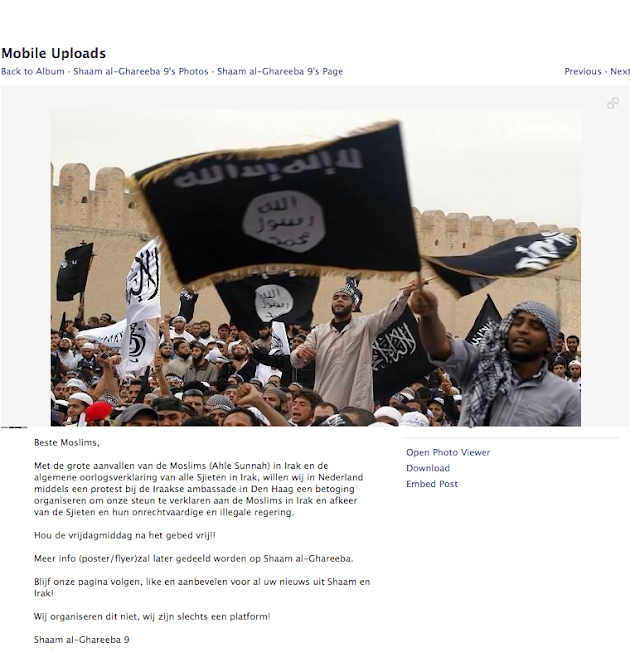
Yesterday there was the international support day for Sunni Muslims in Iraq and, basically, a support day for rebels of ISIS. In the days leading up to this event there was a public outcry about the plan of Dutch ISIS supporters to organize a demonstration in The Hague in support for the Sunni Muslims in Iraq. Given the fact that the idea was announced on a Dutch Facebook site supporting the Dutch foreign fighters in Syria it wasn’t very suprising to see it framed immediately as a pro-ISIS demonstration by Dutch weblog Geenstijl and several opinion leaders and politicians.

Note: I have deleted people’s comments in order to protect their privacy.

My translation of the message:

Dear Muslims,

With the major attacks of the Muslims (Ahle Sunnah) in Iraq and the general declaration of war by all Shiites in Iraq, we want to organize a demonstration in order to declare our support to the Muslims in Irak and our disavowal (afkeer) of Shiites and their unjust and illegal government.

Keep Friday afternoon after prayer free!!

More info (poster/flyer) will be shared on Shaam Al-Ghareeba.

Keep following our page, liking and sharing for all your news from Shaam and Iraq.

We do not organize this, we are only a platform

Shaam al-Ghareeba 9

The Christian Democrats (CDA) and orthodox Christians of the ChristenUnie appealed in parliament to forbid this demonstration which according to them would be possible since the UN has officially categorized ISIS as a terrorist organization. According to minister Timmermans however sympathizing with a terrororganisation does not make a person guilty of terrorist activities and people have the right to demonstrate. The mayor of Den Haag, Van Aartsen (allowing or banning a demonstration is a local decision) stated however that he did not say any legal grounds for banning the demonstration in advance. He also stated that there will be strict conditions among others pertaining to unlawful expressions such as calling for violence and strict surveillance by the police. The embassador of Iraq wanted a ban anyway and stated the demonstration was a provocation for Iraqi’s in the Netherlands and Van Aartsen allowing the demonstration was incomprehensible and it will taint the image of the Netherlands abroad. He also feared clashes between protesters and counter-protesters.

The reactions among Muslims were mixed. Some fully supported the demonstration but many Muslims were angry that people were supporting a ‘terrorist’ organizations. Most reactions I saw however were not so outspoken. People supported ISIS fighting against ‘shiite oppression’ of Sunni Muslims but rejected ISIS’ practices mass executions and their interpretation and implementation of a sharia penal system.

On Wednesday the Dutch website De Ware Religie (the true religion), which functions as a spokesperson for Dutch foreign fighters in Syria, announced the demonstration was cancelled. The victory of ISIS in Mosul and its subsequent showcasing of mass executions appears to given rise to a new sense of urgency among policymakers, politicians and opinion makers to do something against the Dutch foreign fighters and their support base in the Netherlands. Several people did join the online campaigns. Here a short overview and in a few cases I have put some additional info below the example.

There have been a few people asking Muslims to speak out against ISIS and to show where their loyalty is. This is always a dangerous thing as it enhances the us vs. them rhetoric and turns Muslims into terrorists by association or lack of visible disassociation. For the pro ISIS activists these calls are again a sign of the hypocrisy of democrats as they themselves never condemned violence against Sunni Muslims by the Iraqi government.

The calls for public disassociation are part of what I have called the regime of surveillance whereby Muslims are encouraged to enact the accepted and expected models of the Dutch secular liberal citizen. Taken together we can regard the public debates on Islam, the policies regarding Muslims, integration and security politics (often leading to more debate and policies) as a surveillance of the everyday lives of Muslims. The debates about (radical) Islam and the counter-radicalization policies have influenced Muslims’ lives severely. In the Netherlands, several studies have explored how particular debates on Islam trickle down into the daily lives of people in a variety of ways ranging from people’s experiences in schools, workplaces and, of course, their media-consumption at different levels in society.

0 comments.

Anthropology @Amsterdam: Four PhD candidates Muslim Marriages project

Posted on June 14th, 2014 by martijn.
Categories: anthropology, Gender, Kinship & Marriage Issues, Marriage.

Four PhD candidates in Anthropology or closely related discipline

Projectname Muslim Marriages
Hours 38.0 hours per week
Salary € 2083 – € 2664
Education University Graduate
Deadline 1 July 2014

Job description

The AISSR and the Department of Sociology and Anthropology at the University of Amsterdam are looking for PhD candidates who will participate in the ERC-funded research project ‘Problematizing “Muslim Marriages”: Ambiguities and Contestations’, directed by Prof. Dr. Annelies Moors.

This ethnographic project employs the term ‘Muslim marriages’ in a broad sense, as it emerges in public debate and as a form of marriage practice that at least one of the parties concerned considers Islamically valid. It investigates both when and how particular marriage forms have become subject to public debate and what kinds of new (or new uses of old) marriage forms and wedding celebrations are emerging in everyday life. Depending on context, this includes, for instance, unregistered, visiting, temporary, interreligious, transnational, and polygamous marriages. Who are participating in these marriage forms, and how are they performed? Who are able to shape these new forms? How and by whom are such marriages authenticated, authorized or contested as Muslim marriages? Under which conditions do particular forms of Muslim marriages emerge and become licit while other forms become devalued and marginalized? The wider question this project addresses is what economic, political, religious and cultural work these new Muslim marriages do. What subjectivities and socialities do they produce? How do they shape economic relations, group boundaries, religious ethics, and cultural forms? Theoretically, this project intends to contribute to fields such as: Islam, public debate, legal practices, and everyday life; globalization, marriage and reproduction; the family, economy, and intimacy; the body, gender, and sexuality; religion, ethics and aesthetics.

PhD candidates will be based in Amsterdam at the AISSR and will conduct longer term ethnographic fieldwork, preferably in Indonesia, Lebanon, Morocco, the Gulf States and the Balkans. Candidates with strong arguments to do fieldwork elsewhere may also apply.

Tasks

  • Conduct ethnographic field research;
  • Write and complete a PhD dissertation within four years and submit articles to refereed journals or edited volumes;
  • Collaborate with supervisors and peers on research and publications;
  • Participate in conferences, workshops, seminars and other scholarly activities;
  • Participate in the AISSR PhD programme;
  • 10% teaching (contingent upon availability).

Requirements

Phd Candidates should have the following credentials:

  • A completed MA degree in anthropology or closely related discipline (such as Muslim family law);
  • Relevant ethnographic fieldwork experience, ideally in the fieldwork locations and/or related to the research themes;
  • Knowledge of current theoretical and societal debates on ‘Muslim marriages’;
  • Excellent written and spoken English and knowledge of the language(s) needed for fieldwork;
  • Ability and interest to work collegially with the other members of the research team.

Conditions of employment

The full-time appointments will be for a period of four years (12 months plus a further 36 months contingent on a satisfactory performance during the first year), starting 1 September 2014.

The gross monthly salary will be €2,083 in the first year and €2,664 in the fourth year, based on a full-time position of 38 hours per week, plus 8% holiday allowance and 8,3% end-of- year allowance, in conformity with the Collective Labour Agreement of Dutch Universities.

A part-time position may be discussed, but the PhD thesis needs to be completed before 1/9/2018.

Organisation

The Faculty of Social and Behavioural Sciences (FMG) is the largest social-science educational and research institution in the Netherlands. The Faculty serves around 9,000 students in numerous Bachelor’s and Master’s programmes in Political Science, Sociology, Anthropology, Communication Science, Psychology, Social Geography, International Development Studies and Educational Sciences. The academic staff is employed in education as well as research. There are over 1,200 employees at the Faculty, located in a number of buildings in the centre of Amsterdam.

The Department of Sociology and Anthropology is one of the Departments in the FMG. Research and education are carried out by special institutes. Research takes place under the aegis of the Amsterdam Institute for Social Science Research (AISSR), a multidisciplinary research institute, the biggest one of its kind in the Netherlands and possibly in Europe. The broad scope and pluralism of our education and research programmes are inspired by and reflect a strong degree of internationalisation.

Job application

Applications must include, in a single PDF file:

  • A motivation letter (maximum 400 words);
  • A preliminary proposal including research questions, research location, theoretical approaches and methodologies, and most important literature (maximum 1,000 words);
  • A full curriculum vitae;
  • Names and contact details of three references;
  • In a separate PDF file: two writing samples (thesis and/or essay or and/or article) which provide evidence of ethnographic fieldwork experience and ability to theorize.

All correspondence will be in English. Applications must be sent as attachments to application-soca-fmg@uva.nl before 1 July 2014. The subject of the message and the attachment must consist of the text “MUSMAR + applicant’s last name”, the file with the writing samples needs to have ‘sample’ added to the last name.

No agencies please

Additional information

For more information please contact the principal investigator:

For specifics on the Globalizing Culture programme group (institutional location of the project), please visit: aissr.uva.nl/programme-groups/item/globalizing-culture.html

Apply Now!

application-soca-fmg@uva.nl

0 comments.

Integere Antropologie – Congres over antropologie, integriteit en ethiek

Posted on June 11th, 2014 by martijn.
Categories: anthropology, Method.

Dit jaar organisteert de Antropologen Beroepsvereniging op vrijdag 13 juni 2014 een conferentie in het Tropenmuseum in Amsterdam voor antropologen in Nederland.

Centraal tijdens de ABv conferentie staan actuele ethische kwesties. De dag wordt geopend met een lezing van Tobias Kelly, University of Edinburgh. Hij houdt zich bezig met politieke antropologie, rechtsantropologie en zal tijdens zijn lezing ingaan op zijn huidige onderzoek naar de notie van gewetensvrijheid.

Daarna zal tijdens verschillende panels ingegaan worden op vragen als: ‘wat zijn de nieuwe ethische vraagstukken in deze tijd van sociale media?’, ‘hoe gaan onderzoekers om met de eis voor betere verificatie en centrale opslag van onderzoeksgegevens?’

Verder zal er aandacht zijn voor kwesties als samenwerking van antropologen met commerciële partners en de ethische dilemma’s die een antropoloog tegenkomt gedurende onderzoek binnen een gepolitiseerde context.

Kom luisteren en discussiëer mee over antropologie, integriteit en ethiek.

Aanmelden kan via:

secretaris@antropologen.nl

Dit e-mailadres wordt beveiligd tegen spambots. JavaScript dient ingeschakeld te zijn om het te bekijken.

De toegangsprijs voor de dag is inclusief toegang tot het museum, koffie/thee, lunch en de borrel na afloop.

Studentleden: 15 euro
Overige leden: 25 euro

Niet-leden studenten: 30 euro
Overige niet-leden: 45 euro

Vanwege het beperkte aantal plaatsen, is het aan te raden om vooraf te registreren.

Programma Conferentie “Integere Antropologie” – Antropologen.nl

9.00-9.30
Registratie

9.30-9.35
Opening Thijl Sunier (VU)

9.35-10.30
Keynote Tobias Kelly (University of Edinburgh)
The Integrity of Conscience? Commitments, Doubts and Pacifism.

10.30-11.00
Koffie en thee

11.00-12.30
Panel 1 & Panel 2

Panel 1
Wie controleert de antropoloog? (I)

Een gesprek over fraude, integriteit en antropologie.
Hoe wordt er binnen de discipline gedacht over fraude, integriteit en controleerbaarheid?

Voorzitter: Anouk de Koning (Radboud)

Gespreksleider: Rivke Jaffe (UvA)

Sprekers:

  • Janneke Verheijen (Radboud) vertelt waarom ze al haar veldwerkdata online heeft gezet.
  • Sjaak van der Geest (UvA) doet een boekje open over zijn eigen ‘zonden’ om zo de discussie over integriteit binnen antropologie op scherp te zetten.
  • Henk Driessen (Radboud) gaat in op de kwesties informed consent, small talk en de ‘fly on the wall’ positie. Wat voor consequenties heeft dit voor het denken over integriteit in antropologie?
  • Maja Lovrenovic (VU) doet zelf onderzoek in het gebied waar Mart Bax werkte. Zij reflecteert op de implicaties van Mart Bax’ fraude voor antropologie.

Panel 2
Veldwerk, sociale media en ethiek

Facebook, forumdiscussies, weblogs en video’s zijn tegenwoordig een vast onderdeel van antropologisch veldwerk. Deze nieuwe communicatiemiddelen roepen ook nieuwe ethische vragen op over de anonimiteit van respondenten, de relatie tussen onderzoeker en onderzochten en over wat privé en publiek is. In dit panel zullen drie antropologen vanuit de praktijk van hun veldwerk verschillende ethische dilemma’s ter discussie stellen.

Voorzitter: Lenie Brouwer (VU)

Sprekers:

  • Marloes Hamelinck (UU): moslimvrouwen en sociale media op Zanzibar. Hamelinck heeft onderzoek gedaan naar het sociaal media gebruik van moslimvrouwen op Zanzibar en hoe dit gebruik in relatie staat tot morele kwesties. Zij richt zich vooral op de rol van religie in het dagelijks leven en op het gebruik van onder andere Facebook. Zij vraagt zich af hoe je Facebook en online discussies als onderzoeksmateriaal kunt gebruiken. Hoe kun je de anonimiteit van informanten waarborgen? En hoe informeer je informanten?
  • Anke Tonnaer (Radboud): reisweblobgs en toerisme. Tonnaer houdt zich bezig met toerisme en vraagt zich af wat te doen met alle reisblogs die mensen op het web plaatsen. Hoe kun je hier op een ethisch verantwoorde manier mee omgaan?
  • Fridus Steijlen (KITLV): video’s en het dagelijks leven in Indonesië. Steijlen houdt zich al jaren bezig met het filmen van het dagelijks leven op bepaalde plekken in Indonesie. Hij loopt hierbij tegen vragen aan die betrekking hebben op de privacy van de mensen, zowel in het privé als publieke domein. En hoe open en toegankelijk mag en kan het materiaal zijn? Tenslotte, een belangrijk punt van aandacht is dat privacy altijd cultureel bepaald is.

12.30-13.30
Lunch

13.30-15.00
Panel 3 & Panel 4

Panel 3
Wie controleert de antropoloog? (II)
Een gesprek over facultaire richtlijnen en antropologische tactieken.

Wat voor gevolgen hebben diverse integriteitsrichtlijnen en -protocollen voor de verschillende antropologie-afdelingen en hoe gaan antropologen hiermee om?

Voorzitter: Thijl Sunier (VU)

Sprekers:

  • Katrien Klep (Utrecht)
  • Toon van Meijl (Radboud)
  • Overige sprekers worden nog bekend gemaakt.

Panel 4
Veranderend werkveld, nieuwe ethische vragen.

Wat voor ethische kwesties komen naar voren in de nieuwe velden waarin antropologen werkzaam zijn? Wat is, bijvoorbeeld, de ethische manier om samen te werken met mijnbouwbedrijven? En wat voor ethische dilemma’s kom je tegen als organisatieantropoloog?

Voorzitter: Roxane Beumer (Focus)

Sprekers:

  • Sabine Luning (Unversiteit Leiden)
  • Jacqueline Franssens (Culture at Work)
  • Siela Ardjosemito-Jethoe is cultureel antropoloog/sociologisch onderzoeker en docent aan de Haagse Hogeschool en actief met eigen adviesbureau DieVersheid. Vanuit DieVersheid focust zij zich op diversiteitsvraagstukken in de zorg-, welzijn- en educatiesector. Zij gaat in haar presentatie in op haar etnografische onderzoek naar gender in de multiculturele klas van vandaag en vertelt over haar worsteling met haar rol als onderzoeker vs haar rol als docent.
  • Wim Manahutu heeft als directeur van het Moluks Historisch Museum met ethiek en de dilemma’s van (antropologisch) onderzoek en de representatie en zelf-representatie van culturele/etnische groepen te maken gehad.
  • Hij bespreekt hoe de erfgoedsector zich verhoudt tot ontwikkelingen in de maatschappij.

15.00-15.30
Koffie en thee

15.30-17.00
Panel 5 & Panel 6

Panel 5
Politics, ethics and fieldwork.

Welke ethische kwesties kom je tegen als je je als antropoloog met studying-up bezig houdt, of in een politiek mijnenveld begeeft? In dit panel bespreken we de ethische dilemma’s in onderzoek naar Nederlandse salafisten, game farms in Zuidelijk Afrika, en in de relatie met een conservatieve politica in Mexico.

Voorzitter: Anouk de Koning (Radboud)

Sprekers:

  • Martijn de Koning (UvA/Radboud)

Between a game of football and Jihadi Da’wa in the streets of The Hague — The limits of online and offline fieldwork with militant networks.

“In 2012 I started a new research project together with two colleagues. The Public Islamic Mission (PIM) project focused on groups of Muslim militants who affiliated themselves with the ideology of Al Qaeda and, in various ways, showed support for the implementation of sharia laws in the countries where they were based: the Netherlands, Belgium and Germany. In this paper I will concentrate on my research among the Dutch groups and take up three issues: how does a new socio-political context create new strategic and ethical questions? What are the consequences of dealing with groups that many people in society regard as repulsive and dangerous? Where and how to draw the boundaries of participant observation? I will in particular focus on the relation between strategic, ethical and political issues. The paper is based on online and offline fieldwork.”

  • Marja Spierenburg (VU/CERES)

How multi-stakeholder is your multi-stakeholder workshop? Politics and power in stakeholder engagement in research.

“This presentation addresses the assumptions underlying stakeholder engagement in the planning and conducting of research, as well as in the dissemination of research findings. Funding agencies increasingly demand such engagement, assuming that multi-stakeholder platforms are neutral spaces for negotiation about research questions and the translation of research findings in policy-recommendations. Based on experiences with a research programme investigating the social impacts of conversions of farms to private wildlife conservation areas in South Africa, this presentation discusses the promises and pitfalls of stakeholder engagement in research. The presentation focuses on the power relations between the major stakeholders involved – (mainly white) farm owners and managers; farm workers and dwellers; NGOs representing farm dwellers; and government officials – and their differential access to the policy-making arena. The presentation furthermore addresses how these different groups tried to influence both the research questions as well as the outcomes of the research.”

  • Tine Davids (Radboud)

Trying to be a vulnerable observer

“In this article, I seek to further explore my engagements with Mexican female politicians. This encounter with these – in particular right-wing – women has not only led to me having a different understanding of agency, but has also caused me to critically examine the practice of conducting feminist research. Can feminist solidarity be encountered and critical standards met in research on conservative women? What kind of engagement or common ground can be found in this inter-subjective and transnational space, connecting myself as researcher to the Mexican women under study?”

Discussant: Tobias Kelly (University of Edinburgh)

Panel 6
LASSA panel: Ethische dillema’s onder studenten op veldwerk

Studenten komen tijdens hun studie verschillende ethische dilemma’s tegen, met name tijdens het veldwerk. Deze dilemma’s zijn ook nog eens erg divers. Waar ligt de grens tussen informant en vriendschap? Hoe ga ik om met mijn data? In hoeverre pas ik mijn onderzoek aan aan de wensen van de organisatie waarbij ik onderzoek doe? Tijdens het studentenpanel gaan we verder in op dergelijke vragen, die steeds belangrijker worden voor studenten.

Voorzitter: Jelte Verberne (Utrecht)

Sprekers:

  • Renske den Uil (VU)
  • Maartje van der Zedde (UvA)
  • Anne de Jonghe (UU)

17.00-17.15
Afsluiting door Ton Salman (VU)

17.15
Borrel

Kom luisteren en discussieer mee over antropologie, integriteit en ethiek. Aanmelden kan via

secretaris@antropologen.nl

Dit e-mailadres wordt beveiligd tegen spambots. JavaScript dient ingeschakeld te zijn om het te bekijken.

. In verband met de catering verzoeken wij iedereen zich voor 6 juni aan te melden.

De toegangsprijs voor de dag is inclusief toegang tot het museum, koffie/thee, lunch en de borrel na afloop.

  • Studentleden: 15 euro
  • Overige leden: 25 euro
  • Niet-leden studenten: 30 euro
  • Overige niet-leden: 45 euro

Vanwege het beperkte aantal plaatsen, is het aan te raden om vooraf te registreren.


N.B. Het is mogelijk ter plekke lid te worden van het ABv en de ledenprijs te betalen. Lidmaatschap voor studenten is 25 euro, voor anderen 45 euro per jaar. Leden krijgen twee keer per jaar het antropologisch tijdschrift Etnofoor thuisgestuurd.
0 comments.

Syrian women break their silence on rape

Posted on June 10th, 2014 by martijn.
Categories: Gender, Kinship & Marriage Issues, International Terrorism, Society & Politics in the Middle East.

Rape is a weapon of war. Human rights groups and opposition activists say Syrian women held in state prisons are being raped and tortured. Many victims are too afraid to talk. Al Jazeera’s Zeina Khodr met some of the women, who now live in Turkey.

0 comments.

Utopische Vreemdelingen – Onderzoek naar salafisme

Posted on June 6th, 2014 by martijn.
Categories: Important Publications.

Het is al weer enige tijd geleden, maar in 2010 was ik in Utrecht op de universiteit. Studenten aldaar hadden een debat georganiseerd over ‘salafisme in Nederland’ en ik was uitgenodigd om een lezing te geven. Ik was niet alleen. Ook één van de bekendere Nederlandse salafistische predikers was uitgenodigd. Die vertelde onder het genot van een glaasje fris op het einde de volgende anekdote:

‘Ooit vroeg een journalist mij: “Ben je een salafist?” Ik antwoordde: “Nee! Ik ben geen salafist.” Hij zei: “Ben je me nu in de maling aan het nemen?” Ik zei: “Nee, ik weet namelijk dat je een beeld in je hoofd van het salafisme hebt. Dat soort salafist ben ik niet! Ik ben niet de salafist die jij in je hoofd hebt.”

In zijn bijdrage eerder had deze prediker verteld hoe salafisme géén aparte stroming in de islam is, maar de islam uitdraagt zoals deze door de eerste generaties moslims werd gepraktiseerd en hoe deze geldt als voorbeeld en praktische richtlijn voor het leven van alle hedendaagse moslims waar dan ook ter wereld.

Salafisme als onderzoeksveld
Deze anekdote, en de anekdote in de anekdote, laten denk ik goed zien waar het om gaat bij salafisme als religieus en maatschappelijk fenomeen.

Ten eerste staat salafisme in Nederland in ruime mate in de aandacht. Vandaar ook dat studenten van de universiteit belangstelling hadden voor een verhaal van deze prediker en, hoop ik, ook voor het mijne.

Ten tweede heeft het salafisme in politiek, beleid en media een reputatie van een intolerante, gewelddadige stroming die haaks staat op de seculiere en seksuele vrijheden van het Westen. De vraag aan deze prediker kwam vlak na een gewelddadige actie van moslims die tot deze islamitische trend gerekend worden.

Ten derde hebben moslims in het algemeen en ook deze prediker een verwachting van hoe de buitenwereld op hen reageert en daar passen zij hun reactie op aan. Vandaar de, op het eerste oog wellicht, paradoxale reactie van een salafistische prediker die na een bijeenkomst over salafisme de anekdote vertelt waarin tegen hij een journalist die iets wil weten over salafisme zegt dat hij geen salafist is. Er is dus een voortdurende interactie tussen overheid, media en moslims; een interactie die overal anders is en er dus ook voor zorgt dat salafisme in Nederland weer iets anders is dan in Engeland, Egypte of Zuid-Amerika.

Ten vierde heeft het salafisme voor de predikers en ook voor veel gewone gelovigen weer een andere betekenis: namelijk die van de ‘ware’ islam van de beginperiode van de islam.

Ten vijfde hebben wij in ons onderzoek voortdurend te horen gekregen ‘wij zijn de echte salafis’ en anderen zijn extremisten, jihadisten, takfiri, khawarij of wat dan ook. Of ‘salafis zijn de echte moslims’ (zowel door moslims als niet-moslims overigens) en de andere moslims zijn maar halve moslims. Door verschillende groepen, of dit nu beleidsmakers zijn, politici, moslims, islamofobe en andere opinieleiders, de term salafisme wordt ook gebruikt als een manier om zichzelf of juist de Ander aan te wijzen. Op deze manier is de term onderdeel van de politiek van identiteit van mensen.

Dit betekent ook dat de vraag naar wat salafisme is of wie nu een salafist is of wie niet, niet zo vanzelfsprekend en eenduidig te beantwoorden is. We dienen eerst te kijken welk perspectief wij als wetenschappers innemen waarbij we rekening houden met die vijf verschillende dimensies van salafisme die ik net genoemd heb.

Eén van de zaken die daarbij voorop staat is dat wij geen positie innemen in de debatten over wie nu de ware islam volgt en wie niet. Ongetwijfeld zal daar kritiek op zijn van moslimse en niet-moslimse mensen die willen dat we juist wel een positie innemen. Dat heeft niet te maken met het idee dat die mensen niet zouden begrijpen wat wetenschap is zoals van de week in een artikel in Trouw werd gesuggereerd, maar met een andere invalshoek. Als onderzoekers kunnen wij niet bepalen wat de ‘zuivere’ islam is, kunnen wij ook niet klakkeloos de invullingen van islamitische groeperingen of van anti-islam groeperingen overnemen. Evenmin dienen we lichtvaardig de definities van overheden of van groeperingen die het secularisme verdedigen navolgen. Dan zouden we hun interpretatie overnemen en die interpretatie maar ook de onderlinge discussies, vetes en dergelijke moeten juist onderdeel zijn van het onderzoek.

Salafisme als utopische beweging
In het Nijmeegse onderzoeksproject Salafisme als transnationale beweging hebben Joas Wagemakers, Carmen Becker, Roel Meijer en ik vanaf 2007 geprobeerd om samen met professor Harald Motzki en professor Martin van Bruinessen de verschillende dimensies van salafisme in het Midden-Oosten en Europa te onderzoeken waarbij we ook veel besproken hebben met onze collega’s Zoltan Pall (die in Koeweit en Libanon onderzoek deed naar salafisme) en Din Wahid (die in Indonesië onderzoek deed). Het boek Salafisme – Utopische idealen in een weerbarstige praktijk is het resultaat van de onderzoeken van Joas Wagemakers, Carmen Becker en mij. In dit boek benaderen we salafisme als islamitische trend. Wat salafisten tot salafisten maakt, zo stellen we in de inleiding, wordt niet bepaald door de vraag hoe gevaarlijk zij wel of niet zijn. Evenmin wordt dat bepaald door het gegeven dat zij terug zouden willen naar de fundamenten van het geloof en de begintijd van de islam. Veel moslims zien dat als een wenkend perspectief.

Wat salafisten tot salafisten maakt zijn hun ideaalbeelden over hoe die fundamenten en het begin van de islam eruit zien, hun ambities over de hedendaagse implementatie van die ideaalbeelden en hun praktijken om betekenis te geven aan het leven en de wereld om hen heen die gekenmerkt worden door een strikte, letterlijke interpretatie van de Koran en Soenna. Binnen een dergelijk perspectief kunnen we de salafisten beschouwen als utopische beweging. De term utopie, dat zowel ‘geen plaats’ als ‘gelukkige plaats’ als betekenis draagt, kan gezien worden als een verwijzing naar iets dat nastrevenswaardig, wenselijk en mogelijk is, maar dat ook tegen de bestaande situatie in gaat en onhaalbaar is. In zijn Utopia uit 1516 beschreef Sir Thomas More ideaaltypische vormen van sociale organisatie en samenleven waarmee hij enerzijds zijn ambities voor perfecte vormen van samenleven gestalte gaf en anderzijds kritiek gaf op de bestaande samenleving van die tijd. In het geval van salafisten kunnen we stellen dat zij proberen de islam te revitaliseren en reorganiseren op basis van een ideaalbeeld van de eerste drie generaties moslims en een zo strikt, zo gedetailleerd en zo letterlijk mogelijke uitleg van de schriftelijke bronnen van islam. Zo probeert men een leefstijl te ontwikkelen die betrokkenen correcter, rechtvaardiger en bevredigender vinden dan hun huidige leefstijl.

Een utopische transformatie
Thomas More’s Utopia was enerzijds een maatschappijkritiek en anderzijds een ideaal samenlevingsmodel en moreel programma. Dat geldt ook voor het salafisme. Of het nu in het Midden-Oosten is of in Europa, het ideaalbeeld van het salafisme is een kritiek op de huidige samenlevingen die in een morele crisis zouden verkeren. Daarmee is het salafisme recalcitrant of zelfs rebels en omdat men in staat blijkt te zijn mensen te mobiliseren op basis van hun utopie is het ook niet verwonderlijk dat men vaak door overheden en opinieleiders met argusogen wordt bekeken. Zeker wanneer in debatten aan bijna alle militante en gewelddadige acties van moslims het etiket salafisme wordt geplakt (en zeker niet altijd terecht of genuanceerd genoeg), wordt het salafisme al snel hét symbool van de ongewenste islam. Daarbij speelt natuurlijk ook mee dat mensen die zich tot de salafistische lezing van islam bekennen, wel degelijk gewelddaden hebben gepleegd, zich intolerant hebben uitgelaten en verschillende visies hebben voor de correcte rollen van vrouwen en mannen in de samenleving. Juist in samenlevingen die zich voorstaan op tolerantie, gelijke rechten voor vrouwen en mannen en vreedzaam democratisch samenleven kunnen deze groepen voor grote onrust zorgen en zijn ze ook een dankbaar doelwit voor menig politicus.

Zeker voor Europa speelt daarbij een rol dat secularisering grote gevolgen heeft gehad voor de positie van religie. Daarbij zijn er steeds meer mensen die een seculier Europa als norm verdedigen. Secularisering is daarbij niet alleen een beschrijving van een bescheidener wordende rol van het religieuze maar ook een norm die oplegt dat religie in het openbare leven in een afgebakend kader moet blijven. Seculier is op deze wijze ook een identiteit die rust op een ideaalbeeld van tolerantie, vrijheid en gelijkheid die ook aan andersdenkenden, in het bijzonder religieuze mensen, moet worden opgelegd. Net zoals er binnen het christendom en andere religies in de laatste jaren stromingen zijn opgekomen die zich niet zomaar willen neerleggen bij de huidige seculiere status quo, zijn die stromingen er ook binnen islam en salafisme is er daar één van.

Als het gaat om salafisme worden in Nederland vaak de moord op Theo van Gogh door Mohammed Bouyeri aangehaald en het verketteren door predikers van Nederlandse opinieleiders zoals Ayaan Hirsi Ali. Ook allerlei opvattingen over vrouwen en homoseksualiteit komen in die discussies terug. Al wijst een groot deel van de salafisten gewelddadige acties af en stellen sommigen zelfs dat, met name gewelddadige maar ook vreedzame groepen die zich met politiek inlaten, niet tot het salafisme behoren, is er angst voor het geweld dat salafisten zouden kunnen gebruiken. Hun pogingen om te participeren in de samenleving worden gewantrouwd en er bestaat de angst dat salafisten met hun geloofsovertuiging grote druk uitoefenen op anderen, in het bijzonder vrouwen. Het gaat daarbij niet (meer) zozeer om het feit dat er een dreiging van geweld uitgaat van de salafisten, maar om de salafisten als bedreiging voor de normen en waarden van de Nederlandse samenleving, in het bijzonder de vrijheid die bedreigd zou worden door de vermeende af keer (haat) van salafisten tegen het Westen.

In de praktijk echter blijkt dat een groot deel van de salafisten zeer gezagsgetrouw is en niet snel zal protesteren tegen de wereldlijke macht; laat staan met geweld in opstand komen. In die zin is salafisme zelfs redelijk burgerlijk te noemen met een sterke nadruk op studie, werk en gezin. Wel is het duidelijk dat voor individuen het salafisme makkelijk de gedaante aan kan nemen van een oppositionele politiek-religieuze stroming. Of salafisme dan ook daadwerkelijk uitgroeit tot een grotere beweging en hoe die er politiek gezien uitziet, is mede afhankelijk van bijvoorbeeld het beleid van de staten en de infrastructuur en samenstelling van moslimgemeenschappen. De wijze waarop salafistische groeperingen zijn omgegaan met de Arabische opstanden zijn daar een uitstekend voorbeeld van.

Persoonlijke transformatie
Het is echter niet zo dat het salafisme zich alleen ergens tegen keert. Het gaat ook om een programma voor moslims om aan zichzelf te werken als vrome moslims. Dit is misschien nog wel het duidelijkst te zien bij vrouwen. Eén van de meest opvallende kenmerken van het salafisme is de grote nadruk op een scheiding tussen de seksen. Zowel in het debat over islam en salafisme als onder salafisten is de positie van de vrouw sowieso een centraal issue. Aan beide zijden fungeren de vrouw en haar lichaam en opvattingen daarover als een symbolische grens tussen wij en zij. Zoals vaker in dit type religieuze bewegingen wordt het ‘vrije’ gedrag van vrouwen niet alleen gezien als een symptoom van een morele crisis, maar zelfs als één van de oorzaken van die crisis. Er zijn dan ook talloze regels en gedragscodes omtrent seksescheiding, het contact tussen mannen en vrouwen en de bedekking van het lichaam die daarbij hoort. Deze regels dienen overigens niet alleen door vrouwen nageleefd te worden, maar ook door mannen die bijvoorbeeld hun blikken moeten neerslaan.

De toepassing van deze regels is afhankelijk van de plaats waar men zich bevindt (publiek/privé), het specifieke gezelschap (echtgenoot, gezinsleden, vreemden) en de specifieke situatie (gebed, werk, feest). In sommige gevallen gaat het bij de bedekking van lichaamsdelen niet alleen om de buitenkant van het lichaam, maar ook om de stem. Vrouwen worden geacht niet hard te spreken of te zacht of ‘met verleidelijke stem’. In chatrooms willen en mogen vrouwen soms daarom helemaal niet spreken. Niet iedereen houdt zich daaraan overigens, ondanks de talloze verhalen die rondgaan over mannen die misbruik zouden maken van goedgelovige vrouwen. Ook mannen dienen zich te houden aan de strikte regels over scheiding, bedekking en uiterlijk (baard- en haardracht), maar de praktijk is toch dat zij hier makkelijker mee omgaan en dat de consequenties van het overtreden van de regels minder groot zijn. Met name vrouwen die in een sociaal isolement verkeren kunnen het erg zwaar hebben zeker als zij ook de verantwoordelijkheid over kinderen dragen. De vraag is dan hoeveel macht vrouwen in de praktijk hebben om daadwerkelijk tegen ongewenste zaken zoals huiselijk geweld in te gaan, vooral als het gaat om vrouwen met een zwak ondersteunend netwerk en om zaken die zich in de privésfeer afspelen. Juist doordat vrouwen naar het privédomein worden verwezen hebben zij in de praktijk minder macht.

Maar veel vrouwen gebruiken een beroep op islamitische regels ook om zich enigszins los te maken van de tradities van hun ouders, zonder te breken met die ouders. In gevallen waar sprake is van gearrangeerde of gedwongen huwelijken, worden salafistische predikers bijvoorbeeld vaak ingeschakeld om te bemiddelen en ouders erop te wijzen dat hun dochters volgens de islam niet tegen hun wil uitgehuwelijkt zouden mogen worden. In andere gevallen is de verwerping van het gebruik van alcohol en de gereguleerde omgang van mannen en vrouwen, aantrekkelijk voor vrouwen die hun eigen gezins- en familieomstandigheden willen veranderen. Tegelijkertijd schikken zij zich in een regime dat vrouwen vooral een ondersteunende, verzorgende moederrol toekent en waarbij vrouwen beschermd moet worden door mannen. Zij ontlenen hun idee van vrijheid aan het zich onderwerpen aan gedrag- en kledingvoorschriften en meer in het algemeen aan het zich onderwerpen aan Gods wil.

Verenigen van idealen en ambities
Het salafisme wordt daarbij gebruikt als een manier om allerlei idealen en ambities te verenigen: een sterke identiteit als vrouw en moslim, complementair ten opzichte van mannen, vroomheid, vrijheid, moederschap, zekerheid, authenticiteit, het opdoen van kennis, het oprecht en zuiver aanbidden van God en soms maatschappelijk activisme om het negatieve beeld van islam te verbeteren, het recht op vrijheid van godsdienst uit te dragen of op verschillende manieren te strijden tegen onrecht. Het gaat dus, zowel bij mannen als vrouwen, om een mengeling van persoonlijke, maatschappelijke, politieke en religieuze ambities. De mengeling aan motieven en praktijken is te zien als een inspanning om verschillende morele ambities te verenigen en te verwezenlijken binnen een islamitisch ethos door zich te proberen te onderwerpen aan wat men ziet als de wil van God en zo een betere vrouw, betere moslim en, meer in het algemeen, een beter mens te worden.

Internet speelt daarbij een belangrijke rol als manier om kennis te verzamelen, te praten over politieke issues, onzekerheden en uitdagingen in het dagelijks leven en over hoe islamitische voorschriften in de praktijk moeten worden gebracht of hoe de dagelijkse praktijk in overeenstemming met islamitische voorschriften moet worden gebracht. Eén van de populaire verbeeldingen van hoe een goed moslimleven er idealiter uit ziet is dat van de Vreemdeling: iemand die standvastig blijft in het geloof, wel in de wereld is maar niet van de wereld. Dit kan een spirituele, sociale en politieke invulling krijgen zoals we zien bij de populaire nashid met de naam ghuraba (De Vreemdelingen).
You need to a flashplayer enabled browser to view this YouTube video
De nadruk in de religiositeit van veel salafisten ligt op het je inspannen om je zo goed mogelijk te wijden aan God. In die zin is salafisme hard werken: hard werken aan jezelf ontwikkelen als vrome moslim, hard werken aan het verbeteren van je sociale relaties en hard werken aan je relatie met God. Dat leidt soms tot wat wel een salafi burn out genoemd wordt, maar het harde werken is niet per se problematisch. Velen zijn zeer gepassioneerd bezig met hun zoektocht en persoonlijke transformatie en het harde werken is onderdeel van de religiositeit: als alles mee zit wordt je geloof lui en zwak terwijl tegenstand en problemen louterend werken. Hoe dit alles uitwerkt en dus ook [bw] wat salafisme is, is uiteindelijk niet alleen afhankelijk van de persoon zelf of van de religieuze doctrines, maar ook van zijn of haar directe omgeving en de samenleving waarin hij of zij leeft.

Tot zover mijn lezing, maar niet zonder eerst enkele mensen te bedanken. Dat zijn in ieder geval de collega’s van de afdeling Islamstudies aan de Radboud Universiteit met wie we al die tijd zeer prettig hebben samengewerkt en in het bijzonder ook met Roel Meijer en professor Harald Motzki die nauw verbonden waren aan het onderzoeksprogramma. Een bijzonder woord van dank is voor die moslims in Europa en het Midden-Oosten die ons open, vriendelijk en bereidwillig te woord hebben gestaan en met wie we altijd goede contacten hebben opgebouwd. Zonder hun medewerking is onderzoek als dat van ons niet mogelijk en dit boek ook niet. Dank u.

Lezing ter gelegenheid van ‘Salafisme. Ultraorthodoxe islam in Nederland. Wat moeten we ermee?’Discussie met o.a. o.a. Martijn de Koning en Joas Wagemakers. Woensdag 14 mei 2014, 19.30 – 21.30 uur, Huize Heyendael, Radboud Universiteit Nijmegen. Deze lezing en discussie vonden plaats naar aanleiding van de publicatie van het boek Salafisme – Utopische idealen in een weerbarstige praktijk van Joas Wagemakers, Carmen Becker en ondergetekende.

0 comments.

Symposium – Hemelbestormers: Radikaliteit, Religie en Samenleving

Posted on June 2nd, 2014 by martijn.
Categories: (Upcoming) Events.

Hemelbestormers – Radikaliteit, religie en samenleving

Symposium van Religie & Samenleving en Werkgezelschap godsdienst-sociologie en -antropologie

Datum: Vrijdag 6 juni 2014

Lokatie: Auditorium Museum Catharijneconvent Utrecht, Lange Nieuwstraat 38

Inleiding
In een seculiere wereld zullen levensbeschouwing en religie onderworpen zijn aan het primaat van de politiek. Dat zou betekenen dat binnen de grenzen van de democratische rechtsorde aanhangers en organisaties van levensbeschouwing en religie kunnen opereren en hun plek vinden. Dat is de gangbare opvatting. In de huidige maatschappij zijn het echter juist de religies en levensbeschouwingen die de meest uitgesproken critici van het gangbare liberale, kapitalistische en democratische model zijn. Met hun visies op het functioneren van samenleving en politiek, met hun aanhangers en politieke actie vormen ze een serieus te nemen alternatief voor de bestaande structuren. Op dit symposium willen we radicale vormen van levensbeschouwelijke actie en hun invloed op de samenleving presenteren en analyseren.

Programma
10.00 registratie en ontvangst: Voorzitter: dr. Sipco Vellenga
10.30 Opening prof. dr. Marcel Sarot Tilburg School of Catholic Theology
10.35 Inleiding Dr. Sipco Vellenga Werkgezelschap Godsdienst -sociologie en -antropologie

Lezingen:

10.45 DE STRIJD TEGEN DE GEEST VAN DE MODERNITEIT. CONSERVATIEVE REVOLUTIE
Dr. Marin Terpstra Radboud Universiteit Nijmegen

11.30 ALS DAT RADICAAL IS, DAN BEN IK RADICAAL. SALAFI MOSLIMS
Dr. Martijn de Koning Radboud Universiteit Nijmegen/Universiteit van Amsterdam

12.15 pauze, lunch op eigen gelegenheid

Voorzitter: dr. Erik Sengers

14.00 ORTHODOXIE VERBODEN? CONSERVATIEVE KATHOLIEKEN
Dr. Marjet Derks Radboud Universiteit Nijmegen

14.45 DE STILLE REFOLUTIE. BEVINDELIJK GEREFORMEERDEN
Prof. dr. Fred van Lieburg Vrije Universiteit Amsterdam

15.30 WAT HEEFT RELIGIE MET RADICALITEIT?
Prof. dr. Staf Hellemans Tilburg University

15.45 einde/borrel

Entree: € 15 zonder boek/ € 25 euro met boek Aanmelding via dr.sengers[add]hotmail.com (ook voor meer informatie) en door overmaking van de deelnemersbijdrage op NL92SNSB0871023970 t.n.v. D.H. Hak o.v.v. symposium 2014 (abonnees Religie & Samen-leving krijgen boek thuisgestuurd > abonneren via www.religiesamenleving.nl).

Abstracts

Marin Terpstra DE STRIJD TEGEN DE GEEST VAN DE MODERNITEIT
Onderwerp van mijn bijdrage is het (neo)conservatieve denken met als spil Leo Strauss (1899-1973). Deze stroming is verbonden met wat in Duitsland ooit heette: de conservatieve revolutie. Radicaal is deze beweging omdat ze zich fundamenteel keert tegen een belangrijk aspect van de moderne geest: het liberalisme dat uitloopt op nihilisme. Strauss verdedigt die radicaliteit met het argument dat de moderniteit feitelijk wel gewonnen mag hebben, maar dat haar legitimiteit daarmee nog niet is vastgesteld. Zolang de geest van de moderniteit nog niet overtuigend is, loopt deze het risico ten onder te gaan.

Martijn de Koning ALS DAT RADICAAL IS, DAN BEN IK RADICAAL
‘SALAFI’ MOSLIMS EN HET ANTI-RADICALISERINGSBELEID IN NEDERLAND
Na de moord op Theo van Gogh in 2004 werden moslims onderwerp van discussie en beleid met betrekking tot veiligheid en het bewaken van sociale cohesie. Er werd een anti-radicaliseringsbeleid opgezet dat zich vooral richtte op zogenaamde ‘salafi’ moslims. In deze bijdrage zet ik uiteen hoe de Nederlandse ‘salafi’-gemeenschappen zich ontwikkeld hebben en wat hen zo ‘radicaal’ maakt. Daarbij richt ik me op de doctrine en de praktijk van het afwij-zen van wat God haat en het trouw zijn aan datgene wat God lief heeft. De vraag naar de aard van de radicaliteit van deze moslims kan niet beantwoord worden zonder in te gaan in op de vraag waarom de Nederlandse overheid, politici en opinieleiders deze netwerken als radi-caal bestempelen en wat consequenties zijn. Ook het label ‘salafi’ zal daarbij kritisch tegen het licht worden gehouden. Mijn bijdrage is gebaseerd op veldwerk onder Nederlandse salafi netwerken en zal hen belichten vanuit de invalshoek van ‘verzet’.

Marjet Derks ORTHODOXIE VERBODEN? CONSERVATIEVE KATHOLIEKEN EN DE VERANDERINGEN IN DE NEDERLANDSE KERKPROVINCIE IN DE LANGE JAREN ZESTIG
In de marge van de vernieuwingen in de katholieke kerk ontstond een beweging die qua om-vang moeilijk te duiden is, maar die zich regelmatig en krachtig publiekelijk uitte. Hoewel be-staande uit sociaal zeer diverse groeperingen, hadden de aanhangers ervan gemeen dat zij zichzelf als de echte katholieken zagen die vasthielden aan wat zij zagen als de officiële leer van de kerk en loyaal wilden zijn aan de paus. Velen hadden hun leven lang de katholieke zaak gediend, in organisaties, wetenschap of missie. Sommigen waren getekend door oorlog en verzet. Anderen voelden zich bedreigd door de tijdgeest. Allen zagen de vernieuwing in de kerk als verraad aan de kerk en voelden zich door de vernieuwingsgezinde media de mond gesnoerd. Orthodoxie was verboden in de jaren zestig, zo stelden ze. In de geschiedschrijving is deze beweging veronachtzaamd of gestereotypeerd. In deze lezing ga ik in op drie groepen conservatieven, hun achtergronden en beweegredenen, en op het culturele klimaat waarin zij zich verloren voelden.

Fred van Lieburg DE STILLE REFOLUTIE
Refo’s of bevindelijk gereformeerden – de bevolkingsgroep achter de SGP – lijken ietwat dubbelzinnig in hun trouw aan de overheid. Enerzijds zijn ze zeer orangistisch, voeren ze ‘gouvernementele’ oppositie, gedogen ze liberale kabinetten met PVV of PvdA, leveren ze goede bestuurders en ambtenaren en voegen zij zich met hun theocratische idealen moeite-loos in het democratisch bestel. Anderzijds zijn zij trots op hun Nacht van Kersten, voelen zij wel wat voor Wilders, verlangen zij uitzonderingsmaatregelen wegens gewetensbezwaren tegen allerlei wetten en gewoonten, lappen ze visquota aan hun laars, kunnen zij hevig in ver-zet komen en zijn hun dorpen op nieuwjaarsdag een ravage. Valt er historische orde te scheppen in dit verwarrende plaatje? Zijn er verschuivingen gaande? (zie ook www.dutchbiblebelt.org)

Staf Hellemans WAT HEEFT RELIGIE MET RADICALITEIT?
Religies hebben iets met radicaliteit. Daarvan zijn voorbeelden te geven: christelijke martela-ren, religieuzen en missionarissen, godsdienstoorlogen, strenge meditatie- en ascesepraktij-ken, radicale dienstbaarheid. Hoe komt dat? En komt daaraan in het Westen een einde?

0 comments.

Photo Essay: Run-up to Egyptian Presidential "elections", Cairo, Egypt

Posted on May 31st, 2014 by martijn.
Categories: Society & Politics in the Middle East.

This week, (May 26-27), the Egyptian presidential “elections” took place. The photo essay in this album gives you a visual impression of the pre-election run-up in Cairo in the week before the “elections”.

The only credible candidate is former Commander-in-Chief of the Egyptian armed forces Abdel Fattah Al-Sisi. Sisi announced his candidacy in March of this year, changing his military uniform for civilian clothes for the first time in 40 years.

Running against Sisi is Hamdeen Sabahi. He is a controversial socialist/Nasserist politician. Some say he is a serious contender (he came 3rd in the 2012 presidential elections with 21% of the vote), others say him running only serves to legitimise Sisi getting “elected” next week.

Sisi, when still commander-in-chief of the army, played a leading role in ousting then-president Mohamed Morsi in June 2013. Sisi is popular among those in Egypt whose main desire is stability after years of insecurity. They view Sisi as someone who can protect Egypt’s dignity, improve the country’s dire economic situation, and is an observant Muslim.

However, opposition against Sisi and the military rule remains from various sides in society, such as those who remain sided with the aims of the January 25 revolution, and the Muslim Brotherhood (MB). While the former see Sisi as a threat to the soul of the revolution, the MB see in Sisi the mastermind of a coup against the elected MB president Mohamed Morsi and the leader of a crackdown against MB members, of which leaders and members have been imprisoned, many facing death sentences. The current regime labels the MB and its members “terrorists”. The MB have decided to boycott the vote.

Not only the MB is targeted. For example, the “April 6 Youth Movement”, one of the main groups that called for protests before the 25 January 2011 revolution, was recently banned by a Cairo Court for “espionage” and “activities that distort Egypt’s image”.

Sisi is widely expected to capitalise on the military rule’s politics of fear and gain a landslide victory – just as in the polls abroad, which have already closed.

For a video caricature of what some believe Sisi’s presidency will look like, watch this YouTube clip (with English subtitles)
You need to a flashplayer enabled browser to view this YouTube video

Annemarie van Geel is a NISIS PhD candidate at the Faculty of Religious Studies, Radboud University Nijmegen. The title of her research project is: Women-Only Public Spaces on the Arabian Peninsula: Comparing Discourses on Gender, Islam, and Modernity in Saudi Arabia and Kuwait. She is also founder and owner of Faraasha – Middle East Training & Advisory.

0 comments.

Photo Essay: Run-up to Egyptian Presidential “elections”, Cairo, Egypt

Posted on May 31st, 2014 by martijn.
Categories: Society & Politics in the Middle East.

This week, (May 26-27), the Egyptian presidential “elections” took place. The photo essay in this album gives you a visual impression of the pre-election run-up in Cairo in the week before the “elections”.

The only credible candidate is former Commander-in-Chief of the Egyptian armed forces Abdel Fattah Al-Sisi. Sisi announced his candidacy in March of this year, changing his military uniform for civilian clothes for the first time in 40 years.

Running against Sisi is Hamdeen Sabahi. He is a controversial socialist/Nasserist politician. Some say he is a serious contender (he came 3rd in the 2012 presidential elections with 21% of the vote), others say him running only serves to legitimise Sisi getting “elected” next week.

Sisi, when still commander-in-chief of the army, played a leading role in ousting then-president Mohamed Morsi in June 2013. Sisi is popular among those in Egypt whose main desire is stability after years of insecurity. They view Sisi as someone who can protect Egypt’s dignity, improve the country’s dire economic situation, and is an observant Muslim.

However, opposition against Sisi and the military rule remains from various sides in society, such as those who remain sided with the aims of the January 25 revolution, and the Muslim Brotherhood (MB). While the former see Sisi as a threat to the soul of the revolution, the MB see in Sisi the mastermind of a coup against the elected MB president Mohamed Morsi and the leader of a crackdown against MB members, of which leaders and members have been imprisoned, many facing death sentences. The current regime labels the MB and its members “terrorists”. The MB have decided to boycott the vote.

Not only the MB is targeted. For example, the “April 6 Youth Movement”, one of the main groups that called for protests before the 25 January 2011 revolution, was recently banned by a Cairo Court for “espionage” and “activities that distort Egypt’s image”.

Sisi is widely expected to capitalise on the military rule’s politics of fear and gain a landslide victory – just as in the polls abroad, which have already closed.

For a video caricature of what some believe Sisi’s presidency will look like, watch this YouTube clip (with English subtitles)
You need to a flashplayer enabled browser to view this YouTube video

Annemarie van Geel is a NISIS PhD candidate at the Faculty of Religious Studies, Radboud University Nijmegen. The title of her research project is: Women-Only Public Spaces on the Arabian Peninsula: Comparing Discourses on Gender, Islam, and Modernity in Saudi Arabia and Kuwait. She is also founder and owner of Faraasha – Middle East Training & Advisory.

0 comments.

Islamofobie – Het verhaal van een Nederlandse moeder en zakenvrouw

Posted on May 24th, 2014 by martijn.
Categories: islamophobia.

Af en toe heb ik het idee dat er een soort gewenning optreedt onder moslims met betrekking tot islamofobie en andere vormen van agressie. ‘Zo is het nu eenmaal’, ‘Ja, dat weet je sinds 9/11 en Theo van Gogh’, ‘Ja, maar dat is toch niks bijzonders? Het gebeurt zo vaak.’ De kunst van het niet-opmerken of het niet-problematiseren is een manier om door te gaan met het leven van alledag. Het laat ook zien hoe racisme en discriminatie werken: het is een vorm van het onderwerpen van mensen door ze voortdurend te vernederen en als men reageert is niet degene met de uitlating fout (want vrijheid van meningsuiting), maar degene die stappen onderneemt (zie de commentaren tegen de aangifte tegen Wilders).

Dergelijke opmerkingen zijn mede het resultaat van het gegeven dat moslims voortdurend onder het vergrootglas liggen: hun manier van kleden, hun geloofsvoorstellingen, hun manier van leven, enzovoorts. Alles wordt verbijzonderd of het nu positief of negatief is en eerlijk is eerlijk in een dergelijk klimaat draagt ook onderzoek (zoals dat van mij) daaraan bij. Het wordt echt problematisch wanneer die verbijzondering geschiedt door een hiërarchie aan te brengen tussen het Westen (Nederlands) enerzijds en de islam anderzijds. Wanneer die hiërarchie er is in relatie tot het denken en spreken over islam en vervolgens in reactie op moslims kunnen we spreken van islamofobie. Inderdaad, ik beschouw islamofobie als een vorm van racisme.

Crisis & Islamofobie
We zien dat het beste terug in die gevallen waarin mensen normaal gesproken een specifiek fenomeen positief zouden opvatten. Stel je het volgende voor. Er is een economische crisis en die treft iedereen. In die economische crisis is iemand zo koppig om een eigen bedrijf, een webshop, op te richten. Geen sinecure op het moment dat mensen de broekriem moeten aanhalen en in een onzekere situatie verkeren. Maar nee, hier is iemand die de hand niet ophoudt, niet bij de pakken gaat neerzitten en zelf initiatief neemt en eigenlijk de onzekerheid opzoekt. Dat is dapper zou je zeggen en uitstekend voor de economie; we zouden willen dat we meer van zulke initiatieven hadden. Als integratie een issue zou zijn, zouden we het kunnen zien als een vorm van integratie op eigen kracht en in het geval van een vrouw kan ze zo aansluiten bij de zakenvrouw van het jaar. En in ieder geval is het ook een voorbeeld van de participatiemaatschappij.

Behalve dus als het om islam en moslims gaat. Dat maakte Khadija mee. Zij is oprichter en eigenaresse van Islamitisch Speelgoed: een webshop die zich richt op speelgoed dat, zoals zij het zegt:

ondersteuning biedt bij het overbrengen van islamitische waarden. Toen ik op zoek was naar een leuke pop voor mijn dochter, kwam ik de ene Barbie na de andere Barbie tegen met decolleté truitjes en korte rokjes. Dit is niet het beeld dat ik mijn dochter mee wil geven. Ik breng speelgoed op de markt dat ondersteuning biedt bij het overbrengen van islamitische waarden. Een Barbiepop met een blote buik hoort daar niet bij.

Natuurlijk zullen er moslims en anderen zijn die daar anders over denken, maar dat is natuurlijk geen issue. Het staat Khadija vrij om een eigen markt te exploiteren en te scheppen. Wanneer we de webshop bekijken zien we een vrolijke webshop waarbij sommige items verwijzen naar een invulling van islam waarbij vrouwen gesluierd dienen te zijn, sommige poppen met en andere zonder gezicht, maar ook allerlei educatieve en vrolijke alfabetspellen en de typische indeling in jongens- en meisjesspeelgoed door middel van de kleuren blauw en roze die we op vrijwel alle (ook niet-islamitische) speelgoedsites aantreffen.

Islamofobiestijl
Maar het is precies het islamitische karakter van de site dat Annabel Nanninga ertoe dreef een stukje te bakken op Geenstijl:

Screenshot van het stukje op GS. We gaan natuurlijk niet linken.


In het stukje grossiert Annabel Nanninga met allerlei niet al te subtiele verwijzingen naar bekende stereotypes over islam. Zoals dat dan meestal gaat naar aanleiding van een stukje op Geenstijl, is dat het doelwit van de ridiculisering een hoop verkeer op de site te verwerken krijgt (zodat ie plat gaat) en een hoop haatcommentaren en dreigementen binnenkrijgt via mail, gastenboek en facebook. Dat weten ze bij Geenstijl ook wel, maar dat is geen reden om het niet te doen. Integendeel, commotie is de kurk waar de site op drijft. In het verleden werd de site groot door naaktfoto’s van minderjarigen te plaatsen en enkele jaren geleden wist Geenstijl zelfs de minderjarige dochter van toenmalig minister Rouvoet te kakken te zetten op hun site. Alleen omdat zij het niet met haar vader eens waren. Tegenwoordig is de islam een bezoekerslokker. Veel wellevendheid en empathie hoeft dus niet verwacht te worden en of het nu om minderjarige meisjes gaat of om islam en bekeerde vrouwen en hun kinderen: als het geld oplevert kan het.

Niet uniek, wel erger
Hoewel het niet de eerste keer is dat Khadija te maken heeft met een negatieve bejegening, was het nog niet zo erg als nu.

Als bekeerling heb ik natuurlijk al wel vaker vervelende opmerkingen gekregen.Ik ben overduidelijk Nederlandse en draag een hoofddoek. Dit valt uiteraard op. De opmerkingen waren echter niet zo erg als de emails die ik nu ontvangen heb. Ik merk dat op straat het vooral oudere mensen zijn die me aankijken alsof ik op dat moment een mes ga trekken. Een keer in een supermarkt zei een oud vrouwtje dat ik ‘toch wel aardig’ ben, nadat ik iets voor haar iets van een bovenste plank had gepakt. Voordat ik aan haar vroeg of ik haar kon helpen, stond ze me erg angstig aan te kijken.

De reacties die ze kreeg waren niet mis, maar ze wil er niet teveel aandacht aan geven.

Ik heb besloten de negatieve reacties niet letterlijk te herhalen. Ik wil de personen die mijn kinderen en mijzelf de meest afschuwelijke ziektes toewensen en bedreigen niet nog een podium geven. De positieve reacties hadden veelal dezelfde boodschap. Laat je niet op je kop zitten, je bent goed bezig, we zijn blij dat je webshop er is en ga zo door. Er was een reactie waar ik hartelijk om gelachen heb: “Laat je niet gek maken lieve zus, dit soort personen staan vanmiddag weer gewoon bij de plaatselijke shoarmatent hun broodje döner te bestellen en over twee maanden reizen ze allemaal weer schijnheilig richting de zon in Turkije, Egypte, enzovoorts.

Wel heeft ze getwijfeld om aangifte te doen bij de politie. Opvallend is dat het melden bij het Meldpunt discriminatie of bij een meldpunt voor islamofobie niet bij haar is opgekomen. Die meldpunten hebben toch nog wel wat werk te verrichten hoewel hun werk ook door recente bezuinigingen in feite onmogelijk is gemaakt.

Omdat ik flinke dreigmails kreeg, heb ik wel even contact opgenomen met de politie. Zij adviseerden mij even de komende dagen af te wachten en daarna te kijken wat het beste zou zijn, aangifte doen of er alleen een melding van maken. Aangezien de negatieve reacties na het weekend weer voorbij waren heb ik besloten om het alleen bij de melding te houden. Meldpunten voor racisme, discriminatie of islamofobie, heb ik eigenlijk helemaal niet aan gedacht. Misschien dat ik hier nog wel even in duik.

Een opvallende reactie van de politie ook aangezien het in de haatmails niet alleen gaat om dreigementen, maar ook om racisme en dat is toch nog steeds strafbaar. Niet teveel aandacht geven aan islamofobie is een manier om ermee om te gaan en te laten zien dat je ‘je niet op de kop laat zitten.’ Het is echter de vraag of dat werkt en of ze ook niet de confrontatie moet aangaan. Gezien de bedreigingen echter is het voor haar veiligheid en die van haar kinderen misschien wel verstandig. Daarbij concentreert zij zich vooral op haar werk en de combinatie ervan met haar islamitische overtuiging. Khadija is niet van plan om bij de pakken neer te zitten. Ze gaat gewoon door met de webshop en hoopt deze uit te breiden:

Natuurlijk hoop ik de webshop uit te breiden met nieuwe producten. Wat mij betreft staat kwaliteit echter boven de grootte van het aanbod. Mijn droom is om eigen islamitisch speelgoed te gaan produceren. Zit boordevol ideeën waarvan ik hoop dat ik ze kan gaan uitvoeren.

Vroomheid, moederschap en zakenvrouw
De manier waarop Khadija zich presenteert is die van een vrouw die probeert een vrome moslim te zijn, als een moeder die probeert voor haar gezin te zorgen en als zakenvrouw die probeert een eigen shop met klantenkring op te bouwen. Een voorbeeld voor haar is de eerste vrouw van de Profeet Mohammed, Khadija.

Ik heb mijn islamitische naam ‘Khadija’ van mijn man gekregen toen wij getrouwd zijn. Hij is, net als ik, trots op de intelligente, onafhankelijke, maar ook lieve en zorgzame vrouw die Khadija was. Naast een succesvolle zakenvrouw is ze ook dé persoon die de profeet meteen geloofde toen hij de eerste openbaringen kreeg en stond hem bij in de vroege uitnodiging tot de islam. Zij was de eerste vrouw die tot de islam toetrad. Dat vind ik heel bijzonder! In de boeken die ik gelezen heb wordt Khadija beschreven als een eerlijke zakenvrouw die vastberaden en standvastig haar zaken deed. Ze is hierin een groot voorbeeld voor mij. Vastberaden ben ik in ieder geval. Vastberaden om mijn islamitisch speelgoedavontuur tot een succes te maken!


Het is altijd moeilijk aan te geven hoe moslims nou zouden moeten omgaan met islamofobie, al is het maar omdat je het doelwit van islamofobie nu eenmaal niet verantwoordelijk kunt stellen voor het gedrag van anderen.

De ‘pratende’ Arabische vormenpuzzel is het best verkochte item.


Islamofobie raakt iedereen
Islamofobie is geen zaak die moslims alleen aan gaat, iets waar Khadija ook op wijst:

Ik denk niet dat het aan mij is om een boodschap te geven aan het publiek. Het gaat hier om normaal algemeen geaccepteerde normen. Hoe je met elkaar omgaat als persoon. Het enige dat ik wil zeggen is: ga met een ander om zoals je wilt dat zij met jou omgaan.
Ik heb mijn moeder na mijn bekering een boekje gegeven wat de basisprincipes van de Islam uitlegt. Na het lezen vertelde ze mij dat wat ze in het boek las prachtig was, maar dat ze dit helaas niet in de ‘echte’ wereld ziet. In de media zie je alleen zeer negatieve en schokkende berichten over de islam. Allemaal wandaden gepleegd in naam van de islam. Dit heeft echter helemaal niets te maken met de islam. Het is juist een zeer vredelievende godsdienst. De media zouden er goed aan doen om eens normale islamitische gezinnen te laten zien die hard werken en proberen hun kinderen goed op te voeden. De moslimgemeenschap zou op haar beurt meer moeite kunnen doen om uit te leggen dat de negatieve berichten in de media niets te maken hebben met de echte islam.

Ik ben over dat laatste idee, dat ik veel hoor in gesprekken met moslims, wat sceptisch. Natuurlijk, bepaalde acties van moslims dragen niet bij aan een positief (lees niet-politiek) imago van islam, maar dat is in dit voorbeeld nog geen reden om een onderneemster lastig te vallen en zodanig te ridiculiseren dat je weet dat ze het doelwit wordt van agressieve islamofobische reacties. Sterker nog het is individuele moslims verantwoordelijk stellen voor de daden van anderen en voor reacties van weer anderen daarop; iets waar men geen controle en zeggenschap over heeft. Ik heb daarbij het idee dat moslims al voortdurend proberen uit te leggen dat bepaalde daden van andere moslims zich slecht verenigen met hun opvatting van islam, maar daar is Khadija het niet helemaal mee eens:

Ik vraag me eigenlijk wel af of dit gebeurt. Ik zie bijvoorbeeld op dit moment geen vooraanstaand islamitisch persoon die de wereld duidelijk maakt dat het feit dat terreurgroep Boko Haram 200 onschuldige meisjes ontvoert totaal niets met de Islam te maken heeft. Het enige wat we op tv zien, en wat mensen dus geloven, is dat alle meisjes islamitische kleding dragen en surah’s uit de Koran moeten opzeggen. En dit alles in naam van Allah. Ik denk overigens niet dat deze wereldproblematiek door de eigenaar van een speelgoedwebshop in Nederland opgelost kant worden

Inderdaad, problematiek als islamofobie kan niet door een speelgoedwebshop worden opgelost. Toch moeten moslims volgens mij ook niet al teveel van de overheid verwachten. Weliswaar heeft minister Asscher eerder aangegeven dat islamofobie geen marginaal probleem is, maar als we het discriminatiedebat van gisteren bekijken dan blijkt dat het bestrijden van discriminatie en racisme geen prioriteit heeft. Het MDI is wegbezuinigd, er is gelukkig wel wat aandacht voor anti-semitisme, maar niet voor racisme, homofobie en islamofobie en minister Asscher blonk vooral uit door zaken als discriminatie in het onderwijs en etnisch profileren door te verwijzen naar zijn collega’s. Er komt wel een onderzoek naar discriminatie en racisme maar dat gaat alleen over anti-semitisme in relatie tot islam (onderzoek dat er allang is overigens) en discriminatie op de arbeidsmarkt zal pas in 2016 aangepakt worden. Dat het overheidsbeleid zelf niet alleen een uiting is van racisme en discriminatie (bijvoorbeeld in het geval integratie, vluchtelingen en islam) komt al helemaal niet ter sprake.

Ik vind het altijd opvallend dat Nederlandse moslims in Engeland mij vertellen dat ze zich daar meer geaccepteerd voelen. Terwijl in Engeland racisme toch een wat hardere en veel openlijkere gewelddadige geschiedenis heeft dan in Nederland. Tegelijkertijd is de wetgeving tegen racisme weliswaar niet perfect, maar wel zo goed dat mensen zich er toch redelijk beschermd voelen tegen alledaagse en gewelddadige vormen van racisme en discriminatie. Dat is in Nederland klaarblijkelijk toch minder het geval: islamofobie en discriminatie zijn winstgevend geworden.

1 comment.

The Pursuit of Happiness – Happy Muslims, Creativity and Political Agency

Posted on May 18th, 2014 by martijn.
Categories: Activism, islamophobia, Notes from the Field, Religious and Political Radicalization, Society & Politics in the Middle East.

A few weeks ago The Honest Policy launched a ‘Happy Muslims’ version of Pharrell Williams’ feel-good ‘Happy’.
You need to a flashplayer enabled browser to view this YouTube video
By now it has been followed by several other initiatives such as a German video:
You need to a flashplayer enabled browser to view this YouTube video
One from Egypt:
You need to a flashplayer enabled browser to view this YouTube video
One from Chicago, US:
You need to a flashplayer enabled browser to view this YouTube video
One from Abu Dhabi:
You need to a flashplayer enabled browser to view this YouTube video
And one from the Netherlands:
You need to a flashplayer enabled browser to view this YouTube video

And several others, just check Youtube. In that list you will see several critical responses to it as well. We can distinguish at least four types of criticism that I’ve seen in regard to the UK and Dutch versions (I haven’t checked the debates in other cases):

Defining Humanity

Much of the critique was about Muslims who are giving in to ‘Western’ ideas of the good Muslim: someone who shows his/hers allegiance to the country they live in. What gets included in the category of the good Muslim is central to the reproduction of dichotomies between humanity/creativity/happiness in relation to the West on the one hand, and fundamentalism/ terrorism/inhumanity/angriness in relation to Islam on the other. The next comment is exemplary for this type of critique:

Happy Muslims: Performing “Happiness” and “Normalcy” | Muslim Reverie

With regard to the “Happy Muslims” videos, the critiques are again about how Muslims perform “happiness” for the white gaze to be seen as “normal” (“normal” meaning “just like every other British/American/Canadian person” and being seen as nonthreatening to white supremacy). An article on OnIslam.net, which wrote in defense of the video, concluded with a sentence stating that 83% of Muslims are “proud to be a British citizen.” To counter stereotypes, the message seems to always be: “We deserve equal rights and dignity because we’re proud British/American/Canadian/Australian, etc. citizens,” instead of “We deserve equal rights and dignity because we’re human beings.” It’s as if the only way to be respected and accepted in society is to show white non-Muslims that we are not only “happy” in their white supremacist nations, but also how we are “the Good Muslims,” or “proud citizens just like them.” Subsequently, this works to distinguish us from the Muslims “over there,” i.e. the Muslims who aren’t citizens of the West and characterized as being “backwards,” “uncivilized,” “unintelligent,” etc. (and as if their lack of citizenship makes them less human or their deaths less outrageous).

Internalized racism

Related to the first and building upon it is that Muslims through these videos are internalizing the stereotypes that are imposed on them. A critique that is very much related to analysis of racism, orientalism and Islamophobia in the sense that is pretty much how racism works: it gets internalized by the ones who are targeted by it:
I ain’t happy | Escape The Cage

How can we claim to actively fight the stereotypes that plague Western perceptions of Muslims if we operate under the veneer of those very prejudices? What the video very evidently does is it seeks to humanise Muslims by implicitly submitting to orientalist accounts. Why do we continually insist on trying to prove our humanity and normality through such nonsensical antics? And just for the record, I don’t take issue with the dancing or the music, although I know some elements of the Muslim community will. To be clear, I am taking issue with a very specific point, the underlying message that is being bulldozed through this video: “Hey Britain, check us out, we’re not all suicide-bombers. Some of us are even in touch with chart music. And look, we can even crack a smile when we’re happy”. We never play by our rules, we only seem to be efficient when reacting to standards imposed upon us. That’s not smart. The worst “Other-ing” is that which one imposes upon oneself. Self-enslavement, unknowingly absorbed, is the most dangerous form of bondage. Failing to understand that by the very act of attempting to defy dehumanising stereotypes, we have (in)conveniently bought into the status quo’s sophisticated trickery, and have done an unprecedented disservice to ourselves and to our heritage. The result is, to put it bluntly, amateurish and we frankly do not have the right to complain about negative portrayals of Muslims by Western discourse-setters if we have chosen to submit ourselves to such narratives.

Misogyny

A third category of critique pertains to tapping into pop culture and the figure of Pharrell who has featured in rather misogynist pop videos before. In this sense the Muslims in the video trade in the stereotypes of the angry Muslim for the misogynist imagination of pop culture.
‘Happy British Muslims’ sparks unhappiness

Bopping to substandard R&B tracks is a thing many self-respecting folk (whether Muslim or not) might confess to with sheepish embarrassment. That stuff’s catchy, no one’s denying it. But to gloat about it under the banner of a marginalised religious community gives the impression of trying to compensate for something.

The issue I want to raise is, why buy into an aspect of pop culture that sends a message of brainless conformity, as opposed to positive contribution?

I use the term “brainless” deliberately because of what Pharrell has been associated with. I refer to his feature in Robin Thicke’s controversial single “You know you want it” which was banned in 20 student unions across the UK for its “rape-promoting content”.[ii] The same Pharrell who also produced the song’s video featuring Robin, rapper TI and himself alongside a handful of near-nude models being generally demeaned.

Anti-islamic slavery

The conservative critique focuses on the issues of happiness and the role of women in the video. The latter are regarded as dancing provocatively in the video and some see the line ‘happiness is the truth’ as a secular message that opposes Islam as the truth.
My thoughts on #HappyMuslims video | Islam21c

The image which came to mind after a few moments was of slave masters watching their slave girls/boys amuse, dance and entertain them as they twirl their moustaches happily. Yes this is a metaphor and our brothers and sisters are not slave girls, but what is worse is when a Muslim makes that conscious decision that what they have from their Deen and their values just isn’t “good enough” and thus “let’s use the medium of popular culture instead regardless of whether it fits an Islamic ethos or not”. This is of course the real slavery. The slavery of the mind. The music etc wasn’t so depressing for me; it was watching a people fall even more into subservience.

– Any women who claim that females dancing is not provocative or sexual, is either naïve or just plain miskeen. And any man whom claims the same, is, well, lying. Ladies, you could dance like Peter Crouch and men would find that sexual! Men don’t think like you. You lift an elbow out and just wiggle your head forget about anything else and you just provocation-ed off the provocation-meter. You want to do that, keep it for your fella’s eyes only please.

– It’s amazing just how strong that feeling of inferiority amongst liberal and secular Muslims is. That is definitely the major concern here, not the music or dancing. Folks used to call it a inferiority complex. That’s outdated now. We need to call it an “inferiority crisis”.

These different categories are not exclusive and in fact are very much related to each other: they all pertain to how to resist particular oppositions, imaginaries and stereotypes that are imposed on Muslims? The producers and the people who participate in the video are criticized for tapping into and reproducing those imaginaries in different ways.

Happiness as political

My first reaction about the UK video and after the Dutch networks announced their video was in line with much of the critique I have highlighted here. And as one of my interlocutors stated on my Facebook page why should Muslims be happy when in the Netherlands they are submitted to all kinds of racist statements, when there is a terrible war in Syria and when in Burma Rohingya Muslims are persecuted? Why shouldn’t we be angry then? In fact we should be angry now and this video is depoliticizing the whole Muslim issue making our grievances invisible. After some thinking I still agree with these critiques but I have also a few doubts in particular because it ignores an important part of the message of all the different videos: escaping social pressures, happiness, fun, and the diversity among Muslims themselves. As the Honesty Policy stated they wanted to “rethink the rulebook of religious expression”, for a community which is “eclectic, creative and competent”.

As such the fun and happiness displayed in the Happy Muslim meme is of course highly political. It shows a group of Muslims performing a capacity to stop noticing the negative social imaginaries and miseries of the world while at the same time attempting to tame of violence of the racist impositions and the frustrations of feeling powerless against the injustice in the world.

It is I think a mode of double resistance. First of all it is a protest against the imposition of the social imaginary of the angry Muslim basically reducing all Muslims to violent, intolerant and uncreative robots. Second it indicates an area where Muslims, against all odds, are themselves in a way participants experience as ‘finally something fun and positive’ and in a way that challenges the idea that all Muslims are the same by showing their diversity. Also it indicates an attempt to make themselves visible. Although Muslims often disappear as unique individuals in the debates as they are often seen seen as representatives or examples of this and that, the videos state ‘here we are as Muslims and we are all different and unique’. Of course that is also tapping into a cultural development that highly privileges authenticity and individualism (with all its down sides) but it is still a type of resistance anyway.

Silencing the alternative?

Of course, this is a bit speculative since I would need to know more about the motives of the makers and participants and so far I have only seen their facebook postings. I’m engaging in it anyway because I’m wondering if the four categories of criticism I listed here do not fall into a similar trap as the people of the videos are accused of: reproducing the divide between us and them and between the West and Islam. Moreover the criticism appears to make a plea for a type of resistance that is completely separate and not informed by the stereotypes and imaginaries imposed upon Muslims and I wonder if that is possible at all.

It seems as if we think that if people are using happiness, fun and diversity as their main message, we are saying by definition now you are succumbing to Western standards instead of being yourself or being Islamic? But surely there are more repertoires of a good life than Western, Islamic or being yourself? We make highly detailed analysis of how Muslims are trying to create a feeling of belonging to other Muslims or ethnic groups, but we criticize them when they perform their search for belonging to the Netherlands and we see that as being submissive to the negative social imaginaries and Islamophobic policies? What does that say about our own analysis? Is it based upon only two distinct and non-related categories of oppression and opposition against oppression? Why not a different reading as well? Why not the reading, hey here we have a bunch of Muslims and against all odds, against you saying we are all the same and against you trying to exclude us from the important debates and policies, here we are, we are all the same and different at the same time and no matter how violent your policies are, you cannot touch us, we are still happy?

Furthermore I wonder if these critiques do not ignore the idea that governmentality and resistance are always highly related and mutually constitutive. It is precisely through those government policies which are devised to manage integration and radicalization, that Muslims are objectified as governable targets and where the subjectivation of Muslims – as Muslims – occurs but it is also that which creates, informs and shapes the potential for resistance. This means yes resistance is always highly informed by the same social imaginaries it tries to resist and in this case highly informed by the same orientalisms, sexisms and pop culture shallowness it actually tries to resist.

But at the same time happiness, fun, and creativity are all located within wider alternative national and religious geographical imaginaries and as such constitute a critique of social and political injustice, and demands for a more just, satisfying and equitable future. The enactment of happy Muslims within a context of people telling them how to behave, religious conservatism, racism and war can therefore be seen as a political demand for humanity itself and drawing a space where they are left alone by outside pressures. While the above mentioned critique may be warranted (and I think it is) it may also amount to silencing those Muslims who engage in a type of activism which may not have a determinate political effect or one that we have a hard time recognizing and acknowledging.

Of course these comments mainly pertain to Happy Muslims as a transnational phenomenon. Which political effect they exactly create or what type of political agency we are witnessing here is of course for  determined by the concrete local political context as well, making Happy Muslims from the Netherlands partly different from Happy Muslims from Gaza:

You need to a flashplayer enabled browser to view this YouTube video

See also at Allegra Lab: To Be #HAPPY Muslim Or Not To Be – #ANTHROISLAM By Raana Bokhari

0 comments.

Documentary: Return to Homs

Posted on May 11th, 2014 by martijn.
Categories: Arts & culture, Society & Politics in the Middle East.

How do you get from being a pacifist antigovernment protest leader to being a homegrown guerrilla fighter?

Journeyman Pictures : documentaries : Return to Homs (HD)

Nineteen-year-old Basset is the goalkeeper for the Syrian national soccer team. When revolution breaks out the charismatic young man becomes an iconic protest leader and singer. His songs reflect his dream of peaceful liberation from Assad’s brutal regime. Osama is a 24-year-old media activist and pacifist wielding his camera to document the revolution. But when the army cracks down and their beloved Homs becomes a bombed-out ghost town, these two peaceful protesters take up arms and transform into renegade insurgents, with devastating results.

You need to a flashplayer enabled browser to view this YouTube video

Former star goalkeeper of the national soccer team, Abdul Basset Saroot, transformed over three years from a pacifist antigovernment protest leader into a homegrown guerrilla fighter. He saw colleagues die from army sniper bullets and disappear in government detention. He suffered a grievous leg wound and, his friends say, is now surviving on well water and seven olives a day.

Nowadays Abdul Basset Saroot is considered a terrorist by President Bashar al-Assad’s government. He is the main character in the film, “Return to Homs.” The film won the World Cinema Grand Jury Prize for Documentary at Sundance. The film is made by Damascus-based-husband-and-wife-film producers Orwa Nyrabia and Diana El Jeiroudi.

Journeyman Pictures : documentaries : Return to Homs (HD)

“This is Homs, but I don’t know where I am,” Basset says with characteristic joviality as he wanders through the destroyed buildings and rubble-filled streets of the city. They are the streets Basset and Osama grew up in, now a barren battlefield. In fractured homes, discarded living rooms speak of thousands of disrupted lives. Osama is disorientated by this completely new reality, “like an immigrant discovering a new city”.

As the siege takes hold in Homs, these two friends gather together a circle of brave but ragtag comrades, determined to protect the trapped civilians and help to get them out of the city. Surviving on a diet of just a few olives and a single glass of dirty water a day, this handful of stranded amateur fighters hold out against the snipers, tanks and mortars of the Syrian Army. They scuttle through the ghost town like rats, resourceful and single-minded.

Soon bravado gives way to despair as the reality of their David and Goliath battle takes hold. Sitting in a destroyed hallway lit by streaks of sunshine that make their way through the rubble, the normally optimistic Basset seems broken. Osama has been captured and the fight is not going well. “I no longer have it in me to do this. All my close friends are gone. I’m fed up man.”

Yet out of despair grows a renewed, more bitter determination. “Will this revolution ever end?” the film’s director Derki asks. “Sure – they’re not immortal”, smiles Basset. Pushed out of the city by Assad’s forces, he prepares his men for a dangerous return to Homs. “Kill me, but just open up an exit for the people”, the brave young leader cries.

0 comments.

Nieuw boek: 'Salafisme. Utopische idealen in een weerbarstige praktijk'

Posted on May 9th, 2014 by martijn.
Categories: [Online] Publications, Headline, Islam in the Netherlands, Murder on theo Van Gogh and related issues, My Research, Religious and Political Radicalization, Ritual and Religious Experience, Society & Politics in the Middle East, Young Muslims.

Woensdag 14 mei verschijnt bij Uitgeverij Parthenon het boek dat ik samen met mijn collega’s van de afdeling Islamstudies van de Radboud Universiteit, Joas Wagemakers en Carmen Becker, heb geschreven: Salafisme. Utopische idealen in een weerbarstige praktijk.

Hoe ben je een goede moslim?
Wat salafisten gemeen hebben, is dat zij proberen om de profeet Mohammed en de eerste generaties moslims na hem zo nauwkeurig mogelijk te volgen. Maar hoe ben je een goede, vrome moslim? Daar zijn uiteenlopende, soms tegenstrijdige ideeën over. Bijvoorbeeld: zijn strikte kledingvoorschriften enorm belangrijk of leidt die nadruk op uiterlijkheden af van de spiritualiteit? Is geloof een persoonlijk project, dat deelname aan de samenleving niet in de weg staat, of moet je je zo afzijdig mogelijk houden? ‘Er zijn tegenwoordig zelfs salafisten die oproepen om te stemmen. Daar krijgen ze zware kritiek op van anderen, want je zo actief bemoeien met wereldlijk gezag zou een stap op weg naar het ongeloof zijn.. Het is me door ons onderzoek veel duidelijker geworden dat salafist zijn vaak een worsteling is. Tegelijkertijd maakt dat harde werken ook een belangrijk deel uit van een goede moslim zijn.

Populair na ‘9/11’
In de jaren na ‘9/11’ nam de populariteit van het salafisme wereldwijd toe. Toch is de stroming overal, behalve in Saoedi-Arabië, nog altijd een minderheid binnen de islam. In Nederland zou volgens Amsterdams onderzoek zo’n 8 tot 10 procent van de moslimbevolking , dus ongeveer 80.000 mensen, geïnteresseerd kunnen zijn in een stroming als het salafisme – ‘met zo veel slagen om de arm is dat het meest exacte cijfer dat we hebben’.

Theo van Gogh
In Nederland leidde de moord op Theo van Gogh, in 2004, tot een piek in de belangstelling. ‘Deels was dat nieuwsgierigheid, maar er zit ook wat rebels in salafisme. De publieke reacties op orthodoxe moslims waren scherp, destijds. En dan krijg je een tegenreactie: als salafisten denken te worden aangevallen op hun geloof, kunnen ze fel uit de hoek komen. De laatste jaren, hebben mijn collega’s en ik de indruk, is het aantal bezoekers bij bijeenkomsten voor salafisten behoorlijk stabiel.

Arabische Lente
Het boek besteedt ook aandacht aan de gevolgen van de Arabische Lente, die de apolitieke ideeën van veel salafisten behoorlijk op z’n kop hebben gezet. Moesten salafisten langs de kant blijven staan terwijl allerlei regimes omver geworpen werden of moesten ze toch politiek actief worden? Hoewel salafisten vaak bekend staan als rigide, zijn ze in sommige gevallen uiterst flexibel met deze nieuwe uitdaging omgegaan.

salafisme_cover_mr_276x364

Wat moeten we ermee?

Het boek Salafisme. Utopische idealen in een weerbarstige praktijk verschijnt bij Uitgeverij Parthenon en wordt op woensdag 14 mei in Nijmegen gepresenteerd in het Soeterbeeck Programma ‘Salafisme, wat moeten we ermee?’ (lezing en discussie met onder andere Ineke Roex en Roel Meijer, onder leiding van Jan Jaap de Ruiter van de Universiteit van Tilburg).

Datum: woensdag 14 mei 2014

Tijd: van 19:30 tot 21:30

Locatie: Huize Heyendael, Geert Grooteplein-Noord 9, Nijmegen

Organisator: Soeterbeeck Programma
Voor meer informatie over het programma zie HIER. Aanmelden is noodzakelijk, dat kan HIER.

Te verkrijgen vanaf 14 mei
Bij de bekende boekhandels onder andere:
Atheneum Amsterdam
Boekhandel Roelants Nijmegen
Bol.com
Boek.be

Lees de inleiding

1 comment.

Nieuw boek: ‘Salafisme. Utopische idealen in een weerbarstige praktijk’

Posted on May 9th, 2014 by martijn.
Categories: [Online] Publications, Headline, Islam in the Netherlands, Murder on theo Van Gogh and related issues, My Research, Religious and Political Radicalization, Ritual and Religious Experience, Society & Politics in the Middle East, Young Muslims.

Woensdag 14 mei verschijnt bij Uitgeverij Parthenon het boek dat ik samen met mijn collega’s van de afdeling Islamstudies van de Radboud Universiteit, Joas Wagemakers en Carmen Becker, heb geschreven: Salafisme. Utopische idealen in een weerbarstige praktijk.

Hoe ben je een goede moslim?
Wat salafisten gemeen hebben, is dat zij proberen om de profeet Mohammed en de eerste generaties moslims na hem zo nauwkeurig mogelijk te volgen. Maar hoe ben je een goede, vrome moslim? Daar zijn uiteenlopende, soms tegenstrijdige ideeën over. Bijvoorbeeld: zijn strikte kledingvoorschriften enorm belangrijk of leidt die nadruk op uiterlijkheden af van de spiritualiteit? Is geloof een persoonlijk project, dat deelname aan de samenleving niet in de weg staat, of moet je je zo afzijdig mogelijk houden? ‘Er zijn tegenwoordig zelfs salafisten die oproepen om te stemmen. Daar krijgen ze zware kritiek op van anderen, want je zo actief bemoeien met wereldlijk gezag zou een stap op weg naar het ongeloof zijn.. Het is me door ons onderzoek veel duidelijker geworden dat salafist zijn vaak een worsteling is. Tegelijkertijd maakt dat harde werken ook een belangrijk deel uit van een goede moslim zijn.

Populair na ‘9/11’
In de jaren na ‘9/11’ nam de populariteit van het salafisme wereldwijd toe. Toch is de stroming overal, behalve in Saoedi-Arabië, nog altijd een minderheid binnen de islam. In Nederland zou volgens Amsterdams onderzoek zo’n 8 tot 10 procent van de moslimbevolking , dus ongeveer 80.000 mensen, geïnteresseerd kunnen zijn in een stroming als het salafisme – ‘met zo veel slagen om de arm is dat het meest exacte cijfer dat we hebben’.

Theo van Gogh
In Nederland leidde de moord op Theo van Gogh, in 2004, tot een piek in de belangstelling. ‘Deels was dat nieuwsgierigheid, maar er zit ook wat rebels in salafisme. De publieke reacties op orthodoxe moslims waren scherp, destijds. En dan krijg je een tegenreactie: als salafisten denken te worden aangevallen op hun geloof, kunnen ze fel uit de hoek komen. De laatste jaren, hebben mijn collega’s en ik de indruk, is het aantal bezoekers bij bijeenkomsten voor salafisten behoorlijk stabiel.

Arabische Lente
Het boek besteedt ook aandacht aan de gevolgen van de Arabische Lente, die de apolitieke ideeën van veel salafisten behoorlijk op z’n kop hebben gezet. Moesten salafisten langs de kant blijven staan terwijl allerlei regimes omver geworpen werden of moesten ze toch politiek actief worden? Hoewel salafisten vaak bekend staan als rigide, zijn ze in sommige gevallen uiterst flexibel met deze nieuwe uitdaging omgegaan.

salafisme_cover_mr_276x364

Wat moeten we ermee?

Het boek Salafisme. Utopische idealen in een weerbarstige praktijk verschijnt bij Uitgeverij Parthenon en wordt op woensdag 14 mei in Nijmegen gepresenteerd in het Soeterbeeck Programma ‘Salafisme, wat moeten we ermee?’ (lezing en discussie met onder andere Ineke Roex en Roel Meijer, onder leiding van Jan Jaap de Ruiter van de Universiteit van Tilburg).

Datum: woensdag 14 mei 2014

Tijd: van 19:30 tot 21:30

Locatie: Huize Heyendael, Geert Grooteplein-Noord 9, Nijmegen

Organisator: Soeterbeeck Programma
Voor meer informatie over het programma zie HIER. Aanmelden is noodzakelijk, dat kan HIER.

Te verkrijgen vanaf 14 mei
Bij de bekende boekhandels onder andere:
Atheneum Amsterdam
Boekhandel Roelants Nijmegen
Bol.com
Boek.be

Lees de inleiding

1 comment.

Politiek & Herinnering: De schaduw van de Dodenherdenking

Posted on May 3rd, 2014 by martijn.
Categories: Activism, Multiculti Issues.

Het is bijna Dodenherdenking. Dat levert zoals altijd weer de nodige opinies op over hoe en wie we zouden moeten herdenken. Ook dit jaar weer. Dat laat zien hoe levendig is, maar de monopolisering van de herdenkingen levert ook problemen op hoewel herdenken waarschijnlijk nooit helemaal zonder politiek kan.

Herdenkingsrelativisme

In 2011 schreef Nausicaa Marbe:

Nee tegen het herdenkingsrelativisme – Archief – VK

Het was ze gelukt de Tweede Wereldoorlog eruit te poetsen. ‘Op 4 mei herdenken we de slachtoffers van oorlogsgeweld’, heette het. Welke oorlog, welke slachtoffers precies? Is het ons werkelijk om het even? Laten we het toe dat van de herdenking een stamppot wordt gemaakt, gesaust met de hoop dat iedereen zich in alles herkent?

In 2012:

‘Herdenken: Anything goes, als het woord ‘oorlog’ maar valt’ – Nausicaa Marbe – VK

Al een tijd promoot het comité herdenkingsrelativisme, vanuit de bedoeling álle Nederlanders die sinds de uitbraak van de Tweede Wereldoorlog door toedoen van militaire operaties stierven tegelijkertijd te herdenken. Een slecht idee. Elke oorlog heeft een uniek karakter, dat ook de rouw tekent. In een bulkherdenking verdwijnt het specifieke dat de nabestaanden recht doet. Wie algemeen herdenkt, nivelleert alle herinneringen. Hét recept voor afstomping.

Treurig ook dat de Tweede Wereldoorlog verdwenen is uit de reclamespotjes van het Nationaal Comité 4 en 5 mei. De gebeurtenis die nog steeds een ijkpunt vormt voor het denken over goed en kwaad in Europa, die de politieke en culturele ontwikkeling van ons continent tot vandaag beïnvloedt, wordt in de spotjes – toch de etalage van het comité – niet genoemd.

En, het heeft blijkbaar niet veel geholpen, dit jaar schreef ze:

Telegraaf – Angst voor herdenken van de Holocaust

Er moet een einde komen aan hun relativistische, oppervlakkige herdenkingscultuur. Een cultuur die het historisch perspectief waarin slachtoffers vallen niet eert en pijnlijke feiten omzeilt in plaats van onderwerp van debat maakt.

Hoe is het te verklaren dat het woord ’Joden’ vrijwel verdween uit de publiciteit en de introductieteksten op de site van het Comité? In de daar gepresenteerde visie was WO II een gebeurtenis die miljoenen het leven kostte, ’onder hen Joden, Sinti, Roma en andere groepen’.

Onder hen? Alsof er bij een willekeurige razzia toevallig ook Joden uit een woning geplukt zijn. Alsof de Endlösung, zoals door Hitler beraamd en uitgevoerd, voor alle burgers gold, ’onder hen’ ook Joden. Het lijkt erop dat het Comité 4 en 5 mei in zijn herdenkingsintroductie de Jodenvervolging minder gewicht wil geven. Alsof het ontkent dat de ideologie achter de Holocaust, het beleid en de uitvoering ervan historisch uitzonderlijk waren en tot vandaag wereldwijd gevolgen hebben. Alsof het bang is dat dit besef afleidt van andere genocides. Dit grenst aan geschiedvervalsing. Wat voor propaganda wordt hier gevoerd?

Dubieus en ontoelaatbaar. Temeer omdat het Comité in zijn jaarthema de nadruk legt op ’diversiteit van oorlogsslachtoffers’. Nog meer afleiding van de Holocaust?

Marbe staat niet alleen. In Elsevier schreef Rik Kuethe een soortgelijk pleidooi en eerder pleitten ook al Joodse organisaties, de Raad van Kerken en het contactorgaan Moslim en Overheid ervoor om 4 mei alleen nog maar te reserveren voor slachtoffers van de Tweede Wereldoorlog. Als we dan even kijken op de site van het 4en5mei comité dan lezen we in het memorandum:

Nationaal Comité 4 en 5 mei – Wie herdenken we?

Tijdens de Nationale Herdenking herdenken wij allen – burgers en militairen- die in het Koninkrijk der Nederlanden of waar ook ter wereld zijn omgekomen of vermoord sinds het uitbreken van de Tweede Wereldoorlog, en daarna in oorlogssituaties en bij vredesoperaties.”

De Tweede Wereldoorlog wordt dus wel degelijk genoemd (hoewel niet exclusief) en de term ‘vermoord’ is in 2010 toegevoegd om tegemoet te komen aan de wens van de Joodse gemeenschap om het “unieke karakter van de Sjoa expliciet te benoemen.” Dat is wat mager overigens, maar het lijkt me dat de poging tot systematische uitroeiing van het Joodse volk toch niet helemaal uit het collectieve geheugen is verdwenen en uit dat van het 4 en 5 mei comité evenmin. Het beeld is toch erg sterk van een hulpeloze, onderdrukte slachtoffers die massaal werden afgeslacht. En men werd natuurlijk ook massaal afgeslacht.
[http://www.youtube.com/watch?v=3wu5PAtj5Ds]

Wie herdenken we niet?

Herdenken en herinneren zijn gevoelige zaken. Zo wilde men in Schaijk, gemeente Landerd (NBr), een gedenksteen onthullen ter nagedachtenis aan een Duitse piloot. Na protest van Federatief Joods Nederland gaat dat niet door. Dat de Duitsers niet herdacht worden is wellicht nog begrijpelijk. Wat mij opvalt in het memorandum over de herdenking is dat verkrachting niet apart genoemd wordt. In iedere oorlog is verkrachting zowel een wapen als een exces. Japanse troepen hebben zich er massaal schuldig aan gemaakt (Nanking) en de Duitsers vrijwel overal in de door hun bezette gebieden. Nu wordt dat nog wel eens genoemd, maar wat te denken voor de golf aan seksueel geweld (inclusief verkrachting) door de Russische troepen in Oost-Europa, de Fransen (inclusief de Marokkaans-Franse soldaten) in Italië en de Engelse en Amerikaanse troepen in Frankrijk. Er zouden door de Amerikanen naar schatting 14.000 gevallen van verkrachting gepleegd zijn in Frankrijk, Duitsland en Engeland, waarvan 3.500 in Frankrijk. Zeker gaat het om 400 seksuele misdaden zoals blijkt uit de dossiers van de Amerikanen. Die soldaten werden overigens wel gestraft (soms), maar daarbij kregen zwarte soldaten zwaardere straffen dan de witte. En dat zijn de gevallen in Frankrijk, het lijkt me onwaarschijnlijk dat de Amerikaanse soldaten ineens stopten met seksueel geweld toen ze de Belgische en Nederlandse grens overgingen dus misschien is het de moeite waard om hier eens onderzoek naar te doen? Dat zou het verhaal van de ‘bevrijdingskinderen‘ van vrouwen die ‘verliefd’ waren ook nog wel eens in een ander daglicht kunnen zetten.

Een ander geval betreft niet alleen wie ‘we’ niet herdenken als wel waar de herdenking niet mee geassocieerd mag worden. Bijvoorbeeld het lot van de Palestijnen. Zie de aankondiging van een bijeenkomst in de Hilversumse Al Amal moskee:

You need to a flashplayer enabled browser to view this YouTube video

De joodse bezetting van Palestina is een van de meest laffe en moordlustige holocausten op aarde. Honderdduizenden doden, miljoenen vluchtelingen en een apartheidsbeleid voor de resterende bewoners.

Op 4 mei herdenken wij de slachtoffers. Wees erbij! Opdat we niet vergeten…..!

en:

4 MEI DODENHERDENKING.
Zij die door oorlog, bezetting en etnische zuivering zijn omgekomen, verdienen een plek in onze herinnering.

Dat leidde tot de nodige commotie:

You need to a flashplayer enabled browser to view this YouTube video

Opvallend, zowel in de aankondiging als in het telegraaf item is het gebruik van ‘wij’ en ‘zij’. Zowel Marbe’s kritiek op het 4 en 5 mei comité als het verwijt naar Platform Bewust Moslim, die de bijeenkomst in Hilversum zou organiseren, is dat zij de geschiedenis geweld aandoen. In eerste geval zou het unieke karakter van de Jodenvervolging naar de achtergrond verdwijnen en in het tweede geval zou het een affront zijn tegen datzelfde unieke karakter door juist op op 4 mei de etnische zuivering van de Palestijnen te herdenken en dan ook nog met de toe-eigening van de term holocaust. Nu kunnen we inderdaad stellen dat het historisch gezien bepaald niet accuraat is om de etnische zuivering van de Palestijnen te vergelijken met de Sjoa.

Niettemin is er natuurlijk wel een link tussen beiden. Na de verschrikkingen van de Sjoa kregen de Joden een eigen land en de zionisten versloegen hun vijanden en creeerden zo een staat die het thuisland van de Joden kon zijn waar ze beschermd zouden zijn tegen vervolgingen. Dat ging echter wel ten koste van de Palestijnen. Het Palestijnse mandaatgebied was geen leeg land zonder een volk voor een volk zonder land, maar een gebied waar Joden en Arabieren al eeuwen woonden.

You need to a flashplayer enabled browser to view this YouTube video
De Palestijnen werden verdreven en hun land werd bezet. De Palestijnse herinnering aan de etnische zuivering (Nakba – De Catastrophe) is dan ook een zeer levende herinnering ook al, of mede doordat, Israël de herdenking ervan actief tegenwerkt.
You need to a flashplayer enabled browser to view this YouTube video

Het gaat er daarbij ook om, en dat vinden we ook terug in de aankondiging van Bewust Moslim, dat in de ogen van veel Palestijnen, de herinnering aan de Sjoa gebruikt werd en wordt om de stichting van de staat Israël en de voortdurende bezetting van Palestina te legitimeren. Een bezetting die zodanig werkt dat sommigen over Israël spreken als een apartheid staat. Ook onder Israëliërs is kritiek hoe de Sjoa gebruikt wordt om volgzame burgers te creeëren en een militaristische houding in hen te voeden en waarbij de staat en politici een racistische en intolerante houding hebben ten opzichte van de Palestijnen.

In deze laatste gebeurtenis zit eigenlijk nog wat anders. Het gaat er niet alleen wie herdacht wordt en wie er wel of niet geassocieerd mogen worden met de herdenking, maar ook wie dat bepaalt. Uiteindelijk gaat de conferentie over de schaduwholocaust wel gewoon door en kon de overheid het ook niet verbieden, maar men heeft toch genoeg druk uitgeoefend om de moskee te doen beslissen dat de bijeenkomst daar in ieder geval niet doorgaat. Het CIDI roept instanties op geen podium te bieden voor dit ‘krenkend symposium‘, maar anderen pleiten er juist voor dat de vrijheid van meningsuiting ook voor ‘abjecte figuren en meningen‘ geldt. Een ander wijst er juist op dat de herdenking heel selectief de slachtoffers die gemaakt zijn door Nederlanders negeert en dat de commotie over Hilversum ook binnen dat licht bezien moet worden.

Wellicht speelt in de commotie over Hilversum ook mee dat het om moslims gaat. In ieder geval ligt de invloed van religie op de herdenking ook gevoelig. De Dodenherdenking vindt dit jaar plaats op 4 mei, maar omdat dat een zondag is willen sommige orthodoxe christenen dat niet vanwege de zondagrust. Zij herdenken daarom op 3 mei hetgeen ook op de nodige kritiek kan rekenen:

Vier mei zoals het hoort.

Sommige gemeenten in Nederland verplaatsen de Dodenherdenking naar 3 mei, wanneer deze op een zondag valt.

Dit gebeurt zonder steekhoudende argumenten daarvoor. En al helemaal niet in dialoog met de belanghebbenden en plaatselijke bevolking.

Het rekening houden met (ik schat) christelijke gevoeligheden is voor sommige mensen een probleem in ieder geval in relatie tot de datum van de Dodenherdenking. Waar voor de één de zondagsrust heilig is, is voor de ander die datum heilig geworden.

Herdenken: Herinneringen & Nationalisme

En uiteindelijk gaat het hier om. Het doel van herdenken en herinneren in moderne natie-staten heeft weinig te maken met historische accuratesse en nog veel minder met het verbeelden van alle morele en politieke verwikkelingen. In tegendeel, de definitie van de geschiedenis is juist onderdeel van de hele strijd om een sterke ‘wij’ categorie te scheppen. Het gaat om het scheppen van solidariteit, verbondenheid en om te definiëren wie bij ‘we’ hoort en wie bij ‘zij’. De geschiedenis wordt daarbij politiek ingezet om hedendaags beleid te verdedigen. Het gaat bij herdenken en herinneren immers niet alleen om terugkijken naar het verleden, maar ook om rechtvaardigheid, wraak en macht lang nadat de kanonnen zwegen. De symbolen van de herdenking raken dan ook vermengd met ideeën over nationale identiteit, grenzen tussen groepen en insluiting en uitsluiting.

Wat er dan ook nagenoeg bij iedere herdenking gebeurt is een poging om mensen in te sluiten en uit te sluiten van herdenkingen en pogingen door sommige groepen om de definitie en uitvoering van de herdenking te monopoliseren. Je kunt je afvragen of dergelijke geïnstitutionaliseerde herdenkingen wel tegemoet komen aan de huidige jonge en toekomstige generaties om een gevoel van verbondenheid en identiteit te scheppen die rekening houdt met hun werkelijkheden, hoop en angsten voor de toekomst. Dat heeft het 4 en 5 mei comité goed begrepen, maar hun beslissingen stuiten dus overduidelijk op verzet en grenzen.

De vermenging van politiek en herinnering heeft ook een risico in zich. Want waar herdenken enerzijds bedoeld is om ergens mee in het reine komen, is het ook bedoeld om de herinneringen levend te houden: een wereld van vernietiging, geweld, haat en angst. Dat zien we vooral terug in het Hilversumse geval. De commentaren op tal van internetsites over moslims waren weer eens niet mals en de islamofobe PVV (die vooral als supporter van Israël optreedt, maar veel minder van Joden) stelde dan ook gelijk kamervragen. Dat de bijeenkomst in Al Amal niet doorgaat (althans niet in die moskee dus), is precies het argument maken dat veel mensen toch al hebben: dat de Sjoa gebruikt wordt om de Palestijnen met hun gerechtvaardigde grieven monddood te maken. Dat het Platform Bewust Moslim de herdenking (en dan wordt dus de nationale herdenking bedoeld) ‘tart’ en dat men ‘provoceert‘ zorgt er daarbij ook voor dat die grieven van de Palestijnen niet meer gehoord worden, maar dat het alleen gaat om ‘moslims die weer eens iets slechts zouden doen’; iets waar de organisatie ook wel mede debet aan is door een term als ‘schaduwholocaust’ te gebruiken en de herdenking op 4 mei te houden. Dit laatste is ook waarom Noureddine Steenvoorden op Wijblijvenhier pleit voor terughoudendheid mede omdat de relatie tussen moslims en joden hiervoor nog te fragiel zou zijn.

Vrijheid voor alternatieve verhalen

Hoewel herdenken waarschijnlijk nooit helemaal zonder politiek kan (sterker nog, misschien krijgt het zijn waarde wel mede door de politieke conflicten aangezien die iedereen weer eens laten bezinnen waar het nu eigenlijk over gaat), kun je je toch wel afvragen waarom het niet helemaal vrij gelaten kan worden. Er zijn nu eenmaal meerdere vormen van herdenken. En waarom zou je zelf niet speciaal de vrouwen die in de Tweede Wereldoorlog verkracht zijn willen herdenken? Of de slachtoffers van de Nederlandse oorlogsmisdaden in Indonesië? Of de gesneuvelde Syriëgangers? Of andere slachtoffers van de oorlog in Syrië? Een bijzondere sympathieke vind ik bijvoorbeeld de verhalen van verzet en andere dimensies die van de Joodse slachtoffers eigenlijk meer mensen maken dan het wat eendimensionale beeld van een hulpeloze, naamloze massa. Ook dat zou je kunnen zien als een vorm van herdenken; één die tegen het heersende beeld ingaat. Ook het herdenken van oorlogsslachtoffers na de Tweede Wereldoorlog slaat wel degelijk terug op de Tweede Wereldoorlog; was het motto immers niet ‘Dit nooit meer‘? De latere genocides en bezettingen (onder andere de bezetting van Palestina) zijn ook te zien als levende herinneringen aan (het falen van) de boodschap Dit nooit meer. Er is niet één verhaal van de Tweede Wereldoorlog; er zijn er talloze. En die zouden best meer naar de voorgrond mogen komen om ervoor te zorgen dat de monopolisering van de Dodenherdenking niet leidt tot het verstommen van alternatieve verhalen die een meer diverse, en soms kritische en opstandige versie van collectieve herinneringen laten horen.


You need to a flashplayer enabled browser to view this YouTube video


2 comments.

Politiek & Herinnering: De schaduw van de Dodenherdenking

Posted on May 3rd, 2014 by martijn.
Categories: Activism, Multiculti Issues.

Het is bijna Dodenherdenking. Dat levert zoals altijd weer de nodige opinies op over hoe en wie we zouden moeten herdenken. Ook dit jaar weer. Dat laat zien hoe levendig is, maar de monopolisering van de herdenkingen levert ook problemen op hoewel herdenken waarschijnlijk nooit helemaal zonder politiek kan.

Herdenkingsrelativisme

In 2011 schreef Nausicaa Marbe:

Nee tegen het herdenkingsrelativisme – Archief – VK

Het was ze gelukt de Tweede Wereldoorlog eruit te poetsen. ‘Op 4 mei herdenken we de slachtoffers van oorlogsgeweld’, heette het. Welke oorlog, welke slachtoffers precies? Is het ons werkelijk om het even? Laten we het toe dat van de herdenking een stamppot wordt gemaakt, gesaust met de hoop dat iedereen zich in alles herkent?

In 2012:

‘Herdenken: Anything goes, als het woord ‘oorlog’ maar valt’ – Nausicaa Marbe – VK

Al een tijd promoot het comité herdenkingsrelativisme, vanuit de bedoeling álle Nederlanders die sinds de uitbraak van de Tweede Wereldoorlog door toedoen van militaire operaties stierven tegelijkertijd te herdenken. Een slecht idee. Elke oorlog heeft een uniek karakter, dat ook de rouw tekent. In een bulkherdenking verdwijnt het specifieke dat de nabestaanden recht doet. Wie algemeen herdenkt, nivelleert alle herinneringen. Hét recept voor afstomping.

Treurig ook dat de Tweede Wereldoorlog verdwenen is uit de reclamespotjes van het Nationaal Comité 4 en 5 mei. De gebeurtenis die nog steeds een ijkpunt vormt voor het denken over goed en kwaad in Europa, die de politieke en culturele ontwikkeling van ons continent tot vandaag beïnvloedt, wordt in de spotjes – toch de etalage van het comité – niet genoemd.

En, het heeft blijkbaar niet veel geholpen, dit jaar schreef ze:

Telegraaf – Angst voor herdenken van de Holocaust

Er moet een einde komen aan hun relativistische, oppervlakkige herdenkingscultuur. Een cultuur die het historisch perspectief waarin slachtoffers vallen niet eert en pijnlijke feiten omzeilt in plaats van onderwerp van debat maakt.

Hoe is het te verklaren dat het woord ’Joden’ vrijwel verdween uit de publiciteit en de introductieteksten op de site van het Comité? In de daar gepresenteerde visie was WO II een gebeurtenis die miljoenen het leven kostte, ’onder hen Joden, Sinti, Roma en andere groepen’.

Onder hen? Alsof er bij een willekeurige razzia toevallig ook Joden uit een woning geplukt zijn. Alsof de Endlösung, zoals door Hitler beraamd en uitgevoerd, voor alle burgers gold, ’onder hen’ ook Joden. Het lijkt erop dat het Comité 4 en 5 mei in zijn herdenkingsintroductie de Jodenvervolging minder gewicht wil geven. Alsof het ontkent dat de ideologie achter de Holocaust, het beleid en de uitvoering ervan historisch uitzonderlijk waren en tot vandaag wereldwijd gevolgen hebben. Alsof het bang is dat dit besef afleidt van andere genocides. Dit grenst aan geschiedvervalsing. Wat voor propaganda wordt hier gevoerd?

Dubieus en ontoelaatbaar. Temeer omdat het Comité in zijn jaarthema de nadruk legt op ’diversiteit van oorlogsslachtoffers’. Nog meer afleiding van de Holocaust?

Marbe staat niet alleen. In Elsevier schreef Rik Kuethe een soortgelijk pleidooi en eerder pleitten ook al Joodse organisaties, de Raad van Kerken en het contactorgaan Moslim en Overheid ervoor om 4 mei alleen nog maar te reserveren voor slachtoffers van de Tweede Wereldoorlog. Als we dan even kijken op de site van het 4en5mei comité dan lezen we in het memorandum:

Nationaal Comité 4 en 5 mei – Wie herdenken we?

Tijdens de Nationale Herdenking herdenken wij allen – burgers en militairen- die in het Koninkrijk der Nederlanden of waar ook ter wereld zijn omgekomen of vermoord sinds het uitbreken van de Tweede Wereldoorlog, en daarna in oorlogssituaties en bij vredesoperaties.”

De Tweede Wereldoorlog wordt dus wel degelijk genoemd (hoewel niet exclusief) en de term ‘vermoord’ is in 2010 toegevoegd om tegemoet te komen aan de wens van de Joodse gemeenschap om het “unieke karakter van de Sjoa expliciet te benoemen.” Dat is wat mager overigens, maar het lijkt me dat de poging tot systematische uitroeiing van het Joodse volk toch niet helemaal uit het collectieve geheugen is verdwenen en uit dat van het 4 en 5 mei comité evenmin. Het beeld is toch erg sterk van een hulpeloze, onderdrukte slachtoffers die massaal werden afgeslacht. En men werd natuurlijk ook massaal afgeslacht.
[http://www.youtube.com/watch?v=3wu5PAtj5Ds]

Wie herdenken we niet?

Herdenken en herinneren zijn gevoelige zaken. Zo wilde men in Schaijk, gemeente Landerd (NBr), een gedenksteen onthullen ter nagedachtenis aan een Duitse piloot. Na protest van Federatief Joods Nederland gaat dat niet door. Dat de Duitsers niet herdacht worden is wellicht nog begrijpelijk. Wat mij opvalt in het memorandum over de herdenking is dat verkrachting niet apart genoemd wordt. In iedere oorlog is verkrachting zowel een wapen als een exces. Japanse troepen hebben zich er massaal schuldig aan gemaakt (Nanking) en de Duitsers vrijwel overal in de door hun bezette gebieden. Nu wordt dat nog wel eens genoemd, maar wat te denken voor de golf aan seksueel geweld (inclusief verkrachting) door de Russische troepen in Oost-Europa, de Fransen (inclusief de Marokkaans-Franse soldaten) in Italië en de Engelse en Amerikaanse troepen in Frankrijk. Er zouden door de Amerikanen naar schatting 14.000 gevallen van verkrachting gepleegd zijn in Frankrijk, Duitsland en Engeland, waarvan 3.500 in Frankrijk. Zeker gaat het om 400 seksuele misdaden zoals blijkt uit de dossiers van de Amerikanen. Die soldaten werden overigens wel gestraft (soms), maar daarbij kregen zwarte soldaten zwaardere straffen dan de witte. En dat zijn de gevallen in Frankrijk, het lijkt me onwaarschijnlijk dat de Amerikaanse soldaten ineens stopten met seksueel geweld toen ze de Belgische en Nederlandse grens overgingen dus misschien is het de moeite waard om hier eens onderzoek naar te doen? Dat zou het verhaal van de ‘bevrijdingskinderen‘ van vrouwen die ‘verliefd’ waren ook nog wel eens in een ander daglicht kunnen zetten.

Een ander geval betreft niet alleen wie ‘we’ niet herdenken als wel waar de herdenking niet mee geassocieerd mag worden. Bijvoorbeeld het lot van de Palestijnen. Zie de aankondiging van een bijeenkomst in de Hilversumse Al Amal moskee:

You need to a flashplayer enabled browser to view this YouTube video

De joodse bezetting van Palestina is een van de meest laffe en moordlustige holocausten op aarde. Honderdduizenden doden, miljoenen vluchtelingen en een apartheidsbeleid voor de resterende bewoners.

Op 4 mei herdenken wij de slachtoffers. Wees erbij! Opdat we niet vergeten…..!

en:

4 MEI DODENHERDENKING.
Zij die door oorlog, bezetting en etnische zuivering zijn omgekomen, verdienen een plek in onze herinnering.

Dat leidde tot de nodige commotie:

You need to a flashplayer enabled browser to view this YouTube video

Opvallend, zowel in de aankondiging als in het telegraaf item is het gebruik van ‘wij’ en ‘zij’. Zowel Marbe’s kritiek op het 4 en 5 mei comité als het verwijt naar Platform Bewust Moslim, die de bijeenkomst in Hilversum zou organiseren, is dat zij de geschiedenis geweld aandoen. In eerste geval zou het unieke karakter van de Jodenvervolging naar de achtergrond verdwijnen en in het tweede geval zou het een affront zijn tegen datzelfde unieke karakter door juist op op 4 mei de etnische zuivering van de Palestijnen te herdenken en dan ook nog met de toe-eigening van de term holocaust. Nu kunnen we inderdaad stellen dat het historisch gezien bepaald niet accuraat is om de etnische zuivering van de Palestijnen te vergelijken met de Sjoa.

Niettemin is er natuurlijk wel een link tussen beiden. Na de verschrikkingen van de Sjoa kregen de Joden een eigen land en de zionisten versloegen hun vijanden en creeerden zo een staat die het thuisland van de Joden kon zijn waar ze beschermd zouden zijn tegen vervolgingen. Dat ging echter wel ten koste van de Palestijnen. Het Palestijnse mandaatgebied was geen leeg land zonder een volk voor een volk zonder land, maar een gebied waar Joden en Arabieren al eeuwen woonden.

You need to a flashplayer enabled browser to view this YouTube video
De Palestijnen werden verdreven en hun land werd bezet. De Palestijnse herinnering aan de etnische zuivering (Nakba – De Catastrophe) is dan ook een zeer levende herinnering ook al, of mede doordat, Israël de herdenking ervan actief tegenwerkt.
You need to a flashplayer enabled browser to view this YouTube video

Het gaat er daarbij ook om, en dat vinden we ook terug in de aankondiging van Bewust Moslim, dat in de ogen van veel Palestijnen, de herinnering aan de Sjoa gebruikt werd en wordt om de stichting van de staat Israël en de voortdurende bezetting van Palestina te legitimeren. Een bezetting die zodanig werkt dat sommigen over Israël spreken als een apartheid staat. Ook onder Israëliërs is kritiek hoe de Sjoa gebruikt wordt om volgzame burgers te creeëren en een militaristische houding in hen te voeden en waarbij de staat en politici een racistische en intolerante houding hebben ten opzichte van de Palestijnen.

In deze laatste gebeurtenis zit eigenlijk nog wat anders. Het gaat er niet alleen wie herdacht wordt en wie er wel of niet geassocieerd mogen worden met de herdenking, maar ook wie dat bepaalt. Uiteindelijk gaat de conferentie over de schaduwholocaust wel gewoon door en kon de overheid het ook niet verbieden, maar men heeft toch genoeg druk uitgeoefend om de moskee te doen beslissen dat de bijeenkomst daar in ieder geval niet doorgaat. Het CIDI roept instanties op geen podium te bieden voor dit ‘krenkend symposium‘, maar anderen pleiten er juist voor dat de vrijheid van meningsuiting ook voor ‘abjecte figuren en meningen‘ geldt. Een ander wijst er juist op dat de herdenking heel selectief de slachtoffers die gemaakt zijn door Nederlanders negeert en dat de commotie over Hilversum ook binnen dat licht bezien moet worden.

Wellicht speelt in de commotie over Hilversum ook mee dat het om moslims gaat. In ieder geval ligt de invloed van religie op de herdenking ook gevoelig. De Dodenherdenking vindt dit jaar plaats op 4 mei, maar omdat dat een zondag is willen sommige orthodoxe christenen dat niet vanwege de zondagrust. Zij herdenken daarom op 3 mei hetgeen ook op de nodige kritiek kan rekenen:

Vier mei zoals het hoort.

Sommige gemeenten in Nederland verplaatsen de Dodenherdenking naar 3 mei, wanneer deze op een zondag valt.

Dit gebeurt zonder steekhoudende argumenten daarvoor. En al helemaal niet in dialoog met de belanghebbenden en plaatselijke bevolking.

Het rekening houden met (ik schat) christelijke gevoeligheden is voor sommige mensen een probleem in ieder geval in relatie tot de datum van de Dodenherdenking. Waar voor de één de zondagsrust heilig is, is voor de ander die datum heilig geworden.

Herdenken: Herinneringen & Nationalisme

En uiteindelijk gaat het hier om. Het doel van herdenken en herinneren in moderne natie-staten heeft weinig te maken met historische accuratesse en nog veel minder met het verbeelden van alle morele en politieke verwikkelingen. In tegendeel, de definitie van de geschiedenis is juist onderdeel van de hele strijd om een sterke ‘wij’ categorie te scheppen. Het gaat om het scheppen van solidariteit, verbondenheid en om te definiëren wie bij ‘we’ hoort en wie bij ‘zij’. De geschiedenis wordt daarbij politiek ingezet om hedendaags beleid te verdedigen. Het gaat bij herdenken en herinneren immers niet alleen om terugkijken naar het verleden, maar ook om rechtvaardigheid, wraak en macht lang nadat de kanonnen zwegen. De symbolen van de herdenking raken dan ook vermengd met ideeën over nationale identiteit, grenzen tussen groepen en insluiting en uitsluiting.

Wat er dan ook nagenoeg bij iedere herdenking gebeurt is een poging om mensen in te sluiten en uit te sluiten van herdenkingen en pogingen door sommige groepen om de definitie en uitvoering van de herdenking te monopoliseren. Je kunt je afvragen of dergelijke geïnstitutionaliseerde herdenkingen wel tegemoet komen aan de huidige jonge en toekomstige generaties om een gevoel van verbondenheid en identiteit te scheppen die rekening houdt met hun werkelijkheden, hoop en angsten voor de toekomst. Dat heeft het 4 en 5 mei comité goed begrepen, maar hun beslissingen stuiten dus overduidelijk op verzet en grenzen.

De vermenging van politiek en herinnering heeft ook een risico in zich. Want waar herdenken enerzijds bedoeld is om ergens mee in het reine komen, is het ook bedoeld om de herinneringen levend te houden: een wereld van vernietiging, geweld, haat en angst. Dat zien we vooral terug in het Hilversumse geval. De commentaren op tal van internetsites over moslims waren weer eens niet mals en de islamofobe PVV (die vooral als supporter van Israël optreedt, maar veel minder van Joden) stelde dan ook gelijk kamervragen. Dat de bijeenkomst in Al Amal niet doorgaat (althans niet in die moskee dus), is precies het argument maken dat veel mensen toch al hebben: dat de Sjoa gebruikt wordt om de Palestijnen met hun gerechtvaardigde grieven monddood te maken. Dat het Platform Bewust Moslim de herdenking (en dan wordt dus de nationale herdenking bedoeld) ‘tart’ en dat men ‘provoceert‘ zorgt er daarbij ook voor dat die grieven van de Palestijnen niet meer gehoord worden, maar dat het alleen gaat om ‘moslims die weer eens iets slechts zouden doen’; iets waar de organisatie ook wel mede debet aan is door een term als ‘schaduwholocaust’ te gebruiken en de herdenking op 4 mei te houden. Dit laatste is ook waarom Noureddine Steenvoorden op Wijblijvenhier pleit voor terughoudendheid mede omdat de relatie tussen moslims en joden hiervoor nog te fragiel zou zijn.

Vrijheid voor alternatieve verhalen

Hoewel herdenken waarschijnlijk nooit helemaal zonder politiek kan (sterker nog, misschien krijgt het zijn waarde wel mede door de politieke conflicten aangezien die iedereen weer eens laten bezinnen waar het nu eigenlijk over gaat), kun je je toch wel afvragen waarom het niet helemaal vrij gelaten kan worden. Er zijn nu eenmaal meerdere vormen van herdenken. En waarom zou je zelf niet speciaal de vrouwen die in de Tweede Wereldoorlog verkracht zijn willen herdenken? Of de slachtoffers van de Nederlandse oorlogsmisdaden in Indonesië? Of de gesneuvelde Syriëgangers? Of andere slachtoffers van de oorlog in Syrië? Een bijzondere sympathieke vind ik bijvoorbeeld de verhalen van verzet en andere dimensies die van de Joodse slachtoffers eigenlijk meer mensen maken dan het wat eendimensionale beeld van een hulpeloze, naamloze massa. Ook dat zou je kunnen zien als een vorm van herdenken; één die tegen het heersende beeld ingaat. Ook het herdenken van oorlogsslachtoffers na de Tweede Wereldoorlog slaat wel degelijk terug op de Tweede Wereldoorlog; was het motto immers niet ‘Dit nooit meer‘? De latere genocides en bezettingen (onder andere de bezetting van Palestina) zijn ook te zien als levende herinneringen aan (het falen van) de boodschap Dit nooit meer. Er is niet één verhaal van de Tweede Wereldoorlog; er zijn er talloze. En die zouden best meer naar de voorgrond mogen komen om ervoor te zorgen dat de monopolisering van de Dodenherdenking niet leidt tot het verstommen van alternatieve verhalen die een meer diverse, en soms kritische en opstandige versie van collectieve herinneringen laten horen.


You need to a flashplayer enabled browser to view this YouTube video


2 comments.

In the forest of concepts – Thoughts and questions about racism and secularism in relation to Islam

Posted on April 26th, 2014 by martijn.
Categories: anthropology, islamophobia, Multiculti Issues, Notes from the Field.

I have been thinking about the relation between secularism and racism. Whereas on my blog I pay a lot of attention to the issue of race, in my articles for journals and edited volumes I think I mistakenly left out the issue of racism in most of my analysis of contemporary politics regarding Muslims in the Netherlands. And I still am, so this is just a thinking-out-loud-blog.

The Colony

When we look at the time when the Netherlands colonized Indonesia (back then Dutch East-Indies) we can find a remarkable uneven working of secularism. Dutch scholar on Islam and (albeit circumspect for many) Snoeck Hurgronje argued that Islam and Muslims needed to be modernized which at the time by definition meant following the European example. Islamic rebellious thought should be repressed while Islam and politics had to be separated as (according to Snouck Hurgronje) the entanglement of religion and politics was a central feature of Islam. In particular the school system had to acculturate the Dutch East-Indies subjects with the correct secular Dutch values.

At the same in the Netherlands the political elite was establishing the religious pillars allowing a certain degree of recognition and autonomy to religious circles while at the same time being able to monitor and regulate religious differences and inequalities; something that was probably most clear in the sphere of education where catholic and protestant schools received state funding. In the colony however education was used to regulate unruly colonial subjects and to teach them the superior Dutch culture whereby the Dutch state attempted to secularize religious differences and to repress politico-religious thought.

Note also the distinction that was being made between the Islamic nature of the East Indies (seen as non-political folk Islam) which needed modernization (meaning secularisation and education) on the one side and the fear for a violent Islam (thought of as originating in the Middle East) which needed to be banned in order not to influence the people of the East-Indies.

But there was another relation between secularism and colonization as well. An important category of people invented by the Dutch state was ‘Europeans’. A crucial criterion for being European was ‘originating from Europe’ but there is more to that. First of all it is male centred. The milieu and upbringing of a person that defined Europeanness were dependent on the husband’s position. Only ancestry in the male line mattered and women followed their husband’s legal status. When a native woman married a European man, she became European. When a European woman married a native man, she became native.

Origin did not suffice in defining Europeanness and the Dutch law therefore included the criterion of family law. People from elsewhere who in their country of birth were subjected to the same principles as Dutch family law, were categorized as European.  This meant that immigrants from outside Europe could be included as well and in fact meant the inclusion of a religious criterion into the law as the regulation referred to what one saw as Christian principles such as monogamy and privileging children who were born in a marriage between one man and one woman. In this way religion, ic Christianity, became an important marker of Europeanness even though the law did not explicitly mention those principles as Christian. Through this criterion of family law also white settler colonies outside Europe (such as US, Canada, the Afrikaners and Australia) could be included as well as the Armenians who were regarded as Europeans because of their Christian faith and social position.

Secularism, culturism and securitization

We see here how class, religion, secularism, skin color determined if and how people could be included or excluded in the category of European. Later the Dutch state created a category called social Dutch which included white or light-skinned Christians who lived in the Dutch sphere of influence in the Dutch East Indies.

If we turn then at the current politics in Europe regarding Muslims, minorities and migrants we can see a particular mixture of secularism, racism, securitization and culturism. The Muslim, who is usually the centre of these debates, features in the debates as a sort of icon detached from daily life and concrete individual lives as the dangerous, dis-integrated and intolerable migrant. Whereas in the past racism had a regulatory function by identifying the other and what was tolerable or not, nowadays secularism, securitization and culturism create the problem categories that identify what is tolerable. This pushes the issue of race and racism to the background but one can wonder if the current regulations and social imaginaries concerning Muslims are not shaped by the colonial and racist regulations and arrangements of the past while at the same time the issue of ‘race’ is dismissed through redefining race as solely based upon fenotypical features excluding culture and religion and by insisting that we are post-racial.

In the past in the Netherlands it was suggested that Article 23 on the freedom of education of the Dutch constitution should be removed in order to prevent (more) state funded Islamic schools and to promote as such the integration of Muslim minorities. In the case of the Swiss minaret ban and the French and Belgian headscarf bans, the insistence in the debates that diversity should be limited and boundaries should be set for tolerance and superstitions and sensibilities deriving from that should be mocked, the pleas for a liberal Islam, are often times seen as necessary not only for securing cohesion against the threat of terror, unruly diversity and the threat to women but also as civilizing missions for tolerance and inclusion. But one may wonder if these are not just a re-appropriation of past (racist, colonial) strategies, missions and regulations. Moreover, just like in colonial times being Christian entered through the backdoor as a criterion for being European (defined as white), the current emphasis on Europe and the Netherlands in having a so-called Judeo-Christian heritage while at the same time claiming ‘we are a secular country’ shows I think an interesting, subtle relation between secularism, culturism and racism.

How to move on?

I think any analysis of the position of Muslims in relation to secularism and securitization should take into account the issue of racism (and Islamophobia) but I don’t have a clear idea as of yet how to do that. In many publications dealing with securitization, culturalism or secularism, racism is absent and occasionally dismissed as incorrect, misleading and unhelpful. Nevertheless, I think it is clear that the current emphasis on secular values, threats to social cohesion and the need for Muslims to integrate is not so much a neutral post-racial mode of regulating people, it is the contemporary mode of racism. At the same time secularism, securitization and cultural integration provide the focus on Muslims with a self-evident, neutral and de-politicized mask and provides elites with the language to disconnect the Muslim issue from racism which in contemporary politics and debate is now reduced to a biological notion and a phenomenon of the past (holocaust and slavery). Furthermore it enables the dominant, white, majority to claim its own identity, and customs and values that are neutral and universal at the same time and which is under siege from intolerant and intolerable migrants. Culturism, secularism and securitization are not separable from race, do not present a break with racism but are the current racist strategies to regulate people, provide the language for racist identity politics and the mask that gives the dominant group the self image as the innocent and neutral norm.

Not including racism in the analysis means not questioning the (various) ways Muslims are essentialized in reducing them to the dangerous, over-religious, intolerant migrant and deconnects this issue from the Dutch (European) history of racism and the politics of inclusion and exclusion. Does it really matter if people are perceived as biologically/genetically incompatible with the purity and viability of the race nation or as incompatible through a cultural, secularist or security lens? When the states, politicians and opinion leaders propose a return to national values as the ‘leitkultur’ as a response to the perceived threat to social cohesion of society how is that different from the fear that the integrity of a race is threatened? Nevertheless, I have to revisit the issues of racism and secularism more thoroughly and think about, for how example, how they overlap and how they are separate strategies for regulating people. Also for example how are Islamophobia and securitization of Islam different modes of managing and talking about Islam but also have some common features. If racism is articulated in relation to Muslims through the language of secularism then what are the possibilities for Muslims for empowerment, activism and so on? If there are (and I think so) historical parallels between the management of religion and regulation people in the colonies and in current society, what are the similarities and differences and what are the consequences?

If by now you think he is lost and confused in a forest of concepts and societal developments, you are correct. That is what happens sometimes when you revisit and question your own work.

2 comments.

Ik ben wit, dus geen terrorist

Posted on April 16th, 2014 by martijn.
Categories: International Terrorism.

Stel je voor een moslim of zwarte man schiet mensen dood die hij verder niet kent. Hij is verbonden, sterker nog, hij is oprichter van een jihadistisch netwerk en op het moment dat hij wordt afgevoerd schreeuwt hij nog even: “Allahu Akbar!” Hoe lang zou het duren voordat de media gewag maakt van een ‘terroristische aanslag’? Goed het is gissen, maar ik denk dat de meesten onder ons toch zullen inschatten dat dat vrij snel zal zijn en dat men er ook echt van overtuigd zal zijn dat zoiets een terroristische aanslag is.

Toen een enige tijd terug de Fort Hood shooting plaatsvond en later de moord in het Engelse Woolwich vroeg ik me op Twitter openlijk af wat die daden nou precies terroristisch maakt. ‘Nou dat lag toch voor de hand!’ was de meest vriendelijke reactie van een gerespecteerde journalist op Twitter; de reacties van anderen waren minder prettig. Ik zou het geweld vergoelijken.

Toch lijkt onze inschatting van wat terroristisch is toch minder neutraal en helder dan op het eerste gezicht lijkt. Neem de schietpartij in het Amerikaanse Kansas City afgelopen week. Een man schoot drie mensen dood; een 14-jarige jongen, zijn opa en een vrouw. Alledrie joden. (edit: Klaarblijkelijk waren de slachtoffers niet joods, maar dacht dat de dader dat wel.) De moordenaar, Frazier Glen Miller is de oprichter en leider van de Carolina Knights of the Ku Klux Klan en de White Patriot Party. Dit waren oa de koppen van de Nederlandse media:

Doden bij schietpartij joods centrum Kansas City | nu.nl/buitenland | Het laatste nieuws het eerst op nu.nl

‘Schutter joodse centra voormalig leider Ku Klux Klan’ – Buitenland – TROUW

Man opent vuur op Joden in Kansas – NOS Nieuws

Dodelijke schietpartij bij Joods centrum Kansas City | joods.nl

Geen twijfel in de media dat anti-semitisme/racisme hier een rol speelt, maar ook geen vermelding van terrorisme. Waarom eigenlijk niet? Het gaat hier om burgers die worden aangevallen met een politiek-ideologisch doel. Met de Boston Bombing die deze dagen herdacht wordt en met de moorden van Mohamed Merah twijfelde niemand dat het ging om terrorisme.Waarom zou de aanval in Kansas City dan iets anders zijn? Eén van de redenen waarom bijvoorbeeld Merah werd aangemerkt als terrorist was omdat zij verbonden zou zijn met Al Qaeda; een individuele daad is verbonden met iets groters: een beweging, een gedachtegoed, een trend. Maar dat geldt natuurlijk ook voor anti-semitisme en racisme en ook dat is wereldwijd verbonden met terroristische aanslagen zoals die van de NSU in Duitsland (ook iets wat we zelden terrorisme noemen). Als er een jihadistische mondiale is, dan is die er toch zeker ook in het geval anti-semitisme en racisme.

Het lijkt erop alsof we na 9/11 de term terrorisme alleen nog maar gebruiken voor mensen met islamitische motieven ook al nemen die maar een minderheid van de terreuraanslagen voor hun rekening. Hoe zien, ervaren en interpreteren we geweld? Misschien had het veertienjarige meisje dat afgelopen week zo dom was om een dreigende tweet te versturen het nog wel het best gezien. Ze verwees naar een man met een Arabische naam uit Afghanistan en verbond dat met Al Qaeda. Maar daar voegde ze ook nog aan toe: ‘I’m just a 14 year old white girl I’m not a terrorist pls’. Met andere woorden, in haar onbezonnenheid, laat ze zien hoe voor haar terrorisme per definitie niet bij witte mensen hoort, maar wel Arabieren / Afghanen en Al Qaeda.

Misschien zou het toch goed zijn voor de media om zich eens te bezinnen over de term terrorisme in relatie tot de verhouding wit-zwart en identiteiten als Arabier en Afghaan.

zie ook:

Abu Susu’s Blog: It’s Terrorism, Stupid!

Why Isn’t Anyone Calling This Terrorism? | Psychology Today

0 comments.