Blogosphere
You are looking at posts in the category Blogosphere.
| M | T | W | T | F | S | S |
|---|---|---|---|---|---|---|
| « Sep | ||||||
| 1 | 2 | 3 | 4 | |||
| 5 | 6 | 7 | 8 | 9 | 10 | 11 |
| 12 | 13 | 14 | 15 | 16 | 17 | 18 |
| 19 | 20 | 21 | 22 | 23 | 24 | 25 |
| 26 | 27 | 28 | 29 | 30 | 31 | |
Pages
- About
- C L O S E R moves to….C L O S E R
- Contact Me
- Interventions – Forces that Bind or Divide
- ISIM Review via Closer
- Publications
- Research
Categories
- (Upcoming) Events (33)
- [Online] Publications (26)
- Activism (117)
- anthropology (113)
- Method (13)
- Arts & culture (88)
- Asides (2)
- Blind Horses (33)
- Blogosphere (192)
- Burgerschapserie 2010 (50)
- Citizenship Carnival (5)
- Dudok (1)
- Featured (5)
- Gender, Kinship & Marriage Issues (265)
- Gouda Issues (91)
- Guest authors (58)
- Headline (76)
- Important Publications (159)
- Internal Debates (275)
- International Terrorism (437)
- ISIM Leiden (5)
- ISIM Research II (4)
- ISIM/RU Research (171)
- Islam in European History (2)
- Islam in the Netherlands (219)
- Islamnews (56)
- islamophobia (59)
- Joy Category (56)
- Marriage (1)
- Misc. News (891)
- Morocco (70)
- Multiculti Issues (749)
- Murder on theo Van Gogh and related issues (326)
- My Research (118)
- Notes from the Field (82)
- Panoptic Surveillance (4)
- Public Islam (244)
- Religion Other (109)
- Religious and Political Radicalization (635)
- Religious Movements (54)
- Research International (55)
- Research Tools (3)
- Ritual and Religious Experience (58)
- Society & Politics in the Middle East (159)
- Some personal considerations (146)
- Deep in the woods… (18)
- Stadsdebat Rotterdam (3)
- State of Science (5)
- Twitwa (5)
- Uncategorized (74)
- Young Muslims (459)
- Youth culture (as a practice) (157)
General
- ‘In the name of Allah, Most Gracious, Most Merciful’
- – Lotfi Haddi –
- …Kelaat Mgouna…….Ait Ouarchdik…
- ::–}{Nour Al-Islam}{–::
- Al-islam.nl De ware godsdienst voor Allah is de Islam
- Allah Is In The House
- Almaas
- amanullah.org
- Amr Khaled Official Website
- An Islam start page and Islamic search engine – Musalman.com
- arabesque.web-log.nl
- As-Siraat.net
- assadaaka.tk
- Assembley for the Protection of Hijab
- Authentieke Kennis
- Azaytouna – Meknes Azaytouna
- berichten over allochtonen in nederland – web-log.nl
- Bladi.net : Le Portail de la diaspora marocaine
- Bnai Avraham
- BrechtjesBlogje
- Classical Values
- De islam
- DimaDima.nl / De ware godsdienst? bij allah is de islam
- emel – the muslim lifestyle magazine
- Ethnically Incorrect
- fernaci
- Free Muslim Coalition Against Terrorism
- Frontaal Naakt. Ongesluierde opinies, interviews & achtergronden
- Hedendaagse wetenswaardigheden…
- History News Network
- Homepage Al Nisa
- hoofddoek.tk – Een hoofddoek, je goed recht?
- IMRA: International Muslima Rights Association
- Informed Comment
- Insight to Religions
- Instapundit.com
- Interesting Times
- Intro van Abdullah Biesheuvel
- islaam
- Islam Ijtihad World Politics Religion Liberal Islam Muslim Quran Islam in America
- Islam Ijtihad World Politics Religion Liberal Islam Muslim Quran Islam in America
- Islam Website: Islam, Islamic Studies, Arabic, Religion
- Islamforum
- Islamic Philosophy Online
- Islamica Magazine
- islamicate
- Islamophobia Watch
- Islamsevrouw.web-log.nl
- Islamwereld-alles wat je over de Islam wil weten…
- Jihad: War, Terrorism, and Peace in Islam
- JPilot Chat Room
- Madrid11.net
- Marocstart.nl – De marokkaanse startpagina!
- Maryams.Net – Muslim Women and their Islam
- Michel
- Modern Muslima.com
- Moslimjongeren Amsterdam
- Moslimjongeren.nl
- Muslim Peace Fellowship
- Muslim WakeUp! Sex & The Umma
- Muslimah Connection
- Muslims Against Terrorism (MAT)
- Mutma’inaa
- namira
- Otowi!
- Ramadan.NL
- Religion, World Religions, Comparative Religion – Just the facts on the world\’s religions.
- Ryan
- Sahabah
- Salafi Start Siden – The Salafi Start Page
- seifoullah.tk
- Sheikh Abd al Qadir Jilani Home Page
- Sidi Ahmed Ibn Mustafa Al Alawi Radhiya Allahu T’aala ‘Anhu (Islam, tasawuf – Sufism – Soufisme)
- Stichting Vangnet
- Storiesofmalika.web-log.nl
- Support Sanity – Israel / Palestine
- Tekenen van Allah\’s Bestaan op en in ons Lichaam
- Terrorism Unveiled
- The Coffee House | TPMCafe
- The Inter Faith Network for the UK
- The Ni’ma Foundation
- The Traveller’s Souk
- The \’Hofstad\’ terrorism trial – developments
- Thoughts & Readings
- Uitgeverij Momtazah | Helmond
- Un-veiled.net || Un-veiled Reflections
- Watan.nl
- Welkom bij Islamic webservices
- Welkom bij vangnet. De site voor islamitische jongeren!
- welkom moslim en niet moslims
- Yabiladi Maroc – Portail des Marocains dans le Monde
Dutch [Muslims] Blogs
- Hedendaagse wetenswaardigheden…
- Abdelhakim.nl
- Abdellah.nl
- Abdulwadud.web-log.nl
- Abou Jabir – web-log.nl
- Abu Bakker
- Abu Marwan Media Publikaties
- Acta Academica Tijdschrift voor Islam en Dialoog
- Ahamdoellilah – web-log.nl
- Ahlu Soennah – Abou Yunus
- Ahlul Hadeeth
- Ahlul Hadeeth
- Al Moudjahideen
- Al-Adzaan
- Al-Islaam: Bismilaahi Rahmaani Rahiem
- Alesha
- Alfeth.com
- Anoniempje.web-log.nl
- Ansaar at-Tawheed
- At-Tibyan Nederland
- beni-said.tk
- Blog van moemina3 – Skyrock.com
- bouchra
- CyberDjihad
- DE SCHRIJVENDE MOSLIMS
- DE VROLIJKE MOSLIM ;)
- Dewereldwachtopmij.web-log.nl
- Dien~oel~Islaam
- Eali.web-log.nl
- Een genade voor de werelden
- Enige wapen tegen de Waarheid is de leugen…
- ErTaN
- ewa
- Ezel & Os v2
- Gizoh.tk [.::De Site Voor Jou::.]
- Grappige, wijze verhalen van Nasreddin Hodja. Turkse humor.
- Hanifa Lillah
- hayya~ala~assalaah!
- Het laatste nieuws lees je als eerst op Maroc-Media
- Homow Universalizzz
- Ibn al-Qayyim
- IslaamLive Mail
- IslaamLive Mail
- Islam Blog – Juli 2007
- Islam in het Nieuws – web-log.nl
- Islam, een religie
- Islam, een religie
- Islamic Sisters – web-log.nl
- Islamiway’s Weblog
- Islamtawheed’s Blog
- Jihaad
- Jihad
- Journalista
- La Hawla Wa La Quwatta Illa Billah
- M O S L I M J O N G E R E N
- M.J.Ede – Moslimjongeren Ede
- Mahdi\’s Weblog | Vrijheid en het vrije woord | punt.nl: Je eigen gratis weblog, gratis fotoalbum, webmail, startpagina enz
- Maktab.nl (Zawaj – islamitische trouwsite)
- Marocdream.nl – Home
- Marokkaanse.web-log.nl
- Marokkanen Weblog
- Master Soul
- Miboon
- Miesjelle.web-log.nl
- Mijn Schatjes
- Moaz
- moeminway – web-log.nl
- Moslima_Y – web-log.nl
- mosta3inabilaah – web-log.nl
- Muhaajir in islamitisch Zuid-Oost Azië
- Mumin al-Bayda (English)
- Mustafa786.web-log.nl
- Oprecht – Poort tot de kennis
- Said.nl
- saifullah.nl – Jihad al-Haq begint hier!
- Salaam Aleikum
- Sayfoudien – web-log.nl
- soebhanAllah
- Soerah19.web-log.nl – web-log.nl
- Steun Palestina
- Stichting Moslimanetwerk
- Stories of Malika
- supermaroc
- Ummah Nieuws – web-log.nl
- Volkskrant Weblog — Alib Bondon
- Volkskrant Weblog — Moslima Journalista
- Vraag en antwoord…
- wat is Islam
- Wat is islam?
- Weblog – a la Maroc style
- website van Jamal
- Wij Blijven Hier
- Wij Blijven Hier
- www.BenAyad.be – Islam en Actua
- www.moslima.web-log.nl
- Yakini Time
- Youth Of Islam
- Youth Of Islam
- [fikra]
Non-Dutch Muslims Blogs
- Lanallah __Islamic BlogZine__
- This journey ends but only with The Beginning
- ‘the middle place’
- …Never Judge a Person By His or Her Blog…
- …under the tree…
- A Comment on PMUNA
- A Dervish’s Du`a’
- A Family in Baghdad
- A Garden of Children
- A Muslim Mother’s Thoughts / Islamic Parenting
- A Struggle in Uncertainty, Such is Life
- About Afghanistan
- adnan.org: good design, bad idea
- Afiyah
- Ahmeds World of Islam
- Al Musawwir
- Al-Musharaka
- Almiraya tBLOG – O, happy the soul that saw its own faults
- Almusawwir
- an open window
- Anak Alam
- aNaRcHo AkBaR
- Anthology
- AnthroGal’s World
- Arabian Passion
- ArRihla
- Articles Blog
- Asylum Seeker
- avari-nameh
- Baghdad Burning
- Being Noor Javed
- Bismillah
- bloggin’ muslimz.. Linking Muslim bloggers around the globe
- Blogging Islamic Perspective
- Chapati Mystery
- City of Brass – Principled pragmatism at the maghrib of one age, the fajr of another
- COUNTERCOLUMN: All Your Bias Are Belong to Us
- d i z z y l i m i t s . c o m >> muslim sisters united w e b r i n g
- Dar-al-Masnavi
- Day in the life of an American Muslim Woman
- Don’t Shoot!…
- eat-halal guy
- Eye on Gay Muslims
- Eye on Gay Muslims
- Figuring it all out for nearly one quarter of a century
- Free Alaa!
- Friends, Romans, Countrymen…. lend me 5 bux!
- From Peer to Peer ~ A Weblog about P2P File & Idea Sharing and More…
- Ghost of a flea
- Ginny’s Thoughts and Things
- God, Faith, and a Pen: The Official Blog of Dr. Hesham A. Hassaballa
- Golublog
- Green Data
- gulfreporter
- Hadeeth Blog
- Hadouta
- Hello from the land of the Pharaoh
- Hello From the land of the Pharaohs Egypt
- Hijabi Madness
- Hijabified
- HijabMan’s Blog
- Ihsan-net
- Inactivity
- Indigo Jo Blogs
- Iraq Blog Count
- Islam 4 Real
- Islamiblog
- Islamicly Locked
- Izzy Mo’s Blog
- Izzy Mo’s Blog
- Jaded Soul…….Unplugged…..
- Jeneva un-Kay-jed- My Bad Behavior Sanctuary
- K-A-L-E-I-D-O-S-C-O-P-E
- Lawrence of Cyberia
- Letter From Bahrain
- Life of an American Muslim SAHM whose dh is working in Iraq
- Manal and Alaa\’s bit bucket | free speech from the bletches
- Me Vs. MysElF
- Mental Mayhem
- Mere Islam
- Mind, Body, Soul : Blog
- Mohammad Ali Abtahi Webnevesht
- MoorishGirl
- Muslim Apple
- muslim blogs
- Muslims Under Progress…
- My heart speaks
- My Little Bubble
- My Thoughts
- Myself | Hossein Derakhshan’s weblog (English)
- neurotic Iraqi wife
- NINHAJABA
- Niqaabi Forever, Insha-Allah Blog with Islamic nasheeds and lectures from traditional Islamic scholars
- Niqabified: Irrelevant
- O Muhammad!
- Otowi!
- Pak Positive – Pakistani News for the Rest of Us
- Periphery
- Pictures in Baghdad
- PM’s World
- Positive Muslim News
- Procrastination
- Prophet Muhammad
- Queer Jihad
- Radical Muslim
- Raed in the Middle
- RAMBLING MONOLOGUES
- Rendering Islam
- Renegade Masjid
- Rooznegar, Sina Motallebi’s WebGard
- Sabbah’s Blog
- Salam Pax – The Baghdad Blog
- Saracen.nu
- Scarlet Thisbe
- Searching for Truth in a World of Mirrors
- Seeing the Dawn
- Seeker’s Digest
- Seekersdigest.org
- shut up you fat whiner!
- Simply Islam
- Sister Scorpion
- Sister Soljah
- Sister Surviving
- Slow Motion in Style
- Sunni Sister: Blahg Blahg Blahg
- Suzzy’s id is breaking loose…
- tell me a secret
- The Arab Street Files
- The Beirut Spring
- The Islamic Feminista
- The Land of Sad Oranges
- The Muslim Contrarian
- The Muslim Postcolonial
- The Progressive Muslims Union North America Debate
- The Rosetta Stone
- The Traceless Warrior
- The Wayfarer
- TheDesertTimes
- think halal: the muslim group weblog
- Thoughts & Readings
- Through Muslim Eyes
- Turkish Torque
- Uncertainty:Iman and Farid’s Iranian weblog
- UNMEDIA: principled pragmatism
- UNN – Usayd Network News
- Uzer.Aurjee?
- Various blogs by Muslims in the West. – Google Co-op
- washed away memories…
- Welcome to MythandCulture.com and to daily Arrows – Mythologist, Maggie Macary’s blog
- word gets around
- Writeous Sister
- Writersblot Home Page
- www.BenAyad.be – Islam en Actua
- www.Mas’ud’s blog
- \’Aqoul
- ~*choco-bean*~
General Islam Sites
- :: Islam Channel :: – Welcome to IslamChannel Official Website
- Ad3iyah(smeekbeden)
- Al-maktoum Islamic Centre Rotterdam
- Assalamoe Aleikoem Warhmatoe Allahi Wa Barakatuhoe.
- BouG.tk
- Dades Islam en Youngsterdam
- Haq Islam – One stop portal for Islam on the web!
- Hight School Teacher Muhammad al-Harbi\’s Case
- Ibn Taymiyah Pages
- Iskandri
- Islam
- Islam Always Tomorrow Yesterday Today
- Islam denounces terrorism.com
- Islam Home
- islam-internet.nl
- Islamic Artists Society
- Leicester~Muslims
- Mere Islam
- MuslimSpace.com | MuslimSpace.com, The Premiere Muslim Portal
- Safra Project
- Saleel.com
- Sparkly Water
- Statements Against Terror
- Understand Islam
- Welcome to Imaan UK website
Islamic Scholars
Social Sciences Scholars
- ‘ilm al-insaan: Talking About the Talk
- :: .. :: zerzaust :: .. ::
- After Sept. 11: Perspectives from the Social Sciences
- Andrea Ben Lassoued
- Anth 310 – Islam in the Modern World (Spring 2002)
- anthro:politico
- AnthroBase – Social and Cultural Anthropology – A searchable database of anthropological texts
- AnthroBlogs
- AnthroBoundaries
- Anthropologist Community
- anthropology blogs
- antropologi.info – Social and Cultural Anthropology in the News
- Arabist Jansen
- Between Secularization and Religionization Vrije Universiteit Amsterdam
- Bin Gregory Productions
- Blog van het Blaise Pascal Instituut
- Boas Blog
- Causes of Conflict – Thoughts on Religion, Identity and the Middle East (David Hume)
- Cicilie among the Parisians
- Cognitive Anthropology
- Comunidade Imaginada
- Cosmic Variance
- Critical Muslims
- danah boyd
- Deep Thought
- Dienekes’ Anthropology Blog
- Digital Islam
- Erkan\’s field diary
- Ethno::log
- Evamaria\’s ramblings –
- Evan F. Kohlmann – International Terrorism Consultant
- Experimental Philosophy
- For the record
- Forum Fridinum [Religionresearch.org]
- Fragments weblog
- From an Anthropological Perspective
- Gregory Bateson
- Islam & Muslims in Europe *)
- Islam, Islamic Studies, Arabic, Religion
- Islam, Muslims, and an Anthropologist
- Jeremy’s Weblog
- JourneyWoman
- Juan Cole – ‘Documents on Terrorist Abu Musab al-Zarqawi’
- Keywords
- Kijken naar de pers
- languagehat.com
- Left2Right
- Leiter Reports
- Levinas and multicultural society
- Links on Islam and Muslims
- log.squig.org
- Making Anthropology Public
- Martijn de Koning Research Pages / Onderzoekspaginas
- Material World
- MensenStreken
- Modern Mass Media, Religion and the Imagination of Communities
- Moroccan Politics and Perspectives
- Multicultural Netherlands
- My blog’s in Cambridge, but my heart is in Accra
- National Study of Youth and Religion
- Natures/Cultures
- Nomadic Thoughts
- On the Human
- Philip Greenspun’s Weblog:
- Photoethnography.com home page – a resource for photoethnographers
- Qahwa Sada
- RACIAL REALITY BLOG
- Religion Gateway – Academic Info
- Religion News Blog
- Religion Newswriters Association
- Religion Research
- rikcoolsaet.be – Rik Coolsaet – Homepage
- Rites [Religionresearch.org]
- Savage Minds: Notes and Queries in Anthropology – A Group Blog
- Somatosphere
- Space and Culture
- Strange Doctrines
- TayoBlog
- Teaching Anthropology
- The Angry Anthropologist
- The Gadflyer
- The Immanent Frame | Secularism, religion and the public sphere
- The Onion
- The Panda\’s Thumb
- TheAnthroGeek
- This Blog Sits at the
- This Blog Sits at the intersection of Anthropology & Economics
- verbal privilege
- Virtually Islamic: Research and News about Islam in the Digital Age
- Wanna be an Anthropologist
- Welcome to Framing Muslims – International Research Network
- Yahya Birt
Women's Blogs / Sites
- * DURRA * Danielle Durst Britt
- -Fear Allah as He should be Feared-
- a literary silhouette
- a literary silhouette
- A Thought in the Kingdom of Lunacy
- AlMaas – Diamant
- altmuslimah.com – exploring both sides of the gender divide
- Assalaam oe allaikoum Nour al Islam
- Atralnada (Morning Dew)
- ayla\’s perspective shifts
- Beautiful Amygdala
- bouchra
- Boulevard of Broken Dreams
- Chadia17
- Claiming Equal Citizenship
- Dervish
- Fantasy web-log – web-log.nl
- Farah\’s Sowaleef
- Green Tea
- hayya~ala~assalaah!
- Hilsen Fra …
- Islamucation
- kaleidomuslima: fragments of my life
- Laila Lalami
- Marhaban.web-log.nl – web-log.nl
- Moslima_Y – web-log.nl
- Muslim-Refusenik The official website of Irshad Manji
- Myrtus
- Noor al-Islaam – web-log.nl
- Oh You Who Believe…
- Raising Yousuf: a diary of a mother under occupation
- SAFspace
- Salika Sufisticate
- Saloua.nl
- Saudi Eve
- SOUL, HEART, MIND, AND BODY…
- Spirit21 – Shelina Zahra Janmohamed
- Sweep the Sunshine | the mundane is the edge of glory
- Taslima Nasrin
- The Color of Rain
- The Muslimah
- Thoughts Of A Traveller
- Volkskrant Weblog — Islam, een goed geloof
- Weblog Raja Felgata | Koffie Verkeerd – The Battle | punt.nl: Je eigen gratis weblog, gratis fotoalbum, webmail, startpagina enz
- Weblog Raja Felgata | WRF
- Writing is Busy Idleness
- www.moslima.web-log.nl
- Zeitgeistgirl
- Zusters in Islam
- ~:: MARYAM ::~ Tasawwuf Blog
Ritueel en religieuze beleving Nederland
- – Alfeth.com – NL
- :: Al Basair ::
- Abu Marwan Media Publikaties
- Ahlalbait Jongeren
- Ahlul Hadeeth
- Ahlul Hadeeth
- Al-Amien… De Betrouwbare – Home
- Al-Ummah
- Al-Ummah
- Al-Ummah
- Al-Wasatiyyah.com – Home
- Anwaar al-Islaam
- anwaaralislaam.tk
- Aqiedah’s Weblog
- Arabische Lessen – Home
- Arabische Lessen – Home
- Arrayaan.net
- At-taqwa.nl
- Begrijp Islam
- Bismillaah – deboodschap.com
- Citaten van de Salaf
- Dar al-Tarjama WebSite
- Dawah-online.com
- de koraan
- de koraan
- De Koran . net – Het Islaamitische Fundament op het Net – Home
- De Leidraad, een leidraad voor je leven
- Dien~oel~Islaam
- Dien~oel~Islaam
- Faadi Community
- Ghimaar
- hayya~ala~assalaah!
- hayya~ala~assalaah!
- Ibn al-Qayyim
- IMAM-MALIK-Alles over Islam
- IQRA ROOM – Koran studie groep
- Islaam voor iedereen
- Islaam voor iedereen
- Islaam: Terugkeer naar het Boek (Qor-aan) en de Soennah volgens het begrip van de Vrome Voorgangers… – Home
- Islaam: Terugkeer naar het Boek (Qor-aan) en de Soennah volgens het begrip van de Vrome Voorgangers… – Home
- IslaamLive Mail
- IslaamLive Mail
- IslaamLive Mail
- islam :: messageboard
- Islam City NL, Islam en meer
- Islam, een religie
- Islamia.nl – Islamic Shop – Islamitische Winkel
- Islamitische kleding
- Islamitische kleding
- Islamitische smeekbedes
- islamtoday
- islamvoorjou – Informatie over Islam, Koran en Soenah
- kebdani.tk
- KoranOnline.NL
- Lees de Koran – Een Openbaring voor de Mensheid
- Lifemakers NL
- Marocstart.nl | Islam & Koran Startpagina
- Miesbahoel Islam Zwolle
- Mocrodream Forums
- Moslims in Almere
- Moslims online jong en vernieuwend
- Nihedmoslima
- Oprecht – Poort tot de kennis
- Quraan.nl :: quran koran kuran koeran quran-voice alquran :: Luister online naar de Quraan
- Quraan.nl online quraan recitaties :: Koran quran islam allah mohammed god al-islam moslim
- Selefie Nederland
- Stichting Al Hoeda Wa Noer
- Stichting Al Islah
- StION Stichting Islamitische Organisatie Nederland – Ahlus Sunnat Wal Djama\’ah
- Sunni Publicaties
- Sunni.nl – Home
- Teksten van Aboe Ismaiel
- Terug Naar De Dien – Home
- Terug Naar De Dien – Home
- Terug Naar De Dien – Home
- Uw Keuze
- www.ahloelhadieth.com
- www.ahloelhadieth.com
- www.al-thabaat.com
- www.hijaab.com
- www.uwkeuze.net
- Youth Of Islam
- Zegswijzen van de Wijzen
- \’\’ Leid ons op het rechte pad het pad degenen aan wie Gij gunsten hebt geschonken\’\’
Muslim News
Moslims & Maatschappij
Arts & Culture
- : : SamiYusuf.com : : Copyright Awakening 2006 : :
- amir normandi, photographer – bio
- Ani – SINGING FOR THE SOUL OF ISLAM – HOME
- ARTEEAST.ORG
- AZIZ
- Enter into The Home Website Of Mecca2Medina
- Kalima Translation – Reviving Translation in the Arab world
- lemonaa.tk
- MWNF – Museum With No Frontiers – Discover Islamic Art
- Nader Sadek
Misc.
'Fundamentalism'
Islam & commerce
2
Morocco
[Online] Publications
- ACVZ :: | Preliminary Studies | About marriage: choosing a spouse and the issue of forced marriages among Maroccans, Turks and Hindostani in the Netherlands
- ACVZ :: | Voorstudies | Over het huwelijk gesproken: partnerkeuze en gedwongen huwelijken onder Marokkaanse, Turkse en Hindostaanse Nederlanders
- Kennislink – ‘Dit is geen poep wat ik praat’
- Kennislink – Nederlandse moslims
Religious Movements
- :: Al Basair ::
- :: al Haqq :: de waarheid van de Islam ::
- ::Kalamullah.Com::
- Ahloelhadieth.com
- Ahlul Hadeeth
- al-Madinah (Medina) The City of Prophecy ; Islamic University of Madinah (Medina), Life in Madinah (Medina), Saudi Arabia
- American Students in Madinah
- Aqiedah’s Weblog
- Dar al-Tarjama WebSite
- Faith Over Fear – Feiz Muhammad
- Instituut voor Opvoeding & Educatie
- IslaamLive Mail
- IslaamLive Mail
- islamtoday
- Moderate Muslims Refuted
- Rise And Fall Of Salafi Movement in the US by Umar Lee
- Selefie Dawah Nederland
- Selefie Nederland
- Selefienederland
- Stichting Al Hoeda Wa Noer
- Teksten van Aboe Ismaiel
- www.ahloelhadieth.com
- www.BenAyad.be – Islam en Actua
- Youth Of Islam

Zanga Zanga in Libya
Posted on April 8th, 2011 by martijn.
Categories: Blogosphere, Joy Category, Society & Politics in the Middle East.
A few weeks ago Libyan leader Kadaffi gave an already famous speech in which he vowed to fight and die as a martyr. The rest of the speech was ominous but also incomprehensible. His speech appears to have become a youtube’s meme like for example Hitler’s speeches taken from the great film Der Untergang that has produced many hilarious new takes on Youtube. I will give you four here. The first one links Kadaffi’s speech with the one from Hitler who asks the Libyan leader to comment upon his book:
The second one is Gaddafi in the same speech (of course) but it seems he was speaking in a different language: Swedish
The third one is the Zanga Zanga remix; zanga referring to allyway.
And the fourth, and last, one is Conan O’Brien’s take on the speech:
Closing the week 12 – Featuring the Syrian Uprising
Posted on March 27th, 2011 by martijn.
Categories: Blogosphere, Society & Politics in the Middle East.
Most popular on Closer last week:
- De Mislukking van het anti-multiculturalisme IV – De seculiere intolerantie
- Egypt: After the Revolution by Samuli Schielke
- Fitna NL – Analyse van de politieke propaganda
- Two Faces of Revolution by Linda Herrera
Previous updates:
Tunisia Uprising I – Tunisia Uprising II – Tunisia / Egypt Uprising Essential Reading I – The Egypt Revolution – A Need to Read List – Women & Middle East Uprisings. See also the section Society and Politics in the Middle East (Dutch and English guest contributions).
- If you want to stay updated and did not subscribe yet, you can do so HERE
- You can follow me on Twitter: Martijn5155
Featuring the Syrian Uprising
Syria Comment » Archives » Syria Dividing: Most Large Cities Calm. The Troubles in Latakia Lead to Army being Deployed
Syria is dividing into sides – those that will fight the state and those that support the president or fear revolution. The silent majority is still sitting on the side lines, but they will not be able to do so for long if order collapses. The army is sticking by the President, a main difference with Egypt or Tunisia. So long as the army remains united and obeys the President, it will be hard for the opposition to take over parts of the country or bring down the regime.
Global Voices · Syria Protests 2011
Initially inspired by revolutions in Egypt and Tunisia, protests in Syria have gained momentum since March 15, 2011 (a first call for protests on February 5 drew only a small crowd). Thousands have protested against the government of President Bashar Al-Assad in Damascus, Aleppo and several other cities – and dozens have been arrested – but the heart of the protests is currently in southern city Daraa. On March 18, news that 15 children had been arrested for writing anti-regime graffiti sparked a demonstration that led to security forces killing at least three people. In subsequent protests in Daraa, at least 37 more have been killed (some reports say as many as 150 may have died). The most extensive nationwide protests since the beginning of the uprisings were on March 25 on what is now referred to as the “Friday of Dignity” (at least 24 deaths reported so far).
Double-crossing the Rubicon: A whole mess of updates from all over!
The situation in Syria keeps getting more and more serious (or should I say Syrias?). Protesters burnt down a Baath party headquarters today and the protests continue to escalate in response to the governments violent attempts to suppress them.
An interesting consequence of the current situation in Syria is that Hezbollah has positioned itself very squarely on the side of Assad, a strategic decision that will probably come back to bite them in the ass later on. The Alawite sect of Islam that Assad and his core supporters belong to is viewed with some suspicion by many of the more conventional Sunni Arabs of Syria. The government’s close ties to the Shiites of Hezbollah and to the Iranian government have give the unhappy parts of the population ammunition for accusations of borderline heresy.
????????: Muhammed Radwan Arrested
The Syrian regime is just like all the other authoritarian regimes in the Middle East that fabricate stories and arrest innocent people just to cling on to power. To hell with Bashar el-Asad and his bloody regime.
Marjeh Square: a space of the would-be Syrian uprising « Spaces in Public
Despite protests in other locations in Damascus, mostly in the “suburbs,” the first protests on March 15 and 16 took place in the heart of Damascus in Marjeh Square. As the focal point of a sit-in and demonstration, Marjeh Square briefly gave a sense of place to any would-be uprising at the urban core of Damascus. In looking to Marjeh Square as a public space intimately intertwined with Syria’s modern history, we can perhaps glean the urban context of how a city’s spaces of revolt are formed and then transformed over time.
Symbols of the Syrian Regime Begin to Fall « the news in arabic
The ubiquitous visual representations of Asad’s cult of personality are becoming the targets of demonstrations in Syria. After 11 days of demonstrations in numerous Syrian cities, the statues and posters that are a familiar aspect of every Syrian’s life are now being stripped down from their prominent locations in some central squares. No footage has been reported of this happening in Syria’s two major cities Damascus and Aleppo, but Homs and Deraa are substantial cities in their own ways.
Syria’s presence in Lebanon is both covert (with thousands of security officers, many undercover) and overt – as this billboard in Beirut attests.
Middle East Today: Continuance of Political Upheavals in the Arab World
In Syria, the protestors’ movement has spread from Damascus to other cities. It was reported that the Syrian security police killed more than one hundred people in Dirra city. At the same time, the supporters of the regime have started their own movement to challenge those who are opposing the regime. In the meantime, it was reported that the protestors’ movements have spread to other cities in Syria, calling for political reforms and an end to corruption. President Bashaar el Asad promised the protesters political reforms such as freedom of expression, lifting emergency law and allowing political parties to participate in future elections. Meanwhile a counter demonstration spread in Syrian cities in support of the president. However, I doubt that the protesters will be appeased by the promises for political reforms made by the president.
Syria: Protesters Demolish Symbols of Regime · Global Voices
In Syria, the faces of President Bashar al-Assad and his father, former President Hafez al-Assad, are regularly seen on billboards, buildings, and in the form of statues. Visitors to the country are often surprised by the prevalence of such images, while Syrians have grown used to them as a daily feature of life. Yesterday, a number of videos surfaced in which protesters tear down the symbols of the regime: posters and statues of the ruling Assad family.
Iran: Syrians Protest “Neither Iran Nor Hezbollah!” · Global Voices
Several Iranian bloggers reacted to a slogan of Syrian protesters during Wednesday’s march where people chanted “Neither Iran, nor Hezbollah!” Syria is an ally of Iran and is also friendly with the militant group Hezbollah in Lebanon.
Essential Readings
Have the jihadis lost the moral high ground to the rebels? « The Immanent Frame
It has been a season of earthquakes, and the political ones in Libya, Egypt, Tunisia, and elsewhere in the Middle East may have shifted the moral high ground within Islamic opposition movements. Put simply, Tahrir Square may have trumped jihad.
In Egypt, Muslim Group Takes Lead Role in Post-Mubarak Era – NYTimes.com
In post-revolutionary Egypt, where hope and confusion collide in the daily struggle to build a new nation, religion has emerged as a powerful political force, following an uprising that was based on secular ideals. The Muslim Brotherhood, an Islamist group once banned by the state, is at the forefront, transformed into a tacit partner with the military government that many fear will thwart fundamental changes.
What is Political Sectarianism?
There is an ongoing spasm of activism in Lebanon directed towards changing the sectarian structure and ethos of the state. For the past five weeks, growing numbers of people have taken to the streets stating their refusal of both the March 14 and March 8 coalitions and demanding the end of sectarianism in Lebanon. It has been inspiring to see men and women from all age groups, areas and socio-economic strata march together through parts of Southern Beirut, East Beirut, West Beirut and the rest of the country shouting slogans such as “we want the end of political sectarianism”. By some counts (although it is always prudent to be wary of protestor counts) more than 10,000 people participated in the last protest. While it is still early to call what is happening a “movement” and it is definitely too early to call it an uprising, what is happening cannot, and should not, be discounted or cynically dismissed as doomed to failure. Even if it does fail in its stated goal of “overthrowing political sectarianism” it will have succeeded in inspiring thousands of people across Lebanon and its diaspora. It will have succeeded in being the impetus for the formation of networks that will last far beyond these weekly protests. However, before predictions of this group’s failure or success are made it is incumbent upon us to think seriously and critically about what ending political sectarianism entails, and consequently, about what sectarianism is and the myriad ways in which it functions to produce and animate the conditions of possibility for both “Lebanon” as a nation state and “Lebanese citizenship” as a category of everyday practice. Before entering a more in-depth analysis of these questions, I begin with a table that summarizes some of my claims.
How to Lose Friends and Alienate Your People
The extraordinary events that have been gripping the Arab world since December 2010 have demonstrated the steadfastness of Arab citizens across the region in the face of despotic regimes. But they have also demonstrated that Arab despots indeed engage in authoritarian learning. From Tunisia to Egypt to Bahrain to Libya to Morocco to Yemen to Syria (and the list goes on), Arab rulers have followed a peculiarly familiar pattern in the way they have—and are—responding to the protests calling for regime change.
Empire
Anthropologists Not Keen on Human Terrain Systems « CONNECTED in CAIRO
Al-Jazeera English is the latest media outlet to run an article on Human Terrain Systems (HTS) claiming “A new phalanx of anthropologist-warriors are being recruited, carrying ‘cultural scripts’ to battle”. Written by historian Mark LeVine, the article describes a brochure he received asking him to send job-hungry social scientists this way.
Barry Sheppard: Libya, imperialism, and ALBA « Louis Proyect: The Unrepentant Marxist
The unfolding of the Arab revolution is thus objectively and increasingly subjectively anti-imperialist. Washington’s system of domination in North Africa and the Mideast has been shaken. Israel’s role in this system has likewise been weakened. The Israeli ruling class feels itself becoming isolated by the rebellion, and its spokespeople are squealing in alarm. Israel is reacting by renewing attacks on Gaza and further settlements in the West Bank, driving to consolidate its rule from the Mediterranean to the Jordan River.
Not the usual media roundup, this report focuses on some of the questions raised in “The Libyan Revolution is Dead,” as part of a broader critique on the foreign military intervention in Libya, one week after it began. In particular, we examine:
* the political implications of the war in Western nations;
* the nature of the media spectacle, and how it resembles/differs from wars of the last 20 years;
* assessing the “successes” of the no-flight zone (NFZ) and what it allegedly prevented;
* the human rights frame, and the problem of evidence for “crimes;”
* the strategy behind the foreign military intervention, and the increasingly rapid slippage from one goal to the next;
* the slow but growing media analysis of “the rebels” in Libya, getting underneath some of the insurgents’ claims, followed by an examination of some of the promotional propaganda designed to sell them to Western audiences;
* growing critiques of the war, with perspectives from those outside of Western Europe and North America—one might say, from experts on imperialism for having been at its receiving end for many generations;
* and, finally, the folly of the late humanitarian project, that refuses to recognize its own complicity in creating the object of its destructive desires.Links to the relevant articles are to be found throughout.
Anthropologists and stereotypes about Libya and Japan
Have you tried googling “Japan” “earthquake” and “no looting”? Or “Libya” and “tribes”? It’s no big surprise to see stereotypical representations of other people in the news, but the ongoing historical developments in Libya and Japan might provide especially interesting examples.
Women
Arab women step forward – thestar.com
The protests that have swept Tunisia, Egypt, Yemen and Libya have brought Arab women out in numbers. No longer are they relegated to the sidelines. In Cairo, Rihab Assad, a 40-year old office manager, was astonished when she saw another woman with a megaphone shouting out chants to a largely male crowd, who echoed her calls. “To me,” said Assad, “this was something entirely new.”
Dr. Peggy Drexler: Women and Revolution — What Now?
Is the new boss the same as the old boss?
As protest rolls through the public squares of the Middle East one of more unusual sights is women standing shoulder to shoulder with men, risking their freedom and their lives.
An Interview with Yusra Tekbali on Libya » Muslimah Media Watch
Yusra: I thank the media for keeping its radar on Libya, especially as the situation gets more and more desperate. I would of course liked to have seen more detailed reports, which would include specific stories about Libyan women and the strife and daily hardship and unbearable conditions Gaddafi’s regime has brought upon them; however this is Libya–getting reporters in and getting reports out is extremely difficult.
Ida Lichter, M.D.: Muslim Women’s Self-reliance and Clinton’s Guidance Could Ensure Reforms
Secretary of State Hillary Clinton has correctly warned that women’s rights in Tunisia and Egypt risk being undermined, endangering reforms to gender discriminatory laws and jeopardizing the vital social, economic and political contribution of half the population.
I gave the keynote address to the Model Arab League at Miami University. The address was entitled “Egypt’s Uprising: What’s Next?”
YouTube – Still No Equality for Women in Egypt
Egyptian women might be free from Mubarak, but their fight is not over. A women’s rights demonstration in Cairo, celebrating the 100th anniversary of International Women’s Day, ended in shouting, violence and sexual harassment.
YouTube – The women of Benghazi
With their husbands, sons and brothers at the frontlines, the women of Benghazi are busy supporting them with meals and supplies, preparing thousands of sandwiches and warm meals daily.Hoda Abdel Hamid reports from Benghazi, where the uprising began.
YouTube – Libya – Women Protest in Derna call for ouster of Gaddafi
The Bidun of Kuwait: A Look Behind the Laws
In Kuwait, some young Bidun men and women often wonder what more they could offer the country to get accepted as one of its own. Their fathers had lost their lives liberating Kuwait from the Iraqi invasion in the 1990 Gulf War.
In Yemen, female activist strives for an Egypt-like revolution – The Washington Post
Tawakkol Karman sat in front of her laptop, her Facebook page open, planning the next youth demonstration. Nearby were framed photos of her idols: the Rev. Martin Luther King Jr., Mahatma Gandhi and Nelson Mandela. These days, though, Karman is most inspired by her peers. “Look at Egypt,” she said with pride. “We will win.”
Libya
What I´m doing in Libya « revolutionology
Why has the Libyan revolution of 2011 has unfolded the way it has? Why now? What concerns do ordinary Libyans have? How do they see the world? Who are the people willing to put their lives on the line to get rid of Qaddafi? Why do some Libyans remain loyal to the Qaddafi government? And what factors might determine whether this revolt succeeds? To answer such questions, we need a textured understanding of Libyan society in 2011, and of the way revolutions happen in the age of Facebook, satellite TV, and mass media. That’s why I’m here.
Jordan
The Quick Death Of Shabab March 24 And What It Means For Jordan at The Black Iris of Jordan
When a group of young Jordanians from various backgrounds decided to hold a sit-in at the Interior Circle on March 24, the first thought that occurred to me was that this was a recipe for disaster. Given the security apparatus’s history with crowd control, there was no way a sit-in would be allowed outside the governorate office and so close to the Ministry of Interior. I was also filled to the brim with drawn out cliche conclusions about who these guys were and what their demands would be. I am generally weary of most protests, demonstrations and rallies in a country like Jordan as I feel they yield little results beyond getting some minor international media coverage. But I do understand the need for them in a country like Jordan where all other effective mechanisms of accountability are closed off to the public. In other words, unless people take to the streets there is little they can do by way of holding the political apparatus of this country accountable. In other words, these demonstrations do play their role in acting as organized pressure groups, in the total absence of actual organized pressure groups.
With stereotyped conclusions on one shoulder, and a low bar of expectations on the other, I decided to pay the sit-in a visit at 1am on a Thursday night after reading several “reports” that trucks filled with rocks were being mysteriously transported to the Interior circle to arm other groups aiming to attach the March 24 shabab. Not one to buy in to conspiracies, I went. And what I saw was quite baffling.
Jordan: One Death and Some Loss of Hope · Global Voices
Friday night marked the violent defeat of protests that began on March 24 (#March24) in Amman, Jordan. On Thursday night, protesters for democratic reform had camped out at the Dakhliyeh Circle (Ministry of Interior Circle). Throughout Friday more and more citizens gathered at the Dakhliyeh Circle raising their voices for political reform. They were met with counter-demonstrators holding up pictures of Jordan’s King Abdullah and throwing rocks.
Morocco
Morocco teachers say beaten by police during rally | World | Reuters
Moroccan police clashed with teachers demonstrating for better benefits Thursday, seriously injuring several people in the capital Rabat, participants said.
Various groups have stepped up protests in recent weeks, emboldened by successful uprisings in Egypt and Tunisia. Tens of thousands gathered in cities across the kingdom Sunday in one of the largest anti-government protests in decades.
Morocco: The Youth Rise Up – Video Library – The New York Times
An inside look at Morocco’s youth-led revolt, where a group of activists, formed on Facebook, organize nationwide protests demanding democracy.
Tunisia
Tunisians, Free but Still Without Work, Look Toward Europe – NYTimes.com
The revolution has changed much in this low-slung, whitewashed city on the Mediterranean coast. Residents no longer live in fear of the secret police, and speak openly of politics. Devout Muslims say they feel a new freedom to practice their faith. The red national flags that hang almost everywhere are no longer joined by the portrait of the ousted president, Zine el-Abidine Ben Ali.
But scores of unemployed young men still slouch in the cafes in the afternoons, smoking water pipes, playing cards and sipping coffee. And at night, the fishing boats still ferry thousands of desperate workers across the Mediterranean to Europe.
Yemen
In Yemen rebellion, snakes have bitten – CNN
While the world focuses on bombing raids in Libya, a different scenario has been unfolding in Yemen, which would be the first country outside of North Africa in this recent era of uprisings to lose its long-term strongman, Ali Abdullah Saleh.
Dutch
De schepping van het Midden-Oosten | Tineke Bennema
Fascinerend om opnieuw en in detail te lezen hoe tijdens en na de Eerste Wereldoorlog het Midden-Oosten geschapen werd, door voornamelijk Engeland en Frankrijk en dan ook nog eens op advies van een handjevol diplomaten en arabisten (de Engelse Sykes en Franse Picot verdeelden in het pact met hun naam in 1916 Noord-Afrika en het Midden-Oosten in hapklare brokken voor eigen gebruik). Wie nu de loodrechte grenzen in het Midden-Oosten bekijkt, wordt meteen herinnerd aan Bell, Laurence, Sykes en Picot.
Welingelichte Kringen – Handige kaart: wanneer begon het in het Midden-Oosten en waarom ook al weer?
De volksopstand die Hosni Mubarak van zijn troon heeft gestoten, was slechts het begin van een golf van onrust in bijna alle regio’s van de Midden-Oosten. En het lijkt al weer tijden geleden dat in Tunesië president Zine El Abidine Ben Ali de vlucht moest nemen, toen begin februari de vonk vuur over sloeg naar Jordanië, Libanon en Soedan. En er zouden nog veel meer landen volgen.
Slate heeft een mooie animatiekaart met daarop de getijden van de demonstraties en de vergeldingen van de regimes van dag tot dag. Het begint in Tunesië en eindigt met het onopgeloste conflict in Libië. Je kunt met de groene pijl doorklikken voor de gebeurtenissen op de dagen of kies ‘Autoplay’.
De onrust in de Arabische wereld en het Midden-oosten… « Nieuwsblog nrc.next
Voor journalisten levert deze aanhoudende onrust een bijna onhandelbare stroom van informatie aan. Voor de lezer is het dan misschien moeilijk om uit alle artikelen en achtergrondverhalen nog een goed overzicht te krijgen over wat er nu allemaal waar aan de hand is.
Het verdwijnende christendom in het Midden-Oosten | www.dagelijksestandaard.nl
erontrustend is ook dat deze niet eens zo sluipende islamisering van het Midden-Oosten heeft plaatsgevonden in een tijd waarin het Westen oppermachtig was en de moslimwereld zwak, afhankelijk en deels door Europese machten gekoloniseerd. Deze ontwikkeling, die feitelijk reeds heeft plaatsgevonden, geeft veel meer te denken dan de vooralsnog hypothetische gevaren voor de islamisering van West-Europa (waar geen enkel zinnig mens trek in heeft). Wie het laatste wil keren, moet meer oog hebben voor het eerste. Dat vraagt om een brede en – vloek in de neo-nationalistische kerk – kosmopolitische blik.
Closing the week 10 – Featuring Women & Middle East Uprisings
Posted on March 13th, 2011 by martijn.
Categories: Blogosphere, Society & Politics in the Middle East.
Most popular on Closer last week
- De Mislukking van het Anti-Multiculturalisme I – Windmolens
- De Mislukking van het Anti-Multiculturalisme II – Perverse culturalisering
- Paradoxes of Arab Refo-Lutions by Asef Bayat
- Seminar – Women’s Conversion to Islam and the Politics of Belonging
Previous updates: : Tunisia Uprising I – Tunisia Uprising II – Tunisia / Egypt Uprising Essential Reading I – The Egypt Revolution – A Need to Read List. See also the section Society and Politics in the Middle East (Dutch and English guest contributions).
- If you want to stay updated and did not subscribe yet, you can do so HERE
- You can follow me on Twitter: Martijn5155
Essential Reading
Egypt’s revolution and the new feminism « The Immanent Frame
The youth-driven Revolution of 2011, with its call for freedom and justice, is inscribing a new feminism, with a fresh lexicon and syntax. The new feminism—which does not go by the name “feminism,” but by its spirit—redefines the words freedom, liberation, justice, dignity, democracy, equality, and rights. It creates its own syntax, which, the dictionary reminds us, is the “arrangement of words to show their connection and relation.” It announces itself from deep within the Revolution, which aims to resurrect the fundamental principles and rights of citizens and human beings that were wantonly trampled down by the Mubarak government. The new feminism might be called, simply, “freedom, equality and justice for all.” It asserts itself in actions, straight-forwardness, and courage.
Make sure women can lead in the Middle East – Bikya Masr
WASHINGTON: In Libya, Egypt, Bahrain, Yemen, Tunisia and elsewhere, women have stood with men pushing for change. In Libya, Iman and Salwa Bagaighif are helping lead, shape and support protesters. And in Egypt, the Egyptian Organization for Human Rights, one of the oldest and most well-known non-governmental organizations in Egypt, estimated that at least 20 per cent of the protesters were women.
Middle East Protest: Women Demonstrate In Egypt, Libya, Yemen (PHOTOS)
“The bodies of women, so often used as ideological battlegrounds, have withstood all kinds of police violence, from tear gas to live bullets,” organizers of Egypt’s Million Woman March are quoted by CNN as saying. “The real battleground did not differentiate between women and men.”
Take a look at women involved in the protests in Egypt, Libya, Bahrain and other nations here:
Women of the revolution – Features – Al Jazeera English
When 26-year-old Asmaa Mahfouz wrote on Facebook that she was going to Cairo’s Tahrir Square and urged all those who wanted to save the country to join her, the founding member of the April 6 Youth Movement was hoping to seize the moment as Tunisians showed that it was possible for a popular uprising to defeat a dictator.
The French Revolution is the example which should most warn women, in particular, not to put too much trust in the power of revolutions. Women participated in it in large numbers. But what they got out of it, ultimately, was Napoleon Bonaparte and the Napoleonic Code which established the husband’s supremacy over the wife.
This is not intended to discount the importance of what’s happening in Egypt or in Tunisia, just to point out that we shouldn’t automatically assume that revolutions against a tyrant are going to benefit everyone in the society equally.
Will Women Benefit from Middle East Revolution? | Middle East | English
When the dust of Egypt’s revolution began to settle and the country struggled toward a democratic government, many of the women who stood side-by-side with men in Cairo’s Tahrir Square were struck that not one woman was named to the committee to reform the constitution.
Women of the Revolution: Middle East Uprisings Shaped by Women of Egypt and Libya – ABC News
The wave of change sweeping across the Arab world has finally given women a voice. Everywhere I went in the region, I was impressed and surprised by the women I saw. Something changed; a barrier was broken, and they felt empowered and determined to bring down regimes that had denied them their freedom for too long.
Women in the Middle East Revolutions « Louise Acheson
I wonder then, based on the current revolutions occurring across the North African belt, if we will see a step forward or backwards in the education and position of women, or if this revolution will be used by the new leaders as an opportunity to regain a tighter hand of control by ‘dumbing down’ and disallowing the education of women to the levels currently encouraged.
What Do The Revolutions Mean For Women?
But as the dust settles on Tunisia and Egypt’s unusually peaceful revolutions, women inside and outside of those countries are asking what’s next for them.
The Middle East feminist revolution – By Naomi Wolf
Among the most prevalent Western stereotypes about Muslim countries are those concerning Muslim women: doe-eyed, veiled, and submissive, exotically silent, gauzy inhabitants of imagined harems, closeted behind rigid gender roles. So where were these women in Tunisia and Egypt?
Imperial Feminism, Islamophobia, and the Egyptian Revolution
Of course a democratic Egypt would benefit women. The government recently passed a law restricting the work of civil society organizations, many of them led by women. The current regime is responsible for widespread human rights violations, including intense forms of harassment and violence against women, which many organizations such as Nazra for Feminist Studies, the Egyptian Center for Women’s Rights, and the Egyptian Association for Community Participation Enhancement, have well-documented.
So rather than asking, “where are the women,” we might ask:
Why does much of U.S. public discourse frame the revolution through Islamophobia logics and why has the corporate media focused mostly on images of Egyptian men?
Women Protesting in the Middle East | Human Rights Watch
Across the Middle East, women have taken to the streets. In Egypt and Tunisia, women carried banners and placards, demanding an end to dictatorships. In photographs of protests in Bahrain and Yemen, you see numerous female faces in the crowds, demanding a better life. Across the region, both men and women shielded their eyes from teargas, dodged rubber bullets, and hid behind walls.
Middle East women must seize the moment | IQ4News
Who can now ever forget the sight of the brave mothers in Egypt’s Tahrir Square, cooking through the long nights, building barricades and bringing their children along so they too could witness history? Young women unafraid to stand shoulder to shoulder with young men in public – perhaps for the first time in their lives – and articulating so calmly and courageously why they were there and what they wanted from their revolution?
Hillary Clinton on Middle East Women’s Revolution – The Daily Beast
When she heads to Egypt and Tunisia next week, Secretary of State Hillary Clinton vows to “stand firmly for the proposition that women [in the region] deserve a voice and a vote,” she told an audience Friday night at Newsweek and The Daily Beast’s Women in the World summit at New York’s Hudson Theater. “More than that, they deserve to be able to run for office, to serve as leaders and legislators, even president.” At “president” the secretary received a standing ovation. With her smile, Clinton acknowledged the subtext: The women in the room—for they were mostly women—were egging the secretary on to another presidential run.
The New Face of The Middle East – And Boy is She Gorgeous « Sarah’s Chronicles
Throughout history, men have led all revolutions in the Middle East. Be it against the Romans, Ottomans, Crusaders or the French – men have always been the leaders in the change or fight for freedom. I think that has changed. Today – 2011 – men still play an active part in any revolution, but they are not alone. Arab women have been taking on excessive and demanding roles in the revolutions of the Middle East – not only in action, but also in preparation and organization.
Clinton: Women must get role in Mideast transition
WASHINGTON — Secretary of State Hillary Rodham Clinton has a message for the would-be democratic reformers of the Middle East: It’s time to let women make decisions, too.
Arab women: this time, the revolution won’t leave us behind – CSMonitor.com
Arab women have been crucial midwives in the revolutions that have shattered the status quo in the Middle East.
The fight for women’s rights in the Middle East | Life and style | guardian.co.uk
Jane Martinson reports from the Women in the World summit, where campaigners are drawing attention to the internet as a tool to aid women in the Middle East.
The New Agenda » Blog Archive » My observations from Women in the World – Women in the Middle East
Zainab made the point that women have been part of protests in the Middle East since the 1960s in Algiers – yet, not once have women made gains from revolutions. The oppression of women will sadly continue.
Sussan made the point that women need to show virtual support for women in other countries. Her organization has done so by starting petitions. Governments do listen to dissent from the outside.
Zainab and Sussan mentioned that men in their countries are concerned about equality for mothers, wives or sisters – but they are concerned for their daughters and this creates an opening for dialogue.
All stressed the necessity of unity of women across borders.
Women’s Voices in the Revolutions Sweeping the Middle East » Muslimah Media Watch
Google executive Wael Ghonim became one of the faces of the Egyptian revolution through the Facebook page “We are all Khalid Said,” which was a vital spark to the revolution. But another important spark was a video posted by 26-year-old Asmaa Mahfouz from the April 6 Youth Movement, where she declared that she was going out to Tahrir Square and urged people to join her in saving Egypt.
Morocco
Rachel Newcomb: One Moroccan Woman’s Fiery Protest
On Monday, February 21, Fadwa Laroui set herself on fire in the small Moroccan town of Souk Sebt. Amid the dramatic news coming from other parts of the Middle East and North Africa, this story has largely been lost in the shuffle. Yet to ignore what happened to Fadwa Laroui would be a mistake. Although Morocco is consistently cited as a stable beacon of modernity and progress in North Africa, Laroui’s story exemplifies some very serious issues that Morocco has been unable to resolve, namely corruption, the plight of single mothers, and the increasing disparities between the poor and the rich.
Morocco: Women Celebrate International Day · Global Voices
Moroccan women, like their counterparts across the world, have been celebrating the 100th anniversary of the International Women’s Day today. They have long been at the forefront of the civil society’s struggle for a better and more dignified life. And as the freedom “fever”, inspired by the “Arab Revolutions” continues to sweep across the Middle East and North Africa, Moroccan feminists are also taking to the streets, making sure gender equality and emancipation of women are part of the agenda for change.
Morocco: Fadoua Laroui, our own Mohamed Bouazizi · Global Voices
According to one blog, Laroui’s last words before committing suicide were “Stop injustice, corruption and tyranny!” Though many say she was not of any particular political bent, Laroui’s actions and words have nonetheless inspired a new wave of protest in Morocco. One blogger, Mouad, laments the society that engendered such actions:
Fadoua Laroui: The Moroccan Mohamed Bouazizi | The Nation
On December 17, when he set himself on fire in Sidi Bouzid, Mohamed Bouazizi could not have guessed that his act would prompt a series of copycat self-immolations or that it would launch the revolutions we are currently witnessing in the Arab world. It is two months later now, and yet the connection between deep personal despair and meaningful political change is being made evident once again, this time in Morocco.
Last week, Fadoua Laroui, a 25-year old woman, doused herself with gasoline in front of the town hall in Souq Sebt, and lit a match. According to newspaper reports, the local government destroyed the shack in which she lived with her children and later denied her access to replacement social housing because she was a single mother. She died in a Casablanca hospital two days later.
Egypt
Egypt: Protesting Women Celebrated Online · Global Voices
Women’s roles in the ongoing Egyptian anti-government uprising have captured the attention of bloggers and citizens spreading information on social networking sites. The massive number of protesters taking to the streets demanding government reforms has created a tipping point for women’s civic participation in a country where it is risky and dangerous to demonstrate against the authorities. Their efforts have had limited coverage in the mainstream media.
On International Women’s Day, Egyptian women demand revolutionary role – CSMonitor.com
Egyptian women are staging a ‘Million Woman March’ today after the new prime minister appointed only one woman to his cabinet, raising fears that women will be shut out of building a new Egypt.
Meet the daughters of Egypt’s revolution – Seattle News – MyNorthwest.com
The world watched older women, wearing traditional Muslim garb, leading chants. Younger women appeared on YouTube asking others to join the protests at Tahrir Square. “We don’t want the (Mubarak) regime,” a T-shirt and blue jean clad woman told the English speaking media, “The next president of Egypt will be chosen by the people.”
News Desk: Women and Men in Tahrir Square : The New Yorker
They had felt the environment change already. The protests calling for Mubarak’s ouster, which had unified men and women, were quickly retreating from people’s minds as their demands grew more specific and fragmented. Rana’s friend, Hoda, said that she had been harassed that day on her walk to the protest. “The men are back to their old habits,” she said.
Feminism and the Mid-East: What Mostly Happened in Tahrir Square Yesterday — BagNews
As opposed to the idea the photo somehow missed yesterday’s story, however, I think the picture tells the story perfectly. Given that the Mid-East democracy uprising has also been identified by some as a feminist revolution, what we’re seeing in action here (hence, the smile, too) is consciousness-raising — painful and slow as it may be — in full-throated real time.
Looking At What Is Happening In Egypt From A Gendered Lens » Feminist Peace Network
The pictures are so exclusively male that it prompted someone to compile what pictures could be found of women and post them to Facebook. I did find two pictures that I thought were notable in terms of what we see in the U.S. regarding what is happening in Egypt. First, there is this picture of President Obama talking to advisers about Egypt, note the lack of women in the room, particularly Secretary of State Clinton.
Egyptian Protests: Women are a substantial part.
An unprecedented number of Egyptian women participated in Tuesday’s anti-government protests. Ghada Shahbandar, an activist with the Egyptian Organization for Human Rights, estimated the crowd downtown to be 20 percent female. Other estimates were as high as 50 percent. In past protests, the female presence would rarely rise to 10 percent. Protests have a reputation for being dangerous for Egyptian women, whose common struggle as objects of sexual harassment is exacerbated in the congested, male-dominated crowd. Police hasten to fence in the demonstrators, and fleeing leads to violence. And women, whose needs are not reflected in the policies of official opposition groups who normally organize protests, have little reason to take the risk.
The Marriage of Sexism and Islamophobia; Re-Making the News on Egypt
I find myself intermittently infuriated and nauseated by the news coverage of the sexual assault on a female CBS reporter in Tahrir Square during the celebrations the day that Husni Mubarak resigned. This coverage has ranged from the disappointing silence of Al-Jazeera to the blatant racism of Fox News. What actually happened that day to Lara Logan, chief foreign correspondent for 60 Minutes, is not yet known and I have no interest in speculating over the lurid details of a sexual and physical assault, particularly while the victim remains in recovery. In this post, I want to focus on how much of the coverage of this “affair” has revealed the ways in which female bodies are a site that marries Islamophobia to Sexism. This marriage, in turn, reproduces one of the most enduring colonial tropes; the native (and in this case, foreign) woman who needs to be rescued from uncivilized and misogynist men.[1] Cue the- oh so civilized and feminist military invasions and/or occupations of British controlled India, and US controlled Afghanistan and Iraq. In addition to being a discourse that is used to legitimate war, this use of female bodies (and increasingly, gay bodies) as a mark of civilizational status has also been cynically mobilized to continue colonial projects in apartheid South Africa and contemporary Israel.
Yemen
PressTV – ‘Yemeni women join protests’
Yemeni women take to the streets against the unpopular ruler as the country continues to witness massive anti-government protests.
A woman leading change in Yemen by Alice Hackman – Common Ground News Service
London – With two presidents unseated in Tunisia and Egypt and highly publicised protests across Libya, the recent demonstrations in Yemen are catching the world’s attention. The escalating violence is worrying and only time will tell if it will lead to a quick overthrow of Yemeni President Ali Abdullah Saleh or whether change will take much longer in Yemen. But one thing is different in Yemen: the international face of the Yemeni pro-change movement is a woman.
Libya
Libyan women in the vanguard | Radio Netherlands Worldwide
The Attorney General’s Office in Benghazi is the centre of the revolution against 42 years of Colonel Muammar Gaddafi’s rule in Libya. A sit-in here by lawyers and judges was the first serious boost to the uprising led by the country’s youth. Salwa Bugaigis, a lawyer in her mid-40s, led that first sit-in.
Bahrain
AFP: The women of Bahrain take to the streets in protest
MANAMA — Outside a blue tent in Manama’s Pearl Square, Fatima Abdullah hands her 18-month-old daughter to her husband and rejoins her friends in the “Women Only” section, where they brainstorm ahead of the next anti-regime rally.
Tunisia
In Tunisia, Women Play Equal Role In Revolution : NPR
Female voices rang out loud and clear during massive protests that brought down the authoritarian rule of Tunisian President Zine el Abidine Ben Ali.
BBC World Service – News – How will political change affect women in Tunisia?
The political upheaval has thrown into sharp relief some social tensions that might help to shape the country’s future political landscape.
The BBC’s Arab affairs analyst, Magdi Abdelhadi, reports on women’s role in Tunisian society.
Iran
Soona Samsami: Women Will Lead to Bring Freedom to Iran and Middle East
This year, March 8th marks the 100th anniversary of the International Women’s Day. In my homeland, Iran, women have continued to stand up to tyranny, rejecting discrimination and dictatorship with a resounding NO.
Iraq
Iraqi Women Feel Sidelined Despite Parliament Quota – NYTimes.com
Iraqi women hoped that last year’s election would cement a larger role for them in the government. But they have less political influence today than at any time since the American invasion.
On Screen
YouTube – Women & Youth of the Arab Revolutions (Suheir Hammad, Carlos Latuff, DUBSTEP reMIX)
Inspired by the actions of young, Egyptian women whose voices are weapons! Videos by Asma Mahfouz which she posted before January 25…was her video the seed?A compelling spoken word performance by Palestinian Poet Suheir Hammad mixed with original DUBSTEP/ BASS score by DJ Lucxke guides this remix. …in awe of the women of the revolution. Peace, VJ Um Amel. http://vjumamel.com
YouTube – Dalia Ziada: Online Activism a Gift for Women
While Dalia Ziada, Egyptian author and activist, may just be a and Muslim housewife to outsiders, the online realm is different. “I write on my blog, no one cares if I am a man or a women, if I look good or look bad,” she said. “They only care for my mind.”
YouTube – Wajeha H. Al-Huwaider: Saudi Arabia Lives in Darkness
Will the Middle East revolutions spread to Saudi Arabia? In a panel titled “Firebrands: Pioneers in the New Age of Dissent,” Wajeha H. Al-Huwaider, Saudi Arabian journalist and activist, said that a revolution is already happening in her country. The only problem is that no one is listening
YouTube – Citizenship for Saudi Women – English Subtitles
The formal recognition by the state of my full Citizenship in my community with the same civil, political, social, and legal duties & rights that are granted for male members; and to have an institutionalized means for the development, implementation and evaluation of plans and acts that would assure women’s full citizenship; It will include but not be limited to the following:
Leading Egyptian Feminist, Nawal El Saadawi: “Women and Girls are Beside Boys in the Streets”
Renowned feminist and human rights activist Nawal El Saadawi was a political prisoner and exiled from Egypt for years. Now she has returned to Cairo, and she joins us to discuss the role of women during the last seven days of unprecedented protests. “Women and girls are beside boys in the streets,” El Saadawi says. “We are calling for justice, freedom and equality, and real democracy and a new constitution, no discrimination between men and women, no discrimination between Muslims and Christians, to change the system… and to have a real democracy.” [includes rush transcript]
Asmaa Mahfouz & the YouTube Video that Helped Spark the Egyptian Uprising
Three weeks ago today, 26-year-old Egyptian activist Asmaa Mahfouz posted a video online urging people to protest the “corrupt government” of Hosni Mubarak by rallying in Tahrir Square on January 25. Her moving call ultimately helped inspire Egypt’s uprising. “I, a girl, am going down to Tahrir Square, and I will stand alone. And I’ll hold up a banner. Perhaps people will show some honor,” Mahfouz said. “Don’t think you can be safe anymore. None of us are. Come down with us and demand your rights, my rights, your family’s rights. I am going down on January 25th and will say no to corruption, no to this regime.” [includes rush transcript]
Women of the Revolution – ABC News
Lama Hasan examines the role of women in the uprisings in the Middle East.

YouTube – Riz Khan – Mother of the revolution
Nawal el-Saadawi has been fighting for change in Egypt for more than half a century. As Egypt prepares to herald in a new era, what role will women play in the emerging political landscape?
YouTube – Mona Eltahawy: Women and Egypt’s Revolution
Mona Eltahawy discusses the treatment of women in Egypt and the assault of CBS journalist Lara Logan.
Interview with Hanna – Women Activists at Tahrir Square in Cairo, Egypt
YouTube – Riz Khan – Arab feminism
What role have Arab women played in the popular uprisings around the Middle East and what stake do they really have in their countries’ political future?
Yemeni women in the protests
Misc.
Asecular revolution « The Immanent Frame
Why have I chosen the term “asecular,” and not, say, “non-secular” or “post-secular,” to describe the power manifested by these protests? The term “non-secular” is too easily confused with the notion of the religious. And unlike post-secularity, asecularity is not a temporal marker. It allows for the possibility that asecularity has, in different forms, always been with us, even from within the traditions from which state secularity arises. Explorations of post-secularity typically try to identify the emergence of new norms. Such attempts fail to recognize that the process of identifying and distinguishing secular from non-secular norms is part of what secularism is, and that this process is integral to its power. In contrast, the term asecularity specifies a situation not where norms are no longer secular, but where the questions against which such norms are adduced and contested as answers are no longer seen as necessary. It is a situation where we can be genuinely indifferent to those questions, the ways that particular stakes are attached to them, and their seeming indispensability to our ways of life. As a result, such moments open up spaces for us to think beyond our current predicaments. Here, it is worth noting that the condition of asecularity manifested by these protests was also associated with a genuine ethos of democratic sensibility.
Globalization, Compression, and the Desire for Intervention « ZERO ANTHROPOLOGY
We should ask ourselves why it is that actions that have been taken against the Gaddafi regime were never even voiced as a possibility against the Mubarak regime in Egypt, with its own history of decades of torture, murder, imprisonment of dissidents, and the use of thugs and paramilitaries to injure and in numerous cases kill unarmed protesters. In Egypt’s case, there were no sanctions, no assets freeze, no arms embargo, and no call for the international criminal prosecution of the dictator and his henchmen. What kind of calculation is at work, where effectively one despot is treated as “good dictator” and the other one as a “bad dictator”? What makes the difference? Is it the level and nature of the violence used against protesters? If so, and it is a matter of a body count, then what is the “magic number” of protesters killed that causes us to invoke the “Responsibility to Protect” (R2P) doctrine? (Just look at how people think of the violence as “genocide”–which by definition it is not–when speaking of Gaddafi’s violence.)
The Exodus Story and Western Conceptions of Progress, Movement, Revolution « ZERO ANTHROPOLOGY
The key text here is Michael Walzer’s Exodus and Revolution (New York: Basic Books, 1985), from which all of the following quotes are derived. (Footnote: relevant to current debates, Michael Walzer is also a “humanitarian interventionist” and a “just war” theorist—in no simplistic sense either, as he criticizes air campaigns and no fly zones.) All the emphases in the quotes that follow were added.
EXODUS“I have found the Exodus almost everywhere,” Walzer writes (p. 4), and indeed it is everywhere in the Western language of progress and liberation.
Space and Politics: Resonance and the Egyptian Revolution
What has coalesced as a powerful, unstoppable force on the streets of Egypt is resonance: the assertive collective empathy created by multitudes fighting for the control of space. Resonance is an intensely bodily, spatial, political affair, materialized in the masses of bodies coming together in the streets of Egyptian cities in the past thirteen days, clashing with the police, temporarily dispersed by teargas and bullets, and regrouping again like an relentless swarm to reclaim the streets, push the police back, and saturate space with a collective effervescence. Resonance is what gives life to this human rhizome and the source of its power.
Cultural relativism: Another victim of Arab revolutions? | Nicolas’ Blog
As we are watching the fall of dictators and the wind of liberty sweeping in the Arab world, we may not have noticed another victim of this “springtime of Arab people”, namely the individualistic/collectivistic divide. In psychology, many scientists have adopted a kind of culturalism according to which the reason people behave differently across culture because of the “culture” in which they have grown up: People are raised in a particular culture and they come to adopt the particular attitudes and beliefs of their parents, teachers and elders. This explains why people behave differently in different places. For instance, psychologists have often emphasized that some cultures are more individualistic while others are more collectivist and other similar dichotomies have been put forward: sociocentric vs. egocentric, independent vs. interdependent, bounded vs. unbounded.
Making Sense of Jihad: Still a Vanguard
I’m pessimistic that social and political changes going on in some Arab Muslim countries will have much of an effect on global Salafist-jihadism. Understood in the West (if at all) as al-Qaeda and its affiliates, Salafist-jihadism is far more ideologically diverse than Bin Laden and Zawahiri, and far more theologically nuanced than most analysts and policy makers give it credit. Unfortunately, it will endure this glorious revolution, because it has always been outside the mainstream of Islamic religious practice, and there it will remain. I’m more pessimistic about the future of political Islam, Salafist-jihadism’s theological antagonist and ideological counterweight.
Dutch
Revolutie Midden-Oosten door tekort aan water – hetkanWel.nl
De revolutie in het Midden-Oosten is niet alleen ontstaan uit een roep om meer vrijheid. De stijgende voedselprijzen als gevolg van een groeiend tekort aan water spelen ook een belangrijke rol. Volgens een nieuw rapport “Blue Peace” kan het tekort aan water echter een belangrijke stimulans zijn voor meer vrede.
LIVE BLOG: Revolutie in het Midden-Oosten
[Revolutie in het Midden-Oosten] Na de revoluties in Tunesie en Egypte is het nu ook in veel andere Arabische landen onrustig. Daarbij wordt geweld door de verschillende regeringen niet geschuwd. Hoe loopt dit af? Hoeveel doden zullen er nog vallen? Welke dictators worden nog meer verjaagd? Via deze live blog houdt FunX je met interessante video’s, audio’s, tweets, foto’s en links op de hoogte van de laatste ontwikkelingen in het Midden-Oosten.
Verdeelde meningen over gevolgen Midden-Oosten revolutie voor toerisme «
De recente onlusten in Egypte en Tunesië hebben een (tijdelijk?) dramatische uitwerking op het toerisme. Na de aanscherping van het reisadvies van het Ministerie van Buitenlandse Zaken is de interesse in Egypte met 75% en in Tunesië met 85 tot 90% gezakt, zo laat Zoover weten. Het kan niet anders dan dat de revolutie in het Midden-Oosten meerdere partijen zwaar geld gaat kosten. Anderzijds bestaat er de mogelijkheid dat de revolutie een positieve keerzijde heeft. De branche reageert verdeelt, zo is te merken na de reacties die Reisburo Actueel binnen kreeg op de vraag wat de Midden-Oosten revolutie voor gevolgen heeft voor de reisbranche.
Revolutie in Noord-Afrika, onrust in het Midden-Oosten en de economie – Han de Jong
Alle aandacht is de laatste tijd opgeëist door de revoluties in Tunesië, Egypte en Libië en de onrust in andere landen in de regio. Vanuit een menselijk gezichtspunt is het verheugend dat corrupte, autocratische bewinden aan de kant worden geschoven. Hoe raakt het onze economie en onze financiële markten?
Weblog Anja Meulenbelt » De opmars van de Arabische vrouwen: revolutie is seksestrijd
Dit komt helemaal overeen met de bevindingen in mijn eigen onderzoek naar vrouwen in de islamitische wereld. De ‘reëel bestaande islam’ moet, schrijf ik in mijn boek ‘Baas in eigen boerka‘, weinig hebben van ongehoorzame vrouwen. ‘Tegelijk vindt er een gestage, historische ontwikkeling in de onderbouw van de samenleving plaats die onherroepelijk leidt tot de sociaal- economische emancipatie van de seksuele onderklasse – de vrouw. Binnende islam, ondanks de islam. Overal laten vrouwen de mannen een beetje sidderen. Vrouwen gaan naar school,melden zich op de arbeidsmarkt, zitten op Facebook en vertikken het nog langer meer dan twee of drie kinderen te nemen. Veel beter dan hun moeders weten ze wat er te koop is in de wereld, en wat te winnen. Ze hebben niets te verliezen dan hun boerka.’
Saoedi-Arabië, aan de vooravond van… « Rooieravotr
De Saoedische staat voert, gelegitimeerd door dat Wahabisme, een extreem rigide conservatisme door. De achterstelling van vrouwen is welhaast spreekwoordelijk verregaand. Vrouwen mogen in feite niet zonder mannelijke ‘voogd’ aan het openbare leven deelnemen. Vrouwen en mannen zijn zoveel mogelijk gescheiden. Vrouwen mogen niet auto rijden. Vrouwen mogen niet zonder s toestemming van een mannelijke ‘voogd’ naar het buitenland reizen. Vrouwen mogen niet naar binnen in een voetbalstadion. Dat zijn de officiële regels. Pas sinds vrij kort mogen ze wel zelf een hotelkamer boeken en gebruiken. Daar bovenop komt dan nog eens het conservatisme dat vaders ertoe brengt echtgenoten op te dringen aan hun dio ochters, uit te maken wat dochters wel en niet voor studie mogen volgen. Dit alles betreft de positie van vrouwen die economisch tot de ‘beter gesitueerden’ behoren. Het laat zich raden hoe de positie van vrouwen in armere bevolkingslagen is, vrouwen voor wie een auto sowieso buiten bereik is maar op nog veel grovere wijze seksisme te verduren hebben.
Closing the week 10 – Featuring Women & Middle East Uprisings
Posted on March 13th, 2011 by martijn.
Categories: Blogosphere, Society & Politics in the Middle East.
Most popular on Closer last week
- De Mislukking van het Anti-Multiculturalisme I – Windmolens
- De Mislukking van het Anti-Multiculturalisme II – Perverse culturalisering
- Paradoxes of Arab Refo-Lutions by Asef Bayat
- Seminar – Women’s Conversion to Islam and the Politics of Belonging
Previous updates: : Tunisia Uprising I – Tunisia Uprising II – Tunisia / Egypt Uprising Essential Reading I – The Egypt Revolution – A Need to Read List. See also the section Society and Politics in the Middle East (Dutch and English guest contributions).
- If you want to stay updated and did not subscribe yet, you can do so HERE
- You can follow me on Twitter: Martijn5155
Essential Reading
Egypt’s revolution and the new feminism « The Immanent Frame
The youth-driven Revolution of 2011, with its call for freedom and justice, is inscribing a new feminism, with a fresh lexicon and syntax. The new feminism—which does not go by the name “feminism,” but by its spirit—redefines the words freedom, liberation, justice, dignity, democracy, equality, and rights. It creates its own syntax, which, the dictionary reminds us, is the “arrangement of words to show their connection and relation.” It announces itself from deep within the Revolution, which aims to resurrect the fundamental principles and rights of citizens and human beings that were wantonly trampled down by the Mubarak government. The new feminism might be called, simply, “freedom, equality and justice for all.” It asserts itself in actions, straight-forwardness, and courage.
Make sure women can lead in the Middle East – Bikya Masr
WASHINGTON: In Libya, Egypt, Bahrain, Yemen, Tunisia and elsewhere, women have stood with men pushing for change. In Libya, Iman and Salwa Bagaighif are helping lead, shape and support protesters. And in Egypt, the Egyptian Organization for Human Rights, one of the oldest and most well-known non-governmental organizations in Egypt, estimated that at least 20 per cent of the protesters were women.
Middle East Protest: Women Demonstrate In Egypt, Libya, Yemen (PHOTOS)
“The bodies of women, so often used as ideological battlegrounds, have withstood all kinds of police violence, from tear gas to live bullets,” organizers of Egypt’s Million Woman March are quoted by CNN as saying. “The real battleground did not differentiate between women and men.”
Take a look at women involved in the protests in Egypt, Libya, Bahrain and other nations here:
Women of the revolution – Features – Al Jazeera English
When 26-year-old Asmaa Mahfouz wrote on Facebook that she was going to Cairo’s Tahrir Square and urged all those who wanted to save the country to join her, the founding member of the April 6 Youth Movement was hoping to seize the moment as Tunisians showed that it was possible for a popular uprising to defeat a dictator.
The French Revolution is the example which should most warn women, in particular, not to put too much trust in the power of revolutions. Women participated in it in large numbers. But what they got out of it, ultimately, was Napoleon Bonaparte and the Napoleonic Code which established the husband’s supremacy over the wife.
This is not intended to discount the importance of what’s happening in Egypt or in Tunisia, just to point out that we shouldn’t automatically assume that revolutions against a tyrant are going to benefit everyone in the society equally.
Will Women Benefit from Middle East Revolution? | Middle East | English
When the dust of Egypt’s revolution began to settle and the country struggled toward a democratic government, many of the women who stood side-by-side with men in Cairo’s Tahrir Square were struck that not one woman was named to the committee to reform the constitution.
Women of the Revolution: Middle East Uprisings Shaped by Women of Egypt and Libya – ABC News
The wave of change sweeping across the Arab world has finally given women a voice. Everywhere I went in the region, I was impressed and surprised by the women I saw. Something changed; a barrier was broken, and they felt empowered and determined to bring down regimes that had denied them their freedom for too long.
Women in the Middle East Revolutions « Louise Acheson
I wonder then, based on the current revolutions occurring across the North African belt, if we will see a step forward or backwards in the education and position of women, or if this revolution will be used by the new leaders as an opportunity to regain a tighter hand of control by ‘dumbing down’ and disallowing the education of women to the levels currently encouraged.
What Do The Revolutions Mean For Women?
But as the dust settles on Tunisia and Egypt’s unusually peaceful revolutions, women inside and outside of those countries are asking what’s next for them.
The Middle East feminist revolution – By Naomi Wolf
Among the most prevalent Western stereotypes about Muslim countries are those concerning Muslim women: doe-eyed, veiled, and submissive, exotically silent, gauzy inhabitants of imagined harems, closeted behind rigid gender roles. So where were these women in Tunisia and Egypt?
Imperial Feminism, Islamophobia, and the Egyptian Revolution
Of course a democratic Egypt would benefit women. The government recently passed a law restricting the work of civil society organizations, many of them led by women. The current regime is responsible for widespread human rights violations, including intense forms of harassment and violence against women, which many organizations such as Nazra for Feminist Studies, the Egyptian Center for Women’s Rights, and the Egyptian Association for Community Participation Enhancement, have well-documented.
So rather than asking, “where are the women,” we might ask:
Why does much of U.S. public discourse frame the revolution through Islamophobia logics and why has the corporate media focused mostly on images of Egyptian men?
Women Protesting in the Middle East | Human Rights Watch
Across the Middle East, women have taken to the streets. In Egypt and Tunisia, women carried banners and placards, demanding an end to dictatorships. In photographs of protests in Bahrain and Yemen, you see numerous female faces in the crowds, demanding a better life. Across the region, both men and women shielded their eyes from teargas, dodged rubber bullets, and hid behind walls.
Middle East women must seize the moment | IQ4News
Who can now ever forget the sight of the brave mothers in Egypt’s Tahrir Square, cooking through the long nights, building barricades and bringing their children along so they too could witness history? Young women unafraid to stand shoulder to shoulder with young men in public – perhaps for the first time in their lives – and articulating so calmly and courageously why they were there and what they wanted from their revolution?
Hillary Clinton on Middle East Women’s Revolution – The Daily Beast
When she heads to Egypt and Tunisia next week, Secretary of State Hillary Clinton vows to “stand firmly for the proposition that women [in the region] deserve a voice and a vote,” she told an audience Friday night at Newsweek and The Daily Beast’s Women in the World summit at New York’s Hudson Theater. “More than that, they deserve to be able to run for office, to serve as leaders and legislators, even president.” At “president” the secretary received a standing ovation. With her smile, Clinton acknowledged the subtext: The women in the room—for they were mostly women—were egging the secretary on to another presidential run.
The New Face of The Middle East – And Boy is She Gorgeous « Sarah’s Chronicles
Throughout history, men have led all revolutions in the Middle East. Be it against the Romans, Ottomans, Crusaders or the French – men have always been the leaders in the change or fight for freedom. I think that has changed. Today – 2011 – men still play an active part in any revolution, but they are not alone. Arab women have been taking on excessive and demanding roles in the revolutions of the Middle East – not only in action, but also in preparation and organization.
Clinton: Women must get role in Mideast transition
WASHINGTON — Secretary of State Hillary Rodham Clinton has a message for the would-be democratic reformers of the Middle East: It’s time to let women make decisions, too.
Arab women: this time, the revolution won’t leave us behind – CSMonitor.com
Arab women have been crucial midwives in the revolutions that have shattered the status quo in the Middle East.
The fight for women’s rights in the Middle East | Life and style | guardian.co.uk
Jane Martinson reports from the Women in the World summit, where campaigners are drawing attention to the internet as a tool to aid women in the Middle East.
The New Agenda » Blog Archive » My observations from Women in the World – Women in the Middle East
Zainab made the point that women have been part of protests in the Middle East since the 1960s in Algiers – yet, not once have women made gains from revolutions. The oppression of women will sadly continue.
Sussan made the point that women need to show virtual support for women in other countries. Her organization has done so by starting petitions. Governments do listen to dissent from the outside.
Zainab and Sussan mentioned that men in their countries are concerned about equality for mothers, wives or sisters – but they are concerned for their daughters and this creates an opening for dialogue.
All stressed the necessity of unity of women across borders.
Women’s Voices in the Revolutions Sweeping the Middle East » Muslimah Media Watch
Google executive Wael Ghonim became one of the faces of the Egyptian revolution through the Facebook page “We are all Khalid Said,” which was a vital spark to the revolution. But another important spark was a video posted by 26-year-old Asmaa Mahfouz from the April 6 Youth Movement, where she declared that she was going out to Tahrir Square and urged people to join her in saving Egypt.
Morocco
Rachel Newcomb: One Moroccan Woman’s Fiery Protest
On Monday, February 21, Fadwa Laroui set herself on fire in the small Moroccan town of Souk Sebt. Amid the dramatic news coming from other parts of the Middle East and North Africa, this story has largely been lost in the shuffle. Yet to ignore what happened to Fadwa Laroui would be a mistake. Although Morocco is consistently cited as a stable beacon of modernity and progress in North Africa, Laroui’s story exemplifies some very serious issues that Morocco has been unable to resolve, namely corruption, the plight of single mothers, and the increasing disparities between the poor and the rich.
Morocco: Women Celebrate International Day · Global Voices
Moroccan women, like their counterparts across the world, have been celebrating the 100th anniversary of the International Women’s Day today. They have long been at the forefront of the civil society’s struggle for a better and more dignified life. And as the freedom “fever”, inspired by the “Arab Revolutions” continues to sweep across the Middle East and North Africa, Moroccan feminists are also taking to the streets, making sure gender equality and emancipation of women are part of the agenda for change.
Morocco: Fadoua Laroui, our own Mohamed Bouazizi · Global Voices
According to one blog, Laroui’s last words before committing suicide were “Stop injustice, corruption and tyranny!” Though many say she was not of any particular political bent, Laroui’s actions and words have nonetheless inspired a new wave of protest in Morocco. One blogger, Mouad, laments the society that engendered such actions:
Fadoua Laroui: The Moroccan Mohamed Bouazizi | The Nation
On December 17, when he set himself on fire in Sidi Bouzid, Mohamed Bouazizi could not have guessed that his act would prompt a series of copycat self-immolations or that it would launch the revolutions we are currently witnessing in the Arab world. It is two months later now, and yet the connection between deep personal despair and meaningful political change is being made evident once again, this time in Morocco.
Last week, Fadoua Laroui, a 25-year old woman, doused herself with gasoline in front of the town hall in Souq Sebt, and lit a match. According to newspaper reports, the local government destroyed the shack in which she lived with her children and later denied her access to replacement social housing because she was a single mother. She died in a Casablanca hospital two days later.
Egypt
Egypt: Protesting Women Celebrated Online · Global Voices
Women’s roles in the ongoing Egyptian anti-government uprising have captured the attention of bloggers and citizens spreading information on social networking sites. The massive number of protesters taking to the streets demanding government reforms has created a tipping point for women’s civic participation in a country where it is risky and dangerous to demonstrate against the authorities. Their efforts have had limited coverage in the mainstream media.
On International Women’s Day, Egyptian women demand revolutionary role – CSMonitor.com
Egyptian women are staging a ‘Million Woman March’ today after the new prime minister appointed only one woman to his cabinet, raising fears that women will be shut out of building a new Egypt.
Meet the daughters of Egypt’s revolution – Seattle News – MyNorthwest.com
The world watched older women, wearing traditional Muslim garb, leading chants. Younger women appeared on YouTube asking others to join the protests at Tahrir Square. “We don’t want the (Mubarak) regime,” a T-shirt and blue jean clad woman told the English speaking media, “The next president of Egypt will be chosen by the people.”
News Desk: Women and Men in Tahrir Square : The New Yorker
They had felt the environment change already. The protests calling for Mubarak’s ouster, which had unified men and women, were quickly retreating from people’s minds as their demands grew more specific and fragmented. Rana’s friend, Hoda, said that she had been harassed that day on her walk to the protest. “The men are back to their old habits,” she said.
Feminism and the Mid-East: What Mostly Happened in Tahrir Square Yesterday — BagNews
As opposed to the idea the photo somehow missed yesterday’s story, however, I think the picture tells the story perfectly. Given that the Mid-East democracy uprising has also been identified by some as a feminist revolution, what we’re seeing in action here (hence, the smile, too) is consciousness-raising — painful and slow as it may be — in full-throated real time.
Looking At What Is Happening In Egypt From A Gendered Lens » Feminist Peace Network
The pictures are so exclusively male that it prompted someone to compile what pictures could be found of women and post them to Facebook. I did find two pictures that I thought were notable in terms of what we see in the U.S. regarding what is happening in Egypt. First, there is this picture of President Obama talking to advisers about Egypt, note the lack of women in the room, particularly Secretary of State Clinton.
Egyptian Protests: Women are a substantial part.
An unprecedented number of Egyptian women participated in Tuesday’s anti-government protests. Ghada Shahbandar, an activist with the Egyptian Organization for Human Rights, estimated the crowd downtown to be 20 percent female. Other estimates were as high as 50 percent. In past protests, the female presence would rarely rise to 10 percent. Protests have a reputation for being dangerous for Egyptian women, whose common struggle as objects of sexual harassment is exacerbated in the congested, male-dominated crowd. Police hasten to fence in the demonstrators, and fleeing leads to violence. And women, whose needs are not reflected in the policies of official opposition groups who normally organize protests, have little reason to take the risk.
The Marriage of Sexism and Islamophobia; Re-Making the News on Egypt
I find myself intermittently infuriated and nauseated by the news coverage of the sexual assault on a female CBS reporter in Tahrir Square during the celebrations the day that Husni Mubarak resigned. This coverage has ranged from the disappointing silence of Al-Jazeera to the blatant racism of Fox News. What actually happened that day to Lara Logan, chief foreign correspondent for 60 Minutes, is not yet known and I have no interest in speculating over the lurid details of a sexual and physical assault, particularly while the victim remains in recovery. In this post, I want to focus on how much of the coverage of this “affair” has revealed the ways in which female bodies are a site that marries Islamophobia to Sexism. This marriage, in turn, reproduces one of the most enduring colonial tropes; the native (and in this case, foreign) woman who needs to be rescued from uncivilized and misogynist men.[1] Cue the- oh so civilized and feminist military invasions and/or occupations of British controlled India, and US controlled Afghanistan and Iraq. In addition to being a discourse that is used to legitimate war, this use of female bodies (and increasingly, gay bodies) as a mark of civilizational status has also been cynically mobilized to continue colonial projects in apartheid South Africa and contemporary Israel.
Yemen
PressTV – ‘Yemeni women join protests’
Yemeni women take to the streets against the unpopular ruler as the country continues to witness massive anti-government protests.
A woman leading change in Yemen by Alice Hackman – Common Ground News Service
London – With two presidents unseated in Tunisia and Egypt and highly publicised protests across Libya, the recent demonstrations in Yemen are catching the world’s attention. The escalating violence is worrying and only time will tell if it will lead to a quick overthrow of Yemeni President Ali Abdullah Saleh or whether change will take much longer in Yemen. But one thing is different in Yemen: the international face of the Yemeni pro-change movement is a woman.
Libya
Libyan women in the vanguard | Radio Netherlands Worldwide
The Attorney General’s Office in Benghazi is the centre of the revolution against 42 years of Colonel Muammar Gaddafi’s rule in Libya. A sit-in here by lawyers and judges was the first serious boost to the uprising led by the country’s youth. Salwa Bugaigis, a lawyer in her mid-40s, led that first sit-in.
Bahrain
AFP: The women of Bahrain take to the streets in protest
MANAMA — Outside a blue tent in Manama’s Pearl Square, Fatima Abdullah hands her 18-month-old daughter to her husband and rejoins her friends in the “Women Only” section, where they brainstorm ahead of the next anti-regime rally.
Tunisia
In Tunisia, Women Play Equal Role In Revolution : NPR
Female voices rang out loud and clear during massive protests that brought down the authoritarian rule of Tunisian President Zine el Abidine Ben Ali.
BBC World Service – News – How will political change affect women in Tunisia?
The political upheaval has thrown into sharp relief some social tensions that might help to shape the country’s future political landscape.
The BBC’s Arab affairs analyst, Magdi Abdelhadi, reports on women’s role in Tunisian society.
Iran
Soona Samsami: Women Will Lead to Bring Freedom to Iran and Middle East
This year, March 8th marks the 100th anniversary of the International Women’s Day. In my homeland, Iran, women have continued to stand up to tyranny, rejecting discrimination and dictatorship with a resounding NO.
Iraq
Iraqi Women Feel Sidelined Despite Parliament Quota – NYTimes.com
Iraqi women hoped that last year’s election would cement a larger role for them in the government. But they have less political influence today than at any time since the American invasion.
On Screen
YouTube – Women & Youth of the Arab Revolutions (Suheir Hammad, Carlos Latuff, DUBSTEP reMIX)
Inspired by the actions of young, Egyptian women whose voices are weapons! Videos by Asma Mahfouz which she posted before January 25…was her video the seed?A compelling spoken word performance by Palestinian Poet Suheir Hammad mixed with original DUBSTEP/ BASS score by DJ Lucxke guides this remix. …in awe of the women of the revolution. Peace, VJ Um Amel. http://vjumamel.com
YouTube – Dalia Ziada: Online Activism a Gift for Women
While Dalia Ziada, Egyptian author and activist, may just be a and Muslim housewife to outsiders, the online realm is different. “I write on my blog, no one cares if I am a man or a women, if I look good or look bad,” she said. “They only care for my mind.”
YouTube – Wajeha H. Al-Huwaider: Saudi Arabia Lives in Darkness
Will the Middle East revolutions spread to Saudi Arabia? In a panel titled “Firebrands: Pioneers in the New Age of Dissent,” Wajeha H. Al-Huwaider, Saudi Arabian journalist and activist, said that a revolution is already happening in her country. The only problem is that no one is listening
YouTube – Citizenship for Saudi Women – English Subtitles
The formal recognition by the state of my full Citizenship in my community with the same civil, political, social, and legal duties & rights that are granted for male members; and to have an institutionalized means for the development, implementation and evaluation of plans and acts that would assure women’s full citizenship; It will include but not be limited to the following:
Leading Egyptian Feminist, Nawal El Saadawi: “Women and Girls are Beside Boys in the Streets”
Renowned feminist and human rights activist Nawal El Saadawi was a political prisoner and exiled from Egypt for years. Now she has returned to Cairo, and she joins us to discuss the role of women during the last seven days of unprecedented protests. “Women and girls are beside boys in the streets,” El Saadawi says. “We are calling for justice, freedom and equality, and real democracy and a new constitution, no discrimination between men and women, no discrimination between Muslims and Christians, to change the system… and to have a real democracy.” [includes rush transcript]
Asmaa Mahfouz & the YouTube Video that Helped Spark the Egyptian Uprising
Three weeks ago today, 26-year-old Egyptian activist Asmaa Mahfouz posted a video online urging people to protest the “corrupt government” of Hosni Mubarak by rallying in Tahrir Square on January 25. Her moving call ultimately helped inspire Egypt’s uprising. “I, a girl, am going down to Tahrir Square, and I will stand alone. And I’ll hold up a banner. Perhaps people will show some honor,” Mahfouz said. “Don’t think you can be safe anymore. None of us are. Come down with us and demand your rights, my rights, your family’s rights. I am going down on January 25th and will say no to corruption, no to this regime.” [includes rush transcript]
Women of the Revolution – ABC News
Lama Hasan examines the role of women in the uprisings in the Middle East.
YouTube – Riz Khan – Mother of the revolution
Nawal el-Saadawi has been fighting for change in Egypt for more than half a century. As Egypt prepares to herald in a new era, what role will women play in the emerging political landscape?
YouTube – Mona Eltahawy: Women and Egypt’s Revolution
Mona Eltahawy discusses the treatment of women in Egypt and the assault of CBS journalist Lara Logan.
Interview with Hanna – Women Activists at Tahrir Square in Cairo, Egypt
YouTube – Riz Khan – Arab feminism
What role have Arab women played in the popular uprisings around the Middle East and what stake do they really have in their countries’ political future?
Yemeni women in the protests
Misc.
Asecular revolution « The Immanent Frame
Why have I chosen the term “asecular,” and not, say, “non-secular” or “post-secular,” to describe the power manifested by these protests? The term “non-secular” is too easily confused with the notion of the religious. And unlike post-secularity, asecularity is not a temporal marker. It allows for the possibility that asecularity has, in different forms, always been with us, even from within the traditions from which state secularity arises. Explorations of post-secularity typically try to identify the emergence of new norms. Such attempts fail to recognize that the process of identifying and distinguishing secular from non-secular norms is part of what secularism is, and that this process is integral to its power. In contrast, the term asecularity specifies a situation not where norms are no longer secular, but where the questions against which such norms are adduced and contested as answers are no longer seen as necessary. It is a situation where we can be genuinely indifferent to those questions, the ways that particular stakes are attached to them, and their seeming indispensability to our ways of life. As a result, such moments open up spaces for us to think beyond our current predicaments. Here, it is worth noting that the condition of asecularity manifested by these protests was also associated with a genuine ethos of democratic sensibility.
Globalization, Compression, and the Desire for Intervention « ZERO ANTHROPOLOGY
We should ask ourselves why it is that actions that have been taken against the Gaddafi regime were never even voiced as a possibility against the Mubarak regime in Egypt, with its own history of decades of torture, murder, imprisonment of dissidents, and the use of thugs and paramilitaries to injure and in numerous cases kill unarmed protesters. In Egypt’s case, there were no sanctions, no assets freeze, no arms embargo, and no call for the international criminal prosecution of the dictator and his henchmen. What kind of calculation is at work, where effectively one despot is treated as “good dictator” and the other one as a “bad dictator”? What makes the difference? Is it the level and nature of the violence used against protesters? If so, and it is a matter of a body count, then what is the “magic number” of protesters killed that causes us to invoke the “Responsibility to Protect” (R2P) doctrine? (Just look at how people think of the violence as “genocide”–which by definition it is not–when speaking of Gaddafi’s violence.)
The Exodus Story and Western Conceptions of Progress, Movement, Revolution « ZERO ANTHROPOLOGY
The key text here is Michael Walzer’s Exodus and Revolution (New York: Basic Books, 1985), from which all of the following quotes are derived. (Footnote: relevant to current debates, Michael Walzer is also a “humanitarian interventionist” and a “just war” theorist—in no simplistic sense either, as he criticizes air campaigns and no fly zones.) All the emphases in the quotes that follow were added.
EXODUS“I have found the Exodus almost everywhere,” Walzer writes (p. 4), and indeed it is everywhere in the Western language of progress and liberation.
Space and Politics: Resonance and the Egyptian Revolution
What has coalesced as a powerful, unstoppable force on the streets of Egypt is resonance: the assertive collective empathy created by multitudes fighting for the control of space. Resonance is an intensely bodily, spatial, political affair, materialized in the masses of bodies coming together in the streets of Egyptian cities in the past thirteen days, clashing with the police, temporarily dispersed by teargas and bullets, and regrouping again like an relentless swarm to reclaim the streets, push the police back, and saturate space with a collective effervescence. Resonance is what gives life to this human rhizome and the source of its power.
Cultural relativism: Another victim of Arab revolutions? | Nicolas’ Blog
As we are watching the fall of dictators and the wind of liberty sweeping in the Arab world, we may not have noticed another victim of this “springtime of Arab people”, namely the individualistic/collectivistic divide. In psychology, many scientists have adopted a kind of culturalism according to which the reason people behave differently across culture because of the “culture” in which they have grown up: People are raised in a particular culture and they come to adopt the particular attitudes and beliefs of their parents, teachers and elders. This explains why people behave differently in different places. For instance, psychologists have often emphasized that some cultures are more individualistic while others are more collectivist and other similar dichotomies have been put forward: sociocentric vs. egocentric, independent vs. interdependent, bounded vs. unbounded.
Making Sense of Jihad: Still a Vanguard
I’m pessimistic that social and political changes going on in some Arab Muslim countries will have much of an effect on global Salafist-jihadism. Understood in the West (if at all) as al-Qaeda and its affiliates, Salafist-jihadism is far more ideologically diverse than Bin Laden and Zawahiri, and far more theologically nuanced than most analysts and policy makers give it credit. Unfortunately, it will endure this glorious revolution, because it has always been outside the mainstream of Islamic religious practice, and there it will remain. I’m more pessimistic about the future of political Islam, Salafist-jihadism’s theological antagonist and ideological counterweight.
Dutch
Revolutie Midden-Oosten door tekort aan water – hetkanWel.nl
De revolutie in het Midden-Oosten is niet alleen ontstaan uit een roep om meer vrijheid. De stijgende voedselprijzen als gevolg van een groeiend tekort aan water spelen ook een belangrijke rol. Volgens een nieuw rapport “Blue Peace” kan het tekort aan water echter een belangrijke stimulans zijn voor meer vrede.
LIVE BLOG: Revolutie in het Midden-Oosten
[Revolutie in het Midden-Oosten] Na de revoluties in Tunesie en Egypte is het nu ook in veel andere Arabische landen onrustig. Daarbij wordt geweld door de verschillende regeringen niet geschuwd. Hoe loopt dit af? Hoeveel doden zullen er nog vallen? Welke dictators worden nog meer verjaagd? Via deze live blog houdt FunX je met interessante video’s, audio’s, tweets, foto’s en links op de hoogte van de laatste ontwikkelingen in het Midden-Oosten.
Verdeelde meningen over gevolgen Midden-Oosten revolutie voor toerisme «
De recente onlusten in Egypte en Tunesië hebben een (tijdelijk?) dramatische uitwerking op het toerisme. Na de aanscherping van het reisadvies van het Ministerie van Buitenlandse Zaken is de interesse in Egypte met 75% en in Tunesië met 85 tot 90% gezakt, zo laat Zoover weten. Het kan niet anders dan dat de revolutie in het Midden-Oosten meerdere partijen zwaar geld gaat kosten. Anderzijds bestaat er de mogelijkheid dat de revolutie een positieve keerzijde heeft. De branche reageert verdeelt, zo is te merken na de reacties die Reisburo Actueel binnen kreeg op de vraag wat de Midden-Oosten revolutie voor gevolgen heeft voor de reisbranche.
Revolutie in Noord-Afrika, onrust in het Midden-Oosten en de economie – Han de Jong
Alle aandacht is de laatste tijd opgeëist door de revoluties in Tunesië, Egypte en Libië en de onrust in andere landen in de regio. Vanuit een menselijk gezichtspunt is het verheugend dat corrupte, autocratische bewinden aan de kant worden geschoven. Hoe raakt het onze economie en onze financiële markten?
Weblog Anja Meulenbelt » De opmars van de Arabische vrouwen: revolutie is seksestrijd
Dit komt helemaal overeen met de bevindingen in mijn eigen onderzoek naar vrouwen in de islamitische wereld. De ‘reëel bestaande islam’ moet, schrijf ik in mijn boek ‘Baas in eigen boerka‘, weinig hebben van ongehoorzame vrouwen. ‘Tegelijk vindt er een gestage, historische ontwikkeling in de onderbouw van de samenleving plaats die onherroepelijk leidt tot de sociaal- economische emancipatie van de seksuele onderklasse – de vrouw. Binnende islam, ondanks de islam. Overal laten vrouwen de mannen een beetje sidderen. Vrouwen gaan naar school,melden zich op de arbeidsmarkt, zitten op Facebook en vertikken het nog langer meer dan twee of drie kinderen te nemen. Veel beter dan hun moeders weten ze wat er te koop is in de wereld, en wat te winnen. Ze hebben niets te verliezen dan hun boerka.’
Saoedi-Arabië, aan de vooravond van… « Rooieravotr
De Saoedische staat voert, gelegitimeerd door dat Wahabisme, een extreem rigide conservatisme door. De achterstelling van vrouwen is welhaast spreekwoordelijk verregaand. Vrouwen mogen in feite niet zonder mannelijke ‘voogd’ aan het openbare leven deelnemen. Vrouwen en mannen zijn zoveel mogelijk gescheiden. Vrouwen mogen niet auto rijden. Vrouwen mogen niet zonder s toestemming van een mannelijke ‘voogd’ naar het buitenland reizen. Vrouwen mogen niet naar binnen in een voetbalstadion. Dat zijn de officiële regels. Pas sinds vrij kort mogen ze wel zelf een hotelkamer boeken en gebruiken. Daar bovenop komt dan nog eens het conservatisme dat vaders ertoe brengt echtgenoten op te dringen aan hun dio ochters, uit te maken wat dochters wel en niet voor studie mogen volgen. Dit alles betreft de positie van vrouwen die economisch tot de ‘beter gesitueerden’ behoren. Het laat zich raden hoe de positie van vrouwen in armere bevolkingslagen is, vrouwen voor wie een auto sowieso buiten bereik is maar op nog veel grovere wijze seksisme te verduren hebben.
Closing the week 8 – A need to read list of the uprisings in the Middle East
Posted on February 27th, 2011 by martijn.
Categories: Blogosphere, Society & Politics in the Middle East.
Most popular on Closer this week:
- De Marokkaanse Uitzondering? door Nina ter Laan
- Tunisia: From Paradise to Hell and Back? by Miriam Gazzah
- Egypts Revolution 2.0 – The Facebook Factor by Linda Herrera
Previous updates: : Tunisia Uprising I – Tunisia Uprising II – Tunisia / Egypt Uprising Essential Reading I – The Egypt Revolution. See also the section Society and Politics in the Middle East (Dutch and English guest contributions).
- If you want to stay updated and did not subscribe yet, you can do so HERE
- You can follow me on Twitter: Martijn5155
Essential readings again
Religioscope: Egypt: Islam in the insurrection
“Arab anger” in Egypt was no more Islamist than it had been in Tunisia a few weeks earlier. Islam was an ingredient, but no more than that. The various religious groups played a role that was politically very conservative. Few supported the protest movement, some were obliged to show some solidarity, many were frankly opposed. And this went for Copts as much as Muslims.
This revolt is not just against the tyrants but also against the ‘system’ and, as I will explain below, against how the “civilized” West feels entitled to manage the “civilizable” East. To understand this process, we need to make sense of how Arabs, Muslims (and in this case the Middle East) has been conceptualized. As we shall see, anthropology since the 1970s has had lots to say about it and, as some may be surprised to come to know, has directly – but even more so indirectly (nearly subconsciously) -deeply influenced political scientists and then politicians and policies.
Egypt and the global economic order – Opinion – Al Jazeera English
The strikers were responding to the fast-track imposition of neo-liberal economic policies by a cabinet led by Ahmed Nazif, the then prime minister who relentlessly implemented the demands of the World Bank and International Monetary Fund (IMF). These measures included the privatisation of public factories, the liberalisation of markets, decreasing tariffs and import taxes and the introduction of subsidies for agri-businesses in place of those for small farmers with the aim of increasing agricultural exports.
‘Volcano of Rage’ by Max Rodenbeck | The New York Review of Books
Despite wide variations in the nominal forms of government in all these countries, as well as contrasting levels of wealth and education and urbanization, the pattern and shape of the unrest, and the grievances that provoked it, looked everywhere much the same. Arab rulers had grown too isolated, too inflated with pretense and hypocrisy, and too complacently confident in the power of their police. Their overwhelmingly youthful populations suffered perpetual humiliation at the hands of government officials, faced dim work prospects, and had little means of influencing politics. They felt, in the famous words of the Syrian playwright Saadallah Wannous, that they were “sentenced to hope.” More sophisticated and exposed to the world than the generation that ruled them, they had lost faith in the whole patriarchal construct that seemed to hem in their lives.
The Revolution Against Neoliberalism
To describe blatant exploitation of the political system for personal gain as corruption misses the forest for the trees. Such exploitation is surely an outrage against Egyptian citizens, but calling it corruption suggests that the problem amounts to aberrant behavior from a system that would otherwise function smoothly. If this were the case then the crimes of the Mubarak regime could be attributed simply to bad character: change the people and the problems go away. But the real problem with the regime was not necessarily that high-ranking members of the government were thieves in an ordinary sense. They did not necessarily steal directly from the treasury. Rather they were enriched through a conflation of politics and business under the guise of privatization. This was less a violation of the system than business as usual. Mubarak’s Egypt, in a nutshell, was a quintessential neoliberal state.
Women of the revolution – Features – Al Jazeera English
Egyptian women, just like men, took up the call to ‘hope’. Here they describe the spirit of Tahrir – the camaraderie and equality they experienced – and their hope that the model of democracy established there will be carried forward as Egyptians shape a new political and social landscape.
The Architects of the Egyptian Revolution | The Nation
While a new democratic regime might ensure civil and political rights within the framework of a liberal democracy, it is unclear whether the reforms necessary for addressing economic injustice and inequality can be implemented within this framework. Since the 1970s, the Egyptian economy has been increasingly subject to neoliberal economic reforms by the World Bank, the IMF and USAID at the behest of the United States government. Egyptian elites have been beneficiaries of, and partners in, these American-driven reforms. Will this sector of Egyptian society accommodate the demands of the poor, the unemployed and the workers who have so far been equal partners in their struggle against political corruption and autocracy? Will the protestors in Tahrir Square continue to fight for economic justice even as they gain political and civil rights in the months to come?
A private estate called Egypt | Salwa Ismail | Comment is free | The Guardian
There is a lot more behind Hosni Mubarak digging in his heels and setting his thugs on the peaceful protests in Cairo’s Tahrir Square than pure politics. This is also about money. Mubarak and the clique surrounding him have long treated Egypt as their fiefdom and its resources as spoils to be divided among them.
The Struggle to Define the Egyptian Revolution | The Middle East Channel
It is not that the old regime still remains (though it does; the junta and the cabinet are both still staffed by pre-revolutionary appointees and only vague hints of a cabinet reshuffle have been floated). It is clear that real change of some kind will take place. But the shape of the transition has not yet been defined. A more democratic, pluralistic, participatory, public-spirited, and responsive political system is a real possibility. But so is a kinder, gentler, presidentially-dominated, liberalized authoritarianism. In this post, I will discuss the state of play in Egypt; in future writings I hope to explore the implications for other regimes in the region.
Guernica / Nomi Prins: The Egyptian Uprising Is a Direct Response to Ruthless Global Capitalism
The revolution in Egypt is as much a rebellion against the painful deterioration of economic conditions as it is about opposing a dictator, though they are linked. That’s why President Hosni Mubarak’s announcement that he intends to stick around until September was met with an outpouring of rage.
Arab and American revolutions in history « The Immanent Frame
In this post, I will attempt to clarify my position by offering a historical view of how our celebration of what we now call the American Revolution requires us to support the maturation of what are now “mass protests” into the Arab Revolutions. The primary role in that process must be that of Arabs themselves, with each society acting in its own context. But the role of citizens of the United States is a matter of individual personal responsibility, because it is immediately connected to our attitudes and behavior. To the question posed in Thomas Farr’s title—“Where lies wisdom, where folly?”—I say that the universal measure is always the Golden Rule: Do unto others what you would have them do unto you. My strong opposition to the IRFA reflects my opposition to the United States’ failure to uphold the Golden Rule in its foreign policies. If the United States wishes to preach to others the imperative of protecting human rights, it must first apply that injunction to itself. My point is not that civil rights are violated in the United States, though there is sufficient reason for concern on that count; rather, the point is that domestic respect for the civil rights of citizens is not the same as the protection of human rights for all human beings equally, by virtue of their humanity and not their status as citizens. The United States does not have the moral standing and political legitimacy to uphold human rights anywhere in the world, unless it is willing to be judged by the same standards that it claims to apply to others.
Islam and the compulsion of the political « The Immanent Frame
My theoretical point concerns the compulsion of the political in discussing Islam more generally. What are the foreclosures of understanding Islam solely in political terms? Whether in Turkey, Egypt, or elsewhere, why does the analysis and assessment of Islam privilege, presuppose, and entail political argument? As Talal Asad has persuasively argued, the politicization of religion is a definitive feature of ‘the secular.’ From the secular perspective Asad describes, the supposedly fraught relationship between religion and politics (which secularism posits as necessarily problematic) exhausts the interest and importance of religion itself. My final point follows directly from this observation—the compulsion to discuss and comprehend Islam in solely political terms is a political fact in its own right. The compulsion of the political is a self-fulfilling prophecy, one that compels Muslims to account for themselves and their faith in strictly political language, because it assumes that Islam is inherently political. Rather than continue to ask how Islam relates to politics—rather than repeat the compulsion—I suggest that we begin to interrogate the difficulty of thinking of Islam non-politically. It is this question that urgently demands attention and address. The goal of this interrogation should not be to demonstrate, in antithetical fashion, that Islam is essentially non-political—to do so would be to remain within the binary logic that essentializes both Islam and politics. Rather, we should endeavor to speak truth to the powers that insist that Islam is necessarily, monolithically political, and that thereby render Islam itself monolithic and homogeneous.
The power of a new political imagination « The Immanent Frame
However, another wall is still standing: the widely perceived threat of the “Islamic state.” Observers in the U.S., Europe, and the Middle East worry that these revolutions could morph into “religious revolutions” and lead to “Islamic states.” They invariably ask: “What is the role of the Islamists?” “Will they take over the state?” These fears are based on a misunderstanding of the nature of the popular mobilizations in Tunisia and Egypt, of the relation between Islam and politics in the modern Arab Middle East, and on a narrow political imagination. These observers believe that Tunisia and Egypt can be one of only two things: a “secular” dictatorship or an Islamic republic on the Iranian model. This paradigm is plain wrong.
A Muslim revolution in Egypt « The Immanent Frame
Underlying the continuing utility of this trope is the presumption that Muslims as political actors face a stark choice. Secular, liberal democracy vs. Islamist, religious theocracy. There is no middle ground. It is for this reason that the AKP in Turkey continues to be called “mildly Islamist” by The Economist and other publications, while the GOP (which in many ways is far more Christian than the AKP is Islamic) needs no such qualifier. It is this same trope that Hosni Mubarak has used to great effect over the last three decades to justify his repressive regime to his friends in the West. In fact, when James Clapper, the Director of National intelligence, recently tried to make the case to Congress that the Muslim Brotherhood had disavowed violence for participation in democratic politics, he could find no other language to describe it except to call the group “largely secular”! Although he was immediately assailed by folks from the left and the right for this supposed faux pas, he was only giving voice to the internal contradiction built into the dualistic trope through which the West continues to miscomprehend both Islam and Muslims. Recent events in Egypt and elsewhere are unequivocal signs that Muslims will no longer be held hostage to this artificial and corrupt dualism. They are democratic and Muslim. Deal with it.
Five reasons why Arab regimes are falling – CSMonitor.com
Public protests in Egypt are not about minor changes or grievances. President Hosni Mubarak’s regime faces a deep process of legitimacy erosion – the same pattern of legitimacy erosion that exists across much of the Arab region. This erosion won’t simply go away with more protests or new governments, and it will be with us in the years to come. Understanding the larger societal and demographic factors eroding these regimes is vital to understanding the unrest in the Middle East and how the Arab world can move forward.
Egypt’s uprising: different media ensembles at different stages « media/anthropology
In the contemporary era when political actors (rulers, politicians, activists, journalists, citizens, etc.) have access to multiple media, when analysing a struggle it is crucial that we establish which media ensembles – or media mixes – came to the fore at which particular stages of the conflict. Although it is still early days to reconstruct the Egyptian uprising, it is already clear that indeed different stages have seen different constellations of media-related activity in Cairo and other sites of conflict. To illustrate this point, let us retrace the steps of the still unresolved dispute by means of a timeline drawn from Al Jazeera, the BBC, Wikipedia, and other sources.
Benhabib | Public Sphere Forum
What no commentator foresaw is the emergence of a movement of mass democratic resistance that is thoroughly modern in its understanding of politics and sometimes “pious,” but not fanatical – an important distinction that is permanently blurred over. Just as followers of Martin Luther King were educated in the black churches in the American South and gained their spiritual strength from these communities, so the crowds in Tunis, Egypt and elsewhere draw upon Islamic traditions of Shahada – being a martyr and witness of God at once! There is no necessary incompatibility between the religious faith of many who participated in these movements and their modern aspirations!
Chrystia Freeland | Analysis & Opinion | Reuters.com
They are being called the Facebook revolutions, but a better term for the uprisings sweeping through the Middle East might be the Groupon effect. That is because one of the most powerful consequences satellite television and the Internet have had for the protest movements is to help them overcome the problem of collective action, in the same way that Groupon has harnessed the Web for retailers.
The End of the Arab Dream – By James Traub | Foreign Policy
If Muammar al-Qaddafi falls, as seems increasingly likely, he will land with the rending crash of an immense, rigid object, like the statue of Saddam Hussein pulled down in Baghdad’s Firdos Square. This is not because, despite his own delusions, Qaddafi mattered to the world remotely as much as Saddam did. Rather, it’s because the Jamahiriya, or stateless society, he fostered in Libya constitutes the last of the revolutionary fantasies with which Arab leaders have mesmerized their citizens and justified their ruthless acts of repression since the establishment of the modern Arab world in the years after World War II.
Egypt
“I Saw God in Tahrir” « American Anthropological Association
while the Brotherhood will certainly play a formative role in post-revolutionary politics and governance in Egypt, it does not have a monopoly on Islamic discourse in the country.
Other important Islamic actors are Islamic televangelists, the most famous being Amr Khaled.
Jihadis Debate Egypt (3) — jihadica
What I find most interesting in the communiqué is the emphasis on the post-revolutionary phase and the character of the new regime. This is different from Abu Mundhir al-Shanqiti’s fatwa (see my earlier post) and Abu Sa’d al-Amili’s epistle (see below). The Mas’adat al-Mujahidin communiqué stresses the need for “preserving the fruits of your jihad”, not allowing the opportunists “to steal it”: “Any other rule but Islam will not protect you”. Furthermore, it states that “there is no excuse to delay the efforts to achieve this hope.” Failing to do so, it warns, the Egyptian brothers will face a new regime that “will be worse” and many times more corrupt than Mubarak’s. The international dimension of the post-revolutionary phase is not ignored: “you have not only broken your own shackles, but you will liberate the peoples of the other Arab countries from the tyrants of corruption and oppression. The hopes of the Islamic nations depend upon you.” The communiqué ends with a call to Egyptian clerics to forcefully declare their support for the Uprising and remove any doubt about its religious legitimacy.
Egypt’s Muslim Brotherhood faces prospect of democracy amid internal discord
With President Hosni Mubarak gone, the Muslim Brotherhood is finding the prospect of democracy here a mixed blessing.
hawgblawg: More on Ahmed Basiony, Martyr of the Egyptian Revolution
AfricanColours has published Ahmed Basiony’s impressive Artistic C.V. with a few photos of some of his artwork. Basiony (or Bassiouni) died on January 28 at Tahrir, at the hands of Egypt’s security forces. Above is a sample of his artwork.
Muslim television preacher returns to Egypt – CNN Belief Blog – CNN.com Blogs
As Egyptians returned to Tahrir Square to push for the realization of more political demands, one of the world’s most influential Muslim television preachers delivered his first address in Egypt since President Hosni Mubarak left office.
“I don’t have a stronger message than this: Kill yourself working for Egypt,” Amr Khaled told a crowd of thousands.
Libya
On Libya: Why We Need Nuance « ZERO ANTHROPOLOGY
WARNING: Contains satire, mockery and travesty. Suitable for mature audiences only.
Reported events in Libya are very intriguing, to some extent. While one hopes that the following statements do not go too far over the top, we might say that unconfirmed allegations of loss of life may give one reason for pause. It is possible that some of us may entertain certain misgivings about the multifaceted and complex comments offered by the Libyan leader. While some may wish to argue that Col. Gaddafi is a “dictator,” a less tendentious characterization should suggest itself as the situation is neither black nor white, but grey.
It is important that the tone of discussion be kept serious, civil, and reasoned.
The Ancient Past of Libya and Libyans
Ancient Libya was defined as the rather large area in North Africa west of Egypt and west of the Nile River Valley, an area belonging to the afterlife.
Libya: Past and future? – Opinion – Al Jazeera English
Many believed that Colonel Gaddafi’s regime in Libya would withstand the gale of change sweeping the Arab world because of its reputation for brutality which had fragmented the six million-strong population over the past 42 years.
Its likely disappearance now, after a few days of protest by unarmed demonstrators is all-the-more surprising because it has systematically destroyed even the slightest pretence of dissidence and has atomised Libyan society to ensure that no organisation – formal or spontaneous – could ever consolidate sufficiently to oppose it.
Libya repression and protest: Long repressed, Libyans take a brave step toward freedom – latimes.com
Libyans thus had little opportunity to assemble components of civil society. Political associations, human rights organizations, independent professional associations or trade unions were all strictly proscribed, and organized opposition to the “ideology of the 1969 revolution” was punishable by death. On my first visit to Libya in 2005, the specially selected “civil society representatives” permitted to talk with us, and even government officials we met, displayed anxiety about expressing any opinions outside their sanctioned talking points. They literally recited chapter and verse of the Green Book, Kadafi’s small manuscript on governance. The performance was unmatched by anything I had seen in Syria and Iraq.
While dark humour has never been a strong quality in Libyans, there was one moment at Tripoli airport yesterday which proved it does exist. An incoming passenger from a Libyan Arab Airlines flight at the front of an immigration queue bellowed out: “And long life to our great leader Muammar Gaddafi.” Then he burst into laughter – and the immigration officers did the same.
Exclusive Update from Benghazi: Inside Information on the Opposition Movement
This morning, I spoke to Mohammed Fannoush, an active dissident in Benghazi, who informed me that the liberated cities, in both the East and West, have come together and organized a committee which will serve as a collective organ from which they will continue to unwaveringly fight for the overthrow of Muammar Gaddafi. Fannoush has been put in charge of communication and urged me and other Arab-Americans to be active in clarifying the situation of the anti-Gaddafi movement in Libya as being nationalist, as opposed to Gaddafi’s manipulative accusations of a radical Islamist, specifically Al-Qaeda, led opposition. This movement is one based in a struggle for freedom, social justice, civil rights, education, health, and human dignity, of which Gaddafi has deprived them for over 40 years.
tabsir.net » Gaddafi: odd and daffy to the end
The irony is that as much as Gaddafi is hated in the West, thus far little has been done to stop him. Perhaps Berlusconi will send a plane to spirit his friend out, but Gaddafi seems crazy enough to try and hold on to power no matter how many people are killed. The U.N. Security Council is meeting, but thus far only words have been hurled in Gaddafi’s direction. Swiss banks have frozen his assets. The oil fields have been taken over by protesters, supported by the army. The days of Colonel Gaddafi are nearing an end, but probably not before many more lives are taken.
Is Gaddafi just defending his own interests? Is there something more than just a struggle to maintain power?
To understand this we have to move our attention from Libya to a European country: Italy, the gate to Europe for thousands of illegal migrants from Africa and in particular Libya.
More to the point in the present context, Libyans have almost unanimously rejected the prospects of foreign intervention during or after their revolution, on the grounds that its objective will be to keep Libya and its oil safe from the Libyan people. Should they succeed in safeguarding their sovereignty, this may prove their best insurance against a “democratic transition” Iraqi-style.
Bahrain
Bahrain Then and Now: Reflections on the Future of the Arab Monarchies
But today, as authoritarian “republics” across the Arab world tremble and sometimes tumble, little Bahrain is the first kingdom to be challenged by the wave of popular democratic protest. It is bad enough when it has to cancel the Formula One racing event. But you know matters are getting really serious when the king’s police open fire on peaceful demonstrators, prompting protesters to escalate their demands and call for the abolition of the monarchy itself. That hasn’t happened before. Does the present king—and especially his entourage—still possess sufficient legitimacy to face the present crisis?
Notes from the Bahraini Field [Update 2]
The following constitutes a series of email reports (to be updated regularly) from Jadaliyya affiliates in Manama. They will be updated in the next few days to reflect the latest developments in Bahrain. For some important differences between Bahrain and Egypt/Tunisia, see our Jadaliyya article entitled “Is Bahrain Next.”
The Canadian Press: Protest marches fill Bahrain capital as pressure mounts on rulers
MANAMA, Bahrain — Thousands of protesters streamed through Bahrain’s diplomatic area and other sites Sunday, chanting against the country’s king and rejecting his appeals for talks to end the tiny Gulf nation’s nearly two-week-old crisis.
Misc.
Saba Mahmood: Democracy is not enough – Anthropologists on the Arab revolution part II
While the revolutions in Northern Africa and the Middle East are spreading and the Libyan people managed to get rid of another dictator, anthropologists continue to comment the recent events. Here is a short overview.
From fear to fury: how the Arab world found its voice | Music | Music | The Observer
Before the revolution, Egypt’s metal heads lived in fear of arrest. Bullet belts, Iron Maiden T-shirts, horn gestures and headbanging were closet pastimes for foolhardy freaks. Bands such as Bliss, Wyvern, Hate Suffocation, Scarab, Brutus and Massive Scar Era rocked their fans like the priests of a persecuted sect who lived in constant wariness of the ghastly Mukhabarat, Mubarak’s secret police.
Soundtrack to the Arab revolutions | Music | The Observer
Rapper El Général helped spark the uprising in Tunisia, and in Egypt musicians bravely played their part in their nation’s transformation with these impassioned and incendiary tracks
Egypt; The Unexpected (and Unfinished) Revolution « Fifp
I wanted to understand why we did not see in Egypt the kind of collective action we saw in Iran. As an insight as to my line of thought, here’s a section of my conclusion:
“The key factors in explaining the absence of collective action in the Egyptian context and the absence of an Egyptian protest movement lies in an appreciation of the difference trajectory that the country has and continues to develop in, as compared to Iran. Egyptian revolutionary zeal was at its prime under the British occupation and took on an anti-imperialist, nationalist character and is yet to embrace an ideology in the modern context enabling it to unite under a general banner in defiance to the country’s existing authoritarian regime. The Egyptians, unlike the Iranians, lack a history of a united collective successful movement. In addition, the Egyptian state has been much more consistent in its approach towards the masses than its Iranian counterpart. This has meant a long history of repression, blocking of avenues of participation and the undermining of Islam as a revolutionary force.”
The Syrian Style of Repression: Thugs and Lectures – TIME
It was a formidable show of force, clearly meant to intimidate. The security personnel easily outnumbered the small crowd of less than 200 that was prevented — by a human barricade of uniformed men — from gathering anywhere near the embassy to denounce violence against anti-government protesters in Libya. Instead, the demonstration moved to a nearby park some 100 meters away.
Lebanese youth demonstrated against the government, calling for an end to sectarian politics in Lebanon. The protesters marched from the Mar Mikhael church intersection to the Adliyeh area of Beirut on Sunday, called for a secular state. Initial reports indicate that as many as 4,000 protesters took part despite the poor wether conditions.
The docile, supine, unregenerative, cringing Arabs of Orientalism have transformed themselves into fighters for the freedom, liberty and dignity which we Westerners have always assumed it was our unique role to play in the world. One after another, our satraps are falling, and the people we paid them to control are making their own history – our right to meddle in their affairs (which we will, of course, continue to exercise) has been diminished for ever.
After Iraq’s Day of Rage, a Crackdown on Intellectuals
BAGHDAD – Iraqi security forces detained about 300 people, including prominent journalists, artists and lawyers who took part in nationwide demonstrations Friday, in what some of them described as an operation to intimidate Baghdad intellectuals who hold sway over popular opinion.
Obama Is Helping Iran – By Flynt and Hillary Mann Leverett | Foreign Policy
We take billionaire financier George Soros up on the bet he proffered to CNN’s Fareed Zakaria this week that “the Iranian regime will not be there in a year’s time.” In fact, we want to up the ante and wager that not only will the Islamic Republic still be Iran’s government in a year’s time, but that a year from now, the balance of influence and power in the Middle East will be tilted more decisively in Iran’s favor than it ever has been.
Agency and Its Discontents: Between Al Saud’s Paternalism and the Awakening of Saudi Youth
Public life has been calmer than usual in Saudi Arabia for the last month. Invigorated by the people’s revolutionary movements in Tunisia and Egypt and anxious about the increasing violence in Libya, Bahrain and Yemen, Saudis have been following the news obsessively, perhaps for the first time in a decade. Salon talk has also shifted to serious discussions of the less than ideal role the Saudi government has played in the historic regional developments we are witnessing today. Within these discussions, predictions of what will happen next in Saudi Arabia vary, but all agree that the future course of events rests on what King Abdullah will do upon his return. In this context, two days ago, dubbed “Bright Wednesday” by Saudi media, marked a turning point in shaping the course that local movements for change will adopt.
Sacrifice and the Ripple Effect of Tunisian Self-immolation « American Anthropological Association
The years to come will certainly shed more light on the different local activities around Tunisia that served to turn Bouazizi’s act into a catalyst for national revolt rather than a localized incident. In the wake of Tunisia’s success, there were several cases of self-immolation across the Arab world, mainly in places like Egypt and Algeria. It is important to understand the Bouazizi sacrifice and the copycat cases, and to then reflect on the role of sacrifice to bring about change, the use of sacrifice in Egypt in particular, and why the other self-immolation cases did not engender the same reactions.
Dutch
Quote van de Dag: Elke islam-democratie is fake – GeenCommentaar
Volgens Wilders gaan islam en democratie niet samen, maar democratie en moslims wel. Maar dan wel moslims die soort van de islam niet meer aanhangen.
PVV, islam en vrijheid: De moslim als dhimmi | www.dagelijksestandaard.nl
Concluderend: de PVV, die met de aanval op de multikul opkwam voor de individuele vrijheid van de Nederlander, beschadigt met haar voorgestelde beleid de individuele vrijheid en daarmee verantwoordelijkheid van allochtonen en moslims. Is ze de partij van de individuele vrijheid van alle Nederlanders, of alleen van de communale vrijheid van autochtonen? Wordt het multikul, monokul, of liberalisme?
Onbedwelmd slachten III, de islamitische dhabihah « Kandigols Weblog
Het is me al vaker opgevallen dat vooral degenen met uitgesproken standpunten over moslims en islam, nooit met moslims verkeren, of zelfs maar eens in een islamitische slagerij komen. Men baseert zijn hele sociologische totaaltheorie op achterhaalde noties, halve verzinsels en angstvisioenen.
Henk Vroom schrijft beleidsadvies ‘Dialogue with Islam’ : Nieuwemoskee
Het research rapport Dialogue with Islam: Facing the Challenge of Muslim Integration in France, Netherlands, Germany bevat beleidsadviezen voor overheidsbeleid ten aanzien van moslims en moskee-organisaties. Het is geschreven op verzoek van het Centre for European Studies, het wetenschappelijk bureau van de Europese Volkspartij, te Brussel.
Mirjam Shatanawi, Islam in beeld. Kunst en cultuur van moslims wereldwijd | Eutopia Institute
Mirjam Shatanawi stelt heel wat pregnante vragen bij termen als ‘islamitisch’; ‘kunst’ en ‘cultuur’ en bij het verzamelen en exposeren ervan, zonder daar altijd duidelijke antwoorden op te kunnen of te willen geven. Het belangrijkste is dat de vragen een nieuwe discussieruimte openen, een aantal vastgeroeste betekenissen weer vlot maken, en doen nadenken over bewuste en onbewuste beeldvorming en over de ideologieën die onze manier van kijken bepalen. Wie dit soort studies ernstig neemt, kan het woord ‘islam’ niet meer gebruiken op de normatieve en eenduidige manier waarop dat op dit ogenblik in het Nederlandse islamdebat nog steeds gebeurt.
Volhoudbaar: Gekke koeien. Het moet niet dommer worden.
ChristenUnie is bondgenoot geworden in de strijd tegen de islam en door voor een verbod op de sharia te pleiten feitelijk nu ook tegen de moslims zelf.
Het is inmiddels nogal flauw om nog een spook door Europa te laten waren, maar de sharia zou je anders met een gerust hart een dergelijke verschijningsvorm toe kunnen dichten. Het is in ieder geval een mysterieus ding, die sharia, net zo geschikt voor een gesprek als het weer. Je hoeft er geen verstand van te hebben om er toch over mee te kunnen praten. Het verschil is slechts dat je het weer aan den lijve voelt en dus, ook als je geen meteoroloog bent, op zijn minst op enige eigen waarneming kunt bogen, terwijl het aardige van de sharia is dat het echt een Gespenst is, om de term van Marx en Engels maar aan te halen: werkelijk zien doe je het ding niet, maar je kunt er wel lekker voor griezelen.
Rouvoet en Kuiper: Anti-sharia-bepaling geeft duidelijkheid – Opinie – TROUW
opinie Een preambule in de Grondwet snijdt ook het pad af van populisten die de vrijheden van moslims teniet willen doen. Vrijheid en waardigheid worden niet per stemming bepaald.
Egypt's Revolution 2.0: The Facebook Factor
Posted on February 18th, 2011 by martijn.
Categories: Blogosphere, Headline, Society & Politics in the Middle East.
Guest Author: Linda Herrera
The call for a Day of Rage on January 25, 2011 that ignited the Egyptian revolution originated from a Facebook page. Many have since asked: Is this a “Facebook Revolution?” It is high time to put this question to rest and insist that political and social movements belong to people and not to communication tools and technologies. Facebook, like cell phones, the internet, and twitter, do not have agency, a moral universe, and are not predisposed to any particular ideological or political orientation. They are what people make of them. Facebook is no more responsible for Egypt’s revolution than Gutenberg’s printing press with movable type was responsible for the Protestant Reformation in the fifteenth century. But it is valid to say that neither the Reformation nor the pro-democracy rights’ movements sweeping Tunisia, Egypt, Iran, and much of the region would have come about at this juncture without these new tools. Digital communications media have revolutionized learning, cognition, and sociability and facilitated the development of a new generational behavior and consciousness. And the old guard simply do not get it.
Around the globe, far beyond Egypt and Tunisia, we are witnessing a monumental generational rupture taking place around digital literacy, and the coming of age of Generation 2.0. They take for granted interaction, collaboration, and community building on-line. The digital “non-literate” or “semi-literate” tend to be either the very poor lacking means, access to, or time for digital media, or the older generation, the pre-digitals, who do not see the value in changing their communication habits. Many from the pre-digital generation are quick to deride innovations such as Facebook and Twitter as being tools that indulge the egoistic tendencies of the young or which are colossal time wasters. While these critiques hold some validity, they capture only one side, and a small side, of a complex and epic generational sea change that is underway and that is being facilitated—not driven in some inevitable process—by the availability of new communication technologies and social tools.
A youthful global digital generation is growing in leaps and bounds, and social media, of which Facebook is just one platform, is a decisively important factor in it. Youth use social media for a range of social, academic, political, leisure, personal, creative, sexual, cultural, commercial, and other activities. Some characteristics of this global generation are excessive communication, involving many people in decision making, multitasking, group work, blurring of public and private, sharing, individual expression, and collective identification. Another important distinction between the generations is that the digital generation take what media theorist Clay Shirky calls “symmetrical participation” for granted. In other words, they are not passive recipients of media and messages, as in the days when television and print media ruled, but take for granted that they can play a role in the simultaneous production, consumption, interaction with, and dissemination of on-line content. Youth in the Middle East and North Africa share the features of their global generational counterparts but with some important additions and differences.
In politically authoritarian states like Egypt, Tunisia and Iran, youth have been fashioning Facebook into a vibrant and inclusive public square. They also use it to maintain their psychological well being as a space to metaphorically breath when the controls and constrains of the social world become too stifling. A 22 year old blogger and avid Facebook user explains, “It’s such a release to go on Facebook. I feel so liberated knowing there’s a place I can send my thoughts.”
The Rise of the “El-Face” Generation
In October and November 2010 I was in Egypt conducting research with university students in Alexandria and Cairo from diverse social class backgrounds on their media use. Many of them were using a new colloquial term, “El-Face” when talking about Facebook. These Facebook users carry traits of being politically savvy, bold, creative, outward looking, group regulating, and ethical. And their numbers are fast growing. In March 2008 there were some 822,560 users. After the Arabic version of Facebook was launched in March of 2009 usership jumped. By July 1, 2010 there were some 3,581,460 Facebook members, making for an increase of 357.2% in a two year period. The site has become increasingly Arabized, though many users show dexterity in using both English and Arabic.
In the months running up to the parliamentary elections in November 2010 there was much speculation about a possible shut down of Facebook. Adult pundits in the more mainstream media (semi-governmental newspapers, popular Arabic television talk shows) took up the cause of Facebook. They expressed their paternalistic concern about the potentially corrupting force of Facebook on the youth in a familiar moral panic mode. On her popular television talk show, for instance, Hala Sarhan lamented the lawlessness of Facebook, asserting it to be a dangerously free zone in need of restrictions. Others argued that without adult supervision, youth could be lured and tricked by dangerous elements into sedition (fitna). They worried Facebook was fueling sectarian tensions between Christians and Muslims that could lead to violence.
These public Facebook experts are mainly sexagenarian and septuagenarian educators, policy makers, government officials, and academics of a pre-digital age. They are using a pre-digital political cognition and institutional understanding to discuss new media today, and they are direly off the mark. Drawing on older understandings of the media they view Facebook as the new space of ideological control, the place to capture the minds and hearts of the citizens; like state television but accessible through the internet. Some of them are sincere in their worry that dangerous elements, like radicals and criminals, will try to befriend youth on Facebook and lure them in subversive activities. Others are clearly more interested in maintaining raw power and want to find effective ways to keep youth in their fold and under their thumbs. The ones vying to maintain control of the youth reason that if youth are spending time on Facebook, then all the government needs to do is go in and set up its propaganda machinery there, capture and control the hearts and minds of youth on Facebook, it’s that simple. The government has established a presence on Facebook, though a somewhat pitiful one, setting up pages for the National Democratic Party (158 people “like” it), Gamal Mubarak (the page has been removed since the uprising), Hosni Mubarak, and other government figures and causes. But these are not picking up traction. The youth are not buying it, and the more the regime people interlope into Facebook the more they lose legitimacy.
The community of “El-Face” is developing a cultural, political, and ethical universe of its own. It has its own codes and is a regulated space to some degree. There are certain red lines, as Hoda and Amir, both 21 year old university students at Alexandria University, that should not be crossed: you should not use the space to insult each other’s religion, for pornography or sexual harassment, for advertising or selling things, for spreading false rumors, or for spying. When a Facebook friend crosses these lines others intervene by way of posting a corrective comment on their wall, starting a conversation on the post in question, or by defriending them.
Last October many youth were worried that the government would close down Facebook. In discussions with a group of students from the Political Science department at Cairo University, they explained that the government feared the flurry of critical political activity that would invariably precede an election. Though many expressed that turning off Facebook would be akin to suffocating them, as one young man put it, it would be like “blocking the air to my lungs”, they insisted they would not ease up on their pre-election Facebook activities. These included mocking the president, his son, the system, and the whole electoral process. They stood defiant. A 21 year old female student proclaimed, “We don’t care! We’re not afraid of them. What are they going to do, arrest millions of us?”
Their Facebook activities also included a commitment to demanding justice for the brutal killing of one of their own, Khaled Said. It was striking last October how every youth I encountered in and out of the university was talking about Khaled Said. His story, which came out of Facebook, not Al-Jazeera, the newspaper, or any other media, has by now received much international coverage. The events leading to Khaled’s killing originated when he supposedly posted a video of two police officers allegedly dividing the spoils of a drug bust. This manner of citizen journalism has become commonplace and youth are getting more emboldened to expose the festering corruption of a police force that acts with impunity. On June 6, 2010, as Khaled Said was sitting in an internet café in Alexandria, two police officers entered and asked him for his I.D.. He refused to produce it and they proceeded to drag him away and allegedly sadistically beat him to his death as he pleaded for his life in the view of witnesses. The officers claimed that Khaled died of suffocation after swallowing a packet of drugs. His family released a photograph to an activist of the broken, bloodied, and disfigured face from Khaled’s corpse. This photo, and a portrait of the gentle soft skinned face of the living Khaled, went viral. The power of photographic evidence combined with eyewitness accounts and popular knowledge of police brutality left no doubt in anyone’s mind that he was senselessly and brutally murdered by police officers, the very people who are supposed to act in the interest of public safety.
A Facebook page, “We are all Khaled Said” was set up and we now know that activists from the Facebook group 6 of April Youth Movement, and Google executive Wael Ghoneim who is becoming a national hero as instigator of the Day of Rage (see below), were involved in this. The page led to a movement, first for justice to bring the killers to court to pay for their crime, and then, something much bigger. On the heels of the Tunisian revolution and fleeing of the dictator Zine El Abidine Ben Ali, the “We are all Khaled Said” group called for a Day of Rage, a march against “Torture, Corruption, Poverty and Unemployment” for January 25, 2011, the date the Regime designated to “celebrate” the police. Scores of Facebook users changed their profile pages to show their support for this march. Below are some of the samples of their profiles pictures.


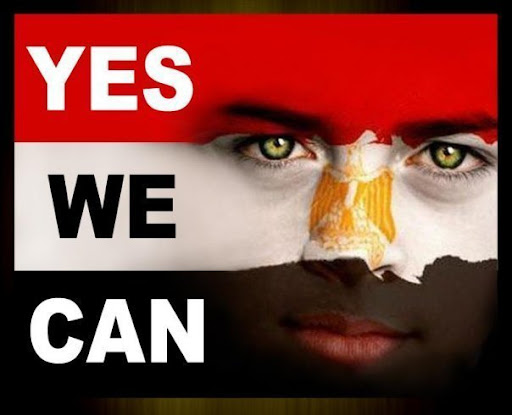
The uprising took off in a way that no one anticipated. On January 27, Facebook, along with telephones and internet, went off. Nevertheless the revolution grew and persisted. When the internet came back up on February 2 there was a conspicuous fluttering of pro-Mubarak profile pictures scattered around college students’ friends’ lists that had the uncanny look of iron curtain style propaganda posters. Though this is pure speculation, it is highly likely that a committee from the Ministry of Information got together to try to decipher how to infiltrate and conquer Facebook. Operating on a pre-digital mindset, they designed and released a poster about 25 January to appropriate the Day of Rage and rewrite history. That poster (Image #4) reads: “Day of Allegiance to the Leader and Commander. We are all with you and our hearts are with you. The campaign for Mubarak, Security for Egypt.”

Another profile photo which showed up among university students after the blackout was one that reads: “With all my heart I love you Egypt, and I love you oh President.”

These posters lacked the spontaneity, show of emotion, creativity of the other profile posters, and smelled of infiltrators, something not well tolerated in the Facebook public square. This pitiable attempt to turn back history and try to capture the allegiance of youth through manipulating Facebook was a sign of how desperately out of touch the regime has become. It is also indicative that it has lost its grip on the ideological state apparatuses, and once that occurs there is nothing left at its disposal but the use of force; or surrender.
Within three days these images of 25 of January as a day of loyalty to the President disappeared from Facebook. On Feburary 8, a new profile photo among Egyptian youth began spreading spontaneously. It was the image of one of their own, Wael Ghoneim, on the day of his release after twelve days disappearance (he was detained by police). The image is from a game-changing interview conducted with him on February 7, 2011 on a satellite channel. This interview, where he admits to organizing the initial protest, set to rest doubts that the revolution was the plot of enemy foreign agents. His display of emotion for the martyrs of the revolution touched the nation, and beyond. That may very well have been the nail in the coffin of the state’s media wars.

What is happening in Egypt is not a Facebook Revolution. But it could not have come about without the Facebook generation, generation 2.0, who are taking, and with their fellow citizens, making history.
Linda Herrera is a social anthropologist with expertise in comparative and international education. She has lived in Egypt and conducted research on youth cultures and educational change in Egypt and the wider Middle East for over two decades. She is currently Associate Professor, Department of Education Policy, Organization and Leadership, University of Illinois at Urbana-Champaign. She is co-editor with A. Bayat of the volume Being Young and Muslim: New Cultural Politics in the Global North and South, published by Oxford University Press (2010).
This post appeared on Jadaliyya. It is republished here with permission of Linda Herrera and Jadaliyya.
Read also Linda Herrera’s previous contribution: Two Faces of Revolution
Egypt’s Revolution 2.0: The Facebook Factor
Posted on February 18th, 2011 by martijn.
Categories: Blogosphere, Headline, Society & Politics in the Middle East.
Guest Author: Linda Herrera
The call for a Day of Rage on January 25, 2011 that ignited the Egyptian revolution originated from a Facebook page. Many have since asked: Is this a “Facebook Revolution?” It is high time to put this question to rest and insist that political and social movements belong to people and not to communication tools and technologies. Facebook, like cell phones, the internet, and twitter, do not have agency, a moral universe, and are not predisposed to any particular ideological or political orientation. They are what people make of them. Facebook is no more responsible for Egypt’s revolution than Gutenberg’s printing press with movable type was responsible for the Protestant Reformation in the fifteenth century. But it is valid to say that neither the Reformation nor the pro-democracy rights’ movements sweeping Tunisia, Egypt, Iran, and much of the region would have come about at this juncture without these new tools. Digital communications media have revolutionized learning, cognition, and sociability and facilitated the development of a new generational behavior and consciousness. And the old guard simply do not get it.
Around the globe, far beyond Egypt and Tunisia, we are witnessing a monumental generational rupture taking place around digital literacy, and the coming of age of Generation 2.0. They take for granted interaction, collaboration, and community building on-line. The digital “non-literate” or “semi-literate” tend to be either the very poor lacking means, access to, or time for digital media, or the older generation, the pre-digitals, who do not see the value in changing their communication habits. Many from the pre-digital generation are quick to deride innovations such as Facebook and Twitter as being tools that indulge the egoistic tendencies of the young or which are colossal time wasters. While these critiques hold some validity, they capture only one side, and a small side, of a complex and epic generational sea change that is underway and that is being facilitated—not driven in some inevitable process—by the availability of new communication technologies and social tools.
A youthful global digital generation is growing in leaps and bounds, and social media, of which Facebook is just one platform, is a decisively important factor in it. Youth use social media for a range of social, academic, political, leisure, personal, creative, sexual, cultural, commercial, and other activities. Some characteristics of this global generation are excessive communication, involving many people in decision making, multitasking, group work, blurring of public and private, sharing, individual expression, and collective identification. Another important distinction between the generations is that the digital generation take what media theorist Clay Shirky calls “symmetrical participation” for granted. In other words, they are not passive recipients of media and messages, as in the days when television and print media ruled, but take for granted that they can play a role in the simultaneous production, consumption, interaction with, and dissemination of on-line content. Youth in the Middle East and North Africa share the features of their global generational counterparts but with some important additions and differences.
In politically authoritarian states like Egypt, Tunisia and Iran, youth have been fashioning Facebook into a vibrant and inclusive public square. They also use it to maintain their psychological well being as a space to metaphorically breath when the controls and constrains of the social world become too stifling. A 22 year old blogger and avid Facebook user explains, “It’s such a release to go on Facebook. I feel so liberated knowing there’s a place I can send my thoughts.”
The Rise of the “El-Face” Generation
In October and November 2010 I was in Egypt conducting research with university students in Alexandria and Cairo from diverse social class backgrounds on their media use. Many of them were using a new colloquial term, “El-Face” when talking about Facebook. These Facebook users carry traits of being politically savvy, bold, creative, outward looking, group regulating, and ethical. And their numbers are fast growing. In March 2008 there were some 822,560 users. After the Arabic version of Facebook was launched in March of 2009 usership jumped. By July 1, 2010 there were some 3,581,460 Facebook members, making for an increase of 357.2% in a two year period. The site has become increasingly Arabized, though many users show dexterity in using both English and Arabic.
In the months running up to the parliamentary elections in November 2010 there was much speculation about a possible shut down of Facebook. Adult pundits in the more mainstream media (semi-governmental newspapers, popular Arabic television talk shows) took up the cause of Facebook. They expressed their paternalistic concern about the potentially corrupting force of Facebook on the youth in a familiar moral panic mode. On her popular television talk show, for instance, Hala Sarhan lamented the lawlessness of Facebook, asserting it to be a dangerously free zone in need of restrictions. Others argued that without adult supervision, youth could be lured and tricked by dangerous elements into sedition (fitna). They worried Facebook was fueling sectarian tensions between Christians and Muslims that could lead to violence.
These public Facebook experts are mainly sexagenarian and septuagenarian educators, policy makers, government officials, and academics of a pre-digital age. They are using a pre-digital political cognition and institutional understanding to discuss new media today, and they are direly off the mark. Drawing on older understandings of the media they view Facebook as the new space of ideological control, the place to capture the minds and hearts of the citizens; like state television but accessible through the internet. Some of them are sincere in their worry that dangerous elements, like radicals and criminals, will try to befriend youth on Facebook and lure them in subversive activities. Others are clearly more interested in maintaining raw power and want to find effective ways to keep youth in their fold and under their thumbs. The ones vying to maintain control of the youth reason that if youth are spending time on Facebook, then all the government needs to do is go in and set up its propaganda machinery there, capture and control the hearts and minds of youth on Facebook, it’s that simple. The government has established a presence on Facebook, though a somewhat pitiful one, setting up pages for the National Democratic Party (158 people “like” it), Gamal Mubarak (the page has been removed since the uprising), Hosni Mubarak, and other government figures and causes. But these are not picking up traction. The youth are not buying it, and the more the regime people interlope into Facebook the more they lose legitimacy.
The community of “El-Face” is developing a cultural, political, and ethical universe of its own. It has its own codes and is a regulated space to some degree. There are certain red lines, as Hoda and Amir, both 21 year old university students at Alexandria University, that should not be crossed: you should not use the space to insult each other’s religion, for pornography or sexual harassment, for advertising or selling things, for spreading false rumors, or for spying. When a Facebook friend crosses these lines others intervene by way of posting a corrective comment on their wall, starting a conversation on the post in question, or by defriending them.
Last October many youth were worried that the government would close down Facebook. In discussions with a group of students from the Political Science department at Cairo University, they explained that the government feared the flurry of critical political activity that would invariably precede an election. Though many expressed that turning off Facebook would be akin to suffocating them, as one young man put it, it would be like “blocking the air to my lungs”, they insisted they would not ease up on their pre-election Facebook activities. These included mocking the president, his son, the system, and the whole electoral process. They stood defiant. A 21 year old female student proclaimed, “We don’t care! We’re not afraid of them. What are they going to do, arrest millions of us?”
Their Facebook activities also included a commitment to demanding justice for the brutal killing of one of their own, Khaled Said. It was striking last October how every youth I encountered in and out of the university was talking about Khaled Said. His story, which came out of Facebook, not Al-Jazeera, the newspaper, or any other media, has by now received much international coverage. The events leading to Khaled’s killing originated when he supposedly posted a video of two police officers allegedly dividing the spoils of a drug bust. This manner of citizen journalism has become commonplace and youth are getting more emboldened to expose the festering corruption of a police force that acts with impunity. On June 6, 2010, as Khaled Said was sitting in an internet café in Alexandria, two police officers entered and asked him for his I.D.. He refused to produce it and they proceeded to drag him away and allegedly sadistically beat him to his death as he pleaded for his life in the view of witnesses. The officers claimed that Khaled died of suffocation after swallowing a packet of drugs. His family released a photograph to an activist of the broken, bloodied, and disfigured face from Khaled’s corpse. This photo, and a portrait of the gentle soft skinned face of the living Khaled, went viral. The power of photographic evidence combined with eyewitness accounts and popular knowledge of police brutality left no doubt in anyone’s mind that he was senselessly and brutally murdered by police officers, the very people who are supposed to act in the interest of public safety.
A Facebook page, “We are all Khaled Said” was set up and we now know that activists from the Facebook group 6 of April Youth Movement, and Google executive Wael Ghoneim who is becoming a national hero as instigator of the Day of Rage (see below), were involved in this. The page led to a movement, first for justice to bring the killers to court to pay for their crime, and then, something much bigger. On the heels of the Tunisian revolution and fleeing of the dictator Zine El Abidine Ben Ali, the “We are all Khaled Said” group called for a Day of Rage, a march against “Torture, Corruption, Poverty and Unemployment” for January 25, 2011, the date the Regime designated to “celebrate” the police. Scores of Facebook users changed their profile pages to show their support for this march. Below are some of the samples of their profiles pictures.
The uprising took off in a way that no one anticipated. On January 27, Facebook, along with telephones and internet, went off. Nevertheless the revolution grew and persisted. When the internet came back up on February 2 there was a conspicuous fluttering of pro-Mubarak profile pictures scattered around college students’ friends’ lists that had the uncanny look of iron curtain style propaganda posters. Though this is pure speculation, it is highly likely that a committee from the Ministry of Information got together to try to decipher how to infiltrate and conquer Facebook. Operating on a pre-digital mindset, they designed and released a poster about 25 January to appropriate the Day of Rage and rewrite history. That poster (Image #4) reads: “Day of Allegiance to the Leader and Commander. We are all with you and our hearts are with you. The campaign for Mubarak, Security for Egypt.”
Another profile photo which showed up among university students after the blackout was one that reads: “With all my heart I love you Egypt, and I love you oh President.”
These posters lacked the spontaneity, show of emotion, creativity of the other profile posters, and smelled of infiltrators, something not well tolerated in the Facebook public square. This pitiable attempt to turn back history and try to capture the allegiance of youth through manipulating Facebook was a sign of how desperately out of touch the regime has become. It is also indicative that it has lost its grip on the ideological state apparatuses, and once that occurs there is nothing left at its disposal but the use of force; or surrender.
Within three days these images of 25 of January as a day of loyalty to the President disappeared from Facebook. On Feburary 8, a new profile photo among Egyptian youth began spreading spontaneously. It was the image of one of their own, Wael Ghoneim, on the day of his release after twelve days disappearance (he was detained by police). The image is from a game-changing interview conducted with him on February 7, 2011 on a satellite channel. This interview, where he admits to organizing the initial protest, set to rest doubts that the revolution was the plot of enemy foreign agents. His display of emotion for the martyrs of the revolution touched the nation, and beyond. That may very well have been the nail in the coffin of the state’s media wars.
What is happening in Egypt is not a Facebook Revolution. But it could not have come about without the Facebook generation, generation 2.0, who are taking, and with their fellow citizens, making history.
Linda Herrera is a social anthropologist with expertise in comparative and international education. She has lived in Egypt and conducted research on youth cultures and educational change in Egypt and the wider Middle East for over two decades. She is currently Associate Professor, Department of Education Policy, Organization and Leadership, University of Illinois at Urbana-Champaign. She is co-editor with A. Bayat of the volume Being Young and Muslim: New Cultural Politics in the Global North and South, published by Oxford University Press (2010).
This post appeared on Jadaliyya. It is republished here with permission of Linda Herrera and Jadaliyya.
Read also Linda Herrera’s previous contribution: Two Faces of Revolution
Closing the week 6 – Featuring the Egypt Revolution
Posted on February 13th, 2011 by martijn.
Categories: Blogosphere, Society & Politics in the Middle East.
Most popular on Closer last week
- Two Faces of Revolution by Linda Herrera
- ‘Now its gonna be a lone one’ – Some first conclusions on the Egyptian Revolution by Samuli Schielke
- ‘Verandering komt eraan’ – De Arabische revolte in Jordanië door Egbert Harmsen
Previous updates on the uprisings in the Middle East: Tunisia Uprising I – Tunisia Uprising II – Tunisia / Egypt Uprising Essential Reading I
- If you want to stay updated and did not subscribe yet, you can do so HERE
- You can follow me on Twitter: Martijn5155
(More) Essential Reading
The road to Tahrir by Charles Hirschkind – The Immanent Frame
These online activists have played a key role in transforming the conditions of political possibility in Egypt during the last decade, and of paving the way to Tahrir Square today. They have sought out and cultivated new forms of political agency in the face of the predations and repressive actions of the Egyptian state. They have pioneered forms of political critique and interaction that can mediate and encompass the heterogeneity of religious and social commitments that constitute Egypt’s contemporary political terrain. From the latest news reports, it is clear that many of them are now being arrested and beaten for their efforts. The regime has again shown itself implacable in its disregard for the people of Egypt.
Egypt, and the post-Islamist middle east by Asef Bayat | openDemocracy
In this incipient post-Islamist middle east, the prevailing popular movements assume a post-national, post-ideological, civil, and democratic character. Iran’s green movement, the Tunisian revolution, and the Egyptian uprising represent the popular movements of these post-Islamist times. They strive to achieve social justice, dignity, and a form of democratic governance that can protect citizens’ fundamental rights.
This new relation between bloggers and other media forms has now become standard: not only do many of the opposition newspapers rely on bloggers for their stories; news stories that journalists can’t print themselves without facing state persecution—for example, on issues relating to the question of Mubarak’s successor—such stories are first fed to bloggers by investigative reporters; once they are reported online, then journalists then proceed to publish the stories in newsprint, citing the blogs as source, this way avoiding the accusation that they themselves invented the story. Moreover, many young people have taken up the practice of using cell-phone cameras in the street, and bloggers are constantly receiving phone film-footage from anonymous sources that they then put on their blogs.
This event played a key role in shaping the place that the blogosphere would come to occupy within Egypt’s media sphere. Namely, bloggers understand their role as that of providing a direct link to what they call “the street,” conceived primarily as a space of state repression and political violence, but also as one of political action and popular resistance. They render visible and publicly speakable a political practice—the violent subjugation of the Egyptian people by its authoritarian regime—that other media outlets cannot easily disclose, due to censorship, practices of harassment, and arrest. This includes not only acts police brutality and torture, but also the more mundane and routine forms of violence that shape the texture of everyday life.
Good morning revolution: A to do list – by Hani Shukrallah – Ahram Online
The revolution has triumphed, but even as we celebrate, we need to begin at once with the most amazing job history has thrown our way, the building of an Egyptian democracy
Egypt’s Revolution 2.0: The Facebook Factor by Linda Herrera – Jadaliyya.com
What is happening in Egypt is not a Facebook Revolution. But it could not have come about without the Facebook generation, generation 2.0, who are taking, and with their fellow citizens, making history.
Imperial Feminism, Islamophobia, and the Egyptian Revolution* by Nadine Naber – Jadaliyya.com
Often ignored in U.S. discussions on Egypt is how protests led by labor unions—many women-based labor unions in the manufacturing cities of Egypt—have catalyzed the Egyptian revolution (Paul Amar, 02-05-11).[ii] The women now holding down Tahrir Square as we speak—are of all ages and social groups and their struggle cannot be explained through Orientalist tropes that reduce Arab women to passive victims of culture or religion or Islam. They are active participants in a grassroots people-based struggle against poverty and state corruption, rigged elections, repression, torture, and police brutality. They are leading marches; attending the wounded, and participating in identity checks of state supported thugs. They have helped create human shields to protect Egyptian Antiquities Museum, the Arab League Headquarters, and one another. They have helped organize neighborhood watch groups and committees nationwide in order to protect private and public property. They are fighting against dictatorship among millions of people-not guided by any one sect or political party—united under one slogan: we want and end to this regime.
More incomplete thoughts on the Algerian situation « The Moor Next Door
The RCD’s headquarters in Algiers was has already been surrounded by police after three hundred people reportedly congregated there to demonstrate their satisfaction with the fall of Mubarak. What kind of affect early obstruction might have will depend on how many people turn out in force to begin with: the masses of police on the streets may have a serious psychological impact on smaller demonstrators and if the demonstrations are as easily dispersed as on 22 January its unlikely that much else will follow. And while many Algerians are thoroughly dissatisfied with Bouteflika, most understand the real political challenge is the whole system, the politicized military leadership, the economic oligarchs, the not mere personalities. Many Algerians have been impressed by the fall of Mubarak, though. Buses of people are heading to Algiers from the surrounding cities and provinces, blocked by the police. By cutting out those seeking to protest peacefully (and with a limited popular appeal) the regime is increasing the likelihood of spontaneous, violent demonstrations which may indeed be to the government’s advantage. While the opposition is weak and without strong popular credentials (not wholly committed to the 12 February movement) there is more potential for something much bigger than previously anticipated as a result of recent events and the anxiety they may cause in the security services and the government at large. Mubarak’s fall has raised the stakes for Algeria’s 12 February march. But his fall does not necessarily make Bouteflika’s imminent. More to come.
Incomplete thoughts on the Algerian Situation « The Moor Next Door
The military and civilian elite learned the “lesson of April 2001,” when youths in Kabylia, and then the rest of the country, rose up and were brutally suppressed: higher levels of violence increase resentment and anger thereby making resistance more powerful. The Algerian response to the winter uprising netted far few deaths than those in Tunisia and Egypt where the deaths of demonstrators became galvanizing moments in struggles against local regimes. The Algerians were able to weather the uprisings without the kind of firm anti-government movement faed by their neighbors. Over the last ten years the Algerians have also grown adept at coopting ideological demands from popular and party forces: it met demands to give Berber a more exalted place within the state, recognizing it as a national language and including references to Berber identity in the constitution; it has included Islamists in the ruling coalition (the MSP) and adopted some of their recommendations in family law and education. But it has not taken on the social and economic contradictions that animate most social and political dissatisfaction among the population.
The revolution is not over by Adam Shatz « LRB blog
But the revolution in Egypt is not over: in fact, it has only begun. Mubarak’s removal from power was only the first objective of Egypt’s demonstrators. It was not just Mubarak but the regime that they want to dislodge, and to replace with a democratic government based on the rule of law. One of the pillars of the regime is the institution that is now improbably cast as the national saviour: the army. The army is respected, even admired by most Egyptians for its role in defending the country’s borders, and for its success in the 1973 war. It has always kept – officially – a discreet distance from the day-to-day running of the country, but it has also acquired a deep investment in the status quo, particularly in the country’s economy: the army is involved in the production of everything from washing machines and heaters to clothing and pharmaceuticals, and is estimated to own about a third of the country’s assets. Nor does it have much incentive to make any changes in foreign policy that might affect the terms of US aid: $1.3 billion per year.
Impressions from Egypt’s front line | Comment is free | guardian.co.uk
Hossam el-Hamalawy, an Egyptian journalist from Cairo, uses photographs to tell the inside story of protests on the streets of his city
The fall of Multiculturalism…again
Cameron Criticizes ‘Multiculturalism’ in Britain – NYTimes.com
LONDON — Faced with growing alarm about Islamic militants who have made Britain one of Europe’s most active bases for terrorist plots, Prime Minister David Cameron has mounted an attack on the country’s decades-old policy of “multiculturalism,” saying it has encouraged “segregated communities” where Islamic extremism can thrive.
Multiculturalism: not a minority problem | Tariq Modood | Comment is free | The Guardian
Notices of the death of multiculturalism began in Britain as far back as 1989, with the Salman Rushdie/Satanic Verses affair. It became clear that the minority-majority faultline was not going to be simply about colour racism, and that the definition of multiculturalism could not be confined to “steelbands, saris and samosas”. For some liberals that meant an end to their support for the concept, as angry Muslims muscled in on something that was intended only for the likes of gay people or black youth. Their protests were supported as “right on”, but a passionate religious identity was too multicultural for many.
Why Cameron’s speech on terrorism puts us more in danger | Liberal Conspiracy
David Cameron’s speech last week was primarily focused on counter-terrorism, even if excerpts released to the media highlighted the ‘death of state multiculturalism’.
This is a problem in itself because, by conflating counter-terrorism and integration, Cameron weakens internal security and makes all of us more vulnerable to terrorism. This isn’t limited to the Conservatives either; many others who define themselves as ‘muscular liberals’ make the same mistake.
Muslim groups, anti-racism campaigners and opposition politicians also questioned the timing of the high-profile speech, just hours before around 3,000 members of the far-right English Defence League (EDL) marched through Luton.
Blame consumer capitalism, not multiculturalism | Madeleine Bunting | Comment is free | The Guardian
David Cameron’s analysis is flawed; it’s individualism and globalisation that are undermining a strong national identity
Cameron Urges Immigrants to Integrate – WSJ.com
LONDON—U.K. Prime Minister David Cameron triggered a debate about multiculturalism in Britain over the weekend after arguing in a speech on terrorism for a “muscular liberalism” that confronts extremist Islam by forging a tighter national identity in multiethnic countries such as Britain.
France’s Sarkozy: Multiculturalism a failure – Israel News, Ynetnews
French leader: We’ve been too concerned about identity of new arrivals, not enough about identity of country receiving them
Nationalist politician Geert Wilders has claimed that he is being persecuted for his political views. The Dutch populist, who likens Islam to fascism, is charged with inciting hatred towards Muslims and others.
How Democracy Became Halal – NYTimes.com
When the legitimacy of theocracy started to unravel amid the regime’s corruption and brutality in the late 1980s, democratic ideas, including powerful democratic interpretations of the Islamic faith, roared forth. The explosion on the streets after the fraudulent presidential elections of June 2009 was just the most visible eruption of the enormous democratic pressures that had built up underneath the republic’s autocracy. More regime-threatening moments are surely coming.
Dutch
Een omstreden washok voor moslims – Trouw
Hogeschool Windesheim vond het gênant dat moslimstudenten zich voor het bidden moesten reinigen in het invalidentoilet. De school richtte een kleine wasruimte in. Reden voor de PVV om Kamervragen te stellen.
Mythbuster: Moslims toch ‘normaler’ | Wijblijvenhier.nl
Na 9/11 in New York is de kloof tussen moslims en niet-moslims groter geworden. Na 7/7 in London gold dit ook sterk voor de Britse moslims en niet-moslims. Of toch niet? In London werd hier een onderzoek naar gedaan door The Gallup Organization. Het resultaat (verrassend voor sommigen): de kloof is veel minder groot dan we zelf denken.
Quote du Jour | Moslims komen van Mars, Westerlingen van Venus? – Sargasso
Toch roepen de elkaar netjes overlappende dichotomieën die Almog aanwijst (de islamitische wereld vs. het Westen // tirannie vs. democratie // vrouwelijk vs. mannelijk) mijn argwaan op. Kan de werkelijkheid werkelijk teruggebracht worden tot zwart tegenover wit? En speelt er bij Almog niet een ideologisch belang mee; namelijk de Westerlingen overtuigen dat de kant van Israël moeten blijven kiezen, ook al gedraagt dit land zich als een koloniale onderdrukker?
Elsevier.nl – Nederland – Moslims lopen belastingvoordeel mis door lakse moskeeën
Mensen die doneren aan moskeeën lopen vaak hun belastingvoordeel mis, omdat partijbesturen van de gebedshuizen zich zelden laten registreren. Giften aan gebedshuizen zijn sinds 2008 niet meer automatisch fiscaal aftrekbaar.
Seks en de seculiere natie | DeJaap
Seksuele politiek (identiteitspolitiek gericht op emancipatie van minderheden als vrouwen en homo’s) was jaren het toonbeeld van progressiviteit. Het opkomen voor de rechten van seksuele minderheden ging toen gepaard met gevoeligheid voor het lot van andere minderheden, die op basis van bijvoorbeeld hun afkomst niet tot de mainstream behoorden. Seksuele politiek is nog steeds het toonbeeld van modern zijn, maar seksuele politiek wordt nu ingezet om een tegenstelling aan te geven tussen wij, het seksueel bevrijde Westen, en zij, de seksueel achterlijke Moslims. Een sexual clash of civilizations. Dit levert een duivels dilemma op voor de wetenschappers aanwezig op de conferentie. Zij hebben het gevoel dat ze moeten kiezen tussen vrouwen (en homo’s, lesbiennes en transgenders) of moslims.
Closing the week 5 – Featuring the Tunisia & Egypt Uprising
Posted on February 6th, 2011 by martijn.
Categories: anthropology, Blogosphere, Society & Politics in the Middle East.
Most popular on Closer this week
- Two Faces of Revolution by Linda Herrera
- Verandering komt eraan? – De ‘Arabische revolte’ in Jordanië door Egbert Harmsen
- ‘Telefoon uit Tunesië’ – Een persoonlijk verslag van de Jasmijn-revolutie door Carpe DM
Previous roundups: Tunisia Uprising I & Tunisia Uprising II
- If you want to stay updated and did not subscribe yet, you can do so HERE
- You can follow me on Twitter: Martijn5155
Essential reading
Egypt’s Class Conflict | Informed Comment
Why has the Egyptian state lost its legitimacy? Max Weber distinguished between power and authority. Power flows from the barrel of a gun, and the Egyptian state still has plenty of those. But Weber defines authority as the likelihood that a command will be obeyed. Leaders who have authority do not have to shoot people. The Mubarak regime has had to shoot over 100 people in the past few days, and wound more. Literally hundreds of thousands of people have ignored Mubarak’s command that they observe night time curfews. He has lost his authority.
LRB · Adam Shatz · Mubarak’s Last Breath
Egypt has never been a democracy. The military has always dominated its political life. Even during the age of liberal nationalism after the First World War, when it had a lively parliamentary life, popular sovereignty was sharply curtailed by British power. Since the 1952 coup which brought Nasser to power, it has been ruled by military dictatorship, although the establishment of multi-party politics in the late 1970s brought a measure of cosmetic diversification. Still, autocratic though they were, both Nasser and Sadat ensured that what Egypt did mattered. Nasser’s failures were spectacular: the aborted union with Syria in the United Arab Republic; the disastrous intervention in the civil war in Yemen; the catastrophic 1967 defeat to Israel that resulted in the destruction of three-quarters of Egypt’s air force and the loss of the Sinai; the creation of a vast and inefficient public sector which the state could not afford; the suppression of dissent, indeed of politics itself. But he also carried out land reform, nationalised the Suez Canal, built the Aswan High Dam, and turned Egypt into a major force in the Non-Aligned Movement. When Nasser spoke, the Arab world listened. Sadat broke with Nasser’s pan-Arab vision, promoting an Egypt-first agenda that ultimately led the country into the arms of the US and Israel. But, like Nasser, he was a statesman of considerable flair and cunning, with a prodigious ability to seize the initiative. By leading Egypt to a partial victory in the 1973 war, he washed away some of the shame of 1967, and eventually secured the restoration of the Sinai. And though his peace with Israel infuriated the Arabs, whom Nasser had electrified, he made Egypt a player in the world. Under Mubarak, Egypt, the ‘mother of the earth’ (umm idduniya), has seen its influence plummet. Nowhere is the decline of the Sunni Arab world so acutely felt as in Cairo ‘the Victorious’, a mega-city much of which has turned into an enormous slum. The air is so thick with fumes you can hardly breathe, the atmosphere as constricted as the country’s political life.
The dignity of Egyptian youth « The Immanent Frame
As I listened, and watched the crowds listening, there were several moments in which a sense of disbelief was discernible amid the seething, boiling anger. Midway through the speech, I think that all Egyptians were asking themselves whether it was possible that their leader of thirty years did not hear his people’s demands. Is it conceivable that, despite the whole world having heard the demand for him to go, he would assert that he will remain in his position until his present term is over (in September 2011)? In other words, is it at all comprehensible that the message he is giving to his people is: “I do not care what you want . . . you do not know what is good for you . . . you have been manipulated . . . I will do as I see fit”? Does this Egyptian Nero not realize that he is burning his people?
Myths of Mubarak « The Immanent Frame
The term ‘secular’ and its conceptual affiliates are doing a lot of work in misrepresenting the uprising in Egypt. ‘Secular’ politics has been taken to mean ‘good’ politics (limited democratization, stability, and support for the peace treaty with Israel), and ‘Islamic’ politics is being translated as ‘bad’ politics (the myriad dangers allegedly posed by the Muslim Brotherhood and its allies). Accounts of the current situation in Egypt are handicapped by an inability to read politics in Egypt and Muslim-majority societies outside of this overly simplistic and politically distorting lens.
LRB · Adam Shatz · After Mubarak
From the Obama administration we can expect criticisms of the crackdown, prayers for peace, and more calls for ‘restraint’ on ‘both sides’ – as if there were symmetry between unarmed protesters and the military regime – but Suleiman will be given the benefit of the doubt. Unlike ElBaradei, he’s a man Washington knows it can deal with. The men and women congregating in Tahrir Square have the misfortune to live in a country that shares a border with Israel, and to be fighting a regime that for the last three decades has provided indispensable services to the US. They are well aware of this. They know that if the West allows the Egyptian movement to be crushed, it will be, in part, because of the conviction that ‘we are not them,’ and that we can’t allow them to have what we have. Despite the enormous odds, they continue to fight.
LRB · Issandr El Amrani · Why Tunis, Why Cairo?
When Ben-Ali fled from Tunis, he created a vacuum at the top of the state that was imperfectly but quickly filled. The initial interim government did not please many, but a sense of civic duty appears for now to have stabilised the situation without a resort to authoritarianism. Mubarak, on the other hand, created a security vacuum in order to spread panic. In agreeing to step down, he tried to ensure that the regime would survive. Egypt is not Tunisia, at least not yet.
Uprisings: From Tunis to Cairo by William Pfaff | The New York Review of Books
Dictators do not usually die in bed. Successful retirement is always a problem for them, and not all solve it. It is a problem for everybody else when they leave. What’s to be done afterward? The popular uprising that overturned the dictatorial Zine el-Abidine Ben Ali regime in Tunisia in mid-January sent a thrill of hope through Arab populations.
Leading Egyptian Feminist, Nawal El Saadawi: “Women and Girls are Beside Boys in the Streets”
Renowned feminist and human rights activist Nawal El Saadawi was a political prisoner and exiled from Egypt for years. Now she has returned to Cairo, and she joins us to discuss the role of women during the last seven days of unprecedented protests. “Women and girls are beside boys in the streets,” El Saadawi says. “We are calling for justice, freedom and equality, and real democracy and a new constitution, no discrimination between men and women, no discrimination between Muslims and Christians, to change the system… and to have a real democracy.” [includes rush transcript]
The central tenets of the “culture and anarchy” canard may be old, but they have taken on new urgency this week and now there is nothing subtle about the message: popular desire for the regime’s removal is ripping apart the Egyptian social fabric and hurting the Egyptian economy; the revolt isn’t authentically Egyptian, but the result of foreign agitation by the likes of Aljazeera and Hamas; the Muslim Brotherhood is behind the rebellion and they are the ones who will stand to gain the most from it; Muslim Brothers are radical Islamists; radical Islam is a threat to Western civilization. And so on. It does not matter whether the pieces of the argument are true. It does not matter whether they contradict each other. What matters is that they all point in a single direction: change = chaos and ruin, the end of civilization.
Yemen is not Tunisia or Egypt – CNN.com
“Yemen is not Tunisia.” These were the words that President Ali Abdullah Saleh spoke to his people on television last Sunday.
As street protests erupt in Yemen’s capital, it is not surprising that an Arab leader who has held power since a bloodless coup in 1978 would dismiss calls for his ouster.
But he was correct.
Informed views from the ground
The Egyptian Protests: A View from the Ground (The Beginning) | Waq al-Waq | Big Think
it has been an interesting week in Cairo. What follows is not analysis or expert opinion, but my own notes from the past several days.
The Egyptian Protests: A View from the Ground (Neighborhood Watch) | Waq al-Waq | Big Think
I sat in front of the bank, which has only one private guard, who is asleep inside. Megdi the guard keeps telling us to wake him up if anything happens. Still, I’m not sure what he can do. Megdi only has six bullets.
The Egyptian Revolution: First Impressions from the Field
This revolution, too, will leave traces deep in the social fabric and psyche for a long time, but in ways that go beyond the youth. While the youth were the driving force in the earlier days, the revolution quickly became national in every sense; over the days I saw an increasing demographic mix in demonstrations, where people from all age groups, social classes, men and women, Muslims and Christians, urban people and peasants—virtually all sectors of society, acting in large numbers and with a determination rarely seen before.
Shippensburg University professor recalls a roiled Egypt – Chambersburg Public Opinion
According to Dr. Karl Lorenz, Shippensburg University professor of anthropology, the people of Egypt have waited 30 years for government reform.
Lorenz lived in Egypt with his wife from August 2009 to July on a Fulbright Scholars Grant. As part of his proposal, he studied predynastic pottery style changes. Studying the pottery styles gave Lorenz insight into the unification of upper and lower Egypt and the rise to pharaohs. His wife researched and also taught at a university.
The rich symbolism of the square in Cairo – Philly.com
When she first traveled to Cairo for fieldwork in 1993, Farha Ghannam recalled, Tahrir Square was mostly used as a bus depot.
Today, it’s the battleground on which the future of Egypt is being fought – a space rich with symbolism and meaning, held and defended by protesters at the cost of some lives.
“There’s this feeling [among demonstrators] that ‘if we lose at Tahrir Square, we’re going to lose the fight,’ ” said Ghannam, an anthropology professor at Swarthmore College who studies the use of public space in Egypt.
I find it very difficult to assemble emotions, memories and impressions to respond to the events in Tunisia and Egypt. I have been responding sharply to others who seized the moment to offer their analysis. Certain characterizations of Egyptians did not sit well with me. I also fear that specific arguments are easily manipulated — that the centers of power who have so deftly dominated the media, huge sums of money and many segments of national elites will thwart the resurgence of popular resistance and demonstration of public will. But since those consulted by Barry and Joe and their “teams” are hard at work, spreading fear of a future Egypt non-compliant with the terms of Camp David, conjuring up the Islamist bogeyman, and (one fears) holding Hosni’s hand, we too should speak.
Tunisia
One Small Revolution – NYTimes.com
Tunisia has a relatively large middle class because of something so obvious it goes unremarked upon: it is a real state, with historical and geographical legitimacy, where political arguments are about budgets and food subsidies, not the extremist ideologies that have plagued its neighbors, Algeria and Libya. It is a state not only because of the legacy of Rome and other empires, but because of human agency, in the person of Habib Bourguiba, one of the lesser-known great men of the 20th century.
Tunisia analysis: Old guard, ‘new’ government | World news | The Guardian
The prime minister himself, 69-year-old Mohamed Ghannouchi, is a Ben Ali loyalist of long standing, having served since 1999. In Tunisia, he became known as “Monsieur Oui Oui” for always saying yes to the president.
To many ordinary Tunisians, these are worrying signs. In the words of a trade unionist quoted on Twitter: “Tunisia has got rid of the dictator but hasn’t got rid of the dictatorship yet.”
Egypt
The Egyptian Uprising: Facts and Fiction | Dissident Voice
There is really only one story here and it is ever so uncomplicated. This is an uprising against an octogenarian dictator who could have done us all a favor by retiring two decades ago. After he goes, the remaining 84 million Egyptians can sort things out among themselves. Everything else is fiction.
Brian Whitaker’s blog, February 2011
The situation in Egypt, as a friend from Alexandria described it to me in an email this morning, is “quite fluid and extremely scary”. It’s also very difficult to work out what is really going on behind the scenes.
Egyptian protesters: What I’m fighting for – Egyptian Protests – Salon.com
What’s too often lost in the coverage of Egypt’s violent clashes are the stories of the people fighting. This slide show offers a look at 10 individuals who make up the crowd of thousands gathered in Tahrir Square day after day. They are students, sailors, teachers, executives, government employees and members of the Muslim Brotherhood. Meet Egypt’s protesters — the people who are behind one of the greatest moments in modern Egyptian history.
What now? I would say that the time has come for the Obama administration to escalate to the next step of actively trying to push Mubarak out. They were right to not do so earlier. No matter how frustrated activists have been by his perceived hedging, until yesterday it was not the time to move to the bottom line. Mubarak is an American ally of 30 years and needed to be given the chance to respond appropriately. And everyone seems to forget that magical democracy words (a phrase which as far as I know I coined) don’t work. Obama saying “Mubarak must go” would not have made Mubarak go, absent the careful preparation of the ground so that the potential power-brokers saw that they really had no choice. Yesterday’s orgy of state-sanctioned violence should be the moment to make clear that there is now no alternative.
Mubarak’s phantom presidency – Opinion – Al Jazeera English
The “March of Millions” in Cairo marks the spectacular emergence of a new political society in Egypt. This uprising brings together a new coalition of forces, uniting reconfigured elements of the security state with prominent business people, internationalist leaders, and relatively new (or newly reconfigured) mass movements of youth, labour, women’s and religious groups. President Hosni Mubarak lost his political power on Friday, January 28.
The Battle for Egypt | The Courier
Kuppinger: Before the uprising happened in Tunisia earlier in January few, including myself, would have foreseen the current events in Cairo. When the protesters in Tunisia were successful and ousted their dictator in a matter of days, it was clear that people in other Arab countries and here in particular, the vast ranks of the younger generation were watching these events very carefully. They took and compared notes. At that point it became increasingly clear that Tunisia could become a model.
The use of hired thugs is classic Mubarak. The regime’s relationship with its people has always depended on intimidation and violence, which proved problematic with the wave of demonstrations and labour protests that have been a growing phenomenon since 2003 – acts of public police rage tend to put the tourists off. In 2005 elections young men were paid to sexually assault female protestors. Last year during the trial of two policemen accused of involvement in the death of Khaled Said a rowdy group of teenagers stood outside the courtroom and accused anti-torture protestors of being Israeli spies, before launching missiles at them. During the elections boys in matching t-shirts danced in front of polling stations while burly colleagues intimated voters on behalf of National Democratic Party candidates.
The who’s who of the has-beens – Blog – The Arabist
I know a lot of journalists (and even some normal, decent people) out there are wondering about the who’s who of the regime. As a person with a someone unhealthy obsession with the Egyptian regime for over a decade, I have been making charts of who’s who for a while.
Rich, Poor and a Rift Exposed by Unrest – NYTimes.com
Over the past several days, hundreds of thousands of Egyptians — from indigent fruit peddlers and doormen to students and engineers, even wealthy landlords — poured into the streets together to denounce President Hosni Mubarak and battle his omnipresent security police. Then, on Friday night, the police pulled out of Egypt’s major cities abruptly, and tensions between rich and poor exploded.
Egyptian Opposition’s Old Guard Falls In Behind Young Leaders – NYTimes.com
“Most of us are under 30,” said Amr Ezz, a 27-year-old lawyer who was one of the group as part of the April 6 Youth Movement, which organized an earlier day of protests last week via Facebook. They were surprised and delighted to see that more than 90,000 people signed up online to participate, emboldening others to turn out and bringing tens of thousands of mostly young people into the streets.
What’s Happening in Egypt Explained (UPDATED) | Mother Jones
What’s happening? Inspired by the recent protests that led to the fall of the Tunisian government and the ousting of longtime Tunisian dictator Zine El Abidine Ben Ali, Egyptians have joined other protesters across the Arab world (in Algeria, notably) in protesting their autocratic governments, high levels of corruption, and grinding poverty. In Egypt, tens of thousands of protesters have taken to the streets.
ZCommunications | Whither Egypt? by Gilbert Achcar | ZNet Article
The Egyptian opposition includes a vast array of forces. There are parties like the Wafd, which are legal parties and constitute what may be called the liberal opposition. Then there is a grey zone occupied by the Muslim Brotherhood. It does not have a legal status but is tolerated by the regime. Its whole structure is visible; it is not an underground force. The Muslim Brotherhood is certainly, and by far, the largest force in the opposition. When Mubarak’s regime, under US pressure, granted some space to the opposition in the 2005 parliamentary elections, the Muslim Brotherhood––running as “independents”––managed to get 88 MPs, i.e. 20 percent of the parliamentary seats, despite all obstacles. In the last elections held last November and December, after the Mubarak regime had decided to close down the limited space that it had opened in 2005, the Muslim Brotherhood almost vanished from parliament, losing all its seats but one.
“Revolutionaries on the Roof” « zunguzungu
Al Jazeera producer Evan Hill posted a (translated) video clip called ”Revolutionaries on the Roof” that deserves wide circulation. It is described as ”Young protesters occupying an apartment building near the site of fierce battles between pro- and anti-government crowds discuss their motivations, the events of the past two weeks, and the diverse make-up of Egypt’s democracy movement. (With reporting and translation by Lara el-Gibaly)”
Freedom, Democracy and the State
Too late for reform – Blog – The Arabist
I like Michele Dunne — she has been consistent for a decade on Egypt, and strikes the right tone here. I remember we sat together a couple of months ago and she laughed at the idea that Omar Suleiman could be a transition figure for Egypt. Here she argues that the US should not be backing Suleiman, it should be backing bottom-up transition.
Egypt’s two futures: Brutality and false reforms, or democracy
OVER THE past few days the world has seen a vivid portrait of the two sides in Egypt’s crisis. There has been the orchestrated brutality and cynical facade of compromise presented by the regime of Hosni Mubarak, who while clinging to his office until September is trying to destroy the opposition and ensure the perpetuation of 50 years of autocracy. In Cairo’s Tahrir Square and in other plazas around the country is the alternative: millions of mostly secular and middle-class citizens, led by the young, who seek genuine democracy and whose regular chant is “we are peaceful.”
Supporting democracy in the Middle East requires abandoning a vision of Pax-Americana
As the Mubarak regime turns to violence in a vain attempt to repress the peaceful protests that have swept Egypt’s streets for over ten days, the risks associated with current U.S. strategy for Egypt and the wider region continue to grow. In its response to the events, the Obama administration has subtly shifted its message, incrementally increasing pressure on the regime over the last week. But the more important story is the remarkable continuities reflected in the administration’s approach.
The Duck of Minerva: Egyptian “People Power,” Civil Society, and the U.S.
Notwithstanding the uncertainties, it is worthwhile to think more about the implications. In the long term, the events of last week would seem to mean more democracy or at least more democratic input into government in Egypt. Regardless, any new government will likely mean leaders less willing to do the bidding of the U.S., whether because of their own beliefs or because of the force of popular sentiment. (Certainly an important undercurrent in the journalistic reporting has been strong anti-American sentiments expressed by many of the protesters.) It is good that American policymakers seem to realize this. President Obama is quoted as stating several times at a high level meeting yesterday that “the outcome has to be decided by the Egyptian people, and the U.S. cannot be in a position of dictating events”–or, in my view, much influencing them.
David H. Price: Challenging America’s Pharaoh
Anyone who has lived in Egypt for an extended period of time or has traveled there for extended stays over the past thirty years should not be surprised at the current uprising. The only surprising thing is that this uprising didn’t happen years or decades sooner.
Johann Hari: We All Helped Suppress the Egyptians — With Our Taxes. So How Do We Change?
The old slogan from the 1960s has come true: the revolution has been televised. The world is watching the Bastille fall on 24/7 rolling news and Tweeting the death-spasms of Mubarak-Antoinette. This elderly thug is trying to beat and tear-gas and buy himself enough time to smuggle his family’s estimated $25bn in loot out of the country, and to install a successor friendly to his interests. The Egyptian people — half of whom live on less than $2 a day — seem determined to prevent the pillage and not to wait until September to drive out a dictator dripping in blood and bad hair dye.
ETHNOGRAFIX: Power, realpolitik, and freedom: Egypt and US Ideals about Freedom
What absolutely blows me away is how quickly some folks drop their supposed ideals about freedom and democracy when the people under consideration are far away (like in Egypt, for example). It’s shocking, actually, to hear some folks out there calling for the support of Mubarak as a close ally (check the comments section). I don’t get it. Democracy, it seems, only applies here at home. When it comes to a distant population like the people of Egypt, it seems that many people are willing to sidestep all of the rhetoric about political freedom and openly advocate supporting a repressive policy state, all in the name of “our interests.” Horribly ironic, no? Granted, the situation in Egypt is far from clear, but I definitely do not think that going back to the “support the nearest dictator who will toe the line” model is the way to go. Absolutely not. Anyway, here are some quotes that are apt for folks on all sides of the political spectrum here in the US:
But what about the Muslim Brotherhood?
Concerns about the Muslim Brotherhood: Israel Fears Regime Change in Egypt – SPIEGEL ONLINE – News – International
Israel is watching developments in Egypt with concern. The government is standing by autocratic Egyptian President Hosni Mubarak, out of fear that the Islamist Muslim Brotherhood could take power and start supplying arms to Hamas.
Muslim Brotherhood, Egypt Opposition Party, In The Spotlight During Protests
In media coverage of the ongoing protests rocking Egypt, the phrase “Muslim Brotherhood” has cropped up more than once. Who is this group, and what role are they playing in the protests?
Why we shouldn’t fear the Muslim Brotherhood – War Room – Salon.com
To get some hard facts and context about the controversial Islamic movement, we spoke with Nathan Brown, a political science professor at George Washington University and director of its Institute for Middle East Studies, who has written extensively on the Muslim Brotherhood. What follows is a transcript of our conversation, edited for length and clarity.
5 Reasons the Muslim Brotherhood Won’t Turn On Israel | Politics | Religion Dispatches
These days, everybody’s in the business of panicking over the potential role of the Muslim Brotherhood. But rather than discuss where the Brotherhood has been in the past, I suggest looking to the future. Events on the ground are changing every few hours, so this is an exercise in informed speculation. Here are five reasons why the Muslim Brotherhood will find it very hard to decisively determine Egypt’s relationship with Israel. These five reasons complicate the assumption that if Mubarak goes, the peace treaty with Israel will come to an end.
Islamists at the Gates – NYTimes.com
But few Israelis really believe in that hopeful outcome. Instead, the grim assumption is that it is just a matter of time before the only real opposition group in Egypt, the Islamist Muslim Brotherhood, takes power. Israelis fear that Egypt will go the way of Iran or Turkey, with Islamists gaining control through violence or gradual co-optation.
Muslim Brotherhood says it is only a minor player in Egyptian protests
The Muslim Brotherhood found its first martyr in Egypt’s popular uprising Friday, when a teenager named Mustafa Sawi was shot dead in front of the Interior Ministry. But the country’s oldest and best-organized opposition group had to take a back seat at his public funeral the next day, as the Muslim Brotherhood insists it is little more than a bit player in the outpouring of resistance to the regime of President Hosni Mubarak.
Don’t Fear Egypt’s Muslim Brotherhood – Brookings Institution
Don’t Fear Egypt’s Muslim Brotherhood
Egypt, Middle East Unrest, Middle East, Governance, Islamic World
Bruce Riedel, Senior Fellow, Foreign Policy, Saban Center for Middle East Policy
January 28, 2011 —
The Jasmine Revolution in Tunisia has sent a shock wave through the Arab world. Never before has the street toppled a dictator. Now Egypt is shaking, Hosni Mubarak’s 30-year-old regime faces its most serious threat ever. The prospect of change in Egypt inevitably raises questions about the oldest and strongest opposition movement in the country, the Muslim Brotherhood, also known as Ikhwan. Can America work with an Egypt where the Ikhwan is part of a transition or even a new government?
Egypt’s Islamist Riddle – WSJ.com
The 83-year-old Islamic movement, Egypt’s biggest opposition bloc, played a subdued role in the uprising. But its past performance in parliamentary elections and its dedicated following mean it will be a force to be reckoned with as Egypt moves toward open elections.
If this discussion evokes a sense of déjà vu, this is because over the past sixty years we have had it many times before, with almost identical outcomes. Since the 1950s, the United States has secretly struck up alliances with the Brotherhood or its offshoots on issues as diverse as fighting communism and calming tensions among European Muslims. And if we look to history, we can see a familiar pattern: each time, US leaders have decided that the Brotherhood could be useful and tried to bend it to America’s goals, and each time, maybe not surprisingly, the only party that clearly has benefited has been the Brotherhood.
Scott Atran: The Muslim Brotherhood Bogey Man
As Egyptians clash over the future of their government, Americans and Europeans have repeatedly expressed fears of the Muslim Brotherhood. “You don’t just have a government and a movement for democracy,” Tony Blair, the former British prime minister, said on Monday. “You also have others, notably the Muslim Brotherhood, who would take this in a different direction.” The previous day, House speaker John Boehner expressed hope that Hosni Mubarak would stay on as president of Egypt while instituting reforms to prevent the Muslim Brotherhood and other extremists from grabbing power.
And even more urgent, what about the jihadis?
Jihadis Debate Egypt (1) — jihadica
Not surprisingly, the jihadi online community is captivated by the uprising, but many are also bewildered about what this means for their cause, and their leaders have been slow to respond. Jarret Brachman has a point when he taunts Zawahiri: “Your Silence is Deafening.” As of Thursday afternoon, the leading jihadi forum Shamikh only featured a handful of authoritative responses to the events in Egypt, from pro-jihadi pundits, a legal scholar and other participants. However, not a word from the leadership. The closest thing to an official response is AQIM’s statement on the events in Tunisia (available also in translation).
Jihadis Debate Egypt (2) — jihadica
Such a response and the mere fact that this anonymous and murky EIJ figure, issues a message, and not a leading Egyptian al-Qaida member, is significant. Again, it demonstrates the jihadis’ irrelevance to the rapidly evolving situation in Egypt.
Uprisings and (new) media
What Al Jazeera Shows and Doesn’t Show | The Middle East Channel
But what television has brought to the world is only a partial reality. There is only Tahrir; the huge metropolitan expanse of Cairo and the families at home in neighborhoods are beyond the frame, oddly irrelevant. The participants in the revolution are the hundreds of thousands of demonstrators, not the equal numbers standing unpicturesque guard by night to ensure the safety of neighborhoods. TV shows a mass, not a massive group of individuals. This televised reality has become hugely controversial.
Wallflowers at the Revolution – NYTimes.com
Perhaps the most revealing window into America’s media-fed isolation from this crisis — small an example as it may seem — is the default assumption that the Egyptian uprising, like every other paroxysm in the region since the Green Revolution in Iran 18 months ago, must be powered by the twin American-born phenomena of Twitter and Facebook. Television news — at once threatened by the power of the Internet and fearful of appearing unhip — can’t get enough of this cliché.
Cairo Activists Use Facebook to Rattle Regime
ack in March, Maher and a friend launched a Facebook group to promote a protest planned for April 6. It became an Internet phenomenon, quickly attracting more than 70,000 members. The April 6 youth movement — amorphous, lacking a clear mission, and yet a bull’s-eye to the zeitgeist — blossomed within days into something influential enough to arouse the ire of Egypt’s internal security forces. Maher is part of a new generation in the Middle East that, through blogs, YouTube, Flickr, Twitter, and now Facebook, is using virtual reality to combat corrupt and oppressive governments. Their nascent, tech-fired rebellion has triggered a government backlash and captured the world’s attention.
Egypt protests: Police use Facebook and Twitter to track down protesters | Mail Online
Gabrielle’s dilemma is shared by many others whose activism, both online and on the streets, has brought them to the attention of the state security police.
While other protesters arrive and leave freely, thousands like Gabrielle – well-educated, middle-class idealistic young Egyptians who used social networking sites to ignite this protest – are beginning to feel trapped. Some say they are fighting for their lives, though they have thus far protested peacefully.
Why Tunisia Is Not a Social-Media Revolution | The American Prospect
commentators have held back with Tunisia, emphasizing that the uprising is a product of the passions and convictions of Tunisia’s people, not a 140-character status update. That’s a good thing. It means our conversations about technology’s transformative power are maturing past assumptions that the spread of the Internet means an inexorable spread of democracy.
But now is the time, perhaps, for a little backlash against the backlash. Scrubbing the Internet from the Tunisian people’s story leaves us with less than a full picture of this moment.
But here now finally are our children – Generation Facebook – kicking aside the burden of history, determined to show us just how easy it is to tell the dictator it’s time to go.
tabsir.net » Streaming Revolution, Screaming Revolution
What happens when a revolution is not only screamed but streamed live? Can we reach a point where it gets as boring as a video game that we have played far too many times? Can our eyes become so glued to the riveting skirmish scenes in Cairo that we lose sight of all the other news that still gets generated. Sudan is having a referendum to separate south from north; Lebanon’s government has emulated Italy’s governing prowess once again (and Hizbollah has no Berlusconi figure in its ranks); world markets fear a closing of the Suez canal… and the list goes on but only with a few short notes at the bottom of the screen.
On The Media: Transcript of “Tunisia’s Twitter Revolution?” (January 21, 2011)
Demonstrators flooded the streets in Tunisia this week calling for an end to corruption and ousting President Zine El Abidine Ben Ali. Many have attributed the wave of protests to the rise of the internet and social media in a country notorious for its censorship but Foreign Policy blogger Marc Lynch says it’s not that simple. He says the internet, social media and satellite channels like Al Jazeera have collectively transformed the information landscape in the Arab world.
Gladwell Still Missing the Point About Social Media and Activism: Tech News and Analysis «
In other words, as far as the New Yorker writer is concerned, the use of any specific communications tools — whether that happens to be cellphones or SMS or Twitter or Facebook — may be occurring, and may even be helping revolutionaries in countries like Egypt in some poorly-defined way, but it’s just not that interesting. This seems like an odd comment coming from someone who wrote a book all about how a series of small changes in the way people think about an issue can suddenly reach a “tipping point” and gain widespread appeal, since that’s exactly what social media does so well.
Thinking about the importance of communications “revolutions.” | Savage Minds
There has been a lot of talk about the importance of social media in recent world events. See for instance, here, here, and here. Some of the more astute commentators have referred to earlier technological revolutions and their impact on television: usenet, fax machines, television, cameras, telegraph, and even the printing press. One technology, however, always seem to get left out, maybe because it seems too “obvious,” and that is literacy.
Facebook and YouTube Fuel the Egyptian Protests – NYTimes.com
“Prior to the murder of Khaled Said, there were blogs and YouTube videos that existed about police torture, but there wasn’t a strong community around them,” said Jillian C. York, the project coordinator for the OpenNet Initiative of the Berkman Center for the Internet and Society at Harvard University. “This case changed that.”
While it is almost impossible to isolate the impact of social media tools from the general swirl of events that set off the popular uprisings across the Middle East, there is little doubt that they provided a new means for ordinary people to connect with human rights advocates trying to amass support against police abuse, torture and the Mubarak government’s permanent emergency laws allowing people to be jailed without charges.
Lecture Clarifies Social Media Usage in Recent Uprisings – CUA Tower – News
While many analysts point to “tweets” as the igniters of the recent revolution in Egypt, Dr. Jon Anderson of the Anthropology Department cautioned students on Wednesday night not to let social media hype drown out the human voices at the root of revolt.
His talk, entitled “Social Media and Politics of the Middle East,” sought to clarify the conceptions surrounding what has been termed a “twitter revolution,” regarding recent popular uprisings against long-standing dictators in Yemen, Tunisia, and Egypt.
Egypt may have turned off the Internet one phone call at a time | Technology | Los Angeles Times
Egypt’s shutdown of the Internet within its borders is an action unlike any other in the history of the World Wide Web and it might have only taken a few phone calls to do it.
MediaShift . What Role Did Social Media Play in Tunisia, Egypt Protests? | PBS
As the protests are playing out in the streets of Cairo and the rest of Egypt today, I have been glued to the live-stream of Al Jazeera English as well as the Twitter hashtag #Jan25, a top trending topic based on the big protests a few days ago. The Egyptian protests come on the heels of a similar revolution in Tunisia, where a longtime dictator, Zine El Abidine Ben Ali, was ousted after young people organized protests via Facebook. We’ve heard about “Twitter revolutions” before in Iran after huge protests there in 2009, but how have things changed today? How much of a role has social media played in the turmoil happening in the Middle East? Will that continue to be the case? Vote in our poll below, or share your deeper thoughts in the comments below.
Other roundups
“A wonderful development” – Anthropologists on the Egypt Uprising (updated)
As you might have noticed, Wikan is argueing along siminar lines as the Western political elite who is about to lose an important ally in the Middle East. For them, “stability” is more important than people power, as Maximilian Forte and his co-bloggers on Zero Anthropology explain in several blog posts, among others The Fall of the American Wall: Tunisia, Egypt, and Beyond and Encircling Empire: Report #11, Focus on Egypt, Encircling Empire: Report #12, FOCUS ON EGYPT: Revolution and Counter-Revolution and The Song of the Nonaligned Nile (by Eliza Jane Darling).
Registering a revolution. Hail to the brave people of Egypt. A roundup. | Erkan’s Field Diary
Too soon to analyze, so here’s my outbox
Tunisia and Egypt uprisings – selected bookmarks « media/anthropology
Highlights on media, anthropology and the Tunisia and Egypt uprisings
anthropologyworks » Understanding Egypt
Political protests in Egypt are ongoing at the time of this writing, mainly in Cairo, Alexandria and some other cities. Who knows what will unfold in the near future? What do cultural anthropologists offer to inform our understanding of this new social movement?
Misc.
Yemen’s president says he won’t seek reelection, but he said that in 2005, too | Need to Know
Reality, however, is more than what happened in the last month. While some protesters in Sanaa have said they were inspired by the protests in Egypt and Tunisia, those two revolts did not inspire the protests anymore than my breakfast burrito did. There were protests in Aden during the Gulf Cup soccer tournament last November, protests over the parcel bombs in Sanaa in October, thousands of people protesting over the most recent round of fighting between the government and the Houthi rebels in the north in March. Yemenis protest routinely, and the last several months have seen a series of increasingly violent rallies across the entire country.
Top Ten Accomplishments of Egypt Demonstrators | Informed Comment
The protest movement in Egypt scored several victories on Friday, but did not actually succeed in getting President Hosni Mubarak to step down. Their accomplishments include:
Of people and things: Egyptian protest and cultural properties « The Berkeley Blog
In a post on the Berkeley Blog, Samuel Redman makes an argument that urges protection of antiquities be emphasized in the face of current events in Egypt, arguing that mummies are “shared global heritage”.
I addressed similar questions in writing a post on my Ancient Bodies, Ancient Lives blog about unconfirmed reports of possible damage to a unique tomb, that of the woman identified as the wet nurse of Tutankhamon. But in writing my post, I subordinated questions of the destruction of antiquities to the critical moment facing Egypt today, which concerns the future of living men and women.
Dutch
Egypte, een langzame revolutie – Vrij Nederland
Opeens is iedereen Egyptedeskundige. Een van de grappigste opmerkingen die ik, via Twitter, tegenkwam, was die van Elseviers René van Rijckevorsel dat ‘een langzame evolutie naar een eerlijker Egypte’ beter is. Voor de volledigheid haalt Van Rijckevorsel er het uitgekauwde doembeeld van veertig procent analfabete Egyptenaren en de alomtegenwoordige Moslimbroederschap bij. Volgens hem zijn er twee opties: het Iran- of het Algerije-scenario.
Het opvallende aan Tunesië is dat het in zeer korte tijd geëscaleerd is, terwijl er in Egypte al jaren protest is tegen het presidentschap van Moubarak. Het laatste half jaar zijn er regelmatig zeer grote en ingrijpende demonstraties geweest, waarbij zelfs sprake was van een coalitie van de gehele oppositie. Desalniettemin zijn de Egyptenaren er nog niet in geslaagd af te komen van La Vache Qui Rit, zoals Moubarak wordt genoemd. De vraag is of dit door steun van de VS komt, of omdat er in Egypte ondanks alles meer uitingsvrijheid en ruimte was dan in Tunesië. Een organisatie als Kifaya, die strijdt tegen de heerschappij van Moubarak, zou tot voor kort ondenkbaar zijn geweest in Tunesië.
Best of Blogs: #25jan (links galore) | DeJaap
Wellicht ter compensatie voor de maanden(jaren?)lange media-afwezigheid zond de NOS vanmiddag live uit over Egypte. Maar in tegenstelling tot de Egyptenaren (tot vanmiddag) heeft u wel toegang tot internet en daarmee toegang tot dezelfde bronnen waar de NOS-correspondenten ook gebruik van maken.
Uiteengespatte droom stimuleert Egyptische opstand – de Volkskrant – Opinie
De afgelopen jaren kenden eigenlijk geen moment zonder protesten tegen het regime, maar de huidige volksopstand is ongekend en kan onmogelijk genegeerd worden. Het Tunesische voorbeeld gaf Egyptenaren hoop en de moed het veiligheidsapparaat te trotseren en hun al jaren breed gedragen afkeer van Mubaraks regime te uiten. Jongeren zijn de stuwende kracht achter de volksopstand in Egypte. Wat zijn de achtergronden van hun frustratie, woede en moed?
Wat is er aan de hand in de Arabische wereld? | Standplaats Wereld
Door Erik van Ommering … hoor ik u denken deze dagen! Nu eens geen heibel tussen Palestijnen en Israëliërs, maar revolutie in Tunesië, opstand in Egypte, rellen in Jemen, demonstraties in Jordanië, protesten in Libanon – waar gaat dat heen? Vanuit mijn positie als onderzoeker in het laatstgenoemde land zal ik een poging in de richting van een antwoord wagen – waarbij ik me bewust ben van de snelheid waarmee de huidige gebeurtenissen mijn relaas ongetwijfeld zullen inhalen. Hierbij nu eens een macro-analyse door een antropoloog!
Turbulente week in Caïro | Standplaats Wereld
Verbaasd lees ik terug hoe één van mijn eerste veldwerknotities, van een paar weken geleden, de acceptatie en leegte in de ogen van de taxichauffeur beschrijft die me van het vliegveld naar de stad brengt. Dat lijkt een ander land een eeuwigheid geleden. Door Police Day (25 januari) begonnen dingen langzaam te veranderen met als climax en epicentrum de Miljoenen Mars op Midan Tahrir (2 februari).
Closing the week 5 – Featuring the Tunisia & Egypt Uprising
Posted on February 6th, 2011 by martijn.
Categories: anthropology, Blogosphere, Society & Politics in the Middle East.
Most popular on Closer this week
- Two Faces of Revolution by Linda Herrera
- Verandering komt eraan? – De ‘Arabische revolte’ in Jordanië door Egbert Harmsen
- ‘Telefoon uit Tunesië’ – Een persoonlijk verslag van de Jasmijn-revolutie door Carpe DM
Previous roundups: Tunisia Uprising I & Tunisia Uprising II
- If you want to stay updated and did not subscribe yet, you can do so HERE
- You can follow me on Twitter: Martijn5155
Essential reading
Egypt’s Class Conflict | Informed Comment
Why has the Egyptian state lost its legitimacy? Max Weber distinguished between power and authority. Power flows from the barrel of a gun, and the Egyptian state still has plenty of those. But Weber defines authority as the likelihood that a command will be obeyed. Leaders who have authority do not have to shoot people. The Mubarak regime has had to shoot over 100 people in the past few days, and wound more. Literally hundreds of thousands of people have ignored Mubarak’s command that they observe night time curfews. He has lost his authority.
LRB · Adam Shatz · Mubarak’s Last Breath
Egypt has never been a democracy. The military has always dominated its political life. Even during the age of liberal nationalism after the First World War, when it had a lively parliamentary life, popular sovereignty was sharply curtailed by British power. Since the 1952 coup which brought Nasser to power, it has been ruled by military dictatorship, although the establishment of multi-party politics in the late 1970s brought a measure of cosmetic diversification. Still, autocratic though they were, both Nasser and Sadat ensured that what Egypt did mattered. Nasser’s failures were spectacular: the aborted union with Syria in the United Arab Republic; the disastrous intervention in the civil war in Yemen; the catastrophic 1967 defeat to Israel that resulted in the destruction of three-quarters of Egypt’s air force and the loss of the Sinai; the creation of a vast and inefficient public sector which the state could not afford; the suppression of dissent, indeed of politics itself. But he also carried out land reform, nationalised the Suez Canal, built the Aswan High Dam, and turned Egypt into a major force in the Non-Aligned Movement. When Nasser spoke, the Arab world listened. Sadat broke with Nasser’s pan-Arab vision, promoting an Egypt-first agenda that ultimately led the country into the arms of the US and Israel. But, like Nasser, he was a statesman of considerable flair and cunning, with a prodigious ability to seize the initiative. By leading Egypt to a partial victory in the 1973 war, he washed away some of the shame of 1967, and eventually secured the restoration of the Sinai. And though his peace with Israel infuriated the Arabs, whom Nasser had electrified, he made Egypt a player in the world. Under Mubarak, Egypt, the ‘mother of the earth’ (umm idduniya), has seen its influence plummet. Nowhere is the decline of the Sunni Arab world so acutely felt as in Cairo ‘the Victorious’, a mega-city much of which has turned into an enormous slum. The air is so thick with fumes you can hardly breathe, the atmosphere as constricted as the country’s political life.
The dignity of Egyptian youth « The Immanent Frame
As I listened, and watched the crowds listening, there were several moments in which a sense of disbelief was discernible amid the seething, boiling anger. Midway through the speech, I think that all Egyptians were asking themselves whether it was possible that their leader of thirty years did not hear his people’s demands. Is it conceivable that, despite the whole world having heard the demand for him to go, he would assert that he will remain in his position until his present term is over (in September 2011)? In other words, is it at all comprehensible that the message he is giving to his people is: “I do not care what you want . . . you do not know what is good for you . . . you have been manipulated . . . I will do as I see fit”? Does this Egyptian Nero not realize that he is burning his people?
Myths of Mubarak « The Immanent Frame
The term ‘secular’ and its conceptual affiliates are doing a lot of work in misrepresenting the uprising in Egypt. ‘Secular’ politics has been taken to mean ‘good’ politics (limited democratization, stability, and support for the peace treaty with Israel), and ‘Islamic’ politics is being translated as ‘bad’ politics (the myriad dangers allegedly posed by the Muslim Brotherhood and its allies). Accounts of the current situation in Egypt are handicapped by an inability to read politics in Egypt and Muslim-majority societies outside of this overly simplistic and politically distorting lens.
LRB · Adam Shatz · After Mubarak
From the Obama administration we can expect criticisms of the crackdown, prayers for peace, and more calls for ‘restraint’ on ‘both sides’ – as if there were symmetry between unarmed protesters and the military regime – but Suleiman will be given the benefit of the doubt. Unlike ElBaradei, he’s a man Washington knows it can deal with. The men and women congregating in Tahrir Square have the misfortune to live in a country that shares a border with Israel, and to be fighting a regime that for the last three decades has provided indispensable services to the US. They are well aware of this. They know that if the West allows the Egyptian movement to be crushed, it will be, in part, because of the conviction that ‘we are not them,’ and that we can’t allow them to have what we have. Despite the enormous odds, they continue to fight.
LRB · Issandr El Amrani · Why Tunis, Why Cairo?
When Ben-Ali fled from Tunis, he created a vacuum at the top of the state that was imperfectly but quickly filled. The initial interim government did not please many, but a sense of civic duty appears for now to have stabilised the situation without a resort to authoritarianism. Mubarak, on the other hand, created a security vacuum in order to spread panic. In agreeing to step down, he tried to ensure that the regime would survive. Egypt is not Tunisia, at least not yet.
Uprisings: From Tunis to Cairo by William Pfaff | The New York Review of Books
Dictators do not usually die in bed. Successful retirement is always a problem for them, and not all solve it. It is a problem for everybody else when they leave. What’s to be done afterward? The popular uprising that overturned the dictatorial Zine el-Abidine Ben Ali regime in Tunisia in mid-January sent a thrill of hope through Arab populations.
Leading Egyptian Feminist, Nawal El Saadawi: “Women and Girls are Beside Boys in the Streets”
Renowned feminist and human rights activist Nawal El Saadawi was a political prisoner and exiled from Egypt for years. Now she has returned to Cairo, and she joins us to discuss the role of women during the last seven days of unprecedented protests. “Women and girls are beside boys in the streets,” El Saadawi says. “We are calling for justice, freedom and equality, and real democracy and a new constitution, no discrimination between men and women, no discrimination between Muslims and Christians, to change the system… and to have a real democracy.” [includes rush transcript]
The central tenets of the “culture and anarchy” canard may be old, but they have taken on new urgency this week and now there is nothing subtle about the message: popular desire for the regime’s removal is ripping apart the Egyptian social fabric and hurting the Egyptian economy; the revolt isn’t authentically Egyptian, but the result of foreign agitation by the likes of Aljazeera and Hamas; the Muslim Brotherhood is behind the rebellion and they are the ones who will stand to gain the most from it; Muslim Brothers are radical Islamists; radical Islam is a threat to Western civilization. And so on. It does not matter whether the pieces of the argument are true. It does not matter whether they contradict each other. What matters is that they all point in a single direction: change = chaos and ruin, the end of civilization.
Yemen is not Tunisia or Egypt – CNN.com
“Yemen is not Tunisia.” These were the words that President Ali Abdullah Saleh spoke to his people on television last Sunday.
As street protests erupt in Yemen’s capital, it is not surprising that an Arab leader who has held power since a bloodless coup in 1978 would dismiss calls for his ouster.
But he was correct.
Informed views from the ground
The Egyptian Protests: A View from the Ground (The Beginning) | Waq al-Waq | Big Think
it has been an interesting week in Cairo. What follows is not analysis or expert opinion, but my own notes from the past several days.
The Egyptian Protests: A View from the Ground (Neighborhood Watch) | Waq al-Waq | Big Think
I sat in front of the bank, which has only one private guard, who is asleep inside. Megdi the guard keeps telling us to wake him up if anything happens. Still, I’m not sure what he can do. Megdi only has six bullets.
The Egyptian Revolution: First Impressions from the Field
This revolution, too, will leave traces deep in the social fabric and psyche for a long time, but in ways that go beyond the youth. While the youth were the driving force in the earlier days, the revolution quickly became national in every sense; over the days I saw an increasing demographic mix in demonstrations, where people from all age groups, social classes, men and women, Muslims and Christians, urban people and peasants—virtually all sectors of society, acting in large numbers and with a determination rarely seen before.
Shippensburg University professor recalls a roiled Egypt – Chambersburg Public Opinion
According to Dr. Karl Lorenz, Shippensburg University professor of anthropology, the people of Egypt have waited 30 years for government reform.
Lorenz lived in Egypt with his wife from August 2009 to July on a Fulbright Scholars Grant. As part of his proposal, he studied predynastic pottery style changes. Studying the pottery styles gave Lorenz insight into the unification of upper and lower Egypt and the rise to pharaohs. His wife researched and also taught at a university.
The rich symbolism of the square in Cairo – Philly.com
When she first traveled to Cairo for fieldwork in 1993, Farha Ghannam recalled, Tahrir Square was mostly used as a bus depot.
Today, it’s the battleground on which the future of Egypt is being fought – a space rich with symbolism and meaning, held and defended by protesters at the cost of some lives.
“There’s this feeling [among demonstrators] that ‘if we lose at Tahrir Square, we’re going to lose the fight,’ ” said Ghannam, an anthropology professor at Swarthmore College who studies the use of public space in Egypt.
I find it very difficult to assemble emotions, memories and impressions to respond to the events in Tunisia and Egypt. I have been responding sharply to others who seized the moment to offer their analysis. Certain characterizations of Egyptians did not sit well with me. I also fear that specific arguments are easily manipulated — that the centers of power who have so deftly dominated the media, huge sums of money and many segments of national elites will thwart the resurgence of popular resistance and demonstration of public will. But since those consulted by Barry and Joe and their “teams” are hard at work, spreading fear of a future Egypt non-compliant with the terms of Camp David, conjuring up the Islamist bogeyman, and (one fears) holding Hosni’s hand, we too should speak.
Tunisia
One Small Revolution – NYTimes.com
Tunisia has a relatively large middle class because of something so obvious it goes unremarked upon: it is a real state, with historical and geographical legitimacy, where political arguments are about budgets and food subsidies, not the extremist ideologies that have plagued its neighbors, Algeria and Libya. It is a state not only because of the legacy of Rome and other empires, but because of human agency, in the person of Habib Bourguiba, one of the lesser-known great men of the 20th century.
Tunisia analysis: Old guard, ‘new’ government | World news | The Guardian
The prime minister himself, 69-year-old Mohamed Ghannouchi, is a Ben Ali loyalist of long standing, having served since 1999. In Tunisia, he became known as “Monsieur Oui Oui” for always saying yes to the president.
To many ordinary Tunisians, these are worrying signs. In the words of a trade unionist quoted on Twitter: “Tunisia has got rid of the dictator but hasn’t got rid of the dictatorship yet.”
Egypt
The Egyptian Uprising: Facts and Fiction | Dissident Voice
There is really only one story here and it is ever so uncomplicated. This is an uprising against an octogenarian dictator who could have done us all a favor by retiring two decades ago. After he goes, the remaining 84 million Egyptians can sort things out among themselves. Everything else is fiction.
Brian Whitaker’s blog, February 2011
The situation in Egypt, as a friend from Alexandria described it to me in an email this morning, is “quite fluid and extremely scary”. It’s also very difficult to work out what is really going on behind the scenes.
Egyptian protesters: What I’m fighting for – Egyptian Protests – Salon.com
What’s too often lost in the coverage of Egypt’s violent clashes are the stories of the people fighting. This slide show offers a look at 10 individuals who make up the crowd of thousands gathered in Tahrir Square day after day. They are students, sailors, teachers, executives, government employees and members of the Muslim Brotherhood. Meet Egypt’s protesters — the people who are behind one of the greatest moments in modern Egyptian history.
What now? I would say that the time has come for the Obama administration to escalate to the next step of actively trying to push Mubarak out. They were right to not do so earlier. No matter how frustrated activists have been by his perceived hedging, until yesterday it was not the time to move to the bottom line. Mubarak is an American ally of 30 years and needed to be given the chance to respond appropriately. And everyone seems to forget that magical democracy words (a phrase which as far as I know I coined) don’t work. Obama saying “Mubarak must go” would not have made Mubarak go, absent the careful preparation of the ground so that the potential power-brokers saw that they really had no choice. Yesterday’s orgy of state-sanctioned violence should be the moment to make clear that there is now no alternative.
Mubarak’s phantom presidency – Opinion – Al Jazeera English
The “March of Millions” in Cairo marks the spectacular emergence of a new political society in Egypt. This uprising brings together a new coalition of forces, uniting reconfigured elements of the security state with prominent business people, internationalist leaders, and relatively new (or newly reconfigured) mass movements of youth, labour, women’s and religious groups. President Hosni Mubarak lost his political power on Friday, January 28.
The Battle for Egypt | The Courier
Kuppinger: Before the uprising happened in Tunisia earlier in January few, including myself, would have foreseen the current events in Cairo. When the protesters in Tunisia were successful and ousted their dictator in a matter of days, it was clear that people in other Arab countries and here in particular, the vast ranks of the younger generation were watching these events very carefully. They took and compared notes. At that point it became increasingly clear that Tunisia could become a model.
The use of hired thugs is classic Mubarak. The regime’s relationship with its people has always depended on intimidation and violence, which proved problematic with the wave of demonstrations and labour protests that have been a growing phenomenon since 2003 – acts of public police rage tend to put the tourists off. In 2005 elections young men were paid to sexually assault female protestors. Last year during the trial of two policemen accused of involvement in the death of Khaled Said a rowdy group of teenagers stood outside the courtroom and accused anti-torture protestors of being Israeli spies, before launching missiles at them. During the elections boys in matching t-shirts danced in front of polling stations while burly colleagues intimated voters on behalf of National Democratic Party candidates.
The who’s who of the has-beens – Blog – The Arabist
I know a lot of journalists (and even some normal, decent people) out there are wondering about the who’s who of the regime. As a person with a someone unhealthy obsession with the Egyptian regime for over a decade, I have been making charts of who’s who for a while.
Rich, Poor and a Rift Exposed by Unrest – NYTimes.com
Over the past several days, hundreds of thousands of Egyptians — from indigent fruit peddlers and doormen to students and engineers, even wealthy landlords — poured into the streets together to denounce President Hosni Mubarak and battle his omnipresent security police. Then, on Friday night, the police pulled out of Egypt’s major cities abruptly, and tensions between rich and poor exploded.
Egyptian Opposition’s Old Guard Falls In Behind Young Leaders – NYTimes.com
“Most of us are under 30,” said Amr Ezz, a 27-year-old lawyer who was one of the group as part of the April 6 Youth Movement, which organized an earlier day of protests last week via Facebook. They were surprised and delighted to see that more than 90,000 people signed up online to participate, emboldening others to turn out and bringing tens of thousands of mostly young people into the streets.
What’s Happening in Egypt Explained (UPDATED) | Mother Jones
What’s happening? Inspired by the recent protests that led to the fall of the Tunisian government and the ousting of longtime Tunisian dictator Zine El Abidine Ben Ali, Egyptians have joined other protesters across the Arab world (in Algeria, notably) in protesting their autocratic governments, high levels of corruption, and grinding poverty. In Egypt, tens of thousands of protesters have taken to the streets.
ZCommunications | Whither Egypt? by Gilbert Achcar | ZNet Article
The Egyptian opposition includes a vast array of forces. There are parties like the Wafd, which are legal parties and constitute what may be called the liberal opposition. Then there is a grey zone occupied by the Muslim Brotherhood. It does not have a legal status but is tolerated by the regime. Its whole structure is visible; it is not an underground force. The Muslim Brotherhood is certainly, and by far, the largest force in the opposition. When Mubarak’s regime, under US pressure, granted some space to the opposition in the 2005 parliamentary elections, the Muslim Brotherhood––running as “independents”––managed to get 88 MPs, i.e. 20 percent of the parliamentary seats, despite all obstacles. In the last elections held last November and December, after the Mubarak regime had decided to close down the limited space that it had opened in 2005, the Muslim Brotherhood almost vanished from parliament, losing all its seats but one.
“Revolutionaries on the Roof” « zunguzungu
Al Jazeera producer Evan Hill posted a (translated) video clip called ”Revolutionaries on the Roof” that deserves wide circulation. It is described as ”Young protesters occupying an apartment building near the site of fierce battles between pro- and anti-government crowds discuss their motivations, the events of the past two weeks, and the diverse make-up of Egypt’s democracy movement. (With reporting and translation by Lara el-Gibaly)”
Freedom, Democracy and the State
Too late for reform – Blog – The Arabist
I like Michele Dunne — she has been consistent for a decade on Egypt, and strikes the right tone here. I remember we sat together a couple of months ago and she laughed at the idea that Omar Suleiman could be a transition figure for Egypt. Here she argues that the US should not be backing Suleiman, it should be backing bottom-up transition.
Egypt’s two futures: Brutality and false reforms, or democracy
OVER THE past few days the world has seen a vivid portrait of the two sides in Egypt’s crisis. There has been the orchestrated brutality and cynical facade of compromise presented by the regime of Hosni Mubarak, who while clinging to his office until September is trying to destroy the opposition and ensure the perpetuation of 50 years of autocracy. In Cairo’s Tahrir Square and in other plazas around the country is the alternative: millions of mostly secular and middle-class citizens, led by the young, who seek genuine democracy and whose regular chant is “we are peaceful.”
Supporting democracy in the Middle East requires abandoning a vision of Pax-Americana
As the Mubarak regime turns to violence in a vain attempt to repress the peaceful protests that have swept Egypt’s streets for over ten days, the risks associated with current U.S. strategy for Egypt and the wider region continue to grow. In its response to the events, the Obama administration has subtly shifted its message, incrementally increasing pressure on the regime over the last week. But the more important story is the remarkable continuities reflected in the administration’s approach.
The Duck of Minerva: Egyptian “People Power,” Civil Society, and the U.S.
Notwithstanding the uncertainties, it is worthwhile to think more about the implications. In the long term, the events of last week would seem to mean more democracy or at least more democratic input into government in Egypt. Regardless, any new government will likely mean leaders less willing to do the bidding of the U.S., whether because of their own beliefs or because of the force of popular sentiment. (Certainly an important undercurrent in the journalistic reporting has been strong anti-American sentiments expressed by many of the protesters.) It is good that American policymakers seem to realize this. President Obama is quoted as stating several times at a high level meeting yesterday that “the outcome has to be decided by the Egyptian people, and the U.S. cannot be in a position of dictating events”–or, in my view, much influencing them.
David H. Price: Challenging America’s Pharaoh
Anyone who has lived in Egypt for an extended period of time or has traveled there for extended stays over the past thirty years should not be surprised at the current uprising. The only surprising thing is that this uprising didn’t happen years or decades sooner.
Johann Hari: We All Helped Suppress the Egyptians — With Our Taxes. So How Do We Change?
The old slogan from the 1960s has come true: the revolution has been televised. The world is watching the Bastille fall on 24/7 rolling news and Tweeting the death-spasms of Mubarak-Antoinette. This elderly thug is trying to beat and tear-gas and buy himself enough time to smuggle his family’s estimated $25bn in loot out of the country, and to install a successor friendly to his interests. The Egyptian people — half of whom live on less than $2 a day — seem determined to prevent the pillage and not to wait until September to drive out a dictator dripping in blood and bad hair dye.
ETHNOGRAFIX: Power, realpolitik, and freedom: Egypt and US Ideals about Freedom
What absolutely blows me away is how quickly some folks drop their supposed ideals about freedom and democracy when the people under consideration are far away (like in Egypt, for example). It’s shocking, actually, to hear some folks out there calling for the support of Mubarak as a close ally (check the comments section). I don’t get it. Democracy, it seems, only applies here at home. When it comes to a distant population like the people of Egypt, it seems that many people are willing to sidestep all of the rhetoric about political freedom and openly advocate supporting a repressive policy state, all in the name of “our interests.” Horribly ironic, no? Granted, the situation in Egypt is far from clear, but I definitely do not think that going back to the “support the nearest dictator who will toe the line” model is the way to go. Absolutely not. Anyway, here are some quotes that are apt for folks on all sides of the political spectrum here in the US:
But what about the Muslim Brotherhood?
Concerns about the Muslim Brotherhood: Israel Fears Regime Change in Egypt – SPIEGEL ONLINE – News – International
Israel is watching developments in Egypt with concern. The government is standing by autocratic Egyptian President Hosni Mubarak, out of fear that the Islamist Muslim Brotherhood could take power and start supplying arms to Hamas.
Muslim Brotherhood, Egypt Opposition Party, In The Spotlight During Protests
In media coverage of the ongoing protests rocking Egypt, the phrase “Muslim Brotherhood” has cropped up more than once. Who is this group, and what role are they playing in the protests?
Why we shouldn’t fear the Muslim Brotherhood – War Room – Salon.com
To get some hard facts and context about the controversial Islamic movement, we spoke with Nathan Brown, a political science professor at George Washington University and director of its Institute for Middle East Studies, who has written extensively on the Muslim Brotherhood. What follows is a transcript of our conversation, edited for length and clarity.
5 Reasons the Muslim Brotherhood Won’t Turn On Israel | Politics | Religion Dispatches
These days, everybody’s in the business of panicking over the potential role of the Muslim Brotherhood. But rather than discuss where the Brotherhood has been in the past, I suggest looking to the future. Events on the ground are changing every few hours, so this is an exercise in informed speculation. Here are five reasons why the Muslim Brotherhood will find it very hard to decisively determine Egypt’s relationship with Israel. These five reasons complicate the assumption that if Mubarak goes, the peace treaty with Israel will come to an end.
Islamists at the Gates – NYTimes.com
But few Israelis really believe in that hopeful outcome. Instead, the grim assumption is that it is just a matter of time before the only real opposition group in Egypt, the Islamist Muslim Brotherhood, takes power. Israelis fear that Egypt will go the way of Iran or Turkey, with Islamists gaining control through violence or gradual co-optation.
Muslim Brotherhood says it is only a minor player in Egyptian protests
The Muslim Brotherhood found its first martyr in Egypt’s popular uprising Friday, when a teenager named Mustafa Sawi was shot dead in front of the Interior Ministry. But the country’s oldest and best-organized opposition group had to take a back seat at his public funeral the next day, as the Muslim Brotherhood insists it is little more than a bit player in the outpouring of resistance to the regime of President Hosni Mubarak.
Don’t Fear Egypt’s Muslim Brotherhood – Brookings Institution
Don’t Fear Egypt’s Muslim Brotherhood
Egypt, Middle East Unrest, Middle East, Governance, Islamic World
Bruce Riedel, Senior Fellow, Foreign Policy, Saban Center for Middle East Policy
January 28, 2011 —
The Jasmine Revolution in Tunisia has sent a shock wave through the Arab world. Never before has the street toppled a dictator. Now Egypt is shaking, Hosni Mubarak’s 30-year-old regime faces its most serious threat ever. The prospect of change in Egypt inevitably raises questions about the oldest and strongest opposition movement in the country, the Muslim Brotherhood, also known as Ikhwan. Can America work with an Egypt where the Ikhwan is part of a transition or even a new government?
Egypt’s Islamist Riddle – WSJ.com
The 83-year-old Islamic movement, Egypt’s biggest opposition bloc, played a subdued role in the uprising. But its past performance in parliamentary elections and its dedicated following mean it will be a force to be reckoned with as Egypt moves toward open elections.
If this discussion evokes a sense of déjà vu, this is because over the past sixty years we have had it many times before, with almost identical outcomes. Since the 1950s, the United States has secretly struck up alliances with the Brotherhood or its offshoots on issues as diverse as fighting communism and calming tensions among European Muslims. And if we look to history, we can see a familiar pattern: each time, US leaders have decided that the Brotherhood could be useful and tried to bend it to America’s goals, and each time, maybe not surprisingly, the only party that clearly has benefited has been the Brotherhood.
Scott Atran: The Muslim Brotherhood Bogey Man
As Egyptians clash over the future of their government, Americans and Europeans have repeatedly expressed fears of the Muslim Brotherhood. “You don’t just have a government and a movement for democracy,” Tony Blair, the former British prime minister, said on Monday. “You also have others, notably the Muslim Brotherhood, who would take this in a different direction.” The previous day, House speaker John Boehner expressed hope that Hosni Mubarak would stay on as president of Egypt while instituting reforms to prevent the Muslim Brotherhood and other extremists from grabbing power.
And even more urgent, what about the jihadis?
Jihadis Debate Egypt (1) — jihadica
Not surprisingly, the jihadi online community is captivated by the uprising, but many are also bewildered about what this means for their cause, and their leaders have been slow to respond. Jarret Brachman has a point when he taunts Zawahiri: “Your Silence is Deafening.” As of Thursday afternoon, the leading jihadi forum Shamikh only featured a handful of authoritative responses to the events in Egypt, from pro-jihadi pundits, a legal scholar and other participants. However, not a word from the leadership. The closest thing to an official response is AQIM’s statement on the events in Tunisia (available also in translation).
Jihadis Debate Egypt (2) — jihadica
Such a response and the mere fact that this anonymous and murky EIJ figure, issues a message, and not a leading Egyptian al-Qaida member, is significant. Again, it demonstrates the jihadis’ irrelevance to the rapidly evolving situation in Egypt.
Uprisings and (new) media
What Al Jazeera Shows and Doesn’t Show | The Middle East Channel
But what television has brought to the world is only a partial reality. There is only Tahrir; the huge metropolitan expanse of Cairo and the families at home in neighborhoods are beyond the frame, oddly irrelevant. The participants in the revolution are the hundreds of thousands of demonstrators, not the equal numbers standing unpicturesque guard by night to ensure the safety of neighborhoods. TV shows a mass, not a massive group of individuals. This televised reality has become hugely controversial.
Wallflowers at the Revolution – NYTimes.com
Perhaps the most revealing window into America’s media-fed isolation from this crisis — small an example as it may seem — is the default assumption that the Egyptian uprising, like every other paroxysm in the region since the Green Revolution in Iran 18 months ago, must be powered by the twin American-born phenomena of Twitter and Facebook. Television news — at once threatened by the power of the Internet and fearful of appearing unhip — can’t get enough of this cliché.
Cairo Activists Use Facebook to Rattle Regime
ack in March, Maher and a friend launched a Facebook group to promote a protest planned for April 6. It became an Internet phenomenon, quickly attracting more than 70,000 members. The April 6 youth movement — amorphous, lacking a clear mission, and yet a bull’s-eye to the zeitgeist — blossomed within days into something influential enough to arouse the ire of Egypt’s internal security forces. Maher is part of a new generation in the Middle East that, through blogs, YouTube, Flickr, Twitter, and now Facebook, is using virtual reality to combat corrupt and oppressive governments. Their nascent, tech-fired rebellion has triggered a government backlash and captured the world’s attention.
Egypt protests: Police use Facebook and Twitter to track down protesters | Mail Online
Gabrielle’s dilemma is shared by many others whose activism, both online and on the streets, has brought them to the attention of the state security police.
While other protesters arrive and leave freely, thousands like Gabrielle – well-educated, middle-class idealistic young Egyptians who used social networking sites to ignite this protest – are beginning to feel trapped. Some say they are fighting for their lives, though they have thus far protested peacefully.
Why Tunisia Is Not a Social-Media Revolution | The American Prospect
commentators have held back with Tunisia, emphasizing that the uprising is a product of the passions and convictions of Tunisia’s people, not a 140-character status update. That’s a good thing. It means our conversations about technology’s transformative power are maturing past assumptions that the spread of the Internet means an inexorable spread of democracy.
But now is the time, perhaps, for a little backlash against the backlash. Scrubbing the Internet from the Tunisian people’s story leaves us with less than a full picture of this moment.
But here now finally are our children – Generation Facebook – kicking aside the burden of history, determined to show us just how easy it is to tell the dictator it’s time to go.
tabsir.net » Streaming Revolution, Screaming Revolution
What happens when a revolution is not only screamed but streamed live? Can we reach a point where it gets as boring as a video game that we have played far too many times? Can our eyes become so glued to the riveting skirmish scenes in Cairo that we lose sight of all the other news that still gets generated. Sudan is having a referendum to separate south from north; Lebanon’s government has emulated Italy’s governing prowess once again (and Hizbollah has no Berlusconi figure in its ranks); world markets fear a closing of the Suez canal… and the list goes on but only with a few short notes at the bottom of the screen.
On The Media: Transcript of “Tunisia’s Twitter Revolution?” (January 21, 2011)
Demonstrators flooded the streets in Tunisia this week calling for an end to corruption and ousting President Zine El Abidine Ben Ali. Many have attributed the wave of protests to the rise of the internet and social media in a country notorious for its censorship but Foreign Policy blogger Marc Lynch says it’s not that simple. He says the internet, social media and satellite channels like Al Jazeera have collectively transformed the information landscape in the Arab world.
Gladwell Still Missing the Point About Social Media and Activism: Tech News and Analysis «
In other words, as far as the New Yorker writer is concerned, the use of any specific communications tools — whether that happens to be cellphones or SMS or Twitter or Facebook — may be occurring, and may even be helping revolutionaries in countries like Egypt in some poorly-defined way, but it’s just not that interesting. This seems like an odd comment coming from someone who wrote a book all about how a series of small changes in the way people think about an issue can suddenly reach a “tipping point” and gain widespread appeal, since that’s exactly what social media does so well.
Thinking about the importance of communications “revolutions.” | Savage Minds
There has been a lot of talk about the importance of social media in recent world events. See for instance, here, here, and here. Some of the more astute commentators have referred to earlier technological revolutions and their impact on television: usenet, fax machines, television, cameras, telegraph, and even the printing press. One technology, however, always seem to get left out, maybe because it seems too “obvious,” and that is literacy.
Facebook and YouTube Fuel the Egyptian Protests – NYTimes.com
“Prior to the murder of Khaled Said, there were blogs and YouTube videos that existed about police torture, but there wasn’t a strong community around them,” said Jillian C. York, the project coordinator for the OpenNet Initiative of the Berkman Center for the Internet and Society at Harvard University. “This case changed that.”
While it is almost impossible to isolate the impact of social media tools from the general swirl of events that set off the popular uprisings across the Middle East, there is little doubt that they provided a new means for ordinary people to connect with human rights advocates trying to amass support against police abuse, torture and the Mubarak government’s permanent emergency laws allowing people to be jailed without charges.
Lecture Clarifies Social Media Usage in Recent Uprisings – CUA Tower – News
While many analysts point to “tweets” as the igniters of the recent revolution in Egypt, Dr. Jon Anderson of the Anthropology Department cautioned students on Wednesday night not to let social media hype drown out the human voices at the root of revolt.
His talk, entitled “Social Media and Politics of the Middle East,” sought to clarify the conceptions surrounding what has been termed a “twitter revolution,” regarding recent popular uprisings against long-standing dictators in Yemen, Tunisia, and Egypt.
Egypt may have turned off the Internet one phone call at a time | Technology | Los Angeles Times
Egypt’s shutdown of the Internet within its borders is an action unlike any other in the history of the World Wide Web and it might have only taken a few phone calls to do it.
MediaShift . What Role Did Social Media Play in Tunisia, Egypt Protests? | PBS
As the protests are playing out in the streets of Cairo and the rest of Egypt today, I have been glued to the live-stream of Al Jazeera English as well as the Twitter hashtag #Jan25, a top trending topic based on the big protests a few days ago. The Egyptian protests come on the heels of a similar revolution in Tunisia, where a longtime dictator, Zine El Abidine Ben Ali, was ousted after young people organized protests via Facebook. We’ve heard about “Twitter revolutions” before in Iran after huge protests there in 2009, but how have things changed today? How much of a role has social media played in the turmoil happening in the Middle East? Will that continue to be the case? Vote in our poll below, or share your deeper thoughts in the comments below.
Other roundups
“A wonderful development” – Anthropologists on the Egypt Uprising (updated)
As you might have noticed, Wikan is argueing along siminar lines as the Western political elite who is about to lose an important ally in the Middle East. For them, “stability” is more important than people power, as Maximilian Forte and his co-bloggers on Zero Anthropology explain in several blog posts, among others The Fall of the American Wall: Tunisia, Egypt, and Beyond and Encircling Empire: Report #11, Focus on Egypt, Encircling Empire: Report #12, FOCUS ON EGYPT: Revolution and Counter-Revolution and The Song of the Nonaligned Nile (by Eliza Jane Darling).
Registering a revolution. Hail to the brave people of Egypt. A roundup. | Erkan’s Field Diary
Too soon to analyze, so here’s my outbox
Tunisia and Egypt uprisings – selected bookmarks « media/anthropology
Highlights on media, anthropology and the Tunisia and Egypt uprisings
anthropologyworks » Understanding Egypt
Political protests in Egypt are ongoing at the time of this writing, mainly in Cairo, Alexandria and some other cities. Who knows what will unfold in the near future? What do cultural anthropologists offer to inform our understanding of this new social movement?
Misc.
Yemen’s president says he won’t seek reelection, but he said that in 2005, too | Need to Know
Reality, however, is more than what happened in the last month. While some protesters in Sanaa have said they were inspired by the protests in Egypt and Tunisia, those two revolts did not inspire the protests anymore than my breakfast burrito did. There were protests in Aden during the Gulf Cup soccer tournament last November, protests over the parcel bombs in Sanaa in October, thousands of people protesting over the most recent round of fighting between the government and the Houthi rebels in the north in March. Yemenis protest routinely, and the last several months have seen a series of increasingly violent rallies across the entire country.
Top Ten Accomplishments of Egypt Demonstrators | Informed Comment
The protest movement in Egypt scored several victories on Friday, but did not actually succeed in getting President Hosni Mubarak to step down. Their accomplishments include:
Of people and things: Egyptian protest and cultural properties « The Berkeley Blog
In a post on the Berkeley Blog, Samuel Redman makes an argument that urges protection of antiquities be emphasized in the face of current events in Egypt, arguing that mummies are “shared global heritage”.
I addressed similar questions in writing a post on my Ancient Bodies, Ancient Lives blog about unconfirmed reports of possible damage to a unique tomb, that of the woman identified as the wet nurse of Tutankhamon. But in writing my post, I subordinated questions of the destruction of antiquities to the critical moment facing Egypt today, which concerns the future of living men and women.
Dutch
Egypte, een langzame revolutie – Vrij Nederland
Opeens is iedereen Egyptedeskundige. Een van de grappigste opmerkingen die ik, via Twitter, tegenkwam, was die van Elseviers René van Rijckevorsel dat ‘een langzame evolutie naar een eerlijker Egypte’ beter is. Voor de volledigheid haalt Van Rijckevorsel er het uitgekauwde doembeeld van veertig procent analfabete Egyptenaren en de alomtegenwoordige Moslimbroederschap bij. Volgens hem zijn er twee opties: het Iran- of het Algerije-scenario.
Het opvallende aan Tunesië is dat het in zeer korte tijd geëscaleerd is, terwijl er in Egypte al jaren protest is tegen het presidentschap van Moubarak. Het laatste half jaar zijn er regelmatig zeer grote en ingrijpende demonstraties geweest, waarbij zelfs sprake was van een coalitie van de gehele oppositie. Desalniettemin zijn de Egyptenaren er nog niet in geslaagd af te komen van La Vache Qui Rit, zoals Moubarak wordt genoemd. De vraag is of dit door steun van de VS komt, of omdat er in Egypte ondanks alles meer uitingsvrijheid en ruimte was dan in Tunesië. Een organisatie als Kifaya, die strijdt tegen de heerschappij van Moubarak, zou tot voor kort ondenkbaar zijn geweest in Tunesië.
Best of Blogs: #25jan (links galore) | DeJaap
Wellicht ter compensatie voor de maanden(jaren?)lange media-afwezigheid zond de NOS vanmiddag live uit over Egypte. Maar in tegenstelling tot de Egyptenaren (tot vanmiddag) heeft u wel toegang tot internet en daarmee toegang tot dezelfde bronnen waar de NOS-correspondenten ook gebruik van maken.
Uiteengespatte droom stimuleert Egyptische opstand – de Volkskrant – Opinie
De afgelopen jaren kenden eigenlijk geen moment zonder protesten tegen het regime, maar de huidige volksopstand is ongekend en kan onmogelijk genegeerd worden. Het Tunesische voorbeeld gaf Egyptenaren hoop en de moed het veiligheidsapparaat te trotseren en hun al jaren breed gedragen afkeer van Mubaraks regime te uiten. Jongeren zijn de stuwende kracht achter de volksopstand in Egypte. Wat zijn de achtergronden van hun frustratie, woede en moed?
Wat is er aan de hand in de Arabische wereld? | Standplaats Wereld
Door Erik van Ommering … hoor ik u denken deze dagen! Nu eens geen heibel tussen Palestijnen en Israëliërs, maar revolutie in Tunesië, opstand in Egypte, rellen in Jemen, demonstraties in Jordanië, protesten in Libanon – waar gaat dat heen? Vanuit mijn positie als onderzoeker in het laatstgenoemde land zal ik een poging in de richting van een antwoord wagen – waarbij ik me bewust ben van de snelheid waarmee de huidige gebeurtenissen mijn relaas ongetwijfeld zullen inhalen. Hierbij nu eens een macro-analyse door een antropoloog!
Turbulente week in Caïro | Standplaats Wereld
Verbaasd lees ik terug hoe één van mijn eerste veldwerknotities, van een paar weken geleden, de acceptatie en leegte in de ogen van de taxichauffeur beschrijft die me van het vliegveld naar de stad brengt. Dat lijkt een ander land een eeuwigheid geleden. Door Police Day (25 januari) begonnen dingen langzaam te veranderen met als climax en epicentrum de Miljoenen Mars op Midan Tahrir (2 februari).
Closing the week 3 – Featuring the Tunisia Uprising II
Posted on January 23rd, 2011 by martijn.
Categories: Blogosphere.
Most popular on Closer this week:
- Geachte journalist…when hell freezes over
- Dutch blend – Islam, race, nationalism and buying local in the Netherlands
- New book – Muslim Diaspora in the West / Causaliteit en correlatie – Etnische komaf en schoolprestaties
- If you want to stay updated and did not subscribe yet, you can do so HERE
- If you want to stay updated about the ISIM Review pages I suggest you do subscribe
- You can follow me on Twitter: Martijn5155
Featuring Tunisia Uprising II
YouTube – Suicide that sparked a revolution
Tunisia’s political upheaval began last month after a young vendor set himself on fire after police confiscated the fruits and vegetables he sold.
The act of self-immolation sparked a series of protests and riots that ultimately led to the end of President Zine El Abidine Ben Ali’s 23-year rule.
Al Jazeera’s Ayman Mohyeldin traveled to the man’s hometown of Sidi Bouzid for this exclusive report.
Esam Al-Amin: The Fall of the West’s Little Dictator
But perhaps the ultimate lesson to Western policymakers is this: Real change is the product of popular will and sacrifice, not imposed by foreign interference or invasions.
To topple the Iraqi dictator, it cost the U.S. over 4,500 dead soldiers, 32,000 injured, a trillion dollars, a sinking economy, at least 150,000 dead Iraqis, a half-million injured, and the devastation of their country, as well as the enmity of billions of Muslims and other people around the world.
Meanwhile, the people of Tunisia toppled another brutal dictator with less than 100 dead who will forever be remembered and honored by their countrymen and women as heroes who paid the ultimate price for freedom.
An uprising in Tunisia – The Big Picture – Boston.com
Beginning in December of last year, a series of ongoing protests in the streets of Tunisia escalated to the point where President Zine el-Abidine Ben Ali – who had ruled the country for 23 years – at first declared he would not seek re-election, then fled the country on January 14th. An interim government was assembled, but protesters remain in the streets, demanding removal of all traces of Ben Ali’s old RCD party. Protesters’ frustrations with high unemployment, inflation and corruption drove them to the streets after a pivotal event, when a young Tunisian vendor named Mohamed Bouazizi set himself on fire after police confiscated his produce cart. Bouazizi died of his injuries days later. Collected here are images of the turmoil in Tunisia over the past couple of weeks.
Tunisia: How the US got it wrong – Opinion – Al Jazeera English
The events in Tunisia again show how US foreign policy in the Middle East fails to fully understand the region.
Mark LeVine
Revolution in Tunisia – Tariq RAMADAN
All honor and praise to the people of Tunisia ! Their resistance and non-violent civic revolutionary action, their determination and sacrifice, has shaken the dictatorship to its foundations. President Ben Ali has fled—he and his close collaborators should have been put on trial—and the country’s prime minister (a long time Ben Ali’s support) has taken the helm…but for how much longer ? What we are witnessing is the first stage ; the stakes are high, the situation fraught with danger. Anything can happen : an attempt by the regime to play for time or to manipulate the people’s demands (with a sham “new” government) ; shadowy maneuvers by internal or outside forces. Vigilance is essential ; there is no place for naivety ; we must remain alert, and beware of hasty expedients. Tunisia’s informal citizens’ revolution has revealed an extraordinary power, but the new counter-power’s strength can also become a weakness if confronted with political forces that will attempt to use the constitution, international political alignments or profit from a cooling-off period simply to reshuffle the deck. We must be equally vigilant about the role of the army. The people may be offered the appearance of freedom minus the dictator, followed by a new clampdown on Tunisian political life. Let us indeed hail this first victory—but be aware that the outcome is far from settled.
Bloggingheads.tv – Uprising in Tunisia
Uprising in Tunisia
The revolution or would-be revolution in Tunisia (09:39)
What happens next? (05:12)
What should the US do? (10:44)
Arab nostalgia for Bush, disappointment in Obama (05:33)
Peace vs. democracy promotion in the Middle East (07:27)
Which regimes might be next to fall? (13:25)
The lesson from Tunisia’s people – The National
Yet one of the lessons to be learned from the Tunisian uprising, which brought down a 23-year-old closed system of rule, is that every despot-led Arab regime lays the foundations for its own undoing. The greedy lust for power, economic monopolies, the exclusion of the people and the oppression of intellectual elites are bound to make the citizens turn the tables.
The Tunisian regime was not the weakest in the region and the Tunisian people are not necessarily the fiercest. For many Arab governments, this should be food for thought.
In the wake of the ouster of Tunisian President Zine El Abidine Ben Ali, we speak with University of Michigan History Professor Juan Cole. “This is the first popular revolution since 1979,” Cole says. “This revolution so far has been spearheaded by labor movements, by internet activists, by rural workers. It’s a populist revolution, and not particularly dominated in any way by Islamic themes, it seems to be a largely secular development.
Where Were the Tunisian Islamists? – NYTimes.com
The young Tunisian street peddler who triggered the revolt by publicly burning himself reminds us of the Vietnamese Buddhist monks in 1963 or of Jan Palach in Czechoslovakia in 1969 — an act of precisely the opposite nature from the suicide bombings that are the trademark of present Islamic terrorism.
Even in this sacrificial act, there has been nothing religious: no green or black turban, no Allah Akbar, no call to jihad. It was instead an individual, desperate and absolute protest, without a word on paradise and salvation. Suicide in this case was the last act of freedom aimed at shaming the dictator and prodding the public to react.
Mona Eltahawy Blog » Archives » Raining on the Tunisian Revolution
But let me tell you what really distresses me off: a host of Western “analysts” and “experts” determined to outdo our despots in coming up with reasons why the Tunisian revolution will fail and why it’s impossible to replicate.
Anthropology
Cultural Farming
All TV/media content communicates messages; but less understood are how media production practices equally communicate. Cultural Farming is a collection of ethnographic video websites built upon simple, camera-less, techniques of appropriation and remix. These projects are on-going performances of public mediaturgy. Each is a
critical examination of common media practice and presentation…because production is always the first step in media meaning-making.The purpose, here, is to illustrate possibilities for critical response in a mediated world, and most importantly to foment deeper public discourse about how media-makers tell our socio-cultural stories to us. In short, common TV/media practices can only tell certain kinds of stories, and only in certain kinds of ways. This is a massive communicational dilemma in a multi-dimensional-media-world. And so, how we respond through our media to those communicating to us can help to inform all media production. Let’s respond to “media” by critically refunctioning its language and technique. Let’s retell “media’s” unreflexive stories back to their makers, to challenge anonymous cultural production.
Book review: No fashion outside the “West”?
“The subject of fashion in non-Western world is largely understudied. The whole research community is to be blamed for viewing fashion too narrowly”, Tereza Kuldova writes in her new book review for antropologi.info. She has read a new book on fashion studies: Fashion in Focus by sociologist Tim Edwards.
How to create culture by noticing culture
Spotting culture is a way of creating culture. Everyone is smarter and more observant when we’ve given them the ethnographic head’s up. Cat jewelry? I had no idea. But now I will look for it. When I am stuck at the airport, I will use the BusinessWeek typology to observe the people around me. New categories will suggest themselves. Old ones will get refined. Union Square? I will keep my “Normal Bob” cheat sheet in mind as I go.
Making culture, mapping culture
Rick asked, “What if I redid the subway map [as] a food map?” He brought in his friend Maira Kalman and the two of them renamed 468 stations. Avenue H became Mulligan Stew, Avenue J became Can of Soda, and Brighton beach became Beach Stroganoff. The New Yorker published their map in 2004.
This is remapping, taking a world we know, and reworking how we see it. It’s one way to make culture.
In an urban neighbourhood in eastern Java, hundreds of religious students, or santri, arrive at a pesantren (boarding school) owned and run by the family of a charismatic preacher, Nyai Nisa. She is a popular figure, aged in her 40s, with hundreds of supporters who appreciate her speeches for their wisdom and for the feminist orientation of her religious thought. The santri have come to this family-operated pesantren because it is also the home of a tarekat (Sufi order). They will attend courses of study that last for days, weeks or months depending on their spiritual needs.
Lies Marcoes Natsir is one of Indonesia’s foremost experts in Islam and gender. She has played a pioneering role in the Indonesian gender equality movement by bridging the divide between Muslim and secular feminists and encouraging feminists to work within Islam to promote gender equality. Lies is a passionate and talented trainer and has used these skills to change people’s attitudes to the status of women in Islam. With her strong leadership and commitment Lies has empowered countless Indonesian women and brought gender into mainstream parlance in Indonesia.
Misc.
‘What is your problem with me?’ Pakistani actress asks Muslim cleric amid reality show furor
ISLAMABAD — A Pakistani actress castigated for appearing to cuddle with an Indian actor on a reality show lashed out at a Muslim cleric who had criticized her during a widely watched television exchange this week.
Hamburg´s Jihadi Legacy – German Town Invaded by Islamists | Jih@d
After Hamburg´s notorious 9-11 Mosque “Masjid Taiba” was closed last year, radical Salafis are searching for a place to meet and worship. In a small North German community they found a new home – one of them a 18 year-old convert who threatens local Jewish Community officials.
WikiLeaks: US courted Dutch Muslims after Van Gogh murder | Radio Netherlands Worldwide
An all-expenses-paid study trip to the US: that was the offer to a number of prominent Dutch Muslims following the killing of controversial filmmaker Theo van Gogh in 2004. Now WikiLeaks documents reveal that these trips were part of a concerted effort by Washington to win the hearts and minds of Dutch Muslims. Among them was the current Mayor of Rotterdam, Ahmed Aboutaleb.
Muslim resistance: The struggle within – video | World news | guardian.co.uk
Documentary maker Masood Khan explores the Muslim community’s struggle against extremism. In the first of three videos, he goes to Luton to see how Salafi Muslims are rejecting the extreme rhetoric of al-Muhajiroun
Amira Hafner-Al-Jabaji talks about dialogue with government. – swissinfo
It is one year since the Swiss government initiated regular dialogue with the Muslim community following a vote to ban new minaret construction.
swissinfo.ch spoke to Amira Hafner-Al-Jabaji, a Swiss of Iraqi origin and one of those involved in the dialogue, about what had changed since November 29, 2009.
Building a police state in Palestine | The Middle East Channel
“If we are building a police state — what are we actually doing here?” So asked a European diplomat responding to allegations of torture by the Palestinian security forces. The diplomat might well ask. A police state is not a state. It is a form of larceny: of people’s rights, aspirations and sacrifices, for the personal benefit of an élite. This is not what the world meant when it called for statehood. But a police state is what is being assiduously constructed in Palestine, disguised as state-building and good governance. Under this guise, its intent is to facilitate the authoritarianism which creates sufficient popular dependency — and fear — to strangle any opposition.
Theocracy: “What Would Be So Bad About It?” | Religion Dispatches
I’m not sure why she used the word theodicy — which is an attempt to answer the theological problem of evil, that is, how can an all-powerful, all-knowing, loving god permit evil to exist — when what she was talking about was clearly theocracy (and Rushdoony didn’t articulate a distinctive theodicy anyway). The flattering essay describes Ahmanson as a “force of nature” and “unflinching in her defense of Rushdoony.” And, in turn, the article doesn’t question either her denial of her own theocratic leanings — or her defense of theocracy as a concept.
Dutch
Onderzoek naar lespraktijken in moskeeën is gestrand
Een onderzoek naar lespraktijken in moskeeën is onlangs gestaakt. Dat heeft minister Piet Hein Donner aan de Tweede Kamer geschreven. Het Verwey-Jonker instituut heeft de opdracht teruggegeven, nadat het er maar niet in slaagde afspraken te maken met moskeeën in Amsterdam en Tilburg. Zo schrijft de Vokskrant.
Waar hebben we het nou eigenlijk over? – Wij Blijven Hier!: Het schrijversplatform van moslims
Vooropgesteld: als het aan mij ligt, zouden juist Islamitische organisaties de meest transparante organisaties moeten zijn. Je zou ieder onderzoek naar het pedagogisch klimaat met open armen moeten ontvangen en hen vol trots de mooie, moderne en schone lokalen kunnen laten zien. Je zou ze op ieder moment een les kunnen laten bijwonen en daarna de complimenten over de stijl van lesgeven op een bescheiden manier in ontvangst nemen. Dat is nu niet de realiteit en dat is een probleem. Ook ik heb niet het vermoeden dat het onderzoek geen doorgang heeft kunnen vinden omdat de Islamitische organisaties uit bescheidenheid hun kwaliteiten niet wilde tonen. Er is nog een hoop te doen.
p>Maar laten we wel de zaken in perspectief blijven zien; waar hebben we het nou eigenlijk over?
„Islam verloochent eigen bron” – Kerknieuws – Kerkplein
UTRECHT – Tussen de moderne islam en het klassieke islamitische denken bestaat een radicale breuk. Islamitische intolerantie van vandaag de dag heeft nauwelijks iets gemeen met het gedachtegoed van moslims in de tiende eeuw.
Pickwick, alleen voor echte Nederlanders – Wij Blijven Hier!: Het schrijversplatform van moslims
Mensen. Er is helemaal geen reden om grammoedig te zijn. Ik kreeg langzamerhand namelijk het vermoeden dat Neerlands marketeers in de veronderstelling waren dat er in elke reclame minimaal één vervelende allochtoon hoorde te zitten. Ik ben daarom blij dat er nu eens een keer van wordt afgeweken en men voor de verandering het Germaanse type uit de gouwe ouwe doos haalt. En alleen al om die reden mag deze reclame genomineerd worden voor een Gouden Loekie in de categorie: Beste Reclame Zonder Irritante Allochtonen
Wat is nou ‘stuff muslims like’? « Nieuwsblog nrc.next
http://www.nrcnext.nl/files/2011/01/conversation_starter132.jpgVanavond worden in het programma Zóóó moslim bekende Nederlanders getest op hun kennis over de islam. Deelnemers moeten vragen als ‘Wat is de hadj’ en ‘hoeveel moskeeën zijn er in Nederland’ zo goed mogelijk beantwoorden. Maar, vraagt redacteur Hanina Ajarai zich vandaag in de papieren nrc.next af, is het niet verstandiger naar moslims te kijken, in plaats van de islam? Je kunt wel iets weten over islam, maar dan weet je eigenlijk nog steeds weinig over moslims.
‘Diversiteit’ is een van de melkkoeien van de Publieke Omroep (PO). Het uitgangspunt van dit beleid is dat de etnische, culturele en religieuze verscheidenheid die Nederland rijk is zichtbaar moet zijn in het aanbod, de makers en het publiek van de media. De media moeten een weerspiegeling zijn van de multiculturele samenleving. Kortom: meer gekleurde acteurs, meer uitheemse presentatoren, meer exotische kandidaten in spelshows en meer aan elkaar gegroeide wenkbrauwen. En dan heb ik het niet over Bert en Ernie. Dit diversiteitsbeleid zou moeten leiden tot meer herkenning en binding met de allochtone kijker. Tot zover de theorie. In de praktijk doen de eerste-generatie-allochtonen (in het bijzonder de moslims) praktisch aan PO-geheelonthouding. Hun kijkgedrag beperkt zich tot de eigentalige schoteltelevisie. De tweede- en derde generatie allochtonen vertonen in kijk- en luistergedrag opvallend veel overeenkomsten met hun autochtone generatiegenoten. Beiden kijken en luisteren veel naar de commerciële zenders. Wat gaat hier mis?
Reformatie en modernisering in de islam : Nieuwemoskee
‘Reformatie en modernisering in de islam’ is een veel besproken thema in moslimkringen, maar ook daarbuiten. Ook in Nederland. De context waarbinnen men dit thema aankaart, impliceert het agenderen van de vraag of de islam vergelijkbare ontwikkelingen kent. De ogenschijnlijk neutrale uitdrukking ‘Reformatie en islam’ verhult echter een aanname met een hoog sceptische gehalte, namelijk dat reformatie- of hervormingsprocessen en modernisering in de islam wel degelijk gewenst zijn. Hier ga ik in op de vraag of islam reformatie- of hervormingprocessen en modernisering kent, en op de vooronderstelde noodzaak dan wel wenselijkheid van dergelijke processen in islam.
De nieuwe schoolstrijd | Dagelijkse Standaard
Gisteren betoogde Joost Niemoller dat het een goede zaak zou zijn als openbare scholen zich zouden verzetten tegen de hoofddoek. Het feit dat alleen bijzondere scholen de hoofddoek mogen weigeren zal er volgens hem toe leiden dat de openbare scholen uiteindelijk tot moslimscholen zullen vervallen en zullen radicaliseren. Bijval was zijn deel, met als voornaamste argument dat openbaar (staats)onderwijs seculier zou moeten zijn, en dat alle religieuze symbolen er zouden moeten worden uitgebannen.
Ik ga eens lekker in tegen deze communis opinio. Secularisering van het openbaar onderwijs ondermijnt het openbare karakter hiervan.
Bruggenbouwers » Cartoonaffaire Denemarken leerzaam voor beoordeling gevolgen Fitna
Zonder de cartoonaffaire in Denemarken in 2005/2006 hadden de Nederlanders minder goed geweten hoe te reageren op de verschijning van de film Fitna in maart 2008. Dat was één van de conclusies die een deelneemster trok na afloop van de ontmoeting op woensdag 19 januari tussen een delegatie van de Deense kerken en een delegatie van de Raad van Kerken in Nederland over het beleid inzake interreligieuze ontmoetingen.
Simon Admiraal en de omgekeerde wishful thinking » Mihai Martoiu Ticu
Simon Admiraal serveert ons de stelling dat ‘Tariq Ramadan wil omgekeerde integratie’ in een opiniestuk in de Volkskrant. Dit stuk is doorspekt met denkfouten en de stelling wordt op geen enkele manier hard gemaakt. Daarnaast toont het gebruikte materiaal evidente onjuistheden. Omdat ik toegang heb tot de Engelse versie van Ramadan’s boek “Western Muslims and the Future of Islam”, kon ik de enige twee aangeleverde “bewijzen” controleren op juistheid van vertaling en de context.
Closing the week 52 – Featuring the Tunisia Uprising
Posted on January 2nd, 2011 by martijn.
Categories: Blogosphere.
Most Popular on Closer this week:
- Een wekelijks portie burgerschap – Een prettig gesprek…met Nazima en Izz ad-din
- Islamizing Europe – Muslim Demographics
- Winnaars Dr. Kromzwaard Trofee 2010 / Nominaties Dr. Kromzwaard Trofee – Stem nu!
- Closing the years 2009-2010
- If you want to stay updated and did not subscribe yet, you can do so HERE
- If you want to stay updated about the ISIM Review pages I suggest you do subscribe
- You can follow me on Twitter: Martijn5155
Featuring The Tunisia Uprising
This week in the Middle East | Brian Whitaker | Comment is free | guardian.co.uk
The biggest story from the Middle East this week … No, the biggest, most important and most inspiring story from the Middle East this year is one that most readers may only vaguely have heard of, if at all. It’s the Tunisian uprising.
The riots and demonstrations that have swept through Tunisia during the past 10 days also began with a small incident. Twenty-six-year-old Mohamed Bouazizi, living in the provincial town of Sidi Bouzid, had a university degree but no work. To earn some money he took to selling fruit and vegetables in the street without a licence. When the authorities stopped him and confiscated his produce, he was so angry that he set himself on fire.
Witnesses report rioting in Tunisian town | Top News | Reuters
“People are angry at the case of Mohamed and the deterioration of unemployment in the region,” said Mahdi Said Horchani. “Regional authorities have promised to intervene.”
Tunisian president vows to punish rioters after worst unrest in a decade | World news | The Guardian
The president delivered a televised address promising more jobs while vowing to punish rioters after two protesters were killed and one graduate set himself on fire in desperation at not being able to find a job.
Tunisian minister is fired after unrest
The president, who runs this tiny Muslim country in North Africa with an iron fist, said the night before that the recent protest violence was manipulated by foreign media and hurt the country’s image. Tunisia is a popular destination for European tourists and one that rarely sees unrest or public dissent. Ben Ali’s government was clearly caught off guard by days of spreading discontent.
RE: Protests in Tunisia « The Moor Next Door
Do follow the links to the Tunisian sites following and reporting on the riots and protests. These are important, even if Tunisia is small and politically unimportant in the big picture, because they represent a push against some of the dominant narratives about Tunisia and its political culture and regime. It is important to understand the people involved and what their aspirations and objectives are; especially as the country looks set for succession in the next five or so years.
Re: Protests in Tunisia, Pt. II « The Moor Next Door
As stated previously, these riots are important because they challenge the dominant discourse on Tunisia’s politics (or lack there of) in western writing and reporting. Tunisia is by far among the most politically stable countries in North Africa and arguably the one with the healthiest economies. But this is all relative to its neighbors and must be considered in the regional context. If things are going the way they are in Tunisia, what does this mean for other geriatric regimes on the verge of power transitions? What impact will these have, if any at all, on how emerging Arab leaders in Egypt, Algeria, Libya and elsewhere look at their people?
No words could express my anger and bitterness about what’s going on in my country!
Les raisins de la colère tunisienne » Nawaat de Tunisie – Tunisia
La tentative d’immolation par le feu de Mohammed Bouaziz, jeune diplômé sans emploi, le 17 décembre à Sidi Bouzid a provoqué une vague de contestation. Depuis lors, ce mouvement s’est étendu au reste de la Tunisie, constate El Watan.
Union member Ali Zarei said that Felhi shouted “no for misery, no for unemployment” before ending his life by touching the pole energized with 30,000 megawatts. The death triggered protests met with tear gas after scores of jobless youths hurled stones at police and set fire to an administrative building in a nearby town.
In Egypt, activism escalates, spurred by Tunisian riots and local violence – Ahram Online
The cumulative and unprecedented peak of discontent – of the elections, the persecution, and the long-standing economic troubles that plague the majority of the nation’s 80 million population – may very well serve to unite disparate groups of activists and politicians, bringing them together in a larger, more forceful movement for change. And the example of Tunisia, and the courage its youth have displayed in risking their lives, may very well be the impetus Egypt’s own youth and activists need to take their activities to a new level of vitality. The question, this time, is how fast the government will react and what measures it will take to crush any imminent threats to its stability and rule. The planned demonstration may very well serve as an indicator and forewarning of what is to come.
The demonstrations have now crossed the Tunisian borders. Thanks to social media sites such as Twitter and Facebook and thanks to lessons learned during the aftermath of Iran’s Presidential election, Tunisians and other Arabs are mobilizing to throw their support behind a movement without a clear idea about who will carry on with this “revolt” as many have started calling it by now.
This is no Iran Election situation though and it would require more work to get the attention of the western world and its mainstream media to cover.
What happened to the state? Where did civil society go? Why is there only silence from Development Minister Mohamed Nouri Jouini?
Before even attempting to answer each one of those questions, these seemingly dysfunctional institutions need to be inspected more closely in order to see the extent to which they share responsibility for the suicidal protests of despair by Tunisia’s youth.
This is a not time for scoring political points. What Wikileaks says or does not say about Tunisia’s ruling familiy serves no purpose here. This is a time for reflection on Tunisia’s own ‘wretched of the earth’ – the ‘khobz-istes’ of Sidi Bouzid and the country’s disenfranchised youth.
The Khobz-istes (the jobless) strike back
Egyptian Chronicles: It is Biased Biased World
I do not understand how the mainstream media and social media dedicated itself to support and help the Iranian opposition after the last presidential elections in false hope to down the regime while it is ignoring the uprising of the Tunisian people that really have suffered for a long time in a way you can’t imagine it.
Egyptian Chronicles: Day No.14 : Tunisia Uprising
For the 14th day in a row the Tunisians continued their protest , for the two weeks now the Tunisians are moving more and more towards an uprising and the world does not want its Christmas and new year vacation to be disturbed. Tunisian people are still angry and the regime wants to control that anger with the security backlash
Tunisia’s inspiring rebellion | Nesrine Malik | Comment is free | guardian.co.uk
There are few moments in the political atmosphere of the Middle East that fill me with genuine pride. While eyes have long been fixed on opposition movements in Iran and Egypt, suddenly Tunisia has provided one of the most inspiring episodes of indigenous revolt against a repressive regime.
Tunisia struggles to end protests – Africa – Al Jazeera English
Tunisia is generally viewed in the West as one of the most stable and politically “moderate” countries in the region.
But the protests, the most boisterous the country has seen since the 1980s, have indicated a popular frustration with the government, a discontent hinted at earlier this month by a leaked US embassy cable.
The cable, titled “Corruption in Tunisia: What’s Yours is Mine”,dated June 2008 and released by the WikiLeaks whistleblowing website, observes a rising degree of corruption among the Tunisian establishment.
Protesters and Police Clash in Tunisia Following Self-Immolation | The Atlantic Wire
Though Tunisia’s relative prosperity has made it one of North Africa’s more peaceful states, the autocratic government is notorious for restricting political freedoms. The ongoing protests have come to incorporate long-held complaints in Tunisia over free speech restrictions, especially in the media and online, and over the 2009 election, which was marred with international observer allegations of government abuse. Here’s what’s happening in Tunisia and what Tunisia-watchers say it means.
Tunisie : Revue de presse des événements de Sidi Bouzid » Nawaat de Tunisie – Tunisia
Vendredi 17 décembre, Mohamed Bouazizi, un jeune diplômé de 26 ans, a tenté de s’immoler en plein jour devant le siège du gouvernorat de Sidi Bouzid, dans le centre-ouest de la Tunisie. Ce geste désespéré a provoqué un mouvement de révolte dans la ville qui est devenue le théâtre de confrontations violentes entre habitants et forces de l’ordre.
Popular Culture
Racists Totally Freak Out Over Muslim ‘Batman of Paris’ – ComicsAlliance | Comics culture, news, humor, commentary, and reviews
Another day, another racist freakout over non-white superheroes. But unlike the hilariously dishonest racism we saw when the Council of Conservative Citizens called for a boycott of Marvel’s Thor movie on account of a mythical Norse god’s depiction as a black man, a recent round of conservative attacks on Nightrunner — DC’s Muslim Batman of Paris — are prejudicial in a more insidious way. While the CCC put forth a laughably tenuous justification for their outrage, it was with respect to one specific character in one specific context. The argument against Nightrunner, led by conservative blogger Warner Todd Huston, is based on the bigoted belief that a Muslim superhero is by definition an exercise in deceitful political correctness, and that Muslims are natively evil.
DC Writer Responds to Anti-Islam Batman Attacks, Puts Protests In New Perspective | Death and Taxes
Batman writer David Hine has come out to explain his decision to have the Dark Knight team up with an Algerian Muslim, Nightrunner. In light of Hine’s remarks, a few more thoughts on why the right’s oh-so-wrong to protest.
Mecca Development Veers to Kitsch – Critic’s Notebook – NYTimes.com
It is an architectural absurdity. Just south of the Grand Mosque in Mecca, the Muslim world’s holiest site, a kitsch rendition of London’s Big Ben is nearing completion. Called the Royal Mecca Clock Tower, it will be one of the tallest buildings in the world, the centerpiece of a complex that is housing a gargantuan shopping mall, an 800-room hotel and a prayer hall for several thousand people. Its muscular form, an unabashed knockoff of the original, blown up to a grotesque scale, will be decorated with Arabic inscriptions and topped by a crescent-shape spire in what feels like a cynical nod to Islam’s architectural past. To make room for it, the Saudi government bulldozed an 18th-century Ottoman fortress and the hill it stood on.
‘Halal champagne’ falls a little flat – The National
PARIS // After the halal burger and halal foie gras became a hit with Muslims living in western countries, it is now the turn of champagne – or something vaguely like it – to try.
Missing character in kids’ literature: Muslims | StarTribune.com
“The books are more about what it’s like to live in another country and be a Muslim, or what it’s like to be from a war-torn nation, not what it’s like to be a teenager in America and be a Muslim,” Braun said. “Those books are few and far between.”
Misc.
The Media Line
Muslim and Jewish organizations in Europe are putting aside differences over the Middle East conflict to team up against a proposal by European Union (EU) lawmakers that would require ritually slaughtered meat to carry a label warning consumers about inhumane treatment to animals.
The Decline Effect and the Scientific Method : The New Yorker
Although many scientific ideas generate conflicting results and suffer from falling effect sizes, they continue to get cited in the textbooks and drive standard medical practice. Why? Because these ideas seem true. Because they make sense. Because we can’t bear to let them go. And this is why the decline effect is so troubling. Not because it reveals the human fallibility of science, in which data are tweaked and beliefs shape perceptions. (Such shortcomings aren’t surprising, at least for scientists.) And not because it reveals that many of our most exciting theories are fleeting fads and will soon be rejected. (That idea has been around since Thomas Kuhn.) The decline effect is troubling because it reminds us how difficult it is to prove anything. We like to pretend that our experiments define the truth for us. But that’s often not the case. Just because an idea is true doesn’t mean it can be proved. And just because an idea can be proved doesn’t mean it’s true. When the experiments are done, we still have to choose what to believe. ?
sp!ked review of books | The truth about tolerance
Frank Furedi, author of the forthcoming On Tolerance: A Defence of Moral Independence, takes to task Tariq Ramadan, who wants to bury the Enlightenment virtue of toleration and replace it with recognition.
Book Review – Holy Ignorance – By Olivier Roy – NYTimes.com
Over the past few years, a number of theories have been offered about the rise of fundamentalism. Roy proposes the most original — and the most persuasive. Fundamentalism, in his view, is a symptom of, rather than a reaction against, the increasing secularization of society. Whether it takes the form of the Christian right in the United States or Salafist purity in the Muslim world, fundamentalism is not about restoring a more authentic and deeply spiritual religious experience. It is instead a manifestation of holy ignorance, Roy’s biting term meant to characterize the worldview of those who, having lost both their theology and their roots, subscribe to ideas as incoherent as they are ultimately futile. The most important thing to know about those urging the restoration of a lost religious authenticity is that they are sustained by the very forces they denounce.
Suicide bombing: the martyr machine | Islam, Muslims, and an Anthropologist
Indeed, international indifference to suffering in Pakistan is certainly not something new. In the commonplace carnage, Pakistani lives appear cheap for both the Pakistani terrorists and the international community, including those involved in the business of making the world “safe” from terrorism. Out of this chaos, one recurrent question arises: why do people volunteer (if they volunteer) to become human bombs and kill innocents, even those who are desperately poor and already suffering? In this post I will not address the first part of the question but rather the second.
Dutch
Protesten tegen werkloosheid in Tunesië « Rooieravotr
Of het werkelijk een revolutionaire volksopstand wordt waarmee de massa van de bevolking zich van een onderdrukkend bewind gaat ontdoen dat hen geen fatsoenlijke toekomst biedt? In ieder geval is het meer, véél meer, dan enkel een paar losse rellen en protesten. En dat is al bemoedigend.
Moslims doen wel zeker iets… – Trouw
Ibrahim Wijbenga, Marokkaans-Nederlands jongerenwerker en voorzitter Landelijk Platform aanpak Jeugdcriminaliteit, heeft gelijk (Podium, 23 december). Geweld tegen Joden is toegenomen. En dat geweld komt niet alleen van de kant van de moslims. Maar waar de discriminatie en het geweld van de islamitische kant komt, blijft het vaak stil. Er wordt niet voldoende afstand genomen door de islamitische gemeenschap zelf, aldus Wijbenga. Ook dat is waar. Antisemitisme wordt niet afdoende veroordeeld.
Wilders maakt boek over zijn visie op islam – Trouw
PVV-leider Geert Wilders wil een boek over zijn visie op de islam uitbrengen, zo heeft hij gezegd in een interview dat vrijdag in De Telegraaf staat.
Islam en Darwin : Nieuwemoskee
Mohammed M.I. Ghaly (1976) is hoogleraar Islam aan de Universiteit Leiden. Hij studeerde islamwetenschappen aan zowel de Al-Azhar Universiteit in Egypte als aan de Universiteit Leiden. In Leiden promoveerde hij op het onderwerp ‘Islam en Handicap’. Zijn interesse ligt met name op het terrein van de islamitische ethiek, jurisprudentie en theologie. Onlangs schreef hij ‘Islam en Darwin, de receptie van Darwin en de evolutietheorie in de Islamitische traditie[i]’. Dit artikel was aanleiding om Mohammed Ghaly voor een gesprek met Nieuwemoskee uit te nodigen.
Radio 1 Journaal » Blog Archief » DE OMGEKEERDE WERELD VAN MARTIN BOSMA
‘Ik een socialist? Nee. Een populist geloof ik, als ik de verzamelde media moet geloven. Eigenlijk ben ik gewoon een ouderwetse sociaaldemocraat, maar mijn tak van sport bestaat niet meer tegenwoordig, geloof ik.’
Het was het nuchtere antwoord van Martin Bosma op de licht provocerende opening van onze ontmoeting, ontleend aan het ophefmakende boek dat hij schreef als prominent PVV-kamerlid: De schijn-élite van de valse munters. Het eind van het jaar 2010 was een geschikt moment om samen met Michiel Breedveld van de Haagse redactie Bosma te laten vertellen over zijn drijfveren en kritische kanttekeningen te zetten bij het boek. Juist omdat het boek zoveel inzicht geeft over het denken bij de PVV. Bijvoorbeeld over de observatie dat Hitler een socialist was.
Ewoud Butter: Gezocht: polderimams
Nederlandse moslims hebben het inmiddels al 20 jaar over de wenselijkheid van in Nederland opgeleide imams. Een wens die gedeeld wordt door de Nederlandse politiek. Zo sprak Rita Verdonk in 2005 de hoop uit dat er in 2008 geen imams meer uit het buitenland zouden worden gehaald. Inmiddels is er een imamopleiding en komen er steeds meer Turks-Nederlandse imams. In Marokkaanse moskeeën blijven polderimams voorlopig nog een uitzondering.
» Archief » Maak kennis met de Nederlandse poldermoslim
De meeste moslims in Nederland komen uit het Midden-Oosten en Noord-Afrika. We hebben het dus over een gebied dat zich uitstrekt van Marokko tot en met Iran en van Turkije tot Soedan.
Aan de hand van een aantal profielen, willen we je een idee geven van de veelzijdigheid van migranten uit deze regio.
Angst voor de islam verkoopt « Mzine
Veel mensen zijn bang voor de islamisering. En hoewel de cijfers hun angst weerspreken, wordt deze ook gevoed en geëxploiteerd.
Winnaars Dr. Kromzwaard Trofee 2010
Posted on January 1st, 2011 by martijn.
Categories: Blogosphere.
Ter gelegenheid van het tienjarig bestaan van mijn website (dat was in 2009 of in 2010; dat weet ik eigenlijk niet zeker) had ik vorig jaar voor het eerst een poll opgenomen voor de beste en slechtste nieuwsberichten en blogs over islam en moslims. Dat was een bescheiden succes vandaar dat ik het dit jaar weer gedaan heb en nu met de geuzennaam Dr. Kromzwaard Trofee.
De polls voor de trofee zijn inmiddels gesloten en de winnaars en verliezers van 2010 zijn bekend. Nog even over hoe de lijsten eigenlijk waren samengesteld. In totaal hebben 69 mensen gereageerd op de oproep om suggesties op te sturen voor de Trofee. Op basis van die suggesties en die van mij heeft een jury van drie geprobeerd een shortlist te maken. Aangezien de jury ook nog wel wat andere dingen te doen had, is de definitieve afronding van de shortlists mijn zaak geweest wat betekende dat voor alle polls, op één na, de lijst van 6 naar 5 teruggebracht moest worden. Uitgangspunt daarbij was dat alle inzendingen die meer dan twee keer genoemd zijn in de suggesties altijd naar de shortlist gingen ongeacht het standpunt van de jury of van mij.
Eén van de reaguurders op de polls schreef mij dat deze polls wel erg duidelijk maken uit welke hoek ik kom. Dat zou kunnen, maar het meeste is toch echt afkomstig van de inzenders. Hij of zij vreesde dat de ‘islamofobe stem’ en alle kritiek op moslims verloren zou gaan; dat lijkt me onzin gezien bijvoorbeeld het artikel uit NRC dat was opgenomen en het artikel van Hassnae over de moslimomroep. Een andere reaguurder vond de categorie slechtste blogs een heel slecht idee omdat je dan slechte ideeën juist een podium geeft. Dat vind ik op zich wel een punt, maar die ideeën hebben al een podium en mijn kleine trofee doet daar weinig aan af denk ik. De meest scherpe reactie kwam van Bert Brussen die met hetzelfde artikel Bedreigen doe je zo, was opgenomen in zowel de categorie beste blogs als de categorie slechtste blog. Bert Brussen negeert echter gemakshalve even dat het negatieve commentaar in de categorie slechtste blog niet van mij is (zoals duidelijk vermeld was) en negeert ook zijn nominatie voor beste blog en het positieve commentaar dat daar bij staat (en dat evenmin van mij is). Op die manier kan hij zich zelf weer even in het zonnetje zetten als martelaar van de vrijheid van meningsuiting en stellen dat ik het herhalen van een bedreiging erger vind dan de bedreiging zelf. Dat is natuurlijk onzin, maar past wel in zijn wereldbeeld waarin iedereen die niet voldoet aan zijn definitie van moraal, deugdzaamheid en fatsoen gelijk een soort Volkert van der Graaf wordt. Zoals het een goed voorvechter van vrijheid betaamt, hoopt hij dan ook dat universiteiten minder geld ontvangen voor onderzoek dat niet zijn straatje past. Dit alles is natuurlijk onzin en het is jammer dat iemand die goed kan schrijven, mooie stukken schrijft over de multiculti problematiek in Zuilen, mij eerst nog een intelligente gozer noemde en zo vriendelijk was om mij te attenderen op enkele mogelijke ‘probleempjes’ op deze site, zo verzuurd is geraakt.
De afgelopen weken ben ik naar enkele ‘salafistische’ bijeenkomsten geweest waarbij een toehoorder zei dat hij altijd wat zenuwachtig wordt van mijn artikelen en dat hij mijn boek weliswaar eerlijk en realistisch vond, maar ook erg pijnlijk en confronterend soms. Dat gecombineerd met een Bert Brussen die mij ziet als gevaar is misschien nog niet zo slecht voor een antropoloog met een publieke rol. Je wordt immers geen antropoloog om de populariteitspolls te winnen.
En dan nu naar de uitslag. Ik presenteer per categorie de winnaar en in iedere categorie is er ook één eervolle of oneervolle vermelding.

Beste blogbericht – Winnaar Abdelhakim
Abdelhakim’s Het Gouden Hoofd is hier de onbedreigde winnaar. Een mooie winnaar, maar voor mij wel een verrassing. Ik heb zo’n vermoeden dat hij nogal wat fans heeft die ook bijna allemaal hebben gestemd. Reacties van stemmers zijn onder meer: Abdelhakim beschouwt vanuit de dubbel positie zowel als nederlander en als tweede generatie immigrant..een lichtend voorbeeld van integratie…. Daarnaast is het mooi en beeldend beschreven en met een duidelijke moraal maar zonder al te moralistisch te worden (in de zin van iemand anders je eigen moraal op willen leggen). Iemand anders die reageerde wilde niet de hoogste waardering geven omdat hij de column niet helemaal islamitisch verantwoord vond. Dat mag natuurlijk, maar voor de goede orde dat is niet aan mij om te bepalen en is ook niet iets waar ik of de jury naar kijkt bij het samenstellen van de lijst. Interessant puntje: de kracht van zwijgen.
En dan de eervolle vermelding. Om maar gelijk mijn eigen regel te breken; deze categorie kent twee eervolle vermeldingen. Allereerst Hassnae Bouazza die met maar liefst zes stukken in de long list stond. Uiteindelijk kan er per categorie maar één overblijven. Maar iemand die zo sterk schrijft en met zo’n hoge productie verdient eigenlijk meer. Een tweede eervolle vermelding is voor Linda Duits die onder meer schrijft op DeJaap.nl. Nu is de Jaap.nl eigenlijk het enige blog dat ik standaard iedere dag even check. Linda Duits is daarbij voor mij de revelatie van dit jaar. Een wetenschapper die een publieke rol op zich neemt is altijd mooi, maar Linda schrijft goed (veel beter dan yours truly) en is uitstekend in staat om wetenschappelijk onderzoek op een originele manier aan de actualiteit te koppelen met altijd weer een verrassende invalshoek.
Beste Nieuwsbericht – Winnaar: Religie& filosofie redactie Trouw
Dit is eigenlijk een verrassing. Lange tijd stond Kustaw Bessems bovenaan, maar de verschillen waren zo klein dat Trouw op het laatst toch won. Ik weet niet wie het precies heeft geschreven, maar het is prettig dat er toch een krant is die wel aandacht heeft voor dit nieuws en dat ook nog eens op een verhelderende en genuanceerde manier. De eervolle vermelding is voor Joke Mat en Laura Starink. Hun reportage over Zuid-Nederland en waarom katholieken op de PVV stemmen is een schoolvoorbeeld van hoe je PVV-stemmers op een open en genuanceerde manier kunt benaderen en hoe de complexiteit van plattelandsleven op een heldere manier inzichtelijk gemaakt kan worden.

Faalhaas 2010
Slechtste blog – Winnaar: Martien Pennings
Onbedreigde winnaar, de nummer één vanaf de eerste dag, is Martien Pennings met ‘Nazislam, historisch onderbouwd en een politiek wapen’. Hoeveel tijd zou het hebben gekost om zo’n slecht onderbouwd stuk in elkaar te flansen? Een stuk dat bol staat van de historische onjuistheden, niet te lezen is en beroerd is opgebouwd? En beste schrijver, continu naar je eigen stukken verwijzen die al de basis vormen voor je stuk, is geen bewijzen aandragen maar in een cirkel ronddraaien. Net zo lang tot de lezer er dol van wordt. Aangezien dit stuk met zo’n straatlengte voorsprong heeft gewonnen is een oneervolle vermelding hier onzin. Die geef ik dus ook niet.
Slechtste nieuwsbericht – Winnaar: Martijn Koolhoven
In deze categorie was het spannend; het ging tussen Trouw, EO en Telegraaf. Uiteindelijk won het door Martijn Koolhoven voor de Telegraaf geschreven stuk over de BDSM studio in Rotterdam. Rutger van Geenstijl heeft verhaal hartstikke kapot gechecked dus dat ga ik niet nog eens overdoen. Net als vorig jaar heeft de Telegraaf dus gewonnen en opnieuw met een bericht dat zo beroerd was dat men het niet eens op de internetpagina durft te laten staan. Wat eigenlijk toch een vorm van laffe geschiedvervalsing is.
Een oneervolle vermelding is hier voor de EO met een reportage die doet vrezen dat EO’s Uitgesproken snel op de vuilnisbelt van de onderzoeksjournalistiek mag. Zie het stuk van Nourdeen Wildeman bij Wijblijvenhier waarom dat zo is. Voor zowel de Telegraaf als de EO geldt, als we geen probleem zien, dan verzinnen we er een en laten we vooral niet de feiten gaan checken. Broddeljournalistiek van de bovenste plank.
In totaal hebben 350 mensen een stem uitgebreid in de verschillende polls. Hartelijk dank daarvoor. Op deze plaats mijn felicitaties aan Abdelhakim en Trouw. Voor Martien Pennings en Martijn Koolhoven zeg ik: Dat kan beter!
U kunt vanaf nu uw inzendingen voor de Dr. Kromzwaard Trofee 2011 inzenden. In 2011 zijn er drie categorieën: blogs (slechtste en beste), nieuwsberichten (slechtste en beste) en, nieuw, columns (slechtste en beste).
Closing the week 51 – Featuring Christmas in the Middle East
Posted on December 26th, 2010 by martijn.
Categories: Blogosphere.
Most popular on Closer this week:
- Een wekelijks portie burgerschap 51 – Een prettig gesprek…met Nazima en Izz ad-Din
- The Politics of Pleasure – The Digital Story of the Nativity
- Gülenbeweging brengt in Tweede Kamer SP en PVV nader tot elkaar
- If you want to stay updated and did not subscribe yet, you can do so HERE
- If you want to stay updated about the ISIM Review pages I suggest you do subscribe
- You can follow me on Twitter: Martijn5155
Featuring: Christmas in the Middle East
Xmas joy mixed with threats for Mideast Christians – Yahoo! News
Christians in the Middle East prepared on Friday to celebrate Christmas, some in fear of attacks against their community, as in Iraq, and others in the most discreet way possible, as in Saudi Arabia.
Egypt’s Coptic Christians struggle against institutionalised prejudice | World news | The Guardian
Christmas is coming in Giza, but the neighbourhood is far from festive. The road to St Mary’s, the half-built church in the neighbourhood of Al-Talbiyya, is strewn with giant clumps of concrete – all torn from the four-lane highway that towers above.
Christmas in Beirut | Informed Comment
The people of Beirut, Lebanon, are dealing with their chronic political nervousness with bright lights and Christmas cheer. Sunni Prime Minister Saad al-Hariri lighted the huge Christmas tree downtown Beirut, and 120 other Christmas trees were spread through the capital. Lebanon consists of Christians, Sunni Muslims, Shiites, and Druze, and has a history of ecumenical respect for the rituals of other groups.
Christmas Trees, Christmas Parties among Egyptian Muslims | Informed Comment
Some 500,000 Christmas trees were sold this year in Egypt, an extremely mysterious statistic. The country’s Orthodox Coptic Church celebrates Christmas on January 7, considers the day distinctly less important than Easter, and does not have a tradition of Christmas trees or Santa Claus. The roughly 8 million Copts are the largest national community of Christians in the Middle East. Admittedly, there are 200,000 uniate Catholics who follow the Pope in Rome but retain their Coptic liturgy (Coptic is a late, Christian-influenced form of the old Pharaonic language of Egypt). But 200,000 is only some 40,000 families or so.
Egypt celebrates Christmas local way | Al-Masry Al-Youm: Today’s News from Egypt
Hotels and touristic outlets have long celebrated Christmas for tourism-related reasons. However, over the past few years, the holiday has been visibly gaining ground throughout various strata of Egyptian society.
Pickled Politics » Merry Christmas
According to Christian tradition, today marks the birthday of Jesus Christ. Christianity actually has a very long history in the subcontinent; there have been settled communities of Christians in India for hundreds of years longer than there have been Christians in northern Europe (including Britain). Thomas the Apostle is also believed to have been sent to India by Jesus to spread his message; St Thomas is buried in the southern Indian state of Kerala. Apocryphally, there are some unconfirmed legends of Jesus visiting Buddhist monasteries in northern India and Tibet during the “missing years” between his childhood and his early thirties.
Radical activism and violence
Meet the DICKHEADS, and pity them | afoe | A Fistful of Euros | European Opinion
This is worrying for all the obvious reasons – it shows that they are rationalising the false positive problem by defining-down the very idea of a suspect package, to the point where there is no real distinction between a suspect package and a non-suspect package. But the problem is broader than that. Consider the last few Al-Qa’ida incidents. All of them have been, objectively, pathetic. The common denominator has been failure mixed with futility. Terrorists who regularly and publicly fail to kill people or destroy artefacts are simply not terrifying. But the official narrative has been that this represents a “new form of terrorism”.
Terrorism and the Myth of Santa Claus: Do you believe? | Kings of War
Some guy is credited with giving gifts to children. In the beginning, he did this himself. He gets found out and venerated. Over time the real person fades from the forefront, but the tradition–the idea–lives on. More than that, though, independent of any central organisation or instruction, millions of people each year give gifts in his name around the world. There are lots of variations in the hows and wherefores, but the main idea continues without any direction. While the idea started as a religiously motivated gesture, it is flexible enough to allow for almost anyone to join in. Sure, there are lots of reinforcing messages, reminding people to play along, passed along from relatives, and other community members (like Coca Cola, Mattel, and Walmart). If you look at it from one perspective (say, if you were an alien who had no idea of the historical context) and looked at the events of 6 January, 6, 24, or 25 December each year, you might think that Santa Claus had an army of millions of obedient followers, doing his bidding, while he controls it all from his secret lair at the North Pole.
Self-Inflicted Wounds | Kings of War
The findings are sharp, counter-intuitive and they face head-on the almost paradoxical nature of the threat — to put it bluntly: al-Qaeda became stronger and weaker at the same time. The report should raise a humbling question for the objectives in the war in Afghanistan. What can actually be achieved there against jihadist militancy? – The authors add a note of caution at the end. Recognizing internal divisions enables weakening jihadi groups, they write, but it will not lead to “a grand solution” to the problem of Islamist militancy. “Indeed, acknowledging the divisions means acknowledging that the challenge posed by jihadis has accompanied us since long before 9/11 and will be with us long after.”
“The latest WikiLeaks revelation: 1 in 3 British Muslim students back killing for Islam and 40% want Sharia law”, reads a typical shock-horror headline in today’s Daily Mail. The reference is to the findings in a July 2008 report by the right-wing anti-Muslim think-tank, the Centre for Social Cohesion, whose figures were quoted in a leaked diplomatic cable from the US embassy in London.
Spot the difference: Today’s Daily Mail carries the headline “The latest WikiLeaks revelation: 1 in 3 British Muslim students back killing for Islam and 40% want Sharia law.” If that sounds awfully familiar, it should: back in 2008 the paper revealed that “one third of British Muslim students say it’s acceptable to kill for Islam,” and that “40 per cent want to see the introduction of Islamic sharia law in Britain.”
The Mail in 2010 claim the figures are from a “a survey revealed by the WikiLeaks’ publication of U.S. diplomatic cables,” but in fact the cables simply repeat a survey published in the, er, Daily Mail two years ago.
Daily Mail Scaremongers About ‘Killing for Islam’
Shame the DM reporter didn’t look further afield in researching this story to take note of another report on Muslims students also released in 2008 and authored by Dr June Edmunds of Cambridge University.
The Winterval Myth. | The Disinformed
This essay is not an attempt to debunk every Christmas-has-been-banned story, that is a job for another day. No, this essay is a thorough examination of the Winterval myth, which you may have read about on numerous occasions thanks to the fact that our wonderful media have repeated it over 283 times since 1998. This essay will take you back to 1997 and the man who created Winterval. It will explain what Winterval actually was and how it was never about replacing Christmas in any way – which explains why the first Winterval in 1997 was such a great success. The Winterval myth was created by a Bishop and repeated by a local newspaper, this essay will look at that article and examine just how such a terrible piece of journalism could be published – and how on earth could 8 newspapers churnalise it the next day.
Iraq: An Iraqi girl’s thinly veiled teenage rebellion – latimes.com
At first, her schoolmates would tease her because she wore sandals to class, not shoes like the rest of them, and because her mother, not her father, drove her to school. Students would jeer, “She’s a Baghdad girl.”
Her teachers forced Ban to wear a head scarf. In her second year, it got worse: The school also ordered her to wear the dark gown called an abaya.
“The ayatollahs go overboard,” she says angrily. “Everything is haram [forbidden]. Nail polish. Makeup. Everything is no, no, no.”
Depressed, Ban combed the Internet for songs and quickly became a fan of Evanescence, a moody goth band fronted by Amy Lee, a woman from Texas with a penchant for black leather, red lipstick and butterflies. Ban memorized Lee’s lyrics: “Fear is only in our minds. But it’s taking over all the time. You poor sweet innocent thing, dry your eyes and testify.”
Dutch
NOS Nieuws – Somaliërs opgepakt om terrorisme
In Rotterdam zijn gisteravond twaalf Somaliërs opgepakt die worden verdacht van betrokkenheid bij terrorisme. Dat meldt het Openbaar Ministerie.
Sharia4Holland: Ata’s nieuwe partij? – Wij Blijven Hier!: Het schrijversplatform van moslims
Ik verbaas me hier niet over, want natuurlijk zijn er moslims die de shari’ah in Nederland willen. Net zoals er liberalen zijn die de vrijmarkt willen laten domineren, linkse rakkers die de socialistische heilstaat nieuw leven willen inblazen en mensen van de PVV die lijfstraffen willen invoeren en een haast wel religieuze mate van discriminatie in het leven willen roepen?en daarmee de scheiding van kerk en staat van de tafel willen vegen. (Geert Wilders met keppeltje gezien? Bijna net zo fraai als Maxima met hoofddoek).
Niet alleen Allah » Onderzoeksresultaten: Allah bepaalt niet alles
goed-postzegel-foto-froukjeVoor mijn masterthesis heb ik onderzoek gedaan naar de waarden en identiteit van tweede generatie migranten in Nederland. De interviews op deze website hebben als empirisch materiaal gediend. Dit keer gebruik ik het blog om de resultaten van mijn onderzoek te bespreken. Voor mijn onderzoeksgroep is ‘Allah’ zeker niet de enige drijvende kracht achter hun denken en handelen, noch geeft het hun identiteit volledig vorm, zoals in de publieke opinie stelselmatig wordt benadrukt.
‘De moslims, niet de islam’ – AMSTERDAM – PAROOL
AMSTERDAM – Is de islam gevaarlijk? Ongehinderd door de aanwezigheid van moslims op het podium ging het zondag tijdens een debat in De Balie over die vraag. En dan ging het door twee bewakers beveiligde debat in het begin ook nog eens vooral over PvdA-leider Job Cohen. Diens vergelijking van de uitsluiting van de Joden in de jaren dertig met die van de moslims nu bestempelde Frits Bolkestein tot ‘starre waanzin’. ”Waar is de Kristallnacht van moslimwinkels?”
Het islamdebat in De Balie, 19 december
In Het Parool staat een verslag van het Islamdebat, dat gisteren in De Balie werd gehouden. Er waren vele prominenten van Islamkritische huize aanwezig, en maar weinig belangrijke vertegenwoordigers met een positief Islam-beeld. Sjoerd de Jong (NRC-journalist) kun je toch moeilijk als prominente Nederlander beschouwen.
Het verweer moest dus komen van de opgekomen mohammedanen zelf. Dat verweer kwam er ook, maar tegen de wetenschappers en mensen als Frits Bolkestein is het niet gemakkelijk optornen. De emoties liepen bij tijden wel hoog op. Carel Brendel benadrukte via Twitter dat de chaos van de bijeenkomst niet uit het Parool-verslag te destilleren viel.
Homoseksualiteit bij moslims « Onlinejournalistiek
Een paar weken geleden werd een homoseksueel koppel van Maghrebijnse afkomst in elkaar geslagen vanwege hun geaardheid. Waarom moesten deze jongens eraan geloven? Is dit de prijs die homoseksuele moslims betalen voor hun liefde? Zijn er wel moslims die openlijk een partner van hetzelfde geslacht hebben? En zo ja, hoe reageert hun omgeving daarop?
Om een genuanceerd beeld te krijgen over de situatie lieten we verschillende stemmen binnen de islam aan het woord. Een allochtone homoseksueel, een islamleerkracht en een imam geven hun mening en visie op het onderwerp. Ook Merhaba, een vereniging die werkt rond homoseksualiteit, geven wij het woord.
Op zoek naar een holebi-moslim
PVV, islam en vrijheid: De moslim als dhimmi | Dagelijkse Standaard
In beide voorbeelden wordt de individuele vrijheid van godsdienst voor moslims beperkt, en worden moslims meer als groep weggezet. De multiculturele segregatie wordt hierdoor niet beëindigd, integendeel. Voeg daarbij de retoriek van Wilders en de zijne die de godsdienst als geheel verwerpen (de islam is bijvoorbeeld fascistisch), en daarmee impliciet de moslims uitmaken voor van alles en nog wat. (Bijvoorbeeld fascisten. Hoe kan iemand immers een religie die fascistisch is aanhangen zonder fascistisch te zijn?) En voila, moslims zijn geheel tot dhimmi gemaakt.
The politics of pleasure – The digital story of the nativity
Posted on December 23rd, 2010 by martijn.
Categories: Blogosphere.
Enjoy the next Youtube film, before I spoil your appetite:
Enjoyed it? I did, it is funny and well made. The thing with ‘avoid Romans’ and Facebook’s Farmville made me smile anyway. But, to spoil your appetite now, there is something political hidden as well.
Note that apparently Nazareth and Bethlehem are part of ‘Israel’ and that in the search list of the search engine Israel appears and not Palestine. I’m sure some people would say they are part of ‘Palestine’ (in particular Bethlehem because that is part of the Westbank (1967) but also of course the area of Nazareth is contested (1948)) and I think the Bible talks about Palestine as well.(EDIT: See comments below. Indeed the Bible does not mention Palestine, stupid mistake.)
In The Body and the Screen. Theories of Internet Spectatorship, Michele White shows how the technological, visual aspects and contents of websites instruct people how to follow particular rules, how to define themselves and how people can engage these sites. By focusing on the idea of spectatorship she examines how users are rendered and regulated by technologies.The rules and standards of Internet discipline the users. Based upon my own research on Internet practices of Moroccan-Dutch youth, in particular forums avatars of jihadi warriors are forbidden while in others they seem to be the rule. In other forums the possibility of people exchanging private messages is severely restricted (certainly in case of exchanges between men and women). In some of the registration forms on Islam sites people have to fill in their religion and in many cases atheist/secular worldviews but also Hindu and Buddhist are not possible choices. In case of gender it is usually male or female (instead of the other way around which would make more sense alphabetically wise) and certainly not a transgender identity or something like that. Often people can use several avatars but these avatars themselves often reproduce stereotypical images of Muslims, Muslim women, skin colour, bodily aspects of men and women.
White’s book is somewhat disappointing when it comes to the analysis of race and ethnicity but in the introduction she does engage with the ways computer technologies address users as white heterosexual men. In the Youtube film mentioned above the user who made the funny presentation is forced to comply with the Western hegemonic view on the case of Israel/Palestine. It is Israel that is used as the standard and the norm removing all disputes and struggles of Palestinians, effectively rendering them invisible. As such Facebook produces a form of identification with Israel and a disidentification with the cause of the Palestinians. Instead of seeing technology and social media as a-political and neutral whe should ask what kind of identities and hegemonies are produced and reproduced in the way particular sites work? Social media such as Facebook are mediators for users to connect to other people, they set the terms of the interaction and to a certain extent shape the exchange and connections between users. By foregrounding particular identities, hegemonies and politics while marginalizing others, the Internet reproduces geo-political but also racial, gender and sexual privileges while at the very same time for example Facebook’s rhetoric suggests that we can connect worldwide without any social boundaries giving it an empowering and liberating potential. The Internet, as White rightly argues, is an ideologically laden network and the digital story of the nativity is a nice example of that.
Wikileaks: Wikivism, Anarchism and the State
Posted on December 15th, 2010 by martijn.
Categories: anthropology, Blogosphere.
The current Wikileaks affair is an interesting case that sheds some light on possibilities for global activism. As Paul Stacey (coining the term ‘wikivism‘) argued in the case of Wikipedia:
Online Deliberation » Wikipedia and the Age of Free Knowledge
The building of a network of contributors around common values and a ‘trust ethic’ are conditions that wikis necessitate and, at their fullest, encourage others to develop and build on. One might even suggest that wikis harness almost ‘revolutionary’ potential, at least in the sense that they make possible the production of new relations between communicating individuals that, in many ways, take on a future of their own (Stacy 79).
The “future” that Stacy hints at becomes particularly important in relation to deliberation. To have a functioning public sphere within our society, universal access to societal deliberation must exist.
Although the quote here pertains to Wikipedia, a similar case I think can be made for Wikileaks. What Wikileaks does is to break the secrets of states so they become open for public deliberation. This action and the counter-reaction of states therefore tell us something about the limits and extent of state power with regard to Internet activism. The accusation of the US but also of for example the Dutch government is quite simple: Wikileaks threatens ‘our’ security by releasing all these documents. It is not possible to close the borders and to seal off the national air space in order to isolate a country; nor is it sufficient to close down internet sites; mirrors seem to appear faster than they are being closed. A while ago many researchers involved in globalization and transnationalism studies more or less assumed (partly for the reasons mentioned here) that the nation-state would become less significant. What we tend to forget however is that states still have a lot of power for surveillance because they can use the same techniques to counter activism. Moreover since 9/11 states have tried to strengthen their power in a process of securitization and domestication (of Muslims and Islam but the effects extend beyond these categories):Securitisation and Domestication of Diaspora Muslims and Islam: Turkish Immigrants in Germany and Australia | United Nations Educational, Scientific and Cultural Organization
the disciplining and management of a social category beyond state borders. They have been increasingly constituted as a homogenised transnational object through the harmonising of public policy and law and through the creation of a Western public sphere produced by spectator-citizens witnessing mediated risk events.
We can see this transnational governmentality also in the case of the wikileaks affair where a Canadian PM advisor calls for the assassination of Assange and where apparently state pressure is enough to get companies to end their services for Wikileaks as Greenwald aptly shows in his overview of ‘the lawless Wild West Attacks Wikileaks‘. As Henry Farrell argues:
State Power and the Response to Wikileaks — Crooked Timber
states are not limited to direct regulation; they can use indirect means, pressing Internet service providers (ISPs) or other actors to implement state policy. For example, states might require ISPs to block their users from having access to a particular site, or to take down sites with certain kinds of content. More generally … a small group of privileged private actors can become “points of control”—states can use them to exert control over a much broader group of other private actors. This is because the former private actors control chokepoints in the information infrastructure or in other key networks of resources. They can block or control flows of data or of other valuable resources among a wide variety of other private actors. Thus, it is not always necessary for a state to exercise direct control over all the relevant private actors in a given issue area in order to be a successful regulator.
And, as Farrell argues, this is indeed what has been happening in the case of Wikileaks. In the Netherlands where one hacktivist was arrested after allegedly being involved in the attack against Visa, companies like Fox-IT deliver security and intelligence services for civil society organisations but also for the state. In an attempt to delegitimate these activists both the Dutch state and Fox-IT in their media appearances labelled the hacktivists as sloppy, shallow (and not very idealistic) vandals.
Although a case for the demise of the nation-state cannot be substantiated, this does not mean that digital activism is without any power or significance. Using the internet for global activism makes it more difficult for states to control the flow of information and the Internet plays a critical role in events, information and experiences being shared by people all over the world as Kevin McDonald describes in his book on Global Movements. The case of the recent Nobel Prize winner Liu Xiaobo is an example of that as well as the case of Wikileaks. According to Liu Xiaobo:
The internet is God’s present to China | Liu Xiaobo – Times Online
The internet has brought about the awakening of ideas among the Chinese. This worries the Government, which has placed great importance on blocking the internet to exert ideological control.
And in the case of Wikileaks:
WikiLeaks Shines a Light on the Limits of Techno-Politics – Whimsley
But while there are many cables in the pile that are of no interest to anyone and which seem to be marked as secret for no good reason, to focus on those is to ignore the real revelations that are coming out, day after day. The purpose of the leaks is to derail the American global agenda – if they haven’t succeeded, they will try again.
The openness question is always contingent, and to phrase political questions in terms of data is sidestepping the big issue. Your answer to “what data should the government make public?” depends not so much on what you think about data, but what you think about the government. Everyone is in favour of other people’s openness.
This openness appears to be essential for public deliberation (according to many supporters) and in the case of Wikileaks that does involve leaking cables with apparently trivial issues. As the now famous Aaron Bady explains in his reading of an essay by Assange:
Julian Assange and the Computer Conspiracy; “To destroy this invisible government” « zunguzungu
Wikileaks does not leak something like the “Collateral Murder” video as a way of putting an end to that particular military tactic; that would be to target a specific leg of the hydra even as it grows two more. Instead, the idea is that increasing the porousness of the conspiracy’s information system will impede its functioning, that the conspiracy will turn against itself in self-defense, clamping down on its own information flows in ways that will then impede its own cognitive function. You destroy the conspiracy, in other words, by making it so paranoid of itself that it can no longer conspire:
The more secretive or unjust an organization is, the more leaks induce fear and paranoia in its leadership and planning coterie. This must result in minimization of efficient internal communications mechanisms (an increase in cognitive “secrecy tax”) and consequent system-wide cognitive decline resulting in decreased ability to hold onto power as the environment demands adaption. Hence in a world where leaking is easy, secretive or unjust systems are nonlinearly hit relative to open, just systems. Since unjust systems, by their nature induce opponents, and in many places barely have the upper hand, mass leaking leaves them exquisitely vulnerable to those who seek to replace them with more open forms of governance.
The leak, in other words, is only the catalyst for the desired counter-overreaction; Wikileaks wants to provoke the conspiracy into turning off its own brain in response to the threat. As it tries to plug its own holes and find the leakers, he reasons, its component elements will de-synchronize from and turn against each other, de-link from the central processing network, and come undone. Even if all the elements of the conspiracy still exist, in this sense, depriving themselves of a vigorous flow of information to connect them all together as a conspiracy prevents them from acting as a conspiracy.
And one of the interesting things in this Wikileaks case is that, based upon Aaron Bady’s analysis, the US reaction against Assange in fact validates the leaks because they can never arrest Assange (for example for being a spy) without making clear that the cables are authentic. The counter-reaction therefore affirms the intentions of the Wikileaks activists. The case of the activists trying to support Wikileaks by attacking websites of for example Visa, may have a less clear political profile. Nevertheless, it is a little bit too simple to assume that the hactivists in the Wikileak case are mere vandals. An insider look by anthropologist (you really need an anthropologist for that…) Gabriella Coleman makes this clear:
What It’s Like to Participate in Anonymous’ Actions – Gabriella Coleman – National – The Atlantic
We see here how one participant is trying to rally the infantry to stay on target but this is followed by critical commentary on motivations behind the attacks. But is it the case that “most people here do not fight because of something?” In reality, it is hard to tell. In some ways, it may be impossible to gauge the intent and motive of thousands of participants, many of who don’t even bother to leave a trace of their thoughts, motivations, and reactions. Among those that do, opinions vary considerably.
And yet there are other statements made by Anonymous that do give a clear sense that some fight for “something” and that this is part of a larger political plan, even if surely not everyone participates in Anonymous for noble causes. Along with IRC, Anonymous have also made ample use of collaborative writing software, in this case Pirate Pad (which rose from the ashes of Etherpad) and do so to coordinate actions, pick targets, and write manifestos. If IRC is where the cacophonous side of Anonymous is most clearly manifest, then the documents and conversation on Pirate Pad reflect a calmer, more deliberate and deliberative side of Anonymous, where participants offer arguments that are picked apart or supported through reasoned debate.
As with all social movements participants have a wide variety of motivations for being involved in hactivism in favour of Wikileaks; some have idealistic motives others have not (and the distinction is not always that clear). These hactivists can perhaps be seen as modern anarchists as Farrell explains in a very good review of Under Three Flags: Anarchism and the Anti-Colonial Imagination (by Benedict Anderson, yes the one of ‘imagined communities’) and The Art of Not Being Governed: An Anarchist History of Upland Southeast Asia (by James Scott). The lack of a clear political profile and the apparent shallow commitment of digital activists appears to limit the potential of these modern anarchists. As Farrell explains:
The State of Statelessness – Henry Farrell – The American Interest Magazine
Thanks to Noam Chomsky, the Internet and the anti-globalization protests of the late 1990s, multitudes of young activists now either see themselves as anarchists or are attracted to aspects of anarchist philosophy. Yet this hardly adds up to a coherent political movement.
While anarchism still inspires political action, anarchists do rather little to organize that action into a larger program for change. Like other activists, they have taken advantage of the Internet to organize protests, but the Internet is no substitute for a directed organization. It can create solidarities and facilitate simple forms of collective action, such as raising money or turning up in the same place for a protest. But it cannot easily sustain complex activities that require long-term commitments. Here, in particular, the Internet actually accentuates some of anarchism’s inherent weaknesses.
But maybe we need to re-visit Granovetter’s argument about the strength of weak ties in order to fully appreciate the ties that are being created online.Weak Ties, Twitter and Revolution | Wired Science | Wired.com
While Gladwell argues that the flat hierarchies of online networks are a detriment to effective activism — he cites the leaderless P.L.O. as an example — Granovetter points out that leaders of social movements often depend on weak ties to maintain loyalty. He notes that organizations dominated by strong ties tend to produce fragmentation and cliquishness, which quickly leads to the breakdown of trust.
This suggests that part of the reason Martin Luther King was able to inspire such discipline among a relatively large group of followers was that he cultivated a large number of weak ties. As a result, people felt like they trusted him, even though they barely knew him. Here’s Granovetter:
Leaders, for their part, have little motivation to be responsive or even trustworthy toward those to whom they have no direct or indirect connection. [This is what happens in a group without weak ties.] Thus, network fragmentation, by reducing drastically the number of paths from any leader to his potential followers, would inhibit trust in such leaders.
Obviously, this 1973 paper doesn’t explore the implications of weak ties that develop online. Do all those Tea Party activists feel like they have weak ties with Sarah Palin? Perhaps these online relationships are intrinsically different than those weak ties we form at the office, or the dinner party?
These are all important questions, and I don’t think we have many good answers. But I would quibble with Gladwell’s wholesale rejection of weak ties as a means of building a social movement. (I have some issues with Shirky, too.) It turns out that such distant relationships aren’t just useful for getting jobs or spreading trends or sharing information. According to Granovetter, they might also help us fight back against the Man, or at least the redevelopment agency.
Nevertheless I do share the reluctance to attribute revolutionary capacities to the Internet to easily like happened in the case of the Green Movement in Iran as the so-called Twitter Revolution. Going back to Farrell’s review:
The State of Statelessness – Henry Farrell – The American Interest Magazine
Scott’s message, if a message it is, is that the possibilities of anarchy are fundamentally limited by the modern state. We cannot get away from the state, so the best we can do is to chasten and moderate it through the institutions of representative democracy. This speaks well to the incoherencies of modern anarchists. It is difficult to imagine anarchism succeeding for the simple reason that there is no reasonable prospect that the state will wither away. The inherent vagueness of anarchism, its frequent unwillingness to articulate and interrogate its own goals and its methodologies directly, and its sometime elevation of mere action over the calculable political results of those actions are all part of the implicit tribute anarchism pays to its enemy. Anarchists even struggle to persuade themselves that they would want to live in a truly stateless society, let alone to persuade the vast majority of their fellow citizens to do so.
Anderson’s history draws us to rather different conclusions and expectations. He suggests that anarchism’s ideological weakness is connected to its very real strength; the one is the obverse of the other. […]
The network that anarchists helped sustain, which brought together insurrectionists, journalists, novelists and the odd liberal intellectual, was formed less by a common ideological project than by profound indignation and solidarity with others agitating against injustices. Here, the very incoherence and malleability of anarchism proved to be an advantage. If it did not achieve much in itself, it allowed others who were associated with it to achieve much indeed. Anarchist newspapers and journalists helped make the Montjuich prison into a source of great shame for Spain, so much so that it proved impossible successfully to prosecute the man who assassinated the prison’s chief torturer.
Here we see the links between the anarchist network of the 19th century, bound together by letters, novels and personal travel, and the anarchist network of today, bound together by the blogs, forums and listservs of the Internet. […] They create links of solidarity across borders. […]
If Scott provides good reason to believe that anarchism will never achieve its global ambitions, Anderson suggests that perhaps those global ambitions were never the most interesting thing about anarchism. Even in a world where the state is here to stay—notwithstanding all the chic nostrums and prophecies about its rapidly growing porosity and looming obsolescence—global networks founded on sympathy, solidarity and a real if diffuse sense of common purpose can help balance against the abuses inherent in the form of the state. Here, anarchists resemble the American Founders, who saw the spirit of liberty as a necessary bulwark against concentrations of power, and were themselves partly embedded in international networks preaching revolution and social upheaval. In building a truly global economy, the great states have given anarchists the opportunity to rebuild their networks of sympathy and common political purpose across borders. Today’s anarchists want to change the world through distributed action rather than a pistol shot. It seems to be working out better.
The weak ties and perhaps shallow commitments fostered on/by the Internet may generate some small-scale changes in individuals’ lives and in small groups on the longer term that may even be more important than the large scale attacks and counter-attacks that are going on now.(See also Maximilian Forte’s take on the Wikileaks Revolution) Twitter, Facebook, Wikis and other forms of digital media probably have more to do with individuals asserting their own place in the world and people trying develop their own voice, than with some revolutionary potential. At the same time however Wikileaks is an example of weak ties on which a network of contributors is build around shared values and a trust ethic (to take up Stacey’s point again). One could say that Wikileaks/Assange created weak ties making people who do not belong to the network and/or do not know Assange trust them enough to join them and stand up for them. Although in general the revolutionary potential of the Internet may seem rather limited, in this case the Internet can be a substitute for directed organization certainly (and here it comes again) in the wake of what Bady has called the ‘counter-overreaction’. The ‘counter-overreaction’ does not only validate the leaks but also directly provokes and feeds the activism against the states’ responses to Wikileaks. What the effect is in the longer term remains to be seen.
Closing the week 49 – Featuring Anthropology of Wikivism
Posted on December 12th, 2010 by martijn.
Categories: Blogosphere.
Most popular on Closer this week:
Geef uw suggesties voor de Dr. Kromzwaard Trofee: HIER
- If you want to stay updated and did not subscribe yet, you can do so HERE
- If you want to stay updated about the ISIM Review pages I suggest you do subscribe
- You can follow me on Twitter: Martijn5155
Anthropology of Wikivism
Paul Stacey “Wikivism”: From Communicative Capitalism to Organized Networks (Cultural Politics: an international journal)
This article examines two different approaches to the political significance of networked technologies like the Internet. It considers Richard Kahn and Douglas Kellner’s “critical/reconstructive” methodology and Jodi Dean’s account of “communicative capitalism,” and shows how the respective approaches are insufficient to elucidate the genuinely radical possibilities we may harbor for the Internet. The case study of “hypertextual databases” or “wikis” is used, both to contextualize the limitations of the above arguments and to present a more radical overture for thinking about network politics. I also utilize Ned Rossiter’s concept of “organized networks” and show how these social-technical forms can provide a more radical proposition for thinking about the political possibilities of wikis. I proceed to translate wikis as specific kinds of organized networks that take us beyond a purely perfunctory language – whether as “information-rich data banks” or else animating the “fantasy of abundance” – and allow us to see them in a decidedly “political” way, as necessarily “incomplete” and thus eminently “rewritable” formations. This essay then concludes by examining the wider implications this “political” reading has for the way in which we understand the multiple situations of nascent forms of democratic politics.
Articles on Wikileaks | Political Activism and the Web
This is a list of all of the articles about Wikileaks, or using Wikileaks data, that I have written to date:
The Anthropology of Hackers – Gabriella Coleman – Technology – The Atlantic
Since 2007, I have taught an undergraduate class on computer hackers at New York University where I am Assistant Professor in the Department of Media, Culture and Communication. The class opens a window into the esoteric facets of hacking: its complicated ethical codes and the multifaceted experiences of pleasures and frustrations in making, breaking, and especially dwelling in technology. Hacking, however, is as much a gateway into familiar cultural and political territory. For instance, hacker commitments to freedom, meritocracy, privacy and free speech are not theirs alone, nor are they hitched solely to the contemporary moment. Indeed, hacker ethical principles hearken back to sensibilities and conundrums that precipitated out of the Enlightenment’s political ferment; hackers have refashioned many political concerns — such as a commitments to free speech — through technological and legal artifacts, thus providing a particularly compelling angle by which to view the continued salience of liberal principles in the context of the digital present.
What It’s Like to Participate in Anonymous’ Actions – Gabriella Coleman – National – The Atlantic
Here I want to give a fuller picture of what it looks like to participate in Anonymous, how they arrive at some consensus, how they change tactics, and how they use technology to produce collaboratively. Although this is quite an incomplete picture, it will perhaps give a more human face to an operation that otherwise seems faceless.
COMMENTARY: Canadian anthropologist defends Wikileaks
A Canadian anthropologist who has donated money to Wikileaks mounted a vigorous defense of the embattled Julian Assange on Wednesday in an article posted on the website CounterPunch.[1] — Maximillian C. Foote is especially exercised by the scrupulous concern for legality evinced by the U.S. government and, inter alia, FOX News, “eager to dedicate its time and energies to looking for legal loopholes by which to hang Wikileaks. It demonstrated no such concern for the finer points of international law, let alone another country’s domestic laws, when it came to the U.S. invasions of Afghanistan and Iraq.” — For Prof. Foote, all the supposed “arguments” presented by the U.S. national security state are really “appealing to something more visceral with all of this posturing: fear. It wants to strike fear into the minds and bodies of people working with Wikileaks, or anyone else doing such work, and anyone contemplating leaking any classified records. Fear is its greatest weapon of psychological destruction, with proven success at home.” — It all amounts to “fear promotion,” to which “the best answer is a combination of further tactical innovation, and greater humor.” …
WikiLeaks Disrupts U.S. Propaganda Machinery « ZERO ANTHROPOLOGY
Flashback time: The language used to depict Saddam Hussein and Osama Bin Laden as craven life forms has returned for a repeat performance except that this time the target is Julian Assange and his merry band of WikiLeakers. “Execute him” say dozens of U.S. politicians and assorted government officials. “Arrest him and hang him,” say others. OMG! laments the US government over news of critical infrastructure locations revealed worldwide. Never mind that maps of pipelines, cable routes, etc. can be pulled with ease right off the Internet.
The Wikileaks Revolution « ZERO ANTHROPOLOGY
We have certainly reached some sort of turning point, a critical crossroads between power, information, and activism, with an uncertain outcome except for one: it is certain that the future will not be merely a seamless extension of the past. Few observers disagree on that, whether speaking of the near-, middle- or long-term. One of the primary actors, Julian Assange, recently stated: “I believe geopolitics will be separated into pre and post cablegate phases.” Carne Ross, a British diplomat, wrote in similar terms: “History may now be dated pre- or post-WikiLeaks.”
But what could be different post-cablegate?
New media, geopolitics and #Wikileaks « media/anthropology
It is widely expected – and reasonably so – that the release by Wikileaks of thousands of US diplomatic cables will have a profound effect on how states communicate both internally and with other states. This global event is also highly likely to alter in important ways existing relationships between digital activists, governments and the news media. How can these changes be studied comparatively, across countries and regions?
I don’t think Wikileaks really accomplishes its purpose. Even if it is somehow making people more aware of their government, it isn’t REALLY. The average person definitely cannot go through gov documents and get anything from it. All they know is what politicians, academics, and the media tells them they should get from it. It’s getting a lot of people in trouble for not doing all that much.
A Wikileaks Crib Sheet, Part 1 « Anthropoliteia: the anthropology of policing
I think that Wikileaks problematizes both our conceptions of media and information, but more about that later. Since officially launched in 2006 (according to Wikipedia) or 2007 (according to its site), the organization has posted a staggering number of leaked documents. Until recently, everyone’s favorite leak, for which it won the 2009 Amnesty International human rights reporting award (New Media) was the 2008 publication of “Kenya: The Cry of Blood – Extrajudicial Killings and Disappearances”, a report by the Kenya National Commission on Human Rights about police killings in Kenya. According to the Wikileaks website, the leak “swung the vote by 10%. This led to changes in the constitution and the establishment of a more open government”. Since the beginning of 2010, Wikileaks has made four major releases, possibly all from the same leak, of information from various branches of the US government: on 5 April 2010 a video of US soldiers in an Apache helicopter shooting people in an Iraqi suburb of New Baghdad; on 25 July 2010 the “Afghanistan War logs” and on 22 October 2010 the “Iraq War Logs”, both compilations of documents detailing the war and occupation of those countries by the United States military; and beginning on 28 November 2010, what will eventually be a quarter million diplomatic cables from US Embassies around the world.
WikiLeaks and Hacktivist Culture | The Nation
In recent months there has been considerable discussion about the WikiLeaks phenomenon, and understandably so, given the volume and sensitivity of the documents the website has released. What this discussion has revealed, however, is that the media and government agencies believe there is a single protagonist to be concerned with—something of a James Bond villain, if you will—when in fact the protagonist is something altogether different: an informal network of revolutionary individuals bound by a shared ethic and culture.
Eurozine – Twelve theses on WikiLeaks – Geert Lovink, Patrice Riemens
Vindictive, politicized, conspiratorial, reckless: one need not agree with WikiLeaks’ modus operandi to acknowledge its service to democracy. Geert Lovink and Patrice Riemens see in WikiLeaks indications of a new culture of exposure beyond the traditional politics of openness and transparency.
Assange said that Wikileaks “practices civil obedience, that is, we are an organization that tries to make the world more civil and act against abusive organizations that are pushing it in the opposite direction.” And a moment later, he clarified that “It is not our goal to achieve a more transparent society; it’s our goal to achieve a more just society.”
This is an important point that gets lost if we focus too much on the techno-utopianism of the original essay, which can credibly be read as too easily equating secrecy — in all its forms — as evil.
Readers should be deeply skeptical of claims that the the NY Times reporting on Iran’s involvement in Iraq based on the Wikileaks documents constitutes some kind of smoking gun about Iran’s involvement in attacks on the U.S. military, or, actually, that the reporting constitutes anything new at all.
WikiRebels – The Documentary
Interprete » If I could have, I would have
wrote an Annual Review of Anthropology on digital media last year. About a month ago, I found out that anyone can download it thanks to a link provided by the ARA, which we are allowed to put on one institutional web page. So go here (and go to the citation for the link) for those who are interested in a way too short review of some of the ethnographic literature on digital media.
Writing the piece left me many psychological wounds and scars, one of which had to do with the fact that I probably overlooked some folks. I have been left out of review type essays and honestly, it sucks. I tried to be as comprehensive as possible: I chose not to massively whittle down the scope (which was an option) and was able to smuggle in more citations than originally allowed and yet I still cut out 200 citations. But in the end I overlooked some folks as I found out about them too late. If I could go back in time, this is who I would include (well there are others but I have chosen these for now).
Celebrating Celebrities
Assange man of the year in Naples nativity creches | Reuters
Wikileaks founder Julian Assange may be alone in jail in London, but in the traditional Neapolitan Christmas creches he is in good company — with Jesus, Mary and Joseph.
A celebrity as a figure for the afterlife « Urbi & Orbi
Ideas about the sort of objects that are needed to face the afterlife are indeed most interesting. In traditionally catholic France, it is common to come across portraits of Jesus or the Virgin Mary displayed on tombs. Celebrities can now also be added to the list.
Misc.
Images of Arabs and Muslims in American Cinema | SUSRIS
Dr. Michalak noted his research is not comprehensive, but the broad scope of films selected and explored demonstrate that Arabs and Muslims have gone from being generally vilified in cinema to being humanized and respected. “The substantial number of films with positive Arab and Muslim characters is a sign that things are changing. Presumably, we can all agree that negative stereotyping is harmful and that Americans should strive for critical thinking, understanding, tolerance and multi-culturalism.”
What we can learn from procrastination : The New Yorker
There’s something comforting about this story: even Nobel-winning economists procrastinate! Many of us go through life with an array of undone tasks, large and small, nibbling at our conscience. But Akerlof saw the experience, for all its familiarity, as mysterious. He genuinely intended to send the box to his friend, yet, as he wrote, in a paper called “Procrastination and Obedience” (1991), “each morning for over eight months I woke up and decided that the next morning would be the day to send the Stiglitz box.” He was always about to send the box, but the moment to act never arrived. Akerlof, who became one of the central figures in behavioral economics, came to the realization that procrastination might be more than just a bad habit. He argued that it revealed something important about the limits of rational thinking and that it could teach useful lessons about phenomena as diverse as substance abuse and savings habits. Since his essay was published, the study of procrastination has become a significant field in academia, with philosophers, psychologists, and economists all weighing in.
Fe-Mail Fail: Amy Mowafi’s Attempt to be Carrie Bradshaw » Muslimah Media Watch
The desire to crown an intelligent, sexy-yet-fashionable lady as the Carrie Bradshaw of the Middle East has been a fierce competition, because, you know, there is nothing more mysterious than the lack of sex and dating in the Middle East.
Sakineh Mohammadi Ashtiani ‘at home’ pictures trigger confusion over her fate
Woman sentenced to death by stoning in Iran is pictured at home with her son – but she may have been filming a confession
For a Women’s Soccer Team, Competing Is a Victory – NYTimes.com
On Tuesday the Afghan national women’s soccer team had only two days left to practice before leaving for its first international competition.
Mideast Youth » Blog Archive » A Piece Of Meat: The Disparity of Choice – Thinking Ahead
If you take out uncovered meat and place it outside without cover, and the cats come to eat it … whose fault is it, the cats’ or the uncovered meat’s? The uncovered meat is the problem. If she was in her room, in her home, in her hijab, no problem would have occurred.
So spoke Sheikh Hilali four years ago, an Egyptian-born cleric living in Australia. This little gem of a statement instantly gained worldwide notoriety and became a classic example of Muslim fundamentalist preaching in the West. After receiving a wave of criticism, he backtracked, saying, “This does not mean I condone rape. I condemn rape. Women in our Australian society have the freedom and right to dress as they choose. The duty of man is to avert his glance or walk away.”
But it was too late.
Spanish city bans burqas in public buildings – Hindustan Times
The northern Spanish town of Lleida has become the country’s first to implement a law banning the wearing of face-covering Islamic veils such as burqas in municipal buildings. Mayor Angel Ros says he is proud “that Lleida is the first city in Spain to regulate against something that is
discriminatory against women.”
For a Muslim mother, a post-9/11 world of worry
Amal Ali, a Muslim mother from the Chicago suburbs, sees the fallout from 9/11 through the eyes of her young children.
FrP brings hijab ban to Parliament / News / The Foreigner — Norwegian News in English.
Norway’s Muslim schoolchildren could soon face a ban on wearing hijabs. The far-Right Progress Party (FrP) is to present its proposal in Parliament today.
All’s Fair in Love and War? Jolie’s New Film Deals with Bosnian-Serbian War » Muslimah Media Watch
Angelina Jolie is known more for being the sexier half of Brangelina and her patchwork family, but her luscious lips and film projects are a close second. The latest controversy regarding the actress’s directorial debut flick in Bosnia is about a Muslim woman.
tabsir.net » Shariah at the Kumback Café
They call Oklahoma the buckle of the Bible Belt. It’s the state where all 77 counties voted Republican when Barack Obama was elected and where 70.8 percent of the electorate last month approved a “Save Our State Amendment” banning Islamic, or Shariah, law.
Dutch
hoeiboei: Moslims veranderen niet
Drie jaar na de start van mijn comité voor ex-moslims en het daarop gebaseerde debat, moet ik constateren dat er tot op heden weinig vooruitgang is geboekt in het denken en handelen van de moslims in Nederland.
Lubbers’ oproep aan CDA om moslims bij partij te betrekken is terecht – Trouw
Insluiten in plaats van uitsluiten. De boodschap van oud-premier Ruud Lubbers aan zijn partij bevat sympathieke elementen. Zaterdag op de viering van het dertigjarig bestaan van het CDA riep hij zijn partijgenoten op met meer nadruk de dialoog aan te gaan met moslims die vanuit hun geloof democratische politiek willen bedrijven.
Bruggenbouwers » Studiemiddag ‘Wat kunnen moslims voor de Nederlandse samenleving betekenen?’
In 2006 nam Harry Mintjes afscheid als docent godsdienstwetenschap aan de Protestantse Theologische Universiteit. Ter gelegenheid van zijn afscheid werd in Kampen een tweedaags symposium gehouden waarin godsdienstwetenschappers en theologen zich gezamenlijk bogen over de vraag hoe de islam in Nederland er nu uitziet. De resultaten van dit symposium zijn inmiddels gebundeld en bieden een boeiend palet. De artikelen variëren van een portret van de kleine Molukse moslimgemeenschap en het debat rond de positie van moslimvrouwen tot beschouwingen over het gesprek tussen joden, christenen en moslims en het beeldenverbod in de islamitische traditie. Ook is er een viertal artikelen over de islam in Duitsland, Denemarken en Groot-Brittannië.
Frits Bolkestein, Taqiyyah Emperor – Wij Blijven Hier!: Het schrijversplatform van moslims
De begrippen jihad, sharia en taqiyyah hebben tegenwoordig een volledig nieuwe betekenis gekregen die weinig meer van doen hebben met religiewetenschap of islamgeschiedenis.
Veel meer Duitsers dan Nederlanders negatief over moslims – GeenCommentaar
Een kleine 60% van de Duitsers heeft negatieve gevoelens over moslims. Dat blijkt uit een Europese opiniepeiling van de universiteit van Münster. Ook over Nederland hebben de onderzoekers nieuwe cijfers. En wat blijkt? Nederlanders zijn stukken positiever.
Moslims tegen serofobie : Holebiplus
Musulmans_serophobie002.jpgWel ja, serofobie is ook een fobie. Ik kreeg een mail van Merhaba met onderstaande oproep. Doorsturen naar alle moslims die je kent!
‘Christenen weten vaak niet dat zij zoveel verhalen delen met moslims’ – Trouw
Filosofe Marlies ter Borg legde de Bijbel en de Koran naast elkaar en vond veel overeenkomsten. De verhalen over de ark van Noach, Jona die in de walvis komt, en Abraham en zijn zonen komen in beide voor. Maria blijkt in de Koran een intellectuele vrouw die heeft gestudeerd.
VVD’er: ‘Nederland wordt steeds intoleranter, vooral ten opzichte van moslims’
“Nederland is nog steeds een progressief land, maar het wordt steeds intoleranter, vooral ten opzichte van moslims.” Dat zegt oud VVD-kamerlid Sam (Oussama) Cherribi in een podcast op de website van de Emory Universiteit, waar Cherribi als hoogleraar werkt. Volgens Cherribi is de islam in Nederland als een ras geconstrueerd. Hij wordt geinterviewd naar aanleiding van het verschijnen van zijn boek ‘ In the House of War’; Dutch islam observed.
‘Zo waarlijk helpe mij Allah almachtig’
In tegenstelling tot wat vaak wordt gedacht betekent het principe tussen de scheiding van kerk en staat in Nederland niet dat de overheid en de publieke ruimte, zoals bij de Franse laïcité, volledig a-religieus zijn. Nederland kent bijvoorbeeld een bede na de troonrede, de tekst “God zij met ons” op de 2 euromunt en het ambtsgebed in sommige gemeenteraden. Een ander misverstand over scheiding van kerk en staat in Nederland is dat het niet mogelijk zou zijn dat religieuze instellingen financiering van de overheid ontvangen. Dat mag in Nederland wel, en diverse religieuze instellingen, zeker christelijke, ontvangen subsidie.
“Volgelingen van Gülen-beweging moeten helderheid geven” : Nieuwemoskee
De volgelingen van de Gülenbeweging moeten openheid van zaken geven, stelt Martin van Bruinessen, hoogleraar vergelijkende studie van moderne moslimsamenlevingen aan de Universiteit Utrecht. De Tweede Kamer ontvangt binnenkort het resultaat van zijn onderzoek naar de omstreden beweging. Hij schreef het rapport in opdracht van voormalig integratieminister Eberhard van der Laan naar aanleiding van een NOVA-uitzending over de islamitische indoctrinatie van kinderen op een internaat van Gülen-volgelingen.
Closing the Week 48 – Featuring Morocco and Western Sahara
Posted on December 5th, 2010 by martijn.
Categories: anthropology, Blogosphere.
Most popular on Closer this week:
- Award for anthropologist Jan Blommaert: Language, Asylum and the National Order
- The Ideology and Influence of Abu Muhammad al-Maqdisi (Guest Author: Joas Wagemakers)
- Islamizing Europe – Muslim Demographics
Geef uw suggesties voor de Dr. Kromzwaard Trofee: HIER
- If you want to stay updated and did not subscribe yet, you can do so HERE
- If you want to stay updated about the ISIM Review pages I suggest you do subscribe
- You can follow me on Twitter: Martijn5155
Featuring Morocco and Western Sahara
Department of Anthropology at Western – Sahrawi in words and pictures
The Moroccan and Mauritanian invasion on Western Sahara in 1975 led to the mass exodus of Sahrawis towards Tindouf, a small town in the Algerian desert. Refugee oral histories and narratives recount horror stories of war, including phosphorous bombs hurled from the skies on the fleeing population. While fighting its military battles on two fronts, the Polisario helped the Sahrawi refugees find safe shelter, distributed food and water (the little that was available) and began establishing and organizing the refugee camps. In February 1976 the Polisario declared a state in exile – the Sahrawi Arab Democratic Republic (SADR) and the refugees became ‘citizens’ who lived in ‘provinces’ the term Sahrawis use in reference to each camp named after districts, towns and areas within Western Sahara.
Pambazuka – Western Sahara and Morocco’s physical and symbolic violence
With tensions coming to a head over the past two weeks, Morocco is once again under the international spotlight for its alleged illegal territorial occupation of Western Sahara. In the wake of a raid on the Sahrawi encampment of Gdeim Izik by Moroccan forces on Monday 8 November, Konstantina Isidoros argues that such ‘events shed illuminating insights into Morocco’s illegal occupation’.
At six am on Monday 8th November, Moroccan armed military forces began a violent attack on one of the largest of Western Sahara’s three ’independence camps’, comprising a reported 8000 tents and 30,000 Sahrawi residents.
AFP: WSahara group ‘releases policeman’ held for spying
The UN refugee agency confirmed on Saturday that Western Saharan independence movement the Polisario Front had freed a policeman it detained on accusations of spying for arch-enemy Morocco.
Spain downplays row with Morocco over Western Sahara – Monsters and Critics
pain on Friday downplayed the importance of its diplomatic problems with Morocco, with Deputy Prime Minister Alfredo Perez Rubalcaba saying there was a sufficient basis of mutual ‘trust’ to solve them.
Rabat announced Thursday that it would review its relations with Madrid after the Spanish parliament adopted a motion urging the government to express its concern over alleged human rights violations in Moroccan-ruled Western Sahara.
Spain’s relations with Morocco were ‘strategic’ and ‘very important,’ Rubalcaba stressed.
As dispute over Western Sahara wears on, growing numbers of refugees journey back home
Some 90,000 Sahrawis, or native Saharans, have lived in desolate tent camps in Algeria since the late 1970s, where they fled to escape warfare between Morocco and the Algerian-backed Polisario Front. Now they are fleeing back to the Moroccan side of the Sahara in increasing numbers, according to reports from the Moroccan government and the United Nations. Most escape to reunite with their families and settle in growing Sahrawi communities; some peacefully promote independent statehood for Western Sahara, while others have planned attacks on Moroccan security forces.
Anthropology (AAA and Science)
New Orleans: 6000 anthropologists, much tweeting, some blogging, no press coverage
It has been one of the best attended conferences ever. More than 6000 anthropologists went to the 109th Annual Meeting of the American Anthropological Society (AAA) in New Orleans.
But as usual, it’s hard to find any press coverage. There are some blog posts about the conference, though, and more than 1000 tweets. “This year was a breakout year for the use of Twitter at the AAA”, Kerim Friedman writes at Savage Minds. The tweets – mostly internal conversations – aren’t of much value for us who haven’t been there, though.
News: Social Sciences and Human Decency – Inside Higher Ed
That conflict is one among many that members of the American Anthropological Association were grappling with here during several sessions of their annual meeting last week. The association is working on its first large-scale revision of its code of ethics in a decade, though some adjustments have been made in the interim, said Dena Plemmons, chair of the task force and a research ethicist at the University of California at San Diego. A new ethics statement is likely to come up for a vote among members in spring 2012.
Anthropology is not a science, says the AAA | Benson Saler’s blog
The Board of the American Anthropological Association has recently adopted a new “mission statement” that omits any reference to “science” in its characterization of anthropology. The previous mission statement contained such a reference.
A number of US anthropologists have protested the new mission statement. I paste below a recent post from Professor Eric C. Thompson of the National University of Singapore. I find Professor Thompson’s post especially interesting because it summarizes some of the data that he and his associates collected from graduate students in several leading US anthropology programs. The student respondents gave their opinions as to which anthropologists they regard as having been most influential on the development of anthropology during the last two decades.
Why anthropology is ‘true’ even if it is not ‘science’ | Savage Minds
A recent article in Inside Higher Ed documented the latest ‘issue’ in anthropology making its way around the Internet: anger amongst ‘scientific’ anthropologists that the executive board of the American Anthropological Association has rewritten the mission statement of the association and removed language which describes anthropology as a science. Now, I have no intention to defend the executive board of the AAA, and I have no objection to labeling myself a social scientist. However, I am concerned that objections to the new statement 1) do a bad job of understanding what ‘science’ is and 2) fail to understand that the knowledge anthropology produces can still be ‘true’ even if it is not ‘scientific’.
Anthropology, Science, and Public Understanding | Neuroanthropology
During November’s annual meeting of the American Anthropological Association, the AAA executive committee made significant changes to its long-range plan statement. By choosing to drop “science” as the main qualifier of the field of anthropology, the executive committee has kicked up a firestorm among anthropologists as well as created a wider reaction in the higher education community.
Here are the old and new wordings for the first of the three sections in the American Anthropological Association’s Statement of Purpose.
Putting ‘science’ back in anthropology – This Just In – CNN.com Blogs
Remember Anthro 101? You probably learned about far-off cultures and methods of observing human social life, in addition to some human evolution, perhaps. Your professor likely referenced published research, and the course catalog said it was a “social science.”
The Social Construction of Neighborhood Navigation… » Sociological Images
…and more in this 3-minute TED talk by Derek Sivers, sent in by AJ S. As AJ points out, the examples show that “…just because something is different doesn’t mean it is not logical in context.”
Somatosphere: Political Subjectivity / Subjectivity beyond the Subject
I have come across an interesting talk by Caroline Williams which would be of interest and relevance to those following the topic of subjectivity, and political subjectivity in specific.
How the Literary Darwinists Got it Wrong | Psychology Today
At the moment, I happen to be reading a 700-page Stephen King novel, left over from time in an airport. In Duma Key, a nasty dead person under the sea bed is able to influence events on this small but spooky island in the Florida Keys. This evil spirit works through paintings. It inspires the protagonist, a renter on the island, to create paintings that amaze and astonish and fetch admiration and high prices. But these paintings do things. They cause heart attacks, remove a bullet embedded in a friend’s skull, make another friend commit suicide, and the paintings make various other people die from various other causes.
Now this is nonsensical, isn’t it? Paintings don’t extract bullets or cause heart attacks. Paintings don’t kill people.
Why we act helpfully toward others – The Times of India
“In anthropology, they say if you are envied, you might act more socially afterward because you try to appease those envious people,” van de Ven says—by sharing your big catch of fish, for example. They wanted to know if these observations from anthropology held up in the psychology lab.
Book review of Cultural Diversity and Global Media (Siapera 2010) « media/anthropology
Review of Cultural Diversity and Global Media: The Mediation of Difference by Eugenia Siapera (2010, pubs. Wiley-Blackwell). This is a draft only, for the final version please see in due course the International Journal of Media and Cultural Politics.
Misc.
Germany’s angst about Islamists goes mainstream
The 200 robed and bearded men gathered at dusk on the market square, rolled out their prayer rugs and intoned Allah’s praises as dismayed townspeople looked on.
It was Ramadan, the Muslim fasting month, and the group that calls itself “Invitation to Paradise” was mounting a defiant response to weeks of public protests against construction of a religious school to teach its austere, militant interpretation of Islam.
In Germany, where the racial crimes of the Nazis have bred extreme sensitivity toward the rights of minorities, such confrontations would until recently have been limited to the far-right margins. The weekly rallies in this city of 250,000 near the Dutch border these days look decidedly mainstream.
Dutch
MOI Studiedag ‘Verbinding, Verbeelding en Vertier’ Moslims en Multimedia
De Nederlandse Vereniging voor de Studie van het Midden-Oosten en de Islam(MOI) organiseert op vrijdag 10 december 2010 een studiedag in Amsterdam:’Verbinding, Verbeelding en Vertier. Moslims en Multimedia’. Aan de hand van recent onderzoek zullen thema’s als methodes van internet onderzoek, salafisme, Fitna the movie en tegenfilms op Youtube, en mediagebruik onder moslims worden toegelicht.
Bruggenbouwers » Reactie liberale moslims op islamnota PKN
De islamnota ‘Integriteit en respect’ van de PKN heeft al de nodige reacties opgeroepen uit eigen geleding, getuige diverse artikelen in de media. Een bevriende dominee heeft mij geattendeerd op de nota en vroeg mij wat ik, moslim, er van vind. Hoewel de nota nog gewijzigd of aangescherpt zal worden en vooral de interne discussie binnen de PKN dient, kan het geen kwaad vanuit moslim-perspectief alvast een eerste reactie te geven.
Volgens Wilders begrijpen veel moslims de islam niet – Joop.nl
De PVV-visie op de islam kort samengevat: je kunt zeggen, wat je wilt maar Osama heeft gelijk.
Vertrouwen of beeldhouwen? : Nieuwemoskee
Eenentwintig jaar geleden besloot ik de islam tot de basis voor mijn verdere spirituele zoektocht te maken. Nu ben ik dus een soort ‘volwassen moslimvrouw’, wat niet betekent dat het leren en zoeken voorbij zijn. Dat hoop ik tot de dag van mijn vertrek uit dit aardse leven te blijven doen, God willende. Toen ik moslim werd, was er nog nauwelijks informatie over islam in de Nederlandse taal beschikbaar. En ook de ‘Rusdhie-affaire’ ging nog grotendeels aan mij voorbij. Toen bepaalden het aanleren van gebed, voedsel- en andere voorschriften, maar vooral de prachtige religieus geïnspireerde verhalen die mijn man vertelde, mijn beleving van gelovig zijn.
De pijnlijke geboorte van de Liberale Islam – Joop.nl
De dit jaar overleden Egyptische vrijdenker Abu Zaid kreeg door zijn liberale religieuze opvattingen problemen met orthodoxe moslims. Opvallend: ook hier in Nederland vielen denkers Abu Zaid af. Vrijdenkers, atheïsten en secularisten zagen niets in het idee van een liberale islam. Terecht?
Vroege Vogels: halal vlees is nog geen halal als er halal op staat
Eén miljoen Nederlandse moslims eten zonder dat ze dat weten, vlees dat eigenlijk niet halal is. Halal vlees komt vrijwel altijd uit de gangbare vee-industrie en het welzijn van de dieren en de manier van slachten is vaak in strijd met de voorschriften van de Koran. Echt halal vlees is volgens Islam deskundigen gelijk aan biologisch vlees, maar in de praktijk is dat absoluut niet het geval. Dier & Recht roept de 1 miljoen Nederlandse moslims op halal vlees uit de gangbare veehouderij (en dat is vrijwel al het halal vlees) te mijden.
‘Islamofobische hetze tegen Witte Tulp’ – AT5 Nieuws
De stichting, die huiswerkhulp geeft aan Turkse kinderen, zou nauwe banden hebben met de omstreden Islamitische Gülenbeweging. Ook zouden jongens en meisjes er gescheiden les krijgen.
Dat stond afgelopen week in een artikel in ambtenarenblad Binnenlands Bestuur. Naar aanleiding van het stuk eiste de VVD Nieuw-West opheldering van het stadsdeelbestuur.
De leiding van de Witte Tulp is uiterst verbolgen over het artikel. “Wij zien dat de hetze rond Stichting Witte Tulp ‘een islamofobisch karakter’ heeft.”
‘Ik hoor de kritische moslims te weinig’
Dat zei theoloog Ruard Ganzevoort vandaag in Dit is de Dag. Hij betreurt het dat de progressieve Nederlandse moslims zich weinig laten horen op gevoelige onderwerpen binnen de Islam. ‘Die moslims zijn er wel, maar ik hoor ze niet’.
Hoe ziet mijn toekomst eruit als ik de islam wél praktiseer? (reactie op Tofik Dibi)
Op 16 oktober publiceerde de Volkskrant een column van Tofik Dibi (tweede kamerlid GroenLinks) met de titel “Wees moslim met opgeheven hoofd!”. Dibi vertelt dat hij, net als ik overigens, sinds de verkiezingen veel vragen krijgt van jonge moslims. Zij blijken onzeker te zijn van de toekomst en vrezen de gevolgen van de monsterzege (een mooi gekozen aanduiding) van Wilders en zijn toenadering tot de macht. De kern van het betoog van Dibi komt mijns inziens tot uitdrukking in de afronding van zijn artikel, waar hij schrijft: “Wees mondig en vol zelfvertrouwen. Wees moslim met opgeheven hoofd. Word een voorbeeld voor anderen. Dát is het meest overtuigende en onweerlegbare bewijs van het ongelijk van Geert Wilders”. Tot zover geen vuiltje aan de lucht.
Nederlandse mediastilte rond Saharaconflict
Wat gek dat ik in de Nederlandse media niets terug kan vinden over de ontwikkelingen in Marokko van de laatste weken. Op de internetsites van de dagbladen ben ik in elk geval niets tegengekomen. Alleen in Het Parool stond een kort bericht: honderdduizenden protesteren in Casablanca tegen EU-resolutie, en beschuldigen vooral de Spaanse socialistische partij van vooringenomenheid.
Wat is er aan de hand?
Interview Rob Vreeken: Baas in Eigen Boerka – Wij Blijven Hier!: Het schrijversplatform van moslims
We horen veel over vrouwen en emancipatie. Vooral erg veel over moslimvrouwen (moslima’s) en emancipatie, of juist het ontbreken ervan. Volkskrantverslaggever Rob Vreeken vond het beeld van het Westen hierop eenzijdig en star. Hij ging dan ook in de moslimwereld op zoek naar vrouwen om erachter te komen hoe divers de emancipatie verloopt. Wijblijvenhier.nl stelde hem een aantal vragen over het resultaat, zijn boek: ‘Baas in eigen boerka’.
Closing the week 44 – Featuring Roshonara Choudry, Al-Awlaki and Online Radicalisation
Posted on November 7th, 2010 by martijn.
Categories: anthropology, Blogosphere.
Most popular on Closer this week:
- Nu online: Zoeken naar een ‘zuivere’ islam
- Islamizing Europe – Muslim Demographics
- Introducing Anthropology and Publicity
Notes:
- I’m honored that my blog Closer is nominated for the Annual Brass Crescent Awards. You can see the full list of nominees and vote at Brasscrescent.org
- Last week was quiet here because I was very busy with the Seminar Anthropology and/in Publicity. Also on behalf of my colleague Henk Driessen I would like to thank the speakers, discussants and participants of the seminar and the writers at the Antpub blog for their stimulating and thought provoking contributions.
- If you want to stay updated and did not subscribe yet, you can do so HERE
- If you want to stay updated about the ISIM Review pages I suggest you do subscribe
- You can follow me on Twitter: Martijn5155
Featuring: Roshonara Choudry, Al-Awlaki and online self-radicalisation
Roshonara Choudhry, Stephen Timms Stabber Radicalized By Anwar al-Awlaki, Gets 15 Years
A British university student radicalized by online sermons from an al-Qaida-linked Muslim cleric was sentenced Wednesday to at least 15 years in prison for trying to murder a lawmaker because he supported the Iraq war.
Roshonara Choudhry: Police interview extracts | UK news | The Guardian
This interview was conducted four hours after Choudhry’s arrest for stabbing Stephen Timms. Choudhry was interviewed by Simon Dobinson, a detective sergeant from Newham police, with detective constable Syed Hussain. Choudhry says she was studying English and Communications at King’s College London, but dropped out on 27 April 2010, in her third year.
Scott Atran: Understanding How the Privileged Become Violent Fanatics
If so many millions support jihad, why are only relatively few willing to kill and die for it? Although heroic action for a great cause is the ultimate end, the path to violent extremism is mostly a matter of individual motivations and small group dynamics in a specific historical context.
How much can we blame al-Awlaqi? | Indigo Jo Blogs
So, Roshonara Choudhary, the stupid woman who tried to murder the MP, Stephen Timms, has received a 15-to-life sentence. Today, the Guardian (and probably other papers) printed transcripts of her interviews with the police after the stabbing, in which she came across as calm and seemed to accept the consequences of what she had done.
The finger is, once again, being pointed at “Shaikh” Anwar al-Awlaqi, the American preacher currently living in Yemen, whose videos were found on Choudhary’s home computer. They didn’t say what the “hate videos” consisted of, but it’s widely known that he has begun to openly advocate violence since his imprisonment in Yemen a few years ago. Before that, he was best known for his Sirah tapes, which many young Muslims listened to keenly. His recent turn means that anyone who ever shared a platform with him or sells his old CD’s is presumed in some places to be a fellow traveller with him now.
Segments of the media and thinktank land have proclaimed that this was ‘radicalisation through the internet’, that Choudhry acted because radical preaching on the internet told her to. This is an oversimplified explanation that offers more populist hot air than meaningful insight.
To claim that the lectures ‘radicalised’ her into committing violence makes no sense.
Talking to the Enemy by Scott Atran – review | Books | The Observer
Rather than being brainwashed by militant recruiters, terrorists tend to be ordinary people driven by their peer group, argues anthropologist Scott Atran
In the last 5 years the Internet has become the principal platform for the dissemination and mediation of the ideology of Islamic movements, ranging from purist (non-violent) to politically engaged movements to Jihadi networks. Certainly in intelligence and security circles the Internet is considered the single most important venue for the radicalization of Muslim youth. On the other hand the Internet is seen as a means for people to transcend ethnic and religious divisions that are pervasive in other spheres of life.
In this paper I will argue that both premises seem to result from a lack of understanding of the relationship between online and offline realities and still more from the difficulty of ascertaining the extent to which websites influence wider audiences and users. In order to understand the reception of Internet messages the local context and the way global narratives are appropriated in the local context, should be taken into account.
My argument will be based on my empirical study of the practices of Muslim youth with regard to the Internet; I will explore how they act simultaneously as performers and observers in these virtual spaces.
Gender
Beyond the veil: London’s burka wearers go on the defensive | Life & Style
But just what is it about the burka and the niqab — two types of face veil, the terms are often used interchangeably — that has so captured public and political attention?
Right Answer, Wrong Reason: Why “Muslim” Is Not A Halloween Costume » Muslimah Media Watch
Just in time for Halloween, the Toronto Star’s ethics columnist, Ken Gallinger (whose columns I enjoy), received a question from a parent:
We are a Christian family. Our daughter, 7, goes to a school where there are many Muslim kids. Some of their moms walk them to school in burqas. My daughter is fascinated by these mysterious “costumes” and says she wants to go out on Halloween as a “Muslim lady.” Do I let her?
Is Muslim Feminism More Than Just a Hijab Defense? » Muslimah Media Watch
There may be 1,001 Muslim feminist critiques on the European burqa ban and its attendant jokes and jibes, insults, and ridiculousness. But what should remain clear is that we Muslim feminists are not just about the hijab. The recent discussion on LGBT acceptance on MMW revealed the cracks in the Muslim “sisterhood” and it began with a post on gay Muslim women in Indonesia.
Othering
Five Chinese Crackers: ‘Muslims tell British: Go to Hell!’ Should Bill Maher be alarmed?
Yesterday, the case of the attempted murder of Stephen Timms MP was in court for sentencing. One lone weirdo, inspired apparently by extremist websites, attempted to murder an MP and was sentenced to life with a minimum of 15 years. The judge only took 14 minutes to reach a decision.
From a tabloid perspective, this just won’t do. There’s no involvement with a shadowy, many-tentacled international organisation of evil cackling baddies, and 15 to life isn’t exactly a low sentence.
This leaves the tabloids in a quandary.
The ‘us and them’ tactic « Enemies of Reason
And the message is clear. Muslims are not us. Muslims are not you. Muslims are not British. Beyond that, Muslims are just one great big homogenous lump of humanity, which ‘we’ – nice, white Express and Star-reading folk – should probably be afraid of.
If Cooke was saying that Timms’ interpretation of his faith led him to do good, whereas Choudhry’s interpretation of hers led her to an act of attempted murder, that would be fair enough. All faiths are open to conflicting interpretations. But Cooke’s words could also be taken as arguing that Christianity is a religion of love and peace whereas Islam is a religion that inspires violence. Trying to be charitable, I initially concluded that his statements were ambiguous.
Anthropology and the Culture of Poverty Debate
‘”Culture of Poverty” Makes a Comeback:’ New York Times « Culture Matters
I have been reading a Festschrift for Jojada Verrips, a prominent Dutch anthropologist whose house I am temporarily occupying (with his permission). Verrips contends that much of 20th-century anthropology has been complicit with the rest of social sciences in a grand exercise of rationalization, which exorcises evil from the “civilized world,” banishes the wild, and sweeps the sinister under the rug. It has focused too much, he says, on explaining and thus taming human behaviour, with the consequence that it is unable to accept irrationality. In contemporary China, the idea that some people are evil and need to be killed or put away is still more or less commonplace. Not in the West. Certainly not in Europe, where the rationalising exercise has gone farther than in the United States.
How does this relate to the “culture of poverty?”
Culture of Poverty: From Analysis to Policy | Neuroanthropology
The Culture of Poverty. Let’s continue the debate. I’ve got some things to say myself, and I also want to round up posts on the culture of poverty concept and on the role of policy.
Misc.
Leadership and Leitkultur – NYTimes.com
SINCE the end of August Germany has been roiled by waves of political turmoil over integration, multiculturalism and the role of the “Leitkultur,” or guiding national culture. This discourse is in turn reinforcing trends toward increasing xenophobia among the broader population.
Between The Spiritual And The Material : 13.7: Cosmos And Culture : NPR
Unfortunately, we are lost in the unnecessary polarization of matter and spirit, and often go to one extreme or the other and make a mess out of it.
tabsir.net » Those Yemeni parcels
I have just finished a first reading of the three statements AQAP posted to jihadi forums earlier today. The one that is getting the most attention – not surprisingly – is the one that takes credit for two parcel bombs and the downing of a UPS plane in Dubai in September.
But for me, by far the most interesting statement is #27, which denies that AQAP had anything to do with two bombs outside a sports club in Aden on October 11. I will return to this below, and talk about why I think this statement is so significant. but first a couple of notes.
Dutch
De leugenaars: taqiyya vs de islamofoben – Wij Blijven Hier!: Het schrijversplatform van moslims
Een van de nare bijwerkingen van de suggestie van een verborgen agenda bij bepaalde moslimgroeperingen in Nederland, is dat het niet meer uitmaakt wat deze moslims voor gedrag tonen of aan daden laten zien. Uiteindelijk is de suggestie dat ze niet te vertrouwen zijn. Dit irriteerde me al rond de publicatie van het AIVD-prutswerkje “Van dawa tot jihad” uit 2004. Ik ergerde me er nog meer aan rond een oud interview van Wilders in Elsevier over de twee fundamentele redenen dat hij een probleem had met de Islam: de vermeende evangelisatiedrift van moslims (ironie aan: doen Christenen namelijk niet aan. Ironie uit.) en hun ‘taqiyya’.
Taqiyya dl 2: Wat gebeurt er nu echt? – Wij Blijven Hier!: Het schrijversplatform van moslims
Van de week schreef ik een stuk over Taqiyya en eindigde ik met twee koranverzen – eraan toevoegend dat liegen en bedriegen is toegestaan. Misschien is het handig als ik een en ander een beetje toelicht met wat geschiedenis, wat moderniteit en met een van de andere primaire bronnen van de Islam – de overleveringen.
Islamitische onbetrouwbaarheid
Martin Bosma speelt hoog spel met zijn verwijzing naar ‘taqiyya’, het islamitisch recht te doen alsof. Hij denkt dat dat ons dwingt geen enkele moslim te vertrouwen maar miskent de kracht van zijn eigen argument: als het deugt is iedereen verdacht, hijzelf incluis. Daarover zo meer. Eerst iets over ‘taqiyya’ voor wie Bosma’s verhaal gemist heeft.
Waarom moslims net zo hard liegen als Piet Paulusma | DeJaap
Schokkend nieuws! Martin Bosma van de PVV heeft ontdekt dat alle moslims liegen. En dat ze dat ontkennen, betekent dus dat dit klopt. Moslims, zo had ie namelijk ergens gelezen, kennen de term taqiyya. “Dat komt uit de Koran”, zo zei hij in Pauw & Witteman, “of eigenlijk de Hadith. Niet dat dit iets zegt, want niet-moslims kunnen ook liegen.” Waarom hij dit erbij zei werd niet echt duidelijk. Een Turkse vrouw die niets om religie gaf, maar omdat ze tegen de PVV was nu ineens weer wel, riep dat dit aanzetten tot haat was. Pauw vroeg zich af of het wel handig was moslims hier aan te herinneren. Ze zouden het immers kunnen gaan gebruiken tegen ons. De rest keek beduusd. Wat moesten ze er mee?
‘Christenasielzoekers bedreigd door moslims’ – GeenCommentaar
Dat gezegd hebbend, rezen er toch een aantal vragen. Hoe het bijvoorbeeld mogelijk was om zo’n onderzoek in asielzoekerscentra uit te voeren, terwijl het COA (Centraal Orgaan opvang asielzoekers) daar toch de eerst aangewezene voor zou zijn? Waarom hebben, terwijl we al jaren asielzoekers opvangen, ons nooit eerder dit soort signalen bereikt? Wie voerde het onderzoek uit, wie werkten eraan mee? Waarom wordt voorbij gegaan aan de omstandigheden die gebruikelijk zijn in asielzoekerscentra, een wereld die ik jaren van dichtbij heb meegemaakt?
Hoofdoekjesprobleem Rietveld bestaat niet | DNU.nu
De hele affaire over problemen met hoofddoekjes op het Utrechtse Gerrit Rietveld College dat door het Utrechtse PvdA-raadslid Gadiza Bouazani is aangeslingerd strookt volgens onderwijswethouder Jeroen Kreijkamp niet met de feiten.
It’s not your passport, it’s you stupid!
Het gemak waarmee de kersverse minister-president het argument van bemoeienis door het land van herkomst met huid en haar erbij haalt om vervolgens een volstrekt ongeoorloofd onderscheid tussen Nederlandse burgers te rechtvaardigen, is voorbij het betamelijke. Vooral als je bedenkt dat het hem helemaal niet om het paspoort is te doen.
Wervingskracht extreemrechts afgenomen omdat sommige standpunten salonfähig zijn geworden
“Voor extreemrechts geldt dat de wervingskracht in de loop der jaren is afgenomen doordat sommige van hun standpunten op de landelijke politieke agenda zijn gekomen. Zo zijn in het integratie- en islamdebat, zoals dat na de aanslagen van 11 september 2001 begon, veel van de standpunten van extreemrechts aan de orde gesteld en bespreekbaar geworden. Voorbeeld hiervan is het veronderstelde failliet van de multiculturele samenleving. Deze ontwikkeling heeft er mede toe geleid dat van de destijds bestaande extreemrechtse groeperingen en bewegingen niet veel over is.”
Closing the Week 40 – Featuring the Re-/De-colonization of the Netherlands Antilles 10-10-10
Posted on October 10th, 2010 by martijn.
Categories: Blogosphere.
The official website of ISIM is closed and the repository of Leiden University works like…well it doesn’t work so well. Which is a problem if you want to read the ISIM Review articles. Therefore I’m happy to present to you: ISIM Review via Closer
Most popular on Closer this week:
- PseudoJournalisten en PseudoDeskundigen over Wilders
- Wilders on Trial – Part III and IV Wafa Sultan and Power, Freedom & Responsibility
- Blog Archive » Islamizing Europe – Muslim Demographics
I’m honoured that my post on Orange Fever appeared in the Four Stone Hearth Anthropology Carnival, time compiled by Judith Weingarten.
- If you want to stay updated and did not subscribe yet, you can do so HERE
- If you want to stay updated about the ISIM Review pages I suggest you do subscribe
- You can follow me on Twitter: Martijn5155
Featuring the Netherlands Antilles – De-/Re-colonization 10-10-10
Dutch colonization of the Americas
During the 17th century, Dutch traders established trade posts and plantations throughout the Americas; actual colonization, with Dutch settling in the new lands was not as common as with settlements of other European nations. Many of the Dutch settlements were lost or abandoned by the end of that century, but the Netherlands managed to retain possession of Suriname until it gained independence in 1975, as well as the Netherlands Antilles and Aruba, which remain within the Kingdom of the Netherlands today.
The Daily Herald -Focus on 10-10-10
For Robert DuBourcq, the passionate hotel and hospitality mainstay who has called St. Maarten home for the past four decades, the reality of St. Maarten becoming a country on October 10, 2010, is a bag of mixed emotions.
nrc.nl – International – Features – Referendum on Curaçao’s future opens old wounds
A referendum on the future of Curaçao within the Kingdom of the Netherlands is dividing the population of the Caribbean island.
Friday Photos: End of the Antilles | FP Passport
Ask most any local on the five square mile island of Saba, and they will refer to change there as “slow to come.” Claimed finally by the Dutch in 1816 after upwards of twelve flag changes in the couple centuries preceding, Saba is the smallest island of the five that make up the Netherlands Antilles, an autonomous part of the Kingdom of the Netherlands. However, change is now approaching fast. The dissolution of the Netherland Antilles is slated for October 10, 2010.
End of the road for Dutch Antilles < Dutch news | Expatica The Netherlands
The Dutch Antilles will stop existing from Sunday when two of its islands become independent states in the Kingdom of the Netherlands and three become Dutch municipalities under a pact concluded last month.
The Federation of the Netherlands Antilles will be dissolved on October 10th 2010. The agreement envisages that Curaçao and St Maarten will become fully self-governing, except in matters of defence, foreign policy, and judicial and financial affairs, which will remain the responsibility of the Dutch government. The three smaller islands of Bonaire, St Eustatius and Saba will gain Dutch municipality status. The economy contracted by 0.2% in 2009.
SpringerLink – Dialectical Anthropology, Volume 29, Numbers 3-4
For much of its colonial history, the Netherlands experienced little contact with its island possessions in the Caribbean. Subsequent Dutch policy was formulated in the shadow of the Netherlands primary concern with its prosperous colony of Indonesia. The 1985 closing of the oil refineries in Aruba and Curacao, Netherlands Antilles and Aruba’s “status aparte” in 1986 triggered a mass migration from those Dutch “overseas countries” to the Netherlands. These recent migrations of thousands of Dutch post-colonial citizens have added to the Dutch reevaluation of its colonial past and debates about its multicultural democratic future.
Holland’s last act of de-colonisation? | Radio Netherlands Worldwide
Does it mark the final act of de-colonisation, or is it the beginning of re-colonisation? The formal decision to break up the Netherlands Antilles, five former Dutch island colonies in the Caribbean, will almost certainly be taken today.
The Netherlands colonised six islands in the Caribbean in the 17th century: Saba, Sint Eustatius and Sint Maarten (east of Puerto Rico) in the Leeward Islands and Aruba, Bonaire and Curaçao (off the coast of Venezuela) in the Windward Islands. They were centres of the slave trade. Nowadays, they are mostly known for their blossoming tourist industry.
In the 1950s, the first serious step was made towards independence: they received political autonomy. In 1986, Aruba became an autonomous part of the Netherlands. The other five islands became the Netherlands Antilles, part of the Dutch state, also with a degree of autonomy. It has taken decades to reach agreement on the latest changes to the islands’ status.
Netherlands Antilles no more – Stabroek News – Guyana
As of tomorrow a new chapter in the annals of Caribbean history will be written with the dissolution of the Dutch Caribbean federation known as the Netherlands Antilles.
10-10-10 will bring an end to 56 years of a constitutional arrangement between the Netherlands(Holland) and its Caribbean dependencies, except Aruba, as a group.
Caribbean Life: Netherlands Antilles to disappear on October 10
The Netherlands Antilles which includes such well-known commercial tax-free Caribbean shopping ports as St. Maarten and Curacao, will be dissolved on Sunday, Oct. 10, following the signing of new country status agreements with The Netherlands this month.
no-more-netherlands-antilles-as-of-10-10-2010 from examiner.com – StumbleUpon
One significant happening on Sunday, October 10th – 10-10-10 – is that, as of that date, there is no more Netherlands Antilles. This marks the end of a constitutional arrangement that has lasted 56 years, between the Netherlands and its Caribbean dependencies. The exception is Aruba, which became an independent country in 1986.
Wilders trial
A View From Israel: Madman or prophet?
While many regard controversial Dutch politician Geert Wilders as alarmist, others say he has deep perception of perils of radical Islam; West should heed his warnings.
Charlemagne: A false prophet | The Economist
Mr Wilders should not be underestimated. By identifying the enemy as Islam and not foreigners, and by casting his rhetoric in terms of freedom rather than race, he becomes harder to label as a reactionary, racist or neo-Nazi. Mr Wilders does not want to associate with the fascist sort. He has no truck with anti-Semitism and fervently supports Israel. He is, for want of a better term, a radical liberal: he defends women’s emancipation and gay rights. He is fighting to defend the West’s liberties; the enemy is Islam (not Muslims, he says), which seeks, violently, to destroy them.
Powerful Dutch Politician Moonlights as Defendant in Hate Speech Trial – NYTimes.com
A court in Amsterdam watched a short film that attacks the Koran on Wednesday, as the trial of Geert Wilders, a powerful anti-immigrant politician charged with inciting hatred of Muslims, resumed.
“Islam Is Not a Religion” | Religion Dispatches
“Islam is not a Religion.” At least that is the argument being made in a court in Murfreesboro, TN, in a suit filed to stop the building of a mosque there.
Tennessee Lt. Governor and current gubernatorial candidate, Ron Ramsey took a similar position last spring.
Without a doubt, these two instances represent disingenuous attempts to gain an edge in a political dispute. But the ambiguity in what counts as a religion creates a space for such rhetoric as well as for some profound miscommunication in contemporary debates about religion.
Dutch politics: In from the wilderness | The Economist
NEARLY four months after its general election, the Netherlands finally looks set for a new cabinet. The leaders of the liberal VVD party and the Christian Democrats (CDA) have reached agreement on forming a coalition. But the minority government will rely on the parliamentary support of the far-right Freedom Party, led by the controversial Geert Wilders (pictured, left), known for his fiery anti-Islam rhetoric and currently on trial for incitement to racial hatred.
War on Terror logic – Glenn Greenwald – Salon.com
What a surprise: bombing Muslims more and more causes more and more Muslims to want to bomb the countries responsible. That, of course, has long been the perverse “logic” driving the War on Terror. The very idea that we’re going to reduce Terrorism by more intensively bombing more Muslim countries is one of the most patently absurd, self-contradicting premises that exists. It’s exactly like announcing that the cure for lung cancer is to quadruple the number of cigarettes one smokes each day. But that’s been the core premise (at least the stated one) of our foreign policy for the last decade: we’re going to stop Terrorism by doing more and more of exactly the things that cause it (and see this very good Economist article on the ease with which drones allow a nation’s leaders to pretend to its citizenry that they are not really at war — as we’re doing with Pakistan).
Misc.
Constructing Amusement: Settling in at Delft, intro week, and lecturing
It’s been a week and a half since my arrival in the Netherlands, and an eventful time even beyond the usual drama of changing countries/cultures.
What will future generations condemn us for?
Looking back at such horrors, it is easy to ask: What were people thinking?
Yet, the chances are that our own descendants will ask the same question, with the same incomprehension, about some of our practices today.
Is there a way to guess which ones? After all, not every disputed institution or practice is destined to be discredited. And it can be hard to distinguish in real time between movements, such as abolition, that will come to represent moral common sense and those, such as prohibition, that will come to seem quaint or misguided. Recall the book-burners of Boston’s old Watch and Ward Society or the organizations for the suppression of vice, with their crusades against claret, contraceptives and sexually candid novels.
Still, a look at the past suggests three signs that a particular practice is destined for future condemnation.
Does NiqaBitch Enrich the Burqa Ban Debate? » Muslimah Media Watch
With articles in Der Spiegel, Rue89, The Telegraph, and a YouTube video in recent weeks, the two self-described web-activists called Niqabitch are making a splash in the French (and European) media landscape. As they said themselves in the Rue89 article, throwing on a burqa in protest of France’s burqa ban would be “too simple.” They wanted to see what would happen by mixing things up a bit and throwing together a niqab with a miniskirt.
So the ladies of MMW got together and discussed our feelings on Niqabitch:
Muslim Women: Balancing School, Work & Family | MuslimMatters.org
Working Muslim women have several things to think about when they’re trying to juggle between their career, home and children. Here are some of the thoughts, I gathered from a few of the women on Muslim Matters to better understand their unique situations and gauge the issues faced by Muslim women in balancing school, work, and family.
Asma Uddin is an international law attorney at The Becket Fund for Religious Liberty and editor-in-chief of Altmuslimah.com, a blog that explores gender and Islam (Altmuslimah @OnFaith has recently launched on Washington Post.com). Asma spoke with CAP’s Sally Steenland on September 24 about Muslim women and gender, religious liberty, hate speech, and balancing work and family life.
Politics in the Netherlands: Not exactly Dutch courage | The Economist
MEET the Netherlands. A small, affluent, densely populated northern European country, economically timid, with the potential for ethnic strife simmering just under its quiet surface. That is the picture painted by the agreement underlying the new Dutch centre-right minority government, consisting of the liberal VVD and the Christian Democrats. With the backbench support of the far-right Freedom Party and its leader, Geert Wilders (see Charlemagne), the new government will have a majority of just one in the 150-seat parliament.
tabsir.net » Nawal El Saadawi on Osama Bin Laden
Award-winning Egyptian writer and feminist Nawal El Saadawi hardly deserves an introduction. Author of over forty books—-translated to over 30 languages—-she has inspired women all over the world but particularly in Muslim world with her writings as well as courageous struggle against obscurantism. She has faced threats to her life, was fired from job by Egyptian authorities and imprisoned, has seen her books banned, even went in exile but has been steadfast and vocal when it comes to women rights and socialism.
The recent statement by German President Christian Wulff that “Islam belongs in Germany” has provoked something of a conservative backlash. The German press is divided on whether the presence of Muslims in Germany is self-evident or cause for concern.
Call for a worldwide ban on burqas | Radio Netherlands Worldwide
The burqa can only be worn behind closed doors from 1 January in France. From then on a full burqa ban comes into force following the ruling from the constitutional court which has approved the law. The government which is about to come into power in the Netherlands also wants to introduce a ban on burqas. “Very good,” says Egyptian journalist Mona Eltahawy, who visited the Netherlands this week.
The recent expulsion of Roma, or Gypsies, from France drew protests from all around Europe – from the liberal media but also from top politicians, and not only from those on the left. But the expulsions went ahead, and they are just the tip of a much larger iceberg of European politics.
Islamic beauty: Can halal cosmetics outgrow their niche? – Reuters –
Thursday evening at a luxury, Pharaonic-themed spa in Dubai. Emirati women, colourful eye makeup contrasting with their black robes, wait by a bronze statue of a smiling Cleopatra for their weekend beauty treat.
The mineral-based skincare range used at the spa is free of pork and alcohol derivatives. Supplier Charlotte Proudman hopes to register it as compliant with sharia, or Islamic law, tapping into a growing trend for “halal cosemtics” in the mostly-Muslim Middle East and among the world’s estimated 1.6 billion Muslims.
Islamic beauty: Can halal cosmetics outgrow their niche?
“I really want to put this onto our packaging so that our clients can be reassured that our products are halal, and that they can feel consistent in their religious beliefs,” Proudman said at the spa, which uses the range she launched in 2008
Muslims Must Learn the Language of Bullies to Respond to Islamophobia | MuslimMatters.org
I believed – when I was growing up – that bullies had the right to inflict pain upon their victims. It was the cycle of life everyone must accept, I thought. To go against them was unnatural and futile. To deal with them I was going to have to come up with creative ways to avoid their wrath and earn their blessings and approval.
The Associated Press: France’s constitutional watchdog endorses veil ban
France’s constitutional watchdog on Thursday endorsed a divisive law forbidding face-covering Islamic veils anywhere in public, but expressed concern about applying it in places of worship such as a mosque.
Surveying religious knowledge « The Immanent Frame
Following the release last week of the results of the Pew Forum on Religion and Public Life’s U.S. Religious Knowledge Survey, which was widely reported as having demonstrated Americans’ considerable lack thereof, we invited a dozen leading scholars to weigh in on the survey’s significance.
Dutch
Antillen vrezen ‘rekolonisatie’ – DePers.nl
De nieuwe staatkundige herstructurering van de Nederlandse Antillen op 10 oktober 2010 wordt niet door iedereen met enthousiasme ontvangen. Vooral op Curaçao is er een sterke beweging tegen deze vorm van ‘rekolonisatie’.
C L O S E R » Blog Archive » Curacao, 30 mei 1969
“Het is geen offici�le feestdag en ergens vind ik dat vreemd, ergens ook weer niet. ”
Op 30 mei 1969 liep een conflict op Curacao volledig uit de hand. Vaag herinner ik me iets ervan op tv gezien te hebben, maar meer niet. Niettemin is het een belangrijk moment in onze koloniale geschiedenis; het is een opstand tegen de onderdrukking door de Hollanders en sommige gevolgen zijn nu nog merkbaar (zoals de oprichting van Frente Obrero).
Einde van de Nederlandse Antillen – Wereldkids
Vandaag op 10 oktober 2010 (10-10-10) houden de Nederlandse Antillen op te bestaan. De eilanden in het Caraïbisch gebied gaan ieder hun eigen weg.
Nederlandse Antillen vandaag opgeheven | Kontabai.NL
De Nederlandse Antillen houden vandaag (10-10-’10) op te bestaan. Curaçao, Bonaire, Sint-Maarten, Sint-Eustatius en Saba, maakten tot gisteren gezamenlijk, met Nederland en Aruba, deel uit van het Koninkrijk der Nederlanden. Dat is veranderd. Curaçao en Sint-Maarten zijn zelfstandig landen binnen het koninkrijk, zoals Aruba dat al sinds 1986 is. Bonaire, Sint-Eustatius en Saba worden bijzondere gemeenten.
Historische dagen voor de Nederlandse Antillen, deze dagen. Zondag 10 oktober, 10-10-10, houden de Nederlandse Antillen in hun huidige staatkundige vorm op te bestaan. Het Antilliaanse kabinet nam vrijdagavond 22.00 uur Nederlandse tijd al afscheid van de bevolking in een laatste, live op televisie en radio uitgezonden en druk bezochte persconferentie.
NOS Nieuws – Liveblog 10/10/10: ontmanteling Antillen
De Nederlandse Antillen houden om middernacht plaatselijke tijd (6 uur ‘s ochtends in Nederland) op te bestaan. Curaçao, Bonaire, Sint-Maarten, Sint-Eustatius en Saba, maken tot vandaag gezamenlijk, met Nederland en Aruba, deel uit van het Koninkrijk der Nederlanden.
Dat gaat veranderen. Curaçao en Sint-Maarten worden zelfstandig landen binnen het koninkrijk, zoals Aruba dat al sinds 1986 is. Bonaire, Sint-Eustatius en Saba worden bijzondere gemeenten.
In dit liveblog vindt u een alvast een voorschot op de ceremonies en feestelijkheden op de eilanden en in Nederland. Alle tijden zijn lokaal.
NOS Nieuws – Antillen: wat er verandert
De Nederlandse Antillen, bestaande uit Curaçao, Bonaire, Sint Maarten, Sint Eustatius en Saba, maken tot vandaag samen met Nederland en Aruba deel uit van het Koninkrijk der Nederlanden. De staatkundige relatie tussen de drie landen is vastgelegd in het Statuut voor het Koninkrijk der Nederlanden. Hierin staat waarover de landen wel of niet zelf beslissen en hoe ze samenwerken.
Met instemming van de drie landen is het Statuut aangepast en zien de veranderingen er als volgt uit:
Caraibisch uitzicht: Vlag van de Antillen definitief gestreken
“Het is vreemd. Vanaf zondag zeggen we niet meer dat we van Curaçao, Nederlandse Antillen komen, maar geboren zijn op Curaçao. Of St. Maarten”
hoeiboei: De ware betekenis van de tekst van de Koran
Over de uitleg en de betekenis van een oude tekst bestaat altijd enige onzekerheid. Ook bij oude godsdienstige teksten als de bijbel en de koran is dat het geval. Twijfel over de ‘ware betekenis’ is bij zulke teksten normaal.
Lees de Koran zoals ik hem lees of ik sleep je voor de rechter – de Volkskrant – Opinie
De opmerking van Hans Jansen tijdens zijn verhoor – dat het bevreemdend is dat de rechtbank zich bezig houdt met de exegese van de Koran – is raak. Nog meer bevreemdend vind ik het dat de aangiftes niet zijn gecontroleerd op historische feiten. Een enkeling probeerde zijn vage, ‘emotionele’ redenen voor de aangiftes te onderbouwen met ‘feiten’.
Waar de aangiftes op neerkomen, is dit: ‘De Koran en de islam betekenen voor mij iets anders dan in de interpretatie van Wilders en veel anderen. En dat mag niet, want dat kwetst mij. En daarom zaait Wilders haat.’
Vredelievend
Met andere woorden: lees de Koran zoals ik hem lees of ik sleep je voor de rechter. Ik ben een moslim en ben dientengevolge vredelievend, daarom bestrijd ik u. Ik leef volgens de regels van de Koran en ik vorm geen bedreiging. Daarom doe ik aangifte.
De muilkorfbrigade aan zet – de Volkskrant – Opinie
Het proces wordt niet voor niets live uitgezonden, opdat een natiewijd publiek zelf kan oordelen. Driemaal raden wat dat aanricht. Per minuut rijzen de verdenkingen geleidelijk tot golemformaat: we zien politieke manipulatie en bestraffing, machtsmisbruik, medeplichtigheid van de rechter. Zo gaat dit proces ook over de kantelende Zeitgeist en de populistische revolte, de kloof tussen burger en overheid en de mate waarin decennia politieke correctheid de democratie hebben toegetakeld. Geen wondje, maar onverzoenlijke gangreen.
Jansen, Wilders’ arabist, nu ook al criminoloog? – Joop.nl
Jansen zegt: ‘Ik acht het onwaarschijnlijk dat een Marokkaanse jongen ooit een moslim zou beroven van zijn tas’. Ik zeg: Grootste onzin die ik ooit heb gehoord
Onze Geert heeft knettergekke vrienden – DePers.nl
In zijn streven te bewijzen dat de islam een godsdienst is die de wereld wil veroveren (brrrr…!) trad afgelopen woensdag de arabist Hans Jansen op voor de Amsterdamse rechtbank. Hans, een fervent katholiek, is het helemaal met Geert eens. Hem werd gevraagd of de Koran inderdaad vergeleken kan worden met Hitlers Mein Kampf, zoals Geert heeft gedaan. Zijn antwoord luidde: ‘In de Koran staan meer antisemitische passages dan in dat boek.’
Ach, zal hij hebben gedacht, wie gaat dat nou controleren?
De Hutu-strategie van Wilders – de Volkskrant – Opinie
Het is niet voor niets dat de PVV-leider grossiert in beelden, en niet in feiten. Want als Wilders feitelijk en zakelijk zou moeten zijn, is hij snel uitgepraat. Het werkt veel beter om de Hutu-strategie te volgen.
hoeiboei: De ware betekenis van de tekst van de Koran
Over de uitleg en de betekenis van een oude tekst bestaat altijd enige onzekerheid. Ook bij oude godsdienstige teksten als de bijbel en de koran is dat het geval. Twijfel over de ‘ware betekenis’ is bij zulke teksten normaal.
Closing the Week 39
Posted on October 3rd, 2010 by martijn.
Categories: anthropology, Blogosphere.
The official website of ISIM is closed and the repository of Leiden University works like…well it doesn’t work so well. Which is a problem if you want to read the ISIM Review articles. Therefore I’m happy to present to you: ISIM Review via Closer
Most popular on Closer this week:
- PVV-Stemmers – Stelletje Malloten!
- IMES Rapport – Salafisme in Nederland. Aard, omvang en dreiging
- Image bites – The Great Burqa Robbery and other political ads
I’m honoured that my post on Orange Fever appeared in the Four Stone Hearth Anthropology Carnival, time compiled by Judith Weingarten.
- If you want to stay updated and did not subscribe yet, you can do so HERE
- If you want to stay updated about the ISIM Review pages I suggest you do subscribe
- You can follow me on Twitter: Martijn5155
Anthropology
Publishing in the GAY-KRANT (‘gay journal’) « Anthropology & Publicity
Over the years I have published articles on my research and that of other anthropologists in many newspapers and weeklies – in the Netherlands and abroad – but I was never sure of the social relevance of all this.
… » Idioms of Islam – idioms of consumerism… a note on Mardin
While it may be true that in a multicultural society we need to develop a religious literacy, i.e. learn to understand various religious idioms in which (ethnic) minorities define themselves in religious terms, members of religious communities cannot avoid picking up the secular idiom of consumerism and human rights. I will come back (inevitably…) to the consumerism aspect – what is normally in the foreground is the question whether Islamic politics is reconcilable with secular constitutions in liberal democracies. And it certainly looks like there is a strong current within Islamism that fairly early on learned to formulate political aims in a secular language.
Book review: Religious globalization = Engaged cosmopolitanism?
Can studying religious movements give us new insights into globalisation or even cosmopolitanism? Anthropologist Tulasi Srinivas thinks so.
How do we make culture? :: CultureBy – Grant McCracken
But of course it’s going to appeal to an anthropologist. We’re in the business of observing how cultural artifacts serve as arguments for their own reality.
But there’s still something breathtaking about the “reality argument” process.
The Joke’s on You – Society for Linguistic Anthropology
this isn’t just a story about private speech becoming public. It is also one about the very nature of meaning. Many people seem to believe that meaning resides in our heads and is merely expressed through language, which operates as a transparent medium communicating our thoughts to the outside world. Linguistic anthropologists view the construction of meaning very differently. For us the construction of meaning is a social process. It is something that is negotiated through the very act of discourse. A joke is only a joke to the extent that your audience accepts it as such. If, instead, they choose to get offended, or take it seriously, it requires a lot of work on the part of the speaker to explain that the statement was meant as a joke. In such a case there are a range of possible outcomes: the audience might accept that it was a “bad joke” and leave it at that, or they might refuse to except the claim that the statement was intended as a joke.
In an unfinished post from some years back, I criticise the anthropologists Akhil Gupta and James Ferguson for their attack on what they call “the standard anthropological tropes of entry into and exit from ‘the field’” (Gupta and Ferguson 1997: 12). If I remember correctly, their point is that these stories exotize the field experience and enhance the strange- and otherness of the field site. That is probably the case in much anthropological writing (the first entry story that came to my mind is Evans Pritchard among the Azande, and there the Azande are far more alive and at least as recognisable in the intro than elsewhere in the book, so that was a bad example.) But that is surely not whole role of these stories. For me, the entry to as well as the exit from the field were surely full of existential experiences that readily can be likened to odysseyic voyages.
Analog/Digital: Why anthropology will never be obsolete
Analog/Digital: New: Anthropology Blogs via Twitter
Further to an earlier post announcing my collection of the best anthropology blogs on the web, you can now receive notifications of the latest blog updates via Twitter.
anthropologyworks » Roma: Not all alike
Since the 1990s, the people who are being displaced and resettled are the ones who are poor. These are not the migratory Roma. Much like low-income migrants from all over the world, Roma are looking to gain a better life for themselves and their children. While Roma are increasingly being organized into a mass movement within their respective countries of origins and in the European Union, local events cause them to be persecuted as a maligned, racialized, and stereotyped minority if they are lucky or as unwanted outsiders and criminals. Roma from East Europe and the Balkans are leaving their countries as a result of the persecution that is so virulent there that it has caused death and destruction of settlements not unlike pogroms of centuries past. For example, in Cluj, a university city in Romania’s multi- ethnic Transylvania region, a large Roma settlement is being displaced and moved into a more remote and environmentally marginal area. The Roma have not been given any recourse. They appear not to have any civil rights. Roma have been attacked in Hungary, the Czech Republic, and the Slovak Republic. These attacks include fire bombings, shootings, stabbings, beatings and murders.
Islamic Movements
William C. Chittick, Ph.D.: The Meaning of Islam
Scholars often distinguish between “Islam,” meaning the religion as taught and practiced over the centuries, and “Islamism,” meaning the various ideologies that have appeared over the past century claiming to speak on its behalf. As one of these scholars put it, “An ideology is a clear blueprint that requires only mechanical implementation. … It offers easy answers to the most difficult and fundamental questions. … [It] renders redundant the human processes of constantly thinking, evaluating, facing hard choices, and balancing” (Farhang Rajaee, Islamism and Modernism, p. 4).
Muslim Brotherhood expert discusses Maghreb Salafism (Magharebia.com)
Alaya Allani is a professor of contemporary history at the University of Manouba in Tunis and a specialist in political Islam. He has published several studies on the Muslim Brotherhood and Salafist currents in the Arab Maghreb. Magharebia sat down with Allani in Tunis to discuss the dangers of the spread of Salafism and what he sees as the root causes of the problem.
New audio statement from Us?mah Bin L?den: “Stop the Method of Relief Work” | JIHADOLOGY
Overall, one can conclude from this that this is yet another example of al-Q?’idah’s efforts to rebrand itself in the aftermath of the slaughter in Iraq, which revulsed much of the Arab and Muslim world. Moreover, the CTC report that stated that al-Q?’idah’s attacks killed Muslims 85% of the time brought light to the hypocrisies of the organization that purported to be at war with the “Zionist-Crusaders” and not a war between al-Qaeda and Muslims. Although most Muslims did not read this report it was fairly obvious to them too who al-Q?’idah killed most of the time. Therefore, al-Q?’idah has tried to be a more inclusive organization and part of this rebranding is a softer message such as this one. At the same time, one should not be fooled by this.
A Crash Course in Jihadi Theory (Part 1) — jihadica
Throughout the years, the number of jihadi writings has grown enormously. Nowadays, books and fatwas on any given subject related to jihadi thought can easily be found and downloaded from the internet. As a service to those who can’t see the forest for the trees anymore or to those people who simply want a brief overview of what every budding jihadi theorist should know, the Shari’a Council of the Jama’at al-Tawhid wa-l-Jihad in Gaza (not to be confused with the Shari’a Council of the Minbar al-Tawhid wa-l-Jihad, on which I wrote previously) produced what can be described as a crash course in jihadi theory some time ago. The book, entitled The Gift of the Unifiers on the Most Important Issues of the Basics of Islam (also available here), describes the theoretical underpinnings of jihadis’ animosity towards Muslim states and their policies in a mere 273 pages. This post is the first of a series in which I discuss this book.
Misc.
Holy ground zero? « The Immanent Frame
Nine years (and a few weeks) have now passed since the events of 9/11, and as Religion in America blogger Paul Matzko noted on the attacks’ ninth anniversary earlier this month, the religious overtones of how Americans remember that day are palpable
Unfaithful Followers » Contexts
Religious conversion may seem like a personal decision, but national history and demographics also play pivotal roles. Robert Barro and his colleagues (Journal for the Scientific Study of Religion, March 2010) compared conversion rates in 40 countries analyzing country-level policies and characteristics.
The Indypendent » Mom, Apple Pie and Islamophobia
The current nativist impulse is not new. The right’s anti-Muslim campaign is eerily similar to 19th-century anti- Catholic bigotry in America.
Qantara.de – Wars over Symbols
The face veil stirs up many controversies – not only in Europe, but also within the Islamic world. For Mohamed El-Moctar, an Islamic scholar and religious historian, however, it’s a practice that has nothing much to do with Islam. Stephanie Doetzer met him in Doha
And how do you compare with the average American? Here’s your chance to find out.
We need a multiculturalism of hope | Tariq Modood | Comment is free | guardian.co.uk
We need a multiculturalism of hope
Moderate secularism and respect for religion are vital if we are to move from a multiculturalism of fear towards genuine pluralism
Continent of Fear: The Rise of Europe’s Right-Wing Populists – SPIEGEL ONLINE – News – International
All across Europe, right-wing populist parties are enjoying significant popular support. Led by charismatic politicians like Geert Wilders, they are exploiting fear of Muslim immigration and frustration with the political establishment — and are forcing mainstream parties to shift to the right.
A look inside NYC Islamic center imam’s mosques – CNN Belief Blog – CNN.com Blogs
The controversy over a proposed Islamic center in lower Manhattan has spiraled into a global debate over Islam’s place in the United States, but the arrival of a mosque a couple blocks from ground zero was driven mostly by the simple need for more space.
Doha meet discusses rise of radicalism
Researchers and experts from Europe, the US and the Arab world gathered here yesterday at a workshop to examine in depth the phenomena of terrorism and resistance.
The recent passage of the bill banning the burqa in the French Senate and the heated discussion preceding it have brought into relief a time-honored (masculine) practice of waging culture wars on the bodies of women. In this case, the bodies are those of veiled Muslim women serving as ideological sites for passionate French debates about national identity and cultural authenticity.
The French and Syrian bans on the niqab may look the same, but underneath they are very different.
Naturally it is gratifying, for those of us who spend significant amounts of time in the Arab world, to see the region get the recognition it deserves. Last month, it was good to see commentators in Europe seize on Syria and Egypt as examples to be followed.
EXCLUSIVE A Palestinian Midwife Who Defies the Odds – WMC Blog
Feeza Shraim overcame violence and Israeli embargoes in the Gaza Strip to bring new life to her damaged homeland, as independent journalist Nida Khan recounts before Shraim receives her award from Americans for UNFPA.
In Afghanistan, Midwives ‘Are Like Guardian Angels For Infants And Mothers’ : The Two-Way : NPR
Midwife Farangis Sultani tells the story of a woman who was in a great deal of pain last winter. The woman was in labor — and her family had brought her to the Shatak village clinic after a three-hour walk on the back of a donkey.
Dutch
Parthenon – Handboek Jongeren Religie in Nederland
Zappers, relishoppers, legobouwers. Jongeren in Nederland; je ziet ze nauwelijks nog in de kerk of de moskee. Toch zijn ze wel degelijk bezig met zingeving en religieuze activiteiten. Ze bewegen zich in diffuse sociale netwerken en zijn moeilijk te traceren, laat staan langdurig te binden. Hoe stellen deze jongeren hun eigen bouwpakket van zingeving samen en waaruit kiezen ze? Uit de tradities van de grote wereldreligies? En waaruit nog meer? Welk effect heeft de religieuze erfenis van ouders op jongeren? Welke bronnen boren moslimjongeren aan voor hun religieuze zingeving? Wat voor adviezen kunnen jongerenwerkers geven aan religieuze instituten?
Het Handboek jongeren en religie toont de stand van zaken en laat zien welke rol voor godsdienstige instituten als de kerk en de moskee kan zijn weggelegd. Met behulp van een nuttige typologie van de verschillende groepen jongeren wordt het veld van religieus jongerenwerk inzichtelijk. Actueel onderzoek door verschillende specialisten in het veld van jongerenpastoraat, jeugdwerk en islamitisch jongerenwerk, wordt afgewisseld met best practices: voorbeelden van succesvolle projecten met jongeren, waaronder swingende jeugdkerken uit neo-evangelicale hoek, eucharistievieringen voor tieners, een bezoekgroep voor jonge gedetineerde moslims en een Ramadan festival. Bij de best practices worden telkens ook tips, contactgegevens én valkuilen vermeld.
Met bijdragen van Nora Asrami, Angela Berben-Schuring, Clazien Broekhoff-Bosman, Monique van Dijk-Groeneboer, Toke Elshof, Joris Kregting, Martijn de Koning, Jacques Maas, Johan Roeland en Hijme Stoffels.
Wereldjournalisten De gemiddelde salafi wil baan, baard en bruid
Hoe groot is het salafisme in Nederland en hoe gevaarlijk? 8% van de moslims noemt zichzelf orthodox c.q. salafi, maar de gemiddelde salafi vormt geen gevaar voor de democratie. Dit blijkt uit het onderzoek van de Universiteit van Amsterdam naar aard, omvang en dreiging van het salafisme in Nederland. De gemiddelde salafi is pragmatisch en wil slechts baard, baan en bruid.
Yoram Stein weblog: Is salafisme geen bedreiging voor de democratie? Lees je eigen rapport!
Volgens politicoloog Jean Tillie en volgens berichten in de media zou een onlangs verschenen wetenschappelijk rapport over het salafisme in Nederland stellen dat salafistische moslims ‘niet gewelddadig’ zijn, en dat deze stroming ‘geen gevaar vormt voor de democratie’. NRC Handelsblad en de NOS meldden dit alsof het wetenschappelijk geconstateerde feiten betrof. De journalisten namen klaarblijkelijk niet de moeite om het onderzoek zelf te lezen. Wie het onderzoek namelijk leest, komt tot een geheel andere conclusie.
Naar aanleiding van het jaarverslag van de AIVD, waarin werd gerept over subsidies aan salafistische organisaties, heeft de Asmetrdamse CDA-fractie gevraagd in de hoofdstad de brochure ‘Facadepolitiek van salafistische organisaties’ te gaan gebruiken. Deze brochure biedt weinig handvatten, versterkt vooral wantrouwen en draagt niet bij aan een zakelijke benadering van het salafisme.
Nederlands Marokkaans Netwerk: Kabinet van verdeeldheid en polarisatie
“In plaats van ‘vrijheid en verantwoordelijkheid’ verdient dit regeerakkoord eerder de naam ‘verdeeldheid en polarisatie’, het akkoord kenmerkt zich door maatregelen die ten doel lijken te hebben om de verschillende bevolkingsgroepen in ons land te verdelen en tegen elkaar op te zetten.”
NOS Headlines – Moslims actief met media – Nieuws
Moslimjongeren lezen vaker een krant dan niet-moslimjongeren. Dat blijkt uit onderzoek van de Vrije Universiteit Amsterdam. Sowieso zijn moslim-jongeren intensievere media-gebruikers dan niet-moslimjongeren. Ze kijken bijvoorbeeld meer televisie. Alle resultaten van het onderzoek staan in het boek ‘Jong en multimediaal; mediagebruik en meningsvorming onder jongeren’ dat vandaag is uitgebracht.
Turkse moslims bidden op straat uit protest – POLITIEK – PAROOL
150 tot 200 Turkse moslims hebben vrijdagmiddag in Amsterdam-West uit protest op straat gebeden. Ze deden dit omdat de bouw van de veelbesproken Westermoskee maar niet mag beginnen. Het gebed vond plaats voor het kantoor van het stadsdeel West aan het Bos en Lommerplein.
Een Nederlandse militair filmde in oktober 2007 Afghaanse soldaten die gevangenen martelen. Het gebeurde tijdens ‘ Spin Ghar’, een ISAF-operatie tegen de Taliban in de Baluchi-vallei in Noord- Uruzgan onder Nederlands commando.
Zijn de Nederlandse militairen verantwoordelijk?
The walk of shame: drank kopen in Marokko | Standplaats Wereld
Moslims mogen van hun geloof geen alcohol drinken. Dit wist ik al toen ik naar Marokko ging. Ook wist ik dat ik in Arabische landen het drinken van alcohol sociaal niet geaccepteerd is en dat ik niet hoefde te verwachten dat ik in elke kroeg een biertje kon bestellen zoals in Nederland. Maar hoe sociaal onacceptabel alcohol hier is werd mij pas duidelijk toen ik zelf wijn ging kopen.
Factcheck: NCRV’s Altijd Wat – De tsunami van islamisering – GeenCommentaar
In haar uitzending van 24 september vroeg het NCRV-programma Altijd Wat zich in haar rubriek Feit of Fictie af hoe reëel de angst is voor de in 2006 door PVV-leider Geert Wilders voorspelde tsunami van islamisering. De vraag is natuurlijk of de cijfers die in de uitzending genoemd werden, inderdaad kloppen. Mijn conclusie: ondanks een enkele onzorgvuldigheid – en een fout – kan je zeggen dat de cijfers en de eindconclusie kloppen.
FORUM, FORUM Jaarlezing 2010. Waar zijn wij bang voor? De extreme ander in ons midden
In de FORUM Jaarlezing 2010 neemt historicus Beatrice de Graaf ons mee op een aanschouwelijke tocht langs de gewezen en vermeende vijanden van de Nederlandse staat en samenleving. Voor welke ‘extreme anderen’ waren en zijn wij bang?
To Jaap or not to Jaap, that is the question | DeJaap
@EdgeofEurope: Eén extreemrechtse bende, dat DeJaap.
Greta Duisenberg: DeJaap is een zionistisch blog.
Leon de Winter: DeJaap is een antisemitisch blog.
Martijn de Koning: DeJaap is mijn favoriete blog.
Closing the Week 29 – Featuring Khaled Said
Posted on July 24th, 2010 by martijn.
Categories: Blogosphere.
The official website of ISIM is closed and the repository of Leiden University works like…well it doesn’t work so well. Which is a problem if you want to read the ISIM Review articles. Therefore I’m happy to present to you: ISIM Review via Closer
Most popular on Closer this week:
- Orange Fever: Notes on the World Cup, football, nationalism and Deep Play in the Netherlands
- Europe and Islam: Dutch elections – Have the Dutch become intolerant?
- Autumn School AISSR – Secular sounds, Islamic sounds: Politics of listening in secular-liberal nation-states
I’m honoured that my post on Orange Fever appears in the Four Stone Hearth Anthropology Carnival, this time compiled by Judith Weingarten.
- If you want to stay updated and did not subscribe yet, you can do so HERE
- If you want to stay updated about the ISIM Review pages I suggest you do subscribe
- You can follow me on Twitter: Martijn5155
Featuring Khaled Said
Global Voices in English » Egypt: Khaled Said – An Emergency Murder by An Emergency Law
Khaled Said, a 28-year-old Egyptian from the coastal city of Alexandria, was allegedly tortured to death at the hands of two officers who wanted to search him under the emergency law. He asked for a reason or a warrant – they killed him.
Egypt: Amnesty International Urges Egypt Government to Investigate Brutal Killing of Young Man
Amnesty International is calling for an immediate, full and independent investigation into the brutal killing of a 28-year-old Egyptian man, Khaled Mohammed Said, while in the hands of Egyptian security forces in the city of Alexandria on Sunday, June 6.
Facebook | My name was khaled , and i was not a terrorist
The story began on 7th June 2010 when Khaled Saeed went to his usual Internet cafe in Sidigaber
Shadowy’s Abyss: Beat to Death.. And the Reason “Why”!
It all started when Khaled Mohamed Saeed, 28 went in a cyber café based in Bobast st, in the district of Cleopatra, Alexandria where, all of the sudden, two policemen rushed in, ordered all the clients to evince their IDs, and started frisking them in a humiliating manner.
Egyptians are intensely outraged, after the murder of a 28-year old man by the police – for refusing to show his ID, in an event that forewarns large repercussions within the Egyptian society, with social media playing a central role in the affair.
Egyptian Chronicles: Follow Up : Khalid’s Protest
The protest in front of the ministry of interior went as expected : Crack downs , arrests and journalists were harassed and their cameras were taken. The best photo I found for the protest was this photo from Assad.
Also here is another photo from Affet
The protest included the activists we always see in the protest , unfortunately it was too small despite the fact that the MOI thought it was going to be massive and that why they had nearly occupied down town !!
I do not know how the regime dares and opens its mouth in front of the photos showing the brutality of the police against peaceful protesters.Just see the videos and slide shows below to understand what I mean.
2,500 protest against police torture in Alexandria | Al-Masry Al-Youm: Today’s News from Egypt
Approximately 2,500 people gathered along Alexandria’s Corniche to protest the alleged torture and killing of Alexandrian Khaled Saeed. The protesters then marched to Saeed’s home.
Police maintained a remarkably limited presence during the protest.
Egypt: Prosecute Police in Beating Death | Human Rights Watch
Egyptian authorities should speedily investigate and bring charges against two plainclothes police officers who numerous witnesses say beat to death 28-year-old Khaled Said in Alexandria on June 6, 2010, Human Rights Watch said today.
Women, fashion and politics
tabsir.net » Born Free, unless you are female
I opened my email this morning and back-to-back there was instant conflict: a posting about a new Indian Deoband fatwa ruling that veiled Muslim women should not ride bicycles and another about a female French lawyer who ripped the face covering off a young Muslim girl in a shopping mall near Nantes, the latter a pre-emptive strike for the pending anti-niqab law in the French parliament. Both rulings strike me as silly, both as overtly political. So now instead of the standard “Death to America” vs. “Muhammad is a child molester” chant wars we have entered the era of dueling over social mores through Fatwa Wars. Although not as erotic as the recent tit-illating fatwa controversy, also involving women’s bodies, the battle lines are still drawn over the same resource: what males do to control women’s bodies and minds.
New Statesman – Europe’s problem with the burqa
Is there an anthropological explanation for the high level of disapproval for a garment worn by so few?
Muslim schoolgirls show that faith and fashion are not incompatible | World news | The Guardian
Muslim schoolgirls show that faith and fashion are not incompatible
Students gave traditional dress a makeover after winning places on an Islamic fashion course
Global Voices: Fashion designers bust burqa stereotypes – thestar.com
It’s meant to be modest – but that doesn’t mean it can’t be luxurious.
French labels by John Galliano of Dior as well as Nina Ricci and Jean Claude Jitrois appear on abayas adorned by Swarovski crystals and elaborate embroidery. They range in price for $2,000 to $2,500 for ready-to-wear, while a couture abaya with a coordinating veil could go for as much as $11,500.
The Associated Press: Spain parliament rejects burqa ban _ for now
Spain’s Parliament on Tuesday rejected a proposal to ban women from wearing in public places Islamic veils that reveal only the eyes.
However, the Socialist government has said it favors including a ban on people wearing burqas in government buildings in an upcoming bill on religious issues to be debated after parliament’s summer vacation break.
In Syria, Ban On Veil Raises Few Eyebrows : NPR
As a loud and controversial debate continues over wearing the Muslim face veil in Europe, Syria quietly imposed curbs Sunday on the niqab, the veil that exposes only the eyes.
The secular-minded Syrian government has rejected extreme religious dress in the classroom, the first Arab government to weigh in so heavily on the face veil.
While many Syrian Muslim women wear a head scarf, the Syrian government sees the face veil as a growing sign of radical Islam. The latest crackdown is in the education system. However, over the past year dozens of Islamic institutes have also been shuttered.
Sumbul Ali-Karamali: Burqa Bans From an American Muslim’s Perspective
Yesterday, Syria banned women wearing a full face veil from university campuses, both public and private. France, of course, voted last week to ban the full face veil (the niqab) from all public areas. The reason cited by both countries is that the face veil as a threat to their secular identity.
Syrian Education Minister Bans Full Face Veils in Universities | Middle East | English
Syria’s education minister has issued a decree banning women on university campuses from wearing veils that cover their faces. The decision appears to be drawing fire from some quarters and praise from others.
Female Afghan Governor Fears Taliban Deal – The Lede Blog – NYTimes.com
On the eve of an international conference in Afghanistan, the country’s only female governor told Britain’s Channel 4 News that Afghan women should not have to sacrifice their rights as part of any peace agreement with the Taliban.
British MP says he won’t meet veiled Muslim women – UK – World – The Times of India
A Conservative MP has drawn flak from Muslims in Britain for saying he will refuse to meet women wearing the full Islamic dress in his constituency unless they lift their veil.
Muslim groups have condemned Philip Hollobone, the MP from Kettering, saying he is being pedantic.
Mona Eltahawy – From liberals and feminists, unsettling silence on rending the Muslim veil
The French parliament’s vote this week to ban full-length veils in public was the right move by the wrong group.
Some have tried to present the ban as a matter of Islam vs. the West. It is not. First, Islam is not monolithic. It, like other major religions, has strains and sects. Many Muslim women — despite their distaste for the European political right wing — support the ban precisely because it is a strike against the Muslim right wing.
Beautiful and striking designs were seen at the fourth Islamic Fashion Festival 2010 Kuala Lumpur-Jakarta.
ISLAMIC fashion is sometimes seen as quite unwearable. If you look at some designs, you find that most of them don’t quite make sense for the average women.
Where on earth would you wear trailing yards of fabric, layers of material and strange-looking headgear? But just like other types of fashion, where some of the things we see on the runway don’t quite look like what women can wear every day, it’s all a matter of interpretation.
gulfnews : Muslim preacher threatened with death in veil row
A female Muslim preacher has been threatened with death for declaring that the niqab (a veil which covers the whole face except for the eyes) is not obligatory.
Two Muslim women thrown out of pool for wearing ‘burkinis’ – Telegraph
Two Muslim women were ordered to leave a swimming pool in a French holiday village on the southwest coast for wearing body-covering “burkinis”.
Noorain Khan’s piece on bad burqa puns, which MMW reposted yesterday, came as I have been coincidentally trying to pull together an explanation of exactly what is wrong with headlines that use these puns. (For those unfamiliar with the structure, here’s an easy formula: “behind/beneath/under/beyond” +”the” + “veil/hijab/burqa/niqab.) Read her piece first for a great list of all the ways that this language plays out; what I want to do in this post is to expand on exactly what is wrong with using titles along these lines.
Life, rules and spirituality
Let women judges do their job
We do need to look at justice with a gender perspective. It is always women who suffer, both from injustice and society’s blindness towards it.
IT SEEMS to be the unchanging lot of women in Malaysia. First we are elevated, and then we are brought down to earth with a thud.
When the first women syariah judges were appointed this month, Muslim women were elated. At last, not only are women recognised for their ability to sit on the syariah bench but also perhaps now we can expect better justice for women in the syariah courts.
The first uneasy twinge came, for me, when one of the new judges said that she wanted to show that just because she was female it didn’t mean she would be biased towards women.
Being Na’ima B. Robert: An Interview with Award Winning Muslim Woman Author | MuslimMatters.org
Na’ima B. Robert is “Muslim, Black, mixed-race, South African, Western, revert and woman all in one”. Descended from Scottish Highlanders on her father’s side and the Zulu people on her mother’s side, she was born in Leeds and grew up in Zimbabwe. She went on to gain a first-class degree from the University of London. Having worked in marketing, the performing arts, and teaching, she is now an award-winning author and Editor-in-Chief of SISTERS, a magazine for Muslim women.
In Yemen, spirituality is in the air | Al-Masry Al-Youm: Today’s News from Egypt
In her book Forty Days and Forty Nights in Yemen: A Journey to Tarim, the City of Light, Ethar el-Katatney beautifully describes her experience in south Yemen, where she attended a course in traditional Islamic sciences. With its in-depth discussion of Islam, stunning photographs, personal ruminations, and daily anecdotes, Forty Days and Forty Nights in Yemencaptures a momentous time in the 23-year-old’s life, and is a meditative, thought-provoking experience for the reader.
Nasr Hamid Abu Zayd, impoverished by his loss, enriched by his inspiration.
By Reuven Firestone
Los Angeles, California – A bright light of critical scholarship of Islam was just extinguished this month in Cairo with the death of Professor Nasr Hamid Abu Zayd on 5 July. I saw him only last spring at the international conference, The Qur’an in its Historical Context, held at the University of Notre Dame, where he and Professor Abdolkarim Soroush, the great contemporary Iranian philosopher and intellectual, together gave one of the most intellectually rigorous and emotionally moving keynote presentations I have ever experienced at an academic conference.
These two Muslims represent the zenith of intellectual and ethical expression among any people of faith I know.
Qantara.de – A Negation of Women or Religious Freedom?
Until recently, the black, full-body veil was unknown in the Maghreb, where it is now the subject of ongoing controversy. The niqab debate in Europe has put the topic back in the spotlight, as Beat Stauffer reports from Fes
Morocco’s madrassas try to shun stereotype – The National Newspaper
The sun was setting over this southern Moroccan village and in his room above the local mosque, Abderrahim Oulgoum’s thoughts turned to a subject far removed from his Quranic law studies: football.
Female Imams Blaze Trail Amid China’s Muslims : NPR
In an alleyway called Wangjia hutong, women go to their own mosque, where Yao Baoxia leads prayers. For 14 years, Yao has been a female imam, or ahong as they are called here, a word derived from Persian.
As she leads the service, Yao stands alongside the other women, not in front of them as a male imam would. But she says her role is the same as a male imam.
Counter-radicalization and Islamophobia in the West
World Security Network interview:Terror Threat from young Muslims born in Europe ? – International Analyst Network
There is a heated discussion in most European countries about the impact of a growing proportion of Muslims. Is there a direct relationship between Islam and terrorism? Is home-grown terrorism more dangerous than imported terrorism? Does the threat come from Islam, or from misused political Islamism? Has a period of multiculturalism come to a disappointing end?
Ioannis Michaletos, WSN Editor for South East Europe and South-eastern Office Co-ordinator took the opportunity to exclusively interview Lorenzo Vidino, the renowned Italian expert on Islam, international terrorism and European counter-strategies.
Anti-mosque protests on the rise, say Muslim advocates – Yahoo! News
Opposition to the construction of mosques has skyrocketed in cities and towns across the country, scholars and advocates of Muslim culture tell The Upshot.
Public protests against three planned mosques have made news in the past week: Former Alaska Gov. Sarah Palin joined others in opposing the building of a mosque a few blocks from the World Trade Center site. Hundreds demonstrated against a proposed mosque in a small town in Tennessee (pictured above). And some residents of Temecula, California, are opposing the local Muslim community’s plan to build a bigger mosque, saying it could become a hotbed of radical Islam.
Writers and academics protest over ‘racist’ LRB blogpost | Books | guardian.co.uk
Writers and academics protest over ‘racist’ LRB blogpost
Seventy-three leading cultural figures have written to the London Review of Books alleging that an article by RW Johnson contained ‘highly offensive, age-old racist stereotypes’
Muslims Debate asked Mr. Geert Wilders why he became anti-Islam and what is his message to the Muslims?
Response to Geert Wilders Message to Muslims | Mike Ghouse | Muslims Debate
Geert Wilders is becoming a European icon of intolerance, as a peace activist and a pluralist Muslim; I have an interest in understanding the man. What turned him away from becoming a peace maker?
France24 – ‘Ground Zero mosque’ raises questions of tolerance and grief
A controversy surrounding plans for an Islamic centre with a mosque near Ground Zero has highlighted tension between America’s cherished freedom of religion and its struggle to recover from the traumas of the September 11, 2001, attacks.
Palin and the ground zero mosque – chicagotribune.com
Suppose there were a heavily Muslim neighborhood in New York, with mosques, religious schools and shops with meat prepared according to Islamic dietary rules. Suppose an evangelical church wanted to build a chapel there. And suppose local Muslims tried to block it as a flagrant insult to them.
Would Sarah Palin urge the church to retract this “unnecessary provocation” in the “interest of healing”? Would her followers? Or would they scorn this disparagement of Christianity and champion the religious freedom on which America was built?
You know the answer. But Palin is not a slave to intellectual consistency. Change the church to a mosque, and put it a couple of blocks from the site of the World Trade Center, and she suddenly loses all patience with the rights of religious believers.
Misc.
Guest Post: “The Potawatomis Didn’t Have a Word for Global Business Center”? » Sociological Images
This is an example of the use of Indigenous language and imagery that many people wouldn’t think twice about, or find any inherent issues with. But let’s look at this a little deeper
Five myths about the death penalty
The death penalty: the punishment we reserve for the worst criminal offenders. Last week, law enforcement officials said it was on the table for four men charged in the shooting deaths of unarmed civilians in New Orleans in the days after Hurricane Katrina. It’s a signal that the crimes were truly reprehensible. Much of what we think we know about American capital punishment comes from the longstanding debate that surrounds the institution. But in making their opposing claims, death-penalty proponents and their abolitionist adversaries perpetrate myths and half-truths that distort the facts. The United States’ death penalty is not what its supporters — or its opponents — would have us believe.
Between Astroturf and Grass: Movements in the Middle » Sociological Images
We recently introduced the idea of “astroturfing.” Coined to contrast with the idea of a “grassroots” movement (led and supported by “regular” people), an astroturf movement is one that looks like it’s grassroots, but is actually driven and funded by a corporation. But is it always easy to distinguish between astroturf and grass? F.T. Garcia sent in this confounding example.
globeandmail.com: Anthropologist’s research ranged from Newfoundland speech to West Bank Jews
Robert Paine’s career was so multifaceted, his intellect so deft, his management practices so influential and inclusive, his research standards so high and thorough, and his impact as an anthropologist, author, teacher and administrator so far-reaching, it is difficult to pick a single example to demonstrate his prowess.
Anthropologist and pioneer in ethnic studies George De Vos dies at 87
George Alphonse De Vos, a professor emeritus of anthropology at the University of California, Berkeley, and a pioneer in cultural psychology, ethnic identity and migration studies, died on July 9, of congestive heart disease. He was 87.
De Vos’s ground-breaking research generated international recognition for then-emerging fields of culture and personality studies and psychological anthropology. His research ranged from psycho-cultural adaptations of Koreans in Japan and Native American cultural psychology to arranged marriage in Japan to Francophone Caribbean and African immigrants in Paris. He is believed to have introduced a multi-cultural perspective to anthropology before the term was invented.
Material World: The Art of Theft: Creativity and Property on deviantART
Specifically, John Palfrey and Urs Gasser write that, “Creativity is the upside of this brave new world of digital media (2008). The downside is law-breaking.”
Over the past two and half years, I have been studying this phenomenon, as it plays out online and offline. My commitment to an ethnographic approach to research has limited most of my attention to one website–albeit a rather large one–and also to comic and anime conventions, both of which feature the new generations of creators that have been taken up in the discourse of copyright law. In particular, I focus upon the real and not historically new concerns of many young artists and media producers as they post their work to the internet.
I would love to ask the politicians who suggest that this war is fought for our ‘western’ security–often based on the insecurity of the non-western others–what we might expect, in ten or fifteen years from now, from a generation which not only has faced 600 children under the age of 5 dying every day, and has suffered the level of trauma described above, but also is increasingly addicted from early childhood to opium? Never before has opium and drugs flourished at such level in Afghanistan, since the Taliban succeed in fighting the cultivation.
Dutch
Religiesubsidie: hier en daar een bui | Artikel 7
Subsidieverlening aan levensbeschouwelijke organisaties is, vanwege de scheiding van kerk en staat, een gevoelig politiek thema. Toch wordt er in gemeenteraden nauwelijks over gedebatteerd en ontbreken veelal gedragsregels. Uit een onderzoek van het Instituut voor multiculturele vraagstukken Forum en het Verwey-Jonker Instituut blijkt dat slechts een kwart van de gemeenten een specifiek beleid heeft op dit terrein en slechts 13 procent hanteert een gedragscode.
’De Koran is gewoon gif’ – Trouw
Ben Kok is een spreekbuis van orthodoxe christenen die huiveren voor moskeeën en minaretten. Vrijwel dagelijks plaatst de Amersfoortse voorganger op internet waarschuwende berichten over het ’gevaar’ van de islam. Nu heeft hij een film gemaakt: ’Islam en waarheid’. „Een godswonder.”
• Begin your day with IslaamTV • » Blog Archive » Joods-Christelijke Pastor op de pijnbank.
Joods-Christelijke Pastor op de pijnbank.
hoeiboei: Kritisch onderzoek nodig naar subsidie Amerikaanse islamclub
Natuurlijk gaat de 1 miljoen euro, die ex-minister Bert Koenders (PvdA) schonk aan de American Society for the Advancement of Muslims (ASMA), niet rechtstreeks naar Cordoba House, het geplande islamitische centrum inclusief moskee in de buurt van Ground Zero. Het geld voor ASMA is toegekend aan het Women’s Islamic Initiative in Spirituality and Equity (WISE), een van de programma’s van ASMA Society.
Ook SP wil boycot Israëlische dadels – Risala Community
De SP in Rotterdam roept samen met Nederlandse moslimorganisaties op om tijdens de ramadan geen dadels uit Israël te kopen. De boycot is volgens de socialisten bedoeld als verzet „tegen de bezetting van de Palestijnse gebieden door Israël en de voortdurende uitbreiding van illegale nederzettingen”.
Mustafa Kus doet aangifte tegen Wilders – Leiden en Regio – Leidsch Dagblad
Mustafa Kus (42) heeft het helemaal gehad met de PVV en in het bijzonder met Geert Wilders. Zozeer zelfs, dat hij deze week bij de politie aangifte heeft gedaan wegens belediging en discriminatie. ,,Ernstige belediging”, zegt de Leidenaar. ,,Het doet mij heel veel pijn.”
Bekering tot de islam: Dennis is nu Abdelkrim | Netwerk
De 19-jarige Dennis uit Haarlem gaat sinds een aantal jaar als Abdelkrim door het leven. Hij heeft zich bekeerd tot de islam. Ondanks de vele vooroordelen schaamt hij zich nergens voor en beleeft hij zijn ‘nieuwe’ geloof op z’n eigen manier.
‘Extra geld voor gebedsruimte’ – DePers.nl
De gemeente Amsterdam stelt 150.000 euro extra beschikbaar voor de bouw van een islamitische gebeds- en wasruimte op begraafplaats De Nieuwe Ooster. Het college van burgemeester en wethouders heeft dat besloten, zo maakte een woordvoerster woensdag bekend. Enkele jaren geleden trok de hoofdstad al eens 416.000 euro uit.
Wereldjournalisten Bekeerlingen tot islam krijgen met geweld te maken
Nederlanders die zich tot de islam bekeren krijgen met vooroordelen en zelfs geweld te maken, zegt Waleed Duisters van het Landelijk Platform Nieuwe Moslims. ‘Men denkt snel dat iemand zich wil aansluiten bij de Taliban.’
Vieze varkens en de karikaturale islam – GeenCommentaar.nl
Een paar jaar geleden werd er in Engeland een campagne van de politie waarin een puppy figureerde vroegtijdig gestopt. Men was bang dat dit onreine dier verontwaardiging zou oproepen bij moslims. Helaas zijn bijna alleen nog maar artikelen op het net terug te vinden over het incident, niet over de daarop volgende verwondering onder moslims.
Lucaswashier » Blog Archive » Het groot Islamitisch varkens topic
En het zijn dit keer eens niet de Islamieten die klagen. Dat deed een Nederlander, want die vond het zielig voor die arme Moslims. Dat ze zomaar een varken te zien krijgen. Want kunst in de vorm van een varken dat kan helemaal niet. Vandaar dat de Lingepolikliniek in Leerdam de kunst meteen verwijderde. Die zijn natuurlijk als de dood voor een man met baard in een jurk en een bommengordel. Hoeveel gekker moet het nog worden? Meteen maar alle uitingen van vrije expressie afschaffen? Want als we het criterium gebruiken dat er iemand mogelijk gekwetst kan worden is niks meer mogelijk. Vanwege al die mensen met tere zieltjes.
Ook DeJaap censureert kunst | DeJaap
Het idee! Beseft zij dan niet dat varkens, koeien, schapen, pauwen, katten, honden en zeker vlinders zeer gemeen kunnen schelden en voor eeuwig op het netvlies worden gebrand van mensen die gewoon heel leuk gek lief exotisch zijn en niet voor zichzelf klachten kunnen indienen, de arme onderdrukte slachtoffers dat het zijn, dus ontzettend blij zijn als een of ander extreem-links Rene Danen-type pro-actief een klacht indient?
Amsterdamse subsidie voor islamitische ‘weekendschool’ – Maroc.NL
Opnieuw kritiek op een Amsterdamse subsidie voor een islamitische voorziening. Stadsdeel centrum gaf een islamitische weekendschool ruim zevenduizend euro in het kader van integratie. Maar de VVD ziet niet in wat de Marokkaanse en religieuze lessen met integratie te maken hebben.
Op Nieuwemoskee.nl is Wilders ook welkom – hetkanWel.nl
Moslims wordt vaak verweten dat zij niet kritisch kijken naar hun eigen geloof. De website Nieuwemoskee.nl, een platform voor hedendaagse denkers, wil hierin verandering brengen. Zij willen denkbeelden over de islam doorbreken.
Nederland, een land waarover velen claimen dat het bekend staat om de moderne beschaving, de normen en waarden. Prachtig, of toch niet?
Een tijdje terug las ik een oud nieuwsartikel over polygaam huwelijken die in Amsterdam toegestaan zouden zijn. Mijn ogen vielen op het volgende stukje tekst: “Deze huwelijken zijn een uiting van onderdrukking van de vrouw…” Ik stond hierbij even stil en las het artikel weer verder door. Aan het eind gekomen, dacht ik weer even na over die zin. Namelijk, er wordt hier een bewering gedaan die de werkelijkheid tegen gaat.
Closing the week – Featuring Judith Butler, Berlin Gay Pride and complicity with racism
Posted on June 27th, 2010 by martijn.
Categories: Blogosphere.
NEW on Closer!
The official website of ISIM is closed and the repository of Leiden University works like…well it doesn’t work so well. Which is a problem if you want to read the ISIM Review articles. Therefore I’m happy to present to you: ISIM Review via Closer
Most popular on Closer this week:
- Het pluriforme ongenoegen
- Europe and Islam: Dutch elections – Have the Dutch become intolerant?
- Islamizing Europe – Muslim Demographics
- If you want to stay updated and did not subscribe yet, you can do so HERE
- If you want to stay updated about the ISIM Review pages I suggest you do subscribe
- You can follow me on Twitter: Martijn5155
Featuring Judith Butler
Judith Butler – I must distance myself
Some of the organizers explicitly made racist statements or did not dissociate themselves from them. The host organizations refuse to understand antiracist politics as an essential part of their work. Having said this, I must distance myself from this complicity with racism, including anti-Muslim racism.
We all have noticed that gay, bisexual, lesbian, trans and queer people can be instrumentalized by those who want to wage wars, i.e. cultural wars against migrants by means of forced islamophobia and military wars against Iraq and Afghanistan. In these times and by these means, we are recruited for nationalism and militarism. Currently, many European governments claim that our gay, lesbian, queer rights must be protected and we are made to believe that the new hatred of immigrants is necessary to protect us. Therefore we must say no to such a deal. To be able to say no under these circumstances is what I call courage. But who says no? And who experiences this racism? Who are the queers who really fight against such politics?
If I were to accept an award for courage, I would have to pass this award on to those that really demonstrate courage. If I were able to, I would pass it on the following groups that are courageous, here and now:1) GLADT: Gays and Lesbians from Turkey. This is a queer migrant self-organization. This group works very successfully within the fields of multiple discrimination, homophobia, transphobia, sexism, and racism.
2) LesMigraS: Lesbian Migrants and Black Lesbians, is an anti-violence and anti-discrimination division of Lesbenberatung Berlin. It has worked with success for ten years. They work in the fields of multiple discrimination, self-empowerment, and antiracist labor.
3) SUSPECT: A small group of queers that established an anti-violence movement. They assert that it is not possible to fight against homophobia without also fighting against racism.
4) ReachOut is a councelling center for victims of rightwing extremist, racist, anti-Semitic , homophobic, and transphobic violence in Berlin. It is critical of structural and governmental violence.
NO HOMONATIONALISM: Judith Butler refuses Berlin Pride Civil Courage Prize 2010
As Berlin Queer and Trans Activists of Colour and Allies we welcome Judith Butler’s decision to turn down the Zivilcourage Prize awarded by Berlin Pride. We are delighted that a renowned theorist has used her celebrity status to honour queer of colour critiques against racism, war, borders, police violence and apartheid. We especially value her bravery in openly critiquing and scandalising the organisers’ closeness to homonationalist organisations – a concept which was coined by Jasbir Puar’s book Terrorist Assemblages. Her courageous speech is a testimony to her openness for new ideas, and her readiness to engage with our long activist and academic work, which all too often happens under conditions of isolation, precariousness, appropriation and instrumentalisation.
Judith Butler 1 – Homonationalism 0 « Bully Bloggers
Ironically, the very reasons I gave Berlin Pride a pass this year — rampant commercialism, body fascism, and apolitical torpor — are the reasons I wish I had now been there to see Judith Butler turn down the organizer’s Prize for Civil Courage. Delivered in German to a surprised but delighted crowd, Butler’s scathingly political remarks rained on the parade of complacency with her pointed barbs against anti-immigrant and anti-muslim racism.
Angela Davis on Judith Butler’s refusal of the CSD Civil Courage Prize
I hope Judith Butler’s refusal of the award will act as a catalyst for more discussion about the impact of racism even within groups which are considered progressive”….”that somehow people from the global south, people of colour are more homophobic than white people is a racist assumption
Europe: No hiding place for Homo-nationalism [akin.blog-city.com]
With Judith Butler, Angela Davis and many other commentators giving voice to this travesty, LGBT organisations would no longer have a hiding place when they are derelict in their responsibilities to all their constituency; obvious members, the oppressed, the ostracised or the afraid – that includes minorities in the West and those that suffer under unspeakable sanction in faraway lands.
Any LGBT gathering that fails to accommodate the minorities as part and parcel of the whole representation of the LGBT community at home first and abroad would cast the organisers as hypocritical and devoid of values, seriously unworthy of the social justice mantle they claim to have and detriment to any further struggle for rights and fairness as they will be open to justifiable criticism and derision. They have no hiding place anymore.
Social Studies
Alison Powell » Filter, Feed and Funnel: Social media participation
I’m going to talk about our historical models for citizenship, and the media spaces that they are associated with. Then I’m going to talk about the media spaces of the present, and the way that filter, feed and funnel shape our opportunities for participation. I’ll talk about some of the problems of social media participation, and then suggest things we can think about – and DO – to use the opportunity that our networked communication provides.
the blog of the Association for the Study of Nationalities, focusing on nationalism , ethnicity and national identity around the world.
In recent years, it might have seemed that nationalism and ethnic conflict is a phenomena of the 1990s. The headlines of the 2000s have been dominated by terrorism and other themes. It is of course no secret that nationalism remains a potent force and that ethnic and national identity continue to shape politics in many, if not most, countries around the world.
Understanding the continuing relevance of nationalism is crucial not just for scholars of particular countries, but also for understanding broader trends and regional dynamics. This blog seeks to provide timely commentary and analysis on events like these. Scholars and analysts associated with the Association for the Study of Nationalities will contribute their postings and we encourage a debate on the topics and postings on the topic of nationalism and ethnic conflict.
But, everything had changed. The neighborhood was nearly empty. We were told that something like40 percent of the Pakistani population had either voluntarily left, were deported, or simply disappeared.
In the days and months after 9/11, security had tightened, the community was repeatedly raided for illegal immigrants, and hundreds were deported. Many more left because of fear. In another part of Brooklyn, Imam Siraj Wahhaj spoke about the fear of those in the neighborhood. “Just imagine FBI knocking on your door at 3:00 in the morning and questioning you,” he said, “people get scared.” Some estimate that about 15-20,000 left the neighborhood. Many stores went out of business. “In the old days,” someone said, “when you went to Coney Island Avenue you saw a lot of people, even at 12 o’clock midnight. And now at nine o’clock at night this place is deserted.”
The neighborhood is now seeing a resurgence thanks to many Pakistanis who have returned. We have much more on Little Pakistan, National Security and Immigration in the book.
Team USA at the 2010 FIFA World Cup: Motivation Unthinkable without the Military « ZERO ANTHROPOLOGY
Turning and turning in the widening gyre | The falcon cannot hear the falconer | Things fall apart; the centre cannot hold | Mere anarchy is loosed upon the world | The blood-dimmed tide is loosed, and everywhere | The ceremony of innocence is drowned | The best lack all conviction, while the worst | Are full of passionate intensity. — W.B. Yeats, The Second Coming
* Team USA at the 2010 FIFA World Cup: Motivation Unthinkable without the Military
by Maximilian ForteIn a military-dominated culture, where the militarist ethos tries to reach into every little corner of social experience and attempts to appropriate every possible making of cultural meaning, this is the latest for our files: Team USA at the 2010 FIFA World Cup in South Africa was apparently unable to think of motivation, discipline, and bonding outside of the military experience. Apparently in the U.S. these qualities have become monopolized by the military, and by militainment propaganda.
The Listening Post described how various branches of the American armed services–the U.S. Army, Navy, Air Force, Marine Corps, Coast Guard–and the Department of Defense itself have each established a beach-head in Hollywood. The Pentagon has liaison officers stationed in Los Angeles, precisely for the purpose of working with Hollywood, and indeed, one of these officers has since left and joined Al Jazeera, and is interviewed in this report. In return for Pentagon consultants, and even actual troops performing stunts and carrying out action scenes in select films (such as Blackhawk Down), as well as the provision of U.S. military equipment, Hollywood filmmakers submit their scripts to the Pentagon for review and approval. The result is a “slickly produced feature length advertisement” for the U.S. military. Where news media are concerned, the Listening Post provides a quick review of what has already been documented and established, concerning the practice under Rumsfeld’s Pentagon of preparing retired generals to go out and serve as “expert military analysts” in order to talk up the wars in Iraq and Afghanistan. Entities such as NBC/CNBC/MSNBC are owned by GE, a major defense contractor. Meanwhile, the video game industry, which exceeds Hollywood in profits, has been a major output of militarized culture, with some games meant to serve as intentional recruitment tools, while actual war itself is being rendered into a video game (such as the flying of drone strikes).
Increasingly, even the silent Muslim majority, that used to rebuke the radical minority for their idea that Muslims/Islam ‘are under attack’, are expressing their loss of confidence in the democratic liberal system to respect and protect them. There is increasingly a sense of dystopia since a growing number feel that Muslims are told one thing (i.e. trust the liberal democratic system, the freedom of speech, the justice of British values) but treated in a way that continuously contradicts those elements (including an astonishingly anti-liberal mass surveillance). Some Muslims, particularly the young, find themselves in a form of double bind (which Bateson has so well theorized) which, in some cases, may led to radical acts of identity.
Space and Culture › Book Review: Essays on Boredom and Modernity
As someone familiar with the major studies on boredom, I found this book to be an engaging introductory text that presents many of the major ideas and historical discussions of this modern phenomenon. Read in conjunction with sources like Goodstein, Essays on Boredom and Modernity can be seen as adding a level of diversity and variation to existing explorations of boredom, which in turn open us new means of interpreting modern and even postmodern views of the world. What is particularly interesting about this book is the cultural vision of modernity that is collectively constructed through this variety of engagements with boredom, one that speaks to the fragmentary and often contradictory experiences of modern culture.
Gender
‘Just World News’ with Helena Cobban: A great resource on the Hamas women
Amayreh’s study is in two parts. The first consists of interviews with three of Hamas’s female MPs: Sameera al-Halayka from the Hebron area, and Jamila Shanti and Huda Naim from Gaza. The second is Amayreh’s own analysis of the significant role women have played in bolstering Hamas.
Muslim women Could not Play football
Several Muslim women who wear the headscarf face a lot of trouble with sports associations, particularly the football one, which forbids them to play the game with their headscarf on.
Thousands rally in Kosovo in support of Muslim headscarf
Thousands Kosovo Albanians staged a protest rally Friday in Pristina after girls were banned from school for refusing to take off their Muslim headscarves.
D.C. police won’t intervene to remove women from mosques | Washington Examiner
The D.C. police department will no longer intervene in an ongoing protest by Islamic women over their place in area mosques, The Washington Examiner has learned.
A group of Muslim women has provoked confrontations in mosques in and around the capital for months by claiming the right to worship next to men. The gestures have led to angry arguments between the women and conservative men among the Muslim worshipers.
06.21.2010 – Defending the rights of Muslim women is a highly charged minefield
When I tell progressive-minded people that I focus on women’s rights in Muslim contexts, I am often met with a round of questions designed to peg me as either a Geert Wilders (a Dutch politician known for his criticism of Islam) or a Moazzam Begg. That is, do I think (a) that Islam is an inherently barbaric religion that hates women or (b) that all calls to promote women’s human rights hide a neo-liberal agenda to demonize Islam and re-colonize the Muslim world? My interrogators often look for clues on my person — my clothing, skin color, accent, and demeanor — to determine which of these is my dominant mind-set.
Imams urged to condemn domestic abuse – Herald Scotland | News | Home News
SCOTLAND’S leading Islamic scholar is launching an unprecedented campaign to place anti-domestic violence messages in Friday prayers at every mosque in Scotland.
Shaykh Amer Jamil, right, the country’s most prominent and respected Muslim thinker, is to meet every imam in Scotland over the coming months. Jamil will ask the imams to tell their congregation about Islam’s stance opposing domestic violence, and give the clerics advice on dealing with the police.
Abayas that mirror World Cup frenzy – Arab News
Even though the Saudi national football team has not qualified for the 2010 World Cup that is to begin in South Africa on Friday, Saudi designers are insisting on celebrating the tournament with flair with the launch of a new selection of abayas with World Cup themes.
Daring to listen to Saudi women » GetReligion
If you pay close attention to the coverage of Islam in the mainstream press, you may have noticed that there are three major themes:
(1) Islam is a religion of peace.
(2) There is no one Islam.
(3) When some Muslims do horrible things, they are being driven by cultural (not religious) realities, even if they insist that their motivations are rooted in their Islamic beliefs.
It’s easy to spot the tensions created by these templates. For example, if “Islam is a religion of peace,” then that makes it sound like there is only one Islam. Meanwhile, if there is one, true form of Islam, is it logical that journalists in the West (or even professors at Georgetown University) should be the ones who get to make decisions about which form of Islam is the true form? That sounds rather provincial, doesn’t it?
Ethnicity, Religion and Conflict
The ethnicisation of violence in Southern Kyrgyzstan | openDemocracy
Media talk of ‘ethnic conflict’ in Kyrgyzstan is misleading, in that it takes ethnicity to be causal. This does not describe the complex, messy process – political, economic, social and structural – whereby this crisis has become ethnicised. What matters now is to understand why and how this has occurred with such destructive speed
Puncturing Pakistan’s “madrasa myth” – The Majlis
Brookings has a new paper out — it’s two papers in one, really — examining the role of madrassas (religious schools) in promoting militancy in Pakistan, and the interplay between education and conflict.
Debating Non-Violent Islamism | Marc Lynch
I have just published an essay in the new issue of Foreign Affairs which uses Paul Berman’s polemic against Tariq Ramadan, Twilight of the Intellectuals, as a jumping off point for a broader discussion of the challenge of non-violent Islamism. I finished drafting it over a month ago, and since then several excellent review essays have appeared including one by Pankaj Mishra in the New Yorker and another by Yale University’s Andrew March in the American Prospect. I found much to criticize in the book, including Berman’s exceedingly thin engagement with the vast scholarly and historiographical literature, his still-puzzling obsession with Ramadan, and his tiresome infighting with a few liberal Western journalists such as Timothy Garton Ash and Ian Buruma. But looking past the polemics, there’s a serious debate to be had about how to think about non-violent Islamist activism in Europe and the United States, the Middle East, and throughout the Muslim communities of the world. In the end, I argue, Berman “flags important debates about Islam’s impact on Europe and the world, but he is an exceedingly poor guide to navigating them.”
Politics and prayer – The National Newspaper
From Nazis and CIA agents to the Muslim Brotherhood, Ian Johnson’s A Mosque in Munichunlocks a little known chapter of history, writes Issandr El Amrani, but its views are simplistic.
PACE report warns of rising Islamophobia in European nations
Europe’s largest intergovernmental human rights watchdog has warned that intolerance toward Islam and Muslims in Europe has been increasing in recent years and urged immediate action to stem violence against Muslims.
Protecting little Brits from the bogeyman | spiked
The Lib-Con coalition has raised the spirits of some British civil rights campaigners who have praised the new government for scrapping New Labour’s ID-card scheme, amending the DNA database model, and ensuring that migrant children will no longer be held in detention. Yet last week’s news headlines declaring that an Indian Muslim preacher would be barred from the UK brought about a strong sense of déjà vu from the not-so-distant New Labour past.
Misc.
Bhopal Victims Protest, Draw Contrast with US Treatment of BP | Informed Comment
T.L. Caswell on how Union Carbide’s negligence in the Bhopal chemical leak near Agra in the 1980s was punished late and lightly, whereas BP was forced by the US to establish a $20 billion payout fund right away.
Aljazeera English reports on the ongoing Bhopal protests by victim families, and their new resentments about how their disaster was dealt with compared to the more pro-active and tough stance taken toward BP.
tabsir.net » Berbers out of Yemen?
A long-standing tradition in North Africa, convincingly rejected by Ibn Khald?n but perpetuated by poets and curricula alike, claims that some major Berber tribes descend from Yemeni Arabs through semi-mythical pre-Islamic kings and their wholly mythical vast conquests. This idea has little to support it, and probably became popular because it allowed these tribes to claim prestigious connections in the context of a high culture dominated by Arab ideas; but why should the connection be specifically Yemeni, rather than, say, North Arabian or perhaps Persian? Linguistics suggests a possible answer.
Debating secularization « The Immanent Frame
It is too easy, her article implies, to simply insist that the cross is, in fact, an essentially Christian symbol (Justice Steven’s position). It is equally too easy to insist that it is universal—that is, that it can be a symbol for all faiths—even when what one means by that seems to be a version of a Christian universal (Justice Alito’s position).
It is too easy, not because these positions are unsophisticated, but because they are effectively ideological. Neither Stevens, the secular apologist, nor Alito, the religious apologist, has, in fact, the least idea of how this symbol functions, how it is read, how it has changed and is changing. Has the cross become more Christian in the past 50 years? Or less? Hard to say without actual research. How facts have changed would seem crucial to understanding how norms should be understood and applied, now and in the future.
Dutch
Historiën » Racistisch geweld is structureel
Het boek geeft inzicht in racistisch geweld in Nederland en laat zien dat er sprake is van een hardnekkig probleem gedurende de gehele periode van 1950 tot heden. In Nederland bestaat een grote neiging om het racistische karakter van geweld te bagatelliseren en om het structurele karakter van dit geweld te ontkennen. Juist deze reactie, en dan met name van landelijke en lokale overheden, heeft een grote invloed gehad op de wijze waarop dit geweld zich gedurende 60 jaar heeft voorgedaan en nog steeds voordoet.
Het verband tussen misdaad en etnische afstamming – Gva.be
In Nederland is de helft van de Marokkaanse jongens op zijn tweeëntwintigste met de politie in aanraking gekomen voor een misdrijf. Eén op de drie in deze groep is een veelpleger met meer dan vijf feiten op zijn kerfstok. Dat blijkt uit een nieuwe studie die is gepubliceerd in het jongste nummer van het Tijdschrift voor Ciminologie. Tot verrassing van de auteurs blijken ook Marokkaanse meisjes drie keer zo veel criminele feiten te plegen als Nederlandse dames. En veelplegers zijn gemiddeld niét gewelddadiger dan personen die maar eens af en toe een feit plegen. Uit een ander onderzoek in hetzelfde nummer van TVC blijkt dan weer dat asielmigranten meer criminele feiten plegen dat autochtonen of gewone migranten. Een evaluatie van beide studies én de vraag of deze studie kan veralgemeend worden naar België. Niet dus.
Elsevier.nl – Buitenland – Duitsland start programma voor radicale moslim met spijt
Duitsland wil een telefoonnummer en een website instellen voor mensen die onder de invloed van fundamentalistische moslims zijn gekomen, maar dit niet meer willen. Het Duitse ministerie van Binnenlandse Zaken hoopt zo te voorkomen dat jonge moslims zich keren tot de radicale islam.
Open Brief aan PVV Stemmer – Wij Blijven Hier!: Het schrijversplatform van moslims
Sherris Alam had een interessant gesprek in de trein met Eric Lucassen (nr 12 PVV). Hieronder staat de brief die Sherris aan Eric schreef, met daaronder een reactie van Eric.
Moslims, geef rekenschap van de angst voor de islam – PvdA Amsterdam
Ramzi Alioui schreef mij ‘the day after’ een ontroerende brief over wat de opmars van de PVV met hem doet. Wat moet ik doen om gemotiveerd te blijven, vraagt hij. Mijn antwoord is, breng een beweging op gang van goedwillende Marokkanen die zich distantiëren van kwelgeesten en radicalen. Laat massaal en publiekelijk zien dat wij houden van Nederland en bijdragen aan deze samenleving.
hoeiboei: Het islamitische racisme
De moslims beweren steeds opnieuw, dat er geen racisme zou voorkomen in de islam, daar zouden alle mensen gelijk zijn. Ze gaan zelfs zover om te beweren, dat het racisme een product van de blanke man zou zijn. Waarom echter kopen Arabieren bij voorkeur zwarte slaven?
De hoofddoek is een symbool van onderdrukking, zeggen critici. Een hoofddoek wel of niet dragen is een bewuste keuze, stellen jonge moslima’s daartegenover. Verslaggever Rob Pietersen interviewde zussen die elk een eigen, andere keuze maakten.
Frontaal Naakt. » Kakkerlakken
Zie bijvoorbeeld haar laatste column, een schokkend relaas over de mensonterende toestanden in een provinciaal ziekenhuis, waar de artsen bij de zoon van een ernstig zieke vrouw drammerig op euthanasie aandringen. Het gaat om een ‘dierbare’, blijkt uit Marbes verhaal, maar dat weerhoudt de stamgasten er niet van hun wekelijkse haatritueel op te voeren
Onderzoek naar aparte begraafplaatsen Joden en islamieten – Gooi & Vechtstreek – Gooi en Eemlander
Wethouder Hette Zijlstra gaat een onderzoeksvoorstel schrijven over de eventuele komst van een joodse en een islamitische begraafplaats in Weesp. Ook zal hij een onderzoek laten doen naar de wenselijkheid van een crematorium in Weesp. De onderzoeksopdracht zal in de volgende commissievergadering besproken kunnen worden.
Maghreb Magazine » Marokkanen omarmen Anne Frank
In Marokko waren Anne Frank en haar beroemde dagboek tot nu toe nauwelijks bekend. Bovendien zien veel Marokkanen verhalen over de holocaust als joodse propaganda. Toch maakt een reizende tentoonstelling over Anne veel los.
‘Anne Frank: een geschiedenis van vandaag’ heet de tentoonstelling in de stad Fez.
Wereldjournalisten Harchaoui: Straffen in plaats van straatcoaches!
‘De autochtone Nederlander maakt zich zorgen om de integratieproblemen, maar doet er weinig aan.’ Dit zei Sadik Harchaoui, directeur van FORUM, instituut voor multiculturele vraagstukken, gisteren tijdens het interviewcollege ‘De Nederlander nu – hetzelfde en toch steeds weer anders’ georganiseerd door de Universitei Utrecht.
nrc.nl – Binnenland – Legerimam: ‘Moslims laten te weinig van zich horen’
Nederlandse moslims moeten actief proberen hun eigen imago te verbeteren. Bovendien zouden ze minder passief moeten zijn en duidelijker voor hun eigen belang moeten opkomen. Dat zegt kolonel Ali Eddaoudi, die een jaar geleden, samen met een Nederlandse collega van Turkse afkomst, werd aangesteld als eerste islamitische geestelijke verzorger bij Defensie.
Closing the week 23 – Featuring the Dutch elections
Posted on June 13th, 2010 by martijn.
Categories: Blogosphere.
NEW on Closer!
The official website of ISIM is closed and the repository of Leiden University works like…well it doesn’t work so well. Which is a problem if you want to read the ISIM Review articles. Therefore I’m happy to present to you: ISIM Review via Closer
Most popular on Closer this week:
- Een verlate impressie van het Nationaal Islam Congres 2010
- Cultuur en religie in Verkiezingen 2010
- Coming soon…Fitna V – Analyzing political propaganda
- If you want to stay updated and did not subscribe yet, you can do so HERE
- If you want to stay updated about the ISIM Review pages I suggest you do subscribe
- You can follow me on Twitter: Martijn5155
Featuring the Dutch national elections
nrc.nl – International – Election 2010 – Dutch election results demand unorthodox and post-haste solutions
An unorthodox solution is required to solve the electoral puzzle voters left politicians with after Wednesday’s election.
nrc.nl – International – Election 2010 – Mark Rutte emerges as new Dutch leader
Mark Rutte’s face was absent during the election campaign, but on Thursday he appeared to have won the election, making his right-wing liberal party the biggest and himself the likely prime minister.
nrc.nl – International – Election 2010 – Governing coalitions of old less likely today
After the Dutch parliamentary election of June 9, the real struggle for power will commence as the political parties seek to form a new governing coalition. The outcome of this painstaking process has become less predictable over the decades.
Dutch Parliamentary Elections: The Return of the Bourgeoisie – SPIEGEL ONLINE – News – International
As the Netherlands prepares to vote, it’s worth remembering that the nation’s odd brand of right-wing populism grew out of 1960s radicalism. Dutch demagogues want to resist intolerant Muslims in the name of traditional Dutch liberty — while denouncing traditional Dutch tolerance as elitist propaganda. This paradox may not survive.
Geert Wilders on course for Dutch cabinet seat | World news | The Guardian
Geert Wilders on course for Dutch cabinet seat
Populist leader of Freedom party insists on government role after election breakthrough
Wilders makes shock gains in Dutch elections – Europe, World – The Independent
Best known for his strident attacks on Islam, Mr Wilders’ electoral triumph sent shock waves through the country’s large immigrant communities and sounded the death knell for the image of the Netherlands as a bastion of tolerance.
Victory of Wilders = The Death of Freedom « a sweet life on a white chrysant island
Suprisingly with this fact 1 in 10 Dutch that we meet those who seem embracing the idea of diversity actually do vote for him! What an irony…
Geert Wilders to enter Dutch government after support for anti-Islamic party triples
“I think everyone is afraid, afraid that the PVV will end up in government,” said a Muslim woman, too scared to give her full name, in the Gouda immigrant suburb of Oosterwei.
A less exciting but more accurate reading of Wednesday’s result would be that the votes of the centre-left parties held up, while those of the right splintered both to the Liberals and the Freedom party. Indisputably the Christian Democrats were the big losers. In an election dominated not by immigration but by the economy and the deficit, Dutch voters could therefore be said to have opted for fiscal austerity with a social conscience, much as British voters did a month ago. This leaves the Liberals well placed to govern with the centre-left in what would here be called a progressive coalition.
The impressive electoral breakthrough of the anti-Jihadist Party for Freedom (PVV) in the Netherlands is sending predictable shock waves through Europe. Its leader, Geert Wilders, wants a stake in government after his party came third with 24 seats, more than doubling its share in the 150 member national assembly. “Nobody in The Hague can bypass the PVV anymore,” he said. “The impossible has happened,” he went on, “the Netherlands chose more security, less crime, less immigration and less Islam.”
“Less Islam” is the key. Forget the currency crisis, social policy, welfare payments, and other nitty-gritty elements of most European elections.
Anthropology
An article a day | Savage Minds
In fact you develop your own unique voice by immersing yourself in the work of others. Introspection is unbelievably overrated. Projects and plans come from conversations with other thinkers, not through contemplation of your own special snowflakedom. Someone really smart writes something. Your reading and note taking is your response.Yes: reading is a way of responding to someone, not listening to them. Because you are thinking about what you are reading. Doing a little everyday is how you keep your mind and career in forward motion. It should take you about an hour, and you should be able to do it on top of your normal classwork. One article a day six days a week for fourteen weeks is 84 articles. Wouldn’t you like to look back on one semester of work and realize you had read nearly 85 articles and had a big fat database recording what you thought of them?
The rewards of research blogging « media/anthropology
I’ve kept meaning to reflect on my blogging practice for ages, but the very same severe constraint that shapes this practice has got in the way time and again – namely a lack of time. This would seem, therefore, like a good opportunity to say one or two quick things about my blogging.
ethnosnacker: Key concepts in anthropology
Below is a list of key concepts in anthropology.
1 Agent & Agency
2 Alterity
3 Auto Anthropology*
4 Children*
5 Classification
6 Code*
7 Cognition
8 Common sense*
9 Community*
10 Consciousness*
11 Contradiction
12 Conversation*
13 Culture*
14 Cybernetics
15 Dialogics and analogics
16 Discourse
17 Gender
18 Gossip*
19 Home and homelessness
20 Individualism*
21 Individuality*
22 Interaction
23 Irony
24 Kinship
25 Ritual & Routine*
26 Power*
27 Belief*
28 Space*I would like to invite you to choose a concept, or two or three and set out explain them in more detail.
‘ilm al-insaan ??? ???????: Cover Girl
The Oprah Magazine ran an article in this month’s issue written by a non-Muslim California mother married to a North African Muslim whose nine-year old daughter Aliya recently decided to start wearing the scarf. She discusses some of the emotions that this kicked up; fears over being different, wanting to protect her daughter from people’s ignorance, wanting her daughter to have a normal childhood, and admiring Aliya for removing herself, to the degree that she can, from some of the storms of girlhood, remembering her own excitement and shame at wearing a bikini. It’s great to see such a unique story, written so lovingly, in a mainstream magazine.
In Harmonium » Critical Social Thought
In my last post, I talked about critical thinking and noted that one of the problems I have been seeing recently lies in the communicative nature of thinking / research. I wanted to expand on this idea a bit, and look at some of the issues surround what, for want of a better term, we might call “social thought”.
From the Annals of Anthroman: ‘White Guilt’ and the Revolution
The Slovenian political philosopher (once dubbed “the most dangerous philosopher in the West” by the New Republic and “the Elvis of cultural theory” by The Chronicle of Higher Education) has written a communist manifesto, First As Tragedy, Then As Farce, challenging contemporary interpretations of 9/11 and of the global financial meltdown of 2008. I won’t try to capture all the nuances of that ambitious and provocative work, but I will give you my version of its punch line: that only what Žižek calls “a dictatorship of the proletariat” can make up for the limitations and constitutive exclusions that inescapably define capitalism (and liberalism and socialism) in all of their various guises.
tabsir.net » From Islamist Watch to Islamic Mimbar: The Politics of Hypocrisy
The critical issue to be contemplated here then is the ethics of exacerbating, even if “just” discursively, the current Islamophobic hysteria that has already been responsible for the deaths of more than a million human beings in Afghanistan, Iraq, and Pakistan and counting. In this era of perpetual war can we afford to ignore the politics of hypocrisy and Islamophobia? Given this consideration, unfortunately, Raza hardly seems to be a Muslim one would want to follow in any way whatsoever: in the Masjid or on the High Street – in much the same way one would avoid praying behind Bin Laden. It is significant to note here that the purported binary construction of “spiritual” and “political” is blind to their sometimes overlapping and often mutually constitutive aspects; spirituality is not divorced from politics, but can potentially be the fount of most, if not all, politics, at least in the religiously inclined.
Dutch
Zuilens dagboek: gedroomde positieve effecten | Bert Brussen
Maar om nog even wat positieve effecten met u te delen: vanmiddag werd ik nog bedreigd in buslijn 3 naar Zuilen, u weet wel, die wijk waar zoveel bewoners omkomen in de positieve effecten. De bedreiging werd natuurlijk geuit door een Marokkaan. (Ik zeg natuurlijk omdat in Zuilen 99,9% van de bedreigingen worden geuit door Marokkanen. lekker correct en fatsoenlijk blijven volhouden dat het niet om de afkomst gaat maar om het individu is erg leuk als je vooral ver van die buitenwijken vol positieve effecten woont. Voor mensen die niet genoeg verdienen om GroenLinks te kunnen stemmen is de werkelijkheid een stuk banaler en grimmiger.) Omdat ik met de voorkant van mijn schoen de achterkant van het prinsje zijn schoen raakte, wat je al snel hebt in een drukke bus, werden mij ogenblikkelijk “klappen” beloofd. Ik vroeg waarom ik klappen verdiende maar dat was reden om nog meer klappen te beloven.
“Tweede keer dat je het vraagt”, zei de jongen zonder dat hij de moeite had genomen de oorpluggen van zijn mp3-speler uit te doen, “nog een keer wat zeggen is driemaal en dat is scheepsrecht”.
Juist ja. Een goed geïntegreerde Marokkaan die zijn gezegdes kent. Dat geeft de burger moed. Als je dan toch bedreigd moet worden voor het per ongeluk licht aantikken van iemands schoen dan graag in Hollandsche gezegdes. Rita Verdonk zou trots zijn op zoveel geslaagde integratie.
Nederland kiest! – Wij Blijven Hier!: Het schrijversplatform van moslims
De definitieve uitslag staat hieronder. Wat zegt dit? Graag jullie mening!
VVD: 31 (+9) – Rutte wonderkind?
PvdA: 30 (-3) – wordt Job nog premier?
PVV: 24 (+15) – astaghfirullah
CDA: 21 (-20) – draconisch weinig
SP: 15 (-10) verlies met gouden randje?
GL: 10 (+3) – emotioneel moment
D66: 10 (+7) – paars plus?
CU: 5 (-1) – NL geen zin in Christelijke partijen?Waar is Rita? 🙂
Zodoende heeft een mannelijke moslim a priori de mislukking in zijn leven al ingecalculeerd gekregen. Het is immers niet mogelijk het voorbeeld te volgen van iemand die onnavolgbaar is. Een man van normaal postuur die meerdere keren per dag met klem gevraagd wordt nu toch eens een reus te worden, zal zich een dwerg gaan voelen, en daar uiteindelijk niet blij over zijn.
Weblog Anja Meulenbelt » The day after the night before (2)
Hebben we de verkiezing gehad, de opluchting (SP weer uit de dip) en de verontwaardiging (anderhalf miljoen mensen die achter die charlatan aanlopen) hebben om voorrang gestreden, en ik verlang vooral naar iemand die tegen me zegt wat kijk je lief, en mij voorlopig ontslaat van de plicht om mijn blonde hoofdje (nou ja, zeg maar wit) te laten kraken over hoe het in godsnaam verder moet. Nu we toch niets anders meer kunnen doen dan speculeren, omdat de race is gelopen en we nou de brokken bij elkaar moeten vegen en zien of daar nog wat van te bouwen is. Waar het niet echt naar uitziet.
Wereldjournalisten PVV wint door politiek cynisme en islamangst
Hoe valt de grote verkiezingszege van de PVV te verklaren? En wat betekent Wilders’ overwinning voor moslims in Nederland?
TK2010 – kutmarokkaan – VKBlog – de Volkskrant
Als ik in de ochtend wakker word vraag ik me af of ik nog wel thuis ben in Nederland. Ik realiseer me meer dan ook dan dat er een grote groep Nederlanders is, die mij hier niet wil hebben. Heb altijd wel geweten dat er mensen zijn die buitenlanders op de een of andere manier niet mogen, maar nooit eerder is het zo spatzuiver geweest als nu. Er zijn dus 1.5 miljoen mensen die op een partij stemmen die Marokkanen en Moslims liever ziet verdwijnen. Dat komt keihard aan, een klap in mijn gezicht. Al mijn hele leven lang doe ik mijn uiterste best om ‘erbij’ te horen, laat me door niets uit de weg slaan, ook niet door racisme en/of discriminatie. Voel me een echte Nederlander en ben ontzettend trots op Nederland en dan vooral Amsterdam. Maar vandaag… vandaag weet ik niet meer wie of wat ik ben.
Vandaag kreeg ik via Facebook de uitnodiging me aan te sluiten bij een groep die excuses aanbiedt voor de anderhalf miljoen Nederlandse kiezers die op Wilders hebben gestemd. Veel van mijn Facebook-vrienden hebben zich aangesloten, ik pieker er niet over.
Abu Pessoptimist: Vijfenzestig jaar na de bevrijding 24 zetels voor een racistische partij!
k moet ook zeggen dat ik met enige verbazing de laatste verkiezingsdebatten heb gezien, waar Wilders aan deelnam alsof hij een echte politicus met een fatsoenlijk programma zou zijn. ‘Kunt u mij zeggen, meneer Cohen, waarom u daar gewoon staat in een overhemd en ik hier in een kogelvrij vest?’ En dan een antwoord krijgen van Cohen dat hij dat inderdaad verschrikkelijk vindt. Had Cohen daar niet op zijn minst aan toe kunnen voegen dat – bedreigingen van mensen weliswaar altijd ten diepste af te keuren zijn – maar dat de manier waarop Wilders de vrijheid van meningsuiting misbruikt om moslims, de islam en de Koran zwart te maken met leugens, verdraaiingen en stemmingmakerij (Fitna is toch wel een duidelijk voorbeeld van een leugenachtige propagandafilm, en beweren dat de Islam geen religie is maar een gewelddadige ideologie is toch ook niet mis) wellicht ook een rol in speelt in dit verhaal? Cohen had er wat mij betreft trouwens ook op mogen wijzen dat zijn familie aan den lijve heeft ondrevondne wat voor gevolgen het kan hebben als partijen en groepen in de samenleving andere groepen discrimineert en niet beoordeelt op daden en gedrag, maar op anders zijn en op het hebben van andere overtuigingen. Ik denk dat Cohen dat soort dingen ook wel had willen zeggen, maar het electoraal riskant vond. Zoals eigenlijk alle reacties van de andere partijen in de laatste fase op Wilders erg voorbijgingen aan dit aspect van de PVV. Wilders kreeg daardoor de ruimte en een soort schijn van legitimiteit.
“Verwondering is het begin van wijsheid” (Socrates): Nuttige idioten
De verontwaardiging na de aanval van Israëlische soldaten op een Free-Gaza-schip is groot. Wat brengt westerse vredesactivisten ertoe zich tot handlangers van de terreurorganisatie Hamas te maken? De Palestijnen zijn zoals altijd slechts pionnen in een propagandaoorlog.
stan van houcke: Leon de Winter’s Slachtoffertroon
De zionist Leon de Winter die ervoor kiest niet in Israel te wonen, maar gewoon in het ‘beschaafde’ Westen, waar hij ongestoord het slachtoffer kan spelen, pontificaal gezeten op zijn ‘slachtoffertroon.’
Het is geen haat « Standplaats Ambon
De oorlog in Irak wordt niet veroorzaakt doordat het zogenaamde volledig christelijke Westen moslims haat, discussies ten aanzien van cartoons en hoofddoekjes zijn niet enkel een uiting van problemen met Islam, moslims in Nederland hebben de vrijheid om hun geloof te belijden en moskeeën te bouwen. Terwijl ik zojuist in een presentatie op de IAIN of Islamitische Staatsuniversiteit betoogd heb dat de wereld echt niet uit twee fronten – Islam en Westen of Christendom – bestaat, kruip ik achter mijn laptopje om de Nederlandse verkiezingsuitslagen te volgen. Plus 15 zetels.
Multiculti’s doen huiliehuilie na verkiezingsuitslag
Verscheidene multiculturele organisaties hebben donderdag bezorgd gereageerd op de forse winst van de PVV bij de Tweede Kamerverkiezingen.
‘Ik word straks misschien etnisch geregistreerd’ – Joop.nl
In Knevel & Van den Brink vertelde tv-presentator Humberto Tan hoe de maatregelen in het verkiezingsprogramma van de PVV hem persoonlijk raken.
Het verkiezingsprogramnma van de PVV biedt de lezer volgens Tan twee keuzes: de multiculturele afgrond of nieuwe normen en waarden in Nederland.
Liberaal islambeleid hard nodig – Opinie – de Volkskrant
Gelovigen zouden geen enkele bijzonder recht moeten hebben, dat niet ook door niet-gelovigen wordt genoten. Liberalen houden godsdienst bewust buiten de politiek.
Abu Pessoptimist: Wat Wilders wil: een ‘etnische registratie van iedereen’ (al in april! MdK)
1. Etnische registratie van iedereen. Inclusief vermelding “Antilliaan”.
“Iedereen” impliceert vanzelfsprekend veel meer dan “Antilliaan”. Het opdelen van de Nederlandse bevolking naar etnische afkomst heeft simpelweg geen enkele toegevoegde waarde. … Een abjecte maatregel welke niet alleen de maatschappelijke coherentie ondergraaft, doch tevens connotaties oproept.
Closing the week 17 – Featuring Politics, Religion and the Public Sphere
Posted on May 2nd, 2010 by martijn.
Categories: Blogosphere.
NEW on Closer!
The official website of ISIM is closed and the repository of Leiden University works like…well it doesn’t work so well. Which is a problem if you want to read the ISIM Review articles. Therefore I’m happy to present to you: ISIM Review via Closer
Most popular on Closer this week:
- Re-inventing Islamic law practices in the Netherlands
- BBC Heart and Soul – Muslims in Amsterdam
- De toelaatbaarheid van zelfmoordaanslagen
- If you want to stay updated and did not subscribe yet, you can do so HERE
- If you want to stay updated about the ISIM Review pages I suggest you do subscribe
- You can follow me on Twitter: Martijn5155
Featuring Politics, Religion and the Public Sphere
For and against proselytism Jose Casanova« The Immanent Frame
I would like to argue for and against proselytism simultaneously, not because of indecisive avoidance, wanting to both have my cake and eat it too, but because of a recognition of the tension between two goods.
I would like to divide the rationales for and against proselytism into three groups—theological, legal-juridical, and socio-cultural—and to argue both for and against proselytism on each of these grounds.
Proselytism and religious freedom « The Immanent Frame
The distinguishing feature of proselytizing is an aim that typically supervenes upon “ordinary” religious expression. It is an accompanying mental state, or maybe just the unintended effect of bearing witness to the truth of one’s faith. Proselytizing is not an observable form of distinct behavior, and so anti-proselytizing laws are quixotic and notional, or they are certain to sweep up more elemental religious expressions—teaching, preaching, worship—which are eminently deserving of protection. This is enough to establish that these laws are unjust, and no additional evaluative premises would be needed to establish that they would be deemed unconstitutional in any American court.
According to many liberal theories, expressions of religious citizens are acceptable in the public sphere so long as they do not influence formal law-making and are expressed in an appropriate public venue. But the political reality is actually more complex and reveals a narrowing or even complete disappearance of public spaces in which religious expression is possible. Talal Asad explains this contradiction by engaging in a Foucauldian deconstruction of public space. Asad’s approach to secularism is particularly helpful for explaining the current debate on Islam in Europe, though it nonetheless requires some additional nuance and further contextualization.
General election: the politics of God | Editorial | Comment is free | The Guardian
The demands of different faith groups will be a challenge for the next PM, the more pressing is constitutional renewal is as high on the agenda as we hope
think that these kinds of threats and the impulses behind them are reprehensible and incompatible with modern, enlightened life and culture, and certainly incompatible with American (including all of the Americas, actually) values and the philosophy behind the U.S. Constitution. What is threatened is a crime and should it be attempted or carried out, should be prosecuted to the full extent of the law, and any defense based on religion or religious offense should be inadmissible on its face (need I mention the Scott Roeder case here?). I also think the fundamental rights of the media are essential to a free democracy. OK?
Now, to the nuance. It seems to me that to understand the struggle over the depiction of the Prophet in U.S. media, we have to think about a number of dimensions and contexts. These will be the themes of my essay, and you can expect them to be developed in more depth there.
Black Omission » Blog Archive » Race, Religion, Anthropology and The World
I’m always curious about issues of race and religion. Heck, add politics and you’ve got the trifecta of “what not to discuss in mixed company.” My desire to understand goes deeper than that, so with that in mind I contacted an old professor of mine in order to take another step toward understanding or a certain inner peace, I haven’t decided yet.
The Legality of Intellectual Property Rights under Islamic Law | Digital Islam
Intellectual property rights are not regulated by Islamic law and jurisprudence per se. The issue is whether the principles of Islamic law can be constructed in a way to provide support for such protection. This paper assesses the extent to which Islamic law and its sophisticated tools have an impact on the protection of intellectual property. First it presents Shar?’a’s main sources; the Qur’an, the Sunna, Ijma and Qiyas and explains how many principles derived therefrom can accommodate intellectual property protection. It also sets out hurdles that have the potential to circumscribe such protection. Then it moves on to consider the effect of secondary sources. The following section examines the dynamics of interpretation of Islamic law over history and explores the impact that Shar?’a has on the enactment of legislation of modern governments. The concluding section briefly considers some tensions between the Western and the Islamic view on intellectual property and the role of economics within Islamic law and society. The arguments presented in this paper reveal that a Shar?’a based system is flexible and adaptable and that this flexibility is to be used in order to face economic reality.
This article explores Islamic websites providing normative content for European Muslim minorities. It focuses on four distinct Sunni websites and analyzes their fatwas, i.e. legal and religious recommendations issued in matters related to family law. Drawing from a broader research of more than 450 fatwas, this article presents the various ways, in which Muslim authorities associated with these sites deal with the conflicting areas between Islamic law and European legal systems. Essentially, it argues that the Internet and information and communication technology create new public spheres where different, and oftentimes conflicting, concepts of coexistence between Islam and the State are negotiated. Moreover this article demonstrates how these concepts are later incorporated into existing legal frameworks through the institutions of arbitration and marriage contracts. At the same time it explores the underlying rationale behind the fatwa-issuing websites, which emphasize the role of the individual and promote voluntarily adherence to Islamic law. On a more general level, this article aims to provide case studies on how technology redefines the politics of religious authority.
The path into terrorism in the name of Islam is often described as a process of radicalization. But to be radical is not necessarily to be violent. Violent radicals are clearly enemies of liberal democracies, but non-violent radicals might sometimes be powerful allies.
This report is a summary of two years of research examining the difference between violent and non-violent radicals in Europe and Canada. It represents a step towards a more nuanced understanding of behavior across radicalized individuals, the appeal of the al-Qaeda narrative, and the role of governments and communities in responding.
In this timely work, Alexander Castilla deconstructs the myth of the so-called clash of Islam and democracy, and examines the forces involving the social integration and religious accommodation of Muslims in Catalonia, Spain during the aftermath of the September 11, 2001 terrorist attacks in the United States and the March 11, 2004 terrorist attacks in Spain. In adapting to the pressures of globalization and to their own religiously plural, yet increasingly secular society, the Catalans sought to strike a delicate balance between the accommodation and integration of Muslims, while building on Catalonia’s nation building project which focused on the historical continuity of Catalan language and culture.
Re-imagining European Identity Politics and the Social Integration of Muslims defines how the claims of immigrant Muslims influence the ongoing construction of a Catalan national identity. It also explores the primary demands for religious accommodation which Muslims sought in the beginning of the 21st century and why it is necessary to separate political and religious powers. Looking at the role of Muslim religious leaders in the context of secular society is of particular significance because the contemporary issues surrounding the separation of politics and religion is far from being resolved not only in Catalonia, but also in greater Spain and in other European countries with significant Muslim communities such as the United Kingdom, Germany, Holland and France.
Re-imagining European Identity Politics and the Social Integration of Muslims represents the first comprehensive study in English about the social integration of Muslims living in Catalonia and combines an historical, socio-political and philosophical analysis about Islam and democracy and contributes to the literature on peace and security studies, as well as to studies of migration, citizenship and nationalism.
Al Jazeera English – Europe – Belgian politicians pass veil ban
Belgian politicians have voted overwhelmingly to ban the wearing of full face veils in public.
Traffic Stop Fuels French Debate Over The Burqa : NPR
What started as a simple traffic ticket has now escalated into a national political drama in France. At issue are individual liberties, Islamic dress and polygamy — and it’s a combination that could prove helpful to President Nicolas Sarkozy and his efforts to pass a law that would ban the full Islamic veil in all public places.
Özkan’s crucifix ban call stirs uproar in Germany – Hurriyet Daily News and Economic Review
The oath-taking ceremony of Germany’s first minister of Turkish heritage was clouded by a controversy over her call for a ban on Christian crucifixes in state schools.
Aygül Özkan, the 38-year-old daughter of a Turkish immigrant family, is expected to be sworn in as Social Affairs Minister in Lower-Saxony on Tuesday. However, she now finds herself subject to criticism even within her own party ranks after calling for a ban on religious symbols in schools.
French Muslim communities torn over potential veil ban – thestar.com
Muslims in the Arab world are incensed and Muslims in France are walking a delicate line after President Nicolas Sarkozy pushed for an all-out ban on full Islamic veils.
“Ridiculous” and “misplaced,” said a Muslim vendor Thursday at an outdoor market in a working class, ethnically mixed Paris suburb. “Racist,” said a Sunni Muslim cleric in Lebanon.
The rector of the Muslim Institute of the Paris Mosque, however, held off on harsh criticism, saying only that any ban should be properly explained, and noting that the Qur’an does not require women to cover their bodies and faces.
Most French want burqa law, but not total ban
Two-thirds of French people want a law limiting the use of face-covering Islamic veils such as the niqab and the burqa, with only a minority backing the government’s plan for a complete ban, a poll showed Saturday.
Not afraid to speak her mind, Salma Yaqoob is well aware that she is a challenge to traditional Muslim political culture
‘South Park’ Mohammed issue sparks debate among Muslims – This Just In – CNN.com Blogs
Blogger Bilal el-Houri is agnostic but he grew up in a Muslim family in the mostly Muslim region of the Middle East. He said, “My first thoughts on the episode were “haha!”, but then I realized how deep and complicated this issue is.”
Qantara.de – “Full Equality before the Law for All Religions”
French political scientist Olivier Roy is one of the foremost European experts on Islam. His new book, “Holy Ignorance. When Religion and Culture Diverge”, will soon be published in English. Eren Güvercin spoke with Roy about the current Islam debate in Europe
Discrimination Against Muslims | Threat to South Park Creators
Infidels of the world, lend me your ears! We the Coburg Jihad, representing every Muslim in the galaxy, wish to warn The Footy Show against depicting the prophet Muhammad as having any involvement in the Melbourne Storm salary cap affair.
Arts and Fashion
The Infidel – (Via Euro-islam.info ‘Religion with a comic touch‘)
New Novelist G. Willow Wilson Takes Flight with ‘Butterfly Mosque’ – elan: The Guide to Global Muslim Culture
G. Willow Wilson is a comic book author, a novelist, an essayist, and a former journalist. And if that wasn’t enough, she is also the author of the soon-to-be-released autobiography, Butterfly Mosque, story of a young North American’s conversion to Islam and her ensuing romance with an Egyptian man. Willow recently took some time out of her schedule to speak to elan about her passion for comic books (check out Willow’sAir series and Vixen!) and her upcoming memoir.
Muslim swimsuits bare little on Turkish catwalks – CNN.com
This is not your typical fashion show. The show is highlighting Islamic women’s clothing — even though very few of the models working here are Muslim.
“Listen, I’m coming from Venezuela [where] we are always walking in shorts, t-shirts, flip-flops. Not afraid to show it. But here it’s totally different,” said Cristina Buderacky, a model who stood more then six feet tall in a peach-colored lycra outfit that resembled a pair of long-sleeved pyjamas with blousy trousers.
In Istanbul, Islamic clothing for women combines modesty with high fashion – CSMonitor.com
At an Istanbul fashion show befitting Paris or Milan, Islamic clothing designers show off apparel for women that combines modesty with high fashion.
Misc.
Coffee as it was Served A Thousand Years Ago « Comestibles
The Oromo ethnic group of Ethiopia are thought to be among the first humans to consume coffee. However, they did so in a very different way than we do now. In nature, the coffee tree produces a reddish-purple fruit called a coffee cherry or berry. At its center is found a seed. Modern processing strips away the fruit and then ferments and roasts the remaining seed, which becomes the coffee beans you buy at your local shop.
Consider » Blog Archive » Should Anthropologists be a Part of Military Operations?
S enators, I appreciate your letting me, an anthropologist, relate my views on the U.S. government’s strategy and efforts to counter violent extremism and radicalization and the military’s role in these efforts. I’ve been with would-be martyrs and holy warriors from Morocco’s Atlantic shore to Indonesia’s outer islands, and from Gaza to Kashmir. My field experience and studies in diverse cultural settings inform my views.
Imam Feisal Abdul Rauf maintains that religion holds one of the keys to resolving the Israeli-Palestinian conflict. While religion is not the primary problem in Israel-Palestine, Rauf says, it is a primary part of the solution
An ideological split at the heart of Islam | Mahmoud Delkhasteh | Comment is free | guardian.co.uk
The current situation in Iran is both a result of and response to a complex combination of socio-political repression and economic corruption. But it is expressed through a range of different discourses – nationalist and leftist, to be sure – but most significantly by different Islamic discourses that read the uprising as a struggle between an Islam of power, represented by Iran’s ruling regime, and an Islam of freedom, represented by many Muslim thinkers who oppose it.
This tension has theological and philosophical roots that can be traced back centuries, particularly through debates over the meaning of tawhid. The interpretation of this theological concept is a critical distinction between the systems of “power-based” and “freedom-based” Islam. In power-based Islam, tawhid signifies a monotheistic belief in which God is regarded as an omnipotent being who cultivates a master-slave relationship with believers. Fear is the defining characteristic of this belief, which links the most powerful to the most powerless in a relationship of obedience. People have no “rights” in this system; all that exists is their “duty”. In this version of tawhid, believers are thus understood to be duty-oriented beings who can touch the gates of heaven only by obeying religious authorities, the only ones deemed capable of deciphering God’s word, and by fulfilling duties as defined by these authorities.
The struggle of being a woman journalist in Saudi Arabia | Menassat
The difficulties women journalists face in reporting an event in Saudi Arabia illustrates the wider difficulties experienced by women in the Kingdom. It starts with the press release. They arrive in abundance announcing outside events, seminars or conferences.
Middle East News | Egypt mufti sanctions mingling of the sexes
A simmering controversy among religious scholars in Saudi Arabia on whether sex segregation is permissible in Islam spilled over into Egypt, where the country’s Grand Mufti Ali Gomaa has thrust his voice behind moderates sanctioning mixed gender environments.
Dutch
Vragen die je moslims niet moet stellen – Wij Blijven Hier!: Het schrijversplatform van moslims
Wie zegt dat er geen domme vragen zijn? Gisteren vroegen wij op onze facebookpagina welke vragen/opmerkingen richting moslims echt niet meer kunnen anno 2010. Gewoon, om te zien hoe het ervoor staat in NL. De reacties waren veelzeggend. Conclusie: Het blijft nog steeds hangen bij hoofddoeken, uithuwelijken, vasten, bekeren, bier, varkens en Joden. Blijkbaar is het weer tijd om de oude vertrouwde reeks ‘Islam voor dummies’ te hervatten.
Amnesty buigt mee | De Dagelijkse Standaard
Thomas van der Dunk schreef in de Volkskrant: « Het is de kern van de westerse samenleving dat wij mensen als zelfstandige individuen beschouwen die niets te verbergen hebben en dus ook als zodanig met hun gezicht herkenbaar moeten zijn”. Inderdaad. Vrije burgers moeten in onze samenleving elkaar recht in het gezicht kunnen kijken. Boerka’s en nikaab’s zijn in hun aard dus onverenigbaar met onze liberale, westerse samenleving. De boerka als voorportaal van maatschappelijke uitsluiting moet wat mij betreft resoluut de pas worden afgesneden. En orthodoxe mannen die dat voor (hun) vrouwen voorstaan eveneens. Een boerkaverbod maakt duidelijk : tot hier en niet verder. Het maakt duidelijk dat dergelijk ingrijpend en vergaand onaangepast gedrag in ons land niet thuis hoort. En niet wordt getolereerd.
Maar al deze argumenten zijn aan Amnesty kennelijk niet besteed. Ik betreur dat zeer.
Weblog Anja Meulenbelt » Acht vooraanstaande moslims op de tv
Het wordt zo vaak beweerd: er is geen ‘verlichting’ onder de moslims, er is geen Voltaire in de islam, islam en vrouwenemancipatie zijn met elkaar in strijd, de islam vernieuwt zich niet, kan zich niet aanpassen. Luister eens naar een aantal vooraanstaande moslims. De Nederlandse Islamitische Omroep presenteert een serie met een aantal interessante mensen, Asma Barlas en Nasr Abu Zayd heb ik al eens ontmoet en horen spreken (hier en hier), van Reza Aslan heb ik het boek gelezen Geen god dan God, (hier) en naar de anderen kijk ik uit.
Stereotypen over Islam en Moslims « Pure Islam
Maar wanneer een Moslim een fout begaat of mensen op een slechte manier behandelt, zeggen mensen ”Islam is de reden”!
Zonder naar de Islam zelf te kijken geloven mensen wat de media zeggen.
Maar vraag wat de Heilige Koran zegt!
Spoeddebat over Islamconferentie – DePers.nl
De Tweede Kamer wil een spoeddebat met minister Ernst Hirsch Ballin (Justitie) over een conferentie eind mei in Amsterdam over de toekomst van de islam in Nederland.
Moslims boos over Belgisch boerkabesluit | al-Iemaan
Moslims in België hekelen het aankomende boerkaverbod in het land. Ze geloven niet in het argument dat het verbod nodig is om veiligheidsredenen. Ze stellen dat het bedoeld is om moslims aan te pakken.
Hoezo geen hoofddoek? – Opinie – de Volkskrant
Een waarlijk vrij burger eist zijn rechten, dus moslims ook
De focus van het neopaternalistische integratiedebat, lijkt de laatste tijd te verschuiven van de vermeende radicalisering van jongeren, naar de zichtbare islam. Met name de hoofddoek (niet te verwarren met hijab) is hierin onderwerp van gesprek. Dit debat kent helaas een aantal uitgangspunten die vooral berusten op onwetendheid, Herrenmentaliteit en slavenmentaliteit.
Plaatsvervanger van God – Opinie – de Volkskrant
Fijn, die mannen die precies weten wat God heeft bedoeld voor vrouwen
Wanneer mannen zich beginnen te bemoeien met het hoofddoekendebat kun je als vrouw net zo goed je biezen pakken. Neem nou student politicologie Izz ad-Din Ruhulessins kolderiek aandoende bijdrage van 22 april: ‘Hoezo geen hoofddoek?’
Loop naar de hel met je integratie – Opinie – de Volkskrant
Jonge moslims zijn staatsburgers van Nederland. Het is ons land, we zijn mede-eigenaars. Wij bepalen zelf wat we een positieve bijdrage vinden
Strengholt: Graag ook boerkaverbod in Nederland
Maar het hoort bij normale omgangsvormen in Nederland dat je met zichtbaar gezicht in het openbaar verschijnt. Dat schept in de omgang een vorm van gelijkwaardigheid waar de samenleving recht op heeft.
In een samenleving mag je eisen aan elkaar stellen die nodig zijn om de samenleving in stand te houden. Beleefdheidsvormen bijvoorbeeld. De boerka is een felle overtreding van onze norm dat je elkaar in het gezicht kunt kijken als je elkaar ontmoet of spreekt. Een masker met carnaval is een ander verhaal. In die sociale context vindt iedereen een masker normaal. De burqa binnen de moskee, ook prima, in die sociale context wordt het normaal gevonden. Waar het om gaat, is de publieke ruimte.
Vraag:
“Als ik eindig met het lezen van een gedeelte van de Qor’aan, mag ik dan het volgende zeggen: “Allaah de Almachtige, heeft de Waarheid gesproken (Sadaqallaahoel-Adhiem)”?”
GREENNEWS » Blog Archive » WBH.tv – Groene Moslims
Halal is niet voor iedereen halal genoeg. De nieuw opgerichte stichting Groene Moslims presenteert voor het eerst in Nederland: Biologisch Halal Vlees. De gedachte erachter? De Islam heeft niet alleen voorschriften voor het moment van slachten, maar vanaf het begin van het leven van het dier wat terecht zal komen op uw bord. Een beetje overdreven of van essentieel belang? Het is in ieder geval een nieuwe stap voor moslims in Nederland en uiteraard was Wijblijvenhier.nl erbij.
’Bangheid kan tot stemmen aanzetten’ – Trouw
Bange kiezers stemmen eerder op de PVV dan kiezers zonder vrees. „Het is de vraag of die gevoelens terecht zijn en of een stem op Wilders helpt”, zegt filosofe Mariëtte Willemsen.
The Max Pam Globe » Het merk “kerk”
“De rooms-katholieke kerk heeft dringend een betere communicatiestrategie nodig”, las ik in het dagblad Trouw. Waarna een lang artikel volgt over de angstige politiek van het Vaticaan om het kindermisbruik zoveel onder de zwarte rok te houden. De kerk zou opener moeten worden en de paus is de enige die “het merk kerk” zou kunnen redden.
Het is de vraag of dat wel juist is. Jan Cremer placht altijd te zeggen: “Het geeft wat ze over me schrijven, als ze maar over me schrijven”. Soms zei hij erbij: “Als ze mijn naam maar goed spellen”.