| M | T | W | T | F | S | S |
|---|---|---|---|---|---|---|
| « Sep | ||||||
| 1 | ||||||
| 2 | 3 | 4 | 5 | 6 | 7 | 8 |
| 9 | 10 | 11 | 12 | 13 | 14 | 15 |
| 16 | 17 | 18 | 19 | 20 | 21 | 22 |
| 23 | 24 | 25 | 26 | 27 | 28 | 29 |
| 30 | 31 | |||||
Pages
- About
- C L O S E R moves to….C L O S E R
- Contact Me
- Interventions – Forces that Bind or Divide
- ISIM Review via Closer
- Publications
- Research
Categories
- (Upcoming) Events (33)
- [Online] Publications (26)
- Activism (117)
- anthropology (113)
- Method (13)
- Arts & culture (88)
- Asides (2)
- Blind Horses (33)
- Blogosphere (192)
- Burgerschapserie 2010 (50)
- Citizenship Carnival (5)
- Dudok (1)
- Featured (5)
- Gender, Kinship & Marriage Issues (265)
- Gouda Issues (91)
- Guest authors (58)
- Headline (76)
- Important Publications (159)
- Internal Debates (275)
- International Terrorism (437)
- ISIM Leiden (5)
- ISIM Research II (4)
- ISIM/RU Research (171)
- Islam in European History (2)
- Islam in the Netherlands (219)
- Islamnews (56)
- islamophobia (59)
- Joy Category (56)
- Marriage (1)
- Misc. News (891)
- Morocco (70)
- Multiculti Issues (749)
- Murder on theo Van Gogh and related issues (326)
- My Research (118)
- Notes from the Field (82)
- Panoptic Surveillance (4)
- Public Islam (244)
- Religion Other (109)
- Religious and Political Radicalization (635)
- Religious Movements (54)
- Research International (55)
- Research Tools (3)
- Ritual and Religious Experience (58)
- Society & Politics in the Middle East (159)
- Some personal considerations (146)
- Deep in the woods… (18)
- Stadsdebat Rotterdam (3)
- State of Science (5)
- Twitwa (5)
- Uncategorized (74)
- Young Muslims (459)
- Youth culture (as a practice) (157)
General
- ‘In the name of Allah, Most Gracious, Most Merciful’
- – Lotfi Haddi –
- …Kelaat Mgouna…….Ait Ouarchdik…
- ::–}{Nour Al-Islam}{–::
- Al-islam.nl De ware godsdienst voor Allah is de Islam
- Allah Is In The House
- Almaas
- amanullah.org
- Amr Khaled Official Website
- An Islam start page and Islamic search engine – Musalman.com
- arabesque.web-log.nl
- As-Siraat.net
- assadaaka.tk
- Assembley for the Protection of Hijab
- Authentieke Kennis
- Azaytouna – Meknes Azaytouna
- berichten over allochtonen in nederland – web-log.nl
- Bladi.net : Le Portail de la diaspora marocaine
- Bnai Avraham
- BrechtjesBlogje
- Classical Values
- De islam
- DimaDima.nl / De ware godsdienst? bij allah is de islam
- emel – the muslim lifestyle magazine
- Ethnically Incorrect
- fernaci
- Free Muslim Coalition Against Terrorism
- Frontaal Naakt. Ongesluierde opinies, interviews & achtergronden
- Hedendaagse wetenswaardigheden…
- History News Network
- Homepage Al Nisa
- hoofddoek.tk – Een hoofddoek, je goed recht?
- IMRA: International Muslima Rights Association
- Informed Comment
- Insight to Religions
- Instapundit.com
- Interesting Times
- Intro van Abdullah Biesheuvel
- islaam
- Islam Ijtihad World Politics Religion Liberal Islam Muslim Quran Islam in America
- Islam Ijtihad World Politics Religion Liberal Islam Muslim Quran Islam in America
- Islam Website: Islam, Islamic Studies, Arabic, Religion
- Islamforum
- Islamic Philosophy Online
- Islamica Magazine
- islamicate
- Islamophobia Watch
- Islamsevrouw.web-log.nl
- Islamwereld-alles wat je over de Islam wil weten…
- Jihad: War, Terrorism, and Peace in Islam
- JPilot Chat Room
- Madrid11.net
- Marocstart.nl – De marokkaanse startpagina!
- Maryams.Net – Muslim Women and their Islam
- Michel
- Modern Muslima.com
- Moslimjongeren Amsterdam
- Moslimjongeren.nl
- Muslim Peace Fellowship
- Muslim WakeUp! Sex & The Umma
- Muslimah Connection
- Muslims Against Terrorism (MAT)
- Mutma’inaa
- namira
- Otowi!
- Ramadan.NL
- Religion, World Religions, Comparative Religion – Just the facts on the world\’s religions.
- Ryan
- Sahabah
- Salafi Start Siden – The Salafi Start Page
- seifoullah.tk
- Sheikh Abd al Qadir Jilani Home Page
- Sidi Ahmed Ibn Mustafa Al Alawi Radhiya Allahu T’aala ‘Anhu (Islam, tasawuf – Sufism – Soufisme)
- Stichting Vangnet
- Storiesofmalika.web-log.nl
- Support Sanity – Israel / Palestine
- Tekenen van Allah\’s Bestaan op en in ons Lichaam
- Terrorism Unveiled
- The Coffee House | TPMCafe
- The Inter Faith Network for the UK
- The Ni’ma Foundation
- The Traveller’s Souk
- The \’Hofstad\’ terrorism trial – developments
- Thoughts & Readings
- Uitgeverij Momtazah | Helmond
- Un-veiled.net || Un-veiled Reflections
- Watan.nl
- Welkom bij Islamic webservices
- Welkom bij vangnet. De site voor islamitische jongeren!
- welkom moslim en niet moslims
- Yabiladi Maroc – Portail des Marocains dans le Monde
Dutch [Muslims] Blogs
- Hedendaagse wetenswaardigheden…
- Abdelhakim.nl
- Abdellah.nl
- Abdulwadud.web-log.nl
- Abou Jabir – web-log.nl
- Abu Bakker
- Abu Marwan Media Publikaties
- Acta Academica Tijdschrift voor Islam en Dialoog
- Ahamdoellilah – web-log.nl
- Ahlu Soennah – Abou Yunus
- Ahlul Hadeeth
- Ahlul Hadeeth
- Al Moudjahideen
- Al-Adzaan
- Al-Islaam: Bismilaahi Rahmaani Rahiem
- Alesha
- Alfeth.com
- Anoniempje.web-log.nl
- Ansaar at-Tawheed
- At-Tibyan Nederland
- beni-said.tk
- Blog van moemina3 – Skyrock.com
- bouchra
- CyberDjihad
- DE SCHRIJVENDE MOSLIMS
- DE VROLIJKE MOSLIM ;)
- Dewereldwachtopmij.web-log.nl
- Dien~oel~Islaam
- Eali.web-log.nl
- Een genade voor de werelden
- Enige wapen tegen de Waarheid is de leugen…
- ErTaN
- ewa
- Ezel & Os v2
- Gizoh.tk [.::De Site Voor Jou::.]
- Grappige, wijze verhalen van Nasreddin Hodja. Turkse humor.
- Hanifa Lillah
- hayya~ala~assalaah!
- Het laatste nieuws lees je als eerst op Maroc-Media
- Homow Universalizzz
- Ibn al-Qayyim
- IslaamLive Mail
- IslaamLive Mail
- Islam Blog – Juli 2007
- Islam in het Nieuws – web-log.nl
- Islam, een religie
- Islam, een religie
- Islamic Sisters – web-log.nl
- Islamiway’s Weblog
- Islamtawheed’s Blog
- Jihaad
- Jihad
- Journalista
- La Hawla Wa La Quwatta Illa Billah
- M O S L I M J O N G E R E N
- M.J.Ede – Moslimjongeren Ede
- Mahdi\’s Weblog | Vrijheid en het vrije woord | punt.nl: Je eigen gratis weblog, gratis fotoalbum, webmail, startpagina enz
- Maktab.nl (Zawaj – islamitische trouwsite)
- Marocdream.nl – Home
- Marokkaanse.web-log.nl
- Marokkanen Weblog
- Master Soul
- Miboon
- Miesjelle.web-log.nl
- Mijn Schatjes
- Moaz
- moeminway – web-log.nl
- Moslima_Y – web-log.nl
- mosta3inabilaah – web-log.nl
- Muhaajir in islamitisch Zuid-Oost Azië
- Mumin al-Bayda (English)
- Mustafa786.web-log.nl
- Oprecht – Poort tot de kennis
- Said.nl
- saifullah.nl – Jihad al-Haq begint hier!
- Salaam Aleikum
- Sayfoudien – web-log.nl
- soebhanAllah
- Soerah19.web-log.nl – web-log.nl
- Steun Palestina
- Stichting Moslimanetwerk
- Stories of Malika
- supermaroc
- Ummah Nieuws – web-log.nl
- Volkskrant Weblog — Alib Bondon
- Volkskrant Weblog — Moslima Journalista
- Vraag en antwoord…
- wat is Islam
- Wat is islam?
- Weblog – a la Maroc style
- website van Jamal
- Wij Blijven Hier
- Wij Blijven Hier
- www.BenAyad.be – Islam en Actua
- www.moslima.web-log.nl
- Yakini Time
- Youth Of Islam
- Youth Of Islam
- [fikra]
Non-Dutch Muslims Blogs
- Lanallah __Islamic BlogZine__
- This journey ends but only with The Beginning
- ‘the middle place’
- …Never Judge a Person By His or Her Blog…
- …under the tree…
- A Comment on PMUNA
- A Dervish’s Du`a’
- A Family in Baghdad
- A Garden of Children
- A Muslim Mother’s Thoughts / Islamic Parenting
- A Struggle in Uncertainty, Such is Life
- About Afghanistan
- adnan.org: good design, bad idea
- Afiyah
- Ahmeds World of Islam
- Al Musawwir
- Al-Musharaka
- Almiraya tBLOG – O, happy the soul that saw its own faults
- Almusawwir
- an open window
- Anak Alam
- aNaRcHo AkBaR
- Anthology
- AnthroGal’s World
- Arabian Passion
- ArRihla
- Articles Blog
- Asylum Seeker
- avari-nameh
- Baghdad Burning
- Being Noor Javed
- Bismillah
- bloggin’ muslimz.. Linking Muslim bloggers around the globe
- Blogging Islamic Perspective
- Chapati Mystery
- City of Brass – Principled pragmatism at the maghrib of one age, the fajr of another
- COUNTERCOLUMN: All Your Bias Are Belong to Us
- d i z z y l i m i t s . c o m >> muslim sisters united w e b r i n g
- Dar-al-Masnavi
- Day in the life of an American Muslim Woman
- Don’t Shoot!…
- eat-halal guy
- Eye on Gay Muslims
- Eye on Gay Muslims
- Figuring it all out for nearly one quarter of a century
- Free Alaa!
- Friends, Romans, Countrymen…. lend me 5 bux!
- From Peer to Peer ~ A Weblog about P2P File & Idea Sharing and More…
- Ghost of a flea
- Ginny’s Thoughts and Things
- God, Faith, and a Pen: The Official Blog of Dr. Hesham A. Hassaballa
- Golublog
- Green Data
- gulfreporter
- Hadeeth Blog
- Hadouta
- Hello from the land of the Pharaoh
- Hello From the land of the Pharaohs Egypt
- Hijabi Madness
- Hijabified
- HijabMan’s Blog
- Ihsan-net
- Inactivity
- Indigo Jo Blogs
- Iraq Blog Count
- Islam 4 Real
- Islamiblog
- Islamicly Locked
- Izzy Mo’s Blog
- Izzy Mo’s Blog
- Jaded Soul…….Unplugged…..
- Jeneva un-Kay-jed- My Bad Behavior Sanctuary
- K-A-L-E-I-D-O-S-C-O-P-E
- Lawrence of Cyberia
- Letter From Bahrain
- Life of an American Muslim SAHM whose dh is working in Iraq
- Manal and Alaa\’s bit bucket | free speech from the bletches
- Me Vs. MysElF
- Mental Mayhem
- Mere Islam
- Mind, Body, Soul : Blog
- Mohammad Ali Abtahi Webnevesht
- MoorishGirl
- Muslim Apple
- muslim blogs
- Muslims Under Progress…
- My heart speaks
- My Little Bubble
- My Thoughts
- Myself | Hossein Derakhshan’s weblog (English)
- neurotic Iraqi wife
- NINHAJABA
- Niqaabi Forever, Insha-Allah Blog with Islamic nasheeds and lectures from traditional Islamic scholars
- Niqabified: Irrelevant
- O Muhammad!
- Otowi!
- Pak Positive – Pakistani News for the Rest of Us
- Periphery
- Pictures in Baghdad
- PM’s World
- Positive Muslim News
- Procrastination
- Prophet Muhammad
- Queer Jihad
- Radical Muslim
- Raed in the Middle
- RAMBLING MONOLOGUES
- Rendering Islam
- Renegade Masjid
- Rooznegar, Sina Motallebi’s WebGard
- Sabbah’s Blog
- Salam Pax – The Baghdad Blog
- Saracen.nu
- Scarlet Thisbe
- Searching for Truth in a World of Mirrors
- Seeing the Dawn
- Seeker’s Digest
- Seekersdigest.org
- shut up you fat whiner!
- Simply Islam
- Sister Scorpion
- Sister Soljah
- Sister Surviving
- Slow Motion in Style
- Sunni Sister: Blahg Blahg Blahg
- Suzzy’s id is breaking loose…
- tell me a secret
- The Arab Street Files
- The Beirut Spring
- The Islamic Feminista
- The Land of Sad Oranges
- The Muslim Contrarian
- The Muslim Postcolonial
- The Progressive Muslims Union North America Debate
- The Rosetta Stone
- The Traceless Warrior
- The Wayfarer
- TheDesertTimes
- think halal: the muslim group weblog
- Thoughts & Readings
- Through Muslim Eyes
- Turkish Torque
- Uncertainty:Iman and Farid’s Iranian weblog
- UNMEDIA: principled pragmatism
- UNN – Usayd Network News
- Uzer.Aurjee?
- Various blogs by Muslims in the West. – Google Co-op
- washed away memories…
- Welcome to MythandCulture.com and to daily Arrows – Mythologist, Maggie Macary’s blog
- word gets around
- Writeous Sister
- Writersblot Home Page
- www.BenAyad.be – Islam en Actua
- www.Mas’ud’s blog
- \’Aqoul
- ~*choco-bean*~
General Islam Sites
- :: Islam Channel :: – Welcome to IslamChannel Official Website
- Ad3iyah(smeekbeden)
- Al-maktoum Islamic Centre Rotterdam
- Assalamoe Aleikoem Warhmatoe Allahi Wa Barakatuhoe.
- BouG.tk
- Dades Islam en Youngsterdam
- Haq Islam – One stop portal for Islam on the web!
- Hight School Teacher Muhammad al-Harbi\’s Case
- Ibn Taymiyah Pages
- Iskandri
- Islam
- Islam Always Tomorrow Yesterday Today
- Islam denounces terrorism.com
- Islam Home
- islam-internet.nl
- Islamic Artists Society
- Leicester~Muslims
- Mere Islam
- MuslimSpace.com | MuslimSpace.com, The Premiere Muslim Portal
- Safra Project
- Saleel.com
- Sparkly Water
- Statements Against Terror
- Understand Islam
- Welcome to Imaan UK website
Islamic Scholars
Social Sciences Scholars
- ‘ilm al-insaan: Talking About the Talk
- :: .. :: zerzaust :: .. ::
- After Sept. 11: Perspectives from the Social Sciences
- Andrea Ben Lassoued
- Anth 310 – Islam in the Modern World (Spring 2002)
- anthro:politico
- AnthroBase – Social and Cultural Anthropology – A searchable database of anthropological texts
- AnthroBlogs
- AnthroBoundaries
- Anthropologist Community
- anthropology blogs
- antropologi.info – Social and Cultural Anthropology in the News
- Arabist Jansen
- Between Secularization and Religionization Vrije Universiteit Amsterdam
- Bin Gregory Productions
- Blog van het Blaise Pascal Instituut
- Boas Blog
- Causes of Conflict – Thoughts on Religion, Identity and the Middle East (David Hume)
- Cicilie among the Parisians
- Cognitive Anthropology
- Comunidade Imaginada
- Cosmic Variance
- Critical Muslims
- danah boyd
- Deep Thought
- Dienekes’ Anthropology Blog
- Digital Islam
- Erkan\’s field diary
- Ethno::log
- Evamaria\’s ramblings –
- Evan F. Kohlmann – International Terrorism Consultant
- Experimental Philosophy
- For the record
- Forum Fridinum [Religionresearch.org]
- Fragments weblog
- From an Anthropological Perspective
- Gregory Bateson
- Islam & Muslims in Europe *)
- Islam, Islamic Studies, Arabic, Religion
- Islam, Muslims, and an Anthropologist
- Jeremy’s Weblog
- JourneyWoman
- Juan Cole – ‘Documents on Terrorist Abu Musab al-Zarqawi’
- Keywords
- Kijken naar de pers
- languagehat.com
- Left2Right
- Leiter Reports
- Levinas and multicultural society
- Links on Islam and Muslims
- log.squig.org
- Making Anthropology Public
- Martijn de Koning Research Pages / Onderzoekspaginas
- Material World
- MensenStreken
- Modern Mass Media, Religion and the Imagination of Communities
- Moroccan Politics and Perspectives
- Multicultural Netherlands
- My blog’s in Cambridge, but my heart is in Accra
- National Study of Youth and Religion
- Natures/Cultures
- Nomadic Thoughts
- On the Human
- Philip Greenspun’s Weblog:
- Photoethnography.com home page – a resource for photoethnographers
- Qahwa Sada
- RACIAL REALITY BLOG
- Religion Gateway – Academic Info
- Religion News Blog
- Religion Newswriters Association
- Religion Research
- rikcoolsaet.be – Rik Coolsaet – Homepage
- Rites [Religionresearch.org]
- Savage Minds: Notes and Queries in Anthropology – A Group Blog
- Somatosphere
- Space and Culture
- Strange Doctrines
- TayoBlog
- Teaching Anthropology
- The Angry Anthropologist
- The Gadflyer
- The Immanent Frame | Secularism, religion and the public sphere
- The Onion
- The Panda\’s Thumb
- TheAnthroGeek
- This Blog Sits at the
- This Blog Sits at the intersection of Anthropology & Economics
- verbal privilege
- Virtually Islamic: Research and News about Islam in the Digital Age
- Wanna be an Anthropologist
- Welcome to Framing Muslims – International Research Network
- Yahya Birt
Women's Blogs / Sites
- * DURRA * Danielle Durst Britt
- -Fear Allah as He should be Feared-
- a literary silhouette
- a literary silhouette
- A Thought in the Kingdom of Lunacy
- AlMaas – Diamant
- altmuslimah.com – exploring both sides of the gender divide
- Assalaam oe allaikoum Nour al Islam
- Atralnada (Morning Dew)
- ayla\’s perspective shifts
- Beautiful Amygdala
- bouchra
- Boulevard of Broken Dreams
- Chadia17
- Claiming Equal Citizenship
- Dervish
- Fantasy web-log – web-log.nl
- Farah\’s Sowaleef
- Green Tea
- hayya~ala~assalaah!
- Hilsen Fra …
- Islamucation
- kaleidomuslima: fragments of my life
- Laila Lalami
- Marhaban.web-log.nl – web-log.nl
- Moslima_Y – web-log.nl
- Muslim-Refusenik The official website of Irshad Manji
- Myrtus
- Noor al-Islaam – web-log.nl
- Oh You Who Believe…
- Raising Yousuf: a diary of a mother under occupation
- SAFspace
- Salika Sufisticate
- Saloua.nl
- Saudi Eve
- SOUL, HEART, MIND, AND BODY…
- Spirit21 – Shelina Zahra Janmohamed
- Sweep the Sunshine | the mundane is the edge of glory
- Taslima Nasrin
- The Color of Rain
- The Muslimah
- Thoughts Of A Traveller
- Volkskrant Weblog — Islam, een goed geloof
- Weblog Raja Felgata | Koffie Verkeerd – The Battle | punt.nl: Je eigen gratis weblog, gratis fotoalbum, webmail, startpagina enz
- Weblog Raja Felgata | WRF
- Writing is Busy Idleness
- www.moslima.web-log.nl
- Zeitgeistgirl
- Zusters in Islam
- ~:: MARYAM ::~ Tasawwuf Blog
Ritueel en religieuze beleving Nederland
- – Alfeth.com – NL
- :: Al Basair ::
- Abu Marwan Media Publikaties
- Ahlalbait Jongeren
- Ahlul Hadeeth
- Ahlul Hadeeth
- Al-Amien… De Betrouwbare – Home
- Al-Ummah
- Al-Ummah
- Al-Ummah
- Al-Wasatiyyah.com – Home
- Anwaar al-Islaam
- anwaaralislaam.tk
- Aqiedah’s Weblog
- Arabische Lessen – Home
- Arabische Lessen – Home
- Arrayaan.net
- At-taqwa.nl
- Begrijp Islam
- Bismillaah – deboodschap.com
- Citaten van de Salaf
- Dar al-Tarjama WebSite
- Dawah-online.com
- de koraan
- de koraan
- De Koran . net – Het Islaamitische Fundament op het Net – Home
- De Leidraad, een leidraad voor je leven
- Dien~oel~Islaam
- Dien~oel~Islaam
- Faadi Community
- Ghimaar
- hayya~ala~assalaah!
- hayya~ala~assalaah!
- Ibn al-Qayyim
- IMAM-MALIK-Alles over Islam
- IQRA ROOM – Koran studie groep
- Islaam voor iedereen
- Islaam voor iedereen
- Islaam: Terugkeer naar het Boek (Qor-aan) en de Soennah volgens het begrip van de Vrome Voorgangers… – Home
- Islaam: Terugkeer naar het Boek (Qor-aan) en de Soennah volgens het begrip van de Vrome Voorgangers… – Home
- IslaamLive Mail
- IslaamLive Mail
- IslaamLive Mail
- islam :: messageboard
- Islam City NL, Islam en meer
- Islam, een religie
- Islamia.nl – Islamic Shop – Islamitische Winkel
- Islamitische kleding
- Islamitische kleding
- Islamitische smeekbedes
- islamtoday
- islamvoorjou – Informatie over Islam, Koran en Soenah
- kebdani.tk
- KoranOnline.NL
- Lees de Koran – Een Openbaring voor de Mensheid
- Lifemakers NL
- Marocstart.nl | Islam & Koran Startpagina
- Miesbahoel Islam Zwolle
- Mocrodream Forums
- Moslims in Almere
- Moslims online jong en vernieuwend
- Nihedmoslima
- Oprecht – Poort tot de kennis
- Quraan.nl :: quran koran kuran koeran quran-voice alquran :: Luister online naar de Quraan
- Quraan.nl online quraan recitaties :: Koran quran islam allah mohammed god al-islam moslim
- Selefie Nederland
- Stichting Al Hoeda Wa Noer
- Stichting Al Islah
- StION Stichting Islamitische Organisatie Nederland – Ahlus Sunnat Wal Djama\’ah
- Sunni Publicaties
- Sunni.nl – Home
- Teksten van Aboe Ismaiel
- Terug Naar De Dien – Home
- Terug Naar De Dien – Home
- Terug Naar De Dien – Home
- Uw Keuze
- www.ahloelhadieth.com
- www.ahloelhadieth.com
- www.al-thabaat.com
- www.hijaab.com
- www.uwkeuze.net
- Youth Of Islam
- Zegswijzen van de Wijzen
- \’\’ Leid ons op het rechte pad het pad degenen aan wie Gij gunsten hebt geschonken\’\’
Muslim News
Moslims & Maatschappij
Arts & Culture
- : : SamiYusuf.com : : Copyright Awakening 2006 : :
- amir normandi, photographer – bio
- Ani – SINGING FOR THE SOUL OF ISLAM – HOME
- ARTEEAST.ORG
- AZIZ
- Enter into The Home Website Of Mecca2Medina
- Kalima Translation – Reviving Translation in the Arab world
- lemonaa.tk
- MWNF – Museum With No Frontiers – Discover Islamic Art
- Nader Sadek
Misc.
'Fundamentalism'
Islam & commerce
2
Morocco
[Online] Publications
- ACVZ :: | Preliminary Studies | About marriage: choosing a spouse and the issue of forced marriages among Maroccans, Turks and Hindostani in the Netherlands
- ACVZ :: | Voorstudies | Over het huwelijk gesproken: partnerkeuze en gedwongen huwelijken onder Marokkaanse, Turkse en Hindostaanse Nederlanders
- Kennislink – ‘Dit is geen poep wat ik praat’
- Kennislink – Nederlandse moslims
Religious Movements
- :: Al Basair ::
- :: al Haqq :: de waarheid van de Islam ::
- ::Kalamullah.Com::
- Ahloelhadieth.com
- Ahlul Hadeeth
- al-Madinah (Medina) The City of Prophecy ; Islamic University of Madinah (Medina), Life in Madinah (Medina), Saudi Arabia
- American Students in Madinah
- Aqiedah’s Weblog
- Dar al-Tarjama WebSite
- Faith Over Fear – Feiz Muhammad
- Instituut voor Opvoeding & Educatie
- IslaamLive Mail
- IslaamLive Mail
- islamtoday
- Moderate Muslims Refuted
- Rise And Fall Of Salafi Movement in the US by Umar Lee
- Selefie Dawah Nederland
- Selefie Nederland
- Selefienederland
- Stichting Al Hoeda Wa Noer
- Teksten van Aboe Ismaiel
- www.ahloelhadieth.com
- www.BenAyad.be – Islam en Actua
- Youth Of Islam

“Now, it’s gonna be a long one” – some first conclusions from the Egyptian revolution
Posted on February 8th, 2011 by martijn.
Categories: anthropology, Guest authors, Headline, Society & Politics in the Middle East.
Guest Author: Samuli Schielke
Sunday, February 6, 2011
Today is my scheduled day of departure from Egypt. As I sit on Cairo airport waiting for my flight to Frankfurt, it is the first time on this trip that regret anything – I regret that I am leaving today and not staying. I have told to every Egyptian I have met today that I am not escaping, just going for my work at the university and returning soon. But perhaps it has been more to convince myself than them. My European friend who like me came here last Monday is staying for another two weeks. My American friend in Imbaba tells that for months, she has been homesick to go to America and see her parents and family again. But now when the US government would even give her a free flight, she says that she cannot go. This is her home, and she is too attached to the people, and especially to her husband. Two days ago, he was arrested on his way back from Tahrir square, held captive for four hours, interrogated, and tortured with electroshocks. He is now more determined than ever. How could she leave him behind? But today is my scheduled departure, and I only intended to come for a week and then return to do what I can to give a balanced idea of the situation in Egypt in the public debates in Germany and Finland. Tomorrow I will give a phone interview to Deutschlandradio (a German news radio), and on Tuesday I will give a talk in Helsinki in Finland. Right now, I feel that maintaining high international pressure on the Egyptian government is going to be crucial, and I will do what I can.
There remains little to be reported about the beginning day in Cairo, but maybe I can try to draw some first conclusion from this week.
The morning in Cairo today was marked by a return to normality everywhere except on Tahrir Square itself, where the demonstrations continue. Now that the streets are full with people again, the fear I felt in the past days on the streets is gone, too. If I stayed, today would be the day when I would again walk through the streets of Cairo, talk with people and feel the atmosphere.
From what I know from this morning’s short excursion in Giza and Dokki, the people remain split, but also ready to change their mind. As my Egyptian friend and I took a taxi to Dokki, the taxi driver was out on the street for the first time since 24 January, and had fully believed what the state television had told him. But as my friend, a journalist, told him what was really going on, the driver amazingly quickly shifted his opinion again, and remembered the old hatred against the oppressive system, the corruption, and the inflation that brought people to the streets last week. A big part of the people here seem impressively willing to change their mind, and if many of those who were out on the streets on 28 January – and also of those who stayed home – have changed their mind in favour of normality in the past days, they do expect things to get better now, and if they don’t, they are likely to change their minds again. This is the impression I also got from the taxi driver who took me to the airport from Dokki. He, too, had not left his house for eleven days, not out of fear for himself, but because he felt that he must stay at home to protect his family. He was very sceptical of what Egyptian television was telling, but he did expect things to get better now. What will he and others like him do if things don’t get better?
As I came to Egypt a week ago I expected that the revolution would follow one of the two courses that were marked by the events of 1989: either a successful transition to democracy by overthrowing of the old regime as happened in eastern Europe, or shooting everybody dead as happened in China. Again, my prediction was wrong (although actually the government did try the Chinese option twice, only unsuccessfully), and now something more complicated is going on.
This is really the question now: Will things get better or not? In other words: Was the revolution a success of a failure? And on what should its success be measured? If it is to be measured on the high spirits and sense of dignity of those who stood firm against the system, it was a success. If it is to be measured by the emotional switch of those who after the Friday of Anger submitted again to the mixture of fear and admiration of the president’s sweet words, it was a failure. If the immense local and international pressure on the Egyptian government will effect sustainable political change, it will be a success. But it will certainly not be an easy success, and very much continuous pressure is needed, as a friend of mine put it in words this morning: “Now, it’s gonna be a long one.”
In Dokki I visited a European-Latin American couple who are determined to stay in Egypt. He was on Tahrir Square on Wednesday night when the thugs attacked the demonstrators, and he spent all night carrying wounded people to the makeshift field hospital. He says: “What really worries me is the possibility that Mubarak goes and is replaced by Omar Suleyman who then sticks to power with American approval. He is the worst of them all.” Just in case, he is trying to get his Latin American girlfriend a visa for Schengen area, because if Omar Suleyman’s campaign against alleged “foreign elements” and “particular agendas” continues, the day may come when they are forced to leave after all.
A few words about the foreigners participating in the revolution need to be said.. Like the Spanish civil war once, so also the Egyptian revolution has moved many foreigners, mostly those living in Egypt since long, to participate in the struggle for democracy. This has been an ambiguous struggle in certain ways, because the state television has exploited the presence of foreigners on Tahrir Square in order to spread quite insane conspiracy theories about foreign agendas behind the democracy movement. The alliance against Egypt, the state television wants to make people believe, is made up of agents of Israel, Hamas, and Iran. That’s about the most insane conspiracy theory I have heard of for a long time. But unfortunately, conspiracy theories do not need to be logical to be convincing. But to step back to the ground of reality, if this revolution has taught me one thing is that the people of Egypt do not need to look up to Europe or America to imagine a better future. They have shown themselves capable of imagining a better future of their own making (with some important help from Tunisia). Compared to our governments with their lip service to democracy and appeasement of dictators, Egyptians have given the world an example in freedom and courage which we all should look up to as an example. This sense of admiration and respect is what has drawn so many foreigners to Tahrir Square in the past days, including myself.
As an anthropologist who has long worked on festive culture, I noticed a strikingly festive aspect to the revolutionary space of Tahrir Square. It is not just a protest against an oppressive regime and a demand for freedom. In itself, it is freedom. It is a real, actual, lived moment of the freedom and dignity that the pro-democracy movement demands. As such, it is an ambiguous moment, because its stark sense of unity (there is a consensus of having absolutely no party slogans on the square) and power is bound to be transient, for even in the most successful scenario it will be followed by a long period of political transition, tactics, negotiations, party politics – all kinds of business that will not be anything like that moment of standing together and finally daring to say “no!”. But thanks to its utopian nature, it is also indestructible. Once it has been realised, it cannot be wiped out of people’s minds again. It will be an experience that, with different colourings and from different perspectives, will mark an entire generation.
In a different sense, however, the relationship of transience and persistence is a critical one. A revolution is not a quick business; it requires persistence. Some have that persistence, and millions have continued demonstrating (remember that in Alexandria and all major provincial cities there are ongoing in demonstrations as well). Others, however, had the anger and energy to go out to the streets on the Friday of Anger on 28 January to say loudly “No!”, but not the persistence to withstand the lure of the president’s speech on Tuesday 1 February when Mubarak showed himself as a mortal human, an old soldier determined to die and be buried in his country. A journalist noted to me that this was the first time Mubarak has ever mentioned his own mortality – the very promise that he will die one day seems to have softened many people.
Speaking of generations, this revolution has been called a youth revolution by all sides, be it by the demonstrators themselves, the state media, or international media. Doing so has different connotations. It can mean highlighting the progressive nature of the movement, but it can also mean depicting the movement as immature. In either case, in my experience the pro-democracy movement is not really a youth movement. People of all ages support the revolution, just like there are people of all ages who oppose it or are of two minds about it. If most of the people out in the demonstrations are young, it is because most Egyptians are young.
Thinking about the way Egyptians are split about their revolution, it is interesting to see how much people offer me explicitly psychological explanations. The most simple one, regarding the switch of many of those who went out on the streets on the Friday of Anger (28 Jan) but were happy to support the president after his speech after the March of Millions (1 Feb), is that Egyptians are very emotional and prone to react emotionally, and in unpredictable ways. One of more subtle theories crystallise around the theme of Freud’s Oedipal father murder about which I wrote yesterday. Another is the Stockholm Syndrom that some have mentioned as an explanation why those who turn to support are favour of the system are often those most brutally oppressed by the same system. The Stockholm Syndrome, referring to a famous bank robbery with hostages in Stockholm, is the reaction of hostages who turn to support their abductors at whose mercy they are. There is something to it.
As I finish writing this, my plane is leaving for Frankfurt and I will be out of Egypt for a while. After these notes, I will upload also some notes from early last week which I couldn’t upload then due to lack of Internet in Egypt. Those are notes from the March of Millions on Tuesday 1 February. But unlike I was thinking at that moment, it was not the biggest demonstration in the history of Egypt. The biggest one was the Friday of Anger on 28 January when people in every street of every city went out to shout “Down with the system!” Due to the almost total media blockade by the Egyptian government, there is still much too little footage from that day. What I have seen so far, shows amazing crowds even in districts far from the city centre, but they also show very systematic violence by the police force, which shot to kill that day. Many were killed, and many more are still missing. I will try to collect image and film material from that day, and if you can send me any, your help is appreciated.
You can also see all my reports (one is still due to be uploaded later tonight) inhttp://samuliegypt.blogspot.com/ The content of the blog is in the public domain, so feel free to cite and circulate on the condition of giving credit to the original.
Greetings from revolutionary Egypt!
Samuli Schielke is a research fellow at Zentrum Moderner Orient (ZMO), Berlin. His research focusses on everyday religiosity and morality, aspiration and frustration in contemporary Egypt. In 2006 he defended his PhD Snacks and Saints: Mawlid Festivals and the Politics of Festivity, Piety and Modernity in Contemporary Egypt at the University of Amsterdam, Faculty of Social and Behavioural Sciences. During his stay in Cairo at the time of the protests at Tahrir Square he maintained a diary. The text here is part of that diary which you can read in full at his blog.
"Now, it's gonna be a long one" – some first conclusions from the Egyptian revolution
Posted on February 8th, 2011 by martijn.
Categories: anthropology, Guest authors, Headline, Society & Politics in the Middle East.
Guest Author: Samuli Schielke
Sunday, February 6, 2011
Today is my scheduled day of departure from Egypt. As I sit on Cairo airport waiting for my flight to Frankfurt, it is the first time on this trip that regret anything – I regret that I am leaving today and not staying. I have told to every Egyptian I have met today that I am not escaping, just going for my work at the university and returning soon. But perhaps it has been more to convince myself than them. My European friend who like me came here last Monday is staying for another two weeks. My American friend in Imbaba tells that for months, she has been homesick to go to America and see her parents and family again. But now when the US government would even give her a free flight, she says that she cannot go. This is her home, and she is too attached to the people, and especially to her husband. Two days ago, he was arrested on his way back from Tahrir square, held captive for four hours, interrogated, and tortured with electroshocks. He is now more determined than ever. How could she leave him behind? But today is my scheduled departure, and I only intended to come for a week and then return to do what I can to give a balanced idea of the situation in Egypt in the public debates in Germany and Finland. Tomorrow I will give a phone interview to Deutschlandradio (a German news radio), and on Tuesday I will give a talk in Helsinki in Finland. Right now, I feel that maintaining high international pressure on the Egyptian government is going to be crucial, and I will do what I can.
There remains little to be reported about the beginning day in Cairo, but maybe I can try to draw some first conclusion from this week.
The morning in Cairo today was marked by a return to normality everywhere except on Tahrir Square itself, where the demonstrations continue. Now that the streets are full with people again, the fear I felt in the past days on the streets is gone, too. If I stayed, today would be the day when I would again walk through the streets of Cairo, talk with people and feel the atmosphere.
From what I know from this morning’s short excursion in Giza and Dokki, the people remain split, but also ready to change their mind. As my Egyptian friend and I took a taxi to Dokki, the taxi driver was out on the street for the first time since 24 January, and had fully believed what the state television had told him. But as my friend, a journalist, told him what was really going on, the driver amazingly quickly shifted his opinion again, and remembered the old hatred against the oppressive system, the corruption, and the inflation that brought people to the streets last week. A big part of the people here seem impressively willing to change their mind, and if many of those who were out on the streets on 28 January – and also of those who stayed home – have changed their mind in favour of normality in the past days, they do expect things to get better now, and if they don’t, they are likely to change their minds again. This is the impression I also got from the taxi driver who took me to the airport from Dokki. He, too, had not left his house for eleven days, not out of fear for himself, but because he felt that he must stay at home to protect his family. He was very sceptical of what Egyptian television was telling, but he did expect things to get better now. What will he and others like him do if things don’t get better?
As I came to Egypt a week ago I expected that the revolution would follow one of the two courses that were marked by the events of 1989: either a successful transition to democracy by overthrowing of the old regime as happened in eastern Europe, or shooting everybody dead as happened in China. Again, my prediction was wrong (although actually the government did try the Chinese option twice, only unsuccessfully), and now something more complicated is going on.
This is really the question now: Will things get better or not? In other words: Was the revolution a success of a failure? And on what should its success be measured? If it is to be measured on the high spirits and sense of dignity of those who stood firm against the system, it was a success. If it is to be measured by the emotional switch of those who after the Friday of Anger submitted again to the mixture of fear and admiration of the president’s sweet words, it was a failure. If the immense local and international pressure on the Egyptian government will effect sustainable political change, it will be a success. But it will certainly not be an easy success, and very much continuous pressure is needed, as a friend of mine put it in words this morning: “Now, it’s gonna be a long one.”
In Dokki I visited a European-Latin American couple who are determined to stay in Egypt. He was on Tahrir Square on Wednesday night when the thugs attacked the demonstrators, and he spent all night carrying wounded people to the makeshift field hospital. He says: “What really worries me is the possibility that Mubarak goes and is replaced by Omar Suleyman who then sticks to power with American approval. He is the worst of them all.” Just in case, he is trying to get his Latin American girlfriend a visa for Schengen area, because if Omar Suleyman’s campaign against alleged “foreign elements” and “particular agendas” continues, the day may come when they are forced to leave after all.
A few words about the foreigners participating in the revolution need to be said.. Like the Spanish civil war once, so also the Egyptian revolution has moved many foreigners, mostly those living in Egypt since long, to participate in the struggle for democracy. This has been an ambiguous struggle in certain ways, because the state television has exploited the presence of foreigners on Tahrir Square in order to spread quite insane conspiracy theories about foreign agendas behind the democracy movement. The alliance against Egypt, the state television wants to make people believe, is made up of agents of Israel, Hamas, and Iran. That’s about the most insane conspiracy theory I have heard of for a long time. But unfortunately, conspiracy theories do not need to be logical to be convincing. But to step back to the ground of reality, if this revolution has taught me one thing is that the people of Egypt do not need to look up to Europe or America to imagine a better future. They have shown themselves capable of imagining a better future of their own making (with some important help from Tunisia). Compared to our governments with their lip service to democracy and appeasement of dictators, Egyptians have given the world an example in freedom and courage which we all should look up to as an example. This sense of admiration and respect is what has drawn so many foreigners to Tahrir Square in the past days, including myself.
As an anthropologist who has long worked on festive culture, I noticed a strikingly festive aspect to the revolutionary space of Tahrir Square. It is not just a protest against an oppressive regime and a demand for freedom. In itself, it is freedom. It is a real, actual, lived moment of the freedom and dignity that the pro-democracy movement demands. As such, it is an ambiguous moment, because its stark sense of unity (there is a consensus of having absolutely no party slogans on the square) and power is bound to be transient, for even in the most successful scenario it will be followed by a long period of political transition, tactics, negotiations, party politics – all kinds of business that will not be anything like that moment of standing together and finally daring to say “no!”. But thanks to its utopian nature, it is also indestructible. Once it has been realised, it cannot be wiped out of people’s minds again. It will be an experience that, with different colourings and from different perspectives, will mark an entire generation.
In a different sense, however, the relationship of transience and persistence is a critical one. A revolution is not a quick business; it requires persistence. Some have that persistence, and millions have continued demonstrating (remember that in Alexandria and all major provincial cities there are ongoing in demonstrations as well). Others, however, had the anger and energy to go out to the streets on the Friday of Anger on 28 January to say loudly “No!”, but not the persistence to withstand the lure of the president’s speech on Tuesday 1 February when Mubarak showed himself as a mortal human, an old soldier determined to die and be buried in his country. A journalist noted to me that this was the first time Mubarak has ever mentioned his own mortality – the very promise that he will die one day seems to have softened many people.
Speaking of generations, this revolution has been called a youth revolution by all sides, be it by the demonstrators themselves, the state media, or international media. Doing so has different connotations. It can mean highlighting the progressive nature of the movement, but it can also mean depicting the movement as immature. In either case, in my experience the pro-democracy movement is not really a youth movement. People of all ages support the revolution, just like there are people of all ages who oppose it or are of two minds about it. If most of the people out in the demonstrations are young, it is because most Egyptians are young.
Thinking about the way Egyptians are split about their revolution, it is interesting to see how much people offer me explicitly psychological explanations. The most simple one, regarding the switch of many of those who went out on the streets on the Friday of Anger (28 Jan) but were happy to support the president after his speech after the March of Millions (1 Feb), is that Egyptians are very emotional and prone to react emotionally, and in unpredictable ways. One of more subtle theories crystallise around the theme of Freud’s Oedipal father murder about which I wrote yesterday. Another is the Stockholm Syndrom that some have mentioned as an explanation why those who turn to support are favour of the system are often those most brutally oppressed by the same system. The Stockholm Syndrome, referring to a famous bank robbery with hostages in Stockholm, is the reaction of hostages who turn to support their abductors at whose mercy they are. There is something to it.
As I finish writing this, my plane is leaving for Frankfurt and I will be out of Egypt for a while. After these notes, I will upload also some notes from early last week which I couldn’t upload then due to lack of Internet in Egypt. Those are notes from the March of Millions on Tuesday 1 February. But unlike I was thinking at that moment, it was not the biggest demonstration in the history of Egypt. The biggest one was the Friday of Anger on 28 January when people in every street of every city went out to shout “Down with the system!” Due to the almost total media blockade by the Egyptian government, there is still much too little footage from that day. What I have seen so far, shows amazing crowds even in districts far from the city centre, but they also show very systematic violence by the police force, which shot to kill that day. Many were killed, and many more are still missing. I will try to collect image and film material from that day, and if you can send me any, your help is appreciated.
You can also see all my reports (one is still due to be uploaded later tonight) inhttp://samuliegypt.blogspot.com/ The content of the blog is in the public domain, so feel free to cite and circulate on the condition of giving credit to the original.
Greetings from revolutionary Egypt!
Samuli Schielke is a research fellow at Zentrum Moderner Orient (ZMO), Berlin. His research focusses on everyday religiosity and morality, aspiration and frustration in contemporary Egypt. In 2006 he defended his PhD Snacks and Saints: Mawlid Festivals and the Politics of Festivity, Piety and Modernity in Contemporary Egypt at the University of Amsterdam, Faculty of Social and Behavioural Sciences. During his stay in Cairo at the time of the protests at Tahrir Square he maintained a diary. The text here is part of that diary which you can read in full at his blog.
Verandering komt eraan? – De ‘Arabische revolte’ in Jordanië
Posted on February 5th, 2011 by martijn.
Categories: Guest authors, Society & Politics in the Middle East.
Gastauteur: Egbert Harmsen
Wat vele jaren lang voor onmogelijk werd gehouden lijkt nu toch bewaarheid te worden: al decennialang heersende regimes in de Arabische wereld, allen gedomineerd paternalistische en autoritaire leidersfiguren die met hun eeuwige zitvlees op de stoel van de macht blijven en die het vaak zelfs presteren om hun zoon klaar te stomen voor hun opvolging, schudden op hun grondvesten. Ook de bevolking van Jordanië is aangestoken door deze protestkoorts, die daar zoals ook elders in de Arabische wereld het geval is, wordt aangejaagd door toenemende armoede, werkloosheid en gebrek aan vrijheid en burgerrechten. Maar hoever reikt dat Jordaanse protest nu eigenlijk en wat zijn de specifieke implicaties ervan?
Het tweeledige Jordaanse protest
Het begon op 7 januari jongstleden. In het stadje Tseiban, 60 km ten zuiden van de hoofdstad Amman, gingen dagloners de straat op om te protesteren. Tegen de prijsstijgingen. Tegen de privatiseringen die in het kader van een neoliberale regeringspolitiek zijn doorgevoerd. Tegen de overheidscorruptie. Binnen een week tijd sloegen deze protesten over naar andere kleine en middelgrote steden, zoals Karak in het zuiden en Irbid in het noorden. Sociaaleconomische eisen domineerden: er moest een nieuwe regering komen die er werkelijk toe bereid was om de massawerkloosheid, de hoge prijzen en de corruptie aan te pakken. Let wel: een nieuwe regering, in de zin van een ander kabinet. Met had het niet over regime change. Aan de top van de Jordaanse machtspiramide staat immers de koning. Deze heeft over alles het laatste woord, zou boven alle partijen staan en ook boven alle misstappen en wanbeleid van overheidsfunctionarissen, tot de minister-president aan toe.
De traditionele Jordaanse oppositie wordt gedomineerd door de uit de Moslim Broederschap voortgekomen Islamitisch Actie Front Partij (IAF), bestaat verder nog uit enkele kleine linkse en seculiere pan-Arabische partijen en daarnaast uit beroepsorganisaties. Deze groepen aarzelden aanvankelijk over zijn houding ten aanzien van de bovengenoemde protesten. Deze protesten werden immers geuit door leden van Jordaanse stammen die van oudsher zeer loyaal zijn aan het Hashemitische koningshuis en diens politiek. De traditionele Jordaanse oppositiepartijen werden door de Tunesische revolutie geïnspireerd om hun stem te verheffen, maar konden op eigen houtje relatief weinig demonstranten mobiliseren. Zij zochten daarom uiteindelijk toch aansluiting bij die nieuw ontstane Jordaanse protestbeweging met zijn sociaaleconomische eisen. Deze beweging, die dus begon in Tseiban, is bekend komen te staan onder de naam “Verandering komt eraan!”. Volgens politiek analist Muhammad Abu Ruman van het Center for Strategic Studies van Jordan University te Amman probeerden de traditionele oppositiepartijen daarmee ruimte te creëren voor hun eigen politieke eisen die vooral in de sfeer lagen van meer democratie en burgerrechten. Meer concreet willen zij, onder andere, een nieuwe kieswet die gebaseerd is op evenredige vertegenwoordiging (en de regimeloyale stammen niet langer bevoordeeld), vrijheid van vergadering en een gekozen premier.
De beweging “Verandering komt eraan!” en de traditionele politieke oppositie konden elkaar vinden in de eis tot aftreden van het kabinet van premier Samir Rifai omwille van de zo hoognodige “verandering”. “Verandering komt eraan!” voelt er echter niet voor om de politieke eisen van de oppositiepartijen over te nemen. Volgens het hoofd van de beweging, Mohammad Sneid, hebben de armen in Jordanië hun eigen prioriteiten, zoals het zeker stellen van voedsel en onderdak. Het zijn zulke eisen, in de sfeer van bread and butter issues, die de beweging aan de overheid wil overbrengen. “Politieke hervormingen vullen de maag immers niet”, meent Sneid. Leiders van traditionele oppositiepartijen, zoals Saeed Thiab van de Wihdat Partij en Munir Hamarneh van de Communistische partij, staan er echter op dat politieke hervormingen, zoals de instelling van een sterk en onafhankelijk parlement die de regering werkelijk controleert en daarmee corruptie tegen gaat, noodzakelijk zijn om sociaaleconomische verbeteringen te bestendigen. De Islamisten sluiten zich bij deze zienswijze aan. In de woorden van IAF-prominent Hamza Mansour, zoals geciteerd in de Engelstalige krant Jordan Times: “we want a government chosen by the majority of the Jordanian people and we want a balance of powers; we will protest until our demands are taken seriously”.
Nieuwe regering
Het verschil in visie tussen de nieuwe protestbeweging “Verandering komt eraan!” en de traditionele oppositiepartijen brengt ook meningsverschillen omtrent de vorming van een nieuwe regering met zich mee. Eerstgenoemde beweging wenst een “regering van nationale eenheid” die afrekent met het vrije marktgeoriënteerde beleid van het kabinet van Rifai. Die nieuwe regering dient de belangen van de tribale en provinciale achterban van de beweging te behartigen in plaats van die van het grote bedrijfsleven. Eerste prioriteit daarbij is een politiek van prijsbeheersing. De islamistische en de linkse oppositiepartijen, die hun aanhang vooral in de grote steden en de Palestijnse vluchtelingenkampen hebben, staan in principe niet afwijzend tegenover deze sociaaleconomische eisen van “Verandering komt eraan!”. Ze geven er echter de voorkeur aan zelf een beslissende stem in een nieuwe regering te hebben en vinden bovendien dat het vormen van een nieuwe regering weinig zin heeft zolang het Jordaanse politieke bestel niet in structurele zin veranderd in de richting van meer democratie.
Reactie van het regime
Geschrokken door de protesten heeft het regime initiatieven ontplooid om de protesten in het land te kalmeren. Zo bracht koning Abdallah II in het diepste geheim bezoeken aan arme streken in het land. Tevens riep hij het Jordaanse parlement op om sociaaleconomische en politieke hervormingen versneld door te voeren. Dit parlement ging zich vervolgens bezinnen op maatregelen om brandstofprijzen te verlagen en de transparantie bij het vaststellen van prijzen te bevorderen. Tevens word er gesproken over het opzetten van een nationaal fonds ter ondersteuning van de armen en van industrieën die veel werkgelegenheid creëren. Salarissen van werknemers en gepensioneerden zijn verhoogd. De politie kreeg de opdracht zich te onthouden van geweld tegen demonstranten, en deelde zelfs water en vruchtensappen aan de laatstgenoemden uit. Op 1 februari jongstleden ging de koning er uiteindelijk toe over om de regering Rifai te ontslaan, naar zijn zeggen omdat dit kabinet enkel bepaalde particuliere belangen had gediend en het naliet om essentiële hervormingen door te voeren. Marouf Bakhit is nu aangewezen om premier te worden van een nieuw kabinet. Bakhit heeft een militaire achtergrond, heeft tevens een leidende rol gespeeld in het Jordaanse veiligheidsapparaat en diende van 2005 tot 2007 ook al als premier. De oppositiepartijen, de islamisten voorop, hebben geen vertrouwen in hem. Hij zou in het verleden slechts lippendienst aan politieke hervormingen hebben bewezen en in werkelijkheid iedere poging tot verdere democratisering hebben gefrustreerd. Hij wordt door islamistische leiders zelfs verantwoordelijk gehouden voor grootschalige verkiezingsfraude tijdens de parlementsverkiezingen van 2007.
“Verandering komt eraan!” is naar aanleiding van de vorming van deze nieuwe regering voorlopig gestopt met demonstraties. Het wil eerst het programma en het beleid van die regering afwachten alvorens het de protesten eventueel hervat. De traditionele oppositiepartijen, en in de eerste plaats de islamisten, willen echter doorgaan met de protesten en die nu richten tegen de nieuwe regering-Bakhit.
Een oude tweedeling
Het verschil in opvatting tussen “Verandering komt eraan!” en de traditionele oppositiepartijen weerspiegelt in hoge mate een al zeer oude tweedeling in de Jordaanse samenleving. Deze tweedeling valt in belangrijke mate samen met het onderscheid tussen de provincie en de grote stad en tot op zekere hoogte ook met die tussen autochtone Jordaanse bedoeïenenstammen en het Palestijnse bevolkingsdeel. Traditioneel worden het overheidsapparaat, de politiek en in het bijzonder het leger en het veiligheidsapparaat gedomineerd door mensen afkomstig uit bedoeïenenstammen. Onder hen bestaat er een sterk besef van loyaliteit aan het “Jordaanse vaderland” onder het gezag van het Hashemitische koningshuis. Onder de Palestijnen is er gemiddeld gesproken sprake van een veel sterkere afwijzende houding ten aanzien van de Jordaanse staat, die altijd weinig ruimte heeft geboden aan uitingen van Palestijns nationaal identiteitsbesef. De bevolking van de grotere steden van Jordanië wordt sterk door Palestijnen gedomineerd.
Palestijnen, maar ook verstedelijkte en modern opgeleide autochtone Jordaniërs hebben altijd aan de basis gestaan van oppositiebewegingen tegen het regime en zijn conservatieve en pro-westerse politiek.
In de jaren ’50 en ’60 ging het daarbij nog hoofdzakelijk om seculier pan-Arabisch nationalisme en om linkse stromingen. Lange tijd kon onvrede onder de bevolking worden afgekocht door een groeiende welvaart. Deze was in belangrijke mate het gevolg van economische steun aan Jordanië door de golfstaten en door westerse mogendheden, en van geldovermakingen naar het thuisland van Jordaanse migranten in de golfstaten. Vanaf het moment dat de olieprijzen in de jaren ’80 in een vrije val belandden was deze welvaartsgroei niet meer mogelijk en verarmden grote delen van de bevolking zelfs. Rellen die in 1989 uitbraken naar aanleiding van prijsstijgingen en bezuinigingsmaatregelen bracht de koning er uiteindelijk toe om de toenmalige regering naar huis te sturen, weer verkiezingen toe te staan en de bevolking de mogelijkheid te bieden om zijn onvrede langs democratische weg te uiten. Dit laatste mocht echter alleen gebeuren op voorwaarde dat men loyaal bleef aan Jordanië als staat en aan het gezag van het Hashemitische koningshuis. Onvrede met het regime en zijn beleid werd inmiddels vooral door de islamisten van met name de Moslim Broederschap vertolkt. Om deze islamistische invloed in te dammen werden in de loop van de jaren ‘90 burgerrechten weer in toenemende mate door het regime ingeperkt en werd het kiesstelsel aangepast. Het gevolg van die aanpassing was dat de gebieden waar de oppositie het sterkst was (de steden) ondervertegenwoordigd waren in het parlement ten gunste van de gebieden waar loyalisten woonden (rurale gebieden).
De bewoners van deze landsdelen zijn echter zeer kwetsbaar voor neoliberale economische beleidsmaatregelen op het vlak van privatisering, bezuiniging en marktwerking, aangezien zij sterk afhankelijk zijn van (werk in) de overheidssector. Dit verklaart waarom de beweging “Verandering komt eraan!”, die deze bewoners in hoge mate vertegenwoordigd, in zijn protesten de nadruk wenst te leggen op het economische beleid en minder geïnteresseerd is in democratisering van het politieke bestel. Binnen dat bestel neemt de bevolking van tribale en rurale gebieden immers tot op de dag van vandaag een bevoorrechte positie in. De islamistische en de linkse oppositie, die zijn achterban hoofdzakelijk in de politiek benadeelde grote steden heeft, wil nu juist wel streven naar democratische hervormingen.
Conclusie
De protesten in Jordanië wijken af van die in landen als Tunesië, Egypte en Jemen aangezien men hier niet zo ver gaat om het vertrek van het staatshoofd (de koning) te eisen. De demonstranten houden zich aan de in Jordanië geldende politieke spelregel dat men hooguit op specifiek beleid van de regering kritiek zou kunnen uitoefenen, maar nooit op de monarchie zelf. In die zin lijkt er weinig nieuws onder de zon vergeleken met protesten en onlusten die zich eerder in het Hashemitische koninkrijk Jordanië hebben voorgedaan. De traditionele politieke en maatschappelijke verdeeldheid in het land, die zich weerspiegelt in enerzijds de nadruk op sociaaleconomisch protest van de beweging “Verandering komt eraan!” en anderzijds de nadruk op democratische hervormingen van de traditionele islamistische en linkse oppositie, zal de hegemonie van de Hashemitische monarchie enkel in stand helpen houden. Ondertussen blijft deze monarchie zichzelf het imago aanmeten dat het boven al deze partijen staat en de belangen en het welzijn van de gehele Jordaanse natie vertegenwoordigt. Dit imago stelt de monarchie in staat om desnoods een impopulair kabinet weg te sturen, de bevolking met wat beleidsaanpassingen te kalmeren en de eigen handen schoon te wassen. Mochten de huidige ontwikkelingen in Tunesië en Egypte echter een structurele verandering in democratische zin gaan behelzen, dan is het niet uitgesloten dat ook Jordanië op een gegeven moment deze weg in zal slaan.
Egbert Harmsen heeft een achtergrond in Midden-Oosten- en Islamstudies en is daarbij gespecialiseerd in de Palestijnse kwestie, het Israëlisch-Arabische conflict, sociale en politieke islam en Jordanië. In 1995 studeerde hij af op een doctoraalscriptie over de opvang en integratie van Palestijnen in Jordanië die tijdens en na de Golfcrisis en -oorlog van 1990/91 Koeweit waren ontvlucht. In 2007 promoveerde hij op een dissertatie getiteld “Islam, Civil Society and Social Work, the Case of Muslim NGOs in Jordan”. Na zijn promotie verichtte hij onderzoek naar islam en moslims in Nederland. Momenteel is hij werkzaam als Universitair Docent Midden-Oosten Studies aan de Universiteit Leiden.
Two Faces of Revolution
Posted on February 1st, 2011 by martijn.
Categories: Featured, Guest authors, Headline, Society & Politics in the Middle East.
Guest Author: Linda Herrera
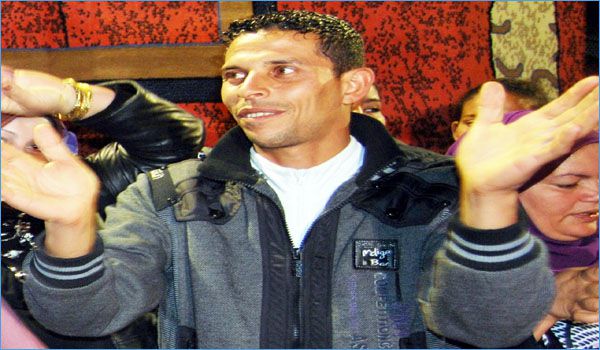
Mohamed Bouazizi

Khaled Said
The events in Tunisia and Egypt have riveted the region and the world. The eruptions of people power have shaken and taken down the seeming unbreakable edifices of dictatorship. (At the time of writing Mubarak has not formally acknowledged that he has been toppled, but the force of the movement is too powerful and determined to fathom any other outcome). Events are moving at breakneck speed and a new narrative for the future is swiftly being written. In the throes of a changing future it merits returning to the stories of two young men, the two faces that stoked the flames of revolution thanks to the persistence of on-line citizen activists who spread their stories. For in the tragic circumstances surrounding their deaths are keys to understanding what has driven throngs of citizens to the streets.
Mohammed Bouazizi has been dubbed “the father of Arab revolution”; a father indeed despite his young years and state of singlehood. Some parts of his life are by now familiar. This 26 year old who left school just short of finishing high school (he was NOT a college graduate as many new stories have been erroneously reporting) and worked in the informal economy as a vendor selling fruits and vegetable to support his widowed mother and five younger siblings. Overwhelmed by the burden of fines, debts, the humiliation of being serially harassed and beaten by police officers, and the indifference of government authorities to redress his grievances, he set himself on fire. His mother insists that though his poverty was crushing, it was the recurrence of humiliation and injustice that drove him to take his life. The image associated with Mohammed Bouazizi is not that of a young man’s face, but of a body in flames on a public sidewalk. His self-immolation occurred in front of the local municipal building where he sought, but never received, justice.
The story of 28 year old Egyptian, Khaled Said, went viral immediately following his death by beating on June 6, 2010. Two photos of him circulated the blogosphere and social networking sites. One was a portrait of his gentle face and soft eyes coming out of a youthful grey hooded sweatshirt; the face of an everyday male youth. The accompanying photo was of the bashed and bloodied face on the corpse of a young man. Though badly disfigured, the image held enough resemblance to the pre-tortured Khaled to decipher that the two faces belonged to the same person. The events leading to Khaled’s killing originated when he posted a video of two police officers allegedly dividing the spoils of a drug bust. This manner of citizen journalism has become commonplace since 2006. Youths across the region have been emboldened by a famous police corruption case of 2006. An activist posted a video on YouTube of two police officers sodomizing and whipping a minibus driver, Emad El Kabeer. It not only incensed the public and disgraced the perpetrators, but led to their criminal prosecution. On June 6, 2010, as Khaled Said was sitting in his local internet café in Alexandria two policemen accosted him and asked him for his I.D. which he refused to produce. They proceeded to drag him away and allegedly beat him to his death as he pleaded for his life. The officers claimed that Khaled died of suffocation when he tried to swallow a package of marijuana to conceal drug possession. But the power of photographic evidence combined with eyewitness accounts and popular knowledge of scores of cases of police brutality left no doubt in anyone’s mind that he was senselessly and brutally murdered by the very members of the police that were supposed to protect them. The court case of the two officers is ongoing.
Mohammed Bouazizi was not the first person to resort to suicide by self immolation out of desperation, there has been an alarming rise in such incidents in different Arab countries. And Khaled Said is sadly one of scores of citizens who have been tortured, terrorized, and killed by police with impunity. But the stories of these two young men are the ones that have captured the popular imagination, they have been game changers.
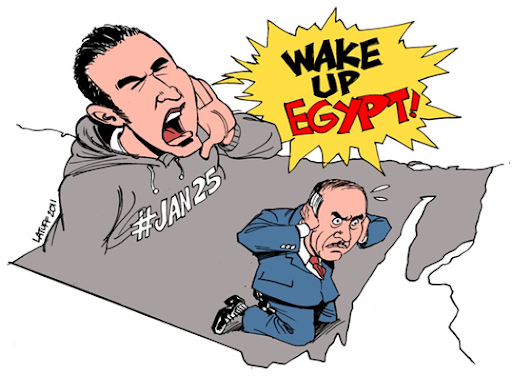
Cartoon from the Facebook Group We are all Khaled Said*
For the youth of Egypt and Tunisia, the largest cohort of young people ever in their countries, the martyrdoms of Khaled Said and Mohamed Bouaziz represent an undeniable tipping point, the breaking of the fear barrier. The youth have banned together as a generation like never before and are crying out collectively, “enough is enough!” to use the words of a 21 year old friend, Sherif, from Alexandria. The political cartoon of Khaled Said in his signature hoodie shouting to the Intelligence Chief, also popularly known “Torturer in chief” and now Mubarak’s Vice President, to “wake up Egypt” perfectly exemplifies this mood (from the Facebook group, We are all Khaled Said). No longer will the youth cower to authority figures tainted by corruption and abuses. These illegitimate leaders will cower to them. The order of things will change.
And so on January 25, 2011, inspired by the remarkable and inspiring revolution in Tunisia that toppled the twenty-three year reign of the dictatorship of Zine El Abidine Ben Ali, Egyptian youth saw it was possible to topple their dictator, Hosni Mubarak, of 31 years. Activists used different on-line platforms, most notably the April 6 Youth Movement and the “We are all Khaled Said” Facebook group to organize a national uprising against “Torture, Corruption, Poverty, and Unemployment.”
It is not arbitrary that civil rights, as exemplified in torture and corruption (recall Khaled Said), topped the list of grievances, followed by economic problems. For youth unemployment and underemployment will, under any regime, be among the greatest challenges of the times.
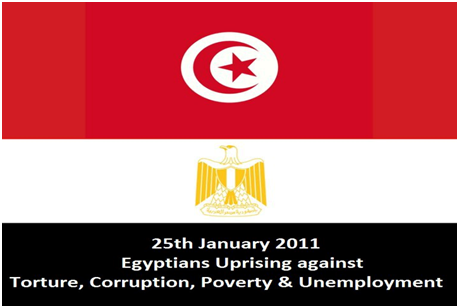
Banner of the Egyptian uprising
No one could have anticipated that this initial call would heed such mass and inclusive participation. Youths initially came to the streets braving tanks, rubber bullets, tear gas (much of which is made in the US and part of US military aid, incidentally), detention, and even death. And they were joined by citizens of all persuasions and life stages; children, youth, elderly, middle aged, female, male, middle class, poor, Muslim, Christians, Atheists.
Contrary to a number of commentators in news outlets in North America and parts of Europe the two revolutions overtaking North Africa are not motivated by Islamism and there are no compelling signs that they will be co-opted in this direction. Such analyses are likely to be either ideologically driven or misinformed. In fact, Islam has not figured whatsoever into the stories of Bouazizi and Said. These are inclusive freedom movements for civic, political, and economic rights. To understand what is driving the movement and what will invariably shape the course of reforms in the coming period we need to return to these young men. Their evocative if tragic deaths speak reams about the erosion of rights and accountability under decades of corrupt dictatorship, about the rabid assault on people’s dignity. They remind us of the desperate need to restore a political order that is just and an economic order that is fair. Mohamed Bouazizi and Khaled Said have unwittingly helped to pave a way forward, and to point the way to the right side of history.
*Correction: The figure who appears cowering in the cartoon is former Minister of Interior, Habib al-Adly, NOT Omar Suleiman, Mubarak’s VP
Linda Herrera is a social anthropologist with expertise in comparative and international education. She has lived in Egypt and conducted research on youth cultures and educational change in Egypt and the wider Middle East for over two decades. She is currently Associate Professor, Department of Education Policy, Organization and Leadership, University of Illinois at Urbana-Champaign. She is co-editor with A. Bayat of the volume Being Young and Muslim: New Cultural Politics in the Global North and South, published by Oxford University Press (2010).
This post also appeared at Thetyee.ca
‘Telefoon uit Tunesië’ – Een persoonlijk verslag van de Jasmijn-revolutie
Posted on January 29th, 2011 by martijn.
Categories: Guest authors, Society & Politics in the Middle East.
Gastauteur: Carpe D.M.
Tunesië, in de ogen van de westerse wereld een zonnig vakantieland en een voorbeeld van hoe een Arabisch land zou moeten zijn. Een vrij land, een modern land, een land waar de islam een rol speelt, maar niet de hoofdrol. Wij Tunesiers weten dat niets minder waar is. Tunesië wordt al jaren geregeerd door de president Zine al Abedine Ben Ali, een president die al jarenlang ‘democratisch’ wordt gekozen. Hij is de opvolger van president Habib Bourguiba , onder zijn bewind was Ben Ali generaal van het leger. In 1987 greep Ben Ali de macht. Hij is getrouwd met Leila Trabelsi, een kapster. De familie Trabelsi is de meeste gehate en gevreesde familie binnen Tunesië. Bijna alle bedrijven zijn in hun handen, zij zijn verantwoordelijk voor alle drugs in- en export, hebben de volledige alcoholmarkt in handen (inclusief fabrieken) en wil je iets gedaan krijgen, moet jouw geld die kant op.
Dit alles was onzichtbaar voor de buitenwereld, totdat op 17 december 2010 de waarheid beetje bij beetje naar buiten kwam. Mohammed Bouazizzi, een jongen zoals alle anderen, afgestudeerd als ICTer en werkloos. Hij besloot het er niet bij te laten zitten en startte zijn eigen groente- en fruitkraam om op deze legitieme manier toch geld te kunnen verdienen voor zijn familie. Maandenlang probeerde hij een vergunning te krijgen, maar vanwege de corruptie van het land werd dit hem onmogelijk gemaakt. Het probleem in Tunesië is dat ambtenaren te pas en te onpas geld willen zien om in eigen zak te steken, en de bedragen zijn zo hoog, dat niemand dit kan betalen. Hij ging verhaal halen op het gemeentehuis en bij terugkomst was zijn kar weggesleept. Uit pure wanhoop stak hij zichzelf in brand. Hij belandde in het ziekenhuis in coma, en overleed een paar dagen later. Wat volgde op zijn daad was iets dat hij in zijn stoutste dromen niet had durven dromen. Het land besloot zijn dood niet voor niets te laten zijn, en kwam in opstand. Wekenlang gingen jongeren de straat op om te demonstreren voor hun rechten.
Tunesië zou Tunesië niet zijn als dit niet keihard de kop ingedrukt zou worden. Het leger en politieagenten werden door Ben Ali ingezet om de mensen terug te dringen en de mond te snoeren, zelfs te doden. Het begon in het dorp Sidi Bouzid en ging vanaf daar door naar de stad Kasserine; in deze stad alleen al vielen minimaal 50 doden door het harde optreden van de politie. Vanuit daar trok de onrust verder het land in, met als eindbestemming het dorp Bizerte en de hoofdstad Tunis. Donderdag 16 januari 2011 kreeg ik ’s ochtends een telefoontje van mijn zestienjarige nichtje, huilend. Mijn oom, tante, nichtjes en neefjes hadden al twee dagen niet gegeten omdat de supermarkten uitgebrand waren en binnen een uur zou het water afgesloten worden. Kort na dit bericht werd inderdaad bekend dat de regering het water en de elektriciteit zou gaan afsluiten. Het water om de mensen tot wanhoop te drijven, en de elektriciteit om zowel de telefoonlijn als het internet af te sluiten, zodat contact met de buitenwereld onmogelijk zou worden.
Over de hele wereld begonnen Tunesiërs vanuit tientallen landen in actie te komen, voornamelijk door middel van demonstraties. Zó ook in Nederland. De avond dat de voorbereidingen getroffen werden kwam plotseling een onverwachte persconferentie van Ben Ali. Zijn beloftes: vanaf dit moment zou er een vrijheid van meningsuiting gelden, er zouden miljoenen gepompt worden in de economie om zo de werkgelegenheid te stimuleren, YouTube zou opengezet worden, er zou geen geweld meer gebruikt worden tegen de demonstranten én de prijzen van brood, suiker en melk zouden naar beneden gaan. Dit alles leidde binnen één uur tot grote verbazing (voornamelijk onder de Tunesiërs die woonachtig zijn buiten Tunesië) en tot grote vreugde. Binnen een uur reden tientallen auto’s al toeterend de straten op, klonken er leuzen als ‘lang leve Ben Ali’ en werden er honderden YouTube filmpjes op Facebook ge-upload. Dit alles tot grote verbazing van de Tunesiërs uit de Nederlandse gemeenschap. Waren hier al die mensen voor gestorven? Waren ze nu al vergeten wat dit regime met het land had gedaan? Beseften zij niet dat dit loze beloftes waren? Met stomheid geslagen werd er druk gediscussieerd of de demonstratie nog wel door moest gaan. Verdienden ze al deze steun en moeite nog wel?
De volgende ochtend werd bekend gemaakt dat twee uur na de speech het wederom uit de hand was gelopen en er drie mensen waren doodgeschoten. Daarnaast bleek dat Ben Ali politieagenten in burger de straat op had gestuurd om naar de buitenwereld toe de illusie te wekken dat hij de situatie weer onder controle had. Vrijdag 14 januari begonnen er ’s ochtends vroeg weer (vreedzame) demonstraties, tot de politie rond het middaguur wederom met geweld ingreep en de situatie uit de hand liep. Die dag heeft (ex)president Ben Ali besloten tijdelijk het land te ontvluchten samen met zijn vrouw, en zijn werkzaamheden over te dragen aan Mohammed Ghannouchi. Ben Ali vluchtte, in de eerste instantie richting Malta, waar hem de toegang werd ontzegd. Vervolgens Parijs en Dubai, maar ook daar werd hij niet ontvangen. Hij is nu al twee weken woonachtig in Saudi-Arabië, het land dat hem wel als politiek vluchteling heeft onthaald.
Zaterdag 15 januari zijn er drie gevangenissen in brand gestoken. Enkelen zijn vermoord, maar zo’n 3000 gevangenen hebben de gevangenissen kunnen ontvluchten. Zij zijn het land ingetrokken om het land verder in vernieling te brengen, geweld te plegen en overvallen te plegen. Online werden beelden geplaatst van politieagenten die ook massaal winkels plunderden en banken overvielen. Mijn vriendin, woonachtig in Tunis liet over FaceBook weten dat iedereen doodsbang was, omdat politieagenten huizen openbraken om spullen te stelen en de meisjes en vrouwen te verkrachten. Nadat het leger dit doorkreeg ontstonden er vuurgevechten tussen het leger en de politietroepen. Het leger heeft de hele periode aan de kant van het volk gestaan en heeft alles op alles gezet om de orde te handhaven.
Direct nadat de president het land verliet en zijn rechterhand de macht over het land had gegeven, trokken de demonstranten de straten weer op om iedereen binnen het kabinet die lid was van de RCD –de partij van Ben Ali- de interim regering te doen verlaten. Uiteindelijk is Ghannouchi vertrokken als interim president en zijn de werkzaamheden overgedragen aan de voorzitter van het parlement, zoals in de grondwet is vastgelegd. Wel is hij aangebleven als lid van de regering. Ben Ali wilde in eerste instantie terugkeren naar het land, maar heeft op advies van andere regeringsleiders te kennen gegeven dat hij definitief zijn troon heeft verlaten en er binnen twee maanden verkiezingen gaan plaats vinden.
Tunesië gaat nu spannende tijden tegemoet, de eerste stappen zijn gezet, maar het echte werk gaat nu pas beginnen. Binnen anderhalve maand moeten er politieke partijen gevormd worden, moeten kandidaten zich verkiesbaar gaan stellen, en moet er op toegezien worden dat het land niet in herhaling gaat vallen. Radicale partijen beginnen weer op te komen, en Ghannouchi (niet te verwarren met de politicus Mohammed Ghannouchi) leider van een radicale islamistische partij, en zo’n twintig jaar geleden verbannen uit Tunesië, is teruggekeerd naar het land. Veel mensen zijn bang dat het land gaat vallen in de handen van extremisten. Dinsdag 25 januari is er een officieel internationaal arrestatiebevel uitgevaardigd voor Ben Ali, zijn vrouw Leila Trabelsi en een aantal naaste familieleden. Zij worden er onder meer van verdacht op grote schaal geld en goederen van de Tunesische staat te hebben gestolen. Voor zover bekend heeft een groot deel van de familie Trabelsi het land verlaten en zijn al hun eigendommen en onroerend goed in beslag genomen en verwoest. Na Tunesië is de onrust nu ook overgeslagen naar Egypte en Yemen, waar afgelopen dagen ook duizenden mensen de straat op gingen, allemaal georganiseerd via FaceBook en Twitter.
In Tunesie is iedereen optimistisch en men hoopt op een democratie, zoals een democratie hoort te zijn. Het is een mooi land, met veel potentie. De angst van het oude regime zit er echter nog steeds in. Het is nog redelijk onzeker welke kant het opgaat en dit is tevens de reden dat ik dit stuk schrijf, maar niet onder mijn eigen naam. Ik hoop dat er ooit een dag komt, waarop die angst zal verdwijnen en ik mij onder mijn complete naam trots kan uitlaten op zowel positieve als negatieve ontwikkelingen binnen het land.
Carpe D.M. is de dochter van een Nederlandse moeder en een Tunesische vader. Zelf is zij meerdere keren per jaar in Tunesië, en hoopt ooit op een dag permanent te kunnen blijven. Een groot gedeelte van haar familie is nog steeds woonachtig in Tunesië, onder wie haar broertje Zij heeft dus de ontwikkelingen van dichtbij meegemaakt.
Noot van de beheerder: De naam is bekend bij de beheerder van dit weblog.
Gülenbeweging brengt in Tweede Kamer SP en PVV nader tot elkaar
Posted on December 18th, 2010 by martijn.
Categories: Guest authors, Important Publications, Public Islam.
Het kabinet stuurde deze week een rapport naar de Tweede Kamer over de Gülenbeweging, die de afgelopen weken weer in de publieke aandacht was geweest met alarmerende krantenberichten over dubbele agenda’s, indoctrinatie en islamisering. De Gülenbeweging is de snelst groeiende Turks-islamitische beweging en is tegenwoordig in een honderdtal landen actief. In Nederland bestaan scholen en huiswerkinstellingen die met de beweging zijn geaffilieerd. Het rapport, dat een aanzienlijk minder paniekerige toon aansloeg dan de krantenberichten, werd donderdag behandeld in een spoeddebat met minister Donner, dat was aangevraagd door het SP-Kamerlid Sadet Karabulut. Eerdere Kamervragen van Karabulut waren de aanleiding geweest tot een onderzoeksopdracht aan de auteur van het rapport, Martin van Bruinessen. De auteur doet hier verslag van het kamerdebat en geeft een korte samenvatting van het rapport.
Gastauteur: Martin van Bruinessen
In het debat met de minister kwamen vooral de stokpaardjes van de verschillende woordvoerders naar voren. Vrijwel iedereen had moeite met het feit dat de Gülenbeweging haar religieuze activiteiten tot de private sfeer beperkt en in het publieke domein seculier optreedt. Terwijl je toch zou zeggen dat het nu juist de eis is van onze radicale secularisten dat mensen hun religie thuis laten als ze de publieke ruimte betreden, en de Gülenbeweging daarom meer aan deze opvatting van secularisme voldoet dan de meeste andere moslimbewegingen. Maar de argwaan wordt juist gevoed door het gemak waarmee de beweging in het publieke domein opereert terwijl men toch echt diep-religieus is. Omdat de sociale activiteiten, hoe nuttig ook, voortkomen uit een religieuze motivatie, is er bijna per definitie sprake van een ‘dubbele agenda’.
Karabulut ontkende de conclusies van het rapport niet, maar vond er voldoende ondersteuning in voor haar standpunt dat er bij de beweging sprake is van indoctrinatie, van een vasthouden van kinderen in een ‘mono-etnische’ omgeving en van afwijzing van Nederlandse morele normen. Ze vroeg om een categorische afwijzing van overheidssubsidie en een nader onderzoek naar wat zich binnen de private sfeer van de beweging afspeelt. Joram van Klaveren (PVV) herhaalde het credo van zijn leider, dat de islam geen religie maar een politieke ideologie is (en viel Donner aan toen die een vergelijking met een christelijke kloosterorde maakte, want christendom en islam zijn nu eenmaal niet te vergelijken). Volgens hem is de Gülenbeweging bezig met islamisering en daarom onwenselijk. Dat ze huiswerkinstellingen oprichten is een vorm van taqiyya, en taqiyya, zo had de AIVD in 2004 geschreven, is strijdig met de democratie.
Minister Donner merkte op dat de overheid zich niet mag en niet wil moeien in de interne zaken van levensbeschouwelijke bewegingen, zolang er geen aanwijzingen zijn van onwettelijke of staatsgevaarlijke activiteiten. De rijksoverheid subsidieert nu geen activiteiten van betrokken organisaties; hij was wel bereid te laten inventariseren wat voor subsidies er door lokale overheden worden verleend, maar niet om aan te dringen tot een stopzetting van de subsidierelatie. Hij liet nadrukkelijk de mogelijkheid open dat maatschappelijk nuttige activiteiten van deze en andere levensbeschouwelijke organisaties gesubsidieerd zouden kunnen worden.
Zowel Karabulut als van Klaveren dienden moties in waarin ze op stopzetting van alle subsidies aandrongen en (Karabulut) op een nader onderzoek naar de interne organisatie en financiering van de Gülenbeweging. De SP en de PVV – die in de kamer de uiterste linker- en rechterflank bezetten – steunden elkaars moties, maar behalve de Partij van de Dieren wezen alle anderen ze af.
Samenvatting van het rapport “De Fethullah Gülenbeweging in Nederland”
Kenmerkend voor de Gülenbeweging is de scheiding tussen de activiteiten in de publieke sfeer, die niet specifiek religieus zijn, en de expliciet religieuze vormen van devotie en verinnerlijking, die in de privésfeer van het internaat, de dersane, het zomerkamp en de huiskamer plaatsvinden. De publieke activiteiten – onderwijs, liefdadigheid, dialoog, ondernemerschap – staan niet los van de religieuze grondhouding die in de privésfeer wordt gecultiveerd, maar worden alle beschouwd als de uitvoering van religieuze plichten. De term hizmet, ‘het dienen’, verbindt beide sferen: maatschappelijke dienstverlening wordt als een vorm van devotie, dienen van God, gezien. Anders dan veel andere islamitische bewegingen, streeft de Gülenbeweging niet (of althans niet primair) naar islamisering van de publieke sfeer, maar ziet deze als een plaats van ontmoeting met andersdenkenden. Het opvoedingsideaal van de beweging is erop gericht een elite te trainen van personen die een ascetische, diep-gelovige levenshouding paren aan professionele bekwaamheid en succes in ‘wereldse’ activiteiten.
De beweging ziet zich als een niet-politieke beweging maar is in Turkije een politieke factor van toenemende betekenis. Hoog opgeleide aanhangers van de beweging hebben belangrijke posities in de zakenwereld, delen van het staatsapparaat, het onderwijs en de media bereikt, en zij spelen een belangrijke rol in de machtsstrijd tussen de oude kemalistische, secularistische, elite en de nieuwe opkomende middenklasse die geworteld is in het meer traditionele en religieus gezinde deel van de bevolking. Tegenstanders verdenken de beweging ervan achter een seculiere façade een dubbele agenda te verbergen die er wel degelijk op gericht is, uiteindelijk aan de maatschappij de sjariah, de islamitische plichtenleer, op te leggen. Het bestaan van een dergelijke agenda is nooit aangetoond, maar dat neemt de achterdocht bij tegenstanders, met name de alevitische minderheid, niet weg.
Sinds het uiteenvallen van de Sovjetunie heeft de beweging haar terrein van actie uitgebreid naar de nieuwe onafhankelijke staten in Centraal-Azië, de Kaukasus en de Balkan, waar ze goede kostscholen oprichtte (met een grotendeels Engelstalig, seculier curriculum), eigen kranten uitgaf, en nauw samenwerkte met Turkse zakenmensen die daar ondernemingen opzetten. Vervolgens ondernam de beweging soortgelijke activiteiten in tal van andere landen in Azië en Afrika (die sterk doen denken aan de activiteiten van christelijke zending/missie en ontwikkelingshulp), en ze werd ook actief onder de Turkse gemeenschappen in West-Europa en Noord-Amerika. Inmiddels heeft de beweging in ruim honderd landen scholen en andere instellingen opgericht.
In Nederland kwamen kleine aantallen aanhangers van de beweging vanaf de jaren tachtig bijeen in huiskamerbijeenkomsten, waar vooral de mystiek getinte Koranuitleg van Said Nursi, één van de twee inspiratiebronnen van de beweging, werden besproken. De beweging raakte goed georganiseerd vanaf het moment dat er een tweede generatie was die de universiteit of hogeschool doorlopen had. Studenten en jonge afgestudeerden richtten in de tweede helft van de jaren negentig de eerste internaten en instellingen voor huiswerkbegeleiding op, om de prestaties van Turks-Nederlandse kinderen in het voortgezet onderwijs te verbeteren en om hun bescherming te bieden tegen de gevaren van drank, drugs, seks en kleine criminaliteit. Het duurde enige tijd voordat er ook scholen werden opgericht, maar met steun van het Ministerie van Onderwijs en gemeentelijke instellingen werd in 2006 de eerste school, het Cosmicus College in Rotterdam (met havo en vwo-afdelingen), geopend, enkele jaren later gevolgd door het Cosmicus Montessori Lyceum in Amsterdam en een Cosmicus basisschool in Rotterdam. Daarnaast werden diverse andere instellingen opgericht, zoals de ondernemersvereniging HOGIAF en de Dialoog Academie.
Terwijl de publieke activiteiten van de beweging, waartoe ook de scholen gerekend kunnen worden, redelijk transparant zijn en geen duidelijk religieus karakter dragen, zijn de religieuze devoties en persoonlijkheidsvormende discipline in de privésfeer aanzienlijk minder gemakkelijk waarneembaar. Een aanhoudende stroom van verdachtmakingen, gevoed door politieke tegenstanders van de beweging, richt zich met name op de vermoede dubbele agenda, indoctrinatie, dwang en strakke controle waaronder jongeren in de scholen en internaten zouden verkeren. Het hier gerapporteerde onderzoek heeft zich vooral gericht op de vormen van disciplinering binnen instellingen van de beweging, en de belangrijkste bron van informatie bestaat uit lange levensloopinterviews met leden en ex-leden van de beweging.
Beide scholen voor voortgezet onderwijs maken deel uit van grotere onderwijskoepels en staan onder een bestuur dat niets met de Gülenbeweging te maken heeft. Wel komt een deel van het lerarenkorps uit de beweging voort en is het ‘concept’ van de school – sterke nadruk op technische vakken en op vorming tot wereldburger – door de aan de beweging verbonden Stichting Cosmicus geformuleerd. Er bestaat geen formele band tussen de scholen en internaten of andere buitenschoolse activiteiten van de beweging. De kwaliteit van het onderwijs is door de schoolinspectie getoetst en voldoende bevonden.
Huiswerkbegeleiding wordt in een groot aantal steden aangeboden en vooral door student-vrijwilligers gegeven. De meeste van deze vrijwilligers zijn aanhangers van de beweging en doen hun best als rolmodel te fungeren, maar hun activiteit beperkt zich tot hulp bij het huiswerk, met behulp van de Nederlandse schoolboeken. Daarnaast zijn er wekelijkse zondagsschoolachtige activiteiten, waar jongeren in het religieuze gedachtegoed van de beweging worden ingewijd.
De intensiefste vorm van religieuze disciplinering vond tot voor kort plaats in de internaten (voor scholieren van het voortgezet onderwijs), die een decennium lang de belangrijkste instellingen van de beweging waren. Scholieren werden hier afgeschermd van een als bedreigend ervaren buitenwereld, frivool vermaak en ongewenste lectuur; ze hadden een strak gestructureerd dagschema met veel tijd voor huiswerk en voor religieuze devoties. Er was binnen deze instellingen geen fysieke dwang om mee te doen aan alle activiteiten maar wel een sterke sociale controle en voortdurende overreding, waardoor de meeste scholieren zich conformeerden aan het gewenste gedrag. Uit de interviews is niets gebleken van werkelijke dwang, hoewel hier wel naar gevraagd is; allen bevestigden dat vooral het voortdurend samenzijn met de groep de druk tot conformeren versterkte. Overigens zijn de internaten inmiddels alle gesloten – volgens de betrokken bestuurders wegens sterk afgenomen belangstelling van de zijde van de ouders.
De belangrijkste disciplinerende instellingen zijn nu de studentenhuizen van de beweging (dersane of isik evi genoemd). Dit zijn doorgaans gewone woonhuizen waar vier tot zes studenten samenwonen, van wie één als de oudere broer (abi) optreedt en de contacten met personen van gezag binnen de beweging onderhoudt. Het aantal dersanes in Nederland bedraagt tientallen. De dersane biedt de studenten goedkope huisvesting en een beschermde omgeving, met sterke onderlinge ondersteuning en controle. Er is sterke druk om aan de ascetische zelfdisciplinering deel te nemen en contacten buiten de beweging tot het noodzakelijke te beperken. Alle geïnterviewden die in een dersane geleefd hebben spraken van de positieve invloed die dit had op hun studieresultaten; sommigen – vooral degenen die later uit de beweging zijn getreden – klaagden over voortdurende sociale controle en gebrek aan intellectuele vrijheid. Overigens erkende ieder dat men zich vrijwillig aan de discipline onderwerpt; wie weigert zich aan de discipline te onderwerpen kan zich zonder problemen van de beweging losmaken.
Eén van de vaak gehoorde beschuldigingen aan het adres van de Gülenbeweging is dat ze door de sociale controle over haar aanhang en het beperken van sociale contacten tot de eigen kring integratie zou belemmeren. De internaten en dersanes houden scholieren en studenten in een beschermde omgeving van de eigen gemeenschap en schermen hen met name af van niet noodzakelijke contacten daarbuiten. Er is echter een sterke ondersteuning van inspanningen om succes te boeken op school en bij voortgezette opleidingen. Deze instellingen hebben participatie in het onderwijs bevorderd. Naar uit de door de onderzoekers afgenomen interviews blijkt, vinden schoolverlaters en afgestudeerden uit kringen van de Gülenbeweging werk in zeer uiteenlopende sectoren van de arbeidsmarkt, en zeker niet uitsluitend in Turkse kring. We zijn bovendien geen enkel geval van werkloosheid tegengekomen. Op deze twee belangrijke indicatoren van integratie, schoolsucces en arbeidsparticipatie, blijken de internaten en dersanes dus geen belemmerende maar juist een bevorderende invloed te hebben.
Waar de beweging bewust afstand houdt van de bredere samenleving, is op het gebied van morele waarden. Zij houdt vastberaden vast aan de eigen geloofsovertuiging en conservatieve morele normen, die verschillen van (wat zij aanziet voor) de dominante morele waarden van seculier Nederland. Deze houding heeft ze overigens gemeen met tal van andere religieuze gemeenschappen, autochtoon zowel als allochtoon. Van de trouwe aanhang verlangt de beweging gehoorzaamheid aan haar morele normen en deelname aan de devotionele activiteiten, maar ze doet geen pogingen die normen en devoties aan anderen op te leggen, ondanks een zekere bekeringsijver. In publieke activiteiten werken prominente leden van de beweging met opvallend gemak samen met mensen van zeer uiteenlopende achtergronden, waaronder ongelovigen.
Martin van Bruinessen is hoogleraar vergelijkende studie van moderne moslimsamenlevingen aan de Universiteit Utrecht. Hij heeft onder meer gepubliceerd over Koerden in Turkije en Islam in Indonesië. Recente publicaties zijn onder meer Producing Islamic knowledge: transmission and dissemination in Western Europe (2010, redactie met Stefano Allievi), en Islam and modernity: key issues and debates (2009, met Muhammad Khalid Masud en Armando Salvatore).
Het hele rapport en de begeleidende brief van de minister over de Gülen beweging zijn HIER te downloaden.
The Ideology and Influence of Abu Muhammad al-Maqdisi
Posted on November 16th, 2010 by martijn.
Categories: Guest authors, ISIM/RU Research, Religious and Political Radicalization.
The Ideology and Influence of Abu Muhammad al-Maqdisi
Guest Author: Joas Wagemakers
The subject of my dissertation, Abu Muhammad al-Maqdisi, is hardly known among Muslims outside Salafi circles and almost a complete unknown among non-Muslims outside specialists of radical Islam. Still, within those two groups, everybody knows who he is, and rightly so: he is the owner of the biggest online library of radical Islamic literature (www.tawhed.ws), the author of dozens of books and scores of articles, fatwas and poems, has inspired militant Islamists around the world (including the former leader of Al-Qa‘ida in Iraq, Abu Mus‘ab al-Zarqawi) and is even said to have influenced Mohammed B., the murderer of Theo van Gogh. Who is this man and what is so special about him?
Al-Maqdisi’s life
Abu Muhammad al-Maqdisi was born in a village called Barqa in the West Bank in 1959, from which he moved to Kuwait when he was only a small child. In Kuwait, he grew up in a secular family and through some friends who took him to mosques controlled by the Muslim Brotherhood, he became increasingly radical. He began to see the rulers of the Muslim world as apostates, “infidels” who should be fought in order to apply the shari‘a. He was never completely satisfied with the Muslim Brotherhood’s message, however, and wanted to combine the supposedly purist message of Salafism with the radical ideas he had learned from the Brotherhood. He eventually found those in certain 19th-century Saudi writings that he discovered when he studied in the kingdom for a year in the 1980s.
Armed with the Salafi tools to label Muslim rulers (including Saudi ones) “infidels”, he moved to Pakistan to teach in the camps of the various “Afghan Arabs”, Arab volunteers who had come from all over the Arab world to fight the Soviet Union, which had occupied Afghanistan in 1979. After leaving Pakistan/Afghanistan, he moved back to Kuwait and eventually to Jordan, where he still lives and is imprisoned now.
Ideology
Al-Maqdisi’s ideas are – at first sight – nothing new. Haven’t we heard all this criticism and excommunication (takfir) of the rulers of the Muslim world before from the likes of Sayyid Qutb and Muhammad ‘Abd al-Salam Faraj? Partly, yes. What makes al-Maqdisi different, however, is that he makes extensive use of (often Saudi) Salafi concepts, arguments and scholars and was one of the first to do so extensively. In other words, whereas Salafism had mostly been a quietist version of Islam whose adherents were subservient to their rulers, al-Maqdisi used the tools that Salafism offered him against those very same rulers. This way, he turned the seemingly obedient Salafi ideology upside-down and revolutionised it. To be sure, al-Maqdisi was certainly not the only ideologue responsible for this process but there are certain areas where he was clearly ahead of his time.
Al-Wala’ wa-l-Bara’
One example of al-Maqdisi’s thinking that makes him somewhat special is his treatment of al-wala’ wa-l-bara’ (loyalty to God, Muslims and Islam and disavowal of everything else). While the overwhelming majority of scholars treated this concept (particularly but not exclusively in Saudi Arabia) as something pertaining only to interpersonal and religious affairs, al-Maqdisi changed this. Adopting the reasoning of the 19th-century Saudi scholars who had influenced him so much, he stated that al-wala’ wa-l-bara’ should also be used in the political, legislative sphere. Not applying Islamic law, he contended, was a violation of the loyalty (wala’) that every Muslim had to show to God. If any ruler of the Muslim world was guilty of such a sin, this should be countered by disavowal (bara’) of them. According to al-Maqdisi, the highest form of bara’ is to fight such rulers through jihad.
Although al-Maqdisi’s reasoning is far more complicated and elaborate than the above shows, his use of concepts such as al-wala’ wa-l-bara’ as well as other terms and arguments usually only employed by state-supported quietist Salafi scholars ensured that he came up with radical solutions akin to what Qutb and Faraj had said but argued for them in a very Salafi way. As such, al-Maqdisi can certainly be viewed as a Jihadi-Salafi (i.e. a Salafi who believes jihad may be used against the supposedly apostate rulers of the Muslim world) but one who has been strongly influenced by the quietist and subservient branch of Salafism as well when it comes to their use of terminology, arguments and sources.
Influence
It is clear that al-Maqdisi’s “quietist Jihadi-Salafi” ideological background reflects his search for Salafi but radical answers to the questions he had. Considering this, it is not surprising that his influence is strongest among those radicals who have roots in or great respect for the quietist Salafi background that al-Maqdisi values so much. This was the case, for example, in Saudi Arabia, where Al-Qa‘ida on the Arabian Peninsula (QAP) was greatly influenced by him. Many members of QAP had strong roots in the Saudi quietist Salafi tradition since they had grown up in a country that prides itself on being a truly Islamic state and uses large parts of the school curriculum to teach its subjects the details of religion. As al-Maqdisi offered Saudi militants Saudi Salafi (and not Egyptian, secular or Marxist) tools to fight the rulers of the kingdom, his message of a radical Islam rooted in a quietist tradition was quite popular among members of QAP.
A process similar to the one in Saudi Arabia took place among radical Salafis in Jordan. Unlike Saudi Arabia, the Hashemite Kingdom of Jordan does not claim to be an Islamic state but there are nevertheless many Salafis there who generally adhere to the same teachings as Saudi Salafis do. Among al-Maqdisi’s supporters, a rather clear distinction can be made between those radicals who had roots in quietist Salafism and those who previously led a life of crime or drug abuse. During my research, I found that the former group has been quite loyal to al-Maqdisi and his teachings, while the latter have often drifted away from his ideas or have even turned against him, considering him too focussed on doctrine or blaming him for allegedly revising his views.
Although al-Maqdisi is not a household name in any country of the world, it is clear that he is an important and influential radical ideologue among like-minded Muslims. His widespread influence, his many writings, his sometimes original thinking and his status as a credible scholar among his admirers ensure that he is going to remain just that for some time to come. Moreover, his current incarceration in Jordan, rather than stop him from being influential, is much more likely to increase his stature as an ideologue unwilling to bend to the will of the “apostate” rulers.
Joas Wagemakers MA is a researcher at the Clingendael Diplomatic Studies Programme and a lecturer and PhD student at Radboud University Nijmegen. Today, 16 November 2010 he defends his PhD thesis on the ideology and influence of Abu Muhammad al-Maqdisi (b. 1959), a Jordanian Jihadi-Salafi ideologue who is widely considered one of the most important radical Islamic scholars alive. Joas Wagemakers has published widely on Islamism and Islamist ideology and co-edits ZemZem, a Dutch-language journal on the Middle East, North-Africa and Islam. Joas Wagemakers blogs at Jihadica.com, a weblog on developments in jihad. His research interests are Islamist movements and Islamist ideology in the context of the modern Middle East and in relation to early-Islamic history.
update: Joas Wagemakers defended his PhD cum laude on 16 November 2010
Wilders drags up outdated colonial rhetoric
Posted on August 20th, 2010 by martijn.
Categories: Guest authors, Multiculti Issues, Public Islam.
Wilders drags up outdated colonial rhetoric
Guest author: Michel Hoebink
‘Why did you become anti-Islamic and what is your message to Muslims? These questions were asked by Muslimsdebate.com to the Dutch politician Geert Wilders. In his reply, Mr Wilders describes Islam as fatalist, tyrannical, violent and irrational and as such as the cause of the lack of democracy and development in the Muslim World. All this in sharp contrast to Christianity and Judaism, which religions according to Mr Wilders encourage their followers to be rational and free. Only by liberating themselves from their religion, he says, Muslims will be able to develop their real potential.
Wilders’ argument is a perfect sample of 19th century ‘orientalist’ rhetoric. Apparently, the leader of the Dutch Freedom Party is unaware of the fact that this type of reasoning was effectively defeated in the 1970s by critics such as the Palestinian Edward Said. Such critics rightfully argued that world religions such as Islam do not have an unchanging essence which is either violent or peaceful or what ever. Throughout the ages, these religions have given rise to a great variety of currents and interpretations. Sure, there are violent currents in Islam, but there have also been plenty of believers who preached pacifism in the name of the same religion. And positive, there are fatalistic tendencies in Islam but there are also currents that preach individual freedom and responsibility, basing themselves on the very same sources. The Koran and the Prophetic traditions are so rich that anybody can always find something to support his case. In short, you can’t limit Islam to one of its historical appearances.
In the academic world, essentialist arguments such as those of Wilders and his 19th century predecessors are out. Individuals who have been following this academic debate since the 1970s, are perplexed when Wilders and his fellow contemporary Islam critics start to bring up these arguments again, as if nothing ever happened.
You can say it even more simple: History decisively proves that Wilders is wrong. If Islam would necessarily lead to fatalism, tyranny and underdevelopment, how is it possible that, from the 8th to the 14th centuries, powerful empires emerged under Islam where science, philosophy, art and architecture flourished on a level that left Europe far behind? And if Judaism and Christianity necessarily produce free and rational individuals, how to explain the Crusades and Inquisition in Medieval times and Nazism and Stalinism in the modern era?
What Wilders does in his argument is applying a classical but rather cheap rhetorical trick: Comparing one’s own virtues to the vices of the other. Following the same formula, rancid islamist authors in the Middle East write books about a despicable religion called Christianity which calls for murder and bloodshed in its sacred texts and whose followers practised these calls during the Crusades and in the present wars in Iraq and Afghanistan.
Wilders attributes economic and social failures in the Muslim World to Islam, which he views as a religion but also as a culture. In itself there is nothing wrong with such cultural explanations. Culture and religion may very well be forwarded as causes of economic and social failures, but the discussion should always be about a particular historical appearance of the culture of religion in question, not about a culture or religion as an unchangeable essence. That is where Wilders is wrong.
Interestingly, many Muslim reformers agree with Geert Wilders when he says that Islam is a ‘backward religion’. However, they speak about the present appearance of traditional Islam and not about an a-historical essence. They believe that the dominant form of traditional Islam, as it is followed by millions of contemporary Muslims, is in need of reform and modernisation. According to Wilders this is not possible. Islam, in his view, can never be reconciled with modernity. If Muslims want to modernise, if they want to embrace democracy and human rights, they will have to give up Islam.
The irony is that Wilders in this sense completely agrees with the fundamentalists, who just like him believe that Muslims have to choose between their religion and the modern world. And indeed: for Wilders, fundamentalist Islam is the only true Islam. ‘Pure Islam’, he calls it, following his mentor the controversial Dutch arabist Hans Jansen, who in turn shamelessly took it from the fundamentalists themselves. All other currents in Islam, in particular the more moderate and modern ones, are considered by Wilders and his mentor as ‘impure’ forms of Islam they prefer not to associate with. The late Egyptian Muslim reformer Nasr Hamid Abu Zayd, who pleaded for a historical reading of the Koran, was abhorrent to them.
In fact Wilders behaves like a believer. He takes side in a religious debate that as an unbeliever he could only describe. The Dutch arabist Robbert Woltering once made fun of this attitude in an ironic commentary in the Dutch daily NRC Handelsblad. It was about the Somali born Dutch MP Ayaan Hirsi Ali, who also frequently used the term ‘pure Islam’, just like Wilders following Hans Jansen.
Woltering is obviously amused. Ever since the coming of Islam, he writes, Muslims have been quarrelling about the question as to what is the correct interpretation of Koran and the Prophetic Traditions. Now, at a time that the answer seems further away than ever, this historical quest has come to an unexpected apotheosis in – of all possible places – the Dutch parliament, where Ms Hirsi Ali recently revealed that she herself has discovered the True Doctrine of Pure Islam!
Ayaan Hirsi Ali’s discovery, Mr Woltering continues, will most probably please Mohammed Bouyeri, the man who murdered film maker Theo van Gogh in the name of Islam. But it will be a disappointment for all those Muslims who mistakenly thought that Islam respects the rights of women and tells them to live in peace with their non-Muslim neighbours.
Mr Woltering, we like to hear more from you.
A well-known prophetic Tradition about fatalism versus the taking charge of one’s own fate: The prophet Mohammed was asked: ‘Should I tie my camel or should I trust God?’ The prophet answered: ‘Tie your camel and trust God.’
Michel Hoebink works for the Arabic department of Radio Netherlands World (RNW).
This article first appeared at Muslimsdebate.com. A version in Dutch can be found at Maroc.nl