Misc. News
You are looking at posts in the category Misc. News.
| M | T | W | T | F | S | S |
|---|---|---|---|---|---|---|
| « Sep | ||||||
| 1 | 2 | 3 | 4 | 5 | 6 | |
| 7 | 8 | 9 | 10 | 11 | 12 | 13 |
| 14 | 15 | 16 | 17 | 18 | 19 | 20 |
| 21 | 22 | 23 | 24 | 25 | 26 | 27 |
| 28 | 29 | 30 | ||||
Pages
- About
- C L O S E R moves to….C L O S E R
- Contact Me
- Interventions – Forces that Bind or Divide
- ISIM Review via Closer
- Publications
- Research
Categories
- (Upcoming) Events (33)
- [Online] Publications (26)
- Activism (117)
- anthropology (113)
- Method (13)
- Arts & culture (88)
- Asides (2)
- Blind Horses (33)
- Blogosphere (192)
- Burgerschapserie 2010 (50)
- Citizenship Carnival (5)
- Dudok (1)
- Featured (5)
- Gender, Kinship & Marriage Issues (265)
- Gouda Issues (91)
- Guest authors (58)
- Headline (76)
- Important Publications (159)
- Internal Debates (275)
- International Terrorism (437)
- ISIM Leiden (5)
- ISIM Research II (4)
- ISIM/RU Research (171)
- Islam in European History (2)
- Islam in the Netherlands (219)
- Islamnews (56)
- islamophobia (59)
- Joy Category (56)
- Marriage (1)
- Misc. News (891)
- Morocco (70)
- Multiculti Issues (749)
- Murder on theo Van Gogh and related issues (326)
- My Research (118)
- Notes from the Field (82)
- Panoptic Surveillance (4)
- Public Islam (244)
- Religion Other (109)
- Religious and Political Radicalization (635)
- Religious Movements (54)
- Research International (55)
- Research Tools (3)
- Ritual and Religious Experience (58)
- Society & Politics in the Middle East (159)
- Some personal considerations (146)
- Deep in the woods… (18)
- Stadsdebat Rotterdam (3)
- State of Science (5)
- Twitwa (5)
- Uncategorized (74)
- Young Muslims (459)
- Youth culture (as a practice) (157)
General
- ‘In the name of Allah, Most Gracious, Most Merciful’
- – Lotfi Haddi –
- …Kelaat Mgouna…….Ait Ouarchdik…
- ::–}{Nour Al-Islam}{–::
- Al-islam.nl De ware godsdienst voor Allah is de Islam
- Allah Is In The House
- Almaas
- amanullah.org
- Amr Khaled Official Website
- An Islam start page and Islamic search engine – Musalman.com
- arabesque.web-log.nl
- As-Siraat.net
- assadaaka.tk
- Assembley for the Protection of Hijab
- Authentieke Kennis
- Azaytouna – Meknes Azaytouna
- berichten over allochtonen in nederland – web-log.nl
- Bladi.net : Le Portail de la diaspora marocaine
- Bnai Avraham
- BrechtjesBlogje
- Classical Values
- De islam
- DimaDima.nl / De ware godsdienst? bij allah is de islam
- emel – the muslim lifestyle magazine
- Ethnically Incorrect
- fernaci
- Free Muslim Coalition Against Terrorism
- Frontaal Naakt. Ongesluierde opinies, interviews & achtergronden
- Hedendaagse wetenswaardigheden…
- History News Network
- Homepage Al Nisa
- hoofddoek.tk – Een hoofddoek, je goed recht?
- IMRA: International Muslima Rights Association
- Informed Comment
- Insight to Religions
- Instapundit.com
- Interesting Times
- Intro van Abdullah Biesheuvel
- islaam
- Islam Ijtihad World Politics Religion Liberal Islam Muslim Quran Islam in America
- Islam Ijtihad World Politics Religion Liberal Islam Muslim Quran Islam in America
- Islam Website: Islam, Islamic Studies, Arabic, Religion
- Islamforum
- Islamic Philosophy Online
- Islamica Magazine
- islamicate
- Islamophobia Watch
- Islamsevrouw.web-log.nl
- Islamwereld-alles wat je over de Islam wil weten…
- Jihad: War, Terrorism, and Peace in Islam
- JPilot Chat Room
- Madrid11.net
- Marocstart.nl – De marokkaanse startpagina!
- Maryams.Net – Muslim Women and their Islam
- Michel
- Modern Muslima.com
- Moslimjongeren Amsterdam
- Moslimjongeren.nl
- Muslim Peace Fellowship
- Muslim WakeUp! Sex & The Umma
- Muslimah Connection
- Muslims Against Terrorism (MAT)
- Mutma’inaa
- namira
- Otowi!
- Ramadan.NL
- Religion, World Religions, Comparative Religion – Just the facts on the world\’s religions.
- Ryan
- Sahabah
- Salafi Start Siden – The Salafi Start Page
- seifoullah.tk
- Sheikh Abd al Qadir Jilani Home Page
- Sidi Ahmed Ibn Mustafa Al Alawi Radhiya Allahu T’aala ‘Anhu (Islam, tasawuf – Sufism – Soufisme)
- Stichting Vangnet
- Storiesofmalika.web-log.nl
- Support Sanity – Israel / Palestine
- Tekenen van Allah\’s Bestaan op en in ons Lichaam
- Terrorism Unveiled
- The Coffee House | TPMCafe
- The Inter Faith Network for the UK
- The Ni’ma Foundation
- The Traveller’s Souk
- The \’Hofstad\’ terrorism trial – developments
- Thoughts & Readings
- Uitgeverij Momtazah | Helmond
- Un-veiled.net || Un-veiled Reflections
- Watan.nl
- Welkom bij Islamic webservices
- Welkom bij vangnet. De site voor islamitische jongeren!
- welkom moslim en niet moslims
- Yabiladi Maroc – Portail des Marocains dans le Monde
Dutch [Muslims] Blogs
- Hedendaagse wetenswaardigheden…
- Abdelhakim.nl
- Abdellah.nl
- Abdulwadud.web-log.nl
- Abou Jabir – web-log.nl
- Abu Bakker
- Abu Marwan Media Publikaties
- Acta Academica Tijdschrift voor Islam en Dialoog
- Ahamdoellilah – web-log.nl
- Ahlu Soennah – Abou Yunus
- Ahlul Hadeeth
- Ahlul Hadeeth
- Al Moudjahideen
- Al-Adzaan
- Al-Islaam: Bismilaahi Rahmaani Rahiem
- Alesha
- Alfeth.com
- Anoniempje.web-log.nl
- Ansaar at-Tawheed
- At-Tibyan Nederland
- beni-said.tk
- Blog van moemina3 – Skyrock.com
- bouchra
- CyberDjihad
- DE SCHRIJVENDE MOSLIMS
- DE VROLIJKE MOSLIM ;)
- Dewereldwachtopmij.web-log.nl
- Dien~oel~Islaam
- Eali.web-log.nl
- Een genade voor de werelden
- Enige wapen tegen de Waarheid is de leugen…
- ErTaN
- ewa
- Ezel & Os v2
- Gizoh.tk [.::De Site Voor Jou::.]
- Grappige, wijze verhalen van Nasreddin Hodja. Turkse humor.
- Hanifa Lillah
- hayya~ala~assalaah!
- Het laatste nieuws lees je als eerst op Maroc-Media
- Homow Universalizzz
- Ibn al-Qayyim
- IslaamLive Mail
- IslaamLive Mail
- Islam Blog – Juli 2007
- Islam in het Nieuws – web-log.nl
- Islam, een religie
- Islam, een religie
- Islamic Sisters – web-log.nl
- Islamiway’s Weblog
- Islamtawheed’s Blog
- Jihaad
- Jihad
- Journalista
- La Hawla Wa La Quwatta Illa Billah
- M O S L I M J O N G E R E N
- M.J.Ede – Moslimjongeren Ede
- Mahdi\’s Weblog | Vrijheid en het vrije woord | punt.nl: Je eigen gratis weblog, gratis fotoalbum, webmail, startpagina enz
- Maktab.nl (Zawaj – islamitische trouwsite)
- Marocdream.nl – Home
- Marokkaanse.web-log.nl
- Marokkanen Weblog
- Master Soul
- Miboon
- Miesjelle.web-log.nl
- Mijn Schatjes
- Moaz
- moeminway – web-log.nl
- Moslima_Y – web-log.nl
- mosta3inabilaah – web-log.nl
- Muhaajir in islamitisch Zuid-Oost Azië
- Mumin al-Bayda (English)
- Mustafa786.web-log.nl
- Oprecht – Poort tot de kennis
- Said.nl
- saifullah.nl – Jihad al-Haq begint hier!
- Salaam Aleikum
- Sayfoudien – web-log.nl
- soebhanAllah
- Soerah19.web-log.nl – web-log.nl
- Steun Palestina
- Stichting Moslimanetwerk
- Stories of Malika
- supermaroc
- Ummah Nieuws – web-log.nl
- Volkskrant Weblog — Alib Bondon
- Volkskrant Weblog — Moslima Journalista
- Vraag en antwoord…
- wat is Islam
- Wat is islam?
- Weblog – a la Maroc style
- website van Jamal
- Wij Blijven Hier
- Wij Blijven Hier
- www.BenAyad.be – Islam en Actua
- www.moslima.web-log.nl
- Yakini Time
- Youth Of Islam
- Youth Of Islam
- [fikra]
Non-Dutch Muslims Blogs
- Lanallah __Islamic BlogZine__
- This journey ends but only with The Beginning
- ‘the middle place’
- …Never Judge a Person By His or Her Blog…
- …under the tree…
- A Comment on PMUNA
- A Dervish’s Du`a’
- A Family in Baghdad
- A Garden of Children
- A Muslim Mother’s Thoughts / Islamic Parenting
- A Struggle in Uncertainty, Such is Life
- About Afghanistan
- adnan.org: good design, bad idea
- Afiyah
- Ahmeds World of Islam
- Al Musawwir
- Al-Musharaka
- Almiraya tBLOG – O, happy the soul that saw its own faults
- Almusawwir
- an open window
- Anak Alam
- aNaRcHo AkBaR
- Anthology
- AnthroGal’s World
- Arabian Passion
- ArRihla
- Articles Blog
- Asylum Seeker
- avari-nameh
- Baghdad Burning
- Being Noor Javed
- Bismillah
- bloggin’ muslimz.. Linking Muslim bloggers around the globe
- Blogging Islamic Perspective
- Chapati Mystery
- City of Brass – Principled pragmatism at the maghrib of one age, the fajr of another
- COUNTERCOLUMN: All Your Bias Are Belong to Us
- d i z z y l i m i t s . c o m >> muslim sisters united w e b r i n g
- Dar-al-Masnavi
- Day in the life of an American Muslim Woman
- Don’t Shoot!…
- eat-halal guy
- Eye on Gay Muslims
- Eye on Gay Muslims
- Figuring it all out for nearly one quarter of a century
- Free Alaa!
- Friends, Romans, Countrymen…. lend me 5 bux!
- From Peer to Peer ~ A Weblog about P2P File & Idea Sharing and More…
- Ghost of a flea
- Ginny’s Thoughts and Things
- God, Faith, and a Pen: The Official Blog of Dr. Hesham A. Hassaballa
- Golublog
- Green Data
- gulfreporter
- Hadeeth Blog
- Hadouta
- Hello from the land of the Pharaoh
- Hello From the land of the Pharaohs Egypt
- Hijabi Madness
- Hijabified
- HijabMan’s Blog
- Ihsan-net
- Inactivity
- Indigo Jo Blogs
- Iraq Blog Count
- Islam 4 Real
- Islamiblog
- Islamicly Locked
- Izzy Mo’s Blog
- Izzy Mo’s Blog
- Jaded Soul…….Unplugged…..
- Jeneva un-Kay-jed- My Bad Behavior Sanctuary
- K-A-L-E-I-D-O-S-C-O-P-E
- Lawrence of Cyberia
- Letter From Bahrain
- Life of an American Muslim SAHM whose dh is working in Iraq
- Manal and Alaa\’s bit bucket | free speech from the bletches
- Me Vs. MysElF
- Mental Mayhem
- Mere Islam
- Mind, Body, Soul : Blog
- Mohammad Ali Abtahi Webnevesht
- MoorishGirl
- Muslim Apple
- muslim blogs
- Muslims Under Progress…
- My heart speaks
- My Little Bubble
- My Thoughts
- Myself | Hossein Derakhshan’s weblog (English)
- neurotic Iraqi wife
- NINHAJABA
- Niqaabi Forever, Insha-Allah Blog with Islamic nasheeds and lectures from traditional Islamic scholars
- Niqabified: Irrelevant
- O Muhammad!
- Otowi!
- Pak Positive – Pakistani News for the Rest of Us
- Periphery
- Pictures in Baghdad
- PM’s World
- Positive Muslim News
- Procrastination
- Prophet Muhammad
- Queer Jihad
- Radical Muslim
- Raed in the Middle
- RAMBLING MONOLOGUES
- Rendering Islam
- Renegade Masjid
- Rooznegar, Sina Motallebi’s WebGard
- Sabbah’s Blog
- Salam Pax – The Baghdad Blog
- Saracen.nu
- Scarlet Thisbe
- Searching for Truth in a World of Mirrors
- Seeing the Dawn
- Seeker’s Digest
- Seekersdigest.org
- shut up you fat whiner!
- Simply Islam
- Sister Scorpion
- Sister Soljah
- Sister Surviving
- Slow Motion in Style
- Sunni Sister: Blahg Blahg Blahg
- Suzzy’s id is breaking loose…
- tell me a secret
- The Arab Street Files
- The Beirut Spring
- The Islamic Feminista
- The Land of Sad Oranges
- The Muslim Contrarian
- The Muslim Postcolonial
- The Progressive Muslims Union North America Debate
- The Rosetta Stone
- The Traceless Warrior
- The Wayfarer
- TheDesertTimes
- think halal: the muslim group weblog
- Thoughts & Readings
- Through Muslim Eyes
- Turkish Torque
- Uncertainty:Iman and Farid’s Iranian weblog
- UNMEDIA: principled pragmatism
- UNN – Usayd Network News
- Uzer.Aurjee?
- Various blogs by Muslims in the West. – Google Co-op
- washed away memories…
- Welcome to MythandCulture.com and to daily Arrows – Mythologist, Maggie Macary’s blog
- word gets around
- Writeous Sister
- Writersblot Home Page
- www.BenAyad.be – Islam en Actua
- www.Mas’ud’s blog
- \’Aqoul
- ~*choco-bean*~
General Islam Sites
- :: Islam Channel :: – Welcome to IslamChannel Official Website
- Ad3iyah(smeekbeden)
- Al-maktoum Islamic Centre Rotterdam
- Assalamoe Aleikoem Warhmatoe Allahi Wa Barakatuhoe.
- BouG.tk
- Dades Islam en Youngsterdam
- Haq Islam – One stop portal for Islam on the web!
- Hight School Teacher Muhammad al-Harbi\’s Case
- Ibn Taymiyah Pages
- Iskandri
- Islam
- Islam Always Tomorrow Yesterday Today
- Islam denounces terrorism.com
- Islam Home
- islam-internet.nl
- Islamic Artists Society
- Leicester~Muslims
- Mere Islam
- MuslimSpace.com | MuslimSpace.com, The Premiere Muslim Portal
- Safra Project
- Saleel.com
- Sparkly Water
- Statements Against Terror
- Understand Islam
- Welcome to Imaan UK website
Islamic Scholars
Social Sciences Scholars
- ‘ilm al-insaan: Talking About the Talk
- :: .. :: zerzaust :: .. ::
- After Sept. 11: Perspectives from the Social Sciences
- Andrea Ben Lassoued
- Anth 310 – Islam in the Modern World (Spring 2002)
- anthro:politico
- AnthroBase – Social and Cultural Anthropology – A searchable database of anthropological texts
- AnthroBlogs
- AnthroBoundaries
- Anthropologist Community
- anthropology blogs
- antropologi.info – Social and Cultural Anthropology in the News
- Arabist Jansen
- Between Secularization and Religionization Vrije Universiteit Amsterdam
- Bin Gregory Productions
- Blog van het Blaise Pascal Instituut
- Boas Blog
- Causes of Conflict – Thoughts on Religion, Identity and the Middle East (David Hume)
- Cicilie among the Parisians
- Cognitive Anthropology
- Comunidade Imaginada
- Cosmic Variance
- Critical Muslims
- danah boyd
- Deep Thought
- Dienekes’ Anthropology Blog
- Digital Islam
- Erkan\’s field diary
- Ethno::log
- Evamaria\’s ramblings –
- Evan F. Kohlmann – International Terrorism Consultant
- Experimental Philosophy
- For the record
- Forum Fridinum [Religionresearch.org]
- Fragments weblog
- From an Anthropological Perspective
- Gregory Bateson
- Islam & Muslims in Europe *)
- Islam, Islamic Studies, Arabic, Religion
- Islam, Muslims, and an Anthropologist
- Jeremy’s Weblog
- JourneyWoman
- Juan Cole – ‘Documents on Terrorist Abu Musab al-Zarqawi’
- Keywords
- Kijken naar de pers
- languagehat.com
- Left2Right
- Leiter Reports
- Levinas and multicultural society
- Links on Islam and Muslims
- log.squig.org
- Making Anthropology Public
- Martijn de Koning Research Pages / Onderzoekspaginas
- Material World
- MensenStreken
- Modern Mass Media, Religion and the Imagination of Communities
- Moroccan Politics and Perspectives
- Multicultural Netherlands
- My blog’s in Cambridge, but my heart is in Accra
- National Study of Youth and Religion
- Natures/Cultures
- Nomadic Thoughts
- On the Human
- Philip Greenspun’s Weblog:
- Photoethnography.com home page – a resource for photoethnographers
- Qahwa Sada
- RACIAL REALITY BLOG
- Religion Gateway – Academic Info
- Religion News Blog
- Religion Newswriters Association
- Religion Research
- rikcoolsaet.be – Rik Coolsaet – Homepage
- Rites [Religionresearch.org]
- Savage Minds: Notes and Queries in Anthropology – A Group Blog
- Somatosphere
- Space and Culture
- Strange Doctrines
- TayoBlog
- Teaching Anthropology
- The Angry Anthropologist
- The Gadflyer
- The Immanent Frame | Secularism, religion and the public sphere
- The Onion
- The Panda\’s Thumb
- TheAnthroGeek
- This Blog Sits at the
- This Blog Sits at the intersection of Anthropology & Economics
- verbal privilege
- Virtually Islamic: Research and News about Islam in the Digital Age
- Wanna be an Anthropologist
- Welcome to Framing Muslims – International Research Network
- Yahya Birt
Women's Blogs / Sites
- * DURRA * Danielle Durst Britt
- -Fear Allah as He should be Feared-
- a literary silhouette
- a literary silhouette
- A Thought in the Kingdom of Lunacy
- AlMaas – Diamant
- altmuslimah.com – exploring both sides of the gender divide
- Assalaam oe allaikoum Nour al Islam
- Atralnada (Morning Dew)
- ayla\’s perspective shifts
- Beautiful Amygdala
- bouchra
- Boulevard of Broken Dreams
- Chadia17
- Claiming Equal Citizenship
- Dervish
- Fantasy web-log – web-log.nl
- Farah\’s Sowaleef
- Green Tea
- hayya~ala~assalaah!
- Hilsen Fra …
- Islamucation
- kaleidomuslima: fragments of my life
- Laila Lalami
- Marhaban.web-log.nl – web-log.nl
- Moslima_Y – web-log.nl
- Muslim-Refusenik The official website of Irshad Manji
- Myrtus
- Noor al-Islaam – web-log.nl
- Oh You Who Believe…
- Raising Yousuf: a diary of a mother under occupation
- SAFspace
- Salika Sufisticate
- Saloua.nl
- Saudi Eve
- SOUL, HEART, MIND, AND BODY…
- Spirit21 – Shelina Zahra Janmohamed
- Sweep the Sunshine | the mundane is the edge of glory
- Taslima Nasrin
- The Color of Rain
- The Muslimah
- Thoughts Of A Traveller
- Volkskrant Weblog — Islam, een goed geloof
- Weblog Raja Felgata | Koffie Verkeerd – The Battle | punt.nl: Je eigen gratis weblog, gratis fotoalbum, webmail, startpagina enz
- Weblog Raja Felgata | WRF
- Writing is Busy Idleness
- www.moslima.web-log.nl
- Zeitgeistgirl
- Zusters in Islam
- ~:: MARYAM ::~ Tasawwuf Blog
Ritueel en religieuze beleving Nederland
- – Alfeth.com – NL
- :: Al Basair ::
- Abu Marwan Media Publikaties
- Ahlalbait Jongeren
- Ahlul Hadeeth
- Ahlul Hadeeth
- Al-Amien… De Betrouwbare – Home
- Al-Ummah
- Al-Ummah
- Al-Ummah
- Al-Wasatiyyah.com – Home
- Anwaar al-Islaam
- anwaaralislaam.tk
- Aqiedah’s Weblog
- Arabische Lessen – Home
- Arabische Lessen – Home
- Arrayaan.net
- At-taqwa.nl
- Begrijp Islam
- Bismillaah – deboodschap.com
- Citaten van de Salaf
- Dar al-Tarjama WebSite
- Dawah-online.com
- de koraan
- de koraan
- De Koran . net – Het Islaamitische Fundament op het Net – Home
- De Leidraad, een leidraad voor je leven
- Dien~oel~Islaam
- Dien~oel~Islaam
- Faadi Community
- Ghimaar
- hayya~ala~assalaah!
- hayya~ala~assalaah!
- Ibn al-Qayyim
- IMAM-MALIK-Alles over Islam
- IQRA ROOM – Koran studie groep
- Islaam voor iedereen
- Islaam voor iedereen
- Islaam: Terugkeer naar het Boek (Qor-aan) en de Soennah volgens het begrip van de Vrome Voorgangers… – Home
- Islaam: Terugkeer naar het Boek (Qor-aan) en de Soennah volgens het begrip van de Vrome Voorgangers… – Home
- IslaamLive Mail
- IslaamLive Mail
- IslaamLive Mail
- islam :: messageboard
- Islam City NL, Islam en meer
- Islam, een religie
- Islamia.nl – Islamic Shop – Islamitische Winkel
- Islamitische kleding
- Islamitische kleding
- Islamitische smeekbedes
- islamtoday
- islamvoorjou – Informatie over Islam, Koran en Soenah
- kebdani.tk
- KoranOnline.NL
- Lees de Koran – Een Openbaring voor de Mensheid
- Lifemakers NL
- Marocstart.nl | Islam & Koran Startpagina
- Miesbahoel Islam Zwolle
- Mocrodream Forums
- Moslims in Almere
- Moslims online jong en vernieuwend
- Nihedmoslima
- Oprecht – Poort tot de kennis
- Quraan.nl :: quran koran kuran koeran quran-voice alquran :: Luister online naar de Quraan
- Quraan.nl online quraan recitaties :: Koran quran islam allah mohammed god al-islam moslim
- Selefie Nederland
- Stichting Al Hoeda Wa Noer
- Stichting Al Islah
- StION Stichting Islamitische Organisatie Nederland – Ahlus Sunnat Wal Djama\’ah
- Sunni Publicaties
- Sunni.nl – Home
- Teksten van Aboe Ismaiel
- Terug Naar De Dien – Home
- Terug Naar De Dien – Home
- Terug Naar De Dien – Home
- Uw Keuze
- www.ahloelhadieth.com
- www.ahloelhadieth.com
- www.al-thabaat.com
- www.hijaab.com
- www.uwkeuze.net
- Youth Of Islam
- Zegswijzen van de Wijzen
- \’\’ Leid ons op het rechte pad het pad degenen aan wie Gij gunsten hebt geschonken\’\’
Muslim News
Moslims & Maatschappij
Arts & Culture
- : : SamiYusuf.com : : Copyright Awakening 2006 : :
- amir normandi, photographer – bio
- Ani – SINGING FOR THE SOUL OF ISLAM – HOME
- ARTEEAST.ORG
- AZIZ
- Enter into The Home Website Of Mecca2Medina
- Kalima Translation – Reviving Translation in the Arab world
- lemonaa.tk
- MWNF – Museum With No Frontiers – Discover Islamic Art
- Nader Sadek
Misc.
'Fundamentalism'
Islam & commerce
2
Morocco
[Online] Publications
- ACVZ :: | Preliminary Studies | About marriage: choosing a spouse and the issue of forced marriages among Maroccans, Turks and Hindostani in the Netherlands
- ACVZ :: | Voorstudies | Over het huwelijk gesproken: partnerkeuze en gedwongen huwelijken onder Marokkaanse, Turkse en Hindostaanse Nederlanders
- Kennislink – ‘Dit is geen poep wat ik praat’
- Kennislink – Nederlandse moslims
Religious Movements
- :: Al Basair ::
- :: al Haqq :: de waarheid van de Islam ::
- ::Kalamullah.Com::
- Ahloelhadieth.com
- Ahlul Hadeeth
- al-Madinah (Medina) The City of Prophecy ; Islamic University of Madinah (Medina), Life in Madinah (Medina), Saudi Arabia
- American Students in Madinah
- Aqiedah’s Weblog
- Dar al-Tarjama WebSite
- Faith Over Fear – Feiz Muhammad
- Instituut voor Opvoeding & Educatie
- IslaamLive Mail
- IslaamLive Mail
- islamtoday
- Moderate Muslims Refuted
- Rise And Fall Of Salafi Movement in the US by Umar Lee
- Selefie Dawah Nederland
- Selefie Nederland
- Selefienederland
- Stichting Al Hoeda Wa Noer
- Teksten van Aboe Ismaiel
- www.ahloelhadieth.com
- www.BenAyad.be – Islam en Actua
- Youth Of Islam

BBC NEWS | Magazine | Travels with my beard
Posted on February 2nd, 2006 by .
Categories: Misc. News.
BBC NEWS | Magazine | Travels with my beard
Interesting story by Rajesh Thind
After the 7 July London bombings could growing a beard completely change the way people treated a British Asian? There was only one way to find out.
It’s interesting to see how stereotypes work: among the ‘victims’ of stereotypes and among the people who act because of these stereotypes (who doesn’t?). See als the reactions on this article.
(more…)
ABC News: Documents Show Army Seized Wives As Tactic
Posted on February 2nd, 2006 by .
Categories: Misc. News.
ABC News: Documents Show Army Seized Wives As Tactic
Documents Show Army Seized Wives of Suspected Insurgents in Hopes of ‘Leveraging’ Surrenders
By CHARLES J. HANLEY AP Special Correspondent
The Associated Press– The U.S. Army in Iraq has at least twice seized and jailed the wives of suspected insurgents in hopes of “leveraging” their husbands into surrender, U.S. military documents show.
In one case, a secretive task force locked up the young mother of a nursing baby, a U.S. intelligence officer reported. In the case of a second detainee, one American colonel suggested to another that they catch her husband by tacking a note to the family’s door telling him “to come get his wife.”
The issue of female detentions in Iraq has taken on a higher profile since kidnappers seized American journalist Jill Carroll on Jan. 7 and threatened to kill her unless all Iraqi women detainees are freed.
The U.S. military on Thursday freed five of what it said were 11 women among the 14,000 detainees currently held in the 2 1/2-year-old insurgency. All were accused of “aiding terrorists or planting explosives,” but an Iraqi government commission found that evidence was lacking.
Iraqi human rights activist Hind al-Salehi contends that U.S. anti-insurgent units, coming up empty-handed in raids on suspects’ houses, have at times detained wives to pressure men into turning themselves in.
Iraq’s deputy justice minister, Busho Ibrahim Ali, dismissed such claims, saying hostage-holding was a tactic used under the ousted Saddam Hussein dictatorship, and “we are not Saddam.” A U.S. command spokesman in Baghdad, Lt. Col. Barry Johnson, said only Iraqis who pose an “imperative threat” are held in long-term U.S.-run detention facilities.
But documents describing two 2004 episodes tell a different story as far as short-term detentions by local U.S. units. The documents are among hundreds the Pentagon has released periodically under U.S. court order to meet an American Civil Liberties Union request for information on detention practices.
In one memo, a civilian Pentagon intelligence officer described what happened when he took part in a raid on an Iraqi suspect’s house in Tarmiya, northwest of Baghdad, on May 9, 2004. The raid involved Task Force (TF) 6-26, a secretive military unit formed to handle high-profile targets.
“During the pre-operation brief it was recommended by TF personnel that if the wife were present, she be detained and held in order to leverage the primary target’s surrender,” wrote the 14-year veteran officer.
He said he objected, but when they raided the house the team leader, a senior sergeant, seized her anyway.
“The 28-year-old woman had three young children at the house, one being as young as six months and still nursing,” the intelligence officer wrote. She was held for two days and was released after he complained, he said.
Like most names in the released documents, the officer’s signature is blacked out on this for-the-record memorandum about his complaint.
Of this case, command spokesman Johnson said he could not judge, months later, the factors that led to the woman’s detention.
The second episode, in June 2004, is found in sketchy detail in e-mail exchanges among six U.S. Army colonels, discussing an undisclosed number of female detainees held in northern Iraq by the Stryker Brigade of the 2nd Infantry Division.
The first message, from a military police colonel, advised staff officers of the U.S. northern command that the Iraqi police would not take control of the jailed women without charges being brought against them.
In a second e-mail, a command staff officer asked an officer of the unit holding the women, “What are you guys doing to try to get the husband have you tacked a note on the door and challenged him to come get his wife?”
Two days later, the brigade’s deputy commander advised the higher command, “As each day goes by, I get more input that these gals have some info and/or will result in getting the husband.”
He went on, “These ladies fought back extremely hard during the original detention. They have shown indications of deceit and misinformation.”
The command staff colonel wrote in reply, referring to a commanding general, “CG wants the husband.”
The released e-mails stop there, and the women’s eventual status could not be immediately determined.
Of this episode, Johnson said, “It is clear the unit believed the females detained had substantial knowledge of insurgent activity and warranted being held.”
On the Net:
First document: http://www.aclu.org/torturefoia/released/t2614 2616.pdf
E-mail exchange: http://www.aclu.org/projects/foiasearch/pdf/DOD044843.pdf
Copyright 2006 The Associated Press. All rights reserved. This material may not be published, broadcast, rewritten, or redistributed.
Copyright © 2006 ABC News Internet Ventures
C L O S E R – Cartoonesque Today
Posted on February 1st, 2006 by martijn.
Categories: Misc. News, Public Islam.
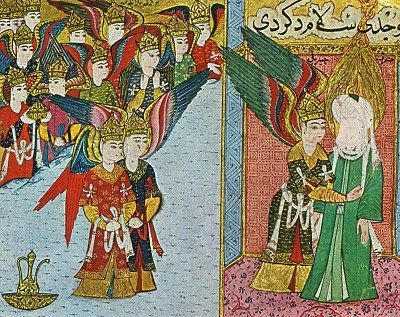
As said yesterday there are many depictions of the prophet Muhammad. Such as this one where angels visit Muhammad to prepare him for the Miraj. It’s a detail from The Progress of the Prophet, Turkey, 16th century.
Today the first company seems to be hit by the boycott: Nordic firm hit by Arab boycott
We have taken 40 years to build up a very big business in the Middle East, and we’ve seen it come to a complete stop in five days
Astrid Gade Niels
Arla spokeswoman
Also more condemnations from the Arab world, this time from 17 Arab countries.
Also the Dutch newspapers have discovered the item. In the Dutch daily De Volkskrant several artists who are reluctant in depicting the prophet. Except for Gregorius Nekschot (pseudonym) who will publish a book soon with a picture of the prophet Muhammad in a compromising situation with Aicha.
The editor of Jylland Posten has published a statement in which he legitimizes himself towards Muslims and says he regrets people felt insulted:
I am sorry that the publication of a few cartoons in the Norwegian paper Magazinet has caused unrest among Muslims. I fully understand that these drawings are seen to give offence by Muslims worldwide. Islam is a spiritual reference point for a large part of the world. Your faith has the right to be respected by us.
The cartoons in the Christian paper Magazinet are not constructive in building the
bridges which are necessary between people with different religious and ethnic backgrounds. Instead they contribute to suspicion and unnecessary conflict.Let it be clear that the Norwegian government condemns every expression or act which expresses contempt for people on the basis of their religion or ethnic origin. Norway has always supported the fight of the UN against religious intolerance and racism, and believes that this fight is important in order to avoid suspicion and conflict. Tolerance, mutual respect and dialogue are the basis values of Norwegian society and of our foreign policy.
Freedom of expression is one of the pillars of Norwegian society. This includes tolerance for opinions that not everyone shares. At the same time our laws and our international obligations enforce restrictions for incitement to hatred or hateful expressions.
This conflict seems clear: Muslims enraged about depicting Muhammad by Westerners and Westerners enraged by Muslims who disrespect freedom of speech. Nevertheless, several questions have to be asked.
1) The reason for this conflict seems clear: the twelve cartoons of the Jylland Posten. But it is not the first one; there are pictures of the prophet Muhammed that exists for ages. Such as the ones I include on every entry on this issue (made by – mostly Shia – Muslims) but also less friendly ones. Such as the next illustration taken from La vie de Mahomet, by M. Prideaux, published in 1699. It shows Muhammad holding a sword and a crescent while trampling on a globe, a cross, and the Ten Commandments.

So again, we know that this is a sensitive topic, why the conflict now and why in Denmark?
2) The conflict started in October 2005 (correct me if i’m wrong). It’s now January: three months later. Why does it escalate now? In this age of internet, mobile phones and so on, it shouldn’t be that difficult to attrackt attention in let’s say Saudi Arabia. Why do the Arab countries interfere now?
3) The conflict is represented as a conflict between Muslims and non-Muslims or Arabs and Europeans. But the picture is actually a little more diverse. Yesterday I showed comments of a Danish Muslims who disagreed with the major organizations and stated that they do not represent everyone. Also, as my good colleague Robbert told me today, the EU has protested against the cartoons:
Franco Frattini, the Deputy EU commissioner for Justice, Freedom, and Security, noting the publication as “foolishness and indiscretion” condemned the cartoons Danish Prime Minister Anders Fogh Rassmussen backed up on the grounds of “freedom of speech and thought”.
Such publications, Frattini emphasized, will serve to radicalism by fomenting hostility against Islam and foreigners.
In response to the “freedom of press” that Mr. Rasmussen used as an excuse, the EU official said the media is not free to make a news story out of anything. Frattini assessing the issue in his personal perspective said if the publication were about his own values, it would hurt him personally as a Catholic Christian and he would have taken great offence.
To be honest, such codes of behavior will accelerate Islamophobia across Europe, said Frattini, emphasizing his respect for the freedom of speech.
Frattini emphasized the cartoons published in Jyllands Posten did not affect people’s ideas on Islam and noted despite everything he is against restricting the freedom of the press.
Also Bill Clinton protested against the cartoons.
“So now what are we going to do? … Replace the anti-Semitic prejudice with anti-Islamic prejudice?” he said at an economic conference in the Qatari capital of Doha.
“In Europe, most of the struggles we’ve had in the past 50 years have been to fight prejudices against Jews, to fight against anti-Semitism,” he said.
Clinton described as “appalling” the 12 cartoons published in a Danish newspaper in September depicting Prophet Mohammed and causing uproar in the Muslim world.
“None of us are totally free of stereotypes about people of different races, different ethnic groups, and different religions … there was this appalling example in northern Europe, in Denmark … these totally outrageous cartoons against Islam,” he said.
So on both sides the boundaries between us and them are blurred. In many newspapers (Dutch ones) there is no attention to that. Why not?
4) What kind of role does internet play? My colleague Robbert showed me an email today with several not very respectful pictures of the prophet. Some of them were from the Jylland Posten but several other ones (such as one with a pig) you can find here.
It also included two PowerPoint presentations with (I thought) a sort of bio of the prophet. And the following letter:
Danish Consulate
Dubai, UAE
Fax: 04 – 2235751To Whom It May Concern:
It is with great displeasure that I write to you to express my shock and anger at the extreme disrespect and thoughtlessness your government has shown in reaction to the offensive cartoons published in the Danish daily, Jyllands-Posten.
The blasphemous cartoons picturing Prophet Mohammed were insulting to the 1.3 billion Muslims all over the world, whose feelings you have inconsiderately ignored. What was even more distasteful was your government’s support for the newspaper’s bigotry, calling it “freedom of speech.†Perhaps you could try denying the holocaust and calling that a “freedom of speech�
The increasing anti-Muslim prejudice in your country is repulsive. It is worth mentioning that the consequences of your insensitivity and passiveness may have skipped your notice: Muslims around the world are campaigning to boycott Danish products. Flyers and pamphlets listing Danish products are being actively distributed everywhere.
As a UAE national, whose country hosts 189 different nationalities living together in harmony, respecting each others’ faiths and cultures, I wish to extend an invitation to your government to learn civilized manners from my country.
The least your government could do now is to apologize to Muslims all around the world, and take disciplinary actions against the newspaper that caused this tension. An appropriate response from your government is demanded.The authors name is left out here-MdK
That whole message is send troughout the whole world via email conflating several incidents with the prophet Muhammad with the incident of the Jylland Posten. An interesting phenomenon.
Frontaal Naakt. Ongesluierde opinies, interviews & achtergronden
Posted on January 31st, 2006 by martijn.
Categories: Misc. News.
Frontaal Naakt. ‘Wij zijn de vrouwen van de toekomst’

Op Frontaal Naakt een leuk interview van Peter Breedveld met Samira el Kandoussi van het internetmagazine Maghrebia.nl.
Jaja. Toen ik Maghrebia zat te lezen, als autochtone, blanke, niet-moslimse Nederlander, kreeg ik een beetje het gevoel een voyeur te zijn. Een buitenstaander die bij Marokkanen naar binnen zit te gluren om te zien hoe ze met elkaar omgaan.
Dat is toch mooi? Dat is toch wat jullie willen weten? Waar wij, vrouwen, onderling over praten, dat ga je allemaal op Maghrebia zien. Ik vind ook dat er problemen zijn in de Marokkaanse gemeenschap, die zijn er gewoon. Ik ben ook kritisch naar de gemeenschap en ik wil ook graag discussie losmaken, maar niet op de manier waarop de gemiddelde autochtone journalist dat doet, want er is ook heel veel humor en er zijn leuke dingen en modeshows en concerten. Er is van alles aan de gang binnen die Marokkaanse gemeenschap wat gewoon geen aandacht krijgt. Daar zou wat afwisseling in moeten komen. Er is ellende, maar er is ook heel veel lol.
Als je daar dan toch bent lees dan ook even de reacties of je het nu scheldkannonades en verwensingen aan het adres van Samira vindt of slechts speldeprikjes.
C L O S E R – Cartoonesque
Posted on January 31st, 2006 by martijn.
Categories: Misc. News, Public Islam.
The controversy about the Danish Muhammad cartoons seems to gain some new speed. There is a call for a boycott against Danish and Norwegian products:

According to Islam-Online.net Muslims Seek UN Resolution Over Danish Cartoons
Ihsanoglu said the UN General Assembly would be asked to “pass a resolution banning attacks on religious beliefs.”
CAIRO, January 30, 2006 (IslamOnline.net & News Agencies) – The Organization of the Islamic Conference (OIC) and the Arab League, the Muslim world’s two main political bodies, are seeking a UN resolution, backed by possible sanctions, to protect religions following the publication of cartoons depicting and ridiculing Prophet Muhammad (PBUH).
Also it seems that Danish sites are the victims of cyber-attacks (for example the website of the Jylland Posten)
and blog Uriasposten.


Not all Muslims agree with the actions and the lobby of the larger organizations. Hadi Kahn, chairman of the Organization of Pakistani Students in Denmark (OPSA), stressed that the group travelling to the Muslim countries does not represent all Muslims.
The are some early Persian pictures of the Prophet Muhammad by the way, which you can find on Superluminal.com such as the one below with the Prophet Muhammad on his prayer rug.

Not that that picture comes from the Shi’a tradition and not from the Sunni-tradition. Nevertheless, I have never received any notice that that site had any threats. So why did that happen in the Danish case. I have written about that earlier.
In the meantime, for the people who want to post comments here. By my guest, keep it polite and decent and you have to be patient. Due to large amounts of spam, all comments have to be moderated before publishing.
Iviews.com – No Talks With Hamas?
Posted on January 29th, 2006 by .
Categories: Misc. News.
Iviews.com
No Talks With Hamas?
An opinion article on Iviews.com Uri Avnery. Does not completely represent my opinion, but still it is worthwile to think about it.
No Talks With Hamas? This Was Said About PLO Too ..
If Ariel Sharon had not been in a deep coma, he would have jumped out of his bed for joy.
The Hamas victory fulfills his most ardent hopes.
For a whole year now, he did everything possible to undermine Mahmoud Abbas. His logic was quite obvious: The Americans wanted him to negotiate with Abbas. Such negotiations would inevitably have led to a situation that would have compelled him to give up almost all of the West Bank. Sharon had no intention of doing so. He wanted to annex about half of the territory. So he had to get rid of Abbas and his moderate image.
During the last year, the situation of the Palestinians got worse from day to day. The actions of the occupation made normal life and commerce impossible. The West Bank settlements were continuously enlarging. The Wall which cuts off about 10 percent of the West Bank was nearing completion. No important prisoners were released. The aim was to impress on the Palestinians that Abbas is weak (“a chicken without feathers”, as Sharon put it), that he cannot achieve anything, that offering peace and observing a cease-fire leads nowhere.
The message to the Palestinians was clear: “Israel understands only the language of force.” Now the Palestinians have put in power a party that speaks this language.
Why did Hamas win?
(more…)
Iviews.com – Islam and the West – Who Hates Whom?
Posted on January 29th, 2006 by .
Categories: Misc. News.
Iviews.com
Islam and the West – Who Hates Whom?
1/24/2006 – Political – Article Ref: AN0601-2885
By: Fahmi Howaidi
The Danish Case
The Danish government’s attitude toward the blasphemous caricatures of the Prophet Muhammad published by a newspaper in the country should not be dismissed lightly as it is typical of the manner in which Western governments and intellectuals treat topics related to Islam. The lethargic reaction of the Muslim governments to the European newspaper’s outrageous treatment of the Prophet too deserves censure .
Are we to understand that abusing the Prophet is a less serious offense than an insult to an Arab head of state that would have triggered angry reactions accompanied by withdrawal of ambassadors and threat of severing diplomatic and economic relations. Should it not be feared that official silence over such issues in the Muslim and Arab world would play into the hands of extremists in the Muslim communities who are waiting for an opportunity to choose the path of violence .
The Danish drawings also reopen the question that is often raised whenever the topic of the relations between Islam and the West comes up: Really who hates whom?
Protected: AD.nl – Verdonk: meeste verblijfsvergunningen
Posted on January 28th, 2006 by martijn.
Categories: Misc. News.
Enter your password to view comments.
The Americans are coming…
Posted on January 28th, 2006 by .
Categories: Misc. News.
Several American bloggers have been invited by the Dutch Tourism Agency to visit Amsterdam in the end of February.
One of the bloggers is AMERICAblog: Because a great nation deserves the truth.
Three days ago I got offered a trip to Amsterdam from the Dutch Tourism Agency. The Dutch were very excited to organize a first-ever trip of bloggers (they invite journalists all the time, but have never invited bloggers). But as it was their trip, I didn’t want to scoop them on it by telling you guys on Tuesday. Well, today they told the public about it, so today I’m telling you about it.
Basically, the trip is really an in-kind blog ad buy – they get a month-long ad on the blog (the ones in the right column), and they pay for the ad with a trip instead of cash (the trip is actually valued at much less than the one month cost of the ad on this site). But still, I’d be far less likely to spend the money on a trip had they paid in cash, so I kind of like being nudged into going.
You really should read the comments in that entry; it gaves you an interesting picture of how others think of the Dutch and Amsterdam: blowing, bikes, tulips and Muslims
Other bloggers are going to, but are also very critical about the organisation, such as Progressive Gold:
I’m angry that the Dutch Tourist Board, rather than try and promote the Netherlands by supporting the blogs of people who actually live and work here ( blimey, give me free entrance to the galleries& museums and I’ll blog ad infinitum) they’d rather shell out big bucks for US bloggers to come out and give their week-long impressions. And the invited bloggers aren’t even obliged to do that for their 5 star trip.
Many of us, sitting here every day actually in the bloody country, are blogging about Holland Dutch politics, Dutch food, Dutch culture and life in Holland, in English, right under their damned noses.
But does the Dutch bloody Tourist Board actually want to hear what we have to say about this country and its inhabitants? It wouldn’t fit in with the ‘tulips, coffeeshops, and Rembrandt’ agenda so i guess that answers that.
It makes me want to spit, especially when the American blogs get to show this nifty little logo:Aaargh. Bloggers In Amsterdam? No, except in the purely technical sense and then for only 7 days.
Well I will be in Germany then, but I wish them all the best and I hope the Baltimore Factor isn’t to big.
Looking for Comedy in the Muslim World : Review
Posted on January 28th, 2006 by .
Categories: Misc. News.
There is a comedy out now: Looking for comedy in the Muslim World, directed by: Albert Brooks
“Looking for Comedy in the Muslim World” is the story of what happens when the U.S. Government sends comedian Albert Brooks to India and Pakistan to find out what makes the more than 300 million Muslims in the region laugh. Brooks, accompanied by two state department handlers and his trusted assistant, goes on a journey that takes him from a concert stage in New Delhi, to the Taj Mahal, to a secret location in the mountains of Pakistan. The film touches upon some of the issues we are dealing with in a post-9/11 world.
Hetkanwel.net (Dutch) has discovered some Muslim comediants:
Moslims; dat zijn toch die getinte, boze jonge mensen zonder een greintje relativeringsvermogen? Door de Haagse Hofstadgroep, de Franse ghetto’s en de Amsterdamse relmarokkanen zou je het bijna gaan denken. Gelukkig blijkt de wereld groter te zijn dan ons pessimisme doet vermoeden. Britse, Amerikaanse en Nederlandse moslims hebben stand-up comedy ontdekt.
(more…)
Protected: NRC Handelsblad – Palestijnen toonden woede over corruptie, bezetting en armoede
Posted on January 28th, 2006 by martijn.
Categories: Misc. News.
Enter your password to view comments.
Expatica's Dutch news in English: Dutch face legal challenge to terror expulsion
Posted on January 28th, 2006 by martijn.
Categories: Misc. News.
Expatica’s Dutch news in English: Dutch face legal challenge to terror expulsion
27 January 2006
AMSTERDAM — A case pending against the Netherlands in the European Court of Human Rights in Strasbourg is being watched closely by the governments of several other European countries.
The case involves an attempt by the Netherlands to deport Algerian man Mohammed Ramzy.
He was arrested in the Netherlands in 2002 and accused of being involved with Muslim extremism. A court in Rotterdam cleared him of terrorism charges, but the Dutch authorities want to send him back to his native country.
Ramzy claims deportation would be contrary to his human rights as there is a substantial risk he will be tortured in Algeria.
The case could have wide
implications as similar deportations are pending in the UK and a number of other countries. Human rights organisations are also monitoring the case, which is scheduled for the spring.[Copyright Expatica News ANP 2006]
Expatica’s Dutch news in English: Dutch face legal challenge to terror expulsion
Posted on January 28th, 2006 by .
Categories: Misc. News.
Expatica’s Dutch news in English: Dutch face legal challenge to terror expulsion
27 January 2006
AMSTERDAM — A case pending against the Netherlands in the European Court of Human Rights in Strasbourg is being watched closely by the governments of several other European countries.
The case involves an attempt by the Netherlands to deport Algerian man Mohammed Ramzy.
He was arrested in the Netherlands in 2002 and accused of being involved with Muslim extremism. A court in Rotterdam cleared him of terrorism charges, but the Dutch authorities want to send him back to his native country.
Ramzy claims deportation would be contrary to his human rights as there is a substantial risk he will be tortured in Algeria.
The case could have wide
implications as similar deportations are pending in the UK and a number of other countries. Human rights organisations are also monitoring the case, which is scheduled for the spring.[Copyright Expatica News ANP 2006]
Protected: gay2day.be – Veilige Haven voor jonge moslimhomo's
Posted on January 28th, 2006 by martijn.
Categories: Misc. News.
Enter your password to view comments.
Protected: gay2day.be – Veilige Haven voor jonge moslimhomo’s
Posted on January 28th, 2006 by martijn.
Categories: Misc. News.
Enter your password to view comments.
Protected: NRC Handelsblad – Hulde en kritiek voor Hirsi Ali
Posted on January 24th, 2006 by martijn.
Categories: Misc. News.
Enter your password to view comments.
Expatica's Moroccan community to tackle troublemakers
Posted on January 24th, 2006 by martijn.
Categories: Misc. News.
Expatica’s Dutch news in English: Moroccans to tackle troublemakers
Moroccan community to tackle troublemakers
24 January 2006
AMSTERDAM – Representatives of the Moroccan community have pledged to act to curb the problem behaviour of an element of Moroccan youths in Amsterdam.
Some 200 people, including imams, young people, youth leaders and concerned parents, met in the Dutch capital on Sunday to discuss concerns about wayward Moroccan youth.
While no concrete measures were agreed to tackle the problems, the organisers were pleased. “Just look at who we have brought together here. That is a start,” one said.
Amsterdam Mayor Job Cohen attended the meeting. He said afterwards it was good the Moroccan community recognised there was a problem in relation to an element of the young
people.“They have indicated that they want to do something about it themselves. It must no longer be the case they remain in the role of victim,” Cohen said.
Cohen warned last week that minor incidents could lead to an outburst as calm in the city is being tested by 100 ‘problem youth’.
[Copyright Expatica News ANP 2006]
Expatica’s Moroccan community to tackle troublemakers
Posted on January 24th, 2006 by .
Categories: Misc. News.
Expatica’s Dutch news in English: Moroccans to tackle troublemakers
Moroccan community to tackle troublemakers
24 January 2006
AMSTERDAM – Representatives of the Moroccan community have pledged to act to curb the problem behaviour of an element of Moroccan youths in Amsterdam.
Some 200 people, including imams, young people, youth leaders and concerned parents, met in the Dutch capital on Sunday to discuss concerns about wayward Moroccan youth.
While no concrete measures were agreed to tackle the problems, the organisers were pleased. “Just look at who we have brought together here. That is a start,” one said.
Amsterdam Mayor Job Cohen attended the meeting. He said afterwards it was good the Moroccan community recognised there was a problem in relation to an element of the young
people.“They have indicated that they want to do something about it themselves. It must no longer be the case they remain in the role of victim,” Cohen said.
Cohen warned last week that minor incidents could lead to an outburst as calm in the city is being tested by 100 ‘problem youth’.
[Copyright Expatica News ANP 2006]
BBC NEWS | World | Europe | Dutch MP defies Muslim pressure
Posted on January 24th, 2006 by .
Categories: Misc. News.
BBC NEWS | World | Europe | Dutch MP defies Muslim pressure
Dutch MP defies Muslim pressure
By Jane Beresford
Producer, Taking a Stand, BBC Radio 4Dutch MP Ayaan Hirsi Ali
Ayaan Hirsi Ali wanted to shape her own future
What turns a devout young Muslim woman into one of Islam’s most outspoken critics?For the Somali-born Dutch MP Ayaan Hirsi Ali, it was a long journey that started with an arranged marriage.
She sought refuge in the Netherlands on her way to her new husband’s home in Canada.
“I wanted a chance at a life where I could shape my own future,” she says.
“I knew the risks – being disowned or being shunned by my father and the rest of my family. I took those risks and I don’t regret it.”
Hirsi Ali describes the anti-US attacks of 11 September 2001 as pivotal to her questioning of Islam.
She remembers the moment when she realised that Mohammed Atta, the leader of the hijackers, had studied the Koran, like her, in the mid-1980s.
She says: “I grabbed the Koran and I started to read what Bin Laden had written and… I put (his) citations next to what is written in the Koran and I realised that, yes, a lot of it is part of my religion and what do I think of that?”
Defending principles
She wrote the play Submission to “challenge the conviction that what is written in the Holy Koran is absolute”.
I have come to the conclusion that Islam can and should be reformed if Muslims want to live at peace
Ayaan Hirsi Ali
It was an act that was to lead to the murder of her collaborator Theo Van Gogh.“I still do feel guilt,” she says.
“Guilt is irrational, but for Theo it was the freedom of expression. He said ‘If I cannot make films in Holland then I am a slave… and I would rather be dead’. And I am just as principled as he is.”
Hirsi Ali now lives under 24-hour armed guard. A note pinned to Van Gogh’s body by the murderer threatened the MP directly.
It read: “You have your principles and I have mine, I am prepared to die for mine, are you prepared to die for yours?”
She says “it’s like the sword of Damocles that hangs above my head. I do realise that”.
“I live like someone who has been told ‘you have some kind of terminal disease – we just don’t know when it’s going to strike’.”
Call for reform
But Hirsi Ali has no intention of being silenced. Submission 2 is in production and Submission 3 is planned.
Dutch film maker Theo van Gogh
Theo Van Gogh was a well-known critic of fundamentalist Islam
“The transition from, let’s say, pre-modern to modern, is something that Judaism and Christianity have gone through and that transition is something that Islam is experiencing right now.“I have come to the conclusion that Islam can and should be reformed if Muslims want to live at peace… that’s why I need the freedom of expression… for other Muslims to think that through.”
Does she think she will survive?
“Yes,” she says. “And if I don’t, well, I’ve lived my life as I want to live it. So be it.”
See also the post below.
BBC NEWS | World | Europe | Dutch MP defies Muslim pressure
Posted on January 24th, 2006 by martijn.
Categories: Misc. News.
BBC NEWS | World | Europe | Dutch MP defies Muslim pressure
Dutch MP defies Muslim pressure
By Jane Beresford
Producer, Taking a Stand, BBC Radio 4Dutch MP Ayaan Hirsi Ali
Ayaan Hirsi Ali wanted to shape her own future
What turns a devout young Muslim woman into one of Islam’s most outspoken critics?For the Somali-born Dutch MP Ayaan Hirsi Ali, it was a long journey that started with an arranged marriage.
She sought refuge in the Netherlands on her way to her new husband’s home in Canada.
“I wanted a chance at a life where I could shape my own future,” she says.
“I knew the risks – being disowned or being shunned by my father and the rest of my family. I took those risks and I don’t regret it.”
Hirsi Ali describes the anti-US attacks of 11 September 2001 as pivotal to her questioning of Islam.
She remembers the moment when she realised that Mohammed Atta, the leader of the hijackers, had studied the Koran, like her, in the mid-1980s.
She says: “I grabbed the Koran and I started to read what Bin Laden had written and… I put (his) citations next to what is written in the Koran and I realised that, yes, a lot of it is part of my religion and what do I think of that?”
Defending principles
She wrote the play Submission to “challenge the conviction that what is written in the Holy Koran is absolute”.
I have come to the conclusion that Islam can and should be reformed if Muslims want to live at peace
Ayaan Hirsi Ali
It was an act that was to lead to the murder of her collaborator Theo Van Gogh.“I still do feel guilt,” she says.
“Guilt is irrational, but for Theo it was the freedom of expression. He said ‘If I cannot make films in Holland then I am a slave… and I would rather be dead’. And I am just as principled as he is.”
Hirsi Ali now lives under 24-hour armed guard. A note pinned to Van Gogh’s body by the murderer threatened the MP directly.
It read: “You have your principles and I have mine, I am prepared to die for mine, are you prepared to die for yours?”
She says “it’s like the sword of Damocles that hangs above my head. I do realise that”.
“I live like someone who has been told ‘you have some kind of terminal disease – we just don’t know when it’s going to strike’.”
Call for reform
But Hirsi Ali has no intention of being silenced. Submission 2 is in production and Submission 3 is planned.
Dutch film maker Theo van Gogh
Theo Van Gogh was a well-known critic of fundamentalist Islam
“The transition from, let’s say, pre-modern to modern, is something that Judaism and Christianity have gone through and that transition is something that Islam is experiencing right now.“I have come to the conclusion that Islam can and should be reformed if Muslims want to live at peace… that’s why I need the freedom of expression… for other Muslims to think that through.”
Does she think she will survive?
“Yes,” she says. “And if I don’t, well, I’ve lived my life as I want to live it. So be it.”
See also the post below.
BBC – Radio 4 – Taking a Stand – Ayaan Hirsi Ali
Posted on January 24th, 2006 by .
Categories: Misc. News.
BBC – Radio 4 – Taking a Stand – 24 January 2006
Taking a Stand
Listen again to this programmeAudio Help
24 January 2006
Tuesday 24 January 2006 9:00-9:30 (Radio 4 FM)
Repeated: Tuesday 24 January 2006 21:30-22:00 (Radio 4 FM)
Interview series with Fergal Keane, in which he talks to people who, through conviction or circumstance, have taken a stand for what they believe in.
When Ayaan Hirsi Ali, the Somali-born Dutch MP, wrote Submission, a film attacking what she believes to be the Koran’s endorsement of the subjugation of women, she knew it would cause controversy. She did not however envisage that it would lead to the murder of her collaborator Theo Van Gogh and a life under 24-hour armed guard for her. She talks to Fergal about her journey from devout Muslim to one of Islam’s most outspoken critics, and why she refuses to be silenced.
Daily Times – ‘The Girls of Riyadh’
Posted on January 23rd, 2006 by .
Categories: Misc. News.
Daily Times – Site Edition
‘The Girls of Riyadh’ shocks the Saudi world
By Andrew Hammond
The book centres on four women from affluent homes who must navigate a minefield of rules and taboos on sex, marriage and social caste to get and keep their men
GAY teenagers, predatory lesbians, women drinking alcohol at weddings, husbands with unsavoury sexual demands.
With characters like that, “The Girls of Riyadh†is not your run-of-the-mill depiction of life in Muslim Saudi Arabia, one of the world’s most restricted and conservative societies.
Though technically banned here, Rajaa al-Sanie’s frank and sometimes shocking insight into the closed world of Saudi women is making waves four months after its publication in Beirut.
Local press commentators have asked the young Saudi to disown the book for besmirching women in the conservative kingdom and interviewers on Saudi-owned satellite channels have accused her of portraying its men as boorish bores.
But many young people using popular Internet chat rooms have praised Sanie’s debut novel for its honesty. Prominent writers have lauded the work as part of a new trend which, through focusing on the psychology of the individual, suggests that human needs come above the demands of society and religion. “I never imagined the reactions will lead to a big stir,†said Sanie, who wears the Islamic headscarf.
“Men are not used to this sincere and frank dialogue. There is a minority in any society that resists any change – some of them are women.â€
Women must be fully covered and accompanied by a male relative in public. Mixing of unmarried men and women is forbidden and women are banned from driving. At first glance you could be forgiven for thinking otherwise from “The Girls of Riyadhâ€.
Minefield of taboos: The book centres on four women from affluent homes who must navigate a minefield of rules and taboos on sex, marriage and social caste to get and keep their men.
Those who fail face rejection and, like many of Saudi Arabia’s moneyed elite, retreat to foreign capitals to lick their wounds in more liberal surroundings.
In one passage, one of the four girls returns from Los Angeles to find that “love in her country is treated like an out-of-place joke that you can have fun with for a while, before it’s removed from circulation by higher authoritiesâ€.
In an early scene, women drink at a society wedding “since it deserved a bottle of Dom Perignonâ€. In another chapter, an effeminate teenager is beaten by a father ashamed of his homosexuality.
And when one of the main characters closes her eyes and prepares herself for what is meant to be her first night of wedded bliss, she is shocked to find her husband “doing what she never imagined.†She hits him, and the marriage is over.
“Society lives some form of ‘paraphrenia’ and the conflict between traditions and modernity is the cause,†the twenty-something Sanie told Reuters. “The reason for the double life is the fear of being rejected and stigmatised by society.†A land of stark contradictions, Saudi Arabia is a tribal society, swimming in oil wealth and a key United States ally that produced 15 of the 19 suicide hijackers behind the Sept. 11 attacks. Sanie cites as an example the Internet, the latest of a series of modern inventions that have taxed hardline clerics who fear the disintegration of Saudi Arabia’s Islamic social model.
Her narrator tells the story of her friends through fictive blog entries that provoke outraged reactions in a national cyber debate – exactly what happened when the novel came out.
“Saudi Arabia has witnessed in just 30 years technological and infrastructural change that took other societies a century or two to achieve,†Sanie said.
“It uses the latest technology, but continues to live with the habits and traditions of the previous century.â€
Some Muslims argue that as the site of Islam’s holiest shrines, Saudi Arabia should remain apart from liberal trends elsewhere as a kind of Islamic Utopia where modern technology must be made to fit uncompromising rules of public morality.
But many sense a new political climate since King Abdullah, a supporter of cautious reform, ascended the throne last year. The king has made the promotion of women in society a priority for the country’s economic development but has said any changes will be in line with Islamic principles. Sanie says getting more women into the workplace will be key to social change. Saudi men prefer to marry teachers since their income reflects on the income of the family, she said. “This financial independence empowers Saudi women to express courageously their views in any dialogue.†reuters
Protected: Het Parool – Waren het eigenlijk wel Marokkanen?
Posted on January 20th, 2006 by martijn.
Categories: Misc. News.
Enter your password to view comments.
Protected: Trouw, deVerdieping| podium – Allochtone jongeren / Media maken ’straatterreur’
Posted on January 20th, 2006 by martijn.
Categories: Misc. News.
Enter your password to view comments.
Protected: Trouw, deVerdieping| podium – Allochtone jongeren / Media maken ’straatterreur’
Posted on January 20th, 2006 by martijn.
Categories: Misc. News.
Enter your password to view comments.