| M | T | W | T | F | S | S |
|---|---|---|---|---|---|---|
| « Sep | ||||||
| 1 | 2 | 3 | 4 | |||
| 5 | 6 | 7 | 8 | 9 | 10 | 11 |
| 12 | 13 | 14 | 15 | 16 | 17 | 18 |
| 19 | 20 | 21 | 22 | 23 | 24 | 25 |
| 26 | 27 | 28 | 29 | 30 | 31 | |
Pages
- About
- C L O S E R moves to….C L O S E R
- Contact Me
- Interventions – Forces that Bind or Divide
- ISIM Review via Closer
- Publications
- Research
Categories
- (Upcoming) Events (33)
- [Online] Publications (26)
- Activism (117)
- anthropology (113)
- Method (13)
- Arts & culture (88)
- Asides (2)
- Blind Horses (33)
- Blogosphere (192)
- Burgerschapserie 2010 (50)
- Citizenship Carnival (5)
- Dudok (1)
- Featured (5)
- Gender, Kinship & Marriage Issues (265)
- Gouda Issues (91)
- Guest authors (58)
- Headline (76)
- Important Publications (159)
- Internal Debates (275)
- International Terrorism (437)
- ISIM Leiden (5)
- ISIM Research II (4)
- ISIM/RU Research (171)
- Islam in European History (2)
- Islam in the Netherlands (219)
- Islamnews (56)
- islamophobia (59)
- Joy Category (56)
- Marriage (1)
- Misc. News (891)
- Morocco (70)
- Multiculti Issues (749)
- Murder on theo Van Gogh and related issues (326)
- My Research (118)
- Notes from the Field (82)
- Panoptic Surveillance (4)
- Public Islam (244)
- Religion Other (109)
- Religious and Political Radicalization (635)
- Religious Movements (54)
- Research International (55)
- Research Tools (3)
- Ritual and Religious Experience (58)
- Society & Politics in the Middle East (159)
- Some personal considerations (146)
- Deep in the woods… (18)
- Stadsdebat Rotterdam (3)
- State of Science (5)
- Twitwa (5)
- Uncategorized (74)
- Young Muslims (459)
- Youth culture (as a practice) (157)
General
- ‘In the name of Allah, Most Gracious, Most Merciful’
- – Lotfi Haddi –
- …Kelaat Mgouna…….Ait Ouarchdik…
- ::–}{Nour Al-Islam}{–::
- Al-islam.nl De ware godsdienst voor Allah is de Islam
- Allah Is In The House
- Almaas
- amanullah.org
- Amr Khaled Official Website
- An Islam start page and Islamic search engine – Musalman.com
- arabesque.web-log.nl
- As-Siraat.net
- assadaaka.tk
- Assembley for the Protection of Hijab
- Authentieke Kennis
- Azaytouna – Meknes Azaytouna
- berichten over allochtonen in nederland – web-log.nl
- Bladi.net : Le Portail de la diaspora marocaine
- Bnai Avraham
- BrechtjesBlogje
- Classical Values
- De islam
- DimaDima.nl / De ware godsdienst? bij allah is de islam
- emel – the muslim lifestyle magazine
- Ethnically Incorrect
- fernaci
- Free Muslim Coalition Against Terrorism
- Frontaal Naakt. Ongesluierde opinies, interviews & achtergronden
- Hedendaagse wetenswaardigheden…
- History News Network
- Homepage Al Nisa
- hoofddoek.tk – Een hoofddoek, je goed recht?
- IMRA: International Muslima Rights Association
- Informed Comment
- Insight to Religions
- Instapundit.com
- Interesting Times
- Intro van Abdullah Biesheuvel
- islaam
- Islam Ijtihad World Politics Religion Liberal Islam Muslim Quran Islam in America
- Islam Ijtihad World Politics Religion Liberal Islam Muslim Quran Islam in America
- Islam Website: Islam, Islamic Studies, Arabic, Religion
- Islamforum
- Islamic Philosophy Online
- Islamica Magazine
- islamicate
- Islamophobia Watch
- Islamsevrouw.web-log.nl
- Islamwereld-alles wat je over de Islam wil weten…
- Jihad: War, Terrorism, and Peace in Islam
- JPilot Chat Room
- Madrid11.net
- Marocstart.nl – De marokkaanse startpagina!
- Maryams.Net – Muslim Women and their Islam
- Michel
- Modern Muslima.com
- Moslimjongeren Amsterdam
- Moslimjongeren.nl
- Muslim Peace Fellowship
- Muslim WakeUp! Sex & The Umma
- Muslimah Connection
- Muslims Against Terrorism (MAT)
- Mutma’inaa
- namira
- Otowi!
- Ramadan.NL
- Religion, World Religions, Comparative Religion – Just the facts on the world\’s religions.
- Ryan
- Sahabah
- Salafi Start Siden – The Salafi Start Page
- seifoullah.tk
- Sheikh Abd al Qadir Jilani Home Page
- Sidi Ahmed Ibn Mustafa Al Alawi Radhiya Allahu T’aala ‘Anhu (Islam, tasawuf – Sufism – Soufisme)
- Stichting Vangnet
- Storiesofmalika.web-log.nl
- Support Sanity – Israel / Palestine
- Tekenen van Allah\’s Bestaan op en in ons Lichaam
- Terrorism Unveiled
- The Coffee House | TPMCafe
- The Inter Faith Network for the UK
- The Ni’ma Foundation
- The Traveller’s Souk
- The \’Hofstad\’ terrorism trial – developments
- Thoughts & Readings
- Uitgeverij Momtazah | Helmond
- Un-veiled.net || Un-veiled Reflections
- Watan.nl
- Welkom bij Islamic webservices
- Welkom bij vangnet. De site voor islamitische jongeren!
- welkom moslim en niet moslims
- Yabiladi Maroc – Portail des Marocains dans le Monde
Dutch [Muslims] Blogs
- Hedendaagse wetenswaardigheden…
- Abdelhakim.nl
- Abdellah.nl
- Abdulwadud.web-log.nl
- Abou Jabir – web-log.nl
- Abu Bakker
- Abu Marwan Media Publikaties
- Acta Academica Tijdschrift voor Islam en Dialoog
- Ahamdoellilah – web-log.nl
- Ahlu Soennah – Abou Yunus
- Ahlul Hadeeth
- Ahlul Hadeeth
- Al Moudjahideen
- Al-Adzaan
- Al-Islaam: Bismilaahi Rahmaani Rahiem
- Alesha
- Alfeth.com
- Anoniempje.web-log.nl
- Ansaar at-Tawheed
- At-Tibyan Nederland
- beni-said.tk
- Blog van moemina3 – Skyrock.com
- bouchra
- CyberDjihad
- DE SCHRIJVENDE MOSLIMS
- DE VROLIJKE MOSLIM ;)
- Dewereldwachtopmij.web-log.nl
- Dien~oel~Islaam
- Eali.web-log.nl
- Een genade voor de werelden
- Enige wapen tegen de Waarheid is de leugen…
- ErTaN
- ewa
- Ezel & Os v2
- Gizoh.tk [.::De Site Voor Jou::.]
- Grappige, wijze verhalen van Nasreddin Hodja. Turkse humor.
- Hanifa Lillah
- hayya~ala~assalaah!
- Het laatste nieuws lees je als eerst op Maroc-Media
- Homow Universalizzz
- Ibn al-Qayyim
- IslaamLive Mail
- IslaamLive Mail
- Islam Blog – Juli 2007
- Islam in het Nieuws – web-log.nl
- Islam, een religie
- Islam, een religie
- Islamic Sisters – web-log.nl
- Islamiway’s Weblog
- Islamtawheed’s Blog
- Jihaad
- Jihad
- Journalista
- La Hawla Wa La Quwatta Illa Billah
- M O S L I M J O N G E R E N
- M.J.Ede – Moslimjongeren Ede
- Mahdi\’s Weblog | Vrijheid en het vrije woord | punt.nl: Je eigen gratis weblog, gratis fotoalbum, webmail, startpagina enz
- Maktab.nl (Zawaj – islamitische trouwsite)
- Marocdream.nl – Home
- Marokkaanse.web-log.nl
- Marokkanen Weblog
- Master Soul
- Miboon
- Miesjelle.web-log.nl
- Mijn Schatjes
- Moaz
- moeminway – web-log.nl
- Moslima_Y – web-log.nl
- mosta3inabilaah – web-log.nl
- Muhaajir in islamitisch Zuid-Oost Azië
- Mumin al-Bayda (English)
- Mustafa786.web-log.nl
- Oprecht – Poort tot de kennis
- Said.nl
- saifullah.nl – Jihad al-Haq begint hier!
- Salaam Aleikum
- Sayfoudien – web-log.nl
- soebhanAllah
- Soerah19.web-log.nl – web-log.nl
- Steun Palestina
- Stichting Moslimanetwerk
- Stories of Malika
- supermaroc
- Ummah Nieuws – web-log.nl
- Volkskrant Weblog — Alib Bondon
- Volkskrant Weblog — Moslima Journalista
- Vraag en antwoord…
- wat is Islam
- Wat is islam?
- Weblog – a la Maroc style
- website van Jamal
- Wij Blijven Hier
- Wij Blijven Hier
- www.BenAyad.be – Islam en Actua
- www.moslima.web-log.nl
- Yakini Time
- Youth Of Islam
- Youth Of Islam
- [fikra]
Non-Dutch Muslims Blogs
- Lanallah __Islamic BlogZine__
- This journey ends but only with The Beginning
- ‘the middle place’
- …Never Judge a Person By His or Her Blog…
- …under the tree…
- A Comment on PMUNA
- A Dervish’s Du`a’
- A Family in Baghdad
- A Garden of Children
- A Muslim Mother’s Thoughts / Islamic Parenting
- A Struggle in Uncertainty, Such is Life
- About Afghanistan
- adnan.org: good design, bad idea
- Afiyah
- Ahmeds World of Islam
- Al Musawwir
- Al-Musharaka
- Almiraya tBLOG – O, happy the soul that saw its own faults
- Almusawwir
- an open window
- Anak Alam
- aNaRcHo AkBaR
- Anthology
- AnthroGal’s World
- Arabian Passion
- ArRihla
- Articles Blog
- Asylum Seeker
- avari-nameh
- Baghdad Burning
- Being Noor Javed
- Bismillah
- bloggin’ muslimz.. Linking Muslim bloggers around the globe
- Blogging Islamic Perspective
- Chapati Mystery
- City of Brass – Principled pragmatism at the maghrib of one age, the fajr of another
- COUNTERCOLUMN: All Your Bias Are Belong to Us
- d i z z y l i m i t s . c o m >> muslim sisters united w e b r i n g
- Dar-al-Masnavi
- Day in the life of an American Muslim Woman
- Don’t Shoot!…
- eat-halal guy
- Eye on Gay Muslims
- Eye on Gay Muslims
- Figuring it all out for nearly one quarter of a century
- Free Alaa!
- Friends, Romans, Countrymen…. lend me 5 bux!
- From Peer to Peer ~ A Weblog about P2P File & Idea Sharing and More…
- Ghost of a flea
- Ginny’s Thoughts and Things
- God, Faith, and a Pen: The Official Blog of Dr. Hesham A. Hassaballa
- Golublog
- Green Data
- gulfreporter
- Hadeeth Blog
- Hadouta
- Hello from the land of the Pharaoh
- Hello From the land of the Pharaohs Egypt
- Hijabi Madness
- Hijabified
- HijabMan’s Blog
- Ihsan-net
- Inactivity
- Indigo Jo Blogs
- Iraq Blog Count
- Islam 4 Real
- Islamiblog
- Islamicly Locked
- Izzy Mo’s Blog
- Izzy Mo’s Blog
- Jaded Soul…….Unplugged…..
- Jeneva un-Kay-jed- My Bad Behavior Sanctuary
- K-A-L-E-I-D-O-S-C-O-P-E
- Lawrence of Cyberia
- Letter From Bahrain
- Life of an American Muslim SAHM whose dh is working in Iraq
- Manal and Alaa\’s bit bucket | free speech from the bletches
- Me Vs. MysElF
- Mental Mayhem
- Mere Islam
- Mind, Body, Soul : Blog
- Mohammad Ali Abtahi Webnevesht
- MoorishGirl
- Muslim Apple
- muslim blogs
- Muslims Under Progress…
- My heart speaks
- My Little Bubble
- My Thoughts
- Myself | Hossein Derakhshan’s weblog (English)
- neurotic Iraqi wife
- NINHAJABA
- Niqaabi Forever, Insha-Allah Blog with Islamic nasheeds and lectures from traditional Islamic scholars
- Niqabified: Irrelevant
- O Muhammad!
- Otowi!
- Pak Positive – Pakistani News for the Rest of Us
- Periphery
- Pictures in Baghdad
- PM’s World
- Positive Muslim News
- Procrastination
- Prophet Muhammad
- Queer Jihad
- Radical Muslim
- Raed in the Middle
- RAMBLING MONOLOGUES
- Rendering Islam
- Renegade Masjid
- Rooznegar, Sina Motallebi’s WebGard
- Sabbah’s Blog
- Salam Pax – The Baghdad Blog
- Saracen.nu
- Scarlet Thisbe
- Searching for Truth in a World of Mirrors
- Seeing the Dawn
- Seeker’s Digest
- Seekersdigest.org
- shut up you fat whiner!
- Simply Islam
- Sister Scorpion
- Sister Soljah
- Sister Surviving
- Slow Motion in Style
- Sunni Sister: Blahg Blahg Blahg
- Suzzy’s id is breaking loose…
- tell me a secret
- The Arab Street Files
- The Beirut Spring
- The Islamic Feminista
- The Land of Sad Oranges
- The Muslim Contrarian
- The Muslim Postcolonial
- The Progressive Muslims Union North America Debate
- The Rosetta Stone
- The Traceless Warrior
- The Wayfarer
- TheDesertTimes
- think halal: the muslim group weblog
- Thoughts & Readings
- Through Muslim Eyes
- Turkish Torque
- Uncertainty:Iman and Farid’s Iranian weblog
- UNMEDIA: principled pragmatism
- UNN – Usayd Network News
- Uzer.Aurjee?
- Various blogs by Muslims in the West. – Google Co-op
- washed away memories…
- Welcome to MythandCulture.com and to daily Arrows – Mythologist, Maggie Macary’s blog
- word gets around
- Writeous Sister
- Writersblot Home Page
- www.BenAyad.be – Islam en Actua
- www.Mas’ud’s blog
- \’Aqoul
- ~*choco-bean*~
General Islam Sites
- :: Islam Channel :: – Welcome to IslamChannel Official Website
- Ad3iyah(smeekbeden)
- Al-maktoum Islamic Centre Rotterdam
- Assalamoe Aleikoem Warhmatoe Allahi Wa Barakatuhoe.
- BouG.tk
- Dades Islam en Youngsterdam
- Haq Islam – One stop portal for Islam on the web!
- Hight School Teacher Muhammad al-Harbi\’s Case
- Ibn Taymiyah Pages
- Iskandri
- Islam
- Islam Always Tomorrow Yesterday Today
- Islam denounces terrorism.com
- Islam Home
- islam-internet.nl
- Islamic Artists Society
- Leicester~Muslims
- Mere Islam
- MuslimSpace.com | MuslimSpace.com, The Premiere Muslim Portal
- Safra Project
- Saleel.com
- Sparkly Water
- Statements Against Terror
- Understand Islam
- Welcome to Imaan UK website
Islamic Scholars
Social Sciences Scholars
- ‘ilm al-insaan: Talking About the Talk
- :: .. :: zerzaust :: .. ::
- After Sept. 11: Perspectives from the Social Sciences
- Andrea Ben Lassoued
- Anth 310 – Islam in the Modern World (Spring 2002)
- anthro:politico
- AnthroBase – Social and Cultural Anthropology – A searchable database of anthropological texts
- AnthroBlogs
- AnthroBoundaries
- Anthropologist Community
- anthropology blogs
- antropologi.info – Social and Cultural Anthropology in the News
- Arabist Jansen
- Between Secularization and Religionization Vrije Universiteit Amsterdam
- Bin Gregory Productions
- Blog van het Blaise Pascal Instituut
- Boas Blog
- Causes of Conflict – Thoughts on Religion, Identity and the Middle East (David Hume)
- Cicilie among the Parisians
- Cognitive Anthropology
- Comunidade Imaginada
- Cosmic Variance
- Critical Muslims
- danah boyd
- Deep Thought
- Dienekes’ Anthropology Blog
- Digital Islam
- Erkan\’s field diary
- Ethno::log
- Evamaria\’s ramblings –
- Evan F. Kohlmann – International Terrorism Consultant
- Experimental Philosophy
- For the record
- Forum Fridinum [Religionresearch.org]
- Fragments weblog
- From an Anthropological Perspective
- Gregory Bateson
- Islam & Muslims in Europe *)
- Islam, Islamic Studies, Arabic, Religion
- Islam, Muslims, and an Anthropologist
- Jeremy’s Weblog
- JourneyWoman
- Juan Cole – ‘Documents on Terrorist Abu Musab al-Zarqawi’
- Keywords
- Kijken naar de pers
- languagehat.com
- Left2Right
- Leiter Reports
- Levinas and multicultural society
- Links on Islam and Muslims
- log.squig.org
- Making Anthropology Public
- Martijn de Koning Research Pages / Onderzoekspaginas
- Material World
- MensenStreken
- Modern Mass Media, Religion and the Imagination of Communities
- Moroccan Politics and Perspectives
- Multicultural Netherlands
- My blog’s in Cambridge, but my heart is in Accra
- National Study of Youth and Religion
- Natures/Cultures
- Nomadic Thoughts
- On the Human
- Philip Greenspun’s Weblog:
- Photoethnography.com home page – a resource for photoethnographers
- Qahwa Sada
- RACIAL REALITY BLOG
- Religion Gateway – Academic Info
- Religion News Blog
- Religion Newswriters Association
- Religion Research
- rikcoolsaet.be – Rik Coolsaet – Homepage
- Rites [Religionresearch.org]
- Savage Minds: Notes and Queries in Anthropology – A Group Blog
- Somatosphere
- Space and Culture
- Strange Doctrines
- TayoBlog
- Teaching Anthropology
- The Angry Anthropologist
- The Gadflyer
- The Immanent Frame | Secularism, religion and the public sphere
- The Onion
- The Panda\’s Thumb
- TheAnthroGeek
- This Blog Sits at the
- This Blog Sits at the intersection of Anthropology & Economics
- verbal privilege
- Virtually Islamic: Research and News about Islam in the Digital Age
- Wanna be an Anthropologist
- Welcome to Framing Muslims – International Research Network
- Yahya Birt
Women's Blogs / Sites
- * DURRA * Danielle Durst Britt
- -Fear Allah as He should be Feared-
- a literary silhouette
- a literary silhouette
- A Thought in the Kingdom of Lunacy
- AlMaas – Diamant
- altmuslimah.com – exploring both sides of the gender divide
- Assalaam oe allaikoum Nour al Islam
- Atralnada (Morning Dew)
- ayla\’s perspective shifts
- Beautiful Amygdala
- bouchra
- Boulevard of Broken Dreams
- Chadia17
- Claiming Equal Citizenship
- Dervish
- Fantasy web-log – web-log.nl
- Farah\’s Sowaleef
- Green Tea
- hayya~ala~assalaah!
- Hilsen Fra …
- Islamucation
- kaleidomuslima: fragments of my life
- Laila Lalami
- Marhaban.web-log.nl – web-log.nl
- Moslima_Y – web-log.nl
- Muslim-Refusenik The official website of Irshad Manji
- Myrtus
- Noor al-Islaam – web-log.nl
- Oh You Who Believe…
- Raising Yousuf: a diary of a mother under occupation
- SAFspace
- Salika Sufisticate
- Saloua.nl
- Saudi Eve
- SOUL, HEART, MIND, AND BODY…
- Spirit21 – Shelina Zahra Janmohamed
- Sweep the Sunshine | the mundane is the edge of glory
- Taslima Nasrin
- The Color of Rain
- The Muslimah
- Thoughts Of A Traveller
- Volkskrant Weblog — Islam, een goed geloof
- Weblog Raja Felgata | Koffie Verkeerd – The Battle | punt.nl: Je eigen gratis weblog, gratis fotoalbum, webmail, startpagina enz
- Weblog Raja Felgata | WRF
- Writing is Busy Idleness
- www.moslima.web-log.nl
- Zeitgeistgirl
- Zusters in Islam
- ~:: MARYAM ::~ Tasawwuf Blog
Ritueel en religieuze beleving Nederland
- – Alfeth.com – NL
- :: Al Basair ::
- Abu Marwan Media Publikaties
- Ahlalbait Jongeren
- Ahlul Hadeeth
- Ahlul Hadeeth
- Al-Amien… De Betrouwbare – Home
- Al-Ummah
- Al-Ummah
- Al-Ummah
- Al-Wasatiyyah.com – Home
- Anwaar al-Islaam
- anwaaralislaam.tk
- Aqiedah’s Weblog
- Arabische Lessen – Home
- Arabische Lessen – Home
- Arrayaan.net
- At-taqwa.nl
- Begrijp Islam
- Bismillaah – deboodschap.com
- Citaten van de Salaf
- Dar al-Tarjama WebSite
- Dawah-online.com
- de koraan
- de koraan
- De Koran . net – Het Islaamitische Fundament op het Net – Home
- De Leidraad, een leidraad voor je leven
- Dien~oel~Islaam
- Dien~oel~Islaam
- Faadi Community
- Ghimaar
- hayya~ala~assalaah!
- hayya~ala~assalaah!
- Ibn al-Qayyim
- IMAM-MALIK-Alles over Islam
- IQRA ROOM – Koran studie groep
- Islaam voor iedereen
- Islaam voor iedereen
- Islaam: Terugkeer naar het Boek (Qor-aan) en de Soennah volgens het begrip van de Vrome Voorgangers… – Home
- Islaam: Terugkeer naar het Boek (Qor-aan) en de Soennah volgens het begrip van de Vrome Voorgangers… – Home
- IslaamLive Mail
- IslaamLive Mail
- IslaamLive Mail
- islam :: messageboard
- Islam City NL, Islam en meer
- Islam, een religie
- Islamia.nl – Islamic Shop – Islamitische Winkel
- Islamitische kleding
- Islamitische kleding
- Islamitische smeekbedes
- islamtoday
- islamvoorjou – Informatie over Islam, Koran en Soenah
- kebdani.tk
- KoranOnline.NL
- Lees de Koran – Een Openbaring voor de Mensheid
- Lifemakers NL
- Marocstart.nl | Islam & Koran Startpagina
- Miesbahoel Islam Zwolle
- Mocrodream Forums
- Moslims in Almere
- Moslims online jong en vernieuwend
- Nihedmoslima
- Oprecht – Poort tot de kennis
- Quraan.nl :: quran koran kuran koeran quran-voice alquran :: Luister online naar de Quraan
- Quraan.nl online quraan recitaties :: Koran quran islam allah mohammed god al-islam moslim
- Selefie Nederland
- Stichting Al Hoeda Wa Noer
- Stichting Al Islah
- StION Stichting Islamitische Organisatie Nederland – Ahlus Sunnat Wal Djama\’ah
- Sunni Publicaties
- Sunni.nl – Home
- Teksten van Aboe Ismaiel
- Terug Naar De Dien – Home
- Terug Naar De Dien – Home
- Terug Naar De Dien – Home
- Uw Keuze
- www.ahloelhadieth.com
- www.ahloelhadieth.com
- www.al-thabaat.com
- www.hijaab.com
- www.uwkeuze.net
- Youth Of Islam
- Zegswijzen van de Wijzen
- \’\’ Leid ons op het rechte pad het pad degenen aan wie Gij gunsten hebt geschonken\’\’
Muslim News
Moslims & Maatschappij
Arts & Culture
- : : SamiYusuf.com : : Copyright Awakening 2006 : :
- amir normandi, photographer – bio
- Ani – SINGING FOR THE SOUL OF ISLAM – HOME
- ARTEEAST.ORG
- AZIZ
- Enter into The Home Website Of Mecca2Medina
- Kalima Translation – Reviving Translation in the Arab world
- lemonaa.tk
- MWNF – Museum With No Frontiers – Discover Islamic Art
- Nader Sadek
Misc.
'Fundamentalism'
Islam & commerce
2
Morocco
[Online] Publications
- ACVZ :: | Preliminary Studies | About marriage: choosing a spouse and the issue of forced marriages among Maroccans, Turks and Hindostani in the Netherlands
- ACVZ :: | Voorstudies | Over het huwelijk gesproken: partnerkeuze en gedwongen huwelijken onder Marokkaanse, Turkse en Hindostaanse Nederlanders
- Kennislink – ‘Dit is geen poep wat ik praat’
- Kennislink – Nederlandse moslims
Religious Movements
- :: Al Basair ::
- :: al Haqq :: de waarheid van de Islam ::
- ::Kalamullah.Com::
- Ahloelhadieth.com
- Ahlul Hadeeth
- al-Madinah (Medina) The City of Prophecy ; Islamic University of Madinah (Medina), Life in Madinah (Medina), Saudi Arabia
- American Students in Madinah
- Aqiedah’s Weblog
- Dar al-Tarjama WebSite
- Faith Over Fear – Feiz Muhammad
- Instituut voor Opvoeding & Educatie
- IslaamLive Mail
- IslaamLive Mail
- islamtoday
- Moderate Muslims Refuted
- Rise And Fall Of Salafi Movement in the US by Umar Lee
- Selefie Dawah Nederland
- Selefie Nederland
- Selefienederland
- Stichting Al Hoeda Wa Noer
- Teksten van Aboe Ismaiel
- www.ahloelhadieth.com
- www.BenAyad.be – Islam en Actua
- Youth Of Islam

C L O S E R – Cartoonesque
Posted on January 31st, 2006 by martijn.
Categories: Misc. News, Public Islam.
The controversy about the Danish Muhammad cartoons seems to gain some new speed. There is a call for a boycott against Danish and Norwegian products:

According to Islam-Online.net Muslims Seek UN Resolution Over Danish Cartoons
Ihsanoglu said the UN General Assembly would be asked to “pass a resolution banning attacks on religious beliefs.”
CAIRO, January 30, 2006 (IslamOnline.net & News Agencies) – The Organization of the Islamic Conference (OIC) and the Arab League, the Muslim world’s two main political bodies, are seeking a UN resolution, backed by possible sanctions, to protect religions following the publication of cartoons depicting and ridiculing Prophet Muhammad (PBUH).
Also it seems that Danish sites are the victims of cyber-attacks (for example the website of the Jylland Posten)
and blog Uriasposten.


Not all Muslims agree with the actions and the lobby of the larger organizations. Hadi Kahn, chairman of the Organization of Pakistani Students in Denmark (OPSA), stressed that the group travelling to the Muslim countries does not represent all Muslims.
The are some early Persian pictures of the Prophet Muhammad by the way, which you can find on Superluminal.com such as the one below with the Prophet Muhammad on his prayer rug.
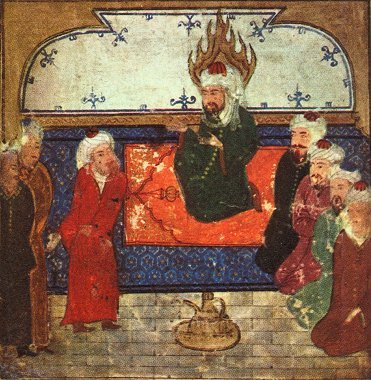
Not that that picture comes from the Shi’a tradition and not from the Sunni-tradition. Nevertheless, I have never received any notice that that site had any threats. So why did that happen in the Danish case. I have written about that earlier.
In the meantime, for the people who want to post comments here. By my guest, keep it polite and decent and you have to be patient. Due to large amounts of spam, all comments have to be moderated before publishing.
C L O S E R – Pictures of you
Posted on January 15th, 2006 by martijn.
Categories: Public Islam.
C L O S E R

The release of the prophet Mohammed cartoons by the Danish Jylland Posten has become a hot topic, online and offline.
First in a few sentences the whole story. After the complaint by an author that no one dared to illustrate his book (because, according to him illustrators feared that extremists would find it sacrilegious to break the Islamic ban on depicting Mohammed – or people in general), the newspaper urged cartoonists to send in drawings of the prophet.
So twelve people did on the newspaper posted all the photo’s. It caused (and still does) a huge debate about ‘Islam and free speech‘ and several Muslims launced a complaint.

“The newspaper has with its action deliberately stepped on Islam’s ethical and moral values with the purpose of contempt and ridiculing Muslims’ feelings, their holy sites and their religious symbols,” the group said.
(My italics, MdK)
The Danish PM refused to talk with Muslims about the issue:
Meanwhile, Denmark’s prime minister on Tuesday accused a group of local Muslims of smearing the country’s reputation in the Middle East as they sought support against a newspaper that published caricatures of Islam’s Prophet Muhammad.
Anders Fogh Rasmussen said he was “stunned” that leaders of the Islamic Faith Community had travelled to Egypt, Syria and Lebanon “to stir up attitudes against Denmark and Danes”.
The group’s leader, Ahmed Abu Laban, a cleric, has defended the December trip, saying the Muslim community was feeling marginalised in Denmark in its protests against the paper.
Dutch MP Hirsi Ali supported him
European leaders should step forward and support Prime Minister Anders Fogh Rasmussen’s refusal to meet with eleven Muslim ambassadors to discuss press coverage of Islam, Dutch MP Ayaan Hirsi Ali said on Sunday.
Rasmussen, however, declined to meet the ambassadors, saying that if they had the slightest understanding of the workings of Danish society, they would know that he had no desire or powers to change the newspaper’s editorial policies. ‘The Danish prime minister’s reply to the ambassadors should be an example for every European leader,’ Hirsi Ali told Jyllands-Posten’s reporter. ‘The prime minister steps forward to tell Muslims loud and clear that the freedom of expression is a deciding factor for a free society, and that a prime minister in a free society neither can nor wishes to regulate what newspapers do or do not do. The fact that he makes a special point of explaining this to the ambassador from Turkey – which is seeking entrance to the EU – is an expression of true statesmanship.’
‘It’s necessary to taunt Muslims on their relationship with Mohammed, because otherwise we will never have the dialogue we need to establish with Muslims on the most central question: Do you really feel that the prophet Mohammed is completely infallible, and that every Muslim in Europe in 2005 should follow the way of life the prophet had 1400 years ago, as the Koran dictates? The provocation is necessary to spark the debate,’ Hirsi Ali said.
The debate is therefore about islam and freedom of speech and the need to tackle the prophet Mohammed as an example for all Muslims by provocations. I don’t know if that was the intention of the author mentioned above, but that’s off topic probably.
So one might be pragmatic and saying what is the need the draw the prophet Mohammed in a book about him. Muslims can do without (see the movie Al Rissala). On the other hand there are muslimgroups who did make drawings of the prophet. So what is actually the problem for them. Well the pictures could be a problem for some, but more important is probably the part in italics I mentioned above, and will repeat here:
the purpose of contempt and ridiculing Muslims’ feelings,
The Muslims who are upset, seem to be upset because they think this is done with a negative reason, or with a more neutral phrase (by Hirsi Ali) to provoke them. This seems also the opinion of Zubair Butt Hussain, Spokesman “Muslims in Dialogue“, Denmark:
But long before these drawings came into the public domain, there was widespread apprehension among Danish Muslims over the way they and their religious affiliation were presented in the media. The image projected in the Danish media of Islam has been one of a faith that did not undergo a reformation and renaissance similar to Christianity and is thus stuck in the middle ages. The drawings are simply a culmination of several years of media persecution of the Muslim minority in Denmark.
Even worse is the role elected politicians have played in stoking this fire. It is not unusual for certain politicians to make the ill-willed and mistaken but common equation that Muslims are immigrants, and immigrants are badly integrated and therefore the root of all evil in Danish society. Beyond the prejudice against immigrants in general this belies, it also contradicts the fact that most Muslims in Denmark have been here for 30-40 years and many are born here. But if that is pointed out, they are simply called second or third generation immigrants. Even ethnic Danish Muslim converts are described by the derogatory “ersatz-immigrants”; one politician has gone so far as to compare these converts to Nazis, and, in all seriousness, advocate that they be placed under surveillance as they constitute a threat to society. A politician from the same party described Muslims as a spreading cancer, while others have suggested criminals of non-Danish ethnic background should be interned or exiled with their closest family.
So well they got what they wanted. Muslims are provoked and it is striking to see how people are islamizing their complaints about a lack of respect and all. And also how non-Muslims are islamizing this protest by speaking of a holy war or by speaking of jihad. And of course some Muslims are doing the same with the violent jihad towards Denmark.
But one can of course be very principal and state the freedom of speech is absolute not matter what the intentions are.
Dutch debate on Islam replays centuries-old argument
Posted on November 24th, 2005 by martijn.
Categories: Islam in the Netherlands, Public Islam.
Dutch debate on Islam replays centuries-old argument
Michel Hoebink of Radio Netherlands about the Dutch islamdebate:
The recent commemoration of last year’s murder of the filmmaker and writer Theo van Gogh, has led to a revival of interest in the ongoing Dutch Islam debate. Newspaper columnist Paul Scheffer argued in the NRC Handelsblad that Islam – in order to reconcile itself with a modern democratic order – needs to rethink some of its basic tenets about freedom of religion.
Last week, the authoritative paper published two very interesting reactions to Mr Scheffer’s plea for Islamic reform: one by Somali-born liberal conservative MP Ayaan Hirsi Ali and another by Islam researcher Robbert Woltering.
Unfavourable to women?
According to Ayaan Hirsi Ali, Scheffer’s belief in the possibility of reforming Islam is naive. Ms Hirsi Ali backs her argument with her widely-publicised conviction that the ‘true doctrine of pure Islam’ – as it can be read in the Koran and the Traditions of the Prophet Mohammed – calls believers to commit violence against unbelievers and is unfavourable to the rights of women.What Paul Scheffer holds for enlightened liberal Muslims, says Ms Hirsi Ali in her commentary, are in fact not Muslims who have left this pure Islam behind them but who have not yet confronted it. They are non-practising Muslims who sooner or later will reveal their ‘true ’nature’ and turn into practising ones.
Correct interpretation
The MP’s argument provoked an ironic commentary by Robbert Woltering, Islam researcher at the Leiden Institute for the Study of Islam in the Modern World (ISIM). Ever since the coming of Islam, Mr Woltering argues, Muslims have been quarrelling about the question as to what is the correct interpretation of Koran and the Prophetic Traditions.Now, at a time that the answer seems further away than ever, the historical quest has come to an unexpected apotheosis, he writes, in – of all possible places – the Dutch parliament, where Ms Hirsi Ali recently revealed that she herself has discovered the True Doctrine of Pure Islam! Ayaan Hirsi Ali’s discovery, says Mr Woltering, will most probably please Mohammed Bouyeri, the fundamentalist who murdered Theo van Gogh. But it will be a disappointment for all those Muslims who mistakenly thought that Islam respects the rights of women and tells them to live in peace with their non-Muslim neighbours.
Replaying the debates
Woltering’s last remark is significant because it alludes to the fact that the debate between Dutch critics and defenders of Islam is, in many ways, some sort of replay of the ongoing debates between fundamentalists and reformers within the Islamic world. Ayaan Hirsi Ali may be a declared critic of fundamentalist Islam, but in fact she is in full agreement with her opponents about the true nature of Islamic religion. On the other hand, Robbert Wolterings implicit plea, that Islam cannot be reduced to a single literalist essence but can be interpreted in many different ways, is in many respects similar to the views of Muslim modernists.Differences run deep
The contemporary debate within Islam is not just a debate between those who favour a conservative and those who favour a modern interpretation. The difference goes deeper than that. It is a debate between literalist fundamentalists and modernist reformers about the very legitimacy of interpretation itself. This debate is also as old as Islam; it finds a clear expression, for instance, in the debate between the rationalist Mu’tazilites and literalist Hanbalites in the 9th century. Fundamentalists believe that the text of the Koran should be literally applied in all times and places, without asking for any rational reason, simply because God tells us to do so. Modernists believe that Islam can be interpreted and re-interpreted in many different ways, in order to meet the demands of different places and ages.
War comes to the heart of Europe
Posted on September 25th, 2005 by martijn.
Categories: Internal Debates, International Terrorism, Murder on theo Van Gogh and related issues, Public Islam, Religious and Political Radicalization.
An article in Asia Times Online :: Asian News, Business and Economy. by Pepe Escobar that owes much credit to Gilles Kepels book ‘War for Muslim Minds’
The battle over the future of global Islam will be fought and decided in Europe.
Whether or not it is responsible for the attacks on London, the al-Qaeda nebula is now configured as a relentless jihadi recruitment mechanism, profiting from the fact that the American invasion and occupation of Iraq has been added to its original mix of extreme Wahhabism and Silicon Valley (which al-Qaeda’s number two, Ayman al-Zawahiri, visited in the early 1990s).
In this article the author discusses the concepts of al-wala wal-bara (“loyalty and separation”) that is crucial for understanding Mohammed B. cs ideology.
Whether or not it is responsible for the attacks on London, the al-Qaeda nebula is now configured as a relentless jihadi recruitment mechanism, profiting from the fact that the American invasion and occupation of Iraq has been added to its original mix of extreme Wahhabism and Silicon Valley (which al-Qaeda’s number two, Ayman al-Zawahiri, visited in the early 1990s).
“Al-Qaeda” is a mutating virus, proliferating secretly in unexpected places. It used to thrive on subterfuge, evasion and deception. Now, the virus is attacking on three fronts. The Internet spreads the lethal, remixed Koran of jihad’s aims and ideology; Iraq has become the university for a new, deadly generation of internationalist jihadis; and Europe is the latest battleground where the new generation is bound to strike. The Euro-jihadi is here to stay.
“Al-Qaeda” is now a metaphor for global, deterritorialized jihad – indeed a “database” (as its original name implies) that strives to represent the microcosm of the whole Islamic umma (community). This is a political war conducted by a revolutionary vanguard. It is also a social war. It is definitely not a religious war. Whether religious war may succeed it depends to a large extent on the Muslim population of Europe, and whether it can isolate the Euro-jihadis.
No one is innocent
The killing of innocents, or massacre of infidels – as in London’s attacks – is not considered terrorism by either Osama bin Laden or Zawahiri: as bin Laden himself has made clear, it is seriously regarded as only a minor reparation for all the crimes committed against Islam since the end of the 600-year-long Ottoman Empire in 1923.Al-Qaeda may be a revolutionary vanguard, but it is always careful to cloak its war as a war against unbelievers. In December 2002, Zawahiri published a crucial pamphlet in the London daily, al-Quds al-Arabi, widely reproduced on the jihadi Internet. He quoted a Koranic verse to justify the accidental killing of Muslims in attacks against unbelievers: the Muslims should not be there in the first place. Because it is ostensibly a war against unbelievers, al-Qaeda cannot but stress that if Muslims are associated with unbelievers, Islam itself is in danger.
Many clerics used this scholarly doctrine – al-wala wal-bara (“loyalty and separation”, in Arabic) to explain why Baghdad fell to the Mongols in the 13th century, as well as the Spanish Reconquista of Andalusia. Zawahiri used it to legitimize any “collateral damage” by jihad. The measure of Zawahiri’s influence is offered by the new, lethal and even more nihilistic generation of jihadis operating in Iraq: they have no problems justifying the killing of fellow Muslims and innocent Iraqi civilians, because for them these people are “associating with unbelievers”. Zawahiri made it clear in 2002 that any Muslim ally of America was by definition an apostate: “Jihad against Americans, Jews and their allies among the hypocrites and apostates is mandatory on all Muslims.”
The Euro-jihadis
The London investigation followed three leads: the attackers might have come from the Middle East, from Northern Africa, or they could have been British. Now Scotland Yard has established they were four men aged 18 to 30, “cleanskins” – with no criminal record – and British-born, of Pakistani origin. In short: the new, lethal, generation of suicide-bombing Euro-jihadis.Most EU counter-terrorism analysts in Brussels – indeed, all over Western Europe – are stunned. This is what many had feared for a long time. As for rumors that London was part of a plan hatched by former Iraqi Mukhabarat agents to use British jihadis and thus retaliate inside British territory, EU analysts say they have no evidence – at least not yet – that Ba’athists were involved. But the jihadi component of the Iraqi resistance may well be. EU analysts tell Asia Times Online, “At the moment we have no evidence that former Iraq intelligence was involved, but we are studying the possibility of Zarqawi agents being infiltrated in Britain, or having come to Britain to conduct an operation.”
If “al-Qaeda”, the virus, really did perpetrate the London bombings, it won’t be confronted with the huge public relations problem posed by the Casablanca attack in Morocco. Then, al-Qaeda’s ideology – disseminated by Salafist sheikhs – had contaminated a group of lumpen proletariat Moroccans, who decided to turn their impotence into terrorism. The problem is that only fellow Moroccan Muslims were killed. The attacks on Madrid in March last year – perpetrated by Casablanca-linked Moroccans – was a different story: the victims were scores of “infidel” Europeans. These jihadis were trained by al-Qaeda. The same pattern, according to EU counter-terrorism analysts, may have played itself out in London.
Just as in Madrid, the attack was claimed by the Abu Hafs al-Masri Brigades (which honor the Egyptian Abu Hafs, a former security chief for bin Laden and trainer of Arab Afghans, killed by American bombs in Kandahar in November 2001). Then a communique was sent to the London daily al-Quds al-Arabi. Now a communique has appeared on an Islamist website from Dubai.
Zawahiri’s jihad masterplan, elaborated in 2001, was to conduct selected, spectacular strikes whose powerful reverberation on global TV and the Internet would mobilize the Muslim masses. But Gilles Kepel, professor of Middle East Studies at the Institute of Political Studies in Paris, warns that “apart from some narrow and unlikely alliances with intellectuals or black sheep, a few random Islamic bankers, and young, dispossessed bombers, bin Laden has been unable to unify poor urban youth, the Muslim middle classes, and the Islamist intelligentsia into a coalition capable of repeating the only triumphant Islamic revolution the world has ever seen: the one that took place in Iran in 1979”.
After London, this situation may be about to change. Kepel already talks of “the fight for Europe”.
Over 10 million immigrants from Muslim countries now live in Western Europe. Their children were born in Europe, speak one or more European languages, carry EU passports, are well educated and technology-savvy, and are familiar with the maze of European institutions. Internationalist jihadis are fighting to capture the hearts and minds of these 10 million.
EU analysts, among the doom and gloom, agree that tensions between Muslims and non-Muslims are bound to peak, especially in Britain and France. Some parts of Brussels, the capital of Europe, feel like Morocco. Belgium, as well as Germany, Spain, Italy, the Netherlands and Scandinavia have all tried very hard to carefully calibrate their policies in terms of keeping potential jihadis under a close watch while at the same time integrating their Muslim populations. France has been too harsh; Britain had thought it kept everything under control by monitoring “Londonistan”. Now the battle for Europe has come – a matter of fitna – sedition, disagreement, war in the heart of Islam. Fitna is Islam’s enemy within – and it’s the jihadis new thrust that is provoking the turmoil.
The question facing the jihadis is whether to force the destabilization of national governments – like those of Saudi Arabia, Egypt and Pakistan – or to go deeper into internationalist jihad. In these terms, “al-Qaeda”, the virus, is not different from any revolutionary vanguard: one is reminded that Stalinists wanted to consolidate the revolution in the USSR, while Trotskyites wanted a permanent, world revolution. Until now, London was a Salafi, and Salafi-jihadi, sanctuary. Now there’s bound to be major repression – and dispersal. “Invisible” Euro-jihadis may be holed up anywhere. The point is not that “al-Qaeda” wants to impose Islam in Europe: what it wants is to impose Wahhabi values in the Arab-Muslim world, and extirpate the West from Muslim lands.
Retaliation
Salafis – closely linked to House of Saud-approved sheikhs – will keep discouraging jihad with a vengeance. They prefer discreet integration. As an example: in France, they did not even protest the law that forbids veiled girls in schools. Sheikh Yousef al-Qardawi – immensely popular because of his al-Jazeera talk show – is against suicide bombing as in September 11 or London, but he approves of jihad in Palestine.The reverberations of London’s attacks, on the other hand, may embolden more Salafi jihadis in west Yorkshire, Hamburg, Paris or Madrid. Some of these jihadis have been to Bosnia, Pakistan, Chechnya or Iraq and are more than ready to strike in western Europe. Not to mention the new jihadis born in Europe, with clean records, apparently well-socialized, and aged between 18 and 30.
When Zawahiri launched his jihad, one of his basic aims was to punish the West, specifically the Anglo-American sphere. He didn’t foresee that the massive response would include death and destruction in the Middle East, as in Iraq. According to some Middle Eastern media reports, more than 128,000 Iraqis have been killed by the invasion and occupation since March 2003; 55% are believed to be women and children under the age 12. This figure is said to be based on information gathered in Iraqi hospitals and from the families of victims. This is how the Middle East evaluates the occupation. And this is one of the major factors giving jihadis what they see as justification for no-holds-barred retaliation against the West.
This new generation of Euro-jihadis is now turning it all upside down, profiting from widespread revulsion against the Anglo-Americans takeover of Iraq to retaliate as well as advance a Salafi worldview. This could all have been prevented by a very simple move: a real democratic project for the Middle East – before indiscriminate support for every one of Israeli Prime Minister Ariel Sharon’s excesses; before Guantanamo; before Abu Ghraib; before the leveling of Fallujah.
Instead, thanks to Pentagon propaganda regurgitated by corporate media, we now have a cipher, a man nobody is sure even exists – Abu Musab al-Zarqawi – elevated to supernatural status. EU analysts despair: we may be entering the age of one thousand Zarqawis coming from the shadows to haunt not the US, but western Europe. It’s as much a war at the heart of Europe as a war at the heart of Islam.
Islam and Muslims in Cyberspace
Posted on May 4th, 2005 by martijn.
Categories: Important Publications, Public Islam.
On Islam Online.net an interesting article by Dalia Yusuf Islam and Muslims in Cyberspace: From (Re)presenting to (Re) understanding
An initial study of Islam and Muslim environments in cyberspace proves that there is a great chance for representing Islam and Muslims.
Using the Internet as an alternative and interpersonal form of communication may help to break the traditional cycle of stereotyping among Muslims themselves and between Muslims and others. A more profound and deliberate study may lead us to recognize the possibility of reunderstanding and rediscovering not only the other but also Muslim self-understanding.
To a certain extent, any study of Muslims using the Internet may begin with the predictable psychological barrier between committed Muslims and the media. This was reflected in a discussion on whether the Internet is lawful or prohibited, as the Internet seems to raise issues of pornography and privacy. One Muslim user lamented, �The already critical social problems of Muslim youth at present will be further worsened by the emerging Internet technology.� 1 This was an expected argument among the various reactions.
Virtual people’s virtual Islam – Media Monitors Network (MMN)
Posted on April 14th, 2005 by martijn.
Categories: Internal Debates, Public Islam, Religious and Political Radicalization, Young Muslims.
Home / Headlines / Virtual people’s virtual Islam – Media Monitors Network (MMN)
Virtual people’s virtual Islam
by Abid Ullah Jan
(Sunday 10 April 2005)
“Young people in the Muslim world, with lust for sex and the glittering Western world before their eyes, find themselves sitting in this virtual world for hours on end, pausing only briefly and then going back on to chat as soon as they are done with other affairs. Many parents are totally oblivious of what their teenagers are doing late at night on the internet. Even watching pornography becomes a blessing by comparison with these chat rooms and infiltrator’s moderated groups for the simple reason that pornography does not change their ideological orientation against Islam and it does not make one hate everything that is related to Muslims and Islam.”
Virtual people's virtual Islam – Media Monitors Network (MMN)
Posted on April 14th, 2005 by martijn.
Categories: Internal Debates, Public Islam, Religious and Political Radicalization, Young Muslims.
Home / Headlines / Virtual people’s virtual Islam – Media Monitors Network (MMN)
Virtual people’s virtual Islam
by Abid Ullah Jan
(Sunday 10 April 2005)
“Young people in the Muslim world, with lust for sex and the glittering Western world before their eyes, find themselves sitting in this virtual world for hours on end, pausing only briefly and then going back on to chat as soon as they are done with other affairs. Many parents are totally oblivious of what their teenagers are doing late at night on the internet. Even watching pornography becomes a blessing by comparison with these chat rooms and infiltrator’s moderated groups for the simple reason that pornography does not change their ideological orientation against Islam and it does not make one hate everything that is related to Muslims and Islam.”
Islamic Blog, Muslims Blog, or…
Posted on February 21st, 2005 by martijn.
Categories: Public Islam, Some personal considerations.
The traceless warrior is quite awake and has noticed that I categorized him as an Islamic Blog.
The Traceless Warrior: Bloggingsphere Update
Well this is not an “Islamic Blog”. While I am a Muslim, I consider a lot of what some people try to pass off as “Islamic” blogs or websites to actually be examples of obsessive-compulsive mono-maniacal religious ideation. It has been my experience that focusing on any one aspect of one’s life to the exclusion of all others produces dangerously unbalanced individuals.
He is right of course.
(more…)
Qantara.de – Mohammad Shabestari – Faith, Freedom, and Reason
Posted on February 13th, 2005 by martijn.
Categories: Internal Debates, Public Islam.
Qantara.de – Mohammad Shabestari – Faith, Freedom, and Reason
Can there be such a thing as Islamic human rights? Do the commandments set forth in the Koran have eternal validity, or can they be modified according to the demands of reason? Iranian clergyman Mohammad Shabestari has devoted his life to exploring these issues in modern religious and political Islamic thinking. By Roman Seidel
Islamic Virtual Ummah
Posted on November 29th, 2004 by martijn.
Categories: Public Islam, Young Muslims.
Islam-Online Web Site – Your Source To The World Of Islam! Communication Center
Many researches and scholars consider the internet as the real reason for the flourishing of the so called “Islamic Virtual Ummah”, what do you think?
Islam on the Internet: Progress or Radicalization?
Posted on November 11th, 2004 by martijn.
Categories: Important Publications, Public Islam.
�Whereas jihad sublimates internal tensions and projects them outward, toward the land of unbelief, fitna undermines Muslim society from within.�
Protected:
Posted on September 30th, 2004 by martijn.
Categories: Misc. News, Public Islam.
Enter your password to view comments.
Submission Part I: film van Theo van Gogh en Ayaan Hirsi Ali
Posted on August 30th, 2004 by martijn.
Categories: Misc. News, Public Islam.
Zomergasten -> Afleveringen -> Ayaan Hirsi Ali -> Items -> Submission
In Zomergasten met Ayaan Hirsi Ali de eerste vertoning van de film “Submission”, een film van Ayaan Hirsi Ali en filmmaker Theo van Gogh. Het gaat om een korte film van tien minuten waarin de meest vrouwonvriendelijke teksten uit de koran onder de aandacht worden gebracht. De film staat niet op de website van Zomergasten, maar wel de uitleg bij de film en de bijbehorende Koranverzen.
Submission
(more…)
Civil Society and religion: retrospective reflections on Catholicism and prospective reflections on Islam
Posted on June 18th, 2004 by martijn.
Categories: Public Islam, Research International.
Civil society and religion: retrospective reflections on Catholicism and prospective reflections on Islam. Casanove on the historical role of catholicism in the emerging democratization and on the incompatibility of islam and democracy. Jose Casanova is Associate Professor of Sociology at the New School for Social Research. He is the author of Public Religions in the Modern World (1994) and he guest-edited the special issue of Sociology of Religion on “Religion and Global Civil Society” (60:3, Fall 2001).
(more…)
Protected: Er groeit een brandnetel in mij
Posted on June 11th, 2004 by martijn.
Categories: Multiculti Issues, Public Islam.
Enter your password to view comments.
Headscarf dilemma is tangled in politics
Posted on June 9th, 2004 by martijn.
Categories: Internal Debates, Public Islam.
Headscarf dilemma is tangled in politics – ExpressNews – University of Alberta
Some Muslim women state that wearing the hizjab is obligatory, others say it isn’t. At the same time non-muslims state a hizjab is a sign of oppression, others say it isn’t. Well here we have the hizjab-debate in a nutshell. An article by dr. Saleem Qureshi from the university of alberta (canada) on this debate with examples from Turkey and France.
(more…)
Islam dress ban ‘breached’ rights
Posted on May 27th, 2004 by martijn.
Categories: Islamnews, Public Islam.
BBC NEWS | UK | Islam dress ban ‘breached’ rights
I am not going to post every little headscarf affair here, but this is one is slightly different that the ones in Holland and France, because of the uniform schoolclothing in the UK.
(more…)
Islam dress ban 'breached' rights
Posted on May 27th, 2004 by martijn.
Categories: Islamnews, Public Islam.
BBC NEWS | UK | Islam dress ban ‘breached’ rights
I am not going to post every little headscarf affair here, but this is one is slightly different that the ones in Holland and France, because of the uniform schoolclothing in the UK.
(more…)
Tantawi engages with questions of modernity
Posted on May 20th, 2004 by martijn.
Categories: Internal Debates, Public Islam.
The Daily Star – Arts & Culture – Tantawi engages with questions of modernity
. On: blue jeans, headscarves, Coca-Cola, falafel, Umm Kulthoum and (my own favorite) Smashing Pumpkins.
(more…)