Multiculti Issues
You are looking at posts in the category Multiculti Issues.
| M | T | W | T | F | S | S |
|---|---|---|---|---|---|---|
| « Sep | ||||||
| 1 | 2 | 3 | 4 | |||
| 5 | 6 | 7 | 8 | 9 | 10 | 11 |
| 12 | 13 | 14 | 15 | 16 | 17 | 18 |
| 19 | 20 | 21 | 22 | 23 | 24 | 25 |
| 26 | 27 | 28 | 29 | 30 | 31 | |
Pages
- About
- C L O S E R moves to….C L O S E R
- Contact Me
- Interventions – Forces that Bind or Divide
- ISIM Review via Closer
- Publications
- Research
Categories
- (Upcoming) Events (33)
- [Online] Publications (26)
- Activism (117)
- anthropology (113)
- Method (13)
- Arts & culture (88)
- Asides (2)
- Blind Horses (33)
- Blogosphere (192)
- Burgerschapserie 2010 (50)
- Citizenship Carnival (5)
- Dudok (1)
- Featured (5)
- Gender, Kinship & Marriage Issues (265)
- Gouda Issues (91)
- Guest authors (58)
- Headline (76)
- Important Publications (159)
- Internal Debates (275)
- International Terrorism (437)
- ISIM Leiden (5)
- ISIM Research II (4)
- ISIM/RU Research (171)
- Islam in European History (2)
- Islam in the Netherlands (219)
- Islamnews (56)
- islamophobia (59)
- Joy Category (56)
- Marriage (1)
- Misc. News (891)
- Morocco (70)
- Multiculti Issues (749)
- Murder on theo Van Gogh and related issues (326)
- My Research (118)
- Notes from the Field (82)
- Panoptic Surveillance (4)
- Public Islam (244)
- Religion Other (109)
- Religious and Political Radicalization (635)
- Religious Movements (54)
- Research International (55)
- Research Tools (3)
- Ritual and Religious Experience (58)
- Society & Politics in the Middle East (159)
- Some personal considerations (146)
- Deep in the woods… (18)
- Stadsdebat Rotterdam (3)
- State of Science (5)
- Twitwa (5)
- Uncategorized (74)
- Young Muslims (459)
- Youth culture (as a practice) (157)
General
- ‘In the name of Allah, Most Gracious, Most Merciful’
- – Lotfi Haddi –
- …Kelaat Mgouna…….Ait Ouarchdik…
- ::–}{Nour Al-Islam}{–::
- Al-islam.nl De ware godsdienst voor Allah is de Islam
- Allah Is In The House
- Almaas
- amanullah.org
- Amr Khaled Official Website
- An Islam start page and Islamic search engine – Musalman.com
- arabesque.web-log.nl
- As-Siraat.net
- assadaaka.tk
- Assembley for the Protection of Hijab
- Authentieke Kennis
- Azaytouna – Meknes Azaytouna
- berichten over allochtonen in nederland – web-log.nl
- Bladi.net : Le Portail de la diaspora marocaine
- Bnai Avraham
- BrechtjesBlogje
- Classical Values
- De islam
- DimaDima.nl / De ware godsdienst? bij allah is de islam
- emel – the muslim lifestyle magazine
- Ethnically Incorrect
- fernaci
- Free Muslim Coalition Against Terrorism
- Frontaal Naakt. Ongesluierde opinies, interviews & achtergronden
- Hedendaagse wetenswaardigheden…
- History News Network
- Homepage Al Nisa
- hoofddoek.tk – Een hoofddoek, je goed recht?
- IMRA: International Muslima Rights Association
- Informed Comment
- Insight to Religions
- Instapundit.com
- Interesting Times
- Intro van Abdullah Biesheuvel
- islaam
- Islam Ijtihad World Politics Religion Liberal Islam Muslim Quran Islam in America
- Islam Ijtihad World Politics Religion Liberal Islam Muslim Quran Islam in America
- Islam Website: Islam, Islamic Studies, Arabic, Religion
- Islamforum
- Islamic Philosophy Online
- Islamica Magazine
- islamicate
- Islamophobia Watch
- Islamsevrouw.web-log.nl
- Islamwereld-alles wat je over de Islam wil weten…
- Jihad: War, Terrorism, and Peace in Islam
- JPilot Chat Room
- Madrid11.net
- Marocstart.nl – De marokkaanse startpagina!
- Maryams.Net – Muslim Women and their Islam
- Michel
- Modern Muslima.com
- Moslimjongeren Amsterdam
- Moslimjongeren.nl
- Muslim Peace Fellowship
- Muslim WakeUp! Sex & The Umma
- Muslimah Connection
- Muslims Against Terrorism (MAT)
- Mutma’inaa
- namira
- Otowi!
- Ramadan.NL
- Religion, World Religions, Comparative Religion – Just the facts on the world\’s religions.
- Ryan
- Sahabah
- Salafi Start Siden – The Salafi Start Page
- seifoullah.tk
- Sheikh Abd al Qadir Jilani Home Page
- Sidi Ahmed Ibn Mustafa Al Alawi Radhiya Allahu T’aala ‘Anhu (Islam, tasawuf – Sufism – Soufisme)
- Stichting Vangnet
- Storiesofmalika.web-log.nl
- Support Sanity – Israel / Palestine
- Tekenen van Allah\’s Bestaan op en in ons Lichaam
- Terrorism Unveiled
- The Coffee House | TPMCafe
- The Inter Faith Network for the UK
- The Ni’ma Foundation
- The Traveller’s Souk
- The \’Hofstad\’ terrorism trial – developments
- Thoughts & Readings
- Uitgeverij Momtazah | Helmond
- Un-veiled.net || Un-veiled Reflections
- Watan.nl
- Welkom bij Islamic webservices
- Welkom bij vangnet. De site voor islamitische jongeren!
- welkom moslim en niet moslims
- Yabiladi Maroc – Portail des Marocains dans le Monde
Dutch [Muslims] Blogs
- Hedendaagse wetenswaardigheden…
- Abdelhakim.nl
- Abdellah.nl
- Abdulwadud.web-log.nl
- Abou Jabir – web-log.nl
- Abu Bakker
- Abu Marwan Media Publikaties
- Acta Academica Tijdschrift voor Islam en Dialoog
- Ahamdoellilah – web-log.nl
- Ahlu Soennah – Abou Yunus
- Ahlul Hadeeth
- Ahlul Hadeeth
- Al Moudjahideen
- Al-Adzaan
- Al-Islaam: Bismilaahi Rahmaani Rahiem
- Alesha
- Alfeth.com
- Anoniempje.web-log.nl
- Ansaar at-Tawheed
- At-Tibyan Nederland
- beni-said.tk
- Blog van moemina3 – Skyrock.com
- bouchra
- CyberDjihad
- DE SCHRIJVENDE MOSLIMS
- DE VROLIJKE MOSLIM ;)
- Dewereldwachtopmij.web-log.nl
- Dien~oel~Islaam
- Eali.web-log.nl
- Een genade voor de werelden
- Enige wapen tegen de Waarheid is de leugen…
- ErTaN
- ewa
- Ezel & Os v2
- Gizoh.tk [.::De Site Voor Jou::.]
- Grappige, wijze verhalen van Nasreddin Hodja. Turkse humor.
- Hanifa Lillah
- hayya~ala~assalaah!
- Het laatste nieuws lees je als eerst op Maroc-Media
- Homow Universalizzz
- Ibn al-Qayyim
- IslaamLive Mail
- IslaamLive Mail
- Islam Blog – Juli 2007
- Islam in het Nieuws – web-log.nl
- Islam, een religie
- Islam, een religie
- Islamic Sisters – web-log.nl
- Islamiway’s Weblog
- Islamtawheed’s Blog
- Jihaad
- Jihad
- Journalista
- La Hawla Wa La Quwatta Illa Billah
- M O S L I M J O N G E R E N
- M.J.Ede – Moslimjongeren Ede
- Mahdi\’s Weblog | Vrijheid en het vrije woord | punt.nl: Je eigen gratis weblog, gratis fotoalbum, webmail, startpagina enz
- Maktab.nl (Zawaj – islamitische trouwsite)
- Marocdream.nl – Home
- Marokkaanse.web-log.nl
- Marokkanen Weblog
- Master Soul
- Miboon
- Miesjelle.web-log.nl
- Mijn Schatjes
- Moaz
- moeminway – web-log.nl
- Moslima_Y – web-log.nl
- mosta3inabilaah – web-log.nl
- Muhaajir in islamitisch Zuid-Oost Azië
- Mumin al-Bayda (English)
- Mustafa786.web-log.nl
- Oprecht – Poort tot de kennis
- Said.nl
- saifullah.nl – Jihad al-Haq begint hier!
- Salaam Aleikum
- Sayfoudien – web-log.nl
- soebhanAllah
- Soerah19.web-log.nl – web-log.nl
- Steun Palestina
- Stichting Moslimanetwerk
- Stories of Malika
- supermaroc
- Ummah Nieuws – web-log.nl
- Volkskrant Weblog — Alib Bondon
- Volkskrant Weblog — Moslima Journalista
- Vraag en antwoord…
- wat is Islam
- Wat is islam?
- Weblog – a la Maroc style
- website van Jamal
- Wij Blijven Hier
- Wij Blijven Hier
- www.BenAyad.be – Islam en Actua
- www.moslima.web-log.nl
- Yakini Time
- Youth Of Islam
- Youth Of Islam
- [fikra]
Non-Dutch Muslims Blogs
- Lanallah __Islamic BlogZine__
- This journey ends but only with The Beginning
- ‘the middle place’
- …Never Judge a Person By His or Her Blog…
- …under the tree…
- A Comment on PMUNA
- A Dervish’s Du`a’
- A Family in Baghdad
- A Garden of Children
- A Muslim Mother’s Thoughts / Islamic Parenting
- A Struggle in Uncertainty, Such is Life
- About Afghanistan
- adnan.org: good design, bad idea
- Afiyah
- Ahmeds World of Islam
- Al Musawwir
- Al-Musharaka
- Almiraya tBLOG – O, happy the soul that saw its own faults
- Almusawwir
- an open window
- Anak Alam
- aNaRcHo AkBaR
- Anthology
- AnthroGal’s World
- Arabian Passion
- ArRihla
- Articles Blog
- Asylum Seeker
- avari-nameh
- Baghdad Burning
- Being Noor Javed
- Bismillah
- bloggin’ muslimz.. Linking Muslim bloggers around the globe
- Blogging Islamic Perspective
- Chapati Mystery
- City of Brass – Principled pragmatism at the maghrib of one age, the fajr of another
- COUNTERCOLUMN: All Your Bias Are Belong to Us
- d i z z y l i m i t s . c o m >> muslim sisters united w e b r i n g
- Dar-al-Masnavi
- Day in the life of an American Muslim Woman
- Don’t Shoot!…
- eat-halal guy
- Eye on Gay Muslims
- Eye on Gay Muslims
- Figuring it all out for nearly one quarter of a century
- Free Alaa!
- Friends, Romans, Countrymen…. lend me 5 bux!
- From Peer to Peer ~ A Weblog about P2P File & Idea Sharing and More…
- Ghost of a flea
- Ginny’s Thoughts and Things
- God, Faith, and a Pen: The Official Blog of Dr. Hesham A. Hassaballa
- Golublog
- Green Data
- gulfreporter
- Hadeeth Blog
- Hadouta
- Hello from the land of the Pharaoh
- Hello From the land of the Pharaohs Egypt
- Hijabi Madness
- Hijabified
- HijabMan’s Blog
- Ihsan-net
- Inactivity
- Indigo Jo Blogs
- Iraq Blog Count
- Islam 4 Real
- Islamiblog
- Islamicly Locked
- Izzy Mo’s Blog
- Izzy Mo’s Blog
- Jaded Soul…….Unplugged…..
- Jeneva un-Kay-jed- My Bad Behavior Sanctuary
- K-A-L-E-I-D-O-S-C-O-P-E
- Lawrence of Cyberia
- Letter From Bahrain
- Life of an American Muslim SAHM whose dh is working in Iraq
- Manal and Alaa\’s bit bucket | free speech from the bletches
- Me Vs. MysElF
- Mental Mayhem
- Mere Islam
- Mind, Body, Soul : Blog
- Mohammad Ali Abtahi Webnevesht
- MoorishGirl
- Muslim Apple
- muslim blogs
- Muslims Under Progress…
- My heart speaks
- My Little Bubble
- My Thoughts
- Myself | Hossein Derakhshan’s weblog (English)
- neurotic Iraqi wife
- NINHAJABA
- Niqaabi Forever, Insha-Allah Blog with Islamic nasheeds and lectures from traditional Islamic scholars
- Niqabified: Irrelevant
- O Muhammad!
- Otowi!
- Pak Positive – Pakistani News for the Rest of Us
- Periphery
- Pictures in Baghdad
- PM’s World
- Positive Muslim News
- Procrastination
- Prophet Muhammad
- Queer Jihad
- Radical Muslim
- Raed in the Middle
- RAMBLING MONOLOGUES
- Rendering Islam
- Renegade Masjid
- Rooznegar, Sina Motallebi’s WebGard
- Sabbah’s Blog
- Salam Pax – The Baghdad Blog
- Saracen.nu
- Scarlet Thisbe
- Searching for Truth in a World of Mirrors
- Seeing the Dawn
- Seeker’s Digest
- Seekersdigest.org
- shut up you fat whiner!
- Simply Islam
- Sister Scorpion
- Sister Soljah
- Sister Surviving
- Slow Motion in Style
- Sunni Sister: Blahg Blahg Blahg
- Suzzy’s id is breaking loose…
- tell me a secret
- The Arab Street Files
- The Beirut Spring
- The Islamic Feminista
- The Land of Sad Oranges
- The Muslim Contrarian
- The Muslim Postcolonial
- The Progressive Muslims Union North America Debate
- The Rosetta Stone
- The Traceless Warrior
- The Wayfarer
- TheDesertTimes
- think halal: the muslim group weblog
- Thoughts & Readings
- Through Muslim Eyes
- Turkish Torque
- Uncertainty:Iman and Farid’s Iranian weblog
- UNMEDIA: principled pragmatism
- UNN – Usayd Network News
- Uzer.Aurjee?
- Various blogs by Muslims in the West. – Google Co-op
- washed away memories…
- Welcome to MythandCulture.com and to daily Arrows – Mythologist, Maggie Macary’s blog
- word gets around
- Writeous Sister
- Writersblot Home Page
- www.BenAyad.be – Islam en Actua
- www.Mas’ud’s blog
- \’Aqoul
- ~*choco-bean*~
General Islam Sites
- :: Islam Channel :: – Welcome to IslamChannel Official Website
- Ad3iyah(smeekbeden)
- Al-maktoum Islamic Centre Rotterdam
- Assalamoe Aleikoem Warhmatoe Allahi Wa Barakatuhoe.
- BouG.tk
- Dades Islam en Youngsterdam
- Haq Islam – One stop portal for Islam on the web!
- Hight School Teacher Muhammad al-Harbi\’s Case
- Ibn Taymiyah Pages
- Iskandri
- Islam
- Islam Always Tomorrow Yesterday Today
- Islam denounces terrorism.com
- Islam Home
- islam-internet.nl
- Islamic Artists Society
- Leicester~Muslims
- Mere Islam
- MuslimSpace.com | MuslimSpace.com, The Premiere Muslim Portal
- Safra Project
- Saleel.com
- Sparkly Water
- Statements Against Terror
- Understand Islam
- Welcome to Imaan UK website
Islamic Scholars
Social Sciences Scholars
- ‘ilm al-insaan: Talking About the Talk
- :: .. :: zerzaust :: .. ::
- After Sept. 11: Perspectives from the Social Sciences
- Andrea Ben Lassoued
- Anth 310 – Islam in the Modern World (Spring 2002)
- anthro:politico
- AnthroBase – Social and Cultural Anthropology – A searchable database of anthropological texts
- AnthroBlogs
- AnthroBoundaries
- Anthropologist Community
- anthropology blogs
- antropologi.info – Social and Cultural Anthropology in the News
- Arabist Jansen
- Between Secularization and Religionization Vrije Universiteit Amsterdam
- Bin Gregory Productions
- Blog van het Blaise Pascal Instituut
- Boas Blog
- Causes of Conflict – Thoughts on Religion, Identity and the Middle East (David Hume)
- Cicilie among the Parisians
- Cognitive Anthropology
- Comunidade Imaginada
- Cosmic Variance
- Critical Muslims
- danah boyd
- Deep Thought
- Dienekes’ Anthropology Blog
- Digital Islam
- Erkan\’s field diary
- Ethno::log
- Evamaria\’s ramblings –
- Evan F. Kohlmann – International Terrorism Consultant
- Experimental Philosophy
- For the record
- Forum Fridinum [Religionresearch.org]
- Fragments weblog
- From an Anthropological Perspective
- Gregory Bateson
- Islam & Muslims in Europe *)
- Islam, Islamic Studies, Arabic, Religion
- Islam, Muslims, and an Anthropologist
- Jeremy’s Weblog
- JourneyWoman
- Juan Cole – ‘Documents on Terrorist Abu Musab al-Zarqawi’
- Keywords
- Kijken naar de pers
- languagehat.com
- Left2Right
- Leiter Reports
- Levinas and multicultural society
- Links on Islam and Muslims
- log.squig.org
- Making Anthropology Public
- Martijn de Koning Research Pages / Onderzoekspaginas
- Material World
- MensenStreken
- Modern Mass Media, Religion and the Imagination of Communities
- Moroccan Politics and Perspectives
- Multicultural Netherlands
- My blog’s in Cambridge, but my heart is in Accra
- National Study of Youth and Religion
- Natures/Cultures
- Nomadic Thoughts
- On the Human
- Philip Greenspun’s Weblog:
- Photoethnography.com home page – a resource for photoethnographers
- Qahwa Sada
- RACIAL REALITY BLOG
- Religion Gateway – Academic Info
- Religion News Blog
- Religion Newswriters Association
- Religion Research
- rikcoolsaet.be – Rik Coolsaet – Homepage
- Rites [Religionresearch.org]
- Savage Minds: Notes and Queries in Anthropology – A Group Blog
- Somatosphere
- Space and Culture
- Strange Doctrines
- TayoBlog
- Teaching Anthropology
- The Angry Anthropologist
- The Gadflyer
- The Immanent Frame | Secularism, religion and the public sphere
- The Onion
- The Panda\’s Thumb
- TheAnthroGeek
- This Blog Sits at the
- This Blog Sits at the intersection of Anthropology & Economics
- verbal privilege
- Virtually Islamic: Research and News about Islam in the Digital Age
- Wanna be an Anthropologist
- Welcome to Framing Muslims – International Research Network
- Yahya Birt
Women's Blogs / Sites
- * DURRA * Danielle Durst Britt
- -Fear Allah as He should be Feared-
- a literary silhouette
- a literary silhouette
- A Thought in the Kingdom of Lunacy
- AlMaas – Diamant
- altmuslimah.com – exploring both sides of the gender divide
- Assalaam oe allaikoum Nour al Islam
- Atralnada (Morning Dew)
- ayla\’s perspective shifts
- Beautiful Amygdala
- bouchra
- Boulevard of Broken Dreams
- Chadia17
- Claiming Equal Citizenship
- Dervish
- Fantasy web-log – web-log.nl
- Farah\’s Sowaleef
- Green Tea
- hayya~ala~assalaah!
- Hilsen Fra …
- Islamucation
- kaleidomuslima: fragments of my life
- Laila Lalami
- Marhaban.web-log.nl – web-log.nl
- Moslima_Y – web-log.nl
- Muslim-Refusenik The official website of Irshad Manji
- Myrtus
- Noor al-Islaam – web-log.nl
- Oh You Who Believe…
- Raising Yousuf: a diary of a mother under occupation
- SAFspace
- Salika Sufisticate
- Saloua.nl
- Saudi Eve
- SOUL, HEART, MIND, AND BODY…
- Spirit21 – Shelina Zahra Janmohamed
- Sweep the Sunshine | the mundane is the edge of glory
- Taslima Nasrin
- The Color of Rain
- The Muslimah
- Thoughts Of A Traveller
- Volkskrant Weblog — Islam, een goed geloof
- Weblog Raja Felgata | Koffie Verkeerd – The Battle | punt.nl: Je eigen gratis weblog, gratis fotoalbum, webmail, startpagina enz
- Weblog Raja Felgata | WRF
- Writing is Busy Idleness
- www.moslima.web-log.nl
- Zeitgeistgirl
- Zusters in Islam
- ~:: MARYAM ::~ Tasawwuf Blog
Ritueel en religieuze beleving Nederland
- – Alfeth.com – NL
- :: Al Basair ::
- Abu Marwan Media Publikaties
- Ahlalbait Jongeren
- Ahlul Hadeeth
- Ahlul Hadeeth
- Al-Amien… De Betrouwbare – Home
- Al-Ummah
- Al-Ummah
- Al-Ummah
- Al-Wasatiyyah.com – Home
- Anwaar al-Islaam
- anwaaralislaam.tk
- Aqiedah’s Weblog
- Arabische Lessen – Home
- Arabische Lessen – Home
- Arrayaan.net
- At-taqwa.nl
- Begrijp Islam
- Bismillaah – deboodschap.com
- Citaten van de Salaf
- Dar al-Tarjama WebSite
- Dawah-online.com
- de koraan
- de koraan
- De Koran . net – Het Islaamitische Fundament op het Net – Home
- De Leidraad, een leidraad voor je leven
- Dien~oel~Islaam
- Dien~oel~Islaam
- Faadi Community
- Ghimaar
- hayya~ala~assalaah!
- hayya~ala~assalaah!
- Ibn al-Qayyim
- IMAM-MALIK-Alles over Islam
- IQRA ROOM – Koran studie groep
- Islaam voor iedereen
- Islaam voor iedereen
- Islaam: Terugkeer naar het Boek (Qor-aan) en de Soennah volgens het begrip van de Vrome Voorgangers… – Home
- Islaam: Terugkeer naar het Boek (Qor-aan) en de Soennah volgens het begrip van de Vrome Voorgangers… – Home
- IslaamLive Mail
- IslaamLive Mail
- IslaamLive Mail
- islam :: messageboard
- Islam City NL, Islam en meer
- Islam, een religie
- Islamia.nl – Islamic Shop – Islamitische Winkel
- Islamitische kleding
- Islamitische kleding
- Islamitische smeekbedes
- islamtoday
- islamvoorjou – Informatie over Islam, Koran en Soenah
- kebdani.tk
- KoranOnline.NL
- Lees de Koran – Een Openbaring voor de Mensheid
- Lifemakers NL
- Marocstart.nl | Islam & Koran Startpagina
- Miesbahoel Islam Zwolle
- Mocrodream Forums
- Moslims in Almere
- Moslims online jong en vernieuwend
- Nihedmoslima
- Oprecht – Poort tot de kennis
- Quraan.nl :: quran koran kuran koeran quran-voice alquran :: Luister online naar de Quraan
- Quraan.nl online quraan recitaties :: Koran quran islam allah mohammed god al-islam moslim
- Selefie Nederland
- Stichting Al Hoeda Wa Noer
- Stichting Al Islah
- StION Stichting Islamitische Organisatie Nederland – Ahlus Sunnat Wal Djama\’ah
- Sunni Publicaties
- Sunni.nl – Home
- Teksten van Aboe Ismaiel
- Terug Naar De Dien – Home
- Terug Naar De Dien – Home
- Terug Naar De Dien – Home
- Uw Keuze
- www.ahloelhadieth.com
- www.ahloelhadieth.com
- www.al-thabaat.com
- www.hijaab.com
- www.uwkeuze.net
- Youth Of Islam
- Zegswijzen van de Wijzen
- \’\’ Leid ons op het rechte pad het pad degenen aan wie Gij gunsten hebt geschonken\’\’
Muslim News
Moslims & Maatschappij
Arts & Culture
- : : SamiYusuf.com : : Copyright Awakening 2006 : :
- amir normandi, photographer – bio
- Ani – SINGING FOR THE SOUL OF ISLAM – HOME
- ARTEEAST.ORG
- AZIZ
- Enter into The Home Website Of Mecca2Medina
- Kalima Translation – Reviving Translation in the Arab world
- lemonaa.tk
- MWNF – Museum With No Frontiers – Discover Islamic Art
- Nader Sadek
Misc.
'Fundamentalism'
Islam & commerce
2
Morocco
[Online] Publications
- ACVZ :: | Preliminary Studies | About marriage: choosing a spouse and the issue of forced marriages among Maroccans, Turks and Hindostani in the Netherlands
- ACVZ :: | Voorstudies | Over het huwelijk gesproken: partnerkeuze en gedwongen huwelijken onder Marokkaanse, Turkse en Hindostaanse Nederlanders
- Kennislink – ‘Dit is geen poep wat ik praat’
- Kennislink – Nederlandse moslims
Religious Movements
- :: Al Basair ::
- :: al Haqq :: de waarheid van de Islam ::
- ::Kalamullah.Com::
- Ahloelhadieth.com
- Ahlul Hadeeth
- al-Madinah (Medina) The City of Prophecy ; Islamic University of Madinah (Medina), Life in Madinah (Medina), Saudi Arabia
- American Students in Madinah
- Aqiedah’s Weblog
- Dar al-Tarjama WebSite
- Faith Over Fear – Feiz Muhammad
- Instituut voor Opvoeding & Educatie
- IslaamLive Mail
- IslaamLive Mail
- islamtoday
- Moderate Muslims Refuted
- Rise And Fall Of Salafi Movement in the US by Umar Lee
- Selefie Dawah Nederland
- Selefie Nederland
- Selefienederland
- Stichting Al Hoeda Wa Noer
- Teksten van Aboe Ismaiel
- www.ahloelhadieth.com
- www.BenAyad.be – Islam en Actua
- Youth Of Islam

Verontwaardiging & Verantwoordelijkheid: Yunus, pleegzorg en Turkse Nederlanders
Posted on March 17th, 2013 by martijn.
Categories: Activism, Multiculti Issues.
De afgelopen week was er veel commotie in Turkije en Nederland over jeugdzorg en pleegzorg in Nederland. Op zich niks nieuws, maar nu kwam op de Turkse zender ATV een Turks-Nederlandse vrouw, Nurgül Azero?lu, in beeld wier kind door jeugdzorg was geplaatst in een lesbisch gezin. Deze vrouw, wat haar falen ook mag zijn, was begrijpelijk boos en verdrietig over die uithuisplaatsing en haar verhaal werd gebruikt door tal van politici, opinieleiders en entrepeneurs om de noodklok te luiden over jeugdzorg, de rechten van de ouders, de inmenging van Turkije, homohaat en de Turks-Nederlandse gemeenschappenp. De demonstratie die was aangekondigd voor komende week, als ook Turkse premier Erdogan op bezoek komt, is inmiddels afgelast. (Of toch weer niet?) Gisteravond al verspreiden PvdA leden Tunuhan Kuzu en Selçuk Öztürk een oproep op facebook, die hieronder volledig, en met toestemming, is overgenomen.
Tekst Oproep:
Stop de verontwaardiging, neem verantwoordelijkheid
Enorme commotie in de Turks-Nederlandse gemeenschap over jeugdzorg en pleegzorg in Nederland. Veroorzaakt door een serie aan eenzijdige reportages op de Turkse zender ATV. Opgeschud door uitspraken van politici. Bemoeilijkt doordat bemoeienis in binnenlandse aangelegenheden aan de orde wordt gesteld. Onder spanning gezet vanwege een bezoek van de Turkse premier aan Nederland. Opgepakt door Nederlandse media. Versneld door social media. Oplopende emoties. Afnemend ratio. Verminderd relativeringsvermogen. Helaas zijn dit de kenmerken van de heftige discussie over jeugdzorg en pleegzorg in Nederland. Wie heeft het over de inhoud?
Ik ben de laatste die beweert dat het systeem volmaakt is. Niet voor niets loopt er al jarenlang een discussie over de decentralisatie van de jeugdzorg om de zorg dichterbij de mensen te brengen. Het belangrijkste uitgangspunt van het systeem is echter wel dat het belang van het kind voorop moet staan. Een veilige omgeving om tot bloei te kunnen komen en uit te kunnen groeien tot volwaardig burger. Spijtig genoeg lukt dat niet bij alle ouders waardoor ingrijpen noodzakelijk is. In het belang van het kind. In het belang van de toekomst van het kind. Gelukkig is Nederland een rechtstaat waar je altijd naar de rechter kan stappen en een oordeel van een onafhankelijke rechtbank kan vragen als je het niet eens bent met een beslissing.
De beelden die ik heb gezien raken mij diep en zijn hartverscheurend. Een kind is het meest dierbare van een ouder. Die beelden gaven mij dan ook aanleiding om mij goed in de zaak te verdiepen en een rondje te bellen. Ik hoorde het verhaal van een kind die een jaar lang niet of veels te laat naar school werd gebracht. Onverzorgd en ondervoed. Is dat in het belang van het kind? De school heeft lang genoeg geprobeerd om afspraken te maken met de ouders. Dat leverde geen resultaat op waarna de school dat heeft gemeld bij Bureau Jeugdzorg. Het resulteerde uiteindelijk in een uithuisplaatsing en plaatsing bij een pleeggezin.
Dat neemt niet weg dat er altijd eerst een poging moet worden gedaan om het kind te plaatsen in de naaste omgeving. Pas als dat niet lukt komt plaatsing in een residentiële inrichting of een pleeggezin aan de orde. En de procedures daarvoor zijn zorgvuldig, selectiecriteria streng en wordt er gekeken naar een match tussen kind, biologische ouders en pleegouders. Ook dat is altijd voor verbetering vatbaar. Zo heeft onze woordvoerder Jeugdzorg Loes Ypma van de PvdA samen met de ChristenUnie onlangs nog een motie ingediend die erop toeziet dat het succesvolle instrument van het netwerkberaad die ervoor zorgt dat er minder ondertoezichtstellingen en uithuisplaatsingen plaatsvinden zo snel mogelijk, uiterlijk 1 januari 2014 in werking gaat treden. Op deze manier kunnen mensen regie blijven houden op hun eigen leven.
Jeugdzorg Nederland gaf 1 positief punt aan naar aanleiding van de ontstane commotie. In een week tijd hadden zich 50 Turks-Nederlandse pleeggezinnen aangemeld. Ik verwacht dan ook dat Turkse Nederlanders die verontwaardigd reageren op deze berichtgeving, zich massaal gaan aanmelden bij Pleegzorg Nederland als pleeggezin. Ik voeg een linkje bij voor geïnteresseerden: https://www.pleegzorg.nl/. Want er bestaat een behoefte aan meer pleeggezinnen en ik geloof in de kracht van mensen. Tegelijkertijd moet er in de toekomst meer aandacht komen van Jeugdzorg Nederland voor de match tussen kind, biologische ouders en pleegouders. Want uiteindelijk is het de bedoeling dat het kind vroeg of laat terug gaat naar de biologische ouders. En dan moet het kind niet terechtkomen in een totaal vreemde omgeving. Maar als die match er simpelweg niet is dan pas moet er verder gekeken in het bestand van gezinnen die zich wel hebben aangemeld als pleeggezin.
Collega Loes Ypma is onze woordvoerder op het terrein van de Jeugdzorg. Ik voel me heel erg verbonden met het onderwerp en de ontstane commotie en discussie raakt me. Dit is een belangrijk onderwerp die we samen hier verder moeten bespreken. Met de betrokken overheidsinstanties, de verantwoordelijke bewindspersonen, de Turks-Nederlandse gemeenschap. Dat is een voortdurend proces en nooit af. In het belang van het kind, want het belang van het kind zal altijd centraal moeten blijven staan.
Tunahan Kuzu – Tweede Kamerlid Partij van de Arbeid
Selçuk Öztürk – Tweede Kamerlid Partij van de Arbeid
Zwarte Piet, Black Pete – The Documentary
Posted on March 6th, 2013 by martijn.
Categories: Multiculti Issues.
In recent years there has been some controversy over the celebration of Sinterklaas that features the problematic figure of Zwarte Piet. Sinterklaas is a yearly feast celebrated in the Netherlands on the evening of 5 December with sweets and presents for children. Sinterklaas is accompanied by a bunch of Zwarte Pieten (Black Pete) in costumes with bright colors and with their faces painted black. Al Jazeera dedicated an episode of the Stream to the topic:
The tradition is very popular and in my impression also becoming popular among ethnic minorities in the Netherlands but others have protested against what they see as racist imagery and the phenomenon of Black Pete as proof of the instutionalized and every day racism in the Netherlands.
Black Pete, Zwarte Piet
A film about the blackface tradition of Zwarte Piet in the Netherlands. Problematic? Or are the Dutch just having holiday fun?
Black Pete, Zwarte piet: The Documentary is a film about the Dutch tradition of Zwarte Piet. The documentary tries to explore different sides of the Sinterlaas/Zwarte Piet tradition: Who wishes to maintain the tradition? Who wishes to change the tradition? And why? he film features interviews of Dutch citizens, historians, scholars, activists, artists, and members of the general community. The film also explores the representation of Black people and the Black body in Dutch popular culture and how these images affect the lives of people of African descent on a day-to-day basis.
Preview
Black Pete, Zwarte Piet: The Documentary: An Interview with Shantrelle P. Lewis | Flyover Feminism
Zwarte Piet was something that I encountered while in the Netherlands. It happened to be at a time where there was a growing wave of public activism against Zwarte Piet, namely the Zwarte Piet is Racisme movement. I thought that it would be interesting to document the history of the tradition and the sentiment growing to abolish if not change the tradition. I also thought it would be interesting to interview people whose lives are both positively and negatively affected by Zwarte Piet.
Personally, this topic impacts me because it affects many people that I have close relationships with in the Netherlands. Also, I’m a Black woman who is at this point, deeply connected to the Netherlands. So although I’m African American, I’m not affected any less by the Zwarte Piet tradition when I encounter its celebration and symbolism.
Beyond that, I believe that Zwarte Piet is symbolic of a broader reality of institutionalized racism. The (mis)representation of Black people and the black body in the Netherlands can be found throughout popular culture, its highest institutions and what scholar Philomena Essed calls “Everyday Racism.”
The film is directed and co-produced by Shantrelle P. Lewis, a Brooklyn-based curator who has received her bachelor and master’s degree in African American Studies. Sheis been engaged in research in the Netherlands andthe Dutch Caribbean for the Caribbean Cultural Center African Diaspora Institute (CCCADI). In her work she tries to engage critically with socio-political phenomena. Chanelle Aponte Pearson is the other co-producer a queer multimedia artist, producer and researcher promoting cultural heritage, social justice, and empowerment through film, photography, fine and art and research in particular pertaining to issues involving LGBTQ community, people of color. Shawn Peters is Director of Photography. He is a cinematographer using light and form to tell unique stories. Brett Russel is still photographer born and raised on the island of Curaçao and moved to the Netherlands when he was 18. He uses his photos to communicate visual narratives. He is responsible for the signature image ‘Black Pete’ that featured last year in the VU University magazine Ad Valvas.
Crowdfunding
The makes have launced a Kickstarter Campaign in order to raise money. This appears to be very successful as they have already reached that goal. They need much more than the declared goal of 20.000 dollar, so more donations are very welcome. The Netherlands is not an easy country to start a debate on its own racism although it was clearly present in the past and it still is. Often people regard calling something racist as highly offensive and state that an ‘accusation’ of racism kills the debate meaning that the ‘accuser’ actually silenced. I hope this film can contribute to a more meaningfull and in-depth debate about racism then we have seen so far.
Open brief van Marokkaans-Nederlandse organisaties aan de Tweede Kamer
Posted on February 26th, 2013 by martijn.
Categories: Activism, Multiculti Issues.
Naar aanleiding van het debat over het zogenaamde ‘Marokkanenprobleem’ dat is aangevraagd door de PVV roepen zo’n 90 Marokkaans-Nederlandse organisaties de overige partijen op om niet mee te werken. In een open brief stellen ze dat er sprake is van een ‘PVV-verkiezingsbijeenkomst’ en vragen ze andere partijen op het debat te boycotten of op een andere manier manier stelling te nemen en te laten zien dat voor hen Marokkaanse Nederlanders onlosmakelijk met de samenleving verbonden zijn. Tevens wijzen de organisaties op het gegeven dat de meerderheid van de Marokkaanse Nederlanders goed geïntegreerd is en willen ze dat de andere partijen wel constructieve oplossingen aandragen voor het deel van de Marokkaans-Nederlandse jongeren dat werkloos is, de opleiding zonder diploma heeft verlaten of in de criminaliteit is beland. De organisaties betreuren de teloorgang van het doelgroepenbeleid en op lokaal niveau voor een coalitie tussen de (plaatselijke) overheid, de zelforganisaties, de ouders en de scholen om de problemen te kunnen aanpakken.
Hieronder de volledige tekst van de brief.
Geachte parlementariërs,
Wilders is als handelaar in angst altijd op zoek naar een sprekend onderwerp. Na de Islam, de Polen en Europa wordt het nu het Marokkanenprobleem. Dankzij de steun van enkele partijen in de Tweede Kamer mag hij straks scheldend van leer trekken tegen de “Marokkaanse criminelen”. Alle taboes doorbrekend zal hij heldhaftig de “verschrikkelijke” problemen die door dit “agressieve en racistische straattuig” veroorzaakt worden, durven benoemen. Voor degenen die wegkijken zal hij ook cijfers debiteren; desnoods opblazen om zo de wegkijkers klem te zetten. Hij zal niet verzuimen om te herhalen dat het criminele gedrag komt door de Islam. Kortom: hij zal tevreden terugkijken op dit “debat” want het is hem weer gelukt om in de zendtijd van de Tweede Kamer het Marokkaanse DNA te framen: crimineel tot en met. De tv- kijkende werkgever, discoportier, winkelier, politieagent en anderen weten nu wat voor vlees ze in de kuip hebben met de Marokkaanse sollicitant, discoganger, consument en verkeersgebruiker. Uiteraard zal Wilders tenslotte – om de critici de mond te snoeren- ook oplossingen aandragen: keihard straffen en het land uitzetten. Meer smaken heeft hij niet.
En zo zal de zitting van de Tweede Kamer verworden tot een vulgaire PVV- verkiezingsbijeenkomst. Dankzij de steun van de VVD, de SGP en 50+ draait de Tweede Kamer volledig in dienst van de agenda van Wilders. Het parlement is dan niet het centrum van democratie waarin alle delen van de samenleving zich kunnen herkennen maar een podium om vandaar uit één bevolkingsgroep buiten de samenleving te plaatsen.
Gaat de Tweede Kamer straks ook debatteren over het “blankenprobleem” als blijkt dat -zoals in het geval van de tragische dood bij de rellen in Hoek van Holland, de waanzinnige vernielingen in Haren en het schoppen van die man in Eindhoven – de daders autochtone blanken zijn?
Gaat de Kamer vanaf nu onze samenleving opsplitsen in verschillende etnische groepen die – al naar gelang van de agenda van Wilders- tegen elkaar uitgespeeld worden? Hebben we onze les uit de geschiedenis van de Tweede Wereldoorlog nog niet getrokken? Staan de Tweede Kamerleden die deze vertoning mogelijk hebben gemaakt straks allemaal keurig op de Dam tijdens de 4 mei-herdenking? Denkt u dat deze racistische bejegening geen spoor zal achterlaten bij de Marokkaanse Nederlanders? Is het u nog niet bekend dat veel burgers zich afwenden van de politiek omdat hun parlement zich laat degraderen tot een vindplaats voor onbeschaafd gedrag?
Wat nu? U kunt kiezen uit twee opties om Wilders in zijn hemd te zetten. Door weg te blijven bij deze verkiezingsbijeenkomst van de PVV! Daarmee maakt u duidelijk dat Kamer geen instrument is van het populisme. Mocht u toch uw moverende redenen hebben om mee te doen, dan heeft dat alleen zin wanneer u erin slaagt om het beoogde effect van Wilders volledig uit te schakelen.
Ten eerste door duidelijk uit te spreken dat Marokkaanse Nederlanders een onlosmakelijk onderdeel vormen van onze samenleving.
Ten tweede door nadrukkelijk- en met rapporten en cijfers bij de hand- te onderstrepen dat de meerderheid van deze bevolkingsgroep in alle sectoren van de maatschappij goed geïntegreerd is: zie de universiteiten, hogescholen, geneeskunde, farmacie, architectuur, advocatuur, sport, toneel, film, cabaret, horeca, leger, ambtenarij, media, enzovoorts.
Ten derde door de constatering dat een deel van de Marokkaanse jongeren disproportioneel in de schooluitval, de werkloosheid en de criminaliteit zit om te zetten in maatregelen die de oorzaken van deze problemen wegwerken, deze jeugd te beschermen tegen ontsporing het deel dat ontspoord is terug te krijgen in de samenleving. Denk daarbij aan het succesvolle initiatief van hoofdcommissaris Nordholt in Amsterdam ongeveer twintig jaar geleden met ontspoorde Antilliaanse jongeren. Na een strenge militaire aanpak in een kazerne liet hij een aantal Antilliaanse jongeren een rijbewijs halen, waardoor ze op het juiste maatschappelijke spoor werden teruggezet.
Doe niet weer een onderzoek. De problemen zijn sinds de jaren ‘80 over-onderzocht. Wat ontbreekt zijn niet de analyses van de problemen maar de juiste maatregelen. Een gericht minderhedenbeleid heeft er in Nederland in de laatste twee decennia van de vorige eeuw voor gezorgd dat veel bevolkingsgroepen goed zijn geïntegreerd in de samenleving. Dankzij onder andere maatregelen gericht op deelname aan het onderwijs en de arbeidsmarkt.
Maar sinds dit specifieke doelgroepenbeleid uit de gratie is, en discriminatie van Marokkanen en moslims politiek correct is geworden, stokt de progressie van een deel van de jeugd in het onderwijs en al helemaal in de arbeidsmarkt.
Niet alle problemen kunnen alleen door de overheid opgelost worden. Met name de tekortkomingen binnen de eigen omgeving die de ontwikkeling van het kind negatief beïnvloeden vallen buiten de overheidsfeer. Om daarbinnen met succes te kunnen interveniëren is de steun van de ouders en de zelforganisaties onontbeerlijk. Een coalitie tussen de (plaatselijke) overheid, de zelforganisaties, de ouders en de scholen is dan noodzakelijk.
Of het debat een vloek dan wel een zegen wordt, is volledig aan u!
Zie hier de eerste ondertekenaars:
Mohamed Rabbae, Landelijk Beraad Marokkanen
Abdou Menebhi, EMCEMO
Abdellah Tallal, Aknarij
Fatima el Maimouni, Meldpunt tegen discriminatie en islamofobie
Mohamed Echarrouti, UMMON
St. Tawasol voor media en cultuur
St. Kultureel Jongeren Centrum
Chebwadie Oemazigh
SSCCM
Stichting Wachm
Aknarij
Ibno Khaldoun
Al Maarif
Federatie van Marokkaanse Moskeeën in Noord-Holland
Moskee al Badr
Moskee Umma
Moskee Salaam
Al Hiwar Haarlem
IOMA (Inspraak Orgaan Marokkanen Amsterdam)
Stichting Mouwada
St. Attanmia
Vrouwen aan het woord
Hart voor samenleving
Stichting shoeff
Stichting Al Hizjra
Stichting Moskee Nasser
Stichting Insaf
Stichting Zohor
Stichting Tazanaght
Marokkaanse Stichting Tilburg
Stichting SSOP
Issalam Verenigingen
Stichting De Brug
Marokkaanse Raad Amsterdam Oost
Stichting Marokkaanse Ouderen Tilburg
Marokkaans comité Tilburg
Amsterdams Marokkaans Forum
Sociaal Cultureel Centrum voor Marokkanen
Stichting Afaaq Lahcen ben Marit
Stichting Euromarocned
Moskee el Mouahadine
Stichting Kantara Mustapha al Filali
Stichting Nisa For Nisa, Fatima Sabbah
Vereniging Jongeren 123
Ouderenbond Amsterdam Ahmed el Yousfi
Vereniging Assilah Mohamed Bouka
Nederlandse Organisatie voor remigratie
Radio Unity FM
Stichting Meknes
Vereniging MOBIN
Stichting Buurtvaders
Stichting Slotervaart
KJC (Centrum Cultureel Jongeren)
Marokkaanse Raad Westerpark
Moskee El Mouhssinine
Moskee Moetaqien
Nederlands Marokkaans Netwerk
St. Nasser
St. Buurt Betrokken Bewoners(BBB)”
St. de Levante”
St. Eloudaya”
St. Kantara”
St. Marokkaanse Werkgroep Rivierenbuurt”
St. N.O.R”
St. Targuist en Rabita”
St. Buurtvaders Staalman”
Vereniging Chefchaouen Ontwikkeling Nederland
Hart voor samenleving
St. Alexander Plus
Stichting Imghrane
Stichting MOS (Marokkaans Ouderen Salon)
Marokkaanse Organisatieleden
Marokkaanse Ver. Issalam Den Haag
Netwerk Marokkaanse Ondernemers in Nederland
Stichting Platform of Moroccans in Europe (PME)
Stichting Afaaq
Noemidia
RMMN, Y. Bouyafa
Mobin, B. Saadane
PPM, A. Meziani
MVVN, Ikram
KMAN, H. Ayie
SOMD, H. Mouttahid
MML, M. Temsamani
PVR, M. Abuleil
ML, M. Chbab
SSOP, M. Mallouch
MOL, C. Ramdani
Kanonnenvlees – Verleden, heden en migratie
Posted on February 19th, 2013 by martijn.
Categories: Guest authors, Multiculti Issues.
Guest author: Norah Karrouche
Afgelopen zomer bezochten mijn ouders tijdens één van hun weekenduitjes een begraafplaats nabij Gembloux. De daaropvolgende zondag tijdens de afwas, toen mijn vader de keuken verliet, fluisterde mijn moeder geëmotioneerd dat hij had gehuild bij een monument voor de Marokkaanse soldaten die er begraven lagen. Tijdens de Tweede Wereldoorlog zette Frankrijk boeren en ander tuig uit de koloniën in als zogenaamde tirailleurs. In België ligt dat kanonnenvlees dus begraven bij Gembloux.
Verleden
Waarom huilen mensen om leed uit het verleden dat hen niet persoonlijk werd aangedaan? Ook dat vroeg ik me die zondagmiddag af. Historici lijken geobsedeerd door de inhoud van herinneringen maar kijken zelden naar de vorm die ze aannemen. Voor de auteurs ervan zijn de rollen beperkt: ze zijn of de slachtoffers, of de helden van hun eigen levensverhalen. Je laat je dus vermassacreren door een clubje machtsdronken blanke mannen of je gaat er prat op West-Europa mee bevrijd te hebben van het grote juk van die andere dictator.
Nu is mijn vader een bescheiden, eerder verlegen en stille man die nog liever doodvalt dan toe te geven dat iets of iemand hem beweegt. Hij vroeg me nooit veel: een hoger diploma dan het zijne, een beter maandloon dan het zijne én een rijbewijs. Vrijheid. Met die wens stapte hij in 1969 in Tanger op een bus met eindhalte Brussel.
Mijn pa bezit de gave mij op de slechtst mogelijke momenten te vragen naar dat rijbewijs. Nu hij zestig is geworden en ik me realiseer dat we niet langer alle tijd van de wereld hebben, overval ik hem soms met een kruisverhoor over zijn eigen verleden.
Mijn pa vindt dan dat ik zaag en dat zijn verleden niet thuishoort in het heden. Soms, zoals vanavond bij het schrijven van dit stuk, vraag ik me af of hoe dat komt. Erfgoed van migratie wimpel ik doorgaans af als een centrumlinkse dada. Of je vader nu uit Tanger of Oostende komt, maakt dat een ruk verschil uit? Ondertussen ken ik heel de oorlogsgeschiedenis van moederskant op mijn duimpje. We hadden slachtoffers, we hadden helden. Maar mijn pa, die kruipt als een angstig kind tijdens onweders op mijn moeders schoot omdat hij bang is dat ook in België de daken dan inzakken, ook al zijn die niet van golfplaten gemaakt. Wanneer ik op zondag thuis ga eten moet het bord leeg voor al die dagen dat er bij pa thuis niets, maar dan ook niets op tafel kwam. Oostende of Tanger.
Mijn pa kwam 44 jaar geleden naar België omdat hij dacht dat zijn kind vrij zou zijn van regimes die dachten dat ze haar plaats in het grote verhaal wel voor haar konden bepalen zonder dat ze daar om vroeg.
Vrijheid.
Heden
Dit is voor al mijn vrienden in de politiek die het niet konden laten op tijd en stond te herhalen dat ik het aan mijn geslacht en achternaam te danken had. Dit is voor iedereen die ooit om die reden op me stemde. Dit is voor alle Marokkanen die me mijden als de pest omdat ze partijpolitiek per definitie verdacht vinden. Voor alle Marokkanen die me afdeden als een landverrader, een collaborateur. Dit is voor alle politici die me feliciteerden met mijn accentloos Nederlands. Dit is voor alle leraren die me bekritiseerden om mijn gebrekkig Nederlands. Dit is voor alle mannen die me een dom wijf en een excuustruus noemden. Dit is voor mezelf, voor de twee jaar, vijf maanden en negentien dagen dat ik daardoor niets meer schreef. Dit is voor alle feministen en cultuurnationalisten die denken dat ze met mij een argument voor een hoofddoekenverbod hebben. Dit is voor iedereen die denkt dit stuk politiek te kunnen recupereren. Dit is voor de docent die het toch wel jammer vond dat ik als allochtoon onderzoek ging doen naar allochtonen. Dit is voor die andere docent die precies het tegenovergestelde dacht. Dit is voor alle big shot Belgisch-Marokkaanse mannen die tijdens de veel te korte zomers in dit trieste, trieste land mijn benen complimenteerden, maar nooit vroegen om mijn mening. Dit is voor alle Vlaamse vrouwen die me vragen hoe dat voelt, met een besneden man. (Niet beter, niet slechter.)
Vraag me te schrijven over alle Marokkanen, maar niet over hem. Tot vanavond. Vraag me niet om te schrijven hoe zijn thuisland zijn herinneringen herbergt, maar over hoe onze herinneringen onze thuislanden zijn.
Mijn thuis is mijn pa die in de woonkamer met zijn zesjarige dochter danst op Babylon By Bus, Graceland en Hada Raykoum. Mijn thuis is mijn grootmoeder die anders naar haar kleindochter keek omdat ze op de wereld werd gezet door een Vlaamse. Mijn thuis is mijn grootvader die in 1973 zijn toekomstige schoonzoon liet natrekken bij de lokale politie omdat hij een Marokkaan was. Mijn thuis is mijn ma die vertelt dat haar vader als krijgsgevangene in Frankrijk op een biechtstoel sliep omdat de kerk vol zat met Senegalezen.
Mijn thuis is mijn pa die soms moeite heeft met vasten en mijn ma die daar in ieder geval nooit rekening mee houdt. Mijn thuis is mijn ma die enkel spek bakt wanneer haar man van huis is. Mijn thuis is mijn pa die zes jaar geleden, op de dag dat zijn moeder in Marokko overleed, samen met zijn dochter ’s nachts op het terras in een dorp nabij Leuven van pure miserie een fles rum soldaat maakte.
Migratie
Zoals genetische ziekten slaan herinneringen soms een generatie over. Je kunt herinneringen kneden, je kunt over ze heen wrijven, je kunt op herinneringen slaan. Geschiedenis herhaalt zich nooit maar soms bakt ze ons nu eenmaal een poets.
Afgelopen zondag kwam ik na een korte nacht ‘s middags bij mijn ouders thuis en riep ik triomfantelijk: ‘ma, pa, ik wil migreren!’
‘Alleen de benen hebt ge van uw moeder’, antwoordde hij sec, ‘ik heb dat altijd al geweten’, en we gingen aan tafel.
Geef mij iets nieuws om voor te vechten. Schrijf mij een nieuw verhaal, pa.
Norah Karrouche is als historica verbonden aan de Erasmus Universiteit Rotterdam, deed onderzoek naar en gaf les over narratieve identiteiten, migratie en culturele globalisering. Ze was tot 2012 actief in de lokale politiek in Leuven.
Dit blog was eerder te lezen op haar website en afgelopen vrijdag ook op de site van De Morgen waar het verscheen onder de titel ‘Ma, pa, zal ik migreren?‘
Muslims and the Paradox of Normality
Posted on February 13th, 2013 by martijn.
Categories: islamophobia, Multiculti Issues.
What is normal? Normal is something or someone conforming to the standard or the common type. But who decides what the standard or common type is? As Foucault has argued enforcing socially acceptable forms of behaviour is not only a function of modern states but also of individual citizens watching and regulating each other and thereby coercing each other and themselves into ‘normality’. We can see policies with regard to integration and Islam and their concomitant public debates as ways of policing practices among Muslims and fixating ‘correct’ identities, discourses and conduct often reducing them to neo-liberal subjects. One of the features of the policies and debates is the idea that Islam and Muslim identity should be something private in a ‘real’ secular society. But because we talk so much in public about Islam and Muslim identity, we give greater currency to Islam and Muslim identity rendering them by definition not private matters. This has consequences for the issue of normality. Consider for example the next commercial:
Mujahid Abdul-Rashid, not an actor, features in the commercial about retirement. As Samuel L. Freedman notes about the ad in the New York Times:
Commercial Shows Muslim as Everyday American – NYTimes.com
What I had just seen was something rare and laudable: what seems to be the first mass-market product commercial featuring an identifiably Muslim person not as a security risk, not as a desert primitive, but as an appealing, everyday American.
And indeed, this is clearly something else then Pamela Geller’s anti-Islam ad campaign or Coca Cola’s ‘Arab on camelback’ commercial during the Super Bowl. Freedman visited Mr. Abdul-Rashid: Commercial Shows Muslim as Everyday American – NYTimes.com
Nobody from Prudential or from Droga5, the agency that created the “Day One Stories,” ever asked Mr. Abdul-Rashid about his religion. Nor does the commercial show him in any religious activity. Still, for any sensate viewer, his name alone attests to his Muslim identity.
“I’d never thought about the ad in those terms, because the thrust of the commercial had nothing to do with my religion whatsoever,” Mr. Abdul-Rashid, 61, said. “You saw an African-American family interacting and then my name at the end. But one day I went to a mosque in Oakland with my friend, and the imam said, ‘This is good, it lets people know we are the mainstream.’ ”
Mr. Abdul-Rashid’s first name, given to him by a Saudi Arabian teacher with whom he studied Islam before converting, is the kind of thing the Pamela Gellers of the world could have waved like a flag. Even some of Mr. Abdul-Rashid’s theater colleagues suggested after the attacks of Sept. 11, 2001, that maybe he would be wise to change his name. He refused.
“The name Mujahid means someone who strives to live in the way of God,” he said. “And, yes, it means holy warrior, too. But if you ask me, that means fighting the good fight. If you see a hungry person and feed him, that’s fighting holy war. The greatest holy war is within ourselves.
”
The commercial shows Mr. Abdul-Rashid as a regular person living the American life as many people like to see it; religion is not to be hidden but also apparently not an issue. It in fact shows a Muslim man as a ‘normal’ man. However:
Commercial Shows Muslim as Everyday American – NYTimes.com
Not being an advertising specialist, I consulted several experts to hear their view of the Prudential commercial. They concurred on its uniqueness and importance.
“It expands our idea of the American Dream and it gives us a new way of looking at it,” said Timothy Malefyt, a professor of marketing at Fordham University who worked in the advertising industry for 15 years. “This guy shares our ideals, our fears. He talks about his work ethic, his love of family. Right away, you can see he’s Muslim. So he’s different from us, but he’s also like us. This lets us reevaluate American Muslim identity.”
The ad struck Nazia Du Bois, the director of global cultural strategy for Ogilvy & Mather, as singular in the American market. “I can’t think of any other ad as bold, as brave, as this,” she said in an interview. Amplifying her point in an e-mail, she wrote, “This commercial demonstrates an enlightened definition of what it means to be American. It does this by broadening the definition of the American ‘everyman.’ ”
Why do we see Mr. Abdul-Rashid here as a normal person while at the same time stressing the uniqueness of this ‘daring’ commercial? Of course, because normality can only be constructed against a background of deviancy, exoticness or more general ‘othering’. Claims about normality operate in the same discursive realm as claims of othering and may therefore actually reproduce it. Publicly declaring something or someone to be normal actually means that a person or event ceases to be ‘normal’ because his/her normality can only be newsworthy when stereotypes are deeply entrenched in our society (or when we think they are). The fact that the company of the commercial felt the need to stress that they had no idea Mr. Abdul-Rashid was Muslim is a telling example here. Apparently, ‘being Muslims’ begs for a public statement; a demand shaped by policies and debates in which many people hold negative opinions of Muslims and Islam. Even when we acknowledge good intentions on the side of the producers of the commercial and of Freedman (and yes of the writer of this blog as well) it proves to be difficult if not impossible to escape the dominant frameworks of representing Muslims.
Welkom in Eurabia II – De Protocollen van de Wijzen van Mekka
Posted on February 10th, 2013 by martijn.
Categories: islamophobia, Multiculti Issues.
In deel twee van Welkom in Eurabia (zie deel 1: HIER) aandacht voor het idee dat moslims erop uit zouden zijn de Europese samenleving te ‘islamiseren’. De uitleg van deze ‘islamisering’ gaat vaak gepaard met begrippen als ‘islamofascisme’, ‘dhimmitude’ ‘eurabia’ en ‘botsing der beschaving’. Op die manier wordt aangegeven dat er sprake is van een intolerante en agressieve uitheemse beschaving die erop uit is ‘ons’ te onderwerpen met ‘naïeve linkse apologeten’ als medeplichtigen. Het vertoog van islamisering heeft zich gemengd met kritiek op het multiculturalisme en op de linkse anti-racisme strijd en we kunnen dergelijke ideeën vinden bij uiteenlopende bewegingen variërend van (oude) racisten zoals het VlaamsBelang tot relatief nieuwe anti-islam bewegingen zoals de Partij voor de Vrijheid als gewelddadige groepen variërend van eenlingen zoals Anders Breivik tot Fronte Combattente Cristiano onder leiding van Roberto Sandalo.
De botsing der beschavingen
Het belangrijkste voorbeeld van de wij-zij tegenstelling die gepaard gaat met het denken in termen van islamisering is terug te vinden in Huntington’s essay en boek ‘The Clash of Civilizations‘. De titel ontleende hij aan pseudo-psychologische analyse Bernard Lewis die stelde dat ‘de’ Arabische cultuur en de politieke en econonomische onderontwikkeling leidt tot gevoelens van woede en vijandschap onder moslims tegenover Amerika, Israël en Europa. Huntington stelde dat, na de Koude Oorlog, er een nieuwe fase was aangebroken in de internationale politiek waarin de belangrijkste basis voor politiek niet zozeer economisch of ideologisch was, maar cultureel. Huntington benoemde met name de ‘islamitische beschaving’ en de ‘confucianistische beschaving’ als grote dreigingen voor de Westerse ‘joods-christelijke beschaving’. Huntington schrijft over deze beschavingen alsof het handelende entiteiten zijn, homogeen en duidelijk herkenbaar. We zitten daarbij niet ver af van klassieke racistische beschrijvingen. Dit wordt vooral duidelijk in Huntington’s latere werk ‘Who are we? The challenges to America’s national identity‘ waarin hij stelde dat de Amerikaanse christelijke identiteit werd bedreigd door Mexicanisering. Volgens hem was het ‘mixen van rassen en dus ook cultuur’ exemplarisch voor ‘national degeneration’. Zowel Lewis’ als Huntington’s werk is opvallend oppervlakkig en generaliserend met het Westen als uitzondering en tegelijkertijd hoogste vorm van beschaving in de geschiedenis van de mensheid.
Eurabia
Waar de ‘clash of civilizations’ nog vrij populair is in meer mainstream kringen en helaas doorgaat voor een sterke politieke analyse, is dat minder het geval met de Eurabia these. Deze these werd ontwikkeld door Giselle Littman (aka Bat Ye’or) in haar boek Eurabia: The Euro-Arab Axis. Daarin stelt ze dat er een geheim project bestond tussen Europese politici en de Arabische wereld om zo Europa te islamiseren met als uiteindelijke doel om Amerika en Israel te vernietigen. Volgens Bat Ye’or leidt dit project tot het culturele uitsterven van Europa dat slechts zou overblijven als een islamitische kolonie: Eurabia. Europeanen zouden daarbij onderworpen worden aan moslims als ‘dhimmi’; de status die in de islam gegeven zou worden aan ‘volkeren van het boek’. In deze scherpe vorm is deze moderne variant van de ‘Protocollen van de Wijzen van Zion’ vooral te vinden in radicale anti-islam kringen, maar in afgezwakte vorm ook bij meer mainstream publicisten zoals Douglas Murray, Hirsi Ali, Alain Finkelkraut, Bernard-Henri Lévi en Hans Janssen en politici als Frits Bolkestein. Zonder uitzondering hameren zij enerzijds op de islam die een gevaar zou zijn voor de Europese identiteit en cultuur en anderzijds wijzen ze linkse intellectuelen en politici aan als medeplichtigen in het ondermijnen van het joods-christelijke Europa. Het is bepaald geen nieuw idee. We vinden het terug bij de Duitse filosoof Oswald Spengler, in de filmindustrie (El Cid) maar ook in veel oudere literatuur de Europese geschiedenis staat bol staat van de angst voor culturele en raciale teloorgang.
Interessant voor deze tijd is dat de Eurabia these ook de Europese eenwording ‘meeneemt’. De basis voor het Eurabia project zou gelegd zijn bij de Euro-Arabische dialoog (EAD) in 1973; op het hoogtepunt van de oliecrisis. Deze dialoog, opgezet door Frankrijk, had als doel om de politieke, culturele en economische banden tussen Europa en de Arabische wereld aan te halen. Eurabia zou, volgens Bat Ye’or, bewerkstelligd worden door het stimuleren van de migratie van moslims naar Europa waarna moslims in staat zouden zijn ‘jihad’ bases te vestigen door heel Europa heen. Tegelijkertijd zou de EAD volgens haar een soort gedachtenpolitie opzetten waardoor universiteiten en media Arabische propagandakanalen werden. Deze ideologische factor zou nog versterkt zijn door de Euro-Mediterrane Stichting voor Dialogen tussen Culturen en Beschavingen die als in een soort Orwelliaanse staat alles zou controleren wat gezegd en gedacht zou worden in onderwijs. De reden voor de welwillende houding van Europese elites zou gelegen zijn in politiek opportunisme, appeasement en toegang tot de Arabische markten. Net als bij Huntington is er bij Bat Ye’or slechts één echte islam: een eenvoudige fanatieke intolerante en gewelddadige religie die onveranderd is sinds de tijden van de profeet Mohammed.
Wat is nu het bewijs dat Bat Ye’or aanlevert voor deze these? Geen enkele, echt nul. Wat ze wel doet is met terugwerkende kracht allerlei gebeurtenissen en ontwikkelingen terugredeneren naar deze these. De Eurabia-these komt niet voort uit een analyse van allerlei fenomenen, maar allerlei fenomenen krijgen hun vergelijkbare betekenis door het Eurabia sjabloon erop te leggen. De Europese wetenschappelijke en economische hulp aan het Midden-Oosten, de Europese eenwording, de steun van Europa aan de Palestijnen (die volgens haar niet bestaan) alles wordt verklaard door deze samenzweringstheorie, maar een concreet bewijs voor het bestaan van enerzijds een verenigd Arabisch-islamitisch front dat Europa wil onderwerpen en anderzijds Europese superinstituties die omgevormd zijn tot voorhoedes van de jihad, is er niet. Geen wonder dat zij bijvoorbeeld niet kan verklaren waarom Israël deel uitmaakt van een Euro-Mediterrane dialoog die erop uit zou de staat Israël te vernietigen. En als deze Euro-Arabische alliantie er op zou zijn om ook de VS te vernietigen, hoe verklaart ze dan de sterke banden tussen de VS en sommige Arabische dictaturen zoals Saoedi-Arabië? En waarom kwam Europa de moslims in Bosnië niet helpen toen diverse Arabische landen gedurende de oorlog in voormalig Joegoslavië daar om vroegen? In Bat Ye’or’s samenzweringstheorie is dat ook niet nodig. Net zoals bij de anti-semitische samenzweringstheses wordt alles simpelweg weg geredeneerd en is bewijs tegen de these in haar ogen juist ondersteunend bewijs van hoe linkse krachten proberen de waarheid te versluieren.
De demografische tijdbom
Eén van de belangrijkste aspecten van de Eurabia these, naast haar ideologische en politieke punten, is die van de demografische overname. Het idee is dat enerzijds de autochtone Europese bevolking steeds minder kinderen krijgt en anderzijds dat daardoor de autochtone bevolking overspoeld wordt door moslim-migranten die juist heel veel kinderen zouden krijgen. Aantoonbare onzin. Allereerst gaat een dergelijke ontwikkeling niet zo snel, ten tweede zijn de geboortecijfers onder moslimigranten in Europa en onder moslims in het Midden-Oosten aan het dalen.
Waar Bat Ye’or geen enkel bewijs levert voor haar samenzweringsthese, is er overvloedig bewijs tegen haar stelling van een demografische overname. De PEW studie The Future of the Global Muslim Population laat onder andere zien dat de geboortecijfers onder moslims dalen en de bevolking minder snel groeit. In Europa zou het gaan om een bevolkingsgroei van 2% onder moslims in de komende 20 jaar (met andere schattingen die variëren van 3-5% tot 6-10% moslims op de totale Europese bevolking in 2030). En ook andere studies hebben daar al eerder op gewezen (zie HIER, HIER, en HIER). Hoewel alle studies dus ook een lichte stijging laten zien, blijven de getallen lichtjaren verwijderd van de demografische overname zoals Bat Ye’or e.a. die zien. Niettemin blijven dergelijke ideeën rondzingen zoals ik recent ook nog heb gemerkt tijdens een bijeenkomst op een ministerie. Daarbij wordt soms verwezen naar een filmpje Muslim Demographics dat de statistieken nog eens verder op z’n kop zet, verdraait en verzint. Zie mijn kritiek op die film HIER en de korte debunking ervan door de BBC:
Er zit wel een probleem aan al deze kritiek op het idee van de demografische machtsovername en dat is dat ze de racistische nonsens van de these in tact laten. Al zou er een demografische onbalans zijn dan vertaalt zich dat niet noodzakelijkerwijze tot een voordeel voor moslims die Europa willen onderwerpen. Het idee dat Europa zoals we dat kennen ophoudt te bestaan wanneer het aandeel moslims boven een bepaald percentage komt is niets anders dan racistische kul. Het gaat ervan uit dat moslims beheerst worden door (die eenzijdige negatieve definitie van een) echte islam die hen ongeacht hun eigen wil, opleiding, sekse, etnische achtergrond, leeftijd zou drijven tot intolerante daden.
Deze notie past echter wel bij de hedendaagse discussie waarin vrijwel alle politici het idee van massa-migratie hebben overgenomen. Massa-immigratie zou de wortel van de hedendaagse problemen zijn in onderwijs, economie, arbeidsmarkt, sociale zekerheid, volksgezondheid, criminaliteit en de Nederlandse cultuur en identiteit. De onzin over massa-immigratie wordt ook voortdurend verspreid door journalisten als Joost Niemoller. Dat er echter helemaal geen massa-immigratie is, lijkt niet echt door te dringen: zie Hein de Haas en Flip van Dyke.
Eurabia & integratie
Wat voor oplossing hebben de Eurabia gelovigen in petto? Voor Breivik was het duidelijk: geweld tegen links was noodzakelijk. De meesten zijn gelukkig gematigder. Velen stellen dat assimilatie noodzakelijk is: moslims houden pas op een gevaar te zijn als ze de islam afzweren. De islam dan gebaseerd op de definitie zoals die in Bat Ye’or’s Eurabia wordt gehanteerd want dat zou de enige echte islam zijn. Als moslims die aanhangen zouden ze per definitie intolerant, gewelddadig en anti-westers zijn en niet te integreren zijn. Maar de islam afzweren is niet voor iedereen voldoende. Moslims die wel ‘aangepast’ lijken doen dat dan alleen voor de schijn en zijn daarmee, als wolven in schaapskleren, misschien nog wel gevaarlijker dan zogenaamde radicale moslims. Vandaar dat eeuwige wantrouwen naar moslims die actief zijn het publieke domein. De ultieme consequenties hiervan kennen we. In recente geschiedenis hoeven we maar te denken aan Srebrenica, maar in een verder verleden is daar bijvoorbeeld het verdrijven van de moslims uit Spanje onder wie ook vele ‘autochtone’ moslims. Een dergelijke confrontatie maakt van Eurabia vooral een self-fulfilling prophecy.
De Eurabia samenzweringsthese zoals die onder meer door Wilders wordt aangehangen heeft ook veel weg van samenzweringstheses tegen joden in het aloude anti-semitische gedachtegoed waarbij de term ‘ras’ vervangen is door beschaving en cultuur. Opvallend natuurlijk gezien het feit dat veel aanhangers van de Eurabia theorie juist sterke voorstanders zijn van de aggressieve zionistische politiek van de staat Israël en zionistische anti-Arabische groepen in Israël. Het dient echter wel uitstekend hun strijdkreten tegen islam die aan de poorten van Europa zou rammelen. Voor anderen echter gaat dit veel te ver, maar vinden wel dat Europa moet staan voor haar eigen identiteit en niet moet toe geven aan multiculturalisme en cultureel relativisme want dan geven ‘we’ vrij baan aan onderdrukking, schending van mensenrechten en kunnen we ‘onze’ samenleving niet verdedigen. Ook hier zien we in de basis dus het idee van de botsing der beschavingen en het kwetsbare Europa tegenover de barbaarse horden.
Het idee van integratie werkt nog op een andere manier en ook hier nemen joden een belangrijke symbolische plaats in. Voortdurend wordt er op gewezen dat joden in de jaren ’20 en ’30 van de vorige eeuw juist goed geïntegreerd waren en dat daarom anti-semitisme irrationeel en onjuist was. (Overigens was het idee dat juist goed geïntegreerde joden gevaarlijke wolven in schaapskleren waren, een belangrijk element van anti-semitisme destijds.) Moslims zouden niet goed geïntegreerd zijn, of zelfs niet willen integreren, en daarom zou islamofobie legitiem en juist verstandig zijn. Het virulente en structurele anti-semitisme van de jaren ’20 en en ’30 van Europa wijst er echter juist op dat joden helemaal niet goed geïntegreerd waren: want hoe is dat mogelijk in samenlevingen waarin racisme onderdeel uitmaakt van de maatschappelijke structuur en waarin anti-semitische stereotypen en vooroordelen joden zichtbaar maken als aparte groep en wegzetten als inferieur? Dan is men per definitie niet geïntegreerd simpelweg omdat de staat en samenleving dat onmogelijk maken. Maar goed, stel dat we het erover eens zijn dat de joden wél goed geïntegreerd waren in die tijd…enige tijd later werden er desondanks zo’n zes miljoen joden afgeslacht. Als het al zou kloppen dat moslims niet willen integreren, dan zou dat niet eens zo dom zijn: het is namelijk geen garantie op veiligheid en zekerheid en in het ergste geval de voorbode van vernietiging.
U mag nu ‘Godwin!’ roepen, maar het lijkt me dat we toch al te gemakkelijk vergeten hoe explosieve samenzweringstheses over joden de voorbode vormden van de holocaust; de Eurabia these is racistische onzin, maar allesbehalve een onschuldige irrationele gedachte.
In deel 3: Een bespreking van het idee van Europa als islamo-christelijke beschaving
Mede ontleend aan:
Carr, Matt. 2006. “You Are Now Entering Eurabia”. Race & Class 48 (1) (januari 7): 1–22. doi:10.1177/0306396806066636.
Fekete, Liz. 2012. “The Muslim Conspiracy Theory and the Oslo Massacre”. Race & Class 53 (3) (januari 1): 30–47. doi:10.1177/0306396811425984.
The Dutch 'Moroccans' Debate
Posted on January 26th, 2013 by martijn.
Categories: Multiculti Issues, Young Muslims.
The Dutch debates on integration have reached a new landmark moment: within a few weeks Dutch parliament will discuss the so-called ‘Moroccans Problem’. This term came about after a recent tragedy in the city of Almere (near Amsterdam) whereby several teenaged soccer players beat and kicked a volunteer linesman after a dispute that is not entirely clear yet. The man died the next day. At first reluctantly but after a few opinion articles in newspapers that followed the huge outcry on the internet the assailants were quickly called: ‘Moroccans’. This refers to the ethnic background of at least two young boys. Calling something by its name (benoemen), is used here as a rationale for identifying the problems (needed to tackle them) and to criticize multiculturalists who want to deny the problems. Of course, in dealing with societal issues some form of labelling of people seems inevitable, but at the same time the concepts used to classify people are not neutral or factual but implicitly take a position that often reflects a dominant discourse and a political agenda.
Nationalism & Neo-Liberalism
The Euro-crisis may appear to have taken the top of the political agenda during the last elections, at the expense of integration / Islam but that was only at a superficial level. In reality neoliberalism met nationalism during the last election campaigns: it is quite remarkable how quickly particular stereotypes on southern Europe, in particular Greece, emerged after the news broke of their financial problems: unreliable, lazy, corrupt, you name it. The EU was blamed by politicians for most of the problems (conveniently shying away from the fact that national politicians make the EU) and parties such as the Freedom Party linked the EU with the problem of the so-called mass-migration. It was supposedly the EU who caused huge waves of migrants coming to the Netherlands (in fact the idea of mass-migration has been debunked by several experts) in particular the East-Europeans and the Muslims. It is in particular Wilders who has weaved together a strong anti-EU stand with anti-immigration and anti-austerity measures. Interestingly, and disturbingly, he is severely criticized on all these points but not so much on the connections he makes between the three themes.
Other parties however see culture (used for referring to migrants) also as problematic in their election campaigns and programmes. If the migrants are presented as beneficial at all (two parties; very few sentences) it is always in relation with something like ‘but there are problems as well’. Concrete measures are proposed that always restrict migrants in order to become compatible with ‘Dutch society’ or the punish them more than other citizens (for instance in the cases of domestic and other forms of family violence). And everything that remotely resembles multiculturalism should not be subsidized anymore. There are some differences between the parties with regard to issues such as dual citizenship, the ban on face-veiling, and some other discriminatory measures of the last government.
All parties do give some attention to the struggle against racism, homophobia and discrimination but often only in general slogans. In short a homogenized picture of the Dutch society is created in which the problems are caused by outsiders (unauthorized migrants, ‘Moroccans’, Muslims) while the problems among particular categories of migrants are denied, reduced to individual responsibility or othered through the discourse of culture. As Jolle Demmers and Sameer S. Mehendale argues the ‘faces of immigrants have served as ideal, identifiable flash points for new repertoires of belonging and othering’ in a neoliberal, ‘atomized’ society endulging in ‘fantasies of purity and the moralization of culture and citizenship’.
The Discourse of Moroccan Street Terrorists
In particular second generation Moroccan-Dutch youth have a bad reputation for causing trouble in the streets, being rude and insulting to women and for scoring high in many statistics on crime, unemployment and problems in education. Using the label ‘Moroccan’ only makes sense because of the dominant culture talk: Moroccan-Dutch youth cause problems, or more, they are a problem because of their culture which is perceived as macho and mysoginist, anti-western and violent. Much of the debate after the death of the referee was therefore about the relation between culture and crime. A flawed question because firstly it is based upon a homogenized and essentialist concept of culture that has no analytical value, and secondly although culture (in a non-essentalist version) always plays a role in crime it is impossible to determine a causal relation between culture and crime. Thirdly (and related to the former) because culture in the essentialized version is a ‘group-concept’ that has little value in explaining the behaviour of an individual.
In most of these accounts the underlying assumption is that Moroccan-Dutch youth should be educated into the ‘Dutch’ rules of conduct and the core values of Dutch society (in the idealized version being secular and upholding sexual freedoms) and in particular their parents should ‘shape up’ and ‘take responsibility’ for the actions of their children. That this type of analysis and its related ‘solution’ is part of the issue by (re-)producing Moroccan-Dutch as people out of place is entirely obscured. Dutch society has left the somewhat pacifying model of the 1990s with regard to the integration of migrants for a more confrontational model after 2000. This has however not resulted in closing the gap with regard to socio-economic inequality and neither with regard to convivial contacts. A recent report by the Netherlands Institute for Social Research (SCP) found that social contact between white native Dutch and the main immigrant groups (Moroccan-Dutch, Turkish-Dutch, Antillean-Dutch and Surinamese-Dutch) has actually decreased over the past 17 years. Half a century after the first Turkish and Moroccan guest workers arrived in the Netherlands, only 28% of Turkish-Dutch and 37% of Moroccan-Dutch identify themselves strongly as Dutch. And while their Dutch language skills have improved, immigrant groups felt less accepted in Dutch society in 2011 than in 2002. This however does not lead to the conclusion that something is wrong with the current model of integration (with its focus on cultural values) but re-affirms the image that something is wrong with (the culture of) migrants.
Gender & Race
The debate is not only about culture, ethnicity and religion. It is also about gender and race. Gender in the sense that often the Moroccan-Dutch girls are seen as the symbols of upward social mobilitiy while being oppressed at the same time by Moroccan-Dutch / Muslim men. Furthermore the boys figure as the poster boy for what is wrong with multiculturalism, Islam and ‘Moroccan culture’ and in need of government intervention and being taught the appropriate model of masculinity in a secular liberal society. This is in particular clear after a Moroccan-Dutch woman stabbed and killed her daughter. This led immediately to the conclusion that we have a possible honour killing at hand here; again the focus on culture whilst calls for closer police monitoring.
Race is the other theme here. Although the Dutch discourse is not so much about race as it is about culture (a difference that has important consequences) there is certainly a racialization going on. First of all essentializing culture to such a degree that is seen as a causal factor in individual wrongdoings is a form of cultural determinism very close to the biological determinism that is part of some race discourse. Secondly, the body is an important marker of otherness. Recently a Turkish-Dutch young man requested a name change because with his ‘Turkish-sounding’ first name he was ‘mistaken’ to be a ‘foreigner’ and a ‘Muslim’ as he was ‘Dutch’ (the young man had an Turkish-Dutch father and ethnic Dutch mother). Moreover the newspaper described him as ‘looking Dutch‘. I don’t know how the young man actually looks like, but I think we can assume here the young man looks ‘white’. The reference here to ‘Turkish’ and ‘Muslim’ shows that skin, eyes and hair color are not (only) signifiers of the exotic other anymore but, through the intersection with ethnicity and Islam, have also come to embody the threatening other in the today’s political and every day imagination.
The Moroccans Debate as Flash Potential
The latter is of course also strongly related to Islam as a threat and apparently minor issues can still explode the Dutch debates for example a Dutch amusement park announcing to establish a Muslim prayer room and the controversy surrounding the ‘halal-homes’ in Amsterdam whereby a social-housing corporation reconstructed houses with partitions separating men and women. The fact that the term ‘halal-homes’ was an invention by a local newspaper, that the houses were fit for non-Muslims as well (actually enjoying it there and living there in larger numbers than before) was lost. The first example shows how the fear of Islamization partly comes about when arrangements for Muslims are made in particular areas that are connected to people’s daily lives, the second example shows how far this fear goes; it does not only come about in relation to public manifestations of Islam but even in relation to Muslims’ private living arrangements. It shows furthermore how superficial the perceived peace on integration issues actually is. Not only horrible events lead to outbursts but also relatively minor issues. This gives these issues a certain ‘flash potential of identity politics’ as explained by Hagendoorn and Sniderman: the speed with which large numbers can be mobilized in opposition to multiculturalism and that serves as an excellent repertoire for politicians to make use of and and to keep the image of the ideal moral community where things like these ‘just not happen’ intact.
The culture talk in integration masks the ways different modes of exclusion and makes it actually harder to pin down: ‘we are not excluding people, we work very hard to integrate them’. The problems with Moroccan-Dutch are then not problems of a society lacking social cohesion, or of a social category at the bottom of the socio-economic hierarchies or problems of families that to some extend are disintegrated, but problems of ‘Moroccan culture’ that appears to be just impossible (or reifying it: unwilling) to assimilate.
Paradox of resistance
All of this leads to a problematic paradox for migrants. The understandable emotions over the death of a referee are channelled through defining a particular social category, Moroccan-Dutch, as a problem: ‘Moroccan’. Being defined as a problem is problematic for people and resistance among Moroccan-Dutch people against such labelling (for example by saying, no not all Moroccans are like this, or yes there are problems but look at how well some of us do) is bringing about the accusation of having a victim mentality. Something that does not belong to a liberal society where people take responsibility for their actions.
At the same time individual Moroccan-Dutch are turned into representatives of ‘their own group’ through the label ‘Moroccan’ and they are held accountable for the actions of others. Protest against the exclusion that occurs by being labelled as a problem therefore leads to the accusation of (still) not being integrated enough and ‘not willing or able to face the facts’. Events such as the death of the referee than brings about the question ‘What more do we need to do for/with them’? Here the public statements (or myths) of the Netherlands as a freedom loving, tolerant country turn into racist and intolerant forms of politics while the individual experiences among Moroccan-Dutch of being excluded are re-affirmed, discarded and to a certain extent made invisible through the discourse of integration.
The Dutch ‘Moroccans’ Debate
Posted on January 26th, 2013 by martijn.
Categories: Multiculti Issues, Young Muslims.
The Dutch debates on integration have reached a new landmark moment: within a few weeks Dutch parliament will discuss the so-called ‘Moroccans Problem’. This term came about after a recent tragedy in the city of Almere (near Amsterdam) whereby several teenaged soccer players beat and kicked a volunteer linesman after a dispute that is not entirely clear yet. The man died the next day. At first reluctantly but after a few opinion articles in newspapers that followed the huge outcry on the internet the assailants were quickly called: ‘Moroccans’. This refers to the ethnic background of at least two young boys. Calling something by its name (benoemen), is used here as a rationale for identifying the problems (needed to tackle them) and to criticize multiculturalists who want to deny the problems. Of course, in dealing with societal issues some form of labelling of people seems inevitable, but at the same time the concepts used to classify people are not neutral or factual but implicitly take a position that often reflects a dominant discourse and a political agenda.
Nationalism & Neo-Liberalism
The Euro-crisis may appear to have taken the top of the political agenda during the last elections, at the expense of integration / Islam but that was only at a superficial level. In reality neoliberalism met nationalism during the last election campaigns: it is quite remarkable how quickly particular stereotypes on southern Europe, in particular Greece, emerged after the news broke of their financial problems: unreliable, lazy, corrupt, you name it. The EU was blamed by politicians for most of the problems (conveniently shying away from the fact that national politicians make the EU) and parties such as the Freedom Party linked the EU with the problem of the so-called mass-migration. It was supposedly the EU who caused huge waves of migrants coming to the Netherlands (in fact the idea of mass-migration has been debunked by several experts) in particular the East-Europeans and the Muslims. It is in particular Wilders who has weaved together a strong anti-EU stand with anti-immigration and anti-austerity measures. Interestingly, and disturbingly, he is severely criticized on all these points but not so much on the connections he makes between the three themes.
Other parties however see culture (used for referring to migrants) also as problematic in their election campaigns and programmes. If the migrants are presented as beneficial at all (two parties; very few sentences) it is always in relation with something like ‘but there are problems as well’. Concrete measures are proposed that always restrict migrants in order to become compatible with ‘Dutch society’ or the punish them more than other citizens (for instance in the cases of domestic and other forms of family violence). And everything that remotely resembles multiculturalism should not be subsidized anymore. There are some differences between the parties with regard to issues such as dual citizenship, the ban on face-veiling, and some other discriminatory measures of the last government.
All parties do give some attention to the struggle against racism, homophobia and discrimination but often only in general slogans. In short a homogenized picture of the Dutch society is created in which the problems are caused by outsiders (unauthorized migrants, ‘Moroccans’, Muslims) while the problems among particular categories of migrants are denied, reduced to individual responsibility or othered through the discourse of culture. As Jolle Demmers and Sameer S. Mehendale argues the ‘faces of immigrants have served as ideal, identifiable flash points for new repertoires of belonging and othering’ in a neoliberal, ‘atomized’ society endulging in ‘fantasies of purity and the moralization of culture and citizenship’.
The Discourse of Moroccan Street Terrorists
In particular second generation Moroccan-Dutch youth have a bad reputation for causing trouble in the streets, being rude and insulting to women and for scoring high in many statistics on crime, unemployment and problems in education. Using the label ‘Moroccan’ only makes sense because of the dominant culture talk: Moroccan-Dutch youth cause problems, or more, they are a problem because of their culture which is perceived as macho and mysoginist, anti-western and violent. Much of the debate after the death of the referee was therefore about the relation between culture and crime. A flawed question because firstly it is based upon a homogenized and essentialist concept of culture that has no analytical value, and secondly although culture (in a non-essentalist version) always plays a role in crime it is impossible to determine a causal relation between culture and crime. Thirdly (and related to the former) because culture in the essentialized version is a ‘group-concept’ that has little value in explaining the behaviour of an individual.
In most of these accounts the underlying assumption is that Moroccan-Dutch youth should be educated into the ‘Dutch’ rules of conduct and the core values of Dutch society (in the idealized version being secular and upholding sexual freedoms) and in particular their parents should ‘shape up’ and ‘take responsibility’ for the actions of their children. That this type of analysis and its related ‘solution’ is part of the issue by (re-)producing Moroccan-Dutch as people out of place is entirely obscured. Dutch society has left the somewhat pacifying model of the 1990s with regard to the integration of migrants for a more confrontational model after 2000. This has however not resulted in closing the gap with regard to socio-economic inequality and neither with regard to convivial contacts. A recent report by the Netherlands Institute for Social Research (SCP) found that social contact between white native Dutch and the main immigrant groups (Moroccan-Dutch, Turkish-Dutch, Antillean-Dutch and Surinamese-Dutch) has actually decreased over the past 17 years. Half a century after the first Turkish and Moroccan guest workers arrived in the Netherlands, only 28% of Turkish-Dutch and 37% of Moroccan-Dutch identify themselves strongly as Dutch. And while their Dutch language skills have improved, immigrant groups felt less accepted in Dutch society in 2011 than in 2002. This however does not lead to the conclusion that something is wrong with the current model of integration (with its focus on cultural values) but re-affirms the image that something is wrong with (the culture of) migrants.
Gender & Race
The debate is not only about culture, ethnicity and religion. It is also about gender and race. Gender in the sense that often the Moroccan-Dutch girls are seen as the symbols of upward social mobilitiy while being oppressed at the same time by Moroccan-Dutch / Muslim men. Furthermore the boys figure as the poster boy for what is wrong with multiculturalism, Islam and ‘Moroccan culture’ and in need of government intervention and being taught the appropriate model of masculinity in a secular liberal society. This is in particular clear after a Moroccan-Dutch woman stabbed and killed her daughter. This led immediately to the conclusion that we have a possible honour killing at hand here; again the focus on culture whilst calls for closer police monitoring.
Race is the other theme here. Although the Dutch discourse is not so much about race as it is about culture (a difference that has important consequences) there is certainly a racialization going on. First of all essentializing culture to such a degree that is seen as a causal factor in individual wrongdoings is a form of cultural determinism very close to the biological determinism that is part of some race discourse. Secondly, the body is an important marker of otherness. Recently a Turkish-Dutch young man requested a name change because with his ‘Turkish-sounding’ first name he was ‘mistaken’ to be a ‘foreigner’ and a ‘Muslim’ as he was ‘Dutch’ (the young man had an Turkish-Dutch father and ethnic Dutch mother). Moreover the newspaper described him as ‘looking Dutch‘. I don’t know how the young man actually looks like, but I think we can assume here the young man looks ‘white’. The reference here to ‘Turkish’ and ‘Muslim’ shows that skin, eyes and hair color are not (only) signifiers of the exotic other anymore but, through the intersection with ethnicity and Islam, have also come to embody the threatening other in the today’s political and every day imagination.
The Moroccans Debate as Flash Potential
The latter is of course also strongly related to Islam as a threat and apparently minor issues can still explode the Dutch debates for example a Dutch amusement park announcing to establish a Muslim prayer room and the controversy surrounding the ‘halal-homes’ in Amsterdam whereby a social-housing corporation reconstructed houses with partitions separating men and women. The fact that the term ‘halal-homes’ was an invention by a local newspaper, that the houses were fit for non-Muslims as well (actually enjoying it there and living there in larger numbers than before) was lost. The first example shows how the fear of Islamization partly comes about when arrangements for Muslims are made in particular areas that are connected to people’s daily lives, the second example shows how far this fear goes; it does not only come about in relation to public manifestations of Islam but even in relation to Muslims’ private living arrangements. It shows furthermore how superficial the perceived peace on integration issues actually is. Not only horrible events lead to outbursts but also relatively minor issues. This gives these issues a certain ‘flash potential of identity politics’ as explained by Hagendoorn and Sniderman: the speed with which large numbers can be mobilized in opposition to multiculturalism and that serves as an excellent repertoire for politicians to make use of and and to keep the image of the ideal moral community where things like these ‘just not happen’ intact.
The culture talk in integration masks the ways different modes of exclusion and makes it actually harder to pin down: ‘we are not excluding people, we work very hard to integrate them’. The problems with Moroccan-Dutch are then not problems of a society lacking social cohesion, or of a social category at the bottom of the socio-economic hierarchies or problems of families that to some extend are disintegrated, but problems of ‘Moroccan culture’ that appears to be just impossible (or reifying it: unwilling) to assimilate.
Paradox of resistance
All of this leads to a problematic paradox for migrants. The understandable emotions over the death of a referee are channelled through defining a particular social category, Moroccan-Dutch, as a problem: ‘Moroccan’. Being defined as a problem is problematic for people and resistance among Moroccan-Dutch people against such labelling (for example by saying, no not all Moroccans are like this, or yes there are problems but look at how well some of us do) is bringing about the accusation of having a victim mentality. Something that does not belong to a liberal society where people take responsibility for their actions.
At the same time individual Moroccan-Dutch are turned into representatives of ‘their own group’ through the label ‘Moroccan’ and they are held accountable for the actions of others. Protest against the exclusion that occurs by being labelled as a problem therefore leads to the accusation of (still) not being integrated enough and ‘not willing or able to face the facts’. Events such as the death of the referee than brings about the question ‘What more do we need to do for/with them’? Here the public statements (or myths) of the Netherlands as a freedom loving, tolerant country turn into racist and intolerant forms of politics while the individual experiences among Moroccan-Dutch of being excluded are re-affirmed, discarded and to a certain extent made invisible through the discourse of integration.
Het Kabinet Rutte 2 – Het Blanke Bordes
Posted on January 12th, 2013 by martijn.
Categories: Multiculti Issues.
Dit blog gaat over uitsluiting van migranten. Nee, niet PVV stijl of in het type commentaar dat Hans Spekman voor zijn kiezen krijgt. Nee, het gaat om een subtielere vorm van uitsluiting: white privilege. ‘White privilege’ wordt gevormd door de structuren, arrangementen en wereldbeelden die leiden tot, verwijzen naar of het gevolg van zijn voordelen die blanke mensen genieten ten opzichte van zwarte mensen in gelijksoortige sociale, politieke en economische omstandigheden. Het gaat daarbij niet om uitgesproken voordelen of vormen van uitgesproken racisme, maar juist om de meer subtiele, ogenschijnlijk vanzelfsprekende zaken die bij nader inzien echter nauw samenhangen met de historische trajecten en politieke omstandigheden van verschillende categorieën mensen.
Een blank bordes
In zijn column van 11 oktober in de NRC stelde Bas Heijne het volgende:
Witte mannen :: nrc.nl
Meer dan een halve eeuw immigratie en geen één gekleurd gezicht op het bordes.
Geen één.
Rustig maar – dat komt doordat wij, anders dan andere landen, volkomen kleurenblind zijn geworden. Positieve discriminatie, wij zijn dat voorbij, ons gaat het om de kwaliteit. Daarbij hebben wij geen zwarte minister nodig, laat staan een zwarte minister-president. Wij hebben Zwarte Piet.
Dit was voor Froukje Santing aanleiding om eens verder te gaan spitten en dat leidde tot het artikel De witte wil tot macht in de Groene van deze week. Daarin stelt ze vast dat waar Nederland ‘verkleurt in rap tempo’ eveneens in rap tempo ‘diversiteit uit is’ geraakt.
Pvda-voorzitter Hans Spekman zegt defensief, maar ook een tikkeltje geïrriteerd: Er was nu gewoon even geen plek in het kabinet voor iemand met een migrantenachtergrond. Hij vergelijkt in een gesprek op het partijbureau aan de Amsterdamse Herengracht de samenstelling van een regeringsploeg met het oplossen van een sudokupuzzel: Je moet het doen met de posten en de mensen die je hebt.
Het is de alledaagsheid van de opmerking van Spekman die me trof. Het lijkt zo logisch, dat je het even nog een keer moet lezen om te snappen dat hij eigenlijk zegt: “We hebben geen mensen met een migrantenachtergrond voor handen, het bastion van de macht is zo blank als het maar zijn kan”. Maar het gaat nog verder:
Een voorbeeld: als de pvda de portefeuille veiligheid zou hebben gekregen, had hij Ahmed Marcouch (Tweede-Kamerlid van Marokkaanse origine en voorheen politiek actief in Amsterdam) naar voren kunnen schuiven voor een regeringspost. Maar ik kan die man, omdat hij migrant is, het boerenleven toch niet laten beheren, waar hij geen verstand van heeft en waar zijn passie niet ligt.
Ook dit lijkt zo logisch als het maar zijn kan, maar Santing wijst erop dat dergelijke overwegingen blijkbaar niet golden voor Sharon Dijksma die, na het vertrek van de onbekende en onervaren Verdaas, landbouw in haar portefeuille kreeg. Dat het om kwaliteit gaat mag dus betwijfeld worden, ook al benadrukt de VVD dat wel in dat artikel. Hoogleraar Ghorashi stelt het in dat artikel als volgt:
We volharden in de nieuwe liberale benadering van de overheid dat alleen mensen die geprivilegieerd zijn kwaliteiten bezitten. Het kiezen voor kwaliteit en niet voor diversiteit, benadrukt ze, is een typisch voorbeeld van hoe structurele maar vooral subtiele vormen van uitsluiting buiten beschouwing worden gelaten: Het dominante denken is dat als je maar hard genoeg je best doet je er wel komt. Maar de groep of klasse waarin je geboren bent is wel degelijk relevant voor succes.
De definitie van kwaliteit
Het gaat echter nóg een stapje verder. De nadruk op kwaliteit in het personeelsbeleid is zelf gestructureerd op basis van afkomst, cultuur en religie. Nemen we het vorige kabinet Rutte, dat overigens het diversiteitsbeleid de prullenbak ingooide. In het regeerakkoord stond destijds te lezen (p.26):
Het kabinet beëindigt het diversiteits/voorkeursbeleid op basis van geslacht en etnische herkomst. Selectie moet plaatsvinden op basis van kwaliteit.
Er was echter helemaal gaan sprake van een be-eindiging van het diversiteitsbeleid, want de zinnen die direct volgden op de vorige zijn deze:
Er komt een meldcode voor cultureel bepaald huiselijk geweld en kindermishandeling. Het kabinet komt met een voorstel voor een algemeen verbod op gelaatsbedekkende kleding zoals boerka’s. In voorschriften wordt opgenomen dat de politie en leden van de rechterlijke macht geen hoofddoek dragen.
Er is dus wel degelijk diversiteitsbeleid maar dan op basis van problemen die samenleving zou hebben met migranten en/of moslims. En dan kunnen we op dezelfde pagina ook nog lezen:
Indien gedrag of kleding van iemand feitelijk zijn kansen op beschikbaarheid voor de arbeidsmarkt beperkt, volgt een weigering, korting of intrekking van een uitkering op grond van de Wet Werk en Bijstand (WWB). Zo nodig zal het kabinet daartoe met een voorstel komen.
Ook hier gaat het dus niet om kwaliteit, maar om uiterlijk en wellicht zelfs om religie aangezien dit plan voor de uitkering waarschijnlijk is ingegeven door zorgen omtrent de boerka. In het huidige VVD-PvdA akkoord kunnen we namelijk lezen (p. 31):
Gezichtsbedekkende kleding wordt verboden in het onderwijs, de zorg, het openbaar vervoer en in overheidsgebouwen. In de openbare ruimte kan de politie ten behoeve van identificatie gelasten de gezichtsbedekkende kleding af te leggen. Wie deze kleding draagt, voldoet niet aan de eisen voor een bijstandsuitkering.
Het gaat er dus niet alleen om dat het idee van kwaliteit machtsverhoudingen en sociale ongelijkheden negeert, maar het begrip kwaliteit is zelf bepaald door machtsverhoudingen, sociale ongelijkheden en politieke doctrines.
Een kabinet dat geen afspiegeling is van de diversiteit van een land is geen kabinet dat gebaseerd is op kwaliteit, maar een kabinet dat gebrekkig van kwaliteit is. PvdA en VVD zijn een afspiegeling en een product van het politieke establishment in Nederland en dat is blank, autochtoon, niet-moslim, seculier, hoog opgeleid, hetero en voornamelijk mannelijk. Het gaat er hier dus niet om dat VVD en PvdA mensen met een ‘migrantenachtergrond’ buiten de deur houden omdat het mensen met een migrantenachtergrond zijn. Ze worden buiten de deur gehouden op basis van normen, procedures die alledaags en vanzelfsprekend zijn in een neo-liberale samenleving. Wanneer we beter kijken echter zien we dat dit zogenaamde kleurenblinde beleid die ongelijkheid vervolgens reproduceert, doordat het vooral de voordelen van het blanke politieke establishment steunt. De nadruk op kwaliteit is daarmee dus een voorkeursbeleid voor autochtonen en de kabinetsformatie is mede gebaseerd op cliëntelisme van het autochtone establishment.
Individuele verantwoordelijkheid en mores
Het doet echter nog wat meer, iets wat Santing niet noemt in haar (overigens heel sterke) artikel. Het diversiteits/kwaliteits argument zorgt ervoor dat de verantwoordelijkheid gelegd wordt bij de migranten en hun nakomelingen. Immers, zij dienen er zelf voor te zorgen dat ze de nodige kwaliteit hebben. En dit gebeurt dan ook, door onderwijs, kadertrainingen, media-trainingen, enzovoorts. Of zoals James Kennedy in het artikel van Santing zegt:
De cultuur van politieke besturen is insulair. Ze staan niet te popelen om een flinke scheut nieuwe inzichten. Die houding zorgt er volgens hem voor dat migranten worden getolereerd, tot op zekere hoogte worden gewaardeerd en zelfs interessant worden gevonden: Als ze er tenminste blijk van geven dat ze snappen hoe het werkt. Ze moeten zich aan de bestaande mores houden. Nederlanders houden er niet van om voortdurend op scherp te moeten staan, ook niet in de politiek.
En hier zitten migranten en hun nakomelingen min of meer in een val. Als ze de juiste mores er op na houden is er nog steeds sprake van achterstand bijvoorbeeld voor wat betreft het verkeren in de juiste netwerken. De overheid doet niet aan voorkeursbeleid, dus daar zijn geen hulpmiddelen van te verwachten (overigens is dit geen pleidooi omdat voorkeursbeleid dan wel in te voeren). En stel nu eens dat migranten er wél in slagen om aan de mores te voldoen en massaal gekozen te worden dan spreken we ineens van etnisch cliëntelisme of zelfs van een coup.
Voldoet men echter niet aan de mores dan is er wel sprake van een beleid gericht op etnische doelgroepen. Geen beleid dat zich richt op het aanpakken van structurele ongelijkheid in etnische groepen (zoals geweld tegen vrouwen) dat mensen daadwerkelijk verder zou helpen, maar beleid gericht op repressie: keihard aanpakken. Met andere woorden er is wel aandacht voor problemen waar ‘de samenleving’ last van zou hebben, maar geen aandacht voor problemen van migranten en hun nakomelingen. Er is wel een groepsspecifiek afkeurbeleid gericht op migranten, maar geen voorkeurbeleid gericht op migranten en wel op autochtonen.
Het is geen issue
En op het moment dat migranten dàt aan de kaak stellen gedragen ze zich als slachtoffers. Intussen echter, zo blijkt uit het stuk van Santing, blijven migranten wel ondervertegenwoordigd in het hoogste politieke orgaan van dit land. Intussen zitten ze klaarblijkelijk niet in de databases van de VVD en PvdA. Intussen zijn degenen die niet de juiste kwalificatie hebben maar wel in de database zitten (Marcouch) meer ongeschikt dan iemand van het establishment die wel in de database zit, wel autochtoon is en ook geen kwalificatie heeft (Dijksma) of iemand die niet uit het establishment komt, maar wel autochtoon is en ook niet de kwalificatie heeft (Verdaas). En men heeft niet verder gezocht. Volgens Spekman:
Natuurlijk ben ik erop aangesproken dat er geen migranten in het kabinet zitten, maar het is geen issue dat is blijven doorzeuren. We zijn vrij snel weer overgegaan tot de orde van de dag.
Deze ongelijkheid legitimeren, het geen issue noemen en overgaan tot de orde van de dag, zonder negatieve consequenties ervan te ondervinden, dat is nou ‘white privilege’.
Welkom in Eurabia I – Voor een islamisering van de samenleving
Posted on January 6th, 2013 by martijn.
Categories: Multiculti Issues.
Introductie: De moslims komen!
In 2004 stelde Bernard Lewis, de beroemde (of beruchte) Orientalist en de Midden-Oosten expert van de VS, in de Duitse krant Die Welt: “Op z’n laatst tegen het einde van deze eeuw zal Europa islamitisch zijn.” Zijn interview bevatte nog veel meer, maar het was deze zin die een golf van angst en verontwaardiging creëerde in Europa dat op dat moment toch al gebukt ging onder anti-islam, anti-moslim en anti-migranten sentimenten. Hij was niet de eerste en ook niet de laatste die de alarmbellen liet afgaan over de dreigende demografische machtsovername door moslims: de moslims komen eraan! Ja dat is erg, want ze nemen de boel over! En u kunt maar beter bang zijn. Erg bang!
In 2013 komt er een nieuwe serie op Closer: Welkom in Eurabia waarin aandacht besteed zal worden aan drie aspecten: de gedachten achter het idee van ‘Eurabia’ , de consequenties ervan en enkele bijbehorende vergezichten. Het idee van een Eurabia (de term is afkomstig van Bat Ye’Or; die zal behandeld worden in deel twee van deze serie: De protocollen van de wijzen van Mekka) is niet uniek. Sterker nog de politieke wortels ervan gaan terug tot de tijd van de kruistochten en de mythe van Eurabia is er slechts één in een lange geschiedenis van xenofobie in de ‘Westerse beschaving’.
Nationalisme en Eurabia
In moderne tijden zijn dergelijke mythes verbonden geraakt met de (opkomst van de) natie-staten. Een natie-staat kent een spanning tussen immigratie en ‘zuiverheid’. Het idee van de natie-staat is gebaseerd op een staat met een belasting- en geweldsmonopolie over een afgebakend grondgebied (erkend door andere natie-staten) die probeert politieke, culturele en religieuze verschillen op haar grondgebied weg te werken of op z’n minst te beheersen. Daar tegenover staat dat een liberale staat goedkope arbeidskrachten nodig heeft om de kapitalistische industrie overeind te houden. Deze arbeidskrachten komen idealiter van buiten want dan zijn ze makkelijker te exploiteren. Teveel buitenlandse krachten betekent echter dat de dominantie van (blanke) autochtonen ondermijnd wordt.
Of het nu gaat om het onderwerpen van bevolkingsgroepen aan slavernij of de hedendaagse migratiebeperkingen, overheden hebben door de geschiedenis heen tal van beleidsmaatregelen getroffen om die spanning tussen de noodzaak van migratie en ‘zuiverheid’ te reguleren. Dat varieert van beperkingen voor huwelijk en voortplanting, het onthouden van gelijke rechten, werkprogramma’s, het coöpteren van elite migranten, enzovoorts. Het idee van een invasie van migranten of een interne demografische explosie is uitermate geschikt om ervoor te zorgen dat autochtonen en nieuwkomers loyaal zijn aan de staat: angst is een uitermate geschikt instrument voor repressie en het is dan ook niet voor niets dat de geschiedenis van de natie-staten zich kenmerkt door telkens nieuwe dreigingen aan te wijzen.
Cultureel-relativisme
Daarbij vinden we nu opinieleiders en politici, van links tot rechts, die vinden dat we teveel cultureel-relativisten en multiculturalisten zijn geworden waardoor ‘onze eigen identiteit’ verloren is gegaan: islamisering gaat ten koste van onze eigen identiteit. De commotie die optrad toen Maxima stelde niet ‘de’ Nederlandse identiteit gevonden te hebben, was veelzeggend daarvoor en denk ook even aan de opmerkingen van Vogelaar over een ‘joods-christelijke-islamitische traditie’.
Nu zijn die zorgen over islamisering nogal overtrokken. Er is geen sprake van een demografische overname; de geboortecijfers onder moslims naderen steeds meer die van autochtone niet-moslims. Er is geen sprake van een toenemende invloed van moslims in de politiek; we worden nog steeds voornamelijk geregeerd door oude, blanke, seculiere mannen. Er zijn twee landelijke koepelorganisaties van moslims en dat is deels een teken van zwakte. Het gebrekkige functioneren van beide organisaties is eveneens een teken van zwakte en zet vraagtekens bij het überhaupt bestaan van zoiets als een moslimgemeenschap; etnische scheidslijnen zijn nog steeds belangrijker dan religieuze verschillen en overeenkomsten. Er is een duidelijke opkomst van revitaliseringsbewegingen zoals het salafisme; die verspreiding is wereldwijd maar tegelijkertijd is men bijna overal een minderheid. De zorgen over islamisering zijn ook mosterd na de maaltijd; de institutionalisering van islam in Nederland met de vestiging van nieuw gebouwde moskeeën, islamitisch onderwijs e.d. heeft zich voornamelijk voltrokken in de jaren negentig en kort daarna.
Tegelijkertijd is er natuurlijk wel degelijk wat veranderd. Enerzijds hebben we een overheid en opinieleiders die graag minder (islamitische) religiositeit willen en anderzijds zijn er bewegingen actief die zich niet neerleggen bij het idee dat religie slechts een beperkte plek dient te hebben in het publieke leven. De bevolking van Nederland is qua religieuze opmaak natuurlijk ook flink veranderd in de afgelopen decennia. In het nieuws komen zaken die op zich niet heel uniek zijn, zoals familiegeweld, maar zodra er een etiket op is geplakt als ‘Marokkanenprobleem’ of ‘eerwraak’ lijken we te denken dat dit soort problemen óf heel nieuw zijn óf zo ‘Middeleeuws’ dat we dachten dat ze al lang verdwenen waren in dit land. Het idee is voortdurend dat de aanwezigheid van ‘die andere cultuur’ leidt tot problemen en:De valse religie van het cultuurrelativisme | ThePostOnline
Cultuurrelativisme leidt tot verlamming: wegkijken, vergoelijken en accepteren van onderdrukking en schending van mensenrechten. Maar vrijheden en grondrechten, die we gelukkig kennen in onze democratische samenleving, zouden juist moeten worden gekoesterd en verdedigd. Ze zijn het waard.
En:
Rutte I wil Nederlandse waarden – Nederlands MediaNetwerk
De eerste stappen waren al gezet, nu is er een definitieve streep getrokken. Een afscheid van de Nederlandse multiculturele samenleving, het is tijd voor de Nederlandse waarden.
Leve de multiculturele anarchie!
Het is opvallend wat hier gebeurt. Waar we enerzijds te horen krijgen dat migranten ‘onze’ cultuur en identiteit doen verwateren en alle verworvenheden die daarbij komen (sociale zekerheid, vrouwenrechten, homorechten, vrijheid van meningsuiting; alle rechten zeg maar die destijds bevochten zijn op de politieke elites en die nu door politieke elites worden gebruikt om de grenzen van onze morele gemeenschap aan te geven) suggereert het omhelzen van ‘Nederlandse waarden’ ook dat we al lang kwijt zijn wat nu echt typisch Nederlands is. We willen terug naar Nederlandse waarden omdat we kwijt zijn wat nu eigenlijk Nederlandse waarden waren en de aanwezigheid van moslims maakt duidelijk wat sommigen in ieder geval niet willen. De roep om die Nederlandse waarden is niet zozeer een teken van de kracht van het nationalisme, als wel van de zwakte en de kwetsbaarheden ervan. We weten het niet meer. Dat is mooi. Want migratie gaat door, moslims zijn en blijven hier, en demografische trends zullen blijven veranderen. Wat bindt ons? En als niets ons meer bindt? Als we geen natie meer zijn?
Deze verwarring en betekeniscrisis lijken me uitstekende uitgangspunten om eens goed na te denken over wat voor morele gemeenschap we in onze verbeelding dan wel willen zijn. Homogeniteit is de dood in de pot van maatschappijkritische creativiteit en verbeelding. Herinnert u zich nog de Paarse jaren negentig? Toen Nederland ‘af’ was? Toen waren we slaven van de ‘boven ons gestelden’ en werd klakkeloos geaccepteerd dat het ‘volbracht’ was en dat het ‘zo goed’ was. Nu niet meer. Door individualisering, de barsten in de neoliberale heilstaat, globalisering staat het nodige op losse schroeven. En er wordt gedebatteerd, gescholden en gevloekt. Dus open die grenzen die maar. Laat de migranten maar binnen en hun geluk in dit leuke landje vinden, laat ze vooral kinderen krijgen en laten we maar kijken waar een radicale verbeelding ons heen brengt.
Branding Uniqueness, Happiness & the Exotic: Ethnic Rituals Anthropologie
Posted on January 3rd, 2013 by martijn.
Categories: anthropology, Multiculti Issues.
I think this post is not what you expect after reading the title. You are not about to read an introduction into the anthropology of ethnic rituals. And no this is also not about the scientific discipline of anthropology as a brand, although it is related to ‘diversity is our business‘ or better: ‘fashionable diversity as a business’. This post is about ethnic interior design and ethnic clothing, Rituals body care and Anthropologie clothes, accessories and home-stuff. Moreover, it is about companies using the terms ethnic, ritual and anthropology (often regarded as part of the anthropoogist’s toolkit) as a way to sell the exotic in a particular way.
Ethnic Chic
Ethnic Chic is a Dutch interior design webshop selling all kinds of stuff for your home: “fashion up your living style”. The page has animal and nature motives against a brown blackground, suggesting being ‘in touch’ with nature. In an interview the owners state that ethnic refers to a mix of influences and styles, ‘modern combined with classic’, ‘oriental combined with elegant’ and ‘refined with tough’. And ‘chic stands for haute couture’. It is very smart way of turning stereotypes into hip and fashionable styles that allow people to chase their illusion of creating a unique and personal style.
Ethnic Fashion
Ethnic Fashion is an American fashion and gift shop. Contrary to Ethnic Chic it doesn’t aim and the high end market but wants to sell stuff that is ‘unique and affordable’. Furthermore it, or rather the owner, connects herself to struggle of women, in particular in India:
About
Helping struggling women has especially meant a lot to me! In the future, I plan to travel to India and buy directly from women who make their own clothing, jewelery and decor. In this way, the money goes directly to them, hopefully enriching their lives directly. I have had immense pleasure in meeting different clientele. The joy of giving back to the community has made a big difference in my life and brings it a special joy! I will continue to support good causes and am always interested in finding ways to help women better their lives !
It sells stuff ranging from tribal vests to bags, skirts and accessories often referred to with terms like ‘harem’, ‘bellydance’ and ‘zebra’.
Rituals

Rituals is a Dutch online shop of luxury home items and body cosmetics. Or in their own words:
About Rituals | Rituals.com | Your body. Your soul. Your rituals.
We develop high quality products to enrich body and soul: luxury goods ranging from body and facial care, to organic cotton ware, scented candles, perfumes, gemstone make-up and tea.
The Rituals philosophy is simple: happiness can be found in the smallest of things. It is our passion to transform your everyday routines into meaningful rituals. Just taking the time to enjoy simple things like a warm bath, a cup of tea or a relaxing massage can transform them into meaningful experiences.
Furthermore:
All products are inspired by authentic Eastern rituals. The Hammam steam bath ritual, the shaving ritual of the Japanese Samurai warriors and the gemstones make-up ritual are examples in a long line of beautiful traditions. Inspired by nature Rituals is designed for discerning customers who have high standards when it comes to personal care, and who also take a caring attitude towards others and the environment. Not surprisingly, these are exactly the same standards we impose on our products and services. We use natural, renewable and organic ingredients for our products; we use safe alternatives for anything nature cannot provide.
Years ago I was in Greece for a holiday. I saw a sign, in English, that read: ‘authentic Greek village, 1km –>’; of course you know that you are dealing with a sort of ‘solidified stereotype of authenticity’. What is in our public imagination as being typical Greek, or in this case ‘typical’ Eastern is reconstructed through particular material constructions and an ambiance that aims to connect all our senses to this utopian image. Authentic is also often related to ‘being in touch with nature’ (as a variant of ‘being in touch with your true self’). More about ‘inspired by nature’:
About Rituals | Rituals.com | Your body. Your soul. Your rituals.
Rituals is designed for discerning customers who have high standards when it comes to personal care, and who also take a caring attitude towards others and the environment. Not surprisingly, these are exactly the same standards we impose on our products and services. We use natural, renewable and organic ingredients for our products; we use safe alternatives for anything nature cannot provide.
Anthropologie
Anthropologie is an American webshop selling clothes, shoes & bags, jewellery & accessories. (Oh, by the way, why is it that almost all shops have a category ‘shoes & bags’? Is that because they have to fit together in fabric and color? Or because they both used to be made of leather quite often? Or is this a very ‘male’ question?). They describe themselves as:
About us | Anthropologie
Anthropologie offers a one-of-a-kind and compelling shopping experience that makes women feel beautiful, hopeful and connected. We invite you into our world – whether it’s our store, website or catalogue – with the hope you take a deep breath and explore until your heart’s content.
We’ve been getting to know you ever since 1992, when we opened our very first store in Wayne, Pennsylvania. From that time on, we’ve not only grown a hundredfold, but, more importantly, we’ve learned so much about you – like how you appreciate innovation, artfulness and good design, and how you’re drawn to soulfulness and sincerity.
Although you enjoy the clever details and fine craftsmanship of our products, you come to us for more than that. You come to escape and to connect, to spend time and to make time.
Complex as you are, you remain our inspiration and because of this, we endeavour to bring you an unimagined experience
Like Ethnic Chic it aims for the high end market and like all the others mentioned here it sells stereotypes of the oriental, the east as stuff that creates the illusion of uniqueness through the exotic; an illusion that is designed to ‘make you feel happy’.
The Illusion of Authenticity: liberal neo-imperialism
The whole idea of these shops is to create a brand revolving around the idea of the authentic. First of all authentic referring to exotic areas where people are ‘still connected’ to their traditions and to nature. Secondly, referring to nature itself. It is about bring the Western people who in their urban areas appear to be estranged from nature and therefore from their own heritage. Thirdly it refers to ‘being yourself’, ‘being who you really are’, and ‘being true to your true self’.
We can see modes of branding the exotic in pop culture as well with for example Destiny’s Child’s outfits from sari material and matching colorfully bindis. Or in Madonna’s case using exotic images from India. Since the meaning of particular material and items depends upon the context, branding the exotic involves re-appropriating symbols and items from people’s daily lives into fashionable items that are mass-produced and specifically made for export to other (often Western) countries. In turn this changes the meanings of those symbols in the countries where they came from as well as how they look and how they are made. Indian bindi’s are a case in point here.
As anthropologist Raleigh Green explains
An Anthropologist’s Approach to Branding | RGI – Blog
in our modern society brand symbols, commonly understood as logos, can be found everywhere. Brands often act like the beginnings of a global pigeon language permitting the far corners of the globe to ‘interrelate’ by recognizing brands like the ‘Apple’ or ‘CocaCola’ symbols.
Branding turns symbols into things for decoration, fashion-items and for migrants it is often a way to emphasize their identity in ways that are acceptable to their countries of residence enabling some shallow liberal form of multiculturalism that is compatible with local, Western, culture and neo-liberalism. Or putting it more plain and simple: culture is turned into a commodity with a completely different understanding of the physical, embodied cultural traditions where they were imported from.
How this works? As, again, Raleigh Green explains:
An Anthropologist’s Approach to Branding | RGI – Blog
Over thousands of years humans have been listening to stories around camp fires, in bed, or at the movies. The connection between a story and a symbol can be very strong – examples abound such as The Cross and the story of Jesus Christ, and the hammer and sickle and the communist revolution. Humans are wired to remember stories – and tapping into that predisposition can be powerful. Brands, like symbols, can be associated with a narrative, a story and ‘mystique’ surrounding them, for example Starbucks and the Seattle coffee bean importers, and Hewlett Packard‘s start-up in a garage. And in advertising, ‘fictitious’ stories (good copy writing!) are often created to sell products and services, and to create brand awareness.
Stories are not only easier to remember than ‘facts’, but they are a powerful way to transmit ideas, values, and culture.
And in some way the businesses on display here have re-appropriated terms anthropologists consider to part of their toolkit. Some people will understandably be offended by this because others are re-appropriating aspects of culture they think and experience as theirs. On the other hand this is also how cultural mixing often works. Apparently the notions of ‘ethnic’, ‘rituals’ and ‘anthropologie’ are important symbols in a narrative of the exotic other but also in re-constructing the experience of the authentic exotic other. This may not be so shallow as suggested sometimes given the fact that the idea of individuality, authenticity and sincerity are deeply-held beliefs of many people and are relevant for everyday life as they go to school, work, family or friends (we do not dress up for no reason at all, right?). The question of we as anthropologists should be bothered by this is not that relevant I guess, but perhaps it does challenge us to think about the brand of anthropology? What kind of anthropology are we communicating to our audience. Ow, and who is actually part of our audience? Isn’t that mostly Western, white audience (notice the model used at the Anthropologie site by the way)? To what extent is anthropological scientific knowledge similar to the webstores here?
Branding Uniqueness, Happiness & the Exotic: Ethnic Rituals Anthropologie
Posted on January 3rd, 2013 by martijn.
Categories: anthropology, Multiculti Issues.
I think this post is not what you expect after reading the title. You are not about to read an introduction into the anthropology of ethnic rituals. And no this is also not about the scientific discipline of anthropology as a brand, although it is related to ‘diversity is our business‘ or better: ‘fashionable diversity as a business’. This post is about ethnic interior design and ethnic clothing, Rituals body care and Anthropologie clothes, accessories and home-stuff. Moreover, it is about companies using the terms ethnic, ritual and anthropology (often regarded as part of the anthropoogist’s toolkit) as a way to sell the exotic in a particular way.
Ethnic Chic
Ethnic Chic is a Dutch interior design webshop selling all kinds of stuff for your home: “fashion up your living style”. The page has animal and nature motives against a brown blackground, suggesting being ‘in touch’ with nature. In an interview the owners state that ethnic refers to a mix of influences and styles, ‘modern combined with classic’, ‘oriental combined with elegant’ and ‘refined with tough’. And ‘chic stands for haute couture’. It is very smart way of turning stereotypes into hip and fashionable styles that allow people to chase their illusion of creating a unique and personal style.
Ethnic Fashion
Ethnic Fashion is an American fashion and gift shop. Contrary to Ethnic Chic it doesn’t aim and the high end market but wants to sell stuff that is ‘unique and affordable’. Furthermore it, or rather the owner, connects herself to struggle of women, in particular in India:
About
Helping struggling women has especially meant a lot to me! In the future, I plan to travel to India and buy directly from women who make their own clothing, jewelery and decor. In this way, the money goes directly to them, hopefully enriching their lives directly. I have had immense pleasure in meeting different clientele. The joy of giving back to the community has made a big difference in my life and brings it a special joy! I will continue to support good causes and am always interested in finding ways to help women better their lives !
It sells stuff ranging from tribal vests to bags, skirts and accessories often referred to with terms like ‘harem’, ‘bellydance’ and ‘zebra’.
Rituals
Rituals is a Dutch online shop of luxury home items and body cosmetics. Or in their own words:
About Rituals | Rituals.com | Your body. Your soul. Your rituals.
We develop high quality products to enrich body and soul: luxury goods ranging from body and facial care, to organic cotton ware, scented candles, perfumes, gemstone make-up and tea.
The Rituals philosophy is simple: happiness can be found in the smallest of things. It is our passion to transform your everyday routines into meaningful rituals. Just taking the time to enjoy simple things like a warm bath, a cup of tea or a relaxing massage can transform them into meaningful experiences.
Furthermore:
All products are inspired by authentic Eastern rituals. The Hammam steam bath ritual, the shaving ritual of the Japanese Samurai warriors and the gemstones make-up ritual are examples in a long line of beautiful traditions. Inspired by nature Rituals is designed for discerning customers who have high standards when it comes to personal care, and who also take a caring attitude towards others and the environment. Not surprisingly, these are exactly the same standards we impose on our products and services. We use natural, renewable and organic ingredients for our products; we use safe alternatives for anything nature cannot provide.
Years ago I was in Greece for a holiday. I saw a sign, in English, that read: ‘authentic Greek village, 1km –>’; of course you know that you are dealing with a sort of ‘solidified stereotype of authenticity’. What is in our public imagination as being typical Greek, or in this case ‘typical’ Eastern is reconstructed through particular material constructions and an ambiance that aims to connect all our senses to this utopian image. Authentic is also often related to ‘being in touch with nature’ (as a variant of ‘being in touch with your true self’). More about ‘inspired by nature’:
About Rituals | Rituals.com | Your body. Your soul. Your rituals.
Rituals is designed for discerning customers who have high standards when it comes to personal care, and who also take a caring attitude towards others and the environment. Not surprisingly, these are exactly the same standards we impose on our products and services. We use natural, renewable and organic ingredients for our products; we use safe alternatives for anything nature cannot provide.
Anthropologie
Anthropologie is an American webshop selling clothes, shoes & bags, jewellery & accessories. (Oh, by the way, why is it that almost all shops have a category ‘shoes & bags’? Is that because they have to fit together in fabric and color? Or because they both used to be made of leather quite often? Or is this a very ‘male’ question?). They describe themselves as:
About us | Anthropologie
Anthropologie offers a one-of-a-kind and compelling shopping experience that makes women feel beautiful, hopeful and connected. We invite you into our world – whether it’s our store, website or catalogue – with the hope you take a deep breath and explore until your heart’s content.
We’ve been getting to know you ever since 1992, when we opened our very first store in Wayne, Pennsylvania. From that time on, we’ve not only grown a hundredfold, but, more importantly, we’ve learned so much about you – like how you appreciate innovation, artfulness and good design, and how you’re drawn to soulfulness and sincerity.
Although you enjoy the clever details and fine craftsmanship of our products, you come to us for more than that. You come to escape and to connect, to spend time and to make time.
Complex as you are, you remain our inspiration and because of this, we endeavour to bring you an unimagined experience
Like Ethnic Chic it aims for the high end market and like all the others mentioned here it sells stereotypes of the oriental, the east as stuff that creates the illusion of uniqueness through the exotic; an illusion that is designed to ‘make you feel happy’.
The Illusion of Authenticity: liberal neo-imperialism
The whole idea of these shops is to create a brand revolving around the idea of the authentic. First of all authentic referring to exotic areas where people are ‘still connected’ to their traditions and to nature. Secondly, referring to nature itself. It is about bring the Western people who in their urban areas appear to be estranged from nature and therefore from their own heritage. Thirdly it refers to ‘being yourself’, ‘being who you really are’, and ‘being true to your true self’.
We can see modes of branding the exotic in pop culture as well with for example Destiny’s Child’s outfits from sari material and matching colorfully bindis. Or in Madonna’s case using exotic images from India. Since the meaning of particular material and items depends upon the context, branding the exotic involves re-appropriating symbols and items from people’s daily lives into fashionable items that are mass-produced and specifically made for export to other (often Western) countries. In turn this changes the meanings of those symbols in the countries where they came from as well as how they look and how they are made. Indian bindi’s are a case in point here.
As anthropologist Raleigh Green explains
An Anthropologist’s Approach to Branding | RGI – Blog
in our modern society brand symbols, commonly understood as logos, can be found everywhere. Brands often act like the beginnings of a global pigeon language permitting the far corners of the globe to ‘interrelate’ by recognizing brands like the ‘Apple’ or ‘CocaCola’ symbols.
Branding turns symbols into things for decoration, fashion-items and for migrants it is often a way to emphasize their identity in ways that are acceptable to their countries of residence enabling some shallow liberal form of multiculturalism that is compatible with local, Western, culture and neo-liberalism. Or putting it more plain and simple: culture is turned into a commodity with a completely different understanding of the physical, embodied cultural traditions where they were imported from.
How this works? As, again, Raleigh Green explains:
An Anthropologist’s Approach to Branding | RGI – Blog
Over thousands of years humans have been listening to stories around camp fires, in bed, or at the movies. The connection between a story and a symbol can be very strong – examples abound such as The Cross and the story of Jesus Christ, and the hammer and sickle and the communist revolution. Humans are wired to remember stories – and tapping into that predisposition can be powerful. Brands, like symbols, can be associated with a narrative, a story and ‘mystique’ surrounding them, for example Starbucks and the Seattle coffee bean importers, and Hewlett Packard‘s start-up in a garage. And in advertising, ‘fictitious’ stories (good copy writing!) are often created to sell products and services, and to create brand awareness.
Stories are not only easier to remember than ‘facts’, but they are a powerful way to transmit ideas, values, and culture.
And in some way the businesses on display here have re-appropriated terms anthropologists consider to part of their toolkit. Some people will understandably be offended by this because others are re-appropriating aspects of culture they think and experience as theirs. On the other hand this is also how cultural mixing often works. Apparently the notions of ‘ethnic’, ‘rituals’ and ‘anthropologie’ are important symbols in a narrative of the exotic other but also in re-constructing the experience of the authentic exotic other. This may not be so shallow as suggested sometimes given the fact that the idea of individuality, authenticity and sincerity are deeply-held beliefs of many people and are relevant for everyday life as they go to school, work, family or friends (we do not dress up for no reason at all, right?). The question of we as anthropologists should be bothered by this is not that relevant I guess, but perhaps it does challenge us to think about the brand of anthropology? What kind of anthropology are we communicating to our audience. Ow, and who is actually part of our audience? Isn’t that mostly Western, white audience (notice the model used at the Anthropologie site by the way)? To what extent is anthropological scientific knowledge similar to the webstores here?
Kromzwaard Trofee: Winnaars & Verliezers van 2012
Posted on January 1st, 2013 by martijn.
Categories: Multiculti Issues.
Beste bezoekers, bij deze de uitslag van de Kromzwaard Trofee 2012. In totaal hebben er 104 mensen gestemd; dat is iets meer dan het gemiddelde van de afgelopen jaren (toen er nog per vraag gestemd kon worden, dat kon nu niet). Dank voor alle commentaren. Er zijn twee vragen binnengekomen waar ik eerst antwoord op wil geven.
- Waarom neem je stukken op (van Benali en Gerson) die impliciet of expliciet kritiek op je werk bevatten? Benali wijst op het grote leger ‘Marokkanendeskundigen’ in de journalistiek en wetenschap en (onder meer) ook naar mensen die onderzoek doen naar ‘salafisten’. Daar heeft hij groot gelijk in. Niet voor niets heb ik op mijn FB pagina, na het SCP rapport, ook de vraag gesteld wat moslims eigenlijk vinden van al het onderzoek naar moslims. Daarover binnenkort meer. Voor wat betreft Gerson, zij verwijst naar mijn artikel over Vaatstra waarin ik stel dat de hausse rondom asielzoekers de opmaat is voor het hedendaagse islamdebat. Zij stelt echter dat die zaak echter niet helemaal voldoet aan de klassieke verklaring van xenofobie, als angst voor het onbekende; het gaat namelijk in dit (en de andere gevallen die zij beschrijft) niet om angst voor het onbekende, in de zin van vreemden. Volgens mij ligt dat wat gecompliceerder, maar dat doet niets af van het feit dat haar invalshoek zeer interessant is. Voor beiden geldt dat goed geformuleerde kritiek geen reden is om een stuk te weigeren. Dat kan ik wel voor de trofee, maar de meeste nominaties komen sowieso binnen door suggesties van lezers. Degene die als meeste genoemd wordt per categorie is sowieso genomineerd. De rest wordt bepaald, op basis van de suggesties, door mij en twee anderen (LM en UO).
- Waarom alleen geschreven stukken? Dat is niet helemaal zo. Inderdaad de genomineerden stukken waren allemaal geschreven stukken, maar in de eerste editie won bijvoorbeeld RTL Nieuws. Alleen tussen de suggesties zaten ditmaal geen tv of radio-uitzendingen. Ik zal voor 2013 duidelijker vermelden dat dat ook kan. Later genoemde suggesties hiervoor waren onder meer de uitzendingen van Nieuwsuur en het NOS journaal over ‘shari’a in Nederland’.
Dan nu de uitslagen
Winnaars van 2012
Beste blog
Hier waren Rahma Bavelaar, Hassnae Bouazza en Linda Duits genomineerd. De verschillen waren niet zo groot, maar de strijd ging toch vooral tussen de eerste twee. Uiteindelijk verloor Hassnae Bouazza de strijd; inmiddels is dat net zo’n traditie als deze Trofee zelf. Maar er moet toch een een moment komen waarop ze wel wint? Met Rahma Bavelaar’s stuk De Slag van Port Said – meer dan een voetbalrel heeft de Kromzwaard Trofee een hele mooie winnaar met een helder goed geschreven stuk dat laat zien dat het allemaal wat ingewikkelder is dan het op het eerste gezicht lijkt. En dat zonder te verzanden in ingewikkelde formuleringen.

Beste Nieuws/achtergrond
In deze categorie waren Natasha Gerson, Hassan Bahara en Ellen van de Bovenkamp genomineerd. Toevallig alledrie met bijdragen uit De Groene Amsterdammer (die op deze plaats geen eervolle vermelding krijgt want dan had De Groene alle stukken maar openbaar moeten laten). Lange tijd voerde Ellen van de Bovenkamp de boventoon, maar uiteindelijk toch gepasseerd door Hassan Bahara en, met ruime voorsprong op beiden, Natasha Gerson met haar stuk Domme Anton heeft het gedaan; Essay De gemeenschap wil een zondebok. Helder, goed geschreven en origineel informatief stuk over één van de zenuwissues in de Nederlandse samenleving: de verschrikkelijke moord en verkrachting van Marianne Vaatstra.
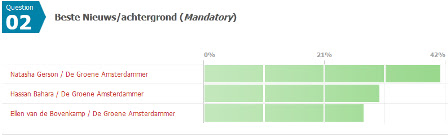
Beste Column/opinie
Hier waren genomineerd: Majda Ouhajji, Fikry el Azzouzi en Abdelkader Benali. Die eerste twee zijn wat mij betreft de ontdekkingen van het jaar, Benali is natuurlijk al lang bekend. De strijd ging hier tussen El Azzouzi en Benali en werd pas met de laatste stem beslist. Met één stem voorsprong won Abdelkader Benali met zijn stuk Het Marokkanenprobleem; met een scherpe pen geschreven en de moeite waard voor alle onderzoekers en journalisten om op hun prikbord te plakken.

Slechtste blog
Annabel Nanninga, Joost Niemoller en Bart Schut waren hier de genomineerden. Annabel Nanninga is hier duidelijk de grootste verliezer, op gepaste afstand gevolgd Niemoller en Schut. Stel nu dat in Nederland een partij opstaat die 140 km op de snelweg als maximumsnelheid wil. En er woont in Brazilië ook een Nederlander. Dan schrijft u op ‘Brazilië wil 140km p/u op de snelweg toestaan’. Als u dat feitelijk juist vindt, dan vindt u Nanninga’s stuk ook feitelijk juist. Natuurlijk de bron van dat stuk was de immer betrouwbare Daily Mail dus zoals gewoonlijk (of anders van The Sun) jat Geenstijl min of meer tekst van de Daily Mail, voegt er wat eigen praat aan toe, plagieert even de term ‘Afscheidseks-wet’ enzovoorts. Weer een stukje gebakken! Nu is Annabel Nanninga dezelfde die ook een gesprek van een treinpassagier op GS zette onder het mom: als je uitspraken in het publiek doet heb je geen recht op privacy. Nog even en Nanninga, die tot voor kort vooral bekendheid genoot omdat ze klachten van lezers aan haar baas openbaarde, in een kijkerspanel zat en kekke stukjes schreef voor Mama Magazine, schrijft dat als een vrouw volgens haar te schaars gekleed loopt ze er om vraagt verkracht te worden. Of wanneer ze teveel bedekt is volgens haar. Nou ja eigenlijk, wanneer ze niet aan haar moraal voldoet. Ze zal dit stukje niet erg vinden, want ze verklaarde immers zelf publiekelijk dat het haar niet boeide en haar baas Marck Burema vond het ook niet nodig om een dhimmi award in het leven te roepen als reactie op de Kromzwaard Trofee. Een echte verliezer dus: Annabel Nanninga.
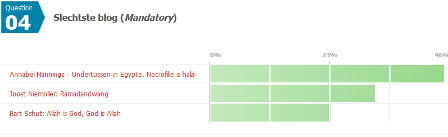
Slechtste nieuws / achtergrond
Hier waren het obscure IsraelToday, het AD en Het Parool genomineerd. Het Parool won overtuigend met een meerderheid aan stemmen voor het stuk ‘halalwoningen’. Het Parool leeft waarschijnlijk nog in het tijdperk waarin journalisten dachten dat ze alleen nieuws doorgaven en dat het dus niet uitmaakt welke termen men kiest. En zo niet, dan toch, is de nogal onkritische houding van het Het Parool. Overigens komt Het Parool volgend jaar met drie nieuwe dijkdoorbrekende reportages: ‘Halalschoenen – hoe moslims erin slagen hun schoenen schoon te houden in wat het grootste probleem van Nederland is: hondenpoep’ & ‘Halalmoskee: Moskee speciaal gebouwd voor moslims’ & ‘Halalamsterdam: Paroolverslaggever ontdekt geïsoleerde stam in Amsterdam: moslims genaamd’. Het Parool is hier de meest veelzeggende verliezer van het afgelopen jaar.
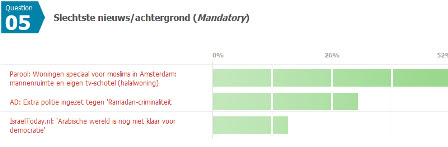
Slechtste opinie/column
Hier waren Thierry Baudet, (opnieuw) Bart Schut en Rutger Bregman genomineerd. De laatste was genomineerd met een stuk uit 2011, maar dat mocht zolang het na 15 december 2011 was. Zijn stuk over waarom we geen racisten zijn, kon nu (in tegenstelling tot destijds) niet op heel veel afkeuring rekenen. Het ging echt tussen Schut en Baudet, waarbij uiteindelijk toch de laatste bijna de helft van het aantal stemmen haalde met zijn volkomen misplaatste stuk ‘Durf te generaliseren over islam’. Dat heeft nog niemand ooit gedaan namelijk of althans niet genoeg. Baudet doet dat voor u aan de hand met een interpretatie van het christendom waar zo mogelijk nog minder van klopt dan die van de islam. Het stuk is a-historisch, zonder politieke context en hij verbergt (maar niet heel goed) dat we hier te maken hebben met missiepoging: moslims moeten zich bekeren tot het seculiere (wat dat ook moge zijn). Baudet is een rijzende ster die her en der schrijft en wordt uitgenodigd als prikkelende deskundige. Wellicht is hier sprake van overmoed. Maar dit stuk is toch echt zijn val. Een typisch geval van schoenmaker blijf bij je leest. Een verliezer van 2012 die we waarschijnlijk nog wel vaker horen denk ik niettemin.

Tot Slot
Rest mij alle winnaars van harte te feliciteren. En voor de verliezers…
Met dank aan L.M. en U.O voor het vele werk met de suggesties.
Iedereen die gestemd heeft, van harte bedankt! Ook in 2013 kunt u weer genieten of uzelf ergeren hier. En alle goeds toegewenst voor 2013 voor jullie en jullie dierbaren.
Kromzwaard Trofee: Winnaars & Verliezers van 2012
Posted on January 1st, 2013 by martijn.
Categories: Multiculti Issues.
Beste bezoekers, bij deze de uitslag van de Kromzwaard Trofee 2012. In totaal hebben er 104 mensen gestemd; dat is iets meer dan het gemiddelde van de afgelopen jaren (toen er nog per vraag gestemd kon worden, dat kon nu niet). Dank voor alle commentaren. Er zijn twee vragen binnengekomen waar ik eerst antwoord op wil geven.
- Waarom neem je stukken op (van Benali en Gerson) die impliciet of expliciet kritiek op je werk bevatten? Benali wijst op het grote leger ‘Marokkanendeskundigen’ in de journalistiek en wetenschap en (onder meer) ook naar mensen die onderzoek doen naar ‘salafisten’. Daar heeft hij groot gelijk in. Niet voor niets heb ik op mijn FB pagina, na het SCP rapport, ook de vraag gesteld wat moslims eigenlijk vinden van al het onderzoek naar moslims. Daarover binnenkort meer. Voor wat betreft Gerson, zij verwijst naar mijn artikel over Vaatstra waarin ik stel dat de hausse rondom asielzoekers de opmaat is voor het hedendaagse islamdebat. Zij stelt echter dat die zaak echter niet helemaal voldoet aan de klassieke verklaring van xenofobie, als angst voor het onbekende; het gaat namelijk in dit (en de andere gevallen die zij beschrijft) niet om angst voor het onbekende, in de zin van vreemden. Volgens mij ligt dat wat gecompliceerder, maar dat doet niets af van het feit dat haar invalshoek zeer interessant is. Voor beiden geldt dat goed geformuleerde kritiek geen reden is om een stuk te weigeren. Dat kan ik wel voor de trofee, maar de meeste nominaties komen sowieso binnen door suggesties van lezers. Degene die als meeste genoemd wordt per categorie is sowieso genomineerd. De rest wordt bepaald, op basis van de suggesties, door mij en twee anderen (LM en UO).
- Waarom alleen geschreven stukken? Dat is niet helemaal zo. Inderdaad de genomineerden stukken waren allemaal geschreven stukken, maar in de eerste editie won bijvoorbeeld RTL Nieuws. Alleen tussen de suggesties zaten ditmaal geen tv of radio-uitzendingen. Ik zal voor 2013 duidelijker vermelden dat dat ook kan. Later genoemde suggesties hiervoor waren onder meer de uitzendingen van Nieuwsuur en het NOS journaal over ‘shari’a in Nederland’.
Dan nu de uitslagen
Winnaars van 2012
Beste blog
Hier waren Rahma Bavelaar, Hassnae Bouazza en Linda Duits genomineerd. De verschillen waren niet zo groot, maar de strijd ging toch vooral tussen de eerste twee. Uiteindelijk verloor Hassnae Bouazza de strijd; inmiddels is dat net zo’n traditie als deze Trofee zelf. Maar er moet toch een een moment komen waarop ze wel wint? Met Rahma Bavelaar’s stuk De Slag van Port Said – meer dan een voetbalrel heeft de Kromzwaard Trofee een hele mooie winnaar met een helder goed geschreven stuk dat laat zien dat het allemaal wat ingewikkelder is dan het op het eerste gezicht lijkt. En dat zonder te verzanden in ingewikkelde formuleringen.
Beste Nieuws/achtergrond
In deze categorie waren Natasha Gerson, Hassan Bahara en Ellen van de Bovenkamp genomineerd. Toevallig alledrie met bijdragen uit De Groene Amsterdammer (die op deze plaats geen eervolle vermelding krijgt want dan had De Groene alle stukken maar openbaar moeten laten). Lange tijd voerde Ellen van de Bovenkamp de boventoon, maar uiteindelijk toch gepasseerd door Hassan Bahara en, met ruime voorsprong op beiden, Natasha Gerson met haar stuk Domme Anton heeft het gedaan; Essay De gemeenschap wil een zondebok. Helder, goed geschreven en origineel informatief stuk over één van de zenuwissues in de Nederlandse samenleving: de verschrikkelijke moord en verkrachting van Marianne Vaatstra.
Beste Column/opinie
Hier waren genomineerd: Majda Ouhajji, Fikry el Azzouzi en Abdelkader Benali. Die eerste twee zijn wat mij betreft de ontdekkingen van het jaar, Benali is natuurlijk al lang bekend. De strijd ging hier tussen El Azzouzi en Benali en werd pas met de laatste stem beslist. Met één stem voorsprong won Abdelkader Benali met zijn stuk Het Marokkanenprobleem; met een scherpe pen geschreven en de moeite waard voor alle onderzoekers en journalisten om op hun prikbord te plakken.
Slechtste blog
Annabel Nanninga, Joost Niemoller en Bart Schut waren hier de genomineerden. Annabel Nanninga is hier duidelijk de grootste verliezer, op gepaste afstand gevolgd Niemoller en Schut. Stel nu dat in Nederland een partij opstaat die 140 km op de snelweg als maximumsnelheid wil. En er woont in Brazilië ook een Nederlander. Dan schrijft u op ‘Brazilië wil 140km p/u op de snelweg toestaan’. Als u dat feitelijk juist vindt, dan vindt u Nanninga’s stuk ook feitelijk juist. Natuurlijk de bron van dat stuk was de immer betrouwbare Daily Mail dus zoals gewoonlijk (of anders van The Sun) jat Geenstijl min of meer tekst van de Daily Mail, voegt er wat eigen praat aan toe, plagieert even de term ‘Afscheidseks-wet’ enzovoorts. Weer een stukje gebakken! Nu is Annabel Nanninga dezelfde die ook een gesprek van een treinpassagier op GS zette onder het mom: als je uitspraken in het publiek doet heb je geen recht op privacy. Nog even en Nanninga, die tot voor kort vooral bekendheid genoot omdat ze klachten van lezers aan haar baas openbaarde, in een kijkerspanel zat en kekke stukjes schreef voor Mama Magazine, schrijft dat als een vrouw volgens haar te schaars gekleed loopt ze er om vraagt verkracht te worden. Of wanneer ze teveel bedekt is volgens haar. Nou ja eigenlijk, wanneer ze niet aan haar moraal voldoet. Ze zal dit stukje niet erg vinden, want ze verklaarde immers zelf publiekelijk dat het haar niet boeide en haar baas Marck Burema vond het ook niet nodig om een dhimmi award in het leven te roepen als reactie op de Kromzwaard Trofee. Een echte verliezer dus: Annabel Nanninga.
Slechtste nieuws / achtergrond
Hier waren het obscure IsraelToday, het AD en Het Parool genomineerd. Het Parool won overtuigend met een meerderheid aan stemmen voor het stuk ‘halalwoningen’. Het Parool leeft waarschijnlijk nog in het tijdperk waarin journalisten dachten dat ze alleen nieuws doorgaven en dat het dus niet uitmaakt welke termen men kiest. En zo niet, dan toch, is de nogal onkritische houding van het Het Parool. Overigens komt Het Parool volgend jaar met drie nieuwe dijkdoorbrekende reportages: ‘Halalschoenen – hoe moslims erin slagen hun schoenen schoon te houden in wat het grootste probleem van Nederland is: hondenpoep’ & ‘Halalmoskee: Moskee speciaal gebouwd voor moslims’ & ‘Halalamsterdam: Paroolverslaggever ontdekt geïsoleerde stam in Amsterdam: moslims genaamd’. Het Parool is hier de meest veelzeggende verliezer van het afgelopen jaar.
Slechtste opinie/column
Hier waren Thierry Baudet, (opnieuw) Bart Schut en Rutger Bregman genomineerd. De laatste was genomineerd met een stuk uit 2011, maar dat mocht zolang het na 15 december 2011 was. Zijn stuk over waarom we geen racisten zijn, kon nu (in tegenstelling tot destijds) niet op heel veel afkeuring rekenen. Het ging echt tussen Schut en Baudet, waarbij uiteindelijk toch de laatste bijna de helft van het aantal stemmen haalde met zijn volkomen misplaatste stuk ‘Durf te generaliseren over islam’. Dat heeft nog niemand ooit gedaan namelijk of althans niet genoeg. Baudet doet dat voor u aan de hand met een interpretatie van het christendom waar zo mogelijk nog minder van klopt dan die van de islam. Het stuk is a-historisch, zonder politieke context en hij verbergt (maar niet heel goed) dat we hier te maken hebben met missiepoging: moslims moeten zich bekeren tot het seculiere (wat dat ook moge zijn). Baudet is een rijzende ster die her en der schrijft en wordt uitgenodigd als prikkelende deskundige. Wellicht is hier sprake van overmoed. Maar dit stuk is toch echt zijn val. Een typisch geval van schoenmaker blijf bij je leest. Een verliezer van 2012 die we waarschijnlijk nog wel vaker horen denk ik niettemin.
Tot Slot
Rest mij alle winnaars van harte te feliciteren. En voor de verliezers…
Met dank aan L.M. en U.O voor het vele werk met de suggesties.
Iedereen die gestemd heeft, van harte bedankt! Ook in 2013 kunt u weer genieten of uzelf ergeren hier. En alle goeds toegewenst voor 2013 voor jullie en jullie dierbaren.
Geweldspraak: PVV, Wilders, De Graaff en flirten met geweld
Posted on December 27th, 2012 by martijn.
Categories: islamophobia, Multiculti Issues.
Even twitter checken op Tweede Kerstdag en wat ziet mijn oog? Een tweet van PVV-senator Marcel de Graaff bij een foto van de Vluchtkerk in Amsterdam. In die kerk zitten uitgeproceerde asielzoekers. Op de foto zien we enkele zwarte mannen die een gebedsmatje uitrollen. En vervolgens twittert de man:
Ik mis de AK47 in het plaatje RT “@devluchtkerk: Ook de gebedsruimte van de #Vluchtkerk wordt steeds beter: twitter.com/Laaiilllaa/sta…”
— Marcel de Graaff (@MJRLdeGraaff) december 26, 2012
Ik mis de AK47 in het plaatje. De AK47 is een automatisch aanvalsgeweer dat ten tijde van de Koude Oorlog maar ook daarna vooral in Afrika gebruikt werd door verzetsbewegingen. Ook later bij bijvoorbeeld Irakese verzetsbewegingen was dit een populair geweer. Wat bedoelt de beste man nu met deze tweet. Dat kunnen denk ik zo’n drie mogelijkheden zijn
- Racisme A: Het zijn ‘zwarten’ en die zijn nu eenmaal gewelddadig dus daar past een geweer wel bij?
- Racisme B: Het zijn moslims en die zijn nu eenmaal gewelddadig dus daar past een geweer wel bij?
Volgens mij dienen we ook een derde mogelijkheid in overweging te nemen:
- Racisme C: Hé moslims/zwarten, waar is een AK47 dan kunnen we ze neermaaien?
Bij dat laatste zou het dus gaan om een oproep tot geweld. Daar zit deze Marcel de Graaff wel vaker dicht tegenaan. In juni vergeleek hij de buitenparlementaire actie van vakbonden en SP met nazisme in de dertiger jaren.
Vakbond is gevaar voor de democratie: #SP roep om buitenparl. actie herinnert aan nazisme 30’jaren
— Marcel de Graaff (@MJRLdeGraaff) juni 10, 2011
Nu hebben we de nazi’s niet gestopt door theedrinken, maar door oorlog voeren. In oktober tweette hij over het geweld in Birma tegen de Rohingya moslims en stelde:
Weerbaarheid birmese bevolking tegen illegale agressieve #moslims betekent de redding van hun cultuur. #helden — Marcel de Graaff (@MJRLdeGraaff) oktober 27, 2012
Vervolgens tweette hij daar achteraan
Maar ook: Geweld tegen minderheden in Birma is verwerpelijk. De staat had dit moeten voorkomen.
— Marcel de Graaff (@MJRLdeGraaff) oktober 27, 2012
Nu zijn die Rohingya wel vaker als illegalen afgebeeld, maar dat klopt toch niet helemaal. Is verder ook niet zo belangrijk. Het gaat erom dat hij de situatie in Birma omdraait: het zijn niet de Rohingya die de aggressors zijn maar anderen uit de burgerbevolking. Volgens De Graaff echter verdedigt men zich ‘alleen’ tegen de Rohingya. Eenzelfde retoriek volgt de PVV hier ook: een verdediging van en door de autochtone bevolking tegen de islam.
In zijn boek Marked for Death. Islam’s War Against the West and Me kunnen we dergelijke haatdragende taal ook terugvinden en het taalgebruik in dat boek kan makkelijk worden geïnterpreteerd als het toestaan van geweld tegen moslims met een politiek programma dat, als het zou worden uitgevoerd, makkelijk kan leiden tot daadwerkelijk geweld tegen islam en moslims. Aldus Jan Jaap de Ruiter in zijn boek The Speck in Your Brother’s Eye (In januari een kritische bespreking van De Ruiter’s boek op deze site). Eerder in 2010 ook stelde Wilders al: ‘Het (islam) is een gewelddadige ideologie zoals communisme en fascisme en we moeten er dan ook op die manier mee omgaan. Als we dat niet doen, zal de islam ons uiteindelijk opeten‘. Zoals hierboven al gesteld; de vergelijking met fascisme en communisme is niet zonder consequenties; dat betekent op z’n minst de mogelijkheid van geweld al zal Wilders het zien als verdediging. Maar door de toevoeging van gewelddadig aan de term ideologie kan er geen twijfel over bestaan als hij zegt dat we er ook die wijze mee om moeten gaan. Communisme en fascisme zijn (ten dele) verslagen door onder meer het gebruik van geweld.
Natuurlijk denken ‘we’ nee ze roepen niet op tot geweld, de PVV gaat heus geen geweld gebruiken of daartoe oproepen. Dat willen ze echt niet en het zou ook heel dom zijn. En misschien vinden we Wilders een gekkie die volkomen overtrokken redeneert. Maar als we hem en ook De Graaff nu eens wèl serieus nemen. Dan zien we dat de tweets van PVV senator Marcel de Graaff in een breder fenomeen passen dat de PVV kenmerkt: demonisering door flirten met geweld. Daarbij wordt de islam / moslim als uitermate gewelddadig neergezet op zo’n karikaturale maar wel demoniserende manier dat nog maar moeilijk het onderscheid valt te maken of het nu de PVV is die zelf flirt met het idee van geweld tegen moslims óf dat ze het echt alleen maar hebben over die islam. De islam wordt als zo anders, zo absoluut en zo kwaadaardig voorgesteld, dat het gebruik van geweld daartegen bijna logische zelfverdediging lijkt.
UPDATE
Wilders laatste interview is een ontzettend goed voorbeeld van de geweldstaal van Wilders tegen islam en Marokkaanse Nederlanders. Ook hier gebruikt hij ‘vechttaal‘ en dienen we te ‘vechten’ voor onze vrijheid en de islam keihard aan te pakken want de islam is een ‘ziekte’. Vooral wanneer hij komt met het punt van ‘Marokkaans racisme’; het idee dat Marokkaans-Nederlandse jongens geen andere Marokkaanse Nederlanders aanvallen of lastig vallen. Een onbewezen stelling die zo vaak herhaalt wordt dat in 2013 iedereen denkt dat het klopt en die verder borduurt op de stelling van de gewelddadige ‘zij’ die ‘ons’ aanvallen:
Politiek taalgebruik is een vorm van taalhandelen die mogelijk zelfs geweld kan legitimeren, maar die ook mensen geweld doen. Wilders’ retoriek en ook dat van De Graaff staat boordevol met taalgeweld en geweldspraak. Weliswaar wordt een en ander voortdurend gelegitimeerd door een beroep op de vrijheid van meningsuiting wat er op neer komt dat ‘we’ tegen moslims zeggen: u dient structureel geweld tegen u te accepteren als bewijs dat u kunt integreren (vrij naar Judith Butler). Op z’n minst flirt je op deze manier met het idee van geweld tegen de islam. Wat dat betreft staat de PVV en met haar Wilders en De Graaff voor structureel geweld tegen moslims. Het wordt hoog tijd dat we dat eens serieuzer nemen en dat we sowieso de uitspraken van Wilders, De Graaf e.a. eens wat serieuzer nemen.
‘Fuck You Nederland’ – De politiek van onverschilligheid
Posted on December 22nd, 2012 by martijn.
Categories: Deep in the woods..., Multiculti Issues, Some personal considerations.
Zeven voorbeelden u zegt het maar:
islamitische internaten
Recent wist de NRC te melden dat in Nederland honderden moslimkinderen zouden wonen in internaten. Focus van het artikel: slecht onderhouden, een enkel internaat is illegaal, sommige zijn brandonveilig, er is geen toezicht, geen pedagogisch plan. In een enkel geval wordt er gesproken over een gevaarlijke situatie. Serieuze zaken. En het zou erger zijn denk ik als sommige mensen die dit soort zaken onderzoeken ook nog Turks konden lezen gezien één van de boekjes die op de foto-serie te vinden zijn.
Ik werd ook gevraagd om een reactie en heb die ook gegeven, maar omdat de journalist slechts een deel van mijn quote wilde gebruiken heb ik mijn medewerking terug getrokken. En de journalist heeft zich daar ook keurig aan gehouden. Het stuk zat me al niet lekker, niet zozeer vanwege wat de journalist wilde weten, maar vooral omdat ik vreesde dat het geheel zou worden getrokken in het integratie- en islamdebat met de bekende wij-zij stellingen. Ook al wordt in het artikel zelf niet echt daarop ingegaan. Er lijkt mij immers niet mis met het bestaan van dergelijke internaten op zich. Ze zijn wettelijk toegestaan (als aan voorwaarden voldaan wordt) en we kennen immers ook schippersinternaten.
En wat schetst mijn niet heel grote verbazing: in het antwoord van minister Ascher gaat het grotendeels om integratie: Asscher: moskee-internaten moeten worden aangepakt, situatie zorgelijk :: nrc.nl
Minister Asscher wil dat internaten die de integratie van kinderen in de Nederlandse samenleving belemmeren, worden aangepakt. In antwoord op Kamervragen van diverse politieke partijen noemde Asscher de huidige situatie in diverse religieuze internaten “zorgelijk”.
De minister wil dat lokale overheden in overleg gaan met internaten over het “pedagogische klimaat en het welzijn van kinderen.” Wel onderzoekt hij nog of gemeentes hiervoor over voldoende middelen beschikken. Voor het goed functioneren van burgers is integratie en participatie van groot belang, zegt de minister van Sociale Zaken. Asscher:
Het gaat daarbij om actieve deelname aan het arbeidsproces en het onderwijs, maar ook aan andere vormen van het maatschappelijk verkeer. Met het oog op dit laatste, acht het kabinet het onwenselijk wanneer personen of groepen zich afkeren van de bredere samenleving en als er op internaten les wordt gegeven waarbij ideeën naar voren worden gebracht die de integratie belemmeren.
Maar het stuk ging toch (ook?) om brandveiligheid en dergelijke? In het antwoord van de minister aan de diverse vragenstellers verwijst de minister naar onderzoeken e.d. van betrokken gemeentes en de GGD; de internaten voldoen aan de voorwaarden en de protocollen. Ja dat soort dingen hebben we eerder gezien of niet? In Volendam en Enschede om maar eens wat te noemen. En waar komen die indrukken uit het krantenartikel dan vandaan? En de klachten van ouders en van voormalige leerlingen? Maar nee, we gaan vooral kijken of het niet bedreigend is voor de integratie. De antwoorden gaan echt op geen enkele manier in op de reele klachten in het artikel van NRC; alleen over problemen die de overheid heeft met migranten, moslims en integratie.
Ok, Asscher concludeert wel dat de veiligheidssituatie van de internaten daadwerkelijk zorgelijk is. Maar dat kan hij dus niet staven op basis van de onderzoeken die zijn geweest; dat bewijs is flinterdun. Nou vooruit er wordt wel aandacht besteed aan sociale dwang als antwoord op de vragen van SP. Dat zou onwenselijk zijn. Maar welke sociale dwang? Toch niet die van integratie en onderwijs en opvoeding lijkt me; allemaal vormen van sociale dwang. Met andere woorden het antwoord slaat nergens op. Asscher ‘weet’ dat de veiligheid zorgelijk is, maar dat wordt niet gesteund door de onderzoeken. Hij praat vervolgens voornamelijk over de problemen die de ‘samenleving’ zou hebben met deze internaten en over de noodzaak tot integratie. En negeert daarbij zo ongeveer alles wat in die NRC reportage is gesteld.
Discriminatie
Het zoveelste discriminatie-onderzoek en voor de zoveelste keer blijkt dat werkgevers discrimineren. Opvallend genoeg lijkt dit minder te gelden voor Marokkaanse Nederlanders, hoewel daar een hoge werkeloosheid onder heerst. Dit zou te maken kunnen hebben, met specifieke effecten wanneer zij solliciteren (ontwijken van werkgevers waar ze denken geen kans te maken of werkgevers die een ‘nette’ Marokkaan als uitzondering op de regel zien). Marokkaanse Nederlanders staan ook hoog in de negatieve lijstjes van productieve factoren: leeftijd, carrière, opleiding, enzovoorts. Hier wordt geen link gelegd met discriminatie, maar dat zou wel degelijk een rol kunnen spelen. De conclusie is in ieder geval helder; je moet proberen niet op een ‘Antilliaan’ or “Marokkaan’ (zoals dat in de stereotypes verstaan wordt) te lijken.
In de kamervragen werd voor de zoveelste keer gesproken over het ‘namen and shamen’ van uitzendbureaus die discrimineren. Het ging ook om werkgevers die aan dergelijke eisen opleggen aan uitzendbureau’s maar volgens de staatssecretaris was uitzendbureaus aanpakken stap één en de opdrachtgevers stap twee. Maar dat is natuurlijk onzin; zoals de markt werkt moet je eerst die opdrachtgevers aanpakken. Zij bepalen immers wat de vraag is. Maar vergeet u het verder maar hoor. In dit dossier gaat niets gebeuren. Ten eerste heeft het SCP geen geld meer voor dit type onderzoek, maar meer nog, er is in al die jaren nooit, maar dan ook echt nooit een structurele maatregel ingevoerd die daadwerkelijk discriminatie tegengaat. De positieve discriminatie die opdrachtgevers en uitzendbureaus toepassen op autochtonen is taboe als het gaat om etnische minderheden en vrouwen. Meer nog uit een evaluatie-onderzoek van gemeentelijke discriminatie-aanpak blijkt dat meer aandacht voor discriminatie weliswaar leidt tot meer bewustzijn onder beleidsmakers, maar dat die beleidsmakers vervolgens niets kunnen doen omdat de politiek hier geen prioriteit aan geeft. Dat hebben we al eerder gezien. Want hoeveel succes had Tofik Dibi met zijn pleidooi om een kamerdebat te voeren over radicalisering onder extreem-rechts? Hoeveel aandacht is er geweest voor de, inmiddels, structurele aanvallen op moskeeen?
Somalië
Volgens staatssecretaris Teeven is Somalië weer veilig. Natuurlijk, er vindt geen brute oorlog plaats daar. Zou dit betekenen dat moslimjongeren die ‘op vakantie’ willen naar Somalië niet meer gevolgd worden in het kader van terrorisme-preventie? Ik denk het niet. Het betekent wel dat Somalische Nederlanders rustig terug gestuurd kunnen worden naar een land (staat kunnen we het niet noemen) dat zich kenmerkt door corruptie, armoede, terreur door gewapende milities (en reken het ‘leger’ daar ook maar onder), wetteloosheid en een ingestorte economie met dagelijks meerdere bomexplosies. Waar jonge meisjes besneden worden (‘we’ waren daar toch zo op tegen?) en dan hebben we het nog niet gehad over hoe verkrachting een oorlogswapen is in dit land. Nederland kan geen enkele bijstand verlenen aan Nederlanders aldaar en daarom geldt ook een negatief reisadvies en wordt mensen geadviseerd om Zuid-Centraal Somalië en Puntland direct te verlaten en is de veiligheidssituatie volgens dat reisadvies in Mogadishu zeer slecht en instabiel. Schijnbaar leggen we migranten andere normen op dan ‘onze eigen’ burgers.
‘Marokkanenprobleem’
Wat is een ‘Marokkanenprobleem’? Dat heeft niet betrekking op het feit dat verdachten met een ‘buitenlands‘ uiterlijk een hogere kans op celstraffen hebben dan anderen. Het heeft ook geen betrekking op het gegeven dat het erop lijkt dat ‘cultuur’ (van migranten natuurlijk) strafverzwarend lijkt te werken. En nee, het gaat ook niet over het gegeven dat bij sommige politiekorpsen Marokkaans-Nederlandse jongens vaker gecontroleerd worden dan bijvoorbeeld autochtone vrouwen of dat agenten deze jongens per definitie zien als ‘doelgroep‘ . Nee, Marokkanenprobleem gaat over de problemen die autochtonen zouden hebben met criminaliteit door Marokkaans-Nederlandse jongeren. Niet over bijvoorbeeld huiselijk geweld in gezinnen, maar over de problemen die de samenleving zou hebben met ‘hen’.
Wilde Marokkaanse mannen
Als een Marokkaans-Nederlandse organisatie een debatavond organiseert over ‘Liefde, seks en islam’ dan hebben we geen aandacht voor de worsteling met seksuele taboes onder Marokkaans-Nederlandse mannen en vrouwen. Nee, dat is een stap terug naar het verleden van voor de seksuele revolutie. Nee, dan gaan we er ook niet heen om verslag te doen van de hele avond met verschillende standpunten en worstelingen. Nou ja behalve dan die van een man die in de war is en meent één van de vrouwelijke organisatoren te moeten lastig vallen. Die vrouwen zijn dan ‘liberale meiden’ en de mannen ‘Marokkaans’ en ‘agressief’. Althans volgens DeJaap TV. Een hele avond bij een debat aanwezig zijn en alleen die paar minuten er uit halen. Wat een armoede. De Marokkaanse Nederlanders zijn goed om boosmakertjes op je site te zetten, maar inhoudelijk ergens aandacht aan besteden ho maar.
Integratie
Het Jaarrapport Integratie van het SCP schetst een zorgwekkend beeld van de integratie. Met name de werkeloosheid van migranten is een probleem. De minderhedenorganisaties pleiten er daarom voor dat er een beleid komt om werkeloosheid onder allochtonen aan te pakken. Dat komt er dus niet; men wil migranten niet als groep apart zetten en het algemene beleid komt ook ten goede aan hen (maar op basis van de cijfers toch niet voldoende maar goed). Dus als het om problemen van migranten zelf gaat, zouden we niet aan groepsdenken moeten doen en viert individuele verantwoordelijkheid hoogtij. Als het echter gaat om problemen die de ‘samenleving’ heeft met migranten dan gaan we het echter wel over groepen hebben. In antwoord op de volgende vraag in de Volkskrant, Als het gaat over euthanasie, abortus of homoseksualiteit, is er een cultuurkloof tussen autochtonen en allochtonen. Is dat zorgelijk?, stelt Asscher:
‘Integratie vergt van de mensen die hier naartoe komen dat zij zich verdiepen in het land van aankomst. Het land van aankomst moet expliciet maken wat het verwacht. Dat doen we met integratiecursussen. Maar we moeten verdergaan en pal staan achter de leraar die vertelt dat hij homo is. Door pal te staan voor onze verworvenheden, maken we het voor immigrantenkinderen makkelijker minder gelovig te zijn dan hun ouders. Het helpt migrantenmeisjes zich te ontplooien en het werkt tegen schijnhuwelijken en andere dwang.’
Bron: De Volkskrant, 21-12-12, pag. 13; niet online
Hij zegt het niet met zoveel woorden, maar hij bedoelt hier moslims. Schijnbaar is een doel van het overheidsbeleid migrantenkinderen minder gelovig te maken? Een veel beter voorbeeld van secularistisch integratiebeleid ken ik niet. Problemen van migranten worden afgeschoven op het individu zelf. Problemen met migranten zijn hun schuld en die pakken we aan.
Loverboys
Enkele jaren geleden alweer ‘ontdekte’ een middelgrote stad in Nederland dat nogal wat Marokkaans-Nederlandse meiden ten prooi vielen aan loverboys. Er moest dringend actie ondernomen worden zeiden migrantenorganisaties. Wat denkt u dat er gebeurde? Een groot plan om overlast van Marokkaans-Nederlandse jongens aan te pakken. Niets, echt helemaal niets voor die meiden die in de problemen zaten.
Dus…
Enkele weken geleden kopte de Telegraaf: ‘Opgeruimd staat netjes‘. Dat sloeg op een kamp van uitgeprocedeerde en niet-uitzetbare asielzoekers in Den Haag en demonstranten die solidair met hen waren. Het kamp moest ‘ontruimd’ worden en nee, opgeruimd sloeg niet op mogelijk materiaal dat achter gebleven zou zijn. Het hele artikel maakt daar geen melding van; het ging alleen om de mensen. Ja, dat zouden we wel eens kunnen vergeten met al deze voorbeelden. Het gaat om mensen. Wat we echter uit de artikelen zien is een pre-occupatie met de problemen die veroorzaakt zouden worden door migranten en een complete kilte en onverschilligheid als het gaat om problemen van migranten. Vergeet u zaken als huiselijk geweld, vrouwenbesnijdenis, problemen van allochtone homo’s; er wordt wel over gepraat dat wel. Weet u nog enkele jaren geleden? Ene Ayaan Hirsi Ali maakte goede sier met haar punt over huiselijk geweld tegen moslimvrouwen. Om vervolgens doodleuk te stemmen voor bezuinigingen op de opvang van mishandelde vrouwen.
Het kan de heren en dames politici geen ene zak schelen. Net zomin als er straks een internaat in de fik gaat en er gaan mensen dood terwijl men beter had kunnen weten. Of een weggestuurde Somalische Nederlander die tegen een kogel oploopt in onveilig Moghadishu. Als de gemeente Stichtse Vecht schuldig kan worden bevonden aan de dood van twee motorrijdsters na een ongeval, zou je dat in deze gevallen ook kunnen zeggen als er iets gebeurt. Of wellicht zelfs aan moord met voorwaardelijk opzet.
Uitsluiting vindt in dit land niet alleen plaats door discriminerende maatregelen van de overheid of door werkgevers, maar ook via onverschilligheid en kilte naar mensen die schijnbaar ons ‘mededogen’ niet verdienen en er alleen zijn als ‘matter out of place’. Er zijn mensen die vinden dat migranten ‘dankbaar‘ moeten zijn. Nou ‘Fuck you, Nederland’ zou ik zeggen.
'Fuck You Nederland' – De politiek van onverschilligheid
Posted on December 22nd, 2012 by martijn.
Categories: Deep in the woods..., Multiculti Issues, Some personal considerations.
Zeven voorbeelden u zegt het maar:
islamitische internaten
Recent wist de NRC te melden dat in Nederland honderden moslimkinderen zouden wonen in internaten. Focus van het artikel: slecht onderhouden, een enkel internaat is illegaal, sommige zijn brandonveilig, er is geen toezicht, geen pedagogisch plan. In een enkel geval wordt er gesproken over een gevaarlijke situatie. Serieuze zaken. En het zou erger zijn denk ik als sommige mensen die dit soort zaken onderzoeken ook nog Turks konden lezen gezien één van de boekjes die op de foto-serie te vinden zijn.
Ik werd ook gevraagd om een reactie en heb die ook gegeven, maar omdat de journalist slechts een deel van mijn quote wilde gebruiken heb ik mijn medewerking terug getrokken. En de journalist heeft zich daar ook keurig aan gehouden. Het stuk zat me al niet lekker, niet zozeer vanwege wat de journalist wilde weten, maar vooral omdat ik vreesde dat het geheel zou worden getrokken in het integratie- en islamdebat met de bekende wij-zij stellingen. Ook al wordt in het artikel zelf niet echt daarop ingegaan. Er lijkt mij immers niet mis met het bestaan van dergelijke internaten op zich. Ze zijn wettelijk toegestaan (als aan voorwaarden voldaan wordt) en we kennen immers ook schippersinternaten.
En wat schetst mijn niet heel grote verbazing: in het antwoord van minister Ascher gaat het grotendeels om integratie: Asscher: moskee-internaten moeten worden aangepakt, situatie zorgelijk :: nrc.nl
Minister Asscher wil dat internaten die de integratie van kinderen in de Nederlandse samenleving belemmeren, worden aangepakt. In antwoord op Kamervragen van diverse politieke partijen noemde Asscher de huidige situatie in diverse religieuze internaten “zorgelijk”.
De minister wil dat lokale overheden in overleg gaan met internaten over het “pedagogische klimaat en het welzijn van kinderen.” Wel onderzoekt hij nog of gemeentes hiervoor over voldoende middelen beschikken. Voor het goed functioneren van burgers is integratie en participatie van groot belang, zegt de minister van Sociale Zaken. Asscher:
Het gaat daarbij om actieve deelname aan het arbeidsproces en het onderwijs, maar ook aan andere vormen van het maatschappelijk verkeer. Met het oog op dit laatste, acht het kabinet het onwenselijk wanneer personen of groepen zich afkeren van de bredere samenleving en als er op internaten les wordt gegeven waarbij ideeën naar voren worden gebracht die de integratie belemmeren.
Maar het stuk ging toch (ook?) om brandveiligheid en dergelijke? In het antwoord van de minister aan de diverse vragenstellers verwijst de minister naar onderzoeken e.d. van betrokken gemeentes en de GGD; de internaten voldoen aan de voorwaarden en de protocollen. Ja dat soort dingen hebben we eerder gezien of niet? In Volendam en Enschede om maar eens wat te noemen. En waar komen die indrukken uit het krantenartikel dan vandaan? En de klachten van ouders en van voormalige leerlingen? Maar nee, we gaan vooral kijken of het niet bedreigend is voor de integratie. De antwoorden gaan echt op geen enkele manier in op de reele klachten in het artikel van NRC; alleen over problemen die de overheid heeft met migranten, moslims en integratie.
Ok, Asscher concludeert wel dat de veiligheidssituatie van de internaten daadwerkelijk zorgelijk is. Maar dat kan hij dus niet staven op basis van de onderzoeken die zijn geweest; dat bewijs is flinterdun. Nou vooruit er wordt wel aandacht besteed aan sociale dwang als antwoord op de vragen van SP. Dat zou onwenselijk zijn. Maar welke sociale dwang? Toch niet die van integratie en onderwijs en opvoeding lijkt me; allemaal vormen van sociale dwang. Met andere woorden het antwoord slaat nergens op. Asscher ‘weet’ dat de veiligheid zorgelijk is, maar dat wordt niet gesteund door de onderzoeken. Hij praat vervolgens voornamelijk over de problemen die de ‘samenleving’ zou hebben met deze internaten en over de noodzaak tot integratie. En negeert daarbij zo ongeveer alles wat in die NRC reportage is gesteld.
Discriminatie
Het zoveelste discriminatie-onderzoek en voor de zoveelste keer blijkt dat werkgevers discrimineren. Opvallend genoeg lijkt dit minder te gelden voor Marokkaanse Nederlanders, hoewel daar een hoge werkeloosheid onder heerst. Dit zou te maken kunnen hebben, met specifieke effecten wanneer zij solliciteren (ontwijken van werkgevers waar ze denken geen kans te maken of werkgevers die een ‘nette’ Marokkaan als uitzondering op de regel zien). Marokkaanse Nederlanders staan ook hoog in de negatieve lijstjes van productieve factoren: leeftijd, carrière, opleiding, enzovoorts. Hier wordt geen link gelegd met discriminatie, maar dat zou wel degelijk een rol kunnen spelen. De conclusie is in ieder geval helder; je moet proberen niet op een ‘Antilliaan’ or “Marokkaan’ (zoals dat in de stereotypes verstaan wordt) te lijken.
In de kamervragen werd voor de zoveelste keer gesproken over het ‘namen and shamen’ van uitzendbureaus die discrimineren. Het ging ook om werkgevers die aan dergelijke eisen opleggen aan uitzendbureau’s maar volgens de staatssecretaris was uitzendbureaus aanpakken stap één en de opdrachtgevers stap twee. Maar dat is natuurlijk onzin; zoals de markt werkt moet je eerst die opdrachtgevers aanpakken. Zij bepalen immers wat de vraag is. Maar vergeet u het verder maar hoor. In dit dossier gaat niets gebeuren. Ten eerste heeft het SCP geen geld meer voor dit type onderzoek, maar meer nog, er is in al die jaren nooit, maar dan ook echt nooit een structurele maatregel ingevoerd die daadwerkelijk discriminatie tegengaat. De positieve discriminatie die opdrachtgevers en uitzendbureaus toepassen op autochtonen is taboe als het gaat om etnische minderheden en vrouwen. Meer nog uit een evaluatie-onderzoek van gemeentelijke discriminatie-aanpak blijkt dat meer aandacht voor discriminatie weliswaar leidt tot meer bewustzijn onder beleidsmakers, maar dat die beleidsmakers vervolgens niets kunnen doen omdat de politiek hier geen prioriteit aan geeft. Dat hebben we al eerder gezien. Want hoeveel succes had Tofik Dibi met zijn pleidooi om een kamerdebat te voeren over radicalisering onder extreem-rechts? Hoeveel aandacht is er geweest voor de, inmiddels, structurele aanvallen op moskeeen?
Somalië
Volgens staatssecretaris Teeven is Somalië weer veilig. Natuurlijk, er vindt geen brute oorlog plaats daar. Zou dit betekenen dat moslimjongeren die ‘op vakantie’ willen naar Somalië niet meer gevolgd worden in het kader van terrorisme-preventie? Ik denk het niet. Het betekent wel dat Somalische Nederlanders rustig terug gestuurd kunnen worden naar een land (staat kunnen we het niet noemen) dat zich kenmerkt door corruptie, armoede, terreur door gewapende milities (en reken het ‘leger’ daar ook maar onder), wetteloosheid en een ingestorte economie met dagelijks meerdere bomexplosies. Waar jonge meisjes besneden worden (‘we’ waren daar toch zo op tegen?) en dan hebben we het nog niet gehad over hoe verkrachting een oorlogswapen is in dit land. Nederland kan geen enkele bijstand verlenen aan Nederlanders aldaar en daarom geldt ook een negatief reisadvies en wordt mensen geadviseerd om Zuid-Centraal Somalië en Puntland direct te verlaten en is de veiligheidssituatie volgens dat reisadvies in Mogadishu zeer slecht en instabiel. Schijnbaar leggen we migranten andere normen op dan ‘onze eigen’ burgers.
‘Marokkanenprobleem’
Wat is een ‘Marokkanenprobleem’? Dat heeft niet betrekking op het feit dat verdachten met een ‘buitenlands‘ uiterlijk een hogere kans op celstraffen hebben dan anderen. Het heeft ook geen betrekking op het gegeven dat het erop lijkt dat ‘cultuur’ (van migranten natuurlijk) strafverzwarend lijkt te werken. En nee, het gaat ook niet over het gegeven dat bij sommige politiekorpsen Marokkaans-Nederlandse jongens vaker gecontroleerd worden dan bijvoorbeeld autochtone vrouwen of dat agenten deze jongens per definitie zien als ‘doelgroep‘ . Nee, Marokkanenprobleem gaat over de problemen die autochtonen zouden hebben met criminaliteit door Marokkaans-Nederlandse jongeren. Niet over bijvoorbeeld huiselijk geweld in gezinnen, maar over de problemen die de samenleving zou hebben met ‘hen’.
Wilde Marokkaanse mannen
Als een Marokkaans-Nederlandse organisatie een debatavond organiseert over ‘Liefde, seks en islam’ dan hebben we geen aandacht voor de worsteling met seksuele taboes onder Marokkaans-Nederlandse mannen en vrouwen. Nee, dat is een stap terug naar het verleden van voor de seksuele revolutie. Nee, dan gaan we er ook niet heen om verslag te doen van de hele avond met verschillende standpunten en worstelingen. Nou ja behalve dan die van een man die in de war is en meent één van de vrouwelijke organisatoren te moeten lastig vallen. Die vrouwen zijn dan ‘liberale meiden’ en de mannen ‘Marokkaans’ en ‘agressief’. Althans volgens DeJaap TV. Een hele avond bij een debat aanwezig zijn en alleen die paar minuten er uit halen. Wat een armoede. De Marokkaanse Nederlanders zijn goed om boosmakertjes op je site te zetten, maar inhoudelijk ergens aandacht aan besteden ho maar.
Integratie
Het Jaarrapport Integratie van het SCP schetst een zorgwekkend beeld van de integratie. Met name de werkeloosheid van migranten is een probleem. De minderhedenorganisaties pleiten er daarom voor dat er een beleid komt om werkeloosheid onder allochtonen aan te pakken. Dat komt er dus niet; men wil migranten niet als groep apart zetten en het algemene beleid komt ook ten goede aan hen (maar op basis van de cijfers toch niet voldoende maar goed). Dus als het om problemen van migranten zelf gaat, zouden we niet aan groepsdenken moeten doen en viert individuele verantwoordelijkheid hoogtij. Als het echter gaat om problemen die de ‘samenleving’ heeft met migranten dan gaan we het echter wel over groepen hebben. In antwoord op de volgende vraag in de Volkskrant, Als het gaat over euthanasie, abortus of homoseksualiteit, is er een cultuurkloof tussen autochtonen en allochtonen. Is dat zorgelijk?, stelt Asscher:
‘Integratie vergt van de mensen die hier naartoe komen dat zij zich verdiepen in het land van aankomst. Het land van aankomst moet expliciet maken wat het verwacht. Dat doen we met integratiecursussen. Maar we moeten verdergaan en pal staan achter de leraar die vertelt dat hij homo is. Door pal te staan voor onze verworvenheden, maken we het voor immigrantenkinderen makkelijker minder gelovig te zijn dan hun ouders. Het helpt migrantenmeisjes zich te ontplooien en het werkt tegen schijnhuwelijken en andere dwang.’
Bron: De Volkskrant, 21-12-12, pag. 13; niet online
Hij zegt het niet met zoveel woorden, maar hij bedoelt hier moslims. Schijnbaar is een doel van het overheidsbeleid migrantenkinderen minder gelovig te maken? Een veel beter voorbeeld van secularistisch integratiebeleid ken ik niet. Problemen van migranten worden afgeschoven op het individu zelf. Problemen met migranten zijn hun schuld en die pakken we aan.
Loverboys
Enkele jaren geleden alweer ‘ontdekte’ een middelgrote stad in Nederland dat nogal wat Marokkaans-Nederlandse meiden ten prooi vielen aan loverboys. Er moest dringend actie ondernomen worden zeiden migrantenorganisaties. Wat denkt u dat er gebeurde? Een groot plan om overlast van Marokkaans-Nederlandse jongens aan te pakken. Niets, echt helemaal niets voor die meiden die in de problemen zaten.
Dus…
Enkele weken geleden kopte de Telegraaf: ‘Opgeruimd staat netjes‘. Dat sloeg op een kamp van uitgeprocedeerde en niet-uitzetbare asielzoekers in Den Haag en demonstranten die solidair met hen waren. Het kamp moest ‘ontruimd’ worden en nee, opgeruimd sloeg niet op mogelijk materiaal dat achter gebleven zou zijn. Het hele artikel maakt daar geen melding van; het ging alleen om de mensen. Ja, dat zouden we wel eens kunnen vergeten met al deze voorbeelden. Het gaat om mensen. Wat we echter uit de artikelen zien is een pre-occupatie met de problemen die veroorzaakt zouden worden door migranten en een complete kilte en onverschilligheid als het gaat om problemen van migranten. Vergeet u zaken als huiselijk geweld, vrouwenbesnijdenis, problemen van allochtone homo’s; er wordt wel over gepraat dat wel. Weet u nog enkele jaren geleden? Ene Ayaan Hirsi Ali maakte goede sier met haar punt over huiselijk geweld tegen moslimvrouwen. Om vervolgens doodleuk te stemmen voor bezuinigingen op de opvang van mishandelde vrouwen.
Het kan de heren en dames politici geen ene zak schelen. Net zomin als er straks een internaat in de fik gaat en er gaan mensen dood terwijl men beter had kunnen weten. Of een weggestuurde Somalische Nederlander die tegen een kogel oploopt in onveilig Moghadishu. Als de gemeente Stichtse Vecht schuldig kan worden bevonden aan de dood van twee motorrijdsters na een ongeval, zou je dat in deze gevallen ook kunnen zeggen als er iets gebeurt. Of wellicht zelfs aan moord met voorwaardelijk opzet.
Uitsluiting vindt in dit land niet alleen plaats door discriminerende maatregelen van de overheid of door werkgevers, maar ook via onverschilligheid en kilte naar mensen die schijnbaar ons ‘mededogen’ niet verdienen en er alleen zijn als ‘matter out of place’. Er zijn mensen die vinden dat migranten ‘dankbaar‘ moeten zijn. Nou ‘Fuck you, Nederland’ zou ik zeggen.
Citizenship Carnival: What is Integration?
Posted on December 19th, 2012 by martijn.
Categories: anthropology, Citizenship Carnival, Guest authors, Headline, Multiculti Issues.
Guest Author: Nadia Fadil
When I was asked to prepare something for this speakers’ corner, the suggested idea was to do something on the headscarf. Considering the fact that I work on Islam and that the successive headscarf controversies have been in the news for more than three decades now, it seemed wide enough of a topic that could touch and open a large discussion.
I however declined. And the reason has not only to do with the fact that debating the headscarf was something I dreaded doing, after countless of panel conversations and publications. Debating the headscarf was rather part of the problem. Part of the mechanisms, through which our societies continuously produce and place boundaries between in- and outsiders, those who belong and those who don’t. Debating the headscarf becomes, consequently, not so much a means to understand this practice, but a modality through which a specific sartorial practice is turned into an object of investigation and conversation. It becomes displaced from its everydayness. It becomes, in other words, something that needs to be integrated.
Integration was therefore the word that I preferred to address. A word that informs most of the research we do. Whether it concerns the EU enlargement, the question of social redistribution or the ways in which cultural minorities and majorities relate to one another. Integration, we have learned in our manuals, figures as the key concept around which the social sciences have emerged. As twin brother to the concept ‘society’, that we owe to the 18th century French Physiocrats who influenced Adam Smith in his quest for an ‘invisible hand’, integration turned into one of the main languages through which ‘social problems’ – also an invention of that same period – could be addressed. This concept would also bear a strong imprint on our relationship to the world and to other cultures, in our attempt to understand the impact of processes of globalization upon what we consider as “traditional societies”.
It is, however, not my purpose to offer an elaborate historical and philosophical genealogy here. In the brief context of this conversation, I rather prefer to problematize this concern with integration – to take it as a point of departure in order to understand the different connotations it invokes and imaginaries it touches upon. For more than simply figuring as a neutral analytical category, the term integration is also a highly contested and controversial concept – one that has been challenged and disputed.
In preparing for this small exposé, I therefore did what social scientists most often do when looking for answers: I questioned people around me. Starting with my mom, whom I always consult on important issues, and who answered: “it refers to the integration between the Sociale Voorzieningen Hogeschool Antwerpen (where she works) and the Artesis Hogeschool!”. Now, my mom is a very wise woman, but this was not exactly the kind of answer I needed. So I went to the world of the internet and sent a call through email and facebook – one of the main social arenas of our times. Clearly, the answers that I will be sharing with you have no generalizable pretension. They are rather the reflection of viewpoints that are held amongst those who are often given a leading role in one of our main contemporary political dramas, also known as the multicultural debate.
Integration passes through the stomach
“Integration means eating couscous on Christmas.” (Myriam)
“Integration means making tajine [a Moroccan dish] with French frites”. (Fatima)
“Integration is achieved when you debate over the question whether a ‘chocoladebroodje’ belongs to the family of the ‘koffiekoeken.’” (Jeroen)
Food. A central marker of collectiveness and one of the primary means through which boundaries are established – something that has been central in the study of culture and has chiefly been examined by Mary Douglas. Whether it is the (problematic) myth of thanksgiving in the case of the Americas, or the multiple exotic restaurants we observe in our glocalized cities, food is the means by which the first contact passes, and the means through which a first exchange and encounter occurs.
Two elements are, however, central in the way in which food emerges here as a marker of integration. The first one is that these examples illustrate the emergence of new, hyphenated identities. Modes of being which, culturally, can no longer be restricted to one social or cultural group. Notions of hybridity and ‘cultural mixing’ figure as the often used terms to designate these patterns of transformation that occur within a multicultural context, which announce the end of pure identities and the continuous intermixing of influences, the creation of new realities – new tastes even in this context – such as the tajine with French frites.
But the centrality of food does something else. Food also creates a bond, it becomes a means to establish social ties. ‘Once salt has been shared you are part of each other’s life’, so a Moroccan saying goes. Sharing food is not without consequences. It binds individuals and creates ties of mutual obligation, reciprocity and interdependence. Food as something that obliges, and something that integrates.
Integration as the quest for cohesion
“For me it is: assimilating the social and moral code of the host society (yet without disregarding your own), learning the dominant language and showing civic duty” (Fouad)
“From a technical point of view, integration is the result of a successful communication between systems that are intrinsically different through an interface. A person from Antwerp with someone from Brussels or a Greek (…) Integration is the successful operation thanks to an “enabler” such as a common language, openness to other societies, willingness to collaborate” (Özturk)
Finding the right language, sharing common values, looking for the right interface. Integration as the endpoint of a negotiation process between different actors who hold different viewpoints on the way in which society operates. The absence of a commonality – or an “interface” – emerges here as a hazard, as it fails to produce the necessary basis by which the heterogeneous elements come to find one another. Norms and values, the collective language, appear here as the connecting dots, as the point of reference that brings this heterogeneity together. A perspective and viewpoint which echoes the Durkheimian tradition that has taught us to think of society as an organic body, in which commonly shared values and norms – in this case language – figure as the necessary rallying points to avoid fragmentation.
This concern with a set of norms and values lies at the heart of how policy makers and the various institutional actors understand this concept. In the case of Flanders, this has been the case at least since the late eighties. While the first definitions around integration drew a distinction between the public sphere (which drew on a requirement of assimilation to public norms – understood as laws) and the private sphere (where one’s culture and language could be fostered), the successive years have observed a gradual increase of institutional bodies that take it upon themselves to ‘integrate’ actors also in relationship to their customs and norms. The various Dutch and ‘inburgerings’ courses that have been implemented since 2004 and rendered mandatory for non-EU migrants are one example of this. The conditional attribution of social housing to non-Dutch speakers, provided that they learn to speak the language in a limited time frame, is another one.
“Integration is being part of the whole, being able to take part to society. It’s the contrary of social exclusion, and it is by no means limited to migrants or minorities”. (Leen)
“[integration] is trying to be together in a bigger whole. In this way, we constantly integrate. A baby goes to day care and needs to integrate later to pre-school and then school and university, work… the individual always needs to find the right balance between herself and the others, society. Today we approach integration far too much from a cultural lens, while this is not necessarily the case” (Ginette)
Yet through its restrictive application to the question of cultural and ethnic minorities, or the question of culture – as pointed out here by Leen and Ginette – integration turns into something else. It becomes a modality through which a sense of demarcation comes to be established between those who are part of society and those who fall outside of it. It becomes not only a tool to incorporate outsiders – but it also draws differences between those who are subjected to this requirement and those who are exempted from it. Integration becomes, consequently, a means to create difference, and to maintain difference.
Integration as control
“Integration is something that is spontaneously associated and linked with ethnic minorities and ‘allochthons’, as if each person born from an ethnic minority needs to be subjected to integration – the same questions are rarely posed to white Belgians” (Hasna)
“Integration is a utopia… that was invented to make sure that an us/them persists…” (Samira)
“You are only considered integrated once you accept silently that someone has harmed you, and when you can live with the idea that fighting this injustice equals adopting a position of ‘victim’. In other words: “Sois integré et tais-toi!”” (Saïla)
“It’s an instrument of control, because this concept is used to draw differences between the real autochthons and the allochthons, and that allochthons will never become real autochthons. (…) It’s power because you can change the rules and make sure people never integrate” (Ibtissam)
Exit visions of commonality and exchange. Enter the experience of control, minorisation (to paraphrase the well-known work of Jan Rath) and the continuous demarcation of those who are ‘in’ and those who aren’t. According to this reading, integration is not so much a means to establish a sense of collectivity, but rather the very modality through which exclusion is produced. Between the ‘majority’ and the ‘minority’, between the integrated and the non-integrated, between the us and the them – as pointed out by Samira.
Speaking about integration draws boundaries, for it establishes a bond between a collectivity that is imagined as homogeneous, understood as sharing common affinities and excluding particular social groups from the latter. It is the boundaries – of which the discourse on integration figures as an important component – that creates the difference between groups, not the groups themselves (as has been centrally argued by Frederik Barth). The language of integration assumes a common language, commonly shared norms and values and a sense of belonging. It assumes a coherent Self that becomes opposed to a other. In the context of Flanders the Francophone other and “allochthon” other (that primarily refers to the Turks and Moroccans), figure as the reference point through which a sense of Flemish identity comes to be established. While the linguistic differences apply for the francophone, the latter no longer does in the case of ethnic minorities of the second and third generation. ‘Norms and values’ consequently emerge as distinctive markers to consistently maintain and cultivate a difference. It is in this respect that Ibtissam’s sentence needs to be read: “integration is power because you can change the rules and make sure people never integrate”.
Integration, however, also appears as a disciplining concept. As a threat – “thou shall integrate!” – that deliberates over the extent of your acceptability, incorporability within this society. “Sois integré et tais-toi”, to paraphrase Saila – for whom this concept figures as a category which brands her position into that of a subaltern. A subaltern that cannot speak – as noted by Gayarti Spivak, or only to the extent that she learns the language of the dominant group, incorporates its values and norms. The important question that emerges throughout these different comments, therefore, touches upon the degree in which minorities can maintain or hold languages and imaginaries that are not ‘readable’ to the dominant groups. Languages that invoke the subjection to God in one’s sartorial practice, that prioritize a strong relationship with what we commonsensically call “the country of origin”, that hold a different reading of the colonial history or the North-South relationship, or which hold a different conception of the very word integration.
Integration as myth and fantasy
The Dutch sociologist Willem Schinkel already famously argued that Social sciences should do away with its focus on integration and ban the latter altogether from its vocabulary. In so doing, he is not alone.
“Integration is rubbish” (Yasmina)
“Integration is a word that is looking for a signification” (Maarten)
“Integration is a myth” (Graziela)
“Integration is like the horizon. It is a point you never reach. It’s an illusion” (Stephan)
“He who integrates is lost” – (Adorno via Sarah)
Should we then abandon the word integration altogether? The different critiques articulated here seem to point towards this direction. For the word integration implies a coherence that does not exist, and compels certain segments of our population to a set of norms that are not shared by all. The concern around integration is therefore first, and foremostly, a concern about oneself. And a continuous frustration over the impossibility of reaching that goal – “integration is a horizon”. The “utopia” of integration, to paraphrase Samira, emerges as a promise of stability and coherence, yet one which can never be achieved (for there will always be an ‘other’ lurking to spoil that fantasy). Abandoning this term by embracing the heterogeneity that constitutes society, emerges, therefore as main alternative. A heterogeneity that is not an exception, but the founding principle of ‘society’. This also means thinking of society in a new way, and conceptualizing integration in a radically new manner. Integration not as the quest of coherence, but integration as the capacity to live through and with this new norm – the norm of diversity and the norm of absence of norms.
Or as argued by Touria:
“In an ideal world integration would mean: questioning all norms and values by way of encounter, confrontation and cohabitation”
And Olivia:
“(Ideal) integration is creating something new together. It is 1 + 1 = 11”
Integration is…
Rather than abandoning the term integration altogether, one could therefore suggest to give the latter a new meaning. Integration as the capacity to take pluralism as startingpoint. Integration as the ability to live in a multicultural and pluralistic context, to abandon the assumptions on the existence of ‘autochthons and allochtons’ and as the competence to navigate the different – and often conflicting and contradictory – expectations that inform our societies.
Let me then conclude with the following sentences by Mohamed.
Integration– he explains – is achieved:
“when comments like ‘oh your Dutch is so good’ become a legal offense”
“when there are no double interviews anymore between two women just because they both share an Arabic background”
“when a ‘rights and duties’ language no longer stands for ‘learn Dutch and you will be all right’”
And
“When there will no longer be a discussion on whether the term “allochthon” can be used”
Nadia Fadil is assistant professor at Interculturalism, Migration and Minorities Research Center (IMMRC) of the Catholic University of Leuven, Belgium. She works on questions of secularism, multiculturalism and Islam from a critical and post-structuralist perspective. In 2008 she defended her PhD: ‘Submitting to God. Submitting to the self. Secular and religious trajectories of second generation Maghrebi in Belgium’; currently being revised for publication.
This is the full, slightly revised, version of a lecture she gave on Monday 17 December 2012, at the Speakers’ Corner.
This article is the first of a series: The Citizenship Carnival. Stay tuned!
New Series: Citizenship Carnival
Posted on December 19th, 2012 by martijn.
Categories: Citizenship Carnival, Headline, Multiculti Issues.
Closer starts a new series of articles called the Citizenship Carnival. The name is based upon the idea of a blog carnival. Usually this means that editors find good blog posts on a particular topic and putting them together in a blog post that is called a ‘carnival’. This will be a little different in that I am the one who invites people to write on a particular theme; in this case a topic that is somehow related to the issues of ‘citizenship’ and ‘integration’.
Particular social phenomena ranging from sports ceremonies to garden parties have implicit and explicit rules that govern how we act in and upon them. The same can be said for integration and citizenship. Implicit and explicit rules govern our perception of what integration and citizenship is and should be. In abiding by these rules, (or not) politicians, policy makers, media and citizens construct integration and citizenship as something ‘real’ and ‘self-evident’. Some of these rules are out in the open: you have to speak the language, the are some demands with regard to income, you have to abide to the laws of the country and so on. But when we de-construct these rules we find other, more implicit, rules as well that have a heavy bearing on how a nation-state includes and/or excludes particular people.
This series will feature articles that in many different ways ask: ‘What do we actually mean when we talking about migrants, citizenship, integration and so on’? Topics such as ‘integration’, ‘homo-nationalism’, ‘orientalism’ ‘neo-colonialism’ will be addressed in in-depth and long (yes!) articles. Some of them will be first versions of texts used for lectures and papers and others will be based upon articles published in scientific journals and others will be somewhere in between. The first articles will be published this year and the rest in 2013. If you want to contribute to this series, don’t hesitate to let me know.
This post will updated every time there is a new article by linking to it. You can also find the articles with the link: http://religionresearch.org/martijn/citizenship-carnival/
Soccer as prism in the Netherlands
Posted on December 7th, 2012 by martijn.
Categories: Guest authors, Multiculti Issues.
Guest Author: Jeffrey Schwerzel
How the case of the murdered line ref lays bare divisions in Dutch society
Last weekend, during an amateur soccer game in Almere a line referee, Richard Nieuwenhuizen was thrashed by four or five soccer players from the away team. He was first kicked and punched on the field, but he managed to run away. The soccer players, aged around 15 or 16, followed him and continued to kick and punch him, even when he was lying on the ground. All this happened in a few seconds, and bystanders were unable to stop it in time. The line referee was however able to stand up and tell about his harrowing experience in the clubhouse. But all was not well: later that day he had to be hospitalized. He died a day later, aged 41, father of three.

Richard Nieuwenhuizen – 41 years old – Almere
The incident generated an immediate public outcry throughout the country, and even reached international press. All amateur soccer games have been called off in the coming weekend: it is as if a period of collective mourning has been announced. Professional games will start after a minute silence, and players will wear a mourning band. Amsterdam alderman Van der Burg called for a “weekend of contemplation”.
As usual, soccer functions as a prism through which Dutch society attempts to analyze itself: implicitly, an incident on a windy field in Almere is taken to be exemplary for developments in Dutch society as a whole. The incident, and especially the question: “Why?” has started off yet a new round of navel-gazing, blame gaming, and what’s-wrong-with-society-analyzing, with soccer, as object of analysis, functioning as microcosm of the Netherlands.
Radio, tv, newspapers, are all decrying “senseless” violence, reporting about the situation on the soccer fields, public safety, cultures of violence, and general dissatisfaction amongst youth in the Netherlands. The debates featured on radio and tv offer the usual mixture of moralizing and blame gaming, and if we take a look at the nature of the reactions and who says what, we are able to make a pretty good map of social relations across the spectrum of Dutch society.
Underlying the unfolding debate is the issue of the changes in society, and attempts to find meaning in this. An instance of “senseless violence” is taken to be a consequence of changes in society, such as a downfall of the stature of government and other trusted institutions (for which the KNVB is in this instance a metaphor), a roughening of public manners, and immigration.
Initial reactions
First of all, there are those immediately involved in the incident: the soccer clubs. SV Nieuw Sloten, to which the perpetrators belonged, disbanded the team, promised cooperation with the police, and issued a press statement denouncing the incident. Almere Buitenboys, the club to which the line ref belonged, lashed out at the national soccer association, the KNVB. It became clear that the Nieuw Sloten team had already received a formal warning from the KNVB for various acts of bad behavior. There is the feeling that perhaps this incident might have been prevented, if the KNVB had been more strict.
The Volkskrant further reported that Almere Buitenboys was also stung by the fact that they were unable to reach the KNVB on a Sunday, and that apparently, the KNVB’s initial reaction was inappropriate (“why are you calling at such a late hour?”). The KNVB comes out looking like its focus is on professional soccer, and does not care for the “little man,” the ordinary citizen who volunteers as a line ref. Others also commented on this. KNVB however has admitted, on the national news, it reacted too late, and has announced, of course, an inquiry. However, the KNVB also stated that violence on the soccer fields is a societal problem: “we are all responsible for what happens on the field.”
The government does not have much to say on the amateur soccer fields: although the government plays a crucial role in maintaining public order when it comes to professional soccer games, this is not so for the thousands of amateur games played every weekend. However, politicians –naturally- felt it necessary to mingle in this national debate. Among whom, the minister for sport, Edith Schippers, and a series of parliamentarians expressed shock and horror. City aldermen from Almere and Amsterdam, home towns of both teams, have made public statements, although it is unclear what official role they have in this. Alderman Eric van der Burg from Amsterdam stated in a radio interview that the B1 team from SV Nieuw Sloten the team had misbehaved before. Rene Peters, alderman in Almere, stated that Almere would provide, if necessary, psychological help for victims, even though the organisation which provides that help (slachtofferhulp) is independent from government authorities.
The press has thus far been able to restrain itself, and largely limited its role to reporting what happened. Only the Telegraaf has mentioned that, apparently, the perpetrators are of Moroccan origin. In what way the ethnic origins of these boys would be relevant to the case, the Telegraaf does not attempt to make clear.
The Question Why?
After initial expressions of shock and horror, the process of making sense of it all started off with comments on large-scale societal developments. Commentators argue that, as society has become more violent and harsh, so has soccer. It is simply a consequence of the gradual loss of manners and the breakdown of decency.
Other commentators have reflected on the role of parents in the sidelines in whipping up emotions of young soccer players. Although there is already an established protocol for overly fanatic parents –they are asked to cool down or else leave the field- this apparently is not enough. Frank de Boer, well-known soccer player and now head coach of Ajax, asked the question: “Whatever happened to the upbringing” of these kids“?
Others have pointed out the fact that the perpetrators are of Moroccan origin. Geert Wilders, the right-wing polician, pointed this out in some of his tweets. Naturally others have disputed this, most notably among whom is Achmed Baadoud, left-wing alderman in the part of Amsterdam from which the Nieuw Sloten team originated. Mr. Baadoud laid blame with the parents, who are giving a bad example off and on the field.
The social media, Twitter foremost among them, have exploded. On Twitter, the hashtag #grensrechter (line ref) has innumerable tweets. Peter R. de Vries, a nationally-known crime reporter, always dependable if you want a contrarian opinion, published a number of tweets in which he derided line refs for being shockingly partial and limitlessly unsportsmanlike (“stuitend partijdig en grenzeloos onsportief”). His tweets have provoked fierce reactions.
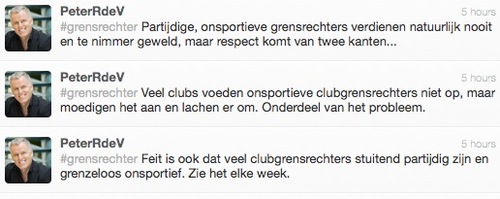
Tweets crime reporter Peter R. de Vries
We can expect to see, in the coming days, deeper reflections on the question “why” in op-eds and “in-depth” reports on tv and radio. The search for causes is likely to consist of moralizing and soul searching along well-established political and social lines. Some will emphasize collective guilt “Dutch society is becoming harsher”), others will blame a specific group (“it’s immigrants wot done it”), and so on, along established lines.
None of this is likely to change anything in a concrete or tangible manner. The public outcry and the search for “why” can best be interpreted as a search for meaning in “senseless violence” and a coming to terms with a complex mix of emotions mixing guilt, helplessness, and nostalgia for a time past when things were better. In this search for meaning, we see established lines of battle being drawn, with predictable statements and predictable reactions. In the confused Netherlands, the case of the murdered line ref only serves to confirm and perhaps sharpen the lines along which our fragmented society has divided itself.
Jeffrey Schwerzel studied anthropology at VU University Amsterdam. He was conscripted into the Dutch army and went to Bosnia. He joined the reserves and served in Afghanistan for 3 tours and works as a researcher.
‘A Stinking Open Wound’: Unauthorized Migrants in Amsterdam
Posted on December 5th, 2012 by martijn.
Categories: Activism, Multiculti Issues, Notes from the Field, Religion Other.
Several months ago a group of unauthorized migrants protested against the Dutch state’s refusal to grant them asylum although they had no possibility to go anywhere else. They set up a camp outside the asylum centre as a political protest. Unless they agree to work towards their return, which is impossible, these stateless people get no help from the Dutch state for housing. The idea is that by making life as miserable as possible these people will go away by themselves. The Dutch state responded to the protest by evicting the occupants and making it impossible to protest their again by building a fence surrounding the terrain.
The camp then split in two; one tent camp in Amsterdam (mainly Somalis) and one in The Hague (mainly Iraqis). Others originate from Ethiopia, Eritrea, Iran, Afghanistan and Azerbajjan. The camp in Amsterdam is supported by churches and mosques and several volunteers from those circles work there in order provide safety, food, shelter and so on. The camps was more than a temporarily housing, it was a means through which they could protest the Dutch aylum policy. In their protests they often emphasized the shared humanity and communitarianism.
Last week, Dutchnews.nl reports:
DutchNews.nl – Amsterdam refugee camp to be cleared by Friday
Some 130 failed asylum seekers who have set up camp in Amsterdam’s Osdorp have been told to clear their tents by Friday.
Judges have ruled the camp must go because of safety fears and Amsterdam’s mayor Eberhard van der Laan has given them until Friday morning to comply.
Judges said there are serious hygiene issues at the site because there is no running water and rubbish is not cleared. In addition, the camp is proving a nuisance to people living in the area.
What the judge also mentioned is that a Dutch far right group, Voorpost, locked the camp recently by using an ‘unbreakable chain’ stating that these ‘illegals where in the right place then: locked and behind bars’. They referred to the camp as a ‘stinking open wound’. There also have been demonstrations supporting the residents of the camp. The judge feared more disturbances also because of an apparent growing hostility of neighbourhood residents (in particular youth).
Dutch media reports and politicians mostly focus on the issue of nuisance for the neighbourhood; not about the fact that we have about 140 people who have nowhere to go and endure terrible conditions of the cold and wet Dutch weather in tents. Apparently these people do not deserve our compassion and concern; it is the outsider’s concerns that dominate here. Ben Langer in a blogpost on refugees in Canada refers to an article by S. Willen Migration, “illegality,” and health: Mapping embodies vulnerability and debating health-related deservingness. Willen writes about unauthorized migrants:Narrowing Our Moral Community of Concern: A Critique of Canada’s New Refugee Policies – Ben Langer « ACCESS DENIED
“they are excluded not only from the political community, but also from the moral community of people whose lives, bodies, illnesses, and injuries are deemed worthy of attention, investment, or concern” (2012: 806). Only by portraying these extremely vulnerable people as “undeserving” (Willen 2012) can Canada deny them care while at the same time maintaining an air of generosity.
Now the judge clearly does not deny these people’s rights for health and safety; his (justified) concerns however result in the camp being evicted last Friday while the people have no notion of where to go to. There is an offer by about 10 municipalities who want to provide a ‘sober shelter’ until 2 January (it can’t really be any more sober than what they I have now I think). A similar use of real or imagined concerns of safety is to be found among people objecting to the camp stating that, for example, bulldozers should clean up the mess. Also, referring to the whole camp, people are talking about ‘cleaning up’ when they mean it should be evicted and cleared. This reminds me of the anti-occupy rhetoric from the authorities and press often denouncing them as dirty, unhealthy and unhygienic. For more on dirt and the occupy movement see the article by Max Liboiron Tactics of Waste, Dirt and Discard in the Occupy Movement and his photo-essay. (H/T Material World)
Such rhetoric divides the world into a neat dichotomy: the us (clean, healthy) and them (dangerous, dirty and unhealthy). It renders us to be normal, citizens and the dominant order while them are trash that has to be cleaned up. As Mary Douglas taught us, labelling something as dirt (matter out of place) has to do with distinguishing and maintaining social values and social order by making clear what is acceptable, normal and expected or how society should be. Immigrants are already seen as a threat to social order and it is not difficult to imagine that unauthorized immigrants who cannot be banned, then are a great problem for a society that is pre-occupied with order, cleanliness and purity anyway. Such dichotomy renders invisible the painful questions we would like to avoid. As Markha Valenta argues on Open Democracy:
The moral sadism of the Dutch State | openDemocracy
The state is afraid, because the strangers are raising issues it does not dare to face: should asylum seekers have the right to influence the policies by which they are judged? Are refugees “human” from the moment they enter Europe? Or are they to be “nothing” unless and until they have the good luck to become residents and citizens?
This tells the story in Amsterdam. But right now all over Europe – in Vienna, in Hungary, in Berlin – there are the same protest camps, the same refugees, the same overbearing states and clusters of local protest. Small, scattered and disparate as they are, they raise a fundamental question that Europe does not know how to face any better than the economic crisis: do we dare to be humane, even at the cost of being just a little less rich, a little less a fortress, and a little more just?
To conclude a note on the protestors and the type of eviction. Well the different groups of protestors actually on Friday when the camp was evicted. There were the unauthorized migrants themselves who protested against the Dutch government putting them on the streets without any help and with nowhere to go. Second there, as they call themselves, the sympathizers. Those who, as they see it, did the real work of supporting the migrants by providing food, shelter, warm clothes and so on. Third, there are the protestors of the third day who came to protest against the eviction by the police. A common name for all three groups, but in particular the last one, is ‘silly leftists’ or ‘demo-silies.’ In particular the latter group is accused of having no real connection with the migrants and instead only promote their, sometimes seen as strange or peculiar, leftist political demands and as such using the migrants for their own political cause. Whatever you might think of the activists outside the camp, it is quite clear that the camp received quite some support from lawyers, neighbours, churches, mosques and some of the media. Quite some means not a lot; the support demonstrations was small and there was no political support at all.
As we all know, the Dutch state is a civilized state. We did not see outright violence; not on the part of the migrants nor on the part of the Dutch state. The whole handling of the protest and the eviction of the camp was the work of bureaucracy. The status of the migrants is ‘just a technical issue’ and there is, according to the state, nothing wrong with its policy. It is just that the migrants refuse to cooperate (how?) and that the countries of origin also refuse to cooperate. No word about for example why we actually have migrants from Iraq? Could it be that there is a relation with an illegal and unjustified war in Iraq and its current instability? Do we really think we have a tough but humane policy when we deny stateless people any possibility of living a life in this country? We have a duty to protect people who cannot safely return home but when their countries become really unsafe we tighten our migration restrictions (see also the case of France). Also the eviction was a technical issue that treats the migrants as criminals and sending them off to nowhere or to a few temporary (of course) alternative housings. It took very long and they booked every individual migrant, one by one. After that the terrain of the camp was cleaned by men in white suits; as such covering up the real stinking wound: the inhumane and irresponsible Dutch asylum policy.
'A Stinking Open Wound': Unauthorized Migrants in Amsterdam
Posted on December 5th, 2012 by martijn.
Categories: Activism, Multiculti Issues, Notes from the Field, Religion Other.
Several months ago a group of unauthorized migrants protested against the Dutch state’s refusal to grant them asylum although they had no possibility to go anywhere else. They set up a camp outside the asylum centre as a political protest. Unless they agree to work towards their return, which is impossible, these stateless people get no help from the Dutch state for housing. The idea is that by making life as miserable as possible these people will go away by themselves. The Dutch state responded to the protest by evicting the occupants and making it impossible to protest their again by building a fence surrounding the terrain.
The camp then split in two; one tent camp in Amsterdam (mainly Somalis) and one in The Hague (mainly Iraqis). Others originate from Ethiopia, Eritrea, Iran, Afghanistan and Azerbajjan. The camp in Amsterdam is supported by churches and mosques and several volunteers from those circles work there in order provide safety, food, shelter and so on. The camps was more than a temporarily housing, it was a means through which they could protest the Dutch aylum policy. In their protests they often emphasized the shared humanity and communitarianism.
Last week, Dutchnews.nl reports:
DutchNews.nl – Amsterdam refugee camp to be cleared by Friday
Some 130 failed asylum seekers who have set up camp in Amsterdam’s Osdorp have been told to clear their tents by Friday.
Judges have ruled the camp must go because of safety fears and Amsterdam’s mayor Eberhard van der Laan has given them until Friday morning to comply.
Judges said there are serious hygiene issues at the site because there is no running water and rubbish is not cleared. In addition, the camp is proving a nuisance to people living in the area.
What the judge also mentioned is that a Dutch far right group, Voorpost, locked the camp recently by using an ‘unbreakable chain’ stating that these ‘illegals where in the right place then: locked and behind bars’. They referred to the camp as a ‘stinking open wound’. There also have been demonstrations supporting the residents of the camp. The judge feared more disturbances also because of an apparent growing hostility of neighbourhood residents (in particular youth).
Dutch media reports and politicians mostly focus on the issue of nuisance for the neighbourhood; not about the fact that we have about 140 people who have nowhere to go and endure terrible conditions of the cold and wet Dutch weather in tents. Apparently these people do not deserve our compassion and concern; it is the outsider’s concerns that dominate here. Ben Langer in a blogpost on refugees in Canada refers to an article by S. Willen Migration, “illegality,” and health: Mapping embodies vulnerability and debating health-related deservingness. Willen writes about unauthorized migrants:Narrowing Our Moral Community of Concern: A Critique of Canada’s New Refugee Policies – Ben Langer « ACCESS DENIED
“they are excluded not only from the political community, but also from the moral community of people whose lives, bodies, illnesses, and injuries are deemed worthy of attention, investment, or concern” (2012: 806). Only by portraying these extremely vulnerable people as “undeserving” (Willen 2012) can Canada deny them care while at the same time maintaining an air of generosity.
Now the judge clearly does not deny these people’s rights for health and safety; his (justified) concerns however result in the camp being evicted last Friday while the people have no notion of where to go to. There is an offer by about 10 municipalities who want to provide a ‘sober shelter’ until 2 January (it can’t really be any more sober than what they I have now I think). A similar use of real or imagined concerns of safety is to be found among people objecting to the camp stating that, for example, bulldozers should clean up the mess. Also, referring to the whole camp, people are talking about ‘cleaning up’ when they mean it should be evicted and cleared. This reminds me of the anti-occupy rhetoric from the authorities and press often denouncing them as dirty, unhealthy and unhygienic. For more on dirt and the occupy movement see the article by Max Liboiron Tactics of Waste, Dirt and Discard in the Occupy Movement and his photo-essay. (H/T Material World)
Such rhetoric divides the world into a neat dichotomy: the us (clean, healthy) and them (dangerous, dirty and unhealthy). It renders us to be normal, citizens and the dominant order while them are trash that has to be cleaned up. As Mary Douglas taught us, labelling something as dirt (matter out of place) has to do with distinguishing and maintaining social values and social order by making clear what is acceptable, normal and expected or how society should be. Immigrants are already seen as a threat to social order and it is not difficult to imagine that unauthorized immigrants who cannot be banned, then are a great problem for a society that is pre-occupied with order, cleanliness and purity anyway. Such dichotomy renders invisible the painful questions we would like to avoid. As Markha Valenta argues on Open Democracy:
The moral sadism of the Dutch State | openDemocracy
The state is afraid, because the strangers are raising issues it does not dare to face: should asylum seekers have the right to influence the policies by which they are judged? Are refugees “human” from the moment they enter Europe? Or are they to be “nothing” unless and until they have the good luck to become residents and citizens?
This tells the story in Amsterdam. But right now all over Europe – in Vienna, in Hungary, in Berlin – there are the same protest camps, the same refugees, the same overbearing states and clusters of local protest. Small, scattered and disparate as they are, they raise a fundamental question that Europe does not know how to face any better than the economic crisis: do we dare to be humane, even at the cost of being just a little less rich, a little less a fortress, and a little more just?
To conclude a note on the protestors and the type of eviction. Well the different groups of protestors actually on Friday when the camp was evicted. There were the unauthorized migrants themselves who protested against the Dutch government putting them on the streets without any help and with nowhere to go. Second there, as they call themselves, the sympathizers. Those who, as they see it, did the real work of supporting the migrants by providing food, shelter, warm clothes and so on. Third, there are the protestors of the third day who came to protest against the eviction by the police. A common name for all three groups, but in particular the last one, is ‘silly leftists’ or ‘demo-silies.’ In particular the latter group is accused of having no real connection with the migrants and instead only promote their, sometimes seen as strange or peculiar, leftist political demands and as such using the migrants for their own political cause. Whatever you might think of the activists outside the camp, it is quite clear that the camp received quite some support from lawyers, neighbours, churches, mosques and some of the media. Quite some means not a lot; the support demonstrations was small and there was no political support at all.
As we all know, the Dutch state is a civilized state. We did not see outright violence; not on the part of the migrants nor on the part of the Dutch state. The whole handling of the protest and the eviction of the camp was the work of bureaucracy. The status of the migrants is ‘just a technical issue’ and there is, according to the state, nothing wrong with its policy. It is just that the migrants refuse to cooperate (how?) and that the countries of origin also refuse to cooperate. No word about for example why we actually have migrants from Iraq? Could it be that there is a relation with an illegal and unjustified war in Iraq and its current instability? Do we really think we have a tough but humane policy when we deny stateless people any possibility of living a life in this country? We have a duty to protect people who cannot safely return home but when their countries become really unsafe we tighten our migration restrictions (see also the case of France). Also the eviction was a technical issue that treats the migrants as criminals and sending them off to nowhere or to a few temporary (of course) alternative housings. It took very long and they booked every individual migrant, one by one. After that the terrain of the camp was cleaned by men in white suits; as such covering up the real stinking wound: the inhumane and irresponsible Dutch asylum policy.
Het spektakel Marianne Vaatstra: Een Nederlander snijdt geen keel door
Posted on November 29th, 2012 by martijn.
Categories: anthropology, Headline, islamophobia, Multiculti Issues.
Zwarte man versus blanke vrouw, elite versus volk, stad versus platteland. Martijn de Koning betoogt dat het spektakel rond de moord op Marianne Vaatstra in 1999 al de kenmerken vertoonde van het latere integratie- en islamdebat.
‘Een keel doorsnijden, dat is iets wat een Fries niet doet’, schrijft columnist Pim Fortuyn oktober 1999 in Elsevier. ‘In het dorp gingen onmiddellijk geruchten dat het een buitenlander moest betreffen, uit een andere cultuur, en ja, die woonden in het asielzoekerscentrum buiten het dorp. Een redelijke gedachte.’
Fortuyn heeft het over de moord op Marianne Vaatstra die in het voorjaar heeft plaatsgevonden. Aanleiding voor zijn stukje is dat een week eerder inwoners van Kollum een hoorzitting hebben verstoord over de verplaatsing van het asielzoekerscentrum naar een andere locatie in de buurt. Dat is in deze periode niet uniek. Door het hele land is er fel protest van comités, soms beïnvloed door radicaal-rechts, die zich verzetten tegen azc’s. Een geluid dat dan nog niet of nauwelijks wordt vertolkt door geaccepteerde politieke partijen.
Inmiddels, dertien jaar later, lijkt het erop dat we de dader niet in het azc moesten zoeken, maar in het nabij gelegen Oudwoude. Dat is schrikken, of zoals een inwoonster van Zwaagwesteinde het verwoordt: ‘Toen iedereen hier dacht dat de dader uit het asielzoekerscentrum kwam, gaf dat tenminste nog enige rust. Je wilt niet dat het een vader van hier is.’ (Trouw, 20-11-12).
Vaak wordt verwezen naar de aanslagen op 11 september 2001 als het moment dat de discussie over islam en integratie echt verhit raakte. Maar terugkijkend naar het spektakel rondom de zaak-Vaatstra, kunnen we vaststellen dat de eerste tekenen van het post-9/11-tijdperk al eerder zichtbaar zijn.
Dat de keel van Marianne is doorgesneden, klopt niet, zo blijkt later, maar destijds was dit kennelijk een heel aansprekend aspect van de moord, want in talloze vroege krantenberichten komt het terug. De Telegraaf (7-5-99) haalt als een van de eerste landelijke kranten een dorpsinwoner aan die het vermoeden uitspreekt dat de manier waarop het slachtoffer is vermoord iets te maken heeft met het azc en zijn bewoners: ‘Dat lijkt me eerder thuis te horen in Oost-Europa.’ Het Parool (14-5-99) noemt daarna een dorpsinwoner bij naam die stelt: ‘Haar keel was van oor tot oor gesneden, zoiets doet een Hollander niet. Da’s meer iets voor het asielzoekerscentrum, dat ligt in hun cultuur. Nederlanders zouden misschien steken of wurgen.’
In de daaropvolgende berichtgeving blijft deze redenering terugkomen. En gaandeweg zien we dat een link wordt gelegd met het onbehagen over de multiculturele samenleving en met het idee dat zaken niet benoemd mogen worden. Het gaat ook al snel niet meer over Oost-Europeanen, maar bijvoorbeeld over een ‘islamitische dader’ (Elsevier, 24-6-00) en ‘een typisch Arabische rituele slachting. Hollanders wurgen liever’. (Dagblad van het Noorden, 30-10-00). Peter R. de Vries brengt een reconstructie met twee donkere mannen die een snijdende beweging maken, met hun vingers langs hun keel. ‘De keel doorsnijden’ wordt een zich herhalend patroon en is een voorbeeld van het idee dat er een directe relatie bestaat tussen cultuur en etnische identiteit enerzijds en criminaliteit anderzijds.
Cultuurdenken
Meer algemeen is het een voorbeeld van cultuurdenken; iets dat destijds en later niet beperkt blijft tot Zwaagwesteinde. In de jaren 90 worden van links tot rechts vraagtekens gezet bij de etnische diversiteit. ‘Mensen met een andere cultuur’ zouden de maatschappelijke samenhang bedreigen doordat culturele verschillen garant zouden staan voor conflicten.
In dit cultuurdenken is iemand die in Marokko is geboren en naar Nederland verhuist, een Marokkaan die een Marokkaanse cultuur heeft. En verder niets. Wat hij of zij doet, vooral datgene dat als afwijkend wordt gezien, is gerelateerd aan of wordt zelfs veroorzaakt door die cultuur. Dat geldt ook voor zijn nakomelingen in Nederland. Dat Marokkanen geen homogene, duidelijk herkenbare eenheid vormen en dat andere identiteiten ook van belang zijn, dat wordt vergeten. Evenals het feit dat mensen geen gevangenen zijn van hun cultuur.
Dat dit cultuurdenken in Nederland in de jaren negentig meer opgeld doet dan elders, blijkt wel uit het feit dat geen enkel ander land in Europa dan al zo veel onderzoek doet naar de relatie tussen etniciteit en criminaliteit; ook al blijkt keer op keer dat die zeer moeilijk hard te maken is.
Maakte het voor Marianne Vaatstra verschil of zij vermoord en verkracht werd door een asielzoeker of een autochtone dorpsgenoot? Voor het publiek klaarblijkelijk wel, ook gezien het feit dat de haatgevoelens jegens asielzoekers destijds in schril contrast staan tot de gevoelens van mededogen die nu uitgaan naar het gezin van de mogelijke dader.
Wanneer we het cultuurdenken in de zaak-Vaatstra ontleden, door te letten op het taalgebruik, zien we de tegenstellingen die in het latere integratie- en islamdebat een grote rol gaan spelen: zwarte/buitenlandse mannen versus blanke/autochtone vrouwen, elite versus volk én stad versus platteland. Dat de moord op Vaatstra snel met asielzoekers in verband wordt gebracht, sluit aan bij een traditioneel xenofoob angstbeeld: de vreemdeling met zijn ongetemde seksuele drift die ‘onze’ vrouwen bedreigt en die moet worden geweerd of beschaafd gemaakt.
Het is een angstbeeld dat ook tekenend is voor de wijze waarop tegenwoordig Europa als morele gemeenschap wordt gedefinieerd. In het artikel ‘Sexual politics, torture, and secular time‘ (PDF) uit 2008 in het British Journal of Sociology, laat de Amerikaanse filosofe Judith Butler zien dat Europa wordt voorgesteld als het voorbeeld voor seksuele vrijheden en moderniteit die moeten worden beschermd tegen verschijnselen als genderongelijkheid, eergerelateerd geweld, huiselijk geweld en gedwongen huwelijken. Niet dat die fenomenen niet bestaan, maar ‘de cultuur’ van migranten wordt er ten onrechte mee gedefinieerd. Wanneer een immigrant maatschappelijk opklimt, is dat ineens niet meer zijn cultuur, dan is dat integratie. ‘Onze’ waarden en normen (in het geval van autochtonen wordt slechts zelden gesproken over cultuur) zijn beter dan ‘hun’ cultuur.
Een concrete variant van deze tegenstelling zou in het post-9/11-tijdperk de film Submission worden, van Ayaan Hirsi Ali en Theo van Gogh. Hiermee presenteerde Hirsi Ali zich als vrije en liberale (ex-moslim)vrouw, die onderdrukte moslimvrouwen wilde bevrijden van moslimmannen. De consequenties van deze manier van denken zijn echter veel groter dan uitingen als deze film. Zoals veel onderzoekers en commentatoren hebben laten zien, was een belangrijke legitimering voor de hele War on Terror het idee dat Arabische vrouwen bevrijd moesten worden van hun vrouwonvriendelijke culturen (PDF).
Lakse elites
Een tweede tegenstelling die in Nederland in het eerste decennium van deze eeuw dominant zou worden, speelt ook al in de controverse rond Marianne Vaatstra: de politieke elite (inclusief het Openbaar Ministerie) en beleidsmakers die ervan worden beschuldigd dat zij ‘de waarheid’ over Marianne Vaatstra verdoezelen om de multiculturele samenleving in stand te houden versus ‘het volk’ dat zijn paradijs verstoord ziet door vreemde culturen en die lakse elites. Deze oppositie zal later terugkomen in het populisme van Fortuyn, Verdonk en Wilders. Die stonden een beleid voor waarin, zo claimden zij, de wil van het volk prevaleert boven de belangen van de elite.
In het gedachtengoed van Wilders, Fortuyn en Verdonk zijn, zij het op verschillende wijzen en in verschillende mate, cultuurdenken en populisme vermengd geraakt. Maar niet alleen bij hen. Vrijwel alle politieke partijen beschouwen vandaag de dag de cultuur van de migrant en de islam als problemen waarmee iets moet gebeuren. Een voorbeeld is de huidige PvdA-minister Lodewijk Asscher die in 2005 stelde: ‘We moeten liberale stromingen dus steunen, en streven naar een Hollandse islam.’ (de Volkskrant, 11-2-05). Het is moeilijk dit soort ideeën te weerleggen. Wie probeert er iets tegen in te brengen, bijvoorbeeld door te wijzen op de al bestaande liberale islam, gaat onbedoeld toch mee in het idee dat de islam een probleem is en bevestigt de tegenstelling nog eens.
Verstoord paradijs
Die tegenstellingen tussen de buitenlandse man en de autochtone vrouw en tussen het volk en de elite, werken in de zaak-Vaatstra nog sterker in combinatie met een derde: het platteland versus de stad. Zoals Peter Geschiere liet zien in zijn boek The Perils of Belonging (2009), berust autochtoniteit op een ideaal van zuiverheid en de zuivere Nederlander is degene die hier ‘het eerst’ was. Zwaagwesteinde wordt na de moord gepresenteerd als het paradijs waar iedereen elkaar nog kent, van echte Friezen, tot voor kort niet verstoord door allerlei zaken die de stad wel kent: criminaliteit, migratie, anonimiteit, enzovoorts. Dat was duidelijk onzin en is ook door dorpsinwoners en de politie in sommige stukken ontkracht. Niettemin, het beeld van het ‘verstoorde paradijs’ (Elsevier, 21-7-01 online 22-5-12) overheerste.
Het aanwijzen van de asielzoekers als dader is vooral een teken dat we het fictieve ideaalbeeld van ons land hoog wilden houden, hier gesymboliseerd door het dorpje Zwaagwesteinde en de mooie, blanke, donkerblonde Marianne Vaatstra. De latere discussies over de islamisering van Nederland, sharia en bijvoorbeeld de gezichtssluier zijn een variant op het verstoorde paradijs: een land dat zijn eigenheid zou verliezen door te veel islam.
Wanneer onderzoekers en commentatoren het hedendaagse islamdebat willen analyseren en verklaren, wordt vaak verwezen naar de aanslagen van 11 september 2001, de moord op Theo van Gogh en de rol van politici als Fortuyn en Wilders. Terecht, maar duidelijk moge zijn dat dat debat een intensivering is van geluiden en gevoelens van onbehagen die er al langer waren en die vervolgens slechts meer geaccepteerd zijn geraakt. De moord op Marianne Vaatstra dateert van 1999: voor Paul Scheffers’ multiculturele drama, voor de El Moumni-affaire (een imam die zich negatief uitliet over homoseksualiteit), voor 9/11, voor Fortuyn en voor de moord op Theo van Gogh.
De drie tegenstellingen in de zaak-Vaatstra leenden zich uitstekend voor politieke exploitatie. De controverse is daarmee een van de vele spektakels die een bedrieglijke plausibiliteit en vanzelfsprekendheid verschaften aan het cultuurdenken. Zo was deze zaak een voorloper van de sociale verdeeldheid waarin we vandaag de dag nog steeds gevangen zitten.
Dit stuk was eerder te lezen in de Volkskrant-bijlage Vonk, zaterdag 24 november 2012
De kranten en de asielzoekers
‘De politie heeft ( ) een sectie van 24 ME’ers achter de hand gehouden om bij ordeverstoringen bij het asielzoekerscentrum de Poelpleats in Kollum direct in te kunnen grijpen. De maatregel is genomen vanwege de geruchten dat de dader van de moord op Marianne Vaatstra onder de asielzoekers gezocht zou moeten worden.’
Leeuwarder Courant, 15 mei 1999
‘In Zwaagwesteinde wordt met verbijstering gereageerd op de uitslag van de dna-test waarmee vaststaat dat de 26-jarige Irakees Marianne Vaatstra niet heeft vermoord. Velen in het dorp hadden gehoopt dat met de arrestatie van deze man de moord op het meisje opgelost zou zijn.’
Leeuwarder Courant, 15 oktober 1999
‘De Kollumer asielzoekers hebben zich erbij neergelegd. Ze zoeken naar manieren om met de verdachtmakingen om te gaan. ( ) Alleen durven ze niet meer. Met een gebogen hoofd lopen de asielzoekers door de supermarkt en de winkelstraat. Om maar niemand aanstoot te geven.’
Leeuwarder Courant, 24 december 1999
‘Direct na de dood van Marianne Vaatstra was duidelijk dat er wel degelijk concrete vermoedens waren in de richting van figuren uit het azc. Die figuren hadden zich verdacht gedragen. ( ) Daar komt bij dat steeds duidelijker wordt dat een flink deel van degenen die verblijven in azc’s geen echte asielzoekers zijn maar gelukszoekers.’
Leeuwarder Courant, opinieartikel van een eigen redacteur, 10 augustus 1999
‘De politie heeft het onderzoek in de moord op Marianne Vaatstra uitgebreid naar het asielzoekerscentrum (azc) in Kollum. Volgens de politie gaat het om ‘uitbreiding van het buurtonderzoek.’
Nieuwsblad van het Noorden, 11 mei 1999
PS
Als toetje, beluister de volgende zeer interessante radiodocumentaire van Joost Wilgenhof bij HollandDoc. Joost Wilgenhof schetst een beeld van een brute moord in het dorp Emmerschans, waarin het saamhorigheidsgevoel een groot goed lijkt en waar buitenstaanders met argusogen worden bekeken. Twee ingrijpende gebeurtenissen wakkeren het saamhorigheidsgevoel in Emmerschans aan. Eerst het fantastische eeuwfeest. En dan de gruwelijke moord op een bejaarde buurtbewoonster. DNA-onderzoek brengt een ongewenste uitkomst.
France24: France’s Muslims seek protection from ‘anti-Islam crusades’
Posted on November 28th, 2012 by martijn.
Categories: Activism, Islamnews, islamophobia, Multiculti Issues.
France’s Muslim community seeks protection from ‘anti-Islam crusades’ – FRANCE 24
France’s Muslim community has called on President François Hollande to make “a solemn statement” to stem what it sees as anti-Islam crusades. Libération leads on that and also has an interview with Abdelghani Merah, brother of Toulouse gunman Mohamed Merah, who condemns Salafist hatred. We also look at a proposed new “exit tax” on companies that re-locate abroad. That’s the focus for this look at the French press on Friday 9th November, 2012.
By Nicholas RUSHWORTHLibération reports France’s Muslim community feels there are anti-Islam crusades underway against them, and want protection.
Its editorial says Muslims feel exasperated. It advises President François Hollande to make the “solemn statement” on the issue Muslims are asking for.
France24: France's Muslims seek protection from 'anti-Islam crusades'
Posted on November 28th, 2012 by martijn.
Categories: Activism, Islamnews, islamophobia, Multiculti Issues.
France’s Muslim community seeks protection from ‘anti-Islam crusades’ – FRANCE 24
France’s Muslim community has called on President François Hollande to make “a solemn statement” to stem what it sees as anti-Islam crusades. Libération leads on that and also has an interview with Abdelghani Merah, brother of Toulouse gunman Mohamed Merah, who condemns Salafist hatred. We also look at a proposed new “exit tax” on companies that re-locate abroad. That’s the focus for this look at the French press on Friday 9th November, 2012.
By Nicholas RUSHWORTHLibération reports France’s Muslim community feels there are anti-Islam crusades underway against them, and want protection.
Its editorial says Muslims feel exasperated. It advises President François Hollande to make the “solemn statement” on the issue Muslims are asking for.