Multiculti Issues
You are looking at posts in the category Multiculti Issues.
| M | T | W | T | F | S | S |
|---|---|---|---|---|---|---|
| « Sep | ||||||
| 1 | 2 | 3 | 4 | |||
| 5 | 6 | 7 | 8 | 9 | 10 | 11 |
| 12 | 13 | 14 | 15 | 16 | 17 | 18 |
| 19 | 20 | 21 | 22 | 23 | 24 | 25 |
| 26 | 27 | 28 | 29 | 30 | 31 | |
Pages
- About
- C L O S E R moves to….C L O S E R
- Contact Me
- Interventions – Forces that Bind or Divide
- ISIM Review via Closer
- Publications
- Research
Categories
- (Upcoming) Events (33)
- [Online] Publications (26)
- Activism (117)
- anthropology (113)
- Method (13)
- Arts & culture (88)
- Asides (2)
- Blind Horses (33)
- Blogosphere (192)
- Burgerschapserie 2010 (50)
- Citizenship Carnival (5)
- Dudok (1)
- Featured (5)
- Gender, Kinship & Marriage Issues (265)
- Gouda Issues (91)
- Guest authors (58)
- Headline (76)
- Important Publications (159)
- Internal Debates (275)
- International Terrorism (437)
- ISIM Leiden (5)
- ISIM Research II (4)
- ISIM/RU Research (171)
- Islam in European History (2)
- Islam in the Netherlands (219)
- Islamnews (56)
- islamophobia (59)
- Joy Category (56)
- Marriage (1)
- Misc. News (891)
- Morocco (70)
- Multiculti Issues (749)
- Murder on theo Van Gogh and related issues (326)
- My Research (118)
- Notes from the Field (82)
- Panoptic Surveillance (4)
- Public Islam (244)
- Religion Other (109)
- Religious and Political Radicalization (635)
- Religious Movements (54)
- Research International (55)
- Research Tools (3)
- Ritual and Religious Experience (58)
- Society & Politics in the Middle East (159)
- Some personal considerations (146)
- Deep in the woods… (18)
- Stadsdebat Rotterdam (3)
- State of Science (5)
- Twitwa (5)
- Uncategorized (74)
- Young Muslims (459)
- Youth culture (as a practice) (157)
General
- ‘In the name of Allah, Most Gracious, Most Merciful’
- – Lotfi Haddi –
- …Kelaat Mgouna…….Ait Ouarchdik…
- ::–}{Nour Al-Islam}{–::
- Al-islam.nl De ware godsdienst voor Allah is de Islam
- Allah Is In The House
- Almaas
- amanullah.org
- Amr Khaled Official Website
- An Islam start page and Islamic search engine – Musalman.com
- arabesque.web-log.nl
- As-Siraat.net
- assadaaka.tk
- Assembley for the Protection of Hijab
- Authentieke Kennis
- Azaytouna – Meknes Azaytouna
- berichten over allochtonen in nederland – web-log.nl
- Bladi.net : Le Portail de la diaspora marocaine
- Bnai Avraham
- BrechtjesBlogje
- Classical Values
- De islam
- DimaDima.nl / De ware godsdienst? bij allah is de islam
- emel – the muslim lifestyle magazine
- Ethnically Incorrect
- fernaci
- Free Muslim Coalition Against Terrorism
- Frontaal Naakt. Ongesluierde opinies, interviews & achtergronden
- Hedendaagse wetenswaardigheden…
- History News Network
- Homepage Al Nisa
- hoofddoek.tk – Een hoofddoek, je goed recht?
- IMRA: International Muslima Rights Association
- Informed Comment
- Insight to Religions
- Instapundit.com
- Interesting Times
- Intro van Abdullah Biesheuvel
- islaam
- Islam Ijtihad World Politics Religion Liberal Islam Muslim Quran Islam in America
- Islam Ijtihad World Politics Religion Liberal Islam Muslim Quran Islam in America
- Islam Website: Islam, Islamic Studies, Arabic, Religion
- Islamforum
- Islamic Philosophy Online
- Islamica Magazine
- islamicate
- Islamophobia Watch
- Islamsevrouw.web-log.nl
- Islamwereld-alles wat je over de Islam wil weten…
- Jihad: War, Terrorism, and Peace in Islam
- JPilot Chat Room
- Madrid11.net
- Marocstart.nl – De marokkaanse startpagina!
- Maryams.Net – Muslim Women and their Islam
- Michel
- Modern Muslima.com
- Moslimjongeren Amsterdam
- Moslimjongeren.nl
- Muslim Peace Fellowship
- Muslim WakeUp! Sex & The Umma
- Muslimah Connection
- Muslims Against Terrorism (MAT)
- Mutma’inaa
- namira
- Otowi!
- Ramadan.NL
- Religion, World Religions, Comparative Religion – Just the facts on the world\’s religions.
- Ryan
- Sahabah
- Salafi Start Siden – The Salafi Start Page
- seifoullah.tk
- Sheikh Abd al Qadir Jilani Home Page
- Sidi Ahmed Ibn Mustafa Al Alawi Radhiya Allahu T’aala ‘Anhu (Islam, tasawuf – Sufism – Soufisme)
- Stichting Vangnet
- Storiesofmalika.web-log.nl
- Support Sanity – Israel / Palestine
- Tekenen van Allah\’s Bestaan op en in ons Lichaam
- Terrorism Unveiled
- The Coffee House | TPMCafe
- The Inter Faith Network for the UK
- The Ni’ma Foundation
- The Traveller’s Souk
- The \’Hofstad\’ terrorism trial – developments
- Thoughts & Readings
- Uitgeverij Momtazah | Helmond
- Un-veiled.net || Un-veiled Reflections
- Watan.nl
- Welkom bij Islamic webservices
- Welkom bij vangnet. De site voor islamitische jongeren!
- welkom moslim en niet moslims
- Yabiladi Maroc – Portail des Marocains dans le Monde
Dutch [Muslims] Blogs
- Hedendaagse wetenswaardigheden…
- Abdelhakim.nl
- Abdellah.nl
- Abdulwadud.web-log.nl
- Abou Jabir – web-log.nl
- Abu Bakker
- Abu Marwan Media Publikaties
- Acta Academica Tijdschrift voor Islam en Dialoog
- Ahamdoellilah – web-log.nl
- Ahlu Soennah – Abou Yunus
- Ahlul Hadeeth
- Ahlul Hadeeth
- Al Moudjahideen
- Al-Adzaan
- Al-Islaam: Bismilaahi Rahmaani Rahiem
- Alesha
- Alfeth.com
- Anoniempje.web-log.nl
- Ansaar at-Tawheed
- At-Tibyan Nederland
- beni-said.tk
- Blog van moemina3 – Skyrock.com
- bouchra
- CyberDjihad
- DE SCHRIJVENDE MOSLIMS
- DE VROLIJKE MOSLIM ;)
- Dewereldwachtopmij.web-log.nl
- Dien~oel~Islaam
- Eali.web-log.nl
- Een genade voor de werelden
- Enige wapen tegen de Waarheid is de leugen…
- ErTaN
- ewa
- Ezel & Os v2
- Gizoh.tk [.::De Site Voor Jou::.]
- Grappige, wijze verhalen van Nasreddin Hodja. Turkse humor.
- Hanifa Lillah
- hayya~ala~assalaah!
- Het laatste nieuws lees je als eerst op Maroc-Media
- Homow Universalizzz
- Ibn al-Qayyim
- IslaamLive Mail
- IslaamLive Mail
- Islam Blog – Juli 2007
- Islam in het Nieuws – web-log.nl
- Islam, een religie
- Islam, een religie
- Islamic Sisters – web-log.nl
- Islamiway’s Weblog
- Islamtawheed’s Blog
- Jihaad
- Jihad
- Journalista
- La Hawla Wa La Quwatta Illa Billah
- M O S L I M J O N G E R E N
- M.J.Ede – Moslimjongeren Ede
- Mahdi\’s Weblog | Vrijheid en het vrije woord | punt.nl: Je eigen gratis weblog, gratis fotoalbum, webmail, startpagina enz
- Maktab.nl (Zawaj – islamitische trouwsite)
- Marocdream.nl – Home
- Marokkaanse.web-log.nl
- Marokkanen Weblog
- Master Soul
- Miboon
- Miesjelle.web-log.nl
- Mijn Schatjes
- Moaz
- moeminway – web-log.nl
- Moslima_Y – web-log.nl
- mosta3inabilaah – web-log.nl
- Muhaajir in islamitisch Zuid-Oost Azië
- Mumin al-Bayda (English)
- Mustafa786.web-log.nl
- Oprecht – Poort tot de kennis
- Said.nl
- saifullah.nl – Jihad al-Haq begint hier!
- Salaam Aleikum
- Sayfoudien – web-log.nl
- soebhanAllah
- Soerah19.web-log.nl – web-log.nl
- Steun Palestina
- Stichting Moslimanetwerk
- Stories of Malika
- supermaroc
- Ummah Nieuws – web-log.nl
- Volkskrant Weblog — Alib Bondon
- Volkskrant Weblog — Moslima Journalista
- Vraag en antwoord…
- wat is Islam
- Wat is islam?
- Weblog – a la Maroc style
- website van Jamal
- Wij Blijven Hier
- Wij Blijven Hier
- www.BenAyad.be – Islam en Actua
- www.moslima.web-log.nl
- Yakini Time
- Youth Of Islam
- Youth Of Islam
- [fikra]
Non-Dutch Muslims Blogs
- Lanallah __Islamic BlogZine__
- This journey ends but only with The Beginning
- ‘the middle place’
- …Never Judge a Person By His or Her Blog…
- …under the tree…
- A Comment on PMUNA
- A Dervish’s Du`a’
- A Family in Baghdad
- A Garden of Children
- A Muslim Mother’s Thoughts / Islamic Parenting
- A Struggle in Uncertainty, Such is Life
- About Afghanistan
- adnan.org: good design, bad idea
- Afiyah
- Ahmeds World of Islam
- Al Musawwir
- Al-Musharaka
- Almiraya tBLOG – O, happy the soul that saw its own faults
- Almusawwir
- an open window
- Anak Alam
- aNaRcHo AkBaR
- Anthology
- AnthroGal’s World
- Arabian Passion
- ArRihla
- Articles Blog
- Asylum Seeker
- avari-nameh
- Baghdad Burning
- Being Noor Javed
- Bismillah
- bloggin’ muslimz.. Linking Muslim bloggers around the globe
- Blogging Islamic Perspective
- Chapati Mystery
- City of Brass – Principled pragmatism at the maghrib of one age, the fajr of another
- COUNTERCOLUMN: All Your Bias Are Belong to Us
- d i z z y l i m i t s . c o m >> muslim sisters united w e b r i n g
- Dar-al-Masnavi
- Day in the life of an American Muslim Woman
- Don’t Shoot!…
- eat-halal guy
- Eye on Gay Muslims
- Eye on Gay Muslims
- Figuring it all out for nearly one quarter of a century
- Free Alaa!
- Friends, Romans, Countrymen…. lend me 5 bux!
- From Peer to Peer ~ A Weblog about P2P File & Idea Sharing and More…
- Ghost of a flea
- Ginny’s Thoughts and Things
- God, Faith, and a Pen: The Official Blog of Dr. Hesham A. Hassaballa
- Golublog
- Green Data
- gulfreporter
- Hadeeth Blog
- Hadouta
- Hello from the land of the Pharaoh
- Hello From the land of the Pharaohs Egypt
- Hijabi Madness
- Hijabified
- HijabMan’s Blog
- Ihsan-net
- Inactivity
- Indigo Jo Blogs
- Iraq Blog Count
- Islam 4 Real
- Islamiblog
- Islamicly Locked
- Izzy Mo’s Blog
- Izzy Mo’s Blog
- Jaded Soul…….Unplugged…..
- Jeneva un-Kay-jed- My Bad Behavior Sanctuary
- K-A-L-E-I-D-O-S-C-O-P-E
- Lawrence of Cyberia
- Letter From Bahrain
- Life of an American Muslim SAHM whose dh is working in Iraq
- Manal and Alaa\’s bit bucket | free speech from the bletches
- Me Vs. MysElF
- Mental Mayhem
- Mere Islam
- Mind, Body, Soul : Blog
- Mohammad Ali Abtahi Webnevesht
- MoorishGirl
- Muslim Apple
- muslim blogs
- Muslims Under Progress…
- My heart speaks
- My Little Bubble
- My Thoughts
- Myself | Hossein Derakhshan’s weblog (English)
- neurotic Iraqi wife
- NINHAJABA
- Niqaabi Forever, Insha-Allah Blog with Islamic nasheeds and lectures from traditional Islamic scholars
- Niqabified: Irrelevant
- O Muhammad!
- Otowi!
- Pak Positive – Pakistani News for the Rest of Us
- Periphery
- Pictures in Baghdad
- PM’s World
- Positive Muslim News
- Procrastination
- Prophet Muhammad
- Queer Jihad
- Radical Muslim
- Raed in the Middle
- RAMBLING MONOLOGUES
- Rendering Islam
- Renegade Masjid
- Rooznegar, Sina Motallebi’s WebGard
- Sabbah’s Blog
- Salam Pax – The Baghdad Blog
- Saracen.nu
- Scarlet Thisbe
- Searching for Truth in a World of Mirrors
- Seeing the Dawn
- Seeker’s Digest
- Seekersdigest.org
- shut up you fat whiner!
- Simply Islam
- Sister Scorpion
- Sister Soljah
- Sister Surviving
- Slow Motion in Style
- Sunni Sister: Blahg Blahg Blahg
- Suzzy’s id is breaking loose…
- tell me a secret
- The Arab Street Files
- The Beirut Spring
- The Islamic Feminista
- The Land of Sad Oranges
- The Muslim Contrarian
- The Muslim Postcolonial
- The Progressive Muslims Union North America Debate
- The Rosetta Stone
- The Traceless Warrior
- The Wayfarer
- TheDesertTimes
- think halal: the muslim group weblog
- Thoughts & Readings
- Through Muslim Eyes
- Turkish Torque
- Uncertainty:Iman and Farid’s Iranian weblog
- UNMEDIA: principled pragmatism
- UNN – Usayd Network News
- Uzer.Aurjee?
- Various blogs by Muslims in the West. – Google Co-op
- washed away memories…
- Welcome to MythandCulture.com and to daily Arrows – Mythologist, Maggie Macary’s blog
- word gets around
- Writeous Sister
- Writersblot Home Page
- www.BenAyad.be – Islam en Actua
- www.Mas’ud’s blog
- \’Aqoul
- ~*choco-bean*~
General Islam Sites
- :: Islam Channel :: – Welcome to IslamChannel Official Website
- Ad3iyah(smeekbeden)
- Al-maktoum Islamic Centre Rotterdam
- Assalamoe Aleikoem Warhmatoe Allahi Wa Barakatuhoe.
- BouG.tk
- Dades Islam en Youngsterdam
- Haq Islam – One stop portal for Islam on the web!
- Hight School Teacher Muhammad al-Harbi\’s Case
- Ibn Taymiyah Pages
- Iskandri
- Islam
- Islam Always Tomorrow Yesterday Today
- Islam denounces terrorism.com
- Islam Home
- islam-internet.nl
- Islamic Artists Society
- Leicester~Muslims
- Mere Islam
- MuslimSpace.com | MuslimSpace.com, The Premiere Muslim Portal
- Safra Project
- Saleel.com
- Sparkly Water
- Statements Against Terror
- Understand Islam
- Welcome to Imaan UK website
Islamic Scholars
Social Sciences Scholars
- ‘ilm al-insaan: Talking About the Talk
- :: .. :: zerzaust :: .. ::
- After Sept. 11: Perspectives from the Social Sciences
- Andrea Ben Lassoued
- Anth 310 – Islam in the Modern World (Spring 2002)
- anthro:politico
- AnthroBase – Social and Cultural Anthropology – A searchable database of anthropological texts
- AnthroBlogs
- AnthroBoundaries
- Anthropologist Community
- anthropology blogs
- antropologi.info – Social and Cultural Anthropology in the News
- Arabist Jansen
- Between Secularization and Religionization Vrije Universiteit Amsterdam
- Bin Gregory Productions
- Blog van het Blaise Pascal Instituut
- Boas Blog
- Causes of Conflict – Thoughts on Religion, Identity and the Middle East (David Hume)
- Cicilie among the Parisians
- Cognitive Anthropology
- Comunidade Imaginada
- Cosmic Variance
- Critical Muslims
- danah boyd
- Deep Thought
- Dienekes’ Anthropology Blog
- Digital Islam
- Erkan\’s field diary
- Ethno::log
- Evamaria\’s ramblings –
- Evan F. Kohlmann – International Terrorism Consultant
- Experimental Philosophy
- For the record
- Forum Fridinum [Religionresearch.org]
- Fragments weblog
- From an Anthropological Perspective
- Gregory Bateson
- Islam & Muslims in Europe *)
- Islam, Islamic Studies, Arabic, Religion
- Islam, Muslims, and an Anthropologist
- Jeremy’s Weblog
- JourneyWoman
- Juan Cole – ‘Documents on Terrorist Abu Musab al-Zarqawi’
- Keywords
- Kijken naar de pers
- languagehat.com
- Left2Right
- Leiter Reports
- Levinas and multicultural society
- Links on Islam and Muslims
- log.squig.org
- Making Anthropology Public
- Martijn de Koning Research Pages / Onderzoekspaginas
- Material World
- MensenStreken
- Modern Mass Media, Religion and the Imagination of Communities
- Moroccan Politics and Perspectives
- Multicultural Netherlands
- My blog’s in Cambridge, but my heart is in Accra
- National Study of Youth and Religion
- Natures/Cultures
- Nomadic Thoughts
- On the Human
- Philip Greenspun’s Weblog:
- Photoethnography.com home page – a resource for photoethnographers
- Qahwa Sada
- RACIAL REALITY BLOG
- Religion Gateway – Academic Info
- Religion News Blog
- Religion Newswriters Association
- Religion Research
- rikcoolsaet.be – Rik Coolsaet – Homepage
- Rites [Religionresearch.org]
- Savage Minds: Notes and Queries in Anthropology – A Group Blog
- Somatosphere
- Space and Culture
- Strange Doctrines
- TayoBlog
- Teaching Anthropology
- The Angry Anthropologist
- The Gadflyer
- The Immanent Frame | Secularism, religion and the public sphere
- The Onion
- The Panda\’s Thumb
- TheAnthroGeek
- This Blog Sits at the
- This Blog Sits at the intersection of Anthropology & Economics
- verbal privilege
- Virtually Islamic: Research and News about Islam in the Digital Age
- Wanna be an Anthropologist
- Welcome to Framing Muslims – International Research Network
- Yahya Birt
Women's Blogs / Sites
- * DURRA * Danielle Durst Britt
- -Fear Allah as He should be Feared-
- a literary silhouette
- a literary silhouette
- A Thought in the Kingdom of Lunacy
- AlMaas – Diamant
- altmuslimah.com – exploring both sides of the gender divide
- Assalaam oe allaikoum Nour al Islam
- Atralnada (Morning Dew)
- ayla\’s perspective shifts
- Beautiful Amygdala
- bouchra
- Boulevard of Broken Dreams
- Chadia17
- Claiming Equal Citizenship
- Dervish
- Fantasy web-log – web-log.nl
- Farah\’s Sowaleef
- Green Tea
- hayya~ala~assalaah!
- Hilsen Fra …
- Islamucation
- kaleidomuslima: fragments of my life
- Laila Lalami
- Marhaban.web-log.nl – web-log.nl
- Moslima_Y – web-log.nl
- Muslim-Refusenik The official website of Irshad Manji
- Myrtus
- Noor al-Islaam – web-log.nl
- Oh You Who Believe…
- Raising Yousuf: a diary of a mother under occupation
- SAFspace
- Salika Sufisticate
- Saloua.nl
- Saudi Eve
- SOUL, HEART, MIND, AND BODY…
- Spirit21 – Shelina Zahra Janmohamed
- Sweep the Sunshine | the mundane is the edge of glory
- Taslima Nasrin
- The Color of Rain
- The Muslimah
- Thoughts Of A Traveller
- Volkskrant Weblog — Islam, een goed geloof
- Weblog Raja Felgata | Koffie Verkeerd – The Battle | punt.nl: Je eigen gratis weblog, gratis fotoalbum, webmail, startpagina enz
- Weblog Raja Felgata | WRF
- Writing is Busy Idleness
- www.moslima.web-log.nl
- Zeitgeistgirl
- Zusters in Islam
- ~:: MARYAM ::~ Tasawwuf Blog
Ritueel en religieuze beleving Nederland
- – Alfeth.com – NL
- :: Al Basair ::
- Abu Marwan Media Publikaties
- Ahlalbait Jongeren
- Ahlul Hadeeth
- Ahlul Hadeeth
- Al-Amien… De Betrouwbare – Home
- Al-Ummah
- Al-Ummah
- Al-Ummah
- Al-Wasatiyyah.com – Home
- Anwaar al-Islaam
- anwaaralislaam.tk
- Aqiedah’s Weblog
- Arabische Lessen – Home
- Arabische Lessen – Home
- Arrayaan.net
- At-taqwa.nl
- Begrijp Islam
- Bismillaah – deboodschap.com
- Citaten van de Salaf
- Dar al-Tarjama WebSite
- Dawah-online.com
- de koraan
- de koraan
- De Koran . net – Het Islaamitische Fundament op het Net – Home
- De Leidraad, een leidraad voor je leven
- Dien~oel~Islaam
- Dien~oel~Islaam
- Faadi Community
- Ghimaar
- hayya~ala~assalaah!
- hayya~ala~assalaah!
- Ibn al-Qayyim
- IMAM-MALIK-Alles over Islam
- IQRA ROOM – Koran studie groep
- Islaam voor iedereen
- Islaam voor iedereen
- Islaam: Terugkeer naar het Boek (Qor-aan) en de Soennah volgens het begrip van de Vrome Voorgangers… – Home
- Islaam: Terugkeer naar het Boek (Qor-aan) en de Soennah volgens het begrip van de Vrome Voorgangers… – Home
- IslaamLive Mail
- IslaamLive Mail
- IslaamLive Mail
- islam :: messageboard
- Islam City NL, Islam en meer
- Islam, een religie
- Islamia.nl – Islamic Shop – Islamitische Winkel
- Islamitische kleding
- Islamitische kleding
- Islamitische smeekbedes
- islamtoday
- islamvoorjou – Informatie over Islam, Koran en Soenah
- kebdani.tk
- KoranOnline.NL
- Lees de Koran – Een Openbaring voor de Mensheid
- Lifemakers NL
- Marocstart.nl | Islam & Koran Startpagina
- Miesbahoel Islam Zwolle
- Mocrodream Forums
- Moslims in Almere
- Moslims online jong en vernieuwend
- Nihedmoslima
- Oprecht – Poort tot de kennis
- Quraan.nl :: quran koran kuran koeran quran-voice alquran :: Luister online naar de Quraan
- Quraan.nl online quraan recitaties :: Koran quran islam allah mohammed god al-islam moslim
- Selefie Nederland
- Stichting Al Hoeda Wa Noer
- Stichting Al Islah
- StION Stichting Islamitische Organisatie Nederland – Ahlus Sunnat Wal Djama\’ah
- Sunni Publicaties
- Sunni.nl – Home
- Teksten van Aboe Ismaiel
- Terug Naar De Dien – Home
- Terug Naar De Dien – Home
- Terug Naar De Dien – Home
- Uw Keuze
- www.ahloelhadieth.com
- www.ahloelhadieth.com
- www.al-thabaat.com
- www.hijaab.com
- www.uwkeuze.net
- Youth Of Islam
- Zegswijzen van de Wijzen
- \’\’ Leid ons op het rechte pad het pad degenen aan wie Gij gunsten hebt geschonken\’\’
Muslim News
Moslims & Maatschappij
Arts & Culture
- : : SamiYusuf.com : : Copyright Awakening 2006 : :
- amir normandi, photographer – bio
- Ani – SINGING FOR THE SOUL OF ISLAM – HOME
- ARTEEAST.ORG
- AZIZ
- Enter into The Home Website Of Mecca2Medina
- Kalima Translation – Reviving Translation in the Arab world
- lemonaa.tk
- MWNF – Museum With No Frontiers – Discover Islamic Art
- Nader Sadek
Misc.
'Fundamentalism'
Islam & commerce
2
Morocco
[Online] Publications
- ACVZ :: | Preliminary Studies | About marriage: choosing a spouse and the issue of forced marriages among Maroccans, Turks and Hindostani in the Netherlands
- ACVZ :: | Voorstudies | Over het huwelijk gesproken: partnerkeuze en gedwongen huwelijken onder Marokkaanse, Turkse en Hindostaanse Nederlanders
- Kennislink – ‘Dit is geen poep wat ik praat’
- Kennislink – Nederlandse moslims
Religious Movements
- :: Al Basair ::
- :: al Haqq :: de waarheid van de Islam ::
- ::Kalamullah.Com::
- Ahloelhadieth.com
- Ahlul Hadeeth
- al-Madinah (Medina) The City of Prophecy ; Islamic University of Madinah (Medina), Life in Madinah (Medina), Saudi Arabia
- American Students in Madinah
- Aqiedah’s Weblog
- Dar al-Tarjama WebSite
- Faith Over Fear – Feiz Muhammad
- Instituut voor Opvoeding & Educatie
- IslaamLive Mail
- IslaamLive Mail
- islamtoday
- Moderate Muslims Refuted
- Rise And Fall Of Salafi Movement in the US by Umar Lee
- Selefie Dawah Nederland
- Selefie Nederland
- Selefienederland
- Stichting Al Hoeda Wa Noer
- Teksten van Aboe Ismaiel
- www.ahloelhadieth.com
- www.BenAyad.be – Islam en Actua
- Youth Of Islam

Egypte en het gelijk van de islambashers
Posted on February 9th, 2011 by martijn.
Categories: Guest authors, Multiculti Issues, Religious and Political Radicalization, Society & Politics in the Middle East.
Guest Author: Roel Meijer
De Nederlandse islambashers, zoals Hans Jansen, moeten de afgelopen twee weken zich achter hun oren hebben gekrabd. Is het dan toch mogelijk dat moslims even vergeten zijn dat ze moslims zijn? Dat ze zo maar in opstand komen tegen een regime? Dat ze niet zoals altijd slaafs de bevelen van machthebbers volgen? Zijn Egyptenaren niet vergeten dat ze a) inherent passief zijn, dom, traditioneel, of nog liever, b) radicaal, haatdragend, antiwesters en gewelddadig? In plaats daarvan zijn de afgelopen twaalf dagen honderdduizenden mensen vreedzaam de straat opgegaan en hebben burgerrechten geëist: transparantie, gelijke rechten, eerlijke verkiezingen en een eind aan corruptie. Rationeler—lees westers volgens de islambashers—kan het niet.
Maar gelukkig duurde het niet lang of de critici hadden een verklaring voor dit merkwaardige fenomeen dat al hun vaststaande ideeën over moslims bevestigde. De demonstraties zijn geen inleiding tot hervormingen, maar een voorbode van een islamitische revolutie die moet leiden tot het aan de macht komen van de politieke islam, vertegenwoordigd door de Moslim Broederschap, die gezien wordt als de bron van het islamitische terrorisme. Daarmee waren de gebeurtenissen weer makkelijk te duiden in het apocalyptische wereldbeeld van de islamhaters die de islam zien als het pure kwaad, de antithese van het verlichtingsideaal dat de demonstranten eigenlijk vertegenwoordigden.
Eigenlijk spreken die islamhaters zichzelf op fundamentele wijze tegen. Hun gedachtegang is namelijk fundamenteel in tegenspraak met het zichzelf toegeëigende monopolie van de islamhaters op verlichting, namelijk dat je open staat voor nieuwe informatie en niet alles meteen in een goed-kwaad sjabloon plaatst. In plaats daarvan houden ze er een soortgelijke redenering op na als die van Mubarak: mij of de chaos. In feite stellen zij zich aan de kant van de autoritaire staat. Tegelijkertijd is dit ook de redenatie van Israel, die alleen interesse toont voor regimes in de regio die het vredesverdrag naleven; wat ze doen met de eigen bevolking is verder van weinig belang.
In het wij-zij beeld van de islamhaters komt het Westen op voor democratie en kent alleen het Westen een echte democratische gezindheid. En ook dat is niet meer dan een leeg cliché. De ondersteuning van de betogers door Barack en de eis voor het onmiddellijke vertrek van Mubarak is slechts in schijn een verdediging van de democratie. Daarvoor zijn de westerse belangen voor het voortbestaan van dit regime te groot. Hoe langer Mubarak blijft zitten, hoe groter zal de overwinning lijken als hij eenmaal vertrekt. Het is echter zonneklaar dat de Egyptische militairen hun lucratieve activiteiten evenals hun beleid ten opzichte van de Verenigde Staten en Israel zullen voortzetten. De militairen zullen immers hun belangen in de economie (door sommigen geschat op 40 procent van BNP) en hun inkomsten uit de VS, 1,3 miljar dollar, niet snel laten schieten.
Als reactie hierop zullen islamitische extremisten de kop weer opsteken, aanslagen plegen en chaos en ellende verspreiden. Iedereen kan weer opgelucht adem halen. De islambashers hebben hun gelijk gehaald dat de islam niet deugt en veranderingen onmogelijk zijn. De Egyptische militairen hebben het Westen ervan overtuigd dat zij het enige alternatief zijn voor de chaos. De westerse regeringen zullen zeggen dat ze geen andere keuze hebben dan deze regimes te ondersteunen. De oude Oriëntalistische clichés over de islam en het Midden-Oosten zijn weer in ere hersteld.
Dit zou jammer zijn, niet alleen omdat de Egyptenaren beter verdienen, maar vooral omdat de geschiedenis anders had kunnen lopen. In het positieve scenario is het heel goed mogelijk dat er nieuwe leiders voortkomen uit de demonstraties die niet gericht zijn op een islamitische oplossing. Daarvoor zijn er aanwijzingen genoeg. Bij geen van de protestgolven van het afgelopen decennium waren de Moslim Broeders sterk aanwezig. Dit gold voor de steundemonstraties aan de tweede Palestijnse intifada, de kifaya-beweging van 2004 en de arbeidersstakingsgolven in 2008.
Daarnaast zijn er aanwijzingen dat de parlementsverkiezingen van 2005, waarbij de Moslim Broederschap 88 van de 166 kandidaten won (van 444 zetels), het hoogtepunt was van de populariteit van de MB. Hoewel uit alle verslagen van de activiteiten van die leden in het parlement blijkt dat ze op allerlei terreinen actief waren en met wetsvoorstellen kwamen om burgerrechten te verbeteren en grotere controle wilden uitoefenen op de politiek van de regering, is deze tactiek uiteindelijk mislukt.
Dit is niet zo verwonderlijk. Uit allerlei aanwijzingen blijkt dat de islamistische beweging op zijn retour is. De laatste decennia zijn de tekortkomingen van de islamistische beweging duidelijk aan het licht gekomen. Bij gebrek aan een programma en een wezenlijke hervorming van de maatschappij was de Moslim Broederschap gedwongen steeds meer politieke ideeën uit het Westen over te nemen en verwaterde haar oorspronkelijke ideeëngoed. Een islamitische staat ging overboord, de toepassing van de shari’a bleek ingewikkelder dan men dacht en het toepassen van geweld was al veel eerder geen succesformule gebleken. De jihadisten spelen in dit verhaal dan ook geen enkele noemenswaardige rol.
De betogingen van de afgelopen tijd leken dat beeld te bevestigen. Jammer dat de islambashers graag hun eigen vijanden in stand willen houden en dat de belangen van het Westen zelden parallel lopen met die van de Arabische bevolking. Iedereen was eigenlijk wel toe aan iets anders. De Egyptische facebook generatie had juist een aardige combinatie weten te vinden tussen individualisme en flashmobs, prudentie en duivelse moed, rationalisme en pathos.
Roel Meijer is docent moderne geschiedenis van het Midden-Oosten aan de Radboud Universiteit, afdeling Islam en Arabisch, en senior onderzoeker aan Clingendael, Hij is redacteur van de bundel Global Salafism: Islam’s New religious Movement (New York, Columbia UP, 2009), en samen met Edwin Bakker, redacteur van The Muslim Brotherhood in Europe: Burdens of the Past, Challenges of the Future (Hurst, verschijnt later dit jaar)
Noot: In samenwerking met het Soeterbeeck programma houdt de afdeling Islam en Arabisch van de Radboud Universiteit Nijmegen op donderdag 10 februari van 12.45 – 13.45 een actualiteiten college over de crisis in Egypte.
Causaliteit en correlatie – Etnische komaf en schoolprestaties
Posted on January 19th, 2011 by martijn.
Categories: Multiculti Issues.
Etnische komaf toch bepalend voor achterstand op school – Trouw
Allochtone kinderen beginnen nog steeds met achterstanden aan de basisschool. Toch krijgen de scholen sinds vorig jaar minder overheidsgeld voor het wegwerken van die achterstanden. Maar het uitgangspunt van dat nieuwe beleid klopt niet, blijkt nu uit onderzoek.
Het klopt niet want, volgens Trouw althans, is de etnische afkomst bepalend voor de achterstand. Want zo blijkt uit een onderzoek van het Amsterdams Kohnstamm Instituut:
Etnische komaf toch bepalend voor achterstand op school – Trouw
Bijna alle allochtone kinderen lopen aan het begin van de basisschool achter op hun autochtone klasgenoten, zo blijkt. Alleen de ’zwarte’ kinderen met de hoogst opgeleide ouders doen het net iets beter dan de ’witte’ kinderen met de laagst opgeleide ouders. „Het is dus niet waar dat etnische komaf geen rol speelt bij achterstand, zoals het kabinet destijds stelde”, zegt onderzoeker Jaap Roeleveld.
Dat lijkt hetzelfde maar is het niet. De kop van Trouw gaat over causaliteit, het fragment over het onderzoek gaat over correlatie. De kop haalt dus oorzaak en samenhang door elkaar. Op de site van Wiskundemeisjes staan enkele voorbeelden waarin dit ook gebeurt die duidelijk maken wat ik hier bedoel:
Wiskundemeisjes » Blog Archive » Correlatie en causaliteit
Een klassiek voorbeeld is de correlatie tussen het aantal ingezette brandweerlieden en de schade die een brand veroorzaakt. Veroorzaken veel brandweermannen de grotere schade? Nee, natuurlijk niet. Er worden meer brandweermannen ingezet omdat het een grote brand is, en een grote brand levert meer schade op. Maar in veel gevallen ligt het wat subtieler en zie je niet meteen wat er niet klopt.
Een mooi voorbeeld hoorde ik een tijd geleden in een lezing van voedingswetenschapper Martijn Katan. Hij vertelde over een onderzoek dat uitwijst dat er een correlatie bestaat tussen het risico op dementie en weinig sporten, met als bijbehorende kop: “Sporten doet risico op dementie verminderen”. Maar het zou ook kunnen dat beginnende dementie ervoor zorgt dat je weinig sport. Of er zou een derde factor kunnen zijn, bijvoorbeeld ongezond leven (roken, veel alcohol drinken, vet eten), die vaak samengaat met weinig sporten en bovendien een risicofactor is voor dementie.
Weliswaar, zo blijkt uit de comments bij Wiskundemeisjes, zijn er mensen die stellen dat causaliteit helemaal niet meer nodig is in de modellen aangezien we zoveel informatie hebben dat we zo’n duidelijke en sterke correlaties kunnen aantonen dat dit bepaalde verschijnselen voldoende verklaart. Dat is hier ook relevant; er zijn immers al jaren onderzoeken die een verband laten zien tussen etniciteit en schoolprestaties. Dat zou er mede toe kunnen bijdragen dat een krant als Trouw met zo’n kop komt; het bevestigd die indruk die we al hadden (ook al is die gebaseerd op dezelfde fout). De correlatie die gegeven wordt kan door verschillende oorzaken een ogenschijnlijk (maar valse) causale relatie worden, bijvoorbeeld doordat we er al vanuit gaan dat buitenlanders dom zijn.
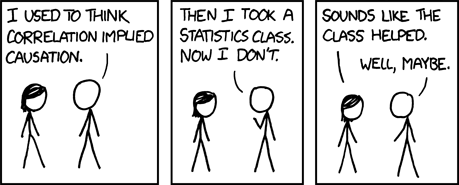 Nou is etniciteit geen gegeven en ‘allochtoonheid’ al helemaal niet. Dat laatste is immers een categorie die door de overheid wordt vastgesteld en niet door de betreffende groep Nederlanders. Dat zelfde geldt voor etniciteit. Turkse Nederlanders kunnen ook Koerdische Nederlanders zijn maar dat onderscheid zult u in beleid en onderzoek zelden aantreffen. Marokkaanse Nederlanders kunnen zich ook presenteren en uiten als Berberse Nederlanders of als Berbers, maar meestal identificeren zij zich en worden zij door de overheid gecategoriseerd als Marokkaan. Het onderscheid ‘wit’ en ‘zwart’ is me overigens hier volkomen onduidelijk aangezien zwart ook gereserveerd kan worden voor alleen Surinamers en Antillianen, maar waarschijnlijk bedoelt men allochtonen.
Dus als er een samenhang is tussen etniciteit/allochtoonheid en schoolprestaties waardoor wordt die dan veroorzaakt? Is het inderdaad minder intelligentie? Waarderen we de schoolprestaties van allochtone leerlingen lager (of juist hoger maar hoe zit het dan nog met die samenhang?)? Welke derde factor zou er een rol bij kunnen spelen? De opvoeding door ouders? De problemen die zouden ontstaan bijvoorbeeld in het geval van Turkse Nederlanders in verband met het debat over islam en integratie (maar voor een afwijkende uiteenzetting zie HIER en HIER)? Met allochtoonheid (tsja lelijk woord en dat allochtoon niet gelijk is aan etnische komaf laten we even voor wat het is) is ook iets bijzonders aan de hand. Die categorie is door de overheid vastgesteld op basis van achterstanden op de arbeidsmarkt en onderwijs. Vervolgens, verrassing!, stellen we al jaren vast dat deze groep een achterstand heeft. Geen wonder dus dat er een samenhang wordt gevonden; maar wordt die samenhang sterker of zwakker over de jaren heen? En waardoor komt dat? En misschien is het wel een combinatie van deze factoren die de samenhang schept, maar alleen stellen dat een samenhang tussen etniciteit en schoolprestaties een causaal verband betekent is een denkfout. Vaststellen dat er een samenhang is, zegt evenmin heel veel; die samenhang moet juist verklaard worden.
Dutch blend – Islam, race, nationalism and buying local in the Netherlands
Posted on January 17th, 2011 by martijn.
Categories: Multiculti Issues.
Rather than a strong sense of national pride, the idea of the moral community seems to be central in opting into the Dutch national project. At the heart of the idea of Dutch nation-state was the notion that every member of society, irrespective of background and religious affiliation, should subscribe to an imagined moral community – an imagined community based upon shared ideas about what constitutes a good and virtuous life.Since the 19th century most of the Protestant groups in the Netherlands (with the exception of a few orthodox Calvinist dissenters between 1830 and 1860 who rejected state interference with church matters) acknowledged the Dutch nation-state as their moral community, linking nation, religion and virtue. The secular regimes of that time promoted the idea of virtuous citizens realizing their moral selves by conforming to prevailing ideas of what constituted a good life and doing good acts on behalf of the welfare of the nation-state. After the secession of Belgium in 1830, the Dutch nation-state became a Protestant nation-state. The threat to the unity of this religious-nationalist community was perceived to come from the Catholics in the south, who were assumed to be more loyal to the Pope in Rome than to the Dutch nation-state (Van Rooden 1996). A new relationship between the nation-state and virtue emerged after the pacification of 1917 that produced the pillar system. The pillar system divided Dutch society into separate groups but also united them in one moral community, effectively replacing the notion of the Netherlands as a ‘Protestant nation’ with the concept of four groups (Catholics, Protestants, Socialists and Liberal-humanists) constituting one moral community. At the end of the 1960s the system collapsed as a result of secularization and individualization rendering the power of churches to mobilize people ineffective and obsolete.
The consequence of the collapse of the pillarized model in the 1960s was the changing of the basis of moral community: the Netherlands was no longer a moral community based upon religious and ideological nationalism. Also the legacy of the second World War discredited strong and overt nationalist expressions and associations. Together with a culturalization of citizenship and integration, during the 1990s the idea of the Dutch moral community was more and more constituted by the of the imagined nation consisting of citizens who find virtue in sexual and secular freedoms. Migrants, and after 9/11, in particular Muslim immigrants and their descendants, increasingly became the ultimate other alledgedly not conforming to the ‘real’ Dutch values and norms and for being loyal to their ‘home’ country or the idea of a world community of Muslims.
Racist, certainly overt racist, are not a strong element in Dutch nationalism. In particular World War II and the holocaust discredited strong and overtly nationalist ideas and expressions and even more so ideas that linked the idea of the Dutch nation with racist ideas. This doesn’t mean that it isn’t part of Dutch nationalism at all. The history of colonization and also the Sinterklaas and Black Pete tradition (partly) prove otherwise. Also it is argued by some that the contemporary critique by populist nativistic parties to a certain extent can be seen as racist as far as it constitutes Muslims as a monolithic group of people that have (a violent representation) of Islam in their genes. We can also find some ideas of race linking to nation in current ad campaigns. Consider the next campaign of the largest Dutch dairy company, Campina. One of their products is the Milner cheese:
The ad is located in a rural area. The voice over tells us that in the ideal world the Netherlands was still one large village. It never was of course, but that is one of the myths about the Dutch past. In this past, as the voice over reminds us, all farmers looked like Rintje Ritsma (a famous Dutch speed skater). All the girls at this farm are blue-eyed, blonde and slim. The fact that they are slim is significant since the theme of the commercial for this cheese is: ‘More cheese, less fat’. Note that there is also one woman in the ad who is a curly dark haired woman named Fatima; a stereotype a the typical Moroccan woman. This voice over startles when he mentions this, apparently acting surprised but then says ‘that is ok too’. (In a recent version ‘Fatima’ is not present anymore).
Another example is the recent campaign of the Dutch tea brand Pickwick (in this case interestingly part of the US company Sara Lee):
The question in this commercial is why there isn’t something called Dutch blend (like English blend) tea. The producers therefore decide to call in ‘real Dutch people’ in order to create a Dutch blend. We see white ‘real Dutch’ people who come the factory by bike to jointly create the new, ‘typical Dutch’, product reviving the idea of the Dutch East Indie company.
In the next Campina campaign there is talk about ‘Dutch’ cows and milk:
In this ad the voice over tells us that we may think that all milk is the same but that more and more milk is coming from abroad. Fortunately, according to the voice over in the ad, Campina milk is guaranteed from ‘our Dutch cows’. (It is not clear to me whether ‘our’ refers to native Dutch, Campina or another party). The farmer in the commercial explains that Dutch farmers take care and feed their cows optimally. The farmer you see in the ad is also a father and a family man, therefore in the ad he states ‘Also as a father I went the best for my family’. The commercial ends with the slogan ‘With Campina you get the best from our country’; country referring to the rural agricultural area as well as to the nation-state. Together with the rise of nativist populism focusing on Muslims, integration of migrants and ‘Dutch normas and values’ we can witness an increasing tendency of people trying to reclaim and resource the idea of closeness, authochtony and authenticity by linking the idea of the nation to an ideal, authentic past and (other) well known stereotypes such as the Dutch as white, blue eyed blonde people. The reason why Campina went along with these ads is that, according to them, there is a tendency of buying local and the urge people feel to buy products that are produced ‘closeby’. Campina is not alone in this. Other Dutch companies do the same such Unox (part of Unilever) and the ‘Old Amsterdam‘ (Gouda cheese) commercials.
The idea of the Dutch moral community that is spread by these commercials differs considerably than the one that is spread by the Dutch government and municipalities for example in the anti-discrimination ads and other campaigns (including commercial ones) that often use images of Muslim women with headscarf.
Now as with every interesting story, this one has a twist as well. One that involves Campina. During one episode of a Dutch newsprogram it was discovered that the Milner cheese is certified halal (by Halal Food).
The product is halal certified (‘even the age-old Dutch cheese’) without consumers knowing it because it is not mentioned on the labels. Consumers thought that this should be on the label so they could make an informed choice. According to a state-secretary consumers have the right to know how a product is prepared, ‘certainly if this has a religious connotation’ and according to another person it is important to know the ‘religious background’ of the product. An anti-islam commentator stated that ‘we do not want things that involve sharia are covered up’. Earlier the populist anti-islam Freedom Party wanted halal food to be removed from the restaurant of the parliament as a case of fighting against Islamization and fighting against ‘the Netherlands adjusting itself to Muslims’. Other parties did not agree, but stated that consumers should be able to make an informed choice. This incident does not in any way however discard what I mentioned above. Campina and other companies try to reach the market as best as possible and in different ways. What matters here is, first, that in the latter incident, or for example in the Pickwick company selling other teas like Turkish Apple and Minty Morocco, does not include the Other in their idea of what constitutes real Dutch. Second these companies sell the idea of an authentic Dutch past based upon, sometimes, racial stereotypes.
All of this may seem trivial but it doesn’t mean that this is not significant. Michael Billig coined the term ‘banal nationalism‘ to direct our attention to the ways nationalism is quietly, invisibly and continuously reproduced in daily life rather then being overtly expressed. The idea of the nation is reproduced in ‘mundane’, ‘routine’ and often ‘unnoticed’ ways. Banal nationalism can be harmless but it can also provide political entrepeneurs with the foundation to mobilize people and to turn this seemingly harmless nationalism into a frenzy; it is the simplicity and pervasiveness that gives banal nationalism its power. The idea of the nation and citizens being prepared to fight for it and take pride in it requires that the sense of nationhood is instilled in us over a lifetime by continuously and in different ways repeating and circulating this idea. Commercial ads, although its makers may have a different intention, are very suited because they come directly in our homes and are often aired multiple times per evening during several weeks. The makers could be right and are probably sincere when they argue that they tap into feelings of buying local but at the same time they reproduce the idea of the local by linking the idea of the nation with whiteness, authenticity and authochtony.
New Book – Muslim Diaspora in the West
Posted on January 13th, 2011 by martijn.
Categories: Important Publications, ISIM/RU Research, Multiculti Issues, My Research, Public Islam, Young Muslims.
 I had the honour of writing a chapter for a new volume Muslim Diaspora in the West edited by Haideh Moghissi and Halleh Ghorashi The book is the product of two workshops, one in Toronto and one in Amsterdam. In my chapter Understanding Dutch Islam – Exploring the Relationship of Muslims with the State and the Public Sphere in the Netherlands, I explore the culturalization of citizenship with the shifting modes of governance of minorities and the secular and the religious in the Netherlands during the last 30 years. This shift with a growing emphasis on cultural integration of migrants (focused on sexual and secular freedoms, tolerance and women’s rights), a defense of secular identity and a more compelling political populism with its focus on the Dutch moral community of citizens, a counter-radicalization policy emerges mainly directed against the Salafi movement.
The Netherlands has often been characterized as an open, tolerant country that changed into the opposite after 9/11 and the murder of van Gogh by a radical Moroccan-Dutch Muslim. It is stated that the secular freedoms of Dutch society are threatened by radical Islam. In this chapter I will explore the dominant model of managing religion in the Netherlands and problematize an unquestioned opposition between the secular and the religious by critically investigating the secularist assumptions of the Dutch state policy of domesticating Islam. A basic tenet of the Dutch model is treating Islam and Muslims as outsiders who do not belong to the Dutch moral community. Combined with recent changes in the public debates about Islam such as going from a consensual style to a confrontational style and the culturalization of citizenship the dominant political praxis of secularism leads to stimulating and integrating a so-called ‘liberal’ Islam while excluding a more assertive version of Islam that is labelled as ‘radical. As such, Dutch secularism does not advocate the complete removal of religion in the public sphere, particular strands of visible Islam are categorized as ‘radical’ and therefore to be excluded from the public domain. One of the main functions of the distinction between ‘liberal’ and ‘radical’ Islam is to create unity among the political elites who are divided over the management of religion but agree that ‘radical’ Islam does not belong to Dutch society.
During my stay in Toronto (and during the flights to Toronto and back) I enjoyed in particular the conversations with Frank Buijs, author of one of the first extensive books on radicalism among Muslim youth in the Netherlands. It seems that sometimes you have to travel to other side of the world in order to have a good conversation with a person who only lives 100km from you. Many thoughts in this chapter emerged during the discussions with him during our flight to Toronto and back. Unfortunately, Frank Buijs died suddenly in 2007. It is to him I dedicate my chapter.
In view of the growing influence of religion in public life on the national and international scenes, the volume Muslim Diaspora in the West constitutes a timely contribution to scholarly debates and a response to concerns raised in the West about Islam and Muslims within diaspora. It begins with the premise that diasporic communities of Islamic cultures, while originating in countries dominated by Islamic laws and religious practices, far from being uniform, are in fact shaped in their existence and experiences by a complex web of class, ethnic, gender, religious and regional factors, as well as the cultural and social influences of their adopted homes.
Within this context, this volume brings together work from experts within Europe and North America to explore the processes that shape the experiences and challenges faced by migrants and refugees who originate in countries of Islamic cultures. Presenting the latest research from a variety of locations on both sides of The Atlantic, Muslim Diaspora in the West addresses the realities of diasporic life for self-identified Muslims, addressing questions of integration, rights and equality before the law, and challenging stereotypical views of Muslims. As such, it will appeal to scholars with interests in race and ethnicity, cultural, media and gender studies, and migration.
Contents:
- Introduction, Haideh Moghissi;
Part I Women’s Agency Within Intersection of Discourses:
- Culturalist approach of women’s emancipation in the Netherlands, Halleh Ghorashi;
- Globalization and women’s leadership in the Muslim diaspora: an intersectional analysis, Fauzia Erfan Ahmed;
- Emergence of a transnational Muslim feminist consciousness among women in the WENAAZ (Western Europe, North America, Australia & New Zealand) context, Cassandra Balchin.
Part II Shifting Notions of Sexuality and Family in Diaspora:
- Multiculturalism and religious legislation in Sweden, Anne Sofie Roald;
- Iranians in Britain, Vida Nassehi-Behnam;
- Changing spousal relations in diaspora: Muslims in Canada, Haideh Moghissi;
- Sexing diaspora: negotiating sexuality in shifting cultural landscape, Fataneh Farahani.
Part III Reflections on Islamic Positionings of Youth in Diaspora:
- Styles of religious practice: Muslim youth cultures in Europe, Thijl Sunier;
- The struggle to stay on the middle ground: the radicalization of Muslims in Sweden, David Thurfjell;
- Young French women of Muslim descent: discriminatory social context and politicization, Sepideh Farkhondeh.
Part IV Diasporic Space and Locating Space: Making homes in turbulent times:
- Moroccan-Dutch Muslims contesting dominant discourses of belonging, Marjo Buitelaar and Femke Stock;
- Understanding Dutch Islam: exploring the relationship of Muslims with the state and the public sphere in the Netherlands, Martijn de Koning;
- Between Iraq and a hard place: Iraqis in diaspora, Jacqueline Ismael and Shereen Ismael;
- Conclusion, Halleh Ghorashi;
Index.
About the Editor:
Haideh Moghissi is Professor of Sociology and Women’s Studies at York University, Toronto
Halleh Ghorashi is PaVEM-chair in Management of Diversity and Integration in the Department of Culture, Organization, and Management at VU University Amsterdam
- Imprint: Ashgate
- Published: December 2010
- Format: 234 x 156 mm
- Extent: 236 pages
- Binding: Hardback
- ISBN: 978-1-4094-0287-9
- Price : £55.00 » Website price: £49.50
- BL Reference: 305.6’97’091713-dc22
- LoC Control No: 2010026830
Muslims and multiculturalism in the Netherlands – A Case of Cultural Masochism?
Posted on January 8th, 2011 by martijn.
Categories: Multiculti Issues.
A fascinating article of John Vinocur in the New York times about the ‘failing integration of its increasinly large and alienated Muslim communities’. According to the writer Europe is in denial about its problems with Muslims. Only when something happens people wake up. He refers to the Netherlands as an exemplary case:
With Muslims, Europe Sees No Problem, and That’s the Problem – NYTimes.com
Then something happens. A conflict comes into focus that, beyond its particulars, raises the question of the ultimate compatibility of Islamic communities in Western environments. An issue that, most comfortably, is kept vague, suddenly demands that Europe — in this case, the Netherlands — draw the line. But where is the line?
What has taken place here is that Frits Bolkestein, the former leader of the Liberal Party, which now heads the Dutch government, has advised “recognizable Jews, orthodox Jews” that their children should emigrate from the Netherlands to Israel or the United States. He said, “I see no future for them here because of anti-Semitism, above all among the Moroccan Dutch, whose numbers continue to grow.”
The remark last month twice shocked the Netherlands.
There was the statement itself, resounding in the context of a national history in which almost the entire pre-World War II Jewish community of 150,000 was wiped out by the Nazis.
More, there was Mr. Bolkestein’s view that the Dutch state was unlikely to deal successfully with the problem and his uncertainty that the Dutch people would demand its resolution. These were matters, he told me later, that reflect his profound and overarching concern about the long-term influence of Muslim populations on all of European society.
This dark vision has particular impact here because of Mr. Bolkestein’s reputation among many of the Dutch as kind of seer concerning Muslim immigration. When he suggested in a speech in 1991 that integration had to mean compromises from newcomers concerning their old identities, he was denounced as a bigot. In the intervening 20 years, large parts of the Dutch political spectrum, and much of Europe’s, have evolved toward a position (closer to his) that regards respect of national law and tradition as more necessary than any further European accommodation to a growing Muslim community.
Concerning the harassment of orthodox Jews in public places, Mr. Bolkestein, who is not Jewish, says that it is an “outrage” and “a tragedy” and that he sees similar circumstances existing in France and Sweden.
Prime Minister Mark Rutte, a Liberal, has responded to Mr. Bolkestein by acknowledging that the problem is one of “great symbolic impact.”
He said of the Netherlands’ anti-Semites, “We stand shoulder to shoulder and stand against these asses.” And, “We want to win society back from the bastards.”
That sounds very much like an admission at the top that Dutch society has been moved or has retreated to someplace it doesn’t want to be.
But Mr. Bolkestein’s pessimism runs deeper. Over the years, he has instead pointed to trends in the country’s population that he believes drive the Dutch/Muslim interface.
Currently, based on official 2006 census figures, the Netherlands Interdisciplinary Demographic Institute estimates Muslims, essentially Moroccans and Turks, represent about 6 percent of the population (with criminality rates among Moroccan youth running about five times that of their Dutch peers). The institute projects the Muslim share of the population will represent 7.6 percent in 2050 — or, with an increased birthrate, 11 percent.
Population growth that is faster than the native population’s, extremists’ murderous plots, sharp-edged disaffection for their adopted countries among third-generation Muslim males, and societies where large segments of the ethnic majority insist they feel increasingly less at home — what should the Netherlands, and by extrapolation Europe, do?
Referring to Germany and France then he states that the ‘School of Acquiescence and Denial’ has some important intellectual followers such as Jurgen Habermas and André Glucksmann. In the Netherlands, according to the author, the leader of the Labor Party is such a proponent he dares to point to the direct of Muslim suffering and exclusion.Because of this denial by these intellectuals and politicians the way has been paved for the far right to take up the ‘Muslim issue’. The article does not offer a solution is to be read more or less as a complaint against multiculturalism but in fact does not really explain what that is. He makes some reference to the fact that the deniers think that there are ‘imaginary conflicts’ and that they think migrants are not supposed to adapt to the majority culture and adopt its customs. An idea former Dutch conservative liberal leader Bolkestein labelled as ‘cultural masochism’.
There is lot to be said about this crappy article. From minor things (Dear author, ‘imaginary conflicts’ does not mean that there are no conflicts, but refers to conflicts with, in this case Muslims, whether we know them or not and/or whether we experienced it ourselves or not) to major things. The author does not take the transformation of the Dutch liberal approach to its non-Dutch citizens and migrants post-9/11, and particularly in the aftermath of the murder of filmmaker Theo van Gogh. There was a shift already in the 1990s in public attitude along with the focus in the media and in politics on the notion of ‘integration,’ and, after 9/11, the emergence of a rude and harsh discourse on multiculturalism, Islam and migrants.
Some researchers and policy-makers viewed the Dutch approach to migrants as a revised form of pillarization: the multicultural model. In particular, the principle of retention of cultural identity is seen as an important feature of minority policy in the 1980s based upon the idea of religious freedom and autonomy. In theory this means that the state should not interfere with the identity expressions of these groups. This idea of Dutch multiculturalism based upon pillarization is not that strange. The pillarized model enabled the state to closely monitor and regulate what religious groups were doing. This model sets the parameters for the continuing participation of religious groups in public life. Nevertheless, perceiving the Dutch integration model as a form of pillarization can be questioned. Others, like Vink make a strong case however argueing that there is no such thing as a pillarized Dutch integration policy, or a multicultural model. Dutch integration policy recognized the importance of cultural identity, but the emphasis always was on integration. Dutch policy reports on integration explicitly denied an unequivocal right for migrants to express their identity and outright rejected a relativist notion of identity. Stimulating activities contributing to the retention of cultural identity were seen as a matter for the organizations themselves and not part of government policy. Another factor is the degree of institutionalization of Islam in the Netherlands which might not be comparable to that of the pillarized system.
The collapse of the pillarization system on the one hand meant an important disadvantage for Muslims in building up an Islamic infrastructure; they could not receive the same funding as churches had in the past. On the other hand, it meant that the Dutch state had to reorganize and redefine its relationship with the churches concerning religious pastoral services to the army, Christian schools, ringing of church bells in public, and so on. Muslims as well as Humanists, Hindus and Jews were recognized as participants and stakeholders in the debates about these matters. Because of their position as outsiders to the Dutch moral community, the presence of Muslims merged Dutch secularism with minority policies to promote the integration of migrants. It has been in particular Dutch minority policies (set up after the violent actions of young Moluccans in the 1970s) and, later on, integration policies that have served to recognize Islam and provide for its institutionalization in Dutch society. The aim was to ‘alter’ the development of a Muslim community towards a ‘more liberal ‘Dutch’ direction, that is, against orthodoxism. As Rath et al. (1999: 61) stated, ‘Officials and politicians wanted Muslims organized in the fashion that was viewed as acceptable and efficient in the Netherlands, i.e., with representative organizations or in coordinating bodies with approachable spokesmen, as if the Muslims in the Netherlands constitute a coherent community’ (my italics). The key issue is, of course, the notion of ‘acceptable and efficient’according to the standards of the Dutch state. The state funded several ‘minority organizations’ and established consultative bodies through which the government would discuss policy issues with representatives of minority groups. Although the formation of a single representative body of Muslims proved problematic over the years, the state managed to co-opt ethnic elites in policy-making structure. Religious freedom and autonomy for religious groups were turned into the principles of integration, with ‘retention of cultural identity’ according to the logic of the integration. Minority groups had the same rights as other ‘identity groups’ as far as public subsidies for broadcasting, education and welfare activities were concerned.
Muslims perfectly adjusted to this system. Statham et al. (2005) show that most claims and demands made by Muslims were acculturative rather than dissociative and controversial. Muslims established Islamic schools, two Islamic broadcasting companies, legal arrangements for halal slaughtering of animals, and special Islamic cemeteries, usually based upon the same principle that guided the pillar system. If Jews and Christians had the right to set up schools, make arrangements for slaughtering, and so on, Muslims had the same rights, too. Denying such rights, it was believed, could possibly lead to politicization and was seen as reprehensible. Foreign influence (through funding)was hindered, although, for example, the Turkish Diyanet met sympathy because, as Rath et al. make clear, it was assumed that their Islam was a ‘liberal’ one compared to others. Much of the institutionalization of Islam in the Netherlands took place in the 1990s. For example, constructing and building new mosques was often supported in a variety of ways. However, these perhaps somewhat idealistic ideas, taken for granted in the 1990s, became discarded after 2001. From 9/11 onwards the newly built mosques were increasingly seen as symbols of Muslim nostalgia and as examples of Dutch culture giving way to Islamization.
In sum, whether the Dutch model of integration policies was multiculturalist or not (I agree with Vink mentioned above for the national policies, but have some doubt with regard to local policies) the situation is certainly more complicated than the author of the New York Times article suggests. In a chapter in a recent book of Haideh Moghissi and Halleh Ghorashi (on which this post is partly based) I explain this in more detail, also referring to the establishment of counter-radicalization policies). The Dutch have tried to incorporate migrants and given Dutch history it was easy for migrants to organize themselves on the bases of religion (instead of on the bases of race or ethnicity such as in the UK). The Dutch government supported that so that they could establish national representatives in a way that fits Dutch model of compromises and negotiations. The Dutch have always tried within that model to monitor and regulate migrant religion into a ‘liberal’ fashion; an approach that has become more compelling with the rise of populist and anti-Islam politicians and an increasing emphasis on cultural integration as a pre-condition for migrants to acquire formal and informal citizenship.
Debate: Sharia's in the West – A Place for religious Laws in Western Democracies?
Posted on December 13th, 2010 by martijn.
Categories: ISIM/RU Research, Multiculti Issues, Public Islam.
Radboud University Nijmegen, the Netherlands, hosted a debate last week on the topic of Sharia(‘s) in the West. In the introduction of the debate, it was said that:
For many citizens of Western countries the concept of Shari’a is tantamount to violation of human rights. For them, religious and secular laws simply don’t go together. Period. No wonder that Rowan Williams, Archbishop of Canterbury, met with criticism and condemnation when, in 2008, he remarked that it would be ‘inevitable’ to adopt elements of Islamic family law into the British legal system.
And yet, only a few decades ago Western countries also upheld religiously inspired laws which provided for matters of marriage, child rearing and divorce. Since then, most of these laws have been abolished or adapted to achieve more individual freedom and a higher degree of equality between men and women. As a result, the whole domain of family law has been secularized en individualized.
Many Muslims living in Western countries find it hard to accept this state of affairs. They take it for granted that family matters must be settled according to religious rules and regulations. They therefore try to achieve some legal autonomy in these matters by appealing to the freedom of religion and anti-discrimination laws. Is this appeal justified? How should a modern secular State respond to the wishes and principles of religious minorities?
I have some doubts about the last paragraph. In the Netherlands there have been no claims to implement Sharia based rules and I this is the case in most European countries and there is a lot of resistance among Muslims about it as well.
In his lecture, John Witte, specialist in family law and religious freedom, gave his views on these matters. Piet Hein van Kempen and Jan Jaap de Ruiter responded.
This compromise on religion and education, forged painfully over a half century of wrangling, has some bearing on questions of religion and marriage. Marriage, like education, is not a state monopoly. Religious parties have always had the right to marry in a religious sanctuary or before a state official. Religious officials have long had the right to participate in the weddings, annulments, divorces and custody battles of their voluntary members. But the state has also long set the threshold requirements of what marriage is and who may participate. Religious officials may add to these state law requirements but not subtract from them. A minister may insist on premarital counseling before a wedding, even if the state will marry a couple without it. But if a minister bullies a minor to marry out of religious duty, the state could throw him in jail. A rabbi may encourage a bickering couple to repent and reconcile, but she cannot prevent them from filing for divorce. An imam may preach of the beauties of polygamy, but if he knowingly presides over a polygamous union, he is an accessory to crime.
However sympathetic I find the essay of professor Witte, I am not convinced of the idea of acommodating Sharia or part of Sharia law in the Dutch legal system. In practice it concerns nearly always family law and exactly in this legal domain there are some very sensitive issues to consider, the most important of which the status of women. Islamic law is not compatible with Dutch law when it concerns women. In numerous instances Sharia holds to her half the authority or power that she accords to Muslim men. In court her witness counts as half a man’s witness. In cases like marriage, children, divorce and inheritance she is in a permanent inferiority position. The way to apply for divorce is so much easier for Muslim men than for women, and inheritance laws foresee half the share of men for women.
Speakers
Prof John Witte is Professor of Law at Emory University, Atlanta, US, and a specialist in religious freedom , history of law and marital law. He is Director of the Center for the Study of Law and Religion, one the world’s largest research programs on religion and human rights. His publications have been translated into several languages. A much sought-after speaker, John Witte was elected Teacher of the Year by students of Emory Law ten times.
Dr Jan Jaap de Ruiter is Arabist at the University of Tilburg. His main interest is in the status and role of the Arabic language and of Islam in Western Europe and Morocco.
Prof dr Piet Hein van Kempen is Professor of Criminal Law and Criminal Procedure and Professor of Human Rights Law at the Radboud University Nijmegen.
Debate: Sharia’s in the West – A Place for religious Laws in Western Democracies?
Posted on December 13th, 2010 by martijn.
Categories: ISIM/RU Research, Multiculti Issues, Public Islam.
Radboud University Nijmegen, the Netherlands, hosted a debate last week on the topic of Sharia(‘s) in the West. In the introduction of the debate, it was said that:
For many citizens of Western countries the concept of Shari’a is tantamount to violation of human rights. For them, religious and secular laws simply don’t go together. Period. No wonder that Rowan Williams, Archbishop of Canterbury, met with criticism and condemnation when, in 2008, he remarked that it would be ‘inevitable’ to adopt elements of Islamic family law into the British legal system.
And yet, only a few decades ago Western countries also upheld religiously inspired laws which provided for matters of marriage, child rearing and divorce. Since then, most of these laws have been abolished or adapted to achieve more individual freedom and a higher degree of equality between men and women. As a result, the whole domain of family law has been secularized en individualized.
Many Muslims living in Western countries find it hard to accept this state of affairs. They take it for granted that family matters must be settled according to religious rules and regulations. They therefore try to achieve some legal autonomy in these matters by appealing to the freedom of religion and anti-discrimination laws. Is this appeal justified? How should a modern secular State respond to the wishes and principles of religious minorities?
I have some doubts about the last paragraph. In the Netherlands there have been no claims to implement Sharia based rules and I this is the case in most European countries and there is a lot of resistance among Muslims about it as well.
In his lecture, John Witte, specialist in family law and religious freedom, gave his views on these matters. Piet Hein van Kempen and Jan Jaap de Ruiter responded.
This compromise on religion and education, forged painfully over a half century of wrangling, has some bearing on questions of religion and marriage. Marriage, like education, is not a state monopoly. Religious parties have always had the right to marry in a religious sanctuary or before a state official. Religious officials have long had the right to participate in the weddings, annulments, divorces and custody battles of their voluntary members. But the state has also long set the threshold requirements of what marriage is and who may participate. Religious officials may add to these state law requirements but not subtract from them. A minister may insist on premarital counseling before a wedding, even if the state will marry a couple without it. But if a minister bullies a minor to marry out of religious duty, the state could throw him in jail. A rabbi may encourage a bickering couple to repent and reconcile, but she cannot prevent them from filing for divorce. An imam may preach of the beauties of polygamy, but if he knowingly presides over a polygamous union, he is an accessory to crime.
However sympathetic I find the essay of professor Witte, I am not convinced of the idea of acommodating Sharia or part of Sharia law in the Dutch legal system. In practice it concerns nearly always family law and exactly in this legal domain there are some very sensitive issues to consider, the most important of which the status of women. Islamic law is not compatible with Dutch law when it concerns women. In numerous instances Sharia holds to her half the authority or power that she accords to Muslim men. In court her witness counts as half a man’s witness. In cases like marriage, children, divorce and inheritance she is in a permanent inferiority position. The way to apply for divorce is so much easier for Muslim men than for women, and inheritance laws foresee half the share of men for women.
Speakers
Prof John Witte is Professor of Law at Emory University, Atlanta, US, and a specialist in religious freedom , history of law and marital law. He is Director of the Center for the Study of Law and Religion, one the world’s largest research programs on religion and human rights. His publications have been translated into several languages. A much sought-after speaker, John Witte was elected Teacher of the Year by students of Emory Law ten times.
Dr Jan Jaap de Ruiter is Arabist at the University of Tilburg. His main interest is in the status and role of the Arabic language and of Islam in Western Europe and Morocco.
Prof dr Piet Hein van Kempen is Professor of Criminal Law and Criminal Procedure and Professor of Human Rights Law at the Radboud University Nijmegen.
Award for anthropologist Jan Blommaert: Language, Asylum and the National Order
Posted on November 30th, 2010 by martijn.
Categories: [Online] Publications, anthropology, Multiculti Issues.
Jan Blommaert has been awarded with the first Barbara Metzger Prize for his article Language, Asylum, and the National Order published in the journal Current Anthropology in August 2009 (vol. 50, no. 4). Jan Blommaert is professor of language, culture and globalization at Tilburg University, the Netherlands and professor in African linguistics and sociolinguistics at Ghent University in Belgium.
The prize has been established by the Wenner-Gren Foundation to be given annually to the article in Current Anthropology that:
Wenner-Gren Announces the Barbara Metzger Prize | The Wenner Gren Foundation
best represents the journal’s longstanding commitment to good writing. Sol Tax, the founding editor of the journal, emphasized that the papers published in Current Anthropology should reach and interest as wide an audience as possible within anthropology, a field with global reach that includes various sub-disciplines. To achieve this aim, Tax set high standards for prose. He sought clear and concise expression of ideas, of fact and of opinion. He welcomed the appropriate use of technical language and discouraged unnecessary jargon.
For many years, Barbara Metzger, the journal’s distinguished copy editor, worked closely with authors to promote these values. The result of her dedicated efforts has been a journal recognized around the world for the lucid and articulate presentation of a wide variety of forms of anthropological scholarship. Following her retirement, the Foundation has created the Barbara Metzger Prize to carry her work forward. It will be awarded annually to the article, report or forum that most fully embodies these standards of writing.
In his article Blommaert probes the way in which officials try to ascertain the authenticity of those seeking asylum in Western Europe:Chicago Journals – Current Anthropology
This paper discusses modernist reactions to postmodern realities. Asylum seekers in Western Europe—people typically inserted into postmodern processes of globalization—are routinely subjected to identification analyses that emphasize the national order. The paper documents the case of a Rwandan refugee in the United Kingdom whose nationality was disputed by the Home Office because of his “abnormal” linguistic repertoire. An analysis of that repertoire, however, supports the applicant’s credibility. The theoretical problematic opposes two versions of sociolinguistics: a sociolinguistics of languages, used by the Home Office, and a sociolinguistics of speech and repertoires, used in this paper. The realities of modern reactions to postmodern phenomena must be taken into account as part of the postmodern phenomenology of language in society.
Blommaert’s analysis suggests that the final decision – which may be a matter of life or death – may come down to judgments about language. His analysis is based upon the case of an asylum seeker from Rwanda, Joseph Mutingra, in the UK. Officials sometimes rely on assumptions about linguistic competence of asylum seekers that may be inaccurate when applied to citizens of often multi-lingual communities. These officials appear to rely on the assumption that the dominant language in the country of the asylum seeker is the standard by which an individual’s application to be evaluated, rendering many asylum applications futile from the start. Mutingira has a low command of Kinyarwanda (Rwanda’s dominant language) because in his childhood he spoke English at home. This is not uncommon but caused the official questioning him to identify him as a non-native speaker. The dominant language is perceived as a neutral standard but Blommaert shows it is based upon questionable assumptions. He urges instead a sociolinguistics of speech and linguistic repertoire more sensitive to the lived experience of the people who are seeking asylum and to link the language that is being used not only to a particular geographic area but also to time (and/or a personal life history) because the relationship between area of origin and use of language is far less clear than assumed – in particular in times of large migration movements and diasporas causing languages to move beyond borders and nations. Particular touching in Blommaert’s account of Mutingira’s story is how language plays an important role in people’s live and their prospects for the future. Mutingra flees after his family has been murdered and because he picks up bits and pieces of languages on the road, he is frequently seen as an enemy with terrible consequences. Mutingra does not fit into the neat categorizations of local standards of language and as a result is ‘exposed’ as suspect every time.
His article is a fine example of good anthropological research and the art of writing while being highly relevant for debates on migration, asylum and migration policies.
You can read the full article here:
Current Anthropology, vol. 50, no. 4, August 2009 – Language, Asylum, and the National Order by Jan Blommaert
Text here is based upon my impression of the article and the press release of Wenner-Gren Foundation and the Dutch press release of Tilburg University
I hereby congratulate Professor Blommaert with a wonderful and fascinating article and for winning this award.
Een wekelijks portie burgerschap 43 – Flower Power Diversiteit
Posted on October 26th, 2010 by martijn.
Categories: Burgerschapserie 2010, Multiculti Issues.
Uit de burgerschapskalender:
“Luisteren naar elkaar. Daar begint het mee. Een ander in zijn waarde laten. En gewoon vragen hoe het met de ander gaat, dat vergeten we vaak.” Gehoord op de discussiebijeenkomst in Leeuwarden.
Luisteren naar elkaar. Dat is een groot goed. Om te beginnen zouden traditionele media en nieuwe media dat eens mogen doen. Maar toegegeven, soms kun je best goed luisteren, maar dat wil nog niet zeggen dat je precies verstaat wat er gezegd wordt. Neem nu de recente toespraak van Merkel over ‘multikulti’
En welke headlines zien we? Check even de Volkskrant, NRC, NOS, FD, Trouw, Elsevier Check ook even enkele blogs: Presseurop, Sargasso, Geenstijl, NRC Experts Blog, Krapuul, Yilli’s, Dagelijkse Standaard, Artikel7, Moslimangst, Arnoudboer. Dames en heren, u zit er allemaal naast. Dat is niet wat Angela Merkel heeft gezegd. Luister nog even heel goed naar bovenstaand filmpje.
Zoals mijn collegae van Language on the Move opmerken zijn twee problemen met het vertalen van de quote van Merkel als ‘Multiculturele samenleving is mislukt’ of ‘Multiculturalisme is mislukt’. Ik splits ze even in drie:
- De kop ‘Multiculturalisme is mislukt’ (of varianten daarop) is een incorrecte vertaling van ‘Multikulti ist absolut gescheitert’. Multikulti is niet hetzelfde als multiculturalisme. Multikulti kan volgens mijn collegae (en ik ben het daar mee eens) het best omschreven worden als ‘flower power diversiteit’. Als u goed luistert is dat ook precies wat Angela Merkel zegt, dat het idee dat we allemaal lang en gelukkig en probleemloos met elkaar samenleven, dat idee is mislukt. De vrijheid blijheid idee is niet Angela Merkel’s idee. En daar zullen weinig mensen het mee oneens zijn, al is vrijheid blijheid best een lief motto.
- De kop multiculturalisme klopt ook al niet omdat Duitsland nooit een beleid van multiculturalisme heeft gehad. Dat kan overigens ook voor Nederland worden gezegd. Integratie met behoud van eigen identiteit was vooral een slogan (zoals vrijheid en blijheid), maar er is nooit enig serieus beleid daarvoor geweest, met hoogstens enkele uitzonderingen op lokaal niveau. Er zijn ook bijna geen claims geweest van allochtonen op speciale rechten voorzover die niet binnen de Nederlandse wet pasten. Er zijn aanpassingen geweest van de wet op het slachten (voor halal-slachten) en voor de Wet op de Lijkbezorging, maar het meeste zoals de vestiging van hindoeistische en islamitische scholen, gebedshuizen, geestelijk verzorgers, enzovoorts paste binnen het Nederlands beleid dat is gebaseerd op de erfenis van de verzuiling (nadrukkelijk niet op de verzuiling zelf!). Toen in Nederland het minderhedenbeleid opkwam (jaren /80) was namelijk al lang duidelijk dat het geen vrijheid blijheid was; het minderhedenbeleid is namelijk ontstaan naar aanleiding van de ontdekking dat gastarbeiders toch echt niet weggingen, maar vooral als reactie op de gewelddadige acties van groepen jonge Molukkers.
- Een tweede punt dat Merkel maakte, en dat schijnbaar toch wat minder is opgevallen, is haar vaststelling dat de islam inmiddels onderdeel is van Duitsland; een bevestiging van wat de Duitse president Christian Wulff al eerder zei. Dat laat zich toch moeilijk rijmen met de idee dat de multiculturele samenleving is mislukt. Ook dat geldt voor Nederland. Allochtone groepen hebben zich op basis van etniciteit en religie een plek verworven in de samenleving, zodanig dat men onderdeel is geworden van het hedendaagse Nederland. Of facties binnen die allochtone (en autochtone) groepen dat nu leuk vinden of niet. Dat gaat gepaard met mooie successen, maar ook met grote problemen. Zo zien we bijvoorbeeld onder Marokkaanse Nederlanders dat de problemen met betrekking tot overlast, criminaliteit, onderwijs en arbeidsmarkt behoorlijk groot zijn, terwijl ook het opleidingsniveau flink is gestegen, steeds meer mannen en vrouwen doorstromen naar hoger onderwijs en zich een plek op de arbeidsmarkt hebben verworven. Het kenmerk is niet het één (de problemen) of het ander (de sociale mobiliteit) per groep, maar allebei tegelijkertijd. De integratie in een multiculturele samenleving gaat gepaard met schuren, fricties, succesverhalen en moed.
Zijn die koppen in de kranten en de blogs nu gewoon een geval van niet goed genoeg luisteren, het Duits niet goed genoeg begrijpen? Of heeft men heel selectief geluisterd en vooral opgepikt: ‘Zie je wel! Daar werkt het ook niet, Merkel zegt het zelf!’?
Closing the week 42 – Featuring the dying of the multicultural light
Posted on October 24th, 2010 by martijn.
Categories: anthropology, Multiculti Issues.
Updated Program Anthropology and/in Publicity « Anthropology & Publicity
The focus of the Anthropology and/in Publicity meeting will be the dissemination of anthropological knowledge to relevant groups in the societies to which anthropologist belong and the societies where they conduct their research. The participants will reflect on the reasons for the underexposure of anthropological knowledge and explore ways to improve its dissemination and application in society.
Most popular on Closer this week:
- Brief van Jason W.: Herziening
- Een wekelijks portie burgerschap 41 – Is uw veiligheid ook de mijne?
- Wilders on Trial Part VI – A case of killing the Messenger?
I’m honoured that my post on Orange Fever appeared in the Four Stone Hearth Anthropology Carnival, time compiled by Judith Weingarten.
- If you want to stay updated and did not subscribe yet, you can do so HERE
- If you want to stay updated about the ISIM Review pages I suggest you do subscribe
- You can follow me on Twitter: Martijn5155
Feature: The dying of the multicultural light
Slavoj Zizek: Far Right and Anti-Immigrant Politicians on the Rise in Europe
We turn now to Europe, where many are concerned about the growing acceptability of anti-immigrant rhetoric and policies. Far from just being expressed by the extreme right wing, the anti-immigrant trend has entered the mainstream. German Chancellor Angela Merkel told a gathering of young members of her conservative Christian Democratic Union party this weekend that multiculturalism has utterly failed. A recent German poll found 13 percent of Germans would welcome the arrival of a new “Führer,” and more than a third of Germans feel the country is “overrun by foreigners.” We speak to the world-renowned philosopher Slavoj Zizek, who has the been called “the Elvis of cultural theory.”
BBC – Gavin Hewitt’s Europe: ‘Failure’ of multiculturalism
In a speech to young members of her party, Chancellor Merkel at the weekend broke a taboo. She said multiculturalism had “utterly failed”.
Up until now mainstream politicians have largely shied away from “identity politics”. No longer. The German chancellor was explicit. “This multicultural approach, saying that we simply live side-by-side and live happily with each other has failed. Utterly failed.”
What did Angela Merkel really say?Language on the Move | Language on the Move
If you read English-language news, you could be forgiven for thinking that Germany’s chancellor Angela Merkel recently came out strongly against multiculturalism and immigration. You could be forgiven, but you’d be wrong!
Anti-Immigrant Nativism Growing in Germany :: racismreview.com
It is not just the U.S. that is seeing a significant increase in anti-immigrant sentiment in the middle of this worldwide capitalistic recession.
Debate about Islam in Germany heats up | Germany | Deutsche Welle | 20.10.2010
Germany’s top-selling non-fiction bestseller is a book that attacks Islam – and the German president can’t get the public to agree with him when he says that Islam is part of Germany.
Turks, Germany and multiculturalism in Europe
German Chancellor Angela Merkel’s statement last week that “attempts at integration have failed” came as no surprise and probably expressed a common feeling felt by many Germans and Europeans.
Dutch welcome Germans to Europe’s immigration debate (Feature) – Monsters and Critics
As far as the Dutch are concerned, the Germans – whom they consider to sometimes be politically behind the times – have finally woken up.
‘Welcome, Germany, to the European immigration debate,’ the Dutch daily newspaper Trouw proclaimed in an editorial this week.
The Netherlands’ dream of a happy, harmonious multicultural society burst on a grey autumn morning six years ago in Amsterdam.
Who’s Racist Now? Europe’s Increasing Intolerance – Joel Kotkin – New Geographer – Forbes
With the rising tide of terrorist threats across Europe, one can somewhat understandably expect a surge in Islamophobia across the West. Yet in a contest to see which can be more racist, one would be safer to bet on Europe than on the traditional bogeyman, the United States.
The Rising Tide of Ethno-Nationalism: Multiculturalism Fails in Europe
Old Europe is dying, and the populist and nationalist parties, in the poet’s phrase, are simply raging “against the dying of the light.”
Angela Merkel’s attack on “Multikulti” was misjudged: many believe it wasn’t even tried – Telegraph
Chancellor Angela Merkel claimed that Germany’s multiculturalism “utterly failed” but many Germans whose parents came from Turkey complain that they have never really been made welcome.
Anti-Immigrant Cracks In Germany’s Fragile Diversity : NPR
Across Europe, economic woes and fears of terrorism are feeding anti-immigrant — particularly anti-Muslim — sentiment. Last weekend, German Chancellor Angela Merkel added fuel to the debate when she said Germany’s attempts to build a multicultural society had “utterly failed.” Host Scott Simon talks to Josef Joffe, publisher-editor of the German newsweekly Die Zeit, about the situation.
Canada’s changing faith – The Globe and Mail
It has been elastic enough to withstand the pressures that have hounded it from birth: the skepticism of Quebec, the racial tensions brought on by non-white immigration.
Yet for multiculturalism, the rise of religion in the public sphere poses a new and more daunting challenge. Criminal prosecutions for honour killings, reports of genital mutilation and incidents of female repression have rocked many Canadians’ sense of tolerance. Across Europe, multicultural policies have crumbled as a result of deepening public suspicion of newly assertive religious groups.
Anthropology
Scholars Return to ‘Culture of Poverty’ Ideas – NYTimes.com
For more than 40 years, social scientists investigating the causes of poverty have tended to treat cultural explanations like Lord Voldemort: That Which Must Not Be Named.
George Tames/The New York Times
The reticence was a legacy of the ugly battles that erupted after Daniel Patrick Moynihan, then an assistant labor secretary in the Johnson administration, introduced the idea of a “culture of poverty” to the public in a startling 1965 report. Although Moynihan didn’t coin the phrase (that distinction belongs to the anthropologist Oscar Lewis), his description of the urban black family as caught in an inescapable “tangle of pathology” of unmarried mothers and welfare dependency was seen as attributing self-perpetuating moral deficiencies to black people, as if blaming them for their own misfortune.
Moynihan’s analysis never lost its appeal to conservative thinkers, whose arguments ultimately succeeded when President Bill Clinton signed a bill in 1996 “ending welfare as we know it.” But in the overwhelmingly liberal ranks of academic sociology and anthropology the word “culture” became a live grenade, and the idea that attitudes and behavior patterns kept people poor was shunned.
Now, after decades of silence, these scholars are speaking openly about you-know-what, conceding that culture and persistent poverty are enmeshed.
“We’ve finally reached the stage where people aren’t afraid of being politically incorrect,” said Douglas S. Massey, a sociologist at Princeton who has argued that Moynihan was unfairly maligned.
Rethinking The Roots of Poverty – The Takeaway
Forty five years ago, Daniel Patrick Moynihan introduced the idea of a “culture of poverty.” The idea has since been derided for describing the urban black family as caught in a “tangle of pathology.” But it never lost its appeal to conservative thinkers.
And wIth one in seven Americans living in poverty today, scholars are revisiting the idea.
The New York Times revisits this today with a look at the controversial idea of a “cultural” explanation for modern poverty issues.
We talk to William Julius Wilson, professor of sociology and social policy at Harvard University, who has always defended the Moynihan report, along with Mario Small, professor of sociology at the University of Chicago.
The Culture of Poverty Debate | Neuroanthropology
I want to focus on the NY Times article, and the popular portrayal of culture and poverty. Unfortunately, this work risks recycling the pernicious effects of the original “culture of poverty” debate – where wrong ideas about “culture” are used to heap blame and twist policy.[…] Culture has been turned into beliefs and perceptions, which Americans view as something highly individual. These people will simply be seen as having unacceptable beliefs.
Pakistan floods rival earthquakes, tsunamis in severity « Know
Abdul Haque Chang is a Fulbright Scholar and graduate student in the Department of Anthropology. He’s working on the issue of governance of water resources management in Pakistan. His major focus is to bring an ethnographic perspective to the issue of waste, scarcity and abundance of water resources management according to different strata of society.
Somatosphere: “Religion and mental health”: a special issue of Transcultural Psychiatry
The latest issue of Transcultural Psychiatry is devoted to “Religion and Mental Health.” Here are the titles and abstracts:
Morals Without God? – NYTimes.com
I was born in Den Bosch, the city after which Hieronymus Bosch named himself. [1] This obviously does not make me an expert on the Dutch painter, but having grown up with his statue on the market square, I have always been fond of his imagery, his symbolism, and how it relates to humanity’s place in the universe. This remains relevant today since Bosch depicts a society under a waning influence of God.
Talking to the Enemy by Scott Atran – review | Books | The Observer
Rather than being brainwashed by militant recruiters, terrorists tend to be ordinary people driven by their peer group, argues anthropologist Scott Atran
Superhero fans, especially those old enough to have opinions, are often divided by their views on the appropriateness of real-world politics in their escapist literature. While many of us regard Dennis O’Neil and Neil Adams’ socially relevant run on “Green Lantern/Green Arrow” to be a superlative example of costumed heroes confronting the hard-hitting issues of the day, just as many readers dismiss it as didactic and inappropriate given the characters’ roots in benign adolescent power fantasies. But what about when real-world issues encroach upon the mild escapism? What happens then?
These issues are being confronted again with “The 99,” a comic about a group of multi-ethnic superheroes with a basis in Islamic culture and faith.
Al-Aqsa Intifada 10 Years Later | The Middle East Channel
This year’s 10th anniversary of the start of the second Palestinian uprising passed with barely a mention in the Israeli, Palestinian and American media. This is not surprising, considering the uprising is widely seen as a disaster for most Palestinians and Israelis, putting the Middle East peace process into a deep and perhaps permanent freeze.
In the Mideast, No Politics but God’s – NYTimes.com
A line was uttered this month by Hassan Nasrallah, the leader of Hezbollah, that drew little notice in between his stentorian asides but said a great deal about politics today for Israelis, Palestinians and the larger Arab world.
To tens of thousands of supporters gathered here to welcome President Mahmoud Ahmadinejad of Iran, Mr. Nasrallah declared that Iran’s Islamic republic “supports the ‘no’s’ that the Arabs declared at the time of late President Gamal Abdel Nasser in Khartoum before many abandoned them. Iran renews these ‘no’s’ along with the Arab nation.”
The Netherlands
What is happening in the Netherlands? (1)- JOOST LAGENDIJK
There is no escape today. I have to write about what is taking place in the country I know best. I arrived in the Netherlands a few days ago, the same day that the new Dutch government was presented. It is the start of a political experiment that will be observed by many inside the country and abroad, out of curiosity by some, with anxiety and concern by many others. For the first time in over 50 years, the Netherlands will be ruled by a coalition government of liberals and Christian democrats that does not have a majority in parliament. It is a minority cabinet that can only survive because it has a deal with a third party, the Freedom Party of extreme-right populist Geert Wilders.
Charlemagne: A false prophet | The Economist
HIS big bleach-blond mane was unmistakable, but this time his mouth, the biggest in Dutch politics, stayed shut. Geert Wilders, leader of the anti-immigrant Freedom Party, is on trial for incitement to hatred and discrimination against Muslims. But when he appeared before judges in Amsterdam on October 4th, this champion of free speech declined to speak.
DutchNews.nl – Opinion: I treasure my heritage
At Geert Wilders trial on inciting hatred and discrimination on Monday, law student Naoual addressed the court on her experiences.
I am a Muslim. I am a Moroccan. I am Dutch. I am a product of the multicultural society. My mother is Dutch. My family on my mother’s side fought the Nazis during the Second World War. Two of my great-uncles gave their lives defending Dutch liberty.
Dutch-Iranian prisoner in isolation cell | Radio Netherlands Worldwide
A Dutch-Iranian woman, Zahra Bahrami, has recently been transferred to an isolation cell in an Iranian prison, according to her daughter.
A key figure in one of Europe’s most infamous Islamic extremist networks has written a public letter renouncing whole swathes of the ideology that led him to try to murder non-believers. On Saturday a Dutch newspaper published what Jason Walters, an imprisoned member of the Netherlands-based “Hofstad Group,” calls a “review document.” The letter offers a window into the mind of a man who dedicated his life to spreading a militant version of Islam, by force when he deemed it necessary. It joins a small but important list of similar recantations, which have become a tool for counterterrorism officials seeking to understand why some people adopt terrorism and, more importantly, why they stop.
Hot in Europe: ‘Governmental Populism’
There is a populist time bomb ticking underneath all postwar political systems. This is very visible in some countries on the European Continent , where populist parties with unprecedented speed move from the margins to the political center. Everywhere new combinations of the center-right aligning with right-wing or radical-right populism pop up. The dominant style of government could be called ’governmental populism’. Governments, claiming to be the voice of (the false unity of) the people, revolt against the postwar European order. Think about Berlusconi and his all-out media war against the Italian juridical system. Think about Sarkozy, who’s presidential-populist ADHD makes the Front National redundant. Think about the anti-minaret Swiss People’s Party, SVP, which is the biggest governing party of Switzerland. Think about Denmark or Austria and Norway in past years.
Since this week, the Netherlands fits into this picture as well.
Misc.
Mass versus Minarets: The Cordoba Controversy – Europe, World – The Independent
Should Spain’s most famous mosque actually be called a cathedral? Dale Fuchs reports on the question dividing a city
Exhibit: Albanian Muslims saved Jews from Nazis – CNN Belief Blog – CNN.com Blogs
With rising anti-Muslim sentiment across the country, an untold story is raising greater awareness about the Muslim faith and the teachings of the Quran. That awareness comes from an unlikely source: a small Jewish congregation in Creve Coeur.
Is It Islamic or Islamist? – Newsweek
Now that even the tolerant, liberal Swedes have elected an anti-Islam party to their Parliament, it’s pretty clear that such controversies are mounting because both the left and the right are confused over the politics of Islam. The left is wrongly defending Islamism—an extremist and at times violent ideology—which it confuses with the common person’s Islam, while the right is often wrongly attacking the Muslim faith, which it confuses with Islamism. Western thinkers must begin to recognize the difference between Islamism and Islam, or we are headed toward an ideologically defined battle with one quarter of humanity.
Intelligent Design Trial Celebrates Fifth Year Reunion | Religion Dispatches
It’s hard to believe so much time has gone by, but this fall marks five years since the six-week trial in a Harrisburg, Pa. courtroom following which federal Judge John E. Jones struck down the teaching of intelligent design in public school science class as unconstitutional, writing that it was merely revamped creationism posing as a scientific theory.
Sometimes I wonder why I am so preoccupied with concerns that are in the states. Right now I’m living in an alternate universe. I’m abroad in an oil rich country where “Fair” equals “Lovely.” All the way across the world, I’m not feeling the reach of many of the containment policies and strategies during this Cold War between Black Men and Black women in America. At this point, I’m joining the non-alignment movement, to focus on development. But I will have my defenses up just in case some missiles shoot my way.
Conversion Story # 643 (not a real number) | Religion Dispatches
These days, when ever you say you are Muslim by choice, you get people asking about your conversion. Mostly they want to know why. This curiosity comes equally from those who are already Muslim and those who are not. I used to tell the same basic steps—although I hardly think my own individual door lights up any bulbs of excitement. Maybe because no lightbulbs went off for me either.
The State of Liberalism – NYTimes.com
It’s a sign of how poorly liberals market themselves and their ideas that the word “liberal” is still in disrepute despite the election of the most genuinely liberal president that the political culture of this country will probably allow. “Progressive” is now the self-description of choice for liberals, though it’s musty and evasive. The basic equation remains: virtually all Republican politicians call themselves conservative; few Democratic politicians call themselves liberal. Even retired Classic Coke liberals like Walter F. Mondale are skittish about their creed. “I never signed up for any ideology,” he writes in his memoirs.
Baroness Warsi told by David Cameron not to appear at Islamic conference | Politics | The Observer
The Conservative party chair, Baroness Warsi, has been banned by David Cameron from attending a major Islamic conference today, igniting a bitter internal row over how the government tackles Islamist extremism.
Warsi, Britain’s first female Muslim cabinet minister, was told by the prime minister to cancel her appearance at the Global Peace and Unity Event, which is being billed as the largest multicultural gathering in Europe.
In veel asielzoekerscentra in Nederland worden christenen bedreigd of mishandeld door vaak islamitische medebewoners. Dat blijkt volgens Stichting Gave uit eigen onderzoek, waarvan de uitkomsten dinsdag waren te zien in het televisieprogramma Uitgesproken EO.
De hoeveelheid feitelijke onjuistheden die in de uitzending naar voren komen, wanneer de feiten en onderbouwing nader worden onderzocht, is schrikbarend.
Gedachten over de netwerkrevolutie en gradaties van betrokkenheid | Jaap Stronks
Malcolm Gladwell serveerde sociale media af: met Twitteren in je pyama verander je de wereld niet – daarvoor is echte betrokkenheid en inzet nodig, stelde hij zo’n beetje; boe weak ties, hoera strong ties. De kritiek op zijn artikel luidde, schrijft ook Ernst-Jan Pfauth: zwakke schakels zijn ook heus belangrijk, kijk maar naar de mobiliserende kracht van Twitter.
Het belangrijkste punt wordt gemist. Sociale media zijn onderdeel van een infrastructuur die bij uitstek *gradaties* van betrokkenheid mogelijk maakt. En die mobiliteit tussen die gradaties faciliteert.
Maghreb Magazine » Netwerk van Vrijzinnige Marokkanen tegen Marokko
Een groep Marokkaanse Nederlanders heeft een organisatie opgericht waarin ze openlijk afstand nemen van de Marokkaanse overheid en pleiten voor een duidelijke keuze voor het Nederlands burgerschap. In religieus opzicht zijn ze vrijzinnig.
Open brief van islamitische CDA-raadsleden aan Coskun Cörüz
Het VVD/CDA kabinet met PVV gedoogsteun is er dan toch gekomen. En dit dan ondanks ons verzet tegen gedoogpartner PVV, een partij die kort gezegd bij de gratie van allochtonen- en moslimhaat bestaat.
Wij, CDA-moslims, zullen ook in de toekomst de uitspraken en stellingnames van de PVV kritisch blijven volgen en niet schuwen om, indien nodig, ons publiekelijk hierover uit te spreken. Het heeft ons, eerlijk gezegd, in hoge mate gestoord dat u tijdens de kabinetsformatie ook geen stelling hebt genomen tegen een gedoogpartner als de PVV.
Ahmed Marcouch over homoseksualiteit en religie
In de moskee vroeg na het gebed een jongen aan mij: ‘Jij verdedigt toch homo’s?’
‘Jongen’ heb ik gezegd, ‘als ik de vrijheid van de homo verdedig, verdedig ik ook jouw vrijheid. Want de vrijheid van de homo is de vrijheid van de moslim. Het is de vrijheid om te kunnen zijn wie je bent, zonder dubbelleven, zonder angst. De vrijheid verbindt ons allen, zoals de lucht dat doet die wij allen inademen. Vrijheid is onze zuurstof. ’
‘Moslims horen er bij, islam nog niet’ – Trouw
Moslims horen bij Nederland, maar de islam nog lang niet. Dat zegt Gert-Jan Segers, directeur van het wetenschappelijk instituut van de ChristenUnie.
Hebt u ook zo’n zin om nu helemaal tot het gaatje te gaan? Het stopzetten van het proces tegen Geert Wilders bracht me in een overwinningsroes. Niet voor lang. Er is werk aan de winkel. De afgelopen maanden zag ik telkens opnieuw kandidaten voor een nieuwe nationale feestdag. Neem dertig juli, door anti-Bruiners juist Zwarte Vrijdag genoemd. Een ware feestdag voor moderne geuzen. De negende juni natuurlijk ook, als de nieuwe D-Day, drie dagen na de eerste. Laten we nog even wachten.
Grenzen aan overheidsbemoeienis : Nieuwemoskee
“Laat ons met rust!” was het antwoord dat met een diepe zucht uit het binnenste van mijn hart kwam op de vraag wat GroenLinks kan doen voor de emancipatie van de moslimvrouw in Nederland. Op zaterdag 9 oktober organiseerde GroenLinks met anderen een conferentie met als titel Godsdienstvrijheid of vrijheid van godsdienst? Eerlijk gezegd ging het hele debat – zoals verwacht – over de islam en over moslims. Volgens Femke Halsema bepalen deze thema’s nu eenmaal de huidige realiteit. ‘Fijn’ dat moslims de aanleiding zijn voor dit debat, maar volgens mij hebben de conclusies wel gevolgen voor alle levensovertuigingen. Het gaat niet meer om de ander, maar om ons allemaal.
Moet je schrik hebben v/d islam? « Rudi Dierick’s Blog
Als echtgenote van een moslima en als adviseur competentie- en diversiteitsbeleid leek het evidente antwoord me ontkennend. Maar een commentaar van mijn echtgenote dwong me dat te nuanceren. Zij heeft namelijk wel schrik, en zelfs grote schrik, van bepaalde stromingen in de islam. Mijn onderzoek ‘Islam, hoofddoek en democratie’ leerde dat die stromingen wereldwijd bijzonder veel macht en invloed genieten. Ze domineren alle scholen voor islamitisch recht volledig. Ze bepalen letterlijk de standpunten van de Conferentie van islamitische Staten. Ze domineren ook de reële standpunten van het Turkse staatsdirectoraat voor religieuze zaken, én haar vertegenwoordigers in Europa, inclusief in de Belgische moslim-executieve. Al die stromingen staan, als puntje bij paaltje komt, op een voorrang van de sharia op het seculier recht. Het Europees Hof voor de Rechten van de Mens oordeelde daarover bijzonder expliciet. Het stelde dat de sharia niet verzoenbaar is met de democratische rechtsorde. Sommige moslims beweren dat er géén tegenspraak zou zijn. Maar dat lijkt me zuivere en doortrapte misleiding. Als je hen dan vraagt dat aan de hand van concrete gevallen -zoals erfenissen- te verduidelijken, dan volgt er nooit een ernstig antwoord (Yousself: aarzel niet!).
Karel Steenbrink’s Weblog: De Apen van Arabist Hans Jansen en zijn verbond met de fundi’s
Jansen benadrukt in dat pleidooi (te vinden op hoeboei.nl) wel dat vrijwel alle geleerden het er over eens zijn dat het in de vroege Medina-periode is ‘neergedaald’, dus aan Mohammed is geopenbaard. Hij zegt er niet bij, dat die hele abrogatieleer door een aantal grote geleerden wordt afgewezen: zou de van eeuwigheid bestaande Koran dan al meteen stevige vormfouten hebben? Dan lijkt het wel op een Nederlandse rechtzaak! Waarom Jansen dan toch die abrogatie zo moet verdedigen? Alsof hij een rechtzinnige moslim is?
De multiculturele samenleving als mediahype. – Leland’s infonubs.com
De multiculturele samenleving als mediahype.
Als er een gebeurtenis is in de moderne geschiedenis die z’n sporen tot op de dag van vandaag heeft getrokken in de geesten van de mensen dan is het wel de Tweede Wereldoorlog. Geen gebeurtenis is meer besproken en geanalyseerd in boeken en films dan juist deze.
Kijkt men naar de onderwerpen die vandaag het politieke debat bepalen: Islam, moslims en de multiculturele samenleving, dan liggen veel van de wortels ervan in de nawerking van de Tweede Wereldoorlog op het politieke debat, vooral voor wat betreft het gedachtegoed van de aanstichter van deze oorlog: Adolf Hitler. De angst om voor fascist te worden uitgemaakt heeft dit debat in feite vanaf het begin verlamd. Wie wil er als slecht mens worden aangewezen, dan nog liever ten onder gaan in multiculturalisme als land.
Deze problematiek, en nog veel meer betreffende het denken over de multiculturele samenleving, snijdt Peter Schlemihl aan in z’n boek Weinkrampf!.
‘Rijssens Stille Oorlog’, dat is de titel van de nogal eenzijdige film die documentairemaker Emile van Rouveroy van Nieuwaal in opdracht van RTV Oost maakte. De première was eind september, tijdens het Nederlands Filmfestival. De documentaire gaat over maatschappelijke, politieke en religieuze verhoudingen in Rijssen.
’Ook zonder de islam blijft zij onderdrukt’ – Trouw
Vrouwen in islamitische landen zijn tweederangsburgers, zegt journalist Rob Vreeken. Maar of dat aan de islam is te wijten? „Het gaat om een hele waaier aan factoren. Religie speelt maar een marginale rol.”
Nee, driewerf nee: we willen geen nieuwe rechters, nieuw proces, nieuwe incidenten en vooral geen nieuwe ronde incompetentie en spierballentaal. Wilders-het-proces aflevering II, mag onder geen beding plaatsvinden, dacht ik gisteren vlak voor vier uur. Het is mooi geweest. Doei!
Herfstmode met ’moslima-power’ – Trouw
Jonge moslima’s gaan weinig uit, maar winkelen des te meer. Zo hebben ze een flinke invloed op het aanbod van kledingzaken. Getailleerde jasjes, fijne wollen vestjes met kralen, blouses met pofmouwtjes: de nieuwe najaarscollectie is vrouwelijker dan ooit.
Opinieblog » Wilders benoemt de ellende en de elite ontkent het
Laat Geert Wilders het maar niet horen. In de Remonstrantse Kerk aan het Museumpark in Rotterdam organiseerden cultuurcentrum Arminius en de Erasmus Universiteit woensdagavond een volledig gesubsidieerde workshop om hoogopgeleide, linkse mensen PVV-retoriek te leren bestrijden.
Hans de Bruijn, hoogleraar bestuurskunde aan de TU Delft, beet het spits af met een analyse van Wilders’ debattechnieken. Het komt neer op framing, zei De Bruijn, die hier het boek Geert Wilders in debat (2010, Boom Lemma Uitgevers) over schreef.
In feite komt bij die voetbalclubs het totale faillissement van de multiculturele samenleving pijnlijk aan het licht. Terwijl de autochtonen dag en nacht, bij weer en wind, bezig zijn van hun cluppie een fantastische voetbalbeleving voor jong en oud te maken loopt de moslimminderheid er de kantjes bij af. Niet of slecht betalen, allerlei misdragingen in de vorm van diefstal en geweld en geen poot uitsteken. Niet in de clubkantine (want, bij de baard van de profeet, daar schenken ze alcohol en serveren ze haram voedsel) maar ook niet als trainer, jeugdleider of wat dan ook.
Wilders-proces: herhaling van zetten | DeJaap
Het Wildersproces draait op volle toeren. En er gebeurt van alles. Ik denk dat geen enkele procedure in Nederland ooit zo van nabij is gevolgd door zoveel mensen. Dit is onze eigen OJ Simpson zaak. Bij ons alleen geen football speler die verdacht wordt van de moord op zijn vrouw, maar een politicus die terecht staat voor wat hij heeft gezegd over moslims en de islam. Het eerste dat mij opvalt in de berichtgeving over het proces, is het bij mijn weten vrijwel totale gebrek aan aandacht voor de procedure die Wilders in 2008 won over … uitlatingen die hij deed over de islam en moslims en de film Fitna. Het vonnis in die zaak is hier te vinden.
Wilders on Trial Part VI – A case of killing the Messenger?
Posted on October 19th, 2010 by martijn.
Categories: Multiculti Issues.
Last Friday, yesterday (Monday) and today the Wilders trial continued. Last Friday was the last day for the Dutch prosecutors. As was to be expected a little bit they sought acquittal on all points of the charge. Maybe surprising for outsiders but note that prosecutors initially declined to press charges against Wilders in June 2008. Prosecutors told the court that Wilders’ statements may be “hurtful” or “insulting” to Muslims, but there was insufficient proof to convict him of trying to polarize Dutch society into antagonistic groups. He has never called for violence. In her summation, prosecutor Birgit van Roessel said Wilders’ statements were made as part of the public debate “about the immigration and integration of nonwestern foreigners, especially Muslims.” “Standpoints can vary considerably and emotions can run high, but … it is a debate that it must be possible to have,” she said.
In one example cited by prosecutors, Wilders wrote in a 2007 opinion piece: “I’ve had enough of Islam in the Netherlands; let not one more Muslim immigrate,” and urged that the Quran be banned. The prosecutors said that statement, like others, was within the legal bounds of public debate. Many of Wilders’ statements seemed to denounce Islam as an ideology or its the growing influence in the Netherlands, rather than being intended as an abuse of Muslims as a people or group, Van Roessel said. At the end of the day Wilders stated “I don’t insult, I don’t incite hate, I don’t discriminate,” he said outside the courtroom afterward. “The only thing I do, and will keep on doing, is speaking the truth.” (copied from Yahoo! News). According to RNW:
Wilders off the hook | Radio Netherlands Worldwide
The prosecutors based their arguments on a few basic principles. In the first place, there is little jurisprudence in Dutch law to fall back on, particularly in the cases of incitement. The jurisprudence on the European level is somewhat broader, including recent cases decided by the European Court of Human Rights against Jean Marie le Pen in France, and Daniel Féret in Belgium. The lawyers cited both cases, as well as a few cases in Dutch courts.
In addition, prosecutors maintained a very close, cautious reading of the law. Statements have to meet very specific criteria to be considered incitement. This is particularly true in the case of a politician taking part in a national debate.
An important argument is that Wilders is campaigning against Islam, and not against Muslims and that he does this within the realm of a broader social debate about integration, immigration and Islam/religion in society. Wilders indeed emphasizes loud and clearly that he is against the Islam and not against its adherents. Several of his ideas appear to show the contrary, but nevertheless it is repeated again and again, becoming a strong soundbite with high degree of resonance. The Supreme Court in the Netherlands has confirmed the relevance of this distinction between religion and religious adherents and this opens up a space for criticism on religion.
It also appears that there is a limit as to the extent in which hurt feelings can be the basis of a hate speech trial. In Bartholomew’s Notes on Religion there is a debate about this based upon a report of Humanity in Action (to whom I talked as well back then):
Netherlands Hate Speech Context « Bartholomew’s Notes on Religion
An organisation called “Humanity in Action” carries an interesting article published in 2000 entitled “The Criminalization of Hate Speech in the Netherlands”, by Ruth Shoemaker and Hadewina Snijders. As they note:
Out of the Dutch ratification of the [1966 Convention on the Elimination of Racial Discrimination] in 1971 came an expansion of Dutch criminal law towards limiting the public expression of hate speech. Because of increasing hate speech in the late 1980s and early 1990s and new waves of anti-Semitism throughout Europe, the Dutch government committed itself to enforcing stricter limitations on racist speech and criminalized Holocaust denial. 1994, for example, marked the first time in Dutch history that political party leaders were personally convicted based on their official party platform when leaders of the Centrumdemocraten party were prosecuted for the espousal of their extreme-right ideology. Additionally, the political party itself was convicted the same year for its racist agenda. Also rooted in a more direct commitment on the part of the Dutch government to limiting and prosecuting hate speech is the difficulty extreme-right groups face when attempting to secure permits for public events and demonstrations…
Anti-Holocaust denial laws, for instance, mean it is illegal to argue against the authenticity of The Diary of Anne Frank.
However, one aspect of the Wilders prosecution case that is particularly troubling is that the charge of “insult” has been added to the allegation of inciting hatred. According to a report on the Appeal Court’s decision:
…most statements are insulting as well since these statements substantially harm the religious esteem of the Islamic worshippers. According to the Court of Appeal Wilders has indeed insulted the Islamic worshippers themselves by affecting the symbols of the Islamic belief as well.
The idea that hurt feelings can be the basis for banning something is of course rather alarming, although the Court adds an important qualification:
As regards the insult of a group the Court of Appeal makes a distinction. In general the Court determines that the traditional Dutch culture of debating is based on tolerance of each others views to a large extent while Islamic immigrants may be expected to have consideration for the existing sentiments in the Netherlands as regards their belief, which is partly at odds with Dutch and European values and norms. As regards insulting statements the Court of Appeal prefers the political, public and other legal counter forces rather than the criminal law, as a result of which an active participation to the public debate, by moslims as well, is promoted.
However, the Court of Appeal makes an exception as regards insulting statements in which a connection with Nazism is made (for instance by comparing the Koran with “Mein Kampf”). The Court of Appeal considers this insulting to such a degree for a community of Islamic worshippers that a general interest is deemed to be present in order to prosecute Wilders because of this.
In itself, then, the decision seems to be an extension of the limitations which have been placed around discussion of Nazism in the Netherlands; but should the case succeed how long will the “distinction” remain in place in the face of further claims of “harm to religious esteem” from all kinds of religious groups, for all kinds of reasons?
Wilders claims that his prosecution is “political”. It doubtless is, and no one is probably more pleased with it than Wilders himself. To return to that essay by Shoemaker and Snijders:
Interestingly, [far-right politician Joop] Glimmerveen reiterates [the] belief that criminalizing hate speech changes the nature of political parties, but he suggests not that the extreme-right becomes more moderate, but rather that other groups that subtly espouse rightest agendas mask these agendas behind facades of liberalism and, in doing so, gain more mass support than extreme-right groups that espouse similar philosophies in a more open manner. As support for this position, Glimmerveen claims that the Volkspartij voor Vrijheid en Democratie (VVD), a liberal party in the Netherlands, holds the same antiimmigrant ideas that the extreme-right Dutch People’s Union espouses, yet the VVD gains more support because in presenting their ideas more covertly, they avoid the stigmas associated with the extreme-right.
And if there’s anyone who’s actually interested in my view, I’ll repeat a point I’ve written before: I favour universal protections for free speech along the lines of the American First Amendment. However, the historic fact is that in most democracies free speech has been balanced against other factors deemed to be socially desirable. Thus some countries have laws against Holocaust denial, to prevent Nazi revivalism; some have laws against blasphemy, to prevent inter-religious strife and to keep the wrath of God at bay; some have laws against mocking the monarch, to avoid possible civil disturbance caused by undermining the established order. Unless you have a society where free speech is treasured as absolute virtue in itself, as we see in the USA, this is hardly a surprising state of affairs. Since intercommunal hatred and prejudice against ethnic and sexual minorities are clearly social evils, the easiest response is (or at least seems to be) to limit freedom to express views that might tend to provoke these things.
The important thing indeed is to understand the different historic trajectories underlying the current state of affairs regarding free speech. It is in particular the perceived social evils that constitute the bases of the complaints against Wilders. Because we are in a court system, the way to address these social evils is to demonstrate that people are harmed by it. It is the principle of harm that makes people having to account for their choice (how) to express themselves. This is what the plaintiffs tried to do on Monday. Muslims: Dutch MP a danger: News24: World: News
“Mr Wilders is a dangerous ideologist who has divided Dutch society,” Naoual Abaida (the complete statement can be read HERE, MdK), a trainee lawyer with a native Dutch mother and Moroccan father, told the court.
“I am asking you to protect me as a Muslim and a Moroccan against Mr Wilders,” she said, referring to his “Islam-bashing” and “insulting, polarising language”.
We are the daily target of xenophobic statements,” Mohamed Rabbae, politician and activist, told the judges as Wilders looked on, occasionally lifting his eyebrows or making faces.“Our children have become unsure about their future (…) in this climate of discrimination, hate and enmity as propagated by Mr Wilders.”
[…]
This in turn caused “anger, bitterness and a deepening of the divide between Muslims and native Dutch”, said Rabbae.
Wilders’ accusers asked for a guilty verdict and a symbolic damages award of 1 euro. Although in particular their lawyers claimed to speak on behalf of all Dutch Muslims, this is not necessarily the case of course. mysask.com – World News
Arson. Attempted arson. Vandalism. Disturbances. Incivility to people attending mosques. Obscenities. Intimidating behaviour — they have all become everyday occurrences” as a result of Wilders’ public remarks, said Mohammed Enait, speaking for an alliance of Dutch mosques that had asked to testify as victims in the case.
Wilders denies inciting hatred of Muslims, and says he criticizes Islam because it’s an ideology that rejects Western values. He says it is not a crime to state what many Dutch voters believe.
Enait said Dutch Muslims have suffered tangible damage as a result of Wilders’ repeated negative remarks about Islam. He said there are countless incidences of “children being cursed at while they walk. Stories from women … who are spit upon, mocked because they wear headscarves.”
Enait, who is from Rotterdam, said the mosque he attended as a child had been burned down.
Dozens of mosques in the Netherlands were burned in 2004 in apparent retaliatory attacks after the killing of filmmaker Theo van Gogh by an Islamic radical who is now serving a life sentence.
Since then, such burnings have become less common but other incidents continue.
The lawyers were not allowed to attack the prosecutor’s tactics and to state that Wilders should be found guilty and punished, which caused a stir when the lawyers continued to do so anyway (many people actually stated that their performance was a farce because of it). When lawyer Enait called Wilders a ‘little Hitler’ (citing former MP Mohammed Rabbae) his lawyer intervened (although stressing that Wilders himself did not object for reasons of free speech). You can find the complete statements HERE (in Dutch).
Today Wilders’ defence lawyer Bram Moszkowicz was up to plead for Wilders. According Moszkowicz Wilders:
AFP: Dutch anti-Islam MP just ‘the messenger’: lawyer
“In his eyes, Islam is a totalitarian ideology,” the politician’s lawyer Bram Moszkowicz told judges of the Amsterdam district court on the first day of defence pleadings broadcast live via the Internet.
“He is trying to prevent violence from being committed with the Koran in hand,” the lawyer said, adding: “Don’t shoot the messenger.”
According to the lawyer Wilders has a right to freedom of speech, even more so because he is a politician. Wilders sees apparent dangers in society and needs to be able to address these. Moszkowicz also stated that the division in this trial is not Wilders versus Muslims, but ‘Dutch people, assimilated Muslims included’ against the ‘sowers of hatred’. He repeated that his client had been denied a fair trial:‘Wilders denied fair trial’ | Radio Netherlands Worldwide
Last year an appeal court ordered the Public Prosecutor’s office to press charges, despite its belief that the MP was protected by the right to free speech.
In his closing address, defence lawyer Bram Moszkowicz argued that this decision showed bias against his client and was tantamount to denying him the presumption of innocence.
I wonder if an acquittal of Wilders would create a paradox given the outline of the Dutch history on free speech given above. There are, with good reasons, restrictions on the freedom of speech and would not an acquittal create the impression that double standards are being applied here? While prosecuting and punishing anti-semitic statements the bigotted and sometimes clearly false statements on Muslims would not be no problem? We will see. Coming Thursday Moszkowicz will conclude his arguments and the verdict is expected on 5 November. I will keep you updated.
What I wrote earlier on this case:
Part III & IV: Wafa Sultan, Power, Freedom & Responsibility
Wilders on Trial Part V – Goodfellas & The Power of Words
Posted on October 13th, 2010 by martijn.
Categories: Multiculti Issues.
The trial against Geert Wilders for insulting groups and incitement to hatred is still going on. Last week we saw the testimonies of supporters of Geert Wilders: Hans Jansen, Wafa Sultan and Simon Admiraal. All three of them were coming to court as ‘expert witnesses’. This is highly questionable since all three ‘experts’ make the same mistake, which becomes clear when we look at Jansen’s statement:
Gates of Vienna: Evidence Given by Prof. Hans Jansen at the Wilders Trial
Amsterdam, May 10, 2010
On his request to: Judge-Commissioner Mr. P.B. Martens, Amsterdam
From: Prof. Dr J.J.G. Jansen, www.arabistjansen.nl
1. Memorandum on the Qur’anic verse 2:256, “There is no compulsion in religion”. The Islam teaches that this verse is ‘abrogated’, i.e. ‘canceled’ by later revelations.
Note: Sura 2, where this Quran verse occurs, is according to friend and foe the first sura that was revealed in Medina. I consider it not possible that the complainants or the Prosecutor can find an Islamic lawyer or an academic Arabist who contradicts this. I regard it therefore as superfluous to spend additional work, time and attention to this issue of dating and chronology. The dating of Sura 2 is widely undisputed. See for example W. Montgomery WATT, Inleiding tot de Koran [‘Introduction to the Qur’an’ —translator], Utrecht, without year, p. 220, top: “All chronological classifications consider sura 2 as the first of the Medinan suras”.
Also the Quran translation by Fred Leemhuis states that Sura 9 dates from Medina (p. 129), and was revealed after Sura 5. Of Sura 5, Leemhuis then says that this was handed down after 48 (p. 77), and so on. Also according Leemhuis, Sura 2 thus is older than Sura 9.
Muhammad, the prophet of the Islam, established himself in Medina in 622, where he died in 632. Sura 9 according to friend and foe dates from a later phase of that period in Medina, in any case, according to most scholars after the conquest of Mecca by the Muslims in 630. There are even scholars who believe that Sura 9 is the last Sura that was revealed in Medina. Any contradictions between Sura 9 and Sura 2 are therefore definitive, in the sense that the rules as laid down in Sura 9, must be the prevailing rules of the Islam and the Sharia.
How can we be so sure that this is so? In Reliance of the Traveller, the oft-mentioned English-Arabic Sharia handbook by Nuh Ha Mim Keller, we read on page 629: “When two primary texts seem to contend, [the judge] gives precedence to: (5) those which supercede previous rulings.” The word ‘previous’ here is crucial for the understanding. This handbook, Reliance, I only mention here because of the fact that in this case it is already more or less known, but there no textbooks on the Islam and the Sharia exist that are made for Muslims by Muslims which state otherwise on this matter.
The principle of abrogation is explicated in the Qur’an itself, it is not the invention of outsiders. Qur’an 2:106, in the translation of Leemhuis: “What ever sign [= Quranic verse, HJ] We abolish or cause to be forgotten, We come up with something better or correspondingly.” ‘Abolish’ is the word with which in 2:106 both Leemhuis as well as Kramers clarify “abrogate”. Qur’an 10:52: “God abolishes”.
Sura 9 dates from the period in Medina (which means: 622-632). It is not the first sura of that period, because Sura 2 is considered as such. In a timeline, Sura 9 consequently is after Sura 2, and Sura 9 consequently abrogates the rules contained in Sura 2, when these are in conflict with provisions contained in Sura 9.
Sura 9:29 contains, in the translation of Leemhuis, the phrase “Fight against those who do not believe in God” and “Do not forbid what God and his Messenger forbid.” This forbidding cannot be made consistent with “there is no compulsion in religion”, 2:256. Forbidding, after all, implies coercion.
The imperative with which verse 9:29 begins, ‘qaatiluu’, is better translated as “beoorloogt” [“waged war on” —translator]. The root ‘qtl’, which the word is related to, means ‘killing’. The specific grammatical form being used here, according to grammarians, could just as well be based on a meaning of “[trying to] kill each other”. The complaining party or the Prosecutor will not find an Islamic legal scholar or scholar of Islam or an academic Arabist who contradicts this.
That this struggle or war at a given moment ends, is in practice correct. In theory the Islamic legal scholars and scholars of Islam nonetheless establish that the duty to wage this struggle will remain until the Last Day. In Reliance, the author states on page 602, the last lines of the page, that the obligation to wage Jihad in the English text:” the time and place for [it]”, remains until the return of Jesus, in the English text: “the final descent of Jesus (upon whom be peace)”.
In this, also, the complaining party or the Prosecutor will not find an Islamic legal scholar or scholar of Islam or academic Arabist who contradicts it. The Islamic legal scholars and scholars of Islam therefore traditionally make a sharp distinction between the ‘the House of the Peace’ and ‘the House of the War’. This distinction is the foundation of Islamic international law. About this dichotomy an extensive literature exists. I can hardly imagine that an academic Arabist or an Islamic legal scholar or a scholar of Islam desires to deceive a court on this matter in public.
2. In the issue that correction of un-Islamic behavior should be done first verbally and then by force:
From the canonical tradition-collection of Muslim (9th century):
[The text below is not read out in court because it is in English, with permission of the defense]
Chapter 21: CONCERNING THE FACTS THAT INTERDICTION AGAINST ABOMINABLE IS A PART OF FAITH, THAT FAITH INCREASES AND DIMINISHES; ENJOINING THAT WHICH IS GOOD AND FORBIDDING THAT WHICH IS ABOMINABLE ARE OBLIGATORY (ACTS)
Book 001, Number 0079:
It is narrated on the authority of Tariq b. Shihab: It was Marwan who initiated (the practice) of delivering khutbah (address) before the prayer on the ‘Id day. A man stood up and said: Prayer should precede khutbah. He (Marwan) remarked, This (practice) has been done away with. Upon this Abu Sa’id remarked: This man has performed (his duty) laid on him. I heard the Messenger of Allah as saying: He who amongst you sees something abominable should modify it with the help of his hand; and if he has not strength enough to do it, then he should do it with his tongue, and if he has not strength enough to do it, (even) then he should (abhor it) from his heart, and that is the least of faith.
Book 001, Number 0081:
It is narrated on the authority ‘Abdullah b. Mas’ud that the Messenger of Allah (may peace and blessings be upon him) observed: Never a Prophet had been sent before me by Allah towards his nation who had not among his people (his) disciples and companions who followed his ways and obeyed his command. Then there came after them their successors who said whatever they did not practise, and practised whatever they were not commanded to do. He who strove against them with his hand was a believer: he who strove against them with his tongue was a believer, and he who strove against them with his heart was a believer and beyond that there is no faith even to the extent of a mustard seed. Abu Rafi’ said: I narrated this hadith to ‘Abdullah b. ‘Umar; he contradicted me. There happened to come ‘Abdullah b. Mas’ud who stayed at Qanat, and ‘Abdullah b ‘Umar wanted me to accompany him for visiting him (as ‘Abdullah b. Mas’ud was ailing), so I went along with him and as we sat (before him) I asked Ibn Mas’ud about this hadith. He narrated it in the same way as I narrated it to Ibn ‘Umar.
[from here on was further read out in court, in Dutch.]
The announcement of hand, tongue and heart is also in the canonical collection of Abuu Daawuud: Kitaab as-Salaat (Al-Khaalidii, Beirut 2007, p. 187 Number 1140) “Who sees a forbidden thing he can change with his hand, let him change it with his hand: and if he can not, then with his tongue, and if he can not, then with his heart, and that is the weakest form of faith.”
I am prepared, if necessary, when the Prosecutor or the complaining party disputes this, to further elaborate these issues.
Yours truly,
Amsterdam, May 10, 2010
What matters most is that he, and the other two (albeit that Admiraal was much more careful than Jansen and Sultan) acted as an Islamic scholar, a shaykh or ayatollah, rather than as scholar of Arab and Islam. They were explaining what Islam is, as if there is an authentic core of Islam. This may be true for believers, but this is not a position a serious scholar should take up. And even in that regard Jansen’s statement is full of errors. I don’t have time to refute every error here but let me take up two issues here. First his reference to the book Reliance of the traveller in which according to Jansen, it is clear that participating in war is an individual duty for every Muslim until Islam will triumph. Jansen knows the debates among Islam scholars about Jihad as a collective or individual duty but doesn’t refer to it. Also in his statement (but not in the version of Gates of Vienna) Jansen declared that it is unlikely that a Morocan boy would ever rob a Muslim from his bag. That of course, as has already been pointed out elsewhere, is a load of crap. First of all it does happen and second he makes this statement based upon his interpretation of Islamic sources thereby linking the written source to a boy’s behaviour. A major sin in serious Islamic studies. The Dutch press failed big time in covering these statements since almost all (!) serious newspapers ran the headline ‘Experts back Wilders’ without questioning it in the subsequent report thereby supporting Wilders’ claim that his views are backed by expert and academic studies. An important claim in his defense strategy because according to him ‘speaking the truth cannot be a crime’.
This week: Summing up
This week is the week of the prosecutor to wrap up their case against Wilders. They will present their findings and a final sentencing plea on Friday. One thing became already clear today. They asked the court to drop the charge that Wilders insulted Muslims as a group. Since his statements are about Islam and not about Muslims, the accusation of insulting Muslims as a group is unjustified and Wilders’ statements are merely opinions that cross the legal threshold. Also the symbolic amount of 1 euro claimed by the organizations behind the complaints was rejected by the prosecutors because it can not be proven that they were damaged in any particular way by Wilders’ statements. The prosecutors also declared that since there was no agreement about the nature of Islam the issue of truth is irrelevant because a Dutch court cannot decide ‘what Islam really says’. While Wilders therefore claims to hold the absolute truth the prosecutors stated that with regard to Islam there is no absolute truth or that it is not up to a court to speak out about that.
Wilders’s Islam views ‘not factual’ – World News, Breaking News – Independent.ie
The case against Wilders is based on dozens of public statements. Typical among them were views he published in an opinion piece in the national newspaper De Volkskrant. “I’ve had enough of Islam in the Netherlands; let not one more Muslim immigrate,” he wrote. “I’ve had enough of the Koran in the Netherlands: Forbid that fascist book.” As recently as August he repeated his view, rejected by Muslims, that Islam is inherently violent and backward. “Our culture which is based on Christianity, Judaism and humanism, is better than the retarded Islamic culture, and this is tough to say, but it is true,” he said in a televised interview. “It is a violent ideology like communism and fascism and we should deal with it that way.”
The charge of inciting hatred and discrimination against Muslims is still on the table and we can expect a final statement on it this Friday. The move of the prosecutors may seem strange, and the lawyers of the complainants already urged the prosecutor to take up their task more seriously, but isn’t necessarily so. During the time of the Fitna affair the police and prosecutors made it easy for Muslims (and others) to file complaints against Wilders. After the affair, however, they refused to prosecute. Then the organizations and individuals behind the first claims went to court to demand prosecution and the court acknowledged that; forcing the prosecutor to take legal action. Because in the first case insulting Muslims as a group was the main accusation, the prosecutors probably felt that they had no chance at all, hence the initial refusal to prosecute followed by dropping the insult charge now. In the mean time however the prosecutors added incitement of hatred to the case which is stronger and may stand a chance (but see below).
Of course the issue of freedom of speech is still on the table. Wilders’s Islam views ‘not factual’ – World News, Breaking News – Independent.ie
Wilders, who polls suggest is the Netherlands’ most popular politician, denies the charges. He says his opinions are protected by freedom of speech and endorsed by more than a million people who voted for him in national elections last June.
Without addressing any of Wilders’ specific remarks, Ms Van Roessel said freedom of speech has limits. “You can expect a politician to be aware of the impact of his words and in any case, the legal limit may not be crossed, no matter how important it may be to address supposed problems and to contribute to matters of general interest,” she said.
Ayaan Hirsi Ali in an op/ed in the Wall Street Journal this week also stated that free speech is on trial. She also stated:
Ayaan Hirsi Ali: In Holland, Free Speech on Trial – WSJ.com
In the national elections held in November 2006, his party won nine seats in parliament. When the Dutch government fell again this year, June elections saw his party take 24 seats in the 150-seat body.
This has spooked Dutch parliamentarians, particularly those wedded to multiculturalism. That’s why, in the fall of 2009, they modified Article 137C and 137D of the Penal Code to make it possible for far-left organizations to take Mr. Wilders to court on grounds of “inciting hatred” against Muslims.
Article 137C of the penal code now states that anyone “who publicly, verbally or in writing or image, deliberately expresses himself in anyway insulting of a group of people because of their race, their religion or belief . . . will be punished with a prison sentence of at the most one year or a fine of third category.” It continues: “If the offense is committed by a person who makes it his profession or habit, or by two or more people in association, a prison sentence of at the most two years or a fine of fourth category will be imposed.”
This is not true however. It seems that Ayaan Hirsi Ali is mixing up the debates about the court case with the debates about blasphemy. The Christian-Democrats wanted to ‘save’ the blasphemy notion in the law by doing away the specific article about blasphemy and at the same time extending article 137C. This debate is still going on and no decisions have been made yet (and I don’t expect it to happen in the near future).
With regard to the freedom of speech and incitement to hatred perhaps the distinction between inflammatory statements about Islam and about Muslims perhaps matters as well:
Islam in America – The Daily Princetonian
It is one thing to say “Muslims are terrorists” and something different to say “Islam is incompatible with Western values” or even “Islam is wrong.” Take Martin Peretz’s infamous commentary in The New Republic: “Muslim life is cheap, most notably to Muslims.” To begin with — because it is not clear to me that this is universally accepted in Western Europe — Peretz ought to have the right to say this. He does have the right to say this, under American law. Nonetheless, he ought not to exercise that right because the commentary is unconstructive, uninformed, unhelpful and an attack on persons rather than ideas: much like the average submission to the ‘Prince’ website.
By way of contrast: To say “Islam is incompatible with Western values” advances a serious debate, not least because it requires us to ask, “What is Islam?” and “What are Western values?” For example, in 2007 roughly one-third of young British Muslims believed that conversion from Islam is forbidden and punishable by death. (Intriguingly, only one-fifth of their grandparents held this view.) If we assume — as I do — that freedom of religion is an authentically Western value, then that particular definition of Islam is incompatible with Western values. Unfortunately, it is hard for anyone who is not a Muslim to state categorically, “This is Islamic, this is not.” Like Protestantism, Islam lacks a centralized body to interpret its sources of religious authority: While there are prominent leaders whose decisions guide the practice of millions, it tends to be the violent fanatics who claim that they are the only legitimate voice of Islam.
Then, again, Wilders could probably escape a sentence because again it is not possible, for a court, to establish what is Islamic and what is not. But one could also argue that stating that Islam is a violent ideology like communism and fascism and we should deal with it in that way, is so inflammatory that it crosses the boundaries of the freedom of speech. Since in the past we did not struggle against communism and fascism peacefully but by (cold) war, the statement can be seen as a call to war against Islam which inevitably means a call to war against Muslims. But Wilders is a politician and perhaps politicians should be given some leniency in this regard:
Pickled Politics » Why the trial against Geert Wilders is wrong
If we ignore, for the moment, the fact that Wilders’ advocacy of free speech is in direct conflict with his calls to ban the Quran, there should be no doubt that he is entirely within his rights to express his opinion – disagreeable or “politically incorrect” as they may be.
The hegemony of political correctness and a reluctance to offend has resulted in an insidious oppression of opinion. It seems that the global epidemic of cultural and religious hypersensitivity, spawned by critics of Rushdie over 20 years ago, is now a dominating force of politics.
The danger is that, by skirting around or censoring cultural and religious issues for fear of offending, we are left with stilted debate and analysis.
We will have to wait until the final verdict is out. Wilders already can prepare himself for a new court case since ‘Salafi’ imam Fawaz filed a complaint against him. In the film Fitna Wilders used footage showing the imam and according to the imam he did not give permission (which is necessary under Dutch law but with some exceptions).
The current case is a difficult one. A case that also shows that not everyone has an equal say in establishing what words mean and what the possible (and verifiable) consequences are of the meanings of these words. In part III and IV I referred to what Kerim Friedman wrote about joking. I want to highlight again because it is relevant and the ‘funny guy’ scene of Goodfellas Friedman shows is very telling:
The Joke’s on You – Society for Linguistic Anthropology
A joke is only a joke to the extent that your audience accepts it as such. If, instead, they choose to get offended, or take it seriously, it requires a lot of work on the part of the speaker to explain that the statement was meant as a joke. In such a case there are a range of possible outcomes: the audience might accept that it was a “bad joke” and leave it at that, or they might refuse to except the claim that the statement was intended as a joke.
Here is a famous scene from the movie Goodfellas in which the character played by Joe Pesci exerts his power by choosing to get offended at the fact that his joke was considered funny.
He eventually relents and admits he was joking, but only after he’s made everyone nervous.
In this case we can say that at the moment it is neither the audience nor the politician who decides what constitutes insulting and incitement. Although feeling insulted is a very personal issue it is now taken out of the hands of the individuals. The strategy of the prosecutor appears (until now) to be not to decide upon the issue of insulting thereby referring it back into the public debate where politicians are the most powerful. The decision about the more dangerous allegation (the power of the word insult seems to be limited in this case) of incitement to hatred is still in the hands of the prosecutors and also taken away from (or given away by) by the people who launched the complaints. Friedman’s point, although perhaps a little to homogenizing with regard to the state, stands: the case is also about who gets to decide what words mean. That, and not the possible limitations of the freedom of speech, makes this case so fundamental and important in relation to the freedom speech.
What I wrote earlier on this case:
Part III & IV: Wafa Sultan, Power, Freedom & Responsibility
- The Koran: Don’t burn it. Read it.
- Late Night: Center for Security Policy’s Report – Boykin-Blessed Anti-Muslim Propaganda
- Stoning Highlights Extremism of Taliban
- Letters: First Amendment collides with Islam
- Prelude to the Great War in Islam
- Understanding and Adultery Laws
- Jihad
- Islam, Islamism, and Moderation

PseudoJournalisten en PseudoDeskundigen over Wilders
Posted on October 7th, 2010 by martijn.
Categories: Multiculti Issues.
Hoe krijg je dat toch voor elkaar? Je laat een paar mensen voor je getuigen die je hebt aangewezen als deskundigen. En wat zeggen de koppen? Of het nu Trouw, GPD-bladen zoals ED, De Limburger en Stentor, of NU.nl, AD, Spitsnieuws, Parool, DePers, Wereldomroep, Telegraaf, of Elsevier is, allemaal hebben ze de kop ‘Deskundigen steunen Wilders’ of varianten daarop. Nou hebben Hans Jansen, Simon Admiraal en Syrisch-Amerikaanse psychiater Wafa Sultan best wat te melden over islam en moslims, in feite zijn het nep-deskundigen op dit gebied. Met uitspraken als deze:
- De Koran bevat meer anti-semitische passages dan Mein Kampf (Jansen)
- Er is maar één islam. Er bestaan wel gematigde moslims (Jansen, op de stelling dat er geen gematigde islam bestaat)
- Het is de bedoeling dat andere godsdiensten ondergeschikt worden aan de islam (Admiraal)
En bijvoorbeeld de stelling van Admiraal dat letterlijk (!) genomen Wilders’ stelling dat de Koran aanzet tot haat klopt en dat de Koran gewelddadig is omdat hij niet geweldloos is. Het valt allemaal onder dezelfde categorie; uitleggen wat de islam is en hoe de Koran gelezen moet worden. Dat geldt ook voor Sultan die vindt dat de Koran een vermenging van politiek en religie is (en dat is erger dan Mein Kampf want dat is alleen politiek…). Nog afgezien van opvallende onjuistheden (bijvoorbeeld in het boek van Jansen, Islam voor varkens, volgens hem een benaming voor ongelovigen en joden, een interpretatie die door vrijwel geen serieuze exegese wordt aangehangen en in plaats daarvan wordt gezien als een benaming die slaat op een volk dat wordt gestraft voor ongehoorzaamheid aan God) gedragen deze mensen zich dus als schriftgeleerden, ayatollah’s of ulema die anderen uitleggen hoe de islam geïnterpreteerd moet worden. Enige serieus wetenschappelijke pretenties heeft het recente werk van Jansen en Sultan niet (Admiraal’s werk ken ik niet goed genoeg en hij bleef redelijk voorzichtig) en valt als het gaat om islam en moslims eerder in de categorie pseudo-wetenschappelijke charlatanerie. Let wel, als mensen dit willen doen, Koran exegese, by my guest en geef je er vooral aan over. Dat is pech voor moslims misschien, maar moslimhobbyisme is nu eenmaal een belangrijk gezelschapsspel geworden en die geest gaat voorlopig echt niet meer terug in de fles. Dus wen er maar aan. En reageer er maar op als je wil. Het is ook geen probleem dat dit gedoe in de rechtszaal aan de orde komt, hoewel ik me afvraag hoe diep een rechtbank kan gaan in koranexegese en theologische bespiegelingen over de islam om vast te stellen wat nu de juiste interpretatie is. Natuurlijk kan het geen kwaad om te laten zien dat Geert Wilders ook steun krijgt voor zijn opvattingen. Maar deskundigen zijn het niet. Nu hoeft de pers ook mijn mening hier niet klakkeloos over te nemen, maar dat ze zonder voorbehoud aanneemt dat het wél deskundigen zijn, lijkt mij een typisch voorbeeld van domheid, luiheid en slordigheid. Had men haast om met nieuws te komen? Je vraagt je af wat die journalisten daar de hele dag doen als ze elkaar allemaal nablaten door een ANP of Novumberichtje over te tikken.
Wat had er dan wel moeten gebeuren? Rechters hadden aan echte deskundigen de volgende vragen kunnen stellen:
- Is er een verband tussen de islam en het gebruik van geweld? (Antwoord: in zijn algemeenheid, nee er is geen causale relatie tussen iemands geloofsopvatting en het uitoefenen van geweld. Voor een kwalificatie daarvan zie HIER).
- Zijn de interpretaties van de heer Wilders over islam gangbaar? (Antwoord: nee ze gaan in tegen gezaghebbende mainstream interpretaties, maar er zijn wel groepen en geleerden die ze zouden kunnen ondersteunen)
- Hoe groot is die groep die dergelijke interpretaties wel aanhangt? (Antwoord: in precieze aantallen: geen idee. Het lijkt een minderheid te zijn, maar wel een krachtige en invloedrijke minderheid door het gebruik van geweld en een imago als verzetsstrijders en het proces van radicalisering erg ingrijpend is)
- Geeft de film Fitna een adequaat beeld van interpretaties van islam en de ontwikkelingen met betrekking tot, wat de heer Wilders noemt, islamisering? (Antwoord, nee, zie HIER).
- Is er, zoals de heer Wilders stelt, sprake van een dreigende ontwikkeling als gevolg van door de groei van het aantal moslims in Nederland (Antwoord, nee in zijn algemeenheid niet. Voor een nadere uitleg zie HIER zonder in te gaan op de vraag of dit bedreigend is of niet. Dat is een persoonlijke interpretatie en/of politieke beslissing).
- Is er sprake van islamisering zoals de heer Wilders stelt? (Antwoord: er is sprake van een inbedding en institutionalisering van de islam in Nederland die zich vooral in de jaren negentig al voltrokken heeft. Of dat ook dreigende potenties in zich heeft in de zin van een islamitische overname en daarmee gepaard gaand geweld en intolerantie, in de opvatting van de heer Wilders, is vooral een politieke inschatting. Een wetenschapper kan zich daar beter niet in mengen.)
- Wat zijn de interpretaties over de scheiding kerk-staat binnen islam? (Antwoord: dat moet u niet aan mij vragen, in zijn algemeenheid kan ik er wel wat over zeggen, zie HIER).
- Hoe kan de omgang van de heer Wilders met de islam getypeerd worden? (Antwoord: als een moderne schriftgeleerde die grossiert in tautologische redeneringen en scripturegnosis met als doel mensen te mobiliseren, de maatschappij te veranderen en het politieke establishment aan te vallen. Of zijn interpretatie de enig juiste is, zie één.)
- Is er maar één islam? (Antwoord: het gros van de moslims zal wellicht ja zeggen en dat geldt ook voor de schriftgeleerden. Wetenschappelijk valt dit niet vol te houden wanneer we kijken naar de geleefde islam. Ook over doctrines zoals jihad – die ook in de mainstream voorkomt – is geen overeenstemming en dan laten we stromingen als Soenni, Shia en Ahmaddiyya islam nog maar even buiten beschouwing.
- Is de islam gevaarlijk voor de samenleving of de ideologie van de heer Wilders? (Antwoord: Geen van beiden valt met ja of nee te beantwoorden. Dat hangt ervan af hoe mensen het interpreteren en wat men ermee doet. De precieze consequenties van een leer op het gedrag van mensen – in de zin van een causale relatie – zijn niet of nauwelijks vast te stellen en hard te maken. Er zijn teveel factoren die eveneens een rol spelen zoals: geslacht, sociaal-economische positie incl. opleiding, sociale inbedding, persoonlijke geschiedenis, enzovoorts). In feite geldt voor zowel de PVV ideologie als de islam of welke andere religie of ideologie dan ook hetzelfde als hiervoor al is gezegd voor de relatie tussen islam en geweld.
Maar dat is de ideale wereld. Waarin journalisten wel kritisch nadenken en niet zomaar ANP stukjes bakken en komen met neutrale koppen zoals Verklaringen Wilders Supporters.
Zie hier de getuigeverklaring van Hans Jansen:
Deel 1
Deel 2
Wilders on Trial – Part III and IV Wafa Sultan and Power, Freedom & Responsibility
Posted on October 4th, 2010 by martijn.
Categories: Multiculti Issues.
UPDATE: Wilders Right to Remain Silent – below
Today the trial against Geert Wilders starts again. For more about its background, see Part 0, Update, Part III. This update starts with the third pre-trial hearing last July where Wafa Sultan gave her testimony. You can see an interview with her on Dutch TV:
Wafa Sultan gained her more than 15 minutes of fame (or shame according to some) when she came on al-Jazeera and attacked Islam:
Like the other witnesses before her, Wafa Sultan claims Islam is essentially a violent religion striving to conquer and submit the free world. She is not against Muslims as she claims (like Wilders does as well) but the question of a particular Muslim is dangerous depends (in her view) about how deep their religiosity is. If, according to her, the person is very pious and so on, then (given the violent nature of Islamic teachings) the person is dangerous. If the person however appears not to be very pious, one still has to consider the possibility that he is playing tricks and deceives you with his moderate outlook.
Anthropologist Gabriele Marranci has explained quite clear why that argument does not add up:
Why Pastor Jones (together with similarly minded people) believes in tautological Islam « Islam, Muslims, and an Anthropologist
a perfect example of how many Americans, Australians, and Europeans today construct the discourse of Islam and form their epistemologies about it. If we analyze both the “International Burn a Quran Day” together with the many polemic arguments over the (not in) Ground Zero mosque in New York, we may find some strong epistemological similarities between the discourse of Islam these people propose and the discourse of Islam that some Muslim extremists propose. The people involved in these actions embrace the idea that Islam is a ‘thing’, or better, a conceptual phenomenon representing a material reality.
Consequently, these individuals think that attacking what they perceive as prominent symbols of Islam, such as the Qur’an, mosques and minarets, or protesting and parading with dogs and pigs, may have a nearly magical, exorcising and ‘desecrating ’ power against that ‘thing’ Islam, which in their minds symbolizes evil incarnate.
[…]
What Bateson, through this example, wished to emphasise is that ‘things’ do not have qualities per-se. They are not ‘agent’ in themselves, but rather they are produced within a dynamic of relationships, both internally and with other “things” of the same category, as well as with the actor or agent ‘making’ them in the process.
Islam, as a “thing”, does not have, of course, qualities and attributes, since it can only be produced (for Muslims of course, by God, and for others maybe by the devil or by humans). Islam is different from other realities (such as “peace”, “war”, “violence”, “terrorism” or even “shari’a”) and it is made ‘real’ only through the way in which people make sense of it, both in thought and action. This means that Pastor Jones and its followers become, in a certain sense, akin to Muslims themselves, albeit per negationem, since they engage in ‘making’ Islam, in believing that Islam is a ‘thing’, and thus ‘defining’ Islam.
But what kind of ‘Islam’ do these people make? To use prototypes to illustrate, both bin-Laden (the terrorist) and Pastor Jones (the Qur’an barbecuer) not only share the fact that they believe that Islam ‘has’ qualities and attributes in an active form, but they also express it through the same system: connecting description and explanation through tautology.
Tautology, in the simplest terms, states that ‘if P is true, then P is true’. In other words, as Bateson explains, ‘all that the tautology affords is connections between prepositions. The creator of the tautology stakes his reputation on the validity of those connections’ (Bateson, p. 77). Tautology contains no information whatever and the explanation which derives from it contains only information provided by the description.
If we look carefully on how, for instance, bin-Laden and Pastor Jones describe and explain Islam we can easily recognize a tautology. Indeed, the basis of what Pastor Jones says is, ‘If Islam is evil, then Islam is evil’ and for bin-Laden the message is ‘if Islam is Jihad, then Islam is jihad’. Logically we can consider both of them, alongside the many whom make Islam through the same epistemological processes, strong believers in tautological Islam.
Their tautology is based upon a particular treatment of Islam and the Quran that produces more or less the same effects as the tautology:
“Islam is evil”. “No! Islam is peace”: The fallacy of the ‘scripturegnosis’ argument « Islam, Muslims, and an Anthropologist
Let me say that the reason may be found in a fallacy that I have started to call scripturegnosis. It sounds a bit like the name of a disease, and although it is not, it is still very pernicious and has been with us for a very long time. It is linked to strong forms of ‘culturalism’, in which the culture, as a symbolic object, is supposed to be capable of shaping and controlling the human mind. Scripturegnosis refers to the idea that a text may be able to control the individual and collective behavior of those whom see it as an inspirational or holy text. In our case, scripturegnosists will hold that something called “Islam” exists per-se as a result of its texts, particularly the Qur’an in this case. Indeed, it is not a surprise that Wilders asked for the ban of the Qur’an (compared to Adolf Hitler’s Mein Kampf).
[…]Our brain, memory and sensory system interpret and alter the reality around us. Emotions, feelings and personal Self modify and make one’s own the circumstantial realities, and among these realities are texts, particularly ‘holy’ ones. Indeed, to illustrate, a person needs only to have some particular parts of his or her brain damaged, and depending upon the area affected, interpretations of texts (both the ‘holy’ and the ordinary) may be significantly altered. Whoever has had the sad experience of knowing somebody affected by Alzheimer’s knows this fact all too well.
Muslims, as any other believers, read (presuming those who read beyond passive recitation) and understand the Qur’an according to their individual psychological and environmental realities that fully influence, together with local traditions and superstitions, their understanding of the text. Even within the same tradition, there exist as many interpretations of the Qur’an as there are readers. Indeed, if the Qur’an were to exert any ‘influence’ upon people, it could only be by means of the trust placed in a religious leader or theologian rather than in the book itself – influence, then, can only ever be purely mediated.
This line of reasoning is far from innocent when we look at how conflicts emerge. Rhetoric such as this reduces the multidimensionality of the lives of Muslims and non-Muslims, making one dimension all-encompassing and primordial while obscuring other dimensions and their mutual influences. A collective action frame, aimed at mobilizing people is constructed in order to influence people’s perception of particular events and meanings attributed to those events. If one applies it often enough and when it resonates among people because it appears to be logical and self-evident given particular processes and events people have experienced, such framing works as a mental shortcut that provides people with an effective and efficient way to deal with information. It is a form of persuasive communication used by political and religious elites prior to and during conflicts attempting to mobilize people for collective action. In this case the idea of Islam as a threat is the central organizing idea by which particular incidents and statements are qualified as examples of Islamization. Wilders’ statement last Thursday was very important in this regard. The new government backed by Wilders’ PVV, wanted to build bridges and has as a motto: Freedom and Responsibility. Wilders stated that this motto was not has and ‘I’m not really a building-bridges-type-of-guy’. The other central organizing idea is ‘freedom’ but he talks about a particular kind of freedom. A striking example is his last statement about the upcoming trial:
A terrible day tomorrow: start of the actual political trial. With me the freedom of speech of at least 1,5 million people is on trial
A trial like this however has much more consequences than his own freedom of speech and that of his followers (the at least 1,5 million people according to him, based upon the last elections). It is about the limits of freedom of speech for 17 million people (all inhabitants of the Netherlands, including Muslims and migrants) and, more in particular, the limits for politicians. He only stands up for the freedom of speech of himself and his followers while trying to curtail the freedom of others: Muslims and migrants.
The tautological and culturalist line of reasoning is highly relevant for the trial that will start again today. As Marranci explained those people using this particular frame are in fact becoming theologians trying to interpret and explain Islamic doctrines. One particular line of defense Wilders’ lawyer will use is trying to establish the truthfullness of Wilders’ statements. The idea behind this strategy is is (based upon earlier Dutch and European cases) that a statement that is true cannot easily be banned as (for example) incitement to hatred. But this defense would also mean that the court has to decide if a particular interpretation of Islam is true or at least holds some truth. This will be mean that the judges become theologians as well. In the past most judges have refrained from doing that or only did that very superficially. I’m not a legal expert but I see some difficulties for the judges here.
The trial also will make something clear about the issue of power. In a great entry anthropologist Kerim Friedman wrote about a the #twitterjoketrial in which a man tweeted about an airport and his tweet was seen as a threat. He claimed he meant it as joke (Dutch readers will inevitably think at #brussengate in which a Dutch blogger was questioned by the police because he re-tweeted a statement on twitter that was deemed threatening as well. The original writer claimed it was meant to see what kind of reactions such a threat what yield. The blogger wanted to show what kind of statements people make on twitter in a post with the headline ‘this is how to threaten Wilders’. Kerim states that the twitter case he blogs about raises questions about the nature of language:
The Joke’s on You – Society for Linguistic Anthropology
Just as the printing press blurred the boundary between public and private with the mass publication of diaries and letters, so too have web services like Facebook and Twitter made public discourse which authors originally intended for a small group of “friends” and “followers.”[…]It is also one about the very nature of meaning. Many people seem to believe that meaning resides in our heads and is merely expressed through language, which operates as a transparent medium communicating our thoughts to the outside world. Linguistic anthropologists view the construction of meaning very differently. For us the construction of meaning is a social process. It is something that is negotiated through the very act of discourse. A joke is only a joke to the extent that your audience accepts it as such. If, instead, they choose to get offended, or take it seriously, it requires a lot of work on the part of the speaker to explain that the statement was meant as a joke. In such a case there are a range of possible outcomes: the audience might accept that it was a “bad joke” and leave it at that, or they might refuse to except the claim that the statement was intended as a joke.
There are two relevant points for the Wilders trial. First of all it seems self-evident that Wilders makes his statements in public. But it also is very telling. Years ago politicians would not dare to make the statements he uttered in public out of fear of becoming labelled as racist and xenophobic and being relegated to the lunatic fringes of politics. Now they have become more mainstream, but still they are remarkable. What Wilders does with such statements is to produce an event, a debate about him and his statements, making sure he will be on top or even deciding the public agenda. The ensuing public debates about his statements, plans and strategies are as much part of the Wilders’ spectacle as Wilders’ and his actions.
The second relevant point is that Friedman makes clear that not everyone has equal power in deciding what particular words mean. Wilders claims that his freedom his attacked by the trial; for the people who started the trial with their complaints (Muslims and non-Muslims) it is a strategy to have a stronger position in the negotiations over what is allowed in contemporary society and what is not. For Wilders it is a (forced) attempt to remain master over his own words. Ultimately, as Friedman also makes clear, it is the state who decides in the trial. The fact that many, even those opposing Wilders, deplored that Muslims and others went to trial (and forced the state to do this) is very interesting in this regard. For some it is about warding off the power of the state for others it is concerning that Muslims can actually have power by exercising their rights or by what has been a called a ‘legal jihad‘. That debate also occurred but mostly on the internet only during the AEL-trial. When the Muhammad cartoons affair occurred a few years ago the Belgian Arab-European League (AEL) came up with cartoons that, for example, depicted Adolf Hitler and Anne Frank in bed together. They wanted to show the double standard that was being applied according to them with regard to cartoons referring to Islam and those referring to the Holocaust and the Jews. According to the appellate court however they (after initially a lower court saw no problem in the cartoons)the cartoons were more grieving than necessary for the public debate over the issue of double standards and they had to pay a fine. Unlike the Wilders trial the AEL trial wasn’t a major public and political event. In the current Wilders case the Dutch state was reluctant to excecise its power but was forced to do showing that the state of course is not a monolithic entity but consists of several institutions that do not always cooperate and that exists in a mutually enforced balance of power. Since Wilders most likely will back the new government of the Netherlands it remains to be seen how that works out for the balance of power. This doesn’t have much influence on this trial, but this trial also exposes that balance of power already which makes it interesting to follow.
Wilders Right to Remain Silent – In Court Today:
Related articles by Zemanta:

PVV stemmers – Stelletje Malloten!
Posted on September 29th, 2010 by martijn.
Categories: Multiculti Issues, Religious and Political Radicalization.
Jaren geleden, zeven dacht ik of zes, ontstond er de nodige commotie toen de AIVD een link legde tussen radicalisering en het islamdebat in Nederland. Later in 2007 gebeurde dat nogmaals door Tsjibbe Joustra. Dat mocht niet gezegd worden door een ‘ambtenaartje’. Best iets voor te zeggen want een ambtenaar moet terughoudend zijn, maar was integraal onderdeel van de analyse van de AIVD. Veel te kort door de bocht geformuleerd en daarom in zijn algemeenheid zeer twijfelachtig want radicalisering is wel wat complexer dan dat. De criticasters vonden dat hun mond gesnoerd werd en waren het ook oneens daarmee; het probleem zat ‘m niet in de islamkritiek maar in islam. En ook dat is in zijn algemeenheid weer veel te simpel en dus onjuist. Wat de invloed van het islamdebat is op radicalisering is nauwelijks vast te stellen omdat er veel te veel andere factoren eveneens een rol spelen. Tegelijkertijd hoeven we ook niet te doen alsof radicalisering onder moslim nou zomaar uit de lucht is komen te vallen.
Nu loopt er een andere discussie die is gestart door Anil Ramdas en (in reactie op hem) Joost Zwagerman. Ramdas maakt gehakt van PVV-stemmers en bestempelt ze in feite tot racistisch en fascistisch blank uitschot dat gevoed wordt door allerlei populistische praat en media. Volgens Zwagerman duwt hij met dergelijk denigrerend taalgebruik autochtone burgers juist richting de PVV en zou hij dus mede verantwoordelijk zijn (en met hem links want Ramdas’ stuk symboliseert de verlegenheid van links met de PVV) de radicalisering van autochtone burgers. Waar Zwagerman dus Ramdas’ uitlatingen ziet als aanjager voor radicalisering, wijst Ramdas erop dat het eigenlijk toch gewoon de hedendaagse cultuur is. De rollen van criticasters en verdedigers lijken omgedraaid nu in vergelijking met 2007 en daarvoor. ‘Links’ steunt Ramdas en wijst op de vrijheid van meningsuiting, ‘rechts’ is gekwetst en het weldenkende midden wijst op het gevaar van dergelijke uitlatingen. Beide opvattingen zijn weer simplistisch en onjuist, nog afgezien van het feit dat beide bijdragen vooral grossieren in drogredenen. Maar ook hier geldt dat we ook weer niet moeten doen alsof de gang van de burgers naar de PVV zomaar uit de lucht komt vallen. Laten we er eens nader naar kijken en beginnen met Zwagerman’s punt over het ridiculiseren van PVV-ers:
Naar aanleiding van bovenstaand filmpje, vatte Jeroen Pauw kernachtig de boodschap van Geenstijl.tv samen: “Dat is toch een stelletje malloten?”. Het schijnt bon ton te zijn om PVV-stemmers als zodanig neer te zetten. Het lijkt ook allemaal zo eenduidig. Zoals René Danen in een discussie met Frans Timmermans op Facebook stelde:
Facebook | Frans Timmermans het misverstand van Zwagerman is dat hij denkt ressentiment te kunnen wegnemen door het te voeden. Misschien goed als hij eens kennisneemt van de correspondentie tussen BHL en Houellebecq (toch onverdachte bronnen). Het voeden van ressentiment is als het voeren van een krokodil in de hoop dat hij jou als laatste opeet.
Rene Danen: Merkwaardig dat er bij Zwagerman en veel media zo’n behoefte is om de PVV kiezer te analyseren en typeren. Dat gebeurt bij geen enkele andere partij.
VVD-stemmers zijn geoon mensen die achter de neo-liberale VVD-standpunten staan. PvdA-ers …mensen die net als die partij eerlijk willen delen. Maar PVV-stemmers willen plotseling iets heel anders dan het racistische programma van de PVV. Wilders is dag in dag uit met zijn discriminerende opmerkingen op TV, maar daar zou het allemaal niets mee te maken hebben. Raar toch. Bovendien. Wie op een overduidelijk racistische partij zou stemmen alleen om zijn pensioentje te redden of het CDA een hak te zetten deugt ook niet. Dat is eigenbelang of rancune najagen over de ruggen van minderheden in ons land.
Wie kritiek heeft op CDA of PvdA kan ook SP of ChristenUnie stemmen. Er is dus geen enkele reden om PVV-stemmers niet op hun gedrag aan te spreken. Je neemt die mensen pas serieus als je ook durft te zeggen dat hun vreemdelingenhaat niet deugt.
Tsja, als de wereld zo simpel en eenduidig in elkaar zat…Eén van de redenen waarom we het willen weten, is dat het ook iets zegt waarom mensen niet meer op andere partijen stemmen. Nog een reden is, dat we het niet weten waarom mensen op Wilders stemmen. Dat leidt tot allerlei problematische statements als zouden PVV-stemmers bijna psychisch gestoord zijn want de samenleving is ziek. Inderdaad, als dat al klopt dan zouden ook andersstemmers ziek zijn. Het idee erachter is een beetje dat wie verstandig is, gewoonweg niet PVV kàn stemmen. Wetenschappers, antropologen niet uitgezonderd, hebben vaak de neiging die groepen te analyseren die zij op het eerste gezicht sympathiek vinden. En dus laten we de PVV-stemmers dan ook maar links liggen en we dienen af te gaan op speculaties. Al in 2008 pleitte ik voor serieus antropologisch onderzoek onder PVV-stemmers, maar twee jaar later moet ik concluderen dat alleen mijn eigen Ethnobarometer onderzoek nog enigszins in die richting komt (maar voor PVV-stemmers ook zwaar onvoldoende).
Die speculaties zijn natuurlijk niet zomaar speculaties. Net als het filmpje van GS maakt het van de PVV-stemmer een karikatuur, samengevat onder de term malloten en tokkies. We zagen dat de afgelopen weken vooral terug in de ruzie tussen Anil Ramdas en Joost Zwagerman. Dit is, volgens mij, de kern van het betoog van Ramdas:
Het Culturele Drama – Column – Nieuws & Opinie – deBuren
Als ik de huidige politieke situatie in Nederland overzie, merk ik twee dramatische vergissingen in Scheffers ‘Multiculturele Drama’: ten eerste dat ‘de oude sociale kwestie’, de achterstand van Hollanders, zou zijn opgelost. Ten tweede dat ‘de sociale kwestie’ belangrijker is dan ‘de culturele kwestie’.
[…]En met culturele kwesties bedoel ik niet alleen de cultuur van de allochtonen, en daarin dan vooral de Islam: ik maak me diepe zorgen om de cultuur van de autochtonen, van de blanken, van de Hollanders.
En daar heeft hij een punt, zonder meer. Maar dan zegt hij:
Het Culturele Drama – Column – Nieuws & Opinie – deBuren
Die Hollanders die in die eigen huizen wonen en een eigen auto hebben en met vakantie kunnen, zijn voor een groot deel white trash. Het zijn tokkies, het zijn families Flodder, met achterlijke ideeën en onbeschofte omgangsvormen. Wat kun je anders zeggen van de meeste Telegraaflezers, SBS-6- en RTL-kijkers en PVV-stemmers, dan dat ze boers, onbehouwen, ruw, plat, vulgair, ordinair en ongemanierd zijn? Primitieve, rancuneuze, rechtse en extreemrechtse types zonder moraal, zonder principes, zonder idealen; kan het anders worden geformuleerd?
De culturele beschaving van een groot deel van de Hollanders is net zo mislukt als die van een groot deel van de allochtonen. En dat komt omdat we cultuur minder belangrijk vonden, en omdat we onder de sociale kwestie alleen de materiële kanten verstonden. Fatsoen is niet materieel, niet te meten, en dus onzichtbaar.
Joop Zwagerman die zich al vaker keerde tegen ‘het benauwende en politiek correcte links van vandaag de dag‘ als het gaat om islamkritiek (maar daarbij wel een heel vage en brede definitie lijkt te hanteren die racisme de-politiseert tot kritiek) reageert furieus op Ramdas:
Waarom besteed ik eigenlijk mijn woorden aan de oenige Anil Ramdas? Omdat onze vriend een multiculti-programma gaat maken voor de VPRO. Vriend Ramdas is tot in detail het evenbeeld van vriend Wilders: beiden stigmatiseren, beiden schelden er op los, beiden zetten een specifieke bevolkingsgroep weg als minderwaardig en […] achterlijk. Het verschil is dat Wilders door het OM wordt vervolgd en dat Ramdas kennelijk een applausje van de VPRO verdient. De scheefgroei en morele verdooldheid van Nederland in een notendop. Droevig
De kern denk ik is dat Ramdas hetzelfde zou doen als Wilders én precies laat zien waarom PVV-kiezers zich vervreemd voelen van de culturele elite. Volgens Ramdas zit ‘m dat mede in de hedendaagse cultuur en meer precies nog culturele wansmaak als gevolg van slechte opvoeding; beide produceren verkeerde opvattingen. In een opinie-artikel gaat Zwagerman iets verder in op mogelijke motieven van mensen om op Wilders te stemmen, mede aan de hand van een mooi artikel uit de NRC Hoe God verdween uit het zuiden. In dat artikel vragen de schrijvers Joke Mat en Laura Starink zich af waarom PVV-kiezers juist het zuiden komen. Samengevat door Zwagerman:
Links helpt Wilders door PVV-kiezers te kleineren – Opinie – de Volkskrant
De kiezer uit het Zuiden wendt zich tot Wilders als gevolg van een hele reeks ongenoegens. Alleen al Wilders’ erkenning van die ongenoegens volstaat om hem zijn stem te geven. Schaalvergroting, globalisering, de EU als een ongrijpbaar en log instituut dat beleid uitzet dat funest is voor de regio, maar ook dreigende bezuinigen op de zorg en verharding in het publieke domein – het is de gemiddelde Wilders-stemmer een nachtmerrie.
Martelaar
Eigenlijk verschilt het onbehagen van die PVV-kiezer niet zoveel van dat van andere kiezers. In de NRC-reportage zei een pastoor in Maastricht het zo: ‘Mijn bejaarden stemden allemaal op de PVV. Ze voelen zich in hun bejaardentehuizen verwaarloosd en denken dat Wilders daar iets aan kan doen. Met moslims heeft het niets te maken, maar ze denken wel: als je uit een vreemd land komt, wordt er van alles voor je gedaan en als wij wat nodig hebben, kan er niks.’Ook de motieven van hoger opgeleiden om op Wilders te stemmen, hebben weinig te maken met de repressieve maatregelen die Wilders in het vooruitzicht stelt. Voor die hogeropgeleiden is vooral het vrije woord van belang.
Het NIPO deed, op verzoek van de Volkskrant, vorig jaar onderzoek naar die motieven, met als conclusie: ‘De hoger opgeleide kiezers voelen zich vooral tot de PVV aangetrokken vanwege de vrijheid van meningsuiting, die in hun ogen wordt bedreigd door de groeiende islamisering. Zij zien Geert Wilders als de martelaar van het vrije woord.’
Dat martelaarschap werd er alleen maar groter op toen het OM Wilders ging vervolgen. Ooit was de steun voor de PVV onder hoger opgeleiden minimaal, maar de NIPO-cijfers uit 2009 lieten zien dat nu 10 tot 15 procent van die hoger opgeleiden ‘om’ is voor de PVV.
Volgens Zwagerman steunen ze de xenofobische, racistische en fascistische statements niet zozeer, maar nemen ze die voor lief (hetgeen de verontwaardiging van Ramdas ook weer niet helemaal onbegrijpelijk maakt). Ook al komt in de verhalen die we in het NRC stuk lezen de islam nauwelijks voor (dat is ook weer niet zo verwonderlijk aangezien er genoeg te klagen valt over andere zaken) feit is wel dat de PVV groot is geworden via zijn anti-islamagitatie en dat mensen deze op z’n minst dus niet zo problematisch vinden. Dit heeft denk ik toch te maken met het gegeven dat veel issues direct of indirect toch met cultuur worden verbonden met de ‘logic of culture talk’ iets dat ik al eerder stelde naar aanleiding van de laatste verkiezingen in Have the Dutch become intolerant? In een lezing voor het ABC naar aanleiding van een onderzoek van Eva Klooster (dat ook enig inzicht biedt in de ongenoegens van mensen) stelde ik dat:
C L O S E R » Blog Archive » Het pluriforme ongenoegen
Terwijl dus eerder in de tijd van de verzuiling en daarvoor nationalisme vooral gebaseerd was op het verbonden zijn met een religieuze of ideologische gemeenschap, gaandeweg de jaren ’80 en ’90 werd dit vervangen door een idee van morele gemeenschap gebaseerd op een gedeelde cultuur die gebaseerd zou zijn op sexuele vrijheden, emancipatie van de vrouw en vrijheid van meningsuiting. Moslims werden, en worden, gevreesd vanwege hun vermeende oppositie tegen deze vrijheden en vanwege hun vermeend sterke religiositeit die veel autochtone niet-moslims herinnert aan het verleden met de beperkingen die werden opgelegd door de kerken. De vrees voor de islam, mede aangewakkerd door allerlei gewelddadige acties door moslims volgens hen uit naam van de islam, is vermengd met een vertoog over jezelf zijn en Nederland als seculiere staat waar religie achterhaald zou zijn en doet denken aan de verstikkende beperkingen van vrijheden uit de jaren vijftig. Deze verschijnselen produceren een extremisme van het midden waar de PVV de belangrijkste verschijningsvorm, vertolker en aanjager van is.
Het extremisme van het midden is ontleend aan Seymour Martin Lipset:
C L O S E R » Blog Archive » Het pluriforme ongenoegen
Wat opvalt in de uitspraken van de mensen in het onderzoek van Eva Klooster maar ook in de ethnobarometer is een wat Seymour Martin Lipset noemde het extremisme van het midden. Waar extremisme meestal in de marges van links of rechts wordt gezocht, kan deze ook in het midden gevonden worden. Het gaat daarbij om ogenschijnlijk tegenstrijdige opvattingen. Allereerst is er een extreem egalitarisme: iedereen is gelijk en etnische en religieuze achtergronden zouden geen enkele rol mogen spelen en iedereen moet sociaal-economisch gezien gelijke kansen hebben. Tegelijkertijd is er ook een sterk autoritarisme: een conservatieve perceptie op culturele waarden, individuele vrijheid en culturele diversiteit. Het eerste heeft vooral betrekking op sociaal-economische positie en het tweede op culturele diversiteit. Dat maakt deze mensen niet links of rechts, maar beiden. De bindende factor lijkt te zijn dat mensen de indruk hebben dat hun leefstijl wordt aangetast: zowel door de economische crisis (maar wellicht ook door een toenemende flexibilisering van de arbeidsmarkt met tijdelijke contracten, uitzendwerk en ontslagversoepeling) als door multiculturalisme. Vooral mensen die het idee hebben dat ze niet meekunnen in de materialistische status race (en daarvoor hoef je niet bij de lage inkomens te behoren) zouden zich kunnen afzetten tegen culturele diversiteit temeer daar zij zich het culturalisme zoals hierboven besproken ook eigen hebben gemaakt. Het extremisme van het midden, of misschien beter gezegd de radicalisering van het midden zit ‘m hierin dat het gedachtegoed dat men uit en de praktijken die men voorstelt weliswaar niet neo-nazistisch of klassiek racistisch zijn, maar wel dat ze zich verwijderen van wat algemeen als ge-accepteerd wordt/werd aanvaard door instituties in de samenleving.
De analyse hierboven is mede ontleend aan Achterberg en Houtman. Zij wijzen er ook op dat het bij een lage sociaal-economische positie (toch de belangrijkste groep Wilders-stemmers) het ook gaat om het culturele kapitaal. Mensen stemmen niet irrationeel omdat ze dom en arm zijn, ze stemmen helemaal niet irrationeel. Hun nadruk op egalitaire verhoudingen en herverdeling van welvaart (iets wat Wilders ook doet) heeft te maken met een gebrekkig economisch kapitaal (banen, opleiding, kansen op de arbeidsmarkt) waardoor het in hun ogen volledig vanzelfsprekend is om te stemmen voor diegenen die de verzorgingsstaat beschermen. Ze hebben echter ook een gebrekkig cultureel kapitaal dat vaak gepaard gaat met conservatieve waarden en verwerping van libertaire waarden. Het eerste, gebrekkig economisch kapitaal, zorgt ervoor dat men probeert economische onzekerheid in te dammen en het tweede, cultureel conservatisme, zorgt ervoor dat men culturele onzekerheid probeert te verkleinen door een nadruk op law and order en een sterk gezag. Het eerste zorgt ervoor dat men de nadruk legt op gelijkheid voor iedereen en dat iedereen gelijke kansen moet hebben, het tweede zorgt ervoor dat ze sterk autoritair en dus hierarchisch zijn ingesteld. Het gaat daarbij niet alleen om objectieve economische en culturele onzekerheid, maar ook om de ervaring ervan. En juist de logic of culture talk, is mijn stelling, beïnvloedt die ervaring negatief. Interessant is dat juist partijen als PVV, maar ook SP, juist een zeer sterke combinatie hebben van een progressief sociaal-economisch programma met een cultureel-conservatief programma; precies de combinatie die mensen in economische en culturele onzekerheid aanspreekt. Maar of het nu Wilders is die een dergelijk klimaat schept (Ramdas) of dat hij het product ervan is (Zwagerman), dat is onduidelijk. En, hetzelfde punt kunnen we maken voor radicalisering onder moslims, het is waarschijnlijk op complexe wijze allebei.
Image bites – The Great Burqa Robbery and other political ads
Posted on September 26th, 2010 by martijn.
Categories: Multiculti Issues, Public Islam.
The visual features of much of the modern mass media is important in understanding the use of films for distributing ones messages and signify a trend in which politics and public debate are not only about verbal arguments but also about visual narrative representations. The visual message literally makes visible the preferred perspective, while obscuring potential alternatives. In a compelling campaign the verbal and visual messages are carefully constructed and interact with social and cultural environments in ways which maximize their acceptance. At the same time given the ambiguity of visual communication the visual narrative is also vague and broad enough to enable to interpret the message in their own way. These features becomes clear for example when we look at a recent ad in the election campaign of anti-islam politician Geert Wilders:
Wilders beats the drum of mass migration directly linking it to Islam, Islamization and linking that to insecurity, crime, social welfare, rejecting ‘Dutch’ values and terrorist attacks by a combination of textual and visual narratives. DeLuca (1999) uses the phrase “image event” to refer to the media tactics of social movements. Such films were I think not meant by him as an ‘image event’ (take Greenpeace’s campaigns in media as prime example of such staged events) but Deluca’s analysis which shows that such events are examples of rhetoric that combines the verbal with the visual in order to achieve “critique through spectacle” (DeLuca 1999:22) is applicable here as well. Such ‘image’ events are usually about providing ‘fragments of arguments’ that break away from the established order, in this case on the one hand it taps into ‘common sense’ ideas about multiculturalism and Islamization while offering an alternative to analysis and explanations coming from what is perceived as the political elite. Showing airplanes (from a foreigh company) bringing in waves of migrants. Visual examples of mass migration such as women with headscarves and mosques, showing prisons, socialist politicians (in particular social democrat Cohen) that are lenient, sleepy and ‘drinking tea’ (as the metaphor of being too lenient and tolerant) and a showing a mosque under construction resonate with fears of people for Islamization and with anger about politicians who are too tolerant about intolerance and who are giving ‘our’ culture away.
Another ‘fine’ example is the recent ad by the Swedish Democrats:
While the counter in the video shows Sweden’s declining budget in this time of economic crisis, Sweden is swept by Muslim immigration visualized by Muslim women in burqa’s and with baby carriages. The particular images used in ‘image events’ can be seen as ‘image bites’ having similar persuasive effects as sound bites on viewers and their political understandings, in particular when it involves negative compelling images that elicit danger, fear, or disgust. The power of the visual rhetoric is, among other things, that it makes the message almost incontestable because reality is reduced in such a way as to be seen as inherent in the way things are. It turns complex issues into messages that appeal to people’s common sense.
Other videos invoke memories of the past in which Muslims conquered Jerusalem, Constantinopel and Cordoba and equating it with contemporary issues such as Park51:
This rhetoric, because it refers back to actual incidents and/or fears in which Muslims played a role and is informed by the widespread logic of culture talk, is predictable at the same time that it provides authority to the central message that Islam is a religion that incites to violence and hatred and that the native citizens will be the victims of Islamization.
H/T: Foreign Policy Blog, JH and MB
Discrimination Monitor 2010: non-Western migrants on the Dutch labour market
Posted on September 7th, 2010 by martijn.
Categories: Multiculti Issues.
Today the Dutch Discrimination Monitor 2010 published. The Discrimination Monitor was compiled at the request of the Dutch Ministry of Social Affairs and Employment. In this monitor the focus on the situation of non-Western migrants on the Dutch labour market. This blogpost is an excerpt taken from the English summary of the report, which can be found HERE.
The purpose of the Discrimination Monitor 2010: non-Western migrants on the Dutch labour market (Discriminatiemonitor niet-westerse migranten op de arbeidsmarkt 2010) is to ascertain the nature and extent of discrimination against non-Western migrants on the Dutch labour market, to identify trends in that discrimination and to assess how important discrimination is in determining the labour market position of non-Western migrants. The Monitor is based on a general definition of discrimination as ‘the unfair treatment of persons because they belong or are considered to belong to a particular group’ (Köbben 1985; Veenman 1990, 2003). The research shows that, even where candidates were equally suitable, employers still more often selected a native Dutch candidate than a non-Western migrant.
In the view of recruitment officers, candidates of non-Western origin are deficient in areas such as Dutch language proficiency and the way they present themselves during job interviews, they do not get through the job application procedure. Wearing a headscarf or a ‘Muslim beard’ and earlier bad experiences with non-Western migrants in the workplace are also cited as reasons for not choosing a non-Western candidate.
The employers surveyed in this study have few problems with relations between employees of native Dutch and non-Western origin. In their view, therefore, this is not a reason to reject candidates with a non-Western background. On the other hand, there are employers who select on the basis of ethnic background based on the expectation or experience that certain ethnic groups are unable to get along together, or in order to prevent a particular ethnic group from forming a majority in the workplace. Finally, there are employers who have had pronounced negative experiences with employees with a non-Western background that are related to their (Islamic) culture or religion. Examples include withdrawal from social activities, not being willing to shake the hand of someone of the opposite sex, not being prepared to wash members of the opposite sex (care sector) and/or dressing in an ever more traditional way. None of the employers interviewed have experienced this regularly, however, and at individual level they therefore regard these experiences as exceptional. What they consider more problematic is the way in which some non-Western migrants approach written and unwritten rules in the workplace. Experiences with employees who repeatedly turn up late, don’t
turn up at all, put in leave requests at short notice or take long holidays are all reasons for recruitment officers to regard taking on non-Western migrants as ‘a hassle’. In particular employees of Moroccan and Antillean background are viewed negatively while Turkish and Surinamese employees are regarded relatively positive.Stereotypical images and negative experiences of non-Western migrants are found in some cases to lead to certain groups of non-Western migrants being excluded from the labour market. The main picture that emerges from the interviews is that choosing a non-Western migrant to fill a vacancy is regarded as a choice which carries certain risks, and this expected or manifest risk means there is a tendency to prefer a native Dutch candidate. This finding suggests that statistical discrimination plays an important role in the exclusion of non-Western migrants from the labour market. According to the statistical discrimination theory, selection decisions on the labour market are regarded as procedures in which a decision ultimately have to be taken within a short space of time about which candidate is the most suitable to fill a particular vacancy. The most suitable candidate is the one with the greatest productivity and the lowest risk. The information that recruitment officers have available to make this decision (e.g. from the candidate’s cv) is insufficient. Gathering information that would provide more certainty about a candidate’s likely productivity is expensive in both time and money. In a bid to keep these costs down, employers use an average assessment of the productivity and risks of the group to which the candidate is considered to belong in order to estimate the expected productivity and risks of the individual applicant. According to this theory, individual non-Western migrants will be excluded from the labour market because of the unfavourable assessment of the productivity and risk associated with non-Western migrants as a group. The role played by statistical discrimination in employers’ selection decisions is reflected in the arguments they use for rejecting certain groups of non-Western migrants. Employers also tend to be more critical when it comes to candidates of non-Western origin. This does not mean that they are always ruled out before they start, but it does mean that candidates of non-Western origin, and especially those with a Moroccan or Antillean background, have to produce far more evidence of their suitability than a comparable native Dutch candidate in order to be selected.
The fact that non-Western migrants have to go the extra mile in order to be able to compete with native Dutch job candidates is also confirmed by employees of intermediary organisations. Negative opinions about qualities and stereotyping do not necessarily lead to the exclusion of non-Western migrants. Several employers indicated that they would like to employ more people of non-Western origin. People may feel that non-Western migrants are less well qualified and then, based on a desire for diversity, adjust the selection standards so that these groups have more chance of being taken on.
As in the Discrimination Monitor 2007, an inventory was compiled for this Monitor of complaints and requests for rulings submitted to Dutch antidiscrimination bureaus (adbs) and the Equal Treatment Commission (cgb), respectively, with a view to gaining a better picture of the nature of the discrimination experienced by non-Western migrants (and their children). Relatively more complaints are submitted about discrimination in the workplace (39%) than about recruitment and selection (27%) and (threatened) dismissal (11%). This finding differs from other studies which show that discrimination is most common in the recruitment and selection process. This discrepancy may be due to the higher percentage of working people relative to the percentage of jobseekers in our study. Moreover, unequal treatment and negative attitudes in the workplace are more visible and more readily experienced as discrimination than discrimination during recruitment and selection, which often remains hidden from the applicant. It is therefore possible that suspicions of discrimination during recruitment and selection are reported less readily, partly because they are more difficult to prove.
Most complaints submitted are about discrimination on the grounds of race (81%), while 16% concern discrimination on the grounds of religion. Despite the observations being spread over a longer period, few changes can be discerned in the number and nature of the complaints. Requests for rulings submitted to the Equal Treatment Commission In the period 2005-2008, 93 requests from non-Western migrants relating to labour market discrimination on the aforementioned grounds led to a ruling being issued by the Dutch Equal Treatment Commission (cgb). Rulings were also issued on a further 26 requests where the origin of the requesting party was not recorded, though based on the texts of the rulings it may be assumed that many of them came from non-Western migrants. As with the antidiscrimination bureaus, most of the requests submitted to the Equal Treatment Commission came from people of Moroccan, Turkish, Surinamese or Antillean origin. In 48 of these 119 requests (the 93 cited plus the 26 anonymous requests), the cgb ruled that the complaint was justified. Most requests involved a complaint about recruitment and selection procedures, or about a combination of discrimination in the workplace and discriminatory terms of employment.
Again, we are unable to discern any trends in the requests for rulings submitted to the cgb between 2005 and 2008. The complaint records of the antidiscrimination bureaus and the rulings by the Equal Treatment Commission provide an insight into the nature of the experienced discrimination. Two things stand out. First, the complaints and requests relating to discrimination on the grounds of religion mostly concern the recruitment and selection procedures. In most of the cases dealt with, the cgb ruled that a prohibited distinction had been drawn – i.e. that there had been discrimination. These cases mostly involved Muslim women wearing a headscarf. The texts of the cgb rulings reveal that in many cases where the employer had set general clothing requirements which were used as a basis for banning the wearing of a headscarf, the employer was unable to demonstrate the legitimacy, necessity and appropriateness of those requirements. The second striking feature is that complaints and requests relating to discrimination on the grounds of race mainly concern incidents in the workplace, often involving discriminatory treatment (e.g. bullying or insults) in combination with an employment conflict. It is often unclear whether the conflict arose as a result of discrimination; in many cases there is a lack of evidence, and the cgb consequently rules that no discrimination can be demonstrated. The data accordingly show that the cgb finds evidence of discrimination in only a third of the cases handled. In some cases, the cgb rules that the law has been contravened because an employer has not dealt adequately with an employee’s complaint about discrimination.
Wilders drags up outdated colonial rhetoric
Posted on August 20th, 2010 by martijn.
Categories: Guest authors, Multiculti Issues, Public Islam.
Wilders drags up outdated colonial rhetoric
Guest author: Michel Hoebink
‘Why did you become anti-Islamic and what is your message to Muslims? These questions were asked by Muslimsdebate.com to the Dutch politician Geert Wilders. In his reply, Mr Wilders describes Islam as fatalist, tyrannical, violent and irrational and as such as the cause of the lack of democracy and development in the Muslim World. All this in sharp contrast to Christianity and Judaism, which religions according to Mr Wilders encourage their followers to be rational and free. Only by liberating themselves from their religion, he says, Muslims will be able to develop their real potential.
Wilders’ argument is a perfect sample of 19th century ‘orientalist’ rhetoric. Apparently, the leader of the Dutch Freedom Party is unaware of the fact that this type of reasoning was effectively defeated in the 1970s by critics such as the Palestinian Edward Said. Such critics rightfully argued that world religions such as Islam do not have an unchanging essence which is either violent or peaceful or what ever. Throughout the ages, these religions have given rise to a great variety of currents and interpretations. Sure, there are violent currents in Islam, but there have also been plenty of believers who preached pacifism in the name of the same religion. And positive, there are fatalistic tendencies in Islam but there are also currents that preach individual freedom and responsibility, basing themselves on the very same sources. The Koran and the Prophetic traditions are so rich that anybody can always find something to support his case. In short, you can’t limit Islam to one of its historical appearances.
In the academic world, essentialist arguments such as those of Wilders and his 19th century predecessors are out. Individuals who have been following this academic debate since the 1970s, are perplexed when Wilders and his fellow contemporary Islam critics start to bring up these arguments again, as if nothing ever happened.
You can say it even more simple: History decisively proves that Wilders is wrong. If Islam would necessarily lead to fatalism, tyranny and underdevelopment, how is it possible that, from the 8th to the 14th centuries, powerful empires emerged under Islam where science, philosophy, art and architecture flourished on a level that left Europe far behind? And if Judaism and Christianity necessarily produce free and rational individuals, how to explain the Crusades and Inquisition in Medieval times and Nazism and Stalinism in the modern era?
What Wilders does in his argument is applying a classical but rather cheap rhetorical trick: Comparing one’s own virtues to the vices of the other. Following the same formula, rancid islamist authors in the Middle East write books about a despicable religion called Christianity which calls for murder and bloodshed in its sacred texts and whose followers practised these calls during the Crusades and in the present wars in Iraq and Afghanistan.
Wilders attributes economic and social failures in the Muslim World to Islam, which he views as a religion but also as a culture. In itself there is nothing wrong with such cultural explanations. Culture and religion may very well be forwarded as causes of economic and social failures, but the discussion should always be about a particular historical appearance of the culture of religion in question, not about a culture or religion as an unchangeable essence. That is where Wilders is wrong.
Interestingly, many Muslim reformers agree with Geert Wilders when he says that Islam is a ‘backward religion’. However, they speak about the present appearance of traditional Islam and not about an a-historical essence. They believe that the dominant form of traditional Islam, as it is followed by millions of contemporary Muslims, is in need of reform and modernisation. According to Wilders this is not possible. Islam, in his view, can never be reconciled with modernity. If Muslims want to modernise, if they want to embrace democracy and human rights, they will have to give up Islam.
The irony is that Wilders in this sense completely agrees with the fundamentalists, who just like him believe that Muslims have to choose between their religion and the modern world. And indeed: for Wilders, fundamentalist Islam is the only true Islam. ‘Pure Islam’, he calls it, following his mentor the controversial Dutch arabist Hans Jansen, who in turn shamelessly took it from the fundamentalists themselves. All other currents in Islam, in particular the more moderate and modern ones, are considered by Wilders and his mentor as ‘impure’ forms of Islam they prefer not to associate with. The late Egyptian Muslim reformer Nasr Hamid Abu Zayd, who pleaded for a historical reading of the Koran, was abhorrent to them.
In fact Wilders behaves like a believer. He takes side in a religious debate that as an unbeliever he could only describe. The Dutch arabist Robbert Woltering once made fun of this attitude in an ironic commentary in the Dutch daily NRC Handelsblad. It was about the Somali born Dutch MP Ayaan Hirsi Ali, who also frequently used the term ‘pure Islam’, just like Wilders following Hans Jansen.
Woltering is obviously amused. Ever since the coming of Islam, he writes, Muslims have been quarrelling about the question as to what is the correct interpretation of Koran and the Prophetic Traditions. Now, at a time that the answer seems further away than ever, this historical quest has come to an unexpected apotheosis in – of all possible places – the Dutch parliament, where Ms Hirsi Ali recently revealed that she herself has discovered the True Doctrine of Pure Islam!
Ayaan Hirsi Ali’s discovery, Mr Woltering continues, will most probably please Mohammed Bouyeri, the man who murdered film maker Theo van Gogh in the name of Islam. But it will be a disappointment for all those Muslims who mistakenly thought that Islam respects the rights of women and tells them to live in peace with their non-Muslim neighbours.
Mr Woltering, we like to hear more from you.
A well-known prophetic Tradition about fatalism versus the taking charge of one’s own fate: The prophet Mohammed was asked: ‘Should I tie my camel or should I trust God?’ The prophet answered: ‘Tie your camel and trust God.’
Michel Hoebink works for the Arabic department of Radio Netherlands World (RNW).
This article first appeared at Muslimsdebate.com. A version in Dutch can be found at Maroc.nl
Sexual Nationalisms – Gender, Sexuality and the Politics of Belonging in the New Europe
Posted on August 10th, 2010 by martijn.
Categories: anthropology, Gender, Kinship & Marriage Issues, Multiculti Issues.
International Conference – 27 & 28 January 2011 – University of Amsterdam
Sexual Nationalisms
Gender, Sexuality and the Politics of Belonging in the New Europe
Since 1989, and even more so after 9/11, the rise of new nationalisms has been inextricably linked to a refashioning of the politics, identities and imaginaries of gender and sexuality in Europe. The old virile nationalism analyzed by George Mosse is now being reinvented in the light of a new brand of sexual politics. Feminist demands and claims of (homo)sexual liberation have moved from the counter-cultural margins to the heart of many European countries’ national imaginations, and have become a central factor in the European Union’s production of itself as an imaginary community. Rhetorics of lesbian/gay and women’s rights have played pivotal roles in discourses and policies redefining modernity in sexual terms, and sexual modernity in national terms. How are these baffling shifts in the cultural and social location of sexuality and gender to be understood?
In Europe and beyond, the refashioning of citizenship contributes to the redefinition of secular liberalism as cultural whiteness. Homophobia and conservatism, gender segregation and sexual violence have been represented as alien to modern European culture and transposed upon the bodies, cultures and religions of migrants, especially Muslims and their descendants. In the process, the status of Europe’s ethnic minorities as citizens has come under question. How can the entanglement of sexual and gender politics, anti-immigration policies, and the current reinvention of national belonging be analyzed? How are we to understand the appropriation of elements of the feminist and sexual liberation agenda by the populist and Islamophobic right?
The prominence of sexual democracy in the remaking of European national imaginaries requires bringing the critique of gender and sexuality beyond second-wave feminism and post-Stonewall liberationist perspectives. In late-capitalist, post-colonial Europe, struggles for sexual freedom and gender equality no longer necessarily challenge dominant formations; on the contrary, they may be mobilized to shape and reinforce exclusionary discourses and practices. The new politics of belonging is thus inseparable from the new politics of exclusion. This shift has not been without consequences for progressive social movements. Whereas in social and cultural analysis, nationalism has long been associated with male dominance, sexual control and heteronormativity, certain articulations of feminism and lesbian/gay liberation have now become intimately entwined with the reinforcement of ethnocultural boundaries within European countries.
As feminist historian Joan W. Scott recently argued when she coined the provocative notion of ‘sexularism’, new forms of sexual regulation have been introduced, especially targeting migrants, their descendants, and other ‘non-whites’. Discursively defining the new national common sense, sexularism also operates at the level of the visceral, reaching deep into the sexual and racial politics, habits and emotions of everyday life. A required allegiance to sexual liberties and rights has been employed as a technology of control and exclusion – what could be called a ‘politics of sexclusion’. Symmetrically, the Europeanization of sexual politics has entailed counter-reactions both inside and outside Europe. In Eastern Europe admission to the European Union has been conditioned on the acceptance of the new standards of sexual democracy, which sometimes led anti-European reactions to also frame themselves in sexual terms. In Western Europe ‘non-‘whites can sometimes be tempted to identify with the caricatures imposed upon them.
An increasing number of scholars in the humanities and social sciences have begun to investigate the important shifts taking place in discourses of sexual freedom and gender equality across the continent. These shifts open up new arenas for ethnographic and other empirical research. What role do sex and gender play in various European nationalisms? In which cultural terms are sexual and gender boundaries articulated? What different trajectories can be discerned, and how can differences between countries be explained? What are the effects of these transformations at the level of the formation of community and subjectivity? How do these discursive shifts become tangible in everyday life? And how can sexual politics avoid the trap of exclusionary instrumentalization without renouncing its emancipatory promise?
In order to discuss such questions, we invite contributions grounded in ethnography and other empirical research along the five following themes:
- The Nationalization of Gender Equality – In secular European imaginations of immigrants and their descendants, the Islamic headscarf in particular has been perceived as an axiomatic signifier of religious and gender oppression. It has been listed along other ‘uncivilized’ ills also attributed to ethnic minorities and disadvantaged neighborhoods, whether they be domestic violence, forced marriage, or female genital mutilations. In contrast, recently acquired milestones in gender equality, like the legal right to abortion, have been adopted by Left and Right politicians alike as new symbols of timeless national essences. What representations of gender have been conveyed by contemporary constructions of the nation? How have forms of domination between men and women been challenged and/or reproduced in neonationalist and secularist projects? In what ways are migrant women’s lives affected by the entwinements of feminist discourses and movements with these projects? How have those women experienced and handled being framed as simultaneously the main victims and the main accomplices of the new Islamic threat? Whereas religion is understood as operating at the level of the embodied, the habitual, material and visceral aspects of secularism are generally ignored or obscured. But what is the secular counterpart of the religious body? What does a gendered politics of secularism look like? At times, restrictive policies against women wearing headscarves have been justified in terms of the necessary limitation of religion to the private sphere; at other times, they have been framed in terms of gender equality and feminist ideals. Should this justificatory plurality be taken at face value, or does it point to deeper and more complex resentments against postcolonial and other ‘non-white’ migrants?
- The National Politics of Sexual Freedom – In Europe, ideals and practices of sexual freedom have mostly been experienced as a tangible break with formerly hegemonic religious traditions and the restraints of community and family. In particular, gay people have sometimes been framed as the very embodiment of modern liberalism, as self-fashioning, unattached, and autonomous subjects. Why have such representations been so effectively tied to the nationalization of modernity in some countries but not in others? What have been the specific trajectories of such representations, and how have they affected lesbian/gay/bisexual/transgender identified people in everyday life? What new normativities have been shaped in the process? And what have been the consequences of these discourses for those who have been framed as the ‘others’ of sexual democracy – Muslims and ethnic minorities? What have been the implications of such reinventions of sexual whiteness for everyday life in the global cities of Western Europe, and the sexual, cultural, religious and political diversity they offer? How have feminist and lesbian/gay movements been affected by these shifts in the social location of sexual and gender politics? What does ‘race’ have to do with the refashioning of sexual politics and identities? If sexual freedom and gender equality are being mobilized in a culturalist re-enactment of European racism, how does this affect white imaginaries and subjectivities? How are those (historically) excluded from whiteness affected by it? Which bodies come to be constructed in the sexual politics of neonationalisms? Which forms of ‘queerness’ are being authorized and which articulations of sexual otherness are being ‘queered’ and thus excluded from sexual normality? On what grounds does this occur, and how do these processes materialize in everyday life?
- The Urban Geographies and Class Politics of Sexual Democracy – The interweaving of urban governance with sexual politics has been normalizing certain sexual spaces at the exclusion of others. In the context of an emergent urban entrepreneurialism and as part of gentrification processes, sexual others have been conscripted into urban politics and spatial renewal, while new hetero- and homonormativities have taken shape in the process. Gender representations have also played important roles in framing and representing cities as aesthetically and commercially attractive for business, tourists and aspiring residents. Simultaneously, certain brands of urban theory have celebrated gay men and women as the avant-garde of urban change, hence of the conquest of formerly working class and ethnic minority neighborhoods by bohemian middle and upper classes. What roles have sexuality and gay urban presence played in processes of gentrification? How have sex and gender been articulated in the urban governance of social marginalization? How are the sexual politics of neoliberalism to be understood? What role does the market play in the sexual reinvention of nationalism and citizenship and in shaping new (homo)normativities? Is the stigmatization of Muslim migrants as sexually conservative a reenactment of discourses that in the past stigmatized working class communities as immoral, archaic or authoritarian? What do the class politics of ‘sexularism’ look like? What kinds of subjectivities are produced in new regimes of sexual progress?
- The Sexual Politics of Immigration Policies – The ever-stricter immigration policies of Europe – both at national levels and at the level of the E.U. – have often been justified in terms of sexual democracy: migrants, especially from Africa or other Islamic countries, have been ostensibly kept out, not on racial, but on sexual grounds, in order to preserve the hard-won democratic values of Europe in the treatment of sexual minorities, and even more crucially, of women. As a consequence, these same migrants, whose matrimonial (forced, fake, etc.) or sartorial (hijab, niqab, etc.) practices have thus been under constant scrutiny, are expected to demonstrate a sincere adhesion to sexual democracy that is presumed inherent to European cultures, despite its very recent history and contemporary limitations. How does such a constraint redefine the subjectivities of migrants – as well as that of their European partners? What does it mean for a woman of Islamic culture to be encouraged to reject her family’s expectations in order to express her sexual modernity? What are the strategies available to migrant women and sexual minorities who attempt to resist oppression, even violence, while refusing to be co-opted by anti-immigrant, if not xenophobic or racist, politics? In other words, what are the interactions between the sexual logic of immigration policies and the sexual imaginaries and practices of the migrants thus targeted?
- European Sexual Modernization and Its Discontents – Today, the borders of Europe are also sexual boundaries. Admission into the E.U. requires identifying with the agenda of sexual democracy. At the same time, almost by definition, non-European countries are suspect. Turkey’s tradition of secularism largely inspired by the French historical model has not been sufficient to dispel the suspicion that this Muslim country is alien to European sexual democracy – as evidenced by the visible presence of the Islamic headscarf. In the same way, international campaigns against homophobia have largely been about the homophobia of others: the logic of human rights has focused more on legal repression than on legal discrimination – the penalization of homosexuality outside Europe rather than the exclusion of gays and lesbians from rights of marriage and adoption within Europe. Conversely, the Europeanization of sexual democracy has fueled reactive nationalisms, not only in those countries that are bound to remain on the margins of Europe, such as the Maghreb, but also in recent E.U. members – regarding homosexuality in particular, for example, in Poland or Lithuania. How are European and non-European sexual politics reconfigured in this new context, i.e. what are the political consequences, in various countries within and outside of Europe, of this geopolitical context?
We invite all those interested to submit a one-page abstract and a CV by: September 1, 2010.
Abstracts as well as questions can be sent to: Robert Davidson (R.J.Davidson@uva.nl)
Organizing Committee: Laurens Buijs, Sébastien Chauvin, Robert Davidson, Jan Willem Duyvendak, Eric Fassin, Paul Mepschen, Rachel Spronk, Bregje Termeer, and Oscar Verkaaik
Organizing Institutions:
Amsterdam Research Centre for Gender and Sexuality, UvA
Institut de Recherche Interdisciplinaire Sur Les Enjeux Sociaux, EHESS, Paris
Institute for Migration and Ethnic Studies, UvA
Research Cluster Dynamics of Citizenship and Culture, UvA
Research Centre for Religion and Society, UvA
Research Cluster Health, Care, and the Body, UvA
Orange Fever: Notes on the Worldcup, football, nationalism and Deep Play in the Netherlands
Posted on July 11th, 2010 by martijn.
Categories: Multiculti Issues.
Imagine this. You are a nine year old boy or girl from a happy middle class or lower class family. The one thing you love the most is to play football on the streets with your friends, day in, day out:
This may appear as football in its most authentic form. Of course as an anthropologist you know that this idea of authenticity is shaped throughout the years and has many cultural influences. What matters here is that it is experienced as the most authentic form of football. And very understandable of course. You can play football all day long with the peers you like the most or envy the most for their skills. You may get interrupted by parents who want you to be home at six for dinner or a dental appointment which is a nuisance so you try to skip that. Of course that doesn’t work, but you know you can always return to the same part of the street and play without having to worry to much about anything. Now imagine that same boy (sorry girls) 15-18 years later. You have to play not just a friendly game with your peers. No this match is about much more than that. It is about making billions of money for the organizing committee. About making millions for your own football association and for yourself. It is about giving the nation you feel you belong to, hope and optimism for the future. It even appears that a good result will give the men in that same nation more sex. The game earlier 12,5 out of 16 million people belonging to the same nation watched your performance. This game will get even higher ratings; more then 25 million eyes watching you (and that is your nation alone). And your opponent is not just an opponent. It could have been the one who occupied your country during the last major war but it turned out to be the nation that plays a fundamental role in the founding myth of your nation centuries ago during one of the longest wars ever: the 80 year long war. You are playing for a nation in distress. That has recently suffered major blows to its reputation as a friendly, funny, tolerant and permissive country. By some it is now seen as a country of intolerance, homophobia, islamophobia and anti-semitism. A victory of you could change that.
That my dear friends is a completely different game than the one you played when you were nine. The football World Cup can be seen as a ‘deep play’. Jeremy Bentham’s coined the concept of “deep play” in his The Theory of Legislation. By ‘deep play’ he means a play in which the stakes are so high that it appears to be irrational for men to engage in it at all. The famous anthropologist Clifford Geertz used the notion in his essay Deep Play: Notes on the Balinese Cockfight.Clifford Geertz; Altered Foundation of Anthropology – washingtonpost.com
More than a description of a cockfight and the betting that accompanied it, “Deep Play” was a wide-ranging metaphorical interpretation of how the people of Bali saw themselves in relation to violence, social status, morality and belief.
“Every people, the proverb has it, loves its own form of violence,” Dr. Geertz wrote. “The cockfight is the Balinese reflection on theirs: on its look, its uses, its force, its fascination.”
The actual betting is not (just) the cocks fighting but the bets that are placed with men “com(ing) together in search of pleasure, [entering] into a relationship which will bring the participants, considered collectively, net pain rather than net pleasure”. With football it is therefore (at least) as much about the football as it is about the fans. In the Dutch case all those people dressed in orange. Orange is the color of the Dutch monarchy and used mostly on Queensday and during games of the national football team (but also for other national teams in the Netherlands).

Theocornelissen.sp.nl Turkish flag in Orange by Turkish Dutch men
The color Orange is much more the national color than for example the tricolor (red-white-blue) and represents a rather inclusive national identity that transcends regional but also ethnic minority identities. You just wear something orange and your part of the community. This appears to be different compared to Spain the opponent in the final. One of my students did research in Barcelona asking herself what the latest victory of Spain in the European football championship has meant for Spanish nationalism and Catalonian nationalism. While it appears that in most countries football has the capability to transcend regional identities in favor of a national identity, this is not the case in Catalonia (based upon her material and the other studies she has used). What did happen and does happen now is that people in Barcelona point to the fact that the success of the Spanish team is based upon players from Barcelona; they make from a Catalonian identity and encompassing identity that includes the Spanish national team. Although it is clear that regions in Spain are very important, this does not mean that the Spanish team is not supported at all of course. It is my impression however (mainly based upon reports in the media and my student’s research) that the situation is different in the Netherlands.
The orange carnival appeared to have emerged in the 1970s, in particular after the Dutch lost the Worldcup final in 1974 from the Germans, which still serves as a national trauma. In 1988 during the European cup it reaches next level when everything that can be made orange was turned into orange and in the last years a new hype of making the street where you live or even whole areas orange. It is in particular here that neo-capitalism plays an important role. Companies make all kinds of items from hats, to dresses and from wigs to magazines in orange; ready made for shops before the championships begin. Media play an important role here increasingly focussing on emotions of fans and players that appeal to the audience. And probably without the introduction of color tv in many families in 1974 (companies like Sony and Phillips often launch new models of tv’s right before the football championships) the color orange would not even have made it as a national color. The combination with football seems ideal: one can identity with a whole team, the game is easy to understand and played all over the world. According to David Winner football has become part of Dutch identity and people have found in football an easy and powerful way to express their national feelings and belonging during times of globalization and europeanization. The role of media, the orange campaign of companies and national identity brings us to the issue of cultural commodification and identity incorporation as explored by John and Jean Comaroff in their book Ethnicity, Inc. A recent post at Savage Minds on the Worldcup made me aware of this:Parallels of Ethnicity Inc. at the World Cup | Savage Minds
They have termed this process “Ethnicity, Inc.” at once referencing both the idea of membership in a culturally constituted “people” and the fact that this cultural identity is more frequently being objectified and marketed to a larger global economic community. Through their fieldwork and research as well as the research of others, the Comaroffs develop several key dimensions that make up the larger process including ideas inclusion and exclusion through privileged genetics, that commerce and consumption produce ethnic groups, and struggles over intellectual property for indigenous groups.
[…]
In the conclusion to the book the Comaroffs present a dynamic that is both promising and terrifying, “…we recognize, and have sought to make sense of, its appeal: of the promise of Ethnicity, Inc. to unlock new forms of self-realization, sentiment, entitlement, enrichment. This notwithstanding the fact that it carries within it a host of costs and contradictions: that it has both insurgent possibility and a tendency to deepen prevailing lines of inequality, the capacity both to enable and to disable, the power both to animate and to annihilate.” (Italics theirs) I applaud them for sticking their necks out on this one and speaking to an inherent contradiction in anthropology. But, it is the last dynamic that gives me shivers and one that some of the marketing around the World Cup has promoted in some capacity.
Football is serious business and the Orange Index (yes this does exist, it measures the commercial success of the worldcup in the Netherlands) shows a rise in sales of ‘orange products’, commercials, news and so on. That the national evening news uses almost half of its program for news on the Dutch national team (much more for example than news about the talks for a new Dutch government let alone international affaiars) is also a sign of how important it is or being made by media. And although it appears that one can find the orange houses and streets mostly in white lower class areas when the Dutch team is succesfull the orange fieber easily spreads to other etnic groups and classes. Nevertheless it also creates new fault lines in society for example between black and white (in particular after the European championship of 96 when black players had to take a lot of criticism and the entire team failed). The current is appears not to be so multicultural as in the nineties although two Moroccan-Dutch and one Moloccuan-Dutch player are part of the whole team. There are less black players compared to the nineties; Elia is the notable exception. And of course not everyone in the Netherlands loves football and some groups are very much opposed to what they call Orange Hysteria. In particular some orthodox protestant Christian groups have warned against corrupting influences on people’s morals but even those circles where many people have no television at all, a large part of the population will watch anyway as I have been told. Nevertheless on a different level football and the worldcup do have some cosmpolitian qualities as well, although they are not explored very often by research as Lorenz notes at antropologi.info (see also the interesting links there).
Orange Fever qualifies as a particular form of deep play in which the players are not just involved in a match stand stands for all those things mentioned above, but it is the game that gives people the capacity to give meaning to developments in current Dutch society. It makes the game larger than life, nurturing the already apparent Orange Fever to reach an exceptional level. Where Dutch people in times of an economic crisis, grievances about multiculturalism, racism and polarization have a strong sense of discomfort, they can lose themselves now in what appears to be a simpel game. Orange Fever is a proces that feeds itself by the success of the Dutch team, commodification of the majority ethnic color and the intense involvement of large parts of the population both in public and private. It leads to fantastic feasts but sometimes also to riots; it can unite people but it may also divide people. This makes it beautiful and scary at the same time. And we may even forget that it is about men who play with a ball.

Anti-semitism, Homophobia and Islamophobia in the Netherlands
Posted on July 2nd, 2010 by martijn.
Categories: Multiculti Issues.
Recently there are reports, again, about rising anti-semitism among Moroccan-Dutch youth. There has been talk about using ‘decoy-jews‘ (lokjoden in Dutch) as to expose and arrest violent youth who according to some seem to think that anti-semitism has become socially acceptable. The police is also talking about using ‘decoy-gays’ in response to, apparently, also rising homophobia in Dutch society. A recent report shows that although homosexuality is much accepted than several years ago there are still concerns for homogenativity and homophobia. It appears that in particular migrant youth often have negative attitudes towards homosexuality.
On Thursday Dutch Parliament had a special meeting in which he denied the rise of anti-semitism but rather that the number goes up and down, mainly determined by tensions in the Middle East. The anti-semitic and homophobic events and the ensuing debates were welcomed by many Muslim organisations and individuals but als triggered the response that the same amount of attention should be given to Islamophobia which according to several reports is indeed (also?) on the rise. According to the recent Racism Monitor anti-semitic violence is decreasing while islamophobic violence is increasing (Report in Dutch). This looks somewhat in contradiction with the general image of the Netherlands as a tolerant, quiet country. A recent study (in Dutch) by Rob de Witte shows however that racist violence in the Netherlands is a structural trend since the 1950s (the point of departure for that study). There were severe reactions against racist violence in the past but only after the rise of extreme right their involvement in the events; the structural character of these events was usually denied. Nevertheless there are also obvious differences between past and present violence. A recent article in Ethnos makes sheds some light I think on these issues:
Bangstad, Sindre and Bunzl, Matti(2010) ”Anthropologists Are Talking’ About Islamophobia and Anti-
Semitism in the New Europe’, Ethnos, 75: 2, 213 — 228
The terms anti-Semitism and Islamophobia are common in the media, but what do they actually refer to? Has traditional anti-Semitism run its historical course while Islamophobia threatens to become the defining condition of the new unified Europe? Both anti-Semitism and Islamophobia are phenomena of exclusion of minorities, but does that make them comparable? And if yes, in what way can such an attempt at comparison escape the pitfall of analogizing the historical situation of the Jew and the contemporary situation of Muslims?
Matti Bunzl is a Professor of Anthropology and Director of the Program in Jewish Culture and Society at the University of Illinois at Urbana-Champaign. He is the author of Symptoms of Modernity: Jews and Queers in Late-Twentieth-Century Vienna (2004) and Anti-Semitism and Islamophobia: Hatreds Old and New in Europe (2007). In his latter book Bunzl argues that are significant distinctions between ‘traditional’ – ‘modern’ anti-Semitism and the ‘new’ anti-semitism that is still part of Europe. In his talk he points to several similarities between contempory Muslims and the Jews but he also argues against the ‘alarmist’ trend of equating both groups in shouting ‘Muslims are the new Jews’. In the interview Bunzl clarifies his stance:
The key difference from anti-Judaism was that in anti-Semitism, Jews had no escape. If you are racially, biologically different, there is nothing you can do. In anti-Judaism Jews could convert. From racial anti-Semitism, there was no way to convert. Now why do I call it ‘modern’? I call it modern because it happens in the late nineteenth century, at the pinnacle of modernity. It is linked to key processes of modernity; first and foremost the creation of the nation-state. Which really has its heyday, its great nationalist movements, in the nineteenth century. Think of the Habsburg Monarchy and all the nationalist movements that break it apart for instance, or think of Norway. This is exactly the moment when Norway wants to be its own nation-state. This is the height of when this happens, so it is a modern term.
The reason I call it ‘traditional’ is because I want to set it against what some people including myself, reluctantly, call the ‘new anti-Semitism’. So it is modern because its origin is in the moment of modernity; traditional because it is opposed to the new anti-Semitism. So what do I mean by new anti-Semitism? There it gets tricky. I try to be very anthropological and use as much as I can what we in anthropology call ‘emic’ categories as opposed to ‘etic’ categories. Emic categories are the categories a population itself uses. Etic categories are categories from the outside that you would impose as an analyst.The new anti-Semitism as an emic category of European discourse by-andlarge refers to the wave of hostility against Jews, quite violent, of the 2000s. It is a wave of hostility against Jews that has been widely linked – and I think, broadly speaking, correctly – to the political situation in the Middle East. The most important time period we are talking about here is 2002–2004, the political contextwas the second intifada, and there was a whole string of violent attacks on Jews centred first and foremost in France and Belgium, but not exclusively. That has been labelled and debated widely under the term the ‘new anti-Semitism’. I do differentiate the new anti-Semitism from the traditional/modern anti-Semitism because of a component that separates it from the anti-Semitism of the early twentieth century, and that is a Muslim component. Now, I do not argue that the new anti-Semitism is an exclusively Muslim phenomenon, but there is a part that disenfranchised Muslim youth have played as perpetrators of these waves of anti-Semitic attacks, especially in France and Belgium. To me, that is a shift from what I call traditional anti-Semitism and therefore could be seen as something new.
[…]
So, traditional/modern anti-Semitism was all about creating an ethnic purity; a pure nation marking the Jews as Other so that you have a pure German space, pure France, etc. When the new anti-Semitism is perpetrated by, for example, Muslims in some relation to the politics of the Middle East, the project is altogether different. If a young Muslim attacks a synagogue or a man who wears a yarmulke, they are not doing so to create an ethnically pure France; that is just not the project. It is a different project. It is a project of resistance against what I think most of them see as a European colonization of the Middle East, namely Israel.
Bunzl defines Islamophobia as
as a rejection of a population on the grounds of their Muslimness
whereby he doesn’t imply that Islamophobia doesn’t have roots that are much older than the current decades. He states both anti-semitism and Islamophobia are sometimes used to block debates about issues that should be debated such as (my examples) the politics of Israel and the unequal position of women and men in Islam.The idea prevalent among some Muslim youth that Muslims are new Jews (as mentioned above rejected by Bunzl, and I think rightly so) should also be seen in the context of their perspective that violence against Jews and gays receives much more attention in media and politics than Islamophobia. They are not completely wrong I think. Looking for example at the last elections and the programs of the political parties it is clear that although all parties state ‘it’s the economy stupid!’, no party recognizes the difficult socio-economic circumstances of migrants (except as a reason not to let people enter the country anymore), the differences between generations that causes problems, modernity’s emphasis on individuality and authenticity that partly stimulates religiosity and only lip-service is paid to the issue of discrimination. That is however in general and not only pertaining to Muslims.
I agree with Bunzl that no matter how dangerous anti-semitism and homophobia are, Islamophobia is a greater political danger than anti-semitism. Whereas in the past Jews were a target for political parties (even some contemporary right wing movements) to mobilize people, this has vanished in the these days and several parties have emerged that primarily agitate against Muslims while being pro-Jewish/pro-Israel. What is clear of course based upon the Dutch case, and in other countries as well, is that accusations of Islamophobia and Anti-semitism are not only used to block debates about particular issues but also has performative aspects to it in which such accusations serve as rhetorical devices in the construction of us vs them. Pronouncing something as anti-semitic or islamophobic can be seen an attempt by groups to mobilize their own constituency, create unity and immunize themselves from attacks from the outside, but can also be seen as a radical political contestation attempting to change the status quo and making the ‘other’ into an immoral category. The same can be said for homosexuality that as Paul Mepschen shows in his piece Erotics of Persuasion:
In the debate about Islam in Dutch society, the politics of homosexuality have increasingly been instrumentalized as a marker of Dutchness, and simultaneously of (Islamic) alterity. While Muslims were increasingly criticized for not embracing sexual tolerance, and represented as homophobic, traditional, and backward, homosexuality was mobilized as the hallmark of what it means to be Dutch and modern today. This functioned as a grounding for the reinvention of Dutch national identity as post-religious (secular), ‘tolerant’, modern, and (neo)liberal.
This can turn ugly when anti gay violence activists turn racist. Judith Butler pointed to this recently when she refused the Civil Courage Award from Berlin Pride:
Judith Buter turns down civil courage award from Berlin Pride | Alana lentin.net
In the past years, racism has indeed been the red thread of international Pride events, from Toronto to Berlin, as well as of the wider gay landscape (see queer of colour theorists’ Jasbir Puar’s and Amit Rai’s early critique of this in their 2002 article ‘Monster Terrorist Fag’). In 2008, the Berlin Pride motto was ‘Hass du was dagegen?’, which might translate as ‘You go’ a problem or wha’?’. Homophobia and Transphobia are redefined as the problems of youth of colour who apparently don’t speak proper German, whose Germanness is always questioned, and who simply don’t belong. 2008 is also the year that the hate crimes discourse enters more significantly into German sexual politics. Its rapid assimilation was aided by the fact that the hatefully criminal homophobe was already known: migrants, who are already criminalised, and are incarcerated and even deported with ever growing ease. This moral panic is made respectable by dubious media practices and so-called scientific studies: Where every case of violence that can be connected to a gay, bi or trans person (no matter if the apparent perpetrator is white or of Colour, and no matter if the basis is homophobia, transphobia or a traffic altercation) is circulated as the latest proof of what we all know already – that queers, especially white men it seems, are worst off of all, and that ‘the homophobic migrants’ are the main cause for this. This increasingly accepted truth is by no small measure the fruit of the work of homonationalist organizations like the Lesbian and Gay Federation Germany and the gay helpline Maneo, whose close collaboration with Pride ultimately caused Butler to reject the award. This work largely consists in media campaigns that repeatedly represent migrants as ‘archaic’, ‘patriarchal’, ‘homophobic’, violent, and unassimilable. Nevertheless, one of these organizations now ironically receives public funding in order to ‘protect’ people of colour from racism. The ‘Rainbow Protection Circle against Racism and Homophobia’ in the gaybourhood Schöneberg was spontaneously greeted by the district mayor with an increase in police patrols. As anti-racists, we sadly know what more police (LGBT or not) mean in an area where many people of colour also live – especially at times of ‘war on terror’ and ‘security, order and cleanliness.’
And in her own words:
Judith Butler – I must distance myself
he host organizations refuse to understand antiracist politics as an essential part of their work. Having said this, I must distance myself from this complicity with racism, including anti-Muslim racism.
We all have noticed that gay, bisexual, lesbian, trans and queer people can be instrumentalized by those who want to wage wars, i.e. cultural wars against migrants by means of forced islamophobia and military wars against Iraq and Afghanistan. In these times and by these means, we are recruited for nationalism and militarism. Currently, many European governments claim that our gay, lesbian, queer rights must be protected and we are made to believe that the new hatred of immigrants is necessary to protect us. Therefore we must say no to such a deal. To be able to say no under these circumstances is what I call courage. But who says no? And who experiences this racism? Who are the queers who really fight against such politics?
And perhaps it her sharp analysis that also might explain why we lack any thorough long term measures against racism, anti-semitism, islamophobia, homophobia or any other intolerant attitude and behaviour. By not acknowledging the structural part of this violence and by focusing on the violence perpretrated by migrant (Muslim) youth our own image of tolerance and openness remains intact. Moreover, the whole debate is not about the victims and merely in very stereotypical terms about the perpetrators. In the end it is mostly about the self-image of the Dutch moral community. Measures taken are therefore aimed at symbolically protecting the image of the tolerant Dutch by announcing counter measures that make good headlines but do nothing to improve the situation of the groups that are attacked.
Het pluriforme ongenoegen
Posted on June 22nd, 2010 by martijn.
Categories: Multiculti Issues.
Inleiding
In haar onderzoek Het Multicultureel Onbehagen richt Eva Klooster zich vooral op de alledaagse gevoelens van onbehagen over pluriform Nederland. Het ACB besteedde aandacht aan dit onderzoek in een expertmeeting. Dit stuk is een weergave van mijn bijdrage. De focus op het alledaagse maakt het onderzoek zeer interessant. Het geeft namelijk een inzicht in hoe verschillende mensen met verschillende achtergronden de wereld om hen betekenis geven; een wereld die wordt ingekleurd door culturele idealen en praktische zaken evenals door beperkingen door mondiale economische, politieke en culturele ontwikkelingen. Om een en ander voor de discussie in een wat breder perspectief te plaatsen zal ik, met een focus op religie in het algemeen en islam in het bijzonder, een vijftal zaken belichten die we volgens mij in verschillende vormen kunnen terug vinden in het betreffende onderzoek. Dat gaat ten eerste om de alledaagse opvatting over cultuur. Ten tweede om de houding ten opzichte van islam natuurlijk en meer in het algemeen ook met religie. En ten derde een, in de analyses vaak afwezige, houding over authenticiteit. En ten vierde natuurlijk, radicalisering van secularisme en islam en als vijfde en laatste het opkomende extremisme van het midden.
Cultuur
Waar in de jaren 70 en 80 de nadruk in het beleid op migranten en later minderheden vooral lag op de sociaal-economische achterstanden, zien we gaandeweg de jaren 90 een verandering. Aan de ene kant worden cultuur, etniciteit en religie in toenemende mate als privé zaken aangemerkt terwijl aan de andere kant over een breed politiek spectrum er vragen werden gesteld over de mate van diversiteit in relatie tot behoud van de sociale cohesie. De privé zaak kwam daarmee in het centrum van het publieke debat te staan. Deze politisering nam een verdere vlucht met de gebeurtenissen van 11 september 2001 en daarna de opkomst van populistisch politicus Fortuyn die een stem gaf aan dat deel van de bevolking met een sterk onbehagen over de multiculturele samenleving gekoppeld met een sterke afkeer van het politieke establishment. Hij was vooral uitgesproken in het verdedigen van de vrijheid van meningsuiting en seksuele vrijheden (in het bijzonder voor homo’s). Zijn opkomst en later ook van die van Ayaan Hirsi Ali en Geert Wilders evenals schrijver en regisseur Theo van Gogh leidde tot een confrontatie stijl in het publieke debat. Dit werd verder aangewakkerd door de moorden op Fortuyn in 2002 en Van Gogh in 2004 en niet te vergeten ook publieke optredens van moslim jongeren en imams die politici en opinieleiders op een grove, harde manier veroordeelden of zelfs bedreigden.
De nadruk op ‘Nederlandse’ waarden is deel van een trend die opkwam in Nederland en de rest van Europa gedurende de jaren ’90. In het proces van het opbouwen van een natie-staat worden, nationale verbondenheid en identiteit geïnterpreteerd aan de hand van ideeën over één nationale cultuur. Interne verschillen worden gehomogeniseerd (de ontzuiling is eigenlijk een verdere stap daartoe in de Nederlandse geschiedenis) en culturele identiteit en gelijkheid worden voorwaarden voor het verwerven van burgerrechten. Met deze interpretatie van burgerschap wordt de noodzaak van migranten om de ‘Nederlandse normen en waarden’ te accepteren én te internaliseren de basis voor het beleid. Migranten moeten dezelfde ideeën over deugdzaam burgerschap verwerven die autochtone Nederlandse burgers ook hoog achten, of dat zouden doen. Deze cultuurretoriek promoot zo een gehomogeniseerde en geïdealiseerde visie op de nationale morele gemeenschap and leidt tot uitsluiting (of insluiting op voorwaarden) van migranten.
Religie ic Islam
Dat heeft zich met name toegespitst op islam. Na 9/11 is de focus in de media, de politiek en het integratiebeleid bijna volledig kwam te liggen op islam en moslims en hun vermeende dreiging voor de Nederlandse samenleving. De confrontatie stijl en de nadruk in dit debat op de theologische onverzoenbaarheid (of op z’n minst spanning) van de islam met ‘Nederlandse waarden en normen’ hebben geleid tot een islamisering van het publieke debat over migranten en integratie: mensen van Turkse en Marokkaanse afkomst en hun nakomelingen worden meer en meer gecategoriseerd als, primair, moslims en de mate van ‘behoud’ van islamitische geloofsvoorstellingen en praktijken worden een maatstaf voor integratie.
Hoewel Nederland de nodige ervaringen had met moslims ten tijde van de kolonisatie van Nederlands Oost-Indië (Indonesië) en Suriname, zien we dat vanaf het moment van hun aankomst Turkse en Marokkaanse migranten werden gecategoriseerd als ‘outsiders’ en als een ‘probleem’ voor de Nederlandse samenleving. Al in de jaren ’80 werden ze gezien als mensen die niet bereid waren om te integreren, vrouwen niet gelijk behandelden, beïnvloed werden door buitenlandse machten, loyaal waren aan het land van herkomst in plaats van Nederland, een voorkeur hadden voor non-democratische modellen en de scheiding kerk-staat niet erkenden en respecteerden. Aanvankelijk werden ze gecategoriseerd als migranten of minderheden (op basis van hun sociaal-economische achterstand), maar later werd dit vervangen door andere labels zoals allochtoon. Ook het etiket ‘moslim’ draagt de impliciete betekenis van buitenstaander.
Daar komt bij dat moslims eigenlijk pas vanaf de jaren 80, in een ontzuilde en snel seculariserende samenleving dus, zich sterk hebben georganiseerd en hun religie hebben ge-institutionaliseerd. De meeste claims en eisen van moslims in Nederland, en door Europa heen,zijn integratief in plaats van dissociatief. Men schikt zich met andere woorden naar het reeds bestaande systeem. Moslims hebben in Nederland islamitische scholen opgericht, twee islamitische omroepen (tegenwoordig weer één), arrangementen voor ritueel slachten en islamitische begraafplaatsen, gewoonlijk gebaseerd op het principe van gelijkheid dat ook de verzuiling domineerde. Als joden en christenen recht hadden op eigen scholen, slachtrituelen enzovoorts, dan moslims ook. Het ontnemen van dergelijke rechten zou, zo werd gevreesd, leiden tot een ongewenste politisering en werd ook principieel als verwerpelijk beschouwd. Buitenlandse invloed werd bemoeilijkt, behalve in het geval van de Turkse Diyanet omdat hun islam als ‘liberaal’ werd gezien ten opzichte van die van anderen. Dat deze institutionalisering echter plaatsvond in een tijd van secularisering, heeft er waarschijnlijk toe bijgedragen aan het idee dat migranten religieus zijn en de autochtonen niet.
Authenticiteit
Pas geleden was er een discussie op Twitter tussen een moslimpoliticus en een persoon die, laten we zeggen, het niet zo zag zitten met die multiculturele samenleving waarin de moslims de baas zouden zijn. Daar kwamen forse reacties op van andere twitteraars, waarop de politicus zei: Nee, zo moeten we dat niet doen, dat zijn de gevoelens van deze man en die moeten we respecteren en serieus nemen. Het is maar een anecdote, maar wel één die exemplarisch is voor een culturele verandering in de Nederlandse samenleving. Eén van de aspecten van de beweging in de jaren ’60 was het uitdragen van het authentieke zelf: je moest jezelf kunnen zijn. Was dat toendertijd nog onderdeel van een beweging tegen de mainstream cultuur, tegen het einde van de 20e eeuw was het ‘jezelf zijn’ of beter gezegd jezelf presenteren en uitten als zodanig, onderdeel geworden van de dominante cultuur, onder wie ook die onder politieke elite. Het voortdurende gehamer van politici op het serieus nemen van emoties en sentimenten van de ‘hardwerkende man en vrouw van de straat’ of zelfs de claim dat men namens die hardwerkende man en vrouw spreekt en gevoelens uit en bespreekbaar maakt, is een uiting van die culturele verandering.
We zien dat deze gevoelens gekoppeld worden aan concrete zaken; variërend van homo’s die weggepest zouden worden tot, zoals Annelies Moors mooi heeft laten zien, de burqa- en niqab-debatten waarin politici stelden dat ze zich ongemakkelijk voelden wanneer ze vrouwen in niqab zagen, zich vervreemd voelden, walgden van deze zogenaamd vrouwonderdrukkende praktijken. Religie is in deze optiek bijna het tegendeel van jezelf zijn; immers je gaat niet van jezelf uit, maar van iets dat niet zou bestaan: God, of van een antiek boek de Bijbel of Koran dat al lang achterhaald is. Het interessante is echter wel dat ook onder religieuze mensen het discours hoog in aanzien staat en dat men dit geinternaliseerd heeft. Dat resulteert in diverse gevallen, of het nu om Evangelische christenen, new age jongeren of Salafistische moslimjongeren gaat in een zoeken naar puurheid en zuiverheid; echt jezelf zijn betekent dan echt christen of echt moslim zijn. In straatculturen vinden we het terug in de eis tot respect; respect is niet meer iets dat je anderen geeft maar een claim op een eigen ruimte waarin je jezelf kunt zijn en anderen moeten respect hebben voor dat eigene.
Radicaal secularisme en radicale islam
De management van religie is niet een vaststaand gegeven, maar het product van een specifieke geschiedenis en ingebed in een geheel van invloeden die de nationale politieke en religieuze cultuur weerspiegelen. Zowel beleid als debat richten zich met name op de salafi beweging. Deze beweging probeert de islam te revitaliseren op basis van een utopisch beeld van de eerste generaties moslims en op deze manier een leefwijze te bevorderen die voor haar participanten rechtvaardiger en bevredigender is dan hun huidige. Hoewel deze beweging aanvankelijk erg quietistisch was en iedere optreden in de publieke ruimte meed, werden ze vanaf 2002 zichtbaarder na incidenten met jongeren die probeerden in Tjetsjenië, Kashmir en Pakistan de gewelddadige jihad uit te voeren. Dit werd versterkt na de moord op Van Gogh in 2004 door jongeren van het Hofstad netwerk die banden hadden of gehad hadden binnen het Europese salafi netwerk. Verder werden preken van imams in de media uitgelicht waarin ze op harde en grove wijze Nederlandse politieke leiders aanpakten, stelden dat vrouwen gecorrigeerd moesten worden als ze iets fout deden eventueel met kracht, het Nederlandse buitenlandbeleid bekritiseerden evenals het bondgenootschap van Nederland met de VS en Israël. Voor de salafi beweging en haar participanten is religie geen privé zaak en dient het dat ook helemaal niet te zijn. Bepaalde elementen van het gedrag van individuele salafi moslims zoals vrouwen die een niqab dragen of mannen en vrouwen die weigeren om iemand van het andere geslacht een hand te geven zijn controversieel.
De achtergrond van deze debatten over liberale en radicale islam wordt bepaald door de moraal van het publieke optreden van religie. De opkomst van religieuze bewegingen zoals de Pinksterbewegingen bij de christenen, de Hindutva onder hindoes en de salafi beweging onder moslims die zich niet neerleggen met het kader voor een liberale, terughoudende religie en een seculiere politieke cultuur wordt in het geval van moslims, radicalisering genoemd. De secularisering van de Nederlandse samenleving heeft niet geleid tot minder conflicten over religie in de publieke ruimte, maar heeft eerder opnieuw de arena geopend voor onderhandelingen over die publieke ruimte ook al zijn religieuze groepen zeer ver gegaan in het zich aanpassen aan de geseculariseerde ruimte. Vooral sinds 2001 wordt het Nederlandse publieke debat zoals in zoveel Europese landen gedomineerd door verschillende perspectieven op moreel burgerschap, de morele orde en de noodzaak voor migranten om te voldoen aan het ideaalbeeld van de Nederlandse morele gemeenschap waarin burgers hun deugdzaamheid vinden in seculiere vrijheden en tolerantie. Daarbij fungeert de islam als de ultieme ander, maar inmiddels lijken de opvattingen over wat acceptabel is in een seculiere samenleving ook zo veranderd dat de druk op bijvoorbeeld christelijk-evangelische groepen ook groter wordt; secularisme is een norm die ook hen wordt opgelegd. Niet alle religieuze groepen weigeren te voldoen aan die norm en onder moslims hebben we het dan vooral over salafisten. Met name zij zijn na 9/11 in het middelpunt van de belangstelling komen te staan toen thema’s als geweld, veiligheid, intolerantie, verborgen agenda’s, religieuze spanningen en een oriëntatie op de islamitische wereld werden toegevoegd aan het debat over cultureel burgerschap. Tegelijk met deze focus op de ‘radicale’ islam zien we ook een extremistischer wordend secularisme opkomen en politici en opinieleiders die hun idee over de seculiere identiteit van de Nederlandse samenleving verdedigen tegen religie in het algemeen en islam in het bijzonder. Daarbij verworden bepaalde seculiere rechten en vrijheden, zoals de vrijheid van meningsuiting, van rechten die burgers hebben ten opzichte van de staat, rechten die burgers uitoefenen ten opzichte van elkaar en zich toe-eigenen en claimen: zoals straatjongeren respect claimen, claimen secularisten de vrijheid van meningsuiting en sexuele rechten in hun kritiek op orthodoxe religieuzen zoals in het geval van de Mohammed cartoons of uitlatingen van geestelijken over homoseksualiteit.
Extremisme van het midden
Wat opvalt in de uitspraken van de mensen in het onderzoek van Eva Klooster maar ook in de ethnobarometer is een wat Seymour Martin Lipset noemde het extremisme van het midden. Waar extremisme meestal in de marges van links of rechts wordt gezocht, kan deze ook in het midden gevonden worden. Het gaat daarbij om ogenschijnlijk tegenstrijdige opvattingen. Allereerst is er een extreem egalitarisme: iedereen is gelijk en etnische en religieuze achtergronden zouden geen enkele rol mogen spelen en iedereen moet sociaal-economisch gezien gelijke kansen hebben. Tegelijkertijd is er ook een sterk autoritarisme: een conservatieve perceptie op culturele waarden, individuele vrijheid en culturele diversiteit. Het eerste heeft vooral betrekking op sociaal-economische positie en het tweede op culturele diversiteit. Dat maakt deze mensen niet links of rechts, maar beiden. De bindende factor lijkt te zijn dat mensen de indruk hebben dat hun leefstijl wordt aangetast: zowel door de economische crisis (maar wellicht ook door een toenemende flexibilisering van de arbeidsmarkt met tijdelijke contracten, uitzendwerk en ontslagversoepeling) als door multiculturalisme. Vooral mensen die het idee hebben dat ze niet meekunnen in de materialistische status race (en daarvoor hoef je niet bij de lage inkomens te behoren) zouden zich kunnen afzetten tegen culturele diversiteit temeer daar zij zich het culturalisme zoals hierboven besproken ook eigen hebben gemaakt. Het extremisme van het midden, of misschien beter gezegd de radicalisering van het midden zit ‘m hierin dat het gedachtegoed dat men uit en de praktijken die men voorstelt weliswaar niet neo-nazistisch of klassiek racistisch zijn, maar wel dat ze zich verwijderen van wat algemeen als ge-accepteerd wordt/werd aanvaard door instituties in de samenleving.
Conclusie
Terwijl dus eerder in de tijd van de verzuiling en daarvoor nationalisme vooral gebaseerd was op het verbonden zijn met een religieuze of ideologische gemeenschap, gaandeweg de jaren ’80 en ’90 werd dit vervangen door een idee van morele gemeenschap gebaseerd op een gedeelde cultuur die gebaseerd zou zijn op sexuele vrijheden, emancipatie van de vrouw en vrijheid van meningsuiting. Moslims werden, en worden, gevreesd vanwege hun vermeende oppositie tegen deze vrijheden en vanwege hun vermeend sterke religiositeit die veel autochtone niet-moslims herinnert aan het verleden met de beperkingen die werden opgelegd door de kerken. De vrees voor de islam, mede aangewakkerd door allerlei gewelddadige acties door moslims volgens hen uit naam van de islam, is vermengd met een vertoog over jezelf zijn en Nederland als seculiere staat waar religie achterhaald zou zijn en doet denken aan de verstikkende beperkingen van vrijheden uit de jaren vijftig. Deze verschijnselen produceren een extremisme van het midden waar de PVV de belangrijkste verschijningsvorm, vertolker en aanjager van is.
Europe and Islam: Dutch elections – Have the Dutch become intolerant?
Posted on June 12th, 2010 by martijn.
Categories: anthropology, Headline, Multiculti Issues.
The results are in
Recently voters in Switzerland issued a stop of the construction of minarets. In Italy, a Muslim woman wearing the niqab was fined for it. Belgium and France are trying to illegalize and stigmatize the burka and niqab. And the Dutch had the elections. There are many reports about ‘right wing Wilders” breakthrough, the major shift to the right. The conservative liberals (VVD) won the elections with (only) 31 out of 150 seats, the social-democrats (PvdA) won 30 seats, the radical populist anti-Islam Party for Freedom (PVV) of Geert Wilders managed to earn 24 seats (earlier 9) and the christian-democrats (CDA) fell back from 41 to 21 seats resulting in the end of prime minister Balkenende. The progressive liberals of D66 (see here for more on the term liberal in Dutch politics), the populist Socialist Party (SP) lost 10 of its 25 seats, the orthodox Christian party (CU) went from 6 to 5, the fundamentalist christian party (SGP) and the Animal Party (PvdD) remained stable at two seats and the progressive liberal green party GroenLinks grew from 7 to 10.
Five remarks
- This indeed is a major shift in Dutch politics, but not for the first in recent times. In 1994 the christian democrats also lost 20 seats (then from 54 to 34) opening the era of the purple coalition: social democrats, conservative and progressive liberals. In 2002 there was another major shift after the assassination of populist leader Fortuyn, bringing the christian-democrats back into government.
- What we can also see from 1994 onwards is a decrease in seats for the political center: the conservative liberals, social democrats and christian-democrats. The rise of populist anti-elite and anti-multiculturalism politicians such as Fortuyn, Verdonk (former minister of integration, her party did not gain any seats i this election) and Wilders together with the Socialist Party is the result of this and strengthened it.
- Wilders’ breakthrough is not new. His popularity and anti-islam ideology have grown out of a paradoxical development in the 1990s whereby religion and ethnicity were increasingly seen as private issues while at the same time along a broad political spectrum questions arised about the lack of social cohesion in society due to cultural diversity. Conservative VVD leader Bolkestein was the first to publicly address the issue of Islam in 1991 and its alleged incompatibility with Western culture. After him it was populist leader Fortuyn who rised to the occasion just before 9/11 but after having published his book Against the Islamization of the Netherlands already in 1996. The social democrats by that had also become more focused on culture and religion as impediments for integration and social cohesion from 2000 onwards.
- Fortuyn and Wilders did not emerge out of the traditional radical right wing parties although there is some overlap between their constituencies. They are therefore not connected with a nationalist, racist and xenophobic tradition that has had a relatively small group of supporters since World War II. In fact both strongly condemn racism, intolerance and discrimination (which is not the same as saying that they love migrants of course) and Wilders has strong philosemitic agenda. Ian Buruma suggests Fortuyn and Wilders are better perceived as the radical offspring of the reformists in the sixties. The sixties have brought many freedoms and relieved the Dutch from the burden of religion but also is perceived as the cause of losing a sense of identity because of the relavist nature of the 1960s. Wilders, and Fortuyn before him, try to revive a sense of pride about Dutch culture in a utopian way whereby Dutch culture is viewed as everything that Islam is not: peaceful, tolerant, committed to freedom of speech and sexual freedoms.
- Although migration and integration were not dominant issues during the campaign, the first analysis show that the issue was important for most people who did vote for Wilders. But it was certainly not the only reason. Wilders has broadened his agenda against the background of economic reforms proposed by many other other parties such as the VVD; here they are more conservative and aiming at protecting the existing status quo in favour of the ‘common man’. And I think, more than other parties, they had a positive message. The last days of the campaign the PVV presented itself as the party for hope and optimism. I think this is important because in the Dutch Ethnobarometer research a few years ago it appeared that even people from the left opted for voting Wilders because they saw him as someone who could solve their problems and the problems Dutch society was facing, while seeing no credible leader on the left. These problems did not only pertain to multiculturalism and Islam but also to a political elite who appeared to be unaccountable for their mistakes (while giving way to migrants), the EU integration (and the loss of sovereignty of the Netherlands somehow extended to a loss of sovereignty of their personal lives) and so on.
Attributing Wilders’ victory to a rise of Dutch intolerance (although that may be the case) means therefore neglecting a trend that has been going on for more than a decade now and the variety in people’s motives for voting for him. It also neglects the fact that other parties have been subjected to the same trend as well while there exists at the same time a broad opposition in Dutch society against the PVV and Wilders. A recent debate after the elections is typical for both the similarities and differences of the PVV and other parties. After the elections it appeared that people discovered that the PVV proposed an ethnic registration for all citizens (except natives and including Antillians (I have written about it earlier but it took a sports journalist on TV to make the public aware of this…). Moreover, it is already standard practice that newborns from people with at least one allochtoneous (migrant) parent are registered as being allochtone (from foreign soil).
Earlier however the social democratic minister of the interior proposed an ethnic registration for criminals. While the PVV is more blunt and generalizing, the social democrats have taken up the same logic in tackling problems in society with migrants.
The logic of culture talk
What is clearly apparent in the Dutch case is that the perception of conflict follows the logic of ‘culture talk’. This means people have a sense of how the relationship between conflict and identity is created namely that putting people with different identities together, in particular the fault line between Muslim and non-Muslim, is responsible for creating competition and tension between the two groups. People seem to understand ethno-religious conflict as primarily ethno-religious in its cause and nature. The perceived differences between Muslims and non-Muslims appear to offer the explanation of the (expectation of) conflict. This resembles the ‘clash of civilization’ (Huntington 1997) where ethnic and/or religious groups are treated as homogenous, clearly demarcated groups and where the basis of conflicts lies in ethno-cultural realities. The dichotomy used here between Muslims and non-Muslims means that it is the individuals who are seen as part of the Muslim-group who have the apparently great depth of cultural attachment, loyalty to an (ancestral) community and a sacred tie that binds them. The others are lumped together under the concept of non-Muslims that is more or less an empty concept and is never defined (only by that which is not Islamic).
The logic of ‘culture talk’ with regards to the relationship between Muslim and non-Muslims is based upon three premises:
- Cultural essentialism: Seeing human beings as ‘cultural’, the bearers of a distinct, bounded and homogeneous culture, which defines them and differentiates them from others.
- Islam as an extreme, exceptional case
- Anxiety: There is an anxiety about people’s loss of cultural values and a threat to their individual and collective lifestyles among minorities and majorities.
One of the most outspoken politicians using the logic of ‘culture talk’ as part of her rhetoric is Ayaan Hirsi Ali. Her recent book Nomad provides an excellent example of how Islam is perceived within this logic:
Hirsi Ali, Berman, and Ramadan on Islam : The New Yorker
she reminds her readers of the West’s tradition of intellectual revolt against clerical tyranny and warns of the insidious, intransigent enemies in their midst. “The Muslim mind today seems to be in the grip of jihad,” she writes.
She is not hopeful that Americans will heed her warning. Her initial job interviews in the United States were discouraging: the Brookings Institution, she writes, worried that she might offend Arab Muslims. (The conservative American Enterprise Institute, however, immediately appointed her as a fellow.) On college campuses, Muslim students accuse her of wanting to “trash” Islam, while Western feminists, convinced that white men are “the ultimate and only oppressors,” lack the “courage or clarity of vision” to help her knock down the mental “hovels” of the East. Pointing to Major Nidal Malik Hasan’s murderous rampage in Texas, last November, she deplores the “conspiracy to ignore the religious motivation for these killings” in America.
Muslims today, Hirsi Ali believes, must be forced to choose between the darkness of Islam and the light of the modern secular West.
Hirsi Ali and Wilders are part of a transnational discourse can be identified in the writings of, for example, Oriana Fallaci and a number of other (liberal) writers such as Paul Berman, Martin Amis, Christopher Hitchens and Bernard Henry-Levy. A whole genre of books written by liberals displaying their (essentialist) criticism towards an Islam that transcended its traditional national boundaries and today threatens European ‘tolerance’ and ‘freedom’ has emerged. They envision a sort of ‘cold war’ in which Europe in particular has to be defended against Islam and especially against Islamism, threatening the secular liberal values and freedoms of society. This discourse ties tolerance and freedom to a European lifestyle that is opposed to what is perceived as an Islamic lifestyle. It is very clear that this cultural logic has found its way into people’s lives and that they effect people’s identity and social relations and practices. How this actually works and what tactics are taken up by Muslims to respond and ‘use’ them in order to resist, accommodate or re-appropiate the public discourse on Islam and the strategies of national institutions, and how they turn these everyday experiences into public issues again (if they do), are matters that are poorly understood however and I hope I can do some research into that in the near future.
Related articles by Zemanta:

Culturalization of the Dutch elections
Posted on June 9th, 2010 by martijn.
Categories: Multiculti Issues.
Today are the Dutch elections. Given the financial crisis and the economic problems within the EU, the main issue is how is to tackle the economic crisis and how to take up 30.000.000.000 Euro cutbacks; a number that everyone seems to agree upon. All parties have detailed plans that promise major revisions in health care, education, development aid and so on. No party is excluded although the Socialist Party (a conservative populist left wing party) and the Party for Freedom of Geert Wilders (a radical right wing populist anti-islam party) are trying to emphasize their attempt to save health care and elderly provisions.
The focus on economics has toned down the sometimes excessive rhetoric about immigration, integration, Islam and Muslims. But it did not disappear completely.
BBC News – Immigration still an issue for voters in Dutch election
Kirsten Fenvelt, a 33-year-old secretary, admits that the topic is uncomfortable, but plunges in.
“It’s a problem with strange people,” she says. “Some people don’t want to work and they want the money, and for me that’s an issue, because I live with a lot of people like that around.
“It’s not getting any better,” she adds. “For the last few years it’s been getting worse and worse. Something should happen.”
“Officially, this issue has faded away,” say political commentator Syp Wynia, “but that’s also what the traditional parties want.
Political analyst Syp Wynia Political analyst Syp Wynia says the immigration issue has not gone away“In countries like ours… it’s a sort of triangle. Crime is one point of the triangle. Another one is your income, the future of the welfare state. And the other one is immigration.
“It was generally recognised that this triangle existed in the last 10 years. And I’m sure that among the general public, amongst voters, the triangle still exists.”
When we look at the election programs of the parties it is very clear that Wilders is the one who sets the agenda on this. His theme is not new of course. Already since the 1990s there is a growing trend of cultural differentialism: a vision that differentiates people into separate groups based upon the idea that the ‘members’ of these group share the same homogeneous culture that is different from other groups and that explains why these people act they way they act. Besides cultural differentialism also monist conceptions of identity (that assume homogeneity and hardly allow any variety) are underlying many of the proposals in the election programs. We can see this all over Europe and at the same time every country has its pecularities. In the case of the Netherlands Ian Buruma writes:
Dutch Parliamentary Elections: The Return of the Bourgeoisie – SPIEGEL ONLINE – News – International
Quite a few former leftists have joined the hysterical chorus about an impending “Eurabia.” In Holland, many leftists who came of age in the 1960s grew up in conservative, often religious families. Their rebellion was often as zealous as the institutions they rebelled against. The idea that religion is once again a serious factor in Dutch society, this time in the shape of Islam, fills them with rage.
In other respects, Fortuyn was closer to more traditional populist demagogues. He attacked the “elites,” encouraged a cult of the strong leader (himself), and promised a way back to a more disciplined, mono-ethnic, mono-cultural society — as if such a society ever really existed.
Defending the ‘Gay Capital of the World’
Geert Wilders is not a flamboyant homosexual, but he is just as eccentric as Fortuyn. Perhaps as a way to disguise the dark hair inherited from his partly Indonesian ancestors, his hair is permanently dyed peroxide-blond. He, too, professes to be a champion of liberalism, and of free speech, for himself, at any rate. The Koran, which he compares to Mein Kampf, should be banned in his view, or at least heavily censored. He also advocates deportation of Muslim immigrants, and a special tax on headscarfs. Without such radical measures, he believes, “Judeo-Christian civilization” is doomed.
One thing that distinguishes Wilders from some of his populist colleagues in other parts of Europe, is a somewhat sinister form of philosemitism, which is driven by his loathing of Islam. A frequent visitor to Israel, Wilders approves of the Israeli hard line on the Arab population. He also finds support among right-wing Jewish organizations in the US, where he finds sympathetic audiences, often in synagogues, for his diatribes against Islam. One wonders what his audience at an “anti-Jihad conference” in Jerusalem made of his remark that Muslims were threatening Amsterdam’s status as the “gay capital of the world.” But this observation says something about the peculiar nature of modern Dutch populism.
Wilders, and before him Pim Fortuyn, is exploiting anxieties that go beyond the fear of Islam. A combination of economic globalization, murky EU politics, financial crises and uncontrolled immigration has eroded many people’s trust in traditional politics and undermined their sense of belonging. More and more voters, in Europe as well as the US, feel unrepresented by the traditional parties. Old neighborhoods have been changed by immigration, and the sense of national identity has been shaken.
Buruma points to the liberal elite as the real target of Wilders cs. To a certain extent that is true I think. But I also think we have gone beyond that. Wilders’ best trick of all is I think that he is recognized as an ‘islamcritic’ instead of a radical anti-islam politician who instrumentalizes a particular vision on Islam (as an intolerant and prone to violence religion) and Dutch society (a tolerant, freedom loving society that once was pristine but now threatened by Islamization) has become common sense. Journalists can ask questions about the Islamization of Dutch society without realizing they are taking up Wilders’ rhetoric. All politicians are talking about massimmigration while in reality the number of migrants has decreased between 2004 and 2007 and between 2002 and 2007 only 6.000 migrants (immigration and emigration) could be added.
This of course does not mean all parties are the same. The social democrats and liberal democrats point out that the Netherlands always has been a country of minorities but they also emphasize the importance of Dutch values, freedom of speech, equality of men and women, separation of church and state and they also focus on domestic violence, honour crimes, genital mutilation and so on (the last three categories constituting so-called ‘cultural crimes’). The orthodox Christian parties and Christian-Democrats emphasize the Christian (added Jewish and Humanist) traditions in the Netherlands which should be the ‘Leitkultur’ in the Netherlands. All others see the Netherlands as a post-Christian, secular and humanist country. The most fundamentalist Christian SGP identifies Islam as one of its opponents together with secularism. All parties underline the necessesity the crucial emphasis on ‘our fundamental norms and values’. Even the most leftist parties (GreenLeft and Socialist Party) do not completely escape the logic of cultural differentialism although they focus as well on a more socio-economic approach. The orthodox Christian Union also deems it important not to accept any limitations for the fundamental freedoms of specific groups (pertaining to themselves but in the past they have extended this logic also to Salafi Muslims). The social-democrats remain somewhere between the Christian-Democrats, conservative liberals of VVD on the one hand, and the other left wing parties. According to them people have to ‘choose’ for the Netherlands, one can remain proud of their roots and Dutch natives also have to make room for ‘new cultures’ that were not part of Dutch society before; a line of thinking that clearly betrays the idea of clearly demarcated cultural groups. The conservative liberals state that they are neutral in religious affairs unless people breach ‘our nuclear values, our democratic order’ and they see the entrance of disadvantaged migrants leading to a ‘cultural drama’ and they do not want any foreign imams anymore (priests or pandits do not seem to be a problem), the are opposed to ‘culturally determined violence such as genital mutillation) and deem sharia courts (which we do not have) as ‘fundamentally at odds with the rule of law and unacceptable’ and Salafi mosques working to oppose integration as unsuited for Dutch society.
In general the conservative liberals (VVD), Christian-Democrats (CDA), Party for Freedom (PVV) and fundamentalist Christian SGP opt for a cultural homogenisation (each according to their own standards) of society. In doing so they separate society in Us (with a Jewish-Christian, Humanist culture) and a strange other culture (mostly Islamic or Muslim). In particular radical Muslims are perceived as the major threat to the homogenuous nation-state the Netherlands (or rather its utopia). The PVV makes a huge issue of wanting to register all ethnic minorities, including the Antillians (who are in fact part of the Kingdom of the Netherlands). No party talks about opportunities migration creates for a small country such as the Netherlands, almost no recognition of the positive sides of Islam (albeit that some point to the capacity to create cohesion) let alone any relativism towards the idea of a superior Dutch or Western culture. And although all parties clearly state ‘it’s the economy stupid!’ no party recognizes the difficult socio-economic circumstances of migrants (except as a reason not to let people enter the country anymore), the differences between generations that causes problems, modernity’s emphasis on individuality and authenticity that partly stimulates religiosity and only lip-service is paid to the issue of discrimination. The multi-dimensionality of Dutch society and of its migrants is reduced to a very one-sided emphasis on cultural differences, the need to educate the others (or to exclude them) that has pervaded the rhetoric of all parties.
Brubaker has written some interesting stuff on this tendency which he calls ‘groupism’: the tendency to take bounded groups as fundamental units of analysis (and basic constituents of the social world). It is indeed a perspective on the world rather than entities in the world as he explains, that at the same time maintains and re-produces groupist ways of thinking because it affects everyday common sense, practical and institutional categories, everyday encounters, cultural idioms, cognitive schemas, interactional clues, discursive frames, organizational routines, social networks and institutional forms, as Brubaker explains. The consequence of this cultural differentialism (which does not have to be negative in all case) is that it leads to a culturalization of citizenship with an increasing exclusivist tendency; migrants and Muslims remain categorized as outsider groups (even though we already have a third generation). This brings about the question if they ever will be part of the Dutch moral community; there is no party that answers that question.
Cultuur en religie in Verkiezingen 2010
Posted on June 8th, 2010 by martijn.
Categories: Multiculti Issues.
Woensdag aanstaande zijn de verkiezingen. Er zijn voldoende redenen om niet te gaan stemmen zoals Hizb ut Tahrir en Stemniet.nl duidelijk maken. Er zijn ook genoeg redenen om wel te gaan stemmen. Mijn studenten hadden als opdracht om de verkiezingsprogramma’s te bekijken (via de overzichten van Forum) en deze te analyseren op basis van cultureel differentialisme en monistische opvattingen over identiteit. Met dat eerste wordt bedoeld dat men ervan uitgaat dat de wereld bestaat uit duidelijk herkenbare groepen die geidentificeerd kunnen worden aan de hand van culturele kenmerken die statisch en eigen zouden zijn aan die groep. In feite zouden we ook kunnen spreken van cultureel essentialisme hoewel dat niet helemaal hetzelfde is; dit laatste gaat vooral in op het idee dat mensen bepaalde statische (bijna natuurlijke) culturele kenmerken hebben die zouden verklaren waarom men doet wat men doet. Het eerste is vooral het perspectief dat de wereld is ingedeeld in duidelijk herkenbare groepen. Beide invalshoeken horen ook nauw bij elkaar. Een monistische opvatting over identiteit hangt daar eveneens mee samen; dat is het spreken over identiteit alsof alle leden van een culturele groep dezelfde identiteit hebben en er geen variatie mogelijk is en/of onenigheid wat nu precies de identiteit van een groep is. Zowel cultureel differentialisme als monisme is empirisch volslagen onhoudbaar; maar spelen wel een belangrijke rol in de verkiezingsprogramma’s. De verschillende partijen kiezen daarbij, natuurlijk, voor verschillende invullingen:
CDA
“Wie naar Nederland komt mag in vrijheid zijn geloof belijden. Tegelijkertijd komt hij in een samenleving waar de joods?christelijke en humanistische traditie en cultuur de samenleving kleuren. Dat betekent dat de Westerse cultuur en waarden en normen leidend zijn voor de samenleving.”
PvdA
Nederland is altijd een land van minderheden geweest. (…) [We moeten] een nieuw saamhorigheidsgevoel smeden dat alle onderlinge verschillen overstijgt. (…) Samenleven gaat niet altijd vanzelf. We moeten ook weer leren omgaan met verschillen in afkomst, etniciteit, cultuur en religie. Daarbij staan drie wegen voor ons open.”
VVD
“De VVD staat voor een samenleving waarin iedereen meedoet. Ongeacht geloof, ras of afkomst. De VVD sluit niemand uit. Bij de VVD staat niet je afkomst maar je toekomst centraal. Niet je geloof maar je gedrag. Niet de groep maar het individu. (…) De VVD staat respectvol, maar neutraal ten opzichte van religies.”
D66
“De Nederlandse samenleving is een mozaïek van culturen met burgers van verschillende herkomst. Van iedere burger wordt naar vermogen een bijdrage aan de samenleving gevraagd, zonder daarbij uit te gaan van een éénvormige identiteit.”
PVV
“Wij zijn een land met Joods?christelijke en humanistische wortels. Alles wat we hebben komt daaruit voort: onze welvaart, scheiding van kerk en staat, democratie. Iedereen in Nederland, gelovig of seculier, mag daar trots op zijn. De laatste decennia wordt geprobeerd het vertrouwde welvarende, gezellige en democratische Nederland in de afgrond te werpen van een multiculturele heilstaat. Onze cultuur staat zwaar onder druk. Islamisering, cultuurrelativisme, haat tegen het Westen, afkeer van alles dat riekt naar patriottisme bepaalt de denkwijze van onze elites.”
Hier zijn het met name CDA en PVV die een monistische visie op identiteit propageren. Let wel propageren; het zijn claims die zijn leggen op de vermeende joods-christelijke, humanistische natuur van Nederland. De andere partijen hier hanteren een mozaïek beeld; dit is wat subtieler en beduidend minder monistisch, maar men gaat nog steeds uit van duidelijk herkenbare groepen. Dezelfde verdeling zien we ook bij de christelijke partijen:
CU:
Nederland is een veelkleurige samenleving geworden, maar we moeten wel zeilen bijzetten om de nieuw ontstane veelkleurige samenleving werkbaar en leefbaar te maken. (…) Teveel mensen voelen zich ontheemd in eigen land. Het komt er daarom op aan om ook vanuit de politiek met wijsheid, voortvarendheid en onderscheidingsvermogen deze grote sociale kwestie ter hand te nemen. Bij de toegenomen diversiteit is het cruciaal het belang van onze fundamentele waarden en normen te onderstrepen. Van nieuwkomers vragen we geen assimilatie, maar wel aanvaarding van de rechtsstaat. Die rechtsstaat, die sterk beïnvloed is door de waarden van het christendom, maakt alle burgers voor de wet gelijk. Iedereen is gehouden de wet te gehoorzamen en zich voor het behoud van de democratische rechtsstaat in te zetten…
…De ChristenUnie zal nooit instemmen met de inperking van fundamentele vrijheden voor een specifieke groep, of dit nu gaat om christenen of moslims…
…[het is] pijnlijk te constateren dat christenen en joden in islamitische landen vervolgd worden of als tweederangsburger worden beschouwd. Dat onderstreept de noodzaak van een waardig en inhoudelijk cultureel debat over de gevolgen van de komst van de islam hier en de identiteit van Nederland…
SGP:
…Het christelijk?historische denken botst allereerst op het denken van doctrinaire seculieren, die de klassieke opvatting over kerk en staat vervormen tot een scheiding van geloof en samenleving. […] Achtergrond van deze onhistorische opvatting over de verhouding van kerk en staat is niet zelden de – terechte – vrees voor de islam. Uit angst voor de islam, moet het christendom het dan eveneens ontgelden. De redenering die daar aan ten grondslag ligt, is die van radicaal en blind gelijkheidsdenken. […] Er is echter een groot verschil tussen het christendom en de islam. […] Waar dat kan, mag daar best uitdrukking aan worden gegeven…
… botsen de waarden van het christelijk geloof op de leer en afschuwwekkende praktijken van de radicale islam. Zeker wereldwijd van een opkomend, militant islamisme een grote bedreiging uit. […] Tegen die achtergrond, en ook omdat de islam wezensvreemd is aan Nederland, de Westerse cultuur en niet zelden vijandig staat tegenover joden en christenen, gaat een toenemende zichtbaarheid van de islam in de publieke ruimte ons aan het hart. Dat heeft niets met onderbuikgevoelens te maken, maar alles met hartzeer over de teloorgang van het christelijk karakter van Nederland als natie…
De SGP maakt in haar statement duidelijk een punt van de islam. Vanzelfsprekend doet de PVV dat ook:
PVV:
Wie denkt dat islamisering een kwestie is van one issue kan niet tellen. De massa?immigratie heeft enorme gevolgen voor alle facetten van onze samenleving. Het is economisch gezien een ramp, het tast de kwaliteit van ons onderwijs aan, vergroot de onveiligheid op straat, leidt tot een uittocht uit onze steden, verdrijft Joden en homo’s en spoelt decennia vrouwenemancipatie door de wc. Om er even een sector uit te lichten: zelfs de zorg islamiseert in rap tempo. Moslimvrouwen die behandeling door mannelijke artsen weigeren, moslima’s die niet door mannelijke broeders willen worden gewassen, islamitische ouderen die van de koks in hun verzorgingshuis halal voedsel eisen, medewerkers van de thuiszorg die een tolk moeten meenemen omdat de patiënt slechts het Turks of Arabisch beheerst. En wie, denkt u, betaalt die tolk? En waarom is die tolk eigenlijk nodig?
Theo van Gogh zei het zo mooi over Job Cohen en zijn houding tegenover Marokkanen. Van Gogh schreef dat Cohen betoogde: “Jullie horen bij ons!”, in plaats van te vragen: “Wat doen jullie eigenlijk hier?”.Wij stellen die vraag wel. Wat doen ze hier eigenlijk? Wie heeft ze binnengelaten?
De stemmingmakerij van de PVV omtrent ‘massa-immigratie’ ontkent een sterke trendbreuk in het immigratiepatroon van Nederland waarbij tussen 2004 en 2007 het aantal niet-westerse immigranten met 23.000 is afgenomen; de migranten zijn tegenwoordig vooral jonge mensen die tijdelijk naar Nederland komen om te werken en niet te vergelijken met de gastarbeiders uit het verleden zo maken Ernest Berkhout en Arjan Heyma in het FD duidelijk. Het verschil tussen cultureel differentialisme en bijvoorbeeld sociaal-economisch differentialisme wordt vooral duidelijk bij GroenLinks en PVV:
Groenlinks:
– De regionale opleidingscentra (roc’s) moeten laagdrempelige leertrajecten aanbieden aan volwassenen, omdat
volwasseneneducatie een belangrijke rol kan spelen bij de integratie van nieuwkomers.
– Afspraken maken met hogescholen en universiteiten over meer loopbaankansen voor jongeren, vrouwen en migranten.
– Er komt een acceptatieplicht voor het bijzonder onderwijs.
– Het wordt een plicht voor gemeenten en schoolbesturen om niet?vrijblijvende afspraken te maken over het bestrijden van
segregatie.
– De overheid voert een actief voorkeursbeleid om de vertegenwoordiging van etnische minderheden in publieke topfuncties
te versterken en maakt hierover ook afspraken met het bedrijfsleven.
PVV:
– Verbod op koranlessen op school, evenals in gebouwen die door schoolbesturen worden beheerd.
– De Canon van Nederland verplicht op basisschool, het volkslied wordt geleerd en op elke school de Nederlandse vlag.
– Handhaving van bijzonder onderwijs en artikel 23 van de Grondwet, maar islamitische scholen gaan dicht.
– Geen verplichte spreiding van leerlingen.
– Buitenlandse studenten hun eigen studiekosten laten betalen.
– Taaltoets voor peuters; de kosten van extra scholing zijn voor de ouders.
– Nederlands onderwijs in het Nederlands.
– Sluiting alle van islamitische scholen.
– Acceptatieplicht arbeid koppelen aan ontvangen bijstand.
GroenLinks houdt het strikt sociaal-economisch, terwijl de PVV ook aan werk en onderwijs multiculturalisme en islam koppelt. Niettemin ontkomen ook de linkse partijen niet aan cultureel differentialisme ook al is dat veel minder duidelijk. De SP wil bijvoorbeeld een einde aan zwarte scholen, maar vergeet dan voor het gemak even dat zwarte scholen (met een hoog percentage allochtoon Nederlandse leerlingen dus) niet ontstaan door de instroom van allochtone Nederlanders maar door de ‘witte vlucht’: het vertrek van autochtone ouders nadat er naar hun zin teveel allochtone kinderen in dat onderwijs zitten. GroenLinks stelt met betrekking tot integratie onder meer het volgende:
Daarnaast wordt kennis bijgebracht over de Grondwet: bijv. de vrijheid
van meningsuiting, het recht op zelfbeschikking, non?discriminatie, de gelijkheid van man en vrouw, de scheiding van kerk en staat
Hierbij gaat het dus om de overdracht van secularistische beginselen alsof dat hetgene is wat kenmerkend is voor Nederland. Grotendeels misschien wel, maar er zijn genoeg autochtone groepen die daarvan afwijken.
ToN stelt het volgende
De gulle en weinig veeleisende Nederlandse overheid opende haar grenzen voor een steeds omvangrijkere migratiestroom uit moslimlanden met een sterk afwijkende cultuur.
ToN gooit hier dus allerlei landen op één hoop: het midden-oosten, zuid-Azië en zuid-oost Azië die zich zouden kenmerkende door één duidelijke homogene cultuur: de moslimcultuur. Het CDA doet hetzelfde maar dan door het complete westen op één hoop te gooien en onomwonden te stellen dat de Westerse cultuur leidend moet zijn. De PvdA ontkomt evenmin steeds minder aan het cultureel differentialisme bijvoorbeeld wanneer het gaat om grondrechten:
Verplichte meldcode voor professionals bij huiselijk geweld, eerwaak, genitale verminking, gedwongen prostitutie en mensenhandel. Voldoende opvangplekken voor slachtoffers.
Een medisch certificaat om meisjes tegen genitale verminking te beschermen.
Het gaat daarbij met name om een soort ‘culturele’ delicten; delicten die haaks zouden staan op de Nederlandse culturele waarden zoals eerwraak en (let op de term) genitale verminking. Doen we dit consequent zouden we ook jongens- en mannenbesnijdenis moeten verbieden en misschien zelfs piercings en tattoos. De PvdA schermt daarbij tevens met de ‘verworvenheden van de emancipatie’ die breed uitgedragen zouden moeten worden. Bij het integratie beleid van de PvdA zien we het volgende:
Een plek vinden in een nieuwe samenleving betekent loslaten, soms meer dan je lief is. En tegelijkertijd je verbinden met Nederland. Je kiest voor Nederland, maar je mag trots blijven op je afkomst. Mensen die hier hun wortels hebben, moeten ook ruimte bieden aan nieuwe culturen die van oudsher niet tot de Nederlandse samenleving behoorden […]
Weliswaar positiever en minder uitsluitend geformuleerd dan een PVV of VVD doet, staat ook hier in het denken in culturen weer op de voorgrond net als het idee dat er vooral verschillen zijn tussen ‘de’ Nederlandse cultuur en de andere culturen. Inburgering heeft te maken met taalles hoewel men ook duidelijk een koppeling maakt met socioaal-economische achterstanden. Voor wat betreft de immigratie ligt daar net als bij alle andere partijen de nadruk vooral op restricties; niet op het in goede banen leiden van migranten.
De VVD is het duidelijkst over de neutraliteit van de staat. Men is neutraal behalve wanneer
onder de vlag van religie inbreuk wordt gemaakt op onze kernwaarden, onze democratische rechtsorde en de daarbij behorende instituties en wetten.
en de instroom van kansarme migranten (een sociaal-economisch probleem) leidt tot een ‘cultureel drama’ en men wil geen imam uit het buitenland meer (priesters en pandits kunnen klaarblijkelijk wel). Bij de grondrechten is men ook helder:
VVD is tegen overheidssubsidiëring religie.
Cultureel bepaald geweld als genitale verminking […] wordt zwaar bestraft en kan leiden tot verlies verblijfsvergunning.
Shariarechtspraak is fundamenteel in tegenspraak met de rechtsstaat en onacceptabel.
En niet te vergeten:
Salafistische moskeeën die integratie tegenwerken passen niet in Nederlandse samenleving.
Mede door de economische crisis zijn cultuur, religie en identiteit misschien niet de belangrijkste thema’s in de debatten, maar niettemin is er toch behoorlijk wat aandacht voor in de programma’s. Uiteindelijk zijn het met name de CDA, VVD, PVV en SGP die inzetten op een culturele homogenisering van de samenleving en van daaruit (zonder dat men, met uitzondering van de PVV, de sociaal-economische component geheel uit het oog verliest) de samenleving indeelt in een wij groep (met een joods-christelijke, humanistische cultuur) en een vreemde allochtone cultuur (vaak islam of gericht op moslims). Met name radicale moslims zijn dan de grootste bedreiging van die homogene natie-staat Nederland (of liever van de utopie daarvan). Er is bij vrijwel geen enkele partij iets te bespeuren van de kansen die migranten bieden en slechts zeer mondjesmaat de positieve kanten van islam, laat staan dat er enige relativering van het idee dat de Westerse cultuur superieur zou zijn, plaatsvindt. Het gevolg van dat cultureel differentialisme (dat niet per definitie negatief hoeft te zijn overigens) is daardoor een culturalisering van het burgerschap met steeds sterkere exclusivistische trekjes; vooral bij de PVV en bij bijna alle partijen terug te vinden in het immigratiebeleid en soms ook in het integratiebeleid. Migranten en moslims blijven als buitenstaander aangemerkt worden zelfs al is er nu sprake van zelfs een derde generatie. Daarmee rijst de vraag of zij eigenlijk ooit wel deel uit kunnen maken van de Nederlandse morele gemeenschap en wat de partijen daarover te melden hebben is volkomen onduidelijk.
Met dank aan mijn studenten.