Religious and Political Radicalization
You are looking at posts in the category Religious and Political Radicalization.
| M | T | W | T | F | S | S |
|---|---|---|---|---|---|---|
| « Sep | ||||||
| 1 | 2 | 3 | 4 | |||
| 5 | 6 | 7 | 8 | 9 | 10 | 11 |
| 12 | 13 | 14 | 15 | 16 | 17 | 18 |
| 19 | 20 | 21 | 22 | 23 | 24 | 25 |
| 26 | 27 | 28 | 29 | 30 | 31 | |
Pages
- About
- C L O S E R moves to….C L O S E R
- Contact Me
- Interventions – Forces that Bind or Divide
- ISIM Review via Closer
- Publications
- Research
Categories
- (Upcoming) Events (33)
- [Online] Publications (26)
- Activism (117)
- anthropology (113)
- Method (13)
- Arts & culture (88)
- Asides (2)
- Blind Horses (33)
- Blogosphere (192)
- Burgerschapserie 2010 (50)
- Citizenship Carnival (5)
- Dudok (1)
- Featured (5)
- Gender, Kinship & Marriage Issues (265)
- Gouda Issues (91)
- Guest authors (58)
- Headline (76)
- Important Publications (159)
- Internal Debates (275)
- International Terrorism (437)
- ISIM Leiden (5)
- ISIM Research II (4)
- ISIM/RU Research (171)
- Islam in European History (2)
- Islam in the Netherlands (219)
- Islamnews (56)
- islamophobia (59)
- Joy Category (56)
- Marriage (1)
- Misc. News (891)
- Morocco (70)
- Multiculti Issues (749)
- Murder on theo Van Gogh and related issues (326)
- My Research (118)
- Notes from the Field (82)
- Panoptic Surveillance (4)
- Public Islam (244)
- Religion Other (109)
- Religious and Political Radicalization (635)
- Religious Movements (54)
- Research International (55)
- Research Tools (3)
- Ritual and Religious Experience (58)
- Society & Politics in the Middle East (159)
- Some personal considerations (146)
- Deep in the woods… (18)
- Stadsdebat Rotterdam (3)
- State of Science (5)
- Twitwa (5)
- Uncategorized (74)
- Young Muslims (459)
- Youth culture (as a practice) (157)
General
- ‘In the name of Allah, Most Gracious, Most Merciful’
- – Lotfi Haddi –
- …Kelaat Mgouna…….Ait Ouarchdik…
- ::–}{Nour Al-Islam}{–::
- Al-islam.nl De ware godsdienst voor Allah is de Islam
- Allah Is In The House
- Almaas
- amanullah.org
- Amr Khaled Official Website
- An Islam start page and Islamic search engine – Musalman.com
- arabesque.web-log.nl
- As-Siraat.net
- assadaaka.tk
- Assembley for the Protection of Hijab
- Authentieke Kennis
- Azaytouna – Meknes Azaytouna
- berichten over allochtonen in nederland – web-log.nl
- Bladi.net : Le Portail de la diaspora marocaine
- Bnai Avraham
- BrechtjesBlogje
- Classical Values
- De islam
- DimaDima.nl / De ware godsdienst? bij allah is de islam
- emel – the muslim lifestyle magazine
- Ethnically Incorrect
- fernaci
- Free Muslim Coalition Against Terrorism
- Frontaal Naakt. Ongesluierde opinies, interviews & achtergronden
- Hedendaagse wetenswaardigheden…
- History News Network
- Homepage Al Nisa
- hoofddoek.tk – Een hoofddoek, je goed recht?
- IMRA: International Muslima Rights Association
- Informed Comment
- Insight to Religions
- Instapundit.com
- Interesting Times
- Intro van Abdullah Biesheuvel
- islaam
- Islam Ijtihad World Politics Religion Liberal Islam Muslim Quran Islam in America
- Islam Ijtihad World Politics Religion Liberal Islam Muslim Quran Islam in America
- Islam Website: Islam, Islamic Studies, Arabic, Religion
- Islamforum
- Islamic Philosophy Online
- Islamica Magazine
- islamicate
- Islamophobia Watch
- Islamsevrouw.web-log.nl
- Islamwereld-alles wat je over de Islam wil weten…
- Jihad: War, Terrorism, and Peace in Islam
- JPilot Chat Room
- Madrid11.net
- Marocstart.nl – De marokkaanse startpagina!
- Maryams.Net – Muslim Women and their Islam
- Michel
- Modern Muslima.com
- Moslimjongeren Amsterdam
- Moslimjongeren.nl
- Muslim Peace Fellowship
- Muslim WakeUp! Sex & The Umma
- Muslimah Connection
- Muslims Against Terrorism (MAT)
- Mutma’inaa
- namira
- Otowi!
- Ramadan.NL
- Religion, World Religions, Comparative Religion – Just the facts on the world\’s religions.
- Ryan
- Sahabah
- Salafi Start Siden – The Salafi Start Page
- seifoullah.tk
- Sheikh Abd al Qadir Jilani Home Page
- Sidi Ahmed Ibn Mustafa Al Alawi Radhiya Allahu T’aala ‘Anhu (Islam, tasawuf – Sufism – Soufisme)
- Stichting Vangnet
- Storiesofmalika.web-log.nl
- Support Sanity – Israel / Palestine
- Tekenen van Allah\’s Bestaan op en in ons Lichaam
- Terrorism Unveiled
- The Coffee House | TPMCafe
- The Inter Faith Network for the UK
- The Ni’ma Foundation
- The Traveller’s Souk
- The \’Hofstad\’ terrorism trial – developments
- Thoughts & Readings
- Uitgeverij Momtazah | Helmond
- Un-veiled.net || Un-veiled Reflections
- Watan.nl
- Welkom bij Islamic webservices
- Welkom bij vangnet. De site voor islamitische jongeren!
- welkom moslim en niet moslims
- Yabiladi Maroc – Portail des Marocains dans le Monde
Dutch [Muslims] Blogs
- Hedendaagse wetenswaardigheden…
- Abdelhakim.nl
- Abdellah.nl
- Abdulwadud.web-log.nl
- Abou Jabir – web-log.nl
- Abu Bakker
- Abu Marwan Media Publikaties
- Acta Academica Tijdschrift voor Islam en Dialoog
- Ahamdoellilah – web-log.nl
- Ahlu Soennah – Abou Yunus
- Ahlul Hadeeth
- Ahlul Hadeeth
- Al Moudjahideen
- Al-Adzaan
- Al-Islaam: Bismilaahi Rahmaani Rahiem
- Alesha
- Alfeth.com
- Anoniempje.web-log.nl
- Ansaar at-Tawheed
- At-Tibyan Nederland
- beni-said.tk
- Blog van moemina3 – Skyrock.com
- bouchra
- CyberDjihad
- DE SCHRIJVENDE MOSLIMS
- DE VROLIJKE MOSLIM ;)
- Dewereldwachtopmij.web-log.nl
- Dien~oel~Islaam
- Eali.web-log.nl
- Een genade voor de werelden
- Enige wapen tegen de Waarheid is de leugen…
- ErTaN
- ewa
- Ezel & Os v2
- Gizoh.tk [.::De Site Voor Jou::.]
- Grappige, wijze verhalen van Nasreddin Hodja. Turkse humor.
- Hanifa Lillah
- hayya~ala~assalaah!
- Het laatste nieuws lees je als eerst op Maroc-Media
- Homow Universalizzz
- Ibn al-Qayyim
- IslaamLive Mail
- IslaamLive Mail
- Islam Blog – Juli 2007
- Islam in het Nieuws – web-log.nl
- Islam, een religie
- Islam, een religie
- Islamic Sisters – web-log.nl
- Islamiway’s Weblog
- Islamtawheed’s Blog
- Jihaad
- Jihad
- Journalista
- La Hawla Wa La Quwatta Illa Billah
- M O S L I M J O N G E R E N
- M.J.Ede – Moslimjongeren Ede
- Mahdi\’s Weblog | Vrijheid en het vrije woord | punt.nl: Je eigen gratis weblog, gratis fotoalbum, webmail, startpagina enz
- Maktab.nl (Zawaj – islamitische trouwsite)
- Marocdream.nl – Home
- Marokkaanse.web-log.nl
- Marokkanen Weblog
- Master Soul
- Miboon
- Miesjelle.web-log.nl
- Mijn Schatjes
- Moaz
- moeminway – web-log.nl
- Moslima_Y – web-log.nl
- mosta3inabilaah – web-log.nl
- Muhaajir in islamitisch Zuid-Oost Azië
- Mumin al-Bayda (English)
- Mustafa786.web-log.nl
- Oprecht – Poort tot de kennis
- Said.nl
- saifullah.nl – Jihad al-Haq begint hier!
- Salaam Aleikum
- Sayfoudien – web-log.nl
- soebhanAllah
- Soerah19.web-log.nl – web-log.nl
- Steun Palestina
- Stichting Moslimanetwerk
- Stories of Malika
- supermaroc
- Ummah Nieuws – web-log.nl
- Volkskrant Weblog — Alib Bondon
- Volkskrant Weblog — Moslima Journalista
- Vraag en antwoord…
- wat is Islam
- Wat is islam?
- Weblog – a la Maroc style
- website van Jamal
- Wij Blijven Hier
- Wij Blijven Hier
- www.BenAyad.be – Islam en Actua
- www.moslima.web-log.nl
- Yakini Time
- Youth Of Islam
- Youth Of Islam
- [fikra]
Non-Dutch Muslims Blogs
- Lanallah __Islamic BlogZine__
- This journey ends but only with The Beginning
- ‘the middle place’
- …Never Judge a Person By His or Her Blog…
- …under the tree…
- A Comment on PMUNA
- A Dervish’s Du`a’
- A Family in Baghdad
- A Garden of Children
- A Muslim Mother’s Thoughts / Islamic Parenting
- A Struggle in Uncertainty, Such is Life
- About Afghanistan
- adnan.org: good design, bad idea
- Afiyah
- Ahmeds World of Islam
- Al Musawwir
- Al-Musharaka
- Almiraya tBLOG – O, happy the soul that saw its own faults
- Almusawwir
- an open window
- Anak Alam
- aNaRcHo AkBaR
- Anthology
- AnthroGal’s World
- Arabian Passion
- ArRihla
- Articles Blog
- Asylum Seeker
- avari-nameh
- Baghdad Burning
- Being Noor Javed
- Bismillah
- bloggin’ muslimz.. Linking Muslim bloggers around the globe
- Blogging Islamic Perspective
- Chapati Mystery
- City of Brass – Principled pragmatism at the maghrib of one age, the fajr of another
- COUNTERCOLUMN: All Your Bias Are Belong to Us
- d i z z y l i m i t s . c o m >> muslim sisters united w e b r i n g
- Dar-al-Masnavi
- Day in the life of an American Muslim Woman
- Don’t Shoot!…
- eat-halal guy
- Eye on Gay Muslims
- Eye on Gay Muslims
- Figuring it all out for nearly one quarter of a century
- Free Alaa!
- Friends, Romans, Countrymen…. lend me 5 bux!
- From Peer to Peer ~ A Weblog about P2P File & Idea Sharing and More…
- Ghost of a flea
- Ginny’s Thoughts and Things
- God, Faith, and a Pen: The Official Blog of Dr. Hesham A. Hassaballa
- Golublog
- Green Data
- gulfreporter
- Hadeeth Blog
- Hadouta
- Hello from the land of the Pharaoh
- Hello From the land of the Pharaohs Egypt
- Hijabi Madness
- Hijabified
- HijabMan’s Blog
- Ihsan-net
- Inactivity
- Indigo Jo Blogs
- Iraq Blog Count
- Islam 4 Real
- Islamiblog
- Islamicly Locked
- Izzy Mo’s Blog
- Izzy Mo’s Blog
- Jaded Soul…….Unplugged…..
- Jeneva un-Kay-jed- My Bad Behavior Sanctuary
- K-A-L-E-I-D-O-S-C-O-P-E
- Lawrence of Cyberia
- Letter From Bahrain
- Life of an American Muslim SAHM whose dh is working in Iraq
- Manal and Alaa\’s bit bucket | free speech from the bletches
- Me Vs. MysElF
- Mental Mayhem
- Mere Islam
- Mind, Body, Soul : Blog
- Mohammad Ali Abtahi Webnevesht
- MoorishGirl
- Muslim Apple
- muslim blogs
- Muslims Under Progress…
- My heart speaks
- My Little Bubble
- My Thoughts
- Myself | Hossein Derakhshan’s weblog (English)
- neurotic Iraqi wife
- NINHAJABA
- Niqaabi Forever, Insha-Allah Blog with Islamic nasheeds and lectures from traditional Islamic scholars
- Niqabified: Irrelevant
- O Muhammad!
- Otowi!
- Pak Positive – Pakistani News for the Rest of Us
- Periphery
- Pictures in Baghdad
- PM’s World
- Positive Muslim News
- Procrastination
- Prophet Muhammad
- Queer Jihad
- Radical Muslim
- Raed in the Middle
- RAMBLING MONOLOGUES
- Rendering Islam
- Renegade Masjid
- Rooznegar, Sina Motallebi’s WebGard
- Sabbah’s Blog
- Salam Pax – The Baghdad Blog
- Saracen.nu
- Scarlet Thisbe
- Searching for Truth in a World of Mirrors
- Seeing the Dawn
- Seeker’s Digest
- Seekersdigest.org
- shut up you fat whiner!
- Simply Islam
- Sister Scorpion
- Sister Soljah
- Sister Surviving
- Slow Motion in Style
- Sunni Sister: Blahg Blahg Blahg
- Suzzy’s id is breaking loose…
- tell me a secret
- The Arab Street Files
- The Beirut Spring
- The Islamic Feminista
- The Land of Sad Oranges
- The Muslim Contrarian
- The Muslim Postcolonial
- The Progressive Muslims Union North America Debate
- The Rosetta Stone
- The Traceless Warrior
- The Wayfarer
- TheDesertTimes
- think halal: the muslim group weblog
- Thoughts & Readings
- Through Muslim Eyes
- Turkish Torque
- Uncertainty:Iman and Farid’s Iranian weblog
- UNMEDIA: principled pragmatism
- UNN – Usayd Network News
- Uzer.Aurjee?
- Various blogs by Muslims in the West. – Google Co-op
- washed away memories…
- Welcome to MythandCulture.com and to daily Arrows – Mythologist, Maggie Macary’s blog
- word gets around
- Writeous Sister
- Writersblot Home Page
- www.BenAyad.be – Islam en Actua
- www.Mas’ud’s blog
- \’Aqoul
- ~*choco-bean*~
General Islam Sites
- :: Islam Channel :: – Welcome to IslamChannel Official Website
- Ad3iyah(smeekbeden)
- Al-maktoum Islamic Centre Rotterdam
- Assalamoe Aleikoem Warhmatoe Allahi Wa Barakatuhoe.
- BouG.tk
- Dades Islam en Youngsterdam
- Haq Islam – One stop portal for Islam on the web!
- Hight School Teacher Muhammad al-Harbi\’s Case
- Ibn Taymiyah Pages
- Iskandri
- Islam
- Islam Always Tomorrow Yesterday Today
- Islam denounces terrorism.com
- Islam Home
- islam-internet.nl
- Islamic Artists Society
- Leicester~Muslims
- Mere Islam
- MuslimSpace.com | MuslimSpace.com, The Premiere Muslim Portal
- Safra Project
- Saleel.com
- Sparkly Water
- Statements Against Terror
- Understand Islam
- Welcome to Imaan UK website
Islamic Scholars
Social Sciences Scholars
- ‘ilm al-insaan: Talking About the Talk
- :: .. :: zerzaust :: .. ::
- After Sept. 11: Perspectives from the Social Sciences
- Andrea Ben Lassoued
- Anth 310 – Islam in the Modern World (Spring 2002)
- anthro:politico
- AnthroBase – Social and Cultural Anthropology – A searchable database of anthropological texts
- AnthroBlogs
- AnthroBoundaries
- Anthropologist Community
- anthropology blogs
- antropologi.info – Social and Cultural Anthropology in the News
- Arabist Jansen
- Between Secularization and Religionization Vrije Universiteit Amsterdam
- Bin Gregory Productions
- Blog van het Blaise Pascal Instituut
- Boas Blog
- Causes of Conflict – Thoughts on Religion, Identity and the Middle East (David Hume)
- Cicilie among the Parisians
- Cognitive Anthropology
- Comunidade Imaginada
- Cosmic Variance
- Critical Muslims
- danah boyd
- Deep Thought
- Dienekes’ Anthropology Blog
- Digital Islam
- Erkan\’s field diary
- Ethno::log
- Evamaria\’s ramblings –
- Evan F. Kohlmann – International Terrorism Consultant
- Experimental Philosophy
- For the record
- Forum Fridinum [Religionresearch.org]
- Fragments weblog
- From an Anthropological Perspective
- Gregory Bateson
- Islam & Muslims in Europe *)
- Islam, Islamic Studies, Arabic, Religion
- Islam, Muslims, and an Anthropologist
- Jeremy’s Weblog
- JourneyWoman
- Juan Cole – ‘Documents on Terrorist Abu Musab al-Zarqawi’
- Keywords
- Kijken naar de pers
- languagehat.com
- Left2Right
- Leiter Reports
- Levinas and multicultural society
- Links on Islam and Muslims
- log.squig.org
- Making Anthropology Public
- Martijn de Koning Research Pages / Onderzoekspaginas
- Material World
- MensenStreken
- Modern Mass Media, Religion and the Imagination of Communities
- Moroccan Politics and Perspectives
- Multicultural Netherlands
- My blog’s in Cambridge, but my heart is in Accra
- National Study of Youth and Religion
- Natures/Cultures
- Nomadic Thoughts
- On the Human
- Philip Greenspun’s Weblog:
- Photoethnography.com home page – a resource for photoethnographers
- Qahwa Sada
- RACIAL REALITY BLOG
- Religion Gateway – Academic Info
- Religion News Blog
- Religion Newswriters Association
- Religion Research
- rikcoolsaet.be – Rik Coolsaet – Homepage
- Rites [Religionresearch.org]
- Savage Minds: Notes and Queries in Anthropology – A Group Blog
- Somatosphere
- Space and Culture
- Strange Doctrines
- TayoBlog
- Teaching Anthropology
- The Angry Anthropologist
- The Gadflyer
- The Immanent Frame | Secularism, religion and the public sphere
- The Onion
- The Panda\’s Thumb
- TheAnthroGeek
- This Blog Sits at the
- This Blog Sits at the intersection of Anthropology & Economics
- verbal privilege
- Virtually Islamic: Research and News about Islam in the Digital Age
- Wanna be an Anthropologist
- Welcome to Framing Muslims – International Research Network
- Yahya Birt
Women's Blogs / Sites
- * DURRA * Danielle Durst Britt
- -Fear Allah as He should be Feared-
- a literary silhouette
- a literary silhouette
- A Thought in the Kingdom of Lunacy
- AlMaas – Diamant
- altmuslimah.com – exploring both sides of the gender divide
- Assalaam oe allaikoum Nour al Islam
- Atralnada (Morning Dew)
- ayla\’s perspective shifts
- Beautiful Amygdala
- bouchra
- Boulevard of Broken Dreams
- Chadia17
- Claiming Equal Citizenship
- Dervish
- Fantasy web-log – web-log.nl
- Farah\’s Sowaleef
- Green Tea
- hayya~ala~assalaah!
- Hilsen Fra …
- Islamucation
- kaleidomuslima: fragments of my life
- Laila Lalami
- Marhaban.web-log.nl – web-log.nl
- Moslima_Y – web-log.nl
- Muslim-Refusenik The official website of Irshad Manji
- Myrtus
- Noor al-Islaam – web-log.nl
- Oh You Who Believe…
- Raising Yousuf: a diary of a mother under occupation
- SAFspace
- Salika Sufisticate
- Saloua.nl
- Saudi Eve
- SOUL, HEART, MIND, AND BODY…
- Spirit21 – Shelina Zahra Janmohamed
- Sweep the Sunshine | the mundane is the edge of glory
- Taslima Nasrin
- The Color of Rain
- The Muslimah
- Thoughts Of A Traveller
- Volkskrant Weblog — Islam, een goed geloof
- Weblog Raja Felgata | Koffie Verkeerd – The Battle | punt.nl: Je eigen gratis weblog, gratis fotoalbum, webmail, startpagina enz
- Weblog Raja Felgata | WRF
- Writing is Busy Idleness
- www.moslima.web-log.nl
- Zeitgeistgirl
- Zusters in Islam
- ~:: MARYAM ::~ Tasawwuf Blog
Ritueel en religieuze beleving Nederland
- – Alfeth.com – NL
- :: Al Basair ::
- Abu Marwan Media Publikaties
- Ahlalbait Jongeren
- Ahlul Hadeeth
- Ahlul Hadeeth
- Al-Amien… De Betrouwbare – Home
- Al-Ummah
- Al-Ummah
- Al-Ummah
- Al-Wasatiyyah.com – Home
- Anwaar al-Islaam
- anwaaralislaam.tk
- Aqiedah’s Weblog
- Arabische Lessen – Home
- Arabische Lessen – Home
- Arrayaan.net
- At-taqwa.nl
- Begrijp Islam
- Bismillaah – deboodschap.com
- Citaten van de Salaf
- Dar al-Tarjama WebSite
- Dawah-online.com
- de koraan
- de koraan
- De Koran . net – Het Islaamitische Fundament op het Net – Home
- De Leidraad, een leidraad voor je leven
- Dien~oel~Islaam
- Dien~oel~Islaam
- Faadi Community
- Ghimaar
- hayya~ala~assalaah!
- hayya~ala~assalaah!
- Ibn al-Qayyim
- IMAM-MALIK-Alles over Islam
- IQRA ROOM – Koran studie groep
- Islaam voor iedereen
- Islaam voor iedereen
- Islaam: Terugkeer naar het Boek (Qor-aan) en de Soennah volgens het begrip van de Vrome Voorgangers… – Home
- Islaam: Terugkeer naar het Boek (Qor-aan) en de Soennah volgens het begrip van de Vrome Voorgangers… – Home
- IslaamLive Mail
- IslaamLive Mail
- IslaamLive Mail
- islam :: messageboard
- Islam City NL, Islam en meer
- Islam, een religie
- Islamia.nl – Islamic Shop – Islamitische Winkel
- Islamitische kleding
- Islamitische kleding
- Islamitische smeekbedes
- islamtoday
- islamvoorjou – Informatie over Islam, Koran en Soenah
- kebdani.tk
- KoranOnline.NL
- Lees de Koran – Een Openbaring voor de Mensheid
- Lifemakers NL
- Marocstart.nl | Islam & Koran Startpagina
- Miesbahoel Islam Zwolle
- Mocrodream Forums
- Moslims in Almere
- Moslims online jong en vernieuwend
- Nihedmoslima
- Oprecht – Poort tot de kennis
- Quraan.nl :: quran koran kuran koeran quran-voice alquran :: Luister online naar de Quraan
- Quraan.nl online quraan recitaties :: Koran quran islam allah mohammed god al-islam moslim
- Selefie Nederland
- Stichting Al Hoeda Wa Noer
- Stichting Al Islah
- StION Stichting Islamitische Organisatie Nederland – Ahlus Sunnat Wal Djama\’ah
- Sunni Publicaties
- Sunni.nl – Home
- Teksten van Aboe Ismaiel
- Terug Naar De Dien – Home
- Terug Naar De Dien – Home
- Terug Naar De Dien – Home
- Uw Keuze
- www.ahloelhadieth.com
- www.ahloelhadieth.com
- www.al-thabaat.com
- www.hijaab.com
- www.uwkeuze.net
- Youth Of Islam
- Zegswijzen van de Wijzen
- \’\’ Leid ons op het rechte pad het pad degenen aan wie Gij gunsten hebt geschonken\’\’
Muslim News
Moslims & Maatschappij
Arts & Culture
- : : SamiYusuf.com : : Copyright Awakening 2006 : :
- amir normandi, photographer – bio
- Ani – SINGING FOR THE SOUL OF ISLAM – HOME
- ARTEEAST.ORG
- AZIZ
- Enter into The Home Website Of Mecca2Medina
- Kalima Translation – Reviving Translation in the Arab world
- lemonaa.tk
- MWNF – Museum With No Frontiers – Discover Islamic Art
- Nader Sadek
Misc.
'Fundamentalism'
Islam & commerce
2
Morocco
[Online] Publications
- ACVZ :: | Preliminary Studies | About marriage: choosing a spouse and the issue of forced marriages among Maroccans, Turks and Hindostani in the Netherlands
- ACVZ :: | Voorstudies | Over het huwelijk gesproken: partnerkeuze en gedwongen huwelijken onder Marokkaanse, Turkse en Hindostaanse Nederlanders
- Kennislink – ‘Dit is geen poep wat ik praat’
- Kennislink – Nederlandse moslims
Religious Movements
- :: Al Basair ::
- :: al Haqq :: de waarheid van de Islam ::
- ::Kalamullah.Com::
- Ahloelhadieth.com
- Ahlul Hadeeth
- al-Madinah (Medina) The City of Prophecy ; Islamic University of Madinah (Medina), Life in Madinah (Medina), Saudi Arabia
- American Students in Madinah
- Aqiedah’s Weblog
- Dar al-Tarjama WebSite
- Faith Over Fear – Feiz Muhammad
- Instituut voor Opvoeding & Educatie
- IslaamLive Mail
- IslaamLive Mail
- islamtoday
- Moderate Muslims Refuted
- Rise And Fall Of Salafi Movement in the US by Umar Lee
- Selefie Dawah Nederland
- Selefie Nederland
- Selefienederland
- Stichting Al Hoeda Wa Noer
- Teksten van Aboe Ismaiel
- www.ahloelhadieth.com
- www.BenAyad.be – Islam en Actua
- Youth Of Islam

Junge Salafiyya-Anhänger suchen im Internet nach dem „wahren Glauben“
Posted on August 29th, 2013 by martijn.
Categories: anthropology, Important Publications, ISIM/RU Research, Religious and Political Radicalization, Ritual and Religious Experience, Young Muslims.
Carmen Becker hat den Einfluss des Internets auf den Glauben junger niederländischer und deutscher Muslime untersucht, die der Salafiyya folgen. Das Internet bietet einen Ort der Begegnung, einen religiösen Raum und zugleich die Möglichkeit, selbst nach den Quelltexten und ihrer Bedeutung zu suchen. Das wird die traditionellen Formen religiöser Autorität verändern, vermutet Becker, die am 9. September 2013 an der Nimweger Radboud Universität promovieren wird.
Ebenso wie die Jugendlichen, um die es geht, spricht Carmen Becker nicht von Salafisten, sondern von „Muslimen, die der Salafiyya folgen“. „Anhänger der Salafiyya streben danach, sich möglichst genau am Propheten Mohammed und den ersten drei Generationen von Muslimen, den sogenannten ‚frommen Vorfahren‘, zu orientieren. ‚Salafisten‘ werden häufig mit Radikalisierung und Gewalt in Verbindung gebracht. Dass sie sehr orthodoxe, mitunter radikale Auffassungen vertreten, bedeutet jedoch nicht automatisch, dass man deshalb radikales Verhalten und Gewalt befürwortet.“
Laut dem deutschen Verfassungsschutz gibt es in Deutschland 3.800 aktive Salafiyya-Anhänger aller Altersgruppen; in den Niederlanden geht der nationale Koordinator für die Terrorismusbekämpfung von 3.000 Anhängern aus. „Das sind jedoch Schätzungen, die auf selbstformulierten Definitionen beruhen und von denen nicht immer klar ist, wie sie zustande gekommen sind.“
In ihrem Forschungsprojekt folgte Becker zwischen 2007 und 2010 zahlreichen Gesprächen und Aktivitäten in Foren sowie Chatrooms und sprach ausführlich mit 47 jungen Muslimen. Mitunter beteiligte sie sich zudem an Gesprächen im Internet, wobei sie sich immer als Forscherin zu erkennen gab.
Muslim werden – in einem Chatroom
Das Internet ist, so stellte Becker fest, für diese muslimischen Jugendlichen nicht nur ein Ort, an dem sie Informationen austauschen, sondern auch ein religiöser Raum, in dem sie ihren Glauben leben können. „Sie können dort reden, beten, Vorträge und Predigten hören, und es besteht auch die Möglichkeit, dem Islam beizutreten. Das setzt allerdings die Anwesenheit von Zeugen voraus, die feststellen, ob das Glaubensbekenntnis überzeugend vorgetragen wird. Das Internet stellt also für den Kern des Rituals keine Gefahr dar.“
Selbst auf die Suche gehen
Auf einer anderen Ebene übt das Internet ihrer Meinung nach mehr Einfluss aus: „Traditionell wird das Wissen über den wahren Glauben von einem Imam oder einer anderen Autorität in der Moschee vermittelt. Im Internet jedoch kann jeder – vor allem jetzt, da immer mehr Quelltexte in verschiedenen Sprachen digitalisiert werden, – die entsprechenden Texte selbst studieren. Das ist keine einfache Aufgabe: Es sind oft keine eindeutigen, unmissverständlichen Texte, und viele Übersetzungen aus dem Arabischen sind schlichtweg schlecht. Darüber hinaus dürfen sich die Gläubigen nicht selbst überschätzen und annehmen, sie könnten den Koran ohne weiteres auslegen. Der Einfluss anerkannter Autoritäten wie der islamischen Gelehrten ist deshalb weiterhin beträchtlich. Aber daneben begeben sich die Menschen selbst auf die Suche nach Belegen für bestimmte Aussagen in den religiösen Quellen und diskutieren Texte und Interpretationen mit anderen Gläubigen.“
Muslim sein im Westen
Die jungen Muslime aus dem Forschungsprojekt hören am liebsten sachkundigen Glaubensgenossen vor Ort zu, denen es gelingt, einen Bezug zwischen Lehre und Leben herzustellen. „Das kann ein junger Prediger oder ein populärer bekehrter Muslim sein – wichtig ist, dass sie sich in das Leben junger orthodoxer Muslime im Westen hineinversetzen können und ihre Sprache sprechen. Ihre Texte werden eifrig diskutiert, weil sie sich weniger mit der Frage beschäftigen, was der Prophet getan hat, als vielmehr damit, was der Prophet unter den gegebenen Umständen tun würde.“
Weniger strenggläubig? Anders!
Die Schlussfolgerung, dass der orthodoxe Glaube jugendlicher Salafiyya-Anhänger unter dem Einfluss des Internets „weniger streng“ wird, möchte Becker nicht ziehen. „Es ist noch zu früh, um zu sagen, welchen Einfluss das Internet letztendlich haben wird. Aber dass es Glaubenspraktiken verändert, davon bin ich überzeugt.“
Carmen Becker (Lindlar, Deutschland, 1977) studierte Politikwissenschaft (Schwerpunkt: Naher und Mittlerer Osten) an der Freien Universität Berlin. Ab 2004 arbeitete sie für das Auswärtige Amt in Berlin. 2007 begann sie mit der Forschung für ihre Doktorarbeit im Fachbereich Arabisch und Islam (Research Institute for Philosophy, Theology and Religious Studies) der Radboud Universität. Ihr Forschungsprojekt ist Teil eines größeren Forschungsprogramms der Radboud Universität zum Thema Salafismus, wofür die Nimweger Universität 2007 Fördermittel der Niederländischen Organisation für Wissenschaftliche Forschung (NWO) erhielt.
Jonge Salafiyya-volgelingen gaan op internet zelf op zoek naar het 'ware geloof'
Posted on August 29th, 2013 by martijn.
Categories: anthropology, Headline, ISIM/RU Research, Religious and Political Radicalization, Ritual and Religious Experience.
Carmen Becker onderzocht de invloed van internet op het geloof van jonge Nederlandse en Duitse moslims die de Salafiyya volgen. Internet biedt hen een ontmoetingsplaats, een godsdienstige ruimte én de mogelijkheid om zelf op zoek te gaan naar bronteksten en hun betekenis. Dat zal traditionele vormen van religieus gezag veranderen, stelt Becker, die op op 9 september 2013 promoveert aan de Radboud Universiteit Nijmegen.
Net als de jongeren om wie het gaat, spreekt Carmen Becker niet over salafisten maar over ‘moslims die de Salafiyya volgen’. ‘Volgelingen van de Salafiyya streven ernaar de profeet Mohammed en de eerste drie generaties moslims, de zogenaamde vrome voorvaderen, zo nauwkeurig mogelijk te volgen. “Salafisten” worden vaak in verband gebracht met radicalisering en geweld. Maar het hebben van zeer orthodoxe, soms radicale opvattingen, betekent niet dat je dús voor radicaal gedrag en geweld bent.’
Volgens de Duitse Verfassungsschutz (binnenlandse veiligheidsdienst) zijn er in Duitsland 3800 actieve Salafiyya-volgelingen, jong en oud; in Nederland houdt de Nationale Coördinator Terrorismebestrijding het op 3000 volgelingen. ‘Dat zijn echter schattingen die op hun eigen definities zijn gebaseerd en waarvan niet altijd duidelijk is hoe ze tot stand zijn gekomen.’
Voor haar onderzoek volgde Becker tussen 2007 en 2010 veel gesprekken en activiteiten op fora en in chatrooms en sprak uitgebreid met 47 jongeren. Soms nam ze ook deel aan gesprekken op internet, waarbij ze zichzelf altijd bekendmaakte als onderzoekster.
Moslim worden in een chatroom
Internet is, stelde Becker vast, voor deze moslimjongeren niet alleen een plek om informatie uit te wisselen, maar ook een godsdienstige ruimte waar ze hun geloof kunnen beleven. ‘Ze kunnen er praten, bidden, naar lezingen en preken luisteren, maar moslim worden in een chatroom kan ook, mits er getuigen zijn die vaststellen of de geloofsbelijdenis overtuigend wordt uitgesproken. Internet tast dus niet de kern van het ritueel aan.’
Zelf op zoek
Op een ander vlak kan de invloed van internet groter zijn, denkt ze: ‘Traditioneel wordt kennis over het ware geloof overgedragen in de moskee, door een imam of een ander gezaghebbend persoon. Maar op internet, zeker nu er steeds meer bronteksten in verschillende talen gedigitaliseerd worden, kun je zelf die teksten bestuderen. Dat is niet eenvoudig: het zijn vaak geen eenduidige, niet mis te verstane teksten, en veel vertalingen uit het Arabisch zijn ronduit slecht. Bovendien mag je als gelovige jezelf niet overschatten en denken dat je de Koran even kunt interpreteren. Het gezag van erkende autoriteiten zoals de islamitische geleerden is dus nog steeds groot. Maar daarnaast gaan mensen zelf op zoek naar bewijsplaatsen voor bepaalde uitspraken en bespreken ze met andere gelovigen teksten en interpretaties.’
Moslim in het westen
De jongeren die Becker onderzocht, luisteren graag naar lokale deskundige geloofsgenoten die erin slagen om de leer en het leven te verbinden. ‘Dat kan een jonge prediker zijn, of een populaire bekeerde moslim – belangrijk is dat ze zich kunnen verplaatsen in het leven van jonge orthodoxe moslims in het westen én hun taal spreken. Hun teksten worden druk besproken, omdat ze minder gaan over de vraag: wat wat heeft de profeet gedaan, maar: wat zou de profeet gedaan hebben onder deze omstandigheden.’
Losser? Anders
Concluderen dat het orthodoxe geloof van jongeren die de Salafiyya volgen ‘losser’ wordt onder invloed van internet, wil Becker niet. ‘Het is nog te vroeg om te kunnen zeggen wat uiteindelijk de invloed zal zijn. Maar dat internet geloofspraktijken verandert – dat denk ik zeker.’
Carmen Becker (Lindlar, Duitsland, 1977) studeerde politicologie (specialisatie: Midden-Oosten) aan de Freie Universität Berlin Vanaf 2004 werkte zij voor het Duitse Ministerie van Buitenlandse Zaken. In 2007 startte ze haar promotieonderzoek bij de afdeling Arabisch en Islam/ Research Institute for Philosophy, Theology and Religious Studies van de Radboud Universiteit. Beckers promotieonderzoek maakt deel uit van een groter onderzoeksprogramma aan de Radboud Universiteit naar Salafisme, waarvoor de Nederlandse organisatie voor Wetenschappelijk Onderzoek (NWO) in 2007 subsidie verstrekte.
Jonge Salafiyya-volgelingen gaan op internet zelf op zoek naar het ‘ware geloof’
Posted on August 29th, 2013 by martijn.
Categories: anthropology, Headline, ISIM/RU Research, Religious and Political Radicalization, Ritual and Religious Experience.
Carmen Becker onderzocht de invloed van internet op het geloof van jonge Nederlandse en Duitse moslims die de Salafiyya volgen. Internet biedt hen een ontmoetingsplaats, een godsdienstige ruimte én de mogelijkheid om zelf op zoek te gaan naar bronteksten en hun betekenis. Dat zal traditionele vormen van religieus gezag veranderen, stelt Becker, die op op 9 september 2013 promoveert aan de Radboud Universiteit Nijmegen.
Net als de jongeren om wie het gaat, spreekt Carmen Becker niet over salafisten maar over ‘moslims die de Salafiyya volgen’. ‘Volgelingen van de Salafiyya streven ernaar de profeet Mohammed en de eerste drie generaties moslims, de zogenaamde vrome voorvaderen, zo nauwkeurig mogelijk te volgen. “Salafisten” worden vaak in verband gebracht met radicalisering en geweld. Maar het hebben van zeer orthodoxe, soms radicale opvattingen, betekent niet dat je dús voor radicaal gedrag en geweld bent.’
Volgens de Duitse Verfassungsschutz (binnenlandse veiligheidsdienst) zijn er in Duitsland 3800 actieve Salafiyya-volgelingen, jong en oud; in Nederland houdt de Nationale Coördinator Terrorismebestrijding het op 3000 volgelingen. ‘Dat zijn echter schattingen die op hun eigen definities zijn gebaseerd en waarvan niet altijd duidelijk is hoe ze tot stand zijn gekomen.’
Voor haar onderzoek volgde Becker tussen 2007 en 2010 veel gesprekken en activiteiten op fora en in chatrooms en sprak uitgebreid met 47 jongeren. Soms nam ze ook deel aan gesprekken op internet, waarbij ze zichzelf altijd bekendmaakte als onderzoekster.
Moslim worden in een chatroom
Internet is, stelde Becker vast, voor deze moslimjongeren niet alleen een plek om informatie uit te wisselen, maar ook een godsdienstige ruimte waar ze hun geloof kunnen beleven. ‘Ze kunnen er praten, bidden, naar lezingen en preken luisteren, maar moslim worden in een chatroom kan ook, mits er getuigen zijn die vaststellen of de geloofsbelijdenis overtuigend wordt uitgesproken. Internet tast dus niet de kern van het ritueel aan.’
Zelf op zoek
Op een ander vlak kan de invloed van internet groter zijn, denkt ze: ‘Traditioneel wordt kennis over het ware geloof overgedragen in de moskee, door een imam of een ander gezaghebbend persoon. Maar op internet, zeker nu er steeds meer bronteksten in verschillende talen gedigitaliseerd worden, kun je zelf die teksten bestuderen. Dat is niet eenvoudig: het zijn vaak geen eenduidige, niet mis te verstane teksten, en veel vertalingen uit het Arabisch zijn ronduit slecht. Bovendien mag je als gelovige jezelf niet overschatten en denken dat je de Koran even kunt interpreteren. Het gezag van erkende autoriteiten zoals de islamitische geleerden is dus nog steeds groot. Maar daarnaast gaan mensen zelf op zoek naar bewijsplaatsen voor bepaalde uitspraken en bespreken ze met andere gelovigen teksten en interpretaties.’
Moslim in het westen
De jongeren die Becker onderzocht, luisteren graag naar lokale deskundige geloofsgenoten die erin slagen om de leer en het leven te verbinden. ‘Dat kan een jonge prediker zijn, of een populaire bekeerde moslim – belangrijk is dat ze zich kunnen verplaatsen in het leven van jonge orthodoxe moslims in het westen én hun taal spreken. Hun teksten worden druk besproken, omdat ze minder gaan over de vraag: wat wat heeft de profeet gedaan, maar: wat zou de profeet gedaan hebben onder deze omstandigheden.’
Losser? Anders
Concluderen dat het orthodoxe geloof van jongeren die de Salafiyya volgen ‘losser’ wordt onder invloed van internet, wil Becker niet. ‘Het is nog te vroeg om te kunnen zeggen wat uiteindelijk de invloed zal zijn. Maar dat internet geloofspraktijken verandert – dat denk ik zeker.’
Carmen Becker (Lindlar, Duitsland, 1977) studeerde politicologie (specialisatie: Midden-Oosten) aan de Freie Universität Berlin Vanaf 2004 werkte zij voor het Duitse Ministerie van Buitenlandse Zaken. In 2007 startte ze haar promotieonderzoek bij de afdeling Arabisch en Islam/ Research Institute for Philosophy, Theology and Religious Studies van de Radboud Universiteit. Beckers promotieonderzoek maakt deel uit van een groter onderzoeksprogramma aan de Radboud Universiteit naar Salafisme, waarvoor de Nederlandse organisatie voor Wetenschappelijk Onderzoek (NWO) in 2007 subsidie verstrekte.
Postcard from England: Make Tea Not War
Posted on July 9th, 2013 by martijn.
Categories: Activism, Multiculti Issues, Notes from the Field, Religious and Political Radicalization.
Hello my dear readers, I’m back in the Netherlands again. I was in England between 18 June and 3 July and I have talked to many people in London, Birmingham, Manchester and Leicester. This time I was not only there for my research on Muslims from the Netherlands who have migrated to the UK and their identity, lifestyles and memories, but also to talk with as many people as I could about the kind of ‘in your face’ activism some Muslims deploy in the UK, the Netherlands, Belgium and Germany as part of a research project I’m working on with a several colleagues.
Woolwich
It was clear from the all the talks that the events of Woolwich were still very much alive in people’s mind. Almost every talk I had came to that topic at least once. The verbal and physical assaults against Muslims and other acts of agression against mosques were treated with what one might call ‘Hollandse nuchterheid’ or ‘Dutch down-to-earth-mentality’ although there is probably a good English equivalent for that as well. Sure in particular the bomb device set off at Aisha Mosque in Walsall scared many people I talked to, but many also warned not to engage in all kinds of scaremongering about Muslims getting attacked everywhere and to treat the number of Islamophobic incidents with caution. One reason for doing that, is that some feared that those incidents are changing the terms of the debate. While after Woolwich many of the people I spoke to were abhorred by the attack and the subsequent theatrical performance of one of the perpetrators, they also observed that the incidents against Muslims triggered feelings of the need to defend and moreover, to retaliate.
That is a justified fear I think; it is indeed proven in many other cases that violent incidents can cause a chain reaction of more violence and counter-violence and violent rhetoric destroying the language of peace, dialogue, inclusion and civility. A noteworthy event that was told many times was the York mosque who invited the EDL demonstrators into the mosque for a cup of tea and together they ended the evening with a football match. It appears that not only violent events can change the terms of the debate but also peacefull tactics can suddenly change the whole scene. Also the idea of ‘Making tea, not War’ was seen as the deployment of a tactic that has a typical ‘British ring’ to it. For many of my interlocutors the York story was seen as a nice example of how Muslims should act. It is one of things I’m interested: in what tactics can change debates and how do these tactics emerge and what are the assumptions and intra-Muslim debates behind it?
StarTV
I’m not going to elaborate on every meeting I had, but I do want to share one interesting event I went to. On Sunday 30 June in the Hilton Hotel in Ealing I attended the launch of a new television channel StarTV. (See also the short report at the Somiland Blog by Goth Mohamed Goth.) It is a really remarkable experience by the way to come to that hotel in London, see all these incrediby nice British Somali people going to the same room as you and the first that happens when you enter the room is that you are welcomed in Dutch.
The channel, an initiative by Dutch Somali Phd-student, youth worker and now also entrepeneur Mohamed Hassan and several others, is going to make programs for Somalis in the diaspora. The evening was one as usual: many many speeches by lots of different people. Not the most exciting thing maybe but as a ritual it is important as it gives you a clue as to who matters and how broad the potential support for the channel might be. Interestingly there was a Somali-Dutch speaker as well who showed a keen interest in cooperating with this channel in order to show their content (they already have) to a wider TV audience.
Such speeches are not only about content but also at establishing or maintaining and publicly performing a particular type of social relationship with the audience and the organizers of such an event. At the end of the reception one of the guests came forward asking what this channel has to offer compared with the already existing Somali TV channels. This older man reminded me of several of these events in the Netherlands where it is usually some older man (sometimes an older woman) who comes forward and asks the one million dollar question, addresses the elephant in the room. Often these are people who appear to be a little peculiar but still liked and respected at the same time.
Mohamed Hasan responded (in Somali, it was translated to the audience) very clear I think that this channel, contrary to the others, will be a diaspora channel, focussing on the issues and preferences of the diaspora audience with regard to life in Europe and the situation in Somalia and Somaliland. Throughout the evening many speakers, in particular young and female speakers, addressed the need to take up issues such as khat, problems of Somali youth and so on in a critical manner. A few people told me that this might turn some of the programs of the channel into controversial ones but they emphasized that there is a need for that, in particular among young people.
There were a few politicians and institutional spokespersons as well. Some from within the community, showing their support for the channel and emphasizing their view that the Somali community is an invisible community (despite having ‘many docters and lawyers’ as was repeated many times during the evening) and the channel may or should contribute to making it more visible. There were several white non-Somali speakers as well, one of them saying that he is willing to appear in programs of the channel and that he will take up the issue of female circumcision, according to him a form of violence against women. Somehow I often get really uncomfortable when (white) politicians and policy makers do that: speaking about female circumcision at a public event that is not about female circumcision but is organized by a community that is connected to that practice. I’m not sure why I feel that way. Is it about discussing something that, to me anyway, is so private at an event that is not related to it? Is it about the white man trying to save black women (not withstanding the fact that there are many among Somalis who are against it as well)? Or do I pick up the unease among the audience? Or is the latter a case of projection on my part?
Home and away through sound and visibility
I think StarTV is an interesting combination of diaspora politics, Somali entrepeneurship, community work and transnational citizenship. A few days before the launch I already had a little tour at their office showing me some of their programs. Here also the events of Woolwich came back in the talks but also in the try outs of a few programs they made that featured some street interviews.
One of the programs about cooking by the way had a tune that will be recognized by many Dutch Somalis and other Dutch people as it was the tune of a very well known long standing Dutch TV program. This made me think of the role of sound in people’s sense of belonging, recognition, home, familiarity, and so on. When I heard the tune it completely took me by surprise although Mohamed ‘warned’ me by saying ‘you have to listen to this, you will recognize it’. It also brought me back to my home situation wherein many people amongst family and friends love that program (I do not by the way). I guess with many Dutch Somalis this will also be a strong embodied moment of belonging although perhaps with different meanings attached to it. One wonders if the eagerness many Dutch Somalis in England have to talk Dutch with me (even if their Dutch sometimes is buried deep in their childhood memories) is not only about speaking it but also about hearing Dutch from me and hearing themselves speak Dutch?
The other issue, emphasized during the launch of StarTV pertains to visibility. What is actually meant by this? There is an abundance of media reports about the problems of Somali youth in the UK; this is not the kind of visibility one is after of course. The idea that there are many lawyers and doctors also suggests a particular kind of visiblity; one that is good but not enough as it came often up in reference to lacking Somali police officers. Another question comes up then: visible to whom? So it could be about having people in public functions visible to the public; splitting the latter into two: the wider public including Somalis who want to be protected against crime and a smaller public of Somalis including the Somali victims and perpretrators of crime who want a police force they can relate to. Speculation of course, but it would be interesting to explore this issue a little more. I also wonder, although it didn’t come up in the talks, what the Olympic medal of Mo Farah means in this case. It was a medal for England by a Somali runner. Visibility could therefore also have something to do with being visible to a wider public as part of England (or the UK?) as British ánd Somalis. This also came up in some of the speeches during the launch of StarTV and the little tour I had at their offices. Visibility then becomes an ambition to feel at home and to be recognized (in different meanings of that word) as being at home in the UK, in the Somali diaspora and perhaps in Somalia as well.
Closing
My trip to England was very useful again and also a very nice experience again. I like to say thanks to everyone who was willing to talk to me now or next time.
PS
During my stay in England I received the news that the Dutch Organization for Scientific Research (NWO) decided to fund a research proposal on Muslim activism that I wrote together with Annelies Moors and Sarah Bracke. In this research we will analyse the varieties in positions Muslim activists have taken in the Dutch Islam debates after 1989, with in particular attention to gender and to social media. Needless to say, I’m very happy with this and look forward cooperating with others involved. Also best wishes for my other colleagues who received funding and I hope that others whose application was refused and who also had a very good proposal will have more luck next time.
PPS
A blessed Ramadan!
OntdekIslam Conferentie – Groene Vogels
Posted on June 25th, 2013 by martijn.
Categories: Activism, ISIM/RU Research, Notes from the Field, Religious and Political Radicalization, Society & Politics in the Middle East, Young Muslims.
Naar aanleiding van het voortdurende conflict in Syrië en de berichten van moslimjongeren die afreizen om aldaar deel te nemen aan de gewapende strijd, heeft OntdekIslam een conferentie georganiseerd.
De titel van de conferentie verwijst naar het idee dat de zielen van martelaren in de strijd worden gedragen in de harten van groene vogels die hen naar het paradijs brengen. Volgens een Hadith Qudsi zou God over deze martelaren hebben gezegd: “Hun zielen bevinden zich in groene vogels, die lantaarns hebben hangen aan de Troon, zij vliegen vrij door het Paradijs, waar zij maar willen, en dan zoeken zij beschutting in deze lantaarns”.
In de conferentie komen vragen aan bod als:
Wat is nu de exacte wijze waarop de islamitische wet- en regelgeving zich verhoudt tot de keuzes van enkele moslimjongeren om te strijden in Syrië? En is het aan de mens om een ander tot martelaar te betitelen, of behoort dit oordeel toe aan Allah swt? Deze en andere vraagstellingen worden besproken in bijdragen door broeder Khalid Benhaddou en imam Remy Soekirman. Broeder Anouar Ethawri zal middels spoken word een bijdrage leveren en ook zal er ruimte zijn voor interactie met het publiek.
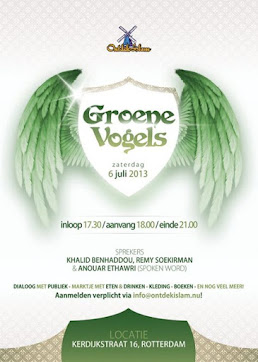
Datum: Zaterdag 6 juli 2013
Adres: Centrum de Middenweg, Kerdijkstraat 16 Rotterdam.
Tijdstip: 17.30 inloop, aanvang 18.00 uur, einde 21.00 uur.
Geplaatst op verzoek van de organisatie
Dirty Wars: US, Yemen and Anwar al-Awlaki
Posted on June 21st, 2013 by martijn.
Categories: International Terrorism, Religious and Political Radicalization, Society & Politics in the Middle East.
On DemocracyNow! attention for “Dirty Wars: The World Is a Battlefield,” the new documentary film by investigative war journalist Jeremy Scahill and Rick Rowley opening yesterday. Scahill’s book by the same name was published in April and exposes the US drone strikes, the massacre at al-Majalah and secret U.S. military actions inside Yemen. The film basically asks how a war like this can ever end, are we going to pay back later, are we creating more enemies than we are killing ‘terrorists’ and does the war on terror really make the world safe? And who is the ‘us’ in this story?
In this video you see a conversation with Scahill and two key Yemenis profiled in the film: Nasser al-Awlaki, who lost his son, cleric Anwar al-Awlaki, and 16-year-old grandson to U.S. drone strikes; and Saleh bin Fareed, the Yemeni sheikh and tribal leader who was one of the first people to arrive at the site of the U.S. attack of al-Majalah that killed 45 civilians in 2009.
See the full transcript HERE.
In the next video, Nasser al-Awkali speaks out for the first time since the Obama administration confirmed drones had killed four U.S. citizens, including his son, Anwar, and teenage grandson, Abdulrahman. The cleric Anwar al-Awlaki was killed in Yemen on Sept. 30, 2011. Anwar’s 16-year-old son was killed in another drone strike two weeks later. “If the United States government gave me concrete evidence against Anwar, I would have done my best to convince Anwar to come to Sana’a or to go even to the United States to face a trial. But it was only allegations,” al-Awlaki says, noting he believes the United States could have easily captured him alive. DemocracyNow! also speak with Anwar’s uncle, Saleh bin Fareed, a Yemeni sheikh and tribal leader. “I am sure I could have handed him over — me and my family — but they never, ever asked us to do that,” Fareed says. The story of the al-Awlakis is featured prominently in the documentary film, “Dirty Wars: The World Is a Battlefield,” directed by Richard Rowley and written by Jeremy Scahill and David Riker.
See the full transcript HERE.
Here you see the trailer of Scahill’s documentary Dirty Wars:
Go to the website of the documentary Dirty Wars.
Geweldsmarketing – Het risico van de politiek van islamofobie
Posted on June 9th, 2013 by martijn.
Categories: Important Publications, Islam in the Netherlands, Multiculti Issues, Religious and Political Radicalization.
Jan Jaap de Ruiter is een Arabist die, als één van de weinigen van mijn collega’s zeer actief is op het internet. Met commentaar en toelichting op vanalles wat met islam, moslims en Midden-Oosten te maken te heeft, levert hij een waardevolle bijdrage als wetenschapper aan het publieke debat. Niet te beroerd om de dialoog aan te gaan met allerlei opponenten die vinden dat hij niet echt waardenvrije wetenschap bedrijft (alsof dat mogelijk zou zijn) richt hij zijn pijlen onder meer op Wilders cs. en hun politieke gedachtegoed. Eén van zijn belangrijkste publicaties op dit terrein is het boekje ‘The Speck in Your Brother’s Eye’ wat deels een uitgebreide recensie is van het boek van Wilders ‘Marked for Death’, deels een pamflet is met een politieke aanklacht (Wilders kleedt zijn anti-islam boodschap zo in, dat geweld een mogelijke, ultieme, consequentie is) en deels het resultaat van zijn eigen zorgen over het politieke klimaat in Nederland.
Marked for Death
Ik bespreek hier het boek van De Ruiter, maar eerst even over het boek van Wilders. Dat boek is zowel een boek met een politieke boodschap als verslag van een persoonlijke strijd van, zoals hij het invult, de eenzame heldhaftige politieke profeet die ten strijde trekt tegen de gewelddadige islam en daarvoor als een echte martelaar een hoge persoonlijke prijs betaalt. Zo vertelt hij in het boek over de dood van zijn vader en hoe hij zijn tranen niet meer kon bedwingen in het bijzijn van zijn aardige maar ook vreemde lijfwachten. Zo maakt hij het persoonlijke politiek en het politieke persoonlijk. Hij voert een verdedigingsstrijd tegen het agressieve en gewelddadige gedrag van migranten die hun inspiratie of zelfs gedrag direct zouden ontlenen aan de islam die hij reduceert tot gewelddadige en/of intolerante acties van moslims en tot enkele verzen uit de Koran die zouden oproepen tot geweld. Zoals Jan Jaap de Ruiter ook laat zien, verdraait Wilders die islamitische geschiedenis zo dat in feite veel alledaagse vooroordelen, stereotyperingen en reacties tegen vreemdelingen en tegen islam (volgens bovenstaande definitie) worden gerationaliseerd tot een legitieme angst en afkeer. Die angst en afkeer en de rationalisering ervan dienen vervolgens als basis voor een meer diepgaand en uitgewerkt standpunt voor het uitsluiten van ongewenste vreemdelingen en moslims. Op dat moment kunnen we met recht spreken van islamofobie.
Die laatste stap maakt hij in dit boek door enerzijds een Westers utopia van vooruitgang, tolerantie en vredelievendheid te creëren tegenover het angstbeeld en de perfecte misère van zijn invulling van islam. Dit doet hij mede op basis van uitspraken van illustere namen als Salman Rushdie en Thomas Jefferson en Albert Speer. Op deze manier schept hij uiteindelijk een specifiek type racistisch, namelijk islamofobisch, gedachtegoed. Het gaat volgens Wilders om een existentiële strijd tussen de Westerse beschaving en de islamitische beschaving. Voor alle duidelijkheid nergens roept Wilders direct op tot geweld tegen moslims; volgens hem zouden moslims hun geloof moeten verlaten.
De splinter en de balk
De stelling van Jan Jaap de Ruiter is dat Wilders zijn onheilscenario zo opzet dat de ultieme consequentie een situatie is waarin geweld de mogelijke of zelfs enige oplossing is om het onheil af te wenden. De Ruiter bespreekt achtereenvolgens de waarheidclaims van Wilders, hoe Wilders zijn idee over de vermeende superioriteit van ‘het Westen’ uitwerkt tegenover de inferioriteit van ‘de islam’, hoe Wilders de islam definieert als ideologie die vergelijkbaar is met nazisme, fascisme en communisme en hoe Wilders de islam wil uitbannen. De Ruiter laat zien dat Wilders weliswaar claimt het debat te willen aangaan, maar dat vooral doet met opzettelijke provocerende beledigingen van islam en moslims. Hij laat overtuigend zien hoe Wilders de islamitische tradities en hun geschiedenissen verdraait, eenzijdig belicht en hoe Wilders probeert zijn definitie van wat islam is op te leggen. De Ruiter probeert niet alleen dat eenzijdige en verdraaide beeld van de islam te corrigeren (zonder apologetisch te worden), maar ook een evenzeer verdraaid en eenzijdig beeld van het Westen recht te zetten. Dit lukt hem ten dele simpelweg door te laten zien dat Wilders citaten uit de context neemt of maar half geeft en door te wijzen op de inconsequenties in het betoog van Wilders.
Anderzijds vervalt ook hij toch enigszins in het beschavingsdenken dat wordt gekenmerkt door een wij-zij denken. Bijvoorbeeld op p. 22 wanneer hij het heeft over Wilders’ idee over superioriteit van het Westen en dat die moslims maar blijven doorzeuren over de kruistochten: ‘Does it mean that the West is not suffering from any kind of memory syndrome?’ Alsof er zoiets bestaat als een ‘Westerse beschaving’ en een ‘islamitische beschaving’ (op zich al ongelijke indelingen) die los van elkaar staan. Dit terwijl Europa en islam al eeuwen nauw met elkaar verbonden zijn; niet alleen door conflicten maar ook door intellectuele uitwisselingen, dialoog, handel, concurrentie, enzovoorts. Het is dan ook opvallend dan De Ruiter in bovenstaand zin die tegenstelling lijkt te hanteren en vervolgens komt met een voorbeeld van Serven en Moslims in de Balkan.
Een ander punt van kritiek betreft het feit dat De Ruiter af en toe zowel ‘islam’ als ‘christendom’ enige capaciteit tot handelen (‘agency’) lijkt toe te schrijven. Bijvoorbeeld als hij zegt ‘Islam…failed to stick’ (p. 49), ‘It is true, Christianity ordains….’ (p. 26). Uiteindelijk zijn ‘islam’ en ‘christendom’ zoals ze hier gebruikt worden abstracte fenomenen die natuurlijk niet ‘handelen’ of ‘falen’ of ‘verordonneren’. Dat zijn mensen die dat doen eventueel op basis van bepaalde geschriften. Daarbij lijkt hij, bijvoorbeeld in het laatst genoemde citaat’ uit te leggen hoe religie geïnterpreteerd dient te worden: ‘Het is waar dat…enz.’. Dat doet hij wel op meer plekken zoals op p. 51 wanneer hij stelt ‘I would say that a good religion or ideology will always be unambiguous in its commandments to its followers. Any spoken or written text that could be interpreted as allowing violence should never be part of a religion or ideology’. Ook hier zien we weer een suggestie dat een religie handelt (commandeert), maar ook dus dat hij invult waar een ‘goede’ religie of ideologie aan dient te voldoen. Dat is zijn persoonlijke invulling en daar is niks mis mee, maar het is irrelevant voor zijn argument (wel relevant overigens in die zijn dat zijn persoonlijke drijfveren zo mooi zichtbaar zijn). Evenmin maakt hij duidelijk wat er dan moet gebeuren met religies waarin wél tradities zijn van gereguleerd geweld (zoals alle religies eigenlijk). Daarbij, zoals De Ruiter laat zien, doet het er ook eigenlijk niet zoveel toe of er in geschriften wordt opgeroepen tot geweld; het gaat om de interpretatie en legitimeringen van mensen en om de vraag of, hoe en waarom men overgaat tot geweld. En om de vraag welk geweld legitiem is en welk niet.
Van ‘Marked for Death’ naar ‘Marketing for Violence’
Dat gezegd hebbende is het natuurlijk wel zo dat mensen aan bepaalde geschriften of dat nu de Bijbel en de Koran is, of Mein Kampf of bepaalde wetsteksten of (inderdaad) de uitspraken van Wilders inspiratie, legitimeringen en een gevoel van urgentie kunnen ontlenen om tot geweld over te gaan. Demonisering van outsiders, mensen strippen van hun menselijke eigenschappen, mensen reduceren tot concrete voorbeelden van grotere abstracties zoals het ‘gewelddadige Westen’ of de ‘gewelddadige islam’ kunnen voor sommigen de drempel om geweld te gebruiken verlagen. Zeker als dat gepaard gaat met het inprenten van het idee dat de eigen levenswijze op het spel staat. Dat hebben we in het verleden gezien met de nazi’s, met de oorlog tussen de Hutu’s en de Tutsi’s in Rwanda, hedentendage met de Rohingya in Myanmar, de Amerikaanse inval in Irak en met islamitische leiders in Irak.
Mijn kritiek hierboven laat dan ook onverlet dat De Ruiter zijn belangrijkste punt overtuigend maakt: door middel van verdraaiingen, halve waarheden en regelrechte leugens schept Wilders een zodanig bedreigend, geperverteerd en onmenselijk beeld van de islam dat er niet heel veel fantasie voor nodig is om je af te vragen wanneer we de wapens moeten oppakken. Dat doet Wilders niet, zo stelt De Ruiter ook heel duidelijk. Wat Wilders doet is het schetsen van een fort waarin goede mensen harmonieus samenleven maar die misleid worden door hun leiders die slechts een dunne glazen muur hebben opgeworpen, leiders die tuig met een dodelijke ziekte hebben binnen gelaten en waarbij buiten wilde, intolerante en agressieve dragers van die ziekte op die dunne glazen muur aan het bonzen zijn. En in dit profetische Stalingrad is Wilders de held die bedreigd wordt maar moedig doorstrijd. Met zijn pen. Zoiets. Als je gelooft in deze waarheden (en in tegenstelling tot wat De Ruiter in het begin van boek zegt, het is niet noodzakelijk dat je het zeker weet; integendeel zelfs) is het niet moeilijk voor te stellen dat er wat meer, laten we zeggen, daadkrachtige middelen noodzakelijk zijn.
De olifant
De vraag is echter of De Ruiter’s gefundeerde waarschuwing veel zal uithalen. Om meerdere redenen denk ik van niet. Ik zal ze hier kort noemen. Allereerst zullen velen zeggen ‘Ja, maar dat doet niets af aan het feit dat moslims wandaden plegen’. Nee dat klopt. De afweging die mensen daarbij maken hangt niet alleen af van het antwoord op de vraag of Wilders een realistisch beeld schetst (nee), maar ook hoe zwaar de elementen wegen die hij aandraagt. En voor zijn aanhangers wegen die zwaar.
Ten tweede, en jammer genoeg besteedt De Ruiter er geen aandacht aan, de politiek van Wilders is niet zo bijzonder en ook niet zo extreem als we wellicht denken. Het denken in abstracties zoals Wilders doet met islam en vervolgens stellen dat mensen niet meer dan een concrete invulling daarvan zijn, is al veel ouder. Het gebeurde al bij racisme en anti-semitisme aan het begin van de 20e eeuw en is ook onderdeel van het beleid dat een onderscheid maakt tussen moderne verlichte autochtonen en de cultuur van de migranten. Dat cultuurdenken leidt tot een onderscheid tussen gewenste en ongewenste burgers en is in beleid en debat steeds meer toegespitst geraakt op moslims en islam. Er is geen enkele politieke partij die de islam (in abstractie) nog niet als probleem heeft aangemerkt. In die zin is Wilders niet meer dan een product van dat cultuurdenken uit de jaren negentig dat toch echt uit de hoek van het politieke midden kwam.
Het is ook niet Wilders’ PVV die een monopolie heeft op schelden en demonisering. De term ‘kutmarokkanen’ is inmiddels een gebruikelijke term geworden voor Marokkaans-Nederlandse jongeren en komt toch echt uit kringen van de PvdA. Ook het CDA verdedigde in 2005 al de motie van Wilders voor een verbod op de boerka ook al is dat discriminerend voor moslims en vrouwen. Ook het huidige kabinet, zonder de PVV, maakt hiervoor wetgeving (zij het in beperkte zin). Het is ook niet de PVV die kwam met een uitgewerkt voorstel om ritueel slachten aan banden te leggen; dat was de PvdD. En ondanks het islamofobisch-racistische gedachtegoed van de PVV was het voor VVD en CDA geen probleem om met hen een gedoogakkoord te sluiten. Goed, na het nodige gemor, maar dat geeft uitstekend weer hoe de machtsverhoudingen liggen.
Een belangrijke waarschuwing
De PVV en haar gedachtegoed zit dus niet in de marge van de Nederlandse politiek maar bevindt zich dus in het centrum ervan en is, net als het racisme van Fortuyn, een rechtstreeks uitvloeisel ervan. Dat maakt het bekritiseren van de balk en de splinter tot het negeren van de olifant in de kamer. Maar natuurlijk zijn er verschillen met andere partijen die over het algemeen de nadruk leggen op behoud van en stimuleren van sociale cohesie en rust. Dat is precies wat de PVV probeert te breken door een provocerende manier van optreden. Dat in combinatie met de vechttaal en de onheilsprofetieën van Wilders, maken van Wilders en de PVV een zeer riskante politiek. Daarom is het goed en noodzakelijk dat mensen als Jan-Jaap de Ruiter hier op heldere, goed onderbouwde en toegankelijke wijze voor waarschuwen.
Syriëgangers op de TV
Posted on May 29th, 2013 by martijn.
Categories: Activism, Notes from the Field, Religious and Political Radicalization.
Inleiding
Wat een drukte he, deze week. Eerst nieuws over het Motivaction onderzoek over Syriëgangers. ‘s Avonds de uitzending van het NCRV programma Altijd Wat over Nederlandse jongeren, idealen, engagement, activisme en strijd; daarin ook een van de pleitbezorgers van de de Syriëgangers. Daarna in Knevel en Van de Brink nog één. En op woensdag dan het programma De Vijfde Dag ‘Op zoek naar Zakariya’ over een bekeerde moslims die vecht in Syrië. En natuurlijk een hoop gedoe op de twitter hierover. En hier een overzicht.
Wat is de vraag
De kern van dit onderzoek betreft de volgende probleemstelling:
- Wat is de houding en opvatting van Nederlandse moslims en autochtonen ten aanzien van de burgeroorlog in Syrië?
- Wat is de houding en opvatting van Nederlandse moslims en autochtonen ten aanzien van Syrië-gangers?
De volgende onderzoeksvragen staan daarbij centraal:
- In hoeverre is er draagvlak voor het interveniëren door de Nederlandse overheid in Syrië (financieel en/of militair)?
- In hoeverre is er begrip voor Nederlandse moslims die naar Syrië vertrekken om te vechten tegen het regime van president Assad?
- Wat is de houding ten aanzien van personen die moslims werven om in Syrië te gaan vechten (de ‘ronselaars’)?
- Hoe dient omgegaan te worden met moslims die naar Syrië willen vertrekken?
- Dienen Syrië-gangers die terugkomen vanuit Syrië naar Nederland gestraft te worden? Zo ja, wat is dan een gepaste straf?
Kort commentaar:
Waarom maakt men een onderscheid tussen autochtonen en Nederlandse moslims? Ook autochtonen kunnen immers moslim zijn.
Waarom noemt men het eigenlijk een burgeroorlog? Waarom niet een gewelddadig schaakspel tussen mondiale en regionale grootmachten, nationale strijdgroepen en het Syrische regime? Of iets anders?
Wordt er bij draagvlak voor interventie in de rapportage vergeleken met soortgelijke vragen uit het verleden? (nee)
Wat is in vredesnaam ‘begrip’? (Is dat begrijpen, goedkeuren, accepteren ?)
Wat is jihad?
Jihad: In de voorgelegde vragenlijst is de volgende toelichting gehanteerd voor jihad; jihad is de heilige strijd voor de normen en waarden van de islam.
De term ‘jihad’ is afkomstig van ‘jahada’: streven naar, zich inspannen, zich bekwamen. Jihad kan verschillende betekenissen hebben, afhankelijk van de context, waaronder ook militaire. Gedurende de tijd is de militaire jihad steeds meer een defensieve jihad geworden tegen aggressie van niet-moslims, vergelijkbaar met de concepten van ‘rechtvaardigde oorlog’ zoals die ontwikkeld is door christelijke denkers zoals Augustinus en Thomas van Aquino en met internationaal oorlogsrecht hoewel er ook wel de nodige verschillen zijn. Er is behoorlijk verschil van mening over toepassing van de jihad-doctrines in de moderne tijd, zo stellen sommigen dat er sprake moet zijn van een kalief die oproept tot jihad (die is er niet) en verschilt men van mening hoe om te gaan met andersdenkende moslims. Wat bedoelt nu in bovenstaande definitie? Die zou ook betrekking kunnen hebben op humanitaire hulp. Anderen stellen dat er geen sprake is van jihad want geen kalief, anderen vinden dat er geen sprake kan zijn van jihad want het gaat om een oorlog tussen moslims en weer anderen stellen dat Assad cs. helemaal geen moslims zijn. Het gaat er mij niet om welke definitie juist is, maar je weet met bovenstaande definitie niet precies wat je meet.
Wie is moslim?
Nederlandse moslims: In Nederland woonachtige moslims met een Turkse en of Marokkaanse achtergrond (zij zelf of hun ouders zijn geboren in Turkije of Marokko). Gekozen is voor deze afbakening, omdat de Turkse en Marokkaanse Nederlanders de grootste moslimgemeenschap vormen in Nederland. Zij benadrukken dat het hier dus geen moslims betreft met bijvoorbeeld een Surinaamse of Indonesische achtergrond en ook geen tot de islam bekeerde autochtone Nederlanders.
Autochtonen: Dit betreft personen die zelf, maar ook hun ouders, in Nederland zijn geboren. Verder hebben wij voor de zuivere vergelijking de enkele autochtoon die de islam aanhangt uit deze steekproef gefilterd.
Dit is natuurlijk uiterst problematisch. Zoals ik eerder al schreef in mijn reflectie hoofdstuk in het SCP rapport Moslim in Nederland (wat echt een mijlenver veel beter rapport is). De tegenstelling autochtonen vs. Moslims bestendigt het beeld dat de islam een migratiegodsdienst is: we vergeten wel eens dat Nederland al in de koloniale tijd veel moslims binnen de grenzen had en dat we inmiddels al tweede- of zelfs derdegeneratiemoslims hebben die hier geboren en opgegroeid zijn. Hoelang blijven we islam dan nog zien als migratiegodsdienst? Waarom geen nadere uitsplitsing gemaakt tussen jong en oud? Waarom ook geen andere autochtone en allochtone religieuze groepen genomen? Er is, onderzoekstechnisch gezien, geen enkele reden om autochtonen als norm te nemen.
Motivaction stelt religie waarschijnlijk als volgt vast. Men maakt een profiel van iedereen die deelneemt aan hun panels op basis van naw-gegevens, samenstelling huishouden, opleidingen, mentality, (gezins-)inkomen en opleiding van hoofdkostwinner en tot slot culturele achtergrond.
Bij culturele achtergrond vraagt men:
– In welk land ben je geboren?
– In welk land is je moeder geboren?
– In welk land is je vader geboren?
Waar men hier naar vraagt is dus etniciteit en niet religie. De verklaart ook dat men autochtone Nederlanders er buiten laat.
Bevragen
Het onderzoek is gebaseerd op twee representatieve steekproeven:
- Een representatieve steekproef onder autochtone Nederlanders tussen de 18 en 70 jaar (n=570).
- Een representatieve steekproef onder Turkse en Marokkaanse moslims in Nederland in de leeftijd van 18 tot 60 jaar (n=370). Er is gekozen voor deze afbakening, omdat Nederlandse moslims voor het overgrote deel bestaan uit Turkse- en Marokkaanse Nederlanders.
Voor de dataverzameling voor de steekproef onder autochtonen is gebruikgemaakt van het StemPunt-panel van Motivaction (www.stempunt.nu) waar momenteel ongeveer 70.000 Nederlanders lid van zijn.
Betekent dit dat er 570 autochtonen gevraagd zijn in een panel van 70.000 Nederlanders? En de rest? Moslims en non-respons? (Wat is de non-respons eigenlijk?). Ook heel opvallend, voor Turkse en Marokkaanse Nederlanders is gebruik gemaakt van een combinatie van online en face-to-face-veldwerk: “Door analfabetisme en digibetisme onder deze groep is het niet mogelijk om een online representatieve steekproef te realiseren.”
Het lijkt me dat het verschil in methodes tussen beide groepen op z’n zachtst gezegd onhandig is en het is ook maar de vraag of bepaalde groepen in Nederland, ook onder autochtonen, wel goed vertegenwoordigd zijn in die onlinepanels.
Conclusies
Dit alles maakt conclusies trekken zeer lastig. Want hoe moeten we de resultaten nu eigenlijk lezen? Wat heeft men precies gevraagd? Kunnen mensen eigenlijk meerdere, tegenstrijdige meningen hebben? Bijvoorbeeld dat men vindt dat er sprake is van een gerechtvaardige strijd, geen jihad, moedige strijders en dat men toch vindt dat ze beter niet kunnen gaan? De gesprekken die ik totnutoe heb gehad laten namelijk zien dat mensen ermee worstelen, dat ze helemaal geen eenduidige mening hebben.
Met de term ‘moslim’ wordt een en ander religieus geduid, maar men bevraagt etnische groepen. Het is niet duidelijk hoe belangrijk religie is voor Turkse en Marokkaanse Nederlanders die onderzocht zijn, hoe belangrijk Syrië is. Dus, misschien vindt men religie superbelangrijk, maar Syrië niet of andersom, maar vindt men het wel een jihad. Of men vindt religie onbelangrijk, Syrië ook, vindt men het geen jihad, maar de jongemannen wel helden. Als we dus al uit kunnen gaan van de conclusies, dan laat het onderzoek vooral het algemene patroon zien en niet de diversiteit.
Motivaction rapport
AltijdWat
Knevel en Van den Brink
Makkelijk praten achterafDe Vijfde Dag
Eerdere uitzending
Het rondje langs de kwettervelden
Tot Slot
Het Twitter-overzicht is een impressie meer niet natuurlijk. Representatief zijn de afgebeelde meningen in ieder geval niet. Ik heb geprobeerd een diversiteit aan posities op te nemen, zonder de afzonderlijke tweets compleet uit hun verband te halen. Op de twittervelden blijkt ontzettend weinig begrip te zijn, maar ik vermoed dat dat een vertekening is. Mensen van wie ik weet dat ze veel positiever zijn over de Syriëgangers hebben zich stil gehouden, maar ook anderen met uitgesproken meningen heb eigenlijk weinig laten horen. Wel zijn er veel reacties in mijn mail waar ik nog even doorheen ga (u krijgt allemaal antwoord, maar het zal niet snel gaan). Er zijn enkele opvallende uitspraken gedaan in de uitzendingen waar ik hier niet op inga.
Gezien de enorme hoeveelheid media-aandacht, leeft bij wel de vraag in hoeverre hedendaagse media de strijd van de jongeren in Syrië, hun pleitbezorgers hier, maar ook die van hun islamitische tegenstanders, het geweld en het bloedvergieten in Syrië reduceert tot sensatie, spektakel en entertainment. Dat gold voor de programma’s afzonderling (met uitzondering van Knevel en Van den Brink) niet zozeer denk ik, maar er zijn natuurlijk al genoeg andere voorbeelden geweest. Er is in ieder geval ook veel discussie over of dit soort verhalen op TV moeten. Om begrip te kweken en de mensen zelf hun positie te laten definiëren en verhelderen lijkt me dit niet slecht. Zeker het programma AltijdWat droeg daar aan bij. Knevel en Van den Brink was meer een inquisitie en de Vijfde Dag eigenlijk een herhaling van wat we eerder gehoord hadden. Voor degenen die hier niks mis mee hebben (moslim en niet-moslim) was het een bijna pijnlijk en boosmakend iets om naar te kijken. Voor anderen was het een feest van herkenning, erkenning en inspiratie.
Demet TV vs. Nieuwsuur: Taal, Beeldvorming en Islam
Posted on May 3rd, 2013 by martijn.
Categories: Activism, Public Islam, Religious and Political Radicalization.
N.a.v. een uitzending van Nieuwsuur heeft Demet TV veel reacties gekregen. Reacties van mensen die zich verbazen over een ‘onjuiste’ ondertiteling van Nieuwsuur. Men meent dat moslims door deze ondertiteling met opzet als gewelddadig worden neergezet.
Het gaat om deze Nieuwsuur uitzending:
Dit is het item dat DemetNu er van maakte:
Demet TV – Verslaggever Oktay Basaran op zoek naar de waarheid
Leven als de profeet in Nederland: Salafisme, democratie en autonomie
Posted on April 25th, 2013 by martijn.
Categories: Activism, anthropology, Headline, Islam in the Netherlands, Religious and Political Radicalization.
Guest author: Ineke Roex
Introductie: spanningen en salafisme
Hebben salafisten een probleem met de democratie? Is het een soort sekte waar je nooit meer uitkomt? Hebben mensen nog wel enige vrijheid als ze ‘salafist’ zijn? Dit zijn vragen die je voortdurend hoort wanneer het gaat om salafisme; een soennitische islamitische hervormingsbeweging die streeft naar het herstel van een ‘zuivere’ islam, door morele heropvoeding van de moslimgemeenschap, een letterlijke lezing van de Koran en hadith, afwijzing van religieuze vernieuwingen en de imitatie van Mohammed en zijn metgezellen in de begintijd van de islam. De salafi-beweging is een utopische beweging die het dagelijkse leven van moslims probeert te reorganiseren conform een geïdealiseerd beeld uit het verleden. Ze creëren een eigen manier van leven die zij bevredigender en rechtvaardiger vinden en tegenover een wereld plaatsen van immoraliteit, onderdrukking en verleiding. Salafi’s leggen een claim op hun geloofsinterpretatie als de enige ware islam. Ze streven ernaar een morele gemeenschap te vormen van ware moslims en claimen daarbij de vertegenwoordigers van de enige islam te zijn. De beweging heeft zich op verschillende manieren ontwikkeld en wordt gekenmerkt door interne polemieken, theologische disputen en conflicten. Het bestaan van deze waarheid claimende geloofsstroming in Nederland, roept klaarblijkelijk vragen op over de verenigbaarheid van deze islamitische trend met democratische principes zoals vrijheid van godsdienst en gedachte en de vrijheid van vereniging en uittreding; vrijheidsrechten die de autonomie van het individu beschermen.
Veldwerk: autonomie en exit
Van december 2007 tot september 2008 heb ik antropologisch onderzoek verricht onder salafistische netwerken in Nederland en geanalyseerd hoe deze beweging zich verhoudt tot de voorwaarden en drempels die noodzakelijk zijn om de autonomie van mensen te waarborgen. Deze vraag heb ik beantwoord door de exitmogelijkheden te onderzoeken aan de hand van vier deelgebieden: organisatievormen, religieuze disciplinering, politieke opvattingen en participatievormen. Het betreft participerende observatie in organisaties en omgeving, informele gesprekken en interviews met predikers, aanhangers en omgeving. In mijn proefschrift beschrijf ik zowel de ideologie die de predikers verkondigen als de dagelijkse religieuze praktijk van degenen die zich verbinden met de salafibeweging. Onderzoek heeft zich tot nu toe enkel op één van deze twee aspecten gericht.
In dit onderzoek is uitgegaan van autonomie als een politiek begrip en als democratische kernwaarde geldt. Vanuit dit politieke begrip van autonomie moeten personen de politieke rechten (vrijheid van gedachte, vrijheid van religie, vrijheid van meningsuiting en het recht op autonomie van andersdenkenden) respecteren, maar autonomie niet per se als persoonlijk ideaal omarmen. Ik ga niet uit van autonomie als absolute waarde, maar ik neem ik procedurele onafhankelijkheid als uitgangspunt. Er is procedurele onafhankelijkheid wanneer iemand zonder dwang of geweld tot een besluit, handeling of levenswijze komt. De manier waarop een resultaat of een besluit bereikt wordt, is vanuit deze redenering belangrijker dan het resultaat of het besluit zelf. Iemand moet zich vrijwillig onderwerpen aan een disciplinerend regime.
Het zich onderwerpen aan de disciplinering tot vroom gelovige binnen de salafi beweging, is niet meteen een schending van iemands autonomie zolang mensen dat doen zonder geweld of andere vormen van dwang. Dit betekent dat mensen er dus uit zouden moeten kunnen stappen. Maar daarmee is niet alles gezegd. Het recht op uittreding moet niet alleen formeel beschikbaar zijn, maar ook realistisch en haalbaar zijn. Om te analyseren hoe de salafistische gemeenschappen zich tot autonomie verhoudt zijn de condities én de drempels van exitmogelijkheden onderzocht. Willen de exitmogelijkheden reëel zijn dan moet er drie voorwaarden aanwezig zijn.
Ten eerste moet er sprake zijn van procedurele onafhankelijkheid, dat wil zeggen afwezigheid van geweld en dwang. Ten tweede moet er toegang tot en kennis zijn van politieke rechten en alternatieven. Ten derde moet men zich niet isoleren. Isolement beperkt de toegang tot alternatieven en verhoogt de kosten van uittreding. Wanneer er sprake is van isolement dan kan uittreding ingrijpend zijn voor een individu, doordat iemand bijvoorbeeld sociaal of psychische afhankelijk is geworden van een groep.

De autonome Salafi
De salafi-beweging schendt de democratische kernwaarde van autonomie op dit moment in Nederland niet. Je kunt salafi én autonoom zijn. Er is in de context van Nederland sprake van procedurele onafhankelijkheid, kennis van en het respecteren van de politieke rechten in de religieuze, maatschappelijke en politieke opvattingen, ambities en praktijken van de salafi-beweging. Deze condities gelden met nadruk alleen op dit moment, in Nederland en niet voor salafi’s die sympathiseren met jihadistische opvattingen en geweld legitimeren. De autonomie van kinderen in salafi-gezinnen die (nog) niet naar school gaan en vrouwen in informele huwelijken, wanneer zij sterk geïsoleerd zijn van de omgeving, kan echter wel onder druk staan. De salafi-beweging roept niet op tot de schending van de autonomie van vrouwen en kinderen, maar stimuleert deze ook niet. Er kan sprake zijn van, soms zelfgekozen, isolement. Tegelijkertijd kunnen vrouwen de salafi-beweging opzoeken om hun autonomie ten opzichte van ouders, familieleden of partners te bewerkstelligen door met belemmerende tradities te breken. Er is dus geen één op één relatie tussen de salafi-beweging en het schenden van de autonomie van de vrouw.
Het is belangrijk dat de gunstige condities voor autonomie worden gewaarborgd zodat de salafi-beweging zich op termijn niet alsnog ontwikkelt tot een antidemocratische beweging. Allereerst is het van belang dat de media en de politiek waken voor het onzorgvuldig gebruiken van de term salafist als label, zodat het salafisme wordt voorgesteld als een eenheid. De ideologie evenals de praktijken in de salafi-beweging zijn veranderlijk, heterogeen en tegenstrijdig. Dit is gunstig voor de autonomie van betrokkenen alsmede de omgang met andersdenkenden. Wanneer de beweging echter als eenheid wordt gepresenteerd kunnen duidelijk afgebakende groepsgrenzen opgeworpen worden. Het is daarnaast niet verstandig om de salafi-beweging te beoordelen en beleid te voeren alleen op basis van bepaalde ideologische salafistische stellingnames. Niet alleen kan hierdoor de scheiding van kerk en staat in het gedrang komen doordat de overheid zich met de religieuze inhoud kan gaan bemoeien. Maar met name de praktijken, de interne sociale relaties en de relaties met de buitenwereld zijn doorslaggevend in de manifestatie van de beweging en de consequenties ervan voor autonomie als democratische waarde. Deze relaties zijn op dit moment veranderlijk, veelvormig en tegenstrijdig en dat is goed nieuws voor de democratie.
Om de gunstige condities te waarborgen is het tevens van belang dat de salafi-beweging en haar participanten niet in isolement raken. Beperkende maatregelen (denk bijvoorbeeld aan een boerka- of een hoofddoekverbod) en weigering voor studie of werk op grond van godsdienstige achtergrond of uiterlijk voorkomen, kunnen isolement in de hand werken, ook al hebben deze maatregelen participatie of bevordering van democratische waarden voor ogen. Samenwerkingen met salafistische organisaties moeten niet per definitie uitgesloten worden.
Ten slotte moet de salafi-beweging de ruimte krijgen om politiek te participeren. Politieke participatie is gunstig voor de bescherming van autonomie. Bovenal kunnen frustraties op politiek terrein het legitimeren van geweld als politiek middel dichterbij brengen. Het is belangrijk dat quiëtistische en politieke netwerken met hun anti-jihadistische stellingname gelovigen proberen te bereiken die sympathiseren met jihadistische opvattingen. Maar dit moet een zaak van de beweging zelf blijven, omdat bij overheidsbemoeienis de kans aanwezig is dat salafistische voorgangers hun legitimiteit en daarmee hun autoriteit verliezen. Het is een verantwoordelijkheid van de gemeenschap met haar imams, predikers, onderwijzers, vrienden en familie om geweldslegitimatie te ontmoedigen, wanneer zij hier mee in aanraking komen. Nederlandse democratie moet, voor de waarborging van autonomie, maatschappelijke en politieke participatie mogelijk houden voor iedereen, ongeacht iemands diepste overtuigingen hoe onwenselijk of extreem die ook mogen zijn.
Ineke Roex is antropoloog en werkzaam aan de Faculteit der Maatschappij- en Gedragswetenschappen, Afd. Politicologie, van de Universiteit van Amsterdam. Zij verdedigt vandaag, 25 april 2013, om 14 uur haar proefschrift. Het boek Leven als de profeet in Nederland: Over de salafi-beweging en democratie ligt vanaf september in de winkel.
Defending the Palestinian Right to Resist
Posted on April 11th, 2013 by martijn.
Categories: Religious and Political Radicalization, Society & Politics in the Middle East.
Amira Hass, a Jewish-Israeli journalist who spent almost 20 years living in and reporting from Gaza and the West Bank, received a lot of hate mail and calls for her prosecution after she defended the right of Palestinians to resist violent occupation.
The inner syntax of Palestinian stone-throwing – Opinion – Israel News | Haaretz Daily Newspaper
Throwing stones is the birthright and duty of anyone subject to foreign rule. Throwing stones is an action as well as a metaphor of resistance. Persecution of stone-throwers, including 8-year-old children, is an inseparable part ? though it’s not always spelled out ? of the job requirements of the foreign ruler, no less than shooting, torture, land theft, restrictions on movement, and the unequal…
According to Hass Israelis deny “how much violence is used on a daily basis against Palestinians. They don’t like to be told that someone has the right to resist their violence.”
Hass was invited to Democracy Now to discuss the reactions to her piece against the background of John Kerry’s visit to Israel.
Transcript at Democracy Now.
Syria's Children – 'Blood Like Water'
Posted on April 6th, 2013 by martijn.
Categories: Religious and Political Radicalization, Society & Politics in the Middle East.
A very disturbing but important report by filmmaker Marcel Mettelsiefen who has spent several weeks with children working(!) in Dar Al-Shifa city hospital in Aleppo. The film features children like Mohamed Asaf and Yussef Mohamed who treat Aleppo’s war wounded.
Before Aleppo entered the revolution this city had 5,000 medical staff. Now 600,000 civilians are cared for by just 30 doctors and nurses, along with the help of children like Yussef and Mohamed. We see amazing children doing amazing work but becoming desensitized as well:
“With time it has become easy: blood has become like water to me.
“In the beginning, when I saw blood, I would shiver and be frightened but now I see blood as water I don’t have any problem when I see it.”
This film above was shot by Marcel Mettelsiefen, produced/directed by Teresa Smith and edited by Agnieszka Liggett and broadcast by Channel4: Syria’s Descent: the agony of Aleppo’s children.
Syria’s Children – ‘Blood Like Water’
Posted on April 6th, 2013 by martijn.
Categories: Religious and Political Radicalization, Society & Politics in the Middle East.
A very disturbing but important report by filmmaker Marcel Mettelsiefen who has spent several weeks with children working(!) in Dar Al-Shifa city hospital in Aleppo. The film features children like Mohamed Asaf and Yussef Mohamed who treat Aleppo’s war wounded.
Before Aleppo entered the revolution this city had 5,000 medical staff. Now 600,000 civilians are cared for by just 30 doctors and nurses, along with the help of children like Yussef and Mohamed. We see amazing children doing amazing work but becoming desensitized as well:
“With time it has become easy: blood has become like water to me.
“In the beginning, when I saw blood, I would shiver and be frightened but now I see blood as water I don’t have any problem when I see it.”
This film above was shot by Marcel Mettelsiefen, produced/directed by Teresa Smith and edited by Agnieszka Liggett and broadcast by Channel4: Syria’s Descent: the agony of Aleppo’s children.
European foreign fighters in Syria
Posted on March 18th, 2013 by martijn.
Categories: Religious and Political Radicalization, Society & Politics in the Middle East.
This post will be updated when relevant. If you have any relevant links or whatever, use the comment section below (moderated, so you comment will not appear immediately or not at all if you don’t want that).
List of updates:
- Note for journalists: Yes, you are allowed to use everything I have here. No, you don’t have to ask permission. Yes, you do have to give credit to me or, if I name a source, to that particular source.
- Update 14-6-2013: Swedish and first British fighter to die in Syria (international news)
- Update 12-6-2013: all sections updated!
- Update 7-5-2013: Background, Dutch news (recruiting), video (Danish fighter)
- Update 17-4-2013: Backgrounder, international news, Dutch news
- Update 3-4-2013: Backgrounder and Dutch news (with Salafi media campaign)
- Update 28-3-2013: Everything (major update!)
- Update 27-3-2013: Dutch news: mother urges son to come home
- Update 26-3-2013: International news: speech Moaz Al-Khatib addressing European fighters and mothers; backgrounds
- Update 24-3-2013: Dutch and Belgian news
- Update 21-3-2013: (via @tintin1957 and Pieter van Ostaeyen): France – Testimony of Tunisian-French fighter, background by Thomas Hegghammer and new videos
- Update 20-3-2013 Dutch and Belgian news: one person killed, list of fighters
- Update 17-12-2013: yes finally an update again: the latest report of ICSR
****
In the last months there have been numerous reports of European foreign fighters in Syria to fight against the Al-Assad regime. In this post I will monitor the main news reports and analysis on this issue, focussing in particular on Dutch fighters but also other European fighters. For now I will divide this overview into four categories: Analysis and background, Written Newsreports, Youtube videos and a Dutch section (featuring only Dutch language features).
Background and analysis
Update 17-12-2013
This ICSR Insight provides an update of their April estimate, offering the most comprehensive and richly resourced account of the Syrian foreign fighter phenomenon from open sources. Based on more than 1,500 sources, we estimate that up to 11,000 individuals from 74 nations have become opposition fighters in Syria – nearly double our previous estimate. Among Western Europeans, the number has more than tripled from (up to) 600 in April to 1,900 now.
A few other conclusions
- Western Europeans now represent up to 18 per cent of the foreign fighter population in Syria, with most recruits coming from France (63-412), Britain (43-366), Germany, (34-240), Belgium (76-296), and the Netherlands (29-152).
- Adjusting for population size, the most heavily affected countries are Belgium (up to 27 foreign fighters per million), Denmark (15), the Netherlands (9), Sweden (9), Norway (8), and Austria (7).
- Individuals from Middle Eastern countries continue to represent the majority of foreign fighters (around 70 per cent). We estimate that up to 6,774 non-Syrian Arabs and an additional 523 non-Arabs from the (wider) region have gone to Syria.The five countries with the largest numbers of foreign fighters in Syria are all part of the Middle East: Jordan is the single biggest contributor (up to 2,089), followed by Saudi Arabia (1,016), Tunisia (970), Lebanon (890), and Libya (556).
- Questions they take up in their analysis are: What groups do they join? What explains the deep rise? Will the trend continue? How does the current mobilisation compare? How foreign is the opposition?
See Peter Neumann (director) briefly explaining the conclusions.
The report and the research were carried out by By Aaron Y. Zelin, ICSR Rena and Sami David Fellow – with contributions from other ICSR staff. Read the whole report here: ICSR Insight: Up to 11,000 foreign fighters in Syria; steep rise among Western Europeans / ICSR
Update: 12-6-2013
Jihadica has two posts breaking down the use of twitter by so-called ‘jihadi’s’: One & Two.
Die Welt has a piece on Salafism as youth culture (German).
Challenging Militarized Masculinities in OpenDemocracy by Amina Mama
Using’martyr’ posts to analyze ‘foreign fighters’ aiding Syrian rebels by Mike Brunker
Clint Watss has two interesting posts up Syria: Suffering the effects of the 2nd Foreign Fighter Glut & Syria’s Foreign Fighters: Dissecting The Next Decade of Conflict
****
Update: 7-5-2013:
At the Economist an article by Thomas Hegghammer: Will they come home to roost? The government is worried about British jihadists in Syria—with reason. According to him:
Foreign conflicts are much more likely to produce domestic terrorists if they involve a group that wants to attack Western targets. Al-Qaeda in Afghanistan regularly trained foreign fighters and dispatched them westward. Syria boasts nothing similar.
At Jihadology a guest post by Aymenn Jawad Al-Tamimi on Majlis Shura al-Mujahidin fi Aknaf Bayt al-Maqdis, one of the factions sympathetic to al-Qaeda’s worldview
****
UPDATE: 17-4-2013
At ICCT The Hague, Sergei Boeke and Daan Weggemans try to shed some light on the question as to why more European foreign fighters to Syria compared to Mali.
Australians in Syria, with lots of background including the relation between Al Qaeda and Jahbat al Nusra.
****
UPDATE: 3-4-2013
In the Washington Post David Ignatius wrote an article ‘Sorting out the Syrian opposition‘. At Syria Comment Aron Lund ‘picks it apart’. Or rather tears it apart. This is a must read!
Aaron Y. Zelin reports on European foreign fighters in Syria at ICSR Insight blog (read also his excellent blog Jihadology). The ICSR Insight shows the significant extent to which the Syrian conflict has mobilised Muslims from across the world: between 140 and 600 fighters going to Syria since early 2011 (7-11% of the foreign fighter total). For Belgium he estimates 14-85 have joined up and for the Netherlands 5-107. Currently between 4-75 Belgians and between 4-104 Dutch people are present; also other European countries are listed. The big gap between, for example, between 4-104 Dutch fighters, also shows how much of this is uncertain of course. (Based upon my own sources I would say there are between 50-70 Dutch fighters; some may alread have returned others left for Syria last week. The Belgian figures appear to be a little higher then my Dutch estimates. In both cases based upon my sources within those networks). Aaron Y. Zelin also mentions eight European martyrdom notices. The Netherlands (2 or 3 killed) and Belgium (2 killed) are not included. Cautioning people not see every foreign fighter as a jihadi and not everyone joining a jihadist group as someone with a fully formed jihadist worldview, he lists several motivations for joining the rebels. Nevertheless there are good reasons for authorities to be worried and he advises security services “to monitor the situation closely and adopt an intelligence led, highly discriminate approach towards dealing with returning fighters”.
Pieter van Ostaeyen tries to answer the question: What is appealing Europeans to Jihad in Syria?. He also translated an interview with Islamic News Agency Haqq Ab? Hamza al-Muh?jir, the spokesman of Liw?’ al-Muj?hid?n f? Bil?d as-Sh?m.
****
UPDATE: 28-3-2013
On Pieter van Ostaeyen’s blog a post by Shami Witness (@ElSaltador)about growing tensions between two factions of the Syrian Resistance, Jabhat an-Nusra and the Kata’ib al-Farouq in Syria.
****
UPDATE: 27-3-2013
Non-Syrian, Islamist Fighters Can Be a Touchy Subject for Rebels – Al-Monitor: the Pulse of the Middle East
After repeated questioning, an FSA commander in the Hama countryside stated: “Yes, there are non-Syrian fighters among our ranks in the Al-Nusra Front, as well as in the Free Syria brigade. However, these non-Syrians represent a small percentage of fighters in these brigades, less than 20% of the former and 5% of the latter.”
Tunisian Jihadists Fighting in Syria – Al-Monitor: the Pulse of the Middle East
At present, Tunisia estimates that around 40% of foreign jihadists in Syria hold Tunisian nationality. More than two-thirds of them are fighting in the ranks of Jabhat al-Nusra. A number of their families have organized demonstrations demanding that the authorities return their sons to Tunisia. At the same time, the Guide of the Ennahda Party, Rachid al-Ghannouchi, took the occasion as an opportunity to stress that his movement was not responsible for the phenomenon.
****
Thomas Hegghammer, Zuckerman fellow at the Center for International Security and Cooperation at Stanford University and senior research fellow at the Norwegian Defence Research Establishment, joins me to discuss Islamist foreign fighters. Topics covered include:
Growth of foreign fighter phenomenon after 1980
How states view foreign fighters that originate from their country
Western fears that those who go abroad as foreign fighters will return to their home country to carry out attacks
Role of foreign fighters in current conflicts
Policy implications for combatting foreign fightersMore by Thomas Hegghammer
The Rise of Muslim Foreign Fighters
Should I stay or Should I Go? Explaining Variation in Western Jihadists’ Choice between Domestic and Foreign Fighting
Thomas Hegghammer on Twitter @Hegghammer
Book: Jihad in Saudi Arabia: Violence and Pan-Islamism since 1979
Recent videos show international makeup of Syrian jihad – Threat Matrix
In the last several weeks, jihadist propaganda and news reports from Syria have increasingly mentioned fighters from foreign countries, including China, Chechnya, Germany, Palestine, Sweden, Saudi Arabia, the United Kingdom, and the United States.
Video Shows Syrian Suicide Bomber’s Last Day – NYTimes.com
Jabhat al-Nusra, a Syrian rebel group accused of ties to Al Qaeda, posted a video online this week that documents the last day in the life of a suicide bomber who killed himself in an attack on a government checkpoint in January.
****
Stop Trying to Make Syria’s War Into a Sectarian Conflict – Atlantic Mobile
It paints a picture of a Middle Eastern conflict in which religious and sectarian differences inexorably determine political outcomes. Because it suggests that such violence is inevitable and may even be biologically or culturally predetermined, it exonerates the Assad regime and other countries that have failed to act even in the face of extreme state-sponsored violence against innocent civilians — as when Syrian government forces bound and shot 49 children during a massacre of 108 civilians in Houla last spring.
The sectarian story is also wrong for a less obvious reason. Syrians — the real people on the ground who happen to live in Syria — don’t conform to the sectarian stereotypes that policymakers and pundits are promoting with such gusto. Of course, some Syrians identify strongly with their ethnic or religious communities. But like people all over the world — including here in the United States — many Syrians hold multiple allegiances, sympathizing with more than one sectarian identity or none at all, or are of mixed backgrounds. […]
But this narrative — and the devastation that could come from it — can be avoided if we debunk at least three myths. First, sectarianism is not about intractable religiosity. […]
Second, Syrians have been mobilizing against Assad for reasons that are not in fact sectarian.[…]
Third, framing the war as sectarian is anything but objective.
British photojournalist John Cantlie was crossing into Syria from Turkey with a guide and Dutch colleague two months ago when he was captured by jihadist fighters – some of them were fellow Britons.
International News
Update: 14-6-2013
Channel4 brings the news of the first British fighter, Ibrahim al-Mazwagi, to die in Syria. The film follows the last months of his life.
Also mentions the death of Jonas Aref El Hassan from Sweden:

Picture via @SyrischNieuws
Update 12-6-2013:
Syrian group urges foreign fighters to leave – Al Jazeera
Antiwar.com: Foreign fighers play growing role on both sides of the conflict. With a little background on the call to foreigners to leave.
Former US soldier accused of fighting with al Qaeda group in Syria – MSNBC
****
UPDATE: 17-4-2013
About 30 Swedish fighters in Syria.
****
UPDATE: 28-3-2013
According to the Telegraph ‘up to 100’ British Muslims are fighting in Syria. Authorities fear that when coming home these men could carry out terrorist attacks.
On Al-Arabiya Abdulrahman Al-Rashed, General Manager of Al Arabiya News Channel, reflects on Moaz Al-Khatib speech (see previous updates) wherein Al-Khatib responds to criticism against the opposition for allowing foreign fighters to participate in battles in Syria. He responded: “How dare you request this from us when no one does anything against the Russians, Iranians and Hezbollah members fighting alongside the regime?”. Al-Rashed agrees and states that if others had rushed to support Syrian rebels earlier this situation would not exist.
On Al-Shorfa a short analysis of Jahbat al-Nusra copying the Al Qaeda in Iraq and recruiting foreign fighters from Spain (and), Morocco, Algeria, Tunisia, Egypt, Libya, Jordan, Yemen and Saudi-Arabia.
Long War Journal on social media jihad on Tunisian ‘martyrs’ in Syria.
Mona alami on Syria’s ‘Salafist’ foreign legions in the Daily Star.
According to Le Figaro, there are at least 50 and as many as 80 French citizens are fighting with jihadist groups in Syria. According to the French anti-terrorism Judge Marc Trévidic the presence of French jihadists in Syria presents French authorities with an paradox. France officially supports the overthrow of the Assad regime making it difficult to state that it does not support those who are fighting the war.
The Danish daily newspaper Politiken reported several weeks ago that a 30-year-old Danish convert to Islam, Abdel Malik, was killed in Syria. A Facebook page, initially launched to protest a comedy show making fun of the Danish immigrant and Muslim community, created a fund to help support Malik’s family: his wife (a convert) and four young children.
Another Danish Muslim, Slimane Hadj Abderrahmane, was also killed a few weeks earlier. He is the son of a Danish mother and Algerian father and was in Guantanamo for two years and released after pressure from the Danish government. In an interview with Politiken in 2011 he stated he was not afraid to die: “Jihad means serving God and by doing so you achieve justice”.
The Danish Jyllands-Posten reports on Abu Ahmed, Abu Ahmed, imam of the Quba Amager mosque in Copenhagen, who allegedly stated that Abderrahmane was “real man” and being “heroic” to die in Syrian war. According to J-P Ahmed joined a Danish Salafist group, Hjælp4Syrien.dk resulting in a campaign to encourage young Danish Muslims to go to Syria to fight. Hjælp4Syrien.dk says the war in Syria should be supported “financially, physically and verbally.”
An article on Magharebia.com Maghreb youth answer Al-Qaeda call, explores the reasons for Maghreb youth to go to Syria and compares it with campaigns in Iraq and Mali.
****
Update: 26-3-2013
In his speech for the Arab Summit in Doha, (former) leader of the Syrian National Coalition mentions receiving letters from mothers in France and the Netherlands expressing their concerns about their children who went to Syria to fight. There are many Syrian mothers, a French mother, a Dutch mother, who have sent me letters saying “Please, my child has gone for jihad in Syria, what do you think of this?” I say that your son is one of real conscious who cannot take the slaughter of an entire people. But I say to all the youth also, if your family needs you, do not come. Serving one’s parents even if they are not Muslim is the essence of struggling for the sake of God. (after 7:10) (Sources H, NW, MC, KA on twitter). Interestingly Dutch media emphasize about either Moaz al-Khatib urging Dutch youth to stay at home or him praising the Dutch fighters. You can find a transcript here. (Via Yasmeen Mobayed).
Update 21-3-2013: (via @tintin1957 and Pieter van Ostaeyen): France – Testimony of Tunisian-French fighter
France24 brings the testimony of Abu Ayman, a Tunesian architect who has joined Ansar Al-Sharia with two friends. They went to Jordan with the intent to help, not necessarily to fight in Syria. They got into contact with rebels and went to Syria where they separated. The fighters, according to Abu Ayman, do not label themselves as foreign, but as muhajirun (emigrants). In his unit there are people from the US, France, Malaysia, Romania and others. See also the updates in the video-section.
****
Syria: the foreign fighters joining the war against Bashar al-Assad | World news | The Guardian
war against Bashar al-Assad
Jihadi veterans of Iraq, Yemen and Afghanistan join callow foreign idealists on frontline of Aleppo
The Guardian, Sunday 23 September 2012
Foreign fighters fuel the sectarian flames in Syria – Middle East – World – The Independent
Fighters from as many as 29 countries have filtered into Syria to join a civil war that has split along sectarian lines, increasingly pitting the ruling Alawite community against the majority Sunni Muslims, UN human rights investigators said today.
Insight: Foreign fighters seek Islamic state in post-Assad Syria | Reuters
Huddled around a fire in a bombed-out building in Aleppo, foreign jihadists say they are fighting for a radical Islamic state in Syria – whether local rebels trying to topple President Bashar al-Assad like it or not.
Foreign Jihadists Declare War on Syria’s Assad – SPIEGEL ONLINE
Last week, the first European fighter voluntarily crossed the border and entered into Syria to fight alongside the Free Syrian Army against the Assad regime. He was “a Frenchman who had just turned 24 and comes from a wealthy family,” reports Abu Rami. “He just turned up here with his credit card in hand.” Abu Rami says he tried in vain to talk the man, whose parents are Algerian, out of it. “He bought a gun, we gave him a short bit of training and then he went in with one of our units,” he says.
Videos (GRAPHIC!)
Update: 12-6-2013
Former US soldier accused of fighting with Al Qaeda group in Syria:
****
Update: 7-5-2013
Video of Danish convert Abdel Malik (see International News update 28-3-2013) who died in Syria while belong to the Katibat al-Muhajirin faction (in much of the press coverage it is stated that he belongs to Jabhat al Nusra). More on this group at Pieter van Ostaeyen’s blog: Katibat al-Muhajirin – The foreigner’s brigade
****
Update: 17-4-2013
The youth go on jihad, because…(a popular video)
****
Update: 28-3-2013
The video below was put on the news site Pownews. It is apparently is made a few days before the young man in the film, Zakariyah Al Hollandi, went to Syria. He criticizes the silence and lack of activism among Muslims against injustices and insults against the prophet Muhammad.Zakariyah states that it is time for Muslims to stick to together and to stand up against the infidels who will never accept Muslims anyway. Muslims should not be afraid and be strong, regardless with the infidels say. According to Zakariyah Dutch society is weak, oppressive to women, the men are weak. If people tell Muslims to leave the Netherlands, he says the reply should be: get the hell out of our own countries like Turkey, Saudi Arabia and Palestine.
****
Update 21-3-2013: (via @tintin1957 and Pieter van Ostaeyen): France – Testimony of Tunisian-French fighter, background by Thomas Hegghammer and new videos
A tribute to the fallen Tunesian Muhajirun in Syria
A tribute to Abou Souhaib, member of the Tunesian Ansar Al-Sharia unit
A foreign fighter giving a talk in front of his companions explaining he left everything behind to fight for Islam (Brigade 138, Aleppo)
An obituary of Swedish fighter Abu Kamal
Story of Chinese fighter Bo Wang (via Pieter van Ostaeyen and NN). Featured on several Facebook pages of European Muslims.
****
The following four videos I have obtained through Dutch journalist Harald Doornbos, except the last one which I received from two other sources, who will remain anonymous. Also historian, Arabist and islamicist on current affairs in the Middle East Pieter van Ostaeyen has a good, and updated, post with these videos.
Apparently, you can hear at 2.11 ‘Is ie dood?’ and at 2.19 ‘Wat zeg je?’ (Dutch for: ‘Is he dead’ and ‘What do you say?’). Note that I do not hear it, but others did.
Dutch / Flemish in the first 20 seconds. Apparently here you can find Belgian fighter DeMulder (see update 20-3-2013 below)
Dutch from 1:50.
Flemish from 1:35
Dutch / German
Update: 12-6-2013
Public outcry and revulsion because of a video that was discovered in which allegedly Dutch speaking (possibly Flemish) fighters behead a person. You can see a report HERE. Both Belgian and Dutch prosecutors have launched an investigation.
The Netherlands has seen a wave of media publicity on the foreign fighters in Syria issue. In particular the people advocating their support have been in the media. You can see an overview HERE (in Dutch).
Florian Flade: Man from Düsseldorf fighting in Syria (German).
Third Belgian died in Syria; killed in while sleeping – De Morgen (Dutch). There are some doubts about this story however. The original story in De Standaard (Dutch) has only one source: the mother in law of the Belgian fighter. According to De Ware Religie (True Religion, a site that supports the Islamic fighters in Syria) Tarik died on the battlefield when he penetrated the ranks of ‘Iranian’ fighters. According to True Religion several people in the ranks of the Dutch fighters have confirmed the latter story.
The Guardian – Germany fears return of European foreign fighters.
****
UPDATE: 7-5-2013
In a post on De Ware Religie (True Religion) Abou Moussa responds to allegations of being a recruiter. He denies and instead states it is the lack of support in the West and among Muslims that make others go to Syria to assist in humanitarian aid or to fight.
According to Trouw a man called Izzet Al-Nour preaches throughout the Netherlands on the duties of Dutch Muslims in Syria. He describes about being an outcast in the mosques in the Netherlands. According to him he doesn’t say young Muslims have to go but he does make clear that they are good Muslims if they do.
In a report by television program Eenvandaag together with Omroep West, it is mentioned that parents of the Syrian fighters and other concerned parents say there is a large network of recruiters in the Hague and that their children might become the victims of human traffickers working for the global jihad. You can see the whole program here:
Eenvandaag
Omroep West
En:
According to parents in the Hague there are several recruiters active in the city who they blame for their sons going to Syria. According to the report of Omroep West, parents are so afraid they hide the passports from their children.
In a report by Nieuwsuur Abou Moussa and Abou Soumaya talking about motives of why Muslims they know go to Syria. They deny any allegations of recruiting these people.
****
UPDATE: 17-4-2013
On 16-4 the Belgian leader Fouad Belkacem aka Abu Imraan, was arrested suspected of recruiting youth for Syria.
According to Dutch intelligence there is no proof that Dutch youth is being recruited. They have the impression that group dynamics, enhanced by social media, play a more important role in the Netherlands. Belgian fighter Raphaël Gendron is killed in Syria. A report by a regional news agency on Victor Droste, aka Zakariyah al Hollandi (see video section) one of the Dutch fighters in Syria: Mr. Bonte, the Belgian father of Jejoen Bonte, who is fighting in Syria, went there to get his son back. No luck yet, however. He gives an interview to the Belgian VTM tv station, while resting in Turkey:
UPDATE: 3-4-2013 Belgian TV news reports that the parents of Brian Demulder have filed charges against Belgian authorities (I think, this is not exactly clear). They are supported by the radical right wing party Vlaams Belang. There is a strong counter-reaction among Dutch Salafis (and the likes) against foreign fighters. One Dutch network is showing a video of Syrian shaykh Adnane Al-Aroor who states that Syria does not need foreign fighters and that they will not be welcomed. Another network shows a video ‘Jihad in Syria’ in which shaykh Yaser Brhami also states Syria doesn’t need foreign fighters. Both shaykhs claim that jihad is an obligation for Syrians but not for Muslims worldwide. Both also claim these foreign fighters are a burden fo Syrian rebels; Yaser Brhami claims they will be seen as evidence of Al Qaeda influences (and I would add, triggering an international response against rebels). **** Update: 28-3-2013 Dutch journalists Carel Brendel, tries to put the debates among Dutch Muslims about fighters in Syria in the broader perspective of a clash between Salafis and Muslim Brothers who call for da’wa and those Muslims (sharia4Belgium, sharia4holland) who aim for sharia and call for jihad (Brendel makes clear he dislikes both). According to him the mainstream Salafis have moderated their speeches resulting in being called ‘democrats’ by the ‘jihadis’. He refers to the Salafi site Al Yaqeen (of the As-Soennah mosque in the Hague) issueing three warnings against what they view as a illegitimate jihad. First a fatwa by imam Ahmad Salam who warns against the practice of excommunication (takfir), emphasizes the obligation to obey parents and the risk the international community to refuse to help Syrian rebels out of fear of spreading the takfir message. Second is dr. Rafik Nagi who also emphasizes the fight in Syria is not jihad and instead means disobeying parents and islamic scholars. According to him there is no waliy ul-Amr (the political leader of Muslims) or body of scholars calling for jihad, except those of Syria but then only for the Syrian people. He criticizes youth who, according to him, make up their own version of jihad. Instead he calls for Muslims to set up and assist in humanitarian aid. The third warning is a reference to the speech of Moaz Al-Khatib (see previous update). The discussion Nagi refers to, on the definition of jihad, also occurred during a meeting with concerned parents in Amsterdam. After this meeting the imam and several other people of the Al-Kabir mosque invited youth opposing their views to have a smaller meeting. The young people filmed it and put it on Youtube, referred to by Brendel: The clash Brendel refers to appears to be several years old already, but I think it is even longer. It is a similar debate compared to 2001/2002 (I can’t go into the details of that here). According to Brendel we should not only focus on what he calls ‘polderjihadis’ but also on the da’wa preachers who are very conservative according to him. A few will feature this Sunday at the National Converts Day (Bekeerlingendag) in the Blue Mosque (Blauwe Moskee) in Amsterdam. This mosque recently featured in the Dutch press according to which the neighbourhood is opposed to the mosque having radical preachers such as Khalid Yasin and Haitham al-Haddad. At the convert day hamza Tzortzis will speak. He is a member of Islamic Research and Education Academy (iERA) just like Haitham al-Haddad, Jalal Ibn Saeed and Yusuf Estes (the latter is also speaking at the convert day). A few people spread a pamphlet against the Blue Mosque that does not speak explicitly of radical preachers however although the writers do appear to be opposedto particiular activities(and more in particular a lack of activities aimed at the neighbourhood). In earlier cases the people of the Blue Mosque rejected the criticism as badly informed, based upon statements taken out of context and stated that the preachers (like Yasin) never made radical statements in their meetings (which is correct as far as I know). On the blog Wijblijvenhier (Here to stay) convert Noureddine Steenvoorden talks about his feelings of being powerless, of sadness and injustice when he learns one of the visitors of his mosque went to Syria. He sees their intention to fight for the sake of God as something beautiful and noble but lacking wisdom while at the same time being angry and frustrated because of the atrocities against brothers and sisters. Dutch tv program The Fifth Day (De Vijfde Dag) broadcasted an interview with a Dutch fighter. This young man, a recent convert, talks about his desire to fight against injustice and for God. Dutch tv program Pauw and Witteman had imam Yasin Elforkani as a guest. He knows the young man featured in the above mention program The Fifth Day. He refutes the jihad concepts these young people adhere to referring to Islamic scholars and people from Syria. He calls for protection for these youth against the, according to him, misperception of the call for jihad. Also a cousin and an uncle of Soufiane, one of the fighters in Syria, are present. Soufiane himself says he is there for humanitarian help, but he remains vague about it. Elforkani challenges the idea that youth from the Netherlands can do anything there as well as their ideas on and understanding of jihad. He also states that these youths do not listen do imams and do not take the time to study jihad. According to the Belgian daily newspaper De Standaard Belgian authorities have established a taskforce in order to prevent young people to join the war in Syria. Chams Eddine Zaougui criticizes the approach for being unrealistic in the era of the Internet. He also criticizes one of the main narratives in the media: the opportunistic recruiter and the naieve young Muslim referring to the work of experts like Chapman and Hegghammer. In the Netherlands the Institute for Multicultural Affairs, Forum, emphasizes the need to prevent youth to go to Syria. According to its director Sadik Harchaoui it concerns youth having all kinds of problems: in debts, police contacts, school drop outs and without work. AD.nl reports about a young Dutch convert and talented football player, Jayden – 15 years old, who apparently went to Syria. The news report also mentions that young people are offered 5-10.000 euro if they go to Syria; this is unconfirmed however. According to Jayden he is doing the right thing; his father however is afraid he is fighting. **** Update: 27-3-2013 On their blog Stukje Duiding, political analysts Stephan de Vries en Dieuwertje Kuijpers, criticize Dutch media reports as they focus mostly on the relationship with the Netherlands, emotions and backgrounds of the young men (he is such a nice boy) and while it should be regarded as part of a global movement and global development. There are reports of a third Dutch fighter killed in Syria. Not sure how reliable that is (again). Pieter van Ostaeyen was at Belgian radio to talk about Jabhat an-Nusra. RNW has a short report with a mother whose Dutch son (Soufian) is currently in Syria. She calls her son to return (in Arabic/Dutch):**** Update: 24-3-2013 One of the plans of the Dutch government appears to be a ‘jihad-lecture‘ for police officers. I don’t know who called this a ‘jihad-lecture’ (or coursre) but they probably mean jihad in a specific way. Maybe they should begin the lecture with teasing out the different ideas about and dimensions of jihad… Dutch TV-program Pauw and Witteman had a Dutch convert among its guests. This young man, Abdelkarim Honing, knows the circles of the Dutch Syria travellers quite well and explained the reasons for joining the fight. Newspaper AD reports on three Dutch Kurds from Rotterdam arrested some time ago right before travelling to Syria. Their court trial will begin soon. News- and background program Eenvandaag reports that Dutch political parties want the government to investigate if it is possible to revoke the Dutch passports of potential fighters. This would be an unprecedent move since we never saw that in other case of Dutch people fighting abroad in the past. It is not only to prevent them from travelling to Syria, but also (at least some parties want that) to prevent them from returning to the Netherlands. They also show the story of the Belgian young man Brian Demulder, see below. They also talk with Peter Velle, someone who strongly identifies himself as ‘ex-Muslim’:
Belgian media report about Jejoen Bontinck, allegedly a member of Sharia4Belgium, who has travelled to Syria to fight. According to his father his son wants to return but is held against his will. His father describes the recruitment practices of people involved with Sharia4Belgium.
Dutch media reveal that there is a second loss in Syria: this time it is Sofian Elfassi. At least according to the media. I have strong doubts about this and I think this is a case of mistaken identity.
Dutch media appears to be in a race about identifying Syria-travellers. AD.nl identifies a Surinamese convert and, Jordi a Dutch convert. NOS states there are about 20-25 people from Delft among the Syria travellers.
****
Update 20-3-2013 Dutch and Belgian news: one person killed, list of fighters:
Dutch newspaper De Volkskrant brings the news that one Moroccan-Dutch fighter in Syria was killed. The young man, Mourad, was in Syria with his brother. Mourad was killed last week, but, according to the newspaper, his brother stays despite pleas of his mother to return.
Dutch television program Eenvandaag brings a list of two Dutch, four Belgian and one German fighters in Syria with pictures and films.
Belgian newspaper De Standaard reveals that one Belgian fighter (Brian Demulder) is identified on one of the videos (HERE or in the list above, video 2) that were discovered by Dutch journalist Harald Doornbos. De Standaard claims to have discovered the videos themselves but it appears they have copy-pasted the work of Pieter van Ostaeyen. (Which me remind me also for Dutch journalists, giving a blog as your source doesn’t harm anyone!). Van Ostaeyen also wrote on Jabhat an-Nusra on his blog.
****
Moroccan-Dutch organisations hold a meeting about Syria travellers
Dutch report that the Amsterdam El Kabir mosque is holding a meeting about Dutch youth travelling to Syria. The meeting is meant for parents, imams and officials and is organized by several Moroccan-Dutch organisations who express their concern regarding stories about Dutch youth wanting to go to Syria to fight against Al-Assad.
Hayan M, the disabled German man (from Kassel) in the video, calls German Muslims for Jihad in Syria:
Syrien: Rebell ruft in Terrorvideo auf Deutsch zum Dschihad auf – SPIEGEL ONLINE
Der Mann heißt Hajan M., ist 38 Jahre alt und hat lange Jahre in Kassel gelebt. Inzwischen kämpft er auf der Seite der Aufständischen in Syrien und ruft in mehreren verstörenden Videos aus dem Krisengebiet erstmals auf Deutsch andere Radikale dazu auf, in den Dschihad zu ziehen. Die Streifen, die im Netz kursieren und die der Norddeutsche Rundfunk am Dienstagabend in Teilen ausstrahlen wird, werfen ein Schlaglicht auf die deutschen Extremisten im Nahen Osten.
Tientallen jongeren terug na desillusie in Syrië | Mediawerkgroep Syrië
Story about Brian de Mulder ‘recruited’ by Sharia4Belgium.
Brian De Mulder
Eén van de jonge moslimstrijders die nog wel in Syrië rondloopt is Brian De Mulder (19 jaar) uit de regio Antwerpen. Hij werd geronseld door Sharia4Belgium zoals de meeste jongeren die vanuit België naar Syrië trokken.
Het Al Qaeda Spook – De Intieme Ideologische Relatie tussen Inspire en Wilders
Posted on March 1st, 2013 by martijn.
Categories: International Terrorism, Religious and Political Radicalization.
Groot alarm in Nederland. Geert Wilders staat op een dodenlijst van Al Qaeda, zo wist de Telegraaf te melden op gezag van journalist Harald Doornbos die ons alle dagen uitstekend op de hoogte houdt van de situatie in Syrië:
Wilders hoog op dodenlijst al-Qaeda – Binnenland | Het laatste nieuws uit Nederland leest u op Telegraaf.nl [binnenland]
Geert Wilders staat hoog op een nieuwe dodenlijst van al-Qaeda. De terreurorganisatie plaatst de PVV-leider op nummer vier van een lugubere lijst met internationale “ongelovigen” die zo snel mogelijk moeten worden gedood. Ook Ayaan Hirsi Ali staat op de lijst.
Het rijtje namen is onlangs gepubliceerd in een magazine voor jihadisten, zo meldt journalist Midden-Oosten Harald Doornbos. ,,Yes we Can. A bullet a day keep the infidels away”, zo luidt de huiveringwekkende tekst waarmee de dodenlijst wordt ingeluid (vrij vertaald: een kogel per dag, houdt de ongelovigen weg).
En vervolgens klakkeloos overgenomen door andere kritische media.
Een voorbeeld van helaas niet zo zeldzame beroerde media aandacht. Om maar even te beginnen met Al Qaeda. Wat is Al Qaeda eigenlijk? We denken dan toch vooral aan Osama Bin Laden. Verder bestaat er zoiets wat Al Qaeda Centraal genoemd wordt in Afghanistan en Pakistan. En er is zoiets als Al Qaeda van het Arabische Schiereiland. Bin Laden was slechts verbonden met één van deze clubjes: die eerste. De spirituele leider van de tweede is Ibrahim Rubaysh.
Verschillende deskundigen hebben al langer hun twijfels ge-uit of Inspire nu wel echt is en echt van Al Qaeda. Sommige denken aan een hoax opgezet door inlichtingendiensten. Dat betwijfel ik, maar het weglaten van een dergelijke discussie is beroerde journalistiek. Het kan wel echt zijn denk ik, maar de klakkeloze verbintenis met Al Qaeda is twijfelachtig aangezien er geen sprake is van één centraal geleide organisatie of netwerk dat de lakens uitdeelt. Inspire is een product zeer waarschijnlijk van Al Qaeda van het Arabische Schiereiland en gemaakt (althans de eerste issues) in de VS. Het magazine lijkt erg op de zogenaamde Jihad Recollections die werden samen gesteld door de Amerikaan Samir Khan (ook betrokken bij Inspire).
Vrijwel alle issues van Inspire totnutoe laten zien dat het magazine vooral transcripten van jihad beroemdheden herhaalt en er is zelden of nooit origineel materiaal terug te vinden. Vrijwel alle opgenomen vertaalde stukken zijn van jihadisten die verbonden zijn aan Al Qaeda op het Arabische Schiereiland. Niet voor niets dat jihaddeskundige Berger dan ook naar Inspire verwijst als een fan-magazine van ‘jihobbyisten’ waarbij het de vraag is of de maker een blad maakt ten faveure van Al Qaeda op het Arabische Schiereiland of dat het blad ook door dat netwerk gesteund wordt.
De benadering van jihad door Inspire is in ieder geval anders dan die van de verschillende AQ clubjes: de laatste opereren als bewegingen die een sociale verandering teweeg willen brengen. Inspire is meer voor de ‘lone wolf’ benadering voor én door mensen die geen directe ervaring hebben met gevechtsactiviteiten (ja dat geldt ook voor de makers gezien hun af en toe stupide adviezen over hoe geweld te gebruiken of een bom te maken). Zoals een andere deskundige, Thomas Hegghammer opmerkt:
Inspire 2 « jihadica
Obviously, someone who follows these guidelines is going to be extremely difficult to catch. The question is how many people are ready to act in this way. Khan’s strategy presupposes that individuals can aquire the motivation to die for the cause almost in a vacuum. However, in most historical cases, individuals only acquired this motivation after interacting with other radicals, going abroad for jihad, or accessing jihadi propaganda – all of which are activities discouraged by Samir Khan. Of course there have been exceptions, such as the Fort Hood shooter Nidal Malik Hassan, but even he was not completely “clean”, as evidenced by his email correspondence with Anwar al-Awlaki. Decentralized jihad is indeed a scary concept, but it does not necessarily work.
Uiteindelijk heeft Inspire inderdaad meer weg van een fanzine. Het kan bijdragen aan de vorming van individuele jihadi identiteiten, maar het is allesbehalve voldoende om daadwerkelijk over te gaan tot geweld. Zo simpel werkt het niet; uit vrijwel alle onderzoek blijkt dat er wel meer nodig is dan dit om iemand over te laten gaan tot een terroristische daad. Voor veel jihadisten gaat het daar ook niet om; het gaat meer om een gevoel van verbondenheid, empowerment en morele superioriteit dan daadwerkelijke actie. Misschien dat het voor de makers wel om actie gaat, maar het lijkt er meer op dat zij vooral het jihad-vertoog onder de lezers willen vormen door de aandacht te vestigen op issues die jihadisten belangrijk zouden moeten vinden en die aandacht op een specifieke manier in te kaderen. Op die manier wordt niet iedere lezer een strijder en hoeft dat ook niet te worden, wel lijkt het de bedoeling te zijn dat iedere lezer een jihad-propagandist wordt.
Inspire is daarmee ook te zien als anti-anti-radicaliseringspropaganda zoals Jarret Brachman betoogt in Foreign Policy. Waar staten proberen radicalisering onder moslims te bestrijden door ideologische boodschappen uit te zenden (naast repressie) probeert Inspire daar tegengif voor te bieden door jihad-ideologie toegankelijk te maken voor een veel breder publiek; ook degenen die misschien niet de terreuracties van Al Qaeda steunen. Met name na 2003 Al Qaeda versplinterd en hebben soortgelijke netwerken wereldwijd veel steun verloren, maar er lijkt nog wel een breed publiek te zijn dat sympathie heeft voor het ideologische verzet en het streven om een einde te maken aan het onrecht tegen moslims dat men ziet. Of Inspire gaat er vanuit dat die steun er is of dat die geschapen moet worden. In veel issues van Inspire ziet Brachman dan ook een bepaald patroon terug:
- De VS of Europa doen iets dat internationale media-aandacht krijgt. Dat kan zijn een nieuwe militaire strategie, een binnenlandse ramp of een belediging tegen de islam.
- Jihadfans zien dat en reageren daar op en gebruiken opvallend vaak zogenaamde ‘Westerse’ begrippen zoals democratie, vrijheid van meningsuiting om het nieuws in hun voordeel uit te leggen door te laten zien hoe ‘slecht’ Europa en de VS wel niet zijn en hoe de VS en Europa eigenlijk hun eigen principes verraden. De ideologie is dan vaak ook een mengeling van ideeen uit al dan niet obscure islamitische tradities, Che Gueverra, Von Clausewitz en Mao Zedong.
- De anti-terrorisme monitors en media pikken dat op vaak onder de algemene (en feitelijk nikszeggende) titel: ‘Al Qaeda…’.
- De jihadisten pikken vervolgens die aandacht weer op en laten zien hoe ze in de gaten worden gehouden.
Dat resulteert vervolgens in allerlei propaganda producten, zoals Inspire, gemaakt door individuen die zichzelf verbinden met AQ. Naast Inspire is er bijvoorbeeld The Power of Truth waarin vooral wordt gesteld hoe sterk AQ is en hoe zwak de VS op basis van uitspraken van allerlei beleidsmakers, inlichtingenofficiers en jihaddeskundigen uit de VS:
Intussen behoort deze video tot één van de must-see videos in jihadisten kringen en net als Inspire vertaalt het de AQ ideologie naar een product voor de massa waarbij minder de nadruk ligt op het bloeddorstig doden van mensen, maar op sluwwheid en slimme aanvallen en zelfpromotie en het oppakken van ‘onze’ eigen retoriek om het tegen ‘ons’ te gebruiken. Tegelijkertijd geeft het ook mensen als Wilders de kans om hetzelfde te doen: deze woorden te gebruiken om te laten zien dat hij toch echt een heldhaftige strijder tegen de islam is. Met andere woorden De Telegraaf is erin getrapt: in de propaganda van Inspire en die van Wilders.
Hieronder vindt u de recente editie van Inspire:
Meer over Inspire:
?????? ?? ????? Views from the Occident: Al-Qa’ida in the Arabian Peninsula Releases Second Issue of English-language Internet Magazine “Inspire”
Inspire 2 Lives Up to Its Name | JARRET BRACHMAN
Always Judged Guilty: Super-Lawnmower Death Cars and the Banal Petulance Of American Jihadis
Mowing Machines And Other Circus Acts via @intelwire
It’s Not Just Newspapers: Circulation Tanks at Al-Qaeda’s Magazine, ‘Inspire’ – Max Fisher – The Atlantic
Op Patrouille: De Grenzen In De Publieke Ruimte
Posted on January 21st, 2013 by martijn.
Categories: Activism, Notes from the Field, Public Islam, Religious and Political Radicalization.
Afgelopen week was er rumoer over moslims die in de straten van Londen zouden ‘patrouilleren’. Zoveel rumoer dat de PVV het nodig vond om er vragen over te stellen. Aangezien ik nu toch in Londen ben, dacht ik hier maar eens even in te duiken en zelf te gaan kijken in Whitechapel.
Wat is er aan de hand?
Het gaat hier om een groepje dat zich ‘Muslim Patrol’ noemt en dat in Whitechapel zou rondlopen. Als die zogenaamde ‘Muslim Patrol’ het zou laten bij mensen te vragen niet op straat te drinken, was dat wellicht nog één ding aangezien Whitechapel deels een door de plaatselijke autoriteiten vastgestelde alcoholvrije zone is. Maar men benaderde ook vrouwen die volgens hen niet passend gekleed waren en mensen die bij een moskee liepen.
Muslim Patrol had een eigen videokanaal op Youtube dat inmiddels echter is verwijderd. De videos zijn nog wel op Liveleak te zien.
En:
In de videos hoort u mensen zeggen ‘This is a Muslim area. Muslim patrol the area‘. Een jonge vrouw die wordt aangesproken zegt dat ze geschokt is: ‘this is Great Britain‘, waarop één van de mannen antwoord ‘We don’t care. It’s not so Great Britain‘. (Met de nadruk op ‘Great’). Dat blanke vrouwen ‘naked animals with no self respect‘ worden genoemd, ben ik niet tegen gekomen hoewel dat wel in de berichtgeving vermeld wordt. Wat je wel kunt horen in het filmpje over de posters is:
From women walking the street dressed like complete naked animals with no self respect, to drunk people carrying alcohol, to drunks being killed in the middle of the road, we try our best to capture and forbid it all
Een subtiel verschil met de verwijzing in de berichtgeving, maar toch. Het is vergelijkbaar met de term ‘kopvoddentax’ van de PVV maar dan gericht aan vrouwen die niet kuis genoeg gekleed gaan volgen de normen van de Muslim Patrol. De video over de poster laat zien dat H&M posters met schaarsgekleede vrouwen worden afgedekt. Volgens de mannen is dat gedaan door moslims, maar daar is geen bewijs voor.
Verklaring van de East-London moskee
De East-London Mosque (de grote moskee in deze buurt) heeft in een officiële verklaring direct afstand genomen van deze praktijken:
Unwelcome ‘patrols’ – 17 Jan 2013
Individuals claiming to be self-styled ‘Muslim patrols’ have been harassing members of the public on the streets of east London late at night, including outside our mosque after it has closed. They have anonymously uploaded their exploits to the internet.These actions are utterly unacceptable and clearly designed to stoke tensions and sow discord. We wholly condemn them. The East London Mosque is committed to building co-operation and harmony between all communities in this borough. The actions of this tiny minority have no place in our faith nor on our streets.
Earlier this week we contacted the Police and the local authorities to alert them to the presence of these individuals and video. We advise anyone who has been harassed by these individuals to contact the Police.
We will monitor the situation closely and our Imams will be speaking out against such actions.
Ook tijdens de vrijdagpreek werd hier aandacht aan besteed door de imam Shams ad Duha:
Kortgezegd zou de imam volgens anderen het volgende gezegd hebben:
Shaykh Shams Ad Duha is basically saying that in sharia it is impermissible for a Muslim to stop a non-Muslim drinking alcohol or eating pig meat in an Islamic country, not only that but the state has the obligation to protect the rights of non-Muslims of carrying out these things because to them they are allowed. Therefore Muslims have no right imposing their views here.
De reacties zo her en der, ook in Nederland, laten zien dat alles wat moslims doen behoorlijk onder het vergrootglas ligt. Niet alleen de intimiderende technieken spelen hier een rol, maar dat moslims überhaupt de straat op gaan om (een bepaalde) orde te bewaren is genoeg om de wenkbrauwen te doen fronsen en te spreken over sharia-politie. Er zijn meerdere plekken in Engeland waar zoiets gaande is en waar soms gesproken wordt over een ‘sharia-zone’. Het is echter niet altijd duidelijk wat nu de status is. Op sommige van die plekken is er duidelijk sprake van verloedering en overlast door mensen op straat die dronken zijn. Dat geldt ook voor Whitechapel. Een gebied dat niet alleen bekend is omdat Jack the Ripper hier vroeger de straten onveilig maakte, maar ook omdat (althans delen ervan) behoorlijk verloederd zijn en waar veel migranten wonen. Door die verloedering is zo’n buurtwacht vaak niet meer dan een poging tot het terug brengen van een orde. Is het zoiets als ‘Attentie: Buurtpreventie’? Een teken dat aangeeft dat het in de wijk juist niet helemaal goed zit, in plaats van dat het een paradijsje is. Het geeft dan eerder een wens aan dan een feit of daadwerkelijke handeling.
Update 1: Carel Brendel wijst mij er niet geheel onterecht op dat de op staat aanwezige burgerwachten die we in Nederland kennen een beter voorbeeld hier zou zijn geweest dan het ‘passieve’ buurtpreventie. Verder stelt hij: “Het recht van de rechtsstaat moet gelden in een buurt. Niet het recht van (al of niet doorgeschoten) gelovigen.”
Het ‘goede’ en het ‘kwade’?
In dit geval was er duidelijk meer aan de hand. Mensen spraken anderen aan en niet al te fijnzinnig. Voor deze mannen is dat onderdeel van het principe ‘het verbieden van het kwade en het gebieden van het goede’. Dat kan op drie manieren: in gedachte, woord en fysieke handeling. Zij kiezen juist voor het laatste. Of ze ook te maken hebben met het bedekken van de posters is mij onduidelijk; in het filmpje wordt gezegd dat de daders moslims zijn. Betekent dat dat de makers van de film dat niet zelf gedaan hebben? Er is geen bewijs voor wie het dan wel gedaan heeft. Het verbranden van de posters lijkt me overigens wel hun werk.
De mannen hebben waarschijnlijk geen banden met de East London Mosque (in formele zin, dat wil niet zeggen dat ze nooit die moskee bezoeken). De boodschap van de moskee zal dan ook op hen niet veel indruk maken (of zelfs bevestigen wat ze al dachten). Toen ik er was, zaterdag, was er niettemin geen sprake van ‘Muslim patrol’ in het aangegeven van gebied van Whitechapel.
Vastleggen en bewaken van morele grenzen
Een dergelijke buurtwacht omstreden zoals eerder ook al bleek in Den Haag toen de As Soennah moskee, enigszins triomfalistisch, aankondigde mee te doen met de buurtwacht tijdens oud en nieuw. Daarbij werd, net als nu, van shariapolitie gesproken. Waar dus enerzijds een buurtwacht in Whitechapel probeert het gedrag van mensen in de openbare ruimte te surveilleren en te reguleren door een soort eigenstandige moslim straatpatrouille, proberen politieke partijen, in dit geval de PVV, eveneens het gedrag van mensen in de openbare ruimte te surveilleren en te reguleren door een secularistische (en in dit geval van anti-islamitische) patrouille in het parlement en in de media. Daartussen zitten in in ieder geval het bestuur van het stadsdeel en de East-London moskee die ieder op hun manier proberen de grenzen van het publieke domein te bewaren met iets minder nadruk op ‘identity politics’ en iets meer op de kunst van het samenleven.
Update 2:
Er is een nieuwe video opgedoken van deze mannen, waarin te zien is hoe ze een man benaderen en roepen: ‘dirty, bloody fag’. Zie Secular Europe.
Update 3:
Inmiddels heb ik hier in Londen met iemand gesproken die enkele dagen per week werkt in die buurt waar de filmpjes zich afspelen; ook op die bewuste dagen. Hij zegt zelf er nooit iets van gemerkt te hebben van een dergelijke patrouille. Niettemin is het wel duidelijk dat er in die buurt gefilmd is waar deze persoon ook werkt iets wat hij ook niet heeft gemerkt. Deze persoon houdt zelf rekening met een een actie van losgeslagen jongeren die wellicht serieus zijn, maar misschien ook wel een grap willen uithalen. Als ze serieus zijn, zo stelt mijn gesprekspartner, dan is het wel vreemd. Op deze manier scheppen ze immers vooral afkeur en een slecht imago, terwijl het er ook te amateuristisch uit zou zien voor een doelbewuste publicitaire actie. Wat het ook moge zijn, is mijn stelling, we dienen niet zomaar klakkeloos aan te nemen wat we op die filmpjes denken te zien. Er blijven teveel vragen over.
Update 4:
Zondag 20 januari is één van de mannen gearresteerd in Acton; zo’n veertig minuten van Whitechapel (met de metr0) . Na de arrestatie van deze 22-jarige man, heeft maandag 21 januari een 19-jarige man zich gemeld bij een politie-bureau in Oost-Londen. Ze zijn ge-arresteerd vanwege verstoring van de openbare orde en, hangende het onderzoek, vrijgelaten. Intussen heeft Anjem Choudary, leider van het radicale Islam4Uk de voorbeeld organisatie voor o.a. Sharia4Belgium, zijn steun uitgesproken voor de twee mannen.
The Majority Strategy of the Muslim Brotherhood II: Responses
Posted on January 14th, 2013 by martijn.
Categories: Activism, Public Islam, Religious and Political Radicalization, Society & Politics in the Middle East.
Guest Author: Roel Meijer
Will the Muslim Brotherhood in Egypt promote the goals of the 25 January revolution, expanding civil, political, economic and social rights; or will it tailor these issues for its own purposes? Especially its strategy to gain power, here called the majority strategy, by means of general and presidential elections, has attracted attention. In two blogposts I will explore how this strategy be explained when its slogan under Mubarak had been “participation not domination” (musharaka la mughaliba)? In the first blogpost I have explained the background and development of the majority strategy. In the current blogpost I present an analysis of the counterforces and the failures of this strategy. My overall argument is that rather than its ideology, it has been the political strategy that explains both the success as well as the failure of the Brotherhood after the fall of Mubarak.
Counterforces
Despite the spectacular success of the Muslim Brotherhood and the Salafi Nour party in winning three-quarters of the seats of parliament, marginalizing the traditional parties, such as the Wafd, the success would not be long-lived. Resistance against the Brotherhood’s majority strategy emerged from all directions of society.
The Tahrir activists were the first to voice criticism of the Brotherhood on account of its opportunistic use of Tahrir protests. While the Brotherhood was careful to maintain relations with SCAF, and chimed in with increasing popular critique of the demonstrators as “anarchists” who were sabotaging the economy and the unity of the country, the Brotherhood did support ‘Tahrir’ when it exerted pressure on the military. Khairat al-Shatir on several occasions threatened SCAF to march to Tahrir if it did not comply with the demands of the revolution. Muhammad al-Biltagi followed him in this respect. The activists, however, condemned this opportunistic use of the resistance against the military.
In the meantime the former Brotherhood youth who had been evicted organized themselves in different organizations such as al-Tayyar al-Masri and joined the elections with a left-wing slate. Although they hardly won parliamentary seats, their critique and inside knowledge, which was published widely, damaged the Brotherhood in the larger cities. The very fact that the debate on the Brotherhood was opened up to an unprecedented extent after the fall of Mubarak, forced the Brotherhood to respond and defend itself, making it vulnerable.
More liberal-minded older generation leaders, who had been members of the Guidance Council, such as Abd al-Mun‘aym Abu al-Futuh, Ibrahim Za‘farani and Muhammad Habib, were perhaps more successful in their critique. Their critique of the undemocratic manner in which FJP was founded and operated (no founding conference, limited influence of its members, appointment of its leadership by the mother organization instead of being elected among new members), damaged the Brotherhood, but mostly among existing liberal critics. More important was Abu al-Futuh’s challenge in the presidential elections. Attracting the new critical generation and even Salafis, he was able to pose as a liberal open-minded Islamist alternative to the Brotherhood, even if his campaign was far from flawless.
Increasingly also the critique of civil society was felt. The heavy-handed attempts of the Brotherhood to gain or retain control over professional organizations had alienated many of its members. This was especially the case with the doctors’ syndicate. The Doctors’ syndicate had been dominated by the Muslim Brotherhood after Mubarak had frozen the board elections in 1993 and no new elections had been held since. By the time Mubarak fell a whole new generation of doctors had emerged who found that the board members had done little to improve the profession, leading to a dramatic deterioration of the national health service. They founded new organizations such as the Doctors Without Rights, and Doctors of Tahrir. Typically they were much more activist than the conservative older generation of the Brotherhood. In May 2011 they organized two strikes. These were opposed by the board dominated by the Brotherhood, following the deal with SCAF to oppose activism and promote “stability”. The Brotherhood later lost dramatically in syndicate elections on 18 October 2011 against the Independent List that won a majority in the boards of 14 of the 27 governorates.
But the story did not end there. The Doctors Without Rights persisted in its demands of raising the percentage of national budget form 4% to 15% and higher wages for doctors and a major overhaul of the whole system that should be based on accountability. When these demands were not met, it organized a new strike on 1 October 2012 against the Brotherhood faction that now directly supported a Brotherhood government. As the strike dragged on for weeks, the strike became politicized and turned into an anti-Brotherhood campaign that attracted greater support from all kinds of opponents of Mursi. When the proposal of the constitution was made available the doctors joined the critique of the final draft proposal demanding a revision of the article on the right of health for citizens.
The independent trade union movement had a similar experience. The first independent had been founded under Mubarak, but it really expanded after his fall, expanding to two hundred independent trade unions, representing 2 million employees, by the end of 2011. Organized in the Independent Egyptian Federation of Independent Trade Unions (EFITU) and the Egyptian Democratic Labor Congress (EDLC), it competed with the corporatist, state controlled ETUF that had been founded in 1957 under Nasser. Although the EFITU was supported by the progressive minister of manpower and Migration, Ahmad Borai, it never succeeded in obtaining legal recognition under the government of Ahmad Sharaf, whose proposals were blocked by SCAF that was unwilling to sanction social rights.
Strikes were stepped up under the Mursi government as it became clear that the new Brotherhood minister of Manpower would not take measures beneficial to workers, condemning strikes, sit-ins and other forms of protest, as part of the official policy of the Brotherhood. Like the doctors, independent labor has recently strengthened its position by forming with a host of left-wing political parties the National Front for the Defense of Labor Rights and Unions Liberties.
Not all professional organizations were opposed to the Brotherhood after they became unfrozen. The Engineers syndicate was supportive of the Brotherhood, as was the Teachers Syndicate and the Pharmacists Syndicate, Dentists Syndicate, where the Brotherhood won the first free elections since the early 1990s in accordance of its majority strategy.
In others the results were mixed. In the Journalists’ Syndicate, its leader was sympathetic to the movement while its board was not, leading to internal struggle when the Brotherhood came to power. Often new organizations were established next to existing ones and had neither relations with the Muslim Brotherhood, not with the former NDP, such as the Teachers Outside Trade Unions, the Coordinating Committee of Teachers, Judges for Reform, Engineers against Legal Restraint, Coordinating Committee of Revolutionary Lawyers. They would mobilize against Brotherhood organizations, such as Coalition of Engineers for Egypt and Doctors for Egypt.
But not only did the Brotherhood’s majority strategy not succeed across the board in the professional organizations, it also did not make inroads in organizations where the previous regime was strongly represented, such as the judiciary. The judiciary had always been divided in reformists who advocated the complete independence of the judiciary and judges who had been appointed by the government. Some organizations changed over the years. For instance, the Judges’ Club (Nadi al-Quda’) had been reformist under Ahmad Makki, but became pro-government under Ahmad Zind. High Court of Cassation had been pro-government but with the appointment of al-Gharyani it had a pro-Brotherhood leader. The same applied to the Supreme Constitutional Court, that had been independent but became more subservient to the government.
Finally, the intellectual elite turned against the Brotherhood, when it realized the Brotherhood was pursuing a majority strategy. It especially condemned the Brotherhood for breaking its promises, first to just participate with winning 30 %, then with 40% and later 51% percent of the seats in parliament, and eventually going all the way. Its broken promise not running a presidential candidate infuriated them and seemed to confirm all the suspicions many intellectuals had always felt for the Brotherhood. Even highly sophisticated intellectuals such as Hasan Nafa‘a or Fahmi Huwaydi, who believed that the Brotherhood should take part in the political process, grew increasingly worried and disenchanted with the heavy-handed policy of the Brotherhood to dominate and exclude its critics rather than to cooperate and include them in fulfilling the demands of the revolution. When Mursi was inaugurated on 30 June 2012, many lambasted the Brotherhood and mocked its solemnity and moralism as a meager replacement for real politics and reform. They were careful to point out its lack of policy and its pursuit of the same economic policy that the previous government had pursued.
Failure of the majority strategy
The growing opposition against the Brotherhood started when its majority strategy had seemed at its most successful. At that point it became clear that the deal the Brotherhood had made with SCAF would not work in its favor. This was apparent from parliament and the Majlis al-Shura. Although the Islamists had a majority in both, they were hamstrung by the Constitutional Declaration of 30 March 2011 that withheld power form parliament the end of the transitional period and the acceptance of the new constitution. After their victories, the Brotherhood became increasingly entangled in the very jungle of measures and procedures it itself had agreed upon.
The Brotherhood found itself increasingly isolated and beleaguered from all sides after it tried to implement its majority strategy in its attempt to dominate the Constituent Assembly together with the Salafis in March 2011. Its claim that it represented the majority and the “will of the people” and that its opponents only represented a small minority of the “elite” (nukhba) grew increasingly thin as more and more institutions were able to organize opposition to the Brotherhood and withhold the legitimacy it craved for.
For a long time the judiciary constituted the main opponent of the Brotherhood’s ambitions. Fearful of its own position and still protected by SCAF, in June the Supreme Constitutional Court disbanded the parliament under the pretext of procedural mistakes. In April the same the Electoral Committee headed by the head of the SCC ruled against participation of several presidential candidates, among them Umar Sulayman, the Salafi leader Hamad Abu Isma’il, but also Khayrat al-Shatir, who was replaced by Muhammad Mursi.
By the time of the presidential elections declining the popularity of the Brotherhood became apparent. Winning in the first round only 24,9 %, against 24,5% for the establishment figure Ahmad Shafiq, 21,1 % for left wing candidate Hamdin Sabbahi and 21,6% for the more liberal-minded Islamist Abu al-Futuh, Mursi and the Brotherhood had done quit poorly; they had lost half the votes compared to the parliamentary elections half a year earlier. Clearly the following of the Brotherhood was a lot more volatile than had been expected and the boast of representing the will of the people became a lot more precarious. Only with support of the left and Islamist liberals was Mursi able to win barely from Ahmad Shafiq in the run-offs. In return Mursi pledged to the opposition to include them in the decision-making process, virtually promising to abandon its high-handed majority strategy. The new government reflected this intention, as well the establishment of a Advisory Council, with members such as Hasan Naf‘a.
Polarization
Despite these good intentions the Muslim Brotherhood continued its earlier strategy. From the fact that the Brotherhood could get rid of SCAF by firing its head Husain al-Tantawi on 12 August, it drew the conclusion that it could go it alone with its Salafi partner the Nour party, after all. Finally the Brotherhood have its cake and eat it too.
The elimination of SCAF from the power equation, however, made the Brotherhood the focus of all the social, economic and political demands that had been formerly directed at SCAF. The anger at the closed manner at which the Brotherhood pursued its policies, its inability to present an alternative to the economic policies of the Mubarak regime, its incapacity to respond to critique and understand the deep-seated demands for reform only fed the anger of the more critical part of the population.
This anger would express itself in the gradual walk-out of 29 of the 1000 members of the second Constitutional Assembly after it was established in June, reaching a crescendo in November. Although many commentators have argued that its illiberal character is the reason for lack of support, this in itself is a reflection of the failure of the Brotherhood to include other social, ideological, economic and cultural currents into the deliberative process of the formulating the constitution and write their rights into the constitution.
The result has been an attack over the past months of journalists, trade unions, human rights organizations, Coptic church, women’s organization, of the several draft and eventually of the final version of the constitution on 2 December as they progressively left the Constitutional Assembly. Theirs was basically in a vote of no-confidence in the Brotherhood-Salafi coalition to realize the demands of what they think is the revolution. Though Mursi’s “power grab” of 22 November of arrogating far-reaching power to himself and firing the Public Prosecutor is explainable as a means to be one step before the no-less undemocratic Supreme Constitutional Council to disband the Constituent Assembly and possibly annul the presidential elections, for the opposition it confirmed the worst fears of the Brotherhood. As opposed to the majority of the Brotherhood, it tried to mobilize its own ‘majority’ on Tahrir square.
Conclusion
The Muslim Brotherhood stands before a sheer impossible task of governing Egypt and solving the deep and almost insolvable economic crisis, while dealing with growing resistance of the vested interests on the hand in the military and the former regime on the one hand, and emerging plethora of activists and reformist movements on the other hand, while it has under fire of a strongly politicized Salafi movement not to give concessions to “secularists” and “atheists”. Even if the so-called liberals at a certain point have done everything in their power to sabotage the rule of the Brotherhood, the movement itself has made it extremely difficult for itself by pursuing a majority strategy that excludes instead of includes its opponents in order to implement widespread reform of the state instead of imposing its views on society.
Roel Meijer teaches modern Middle Eastern history at Radboud University in Nijmegen and is senior researcher at the Netherlands Institute of International Relations. He has published widely on Islamist movements: Global Salafism: Islam’s New Religious Movement and most recently, The Muslim Brotherhood in Europe.
This is part two of The Majority Strategy of the Muslim Brotherhood. The first part was published last week: Background and Development. A referenced version of this article has appeared in Orient, 1, 2013.
The Majority Strategy of the Muslim Brotherhood I: Background and Development
Posted on January 9th, 2013 by martijn.
Categories: Public Islam, Religious and Political Radicalization, Society & Politics in the Middle East.
Guest Author: Roel Meijer
Few subjects are as controversial as the Muslim Brotherhood. During the past few decades many commentators have speculated about the nature of the Egyptian Muslim Brotherhood. Is it totalitarian, authoritarian, are there chances for it becoming democratic? What is the role of the Tanzim (the main organization of the Brothers), the third generation, and the youth? What are its relations with the previous regime, the left, and social movements in the first decade of the 2000s? This question has gained urgency with the fall of Mubarak and the Arab spring. Will the Brotherhood promote the goals of the 25 January revolution, expanding civil, political, economic and social rights; or will it tailor these issues for its own purposes? The past two years have provided new insights into the workings of the Brotherhood. Especially its strategy to gain power, here called the majority strategy, by means of general and presidential elections, has attracted attention. How can this strategy be explained when its slogan under Mubarak had been “participation not domination” (musharaka la mughaliba)?
In two blogposts I will explore the majority strategy of the Muslim Brotherhood. Firstly, in this blogpost, I will delve into the background and development of the majority strategy. In the next blogpost I present an analysis of the counterforces and the failures of this strategy. My overall argument is that rather than its ideology, it has been the political strategy that explains both the success as well as the failure of the Brotherhood after the fall of Mubarak.
Changing views
As Nathan Brown (When Victory is not an Option: Islamist Movements in Arab Politics, New York: Cornell University Press) makes clear, the Muslim Brotherhood is not a exclusively a political organization, but one with multiple activities, diverse interests and different strategies. Having become extremely cautious under authoritarian regimes, political participation in the 1980s implied tremendous risks. The repression political participation could provoke could jeopardize the whole movement and therefore political participation remained one option among others. This does not mean that the movement did not change. Participation, the rise of the third generation and greater outreach to society, led to important ideological changes. Whereas under Hasan al-Banna (1906-1949) multiparty system had been rejected, “partyism” (hizbiyya) in the 1980s became increasingly accepted as a means of expanding the influence of the Brotherhood, aside from its more traditional work of building up its infrastructure of hospitals, schools, social services.
For the first time, the Brotherhood was forced to think deeper about politics and the political process, producing in 2004 and 2007 increasingly more elaborate political programs that provided pragmatic solutions to problems society faced as a whole. In its struggle against the authoritarian regime, it saw the usefulness of citizenship rights, the independence of the judiciary, the limitations of the power of the president and the balance of powers between the legislative, the judiciary and the executive. Even if these rights were marred by religious oversight, and contained illiberal elements, especially in regard with equal rights for women, non-Muslims, and the freedom of expression, it did recognize the sovereignty of the people. In that sense, it built upon the political opening Hasan Hudaiby had set out in his Preachers not Judges in the 1960s, a trend that most recently reflected in embracing the concept of the “civil state” (al-dawla al-madaniyya) rather than the religious state (al-dawla al-diniyya).
The question, however, was not whether the Brotherhood had changed, but to what extent? As it was still mostly a semi-legal, partly underground organization, repressed by an authoritarian state, it was difficult to determine how far these reforms went. The fact that its most liberal current split-off formed the Wasat party in the 1990s did not augur well. The Wasat Party no longer promoted the implementing the shari‘a and the founding of an Islamic state. Instead it upheld the idea that Islam is a civilization and Muslims and Copts were equal because they both were participants in its history. More reassuring was that liberal figures, such as Abd al-Mun‘aym Abu al-Futuh, still remained inside the movement and were members of the Guidance Council. Hope for reform was also stimulated by the emergence of a more progressive youth. On the other hand, it seemed unlikely that the more liberal-minded forces were able to influence the Tanzim, the highly structured main organization of the movement, based on a cell structure of the “family” (‘usra), which was mostly recruited from the conservative countryside. Neither were there any signs that the hierarchical internal structure, still based on the principle of “hearing and obeying” (sam‘a wa-l-ta‘a), was seriously challenged. If anything, the multiple interests, sectors, and strategies of the movement deepened the profound ambiguity that had plagued the Brotherhood from its inception.
Which direction the Brotherhood would take depended on the struggle between the more outward looking political current and the more inward looking da‘wa oriented section that was focused on Islamization pof society from below. While the first current seemed to gain in influence after the Brotherhood did well in the general elections in 2005, gaining 88 of the 454 seats, the subsequent repression, during which one if its leader Khairat al-Shatir was imprisoned, worked in favor of the latter. When during the fraudulent elections of 2010 the Brotherhood failed to win a single seat, and Muhammad Badi‘ became the General Guide, its more cautious wing seemed to have gained the upper-hand. In anticipation of the succession of Gamal Mubarak of his father, even the assuring slogan of “participation without domination”, seemed too radical. The cautious attitude of the Brotherhood was also reflected in the way it took part in the many demonstrations and movements of the decade preceding the uprising: it did participate but always kept the larger interests of preserving its organization and manifold non-political interests at heart.
The majority strategy
The predominance of the inward looking group explains why the Muslim Brotherhood was not only taken by surprise by the uprising of 25 January 2011 but was also unable to respond adequately to the subsequent events. Not until 28 of January when the regime accused the Brotherhood of instigating the uprising, did it unleash the Tanzim on Tahrir and wholeheartedly supported the demands for the fall of the regime. But even then, the risks of participation in the revolution were so high, that it negotiated with the regime.
The majority strategy emerged after the fall of Mubarak. It was not a policy that was formulated from the beginning but grew over time, depending on the politics of its adversaries and their responses to the Brotherhood’s moves. Despite the lack of evidence of a stated policy, the subsequent measures the Brotherhood took make it into a coherent strategy. It consisted of two components. The first was to maintain good relations with Supreme Council of the Armed Forces (SCAF) and make a tacit agreement that recognized the military’s interests while playing down its own political ambitions. To assure the military of their good intentions, for instance, the old slogan “participation not domination” was dusted off, and the announcement was made that the Brotherhood would run only in limited number the electoral districts.
The second component contradicted the first and aimed at building up the Tanzim as rapidly as possible by expanding its countrywide network. Already on 14 February it announced that it would establish a new party, the Freedom and Justice Party (FJP). In the following year hardly a week passed without the Brotherhood announcing the opening of another office of the FJP. To its credit it must be said that secular opposition was weak and the Brotherhood had to fill the vacuum the defunct NDP had left behind.
More damaging in the long run were the series of deals with SCAF the majority strategy entailed. One of these deals was to prevent the most urgent demands of the revolution from being met, namely to elect a Constitutional Assembly to write a new constitution that would enshrine the civil, political and social rights the revolution demanded. Instead, a constitutional committee was appointed by SCAF in February 2011, headed by the pro-Brotherhood judge Tariq al-Bishri, with the assignment to adjust a limited number articles of the 1971 Constitution. Its assignment was to pave the way for free and fair elections, of which the Brotherhood, as the strongest movement, would benefit the most. The victory of 77,3% in favor of the amendments during the referendum on 19 March came as a shock to the activists of Tahrir square and the liberals, whose suspicions of the Brotherhood as a thoroughly counter-revolutionary movement—never far from the surface—were re-awakened.
The Constitutional Declaration (30 March) of SCAF would enshrine the previous compromises. It laid down that first general elections would be held under the adjusted constitution of 1971 after which the newly elected parliament would appoint 100 member Constituent Assembly. In addition, it stipulated that the transitional period would only end with a referendum accepting the constitution and that a transition of power from SCAF to independent government would be appointed by the president.
Although the recognition of political rights was a dramatic step forward (recognition of political parties became a formality), the flaws of the arrangement (the sequence of steps of the transitional phase, the retention of power of SCAF) would block the fundamental transformation of Egyptian society based on civil, political and social rights Egyptians in their new awareness as citizens were claiming after the fall of Mubarak. Because they were not supported by a sympathetic government during the transitional period that could translate the revolution in law, reformists had to fight out a prolonged battle with conservatives in each and every institution for reform, almost always leading to bitter disputes. The “long march through the institutions” from below would clash with the Brotherhood’s attempt to gain control of society from above by means of its majority strategy.
Containing the revolution
SCAF represented the first major hindrance to the revolution. With the exit of Mubarak and the source of corruption of intermingling of politics and economic interests, it believed the revolution had ended. It literally advised the revolutionaries to go home after Mubarak had left. It blocked all reform measures that would dismantle the authoritarian state and its patronage system and prevented the Sharif government from taking any initiatives to meet civil and social demands of demonstrators, refusing to disband the Military Courts, accept the existence of independent trade unions, reform universities, let alone take on the Ministry of Interior.
Only gradually did SCAF realize that political and social unrest would not go away. The continuous Friday demonstrations and sit-ins on Tahrir square beginning a week after Mubarak’s fall and gaining in force in March and the during the summer, turning into more violent confrontations on 9 October (Maspero massacre) and November and December (Muhammad Mahmoud street clashes), would tarnish the image of SCAF as the “guardian of the revolution” and belie its pledge not to fire on civilians.
At the same time the Muslim Brotherhood organized the FJP as an instrument to pursue its majority strategy. It did this by keeping it on a tight leash and transferring the top members of the Guidance Council to lead the party although they had to relinquish their functions in the Brotherhood. It, moreover, stipulated that its members were only allowed to vote for the FJP.
As a result, liberals and groups within the movement who did not agree with the majority strategy pursued by Khairat al-Shatir either left or were purged from the movement, in turn leading to the deepening of its conservative character. For instance, Abd al-Mun‘aym Abu al-Futuh was expelled after he announced candidacy to run for presidency. The more independent minded Brotherhood youth started to leave in March, and were finally kicked out in May after they had taken part in unauthorized mass demonstrations on Tahrir. The few independent minds that the movement harbored, such as Muhammad al-Baltaji, who had sympathized with the Tahrir movement and constantly tried to mediate between the two, were exceptional and in the end ineffectual to broker a compromise between the two.
Aside from building up its infrastructure, purging the dissidents, blocking demands for internal reforms and adapting itself to the much more open environment after the 25 January Revolution, the majority strategy also dictated that the Brotherhood extend its power to social and civic institutions in society, further hampering the drive for change. Gaining power over these institutions was imperative as the members of the Constituent Assembly would be nominated from. Also here the vacuum left behind by the NDP, which through patronage, often had its candidate elected head of the syndicates, proved helpful.
From the fall of Mubarak to the electoral victory in the parliament and Majlis al-Shura in February 2012 the majority strategy of the Brotherhood seemed to work. In return for tenuous support for Tahrir demonstrations and major counterdemonstrations on 27 July, which showed the power of the Islamist movement, SCAF allowed the Brotherhood to build the necessary infrastructure to win the elections, which were exceptionally successful.
At the same time, the Brotherhood benefited from the gradual erosion of the prestige of SCAF that increasingly showed that it was incapable of handling the opposition in the fall-out of Maspero and Muhammad Mahmoud street clashes. Severely weakened, the Brotherhood increasingly could challenge SCAF when it overtly tried to preserve its privileges, as was the case with the Ali Silmi document. Typical of the Brotherhood, it unleashed its troops on Tahrir in protest against SCAF, but pulled them back at the right time not to alienate SCAF, letting the activists take the brunt of clash with security forces.
For the Brotherhood, winning the elections remained the main goal of its actions. Once they had the elections through the ballot box legitimacy would be transferred from Tahrir to parliament, with the Brotherhood representing the “will of the people” (iradat al-sha‘b). Representing the majority (ghalabiyya) was the basis of taking over power from SCAF.
The even larger victory for the Senate (Majlis al-Shura) in February seemed to confirm the viability of this strategy. Emboldened the Brotherhood took the next step and launched Khairat al-Shatir at the end of March 2012 as presidential candidate. When he was rejected as candidate by the Electoral Commission in April, he was succeeded by Muhammad Mursi, another previous member of the Guidance Council who had become leader of the FJP.
Roel Meijer teaches modern Middle Eastern history at Radboud University in Nijmegen and is senior researcher at the Netherlands Institute of International Relations. He has published widely on Islamist movements: Global Salafism: Islam’s New Religious Movement and most recently, The Muslim Brotherhood in Europe.
PS
This is part one of two blogposts on The Majority Strategy of the Muslim Brotherhood. Coming Monday the second part will be published on Monday.
Terreur: De 14 van Mechelen
Posted on December 10th, 2012 by martijn.
Categories: International Terrorism, Religious and Political Radicalization.
Eén van de meest vage terreurzaken van de afgelopen jaren, was die van Samir S. Redouan A. en Soufiane B. die in november 2010 op werden opgepakt door de Nationale Recherche en uitgeleverd op verdenking van betrokkenheid bij het plannen van een aanslag en lidmaatschap van een terroristische organisatie. Die eerste aanklacht verdween al snel, de laatste bleef over. Zij kwamen voor de rechter samen met 11 anderen: drie Russen van Tsetsjeense afkomst en acht Marokkaanse Belgen. Drie van die elf zouden ook lid zijn van het inmiddels opgeheven Sharia4Belgium.
Redouan A. zou de leiding hebben gehadover het ronselen van jongeren voor de gewapende strijd en onder andere Samir S. hebben gerekruteerd. Zij zouden in het najaar van 2010 naar Oost-Turkije zijn afgereisd voor de gewapende strijd. Dat is een rare plaats voor de strijd, en de verdachten hielden dan ook vol dat het een ‘legale’ reis was (foto’s ervan stonden op internet). Inmiddels zijn alle verdachten vrijgesproken op één Belgische verdachte na. Dat was de hoofdverdachte en hij werd ervan beschuldigd een op een forum gesproken te hebben over een grote aanslag op Antwerpen. Door de rechter werd dit gezien als
een verregaande vorm van intolerantie ten aanzien van andersdenkenden, een gebrek aan respect voor fundamentele mensenrechten en de democratische waarden van dit land.
Eenvandaag heeft een overzicht met een reactie van Samir S.:
EenVandaag :: Webitem: Ex-terreurverdachte Samir over zijn vrijspraak
Ex-terreurverdachte Samir over zijn vrijspraak
Verslag: Fannie TijmstraGrote opluchting bij de voormalige jongerenwerker Samir S. uit Amsterdam. Twee jaar lang werd hij door de Belgische justitie verdacht van terrorisme. Nu is hij door de Belgische rechter vrijgesproken.
Eind 2010 werd Samir, samen met twee andere Amsterdammers van zijn bed gelicht op verdenking van lidmaatschap van een terroristische organisatie. Hij zou geronseld zijn als jihadstrijder door een internationaal terreurnetwerk. Hij zat ruim vijf maanden vast, waarna hij in afwachting van de rechtszaak op borgtocht vrij kwam. Samir heeft altijd volgehouden onschuldig te zijn.
Samir is blij en reageert:
Het openbaar ministerie in België had straffen tot 10 jaar cel tegen hen geëist. 13 van de 14 terreurverdachten zijn vrijgesproken van lidmaatschap van een terroristische organisatie door de rechter in Mechelen. Alleen de Marokkaanse Belg Hasan K werd veroordeeld voor het op internet bespreken van plannen voor een aanslag in België. Hij kreeg vijf jaar cel.
EenVandaag maakte eerder onder meer de volgende items over Samir.
Terreurverdachte blijkt jongerenwerker:
Samir S.: “Ik verwacht vrijspraak en excuses”:
Wind Mee Wind Tegen: Samir & Chipshol:
Passion, Austerity & Public Space: Social Meltdown in Greece
Posted on November 25th, 2012 by martijn.
Categories: Activism, anthropology, Religious and Political Radicalization.
Here is a fantastic piece of research and film-making! Dr. Dimitris Dalakoglou anthropologist at Essex, is involved in the project The City at a time of Crisis. On the related website you can find several interesting films such as Nearing the Edge:
Nearing the edge from Ross Domoney on Vimeo.
City at a Time of Crisis – Spaces of Othering: First comments on a hardly public space
We must keep in mind that the transformations taking place today in the body of metropolitan Athens do not take place independently of the transformations marking cities of the capitalist periphery. We ought, therefore, to conceive urban phenomena as an interweaving of multiform processes taking place much beyond our line of sight, much beyond the invisible walls of contemporary cities. We ought to look at the neighbourhoods around Victoria Square in Athens side-by-side to the neighbourhouds of Mogadishu. The neighbourhoods around Agios Panteleimonas next to those of Kabul. Not in the way dictated by far-right rhetoric – that is, as an adducing of examples aimed at comparison and ridicule, but as stops in routes acquiring meaning only when inserted in the historical thread woven by capitalist exploitation and the crises it both requires andleads into.
In the next film Athens: Social Meltdown, by Ross Domoney, Dr. Dimitris Dalakoglou explains the social meltdown which took place in Greece between May 2010 & June 2012 that is on going. This film contains videos and photos shot on the streets, often containing violence and paints a portrait of widespread economic hardship endured by a cities inhabitants. This film is part of an ongoing research project, which looks at the rapid structural changes which Greece is undergoing.
One of the interesting aspects of the film, as already noted at Culture Matters, is the emotions people have in explaining their motives for protesting and the reasons for why they are so angry. It is, I think, not only about being angry but also about being passionate in defending their lives, livelihood and maybe even Greece. The pain, anger and passion appear to be nurtured and stimulated during the protests as others join in when one person explains his emotions and affect. They are part of a collective event and a shared movement (in more than one way) through which they experience a connection and affection with other people united for a common goal: social justice. While Greek society on the one hand may be on the verge of disintegration, it appears (as I have experienced with protests in other contexts as well) that these protests provide people a sense of ‘doing something’, ‘defending something’ and fight for something good: survival, social justice and democracy. It stands in sharp contrast to the image of the fat, lazy Greek that prevails in so many of the debates in the EU on Greece.
Athens: Social Meltdown – Greek subtitles from Ross Domoney on Vimeo.
Passion, Austerity & Public Space: Social Meltdown in Greece
Posted on November 25th, 2012 by martijn.
Categories: Activism, anthropology, Religious and Political Radicalization.
Here is a fantastic piece of research and film-making! Dr. Dimitris Dalakoglou anthropologist at Essex, is involved in the project The City at a time of Crisis. On the related website you can find several interesting films such as Nearing the Edge:
Nearing the edge from Ross Domoney on Vimeo.
City at a Time of Crisis – Spaces of Othering: First comments on a hardly public space
We must keep in mind that the transformations taking place today in the body of metropolitan Athens do not take place independently of the transformations marking cities of the capitalist periphery. We ought, therefore, to conceive urban phenomena as an interweaving of multiform processes taking place much beyond our line of sight, much beyond the invisible walls of contemporary cities. We ought to look at the neighbourhoods around Victoria Square in Athens side-by-side to the neighbourhouds of Mogadishu. The neighbourhoods around Agios Panteleimonas next to those of Kabul. Not in the way dictated by far-right rhetoric – that is, as an adducing of examples aimed at comparison and ridicule, but as stops in routes acquiring meaning only when inserted in the historical thread woven by capitalist exploitation and the crises it both requires andleads into.
In the next film Athens: Social Meltdown, by Ross Domoney, Dr. Dimitris Dalakoglou explains the social meltdown which took place in Greece between May 2010 & June 2012 that is on going. This film contains videos and photos shot on the streets, often containing violence and paints a portrait of widespread economic hardship endured by a cities inhabitants. This film is part of an ongoing research project, which looks at the rapid structural changes which Greece is undergoing.
One of the interesting aspects of the film, as already noted at Culture Matters, is the emotions people have in explaining their motives for protesting and the reasons for why they are so angry. It is, I think, not only about being angry but also about being passionate in defending their lives, livelihood and maybe even Greece. The pain, anger and passion appear to be nurtured and stimulated during the protests as others join in when one person explains his emotions and affect. They are part of a collective event and a shared movement (in more than one way) through which they experience a connection and affection with other people united for a common goal: social justice. While Greek society on the one hand may be on the verge of disintegration, it appears (as I have experienced with protests in other contexts as well) that these protests provide people a sense of ‘doing something’, ‘defending something’ and fight for something good: survival, social justice and democracy. It stands in sharp contrast to the image of the fat, lazy Greek that prevails in so many of the debates in the EU on Greece.
Athens: Social Meltdown – Greek subtitles from Ross Domoney on Vimeo.
'Lekker Makkelijk' – Thierry Baudet en Generaliseren over Islam
Posted on November 9th, 2012 by martijn.
Categories: Islam in the Netherlands, islamophobia, Public Islam, Religious and Political Radicalization, Society & Politics in the Middle East.
Guest Authors: Paul Aarts; Maurits Berger, Leon Buskens; Nathal Dessing; Dick Douwes; Karin van Nieuwkerk; Ruud Peters; Jan Jaap de Ruiter; Amr Ryad; Petra Sijpestijn; Thijl Sunier; Gerard Wiegers.
Generaliseren van islam is wel heel gemakkelijk, menen islam-wetenschappers, want dan hoeft er niet gekeken te worden naar de vele manieren waarop moslims met hun islam omgaan.
Het is bizar om van een wetenschapper te vernemen dat ‘generaliseren’ over een complex onderwerp als islam nodig is, en dat er ‘geen helder zicht’ zou zijn op de problematiek. Dit is wat gepromoveerd jurist Thierry Baudet stelt in zijn column ‘Durf te generaliseren over de islam’ (NRC 2 november 2012).
Nuance in onderzoek naar islam
Als hij even de academische databanken had gegoogled, had hij kunnen zien dat alleen al door de Nederlandse wetenschappers in de afgelopen tien jaar een enorme hoeveelheid onderzoek is verricht naar alle facetten van de islam, en dat daar wel degelijk een helder beeld uit naar voren komt, namelijk dat de islam en moslims even gevarieerd zijn als bijvoorbeeld het christendom en christenen. Maar blijkbaar is het nogal storend dat dit beeld genuanceerd is.
Die nuance moet ook wel, want het gaat om mensen. En dat is precies het punt waar personen als Thierry Baudet de mist in gaan: zij beoordelen moslims niet als mensen met een geloof, maar beschouwen islam als een geloof dat mensen aanstuurt. Moslims, in hun visie, beschikken niet over het vermogen zelf te beslissen, te oordelen of te handelen.
De realiteit: Moslims niet gevangen in doctrines
Daarom krijg je wederom het verhaaltje opgelepeld van de theologische doctrine van de islam die zou verklaren waarom moslims hun religie niet kunnen ‘herinterpreteren’, zij ‘oorlogszuchtig’ zouden zijn, niet doen aan de ‘scheiding van godsdienst en politiek’ en dat de sharia onverenigbaar is met democratie. Dit voldoet misschien aan het ‘heldere beeld’ dat Baudet heeft van de islam, maar niet aan het heldere beeld van de werkelijkheid.
Deze werkelijkheid is dat de islam meer dan ooit wordt geherinterpreteerd. Dat betekent dat er dus allerlei opvattingen naar voren worden gebracht die afwijken van de gangbare orthodoxie. Salafisten zitten aan de ene kant van het spectrum, moslimfeministen en –liberalen aan de andere kant. Verwarrend, want wat is dan nog ‘de islam’ waar Baudet en anderen over willen generaliseren? Het enige antwoord is dat de islam een bron is voor een veelheid aan interpretaties waar de moslims op dit moment van hun geschiedenis mee worstelen.
De werkelijkheid is ook dat er inderdaad veel gewelddadige conflicten plaatsvinden waarbij ‘moslims’ een rol spelen. In veel gevallen speelt religie inderdaad een rol: soms als rechtvaardiging, soms als identiteit van ‘wij’ tegen ‘zij’. Vaker blijken de onderliggende redenen voor de conflicten veel aardser te zijn: migratie, geld, land, macht. Maar als wij ervoor kiezen om de strijdende partijen een religieuze titel te geven, bestaat het gevaar dat wij het conflict zelf religieus maken, zoals over de landconflicten in de grensgebieden van Birma waar gesproken wordt over ‘Boeddhisten’ die ‘moslims’ aanvallen.
De werkelijkheid is voorts dat de scheiding van godsdienst en politiek nergens zo afwezig is geweest als in Nederland. Daarentegen waren religieuze politieke partijen waren tot voor kort verboden geweest in de Arabische landen als Egypte en Tunesië. Nu zij vanwege de omwentelingen voor het eerst stem kunnen geven aan het volk, blijkt dat die net zo verdeeld is langs religieuze en seculiere lijnen als Nederland. Dit mag onwenselijke gevolgen hebben, maar dat doet niet af aan de werkelijkheid van wat er gebeurt. En generalisaties passen daarin net zo min als dat in de ingewikkelde relatie tussen religie en politiek die we waarnemen in het Amerikaanse of Nederlandse politieke bestel.
Tenslotte de werkelijkheid over de relatie tussen sharia en democratie, die onverenigbaar zou zijn. Baudet haalt hiervoor de uitspraak aan van het Europees Hof van de Rechten van de Mens, dat in 2003 heeft geoordeeld dat ‘sharia’ onverenigbaar is met de beginselen van het Europees Verdrag voor de Rechten van de Mens. Hier passen twee opmerkingen. Ten eerste ging het om het specifieke geval dat de Turkse islamitische Refah Partij allerlei dreigende taal had uitgeslagen in de trant van ‘wacht maar als wij aan de macht zijn, dan slaan we jullie om de oren met sharia.’ In dat opzicht was de uitspraak terecht.
Maar het Hof gaat de fout in door ‘de sharia’ in zijn algemeenheid onverenigbaar te verklaren met mensenrechten. De sharia is namelijk meer dan alleen strafmaatregelen – zij omvat ook bepalingen omtrent bidden, vasten, begraven, contractrecht, enzovoort. Geen gedragingen die tegen mensenrechten zijn.
Maar dan gaat Baudet in één adem door met de bewering dat sharia in de weg staat aan democratie. Hij doet dat met theologische argumenten, maar opnieuw wijst de werkelijkheid anders uit. Uit grootschalige onderzoeken in de Arabische en moslimwereld is gebleken dat zowel sharia als democratie hoog op de lijst staan van wat moslims wensen. De Arabische revoltes hebben laten zien hoezeer dat waar is. Nogmaals, de uitkomst van de relatie tussen islam en democratie mag ons in het Westen niet aanstaan, maar het is onzin om te beweren dat die relatie tegenstrijdig is.
Geen aandacht voor diversiteit in praktijken
De theologische benadering van Baudet is kenmerkend voor de wijze waarop het islam-debat in Nederland zo lang al wordt gevoerd. Die benadering is ook gemakkelijk: zo hoef je geen aandacht te schenken aan de vele manieren waarop moslims met die islam omgaan.
Paul Aarts is universitair docent internationale betrekkingen aan de Universiteit van Amsterdam;
Maurits Berger is hoogleraar islam in het hedendaagse Westen aan de Universiteit Leiden;
Leon Buskens is hoogleraar recht en cultuur in islamitische samenlevingen aan de Universiteit Leiden;
Nathal Dessing is docent antropologie van de islam aan de Universiteit Leiden;
Dick Douwes is hoogleraar Geschiedenis van het Midden-Oosten aan de Erasmus Universiteit Rotterdam;
Karin van Nieuwkerk is hoogleraar Islamstudies aan de Radboud Universiteit Nijmegen;
Ruud Peters is emeritus hoogleraar islamitisch recht van de Universiteit van Amsterdam;
Jan Jaap de Ruiter is arabist en universitair docent aan de Universiteit van Tilburg;
Amr Ryad is docent islamitische geschiedenis aan de Universiteit Leiden;
Petra Sijpestijn, hoogleraar Arabisch aan Universiteit Leiden;
Thijl Sunier is hoogleraar Islam in Europese samenlevingen aan de Vrije Universiteit;
Gerard Wiegers, hoogleraar religiestudies aan de Universiteit van Amsterdam.
‘Lekker Makkelijk’ – Thierry Baudet en Generaliseren over Islam
Posted on November 9th, 2012 by martijn.
Categories: Islam in the Netherlands, islamophobia, Public Islam, Religious and Political Radicalization, Society & Politics in the Middle East.
Guest Authors: Paul Aarts; Maurits Berger, Leon Buskens; Nathal Dessing; Dick Douwes; Karin van Nieuwkerk; Ruud Peters; Jan Jaap de Ruiter; Amr Ryad; Petra Sijpestijn; Thijl Sunier; Gerard Wiegers.
Generaliseren van islam is wel heel gemakkelijk, menen islam-wetenschappers, want dan hoeft er niet gekeken te worden naar de vele manieren waarop moslims met hun islam omgaan.
Het is bizar om van een wetenschapper te vernemen dat ‘generaliseren’ over een complex onderwerp als islam nodig is, en dat er ‘geen helder zicht’ zou zijn op de problematiek. Dit is wat gepromoveerd jurist Thierry Baudet stelt in zijn column ‘Durf te generaliseren over de islam’ (NRC 2 november 2012).
Nuance in onderzoek naar islam
Als hij even de academische databanken had gegoogled, had hij kunnen zien dat alleen al door de Nederlandse wetenschappers in de afgelopen tien jaar een enorme hoeveelheid onderzoek is verricht naar alle facetten van de islam, en dat daar wel degelijk een helder beeld uit naar voren komt, namelijk dat de islam en moslims even gevarieerd zijn als bijvoorbeeld het christendom en christenen. Maar blijkbaar is het nogal storend dat dit beeld genuanceerd is.
Die nuance moet ook wel, want het gaat om mensen. En dat is precies het punt waar personen als Thierry Baudet de mist in gaan: zij beoordelen moslims niet als mensen met een geloof, maar beschouwen islam als een geloof dat mensen aanstuurt. Moslims, in hun visie, beschikken niet over het vermogen zelf te beslissen, te oordelen of te handelen.
De realiteit: Moslims niet gevangen in doctrines
Daarom krijg je wederom het verhaaltje opgelepeld van de theologische doctrine van de islam die zou verklaren waarom moslims hun religie niet kunnen ‘herinterpreteren’, zij ‘oorlogszuchtig’ zouden zijn, niet doen aan de ‘scheiding van godsdienst en politiek’ en dat de sharia onverenigbaar is met democratie. Dit voldoet misschien aan het ‘heldere beeld’ dat Baudet heeft van de islam, maar niet aan het heldere beeld van de werkelijkheid.
Deze werkelijkheid is dat de islam meer dan ooit wordt geherinterpreteerd. Dat betekent dat er dus allerlei opvattingen naar voren worden gebracht die afwijken van de gangbare orthodoxie. Salafisten zitten aan de ene kant van het spectrum, moslimfeministen en –liberalen aan de andere kant. Verwarrend, want wat is dan nog ‘de islam’ waar Baudet en anderen over willen generaliseren? Het enige antwoord is dat de islam een bron is voor een veelheid aan interpretaties waar de moslims op dit moment van hun geschiedenis mee worstelen.
De werkelijkheid is ook dat er inderdaad veel gewelddadige conflicten plaatsvinden waarbij ‘moslims’ een rol spelen. In veel gevallen speelt religie inderdaad een rol: soms als rechtvaardiging, soms als identiteit van ‘wij’ tegen ‘zij’. Vaker blijken de onderliggende redenen voor de conflicten veel aardser te zijn: migratie, geld, land, macht. Maar als wij ervoor kiezen om de strijdende partijen een religieuze titel te geven, bestaat het gevaar dat wij het conflict zelf religieus maken, zoals over de landconflicten in de grensgebieden van Birma waar gesproken wordt over ‘Boeddhisten’ die ‘moslims’ aanvallen.
De werkelijkheid is voorts dat de scheiding van godsdienst en politiek nergens zo afwezig is geweest als in Nederland. Daarentegen waren religieuze politieke partijen waren tot voor kort verboden geweest in de Arabische landen als Egypte en Tunesië. Nu zij vanwege de omwentelingen voor het eerst stem kunnen geven aan het volk, blijkt dat die net zo verdeeld is langs religieuze en seculiere lijnen als Nederland. Dit mag onwenselijke gevolgen hebben, maar dat doet niet af aan de werkelijkheid van wat er gebeurt. En generalisaties passen daarin net zo min als dat in de ingewikkelde relatie tussen religie en politiek die we waarnemen in het Amerikaanse of Nederlandse politieke bestel.
Tenslotte de werkelijkheid over de relatie tussen sharia en democratie, die onverenigbaar zou zijn. Baudet haalt hiervoor de uitspraak aan van het Europees Hof van de Rechten van de Mens, dat in 2003 heeft geoordeeld dat ‘sharia’ onverenigbaar is met de beginselen van het Europees Verdrag voor de Rechten van de Mens. Hier passen twee opmerkingen. Ten eerste ging het om het specifieke geval dat de Turkse islamitische Refah Partij allerlei dreigende taal had uitgeslagen in de trant van ‘wacht maar als wij aan de macht zijn, dan slaan we jullie om de oren met sharia.’ In dat opzicht was de uitspraak terecht.
Maar het Hof gaat de fout in door ‘de sharia’ in zijn algemeenheid onverenigbaar te verklaren met mensenrechten. De sharia is namelijk meer dan alleen strafmaatregelen – zij omvat ook bepalingen omtrent bidden, vasten, begraven, contractrecht, enzovoort. Geen gedragingen die tegen mensenrechten zijn.
Maar dan gaat Baudet in één adem door met de bewering dat sharia in de weg staat aan democratie. Hij doet dat met theologische argumenten, maar opnieuw wijst de werkelijkheid anders uit. Uit grootschalige onderzoeken in de Arabische en moslimwereld is gebleken dat zowel sharia als democratie hoog op de lijst staan van wat moslims wensen. De Arabische revoltes hebben laten zien hoezeer dat waar is. Nogmaals, de uitkomst van de relatie tussen islam en democratie mag ons in het Westen niet aanstaan, maar het is onzin om te beweren dat die relatie tegenstrijdig is.
Geen aandacht voor diversiteit in praktijken
De theologische benadering van Baudet is kenmerkend voor de wijze waarop het islam-debat in Nederland zo lang al wordt gevoerd. Die benadering is ook gemakkelijk: zo hoef je geen aandacht te schenken aan de vele manieren waarop moslims met die islam omgaan.
Paul Aarts is universitair docent internationale betrekkingen aan de Universiteit van Amsterdam;
Maurits Berger is hoogleraar islam in het hedendaagse Westen aan de Universiteit Leiden;
Leon Buskens is hoogleraar recht en cultuur in islamitische samenlevingen aan de Universiteit Leiden;
Nathal Dessing is docent antropologie van de islam aan de Universiteit Leiden;
Dick Douwes is hoogleraar Geschiedenis van het Midden-Oosten aan de Erasmus Universiteit Rotterdam;
Karin van Nieuwkerk is hoogleraar Islamstudies aan de Radboud Universiteit Nijmegen;
Ruud Peters is emeritus hoogleraar islamitisch recht van de Universiteit van Amsterdam;
Jan Jaap de Ruiter is arabist en universitair docent aan de Universiteit van Tilburg;
Amr Ryad is docent islamitische geschiedenis aan de Universiteit Leiden;
Petra Sijpestijn, hoogleraar Arabisch aan Universiteit Leiden;
Thijl Sunier is hoogleraar Islam in Europese samenlevingen aan de Vrije Universiteit;
Gerard Wiegers, hoogleraar religiestudies aan de Universiteit van Amsterdam.
New Book: Whatever Happened to the Islamists?
Posted on November 8th, 2012 by martijn.
Categories: Important Publications, ISIM/RU Research, Murder on theo Van Gogh and related issues, Public Islam, Religious and Political Radicalization, Ritual and Religious Experience, Society & Politics in the Middle East, Young Muslims.
At France24 we find an interview with sociologist of Islam, Amel Boubekeur.
Amel Boubekeur, Sociologist and expert on political Islam – FRANCE 24
As the West struggles to wrap its head around the repercussions of the Arab Spring, one issue that stands out is the increasing role of Islamists in all aspects of life. So how should Western leaders reframe their approach when it comes to dealing with Islamist politicians? Annette Young talks to Amel Boubekeur, a sociologist and the co-author of “Whatever Happened to the Islamists?”
Watch the interesting interview here:
Olivier Roy and Amel Boubekeur have edited a volume on Islamism and political Islam:Whatever Happened to the Islamists?
Islamism and political Islam might seem like contemporary phenomena, but the roots of both movements can be traced back more than a century. Nevertheless, the utopian beliefs of Islamism have been irrevocably changed by the processes of modernization—especially globalization—which have taken the philosophy into unmistakable new directions.
Through meticulous theoretical and ethnographic research, this collection maps the movements of current and former Islamists to determine what has become of political Islam. Islam continues to be a fresh and vital ideology to a new generation of militants, even though the channels though which it is expressed have changed. Jihad is often conducted electronically, via Islamist e-mail list-serves, and Islamist activism has been personalized—even domesticated—through the production and consumption of political goods, such as Islamic soft drinks. Even the street protests that once characterized the Islamist struggle have been eclipsed by Islamic rap concerts. In addressing these changes, this anthology highlights Islam’s remarkable adaptation to modern influences and the ongoing revitalization of its utopian message.
About the Author
Amel Boubekeur is research fellow and head of the Islam and Europe program at the Centre for European Policy Studies, Brussels.Olivier Roy is a professor at l’Ecole des Hautes Etudes en Sciences Sociales in Paris and a research director at the Centre National de la Recherche Scientifique. A world authority on Islam and politics, Roy’s books are Secularism Confronts Islam, The Failure of Political Islam, The New Central Asia: The Creation of Nations, Globalized Islam: The Search for a New Ummah, and, with Mariam Abou Zahab, Islamist Networks: The Afghan-Pakistan Connection.
 I’m very honoured to have a chapter in this excellent volume. In this chapter “The ‘Other’ Polical Islam: Understanding Salafi Politics’ I discuss how modern Dutch Salafi networks engage in politics in new and unexpectedways. Although many have described the Salafi movement as lacking a politicial program and shying away from politics, I show how they have started to becomeincreasingly engaged and entangled in the Dutch political scene. By attempting to influence the Dutch political scene while being the main target of the counter-radicalization policies, they have adjusted their messages and styles in a way that accommodates Dutch secular society. As such they have engaged in a politics of lifestyles, distinction and resistance, trying to transform the oppressive structures of society and build up their position as the only legitimate representatives of Islam in Dutch society.
For more information see also Hurst Publishers.
‘Laughing Killer’: Bouyeri and the Murder of Theo van Gogh
Posted on November 2nd, 2012 by martijn.
Categories: International Terrorism, Murder on theo Van Gogh and related issues, Notes from the Field, Religious and Political Radicalization.
On 2 November 2004 Mohammed Bouyeri killed Dutch writer and film director Theo van Gogh. He shot him, slit his throat and planted a knife in his chest with a letter to Ayaan Hirsi Ali attached to it. In Bouyeri’s view, violence against the infidels was not only allowed by Islam, or necessary to free Muslims from oppression by the ‘infidels’, but a direct command from Allah. According to him this order is clear and prescribed in the text ‘The Obligation’ referring to the obligation to kill ‘those who insult the Prophet’. This text is based upon the writings of Ibn Taymiyyah, an Islamic scholar who lived at the height of the Mongol threat and whose work was translated by Mohammed Bouyeri. Bouyeri’s reading of that text convinced him that comments such as uttered by Hirsi Ali, Wilders and Van Gogh about Islam and the prophet Muhammad, were insults such as Ibn Taymiyyah had referred to, and that consequentially the only proper response was to kill them. Such a punishment is thus not inspired by the insult of Muslims as such. If that were the case, the Muslim doing the executions would be following his own impulses. Instead, what he should be doing is obeying Allah’s will. After all, it was Allah Himself who had ordained this punishment. Any ‘good’ Muslim would have to act upon this order, or end up being an infidel. His reading of this text was heavily disputed by Salafi Muslims but at that time he and his group were already outside the circles of the Salafi in the Netherlands to a large extent.
Bouyeri clearly saw himself as an instrument of Allah and in his open letter to Hirsi Ali pinned upon Van Gogh’s body he claimed following the footsteps of the Prophet Muhammad. One of the most remarkable references in his letter (and again strongly contested by other Muslims) was to the Prophet as the ‘laughing killer’: Peace and Blessings on the Amir of the Mujahidin, the Laughing Killer Mohammed the Prophet of God (God’s Peace be Upon him) [Vrede en zegeningen op de Emir van de Mujahideen, de lachende doder Mohammed Rasoeloe Allah (Sala Allaho alaihie wa Sallam)]. This is a very unusual epithet, so unusual that it is worthwhile to have a look where it might have come from since it apparently does not appear in any of the accepted hadith books.
A similar reference is found after Bouyeri’s act in the letter claiming responsibility for the London bombings: ‘In the name of God, the Merciful, the Compassionate, may peace be upon the cheerful one and undaunted fighter, Prophet Muhammad, God’s peace be upon him.’ The phrase in Arabic (ad-Dahûk al-Qattâl), can be translated as ‘the cheerful one and undaunted fighter’, meaning constantly laughing and lethal and ‘murderous, deadly, lethal’. An interesting reference to this text comes from Iraqi suicide bombers since a similar text can be found among them: ‘May peace be upon the cheerful one and undaunted fighter, Prophet Muhammad, God’s peace be upon him.’ Furthermore, Bouyeri’s reference may also be based upon a statement by Omar Bakri, former leader of the radical Al Muhajiroun in the UK. In an interview with Jamestown Foundation he was asked about the 9/11 attacks and whether they were Islamic or not. Omar Bakri Mohammed responded:
The Jamestown Foundation: Al-Muhajiroun in the UK: An Interview with Sheikh Omar Bakri Mohammed
A: The Prophet Muhammad once said to the enemy: I have come to terrorize you; he said: “O, people of Qureish I have come to slaughter you’; in another quote he said: ‘I am the Prophet who kills while laughing’.
Q: Are you sure these traits are attributable to the Prophet Muhammad?
A: I can quote to you the authentic references. Anyway for me “terrorism” is not necessarily a bad word; it depends on the context and whether it is based on the commands of Allah.
and on Living Islam I found this:
Various Shorter Texts by Shaykh Gibril Haddad
he [referring to Omar Bakri, MdK) states:
“ana al-dhahUk al-qattAl”
which i have seen translated as “i am the cheerful one, the dauntless fighter and would this be the most accurate rendering into english?
Ana al-dahuk al-qattal: “I am the oft-smiling one and I am the fierce warrior.”
Yes, this is related with its chain from Ibn `Abbas by the Shafi`i and Maliki philologist and litterateur Ahmad ibn Faris (d. 395) in his brief _Asma’u Rasulillah (salla Allahu `alayhi wa-Sallam) wa- Ma`aniha_ (Kuwait: Markaz al-Makhtutat, 1989). Al-Suyuti adduces the latter’s chain in his _Riyad al-Aniqa_ and al-Dhahabi mentions the report in the volume on Sira of his massive _Tarikh al-Islam_.
Note: “Dahuk” is germane to “qattal” in the sense that “al-dahhak,” which also means “the oft-smiling one,” is synonymous with “he of scathing courage in battle” as mentioned by al-Qastallani according to al-Nabhani in _al-Asma fima li-Sayyidina Muhammadin min al-Asma_.
Blessings and peace on the Prophet, his Family, and his Companions.
gibril
[SP 2006-05-12]
As said this was heavily disputed by other Muslims (including Salafis) and I haven’t found a reference anywhere in the major sources. It also doesn’t really matter. What matters here is what Bouyeri meant to do, meant to perform with this statement. By the term ‘laughing killer’ Bouyeri probably meant to be a ‘cheerful and undaunted fighter’, a person who goes to battle cheerfully and undaunted because he ‘knows’ God supports him. He does not fight because of feelings of rage against his enemies but because God wants him to. With this Bouyeri at the same time demonstrates his attempt to emulate his personal idea of the prophet and to build on the tradition of (what he saw as) contemporary true Muslims: the freedom fighters in Iraq. For him it was of crucial importance not to fight out of anger or frustration but solely because God asked him; he re-defined himself as an instrument of God.
This explanation of the Van Gogh’s murder can be sustained by an analysis of the particular form of the deed, performed as a ritual killing, and by the expectations of the perpetrator to be killed afterwards by policemen. The ritual killing of Van Gogh can be seen as a sacrifice for Allah and the expectations to be killed can be seen as a way to look for the status of martyr by Bouyeri. The West often refers to Islamic ‘suicide bombers’. According to Bouyeari and others fighters and victims of the occupation by the United States and Israel, people who kill themselves are ‘martyrs’ and not suicide bombers. A sacrifice gives a life that can not be reinstated but it is given to request new or alternative forms of live, health, birth of a child etc. Muslims have gone astray according the Bouyeri and the likes and reciprocity in the sacrifice makes it possible to restore the relation with Allah. From the point of view that a sacrifice as a ritual reasserts the norms, the murder can be seen as a peace offering, a gift with which a return can be claimed. Moreover, the intention of Bouyeri was offering his life for the cause of defending Islam in such a way as to achieve the most favourable return. The martyr has the assurance of paradise, the act alone automatically gives entrance to heaven.
For Bouyeri and his fellow members of the Hofstad network, their ideology as displayed in their texts, shows a fusion between global and local contexts and a mixture of all kinds of influences and re-interpretations of text of Hizb ut Tahrir, Salafiyya and American Christian Fundamentalists. They are clearly inspired by identification with the global ummah and the concomitant transnational religious movements, but also with a global public platform, perceived to be hostile towards Islam. This combination echoes in their assessment of the significance of the expressions of specific Dutch protagonists of which Hirsi Ali was, in this analysis, the principal actor. The group’s interpretation of Islam can be seen as a reversal of the main message in the Dutch Islam debates we addressed above. In particular, it is a turnaround of the views of Hirsi Ali; the negative image of Muslims is transferred into a strong and assertive one, providing, for Bouyeri and his companions, for a positive identification. Bouyeri’s radicalized version of Islamic activism based upon transnational and local influences is therefore a way to give meaning to the social realities surrounding him and can be seen as a cross-fertilization between an idealized Islamic past and a dark present.
A large part of this text is based upon, and taken from:
New Book: Local Battles- Global Stakes
Edien Bartels and Martijn de Koning, abstract
Submission and a Ritual Murder; The transnational aspects of a local conflict and protest
On 2 November 2004, Theo van Gogh, a Dutch columnist, filmmaker and producer of the film Submission was murdered in Amsterdam by a Moroccan-Dutch Muslim. However in order to understand the significance of the film Submission and the murder of its producer, Theo van Gogh, we should look beyond these local and national frames, and beyond the local significance of this conflict. In this chapter we will show how a transnational take on both topics, the film Submission and the murder of Theo van Gogh, can contribute to a better understanding of how and why these local events occurred.