Society & Politics in the Middle East
You are looking at posts in the category Society & Politics in the Middle East.
| M | T | W | T | F | S | S |
|---|---|---|---|---|---|---|
| « Sep | ||||||
| 1 | 2 | 3 | 4 | |||
| 5 | 6 | 7 | 8 | 9 | 10 | 11 |
| 12 | 13 | 14 | 15 | 16 | 17 | 18 |
| 19 | 20 | 21 | 22 | 23 | 24 | 25 |
| 26 | 27 | 28 | 29 | 30 | 31 | |
Pages
- About
- C L O S E R moves to….C L O S E R
- Contact Me
- Interventions – Forces that Bind or Divide
- ISIM Review via Closer
- Publications
- Research
Categories
- (Upcoming) Events (33)
- [Online] Publications (26)
- Activism (117)
- anthropology (113)
- Method (13)
- Arts & culture (88)
- Asides (2)
- Blind Horses (33)
- Blogosphere (192)
- Burgerschapserie 2010 (50)
- Citizenship Carnival (5)
- Dudok (1)
- Featured (5)
- Gender, Kinship & Marriage Issues (265)
- Gouda Issues (91)
- Guest authors (58)
- Headline (76)
- Important Publications (159)
- Internal Debates (275)
- International Terrorism (437)
- ISIM Leiden (5)
- ISIM Research II (4)
- ISIM/RU Research (171)
- Islam in European History (2)
- Islam in the Netherlands (219)
- Islamnews (56)
- islamophobia (59)
- Joy Category (56)
- Marriage (1)
- Misc. News (891)
- Morocco (70)
- Multiculti Issues (749)
- Murder on theo Van Gogh and related issues (326)
- My Research (118)
- Notes from the Field (82)
- Panoptic Surveillance (4)
- Public Islam (244)
- Religion Other (109)
- Religious and Political Radicalization (635)
- Religious Movements (54)
- Research International (55)
- Research Tools (3)
- Ritual and Religious Experience (58)
- Society & Politics in the Middle East (159)
- Some personal considerations (146)
- Deep in the woods… (18)
- Stadsdebat Rotterdam (3)
- State of Science (5)
- Twitwa (5)
- Uncategorized (74)
- Young Muslims (459)
- Youth culture (as a practice) (157)
General
- ‘In the name of Allah, Most Gracious, Most Merciful’
- – Lotfi Haddi –
- …Kelaat Mgouna…….Ait Ouarchdik…
- ::–}{Nour Al-Islam}{–::
- Al-islam.nl De ware godsdienst voor Allah is de Islam
- Allah Is In The House
- Almaas
- amanullah.org
- Amr Khaled Official Website
- An Islam start page and Islamic search engine – Musalman.com
- arabesque.web-log.nl
- As-Siraat.net
- assadaaka.tk
- Assembley for the Protection of Hijab
- Authentieke Kennis
- Azaytouna – Meknes Azaytouna
- berichten over allochtonen in nederland – web-log.nl
- Bladi.net : Le Portail de la diaspora marocaine
- Bnai Avraham
- BrechtjesBlogje
- Classical Values
- De islam
- DimaDima.nl / De ware godsdienst? bij allah is de islam
- emel – the muslim lifestyle magazine
- Ethnically Incorrect
- fernaci
- Free Muslim Coalition Against Terrorism
- Frontaal Naakt. Ongesluierde opinies, interviews & achtergronden
- Hedendaagse wetenswaardigheden…
- History News Network
- Homepage Al Nisa
- hoofddoek.tk – Een hoofddoek, je goed recht?
- IMRA: International Muslima Rights Association
- Informed Comment
- Insight to Religions
- Instapundit.com
- Interesting Times
- Intro van Abdullah Biesheuvel
- islaam
- Islam Ijtihad World Politics Religion Liberal Islam Muslim Quran Islam in America
- Islam Ijtihad World Politics Religion Liberal Islam Muslim Quran Islam in America
- Islam Website: Islam, Islamic Studies, Arabic, Religion
- Islamforum
- Islamic Philosophy Online
- Islamica Magazine
- islamicate
- Islamophobia Watch
- Islamsevrouw.web-log.nl
- Islamwereld-alles wat je over de Islam wil weten…
- Jihad: War, Terrorism, and Peace in Islam
- JPilot Chat Room
- Madrid11.net
- Marocstart.nl – De marokkaanse startpagina!
- Maryams.Net – Muslim Women and their Islam
- Michel
- Modern Muslima.com
- Moslimjongeren Amsterdam
- Moslimjongeren.nl
- Muslim Peace Fellowship
- Muslim WakeUp! Sex & The Umma
- Muslimah Connection
- Muslims Against Terrorism (MAT)
- Mutma’inaa
- namira
- Otowi!
- Ramadan.NL
- Religion, World Religions, Comparative Religion – Just the facts on the world\’s religions.
- Ryan
- Sahabah
- Salafi Start Siden – The Salafi Start Page
- seifoullah.tk
- Sheikh Abd al Qadir Jilani Home Page
- Sidi Ahmed Ibn Mustafa Al Alawi Radhiya Allahu T’aala ‘Anhu (Islam, tasawuf – Sufism – Soufisme)
- Stichting Vangnet
- Storiesofmalika.web-log.nl
- Support Sanity – Israel / Palestine
- Tekenen van Allah\’s Bestaan op en in ons Lichaam
- Terrorism Unveiled
- The Coffee House | TPMCafe
- The Inter Faith Network for the UK
- The Ni’ma Foundation
- The Traveller’s Souk
- The \’Hofstad\’ terrorism trial – developments
- Thoughts & Readings
- Uitgeverij Momtazah | Helmond
- Un-veiled.net || Un-veiled Reflections
- Watan.nl
- Welkom bij Islamic webservices
- Welkom bij vangnet. De site voor islamitische jongeren!
- welkom moslim en niet moslims
- Yabiladi Maroc – Portail des Marocains dans le Monde
Dutch [Muslims] Blogs
- Hedendaagse wetenswaardigheden…
- Abdelhakim.nl
- Abdellah.nl
- Abdulwadud.web-log.nl
- Abou Jabir – web-log.nl
- Abu Bakker
- Abu Marwan Media Publikaties
- Acta Academica Tijdschrift voor Islam en Dialoog
- Ahamdoellilah – web-log.nl
- Ahlu Soennah – Abou Yunus
- Ahlul Hadeeth
- Ahlul Hadeeth
- Al Moudjahideen
- Al-Adzaan
- Al-Islaam: Bismilaahi Rahmaani Rahiem
- Alesha
- Alfeth.com
- Anoniempje.web-log.nl
- Ansaar at-Tawheed
- At-Tibyan Nederland
- beni-said.tk
- Blog van moemina3 – Skyrock.com
- bouchra
- CyberDjihad
- DE SCHRIJVENDE MOSLIMS
- DE VROLIJKE MOSLIM ;)
- Dewereldwachtopmij.web-log.nl
- Dien~oel~Islaam
- Eali.web-log.nl
- Een genade voor de werelden
- Enige wapen tegen de Waarheid is de leugen…
- ErTaN
- ewa
- Ezel & Os v2
- Gizoh.tk [.::De Site Voor Jou::.]
- Grappige, wijze verhalen van Nasreddin Hodja. Turkse humor.
- Hanifa Lillah
- hayya~ala~assalaah!
- Het laatste nieuws lees je als eerst op Maroc-Media
- Homow Universalizzz
- Ibn al-Qayyim
- IslaamLive Mail
- IslaamLive Mail
- Islam Blog – Juli 2007
- Islam in het Nieuws – web-log.nl
- Islam, een religie
- Islam, een religie
- Islamic Sisters – web-log.nl
- Islamiway’s Weblog
- Islamtawheed’s Blog
- Jihaad
- Jihad
- Journalista
- La Hawla Wa La Quwatta Illa Billah
- M O S L I M J O N G E R E N
- M.J.Ede – Moslimjongeren Ede
- Mahdi\’s Weblog | Vrijheid en het vrije woord | punt.nl: Je eigen gratis weblog, gratis fotoalbum, webmail, startpagina enz
- Maktab.nl (Zawaj – islamitische trouwsite)
- Marocdream.nl – Home
- Marokkaanse.web-log.nl
- Marokkanen Weblog
- Master Soul
- Miboon
- Miesjelle.web-log.nl
- Mijn Schatjes
- Moaz
- moeminway – web-log.nl
- Moslima_Y – web-log.nl
- mosta3inabilaah – web-log.nl
- Muhaajir in islamitisch Zuid-Oost Azië
- Mumin al-Bayda (English)
- Mustafa786.web-log.nl
- Oprecht – Poort tot de kennis
- Said.nl
- saifullah.nl – Jihad al-Haq begint hier!
- Salaam Aleikum
- Sayfoudien – web-log.nl
- soebhanAllah
- Soerah19.web-log.nl – web-log.nl
- Steun Palestina
- Stichting Moslimanetwerk
- Stories of Malika
- supermaroc
- Ummah Nieuws – web-log.nl
- Volkskrant Weblog — Alib Bondon
- Volkskrant Weblog — Moslima Journalista
- Vraag en antwoord…
- wat is Islam
- Wat is islam?
- Weblog – a la Maroc style
- website van Jamal
- Wij Blijven Hier
- Wij Blijven Hier
- www.BenAyad.be – Islam en Actua
- www.moslima.web-log.nl
- Yakini Time
- Youth Of Islam
- Youth Of Islam
- [fikra]
Non-Dutch Muslims Blogs
- Lanallah __Islamic BlogZine__
- This journey ends but only with The Beginning
- ‘the middle place’
- …Never Judge a Person By His or Her Blog…
- …under the tree…
- A Comment on PMUNA
- A Dervish’s Du`a’
- A Family in Baghdad
- A Garden of Children
- A Muslim Mother’s Thoughts / Islamic Parenting
- A Struggle in Uncertainty, Such is Life
- About Afghanistan
- adnan.org: good design, bad idea
- Afiyah
- Ahmeds World of Islam
- Al Musawwir
- Al-Musharaka
- Almiraya tBLOG – O, happy the soul that saw its own faults
- Almusawwir
- an open window
- Anak Alam
- aNaRcHo AkBaR
- Anthology
- AnthroGal’s World
- Arabian Passion
- ArRihla
- Articles Blog
- Asylum Seeker
- avari-nameh
- Baghdad Burning
- Being Noor Javed
- Bismillah
- bloggin’ muslimz.. Linking Muslim bloggers around the globe
- Blogging Islamic Perspective
- Chapati Mystery
- City of Brass – Principled pragmatism at the maghrib of one age, the fajr of another
- COUNTERCOLUMN: All Your Bias Are Belong to Us
- d i z z y l i m i t s . c o m >> muslim sisters united w e b r i n g
- Dar-al-Masnavi
- Day in the life of an American Muslim Woman
- Don’t Shoot!…
- eat-halal guy
- Eye on Gay Muslims
- Eye on Gay Muslims
- Figuring it all out for nearly one quarter of a century
- Free Alaa!
- Friends, Romans, Countrymen…. lend me 5 bux!
- From Peer to Peer ~ A Weblog about P2P File & Idea Sharing and More…
- Ghost of a flea
- Ginny’s Thoughts and Things
- God, Faith, and a Pen: The Official Blog of Dr. Hesham A. Hassaballa
- Golublog
- Green Data
- gulfreporter
- Hadeeth Blog
- Hadouta
- Hello from the land of the Pharaoh
- Hello From the land of the Pharaohs Egypt
- Hijabi Madness
- Hijabified
- HijabMan’s Blog
- Ihsan-net
- Inactivity
- Indigo Jo Blogs
- Iraq Blog Count
- Islam 4 Real
- Islamiblog
- Islamicly Locked
- Izzy Mo’s Blog
- Izzy Mo’s Blog
- Jaded Soul…….Unplugged…..
- Jeneva un-Kay-jed- My Bad Behavior Sanctuary
- K-A-L-E-I-D-O-S-C-O-P-E
- Lawrence of Cyberia
- Letter From Bahrain
- Life of an American Muslim SAHM whose dh is working in Iraq
- Manal and Alaa\’s bit bucket | free speech from the bletches
- Me Vs. MysElF
- Mental Mayhem
- Mere Islam
- Mind, Body, Soul : Blog
- Mohammad Ali Abtahi Webnevesht
- MoorishGirl
- Muslim Apple
- muslim blogs
- Muslims Under Progress…
- My heart speaks
- My Little Bubble
- My Thoughts
- Myself | Hossein Derakhshan’s weblog (English)
- neurotic Iraqi wife
- NINHAJABA
- Niqaabi Forever, Insha-Allah Blog with Islamic nasheeds and lectures from traditional Islamic scholars
- Niqabified: Irrelevant
- O Muhammad!
- Otowi!
- Pak Positive – Pakistani News for the Rest of Us
- Periphery
- Pictures in Baghdad
- PM’s World
- Positive Muslim News
- Procrastination
- Prophet Muhammad
- Queer Jihad
- Radical Muslim
- Raed in the Middle
- RAMBLING MONOLOGUES
- Rendering Islam
- Renegade Masjid
- Rooznegar, Sina Motallebi’s WebGard
- Sabbah’s Blog
- Salam Pax – The Baghdad Blog
- Saracen.nu
- Scarlet Thisbe
- Searching for Truth in a World of Mirrors
- Seeing the Dawn
- Seeker’s Digest
- Seekersdigest.org
- shut up you fat whiner!
- Simply Islam
- Sister Scorpion
- Sister Soljah
- Sister Surviving
- Slow Motion in Style
- Sunni Sister: Blahg Blahg Blahg
- Suzzy’s id is breaking loose…
- tell me a secret
- The Arab Street Files
- The Beirut Spring
- The Islamic Feminista
- The Land of Sad Oranges
- The Muslim Contrarian
- The Muslim Postcolonial
- The Progressive Muslims Union North America Debate
- The Rosetta Stone
- The Traceless Warrior
- The Wayfarer
- TheDesertTimes
- think halal: the muslim group weblog
- Thoughts & Readings
- Through Muslim Eyes
- Turkish Torque
- Uncertainty:Iman and Farid’s Iranian weblog
- UNMEDIA: principled pragmatism
- UNN – Usayd Network News
- Uzer.Aurjee?
- Various blogs by Muslims in the West. – Google Co-op
- washed away memories…
- Welcome to MythandCulture.com and to daily Arrows – Mythologist, Maggie Macary’s blog
- word gets around
- Writeous Sister
- Writersblot Home Page
- www.BenAyad.be – Islam en Actua
- www.Mas’ud’s blog
- \’Aqoul
- ~*choco-bean*~
General Islam Sites
- :: Islam Channel :: – Welcome to IslamChannel Official Website
- Ad3iyah(smeekbeden)
- Al-maktoum Islamic Centre Rotterdam
- Assalamoe Aleikoem Warhmatoe Allahi Wa Barakatuhoe.
- BouG.tk
- Dades Islam en Youngsterdam
- Haq Islam – One stop portal for Islam on the web!
- Hight School Teacher Muhammad al-Harbi\’s Case
- Ibn Taymiyah Pages
- Iskandri
- Islam
- Islam Always Tomorrow Yesterday Today
- Islam denounces terrorism.com
- Islam Home
- islam-internet.nl
- Islamic Artists Society
- Leicester~Muslims
- Mere Islam
- MuslimSpace.com | MuslimSpace.com, The Premiere Muslim Portal
- Safra Project
- Saleel.com
- Sparkly Water
- Statements Against Terror
- Understand Islam
- Welcome to Imaan UK website
Islamic Scholars
Social Sciences Scholars
- ‘ilm al-insaan: Talking About the Talk
- :: .. :: zerzaust :: .. ::
- After Sept. 11: Perspectives from the Social Sciences
- Andrea Ben Lassoued
- Anth 310 – Islam in the Modern World (Spring 2002)
- anthro:politico
- AnthroBase – Social and Cultural Anthropology – A searchable database of anthropological texts
- AnthroBlogs
- AnthroBoundaries
- Anthropologist Community
- anthropology blogs
- antropologi.info – Social and Cultural Anthropology in the News
- Arabist Jansen
- Between Secularization and Religionization Vrije Universiteit Amsterdam
- Bin Gregory Productions
- Blog van het Blaise Pascal Instituut
- Boas Blog
- Causes of Conflict – Thoughts on Religion, Identity and the Middle East (David Hume)
- Cicilie among the Parisians
- Cognitive Anthropology
- Comunidade Imaginada
- Cosmic Variance
- Critical Muslims
- danah boyd
- Deep Thought
- Dienekes’ Anthropology Blog
- Digital Islam
- Erkan\’s field diary
- Ethno::log
- Evamaria\’s ramblings –
- Evan F. Kohlmann – International Terrorism Consultant
- Experimental Philosophy
- For the record
- Forum Fridinum [Religionresearch.org]
- Fragments weblog
- From an Anthropological Perspective
- Gregory Bateson
- Islam & Muslims in Europe *)
- Islam, Islamic Studies, Arabic, Religion
- Islam, Muslims, and an Anthropologist
- Jeremy’s Weblog
- JourneyWoman
- Juan Cole – ‘Documents on Terrorist Abu Musab al-Zarqawi’
- Keywords
- Kijken naar de pers
- languagehat.com
- Left2Right
- Leiter Reports
- Levinas and multicultural society
- Links on Islam and Muslims
- log.squig.org
- Making Anthropology Public
- Martijn de Koning Research Pages / Onderzoekspaginas
- Material World
- MensenStreken
- Modern Mass Media, Religion and the Imagination of Communities
- Moroccan Politics and Perspectives
- Multicultural Netherlands
- My blog’s in Cambridge, but my heart is in Accra
- National Study of Youth and Religion
- Natures/Cultures
- Nomadic Thoughts
- On the Human
- Philip Greenspun’s Weblog:
- Photoethnography.com home page – a resource for photoethnographers
- Qahwa Sada
- RACIAL REALITY BLOG
- Religion Gateway – Academic Info
- Religion News Blog
- Religion Newswriters Association
- Religion Research
- rikcoolsaet.be – Rik Coolsaet – Homepage
- Rites [Religionresearch.org]
- Savage Minds: Notes and Queries in Anthropology – A Group Blog
- Somatosphere
- Space and Culture
- Strange Doctrines
- TayoBlog
- Teaching Anthropology
- The Angry Anthropologist
- The Gadflyer
- The Immanent Frame | Secularism, religion and the public sphere
- The Onion
- The Panda\’s Thumb
- TheAnthroGeek
- This Blog Sits at the
- This Blog Sits at the intersection of Anthropology & Economics
- verbal privilege
- Virtually Islamic: Research and News about Islam in the Digital Age
- Wanna be an Anthropologist
- Welcome to Framing Muslims – International Research Network
- Yahya Birt
Women's Blogs / Sites
- * DURRA * Danielle Durst Britt
- -Fear Allah as He should be Feared-
- a literary silhouette
- a literary silhouette
- A Thought in the Kingdom of Lunacy
- AlMaas – Diamant
- altmuslimah.com – exploring both sides of the gender divide
- Assalaam oe allaikoum Nour al Islam
- Atralnada (Morning Dew)
- ayla\’s perspective shifts
- Beautiful Amygdala
- bouchra
- Boulevard of Broken Dreams
- Chadia17
- Claiming Equal Citizenship
- Dervish
- Fantasy web-log – web-log.nl
- Farah\’s Sowaleef
- Green Tea
- hayya~ala~assalaah!
- Hilsen Fra …
- Islamucation
- kaleidomuslima: fragments of my life
- Laila Lalami
- Marhaban.web-log.nl – web-log.nl
- Moslima_Y – web-log.nl
- Muslim-Refusenik The official website of Irshad Manji
- Myrtus
- Noor al-Islaam – web-log.nl
- Oh You Who Believe…
- Raising Yousuf: a diary of a mother under occupation
- SAFspace
- Salika Sufisticate
- Saloua.nl
- Saudi Eve
- SOUL, HEART, MIND, AND BODY…
- Spirit21 – Shelina Zahra Janmohamed
- Sweep the Sunshine | the mundane is the edge of glory
- Taslima Nasrin
- The Color of Rain
- The Muslimah
- Thoughts Of A Traveller
- Volkskrant Weblog — Islam, een goed geloof
- Weblog Raja Felgata | Koffie Verkeerd – The Battle | punt.nl: Je eigen gratis weblog, gratis fotoalbum, webmail, startpagina enz
- Weblog Raja Felgata | WRF
- Writing is Busy Idleness
- www.moslima.web-log.nl
- Zeitgeistgirl
- Zusters in Islam
- ~:: MARYAM ::~ Tasawwuf Blog
Ritueel en religieuze beleving Nederland
- – Alfeth.com – NL
- :: Al Basair ::
- Abu Marwan Media Publikaties
- Ahlalbait Jongeren
- Ahlul Hadeeth
- Ahlul Hadeeth
- Al-Amien… De Betrouwbare – Home
- Al-Ummah
- Al-Ummah
- Al-Ummah
- Al-Wasatiyyah.com – Home
- Anwaar al-Islaam
- anwaaralislaam.tk
- Aqiedah’s Weblog
- Arabische Lessen – Home
- Arabische Lessen – Home
- Arrayaan.net
- At-taqwa.nl
- Begrijp Islam
- Bismillaah – deboodschap.com
- Citaten van de Salaf
- Dar al-Tarjama WebSite
- Dawah-online.com
- de koraan
- de koraan
- De Koran . net – Het Islaamitische Fundament op het Net – Home
- De Leidraad, een leidraad voor je leven
- Dien~oel~Islaam
- Dien~oel~Islaam
- Faadi Community
- Ghimaar
- hayya~ala~assalaah!
- hayya~ala~assalaah!
- Ibn al-Qayyim
- IMAM-MALIK-Alles over Islam
- IQRA ROOM – Koran studie groep
- Islaam voor iedereen
- Islaam voor iedereen
- Islaam: Terugkeer naar het Boek (Qor-aan) en de Soennah volgens het begrip van de Vrome Voorgangers… – Home
- Islaam: Terugkeer naar het Boek (Qor-aan) en de Soennah volgens het begrip van de Vrome Voorgangers… – Home
- IslaamLive Mail
- IslaamLive Mail
- IslaamLive Mail
- islam :: messageboard
- Islam City NL, Islam en meer
- Islam, een religie
- Islamia.nl – Islamic Shop – Islamitische Winkel
- Islamitische kleding
- Islamitische kleding
- Islamitische smeekbedes
- islamtoday
- islamvoorjou – Informatie over Islam, Koran en Soenah
- kebdani.tk
- KoranOnline.NL
- Lees de Koran – Een Openbaring voor de Mensheid
- Lifemakers NL
- Marocstart.nl | Islam & Koran Startpagina
- Miesbahoel Islam Zwolle
- Mocrodream Forums
- Moslims in Almere
- Moslims online jong en vernieuwend
- Nihedmoslima
- Oprecht – Poort tot de kennis
- Quraan.nl :: quran koran kuran koeran quran-voice alquran :: Luister online naar de Quraan
- Quraan.nl online quraan recitaties :: Koran quran islam allah mohammed god al-islam moslim
- Selefie Nederland
- Stichting Al Hoeda Wa Noer
- Stichting Al Islah
- StION Stichting Islamitische Organisatie Nederland – Ahlus Sunnat Wal Djama\’ah
- Sunni Publicaties
- Sunni.nl – Home
- Teksten van Aboe Ismaiel
- Terug Naar De Dien – Home
- Terug Naar De Dien – Home
- Terug Naar De Dien – Home
- Uw Keuze
- www.ahloelhadieth.com
- www.ahloelhadieth.com
- www.al-thabaat.com
- www.hijaab.com
- www.uwkeuze.net
- Youth Of Islam
- Zegswijzen van de Wijzen
- \’\’ Leid ons op het rechte pad het pad degenen aan wie Gij gunsten hebt geschonken\’\’
Muslim News
Moslims & Maatschappij
Arts & Culture
- : : SamiYusuf.com : : Copyright Awakening 2006 : :
- amir normandi, photographer – bio
- Ani – SINGING FOR THE SOUL OF ISLAM – HOME
- ARTEEAST.ORG
- AZIZ
- Enter into The Home Website Of Mecca2Medina
- Kalima Translation – Reviving Translation in the Arab world
- lemonaa.tk
- MWNF – Museum With No Frontiers – Discover Islamic Art
- Nader Sadek
Misc.
'Fundamentalism'
Islam & commerce
2
Morocco
[Online] Publications
- ACVZ :: | Preliminary Studies | About marriage: choosing a spouse and the issue of forced marriages among Maroccans, Turks and Hindostani in the Netherlands
- ACVZ :: | Voorstudies | Over het huwelijk gesproken: partnerkeuze en gedwongen huwelijken onder Marokkaanse, Turkse en Hindostaanse Nederlanders
- Kennislink – ‘Dit is geen poep wat ik praat’
- Kennislink – Nederlandse moslims
Religious Movements
- :: Al Basair ::
- :: al Haqq :: de waarheid van de Islam ::
- ::Kalamullah.Com::
- Ahloelhadieth.com
- Ahlul Hadeeth
- al-Madinah (Medina) The City of Prophecy ; Islamic University of Madinah (Medina), Life in Madinah (Medina), Saudi Arabia
- American Students in Madinah
- Aqiedah’s Weblog
- Dar al-Tarjama WebSite
- Faith Over Fear – Feiz Muhammad
- Instituut voor Opvoeding & Educatie
- IslaamLive Mail
- IslaamLive Mail
- islamtoday
- Moderate Muslims Refuted
- Rise And Fall Of Salafi Movement in the US by Umar Lee
- Selefie Dawah Nederland
- Selefie Nederland
- Selefienederland
- Stichting Al Hoeda Wa Noer
- Teksten van Aboe Ismaiel
- www.ahloelhadieth.com
- www.BenAyad.be – Islam en Actua
- Youth Of Islam

Wilde Beweringen over de Opstand
Posted on February 12th, 2011 by martijn.
Categories: Guest authors, Society & Politics in the Middle East.
Guest Author: Robbert Woltering
Het artikel dd. 8 februari van CIDI-medewerker Marthe Tholen, waarin deze waarschuwt tegen wat zij ziet als de gevaren van de democratische opstand in Egypte, bevat een aantal fouten. In tegenstelling tot wat zij beweert is Mohammed Ghanem niet een van de leiders van de Moslim Broederschap. Zijn vermeende uitlatingen op een Iraans televisiestation doen dus niet ter zake. De bewering dat de organisatie tot driemaal toe heeft opgeroepen dat het vredesverdrag met Israel moet worden opgezegd, staaft Tholen niet met verwijzingen. Dat komt omdat de bewering niet klopt. Tholen baseert zich waarschijnlijk op een interview dat een middelhoog bestuurslid van de organisatie, ene Rashad al-Bayoumi, zou hebben gegeven aan een Japanse televisiezender. Op basis van uitlatingen gedaan door een dergelijk middenkaderlid kan niet worden beweerd dat dit de mening is van de organisatie. Sterker nog, de gewraakte uitlatingen staan in contrast met de consistente lijn die al lang geleden is ingezet door eersterangs woordvoerders en leidinggevenden zoals Essam al-Erian, Mahmoud Ezzat en Muhammad Badi.
Waar de wilde beweringen voor nodig waren, blijkt wel uit de algehele toonzetting van haar artikel. Van de vele onoprechte en alarmerende reacties op de Egyptische revolte spant deze de kroon. De verwijzing naar de overwinning van Hamas in de Palestijnse verkiezingen toont hoezeer de auteur naar Egypte kijkt met een Israëlische bril, die haar beeld vervormt. De verkiezingen in de Palestijnse gebieden zijn onvergelijkbaar met eventuele verkiezingen in Egypte, omdat Egyptenaren in tegenstelling tot de Palestijnen niet in een oorlogssituatie verkeren, en niet al sinds decennia onder bezetting leven. Dat de auteur die context is ontgaan is wellicht tekenend voor de Israëlische verkleuring van haar kijk op de zaak. Haar voorstel aan het Westen om Egypte ‘dezelfde relatie aan te bieden’ als die het Westen heeft met Israël is tenslotte ridicuul en een gotspe, omdat ze ermee blijkt te bedoelen dat het Westen moet voorkomen dat de Moslimbroeders bij democratische verkiezingen hun politieke aandeel in gaan nemen. Het Westen heeft een bijzondere band met Israël, maar die bestaat er gelukkig niet uit dat het Westen in Israël de verkiezingen manipuleert. Dat Tholen dit voor Egypte wel wenst toont aan dat ze niet alleen de Moslimbroeders slecht kent, maar dat ze ook van democratie weinig heeft begrepen. Ik wil Tholen haar echt op vrije meningsuiting niet ontzeggen, maar van een kwaliteitskrant mag wel verwacht worden dat het ervoor waakt te fungeren als een doorgeefluik van desinformatie.
Robbert Woltering is universitair docent Arabische taal en cultuur aan de Universiteit van Amsterdam.
Egypte en het gelijk van de islambashers
Posted on February 9th, 2011 by martijn.
Categories: Guest authors, Multiculti Issues, Religious and Political Radicalization, Society & Politics in the Middle East.
Guest Author: Roel Meijer
De Nederlandse islambashers, zoals Hans Jansen, moeten de afgelopen twee weken zich achter hun oren hebben gekrabd. Is het dan toch mogelijk dat moslims even vergeten zijn dat ze moslims zijn? Dat ze zo maar in opstand komen tegen een regime? Dat ze niet zoals altijd slaafs de bevelen van machthebbers volgen? Zijn Egyptenaren niet vergeten dat ze a) inherent passief zijn, dom, traditioneel, of nog liever, b) radicaal, haatdragend, antiwesters en gewelddadig? In plaats daarvan zijn de afgelopen twaalf dagen honderdduizenden mensen vreedzaam de straat opgegaan en hebben burgerrechten geëist: transparantie, gelijke rechten, eerlijke verkiezingen en een eind aan corruptie. Rationeler—lees westers volgens de islambashers—kan het niet.
Maar gelukkig duurde het niet lang of de critici hadden een verklaring voor dit merkwaardige fenomeen dat al hun vaststaande ideeën over moslims bevestigde. De demonstraties zijn geen inleiding tot hervormingen, maar een voorbode van een islamitische revolutie die moet leiden tot het aan de macht komen van de politieke islam, vertegenwoordigd door de Moslim Broederschap, die gezien wordt als de bron van het islamitische terrorisme. Daarmee waren de gebeurtenissen weer makkelijk te duiden in het apocalyptische wereldbeeld van de islamhaters die de islam zien als het pure kwaad, de antithese van het verlichtingsideaal dat de demonstranten eigenlijk vertegenwoordigden.
Eigenlijk spreken die islamhaters zichzelf op fundamentele wijze tegen. Hun gedachtegang is namelijk fundamenteel in tegenspraak met het zichzelf toegeëigende monopolie van de islamhaters op verlichting, namelijk dat je open staat voor nieuwe informatie en niet alles meteen in een goed-kwaad sjabloon plaatst. In plaats daarvan houden ze er een soortgelijke redenering op na als die van Mubarak: mij of de chaos. In feite stellen zij zich aan de kant van de autoritaire staat. Tegelijkertijd is dit ook de redenatie van Israel, die alleen interesse toont voor regimes in de regio die het vredesverdrag naleven; wat ze doen met de eigen bevolking is verder van weinig belang.
In het wij-zij beeld van de islamhaters komt het Westen op voor democratie en kent alleen het Westen een echte democratische gezindheid. En ook dat is niet meer dan een leeg cliché. De ondersteuning van de betogers door Barack en de eis voor het onmiddellijke vertrek van Mubarak is slechts in schijn een verdediging van de democratie. Daarvoor zijn de westerse belangen voor het voortbestaan van dit regime te groot. Hoe langer Mubarak blijft zitten, hoe groter zal de overwinning lijken als hij eenmaal vertrekt. Het is echter zonneklaar dat de Egyptische militairen hun lucratieve activiteiten evenals hun beleid ten opzichte van de Verenigde Staten en Israel zullen voortzetten. De militairen zullen immers hun belangen in de economie (door sommigen geschat op 40 procent van BNP) en hun inkomsten uit de VS, 1,3 miljar dollar, niet snel laten schieten.
Als reactie hierop zullen islamitische extremisten de kop weer opsteken, aanslagen plegen en chaos en ellende verspreiden. Iedereen kan weer opgelucht adem halen. De islambashers hebben hun gelijk gehaald dat de islam niet deugt en veranderingen onmogelijk zijn. De Egyptische militairen hebben het Westen ervan overtuigd dat zij het enige alternatief zijn voor de chaos. De westerse regeringen zullen zeggen dat ze geen andere keuze hebben dan deze regimes te ondersteunen. De oude Oriëntalistische clichés over de islam en het Midden-Oosten zijn weer in ere hersteld.
Dit zou jammer zijn, niet alleen omdat de Egyptenaren beter verdienen, maar vooral omdat de geschiedenis anders had kunnen lopen. In het positieve scenario is het heel goed mogelijk dat er nieuwe leiders voortkomen uit de demonstraties die niet gericht zijn op een islamitische oplossing. Daarvoor zijn er aanwijzingen genoeg. Bij geen van de protestgolven van het afgelopen decennium waren de Moslim Broeders sterk aanwezig. Dit gold voor de steundemonstraties aan de tweede Palestijnse intifada, de kifaya-beweging van 2004 en de arbeidersstakingsgolven in 2008.
Daarnaast zijn er aanwijzingen dat de parlementsverkiezingen van 2005, waarbij de Moslim Broederschap 88 van de 166 kandidaten won (van 444 zetels), het hoogtepunt was van de populariteit van de MB. Hoewel uit alle verslagen van de activiteiten van die leden in het parlement blijkt dat ze op allerlei terreinen actief waren en met wetsvoorstellen kwamen om burgerrechten te verbeteren en grotere controle wilden uitoefenen op de politiek van de regering, is deze tactiek uiteindelijk mislukt.
Dit is niet zo verwonderlijk. Uit allerlei aanwijzingen blijkt dat de islamistische beweging op zijn retour is. De laatste decennia zijn de tekortkomingen van de islamistische beweging duidelijk aan het licht gekomen. Bij gebrek aan een programma en een wezenlijke hervorming van de maatschappij was de Moslim Broederschap gedwongen steeds meer politieke ideeën uit het Westen over te nemen en verwaterde haar oorspronkelijke ideeëngoed. Een islamitische staat ging overboord, de toepassing van de shari’a bleek ingewikkelder dan men dacht en het toepassen van geweld was al veel eerder geen succesformule gebleken. De jihadisten spelen in dit verhaal dan ook geen enkele noemenswaardige rol.
De betogingen van de afgelopen tijd leken dat beeld te bevestigen. Jammer dat de islambashers graag hun eigen vijanden in stand willen houden en dat de belangen van het Westen zelden parallel lopen met die van de Arabische bevolking. Iedereen was eigenlijk wel toe aan iets anders. De Egyptische facebook generatie had juist een aardige combinatie weten te vinden tussen individualisme en flashmobs, prudentie en duivelse moed, rationalisme en pathos.
Roel Meijer is docent moderne geschiedenis van het Midden-Oosten aan de Radboud Universiteit, afdeling Islam en Arabisch, en senior onderzoeker aan Clingendael, Hij is redacteur van de bundel Global Salafism: Islam’s New religious Movement (New York, Columbia UP, 2009), en samen met Edwin Bakker, redacteur van The Muslim Brotherhood in Europe: Burdens of the Past, Challenges of the Future (Hurst, verschijnt later dit jaar)
Noot: In samenwerking met het Soeterbeeck programma houdt de afdeling Islam en Arabisch van de Radboud Universiteit Nijmegen op donderdag 10 februari van 12.45 – 13.45 een actualiteiten college over de crisis in Egypte.
“Now, it’s gonna be a long one” – some first conclusions from the Egyptian revolution
Posted on February 8th, 2011 by martijn.
Categories: anthropology, Guest authors, Headline, Society & Politics in the Middle East.
Guest Author: Samuli Schielke
Sunday, February 6, 2011
Today is my scheduled day of departure from Egypt. As I sit on Cairo airport waiting for my flight to Frankfurt, it is the first time on this trip that regret anything – I regret that I am leaving today and not staying. I have told to every Egyptian I have met today that I am not escaping, just going for my work at the university and returning soon. But perhaps it has been more to convince myself than them. My European friend who like me came here last Monday is staying for another two weeks. My American friend in Imbaba tells that for months, she has been homesick to go to America and see her parents and family again. But now when the US government would even give her a free flight, she says that she cannot go. This is her home, and she is too attached to the people, and especially to her husband. Two days ago, he was arrested on his way back from Tahrir square, held captive for four hours, interrogated, and tortured with electroshocks. He is now more determined than ever. How could she leave him behind? But today is my scheduled departure, and I only intended to come for a week and then return to do what I can to give a balanced idea of the situation in Egypt in the public debates in Germany and Finland. Tomorrow I will give a phone interview to Deutschlandradio (a German news radio), and on Tuesday I will give a talk in Helsinki in Finland. Right now, I feel that maintaining high international pressure on the Egyptian government is going to be crucial, and I will do what I can.
There remains little to be reported about the beginning day in Cairo, but maybe I can try to draw some first conclusion from this week.
The morning in Cairo today was marked by a return to normality everywhere except on Tahrir Square itself, where the demonstrations continue. Now that the streets are full with people again, the fear I felt in the past days on the streets is gone, too. If I stayed, today would be the day when I would again walk through the streets of Cairo, talk with people and feel the atmosphere.
From what I know from this morning’s short excursion in Giza and Dokki, the people remain split, but also ready to change their mind. As my Egyptian friend and I took a taxi to Dokki, the taxi driver was out on the street for the first time since 24 January, and had fully believed what the state television had told him. But as my friend, a journalist, told him what was really going on, the driver amazingly quickly shifted his opinion again, and remembered the old hatred against the oppressive system, the corruption, and the inflation that brought people to the streets last week. A big part of the people here seem impressively willing to change their mind, and if many of those who were out on the streets on 28 January – and also of those who stayed home – have changed their mind in favour of normality in the past days, they do expect things to get better now, and if they don’t, they are likely to change their minds again. This is the impression I also got from the taxi driver who took me to the airport from Dokki. He, too, had not left his house for eleven days, not out of fear for himself, but because he felt that he must stay at home to protect his family. He was very sceptical of what Egyptian television was telling, but he did expect things to get better now. What will he and others like him do if things don’t get better?
As I came to Egypt a week ago I expected that the revolution would follow one of the two courses that were marked by the events of 1989: either a successful transition to democracy by overthrowing of the old regime as happened in eastern Europe, or shooting everybody dead as happened in China. Again, my prediction was wrong (although actually the government did try the Chinese option twice, only unsuccessfully), and now something more complicated is going on.
This is really the question now: Will things get better or not? In other words: Was the revolution a success of a failure? And on what should its success be measured? If it is to be measured on the high spirits and sense of dignity of those who stood firm against the system, it was a success. If it is to be measured by the emotional switch of those who after the Friday of Anger submitted again to the mixture of fear and admiration of the president’s sweet words, it was a failure. If the immense local and international pressure on the Egyptian government will effect sustainable political change, it will be a success. But it will certainly not be an easy success, and very much continuous pressure is needed, as a friend of mine put it in words this morning: “Now, it’s gonna be a long one.”
In Dokki I visited a European-Latin American couple who are determined to stay in Egypt. He was on Tahrir Square on Wednesday night when the thugs attacked the demonstrators, and he spent all night carrying wounded people to the makeshift field hospital. He says: “What really worries me is the possibility that Mubarak goes and is replaced by Omar Suleyman who then sticks to power with American approval. He is the worst of them all.” Just in case, he is trying to get his Latin American girlfriend a visa for Schengen area, because if Omar Suleyman’s campaign against alleged “foreign elements” and “particular agendas” continues, the day may come when they are forced to leave after all.
A few words about the foreigners participating in the revolution need to be said.. Like the Spanish civil war once, so also the Egyptian revolution has moved many foreigners, mostly those living in Egypt since long, to participate in the struggle for democracy. This has been an ambiguous struggle in certain ways, because the state television has exploited the presence of foreigners on Tahrir Square in order to spread quite insane conspiracy theories about foreign agendas behind the democracy movement. The alliance against Egypt, the state television wants to make people believe, is made up of agents of Israel, Hamas, and Iran. That’s about the most insane conspiracy theory I have heard of for a long time. But unfortunately, conspiracy theories do not need to be logical to be convincing. But to step back to the ground of reality, if this revolution has taught me one thing is that the people of Egypt do not need to look up to Europe or America to imagine a better future. They have shown themselves capable of imagining a better future of their own making (with some important help from Tunisia). Compared to our governments with their lip service to democracy and appeasement of dictators, Egyptians have given the world an example in freedom and courage which we all should look up to as an example. This sense of admiration and respect is what has drawn so many foreigners to Tahrir Square in the past days, including myself.
As an anthropologist who has long worked on festive culture, I noticed a strikingly festive aspect to the revolutionary space of Tahrir Square. It is not just a protest against an oppressive regime and a demand for freedom. In itself, it is freedom. It is a real, actual, lived moment of the freedom and dignity that the pro-democracy movement demands. As such, it is an ambiguous moment, because its stark sense of unity (there is a consensus of having absolutely no party slogans on the square) and power is bound to be transient, for even in the most successful scenario it will be followed by a long period of political transition, tactics, negotiations, party politics – all kinds of business that will not be anything like that moment of standing together and finally daring to say “no!”. But thanks to its utopian nature, it is also indestructible. Once it has been realised, it cannot be wiped out of people’s minds again. It will be an experience that, with different colourings and from different perspectives, will mark an entire generation.
In a different sense, however, the relationship of transience and persistence is a critical one. A revolution is not a quick business; it requires persistence. Some have that persistence, and millions have continued demonstrating (remember that in Alexandria and all major provincial cities there are ongoing in demonstrations as well). Others, however, had the anger and energy to go out to the streets on the Friday of Anger on 28 January to say loudly “No!”, but not the persistence to withstand the lure of the president’s speech on Tuesday 1 February when Mubarak showed himself as a mortal human, an old soldier determined to die and be buried in his country. A journalist noted to me that this was the first time Mubarak has ever mentioned his own mortality – the very promise that he will die one day seems to have softened many people.
Speaking of generations, this revolution has been called a youth revolution by all sides, be it by the demonstrators themselves, the state media, or international media. Doing so has different connotations. It can mean highlighting the progressive nature of the movement, but it can also mean depicting the movement as immature. In either case, in my experience the pro-democracy movement is not really a youth movement. People of all ages support the revolution, just like there are people of all ages who oppose it or are of two minds about it. If most of the people out in the demonstrations are young, it is because most Egyptians are young.
Thinking about the way Egyptians are split about their revolution, it is interesting to see how much people offer me explicitly psychological explanations. The most simple one, regarding the switch of many of those who went out on the streets on the Friday of Anger (28 Jan) but were happy to support the president after his speech after the March of Millions (1 Feb), is that Egyptians are very emotional and prone to react emotionally, and in unpredictable ways. One of more subtle theories crystallise around the theme of Freud’s Oedipal father murder about which I wrote yesterday. Another is the Stockholm Syndrom that some have mentioned as an explanation why those who turn to support are favour of the system are often those most brutally oppressed by the same system. The Stockholm Syndrome, referring to a famous bank robbery with hostages in Stockholm, is the reaction of hostages who turn to support their abductors at whose mercy they are. There is something to it.
As I finish writing this, my plane is leaving for Frankfurt and I will be out of Egypt for a while. After these notes, I will upload also some notes from early last week which I couldn’t upload then due to lack of Internet in Egypt. Those are notes from the March of Millions on Tuesday 1 February. But unlike I was thinking at that moment, it was not the biggest demonstration in the history of Egypt. The biggest one was the Friday of Anger on 28 January when people in every street of every city went out to shout “Down with the system!” Due to the almost total media blockade by the Egyptian government, there is still much too little footage from that day. What I have seen so far, shows amazing crowds even in districts far from the city centre, but they also show very systematic violence by the police force, which shot to kill that day. Many were killed, and many more are still missing. I will try to collect image and film material from that day, and if you can send me any, your help is appreciated.
You can also see all my reports (one is still due to be uploaded later tonight) inhttp://samuliegypt.blogspot.com/ The content of the blog is in the public domain, so feel free to cite and circulate on the condition of giving credit to the original.
Greetings from revolutionary Egypt!
Samuli Schielke is a research fellow at Zentrum Moderner Orient (ZMO), Berlin. His research focusses on everyday religiosity and morality, aspiration and frustration in contemporary Egypt. In 2006 he defended his PhD Snacks and Saints: Mawlid Festivals and the Politics of Festivity, Piety and Modernity in Contemporary Egypt at the University of Amsterdam, Faculty of Social and Behavioural Sciences. During his stay in Cairo at the time of the protests at Tahrir Square he maintained a diary. The text here is part of that diary which you can read in full at his blog.
"Now, it's gonna be a long one" – some first conclusions from the Egyptian revolution
Posted on February 8th, 2011 by martijn.
Categories: anthropology, Guest authors, Headline, Society & Politics in the Middle East.
Guest Author: Samuli Schielke
Sunday, February 6, 2011
Today is my scheduled day of departure from Egypt. As I sit on Cairo airport waiting for my flight to Frankfurt, it is the first time on this trip that regret anything – I regret that I am leaving today and not staying. I have told to every Egyptian I have met today that I am not escaping, just going for my work at the university and returning soon. But perhaps it has been more to convince myself than them. My European friend who like me came here last Monday is staying for another two weeks. My American friend in Imbaba tells that for months, she has been homesick to go to America and see her parents and family again. But now when the US government would even give her a free flight, she says that she cannot go. This is her home, and she is too attached to the people, and especially to her husband. Two days ago, he was arrested on his way back from Tahrir square, held captive for four hours, interrogated, and tortured with electroshocks. He is now more determined than ever. How could she leave him behind? But today is my scheduled departure, and I only intended to come for a week and then return to do what I can to give a balanced idea of the situation in Egypt in the public debates in Germany and Finland. Tomorrow I will give a phone interview to Deutschlandradio (a German news radio), and on Tuesday I will give a talk in Helsinki in Finland. Right now, I feel that maintaining high international pressure on the Egyptian government is going to be crucial, and I will do what I can.
There remains little to be reported about the beginning day in Cairo, but maybe I can try to draw some first conclusion from this week.
The morning in Cairo today was marked by a return to normality everywhere except on Tahrir Square itself, where the demonstrations continue. Now that the streets are full with people again, the fear I felt in the past days on the streets is gone, too. If I stayed, today would be the day when I would again walk through the streets of Cairo, talk with people and feel the atmosphere.
From what I know from this morning’s short excursion in Giza and Dokki, the people remain split, but also ready to change their mind. As my Egyptian friend and I took a taxi to Dokki, the taxi driver was out on the street for the first time since 24 January, and had fully believed what the state television had told him. But as my friend, a journalist, told him what was really going on, the driver amazingly quickly shifted his opinion again, and remembered the old hatred against the oppressive system, the corruption, and the inflation that brought people to the streets last week. A big part of the people here seem impressively willing to change their mind, and if many of those who were out on the streets on 28 January – and also of those who stayed home – have changed their mind in favour of normality in the past days, they do expect things to get better now, and if they don’t, they are likely to change their minds again. This is the impression I also got from the taxi driver who took me to the airport from Dokki. He, too, had not left his house for eleven days, not out of fear for himself, but because he felt that he must stay at home to protect his family. He was very sceptical of what Egyptian television was telling, but he did expect things to get better now. What will he and others like him do if things don’t get better?
As I came to Egypt a week ago I expected that the revolution would follow one of the two courses that were marked by the events of 1989: either a successful transition to democracy by overthrowing of the old regime as happened in eastern Europe, or shooting everybody dead as happened in China. Again, my prediction was wrong (although actually the government did try the Chinese option twice, only unsuccessfully), and now something more complicated is going on.
This is really the question now: Will things get better or not? In other words: Was the revolution a success of a failure? And on what should its success be measured? If it is to be measured on the high spirits and sense of dignity of those who stood firm against the system, it was a success. If it is to be measured by the emotional switch of those who after the Friday of Anger submitted again to the mixture of fear and admiration of the president’s sweet words, it was a failure. If the immense local and international pressure on the Egyptian government will effect sustainable political change, it will be a success. But it will certainly not be an easy success, and very much continuous pressure is needed, as a friend of mine put it in words this morning: “Now, it’s gonna be a long one.”
In Dokki I visited a European-Latin American couple who are determined to stay in Egypt. He was on Tahrir Square on Wednesday night when the thugs attacked the demonstrators, and he spent all night carrying wounded people to the makeshift field hospital. He says: “What really worries me is the possibility that Mubarak goes and is replaced by Omar Suleyman who then sticks to power with American approval. He is the worst of them all.” Just in case, he is trying to get his Latin American girlfriend a visa for Schengen area, because if Omar Suleyman’s campaign against alleged “foreign elements” and “particular agendas” continues, the day may come when they are forced to leave after all.
A few words about the foreigners participating in the revolution need to be said.. Like the Spanish civil war once, so also the Egyptian revolution has moved many foreigners, mostly those living in Egypt since long, to participate in the struggle for democracy. This has been an ambiguous struggle in certain ways, because the state television has exploited the presence of foreigners on Tahrir Square in order to spread quite insane conspiracy theories about foreign agendas behind the democracy movement. The alliance against Egypt, the state television wants to make people believe, is made up of agents of Israel, Hamas, and Iran. That’s about the most insane conspiracy theory I have heard of for a long time. But unfortunately, conspiracy theories do not need to be logical to be convincing. But to step back to the ground of reality, if this revolution has taught me one thing is that the people of Egypt do not need to look up to Europe or America to imagine a better future. They have shown themselves capable of imagining a better future of their own making (with some important help from Tunisia). Compared to our governments with their lip service to democracy and appeasement of dictators, Egyptians have given the world an example in freedom and courage which we all should look up to as an example. This sense of admiration and respect is what has drawn so many foreigners to Tahrir Square in the past days, including myself.
As an anthropologist who has long worked on festive culture, I noticed a strikingly festive aspect to the revolutionary space of Tahrir Square. It is not just a protest against an oppressive regime and a demand for freedom. In itself, it is freedom. It is a real, actual, lived moment of the freedom and dignity that the pro-democracy movement demands. As such, it is an ambiguous moment, because its stark sense of unity (there is a consensus of having absolutely no party slogans on the square) and power is bound to be transient, for even in the most successful scenario it will be followed by a long period of political transition, tactics, negotiations, party politics – all kinds of business that will not be anything like that moment of standing together and finally daring to say “no!”. But thanks to its utopian nature, it is also indestructible. Once it has been realised, it cannot be wiped out of people’s minds again. It will be an experience that, with different colourings and from different perspectives, will mark an entire generation.
In a different sense, however, the relationship of transience and persistence is a critical one. A revolution is not a quick business; it requires persistence. Some have that persistence, and millions have continued demonstrating (remember that in Alexandria and all major provincial cities there are ongoing in demonstrations as well). Others, however, had the anger and energy to go out to the streets on the Friday of Anger on 28 January to say loudly “No!”, but not the persistence to withstand the lure of the president’s speech on Tuesday 1 February when Mubarak showed himself as a mortal human, an old soldier determined to die and be buried in his country. A journalist noted to me that this was the first time Mubarak has ever mentioned his own mortality – the very promise that he will die one day seems to have softened many people.
Speaking of generations, this revolution has been called a youth revolution by all sides, be it by the demonstrators themselves, the state media, or international media. Doing so has different connotations. It can mean highlighting the progressive nature of the movement, but it can also mean depicting the movement as immature. In either case, in my experience the pro-democracy movement is not really a youth movement. People of all ages support the revolution, just like there are people of all ages who oppose it or are of two minds about it. If most of the people out in the demonstrations are young, it is because most Egyptians are young.
Thinking about the way Egyptians are split about their revolution, it is interesting to see how much people offer me explicitly psychological explanations. The most simple one, regarding the switch of many of those who went out on the streets on the Friday of Anger (28 Jan) but were happy to support the president after his speech after the March of Millions (1 Feb), is that Egyptians are very emotional and prone to react emotionally, and in unpredictable ways. One of more subtle theories crystallise around the theme of Freud’s Oedipal father murder about which I wrote yesterday. Another is the Stockholm Syndrom that some have mentioned as an explanation why those who turn to support are favour of the system are often those most brutally oppressed by the same system. The Stockholm Syndrome, referring to a famous bank robbery with hostages in Stockholm, is the reaction of hostages who turn to support their abductors at whose mercy they are. There is something to it.
As I finish writing this, my plane is leaving for Frankfurt and I will be out of Egypt for a while. After these notes, I will upload also some notes from early last week which I couldn’t upload then due to lack of Internet in Egypt. Those are notes from the March of Millions on Tuesday 1 February. But unlike I was thinking at that moment, it was not the biggest demonstration in the history of Egypt. The biggest one was the Friday of Anger on 28 January when people in every street of every city went out to shout “Down with the system!” Due to the almost total media blockade by the Egyptian government, there is still much too little footage from that day. What I have seen so far, shows amazing crowds even in districts far from the city centre, but they also show very systematic violence by the police force, which shot to kill that day. Many were killed, and many more are still missing. I will try to collect image and film material from that day, and if you can send me any, your help is appreciated.
You can also see all my reports (one is still due to be uploaded later tonight) inhttp://samuliegypt.blogspot.com/ The content of the blog is in the public domain, so feel free to cite and circulate on the condition of giving credit to the original.
Greetings from revolutionary Egypt!
Samuli Schielke is a research fellow at Zentrum Moderner Orient (ZMO), Berlin. His research focusses on everyday religiosity and morality, aspiration and frustration in contemporary Egypt. In 2006 he defended his PhD Snacks and Saints: Mawlid Festivals and the Politics of Festivity, Piety and Modernity in Contemporary Egypt at the University of Amsterdam, Faculty of Social and Behavioural Sciences. During his stay in Cairo at the time of the protests at Tahrir Square he maintained a diary. The text here is part of that diary which you can read in full at his blog.
Closing the week 5 – Featuring the Tunisia & Egypt Uprising
Posted on February 6th, 2011 by martijn.
Categories: anthropology, Blogosphere, Society & Politics in the Middle East.
Most popular on Closer this week
- Two Faces of Revolution by Linda Herrera
- Verandering komt eraan? – De ‘Arabische revolte’ in Jordanië door Egbert Harmsen
- ‘Telefoon uit Tunesië’ – Een persoonlijk verslag van de Jasmijn-revolutie door Carpe DM
Previous roundups: Tunisia Uprising I & Tunisia Uprising II
- If you want to stay updated and did not subscribe yet, you can do so HERE
- You can follow me on Twitter: Martijn5155
Essential reading
Egypt’s Class Conflict | Informed Comment
Why has the Egyptian state lost its legitimacy? Max Weber distinguished between power and authority. Power flows from the barrel of a gun, and the Egyptian state still has plenty of those. But Weber defines authority as the likelihood that a command will be obeyed. Leaders who have authority do not have to shoot people. The Mubarak regime has had to shoot over 100 people in the past few days, and wound more. Literally hundreds of thousands of people have ignored Mubarak’s command that they observe night time curfews. He has lost his authority.
LRB · Adam Shatz · Mubarak’s Last Breath
Egypt has never been a democracy. The military has always dominated its political life. Even during the age of liberal nationalism after the First World War, when it had a lively parliamentary life, popular sovereignty was sharply curtailed by British power. Since the 1952 coup which brought Nasser to power, it has been ruled by military dictatorship, although the establishment of multi-party politics in the late 1970s brought a measure of cosmetic diversification. Still, autocratic though they were, both Nasser and Sadat ensured that what Egypt did mattered. Nasser’s failures were spectacular: the aborted union with Syria in the United Arab Republic; the disastrous intervention in the civil war in Yemen; the catastrophic 1967 defeat to Israel that resulted in the destruction of three-quarters of Egypt’s air force and the loss of the Sinai; the creation of a vast and inefficient public sector which the state could not afford; the suppression of dissent, indeed of politics itself. But he also carried out land reform, nationalised the Suez Canal, built the Aswan High Dam, and turned Egypt into a major force in the Non-Aligned Movement. When Nasser spoke, the Arab world listened. Sadat broke with Nasser’s pan-Arab vision, promoting an Egypt-first agenda that ultimately led the country into the arms of the US and Israel. But, like Nasser, he was a statesman of considerable flair and cunning, with a prodigious ability to seize the initiative. By leading Egypt to a partial victory in the 1973 war, he washed away some of the shame of 1967, and eventually secured the restoration of the Sinai. And though his peace with Israel infuriated the Arabs, whom Nasser had electrified, he made Egypt a player in the world. Under Mubarak, Egypt, the ‘mother of the earth’ (umm idduniya), has seen its influence plummet. Nowhere is the decline of the Sunni Arab world so acutely felt as in Cairo ‘the Victorious’, a mega-city much of which has turned into an enormous slum. The air is so thick with fumes you can hardly breathe, the atmosphere as constricted as the country’s political life.
The dignity of Egyptian youth « The Immanent Frame
As I listened, and watched the crowds listening, there were several moments in which a sense of disbelief was discernible amid the seething, boiling anger. Midway through the speech, I think that all Egyptians were asking themselves whether it was possible that their leader of thirty years did not hear his people’s demands. Is it conceivable that, despite the whole world having heard the demand for him to go, he would assert that he will remain in his position until his present term is over (in September 2011)? In other words, is it at all comprehensible that the message he is giving to his people is: “I do not care what you want . . . you do not know what is good for you . . . you have been manipulated . . . I will do as I see fit”? Does this Egyptian Nero not realize that he is burning his people?
Myths of Mubarak « The Immanent Frame
The term ‘secular’ and its conceptual affiliates are doing a lot of work in misrepresenting the uprising in Egypt. ‘Secular’ politics has been taken to mean ‘good’ politics (limited democratization, stability, and support for the peace treaty with Israel), and ‘Islamic’ politics is being translated as ‘bad’ politics (the myriad dangers allegedly posed by the Muslim Brotherhood and its allies). Accounts of the current situation in Egypt are handicapped by an inability to read politics in Egypt and Muslim-majority societies outside of this overly simplistic and politically distorting lens.
LRB · Adam Shatz · After Mubarak
From the Obama administration we can expect criticisms of the crackdown, prayers for peace, and more calls for ‘restraint’ on ‘both sides’ – as if there were symmetry between unarmed protesters and the military regime – but Suleiman will be given the benefit of the doubt. Unlike ElBaradei, he’s a man Washington knows it can deal with. The men and women congregating in Tahrir Square have the misfortune to live in a country that shares a border with Israel, and to be fighting a regime that for the last three decades has provided indispensable services to the US. They are well aware of this. They know that if the West allows the Egyptian movement to be crushed, it will be, in part, because of the conviction that ‘we are not them,’ and that we can’t allow them to have what we have. Despite the enormous odds, they continue to fight.
LRB · Issandr El Amrani · Why Tunis, Why Cairo?
When Ben-Ali fled from Tunis, he created a vacuum at the top of the state that was imperfectly but quickly filled. The initial interim government did not please many, but a sense of civic duty appears for now to have stabilised the situation without a resort to authoritarianism. Mubarak, on the other hand, created a security vacuum in order to spread panic. In agreeing to step down, he tried to ensure that the regime would survive. Egypt is not Tunisia, at least not yet.
Uprisings: From Tunis to Cairo by William Pfaff | The New York Review of Books
Dictators do not usually die in bed. Successful retirement is always a problem for them, and not all solve it. It is a problem for everybody else when they leave. What’s to be done afterward? The popular uprising that overturned the dictatorial Zine el-Abidine Ben Ali regime in Tunisia in mid-January sent a thrill of hope through Arab populations.
Leading Egyptian Feminist, Nawal El Saadawi: “Women and Girls are Beside Boys in the Streets”
Renowned feminist and human rights activist Nawal El Saadawi was a political prisoner and exiled from Egypt for years. Now she has returned to Cairo, and she joins us to discuss the role of women during the last seven days of unprecedented protests. “Women and girls are beside boys in the streets,” El Saadawi says. “We are calling for justice, freedom and equality, and real democracy and a new constitution, no discrimination between men and women, no discrimination between Muslims and Christians, to change the system… and to have a real democracy.” [includes rush transcript]
The central tenets of the “culture and anarchy” canard may be old, but they have taken on new urgency this week and now there is nothing subtle about the message: popular desire for the regime’s removal is ripping apart the Egyptian social fabric and hurting the Egyptian economy; the revolt isn’t authentically Egyptian, but the result of foreign agitation by the likes of Aljazeera and Hamas; the Muslim Brotherhood is behind the rebellion and they are the ones who will stand to gain the most from it; Muslim Brothers are radical Islamists; radical Islam is a threat to Western civilization. And so on. It does not matter whether the pieces of the argument are true. It does not matter whether they contradict each other. What matters is that they all point in a single direction: change = chaos and ruin, the end of civilization.
Yemen is not Tunisia or Egypt – CNN.com
“Yemen is not Tunisia.” These were the words that President Ali Abdullah Saleh spoke to his people on television last Sunday.
As street protests erupt in Yemen’s capital, it is not surprising that an Arab leader who has held power since a bloodless coup in 1978 would dismiss calls for his ouster.
But he was correct.
Informed views from the ground
The Egyptian Protests: A View from the Ground (The Beginning) | Waq al-Waq | Big Think
it has been an interesting week in Cairo. What follows is not analysis or expert opinion, but my own notes from the past several days.
The Egyptian Protests: A View from the Ground (Neighborhood Watch) | Waq al-Waq | Big Think
I sat in front of the bank, which has only one private guard, who is asleep inside. Megdi the guard keeps telling us to wake him up if anything happens. Still, I’m not sure what he can do. Megdi only has six bullets.
The Egyptian Revolution: First Impressions from the Field
This revolution, too, will leave traces deep in the social fabric and psyche for a long time, but in ways that go beyond the youth. While the youth were the driving force in the earlier days, the revolution quickly became national in every sense; over the days I saw an increasing demographic mix in demonstrations, where people from all age groups, social classes, men and women, Muslims and Christians, urban people and peasants—virtually all sectors of society, acting in large numbers and with a determination rarely seen before.
Shippensburg University professor recalls a roiled Egypt – Chambersburg Public Opinion
According to Dr. Karl Lorenz, Shippensburg University professor of anthropology, the people of Egypt have waited 30 years for government reform.
Lorenz lived in Egypt with his wife from August 2009 to July on a Fulbright Scholars Grant. As part of his proposal, he studied predynastic pottery style changes. Studying the pottery styles gave Lorenz insight into the unification of upper and lower Egypt and the rise to pharaohs. His wife researched and also taught at a university.
The rich symbolism of the square in Cairo – Philly.com
When she first traveled to Cairo for fieldwork in 1993, Farha Ghannam recalled, Tahrir Square was mostly used as a bus depot.
Today, it’s the battleground on which the future of Egypt is being fought – a space rich with symbolism and meaning, held and defended by protesters at the cost of some lives.
“There’s this feeling [among demonstrators] that ‘if we lose at Tahrir Square, we’re going to lose the fight,’ ” said Ghannam, an anthropology professor at Swarthmore College who studies the use of public space in Egypt.
I find it very difficult to assemble emotions, memories and impressions to respond to the events in Tunisia and Egypt. I have been responding sharply to others who seized the moment to offer their analysis. Certain characterizations of Egyptians did not sit well with me. I also fear that specific arguments are easily manipulated — that the centers of power who have so deftly dominated the media, huge sums of money and many segments of national elites will thwart the resurgence of popular resistance and demonstration of public will. But since those consulted by Barry and Joe and their “teams” are hard at work, spreading fear of a future Egypt non-compliant with the terms of Camp David, conjuring up the Islamist bogeyman, and (one fears) holding Hosni’s hand, we too should speak.
Tunisia
One Small Revolution – NYTimes.com
Tunisia has a relatively large middle class because of something so obvious it goes unremarked upon: it is a real state, with historical and geographical legitimacy, where political arguments are about budgets and food subsidies, not the extremist ideologies that have plagued its neighbors, Algeria and Libya. It is a state not only because of the legacy of Rome and other empires, but because of human agency, in the person of Habib Bourguiba, one of the lesser-known great men of the 20th century.
Tunisia analysis: Old guard, ‘new’ government | World news | The Guardian
The prime minister himself, 69-year-old Mohamed Ghannouchi, is a Ben Ali loyalist of long standing, having served since 1999. In Tunisia, he became known as “Monsieur Oui Oui” for always saying yes to the president.
To many ordinary Tunisians, these are worrying signs. In the words of a trade unionist quoted on Twitter: “Tunisia has got rid of the dictator but hasn’t got rid of the dictatorship yet.”
Egypt
The Egyptian Uprising: Facts and Fiction | Dissident Voice
There is really only one story here and it is ever so uncomplicated. This is an uprising against an octogenarian dictator who could have done us all a favor by retiring two decades ago. After he goes, the remaining 84 million Egyptians can sort things out among themselves. Everything else is fiction.
Brian Whitaker’s blog, February 2011
The situation in Egypt, as a friend from Alexandria described it to me in an email this morning, is “quite fluid and extremely scary”. It’s also very difficult to work out what is really going on behind the scenes.
Egyptian protesters: What I’m fighting for – Egyptian Protests – Salon.com
What’s too often lost in the coverage of Egypt’s violent clashes are the stories of the people fighting. This slide show offers a look at 10 individuals who make up the crowd of thousands gathered in Tahrir Square day after day. They are students, sailors, teachers, executives, government employees and members of the Muslim Brotherhood. Meet Egypt’s protesters — the people who are behind one of the greatest moments in modern Egyptian history.
What now? I would say that the time has come for the Obama administration to escalate to the next step of actively trying to push Mubarak out. They were right to not do so earlier. No matter how frustrated activists have been by his perceived hedging, until yesterday it was not the time to move to the bottom line. Mubarak is an American ally of 30 years and needed to be given the chance to respond appropriately. And everyone seems to forget that magical democracy words (a phrase which as far as I know I coined) don’t work. Obama saying “Mubarak must go” would not have made Mubarak go, absent the careful preparation of the ground so that the potential power-brokers saw that they really had no choice. Yesterday’s orgy of state-sanctioned violence should be the moment to make clear that there is now no alternative.
Mubarak’s phantom presidency – Opinion – Al Jazeera English
The “March of Millions” in Cairo marks the spectacular emergence of a new political society in Egypt. This uprising brings together a new coalition of forces, uniting reconfigured elements of the security state with prominent business people, internationalist leaders, and relatively new (or newly reconfigured) mass movements of youth, labour, women’s and religious groups. President Hosni Mubarak lost his political power on Friday, January 28.
The Battle for Egypt | The Courier
Kuppinger: Before the uprising happened in Tunisia earlier in January few, including myself, would have foreseen the current events in Cairo. When the protesters in Tunisia were successful and ousted their dictator in a matter of days, it was clear that people in other Arab countries and here in particular, the vast ranks of the younger generation were watching these events very carefully. They took and compared notes. At that point it became increasingly clear that Tunisia could become a model.
The use of hired thugs is classic Mubarak. The regime’s relationship with its people has always depended on intimidation and violence, which proved problematic with the wave of demonstrations and labour protests that have been a growing phenomenon since 2003 – acts of public police rage tend to put the tourists off. In 2005 elections young men were paid to sexually assault female protestors. Last year during the trial of two policemen accused of involvement in the death of Khaled Said a rowdy group of teenagers stood outside the courtroom and accused anti-torture protestors of being Israeli spies, before launching missiles at them. During the elections boys in matching t-shirts danced in front of polling stations while burly colleagues intimated voters on behalf of National Democratic Party candidates.
The who’s who of the has-beens – Blog – The Arabist
I know a lot of journalists (and even some normal, decent people) out there are wondering about the who’s who of the regime. As a person with a someone unhealthy obsession with the Egyptian regime for over a decade, I have been making charts of who’s who for a while.
Rich, Poor and a Rift Exposed by Unrest – NYTimes.com
Over the past several days, hundreds of thousands of Egyptians — from indigent fruit peddlers and doormen to students and engineers, even wealthy landlords — poured into the streets together to denounce President Hosni Mubarak and battle his omnipresent security police. Then, on Friday night, the police pulled out of Egypt’s major cities abruptly, and tensions between rich and poor exploded.
Egyptian Opposition’s Old Guard Falls In Behind Young Leaders – NYTimes.com
“Most of us are under 30,” said Amr Ezz, a 27-year-old lawyer who was one of the group as part of the April 6 Youth Movement, which organized an earlier day of protests last week via Facebook. They were surprised and delighted to see that more than 90,000 people signed up online to participate, emboldening others to turn out and bringing tens of thousands of mostly young people into the streets.
What’s Happening in Egypt Explained (UPDATED) | Mother Jones
What’s happening? Inspired by the recent protests that led to the fall of the Tunisian government and the ousting of longtime Tunisian dictator Zine El Abidine Ben Ali, Egyptians have joined other protesters across the Arab world (in Algeria, notably) in protesting their autocratic governments, high levels of corruption, and grinding poverty. In Egypt, tens of thousands of protesters have taken to the streets.
ZCommunications | Whither Egypt? by Gilbert Achcar | ZNet Article
The Egyptian opposition includes a vast array of forces. There are parties like the Wafd, which are legal parties and constitute what may be called the liberal opposition. Then there is a grey zone occupied by the Muslim Brotherhood. It does not have a legal status but is tolerated by the regime. Its whole structure is visible; it is not an underground force. The Muslim Brotherhood is certainly, and by far, the largest force in the opposition. When Mubarak’s regime, under US pressure, granted some space to the opposition in the 2005 parliamentary elections, the Muslim Brotherhood––running as “independents”––managed to get 88 MPs, i.e. 20 percent of the parliamentary seats, despite all obstacles. In the last elections held last November and December, after the Mubarak regime had decided to close down the limited space that it had opened in 2005, the Muslim Brotherhood almost vanished from parliament, losing all its seats but one.
“Revolutionaries on the Roof” « zunguzungu
Al Jazeera producer Evan Hill posted a (translated) video clip called ”Revolutionaries on the Roof” that deserves wide circulation. It is described as ”Young protesters occupying an apartment building near the site of fierce battles between pro- and anti-government crowds discuss their motivations, the events of the past two weeks, and the diverse make-up of Egypt’s democracy movement. (With reporting and translation by Lara el-Gibaly)”
Freedom, Democracy and the State
Too late for reform – Blog – The Arabist
I like Michele Dunne — she has been consistent for a decade on Egypt, and strikes the right tone here. I remember we sat together a couple of months ago and she laughed at the idea that Omar Suleiman could be a transition figure for Egypt. Here she argues that the US should not be backing Suleiman, it should be backing bottom-up transition.
Egypt’s two futures: Brutality and false reforms, or democracy
OVER THE past few days the world has seen a vivid portrait of the two sides in Egypt’s crisis. There has been the orchestrated brutality and cynical facade of compromise presented by the regime of Hosni Mubarak, who while clinging to his office until September is trying to destroy the opposition and ensure the perpetuation of 50 years of autocracy. In Cairo’s Tahrir Square and in other plazas around the country is the alternative: millions of mostly secular and middle-class citizens, led by the young, who seek genuine democracy and whose regular chant is “we are peaceful.”
Supporting democracy in the Middle East requires abandoning a vision of Pax-Americana
As the Mubarak regime turns to violence in a vain attempt to repress the peaceful protests that have swept Egypt’s streets for over ten days, the risks associated with current U.S. strategy for Egypt and the wider region continue to grow. In its response to the events, the Obama administration has subtly shifted its message, incrementally increasing pressure on the regime over the last week. But the more important story is the remarkable continuities reflected in the administration’s approach.
The Duck of Minerva: Egyptian “People Power,” Civil Society, and the U.S.
Notwithstanding the uncertainties, it is worthwhile to think more about the implications. In the long term, the events of last week would seem to mean more democracy or at least more democratic input into government in Egypt. Regardless, any new government will likely mean leaders less willing to do the bidding of the U.S., whether because of their own beliefs or because of the force of popular sentiment. (Certainly an important undercurrent in the journalistic reporting has been strong anti-American sentiments expressed by many of the protesters.) It is good that American policymakers seem to realize this. President Obama is quoted as stating several times at a high level meeting yesterday that “the outcome has to be decided by the Egyptian people, and the U.S. cannot be in a position of dictating events”–or, in my view, much influencing them.
David H. Price: Challenging America’s Pharaoh
Anyone who has lived in Egypt for an extended period of time or has traveled there for extended stays over the past thirty years should not be surprised at the current uprising. The only surprising thing is that this uprising didn’t happen years or decades sooner.
Johann Hari: We All Helped Suppress the Egyptians — With Our Taxes. So How Do We Change?
The old slogan from the 1960s has come true: the revolution has been televised. The world is watching the Bastille fall on 24/7 rolling news and Tweeting the death-spasms of Mubarak-Antoinette. This elderly thug is trying to beat and tear-gas and buy himself enough time to smuggle his family’s estimated $25bn in loot out of the country, and to install a successor friendly to his interests. The Egyptian people — half of whom live on less than $2 a day — seem determined to prevent the pillage and not to wait until September to drive out a dictator dripping in blood and bad hair dye.
ETHNOGRAFIX: Power, realpolitik, and freedom: Egypt and US Ideals about Freedom
What absolutely blows me away is how quickly some folks drop their supposed ideals about freedom and democracy when the people under consideration are far away (like in Egypt, for example). It’s shocking, actually, to hear some folks out there calling for the support of Mubarak as a close ally (check the comments section). I don’t get it. Democracy, it seems, only applies here at home. When it comes to a distant population like the people of Egypt, it seems that many people are willing to sidestep all of the rhetoric about political freedom and openly advocate supporting a repressive policy state, all in the name of “our interests.” Horribly ironic, no? Granted, the situation in Egypt is far from clear, but I definitely do not think that going back to the “support the nearest dictator who will toe the line” model is the way to go. Absolutely not. Anyway, here are some quotes that are apt for folks on all sides of the political spectrum here in the US:
But what about the Muslim Brotherhood?
Concerns about the Muslim Brotherhood: Israel Fears Regime Change in Egypt – SPIEGEL ONLINE – News – International
Israel is watching developments in Egypt with concern. The government is standing by autocratic Egyptian President Hosni Mubarak, out of fear that the Islamist Muslim Brotherhood could take power and start supplying arms to Hamas.
Muslim Brotherhood, Egypt Opposition Party, In The Spotlight During Protests
In media coverage of the ongoing protests rocking Egypt, the phrase “Muslim Brotherhood” has cropped up more than once. Who is this group, and what role are they playing in the protests?
Why we shouldn’t fear the Muslim Brotherhood – War Room – Salon.com
To get some hard facts and context about the controversial Islamic movement, we spoke with Nathan Brown, a political science professor at George Washington University and director of its Institute for Middle East Studies, who has written extensively on the Muslim Brotherhood. What follows is a transcript of our conversation, edited for length and clarity.
5 Reasons the Muslim Brotherhood Won’t Turn On Israel | Politics | Religion Dispatches
These days, everybody’s in the business of panicking over the potential role of the Muslim Brotherhood. But rather than discuss where the Brotherhood has been in the past, I suggest looking to the future. Events on the ground are changing every few hours, so this is an exercise in informed speculation. Here are five reasons why the Muslim Brotherhood will find it very hard to decisively determine Egypt’s relationship with Israel. These five reasons complicate the assumption that if Mubarak goes, the peace treaty with Israel will come to an end.
Islamists at the Gates – NYTimes.com
But few Israelis really believe in that hopeful outcome. Instead, the grim assumption is that it is just a matter of time before the only real opposition group in Egypt, the Islamist Muslim Brotherhood, takes power. Israelis fear that Egypt will go the way of Iran or Turkey, with Islamists gaining control through violence or gradual co-optation.
Muslim Brotherhood says it is only a minor player in Egyptian protests
The Muslim Brotherhood found its first martyr in Egypt’s popular uprising Friday, when a teenager named Mustafa Sawi was shot dead in front of the Interior Ministry. But the country’s oldest and best-organized opposition group had to take a back seat at his public funeral the next day, as the Muslim Brotherhood insists it is little more than a bit player in the outpouring of resistance to the regime of President Hosni Mubarak.
Don’t Fear Egypt’s Muslim Brotherhood – Brookings Institution
Don’t Fear Egypt’s Muslim Brotherhood
Egypt, Middle East Unrest, Middle East, Governance, Islamic World
Bruce Riedel, Senior Fellow, Foreign Policy, Saban Center for Middle East Policy
January 28, 2011 —
The Jasmine Revolution in Tunisia has sent a shock wave through the Arab world. Never before has the street toppled a dictator. Now Egypt is shaking, Hosni Mubarak’s 30-year-old regime faces its most serious threat ever. The prospect of change in Egypt inevitably raises questions about the oldest and strongest opposition movement in the country, the Muslim Brotherhood, also known as Ikhwan. Can America work with an Egypt where the Ikhwan is part of a transition or even a new government?
Egypt’s Islamist Riddle – WSJ.com
The 83-year-old Islamic movement, Egypt’s biggest opposition bloc, played a subdued role in the uprising. But its past performance in parliamentary elections and its dedicated following mean it will be a force to be reckoned with as Egypt moves toward open elections.
If this discussion evokes a sense of déjà vu, this is because over the past sixty years we have had it many times before, with almost identical outcomes. Since the 1950s, the United States has secretly struck up alliances with the Brotherhood or its offshoots on issues as diverse as fighting communism and calming tensions among European Muslims. And if we look to history, we can see a familiar pattern: each time, US leaders have decided that the Brotherhood could be useful and tried to bend it to America’s goals, and each time, maybe not surprisingly, the only party that clearly has benefited has been the Brotherhood.
Scott Atran: The Muslim Brotherhood Bogey Man
As Egyptians clash over the future of their government, Americans and Europeans have repeatedly expressed fears of the Muslim Brotherhood. “You don’t just have a government and a movement for democracy,” Tony Blair, the former British prime minister, said on Monday. “You also have others, notably the Muslim Brotherhood, who would take this in a different direction.” The previous day, House speaker John Boehner expressed hope that Hosni Mubarak would stay on as president of Egypt while instituting reforms to prevent the Muslim Brotherhood and other extremists from grabbing power.
And even more urgent, what about the jihadis?
Jihadis Debate Egypt (1) — jihadica
Not surprisingly, the jihadi online community is captivated by the uprising, but many are also bewildered about what this means for their cause, and their leaders have been slow to respond. Jarret Brachman has a point when he taunts Zawahiri: “Your Silence is Deafening.” As of Thursday afternoon, the leading jihadi forum Shamikh only featured a handful of authoritative responses to the events in Egypt, from pro-jihadi pundits, a legal scholar and other participants. However, not a word from the leadership. The closest thing to an official response is AQIM’s statement on the events in Tunisia (available also in translation).
Jihadis Debate Egypt (2) — jihadica
Such a response and the mere fact that this anonymous and murky EIJ figure, issues a message, and not a leading Egyptian al-Qaida member, is significant. Again, it demonstrates the jihadis’ irrelevance to the rapidly evolving situation in Egypt.
Uprisings and (new) media
What Al Jazeera Shows and Doesn’t Show | The Middle East Channel
But what television has brought to the world is only a partial reality. There is only Tahrir; the huge metropolitan expanse of Cairo and the families at home in neighborhoods are beyond the frame, oddly irrelevant. The participants in the revolution are the hundreds of thousands of demonstrators, not the equal numbers standing unpicturesque guard by night to ensure the safety of neighborhoods. TV shows a mass, not a massive group of individuals. This televised reality has become hugely controversial.
Wallflowers at the Revolution – NYTimes.com
Perhaps the most revealing window into America’s media-fed isolation from this crisis — small an example as it may seem — is the default assumption that the Egyptian uprising, like every other paroxysm in the region since the Green Revolution in Iran 18 months ago, must be powered by the twin American-born phenomena of Twitter and Facebook. Television news — at once threatened by the power of the Internet and fearful of appearing unhip — can’t get enough of this cliché.
Cairo Activists Use Facebook to Rattle Regime
ack in March, Maher and a friend launched a Facebook group to promote a protest planned for April 6. It became an Internet phenomenon, quickly attracting more than 70,000 members. The April 6 youth movement — amorphous, lacking a clear mission, and yet a bull’s-eye to the zeitgeist — blossomed within days into something influential enough to arouse the ire of Egypt’s internal security forces. Maher is part of a new generation in the Middle East that, through blogs, YouTube, Flickr, Twitter, and now Facebook, is using virtual reality to combat corrupt and oppressive governments. Their nascent, tech-fired rebellion has triggered a government backlash and captured the world’s attention.
Egypt protests: Police use Facebook and Twitter to track down protesters | Mail Online
Gabrielle’s dilemma is shared by many others whose activism, both online and on the streets, has brought them to the attention of the state security police.
While other protesters arrive and leave freely, thousands like Gabrielle – well-educated, middle-class idealistic young Egyptians who used social networking sites to ignite this protest – are beginning to feel trapped. Some say they are fighting for their lives, though they have thus far protested peacefully.
Why Tunisia Is Not a Social-Media Revolution | The American Prospect
commentators have held back with Tunisia, emphasizing that the uprising is a product of the passions and convictions of Tunisia’s people, not a 140-character status update. That’s a good thing. It means our conversations about technology’s transformative power are maturing past assumptions that the spread of the Internet means an inexorable spread of democracy.
But now is the time, perhaps, for a little backlash against the backlash. Scrubbing the Internet from the Tunisian people’s story leaves us with less than a full picture of this moment.
But here now finally are our children – Generation Facebook – kicking aside the burden of history, determined to show us just how easy it is to tell the dictator it’s time to go.
tabsir.net » Streaming Revolution, Screaming Revolution
What happens when a revolution is not only screamed but streamed live? Can we reach a point where it gets as boring as a video game that we have played far too many times? Can our eyes become so glued to the riveting skirmish scenes in Cairo that we lose sight of all the other news that still gets generated. Sudan is having a referendum to separate south from north; Lebanon’s government has emulated Italy’s governing prowess once again (and Hizbollah has no Berlusconi figure in its ranks); world markets fear a closing of the Suez canal… and the list goes on but only with a few short notes at the bottom of the screen.
On The Media: Transcript of “Tunisia’s Twitter Revolution?” (January 21, 2011)
Demonstrators flooded the streets in Tunisia this week calling for an end to corruption and ousting President Zine El Abidine Ben Ali. Many have attributed the wave of protests to the rise of the internet and social media in a country notorious for its censorship but Foreign Policy blogger Marc Lynch says it’s not that simple. He says the internet, social media and satellite channels like Al Jazeera have collectively transformed the information landscape in the Arab world.
Gladwell Still Missing the Point About Social Media and Activism: Tech News and Analysis «
In other words, as far as the New Yorker writer is concerned, the use of any specific communications tools — whether that happens to be cellphones or SMS or Twitter or Facebook — may be occurring, and may even be helping revolutionaries in countries like Egypt in some poorly-defined way, but it’s just not that interesting. This seems like an odd comment coming from someone who wrote a book all about how a series of small changes in the way people think about an issue can suddenly reach a “tipping point” and gain widespread appeal, since that’s exactly what social media does so well.
Thinking about the importance of communications “revolutions.” | Savage Minds
There has been a lot of talk about the importance of social media in recent world events. See for instance, here, here, and here. Some of the more astute commentators have referred to earlier technological revolutions and their impact on television: usenet, fax machines, television, cameras, telegraph, and even the printing press. One technology, however, always seem to get left out, maybe because it seems too “obvious,” and that is literacy.
Facebook and YouTube Fuel the Egyptian Protests – NYTimes.com
“Prior to the murder of Khaled Said, there were blogs and YouTube videos that existed about police torture, but there wasn’t a strong community around them,” said Jillian C. York, the project coordinator for the OpenNet Initiative of the Berkman Center for the Internet and Society at Harvard University. “This case changed that.”
While it is almost impossible to isolate the impact of social media tools from the general swirl of events that set off the popular uprisings across the Middle East, there is little doubt that they provided a new means for ordinary people to connect with human rights advocates trying to amass support against police abuse, torture and the Mubarak government’s permanent emergency laws allowing people to be jailed without charges.
Lecture Clarifies Social Media Usage in Recent Uprisings – CUA Tower – News
While many analysts point to “tweets” as the igniters of the recent revolution in Egypt, Dr. Jon Anderson of the Anthropology Department cautioned students on Wednesday night not to let social media hype drown out the human voices at the root of revolt.
His talk, entitled “Social Media and Politics of the Middle East,” sought to clarify the conceptions surrounding what has been termed a “twitter revolution,” regarding recent popular uprisings against long-standing dictators in Yemen, Tunisia, and Egypt.
Egypt may have turned off the Internet one phone call at a time | Technology | Los Angeles Times
Egypt’s shutdown of the Internet within its borders is an action unlike any other in the history of the World Wide Web and it might have only taken a few phone calls to do it.
MediaShift . What Role Did Social Media Play in Tunisia, Egypt Protests? | PBS
As the protests are playing out in the streets of Cairo and the rest of Egypt today, I have been glued to the live-stream of Al Jazeera English as well as the Twitter hashtag #Jan25, a top trending topic based on the big protests a few days ago. The Egyptian protests come on the heels of a similar revolution in Tunisia, where a longtime dictator, Zine El Abidine Ben Ali, was ousted after young people organized protests via Facebook. We’ve heard about “Twitter revolutions” before in Iran after huge protests there in 2009, but how have things changed today? How much of a role has social media played in the turmoil happening in the Middle East? Will that continue to be the case? Vote in our poll below, or share your deeper thoughts in the comments below.
Other roundups
“A wonderful development” – Anthropologists on the Egypt Uprising (updated)
As you might have noticed, Wikan is argueing along siminar lines as the Western political elite who is about to lose an important ally in the Middle East. For them, “stability” is more important than people power, as Maximilian Forte and his co-bloggers on Zero Anthropology explain in several blog posts, among others The Fall of the American Wall: Tunisia, Egypt, and Beyond and Encircling Empire: Report #11, Focus on Egypt, Encircling Empire: Report #12, FOCUS ON EGYPT: Revolution and Counter-Revolution and The Song of the Nonaligned Nile (by Eliza Jane Darling).
Registering a revolution. Hail to the brave people of Egypt. A roundup. | Erkan’s Field Diary
Too soon to analyze, so here’s my outbox
Tunisia and Egypt uprisings – selected bookmarks « media/anthropology
Highlights on media, anthropology and the Tunisia and Egypt uprisings
anthropologyworks » Understanding Egypt
Political protests in Egypt are ongoing at the time of this writing, mainly in Cairo, Alexandria and some other cities. Who knows what will unfold in the near future? What do cultural anthropologists offer to inform our understanding of this new social movement?
Misc.
Yemen’s president says he won’t seek reelection, but he said that in 2005, too | Need to Know
Reality, however, is more than what happened in the last month. While some protesters in Sanaa have said they were inspired by the protests in Egypt and Tunisia, those two revolts did not inspire the protests anymore than my breakfast burrito did. There were protests in Aden during the Gulf Cup soccer tournament last November, protests over the parcel bombs in Sanaa in October, thousands of people protesting over the most recent round of fighting between the government and the Houthi rebels in the north in March. Yemenis protest routinely, and the last several months have seen a series of increasingly violent rallies across the entire country.
Top Ten Accomplishments of Egypt Demonstrators | Informed Comment
The protest movement in Egypt scored several victories on Friday, but did not actually succeed in getting President Hosni Mubarak to step down. Their accomplishments include:
Of people and things: Egyptian protest and cultural properties « The Berkeley Blog
In a post on the Berkeley Blog, Samuel Redman makes an argument that urges protection of antiquities be emphasized in the face of current events in Egypt, arguing that mummies are “shared global heritage”.
I addressed similar questions in writing a post on my Ancient Bodies, Ancient Lives blog about unconfirmed reports of possible damage to a unique tomb, that of the woman identified as the wet nurse of Tutankhamon. But in writing my post, I subordinated questions of the destruction of antiquities to the critical moment facing Egypt today, which concerns the future of living men and women.
Dutch
Egypte, een langzame revolutie – Vrij Nederland
Opeens is iedereen Egyptedeskundige. Een van de grappigste opmerkingen die ik, via Twitter, tegenkwam, was die van Elseviers René van Rijckevorsel dat ‘een langzame evolutie naar een eerlijker Egypte’ beter is. Voor de volledigheid haalt Van Rijckevorsel er het uitgekauwde doembeeld van veertig procent analfabete Egyptenaren en de alomtegenwoordige Moslimbroederschap bij. Volgens hem zijn er twee opties: het Iran- of het Algerije-scenario.
Het opvallende aan Tunesië is dat het in zeer korte tijd geëscaleerd is, terwijl er in Egypte al jaren protest is tegen het presidentschap van Moubarak. Het laatste half jaar zijn er regelmatig zeer grote en ingrijpende demonstraties geweest, waarbij zelfs sprake was van een coalitie van de gehele oppositie. Desalniettemin zijn de Egyptenaren er nog niet in geslaagd af te komen van La Vache Qui Rit, zoals Moubarak wordt genoemd. De vraag is of dit door steun van de VS komt, of omdat er in Egypte ondanks alles meer uitingsvrijheid en ruimte was dan in Tunesië. Een organisatie als Kifaya, die strijdt tegen de heerschappij van Moubarak, zou tot voor kort ondenkbaar zijn geweest in Tunesië.
Best of Blogs: #25jan (links galore) | DeJaap
Wellicht ter compensatie voor de maanden(jaren?)lange media-afwezigheid zond de NOS vanmiddag live uit over Egypte. Maar in tegenstelling tot de Egyptenaren (tot vanmiddag) heeft u wel toegang tot internet en daarmee toegang tot dezelfde bronnen waar de NOS-correspondenten ook gebruik van maken.
Uiteengespatte droom stimuleert Egyptische opstand – de Volkskrant – Opinie
De afgelopen jaren kenden eigenlijk geen moment zonder protesten tegen het regime, maar de huidige volksopstand is ongekend en kan onmogelijk genegeerd worden. Het Tunesische voorbeeld gaf Egyptenaren hoop en de moed het veiligheidsapparaat te trotseren en hun al jaren breed gedragen afkeer van Mubaraks regime te uiten. Jongeren zijn de stuwende kracht achter de volksopstand in Egypte. Wat zijn de achtergronden van hun frustratie, woede en moed?
Wat is er aan de hand in de Arabische wereld? | Standplaats Wereld
Door Erik van Ommering … hoor ik u denken deze dagen! Nu eens geen heibel tussen Palestijnen en Israëliërs, maar revolutie in Tunesië, opstand in Egypte, rellen in Jemen, demonstraties in Jordanië, protesten in Libanon – waar gaat dat heen? Vanuit mijn positie als onderzoeker in het laatstgenoemde land zal ik een poging in de richting van een antwoord wagen – waarbij ik me bewust ben van de snelheid waarmee de huidige gebeurtenissen mijn relaas ongetwijfeld zullen inhalen. Hierbij nu eens een macro-analyse door een antropoloog!
Turbulente week in Caïro | Standplaats Wereld
Verbaasd lees ik terug hoe één van mijn eerste veldwerknotities, van een paar weken geleden, de acceptatie en leegte in de ogen van de taxichauffeur beschrijft die me van het vliegveld naar de stad brengt. Dat lijkt een ander land een eeuwigheid geleden. Door Police Day (25 januari) begonnen dingen langzaam te veranderen met als climax en epicentrum de Miljoenen Mars op Midan Tahrir (2 februari).
Closing the week 5 – Featuring the Tunisia & Egypt Uprising
Posted on February 6th, 2011 by martijn.
Categories: anthropology, Blogosphere, Society & Politics in the Middle East.
Most popular on Closer this week
- Two Faces of Revolution by Linda Herrera
- Verandering komt eraan? – De ‘Arabische revolte’ in Jordanië door Egbert Harmsen
- ‘Telefoon uit Tunesië’ – Een persoonlijk verslag van de Jasmijn-revolutie door Carpe DM
Previous roundups: Tunisia Uprising I & Tunisia Uprising II
- If you want to stay updated and did not subscribe yet, you can do so HERE
- You can follow me on Twitter: Martijn5155
Essential reading
Egypt’s Class Conflict | Informed Comment
Why has the Egyptian state lost its legitimacy? Max Weber distinguished between power and authority. Power flows from the barrel of a gun, and the Egyptian state still has plenty of those. But Weber defines authority as the likelihood that a command will be obeyed. Leaders who have authority do not have to shoot people. The Mubarak regime has had to shoot over 100 people in the past few days, and wound more. Literally hundreds of thousands of people have ignored Mubarak’s command that they observe night time curfews. He has lost his authority.
LRB · Adam Shatz · Mubarak’s Last Breath
Egypt has never been a democracy. The military has always dominated its political life. Even during the age of liberal nationalism after the First World War, when it had a lively parliamentary life, popular sovereignty was sharply curtailed by British power. Since the 1952 coup which brought Nasser to power, it has been ruled by military dictatorship, although the establishment of multi-party politics in the late 1970s brought a measure of cosmetic diversification. Still, autocratic though they were, both Nasser and Sadat ensured that what Egypt did mattered. Nasser’s failures were spectacular: the aborted union with Syria in the United Arab Republic; the disastrous intervention in the civil war in Yemen; the catastrophic 1967 defeat to Israel that resulted in the destruction of three-quarters of Egypt’s air force and the loss of the Sinai; the creation of a vast and inefficient public sector which the state could not afford; the suppression of dissent, indeed of politics itself. But he also carried out land reform, nationalised the Suez Canal, built the Aswan High Dam, and turned Egypt into a major force in the Non-Aligned Movement. When Nasser spoke, the Arab world listened. Sadat broke with Nasser’s pan-Arab vision, promoting an Egypt-first agenda that ultimately led the country into the arms of the US and Israel. But, like Nasser, he was a statesman of considerable flair and cunning, with a prodigious ability to seize the initiative. By leading Egypt to a partial victory in the 1973 war, he washed away some of the shame of 1967, and eventually secured the restoration of the Sinai. And though his peace with Israel infuriated the Arabs, whom Nasser had electrified, he made Egypt a player in the world. Under Mubarak, Egypt, the ‘mother of the earth’ (umm idduniya), has seen its influence plummet. Nowhere is the decline of the Sunni Arab world so acutely felt as in Cairo ‘the Victorious’, a mega-city much of which has turned into an enormous slum. The air is so thick with fumes you can hardly breathe, the atmosphere as constricted as the country’s political life.
The dignity of Egyptian youth « The Immanent Frame
As I listened, and watched the crowds listening, there were several moments in which a sense of disbelief was discernible amid the seething, boiling anger. Midway through the speech, I think that all Egyptians were asking themselves whether it was possible that their leader of thirty years did not hear his people’s demands. Is it conceivable that, despite the whole world having heard the demand for him to go, he would assert that he will remain in his position until his present term is over (in September 2011)? In other words, is it at all comprehensible that the message he is giving to his people is: “I do not care what you want . . . you do not know what is good for you . . . you have been manipulated . . . I will do as I see fit”? Does this Egyptian Nero not realize that he is burning his people?
Myths of Mubarak « The Immanent Frame
The term ‘secular’ and its conceptual affiliates are doing a lot of work in misrepresenting the uprising in Egypt. ‘Secular’ politics has been taken to mean ‘good’ politics (limited democratization, stability, and support for the peace treaty with Israel), and ‘Islamic’ politics is being translated as ‘bad’ politics (the myriad dangers allegedly posed by the Muslim Brotherhood and its allies). Accounts of the current situation in Egypt are handicapped by an inability to read politics in Egypt and Muslim-majority societies outside of this overly simplistic and politically distorting lens.
LRB · Adam Shatz · After Mubarak
From the Obama administration we can expect criticisms of the crackdown, prayers for peace, and more calls for ‘restraint’ on ‘both sides’ – as if there were symmetry between unarmed protesters and the military regime – but Suleiman will be given the benefit of the doubt. Unlike ElBaradei, he’s a man Washington knows it can deal with. The men and women congregating in Tahrir Square have the misfortune to live in a country that shares a border with Israel, and to be fighting a regime that for the last three decades has provided indispensable services to the US. They are well aware of this. They know that if the West allows the Egyptian movement to be crushed, it will be, in part, because of the conviction that ‘we are not them,’ and that we can’t allow them to have what we have. Despite the enormous odds, they continue to fight.
LRB · Issandr El Amrani · Why Tunis, Why Cairo?
When Ben-Ali fled from Tunis, he created a vacuum at the top of the state that was imperfectly but quickly filled. The initial interim government did not please many, but a sense of civic duty appears for now to have stabilised the situation without a resort to authoritarianism. Mubarak, on the other hand, created a security vacuum in order to spread panic. In agreeing to step down, he tried to ensure that the regime would survive. Egypt is not Tunisia, at least not yet.
Uprisings: From Tunis to Cairo by William Pfaff | The New York Review of Books
Dictators do not usually die in bed. Successful retirement is always a problem for them, and not all solve it. It is a problem for everybody else when they leave. What’s to be done afterward? The popular uprising that overturned the dictatorial Zine el-Abidine Ben Ali regime in Tunisia in mid-January sent a thrill of hope through Arab populations.
Leading Egyptian Feminist, Nawal El Saadawi: “Women and Girls are Beside Boys in the Streets”
Renowned feminist and human rights activist Nawal El Saadawi was a political prisoner and exiled from Egypt for years. Now she has returned to Cairo, and she joins us to discuss the role of women during the last seven days of unprecedented protests. “Women and girls are beside boys in the streets,” El Saadawi says. “We are calling for justice, freedom and equality, and real democracy and a new constitution, no discrimination between men and women, no discrimination between Muslims and Christians, to change the system… and to have a real democracy.” [includes rush transcript]
The central tenets of the “culture and anarchy” canard may be old, but they have taken on new urgency this week and now there is nothing subtle about the message: popular desire for the regime’s removal is ripping apart the Egyptian social fabric and hurting the Egyptian economy; the revolt isn’t authentically Egyptian, but the result of foreign agitation by the likes of Aljazeera and Hamas; the Muslim Brotherhood is behind the rebellion and they are the ones who will stand to gain the most from it; Muslim Brothers are radical Islamists; radical Islam is a threat to Western civilization. And so on. It does not matter whether the pieces of the argument are true. It does not matter whether they contradict each other. What matters is that they all point in a single direction: change = chaos and ruin, the end of civilization.
Yemen is not Tunisia or Egypt – CNN.com
“Yemen is not Tunisia.” These were the words that President Ali Abdullah Saleh spoke to his people on television last Sunday.
As street protests erupt in Yemen’s capital, it is not surprising that an Arab leader who has held power since a bloodless coup in 1978 would dismiss calls for his ouster.
But he was correct.
Informed views from the ground
The Egyptian Protests: A View from the Ground (The Beginning) | Waq al-Waq | Big Think
it has been an interesting week in Cairo. What follows is not analysis or expert opinion, but my own notes from the past several days.
The Egyptian Protests: A View from the Ground (Neighborhood Watch) | Waq al-Waq | Big Think
I sat in front of the bank, which has only one private guard, who is asleep inside. Megdi the guard keeps telling us to wake him up if anything happens. Still, I’m not sure what he can do. Megdi only has six bullets.
The Egyptian Revolution: First Impressions from the Field
This revolution, too, will leave traces deep in the social fabric and psyche for a long time, but in ways that go beyond the youth. While the youth were the driving force in the earlier days, the revolution quickly became national in every sense; over the days I saw an increasing demographic mix in demonstrations, where people from all age groups, social classes, men and women, Muslims and Christians, urban people and peasants—virtually all sectors of society, acting in large numbers and with a determination rarely seen before.
Shippensburg University professor recalls a roiled Egypt – Chambersburg Public Opinion
According to Dr. Karl Lorenz, Shippensburg University professor of anthropology, the people of Egypt have waited 30 years for government reform.
Lorenz lived in Egypt with his wife from August 2009 to July on a Fulbright Scholars Grant. As part of his proposal, he studied predynastic pottery style changes. Studying the pottery styles gave Lorenz insight into the unification of upper and lower Egypt and the rise to pharaohs. His wife researched and also taught at a university.
The rich symbolism of the square in Cairo – Philly.com
When she first traveled to Cairo for fieldwork in 1993, Farha Ghannam recalled, Tahrir Square was mostly used as a bus depot.
Today, it’s the battleground on which the future of Egypt is being fought – a space rich with symbolism and meaning, held and defended by protesters at the cost of some lives.
“There’s this feeling [among demonstrators] that ‘if we lose at Tahrir Square, we’re going to lose the fight,’ ” said Ghannam, an anthropology professor at Swarthmore College who studies the use of public space in Egypt.
I find it very difficult to assemble emotions, memories and impressions to respond to the events in Tunisia and Egypt. I have been responding sharply to others who seized the moment to offer their analysis. Certain characterizations of Egyptians did not sit well with me. I also fear that specific arguments are easily manipulated — that the centers of power who have so deftly dominated the media, huge sums of money and many segments of national elites will thwart the resurgence of popular resistance and demonstration of public will. But since those consulted by Barry and Joe and their “teams” are hard at work, spreading fear of a future Egypt non-compliant with the terms of Camp David, conjuring up the Islamist bogeyman, and (one fears) holding Hosni’s hand, we too should speak.
Tunisia
One Small Revolution – NYTimes.com
Tunisia has a relatively large middle class because of something so obvious it goes unremarked upon: it is a real state, with historical and geographical legitimacy, where political arguments are about budgets and food subsidies, not the extremist ideologies that have plagued its neighbors, Algeria and Libya. It is a state not only because of the legacy of Rome and other empires, but because of human agency, in the person of Habib Bourguiba, one of the lesser-known great men of the 20th century.
Tunisia analysis: Old guard, ‘new’ government | World news | The Guardian
The prime minister himself, 69-year-old Mohamed Ghannouchi, is a Ben Ali loyalist of long standing, having served since 1999. In Tunisia, he became known as “Monsieur Oui Oui” for always saying yes to the president.
To many ordinary Tunisians, these are worrying signs. In the words of a trade unionist quoted on Twitter: “Tunisia has got rid of the dictator but hasn’t got rid of the dictatorship yet.”
Egypt
The Egyptian Uprising: Facts and Fiction | Dissident Voice
There is really only one story here and it is ever so uncomplicated. This is an uprising against an octogenarian dictator who could have done us all a favor by retiring two decades ago. After he goes, the remaining 84 million Egyptians can sort things out among themselves. Everything else is fiction.
Brian Whitaker’s blog, February 2011
The situation in Egypt, as a friend from Alexandria described it to me in an email this morning, is “quite fluid and extremely scary”. It’s also very difficult to work out what is really going on behind the scenes.
Egyptian protesters: What I’m fighting for – Egyptian Protests – Salon.com
What’s too often lost in the coverage of Egypt’s violent clashes are the stories of the people fighting. This slide show offers a look at 10 individuals who make up the crowd of thousands gathered in Tahrir Square day after day. They are students, sailors, teachers, executives, government employees and members of the Muslim Brotherhood. Meet Egypt’s protesters — the people who are behind one of the greatest moments in modern Egyptian history.
What now? I would say that the time has come for the Obama administration to escalate to the next step of actively trying to push Mubarak out. They were right to not do so earlier. No matter how frustrated activists have been by his perceived hedging, until yesterday it was not the time to move to the bottom line. Mubarak is an American ally of 30 years and needed to be given the chance to respond appropriately. And everyone seems to forget that magical democracy words (a phrase which as far as I know I coined) don’t work. Obama saying “Mubarak must go” would not have made Mubarak go, absent the careful preparation of the ground so that the potential power-brokers saw that they really had no choice. Yesterday’s orgy of state-sanctioned violence should be the moment to make clear that there is now no alternative.
Mubarak’s phantom presidency – Opinion – Al Jazeera English
The “March of Millions” in Cairo marks the spectacular emergence of a new political society in Egypt. This uprising brings together a new coalition of forces, uniting reconfigured elements of the security state with prominent business people, internationalist leaders, and relatively new (or newly reconfigured) mass movements of youth, labour, women’s and religious groups. President Hosni Mubarak lost his political power on Friday, January 28.
The Battle for Egypt | The Courier
Kuppinger: Before the uprising happened in Tunisia earlier in January few, including myself, would have foreseen the current events in Cairo. When the protesters in Tunisia were successful and ousted their dictator in a matter of days, it was clear that people in other Arab countries and here in particular, the vast ranks of the younger generation were watching these events very carefully. They took and compared notes. At that point it became increasingly clear that Tunisia could become a model.
The use of hired thugs is classic Mubarak. The regime’s relationship with its people has always depended on intimidation and violence, which proved problematic with the wave of demonstrations and labour protests that have been a growing phenomenon since 2003 – acts of public police rage tend to put the tourists off. In 2005 elections young men were paid to sexually assault female protestors. Last year during the trial of two policemen accused of involvement in the death of Khaled Said a rowdy group of teenagers stood outside the courtroom and accused anti-torture protestors of being Israeli spies, before launching missiles at them. During the elections boys in matching t-shirts danced in front of polling stations while burly colleagues intimated voters on behalf of National Democratic Party candidates.
The who’s who of the has-beens – Blog – The Arabist
I know a lot of journalists (and even some normal, decent people) out there are wondering about the who’s who of the regime. As a person with a someone unhealthy obsession with the Egyptian regime for over a decade, I have been making charts of who’s who for a while.
Rich, Poor and a Rift Exposed by Unrest – NYTimes.com
Over the past several days, hundreds of thousands of Egyptians — from indigent fruit peddlers and doormen to students and engineers, even wealthy landlords — poured into the streets together to denounce President Hosni Mubarak and battle his omnipresent security police. Then, on Friday night, the police pulled out of Egypt’s major cities abruptly, and tensions between rich and poor exploded.
Egyptian Opposition’s Old Guard Falls In Behind Young Leaders – NYTimes.com
“Most of us are under 30,” said Amr Ezz, a 27-year-old lawyer who was one of the group as part of the April 6 Youth Movement, which organized an earlier day of protests last week via Facebook. They were surprised and delighted to see that more than 90,000 people signed up online to participate, emboldening others to turn out and bringing tens of thousands of mostly young people into the streets.
What’s Happening in Egypt Explained (UPDATED) | Mother Jones
What’s happening? Inspired by the recent protests that led to the fall of the Tunisian government and the ousting of longtime Tunisian dictator Zine El Abidine Ben Ali, Egyptians have joined other protesters across the Arab world (in Algeria, notably) in protesting their autocratic governments, high levels of corruption, and grinding poverty. In Egypt, tens of thousands of protesters have taken to the streets.
ZCommunications | Whither Egypt? by Gilbert Achcar | ZNet Article
The Egyptian opposition includes a vast array of forces. There are parties like the Wafd, which are legal parties and constitute what may be called the liberal opposition. Then there is a grey zone occupied by the Muslim Brotherhood. It does not have a legal status but is tolerated by the regime. Its whole structure is visible; it is not an underground force. The Muslim Brotherhood is certainly, and by far, the largest force in the opposition. When Mubarak’s regime, under US pressure, granted some space to the opposition in the 2005 parliamentary elections, the Muslim Brotherhood––running as “independents”––managed to get 88 MPs, i.e. 20 percent of the parliamentary seats, despite all obstacles. In the last elections held last November and December, after the Mubarak regime had decided to close down the limited space that it had opened in 2005, the Muslim Brotherhood almost vanished from parliament, losing all its seats but one.
“Revolutionaries on the Roof” « zunguzungu
Al Jazeera producer Evan Hill posted a (translated) video clip called ”Revolutionaries on the Roof” that deserves wide circulation. It is described as ”Young protesters occupying an apartment building near the site of fierce battles between pro- and anti-government crowds discuss their motivations, the events of the past two weeks, and the diverse make-up of Egypt’s democracy movement. (With reporting and translation by Lara el-Gibaly)”
Freedom, Democracy and the State
Too late for reform – Blog – The Arabist
I like Michele Dunne — she has been consistent for a decade on Egypt, and strikes the right tone here. I remember we sat together a couple of months ago and she laughed at the idea that Omar Suleiman could be a transition figure for Egypt. Here she argues that the US should not be backing Suleiman, it should be backing bottom-up transition.
Egypt’s two futures: Brutality and false reforms, or democracy
OVER THE past few days the world has seen a vivid portrait of the two sides in Egypt’s crisis. There has been the orchestrated brutality and cynical facade of compromise presented by the regime of Hosni Mubarak, who while clinging to his office until September is trying to destroy the opposition and ensure the perpetuation of 50 years of autocracy. In Cairo’s Tahrir Square and in other plazas around the country is the alternative: millions of mostly secular and middle-class citizens, led by the young, who seek genuine democracy and whose regular chant is “we are peaceful.”
Supporting democracy in the Middle East requires abandoning a vision of Pax-Americana
As the Mubarak regime turns to violence in a vain attempt to repress the peaceful protests that have swept Egypt’s streets for over ten days, the risks associated with current U.S. strategy for Egypt and the wider region continue to grow. In its response to the events, the Obama administration has subtly shifted its message, incrementally increasing pressure on the regime over the last week. But the more important story is the remarkable continuities reflected in the administration’s approach.
The Duck of Minerva: Egyptian “People Power,” Civil Society, and the U.S.
Notwithstanding the uncertainties, it is worthwhile to think more about the implications. In the long term, the events of last week would seem to mean more democracy or at least more democratic input into government in Egypt. Regardless, any new government will likely mean leaders less willing to do the bidding of the U.S., whether because of their own beliefs or because of the force of popular sentiment. (Certainly an important undercurrent in the journalistic reporting has been strong anti-American sentiments expressed by many of the protesters.) It is good that American policymakers seem to realize this. President Obama is quoted as stating several times at a high level meeting yesterday that “the outcome has to be decided by the Egyptian people, and the U.S. cannot be in a position of dictating events”–or, in my view, much influencing them.
David H. Price: Challenging America’s Pharaoh
Anyone who has lived in Egypt for an extended period of time or has traveled there for extended stays over the past thirty years should not be surprised at the current uprising. The only surprising thing is that this uprising didn’t happen years or decades sooner.
Johann Hari: We All Helped Suppress the Egyptians — With Our Taxes. So How Do We Change?
The old slogan from the 1960s has come true: the revolution has been televised. The world is watching the Bastille fall on 24/7 rolling news and Tweeting the death-spasms of Mubarak-Antoinette. This elderly thug is trying to beat and tear-gas and buy himself enough time to smuggle his family’s estimated $25bn in loot out of the country, and to install a successor friendly to his interests. The Egyptian people — half of whom live on less than $2 a day — seem determined to prevent the pillage and not to wait until September to drive out a dictator dripping in blood and bad hair dye.
ETHNOGRAFIX: Power, realpolitik, and freedom: Egypt and US Ideals about Freedom
What absolutely blows me away is how quickly some folks drop their supposed ideals about freedom and democracy when the people under consideration are far away (like in Egypt, for example). It’s shocking, actually, to hear some folks out there calling for the support of Mubarak as a close ally (check the comments section). I don’t get it. Democracy, it seems, only applies here at home. When it comes to a distant population like the people of Egypt, it seems that many people are willing to sidestep all of the rhetoric about political freedom and openly advocate supporting a repressive policy state, all in the name of “our interests.” Horribly ironic, no? Granted, the situation in Egypt is far from clear, but I definitely do not think that going back to the “support the nearest dictator who will toe the line” model is the way to go. Absolutely not. Anyway, here are some quotes that are apt for folks on all sides of the political spectrum here in the US:
But what about the Muslim Brotherhood?
Concerns about the Muslim Brotherhood: Israel Fears Regime Change in Egypt – SPIEGEL ONLINE – News – International
Israel is watching developments in Egypt with concern. The government is standing by autocratic Egyptian President Hosni Mubarak, out of fear that the Islamist Muslim Brotherhood could take power and start supplying arms to Hamas.
Muslim Brotherhood, Egypt Opposition Party, In The Spotlight During Protests
In media coverage of the ongoing protests rocking Egypt, the phrase “Muslim Brotherhood” has cropped up more than once. Who is this group, and what role are they playing in the protests?
Why we shouldn’t fear the Muslim Brotherhood – War Room – Salon.com
To get some hard facts and context about the controversial Islamic movement, we spoke with Nathan Brown, a political science professor at George Washington University and director of its Institute for Middle East Studies, who has written extensively on the Muslim Brotherhood. What follows is a transcript of our conversation, edited for length and clarity.
5 Reasons the Muslim Brotherhood Won’t Turn On Israel | Politics | Religion Dispatches
These days, everybody’s in the business of panicking over the potential role of the Muslim Brotherhood. But rather than discuss where the Brotherhood has been in the past, I suggest looking to the future. Events on the ground are changing every few hours, so this is an exercise in informed speculation. Here are five reasons why the Muslim Brotherhood will find it very hard to decisively determine Egypt’s relationship with Israel. These five reasons complicate the assumption that if Mubarak goes, the peace treaty with Israel will come to an end.
Islamists at the Gates – NYTimes.com
But few Israelis really believe in that hopeful outcome. Instead, the grim assumption is that it is just a matter of time before the only real opposition group in Egypt, the Islamist Muslim Brotherhood, takes power. Israelis fear that Egypt will go the way of Iran or Turkey, with Islamists gaining control through violence or gradual co-optation.
Muslim Brotherhood says it is only a minor player in Egyptian protests
The Muslim Brotherhood found its first martyr in Egypt’s popular uprising Friday, when a teenager named Mustafa Sawi was shot dead in front of the Interior Ministry. But the country’s oldest and best-organized opposition group had to take a back seat at his public funeral the next day, as the Muslim Brotherhood insists it is little more than a bit player in the outpouring of resistance to the regime of President Hosni Mubarak.
Don’t Fear Egypt’s Muslim Brotherhood – Brookings Institution
Don’t Fear Egypt’s Muslim Brotherhood
Egypt, Middle East Unrest, Middle East, Governance, Islamic World
Bruce Riedel, Senior Fellow, Foreign Policy, Saban Center for Middle East Policy
January 28, 2011 —
The Jasmine Revolution in Tunisia has sent a shock wave through the Arab world. Never before has the street toppled a dictator. Now Egypt is shaking, Hosni Mubarak’s 30-year-old regime faces its most serious threat ever. The prospect of change in Egypt inevitably raises questions about the oldest and strongest opposition movement in the country, the Muslim Brotherhood, also known as Ikhwan. Can America work with an Egypt where the Ikhwan is part of a transition or even a new government?
Egypt’s Islamist Riddle – WSJ.com
The 83-year-old Islamic movement, Egypt’s biggest opposition bloc, played a subdued role in the uprising. But its past performance in parliamentary elections and its dedicated following mean it will be a force to be reckoned with as Egypt moves toward open elections.
If this discussion evokes a sense of déjà vu, this is because over the past sixty years we have had it many times before, with almost identical outcomes. Since the 1950s, the United States has secretly struck up alliances with the Brotherhood or its offshoots on issues as diverse as fighting communism and calming tensions among European Muslims. And if we look to history, we can see a familiar pattern: each time, US leaders have decided that the Brotherhood could be useful and tried to bend it to America’s goals, and each time, maybe not surprisingly, the only party that clearly has benefited has been the Brotherhood.
Scott Atran: The Muslim Brotherhood Bogey Man
As Egyptians clash over the future of their government, Americans and Europeans have repeatedly expressed fears of the Muslim Brotherhood. “You don’t just have a government and a movement for democracy,” Tony Blair, the former British prime minister, said on Monday. “You also have others, notably the Muslim Brotherhood, who would take this in a different direction.” The previous day, House speaker John Boehner expressed hope that Hosni Mubarak would stay on as president of Egypt while instituting reforms to prevent the Muslim Brotherhood and other extremists from grabbing power.
And even more urgent, what about the jihadis?
Jihadis Debate Egypt (1) — jihadica
Not surprisingly, the jihadi online community is captivated by the uprising, but many are also bewildered about what this means for their cause, and their leaders have been slow to respond. Jarret Brachman has a point when he taunts Zawahiri: “Your Silence is Deafening.” As of Thursday afternoon, the leading jihadi forum Shamikh only featured a handful of authoritative responses to the events in Egypt, from pro-jihadi pundits, a legal scholar and other participants. However, not a word from the leadership. The closest thing to an official response is AQIM’s statement on the events in Tunisia (available also in translation).
Jihadis Debate Egypt (2) — jihadica
Such a response and the mere fact that this anonymous and murky EIJ figure, issues a message, and not a leading Egyptian al-Qaida member, is significant. Again, it demonstrates the jihadis’ irrelevance to the rapidly evolving situation in Egypt.
Uprisings and (new) media
What Al Jazeera Shows and Doesn’t Show | The Middle East Channel
But what television has brought to the world is only a partial reality. There is only Tahrir; the huge metropolitan expanse of Cairo and the families at home in neighborhoods are beyond the frame, oddly irrelevant. The participants in the revolution are the hundreds of thousands of demonstrators, not the equal numbers standing unpicturesque guard by night to ensure the safety of neighborhoods. TV shows a mass, not a massive group of individuals. This televised reality has become hugely controversial.
Wallflowers at the Revolution – NYTimes.com
Perhaps the most revealing window into America’s media-fed isolation from this crisis — small an example as it may seem — is the default assumption that the Egyptian uprising, like every other paroxysm in the region since the Green Revolution in Iran 18 months ago, must be powered by the twin American-born phenomena of Twitter and Facebook. Television news — at once threatened by the power of the Internet and fearful of appearing unhip — can’t get enough of this cliché.
Cairo Activists Use Facebook to Rattle Regime
ack in March, Maher and a friend launched a Facebook group to promote a protest planned for April 6. It became an Internet phenomenon, quickly attracting more than 70,000 members. The April 6 youth movement — amorphous, lacking a clear mission, and yet a bull’s-eye to the zeitgeist — blossomed within days into something influential enough to arouse the ire of Egypt’s internal security forces. Maher is part of a new generation in the Middle East that, through blogs, YouTube, Flickr, Twitter, and now Facebook, is using virtual reality to combat corrupt and oppressive governments. Their nascent, tech-fired rebellion has triggered a government backlash and captured the world’s attention.
Egypt protests: Police use Facebook and Twitter to track down protesters | Mail Online
Gabrielle’s dilemma is shared by many others whose activism, both online and on the streets, has brought them to the attention of the state security police.
While other protesters arrive and leave freely, thousands like Gabrielle – well-educated, middle-class idealistic young Egyptians who used social networking sites to ignite this protest – are beginning to feel trapped. Some say they are fighting for their lives, though they have thus far protested peacefully.
Why Tunisia Is Not a Social-Media Revolution | The American Prospect
commentators have held back with Tunisia, emphasizing that the uprising is a product of the passions and convictions of Tunisia’s people, not a 140-character status update. That’s a good thing. It means our conversations about technology’s transformative power are maturing past assumptions that the spread of the Internet means an inexorable spread of democracy.
But now is the time, perhaps, for a little backlash against the backlash. Scrubbing the Internet from the Tunisian people’s story leaves us with less than a full picture of this moment.
But here now finally are our children – Generation Facebook – kicking aside the burden of history, determined to show us just how easy it is to tell the dictator it’s time to go.
tabsir.net » Streaming Revolution, Screaming Revolution
What happens when a revolution is not only screamed but streamed live? Can we reach a point where it gets as boring as a video game that we have played far too many times? Can our eyes become so glued to the riveting skirmish scenes in Cairo that we lose sight of all the other news that still gets generated. Sudan is having a referendum to separate south from north; Lebanon’s government has emulated Italy’s governing prowess once again (and Hizbollah has no Berlusconi figure in its ranks); world markets fear a closing of the Suez canal… and the list goes on but only with a few short notes at the bottom of the screen.
On The Media: Transcript of “Tunisia’s Twitter Revolution?” (January 21, 2011)
Demonstrators flooded the streets in Tunisia this week calling for an end to corruption and ousting President Zine El Abidine Ben Ali. Many have attributed the wave of protests to the rise of the internet and social media in a country notorious for its censorship but Foreign Policy blogger Marc Lynch says it’s not that simple. He says the internet, social media and satellite channels like Al Jazeera have collectively transformed the information landscape in the Arab world.
Gladwell Still Missing the Point About Social Media and Activism: Tech News and Analysis «
In other words, as far as the New Yorker writer is concerned, the use of any specific communications tools — whether that happens to be cellphones or SMS or Twitter or Facebook — may be occurring, and may even be helping revolutionaries in countries like Egypt in some poorly-defined way, but it’s just not that interesting. This seems like an odd comment coming from someone who wrote a book all about how a series of small changes in the way people think about an issue can suddenly reach a “tipping point” and gain widespread appeal, since that’s exactly what social media does so well.
Thinking about the importance of communications “revolutions.” | Savage Minds
There has been a lot of talk about the importance of social media in recent world events. See for instance, here, here, and here. Some of the more astute commentators have referred to earlier technological revolutions and their impact on television: usenet, fax machines, television, cameras, telegraph, and even the printing press. One technology, however, always seem to get left out, maybe because it seems too “obvious,” and that is literacy.
Facebook and YouTube Fuel the Egyptian Protests – NYTimes.com
“Prior to the murder of Khaled Said, there were blogs and YouTube videos that existed about police torture, but there wasn’t a strong community around them,” said Jillian C. York, the project coordinator for the OpenNet Initiative of the Berkman Center for the Internet and Society at Harvard University. “This case changed that.”
While it is almost impossible to isolate the impact of social media tools from the general swirl of events that set off the popular uprisings across the Middle East, there is little doubt that they provided a new means for ordinary people to connect with human rights advocates trying to amass support against police abuse, torture and the Mubarak government’s permanent emergency laws allowing people to be jailed without charges.
Lecture Clarifies Social Media Usage in Recent Uprisings – CUA Tower – News
While many analysts point to “tweets” as the igniters of the recent revolution in Egypt, Dr. Jon Anderson of the Anthropology Department cautioned students on Wednesday night not to let social media hype drown out the human voices at the root of revolt.
His talk, entitled “Social Media and Politics of the Middle East,” sought to clarify the conceptions surrounding what has been termed a “twitter revolution,” regarding recent popular uprisings against long-standing dictators in Yemen, Tunisia, and Egypt.
Egypt may have turned off the Internet one phone call at a time | Technology | Los Angeles Times
Egypt’s shutdown of the Internet within its borders is an action unlike any other in the history of the World Wide Web and it might have only taken a few phone calls to do it.
MediaShift . What Role Did Social Media Play in Tunisia, Egypt Protests? | PBS
As the protests are playing out in the streets of Cairo and the rest of Egypt today, I have been glued to the live-stream of Al Jazeera English as well as the Twitter hashtag #Jan25, a top trending topic based on the big protests a few days ago. The Egyptian protests come on the heels of a similar revolution in Tunisia, where a longtime dictator, Zine El Abidine Ben Ali, was ousted after young people organized protests via Facebook. We’ve heard about “Twitter revolutions” before in Iran after huge protests there in 2009, but how have things changed today? How much of a role has social media played in the turmoil happening in the Middle East? Will that continue to be the case? Vote in our poll below, or share your deeper thoughts in the comments below.
Other roundups
“A wonderful development” – Anthropologists on the Egypt Uprising (updated)
As you might have noticed, Wikan is argueing along siminar lines as the Western political elite who is about to lose an important ally in the Middle East. For them, “stability” is more important than people power, as Maximilian Forte and his co-bloggers on Zero Anthropology explain in several blog posts, among others The Fall of the American Wall: Tunisia, Egypt, and Beyond and Encircling Empire: Report #11, Focus on Egypt, Encircling Empire: Report #12, FOCUS ON EGYPT: Revolution and Counter-Revolution and The Song of the Nonaligned Nile (by Eliza Jane Darling).
Registering a revolution. Hail to the brave people of Egypt. A roundup. | Erkan’s Field Diary
Too soon to analyze, so here’s my outbox
Tunisia and Egypt uprisings – selected bookmarks « media/anthropology
Highlights on media, anthropology and the Tunisia and Egypt uprisings
anthropologyworks » Understanding Egypt
Political protests in Egypt are ongoing at the time of this writing, mainly in Cairo, Alexandria and some other cities. Who knows what will unfold in the near future? What do cultural anthropologists offer to inform our understanding of this new social movement?
Misc.
Yemen’s president says he won’t seek reelection, but he said that in 2005, too | Need to Know
Reality, however, is more than what happened in the last month. While some protesters in Sanaa have said they were inspired by the protests in Egypt and Tunisia, those two revolts did not inspire the protests anymore than my breakfast burrito did. There were protests in Aden during the Gulf Cup soccer tournament last November, protests over the parcel bombs in Sanaa in October, thousands of people protesting over the most recent round of fighting between the government and the Houthi rebels in the north in March. Yemenis protest routinely, and the last several months have seen a series of increasingly violent rallies across the entire country.
Top Ten Accomplishments of Egypt Demonstrators | Informed Comment
The protest movement in Egypt scored several victories on Friday, but did not actually succeed in getting President Hosni Mubarak to step down. Their accomplishments include:
Of people and things: Egyptian protest and cultural properties « The Berkeley Blog
In a post on the Berkeley Blog, Samuel Redman makes an argument that urges protection of antiquities be emphasized in the face of current events in Egypt, arguing that mummies are “shared global heritage”.
I addressed similar questions in writing a post on my Ancient Bodies, Ancient Lives blog about unconfirmed reports of possible damage to a unique tomb, that of the woman identified as the wet nurse of Tutankhamon. But in writing my post, I subordinated questions of the destruction of antiquities to the critical moment facing Egypt today, which concerns the future of living men and women.
Dutch
Egypte, een langzame revolutie – Vrij Nederland
Opeens is iedereen Egyptedeskundige. Een van de grappigste opmerkingen die ik, via Twitter, tegenkwam, was die van Elseviers René van Rijckevorsel dat ‘een langzame evolutie naar een eerlijker Egypte’ beter is. Voor de volledigheid haalt Van Rijckevorsel er het uitgekauwde doembeeld van veertig procent analfabete Egyptenaren en de alomtegenwoordige Moslimbroederschap bij. Volgens hem zijn er twee opties: het Iran- of het Algerije-scenario.
Het opvallende aan Tunesië is dat het in zeer korte tijd geëscaleerd is, terwijl er in Egypte al jaren protest is tegen het presidentschap van Moubarak. Het laatste half jaar zijn er regelmatig zeer grote en ingrijpende demonstraties geweest, waarbij zelfs sprake was van een coalitie van de gehele oppositie. Desalniettemin zijn de Egyptenaren er nog niet in geslaagd af te komen van La Vache Qui Rit, zoals Moubarak wordt genoemd. De vraag is of dit door steun van de VS komt, of omdat er in Egypte ondanks alles meer uitingsvrijheid en ruimte was dan in Tunesië. Een organisatie als Kifaya, die strijdt tegen de heerschappij van Moubarak, zou tot voor kort ondenkbaar zijn geweest in Tunesië.
Best of Blogs: #25jan (links galore) | DeJaap
Wellicht ter compensatie voor de maanden(jaren?)lange media-afwezigheid zond de NOS vanmiddag live uit over Egypte. Maar in tegenstelling tot de Egyptenaren (tot vanmiddag) heeft u wel toegang tot internet en daarmee toegang tot dezelfde bronnen waar de NOS-correspondenten ook gebruik van maken.
Uiteengespatte droom stimuleert Egyptische opstand – de Volkskrant – Opinie
De afgelopen jaren kenden eigenlijk geen moment zonder protesten tegen het regime, maar de huidige volksopstand is ongekend en kan onmogelijk genegeerd worden. Het Tunesische voorbeeld gaf Egyptenaren hoop en de moed het veiligheidsapparaat te trotseren en hun al jaren breed gedragen afkeer van Mubaraks regime te uiten. Jongeren zijn de stuwende kracht achter de volksopstand in Egypte. Wat zijn de achtergronden van hun frustratie, woede en moed?
Wat is er aan de hand in de Arabische wereld? | Standplaats Wereld
Door Erik van Ommering … hoor ik u denken deze dagen! Nu eens geen heibel tussen Palestijnen en Israëliërs, maar revolutie in Tunesië, opstand in Egypte, rellen in Jemen, demonstraties in Jordanië, protesten in Libanon – waar gaat dat heen? Vanuit mijn positie als onderzoeker in het laatstgenoemde land zal ik een poging in de richting van een antwoord wagen – waarbij ik me bewust ben van de snelheid waarmee de huidige gebeurtenissen mijn relaas ongetwijfeld zullen inhalen. Hierbij nu eens een macro-analyse door een antropoloog!
Turbulente week in Caïro | Standplaats Wereld
Verbaasd lees ik terug hoe één van mijn eerste veldwerknotities, van een paar weken geleden, de acceptatie en leegte in de ogen van de taxichauffeur beschrijft die me van het vliegveld naar de stad brengt. Dat lijkt een ander land een eeuwigheid geleden. Door Police Day (25 januari) begonnen dingen langzaam te veranderen met als climax en epicentrum de Miljoenen Mars op Midan Tahrir (2 februari).
Verandering komt eraan? – De ‘Arabische revolte’ in Jordanië
Posted on February 5th, 2011 by martijn.
Categories: Guest authors, Society & Politics in the Middle East.
Gastauteur: Egbert Harmsen
Wat vele jaren lang voor onmogelijk werd gehouden lijkt nu toch bewaarheid te worden: al decennialang heersende regimes in de Arabische wereld, allen gedomineerd paternalistische en autoritaire leidersfiguren die met hun eeuwige zitvlees op de stoel van de macht blijven en die het vaak zelfs presteren om hun zoon klaar te stomen voor hun opvolging, schudden op hun grondvesten. Ook de bevolking van Jordanië is aangestoken door deze protestkoorts, die daar zoals ook elders in de Arabische wereld het geval is, wordt aangejaagd door toenemende armoede, werkloosheid en gebrek aan vrijheid en burgerrechten. Maar hoever reikt dat Jordaanse protest nu eigenlijk en wat zijn de specifieke implicaties ervan?
Het tweeledige Jordaanse protest
Het begon op 7 januari jongstleden. In het stadje Tseiban, 60 km ten zuiden van de hoofdstad Amman, gingen dagloners de straat op om te protesteren. Tegen de prijsstijgingen. Tegen de privatiseringen die in het kader van een neoliberale regeringspolitiek zijn doorgevoerd. Tegen de overheidscorruptie. Binnen een week tijd sloegen deze protesten over naar andere kleine en middelgrote steden, zoals Karak in het zuiden en Irbid in het noorden. Sociaaleconomische eisen domineerden: er moest een nieuwe regering komen die er werkelijk toe bereid was om de massawerkloosheid, de hoge prijzen en de corruptie aan te pakken. Let wel: een nieuwe regering, in de zin van een ander kabinet. Met had het niet over regime change. Aan de top van de Jordaanse machtspiramide staat immers de koning. Deze heeft over alles het laatste woord, zou boven alle partijen staan en ook boven alle misstappen en wanbeleid van overheidsfunctionarissen, tot de minister-president aan toe.
De traditionele Jordaanse oppositie wordt gedomineerd door de uit de Moslim Broederschap voortgekomen Islamitisch Actie Front Partij (IAF), bestaat verder nog uit enkele kleine linkse en seculiere pan-Arabische partijen en daarnaast uit beroepsorganisaties. Deze groepen aarzelden aanvankelijk over zijn houding ten aanzien van de bovengenoemde protesten. Deze protesten werden immers geuit door leden van Jordaanse stammen die van oudsher zeer loyaal zijn aan het Hashemitische koningshuis en diens politiek. De traditionele Jordaanse oppositiepartijen werden door de Tunesische revolutie geïnspireerd om hun stem te verheffen, maar konden op eigen houtje relatief weinig demonstranten mobiliseren. Zij zochten daarom uiteindelijk toch aansluiting bij die nieuw ontstane Jordaanse protestbeweging met zijn sociaaleconomische eisen. Deze beweging, die dus begon in Tseiban, is bekend komen te staan onder de naam “Verandering komt eraan!”. Volgens politiek analist Muhammad Abu Ruman van het Center for Strategic Studies van Jordan University te Amman probeerden de traditionele oppositiepartijen daarmee ruimte te creëren voor hun eigen politieke eisen die vooral in de sfeer lagen van meer democratie en burgerrechten. Meer concreet willen zij, onder andere, een nieuwe kieswet die gebaseerd is op evenredige vertegenwoordiging (en de regimeloyale stammen niet langer bevoordeeld), vrijheid van vergadering en een gekozen premier.
De beweging “Verandering komt eraan!” en de traditionele politieke oppositie konden elkaar vinden in de eis tot aftreden van het kabinet van premier Samir Rifai omwille van de zo hoognodige “verandering”. “Verandering komt eraan!” voelt er echter niet voor om de politieke eisen van de oppositiepartijen over te nemen. Volgens het hoofd van de beweging, Mohammad Sneid, hebben de armen in Jordanië hun eigen prioriteiten, zoals het zeker stellen van voedsel en onderdak. Het zijn zulke eisen, in de sfeer van bread and butter issues, die de beweging aan de overheid wil overbrengen. “Politieke hervormingen vullen de maag immers niet”, meent Sneid. Leiders van traditionele oppositiepartijen, zoals Saeed Thiab van de Wihdat Partij en Munir Hamarneh van de Communistische partij, staan er echter op dat politieke hervormingen, zoals de instelling van een sterk en onafhankelijk parlement die de regering werkelijk controleert en daarmee corruptie tegen gaat, noodzakelijk zijn om sociaaleconomische verbeteringen te bestendigen. De Islamisten sluiten zich bij deze zienswijze aan. In de woorden van IAF-prominent Hamza Mansour, zoals geciteerd in de Engelstalige krant Jordan Times: “we want a government chosen by the majority of the Jordanian people and we want a balance of powers; we will protest until our demands are taken seriously”.
Nieuwe regering
Het verschil in visie tussen de nieuwe protestbeweging “Verandering komt eraan!” en de traditionele oppositiepartijen brengt ook meningsverschillen omtrent de vorming van een nieuwe regering met zich mee. Eerstgenoemde beweging wenst een “regering van nationale eenheid” die afrekent met het vrije marktgeoriënteerde beleid van het kabinet van Rifai. Die nieuwe regering dient de belangen van de tribale en provinciale achterban van de beweging te behartigen in plaats van die van het grote bedrijfsleven. Eerste prioriteit daarbij is een politiek van prijsbeheersing. De islamistische en de linkse oppositiepartijen, die hun aanhang vooral in de grote steden en de Palestijnse vluchtelingenkampen hebben, staan in principe niet afwijzend tegenover deze sociaaleconomische eisen van “Verandering komt eraan!”. Ze geven er echter de voorkeur aan zelf een beslissende stem in een nieuwe regering te hebben en vinden bovendien dat het vormen van een nieuwe regering weinig zin heeft zolang het Jordaanse politieke bestel niet in structurele zin veranderd in de richting van meer democratie.
Reactie van het regime
Geschrokken door de protesten heeft het regime initiatieven ontplooid om de protesten in het land te kalmeren. Zo bracht koning Abdallah II in het diepste geheim bezoeken aan arme streken in het land. Tevens riep hij het Jordaanse parlement op om sociaaleconomische en politieke hervormingen versneld door te voeren. Dit parlement ging zich vervolgens bezinnen op maatregelen om brandstofprijzen te verlagen en de transparantie bij het vaststellen van prijzen te bevorderen. Tevens word er gesproken over het opzetten van een nationaal fonds ter ondersteuning van de armen en van industrieën die veel werkgelegenheid creëren. Salarissen van werknemers en gepensioneerden zijn verhoogd. De politie kreeg de opdracht zich te onthouden van geweld tegen demonstranten, en deelde zelfs water en vruchtensappen aan de laatstgenoemden uit. Op 1 februari jongstleden ging de koning er uiteindelijk toe over om de regering Rifai te ontslaan, naar zijn zeggen omdat dit kabinet enkel bepaalde particuliere belangen had gediend en het naliet om essentiële hervormingen door te voeren. Marouf Bakhit is nu aangewezen om premier te worden van een nieuw kabinet. Bakhit heeft een militaire achtergrond, heeft tevens een leidende rol gespeeld in het Jordaanse veiligheidsapparaat en diende van 2005 tot 2007 ook al als premier. De oppositiepartijen, de islamisten voorop, hebben geen vertrouwen in hem. Hij zou in het verleden slechts lippendienst aan politieke hervormingen hebben bewezen en in werkelijkheid iedere poging tot verdere democratisering hebben gefrustreerd. Hij wordt door islamistische leiders zelfs verantwoordelijk gehouden voor grootschalige verkiezingsfraude tijdens de parlementsverkiezingen van 2007.
“Verandering komt eraan!” is naar aanleiding van de vorming van deze nieuwe regering voorlopig gestopt met demonstraties. Het wil eerst het programma en het beleid van die regering afwachten alvorens het de protesten eventueel hervat. De traditionele oppositiepartijen, en in de eerste plaats de islamisten, willen echter doorgaan met de protesten en die nu richten tegen de nieuwe regering-Bakhit.
Een oude tweedeling
Het verschil in opvatting tussen “Verandering komt eraan!” en de traditionele oppositiepartijen weerspiegelt in hoge mate een al zeer oude tweedeling in de Jordaanse samenleving. Deze tweedeling valt in belangrijke mate samen met het onderscheid tussen de provincie en de grote stad en tot op zekere hoogte ook met die tussen autochtone Jordaanse bedoeïenenstammen en het Palestijnse bevolkingsdeel. Traditioneel worden het overheidsapparaat, de politiek en in het bijzonder het leger en het veiligheidsapparaat gedomineerd door mensen afkomstig uit bedoeïenenstammen. Onder hen bestaat er een sterk besef van loyaliteit aan het “Jordaanse vaderland” onder het gezag van het Hashemitische koningshuis. Onder de Palestijnen is er gemiddeld gesproken sprake van een veel sterkere afwijzende houding ten aanzien van de Jordaanse staat, die altijd weinig ruimte heeft geboden aan uitingen van Palestijns nationaal identiteitsbesef. De bevolking van de grotere steden van Jordanië wordt sterk door Palestijnen gedomineerd.
Palestijnen, maar ook verstedelijkte en modern opgeleide autochtone Jordaniërs hebben altijd aan de basis gestaan van oppositiebewegingen tegen het regime en zijn conservatieve en pro-westerse politiek.
In de jaren ’50 en ’60 ging het daarbij nog hoofdzakelijk om seculier pan-Arabisch nationalisme en om linkse stromingen. Lange tijd kon onvrede onder de bevolking worden afgekocht door een groeiende welvaart. Deze was in belangrijke mate het gevolg van economische steun aan Jordanië door de golfstaten en door westerse mogendheden, en van geldovermakingen naar het thuisland van Jordaanse migranten in de golfstaten. Vanaf het moment dat de olieprijzen in de jaren ’80 in een vrije val belandden was deze welvaartsgroei niet meer mogelijk en verarmden grote delen van de bevolking zelfs. Rellen die in 1989 uitbraken naar aanleiding van prijsstijgingen en bezuinigingsmaatregelen bracht de koning er uiteindelijk toe om de toenmalige regering naar huis te sturen, weer verkiezingen toe te staan en de bevolking de mogelijkheid te bieden om zijn onvrede langs democratische weg te uiten. Dit laatste mocht echter alleen gebeuren op voorwaarde dat men loyaal bleef aan Jordanië als staat en aan het gezag van het Hashemitische koningshuis. Onvrede met het regime en zijn beleid werd inmiddels vooral door de islamisten van met name de Moslim Broederschap vertolkt. Om deze islamistische invloed in te dammen werden in de loop van de jaren ‘90 burgerrechten weer in toenemende mate door het regime ingeperkt en werd het kiesstelsel aangepast. Het gevolg van die aanpassing was dat de gebieden waar de oppositie het sterkst was (de steden) ondervertegenwoordigd waren in het parlement ten gunste van de gebieden waar loyalisten woonden (rurale gebieden).
De bewoners van deze landsdelen zijn echter zeer kwetsbaar voor neoliberale economische beleidsmaatregelen op het vlak van privatisering, bezuiniging en marktwerking, aangezien zij sterk afhankelijk zijn van (werk in) de overheidssector. Dit verklaart waarom de beweging “Verandering komt eraan!”, die deze bewoners in hoge mate vertegenwoordigd, in zijn protesten de nadruk wenst te leggen op het economische beleid en minder geïnteresseerd is in democratisering van het politieke bestel. Binnen dat bestel neemt de bevolking van tribale en rurale gebieden immers tot op de dag van vandaag een bevoorrechte positie in. De islamistische en de linkse oppositie, die zijn achterban hoofdzakelijk in de politiek benadeelde grote steden heeft, wil nu juist wel streven naar democratische hervormingen.
Conclusie
De protesten in Jordanië wijken af van die in landen als Tunesië, Egypte en Jemen aangezien men hier niet zo ver gaat om het vertrek van het staatshoofd (de koning) te eisen. De demonstranten houden zich aan de in Jordanië geldende politieke spelregel dat men hooguit op specifiek beleid van de regering kritiek zou kunnen uitoefenen, maar nooit op de monarchie zelf. In die zin lijkt er weinig nieuws onder de zon vergeleken met protesten en onlusten die zich eerder in het Hashemitische koninkrijk Jordanië hebben voorgedaan. De traditionele politieke en maatschappelijke verdeeldheid in het land, die zich weerspiegelt in enerzijds de nadruk op sociaaleconomisch protest van de beweging “Verandering komt eraan!” en anderzijds de nadruk op democratische hervormingen van de traditionele islamistische en linkse oppositie, zal de hegemonie van de Hashemitische monarchie enkel in stand helpen houden. Ondertussen blijft deze monarchie zichzelf het imago aanmeten dat het boven al deze partijen staat en de belangen en het welzijn van de gehele Jordaanse natie vertegenwoordigt. Dit imago stelt de monarchie in staat om desnoods een impopulair kabinet weg te sturen, de bevolking met wat beleidsaanpassingen te kalmeren en de eigen handen schoon te wassen. Mochten de huidige ontwikkelingen in Tunesië en Egypte echter een structurele verandering in democratische zin gaan behelzen, dan is het niet uitgesloten dat ook Jordanië op een gegeven moment deze weg in zal slaan.
Egbert Harmsen heeft een achtergrond in Midden-Oosten- en Islamstudies en is daarbij gespecialiseerd in de Palestijnse kwestie, het Israëlisch-Arabische conflict, sociale en politieke islam en Jordanië. In 1995 studeerde hij af op een doctoraalscriptie over de opvang en integratie van Palestijnen in Jordanië die tijdens en na de Golfcrisis en -oorlog van 1990/91 Koeweit waren ontvlucht. In 2007 promoveerde hij op een dissertatie getiteld “Islam, Civil Society and Social Work, the Case of Muslim NGOs in Jordan”. Na zijn promotie verichtte hij onderzoek naar islam en moslims in Nederland. Momenteel is hij werkzaam als Universitair Docent Midden-Oosten Studies aan de Universiteit Leiden.
Two Faces of Revolution
Posted on February 1st, 2011 by martijn.
Categories: Featured, Guest authors, Headline, Society & Politics in the Middle East.
Guest Author: Linda Herrera
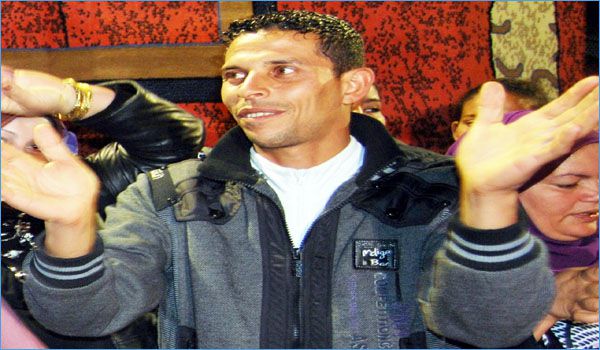
Mohamed Bouazizi

Khaled Said
The events in Tunisia and Egypt have riveted the region and the world. The eruptions of people power have shaken and taken down the seeming unbreakable edifices of dictatorship. (At the time of writing Mubarak has not formally acknowledged that he has been toppled, but the force of the movement is too powerful and determined to fathom any other outcome). Events are moving at breakneck speed and a new narrative for the future is swiftly being written. In the throes of a changing future it merits returning to the stories of two young men, the two faces that stoked the flames of revolution thanks to the persistence of on-line citizen activists who spread their stories. For in the tragic circumstances surrounding their deaths are keys to understanding what has driven throngs of citizens to the streets.
Mohammed Bouazizi has been dubbed “the father of Arab revolution”; a father indeed despite his young years and state of singlehood. Some parts of his life are by now familiar. This 26 year old who left school just short of finishing high school (he was NOT a college graduate as many new stories have been erroneously reporting) and worked in the informal economy as a vendor selling fruits and vegetable to support his widowed mother and five younger siblings. Overwhelmed by the burden of fines, debts, the humiliation of being serially harassed and beaten by police officers, and the indifference of government authorities to redress his grievances, he set himself on fire. His mother insists that though his poverty was crushing, it was the recurrence of humiliation and injustice that drove him to take his life. The image associated with Mohammed Bouazizi is not that of a young man’s face, but of a body in flames on a public sidewalk. His self-immolation occurred in front of the local municipal building where he sought, but never received, justice.
The story of 28 year old Egyptian, Khaled Said, went viral immediately following his death by beating on June 6, 2010. Two photos of him circulated the blogosphere and social networking sites. One was a portrait of his gentle face and soft eyes coming out of a youthful grey hooded sweatshirt; the face of an everyday male youth. The accompanying photo was of the bashed and bloodied face on the corpse of a young man. Though badly disfigured, the image held enough resemblance to the pre-tortured Khaled to decipher that the two faces belonged to the same person. The events leading to Khaled’s killing originated when he posted a video of two police officers allegedly dividing the spoils of a drug bust. This manner of citizen journalism has become commonplace since 2006. Youths across the region have been emboldened by a famous police corruption case of 2006. An activist posted a video on YouTube of two police officers sodomizing and whipping a minibus driver, Emad El Kabeer. It not only incensed the public and disgraced the perpetrators, but led to their criminal prosecution. On June 6, 2010, as Khaled Said was sitting in his local internet café in Alexandria two policemen accosted him and asked him for his I.D. which he refused to produce. They proceeded to drag him away and allegedly beat him to his death as he pleaded for his life. The officers claimed that Khaled died of suffocation when he tried to swallow a package of marijuana to conceal drug possession. But the power of photographic evidence combined with eyewitness accounts and popular knowledge of scores of cases of police brutality left no doubt in anyone’s mind that he was senselessly and brutally murdered by the very members of the police that were supposed to protect them. The court case of the two officers is ongoing.
Mohammed Bouazizi was not the first person to resort to suicide by self immolation out of desperation, there has been an alarming rise in such incidents in different Arab countries. And Khaled Said is sadly one of scores of citizens who have been tortured, terrorized, and killed by police with impunity. But the stories of these two young men are the ones that have captured the popular imagination, they have been game changers.
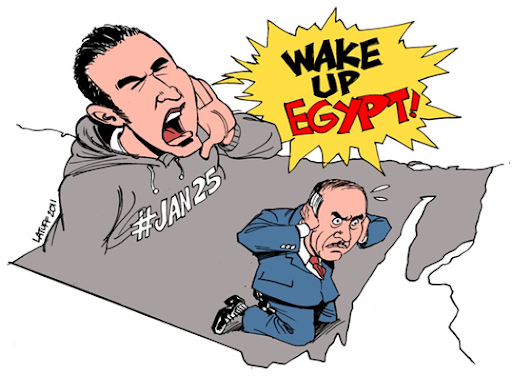
Cartoon from the Facebook Group We are all Khaled Said*
For the youth of Egypt and Tunisia, the largest cohort of young people ever in their countries, the martyrdoms of Khaled Said and Mohamed Bouaziz represent an undeniable tipping point, the breaking of the fear barrier. The youth have banned together as a generation like never before and are crying out collectively, “enough is enough!” to use the words of a 21 year old friend, Sherif, from Alexandria. The political cartoon of Khaled Said in his signature hoodie shouting to the Intelligence Chief, also popularly known “Torturer in chief” and now Mubarak’s Vice President, to “wake up Egypt” perfectly exemplifies this mood (from the Facebook group, We are all Khaled Said). No longer will the youth cower to authority figures tainted by corruption and abuses. These illegitimate leaders will cower to them. The order of things will change.
And so on January 25, 2011, inspired by the remarkable and inspiring revolution in Tunisia that toppled the twenty-three year reign of the dictatorship of Zine El Abidine Ben Ali, Egyptian youth saw it was possible to topple their dictator, Hosni Mubarak, of 31 years. Activists used different on-line platforms, most notably the April 6 Youth Movement and the “We are all Khaled Said” Facebook group to organize a national uprising against “Torture, Corruption, Poverty, and Unemployment.”
It is not arbitrary that civil rights, as exemplified in torture and corruption (recall Khaled Said), topped the list of grievances, followed by economic problems. For youth unemployment and underemployment will, under any regime, be among the greatest challenges of the times.
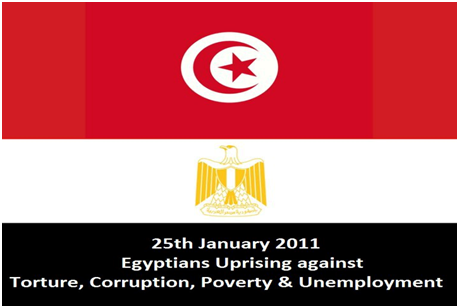
Banner of the Egyptian uprising
No one could have anticipated that this initial call would heed such mass and inclusive participation. Youths initially came to the streets braving tanks, rubber bullets, tear gas (much of which is made in the US and part of US military aid, incidentally), detention, and even death. And they were joined by citizens of all persuasions and life stages; children, youth, elderly, middle aged, female, male, middle class, poor, Muslim, Christians, Atheists.
Contrary to a number of commentators in news outlets in North America and parts of Europe the two revolutions overtaking North Africa are not motivated by Islamism and there are no compelling signs that they will be co-opted in this direction. Such analyses are likely to be either ideologically driven or misinformed. In fact, Islam has not figured whatsoever into the stories of Bouazizi and Said. These are inclusive freedom movements for civic, political, and economic rights. To understand what is driving the movement and what will invariably shape the course of reforms in the coming period we need to return to these young men. Their evocative if tragic deaths speak reams about the erosion of rights and accountability under decades of corrupt dictatorship, about the rabid assault on people’s dignity. They remind us of the desperate need to restore a political order that is just and an economic order that is fair. Mohamed Bouazizi and Khaled Said have unwittingly helped to pave a way forward, and to point the way to the right side of history.
*Correction: The figure who appears cowering in the cartoon is former Minister of Interior, Habib al-Adly, NOT Omar Suleiman, Mubarak’s VP
Linda Herrera is a social anthropologist with expertise in comparative and international education. She has lived in Egypt and conducted research on youth cultures and educational change in Egypt and the wider Middle East for over two decades. She is currently Associate Professor, Department of Education Policy, Organization and Leadership, University of Illinois at Urbana-Champaign. She is co-editor with A. Bayat of the volume Being Young and Muslim: New Cultural Politics in the Global North and South, published by Oxford University Press (2010).
This post also appeared at Thetyee.ca
‘Telefoon uit Tunesië’ – Een persoonlijk verslag van de Jasmijn-revolutie
Posted on January 29th, 2011 by martijn.
Categories: Guest authors, Society & Politics in the Middle East.
Gastauteur: Carpe D.M.
Tunesië, in de ogen van de westerse wereld een zonnig vakantieland en een voorbeeld van hoe een Arabisch land zou moeten zijn. Een vrij land, een modern land, een land waar de islam een rol speelt, maar niet de hoofdrol. Wij Tunesiers weten dat niets minder waar is. Tunesië wordt al jaren geregeerd door de president Zine al Abedine Ben Ali, een president die al jarenlang ‘democratisch’ wordt gekozen. Hij is de opvolger van president Habib Bourguiba , onder zijn bewind was Ben Ali generaal van het leger. In 1987 greep Ben Ali de macht. Hij is getrouwd met Leila Trabelsi, een kapster. De familie Trabelsi is de meeste gehate en gevreesde familie binnen Tunesië. Bijna alle bedrijven zijn in hun handen, zij zijn verantwoordelijk voor alle drugs in- en export, hebben de volledige alcoholmarkt in handen (inclusief fabrieken) en wil je iets gedaan krijgen, moet jouw geld die kant op.
Dit alles was onzichtbaar voor de buitenwereld, totdat op 17 december 2010 de waarheid beetje bij beetje naar buiten kwam. Mohammed Bouazizzi, een jongen zoals alle anderen, afgestudeerd als ICTer en werkloos. Hij besloot het er niet bij te laten zitten en startte zijn eigen groente- en fruitkraam om op deze legitieme manier toch geld te kunnen verdienen voor zijn familie. Maandenlang probeerde hij een vergunning te krijgen, maar vanwege de corruptie van het land werd dit hem onmogelijk gemaakt. Het probleem in Tunesië is dat ambtenaren te pas en te onpas geld willen zien om in eigen zak te steken, en de bedragen zijn zo hoog, dat niemand dit kan betalen. Hij ging verhaal halen op het gemeentehuis en bij terugkomst was zijn kar weggesleept. Uit pure wanhoop stak hij zichzelf in brand. Hij belandde in het ziekenhuis in coma, en overleed een paar dagen later. Wat volgde op zijn daad was iets dat hij in zijn stoutste dromen niet had durven dromen. Het land besloot zijn dood niet voor niets te laten zijn, en kwam in opstand. Wekenlang gingen jongeren de straat op om te demonstreren voor hun rechten.
Tunesië zou Tunesië niet zijn als dit niet keihard de kop ingedrukt zou worden. Het leger en politieagenten werden door Ben Ali ingezet om de mensen terug te dringen en de mond te snoeren, zelfs te doden. Het begon in het dorp Sidi Bouzid en ging vanaf daar door naar de stad Kasserine; in deze stad alleen al vielen minimaal 50 doden door het harde optreden van de politie. Vanuit daar trok de onrust verder het land in, met als eindbestemming het dorp Bizerte en de hoofdstad Tunis. Donderdag 16 januari 2011 kreeg ik ’s ochtends een telefoontje van mijn zestienjarige nichtje, huilend. Mijn oom, tante, nichtjes en neefjes hadden al twee dagen niet gegeten omdat de supermarkten uitgebrand waren en binnen een uur zou het water afgesloten worden. Kort na dit bericht werd inderdaad bekend dat de regering het water en de elektriciteit zou gaan afsluiten. Het water om de mensen tot wanhoop te drijven, en de elektriciteit om zowel de telefoonlijn als het internet af te sluiten, zodat contact met de buitenwereld onmogelijk zou worden.
Over de hele wereld begonnen Tunesiërs vanuit tientallen landen in actie te komen, voornamelijk door middel van demonstraties. Zó ook in Nederland. De avond dat de voorbereidingen getroffen werden kwam plotseling een onverwachte persconferentie van Ben Ali. Zijn beloftes: vanaf dit moment zou er een vrijheid van meningsuiting gelden, er zouden miljoenen gepompt worden in de economie om zo de werkgelegenheid te stimuleren, YouTube zou opengezet worden, er zou geen geweld meer gebruikt worden tegen de demonstranten én de prijzen van brood, suiker en melk zouden naar beneden gaan. Dit alles leidde binnen één uur tot grote verbazing (voornamelijk onder de Tunesiërs die woonachtig zijn buiten Tunesië) en tot grote vreugde. Binnen een uur reden tientallen auto’s al toeterend de straten op, klonken er leuzen als ‘lang leve Ben Ali’ en werden er honderden YouTube filmpjes op Facebook ge-upload. Dit alles tot grote verbazing van de Tunesiërs uit de Nederlandse gemeenschap. Waren hier al die mensen voor gestorven? Waren ze nu al vergeten wat dit regime met het land had gedaan? Beseften zij niet dat dit loze beloftes waren? Met stomheid geslagen werd er druk gediscussieerd of de demonstratie nog wel door moest gaan. Verdienden ze al deze steun en moeite nog wel?
De volgende ochtend werd bekend gemaakt dat twee uur na de speech het wederom uit de hand was gelopen en er drie mensen waren doodgeschoten. Daarnaast bleek dat Ben Ali politieagenten in burger de straat op had gestuurd om naar de buitenwereld toe de illusie te wekken dat hij de situatie weer onder controle had. Vrijdag 14 januari begonnen er ’s ochtends vroeg weer (vreedzame) demonstraties, tot de politie rond het middaguur wederom met geweld ingreep en de situatie uit de hand liep. Die dag heeft (ex)president Ben Ali besloten tijdelijk het land te ontvluchten samen met zijn vrouw, en zijn werkzaamheden over te dragen aan Mohammed Ghannouchi. Ben Ali vluchtte, in de eerste instantie richting Malta, waar hem de toegang werd ontzegd. Vervolgens Parijs en Dubai, maar ook daar werd hij niet ontvangen. Hij is nu al twee weken woonachtig in Saudi-Arabië, het land dat hem wel als politiek vluchteling heeft onthaald.
Zaterdag 15 januari zijn er drie gevangenissen in brand gestoken. Enkelen zijn vermoord, maar zo’n 3000 gevangenen hebben de gevangenissen kunnen ontvluchten. Zij zijn het land ingetrokken om het land verder in vernieling te brengen, geweld te plegen en overvallen te plegen. Online werden beelden geplaatst van politieagenten die ook massaal winkels plunderden en banken overvielen. Mijn vriendin, woonachtig in Tunis liet over FaceBook weten dat iedereen doodsbang was, omdat politieagenten huizen openbraken om spullen te stelen en de meisjes en vrouwen te verkrachten. Nadat het leger dit doorkreeg ontstonden er vuurgevechten tussen het leger en de politietroepen. Het leger heeft de hele periode aan de kant van het volk gestaan en heeft alles op alles gezet om de orde te handhaven.
Direct nadat de president het land verliet en zijn rechterhand de macht over het land had gegeven, trokken de demonstranten de straten weer op om iedereen binnen het kabinet die lid was van de RCD –de partij van Ben Ali- de interim regering te doen verlaten. Uiteindelijk is Ghannouchi vertrokken als interim president en zijn de werkzaamheden overgedragen aan de voorzitter van het parlement, zoals in de grondwet is vastgelegd. Wel is hij aangebleven als lid van de regering. Ben Ali wilde in eerste instantie terugkeren naar het land, maar heeft op advies van andere regeringsleiders te kennen gegeven dat hij definitief zijn troon heeft verlaten en er binnen twee maanden verkiezingen gaan plaats vinden.
Tunesië gaat nu spannende tijden tegemoet, de eerste stappen zijn gezet, maar het echte werk gaat nu pas beginnen. Binnen anderhalve maand moeten er politieke partijen gevormd worden, moeten kandidaten zich verkiesbaar gaan stellen, en moet er op toegezien worden dat het land niet in herhaling gaat vallen. Radicale partijen beginnen weer op te komen, en Ghannouchi (niet te verwarren met de politicus Mohammed Ghannouchi) leider van een radicale islamistische partij, en zo’n twintig jaar geleden verbannen uit Tunesië, is teruggekeerd naar het land. Veel mensen zijn bang dat het land gaat vallen in de handen van extremisten. Dinsdag 25 januari is er een officieel internationaal arrestatiebevel uitgevaardigd voor Ben Ali, zijn vrouw Leila Trabelsi en een aantal naaste familieleden. Zij worden er onder meer van verdacht op grote schaal geld en goederen van de Tunesische staat te hebben gestolen. Voor zover bekend heeft een groot deel van de familie Trabelsi het land verlaten en zijn al hun eigendommen en onroerend goed in beslag genomen en verwoest. Na Tunesië is de onrust nu ook overgeslagen naar Egypte en Yemen, waar afgelopen dagen ook duizenden mensen de straat op gingen, allemaal georganiseerd via FaceBook en Twitter.
In Tunesie is iedereen optimistisch en men hoopt op een democratie, zoals een democratie hoort te zijn. Het is een mooi land, met veel potentie. De angst van het oude regime zit er echter nog steeds in. Het is nog redelijk onzeker welke kant het opgaat en dit is tevens de reden dat ik dit stuk schrijf, maar niet onder mijn eigen naam. Ik hoop dat er ooit een dag komt, waarop die angst zal verdwijnen en ik mij onder mijn complete naam trots kan uitlaten op zowel positieve als negatieve ontwikkelingen binnen het land.
Carpe D.M. is de dochter van een Nederlandse moeder en een Tunesische vader. Zelf is zij meerdere keren per jaar in Tunesië, en hoopt ooit op een dag permanent te kunnen blijven. Een groot gedeelte van haar familie is nog steeds woonachtig in Tunesië, onder wie haar broertje Zij heeft dus de ontwikkelingen van dichtbij meegemaakt.
Noot van de beheerder: De naam is bekend bij de beheerder van dit weblog.