Society & Politics in the Middle East
You are looking at posts in the category Society & Politics in the Middle East.
| M | T | W | T | F | S | S |
|---|---|---|---|---|---|---|
| « Sep | ||||||
| 1 | 2 | 3 | 4 | |||
| 5 | 6 | 7 | 8 | 9 | 10 | 11 |
| 12 | 13 | 14 | 15 | 16 | 17 | 18 |
| 19 | 20 | 21 | 22 | 23 | 24 | 25 |
| 26 | 27 | 28 | 29 | 30 | 31 | |
Pages
- About
- C L O S E R moves to….C L O S E R
- Contact Me
- Interventions – Forces that Bind or Divide
- ISIM Review via Closer
- Publications
- Research
Categories
- (Upcoming) Events (33)
- [Online] Publications (26)
- Activism (117)
- anthropology (113)
- Method (13)
- Arts & culture (88)
- Asides (2)
- Blind Horses (33)
- Blogosphere (192)
- Burgerschapserie 2010 (50)
- Citizenship Carnival (5)
- Dudok (1)
- Featured (5)
- Gender, Kinship & Marriage Issues (265)
- Gouda Issues (91)
- Guest authors (58)
- Headline (76)
- Important Publications (159)
- Internal Debates (275)
- International Terrorism (437)
- ISIM Leiden (5)
- ISIM Research II (4)
- ISIM/RU Research (171)
- Islam in European History (2)
- Islam in the Netherlands (219)
- Islamnews (56)
- islamophobia (59)
- Joy Category (56)
- Marriage (1)
- Misc. News (891)
- Morocco (70)
- Multiculti Issues (749)
- Murder on theo Van Gogh and related issues (326)
- My Research (118)
- Notes from the Field (82)
- Panoptic Surveillance (4)
- Public Islam (244)
- Religion Other (109)
- Religious and Political Radicalization (635)
- Religious Movements (54)
- Research International (55)
- Research Tools (3)
- Ritual and Religious Experience (58)
- Society & Politics in the Middle East (159)
- Some personal considerations (146)
- Deep in the woods… (18)
- Stadsdebat Rotterdam (3)
- State of Science (5)
- Twitwa (5)
- Uncategorized (74)
- Young Muslims (459)
- Youth culture (as a practice) (157)
General
- ‘In the name of Allah, Most Gracious, Most Merciful’
- – Lotfi Haddi –
- …Kelaat Mgouna…….Ait Ouarchdik…
- ::–}{Nour Al-Islam}{–::
- Al-islam.nl De ware godsdienst voor Allah is de Islam
- Allah Is In The House
- Almaas
- amanullah.org
- Amr Khaled Official Website
- An Islam start page and Islamic search engine – Musalman.com
- arabesque.web-log.nl
- As-Siraat.net
- assadaaka.tk
- Assembley for the Protection of Hijab
- Authentieke Kennis
- Azaytouna – Meknes Azaytouna
- berichten over allochtonen in nederland – web-log.nl
- Bladi.net : Le Portail de la diaspora marocaine
- Bnai Avraham
- BrechtjesBlogje
- Classical Values
- De islam
- DimaDima.nl / De ware godsdienst? bij allah is de islam
- emel – the muslim lifestyle magazine
- Ethnically Incorrect
- fernaci
- Free Muslim Coalition Against Terrorism
- Frontaal Naakt. Ongesluierde opinies, interviews & achtergronden
- Hedendaagse wetenswaardigheden…
- History News Network
- Homepage Al Nisa
- hoofddoek.tk – Een hoofddoek, je goed recht?
- IMRA: International Muslima Rights Association
- Informed Comment
- Insight to Religions
- Instapundit.com
- Interesting Times
- Intro van Abdullah Biesheuvel
- islaam
- Islam Ijtihad World Politics Religion Liberal Islam Muslim Quran Islam in America
- Islam Ijtihad World Politics Religion Liberal Islam Muslim Quran Islam in America
- Islam Website: Islam, Islamic Studies, Arabic, Religion
- Islamforum
- Islamic Philosophy Online
- Islamica Magazine
- islamicate
- Islamophobia Watch
- Islamsevrouw.web-log.nl
- Islamwereld-alles wat je over de Islam wil weten…
- Jihad: War, Terrorism, and Peace in Islam
- JPilot Chat Room
- Madrid11.net
- Marocstart.nl – De marokkaanse startpagina!
- Maryams.Net – Muslim Women and their Islam
- Michel
- Modern Muslima.com
- Moslimjongeren Amsterdam
- Moslimjongeren.nl
- Muslim Peace Fellowship
- Muslim WakeUp! Sex & The Umma
- Muslimah Connection
- Muslims Against Terrorism (MAT)
- Mutma’inaa
- namira
- Otowi!
- Ramadan.NL
- Religion, World Religions, Comparative Religion – Just the facts on the world\’s religions.
- Ryan
- Sahabah
- Salafi Start Siden – The Salafi Start Page
- seifoullah.tk
- Sheikh Abd al Qadir Jilani Home Page
- Sidi Ahmed Ibn Mustafa Al Alawi Radhiya Allahu T’aala ‘Anhu (Islam, tasawuf – Sufism – Soufisme)
- Stichting Vangnet
- Storiesofmalika.web-log.nl
- Support Sanity – Israel / Palestine
- Tekenen van Allah\’s Bestaan op en in ons Lichaam
- Terrorism Unveiled
- The Coffee House | TPMCafe
- The Inter Faith Network for the UK
- The Ni’ma Foundation
- The Traveller’s Souk
- The \’Hofstad\’ terrorism trial – developments
- Thoughts & Readings
- Uitgeverij Momtazah | Helmond
- Un-veiled.net || Un-veiled Reflections
- Watan.nl
- Welkom bij Islamic webservices
- Welkom bij vangnet. De site voor islamitische jongeren!
- welkom moslim en niet moslims
- Yabiladi Maroc – Portail des Marocains dans le Monde
Dutch [Muslims] Blogs
- Hedendaagse wetenswaardigheden…
- Abdelhakim.nl
- Abdellah.nl
- Abdulwadud.web-log.nl
- Abou Jabir – web-log.nl
- Abu Bakker
- Abu Marwan Media Publikaties
- Acta Academica Tijdschrift voor Islam en Dialoog
- Ahamdoellilah – web-log.nl
- Ahlu Soennah – Abou Yunus
- Ahlul Hadeeth
- Ahlul Hadeeth
- Al Moudjahideen
- Al-Adzaan
- Al-Islaam: Bismilaahi Rahmaani Rahiem
- Alesha
- Alfeth.com
- Anoniempje.web-log.nl
- Ansaar at-Tawheed
- At-Tibyan Nederland
- beni-said.tk
- Blog van moemina3 – Skyrock.com
- bouchra
- CyberDjihad
- DE SCHRIJVENDE MOSLIMS
- DE VROLIJKE MOSLIM ;)
- Dewereldwachtopmij.web-log.nl
- Dien~oel~Islaam
- Eali.web-log.nl
- Een genade voor de werelden
- Enige wapen tegen de Waarheid is de leugen…
- ErTaN
- ewa
- Ezel & Os v2
- Gizoh.tk [.::De Site Voor Jou::.]
- Grappige, wijze verhalen van Nasreddin Hodja. Turkse humor.
- Hanifa Lillah
- hayya~ala~assalaah!
- Het laatste nieuws lees je als eerst op Maroc-Media
- Homow Universalizzz
- Ibn al-Qayyim
- IslaamLive Mail
- IslaamLive Mail
- Islam Blog – Juli 2007
- Islam in het Nieuws – web-log.nl
- Islam, een religie
- Islam, een religie
- Islamic Sisters – web-log.nl
- Islamiway’s Weblog
- Islamtawheed’s Blog
- Jihaad
- Jihad
- Journalista
- La Hawla Wa La Quwatta Illa Billah
- M O S L I M J O N G E R E N
- M.J.Ede – Moslimjongeren Ede
- Mahdi\’s Weblog | Vrijheid en het vrije woord | punt.nl: Je eigen gratis weblog, gratis fotoalbum, webmail, startpagina enz
- Maktab.nl (Zawaj – islamitische trouwsite)
- Marocdream.nl – Home
- Marokkaanse.web-log.nl
- Marokkanen Weblog
- Master Soul
- Miboon
- Miesjelle.web-log.nl
- Mijn Schatjes
- Moaz
- moeminway – web-log.nl
- Moslima_Y – web-log.nl
- mosta3inabilaah – web-log.nl
- Muhaajir in islamitisch Zuid-Oost Azië
- Mumin al-Bayda (English)
- Mustafa786.web-log.nl
- Oprecht – Poort tot de kennis
- Said.nl
- saifullah.nl – Jihad al-Haq begint hier!
- Salaam Aleikum
- Sayfoudien – web-log.nl
- soebhanAllah
- Soerah19.web-log.nl – web-log.nl
- Steun Palestina
- Stichting Moslimanetwerk
- Stories of Malika
- supermaroc
- Ummah Nieuws – web-log.nl
- Volkskrant Weblog — Alib Bondon
- Volkskrant Weblog — Moslima Journalista
- Vraag en antwoord…
- wat is Islam
- Wat is islam?
- Weblog – a la Maroc style
- website van Jamal
- Wij Blijven Hier
- Wij Blijven Hier
- www.BenAyad.be – Islam en Actua
- www.moslima.web-log.nl
- Yakini Time
- Youth Of Islam
- Youth Of Islam
- [fikra]
Non-Dutch Muslims Blogs
- Lanallah __Islamic BlogZine__
- This journey ends but only with The Beginning
- ‘the middle place’
- …Never Judge a Person By His or Her Blog…
- …under the tree…
- A Comment on PMUNA
- A Dervish’s Du`a’
- A Family in Baghdad
- A Garden of Children
- A Muslim Mother’s Thoughts / Islamic Parenting
- A Struggle in Uncertainty, Such is Life
- About Afghanistan
- adnan.org: good design, bad idea
- Afiyah
- Ahmeds World of Islam
- Al Musawwir
- Al-Musharaka
- Almiraya tBLOG – O, happy the soul that saw its own faults
- Almusawwir
- an open window
- Anak Alam
- aNaRcHo AkBaR
- Anthology
- AnthroGal’s World
- Arabian Passion
- ArRihla
- Articles Blog
- Asylum Seeker
- avari-nameh
- Baghdad Burning
- Being Noor Javed
- Bismillah
- bloggin’ muslimz.. Linking Muslim bloggers around the globe
- Blogging Islamic Perspective
- Chapati Mystery
- City of Brass – Principled pragmatism at the maghrib of one age, the fajr of another
- COUNTERCOLUMN: All Your Bias Are Belong to Us
- d i z z y l i m i t s . c o m >> muslim sisters united w e b r i n g
- Dar-al-Masnavi
- Day in the life of an American Muslim Woman
- Don’t Shoot!…
- eat-halal guy
- Eye on Gay Muslims
- Eye on Gay Muslims
- Figuring it all out for nearly one quarter of a century
- Free Alaa!
- Friends, Romans, Countrymen…. lend me 5 bux!
- From Peer to Peer ~ A Weblog about P2P File & Idea Sharing and More…
- Ghost of a flea
- Ginny’s Thoughts and Things
- God, Faith, and a Pen: The Official Blog of Dr. Hesham A. Hassaballa
- Golublog
- Green Data
- gulfreporter
- Hadeeth Blog
- Hadouta
- Hello from the land of the Pharaoh
- Hello From the land of the Pharaohs Egypt
- Hijabi Madness
- Hijabified
- HijabMan’s Blog
- Ihsan-net
- Inactivity
- Indigo Jo Blogs
- Iraq Blog Count
- Islam 4 Real
- Islamiblog
- Islamicly Locked
- Izzy Mo’s Blog
- Izzy Mo’s Blog
- Jaded Soul…….Unplugged…..
- Jeneva un-Kay-jed- My Bad Behavior Sanctuary
- K-A-L-E-I-D-O-S-C-O-P-E
- Lawrence of Cyberia
- Letter From Bahrain
- Life of an American Muslim SAHM whose dh is working in Iraq
- Manal and Alaa\’s bit bucket | free speech from the bletches
- Me Vs. MysElF
- Mental Mayhem
- Mere Islam
- Mind, Body, Soul : Blog
- Mohammad Ali Abtahi Webnevesht
- MoorishGirl
- Muslim Apple
- muslim blogs
- Muslims Under Progress…
- My heart speaks
- My Little Bubble
- My Thoughts
- Myself | Hossein Derakhshan’s weblog (English)
- neurotic Iraqi wife
- NINHAJABA
- Niqaabi Forever, Insha-Allah Blog with Islamic nasheeds and lectures from traditional Islamic scholars
- Niqabified: Irrelevant
- O Muhammad!
- Otowi!
- Pak Positive – Pakistani News for the Rest of Us
- Periphery
- Pictures in Baghdad
- PM’s World
- Positive Muslim News
- Procrastination
- Prophet Muhammad
- Queer Jihad
- Radical Muslim
- Raed in the Middle
- RAMBLING MONOLOGUES
- Rendering Islam
- Renegade Masjid
- Rooznegar, Sina Motallebi’s WebGard
- Sabbah’s Blog
- Salam Pax – The Baghdad Blog
- Saracen.nu
- Scarlet Thisbe
- Searching for Truth in a World of Mirrors
- Seeing the Dawn
- Seeker’s Digest
- Seekersdigest.org
- shut up you fat whiner!
- Simply Islam
- Sister Scorpion
- Sister Soljah
- Sister Surviving
- Slow Motion in Style
- Sunni Sister: Blahg Blahg Blahg
- Suzzy’s id is breaking loose…
- tell me a secret
- The Arab Street Files
- The Beirut Spring
- The Islamic Feminista
- The Land of Sad Oranges
- The Muslim Contrarian
- The Muslim Postcolonial
- The Progressive Muslims Union North America Debate
- The Rosetta Stone
- The Traceless Warrior
- The Wayfarer
- TheDesertTimes
- think halal: the muslim group weblog
- Thoughts & Readings
- Through Muslim Eyes
- Turkish Torque
- Uncertainty:Iman and Farid’s Iranian weblog
- UNMEDIA: principled pragmatism
- UNN – Usayd Network News
- Uzer.Aurjee?
- Various blogs by Muslims in the West. – Google Co-op
- washed away memories…
- Welcome to MythandCulture.com and to daily Arrows – Mythologist, Maggie Macary’s blog
- word gets around
- Writeous Sister
- Writersblot Home Page
- www.BenAyad.be – Islam en Actua
- www.Mas’ud’s blog
- \’Aqoul
- ~*choco-bean*~
General Islam Sites
- :: Islam Channel :: – Welcome to IslamChannel Official Website
- Ad3iyah(smeekbeden)
- Al-maktoum Islamic Centre Rotterdam
- Assalamoe Aleikoem Warhmatoe Allahi Wa Barakatuhoe.
- BouG.tk
- Dades Islam en Youngsterdam
- Haq Islam – One stop portal for Islam on the web!
- Hight School Teacher Muhammad al-Harbi\’s Case
- Ibn Taymiyah Pages
- Iskandri
- Islam
- Islam Always Tomorrow Yesterday Today
- Islam denounces terrorism.com
- Islam Home
- islam-internet.nl
- Islamic Artists Society
- Leicester~Muslims
- Mere Islam
- MuslimSpace.com | MuslimSpace.com, The Premiere Muslim Portal
- Safra Project
- Saleel.com
- Sparkly Water
- Statements Against Terror
- Understand Islam
- Welcome to Imaan UK website
Islamic Scholars
Social Sciences Scholars
- ‘ilm al-insaan: Talking About the Talk
- :: .. :: zerzaust :: .. ::
- After Sept. 11: Perspectives from the Social Sciences
- Andrea Ben Lassoued
- Anth 310 – Islam in the Modern World (Spring 2002)
- anthro:politico
- AnthroBase – Social and Cultural Anthropology – A searchable database of anthropological texts
- AnthroBlogs
- AnthroBoundaries
- Anthropologist Community
- anthropology blogs
- antropologi.info – Social and Cultural Anthropology in the News
- Arabist Jansen
- Between Secularization and Religionization Vrije Universiteit Amsterdam
- Bin Gregory Productions
- Blog van het Blaise Pascal Instituut
- Boas Blog
- Causes of Conflict – Thoughts on Religion, Identity and the Middle East (David Hume)
- Cicilie among the Parisians
- Cognitive Anthropology
- Comunidade Imaginada
- Cosmic Variance
- Critical Muslims
- danah boyd
- Deep Thought
- Dienekes’ Anthropology Blog
- Digital Islam
- Erkan\’s field diary
- Ethno::log
- Evamaria\’s ramblings –
- Evan F. Kohlmann – International Terrorism Consultant
- Experimental Philosophy
- For the record
- Forum Fridinum [Religionresearch.org]
- Fragments weblog
- From an Anthropological Perspective
- Gregory Bateson
- Islam & Muslims in Europe *)
- Islam, Islamic Studies, Arabic, Religion
- Islam, Muslims, and an Anthropologist
- Jeremy’s Weblog
- JourneyWoman
- Juan Cole – ‘Documents on Terrorist Abu Musab al-Zarqawi’
- Keywords
- Kijken naar de pers
- languagehat.com
- Left2Right
- Leiter Reports
- Levinas and multicultural society
- Links on Islam and Muslims
- log.squig.org
- Making Anthropology Public
- Martijn de Koning Research Pages / Onderzoekspaginas
- Material World
- MensenStreken
- Modern Mass Media, Religion and the Imagination of Communities
- Moroccan Politics and Perspectives
- Multicultural Netherlands
- My blog’s in Cambridge, but my heart is in Accra
- National Study of Youth and Religion
- Natures/Cultures
- Nomadic Thoughts
- On the Human
- Philip Greenspun’s Weblog:
- Photoethnography.com home page – a resource for photoethnographers
- Qahwa Sada
- RACIAL REALITY BLOG
- Religion Gateway – Academic Info
- Religion News Blog
- Religion Newswriters Association
- Religion Research
- rikcoolsaet.be – Rik Coolsaet – Homepage
- Rites [Religionresearch.org]
- Savage Minds: Notes and Queries in Anthropology – A Group Blog
- Somatosphere
- Space and Culture
- Strange Doctrines
- TayoBlog
- Teaching Anthropology
- The Angry Anthropologist
- The Gadflyer
- The Immanent Frame | Secularism, religion and the public sphere
- The Onion
- The Panda\’s Thumb
- TheAnthroGeek
- This Blog Sits at the
- This Blog Sits at the intersection of Anthropology & Economics
- verbal privilege
- Virtually Islamic: Research and News about Islam in the Digital Age
- Wanna be an Anthropologist
- Welcome to Framing Muslims – International Research Network
- Yahya Birt
Women's Blogs / Sites
- * DURRA * Danielle Durst Britt
- -Fear Allah as He should be Feared-
- a literary silhouette
- a literary silhouette
- A Thought in the Kingdom of Lunacy
- AlMaas – Diamant
- altmuslimah.com – exploring both sides of the gender divide
- Assalaam oe allaikoum Nour al Islam
- Atralnada (Morning Dew)
- ayla\’s perspective shifts
- Beautiful Amygdala
- bouchra
- Boulevard of Broken Dreams
- Chadia17
- Claiming Equal Citizenship
- Dervish
- Fantasy web-log – web-log.nl
- Farah\’s Sowaleef
- Green Tea
- hayya~ala~assalaah!
- Hilsen Fra …
- Islamucation
- kaleidomuslima: fragments of my life
- Laila Lalami
- Marhaban.web-log.nl – web-log.nl
- Moslima_Y – web-log.nl
- Muslim-Refusenik The official website of Irshad Manji
- Myrtus
- Noor al-Islaam – web-log.nl
- Oh You Who Believe…
- Raising Yousuf: a diary of a mother under occupation
- SAFspace
- Salika Sufisticate
- Saloua.nl
- Saudi Eve
- SOUL, HEART, MIND, AND BODY…
- Spirit21 – Shelina Zahra Janmohamed
- Sweep the Sunshine | the mundane is the edge of glory
- Taslima Nasrin
- The Color of Rain
- The Muslimah
- Thoughts Of A Traveller
- Volkskrant Weblog — Islam, een goed geloof
- Weblog Raja Felgata | Koffie Verkeerd – The Battle | punt.nl: Je eigen gratis weblog, gratis fotoalbum, webmail, startpagina enz
- Weblog Raja Felgata | WRF
- Writing is Busy Idleness
- www.moslima.web-log.nl
- Zeitgeistgirl
- Zusters in Islam
- ~:: MARYAM ::~ Tasawwuf Blog
Ritueel en religieuze beleving Nederland
- – Alfeth.com – NL
- :: Al Basair ::
- Abu Marwan Media Publikaties
- Ahlalbait Jongeren
- Ahlul Hadeeth
- Ahlul Hadeeth
- Al-Amien… De Betrouwbare – Home
- Al-Ummah
- Al-Ummah
- Al-Ummah
- Al-Wasatiyyah.com – Home
- Anwaar al-Islaam
- anwaaralislaam.tk
- Aqiedah’s Weblog
- Arabische Lessen – Home
- Arabische Lessen – Home
- Arrayaan.net
- At-taqwa.nl
- Begrijp Islam
- Bismillaah – deboodschap.com
- Citaten van de Salaf
- Dar al-Tarjama WebSite
- Dawah-online.com
- de koraan
- de koraan
- De Koran . net – Het Islaamitische Fundament op het Net – Home
- De Leidraad, een leidraad voor je leven
- Dien~oel~Islaam
- Dien~oel~Islaam
- Faadi Community
- Ghimaar
- hayya~ala~assalaah!
- hayya~ala~assalaah!
- Ibn al-Qayyim
- IMAM-MALIK-Alles over Islam
- IQRA ROOM – Koran studie groep
- Islaam voor iedereen
- Islaam voor iedereen
- Islaam: Terugkeer naar het Boek (Qor-aan) en de Soennah volgens het begrip van de Vrome Voorgangers… – Home
- Islaam: Terugkeer naar het Boek (Qor-aan) en de Soennah volgens het begrip van de Vrome Voorgangers… – Home
- IslaamLive Mail
- IslaamLive Mail
- IslaamLive Mail
- islam :: messageboard
- Islam City NL, Islam en meer
- Islam, een religie
- Islamia.nl – Islamic Shop – Islamitische Winkel
- Islamitische kleding
- Islamitische kleding
- Islamitische smeekbedes
- islamtoday
- islamvoorjou – Informatie over Islam, Koran en Soenah
- kebdani.tk
- KoranOnline.NL
- Lees de Koran – Een Openbaring voor de Mensheid
- Lifemakers NL
- Marocstart.nl | Islam & Koran Startpagina
- Miesbahoel Islam Zwolle
- Mocrodream Forums
- Moslims in Almere
- Moslims online jong en vernieuwend
- Nihedmoslima
- Oprecht – Poort tot de kennis
- Quraan.nl :: quran koran kuran koeran quran-voice alquran :: Luister online naar de Quraan
- Quraan.nl online quraan recitaties :: Koran quran islam allah mohammed god al-islam moslim
- Selefie Nederland
- Stichting Al Hoeda Wa Noer
- Stichting Al Islah
- StION Stichting Islamitische Organisatie Nederland – Ahlus Sunnat Wal Djama\’ah
- Sunni Publicaties
- Sunni.nl – Home
- Teksten van Aboe Ismaiel
- Terug Naar De Dien – Home
- Terug Naar De Dien – Home
- Terug Naar De Dien – Home
- Uw Keuze
- www.ahloelhadieth.com
- www.ahloelhadieth.com
- www.al-thabaat.com
- www.hijaab.com
- www.uwkeuze.net
- Youth Of Islam
- Zegswijzen van de Wijzen
- \’\’ Leid ons op het rechte pad het pad degenen aan wie Gij gunsten hebt geschonken\’\’
Muslim News
Moslims & Maatschappij
Arts & Culture
- : : SamiYusuf.com : : Copyright Awakening 2006 : :
- amir normandi, photographer – bio
- Ani – SINGING FOR THE SOUL OF ISLAM – HOME
- ARTEEAST.ORG
- AZIZ
- Enter into The Home Website Of Mecca2Medina
- Kalima Translation – Reviving Translation in the Arab world
- lemonaa.tk
- MWNF – Museum With No Frontiers – Discover Islamic Art
- Nader Sadek
Misc.
'Fundamentalism'
Islam & commerce
2
Morocco
[Online] Publications
- ACVZ :: | Preliminary Studies | About marriage: choosing a spouse and the issue of forced marriages among Maroccans, Turks and Hindostani in the Netherlands
- ACVZ :: | Voorstudies | Over het huwelijk gesproken: partnerkeuze en gedwongen huwelijken onder Marokkaanse, Turkse en Hindostaanse Nederlanders
- Kennislink – ‘Dit is geen poep wat ik praat’
- Kennislink – Nederlandse moslims
Religious Movements
- :: Al Basair ::
- :: al Haqq :: de waarheid van de Islam ::
- ::Kalamullah.Com::
- Ahloelhadieth.com
- Ahlul Hadeeth
- al-Madinah (Medina) The City of Prophecy ; Islamic University of Madinah (Medina), Life in Madinah (Medina), Saudi Arabia
- American Students in Madinah
- Aqiedah’s Weblog
- Dar al-Tarjama WebSite
- Faith Over Fear – Feiz Muhammad
- Instituut voor Opvoeding & Educatie
- IslaamLive Mail
- IslaamLive Mail
- islamtoday
- Moderate Muslims Refuted
- Rise And Fall Of Salafi Movement in the US by Umar Lee
- Selefie Dawah Nederland
- Selefie Nederland
- Selefienederland
- Stichting Al Hoeda Wa Noer
- Teksten van Aboe Ismaiel
- www.ahloelhadieth.com
- www.BenAyad.be – Islam en Actua
- Youth Of Islam

De protesten in Syrië
Posted on March 29th, 2011 by martijn.
Categories: Guest authors, Society & Politics in the Middle East.
Guest Author: Dick Douwes
Past Syrië in het rijtje Tunesië en Egypte? Of kunnen er Libische toestanden ontstaan?
Massale protesten in Syrië beperken zich tot nu toe vooral tot plattelandssteden nabij de grens met Jordanië. Er zijn ook demonstraties in andere steden, waaronder in de twee grootste, Damascus en Aleppo. Het zijn kleine maar dappere demonstraties tegen het regime. Er zijn andere, grotere demonstraties pro-regime, maar die zijn dan ook georganiseerd door het regime. Welke kant gaat het op in Syrië?
Syrië kampt met de voor de regio bekende problemen: snelle bevolkingsgroei, stagnerende economie, wijdverbreide corruptie en politieke repressie. Het onderwijs barst uit zijn voegen door de grote toestroom van kinderen en jongeren. Uitzicht op een baan, laat staan een passende, is klein. Geen baan betekent laat trouwen, in ieder geval voor jonge mannen, en als er een gezin wordt gesticht, inwonen bij familie op een paar vierkante meter. Syrië staat vol met simpele, half afgebouwde en deels bewoonde huizen; allemaal als ideaal begonnen maar gestrand op te hoge prijzen voor cement en te lage inkomens. Een woningcrisis in kwadraat.
Dat de woede in Syrië zich nu manifesteert in Dera’a en omgeving is opvallend. Plattelandssteden als Dera’a vormden lange tijd de basis van het socialistische Ba’th regime dat sinds 1963 aan de macht is. Het Syrische regime wordt vaak alawitisch genoemd vanwege het grote aandeel van alawieten in de top van het leger en de politiek, maar in oorsprong rust het regime op een beweging zich emanciperende plattelanders, waaronder alawieten, die zich keerden tegen de macht van grootgrondbezitters; de notabele families van de grote steden: Damascus, Aleppo , Hama en Homs.
Dat de woede zich eerst laat zien op het platteland, is niet zonder reden. De elite van de partij – en het leger – heeft zich in de afgelopen decennia verplaatst van de dorpen en plattelandsteden naar Damascus. Er zijn allerlei allianties ontstaan tussen officieren, partijbonzen en ondernemers van divers pluimage waarin nouveau riche alawieten zich mengen met de stedelijke elite van soennieten en christenen. Anders dan in de eerste decennia investeert het regime maar weinig in de meer afgelegen plattelandsgebieden. Juist die gebieden kampen met vaak omvangrijke ecologische en dus economische problemen als gevolg van droogte en roofbouw op de natuurlijke watervoorraden.
In Tunesië en Egypte bleek het leger een buffer te vormen tussen repressie en protest en koos de legertop voor verandering – zij het vooralsnog niet een radicale. Syrië kent net als Egypte een groot staand leger van dienstplichtigen. Maar daarnaast zijn er verschillende elite-eenheden, veiligheidsdiensten en milities die onder commando vallen van de president en/of zijn veelal alawitische bondgenoten. Het is de vraag in hoeverre en hoe lang het leger en de politie bereid zijn het vuur te openen op demonstranten.
Dera’a: Demonstranten halen beeld van Hafez al-Assad neer
De fundamentele vraag is of de Syrische staat sterk genoeg is. Het leger is zo’n instituut dat de staat kan dragen, zoals blijkt in Egypte en Tunesië. Ook vakbonden, een redelijk onafhankelijke rechtspraak, een bewuste middenklasse en een beperkte ruimte voor protest bepalen hoe een regime op protest reageert. In Syrië was de eerste reactie schieten met scherp. Toch hebben de protesten al taboes doorbroken. Syrië is vergeven van standbeelden en beeltenissen van de presidente en van zijn vader. De eersten zijn al vernield. Veel hangt nu af van het vermogen van het regime de grote steden te controleren en hun relaties met de stedelijke elites te behouden. Ook die laatsten wachten waarschijnlijk niet op een revolutie vanuit het verarmde platteland.
Dick Douwes (1957) is hoogleraar Geschiedenis van het Midden-Oosten aan de Erasmus Universteit Rotterdam en studeerde Arabisch aan de Katholieke Universiteit Nijmegen. Naast historisch werk publiceert Douwes over de integratie van islamitische gemeenschappen in Nederland en is voorzitter van de Nederlandse Vereniging voor de Studie van Islam en het Midden-Oosten (MOI).
Closing the week 12 – Featuring the Syrian Uprising
Posted on March 27th, 2011 by martijn.
Categories: Blogosphere, Society & Politics in the Middle East.
Most popular on Closer last week:
- De Mislukking van het anti-multiculturalisme IV – De seculiere intolerantie
- Egypt: After the Revolution by Samuli Schielke
- Fitna NL – Analyse van de politieke propaganda
- Two Faces of Revolution by Linda Herrera
Previous updates:
Tunisia Uprising I – Tunisia Uprising II – Tunisia / Egypt Uprising Essential Reading I – The Egypt Revolution – A Need to Read List – Women & Middle East Uprisings. See also the section Society and Politics in the Middle East (Dutch and English guest contributions).
- If you want to stay updated and did not subscribe yet, you can do so HERE
- You can follow me on Twitter: Martijn5155
Featuring the Syrian Uprising
Syria Comment » Archives » Syria Dividing: Most Large Cities Calm. The Troubles in Latakia Lead to Army being Deployed
Syria is dividing into sides – those that will fight the state and those that support the president or fear revolution. The silent majority is still sitting on the side lines, but they will not be able to do so for long if order collapses. The army is sticking by the President, a main difference with Egypt or Tunisia. So long as the army remains united and obeys the President, it will be hard for the opposition to take over parts of the country or bring down the regime.
Global Voices · Syria Protests 2011
Initially inspired by revolutions in Egypt and Tunisia, protests in Syria have gained momentum since March 15, 2011 (a first call for protests on February 5 drew only a small crowd). Thousands have protested against the government of President Bashar Al-Assad in Damascus, Aleppo and several other cities – and dozens have been arrested – but the heart of the protests is currently in southern city Daraa. On March 18, news that 15 children had been arrested for writing anti-regime graffiti sparked a demonstration that led to security forces killing at least three people. In subsequent protests in Daraa, at least 37 more have been killed (some reports say as many as 150 may have died). The most extensive nationwide protests since the beginning of the uprisings were on March 25 on what is now referred to as the “Friday of Dignity” (at least 24 deaths reported so far).
Double-crossing the Rubicon: A whole mess of updates from all over!
The situation in Syria keeps getting more and more serious (or should I say Syrias?). Protesters burnt down a Baath party headquarters today and the protests continue to escalate in response to the governments violent attempts to suppress them.
An interesting consequence of the current situation in Syria is that Hezbollah has positioned itself very squarely on the side of Assad, a strategic decision that will probably come back to bite them in the ass later on. The Alawite sect of Islam that Assad and his core supporters belong to is viewed with some suspicion by many of the more conventional Sunni Arabs of Syria. The government’s close ties to the Shiites of Hezbollah and to the Iranian government have give the unhappy parts of the population ammunition for accusations of borderline heresy.
????????: Muhammed Radwan Arrested
The Syrian regime is just like all the other authoritarian regimes in the Middle East that fabricate stories and arrest innocent people just to cling on to power. To hell with Bashar el-Asad and his bloody regime.
Marjeh Square: a space of the would-be Syrian uprising « Spaces in Public
Despite protests in other locations in Damascus, mostly in the “suburbs,” the first protests on March 15 and 16 took place in the heart of Damascus in Marjeh Square. As the focal point of a sit-in and demonstration, Marjeh Square briefly gave a sense of place to any would-be uprising at the urban core of Damascus. In looking to Marjeh Square as a public space intimately intertwined with Syria’s modern history, we can perhaps glean the urban context of how a city’s spaces of revolt are formed and then transformed over time.
Symbols of the Syrian Regime Begin to Fall « the news in arabic
The ubiquitous visual representations of Asad’s cult of personality are becoming the targets of demonstrations in Syria. After 11 days of demonstrations in numerous Syrian cities, the statues and posters that are a familiar aspect of every Syrian’s life are now being stripped down from their prominent locations in some central squares. No footage has been reported of this happening in Syria’s two major cities Damascus and Aleppo, but Homs and Deraa are substantial cities in their own ways.
Syria’s presence in Lebanon is both covert (with thousands of security officers, many undercover) and overt – as this billboard in Beirut attests.
Middle East Today: Continuance of Political Upheavals in the Arab World
In Syria, the protestors’ movement has spread from Damascus to other cities. It was reported that the Syrian security police killed more than one hundred people in Dirra city. At the same time, the supporters of the regime have started their own movement to challenge those who are opposing the regime. In the meantime, it was reported that the protestors’ movements have spread to other cities in Syria, calling for political reforms and an end to corruption. President Bashaar el Asad promised the protesters political reforms such as freedom of expression, lifting emergency law and allowing political parties to participate in future elections. Meanwhile a counter demonstration spread in Syrian cities in support of the president. However, I doubt that the protesters will be appeased by the promises for political reforms made by the president.
Syria: Protesters Demolish Symbols of Regime · Global Voices
In Syria, the faces of President Bashar al-Assad and his father, former President Hafez al-Assad, are regularly seen on billboards, buildings, and in the form of statues. Visitors to the country are often surprised by the prevalence of such images, while Syrians have grown used to them as a daily feature of life. Yesterday, a number of videos surfaced in which protesters tear down the symbols of the regime: posters and statues of the ruling Assad family.
Iran: Syrians Protest “Neither Iran Nor Hezbollah!” · Global Voices
Several Iranian bloggers reacted to a slogan of Syrian protesters during Wednesday’s march where people chanted “Neither Iran, nor Hezbollah!” Syria is an ally of Iran and is also friendly with the militant group Hezbollah in Lebanon.
Essential Readings
Have the jihadis lost the moral high ground to the rebels? « The Immanent Frame
It has been a season of earthquakes, and the political ones in Libya, Egypt, Tunisia, and elsewhere in the Middle East may have shifted the moral high ground within Islamic opposition movements. Put simply, Tahrir Square may have trumped jihad.
In Egypt, Muslim Group Takes Lead Role in Post-Mubarak Era – NYTimes.com
In post-revolutionary Egypt, where hope and confusion collide in the daily struggle to build a new nation, religion has emerged as a powerful political force, following an uprising that was based on secular ideals. The Muslim Brotherhood, an Islamist group once banned by the state, is at the forefront, transformed into a tacit partner with the military government that many fear will thwart fundamental changes.
What is Political Sectarianism?
There is an ongoing spasm of activism in Lebanon directed towards changing the sectarian structure and ethos of the state. For the past five weeks, growing numbers of people have taken to the streets stating their refusal of both the March 14 and March 8 coalitions and demanding the end of sectarianism in Lebanon. It has been inspiring to see men and women from all age groups, areas and socio-economic strata march together through parts of Southern Beirut, East Beirut, West Beirut and the rest of the country shouting slogans such as “we want the end of political sectarianism”. By some counts (although it is always prudent to be wary of protestor counts) more than 10,000 people participated in the last protest. While it is still early to call what is happening a “movement” and it is definitely too early to call it an uprising, what is happening cannot, and should not, be discounted or cynically dismissed as doomed to failure. Even if it does fail in its stated goal of “overthrowing political sectarianism” it will have succeeded in inspiring thousands of people across Lebanon and its diaspora. It will have succeeded in being the impetus for the formation of networks that will last far beyond these weekly protests. However, before predictions of this group’s failure or success are made it is incumbent upon us to think seriously and critically about what ending political sectarianism entails, and consequently, about what sectarianism is and the myriad ways in which it functions to produce and animate the conditions of possibility for both “Lebanon” as a nation state and “Lebanese citizenship” as a category of everyday practice. Before entering a more in-depth analysis of these questions, I begin with a table that summarizes some of my claims.
How to Lose Friends and Alienate Your People
The extraordinary events that have been gripping the Arab world since December 2010 have demonstrated the steadfastness of Arab citizens across the region in the face of despotic regimes. But they have also demonstrated that Arab despots indeed engage in authoritarian learning. From Tunisia to Egypt to Bahrain to Libya to Morocco to Yemen to Syria (and the list goes on), Arab rulers have followed a peculiarly familiar pattern in the way they have—and are—responding to the protests calling for regime change.
Empire
Anthropologists Not Keen on Human Terrain Systems « CONNECTED in CAIRO
Al-Jazeera English is the latest media outlet to run an article on Human Terrain Systems (HTS) claiming “A new phalanx of anthropologist-warriors are being recruited, carrying ‘cultural scripts’ to battle”. Written by historian Mark LeVine, the article describes a brochure he received asking him to send job-hungry social scientists this way.
Barry Sheppard: Libya, imperialism, and ALBA « Louis Proyect: The Unrepentant Marxist
The unfolding of the Arab revolution is thus objectively and increasingly subjectively anti-imperialist. Washington’s system of domination in North Africa and the Mideast has been shaken. Israel’s role in this system has likewise been weakened. The Israeli ruling class feels itself becoming isolated by the rebellion, and its spokespeople are squealing in alarm. Israel is reacting by renewing attacks on Gaza and further settlements in the West Bank, driving to consolidate its rule from the Mediterranean to the Jordan River.
Not the usual media roundup, this report focuses on some of the questions raised in “The Libyan Revolution is Dead,” as part of a broader critique on the foreign military intervention in Libya, one week after it began. In particular, we examine:
* the political implications of the war in Western nations;
* the nature of the media spectacle, and how it resembles/differs from wars of the last 20 years;
* assessing the “successes” of the no-flight zone (NFZ) and what it allegedly prevented;
* the human rights frame, and the problem of evidence for “crimes;”
* the strategy behind the foreign military intervention, and the increasingly rapid slippage from one goal to the next;
* the slow but growing media analysis of “the rebels” in Libya, getting underneath some of the insurgents’ claims, followed by an examination of some of the promotional propaganda designed to sell them to Western audiences;
* growing critiques of the war, with perspectives from those outside of Western Europe and North America—one might say, from experts on imperialism for having been at its receiving end for many generations;
* and, finally, the folly of the late humanitarian project, that refuses to recognize its own complicity in creating the object of its destructive desires.Links to the relevant articles are to be found throughout.
Anthropologists and stereotypes about Libya and Japan
Have you tried googling “Japan” “earthquake” and “no looting”? Or “Libya” and “tribes”? It’s no big surprise to see stereotypical representations of other people in the news, but the ongoing historical developments in Libya and Japan might provide especially interesting examples.
Women
Arab women step forward – thestar.com
The protests that have swept Tunisia, Egypt, Yemen and Libya have brought Arab women out in numbers. No longer are they relegated to the sidelines. In Cairo, Rihab Assad, a 40-year old office manager, was astonished when she saw another woman with a megaphone shouting out chants to a largely male crowd, who echoed her calls. “To me,” said Assad, “this was something entirely new.”
Dr. Peggy Drexler: Women and Revolution — What Now?
Is the new boss the same as the old boss?
As protest rolls through the public squares of the Middle East one of more unusual sights is women standing shoulder to shoulder with men, risking their freedom and their lives.
An Interview with Yusra Tekbali on Libya » Muslimah Media Watch
Yusra: I thank the media for keeping its radar on Libya, especially as the situation gets more and more desperate. I would of course liked to have seen more detailed reports, which would include specific stories about Libyan women and the strife and daily hardship and unbearable conditions Gaddafi’s regime has brought upon them; however this is Libya–getting reporters in and getting reports out is extremely difficult.
Ida Lichter, M.D.: Muslim Women’s Self-reliance and Clinton’s Guidance Could Ensure Reforms
Secretary of State Hillary Clinton has correctly warned that women’s rights in Tunisia and Egypt risk being undermined, endangering reforms to gender discriminatory laws and jeopardizing the vital social, economic and political contribution of half the population.
I gave the keynote address to the Model Arab League at Miami University. The address was entitled “Egypt’s Uprising: What’s Next?”
YouTube – Still No Equality for Women in Egypt
Egyptian women might be free from Mubarak, but their fight is not over. A women’s rights demonstration in Cairo, celebrating the 100th anniversary of International Women’s Day, ended in shouting, violence and sexual harassment.
YouTube – The women of Benghazi
With their husbands, sons and brothers at the frontlines, the women of Benghazi are busy supporting them with meals and supplies, preparing thousands of sandwiches and warm meals daily.Hoda Abdel Hamid reports from Benghazi, where the uprising began.
YouTube – Libya – Women Protest in Derna call for ouster of Gaddafi
The Bidun of Kuwait: A Look Behind the Laws
In Kuwait, some young Bidun men and women often wonder what more they could offer the country to get accepted as one of its own. Their fathers had lost their lives liberating Kuwait from the Iraqi invasion in the 1990 Gulf War.
In Yemen, female activist strives for an Egypt-like revolution – The Washington Post
Tawakkol Karman sat in front of her laptop, her Facebook page open, planning the next youth demonstration. Nearby were framed photos of her idols: the Rev. Martin Luther King Jr., Mahatma Gandhi and Nelson Mandela. These days, though, Karman is most inspired by her peers. “Look at Egypt,” she said with pride. “We will win.”
Libya
What I´m doing in Libya « revolutionology
Why has the Libyan revolution of 2011 has unfolded the way it has? Why now? What concerns do ordinary Libyans have? How do they see the world? Who are the people willing to put their lives on the line to get rid of Qaddafi? Why do some Libyans remain loyal to the Qaddafi government? And what factors might determine whether this revolt succeeds? To answer such questions, we need a textured understanding of Libyan society in 2011, and of the way revolutions happen in the age of Facebook, satellite TV, and mass media. That’s why I’m here.
Jordan
The Quick Death Of Shabab March 24 And What It Means For Jordan at The Black Iris of Jordan
When a group of young Jordanians from various backgrounds decided to hold a sit-in at the Interior Circle on March 24, the first thought that occurred to me was that this was a recipe for disaster. Given the security apparatus’s history with crowd control, there was no way a sit-in would be allowed outside the governorate office and so close to the Ministry of Interior. I was also filled to the brim with drawn out cliche conclusions about who these guys were and what their demands would be. I am generally weary of most protests, demonstrations and rallies in a country like Jordan as I feel they yield little results beyond getting some minor international media coverage. But I do understand the need for them in a country like Jordan where all other effective mechanisms of accountability are closed off to the public. In other words, unless people take to the streets there is little they can do by way of holding the political apparatus of this country accountable. In other words, these demonstrations do play their role in acting as organized pressure groups, in the total absence of actual organized pressure groups.
With stereotyped conclusions on one shoulder, and a low bar of expectations on the other, I decided to pay the sit-in a visit at 1am on a Thursday night after reading several “reports” that trucks filled with rocks were being mysteriously transported to the Interior circle to arm other groups aiming to attach the March 24 shabab. Not one to buy in to conspiracies, I went. And what I saw was quite baffling.
Jordan: One Death and Some Loss of Hope · Global Voices
Friday night marked the violent defeat of protests that began on March 24 (#March24) in Amman, Jordan. On Thursday night, protesters for democratic reform had camped out at the Dakhliyeh Circle (Ministry of Interior Circle). Throughout Friday more and more citizens gathered at the Dakhliyeh Circle raising their voices for political reform. They were met with counter-demonstrators holding up pictures of Jordan’s King Abdullah and throwing rocks.
Morocco
Morocco teachers say beaten by police during rally | World | Reuters
Moroccan police clashed with teachers demonstrating for better benefits Thursday, seriously injuring several people in the capital Rabat, participants said.
Various groups have stepped up protests in recent weeks, emboldened by successful uprisings in Egypt and Tunisia. Tens of thousands gathered in cities across the kingdom Sunday in one of the largest anti-government protests in decades.
Morocco: The Youth Rise Up – Video Library – The New York Times
An inside look at Morocco’s youth-led revolt, where a group of activists, formed on Facebook, organize nationwide protests demanding democracy.
Tunisia
Tunisians, Free but Still Without Work, Look Toward Europe – NYTimes.com
The revolution has changed much in this low-slung, whitewashed city on the Mediterranean coast. Residents no longer live in fear of the secret police, and speak openly of politics. Devout Muslims say they feel a new freedom to practice their faith. The red national flags that hang almost everywhere are no longer joined by the portrait of the ousted president, Zine el-Abidine Ben Ali.
But scores of unemployed young men still slouch in the cafes in the afternoons, smoking water pipes, playing cards and sipping coffee. And at night, the fishing boats still ferry thousands of desperate workers across the Mediterranean to Europe.
Yemen
In Yemen rebellion, snakes have bitten – CNN
While the world focuses on bombing raids in Libya, a different scenario has been unfolding in Yemen, which would be the first country outside of North Africa in this recent era of uprisings to lose its long-term strongman, Ali Abdullah Saleh.
Dutch
De schepping van het Midden-Oosten | Tineke Bennema
Fascinerend om opnieuw en in detail te lezen hoe tijdens en na de Eerste Wereldoorlog het Midden-Oosten geschapen werd, door voornamelijk Engeland en Frankrijk en dan ook nog eens op advies van een handjevol diplomaten en arabisten (de Engelse Sykes en Franse Picot verdeelden in het pact met hun naam in 1916 Noord-Afrika en het Midden-Oosten in hapklare brokken voor eigen gebruik). Wie nu de loodrechte grenzen in het Midden-Oosten bekijkt, wordt meteen herinnerd aan Bell, Laurence, Sykes en Picot.
Welingelichte Kringen – Handige kaart: wanneer begon het in het Midden-Oosten en waarom ook al weer?
De volksopstand die Hosni Mubarak van zijn troon heeft gestoten, was slechts het begin van een golf van onrust in bijna alle regio’s van de Midden-Oosten. En het lijkt al weer tijden geleden dat in Tunesië president Zine El Abidine Ben Ali de vlucht moest nemen, toen begin februari de vonk vuur over sloeg naar Jordanië, Libanon en Soedan. En er zouden nog veel meer landen volgen.
Slate heeft een mooie animatiekaart met daarop de getijden van de demonstraties en de vergeldingen van de regimes van dag tot dag. Het begint in Tunesië en eindigt met het onopgeloste conflict in Libië. Je kunt met de groene pijl doorklikken voor de gebeurtenissen op de dagen of kies ‘Autoplay’.
De onrust in de Arabische wereld en het Midden-oosten… « Nieuwsblog nrc.next
Voor journalisten levert deze aanhoudende onrust een bijna onhandelbare stroom van informatie aan. Voor de lezer is het dan misschien moeilijk om uit alle artikelen en achtergrondverhalen nog een goed overzicht te krijgen over wat er nu allemaal waar aan de hand is.
Het verdwijnende christendom in het Midden-Oosten | www.dagelijksestandaard.nl
erontrustend is ook dat deze niet eens zo sluipende islamisering van het Midden-Oosten heeft plaatsgevonden in een tijd waarin het Westen oppermachtig was en de moslimwereld zwak, afhankelijk en deels door Europese machten gekoloniseerd. Deze ontwikkeling, die feitelijk reeds heeft plaatsgevonden, geeft veel meer te denken dan de vooralsnog hypothetische gevaren voor de islamisering van West-Europa (waar geen enkel zinnig mens trek in heeft). Wie het laatste wil keren, moet meer oog hebben voor het eerste. Dat vraagt om een brede en – vloek in de neo-nationalistische kerk – kosmopolitische blik.
Egypt: After the Revolution
Posted on March 19th, 2011 by martijn.
Categories: Guest authors, Headline, Society & Politics in the Middle East.
Guest Author: Samuli Schielke
As I write these final notes from the Egyptian revolution on my way back to Germany, I once again curse my amazingly bad timing regarding key events of the revolution. I arrived in Egypt on my first visit three days after the Friday of Anger, was dramatic key moment that made the old system lose its balance. I left five days before Hosni Mubarak resigned. I arrived on my second visit one day after the Essam Sharaf’s caretaker government took over. And I am leaving in the early morning hours of the constitutional referendum that will determine which way Egypt will be going in the coming months.
This decisive moment is just one of the many that Egypt has seen and will continue to see during this year. But as it is the moment when I leave Egypt, I seize it to offer some preliminary conclusions about the Egyptian revolution and the social and emotional dynamics it has released. I make no pretensions to neutrality. My account of the Egyptian revolution is an extremely partisan one, and I would consider it a failure if it weren’t so. There are times to look at things from a neutral distance, and there are times to take a stance. But while taking a stance, I have tried to be fair towards those whose views and actions I do not agree with. It has been difficult.
In November 2010 I spoke with the Egyptian journalist Abdalla Hassan who told me that there will be a revolution in Egypt soon. I replied him that there is no way there will be a revolution in Egypt, and in any case, I find a revolution a bad idea because in revolutions things get broken, people get killed, and in the end the wrong people seize the power. I was obviously wrong about the point as to whether there will be a revolution in Egypt or not. However, at the moment it looks like that all my three reasons to be opposed to a revolution are turning out to be true. And yet I continue to think that the revolution was a good thing, one of the best things that have happened to Egypt since a long time.
To start with, things don’t look too good to be honest. There is strong mobilisation for a “No” vote for the sake of a new democratic constitution to finish the job of the revolution. The activists of the “No” vote who for too long a while were focussed on demonstrations, the press and the Internet, have finally taken to debating and spreading leaflets in the streets. But they are facing a much stronger mobilisation by an unholy alliance of Mubarak’s National Democratic Party, the Muslim Brotherhood, and the Salafis, for a “Yes” vote, with tacit support of the army. A “Yes” vote will mean a consolidation of what remains of the old system, and it will mean early elections that are likely to be dominated by an alliance of the old system and Islamists. In Cairo the “Yes” and “No” campaigns appear to have approximately equal strength, but in Alexandria, where the Salafis are especially strong, they have been not only speaking out loudly for their point of view, they also quite reject the possibility of there being a different point of view. According to newspaper reports, they have been aggressively trying to prevent the “No” campaign from spreading its message in Alexandria. Despite the widely publicised measures to guarantee a transparent election, there are already reports of vote-rigging on the countryside and in Upper Egypt. The odds are at the moment that the “Yes” vote will prevail due to a mixture of trustful expectation of a quick return to normality among a very large part of Egyptians, the organising power of Islamist movements, the tacit “Yes”-campaign by the state media, and some fraud. But the outcome is not certain, and that in itself is a major progress in Egypt. (For more details on the arguments for and consequences involved in a “Yes” or “No” vote, see my previous post)
Scenarios for the future
I spent yesterday, my last day in Egypt, from the morning until the evening meeting my friends in Cairo. They represent a very particular selection of Egyptians. They are all going to vote “No”, and they all think that Egypt needs more social and gender equality, more freedom, and a civil state ruled by a democratic government, without the Muslim Brothers if possible. But their assessment of the situation is different, each coming up with a different scenario of Egypt’s future.
My friend from southern Cairo is the most pessimistic one. She sees that the Muslim Brothers and the Salafis are about to take over, be it directly or indirectly, and that there is a grave danger that the promises of democracy and freedom will be betrayed by a conservative religious turn that will put an end to the little bit of freedom there was for different ways of life in Egypt under Mubarak. In her view, the nationalists and leftist were very naive to join the Muslim Brotherhood in the temporary alliance to overthrow Mubarak because the Muslim Brothers are the ones who will profit now due to their superior organisation. She argues that since the system was so weak that it fell after less than three weeks of demonstrations, it would have been very well possible indeed to gradually reform it. A gradual reform of the old system, she argues, would have been better because it would not have given the Islamists the chance to dominate which they are offered now. Maybe, I say, but now things are as they are. So what to do now? She does not have a plan, but she points out that whatever its political consequences, the revolution has released a longing for freedom and unsettled the logic of gender relations. This shift can substantially change Egyptian society in the coming years, but it needs to get the chance to evolve.
F.E., a long-standing socialist activist, is much more optimistic. “Whatever the outcome of the referendum, we have already gained a lot.” Many socialist and communist movements that were previously working in illegality are now working publicly. Some of them are well connected with the new free trade unions in Egypt’s industrial centres. Left wing parties and organisations are mushrooming. The crucial issue, in F.E.’s view, is to create a functioning network to facilitate their work to compete with the Muslim Brotherhood and the NDP. In F.E.’s view it is in a way good that the Muslim Brotherhood decided to join the “Yes” campaign because by doing so “they have proven to everybody what we already knew: that they are a part of the system”. In F.E.’s view, there is a likelihood that the Muslim Brotherhood comes to power in alliance of parts of the old system. But it won’t be a disaster since it will only be making official what has been unofficially going on since the 1970’s. With the gradual withdrawal of the state from its role as a service provider in the course of economical liberalisation, the Islamist movements and religious actors in general were given the role of non-governmental service providers in the new neoliberal system of governance. Due to this deal, F.E. says, the Muslim Brothers have a societal advantage which the socialists and the labour movement now have to catch up with by entering the streets and the popular neighbourhoods and defeating the Islamists in their home ground. A part of the plan is to raise lawsuits against Muslim Brotherhood-dominated charities which often link their services with ideological conditions, which is against the law on charitable institutions (F.E. is lawyer by training, he knows). But the crucial point is to be there for the people, to offer services and to be socially active: “The poor people cannot afford to be ideological. If you go to them and offer them assistance, they take it. It doesn’t take much ideology to tell the difference between one loaf of bread, and two loafs.” In F.E.’s view, right now is the finest hour of the Muslim Brotherhood, but their days are counted because in the end they are a part of the corrupt old system, and will not be able to solve the problem of social inequality – the issue that took the people to the streets.
W., also a long-standing socialist and since years a cultural activist, is a little less enthusiastic about the networking capacities of the leftist movement. He, too, has been intensively involved in the revolution, and as I meet him in the evening, he is exhausted. Not only has he been participating in a number of cultural activities and a leaflet campaign on the eve of the referendum, he is also a member of the citizen’s checkpoint in the area of the cultural centre where he works. Yesterday he attended the founding meeting of yet another socialist party. He is not so worried about the splintering of leftist parties, however. What troubles him is that trade unions are at the moment so busy presenting their demands to the ministries that they have no concentration for the wider political situation. These demands, which typically involve improved pay and a change in management structures, are known in Egypt currently as “the demands of professional groups” (matalib fi’awiya), which has become something of a curse word. For activists like W, they are an ambivalent business, partly a crucial part of political action, partly detrimental to coordinating the pursuit of more general objectives.
Dr. A., a psychologist concerned with the spiritual aspect of religion as a way to help people find agency in their lives, says that he is neither a pessimist or an optimist: Pessimism and optimism, he argues, are attitudes of the time before the revolution, now is a time to work. He says that when people discuss the referendum with him, he doesn’t say what he will vote, but only encourages them to vote and take the decision in their own hands. He will vote “No”, he says, but what is more important for him is the level of political consciousness and spontaneous activity by young people who never had that experience before. “When I was at the Friday prayer today, after the prayer there were people spreading ‘Yes’ leaflets and others spreading ‘No’ leaflets, people whom I had never before seen being socially active. I went to the guy with the “No” leaflets and thanked him for just that.” We discuss what will happen to this drive of activity if the majority vote will be a “Yes”. I’m concerned that a victory of the “Yes” vote, which would be the first major setback for the revolutionaries (excepting, of course, the Muslim Brothers who go for “Yes”), will cause a major wave of frustration and make many people give up again. The question, Dr. A. replies, is about turning the spirit of revolution into experience. The revolution is an emotional state, and as such it is transient even if it leaves a strong trace on one. But it also comes with a practical experience, and that practical experience is changing a significant part of Egypt in these very days.
Revolution is a sledgehammer: Contradictory changes and social dynamics
That change will be a contradictory one. A revolution is a sledgehammer, good for breaking the walls of oppression and frustration. It is a way of changing things that causes a lot of damage, it is risky, and there is no way to tell how things will eventually turn out. One can draw so many comparisons to the Iranian revolution 0f 1979, to the Russian revolutions of 1905 and 1917, to the revolutions of the Eastern Block in 1968 and 1989, and the youth revolution in western Europe and Northern America in 1968 – but the only thing that one learns is that revolutions are fundamentally unpredictable. Afterwards, we will be able to name the actors, the groups, the dynamics, and the decisions that determined the course of events. But beforehand, nobody knows.
What I do know is this: Egypt’s revolution of 25 January built on a number of social dynamics that were present in Egypt already years before, and which have now been partly magnified, and partly transformed.
Number one is the reintroduction of capitalism since the 1970’s after a period of Arab socialism, and the enormous social impact of neoliberal governance that gave enormous wealth to a political-economical elite, some wealth to a new middle class, and an enormous gap of promises and reality to the biggest part of the population. Egypt in the age of Mubarak was a liberal dictatorship, with vast opportunities for investment, beautiful new malls and resorts, space for different lifestyles on the condition of sufficient funds, an extremely stratified class society, and a brutal and arrogant security apparatus that treated citizens like criminals and had criminals on its paycheck. As Walter Armbrust has argued in an early and very fitting analysis, the revolution of 25 January 2011 was directed first and foremost against this conglomerate of big money, class and family privileges, and everyday oppression, and whether and to what degree this conglomerate will change in favour of ordinary Egyptians, will be the primary measure-stick on which the people who undertook the revolution will measure its success.
Number two is the wave of a very particular kind of religious conservatism that Egypt has been experiencing since thirty years. In the past decade this religious conservatism took a markedly unpolitical, primarily socially engaged shape, but it now turns out that this was very much due to the constraints of the Mubarak system that worked systematically to depoliticise social movements. Now religious conservatism has become an openly political (and so have left wing cultural projects, by the way) again, thus also creating new kinds of divisions. Some of my colleagues have argued that the revolutionary protest has offered a new language of dissent, a new logic to think about the relationship of state, society, religion, and the individual which is “asecular” in the words of Hussein Agrama, because it stands outside the contrast of the secular and the religious. This could indeed be the impression if one focusses on the utopian moment of revolutionary protest. But that the utopian moment of a revolutionary protest and now we are in entering the period of transition. The shared spirit of protest has become impossible to hold once the common goal was reached, although it is likely to have some positive effects on Egypt’s politics in the next years. The political developments of the transitional period are providing for a spectacular comeback of that contrast in new forms, most disturbingly in the shape of the Salafis with their rejection of the very idea of democracy as un-Islamic, but also in a less destructive way in the way leftist and nationalist political actors are now rearranging their ranks to face the alliance of the old system and the Muslim brotherhood. Turning Agrama’s analysis around, the re-politicisation of religious conservatism is providing not so much specific norms – after all, Egypt is for the biggest part a conservative and religious society anyway – than specific questions that it obliges Egyptians to ask and answer (I am thinking for example, about the discussion about the Islamic state between R. and Y. in my note from 15 March).
But more important than who will run the country in the next four or eight years is the peculiar nature of this religious conservatism as an integral part of the neoliberal system of governance as F.E the socialist pointed out. The power of Islamist ideals of politics and society over Egypt is interlinked with the experience of an increasingly amoral society moving away from a conservative communal experience towards a competitive, fragmented social experience where morals are learned from the book. The power of the Islamist promise of good life rises and falls with the neoliberal capitalist utopia/dystopia. While I am not much of a socialist myself, I therefore think that socialists and the labour movement may have more to say in future than may seem right now.
Number three is the strained relationship of ordinary people with the state, which for a long time has been marked by seeking the patronage of the state/business authorities, and cursing the humiliation which one experienced while doing so. Burning the police stations on 28 January was a radical, impulsive reaction against this experience, and it has released highly contradictory dynamics. Until today, there is very little police on the streets of Egypt’s cities, although technically the police should have been able to return weeks ago. Partly it has made things better, as people have to suffer a lot less insults and derision than they used to. Partly it has made things more colourful, with street vendors who used to play cat and mouse with the police now working freely in Cairo’s shopping streets. But for a big part, it is a serious problem in face of the increase in crime – and in fear of crime – that followed the revolution, further aggravated by the large number of police firearms that got into private hands on 28 January. The fear of crime and violence is the strongest argument in the hands of those who want things to get back to as they were. Those who want to push for the sake of continuing revolution tend to place the blame on the police itself, seeing in the delayed return of the police to the street a continued campaign of intimidation. But I think that more is at stake. A main reason appears to be that the police officers are very hesitant to take their new role as servants of the people. There is very strong resistance against criminal investigations against police officers. In the beginning of this week, police forces in Alexandria marched out of the courts they were supposed to protect in protest against court cases against three police officers accused of killing protesters. This spirit was most arrogantly marked by the video circulating on the Internet in early March, showing a police chief telling the policemen that “we are the masters of the country.” The burning of the police stations has been a traumatic event for the police force, and an ambiguous one for the citizens who note the new politeness of the few police officers in the streets with great satisfaction, but also suffer from the new insecurity of violent crime. The relation of the citizens and the police will remain an open question for a while, and while there seems to be no return to times past, it is unclear whether a new sound base for policing will be found. The relationship will remain strained. And the weapons that moved to private hands will stay that way, and violent crime is likely to become a more permanent menace in Egyptians’ daily life.
Number four is the crisis of patriarchal authority so dramatically marked in the Oedipal father murder which the revolutionaries committed on Mubarak, the clientelistic father-godfather of the nation. I wrote more about this point back in February, at the moment I want to point out that this was a move by no means a shared undertaking by all Egyptians. A lot of people did not believe that Mubarak would go until the last minute, and did not dare or care to go out to the streets. These people, too, are now claiming the revolution as theirs, but for them it has a different emotional significance. And those who did believe that Mubarak would go and who put their faith into a revolution without visible leaders, had quite different ideas of what would replace the figure of the respected and feared collective father. Things are in the movement, and some are searching for new reliable sources of authority while others are claiming the freedom to speak out what is in one’s heart and yet others are experimenting with non-hierarchical organisation and pluralistic debate. This shift in authority and in the entitlement to a voice will be the biggest and bitterest struggle that Egypt will face in the next decades.
Revolution and emotions
This is why I think the Egyptian revolution is a good thing although things have been broken, people have been killed, and the wrong people are likely to get into power. Egypt of the past decade was marked by an enormous contrast of great promises and high expectations on the one hand, and a sense of humiliation, depression and frustration. The 25 January revolution opened up a different way to feel about the world, and things got into movement. Some things will get back to the way they were, some will get better, a lot of things will get worse. But they are not just happening to people. One can do something about one’s share in the world. So many people in Egypt felt that nothing can be done, and many of them now feel that something can be done after all. They will do that something now, for better or worse.
Revolution is indeed an emotional state, and it is an intense, nervous and stressful one. One cannot go on that way for very long. The turn from the state of revolution to a state of transition is also a time of exhaustion and bad nerves. R., an artist, is sick with a “post-revolutionary flue” as she calls it. Like many others whom I have met, she is emotionally exhausted, and says that the past month and a half has been the most stressful time in her life. Although I myself have spent only three weeks in Egypt since the revolution began, my nerves are wrecked, too. I have started smoking again, and I sleep very badly. And yet unlike many others, I haven’t been through any really bad experiences. But there is a constant anxiety, and it is of the same kind of the anxiety of M. who found it quite wearing to find this country one’s own. Like so many Egyptians who share this feeling, I am anxious because I care. Having lived so long in a country that seemed so stalled, so doomed to face just more and more of the same, it is not a bad thing to be anxious in this way.
Greetings from Egypt in transition!
Samuli Schielke is a research fellow at Zentrum Moderner Orient (ZMO), Berlin. His research focusses on everyday religiosity and morality, aspiration and frustration in contemporary Egypt. In 2006 he defended his PhD Snacks and Saints: Mawlid Festivals and the Politics of Festivity, Piety and Modernity in Contemporary Egypt at the University of Amsterdam, Faculty of Social and Behavioural Sciences. During his stay in Cairo at the time of the protests at Tahrir Square he maintained a diary. The text here is part of that diary which you can read in full at his blog. He also wrote “Now, it’s gonna be a long one” – Some first conclusion on the Egyptian Revolution
Vrijdag Revolutiedag – Een bloedig overzicht
Posted on March 18th, 2011 by martijn.
Categories: Society & Politics in the Middle East.
Het is vrijdag. En het is revolutiedag. En die revolutie wordt steeds bloediger.
Yemen
Volgens CNN zijn er tenminste 33 doden gevallen bij het vrijdagprotest nadat veiligheidstroepen en wellicht ook pro-regerings activisten het vuur openden op de menigte. De protesten zouden plaatsvinden nabij Sana’a University, Aden en Hodeida.
Bron: Pomed
Over hoe het allemaal begon in Yemen: How it Started in Yemen: From Tahrir to Taghyir
Syrië
“God, Syrië, Vrijheid”
Een kleine demonstratie werd uit elkaar gedreven door de veiligheidspolitie. Dit was al de derde demonstratie in Damascus. Afgelopen woensdag was er een stille tocht voor de vrijlating van politieke gevangenen. Ongeveer 1/5 werd opgepakt en aangeklaagd.
Bron: Pomed
Bahrain
Saoedi Arabië heeft afgelopen weken troepen gestuurd naar Bahrain. Ik weet niet of we dat ook een humanitaire interventie noemen. Of zou het dat zijn wanneer Iran dat zou doen om de demonstranten te steunen? Of dan juist niet? Inmiddels heeft ook Qatar bevestigd dat ze troepen stuurt ter ondersteuning van het regime.
Voor een regelmatige update over Bahrain: A State of Violence [Notes from the Bahraini Field- Update 7] en Global Voices Online. De commentaren in de Nederlandse pers gaan vooral over de tegenstelling tussen shia moslims en de soennitische heersers. Andere zaken spelen daar echter dwars doorheen zoals kolonialisme, de verhouding tussen Iran en Saoedi Arabië en de interne politiek in Saoedi-Arabië.
Jordanië
In Jordanië zijn de demonstranten ontevreden vanwege het lage tempo van de hervormingen en men heeft vreedzaam gedemonstreerd ondanks de start van de nationale dialoog morgen.
Libië
Ik heb serieuze twijfels bij de militaire interventie in Libië. Nog even afgezien van het feit dat we vooral de Libische staat in bedwang moeten houden omdat het Westen wapens heeft geleverd aan deze ‘voorbeeldige’ staat, kunnen we ons afvragen of de Libische Lente nu niet is omgeslagen in een hete Navo zomer. We mogen ons wel weer lekker goed voelen met deze humanitaire interventie (maar zie Iran, Saoedi-Arabië en Qatar in relatie tot Bahrain), maar waarom zouden we Libië helpen? En niet Yemen of Bahrain, of Oezbekistan of Syrië of Palestina? Met het overduidelijke meten met twee maten lijkt deze (en andere) humanitaire interventie vooral op een vorm van humanitair imperialisme zo betoogt M. Forte, niet helemaal onterecht. En wat is dat nou weer dat Nederland zo staat te springen om zich weer in een oorlog te storten? Want ik verwacht dat het dat wordt; een no-fly zone heeft nog nooit een regime ten val gebracht dus waarom nu wel? Of accepteren we dat Gadafi wint ook met een no-fly zone? Dat gaat een gezellige tijd worden dan. Natuurlijk moet Gadafi weg, maar wat krijgen we dan terug? Hebben we enig idee eigenlijk wie we steunen? Een veel gestelde vraag is ook, maar wat wil je dan? Niks doen? Ik weet niet wat wel zou moeten gebeuren, maar een oorlog beginnen omdat je anders ook niet weet wat te doen is wel een heel beroerde redenering. En het maakt de oorlog al helemaal niet juist en rechtvaardig. Daarbij komt ook nog dat humanitaire interventie nou meestal ook niet direct leidt tot een daling van het dodental.
Behalve problemen met deze gewapende actie (waar ik vanwege de opstandelingen ook nog wel enig sympathie voor heb) is het vooral de kritiekloosheid in de media die me dwars zit. Gaan we weer dezelfde kant op als met Irak en Afghanistan waar de media nauwelijks kritische vragen durfden te stellen over het besluitvormingsproces en het idee dat we uiteindelijk (ondanks alle leugens van uit de VS) toch die mensen gingen ‘bevrijden’? En wat willen we daar nu eigenlijk doen? Het zal best goed voelen om te vinden dat je moreel gezien bij de ‘good guys’ hoort, maar enige terughoudendheid lijkt me echt op z’n plaats en een meer afstandelijke kritische houding noodzakelijk.
Volg de uitstekende live updates bij Al Jazeera en ook bij NRC en Global Voices. Intussen heeft Libië een wapenstilstand afgekondigd. Afwachten of dat serieus is.
Marokko
Gisteren is in Marokko gedemonstreerd en ook dat protest verliep gewelddadig.
Saudi Arabia
In een speech gisteren waarschuwde koning Abdullah dat de protesten de stabiliteit van de natie aantasten en dat dat niet getolereerd zal worden. Hij kondigde gelijk wat extra geld aan voor iedereen. Eigenlijk was het een live-uitzending van de ‘ruler’s burgain’ zeg maar: het afkopen van de wens om politieke participatie voor geld en andere sociaal-economische voordelen.
Palestina
In Palestina (Gaza en Westbank) demonstreerden burgers voor eenheid tussen Fatah en Hamas (afgelopen dinsdag). Er is wat onduidelijkheid over het optreden van Hamas daarbij, maar het lijkt erop dat men geweld heeft gebruikt om een sit in op te breken.
Closing the week 10 – Featuring Women & Middle East Uprisings
Posted on March 13th, 2011 by martijn.
Categories: Blogosphere, Society & Politics in the Middle East.
Most popular on Closer last week
- De Mislukking van het Anti-Multiculturalisme I – Windmolens
- De Mislukking van het Anti-Multiculturalisme II – Perverse culturalisering
- Paradoxes of Arab Refo-Lutions by Asef Bayat
- Seminar – Women’s Conversion to Islam and the Politics of Belonging
Previous updates: : Tunisia Uprising I – Tunisia Uprising II – Tunisia / Egypt Uprising Essential Reading I – The Egypt Revolution – A Need to Read List. See also the section Society and Politics in the Middle East (Dutch and English guest contributions).
- If you want to stay updated and did not subscribe yet, you can do so HERE
- You can follow me on Twitter: Martijn5155
Essential Reading
Egypt’s revolution and the new feminism « The Immanent Frame
The youth-driven Revolution of 2011, with its call for freedom and justice, is inscribing a new feminism, with a fresh lexicon and syntax. The new feminism—which does not go by the name “feminism,” but by its spirit—redefines the words freedom, liberation, justice, dignity, democracy, equality, and rights. It creates its own syntax, which, the dictionary reminds us, is the “arrangement of words to show their connection and relation.” It announces itself from deep within the Revolution, which aims to resurrect the fundamental principles and rights of citizens and human beings that were wantonly trampled down by the Mubarak government. The new feminism might be called, simply, “freedom, equality and justice for all.” It asserts itself in actions, straight-forwardness, and courage.
Make sure women can lead in the Middle East – Bikya Masr
WASHINGTON: In Libya, Egypt, Bahrain, Yemen, Tunisia and elsewhere, women have stood with men pushing for change. In Libya, Iman and Salwa Bagaighif are helping lead, shape and support protesters. And in Egypt, the Egyptian Organization for Human Rights, one of the oldest and most well-known non-governmental organizations in Egypt, estimated that at least 20 per cent of the protesters were women.
Middle East Protest: Women Demonstrate In Egypt, Libya, Yemen (PHOTOS)
“The bodies of women, so often used as ideological battlegrounds, have withstood all kinds of police violence, from tear gas to live bullets,” organizers of Egypt’s Million Woman March are quoted by CNN as saying. “The real battleground did not differentiate between women and men.”
Take a look at women involved in the protests in Egypt, Libya, Bahrain and other nations here:
Women of the revolution – Features – Al Jazeera English
When 26-year-old Asmaa Mahfouz wrote on Facebook that she was going to Cairo’s Tahrir Square and urged all those who wanted to save the country to join her, the founding member of the April 6 Youth Movement was hoping to seize the moment as Tunisians showed that it was possible for a popular uprising to defeat a dictator.
The French Revolution is the example which should most warn women, in particular, not to put too much trust in the power of revolutions. Women participated in it in large numbers. But what they got out of it, ultimately, was Napoleon Bonaparte and the Napoleonic Code which established the husband’s supremacy over the wife.
This is not intended to discount the importance of what’s happening in Egypt or in Tunisia, just to point out that we shouldn’t automatically assume that revolutions against a tyrant are going to benefit everyone in the society equally.
Will Women Benefit from Middle East Revolution? | Middle East | English
When the dust of Egypt’s revolution began to settle and the country struggled toward a democratic government, many of the women who stood side-by-side with men in Cairo’s Tahrir Square were struck that not one woman was named to the committee to reform the constitution.
Women of the Revolution: Middle East Uprisings Shaped by Women of Egypt and Libya – ABC News
The wave of change sweeping across the Arab world has finally given women a voice. Everywhere I went in the region, I was impressed and surprised by the women I saw. Something changed; a barrier was broken, and they felt empowered and determined to bring down regimes that had denied them their freedom for too long.
Women in the Middle East Revolutions « Louise Acheson
I wonder then, based on the current revolutions occurring across the North African belt, if we will see a step forward or backwards in the education and position of women, or if this revolution will be used by the new leaders as an opportunity to regain a tighter hand of control by ‘dumbing down’ and disallowing the education of women to the levels currently encouraged.
What Do The Revolutions Mean For Women?
But as the dust settles on Tunisia and Egypt’s unusually peaceful revolutions, women inside and outside of those countries are asking what’s next for them.
The Middle East feminist revolution – By Naomi Wolf
Among the most prevalent Western stereotypes about Muslim countries are those concerning Muslim women: doe-eyed, veiled, and submissive, exotically silent, gauzy inhabitants of imagined harems, closeted behind rigid gender roles. So where were these women in Tunisia and Egypt?
Imperial Feminism, Islamophobia, and the Egyptian Revolution
Of course a democratic Egypt would benefit women. The government recently passed a law restricting the work of civil society organizations, many of them led by women. The current regime is responsible for widespread human rights violations, including intense forms of harassment and violence against women, which many organizations such as Nazra for Feminist Studies, the Egyptian Center for Women’s Rights, and the Egyptian Association for Community Participation Enhancement, have well-documented.
So rather than asking, “where are the women,” we might ask:
Why does much of U.S. public discourse frame the revolution through Islamophobia logics and why has the corporate media focused mostly on images of Egyptian men?
Women Protesting in the Middle East | Human Rights Watch
Across the Middle East, women have taken to the streets. In Egypt and Tunisia, women carried banners and placards, demanding an end to dictatorships. In photographs of protests in Bahrain and Yemen, you see numerous female faces in the crowds, demanding a better life. Across the region, both men and women shielded their eyes from teargas, dodged rubber bullets, and hid behind walls.
Middle East women must seize the moment | IQ4News
Who can now ever forget the sight of the brave mothers in Egypt’s Tahrir Square, cooking through the long nights, building barricades and bringing their children along so they too could witness history? Young women unafraid to stand shoulder to shoulder with young men in public – perhaps for the first time in their lives – and articulating so calmly and courageously why they were there and what they wanted from their revolution?
Hillary Clinton on Middle East Women’s Revolution – The Daily Beast
When she heads to Egypt and Tunisia next week, Secretary of State Hillary Clinton vows to “stand firmly for the proposition that women [in the region] deserve a voice and a vote,” she told an audience Friday night at Newsweek and The Daily Beast’s Women in the World summit at New York’s Hudson Theater. “More than that, they deserve to be able to run for office, to serve as leaders and legislators, even president.” At “president” the secretary received a standing ovation. With her smile, Clinton acknowledged the subtext: The women in the room—for they were mostly women—were egging the secretary on to another presidential run.
The New Face of The Middle East – And Boy is She Gorgeous « Sarah’s Chronicles
Throughout history, men have led all revolutions in the Middle East. Be it against the Romans, Ottomans, Crusaders or the French – men have always been the leaders in the change or fight for freedom. I think that has changed. Today – 2011 – men still play an active part in any revolution, but they are not alone. Arab women have been taking on excessive and demanding roles in the revolutions of the Middle East – not only in action, but also in preparation and organization.
Clinton: Women must get role in Mideast transition
WASHINGTON — Secretary of State Hillary Rodham Clinton has a message for the would-be democratic reformers of the Middle East: It’s time to let women make decisions, too.
Arab women: this time, the revolution won’t leave us behind – CSMonitor.com
Arab women have been crucial midwives in the revolutions that have shattered the status quo in the Middle East.
The fight for women’s rights in the Middle East | Life and style | guardian.co.uk
Jane Martinson reports from the Women in the World summit, where campaigners are drawing attention to the internet as a tool to aid women in the Middle East.
The New Agenda » Blog Archive » My observations from Women in the World – Women in the Middle East
Zainab made the point that women have been part of protests in the Middle East since the 1960s in Algiers – yet, not once have women made gains from revolutions. The oppression of women will sadly continue.
Sussan made the point that women need to show virtual support for women in other countries. Her organization has done so by starting petitions. Governments do listen to dissent from the outside.
Zainab and Sussan mentioned that men in their countries are concerned about equality for mothers, wives or sisters – but they are concerned for their daughters and this creates an opening for dialogue.
All stressed the necessity of unity of women across borders.
Women’s Voices in the Revolutions Sweeping the Middle East » Muslimah Media Watch
Google executive Wael Ghonim became one of the faces of the Egyptian revolution through the Facebook page “We are all Khalid Said,” which was a vital spark to the revolution. But another important spark was a video posted by 26-year-old Asmaa Mahfouz from the April 6 Youth Movement, where she declared that she was going out to Tahrir Square and urged people to join her in saving Egypt.
Morocco
Rachel Newcomb: One Moroccan Woman’s Fiery Protest
On Monday, February 21, Fadwa Laroui set herself on fire in the small Moroccan town of Souk Sebt. Amid the dramatic news coming from other parts of the Middle East and North Africa, this story has largely been lost in the shuffle. Yet to ignore what happened to Fadwa Laroui would be a mistake. Although Morocco is consistently cited as a stable beacon of modernity and progress in North Africa, Laroui’s story exemplifies some very serious issues that Morocco has been unable to resolve, namely corruption, the plight of single mothers, and the increasing disparities between the poor and the rich.
Morocco: Women Celebrate International Day · Global Voices
Moroccan women, like their counterparts across the world, have been celebrating the 100th anniversary of the International Women’s Day today. They have long been at the forefront of the civil society’s struggle for a better and more dignified life. And as the freedom “fever”, inspired by the “Arab Revolutions” continues to sweep across the Middle East and North Africa, Moroccan feminists are also taking to the streets, making sure gender equality and emancipation of women are part of the agenda for change.
Morocco: Fadoua Laroui, our own Mohamed Bouazizi · Global Voices
According to one blog, Laroui’s last words before committing suicide were “Stop injustice, corruption and tyranny!” Though many say she was not of any particular political bent, Laroui’s actions and words have nonetheless inspired a new wave of protest in Morocco. One blogger, Mouad, laments the society that engendered such actions:
Fadoua Laroui: The Moroccan Mohamed Bouazizi | The Nation
On December 17, when he set himself on fire in Sidi Bouzid, Mohamed Bouazizi could not have guessed that his act would prompt a series of copycat self-immolations or that it would launch the revolutions we are currently witnessing in the Arab world. It is two months later now, and yet the connection between deep personal despair and meaningful political change is being made evident once again, this time in Morocco.
Last week, Fadoua Laroui, a 25-year old woman, doused herself with gasoline in front of the town hall in Souq Sebt, and lit a match. According to newspaper reports, the local government destroyed the shack in which she lived with her children and later denied her access to replacement social housing because she was a single mother. She died in a Casablanca hospital two days later.
Egypt
Egypt: Protesting Women Celebrated Online · Global Voices
Women’s roles in the ongoing Egyptian anti-government uprising have captured the attention of bloggers and citizens spreading information on social networking sites. The massive number of protesters taking to the streets demanding government reforms has created a tipping point for women’s civic participation in a country where it is risky and dangerous to demonstrate against the authorities. Their efforts have had limited coverage in the mainstream media.
On International Women’s Day, Egyptian women demand revolutionary role – CSMonitor.com
Egyptian women are staging a ‘Million Woman March’ today after the new prime minister appointed only one woman to his cabinet, raising fears that women will be shut out of building a new Egypt.
Meet the daughters of Egypt’s revolution – Seattle News – MyNorthwest.com
The world watched older women, wearing traditional Muslim garb, leading chants. Younger women appeared on YouTube asking others to join the protests at Tahrir Square. “We don’t want the (Mubarak) regime,” a T-shirt and blue jean clad woman told the English speaking media, “The next president of Egypt will be chosen by the people.”
News Desk: Women and Men in Tahrir Square : The New Yorker
They had felt the environment change already. The protests calling for Mubarak’s ouster, which had unified men and women, were quickly retreating from people’s minds as their demands grew more specific and fragmented. Rana’s friend, Hoda, said that she had been harassed that day on her walk to the protest. “The men are back to their old habits,” she said.
Feminism and the Mid-East: What Mostly Happened in Tahrir Square Yesterday — BagNews
As opposed to the idea the photo somehow missed yesterday’s story, however, I think the picture tells the story perfectly. Given that the Mid-East democracy uprising has also been identified by some as a feminist revolution, what we’re seeing in action here (hence, the smile, too) is consciousness-raising — painful and slow as it may be — in full-throated real time.
Looking At What Is Happening In Egypt From A Gendered Lens » Feminist Peace Network
The pictures are so exclusively male that it prompted someone to compile what pictures could be found of women and post them to Facebook. I did find two pictures that I thought were notable in terms of what we see in the U.S. regarding what is happening in Egypt. First, there is this picture of President Obama talking to advisers about Egypt, note the lack of women in the room, particularly Secretary of State Clinton.
Egyptian Protests: Women are a substantial part.
An unprecedented number of Egyptian women participated in Tuesday’s anti-government protests. Ghada Shahbandar, an activist with the Egyptian Organization for Human Rights, estimated the crowd downtown to be 20 percent female. Other estimates were as high as 50 percent. In past protests, the female presence would rarely rise to 10 percent. Protests have a reputation for being dangerous for Egyptian women, whose common struggle as objects of sexual harassment is exacerbated in the congested, male-dominated crowd. Police hasten to fence in the demonstrators, and fleeing leads to violence. And women, whose needs are not reflected in the policies of official opposition groups who normally organize protests, have little reason to take the risk.
The Marriage of Sexism and Islamophobia; Re-Making the News on Egypt
I find myself intermittently infuriated and nauseated by the news coverage of the sexual assault on a female CBS reporter in Tahrir Square during the celebrations the day that Husni Mubarak resigned. This coverage has ranged from the disappointing silence of Al-Jazeera to the blatant racism of Fox News. What actually happened that day to Lara Logan, chief foreign correspondent for 60 Minutes, is not yet known and I have no interest in speculating over the lurid details of a sexual and physical assault, particularly while the victim remains in recovery. In this post, I want to focus on how much of the coverage of this “affair” has revealed the ways in which female bodies are a site that marries Islamophobia to Sexism. This marriage, in turn, reproduces one of the most enduring colonial tropes; the native (and in this case, foreign) woman who needs to be rescued from uncivilized and misogynist men.[1] Cue the- oh so civilized and feminist military invasions and/or occupations of British controlled India, and US controlled Afghanistan and Iraq. In addition to being a discourse that is used to legitimate war, this use of female bodies (and increasingly, gay bodies) as a mark of civilizational status has also been cynically mobilized to continue colonial projects in apartheid South Africa and contemporary Israel.
Yemen
PressTV – ‘Yemeni women join protests’
Yemeni women take to the streets against the unpopular ruler as the country continues to witness massive anti-government protests.
A woman leading change in Yemen by Alice Hackman – Common Ground News Service
London – With two presidents unseated in Tunisia and Egypt and highly publicised protests across Libya, the recent demonstrations in Yemen are catching the world’s attention. The escalating violence is worrying and only time will tell if it will lead to a quick overthrow of Yemeni President Ali Abdullah Saleh or whether change will take much longer in Yemen. But one thing is different in Yemen: the international face of the Yemeni pro-change movement is a woman.
Libya
Libyan women in the vanguard | Radio Netherlands Worldwide
The Attorney General’s Office in Benghazi is the centre of the revolution against 42 years of Colonel Muammar Gaddafi’s rule in Libya. A sit-in here by lawyers and judges was the first serious boost to the uprising led by the country’s youth. Salwa Bugaigis, a lawyer in her mid-40s, led that first sit-in.
Bahrain
AFP: The women of Bahrain take to the streets in protest
MANAMA — Outside a blue tent in Manama’s Pearl Square, Fatima Abdullah hands her 18-month-old daughter to her husband and rejoins her friends in the “Women Only” section, where they brainstorm ahead of the next anti-regime rally.
Tunisia
In Tunisia, Women Play Equal Role In Revolution : NPR
Female voices rang out loud and clear during massive protests that brought down the authoritarian rule of Tunisian President Zine el Abidine Ben Ali.
BBC World Service – News – How will political change affect women in Tunisia?
The political upheaval has thrown into sharp relief some social tensions that might help to shape the country’s future political landscape.
The BBC’s Arab affairs analyst, Magdi Abdelhadi, reports on women’s role in Tunisian society.
Iran
Soona Samsami: Women Will Lead to Bring Freedom to Iran and Middle East
This year, March 8th marks the 100th anniversary of the International Women’s Day. In my homeland, Iran, women have continued to stand up to tyranny, rejecting discrimination and dictatorship with a resounding NO.
Iraq
Iraqi Women Feel Sidelined Despite Parliament Quota – NYTimes.com
Iraqi women hoped that last year’s election would cement a larger role for them in the government. But they have less political influence today than at any time since the American invasion.
On Screen
YouTube – Women & Youth of the Arab Revolutions (Suheir Hammad, Carlos Latuff, DUBSTEP reMIX)
Inspired by the actions of young, Egyptian women whose voices are weapons! Videos by Asma Mahfouz which she posted before January 25…was her video the seed?A compelling spoken word performance by Palestinian Poet Suheir Hammad mixed with original DUBSTEP/ BASS score by DJ Lucxke guides this remix. …in awe of the women of the revolution. Peace, VJ Um Amel. http://vjumamel.com
YouTube – Dalia Ziada: Online Activism a Gift for Women
While Dalia Ziada, Egyptian author and activist, may just be a and Muslim housewife to outsiders, the online realm is different. “I write on my blog, no one cares if I am a man or a women, if I look good or look bad,” she said. “They only care for my mind.”
YouTube – Wajeha H. Al-Huwaider: Saudi Arabia Lives in Darkness
Will the Middle East revolutions spread to Saudi Arabia? In a panel titled “Firebrands: Pioneers in the New Age of Dissent,” Wajeha H. Al-Huwaider, Saudi Arabian journalist and activist, said that a revolution is already happening in her country. The only problem is that no one is listening
YouTube – Citizenship for Saudi Women – English Subtitles
The formal recognition by the state of my full Citizenship in my community with the same civil, political, social, and legal duties & rights that are granted for male members; and to have an institutionalized means for the development, implementation and evaluation of plans and acts that would assure women’s full citizenship; It will include but not be limited to the following:
Leading Egyptian Feminist, Nawal El Saadawi: “Women and Girls are Beside Boys in the Streets”
Renowned feminist and human rights activist Nawal El Saadawi was a political prisoner and exiled from Egypt for years. Now she has returned to Cairo, and she joins us to discuss the role of women during the last seven days of unprecedented protests. “Women and girls are beside boys in the streets,” El Saadawi says. “We are calling for justice, freedom and equality, and real democracy and a new constitution, no discrimination between men and women, no discrimination between Muslims and Christians, to change the system… and to have a real democracy.” [includes rush transcript]
Asmaa Mahfouz & the YouTube Video that Helped Spark the Egyptian Uprising
Three weeks ago today, 26-year-old Egyptian activist Asmaa Mahfouz posted a video online urging people to protest the “corrupt government” of Hosni Mubarak by rallying in Tahrir Square on January 25. Her moving call ultimately helped inspire Egypt’s uprising. “I, a girl, am going down to Tahrir Square, and I will stand alone. And I’ll hold up a banner. Perhaps people will show some honor,” Mahfouz said. “Don’t think you can be safe anymore. None of us are. Come down with us and demand your rights, my rights, your family’s rights. I am going down on January 25th and will say no to corruption, no to this regime.” [includes rush transcript]
Women of the Revolution – ABC News
Lama Hasan examines the role of women in the uprisings in the Middle East.

YouTube – Riz Khan – Mother of the revolution
Nawal el-Saadawi has been fighting for change in Egypt for more than half a century. As Egypt prepares to herald in a new era, what role will women play in the emerging political landscape?
YouTube – Mona Eltahawy: Women and Egypt’s Revolution
Mona Eltahawy discusses the treatment of women in Egypt and the assault of CBS journalist Lara Logan.
Interview with Hanna – Women Activists at Tahrir Square in Cairo, Egypt
YouTube – Riz Khan – Arab feminism
What role have Arab women played in the popular uprisings around the Middle East and what stake do they really have in their countries’ political future?
Yemeni women in the protests
Misc.
Asecular revolution « The Immanent Frame
Why have I chosen the term “asecular,” and not, say, “non-secular” or “post-secular,” to describe the power manifested by these protests? The term “non-secular” is too easily confused with the notion of the religious. And unlike post-secularity, asecularity is not a temporal marker. It allows for the possibility that asecularity has, in different forms, always been with us, even from within the traditions from which state secularity arises. Explorations of post-secularity typically try to identify the emergence of new norms. Such attempts fail to recognize that the process of identifying and distinguishing secular from non-secular norms is part of what secularism is, and that this process is integral to its power. In contrast, the term asecularity specifies a situation not where norms are no longer secular, but where the questions against which such norms are adduced and contested as answers are no longer seen as necessary. It is a situation where we can be genuinely indifferent to those questions, the ways that particular stakes are attached to them, and their seeming indispensability to our ways of life. As a result, such moments open up spaces for us to think beyond our current predicaments. Here, it is worth noting that the condition of asecularity manifested by these protests was also associated with a genuine ethos of democratic sensibility.
Globalization, Compression, and the Desire for Intervention « ZERO ANTHROPOLOGY
We should ask ourselves why it is that actions that have been taken against the Gaddafi regime were never even voiced as a possibility against the Mubarak regime in Egypt, with its own history of decades of torture, murder, imprisonment of dissidents, and the use of thugs and paramilitaries to injure and in numerous cases kill unarmed protesters. In Egypt’s case, there were no sanctions, no assets freeze, no arms embargo, and no call for the international criminal prosecution of the dictator and his henchmen. What kind of calculation is at work, where effectively one despot is treated as “good dictator” and the other one as a “bad dictator”? What makes the difference? Is it the level and nature of the violence used against protesters? If so, and it is a matter of a body count, then what is the “magic number” of protesters killed that causes us to invoke the “Responsibility to Protect” (R2P) doctrine? (Just look at how people think of the violence as “genocide”–which by definition it is not–when speaking of Gaddafi’s violence.)
The Exodus Story and Western Conceptions of Progress, Movement, Revolution « ZERO ANTHROPOLOGY
The key text here is Michael Walzer’s Exodus and Revolution (New York: Basic Books, 1985), from which all of the following quotes are derived. (Footnote: relevant to current debates, Michael Walzer is also a “humanitarian interventionist” and a “just war” theorist—in no simplistic sense either, as he criticizes air campaigns and no fly zones.) All the emphases in the quotes that follow were added.
EXODUS“I have found the Exodus almost everywhere,” Walzer writes (p. 4), and indeed it is everywhere in the Western language of progress and liberation.
Space and Politics: Resonance and the Egyptian Revolution
What has coalesced as a powerful, unstoppable force on the streets of Egypt is resonance: the assertive collective empathy created by multitudes fighting for the control of space. Resonance is an intensely bodily, spatial, political affair, materialized in the masses of bodies coming together in the streets of Egyptian cities in the past thirteen days, clashing with the police, temporarily dispersed by teargas and bullets, and regrouping again like an relentless swarm to reclaim the streets, push the police back, and saturate space with a collective effervescence. Resonance is what gives life to this human rhizome and the source of its power.
Cultural relativism: Another victim of Arab revolutions? | Nicolas’ Blog
As we are watching the fall of dictators and the wind of liberty sweeping in the Arab world, we may not have noticed another victim of this “springtime of Arab people”, namely the individualistic/collectivistic divide. In psychology, many scientists have adopted a kind of culturalism according to which the reason people behave differently across culture because of the “culture” in which they have grown up: People are raised in a particular culture and they come to adopt the particular attitudes and beliefs of their parents, teachers and elders. This explains why people behave differently in different places. For instance, psychologists have often emphasized that some cultures are more individualistic while others are more collectivist and other similar dichotomies have been put forward: sociocentric vs. egocentric, independent vs. interdependent, bounded vs. unbounded.
Making Sense of Jihad: Still a Vanguard
I’m pessimistic that social and political changes going on in some Arab Muslim countries will have much of an effect on global Salafist-jihadism. Understood in the West (if at all) as al-Qaeda and its affiliates, Salafist-jihadism is far more ideologically diverse than Bin Laden and Zawahiri, and far more theologically nuanced than most analysts and policy makers give it credit. Unfortunately, it will endure this glorious revolution, because it has always been outside the mainstream of Islamic religious practice, and there it will remain. I’m more pessimistic about the future of political Islam, Salafist-jihadism’s theological antagonist and ideological counterweight.
Dutch
Revolutie Midden-Oosten door tekort aan water – hetkanWel.nl
De revolutie in het Midden-Oosten is niet alleen ontstaan uit een roep om meer vrijheid. De stijgende voedselprijzen als gevolg van een groeiend tekort aan water spelen ook een belangrijke rol. Volgens een nieuw rapport “Blue Peace” kan het tekort aan water echter een belangrijke stimulans zijn voor meer vrede.
LIVE BLOG: Revolutie in het Midden-Oosten
[Revolutie in het Midden-Oosten] Na de revoluties in Tunesie en Egypte is het nu ook in veel andere Arabische landen onrustig. Daarbij wordt geweld door de verschillende regeringen niet geschuwd. Hoe loopt dit af? Hoeveel doden zullen er nog vallen? Welke dictators worden nog meer verjaagd? Via deze live blog houdt FunX je met interessante video’s, audio’s, tweets, foto’s en links op de hoogte van de laatste ontwikkelingen in het Midden-Oosten.
Verdeelde meningen over gevolgen Midden-Oosten revolutie voor toerisme «
De recente onlusten in Egypte en Tunesië hebben een (tijdelijk?) dramatische uitwerking op het toerisme. Na de aanscherping van het reisadvies van het Ministerie van Buitenlandse Zaken is de interesse in Egypte met 75% en in Tunesië met 85 tot 90% gezakt, zo laat Zoover weten. Het kan niet anders dan dat de revolutie in het Midden-Oosten meerdere partijen zwaar geld gaat kosten. Anderzijds bestaat er de mogelijkheid dat de revolutie een positieve keerzijde heeft. De branche reageert verdeelt, zo is te merken na de reacties die Reisburo Actueel binnen kreeg op de vraag wat de Midden-Oosten revolutie voor gevolgen heeft voor de reisbranche.
Revolutie in Noord-Afrika, onrust in het Midden-Oosten en de economie – Han de Jong
Alle aandacht is de laatste tijd opgeëist door de revoluties in Tunesië, Egypte en Libië en de onrust in andere landen in de regio. Vanuit een menselijk gezichtspunt is het verheugend dat corrupte, autocratische bewinden aan de kant worden geschoven. Hoe raakt het onze economie en onze financiële markten?
Weblog Anja Meulenbelt » De opmars van de Arabische vrouwen: revolutie is seksestrijd
Dit komt helemaal overeen met de bevindingen in mijn eigen onderzoek naar vrouwen in de islamitische wereld. De ‘reëel bestaande islam’ moet, schrijf ik in mijn boek ‘Baas in eigen boerka‘, weinig hebben van ongehoorzame vrouwen. ‘Tegelijk vindt er een gestage, historische ontwikkeling in de onderbouw van de samenleving plaats die onherroepelijk leidt tot de sociaal- economische emancipatie van de seksuele onderklasse – de vrouw. Binnende islam, ondanks de islam. Overal laten vrouwen de mannen een beetje sidderen. Vrouwen gaan naar school,melden zich op de arbeidsmarkt, zitten op Facebook en vertikken het nog langer meer dan twee of drie kinderen te nemen. Veel beter dan hun moeders weten ze wat er te koop is in de wereld, en wat te winnen. Ze hebben niets te verliezen dan hun boerka.’
Saoedi-Arabië, aan de vooravond van… « Rooieravotr
De Saoedische staat voert, gelegitimeerd door dat Wahabisme, een extreem rigide conservatisme door. De achterstelling van vrouwen is welhaast spreekwoordelijk verregaand. Vrouwen mogen in feite niet zonder mannelijke ‘voogd’ aan het openbare leven deelnemen. Vrouwen en mannen zijn zoveel mogelijk gescheiden. Vrouwen mogen niet auto rijden. Vrouwen mogen niet zonder s toestemming van een mannelijke ‘voogd’ naar het buitenland reizen. Vrouwen mogen niet naar binnen in een voetbalstadion. Dat zijn de officiële regels. Pas sinds vrij kort mogen ze wel zelf een hotelkamer boeken en gebruiken. Daar bovenop komt dan nog eens het conservatisme dat vaders ertoe brengt echtgenoten op te dringen aan hun dio ochters, uit te maken wat dochters wel en niet voor studie mogen volgen. Dit alles betreft de positie van vrouwen die economisch tot de ‘beter gesitueerden’ behoren. Het laat zich raden hoe de positie van vrouwen in armere bevolkingslagen is, vrouwen voor wie een auto sowieso buiten bereik is maar op nog veel grovere wijze seksisme te verduren hebben.
Closing the week 10 – Featuring Women & Middle East Uprisings
Posted on March 13th, 2011 by martijn.
Categories: Blogosphere, Society & Politics in the Middle East.
Most popular on Closer last week
- De Mislukking van het Anti-Multiculturalisme I – Windmolens
- De Mislukking van het Anti-Multiculturalisme II – Perverse culturalisering
- Paradoxes of Arab Refo-Lutions by Asef Bayat
- Seminar – Women’s Conversion to Islam and the Politics of Belonging
Previous updates: : Tunisia Uprising I – Tunisia Uprising II – Tunisia / Egypt Uprising Essential Reading I – The Egypt Revolution – A Need to Read List. See also the section Society and Politics in the Middle East (Dutch and English guest contributions).
- If you want to stay updated and did not subscribe yet, you can do so HERE
- You can follow me on Twitter: Martijn5155
Essential Reading
Egypt’s revolution and the new feminism « The Immanent Frame
The youth-driven Revolution of 2011, with its call for freedom and justice, is inscribing a new feminism, with a fresh lexicon and syntax. The new feminism—which does not go by the name “feminism,” but by its spirit—redefines the words freedom, liberation, justice, dignity, democracy, equality, and rights. It creates its own syntax, which, the dictionary reminds us, is the “arrangement of words to show their connection and relation.” It announces itself from deep within the Revolution, which aims to resurrect the fundamental principles and rights of citizens and human beings that were wantonly trampled down by the Mubarak government. The new feminism might be called, simply, “freedom, equality and justice for all.” It asserts itself in actions, straight-forwardness, and courage.
Make sure women can lead in the Middle East – Bikya Masr
WASHINGTON: In Libya, Egypt, Bahrain, Yemen, Tunisia and elsewhere, women have stood with men pushing for change. In Libya, Iman and Salwa Bagaighif are helping lead, shape and support protesters. And in Egypt, the Egyptian Organization for Human Rights, one of the oldest and most well-known non-governmental organizations in Egypt, estimated that at least 20 per cent of the protesters were women.
Middle East Protest: Women Demonstrate In Egypt, Libya, Yemen (PHOTOS)
“The bodies of women, so often used as ideological battlegrounds, have withstood all kinds of police violence, from tear gas to live bullets,” organizers of Egypt’s Million Woman March are quoted by CNN as saying. “The real battleground did not differentiate between women and men.”
Take a look at women involved in the protests in Egypt, Libya, Bahrain and other nations here:
Women of the revolution – Features – Al Jazeera English
When 26-year-old Asmaa Mahfouz wrote on Facebook that she was going to Cairo’s Tahrir Square and urged all those who wanted to save the country to join her, the founding member of the April 6 Youth Movement was hoping to seize the moment as Tunisians showed that it was possible for a popular uprising to defeat a dictator.
The French Revolution is the example which should most warn women, in particular, not to put too much trust in the power of revolutions. Women participated in it in large numbers. But what they got out of it, ultimately, was Napoleon Bonaparte and the Napoleonic Code which established the husband’s supremacy over the wife.
This is not intended to discount the importance of what’s happening in Egypt or in Tunisia, just to point out that we shouldn’t automatically assume that revolutions against a tyrant are going to benefit everyone in the society equally.
Will Women Benefit from Middle East Revolution? | Middle East | English
When the dust of Egypt’s revolution began to settle and the country struggled toward a democratic government, many of the women who stood side-by-side with men in Cairo’s Tahrir Square were struck that not one woman was named to the committee to reform the constitution.
Women of the Revolution: Middle East Uprisings Shaped by Women of Egypt and Libya – ABC News
The wave of change sweeping across the Arab world has finally given women a voice. Everywhere I went in the region, I was impressed and surprised by the women I saw. Something changed; a barrier was broken, and they felt empowered and determined to bring down regimes that had denied them their freedom for too long.
Women in the Middle East Revolutions « Louise Acheson
I wonder then, based on the current revolutions occurring across the North African belt, if we will see a step forward or backwards in the education and position of women, or if this revolution will be used by the new leaders as an opportunity to regain a tighter hand of control by ‘dumbing down’ and disallowing the education of women to the levels currently encouraged.
What Do The Revolutions Mean For Women?
But as the dust settles on Tunisia and Egypt’s unusually peaceful revolutions, women inside and outside of those countries are asking what’s next for them.
The Middle East feminist revolution – By Naomi Wolf
Among the most prevalent Western stereotypes about Muslim countries are those concerning Muslim women: doe-eyed, veiled, and submissive, exotically silent, gauzy inhabitants of imagined harems, closeted behind rigid gender roles. So where were these women in Tunisia and Egypt?
Imperial Feminism, Islamophobia, and the Egyptian Revolution
Of course a democratic Egypt would benefit women. The government recently passed a law restricting the work of civil society organizations, many of them led by women. The current regime is responsible for widespread human rights violations, including intense forms of harassment and violence against women, which many organizations such as Nazra for Feminist Studies, the Egyptian Center for Women’s Rights, and the Egyptian Association for Community Participation Enhancement, have well-documented.
So rather than asking, “where are the women,” we might ask:
Why does much of U.S. public discourse frame the revolution through Islamophobia logics and why has the corporate media focused mostly on images of Egyptian men?
Women Protesting in the Middle East | Human Rights Watch
Across the Middle East, women have taken to the streets. In Egypt and Tunisia, women carried banners and placards, demanding an end to dictatorships. In photographs of protests in Bahrain and Yemen, you see numerous female faces in the crowds, demanding a better life. Across the region, both men and women shielded their eyes from teargas, dodged rubber bullets, and hid behind walls.
Middle East women must seize the moment | IQ4News
Who can now ever forget the sight of the brave mothers in Egypt’s Tahrir Square, cooking through the long nights, building barricades and bringing their children along so they too could witness history? Young women unafraid to stand shoulder to shoulder with young men in public – perhaps for the first time in their lives – and articulating so calmly and courageously why they were there and what they wanted from their revolution?
Hillary Clinton on Middle East Women’s Revolution – The Daily Beast
When she heads to Egypt and Tunisia next week, Secretary of State Hillary Clinton vows to “stand firmly for the proposition that women [in the region] deserve a voice and a vote,” she told an audience Friday night at Newsweek and The Daily Beast’s Women in the World summit at New York’s Hudson Theater. “More than that, they deserve to be able to run for office, to serve as leaders and legislators, even president.” At “president” the secretary received a standing ovation. With her smile, Clinton acknowledged the subtext: The women in the room—for they were mostly women—were egging the secretary on to another presidential run.
The New Face of The Middle East – And Boy is She Gorgeous « Sarah’s Chronicles
Throughout history, men have led all revolutions in the Middle East. Be it against the Romans, Ottomans, Crusaders or the French – men have always been the leaders in the change or fight for freedom. I think that has changed. Today – 2011 – men still play an active part in any revolution, but they are not alone. Arab women have been taking on excessive and demanding roles in the revolutions of the Middle East – not only in action, but also in preparation and organization.
Clinton: Women must get role in Mideast transition
WASHINGTON — Secretary of State Hillary Rodham Clinton has a message for the would-be democratic reformers of the Middle East: It’s time to let women make decisions, too.
Arab women: this time, the revolution won’t leave us behind – CSMonitor.com
Arab women have been crucial midwives in the revolutions that have shattered the status quo in the Middle East.
The fight for women’s rights in the Middle East | Life and style | guardian.co.uk
Jane Martinson reports from the Women in the World summit, where campaigners are drawing attention to the internet as a tool to aid women in the Middle East.
The New Agenda » Blog Archive » My observations from Women in the World – Women in the Middle East
Zainab made the point that women have been part of protests in the Middle East since the 1960s in Algiers – yet, not once have women made gains from revolutions. The oppression of women will sadly continue.
Sussan made the point that women need to show virtual support for women in other countries. Her organization has done so by starting petitions. Governments do listen to dissent from the outside.
Zainab and Sussan mentioned that men in their countries are concerned about equality for mothers, wives or sisters – but they are concerned for their daughters and this creates an opening for dialogue.
All stressed the necessity of unity of women across borders.
Women’s Voices in the Revolutions Sweeping the Middle East » Muslimah Media Watch
Google executive Wael Ghonim became one of the faces of the Egyptian revolution through the Facebook page “We are all Khalid Said,” which was a vital spark to the revolution. But another important spark was a video posted by 26-year-old Asmaa Mahfouz from the April 6 Youth Movement, where she declared that she was going out to Tahrir Square and urged people to join her in saving Egypt.
Morocco
Rachel Newcomb: One Moroccan Woman’s Fiery Protest
On Monday, February 21, Fadwa Laroui set herself on fire in the small Moroccan town of Souk Sebt. Amid the dramatic news coming from other parts of the Middle East and North Africa, this story has largely been lost in the shuffle. Yet to ignore what happened to Fadwa Laroui would be a mistake. Although Morocco is consistently cited as a stable beacon of modernity and progress in North Africa, Laroui’s story exemplifies some very serious issues that Morocco has been unable to resolve, namely corruption, the plight of single mothers, and the increasing disparities between the poor and the rich.
Morocco: Women Celebrate International Day · Global Voices
Moroccan women, like their counterparts across the world, have been celebrating the 100th anniversary of the International Women’s Day today. They have long been at the forefront of the civil society’s struggle for a better and more dignified life. And as the freedom “fever”, inspired by the “Arab Revolutions” continues to sweep across the Middle East and North Africa, Moroccan feminists are also taking to the streets, making sure gender equality and emancipation of women are part of the agenda for change.
Morocco: Fadoua Laroui, our own Mohamed Bouazizi · Global Voices
According to one blog, Laroui’s last words before committing suicide were “Stop injustice, corruption and tyranny!” Though many say she was not of any particular political bent, Laroui’s actions and words have nonetheless inspired a new wave of protest in Morocco. One blogger, Mouad, laments the society that engendered such actions:
Fadoua Laroui: The Moroccan Mohamed Bouazizi | The Nation
On December 17, when he set himself on fire in Sidi Bouzid, Mohamed Bouazizi could not have guessed that his act would prompt a series of copycat self-immolations or that it would launch the revolutions we are currently witnessing in the Arab world. It is two months later now, and yet the connection between deep personal despair and meaningful political change is being made evident once again, this time in Morocco.
Last week, Fadoua Laroui, a 25-year old woman, doused herself with gasoline in front of the town hall in Souq Sebt, and lit a match. According to newspaper reports, the local government destroyed the shack in which she lived with her children and later denied her access to replacement social housing because she was a single mother. She died in a Casablanca hospital two days later.
Egypt
Egypt: Protesting Women Celebrated Online · Global Voices
Women’s roles in the ongoing Egyptian anti-government uprising have captured the attention of bloggers and citizens spreading information on social networking sites. The massive number of protesters taking to the streets demanding government reforms has created a tipping point for women’s civic participation in a country where it is risky and dangerous to demonstrate against the authorities. Their efforts have had limited coverage in the mainstream media.
On International Women’s Day, Egyptian women demand revolutionary role – CSMonitor.com
Egyptian women are staging a ‘Million Woman March’ today after the new prime minister appointed only one woman to his cabinet, raising fears that women will be shut out of building a new Egypt.
Meet the daughters of Egypt’s revolution – Seattle News – MyNorthwest.com
The world watched older women, wearing traditional Muslim garb, leading chants. Younger women appeared on YouTube asking others to join the protests at Tahrir Square. “We don’t want the (Mubarak) regime,” a T-shirt and blue jean clad woman told the English speaking media, “The next president of Egypt will be chosen by the people.”
News Desk: Women and Men in Tahrir Square : The New Yorker
They had felt the environment change already. The protests calling for Mubarak’s ouster, which had unified men and women, were quickly retreating from people’s minds as their demands grew more specific and fragmented. Rana’s friend, Hoda, said that she had been harassed that day on her walk to the protest. “The men are back to their old habits,” she said.
Feminism and the Mid-East: What Mostly Happened in Tahrir Square Yesterday — BagNews
As opposed to the idea the photo somehow missed yesterday’s story, however, I think the picture tells the story perfectly. Given that the Mid-East democracy uprising has also been identified by some as a feminist revolution, what we’re seeing in action here (hence, the smile, too) is consciousness-raising — painful and slow as it may be — in full-throated real time.
Looking At What Is Happening In Egypt From A Gendered Lens » Feminist Peace Network
The pictures are so exclusively male that it prompted someone to compile what pictures could be found of women and post them to Facebook. I did find two pictures that I thought were notable in terms of what we see in the U.S. regarding what is happening in Egypt. First, there is this picture of President Obama talking to advisers about Egypt, note the lack of women in the room, particularly Secretary of State Clinton.
Egyptian Protests: Women are a substantial part.
An unprecedented number of Egyptian women participated in Tuesday’s anti-government protests. Ghada Shahbandar, an activist with the Egyptian Organization for Human Rights, estimated the crowd downtown to be 20 percent female. Other estimates were as high as 50 percent. In past protests, the female presence would rarely rise to 10 percent. Protests have a reputation for being dangerous for Egyptian women, whose common struggle as objects of sexual harassment is exacerbated in the congested, male-dominated crowd. Police hasten to fence in the demonstrators, and fleeing leads to violence. And women, whose needs are not reflected in the policies of official opposition groups who normally organize protests, have little reason to take the risk.
The Marriage of Sexism and Islamophobia; Re-Making the News on Egypt
I find myself intermittently infuriated and nauseated by the news coverage of the sexual assault on a female CBS reporter in Tahrir Square during the celebrations the day that Husni Mubarak resigned. This coverage has ranged from the disappointing silence of Al-Jazeera to the blatant racism of Fox News. What actually happened that day to Lara Logan, chief foreign correspondent for 60 Minutes, is not yet known and I have no interest in speculating over the lurid details of a sexual and physical assault, particularly while the victim remains in recovery. In this post, I want to focus on how much of the coverage of this “affair” has revealed the ways in which female bodies are a site that marries Islamophobia to Sexism. This marriage, in turn, reproduces one of the most enduring colonial tropes; the native (and in this case, foreign) woman who needs to be rescued from uncivilized and misogynist men.[1] Cue the- oh so civilized and feminist military invasions and/or occupations of British controlled India, and US controlled Afghanistan and Iraq. In addition to being a discourse that is used to legitimate war, this use of female bodies (and increasingly, gay bodies) as a mark of civilizational status has also been cynically mobilized to continue colonial projects in apartheid South Africa and contemporary Israel.
Yemen
PressTV – ‘Yemeni women join protests’
Yemeni women take to the streets against the unpopular ruler as the country continues to witness massive anti-government protests.
A woman leading change in Yemen by Alice Hackman – Common Ground News Service
London – With two presidents unseated in Tunisia and Egypt and highly publicised protests across Libya, the recent demonstrations in Yemen are catching the world’s attention. The escalating violence is worrying and only time will tell if it will lead to a quick overthrow of Yemeni President Ali Abdullah Saleh or whether change will take much longer in Yemen. But one thing is different in Yemen: the international face of the Yemeni pro-change movement is a woman.
Libya
Libyan women in the vanguard | Radio Netherlands Worldwide
The Attorney General’s Office in Benghazi is the centre of the revolution against 42 years of Colonel Muammar Gaddafi’s rule in Libya. A sit-in here by lawyers and judges was the first serious boost to the uprising led by the country’s youth. Salwa Bugaigis, a lawyer in her mid-40s, led that first sit-in.
Bahrain
AFP: The women of Bahrain take to the streets in protest
MANAMA — Outside a blue tent in Manama’s Pearl Square, Fatima Abdullah hands her 18-month-old daughter to her husband and rejoins her friends in the “Women Only” section, where they brainstorm ahead of the next anti-regime rally.
Tunisia
In Tunisia, Women Play Equal Role In Revolution : NPR
Female voices rang out loud and clear during massive protests that brought down the authoritarian rule of Tunisian President Zine el Abidine Ben Ali.
BBC World Service – News – How will political change affect women in Tunisia?
The political upheaval has thrown into sharp relief some social tensions that might help to shape the country’s future political landscape.
The BBC’s Arab affairs analyst, Magdi Abdelhadi, reports on women’s role in Tunisian society.
Iran
Soona Samsami: Women Will Lead to Bring Freedom to Iran and Middle East
This year, March 8th marks the 100th anniversary of the International Women’s Day. In my homeland, Iran, women have continued to stand up to tyranny, rejecting discrimination and dictatorship with a resounding NO.
Iraq
Iraqi Women Feel Sidelined Despite Parliament Quota – NYTimes.com
Iraqi women hoped that last year’s election would cement a larger role for them in the government. But they have less political influence today than at any time since the American invasion.
On Screen
YouTube – Women & Youth of the Arab Revolutions (Suheir Hammad, Carlos Latuff, DUBSTEP reMIX)
Inspired by the actions of young, Egyptian women whose voices are weapons! Videos by Asma Mahfouz which she posted before January 25…was her video the seed?A compelling spoken word performance by Palestinian Poet Suheir Hammad mixed with original DUBSTEP/ BASS score by DJ Lucxke guides this remix. …in awe of the women of the revolution. Peace, VJ Um Amel. http://vjumamel.com
YouTube – Dalia Ziada: Online Activism a Gift for Women
While Dalia Ziada, Egyptian author and activist, may just be a and Muslim housewife to outsiders, the online realm is different. “I write on my blog, no one cares if I am a man or a women, if I look good or look bad,” she said. “They only care for my mind.”
YouTube – Wajeha H. Al-Huwaider: Saudi Arabia Lives in Darkness
Will the Middle East revolutions spread to Saudi Arabia? In a panel titled “Firebrands: Pioneers in the New Age of Dissent,” Wajeha H. Al-Huwaider, Saudi Arabian journalist and activist, said that a revolution is already happening in her country. The only problem is that no one is listening
YouTube – Citizenship for Saudi Women – English Subtitles
The formal recognition by the state of my full Citizenship in my community with the same civil, political, social, and legal duties & rights that are granted for male members; and to have an institutionalized means for the development, implementation and evaluation of plans and acts that would assure women’s full citizenship; It will include but not be limited to the following:
Leading Egyptian Feminist, Nawal El Saadawi: “Women and Girls are Beside Boys in the Streets”
Renowned feminist and human rights activist Nawal El Saadawi was a political prisoner and exiled from Egypt for years. Now she has returned to Cairo, and she joins us to discuss the role of women during the last seven days of unprecedented protests. “Women and girls are beside boys in the streets,” El Saadawi says. “We are calling for justice, freedom and equality, and real democracy and a new constitution, no discrimination between men and women, no discrimination between Muslims and Christians, to change the system… and to have a real democracy.” [includes rush transcript]
Asmaa Mahfouz & the YouTube Video that Helped Spark the Egyptian Uprising
Three weeks ago today, 26-year-old Egyptian activist Asmaa Mahfouz posted a video online urging people to protest the “corrupt government” of Hosni Mubarak by rallying in Tahrir Square on January 25. Her moving call ultimately helped inspire Egypt’s uprising. “I, a girl, am going down to Tahrir Square, and I will stand alone. And I’ll hold up a banner. Perhaps people will show some honor,” Mahfouz said. “Don’t think you can be safe anymore. None of us are. Come down with us and demand your rights, my rights, your family’s rights. I am going down on January 25th and will say no to corruption, no to this regime.” [includes rush transcript]
Women of the Revolution – ABC News
Lama Hasan examines the role of women in the uprisings in the Middle East.
YouTube – Riz Khan – Mother of the revolution
Nawal el-Saadawi has been fighting for change in Egypt for more than half a century. As Egypt prepares to herald in a new era, what role will women play in the emerging political landscape?
YouTube – Mona Eltahawy: Women and Egypt’s Revolution
Mona Eltahawy discusses the treatment of women in Egypt and the assault of CBS journalist Lara Logan.
Interview with Hanna – Women Activists at Tahrir Square in Cairo, Egypt
YouTube – Riz Khan – Arab feminism
What role have Arab women played in the popular uprisings around the Middle East and what stake do they really have in their countries’ political future?
Yemeni women in the protests
Misc.
Asecular revolution « The Immanent Frame
Why have I chosen the term “asecular,” and not, say, “non-secular” or “post-secular,” to describe the power manifested by these protests? The term “non-secular” is too easily confused with the notion of the religious. And unlike post-secularity, asecularity is not a temporal marker. It allows for the possibility that asecularity has, in different forms, always been with us, even from within the traditions from which state secularity arises. Explorations of post-secularity typically try to identify the emergence of new norms. Such attempts fail to recognize that the process of identifying and distinguishing secular from non-secular norms is part of what secularism is, and that this process is integral to its power. In contrast, the term asecularity specifies a situation not where norms are no longer secular, but where the questions against which such norms are adduced and contested as answers are no longer seen as necessary. It is a situation where we can be genuinely indifferent to those questions, the ways that particular stakes are attached to them, and their seeming indispensability to our ways of life. As a result, such moments open up spaces for us to think beyond our current predicaments. Here, it is worth noting that the condition of asecularity manifested by these protests was also associated with a genuine ethos of democratic sensibility.
Globalization, Compression, and the Desire for Intervention « ZERO ANTHROPOLOGY
We should ask ourselves why it is that actions that have been taken against the Gaddafi regime were never even voiced as a possibility against the Mubarak regime in Egypt, with its own history of decades of torture, murder, imprisonment of dissidents, and the use of thugs and paramilitaries to injure and in numerous cases kill unarmed protesters. In Egypt’s case, there were no sanctions, no assets freeze, no arms embargo, and no call for the international criminal prosecution of the dictator and his henchmen. What kind of calculation is at work, where effectively one despot is treated as “good dictator” and the other one as a “bad dictator”? What makes the difference? Is it the level and nature of the violence used against protesters? If so, and it is a matter of a body count, then what is the “magic number” of protesters killed that causes us to invoke the “Responsibility to Protect” (R2P) doctrine? (Just look at how people think of the violence as “genocide”–which by definition it is not–when speaking of Gaddafi’s violence.)
The Exodus Story and Western Conceptions of Progress, Movement, Revolution « ZERO ANTHROPOLOGY
The key text here is Michael Walzer’s Exodus and Revolution (New York: Basic Books, 1985), from which all of the following quotes are derived. (Footnote: relevant to current debates, Michael Walzer is also a “humanitarian interventionist” and a “just war” theorist—in no simplistic sense either, as he criticizes air campaigns and no fly zones.) All the emphases in the quotes that follow were added.
EXODUS“I have found the Exodus almost everywhere,” Walzer writes (p. 4), and indeed it is everywhere in the Western language of progress and liberation.
Space and Politics: Resonance and the Egyptian Revolution
What has coalesced as a powerful, unstoppable force on the streets of Egypt is resonance: the assertive collective empathy created by multitudes fighting for the control of space. Resonance is an intensely bodily, spatial, political affair, materialized in the masses of bodies coming together in the streets of Egyptian cities in the past thirteen days, clashing with the police, temporarily dispersed by teargas and bullets, and regrouping again like an relentless swarm to reclaim the streets, push the police back, and saturate space with a collective effervescence. Resonance is what gives life to this human rhizome and the source of its power.
Cultural relativism: Another victim of Arab revolutions? | Nicolas’ Blog
As we are watching the fall of dictators and the wind of liberty sweeping in the Arab world, we may not have noticed another victim of this “springtime of Arab people”, namely the individualistic/collectivistic divide. In psychology, many scientists have adopted a kind of culturalism according to which the reason people behave differently across culture because of the “culture” in which they have grown up: People are raised in a particular culture and they come to adopt the particular attitudes and beliefs of their parents, teachers and elders. This explains why people behave differently in different places. For instance, psychologists have often emphasized that some cultures are more individualistic while others are more collectivist and other similar dichotomies have been put forward: sociocentric vs. egocentric, independent vs. interdependent, bounded vs. unbounded.
Making Sense of Jihad: Still a Vanguard
I’m pessimistic that social and political changes going on in some Arab Muslim countries will have much of an effect on global Salafist-jihadism. Understood in the West (if at all) as al-Qaeda and its affiliates, Salafist-jihadism is far more ideologically diverse than Bin Laden and Zawahiri, and far more theologically nuanced than most analysts and policy makers give it credit. Unfortunately, it will endure this glorious revolution, because it has always been outside the mainstream of Islamic religious practice, and there it will remain. I’m more pessimistic about the future of political Islam, Salafist-jihadism’s theological antagonist and ideological counterweight.
Dutch
Revolutie Midden-Oosten door tekort aan water – hetkanWel.nl
De revolutie in het Midden-Oosten is niet alleen ontstaan uit een roep om meer vrijheid. De stijgende voedselprijzen als gevolg van een groeiend tekort aan water spelen ook een belangrijke rol. Volgens een nieuw rapport “Blue Peace” kan het tekort aan water echter een belangrijke stimulans zijn voor meer vrede.
LIVE BLOG: Revolutie in het Midden-Oosten
[Revolutie in het Midden-Oosten] Na de revoluties in Tunesie en Egypte is het nu ook in veel andere Arabische landen onrustig. Daarbij wordt geweld door de verschillende regeringen niet geschuwd. Hoe loopt dit af? Hoeveel doden zullen er nog vallen? Welke dictators worden nog meer verjaagd? Via deze live blog houdt FunX je met interessante video’s, audio’s, tweets, foto’s en links op de hoogte van de laatste ontwikkelingen in het Midden-Oosten.
Verdeelde meningen over gevolgen Midden-Oosten revolutie voor toerisme «
De recente onlusten in Egypte en Tunesië hebben een (tijdelijk?) dramatische uitwerking op het toerisme. Na de aanscherping van het reisadvies van het Ministerie van Buitenlandse Zaken is de interesse in Egypte met 75% en in Tunesië met 85 tot 90% gezakt, zo laat Zoover weten. Het kan niet anders dan dat de revolutie in het Midden-Oosten meerdere partijen zwaar geld gaat kosten. Anderzijds bestaat er de mogelijkheid dat de revolutie een positieve keerzijde heeft. De branche reageert verdeelt, zo is te merken na de reacties die Reisburo Actueel binnen kreeg op de vraag wat de Midden-Oosten revolutie voor gevolgen heeft voor de reisbranche.
Revolutie in Noord-Afrika, onrust in het Midden-Oosten en de economie – Han de Jong
Alle aandacht is de laatste tijd opgeëist door de revoluties in Tunesië, Egypte en Libië en de onrust in andere landen in de regio. Vanuit een menselijk gezichtspunt is het verheugend dat corrupte, autocratische bewinden aan de kant worden geschoven. Hoe raakt het onze economie en onze financiële markten?
Weblog Anja Meulenbelt » De opmars van de Arabische vrouwen: revolutie is seksestrijd
Dit komt helemaal overeen met de bevindingen in mijn eigen onderzoek naar vrouwen in de islamitische wereld. De ‘reëel bestaande islam’ moet, schrijf ik in mijn boek ‘Baas in eigen boerka‘, weinig hebben van ongehoorzame vrouwen. ‘Tegelijk vindt er een gestage, historische ontwikkeling in de onderbouw van de samenleving plaats die onherroepelijk leidt tot de sociaal- economische emancipatie van de seksuele onderklasse – de vrouw. Binnende islam, ondanks de islam. Overal laten vrouwen de mannen een beetje sidderen. Vrouwen gaan naar school,melden zich op de arbeidsmarkt, zitten op Facebook en vertikken het nog langer meer dan twee of drie kinderen te nemen. Veel beter dan hun moeders weten ze wat er te koop is in de wereld, en wat te winnen. Ze hebben niets te verliezen dan hun boerka.’
Saoedi-Arabië, aan de vooravond van… « Rooieravotr
De Saoedische staat voert, gelegitimeerd door dat Wahabisme, een extreem rigide conservatisme door. De achterstelling van vrouwen is welhaast spreekwoordelijk verregaand. Vrouwen mogen in feite niet zonder mannelijke ‘voogd’ aan het openbare leven deelnemen. Vrouwen en mannen zijn zoveel mogelijk gescheiden. Vrouwen mogen niet auto rijden. Vrouwen mogen niet zonder s toestemming van een mannelijke ‘voogd’ naar het buitenland reizen. Vrouwen mogen niet naar binnen in een voetbalstadion. Dat zijn de officiële regels. Pas sinds vrij kort mogen ze wel zelf een hotelkamer boeken en gebruiken. Daar bovenop komt dan nog eens het conservatisme dat vaders ertoe brengt echtgenoten op te dringen aan hun dio ochters, uit te maken wat dochters wel en niet voor studie mogen volgen. Dit alles betreft de positie van vrouwen die economisch tot de ‘beter gesitueerden’ behoren. Het laat zich raden hoe de positie van vrouwen in armere bevolkingslagen is, vrouwen voor wie een auto sowieso buiten bereik is maar op nog veel grovere wijze seksisme te verduren hebben.
Paradoxes of Arab Refo-lutions
Posted on March 5th, 2011 by martijn.
Categories: Guest authors, Headline, Society & Politics in the Middle East.
Guest Author: Asef Bayat
 Serious concerns are expressed currently in Tunisia and Egypt about the sabotage of the defeated elites. Many in the revolutionary and pro-democracy circles speak of a creeping counter-revolution. This is not surprising. If revolutions are about intense struggle for a profound change, then any revolution should expect a counterrevolution of subtle or blatant forms. The French, Russian, Chinese, Iranian, and Nicaraguan revolutions all faced protracted civil or international wars. The question is not if the threat of counter-revolution is to be expected; the question rather is if the ‘revolutions’ are revolutionary enough to offset the perils of restoration. It seems that the Arab revolutions remain particularly vulnerable precisely because of their distinct peculiarity—their structural anomaly expressed in the paradoxical trajectory of political change.
Historically, three types of bottom-up regime/political change stand out. The first is the ‘reformist change’. Here, social and political movements mobilize in a usually sustained campaign to exert concerted pressure on the incumbent regimes to undertake reforms through the institutions of the existing states. Resting on their social power—the mobilization of the grassroots— the opposition movements compel the political elites to reform themselves, their laws and institutions often through some of kind of social pacts. So, change happens within the framework of the existing political arrangements. The transition to democracy in countries like Mexico and Brazil in the 1980s was of this nature. The leadership of Iran’s Green movement currently pursues similar reformist trajectory. In this trajectory, the depth and extend of reforms vary. Change may remain superficial; but it can also be profound if it materialized cumulatively by legal, institutional and politico-cultural reforms.
The second mode of political change is the ‘insurrectionary model’, where a revolutionary movement builds up in a fairly extended span of time during which a recognized leadership and organization emerge along with some blueprint of future political structure. At the same time that the incumbent regime continues to resist through police or military apparatus, a gradual erosion and defection begin to crack the governing body. The revolutionary camp pushes forward, attracts defectors, forms a shadow government, and builds some organs of alternative power. In the meantime, the regime’s governmentality gets paralyzed, leading to a state of ‘dual power’ between the incumbent and the opposition. The state of ‘dual power’ ends by an insurrectionary battle in which the revolutionary camp takes over the state power via force; it dislodges the old organs of authority and establishes new ones. Here we have a comprehensive overhaul of the state, with new functionaries, ideology, and mode of governance. The Iranian revolution of 1979, the Sandinista Revolution in Nicaragua, or the Cuban revolution of 1952 exemplifies such insurrectionary course.
The third possibility pertains to ‘regime implosion’, when the revolutionary movement builds up through general strikes and broad practices of civil disobedience, or through a revolutionary warfare progressively encircling the regime, so that in the end the regime implodes. It collapses in disruption, defection, and total disorder. In its place come the alternative elites and institutions. Ceausescu’s regime in Romania imploded in a dramatic political chaos and violence in 1989, but gave rise eventually to very different political and economic systems under the newly established political structure, the National Salvation Front. Qaddafi’s Libya may experience such an implosion if the revolutionary insurgency continues to strangle Tripoli. In both ‘insurrection’ and ‘implosion’, and unlike the reformist mode, attempts to reform the political structure take place not through the existing institutions of the state, but overwhelmingly outside of them.
Now, Egypt’s revolution, just like that of Tunisia, does not resemble any of these experiences. In Egypt and Tunisia, the rise of powerful political uprisings augmented the fastest revolutions of our time. Tunisians in the course of one month and Egyptians in just 18 days succeeded in dislodging long-serving authoritarian rulers, dismantling a number of institutions associated with them, including the ruling parties, the legislative bodies, and a number of ministries, in the meantime establishing a promise of constitutional and political reform. And all these have been achieved in manners that were remarkably civil, peaceful, and fast. But these astonishing rapid triumphs did not leave much opportunity for the opposition to build parallel organs of authority capable of taking control of the new state. Instead, the opposition wants the institutions of the incumbent regimes, for instance the Military in Egypt, to carry out substantial reforms on behalf of the revolution—that is, to modify the constitution, ensure free elections, guarantee free political parties, and in the long run institutionalize democratic governance. Here again lies a key anomaly of these revolutions– they enjoy enormous social power, but lack administrative authority; they garner remarkable hegemony, but do not actually rule. Thus, the incumbent regimes continue to stand; there are no new states or governing bodies, nor novel means and modes of governance that altogether embody the will of the revolution.
It is true that, like their Arab counterparts, the Eastern European revolutions of the late 1990s were also non-violent, civil, and remarkably rapid (East Germany’s revolution took only ten days); but they managed, unlike in Tunisia and Egypt, to completely transform the political and economic systems. This was possible because the imploded East German communist state could simply dissipate and dissolve into the already existing West German governing body. And broadly, since the difference between what East European people had (one party, communist state) and what they wanted (liberal democracy and market economy) was so distinctly radical that the trajectory of change had to be revolutionary. Half-way, superficial, and reformist change would have been easily detected and resisted—something different from the Arab revolutions in which the demands of ‘change, freedom, social justice’ are broad enough to be claimed even by the counter-revolution. Consequently, the Arab revolutions resemble perhaps more Georgia’s Rose Revolution of 2003 and Ukraine’s Orange Revolution of November 2004-January 2005 where in both cases a massive and sustained popular protest brought down incumbent fraudulent rulers. In these instances, the trajectory of change looks more reformist than revolutionary, strictly speaking.
But there is a more promising side to the Arab political upheavals. One cannot deny the operation of a powerful revolutionary mode in these political episodes, which make them more profound than those in Georgia or Ukraine. In Tunisia and Egypt, the departure of despotic rulers and their apparatus of coercion have opened up an unprecedented free space for citizens, notably the subaltern subjects, to reclaim their societies. As is the case in most revolutionary turning points, an enormous energy has been released in the society’s body politics. Banned political parties have come to surface and new ones are getting established. Societal organizations have become more vocal and extraordinary grassroots initiatives are under way. In Egypt, working people, free from fear of persecution, aggressively follow their violated claims. Laborers are pushing for new independent unions; some of them have already formed the ‘Coalition of the 25 January Revolution Workers’ to assert the revolutionary principles of “change, freedom, and social justice”. Small farmers (with less than ten feddans) in rural areas are organizing themselves in independent syndicates; others continue fighting for betters wages and conditions. The first Organization of the Residents of Cairo’s Ashwa’iyyat (slums), established recently, has called for the removal of corrupt governors, and for the abolition of regime-sponsored ‘local councils’. Youth groups organize to clean up slum areas, engage in civil works and reclaim their civil pride. Students pour into the streets to demand Ministry of Education to revise the curricula. The stories of Coptic and Muslim cooperation to fight sectarian rumors and provocations are already known and need not be repeated here. And of course the Tahrir Revolutionary Front continues to exert pressure on the military to speed up reforms. These all represent popular engagement of exceptional times. But the extraordinary sense of liberation, urge for self-realization, the dream of a new and just order—in short the desire for ‘all that is new’ are what define the very spirit of these revolutions. In these turning points, these societies have moved far ahead of their political elites, exposing albeit the major anomaly of these revolutions—the discrepancy between a revolutionary desire for the ‘new’, and a reformist trajectory that may lead to harboring the ‘old’.
How do we then make sense of the Arab revolutions? These may be characterized neither as ‘revolutions’ per se nor simply ‘reform’ measures. Instead we may speak of ‘refo-lutions’– revolutions that want to push for reforms in, and through the institutions of the incumbent states. As such, refo-lutions express paradoxical processes—something to be cherished and yet vulnerable. Refo-lutions do possess the advantage of ensuring orderly transitions, avoiding violence, destruction, and chaos—the evils that dramatically raise the cost of change. In addition, revolutionary excess, the ‘reign of terror’, exclusion, revenge, summary trials and guillotines can be avoided. And there are the possibilities of genuine transformation through social pacts, but only if the society—the grassroots, civil society associations, labor unions, and social movements—continue to remain vigilant, mobilized and exert pressure. Otherwise refo-lutions carry with them the perils of counter-revolutionary restoration precisely because the revolution has not made it into the key institutions of the state power. One can readily imagine powerful stakeholders, wounded by the ferocity of popular upheavals, would desperately seek regrouping, initiate sabotage, and instigate counter-propaganda. Ex-high state officials, old party apparatchiks, key editor-in-chiefs, big businesses, members of aggrieved intelligent services and not to mention military men could penetrate the apparatus of power and propaganda to turn things into their advantage. The danger can especially be more pronounced when the revolutionary fervor subsides, normal life resumes, hard realities of reconstruction seep in, and the populace gets disenchanted. There is little recourse for realizing a meaningful change without turning refo-lutions into revolutions.
Asef Bayat is Professor of Sociology and Middle East Studies at theUniversity of Illinois, Urbana-Champaign. He is the co-author of BeingYoung and Muslim (Oxford University Press, 2010) and author of Life as Politics: How Ordinary People Change the Middle East (StanfordUniversity press, 2010).
This post is also published at Jadaliyya.com where Asef Bayat also wrote Egypt and the Post-Islamist Middle East
On democracy – From Tahrir to the Netherlands
Posted on March 2nd, 2011 by martijn.
Categories: Society & Politics in the Middle East, Some personal considerations.
Today the Netherlands has regional elections. People choose the regional candidates who later will choose the representatives in the Dutch senate. Because of the current coalition that rests on the support of the anti-Islam Freedom Party of Wilders, the government not only lacks a majority in the house of representatives (Tweede Kamer) where it needs the Freedom Party, it also does not have a majority in the Senate where the Freedom Party has no seats yet. The current campaign is therefore dominated not by regional issues but by national themes. This, hopefully could lead to a high turn out rate but I doubt it since the 1995 elections not even half of the population voted in 1999, 2003 and 2007.
The low turn out is remarkable given the struggles in other parts of the world for freedom, civil rights and democracy. In particular Tunisia, Egypt and Libya are exemplary cases of course.
Via Petra Stienen I found the next video on Youtube made by Dikla Zeidler who is a camjo (camera journalist) and (I think) a journalism student together Bahram Sadeghi.
It is interesting to see how the call for democracy has spread all over the Middle East and is now influencing events elsewhere. Usually the narrative is that the West is bringing freedom to the non-West as Maximilian Forte argues in particular in the case of women. While Forte points to the hypocrisy of such ideas against the background of the reported rape and assault on CBS journalist Lara Logan, the Western plea for and attempts to export democracy indeed seem shallow and opportunistic. Not only with regard the outspoken fears of Islamist victories in elections, but also with the low commitment to voting in Western countries. And although the turn out rates are low it appears that politicians such as Wilders who is playing the nativist and anti-Islam card is able to mobilise voters while others aren’t. The political elite wouldn’t be so afraid for the Freedom Party if it weren’t for his succes among the men and women on the streets. The same political elite that is troubled by the prospect that the ‘Arab street’ will vote for an islamist movement that is antagonistic towards the West and Israel. Tahrir took the message of hope from Tunisia and spread it further into the Middle East and even to Wisconsin in the United States. The West being influenced by movements in the Middle East makes clear that, as Lisa Wade wrote at Sociological Images, ‘a hierarchical “West and the rest” binary‘ does not adequately describe and explain reality (although the title of her post, Egypt supports Wisconsin, is a little too much I think). Let’s hope the Dutch take up the commitment to freedom and democracy of the Tunisian and Egyptian protesters and go to vote today.
Egypte: En hoe nu verder?
Posted on March 1st, 2011 by martijn.
Categories: Society & Politics in the Middle East.
Guest Author: Gert Borg
Wanneer je een stuk schrijft over de huidige ontwikkelingen in het Midden-Oosten – of bijvoorbeeld in Egypte – is het langzamerhand belangrijk geworden om begin- en eindtijd van het schrijfproces in de kantlijn te noteren, want zo snel gaan de ontwikkelingen. Het is nu 14 februari 14.06 u.
Vorige week vrijdag is na vasthoudende en gedisciplineerde demonstraties in Cairo – en na tegendemonstraties met een provocatieve achtergrond en bloedige gevolgen – het voorlopige resultaat bereikt: president Mubarak is afgetreden. Het afgelopen weekend is er gefeest en teruggekeken, maar inmiddels is het Midan Tahrir betrekkelijk verzetsloos ontruimd door het leger en is een aantal maatregelen aangekondigd dat binnen een half jaar moet leiden tot een betere situatie in Egypte, want zo lang heeft het leger besloten aan de macht te blijven:
- Het parlement is ontbonden
- De bestaande regering blijft aan als een soort interim kabinet
- De Grondwet is opgeschort
- Een civiel college, bestaande uit meerdere vertegenwoordigers, waaronder rechters, buigt zich over een nieuwe Grondwet
Natuurlijk wil ik niet de pret bederven, maar ik vertrouw het niet helemaal. Toen ik in 2006 terugging naar Nederland na mijn laatste baan in Cairo was er een CD/cassette op de markt met een titel die me altijd bijgebleven is: itkhada’nâ, we’ve been fooled. Om een of andere reden heb ik hier altijd de situatie in herkend van de Egyptische bevolking.
Na een lange onderbreking is het 23 februari geworden. De bal rolt gewoon verder, maar ik pak de draad maar weer op bij Egypte. Gedurende de crisis van de afgelopen weken heeft het leger zich van zijn beste kant laten zien: baby’s in de armen, wonden deppen, zich laten zoenen door jan en alleman, een sfeerbeeld dat te zien is op dit filmpje (eigenlijk een tearjerker)
Inmiddels is een nieuw kabinet benoemd en (hopla) ik ken ineens twee echte ministers: Zahi Hawass (de archeoloog met hoed) was al een tijdje Minister van Oudheden en Guda Abd al-Khaleq (een heel aardige econoom van Cairo University), minister van Sociale Zaken. Toch blijft de leiding op dit moment in handen van het leger en ik heb daar om twee redenen bedenkingen:
- Er zijn de afgelopen weken scherpschutters ingezet; volgens mij beschikt alleen het leger daarover en niet de oproerpolitie of de geheime dienst
- Verschillende hoge officieren hebben grote financiële belangen in Egyptische bedrijven; mij is niet duidelijk wat hun belang is om niet terug te keren naar de status quo
Het belang van de Moslimbroederschap als factor voor de toekomst van Egypte wordt door steeds meer deskundigen gereduceerd. Dat lijkt me juist. Daarnaast komen er “oude” partijen naar voren, die door velen waren afgedaan als bejaardensoos: al-Tagammu’, en al-Wafd, bijvoorbeeld, en al-Wasat. Het zal mij benieuwen of deze partijen in staat zijn enige aantrekkingskracht uit te oefenen op de jongere generatie, die de opstand van de laatste weken gedragen heeft. Zonder deze generatie beginnen ze niet veel en het is dan ook niet ondenkbaar dat bewegingen als “6 April” en Kifaya zichzelf zullen om-organiseren tot politieke partijen. In dat kader wil ik een interessante documentaire noemen die is gemaakt en uitgezonden door al-Jazeera in de rubriek People & Power: Egypt: Seed of Change
Uit die documentaire valt op te maken, dat de bewering als zouden deze bewegingen geen leiders hebben niet helemaal opgaat: Ahmad Maher die optreedt als voorman van “6 April” lijkt me zeker iemand die in een komend kabinet zitting zou moeten krijgen.
De verhalen die ik uit Egypte hoor, stemmen nog steeds niet tot grote vreugde: er zijn op vele plaatsen nog road blocks en er worden nog steeds mensen (in ieder geval ook buitenlanders) opgepakt voor ondervraging. Aan de andere kant: leer mij de Egyptenaren kennen, want ik vermoed, dat iedereen zo snel mogelijk weer aan de alledaagse beslommeringen wil, maar dan liefst zonder inmenging van de politie en zonder omkoping. We wachten af en ik houd contact met kennissen en vrienden die de situatie van dichtbij volgen.
Jemen & Libië
Jemen is al een tijdje een dominosteen die maar niet om wil vallen. Ik weet ook niet of dat omvallen wel zo wenselijk is, hoewel er natuurlijk een alternatief moet komen voor Ali Abdallah Saleh. Zodra in Jemen de centrale overheid wegvalt is het gevaar groot, dat het land uiteen valt in stammen. In Nederland zijn we niet erg vertrouwd met het verschijnsel “tribale cultuur” en dat maakt een discussie hierover lastig. Een voorbeeld is de sociale structuur in Afghanistan, een land dat niet alleen is opgedeeld in stammen en gebieden waar stammen heersen, maar ook in verschillende talen . Dit soort verticale structuren verdraagt zich slecht met een begrip van democratie dat een zekere horizontale gelaagdheid van sociale en financiële belangen veronderstelt. Verandering (ook drastisch) van binnenuit lijkt me dan meer een aangewezen weg.
Hetzelfde (een tribale structuur) is van toepassing op Libië dat nu in brand staat, maar dan iets minder acuut. Het belangrijkste verschil met Jemen is, dat alle Libiërs in gelijke mate belang hebben bij de olie-export waarop het land drijft en bij de infrastructuur die daarvoor nodig is en blijft. In feite heeft Qaddafi-junior (Sayf al-Islam) dat heel treffend toegelicht in zijn toespraak van eergisteren, hoewel ik denk, dat dat niet de bedoeling was. De toespraak van Mu’ammar al-Qaddafi moet tot in eeuwigheid worden bewaard als een treurig relict van domheid, zelfoverschatting en hersenloos gebral. Voor dat soort dingen geldt: fijn dat die er ook nog zijn, desnoods als afschrikwekkend voorbeeld. Intussen wordt de situatie in Libië zeer bedreigend voor de lokale bevolking en voor de expats die proberen weg te komen. Van de afloop valt niets te zeggen, uiteraard, maar de berichten die binnenkomen beloven niet veel goeds. We weten pas meer als de journalisten, die nu het land binnenkomen, hun waarnemingen kunnen doorgeven via de media.
25 Februari: Libië is een slachtpartij. Vooral in de omgeving van Tripoli wordt nog zwaar gevochten en er bestaat ongerustheid over het mogelijk inzetten van mosterdgas, hoewel het bewind de technische mogelijkheden ontbeert om dit gas “adequaat” te verspreiden. Het lijkt erop. Dat Qaddafi en de zijnen voor niets terugschrikken.
28 februari: In iets meer dan anderhalve maand tijd is de Arabische wereld ingrijpend veranderd. Natuurlijk is het interessant om te achterhalen hoe dat kon gebeuren. Maar minstens zo interessant is om te vragen waarom niemand dat voorzien had: deze veranderingen troffen de internationale regeringsleiders als een donderslag bij heldere hemel. Daardoor konden ze niet op de ontwikkelingen anticiperen, en het is goed mogelijk, dat de grote mogendheden veel invloed in het gebied hebben verloren.
Blinde vlekken
Wie hadden dat moeten voorzien? Politici en diplomaten op de eerste plaats, en dan vooral die, die er hun beroep van maken om internationale ontwikkelingen te voorzien. Wie nog meer? Nu wordt het gevoelig: sinds twee of drie decennia wordt het kennisgebied “Midden-Oosten” overvloedig bevolkt door sociale wetenschappers van diverse pluimage. De grootste gemene deler onder beide beroepsgroepen – politici en sociale wetenschappers – is gebrek aan kennis van de Arabische taal en de Arabische cultuur en geschiedenis. Waar ze wel goed in zijn is het herkennen en benoemen van sociale structuren. En daar ligt precies de zwakte van die beroepsgroepen: de structuren worden herkend naar en geïnterpreteerd als westerse patronen en modellen, terwijl het juist voor de Arabische wereld en andere stukken in de wereld van het grootste belang is, om aan dat soort patronen en structuren niet vast te zitten. Dat vergt een open, onbevangen blik, gebaseerd op inlevingsvermogen in de mensen om wie het gaat. En als ik die al ooit ergens heb aantroffen, dan was dat bij mensen van mijn eigen vak: Arabisten.
Een goed voorbeeld is de inschatting van het belang van “volksbewegingen” zoals in Egypte Kifaya en 6 April. Die inschatting pakt verkeerd uit, omdat deze groepen niet netjes geformeerd zijn langs grenzen van partijen en vakbonden met programma’s, zoals men graag wil, maar omdat ze hun legitimatie halen “van de straat”. In totalitaire staten met een decennia-lange geschiedenis van onderdrukking is een andere structuur ook niet mogelijk. Maar het heeft mij verbaasd hoe men ziende blind en horende doof heeft kunnen zijn voor wat er “op straat” gebeurt.
Dit stukje was nodig als inleiding op de toekomstige situatie in Libië. Al-Qaddâfî (om er dan maar eens een correcte spelling tegenaan te gooien) en de zijnen zullen hun macht verliezen en ze zullen blij mogen zijn als ze als martelaren het hazenpad kunnen kiezen. Maar wat dan? Wat in Jemen ook een rol speelt – maar wat in de media nog niet echt was doorgedrongen – is het feit, dat ook Libië gestructureerd is volgens lijnen van stammen. Nu wordt daar veelvuldig over geschreven. Zo’n tribale structuur en democratie verdragen elkaar slecht, dus dat wordt niks en gaat leiden tot een hoop frustratie. Er is wel een oplossing denkbaar, maar die zou juist gebaseerd moeten zijn op die tribale structuur en op het begrip “eer” (sharaf) dat daarmee samenhangt.
Ik wil hopen, dat het in een land als Libië lukt om een kleine centrale overheid op te zetten, die verantwoordelijk is voor de heffing van gelijke belastingen, een beperkt defensie-apparaat, een kleine instantie voor interne veiligheid en voor de buitenlandse politiek. Vervolgens kunnen gebieden als infrastructuur, onderwijs, sociale zaken etc. als “ministeries” worden toegekend aan verschillende stammen, die niet alleen de macht hebben over die deelgebieden, maar ook de verantwoordelijkheid en aansprakelijkheid, beide te controleren door een democratisch gekozen parlement. In zo’n structuur is een weg vol potholes of een gesprongen waterleiding een inbreuk op je eergevoel. Als een dergelijk experiment de tijd zou krijgen en zou slagen, dan zie ik het donker in voor de kleptocratische heersers in de rest van Afrika.
Gert Borg is universitair docent Islam en Arabisch aan de Radboud Universiteit Nijmegen en voormalig directeur van het Nederlands-Vlaamse Instituut in Caïro
Closing the week 8 – A need to read list of the uprisings in the Middle East
Posted on February 27th, 2011 by martijn.
Categories: Blogosphere, Society & Politics in the Middle East.
Most popular on Closer this week:
- De Marokkaanse Uitzondering? door Nina ter Laan
- Tunisia: From Paradise to Hell and Back? by Miriam Gazzah
- Egypts Revolution 2.0 – The Facebook Factor by Linda Herrera
Previous updates: : Tunisia Uprising I – Tunisia Uprising II – Tunisia / Egypt Uprising Essential Reading I – The Egypt Revolution. See also the section Society and Politics in the Middle East (Dutch and English guest contributions).
- If you want to stay updated and did not subscribe yet, you can do so HERE
- You can follow me on Twitter: Martijn5155
Essential readings again
Religioscope: Egypt: Islam in the insurrection
“Arab anger” in Egypt was no more Islamist than it had been in Tunisia a few weeks earlier. Islam was an ingredient, but no more than that. The various religious groups played a role that was politically very conservative. Few supported the protest movement, some were obliged to show some solidarity, many were frankly opposed. And this went for Copts as much as Muslims.
This revolt is not just against the tyrants but also against the ‘system’ and, as I will explain below, against how the “civilized” West feels entitled to manage the “civilizable” East. To understand this process, we need to make sense of how Arabs, Muslims (and in this case the Middle East) has been conceptualized. As we shall see, anthropology since the 1970s has had lots to say about it and, as some may be surprised to come to know, has directly – but even more so indirectly (nearly subconsciously) -deeply influenced political scientists and then politicians and policies.
Egypt and the global economic order – Opinion – Al Jazeera English
The strikers were responding to the fast-track imposition of neo-liberal economic policies by a cabinet led by Ahmed Nazif, the then prime minister who relentlessly implemented the demands of the World Bank and International Monetary Fund (IMF). These measures included the privatisation of public factories, the liberalisation of markets, decreasing tariffs and import taxes and the introduction of subsidies for agri-businesses in place of those for small farmers with the aim of increasing agricultural exports.
‘Volcano of Rage’ by Max Rodenbeck | The New York Review of Books
Despite wide variations in the nominal forms of government in all these countries, as well as contrasting levels of wealth and education and urbanization, the pattern and shape of the unrest, and the grievances that provoked it, looked everywhere much the same. Arab rulers had grown too isolated, too inflated with pretense and hypocrisy, and too complacently confident in the power of their police. Their overwhelmingly youthful populations suffered perpetual humiliation at the hands of government officials, faced dim work prospects, and had little means of influencing politics. They felt, in the famous words of the Syrian playwright Saadallah Wannous, that they were “sentenced to hope.” More sophisticated and exposed to the world than the generation that ruled them, they had lost faith in the whole patriarchal construct that seemed to hem in their lives.
The Revolution Against Neoliberalism
To describe blatant exploitation of the political system for personal gain as corruption misses the forest for the trees. Such exploitation is surely an outrage against Egyptian citizens, but calling it corruption suggests that the problem amounts to aberrant behavior from a system that would otherwise function smoothly. If this were the case then the crimes of the Mubarak regime could be attributed simply to bad character: change the people and the problems go away. But the real problem with the regime was not necessarily that high-ranking members of the government were thieves in an ordinary sense. They did not necessarily steal directly from the treasury. Rather they were enriched through a conflation of politics and business under the guise of privatization. This was less a violation of the system than business as usual. Mubarak’s Egypt, in a nutshell, was a quintessential neoliberal state.
Women of the revolution – Features – Al Jazeera English
Egyptian women, just like men, took up the call to ‘hope’. Here they describe the spirit of Tahrir – the camaraderie and equality they experienced – and their hope that the model of democracy established there will be carried forward as Egyptians shape a new political and social landscape.
The Architects of the Egyptian Revolution | The Nation
While a new democratic regime might ensure civil and political rights within the framework of a liberal democracy, it is unclear whether the reforms necessary for addressing economic injustice and inequality can be implemented within this framework. Since the 1970s, the Egyptian economy has been increasingly subject to neoliberal economic reforms by the World Bank, the IMF and USAID at the behest of the United States government. Egyptian elites have been beneficiaries of, and partners in, these American-driven reforms. Will this sector of Egyptian society accommodate the demands of the poor, the unemployed and the workers who have so far been equal partners in their struggle against political corruption and autocracy? Will the protestors in Tahrir Square continue to fight for economic justice even as they gain political and civil rights in the months to come?
A private estate called Egypt | Salwa Ismail | Comment is free | The Guardian
There is a lot more behind Hosni Mubarak digging in his heels and setting his thugs on the peaceful protests in Cairo’s Tahrir Square than pure politics. This is also about money. Mubarak and the clique surrounding him have long treated Egypt as their fiefdom and its resources as spoils to be divided among them.
The Struggle to Define the Egyptian Revolution | The Middle East Channel
It is not that the old regime still remains (though it does; the junta and the cabinet are both still staffed by pre-revolutionary appointees and only vague hints of a cabinet reshuffle have been floated). It is clear that real change of some kind will take place. But the shape of the transition has not yet been defined. A more democratic, pluralistic, participatory, public-spirited, and responsive political system is a real possibility. But so is a kinder, gentler, presidentially-dominated, liberalized authoritarianism. In this post, I will discuss the state of play in Egypt; in future writings I hope to explore the implications for other regimes in the region.
Guernica / Nomi Prins: The Egyptian Uprising Is a Direct Response to Ruthless Global Capitalism
The revolution in Egypt is as much a rebellion against the painful deterioration of economic conditions as it is about opposing a dictator, though they are linked. That’s why President Hosni Mubarak’s announcement that he intends to stick around until September was met with an outpouring of rage.
Arab and American revolutions in history « The Immanent Frame
In this post, I will attempt to clarify my position by offering a historical view of how our celebration of what we now call the American Revolution requires us to support the maturation of what are now “mass protests” into the Arab Revolutions. The primary role in that process must be that of Arabs themselves, with each society acting in its own context. But the role of citizens of the United States is a matter of individual personal responsibility, because it is immediately connected to our attitudes and behavior. To the question posed in Thomas Farr’s title—“Where lies wisdom, where folly?”—I say that the universal measure is always the Golden Rule: Do unto others what you would have them do unto you. My strong opposition to the IRFA reflects my opposition to the United States’ failure to uphold the Golden Rule in its foreign policies. If the United States wishes to preach to others the imperative of protecting human rights, it must first apply that injunction to itself. My point is not that civil rights are violated in the United States, though there is sufficient reason for concern on that count; rather, the point is that domestic respect for the civil rights of citizens is not the same as the protection of human rights for all human beings equally, by virtue of their humanity and not their status as citizens. The United States does not have the moral standing and political legitimacy to uphold human rights anywhere in the world, unless it is willing to be judged by the same standards that it claims to apply to others.
Islam and the compulsion of the political « The Immanent Frame
My theoretical point concerns the compulsion of the political in discussing Islam more generally. What are the foreclosures of understanding Islam solely in political terms? Whether in Turkey, Egypt, or elsewhere, why does the analysis and assessment of Islam privilege, presuppose, and entail political argument? As Talal Asad has persuasively argued, the politicization of religion is a definitive feature of ‘the secular.’ From the secular perspective Asad describes, the supposedly fraught relationship between religion and politics (which secularism posits as necessarily problematic) exhausts the interest and importance of religion itself. My final point follows directly from this observation—the compulsion to discuss and comprehend Islam in solely political terms is a political fact in its own right. The compulsion of the political is a self-fulfilling prophecy, one that compels Muslims to account for themselves and their faith in strictly political language, because it assumes that Islam is inherently political. Rather than continue to ask how Islam relates to politics—rather than repeat the compulsion—I suggest that we begin to interrogate the difficulty of thinking of Islam non-politically. It is this question that urgently demands attention and address. The goal of this interrogation should not be to demonstrate, in antithetical fashion, that Islam is essentially non-political—to do so would be to remain within the binary logic that essentializes both Islam and politics. Rather, we should endeavor to speak truth to the powers that insist that Islam is necessarily, monolithically political, and that thereby render Islam itself monolithic and homogeneous.
The power of a new political imagination « The Immanent Frame
However, another wall is still standing: the widely perceived threat of the “Islamic state.” Observers in the U.S., Europe, and the Middle East worry that these revolutions could morph into “religious revolutions” and lead to “Islamic states.” They invariably ask: “What is the role of the Islamists?” “Will they take over the state?” These fears are based on a misunderstanding of the nature of the popular mobilizations in Tunisia and Egypt, of the relation between Islam and politics in the modern Arab Middle East, and on a narrow political imagination. These observers believe that Tunisia and Egypt can be one of only two things: a “secular” dictatorship or an Islamic republic on the Iranian model. This paradigm is plain wrong.
A Muslim revolution in Egypt « The Immanent Frame
Underlying the continuing utility of this trope is the presumption that Muslims as political actors face a stark choice. Secular, liberal democracy vs. Islamist, religious theocracy. There is no middle ground. It is for this reason that the AKP in Turkey continues to be called “mildly Islamist” by The Economist and other publications, while the GOP (which in many ways is far more Christian than the AKP is Islamic) needs no such qualifier. It is this same trope that Hosni Mubarak has used to great effect over the last three decades to justify his repressive regime to his friends in the West. In fact, when James Clapper, the Director of National intelligence, recently tried to make the case to Congress that the Muslim Brotherhood had disavowed violence for participation in democratic politics, he could find no other language to describe it except to call the group “largely secular”! Although he was immediately assailed by folks from the left and the right for this supposed faux pas, he was only giving voice to the internal contradiction built into the dualistic trope through which the West continues to miscomprehend both Islam and Muslims. Recent events in Egypt and elsewhere are unequivocal signs that Muslims will no longer be held hostage to this artificial and corrupt dualism. They are democratic and Muslim. Deal with it.
Five reasons why Arab regimes are falling – CSMonitor.com
Public protests in Egypt are not about minor changes or grievances. President Hosni Mubarak’s regime faces a deep process of legitimacy erosion – the same pattern of legitimacy erosion that exists across much of the Arab region. This erosion won’t simply go away with more protests or new governments, and it will be with us in the years to come. Understanding the larger societal and demographic factors eroding these regimes is vital to understanding the unrest in the Middle East and how the Arab world can move forward.
Egypt’s uprising: different media ensembles at different stages « media/anthropology
In the contemporary era when political actors (rulers, politicians, activists, journalists, citizens, etc.) have access to multiple media, when analysing a struggle it is crucial that we establish which media ensembles – or media mixes – came to the fore at which particular stages of the conflict. Although it is still early days to reconstruct the Egyptian uprising, it is already clear that indeed different stages have seen different constellations of media-related activity in Cairo and other sites of conflict. To illustrate this point, let us retrace the steps of the still unresolved dispute by means of a timeline drawn from Al Jazeera, the BBC, Wikipedia, and other sources.
Benhabib | Public Sphere Forum
What no commentator foresaw is the emergence of a movement of mass democratic resistance that is thoroughly modern in its understanding of politics and sometimes “pious,” but not fanatical – an important distinction that is permanently blurred over. Just as followers of Martin Luther King were educated in the black churches in the American South and gained their spiritual strength from these communities, so the crowds in Tunis, Egypt and elsewhere draw upon Islamic traditions of Shahada – being a martyr and witness of God at once! There is no necessary incompatibility between the religious faith of many who participated in these movements and their modern aspirations!
Chrystia Freeland | Analysis & Opinion | Reuters.com
They are being called the Facebook revolutions, but a better term for the uprisings sweeping through the Middle East might be the Groupon effect. That is because one of the most powerful consequences satellite television and the Internet have had for the protest movements is to help them overcome the problem of collective action, in the same way that Groupon has harnessed the Web for retailers.
The End of the Arab Dream – By James Traub | Foreign Policy
If Muammar al-Qaddafi falls, as seems increasingly likely, he will land with the rending crash of an immense, rigid object, like the statue of Saddam Hussein pulled down in Baghdad’s Firdos Square. This is not because, despite his own delusions, Qaddafi mattered to the world remotely as much as Saddam did. Rather, it’s because the Jamahiriya, or stateless society, he fostered in Libya constitutes the last of the revolutionary fantasies with which Arab leaders have mesmerized their citizens and justified their ruthless acts of repression since the establishment of the modern Arab world in the years after World War II.
Egypt
“I Saw God in Tahrir” « American Anthropological Association
while the Brotherhood will certainly play a formative role in post-revolutionary politics and governance in Egypt, it does not have a monopoly on Islamic discourse in the country.
Other important Islamic actors are Islamic televangelists, the most famous being Amr Khaled.
Jihadis Debate Egypt (3) — jihadica
What I find most interesting in the communiqué is the emphasis on the post-revolutionary phase and the character of the new regime. This is different from Abu Mundhir al-Shanqiti’s fatwa (see my earlier post) and Abu Sa’d al-Amili’s epistle (see below). The Mas’adat al-Mujahidin communiqué stresses the need for “preserving the fruits of your jihad”, not allowing the opportunists “to steal it”: “Any other rule but Islam will not protect you”. Furthermore, it states that “there is no excuse to delay the efforts to achieve this hope.” Failing to do so, it warns, the Egyptian brothers will face a new regime that “will be worse” and many times more corrupt than Mubarak’s. The international dimension of the post-revolutionary phase is not ignored: “you have not only broken your own shackles, but you will liberate the peoples of the other Arab countries from the tyrants of corruption and oppression. The hopes of the Islamic nations depend upon you.” The communiqué ends with a call to Egyptian clerics to forcefully declare their support for the Uprising and remove any doubt about its religious legitimacy.
Egypt’s Muslim Brotherhood faces prospect of democracy amid internal discord
With President Hosni Mubarak gone, the Muslim Brotherhood is finding the prospect of democracy here a mixed blessing.
hawgblawg: More on Ahmed Basiony, Martyr of the Egyptian Revolution
AfricanColours has published Ahmed Basiony’s impressive Artistic C.V. with a few photos of some of his artwork. Basiony (or Bassiouni) died on January 28 at Tahrir, at the hands of Egypt’s security forces. Above is a sample of his artwork.
Muslim television preacher returns to Egypt – CNN Belief Blog – CNN.com Blogs
As Egyptians returned to Tahrir Square to push for the realization of more political demands, one of the world’s most influential Muslim television preachers delivered his first address in Egypt since President Hosni Mubarak left office.
“I don’t have a stronger message than this: Kill yourself working for Egypt,” Amr Khaled told a crowd of thousands.
Libya
On Libya: Why We Need Nuance « ZERO ANTHROPOLOGY
WARNING: Contains satire, mockery and travesty. Suitable for mature audiences only.
Reported events in Libya are very intriguing, to some extent. While one hopes that the following statements do not go too far over the top, we might say that unconfirmed allegations of loss of life may give one reason for pause. It is possible that some of us may entertain certain misgivings about the multifaceted and complex comments offered by the Libyan leader. While some may wish to argue that Col. Gaddafi is a “dictator,” a less tendentious characterization should suggest itself as the situation is neither black nor white, but grey.
It is important that the tone of discussion be kept serious, civil, and reasoned.
The Ancient Past of Libya and Libyans
Ancient Libya was defined as the rather large area in North Africa west of Egypt and west of the Nile River Valley, an area belonging to the afterlife.
Libya: Past and future? – Opinion – Al Jazeera English
Many believed that Colonel Gaddafi’s regime in Libya would withstand the gale of change sweeping the Arab world because of its reputation for brutality which had fragmented the six million-strong population over the past 42 years.
Its likely disappearance now, after a few days of protest by unarmed demonstrators is all-the-more surprising because it has systematically destroyed even the slightest pretence of dissidence and has atomised Libyan society to ensure that no organisation – formal or spontaneous – could ever consolidate sufficiently to oppose it.
Libya repression and protest: Long repressed, Libyans take a brave step toward freedom – latimes.com
Libyans thus had little opportunity to assemble components of civil society. Political associations, human rights organizations, independent professional associations or trade unions were all strictly proscribed, and organized opposition to the “ideology of the 1969 revolution” was punishable by death. On my first visit to Libya in 2005, the specially selected “civil society representatives” permitted to talk with us, and even government officials we met, displayed anxiety about expressing any opinions outside their sanctioned talking points. They literally recited chapter and verse of the Green Book, Kadafi’s small manuscript on governance. The performance was unmatched by anything I had seen in Syria and Iraq.
While dark humour has never been a strong quality in Libyans, there was one moment at Tripoli airport yesterday which proved it does exist. An incoming passenger from a Libyan Arab Airlines flight at the front of an immigration queue bellowed out: “And long life to our great leader Muammar Gaddafi.” Then he burst into laughter – and the immigration officers did the same.
Exclusive Update from Benghazi: Inside Information on the Opposition Movement
This morning, I spoke to Mohammed Fannoush, an active dissident in Benghazi, who informed me that the liberated cities, in both the East and West, have come together and organized a committee which will serve as a collective organ from which they will continue to unwaveringly fight for the overthrow of Muammar Gaddafi. Fannoush has been put in charge of communication and urged me and other Arab-Americans to be active in clarifying the situation of the anti-Gaddafi movement in Libya as being nationalist, as opposed to Gaddafi’s manipulative accusations of a radical Islamist, specifically Al-Qaeda, led opposition. This movement is one based in a struggle for freedom, social justice, civil rights, education, health, and human dignity, of which Gaddafi has deprived them for over 40 years.
tabsir.net » Gaddafi: odd and daffy to the end
The irony is that as much as Gaddafi is hated in the West, thus far little has been done to stop him. Perhaps Berlusconi will send a plane to spirit his friend out, but Gaddafi seems crazy enough to try and hold on to power no matter how many people are killed. The U.N. Security Council is meeting, but thus far only words have been hurled in Gaddafi’s direction. Swiss banks have frozen his assets. The oil fields have been taken over by protesters, supported by the army. The days of Colonel Gaddafi are nearing an end, but probably not before many more lives are taken.
Is Gaddafi just defending his own interests? Is there something more than just a struggle to maintain power?
To understand this we have to move our attention from Libya to a European country: Italy, the gate to Europe for thousands of illegal migrants from Africa and in particular Libya.
More to the point in the present context, Libyans have almost unanimously rejected the prospects of foreign intervention during or after their revolution, on the grounds that its objective will be to keep Libya and its oil safe from the Libyan people. Should they succeed in safeguarding their sovereignty, this may prove their best insurance against a “democratic transition” Iraqi-style.
Bahrain
Bahrain Then and Now: Reflections on the Future of the Arab Monarchies
But today, as authoritarian “republics” across the Arab world tremble and sometimes tumble, little Bahrain is the first kingdom to be challenged by the wave of popular democratic protest. It is bad enough when it has to cancel the Formula One racing event. But you know matters are getting really serious when the king’s police open fire on peaceful demonstrators, prompting protesters to escalate their demands and call for the abolition of the monarchy itself. That hasn’t happened before. Does the present king—and especially his entourage—still possess sufficient legitimacy to face the present crisis?
Notes from the Bahraini Field [Update 2]
The following constitutes a series of email reports (to be updated regularly) from Jadaliyya affiliates in Manama. They will be updated in the next few days to reflect the latest developments in Bahrain. For some important differences between Bahrain and Egypt/Tunisia, see our Jadaliyya article entitled “Is Bahrain Next.”
The Canadian Press: Protest marches fill Bahrain capital as pressure mounts on rulers
MANAMA, Bahrain — Thousands of protesters streamed through Bahrain’s diplomatic area and other sites Sunday, chanting against the country’s king and rejecting his appeals for talks to end the tiny Gulf nation’s nearly two-week-old crisis.
Misc.
Saba Mahmood: Democracy is not enough – Anthropologists on the Arab revolution part II
While the revolutions in Northern Africa and the Middle East are spreading and the Libyan people managed to get rid of another dictator, anthropologists continue to comment the recent events. Here is a short overview.
From fear to fury: how the Arab world found its voice | Music | Music | The Observer
Before the revolution, Egypt’s metal heads lived in fear of arrest. Bullet belts, Iron Maiden T-shirts, horn gestures and headbanging were closet pastimes for foolhardy freaks. Bands such as Bliss, Wyvern, Hate Suffocation, Scarab, Brutus and Massive Scar Era rocked their fans like the priests of a persecuted sect who lived in constant wariness of the ghastly Mukhabarat, Mubarak’s secret police.
Soundtrack to the Arab revolutions | Music | The Observer
Rapper El Général helped spark the uprising in Tunisia, and in Egypt musicians bravely played their part in their nation’s transformation with these impassioned and incendiary tracks
Egypt; The Unexpected (and Unfinished) Revolution « Fifp
I wanted to understand why we did not see in Egypt the kind of collective action we saw in Iran. As an insight as to my line of thought, here’s a section of my conclusion:
“The key factors in explaining the absence of collective action in the Egyptian context and the absence of an Egyptian protest movement lies in an appreciation of the difference trajectory that the country has and continues to develop in, as compared to Iran. Egyptian revolutionary zeal was at its prime under the British occupation and took on an anti-imperialist, nationalist character and is yet to embrace an ideology in the modern context enabling it to unite under a general banner in defiance to the country’s existing authoritarian regime. The Egyptians, unlike the Iranians, lack a history of a united collective successful movement. In addition, the Egyptian state has been much more consistent in its approach towards the masses than its Iranian counterpart. This has meant a long history of repression, blocking of avenues of participation and the undermining of Islam as a revolutionary force.”
The Syrian Style of Repression: Thugs and Lectures – TIME
It was a formidable show of force, clearly meant to intimidate. The security personnel easily outnumbered the small crowd of less than 200 that was prevented — by a human barricade of uniformed men — from gathering anywhere near the embassy to denounce violence against anti-government protesters in Libya. Instead, the demonstration moved to a nearby park some 100 meters away.
Lebanese youth demonstrated against the government, calling for an end to sectarian politics in Lebanon. The protesters marched from the Mar Mikhael church intersection to the Adliyeh area of Beirut on Sunday, called for a secular state. Initial reports indicate that as many as 4,000 protesters took part despite the poor wether conditions.
The docile, supine, unregenerative, cringing Arabs of Orientalism have transformed themselves into fighters for the freedom, liberty and dignity which we Westerners have always assumed it was our unique role to play in the world. One after another, our satraps are falling, and the people we paid them to control are making their own history – our right to meddle in their affairs (which we will, of course, continue to exercise) has been diminished for ever.
After Iraq’s Day of Rage, a Crackdown on Intellectuals
BAGHDAD – Iraqi security forces detained about 300 people, including prominent journalists, artists and lawyers who took part in nationwide demonstrations Friday, in what some of them described as an operation to intimidate Baghdad intellectuals who hold sway over popular opinion.
Obama Is Helping Iran – By Flynt and Hillary Mann Leverett | Foreign Policy
We take billionaire financier George Soros up on the bet he proffered to CNN’s Fareed Zakaria this week that “the Iranian regime will not be there in a year’s time.” In fact, we want to up the ante and wager that not only will the Islamic Republic still be Iran’s government in a year’s time, but that a year from now, the balance of influence and power in the Middle East will be tilted more decisively in Iran’s favor than it ever has been.
Agency and Its Discontents: Between Al Saud’s Paternalism and the Awakening of Saudi Youth
Public life has been calmer than usual in Saudi Arabia for the last month. Invigorated by the people’s revolutionary movements in Tunisia and Egypt and anxious about the increasing violence in Libya, Bahrain and Yemen, Saudis have been following the news obsessively, perhaps for the first time in a decade. Salon talk has also shifted to serious discussions of the less than ideal role the Saudi government has played in the historic regional developments we are witnessing today. Within these discussions, predictions of what will happen next in Saudi Arabia vary, but all agree that the future course of events rests on what King Abdullah will do upon his return. In this context, two days ago, dubbed “Bright Wednesday” by Saudi media, marked a turning point in shaping the course that local movements for change will adopt.
Sacrifice and the Ripple Effect of Tunisian Self-immolation « American Anthropological Association
The years to come will certainly shed more light on the different local activities around Tunisia that served to turn Bouazizi’s act into a catalyst for national revolt rather than a localized incident. In the wake of Tunisia’s success, there were several cases of self-immolation across the Arab world, mainly in places like Egypt and Algeria. It is important to understand the Bouazizi sacrifice and the copycat cases, and to then reflect on the role of sacrifice to bring about change, the use of sacrifice in Egypt in particular, and why the other self-immolation cases did not engender the same reactions.
Dutch
Quote van de Dag: Elke islam-democratie is fake – GeenCommentaar
Volgens Wilders gaan islam en democratie niet samen, maar democratie en moslims wel. Maar dan wel moslims die soort van de islam niet meer aanhangen.
PVV, islam en vrijheid: De moslim als dhimmi | www.dagelijksestandaard.nl
Concluderend: de PVV, die met de aanval op de multikul opkwam voor de individuele vrijheid van de Nederlander, beschadigt met haar voorgestelde beleid de individuele vrijheid en daarmee verantwoordelijkheid van allochtonen en moslims. Is ze de partij van de individuele vrijheid van alle Nederlanders, of alleen van de communale vrijheid van autochtonen? Wordt het multikul, monokul, of liberalisme?
Onbedwelmd slachten III, de islamitische dhabihah « Kandigols Weblog
Het is me al vaker opgevallen dat vooral degenen met uitgesproken standpunten over moslims en islam, nooit met moslims verkeren, of zelfs maar eens in een islamitische slagerij komen. Men baseert zijn hele sociologische totaaltheorie op achterhaalde noties, halve verzinsels en angstvisioenen.
Henk Vroom schrijft beleidsadvies ‘Dialogue with Islam’ : Nieuwemoskee
Het research rapport Dialogue with Islam: Facing the Challenge of Muslim Integration in France, Netherlands, Germany bevat beleidsadviezen voor overheidsbeleid ten aanzien van moslims en moskee-organisaties. Het is geschreven op verzoek van het Centre for European Studies, het wetenschappelijk bureau van de Europese Volkspartij, te Brussel.
Mirjam Shatanawi, Islam in beeld. Kunst en cultuur van moslims wereldwijd | Eutopia Institute
Mirjam Shatanawi stelt heel wat pregnante vragen bij termen als ‘islamitisch’; ‘kunst’ en ‘cultuur’ en bij het verzamelen en exposeren ervan, zonder daar altijd duidelijke antwoorden op te kunnen of te willen geven. Het belangrijkste is dat de vragen een nieuwe discussieruimte openen, een aantal vastgeroeste betekenissen weer vlot maken, en doen nadenken over bewuste en onbewuste beeldvorming en over de ideologieën die onze manier van kijken bepalen. Wie dit soort studies ernstig neemt, kan het woord ‘islam’ niet meer gebruiken op de normatieve en eenduidige manier waarop dat op dit ogenblik in het Nederlandse islamdebat nog steeds gebeurt.
Volhoudbaar: Gekke koeien. Het moet niet dommer worden.
ChristenUnie is bondgenoot geworden in de strijd tegen de islam en door voor een verbod op de sharia te pleiten feitelijk nu ook tegen de moslims zelf.
Het is inmiddels nogal flauw om nog een spook door Europa te laten waren, maar de sharia zou je anders met een gerust hart een dergelijke verschijningsvorm toe kunnen dichten. Het is in ieder geval een mysterieus ding, die sharia, net zo geschikt voor een gesprek als het weer. Je hoeft er geen verstand van te hebben om er toch over mee te kunnen praten. Het verschil is slechts dat je het weer aan den lijve voelt en dus, ook als je geen meteoroloog bent, op zijn minst op enige eigen waarneming kunt bogen, terwijl het aardige van de sharia is dat het echt een Gespenst is, om de term van Marx en Engels maar aan te halen: werkelijk zien doe je het ding niet, maar je kunt er wel lekker voor griezelen.
Rouvoet en Kuiper: Anti-sharia-bepaling geeft duidelijkheid – Opinie – TROUW
opinie Een preambule in de Grondwet snijdt ook het pad af van populisten die de vrijheden van moslims teniet willen doen. Vrijheid en waardigheid worden niet per stemming bepaald.
Jadaliyya Interview with Ali Ahmida
Posted on February 25th, 2011 by martijn.
Categories: Society & Politics in the Middle East.
One of the most interesting sites with updates and backgrounds on the revolts in the Arab world is Jadaliyya.com. Today they published their first interview conducted by Jadaliyya Co-Editor Noura Erakat with one of the leaders of the Libyan uprising: Ali Ahmida.
In this interview, Ali Ahmida (bio here) discusses how the recent civilian revolt began as a reformist movement and quickly transformed into a revolutionary one demanding regime change. Ahmida also places the opposition forces in their geo-political context in light of Libya’s legacy of post-colonial state building. Ahmida concludes by exploring the three possible scenarios in the next phase of Libya’s revolt. Please excuse the low quality audio at the outset of Ali Ahmida’s comments.
You can watch the interview HERE.
Jemen als ‘Wild Card’
Posted on February 23rd, 2011 by martijn.
Categories: Guest authors, Society & Politics in the Middle East.
Guest Author: Annemarie van Geel
Terwijl er de afgelopen dagen op het internet gediscussieerd werd hoe de naam Mubarak omgevormd kan worden naar een Arabisch werkwoord en wat dat woord dan zou moeten betekenen, gingen in Jemen mensen de straat op om te protesteren tegen het regime van Ali Abdallah Salih, de man die de afgelopen 33 jaar Jemen heeft geregeerd. In het Midden-Oosten, maar ook elders, word uitgebreid gegist over de vraag ‘wie is de volgende’. Op het eerste gezicht lijkt Jemen (in casu: president Ali Abdallah Salih) kandidaat te zijn.
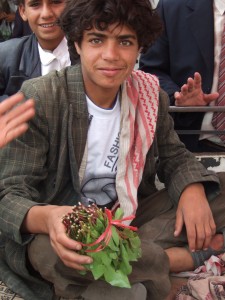
Qat in Sana'a Foto Annemarie van Geel
Als armste land van de Arabische wereld -bijna de helft van de bevolking leeft van minder dan $2 per dag- heeft Jemen te kampen met een werkloosheid van ongeveer 35%. Corruptie, analfabetisme, een qat-verslaafde bevolking en een laatste plaats in het meest recente Global Gender Gap Report van het World Economic Forum maken het plaatje niet rooskleuriger.
Jemen is een complexe mix van stammen, religieuze groeperingen, en overige groepen. Salih heeft de ingewikkelde onderlinge verhoudingen tussen de verschillende groepen de afgelopen 33 jaar danig in zijn voordeel weten te manipuleren. Desondanks wordt het regime geconfronteerd met tribale rebellie van de Houthis in het noorden, een afscheidingsbeweging in het zuiden (dat tot 1990 onafhankelijk was), en Al Qaeda in het oosten van het land. Zelfs vóór het begin van de protesten stond Salih dus al aanzienlijk onder druk.
Die druk kwam onder andere van de oppositie-alliantie “Joint Meeting Parties” (JMP), bestaande uit islamisten, socialisten en wat kleinere oppositiegroepen. De JMP had al verschillende malen aangegeven op te zullen roepen tot protesten tegen Salih en diens partij de “General People’s Congress” (GPC) als er vóór de Parlementsverkiezingen van april van dit jaar geen politieke en electorale hervormingen zouden worden doorgevoerd.
Echter, de JMP is de “officiële” oppositie en tot op zekere hoogte gecoöpteerd door het regime. Maar naast de waarschuwing van de JMP werden er in Jemen, net als in Egypte en Tunesië, protesten georganiseerd door studenten via Facebookgroepen zoals “Eyoun Shabbah” (Ogen van de Jeugd) en “Harakat al Shabaab li Tagheer” (Jongerenbeweging voor Verandering). Deze groepen zijn een alternatief voor zij die gefrustreerd zijn geraakt met de officiële oppositie. In Jemen echter is internetgebruik vele malen lager dan in Egypte, en deze Facebookgroepen hebben dan ook slechts enkele honderden leden.
Een van de leidsters van de studentenprotesten is Tawakkul Karma. Toen Saleh op 23 januari deze activiste, die voorzitster is van Women Journalists Without Chains en lid van de islamistische Islah partij, liet arresteren leidde dit tot ongekende studentenprotesten in Sana’a, de hoofdstad, en Ta’izz (zuid-westen).
Tawakkul werd gearresteerd toen zij uit een vergadering kwam met de Secretaris-Generaal van de Islah partij (die deel uitmaakt van de JMP-oppositiegroep). Zij werd ervan beschuldigd demonstraties te organiseren en geweld en chaos te veroorzaken in de maatschappij. Vanwege de demonstraties tegen haar arrestatie kwam ze echter snel vrij. Salih verhoogde onmiddellijk de salarissen van soldaten met $25 per maand – een aanzienlijk bedrag in Jemen. In ieder geval voorlopig kan Salih nog rekenen op de steun van het leger.
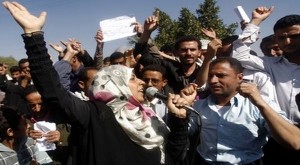
Activiste Tawakkul Karman Foto Associated Press
Tawakkul ging na haar vrijlating direct weer de straat op. Tijdens een van de studentendemonstraties die ze leidde scandeerden pro-democratie studenten, refererende aan de voormalige president van Tunesië: “Ali, Ali, ga weg, ga weg, ga je vriend Ben Ali achterna” terwijl pro-regime studenten riepen “Ali of de dood, Ali of de dood” en “Jongeren, jongeren, Islah is de terrorist”. Ook de leus “de mensen willen de val van het regime” – die we ook tijdens de protesten in Egypte hoorden – wordt gescandeerd.
Op 2 februari gaf Salih aan zich niet te zullen kandideren voor de Presidentsverkiezingen van 2013 – een claim die hij ook maakte voor de Presidentsverkiezingen van 2006. Ook gaf hij aan de macht niet over te zullen dragen aan zijn zoon. Salih’s aankondiging kwam een dag voor Jemen’s Dag van Woede (5 februari) die werd geïnspireerd door de gebeurtenissen in Egypte en Tunesië. De avond van tevoren maakten pro-regime demonstraten kwartier op het centrale plein van Sana’a -net als in Cairo Midan Tahrir (Bevrijdingsplein) geheten- gewapend met posters van de president.
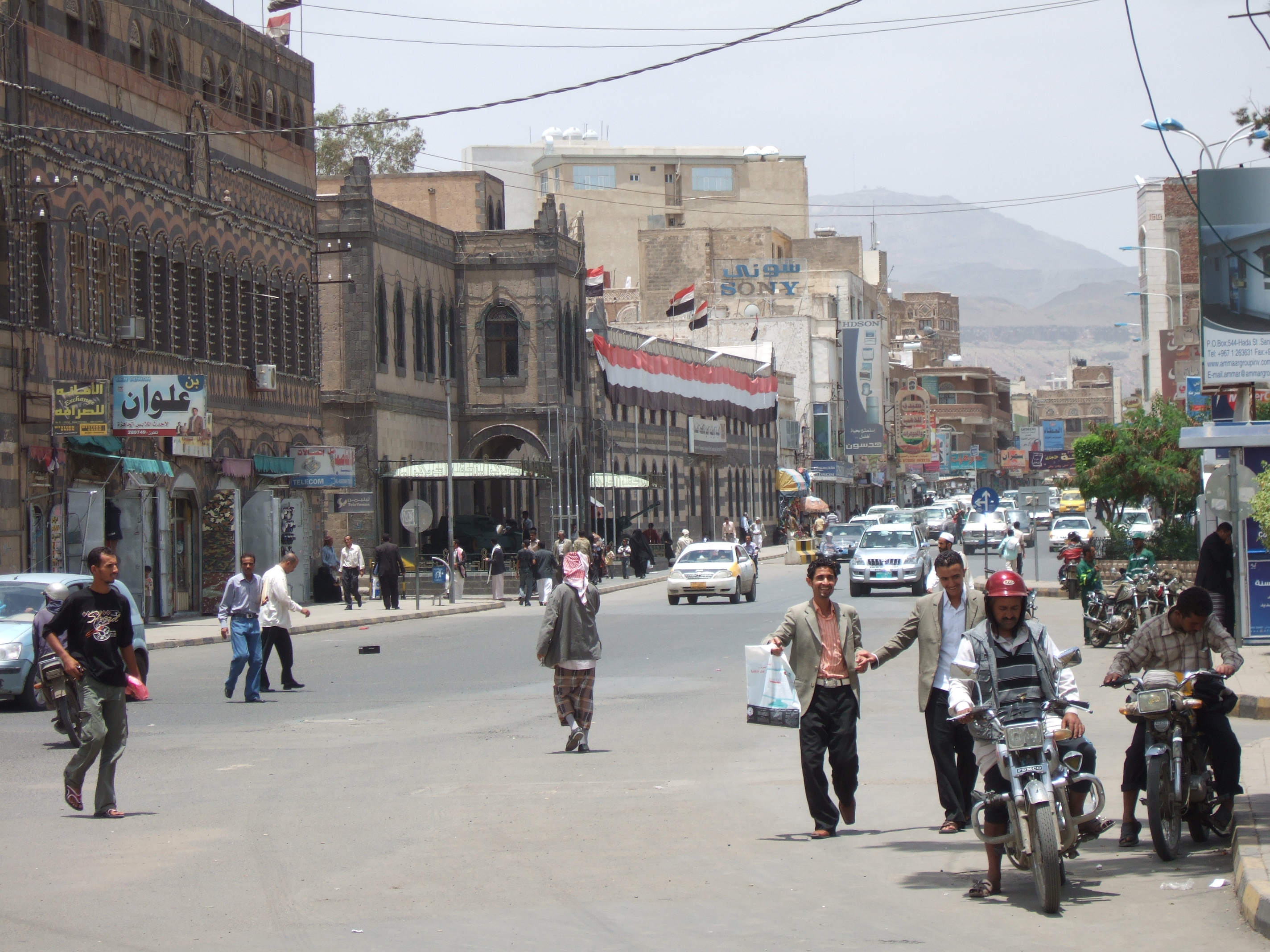
Bevrijdingsplein Sana'a Foto Annemarie van Geel
Ook de afgelopen week is er geprotesteerd in Jemen. En niet alleen op straat: de website van de Jemenitische staatstelevisie werd gehackt en even was er enkel te lezen: “Ga weg.. de bevolking wil je niet. 33 Jaar honger zijn genoeg! Een geweldloze revolutie.”
Deze week noemde Salih de pro-democratie demonstranten “anarchisten”, terwijl hij vrijwel tegelijkertijd opriep tot een Nationale Dialoog. Welhaast als antwoord vond er afgelopen vrijdag, 18 februari, een “Dag van Woede” plaats na het vrijdaggebed. Net als in Egypte werden mensen via Facebook en Twitter opgeroepen om te demonstreren. Veel mensen gaven gehoor aan de oproepen en er vonden demonstraties plaats in Sana’a (de hoofdstad), Ta’izz (de stad die het centrum van de pro-democratie demonstraties lijkt te zijn geworden) en Aden (waar de seperatisten de laatste jaren zeer actief zijn), alsook ook in Ibb, Abyan, Al Beidha, Hadramout, Dhalie en Hodeida.
Maar Salih lijkt geleerd te hebben van het lot van zijn collega’s Ben Ali en Mubarak en grijpt in. Veel mensen echter, vooral de verschillende stammen, hebben wapens, die gewoon in de souq (de markt) te koop zijn. De situatie zou dus wellicht grimmiger kunnen worden.
De demonstranten zijn niet alleen studenten maar ook islamisten, separatisten en leden van stammen. Deelname van die laatste twee groepen is niet vanzelfsprekend. Pas afgelopen woensdag sloten de separatisten, die jarenlang voor afscheiding waren, zich aan bij de protesten, wellicht denkende dat het vertrek van Salih ook al een aanzienlijke verbetering is. Zij roepen nu op tot de val van Salih en willen democratie. Een belangrijke verandering van tactiek, aangezien het de positie van de pro-democratie demonstranten aanzienlijk versterkt.
Oude stad van Sana'a Foto Annemarie van Geel
Ook de Houthis, de rebellerende stam in het noorden, hebben zich achter de demonstranten geschaard. Hoewel sommigen dit welhaast zien als een verkapte oorlogsverklaring hebben de Houthis (nog) geen strijders gemobiliseerd. Hussein al Ahmar, een leider van de Hashids (een van twee grootste stammen in Jemen) heeft aangegeven dat mocht de situatie in Sana’a uit de hand lopen zij zich achter de demonstranten zullen scharen. Zoals in Egypte en Tunesië het leger een centrale rol speelde in de protesten zouden in Jemen de stammen een bepalende factor kunnen zijn.
Tegelijkertijd riepen prominente geestelijken, zoals Abdelmajid al Zindani, op tot het vormen van een interim-eenheidsregering met leden van de oppositie op belangrijke ministeries en verkiezingen over 6 maanden. Tot deze oproep was Zindani één van de belangrijkste bondgenoten van Salih. Al Qaeda op het Arabisch Schiereiland houdt zich, afgezien van haar oproep tot jihad tegen de Houthis die shi’itisch zijn, afzijdig van de demonstraties.
De druk op Salih neemt dus toe en steun voor hem lijkt af te brokkelen. Later deze maand zou Saleh afreizen naar de Verenigde Staten, zijn belangrijkste bondgenoot. Maar gezien de recente ontwikkelingen in Jemen, en de toezegging van de oppositie om met hem te praten, heeft hij dat bezoek afgeblazen.
En de (nabije) toekomst? De oppositie is grotendeels verzwakt en/of gecoöpteerd door het regime. Onlangs accepteerde de JMP een initiatief van de regering voor politieke hervormingen, hiertoe aangemoedigd door de EU en de VS. De JMP echter heeft weinig geloofwaardigheid in het land. Gisteren verklaarde de alliantie niet meer bereid te zijn tot dialoog met het regime. Dat betekent niet dat de JMP niet wellicht straks tóch met Saleh aan tafel zit. Aan de andere kant lijkt de oppositie geen sterke leiders te kunnen leveren die ook nog de delicate balans tussen de stammen, religieuze groepen, en anderen zouden kunnen bewaren, hetgeen noodzakelijk is om het land politiek, economisch en sociaal bij elkaar te kunnen blijven houden.
De protesten houden vooralsnog aan. Jemen is een “wild card” en het is onduidelijk welke kant het op zal gaan in het land. Waarschijnlijk zal veel afhangen van hoe Salih de komende tijd omgaat met de protesten en de demonstranten en wat de uitkomst zal zijn van zijn eventuele gesprekken met de JMP.
Dus wat er gaat komen in Jemen – en in andere Arabische landen: “Allahu ‘alim”, ofwel, God mag het weten, zoals Arabieren soms zeggen.
Annemarie van Geel (1981) ontving haar Masterdiploma in Internationale Betrekkingen met het Midden-Oosten als specialisatie van de Universiteit van Cambridge in 2003. Ze heeft gewoond in Egypte, de Westelijke Jordaanoever, Syrië en Jemen en reisde uitgebreid door de regio. Ze heeft gewerkt bij Instituut Clingendael, het voormalig ISIM (International Institute for the Study of Islam in the Modern World) en de Midden-Oosten afdeling van Amnesty International Nederland. Sinds 2011 begon is ze als promovendus verbonden aan de afdeling Islam en Arabisch van de Radboud Universiteit te Nijmegen waar ze onderzoek doet naar gender segregatie in Saoedi-Arabië en Koeweit. Annemarie van Geel heeft haar eigen website Faraasha.nl, waar dit stuk eerder is verschenen.
Jemen als 'Wild Card'
Posted on February 23rd, 2011 by martijn.
Categories: Guest authors, Society & Politics in the Middle East.
Guest Author: Annemarie van Geel
Terwijl er de afgelopen dagen op het internet gediscussieerd werd hoe de naam Mubarak omgevormd kan worden naar een Arabisch werkwoord en wat dat woord dan zou moeten betekenen, gingen in Jemen mensen de straat op om te protesteren tegen het regime van Ali Abdallah Salih, de man die de afgelopen 33 jaar Jemen heeft geregeerd. In het Midden-Oosten, maar ook elders, word uitgebreid gegist over de vraag ‘wie is de volgende’. Op het eerste gezicht lijkt Jemen (in casu: president Ali Abdallah Salih) kandidaat te zijn.
Qat in Sana'a Foto Annemarie van Geel
Als armste land van de Arabische wereld -bijna de helft van de bevolking leeft van minder dan $2 per dag- heeft Jemen te kampen met een werkloosheid van ongeveer 35%. Corruptie, analfabetisme, een qat-verslaafde bevolking en een laatste plaats in het meest recente Global Gender Gap Report van het World Economic Forum maken het plaatje niet rooskleuriger.
Jemen is een complexe mix van stammen, religieuze groeperingen, en overige groepen. Salih heeft de ingewikkelde onderlinge verhoudingen tussen de verschillende groepen de afgelopen 33 jaar danig in zijn voordeel weten te manipuleren. Desondanks wordt het regime geconfronteerd met tribale rebellie van de Houthis in het noorden, een afscheidingsbeweging in het zuiden (dat tot 1990 onafhankelijk was), en Al Qaeda in het oosten van het land. Zelfs vóór het begin van de protesten stond Salih dus al aanzienlijk onder druk.
Die druk kwam onder andere van de oppositie-alliantie “Joint Meeting Parties” (JMP), bestaande uit islamisten, socialisten en wat kleinere oppositiegroepen. De JMP had al verschillende malen aangegeven op te zullen roepen tot protesten tegen Salih en diens partij de “General People’s Congress” (GPC) als er vóór de Parlementsverkiezingen van april van dit jaar geen politieke en electorale hervormingen zouden worden doorgevoerd.
Echter, de JMP is de “officiële” oppositie en tot op zekere hoogte gecoöpteerd door het regime. Maar naast de waarschuwing van de JMP werden er in Jemen, net als in Egypte en Tunesië, protesten georganiseerd door studenten via Facebookgroepen zoals “Eyoun Shabbah” (Ogen van de Jeugd) en “Harakat al Shabaab li Tagheer” (Jongerenbeweging voor Verandering). Deze groepen zijn een alternatief voor zij die gefrustreerd zijn geraakt met de officiële oppositie. In Jemen echter is internetgebruik vele malen lager dan in Egypte, en deze Facebookgroepen hebben dan ook slechts enkele honderden leden.
Een van de leidsters van de studentenprotesten is Tawakkul Karma. Toen Saleh op 23 januari deze activiste, die voorzitster is van Women Journalists Without Chains en lid van de islamistische Islah partij, liet arresteren leidde dit tot ongekende studentenprotesten in Sana’a, de hoofdstad, en Ta’izz (zuid-westen).
Tawakkul werd gearresteerd toen zij uit een vergadering kwam met de Secretaris-Generaal van de Islah partij (die deel uitmaakt van de JMP-oppositiegroep). Zij werd ervan beschuldigd demonstraties te organiseren en geweld en chaos te veroorzaken in de maatschappij. Vanwege de demonstraties tegen haar arrestatie kwam ze echter snel vrij. Salih verhoogde onmiddellijk de salarissen van soldaten met $25 per maand – een aanzienlijk bedrag in Jemen. In ieder geval voorlopig kan Salih nog rekenen op de steun van het leger.
Activiste Tawakkul Karman Foto Associated Press
Tawakkul ging na haar vrijlating direct weer de straat op. Tijdens een van de studentendemonstraties die ze leidde scandeerden pro-democratie studenten, refererende aan de voormalige president van Tunesië: “Ali, Ali, ga weg, ga weg, ga je vriend Ben Ali achterna” terwijl pro-regime studenten riepen “Ali of de dood, Ali of de dood” en “Jongeren, jongeren, Islah is de terrorist”. Ook de leus “de mensen willen de val van het regime” – die we ook tijdens de protesten in Egypte hoorden – wordt gescandeerd.
Op 2 februari gaf Salih aan zich niet te zullen kandideren voor de Presidentsverkiezingen van 2013 – een claim die hij ook maakte voor de Presidentsverkiezingen van 2006. Ook gaf hij aan de macht niet over te zullen dragen aan zijn zoon. Salih’s aankondiging kwam een dag voor Jemen’s Dag van Woede (5 februari) die werd geïnspireerd door de gebeurtenissen in Egypte en Tunesië. De avond van tevoren maakten pro-regime demonstraten kwartier op het centrale plein van Sana’a -net als in Cairo Midan Tahrir (Bevrijdingsplein) geheten- gewapend met posters van de president.
Bevrijdingsplein Sana'a Foto Annemarie van Geel
Ook de afgelopen week is er geprotesteerd in Jemen. En niet alleen op straat: de website van de Jemenitische staatstelevisie werd gehackt en even was er enkel te lezen: “Ga weg.. de bevolking wil je niet. 33 Jaar honger zijn genoeg! Een geweldloze revolutie.”
Deze week noemde Salih de pro-democratie demonstranten “anarchisten”, terwijl hij vrijwel tegelijkertijd opriep tot een Nationale Dialoog. Welhaast als antwoord vond er afgelopen vrijdag, 18 februari, een “Dag van Woede” plaats na het vrijdaggebed. Net als in Egypte werden mensen via Facebook en Twitter opgeroepen om te demonstreren. Veel mensen gaven gehoor aan de oproepen en er vonden demonstraties plaats in Sana’a (de hoofdstad), Ta’izz (de stad die het centrum van de pro-democratie demonstraties lijkt te zijn geworden) en Aden (waar de seperatisten de laatste jaren zeer actief zijn), alsook ook in Ibb, Abyan, Al Beidha, Hadramout, Dhalie en Hodeida.
Maar Salih lijkt geleerd te hebben van het lot van zijn collega’s Ben Ali en Mubarak en grijpt in. Veel mensen echter, vooral de verschillende stammen, hebben wapens, die gewoon in de souq (de markt) te koop zijn. De situatie zou dus wellicht grimmiger kunnen worden.
De demonstranten zijn niet alleen studenten maar ook islamisten, separatisten en leden van stammen. Deelname van die laatste twee groepen is niet vanzelfsprekend. Pas afgelopen woensdag sloten de separatisten, die jarenlang voor afscheiding waren, zich aan bij de protesten, wellicht denkende dat het vertrek van Salih ook al een aanzienlijke verbetering is. Zij roepen nu op tot de val van Salih en willen democratie. Een belangrijke verandering van tactiek, aangezien het de positie van de pro-democratie demonstranten aanzienlijk versterkt.
Oude stad van Sana'a Foto Annemarie van Geel
Ook de Houthis, de rebellerende stam in het noorden, hebben zich achter de demonstranten geschaard. Hoewel sommigen dit welhaast zien als een verkapte oorlogsverklaring hebben de Houthis (nog) geen strijders gemobiliseerd. Hussein al Ahmar, een leider van de Hashids (een van twee grootste stammen in Jemen) heeft aangegeven dat mocht de situatie in Sana’a uit de hand lopen zij zich achter de demonstranten zullen scharen. Zoals in Egypte en Tunesië het leger een centrale rol speelde in de protesten zouden in Jemen de stammen een bepalende factor kunnen zijn.
Tegelijkertijd riepen prominente geestelijken, zoals Abdelmajid al Zindani, op tot het vormen van een interim-eenheidsregering met leden van de oppositie op belangrijke ministeries en verkiezingen over 6 maanden. Tot deze oproep was Zindani één van de belangrijkste bondgenoten van Salih. Al Qaeda op het Arabisch Schiereiland houdt zich, afgezien van haar oproep tot jihad tegen de Houthis die shi’itisch zijn, afzijdig van de demonstraties.
De druk op Salih neemt dus toe en steun voor hem lijkt af te brokkelen. Later deze maand zou Saleh afreizen naar de Verenigde Staten, zijn belangrijkste bondgenoot. Maar gezien de recente ontwikkelingen in Jemen, en de toezegging van de oppositie om met hem te praten, heeft hij dat bezoek afgeblazen.
En de (nabije) toekomst? De oppositie is grotendeels verzwakt en/of gecoöpteerd door het regime. Onlangs accepteerde de JMP een initiatief van de regering voor politieke hervormingen, hiertoe aangemoedigd door de EU en de VS. De JMP echter heeft weinig geloofwaardigheid in het land. Gisteren verklaarde de alliantie niet meer bereid te zijn tot dialoog met het regime. Dat betekent niet dat de JMP niet wellicht straks tóch met Saleh aan tafel zit. Aan de andere kant lijkt de oppositie geen sterke leiders te kunnen leveren die ook nog de delicate balans tussen de stammen, religieuze groepen, en anderen zouden kunnen bewaren, hetgeen noodzakelijk is om het land politiek, economisch en sociaal bij elkaar te kunnen blijven houden.
De protesten houden vooralsnog aan. Jemen is een “wild card” en het is onduidelijk welke kant het op zal gaan in het land. Waarschijnlijk zal veel afhangen van hoe Salih de komende tijd omgaat met de protesten en de demonstranten en wat de uitkomst zal zijn van zijn eventuele gesprekken met de JMP.
Dus wat er gaat komen in Jemen – en in andere Arabische landen: “Allahu ‘alim”, ofwel, God mag het weten, zoals Arabieren soms zeggen.
Annemarie van Geel (1981) ontving haar Masterdiploma in Internationale Betrekkingen met het Midden-Oosten als specialisatie van de Universiteit van Cambridge in 2003. Ze heeft gewoond in Egypte, de Westelijke Jordaanoever, Syrië en Jemen en reisde uitgebreid door de regio. Ze heeft gewerkt bij Instituut Clingendael, het voormalig ISIM (International Institute for the Study of Islam in the Modern World) en de Midden-Oosten afdeling van Amnesty International Nederland. Sinds 2011 begon is ze als promovendus verbonden aan de afdeling Islam en Arabisch van de Radboud Universiteit te Nijmegen waar ze onderzoek doet naar gender segregatie in Saoedi-Arabië en Koeweit. Annemarie van Geel heeft haar eigen website Faraasha.nl, waar dit stuk eerder is verschenen.
Live Libya Uprising
Posted on February 22nd, 2011 by martijn.
Categories: Society & Politics in the Middle East.
A whole lot of things going in Libya. Too much to cover it all I think and with not that much background information. Trying to help you a little bit:
Background information
The Arab Revolts: Ten Tentative Observations
The extraordinary developments in Tunisia and Egypt during the first six weeks of this year, and more recently in Bahrain, Libya, Yemen and elsewhere, have inaugurated a revolutionary moment in the Arab world not experienced since 1958. If sustained uprisings continue and spread, it has the potential to develop into an Arab 1848. Based on what we have witnessed thus far, the following observations appear relevant:
EA WorldView – Home – Libya (and Beyond) LiveBlog: Qaddafi Hangs On With Fighter Jets and Bluster
Libya on the brink | FP Passport
Seif’s speech was certainly crazy, but he may be right about one thing: There is a nasty internecine conflict on the way in Libya. From all that we’ve seen, the regime will do anything to stay in power, including shooting people in cold blood with heavy-caliber weapons. It doesn’t look like there will be a nice, friendly “let’s all hold hands and clean up Tahrir Square” moment. After four decades of unspeakable tyranny, Libyans will be out for vengeance.
Seham’s Libya links #feb17 – Blog – The Arabist
The indefatiguable Seham has compiled a long list of links pertaining to Libya.
Updates:
Libya erupts as Gaddafi clings on – live updates | World news | guardian.co.uk
Live Blog – Libya Feb 22 | Al Jazeera Blogs
????????? ??????? – ????? ??? | World news | guardian.co.uk
Libya: The Violence of An Unraveling Regime [Ongoing Updates]
Despite the unmistakable signs of the fall of the regime, the severity of the situation seems only to be escalating. Confirmed reports describe shoot-to-kill policies in certain parts of the country as well as the use of helicopter gun ships, fighter jets, and other artillery to inflict mass violence. The death toll today, Monday February 21st, alone is currently at 250 with several thousands injured. One of the greatest difficulties in understanding what exactly is happening in Libya is the relative media blackout enforced by al-Qaddafi’s regime, who disabled internet service across the country and disconnected phone service in many parts. Reports have also confirmed the jamming of satellite signals for several news stations, including al-Jazeera, al-Manar, NBN, and New TV. Beyond the fact of the unraveling of a 42-year old authoritarian regime at the hands of a popular uprising and the regime’s massacring of the Libyan people, it is difficult to analyze the situation on the ground. However, there should be no lack of clarity as to both the legitimate aspirations and humbling courage of the Libyan people, as well as the blood that is on the hands of the Libyan regime. The complicity–by virtue of silence–of the broader community of state leaders and international institutions is equally clear.
Below begins an ongoing list of updates on the situation in Libya.
Twitter
Tunisia: from paradise to hell and back?
Posted on February 21st, 2011 by martijn.
Categories: Guest authors, Headline, Society & Politics in the Middle East.
Guest Author: Miriam Gazzah
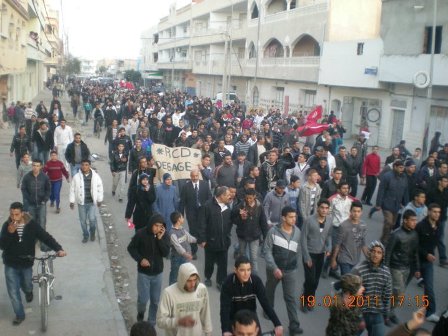 Tunisia is one of my two homelands. Even though born and raised in the Netherlands, I have been feeling more and more Tunisian lately. My father is a Tunisian from M’Saken, a town in the Sahel, near Sousse. Ever since I was a young girl, I have been visiting Tunisia every year during summer holidays. Known in Europe as a warm, Mediterranean holiday paradise, Tunisia is not just that, or maybe even far from that. My parents took us to see the whole country, from the Sahel to Cap Bon, from Carthago to Mahdia. During the four to six weeks spent there every year, my brothers and I got to know the country way beyond its touristic highlights.
I always knew that Tunisia was no paradise. I remember when I was little, I used to wonder why all the men and young boys sitting in the cafes were not at work. No matter what time we passed by – even in the middle of the night – the cafes were always full with men! Little did I know then, that there was no work for them. Luckily my family is relatively well off, but many Tunisians struggle to survive. Because family bonds and social control are strong, people are able to survive, helping each other every way they can. For example, every time we visited one of the sisters of my grandmother, we would bring her food, like a kilo of sugar, bread or meat. Something unheard of in the Netherlands but that is how people get by in Tunisia.
Experiences of repression
 Almost all of my cousins have university degrees, but very few of them have jobs on university level. Some of them endured long visa-application processes or married French-Tunisian girls and have moved to France or Germany, in the hope to build a better live there. Life is hard for many Tunisians; unemployment being one of the biggest problems. But that is not all. As I grew older, I started to become aware of the more ‘subtle’ ways the Tunisian president and its accomplices kept the people in a choke-hold. Repression, censorship, the omnipresence of so-called ‘government informers’, the glorification of Ben Ali in public spaces and the media, the corruption of the regime, expropriation of land, and so on have kept Tunisians silent for 23 years. I have experienced the repression of the old Tunisian regime myself or witnessed it in my surroundings more than once.
One year – it was sometime in the 1990s – my second cousin who is also our neighbour, at that time around 25 years old, was not there to welcome us when we arrived from the Netherlands for our summer holiday. It turned out that he had been arrested and put into jail. Knowing him as a very gentle and smart young man, I was surprised to hear of his arrest. Through the grapevine we heard that he might have been arrested, because he had been hanging out with the ‘wrong’ people. The concept of ‘wrong’ people was used in the 1990s to point out ‘Islamists’ or ‘fundamentalists’ or, in short people who wore a beard. He was imprisoned for more than 3 years, without trial and without his family knowing why he was kept imprisoned. Ben Ali has used the fear of the rise of Islamism as an alibi for arresting people who are allegedly ‘against the regime’. A tactic that worked well. Even my own family, including my father, condoned the repression of so-called ‘fundamentalists’ at that time, because ‘we do not want Tunisia to become like Algeria, where people slaughter each other like lambs’. By feeding into the fear of rising fundamentalism and using Algeria as a horrific example, Ben Ali managed to repress a lot of anti-regime currents in the 1990s.
Another example of repression hit home a little closer: my older brother – a big fan of airplanes and airports – was filming an incoming airplane from a road around one kilometre distant from the airport of Monastir. A car drove up behind us and three men in plain clothes stepped out and claimed to be police men. They took the camera and started to interrogate my brother and father in a pretty aggressive and intimidating way. They took the passports of my father and brother, the camera and ushered us to drive with them to the police station. My father and brother were brought inside, my mom, little brother and I had to wait in the parking lot in the burning sun. We waited for more than 1,5 hours before they finally returned, with their passports and camera, but without the tape, of course. An upsetting experience, because of the degrading way they treated us and the helplessness you feel when they take your passports, and you don’t know whether you will ever get them back.
Direct update from M’Saken, Tunisia
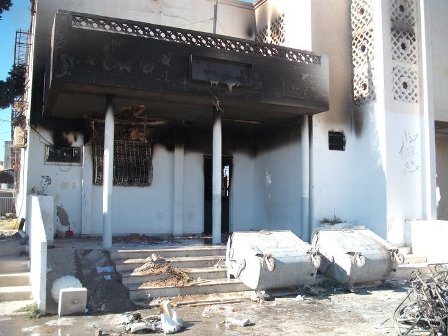 As I write this paragraph my father is in Tunisia. It is his first trip to his homeland since Ben Ali has fled. Egypt has been dominating the media for some weeks now, but that does not mean that developments in Tunisia have come to a full stop. In my father’s first call to me, end of January 2011, he states that in our hometown M’Saken, the police station and the (former) office of Ben Ali’s political party RCD are burnt to the ground (see picture, all pictures taken by Hosni El Gourar). He also reports of the absence of the police, at least in M’Saken and surroundings – a very strange and quite frightening phenomenon. He also tells me that in the area there are robberies going on with deadly endings. Even worse maybe, he reports of Ben Ali supporters who join each other in militias – armed and well! – and try to stir up chaos; an attempt to launch a contra-revolution. The situation is thus far from calm.
In order to secure neighbourhoods, young M’Sakeni’s have volunteered to watch over area’s of the town. Committees of security have been founded. Young men safeguard important feeder roads and patrol the area (see pictures). 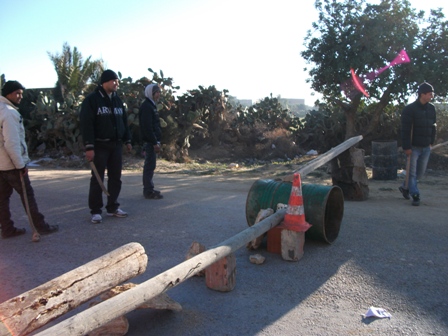 Much to the surprise of many elderly, Tunisian youth have shown the country a new face. Whereas in the past, today’s youth was known as the ‘generation of nothing’, the Jasmin Revolution has turned this image completely around. As perceived by my father, the older generation is confused. Tunisian youth have shown a degree of responsibility that was unheard of. They took action and they changed things. The generation gap seems to have disappeared instantly, says my father.
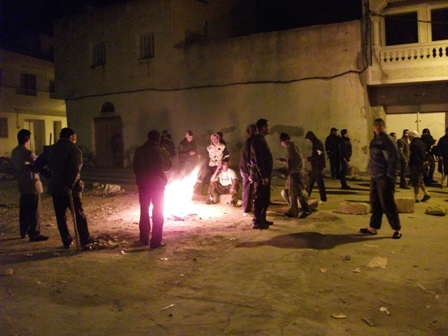 It is now Wednesday February 16, 2011. My father has just returned from Tunisia. His updated report of the current situation in M’Saken and Tunisia confirms my earlier feeling that all is far from stable. The good news, he tells me, is that “the atmosphere is completely different from the last time he was there in November 2010. People are polite, not so edgy, even traffic has become far less stressful. Inter-human relations have improved enormously. Police are nowhere to be found, but, all in all, every day life seems to return to its ‘normal’ status.” But when he continues to tell of his short stay, it appears that Tunisia is not at all ‘back to normal’.
The Ben Ali aftermath: Rumours about endless enrichment
Ever since the departure of Ben Ali, stories and rumours about the enormous corruption of Ben Ali and the Trabelsi’s keep circulating among the Tunisian people. Especially Leila Ben Ali and her Trabelsi family members are hated for their incredible enrichment on expense of the Tunisian people. Leila, a second wife of Ben Ali, used to be a simple hair dresser, roaming around in nightclub circuits, where she supposedly met Ben Ali. Leila Ben Ali is in Tunisia also known as Leila Gin Tonic- what’s in a name?
Some of the remarkable rumours that my father picked up include the story that Ben Ali supposedly had some Roman pillars dating back a couple hundred years before Christ from the Bardo Museum in Tunis (http://www.informatique-tunisie.com/museebardo/) to be converted into wash bins to be put into his own home. Allegedly his wife Leila had very specific and extraordinary demands concerning the furnishing of her bath room. Replica’s of the original pillars were put back into the museum.
Another rumour that goes around on the streets is that some time after 9/11/2001 the United Nations had granted Tunisia a subsidy for the appointment of 150.000 extra police men to prevent and combat terrorism. It is said that only 50.000 police men were installed and that the funding for the rest disappeared into the pockets of one of the Trabelsi’s who was in charge of this project.
The Trabelsi’s are often said to be the real demons behind the regime. Many of Ben Ali’s in-laws were involved in corruption and illegal practices. Some of them have also been arrested in the mean while. It is often said in popular language that “they [the Trabelsi’s] are worse than the Maffia.”
These outrageous stories of how Ben Ali and his in-laws enriched themselves are the constant talk of the town. Whether all of these rumours are true or not, it is taken for a fact that Ben Ali made himself a very wealthy man. Nonetheless, the exact amount of his financial ability is not known yet. The possessions of Ben Ali and the Trabelsi family include houses (in Tunisia and abroad), cars (Ferrari’s and the like), businesses, stocks, gold, and so on. Watch this YouTube clip where two men ‘steal’ one of Ben Ali’s Ferrari’s with a fork lift:
.
The huge wealth acquired by Ben Ali and his family, illegal or not, is a thorn in the flesh of the Tunisian people.
Tunisia…back to the future
Tunisia remains unstable. Many (young) Tunisians still want to emigrate to Europe. Several hundreds, maybe thousands still arrive regularly at the Italian isle of Lampedusa to try to enter Europe. Even though press and media present this as something new, it is not. Tunisians were fleeing the country also way before Ben Ali left. What will happen in the near future remains difficult to predict. In prospect of the elections in September 2011, people are trying to get back to business as usual. Ironically, ‘business’ is what Tunisia lacks: meaning work and especially work deriving from tourism. Work and freedom of speech and expression, that is all that Tunisian youth want. It is a simple request. But not easily achieved for a country where more than half of the population consists of people under 25 years old. Tunisia’s new government will hopefully find a way to give new impulses to the economy, with help of Europe and the United States. But most importantly: tourists must come back to Tunisia as soon as possible. Maybe then paradise will move a little closer to Tunisia.
Thanks to Hosni El Gourar from M´Saken, Tunisia for the pictures.
Dr. Miriam Gazzah is a postdoctoral fellow at the Amsterdam Institute for Social Science Research (AISSR) at the University of Amsterdam. She is currently working within the research project: Islamic cultural practices and performances: The emergence of new youth cultures in Europe.
Read more about this research project here: http://home.medewerker.uva.nl/m.gazzah/
Visit Miriam Gazzah’s personal website and blog: http://www.miriamgazzah.nl
De opstanden in de Arabische pers III – Bahrein
Posted on February 21st, 2011 by martijn.
Categories: De Arabische Pers, Guest authors.
Guest Author: Roel Meijer
Bahrein
De laatste paar dagen is een stortvloed aan interessante westerse commentaren verschenen over de situatie in Bahrein. Dit is een kleine bloemlezing daaruit. De opstand in Bahrein is uniek, zoals alle opstanden van elkaar verschillen. Maar het interessante van Bahrein is niet zozeer dat de 5de vloot van de Amerikanen er zijn thuisbasis heeft, of zelfs dat de meerderheid van de bevolking shi‘iet is (tussen 60 en 70 procent) en de heerschappij is in handen van de soennieten en het koningshuis, de Al Khalifa —twee zaken die voordturend benadrukt worden. Interessant is juist dat er al een tijd ontwikkelingen aan de gang zijn. In tegenstelling tot Egypte waren er in oktober 2010 tamelijke vrije verkiezingen die door de Wifaq Partij gewonnen werd (18 van de 40 zetels). In 2005 deed deze partij voor het eerst mee aan verkiezingen nadat politieke hervormingen waren doorgevoerd. Na het bloedbad van afgelopen donderdag is de Wifaq Partij uit het parlement getreden.
Daarnaast is, in tegenstelling tot Egypte, de shi’ietische oppositie gesplitst tussen de gematigde Wifaq Partij, geleid door sheikh Ali Salman, en de radicalere al-Haqq beweging. Omdat de eerste zo weinig concessies heeft losgekregen de afgelopen jaren wordt de partij door met name de shi’ietische jeugd—die ook hier zeer actief is—als te slap beschouwd. Het is de laatste groep die de demonstraties en bezetting van het Parelplein heeft georganiseerd in centraal Manama op 16-17 februari die zo bloedig uit elkaar zijn geslagen door het leger. Hierbij vielen 5 doden; in ieder geval één persoon werd geëxecuteerd—anderen werden in hun slaap doodgeschoten met hagel. Gedurende het afgelopen jaar zouden leden van de Haqq beweging opgepakt zijn en gemarteld.
Een ander verschil met Egypte is dat het koningshuis verdeeld is in twee kampen. Aan de ene kant staat de “verlichte koning”, Hamad bin Issa Al Khalifa (vanaf 1999 op de troon) samen met zijn zoon, kroonprins Salman bin Hamad Al Khalifa. Aan de andere kant staat de conservatieve premier, de koning’s oom, Khalifa bin Salman Al Khalifa (aan de macht vanaf 1971) en een kliek om hem heen die alle belangrijkste posten in handen heeft: binnenlandse zaken, defensie, buitenlandse zaken. De conservatieve factie vindt ondersteuning van de Bahreinse Salafi beweging.
De Bahrein kenner Olivier Da Lage denkt dat vooral de premier achter de aanval van het huurleger en de politie zit. De premier zou daarin gesteund zijn door Saoedi-Arabië die onder geen enkel beding een situatie wil laten ontstaan zoals op Tahrir plein in Caïro dat 18 dagen is bezet. De Saoedi’s zijn vooral bang voor de eigen shi‘ietische bevolking (tussen de 5 en 11 % van de bevolking) die in het aangrenzende gebied woont met Qatif en Dammam als belangrijkste plaatsen, en waar de belangrijkste olievoorraden van het land zich bevinden. Een ander verschil met Egypte is de samenstelling van het leger dat eigenlijk een huurleger is dat uit Pakistani en andere buitenlanders bestaat, en in tegenstelling tot het conscriptie leger in Egypte geen enkele band heeft met de bevolking en uitsluitend een verlengstuk is van het regime—vooral de premier.
Afgezien van deze verschillen met Egypte zijn alle commentatoren het erover eens dat de eisen dezelfde zijn: eerlijke verkiezingen, gelijkheid voor de wet, einde van corruptie. Kenmerkend is de nationalistische inslag van de demonstraties en het streven het sektarisme en vooral de discriminatie van shi’ieten door het Salafisme op te heffen. Eén van de leuzen was “Geen Sunni, geen Shi‘a, alleen Bahreini”. Dit is geen nieuwe ontwikkeling. Al vanaf de jaren negentig is de shi’itische oppositie in Bahrein en Saoedi-Arabië sterk beïnvloed door liberale ideeën. Zie bijvoorbeeld de websites van de vroegere Saoedische shi’ietische leider Hasan al-Saffar, Tawfiq al-Saif en Muhammad Mahfuz. De Wifaq partij is voorstander van een constitutionele monarchie, de al-Haqq beweging zou na het bloedbad het aftreden eisen van de gehele Khalifa familie.
Inmiddels is het Parelplein opnieuw bezet door demonstranten en schijnen er onderhandelingen plaats te vinden tussen de Wifaq leider Ali Salman en het regime. Maar volgens Olivier Da Lage zal de uitkomst vooral bepaald worden door de interne strijd binnen het koningshuis. Een belangrijke eis van de demonstranten zal het vertrek van de premier zijn, Khalifa. Mocht hij toch de controle verwerven over het leger en geen gehoor geven aan de oppositie dan kan nog een bloedbad volgen. De Amerikanen gaan ervan uit dat een compromis gesloten wordt in het kleine land (500.000m inwoners). Vooralsnog is er geen sprake van anti-Amerikanisme (zo werden bijvoorbeeld geen Amerikaanse vlaggen verbrand) net zo min als van een pro-Iraanse houding, maar de hulp van Iran kan worden ingeroepen als de botsingen tussen leger en betogers uit de hand lopen.
Saoedische pers over Bahrein
Opvallend is dat Saoedische pers weinig te melden heeft over de situatie in Bahrein. Het liberale al-Watan heeft één artikel over de begrafenis van de slachtoffers van 18 februari. ‘Ukaz en al-Riyadh hebben niet één artikel over Bahrein. Al-Sharq al-Awsat, dat in Londen uitkomt, heeft evenmin veel te melden over Bahrein. Hieruit blijkt weer dat de machtige Saoedische pers tekort schiet wanneer het kwesties betreft die Saoedische belangen direct aangaan.
Saoedische pers over Egypte
De Saoedische pers heeft daarentegen opvallend neutraal gereageerd op de gebeurtenissen in Egypte. Al-Riyad heeft het over de 25 januari revolutie en analyseert de eisen van de demonstranten tijdens de massale herdenking van het verdwijnen van Mubarak op het Tahrir plein op 18 februari. Andere maatregelen, zoals die van de Hoogste Raad van Militairen om het parlement te ontbinden, worden gewoon genoemd.
Egypte
Vandaag heeft de Egyptische Raad van State/Conseil d’état (Majlis al-Dawla) bekend gemaakt dat eindelijk na 15 jaar de Hizb al-Wasat is gelegaliseerd. Ze verklaarde de laatste uitspraak van de speciale commissie van de Senaat (Majlis al-Shura) van 2009 ongeldig—het zou in strijd zijn met de geest van de grondwet (!). De Hizb al-Wasat is een liberale afsplitsing van de Moslim Broederschap, die in 1995 werd opgericht door een jonge generatie intellectuelen die genoeg had van de ondemocratische structuur van de partij en de gerichtheid op de shari ‘a. Het opvallende van de partij was dat ze kopten als leden had. Dat kwam doordat ze een inclusief beeld had van de islam, dat zij zag als een “cultuur/civilisatie” eerder dan een wet. Christenen konden lid worden van de partij omdat christenen in het verleden een cruciale bijdrage hadden geleverd aan de islamitische cultuur.
De opstanden in de Arabische pers II
Posted on February 20th, 2011 by martijn.
Categories: De Arabische Pers, Guest authors.
Roel Meijer maakt voor Closer een overzicht van de berichtgeving over de Arabische opstanden in de Arabische pers.
Optimisten
De onderzoekers naar de Arabische revolutie zijn verdeeld in optimisten en pessimisten. Maar iedereen is het erover eens dat het jaren zal duren voordat er een democratie gevestigd is. Hier een paar commentaren van optimisten. Adrian Crewe is een optimist. Hij zegt dat de democratische krachten niet genegeerd kunnen worden, maar dat er nog een lange strijd te wachten staat. Hij geeft een volledige lijst van eisen van de hervormers. Richard N. Haass, hoofd van het Amerikaanse prestigieuze Council on Foreign Relations, maakt de belangrijke opmerking dat timing van cruciaal belang is bij revoluties. Als Mubarak eerder had aangekondigd dat hij niet deel zou nemen aan presidentsverkiezingen, of eerder had afgetreden zou de coalitie niet zo sterk zijn geweest en was het leger hier sterker uit gekomen. Hij zegt dat de lange weg naar hervormingen gunstig kan zijn: het geeft civil society en nieuwe krachten de tijd zich te ontwikkelen. De Moslim Broederschap is nu in het voordeel omdat ze al zo’n lange ervaring heeft. Hij is bang voor splitsingen in de oppositie. Een recente analyse van Nathan Brown (17 febr.) van Carnegie Endowment is optimistisch en tegelijkertijd realistisch. Hij stelt dat het heel goed mogelijk is dat de grondwet slechts geringe veranderingen ondergaat, maar dit zou al een enorm verschil uitmaken als er geen meerderheidspartij is zoals de NDP van Mubarak. Hij vindt dat er al enorme veranderingen nu doorgevoerd worden. Egyptenaren zetten nu al directeuren van bedrijven af, kiezen nieuwe vakbondsleiders en hoofdredacteuren.
Pessimisten
De pessimisten bestaan vooral uit die commentatoren die zeggen dat het leger te sterk is en dat het regime nog helemaal in tact is. Robert Springborg, die al in de jaren tachtig een boek schreef over Mubarak, Egypt under Mubarak, behoort tot die groep. Op 2 februari schreef hij een kritisch stuk hoe het regime de oppositie zou verslaan. Daar is tot nu toe nog niets van terecht gekomen, maar het kan nog gebeuren. Als geen ander heeft hij inzicht in de militaire belangen in Egypte. Hij schat het aandeel van militairen bedrijven in het BNP op tussen 5 en 40 %. Dat loopt nogal uiteen, maar als het tweede cijfer zou kloppen is dat immens. Steven Cook die een boek heeft geschreven over militaire regimes in Turkije en Egypte, wijst op de verschillen tussen Egypte en Turkije. Hij heeft zeker gelijk dat in de jaren tachtig het Turkse leger veel repressiever was dan nu in Egypte. Marc Lynch is ook een goede bron in deze. Hij behoort tot de best geïnformeerde onderzoekers, die de laatste tijd meer bezig is “well-connected” te zijn met de hogere regionen van de Amerikaanse politiek, dan met wetenschap beoefenen. In zekere zin komt nu eindelijk zijn voorspelling uit dat de “Arab street” sinds Al Jazeera een rol gaat spelen. Op 3 febr. maakte hij al goede opmerkingen over de Amerikaanse politieke invloed en de rol van het leger. Een andere commentator is Abdurrahman Al-Shayyal. Zijn artikelen over het leger waren altijd goed. Veel van de speculatie over de rol van het Egyptische leger is gebaseerd op het WIKILEAKS “cable” van de Amerikaanse ambassade in Egypte over het leger en de ontevredenheid van de lagere en midden-kader over de leiding.
Moslim Broederschap
Veel pessimisten zien de Moslim Broederschap als het grootste gevaar voor de democratie in Egypte. Het argument is dat de MB beter georganiseerd is dan andere groeperingen. Dat is waarschijnlijk zo maar er spelen veel meer factoren een rol, zoals haar strategie, leiderschap, aanhang, vooral onder jongeren. Een van de best ingewijde commentatoren is de Egyptische Hussam Tamam, die in het Arabisch verschillende boeken heeft geschreven over de beweging. Af en toe worden zijn artikelen in het Engels vertaald en op de site van Carnegie Endowment gezet, sowieso de beste site over Egypte en de islamitische beweging. Zo ook dit artikel over de verklaring waarom de Moslim Broederschap zo traag heeft gereageerd op de laatste ontwikkelingen.
Het Palestijnse dagblad al-Quds al-‘Arabi meldt dat de Moslim Broederschap gisteren heeft aangekondigd dat ze haar mening over het vredesverdrag met Israël niet aan het volk zal opleggen. Isam al-Iryan, lid van de leidinggevende raad (Maktab al-Irshad), zei dat de Moslim Broederschap daar niet alleen over kon beslissen: “niemand kan het verdrag met een pennenstreep beëindigen.” Gisteren had de Moslim Broederschap al aangekondigd dat ze geen kandidaat zal stellen voor het presidentschap. De beroemde Egyptische geestelijke Yusuf al-Qaradawi, die volgens velen lid is van de Moslim Broederschap en in Qatar woont, sprak ter gelegenheid van de herdenkingsbijeenkomst van het vetrek van Mubarak op het Tahrir plein. Opvallend was zijn oproep tot het wegsturen van de huidige militaire regering en het instellen van een regering van nationale eenheid. Ook zouden alle politieke gevangenen vrijgelaten moeten worden. Tevens bendrukte hij de religieuze eenheid in Egypte door de revolutie van 25 januari de gezamenlijke revolutie van moslims en christenen te noemen (Al-Quds al-Arabi, 19-20 februari 2011., p. 2).
Het Egyptische dagblad al-Shuruq, drukt een fascinerend interview af met de tweede man van de Moslim Broederschap Rashad al-Bayumi, die een paar dagen voor het vertrek van Mubarak nog een gesprek aanging met Umar Sulayman over de toekomst van Egypte. In dit interview ging hij in op het plan een politieke partij op te richten. Hij zei: “politiek is een deel van de werkzaamheden van de MB; en de partij is slechts een onderdeel van de gehele politiek van de Moslim Broederschap.” Hij zei verder dat ook kopten lid konden worden van de nieuwe partij.
Verder ging hij in op het andere kritiekpunt op de Broederschap, het verbod op de kandidatuur van kopten en vrouwen voor het presidentschap, een issue waarvoor de Broederschap in 2007 zware kritiek te verduren kreeg toen haar voorlopige partijprogram uitlekte en waaraan de Carnegie Endowment een studie heeft gewijd. Blijkbaar is het punt nog niet opgelost want al-Bayumi’s antwoord was ontwijkend. Hij zei dat het een kwestie is van fiqh (islamitische jurisprudentie) waar specialisten zich over moeten buigen. Tevens herhaalde hij het standpunt dat “de Moslim Broederschap haar mening niet aan het Egyptische volk zal opleggen.” Op de vraag of de Broederschap haar mening aanpaste aan internationale druk zei al-Bayumi dat “er geen onwrikbare meningen bij de Broederschap bestaan en dat alle meningen herzien kunnen worden.”
Over de relatie tussen de nieuwe partij en de moederorganisatie zei hij dat de organisatie vele afdelingen heeft, en dat die tamelijk autonoom mogen opereren. Dit zou ook gelden voor de toekomstige politieke partij, maar uit de rest van het antwoord werd duidelijk dat de relatie hecht zou zijn en de organisatie controle zou uitoefenen op de partij. Interessant is dat hij het streven naar een islamitische staat volledig afwees, als “een vreemd idee”. Hij benadrukte dat alle groeperingen geaccepteerd zullen worden, seculieren, links, etc. Hij stelt dat de Moslim Broederschap een “civiele staat” nastreeft gebaseerd op “religieuze grondslag ”(al-marja‘iyya al-islamiyya). In die zin moet art. 2 van de grondwet (de shari ‘a is de hoofdbron van alle wetgeving) gehandhaafd blijven. Dit was overigens ook de mening van Tariq al-Bishri, in Al-Ahram van 16 februari 2011, hoofd van de raad die de grondwet binnen tien dagen moet herzien. Daarnaast stelde al-Bayumi dat de partij ook interne hervormingen tegemoet kan zien, een opmerking die vooral betrekking had op het statuut van de organisatie die alles behalve democratisch is. Het zou zelfs mogelijk zijn de leider van de beweging (al-murshid al- ‘amm) wordt gekozen (“ alles behoort tot de mogelijkheden”). Tenslotte stelde hij dat de Moslim Broederschap zich zal houden aan alle internationale verdragen, doelend op het vredesverdrag met Israël.
Ook de reactie van de Jama‘at al-Islamiyya op de revolutie is interessant, want velen denken dat zij weer het gewelddadige pad zal kiezen zodra de kans zich voordoet. In 1997 was zij verantwoordelijk voor de bloedige aanslagen in Luxor waarbij 58 toeristen omkwamen. Voor een uitgebreide beschrijving van de beweging zie een hoofdstuk van mij dat gewijd is aan de beweging. Later zwoor ze het geweld af. Bij monde van het ideoloog Najih Ibrahim heeft de JI zich achter de revolutie geschaard.
De beweging van 25 januari en hervormingen
Al-Quds al-Arabi maakt ook melding van de intentie van een groep jongeren om een politieke partij op te richten. Het Egyptische dagblad al-Shuruq, meldt dat de Nationale Vereniging voor Verandering (Jama’iyya al-Wataniyya li-l-Taghyir) , olv Baradei, heeft geëist dat er onmiddellijke een overgangsraad wordt aangesteld bestaande uit vijf neutrale personen, die de verkiezingen moeten voorbereiden. De Vereniging eist: opheffing van de noodtoestand, vermindering van veiligheidstroepen, opheffing van de ordepolitie (al-Aman al-Markazi), ontbinding van gemeenteraden, vrijheid politieke partijen op te richten en vereniging te stichten. De vereniging eist ook de oprichting van een grondwetgevende vergadering in plaats van de raad olv Tariq al-Bishri, die nu binnen tien dagen de meest essentiële artikelen gaat herzien.
De Marokkaanse Uitzondering?
Posted on February 20th, 2011 by martijn.
Categories: Featured, Headline, Society & Politics in the Middle East.
Guest Author: Nina ter Laan
Marokko staat in het westen bekend als één van de meest liberale landen van Noord Afrika. Wat wij in Nederland over Marokko te weten komen wordt vaak gezien door de lens van migratie en integratiedebatten. We moeten echter niet vergeten dat de economische drijfveren (armoede) van de Marokkaanse gastarbeiders (voornamelijk uit de Rif) in de jaren ‘60 en ‘70 van de vorige eeuw, destijds voortkwamen uit politieke onderdrukking. Dezelfde misstanden die nu door bevolkingen in het MO aan de kaak worden gesteld. Is er zoveel veranderd in de tussenliggende jaren in Marokko? Want tot nu toe krijgt de revolutionaire geest die momenteel over landen in het MO waart geen vat op het land. Er zijn wel reacties vanuit de bevolking gekomen. Kleine protesten werden al geïnitieerd in steden als Tanger en Fes en een viertal mensen stak zichzelf in brand, in de hoop een vergelijkbare protestactie als in Tunesië te ontketenen. Ook via sociale media roepen kleine groepen op tot protest. Maar dit alles heeft niet hetzelfde effect gehad als in Tunesië, Egypte of zelfs Algerije.
De overheid reageerde ook. De Marokkaanse minister van informatie Khalid Naciri zei tijdens een persconferentie dat de Marokkaanse regering de volken in de Arabische wereld steunt, maar benadrukte tegelijkertijd het belang van stabiliteit van Marokko voor de rest van de regio. Bovendien zei hij dat het koninkrijk al lang het pad van meer democratie en vrijheden is opgegaan. Het vertrouwen in het veronderstelde voltooide democratisering proces van Marokko staat echter haaks op de onmiddellijke verhoging van de subsidies op voedselprijzen en het verplaatsen van militaire troepen van de Westelijke Sahara naar de binnenlanden als reactie op de onrust in Tunesië.
Of Marokko daadwerkelijk al gedemocratiseerd is, zoals Naciri beweert, valt te betwijfelen. Wel is het het enige land in de regio dat reeds sinds eind jaren negentig van de vorige eeuw al een geleidelijk democratiseringsproces heeft ondergaan. Als antwoord op het einde van de koude oorlog en onder druk van internationale mensenrechtenorganisaties werden er aan het einde van het bewind van Hassan II, de toenmalige koning van Marokko, hervormingen doorgevoerd. De Marokkaanse bevolking ging onder zijn bewind namelijk gebukt onder repressie. Tijdens zijn bewind trad hij hardhandig op tegen binnenlandse tegenstanders van het regime. Deze periode wordt ook wel “De loden jaren” genoemd. In 1970 en 1972 werden er door het leger aanslagen gepleegd op de koning. Beide aanslagen mislukten en de daders werden geëxecuteerd en hun families gearresteerd en jarenlang vastgehouden in mensonterende omstandigheden. Ook de Berbertalige bevolking uit de Rif is meerdere malen in opstand gekomen tegen repressies van het regime zoals tijdens de opstand in de jaren vijftig en later de jaren 80. Beide opstanden werden hardhandig neergeslagen door het leger. Na de laatste Rif opstand zette Hassan geen voet meer in het gebied en liet de regio aan haar lot over. De hervormingen zetten een nieuwe koers in en kwamen in een stroomversnelling toen Mohammed 6 zijn vader na zijn dood opvolgde in 1999. Nu, na een decennium Mohamed 6 aan het bewind lijkt er meer speling te zijn, zeker in vergelijking met de buurlanden. De armoede in Marokko is niet onderdrukkend, de kosten van levensonderhoud zijn relatief laag, er heerst niet al decennia lang een noodtoestand (zoals bijvoorbeeld in Egypte of Algerije), waardoor protesten tot op zekere hoogte getolereerd worden.
Toch zijn ook veel Marokkanen ontevreden met de huidige situatie met name door armoede (15% leeft onder de armoede grens), werkeloosheid (10%), slecht onderwijs, analfabetisme (40%) en beperkte politieke vrijheid. Het is een harde klassenmaatschappij met een traditie van patroon-cliënt-relaties en de daarmee gepaarde corruptie. Er is een enorme kloof tussen rijk en arm en een relatief kleine hoogopgeleide middenklasse. Volgens het tijdschrift Forbes is de koninklijke familie in het bezit van ongeveer 2,5 miljard dollar en worden belangrijke posities steeds gedomineerd door dezelfde hooggeplaatste families. Het is niet vreemd dus dat er toch oproepen tot protest zijn. Een groep jonge Marokkanen genaamd “le mouvement du 20 fevrier” heeft afgelopen donderdag opgeroepen om op 20 februari massaal de straat op te gaan om economische hervormingen te eisen, maar ook om een politiek geluid te laten horen tegen de regering, tegen de clan die het koningshuis omringt, maar ook tegen de koning. De groep, die opereert via netwerksite Facebook, claimt nu al ongeveer 5000 aanhangers te hebben. Ze eisen: ontbinding van het parlement, een nieuwe grondwet, een overgangsregering, vrijlating van politieke gevangenen, en sociaal economische rechten.
Regeringsvorm: constitutionele monarchie
Eén van de verklaringen waarom Marokko anders reageert op de opstanden dan overige Arabische landen moet gezocht worden in de regeringsvorm van het land en de centrale positie van de koning daarin. Marokko is geen militaire dictatuur zoals Algerije of Egypte, maar een constitutionele monarchie waarvan de afstamming van het staatshoofd terugvoert tot de profeet Mohammed via de Alawieten dynastie die Marokko nu reeds sinds 400 jaar regeert. De koning is Amir al Muminin, leider der gelovigen. De politieke macht van de monarch in Marokko is groot en reikt ver. Naast koning is hij ook opperbevelhebber van het leger en voorzitter van de Hoge Raad. Via artikel 19 van de grondwet staat hij boven alle andere politieke partijen en hij heeft de bevoegdheden ministers persoonlijk te benoemen en fatwa’s uit te vaardigen. Ook in het bedrijfsleven heeft de koning een aardige vinger in de pap. De Koninklijke familiebedrijven, zoals o.a. ONA, zijn tezamen goed voor 6 procent van het Marokkaanse BBP. Parallel aan het koningshuis beschikt Marokko ook over een democratisch bestel, met een parlement, politieke partijen en een minister president en verkiezingen. Het democratisch gehalte van dit staatsbestuur is echter niet zo groot. Het parlement en de kliek rondom de koning zijn gebaseerd op patroon-cliëntrelaties waarbij giften en invloedrijke posities gegeven worden in ruil voor politieke loyaliteit. Ook al heb je in Marokko nog zo’n goede opleiding, wanneer je niet de juiste connecties hebt kom je niet ver.
Koning Mohammed VI, geliefd monarch, hervormer of despoot?
Onder de invloed van de revoluties in Tunesië en Egypte gaan er nu wel stemmen op om de macht van de koning in te perken tot een meer ceremoniële positie, zoals in Zweden of Nederland. Echter, tegelijkertijd wordt de koning als enig geloofwaardig en betrouwbaar lid van het parlement gezien. Ondanks de corruptie en de ongelijke verdeling van macht geniet de koning toch een enorme legitimiteit onder een groot deel van de Marokkaanse bevolking. Dit is bijvoorbeeld te merken in de reacties van Marokkaanse jongeren via de sociale media: op Facebook hebben jongeren allerlei foto’s van Egyptische demonstranten gepost met teksten en steunbetuigingen en liefdesverklaringen aan de koning. Er is zelfs een beweging tegen de “mouvement du 20 fevrier” opgekomen, genaamd “de mars van de liefde”, waarin facebookers werden opgeroepen om op Valentijnsdag hun profielfoto te veranderen in een foto van Mohammed VI. De nog jonge koning (nu 47 jaar) heeft zijn populariteit niet alleen te danken aan zijn religieuze legitimiteit en de breuk die hij heeft gemaakt ten opzichte van dictatoriale beleid van zijn vader, maar ook aan zijn ondernemersgeest. Koninklijke initiatieven en hervormingen, zoals ontwikkeling van infrastructurele projecten – de bouw van havens, en wegen – maar ook sociale hervormingen zijn op tijd klaar en worden efficiënt uitgevoerd. Met als gevolg dat de Marokkanen een betere infrastructuur hebben gekregen en er voor vrouwen meer rechten zijn dan voorheen dankzij de herziening van de moudawana. Ook is er meer persvrijheid dan voorheen, en sommige minderheden zagen hun eisen ingewilligd.
Dit alles maakt dat de koning door velen over het algemeen minder als een despoot wordt gezien en meer als een weldoener en een geliefd monarch. De loyaliteit van de bevolking naar de koning is dus groot, terwijl de regerende klasse vaak wordt gezien als een falende en corrupte kliek die elkaar al jaren lang in het zadel houdt, de bevolking armer maakt en eerlijke kansen op werk ontneemt. Deze regering wordt echter benoemd door de koning die zelf ook deel uitmaakt van deze eeuwen oude klasse (Makhzen). De keerzijde is dat de massa vaak nog niet van de hervormingen heeft kunnen profiteren en dat, hoewel slachtoffers van de loden jaren hun verhalen mogen doen voor het gerechtigheid en verzoeningscomité, er geen vervolging van de daders plaats vindt. Daarbij wordt oppositie of kritiek op de koning niet geduld.
Pers
Dit is onder andere te merken in de pers. Ondanks het feit dat de persvrijheid de afgelopen jaren is verbeterd, moeten journalisten toch nog regelmatig voor enkele dagen de cel in wanneer zij zich kritisch uitlaten over de onderwerpen waar je in Marokko absoluut niet kritisch over mag schrijven: de onafhankelijkheid van de Westelijke Sahara, de islam, en de positie van de koning. De toename van persvrijheid lijkt het afgelopen jaar echter weer tanende. In 2010 werden maar liefst twee liberaal kritische tijdschriften uit de lucht gehaald: “Le Journal Hebdo” en “Nichane. Nichane was in 2006 al in de problemen geraakt door een artikel over humor en de grappen die Marokkanen maken over islam, seks en de koning. De schrijvers van het artikel werden vervolgd en kregen een boete en voorwaardelijke straffen. Na een publicatie van een populariteitspoll van de koning werd in oktober vorig jaar het tijdschrift subtiel de nek omgedraaid door met name een advertentieboycot van ONA, het bedrijf dat in handen is van het koningshuis. Het enige liberaal kritische tijdschrift dat nu nog bestaat is het Franstalige Telquel.
Oppositie en co-optatie
Wat Marokko ook onderscheidt van andere landen in het MO is dat het land een breed scala aan georganiseerde protestbewegingen en culturele politieke bewegingen kent, waarvan sommige buiten het politieke systeem opereren. Zij bemiddelen tussen de politieke macht en het volk via cultureel politieke organisaties en oefenen een belangrijke invloed uit op het politieke beleid. In tegenstelling tot zijn vader onderdrukt de huidige koning deze bewegingen niet. Ze worden getolereerd en gecontroleerd en er wordt geprobeerd hen in de machtscirkel te trekken door middel van coöptatie-strategieën. Met andere woorden het regime organiseert haar eigen oppositie. Dit is onder andere bij de Berberse beweging gebeurd, door middel van de oprichting van het koninklijk berber instituut (IRCAM), waar sommige voormalige Berberse activisten een aanstelling hebben gekregen als ambtenaar of onderzoeker. Een goed voorbeeld vormen de hoogopgeleide werklozen. Deze groep organiseert sinds een aantal jaren driemaal daags demonstraties voor het parlement in Rabat om de regering om werk in de publieke sector te vragen. Het gaat hier om een doordacht systeem van georganiseerde afgestudeerde werkelozen die hun bestaan zichtbaar maken door middel van straatprotesten in de hoofdstad van Marokko met als doel een baan in de publieke sector te verkrijgen. De regering houdt de demonstranten afhankelijk door jaarlijks banen te verstrekken ( in volgorde van wie het langst en trouwst geprotesteerd hebben). Hierdoor wordt dit systeem in stand gehouden, er wordt de schijn van democratie gewekt zonder dat het structurele probleem wordt aangepakt.
Politiek en islam
Na 9/ 11 en de aanslagen door jihadisten in 2003 in Casablanca is Marokko een nieuwe koers gaan varen. Er werd hardhandig opgetreden tegen leden van islamitische bewegingen en tegelijkertijd werd er een nationale campagne tegen terrorisme georganiseerd, waarbij de nadruk lag op een tolerante en moderne Islam. Hiermee werd niet alleen aan de internationale gemeenschap getoond dat de Marokkaanse islam een moderne en liberale islam is, maar ook bood men op deze manier een tegenwicht tegen ´radicalisering´. De nadruk op het soefisme als de pacifistische variant van de islam, als een basispeiler in de herformulering van een Marokkaanse islam staat hierin centraal. Men hoopt op deze manier de islamistische oppositie die sterk groeit in populariteit, onder de duim te houden. Een deel daarvan is toegelaten in het parlement (PJD), gecoöpteerd in het regime, waardoor het redelijk controleerbaar blijft. Echter, de grootste politieke islamistische beweging de al ‘adl wa l Ihsane is uitgesloten van politieke participatie vanwege hun standpunt jegens de koning, wier religieuze legitimiteit zij in twijfel trekken.
Marokkaanse jongerencultuur, globalisering en liberalisering van de culturele sfeer
In 2003, vlak na de aanslagen in Casablanca, werd een aantal heavy metal artiesten gearresteerd op verdenking van satanisme. Na een juridisch proces werden de muzikanten op verzoek van de koning vrijgelaten. Dit was een doorbraak voor een jongerencultuur die daarvoor verborgen was gebleven. Rap, techno en heavy metal liefhebbers en muzikanten kwamen aan de oppervlakte en speelden hun muziek op festivals die plots gesponsord of zelfs georganiseerd werden door de overheid. Rappers die maatschappijkritische liederen opvoeren werden uitgenodigd op het koninklijk paleis. Na de aanslagen liet de koning de teugels verder vieren. Hij gaf daarmee ruimte aan een generatie jongeren die in een plek opeist in de geglobaliseerde wereld waarin ze leeft. Deze muziekscene, Nayda ( van het Marokkaans Arabische woord Nod, dat opstaan betekent) stond aan de wieg van een nieuw soort patriottisme, tegen terrorisme en voor vrijheid van meningsuiting, voor een eerlijk en vrij Marokko. Een patriottisme dat niet conservatief is, maar open naar de wereld. Wellicht heeft de koning getracht deze muziekscene (voornamelijk stedelijk) te beïnvloeden en te controleren door middel van financiële en morele steun. Tegelijkertijd echter, is er daarmee een belangrijke uitlaatklep gecreëerd waarin, net als bij de georganiseerde protesten, een gefrustreerde bevolking haar gevoelens tot uiting kan brengen. Hierdoor kunnen rappers als Don Bigg nummers uitbrengen als Baraka men al Khouf (Genoeg met de angst).
>
What’s next?
Wat ook de uitkomst zal zijn, het is onwaarschijnlijk dat de koning zal vertrekken. De koning in Marokko heeft een haast goddelijke rol, en slechts weinigen durven hem te bekritiseren. Met zijn aantreden is er zeker modernisering en democratisering gekomen, maar vele van de door de koning geïnitieerde hervormingen lijken vooral symbolisch van aard aangezien ze niet altijd ten goede zijn gekomen van de massa. Toch hebben de Marokkanen slechtere tijden gekend van onderdrukking, volksopstanden en militaire coups. De herinnering aan de Loden jaren boezemt (zeker bij de nog oudere generatie) nog steeds angst in. Tegelijkertijd bieden de geleidelijke hervormingen zichtbare verbeteringen en vooral hoop en vertrouwen. Dit biedt zekerheid en stabiliteit en legitimiteit van de status quo. Misschien hebben de Marokkanen teveel te verliezen om aan een revolutie te beginnen? Daarbij zijn er sinds het aantreden van Mohammed VI meer uitlaatkleppen ontstaan zoals de mogelijkheden van (gecontroleerde) straatprotesten en muziekfestivals. Deze vrijheden werken als katalysatoren tegen mogelijke onrust en conflict. Marokko is misschien niet reeds gedemocratiseerd, zoals Naciri beweert, maar wel zijn er reeds sinds enkele jaren onderhandelingen gestart over de vrijheid van meningsuiting tussen de staat en de bevolking via cultuur, protest en politieke bewegingen over de grenzen van expressie van collectieve onvrede.
Of deze geleidelijke verbeteringen werkelijk richting een democratisering van het land gaan, of gericht zijn op de consolidatie van het huidige bewind valt te bezien. De vraag is of de pas der geleidelijkheid snel genoeg gaat voordat de onvrede over armoede, ongelijke machtsverdeling, corruptie en werkeloosheid wellicht toch ook overslaat naar Marokko.
Nina ter Laan is promovendus in het onderzoeksprogramma ‘Islam and the performing arts in the Middle East and Europe: from cultural heritage to cultural citizenship’aan de afdeling Islam en Arabisch van de Radboud Universiteit Nijmegen . Haar onderzoek richt zich op nieuwe ontwikkelingen op het terrein van islamitisch entertainment en kunst in het Midden-Oosten, in het bijzonder Marokko.
Tekst: Baraka men al Khouf/ Genoeg met de angst
Artiest: Don Bigg ( Al Khasser)Baraka!
Laten we stoppen met bang zijn
Hef je hoofd oh ware Marokkanen
En laten we stoppen met bang zijn
Hef je handen en laat de angst niet in jullie harten huizen
Jullie zijn bang voor de politie, voor de gemeenschap en voor de rijken
Jullie zijn bang voor iedereen maar niet voor GodEr zijn er die bang zijn voor de politie
Er zijn er die bang zijn voor de ambtenaar
En dan zijn er ook die immuun tegen hen zijn
Dan zijn er hen die bang zijn voor mij
En ook zij die bezorgd zijn om mij
Er zijn er die onrechtvaardigheid hebben doorleefd
En er zijn er die zichzelf opblazen
Er zijn er die een politieke partij representeren
En er zijn er die zichzelf representeren
Er zijn er die mensen voorliegen
Er zijn er die stelen en dan liegen dat ze hebben gestolen
Er zijn er die zich verloren voelen en God de schuld geven
Er zijn er die naar me luisteren en anderen die bang zijn voor mijn woorden
Er zijn er die dood zijn.
Er zijn er die mensen vermoord hebben en nog steeds vrij rondlopen
Er zijn er die de Koran kennen maar niets te zeggen hebben in de pers
Er zijn er die miljarden verdienen maar nog geen dirham spenderen
Er zijn mensen die in Tel quel schrijven en daarvoor gearresteerd worden.We zijn met jullie broeders!
Vertaling: Nina ter Laan
De opstanden in de Arabische Pers I
Posted on February 20th, 2011 by martijn.
Categories: De Arabische Pers, Society & Politics in the Middle East.
Voor Closer zal Roel Meijer met enige regelmaat een overzicht geven van de berichtgeving in de Arabische pers over de opstanden in het Midden-Oosten. Dit is deel 1.
Guest Author: Roel Meijer
Moslim Broederschap
De leider van de Moslim Broederschap Muhammad Badi‘ heeft aangekondigd dat de Moslim broederschap geen kandidaat naar voren schuift voor de presidentsverkiezingen. Ze zou ook niet streven naar een meerderheid in het parlement. Hij zei dat de MB “dienaars van het volk zijn” maar tevens waarschuwde hij dat de MB onderdeel van het “weefsel van het volk” is. Hij noemt de revolutie van 25 januari een “gezegende revolutie” (al-thawra al-mubaraka). Twee keer in zijn verklaring riep hij op tot eenheid tussen moslims en christenen.
Isam al-Iryan, prominent lid van het politburo (al-Maktab al-Irshad) verklaarde overigens dat de Moslim Broederschap wel degelijk vanaf het begin heeft deelgenomen aan de revolutie. Bemoedigend is dat het leger geen eigen kandidaten naar voren zal schuiven. Het leger heeft een facebook pagina geopend om beter contact te houden met de “nobele Egyptische broeders”.
Mubarak
Steeds duidelijker wordt de aftakeling van Mubarak. Net zoals de shah aan het einde van het regime aan kanker leed, zo had Mubarak “de relatie met de realiteit verloren”. Maar dit is het lot van alle absolute despoten stelt al-Misri al-Yawm. In Egypte worden ze de “nieuwe mamlukken” genoemd, de heerschappij van slaven die Egypte van 1250 tot de Osmaanse heerschappij hebben overheerst.
Eisen
Tijdens de demonstratie ter nagedachtenis van het aftreden van Mubarak, stelde de organisatie van de 6 april beweging opnieuw haar eisen: vrijlating alle gevangenen, invoering algemene vrijheden, opheffing noodtoestand, solidariteit met stakers en arbeiders. Al-Baradei eiste dat voor de verkiezingen de tijdelijke grondwet vervangen wordt en definitief die van 1971 vervangen wordt door een nieuwe.
Grondwet
Ook Rif’at al-Said, leider van de linkse Tajammu Partij, doet een duitje in het zakje in een interview met al-Sharq al-Awsat. Hij nam deel aan de besprekingen met Mubarak die duurden vanaf 6 februari tot een dag voordat Mubarak aftrad. Hij zegt dat het leger ontevreden was over de aanpassingen van de grondwet die ervoor dienden dat de zoon van Mubarak, Jamal, de macht kon overnemen. Verandering van de grondwet was het belangrijkste onderwerp van gesprek. Hij stelt dat corruptie die altijd heeft bestaan maar onder Mubarak helemaal uit de hand liep een van de hoofdoorzaken is van de opstand. De vervalsing van de verkiezingen eind 2010 gaf de nekslag aan het regime.
Corruptie
Zonder enige twijfel is corruptie een van de thema’s van de revolutie van 25 januari. Een van de eisen van de arbeiders die staken is dat vakbondsleiders en corrupte ondernemers verdwijnen.
Toekomstige president
Interessant is het beeld dat Egyptenaren zouden hebben van hun toekomstige president. Hij zou in dienst van het volk moeten staan, voor beperkte periode een bepaalde program moeten uitvoeren; hij zou “open moeten staan voor de publieke opinie”; hij mag vooral niet corrupt zijn en moet perse “schone handen hebben”. Een van de belangrijkste taken van de nieuwe president is dat hij de corruptie bestrijdt en de ministers van Mubarak vervolgt. Egyptenaren willen ook geen familie om hem heen die zich verrijkt. Transparantie is een andere eis; er mag geen geheimhouding meer zijn.
Het leger
Hoe dubieus deze ‘revolutie’ is blijkt uit de bewondering voor het leger die voor het volk is.
Utopische Moslimbroeders zijn realisten geworden
Posted on February 19th, 2011 by martijn.
Categories: Guest authors, Society & Politics in the Middle East.
Guest Authors: Bertus Hendriks & Roel Meijer
Het is bijna onmogelijk een nuchter debat te voeren over de politieke islam, waarvan de Moslimbroederschap de belichaming vormt. Een voorbeeld is het artikel van Hala Naoum Nehme over de rol van de Moslimbroederschap in de omwenteling in Egypte (Opinie & Debat, 14 februari). Eens een dief, altijd een dief, zo zou je haar analyse kunnen samenvatten.
De Moslimbroederschap heeft in het verleden inderdaad een revolutionair islamitisch programma uitgedragen. Dit heeft overigens in Egypte nooit tot enig resultaat geleid. Toen de Broederschap in 1954 door de toenmalige Egyptische president Nasser beschuldigd werd van een poging tot staatsgreep, volgde een genadeloze repressie die veel heeft bijgedragen aan de radicalisering van de Broederschap en haar toenmalige chef-ideoloog Sayyid Qutb. Deze is een belangrijke inspiratiebron geworden voor de extreme en gewelddadige jihadstrijders van Gama’at Islamiyya, Jihad Islamiyya en de Al-Qaida variëteit.
Afstand genomen
Maar sindsdien heeft de Broederschap onder Hassan al-Hudeibi, de opvolger van oprichter Hassan al- Banna, nadrukkelijk afstand genomen van de gewelddadige opvattingen van Sayyid Qutb. En is de Broederschap begonnen aan een ‘lange mars door de instituties’ die karakter en opstelling van de Broederschap ingrijpend heeft veranderd.
De afgelopen dertig jaar heeft de Moslimbroederschap geleerd dat politiek bedrijven gepaard gaat met het sluiten van compromissen. Dat bleek niet alleen uit haar deelname aan de verkiezingen van 1984, 1987 en 2005, maar vooral uit de manier waarop de beweging opereerde in beroepsorganisaties als de Journalistenbond, de Artsenbond, de Orde van Advocaten en andere standsorganisaties. Daar heeft ze door haar pragmatische opstelling veel invloed verworven. Ook de wijze waarop de 88 in 2005 gekozen parlementariërs van de Broederschap hebben geopereerd bevestigt dit proces van geleidelijke hervorming. Dat ging niet zonder slag of stoot. Radicale facties hebben zich verbitterd afgescheiden, terwijl vooral jongere kaderleden voor wie de modernisering niet snel genoeg ging, zich afscheidden. Die richtten de Wasat-partij op, door Mubarak eveneens illegaal verklaard. Maar ook onder hen die de Broederschap trouw bleven, woedden discussies; tussen de oude garde en de generatie van mensen als Issam al-Ariaan die nu prominent naar voren treedt, en vervolgens ook tussen die generatie en de nog veel jongere Broederbloggers.
Ontwerpbeginselprogramma
De hervormingstrend en de obstakels daarbij komen ook tot uitdrukking in de heftige discussies rond een ontwerpbeginselprogramma waarin de Broederschap nadrukkelijk ingaat op economische en sociale kwesties en niet alleen de slogan ‘islam is de oplossing’ bezigt. Met deze verschuiving van utopisme naar praktische politiek en belangenbehartiging is het idee van een islamitische staat geleidelijk achter de horizon verdwenen.
Zelfs de invoering van de sharia is op de achtergrond geraakt. Dat was ook niet zo’n issue omdat de Moslimbroederschap zich makkelijk kon vinden in het door Sadat ingevoerde grondwetsartikel dat de sharia de voornaamste bron van wetgeving is. Dit illustreert nog eens de stelling van Olivier Roy, dat de regimes die hun dictatoriale optreden rechtvaardigen met de noodzaak de Moslimbroederschap tegen te houden, de secularisatie allerminst hebben bevorderd. Om het gras voor de voeten van de Broeders weg te maaien, werd de islamisering door het regime juist bevorderd. Daar kunnen de Kopten over meepraten.
18 karaats-democraten
Betekent dit dat de Moslimbroeders nu 18 karaats-democraten geworden zijn? Natuurlijk niet, en dat soort romantische illusies koesteren wij ook niet. Zo huldigt de Broederschap zeer problematische standpunten op het terrein van gelijke rechten voor vrouwen en niet-islamitische minderheden. De meningen zijn intern sterk verdeeld. Terwijl de meest liberale vertegenwoordigers bereid zijn een vrouw of een koptische christen als president te accepteren, is dit voor de oude garde nog een brug te ver.
Niet minder tekenend is de strijd om de voorrang tussen de twee principes van de beweging, namelijk de soevereiniteit van het volk en de sharia. Bepaalt de democratische wil van het volk de wet of moeten alle wetten uiteindelijk toch getoetst worden aan de sharia door een raad van geestelijken? De discussie daarover zal snel beslecht moeten worden nu de Broederschap besloten heeft met een eigen politiek partij aan de verkiezingen deel te nemen. Dat dwingt op deze en andere heikele punten met een concreet en duidelijk standpunt te komen.
Versleten
Al deze ontwikkelingen afdoen als met twee monden spreken van een wolf in schaapskleren is een versleten, maar ook niet te weerleggen argument. Harde taal bewijst immers het extremistische en fundamenteel ondemocratische karakter van de beweging, concrete en zichtbare hervormingen bewijzen alleen maar de geheime agenda van de beweging om de wereld zand in de ogen te strooien. In dit gesloten wereldbeeld heb je altijd gelijk. Maar steeds meer beleidsmakers, van het Arab Reform Project van de Carnegie Foundation tot de CIA, zijn ervan overtuigd dat het toekomstscenario van de Moslimbroederschap het Turkse model is en niet het Iraanse.
Het is belangrijk dat de Broederschap kan meedoen aan eerlijke en vrije verkiezingen waar ze de concurrentie moet aangaan met geloofwaardige, seculiere partijen, voor wie niet ‘islam’ maar ‘Tunesië’ de oplossing is. Die moeten dan wel de tijd krijgen zich te organiseren, dus geen overhaaste verkiezingen waarbij de Broederschap met zijn goed gewortelde netwerk een onevenredige voorsprong geniet.
Er is na de ‘revolutie van de jeugd’ die de Broederschap evenzeer heeft overvallen als het regime, voldoende reden de uitslag van die verkiezingsstrijd met het nodige vertrouwen tegemoet te zien.
Bertus Hendriks en Roel Meijer zijn beiden verbonden aan Clingendael. Roel Meijer is eveneens verbonden aan de afdeling Islam & Arabisch van de Radboud Universiteit Nijmegen en redacteur (met Edwin Bakker) van de bundel The Muslim Brotherhood in Europe: Burdens of the Past, Challenges of the Future (2011).
Egypt’s Revolution 2.0: The Facebook Factor
Posted on February 18th, 2011 by martijn.
Categories: Blogosphere, Headline, Society & Politics in the Middle East.
Guest Author: Linda Herrera
The call for a Day of Rage on January 25, 2011 that ignited the Egyptian revolution originated from a Facebook page. Many have since asked: Is this a “Facebook Revolution?” It is high time to put this question to rest and insist that political and social movements belong to people and not to communication tools and technologies. Facebook, like cell phones, the internet, and twitter, do not have agency, a moral universe, and are not predisposed to any particular ideological or political orientation. They are what people make of them. Facebook is no more responsible for Egypt’s revolution than Gutenberg’s printing press with movable type was responsible for the Protestant Reformation in the fifteenth century. But it is valid to say that neither the Reformation nor the pro-democracy rights’ movements sweeping Tunisia, Egypt, Iran, and much of the region would have come about at this juncture without these new tools. Digital communications media have revolutionized learning, cognition, and sociability and facilitated the development of a new generational behavior and consciousness. And the old guard simply do not get it.
Around the globe, far beyond Egypt and Tunisia, we are witnessing a monumental generational rupture taking place around digital literacy, and the coming of age of Generation 2.0. They take for granted interaction, collaboration, and community building on-line. The digital “non-literate” or “semi-literate” tend to be either the very poor lacking means, access to, or time for digital media, or the older generation, the pre-digitals, who do not see the value in changing their communication habits. Many from the pre-digital generation are quick to deride innovations such as Facebook and Twitter as being tools that indulge the egoistic tendencies of the young or which are colossal time wasters. While these critiques hold some validity, they capture only one side, and a small side, of a complex and epic generational sea change that is underway and that is being facilitated—not driven in some inevitable process—by the availability of new communication technologies and social tools.
A youthful global digital generation is growing in leaps and bounds, and social media, of which Facebook is just one platform, is a decisively important factor in it. Youth use social media for a range of social, academic, political, leisure, personal, creative, sexual, cultural, commercial, and other activities. Some characteristics of this global generation are excessive communication, involving many people in decision making, multitasking, group work, blurring of public and private, sharing, individual expression, and collective identification. Another important distinction between the generations is that the digital generation take what media theorist Clay Shirky calls “symmetrical participation” for granted. In other words, they are not passive recipients of media and messages, as in the days when television and print media ruled, but take for granted that they can play a role in the simultaneous production, consumption, interaction with, and dissemination of on-line content. Youth in the Middle East and North Africa share the features of their global generational counterparts but with some important additions and differences.
In politically authoritarian states like Egypt, Tunisia and Iran, youth have been fashioning Facebook into a vibrant and inclusive public square. They also use it to maintain their psychological well being as a space to metaphorically breath when the controls and constrains of the social world become too stifling. A 22 year old blogger and avid Facebook user explains, “It’s such a release to go on Facebook. I feel so liberated knowing there’s a place I can send my thoughts.”
The Rise of the “El-Face” Generation
In October and November 2010 I was in Egypt conducting research with university students in Alexandria and Cairo from diverse social class backgrounds on their media use. Many of them were using a new colloquial term, “El-Face” when talking about Facebook. These Facebook users carry traits of being politically savvy, bold, creative, outward looking, group regulating, and ethical. And their numbers are fast growing. In March 2008 there were some 822,560 users. After the Arabic version of Facebook was launched in March of 2009 usership jumped. By July 1, 2010 there were some 3,581,460 Facebook members, making for an increase of 357.2% in a two year period. The site has become increasingly Arabized, though many users show dexterity in using both English and Arabic.
In the months running up to the parliamentary elections in November 2010 there was much speculation about a possible shut down of Facebook. Adult pundits in the more mainstream media (semi-governmental newspapers, popular Arabic television talk shows) took up the cause of Facebook. They expressed their paternalistic concern about the potentially corrupting force of Facebook on the youth in a familiar moral panic mode. On her popular television talk show, for instance, Hala Sarhan lamented the lawlessness of Facebook, asserting it to be a dangerously free zone in need of restrictions. Others argued that without adult supervision, youth could be lured and tricked by dangerous elements into sedition (fitna). They worried Facebook was fueling sectarian tensions between Christians and Muslims that could lead to violence.
These public Facebook experts are mainly sexagenarian and septuagenarian educators, policy makers, government officials, and academics of a pre-digital age. They are using a pre-digital political cognition and institutional understanding to discuss new media today, and they are direly off the mark. Drawing on older understandings of the media they view Facebook as the new space of ideological control, the place to capture the minds and hearts of the citizens; like state television but accessible through the internet. Some of them are sincere in their worry that dangerous elements, like radicals and criminals, will try to befriend youth on Facebook and lure them in subversive activities. Others are clearly more interested in maintaining raw power and want to find effective ways to keep youth in their fold and under their thumbs. The ones vying to maintain control of the youth reason that if youth are spending time on Facebook, then all the government needs to do is go in and set up its propaganda machinery there, capture and control the hearts and minds of youth on Facebook, it’s that simple. The government has established a presence on Facebook, though a somewhat pitiful one, setting up pages for the National Democratic Party (158 people “like” it), Gamal Mubarak (the page has been removed since the uprising), Hosni Mubarak, and other government figures and causes. But these are not picking up traction. The youth are not buying it, and the more the regime people interlope into Facebook the more they lose legitimacy.
The community of “El-Face” is developing a cultural, political, and ethical universe of its own. It has its own codes and is a regulated space to some degree. There are certain red lines, as Hoda and Amir, both 21 year old university students at Alexandria University, that should not be crossed: you should not use the space to insult each other’s religion, for pornography or sexual harassment, for advertising or selling things, for spreading false rumors, or for spying. When a Facebook friend crosses these lines others intervene by way of posting a corrective comment on their wall, starting a conversation on the post in question, or by defriending them.
Last October many youth were worried that the government would close down Facebook. In discussions with a group of students from the Political Science department at Cairo University, they explained that the government feared the flurry of critical political activity that would invariably precede an election. Though many expressed that turning off Facebook would be akin to suffocating them, as one young man put it, it would be like “blocking the air to my lungs”, they insisted they would not ease up on their pre-election Facebook activities. These included mocking the president, his son, the system, and the whole electoral process. They stood defiant. A 21 year old female student proclaimed, “We don’t care! We’re not afraid of them. What are they going to do, arrest millions of us?”
Their Facebook activities also included a commitment to demanding justice for the brutal killing of one of their own, Khaled Said. It was striking last October how every youth I encountered in and out of the university was talking about Khaled Said. His story, which came out of Facebook, not Al-Jazeera, the newspaper, or any other media, has by now received much international coverage. The events leading to Khaled’s killing originated when he supposedly posted a video of two police officers allegedly dividing the spoils of a drug bust. This manner of citizen journalism has become commonplace and youth are getting more emboldened to expose the festering corruption of a police force that acts with impunity. On June 6, 2010, as Khaled Said was sitting in an internet café in Alexandria, two police officers entered and asked him for his I.D.. He refused to produce it and they proceeded to drag him away and allegedly sadistically beat him to his death as he pleaded for his life in the view of witnesses. The officers claimed that Khaled died of suffocation after swallowing a packet of drugs. His family released a photograph to an activist of the broken, bloodied, and disfigured face from Khaled’s corpse. This photo, and a portrait of the gentle soft skinned face of the living Khaled, went viral. The power of photographic evidence combined with eyewitness accounts and popular knowledge of police brutality left no doubt in anyone’s mind that he was senselessly and brutally murdered by police officers, the very people who are supposed to act in the interest of public safety.
A Facebook page, “We are all Khaled Said” was set up and we now know that activists from the Facebook group 6 of April Youth Movement, and Google executive Wael Ghoneim who is becoming a national hero as instigator of the Day of Rage (see below), were involved in this. The page led to a movement, first for justice to bring the killers to court to pay for their crime, and then, something much bigger. On the heels of the Tunisian revolution and fleeing of the dictator Zine El Abidine Ben Ali, the “We are all Khaled Said” group called for a Day of Rage, a march against “Torture, Corruption, Poverty and Unemployment” for January 25, 2011, the date the Regime designated to “celebrate” the police. Scores of Facebook users changed their profile pages to show their support for this march. Below are some of the samples of their profiles pictures.


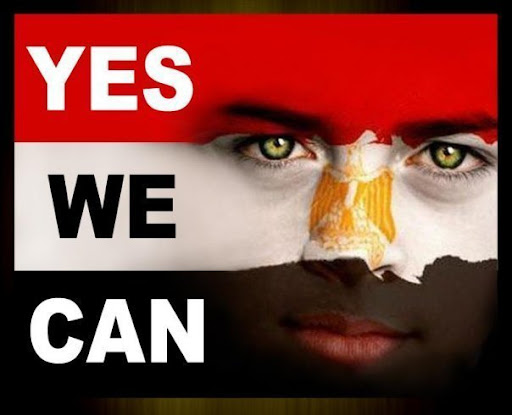
The uprising took off in a way that no one anticipated. On January 27, Facebook, along with telephones and internet, went off. Nevertheless the revolution grew and persisted. When the internet came back up on February 2 there was a conspicuous fluttering of pro-Mubarak profile pictures scattered around college students’ friends’ lists that had the uncanny look of iron curtain style propaganda posters. Though this is pure speculation, it is highly likely that a committee from the Ministry of Information got together to try to decipher how to infiltrate and conquer Facebook. Operating on a pre-digital mindset, they designed and released a poster about 25 January to appropriate the Day of Rage and rewrite history. That poster (Image #4) reads: “Day of Allegiance to the Leader and Commander. We are all with you and our hearts are with you. The campaign for Mubarak, Security for Egypt.”

Another profile photo which showed up among university students after the blackout was one that reads: “With all my heart I love you Egypt, and I love you oh President.”

These posters lacked the spontaneity, show of emotion, creativity of the other profile posters, and smelled of infiltrators, something not well tolerated in the Facebook public square. This pitiable attempt to turn back history and try to capture the allegiance of youth through manipulating Facebook was a sign of how desperately out of touch the regime has become. It is also indicative that it has lost its grip on the ideological state apparatuses, and once that occurs there is nothing left at its disposal but the use of force; or surrender.
Within three days these images of 25 of January as a day of loyalty to the President disappeared from Facebook. On Feburary 8, a new profile photo among Egyptian youth began spreading spontaneously. It was the image of one of their own, Wael Ghoneim, on the day of his release after twelve days disappearance (he was detained by police). The image is from a game-changing interview conducted with him on February 7, 2011 on a satellite channel. This interview, where he admits to organizing the initial protest, set to rest doubts that the revolution was the plot of enemy foreign agents. His display of emotion for the martyrs of the revolution touched the nation, and beyond. That may very well have been the nail in the coffin of the state’s media wars.

What is happening in Egypt is not a Facebook Revolution. But it could not have come about without the Facebook generation, generation 2.0, who are taking, and with their fellow citizens, making history.
Linda Herrera is a social anthropologist with expertise in comparative and international education. She has lived in Egypt and conducted research on youth cultures and educational change in Egypt and the wider Middle East for over two decades. She is currently Associate Professor, Department of Education Policy, Organization and Leadership, University of Illinois at Urbana-Champaign. She is co-editor with A. Bayat of the volume Being Young and Muslim: New Cultural Politics in the Global North and South, published by Oxford University Press (2010).
This post appeared on Jadaliyya. It is republished here with permission of Linda Herrera and Jadaliyya.
Read also Linda Herrera’s previous contribution: Two Faces of Revolution
Egypt's Revolution 2.0: The Facebook Factor
Posted on February 18th, 2011 by martijn.
Categories: Blogosphere, Headline, Society & Politics in the Middle East.
Guest Author: Linda Herrera
The call for a Day of Rage on January 25, 2011 that ignited the Egyptian revolution originated from a Facebook page. Many have since asked: Is this a “Facebook Revolution?” It is high time to put this question to rest and insist that political and social movements belong to people and not to communication tools and technologies. Facebook, like cell phones, the internet, and twitter, do not have agency, a moral universe, and are not predisposed to any particular ideological or political orientation. They are what people make of them. Facebook is no more responsible for Egypt’s revolution than Gutenberg’s printing press with movable type was responsible for the Protestant Reformation in the fifteenth century. But it is valid to say that neither the Reformation nor the pro-democracy rights’ movements sweeping Tunisia, Egypt, Iran, and much of the region would have come about at this juncture without these new tools. Digital communications media have revolutionized learning, cognition, and sociability and facilitated the development of a new generational behavior and consciousness. And the old guard simply do not get it.
Around the globe, far beyond Egypt and Tunisia, we are witnessing a monumental generational rupture taking place around digital literacy, and the coming of age of Generation 2.0. They take for granted interaction, collaboration, and community building on-line. The digital “non-literate” or “semi-literate” tend to be either the very poor lacking means, access to, or time for digital media, or the older generation, the pre-digitals, who do not see the value in changing their communication habits. Many from the pre-digital generation are quick to deride innovations such as Facebook and Twitter as being tools that indulge the egoistic tendencies of the young or which are colossal time wasters. While these critiques hold some validity, they capture only one side, and a small side, of a complex and epic generational sea change that is underway and that is being facilitated—not driven in some inevitable process—by the availability of new communication technologies and social tools.
A youthful global digital generation is growing in leaps and bounds, and social media, of which Facebook is just one platform, is a decisively important factor in it. Youth use social media for a range of social, academic, political, leisure, personal, creative, sexual, cultural, commercial, and other activities. Some characteristics of this global generation are excessive communication, involving many people in decision making, multitasking, group work, blurring of public and private, sharing, individual expression, and collective identification. Another important distinction between the generations is that the digital generation take what media theorist Clay Shirky calls “symmetrical participation” for granted. In other words, they are not passive recipients of media and messages, as in the days when television and print media ruled, but take for granted that they can play a role in the simultaneous production, consumption, interaction with, and dissemination of on-line content. Youth in the Middle East and North Africa share the features of their global generational counterparts but with some important additions and differences.
In politically authoritarian states like Egypt, Tunisia and Iran, youth have been fashioning Facebook into a vibrant and inclusive public square. They also use it to maintain their psychological well being as a space to metaphorically breath when the controls and constrains of the social world become too stifling. A 22 year old blogger and avid Facebook user explains, “It’s such a release to go on Facebook. I feel so liberated knowing there’s a place I can send my thoughts.”
The Rise of the “El-Face” Generation
In October and November 2010 I was in Egypt conducting research with university students in Alexandria and Cairo from diverse social class backgrounds on their media use. Many of them were using a new colloquial term, “El-Face” when talking about Facebook. These Facebook users carry traits of being politically savvy, bold, creative, outward looking, group regulating, and ethical. And their numbers are fast growing. In March 2008 there were some 822,560 users. After the Arabic version of Facebook was launched in March of 2009 usership jumped. By July 1, 2010 there were some 3,581,460 Facebook members, making for an increase of 357.2% in a two year period. The site has become increasingly Arabized, though many users show dexterity in using both English and Arabic.
In the months running up to the parliamentary elections in November 2010 there was much speculation about a possible shut down of Facebook. Adult pundits in the more mainstream media (semi-governmental newspapers, popular Arabic television talk shows) took up the cause of Facebook. They expressed their paternalistic concern about the potentially corrupting force of Facebook on the youth in a familiar moral panic mode. On her popular television talk show, for instance, Hala Sarhan lamented the lawlessness of Facebook, asserting it to be a dangerously free zone in need of restrictions. Others argued that without adult supervision, youth could be lured and tricked by dangerous elements into sedition (fitna). They worried Facebook was fueling sectarian tensions between Christians and Muslims that could lead to violence.
These public Facebook experts are mainly sexagenarian and septuagenarian educators, policy makers, government officials, and academics of a pre-digital age. They are using a pre-digital political cognition and institutional understanding to discuss new media today, and they are direly off the mark. Drawing on older understandings of the media they view Facebook as the new space of ideological control, the place to capture the minds and hearts of the citizens; like state television but accessible through the internet. Some of them are sincere in their worry that dangerous elements, like radicals and criminals, will try to befriend youth on Facebook and lure them in subversive activities. Others are clearly more interested in maintaining raw power and want to find effective ways to keep youth in their fold and under their thumbs. The ones vying to maintain control of the youth reason that if youth are spending time on Facebook, then all the government needs to do is go in and set up its propaganda machinery there, capture and control the hearts and minds of youth on Facebook, it’s that simple. The government has established a presence on Facebook, though a somewhat pitiful one, setting up pages for the National Democratic Party (158 people “like” it), Gamal Mubarak (the page has been removed since the uprising), Hosni Mubarak, and other government figures and causes. But these are not picking up traction. The youth are not buying it, and the more the regime people interlope into Facebook the more they lose legitimacy.
The community of “El-Face” is developing a cultural, political, and ethical universe of its own. It has its own codes and is a regulated space to some degree. There are certain red lines, as Hoda and Amir, both 21 year old university students at Alexandria University, that should not be crossed: you should not use the space to insult each other’s religion, for pornography or sexual harassment, for advertising or selling things, for spreading false rumors, or for spying. When a Facebook friend crosses these lines others intervene by way of posting a corrective comment on their wall, starting a conversation on the post in question, or by defriending them.
Last October many youth were worried that the government would close down Facebook. In discussions with a group of students from the Political Science department at Cairo University, they explained that the government feared the flurry of critical political activity that would invariably precede an election. Though many expressed that turning off Facebook would be akin to suffocating them, as one young man put it, it would be like “blocking the air to my lungs”, they insisted they would not ease up on their pre-election Facebook activities. These included mocking the president, his son, the system, and the whole electoral process. They stood defiant. A 21 year old female student proclaimed, “We don’t care! We’re not afraid of them. What are they going to do, arrest millions of us?”
Their Facebook activities also included a commitment to demanding justice for the brutal killing of one of their own, Khaled Said. It was striking last October how every youth I encountered in and out of the university was talking about Khaled Said. His story, which came out of Facebook, not Al-Jazeera, the newspaper, or any other media, has by now received much international coverage. The events leading to Khaled’s killing originated when he supposedly posted a video of two police officers allegedly dividing the spoils of a drug bust. This manner of citizen journalism has become commonplace and youth are getting more emboldened to expose the festering corruption of a police force that acts with impunity. On June 6, 2010, as Khaled Said was sitting in an internet café in Alexandria, two police officers entered and asked him for his I.D.. He refused to produce it and they proceeded to drag him away and allegedly sadistically beat him to his death as he pleaded for his life in the view of witnesses. The officers claimed that Khaled died of suffocation after swallowing a packet of drugs. His family released a photograph to an activist of the broken, bloodied, and disfigured face from Khaled’s corpse. This photo, and a portrait of the gentle soft skinned face of the living Khaled, went viral. The power of photographic evidence combined with eyewitness accounts and popular knowledge of police brutality left no doubt in anyone’s mind that he was senselessly and brutally murdered by police officers, the very people who are supposed to act in the interest of public safety.
A Facebook page, “We are all Khaled Said” was set up and we now know that activists from the Facebook group 6 of April Youth Movement, and Google executive Wael Ghoneim who is becoming a national hero as instigator of the Day of Rage (see below), were involved in this. The page led to a movement, first for justice to bring the killers to court to pay for their crime, and then, something much bigger. On the heels of the Tunisian revolution and fleeing of the dictator Zine El Abidine Ben Ali, the “We are all Khaled Said” group called for a Day of Rage, a march against “Torture, Corruption, Poverty and Unemployment” for January 25, 2011, the date the Regime designated to “celebrate” the police. Scores of Facebook users changed their profile pages to show their support for this march. Below are some of the samples of their profiles pictures.
The uprising took off in a way that no one anticipated. On January 27, Facebook, along with telephones and internet, went off. Nevertheless the revolution grew and persisted. When the internet came back up on February 2 there was a conspicuous fluttering of pro-Mubarak profile pictures scattered around college students’ friends’ lists that had the uncanny look of iron curtain style propaganda posters. Though this is pure speculation, it is highly likely that a committee from the Ministry of Information got together to try to decipher how to infiltrate and conquer Facebook. Operating on a pre-digital mindset, they designed and released a poster about 25 January to appropriate the Day of Rage and rewrite history. That poster (Image #4) reads: “Day of Allegiance to the Leader and Commander. We are all with you and our hearts are with you. The campaign for Mubarak, Security for Egypt.”
Another profile photo which showed up among university students after the blackout was one that reads: “With all my heart I love you Egypt, and I love you oh President.”
These posters lacked the spontaneity, show of emotion, creativity of the other profile posters, and smelled of infiltrators, something not well tolerated in the Facebook public square. This pitiable attempt to turn back history and try to capture the allegiance of youth through manipulating Facebook was a sign of how desperately out of touch the regime has become. It is also indicative that it has lost its grip on the ideological state apparatuses, and once that occurs there is nothing left at its disposal but the use of force; or surrender.
Within three days these images of 25 of January as a day of loyalty to the President disappeared from Facebook. On Feburary 8, a new profile photo among Egyptian youth began spreading spontaneously. It was the image of one of their own, Wael Ghoneim, on the day of his release after twelve days disappearance (he was detained by police). The image is from a game-changing interview conducted with him on February 7, 2011 on a satellite channel. This interview, where he admits to organizing the initial protest, set to rest doubts that the revolution was the plot of enemy foreign agents. His display of emotion for the martyrs of the revolution touched the nation, and beyond. That may very well have been the nail in the coffin of the state’s media wars.
What is happening in Egypt is not a Facebook Revolution. But it could not have come about without the Facebook generation, generation 2.0, who are taking, and with their fellow citizens, making history.
Linda Herrera is a social anthropologist with expertise in comparative and international education. She has lived in Egypt and conducted research on youth cultures and educational change in Egypt and the wider Middle East for over two decades. She is currently Associate Professor, Department of Education Policy, Organization and Leadership, University of Illinois at Urbana-Champaign. She is co-editor with A. Bayat of the volume Being Young and Muslim: New Cultural Politics in the Global North and South, published by Oxford University Press (2010).
This post appeared on Jadaliyya. It is republished here with permission of Linda Herrera and Jadaliyya.
Read also Linda Herrera’s previous contribution: Two Faces of Revolution
Uprising – Music, Images and The Tunisia and Egypt Revolution on Youtube
Posted on February 17th, 2011 by martijn.
Categories: Arts & culture, Society & Politics in the Middle East.
Music, images and nowadays video have always been an important part of protest movements. These practices of making and spreading music videos can enhance the solidarity with a movement, its identity and ideas, values and goals. It makes distant sympathizers (feel) part of the movement, in this case global movement’ because they are actually participating in spreading the word (and image) and the express their own political position in public. Some of the music belonging to these videos can be experienced as extremely powerful; if the images are not strong enough to evoke the senses, the combination with the music will. Not only the number of people grows that can engage with the message of the movement, their excitement, anger, grievances can increase at the same time; on the ground creating what has been called by Elias Canetti a ‘rhythmic crowd’; what a movement may lack in numbers they make up in intensity. How this actually works with youtube videos remains to be seen nevertheless it seems clear that musicians and youtubers are inspired by the Egypt revolution.
I have had the pleasure of enjoying two fantastic concert by Muse. One of my favorite songs is Uprising. And now with the uprisings in Egypt and Tunisia and elsewhere I was actually waiting for these videos to appear:
well, apparently I can’t because the protest videos featuring Muse’s The Uprising have been blocked due to copyright violations…So have a look at the next ones”:
Take a Bow
Map of the Problematique
Thirteen Senses – Into the Fire
Globus – Europe (via Raafatology)
The next video shows photographs of the revolution and using the song Million Man March by Lowkey ft. Mai Khalil:
Of course, Egyptian artists are not silent either. Watch and listen to the next song; a very popular one by Mohamed Mouzir: Ezzay (How come?)
Next one of the first protest songs Sefr (zero) by Haitham Nabil. Hani Almadhoun has the lyrics at Hot Arab Music.
The next song is made by Arab-American and African-American musicians: January 25 or #jan25:
The song is a ‘testament to the revolution’s effect on the hearts and minds of today’s youth, and the spirit of resistance it has come to symbolize for oppressed people worldwide.’
While the videos featuring for example Muse use existing songs as background thereby creating a sort of soundwall that provokes the senses, the videos from Egyptian artists are different. Arabian Knightz recorded this song Rebel in the first week of the protests:
The next one is a very powerful one of Arabian Knightz featuring the Palestinian Shadia Mansour:
And here three videos from and about the Jasmin Revolution in Tunisia from El General:
The next song and video as actually made at Tahrir Square in Cairo:
One of the most well known artists, Sami Yusuf, whose Islamic pop songs aim at empowering Muslim youth and making them proud of their identity, has also released a song: ‘I am your hope’:
Before bringing this to a (sort of conclusion) I want to show you one more, this time by Master Mimz, a female rap artist from Morocco: Back Down Mubarak! (Note the difference in the footage shown in the video?):
See also this relevant piece on Jadaliyya: Imperial Feminism, Islamophobia, and the Egyptian Revolution* by Nadine Naber that refers to the video of Master Mimz.
What youtube and modern computer technology make possible is people using products of the culture industry (such as popmusic) and appropriate them to fit their own values, needs and goals. Youtube does not only enable people to escape the censorship by the Egyptian state but also the formats and models they are exposed to by the culture industry. Youtube therefore has become an important platform for what Fiske (building on De Certeau) has called ’semiotic resistance’and creativity; one that has profound cultural and political significance.
And ok, as an academic one should keep a certain distance but hey: long live the people of Egypt!
Verantwoordelijkheid en Schuldgevoel – Volksprotesten in het Midden-Oosten
Posted on February 14th, 2011 by martijn.
Categories: Guest authors, Society & Politics in the Middle East.
Guest Author: Evert van der Zweerde
Volksprotest in Tunis, Egypte, Amman en Jemen. Hoe lang hebben zij gewacht totdat ze in opstand kwamen tegen de gehate regimes die er enkel zitten omdat “het Westen” denkt dat dat het eigen belang dient? Wiens belang? Niet het mijne.
Twee jaar geleden was ik in Caïro. Ik at kip nuggets in de Kentucky Fried Chicken aan midan tahrir en keek mijn ogen uit naar de prachtige jonge Egyptische meiden, met kleurige hoofddoeken als ze moslima waren, zonder als ze kopt waren, in niqab als ze streng-gelovig waren. Arm-in-arm ondanks die verschillen, zoals ze nu zij-aan-zij staan. Zoals kopten nu tijdens het middaggebed een cordon vormen rond de moslims op het plein om te voorkomen dat het gespuis van Mubarak dat moment van kwetsbaarheid uitbuit.
Twee jaar geleden sprak ik met de hoofdredacteur van al-misri al-yawm, toen een in de marge getolereerd dagblad, nu de spreekbuis van het nieuwe Egypte. Ik sprak met de voorzitter van de oppositiepartij al-wasat, “het midden”, wiens grote voorbeelden de Duitse CDU en de Turkse AKP waren. Ik sprak met de hoogstbejaarde Gamal al-banna, wiens broer Hassan de Moslim-Broederschap oprichtte. Hij droomde van een liberale socialistische islamitische democratische republiek. Van zo’n soort republiek droom ik ook weleens. Hopelijk leeft hij nog en droomt hij verder. De gebeurtenissen hebben hem ingehaald.
De Egyptenaren die nu vrijheid en democratie willen zijn mensen zoals u en ik die afwillen van dictator en geheime politie, die corruptie en nepotisme beu zijn, die werk, betaalbare gezondheidszorg en goed onderwijs willen. Ja, de Moslim Broederschap levert dat al en ontleent daaraan haar populariteit. Ja, veel Egyptenaren vinden politieke inspiratie in islamitische idealen van rechtvaardigheid en gelijkheid. Ja, velen in het Midden Oosten zijn boos op de Westerse regeringen die, geplaagd door post-Holocaust schuldgevoel, al decennia lang met twee maten meten wanneer het om Israël en Palestina gaat. Ze zijn niet tegen Joden, ze zijn tegen zionisme en tegen de wijze waarop “wij” de compensatie van ons schuldgevoel op hen afwentelen. Dat schuldgevoel moeten wij, Hannah Arendt indachtig, omzetten in het nemen van verantwoordelijkheid voor een andere loop van de geschiedenis, voor zover dat in onze macht ligt.
Om te begrijpen wat de mensen in Caïro willen, en vooral: niet willen, hoef ik niet te weten of ze moslim zijn of iets anders en het maakt mij niet uit of een deel van hen gelooft in het ideaal van een hersteld kalifaat. De helft van de Franse résistance tijdens de Tweede Wereldoorlog geloofde in een door de Sovjet-Unie geleide wereldrevolutie en de komst van een communistische samenleving. Wat ze deden was het bestrijden van de Nazi’s en van het gehate Vichy-regime van maarschalk Pétain. Mij hoeft het niet uit te maken of een demonstrant een T-shirt met Che Guevara draagt of “Allahu akbar” roept. Wat zij of hij wil snap ik ook zonder die heilige grootheden.
De eerste versie van deze column schreef ik op een schrijfblok van een demokratski seminar dat ik 10 jaar geleden met mijn collega Machiel Karskens in Belgrado bezocht. Daar gingen toen, zoals ook nu, mensen de straat op om een einde te maken aan corruptie en nepotisme -daar heet dat “mafia”-, om werk en om een fatsoenlijk bestaan. Sommigen riepen en roepen daarbij dat het Orthodox-christelijke Servische volk al eeuwenlang slachtoffer is en dat dat afgelopen moet zijn. Dat klinkt eng, maar om te begrijpen wat de mensen in Belgrado willen, en vooral: niet willen, hoef ik niet te weten of ze Servisch-orthodox zijn of iets anders en het maakt mij niet uit of een deel van hen gelooft in een rechtvaardige theocratische heilsstaat. Wat ik wèl moet weten is dat “het Westen” mede schuld is aan de ontstane situatie door tijdens de burgeroorlog in voormalig Joegoslavië met twee maten te meten, het rooms-katholieke Kroatië klakkeloos te erkennen, Belgrado te bombarderen en de Bosnische moslims op een verschrikkelijke manier in de steek te laten.
Historische schuld leidt tot schuldgevoel, maar schuldgevoel is nooit een constructieve politieke passie. Waar het om gaat is verantwoordelijkheid nemen en versnelde opname van Servië en van Bosnië-Herzegovina in de EU na te streven. Waar het om gaat is de neerbuigende postkoloniale houding ten opzichte van regeringen en bevolkingen in Tunis, Caïro en elders te vervangen door principiële gelijkwaardigheid. Het gaat niet aan om te roepen dat democratie een recht van ieder volk is en vervolgens op de rem te gaan staan wanneer een groepering de verkiezingen dreigt te gaan winnen die “ons” om welke reden dan ook niet bevalt. Waar het ook om gaat, ten slotte, hier en daar en overal, is op te houden religie te misbruiken om af te leiden van werkelijke problemen.
Prof. dr. Evert van der Zweerde is hoogleraar Politieke filosofie aan de Radboud Universiteit Nijmegen. Deze tekst sprak hij afgelopen donderdag uit als column tijdens het actualiteitencollege over de crisis in het Midden-Oosten. Afgelopen vrijdag hieldt Evert van der Zweerde zijn oratie, getiteld “Het is ook nooit goed…” Democratie vanuit politiek-filosofisch perspectief
Closing the week 6 – Featuring the Egypt Revolution
Posted on February 13th, 2011 by martijn.
Categories: Blogosphere, Society & Politics in the Middle East.
Most popular on Closer last week
- Two Faces of Revolution by Linda Herrera
- ‘Now its gonna be a lone one’ – Some first conclusions on the Egyptian Revolution by Samuli Schielke
- ‘Verandering komt eraan’ – De Arabische revolte in Jordanië door Egbert Harmsen
Previous updates on the uprisings in the Middle East: Tunisia Uprising I – Tunisia Uprising II – Tunisia / Egypt Uprising Essential Reading I
- If you want to stay updated and did not subscribe yet, you can do so HERE
- You can follow me on Twitter: Martijn5155
(More) Essential Reading
The road to Tahrir by Charles Hirschkind – The Immanent Frame
These online activists have played a key role in transforming the conditions of political possibility in Egypt during the last decade, and of paving the way to Tahrir Square today. They have sought out and cultivated new forms of political agency in the face of the predations and repressive actions of the Egyptian state. They have pioneered forms of political critique and interaction that can mediate and encompass the heterogeneity of religious and social commitments that constitute Egypt’s contemporary political terrain. From the latest news reports, it is clear that many of them are now being arrested and beaten for their efforts. The regime has again shown itself implacable in its disregard for the people of Egypt.
Egypt, and the post-Islamist middle east by Asef Bayat | openDemocracy
In this incipient post-Islamist middle east, the prevailing popular movements assume a post-national, post-ideological, civil, and democratic character. Iran’s green movement, the Tunisian revolution, and the Egyptian uprising represent the popular movements of these post-Islamist times. They strive to achieve social justice, dignity, and a form of democratic governance that can protect citizens’ fundamental rights.
This new relation between bloggers and other media forms has now become standard: not only do many of the opposition newspapers rely on bloggers for their stories; news stories that journalists can’t print themselves without facing state persecution—for example, on issues relating to the question of Mubarak’s successor—such stories are first fed to bloggers by investigative reporters; once they are reported online, then journalists then proceed to publish the stories in newsprint, citing the blogs as source, this way avoiding the accusation that they themselves invented the story. Moreover, many young people have taken up the practice of using cell-phone cameras in the street, and bloggers are constantly receiving phone film-footage from anonymous sources that they then put on their blogs.
This event played a key role in shaping the place that the blogosphere would come to occupy within Egypt’s media sphere. Namely, bloggers understand their role as that of providing a direct link to what they call “the street,” conceived primarily as a space of state repression and political violence, but also as one of political action and popular resistance. They render visible and publicly speakable a political practice—the violent subjugation of the Egyptian people by its authoritarian regime—that other media outlets cannot easily disclose, due to censorship, practices of harassment, and arrest. This includes not only acts police brutality and torture, but also the more mundane and routine forms of violence that shape the texture of everyday life.
Good morning revolution: A to do list – by Hani Shukrallah – Ahram Online
The revolution has triumphed, but even as we celebrate, we need to begin at once with the most amazing job history has thrown our way, the building of an Egyptian democracy
Egypt’s Revolution 2.0: The Facebook Factor by Linda Herrera – Jadaliyya.com
What is happening in Egypt is not a Facebook Revolution. But it could not have come about without the Facebook generation, generation 2.0, who are taking, and with their fellow citizens, making history.
Imperial Feminism, Islamophobia, and the Egyptian Revolution* by Nadine Naber – Jadaliyya.com
Often ignored in U.S. discussions on Egypt is how protests led by labor unions—many women-based labor unions in the manufacturing cities of Egypt—have catalyzed the Egyptian revolution (Paul Amar, 02-05-11).[ii] The women now holding down Tahrir Square as we speak—are of all ages and social groups and their struggle cannot be explained through Orientalist tropes that reduce Arab women to passive victims of culture or religion or Islam. They are active participants in a grassroots people-based struggle against poverty and state corruption, rigged elections, repression, torture, and police brutality. They are leading marches; attending the wounded, and participating in identity checks of state supported thugs. They have helped create human shields to protect Egyptian Antiquities Museum, the Arab League Headquarters, and one another. They have helped organize neighborhood watch groups and committees nationwide in order to protect private and public property. They are fighting against dictatorship among millions of people-not guided by any one sect or political party—united under one slogan: we want and end to this regime.
More incomplete thoughts on the Algerian situation « The Moor Next Door
The RCD’s headquarters in Algiers was has already been surrounded by police after three hundred people reportedly congregated there to demonstrate their satisfaction with the fall of Mubarak. What kind of affect early obstruction might have will depend on how many people turn out in force to begin with: the masses of police on the streets may have a serious psychological impact on smaller demonstrators and if the demonstrations are as easily dispersed as on 22 January its unlikely that much else will follow. And while many Algerians are thoroughly dissatisfied with Bouteflika, most understand the real political challenge is the whole system, the politicized military leadership, the economic oligarchs, the not mere personalities. Many Algerians have been impressed by the fall of Mubarak, though. Buses of people are heading to Algiers from the surrounding cities and provinces, blocked by the police. By cutting out those seeking to protest peacefully (and with a limited popular appeal) the regime is increasing the likelihood of spontaneous, violent demonstrations which may indeed be to the government’s advantage. While the opposition is weak and without strong popular credentials (not wholly committed to the 12 February movement) there is more potential for something much bigger than previously anticipated as a result of recent events and the anxiety they may cause in the security services and the government at large. Mubarak’s fall has raised the stakes for Algeria’s 12 February march. But his fall does not necessarily make Bouteflika’s imminent. More to come.
Incomplete thoughts on the Algerian Situation « The Moor Next Door
The military and civilian elite learned the “lesson of April 2001,” when youths in Kabylia, and then the rest of the country, rose up and were brutally suppressed: higher levels of violence increase resentment and anger thereby making resistance more powerful. The Algerian response to the winter uprising netted far few deaths than those in Tunisia and Egypt where the deaths of demonstrators became galvanizing moments in struggles against local regimes. The Algerians were able to weather the uprisings without the kind of firm anti-government movement faed by their neighbors. Over the last ten years the Algerians have also grown adept at coopting ideological demands from popular and party forces: it met demands to give Berber a more exalted place within the state, recognizing it as a national language and including references to Berber identity in the constitution; it has included Islamists in the ruling coalition (the MSP) and adopted some of their recommendations in family law and education. But it has not taken on the social and economic contradictions that animate most social and political dissatisfaction among the population.
The revolution is not over by Adam Shatz « LRB blog
But the revolution in Egypt is not over: in fact, it has only begun. Mubarak’s removal from power was only the first objective of Egypt’s demonstrators. It was not just Mubarak but the regime that they want to dislodge, and to replace with a democratic government based on the rule of law. One of the pillars of the regime is the institution that is now improbably cast as the national saviour: the army. The army is respected, even admired by most Egyptians for its role in defending the country’s borders, and for its success in the 1973 war. It has always kept – officially – a discreet distance from the day-to-day running of the country, but it has also acquired a deep investment in the status quo, particularly in the country’s economy: the army is involved in the production of everything from washing machines and heaters to clothing and pharmaceuticals, and is estimated to own about a third of the country’s assets. Nor does it have much incentive to make any changes in foreign policy that might affect the terms of US aid: $1.3 billion per year.
Impressions from Egypt’s front line | Comment is free | guardian.co.uk
Hossam el-Hamalawy, an Egyptian journalist from Cairo, uses photographs to tell the inside story of protests on the streets of his city
The fall of Multiculturalism…again
Cameron Criticizes ‘Multiculturalism’ in Britain – NYTimes.com
LONDON — Faced with growing alarm about Islamic militants who have made Britain one of Europe’s most active bases for terrorist plots, Prime Minister David Cameron has mounted an attack on the country’s decades-old policy of “multiculturalism,” saying it has encouraged “segregated communities” where Islamic extremism can thrive.
Multiculturalism: not a minority problem | Tariq Modood | Comment is free | The Guardian
Notices of the death of multiculturalism began in Britain as far back as 1989, with the Salman Rushdie/Satanic Verses affair. It became clear that the minority-majority faultline was not going to be simply about colour racism, and that the definition of multiculturalism could not be confined to “steelbands, saris and samosas”. For some liberals that meant an end to their support for the concept, as angry Muslims muscled in on something that was intended only for the likes of gay people or black youth. Their protests were supported as “right on”, but a passionate religious identity was too multicultural for many.
Why Cameron’s speech on terrorism puts us more in danger | Liberal Conspiracy
David Cameron’s speech last week was primarily focused on counter-terrorism, even if excerpts released to the media highlighted the ‘death of state multiculturalism’.
This is a problem in itself because, by conflating counter-terrorism and integration, Cameron weakens internal security and makes all of us more vulnerable to terrorism. This isn’t limited to the Conservatives either; many others who define themselves as ‘muscular liberals’ make the same mistake.
Muslim groups, anti-racism campaigners and opposition politicians also questioned the timing of the high-profile speech, just hours before around 3,000 members of the far-right English Defence League (EDL) marched through Luton.
Blame consumer capitalism, not multiculturalism | Madeleine Bunting | Comment is free | The Guardian
David Cameron’s analysis is flawed; it’s individualism and globalisation that are undermining a strong national identity
Cameron Urges Immigrants to Integrate – WSJ.com
LONDON—U.K. Prime Minister David Cameron triggered a debate about multiculturalism in Britain over the weekend after arguing in a speech on terrorism for a “muscular liberalism” that confronts extremist Islam by forging a tighter national identity in multiethnic countries such as Britain.
France’s Sarkozy: Multiculturalism a failure – Israel News, Ynetnews
French leader: We’ve been too concerned about identity of new arrivals, not enough about identity of country receiving them
Nationalist politician Geert Wilders has claimed that he is being persecuted for his political views. The Dutch populist, who likens Islam to fascism, is charged with inciting hatred towards Muslims and others.
How Democracy Became Halal – NYTimes.com
When the legitimacy of theocracy started to unravel amid the regime’s corruption and brutality in the late 1980s, democratic ideas, including powerful democratic interpretations of the Islamic faith, roared forth. The explosion on the streets after the fraudulent presidential elections of June 2009 was just the most visible eruption of the enormous democratic pressures that had built up underneath the republic’s autocracy. More regime-threatening moments are surely coming.
Dutch
Een omstreden washok voor moslims – Trouw
Hogeschool Windesheim vond het gênant dat moslimstudenten zich voor het bidden moesten reinigen in het invalidentoilet. De school richtte een kleine wasruimte in. Reden voor de PVV om Kamervragen te stellen.
Mythbuster: Moslims toch ‘normaler’ | Wijblijvenhier.nl
Na 9/11 in New York is de kloof tussen moslims en niet-moslims groter geworden. Na 7/7 in London gold dit ook sterk voor de Britse moslims en niet-moslims. Of toch niet? In London werd hier een onderzoek naar gedaan door The Gallup Organization. Het resultaat (verrassend voor sommigen): de kloof is veel minder groot dan we zelf denken.
Quote du Jour | Moslims komen van Mars, Westerlingen van Venus? – Sargasso
Toch roepen de elkaar netjes overlappende dichotomieën die Almog aanwijst (de islamitische wereld vs. het Westen // tirannie vs. democratie // vrouwelijk vs. mannelijk) mijn argwaan op. Kan de werkelijkheid werkelijk teruggebracht worden tot zwart tegenover wit? En speelt er bij Almog niet een ideologisch belang mee; namelijk de Westerlingen overtuigen dat de kant van Israël moeten blijven kiezen, ook al gedraagt dit land zich als een koloniale onderdrukker?
Elsevier.nl – Nederland – Moslims lopen belastingvoordeel mis door lakse moskeeën
Mensen die doneren aan moskeeën lopen vaak hun belastingvoordeel mis, omdat partijbesturen van de gebedshuizen zich zelden laten registreren. Giften aan gebedshuizen zijn sinds 2008 niet meer automatisch fiscaal aftrekbaar.
Seks en de seculiere natie | DeJaap
Seksuele politiek (identiteitspolitiek gericht op emancipatie van minderheden als vrouwen en homo’s) was jaren het toonbeeld van progressiviteit. Het opkomen voor de rechten van seksuele minderheden ging toen gepaard met gevoeligheid voor het lot van andere minderheden, die op basis van bijvoorbeeld hun afkomst niet tot de mainstream behoorden. Seksuele politiek is nog steeds het toonbeeld van modern zijn, maar seksuele politiek wordt nu ingezet om een tegenstelling aan te geven tussen wij, het seksueel bevrijde Westen, en zij, de seksueel achterlijke Moslims. Een sexual clash of civilizations. Dit levert een duivels dilemma op voor de wetenschappers aanwezig op de conferentie. Zij hebben het gevoel dat ze moeten kiezen tussen vrouwen (en homo’s, lesbiennes en transgenders) of moslims.