Activism
You are looking at posts in the category Activism.
| M | T | W | T | F | S | S |
|---|---|---|---|---|---|---|
| « Sep | ||||||
| 1 | 2 | 3 | 4 | |||
| 5 | 6 | 7 | 8 | 9 | 10 | 11 |
| 12 | 13 | 14 | 15 | 16 | 17 | 18 |
| 19 | 20 | 21 | 22 | 23 | 24 | 25 |
| 26 | 27 | 28 | 29 | 30 | 31 | |
Pages
- About
- C L O S E R moves to….C L O S E R
- Contact Me
- Interventions – Forces that Bind or Divide
- ISIM Review via Closer
- Publications
- Research
Categories
- (Upcoming) Events (33)
- [Online] Publications (26)
- Activism (117)
- anthropology (113)
- Method (13)
- Arts & culture (88)
- Asides (2)
- Blind Horses (33)
- Blogosphere (192)
- Burgerschapserie 2010 (50)
- Citizenship Carnival (5)
- Dudok (1)
- Featured (5)
- Gender, Kinship & Marriage Issues (265)
- Gouda Issues (91)
- Guest authors (58)
- Headline (76)
- Important Publications (159)
- Internal Debates (275)
- International Terrorism (437)
- ISIM Leiden (5)
- ISIM Research II (4)
- ISIM/RU Research (171)
- Islam in European History (2)
- Islam in the Netherlands (219)
- Islamnews (56)
- islamophobia (59)
- Joy Category (56)
- Marriage (1)
- Misc. News (891)
- Morocco (70)
- Multiculti Issues (749)
- Murder on theo Van Gogh and related issues (326)
- My Research (118)
- Notes from the Field (82)
- Panoptic Surveillance (4)
- Public Islam (244)
- Religion Other (109)
- Religious and Political Radicalization (635)
- Religious Movements (54)
- Research International (55)
- Research Tools (3)
- Ritual and Religious Experience (58)
- Society & Politics in the Middle East (159)
- Some personal considerations (146)
- Deep in the woods… (18)
- Stadsdebat Rotterdam (3)
- State of Science (5)
- Twitwa (5)
- Uncategorized (74)
- Young Muslims (459)
- Youth culture (as a practice) (157)
General
- ‘In the name of Allah, Most Gracious, Most Merciful’
- – Lotfi Haddi –
- …Kelaat Mgouna…….Ait Ouarchdik…
- ::–}{Nour Al-Islam}{–::
- Al-islam.nl De ware godsdienst voor Allah is de Islam
- Allah Is In The House
- Almaas
- amanullah.org
- Amr Khaled Official Website
- An Islam start page and Islamic search engine – Musalman.com
- arabesque.web-log.nl
- As-Siraat.net
- assadaaka.tk
- Assembley for the Protection of Hijab
- Authentieke Kennis
- Azaytouna – Meknes Azaytouna
- berichten over allochtonen in nederland – web-log.nl
- Bladi.net : Le Portail de la diaspora marocaine
- Bnai Avraham
- BrechtjesBlogje
- Classical Values
- De islam
- DimaDima.nl / De ware godsdienst? bij allah is de islam
- emel – the muslim lifestyle magazine
- Ethnically Incorrect
- fernaci
- Free Muslim Coalition Against Terrorism
- Frontaal Naakt. Ongesluierde opinies, interviews & achtergronden
- Hedendaagse wetenswaardigheden…
- History News Network
- Homepage Al Nisa
- hoofddoek.tk – Een hoofddoek, je goed recht?
- IMRA: International Muslima Rights Association
- Informed Comment
- Insight to Religions
- Instapundit.com
- Interesting Times
- Intro van Abdullah Biesheuvel
- islaam
- Islam Ijtihad World Politics Religion Liberal Islam Muslim Quran Islam in America
- Islam Ijtihad World Politics Religion Liberal Islam Muslim Quran Islam in America
- Islam Website: Islam, Islamic Studies, Arabic, Religion
- Islamforum
- Islamic Philosophy Online
- Islamica Magazine
- islamicate
- Islamophobia Watch
- Islamsevrouw.web-log.nl
- Islamwereld-alles wat je over de Islam wil weten…
- Jihad: War, Terrorism, and Peace in Islam
- JPilot Chat Room
- Madrid11.net
- Marocstart.nl – De marokkaanse startpagina!
- Maryams.Net – Muslim Women and their Islam
- Michel
- Modern Muslima.com
- Moslimjongeren Amsterdam
- Moslimjongeren.nl
- Muslim Peace Fellowship
- Muslim WakeUp! Sex & The Umma
- Muslimah Connection
- Muslims Against Terrorism (MAT)
- Mutma’inaa
- namira
- Otowi!
- Ramadan.NL
- Religion, World Religions, Comparative Religion – Just the facts on the world\’s religions.
- Ryan
- Sahabah
- Salafi Start Siden – The Salafi Start Page
- seifoullah.tk
- Sheikh Abd al Qadir Jilani Home Page
- Sidi Ahmed Ibn Mustafa Al Alawi Radhiya Allahu T’aala ‘Anhu (Islam, tasawuf – Sufism – Soufisme)
- Stichting Vangnet
- Storiesofmalika.web-log.nl
- Support Sanity – Israel / Palestine
- Tekenen van Allah\’s Bestaan op en in ons Lichaam
- Terrorism Unveiled
- The Coffee House | TPMCafe
- The Inter Faith Network for the UK
- The Ni’ma Foundation
- The Traveller’s Souk
- The \’Hofstad\’ terrorism trial – developments
- Thoughts & Readings
- Uitgeverij Momtazah | Helmond
- Un-veiled.net || Un-veiled Reflections
- Watan.nl
- Welkom bij Islamic webservices
- Welkom bij vangnet. De site voor islamitische jongeren!
- welkom moslim en niet moslims
- Yabiladi Maroc – Portail des Marocains dans le Monde
Dutch [Muslims] Blogs
- Hedendaagse wetenswaardigheden…
- Abdelhakim.nl
- Abdellah.nl
- Abdulwadud.web-log.nl
- Abou Jabir – web-log.nl
- Abu Bakker
- Abu Marwan Media Publikaties
- Acta Academica Tijdschrift voor Islam en Dialoog
- Ahamdoellilah – web-log.nl
- Ahlu Soennah – Abou Yunus
- Ahlul Hadeeth
- Ahlul Hadeeth
- Al Moudjahideen
- Al-Adzaan
- Al-Islaam: Bismilaahi Rahmaani Rahiem
- Alesha
- Alfeth.com
- Anoniempje.web-log.nl
- Ansaar at-Tawheed
- At-Tibyan Nederland
- beni-said.tk
- Blog van moemina3 – Skyrock.com
- bouchra
- CyberDjihad
- DE SCHRIJVENDE MOSLIMS
- DE VROLIJKE MOSLIM ;)
- Dewereldwachtopmij.web-log.nl
- Dien~oel~Islaam
- Eali.web-log.nl
- Een genade voor de werelden
- Enige wapen tegen de Waarheid is de leugen…
- ErTaN
- ewa
- Ezel & Os v2
- Gizoh.tk [.::De Site Voor Jou::.]
- Grappige, wijze verhalen van Nasreddin Hodja. Turkse humor.
- Hanifa Lillah
- hayya~ala~assalaah!
- Het laatste nieuws lees je als eerst op Maroc-Media
- Homow Universalizzz
- Ibn al-Qayyim
- IslaamLive Mail
- IslaamLive Mail
- Islam Blog – Juli 2007
- Islam in het Nieuws – web-log.nl
- Islam, een religie
- Islam, een religie
- Islamic Sisters – web-log.nl
- Islamiway’s Weblog
- Islamtawheed’s Blog
- Jihaad
- Jihad
- Journalista
- La Hawla Wa La Quwatta Illa Billah
- M O S L I M J O N G E R E N
- M.J.Ede – Moslimjongeren Ede
- Mahdi\’s Weblog | Vrijheid en het vrije woord | punt.nl: Je eigen gratis weblog, gratis fotoalbum, webmail, startpagina enz
- Maktab.nl (Zawaj – islamitische trouwsite)
- Marocdream.nl – Home
- Marokkaanse.web-log.nl
- Marokkanen Weblog
- Master Soul
- Miboon
- Miesjelle.web-log.nl
- Mijn Schatjes
- Moaz
- moeminway – web-log.nl
- Moslima_Y – web-log.nl
- mosta3inabilaah – web-log.nl
- Muhaajir in islamitisch Zuid-Oost Azië
- Mumin al-Bayda (English)
- Mustafa786.web-log.nl
- Oprecht – Poort tot de kennis
- Said.nl
- saifullah.nl – Jihad al-Haq begint hier!
- Salaam Aleikum
- Sayfoudien – web-log.nl
- soebhanAllah
- Soerah19.web-log.nl – web-log.nl
- Steun Palestina
- Stichting Moslimanetwerk
- Stories of Malika
- supermaroc
- Ummah Nieuws – web-log.nl
- Volkskrant Weblog — Alib Bondon
- Volkskrant Weblog — Moslima Journalista
- Vraag en antwoord…
- wat is Islam
- Wat is islam?
- Weblog – a la Maroc style
- website van Jamal
- Wij Blijven Hier
- Wij Blijven Hier
- www.BenAyad.be – Islam en Actua
- www.moslima.web-log.nl
- Yakini Time
- Youth Of Islam
- Youth Of Islam
- [fikra]
Non-Dutch Muslims Blogs
- Lanallah __Islamic BlogZine__
- This journey ends but only with The Beginning
- ‘the middle place’
- …Never Judge a Person By His or Her Blog…
- …under the tree…
- A Comment on PMUNA
- A Dervish’s Du`a’
- A Family in Baghdad
- A Garden of Children
- A Muslim Mother’s Thoughts / Islamic Parenting
- A Struggle in Uncertainty, Such is Life
- About Afghanistan
- adnan.org: good design, bad idea
- Afiyah
- Ahmeds World of Islam
- Al Musawwir
- Al-Musharaka
- Almiraya tBLOG – O, happy the soul that saw its own faults
- Almusawwir
- an open window
- Anak Alam
- aNaRcHo AkBaR
- Anthology
- AnthroGal’s World
- Arabian Passion
- ArRihla
- Articles Blog
- Asylum Seeker
- avari-nameh
- Baghdad Burning
- Being Noor Javed
- Bismillah
- bloggin’ muslimz.. Linking Muslim bloggers around the globe
- Blogging Islamic Perspective
- Chapati Mystery
- City of Brass – Principled pragmatism at the maghrib of one age, the fajr of another
- COUNTERCOLUMN: All Your Bias Are Belong to Us
- d i z z y l i m i t s . c o m >> muslim sisters united w e b r i n g
- Dar-al-Masnavi
- Day in the life of an American Muslim Woman
- Don’t Shoot!…
- eat-halal guy
- Eye on Gay Muslims
- Eye on Gay Muslims
- Figuring it all out for nearly one quarter of a century
- Free Alaa!
- Friends, Romans, Countrymen…. lend me 5 bux!
- From Peer to Peer ~ A Weblog about P2P File & Idea Sharing and More…
- Ghost of a flea
- Ginny’s Thoughts and Things
- God, Faith, and a Pen: The Official Blog of Dr. Hesham A. Hassaballa
- Golublog
- Green Data
- gulfreporter
- Hadeeth Blog
- Hadouta
- Hello from the land of the Pharaoh
- Hello From the land of the Pharaohs Egypt
- Hijabi Madness
- Hijabified
- HijabMan’s Blog
- Ihsan-net
- Inactivity
- Indigo Jo Blogs
- Iraq Blog Count
- Islam 4 Real
- Islamiblog
- Islamicly Locked
- Izzy Mo’s Blog
- Izzy Mo’s Blog
- Jaded Soul…….Unplugged…..
- Jeneva un-Kay-jed- My Bad Behavior Sanctuary
- K-A-L-E-I-D-O-S-C-O-P-E
- Lawrence of Cyberia
- Letter From Bahrain
- Life of an American Muslim SAHM whose dh is working in Iraq
- Manal and Alaa\’s bit bucket | free speech from the bletches
- Me Vs. MysElF
- Mental Mayhem
- Mere Islam
- Mind, Body, Soul : Blog
- Mohammad Ali Abtahi Webnevesht
- MoorishGirl
- Muslim Apple
- muslim blogs
- Muslims Under Progress…
- My heart speaks
- My Little Bubble
- My Thoughts
- Myself | Hossein Derakhshan’s weblog (English)
- neurotic Iraqi wife
- NINHAJABA
- Niqaabi Forever, Insha-Allah Blog with Islamic nasheeds and lectures from traditional Islamic scholars
- Niqabified: Irrelevant
- O Muhammad!
- Otowi!
- Pak Positive – Pakistani News for the Rest of Us
- Periphery
- Pictures in Baghdad
- PM’s World
- Positive Muslim News
- Procrastination
- Prophet Muhammad
- Queer Jihad
- Radical Muslim
- Raed in the Middle
- RAMBLING MONOLOGUES
- Rendering Islam
- Renegade Masjid
- Rooznegar, Sina Motallebi’s WebGard
- Sabbah’s Blog
- Salam Pax – The Baghdad Blog
- Saracen.nu
- Scarlet Thisbe
- Searching for Truth in a World of Mirrors
- Seeing the Dawn
- Seeker’s Digest
- Seekersdigest.org
- shut up you fat whiner!
- Simply Islam
- Sister Scorpion
- Sister Soljah
- Sister Surviving
- Slow Motion in Style
- Sunni Sister: Blahg Blahg Blahg
- Suzzy’s id is breaking loose…
- tell me a secret
- The Arab Street Files
- The Beirut Spring
- The Islamic Feminista
- The Land of Sad Oranges
- The Muslim Contrarian
- The Muslim Postcolonial
- The Progressive Muslims Union North America Debate
- The Rosetta Stone
- The Traceless Warrior
- The Wayfarer
- TheDesertTimes
- think halal: the muslim group weblog
- Thoughts & Readings
- Through Muslim Eyes
- Turkish Torque
- Uncertainty:Iman and Farid’s Iranian weblog
- UNMEDIA: principled pragmatism
- UNN – Usayd Network News
- Uzer.Aurjee?
- Various blogs by Muslims in the West. – Google Co-op
- washed away memories…
- Welcome to MythandCulture.com and to daily Arrows – Mythologist, Maggie Macary’s blog
- word gets around
- Writeous Sister
- Writersblot Home Page
- www.BenAyad.be – Islam en Actua
- www.Mas’ud’s blog
- \’Aqoul
- ~*choco-bean*~
General Islam Sites
- :: Islam Channel :: – Welcome to IslamChannel Official Website
- Ad3iyah(smeekbeden)
- Al-maktoum Islamic Centre Rotterdam
- Assalamoe Aleikoem Warhmatoe Allahi Wa Barakatuhoe.
- BouG.tk
- Dades Islam en Youngsterdam
- Haq Islam – One stop portal for Islam on the web!
- Hight School Teacher Muhammad al-Harbi\’s Case
- Ibn Taymiyah Pages
- Iskandri
- Islam
- Islam Always Tomorrow Yesterday Today
- Islam denounces terrorism.com
- Islam Home
- islam-internet.nl
- Islamic Artists Society
- Leicester~Muslims
- Mere Islam
- MuslimSpace.com | MuslimSpace.com, The Premiere Muslim Portal
- Safra Project
- Saleel.com
- Sparkly Water
- Statements Against Terror
- Understand Islam
- Welcome to Imaan UK website
Islamic Scholars
Social Sciences Scholars
- ‘ilm al-insaan: Talking About the Talk
- :: .. :: zerzaust :: .. ::
- After Sept. 11: Perspectives from the Social Sciences
- Andrea Ben Lassoued
- Anth 310 – Islam in the Modern World (Spring 2002)
- anthro:politico
- AnthroBase – Social and Cultural Anthropology – A searchable database of anthropological texts
- AnthroBlogs
- AnthroBoundaries
- Anthropologist Community
- anthropology blogs
- antropologi.info – Social and Cultural Anthropology in the News
- Arabist Jansen
- Between Secularization and Religionization Vrije Universiteit Amsterdam
- Bin Gregory Productions
- Blog van het Blaise Pascal Instituut
- Boas Blog
- Causes of Conflict – Thoughts on Religion, Identity and the Middle East (David Hume)
- Cicilie among the Parisians
- Cognitive Anthropology
- Comunidade Imaginada
- Cosmic Variance
- Critical Muslims
- danah boyd
- Deep Thought
- Dienekes’ Anthropology Blog
- Digital Islam
- Erkan\’s field diary
- Ethno::log
- Evamaria\’s ramblings –
- Evan F. Kohlmann – International Terrorism Consultant
- Experimental Philosophy
- For the record
- Forum Fridinum [Religionresearch.org]
- Fragments weblog
- From an Anthropological Perspective
- Gregory Bateson
- Islam & Muslims in Europe *)
- Islam, Islamic Studies, Arabic, Religion
- Islam, Muslims, and an Anthropologist
- Jeremy’s Weblog
- JourneyWoman
- Juan Cole – ‘Documents on Terrorist Abu Musab al-Zarqawi’
- Keywords
- Kijken naar de pers
- languagehat.com
- Left2Right
- Leiter Reports
- Levinas and multicultural society
- Links on Islam and Muslims
- log.squig.org
- Making Anthropology Public
- Martijn de Koning Research Pages / Onderzoekspaginas
- Material World
- MensenStreken
- Modern Mass Media, Religion and the Imagination of Communities
- Moroccan Politics and Perspectives
- Multicultural Netherlands
- My blog’s in Cambridge, but my heart is in Accra
- National Study of Youth and Religion
- Natures/Cultures
- Nomadic Thoughts
- On the Human
- Philip Greenspun’s Weblog:
- Photoethnography.com home page – a resource for photoethnographers
- Qahwa Sada
- RACIAL REALITY BLOG
- Religion Gateway – Academic Info
- Religion News Blog
- Religion Newswriters Association
- Religion Research
- rikcoolsaet.be – Rik Coolsaet – Homepage
- Rites [Religionresearch.org]
- Savage Minds: Notes and Queries in Anthropology – A Group Blog
- Somatosphere
- Space and Culture
- Strange Doctrines
- TayoBlog
- Teaching Anthropology
- The Angry Anthropologist
- The Gadflyer
- The Immanent Frame | Secularism, religion and the public sphere
- The Onion
- The Panda\’s Thumb
- TheAnthroGeek
- This Blog Sits at the
- This Blog Sits at the intersection of Anthropology & Economics
- verbal privilege
- Virtually Islamic: Research and News about Islam in the Digital Age
- Wanna be an Anthropologist
- Welcome to Framing Muslims – International Research Network
- Yahya Birt
Women's Blogs / Sites
- * DURRA * Danielle Durst Britt
- -Fear Allah as He should be Feared-
- a literary silhouette
- a literary silhouette
- A Thought in the Kingdom of Lunacy
- AlMaas – Diamant
- altmuslimah.com – exploring both sides of the gender divide
- Assalaam oe allaikoum Nour al Islam
- Atralnada (Morning Dew)
- ayla\’s perspective shifts
- Beautiful Amygdala
- bouchra
- Boulevard of Broken Dreams
- Chadia17
- Claiming Equal Citizenship
- Dervish
- Fantasy web-log – web-log.nl
- Farah\’s Sowaleef
- Green Tea
- hayya~ala~assalaah!
- Hilsen Fra …
- Islamucation
- kaleidomuslima: fragments of my life
- Laila Lalami
- Marhaban.web-log.nl – web-log.nl
- Moslima_Y – web-log.nl
- Muslim-Refusenik The official website of Irshad Manji
- Myrtus
- Noor al-Islaam – web-log.nl
- Oh You Who Believe…
- Raising Yousuf: a diary of a mother under occupation
- SAFspace
- Salika Sufisticate
- Saloua.nl
- Saudi Eve
- SOUL, HEART, MIND, AND BODY…
- Spirit21 – Shelina Zahra Janmohamed
- Sweep the Sunshine | the mundane is the edge of glory
- Taslima Nasrin
- The Color of Rain
- The Muslimah
- Thoughts Of A Traveller
- Volkskrant Weblog — Islam, een goed geloof
- Weblog Raja Felgata | Koffie Verkeerd – The Battle | punt.nl: Je eigen gratis weblog, gratis fotoalbum, webmail, startpagina enz
- Weblog Raja Felgata | WRF
- Writing is Busy Idleness
- www.moslima.web-log.nl
- Zeitgeistgirl
- Zusters in Islam
- ~:: MARYAM ::~ Tasawwuf Blog
Ritueel en religieuze beleving Nederland
- – Alfeth.com – NL
- :: Al Basair ::
- Abu Marwan Media Publikaties
- Ahlalbait Jongeren
- Ahlul Hadeeth
- Ahlul Hadeeth
- Al-Amien… De Betrouwbare – Home
- Al-Ummah
- Al-Ummah
- Al-Ummah
- Al-Wasatiyyah.com – Home
- Anwaar al-Islaam
- anwaaralislaam.tk
- Aqiedah’s Weblog
- Arabische Lessen – Home
- Arabische Lessen – Home
- Arrayaan.net
- At-taqwa.nl
- Begrijp Islam
- Bismillaah – deboodschap.com
- Citaten van de Salaf
- Dar al-Tarjama WebSite
- Dawah-online.com
- de koraan
- de koraan
- De Koran . net – Het Islaamitische Fundament op het Net – Home
- De Leidraad, een leidraad voor je leven
- Dien~oel~Islaam
- Dien~oel~Islaam
- Faadi Community
- Ghimaar
- hayya~ala~assalaah!
- hayya~ala~assalaah!
- Ibn al-Qayyim
- IMAM-MALIK-Alles over Islam
- IQRA ROOM – Koran studie groep
- Islaam voor iedereen
- Islaam voor iedereen
- Islaam: Terugkeer naar het Boek (Qor-aan) en de Soennah volgens het begrip van de Vrome Voorgangers… – Home
- Islaam: Terugkeer naar het Boek (Qor-aan) en de Soennah volgens het begrip van de Vrome Voorgangers… – Home
- IslaamLive Mail
- IslaamLive Mail
- IslaamLive Mail
- islam :: messageboard
- Islam City NL, Islam en meer
- Islam, een religie
- Islamia.nl – Islamic Shop – Islamitische Winkel
- Islamitische kleding
- Islamitische kleding
- Islamitische smeekbedes
- islamtoday
- islamvoorjou – Informatie over Islam, Koran en Soenah
- kebdani.tk
- KoranOnline.NL
- Lees de Koran – Een Openbaring voor de Mensheid
- Lifemakers NL
- Marocstart.nl | Islam & Koran Startpagina
- Miesbahoel Islam Zwolle
- Mocrodream Forums
- Moslims in Almere
- Moslims online jong en vernieuwend
- Nihedmoslima
- Oprecht – Poort tot de kennis
- Quraan.nl :: quran koran kuran koeran quran-voice alquran :: Luister online naar de Quraan
- Quraan.nl online quraan recitaties :: Koran quran islam allah mohammed god al-islam moslim
- Selefie Nederland
- Stichting Al Hoeda Wa Noer
- Stichting Al Islah
- StION Stichting Islamitische Organisatie Nederland – Ahlus Sunnat Wal Djama\’ah
- Sunni Publicaties
- Sunni.nl – Home
- Teksten van Aboe Ismaiel
- Terug Naar De Dien – Home
- Terug Naar De Dien – Home
- Terug Naar De Dien – Home
- Uw Keuze
- www.ahloelhadieth.com
- www.ahloelhadieth.com
- www.al-thabaat.com
- www.hijaab.com
- www.uwkeuze.net
- Youth Of Islam
- Zegswijzen van de Wijzen
- \’\’ Leid ons op het rechte pad het pad degenen aan wie Gij gunsten hebt geschonken\’\’
Muslim News
Moslims & Maatschappij
Arts & Culture
- : : SamiYusuf.com : : Copyright Awakening 2006 : :
- amir normandi, photographer – bio
- Ani – SINGING FOR THE SOUL OF ISLAM – HOME
- ARTEEAST.ORG
- AZIZ
- Enter into The Home Website Of Mecca2Medina
- Kalima Translation – Reviving Translation in the Arab world
- lemonaa.tk
- MWNF – Museum With No Frontiers – Discover Islamic Art
- Nader Sadek
Misc.
'Fundamentalism'
Islam & commerce
2
Morocco
[Online] Publications
- ACVZ :: | Preliminary Studies | About marriage: choosing a spouse and the issue of forced marriages among Maroccans, Turks and Hindostani in the Netherlands
- ACVZ :: | Voorstudies | Over het huwelijk gesproken: partnerkeuze en gedwongen huwelijken onder Marokkaanse, Turkse en Hindostaanse Nederlanders
- Kennislink – ‘Dit is geen poep wat ik praat’
- Kennislink – Nederlandse moslims
Religious Movements
- :: Al Basair ::
- :: al Haqq :: de waarheid van de Islam ::
- ::Kalamullah.Com::
- Ahloelhadieth.com
- Ahlul Hadeeth
- al-Madinah (Medina) The City of Prophecy ; Islamic University of Madinah (Medina), Life in Madinah (Medina), Saudi Arabia
- American Students in Madinah
- Aqiedah’s Weblog
- Dar al-Tarjama WebSite
- Faith Over Fear – Feiz Muhammad
- Instituut voor Opvoeding & Educatie
- IslaamLive Mail
- IslaamLive Mail
- islamtoday
- Moderate Muslims Refuted
- Rise And Fall Of Salafi Movement in the US by Umar Lee
- Selefie Dawah Nederland
- Selefie Nederland
- Selefienederland
- Stichting Al Hoeda Wa Noer
- Teksten van Aboe Ismaiel
- www.ahloelhadieth.com
- www.BenAyad.be – Islam en Actua
- Youth Of Islam

Demet TV vs. Nieuwsuur: Taal, Beeldvorming en Islam
Posted on May 3rd, 2013 by martijn.
Categories: Activism, Public Islam, Religious and Political Radicalization.
N.a.v. een uitzending van Nieuwsuur heeft Demet TV veel reacties gekregen. Reacties van mensen die zich verbazen over een ‘onjuiste’ ondertiteling van Nieuwsuur. Men meent dat moslims door deze ondertiteling met opzet als gewelddadig worden neergezet.
Het gaat om deze Nieuwsuur uitzending:
Dit is het item dat DemetNu er van maakte:
Demet TV – Verslaggever Oktay Basaran op zoek naar de waarheid
Leven als de profeet in Nederland: Salafisme, democratie en autonomie
Posted on April 25th, 2013 by martijn.
Categories: Activism, anthropology, Headline, Islam in the Netherlands, Religious and Political Radicalization.
Guest author: Ineke Roex
Introductie: spanningen en salafisme
Hebben salafisten een probleem met de democratie? Is het een soort sekte waar je nooit meer uitkomt? Hebben mensen nog wel enige vrijheid als ze ‘salafist’ zijn? Dit zijn vragen die je voortdurend hoort wanneer het gaat om salafisme; een soennitische islamitische hervormingsbeweging die streeft naar het herstel van een ‘zuivere’ islam, door morele heropvoeding van de moslimgemeenschap, een letterlijke lezing van de Koran en hadith, afwijzing van religieuze vernieuwingen en de imitatie van Mohammed en zijn metgezellen in de begintijd van de islam. De salafi-beweging is een utopische beweging die het dagelijkse leven van moslims probeert te reorganiseren conform een geïdealiseerd beeld uit het verleden. Ze creëren een eigen manier van leven die zij bevredigender en rechtvaardiger vinden en tegenover een wereld plaatsen van immoraliteit, onderdrukking en verleiding. Salafi’s leggen een claim op hun geloofsinterpretatie als de enige ware islam. Ze streven ernaar een morele gemeenschap te vormen van ware moslims en claimen daarbij de vertegenwoordigers van de enige islam te zijn. De beweging heeft zich op verschillende manieren ontwikkeld en wordt gekenmerkt door interne polemieken, theologische disputen en conflicten. Het bestaan van deze waarheid claimende geloofsstroming in Nederland, roept klaarblijkelijk vragen op over de verenigbaarheid van deze islamitische trend met democratische principes zoals vrijheid van godsdienst en gedachte en de vrijheid van vereniging en uittreding; vrijheidsrechten die de autonomie van het individu beschermen.
Veldwerk: autonomie en exit
Van december 2007 tot september 2008 heb ik antropologisch onderzoek verricht onder salafistische netwerken in Nederland en geanalyseerd hoe deze beweging zich verhoudt tot de voorwaarden en drempels die noodzakelijk zijn om de autonomie van mensen te waarborgen. Deze vraag heb ik beantwoord door de exitmogelijkheden te onderzoeken aan de hand van vier deelgebieden: organisatievormen, religieuze disciplinering, politieke opvattingen en participatievormen. Het betreft participerende observatie in organisaties en omgeving, informele gesprekken en interviews met predikers, aanhangers en omgeving. In mijn proefschrift beschrijf ik zowel de ideologie die de predikers verkondigen als de dagelijkse religieuze praktijk van degenen die zich verbinden met de salafibeweging. Onderzoek heeft zich tot nu toe enkel op één van deze twee aspecten gericht.
In dit onderzoek is uitgegaan van autonomie als een politiek begrip en als democratische kernwaarde geldt. Vanuit dit politieke begrip van autonomie moeten personen de politieke rechten (vrijheid van gedachte, vrijheid van religie, vrijheid van meningsuiting en het recht op autonomie van andersdenkenden) respecteren, maar autonomie niet per se als persoonlijk ideaal omarmen. Ik ga niet uit van autonomie als absolute waarde, maar ik neem ik procedurele onafhankelijkheid als uitgangspunt. Er is procedurele onafhankelijkheid wanneer iemand zonder dwang of geweld tot een besluit, handeling of levenswijze komt. De manier waarop een resultaat of een besluit bereikt wordt, is vanuit deze redenering belangrijker dan het resultaat of het besluit zelf. Iemand moet zich vrijwillig onderwerpen aan een disciplinerend regime.
Het zich onderwerpen aan de disciplinering tot vroom gelovige binnen de salafi beweging, is niet meteen een schending van iemands autonomie zolang mensen dat doen zonder geweld of andere vormen van dwang. Dit betekent dat mensen er dus uit zouden moeten kunnen stappen. Maar daarmee is niet alles gezegd. Het recht op uittreding moet niet alleen formeel beschikbaar zijn, maar ook realistisch en haalbaar zijn. Om te analyseren hoe de salafistische gemeenschappen zich tot autonomie verhoudt zijn de condities én de drempels van exitmogelijkheden onderzocht. Willen de exitmogelijkheden reëel zijn dan moet er drie voorwaarden aanwezig zijn.
Ten eerste moet er sprake zijn van procedurele onafhankelijkheid, dat wil zeggen afwezigheid van geweld en dwang. Ten tweede moet er toegang tot en kennis zijn van politieke rechten en alternatieven. Ten derde moet men zich niet isoleren. Isolement beperkt de toegang tot alternatieven en verhoogt de kosten van uittreding. Wanneer er sprake is van isolement dan kan uittreding ingrijpend zijn voor een individu, doordat iemand bijvoorbeeld sociaal of psychische afhankelijk is geworden van een groep.

De autonome Salafi
De salafi-beweging schendt de democratische kernwaarde van autonomie op dit moment in Nederland niet. Je kunt salafi én autonoom zijn. Er is in de context van Nederland sprake van procedurele onafhankelijkheid, kennis van en het respecteren van de politieke rechten in de religieuze, maatschappelijke en politieke opvattingen, ambities en praktijken van de salafi-beweging. Deze condities gelden met nadruk alleen op dit moment, in Nederland en niet voor salafi’s die sympathiseren met jihadistische opvattingen en geweld legitimeren. De autonomie van kinderen in salafi-gezinnen die (nog) niet naar school gaan en vrouwen in informele huwelijken, wanneer zij sterk geïsoleerd zijn van de omgeving, kan echter wel onder druk staan. De salafi-beweging roept niet op tot de schending van de autonomie van vrouwen en kinderen, maar stimuleert deze ook niet. Er kan sprake zijn van, soms zelfgekozen, isolement. Tegelijkertijd kunnen vrouwen de salafi-beweging opzoeken om hun autonomie ten opzichte van ouders, familieleden of partners te bewerkstelligen door met belemmerende tradities te breken. Er is dus geen één op één relatie tussen de salafi-beweging en het schenden van de autonomie van de vrouw.
Het is belangrijk dat de gunstige condities voor autonomie worden gewaarborgd zodat de salafi-beweging zich op termijn niet alsnog ontwikkelt tot een antidemocratische beweging. Allereerst is het van belang dat de media en de politiek waken voor het onzorgvuldig gebruiken van de term salafist als label, zodat het salafisme wordt voorgesteld als een eenheid. De ideologie evenals de praktijken in de salafi-beweging zijn veranderlijk, heterogeen en tegenstrijdig. Dit is gunstig voor de autonomie van betrokkenen alsmede de omgang met andersdenkenden. Wanneer de beweging echter als eenheid wordt gepresenteerd kunnen duidelijk afgebakende groepsgrenzen opgeworpen worden. Het is daarnaast niet verstandig om de salafi-beweging te beoordelen en beleid te voeren alleen op basis van bepaalde ideologische salafistische stellingnames. Niet alleen kan hierdoor de scheiding van kerk en staat in het gedrang komen doordat de overheid zich met de religieuze inhoud kan gaan bemoeien. Maar met name de praktijken, de interne sociale relaties en de relaties met de buitenwereld zijn doorslaggevend in de manifestatie van de beweging en de consequenties ervan voor autonomie als democratische waarde. Deze relaties zijn op dit moment veranderlijk, veelvormig en tegenstrijdig en dat is goed nieuws voor de democratie.
Om de gunstige condities te waarborgen is het tevens van belang dat de salafi-beweging en haar participanten niet in isolement raken. Beperkende maatregelen (denk bijvoorbeeld aan een boerka- of een hoofddoekverbod) en weigering voor studie of werk op grond van godsdienstige achtergrond of uiterlijk voorkomen, kunnen isolement in de hand werken, ook al hebben deze maatregelen participatie of bevordering van democratische waarden voor ogen. Samenwerkingen met salafistische organisaties moeten niet per definitie uitgesloten worden.
Ten slotte moet de salafi-beweging de ruimte krijgen om politiek te participeren. Politieke participatie is gunstig voor de bescherming van autonomie. Bovenal kunnen frustraties op politiek terrein het legitimeren van geweld als politiek middel dichterbij brengen. Het is belangrijk dat quiëtistische en politieke netwerken met hun anti-jihadistische stellingname gelovigen proberen te bereiken die sympathiseren met jihadistische opvattingen. Maar dit moet een zaak van de beweging zelf blijven, omdat bij overheidsbemoeienis de kans aanwezig is dat salafistische voorgangers hun legitimiteit en daarmee hun autoriteit verliezen. Het is een verantwoordelijkheid van de gemeenschap met haar imams, predikers, onderwijzers, vrienden en familie om geweldslegitimatie te ontmoedigen, wanneer zij hier mee in aanraking komen. Nederlandse democratie moet, voor de waarborging van autonomie, maatschappelijke en politieke participatie mogelijk houden voor iedereen, ongeacht iemands diepste overtuigingen hoe onwenselijk of extreem die ook mogen zijn.
Ineke Roex is antropoloog en werkzaam aan de Faculteit der Maatschappij- en Gedragswetenschappen, Afd. Politicologie, van de Universiteit van Amsterdam. Zij verdedigt vandaag, 25 april 2013, om 14 uur haar proefschrift. Het boek Leven als de profeet in Nederland: Over de salafi-beweging en democratie ligt vanaf september in de winkel.
Verontwaardiging & Verantwoordelijkheid: Yunus, pleegzorg en Turkse Nederlanders
Posted on March 17th, 2013 by martijn.
Categories: Activism, Multiculti Issues.
De afgelopen week was er veel commotie in Turkije en Nederland over jeugdzorg en pleegzorg in Nederland. Op zich niks nieuws, maar nu kwam op de Turkse zender ATV een Turks-Nederlandse vrouw, Nurgül Azero?lu, in beeld wier kind door jeugdzorg was geplaatst in een lesbisch gezin. Deze vrouw, wat haar falen ook mag zijn, was begrijpelijk boos en verdrietig over die uithuisplaatsing en haar verhaal werd gebruikt door tal van politici, opinieleiders en entrepeneurs om de noodklok te luiden over jeugdzorg, de rechten van de ouders, de inmenging van Turkije, homohaat en de Turks-Nederlandse gemeenschappenp. De demonstratie die was aangekondigd voor komende week, als ook Turkse premier Erdogan op bezoek komt, is inmiddels afgelast. (Of toch weer niet?) Gisteravond al verspreiden PvdA leden Tunuhan Kuzu en Selçuk Öztürk een oproep op facebook, die hieronder volledig, en met toestemming, is overgenomen.
Tekst Oproep:
Stop de verontwaardiging, neem verantwoordelijkheid
Enorme commotie in de Turks-Nederlandse gemeenschap over jeugdzorg en pleegzorg in Nederland. Veroorzaakt door een serie aan eenzijdige reportages op de Turkse zender ATV. Opgeschud door uitspraken van politici. Bemoeilijkt doordat bemoeienis in binnenlandse aangelegenheden aan de orde wordt gesteld. Onder spanning gezet vanwege een bezoek van de Turkse premier aan Nederland. Opgepakt door Nederlandse media. Versneld door social media. Oplopende emoties. Afnemend ratio. Verminderd relativeringsvermogen. Helaas zijn dit de kenmerken van de heftige discussie over jeugdzorg en pleegzorg in Nederland. Wie heeft het over de inhoud?
Ik ben de laatste die beweert dat het systeem volmaakt is. Niet voor niets loopt er al jarenlang een discussie over de decentralisatie van de jeugdzorg om de zorg dichterbij de mensen te brengen. Het belangrijkste uitgangspunt van het systeem is echter wel dat het belang van het kind voorop moet staan. Een veilige omgeving om tot bloei te kunnen komen en uit te kunnen groeien tot volwaardig burger. Spijtig genoeg lukt dat niet bij alle ouders waardoor ingrijpen noodzakelijk is. In het belang van het kind. In het belang van de toekomst van het kind. Gelukkig is Nederland een rechtstaat waar je altijd naar de rechter kan stappen en een oordeel van een onafhankelijke rechtbank kan vragen als je het niet eens bent met een beslissing.
De beelden die ik heb gezien raken mij diep en zijn hartverscheurend. Een kind is het meest dierbare van een ouder. Die beelden gaven mij dan ook aanleiding om mij goed in de zaak te verdiepen en een rondje te bellen. Ik hoorde het verhaal van een kind die een jaar lang niet of veels te laat naar school werd gebracht. Onverzorgd en ondervoed. Is dat in het belang van het kind? De school heeft lang genoeg geprobeerd om afspraken te maken met de ouders. Dat leverde geen resultaat op waarna de school dat heeft gemeld bij Bureau Jeugdzorg. Het resulteerde uiteindelijk in een uithuisplaatsing en plaatsing bij een pleeggezin.
Dat neemt niet weg dat er altijd eerst een poging moet worden gedaan om het kind te plaatsen in de naaste omgeving. Pas als dat niet lukt komt plaatsing in een residentiële inrichting of een pleeggezin aan de orde. En de procedures daarvoor zijn zorgvuldig, selectiecriteria streng en wordt er gekeken naar een match tussen kind, biologische ouders en pleegouders. Ook dat is altijd voor verbetering vatbaar. Zo heeft onze woordvoerder Jeugdzorg Loes Ypma van de PvdA samen met de ChristenUnie onlangs nog een motie ingediend die erop toeziet dat het succesvolle instrument van het netwerkberaad die ervoor zorgt dat er minder ondertoezichtstellingen en uithuisplaatsingen plaatsvinden zo snel mogelijk, uiterlijk 1 januari 2014 in werking gaat treden. Op deze manier kunnen mensen regie blijven houden op hun eigen leven.
Jeugdzorg Nederland gaf 1 positief punt aan naar aanleiding van de ontstane commotie. In een week tijd hadden zich 50 Turks-Nederlandse pleeggezinnen aangemeld. Ik verwacht dan ook dat Turkse Nederlanders die verontwaardigd reageren op deze berichtgeving, zich massaal gaan aanmelden bij Pleegzorg Nederland als pleeggezin. Ik voeg een linkje bij voor geïnteresseerden: https://www.pleegzorg.nl/. Want er bestaat een behoefte aan meer pleeggezinnen en ik geloof in de kracht van mensen. Tegelijkertijd moet er in de toekomst meer aandacht komen van Jeugdzorg Nederland voor de match tussen kind, biologische ouders en pleegouders. Want uiteindelijk is het de bedoeling dat het kind vroeg of laat terug gaat naar de biologische ouders. En dan moet het kind niet terechtkomen in een totaal vreemde omgeving. Maar als die match er simpelweg niet is dan pas moet er verder gekeken in het bestand van gezinnen die zich wel hebben aangemeld als pleeggezin.
Collega Loes Ypma is onze woordvoerder op het terrein van de Jeugdzorg. Ik voel me heel erg verbonden met het onderwerp en de ontstane commotie en discussie raakt me. Dit is een belangrijk onderwerp die we samen hier verder moeten bespreken. Met de betrokken overheidsinstanties, de verantwoordelijke bewindspersonen, de Turks-Nederlandse gemeenschap. Dat is een voortdurend proces en nooit af. In het belang van het kind, want het belang van het kind zal altijd centraal moeten blijven staan.
Tunahan Kuzu – Tweede Kamerlid Partij van de Arbeid
Selçuk Öztürk – Tweede Kamerlid Partij van de Arbeid
Verontwaardiging & Verantwoordelijkheid: Yunus, pleegzorg en Turkse Nederlanders
Posted on March 17th, 2013 by martijn.
Categories: Activism, Multiculti Issues.
De afgelopen week was er veel commotie in Turkije en Nederland over jeugdzorg en pleegzorg in Nederland. Op zich niks nieuws, maar nu kwam op de Turkse zender ATV een Turks-Nederlandse vrouw, Nurgül Azero?lu, in beeld wier kind door jeugdzorg was geplaatst in een lesbisch gezin. Deze vrouw, wat haar falen ook mag zijn, was begrijpelijk boos en verdrietig over die uithuisplaatsing en haar verhaal werd gebruikt door tal van politici, opinieleiders en entrepeneurs om de noodklok te luiden over jeugdzorg, de rechten van de ouders, de inmenging van Turkije, homohaat en de Turks-Nederlandse gemeenschappenp. De demonstratie die was aangekondigd voor komende week, als ook Turkse premier Erdogan op bezoek komt, is inmiddels afgelast. (Of toch weer niet?) Gisteravond al verspreiden PvdA leden Tunuhan Kuzu en Selçuk Öztürk een oproep op facebook, die hieronder volledig, en met toestemming, is overgenomen.
Tekst Oproep:
Stop de verontwaardiging, neem verantwoordelijkheid
Enorme commotie in de Turks-Nederlandse gemeenschap over jeugdzorg en pleegzorg in Nederland. Veroorzaakt door een serie aan eenzijdige reportages op de Turkse zender ATV. Opgeschud door uitspraken van politici. Bemoeilijkt doordat bemoeienis in binnenlandse aangelegenheden aan de orde wordt gesteld. Onder spanning gezet vanwege een bezoek van de Turkse premier aan Nederland. Opgepakt door Nederlandse media. Versneld door social media. Oplopende emoties. Afnemend ratio. Verminderd relativeringsvermogen. Helaas zijn dit de kenmerken van de heftige discussie over jeugdzorg en pleegzorg in Nederland. Wie heeft het over de inhoud?
Ik ben de laatste die beweert dat het systeem volmaakt is. Niet voor niets loopt er al jarenlang een discussie over de decentralisatie van de jeugdzorg om de zorg dichterbij de mensen te brengen. Het belangrijkste uitgangspunt van het systeem is echter wel dat het belang van het kind voorop moet staan. Een veilige omgeving om tot bloei te kunnen komen en uit te kunnen groeien tot volwaardig burger. Spijtig genoeg lukt dat niet bij alle ouders waardoor ingrijpen noodzakelijk is. In het belang van het kind. In het belang van de toekomst van het kind. Gelukkig is Nederland een rechtstaat waar je altijd naar de rechter kan stappen en een oordeel van een onafhankelijke rechtbank kan vragen als je het niet eens bent met een beslissing.
De beelden die ik heb gezien raken mij diep en zijn hartverscheurend. Een kind is het meest dierbare van een ouder. Die beelden gaven mij dan ook aanleiding om mij goed in de zaak te verdiepen en een rondje te bellen. Ik hoorde het verhaal van een kind die een jaar lang niet of veels te laat naar school werd gebracht. Onverzorgd en ondervoed. Is dat in het belang van het kind? De school heeft lang genoeg geprobeerd om afspraken te maken met de ouders. Dat leverde geen resultaat op waarna de school dat heeft gemeld bij Bureau Jeugdzorg. Het resulteerde uiteindelijk in een uithuisplaatsing en plaatsing bij een pleeggezin.
Dat neemt niet weg dat er altijd eerst een poging moet worden gedaan om het kind te plaatsen in de naaste omgeving. Pas als dat niet lukt komt plaatsing in een residentiële inrichting of een pleeggezin aan de orde. En de procedures daarvoor zijn zorgvuldig, selectiecriteria streng en wordt er gekeken naar een match tussen kind, biologische ouders en pleegouders. Ook dat is altijd voor verbetering vatbaar. Zo heeft onze woordvoerder Jeugdzorg Loes Ypma van de PvdA samen met de ChristenUnie onlangs nog een motie ingediend die erop toeziet dat het succesvolle instrument van het netwerkberaad die ervoor zorgt dat er minder ondertoezichtstellingen en uithuisplaatsingen plaatsvinden zo snel mogelijk, uiterlijk 1 januari 2014 in werking gaat treden. Op deze manier kunnen mensen regie blijven houden op hun eigen leven.
Jeugdzorg Nederland gaf 1 positief punt aan naar aanleiding van de ontstane commotie. In een week tijd hadden zich 50 Turks-Nederlandse pleeggezinnen aangemeld. Ik verwacht dan ook dat Turkse Nederlanders die verontwaardigd reageren op deze berichtgeving, zich massaal gaan aanmelden bij Pleegzorg Nederland als pleeggezin. Ik voeg een linkje bij voor geïnteresseerden: https://www.pleegzorg.nl/. Want er bestaat een behoefte aan meer pleeggezinnen en ik geloof in de kracht van mensen. Tegelijkertijd moet er in de toekomst meer aandacht komen van Jeugdzorg Nederland voor de match tussen kind, biologische ouders en pleegouders. Want uiteindelijk is het de bedoeling dat het kind vroeg of laat terug gaat naar de biologische ouders. En dan moet het kind niet terechtkomen in een totaal vreemde omgeving. Maar als die match er simpelweg niet is dan pas moet er verder gekeken in het bestand van gezinnen die zich wel hebben aangemeld als pleeggezin.
Collega Loes Ypma is onze woordvoerder op het terrein van de Jeugdzorg. Ik voel me heel erg verbonden met het onderwerp en de ontstane commotie en discussie raakt me. Dit is een belangrijk onderwerp die we samen hier verder moeten bespreken. Met de betrokken overheidsinstanties, de verantwoordelijke bewindspersonen, de Turks-Nederlandse gemeenschap. Dat is een voortdurend proces en nooit af. In het belang van het kind, want het belang van het kind zal altijd centraal moeten blijven staan.
Tunahan Kuzu – Tweede Kamerlid Partij van de Arbeid
Selçuk Öztürk – Tweede Kamerlid Partij van de Arbeid
Marriage as punishment: documentary about women’s rights in Morocco
Posted on March 15th, 2013 by martijn.
Categories: Activism, Arts & culture, Gender, Kinship & Marriage Issues, Headline, Morocco.
Guest Author: Hasna Ankal
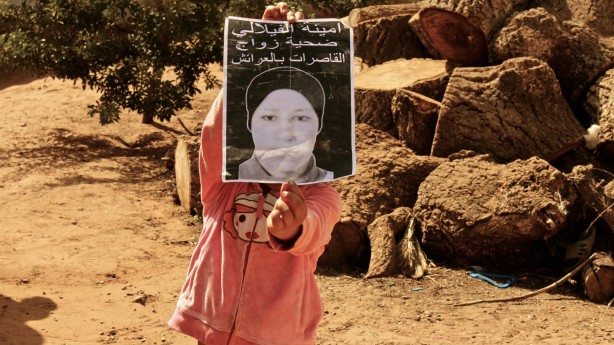
Little sister of Amina Filalli holding the picture of Amina. © Riley Dufurrena
Nadir Bouhmouch, a 22-year-old film student in the US, was determined to shoot a documentary during his summer vacation in Morocco. The suicide of the 16-year-old Amina Filali from Larache, who presumably was forced to marry her rapist, gave him the idea to use her story as the main topic for a documentary about women’s rights in his country of birth. He named the film 475 – When Marriage Becomes Punishment, with 475 referring to the article of the Moroccan penal code that made Filali’s marriage possible.
Bouhmouch released the film online on 21 February this year, in commemoration of another Moroccan woman: on 21 February 2011 Fadoua Laroui set herself on fire after she was excluded from a social housing scheme as a single mother. He also chose February because in that month the 20 February Movement, a Moroccan movement that organises demonstrations for democracy, marked its second anniversary.
As a way to protest he didn’t ask the Moroccan authorities for permission to make the documentary. “We didn’t want any permission”, he says. By ‘we’ he is referring to the members of Guerrilla Cinema, a collective of young Moroccan film makers who want to make films without censorship. “To make films without permission is a form of civil disobedience. This is a protest against the government’s regulation of films. We didn’t want to be endorsed by something we don’t believe in.”
For Bouhmouch and his crew the obstacles were limited to a few questionings by local judges and a wali (regional governor) who allowed the film makers to film because they were students. Sometimes it’s obvious the film was made by students lacking expensive professional material. “That was to not attract any attention. It’s a clandestine way of making films at Guerrilla Cinema: not always with a big stick with a microphone, no big camera and no interviews in public. We minimised our crew and that has aesthetic and technical consequences.”

The film crew during an interview with the father of Amina Filali in Larache, August 2012. © Hamza Mahfoudi
The idea for the documentary came a year ago when Moroccan activists started a discussion in Morocco about women’s rights and the unjust laws. “I didn’t even know such a law existed, or at least not in the way media presented it, because it sounded very barbaric.” Based on article 475 of the Moroccan penal code a rapist could avoid punishment if he would marry his victim. Could, because in January 2013 the minister of Justice announced plans to change this law.
When watching the film it soon becomes clear there are different versions to Filali’s story. “We don’t know what exactly happened either”, Bouhmouch says. “The media presented a typical orientalist story of a Muslim girl who became a victim of what is illustrated as a barbaric culture. We discovered that there were different stories. I think Amina had a relationship, but got raped while she was in that relationship. The Moroccan government doesn’t recognise rape within a relationship or marriage. We discovered a very complex story and that is what the media missed.” Bouhmouch concludes further that Amina’s family wanted a marriage after her relationship became public, and that her rapist’s parents didn’t want a daughter-in-law who lost her virginity. “So her parents brought the case to court to force them to get married. For girls like Amina in that situation there is no other option but to agree.”
In his film Bouhmouch shows a second story: that of the second wife of Amina Filali’s father. This woman reveals how her husband is making her life hell with abuse. This story sharply contrasts with her husband declaring in front of the camera how he mourns his daughter’s fate and wishes no woman would be treated like that. “His attitude resembles that of the Moroccan government. It is extremely patriarchal: it discriminates women in its own country but then talks about how it fights inequality in international fora”, Bouhmouch explains.
‘It’s not your fault’
But for the film crew the goal of the documentary was not to change the law, but to restart a discussion about feminism. Bouhmouch: “I don’t want to tell people what to think of the case. I am a man too and have been exposed to a patriarchal society in both Morocco and the United States, so I also have this type of mindset.” The women in his crew reminded him of this. “Working with Houda Lamqaddam was great”, he says. Lamqaddam, 21 years old and a student in computer science and communication, became a rape victim when she was 17. She is a co-producer and narrator of 475 – When Marriage Becomes Punishment.
Last year when many Moroccans were discussing the death of Amina Filali and women’s rights online, Lamqaddam wrote on her blog about her experience as a rape victim. “I wanted to enter into the debate with my voice. I wanted to say to people that they should stop with the way they talk about rape victims. It was all about ‘how they feel’ and ‘what they should do’. For once I wanted to speak out myself.” On her blog she called on other girls and women to not hesitate to file a complaint if they were raped. ‘It’s not your fault’, she reassured them. She also wrote about how her family supported her all along. “Online I also received support after writing my story, but it felt so unfair: this support should go to a lot more women.”

The crew with Khadija Riyadi (president of the Moroccan human rights association AMDH). From left to right: Layla Belmahi, Nadir Bouhmouch, Khadija Riyadi, Amina Benalioulha, Youness Belghazi, Houda Lamqaddam and Hamza Mahfoudi. © Naji Tbel
It is Lamqaddam with whom the second wife of Amina Filali’s father shares her story in the film. “That was heartbreaking”, says Lamqaddam. “First because she told us a story no one had asked about. There were journalists and activists who went to talk with Amina Filali’s family and neighbours, but as a second wife she stayed in the background. She came to us herself. We were there with three people who had inferior filming equipment and an Iphone while the rest of the crew was elsewhere. She spoke, we recorded, and it felt as if there was nothing we could do for her.” Now this second wife is in contact with women’s organisations who could help her get a divorce.
Whether such women’s organisations can bring feminism forward in Morocco is a question to which Lamqaddam’s answer is mixed. “There are women who do a really good job, but their hands are tied by the government. Actually there are two kinds of women’s organisations. Either they exist for ‘make believe’: to show on television how we have human rights organisations in Morocco and to show to foreign government bodies that our government cares about women’s rights, because that is often a condition for financial support. Or there are women’s organisations of people who actually want to do something but can’t, because of the state structure that blocks them.”
‘Embarrassing’
The 18-year-old Layla Belmahi, another co-producer of 475 – When Marriage Becomes Punishment, also thinks the situation of Moroccan women deserves more attention. Belmahi is the founder of Woman Choufouch, the Moroccan version of the SlutWalk that denounces sexual harassment in the streets of Morocco. “Moroccan verbal harassment often start with the expression ‘Woman choufouch?’ (‘Can’t we even look?’)”, she explains. “We don’t just want media attention when a rape victim dies.” According to Belmahi Moroccan media and institutions make the work of women’s organisations unnecessarily difficult. “When an association wants a campaign on television, it has to pay the same airtime fee companies pay.” Until now Belmahi didn’t organise a demonstration against street harassment, but she and her supporters did participate with other associations in a sit-in for victims like Amina Filali.
Woman Choufouch, Guerrilla Cinema and the 20 February Movement have in common that they are led by the young generation of Moroccans who demand respect for human rights. Belmahi: “Activists are the most sensitive people in a society. They are the first to notice problems, to understand where they come from and to have the courage to denounce them.” Lamqaddam’s experience brings in a nuance. She noticed this kind of activists, too, sometimes see feminism as a luxury. “This even goes for some of my friends in the 20 February Movement who describe themselves as human rights activists or anarchists. If you talk with them about men and women, it’s still about the same gender roles. The way they talk about female politicians is embarrassing. For example, they nicknamed Nabila Mounib, who is the head of the socialist political party PSU, milf. That stands for mother I’d like to fuck. That’s how they describe attractive older women. This is something universal. Everytime I try to say something about this I’m the ‘hysterical feminist with no sense of humor’.”
That this mentality exists within the 20 February Movement troubles Lamqaddam. “The last thing we need is another structure that calls itself independent, free and positive and at the same time brings oppression with it.”
To watch the English version of the film:
Arab Version: HERE.
Hasna Ankal is editor of al.arte.magazine, journalist at Belgian newspaper Het Belang van Limburg, and a member of the Flemish youth press agency StampMedia. She writes about Islam, Amazigh culture, feminism, and Morocco. She wrote this piece for al. arte.magazine (Dutch and English) It is re-published here with permission of the author and al.arte.magazine. The photo’s have been used with kind permission of Nadir Bouhmouch.
Open brief van Marokkaans-Nederlandse organisaties aan de Tweede Kamer
Posted on February 26th, 2013 by martijn.
Categories: Activism, Multiculti Issues.
Naar aanleiding van het debat over het zogenaamde ‘Marokkanenprobleem’ dat is aangevraagd door de PVV roepen zo’n 90 Marokkaans-Nederlandse organisaties de overige partijen op om niet mee te werken. In een open brief stellen ze dat er sprake is van een ‘PVV-verkiezingsbijeenkomst’ en vragen ze andere partijen op het debat te boycotten of op een andere manier manier stelling te nemen en te laten zien dat voor hen Marokkaanse Nederlanders onlosmakelijk met de samenleving verbonden zijn. Tevens wijzen de organisaties op het gegeven dat de meerderheid van de Marokkaanse Nederlanders goed geïntegreerd is en willen ze dat de andere partijen wel constructieve oplossingen aandragen voor het deel van de Marokkaans-Nederlandse jongeren dat werkloos is, de opleiding zonder diploma heeft verlaten of in de criminaliteit is beland. De organisaties betreuren de teloorgang van het doelgroepenbeleid en op lokaal niveau voor een coalitie tussen de (plaatselijke) overheid, de zelforganisaties, de ouders en de scholen om de problemen te kunnen aanpakken.
Hieronder de volledige tekst van de brief.
Geachte parlementariërs,
Wilders is als handelaar in angst altijd op zoek naar een sprekend onderwerp. Na de Islam, de Polen en Europa wordt het nu het Marokkanenprobleem. Dankzij de steun van enkele partijen in de Tweede Kamer mag hij straks scheldend van leer trekken tegen de “Marokkaanse criminelen”. Alle taboes doorbrekend zal hij heldhaftig de “verschrikkelijke” problemen die door dit “agressieve en racistische straattuig” veroorzaakt worden, durven benoemen. Voor degenen die wegkijken zal hij ook cijfers debiteren; desnoods opblazen om zo de wegkijkers klem te zetten. Hij zal niet verzuimen om te herhalen dat het criminele gedrag komt door de Islam. Kortom: hij zal tevreden terugkijken op dit “debat” want het is hem weer gelukt om in de zendtijd van de Tweede Kamer het Marokkaanse DNA te framen: crimineel tot en met. De tv- kijkende werkgever, discoportier, winkelier, politieagent en anderen weten nu wat voor vlees ze in de kuip hebben met de Marokkaanse sollicitant, discoganger, consument en verkeersgebruiker. Uiteraard zal Wilders tenslotte – om de critici de mond te snoeren- ook oplossingen aandragen: keihard straffen en het land uitzetten. Meer smaken heeft hij niet.
En zo zal de zitting van de Tweede Kamer verworden tot een vulgaire PVV- verkiezingsbijeenkomst. Dankzij de steun van de VVD, de SGP en 50+ draait de Tweede Kamer volledig in dienst van de agenda van Wilders. Het parlement is dan niet het centrum van democratie waarin alle delen van de samenleving zich kunnen herkennen maar een podium om vandaar uit één bevolkingsgroep buiten de samenleving te plaatsen.
Gaat de Tweede Kamer straks ook debatteren over het “blankenprobleem” als blijkt dat -zoals in het geval van de tragische dood bij de rellen in Hoek van Holland, de waanzinnige vernielingen in Haren en het schoppen van die man in Eindhoven – de daders autochtone blanken zijn?
Gaat de Kamer vanaf nu onze samenleving opsplitsen in verschillende etnische groepen die – al naar gelang van de agenda van Wilders- tegen elkaar uitgespeeld worden? Hebben we onze les uit de geschiedenis van de Tweede Wereldoorlog nog niet getrokken? Staan de Tweede Kamerleden die deze vertoning mogelijk hebben gemaakt straks allemaal keurig op de Dam tijdens de 4 mei-herdenking? Denkt u dat deze racistische bejegening geen spoor zal achterlaten bij de Marokkaanse Nederlanders? Is het u nog niet bekend dat veel burgers zich afwenden van de politiek omdat hun parlement zich laat degraderen tot een vindplaats voor onbeschaafd gedrag?
Wat nu? U kunt kiezen uit twee opties om Wilders in zijn hemd te zetten. Door weg te blijven bij deze verkiezingsbijeenkomst van de PVV! Daarmee maakt u duidelijk dat Kamer geen instrument is van het populisme. Mocht u toch uw moverende redenen hebben om mee te doen, dan heeft dat alleen zin wanneer u erin slaagt om het beoogde effect van Wilders volledig uit te schakelen.
Ten eerste door duidelijk uit te spreken dat Marokkaanse Nederlanders een onlosmakelijk onderdeel vormen van onze samenleving.
Ten tweede door nadrukkelijk- en met rapporten en cijfers bij de hand- te onderstrepen dat de meerderheid van deze bevolkingsgroep in alle sectoren van de maatschappij goed geïntegreerd is: zie de universiteiten, hogescholen, geneeskunde, farmacie, architectuur, advocatuur, sport, toneel, film, cabaret, horeca, leger, ambtenarij, media, enzovoorts.
Ten derde door de constatering dat een deel van de Marokkaanse jongeren disproportioneel in de schooluitval, de werkloosheid en de criminaliteit zit om te zetten in maatregelen die de oorzaken van deze problemen wegwerken, deze jeugd te beschermen tegen ontsporing het deel dat ontspoord is terug te krijgen in de samenleving. Denk daarbij aan het succesvolle initiatief van hoofdcommissaris Nordholt in Amsterdam ongeveer twintig jaar geleden met ontspoorde Antilliaanse jongeren. Na een strenge militaire aanpak in een kazerne liet hij een aantal Antilliaanse jongeren een rijbewijs halen, waardoor ze op het juiste maatschappelijke spoor werden teruggezet.
Doe niet weer een onderzoek. De problemen zijn sinds de jaren ‘80 over-onderzocht. Wat ontbreekt zijn niet de analyses van de problemen maar de juiste maatregelen. Een gericht minderhedenbeleid heeft er in Nederland in de laatste twee decennia van de vorige eeuw voor gezorgd dat veel bevolkingsgroepen goed zijn geïntegreerd in de samenleving. Dankzij onder andere maatregelen gericht op deelname aan het onderwijs en de arbeidsmarkt.
Maar sinds dit specifieke doelgroepenbeleid uit de gratie is, en discriminatie van Marokkanen en moslims politiek correct is geworden, stokt de progressie van een deel van de jeugd in het onderwijs en al helemaal in de arbeidsmarkt.
Niet alle problemen kunnen alleen door de overheid opgelost worden. Met name de tekortkomingen binnen de eigen omgeving die de ontwikkeling van het kind negatief beïnvloeden vallen buiten de overheidsfeer. Om daarbinnen met succes te kunnen interveniëren is de steun van de ouders en de zelforganisaties onontbeerlijk. Een coalitie tussen de (plaatselijke) overheid, de zelforganisaties, de ouders en de scholen is dan noodzakelijk.
Of het debat een vloek dan wel een zegen wordt, is volledig aan u!
Zie hier de eerste ondertekenaars:
Mohamed Rabbae, Landelijk Beraad Marokkanen
Abdou Menebhi, EMCEMO
Abdellah Tallal, Aknarij
Fatima el Maimouni, Meldpunt tegen discriminatie en islamofobie
Mohamed Echarrouti, UMMON
St. Tawasol voor media en cultuur
St. Kultureel Jongeren Centrum
Chebwadie Oemazigh
SSCCM
Stichting Wachm
Aknarij
Ibno Khaldoun
Al Maarif
Federatie van Marokkaanse Moskeeën in Noord-Holland
Moskee al Badr
Moskee Umma
Moskee Salaam
Al Hiwar Haarlem
IOMA (Inspraak Orgaan Marokkanen Amsterdam)
Stichting Mouwada
St. Attanmia
Vrouwen aan het woord
Hart voor samenleving
Stichting shoeff
Stichting Al Hizjra
Stichting Moskee Nasser
Stichting Insaf
Stichting Zohor
Stichting Tazanaght
Marokkaanse Stichting Tilburg
Stichting SSOP
Issalam Verenigingen
Stichting De Brug
Marokkaanse Raad Amsterdam Oost
Stichting Marokkaanse Ouderen Tilburg
Marokkaans comité Tilburg
Amsterdams Marokkaans Forum
Sociaal Cultureel Centrum voor Marokkanen
Stichting Afaaq Lahcen ben Marit
Stichting Euromarocned
Moskee el Mouahadine
Stichting Kantara Mustapha al Filali
Stichting Nisa For Nisa, Fatima Sabbah
Vereniging Jongeren 123
Ouderenbond Amsterdam Ahmed el Yousfi
Vereniging Assilah Mohamed Bouka
Nederlandse Organisatie voor remigratie
Radio Unity FM
Stichting Meknes
Vereniging MOBIN
Stichting Buurtvaders
Stichting Slotervaart
KJC (Centrum Cultureel Jongeren)
Marokkaanse Raad Westerpark
Moskee El Mouhssinine
Moskee Moetaqien
Nederlands Marokkaans Netwerk
St. Nasser
St. Buurt Betrokken Bewoners(BBB)”
St. de Levante”
St. Eloudaya”
St. Kantara”
St. Marokkaanse Werkgroep Rivierenbuurt”
St. N.O.R”
St. Targuist en Rabita”
St. Buurtvaders Staalman”
Vereniging Chefchaouen Ontwikkeling Nederland
Hart voor samenleving
St. Alexander Plus
Stichting Imghrane
Stichting MOS (Marokkaans Ouderen Salon)
Marokkaanse Organisatieleden
Marokkaanse Ver. Issalam Den Haag
Netwerk Marokkaanse Ondernemers in Nederland
Stichting Platform of Moroccans in Europe (PME)
Stichting Afaaq
Noemidia
RMMN, Y. Bouyafa
Mobin, B. Saadane
PPM, A. Meziani
MVVN, Ikram
KMAN, H. Ayie
SOMD, H. Mouttahid
MML, M. Temsamani
PVR, M. Abuleil
ML, M. Chbab
SSOP, M. Mallouch
MOL, C. Ramdani
Op Patrouille: De Grenzen In De Publieke Ruimte
Posted on January 21st, 2013 by martijn.
Categories: Activism, Notes from the Field, Public Islam, Religious and Political Radicalization.
Afgelopen week was er rumoer over moslims die in de straten van Londen zouden ‘patrouilleren’. Zoveel rumoer dat de PVV het nodig vond om er vragen over te stellen. Aangezien ik nu toch in Londen ben, dacht ik hier maar eens even in te duiken en zelf te gaan kijken in Whitechapel.
Wat is er aan de hand?
Het gaat hier om een groepje dat zich ‘Muslim Patrol’ noemt en dat in Whitechapel zou rondlopen. Als die zogenaamde ‘Muslim Patrol’ het zou laten bij mensen te vragen niet op straat te drinken, was dat wellicht nog één ding aangezien Whitechapel deels een door de plaatselijke autoriteiten vastgestelde alcoholvrije zone is. Maar men benaderde ook vrouwen die volgens hen niet passend gekleed waren en mensen die bij een moskee liepen.
Muslim Patrol had een eigen videokanaal op Youtube dat inmiddels echter is verwijderd. De videos zijn nog wel op Liveleak te zien.
En:
In de videos hoort u mensen zeggen ‘This is a Muslim area. Muslim patrol the area‘. Een jonge vrouw die wordt aangesproken zegt dat ze geschokt is: ‘this is Great Britain‘, waarop één van de mannen antwoord ‘We don’t care. It’s not so Great Britain‘. (Met de nadruk op ‘Great’). Dat blanke vrouwen ‘naked animals with no self respect‘ worden genoemd, ben ik niet tegen gekomen hoewel dat wel in de berichtgeving vermeld wordt. Wat je wel kunt horen in het filmpje over de posters is:
From women walking the street dressed like complete naked animals with no self respect, to drunk people carrying alcohol, to drunks being killed in the middle of the road, we try our best to capture and forbid it all
Een subtiel verschil met de verwijzing in de berichtgeving, maar toch. Het is vergelijkbaar met de term ‘kopvoddentax’ van de PVV maar dan gericht aan vrouwen die niet kuis genoeg gekleed gaan volgen de normen van de Muslim Patrol. De video over de poster laat zien dat H&M posters met schaarsgekleede vrouwen worden afgedekt. Volgens de mannen is dat gedaan door moslims, maar daar is geen bewijs voor.
Verklaring van de East-London moskee
De East-London Mosque (de grote moskee in deze buurt) heeft in een officiële verklaring direct afstand genomen van deze praktijken:
Unwelcome ‘patrols’ – 17 Jan 2013
Individuals claiming to be self-styled ‘Muslim patrols’ have been harassing members of the public on the streets of east London late at night, including outside our mosque after it has closed. They have anonymously uploaded their exploits to the internet.These actions are utterly unacceptable and clearly designed to stoke tensions and sow discord. We wholly condemn them. The East London Mosque is committed to building co-operation and harmony between all communities in this borough. The actions of this tiny minority have no place in our faith nor on our streets.
Earlier this week we contacted the Police and the local authorities to alert them to the presence of these individuals and video. We advise anyone who has been harassed by these individuals to contact the Police.
We will monitor the situation closely and our Imams will be speaking out against such actions.
Ook tijdens de vrijdagpreek werd hier aandacht aan besteed door de imam Shams ad Duha:
Kortgezegd zou de imam volgens anderen het volgende gezegd hebben:
Shaykh Shams Ad Duha is basically saying that in sharia it is impermissible for a Muslim to stop a non-Muslim drinking alcohol or eating pig meat in an Islamic country, not only that but the state has the obligation to protect the rights of non-Muslims of carrying out these things because to them they are allowed. Therefore Muslims have no right imposing their views here.
De reacties zo her en der, ook in Nederland, laten zien dat alles wat moslims doen behoorlijk onder het vergrootglas ligt. Niet alleen de intimiderende technieken spelen hier een rol, maar dat moslims überhaupt de straat op gaan om (een bepaalde) orde te bewaren is genoeg om de wenkbrauwen te doen fronsen en te spreken over sharia-politie. Er zijn meerdere plekken in Engeland waar zoiets gaande is en waar soms gesproken wordt over een ‘sharia-zone’. Het is echter niet altijd duidelijk wat nu de status is. Op sommige van die plekken is er duidelijk sprake van verloedering en overlast door mensen op straat die dronken zijn. Dat geldt ook voor Whitechapel. Een gebied dat niet alleen bekend is omdat Jack the Ripper hier vroeger de straten onveilig maakte, maar ook omdat (althans delen ervan) behoorlijk verloederd zijn en waar veel migranten wonen. Door die verloedering is zo’n buurtwacht vaak niet meer dan een poging tot het terug brengen van een orde. Is het zoiets als ‘Attentie: Buurtpreventie’? Een teken dat aangeeft dat het in de wijk juist niet helemaal goed zit, in plaats van dat het een paradijsje is. Het geeft dan eerder een wens aan dan een feit of daadwerkelijke handeling.
Update 1: Carel Brendel wijst mij er niet geheel onterecht op dat de op staat aanwezige burgerwachten die we in Nederland kennen een beter voorbeeld hier zou zijn geweest dan het ‘passieve’ buurtpreventie. Verder stelt hij: “Het recht van de rechtsstaat moet gelden in een buurt. Niet het recht van (al of niet doorgeschoten) gelovigen.”
Het ‘goede’ en het ‘kwade’?
In dit geval was er duidelijk meer aan de hand. Mensen spraken anderen aan en niet al te fijnzinnig. Voor deze mannen is dat onderdeel van het principe ‘het verbieden van het kwade en het gebieden van het goede’. Dat kan op drie manieren: in gedachte, woord en fysieke handeling. Zij kiezen juist voor het laatste. Of ze ook te maken hebben met het bedekken van de posters is mij onduidelijk; in het filmpje wordt gezegd dat de daders moslims zijn. Betekent dat dat de makers van de film dat niet zelf gedaan hebben? Er is geen bewijs voor wie het dan wel gedaan heeft. Het verbranden van de posters lijkt me overigens wel hun werk.
De mannen hebben waarschijnlijk geen banden met de East London Mosque (in formele zin, dat wil niet zeggen dat ze nooit die moskee bezoeken). De boodschap van de moskee zal dan ook op hen niet veel indruk maken (of zelfs bevestigen wat ze al dachten). Toen ik er was, zaterdag, was er niettemin geen sprake van ‘Muslim patrol’ in het aangegeven van gebied van Whitechapel.
Vastleggen en bewaken van morele grenzen
Een dergelijke buurtwacht omstreden zoals eerder ook al bleek in Den Haag toen de As Soennah moskee, enigszins triomfalistisch, aankondigde mee te doen met de buurtwacht tijdens oud en nieuw. Daarbij werd, net als nu, van shariapolitie gesproken. Waar dus enerzijds een buurtwacht in Whitechapel probeert het gedrag van mensen in de openbare ruimte te surveilleren en te reguleren door een soort eigenstandige moslim straatpatrouille, proberen politieke partijen, in dit geval de PVV, eveneens het gedrag van mensen in de openbare ruimte te surveilleren en te reguleren door een secularistische (en in dit geval van anti-islamitische) patrouille in het parlement en in de media. Daartussen zitten in in ieder geval het bestuur van het stadsdeel en de East-London moskee die ieder op hun manier proberen de grenzen van het publieke domein te bewaren met iets minder nadruk op ‘identity politics’ en iets meer op de kunst van het samenleven.
Update 2:
Er is een nieuwe video opgedoken van deze mannen, waarin te zien is hoe ze een man benaderen en roepen: ‘dirty, bloody fag’. Zie Secular Europe.
Update 3:
Inmiddels heb ik hier in Londen met iemand gesproken die enkele dagen per week werkt in die buurt waar de filmpjes zich afspelen; ook op die bewuste dagen. Hij zegt zelf er nooit iets van gemerkt te hebben van een dergelijke patrouille. Niettemin is het wel duidelijk dat er in die buurt gefilmd is waar deze persoon ook werkt iets wat hij ook niet heeft gemerkt. Deze persoon houdt zelf rekening met een een actie van losgeslagen jongeren die wellicht serieus zijn, maar misschien ook wel een grap willen uithalen. Als ze serieus zijn, zo stelt mijn gesprekspartner, dan is het wel vreemd. Op deze manier scheppen ze immers vooral afkeur en een slecht imago, terwijl het er ook te amateuristisch uit zou zien voor een doelbewuste publicitaire actie. Wat het ook moge zijn, is mijn stelling, we dienen niet zomaar klakkeloos aan te nemen wat we op die filmpjes denken te zien. Er blijven teveel vragen over.
Update 4:
Zondag 20 januari is één van de mannen gearresteerd in Acton; zo’n veertig minuten van Whitechapel (met de metr0) . Na de arrestatie van deze 22-jarige man, heeft maandag 21 januari een 19-jarige man zich gemeld bij een politie-bureau in Oost-Londen. Ze zijn ge-arresteerd vanwege verstoring van de openbare orde en, hangende het onderzoek, vrijgelaten. Intussen heeft Anjem Choudary, leider van het radicale Islam4Uk de voorbeeld organisatie voor o.a. Sharia4Belgium, zijn steun uitgesproken voor de twee mannen.
The Majority Strategy of the Muslim Brotherhood II: Responses
Posted on January 14th, 2013 by martijn.
Categories: Activism, Public Islam, Religious and Political Radicalization, Society & Politics in the Middle East.
Guest Author: Roel Meijer
Will the Muslim Brotherhood in Egypt promote the goals of the 25 January revolution, expanding civil, political, economic and social rights; or will it tailor these issues for its own purposes? Especially its strategy to gain power, here called the majority strategy, by means of general and presidential elections, has attracted attention. In two blogposts I will explore how this strategy be explained when its slogan under Mubarak had been “participation not domination” (musharaka la mughaliba)? In the first blogpost I have explained the background and development of the majority strategy. In the current blogpost I present an analysis of the counterforces and the failures of this strategy. My overall argument is that rather than its ideology, it has been the political strategy that explains both the success as well as the failure of the Brotherhood after the fall of Mubarak.
Counterforces
Despite the spectacular success of the Muslim Brotherhood and the Salafi Nour party in winning three-quarters of the seats of parliament, marginalizing the traditional parties, such as the Wafd, the success would not be long-lived. Resistance against the Brotherhood’s majority strategy emerged from all directions of society.
The Tahrir activists were the first to voice criticism of the Brotherhood on account of its opportunistic use of Tahrir protests. While the Brotherhood was careful to maintain relations with SCAF, and chimed in with increasing popular critique of the demonstrators as “anarchists” who were sabotaging the economy and the unity of the country, the Brotherhood did support ‘Tahrir’ when it exerted pressure on the military. Khairat al-Shatir on several occasions threatened SCAF to march to Tahrir if it did not comply with the demands of the revolution. Muhammad al-Biltagi followed him in this respect. The activists, however, condemned this opportunistic use of the resistance against the military.
In the meantime the former Brotherhood youth who had been evicted organized themselves in different organizations such as al-Tayyar al-Masri and joined the elections with a left-wing slate. Although they hardly won parliamentary seats, their critique and inside knowledge, which was published widely, damaged the Brotherhood in the larger cities. The very fact that the debate on the Brotherhood was opened up to an unprecedented extent after the fall of Mubarak, forced the Brotherhood to respond and defend itself, making it vulnerable.
More liberal-minded older generation leaders, who had been members of the Guidance Council, such as Abd al-Mun‘aym Abu al-Futuh, Ibrahim Za‘farani and Muhammad Habib, were perhaps more successful in their critique. Their critique of the undemocratic manner in which FJP was founded and operated (no founding conference, limited influence of its members, appointment of its leadership by the mother organization instead of being elected among new members), damaged the Brotherhood, but mostly among existing liberal critics. More important was Abu al-Futuh’s challenge in the presidential elections. Attracting the new critical generation and even Salafis, he was able to pose as a liberal open-minded Islamist alternative to the Brotherhood, even if his campaign was far from flawless.
Increasingly also the critique of civil society was felt. The heavy-handed attempts of the Brotherhood to gain or retain control over professional organizations had alienated many of its members. This was especially the case with the doctors’ syndicate. The Doctors’ syndicate had been dominated by the Muslim Brotherhood after Mubarak had frozen the board elections in 1993 and no new elections had been held since. By the time Mubarak fell a whole new generation of doctors had emerged who found that the board members had done little to improve the profession, leading to a dramatic deterioration of the national health service. They founded new organizations such as the Doctors Without Rights, and Doctors of Tahrir. Typically they were much more activist than the conservative older generation of the Brotherhood. In May 2011 they organized two strikes. These were opposed by the board dominated by the Brotherhood, following the deal with SCAF to oppose activism and promote “stability”. The Brotherhood later lost dramatically in syndicate elections on 18 October 2011 against the Independent List that won a majority in the boards of 14 of the 27 governorates.
But the story did not end there. The Doctors Without Rights persisted in its demands of raising the percentage of national budget form 4% to 15% and higher wages for doctors and a major overhaul of the whole system that should be based on accountability. When these demands were not met, it organized a new strike on 1 October 2012 against the Brotherhood faction that now directly supported a Brotherhood government. As the strike dragged on for weeks, the strike became politicized and turned into an anti-Brotherhood campaign that attracted greater support from all kinds of opponents of Mursi. When the proposal of the constitution was made available the doctors joined the critique of the final draft proposal demanding a revision of the article on the right of health for citizens.
The independent trade union movement had a similar experience. The first independent had been founded under Mubarak, but it really expanded after his fall, expanding to two hundred independent trade unions, representing 2 million employees, by the end of 2011. Organized in the Independent Egyptian Federation of Independent Trade Unions (EFITU) and the Egyptian Democratic Labor Congress (EDLC), it competed with the corporatist, state controlled ETUF that had been founded in 1957 under Nasser. Although the EFITU was supported by the progressive minister of manpower and Migration, Ahmad Borai, it never succeeded in obtaining legal recognition under the government of Ahmad Sharaf, whose proposals were blocked by SCAF that was unwilling to sanction social rights.
Strikes were stepped up under the Mursi government as it became clear that the new Brotherhood minister of Manpower would not take measures beneficial to workers, condemning strikes, sit-ins and other forms of protest, as part of the official policy of the Brotherhood. Like the doctors, independent labor has recently strengthened its position by forming with a host of left-wing political parties the National Front for the Defense of Labor Rights and Unions Liberties.
Not all professional organizations were opposed to the Brotherhood after they became unfrozen. The Engineers syndicate was supportive of the Brotherhood, as was the Teachers Syndicate and the Pharmacists Syndicate, Dentists Syndicate, where the Brotherhood won the first free elections since the early 1990s in accordance of its majority strategy.
In others the results were mixed. In the Journalists’ Syndicate, its leader was sympathetic to the movement while its board was not, leading to internal struggle when the Brotherhood came to power. Often new organizations were established next to existing ones and had neither relations with the Muslim Brotherhood, not with the former NDP, such as the Teachers Outside Trade Unions, the Coordinating Committee of Teachers, Judges for Reform, Engineers against Legal Restraint, Coordinating Committee of Revolutionary Lawyers. They would mobilize against Brotherhood organizations, such as Coalition of Engineers for Egypt and Doctors for Egypt.
But not only did the Brotherhood’s majority strategy not succeed across the board in the professional organizations, it also did not make inroads in organizations where the previous regime was strongly represented, such as the judiciary. The judiciary had always been divided in reformists who advocated the complete independence of the judiciary and judges who had been appointed by the government. Some organizations changed over the years. For instance, the Judges’ Club (Nadi al-Quda’) had been reformist under Ahmad Makki, but became pro-government under Ahmad Zind. High Court of Cassation had been pro-government but with the appointment of al-Gharyani it had a pro-Brotherhood leader. The same applied to the Supreme Constitutional Court, that had been independent but became more subservient to the government.
Finally, the intellectual elite turned against the Brotherhood, when it realized the Brotherhood was pursuing a majority strategy. It especially condemned the Brotherhood for breaking its promises, first to just participate with winning 30 %, then with 40% and later 51% percent of the seats in parliament, and eventually going all the way. Its broken promise not running a presidential candidate infuriated them and seemed to confirm all the suspicions many intellectuals had always felt for the Brotherhood. Even highly sophisticated intellectuals such as Hasan Nafa‘a or Fahmi Huwaydi, who believed that the Brotherhood should take part in the political process, grew increasingly worried and disenchanted with the heavy-handed policy of the Brotherhood to dominate and exclude its critics rather than to cooperate and include them in fulfilling the demands of the revolution. When Mursi was inaugurated on 30 June 2012, many lambasted the Brotherhood and mocked its solemnity and moralism as a meager replacement for real politics and reform. They were careful to point out its lack of policy and its pursuit of the same economic policy that the previous government had pursued.
Failure of the majority strategy
The growing opposition against the Brotherhood started when its majority strategy had seemed at its most successful. At that point it became clear that the deal the Brotherhood had made with SCAF would not work in its favor. This was apparent from parliament and the Majlis al-Shura. Although the Islamists had a majority in both, they were hamstrung by the Constitutional Declaration of 30 March 2011 that withheld power form parliament the end of the transitional period and the acceptance of the new constitution. After their victories, the Brotherhood became increasingly entangled in the very jungle of measures and procedures it itself had agreed upon.
The Brotherhood found itself increasingly isolated and beleaguered from all sides after it tried to implement its majority strategy in its attempt to dominate the Constituent Assembly together with the Salafis in March 2011. Its claim that it represented the majority and the “will of the people” and that its opponents only represented a small minority of the “elite” (nukhba) grew increasingly thin as more and more institutions were able to organize opposition to the Brotherhood and withhold the legitimacy it craved for.
For a long time the judiciary constituted the main opponent of the Brotherhood’s ambitions. Fearful of its own position and still protected by SCAF, in June the Supreme Constitutional Court disbanded the parliament under the pretext of procedural mistakes. In April the same the Electoral Committee headed by the head of the SCC ruled against participation of several presidential candidates, among them Umar Sulayman, the Salafi leader Hamad Abu Isma’il, but also Khayrat al-Shatir, who was replaced by Muhammad Mursi.
By the time of the presidential elections declining the popularity of the Brotherhood became apparent. Winning in the first round only 24,9 %, against 24,5% for the establishment figure Ahmad Shafiq, 21,1 % for left wing candidate Hamdin Sabbahi and 21,6% for the more liberal-minded Islamist Abu al-Futuh, Mursi and the Brotherhood had done quit poorly; they had lost half the votes compared to the parliamentary elections half a year earlier. Clearly the following of the Brotherhood was a lot more volatile than had been expected and the boast of representing the will of the people became a lot more precarious. Only with support of the left and Islamist liberals was Mursi able to win barely from Ahmad Shafiq in the run-offs. In return Mursi pledged to the opposition to include them in the decision-making process, virtually promising to abandon its high-handed majority strategy. The new government reflected this intention, as well the establishment of a Advisory Council, with members such as Hasan Naf‘a.
Polarization
Despite these good intentions the Muslim Brotherhood continued its earlier strategy. From the fact that the Brotherhood could get rid of SCAF by firing its head Husain al-Tantawi on 12 August, it drew the conclusion that it could go it alone with its Salafi partner the Nour party, after all. Finally the Brotherhood have its cake and eat it too.
The elimination of SCAF from the power equation, however, made the Brotherhood the focus of all the social, economic and political demands that had been formerly directed at SCAF. The anger at the closed manner at which the Brotherhood pursued its policies, its inability to present an alternative to the economic policies of the Mubarak regime, its incapacity to respond to critique and understand the deep-seated demands for reform only fed the anger of the more critical part of the population.
This anger would express itself in the gradual walk-out of 29 of the 1000 members of the second Constitutional Assembly after it was established in June, reaching a crescendo in November. Although many commentators have argued that its illiberal character is the reason for lack of support, this in itself is a reflection of the failure of the Brotherhood to include other social, ideological, economic and cultural currents into the deliberative process of the formulating the constitution and write their rights into the constitution.
The result has been an attack over the past months of journalists, trade unions, human rights organizations, Coptic church, women’s organization, of the several draft and eventually of the final version of the constitution on 2 December as they progressively left the Constitutional Assembly. Theirs was basically in a vote of no-confidence in the Brotherhood-Salafi coalition to realize the demands of what they think is the revolution. Though Mursi’s “power grab” of 22 November of arrogating far-reaching power to himself and firing the Public Prosecutor is explainable as a means to be one step before the no-less undemocratic Supreme Constitutional Council to disband the Constituent Assembly and possibly annul the presidential elections, for the opposition it confirmed the worst fears of the Brotherhood. As opposed to the majority of the Brotherhood, it tried to mobilize its own ‘majority’ on Tahrir square.
Conclusion
The Muslim Brotherhood stands before a sheer impossible task of governing Egypt and solving the deep and almost insolvable economic crisis, while dealing with growing resistance of the vested interests on the hand in the military and the former regime on the one hand, and emerging plethora of activists and reformist movements on the other hand, while it has under fire of a strongly politicized Salafi movement not to give concessions to “secularists” and “atheists”. Even if the so-called liberals at a certain point have done everything in their power to sabotage the rule of the Brotherhood, the movement itself has made it extremely difficult for itself by pursuing a majority strategy that excludes instead of includes its opponents in order to implement widespread reform of the state instead of imposing its views on society.
Roel Meijer teaches modern Middle Eastern history at Radboud University in Nijmegen and is senior researcher at the Netherlands Institute of International Relations. He has published widely on Islamist movements: Global Salafism: Islam’s New Religious Movement and most recently, The Muslim Brotherhood in Europe.
This is part two of The Majority Strategy of the Muslim Brotherhood. The first part was published last week: Background and Development. A referenced version of this article has appeared in Orient, 1, 2013.
The Jihad Struggle: #MyJihad Campaign
Posted on December 17th, 2012 by martijn.
Categories: Activism, anthropology, Notes from the Field, Public Islam.
A recent anti-Muslim ad campaign by the American Freedom Defense Initiative (ADFI) in New York called Muslims “savages” and proclaimed “defeat Jihad.” The ads appeared in New York underground stations and where quickly defaced. For many Muslims however Jihad is an Islamic spiritual concept that is simply means “struggle”:
a struggle against odds, difficulty, and barriers — a struggle to a better place.
This video is the making of the first photo shoot for the newly minted MyJihad ad campaign, a national public educational campaign, starting in Chicago, in which American Muslims showcase how everyday Muslims define, practice, and live Jihad.
MyJihad is an American campaign sponsored by the Council on American-Islamic Relations (CAIR). ‘MyJihad’ ads will appear on public buses featuring Muslims’ interpretations of the term ‘jihad’ often erroneously defined as ‘holy war’. This of course does not mean that no Muslim understand jihad as a violent struggle against oppression, imperialism and humiliation (as they probably see it). But what this campaign shows are the multitude of meanings connected to jihad. The campaign has its own website MyJihad and released two Youtube videos (above you already saw the first):
According to Ahmed Rehab of CAIR (on OnIslam):
The MyJihad campaign is about reclaiming Jihad from the Muslim and anti-Muslim extremists who, ironically but not surprisingly, see eye to eye on Jihad. Jihad is a term that has unfortunately been widely misrepresented by the actions of Muslim extremists first and foremost, and by attempts at public indoctrination coming from Islamophobes who claim that the minority extremists are right and the majority of Muslims are wrong.
It is also about pushing for an intelligent and informed understanding of Islam and its concepts and practices in the media, the educational circles, and the public,
According to campaign volunteer Angie Emara:
We have been overwhelmed with the participation of people of other faiths tweeting their struggles. People of different backgrounds are finding a common language, they’re learning to see themselves in one another as they share similar expressions of their daily Jihad.
The ads on the buses range from personal struggles to religious interpretations to wanting to share a positive image on Islam and the world and fighting Islamophobia in positive novel ways.
American Muslims launch campaign to reclaim ‘jihad’ | The Raw Story
“#MyJihad is to build friendships across the aisle,” says one ad showing an African American man leaning on the shoulder of a Jewish friend.
“#MyJihad is to march on despite losing my son,” says another ad, featuring a portrait of a mother with her three remaining children.
“#MyJihad is to not judge people by their cover,” says a third, framed by two women in headscarves.
Although there are some sceptical voices among Muslims as well and also a few denouncing the use of women’s portraits in the campaign, most seem positive. The strongest criticism on the part of Muslims comes from some Salafi networks and organizations like Hizb ut Tahrir who criticize the outlook of the campaign as well as the content. As they see it the people from MyJihad want to make jihad compatible to American national identity by stripping it from its warrior content and de-politicizing it. Pamela Geller who co-founded ADFI called the MyJihad campaign a ‘contemptuous propaganda campaign‘. The ADFI will launch a new campaign in January 2013.
Besides the bus ads MyJihad makes extensive use of social media through a Facebook page and a Twitter stream:
All of this shows an interesting struggle (pun intended)of identity politics over the meaning of the word jihad with Muslims indeed trying to make it more compatible with secular notions of individual struggle and the common good and with both anti-islam activists and so-called radical Muslim groups trying to oppose such an attempt. But perhaps the secular-religious binary is a little to easy or even misleading here. It is not that the MyJihad campaign is fully detached from Muslim traditions; Jihad as a personal struggle has always existed but so does Jihad as an armed struggle (albeit with different definitions than for example the one of HuT). The whole issue here goes beyond Islam as a religion; it is also about trying to gain acceptance and recognition of Muslims as Americans and making a strong statement against anti-Islam campaigners and the definitions of Islam they try to impose on Muslims and wider society. Furthermore such a strong display of ‘Muslimness’ does that fit into American definitions of the secular? Maybe, I don’t know to be honest, but I expect it would be more problematic in some European countries such as France. There are also many non-Muslims supportive of this campaign equally dismayed by the anti-Islam rhetoric of Geller cs. The secular here is as much diversified as the religious when it comes to the question of Islam in American society.
I think we need to analyse the whole spectacle of the campaign, its supporters and opponents by going beyond the binary religious-secular; showing how they are blurred but perhaps also look for the a-secular/a-religious aspects of it. How do we that? Do we have meta-secular tools available for such an analysis? Or are we inevitably reproducing the binary and thereby perhaps privileging one perspective in the controversy over the other?
Islamitische internaten in Nederland
Posted on December 6th, 2012 by martijn.
Categories: Activism, anthropology, Guest authors, Islam in the Netherlands, Public Islam.
Guest Author: Mehmet Sahin
Binnen de Turkse samenleving is het internaat een algemeen geaccepteerde instelling waar schoolgaande kinderen en studenten wonen. De eerste internaten werden door de Turkse overheid in de jaren vijftig opgericht om voor studerende jongeren van het platteland een geschikte slaapplaats in de stad te creëren. Bovendien wilde de Turkse overheid op deze manier indirect de modernisering van het platteland bevorderen. In diezelfde periode waren er ook al islamitische internaten waarbij de kinderen alleen maar Koranlessen kregen van de geestelijken, om later imam te worden. Deze islamitische internaten waren niet zo geïnteresseerd in het onderwijs dat door de Turkse overheid werd aangeboden, omdat dat immers gekarakteriseerd werd door een behoorlijke seculiere benadering.
Süleymanci- en de Nurcu bewegingen
Vanaf de jaren zestig hebben twee Islamitische stromingen in Turkije, namelijk de Süleymanci- en de Nurcu bewegingen (waarbij die laatste de toenmalige benaming was van de huidige Gülenbeweging), het curriculum in hun internaten veranderd, met een specifiek doel voor ogen. Aan de ene kant wilden deze twee bewegingen het islamitische onderwijs niet loslaten, maar aan de andere kant wilden ze het seculiere onderwijs promoten onder hun aanhang. In de jaren zeventig opende de Süleymanc?-beweging de eerste internaten met een gecombineerd programma van seculier en islamitisch onderwijs in Turkije. De leerlingen gingen overdag naar de seculiere school van de overheid. Na schooltijd echter kwamen deze leerlingen naar het internaat, om hun huiswerk te maken en zich te verdiepen in de islamitische leer. De leerlingen in deze internaten werden begeleid door de jonge sympathisanten van deze beweging die studeerden aan de universiteiten. Vanaf begin jaren tachtig begon de Gülenbeweging massaal zulke internaten te openen in Turkije waar kinderen, naast hun school, intensieve huiswerkbegeleiding en islamitische lessen kregen. Deze islamitische internaten bloeiden vooral omdat de islamitisch georiënteerde ouders wilden dat hun kinderen volwaardig zouden deelnemen aan de maatschappij, met behoud van hun geloof.
Vanaf de jaren negentig hebben de Turkse Süleymanci- en Gülen-bewegingen in Nederland verschillende internaten geopend voor de kinderen van de Turkse migranten. In de jaren tachtig stuurden veel Turkse ouders hun kinderen naar de internaten van deze bewegingen in Turkije, om hen te beschermen tegen de schadelijke effecten van de Westerse cultuur in Nederland. De opening van zulke internaten in Nederland vanaf de jaren negentig was een grote opluchting voor veel Turkse ouders. Ze hoefden hun kinderen nu niet meer naar Turkije te sturen. Daar, in Turkije, hadden veel van deze jonge kinderen het erg moeilijk omdat ze hun ouders erg misten. Daarnaast hadden deze kinderen grote aanpassingsproblemen wanneer ze terugkeerden naar Nederland. Hun diploma werd bovendien niet als gelijkwaardig aan het Nederlandse diploma erkend. Door hun lange verblijf in Turkije hadden daarnaast vele van deze jongeren de Nederlandse taal vergeten.
Soorten internaten
De Turkse studenten die nu verbonden zijn met deze bewegingen, wonen ook in de Nederlandse internaten. Daar helpen zij de jongeren met hun huiswerk. Er zijn ook studenten met een theologiestudie uit Turkije die intensief les geven over de islam aan deze jongeren en meisjes in deze internaten. Er zijn twee soorten internaten. De meisjes- en jongensinternaten hanteren een strikte scheiding van de seksen. Een belangrijk effect van het verblijf in deze internaten is dat de leerlingen meestal succesvol hun school afmaken door het strakke huiswerkbegeleidingprogramma. De student-begeleiders in deze internaten houden ook contact met de school van deze leerlingen en voeren dagelijkse gesprekken met de leerlingen over de school resultaten. Daarnaast vormt de geestelijke vorming een belangrijk aandachtspunt voor deze begeleiders. Met name in de weekenden hebben de leerlingen meer tijd om zich te verdiepen in de islamitische kennis en verder hebben ze meer tijd voor de sociale en sportactiviteiten. De ouders die hun kinderen missen mogen op bezoek komen wanneer ze willen. De kinderen mogen tijdens hun zomer- en andere schoolvakanties naar hun ouders gaan.
Ophef
Recent is er enige ophef over deze internaten ontstaan. Daarover is in het kort het volgende te zeggen: De verschillende journalisten in Nederland van de landelijke kranten zoals de Volkskrant, NRC en de Trouw hebben zeer kritische vraagtekens gezet bij het sociaalpedagogische klimaat in deze internaten. Aan de ene kant is het goede dat deze internaten aandacht krijgen van de pers, maar helaas deze internaten worden structureel in een negatieve context behandeld door de Nederlandse journalisten. Het zou erg functioneel en waardevol zijn dat de positieve effecten van deze internaten ook aandacht zouden krijgen. Het positieve effect van deze internaten aan de educatie van de kinderen krijgt geen enkele aandacht in de pers waardoor een foutief beeld ontstaat over deze internaten.
Mehmet Sahin is verbonden aan de afdeling Culturele Antropologie van de Vrije Universiteit Amsterdam als NISIS PhD kanidaat. Zijn onderzoeksproject richt zich op de Gülen-beweging: The Golden Generation: Islam, Inspiration, Ethical techniques of binding within the Gülen Movement.
‘A Stinking Open Wound’: Unauthorized Migrants in Amsterdam
Posted on December 5th, 2012 by martijn.
Categories: Activism, Multiculti Issues, Notes from the Field, Religion Other.
Several months ago a group of unauthorized migrants protested against the Dutch state’s refusal to grant them asylum although they had no possibility to go anywhere else. They set up a camp outside the asylum centre as a political protest. Unless they agree to work towards their return, which is impossible, these stateless people get no help from the Dutch state for housing. The idea is that by making life as miserable as possible these people will go away by themselves. The Dutch state responded to the protest by evicting the occupants and making it impossible to protest their again by building a fence surrounding the terrain.
The camp then split in two; one tent camp in Amsterdam (mainly Somalis) and one in The Hague (mainly Iraqis). Others originate from Ethiopia, Eritrea, Iran, Afghanistan and Azerbajjan. The camp in Amsterdam is supported by churches and mosques and several volunteers from those circles work there in order provide safety, food, shelter and so on. The camps was more than a temporarily housing, it was a means through which they could protest the Dutch aylum policy. In their protests they often emphasized the shared humanity and communitarianism.
Last week, Dutchnews.nl reports:
DutchNews.nl – Amsterdam refugee camp to be cleared by Friday
Some 130 failed asylum seekers who have set up camp in Amsterdam’s Osdorp have been told to clear their tents by Friday.
Judges have ruled the camp must go because of safety fears and Amsterdam’s mayor Eberhard van der Laan has given them until Friday morning to comply.
Judges said there are serious hygiene issues at the site because there is no running water and rubbish is not cleared. In addition, the camp is proving a nuisance to people living in the area.
What the judge also mentioned is that a Dutch far right group, Voorpost, locked the camp recently by using an ‘unbreakable chain’ stating that these ‘illegals where in the right place then: locked and behind bars’. They referred to the camp as a ‘stinking open wound’. There also have been demonstrations supporting the residents of the camp. The judge feared more disturbances also because of an apparent growing hostility of neighbourhood residents (in particular youth).
Dutch media reports and politicians mostly focus on the issue of nuisance for the neighbourhood; not about the fact that we have about 140 people who have nowhere to go and endure terrible conditions of the cold and wet Dutch weather in tents. Apparently these people do not deserve our compassion and concern; it is the outsider’s concerns that dominate here. Ben Langer in a blogpost on refugees in Canada refers to an article by S. Willen Migration, “illegality,” and health: Mapping embodies vulnerability and debating health-related deservingness. Willen writes about unauthorized migrants:Narrowing Our Moral Community of Concern: A Critique of Canada’s New Refugee Policies – Ben Langer « ACCESS DENIED
“they are excluded not only from the political community, but also from the moral community of people whose lives, bodies, illnesses, and injuries are deemed worthy of attention, investment, or concern” (2012: 806). Only by portraying these extremely vulnerable people as “undeserving” (Willen 2012) can Canada deny them care while at the same time maintaining an air of generosity.
Now the judge clearly does not deny these people’s rights for health and safety; his (justified) concerns however result in the camp being evicted last Friday while the people have no notion of where to go to. There is an offer by about 10 municipalities who want to provide a ‘sober shelter’ until 2 January (it can’t really be any more sober than what they I have now I think). A similar use of real or imagined concerns of safety is to be found among people objecting to the camp stating that, for example, bulldozers should clean up the mess. Also, referring to the whole camp, people are talking about ‘cleaning up’ when they mean it should be evicted and cleared. This reminds me of the anti-occupy rhetoric from the authorities and press often denouncing them as dirty, unhealthy and unhygienic. For more on dirt and the occupy movement see the article by Max Liboiron Tactics of Waste, Dirt and Discard in the Occupy Movement and his photo-essay. (H/T Material World)
Such rhetoric divides the world into a neat dichotomy: the us (clean, healthy) and them (dangerous, dirty and unhealthy). It renders us to be normal, citizens and the dominant order while them are trash that has to be cleaned up. As Mary Douglas taught us, labelling something as dirt (matter out of place) has to do with distinguishing and maintaining social values and social order by making clear what is acceptable, normal and expected or how society should be. Immigrants are already seen as a threat to social order and it is not difficult to imagine that unauthorized immigrants who cannot be banned, then are a great problem for a society that is pre-occupied with order, cleanliness and purity anyway. Such dichotomy renders invisible the painful questions we would like to avoid. As Markha Valenta argues on Open Democracy:
The moral sadism of the Dutch State | openDemocracy
The state is afraid, because the strangers are raising issues it does not dare to face: should asylum seekers have the right to influence the policies by which they are judged? Are refugees “human” from the moment they enter Europe? Or are they to be “nothing” unless and until they have the good luck to become residents and citizens?
This tells the story in Amsterdam. But right now all over Europe – in Vienna, in Hungary, in Berlin – there are the same protest camps, the same refugees, the same overbearing states and clusters of local protest. Small, scattered and disparate as they are, they raise a fundamental question that Europe does not know how to face any better than the economic crisis: do we dare to be humane, even at the cost of being just a little less rich, a little less a fortress, and a little more just?
To conclude a note on the protestors and the type of eviction. Well the different groups of protestors actually on Friday when the camp was evicted. There were the unauthorized migrants themselves who protested against the Dutch government putting them on the streets without any help and with nowhere to go. Second there, as they call themselves, the sympathizers. Those who, as they see it, did the real work of supporting the migrants by providing food, shelter, warm clothes and so on. Third, there are the protestors of the third day who came to protest against the eviction by the police. A common name for all three groups, but in particular the last one, is ‘silly leftists’ or ‘demo-silies.’ In particular the latter group is accused of having no real connection with the migrants and instead only promote their, sometimes seen as strange or peculiar, leftist political demands and as such using the migrants for their own political cause. Whatever you might think of the activists outside the camp, it is quite clear that the camp received quite some support from lawyers, neighbours, churches, mosques and some of the media. Quite some means not a lot; the support demonstrations was small and there was no political support at all.
As we all know, the Dutch state is a civilized state. We did not see outright violence; not on the part of the migrants nor on the part of the Dutch state. The whole handling of the protest and the eviction of the camp was the work of bureaucracy. The status of the migrants is ‘just a technical issue’ and there is, according to the state, nothing wrong with its policy. It is just that the migrants refuse to cooperate (how?) and that the countries of origin also refuse to cooperate. No word about for example why we actually have migrants from Iraq? Could it be that there is a relation with an illegal and unjustified war in Iraq and its current instability? Do we really think we have a tough but humane policy when we deny stateless people any possibility of living a life in this country? We have a duty to protect people who cannot safely return home but when their countries become really unsafe we tighten our migration restrictions (see also the case of France). Also the eviction was a technical issue that treats the migrants as criminals and sending them off to nowhere or to a few temporary (of course) alternative housings. It took very long and they booked every individual migrant, one by one. After that the terrain of the camp was cleaned by men in white suits; as such covering up the real stinking wound: the inhumane and irresponsible Dutch asylum policy.
'A Stinking Open Wound': Unauthorized Migrants in Amsterdam
Posted on December 5th, 2012 by martijn.
Categories: Activism, Multiculti Issues, Notes from the Field, Religion Other.
Several months ago a group of unauthorized migrants protested against the Dutch state’s refusal to grant them asylum although they had no possibility to go anywhere else. They set up a camp outside the asylum centre as a political protest. Unless they agree to work towards their return, which is impossible, these stateless people get no help from the Dutch state for housing. The idea is that by making life as miserable as possible these people will go away by themselves. The Dutch state responded to the protest by evicting the occupants and making it impossible to protest their again by building a fence surrounding the terrain.
The camp then split in two; one tent camp in Amsterdam (mainly Somalis) and one in The Hague (mainly Iraqis). Others originate from Ethiopia, Eritrea, Iran, Afghanistan and Azerbajjan. The camp in Amsterdam is supported by churches and mosques and several volunteers from those circles work there in order provide safety, food, shelter and so on. The camps was more than a temporarily housing, it was a means through which they could protest the Dutch aylum policy. In their protests they often emphasized the shared humanity and communitarianism.
Last week, Dutchnews.nl reports:
DutchNews.nl – Amsterdam refugee camp to be cleared by Friday
Some 130 failed asylum seekers who have set up camp in Amsterdam’s Osdorp have been told to clear their tents by Friday.
Judges have ruled the camp must go because of safety fears and Amsterdam’s mayor Eberhard van der Laan has given them until Friday morning to comply.
Judges said there are serious hygiene issues at the site because there is no running water and rubbish is not cleared. In addition, the camp is proving a nuisance to people living in the area.
What the judge also mentioned is that a Dutch far right group, Voorpost, locked the camp recently by using an ‘unbreakable chain’ stating that these ‘illegals where in the right place then: locked and behind bars’. They referred to the camp as a ‘stinking open wound’. There also have been demonstrations supporting the residents of the camp. The judge feared more disturbances also because of an apparent growing hostility of neighbourhood residents (in particular youth).
Dutch media reports and politicians mostly focus on the issue of nuisance for the neighbourhood; not about the fact that we have about 140 people who have nowhere to go and endure terrible conditions of the cold and wet Dutch weather in tents. Apparently these people do not deserve our compassion and concern; it is the outsider’s concerns that dominate here. Ben Langer in a blogpost on refugees in Canada refers to an article by S. Willen Migration, “illegality,” and health: Mapping embodies vulnerability and debating health-related deservingness. Willen writes about unauthorized migrants:Narrowing Our Moral Community of Concern: A Critique of Canada’s New Refugee Policies – Ben Langer « ACCESS DENIED
“they are excluded not only from the political community, but also from the moral community of people whose lives, bodies, illnesses, and injuries are deemed worthy of attention, investment, or concern” (2012: 806). Only by portraying these extremely vulnerable people as “undeserving” (Willen 2012) can Canada deny them care while at the same time maintaining an air of generosity.
Now the judge clearly does not deny these people’s rights for health and safety; his (justified) concerns however result in the camp being evicted last Friday while the people have no notion of where to go to. There is an offer by about 10 municipalities who want to provide a ‘sober shelter’ until 2 January (it can’t really be any more sober than what they I have now I think). A similar use of real or imagined concerns of safety is to be found among people objecting to the camp stating that, for example, bulldozers should clean up the mess. Also, referring to the whole camp, people are talking about ‘cleaning up’ when they mean it should be evicted and cleared. This reminds me of the anti-occupy rhetoric from the authorities and press often denouncing them as dirty, unhealthy and unhygienic. For more on dirt and the occupy movement see the article by Max Liboiron Tactics of Waste, Dirt and Discard in the Occupy Movement and his photo-essay. (H/T Material World)
Such rhetoric divides the world into a neat dichotomy: the us (clean, healthy) and them (dangerous, dirty and unhealthy). It renders us to be normal, citizens and the dominant order while them are trash that has to be cleaned up. As Mary Douglas taught us, labelling something as dirt (matter out of place) has to do with distinguishing and maintaining social values and social order by making clear what is acceptable, normal and expected or how society should be. Immigrants are already seen as a threat to social order and it is not difficult to imagine that unauthorized immigrants who cannot be banned, then are a great problem for a society that is pre-occupied with order, cleanliness and purity anyway. Such dichotomy renders invisible the painful questions we would like to avoid. As Markha Valenta argues on Open Democracy:
The moral sadism of the Dutch State | openDemocracy
The state is afraid, because the strangers are raising issues it does not dare to face: should asylum seekers have the right to influence the policies by which they are judged? Are refugees “human” from the moment they enter Europe? Or are they to be “nothing” unless and until they have the good luck to become residents and citizens?
This tells the story in Amsterdam. But right now all over Europe – in Vienna, in Hungary, in Berlin – there are the same protest camps, the same refugees, the same overbearing states and clusters of local protest. Small, scattered and disparate as they are, they raise a fundamental question that Europe does not know how to face any better than the economic crisis: do we dare to be humane, even at the cost of being just a little less rich, a little less a fortress, and a little more just?
To conclude a note on the protestors and the type of eviction. Well the different groups of protestors actually on Friday when the camp was evicted. There were the unauthorized migrants themselves who protested against the Dutch government putting them on the streets without any help and with nowhere to go. Second there, as they call themselves, the sympathizers. Those who, as they see it, did the real work of supporting the migrants by providing food, shelter, warm clothes and so on. Third, there are the protestors of the third day who came to protest against the eviction by the police. A common name for all three groups, but in particular the last one, is ‘silly leftists’ or ‘demo-silies.’ In particular the latter group is accused of having no real connection with the migrants and instead only promote their, sometimes seen as strange or peculiar, leftist political demands and as such using the migrants for their own political cause. Whatever you might think of the activists outside the camp, it is quite clear that the camp received quite some support from lawyers, neighbours, churches, mosques and some of the media. Quite some means not a lot; the support demonstrations was small and there was no political support at all.
As we all know, the Dutch state is a civilized state. We did not see outright violence; not on the part of the migrants nor on the part of the Dutch state. The whole handling of the protest and the eviction of the camp was the work of bureaucracy. The status of the migrants is ‘just a technical issue’ and there is, according to the state, nothing wrong with its policy. It is just that the migrants refuse to cooperate (how?) and that the countries of origin also refuse to cooperate. No word about for example why we actually have migrants from Iraq? Could it be that there is a relation with an illegal and unjustified war in Iraq and its current instability? Do we really think we have a tough but humane policy when we deny stateless people any possibility of living a life in this country? We have a duty to protect people who cannot safely return home but when their countries become really unsafe we tighten our migration restrictions (see also the case of France). Also the eviction was a technical issue that treats the migrants as criminals and sending them off to nowhere or to a few temporary (of course) alternative housings. It took very long and they booked every individual migrant, one by one. After that the terrain of the camp was cleaned by men in white suits; as such covering up the real stinking wound: the inhumane and irresponsible Dutch asylum policy.
France24: France’s Muslims seek protection from ‘anti-Islam crusades’
Posted on November 28th, 2012 by martijn.
Categories: Activism, Islamnews, islamophobia, Multiculti Issues.
France’s Muslim community seeks protection from ‘anti-Islam crusades’ – FRANCE 24
France’s Muslim community has called on President François Hollande to make “a solemn statement” to stem what it sees as anti-Islam crusades. Libération leads on that and also has an interview with Abdelghani Merah, brother of Toulouse gunman Mohamed Merah, who condemns Salafist hatred. We also look at a proposed new “exit tax” on companies that re-locate abroad. That’s the focus for this look at the French press on Friday 9th November, 2012.
By Nicholas RUSHWORTHLibération reports France’s Muslim community feels there are anti-Islam crusades underway against them, and want protection.
Its editorial says Muslims feel exasperated. It advises President François Hollande to make the “solemn statement” on the issue Muslims are asking for.
France24: France's Muslims seek protection from 'anti-Islam crusades'
Posted on November 28th, 2012 by martijn.
Categories: Activism, Islamnews, islamophobia, Multiculti Issues.
France’s Muslim community seeks protection from ‘anti-Islam crusades’ – FRANCE 24
France’s Muslim community has called on President François Hollande to make “a solemn statement” to stem what it sees as anti-Islam crusades. Libération leads on that and also has an interview with Abdelghani Merah, brother of Toulouse gunman Mohamed Merah, who condemns Salafist hatred. We also look at a proposed new “exit tax” on companies that re-locate abroad. That’s the focus for this look at the French press on Friday 9th November, 2012.
By Nicholas RUSHWORTHLibération reports France’s Muslim community feels there are anti-Islam crusades underway against them, and want protection.
Its editorial says Muslims feel exasperated. It advises President François Hollande to make the “solemn statement” on the issue Muslims are asking for.
Passion, Austerity & Public Space: Social Meltdown in Greece
Posted on November 25th, 2012 by martijn.
Categories: Activism, anthropology, Religious and Political Radicalization.
Here is a fantastic piece of research and film-making! Dr. Dimitris Dalakoglou anthropologist at Essex, is involved in the project The City at a time of Crisis. On the related website you can find several interesting films such as Nearing the Edge:
Nearing the edge from Ross Domoney on Vimeo.
City at a Time of Crisis – Spaces of Othering: First comments on a hardly public space
We must keep in mind that the transformations taking place today in the body of metropolitan Athens do not take place independently of the transformations marking cities of the capitalist periphery. We ought, therefore, to conceive urban phenomena as an interweaving of multiform processes taking place much beyond our line of sight, much beyond the invisible walls of contemporary cities. We ought to look at the neighbourhoods around Victoria Square in Athens side-by-side to the neighbourhouds of Mogadishu. The neighbourhoods around Agios Panteleimonas next to those of Kabul. Not in the way dictated by far-right rhetoric – that is, as an adducing of examples aimed at comparison and ridicule, but as stops in routes acquiring meaning only when inserted in the historical thread woven by capitalist exploitation and the crises it both requires andleads into.
In the next film Athens: Social Meltdown, by Ross Domoney, Dr. Dimitris Dalakoglou explains the social meltdown which took place in Greece between May 2010 & June 2012 that is on going. This film contains videos and photos shot on the streets, often containing violence and paints a portrait of widespread economic hardship endured by a cities inhabitants. This film is part of an ongoing research project, which looks at the rapid structural changes which Greece is undergoing.
One of the interesting aspects of the film, as already noted at Culture Matters, is the emotions people have in explaining their motives for protesting and the reasons for why they are so angry. It is, I think, not only about being angry but also about being passionate in defending their lives, livelihood and maybe even Greece. The pain, anger and passion appear to be nurtured and stimulated during the protests as others join in when one person explains his emotions and affect. They are part of a collective event and a shared movement (in more than one way) through which they experience a connection and affection with other people united for a common goal: social justice. While Greek society on the one hand may be on the verge of disintegration, it appears (as I have experienced with protests in other contexts as well) that these protests provide people a sense of ‘doing something’, ‘defending something’ and fight for something good: survival, social justice and democracy. It stands in sharp contrast to the image of the fat, lazy Greek that prevails in so many of the debates in the EU on Greece.
Athens: Social Meltdown – Greek subtitles from Ross Domoney on Vimeo.
Passion, Austerity & Public Space: Social Meltdown in Greece
Posted on November 25th, 2012 by martijn.
Categories: Activism, anthropology, Religious and Political Radicalization.
Here is a fantastic piece of research and film-making! Dr. Dimitris Dalakoglou anthropologist at Essex, is involved in the project The City at a time of Crisis. On the related website you can find several interesting films such as Nearing the Edge:
Nearing the edge from Ross Domoney on Vimeo.
City at a Time of Crisis – Spaces of Othering: First comments on a hardly public space
We must keep in mind that the transformations taking place today in the body of metropolitan Athens do not take place independently of the transformations marking cities of the capitalist periphery. We ought, therefore, to conceive urban phenomena as an interweaving of multiform processes taking place much beyond our line of sight, much beyond the invisible walls of contemporary cities. We ought to look at the neighbourhoods around Victoria Square in Athens side-by-side to the neighbourhouds of Mogadishu. The neighbourhoods around Agios Panteleimonas next to those of Kabul. Not in the way dictated by far-right rhetoric – that is, as an adducing of examples aimed at comparison and ridicule, but as stops in routes acquiring meaning only when inserted in the historical thread woven by capitalist exploitation and the crises it both requires andleads into.
In the next film Athens: Social Meltdown, by Ross Domoney, Dr. Dimitris Dalakoglou explains the social meltdown which took place in Greece between May 2010 & June 2012 that is on going. This film contains videos and photos shot on the streets, often containing violence and paints a portrait of widespread economic hardship endured by a cities inhabitants. This film is part of an ongoing research project, which looks at the rapid structural changes which Greece is undergoing.
One of the interesting aspects of the film, as already noted at Culture Matters, is the emotions people have in explaining their motives for protesting and the reasons for why they are so angry. It is, I think, not only about being angry but also about being passionate in defending their lives, livelihood and maybe even Greece. The pain, anger and passion appear to be nurtured and stimulated during the protests as others join in when one person explains his emotions and affect. They are part of a collective event and a shared movement (in more than one way) through which they experience a connection and affection with other people united for a common goal: social justice. While Greek society on the one hand may be on the verge of disintegration, it appears (as I have experienced with protests in other contexts as well) that these protests provide people a sense of ‘doing something’, ‘defending something’ and fight for something good: survival, social justice and democracy. It stands in sharp contrast to the image of the fat, lazy Greek that prevails in so many of the debates in the EU on Greece.
Athens: Social Meltdown – Greek subtitles from Ross Domoney on Vimeo.
The Muslim Brotherhood of Europe
Posted on November 14th, 2012 by martijn.
Categories: Activism, Guest authors, Headline, Islam in the Netherlands, islamophobia, Multiculti Issues, Public Islam, Society & Politics in the Middle East.
Guest Author: Roel Meijer
The following is excerpted from the Introduction of the Muslim Brotherhood in Europe. Editors Roel Meijer and Erwin Bakker. New York / London: Columbia University Press / Hurst Publishers. 2012
Introduction
The Muslim Brotherhood is perhaps one of the most contested Islamic organisations in the world. Founded in 1928 by Hasan al-Banna in Egypt, it established a counterweight to the growing Westernisation of the country under British rule. It is, furthermore, regarded as the oldest Islamic organisation that turned Islam into a political activist ideology. In Egypt itself, the Brotherhood rapidly became more popular as it supported Islamic issues, such as the Palestinian revolt in 1936, and more so as the Egyptian monarchy collapsed and politics became radicalised. With its paramilitary youth organisations, it followed a militant trend that the political parties had already pioneered. It distinguished itself, however, by establishing a secret organisation, which developed into a terrorist cell that plotted the assassination of public figures and carried out bomb attacks on Jewish warehouses and institutions. Banned in 1948, its leader Hasan al-Banna was assassinated in 1949.
Since then, the Brotherhood has experienced a bumpy history. Legalised in 1950, it supported the military takeover of the Free Officers two years later, only to become involved in an unequal power struggle ending, in 1954, in its renewed banishment. The subsequent period of trial (mihna) would last until the early 1970s when President Sadat released the Brothers from prison. The agreement was made that they were allowed to operate and exercise da‘wa, as long as they did not become involved in politics. Aside from a brief clamp-down on their movements just before the assassination of Sadat, the honeymoon with the regime would last until the end of the 1980s, when, once again, the regime started to distrust the movement and its intentions. Despite the Brotherhood’s participation in elections in coalition with political parties or as independents, even winning 88 seats (of 454 seats) in 2005, over the last twenty years, its leaders have been constantly harassed, arrested and released in a cat and mouse game with the Mubarak regime.
The muslim brotherhood in Europe
 The presence of the Brotherhood in Europe dates from the 1960s, when leaders such as Said Ramadan and other refugees from Egypt and Syria settled there to escape persecution of the military regimes. As the different chapters of this volume make clear, these migrants never intended to stay and mainly saw Europe as a base to recuperate and eventually reclaim the homeland from the regimes that had banished them. To what extent the rapidly expanding student organisations were part of the Brotherhood remains unclear. In Spain and Germany, the local organisations set up by Egyptians, Syrians and others were extensions of the Middle Eastern organisations of which they were members. In France and the UK, relations were looser and more informal. What is clear is that these organisations gradually became more involved in European society, by helping to build mosques and Muslim societies with and for migrant workers from Turkey, Morocco, Algeria, Pakistan and India. It was only in the 1980s and 1990s, when many of the students and migrants decided to stay in Europe, that these communities started to build the network of Muslim organisations that today cover the continent.
Research and Politics
It would be naive to think that research into the Muslim Brotherhood could be carried out in a political vacuum. The movement’s political ambitions, totalizing ideology and violent history have dogged the movement itself. Moreover, it has put a heavy burden on its current leaders and affiliated organisations, which are always pursued by its past and held in suspicion. At a time when Islam is regarded as a threat to the West and the Brotherhood is considered to be one of its most important political movements, the Brotherhood has come to embody this threat. Thus, researchers are immediately confronted with its negative image. Any volume on the Brotherhood should, therefore, address this negative image and try to separate the valid arguments from the spurious ones.
A cursory glance on the Internet and in newspapers shows that the differences of opinion run deep and emotions evoked by the Brotherhood regularly reach new heights. A dividing line in Europe runs between those politicians, journalists and researchers who believe, on the one hand, that organisations associated with the Brotherhood promote the integration of Muslims into European society and those, on the other side, who regard them as an obstacle to integration.
Accusing the Muslim Brotherhood
The most commonly heard accusation is that Brotherhood-affiliated organisations speak with a forked tongue. While they present themselves as democrats towards the European authorities, with the purpose to acquire good standing and influence, its leaders are suspected to actually be intolerant militants when speaking to their own following.
Another means of discrediting the Brotherhood is to point out the persistent popularity and influence of its historic leaders, specifically those who condoned or promoted violence, such as the Egyptians Hasan al-Banna (1906-49) and Sayyid Qutb (1906-66), and the Pakistani Abu A’la alMawdudi (d. 1973). The Brotherhood’s slogan, ‘Allah is our goal, the messenger is our model, the Quran is our constitution, jihad is our means, and martyrdom in the way of Allah is our aspiration’ is cited ad nauseam. In France, some talk of the ‘secret ambitions’ of the UOIF and its ‘discours de façade’,or ‘le double langage’.
The Muslim Brotherhood is frequently associated with terrorism. Some
critics regard it as the source of all Islamic terrorism, of which Al-Qaeda is
the latest manifestation. However, the most common way to discredit the Brotherhood and its affiliated organisations is to link them to Hamas, regarded by the United States as a terrorist organisation. By far the most fundamental accusation is that the Muslim Brotherhood is taking advantage of the freedom of organisation and expression in Europe in order to take over the continent and Islamise it. Once inside the halls of power, critics discern that the Brotherhood tries to put its plan of infiltration into practice, even becoming the ally of the state in its struggle against terrorism. In the UK, for instance, members of the Muslim Association of Britain (MAB) and the Muslim Council of Britain (MCB) were appointed by the government to the Mosques’ and Imams’ National Advisory Board (MINAB) to fight extremism. But many believe that, ‘far from being an ally in the fight against extremism, the MCB is part of the problem.’
The complexities of the Brotherhoods
This volume is meant to contribute to the discussion on Brotherhood-affiliated organisations. It aims to show that the role of these organisations is a far more complex story than that which is typically portrayed in the press or the political arena. Moreover, it investigates the extent to which the various arguments against the Muslim Brotherhood can be considered valid, one-sided or unfounded.
As with all conspiracy theories that try to portray the enemy as a solid front, the critics often forget that the Brotherhood has been wracked with internal disputes. For instance, the Brotherhood in Egypt supported the Khomeini revolution in 1979, while those branches in Saudi Arabia (organised in the Sahwa) did not. Likewise, the Brotherhood in Egypt supported the invasion of Kuwait in 1990-1, in opposition to the Kuwaiti branch, which was opposed. During the first years of the American invasion of Iraq, the Islamic Party of Iraq was one of the closest allies of the Americans, while other Brotherhood organisations called for resistance against American occupation.
However, not only between branches, but also within national branches, the front has been far from united. Many internal disputes started in the lands of origin and were transported to Europe. For instance, disputes within the Syrian community contributed to the decline of the Brotherhood’s presence in Spain (Chapter 9). In France, the followers of the Syrian Isam al-Attar, organised in l’Association des étudiants islamiques de France (AEIF), clashed with the UOIF, which followed the Egyptian Brotherhood.
As far as we know, the Syrian disputes also spilled over into Germany; and in the UK, the divisions between Egyptian, Iraqi and Syrian branches often complicate internal cooperation. In the past, the fabled organiser Said Ramadan seems to have clashed with Mustafa Mashhur, who is supposedly the founder of Brotherhood International. However, growing preoccupation with the local situation may decrease the impact of disputes in the country of origin on their affiliated organisations in Europe.
As all the authors in this volume point out, the Brotherhood in Europe was founded by students who had fled the Middle East. And it remains, basically, an elitist organisation. Nowhere have the Brotherhood-affiliated organisations succeeded in becoming mass organisations. Neither has its position as an interlocutor with the state always been that advantageous. In France, many Muslims complain about the meekness of the UOIF. In fact, this seems to be the universal flaw of the Brotherhood: becoming interlocked with the state in a pas de deux that revolves around the issue of power, rather than mobilising its followers. The Collectif des musulmans de France criticised the UOIF of spawning the ‘new Muslim notables of the Republic’. Another flaw in the criticism is that critics do not make a distinction between the branches in the Middle East and those in Europe. They neglect these groups’ tremendous differences, which are growing, as several chapters in this volume make clear. Local circumstances induce Brotherhood-affiliated organisations to revise their concepts and create a European version of the Brotherhood’s heritage.
Challenges of Brotherhood heritage.
It seems that, in the European context, it is more useful to look at ideological and practical changes that are made on a daily basis in relation to mixité, headscarves, and citizenship, rather than to keep on pointing at the continued reference to Hasan al-Banna and Sayyid Qutb. Despite this call for a more conscientious analysis of Brotherhood-affiliated organisations in Europe, there are reasons for being critical thereof.
One of the pressing issues is their secrecy, both on the level of the organisations as well as the flow of their money. Some movements seem to be aware of the need to create greater transparency. The suspicions are fed by the categorical denial of all the organisations’ leaders that they are affiliated with the Muslim Brotherhood. Stefan Meining (Chapter 10) shows how the suspicions between the Verfassungsschutz and the IGD feed on each other. Thus, both sides have become locked into an endless game of accusations and denials, which derives from the misconception that the Muslim Brotherhood is an antidemocratic, totalitarian movement opposed to the German Constitution.
Finally, the ideology of the Muslim Brotherhood itself still poses problems. Although one should look at the daily influence of, for instance, the European Council for Fatwa and Research (ECFR), the major ideological lines are still not exclusively positive. Even if many of the authors in this volume are able to explain it, the most perplexing aspect of the Brotherhood is the peaceful coexistence of the most contradictory currents of thought. This is evident in Egypt (see Chapters 11 and 12), but is also apparent in Europe.
This book deals primarily with the establishment and expansion of the Muslim Brotherhood in Europe since the 1960s, when its European affiliated branches began to acquire their own dynamics. But clearly developments concerning the Muslim Brotherhood across the Mediterranean cannot be ignored. Due to constant personal, intellectual and financial transnational contacts, the Middle East and Europe have influenced each other. For this reason, we have divided the book into three sections. The first section focuses on more general European and transnational trends within the Brotherhood and Brotherhood-affiliated organisations. It also poses general questions, such as: what are the transnational relations?; are they centrally organised, or should we regard them as networks? In addition, the nature of these organisations will be discussed along with the long-term trends, such as the secularisation of the movement. In the second section, more attention is given to developments in specific countries. Despite a number of prominent works, the history of many of these national organisations is still to be written.
Roel Meijer teaches modern Middle Eastern history at Radboud University in Nijmegen and is senior researcher at the Netherlands Institute of International Relations. He has published widely on Islamist movements, most recently the book Global Salafism: Islam’s New Religious Movement.
You can find the book on Columbia University Press, Hurst Publishers, Amazon.com
You can download the full introduction chapter here:
Interview Ahmed Mouaz al-Khatib: Freedom is a Birthright
Posted on November 13th, 2012 by martijn.
Categories: Activism, Society & Politics in the Middle East.
Ahmed Mouaz Al-Khatib is the new leader of the coalition of the Syrian oppostion. Last year he visited the Netherlands and the Dutch program Gesprek op 2, had an interview with him. He was arrested for the fourth time shortly after this interview but released and left the country. You can watch the interview here; the first part (introduction) is in Dutch, the rest of the interview is in English).
Material Religion – Popularizing Islam: Muslims and Materiality
Posted on October 17th, 2012 by martijn.
Categories: Activism, anthropology, Arts & culture, ISIM/RU Research, Public Islam, Religion Other.
A short commentary of mine was published in the last issue of Material Religion: The Journal of Objects, Art and Belief, Volume 8, Number 3, September 2012.
Styles of Salafi Activism: Escaping the Divide
Dutch Salafi Muslims adopt different styles of activism that blur the binary opposition between the secular and the religious. In this short commentary I present two examples and reflect upon how Salafi activists attempt to escape the divide between the religious and the secular while at the same time triggering debates and policies that impose the dichotomy upon them.
DOI: http://dx.doi.org/10.2752/175183412X13415044209032
Source: Material Religion: The Journal of Objects, Art and Belief, Volume 8, Number 3, September 2012 , pp. 400-401(2)
Publisher: Berg Publishers
This short article is part of the ‘In Conversation’ section of Material Religion: The Journal of Objects, Art and Belief in which (invited by prof. Annelies Moors) the authors reflect upon the division between the secular and the religious. The pieces in this section are:
In conversation
- Transgressing the Religious-Secular Divide? by Annelies Moors, pp. 399-399(1)
- Styles of Salafi Activism: Escaping the Divide by Martijn de Koning, pp. 400-401(2)
- Halal Arts: What’s in a Concept? by Jeanette Jouili, pp. 402-403(2)
The current issue of Material Religion (to which aforementioned articles belong) is a special issue: popularizing islam: muslims and materiality edited by prof. Annelies Moors. It includes the following articles:
Material Religion: The Journal of Objects, Art and Belief
Popularizing Islam: Muslims and Materiality-Introduction
pp. 272-279(8)
Author: Moors, Annelies
Abstract:This special issue centers on how Islam becomes present in the public through material, tangible forms, including mosques, headscarves, and movies in a wide variety of locations, such as Morocco, Egypt, Kyrgyzstan, Turkey, and the Netherlands. It zones in on how both nation-states and Islamic movements have developed new kinds of cultural politics, taking into account the twin forces of the state governance of Islam and consumer capitalism.
Constructing Authentic Houses of God: Religious Politics and Creative Iconographies in Dutch Mosque Design
pp. 280-307(28)
Author: Roose, Eric R.
Abstract:
Modern mosques in the West are all too often considered to be anachronistic pastiches of authentic historical examples that are literally out of place in the Muslim diaspora. Whereas this perspective has usually led to projections of nostalgia onto generalized communities, in this article I will take two prominent and enigmatic examples from the Netherlands and trace empirically how their designs have developed. Building on an expanding body of iconological studies of religious architecture, I will present an analysis of the different positions the Muslim patrons who initiated these buildings have taken up in Islamic politics. An empirical reconstruction of their prototypical selections, and how these were used to steer the architects towards the creation of desired drawings, makes their outcomes more intelligible. Whereas both mosques have been modeled on the same historical example, an underlying contestation of religious authorization has led to divergent forms of architectural authentication.
Formats, Fabrics, and Fashions: Muslim Headscarves Revisited
pp. 308-329(22)
Authors: Ünal, R. Arzu; Moors, Annelies
Abstract:
Changes in the sartorial practices of Dutch-Turkish women who wear Muslim headscarves may be summarized as a shift from sober, religiously inspired forms of dress towards colorful, more fashionable styles. A focus on the materiality of headscarves indicates, however, that the relation between Islam, dress, and fashion is more complex. The main motivation for the women to adopt headscarves, including the fashionable ones, is religious. They do so because they consider it a practice prescribed in the foundational Islamic texts and because presenting a pleasant, up-to-date look can be considered as a form of visual da’wa. At the same time, however, wearing particular styles of fashionable headscarves also performs other, non-religious, identities and forms of belonging, such as those pertaining to status, ethnicity, and professionalism. This is evident in how fabrics (such as silk) and shapes of headscarves (square or rectangular) matter. An investigation of headscarves as particular items of dress is, in turn, helpful to understand the limits of a focus on aesthetic styles and fashion. The headscarf format makes these items of dress easy to acquire and hard to discard, because they are often received as gifts. A woman’s attachment to particular headscarves-materializing social relations and functioning as souvenirs-goes beyond aesthetic styles and mitigates the force of fashion.
In the Name of Culture: Berber Activism and the Material Politics of “Popular Islam“ in Southeastern Morocco
pp. 330-353(24)
Author: Silverstein, Paul A.
Abstract:
After Moroccan independence in 1956, salafi critiques of the heterodox and heteroprax tendencies associated with “popular Islam“ (l’islam populaire, as elaborated in particular by French colonial ethnologists and legal scholars) became enshrined within state ideology and administration. In response, over the past twenty years, a burgeoning Berber (or Amazigh) cultural movement has espoused local religious beliefs and practices as more attuned to the authentic culture of North Africa, and sought the protection of such regional idioms in the name of human rights. This article explores how a set of Amazigh activists from southeastern Morocco, while in many cases avowing a politics of secularism (laïcité), nonetheless ambivalently embrace certain practices of “popular Islam“ as paramount elements of Berber culture, including pilgrimage to the tombs of “saints,“ the role of marabouts and Sufi brotherhoods, the pre-Islamic (Jewish or Christian) roots of ritual life, and the general inscription of the natural landscape with baraka. Their ideology ironically dovetails with recent attempts by state actors to (re-)construct a particular, non-fundamentalist Moroccan Islam as part of its participation in the global “war on terror.“ Such a material embrace of “popular Islam“ challenges scholastic categories.
Islamically Marked Bodies and Urban Space in Two Egyptian Films
pp. 354-373(20)
Author: Armbrust, Walter
Since the 1970s Egyptian cinema has grappled with two closely related issues. First, filmmakers sought to neutralize the occurrence of Islamically marked bodies through visual conventions that either carefully excised them from the urban fabric, or alternatively, cast them as a political challenge to the state’s modernist project. Secondly, filmmakers struggled to digest the material decline of urban space that had, in earlier eras, functioned as the aspirational site of modern life. Starting in the mid 1990s, as the ideology of economic liberalism gained traction in Egypt, new visual conventions for representing both piety and urban space began to emerge. In this article I examine these emerging conventions, instantiated in two films from the late Mubarak era: The Yacoubian Building (2006) and I Am Not With Them (2007). I argue that the apparent novelty of these emergent visual conventions-the depiction of Islamically marked bodies, and the displacement of location from the old urban center to the new suburbs-should be understood as cultural naturalizations of neoliberalism.
Watching Clone: Brazilian Soap Operas and Muslimness in Kyrgyzstan
pp. 374-396(23)
Author: McBrien, Julie
Abstract:
In 2004 Clone, a Brazilian soap opera that featured Moroccans and Brazilians as main characters, broadcast throughout post-Soviet Central Asia. The program rose to tremendous popularity in the Kyrgyzstani town of BazaarKorgon partly due to the romanticism of its imagery. The town’s residents said they were so taken by the soap opera because it was the first fictionalized program that featured Muslims as main characters that had aired in the post-Soviet period. While the rather orientalized images featured in the serial can be read as highly stereotypical, Bazaar-Korgonians nonetheless utilized the soap to widen conceptualizations of what “true“ Muslimness could be. Some even used it to support their efforts at religious piety. The soap opera was certainly not a religious object. Nevertheless, residents utilized it in explicitly religious projects. This forces us to consider the role that such ambiguously classifiable objects-those that fall outside of the undeniably religious/non-religious dialectic-play in “doing religion.
Tawakkol Karman, Nobel Peace Prize Laureate (2011)
Posted on October 10th, 2012 by martijn.
Categories: Activism, Society & Politics in the Middle East.
This week is the Nobel Peace Price 2012 will be awarded. France24 spoke with last year’s laureate: Tawakkol Karman from Yemen. Christophe Robeet speaks to Tawakkol Karman during the first edition of the World Forum for Democracy in Strasbourg. The young icon of the Yemeni uprising criticises the world’s weak response to the Syrian crisis and says she dreams of the day Bashar al-Assad will be brought before the ICC. She also explains why Yemen has become a better place since Ali Abdullah Saleh agreed to relinquish power.
In actie: ‘Humanitair drama tentenkamp Nieuw-West’
Posted on October 5th, 2012 by martijn.
Categories: Activism, Multiculti Issues, Notes from the Field, Public Islam.
Diverse islamitische organisaties in Amsterdam Nieuw-West slaan de handen ineen om zich in te zetten voor betere humanitaire omstandigheden in het tentenkamp in de wijk. In dit tentenkamp bivakkeren enkele tientallen uitgeprocedeerde asielzoekers onder schrijnende omstandigheden. De groep bestaat uit volwassen mannen, maar ook kinderen en (zwangere) vrouwen. De samenwerkende islamitische organisaties hopen te voorzien in warme maaltijden, betere kleding en betere beschutting om de asielzoekers een meer menswaardig verblijf te kunnen geven.
“We zien in de media dat diverse politieke partijen hun handen aftrekken van deze groep mensen en hen letterlijk in de kou laten staan. De discussie gaat dan vooral over de reden van het protest,” zo stelt Nourdeen Wildeman van Stichting OntdekIslam. “Wij vinden dat wij als medemensen een verantwoordelijkheid dragen voor de minimale humanitaire voorzieningen, ongeacht ons standpunt over de inhoud van het protest. Wij zien kinderen, zwangere vrouwen en anderen in omstandigheden die een groot risico vormen voor de gezondheid.”
Onderdeel van de actie is een inzamelingsactie. Mensen worden opgeroepen een donatie te doen naar Stichting OntdekIslam via rekeningnummer 27.13.967 onder vermelding van ‘tentenkamp’. Via de website ontdekislam.nl zullen foto’s worden verspreid van de geleverde hulp.
De islamitische organisaties die zich inzetten voor het welzijn van de asielzoekers zijn onder andere de Blauwe Moskee uit Slotervaart, de Suleymaniye Moskee in Osdorp, Stichting OntdekIslam, het Landelijk Platform Nieuwe Moslims en diverse betrokken individuen. “Wij nodigen iedere andere (religieuze) organisatie uit om zich bij ons aan te sluiten – islamitisch of niet – zodat we ons kunnen inzetten voor onze medemens,” benadrukt Wildeman. “Wij bieden ook hulp aan alle bewoners van het kamp, ongeacht verblijfstatus, nationaliteit of religieuze achtergrond. Wij nemen als burgers onze verantwoordelijkheden en doen wat we kunnen. We hopen dat burgemeester van der Laan dat tijdens de beraadslaging vanavond ook zal doen.”

Deze informatie is afkomstig van een persbericht
In actie: 'Humanitair drama tentenkamp Nieuw-West'
Posted on October 5th, 2012 by martijn.
Categories: Activism, Multiculti Issues, Notes from the Field, Public Islam.
Diverse islamitische organisaties in Amsterdam Nieuw-West slaan de handen ineen om zich in te zetten voor betere humanitaire omstandigheden in het tentenkamp in de wijk. In dit tentenkamp bivakkeren enkele tientallen uitgeprocedeerde asielzoekers onder schrijnende omstandigheden. De groep bestaat uit volwassen mannen, maar ook kinderen en (zwangere) vrouwen. De samenwerkende islamitische organisaties hopen te voorzien in warme maaltijden, betere kleding en betere beschutting om de asielzoekers een meer menswaardig verblijf te kunnen geven.
“We zien in de media dat diverse politieke partijen hun handen aftrekken van deze groep mensen en hen letterlijk in de kou laten staan. De discussie gaat dan vooral over de reden van het protest,” zo stelt Nourdeen Wildeman van Stichting OntdekIslam. “Wij vinden dat wij als medemensen een verantwoordelijkheid dragen voor de minimale humanitaire voorzieningen, ongeacht ons standpunt over de inhoud van het protest. Wij zien kinderen, zwangere vrouwen en anderen in omstandigheden die een groot risico vormen voor de gezondheid.”
Onderdeel van de actie is een inzamelingsactie. Mensen worden opgeroepen een donatie te doen naar Stichting OntdekIslam via rekeningnummer 27.13.967 onder vermelding van ‘tentenkamp’. Via de website ontdekislam.nl zullen foto’s worden verspreid van de geleverde hulp.
De islamitische organisaties die zich inzetten voor het welzijn van de asielzoekers zijn onder andere de Blauwe Moskee uit Slotervaart, de Suleymaniye Moskee in Osdorp, Stichting OntdekIslam, het Landelijk Platform Nieuwe Moslims en diverse betrokken individuen. “Wij nodigen iedere andere (religieuze) organisatie uit om zich bij ons aan te sluiten – islamitisch of niet – zodat we ons kunnen inzetten voor onze medemens,” benadrukt Wildeman. “Wij bieden ook hulp aan alle bewoners van het kamp, ongeacht verblijfstatus, nationaliteit of religieuze achtergrond. Wij nemen als burgers onze verantwoordelijkheden en doen wat we kunnen. We hopen dat burgemeester van der Laan dat tijdens de beraadslaging vanavond ook zal doen.”
Deze informatie is afkomstig van een persbericht
Symposium & Inaugural Lecture: Materiality, Mediation and the Study of Religion
Posted on October 4th, 2012 by martijn.
Categories: Activism, Religion Other, Research International.
Materiality, Mediation and the Study of Religion
On 19 October 2012 Prof. Birgit Meyer (professor of Religious Studies) will be giving her inaugural lecture on ‘Mediation and the Genesis of Presence. Towards a Material Approach of Religion.’ This will be the concluding contribution to a conference on ‘Materiality, Mediation, and the Study of Religion’, held on 18-19 October in Utrecht.
Department of Religious Studies and Theology, Faculty of Humanities, Utrecht University
Convener: Birgit Meyer
18 & 19 October 2012
Instead of having become obsolete through modernization and secularization, religion has continued unabated to transform into new varieties and this poses major theoretical challenges for its study. The central aim of this symposium is to contribute to developing new perspectives for the study of religion from the angle of materiality and mediation. Taking as a starting point that religion is a mundane as well as world-making social-cultural phenomenon, the main concern of the symposium is to explore how religion becomes concrete and palpable through people, their practices and use of things, and is part and parcel of politico-aesthetic power structures.
This symposium places center stage bodies, pictures, objects, and texts – all pivotal for processes of (religious) world-making. Being authorized as material media with a certain task and purpose, bodies, pictures, objects, and texts are located right at the heart of current inquiries into the interface of “materiality” and “mediation.” They are embedded in sets of practices and modes of sensation and experience. Bringing together scholars with different disciplinary backgrounds, this symposium is envisioned as a multidisciplinary platform for debating and rethinking the study of religion in our time.
Attendance to the symposium is free, but it is necessary to register because the number of seats is limited. Please send an e-mail to Jeannette Boere, Trans 14, 3512 JK Utrecht, tel. 030 – 253 2079) a.c.m.boere@uu.nl.
Program (subject to revision)
18 October 2012
Venue: Sweelinckzaal, Drift 21, Utrecht University
9.15-9.30: Welcome
BODIES
9.30-10.45
Mattijs van de Port Religion and the Body-That-Cannot-Be-Told
Anne-Marie Korte Dis/closed Bodies: Gender and Sexuality as Markers of Contemporary Religious Controversies
Discussant: Marleen de Witte
11.00-12.15
Christian Lange Singing, Touching and Eating the Qur??n: Bodily and Material Aspects of Scripture in Islamic traditions
Jojada Verrips Speaking and Singing, or how Orthodox Calvinists Tune Their Bodies
Discussant: Petra Gehring
12.15-13.45: Lunch
PICTURES
13.45-15.00
David Morgan, Religious Studies, Networking Vision: Ways of Seeing and the Study of Religious Visuality
Bob Becking Materializing the Divine in Ancient Israel
Discussant: Alexandra Grieser
15.15-16.30
Christiane Kruse How to Believe in Contemporary Art? The Question of Spirit in Works of Annish Kapoor and Olafur Eliasson
Ann-Sophie Lehman A Hair’s Breadth: Interstices between Medium, Body and Belief in Jan van Eyck’s Adam and Eve Panels of the Ghent Altarpiece
Discussant: Simon O’ Meara
OBJECTS I
16.45-18.00
Peter van der Veer What if Everything is Destroyed? Iconoclasm and Embodied Memory
Patricia Spyer Special Effects: Scale, Animacy, Presence
Discussant: Peter Pels
19 October 2012
Venue: Academiegebouw, Domplein, Utrecht University
OBJECTS II
9.30-10.45
Jo Spaans Beneath the Pulpit. Church Buildings and How They Shaped Protestant Religion from the Seventeenth Century to the Present
Matthew Engelke “Not Mine, not Mine”: On the Coffin Question in Humanist Funerals
Discussant: Joris van Eijnatten
TEXTS
11.00-12.15
Patrick Eisenlohr Materialities of Religious Discourse
Terje Stordalen Emancipating Bodies, Artefacts, and Figurations from the Textual Gaze
Discussant: Eric Ottenheijm
12.15-13.45 lunch
13.45-15.00
Pamela Klassen Cosmologies of Mediation: How Stories and their Tellings Make the World
Ann Rigney Materialising Memories? Objects, Narratives and the Disappeared
Discussant: Johan Goud
16.15-17.00 Inaugural lecture Birgit Meyer: Mediation and the Genesis of Presence. Towards a Material Approach of Religion
Symposium & Inaugural Lecture: Materiality, Mediation and the Study of Religion
Posted on October 4th, 2012 by martijn.
Categories: Activism, Religion Other, Research International.
Materiality, Mediation and the Study of Religion
On 19 October 2012 Prof. Birgit Meyer (professor of Religious Studies) will be giving her inaugural lecture on ‘Mediation and the Genesis of Presence. Towards a Material Approach of Religion.’ This will be the concluding contribution to a conference on ‘Materiality, Mediation, and the Study of Religion’, held on 18-19 October in Utrecht.
Department of Religious Studies and Theology, Faculty of Humanities, Utrecht University
Convener: Birgit Meyer
18 & 19 October 2012
Instead of having become obsolete through modernization and secularization, religion has continued unabated to transform into new varieties and this poses major theoretical challenges for its study. The central aim of this symposium is to contribute to developing new perspectives for the study of religion from the angle of materiality and mediation. Taking as a starting point that religion is a mundane as well as world-making social-cultural phenomenon, the main concern of the symposium is to explore how religion becomes concrete and palpable through people, their practices and use of things, and is part and parcel of politico-aesthetic power structures.
This symposium places center stage bodies, pictures, objects, and texts – all pivotal for processes of (religious) world-making. Being authorized as material media with a certain task and purpose, bodies, pictures, objects, and texts are located right at the heart of current inquiries into the interface of “materiality” and “mediation.” They are embedded in sets of practices and modes of sensation and experience. Bringing together scholars with different disciplinary backgrounds, this symposium is envisioned as a multidisciplinary platform for debating and rethinking the study of religion in our time.
Attendance to the symposium is free, but it is necessary to register because the number of seats is limited. Please send an e-mail to Jeannette Boere, Trans 14, 3512 JK Utrecht, tel. 030 – 253 2079) a.c.m.boere@uu.nl.
Program (subject to revision)
18 October 2012
Venue: Sweelinckzaal, Drift 21, Utrecht University
9.15-9.30: Welcome
BODIES
9.30-10.45
Mattijs van de Port Religion and the Body-That-Cannot-Be-Told
Anne-Marie Korte Dis/closed Bodies: Gender and Sexuality as Markers of Contemporary Religious Controversies
Discussant: Marleen de Witte
11.00-12.15
Christian Lange Singing, Touching and Eating the Qur??n: Bodily and Material Aspects of Scripture in Islamic traditions
Jojada Verrips Speaking and Singing, or how Orthodox Calvinists Tune Their Bodies
Discussant: Petra Gehring
12.15-13.45: Lunch
PICTURES
13.45-15.00
David Morgan, Religious Studies, Networking Vision: Ways of Seeing and the Study of Religious Visuality
Bob Becking Materializing the Divine in Ancient Israel
Discussant: Alexandra Grieser
15.15-16.30
Christiane Kruse How to Believe in Contemporary Art? The Question of Spirit in Works of Annish Kapoor and Olafur Eliasson
Ann-Sophie Lehman A Hair’s Breadth: Interstices between Medium, Body and Belief in Jan van Eyck’s Adam and Eve Panels of the Ghent Altarpiece
Discussant: Simon O’ Meara
OBJECTS I
16.45-18.00
Peter van der Veer What if Everything is Destroyed? Iconoclasm and Embodied Memory
Patricia Spyer Special Effects: Scale, Animacy, Presence
Discussant: Peter Pels
19 October 2012
Venue: Academiegebouw, Domplein, Utrecht University
OBJECTS II
9.30-10.45
Jo Spaans Beneath the Pulpit. Church Buildings and How They Shaped Protestant Religion from the Seventeenth Century to the Present
Matthew Engelke “Not Mine, not Mine”: On the Coffin Question in Humanist Funerals
Discussant: Joris van Eijnatten
TEXTS
11.00-12.15
Patrick Eisenlohr Materialities of Religious Discourse
Terje Stordalen Emancipating Bodies, Artefacts, and Figurations from the Textual Gaze
Discussant: Eric Ottenheijm
12.15-13.45 lunch
13.45-15.00
Pamela Klassen Cosmologies of Mediation: How Stories and their Tellings Make the World
Ann Rigney Materialising Memories? Objects, Narratives and the Disappeared
Discussant: Johan Goud
16.15-17.00 Inaugural lecture Birgit Meyer: Mediation and the Genesis of Presence. Towards a Material Approach of Religion
Mannen met een Missie: Fadel Soliman & Ben Kok
Posted on October 2nd, 2012 by martijn.
Categories: Activism, islamophobia, Notes from the Field, Public Islam.
Afgelopen weekend organiseerde OntdekIslam samen met het Landelijk Platform Nieuwe Moslims (LPNM) een zogenaamd dawah weekend in Brabant. Spreker tijdens dit driedaagse kamp was Fadel Soliman, voorzitter van Bridges Foundation (recent interview met hem: Deel1 en deel 2). Nee, u krijgt van mij hier geen verslag ook al had ik het voorrecht er twee dagen bij te zijn. Ik beschouw het niet als ‘public event’ en daarmee is het niet geschikt voor een verslag op dit blog. Een verslag in op Al Jazeera Arabisch vindt u HIER.
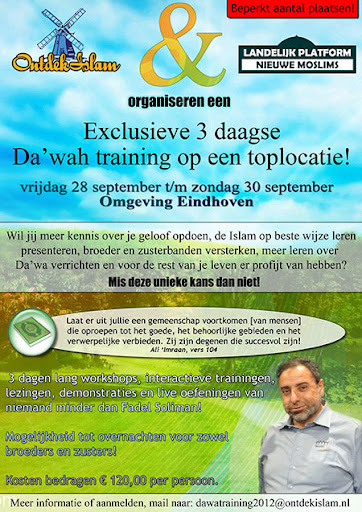
flyer dawa training
Wat inmiddels wel publiek is, en daarom ook hier, is het slotgesprek van Fadel Soliman met ‘joods-christelijk’ pastor Ben Kok. Deze pastor publiceerde een tijdje terug zijn DVD Islam en Waarheid. U ziet hier de trailer en let even op bij 4.50min:
Ben Kok interviewde Fadel Soliman al eerder in juni 2010:
In het interview tijdens het dawah-weekend confronteerde Soliman Ben Kok met een fragment uit zijn DVD dat u in de trailer op 4.50 min kunt zien: het gaat om een hond die dichtbij de Qur’an komt. Soliman vroeg hem of hij het was die de hond aan de Qur’an likte waarop Ben Kok stelde dat de hond alleen dichtbij de Qur’an was (en het boek niet likte) en dat het doel was om te laten zien dat de Qur’an ook maar een gewoon boek was net als de Bijbel. Hieronder ziet u het interview zoals geplaatst op het youtube kanaal van Bridges Foundation:
En hier ziet u het gebeuren zoals in beeld gebracht door twee mensen die met Ben Kok meekwamen:
Interessant verschil in cameravoering overigens
Hier leest u het verslag van Ben Kok: HIER.
U ziet dat de aanwezigen met de heer Soliman vertrekken (nou ja na eerst keurig opgeruimd te hebben). Veel reacties die ik hierop gehoord en gezien heb zijn positief voor Soliman hoewel er ook mensen zijn die zich afvragen waarom Ben Kok überhaupt was uitgenodigd. Al met al kun je stellen dat Soliman niet alleen vertelt over hoe je dawah moet doen, maar het ook heeft voorgedaan en heeft voorgedaan waar, althans voor hem, de grens ligt. Op zijn manier geldt dit ook voor Ben Kok. Hij wil vertellen dat de islam de wereld overneemt en met dit gesprek probeert hij dit ook te laten zien.
UPDATE
Zie ook het blog van Carel Brendel: Harde woorden in Brabant, mooi-weer-praatjes in Brussel
En van Peter Frans Koops (met wie ik na afloop van het gesprek tussen Soliman en Kok nog een kort interessant gesprek had): De ware aard van de islam.
Zorgwekkend is het blog EJBron waar één zelfs oproept tot geweld in een reactie op een stuk Martien Pennings: Ben Kok werd uitgenodigd voor een typische islamdialoog