Important Publications
You are looking at posts in the category Important Publications.
| M | T | W | T | F | S | S |
|---|---|---|---|---|---|---|
| « Sep | ||||||
| 1 | 2 | 3 | 4 | 5 | 6 | 7 |
| 8 | 9 | 10 | 11 | 12 | 13 | 14 |
| 15 | 16 | 17 | 18 | 19 | 20 | 21 |
| 22 | 23 | 24 | 25 | 26 | 27 | 28 |
| 29 | 30 | |||||
Pages
- About
- C L O S E R moves to….C L O S E R
- Contact Me
- Interventions – Forces that Bind or Divide
- ISIM Review via Closer
- Publications
- Research
Categories
- (Upcoming) Events (33)
- [Online] Publications (26)
- Activism (117)
- anthropology (113)
- Method (13)
- Arts & culture (88)
- Asides (2)
- Blind Horses (33)
- Blogosphere (192)
- Burgerschapserie 2010 (50)
- Citizenship Carnival (5)
- Dudok (1)
- Featured (5)
- Gender, Kinship & Marriage Issues (265)
- Gouda Issues (91)
- Guest authors (58)
- Headline (76)
- Important Publications (159)
- Internal Debates (275)
- International Terrorism (437)
- ISIM Leiden (5)
- ISIM Research II (4)
- ISIM/RU Research (171)
- Islam in European History (2)
- Islam in the Netherlands (219)
- Islamnews (56)
- islamophobia (59)
- Joy Category (56)
- Marriage (1)
- Misc. News (891)
- Morocco (70)
- Multiculti Issues (749)
- Murder on theo Van Gogh and related issues (326)
- My Research (118)
- Notes from the Field (82)
- Panoptic Surveillance (4)
- Public Islam (244)
- Religion Other (109)
- Religious and Political Radicalization (635)
- Religious Movements (54)
- Research International (55)
- Research Tools (3)
- Ritual and Religious Experience (58)
- Society & Politics in the Middle East (159)
- Some personal considerations (146)
- Deep in the woods… (18)
- Stadsdebat Rotterdam (3)
- State of Science (5)
- Twitwa (5)
- Uncategorized (74)
- Young Muslims (459)
- Youth culture (as a practice) (157)
General
- ‘In the name of Allah, Most Gracious, Most Merciful’
- – Lotfi Haddi –
- …Kelaat Mgouna…….Ait Ouarchdik…
- ::–}{Nour Al-Islam}{–::
- Al-islam.nl De ware godsdienst voor Allah is de Islam
- Allah Is In The House
- Almaas
- amanullah.org
- Amr Khaled Official Website
- An Islam start page and Islamic search engine – Musalman.com
- arabesque.web-log.nl
- As-Siraat.net
- assadaaka.tk
- Assembley for the Protection of Hijab
- Authentieke Kennis
- Azaytouna – Meknes Azaytouna
- berichten over allochtonen in nederland – web-log.nl
- Bladi.net : Le Portail de la diaspora marocaine
- Bnai Avraham
- BrechtjesBlogje
- Classical Values
- De islam
- DimaDima.nl / De ware godsdienst? bij allah is de islam
- emel – the muslim lifestyle magazine
- Ethnically Incorrect
- fernaci
- Free Muslim Coalition Against Terrorism
- Frontaal Naakt. Ongesluierde opinies, interviews & achtergronden
- Hedendaagse wetenswaardigheden…
- History News Network
- Homepage Al Nisa
- hoofddoek.tk – Een hoofddoek, je goed recht?
- IMRA: International Muslima Rights Association
- Informed Comment
- Insight to Religions
- Instapundit.com
- Interesting Times
- Intro van Abdullah Biesheuvel
- islaam
- Islam Ijtihad World Politics Religion Liberal Islam Muslim Quran Islam in America
- Islam Ijtihad World Politics Religion Liberal Islam Muslim Quran Islam in America
- Islam Website: Islam, Islamic Studies, Arabic, Religion
- Islamforum
- Islamic Philosophy Online
- Islamica Magazine
- islamicate
- Islamophobia Watch
- Islamsevrouw.web-log.nl
- Islamwereld-alles wat je over de Islam wil weten…
- Jihad: War, Terrorism, and Peace in Islam
- JPilot Chat Room
- Madrid11.net
- Marocstart.nl – De marokkaanse startpagina!
- Maryams.Net – Muslim Women and their Islam
- Michel
- Modern Muslima.com
- Moslimjongeren Amsterdam
- Moslimjongeren.nl
- Muslim Peace Fellowship
- Muslim WakeUp! Sex & The Umma
- Muslimah Connection
- Muslims Against Terrorism (MAT)
- Mutma’inaa
- namira
- Otowi!
- Ramadan.NL
- Religion, World Religions, Comparative Religion – Just the facts on the world\’s religions.
- Ryan
- Sahabah
- Salafi Start Siden – The Salafi Start Page
- seifoullah.tk
- Sheikh Abd al Qadir Jilani Home Page
- Sidi Ahmed Ibn Mustafa Al Alawi Radhiya Allahu T’aala ‘Anhu (Islam, tasawuf – Sufism – Soufisme)
- Stichting Vangnet
- Storiesofmalika.web-log.nl
- Support Sanity – Israel / Palestine
- Tekenen van Allah\’s Bestaan op en in ons Lichaam
- Terrorism Unveiled
- The Coffee House | TPMCafe
- The Inter Faith Network for the UK
- The Ni’ma Foundation
- The Traveller’s Souk
- The \’Hofstad\’ terrorism trial – developments
- Thoughts & Readings
- Uitgeverij Momtazah | Helmond
- Un-veiled.net || Un-veiled Reflections
- Watan.nl
- Welkom bij Islamic webservices
- Welkom bij vangnet. De site voor islamitische jongeren!
- welkom moslim en niet moslims
- Yabiladi Maroc – Portail des Marocains dans le Monde
Dutch [Muslims] Blogs
- Hedendaagse wetenswaardigheden…
- Abdelhakim.nl
- Abdellah.nl
- Abdulwadud.web-log.nl
- Abou Jabir – web-log.nl
- Abu Bakker
- Abu Marwan Media Publikaties
- Acta Academica Tijdschrift voor Islam en Dialoog
- Ahamdoellilah – web-log.nl
- Ahlu Soennah – Abou Yunus
- Ahlul Hadeeth
- Ahlul Hadeeth
- Al Moudjahideen
- Al-Adzaan
- Al-Islaam: Bismilaahi Rahmaani Rahiem
- Alesha
- Alfeth.com
- Anoniempje.web-log.nl
- Ansaar at-Tawheed
- At-Tibyan Nederland
- beni-said.tk
- Blog van moemina3 – Skyrock.com
- bouchra
- CyberDjihad
- DE SCHRIJVENDE MOSLIMS
- DE VROLIJKE MOSLIM ;)
- Dewereldwachtopmij.web-log.nl
- Dien~oel~Islaam
- Eali.web-log.nl
- Een genade voor de werelden
- Enige wapen tegen de Waarheid is de leugen…
- ErTaN
- ewa
- Ezel & Os v2
- Gizoh.tk [.::De Site Voor Jou::.]
- Grappige, wijze verhalen van Nasreddin Hodja. Turkse humor.
- Hanifa Lillah
- hayya~ala~assalaah!
- Het laatste nieuws lees je als eerst op Maroc-Media
- Homow Universalizzz
- Ibn al-Qayyim
- IslaamLive Mail
- IslaamLive Mail
- Islam Blog – Juli 2007
- Islam in het Nieuws – web-log.nl
- Islam, een religie
- Islam, een religie
- Islamic Sisters – web-log.nl
- Islamiway’s Weblog
- Islamtawheed’s Blog
- Jihaad
- Jihad
- Journalista
- La Hawla Wa La Quwatta Illa Billah
- M O S L I M J O N G E R E N
- M.J.Ede – Moslimjongeren Ede
- Mahdi\’s Weblog | Vrijheid en het vrije woord | punt.nl: Je eigen gratis weblog, gratis fotoalbum, webmail, startpagina enz
- Maktab.nl (Zawaj – islamitische trouwsite)
- Marocdream.nl – Home
- Marokkaanse.web-log.nl
- Marokkanen Weblog
- Master Soul
- Miboon
- Miesjelle.web-log.nl
- Mijn Schatjes
- Moaz
- moeminway – web-log.nl
- Moslima_Y – web-log.nl
- mosta3inabilaah – web-log.nl
- Muhaajir in islamitisch Zuid-Oost Azië
- Mumin al-Bayda (English)
- Mustafa786.web-log.nl
- Oprecht – Poort tot de kennis
- Said.nl
- saifullah.nl – Jihad al-Haq begint hier!
- Salaam Aleikum
- Sayfoudien – web-log.nl
- soebhanAllah
- Soerah19.web-log.nl – web-log.nl
- Steun Palestina
- Stichting Moslimanetwerk
- Stories of Malika
- supermaroc
- Ummah Nieuws – web-log.nl
- Volkskrant Weblog — Alib Bondon
- Volkskrant Weblog — Moslima Journalista
- Vraag en antwoord…
- wat is Islam
- Wat is islam?
- Weblog – a la Maroc style
- website van Jamal
- Wij Blijven Hier
- Wij Blijven Hier
- www.BenAyad.be – Islam en Actua
- www.moslima.web-log.nl
- Yakini Time
- Youth Of Islam
- Youth Of Islam
- [fikra]
Non-Dutch Muslims Blogs
- Lanallah __Islamic BlogZine__
- This journey ends but only with The Beginning
- ‘the middle place’
- …Never Judge a Person By His or Her Blog…
- …under the tree…
- A Comment on PMUNA
- A Dervish’s Du`a’
- A Family in Baghdad
- A Garden of Children
- A Muslim Mother’s Thoughts / Islamic Parenting
- A Struggle in Uncertainty, Such is Life
- About Afghanistan
- adnan.org: good design, bad idea
- Afiyah
- Ahmeds World of Islam
- Al Musawwir
- Al-Musharaka
- Almiraya tBLOG – O, happy the soul that saw its own faults
- Almusawwir
- an open window
- Anak Alam
- aNaRcHo AkBaR
- Anthology
- AnthroGal’s World
- Arabian Passion
- ArRihla
- Articles Blog
- Asylum Seeker
- avari-nameh
- Baghdad Burning
- Being Noor Javed
- Bismillah
- bloggin’ muslimz.. Linking Muslim bloggers around the globe
- Blogging Islamic Perspective
- Chapati Mystery
- City of Brass – Principled pragmatism at the maghrib of one age, the fajr of another
- COUNTERCOLUMN: All Your Bias Are Belong to Us
- d i z z y l i m i t s . c o m >> muslim sisters united w e b r i n g
- Dar-al-Masnavi
- Day in the life of an American Muslim Woman
- Don’t Shoot!…
- eat-halal guy
- Eye on Gay Muslims
- Eye on Gay Muslims
- Figuring it all out for nearly one quarter of a century
- Free Alaa!
- Friends, Romans, Countrymen…. lend me 5 bux!
- From Peer to Peer ~ A Weblog about P2P File & Idea Sharing and More…
- Ghost of a flea
- Ginny’s Thoughts and Things
- God, Faith, and a Pen: The Official Blog of Dr. Hesham A. Hassaballa
- Golublog
- Green Data
- gulfreporter
- Hadeeth Blog
- Hadouta
- Hello from the land of the Pharaoh
- Hello From the land of the Pharaohs Egypt
- Hijabi Madness
- Hijabified
- HijabMan’s Blog
- Ihsan-net
- Inactivity
- Indigo Jo Blogs
- Iraq Blog Count
- Islam 4 Real
- Islamiblog
- Islamicly Locked
- Izzy Mo’s Blog
- Izzy Mo’s Blog
- Jaded Soul…….Unplugged…..
- Jeneva un-Kay-jed- My Bad Behavior Sanctuary
- K-A-L-E-I-D-O-S-C-O-P-E
- Lawrence of Cyberia
- Letter From Bahrain
- Life of an American Muslim SAHM whose dh is working in Iraq
- Manal and Alaa\’s bit bucket | free speech from the bletches
- Me Vs. MysElF
- Mental Mayhem
- Mere Islam
- Mind, Body, Soul : Blog
- Mohammad Ali Abtahi Webnevesht
- MoorishGirl
- Muslim Apple
- muslim blogs
- Muslims Under Progress…
- My heart speaks
- My Little Bubble
- My Thoughts
- Myself | Hossein Derakhshan’s weblog (English)
- neurotic Iraqi wife
- NINHAJABA
- Niqaabi Forever, Insha-Allah Blog with Islamic nasheeds and lectures from traditional Islamic scholars
- Niqabified: Irrelevant
- O Muhammad!
- Otowi!
- Pak Positive – Pakistani News for the Rest of Us
- Periphery
- Pictures in Baghdad
- PM’s World
- Positive Muslim News
- Procrastination
- Prophet Muhammad
- Queer Jihad
- Radical Muslim
- Raed in the Middle
- RAMBLING MONOLOGUES
- Rendering Islam
- Renegade Masjid
- Rooznegar, Sina Motallebi’s WebGard
- Sabbah’s Blog
- Salam Pax – The Baghdad Blog
- Saracen.nu
- Scarlet Thisbe
- Searching for Truth in a World of Mirrors
- Seeing the Dawn
- Seeker’s Digest
- Seekersdigest.org
- shut up you fat whiner!
- Simply Islam
- Sister Scorpion
- Sister Soljah
- Sister Surviving
- Slow Motion in Style
- Sunni Sister: Blahg Blahg Blahg
- Suzzy’s id is breaking loose…
- tell me a secret
- The Arab Street Files
- The Beirut Spring
- The Islamic Feminista
- The Land of Sad Oranges
- The Muslim Contrarian
- The Muslim Postcolonial
- The Progressive Muslims Union North America Debate
- The Rosetta Stone
- The Traceless Warrior
- The Wayfarer
- TheDesertTimes
- think halal: the muslim group weblog
- Thoughts & Readings
- Through Muslim Eyes
- Turkish Torque
- Uncertainty:Iman and Farid’s Iranian weblog
- UNMEDIA: principled pragmatism
- UNN – Usayd Network News
- Uzer.Aurjee?
- Various blogs by Muslims in the West. – Google Co-op
- washed away memories…
- Welcome to MythandCulture.com and to daily Arrows – Mythologist, Maggie Macary’s blog
- word gets around
- Writeous Sister
- Writersblot Home Page
- www.BenAyad.be – Islam en Actua
- www.Mas’ud’s blog
- \’Aqoul
- ~*choco-bean*~
General Islam Sites
- :: Islam Channel :: – Welcome to IslamChannel Official Website
- Ad3iyah(smeekbeden)
- Al-maktoum Islamic Centre Rotterdam
- Assalamoe Aleikoem Warhmatoe Allahi Wa Barakatuhoe.
- BouG.tk
- Dades Islam en Youngsterdam
- Haq Islam – One stop portal for Islam on the web!
- Hight School Teacher Muhammad al-Harbi\’s Case
- Ibn Taymiyah Pages
- Iskandri
- Islam
- Islam Always Tomorrow Yesterday Today
- Islam denounces terrorism.com
- Islam Home
- islam-internet.nl
- Islamic Artists Society
- Leicester~Muslims
- Mere Islam
- MuslimSpace.com | MuslimSpace.com, The Premiere Muslim Portal
- Safra Project
- Saleel.com
- Sparkly Water
- Statements Against Terror
- Understand Islam
- Welcome to Imaan UK website
Islamic Scholars
Social Sciences Scholars
- ‘ilm al-insaan: Talking About the Talk
- :: .. :: zerzaust :: .. ::
- After Sept. 11: Perspectives from the Social Sciences
- Andrea Ben Lassoued
- Anth 310 – Islam in the Modern World (Spring 2002)
- anthro:politico
- AnthroBase – Social and Cultural Anthropology – A searchable database of anthropological texts
- AnthroBlogs
- AnthroBoundaries
- Anthropologist Community
- anthropology blogs
- antropologi.info – Social and Cultural Anthropology in the News
- Arabist Jansen
- Between Secularization and Religionization Vrije Universiteit Amsterdam
- Bin Gregory Productions
- Blog van het Blaise Pascal Instituut
- Boas Blog
- Causes of Conflict – Thoughts on Religion, Identity and the Middle East (David Hume)
- Cicilie among the Parisians
- Cognitive Anthropology
- Comunidade Imaginada
- Cosmic Variance
- Critical Muslims
- danah boyd
- Deep Thought
- Dienekes’ Anthropology Blog
- Digital Islam
- Erkan\’s field diary
- Ethno::log
- Evamaria\’s ramblings –
- Evan F. Kohlmann – International Terrorism Consultant
- Experimental Philosophy
- For the record
- Forum Fridinum [Religionresearch.org]
- Fragments weblog
- From an Anthropological Perspective
- Gregory Bateson
- Islam & Muslims in Europe *)
- Islam, Islamic Studies, Arabic, Religion
- Islam, Muslims, and an Anthropologist
- Jeremy’s Weblog
- JourneyWoman
- Juan Cole – ‘Documents on Terrorist Abu Musab al-Zarqawi’
- Keywords
- Kijken naar de pers
- languagehat.com
- Left2Right
- Leiter Reports
- Levinas and multicultural society
- Links on Islam and Muslims
- log.squig.org
- Making Anthropology Public
- Martijn de Koning Research Pages / Onderzoekspaginas
- Material World
- MensenStreken
- Modern Mass Media, Religion and the Imagination of Communities
- Moroccan Politics and Perspectives
- Multicultural Netherlands
- My blog’s in Cambridge, but my heart is in Accra
- National Study of Youth and Religion
- Natures/Cultures
- Nomadic Thoughts
- On the Human
- Philip Greenspun’s Weblog:
- Photoethnography.com home page – a resource for photoethnographers
- Qahwa Sada
- RACIAL REALITY BLOG
- Religion Gateway – Academic Info
- Religion News Blog
- Religion Newswriters Association
- Religion Research
- rikcoolsaet.be – Rik Coolsaet – Homepage
- Rites [Religionresearch.org]
- Savage Minds: Notes and Queries in Anthropology – A Group Blog
- Somatosphere
- Space and Culture
- Strange Doctrines
- TayoBlog
- Teaching Anthropology
- The Angry Anthropologist
- The Gadflyer
- The Immanent Frame | Secularism, religion and the public sphere
- The Onion
- The Panda\’s Thumb
- TheAnthroGeek
- This Blog Sits at the
- This Blog Sits at the intersection of Anthropology & Economics
- verbal privilege
- Virtually Islamic: Research and News about Islam in the Digital Age
- Wanna be an Anthropologist
- Welcome to Framing Muslims – International Research Network
- Yahya Birt
Women's Blogs / Sites
- * DURRA * Danielle Durst Britt
- -Fear Allah as He should be Feared-
- a literary silhouette
- a literary silhouette
- A Thought in the Kingdom of Lunacy
- AlMaas – Diamant
- altmuslimah.com – exploring both sides of the gender divide
- Assalaam oe allaikoum Nour al Islam
- Atralnada (Morning Dew)
- ayla\’s perspective shifts
- Beautiful Amygdala
- bouchra
- Boulevard of Broken Dreams
- Chadia17
- Claiming Equal Citizenship
- Dervish
- Fantasy web-log – web-log.nl
- Farah\’s Sowaleef
- Green Tea
- hayya~ala~assalaah!
- Hilsen Fra …
- Islamucation
- kaleidomuslima: fragments of my life
- Laila Lalami
- Marhaban.web-log.nl – web-log.nl
- Moslima_Y – web-log.nl
- Muslim-Refusenik The official website of Irshad Manji
- Myrtus
- Noor al-Islaam – web-log.nl
- Oh You Who Believe…
- Raising Yousuf: a diary of a mother under occupation
- SAFspace
- Salika Sufisticate
- Saloua.nl
- Saudi Eve
- SOUL, HEART, MIND, AND BODY…
- Spirit21 – Shelina Zahra Janmohamed
- Sweep the Sunshine | the mundane is the edge of glory
- Taslima Nasrin
- The Color of Rain
- The Muslimah
- Thoughts Of A Traveller
- Volkskrant Weblog — Islam, een goed geloof
- Weblog Raja Felgata | Koffie Verkeerd – The Battle | punt.nl: Je eigen gratis weblog, gratis fotoalbum, webmail, startpagina enz
- Weblog Raja Felgata | WRF
- Writing is Busy Idleness
- www.moslima.web-log.nl
- Zeitgeistgirl
- Zusters in Islam
- ~:: MARYAM ::~ Tasawwuf Blog
Ritueel en religieuze beleving Nederland
- – Alfeth.com – NL
- :: Al Basair ::
- Abu Marwan Media Publikaties
- Ahlalbait Jongeren
- Ahlul Hadeeth
- Ahlul Hadeeth
- Al-Amien… De Betrouwbare – Home
- Al-Ummah
- Al-Ummah
- Al-Ummah
- Al-Wasatiyyah.com – Home
- Anwaar al-Islaam
- anwaaralislaam.tk
- Aqiedah’s Weblog
- Arabische Lessen – Home
- Arabische Lessen – Home
- Arrayaan.net
- At-taqwa.nl
- Begrijp Islam
- Bismillaah – deboodschap.com
- Citaten van de Salaf
- Dar al-Tarjama WebSite
- Dawah-online.com
- de koraan
- de koraan
- De Koran . net – Het Islaamitische Fundament op het Net – Home
- De Leidraad, een leidraad voor je leven
- Dien~oel~Islaam
- Dien~oel~Islaam
- Faadi Community
- Ghimaar
- hayya~ala~assalaah!
- hayya~ala~assalaah!
- Ibn al-Qayyim
- IMAM-MALIK-Alles over Islam
- IQRA ROOM – Koran studie groep
- Islaam voor iedereen
- Islaam voor iedereen
- Islaam: Terugkeer naar het Boek (Qor-aan) en de Soennah volgens het begrip van de Vrome Voorgangers… – Home
- Islaam: Terugkeer naar het Boek (Qor-aan) en de Soennah volgens het begrip van de Vrome Voorgangers… – Home
- IslaamLive Mail
- IslaamLive Mail
- IslaamLive Mail
- islam :: messageboard
- Islam City NL, Islam en meer
- Islam, een religie
- Islamia.nl – Islamic Shop – Islamitische Winkel
- Islamitische kleding
- Islamitische kleding
- Islamitische smeekbedes
- islamtoday
- islamvoorjou – Informatie over Islam, Koran en Soenah
- kebdani.tk
- KoranOnline.NL
- Lees de Koran – Een Openbaring voor de Mensheid
- Lifemakers NL
- Marocstart.nl | Islam & Koran Startpagina
- Miesbahoel Islam Zwolle
- Mocrodream Forums
- Moslims in Almere
- Moslims online jong en vernieuwend
- Nihedmoslima
- Oprecht – Poort tot de kennis
- Quraan.nl :: quran koran kuran koeran quran-voice alquran :: Luister online naar de Quraan
- Quraan.nl online quraan recitaties :: Koran quran islam allah mohammed god al-islam moslim
- Selefie Nederland
- Stichting Al Hoeda Wa Noer
- Stichting Al Islah
- StION Stichting Islamitische Organisatie Nederland – Ahlus Sunnat Wal Djama\’ah
- Sunni Publicaties
- Sunni.nl – Home
- Teksten van Aboe Ismaiel
- Terug Naar De Dien – Home
- Terug Naar De Dien – Home
- Terug Naar De Dien – Home
- Uw Keuze
- www.ahloelhadieth.com
- www.ahloelhadieth.com
- www.al-thabaat.com
- www.hijaab.com
- www.uwkeuze.net
- Youth Of Islam
- Zegswijzen van de Wijzen
- \’\’ Leid ons op het rechte pad het pad degenen aan wie Gij gunsten hebt geschonken\’\’
Muslim News
Moslims & Maatschappij
Arts & Culture
- : : SamiYusuf.com : : Copyright Awakening 2006 : :
- amir normandi, photographer – bio
- Ani – SINGING FOR THE SOUL OF ISLAM – HOME
- ARTEEAST.ORG
- AZIZ
- Enter into The Home Website Of Mecca2Medina
- Kalima Translation – Reviving Translation in the Arab world
- lemonaa.tk
- MWNF – Museum With No Frontiers – Discover Islamic Art
- Nader Sadek
Misc.
'Fundamentalism'
Islam & commerce
2
Morocco
[Online] Publications
- ACVZ :: | Preliminary Studies | About marriage: choosing a spouse and the issue of forced marriages among Maroccans, Turks and Hindostani in the Netherlands
- ACVZ :: | Voorstudies | Over het huwelijk gesproken: partnerkeuze en gedwongen huwelijken onder Marokkaanse, Turkse en Hindostaanse Nederlanders
- Kennislink – ‘Dit is geen poep wat ik praat’
- Kennislink – Nederlandse moslims
Religious Movements
- :: Al Basair ::
- :: al Haqq :: de waarheid van de Islam ::
- ::Kalamullah.Com::
- Ahloelhadieth.com
- Ahlul Hadeeth
- al-Madinah (Medina) The City of Prophecy ; Islamic University of Madinah (Medina), Life in Madinah (Medina), Saudi Arabia
- American Students in Madinah
- Aqiedah’s Weblog
- Dar al-Tarjama WebSite
- Faith Over Fear – Feiz Muhammad
- Instituut voor Opvoeding & Educatie
- IslaamLive Mail
- IslaamLive Mail
- islamtoday
- Moderate Muslims Refuted
- Rise And Fall Of Salafi Movement in the US by Umar Lee
- Selefie Dawah Nederland
- Selefie Nederland
- Selefienederland
- Stichting Al Hoeda Wa Noer
- Teksten van Aboe Ismaiel
- www.ahloelhadieth.com
- www.BenAyad.be – Islam en Actua
- Youth Of Islam

Utopische Vreemdelingen – Onderzoek naar salafisme
Posted on June 6th, 2014 by martijn.
Categories: Important Publications.
Het is al weer enige tijd geleden, maar in 2010 was ik in Utrecht op de universiteit. Studenten aldaar hadden een debat georganiseerd over ‘salafisme in Nederland’ en ik was uitgenodigd om een lezing te geven. Ik was niet alleen. Ook één van de bekendere Nederlandse salafistische predikers was uitgenodigd. Die vertelde onder het genot van een glaasje fris op het einde de volgende anekdote:
‘Ooit vroeg een journalist mij: “Ben je een salafist?” Ik antwoordde: “Nee! Ik ben geen salafist.” Hij zei: “Ben je me nu in de maling aan het nemen?” Ik zei: “Nee, ik weet namelijk dat je een beeld in je hoofd van het salafisme hebt. Dat soort salafist ben ik niet! Ik ben niet de salafist die jij in je hoofd hebt.”
In zijn bijdrage eerder had deze prediker verteld hoe salafisme géén aparte stroming in de islam is, maar de islam uitdraagt zoals deze door de eerste generaties moslims werd gepraktiseerd en hoe deze geldt als voorbeeld en praktische richtlijn voor het leven van alle hedendaagse moslims waar dan ook ter wereld.
Salafisme als onderzoeksveld
Deze anekdote, en de anekdote in de anekdote, laten denk ik goed zien waar het om gaat bij salafisme als religieus en maatschappelijk fenomeen.
Ten eerste staat salafisme in Nederland in ruime mate in de aandacht. Vandaar ook dat studenten van de universiteit belangstelling hadden voor een verhaal van deze prediker en, hoop ik, ook voor het mijne.
Ten tweede heeft het salafisme in politiek, beleid en media een reputatie van een intolerante, gewelddadige stroming die haaks staat op de seculiere en seksuele vrijheden van het Westen. De vraag aan deze prediker kwam vlak na een gewelddadige actie van moslims die tot deze islamitische trend gerekend worden.
Ten derde hebben moslims in het algemeen en ook deze prediker een verwachting van hoe de buitenwereld op hen reageert en daar passen zij hun reactie op aan. Vandaar de, op het eerste oog wellicht, paradoxale reactie van een salafistische prediker die na een bijeenkomst over salafisme de anekdote vertelt waarin tegen hij een journalist die iets wil weten over salafisme zegt dat hij geen salafist is. Er is dus een voortdurende interactie tussen overheid, media en moslims; een interactie die overal anders is en er dus ook voor zorgt dat salafisme in Nederland weer iets anders is dan in Engeland, Egypte of Zuid-Amerika.
Ten vierde heeft het salafisme voor de predikers en ook voor veel gewone gelovigen weer een andere betekenis: namelijk die van de ‘ware’ islam van de beginperiode van de islam.
Ten vijfde hebben wij in ons onderzoek voortdurend te horen gekregen ‘wij zijn de echte salafis’ en anderen zijn extremisten, jihadisten, takfiri, khawarij of wat dan ook. Of ‘salafis zijn de echte moslims’ (zowel door moslims als niet-moslims overigens) en de andere moslims zijn maar halve moslims. Door verschillende groepen, of dit nu beleidsmakers zijn, politici, moslims, islamofobe en andere opinieleiders, de term salafisme wordt ook gebruikt als een manier om zichzelf of juist de Ander aan te wijzen. Op deze manier is de term onderdeel van de politiek van identiteit van mensen.
Dit betekent ook dat de vraag naar wat salafisme is of wie nu een salafist is of wie niet, niet zo vanzelfsprekend en eenduidig te beantwoorden is. We dienen eerst te kijken welk perspectief wij als wetenschappers innemen waarbij we rekening houden met die vijf verschillende dimensies van salafisme die ik net genoemd heb.
Eén van de zaken die daarbij voorop staat is dat wij geen positie innemen in de debatten over wie nu de ware islam volgt en wie niet. Ongetwijfeld zal daar kritiek op zijn van moslimse en niet-moslimse mensen die willen dat we juist wel een positie innemen. Dat heeft niet te maken met het idee dat die mensen niet zouden begrijpen wat wetenschap is zoals van de week in een artikel in Trouw werd gesuggereerd, maar met een andere invalshoek. Als onderzoekers kunnen wij niet bepalen wat de ‘zuivere’ islam is, kunnen wij ook niet klakkeloos de invullingen van islamitische groeperingen of van anti-islam groeperingen overnemen. Evenmin dienen we lichtvaardig de definities van overheden of van groeperingen die het secularisme verdedigen navolgen. Dan zouden we hun interpretatie overnemen en die interpretatie maar ook de onderlinge discussies, vetes en dergelijke moeten juist onderdeel zijn van het onderzoek.
Salafisme als utopische beweging
In het Nijmeegse onderzoeksproject Salafisme als transnationale beweging hebben Joas Wagemakers, Carmen Becker, Roel Meijer en ik vanaf 2007 geprobeerd om samen met professor Harald Motzki en professor Martin van Bruinessen de verschillende dimensies van salafisme in het Midden-Oosten en Europa te onderzoeken waarbij we ook veel besproken hebben met onze collega’s Zoltan Pall (die in Koeweit en Libanon onderzoek deed naar salafisme) en Din Wahid (die in Indonesië onderzoek deed). Het boek Salafisme – Utopische idealen in een weerbarstige praktijk is het resultaat van de onderzoeken van Joas Wagemakers, Carmen Becker en mij. In dit boek benaderen we salafisme als islamitische trend. Wat salafisten tot salafisten maakt, zo stellen we in de inleiding, wordt niet bepaald door de vraag hoe gevaarlijk zij wel of niet zijn. Evenmin wordt dat bepaald door het gegeven dat zij terug zouden willen naar de fundamenten van het geloof en de begintijd van de islam. Veel moslims zien dat als een wenkend perspectief.
Wat salafisten tot salafisten maakt zijn hun ideaalbeelden over hoe die fundamenten en het begin van de islam eruit zien, hun ambities over de hedendaagse implementatie van die ideaalbeelden en hun praktijken om betekenis te geven aan het leven en de wereld om hen heen die gekenmerkt worden door een strikte, letterlijke interpretatie van de Koran en Soenna. Binnen een dergelijk perspectief kunnen we de salafisten beschouwen als utopische beweging. De term utopie, dat zowel ‘geen plaats’ als ‘gelukkige plaats’ als betekenis draagt, kan gezien worden als een verwijzing naar iets dat nastrevenswaardig, wenselijk en mogelijk is, maar dat ook tegen de bestaande situatie in gaat en onhaalbaar is. In zijn Utopia uit 1516 beschreef Sir Thomas More ideaaltypische vormen van sociale organisatie en samenleven waarmee hij enerzijds zijn ambities voor perfecte vormen van samenleven gestalte gaf en anderzijds kritiek gaf op de bestaande samenleving van die tijd. In het geval van salafisten kunnen we stellen dat zij proberen de islam te revitaliseren en reorganiseren op basis van een ideaalbeeld van de eerste drie generaties moslims en een zo strikt, zo gedetailleerd en zo letterlijk mogelijke uitleg van de schriftelijke bronnen van islam. Zo probeert men een leefstijl te ontwikkelen die betrokkenen correcter, rechtvaardiger en bevredigender vinden dan hun huidige leefstijl.
Een utopische transformatie
Thomas More’s Utopia was enerzijds een maatschappijkritiek en anderzijds een ideaal samenlevingsmodel en moreel programma. Dat geldt ook voor het salafisme. Of het nu in het Midden-Oosten is of in Europa, het ideaalbeeld van het salafisme is een kritiek op de huidige samenlevingen die in een morele crisis zouden verkeren. Daarmee is het salafisme recalcitrant of zelfs rebels en omdat men in staat blijkt te zijn mensen te mobiliseren op basis van hun utopie is het ook niet verwonderlijk dat men vaak door overheden en opinieleiders met argusogen wordt bekeken. Zeker wanneer in debatten aan bijna alle militante en gewelddadige acties van moslims het etiket salafisme wordt geplakt (en zeker niet altijd terecht of genuanceerd genoeg), wordt het salafisme al snel hét symbool van de ongewenste islam. Daarbij speelt natuurlijk ook mee dat mensen die zich tot de salafistische lezing van islam bekennen, wel degelijk gewelddaden hebben gepleegd, zich intolerant hebben uitgelaten en verschillende visies hebben voor de correcte rollen van vrouwen en mannen in de samenleving. Juist in samenlevingen die zich voorstaan op tolerantie, gelijke rechten voor vrouwen en mannen en vreedzaam democratisch samenleven kunnen deze groepen voor grote onrust zorgen en zijn ze ook een dankbaar doelwit voor menig politicus.
Zeker voor Europa speelt daarbij een rol dat secularisering grote gevolgen heeft gehad voor de positie van religie. Daarbij zijn er steeds meer mensen die een seculier Europa als norm verdedigen. Secularisering is daarbij niet alleen een beschrijving van een bescheidener wordende rol van het religieuze maar ook een norm die oplegt dat religie in het openbare leven in een afgebakend kader moet blijven. Seculier is op deze wijze ook een identiteit die rust op een ideaalbeeld van tolerantie, vrijheid en gelijkheid die ook aan andersdenkenden, in het bijzonder religieuze mensen, moet worden opgelegd. Net zoals er binnen het christendom en andere religies in de laatste jaren stromingen zijn opgekomen die zich niet zomaar willen neerleggen bij de huidige seculiere status quo, zijn die stromingen er ook binnen islam en salafisme is er daar één van.
Als het gaat om salafisme worden in Nederland vaak de moord op Theo van Gogh door Mohammed Bouyeri aangehaald en het verketteren door predikers van Nederlandse opinieleiders zoals Ayaan Hirsi Ali. Ook allerlei opvattingen over vrouwen en homoseksualiteit komen in die discussies terug. Al wijst een groot deel van de salafisten gewelddadige acties af en stellen sommigen zelfs dat, met name gewelddadige maar ook vreedzame groepen die zich met politiek inlaten, niet tot het salafisme behoren, is er angst voor het geweld dat salafisten zouden kunnen gebruiken. Hun pogingen om te participeren in de samenleving worden gewantrouwd en er bestaat de angst dat salafisten met hun geloofsovertuiging grote druk uitoefenen op anderen, in het bijzonder vrouwen. Het gaat daarbij niet (meer) zozeer om het feit dat er een dreiging van geweld uitgaat van de salafisten, maar om de salafisten als bedreiging voor de normen en waarden van de Nederlandse samenleving, in het bijzonder de vrijheid die bedreigd zou worden door de vermeende af keer (haat) van salafisten tegen het Westen.
In de praktijk echter blijkt dat een groot deel van de salafisten zeer gezagsgetrouw is en niet snel zal protesteren tegen de wereldlijke macht; laat staan met geweld in opstand komen. In die zin is salafisme zelfs redelijk burgerlijk te noemen met een sterke nadruk op studie, werk en gezin. Wel is het duidelijk dat voor individuen het salafisme makkelijk de gedaante aan kan nemen van een oppositionele politiek-religieuze stroming. Of salafisme dan ook daadwerkelijk uitgroeit tot een grotere beweging en hoe die er politiek gezien uitziet, is mede afhankelijk van bijvoorbeeld het beleid van de staten en de infrastructuur en samenstelling van moslimgemeenschappen. De wijze waarop salafistische groeperingen zijn omgegaan met de Arabische opstanden zijn daar een uitstekend voorbeeld van.
Persoonlijke transformatie
Het is echter niet zo dat het salafisme zich alleen ergens tegen keert. Het gaat ook om een programma voor moslims om aan zichzelf te werken als vrome moslims. Dit is misschien nog wel het duidelijkst te zien bij vrouwen. Eén van de meest opvallende kenmerken van het salafisme is de grote nadruk op een scheiding tussen de seksen. Zowel in het debat over islam en salafisme als onder salafisten is de positie van de vrouw sowieso een centraal issue. Aan beide zijden fungeren de vrouw en haar lichaam en opvattingen daarover als een symbolische grens tussen wij en zij. Zoals vaker in dit type religieuze bewegingen wordt het ‘vrije’ gedrag van vrouwen niet alleen gezien als een symptoom van een morele crisis, maar zelfs als één van de oorzaken van die crisis. Er zijn dan ook talloze regels en gedragscodes omtrent seksescheiding, het contact tussen mannen en vrouwen en de bedekking van het lichaam die daarbij hoort. Deze regels dienen overigens niet alleen door vrouwen nageleefd te worden, maar ook door mannen die bijvoorbeeld hun blikken moeten neerslaan.
De toepassing van deze regels is afhankelijk van de plaats waar men zich bevindt (publiek/privé), het specifieke gezelschap (echtgenoot, gezinsleden, vreemden) en de specifieke situatie (gebed, werk, feest). In sommige gevallen gaat het bij de bedekking van lichaamsdelen niet alleen om de buitenkant van het lichaam, maar ook om de stem. Vrouwen worden geacht niet hard te spreken of te zacht of ‘met verleidelijke stem’. In chatrooms willen en mogen vrouwen soms daarom helemaal niet spreken. Niet iedereen houdt zich daaraan overigens, ondanks de talloze verhalen die rondgaan over mannen die misbruik zouden maken van goedgelovige vrouwen. Ook mannen dienen zich te houden aan de strikte regels over scheiding, bedekking en uiterlijk (baard- en haardracht), maar de praktijk is toch dat zij hier makkelijker mee omgaan en dat de consequenties van het overtreden van de regels minder groot zijn. Met name vrouwen die in een sociaal isolement verkeren kunnen het erg zwaar hebben zeker als zij ook de verantwoordelijkheid over kinderen dragen. De vraag is dan hoeveel macht vrouwen in de praktijk hebben om daadwerkelijk tegen ongewenste zaken zoals huiselijk geweld in te gaan, vooral als het gaat om vrouwen met een zwak ondersteunend netwerk en om zaken die zich in de privésfeer afspelen. Juist doordat vrouwen naar het privédomein worden verwezen hebben zij in de praktijk minder macht.
Maar veel vrouwen gebruiken een beroep op islamitische regels ook om zich enigszins los te maken van de tradities van hun ouders, zonder te breken met die ouders. In gevallen waar sprake is van gearrangeerde of gedwongen huwelijken, worden salafistische predikers bijvoorbeeld vaak ingeschakeld om te bemiddelen en ouders erop te wijzen dat hun dochters volgens de islam niet tegen hun wil uitgehuwelijkt zouden mogen worden. In andere gevallen is de verwerping van het gebruik van alcohol en de gereguleerde omgang van mannen en vrouwen, aantrekkelijk voor vrouwen die hun eigen gezins- en familieomstandigheden willen veranderen. Tegelijkertijd schikken zij zich in een regime dat vrouwen vooral een ondersteunende, verzorgende moederrol toekent en waarbij vrouwen beschermd moet worden door mannen. Zij ontlenen hun idee van vrijheid aan het zich onderwerpen aan gedrag- en kledingvoorschriften en meer in het algemeen aan het zich onderwerpen aan Gods wil.
Verenigen van idealen en ambities
Het salafisme wordt daarbij gebruikt als een manier om allerlei idealen en ambities te verenigen: een sterke identiteit als vrouw en moslim, complementair ten opzichte van mannen, vroomheid, vrijheid, moederschap, zekerheid, authenticiteit, het opdoen van kennis, het oprecht en zuiver aanbidden van God en soms maatschappelijk activisme om het negatieve beeld van islam te verbeteren, het recht op vrijheid van godsdienst uit te dragen of op verschillende manieren te strijden tegen onrecht. Het gaat dus, zowel bij mannen als vrouwen, om een mengeling van persoonlijke, maatschappelijke, politieke en religieuze ambities. De mengeling aan motieven en praktijken is te zien als een inspanning om verschillende morele ambities te verenigen en te verwezenlijken binnen een islamitisch ethos door zich te proberen te onderwerpen aan wat men ziet als de wil van God en zo een betere vrouw, betere moslim en, meer in het algemeen, een beter mens te worden.
Internet speelt daarbij een belangrijke rol als manier om kennis te verzamelen, te praten over politieke issues, onzekerheden en uitdagingen in het dagelijks leven en over hoe islamitische voorschriften in de praktijk moeten worden gebracht of hoe de dagelijkse praktijk in overeenstemming met islamitische voorschriften moet worden gebracht. Eén van de populaire verbeeldingen van hoe een goed moslimleven er idealiter uit ziet is dat van de Vreemdeling: iemand die standvastig blijft in het geloof, wel in de wereld is maar niet van de wereld. Dit kan een spirituele, sociale en politieke invulling krijgen zoals we zien bij de populaire nashid met de naam ghuraba (De Vreemdelingen).
De nadruk in de religiositeit van veel salafisten ligt op het je inspannen om je zo goed mogelijk te wijden aan God. In die zin is salafisme hard werken: hard werken aan jezelf ontwikkelen als vrome moslim, hard werken aan het verbeteren van je sociale relaties en hard werken aan je relatie met God. Dat leidt soms tot wat wel een salafi burn out genoemd wordt, maar het harde werken is niet per se problematisch. Velen zijn zeer gepassioneerd bezig met hun zoektocht en persoonlijke transformatie en het harde werken is onderdeel van de religiositeit: als alles mee zit wordt je geloof lui en zwak terwijl tegenstand en problemen louterend werken. Hoe dit alles uitwerkt en dus ook [bw] wat salafisme is, is uiteindelijk niet alleen afhankelijk van de persoon zelf of van de religieuze doctrines, maar ook van zijn of haar directe omgeving en de samenleving waarin hij of zij leeft.
Tot zover mijn lezing, maar niet zonder eerst enkele mensen te bedanken. Dat zijn in ieder geval de collega’s van de afdeling Islamstudies aan de Radboud Universiteit met wie we al die tijd zeer prettig hebben samengewerkt en in het bijzonder ook met Roel Meijer en professor Harald Motzki die nauw verbonden waren aan het onderzoeksprogramma. Een bijzonder woord van dank is voor die moslims in Europa en het Midden-Oosten die ons open, vriendelijk en bereidwillig te woord hebben gestaan en met wie we altijd goede contacten hebben opgebouwd. Zonder hun medewerking is onderzoek als dat van ons niet mogelijk en dit boek ook niet. Dank u.
Lezing ter gelegenheid van ‘Salafisme. Ultraorthodoxe islam in Nederland. Wat moeten we ermee?’Discussie met o.a. o.a. Martijn de Koning en Joas Wagemakers. Woensdag 14 mei 2014, 19.30 – 21.30 uur, Huize Heyendael, Radboud Universiteit Nijmegen. Deze lezing en discussie vonden plaats naar aanleiding van de publicatie van het boek Salafisme – Utopische idealen in een weerbarstige praktijk van Joas Wagemakers, Carmen Becker en ondergetekende.
Empire & Saving Muslim Women?
Posted on January 26th, 2014 by martijn.
Categories: Activism, anthropology, Gender, Kinship & Marriage Issues, Important Publications, islamophobia, Multiculti Issues.
Lila Abu-Lughod is professor of anthropology and women’s studies and director of the Middle East Institute at Columbia University in New York. In 2002 she published an article in the academic journal American Anthropologist: Do Muslim Women Really Need Saving? Anthropological Reflections on Cultural Relativism and Its Others. In this article she explores the ethics of the ‘War on Terror’ and how anthropology can contribute to a critical interrogation on the justification for the American intervention in Afghanistan in terms of liberating, or saving, Afghan women. Her article is a plea for a serious critical appreciation of differences among women in the world as the products of different histories, expressions of different circumstances, and manifestations of differently structured desires and tries to answer the implications for working together in changing their lives.
In her recently published book, Do Muslim Women Need Saving?, she presents the result of her attempt to deconstruct the popular often stereotyped images about Muslim women coming about in reports on honor killings, abuse, and (as criticized by her) in the propaganda of FEMEN with the complexity of the lives of women she met during her research. In a recent article, responding the Femen controversy about Topless Jihad and the counter-responses by Muslim women, she wrote for the National she criticized the assumption that muslim are oppressed:
Topless protests raise the question: Who can speak for Muslim women? | The National
his assumption makes everything from banning forms of dress to hysteria about “Sharia” arbitration courts appear rational. It makes politicians and feminists more interested in a piece of clothing than the women who wear it.
The photographs posted by these visibly Muslim women in their counter-protest raise some awkward questions. Who speaks for Muslim women? How did “freedom” and “choice” come to be the key terms in the debates about Muslim women’s rights? And how did Islam come to be blamed when a simple look around would confirm that Muslim women’s lives, political views and social positions are so diverse?
The problems they face are clearly shaped by many factors besides Islam, which itself is a constantly changing and contested tradition.
There is a long history of negative western representations of women in the “Orient”. Popular media have been breathing new life into these images ever since liberating the women of Afghanistan was offered as a rationale for military intervention. In 2001, I was suspicious of this justification for war, a justification that former first lady Laura Bush along with former secretary of state Hillary Clinton resuscitated last week in the face of the dismal situation in Afghanistan.
As an anthropologist who had studied and written about women and gender politics in the Muslim world for 20 years, I could not make sense then of the gap between what I was seeing in the media and what I knew from experience. I wondered which Muslim women were imagined as the objects of such humanitarian concern. Could one lump together refugees begging on the streets of Beirut with prime ministers of populous Muslim countries?
In the next videos she discusses her book:
See also the New York Times Read Around Video: HERE.
In Time Magazine an excerpt of her book:
Lila Abu-Lughod: Do Muslim Women Need Saving? | TIME.com
A language of rights cannot really capture the complications of lives actually lived. If we were to consider the quandaries of a young woman in rural Egypt as she tries to make choices about who to marry or how she will make a good life for her children in trying circumstances, perhaps we would realize that we all work within constraints. It does not do justice to anyone to view her life only in terms of rights or that loaded term, freedom. These are not the terms in which we understand our own lives, born into families we did not choose, finding our way into what might fulfill us in life, constrained by failing economies, subject to the consumer capitalism, and making moral mistakes we must live with.
See also the Daily Beast
I think the book is timely and necessary addition to ongoing debates on gender, Muslim women, Islam, feminism and imperialism.
Empire & Saving Muslim Women?
Posted on January 26th, 2014 by martijn.
Categories: Activism, anthropology, Gender, Kinship & Marriage Issues, Important Publications, islamophobia, Multiculti Issues.
Lila Abu-Lughod is professor of anthropology and women’s studies and director of the Middle East Institute at Columbia University in New York. In 2002 she published an article in the academic journal American Anthropologist: Do Muslim Women Really Need Saving? Anthropological Reflections on Cultural Relativism and Its Others. In this article she explores the ethics of the ‘War on Terror’ and how anthropology can contribute to a critical interrogation on the justification for the American intervention in Afghanistan in terms of liberating, or saving, Afghan women. Her article is a plea for a serious critical appreciation of differences among women in the world as the products of different histories, expressions of different circumstances, and manifestations of differently structured desires and tries to answer the implications for working together in changing their lives.
In her recently published book, Do Muslim Women Need Saving?, she presents the result of her attempt to deconstruct the popular often stereotyped images about Muslim women coming about in reports on honor killings, abuse, and (as criticized by her) in the propaganda of FEMEN with the complexity of the lives of women she met during her research. In a recent article, responding the Femen controversy about Topless Jihad and the counter-responses by Muslim women, she wrote for the National she criticized the assumption that muslim are oppressed:
Topless protests raise the question: Who can speak for Muslim women? | The National
his assumption makes everything from banning forms of dress to hysteria about “Sharia” arbitration courts appear rational. It makes politicians and feminists more interested in a piece of clothing than the women who wear it.
The photographs posted by these visibly Muslim women in their counter-protest raise some awkward questions. Who speaks for Muslim women? How did “freedom” and “choice” come to be the key terms in the debates about Muslim women’s rights? And how did Islam come to be blamed when a simple look around would confirm that Muslim women’s lives, political views and social positions are so diverse?
The problems they face are clearly shaped by many factors besides Islam, which itself is a constantly changing and contested tradition.
There is a long history of negative western representations of women in the “Orient”. Popular media have been breathing new life into these images ever since liberating the women of Afghanistan was offered as a rationale for military intervention. In 2001, I was suspicious of this justification for war, a justification that former first lady Laura Bush along with former secretary of state Hillary Clinton resuscitated last week in the face of the dismal situation in Afghanistan.
As an anthropologist who had studied and written about women and gender politics in the Muslim world for 20 years, I could not make sense then of the gap between what I was seeing in the media and what I knew from experience. I wondered which Muslim women were imagined as the objects of such humanitarian concern. Could one lump together refugees begging on the streets of Beirut with prime ministers of populous Muslim countries?
In the next videos she discusses her book:
See also the New York Times Read Around Video: HERE.
In Time Magazine an excerpt of her book:
Lila Abu-Lughod: Do Muslim Women Need Saving? | TIME.com
A language of rights cannot really capture the complications of lives actually lived. If we were to consider the quandaries of a young woman in rural Egypt as she tries to make choices about who to marry or how she will make a good life for her children in trying circumstances, perhaps we would realize that we all work within constraints. It does not do justice to anyone to view her life only in terms of rights or that loaded term, freedom. These are not the terms in which we understand our own lives, born into families we did not choose, finding our way into what might fulfill us in life, constrained by failing economies, subject to the consumer capitalism, and making moral mistakes we must live with.
See also the Daily Beast
I think the book is timely and necessary addition to ongoing debates on gender, Muslim women, Islam, feminism and imperialism.
Junge Salafiyya-Anhänger suchen im Internet nach dem „wahren Glauben“
Posted on August 29th, 2013 by martijn.
Categories: anthropology, Important Publications, ISIM/RU Research, Religious and Political Radicalization, Ritual and Religious Experience, Young Muslims.
Carmen Becker hat den Einfluss des Internets auf den Glauben junger niederländischer und deutscher Muslime untersucht, die der Salafiyya folgen. Das Internet bietet einen Ort der Begegnung, einen religiösen Raum und zugleich die Möglichkeit, selbst nach den Quelltexten und ihrer Bedeutung zu suchen. Das wird die traditionellen Formen religiöser Autorität verändern, vermutet Becker, die am 9. September 2013 an der Nimweger Radboud Universität promovieren wird.
Ebenso wie die Jugendlichen, um die es geht, spricht Carmen Becker nicht von Salafisten, sondern von „Muslimen, die der Salafiyya folgen“. „Anhänger der Salafiyya streben danach, sich möglichst genau am Propheten Mohammed und den ersten drei Generationen von Muslimen, den sogenannten ‚frommen Vorfahren‘, zu orientieren. ‚Salafisten‘ werden häufig mit Radikalisierung und Gewalt in Verbindung gebracht. Dass sie sehr orthodoxe, mitunter radikale Auffassungen vertreten, bedeutet jedoch nicht automatisch, dass man deshalb radikales Verhalten und Gewalt befürwortet.“
Laut dem deutschen Verfassungsschutz gibt es in Deutschland 3.800 aktive Salafiyya-Anhänger aller Altersgruppen; in den Niederlanden geht der nationale Koordinator für die Terrorismusbekämpfung von 3.000 Anhängern aus. „Das sind jedoch Schätzungen, die auf selbstformulierten Definitionen beruhen und von denen nicht immer klar ist, wie sie zustande gekommen sind.“
In ihrem Forschungsprojekt folgte Becker zwischen 2007 und 2010 zahlreichen Gesprächen und Aktivitäten in Foren sowie Chatrooms und sprach ausführlich mit 47 jungen Muslimen. Mitunter beteiligte sie sich zudem an Gesprächen im Internet, wobei sie sich immer als Forscherin zu erkennen gab.
Muslim werden – in einem Chatroom
Das Internet ist, so stellte Becker fest, für diese muslimischen Jugendlichen nicht nur ein Ort, an dem sie Informationen austauschen, sondern auch ein religiöser Raum, in dem sie ihren Glauben leben können. „Sie können dort reden, beten, Vorträge und Predigten hören, und es besteht auch die Möglichkeit, dem Islam beizutreten. Das setzt allerdings die Anwesenheit von Zeugen voraus, die feststellen, ob das Glaubensbekenntnis überzeugend vorgetragen wird. Das Internet stellt also für den Kern des Rituals keine Gefahr dar.“
Selbst auf die Suche gehen
Auf einer anderen Ebene übt das Internet ihrer Meinung nach mehr Einfluss aus: „Traditionell wird das Wissen über den wahren Glauben von einem Imam oder einer anderen Autorität in der Moschee vermittelt. Im Internet jedoch kann jeder – vor allem jetzt, da immer mehr Quelltexte in verschiedenen Sprachen digitalisiert werden, – die entsprechenden Texte selbst studieren. Das ist keine einfache Aufgabe: Es sind oft keine eindeutigen, unmissverständlichen Texte, und viele Übersetzungen aus dem Arabischen sind schlichtweg schlecht. Darüber hinaus dürfen sich die Gläubigen nicht selbst überschätzen und annehmen, sie könnten den Koran ohne weiteres auslegen. Der Einfluss anerkannter Autoritäten wie der islamischen Gelehrten ist deshalb weiterhin beträchtlich. Aber daneben begeben sich die Menschen selbst auf die Suche nach Belegen für bestimmte Aussagen in den religiösen Quellen und diskutieren Texte und Interpretationen mit anderen Gläubigen.“
Muslim sein im Westen
Die jungen Muslime aus dem Forschungsprojekt hören am liebsten sachkundigen Glaubensgenossen vor Ort zu, denen es gelingt, einen Bezug zwischen Lehre und Leben herzustellen. „Das kann ein junger Prediger oder ein populärer bekehrter Muslim sein – wichtig ist, dass sie sich in das Leben junger orthodoxer Muslime im Westen hineinversetzen können und ihre Sprache sprechen. Ihre Texte werden eifrig diskutiert, weil sie sich weniger mit der Frage beschäftigen, was der Prophet getan hat, als vielmehr damit, was der Prophet unter den gegebenen Umständen tun würde.“
Weniger strenggläubig? Anders!
Die Schlussfolgerung, dass der orthodoxe Glaube jugendlicher Salafiyya-Anhänger unter dem Einfluss des Internets „weniger streng“ wird, möchte Becker nicht ziehen. „Es ist noch zu früh, um zu sagen, welchen Einfluss das Internet letztendlich haben wird. Aber dass es Glaubenspraktiken verändert, davon bin ich überzeugt.“
Carmen Becker (Lindlar, Deutschland, 1977) studierte Politikwissenschaft (Schwerpunkt: Naher und Mittlerer Osten) an der Freien Universität Berlin. Ab 2004 arbeitete sie für das Auswärtige Amt in Berlin. 2007 begann sie mit der Forschung für ihre Doktorarbeit im Fachbereich Arabisch und Islam (Research Institute for Philosophy, Theology and Religious Studies) der Radboud Universität. Ihr Forschungsprojekt ist Teil eines größeren Forschungsprogramms der Radboud Universität zum Thema Salafismus, wofür die Nimweger Universität 2007 Fördermittel der Niederländischen Organisation für Wissenschaftliche Forschung (NWO) erhielt.
Geweldsmarketing – Het risico van de politiek van islamofobie
Posted on June 9th, 2013 by martijn.
Categories: Important Publications, Islam in the Netherlands, Multiculti Issues, Religious and Political Radicalization.
Jan Jaap de Ruiter is een Arabist die, als één van de weinigen van mijn collega’s zeer actief is op het internet. Met commentaar en toelichting op vanalles wat met islam, moslims en Midden-Oosten te maken te heeft, levert hij een waardevolle bijdrage als wetenschapper aan het publieke debat. Niet te beroerd om de dialoog aan te gaan met allerlei opponenten die vinden dat hij niet echt waardenvrije wetenschap bedrijft (alsof dat mogelijk zou zijn) richt hij zijn pijlen onder meer op Wilders cs. en hun politieke gedachtegoed. Eén van zijn belangrijkste publicaties op dit terrein is het boekje ‘The Speck in Your Brother’s Eye’ wat deels een uitgebreide recensie is van het boek van Wilders ‘Marked for Death’, deels een pamflet is met een politieke aanklacht (Wilders kleedt zijn anti-islam boodschap zo in, dat geweld een mogelijke, ultieme, consequentie is) en deels het resultaat van zijn eigen zorgen over het politieke klimaat in Nederland.
Marked for Death
Ik bespreek hier het boek van De Ruiter, maar eerst even over het boek van Wilders. Dat boek is zowel een boek met een politieke boodschap als verslag van een persoonlijke strijd van, zoals hij het invult, de eenzame heldhaftige politieke profeet die ten strijde trekt tegen de gewelddadige islam en daarvoor als een echte martelaar een hoge persoonlijke prijs betaalt. Zo vertelt hij in het boek over de dood van zijn vader en hoe hij zijn tranen niet meer kon bedwingen in het bijzijn van zijn aardige maar ook vreemde lijfwachten. Zo maakt hij het persoonlijke politiek en het politieke persoonlijk. Hij voert een verdedigingsstrijd tegen het agressieve en gewelddadige gedrag van migranten die hun inspiratie of zelfs gedrag direct zouden ontlenen aan de islam die hij reduceert tot gewelddadige en/of intolerante acties van moslims en tot enkele verzen uit de Koran die zouden oproepen tot geweld. Zoals Jan Jaap de Ruiter ook laat zien, verdraait Wilders die islamitische geschiedenis zo dat in feite veel alledaagse vooroordelen, stereotyperingen en reacties tegen vreemdelingen en tegen islam (volgens bovenstaande definitie) worden gerationaliseerd tot een legitieme angst en afkeer. Die angst en afkeer en de rationalisering ervan dienen vervolgens als basis voor een meer diepgaand en uitgewerkt standpunt voor het uitsluiten van ongewenste vreemdelingen en moslims. Op dat moment kunnen we met recht spreken van islamofobie.
Die laatste stap maakt hij in dit boek door enerzijds een Westers utopia van vooruitgang, tolerantie en vredelievendheid te creëren tegenover het angstbeeld en de perfecte misère van zijn invulling van islam. Dit doet hij mede op basis van uitspraken van illustere namen als Salman Rushdie en Thomas Jefferson en Albert Speer. Op deze manier schept hij uiteindelijk een specifiek type racistisch, namelijk islamofobisch, gedachtegoed. Het gaat volgens Wilders om een existentiële strijd tussen de Westerse beschaving en de islamitische beschaving. Voor alle duidelijkheid nergens roept Wilders direct op tot geweld tegen moslims; volgens hem zouden moslims hun geloof moeten verlaten.
De splinter en de balk
De stelling van Jan Jaap de Ruiter is dat Wilders zijn onheilscenario zo opzet dat de ultieme consequentie een situatie is waarin geweld de mogelijke of zelfs enige oplossing is om het onheil af te wenden. De Ruiter bespreekt achtereenvolgens de waarheidclaims van Wilders, hoe Wilders zijn idee over de vermeende superioriteit van ‘het Westen’ uitwerkt tegenover de inferioriteit van ‘de islam’, hoe Wilders de islam definieert als ideologie die vergelijkbaar is met nazisme, fascisme en communisme en hoe Wilders de islam wil uitbannen. De Ruiter laat zien dat Wilders weliswaar claimt het debat te willen aangaan, maar dat vooral doet met opzettelijke provocerende beledigingen van islam en moslims. Hij laat overtuigend zien hoe Wilders de islamitische tradities en hun geschiedenissen verdraait, eenzijdig belicht en hoe Wilders probeert zijn definitie van wat islam is op te leggen. De Ruiter probeert niet alleen dat eenzijdige en verdraaide beeld van de islam te corrigeren (zonder apologetisch te worden), maar ook een evenzeer verdraaid en eenzijdig beeld van het Westen recht te zetten. Dit lukt hem ten dele simpelweg door te laten zien dat Wilders citaten uit de context neemt of maar half geeft en door te wijzen op de inconsequenties in het betoog van Wilders.
Anderzijds vervalt ook hij toch enigszins in het beschavingsdenken dat wordt gekenmerkt door een wij-zij denken. Bijvoorbeeld op p. 22 wanneer hij het heeft over Wilders’ idee over superioriteit van het Westen en dat die moslims maar blijven doorzeuren over de kruistochten: ‘Does it mean that the West is not suffering from any kind of memory syndrome?’ Alsof er zoiets bestaat als een ‘Westerse beschaving’ en een ‘islamitische beschaving’ (op zich al ongelijke indelingen) die los van elkaar staan. Dit terwijl Europa en islam al eeuwen nauw met elkaar verbonden zijn; niet alleen door conflicten maar ook door intellectuele uitwisselingen, dialoog, handel, concurrentie, enzovoorts. Het is dan ook opvallend dan De Ruiter in bovenstaand zin die tegenstelling lijkt te hanteren en vervolgens komt met een voorbeeld van Serven en Moslims in de Balkan.
Een ander punt van kritiek betreft het feit dat De Ruiter af en toe zowel ‘islam’ als ‘christendom’ enige capaciteit tot handelen (‘agency’) lijkt toe te schrijven. Bijvoorbeeld als hij zegt ‘Islam…failed to stick’ (p. 49), ‘It is true, Christianity ordains….’ (p. 26). Uiteindelijk zijn ‘islam’ en ‘christendom’ zoals ze hier gebruikt worden abstracte fenomenen die natuurlijk niet ‘handelen’ of ‘falen’ of ‘verordonneren’. Dat zijn mensen die dat doen eventueel op basis van bepaalde geschriften. Daarbij lijkt hij, bijvoorbeeld in het laatst genoemde citaat’ uit te leggen hoe religie geïnterpreteerd dient te worden: ‘Het is waar dat…enz.’. Dat doet hij wel op meer plekken zoals op p. 51 wanneer hij stelt ‘I would say that a good religion or ideology will always be unambiguous in its commandments to its followers. Any spoken or written text that could be interpreted as allowing violence should never be part of a religion or ideology’. Ook hier zien we weer een suggestie dat een religie handelt (commandeert), maar ook dus dat hij invult waar een ‘goede’ religie of ideologie aan dient te voldoen. Dat is zijn persoonlijke invulling en daar is niks mis mee, maar het is irrelevant voor zijn argument (wel relevant overigens in die zijn dat zijn persoonlijke drijfveren zo mooi zichtbaar zijn). Evenmin maakt hij duidelijk wat er dan moet gebeuren met religies waarin wél tradities zijn van gereguleerd geweld (zoals alle religies eigenlijk). Daarbij, zoals De Ruiter laat zien, doet het er ook eigenlijk niet zoveel toe of er in geschriften wordt opgeroepen tot geweld; het gaat om de interpretatie en legitimeringen van mensen en om de vraag of, hoe en waarom men overgaat tot geweld. En om de vraag welk geweld legitiem is en welk niet.
Van ‘Marked for Death’ naar ‘Marketing for Violence’
Dat gezegd hebbende is het natuurlijk wel zo dat mensen aan bepaalde geschriften of dat nu de Bijbel en de Koran is, of Mein Kampf of bepaalde wetsteksten of (inderdaad) de uitspraken van Wilders inspiratie, legitimeringen en een gevoel van urgentie kunnen ontlenen om tot geweld over te gaan. Demonisering van outsiders, mensen strippen van hun menselijke eigenschappen, mensen reduceren tot concrete voorbeelden van grotere abstracties zoals het ‘gewelddadige Westen’ of de ‘gewelddadige islam’ kunnen voor sommigen de drempel om geweld te gebruiken verlagen. Zeker als dat gepaard gaat met het inprenten van het idee dat de eigen levenswijze op het spel staat. Dat hebben we in het verleden gezien met de nazi’s, met de oorlog tussen de Hutu’s en de Tutsi’s in Rwanda, hedentendage met de Rohingya in Myanmar, de Amerikaanse inval in Irak en met islamitische leiders in Irak.
Mijn kritiek hierboven laat dan ook onverlet dat De Ruiter zijn belangrijkste punt overtuigend maakt: door middel van verdraaiingen, halve waarheden en regelrechte leugens schept Wilders een zodanig bedreigend, geperverteerd en onmenselijk beeld van de islam dat er niet heel veel fantasie voor nodig is om je af te vragen wanneer we de wapens moeten oppakken. Dat doet Wilders niet, zo stelt De Ruiter ook heel duidelijk. Wat Wilders doet is het schetsen van een fort waarin goede mensen harmonieus samenleven maar die misleid worden door hun leiders die slechts een dunne glazen muur hebben opgeworpen, leiders die tuig met een dodelijke ziekte hebben binnen gelaten en waarbij buiten wilde, intolerante en agressieve dragers van die ziekte op die dunne glazen muur aan het bonzen zijn. En in dit profetische Stalingrad is Wilders de held die bedreigd wordt maar moedig doorstrijd. Met zijn pen. Zoiets. Als je gelooft in deze waarheden (en in tegenstelling tot wat De Ruiter in het begin van boek zegt, het is niet noodzakelijk dat je het zeker weet; integendeel zelfs) is het niet moeilijk voor te stellen dat er wat meer, laten we zeggen, daadkrachtige middelen noodzakelijk zijn.
De olifant
De vraag is echter of De Ruiter’s gefundeerde waarschuwing veel zal uithalen. Om meerdere redenen denk ik van niet. Ik zal ze hier kort noemen. Allereerst zullen velen zeggen ‘Ja, maar dat doet niets af aan het feit dat moslims wandaden plegen’. Nee dat klopt. De afweging die mensen daarbij maken hangt niet alleen af van het antwoord op de vraag of Wilders een realistisch beeld schetst (nee), maar ook hoe zwaar de elementen wegen die hij aandraagt. En voor zijn aanhangers wegen die zwaar.
Ten tweede, en jammer genoeg besteedt De Ruiter er geen aandacht aan, de politiek van Wilders is niet zo bijzonder en ook niet zo extreem als we wellicht denken. Het denken in abstracties zoals Wilders doet met islam en vervolgens stellen dat mensen niet meer dan een concrete invulling daarvan zijn, is al veel ouder. Het gebeurde al bij racisme en anti-semitisme aan het begin van de 20e eeuw en is ook onderdeel van het beleid dat een onderscheid maakt tussen moderne verlichte autochtonen en de cultuur van de migranten. Dat cultuurdenken leidt tot een onderscheid tussen gewenste en ongewenste burgers en is in beleid en debat steeds meer toegespitst geraakt op moslims en islam. Er is geen enkele politieke partij die de islam (in abstractie) nog niet als probleem heeft aangemerkt. In die zin is Wilders niet meer dan een product van dat cultuurdenken uit de jaren negentig dat toch echt uit de hoek van het politieke midden kwam.
Het is ook niet Wilders’ PVV die een monopolie heeft op schelden en demonisering. De term ‘kutmarokkanen’ is inmiddels een gebruikelijke term geworden voor Marokkaans-Nederlandse jongeren en komt toch echt uit kringen van de PvdA. Ook het CDA verdedigde in 2005 al de motie van Wilders voor een verbod op de boerka ook al is dat discriminerend voor moslims en vrouwen. Ook het huidige kabinet, zonder de PVV, maakt hiervoor wetgeving (zij het in beperkte zin). Het is ook niet de PVV die kwam met een uitgewerkt voorstel om ritueel slachten aan banden te leggen; dat was de PvdD. En ondanks het islamofobisch-racistische gedachtegoed van de PVV was het voor VVD en CDA geen probleem om met hen een gedoogakkoord te sluiten. Goed, na het nodige gemor, maar dat geeft uitstekend weer hoe de machtsverhoudingen liggen.
Een belangrijke waarschuwing
De PVV en haar gedachtegoed zit dus niet in de marge van de Nederlandse politiek maar bevindt zich dus in het centrum ervan en is, net als het racisme van Fortuyn, een rechtstreeks uitvloeisel ervan. Dat maakt het bekritiseren van de balk en de splinter tot het negeren van de olifant in de kamer. Maar natuurlijk zijn er verschillen met andere partijen die over het algemeen de nadruk leggen op behoud van en stimuleren van sociale cohesie en rust. Dat is precies wat de PVV probeert te breken door een provocerende manier van optreden. Dat in combinatie met de vechttaal en de onheilsprofetieën van Wilders, maken van Wilders en de PVV een zeer riskante politiek. Daarom is het goed en noodzakelijk dat mensen als Jan-Jaap de Ruiter hier op heldere, goed onderbouwde en toegankelijke wijze voor waarschuwen.
The moral maze: Dutch Salafis and the construction of a moral community of the faithful
Posted on May 15th, 2013 by martijn.
Categories: anthropology, Important Publications, ISIM/RU Research, My Research, Ritual and Religious Experience.
A new edition of the journal Contemporary Islam has been published: Moral Ambiguities and Muslim Lives. As the editors of this special issue, Susanne Dahlgren and Samuli Schielke state in their introduction:
As commonly pointed out by social scientists today, the way religions interact with processes of modernisation has not made them secondary in the lives of ‘modernising subjectivities’. As Peter L. Berger has put it, the world is as religious as it ever was and in some places even more religious than ever. What modernity brings about, is pluralisation of individual lifeworlds that consequently undermines all taken-for-granted certainties (Berger 2001: 445, 449). At the same time, religion has become an individual choice marking a difference between generations. Like with other religions, self-fashioning and active engagement in ‘making’ religion (Avishai 2008) are typical to Islam today. In this thematic volume, titled “Moral Ambiguities and Muslim Lives” we focus on the resurgence of Islam as a project of self-improvement and the search for a good life, surrounded by the various uncertainties, ambiguities and complexities of today’s world. As we see it, throughout the world today, discourses on being a Muslim crystallise around morality and good life – issues that are often deeply political but demand an understanding of politics as embedded in questions about worship, the meaningful structure for life and social relations, and contested visions of right and wrong, subjectivity and community. Recognising this centrality of everyday moral practice, an increasing number of ethnographic studies have taken up the task of looking at the ways the adherence to Muhammad’s message constitutes a part of people’s subjectivity and everyday experience. And yet it has proven difficult to take religion seriously without losing sight of the overall complexity of the human condition. Ethnographies focusing only on people’s practice of Islam with a narrow focus restricted to people active in groups of dedicated believers, can provide a partial image at best, and risk reproducing the limited bias of the activists’ groups they study. To provide directions for a more balanced image, the volume at hand presents an interdisciplinary spectrum (including anthropology, sociology, political science, and textual analysis) of approaches to the ambiguities that Islam embraces as a moral discourse and as an everyday practice in a time when the label ‘Muslim’ has become loaded with enormous normative promises and pressures.
I’m very happy to have been able to contribute to this interesting special issue with an article based upon my own research in the Netherlands.
The moral maze: Dutch Salafis and the construction of a moral community of the faithful
The Salafi movement presents itself as a moral guardian of Muslims in a world that, according to many, is filled with moral crisis, temptations and anti-Islam tendencies. Salafis claim that it is essential to return to the community of the pious forefathers seen as the most outstanding community of all times with the highest absolute moral standard. In this article I will show how individual participants engage with this idea of a moral community of believers yet remain vulnerable to the ambiguities and ruptures inherent in everyday life and within the Salafi movement. By exploring how Salafis passionately try to search for the ‘correct’ knowledge and strive to maintain a unity between knowledge, conviction and behavior, and the role of friendships therein, I argue that Salafism does not remain separate from the troubles of everyday but that these issues enter into and exist in Salafi thought and practice, not by being resolved but by being transformed into personal struggles. These ambiguities and ruptures may cause problems but also provide an incentive for Salafis to continuously work at the self-improvement of one’s piety, authenticity, and sisterhood and brotherhood.
You can find it HERE.
Other articles in this special issue are:
- Introduction by Susanne Dahlgren, Samuli Schielke Pages 1-13
- Hand, heart and handphone: State shari`a in the age of the SMS by R. Michael Feener Pages 15-32
- The clash of values across symbolic boundaries: claims of urban space in contemporary Istanbul by Pekka Tuominen Pages 33-51
- What makes a good minority Muslim? Educational policy and the paradoxes of Muslim schooling in Uganda by Dorothea E. Schulz Pages 53-70
- Islamic state without Islamists: Jordanian students talk about the ideal state by Fadi Kabatilo Pages 85-106
- Piety, profit and the market in Cairo: a political economy of Islamisation by Salwa Ismail Pages 107-128
Many thanks to the editors for making such a wonderful special issue.
European and non-European Philosophers as public intellectuals
Posted on February 21st, 2013 by martijn.
Categories: Important Publications.
On the site of Al Jazeera an amazing and interesting exchange on the process of re-westernisation, de-westernisation and decoloniality in politics, economy, religions, aesthetics, knowledge and subjectivity and the role of thinkers and how they can respond to events in a productive manner.
Santiago Zabala provided the kick off by celebrating Slavov Zivek:
Slavoj Zizek and the role of the philosopher – Opinion – Al Jazeera English
[F]ew have managed to overcome its boundaries and become public intellectuals intensely engaged in our cultural and political life as did Hannah Arendt (with the Eichmann trial), Jean-Paul Sartre (in the protests of May 1968) and Michel Foucault (with the Iranian revolution).
These philosophers became public intellectuals not simply because of their original philosophical projects or the exceptional political events of their epochs, but rather because their thoughts were drawn by these events. But how can an intellectual respond to the events of his epoch in order to contribute in a productive manner?
In order to respond, as Edward Said once said, the intellectual has to be “an outsider, living in self-imposed exile, and on the margins of society”, that is, free from academic, religious and political establishments; otherwise, he or she will simply submit to the inevitability of events.
He exposes himself to criticism
If Slavoj Zizek perfectly fits Said’s description, it is not because he is unemployed, in exile, and at the margins of society, but rather because he writes as if he were. His theoretical books, political positions and public appearances are a disruption not only of the common academic style, but also of the idea of the philosopher or intellectual as someone to be idealised and deferred to.
[…]
Today, whether we like him or not, Zizek is, as the Observer points out, “what Jacques Derrida was to the 80s”, that is, the thinker of our age. While Derrida’s intellectual operation focused on “deconstructing” our linguistic frames of reference, Zizek instead “disrupts” our ideological structures, the underside of acceptable philosophical, religious and political discourses.Although it’s impossible to cover all the Slovenian philosophers’ meditations, which span from Schelling’s idealism through Jacques Lacan’s psychoanalysis and John Milbank’s theology, it is worth venturing into the political disruptions he has created (which I will comment upon in a later post) in order to further understand how he has changed the role of the philosopher, a role, as he writes in his two latest books (Less Than Nothing and Mapping Ideology) that must “articulate the space for a revolt” independently because when a revolutionary movement is denounced as ideological, “one can be sure that its inversion is no less ideological”.
Hamid Dabashi responds to Zabala by asking the question ‘What happens with thinkers who operate outside the European philosophical ‘pedigree’?
Can non-Europeans think? – Opinion – Al Jazeera English
What immediately strikes the reader when seeing [Zabala’s] opening paragraph is the unabashedly European character and disposition of the thing the author calls “philosophy today” – thus laying a claim on both the subject and time that is peculiar and in fact an exclusive property of Europe.
[…]
What about other thinkers who operate outside this European philosophical pedigree, whether they practice their thinking in the European languages they have colonially inherited or else in their own mother tongues – in Asia, in Africa, in Latin America, thinkers that have actually earned the dignity of a name, and perhaps even the pedigree of a “public intellectual” not too dissimilar to Hannah Arendt, Jean-Paul Sartre, and Michel Foucault that in this piece on Al Jazeera are offered as predecessors of Zizek?“Why is European philosophy ‘philosophy’, but African philosophy ‘ethnophilosophy’?”
What about thinkers outside the purview of these European philosophers; how are we to name and designate and honour and learn from them with the epithet of “public intellectual” in the age of globalised media?
Do the constellation of thinkers from South Asia, exemplified by leading figures like Ashis Nandy, Partha Chatterjee, Gayatri Spivak, Ranajit Guha, Sudipta Kaviraj, Dipesh Chakrabarty, Homi Bhabha, or Akeel Bilgrami, come together to form a nucleus of thinking that is conscious of itself? Would that constellation perhaps merit the word “thinking” in a manner that would qualify one of them – as a South Asian – to the term “philosopher” or “public intellectuals”?
Are they “South Asian thinkers” or “thinkers”, the way these European thinkers are? Why is it that if Mozart sneezes it is “music” (and I am quite sure the great genius even sneezed melodiously) but the most sophisticated Indian music ragas are the subject of “ethnomusicology”?
In a third contribution Walter D. Mignolo weighs in and argues that although Zizek may the most important contemporary European thinker, the work of people like Lewis R Gordon, Seyyed Hossein Nasr, Wang Hui and Enrique Dussel is much more relevant for many people.
Yes, we can: Non-European thinkers and philosophers – Opinion – Al Jazeera English
Dabashi’s […] response is a sign among many that we, on the planet, are living a change of epoch rather than in an epoch of changes. The change of epoch is announced, in the sphere of knowledge, in the process of delinking from long lasting effects of epistemic colonial and imperial differences.
According to this frame, Native Americans have wisdom and Anglo-Americans science; Africans have experience and Europeans philosophy; the Third World has culture and the First World social sciences, including anthropology who study the cultures of the Third World; Chinese and Indians have traditions, Europeans modernity; Islam dwells in religion, Europeans in secularism.
Those beliefs in such hierarchies are gone among a growing number of non-European scholars, intellectuals, thinkers, activists. This is for me the implicit call made by Dabashi.
[…]
So the fact that Zizek, and other European intellectuals, are seriously rethinking communism means that they are engaging in one option (the reorientation of the Left) among many, today, marching toward the prospect of harmony overcoming the necessity of war; overcoming success and competition which engender corruption and selfishness, and promoting the plenitude of life over development and death.Building harmonious future
In sum, the exchanges of ideas – in this publication – between Santiago Zabala and Hamid Dabashi, brings to the foreground a fundamental issue in building global and harmonious futures. There is a parallel between the growing convictions of the failure of neo-liberalism in the non-European world that parallels the growing conviction of limits (at the same time the value) of continental philosophy.
Sartre summarised it all in his prologue to Frantz Fanon’s The Wretched of the Earth (1961), when he states, addressing a French and European audience, “listen, pay attention, Fanon is no longer talking to us”.
Of course you should (yes, you should!) read the whole articles. I don’t know if any new episode will appear, but if so I will update this page.
Ervaren & Ervaren worden: Boekpresentatie en Seminar Emoties in Veldonderzoek
Posted on December 2nd, 2012 by martijn.
Categories: anthropology, Important Publications, ISIM/RU Research, Method, Notes from the Field, Religion Other, Ritual and Religious Experience.
Op 13 december organiseren Uitgeverij Eburon en het departement Religiewetenschap en Theologie van de Universiteit Utrecht het symposium ‘Emoties in het veld’, ter gelegenheid van het verschijnen van het boek Ervaren en ervaren worden. Opstellen over langdurig sociaalwetenschappelijk veldonderzoek (Jansma, Hak en De Koning (red.)).
In het boek worden strategische en – ethische problemen uit de praktijk van het sociaal wetenschappelijk veldonderzoek onder de loep genomen. Het merendeel van het onderzoek werd in Nederland verricht, een tweetal (ook) in Vlaanderen. Ervaren en ervaren worden’ is een bijzondere publicatie. Nog niet eerder verscheen een boek met opstellen waarin gereflecteerd wordt op langdurig veldonderzoek. Aandacht wordt geschonken aan methodologische vraagstukken, gevoelige en ethische vraagstukken worden geanalyseerd en beschreven. Onderzoekers, gesprekspartners en lezers zijn in het geding (geweest) en dat wordt duidelijk in keuzes die je als onderzoeker maakt en in de receptie van de resultaten bij uitgave van het onderzoeksverslag. Het is precies daarom dat we in dit seminar ter gelegenheid van de presentatie van het boek stil zullen staan bij ‘emoties in het veld’.
Het seminar beoogt niet alleen de aandacht te vestigen op de realisatie van het boek, het biedt (toekomstige) onderzoekers op het terrein van sociaal-, cultureel-, en religiewetenschappelijk onderzoek de mogelijkheid elkaar te ontmoeten, ervaringen en expertise uit te wisselen. Daarnaast wil het enthousiasme wekken voor de bijzondere leerervaring die de onderzoeker tijdens het veldwerk opdoet.
Een van de auteurs is dr. Nicolette Hijweege-Smeets (Religiewetenschap en Theologie), die ook een presentatie zal geven tijdens het symposium. Ook communicatiewetenschapper dr. Linda Duits (Onderzoekinstituut voor Geschiedenis en Cultuur) schreef een opstel. Daarnaast zijn er bijdragen in het boek van onder meer Carmen Becker (Radboud Universiteit Nijmegen) over onderzoek naar internetpraktijken onder salafistische moslims, Joanne Wojtkowiak (RU Nijmegen) over onderzoek naar rituelen bij de dood.
Datum: 13 december 2012
Tijdstip: 14:30 t/m 17:00
Locatie: Universiteitsbibliotheek Uithof
Kamer: Boothzaal
Ervaren en ervaren worden is een bijzondere publicatie: nog niet eerder verscheen een boek met opstellen waarin gereflecteerd wordt op langdurig veldonderzoek. Aandacht wordt geschonken aan methodologische vraagstukken, gevoelige en ethische vraagstukken worden geanalyseerd en beschreven. Onderzoekers, gesprekspartners en lezers zijn in het geding (geweest) en dat wordt duidelijk in keuzes die je als onderzoeker maakt en in de receptie van de resultaten bij uitgave van het onderzoeksverslag. Het is precies daarom dat dit seminar stil zal staan bij ‘emoties in het veld’.
Programma
14.30–15.00 Ontvangst met koffie en thee
15.00–15.10 Welkom en inleiding – dr. Lammert Gosse Jansma
15.10–15.25 ‘De dood en de antropoloog. Emoties door veldwerk’ – dr. Martijn de Koning
15.30–15.45 ‘Een markt voor vrouwen – lief en leed van cross-gender interviewen’ – drs. Norah Korrouche
15.55–16.10 ‘Te gast rond Cerridwens ketel, analyse van emoties binnen het neo-paganistische veld’ – drs. Hanneke MinkJan
16.15–16.30 ‘Schroom het heilige te naderen’ – dr. Nicolette Hijweege
16.30–16.50 Ruimte voor gesprek/forum
16.55–17.00 Dr Lammert Gosse Jansma presenteert het boek Ervaren en ervaren worden. Opstellen over langdurig sociaalwetenschappelijk veldonderzoek (Eburon, ISBN 9789059727083)
17.00 Sluiting
Boek met korting: Tijdens het symposium is het boek te koop voor de speciale prijs van € 20.00 euro (normaal € 29.90).
Aanmelden
Vanwege beperkte zaalruimte is aanmelding vooraf noodzakelijk, bij Jeannette Boere, a.c.m.boere@uu.nl.
Kosten
Vrijwillige bijdrage voor koffie en thee (gewenst: € 5 ,-).
Informatie over het boek
 Of het nu gaat om de interactie tussen een arts en bewoners van een verpleeghuis, de relatie tussen religieuze gezagdragers en ‘gewone’ gelovigen, de omgang van gelovige en niet-gelovige mensen met de dood, één van de beste manieren voor een wetenschapper om inzicht te krijgen in dergelijke fenomenen is langdurig veldonderzoek. Hierbij probeert de onderzoeker zoveel mogelijk deel uit te maken van het dagelijks leven van de mensen naar wie hij of zij onderzoek doet. Maar dit is minder eenvoudig dan op het eerste gezicht lijkt. Hoe krijg je toegang tot de onderzoeksgroep en hoe behoud je die? Hoe balanceer je tussen betrokkenheid en distantie? Met welke belangen krijg je te maken? Hoe ga je om met conflicterende partijen? En hoe met vormen van agressiviteit?
In dit boek geven 12 onderzoekers op basis van hun eigen concrete ervaringen inzicht in de mogelijkheden en beperkingen van langdurig veldwerk. Deze ervaringen zijn relevant voor studenten en onderzoekers, maar informeren ook een breder publiek over deze vorm van materiaal verzamelen. De onderzoekers sparen zichzelf niet; een kritische reflectie op de gebruikte methoden, de waarde van het onderzoeksmateriaal en het eigen optreden in het onderzoeksveld staat voorop. Ook ethische problemen komen aan de orde. Hoe garandeer je anonimiteit van de informanten? Waar liggen de grenzen met betrekking tot het deelnemen aan activiteiten samen met je informanten? Hoe ga je om met vertrouwelijke informatie? Hoe weersta je de druk van belangengroepen bij de publicatie van de onderzoeksresultaten? Moet je bij het publiceren terughoudend berichten over mogelijk gevoelige zaken of die zelfs soms weglaten om sensationele berichtgeving in de media te voorkomen? Langdurig veldonderzoek vraagt een bepaalde houding van de onderzoeker: hij/zij moet geduld hebben, bestand zijn tegen publicatiedruk en zich niet laten beïnvloeden door de waan van de dag. Deze bundel is dan ook een pleidooi voor ‘slow research’: tijdsinvestering, diepgang en gedegenheid.
Ervaren & Ervaren worden: Boekpresentatie en Seminar Emoties in Veldonderzoek
Posted on December 2nd, 2012 by martijn.
Categories: anthropology, Important Publications, ISIM/RU Research, Method, Notes from the Field, Religion Other, Ritual and Religious Experience.
Op 13 december organiseren Uitgeverij Eburon en het departement Religiewetenschap en Theologie van de Universiteit Utrecht het symposium ‘Emoties in het veld’, ter gelegenheid van het verschijnen van het boek Ervaren en ervaren worden. Opstellen over langdurig sociaalwetenschappelijk veldonderzoek (Jansma, Hak en De Koning (red.)).
In het boek worden strategische en – ethische problemen uit de praktijk van het sociaal wetenschappelijk veldonderzoek onder de loep genomen. Het merendeel van het onderzoek werd in Nederland verricht, een tweetal (ook) in Vlaanderen. Ervaren en ervaren worden’ is een bijzondere publicatie. Nog niet eerder verscheen een boek met opstellen waarin gereflecteerd wordt op langdurig veldonderzoek. Aandacht wordt geschonken aan methodologische vraagstukken, gevoelige en ethische vraagstukken worden geanalyseerd en beschreven. Onderzoekers, gesprekspartners en lezers zijn in het geding (geweest) en dat wordt duidelijk in keuzes die je als onderzoeker maakt en in de receptie van de resultaten bij uitgave van het onderzoeksverslag. Het is precies daarom dat we in dit seminar ter gelegenheid van de presentatie van het boek stil zullen staan bij ‘emoties in het veld’.
Het seminar beoogt niet alleen de aandacht te vestigen op de realisatie van het boek, het biedt (toekomstige) onderzoekers op het terrein van sociaal-, cultureel-, en religiewetenschappelijk onderzoek de mogelijkheid elkaar te ontmoeten, ervaringen en expertise uit te wisselen. Daarnaast wil het enthousiasme wekken voor de bijzondere leerervaring die de onderzoeker tijdens het veldwerk opdoet.
Een van de auteurs is dr. Nicolette Hijweege-Smeets (Religiewetenschap en Theologie), die ook een presentatie zal geven tijdens het symposium. Ook communicatiewetenschapper dr. Linda Duits (Onderzoekinstituut voor Geschiedenis en Cultuur) schreef een opstel. Daarnaast zijn er bijdragen in het boek van onder meer Carmen Becker (Radboud Universiteit Nijmegen) over onderzoek naar internetpraktijken onder salafistische moslims, Joanne Wojtkowiak (RU Nijmegen) over onderzoek naar rituelen bij de dood.
Datum: 13 december 2012
Tijdstip: 14:30 t/m 17:00
Locatie: Universiteitsbibliotheek Uithof
Kamer: Boothzaal
Ervaren en ervaren worden is een bijzondere publicatie: nog niet eerder verscheen een boek met opstellen waarin gereflecteerd wordt op langdurig veldonderzoek. Aandacht wordt geschonken aan methodologische vraagstukken, gevoelige en ethische vraagstukken worden geanalyseerd en beschreven. Onderzoekers, gesprekspartners en lezers zijn in het geding (geweest) en dat wordt duidelijk in keuzes die je als onderzoeker maakt en in de receptie van de resultaten bij uitgave van het onderzoeksverslag. Het is precies daarom dat dit seminar stil zal staan bij ‘emoties in het veld’.
Programma
14.30–15.00 Ontvangst met koffie en thee
15.00–15.10 Welkom en inleiding – dr. Lammert Gosse Jansma
15.10–15.25 ‘De dood en de antropoloog. Emoties door veldwerk’ – dr. Martijn de Koning
15.30–15.45 ‘Een markt voor vrouwen – lief en leed van cross-gender interviewen’ – drs. Norah Korrouche
15.55–16.10 ‘Te gast rond Cerridwens ketel, analyse van emoties binnen het neo-paganistische veld’ – drs. Hanneke MinkJan
16.15–16.30 ‘Schroom het heilige te naderen’ – dr. Nicolette Hijweege
16.30–16.50 Ruimte voor gesprek/forum
16.55–17.00 Dr Lammert Gosse Jansma presenteert het boek Ervaren en ervaren worden. Opstellen over langdurig sociaalwetenschappelijk veldonderzoek (Eburon, ISBN 9789059727083)
17.00 Sluiting
Boek met korting: Tijdens het symposium is het boek te koop voor de speciale prijs van € 20.00 euro (normaal € 29.90).
Aanmelden
Vanwege beperkte zaalruimte is aanmelding vooraf noodzakelijk, bij Jeannette Boere, a.c.m.boere@uu.nl.
Kosten
Vrijwillige bijdrage voor koffie en thee (gewenst: € 5 ,-).
Informatie over het boek
Of het nu gaat om de interactie tussen een arts en bewoners van een verpleeghuis, de relatie tussen religieuze gezagdragers en ‘gewone’ gelovigen, de omgang van gelovige en niet-gelovige mensen met de dood, één van de beste manieren voor een wetenschapper om inzicht te krijgen in dergelijke fenomenen is langdurig veldonderzoek. Hierbij probeert de onderzoeker zoveel mogelijk deel uit te maken van het dagelijks leven van de mensen naar wie hij of zij onderzoek doet. Maar dit is minder eenvoudig dan op het eerste gezicht lijkt. Hoe krijg je toegang tot de onderzoeksgroep en hoe behoud je die? Hoe balanceer je tussen betrokkenheid en distantie? Met welke belangen krijg je te maken? Hoe ga je om met conflicterende partijen? En hoe met vormen van agressiviteit?
In dit boek geven 12 onderzoekers op basis van hun eigen concrete ervaringen inzicht in de mogelijkheden en beperkingen van langdurig veldwerk. Deze ervaringen zijn relevant voor studenten en onderzoekers, maar informeren ook een breder publiek over deze vorm van materiaal verzamelen. De onderzoekers sparen zichzelf niet; een kritische reflectie op de gebruikte methoden, de waarde van het onderzoeksmateriaal en het eigen optreden in het onderzoeksveld staat voorop. Ook ethische problemen komen aan de orde. Hoe garandeer je anonimiteit van de informanten? Waar liggen de grenzen met betrekking tot het deelnemen aan activiteiten samen met je informanten? Hoe ga je om met vertrouwelijke informatie? Hoe weersta je de druk van belangengroepen bij de publicatie van de onderzoeksresultaten? Moet je bij het publiceren terughoudend berichten over mogelijk gevoelige zaken of die zelfs soms weglaten om sensationele berichtgeving in de media te voorkomen? Langdurig veldonderzoek vraagt een bepaalde houding van de onderzoeker: hij/zij moet geduld hebben, bestand zijn tegen publicatiedruk en zich niet laten beïnvloeden door de waan van de dag. Deze bundel is dan ook een pleidooi voor ‘slow research’: tijdsinvestering, diepgang en gedegenheid.
New Book: Whatever Happened to the Islamists?
Posted on November 8th, 2012 by martijn.
Categories: Important Publications, ISIM/RU Research, Murder on theo Van Gogh and related issues, Public Islam, Religious and Political Radicalization, Ritual and Religious Experience, Society & Politics in the Middle East, Young Muslims.
At France24 we find an interview with sociologist of Islam, Amel Boubekeur.
Amel Boubekeur, Sociologist and expert on political Islam – FRANCE 24
As the West struggles to wrap its head around the repercussions of the Arab Spring, one issue that stands out is the increasing role of Islamists in all aspects of life. So how should Western leaders reframe their approach when it comes to dealing with Islamist politicians? Annette Young talks to Amel Boubekeur, a sociologist and the co-author of “Whatever Happened to the Islamists?”
Watch the interesting interview here:
Olivier Roy and Amel Boubekeur have edited a volume on Islamism and political Islam:Whatever Happened to the Islamists?
Islamism and political Islam might seem like contemporary phenomena, but the roots of both movements can be traced back more than a century. Nevertheless, the utopian beliefs of Islamism have been irrevocably changed by the processes of modernization—especially globalization—which have taken the philosophy into unmistakable new directions.
Through meticulous theoretical and ethnographic research, this collection maps the movements of current and former Islamists to determine what has become of political Islam. Islam continues to be a fresh and vital ideology to a new generation of militants, even though the channels though which it is expressed have changed. Jihad is often conducted electronically, via Islamist e-mail list-serves, and Islamist activism has been personalized—even domesticated—through the production and consumption of political goods, such as Islamic soft drinks. Even the street protests that once characterized the Islamist struggle have been eclipsed by Islamic rap concerts. In addressing these changes, this anthology highlights Islam’s remarkable adaptation to modern influences and the ongoing revitalization of its utopian message.
About the Author
Amel Boubekeur is research fellow and head of the Islam and Europe program at the Centre for European Policy Studies, Brussels.Olivier Roy is a professor at l’Ecole des Hautes Etudes en Sciences Sociales in Paris and a research director at the Centre National de la Recherche Scientifique. A world authority on Islam and politics, Roy’s books are Secularism Confronts Islam, The Failure of Political Islam, The New Central Asia: The Creation of Nations, Globalized Islam: The Search for a New Ummah, and, with Mariam Abou Zahab, Islamist Networks: The Afghan-Pakistan Connection.
 I’m very honoured to have a chapter in this excellent volume. In this chapter “The ‘Other’ Polical Islam: Understanding Salafi Politics’ I discuss how modern Dutch Salafi networks engage in politics in new and unexpectedways. Although many have described the Salafi movement as lacking a politicial program and shying away from politics, I show how they have started to becomeincreasingly engaged and entangled in the Dutch political scene. By attempting to influence the Dutch political scene while being the main target of the counter-radicalization policies, they have adjusted their messages and styles in a way that accommodates Dutch secular society. As such they have engaged in a politics of lifestyles, distinction and resistance, trying to transform the oppressive structures of society and build up their position as the only legitimate representatives of Islam in Dutch society.
For more information see also Hurst Publishers.
Hearing Voices: Culture and Mental Experience
Posted on October 28th, 2012 by martijn.
Categories: anthropology, Important Publications, Religion Other, Ritual and Religious Experience.
One of the anthropologists outside the research field of Islam and Muslims I admire very much is Tanya Luhrmann. In her research she is concerned with the social construction of psychological experiences and how people experience their world. More in particular her research is concerned with what some in more popular discussions call the “irrational”. How do particular ideas in your head come to seem real and how do particular ideas about your own mind influence your mental experiences? She wrote several books such as Persuasions of the Witch’s Craft; The Good Parsi; Of Two Minds and (my favorite) When God Talks Back. The last book has been an inspiration for me in my work on Muslim youth and Salafi Islam. In that book she describes how people find God and how they actually come to experience that it is God who speaks back at them. See the article in the New Yorker and at NPR. See also the excerpt where she in fact asks the basic questions. These questions appear to be so basic (and they are) but open up a whole range of experiences and perspectives of the people she is working with:
When God Talks Back : NPR
How does God become real for people? How are sensible people able to believe in an invisible being who has a demonstrable effect on their lives? And how can they sustain that belief in the face of what skeptical observers think must be inevitable disconfirmation? This book answers these questions by taking an outsider’s perspective into the heart of faith through an anthropological exploration of American evangelical Christianity.
A recent project of her compares the experience of hearing distressing voices in India, Ghana and in the United States. Last week she was to speak at the ‘Culture, Mind and Brain‘ conference in the US. Although she couldn’t be there, she prerecorded her lecture Hearing Voices in Accra and Chennai: How Culture Makes a Difference to Psychiatric Experience. In this lecture she talks how particular cultural dispositions relate to the voices people with psychotic disorder experience. This lecture was based upon her fieldwork in the US, Accra (Ghana) and Chennai. She shows that there is a variation in the voices people have in Chennai and Accra constituted by and also producing different experiences of hearing voices. She asked patients what kind of voices they hear, how they experienced their relationship with voices, if and how they identified the voices and the type of control they had, if at all.
In the US people identified themselves as schizophrenic and ‘knew’ that hearing voices meant that you are crazy leading to denial and hating the voices because it was related to stigmas of having mental illness. In Accra, Ghana, it did not by definition mean that someone was crazy but that he/she was under attack by spirits or witches. They did not talk about ‘schizophrenia’ and expressed the positive experiences of hearing voices. The people in Chennai, India, heard voices of relatives who told them ‘to get dressed and clean up’. These voices of people (who were diagnosed with schizophrenia) were at times supportive, consoling and experienced as companions.
The three cases show, according to Luhrmann, that people have different avenues of meaning-making when they start hearing the voices that also influences the way the experience the voices. In her talk she referred to a (controversial) Dutch movement (Hearing Voices movement established by Marius Romme, a psychiatrist from the Netherlands, and his wife Sandra Escher, with their patients) that encourages people to have a stronger positive relationship with the voices they hear. It in fact encourages them not to perceive and experience schizophrenia as life sentence that will scar them for life. If we are able to radically redefine our understanding of mental experiences we may be able to change them. (Read Luhrmann’s article Living with Voices for a more elaborate account). I think this overestimates our ability to ‘change culture’. The medical model is very dominant in the West (not only with regard to mental experiences but also in other areas) and maybe related to neo-liberal capitalism that needs ‘sane’ people who are able to work in the pace and other conditions set by neo-liberalism. Or to profound changes in the West over the last 30 or so years such as the idea to reduce risk (for individuals, for society). This is somewhat speculative but if one looks at the actual stigma psychiatric patients have it is often twofold: they are a risk to security of society and they are a nuisance because they cannot function in the ‘normal’ labor market. Changing how people perceive their mental experiences is thus more then only changing their perceptions; it is changing society in many ways.
You can watch Luhrmann’s lecture here:
Hearing Voices in Accra and Chennai from Constance Cummings on Vimeo.
A much more elaborate post on this lecture is written by Greg Downey: Tanya Luhrmann, hearing voices in Accra and Chenai. Together with Daniel Lende he maintains the Neuranthropology blog. If you did not bookmark this yet, you should. It is one of the best anthropology blogs around combining academic work, societal debates and a love for anthropology and that in an accessible and understandable language.
Tijdschrift voor Theologie: Islamisering of Secularisering? De Kwestie van Islam in Europa
Posted on October 23rd, 2012 by martijn.
Categories: anthropology, Important Publications, Public Islam.
De redactie van het Tijdschrift voor Theologie heeft mij gevraagd een reviewessay te schrijven over het thema Islam in Europa. Dat is verschenen in het septembernummer.
Islamisering of Secularisering? De Kwestie van Islam in Europa
De islam is al eeuwen een onderdeel van Europa. We kunnen grofweg vier stromen onderscheiden die ieder een ander type invloed en aanwezigheid met zich meebrachten en/of –brengen. Allereerst is er de nauwelijks te onderschatten invloed van de Moren in Spanje (711-1492). Er zijn geen islamitische nazaten in Spanje van deze beschaving, maar resten ervan zijn duidelijk terug te vinden in wetenschap, namen van plaatsen, gebouwen, enzovoorts. Ten tweede zijn er de Krimtataren (vanaf de tiende eeuw) die in het kielzog van de Mongolen Oost-Europa binnenkwamen en momenteel nog terug te vinden zijn in Finland, Polen en Litouwen. Nazaten hiervan hebben nog met de Polen meegevochten in de Slag bij Wenen tegen de Ottomanen. Die groep vormt vanaf de 14e eeuw de derde categorie en er zijn nog steeds afstammelingen van deze groep in Oost-Europa (vaak Turken genoemd hoewel ook bekeerlingen en hun nakomelingen soms dat label krijgen). Als vierde zijn er, voornamelijk in West-Europa, vanaf de 19e eeuw moslims die als koloniale migrant, gastarbeider of vluchteling naar Europa kwamen. In het verleden had Oost-Europa overigens enkele groepen moslims van wie de herkomst onduidelijk was zoals de Böszörmény in Hongarije (10e – 13e eeuw) en een groep die nu nog bestaat: de Pomaks (in Bulgarije).
In het algemeen kunnen we stellen dat door de eeuwen heen de relatie tussen islam en Europa wordt gekenmerkt door onderlinge dialoog en kruisbestuiving op het gebied van politiek, technologie en maatschappelijke arrangement, maar ook conflict en competitie. De islam is dus een wezenlijk onderdeel van de Europese geschiedenis. Toch lijkt de vraag hoeveel religie een samenleving kan hebben, of hoeveel islam, er één van de laatste tijd. Er ligt een sterk normatieve component ten grondslag aan die vraag. Kan islam zich hedentendage inpassen in de Europese morele gemeenschap die zich idealiter zou kenmerken door seculiere en seksuele vrijheden? Kan de islam zich aanpassen aan de Europese cultuur en alle problemen rondom integratie en radicalisering achter zich laten? Hoe verhoudt islam zich tot het Europese zelfbeeld (en dat van de afzonderlijke natie-staten) als een beschaving gebaseerd op joods-christelijke tradities? Er is ‘dus’ iets mis met islam wat dergelijke vragen klaarblijkelijk oproept. Deze vragen gaan uit van een strikt onderscheid tussen het religieuze en het seculiere domein in een samenleving. Recent onderzoek zet deze tegenstelling echter onder druk. In dit reviewessay behandel ik de volgende publicaties:
- Ahmet Yukleyen, Localizing Islam in Europe: Turkish Islamic Communities in Germany & the Netherlands, 1e ed. (Syracuse: Syracuse University Press, 2012).
- John R. Bowen, Can Islam Be French?: Pluralism and Pragmatism in a Secularist State (Princeton, Oxford: Princeton University Press, 2009).
- Kristen Ghodsee, Muslim Lives in Eastern Europe: Gender, Ethnicity, and the Transformation of Islam in Postsocialist Bulgaria (Princeton, Oxford: Princeton University Press, 2010)
- Christine M. Jacobsen, Islamic Traditions and Muslim Youth in Norway (Leiden: Brill, 2010).
Uit deze publicaties blijkt helder dat in ieder Europees land het religieuze domein er anders uit ziet. Het is afhankelijk van de politieke en culturele context door de tijd heen en meestal sterk bepaald door de onderhandelingen tussen de christelijke kerk en de seculiere liberale of communistische elites. Dit betekent dat waar de grens tussen het religieuze en het seculiere wordt getrokken, wie dat doet en op welke wijze niet als vanzelfsprekend gezien moeten worden, maar juist centraal moeten staan in studies die zich met politiek, religie en secularisme bezighouden. Niet alleen is er niet één islam, er is ook niet één Europa.
Lees Verder: Islamisering of Secularisering? De Kwestie van Islam in Europa
Andere artikelen in dit nummer zijn:
Tijdschrift voor Theologie: Jaargang 2012, Nummer 3
Jaargang 2012, Nummer 3
- Ruim baan voor de verbeelding Over creativiteit en geloof Timothy Radcliffe
- Alle dingen nieuw Theologie uit genade Erik Borgman
- Is het personalisme achterhaald? Darwin en christelijke ethiek Johan de Tavernier
- Wereldse theologie Publieke theologie en de economische wetenschap Aloys Wijngaards
Pew onderzoek: Eenheid en diversiteit onder moslims in de wereld
Posted on August 16th, 2012 by martijn.
Categories: Important Publications, Research International.
Er is een nieuw rapport uit van The Pew Forum on Religion & Public Life, een project dat valt onder PewResearch Center. Dit onderzoek The World Muslims – Unity and Diversity richt zich op diverse dimensies van religiositeit en identiteit van moslims: centrale geloofsvoorstellingen, verschillende interpretaties van en visies op orthodoxie, religieuze stromingen en het gewicht van de interne religieuze verschillen, verschillen in moskeebezoek tussen mannen en vrouwen, verschillen tussen generaties met betrekking tot religieuze betrokkenheid, en perspectieven op anderen. Het onderzoek is uitgevoerd in 39 landen en gebieden in het Midden-Oosten, Noord-Afrika, Zuidoost-Azië, Zuid-Azië, Centraal Azië, Sub-Sahara Afrika en Zuid-Oost Europa.
De onderzoekers laten zien dat het bij religiositeit niet alleen gaat om het geloof in één God en dat Mohammed zijn profeet is, maar dat ook andere geloofsvoorstellingen een belangrijke rol spelen zoals het geloof in engelen, de hemel, de hel and het lot (voorbeschikking); de zes zuilen van de islam (naast de bekendere vijf zuilen: geloofsbelijdenis, bidden, vasten, zakat en hajj). Daarover lijkt een grote mate van overeenstemming te bestaan, maar in de 39 onderzochte landen en gebieden blijkt dat moslims aanzienlijk verschillen in de mate van religieuze betrokkenheid, openheid voor meerdere interpretaties van hun geloof en de acceptatie van groeperingen en bewegingen. Het rapport bevat ook nog een appendix waarbij deze scores vergeleken kunnen worden met die van Amerikaanse moslims.
De vraag is overigens of die eensgezindheid als het gaat om de centrale geloofsvoorstellingen wel echt zo groot is. Wellicht onderschrijft men wel bijvoorbeeld het idee van 1 God en het bestaan van engelen, maar wat dat concreet betekent, welke eigenschappen God heeft enzovoorts is wel onderwerp van debat; althans onder islamitische schriftgeleerden. Verschillende opvattingen (zoals houding ten opzichte van andersgelovige moslims) hangen duidelijk af van de nationale en regionale context waarbij politieke en historisch gegroeide omstandigheden een belangrijke spelen. Een andere constante is ook dat vrouwen veel vaker dan mannen aangeven nooit de lokale moskee te bezoeken; tegelijkertijd zijn ook hier hele grote regionale verschillen (in sub-Sahara Afrika slechts 1 procentpunt verschil tussen mannen en vrouwen en in Pakistan 76 procentpunt). Hetzelfde kan gesteld worden voor de verschillen tussen generaties; vrijwel overal (met uitzondering van Rusland) zijn het de ouderen (ouder dan 35) die meer waarde hechten aan islam dan de jongeren waarbij vooral de verschillen in het Midden-Oosten groot zijn. In het algemeen blijken moslims in Centraal Azië en Zuid- en OostEuropa minder praktiserend te zijn dan in bijvoorbeeld het Midden-Oosten en Noord-Afrika. Het praktiseren (onder de noemer betrokkenheid) is gemeten door te kijken naar hoe vaak men bidt, de Quran leest of beluistert, vast, de hajj verricht en of men gelooft in één God en Mohammed als zijn profeet. Dat is niet onaardig en zeker beter dan de surveys die religiositeit onder moslims reduceren tot vasten en moskeebezoek.
Het is opmerkelijk dat West-Europa niet in het onderzoek is meegenomen. Men had ook in de West-Europese landen makkelijk aan 1000 respondenten kunnen komen net als men in de betrokken landen gedaan heeft. Weliswaar is de hedendaagse aanwezigheid van moslims in West-Europa van recentere datum dan die in zuidelijk en oost-Europa, maar dat maakt voor een onderzoek als dit niet veel uit. Het huidige onderzoek suggereert een sterke samenhang tussen de nationale context en de religieuze betrokkenheid en praktijk. Gezien de huidige islamofobische invloeden in media en beleid in het Westen is dit onderzoek ook interessant voor West-Europa. Overigens komen we nauwelijks iets te weten over de precieze aard van de samenhang tussen de nationale context en de religieuze praktijken en betrokkenheid, maar daar is wellicht ook ander type onderzoek voor nodig dan een survey. De nadruk op de nationale context betekent eveneens weinig aandacht voor transnationale verbanden en de samenhang daarvan met religieuze praktijk en betrokkenheid; toch ook wel gemis in deze tijd van globalisering. Ondanks deze kanttekeningen geeft dit onderzoek toch wel een aardig beeld van de diversiteit onder moslims en is daarmee ook een belangrijk argument tegen homogeniserende en reductionistische opvattingen over islam en moslims, die moslims vooral reduceren tot gevangenen van de Koran en een homogene moslimcultuur.
Lees het volledige onderzoek HIER.
Zie ook het recente onderzoek over deelname aan de vasten: HIER.

The World’s Muslims: Unity and Diversity
INFOGRAPHIC. Taken from the Pew site.
Joan Scott – Sexularism
Posted on May 24th, 2012 by martijn.
Categories: Gender, Kinship & Marriage Issues, Important Publications, Multiculti Issues.
In this lecture Joan Scott addresses the sharp oppositions often made these days between secularism and gender equality, on the one side, and religion (especially Islam) and the oppression of women, on the other. It argues that we need a genealogy of secularism (in the way Talal Asad has called for it) to determine what the relationship has been historically between the separation of church and state and improvements in the status of women.
You can also find her lecture on Sexularism HERE (pdf).
Godsdienstvrijheid onder druk? Vrijheid, angst en conflict
Posted on May 3rd, 2012 by martijn.
Categories: Important Publications, ISIM/RU Research, Religious and Political Radicalization.
Op vrijdag 1 juni wordt in Amsterdam het symposium Godsdienst onder druk? Vrijheid, angst en conflict gehouden. Nederland kent een traditie van grote godsdienstvrijheid. Toch staan de laatste jaren diverse religieuze verworvenheden ter discussie. In de politiek is de praktijk van rituele slacht onderwerp van debat, maar ook is er regelmatig discussie over de vrijheid van onderwijs (acceptatieplicht), de zondagsrust, het verbod op blasfemie, de tolerantie van ‘weigerambtenaren’ die geen homoseksuelen willen trouwen en het dragen van religieuze kleding en symbolen. In het kader van haar emancipatie-, sociale cohesie- of veiligheidsbeleid lijkt de overheid zich vaker te bemoeien met religieuze groeperingen. Tevens lijken seculiere en orthodox-religieuze bevolkingsgroepen scherper tegenover elkaar te staan. Dit symposium is erop gericht dieper inzicht te krijgen in de veranderende opstelling ten opzichte van religie in Nederland. Staat religie in Nederland inderdaad onder druk? En als dit het geval is, waaraan is dat dan toe te schrijven? Moet de toenemende druk vooral gezien worden als een poging van seculiere krachten om de rechten van seculiere en gelovige burgers gelijk te trekken of is er meer aan de hand en speelt bijvoorbeeld angst voor religie een rol? En zo ja, waar heeft dat dan mee te maken? Met een groeiende onbekendheid met religie, met een sterke behoefte aan culturele homogeniteit in een globaliserende wereld, of spelen andere factoren een rol? Hoe reageren orthodox-religieuze groepen op religiekritiek? En wat zijn de maatschappelijke effecten van de toenemende druk op religie? Spelen verschillen mee tussen ‘oude’ en ‘nieuwe’ religies?
Programma
10.00 uur – ontvangst met koffie
10.30 uur – opening
10.35 uur – mr. André Rouvoet: Overheid en godsdienst: een moeizame relatie
11.05 uur – discussie
11.20 uur – koffiepauze
11.45 uur – prof. dr. Paul Dekker: Christenen als buren? Religieuze tolerantie in Nederland in historisch en Europees perspectief
12.15 uur – discussie
12.30 uur – lunchpauze (lunch op eigen gelegenheid)
13.30 uur – parallelle workshops
Vrijheid
prof. dr. Gerard Wiegers: Religie onder druk? Reacties van islamitische en niet-islamitische organisaties in Nederland op het Zwitserse minarettenverbod
dr. Tineke Nugteren: Vuur, as en water: Grenzen aan de hindoestaanse crematierituelen in Nederland
dr. Bart Wallet: Ritueel slachten en godsdienstvrijheid in een seculiere samenleving
Angst
dr. Markha Valenta: Terror as Tsunami, Security as Dyke: Little Holland Takes on Global Religion
prof. dr. Judith Frishman: Mes en bloed: de angst voor joodse riten
dr. Martijn de Koning: ‘Salafisme is overal’ – Een radicale utopie en de constructie van angst
Conflict
dr. Sipco Vellenga: Religieuze tolerantie op retour? Hete discussies, kalme reacties en bedenkelijke effecten
prof. dr. Ruard Ganzevoort: Haatbaarden, kleuterneukers en een pannetje soep. De framing van traditioneel-religieuze groepen in het maatschappelijk domein
prof. dr. Beatrice de Graaf / prof. dr. George Harinck: Een probleem van orde. Religie op de nationale veiligheidsagenda, van 1813 tot heden
15.00 uur – koffiepauze
15.15 uur – plenaire bijeenkomst
15.55 uur – afsluiting dagvoorzitter
16.00 uur – borrel
Lokaties, aanmelding en overige info zie HIER.
‘Salafisme is overal’ – Een radicale utopie en de constructie van angst
In mijn bijdrage, die ook zal verschijnen in het tijdschrift Religie & Samenleving, zal ik in het bijzonder ingaan op de angst voor het salafisme. Ik zal dit analyseren aan de hand van het begrip islamofobie. Islamofobie beschouw ik als een structureel verschijnsel dat leidt tot het categoriseren en hiërarchiseren van groepen mensen die vervolgens de toegang tot de morele gemeenschap wordt gegund of juist ontzegd. Daarbij gaat het me niet zozeer om concrete uitingen van angst in de vorm van discriminatie en agressie (zie het rapport van Amnesty Choice and Prejudice – Discrimination against Muslims in Europe).
In mijn stuk gaat het om een analyse van verschuivingen in paradigma’s die we kunnen aantreffen in politiek, beleid en media en die betrekking hebben op migratie en het management van religie en in het bijzonder van moslims in Nederland. Vanaf het begin hebben alle natie-staten in Europa, en Nederland is geen uitzondering, programma’s om de bevolking op hun grondgebied te homogeniseren op het gebied van taal en cultuur. Iedere staat dient daarvoor insiders en outsiders aan te wijzen en deze vervolgens te reguleren. Deze categorisering en regularisering heeft met betrekking tot moslims een sterke islamofobische logica zo zal ik laten zien. Deze logica komt voort uit een drietal paradigmawisselingen. Als eerste het classificeren van migranten op basis van culturele (in plaats van sociaal-economische) kenmerken die aan hen toegeschreven worden in debat en beleid. Ten tweede de verschuiving in het idee van een morele gemeenschap. Waar dat idee voorheen gebaseerd was op het behoren bij een zuil, is er in de laatste dertig jaar een gemeenschapsidee opgekomen dat gebaseerd is op een ideaalbeeld van seculiere en seksuele vrijheden. Als derde en laatste de opkomst van het veiligheidsdenken: securitisering. Hierbij is islam tot veiligheidsissue verklaard. Die veiligheid heeft niet alleen betrekking op bescherming tegen mogelijke gewelddaden, maar richt zich ook op bescherming van het idee van de morele gemeenschap en op sociale cohesie.
Het salafisme heeft een plek heeft verworven als folk devil in de huidige morele paniek over ‘islamisering’ van de samenleving doordat het uitstekend past als exemplarisch voorbeeld van de ‘radicale islam’ tegenover de liberale islam die wel zou passen in Nederland als morele gemeenschap. Het salafisme, zo zal ik aantonen, wordt daarbij voorgesteld als een concrete manifestatie van die dreiging doordat het appelleert aan een aantal sterk gewortelde angsten die te maken hebben met migratie, etnische diversiteit en religie.
De Ideologie van de PVV
Posted on March 2nd, 2012 by martijn.
Categories: Guest authors, Important Publications, Multiculti Issues, Religious and Political Radicalization.
Guest Author: Jan Jaap de Ruiter
Als dit blog verschijnt, zit ik in De Nieuwe Liefde in Amsterdam om daar het eerste exemplaar van mijn boek De ideologie van de PVV – Het kwade goed en het goede kwaad in ontvangst te nemen. Op het moment dat ik dit schrijf heb ik het fysieke product van mijn inspanningen nog niet in handen gehad. Spannend.
Het doorgronden van de ideologie van de PVV was een hersenkrakende exercitie. Het boek is een analyse en weerlegging van de gedachten en overwegingen die Martin Bosma, PVV’er van het eerste uur en thans Tweede Kamerlid, in zijn boek De schijn-élite van de valse munters onder woorden heeft gebracht. En deze zijn niet eenvoudig te volgen. Het zijn kromme paden die voorgesteld worden als recht. Je bewandelt zo’n pad, laat je als het ware meevoeren om aan het eind ervan vast te stellen dat je uitkomt bij een op zijn minst bijzondere uitkomst. Dan moet je terugredeneren waar het ‘fout’ ging en vervolgens proberen onder woorden te brengen hoe het dan wel zit.
Een voorbeeld? In zijn 22e hoofdstuk, getiteld Adolf Hitler, socialist, betoogt Bosma dat het huidige Links de erfgenaam is van het ‘linkse’ nationaal-socialisme, waarbij hij consequent het streepje tussen nationaal en socialisme weglaat en het liefst nationaal tussen haakjes zet. De PvdA van nu is dus het kleinkind van de NSDAP van Hitler, Himmler en Goebbels. Zoals ik het hier opschrijf is de redenering grotesk. Zonder meer. Maar zoals Bosma het opschrijft, loop je bijna in de val. Een goede manier om Bosma’s redeneringen te weerleggen is ze toe te passen op situaties die hij niet noemt, maar die wel met zijn overwegingen te maken hebben. Ik geef een voorbeeld naar aanleiding van de NSDAP-PvdA overwegingen. Er dus van uitgaand dat het socialisme van na de Tweede Wereldoorlog de erfgenaam is van het ‘socialisme’ van Hitler, wekt het op zijn minst bevreemding dat de staat Israel indertijd in 1960 ‘kameraad’ Eichmann uit Argentinië liet ontvoeren en berechten. Immers, Eichmann was lid van grootvaderpartij NSDAP en de regering van de joodse staat bestond uit een coalitie van diverse partijen waarvan de socialistische Mapaipartij van David Ben Goerion de grootste was. Dit is natuurlijk je reinste kolder, maar het is de consequentie van de PVV-manier van redeneren.
Het viel te verwachten dat Bosma het Eichmannvoorbeeld natuurlijk nooit in zijn boek zou opnemen. Bovendien zijn de joden en de staat Israel, aldus Bosma, bondgenoten in de strijd tegen de verfoeide islam en de massa-immigratie die ons land te grazen hebben genomen. Zou je aan Henk dan wel Ingrid vragen welke vlag er in het kantoor van Bosma in de Tweede Kamer hangt, dan denk ik dat ze zullen zeggen dat dat Neêrlands driekleur is. Niets is echter minder waar. Bosma heeft de grootste Israëlische vlag die hij op de markt van Tel Aviv kon vinden, gekocht en in zijn kantoor opgehangen om aan te geven dat ook zijn werkplek naar zijn zeggen ‘bevrijd gebied’ is: vrij van moslims en de islam.
Het boek van Bosma is een grote aaneenschakeling van beweringen en redeneringen die niet makkelijk te doorgronden zijn. Ze hebben echter alle een ding gemeen en dat zijn de strakke waardeoordelen die hij eraan hecht. Iets is goed of iets is slecht. Slecht zijn: de islam, de multiculturele samenleving en alles wat links is. Goed is het christendom, de joden en Israel en monoculturaliteit. Zo simpel is het. Hij heeft dan ook als motto voor zijn boek het vers Jesaja 5: 20 dat als volgt luidt:
‘Wee hen die het kwade goed noemen en het goede kwaad, die van het duister licht maken en van het licht duisternis, van bitter zoet en van zoet bitter’.
Het is jammer dat Bosma niet verder heeft gelezen want het op Jesaja 5:20 volgende vers 21 luidt als volgt:
‘Wee hun die wijs zijn in hun eigen ogen,
en verstandig naar hun eigen mening’.
Dit laatste vers is het motto van mijn boek en dat werd opgepikt door de media. De Volkskrant journalist die mij interviewde vroeg mij hoe ik in 140 tekens de essentie van mijn boek zou samenvatten. Geheel in lijn met het tijdperk van soundbites en tweets. Dit was mijn antwoord in slechts 62 tekens: ‘De waarheid bestaat niet uit zwartwit, maar uit grijstinten.’ Niet erg spannend, niet sexy, ik weet het. Maar zwart-wit leidt tot uitsluiting en bij grijs kan iedereen terecht. Het de Volkskrant interview is eveneens vandaag verschenen.
Inmiddels is mijn boek volop in de media geweest. Ik vreesde het ergste. Ik overwoog zelfs de hele zaak af te blazen. Dat laatste was vooral ingegeven door de rel die losbarstte over de tien die Jan Blommaert en ik gegeven hadden aan de bachelorthesis van Henk Bovekerk afgelopen januari. Bovekerk betoogt in die thesis dat de PVV fascistisch van aard is. Nu was het nooit de bedoeling dat die thesis in de openbaarheid kwam, maar het gebeurde en dat zij dan maar zo. Hoe dan ook, de pers was vernietigend, er kwamen hele nare emails en tweets binnen. Het was een rite de passage die elk mens blijkbaar moet ondergaan als hij zijn hoofd boven het maaiveld uitsteekt. Exemplarisch is dat ik tijdens de thesiskwestie met het uur tientallen nieuwe volgers op Twitter erbij kreeg, van 275 naar 430 en dat ik er deze week maar liefst negen bij mocht tellen: ik sta nu op 439. Over hijgerigheid gesproken.
Hoe dan ook, ik heb doorgezet. Ik wil graag bijdragen aan het debat, de tegenstand ten spijt. En ik moet zeggen dat het me meevalt. De reacties tot nu toe in de pers en de media zijn welwillend. Geen extremisme. Natuurlijk is het jammer te horen dat Martin Bosma niet met me in debat wil. EO’s Dit is de dag Radio 1 programma van 29 februari jl. had hem dat gevraagd, maar hij verklaarde dat ik geen ‘echte wetenschapper’ zou zijn en dat dat voor hem reden genoeg is niet met mij te praten. Ik heb toen in de ether voorgesteld dat hij in debat zou gaan met “citoyen de Ruiter”. God weet hoe we geprobeerd hebben een PVV’er naar Amsterdam te krijgen om het eerste exemplaar van het boek aan te bieden. Met een PVV-kamerlid ga ik op je-en-jij-basis om, maar het mocht allemaal niet baten. Nu wordt het een soort Ons Soort Mensenbijeenkomst en om eerlijk te zijn vind ik die maar al te saai. Wellicht bevindt zich in het publiek nog een frisse tegenstander en ook later zijn er nog debatten zoals in Tilburg op 13 maart. We gaan het zien.
De ideologie van de PVV is mijn bijdrage aan het debat over deze partij, de al of niet multiculturele samenleving en de islam in Nederland. Ik verwacht dat het boek lange tijd actueel zal blijven hoe tegenstrijdig dat ook klinkt. Immers, het denken van de PVV zal niet veranderen, dat is naar de aard van de partij onmogelijk. Daarom ben ik blij dat ik doorgezet heb en het boek op de markt heb gebracht. Toch het zou ook zo maar kunnen dat ik besluit dat dit ook mijn laatste bijdrage aan het debat is en het advies van collega-arabist Hans Jansen opvolg en een ‘mooi boek’ ga schrijven over ‘iets’ van de Arabische cultuur. Want je lichaam en je geest moeten er wel tegen kunnen: het debat rond de macht. Hoewel het tegelijkertijd ook erg verslavend is. We gaan het zien en voorlopig ligt de bal weer bij de tegenpartij, zoals het in een echte democratie hoort.
 Jan Jaap de Ruiter is Arabist en verbonden aan Tilburg University. Hij houdt zich bezig met de status en rol van het Arabisch en de islam in West-Europa en Marokko. Hij publiceert over beide thema’s in diverse talen, waaronder in het Frans, en gaat het debat erover aan in nationale en internationale context. De ideologie van de PVV is uitgebracht door Rozenberg Publishers. Het boek ligt vanaf 2 maart 2012 in de winkel en is op talloze boekhandelsites te bestellen.
Op zoek naar de profeet Mohammed – De overleveringen via Al-Zuhri
Posted on January 26th, 2012 by martijn.
Categories: Guest authors, Important Publications, Internal Debates, Religion Other.
Gastauteur: Nicolet Boekhoff – Van der Voort
We weten ogenschijnlijk heel veel over het leven van de stichter van de islam, de profeet Muhammad. Elk jaar verschijnt er weer een nieuwe biografie met gedetailleerde informatie over zijn militaire campagnes, zijn huwelijken en zijn dagelijkse bezigheden. Bijna al deze informatie is beschikbaar in de vorm van overleveringen of tradities, in het Arabisch ahadith, die door zijn volgelingen zijn doorgegeven. Deze overleveringen zijn vandaag de dag terug te vinden in verzamelingen die minstens 200 jaar na de dood van de profeet zijn samengesteld.
Enkele wetenschappers hebben de vraag gesteld of deze overleveringen daadwerkelijk de gebeurtenissen beschrijven of latere ontwikkelingen in de islam weergeven. Anders gezegd: gaan ze over de historische Muhammad of over het beeld dat zijn latere volgelingen van hem en de gebeurtenissen hebben, dus om een soort mythische Muhammad? Gaat het om geschiedenis of legende, of misschien iets ertussenin?
Wat kan helpen om deze vraag te beantwoorden zijn de overleveraarsketens (asanid) die meestal voor de beschrijving van de gebeurtenis staan. De keten zou het pad weergeven waarlangs de overlevering doorgegeven is, namelijk vanaf de samensteller van de verzameling waar de overlevering zich in bevindt, tot aan de ooggetuige van de gebeurtenis, dus bijvoorbeeld via welke personen de verzamelaar Ibn Hisham het verhaal van Ka’b heeft gehoord.
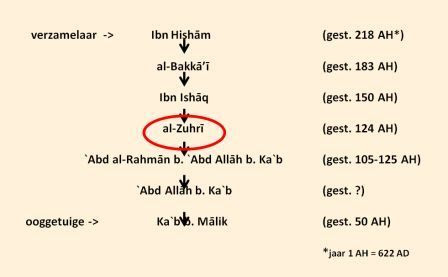 Een van de namen die regelmatig voorkomt in de keten van overleveringen over het leven van de profeet Muhammad, is die van Ibn Shihab al-Zuhri, een beroemde geleerde uit Medina, de woonplaats van de profeet en de tweede heilige stad na Mekka. Al-Zuhri leefde vanaf het laatste kwart van de 7e eeuw tot halverwege de 8e eeuw, wat betekent dat hij zo’n 40 tot 50 jaar na de dood van de profeet Muhammad geboren is. Hij behoorde tot de generatie van de Opvolgers, degenen die geboren zijn na de dood van de profeet en dus zelf geen contact met hem hebben gehad, maar wel overleverden van Muhammad’s metgezellen. Hij had zelf bij een aantal gerenommeerde geleerden uit Mekka en Medina gestudeerd en werkte lange tijd tot aan zijn dood voor een aantal kaliefen van het Umayyadenhof, die het islamitische rijk regeerden van het islamitische jaar 41-132/ ofwel van 661-750 christelijke jaartelling.
 Het plaatje dat ik op de voorkant van mijn proefschrift heb gezet is dus geen afbeelding van hoe al-Zuhri er waarschijnlijk uit zag, maar geeft weer hoe ik al-Zuhri voor me zag, voordat ik me had verdiept in de gegevens over zijn leven. Voor zijn werk voor de Omayyadenkaliefen werden zijn schulden betaald, kreeg hij een geregelde toelage en een landgoed, dus waarschijnlijk zal hij niet op de grond voor een muur hebben gezeten tijdens het overleveren.
Zoals ik al eerder zei is het de vraag of de overleveringen in de latere werken historische gebeurtenissen beschrijven of het beeld weergeven dat latere generaties van hun profeet hadden. Moslimse en niet-moslimse wetenschappers zijn het met elkaar eens dat het overleveringsmateriaal vervalsingen, fouten, tegenstrijdige informatie, verfraaiing van de informatie en dergelijke bevat. In hoeverre is het echter mogelijk om authentiek materiaal van vervalst of gedeeltelijk vervalst materiaal te onderscheiden?
Daarnaast hebben we ook nog te maken met de problematiek van het overleveren zelf. Een verhaal dat overgeleverd wordt van persoon op persoon, hetzij mondeling, hetzij schriftelijk of in combinatie: mondeling op basis van schriftelijke aantekeningen, zal veranderen als het van persoon op persoon wordt overgeleverd. Je kunt dat vergelijken met het doorgeven van een stuk klei. Bij mondelinge overlevering is de klei heel zacht en vervormd makkelijk. De kern blijft hetzelfde zijn, maar de vorm zal anders zijn, zoals andere woorden, andere volgorde van het verhaal. Bij mondelinge overlevering obv aantekeningen heb je te maken met zachte klei met harde stukken erin. De zachte stukken kunnen vervormen, maar de harde stukken, de notities, die opgeschreven woorden, blijven vaak hetzelfde tijdens het overleveren. Bij schriftelijke overlevering, wat hardere klei, zijn er weinig veranderingen, hoewel er een stuk vanaf gehaald kan zijn of er kleine vervormingen in de klei zijn. Bij schriftelijk moet u denken aan het dicteren van een tekst of het controleren van een tekst die een student voorlas aan zijn leraar.
Elke overleveraar zal vingerafdrukken op de klei achterlaten in de vorm van woordjes, stukken tekst, verhaalelementen die alleen bij die overleveraar (en zijn studenten) te vinden zijn. Om te kijken of de overleveringen in de latere werken die aan al-Zuhri zijn toegeschreven, ook echt van hem afkomstig waren, ben ik bij drie verhalenop zoek gegaan naar zijn overleveringsvingerafdrukken. Daarvoor heb ik zoveel mogelijk varianten van dat verhaal verzameld. Ik heb alle ketens van de teksten in een diagram bij elkaar gezet, wat het volgende plaatje oplevert. Ik heb de versies van al-Zuhri’s studenten met elkaar vergeleken. Elke versie had een of meerdere kenmerken die niet bij de andere studenten te vinden waren, van elke student heb ik een overleveringsvingeradruk terug kunnen vinden. De versies van de vier studenten hadden ook veel gemeenschappelijk, wat de gegevens uit de overleveraarsketens bevestigt, want ze zijn allemaal van al-Zuhri afkomstig.
Om te controleren of al-Zuhri zijn overlevering vervolgens ook van de persoon had die hij in de keten als zijn informant aangeeft (de vier namen uit het schema bleken van een en dezelfde persoon te zijn), heb ik al-Zuhri’s versie vergeleken met een of meerdere versies die volgens de overleveraarsketens niet van hem afkomstig waren. Het bleek dat alle drie de verhalen inderdaad van al-Zuhri afkomstig waren en dat alle versies van zijn studenten van elkaar verschilden en karakteristieke overleveringsvingerafdrukken bevatten. Dit betekent dat bewezen is dat al-Zuhri’s studenten het verhaal van hun leraar hadden gekregen en het weer verder overleverd hadden. De versies van de studenten lijken echter zo veel op elkaar dat al-Zuhri hen moet hebben onderwezen op basis van uitgewerkte notitieboeken.
De analyse heeft ook laten zien dat de versie van een student van al- Zuhri, Ma’mar b. Rashid, afweek van die van de andere studenten. De versies van de andere studenten waren meer uitgewerkt dan die van Ma’mar en leken in veel gevallen ook sterk op elkaar. Voorbeelden van uitwerkingen zijn locaties die in Ma’mar’s versie vaag aangeduid zijn, maar in de versies van de andere studenten benoemd. Namen van personen die in Ma’mar’s versie afgekort zijn, zijn bij de anderen volledig vermeld. Bepaalde verhaalelementen zijn wel aanwezig in Ma’mar’s versie, maar over het algemeen genomen niet bij de anderen en vice versa.
De Umayyadenkalief Hisham heeft al-Zuhri waarschijnlijk in zijn laatste decennium ertoe aangezet om een boekwerk voor het hof te maken. Later heeft al-Zuhri ook studenten buiten het hof van de kalief deze boeken laten overschrijven. Andere resultaten waren dat al-Zuhri’s drie overleveringen teruggingen op verhalen uit de tijd rond de eeuwwisseling of eerder en dat hij zijn materiaal bewerkt heeft tussen de tijd dat hij het ontving en de tijd waarin hij het aan zijn studenten ging overleveren, waarbij hij overstapte van aantekeningen voor persoonlijk gebruik tot meer of minder uitgewerkte notitieboeken. Bij hem is een trent waarneembaar om zijn bronnen beter te specificeren en een groeiende belangstelling voor het verband van verhalen over de profeet met Koranverzen en juridische zaken. Langzamerhand ontstaat er zo meer kennis over de ontwikkeling van de biografie van de profeet Muhammad in de tijd voor de grote verzamelingen.
Nicolet Boekhoff (Utrecht, 1970) studeerde Talen en culturen van het Midden-Oosten (specialisatie Islam) aan de Radboud Universiteit Nijmegen. Ze was als junioronderzoeker tussen 2002 en 2008 werkzaam bij de afdeling Arabisch en islam van de Radboud Universiteit Nijmegen. Momenteel is ze docent bij diezelfde afdeling. Dit onderzoek valt onder het programma van het Research Institute for Philosophy, Theology and Religious Studies van de Radboud Universiteit. De tekst van dit stuk is uitgesproken tijdens het zogenaamde lekenpraatje aan het begin van de verdediging van het proefschrift. Afgelopen maandag vond de verdediging plaats. De titel van haar proefschrift is Between history and legend. The biography of the prophet Muhammad by Ibn Shihab al-Zuhri.
Publications 2011 – On Salafism and other tough issues
Posted on January 2nd, 2012 by martijn.
Categories: Headline, Important Publications.
The year 2011 has ended which means making research reports. For our Salafism project at Radboud University Nijmegen, 2011 has been a special year since not only Joas Wagemakers defended his PhD cum laude and prof. Harald Motzki who retired, but it is also the last year of the project. In 2012 a Dutch monograph is planned and several articles will be published. But this is my Dutch and international production of 2011:
Scientific articles (peer-reviewed)
Koning, M. de, Edien Bartels, Oka Storms. (2011). Schadelijke traditionele praktijken en cultureel burgerschap – Integratie, seksualiteit en gender. Tijdschrift voor Genderstudies, 14(1), 35-51.
Koning, M. de. (2011). “Moge Hij onze ogen openen” De radicale utopie van het “salafisme”. Tijdschrift voor Religie, Recht en Beleid, 2(2).
Koning, M. de. (2011). Dialoog en Geloof in Actie. Theologisch Debat, 8(2), 19-26.
Articles (non peer-reviewed / professional)
Koning, M. de. (2011) De transnationale salafiyyahbeweging. Internationale Spectator, 65(10), 516-521.
Bookchapter
De Koning, M. de. (2011). “Melting the heart” Muslim youth in the Netherlands and the Qur’an. In Nicolet Boekhoff-van der Voort, Kees Versteegh and Joas Wagemakers (Eds.) The Transmission and Dynamics of the Textual Sources of Islam. Essays in Honour of Harald Motzki. Leiden: Brill Publishers.
Bartels, E., & De Koning, M. (2011). Submission and a Ritual Murder; The transnational aspects of a local conflict and protest. In T. Salman & M. De Theije (Red.), Local Battles – Global Stakes. The Globalization of Local Conflicts and the Localization of Global Interests (pp. 21-41). Amsterdam: VU University Press.
De Koning, M., & Meijer, R. (2011). Going All the Way: Politicization and Radicalization of the Hofstad Network in the Netherlands. In A. E. Azzi, X. Chryssochoou, B. Klandermans, & B. Simon (Red.), Identity and Participation in Culturally Diverse Societies: A Multidisciplinary Perspective (pp. 220-239). Oxford: Wiley-Blackwell.
Koning, M. de. (2011). Tussen de profeet en het paradijs. De morele ambities van de salafiyyah in Nederland. In Musschenga & B. Siertsema (Red.), Het Kwaad. Reflecties op de zwarte zijde van ons bestaan (pp. 180-191). Vught: Skandalon.
Koning,M. De. (2011) Netherlands. In Yearbook of Muslims in Europe, red. Jorgen Nielsen, Samim Akgönül, Brigitte Maréchal, en Christian Moe, 1:243-257. Leiden: Brill.
Papers
Fields of Authorization – Transnational connections of authority in Salafi networks by Martijn de Koning. MESA conference 2010, San Diego. 1-4 December 2010
Key note lecture: Hello Salafists! – Salafism, authority and the issue of public anthropology. Rabat Spring School. Netherlands Interuniversity School for Islamic Studies (NISIS), Institut d’études de l’Islam et des Sociétés du Mondes Musulmans (IISMM), cooperation with the Institute de recherche pour le développement (IRD), Centre Jacques-Berque (CJB) and Centre Marocain des Sciences Sociales (CM2S). 21-25 March 2011
“God doesn’t look at your nationality” – The Salafi movement and religious and ethnic identity politics of Moroccan-Dutch Muslims in everyday life. Paper presented at Religion and Ethnicity in the age of Globalization: perspectives from Europe and India. Convenors: Francio Guadeloupe and Olga Sezneva, University of Amsterdam, and Fatima Alikhan, Osmania University, Hyderabad. 29-30 September, 2011, Amsterdam.
Genealogy of Authority. Position paper Roundtable MESA 2011, Washington DC. 30 November – 5 December 2011
Popularized
Guestview: Ritual slaughter ban reflects fights over food and faith in the Netherlands, available at Reuters FaithWorld, Religion, faith and ethics.
Misc.
Lecture “Zoeken naar een ‘zuivere’ islam. De religieuze zoektocht van moslimjongeren en de opkomst van de salafiyyah” Lezing voor FMV – Federatie van Marokkaanse Verenigingen, Antwerpen, vrijdag 28 januari.
Lecture Argan Debate Series ‘The final fatwa’, Amsterdam, 16 September 2011
Lecture “Fear and Loathing in Europe. Life after 9/11” Lezing voor ICCT’s expert meeting on Freedom from Fear: Answering Terrorism with Public Resilience, 3 October 2011.
Lecture “Op zoek naar een islamitische lente. Over gematigde en radicale islam en waar het eigenlijk over zou moeteng aan.” Lezing voor Stichting de Christelijke Pers – Trouwberaad. 3 oktober 2011
Debate De Arabische Lente in Egypte met Tarek Osman, Rachid Touhtouh en Evert van der Zweerde. Soeterbeeck Programma Radboud Universiteit en Lux Nijmegen. 13 september 2011
Debate Religieuze diversiteit: niets dan problemen?! Met Hans Janssen, Mohamed Ajouaou en Erik Borgman. Soeterbeeck Programma Radboud Universiteit en Lux Nijmegen. 30 November 2011
Contribution tv-programma ‘9/11 De dag die de wereld veranderde’ Zembla (NTR) Deel 3: ‘Het bange land’, zondag 11 september om 20.15 uur
You can find all my publications at the ‘Publications Page‘. This page has been updated with recent publications and I have added several links where you can download articles and bookchapters.
Going all the way
Posted on November 14th, 2011 by martijn.
Categories: Important Publications.
Martijn de Koning, & Roel Meijer (2010). Going All the Way
Politicization and Radicalization of the Hofstad Network in the Netherlands Identity and Participation in Culturally Diverse Societies DOI: 10.1002/9781444328158.ch11
You can also download it at Academia.edu
Islamoloog Joas Wagemakers krijgt Erasmus studieprijs
Posted on November 9th, 2011 by martijn.
Categories: Important Publications, ISIM/RU Research, Joy Category, Religious and Political Radicalization.
Stichting Praemium Erasmianum kent een studieprijs toe aan het proefschrift van Joas Wagemakers, onderzoeker en docent Islam & Arabisch aan de Radboud Universiteit. Wagemakers promoveerde in november 2010 cum laude op zijn dissertatie over de Jordaanse radicaal-islamitische ideoloog Abu Muhammad al-Maqdisi.
De Stichting Praemium Erasmianum kent jaarlijks maximaal vijf Studieprijzen toe voor bijzondere dissertaties op het gebied van geesteswetenschappen en maatschappij- en gedragswetenschappen. De Studieprijs bestaat uit een geldbedrag van € 3.000 en een oorkonde.
Gematigd-extreme ideoloog
Joas Wagemakers ontvangt de prijs voor zijn proefschrift A Quietist Jihadi-Salafi.The Ideology and Influence of Abu Muhammad al-Maqdisi. Het onderzoek gaat over de ideologie van de Jordaanse radicaal-islamitische Abu Muhammad al-Maqdisi in de context van het salafisme, een stroming binnen de islam. Salafisme wordt doorgaans in drie categorieën verdeeld: het quiëtisme, dat zich op missionaire activiteiten en onderwijs richt en politiek veelal mijdt; het politiek salafisme, dat juist zeer politiek geëngageerd is; en het jihadi-salafisme, dat zich, soms met geweld, tegen de bestaande regimes in de moslimwereld keert omdat deze niet-islamitisch zouden zijn vanwege het feit dat ze de islamitische wetgeving (sharia) niet of niet volledig invoeren. Wagemakers laat zien dat al-Maqdisi zowel in de quiëtistische (gematigde) als de jihadistische (extremistische) categorie thuishoort. Dit verklaart waarom deze ‘gematigde extremist’ in sommige contexten wel en in andere juist niet invloedrijk is geweest.
Breder belang
Belangrijk criterium voor de bekroning van een proefschrift met de Praemium Erasmianum is ‘de casusoverstijgende behandeling van het onderwerp en het bredere belang van het boek voor andere disciplines’, aldus het persbericht. Daarmee wordt, denkt Wagemakers, bedoeld dat zijn proefschrift niet alleen relevant is voor het leven en denken van al-Maqdisi, maar ook voor andere processen van radicalisering. ‘Mijn studie beschrijft hoe radicalisering in z’n werk gaat, hoe tekst en context, Koran en omgeving, elkaar beïnvloeden. Op zich is het geen spectaculaire ontdekking dát dat zo gaat, maar ik heb het wel voor het eerst heel systematisch aangetoond. Mijn proefschrift geeft bovendien een tot dan toe niet verschenen inkijk in de ideologische achtergrond van het salafisme. En het laat zien hoe ideologie – en dat stuk is zeker casusoverstijgend – evolueert.’
Veni
Wagemakers ontving in september een Veni-subsidie van de Nederlandse organisatie voor Wetenschappelijk Onderzoek (NWO) waarmee hij onderzoek gaat doen naar islamitische activisten (sociaal en/of politiek) in Jordanië. Wagemakers is als onderzoeker ook verbonden aan het instituut voor internationale betrekkingen Clingendael.
Uitreiking
De Studieprijzen Praemium Erasmianum worden op donderdag 15 december uitgereikt in Amsterdam.
(Tekst:Anja van Kessel, RU)
Mijn collega en (nog even) kamergenoot aan de Radboud Universiteit heeft eerder een stuk geschreven voor dit blog naar aanleiding van zijn proefschrift over Mohammed al Maqdisi:
The Ideology and Influence of Muhammad al Maqdisi
En hij heeft bijgedragen aan de volgende post over Al Maqdisi:
Het glazen huis – Al Maqdisi Jihadi Controverse en nieuwe publicatie
Een 'Europese' Islam
Posted on October 26th, 2011 by martijn.
Categories: Important Publications, ISIM/RU Research, Religious and Political Radicalization.
Het tijdschrift Internationale Spectator van Instituut Clingendael heeft een themanummer over ‘Europese’ Islam.
Inhoud:
Maurits Berger – Islamisering van het Westen, of verwesterlijking van de islam? (SUMMARY [EN]) Oktober 2011 – 65(10), p.503-507 – (129 Kb)
Niek Biegman, Soefisme als Politieke Factor (SUMMARY [EN])
Oktober 2011 – 65(10), p.508-511 -(abonnees)
Roel Meijer, De Moslim Broederschap in Europa (SUMMARY [EN])
Oktober 2011 – 65(10), p.512-515 – (99 Kb)
Inez Schippers, De Gülenbeweging: Turkse islam met twee gezichten (SUMMARY [EN]) Oktober 2011 – 65(10), p.521-524 -(abonnees)
Eelko Hooijmaajers, Tussen Tanzimat en Koran: Modernisering en islamisme in het Ottomaanse Rijk (SUMMARY [EN]) Oktober 2011 – 65(10), p.525-529 -(abonnees)
Martijn de Koning, De Transnationale Salafiyyahbeweging
(SUMMARY [EN]) Oktober 2011 – 65(10), p.516-520 -(abonnees)
Mijn artikel is hier te downloaden:
Engelse samenvatting
De transnationale salafiyyahbeweging
Martijn de Koning elaborates the Salafiyyah movement, an Islamic movement that aims to revitalize Islam based upon the utopian ideal of the prophet Muhammad and his companions. The author explores how the Salafiyyah movement consists of transnational social fields: net-works of networks where people, ideas, means and identities meet. First it is shown how international migration has made it possible to establish local Salafiyyah networks in the Netherlands and how in turn Dutch Salafiyyah Muslims use the transnational networks. Secondly the focus is on transnational debates about the nature of Islam in Europe and how these debates informed the fragmentation of the Dutch networks. The author subsequently shows how people create a sense of belonging to the transnational Salafiyyah movement. While the transnational dimension of the Salafiyyah runs counter to current integration policies, for the Salafiyyah movement the interplay between local and transnational networks is essential for the establishment of a global movement.
Download artikel HIER.
De PDF van dit artikel is met toestemming van de redactie overgenomen uit de Internationale Spectator, maandblad voor Internationale politiek, uitgegeven door de Koninklijke Van Gorcum te Assen namens het Nederlands Instituut voor Internationale Betrekkingen Clingendael te Den Haag.
Een ‘Europese’ Islam
Posted on October 26th, 2011 by martijn.
Categories: Important Publications, ISIM/RU Research, Religious and Political Radicalization.
Het tijdschrift Internationale Spectator van Instituut Clingendael heeft een themanummer over ‘Europese’ Islam.
Inhoud:
Maurits Berger – Islamisering van het Westen, of verwesterlijking van de islam? (SUMMARY [EN]) Oktober 2011 – 65(10), p.503-507 – (129 Kb)
Niek Biegman, Soefisme als Politieke Factor (SUMMARY [EN])
Oktober 2011 – 65(10), p.508-511 -(abonnees)
Roel Meijer, De Moslim Broederschap in Europa (SUMMARY [EN])
Oktober 2011 – 65(10), p.512-515 – (99 Kb)
Inez Schippers, De Gülenbeweging: Turkse islam met twee gezichten (SUMMARY [EN]) Oktober 2011 – 65(10), p.521-524 -(abonnees)
Eelko Hooijmaajers, Tussen Tanzimat en Koran: Modernisering en islamisme in het Ottomaanse Rijk (SUMMARY [EN]) Oktober 2011 – 65(10), p.525-529 -(abonnees)
Martijn de Koning, De Transnationale Salafiyyahbeweging
(SUMMARY [EN]) Oktober 2011 – 65(10), p.516-520 -(abonnees)
Mijn artikel is hier te downloaden:
Engelse samenvatting
De transnationale salafiyyahbeweging
Martijn de Koning elaborates the Salafiyyah movement, an Islamic movement that aims to revitalize Islam based upon the utopian ideal of the prophet Muhammad and his companions. The author explores how the Salafiyyah movement consists of transnational social fields: net-works of networks where people, ideas, means and identities meet. First it is shown how international migration has made it possible to establish local Salafiyyah networks in the Netherlands and how in turn Dutch Salafiyyah Muslims use the transnational networks. Secondly the focus is on transnational debates about the nature of Islam in Europe and how these debates informed the fragmentation of the Dutch networks. The author subsequently shows how people create a sense of belonging to the transnational Salafiyyah movement. While the transnational dimension of the Salafiyyah runs counter to current integration policies, for the Salafiyyah movement the interplay between local and transnational networks is essential for the establishment of a global movement.
Download artikel HIER.
Veilige religie of religieuze vrijheid
Posted on September 20th, 2011 by martijn.
Categories: Important Publications, ISIM/RU Research, Religion Other, Religious and Political Radicalization.
Het wetenschappelijke tijdschrift voorReligie, Recht en Beleid heeft een themanummer over de relatie tussen religie en (gevoelens van) veiligheid. In dit themanummer, onder redactie van Beatrice de Graaf en Sipco Vellenga.
Aflevering 2, juli 2011
Redactioneel
Veilige religie, of religieuze veiligheid?
Trefwoorden: Editorial, Religion, Safety
Auteurs Maurits BergerReligie en Onveiligheid
Trefwoorden: Editorial, Religion, Safety
Auteurs Beatrice de Graaf en Sipco VellengaReligieuze orthodoxie als bedreiging – Verschuivingen in het publieke debat
Trefwoorden: public debate, religious orthodoxy, religion and violence
Auteurs Sipco VellengaReligie, criminaliteit en geweld: ambivalente bevindingen
Trefwoorden: religious commitment, fundamentalism, muslim-radicalism, crime, violence, prevention
Auteurs Bas van StokkomWanneer religie niet aan onze kant staat – Een cultuurpsychologische analyse van angst voor religie
Trefwoorden: religion, fear, cultural psychology, agency
Auteurs Mark Dechesne‘Moge Hij onze ogen openen’ – De radicale utopie van het ‘salafisme’
Trefwoorden: salafism, social movements, radicalisation, muslims
Auteurs Martijn de KoningReligion bites: religieuze orthodoxie op de nationale veiligheidsagenda
Trefwoorden: securitization, terrorism, securitization-framework, salafism
Auteurs Beatrice de GraafDiscussie: Drie visies op de relatie tussen religie en veiligheidsbeleid
Verslag van de expertmeeting ‘Angst voor religie?’ van de Commissie Religie in het Publieke Domein, 23 juni 2010, Den Haag
Trefwoorden government, safety policy, religious orthodoxy, counternarratives
Auteurs Ernst Hirsch Ballin, Peter Knoope en James KennedyReligie, veiligheid en de gedaanteverandering van religie
Trefwoorden: religious transformation, religion and safety, religion and lifestyle
Auteurs Erik BorgmanJurisprudentie
Het afdwingen van een islamitische verstoting
Trefwoorden: case law, divorce, Pakistan
Auteurs Maurits BergerKruisbeelden op openbare scholen in Italië (II)
De uitspraak van de Grand Chamber van het Europese Hof voor de Rechten van de Mens
Trefwoorden: case law, religion, Italy
Auteurs Carla Zoethout
Dit themanummer is het resultaat van een expert-meeting over religie en (on-)veiligheid georganiseerd door Forum. In mijn bijdrage probeer ik een kader te bieden dat een alternatief is voor bestaande radicaliseringsperspectieven op islam en op ‘salafisme’ in het bijzonder. Ik richt me daarbij in het bijzonder op het proces van betekenisgeving en laat zien dat veel praktijken van de ‘salafi’ beweging niet per definitie problematisch hoeven te zijn, maar vooral gericht zijn op het bieden van een alternatieve visie op de wereld hen heen en op het reorganiseren van het dagelijks leven van de participanten. Dit gebeurt dan wel op zo’n manier dat ze op gespannen voet kunnen staan met de visie van de Nederlandse staat op goed burgerschap dat sinds 9/11 steeds meer in het teken is komen te staan van veiligheid, seculiere en sexuele vrijheden.
U vindt meer informatie hier: 2 2011 · Tijdschrift voor Religie, Recht en Beleid · BJu Tijdschriften
New Book: Local Battles- Global Stakes
Posted on July 5th, 2011 by martijn.
Categories: anthropology, Important Publications, ISIM/RU Research, My Research, Religious and Political Radicalization, Young Muslims.
 Together with my colleague Edien Bartels I have written a chapter called Submission and a Ritual Murder; The transnational aspects of a local conflict and protest in a volume edited by my colleagues of VU University Amsterdam: Ton Salman and Marjo de Theije.
In this volume Local Battles, Global Stakes. The Globalization of Local Conflicts and the Localization of Global Interests the authors challenge the often held assumption with regard to conflicts around the world that ‘the local’ and ‘the global’ are clearly distinct realms. This is most clearly brought out in phrases about ‘local responses’ to ‘global change’. This book addresses a wealth of cases from around the world that illustrate how local tensions, frictions and open conflicts are not only influenced by outside actors, but how local parties proactively seek to insert their interests in global discourses, if only to strengthen their legitimacy.
This compilation covers issues ranging from religious contentions, ethical controversies, ethnic clashes, and environmental issues in Asia, Latin America, Africa and Europe. Geo-political interference from outside players, material and immaterial support from diasporas, international media articulation of the conflict’s stakes, and international religious proselytising, all co-constitute local disputes. This book shows how local strife is often situated in and shaped by broader political and other contexts.
This book is meant for all scholars and students interested in the real and tangible effects of globalization processes, in particular for anthropologists, political scientists, sociologists and scholars interested in international dimensions of environmental issues, religion, ethnicity and gender.
Part One: Global Religions, Local Battles
2
Edien Bartels and Martijn de Koning, abstract
Submission and a Ritual Murder; The transnational aspects of a local conflict and protest
On 2 November 2004, Theo van Gogh, a Dutch columnist, filmmaker and producer of the film Submission was murdered in Amsterdam by a Moroccan-Dutch Muslim. However in order to understand the significance of the film Submission and the murder of its producer, Theo van Gogh, we should look beyond these local and national frames, and beyond the local significance of this conflict. In this chapter we will show how a transnational take on both topics, the film Submission and the murder of Theo van Gogh, can contribute to a better understanding of how and why these local events occurred.
Keywords: Islam, identity, Muslim youth, terrorism, liberalism.
3
Oscar Salemink, abstract
Changing rights and wrongs: The transnational construction of indigenous and human rights among Vietnam’s Central Highlanders
In the context of Vietnam’s Central Highlanders’ conflict-ridden relationship with the Vietnamese state and the growing transnational interference by their vociferous diaspora, this paper analyzes particular shifts in the framing of their rights. A notion of collective group rights that are by definition particularistic and exclusive has given way to individual rights (especially religious freedom) that are universal and inclusive. Simultaneously, a localized and communal emphasis has changed to a transnational one oriented toward international fora. Local interests and aspirations thus come to be framed as universal human rights that pertain to individuals, rather than local rights that pertain to collectives. In this light, recent attempts to theorize minority or indigenous rights appear to be ineffective and will probably be counter-productive.
Keywords: Ethnicity, Human Rights, indigenous rights, Religion, transnationalism.
4
Marjo de Theije, abstract
Local protest and transnational Catholicism in Brazil
Based on research in Brazil, the author discusses three local situations of conflict and social protest, using a transnational perspective. She concentrates on the use of universal claims of Catholicism in local negotiations of religious change under the influence of different cultural campaigns. The clashes in question are divided into those involving local political problems and those concerning the religious domain itself. The analysis shows that in each of the cases–albeit with different intensity and outcome–the interconnection between translocal processes and the meaning and experience of locality has a significant role in the power plays and the formulations of religious or social protest in the local context.
Keywords: Brazil, Catholicism, local, protest, transnational.
Part Two: Family Values, Gendered Morals, Contested Ethics
5
Claudia Fonseca, abstract
Protest Against Adoption in Brazil: A “Global” Presence in “Local” Matters
As we trace the processes that have influenced the recent evolution of child placement policies in Brazil – from plenary adoption and foster care to family preservation – we observe how these technologies of government, designed to smooth over disputes involving issues of class and nationality, combine “external” with national inputs. Relevant actors range from international celebrities to local specialists (social workers, NGO volunteers, and judicial officials) and journalists who may themselves circulate through international decision-making sites. Finally, the inclusion in our analysis of the role and understandings of birth families – politically, the bottom rung in adoption procedures — leads to the hypothesis that strategic alliances between local and international protest movements may exert an influence in the formation of national policies that may, at least momentarily, perturb traditional hierarchies of power.
Keywords: Technologies of government, transnational adoption, protest movements, child rights, global assemblages.
6
Pinkaew Laungaramsri, abstract
Imagining nation: Women’s rights and the transnational movement of Shan women in Thailand and Burma
This article explores the relationship between women, nation, nationalism, and transnational women’s practice through the Shan women’s movement in Thailand, particularly the international campaign to stop the systematic rape of Shan women by Burmese soldiers. Employing a feminist critique of nationalism, the article argues that transnational networks allow for the negotiation between national, local, and women’s identities. Whereas the authoritative power of nationalism continues to suppress and silence the transnational subjectivity of women, the Shan women’s movement represents a transnational attempt to contest the confinement of women’s subjectivities within the territorialized nation-state.
Keywords: gender, nation, rape, refugees, transnationalism.
7
Halleh Ghorashi and Nayereh Tavakoli, abstract
Paradoxes of transnational space and local activism: Iranians organizing across borders
The Iranian revolution of 1979 promised to bring freedom and equality, but as soon as one group gained power, it turned out to be oppressive of both its political opposition and women. This resulted in the formation of a large Iranian diaspora bound together by its hatred for the Iranian regime. Years of suppression in the 1980s in Iran resulted in a deep gap between Iranians living inside and outside Iran. During the 1990s, however, cross-border relationships started to change as a result of two major factors: transnational activities and the influence of cyberspace. This paper focuses on the paradoxes of transnational connections in local protest with a focus on the women’s movement. We show both how transnational links have empowered women activists in Iran and how they have led to new dangers at the local level. We also reveal how support from the Iranian diaspora can be patronizing as well as supportive.
Keywords: cyberspace, Iranian diaspora, Iranian revolution, Iranian women’s movement, Iranian Women’s Studies Foundation.
8
Martha Cecilia Ruiz and Lorraine Nencel, abstract
Sex Work(er): The struggles of a global concept
This chapter aims to trace the travels of the global concept sex work(er). This political concept is globally used by women working in the sex industry to organize and fight for rights and social respect. It is also a concept challenging past and present discourses on “sexual slavery”. We focus on the global and local struggles of the concept in regard to its acceptance and incorporation in global and local discourse. For this objective we frame this chapter in a theoretical approach built on the ideas of travelling theories; a framework offered as an alternative to the cultural imperialism critique of global feminism. Travelling theories recognizes the interconnectedness of the global and local but does not assume that the concepts are imposed and/or imitated when they reach their local destination. To illustrate how the concept sex work(er) has circualted not only from North to South but also within the South, we elaborate on a particular case, the Sex Workers Movement of Machala, Ecuador – one of the earliest founded organizations on the Latin American continent.
Keywords: Sexwork(er), transnational migration, travelling theories.
Part Three: Belonging Amidst Scattered Boundaries / Global Ammunition, Local Essentialisms
9
Karsten Paerregaard, abstract
Transnational crossfire: Local, national and global conflicts in Peruvian migration
This chapter argues that globalization processes are shaped by friction and exclusion as much as fluidity and inclusion and that conflict therefore is integral parts of population movements, especially when this evolves in a transnational context. By applying a transnational approach the chapter brings to the fore how tensions are negotiated, contested and reinterpreted not merely in a local but also in a regional, national and international context. More specifically, it examines the transnational network of Peruvian migrants who work as sheepherders in the United States and examines the conflicts that this migration practice generates in both Peru and the United States. The chapter concludes that the tensions that occur on the sheep ranches not only cause a divide within the migrant community itself but also trigger a political crisis on a national level in Peru and an international strife between Peru and the United States.
Keywords: transnational, sheepherders, conflict, Peru, United States.
10
Lenie Brouwer, abstract
Jokes, raps and transnational orientations – Protests of Dutch-Moroccan youths in the Debate on Islam
Islam is today one of the most discussed topics in Dutch national newspapers and internet discussion groups. In this public debate the Muslim-voice is underrepresented, more in particular, the views of Muslim youngsters. The polarised debate and the current policy measures deepens the division between non-Muslims and Muslims, between ‘us’ and ‘them’, and fosters the highlighting of one specific identity that seems best suited to counter the accusations: that of being a Muslim. This makes Islam more attractive as a vehicle to reject all these accusations. The reactions of young Muslims or Dutch Moroccans are analysed in a media-technology context, a computer clubhouse in Amsterdam and Moroccan websites. It is argued that Dutch Moroccan youths perceive Islam more and more as an appealing religion, as a motive of pride, in response to the negative image of Islam and the social exclusion of Muslims in the West.
Keywords: Islam, Muslim youth, the Netherlands, media-technology, religious identity.
11
Ellen Bal and Kathinka Sinha-Kerkhoff, abstract
British Indians in colonial India and Surinam: transnational identification and estrangement
The authors present a case study of Indian nationalists who drew from a discourse on ‘exploited overseas Indian migrants’ to serve their own political interests. At the same time, overseas British Indians, in this case in Surinam, advocated the continuation of transnational relations between (British) India and Surinam in order to strengthen the position of their community locally. Clearly, for some time, transnational identification served the (national) interests of both groups in the two different nations. Yet, the authors also show that when such transnational ‘solutions’ did not serve any longer to solve local problems, estrangement between the two communities followed. Theoretically, this article constitutes a synthesis of approaches that connect identities to specific places and theories that have abandoned the study of geographically-based national societies. It demonstrates how the politics of place is dominant even within the field of transnational alliances.
Keywords: estrangement, identity politics, overseas Indians, place, transnational identification.
12
Ton Salman, abstract
Narrow margins, stern sovereignty: Juxtaposing transnational and local features of Bolivia’s crisis
This article argues that the current Bolivian political crisis is ‘made’ both internally and abroad. Yet it is much more than a simple adding up of the two constituent factors: external influences are always mediated by local actors. Local actors turn these influences into meaningful issues and demands in the Bolivian political context. These actors, in turn, are co-constituted by external forces, as is the case with the prominent indigenous movements in the country: their self-awareness and identity politics in part depend upon support and discourses of a transnational nature. The fact that these indigenous movements insist on sovereignty and self-determination with regard to the use of Bolivia’s natural resources is a case in point. This demand, at the same time, is articulated in a setting in which this sovereignty suffers from tightening margins due to the external obligation to restructure both the state and the economy.
Keywords: crisis of democracy, neo-liberalism, political protest, transnationalism.
13
Folkje Lips, abstract
Stretching the margins of tolerated criticism: Using non-Cuban music in local protest
This article presents music in Cuba as being more than just a sound and Cuban musicians as being more than mere entertainers. By choosing foreign music-genres as identity-markers, Cuban musicians and their audience express a critical awareness about their socio-political reality. Depending on the extent to which they want to employ this awareness to influence local concepts of society and politics, they modify and adapt their music to fit Cubaneity. Although critical awareness is not something the Cuban government will normally allow to be displayed, these musicians seem to enjoy some leeway. By examining two transnational musical genres, hip-hop and rock music, this article shows two different ways to find and widen the boundaries of the admissible in Cuba.
Keywords: Cuba, Cubaneity, Hip-hop, Rock, Protest, State-control.
Part Four: The Contested Ground of Environmental Values
14
Marja Spierenburg, Conrad Steenkamp, and Harry Wels, abstract
Resistance of local communities against marginalization in the Great Limpopo Transfrontier Conservation Area
The Great Limpopo is one of the largest Transfrontier Conservation Areas (TFCA) in the world, encompassing vast areas in South Africa, Zimbabwe, and Mozambique. The TFCA concept is embraced by practically all (international) conservation agencies. The rationale for the support is that the boundaries of ecosystems generally do not overlap with those of the nation-state. Their protection requires transnational cooperation. By arguing that local communities living in or close to TFCAs will participate and benefit economically, TFCA proponents claim social legitimacy for the project. However, analysis shows that communities first have to live up to rigid standards and requirements set by the international conservation authorities, before they are considered ‘fit’ to participate. Communities attempt to resist this type of marginalization by forming alliances with (inter)national development and human rights NGOs, with mixed results.
Keywords: NGOs, resistance, sustainable development, transfrontier conservation, transnationalism.
15
Julia M. Wittmayer and Bram Büscher, abstract
Conserving conflict? Transfrontier conservation, development discourses and local conflict between South Africa and Lesotho
Since the early 1980s, South Africa and Lesotho have tried to find ways to jointly conserve the Maloti-Drakensberg mountain ecosystem that runs across their shared boundary. Recently, the countries completed the first phase of the ‘Maloti-Drakensberg transfrontier conservation and development project’ (MDTP) that besides conservation aims to reduce poverty through ecotourism and increase international cooperation. This chapter describes and analyses how discourses of conservation and development in the project both cement and complicate transnational relations and how these in turn articulate with, shape and are shaped by ‘the local’. The ‘local’ in Lesotho, in turn, can never be understood without drawing South Africa into the equation, for one because of the many Basotho that have always worked in South African mines, so providing their families with crucial livelihood support. Recently, however, massive retrenchments have forced numerous Basotho men to return to their families and try to again fit in locally. Focussing on the people living around the north-eastern boundary of Lesotho, we show how conflictual situations put the spotlight on the ways in which ‘the local’ in Lesotho deals with dual forces of localisation and transnationalisation. We argue that local people accommodate, even appropriate, these dual pressures by adopted an increasingly flexible stance in terms of identity, alliances and discourses. This in turn allows them to increase their livelihood options. In contrast, by being more focused on the level of discourse rather than these contradicting dynamics on the local level, the MDTP intervention planners, have decreased the likelihood of attaining their objectives.
Keywords: Conflicts, Transfrontier Conservation, development, South Africa, Lesotho.
The book can be ordered at VU University Publishers € 39,95 or at internet bookstores
Theologisch debat – Dialoog en geloof in actie
Posted on June 15th, 2011 by martijn.
Categories: [Online] Publications, Important Publications, ISIM/RU Research, Multiculti Issues.
Het tijdschrift Theologisch Debat doet haar naam eer aan en heeft een debatsectie; ditmaal over interreligieuze dialoog. De opening wordt verzorgd door kersverse hoogleraar interreligieuze dialoog Marcel Poorthuis. Andere artikelen zijn van Gé Speelman (Een integere en respectvolle dialoog – Opmerkingen bij de Islamnota van de PKN), Bernhard Reitsma (Wat er achter de dialoog schuil gaat) en van uw blogger en antropoloog: Dialoog en Geloof in Actie.
Inleiding
In zijn artikel gaat Marcel Poorthuis in op het ‘eigene van de dialoog tussen godsdiensten’. Volgens Poorthuis zijn mensen weliswaar door de secularisatie ‘vervreemd van hun eigen religie en kerk’, maar dat betekent niet dat er geen belangstelling is voor religie. Die belangstelling kenmerkt zich echter door een hoog knip- en plakgehalte waarbij mensen hun eigen religieuze repertoire van voorstellingen en praktijken in elkaar zetten zonder oog voor de tradities en zonder enig gevoel voor de sociale verbanden van het jodendom, christendom en islam. Deze postmoderne houding zoals hij dit noemt bedreigt de interreligieuze dialoog. Gé Speelman heeft in dit nummer hier al uitstekend commentaar opgeleverd. Ik ga in mijn bijdrage in op de andere hindernis voor religieuze dialoog die Poorthuis ziet: fundamentalisme. Volgens hem is fundamentalisme het tegendeel van dialoog om dat ‘de ander daarin louter als ketter en vijand verschijnt, zonder enige verwantschap’.
Wat ik wil betogen is dat Poorthuis er een heel specifiek religiebegrip op na houdt dat heel gesloten is doordat het uitgaat van de vraag tot welke religie mensen zich rekenen en welke bijbehorende geloofsvoorstellingen mensen hebben. De vragen hoe mensen geloven en waarin mensen geloven komt niet aan de orde. Daardoor mist hij dat de waarde van interreligieuze dialoog (in het algemeen) niet ligt in uitwisselingen over religieuze doctrines, religieuze overtuigingen en geschiedenis, maar, zo betoog ik hier, in sociale relaties. En daar zouden zelfs fundamentalisten een rol in kunnen spelen. Allereerst zal ik verder ingaan op het specifieke religiebegrip van Poorthuis. Om dit verder te concretiseren geef ik vervolgens een korte schets geven van de activiteiten onder moslims met betrekking tot interreligieuze dialoog waarna ik aan de hand van voorbeelden in Gouda en Roermond me richt op de vraag wat interreligieuze dialoog te maken heeft met hoe mensen geloven en meer specifiek met hoe fundamentalisten ( salafisten’) geloven.
Theologisch Debat wordt uitgegeven door Uitgeverij Kok en zit tegenwoordig ook op twitter: Theologisch Debat.
De bijdrage van Poorthuis is gebaseerd op zijn oratie die u HIER kunt lezen. Op Republiek Allochtonië een verkorte weergave van die oratie: Dialoog tussen de religies: toekomst of verleden tijd?