Headline
You are looking at posts in the category Headline.
| M | T | W | T | F | S | S |
|---|---|---|---|---|---|---|
| « Sep | ||||||
| 1 | 2 | 3 | 4 | |||
| 5 | 6 | 7 | 8 | 9 | 10 | 11 |
| 12 | 13 | 14 | 15 | 16 | 17 | 18 |
| 19 | 20 | 21 | 22 | 23 | 24 | 25 |
| 26 | 27 | 28 | 29 | 30 | 31 | |
Pages
- About
- C L O S E R moves to….C L O S E R
- Contact Me
- Interventions – Forces that Bind or Divide
- ISIM Review via Closer
- Publications
- Research
Categories
- (Upcoming) Events (33)
- [Online] Publications (26)
- Activism (117)
- anthropology (113)
- Method (13)
- Arts & culture (88)
- Asides (2)
- Blind Horses (33)
- Blogosphere (192)
- Burgerschapserie 2010 (50)
- Citizenship Carnival (5)
- Dudok (1)
- Featured (5)
- Gender, Kinship & Marriage Issues (265)
- Gouda Issues (91)
- Guest authors (58)
- Headline (76)
- Important Publications (159)
- Internal Debates (275)
- International Terrorism (437)
- ISIM Leiden (5)
- ISIM Research II (4)
- ISIM/RU Research (171)
- Islam in European History (2)
- Islam in the Netherlands (219)
- Islamnews (56)
- islamophobia (59)
- Joy Category (56)
- Marriage (1)
- Misc. News (891)
- Morocco (70)
- Multiculti Issues (749)
- Murder on theo Van Gogh and related issues (326)
- My Research (118)
- Notes from the Field (82)
- Panoptic Surveillance (4)
- Public Islam (244)
- Religion Other (109)
- Religious and Political Radicalization (635)
- Religious Movements (54)
- Research International (55)
- Research Tools (3)
- Ritual and Religious Experience (58)
- Society & Politics in the Middle East (159)
- Some personal considerations (146)
- Deep in the woods… (18)
- Stadsdebat Rotterdam (3)
- State of Science (5)
- Twitwa (5)
- Uncategorized (74)
- Young Muslims (459)
- Youth culture (as a practice) (157)
General
- ‘In the name of Allah, Most Gracious, Most Merciful’
- – Lotfi Haddi –
- …Kelaat Mgouna…….Ait Ouarchdik…
- ::–}{Nour Al-Islam}{–::
- Al-islam.nl De ware godsdienst voor Allah is de Islam
- Allah Is In The House
- Almaas
- amanullah.org
- Amr Khaled Official Website
- An Islam start page and Islamic search engine – Musalman.com
- arabesque.web-log.nl
- As-Siraat.net
- assadaaka.tk
- Assembley for the Protection of Hijab
- Authentieke Kennis
- Azaytouna – Meknes Azaytouna
- berichten over allochtonen in nederland – web-log.nl
- Bladi.net : Le Portail de la diaspora marocaine
- Bnai Avraham
- BrechtjesBlogje
- Classical Values
- De islam
- DimaDima.nl / De ware godsdienst? bij allah is de islam
- emel – the muslim lifestyle magazine
- Ethnically Incorrect
- fernaci
- Free Muslim Coalition Against Terrorism
- Frontaal Naakt. Ongesluierde opinies, interviews & achtergronden
- Hedendaagse wetenswaardigheden…
- History News Network
- Homepage Al Nisa
- hoofddoek.tk – Een hoofddoek, je goed recht?
- IMRA: International Muslima Rights Association
- Informed Comment
- Insight to Religions
- Instapundit.com
- Interesting Times
- Intro van Abdullah Biesheuvel
- islaam
- Islam Ijtihad World Politics Religion Liberal Islam Muslim Quran Islam in America
- Islam Ijtihad World Politics Religion Liberal Islam Muslim Quran Islam in America
- Islam Website: Islam, Islamic Studies, Arabic, Religion
- Islamforum
- Islamic Philosophy Online
- Islamica Magazine
- islamicate
- Islamophobia Watch
- Islamsevrouw.web-log.nl
- Islamwereld-alles wat je over de Islam wil weten…
- Jihad: War, Terrorism, and Peace in Islam
- JPilot Chat Room
- Madrid11.net
- Marocstart.nl – De marokkaanse startpagina!
- Maryams.Net – Muslim Women and their Islam
- Michel
- Modern Muslima.com
- Moslimjongeren Amsterdam
- Moslimjongeren.nl
- Muslim Peace Fellowship
- Muslim WakeUp! Sex & The Umma
- Muslimah Connection
- Muslims Against Terrorism (MAT)
- Mutma’inaa
- namira
- Otowi!
- Ramadan.NL
- Religion, World Religions, Comparative Religion – Just the facts on the world\’s religions.
- Ryan
- Sahabah
- Salafi Start Siden – The Salafi Start Page
- seifoullah.tk
- Sheikh Abd al Qadir Jilani Home Page
- Sidi Ahmed Ibn Mustafa Al Alawi Radhiya Allahu T’aala ‘Anhu (Islam, tasawuf – Sufism – Soufisme)
- Stichting Vangnet
- Storiesofmalika.web-log.nl
- Support Sanity – Israel / Palestine
- Tekenen van Allah\’s Bestaan op en in ons Lichaam
- Terrorism Unveiled
- The Coffee House | TPMCafe
- The Inter Faith Network for the UK
- The Ni’ma Foundation
- The Traveller’s Souk
- The \’Hofstad\’ terrorism trial – developments
- Thoughts & Readings
- Uitgeverij Momtazah | Helmond
- Un-veiled.net || Un-veiled Reflections
- Watan.nl
- Welkom bij Islamic webservices
- Welkom bij vangnet. De site voor islamitische jongeren!
- welkom moslim en niet moslims
- Yabiladi Maroc – Portail des Marocains dans le Monde
Dutch [Muslims] Blogs
- Hedendaagse wetenswaardigheden…
- Abdelhakim.nl
- Abdellah.nl
- Abdulwadud.web-log.nl
- Abou Jabir – web-log.nl
- Abu Bakker
- Abu Marwan Media Publikaties
- Acta Academica Tijdschrift voor Islam en Dialoog
- Ahamdoellilah – web-log.nl
- Ahlu Soennah – Abou Yunus
- Ahlul Hadeeth
- Ahlul Hadeeth
- Al Moudjahideen
- Al-Adzaan
- Al-Islaam: Bismilaahi Rahmaani Rahiem
- Alesha
- Alfeth.com
- Anoniempje.web-log.nl
- Ansaar at-Tawheed
- At-Tibyan Nederland
- beni-said.tk
- Blog van moemina3 – Skyrock.com
- bouchra
- CyberDjihad
- DE SCHRIJVENDE MOSLIMS
- DE VROLIJKE MOSLIM ;)
- Dewereldwachtopmij.web-log.nl
- Dien~oel~Islaam
- Eali.web-log.nl
- Een genade voor de werelden
- Enige wapen tegen de Waarheid is de leugen…
- ErTaN
- ewa
- Ezel & Os v2
- Gizoh.tk [.::De Site Voor Jou::.]
- Grappige, wijze verhalen van Nasreddin Hodja. Turkse humor.
- Hanifa Lillah
- hayya~ala~assalaah!
- Het laatste nieuws lees je als eerst op Maroc-Media
- Homow Universalizzz
- Ibn al-Qayyim
- IslaamLive Mail
- IslaamLive Mail
- Islam Blog – Juli 2007
- Islam in het Nieuws – web-log.nl
- Islam, een religie
- Islam, een religie
- Islamic Sisters – web-log.nl
- Islamiway’s Weblog
- Islamtawheed’s Blog
- Jihaad
- Jihad
- Journalista
- La Hawla Wa La Quwatta Illa Billah
- M O S L I M J O N G E R E N
- M.J.Ede – Moslimjongeren Ede
- Mahdi\’s Weblog | Vrijheid en het vrije woord | punt.nl: Je eigen gratis weblog, gratis fotoalbum, webmail, startpagina enz
- Maktab.nl (Zawaj – islamitische trouwsite)
- Marocdream.nl – Home
- Marokkaanse.web-log.nl
- Marokkanen Weblog
- Master Soul
- Miboon
- Miesjelle.web-log.nl
- Mijn Schatjes
- Moaz
- moeminway – web-log.nl
- Moslima_Y – web-log.nl
- mosta3inabilaah – web-log.nl
- Muhaajir in islamitisch Zuid-Oost Azië
- Mumin al-Bayda (English)
- Mustafa786.web-log.nl
- Oprecht – Poort tot de kennis
- Said.nl
- saifullah.nl – Jihad al-Haq begint hier!
- Salaam Aleikum
- Sayfoudien – web-log.nl
- soebhanAllah
- Soerah19.web-log.nl – web-log.nl
- Steun Palestina
- Stichting Moslimanetwerk
- Stories of Malika
- supermaroc
- Ummah Nieuws – web-log.nl
- Volkskrant Weblog — Alib Bondon
- Volkskrant Weblog — Moslima Journalista
- Vraag en antwoord…
- wat is Islam
- Wat is islam?
- Weblog – a la Maroc style
- website van Jamal
- Wij Blijven Hier
- Wij Blijven Hier
- www.BenAyad.be – Islam en Actua
- www.moslima.web-log.nl
- Yakini Time
- Youth Of Islam
- Youth Of Islam
- [fikra]
Non-Dutch Muslims Blogs
- Lanallah __Islamic BlogZine__
- This journey ends but only with The Beginning
- ‘the middle place’
- …Never Judge a Person By His or Her Blog…
- …under the tree…
- A Comment on PMUNA
- A Dervish’s Du`a’
- A Family in Baghdad
- A Garden of Children
- A Muslim Mother’s Thoughts / Islamic Parenting
- A Struggle in Uncertainty, Such is Life
- About Afghanistan
- adnan.org: good design, bad idea
- Afiyah
- Ahmeds World of Islam
- Al Musawwir
- Al-Musharaka
- Almiraya tBLOG – O, happy the soul that saw its own faults
- Almusawwir
- an open window
- Anak Alam
- aNaRcHo AkBaR
- Anthology
- AnthroGal’s World
- Arabian Passion
- ArRihla
- Articles Blog
- Asylum Seeker
- avari-nameh
- Baghdad Burning
- Being Noor Javed
- Bismillah
- bloggin’ muslimz.. Linking Muslim bloggers around the globe
- Blogging Islamic Perspective
- Chapati Mystery
- City of Brass – Principled pragmatism at the maghrib of one age, the fajr of another
- COUNTERCOLUMN: All Your Bias Are Belong to Us
- d i z z y l i m i t s . c o m >> muslim sisters united w e b r i n g
- Dar-al-Masnavi
- Day in the life of an American Muslim Woman
- Don’t Shoot!…
- eat-halal guy
- Eye on Gay Muslims
- Eye on Gay Muslims
- Figuring it all out for nearly one quarter of a century
- Free Alaa!
- Friends, Romans, Countrymen…. lend me 5 bux!
- From Peer to Peer ~ A Weblog about P2P File & Idea Sharing and More…
- Ghost of a flea
- Ginny’s Thoughts and Things
- God, Faith, and a Pen: The Official Blog of Dr. Hesham A. Hassaballa
- Golublog
- Green Data
- gulfreporter
- Hadeeth Blog
- Hadouta
- Hello from the land of the Pharaoh
- Hello From the land of the Pharaohs Egypt
- Hijabi Madness
- Hijabified
- HijabMan’s Blog
- Ihsan-net
- Inactivity
- Indigo Jo Blogs
- Iraq Blog Count
- Islam 4 Real
- Islamiblog
- Islamicly Locked
- Izzy Mo’s Blog
- Izzy Mo’s Blog
- Jaded Soul…….Unplugged…..
- Jeneva un-Kay-jed- My Bad Behavior Sanctuary
- K-A-L-E-I-D-O-S-C-O-P-E
- Lawrence of Cyberia
- Letter From Bahrain
- Life of an American Muslim SAHM whose dh is working in Iraq
- Manal and Alaa\’s bit bucket | free speech from the bletches
- Me Vs. MysElF
- Mental Mayhem
- Mere Islam
- Mind, Body, Soul : Blog
- Mohammad Ali Abtahi Webnevesht
- MoorishGirl
- Muslim Apple
- muslim blogs
- Muslims Under Progress…
- My heart speaks
- My Little Bubble
- My Thoughts
- Myself | Hossein Derakhshan’s weblog (English)
- neurotic Iraqi wife
- NINHAJABA
- Niqaabi Forever, Insha-Allah Blog with Islamic nasheeds and lectures from traditional Islamic scholars
- Niqabified: Irrelevant
- O Muhammad!
- Otowi!
- Pak Positive – Pakistani News for the Rest of Us
- Periphery
- Pictures in Baghdad
- PM’s World
- Positive Muslim News
- Procrastination
- Prophet Muhammad
- Queer Jihad
- Radical Muslim
- Raed in the Middle
- RAMBLING MONOLOGUES
- Rendering Islam
- Renegade Masjid
- Rooznegar, Sina Motallebi’s WebGard
- Sabbah’s Blog
- Salam Pax – The Baghdad Blog
- Saracen.nu
- Scarlet Thisbe
- Searching for Truth in a World of Mirrors
- Seeing the Dawn
- Seeker’s Digest
- Seekersdigest.org
- shut up you fat whiner!
- Simply Islam
- Sister Scorpion
- Sister Soljah
- Sister Surviving
- Slow Motion in Style
- Sunni Sister: Blahg Blahg Blahg
- Suzzy’s id is breaking loose…
- tell me a secret
- The Arab Street Files
- The Beirut Spring
- The Islamic Feminista
- The Land of Sad Oranges
- The Muslim Contrarian
- The Muslim Postcolonial
- The Progressive Muslims Union North America Debate
- The Rosetta Stone
- The Traceless Warrior
- The Wayfarer
- TheDesertTimes
- think halal: the muslim group weblog
- Thoughts & Readings
- Through Muslim Eyes
- Turkish Torque
- Uncertainty:Iman and Farid’s Iranian weblog
- UNMEDIA: principled pragmatism
- UNN – Usayd Network News
- Uzer.Aurjee?
- Various blogs by Muslims in the West. – Google Co-op
- washed away memories…
- Welcome to MythandCulture.com and to daily Arrows – Mythologist, Maggie Macary’s blog
- word gets around
- Writeous Sister
- Writersblot Home Page
- www.BenAyad.be – Islam en Actua
- www.Mas’ud’s blog
- \’Aqoul
- ~*choco-bean*~
General Islam Sites
- :: Islam Channel :: – Welcome to IslamChannel Official Website
- Ad3iyah(smeekbeden)
- Al-maktoum Islamic Centre Rotterdam
- Assalamoe Aleikoem Warhmatoe Allahi Wa Barakatuhoe.
- BouG.tk
- Dades Islam en Youngsterdam
- Haq Islam – One stop portal for Islam on the web!
- Hight School Teacher Muhammad al-Harbi\’s Case
- Ibn Taymiyah Pages
- Iskandri
- Islam
- Islam Always Tomorrow Yesterday Today
- Islam denounces terrorism.com
- Islam Home
- islam-internet.nl
- Islamic Artists Society
- Leicester~Muslims
- Mere Islam
- MuslimSpace.com | MuslimSpace.com, The Premiere Muslim Portal
- Safra Project
- Saleel.com
- Sparkly Water
- Statements Against Terror
- Understand Islam
- Welcome to Imaan UK website
Islamic Scholars
Social Sciences Scholars
- ‘ilm al-insaan: Talking About the Talk
- :: .. :: zerzaust :: .. ::
- After Sept. 11: Perspectives from the Social Sciences
- Andrea Ben Lassoued
- Anth 310 – Islam in the Modern World (Spring 2002)
- anthro:politico
- AnthroBase – Social and Cultural Anthropology – A searchable database of anthropological texts
- AnthroBlogs
- AnthroBoundaries
- Anthropologist Community
- anthropology blogs
- antropologi.info – Social and Cultural Anthropology in the News
- Arabist Jansen
- Between Secularization and Religionization Vrije Universiteit Amsterdam
- Bin Gregory Productions
- Blog van het Blaise Pascal Instituut
- Boas Blog
- Causes of Conflict – Thoughts on Religion, Identity and the Middle East (David Hume)
- Cicilie among the Parisians
- Cognitive Anthropology
- Comunidade Imaginada
- Cosmic Variance
- Critical Muslims
- danah boyd
- Deep Thought
- Dienekes’ Anthropology Blog
- Digital Islam
- Erkan\’s field diary
- Ethno::log
- Evamaria\’s ramblings –
- Evan F. Kohlmann – International Terrorism Consultant
- Experimental Philosophy
- For the record
- Forum Fridinum [Religionresearch.org]
- Fragments weblog
- From an Anthropological Perspective
- Gregory Bateson
- Islam & Muslims in Europe *)
- Islam, Islamic Studies, Arabic, Religion
- Islam, Muslims, and an Anthropologist
- Jeremy’s Weblog
- JourneyWoman
- Juan Cole – ‘Documents on Terrorist Abu Musab al-Zarqawi’
- Keywords
- Kijken naar de pers
- languagehat.com
- Left2Right
- Leiter Reports
- Levinas and multicultural society
- Links on Islam and Muslims
- log.squig.org
- Making Anthropology Public
- Martijn de Koning Research Pages / Onderzoekspaginas
- Material World
- MensenStreken
- Modern Mass Media, Religion and the Imagination of Communities
- Moroccan Politics and Perspectives
- Multicultural Netherlands
- My blog’s in Cambridge, but my heart is in Accra
- National Study of Youth and Religion
- Natures/Cultures
- Nomadic Thoughts
- On the Human
- Philip Greenspun’s Weblog:
- Photoethnography.com home page – a resource for photoethnographers
- Qahwa Sada
- RACIAL REALITY BLOG
- Religion Gateway – Academic Info
- Religion News Blog
- Religion Newswriters Association
- Religion Research
- rikcoolsaet.be – Rik Coolsaet – Homepage
- Rites [Religionresearch.org]
- Savage Minds: Notes and Queries in Anthropology – A Group Blog
- Somatosphere
- Space and Culture
- Strange Doctrines
- TayoBlog
- Teaching Anthropology
- The Angry Anthropologist
- The Gadflyer
- The Immanent Frame | Secularism, religion and the public sphere
- The Onion
- The Panda\’s Thumb
- TheAnthroGeek
- This Blog Sits at the
- This Blog Sits at the intersection of Anthropology & Economics
- verbal privilege
- Virtually Islamic: Research and News about Islam in the Digital Age
- Wanna be an Anthropologist
- Welcome to Framing Muslims – International Research Network
- Yahya Birt
Women's Blogs / Sites
- * DURRA * Danielle Durst Britt
- -Fear Allah as He should be Feared-
- a literary silhouette
- a literary silhouette
- A Thought in the Kingdom of Lunacy
- AlMaas – Diamant
- altmuslimah.com – exploring both sides of the gender divide
- Assalaam oe allaikoum Nour al Islam
- Atralnada (Morning Dew)
- ayla\’s perspective shifts
- Beautiful Amygdala
- bouchra
- Boulevard of Broken Dreams
- Chadia17
- Claiming Equal Citizenship
- Dervish
- Fantasy web-log – web-log.nl
- Farah\’s Sowaleef
- Green Tea
- hayya~ala~assalaah!
- Hilsen Fra …
- Islamucation
- kaleidomuslima: fragments of my life
- Laila Lalami
- Marhaban.web-log.nl – web-log.nl
- Moslima_Y – web-log.nl
- Muslim-Refusenik The official website of Irshad Manji
- Myrtus
- Noor al-Islaam – web-log.nl
- Oh You Who Believe…
- Raising Yousuf: a diary of a mother under occupation
- SAFspace
- Salika Sufisticate
- Saloua.nl
- Saudi Eve
- SOUL, HEART, MIND, AND BODY…
- Spirit21 – Shelina Zahra Janmohamed
- Sweep the Sunshine | the mundane is the edge of glory
- Taslima Nasrin
- The Color of Rain
- The Muslimah
- Thoughts Of A Traveller
- Volkskrant Weblog — Islam, een goed geloof
- Weblog Raja Felgata | Koffie Verkeerd – The Battle | punt.nl: Je eigen gratis weblog, gratis fotoalbum, webmail, startpagina enz
- Weblog Raja Felgata | WRF
- Writing is Busy Idleness
- www.moslima.web-log.nl
- Zeitgeistgirl
- Zusters in Islam
- ~:: MARYAM ::~ Tasawwuf Blog
Ritueel en religieuze beleving Nederland
- – Alfeth.com – NL
- :: Al Basair ::
- Abu Marwan Media Publikaties
- Ahlalbait Jongeren
- Ahlul Hadeeth
- Ahlul Hadeeth
- Al-Amien… De Betrouwbare – Home
- Al-Ummah
- Al-Ummah
- Al-Ummah
- Al-Wasatiyyah.com – Home
- Anwaar al-Islaam
- anwaaralislaam.tk
- Aqiedah’s Weblog
- Arabische Lessen – Home
- Arabische Lessen – Home
- Arrayaan.net
- At-taqwa.nl
- Begrijp Islam
- Bismillaah – deboodschap.com
- Citaten van de Salaf
- Dar al-Tarjama WebSite
- Dawah-online.com
- de koraan
- de koraan
- De Koran . net – Het Islaamitische Fundament op het Net – Home
- De Leidraad, een leidraad voor je leven
- Dien~oel~Islaam
- Dien~oel~Islaam
- Faadi Community
- Ghimaar
- hayya~ala~assalaah!
- hayya~ala~assalaah!
- Ibn al-Qayyim
- IMAM-MALIK-Alles over Islam
- IQRA ROOM – Koran studie groep
- Islaam voor iedereen
- Islaam voor iedereen
- Islaam: Terugkeer naar het Boek (Qor-aan) en de Soennah volgens het begrip van de Vrome Voorgangers… – Home
- Islaam: Terugkeer naar het Boek (Qor-aan) en de Soennah volgens het begrip van de Vrome Voorgangers… – Home
- IslaamLive Mail
- IslaamLive Mail
- IslaamLive Mail
- islam :: messageboard
- Islam City NL, Islam en meer
- Islam, een religie
- Islamia.nl – Islamic Shop – Islamitische Winkel
- Islamitische kleding
- Islamitische kleding
- Islamitische smeekbedes
- islamtoday
- islamvoorjou – Informatie over Islam, Koran en Soenah
- kebdani.tk
- KoranOnline.NL
- Lees de Koran – Een Openbaring voor de Mensheid
- Lifemakers NL
- Marocstart.nl | Islam & Koran Startpagina
- Miesbahoel Islam Zwolle
- Mocrodream Forums
- Moslims in Almere
- Moslims online jong en vernieuwend
- Nihedmoslima
- Oprecht – Poort tot de kennis
- Quraan.nl :: quran koran kuran koeran quran-voice alquran :: Luister online naar de Quraan
- Quraan.nl online quraan recitaties :: Koran quran islam allah mohammed god al-islam moslim
- Selefie Nederland
- Stichting Al Hoeda Wa Noer
- Stichting Al Islah
- StION Stichting Islamitische Organisatie Nederland – Ahlus Sunnat Wal Djama\’ah
- Sunni Publicaties
- Sunni.nl – Home
- Teksten van Aboe Ismaiel
- Terug Naar De Dien – Home
- Terug Naar De Dien – Home
- Terug Naar De Dien – Home
- Uw Keuze
- www.ahloelhadieth.com
- www.ahloelhadieth.com
- www.al-thabaat.com
- www.hijaab.com
- www.uwkeuze.net
- Youth Of Islam
- Zegswijzen van de Wijzen
- \’\’ Leid ons op het rechte pad het pad degenen aan wie Gij gunsten hebt geschonken\’\’
Muslim News
Moslims & Maatschappij
Arts & Culture
- : : SamiYusuf.com : : Copyright Awakening 2006 : :
- amir normandi, photographer – bio
- Ani – SINGING FOR THE SOUL OF ISLAM – HOME
- ARTEEAST.ORG
- AZIZ
- Enter into The Home Website Of Mecca2Medina
- Kalima Translation – Reviving Translation in the Arab world
- lemonaa.tk
- MWNF – Museum With No Frontiers – Discover Islamic Art
- Nader Sadek
Misc.
'Fundamentalism'
Islam & commerce
2
Morocco
[Online] Publications
- ACVZ :: | Preliminary Studies | About marriage: choosing a spouse and the issue of forced marriages among Maroccans, Turks and Hindostani in the Netherlands
- ACVZ :: | Voorstudies | Over het huwelijk gesproken: partnerkeuze en gedwongen huwelijken onder Marokkaanse, Turkse en Hindostaanse Nederlanders
- Kennislink – ‘Dit is geen poep wat ik praat’
- Kennislink – Nederlandse moslims
Religious Movements
- :: Al Basair ::
- :: al Haqq :: de waarheid van de Islam ::
- ::Kalamullah.Com::
- Ahloelhadieth.com
- Ahlul Hadeeth
- al-Madinah (Medina) The City of Prophecy ; Islamic University of Madinah (Medina), Life in Madinah (Medina), Saudi Arabia
- American Students in Madinah
- Aqiedah’s Weblog
- Dar al-Tarjama WebSite
- Faith Over Fear – Feiz Muhammad
- Instituut voor Opvoeding & Educatie
- IslaamLive Mail
- IslaamLive Mail
- islamtoday
- Moderate Muslims Refuted
- Rise And Fall Of Salafi Movement in the US by Umar Lee
- Selefie Dawah Nederland
- Selefie Nederland
- Selefienederland
- Stichting Al Hoeda Wa Noer
- Teksten van Aboe Ismaiel
- www.ahloelhadieth.com
- www.BenAyad.be – Islam en Actua
- Youth Of Islam

De Marokkaanse Uitzondering?
Posted on February 20th, 2011 by martijn.
Categories: Featured, Headline, Society & Politics in the Middle East.
Guest Author: Nina ter Laan
Marokko staat in het westen bekend als één van de meest liberale landen van Noord Afrika. Wat wij in Nederland over Marokko te weten komen wordt vaak gezien door de lens van migratie en integratiedebatten. We moeten echter niet vergeten dat de economische drijfveren (armoede) van de Marokkaanse gastarbeiders (voornamelijk uit de Rif) in de jaren ‘60 en ‘70 van de vorige eeuw, destijds voortkwamen uit politieke onderdrukking. Dezelfde misstanden die nu door bevolkingen in het MO aan de kaak worden gesteld. Is er zoveel veranderd in de tussenliggende jaren in Marokko? Want tot nu toe krijgt de revolutionaire geest die momenteel over landen in het MO waart geen vat op het land. Er zijn wel reacties vanuit de bevolking gekomen. Kleine protesten werden al geïnitieerd in steden als Tanger en Fes en een viertal mensen stak zichzelf in brand, in de hoop een vergelijkbare protestactie als in Tunesië te ontketenen. Ook via sociale media roepen kleine groepen op tot protest. Maar dit alles heeft niet hetzelfde effect gehad als in Tunesië, Egypte of zelfs Algerije.
De overheid reageerde ook. De Marokkaanse minister van informatie Khalid Naciri zei tijdens een persconferentie dat de Marokkaanse regering de volken in de Arabische wereld steunt, maar benadrukte tegelijkertijd het belang van stabiliteit van Marokko voor de rest van de regio. Bovendien zei hij dat het koninkrijk al lang het pad van meer democratie en vrijheden is opgegaan. Het vertrouwen in het veronderstelde voltooide democratisering proces van Marokko staat echter haaks op de onmiddellijke verhoging van de subsidies op voedselprijzen en het verplaatsen van militaire troepen van de Westelijke Sahara naar de binnenlanden als reactie op de onrust in Tunesië.
Of Marokko daadwerkelijk al gedemocratiseerd is, zoals Naciri beweert, valt te betwijfelen. Wel is het het enige land in de regio dat reeds sinds eind jaren negentig van de vorige eeuw al een geleidelijk democratiseringsproces heeft ondergaan. Als antwoord op het einde van de koude oorlog en onder druk van internationale mensenrechtenorganisaties werden er aan het einde van het bewind van Hassan II, de toenmalige koning van Marokko, hervormingen doorgevoerd. De Marokkaanse bevolking ging onder zijn bewind namelijk gebukt onder repressie. Tijdens zijn bewind trad hij hardhandig op tegen binnenlandse tegenstanders van het regime. Deze periode wordt ook wel “De loden jaren” genoemd. In 1970 en 1972 werden er door het leger aanslagen gepleegd op de koning. Beide aanslagen mislukten en de daders werden geëxecuteerd en hun families gearresteerd en jarenlang vastgehouden in mensonterende omstandigheden. Ook de Berbertalige bevolking uit de Rif is meerdere malen in opstand gekomen tegen repressies van het regime zoals tijdens de opstand in de jaren vijftig en later de jaren 80. Beide opstanden werden hardhandig neergeslagen door het leger. Na de laatste Rif opstand zette Hassan geen voet meer in het gebied en liet de regio aan haar lot over. De hervormingen zetten een nieuwe koers in en kwamen in een stroomversnelling toen Mohammed 6 zijn vader na zijn dood opvolgde in 1999. Nu, na een decennium Mohamed 6 aan het bewind lijkt er meer speling te zijn, zeker in vergelijking met de buurlanden. De armoede in Marokko is niet onderdrukkend, de kosten van levensonderhoud zijn relatief laag, er heerst niet al decennia lang een noodtoestand (zoals bijvoorbeeld in Egypte of Algerije), waardoor protesten tot op zekere hoogte getolereerd worden.
Toch zijn ook veel Marokkanen ontevreden met de huidige situatie met name door armoede (15% leeft onder de armoede grens), werkeloosheid (10%), slecht onderwijs, analfabetisme (40%) en beperkte politieke vrijheid. Het is een harde klassenmaatschappij met een traditie van patroon-cliënt-relaties en de daarmee gepaarde corruptie. Er is een enorme kloof tussen rijk en arm en een relatief kleine hoogopgeleide middenklasse. Volgens het tijdschrift Forbes is de koninklijke familie in het bezit van ongeveer 2,5 miljard dollar en worden belangrijke posities steeds gedomineerd door dezelfde hooggeplaatste families. Het is niet vreemd dus dat er toch oproepen tot protest zijn. Een groep jonge Marokkanen genaamd “le mouvement du 20 fevrier” heeft afgelopen donderdag opgeroepen om op 20 februari massaal de straat op te gaan om economische hervormingen te eisen, maar ook om een politiek geluid te laten horen tegen de regering, tegen de clan die het koningshuis omringt, maar ook tegen de koning. De groep, die opereert via netwerksite Facebook, claimt nu al ongeveer 5000 aanhangers te hebben. Ze eisen: ontbinding van het parlement, een nieuwe grondwet, een overgangsregering, vrijlating van politieke gevangenen, en sociaal economische rechten.
Regeringsvorm: constitutionele monarchie
Eén van de verklaringen waarom Marokko anders reageert op de opstanden dan overige Arabische landen moet gezocht worden in de regeringsvorm van het land en de centrale positie van de koning daarin. Marokko is geen militaire dictatuur zoals Algerije of Egypte, maar een constitutionele monarchie waarvan de afstamming van het staatshoofd terugvoert tot de profeet Mohammed via de Alawieten dynastie die Marokko nu reeds sinds 400 jaar regeert. De koning is Amir al Muminin, leider der gelovigen. De politieke macht van de monarch in Marokko is groot en reikt ver. Naast koning is hij ook opperbevelhebber van het leger en voorzitter van de Hoge Raad. Via artikel 19 van de grondwet staat hij boven alle andere politieke partijen en hij heeft de bevoegdheden ministers persoonlijk te benoemen en fatwa’s uit te vaardigen. Ook in het bedrijfsleven heeft de koning een aardige vinger in de pap. De Koninklijke familiebedrijven, zoals o.a. ONA, zijn tezamen goed voor 6 procent van het Marokkaanse BBP. Parallel aan het koningshuis beschikt Marokko ook over een democratisch bestel, met een parlement, politieke partijen en een minister president en verkiezingen. Het democratisch gehalte van dit staatsbestuur is echter niet zo groot. Het parlement en de kliek rondom de koning zijn gebaseerd op patroon-cliëntrelaties waarbij giften en invloedrijke posities gegeven worden in ruil voor politieke loyaliteit. Ook al heb je in Marokko nog zo’n goede opleiding, wanneer je niet de juiste connecties hebt kom je niet ver.
Koning Mohammed VI, geliefd monarch, hervormer of despoot?
Onder de invloed van de revoluties in Tunesië en Egypte gaan er nu wel stemmen op om de macht van de koning in te perken tot een meer ceremoniële positie, zoals in Zweden of Nederland. Echter, tegelijkertijd wordt de koning als enig geloofwaardig en betrouwbaar lid van het parlement gezien. Ondanks de corruptie en de ongelijke verdeling van macht geniet de koning toch een enorme legitimiteit onder een groot deel van de Marokkaanse bevolking. Dit is bijvoorbeeld te merken in de reacties van Marokkaanse jongeren via de sociale media: op Facebook hebben jongeren allerlei foto’s van Egyptische demonstranten gepost met teksten en steunbetuigingen en liefdesverklaringen aan de koning. Er is zelfs een beweging tegen de “mouvement du 20 fevrier” opgekomen, genaamd “de mars van de liefde”, waarin facebookers werden opgeroepen om op Valentijnsdag hun profielfoto te veranderen in een foto van Mohammed VI. De nog jonge koning (nu 47 jaar) heeft zijn populariteit niet alleen te danken aan zijn religieuze legitimiteit en de breuk die hij heeft gemaakt ten opzichte van dictatoriale beleid van zijn vader, maar ook aan zijn ondernemersgeest. Koninklijke initiatieven en hervormingen, zoals ontwikkeling van infrastructurele projecten – de bouw van havens, en wegen – maar ook sociale hervormingen zijn op tijd klaar en worden efficiënt uitgevoerd. Met als gevolg dat de Marokkanen een betere infrastructuur hebben gekregen en er voor vrouwen meer rechten zijn dan voorheen dankzij de herziening van de moudawana. Ook is er meer persvrijheid dan voorheen, en sommige minderheden zagen hun eisen ingewilligd.
Dit alles maakt dat de koning door velen over het algemeen minder als een despoot wordt gezien en meer als een weldoener en een geliefd monarch. De loyaliteit van de bevolking naar de koning is dus groot, terwijl de regerende klasse vaak wordt gezien als een falende en corrupte kliek die elkaar al jaren lang in het zadel houdt, de bevolking armer maakt en eerlijke kansen op werk ontneemt. Deze regering wordt echter benoemd door de koning die zelf ook deel uitmaakt van deze eeuwen oude klasse (Makhzen). De keerzijde is dat de massa vaak nog niet van de hervormingen heeft kunnen profiteren en dat, hoewel slachtoffers van de loden jaren hun verhalen mogen doen voor het gerechtigheid en verzoeningscomité, er geen vervolging van de daders plaats vindt. Daarbij wordt oppositie of kritiek op de koning niet geduld.
Pers
Dit is onder andere te merken in de pers. Ondanks het feit dat de persvrijheid de afgelopen jaren is verbeterd, moeten journalisten toch nog regelmatig voor enkele dagen de cel in wanneer zij zich kritisch uitlaten over de onderwerpen waar je in Marokko absoluut niet kritisch over mag schrijven: de onafhankelijkheid van de Westelijke Sahara, de islam, en de positie van de koning. De toename van persvrijheid lijkt het afgelopen jaar echter weer tanende. In 2010 werden maar liefst twee liberaal kritische tijdschriften uit de lucht gehaald: “Le Journal Hebdo” en “Nichane. Nichane was in 2006 al in de problemen geraakt door een artikel over humor en de grappen die Marokkanen maken over islam, seks en de koning. De schrijvers van het artikel werden vervolgd en kregen een boete en voorwaardelijke straffen. Na een publicatie van een populariteitspoll van de koning werd in oktober vorig jaar het tijdschrift subtiel de nek omgedraaid door met name een advertentieboycot van ONA, het bedrijf dat in handen is van het koningshuis. Het enige liberaal kritische tijdschrift dat nu nog bestaat is het Franstalige Telquel.
Oppositie en co-optatie
Wat Marokko ook onderscheidt van andere landen in het MO is dat het land een breed scala aan georganiseerde protestbewegingen en culturele politieke bewegingen kent, waarvan sommige buiten het politieke systeem opereren. Zij bemiddelen tussen de politieke macht en het volk via cultureel politieke organisaties en oefenen een belangrijke invloed uit op het politieke beleid. In tegenstelling tot zijn vader onderdrukt de huidige koning deze bewegingen niet. Ze worden getolereerd en gecontroleerd en er wordt geprobeerd hen in de machtscirkel te trekken door middel van coöptatie-strategieën. Met andere woorden het regime organiseert haar eigen oppositie. Dit is onder andere bij de Berberse beweging gebeurd, door middel van de oprichting van het koninklijk berber instituut (IRCAM), waar sommige voormalige Berberse activisten een aanstelling hebben gekregen als ambtenaar of onderzoeker. Een goed voorbeeld vormen de hoogopgeleide werklozen. Deze groep organiseert sinds een aantal jaren driemaal daags demonstraties voor het parlement in Rabat om de regering om werk in de publieke sector te vragen. Het gaat hier om een doordacht systeem van georganiseerde afgestudeerde werkelozen die hun bestaan zichtbaar maken door middel van straatprotesten in de hoofdstad van Marokko met als doel een baan in de publieke sector te verkrijgen. De regering houdt de demonstranten afhankelijk door jaarlijks banen te verstrekken ( in volgorde van wie het langst en trouwst geprotesteerd hebben). Hierdoor wordt dit systeem in stand gehouden, er wordt de schijn van democratie gewekt zonder dat het structurele probleem wordt aangepakt.
Politiek en islam
Na 9/ 11 en de aanslagen door jihadisten in 2003 in Casablanca is Marokko een nieuwe koers gaan varen. Er werd hardhandig opgetreden tegen leden van islamitische bewegingen en tegelijkertijd werd er een nationale campagne tegen terrorisme georganiseerd, waarbij de nadruk lag op een tolerante en moderne Islam. Hiermee werd niet alleen aan de internationale gemeenschap getoond dat de Marokkaanse islam een moderne en liberale islam is, maar ook bood men op deze manier een tegenwicht tegen ´radicalisering´. De nadruk op het soefisme als de pacifistische variant van de islam, als een basispeiler in de herformulering van een Marokkaanse islam staat hierin centraal. Men hoopt op deze manier de islamistische oppositie die sterk groeit in populariteit, onder de duim te houden. Een deel daarvan is toegelaten in het parlement (PJD), gecoöpteerd in het regime, waardoor het redelijk controleerbaar blijft. Echter, de grootste politieke islamistische beweging de al ‘adl wa l Ihsane is uitgesloten van politieke participatie vanwege hun standpunt jegens de koning, wier religieuze legitimiteit zij in twijfel trekken.
Marokkaanse jongerencultuur, globalisering en liberalisering van de culturele sfeer
In 2003, vlak na de aanslagen in Casablanca, werd een aantal heavy metal artiesten gearresteerd op verdenking van satanisme. Na een juridisch proces werden de muzikanten op verzoek van de koning vrijgelaten. Dit was een doorbraak voor een jongerencultuur die daarvoor verborgen was gebleven. Rap, techno en heavy metal liefhebbers en muzikanten kwamen aan de oppervlakte en speelden hun muziek op festivals die plots gesponsord of zelfs georganiseerd werden door de overheid. Rappers die maatschappijkritische liederen opvoeren werden uitgenodigd op het koninklijk paleis. Na de aanslagen liet de koning de teugels verder vieren. Hij gaf daarmee ruimte aan een generatie jongeren die in een plek opeist in de geglobaliseerde wereld waarin ze leeft. Deze muziekscene, Nayda ( van het Marokkaans Arabische woord Nod, dat opstaan betekent) stond aan de wieg van een nieuw soort patriottisme, tegen terrorisme en voor vrijheid van meningsuiting, voor een eerlijk en vrij Marokko. Een patriottisme dat niet conservatief is, maar open naar de wereld. Wellicht heeft de koning getracht deze muziekscene (voornamelijk stedelijk) te beïnvloeden en te controleren door middel van financiële en morele steun. Tegelijkertijd echter, is er daarmee een belangrijke uitlaatklep gecreëerd waarin, net als bij de georganiseerde protesten, een gefrustreerde bevolking haar gevoelens tot uiting kan brengen. Hierdoor kunnen rappers als Don Bigg nummers uitbrengen als Baraka men al Khouf (Genoeg met de angst).
>
What’s next?
Wat ook de uitkomst zal zijn, het is onwaarschijnlijk dat de koning zal vertrekken. De koning in Marokko heeft een haast goddelijke rol, en slechts weinigen durven hem te bekritiseren. Met zijn aantreden is er zeker modernisering en democratisering gekomen, maar vele van de door de koning geïnitieerde hervormingen lijken vooral symbolisch van aard aangezien ze niet altijd ten goede zijn gekomen van de massa. Toch hebben de Marokkanen slechtere tijden gekend van onderdrukking, volksopstanden en militaire coups. De herinnering aan de Loden jaren boezemt (zeker bij de nog oudere generatie) nog steeds angst in. Tegelijkertijd bieden de geleidelijke hervormingen zichtbare verbeteringen en vooral hoop en vertrouwen. Dit biedt zekerheid en stabiliteit en legitimiteit van de status quo. Misschien hebben de Marokkanen teveel te verliezen om aan een revolutie te beginnen? Daarbij zijn er sinds het aantreden van Mohammed VI meer uitlaatkleppen ontstaan zoals de mogelijkheden van (gecontroleerde) straatprotesten en muziekfestivals. Deze vrijheden werken als katalysatoren tegen mogelijke onrust en conflict. Marokko is misschien niet reeds gedemocratiseerd, zoals Naciri beweert, maar wel zijn er reeds sinds enkele jaren onderhandelingen gestart over de vrijheid van meningsuiting tussen de staat en de bevolking via cultuur, protest en politieke bewegingen over de grenzen van expressie van collectieve onvrede.
Of deze geleidelijke verbeteringen werkelijk richting een democratisering van het land gaan, of gericht zijn op de consolidatie van het huidige bewind valt te bezien. De vraag is of de pas der geleidelijkheid snel genoeg gaat voordat de onvrede over armoede, ongelijke machtsverdeling, corruptie en werkeloosheid wellicht toch ook overslaat naar Marokko.
Nina ter Laan is promovendus in het onderzoeksprogramma ‘Islam and the performing arts in the Middle East and Europe: from cultural heritage to cultural citizenship’aan de afdeling Islam en Arabisch van de Radboud Universiteit Nijmegen . Haar onderzoek richt zich op nieuwe ontwikkelingen op het terrein van islamitisch entertainment en kunst in het Midden-Oosten, in het bijzonder Marokko.
Tekst: Baraka men al Khouf/ Genoeg met de angst
Artiest: Don Bigg ( Al Khasser)Baraka!
Laten we stoppen met bang zijn
Hef je hoofd oh ware Marokkanen
En laten we stoppen met bang zijn
Hef je handen en laat de angst niet in jullie harten huizen
Jullie zijn bang voor de politie, voor de gemeenschap en voor de rijken
Jullie zijn bang voor iedereen maar niet voor GodEr zijn er die bang zijn voor de politie
Er zijn er die bang zijn voor de ambtenaar
En dan zijn er ook die immuun tegen hen zijn
Dan zijn er hen die bang zijn voor mij
En ook zij die bezorgd zijn om mij
Er zijn er die onrechtvaardigheid hebben doorleefd
En er zijn er die zichzelf opblazen
Er zijn er die een politieke partij representeren
En er zijn er die zichzelf representeren
Er zijn er die mensen voorliegen
Er zijn er die stelen en dan liegen dat ze hebben gestolen
Er zijn er die zich verloren voelen en God de schuld geven
Er zijn er die naar me luisteren en anderen die bang zijn voor mijn woorden
Er zijn er die dood zijn.
Er zijn er die mensen vermoord hebben en nog steeds vrij rondlopen
Er zijn er die de Koran kennen maar niets te zeggen hebben in de pers
Er zijn er die miljarden verdienen maar nog geen dirham spenderen
Er zijn mensen die in Tel quel schrijven en daarvoor gearresteerd worden.We zijn met jullie broeders!
Vertaling: Nina ter Laan
Egypt's Revolution 2.0: The Facebook Factor
Posted on February 18th, 2011 by martijn.
Categories: Blogosphere, Headline, Society & Politics in the Middle East.
Guest Author: Linda Herrera
The call for a Day of Rage on January 25, 2011 that ignited the Egyptian revolution originated from a Facebook page. Many have since asked: Is this a “Facebook Revolution?” It is high time to put this question to rest and insist that political and social movements belong to people and not to communication tools and technologies. Facebook, like cell phones, the internet, and twitter, do not have agency, a moral universe, and are not predisposed to any particular ideological or political orientation. They are what people make of them. Facebook is no more responsible for Egypt’s revolution than Gutenberg’s printing press with movable type was responsible for the Protestant Reformation in the fifteenth century. But it is valid to say that neither the Reformation nor the pro-democracy rights’ movements sweeping Tunisia, Egypt, Iran, and much of the region would have come about at this juncture without these new tools. Digital communications media have revolutionized learning, cognition, and sociability and facilitated the development of a new generational behavior and consciousness. And the old guard simply do not get it.
Around the globe, far beyond Egypt and Tunisia, we are witnessing a monumental generational rupture taking place around digital literacy, and the coming of age of Generation 2.0. They take for granted interaction, collaboration, and community building on-line. The digital “non-literate” or “semi-literate” tend to be either the very poor lacking means, access to, or time for digital media, or the older generation, the pre-digitals, who do not see the value in changing their communication habits. Many from the pre-digital generation are quick to deride innovations such as Facebook and Twitter as being tools that indulge the egoistic tendencies of the young or which are colossal time wasters. While these critiques hold some validity, they capture only one side, and a small side, of a complex and epic generational sea change that is underway and that is being facilitated—not driven in some inevitable process—by the availability of new communication technologies and social tools.
A youthful global digital generation is growing in leaps and bounds, and social media, of which Facebook is just one platform, is a decisively important factor in it. Youth use social media for a range of social, academic, political, leisure, personal, creative, sexual, cultural, commercial, and other activities. Some characteristics of this global generation are excessive communication, involving many people in decision making, multitasking, group work, blurring of public and private, sharing, individual expression, and collective identification. Another important distinction between the generations is that the digital generation take what media theorist Clay Shirky calls “symmetrical participation” for granted. In other words, they are not passive recipients of media and messages, as in the days when television and print media ruled, but take for granted that they can play a role in the simultaneous production, consumption, interaction with, and dissemination of on-line content. Youth in the Middle East and North Africa share the features of their global generational counterparts but with some important additions and differences.
In politically authoritarian states like Egypt, Tunisia and Iran, youth have been fashioning Facebook into a vibrant and inclusive public square. They also use it to maintain their psychological well being as a space to metaphorically breath when the controls and constrains of the social world become too stifling. A 22 year old blogger and avid Facebook user explains, “It’s such a release to go on Facebook. I feel so liberated knowing there’s a place I can send my thoughts.”
The Rise of the “El-Face” Generation
In October and November 2010 I was in Egypt conducting research with university students in Alexandria and Cairo from diverse social class backgrounds on their media use. Many of them were using a new colloquial term, “El-Face” when talking about Facebook. These Facebook users carry traits of being politically savvy, bold, creative, outward looking, group regulating, and ethical. And their numbers are fast growing. In March 2008 there were some 822,560 users. After the Arabic version of Facebook was launched in March of 2009 usership jumped. By July 1, 2010 there were some 3,581,460 Facebook members, making for an increase of 357.2% in a two year period. The site has become increasingly Arabized, though many users show dexterity in using both English and Arabic.
In the months running up to the parliamentary elections in November 2010 there was much speculation about a possible shut down of Facebook. Adult pundits in the more mainstream media (semi-governmental newspapers, popular Arabic television talk shows) took up the cause of Facebook. They expressed their paternalistic concern about the potentially corrupting force of Facebook on the youth in a familiar moral panic mode. On her popular television talk show, for instance, Hala Sarhan lamented the lawlessness of Facebook, asserting it to be a dangerously free zone in need of restrictions. Others argued that without adult supervision, youth could be lured and tricked by dangerous elements into sedition (fitna). They worried Facebook was fueling sectarian tensions between Christians and Muslims that could lead to violence.
These public Facebook experts are mainly sexagenarian and septuagenarian educators, policy makers, government officials, and academics of a pre-digital age. They are using a pre-digital political cognition and institutional understanding to discuss new media today, and they are direly off the mark. Drawing on older understandings of the media they view Facebook as the new space of ideological control, the place to capture the minds and hearts of the citizens; like state television but accessible through the internet. Some of them are sincere in their worry that dangerous elements, like radicals and criminals, will try to befriend youth on Facebook and lure them in subversive activities. Others are clearly more interested in maintaining raw power and want to find effective ways to keep youth in their fold and under their thumbs. The ones vying to maintain control of the youth reason that if youth are spending time on Facebook, then all the government needs to do is go in and set up its propaganda machinery there, capture and control the hearts and minds of youth on Facebook, it’s that simple. The government has established a presence on Facebook, though a somewhat pitiful one, setting up pages for the National Democratic Party (158 people “like” it), Gamal Mubarak (the page has been removed since the uprising), Hosni Mubarak, and other government figures and causes. But these are not picking up traction. The youth are not buying it, and the more the regime people interlope into Facebook the more they lose legitimacy.
The community of “El-Face” is developing a cultural, political, and ethical universe of its own. It has its own codes and is a regulated space to some degree. There are certain red lines, as Hoda and Amir, both 21 year old university students at Alexandria University, that should not be crossed: you should not use the space to insult each other’s religion, for pornography or sexual harassment, for advertising or selling things, for spreading false rumors, or for spying. When a Facebook friend crosses these lines others intervene by way of posting a corrective comment on their wall, starting a conversation on the post in question, or by defriending them.
Last October many youth were worried that the government would close down Facebook. In discussions with a group of students from the Political Science department at Cairo University, they explained that the government feared the flurry of critical political activity that would invariably precede an election. Though many expressed that turning off Facebook would be akin to suffocating them, as one young man put it, it would be like “blocking the air to my lungs”, they insisted they would not ease up on their pre-election Facebook activities. These included mocking the president, his son, the system, and the whole electoral process. They stood defiant. A 21 year old female student proclaimed, “We don’t care! We’re not afraid of them. What are they going to do, arrest millions of us?”
Their Facebook activities also included a commitment to demanding justice for the brutal killing of one of their own, Khaled Said. It was striking last October how every youth I encountered in and out of the university was talking about Khaled Said. His story, which came out of Facebook, not Al-Jazeera, the newspaper, or any other media, has by now received much international coverage. The events leading to Khaled’s killing originated when he supposedly posted a video of two police officers allegedly dividing the spoils of a drug bust. This manner of citizen journalism has become commonplace and youth are getting more emboldened to expose the festering corruption of a police force that acts with impunity. On June 6, 2010, as Khaled Said was sitting in an internet café in Alexandria, two police officers entered and asked him for his I.D.. He refused to produce it and they proceeded to drag him away and allegedly sadistically beat him to his death as he pleaded for his life in the view of witnesses. The officers claimed that Khaled died of suffocation after swallowing a packet of drugs. His family released a photograph to an activist of the broken, bloodied, and disfigured face from Khaled’s corpse. This photo, and a portrait of the gentle soft skinned face of the living Khaled, went viral. The power of photographic evidence combined with eyewitness accounts and popular knowledge of police brutality left no doubt in anyone’s mind that he was senselessly and brutally murdered by police officers, the very people who are supposed to act in the interest of public safety.
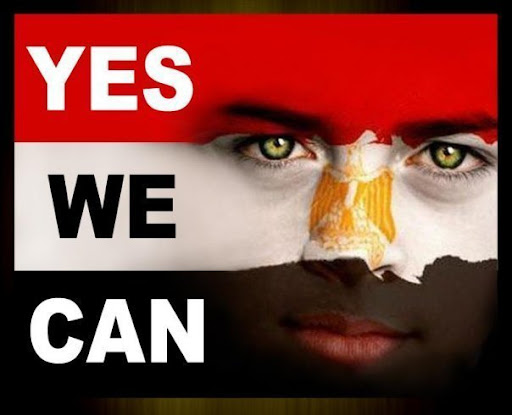
A Facebook page, “We are all Khaled Said” was set up and we now know that activists from the Facebook group 6 of April Youth Movement, and Google executive Wael Ghoneim who is becoming a national hero as instigator of the Day of Rage (see below), were involved in this. The page led to a movement, first for justice to bring the killers to court to pay for their crime, and then, something much bigger. On the heels of the Tunisian revolution and fleeing of the dictator Zine El Abidine Ben Ali, the “We are all Khaled Said” group called for a Day of Rage, a march against “Torture, Corruption, Poverty and Unemployment” for January 25, 2011, the date the Regime designated to “celebrate” the police. Scores of Facebook users changed their profile pages to show their support for this march. Below are some of the samples of their profiles pictures.


The uprising took off in a way that no one anticipated. On January 27, Facebook, along with telephones and internet, went off. Nevertheless the revolution grew and persisted. When the internet came back up on February 2 there was a conspicuous fluttering of pro-Mubarak profile pictures scattered around college students’ friends’ lists that had the uncanny look of iron curtain style propaganda posters. Though this is pure speculation, it is highly likely that a committee from the Ministry of Information got together to try to decipher how to infiltrate and conquer Facebook. Operating on a pre-digital mindset, they designed and released a poster about 25 January to appropriate the Day of Rage and rewrite history. That poster (Image #4) reads: “Day of Allegiance to the Leader and Commander. We are all with you and our hearts are with you. The campaign for Mubarak, Security for Egypt.”

Another profile photo which showed up among university students after the blackout was one that reads: “With all my heart I love you Egypt, and I love you oh President.”

These posters lacked the spontaneity, show of emotion, creativity of the other profile posters, and smelled of infiltrators, something not well tolerated in the Facebook public square. This pitiable attempt to turn back history and try to capture the allegiance of youth through manipulating Facebook was a sign of how desperately out of touch the regime has become. It is also indicative that it has lost its grip on the ideological state apparatuses, and once that occurs there is nothing left at its disposal but the use of force; or surrender.
Within three days these images of 25 of January as a day of loyalty to the President disappeared from Facebook. On Feburary 8, a new profile photo among Egyptian youth began spreading spontaneously. It was the image of one of their own, Wael Ghoneim, on the day of his release after twelve days disappearance (he was detained by police). The image is from a game-changing interview conducted with him on February 7, 2011 on a satellite channel. This interview, where he admits to organizing the initial protest, set to rest doubts that the revolution was the plot of enemy foreign agents. His display of emotion for the martyrs of the revolution touched the nation, and beyond. That may very well have been the nail in the coffin of the state’s media wars.

What is happening in Egypt is not a Facebook Revolution. But it could not have come about without the Facebook generation, generation 2.0, who are taking, and with their fellow citizens, making history.
Linda Herrera is a social anthropologist with expertise in comparative and international education. She has lived in Egypt and conducted research on youth cultures and educational change in Egypt and the wider Middle East for over two decades. She is currently Associate Professor, Department of Education Policy, Organization and Leadership, University of Illinois at Urbana-Champaign. She is co-editor with A. Bayat of the volume Being Young and Muslim: New Cultural Politics in the Global North and South, published by Oxford University Press (2010).
This post appeared on Jadaliyya. It is republished here with permission of Linda Herrera and Jadaliyya.
Read also Linda Herrera’s previous contribution: Two Faces of Revolution
Egypt’s Revolution 2.0: The Facebook Factor
Posted on February 18th, 2011 by martijn.
Categories: Blogosphere, Headline, Society & Politics in the Middle East.
Guest Author: Linda Herrera
The call for a Day of Rage on January 25, 2011 that ignited the Egyptian revolution originated from a Facebook page. Many have since asked: Is this a “Facebook Revolution?” It is high time to put this question to rest and insist that political and social movements belong to people and not to communication tools and technologies. Facebook, like cell phones, the internet, and twitter, do not have agency, a moral universe, and are not predisposed to any particular ideological or political orientation. They are what people make of them. Facebook is no more responsible for Egypt’s revolution than Gutenberg’s printing press with movable type was responsible for the Protestant Reformation in the fifteenth century. But it is valid to say that neither the Reformation nor the pro-democracy rights’ movements sweeping Tunisia, Egypt, Iran, and much of the region would have come about at this juncture without these new tools. Digital communications media have revolutionized learning, cognition, and sociability and facilitated the development of a new generational behavior and consciousness. And the old guard simply do not get it.
Around the globe, far beyond Egypt and Tunisia, we are witnessing a monumental generational rupture taking place around digital literacy, and the coming of age of Generation 2.0. They take for granted interaction, collaboration, and community building on-line. The digital “non-literate” or “semi-literate” tend to be either the very poor lacking means, access to, or time for digital media, or the older generation, the pre-digitals, who do not see the value in changing their communication habits. Many from the pre-digital generation are quick to deride innovations such as Facebook and Twitter as being tools that indulge the egoistic tendencies of the young or which are colossal time wasters. While these critiques hold some validity, they capture only one side, and a small side, of a complex and epic generational sea change that is underway and that is being facilitated—not driven in some inevitable process—by the availability of new communication technologies and social tools.
A youthful global digital generation is growing in leaps and bounds, and social media, of which Facebook is just one platform, is a decisively important factor in it. Youth use social media for a range of social, academic, political, leisure, personal, creative, sexual, cultural, commercial, and other activities. Some characteristics of this global generation are excessive communication, involving many people in decision making, multitasking, group work, blurring of public and private, sharing, individual expression, and collective identification. Another important distinction between the generations is that the digital generation take what media theorist Clay Shirky calls “symmetrical participation” for granted. In other words, they are not passive recipients of media and messages, as in the days when television and print media ruled, but take for granted that they can play a role in the simultaneous production, consumption, interaction with, and dissemination of on-line content. Youth in the Middle East and North Africa share the features of their global generational counterparts but with some important additions and differences.
In politically authoritarian states like Egypt, Tunisia and Iran, youth have been fashioning Facebook into a vibrant and inclusive public square. They also use it to maintain their psychological well being as a space to metaphorically breath when the controls and constrains of the social world become too stifling. A 22 year old blogger and avid Facebook user explains, “It’s such a release to go on Facebook. I feel so liberated knowing there’s a place I can send my thoughts.”
The Rise of the “El-Face” Generation
In October and November 2010 I was in Egypt conducting research with university students in Alexandria and Cairo from diverse social class backgrounds on their media use. Many of them were using a new colloquial term, “El-Face” when talking about Facebook. These Facebook users carry traits of being politically savvy, bold, creative, outward looking, group regulating, and ethical. And their numbers are fast growing. In March 2008 there were some 822,560 users. After the Arabic version of Facebook was launched in March of 2009 usership jumped. By July 1, 2010 there were some 3,581,460 Facebook members, making for an increase of 357.2% in a two year period. The site has become increasingly Arabized, though many users show dexterity in using both English and Arabic.
In the months running up to the parliamentary elections in November 2010 there was much speculation about a possible shut down of Facebook. Adult pundits in the more mainstream media (semi-governmental newspapers, popular Arabic television talk shows) took up the cause of Facebook. They expressed their paternalistic concern about the potentially corrupting force of Facebook on the youth in a familiar moral panic mode. On her popular television talk show, for instance, Hala Sarhan lamented the lawlessness of Facebook, asserting it to be a dangerously free zone in need of restrictions. Others argued that without adult supervision, youth could be lured and tricked by dangerous elements into sedition (fitna). They worried Facebook was fueling sectarian tensions between Christians and Muslims that could lead to violence.
These public Facebook experts are mainly sexagenarian and septuagenarian educators, policy makers, government officials, and academics of a pre-digital age. They are using a pre-digital political cognition and institutional understanding to discuss new media today, and they are direly off the mark. Drawing on older understandings of the media they view Facebook as the new space of ideological control, the place to capture the minds and hearts of the citizens; like state television but accessible through the internet. Some of them are sincere in their worry that dangerous elements, like radicals and criminals, will try to befriend youth on Facebook and lure them in subversive activities. Others are clearly more interested in maintaining raw power and want to find effective ways to keep youth in their fold and under their thumbs. The ones vying to maintain control of the youth reason that if youth are spending time on Facebook, then all the government needs to do is go in and set up its propaganda machinery there, capture and control the hearts and minds of youth on Facebook, it’s that simple. The government has established a presence on Facebook, though a somewhat pitiful one, setting up pages for the National Democratic Party (158 people “like” it), Gamal Mubarak (the page has been removed since the uprising), Hosni Mubarak, and other government figures and causes. But these are not picking up traction. The youth are not buying it, and the more the regime people interlope into Facebook the more they lose legitimacy.
The community of “El-Face” is developing a cultural, political, and ethical universe of its own. It has its own codes and is a regulated space to some degree. There are certain red lines, as Hoda and Amir, both 21 year old university students at Alexandria University, that should not be crossed: you should not use the space to insult each other’s religion, for pornography or sexual harassment, for advertising or selling things, for spreading false rumors, or for spying. When a Facebook friend crosses these lines others intervene by way of posting a corrective comment on their wall, starting a conversation on the post in question, or by defriending them.
Last October many youth were worried that the government would close down Facebook. In discussions with a group of students from the Political Science department at Cairo University, they explained that the government feared the flurry of critical political activity that would invariably precede an election. Though many expressed that turning off Facebook would be akin to suffocating them, as one young man put it, it would be like “blocking the air to my lungs”, they insisted they would not ease up on their pre-election Facebook activities. These included mocking the president, his son, the system, and the whole electoral process. They stood defiant. A 21 year old female student proclaimed, “We don’t care! We’re not afraid of them. What are they going to do, arrest millions of us?”
Their Facebook activities also included a commitment to demanding justice for the brutal killing of one of their own, Khaled Said. It was striking last October how every youth I encountered in and out of the university was talking about Khaled Said. His story, which came out of Facebook, not Al-Jazeera, the newspaper, or any other media, has by now received much international coverage. The events leading to Khaled’s killing originated when he supposedly posted a video of two police officers allegedly dividing the spoils of a drug bust. This manner of citizen journalism has become commonplace and youth are getting more emboldened to expose the festering corruption of a police force that acts with impunity. On June 6, 2010, as Khaled Said was sitting in an internet café in Alexandria, two police officers entered and asked him for his I.D.. He refused to produce it and they proceeded to drag him away and allegedly sadistically beat him to his death as he pleaded for his life in the view of witnesses. The officers claimed that Khaled died of suffocation after swallowing a packet of drugs. His family released a photograph to an activist of the broken, bloodied, and disfigured face from Khaled’s corpse. This photo, and a portrait of the gentle soft skinned face of the living Khaled, went viral. The power of photographic evidence combined with eyewitness accounts and popular knowledge of police brutality left no doubt in anyone’s mind that he was senselessly and brutally murdered by police officers, the very people who are supposed to act in the interest of public safety.
A Facebook page, “We are all Khaled Said” was set up and we now know that activists from the Facebook group 6 of April Youth Movement, and Google executive Wael Ghoneim who is becoming a national hero as instigator of the Day of Rage (see below), were involved in this. The page led to a movement, first for justice to bring the killers to court to pay for their crime, and then, something much bigger. On the heels of the Tunisian revolution and fleeing of the dictator Zine El Abidine Ben Ali, the “We are all Khaled Said” group called for a Day of Rage, a march against “Torture, Corruption, Poverty and Unemployment” for January 25, 2011, the date the Regime designated to “celebrate” the police. Scores of Facebook users changed their profile pages to show their support for this march. Below are some of the samples of their profiles pictures.
The uprising took off in a way that no one anticipated. On January 27, Facebook, along with telephones and internet, went off. Nevertheless the revolution grew and persisted. When the internet came back up on February 2 there was a conspicuous fluttering of pro-Mubarak profile pictures scattered around college students’ friends’ lists that had the uncanny look of iron curtain style propaganda posters. Though this is pure speculation, it is highly likely that a committee from the Ministry of Information got together to try to decipher how to infiltrate and conquer Facebook. Operating on a pre-digital mindset, they designed and released a poster about 25 January to appropriate the Day of Rage and rewrite history. That poster (Image #4) reads: “Day of Allegiance to the Leader and Commander. We are all with you and our hearts are with you. The campaign for Mubarak, Security for Egypt.”
Another profile photo which showed up among university students after the blackout was one that reads: “With all my heart I love you Egypt, and I love you oh President.”
These posters lacked the spontaneity, show of emotion, creativity of the other profile posters, and smelled of infiltrators, something not well tolerated in the Facebook public square. This pitiable attempt to turn back history and try to capture the allegiance of youth through manipulating Facebook was a sign of how desperately out of touch the regime has become. It is also indicative that it has lost its grip on the ideological state apparatuses, and once that occurs there is nothing left at its disposal but the use of force; or surrender.
Within three days these images of 25 of January as a day of loyalty to the President disappeared from Facebook. On Feburary 8, a new profile photo among Egyptian youth began spreading spontaneously. It was the image of one of their own, Wael Ghoneim, on the day of his release after twelve days disappearance (he was detained by police). The image is from a game-changing interview conducted with him on February 7, 2011 on a satellite channel. This interview, where he admits to organizing the initial protest, set to rest doubts that the revolution was the plot of enemy foreign agents. His display of emotion for the martyrs of the revolution touched the nation, and beyond. That may very well have been the nail in the coffin of the state’s media wars.
What is happening in Egypt is not a Facebook Revolution. But it could not have come about without the Facebook generation, generation 2.0, who are taking, and with their fellow citizens, making history.
Linda Herrera is a social anthropologist with expertise in comparative and international education. She has lived in Egypt and conducted research on youth cultures and educational change in Egypt and the wider Middle East for over two decades. She is currently Associate Professor, Department of Education Policy, Organization and Leadership, University of Illinois at Urbana-Champaign. She is co-editor with A. Bayat of the volume Being Young and Muslim: New Cultural Politics in the Global North and South, published by Oxford University Press (2010).
This post appeared on Jadaliyya. It is republished here with permission of Linda Herrera and Jadaliyya.
Read also Linda Herrera’s previous contribution: Two Faces of Revolution
"Now, it's gonna be a long one" – some first conclusions from the Egyptian revolution
Posted on February 8th, 2011 by martijn.
Categories: anthropology, Guest authors, Headline, Society & Politics in the Middle East.
Guest Author: Samuli Schielke
Sunday, February 6, 2011
Today is my scheduled day of departure from Egypt. As I sit on Cairo airport waiting for my flight to Frankfurt, it is the first time on this trip that regret anything – I regret that I am leaving today and not staying. I have told to every Egyptian I have met today that I am not escaping, just going for my work at the university and returning soon. But perhaps it has been more to convince myself than them. My European friend who like me came here last Monday is staying for another two weeks. My American friend in Imbaba tells that for months, she has been homesick to go to America and see her parents and family again. But now when the US government would even give her a free flight, she says that she cannot go. This is her home, and she is too attached to the people, and especially to her husband. Two days ago, he was arrested on his way back from Tahrir square, held captive for four hours, interrogated, and tortured with electroshocks. He is now more determined than ever. How could she leave him behind? But today is my scheduled departure, and I only intended to come for a week and then return to do what I can to give a balanced idea of the situation in Egypt in the public debates in Germany and Finland. Tomorrow I will give a phone interview to Deutschlandradio (a German news radio), and on Tuesday I will give a talk in Helsinki in Finland. Right now, I feel that maintaining high international pressure on the Egyptian government is going to be crucial, and I will do what I can.
There remains little to be reported about the beginning day in Cairo, but maybe I can try to draw some first conclusion from this week.
The morning in Cairo today was marked by a return to normality everywhere except on Tahrir Square itself, where the demonstrations continue. Now that the streets are full with people again, the fear I felt in the past days on the streets is gone, too. If I stayed, today would be the day when I would again walk through the streets of Cairo, talk with people and feel the atmosphere.
From what I know from this morning’s short excursion in Giza and Dokki, the people remain split, but also ready to change their mind. As my Egyptian friend and I took a taxi to Dokki, the taxi driver was out on the street for the first time since 24 January, and had fully believed what the state television had told him. But as my friend, a journalist, told him what was really going on, the driver amazingly quickly shifted his opinion again, and remembered the old hatred against the oppressive system, the corruption, and the inflation that brought people to the streets last week. A big part of the people here seem impressively willing to change their mind, and if many of those who were out on the streets on 28 January – and also of those who stayed home – have changed their mind in favour of normality in the past days, they do expect things to get better now, and if they don’t, they are likely to change their minds again. This is the impression I also got from the taxi driver who took me to the airport from Dokki. He, too, had not left his house for eleven days, not out of fear for himself, but because he felt that he must stay at home to protect his family. He was very sceptical of what Egyptian television was telling, but he did expect things to get better now. What will he and others like him do if things don’t get better?
As I came to Egypt a week ago I expected that the revolution would follow one of the two courses that were marked by the events of 1989: either a successful transition to democracy by overthrowing of the old regime as happened in eastern Europe, or shooting everybody dead as happened in China. Again, my prediction was wrong (although actually the government did try the Chinese option twice, only unsuccessfully), and now something more complicated is going on.
This is really the question now: Will things get better or not? In other words: Was the revolution a success of a failure? And on what should its success be measured? If it is to be measured on the high spirits and sense of dignity of those who stood firm against the system, it was a success. If it is to be measured by the emotional switch of those who after the Friday of Anger submitted again to the mixture of fear and admiration of the president’s sweet words, it was a failure. If the immense local and international pressure on the Egyptian government will effect sustainable political change, it will be a success. But it will certainly not be an easy success, and very much continuous pressure is needed, as a friend of mine put it in words this morning: “Now, it’s gonna be a long one.”
In Dokki I visited a European-Latin American couple who are determined to stay in Egypt. He was on Tahrir Square on Wednesday night when the thugs attacked the demonstrators, and he spent all night carrying wounded people to the makeshift field hospital. He says: “What really worries me is the possibility that Mubarak goes and is replaced by Omar Suleyman who then sticks to power with American approval. He is the worst of them all.” Just in case, he is trying to get his Latin American girlfriend a visa for Schengen area, because if Omar Suleyman’s campaign against alleged “foreign elements” and “particular agendas” continues, the day may come when they are forced to leave after all.
A few words about the foreigners participating in the revolution need to be said.. Like the Spanish civil war once, so also the Egyptian revolution has moved many foreigners, mostly those living in Egypt since long, to participate in the struggle for democracy. This has been an ambiguous struggle in certain ways, because the state television has exploited the presence of foreigners on Tahrir Square in order to spread quite insane conspiracy theories about foreign agendas behind the democracy movement. The alliance against Egypt, the state television wants to make people believe, is made up of agents of Israel, Hamas, and Iran. That’s about the most insane conspiracy theory I have heard of for a long time. But unfortunately, conspiracy theories do not need to be logical to be convincing. But to step back to the ground of reality, if this revolution has taught me one thing is that the people of Egypt do not need to look up to Europe or America to imagine a better future. They have shown themselves capable of imagining a better future of their own making (with some important help from Tunisia). Compared to our governments with their lip service to democracy and appeasement of dictators, Egyptians have given the world an example in freedom and courage which we all should look up to as an example. This sense of admiration and respect is what has drawn so many foreigners to Tahrir Square in the past days, including myself.
As an anthropologist who has long worked on festive culture, I noticed a strikingly festive aspect to the revolutionary space of Tahrir Square. It is not just a protest against an oppressive regime and a demand for freedom. In itself, it is freedom. It is a real, actual, lived moment of the freedom and dignity that the pro-democracy movement demands. As such, it is an ambiguous moment, because its stark sense of unity (there is a consensus of having absolutely no party slogans on the square) and power is bound to be transient, for even in the most successful scenario it will be followed by a long period of political transition, tactics, negotiations, party politics – all kinds of business that will not be anything like that moment of standing together and finally daring to say “no!”. But thanks to its utopian nature, it is also indestructible. Once it has been realised, it cannot be wiped out of people’s minds again. It will be an experience that, with different colourings and from different perspectives, will mark an entire generation.
In a different sense, however, the relationship of transience and persistence is a critical one. A revolution is not a quick business; it requires persistence. Some have that persistence, and millions have continued demonstrating (remember that in Alexandria and all major provincial cities there are ongoing in demonstrations as well). Others, however, had the anger and energy to go out to the streets on the Friday of Anger on 28 January to say loudly “No!”, but not the persistence to withstand the lure of the president’s speech on Tuesday 1 February when Mubarak showed himself as a mortal human, an old soldier determined to die and be buried in his country. A journalist noted to me that this was the first time Mubarak has ever mentioned his own mortality – the very promise that he will die one day seems to have softened many people.
Speaking of generations, this revolution has been called a youth revolution by all sides, be it by the demonstrators themselves, the state media, or international media. Doing so has different connotations. It can mean highlighting the progressive nature of the movement, but it can also mean depicting the movement as immature. In either case, in my experience the pro-democracy movement is not really a youth movement. People of all ages support the revolution, just like there are people of all ages who oppose it or are of two minds about it. If most of the people out in the demonstrations are young, it is because most Egyptians are young.
Thinking about the way Egyptians are split about their revolution, it is interesting to see how much people offer me explicitly psychological explanations. The most simple one, regarding the switch of many of those who went out on the streets on the Friday of Anger (28 Jan) but were happy to support the president after his speech after the March of Millions (1 Feb), is that Egyptians are very emotional and prone to react emotionally, and in unpredictable ways. One of more subtle theories crystallise around the theme of Freud’s Oedipal father murder about which I wrote yesterday. Another is the Stockholm Syndrom that some have mentioned as an explanation why those who turn to support are favour of the system are often those most brutally oppressed by the same system. The Stockholm Syndrome, referring to a famous bank robbery with hostages in Stockholm, is the reaction of hostages who turn to support their abductors at whose mercy they are. There is something to it.
As I finish writing this, my plane is leaving for Frankfurt and I will be out of Egypt for a while. After these notes, I will upload also some notes from early last week which I couldn’t upload then due to lack of Internet in Egypt. Those are notes from the March of Millions on Tuesday 1 February. But unlike I was thinking at that moment, it was not the biggest demonstration in the history of Egypt. The biggest one was the Friday of Anger on 28 January when people in every street of every city went out to shout “Down with the system!” Due to the almost total media blockade by the Egyptian government, there is still much too little footage from that day. What I have seen so far, shows amazing crowds even in districts far from the city centre, but they also show very systematic violence by the police force, which shot to kill that day. Many were killed, and many more are still missing. I will try to collect image and film material from that day, and if you can send me any, your help is appreciated.
You can also see all my reports (one is still due to be uploaded later tonight) inhttp://samuliegypt.blogspot.com/ The content of the blog is in the public domain, so feel free to cite and circulate on the condition of giving credit to the original.
Greetings from revolutionary Egypt!
Samuli Schielke is a research fellow at Zentrum Moderner Orient (ZMO), Berlin. His research focusses on everyday religiosity and morality, aspiration and frustration in contemporary Egypt. In 2006 he defended his PhD Snacks and Saints: Mawlid Festivals and the Politics of Festivity, Piety and Modernity in Contemporary Egypt at the University of Amsterdam, Faculty of Social and Behavioural Sciences. During his stay in Cairo at the time of the protests at Tahrir Square he maintained a diary. The text here is part of that diary which you can read in full at his blog.
“Now, it’s gonna be a long one” – some first conclusions from the Egyptian revolution
Posted on February 8th, 2011 by martijn.
Categories: anthropology, Guest authors, Headline, Society & Politics in the Middle East.
Guest Author: Samuli Schielke
Sunday, February 6, 2011
Today is my scheduled day of departure from Egypt. As I sit on Cairo airport waiting for my flight to Frankfurt, it is the first time on this trip that regret anything – I regret that I am leaving today and not staying. I have told to every Egyptian I have met today that I am not escaping, just going for my work at the university and returning soon. But perhaps it has been more to convince myself than them. My European friend who like me came here last Monday is staying for another two weeks. My American friend in Imbaba tells that for months, she has been homesick to go to America and see her parents and family again. But now when the US government would even give her a free flight, she says that she cannot go. This is her home, and she is too attached to the people, and especially to her husband. Two days ago, he was arrested on his way back from Tahrir square, held captive for four hours, interrogated, and tortured with electroshocks. He is now more determined than ever. How could she leave him behind? But today is my scheduled departure, and I only intended to come for a week and then return to do what I can to give a balanced idea of the situation in Egypt in the public debates in Germany and Finland. Tomorrow I will give a phone interview to Deutschlandradio (a German news radio), and on Tuesday I will give a talk in Helsinki in Finland. Right now, I feel that maintaining high international pressure on the Egyptian government is going to be crucial, and I will do what I can.
There remains little to be reported about the beginning day in Cairo, but maybe I can try to draw some first conclusion from this week.
The morning in Cairo today was marked by a return to normality everywhere except on Tahrir Square itself, where the demonstrations continue. Now that the streets are full with people again, the fear I felt in the past days on the streets is gone, too. If I stayed, today would be the day when I would again walk through the streets of Cairo, talk with people and feel the atmosphere.
From what I know from this morning’s short excursion in Giza and Dokki, the people remain split, but also ready to change their mind. As my Egyptian friend and I took a taxi to Dokki, the taxi driver was out on the street for the first time since 24 January, and had fully believed what the state television had told him. But as my friend, a journalist, told him what was really going on, the driver amazingly quickly shifted his opinion again, and remembered the old hatred against the oppressive system, the corruption, and the inflation that brought people to the streets last week. A big part of the people here seem impressively willing to change their mind, and if many of those who were out on the streets on 28 January – and also of those who stayed home – have changed their mind in favour of normality in the past days, they do expect things to get better now, and if they don’t, they are likely to change their minds again. This is the impression I also got from the taxi driver who took me to the airport from Dokki. He, too, had not left his house for eleven days, not out of fear for himself, but because he felt that he must stay at home to protect his family. He was very sceptical of what Egyptian television was telling, but he did expect things to get better now. What will he and others like him do if things don’t get better?
As I came to Egypt a week ago I expected that the revolution would follow one of the two courses that were marked by the events of 1989: either a successful transition to democracy by overthrowing of the old regime as happened in eastern Europe, or shooting everybody dead as happened in China. Again, my prediction was wrong (although actually the government did try the Chinese option twice, only unsuccessfully), and now something more complicated is going on.
This is really the question now: Will things get better or not? In other words: Was the revolution a success of a failure? And on what should its success be measured? If it is to be measured on the high spirits and sense of dignity of those who stood firm against the system, it was a success. If it is to be measured by the emotional switch of those who after the Friday of Anger submitted again to the mixture of fear and admiration of the president’s sweet words, it was a failure. If the immense local and international pressure on the Egyptian government will effect sustainable political change, it will be a success. But it will certainly not be an easy success, and very much continuous pressure is needed, as a friend of mine put it in words this morning: “Now, it’s gonna be a long one.”
In Dokki I visited a European-Latin American couple who are determined to stay in Egypt. He was on Tahrir Square on Wednesday night when the thugs attacked the demonstrators, and he spent all night carrying wounded people to the makeshift field hospital. He says: “What really worries me is the possibility that Mubarak goes and is replaced by Omar Suleyman who then sticks to power with American approval. He is the worst of them all.” Just in case, he is trying to get his Latin American girlfriend a visa for Schengen area, because if Omar Suleyman’s campaign against alleged “foreign elements” and “particular agendas” continues, the day may come when they are forced to leave after all.
A few words about the foreigners participating in the revolution need to be said.. Like the Spanish civil war once, so also the Egyptian revolution has moved many foreigners, mostly those living in Egypt since long, to participate in the struggle for democracy. This has been an ambiguous struggle in certain ways, because the state television has exploited the presence of foreigners on Tahrir Square in order to spread quite insane conspiracy theories about foreign agendas behind the democracy movement. The alliance against Egypt, the state television wants to make people believe, is made up of agents of Israel, Hamas, and Iran. That’s about the most insane conspiracy theory I have heard of for a long time. But unfortunately, conspiracy theories do not need to be logical to be convincing. But to step back to the ground of reality, if this revolution has taught me one thing is that the people of Egypt do not need to look up to Europe or America to imagine a better future. They have shown themselves capable of imagining a better future of their own making (with some important help from Tunisia). Compared to our governments with their lip service to democracy and appeasement of dictators, Egyptians have given the world an example in freedom and courage which we all should look up to as an example. This sense of admiration and respect is what has drawn so many foreigners to Tahrir Square in the past days, including myself.
As an anthropologist who has long worked on festive culture, I noticed a strikingly festive aspect to the revolutionary space of Tahrir Square. It is not just a protest against an oppressive regime and a demand for freedom. In itself, it is freedom. It is a real, actual, lived moment of the freedom and dignity that the pro-democracy movement demands. As such, it is an ambiguous moment, because its stark sense of unity (there is a consensus of having absolutely no party slogans on the square) and power is bound to be transient, for even in the most successful scenario it will be followed by a long period of political transition, tactics, negotiations, party politics – all kinds of business that will not be anything like that moment of standing together and finally daring to say “no!”. But thanks to its utopian nature, it is also indestructible. Once it has been realised, it cannot be wiped out of people’s minds again. It will be an experience that, with different colourings and from different perspectives, will mark an entire generation.
In a different sense, however, the relationship of transience and persistence is a critical one. A revolution is not a quick business; it requires persistence. Some have that persistence, and millions have continued demonstrating (remember that in Alexandria and all major provincial cities there are ongoing in demonstrations as well). Others, however, had the anger and energy to go out to the streets on the Friday of Anger on 28 January to say loudly “No!”, but not the persistence to withstand the lure of the president’s speech on Tuesday 1 February when Mubarak showed himself as a mortal human, an old soldier determined to die and be buried in his country. A journalist noted to me that this was the first time Mubarak has ever mentioned his own mortality – the very promise that he will die one day seems to have softened many people.
Speaking of generations, this revolution has been called a youth revolution by all sides, be it by the demonstrators themselves, the state media, or international media. Doing so has different connotations. It can mean highlighting the progressive nature of the movement, but it can also mean depicting the movement as immature. In either case, in my experience the pro-democracy movement is not really a youth movement. People of all ages support the revolution, just like there are people of all ages who oppose it or are of two minds about it. If most of the people out in the demonstrations are young, it is because most Egyptians are young.
Thinking about the way Egyptians are split about their revolution, it is interesting to see how much people offer me explicitly psychological explanations. The most simple one, regarding the switch of many of those who went out on the streets on the Friday of Anger (28 Jan) but were happy to support the president after his speech after the March of Millions (1 Feb), is that Egyptians are very emotional and prone to react emotionally, and in unpredictable ways. One of more subtle theories crystallise around the theme of Freud’s Oedipal father murder about which I wrote yesterday. Another is the Stockholm Syndrom that some have mentioned as an explanation why those who turn to support are favour of the system are often those most brutally oppressed by the same system. The Stockholm Syndrome, referring to a famous bank robbery with hostages in Stockholm, is the reaction of hostages who turn to support their abductors at whose mercy they are. There is something to it.
As I finish writing this, my plane is leaving for Frankfurt and I will be out of Egypt for a while. After these notes, I will upload also some notes from early last week which I couldn’t upload then due to lack of Internet in Egypt. Those are notes from the March of Millions on Tuesday 1 February. But unlike I was thinking at that moment, it was not the biggest demonstration in the history of Egypt. The biggest one was the Friday of Anger on 28 January when people in every street of every city went out to shout “Down with the system!” Due to the almost total media blockade by the Egyptian government, there is still much too little footage from that day. What I have seen so far, shows amazing crowds even in districts far from the city centre, but they also show very systematic violence by the police force, which shot to kill that day. Many were killed, and many more are still missing. I will try to collect image and film material from that day, and if you can send me any, your help is appreciated.
You can also see all my reports (one is still due to be uploaded later tonight) inhttp://samuliegypt.blogspot.com/ The content of the blog is in the public domain, so feel free to cite and circulate on the condition of giving credit to the original.
Greetings from revolutionary Egypt!
Samuli Schielke is a research fellow at Zentrum Moderner Orient (ZMO), Berlin. His research focusses on everyday religiosity and morality, aspiration and frustration in contemporary Egypt. In 2006 he defended his PhD Snacks and Saints: Mawlid Festivals and the Politics of Festivity, Piety and Modernity in Contemporary Egypt at the University of Amsterdam, Faculty of Social and Behavioural Sciences. During his stay in Cairo at the time of the protests at Tahrir Square he maintained a diary. The text here is part of that diary which you can read in full at his blog.
Two Faces of Revolution
Posted on February 1st, 2011 by martijn.
Categories: Featured, Guest authors, Headline, Society & Politics in the Middle East.
Guest Author: Linda Herrera
Mohamed Bouazizi

Khaled Said
The events in Tunisia and Egypt have riveted the region and the world. The eruptions of people power have shaken and taken down the seeming unbreakable edifices of dictatorship. (At the time of writing Mubarak has not formally acknowledged that he has been toppled, but the force of the movement is too powerful and determined to fathom any other outcome). Events are moving at breakneck speed and a new narrative for the future is swiftly being written. In the throes of a changing future it merits returning to the stories of two young men, the two faces that stoked the flames of revolution thanks to the persistence of on-line citizen activists who spread their stories. For in the tragic circumstances surrounding their deaths are keys to understanding what has driven throngs of citizens to the streets.
Mohammed Bouazizi has been dubbed “the father of Arab revolution”; a father indeed despite his young years and state of singlehood. Some parts of his life are by now familiar. This 26 year old who left school just short of finishing high school (he was NOT a college graduate as many new stories have been erroneously reporting) and worked in the informal economy as a vendor selling fruits and vegetable to support his widowed mother and five younger siblings. Overwhelmed by the burden of fines, debts, the humiliation of being serially harassed and beaten by police officers, and the indifference of government authorities to redress his grievances, he set himself on fire. His mother insists that though his poverty was crushing, it was the recurrence of humiliation and injustice that drove him to take his life. The image associated with Mohammed Bouazizi is not that of a young man’s face, but of a body in flames on a public sidewalk. His self-immolation occurred in front of the local municipal building where he sought, but never received, justice.
The story of 28 year old Egyptian, Khaled Said, went viral immediately following his death by beating on June 6, 2010. Two photos of him circulated the blogosphere and social networking sites. One was a portrait of his gentle face and soft eyes coming out of a youthful grey hooded sweatshirt; the face of an everyday male youth. The accompanying photo was of the bashed and bloodied face on the corpse of a young man. Though badly disfigured, the image held enough resemblance to the pre-tortured Khaled to decipher that the two faces belonged to the same person. The events leading to Khaled’s killing originated when he posted a video of two police officers allegedly dividing the spoils of a drug bust. This manner of citizen journalism has become commonplace since 2006. Youths across the region have been emboldened by a famous police corruption case of 2006. An activist posted a video on YouTube of two police officers sodomizing and whipping a minibus driver, Emad El Kabeer. It not only incensed the public and disgraced the perpetrators, but led to their criminal prosecution. On June 6, 2010, as Khaled Said was sitting in his local internet café in Alexandria two policemen accosted him and asked him for his I.D. which he refused to produce. They proceeded to drag him away and allegedly beat him to his death as he pleaded for his life. The officers claimed that Khaled died of suffocation when he tried to swallow a package of marijuana to conceal drug possession. But the power of photographic evidence combined with eyewitness accounts and popular knowledge of scores of cases of police brutality left no doubt in anyone’s mind that he was senselessly and brutally murdered by the very members of the police that were supposed to protect them. The court case of the two officers is ongoing.
Mohammed Bouazizi was not the first person to resort to suicide by self immolation out of desperation, there has been an alarming rise in such incidents in different Arab countries. And Khaled Said is sadly one of scores of citizens who have been tortured, terrorized, and killed by police with impunity. But the stories of these two young men are the ones that have captured the popular imagination, they have been game changers.
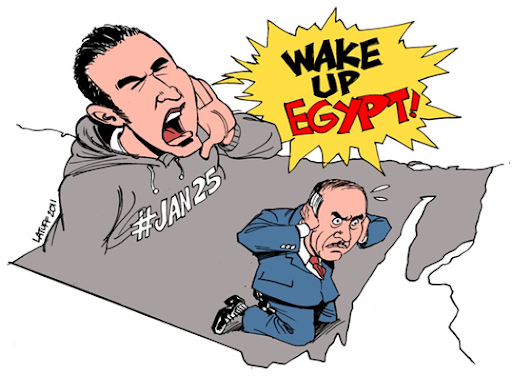
Cartoon from the Facebook Group We are all Khaled Said*
For the youth of Egypt and Tunisia, the largest cohort of young people ever in their countries, the martyrdoms of Khaled Said and Mohamed Bouaziz represent an undeniable tipping point, the breaking of the fear barrier. The youth have banned together as a generation like never before and are crying out collectively, “enough is enough!” to use the words of a 21 year old friend, Sherif, from Alexandria. The political cartoon of Khaled Said in his signature hoodie shouting to the Intelligence Chief, also popularly known “Torturer in chief” and now Mubarak’s Vice President, to “wake up Egypt” perfectly exemplifies this mood (from the Facebook group, We are all Khaled Said). No longer will the youth cower to authority figures tainted by corruption and abuses. These illegitimate leaders will cower to them. The order of things will change.
And so on January 25, 2011, inspired by the remarkable and inspiring revolution in Tunisia that toppled the twenty-three year reign of the dictatorship of Zine El Abidine Ben Ali, Egyptian youth saw it was possible to topple their dictator, Hosni Mubarak, of 31 years. Activists used different on-line platforms, most notably the April 6 Youth Movement and the “We are all Khaled Said” Facebook group to organize a national uprising against “Torture, Corruption, Poverty, and Unemployment.”
It is not arbitrary that civil rights, as exemplified in torture and corruption (recall Khaled Said), topped the list of grievances, followed by economic problems. For youth unemployment and underemployment will, under any regime, be among the greatest challenges of the times.
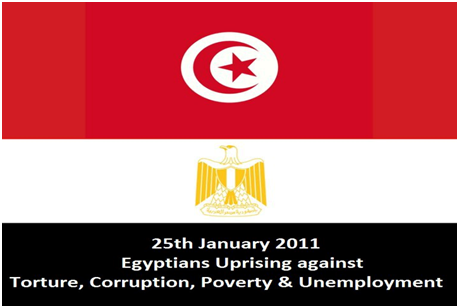
Banner of the Egyptian uprising
No one could have anticipated that this initial call would heed such mass and inclusive participation. Youths initially came to the streets braving tanks, rubber bullets, tear gas (much of which is made in the US and part of US military aid, incidentally), detention, and even death. And they were joined by citizens of all persuasions and life stages; children, youth, elderly, middle aged, female, male, middle class, poor, Muslim, Christians, Atheists.
Contrary to a number of commentators in news outlets in North America and parts of Europe the two revolutions overtaking North Africa are not motivated by Islamism and there are no compelling signs that they will be co-opted in this direction. Such analyses are likely to be either ideologically driven or misinformed. In fact, Islam has not figured whatsoever into the stories of Bouazizi and Said. These are inclusive freedom movements for civic, political, and economic rights. To understand what is driving the movement and what will invariably shape the course of reforms in the coming period we need to return to these young men. Their evocative if tragic deaths speak reams about the erosion of rights and accountability under decades of corrupt dictatorship, about the rabid assault on people’s dignity. They remind us of the desperate need to restore a political order that is just and an economic order that is fair. Mohamed Bouazizi and Khaled Said have unwittingly helped to pave a way forward, and to point the way to the right side of history.
*Correction: The figure who appears cowering in the cartoon is former Minister of Interior, Habib al-Adly, NOT Omar Suleiman, Mubarak’s VP
Linda Herrera is a social anthropologist with expertise in comparative and international education. She has lived in Egypt and conducted research on youth cultures and educational change in Egypt and the wider Middle East for over two decades. She is currently Associate Professor, Department of Education Policy, Organization and Leadership, University of Illinois at Urbana-Champaign. She is co-editor with A. Bayat of the volume Being Young and Muslim: New Cultural Politics in the Global North and South, published by Oxford University Press (2010).
This post also appeared at Thetyee.ca
Closing the years 2009-2010
Posted on December 31st, 2010 by martijn.
Categories: anthropology, Headline, ISIM/RU Research, My Research.
Because I don’t exactly know anymore when I started my own website, both the years 2009 and 2010 have been labelled as celebrating 10 years of blogging. In the last two years I tried to re-direct this site into more like a public anthropology website. A process that started in 2009 with the post Public Anthropology – 10 years from Researchpages to Closer (1999/2000-2009/2010). Based upon a text of Craig Calhoun I stated:
C L O S E R » Blog Archive » Public Anthropology – 10 Years from Researchpages to Closer (1999/2000 – 2009/2010)
Calhoun continues by stating that public science and addressing public issues is not just giving answers to questions the public has. It is as much, or even more, about questioning why particular issues are addressed in the way they are addressed by particular people and what the consequences of that are. How are particular issues and the way they are debated related to (changing) historical and cultural contexts, what is taken-for-granted and what does it mean? In my opinion this is (or at least should) should be the focus of this blog and has informed the change from my website Researchpages to Closer.
Maybe the most important contribution to this is a post on Islamizing Europe in which I try to deconstruct the argument of a demographic takeover of Europe by Muslims but also trying to understand how the whole argument works. It is a post from May 2009, and was last year and this year the most popular post of my blog. A second post involves the digital re-publication of all of the issues of the ISIM Review; the magazine of the former Institute for the Study of Islam in the World (ISIM) where I worked until it was closed in 2009. The most popular issue was Newsletter 7 on confronting modernity and my own article on Moroccan-Dutch youth and Islam, based upon my PhD research. Also Welmoet Boender’s article on Imams in the Netherlands, based upon her PhD research was very popular.
When I started my current research – Understanding Islam – Salafism as a Utopian Movement – I still worked at ISIM but after it closed the whole project moved over to Radboud University Nijmegen that was already a partner in the project. The Radicalization Series on my blog is a part of this project and a preparation for articles and chapter to write. Salafism as Utopian Movement post is an attempt to bring anthropology into the social movement approach that is now sort of leading in the research on Islamic activism. Besides this Salafism research, or better more and more as a part of that project, I try to follow the current debates on Islam in Europe but sometimes also in the US given the transnational connections of both Islam and the debate about Islam. The post on the Dutch Ground Zero Mosque is the most important example of such transnational connections. An ongoing task in this is of course monitoring the debate about and with Dutch anti-Islam politician Geert Wilders for which my post on his movie Fitna is still leading. But other topics covered here have found some public as well. The post on Rebelle – Art, Feminism and Muslim Women is still very popular as well as the Orange Fever post on the Worldcup football and nationalism in the Netherlands. The post was covered in the anthropology carnival of Four Stone Hearth #97 while asking the question: Does orange truly transcend ethnic minority identities? I think it does, for a while, in a superficial but nevertheless important way. I think.
Another issue that has been covered somewhat in Dutch debate is the question whether or not society is suffering from pornofication and sexualization by commerce. When a Muslim man wanted to scratch out posters that were sexist in his view, the debate suddenly changed. Interesting enough to cover it on my blog with some …uhm… fascinating comments as well. When trying to build up some sort of public anthropology one risks to become part of the public debate on the topic one wants to study. This happened to me as well albeit that I have to admit that I did not always acted very smart. One thing I did, and I still stand by it, was to comment upon a debate about a Dutch newspaper that re-published one of the Muhammad Cartoons. One of the Salafi organizations of course was against it and protested it which led to the removal of the cartoon. This was followed by other newspapers and sites that as a protest against the removal in turn re-published that particular cartoon under the label of defending free speech. In my comment for the tv channel of the Salafi group I commented on the political use of this free speech argument. I wrote about this in the posts Cartoonesque 15 and Cartoonesque 16. When one becomes part of the public debates, the whole public anthropology idea gets a different turn of course. Together with my colleague Henk Driessen of Radboud University I organized the workshop Anthropology and/in Publicity in order to explore the idea of public anthropology further with lectures by Ulf Hannerz, Thomas Hylland Eriksen, Annelies Moors and Mathijs Pelkmans. Part of this workshop was a weblog to which several people contributed. One of the contributors, Daniel Lende, has written an excellent summary of the blogposts in Anthropology and Publicity(Thanks!). We will probably try to publish the lectures in a special issue of a journal and include material of the blog as well then (we are not yet sure how to do this). The blog will remain online for a while but in the future the blog could move entirely to this blog as a special section. Also on behalf of Henk Driessen I would like to say thanks to all the speakers of the workshop, the contributors to the blog and the discussants and participants of the workshop who made the whole endeavour succesfull.
To close this entry I would like to add that I would be a very bad public anthropologist when I did not write in Dutch anymore. Too bad for my English readers, but also in the future many posts will be in Dutch (I usually write one in Dutch and one in English every week). In Dutch I have tried to explain some of the motives of people who vote for the anti-Islam Freedom Party of Geert Wilders and try to go beyond the unsubstantiated claims that it is all about anti-islam sentiments and to take the voters seriously instead of mocking them for example in a post called Hungry Wolves – Wilders, PVV and Far Right. A similar analysis was written in English after the recent elections: Europe and Islam: Dutch Elections – Have the Dutch become intolerant? Another issue that has already been mentioned here is the instrumentalization of free speech to include and/or exclude minorities. In a Dutch post I try to extend this argument by pointing to something I coined as ‘freedomnarcissism‘: a form of behaviour that is characterized by an obsession with freedom of the self combined with egoïsm, a lack of empathy and an attempt to be the alpha male (it is often about male bloggers who fiercely attack others who take objection to their self-proclaimed freedom of speech heroism). It is about people who try to immunize themselves against critique from the outside by pointing to the freedom of speech and use the same freedom of speech to harm others. The idea is loosely based upon Christoffer Lash’s Culture of Narcissism who states that people are afraid to be meaningless and as a result develop all kinds of counter-strategies to feel real. Other popular Dutch posts are about the movie Avatar and the publication of a letter of a young Muslim, Jason Walters, convicted for terrorism. In this letter he revises his view on jihad, politics, violence and the position of Muslims in the West. Also both posts featuring my PhD (English summary HERE) are still quite popular.
A new feature on my blog in 2010 were the contributions of guest authors. Martin van Bruinessen on the Gülenmovement (in Dutch), Joas Wagemakers on the Ideology and Influence of Abu Muhammad al-Maqdisi and Michel Hoebink of Radio Netherlands on Wilders’ outdated colonial rhetoric were the first with excellent contributions. I will certainly invite more guest authors in 2011 and people can send in their own contributions as well (those will be reviewed by another colleague and myself). I hope I can continue my line of blogging in the coming years. For now let me say thank you to all my readers, colleagues and most of all the people I work with in my research for their valuable input, comments, criticisms and jokes.
Publications
Books
2008
Zoeken naar een ‘zuivere’ islam. Geloofsbeleving en identiteitsvorming onder jonge Marokkaans-Nederlandse moslims, Amsterdam: Bert Bakker
Searching for a ‘pure’ Islam. Religious Beliefs and Identity Construction among Moroccan-Dutch Youth, Amsterdam: Bert Bakker (In Press). The Ph.D thesis will be in Dutch. The English summary is here. Read my article in the ISIM Review HERE.
Articles
2010
With Roeland, Johan, Stef Aupers, Dick Houtman, and Ineke Noomen. 2010. “Zoeken naar zuiverheid. Religieuze purificatie onder jonge new-agers, evangelicalen en moslims.” Sociologie 11-30.
‘The Quest for Religious Purity in New Age, Evangelicalism and Islam: Religious Renditions of Dutch Youth and the Luckmann Legacy’, in: Annual Review of the Sociology of Religion – 2009: Youth and Religion (with Stef Aupers, Dick Houtman, Ineke Noomen and Johan Roeland
2009
Islam is Islam. Punt uit? Marokkaans-Nederlandse moslimjongeren in Gouda en de culturele constructie van een ‘zuivere’ islam. Migrantenstudies 25, no. 1: 59-72.
Moslimjongeren. De salafi-beweging en de vorming van een morele gemeenschap. Tijdschrift voor Criminologie, no. 4: 375-385.
Chapters in edited volumes
2010
With Bartels, Edien, Kim Knibbe, and Oscar Salemink. 2010. “Cultural Identity as a Key Dimension of Human Security in Western Europe: The Dutch Case.” Pp. 116-133 in A World of Insecurity. Anthropological Perspectives On Human Security, Eds. Thomas Hylland Eriksen, Ellen Bal, and Oscar Salemink. London: Pluto Press.
“Understanding Dutch Islam: Exploring the Relationship of Muslims with the State and the Public Sphere in the Netherlands.” Pp. 181-197 in Muslim Diaspora in the West Negotiating Gender, Home and Belonging, Eds. Haideh Moghissi en Halleh Ghorashi. Burlington: Ashgate Publishing.
With Roel Meijer. “Going All the Way: Politicization and Radicalization of the Hofstad Network in the Netherlands.” Pp. 220-239 in Identity and Participation in Culturally Diverse Societies: A Multidisciplinary Perspective, Eds. Assaad E. Azzi, Xenia Chryssochoou, Bernd Klandermans, and Bernd Simon. Oxford: Wiley-Blackwell.
With Van Dijk-Groeneboer, Monique, and Joris Kregting, en Johan Roeland. 2010. “Ze Geloven Het Wel.” Pp. 25-88 in Handboek Jongeren en Religie. Katholieke, protestantse en islamitische jongeren in Nederland, Ed. Van Dijk-Groeneboer. Amsterdam: Parthenon.
De Koning, Martijn. 2010. “Zoeken naar Zuiverheid en Authenticeit..” Pp. 159-175 in Handboek Jongeren en Religie. Katholieke, protestantse en islamitische jongeren in Nederland,Ed. Monique Van Dijk-Groeneboer. Amsterdam: Parthenon.
2009
Changing Worldviews and Friendship. An Exploration of the Life Stories of Two Female Salafists in the Netherlands. In Global Salafism. Islam’s New Religious Movement, Ed. Roel Meijer, 372-392. London: Hurst.
Netherlands. In Yearbook of Muslims in Europe, Ed. Jorgen Nielsen, Samim Akgönül, Brigitte Maréchal, en Christian Moe, 1:243-257. Leiden: Brill.
If you want to stay updated and did not subscribe yet, you can do so HERE.
Nominaties Dr. Kromzwaard Trofee – Stem nu!
Posted on December 28th, 2010 by martijn.
Categories: Headline.
Het heeft even geduurd, maar de nominaties voor de Dr. Kromzwaard zijn bekend. Uit een longlist van in totaal 69 items heeft een jury een shortlist samengesteld. Aangezien één jurylid te druk had met eten tijdens de kerst, een ander heel vroom alle islamitische conferenties wilde bijwonen en de derde op vakantie was, is een groot deel van de inbreng afkomstig van yours truly.
Hieronder vindt u de polls met de titels en links naar de blogs en artikelen. U dient de stukken te beoordelen door middel van het geven van sterren. In de categorie Dr. Kromzwaard Trofee geldt, hoe meer sterren hoe beter. En in de categorie Faalhazen geldt hoe meer sterren hoe slechter. Onder de polls vindt u eveneens de links naar de artikelen maar dan in blockquotes commentaren van inzenders en van juryleden (maar niet van mij!).
Dr. Kromzwaard Trofee
Faalhazen
Dr. Kromzwaard Trofee
Beste Blogs
Frontaal Naakt. » Moslimomroep
Dat hele gedoe rondom die moslimomroep tekent feilloos de impotentie van zowel moslims als NL instituties om iets structureels tot stand te brengen als hetgaat om islam in NL. Hoezo islamisering?
Wilders misbruikt vrouwen | DeJaap
Uitstekende weergave van wetenschappelijk en maatschappelijk relevant onderzoek, goed en helder geschreven en voer voor de nodige discussie
Wilders met de dood bedreigen doe je zo | Bert Brussen
Geeft prima aan in wat voor ziek klimaat we zitten: flauwekul en bedreigingen op twitter en een incompetent politie en OM die de boodschapper aanvalt in plaats van de dader
Column: ‘Het Gouden Hoofd’ | Abdelhakim.nl
Voert je mee naar verre oorden en tijden, maar houdt je met beide benen stevig op de grond van hier en nu
Een hoax haarfijn ontleend en ontkracht, het betere mediawaakhond werk
Beste Nieuwsberichten
Over integratie blijft het stil
Uitstekend stuk dat op een bijna grappige manier de tegenstellingen en overeenkomsten in de Kamer aangeeft mbt integratie
Hoe God verdween uit het zuiden – NRC
Misschien wel het beste en meest grondige artikel over PVV-stemmers evah
Bizarre instructies van imams – Nieuws – VK
Het zijn de imams die hard klagen over het gegeven dat jongeren zelf maar kennis zouden zoeken over islam. Maar is date en wonder met dit type fatwas? Genuanceerd en verhelderend zonder te verbloemen.
Worstelen met raadsel van islam – Nieuws – Reformatorisch Dagblad
Voor christelijke gelovigen kan de omgang met islam een worsteling zijn, is de islam een vijand of bondgenoot. Dit artikel geeft een prachtig inkijkje
Moslimgeestelijken in het geweer tegen terrorisme – Trouw
Voortdurend vragen we om moslimgeestelijken die afstand nemen van terrorisme en de islam zelf hervormen. En wanneer dat dan eindelijk gebeurt, gaat me dat toch gepaard met een hoop aandacht. NOT!
De Faalhazen
Beroerde blogs
GeenStijl : Mohammed Mohandis. Laptop-stapper?
Schrijver van het modern medium GS is schijnbaar niet op de hoogte van laatste technologische ontwikkelingen, als je met blackberry twitter op gaat, lijkt het ook alsof je via web (dus laptop) communiceert. Canard!
Wilders met de dood bedreigen doe je zo | Bert Brussen
Op het moment dat je dit bericht plaatst is er al een tweet geweest waarin gesteld wordt dat bedreigen niet de bedoeling was. Dus…je plaatst een tweet van je weet dat bedreigen niet de bedoeling is, op je site als zijnde een bedreiging zonder verder toelichting. Je beschuldigt iemand dus vals en daarna ga je zeuren omdat jij alleen de bedreiging tweet en niet de nuance? Dan ben je een enorme prutser, zielige jankert en en rijp voor GS.
Allochtonenweblog: Drie staten van de moslimevolutie (Izz ad-Din Ruhulessin)
Natuurlijk, onze nationale clown, izz ad din, met weer eens een onnavolgbaar onzin verhaal. Als je deze man ziet of leest, moet je vanzelf om moslims lachen
Nazislam: historisch onderbouwd en een politiek wapen
Stond eerst op artikel maar is daar verwijderd http://www.artikel7.nu/?p=41011 het moet doorgaan voor een islamkritisch artikel, maar schrijver Martien Pennings is echt compleet de weg kwijt. Ik vermoed dat hij over een tijd met de onthulling komt dat Hitler moslim was.
Achterlijke artikelen
Islamdeskundigen ondersteunen Wilders – Trouw
Tuurlijk een loodgieter zal ook best iets aan te merken hebben op de timmerman, maar dat maakt hem nog geen timmerdeskundige!
NWS / Rotterdamse moslimwijk in shock – forum.fok.nl
Doet het goed, en als je geen boze moslim kunt vinden, verzin je gewoon een complete boze wijk zie: http://www.leugens.nl/2010/04/14/%E2%80%98er-klopte-niets-van-een-telegraaf-bericht%E2%80%99/
SpitsNieuws : Marokkanen halen uit naar Bolkestein
Tuurlijk alle Marokkanen doen dat. En wat laten we dan zien? Een paar woedende mensen met Arabische teksten in een betoging. Ach uit Pakistan but who cares? Zie; http://www.photoq.nl/articles/columns/top-die-foto/2010/12/08/boze-marokkanen/
Geslachte schapen rotten weg op balkon – Amsterdam (WebRegio.nl – ‘t Gooi) – WebRegio.nl
Waarom zou AT5 toch de oorspronkelijke foto’s hebben weggehaald? Wat zien we eigenlijk (een schaap in slachterij, niet op een balkon). Is dit een groter probleem? Geen idee. En wie zegt dat het ligt te rotten? Het kan ook adelen. MMm krijg er nu al zin an. Zie hier: http://sargasso.nl/archief/2010/11/18/geslachte-schapen-rotten-weg-op-balkon/#comment-459456
Dr. Kromzwaard Trofee 2010 – Stuur uw suggesties in
Posted on November 28th, 2010 by martijn.
Categories: Headline, Joy Category.
Vorig jaar ben ik begonnen met het ‘Beste/Slechtste van 2009’. Voor dit jaar officieel omgedoopt in Dr. Kromzwaard Trofee 2010. U kunt vanaf nu uw inzendingen insturen voor twee categorieën:
- Blogs: welke blogentry over moslims en/of islam uit 2010 is het beste en welke is het slechtste? Kijk daarbij onder meer naar schrijfstijl, argumentatie en originaliteit.
- Nieuws-/Achtergrondartikelen: welk artikel uit een nieuwsmedium (kranten, tijdschriften, omroepen, nieuwswebsites) is het beste of slechtste nieuws-/achtergrondartikel over moslims en/of islam? Kijk daarbij naar schrijfstijl, helderheid, nuance en nieuwswaardigheid.
Voor iedere categorie dient u dus een suggestie te geven voor het beste en voor het slechtste.
U kunt uw suggesties doorgeven via de volgende pagina: Dr. Kromzwaard Trofee Inzendingen. Inzendingen dienen hoofdzakelijk in het Nederlands te zijn. Artikelen met vertaling van Arabisch en/of Engels zijn toegestaan. U heeft drie weken de tijd. Daarna worden de nominaties bekend gemaakt en op 1 januari de winnaar.
Verras me!
De winnaars van vorig jaar:
Beste blogentry:
Gin de Mooy / Sargasso – Vrouwenbesnijdenis: verminking of een mensenrecht
Beste nieuwsbericht:
RTL – 110 burgerdoden door missie Uruzgan
Slechtste blogentry:
Stan de Jong – Kristallnacht Buitenveldert (van oorspronkelijke site verwijderd)
Slechtste nieuwsbericht:
Telegraaf – Avondklok voor moslims (van Telegraaf site verwijderd)
Introducing Anthropology and Publicity
Posted on October 17th, 2010 by martijn.
Categories: anthropology, Featured, Headline, ISIM/RU Research.
Although anthropology is by definition ‘public’, the relationship between its practitioners and society, its social relevance and its connections with the wider audience, have always been controversial and complex. This will be the general theme of the meeting on 5 November 2010 at Ravenstein. To be sure, it is a vast and multifaceted topic.

The focus is on the dissemination of anthropological knowledge to relevant groups in the societies to which anthropologists belong and those where they conduct their research. We will address the reasons for the underexposure of anthropological knowledge (albeit there is considerable variation in this regard according to national anthropological traditions) and explore ways to improve its dissemination and application in society.
Since the emergence of academic anthropology, the discipline has had the double mission of, on the one hand, describing and interpreting cultural differences and, on the other, generating cross-cultural knowledge about humankind. The inherent tension between the particular and the general requires a balancing act on the part of anthropologists and complicates the translation of anthropological knowledge for ‘consumption’ by the wider public, media and policy makers. Given the increased complexity of societies in a globalizing world, anthropological knowledge has become potentially more relevant, yet remains underexposed to wider audiences.

Bridge over the river Waal (Waalbrug) Nijmegen
The meeting in Soeterbeeck will be structured by four intimately related questions. First, in which ways can anthropological knowledge be improved in order to become more relevant and accessible for non-collegial groups in their own society and in the societies where they do their fieldwork? Second, what are the pros and cons of popularizing anthropological publications and moving them to the ‘front lines’? Third, to what extent can cultural relativism play a role in the public debate on social issues? And, finally, what role can the new digital media play in enhancing the public value of anthropology?
These questions will be addressed by the following speakers: Ulf Hannerz (Stockholm University), Thomas Hylland Eriksen (University of Oslo), Jeremy MacClancy (Oxford Brookes University), Annelies Moors(University of Amsterdam), Mathijs Pelkmans (London School of Economics) and discussed in a small gathering of colleagues at the conference centre Soeterbeeck of Radboud University Nijmegen.
Henk Driessen, Martijn de Koning, 27/08/2010
You can find more information about the seminar and contributions of guest writers on the weblog Anthropology & Publicity.
Radicalization Series IV – Salafism as a Utopian Movement
Posted on August 6th, 2010 by martijn.
Categories: Featured, Headline, ISIM/RU Research, My Research, Religious and Political Radicalization, Young Muslims.
Introduction
There are many different approaches for research on Salafism and they all make clear that, although Salafism has some distinguishing features, the movement is quite diverse with many doctrinary contradictions and clashes and different politico-theological tendencies. Almost all definitions emphasize that the term Salafism is derived from ‘al-salaf al-salih, (the pious predecessors); the first three generations of Muslims who are, according to tradition, the best generations of Muslims ever lived. They also emphasize that Salafists treat Quran and Sunna (the life of the prophet Muhammad) as the only legitimate sources for reason and behaviour of Muslims. It is therefore difficult to define Salafism in a clear, consistent way. One of the main frames for research on Salafism is Quintan Wiktorowicz’ work on Islamic activism; based upon social movement theory. He makes a distinction between Purists, Politicos and Jihadis. The purists, according to Wiktorowicz are not interested in politics, while Politicos (often influenced by Muslim Brotherhood networks) do engage in politics while the Jihadis see the world in such a deplorable state that only a violent Jihad can bring peace and (Islamic) justice to Muslims. Several authors in the book Global Salafism (in particular Thomas Hegghammer) have criticized his model among other things for being internal inconsistent (because jihadis should be a subsubdivision of politicos based upon him seeing political strategy as the defining issue), the definition is still too much based upon theology that does not tell us very much about people’s actual behaviour and claiming to be a-political (as purists do) is a political claim because it indirectly supports the status quo. Hegghammer propes a different typology based upon the structural presence of resources, strategies and rationales for action. Although helpful this model does not solve the problem that it cannot take into account identity, gender or the idea that security and radicalization (two angles in which both approaches fit) are themselves cultural constructions with specific local, national and transnational dimensions. Both models are also top down: they take up the official doctrines, methods and identities of spokespersons and religious authorities but ignore the perspectives, ideas and practices of participants in the movements.
In my research I choose for a more anthropological account of Salafism as a religious movement, taking seriously the political and religious subjectivities of participants. Based upon an article on Grounded Utopian Movements by Price, Nonini and Fox Tree in Anthropological Quarterly, I regard Salafism as a movement trying to revitalize Islam based upon a homogenuous ideal of Islam of the days of the first generation Muslims. The Salafi movement aims to cleanse Islam from so-called non-Islamic accretions, such as Sufism, Shi‘a Islam, or local practices and doctrines, which have sullied a “pure” Islam (Meijer, in Global Salafism). The only way to lead a pure and authentic life and to inherit paradise is to return to the period of the prophet Muhammad and his companions and to emulate their lives. The sources of the Islam, the Qur??n and the ?ad?th are seen as the written version of the authentic and pure Islam. All human action has to be covered by the sources of Islam to be legitimate, otherwise they are condemned as bid’a or worse: in some cases such illegitimate acts may lead to takfir. Moreover since the prophet Muhammad is considered to be an exemplary, perfect Muslim, the Sunna, a close reading of the Qurann and hadth are essential sources with guidelines for leading the correct life and staying on the righteous path. This applies to thought, behaviour as well as appearance. Based upon this ideal the movement tries to develop a lifestyle participants find more just and satisfying than at present. The transnational Salafi movement consists of local and global branches and is characterized by a loosely coupled network structure that is non-hierarchical and characterized by a segmentary-like mobilization and fission and fusion of several sub-networks. The different Salafi networks share the same doctrine of tawhid (the unity and uniqueness of God) as Wiktorowicz explains, but (contray to Wiktorowicz’ claim) do not agree on all aspects of this principle such as what constitutes belief and unbelief and how to interpret particular attributes of Allah. Furthermore, Salafi networks share the method of reading and interpreting the sources of Islam but they differ on the methods of worship and the manner of achieving their goals.
Utopian Movement
Just like in the case of Salafism, Price et al make clear that movements such as Global Justice, Rastafari, Maya Movement and Pentecostalism can be seen as Grounded Utopion Movements whereby grounded refers to the idea that identities, values and imaginaries are grounded in local histories and are embodied and experienced by concrete persons with their own histories. They use the term grounded to refute that we are not talking about irrational, obsolete and romantic ideas; instead they rooted, constructed and nurtured by interactions and practices binding people to the idea of being and becoming part of a community. They admit that all movements have utopian dimensions; this dimensions directs actions in terms of goals and the correct trajectory towards achieving those goals. Grounded Utopian Movements however are distinct from other movements because their utopian imaginaries pertain to the protection of the moral integrity of one’s own community and of one’s own identity against different modalities of oppression and injustice. It is in particular their capacity to create new, alternative realities that make state institutions and elites wary of them and perceive these movements as a threat for social cohesion, security and existing arrangements in society.
Establishing Utopia: politics of lifestyles, distinction and resistance
The Salafi movement is a modern social movement aimed at guarding the identity and integrity of Muslims in a world perceived to be full of seduction, oppression and injustice. Convincing and teaching Muslims to be part of common life, a common heritage and common practices determining a good and correct life is crucial for establishing a ‘true’ moral community emulating the model of the prophet Muhammad. Many activities of the Salafi movement therefore are aimed at constructing the moral community and teaching people the proper ways of being part of that community. The most important strategy of the Salafi movement for de-corrupting Islam and the Muslim community is da’wa: inviting people to Islam (mission). With their da’wa activities the movement spreads its ideas of a virtuous life based upon the idea of commanding good and forbidding evil (al-amr bi-l-ma’ruf wa nahy ‘an almunkar). We can distinguish between three different types of activities sustaining that principle: politics of lifestyles, politics of distinction and politics of resistance (de Koning, 2009b).
All Salafi networks in the Netherlands and other European countries are engaged in one way or another in these type activities. Politics of lifestyles are activities aimed at shaping and nurturing the correct Islamic identity and lifestyle of participants. Preachers of the Salafi movement give lessons, lectures, organize conferences about the correct islamic lifestyle (dress, marriage, ways to interact, being Muslim in a Western society, and so on). The different networks publish books and leaflets about these topics and every networks has its own (sometimes overlapping) circles of lectures and courses by which they aim at a moral rehabilitation of Muslim youth. This does not mean that people are passive consumers of Salafi ideas; in daily life they have to make compromises which most of them do with regard to for example dress and interaction between men and women. Also the courses and conferences are not only about transferring knowledge; they are also meant to establish a sense of belong, brotherhood/sisterhood. It is the combination of knowledge and being together that accounts for many people using the knowledge circles to boost their imaan (faith).
The politics of distinction are aimed at protecting a minority position of Muslims in a society where the majority tries assimilate them. Particular lifestyle practices such as wearing the niqab can become part of the politics of distinction when they are part of public debate or even forbidden. As a result the Salafi movement tries to engage with the public debate and at the same time such plans offer them a platform to disseminate their ideas to a larger (Muslim and non-Muslim) audience. Also self-identification is part of the politics of distinction for example pertaining to the internal quarrels over using the label Salafi method, Salafi (in Dutch also selefie) and criticizing other groups. The boundaries between different branches of the Salafi movement may appear very strong and impermeable when looking at the daily life of participants a more nuances picture emergers because for example economic motivations can lead to people of one network working in the institutes of another (antagonistic) network. And indeed, building their own institutions such as Islamic schools and home care are also part of this type of politics as well as criticizing other Muslim organisations for their allegedly complacent attitude in the Islam debate.
The third type, resistance politics, involves activities aimed against what the Salafi movement perceives as oppressive structures in Europe and Muslim countries. This can pertain to preaches about ‘zionist’ aggression against Palestinians, the necessity of fighting against injustice and severe attacks at Muslim representatives outside the Salafi movement. Travels of some youths to Chechnya, Afghanistan, Pakistan (Kashmir), Iraq and Somalia to participate in the fighting against the US, is also part of this, as well as publishing jihad texts and videos on the internet. Most networks of the Salafi movement do not differ with regard to life style politics but are in fierce disagreement over the other two types.
Welcoming utopia
The call for unity, purity and religionization coming from the Salafi movement can be seen as an attempt to establish itself as the only true representatives of ‘true’ Islam in the Netherlands protecting the Muslim communities from attacks from inside and outside. Moreover, given the practice of Salafi preachers to base their statements upon ‘evidence’ from Islamic sources and explaining them at the same time, the Salafi movement does not only provide Muslim youth a way to engage with a vision of ‘true’ Islam and create a sharp distinction between them and their parents and them and Dutch society, but also a method and path to immerse oneself into a ‘new’ tradition. As I have shown in my contribution to Global Salafism by analyzing the life-stories of two female Salafists, the process by Moroccan-Dutch youth turn to Islam after a period of ‘being not so religious’ or ‘sleeping Muslims’ and affiliate themselves with the Salafi movement can be described as a type of conversion; a re-affiliation within the same religious tradition. These women seek a strong identity, self-realisation and a symbolic transformation of a personal crisis. The Salafi doctrines enable them to rewrite their own life stories and to construct their sense of self as strong people who find their purpose of life in Islam. They have rebuild their own life-stories in the process of seeking wholeness and connected their own individual trajectories, predicaments, ideals and ideas to the Salafi interpretation of Islam.
The rigorous and sometimes rigid Salafi creed and piety creates a stark contrast with the often conflicting and troublesome experiences of daily life. This, as is the same as with the other Muslim youth searching for a ‘true’ Islam, does not mean people actually follow every aspect of the Salafi way. Many of them see it as an attempt to follow a life as a ‘true’ Muslim, as a personal project that has to be fulfilled and as a means to revive ones personal faith (imaan) without fully living up to it. The utopian Islam and the dark, messy, chaotic daily life coexist and, this contradiction is exactly what both is the strength and weakness of the Salafi movement. The utopia with its high moral standards can become an obstacle for functioning in daily life with family, work and education where other rules and loyalties exist. At the same time it gives the Salafi movement its power for it means that people can hold on to the ideal without diluting it and it makes people striving for more all the time: the utopia lies somewhere at the horizon (it is concrete) although impossible to reach. By framing the ideas about the correct lifestyle, building up a position as a minority in Europe and its fight against oppression and justice, in terms of commanding good and forbidding evil the actions of the Salafi movement become moral issues by which the Salafi movement tries to construct a moral community and emphasizes its integrity and tries to safeguard it.
Europe and Islam: Dutch elections – Have the Dutch become intolerant?
Posted on June 12th, 2010 by martijn.
Categories: anthropology, Headline, Multiculti Issues.
The results are in
Recently voters in Switzerland issued a stop of the construction of minarets. In Italy, a Muslim woman wearing the niqab was fined for it. Belgium and France are trying to illegalize and stigmatize the burka and niqab. And the Dutch had the elections. There are many reports about ‘right wing Wilders” breakthrough, the major shift to the right. The conservative liberals (VVD) won the elections with (only) 31 out of 150 seats, the social-democrats (PvdA) won 30 seats, the radical populist anti-Islam Party for Freedom (PVV) of Geert Wilders managed to earn 24 seats (earlier 9) and the christian-democrats (CDA) fell back from 41 to 21 seats resulting in the end of prime minister Balkenende. The progressive liberals of D66 (see here for more on the term liberal in Dutch politics), the populist Socialist Party (SP) lost 10 of its 25 seats, the orthodox Christian party (CU) went from 6 to 5, the fundamentalist christian party (SGP) and the Animal Party (PvdD) remained stable at two seats and the progressive liberal green party GroenLinks grew from 7 to 10.
Five remarks
- This indeed is a major shift in Dutch politics, but not for the first in recent times. In 1994 the christian democrats also lost 20 seats (then from 54 to 34) opening the era of the purple coalition: social democrats, conservative and progressive liberals. In 2002 there was another major shift after the assassination of populist leader Fortuyn, bringing the christian-democrats back into government.
- What we can also see from 1994 onwards is a decrease in seats for the political center: the conservative liberals, social democrats and christian-democrats. The rise of populist anti-elite and anti-multiculturalism politicians such as Fortuyn, Verdonk (former minister of integration, her party did not gain any seats i this election) and Wilders together with the Socialist Party is the result of this and strengthened it.
- Wilders’ breakthrough is not new. His popularity and anti-islam ideology have grown out of a paradoxical development in the 1990s whereby religion and ethnicity were increasingly seen as private issues while at the same time along a broad political spectrum questions arised about the lack of social cohesion in society due to cultural diversity. Conservative VVD leader Bolkestein was the first to publicly address the issue of Islam in 1991 and its alleged incompatibility with Western culture. After him it was populist leader Fortuyn who rised to the occasion just before 9/11 but after having published his book Against the Islamization of the Netherlands already in 1996. The social democrats by that had also become more focused on culture and religion as impediments for integration and social cohesion from 2000 onwards.
- Fortuyn and Wilders did not emerge out of the traditional radical right wing parties although there is some overlap between their constituencies. They are therefore not connected with a nationalist, racist and xenophobic tradition that has had a relatively small group of supporters since World War II. In fact both strongly condemn racism, intolerance and discrimination (which is not the same as saying that they love migrants of course) and Wilders has strong philosemitic agenda. Ian Buruma suggests Fortuyn and Wilders are better perceived as the radical offspring of the reformists in the sixties. The sixties have brought many freedoms and relieved the Dutch from the burden of religion but also is perceived as the cause of losing a sense of identity because of the relavist nature of the 1960s. Wilders, and Fortuyn before him, try to revive a sense of pride about Dutch culture in a utopian way whereby Dutch culture is viewed as everything that Islam is not: peaceful, tolerant, committed to freedom of speech and sexual freedoms.
- Although migration and integration were not dominant issues during the campaign, the first analysis show that the issue was important for most people who did vote for Wilders. But it was certainly not the only reason. Wilders has broadened his agenda against the background of economic reforms proposed by many other other parties such as the VVD; here they are more conservative and aiming at protecting the existing status quo in favour of the ‘common man’. And I think, more than other parties, they had a positive message. The last days of the campaign the PVV presented itself as the party for hope and optimism. I think this is important because in the Dutch Ethnobarometer research a few years ago it appeared that even people from the left opted for voting Wilders because they saw him as someone who could solve their problems and the problems Dutch society was facing, while seeing no credible leader on the left. These problems did not only pertain to multiculturalism and Islam but also to a political elite who appeared to be unaccountable for their mistakes (while giving way to migrants), the EU integration (and the loss of sovereignty of the Netherlands somehow extended to a loss of sovereignty of their personal lives) and so on.
Attributing Wilders’ victory to a rise of Dutch intolerance (although that may be the case) means therefore neglecting a trend that has been going on for more than a decade now and the variety in people’s motives for voting for him. It also neglects the fact that other parties have been subjected to the same trend as well while there exists at the same time a broad opposition in Dutch society against the PVV and Wilders. A recent debate after the elections is typical for both the similarities and differences of the PVV and other parties. After the elections it appeared that people discovered that the PVV proposed an ethnic registration for all citizens (except natives and including Antillians (I have written about it earlier but it took a sports journalist on TV to make the public aware of this…). Moreover, it is already standard practice that newborns from people with at least one allochtoneous (migrant) parent are registered as being allochtone (from foreign soil).
Earlier however the social democratic minister of the interior proposed an ethnic registration for criminals. While the PVV is more blunt and generalizing, the social democrats have taken up the same logic in tackling problems in society with migrants.
The logic of culture talk
What is clearly apparent in the Dutch case is that the perception of conflict follows the logic of ‘culture talk’. This means people have a sense of how the relationship between conflict and identity is created namely that putting people with different identities together, in particular the fault line between Muslim and non-Muslim, is responsible for creating competition and tension between the two groups. People seem to understand ethno-religious conflict as primarily ethno-religious in its cause and nature. The perceived differences between Muslims and non-Muslims appear to offer the explanation of the (expectation of) conflict. This resembles the ‘clash of civilization’ (Huntington 1997) where ethnic and/or religious groups are treated as homogenous, clearly demarcated groups and where the basis of conflicts lies in ethno-cultural realities. The dichotomy used here between Muslims and non-Muslims means that it is the individuals who are seen as part of the Muslim-group who have the apparently great depth of cultural attachment, loyalty to an (ancestral) community and a sacred tie that binds them. The others are lumped together under the concept of non-Muslims that is more or less an empty concept and is never defined (only by that which is not Islamic).
The logic of ‘culture talk’ with regards to the relationship between Muslim and non-Muslims is based upon three premises:
- Cultural essentialism: Seeing human beings as ‘cultural’, the bearers of a distinct, bounded and homogeneous culture, which defines them and differentiates them from others.
- Islam as an extreme, exceptional case
- Anxiety: There is an anxiety about people’s loss of cultural values and a threat to their individual and collective lifestyles among minorities and majorities.
One of the most outspoken politicians using the logic of ‘culture talk’ as part of her rhetoric is Ayaan Hirsi Ali. Her recent book Nomad provides an excellent example of how Islam is perceived within this logic:
Hirsi Ali, Berman, and Ramadan on Islam : The New Yorker
she reminds her readers of the West’s tradition of intellectual revolt against clerical tyranny and warns of the insidious, intransigent enemies in their midst. “The Muslim mind today seems to be in the grip of jihad,” she writes.
She is not hopeful that Americans will heed her warning. Her initial job interviews in the United States were discouraging: the Brookings Institution, she writes, worried that she might offend Arab Muslims. (The conservative American Enterprise Institute, however, immediately appointed her as a fellow.) On college campuses, Muslim students accuse her of wanting to “trash” Islam, while Western feminists, convinced that white men are “the ultimate and only oppressors,” lack the “courage or clarity of vision” to help her knock down the mental “hovels” of the East. Pointing to Major Nidal Malik Hasan’s murderous rampage in Texas, last November, she deplores the “conspiracy to ignore the religious motivation for these killings” in America.
Muslims today, Hirsi Ali believes, must be forced to choose between the darkness of Islam and the light of the modern secular West.
Hirsi Ali and Wilders are part of a transnational discourse can be identified in the writings of, for example, Oriana Fallaci and a number of other (liberal) writers such as Paul Berman, Martin Amis, Christopher Hitchens and Bernard Henry-Levy. A whole genre of books written by liberals displaying their (essentialist) criticism towards an Islam that transcended its traditional national boundaries and today threatens European ‘tolerance’ and ‘freedom’ has emerged. They envision a sort of ‘cold war’ in which Europe in particular has to be defended against Islam and especially against Islamism, threatening the secular liberal values and freedoms of society. This discourse ties tolerance and freedom to a European lifestyle that is opposed to what is perceived as an Islamic lifestyle. It is very clear that this cultural logic has found its way into people’s lives and that they effect people’s identity and social relations and practices. How this actually works and what tactics are taken up by Muslims to respond and ‘use’ them in order to resist, accommodate or re-appropiate the public discourse on Islam and the strategies of national institutions, and how they turn these everyday experiences into public issues again (if they do), are matters that are poorly understood however and I hope I can do some research into that in the near future.
Related articles by Zemanta:

Reflectie op publieke sociaal-wetenschappelijke kennis
Posted on May 1st, 2010 by martijn.
Categories: anthropology, Headline, ISIM/RU Research, Method, My Research, Some personal considerations.
Logboek november 2002
Jawad: Wie denk je wel niet dat je bent? Jij zegt, ja ik weet, ik snap, ik snap wat je bedoelt. Nou, je weet helemaal niks! Jij hebt niet te maken met racisme! Mensen kijken niet raar naar jou als je een winkel binnenkomt! Mensen kijken je niet aan van, daar gaat weer een terrorist. Je weet niks! Misschien ben je nog wel erger dan al die racisten. Je bent maar een witte autochtoon die ons wil vertellen hoe de dingen in elkaar zitten en rommelt met ons hoofd!
1. Inleiding
Van 1999 tot en met 2005 heb ik als coördinator en begeleider gewerkt bij de huiswerkbegeleiding en andere sociaal-culturele activiteiten in moskee An Nour in Gouda. In die periode heb ik ook mijn onderzoek verricht naar de wijze waarop Marokkaans-Nederlandse jongeren in Gouda hun moslimidentiteit construeren. Jawad is één van mijn sleutelinformanten in de moskee. Hij doet bovenstaande uitspraken tijdens een verhitte discussie met enkele Marokkaans-Nederlandse collega’s van RCJ/Het Woonhuis (een jeugdhulpverleningsinstelling die samenwerkte met moskee An Nour) en mij over uitlatingen van Hirsi Ali. Hij en de andere Marokkaans-Nederlandse collega’s wilden van mij weten of ik het met hem eens was en aan wiens kant ik stond: de moslims of de Nederlanders. Ik stelde mij op het standpunt dat ik als coördinator en onderzoeker niet wil kiezen en eigenlijk ook vindt dat er geen keuze gemaakt hoeft te worden. Op het moment dat ik na herhaald aandringen expliciet weiger om een keuze te maken wordt Jawad boos.
Zijn uitbarsting komt op een moment dat het islamdebat in Nederland in volle hevigheid woedt. De aanslagen op 11 september 2001, de verkiezingscampagne met Pim Fortuyn (en zijn moord), de bedreigingen tegen Hirsi Ali en de aanslagen op Bali hebben de verhouding tussen moslims en niet-moslims op scherp gesteld. Begrippen als cultuur en identiteit hebben in een dergelijke situatie een politieke lading doordat ze gebruikt worden door politici, opinieleiders en religieuze leiders om mensen uit te sluiten of juist in te sluiten. Uit het fragment blijkt dat hij mij op verschillende manieren ziet als buitenstaander. Allereerst gaat het daarbij om de ervaringen die hij zou hebben en ik niet. Tegelijkertijd categoriseert Jawad mij als ‘witte autochtoon’. Jawad geeft aan dat hij mij wantrouwt en hij trekt in twijfel of ik eigenlijk wel enige kennis heb over het onderwerp van mijn onderzoek: de constructie van moslimidentiteit door Marokkaanse-Nederlandse jongens en meisjes in Gouda. De wijze waarop Jawad mij categoriseert levert informatie op over de ontwikkelingen in de onderzoeksgroep, maar roept ook vragen op over de geldigheid van het materiaal dat ik via mijn onderzoek produceer. Is de kennis die ik verzamel inderdaad beïnvloed door mijn aanwezigheid, het feit dat ik met hun ‘hoofd rommel’ en dus vanalles oproep? Is mijn kennis inderdaad beperkt of vertekend doordat ik niet te maken heb met racisme of doordat ik een witte autochtone Nederlander ben?
Omgekeerd komt het natuurlijk voor bijvoorbeeld in een reactie op het artikel van Linda Duits over Wilders’ vrouwonvriendelijkheid:
Wilders misbruikt vrouwen | DeJaap
Het is volgens mij algemeen bekend hoe ontstellend variabel menselijke interpretatie van zelfs de simpelste beelden, woorden en geluiden is. De historie staat bol van de gruwelijkste misdaden die als onschuldig verschil van mening begonnen. Wat geeft je in vredesnaam het idee dat je op een eenduidige manier naar een beladen filmpje als Fitna kunt kijken, en dat ‘wetenschap’ te noemen? Het is natuurlijk leuk om Wilders een hak te zetten, en net zoals elke politicus moeten ook zijn uitspraken zorgvuldig worden getoetst aan objectieve gegevens; maar mijn hemel zeg, doe het in het vervolg alsjeblieft daarmee en niet met zo’n gekleurde bril.
En ook in een recente discussie naar aanleiding van een stuk van Joep Smaling werd ze er weer fijntjes aan herinnerd:
Ultralinkse socioloog weigert weg te kijken | DeJaap
Als ik wel reageer, wordt dat gezien als genuanceerd willen theedrinken; als ik niet reageer, onttrek ik me aan het debat en trek in me terug in de ivoren toren. ‘Damned if you do, damned if you don’t’ noem je dat. Toen ik dit voorlegde aan mijn mederedactieleden, werd ik bedolven onder precies de bespotting die ik vreesde. Nuanceren is – zo werd mij uitgelegd –een manier van geïndoctrineerde, gesubsidieerde sociaalwetenschappers om feiten te negeren dan wel te ontkennen. Het is grachtengordel-correctheid van ideaaltypische oud-linkse wegkijksoosjologen die niet verder komen dan drie vierkante meter beschermde ruimte rondom de Universiteit van Amsterdam. Zijdelings werd ik beticht van het in het zadel houden van een religieus-orthodox patriarchaat; uiteindelijk werd ik vooral beschuldigd van arrogantie vanwege het claimen van moreel gelijk.
Het recente sharia-onderzoek uitgevoerd door Laurens Bakker e.a. was zo’n voorbeeld. Zowel de redactie als Geenstijl.nl, journalist Carel Brendel en diverse andere bloggers en reaguurders waren ervan overtuigd dat ik de onderzoeker was van het onderzoek en daarmee was het onderzoek per definitie niks: als salafistenknuffelaar, links, Radboud communist moest ik wel de waarheid wel verdoezelen. Dat niemand van hen ook maar de moeite nam om het ook eens aan mij te vroegen, doet er niet veel toe. In dit stuk ga ik in op het onbehagen ten opzichte van sociaal-wetenschappelijk onderzoek, de (twijfels omtrent de) geldigheid ervan en de rol van wetenschappers.
2. Geldigheid van sociaal-wetenschappelijk onderzoek
De voorbeelden laten zien dat de vraag die Jawad aan mij stelde: ‘Wie denk je wel niet dat je bent? is van groot belang voor de geldigheid van antropologisch onderzoek en eigenlijk voor ieder sociaal-wetenschappelijk onderzoek. De vraag raakt namelijk niet alleen aan mijn positie en mijn eigen identiteit in het veld. De vraagt komt op in een situatie waarin Marokkaanse Nederlanders in de media en door politici in toenemende mate als moslims gecategoriseerd worden, waarbij steeds vaker een wij-zij discours de verhoudingen tussen moslims en niet-moslims bepaalt. In hoeverre is het materiaal dat is verzameld ook ingebed in dat discours? Is het construeren van een moslimidentiteit in 2005 (aan het einde van mijn onderzoek) nog wel hetzelfde proces als in 1999 (het begin van mijn onderzoek)? Heeft de centrale vraag van het onderzoek (hoe construeren Marokkaans-Nederlandse jongens en meisjes in Gouda hun moslimidentiteit?) nog wel dezelfde betekenis in deze snel veranderende omstandigheden? Al deze zaken kunnen van invloed zijn op de geldigheid van het onderzoek omdat ze gevolgen hebben voor de mate waarin gegevens, begrippen, beschrijvingen en analyses een goede weergave vormen van de sociale werkelijkheid van de onderzoeksgroep.
The truths are held to be certain, settled, and independent of context or formulation. Especially since Thomas Kuhn’s classic The Structure of Scientific Revolutions, however, this presumption has been widely treated with skepticism or rejected. Even those who disagree with particulars of Kuhn’s argument mostly recognize the importance of his central point: that “truths” are formulated and stabilized within scientific paradigms that allow for the “normal science” of effective testing of propositions and elaboration of theories, but that revolutionary breakthroughs in science often derive from growing recognition of contradictions and aporias within these paradigms, which in turn they shatter and replace.[4] This is not an argument against truth or for an anything goes relativism. But it is an argument for seeing science as a historical process, always open-ended in ways large as well as small. And this in turn is an argument for a more democratic vision of science, one in which possession of current “truths” is less of a trump card for certified experts to play in relation to lay people.
Social scientists engaging public questions need to offer truth. If scholarly knowledge has no authority, if it doesn’t provide good reasons to believe that some courses of action are better than others, or riskier, or less reliable, then it doesn’t have a distinctive value. But the authority of scholarly knowledge isn’t and can’t be perfect. Science is, after all, in large part a process of learning from errors, not just a process of accumulating truths. And especially in social science, truths are often highly contextual and conditional, predictions of what is more or less likely under certain circumstances, not statements of absolute and unvarying causal relationships. Social scientists bring real knowledge, but inevitably incomplete knowledge. The truths of social science are, moreover, graspable in different ways. They have to be communicated and this always means rendering them in ways that foreground certain aspects more than others, that illuminate some dimensions and leave others in the shadows. Knowledge is part of culture, not easily and fully abstractable from the rest of culture. But it is partly through the effort to communicate knowledge to non-specialists that researchers (like teachers) see new implications of what they know, new dimensions to issues they thought they understood fully, and sometimes limits to their own grasp of what they thought were established truths.
De oude positie waarbij de onderzoeker als het ware onzichtbaar was gedurende het onderzoek en zijn/haar objectieve resultaat presenteert als de waarheid, wordt binnen het etnografisch onderzoek bijna niet meer aangehangen. Er is nu meer aandacht voor subjectiviteit, de interactie met de onderzochten, machtsprocessen en de context waarbinnen het onderzoek plaatsvindt, met veel kritische aandacht voor de waarheidsclaim van de onderzoeker. De vraag daarbij is onder meer of datgene wat de onderzoeker laat zien niet een weerspiegeling is van zijn/haar achtergrond en wereldbeeld.
Reflectie kan gezien worden als een extra middel om de betrouwbaarheid van de onderzoeksgegevens te toetsen en de geldigheid ervan te verhogen. Vaak staat in een dergelijke reflectie de onderzoeker centraal. Het gaat om de bewuste en onbewuste motieven en achtergronden van de onderzoeker. Daarmee is deze zelfreflexiviteit niet meer dan een poging om de onderzoeker als objectieve wetenschapper boven het onderzoeksveld uit te tillen. In de oude objectief-positivistische onderzoekstraditie stond de onderzoeker onzichtbaar buiten het veld van onderzoek. In de kwalitatieve en reflexieve traditie wordt de onderzoeker zichtbaar. De eenzijdige focus op de onderzoeker verhult echter dat kwalitatief onderzoek een relationeel proces is: de onderzoeker gaat een relatie aan met de onderzoeksgroep en is daar slechts één van de spelers. Het moet gaan om een reflectie op de relatie tussen de onderzoeker en onderzochten en niet (alleen) om reflectie op de onderzoeker. Deze reflectie is noodzakelijk om processen te analyseren die van invloed zijn op het onderzoeksmateriaal zoals insluiting en uitsluiting, veranderingen en bredere maatschappelijke omstandigheden.
Reflectie is derhalve belangrijk, maar daarmee is nog niet aangetoond hoe reflectie een bijdrage kan leveren aan de analyse en daarmee aan de geldigheid van het onderzoek. Geldigheid heeft betrekking op de overeenstemming van de bevindingen in het onderzoek met de werkelijkheid. Zeker met betrekking tot etnografisch onderzoek zijn er de nodige vraagtekens te plaatsen of geldiger resultaten worden bereikt in vergelijking met meer positivistische onderzoeken, terwijl er ook onderzoekers zijn die beweren dat juist etnografisch onderzoek de meest geldige gegevens oplevert. Dit is niet de plaats om te beslissen wat nu de meest geldige methode is, wel zijn er met betrekking tot kwalitatief onderzoek enkele uitdagingen als het gaat om geldigheid. Wanneer met geldigheid bedoeld wordt dat de onderzoeker de werkelijkheid juist representeert, dan spelen in onderzoek dat over langere tijd plaatsvindt veranderingen een cruciale rol. Zo kunnen er veranderingen optreden in de betekenis van bepaalde begrippen (zoals identiteit) en kunnen respondenten in het onderzoek ook veranderen (zeker in het geval van jongeren). De kleine setting waarin een kwalitatief onderzoeker zich begeeft, bemoeilijkt ook het vertalen van de onderzoeksresultaten naar bredere populaties. Niettemin blijft geldigheid naar mijn mening een belangrijke zaak voor kwalitatief onderzoek.
Het vaststellen van de geldigheid van onderzoeksresultaten in mijn onderzoek betekent niet dat het gaat om het vaststellen van de geldigheid van één centraal discours in de constructie van een moslimidentiteit, of om het vaststellen of de opvattingen over moslimidentiteit in overeenstemming zijn met een normatieve islam en Nederlandse cultuur, maar om het creëren van een plausibele representatie van de verschillende manieren waarop jongeren (in mijn onderzoek althans) zoeken naar een ‘zuivere’ islam.
3. In het veld
Het verrichten van veldwerk betekent dat een onderzoeker een relatie aangaat met mensen uit de onderzoeksgroep en deelgenoot wordt van processen die zich in die groep afspelen en van allerlei lokale, nationale en internationale ontwikkelingen die daar een rol bij spelen. Een onderzoeker kan zich daar niet aan onttrekken, maar dit dient deze zichtbaar te maken om op die manier verantwoording af te leggen over het onderzoeksresultaat. Juist in een in een zeer gepolitiseerde situatie kan de positie en achtergrond van een onderzoeker grote consequenties hebben voor allerlei processen van insluiting en uitsluiting en wordt tevens de vraag opgeroepen in hoeverre de wijze waarop een onderzoeker de sociale werkelijkheid interpreteert, beïnvloed is door die processen en dominante discoursen. Zeker nu begrippen als cultuur, identiteit en radicalisering zo sterk ideologisch geladen zijn dat ze direct van invloed zijn op de uitkomsten van een onderzoek en onderzoekers zich daar zelf ook moeilijk aan kunnen onttrekken, is reflectie op de geldigheid van de uitkomsten noodzakelijk.
De relatie tussen geldigheid en reflectie komt neer op de vraag waarom een onderzoek bepaalde uitkomsten heeft. De wijze waarop jongeren mij categoriseren bepaalt de toegang tot het onderzoeksveld, bepaalt mede welke informatie zij mij wilden geven (bijvoorbeeld een positief beeld over de islam en over zichzelf als vrome moslims) en maakt mij ook onderdeel van allerlei interne verwikkelingen. Deze reflectie dient niet alleen betrekking te hebben op de achtergronden van de onderzoeker, maar vooral op de relatie tussen onderzoeker en onderzoeksgroep. In een tijd waarin het onderwerp van het onderzoek een extra lading krijgt door allerlei gebeurtenissen en het publieke debat, heeft de categorisering door de onderzoeksgroep een grote invloed op de wijze waarop materiaal kan worden verzameld en ook op de inhoud van dat materiaal en hoe het materiaal kan worden gelezen. Categoriseringen zijn niet per definitie exclusief, maar de politisering van islam en de polarisatie tussen moslims en niet-moslims, kan daartoe wel leiden. Dit heeft als consequentie gehad dat ik als onderzoeker te maken kreeg met vragen over mijn loyaliteit. Ook hoogoplopende interne conflicten (al dan niet beïnvloed door het publieke debat) dragen daar aan bij. Dergelijke aspecten negeren doet afbreuk aan de wetenschappelijke en maatschappelijke relevantie van de uitkomsten van het onderzoek. Sterker nog, het is deze reflectie in combinatie met een systematische, wetenschappelijk gefundeerde methode en onderzoek geïnformeerd door theoretische modellen en verklaringen, die maakt dat sociaal-wetenschappelijke kennis gezaghebbend is. Die combinatie zorgt er namelijk voor dat sociaal-wetenschappelijke kennis ‘truth value’ heeft. De waarheden van sociaal-wetenschappelijk onderzoek mogen weliswaar beperkt zijn, onder de nodige voorbehouden staan en in verschillende omstandigheden op verschillende manieren uitgedrukt kunnen worden, maar ze geven wel een meer accurate en beter begrip geven van de wereld om ons heen dan andere. Sociaal-wetenschappelijke kennis over islam, jongerencultuur, politieke processen is plausibeler dan vele andere verklaringen over dergelijke en andere fenomenen. Het is juist de twijfel, de reflectie en de wetenschappelijke discussies over onderzoek die wetenschappelijk onderzoek beter maken. Duits stelt terecht dat de gewone man daar niet altijd zicht op heeft en dus veel studies ook niet op waarde kan schatten. In het geval van de islam en moslims: veel lezen in de krant, het bezoeken van het Midden-Oosten, positieve of negatieve ervaringen met moslims, maakt u nog niet tot een deskundige over ontwikkelingen met betrekking tot islam in Europa of onder moslims in Europa.
4. Tot slot: Het onbehagen over sociaal-wetenschappelijk onderzoek
Het gaat denk ik nog een stap verder zoals ik recent ook betoogde in een post over de kleine recente cartoonaffaire:
C L O S E R » Blog Archive » Cartoonesque 15 – Muhammad Cartoons and Public Anthropology
I think, or like to believe anyway, that this is exactly what I’m doing and this is also exactly what is unsettling about anthropological research. I try to move back and forth in a world that is for some people dominated by us vs. them and therefore as a native man I transgress the boundaries of ‘us’. The fact that in the video I did not defend ‘freedom of speech’ against acts of ‘radical’ imams (although the team of Islaam.tv knows my views about it) or at least was not clear about own position probably contributed to that feeling of uneasiness, the fear that I secretly belong to ‘the other side’ or even the conviction that I am (which according to some makes me a ‘traitor’). For example in another post I questioned a British research about the Muslim Arbitrage Tribunals in the UK. I stated that regulating Islamic arbitration might be a good idea in order to monitor such practices and prevent problems but that religious arbitration (even when regulated) also has several problems attached to it. This comment contributed to the idea that I was in favour of sharia courts in the Netherlands, full stop. Hence, the comment quoted in the beginning of this post. What is a position of distance to me, for them is an attack and for those who objected to the cartoons it was a sign of neutral comments or maybe even friendly towards Muslims. This does not make public anthropology any easier but it does make it more necessary and relevant as Jovan Maud also stated at Culture Matters. And indeed, it will not give anthropologists a high ranking in popularity contests.
Een belangrijke taak van een sociaal-wetenschapper die zijn/haar publieke taak ook serieus neemt, is het publiekelijk ter discussie stellen van ‘aangename waarheden’: waarheden die mensen vanzelfsprekend vinden en comfortabel omdat het hen in staat stelt hun leven te leiden zonder al te pijnlijke vragen te moeten stellen. Een wetenschapper moet de vraag kunnen stellen waarom de overheid en opinieleiders het noodzakelijk vinden bepaalde groepen moslims als ‘radicaal’ te bestempelen zonder de door hun aangedragen verklaringen (ze zijn gevaarlijk, bedreigen de democratische orde, enz.) voor lief aan te nemen. De wetenschapper dient juist de eigen samenleving kritisch onder de loep te nemen ook al vind het publiek deze vragen (laat staan de antwoorden) onprettig of zelfs ronduit gevaarlijk. Als wetenschappers het dan ook nog eens onderling oneens zijn hierover, is dat natuurlijk nog eens oncomfortabeler. Het slechtste antwoord wat de wetenschapper hierop kan geven is het zich opsluiten in de ivoren toren; juist het naar buiten treden levert betere sociaal-wetenschappelijke kennis op.
Dit betekent overigens wel dat een wetenschapper zich bewust dient te zijn van zijn/haar publieke rol. Het onbehagen ten opzichte van veel sociaal-wetenschappelijk onderzoek (dat tegen de eigen mening en waarheden van de individuele burger ingaat) is niet alleen terug te voeren op een gebrek aan erkenning onder de burgers. Het is ook het onvermogen van veel wetenschappers om in begrijpelijke taal te communiceren over hun eigen onderzoek, om zich te verdiepen in dat onbehagen van de burger zonder gelijk een en ander te veroordelen en het gebrek aan waardering en erkenning voor wetenschappers die wel een publieke taak op zich durven te nemen.
Dit stuk is een bewerking van:
“’Wie denk je wel niet dat je bent?’ Etnografisch onderzoek onder moslimjongeren in Gouda.” Kwalon. Tijdschrift voor Kwalitatief Onderzoek 13(1): 81-96. 2008
Over de controverse op DeJaap.nl tussen Joep Smaling en Linda Duits zal donderdag as. nog een stukje verschijnen.
Later dit jaar vindt er op de Radboud Universiteit een internationale workshop plaats over sociale wetenschappen (antropologie) en publiciteit.
NEW: ISIM Review on Closer
Posted on February 23rd, 2010 by martijn.
Categories: Headline, Important Publications.
Since a few days the old ISIM website seems to be unavailable. I don’t know if this is just a technical problem or final. Despite an evaluation by an international peer-review committee that rated The International Institute for the Study of Islam in the Modern World (ISIM) as an excellently performing, internationally leading institute in its field, the institute has been closed as per 1 January 2009, due to the lack of adequate funding. ISIM was set up ten years ago by the universities of Leiden, Amsterdam, Utrecht and Nijmegen, and the Netherlands Ministry of Education, Culture and Science. The objective of the institute has been to carry out innovative research into the social, political, cultural and intellectual trends and movements in present-day Muslim communities and societies worldwide.
ISIM Review
The ISIM Review carries research articles by scholars throughout the world, enabling its readers to follow trends in research and offering background information on current developments and events relevant to Islam and Muslim societies. In 2005 the name of the ISIM Newsletter has been changed to ISIM Review to more accurately reflect the publication’s objective of providing a review of debates and research on contemporary Muslim societies and communities in an accessible manner to a broad readership.
On CLOSER you find an overview of all the ISIM Reviews (incl. Newsletter) over the years with links to the full issue or separate articles (from no. 13 onwards). This also includes my own article on religious identity and beliefs of Moroccan-Dutch youth in the Netherlands and their search for purifying Islam.
You can find the link at the menu at the top of the page <ISIM Review via Closer> or just click HERE.
- If you want to stay updated and did not subscribe yet, you can do so HERE
- You can follow me on Twitter: Martijn5155
Radicalization Series – Part III The state, secularism and securitization
Posted on January 24th, 2010 by martijn.
Categories: Headline, ISIM/RU Research, Religious and Political Radicalization.
The second type of radical Islam emphasises the resistance against Western cultural oppression. The focus is primarily on the ‘baneful’ Western lifestyle, which is considered a threat to ‘pure Islam’. This type of radical Islam can be described as radical-Islamic puritanism. Its adherents loathe the way in which human relations are given shape in Western society. They despise Western views on equal rights of men and women (in particular the right of women to participate in public life on an equal footing as men), freedom of speech, respect for ideological multiformity, autonomy in privacy, the secular nature of society, et cetera.
From Dawah to Jihad – AIVD
In the Netherlands Islam has grown into a religion with a large constituency. Accepting this as a reality is not always easy for the strongly secularized native population. This is partly caused because of the much more manifest expressions of Islamic faith, than ‘we’ were used to from other religious groups during the last decades. In combination with a constant threat of radical currents within Islam, people experience the changed societal positions as a threat of their safety. When people are also confronted with criminal or intimidate behaviour or migrant youth groups, tensions arise.
Integration policy report 2007-2011 Make sure you belong!
Introduction
In this third part of the radicalization series, I will take up an issue raised in part II; the need for critically analyzing the role of the state in counter-radicalization. The above quotes are exemplary for the point I’m trying to make here. In the first quote radical Islam (mainly pertaining to Salafism) is contradicted with Western lifestyle and the ‘secular nature of society’. In the second Islam is treated as something from the outside and besides Islam also ‘radical currents’ and ‘more manifest expressions’ of Islam are noted. Since 9/11 and the murder on Dutch film director Van Gogh in 2004 by a young Muslim, radicalism among Muslim youthis perceived to threaten the security of a society based upon liberal, democratic and secular values (AIVD 2006; AIVD 2007). Such a dichotomy between the secular and (radical) Islam usually leaves the secular order uninvestigated and unquestioned. This post will contribute to ongoing efforts to problematize an unquestioned opposition between the secular and the religious by critically investigating the secularist assumptions of Dutch state’s counter-radicalization policy.
Secularism and the moral community
As Asad (2003, 25) argues the secular and the religious are not fixed categories. In secular societies particular modes of reasoning and argumentation, behaviours, knowledge and sensibilities are seen as the embodiment of a universal reason which religious people have to comply to, while only modestly expressing their religiosity (cf. Asad 2006, 515). This brings us to the notion of secularism as a political doctrine. Secularism is thought to create a neutral and objective arena where people with different religious viewpoints can meet on the basis of subscribing to the same political principles (cf. Taylor 1998). Secularism is also the product of a specific history and embedded in a complex of influences that reflect and influence national political and religious culture (Amiraux en Jonker 2006, 16). Different nation-state conceptions, different historical experiences with immigration and different models of church-state relations lead to different trajectories of secularism and (related to these different trajectories) differences in people in self-positioning and claiming recognition, and different modalities of the public sphere (Amir-Moazami 2005, 211). Secularism then is more than just a political stand about the place of religion in society or just the label for the alleged decline of religion. Secularism can be seen as a particular kind of a cultural repertoire with its own beliefs, practices and experiences that can be organized, activated and mobilised by social actors to defend their interests and give meaning to the social world (especially the state) surrounding them (Gorski en Alt?nordu 2008). Asad (2006) has been an important inspiration for research into the ‘cultures of secularism’ for example by Mahmood (2006, 327) who argues that secularism proffers a political solution. This solution lies not so much in a neutral state tolerating difference and diversity but in remaking certain kinds of religious subjectivities to render them compliant with prevailing liberal political rule. Research into the cultural repertoires of secularism and its uses by social actors is therefore important in appreciating the challenges posed by migrants and the second generation to the nation-state and its citizenship politics on the one side, and the debates about multiculturalism and the management of religion on the other side.
The central issue of the Dutch state in managing in its relation with religion in general and churches in particular has been an attempt to monitor, regulate and set the parameters for the participation of religious groups in public life; not by banning religion altogether from the public sphere but by creating a framework within which religious groups could work to construct and define their collective identities. The result has been an attempt to ‘change’ the development of a Muslim community into a ‘more liberal ‘Dutch’ direction that is according against orthodoxism, aimed at dialogue and organized in a manner that the Dutch were accustomed to. And this is exactly what has happened in the 1980s and 1990s. Most claims and demands by Muslims were (in particular because they fitted into the system) acculturative instead of dissociative and controversial and based upon a consensual style of politics instead of a politicization of culture and religion as occurred after 2000.
Furthermore, the idea of the Dutch nation-state was constituted by the idea that every member of society, irrespective of their background and religious affiliation, should subscribe to an imagined moral community; an imagined community based upon ideas about what constitutes a good and virtuous life. Rather than a strong sense of national pride, this idea of the moral community seems to be central in opting in the Dutch national project (cf. Sunier 2000). The Dutch public sphere, in particular since 2001, has partly been dominated by controversies about competing perspectives on moral citizenship and moral order, and about the need of educating and assimilating migrants to comply to an idealized vision of the Dutch moral community consisting of citizens who find virtue in secular freedoms and tolerance (cf. Mepschen 2009).
The Dutch Moral community
While in the time of pillarization (and before) nationalism was in part based upon belonging to a religious or ideological community (and vice versa), now belonging to the Dutch moral community seems to be more and more based upon the idea of a ‘shared culture’ in which sexual freedoms, emancipation of women and the freedom of expression are believed to be the hallmark. It is in particular Muslims who are feared because of the alleged opposition against these freedoms and because of their religiosity. They remind native Dutch people of the (religious) constraints of the past with regard to these freedoms (Van der Veer 2006).
The focus on ‘Dutch’ values is part of a trend emerged in the Netherlands and throughout Europe during 1990s as argued by Stolcke (1995). Stolcke (1995: 7-12), focusing on new rhetoric of exclusion and inclusion based upon cultural essentialism (a rhetoric she calls ‘cultural fundamentalism’) shows how in the process of building nation-states, national belonging and identity are interpreted as cultural singularity. Internal differences are homogenized and cultural identity and sameness become the prerequisite to access to citizenship rights. With this interpretation of citizenship, the need for migrants to accept ‘Dutch norms and values’ became central. Therefore the need to educate and mould migrants into assimilated citizens came about. Migrants should abide by the same ideas of virtuous citizenship and a good life as native Dutch citizens are believed to hold in high regard (see: Tonkens, Hurenkamp, en Duyvendak 2008; Verkaaik 2008; Mepschen 2009). The rhetoric of culture produces an homogenized and idealized vision of the national moral community and exclusion of migrants (Butler 2008). The ongoing emphasis on Muslims as outsiders who need to be adjusted to this unquestioned idea of a shared Dutch culture, has been maintained over the years and produced what Schinkel (2007) describes as ‘the paradox of integration’ This paradox of integration means that migrants are inevitably part of society but re-casted as outsiders who have to be transformed in order to fit into the moral community. At the same time they remain outsiders since even second and third generation are categorized as such.
Radicalization of secularism: liberal Islam vs. Radical Islam
After 9/11 the debate shifted to key themes as violence, fundamentalism, intolerance, hidden agendas, religious tensions, and an orientation on the Islamic world instead of the European world. This has led to a dual track approach in Dutch policies. On the one hand the emphasis on integration remains, albeit with an almost exclusive focus on Islam and Muslims. What is new since 9/11 and especially since the murder of Van Gogh is a radicalization of secularist discourses. In these discourses we see a changing focus: particular trends in Islam are not incorporated, changed and adjusted, but are deterred and fought against by a counter-radicalization policy.
Dutch counter-radicalization policy can be seen as an attempt to exclude those religious practices and beliefs (labelled under ‘radical islam’) that are deemed to be incompatible with liberal political rule (cf. Mahmood 2006). Both the debate and policy primarily target the Salafi movement. This movement aims to revitalize Islam based upon the life of the first Muslims and strives to live according to that idealized vision which its followers find more just and satisfying than the present (De Koning 2009). During the 1980s and 1990s the Salafi movement emerged in the Netherlands via transnational networks, mosques and Islamic schools. Although this movement initially remained quietist, after 2002 it became more visible after incidents with youth trying to go abroad to fight jihad, the murder of Theo van Gogh, Friday prayer sermons whereby imams attacked the Dutch government and politicians and stated that it is allowed to ‘correct’ women with force (De Koning 2009). For the Salafi movement and its participants religion is not and should not be private. Moreover particular modalities of going public as Muslim by Salafi participants are controversial, such as refusing to shake hands and wearing the niqab by women.
Before going into the construction of liberal vs. radical Islam, a few remarks concerning secularism and liberal Islam are in place. As Haddad and Balz (2008) explain: the overall tendency in Europe with regard to integration, security and secularism is a convergence towards the French model with a more rigid separation of church and state and a stricter approach of Islamic authorities. We should not forget however that the overall secularist outlook is shaped by compromises and remains contested because, at least in the Dutch case, there is no agreement over the management of (public) religion by the state. Orthodox Christian parties try to defend the status quo while the Christian-Democrats try to defend the status of religion in public by making the laws more apt to a pluralistic society. The Green Left, progressive and conservative liberals try to further limit the public appearance of religion. The conservative and progressive liberals seem to opt for a stricter separation of church and state while the right wing PVV seems to be mainly interested in banning Islam. The ideas about the correct secular outlook for Dutch society therefore differ and do not only pertain to Islam although Islam is the center of all debates. There is also no agreement on what liberal Islam is. With the exception of the PVV (for which there does not exist a moderate or liberal Islam) generally speaking we can argue that ‘liberal islam’ is perceived by most political parties as a social-cultural and religious phenomenon (much in the same way as Christianity is perceived as a Dutch cultural tradition) with no political aspirations, kept private or with only a modest public appearance.
The background of this debate about radical or liberal Islam involves the ethics of going public by religious groups. As Casanova (1994) has convincingly shown, secularization of a society does not necessarily lead to a decrease in religiosity nor does it necessarily lead to a privatization of religion. The emergence of groups that are unwilling to comply to the frame of liberal Islam and to the secular political culture has been labelled as radicalism (for example:AIVD 2006; AIVD 2007). An important characteristic of this labelling is categorizing and lumping together all (Islamic) ideologies that threaten the democratic order of Dutch society. The distinction liberal Islam and radical Islam pertains to ‘good Islam vs. bad Islam’, a distinction made by Mamdani (2004). ‘Good Islam’ can be relegated to specific areas in the public sphere, but when Islam is experienced as entering into in the public sphere in an assertive or even aggressive way it can be typified as ‘bad Islam’. ‘Radical’ Islam divides the Muslim community and separates them from their identity as an integrated, tolerant and liberal citizens (cf. Birt 2006: 294). As such in particular the Salafi imams are denounced. A well-known incident is that of Salafi imam Ahmad Salam refusing to shake hands with the then Minister of Integration Rita Verdonk. After his refusal she asked the imam “are we not equal?” and stated “well we have a lot to discuss then”. Later on the ministry explained that Minister Verdonk wanted to make clear shaking hands was a conventional Dutch habit. In her view it is important for imams to be aware of this and adjust to it. Refusing to shake hands but also for example wearing the niqab are seen by the Dutch government as symbols of a form of Islam that does not fit Dutch society (In: Moors 2009, 401). What is at stake here is not only rejection of a public display of religion or an Islam that is expressed in ways that people experience as strange and different. It is also a denunciation of what is felt as an assertive and intrusive expression of Islamic religiosity and as an ostentatious, provocative rejection of the Dutch moral community. While for the right wing PVV there is no thing as a moderate Islam, other parties (including the secular ones) tend to support the establishment of a ‘moderate’ or ‘liberal’ Islam, albeit this support is contested within their own ranks. With regard to radical Muslims however all parties oppose their practices out of a firm support for liberal principles or in order to neutralize the PVV and co-opt its constituency (cf. Moors 2009).
It may appear to be self-evident for a democratic country to fight against intolerant ideas or for a secular country to try to contain religion, but it is not. Much of the ideas among Salafists for example pertaining to homosexuality and the rights of women, do not differ very much from orthodox Protestants and members of churches as Pentecostals. Even ‘conservative’ Catholics in the Netherlands agree on this matter. Also the visibility of religion in society and public sphere is not seen in the same way for Muslims as for Christians. Among orthodox protestants there are also groups becoming more visible in the public sphere and refuting the secular contract (cf. Roeland 2009). But that is not labelled as radicalization nor is there any other policy trying to contain for example the Pentecostal movement or active migrant churches. Left wing, right wing and animal rights radicalization are recognized but there is no policy countering radicalization from these sides, albeit that there are some efforts to counter right wing radicalization among native Dutch youth. Schools and other institutions report more incidents about right wing radicalization than radicalization among Muslims, the operationalization of radicalization policy is clearly aimed at Muslim youth given the inclusion of imams, ‘moderate’ Islamic organizations, activities aimed at integration. In plans combating radicalization the dichotomy between ‘Western’ and ‘(radical) Islam’ is central. The dual track policy with regard to Muslims, combining integration policy and counter-radicalization policy, shows that the main difference between orthodox Christians and right wing youth on the one hand and (radicalizing) Muslim youth on the other hand is that the first is seen as part of Dutch moral community while the latter is not.
Conclusion
Lacking in much of the analyses is a critical reflection on the role of the state and its institutions, the ethical-normative aspects counter-radicalization policies, and the discursive foundations which make ‘radicalism studies’ and counter-radicalization policies possible in the first place. Why do states and their institutions label particular individuals, groups and movements as radical and what are the consequences in terms of rights, policies and the position and daily lives of the targeted groups? A more critical and reflexive approach is urgently needed, whether it is about issues of radicalization or secularism.The Netherlands has witnessed an increasing Islamization of the public debate in which Islam becomes a standard for integration and that is combined with policies trying to make Muslims abide by ‘typical Dutch’ values. In particular secular freedoms pertaining to sexuality, women and freedom of speech are instrumentalized into a cultural program of inclusion and citizenship producing a demarcation between a free secular society and Muslim immigrants. These freedoms work as a modality of the secular governance of Islam and the need to protect them is more compelling since 9/11 and the murder of Theo van Gogh by Muslims who adhere to a ‘bad Islam’. The distinction between ‘good Islam’ (that still has to be adjusted) and ‘bad Islam’ (that has to be excluded) reveals a paradox within Dutch secularism and integration policy. While Islam is regarded as coming from outside and therefore it has to be changed, it is also acknowledged as a religion already institutionalized in the Netherlands (therefore it is also inside). Furthermore, radical Islam or ‘bad Islam’ has to be banned. These representation of Islam vis a vis Dutch society reproduces and nurtures the image of the Netherlands as a homogenous secular country, based upon a Christian tradition threatened by radicals, as has been noted by several scholars (for example Butler 2008). It does however do more than that. This becomes clear by looking at the practices of creating a moral community. The distinction between liberal and radical Islam produces unity among different political factions in society and therefore unity within the moral community. The Dutch moral community is created by excluding radical Islam. All parties share the same idea of Muslims and Islam as being outside the moral community and the need to fight against ’radical’ Islam. The main difference between the right wing PVV and others is that the first is convinced that a moderate Islam doesn’t exist, while others do regard Islam as something that can be accommodated to Dutch political culture and its management of religion. Regarding Islam as something from outside and the distinction between ‘good and bad Islam’ allows political parties to criticize and focus on problems with Islam and Muslims, without the need to take up an extreme position as that of the PVV which is regarded as unethical and counterproductive (cf. Schinkel 2008).
References
- AIVD. 2006. Violent Jihad in the Netherlands. Current trends in the Islamist terrorist threat.
- —. 2007. Radicale dawa in verandering, de opkomst van islamitisch neoradicalisme in Nederland. Den Haag: Ministerie van Binnenlandse Zaken en Koninkrijksrelaties.
- Amiraux, Valérie, en Gerdien Jonker. 2006. Introduction: Talking about visibility, actors, politics, forms of engagement. In Politics of visibility. Young Muslims in European Public Spaces. Bielefeld: Transcript.
- Amir-Moazami, Schirin. 2005. Reaffirming and Shifting Boundaries: Muslim Perspectives on Gender and Citizenship in France and Germany. In Islam and the New Europe. Continuities, Changes, Confrontations., 209-233. Yearbook of the Sociology of Islam 6. New Brunswick / Bielefeld: Transcript.
- Asad, Talal. 2003. Formations of the Secular: Christianity, Islam, Modernity (Cultural Memory in the Present). New York: Cambridge University Press.
- —. 2006. Trying to understand French secularism. In Political Theologies. New York: Fordham University Press.
- Bloemraad, Irene, Anna C. Korteweg, en Gökçe Yurdakul. 2008. Citizenship and Immigration: Multiculturalism, Assimilation, and Challenges to the Nation-State. Annual Review of Sociology 34: 153-179.
- Boender, Welmoet. 2007. Imam in Nederland. Amsterdam: Bert Bakker.
- Butler, Judith. 2008. Sexual politics, torture, and secular time. British Journal of Sociology 59, no. 1: 1-23. doi:10.1111/j.1468-4446.2007.00176.x.
- Casanova, Jose. 1994. Public Religion in the Modern World. Chicago: University Of Chicago Press.
- Cliteur, Paul. 2002. Moderne Papoea’s, Dilemma’s van een multiculturele samenleving. Amsterdam/Antwerpen: De Arbeiderspers.
- Gorski, Philip S., en Ate? Alt?nordu. 2008. After Secularization? Annual Review of Sociology 34: 55-85.
- Haddad, Yvonne Yazbeck [1], en Michael [2] Balz. 2008. Taming the Imams: European Governments and Islamic Preachers since 9/11. Islam and Christian-Muslim Relations 19 (April): 215-235. doi:10.1080/09596410801923980.
- Kennedy, James C., en Markha Valenta. 2006. Religious Pluralism and the Dutch state: Reflections on the future of article 23. In Geloven in het publieke domein. Verkenningen van een dubbele transformatie. Amsterdam: Amsterdam University Press.
- Koning, Martijn de. 2009. Moslimjongeren. De salafi-beweging en de vorming van een morele gemeenschap. Tijdschrift voor Criminologie, no. 4: 375-385.
- Lijphart, A. 1968. The politics of accommodation: pluralism and democracy in The Netherlands. Berkeley: University of California Press.
- Mahmood, Saba. 2006. Secularism, Hermeneutics, and Empire: The Politics of Islamic Reformation. Public Culture 18, no. 2: 323-347.
- Mamdani, Mahmood. 2004. Good Muslim, Bad Muslim: America, the Cold War and the Roots of Terror. New York: Pantheon.
- Mepschen, Paul. 2009. Erotics of persuasion. Sexuality and the politics of alterity and autochthony. Amsterdam: Amsterdam School for Social Science Research (ASSR).
- Moors, Annelies [1]. 2009. The Dutch and the face-veil: The politics of discomfort. Social Anthropology 17, no. 4: 393-408. doi:10.1111/j.1469-8676.2009.00084.x.
- Rath, J., R. Penninx, K. Groenendijk, en A. Meyer. 1999. The politics of Recognition of Religious Diversity in Europe. Social Reactions to the Institutionalizaton of Islam in the Netherlands, Belgium and Britain. The Netherlands’ Journal of Social Sciences 35, no. 1: 53-68.
- Rath, J., Thijl Sunier, en A. Meyer. 1997. Islam in the Netherlands: The establishment of Islamic Institutions in a De-pillarizing society. Journal of Economic and Social Geography 88, no. 4: 389-395.
- Roeland, Johan. 2009. Selfation. Dutch Evangelical Youth Between Subjectivization and Subjection. Amsterdam: Amsterdam University Press.
- Rooden, Peter. 1996. Religieuze regimes : over godsdienst en maatschappij in Nederland 1570-1990. Amsterdam: Bert Bakker.
- Schinkel, Willem. 2007. Denken in een tijd van sociale hypochondrie. Aanzet tot een theorie voorbij de maatschappij. Kampen: Uitgeverij Klement.
- —. 2008. De gedroomde samenleving. Kampen: Uitgeverij Klement.
- Stolcke, Verena. 1995. Talking Culture: New Boundaries, New Rhetorics of Exclusion in Europe. Current Anthropology 36, no. 1: 1-24.
- Sunier, Thijl. 2000. Civil enculturation: Nation-state, school, and ethnic difference in four European countries. Journal of International Migration and Integration 1, no. 3: 305-329. doi:10.1007/s12134-000-1016-2.
- —. 2006. Religious newcomers and the nation-state. In Paths of integration: migrants in Western Europe 1880-2004, red. Leo Lucassen, David Feldman, en Jochen Oltmer, 239-261. Amsterdam: Amsterdam University Press.
- Taylor, Charles. 1998. Modes of Secularism. In Secularism and its Critics, red. Rajeev Bhargava, 31-53. New Delhi: Oxford University Press US.
- Tonkens, Evelien, Menno Hurenkamp, en Jan Willem Duyvendak. 2008. Culturalization of citizenship in the Netherlands. Amsterdam: Amsterdam School for Social Science Research (ASSR).
- Van der Veer, Peter. 2006. Pim Fortuyn, Theo van Gogh, and the Politics of Tolerance in the Netherlands. Public Culture 18, no. 1: 111-124.
- Verkaaik, Oskar. 2008. The Cachet Dilemma: Ritual and Agency in New Dutch Nationalism. Amsterdam: Amsterdam School for Social Science Research (ASSR).
Radicalization Series
1. The slippery slope of ethnic profiling
2. What is it? A plea for critical radicalization studies
- John L. Esposito: Combating Muslim Intolerance
- Ed Gurowitz, Ph.D.: The New Enemy – It’s Worse Than We Thought
- Emanuele Ottolenghi: Iran’s Righteous Martyrs
- A dangerous anachronism | Jeremy Havardi
- Jihad! The Musical at the Jermyn Street Theatre, review
- Is Islamophobia real? | Andrew Brown
- Religious tolerance runs both ways
- The Luton protesters should not have been convicted
- Britons are suspicious towards Muslims, study finds
![Reblog this post [with Zemanta]](http://img.zemanta.com/reblog_e.png?x-id=09a8e880-6869-41a2-890c-84f72c6247c2)
De winnaars en verliezers van 2009
Posted on December 31st, 2009 by martijn.
Categories: Blind Horses, Blogosphere, Headline.
Zo de uitslagen zijn binnen en bekeken door de partijdige jury. Ik heb diverse mails binnengekregen van mensen die de poll veel te politiek vonden. Dat kan. Aan de andere kant, probeer eens een poll te maken met onderwerpen over islam/moslims/multiculturele samenleving die niet politiek is. Een andere andere vraag ging over de afwezigheid van blogs van moslims terwijl deze site toch een uitgebreid overzicht daarvan biedt. Dat viel mij ook op, maar dan moeten ze wel genomineerd worden; alleen Wijblijvenhier.nl kwam naar voren maar niet vaak genoeg. Dan een hele trits mails met dit had er echt in gemoeten, waarom staat deze er niet in? Volgende keer beter mensen en u kunt u suggesties voor 2010 het hele jaar insturen (en ze worden dan in ieder geval opgenomen in de weekoverzichten).
Dan nu maar de uitslag he.
Beste en slechtste nieuwsbericht
Onbedreigd het beste van het begin af aan was RTL’s 110 burgerdoden door missie Uruzgan. Eindelijk weer eens een mooi staaltje onderzoeksjournalistiek en vasthoudendheid schreef een journalist van een concurrend station aan mij. Spannender was de verkiezing voor het slechtste bericht. Lange tijd stond Elsevier’s Amsterdam ontsnapt aan grootschalige aanslag bovenaan. Uiteindelijk is het de Telegraaf geworden met het bericht Wilders wil avondklok voor moslims. Zoals één van de mensen mij liet weten: Dit laat maar weer eens zien hoe de Telegraaf en media in het algemeen iedere scheet van Wilders en moslims onkritisch opblazen en niet eens de basisvaardigheden voor een journalist kunnen hanteren. Een vette hoax en erger, men rectificeert niet, nee men haalt het bericht gewoon weg. Geschiedvervalsing dus. De Telegraaf reageert niet op mijn verzoek om een reactie, het zal wel zoiets als dit zijn.
De totale uitslag:
Blogentries
Beste blogentry is onbedreigd de post geschreven door Gin op Sargasso.nl: Vrouwenbesnijdenis: verminking of een mensenrecht. Het is goed geschreven en pakt een ingewikkeld actueel onderwerp – vrouwenbesnijdenis – en laat een onverwacht perspectief zien: dat van de vrouwen die voor de praktijk van vrouwenbesnijdenis zijn. Voor mensen die daar meer over willen lezen, Anthropology Today heeft een interessant interview van Richard Shweder met Fuambai S. Ahmadu die in Sierra Leone (net als Gin) onderzoek heeft gedaan. Het is HIER te lezen.
De strijd om de slechtste blogentry was spannender met Geenstijl.nl als goede tweede, maar uiteindelijk is het toch Stan de Jong’s Kristallnacht geworden. Hier zijn ook nogal wat mails binnengekomen die goed laten zien hoe hoog mensen dit stuk opnemen “Stan de Jong is de nieuwe Goebbels”, “Als hij als journalist dit stuk schrijft, wat betekent dat dan voor zijn zogenaamde onderzoeksjournalistiek? Stan de Jong is een onbetrouwbare liegende stukjesschrijver”. Het is grof maar wel te begrijpen. Hij hoort een groep Marokkaans-Nederlandse jongens schreeuwen (etnisch kenmerk: capuchonnetjes en scooters). Hij weet niet wat ze zeiden, maar ze stonden voor een kosjere kruidenier dus hij wist wel wat ze bedoelden. Zoiets voel je aan. Hij weet niet wie ze waren, hoeveel of waar vandaan, maar het weerhoudt hem er allemaal niet van om er het stempel Kristallnacht op te plakken zeker omdat het ten tijde van het incident Offerfeest was (logica…). Hoe kan een ervaren journalist (goed over het algemeen voor de rioolpers en niet altijd even zorgvuldig) zo over de zeik raken van al te luidruchtige jongeren? En dat vervolgens ook nog eens opschrijven? En dat vervolgens ook nog eens publiceren? En wat nog erger is, zoals we hebben kunnen lezen in Bert Brussen’s uitstekende stukjes over Zuilen; er zijn wel degelijk problemen ervaren met Marokkaans-Nederlandse jongeren, en niet zo’n klein beetje ook. Stan de Jong’s stuk is een klap in het gezicht van die mensen want zijn stuk wordt een uitnodiging om die mensen belachelijk te maken. Vervolgens doet hij dan ook nog eens aan geschiedvervalsing door het stuk weg te halen. Een laffe, hypocriete en onbetrouwbare journalist.
De totale uitslag:
Zo en nu ga ik maar eens aan de oliebollen.
Stem op het beste en slechtste
Posted on December 21st, 2009 by martijn.
Categories: Blind Horses, Blogosphere, Headline.
KIJK HIER VOOR DE UITSLAG
Dan volgen hier de genomineerden voor beste en slechtste berichten/blogspost over islam/moslims/multiculturele samenleving. De nominaties zijn vastgesteld door een zeer ondeskundige jury bestaande uit een zeer radicale moslim, een echte PVV-hardliner en iemand die tussen deze twee al snel de redelijkheid zelve lijkt (maar niets is minder waar): moi.
Er zijn ook wat zaken afgevallen. Even voor iedere categorie één. Slechtste nieuwsbericht wordt niet Telegraaf (er zijn echt slechtere hoor over deze shoot out), slechtse blogentry wordt niet LWH (te makkelijk, en het is ook heel erg of zoiets), beste nieuwsbericht wordt ook niet: Epenaren (ja en sinterklaas bestaat ook) en beste blogbericht ook niet Geencommentaar.nl (tjsa én de volkskrant én GC hiervoor is echt wat veel, maar goed als de volkskrant wint met de slechtste nieuwsberichten krijgen jullie de credits).
Maar de genomineerden zijn echt goed en ranzig. Oordeel en stem zelf. U kunt direct stemmen door HIER te klikken (de titels in de polls linken door naar de artikelen) of hieronder even rustig te boel bekijken.
Nieuwsberichten.
Beste nieuwsbericht:
Genomineerd voor beste nieuwsberichten zijn:
Brochure over salafisme: ’bang makend broddelwerk’ – Trouw
Er is kritiek op een brochure van Binnenlandse Zaken over de façadepolitiek van salafistische organisaties. „Dit is een veel te ingewikkeld onderwerp voor een rapport in jip-en-janneketaal.”
Zeldzaam kritisch stuk voor het anti-radicaliseringsbeleid.
RTL Nieuws.nl – 110 burgerdoden door missie Uruzgan
110 burgerdoden door missie Uruzgan
De Tweede Kamer vraagt er al jaren om, RTL Nieuws heeft ze gekregen: de cijfers over burgerslachtoffers tijdens de Nederlandse missie in Uruzgan.
RTL doet iets wat veel media al tijden nalaten en de Tweede Kamer ook: de overheid dwingen tot openheid.
Eerst militair, dan moslim – Binnenland – Reformatorisch Dagblad
Hun integratie blijft nog wat achter bij die in de rest van de maatschappij, maar moslims in de Nederlandse krijgsmacht zijn geen zeldzaamheid meer. Wat ervaart een moslimmilitair als hij op missie is in een islamitisch land als Afghanistan? Sergeant van de verbindingstroepen Buddy Masfirdaus: „Ik ben allereerst militair, pas daarna moslim.”
Zonder de heikele punten te omzeilen of te vergoelijken, geeft dit artikel een mooi inzicht in de leefwereld van Nederlandse moslims in het leger.
Nederlandse Islamitische Omroep » Archief » Nieuw tijdperk voor jonge moslimleiders
Het is inmiddels een week geleden dat een Nederlandse delegatie van jonge moslims vertrok naar Doha om deel te nemen aan de wereldconferentie van ‘Moslimleiders van de toekomst’. Ze kwamen daar bijeen om met een groep van ongeveer driehonderd moslims te praten over een betere toekomst voor de moslims en de wereld in het algemeen.
Al is het maar omdat de NIO werkelijk de enige is (op een opiniebijdrage in Trouw na) die aandacht heeft gehad voor deze grote wereldwijde conferentie.
‘Ik draag het liefst altijd mijn nikab’ – Trouw
Nederlandse moslima’s willen de vrijheid hebben om op hun manier hun geloof te uiten. Door het dragen van een nikab bijvoorbeeld. Maar de Nederlandse samenleving accepteert dat niet. Dus dragen ze die alleen bij moskeebezoek.
Geeft een goed inzicht in de beweegredenen en dilemma’s van vrouwen die een niqab (willen) dragen.
Slechtste nieuwsbericht:
» Hoax van de maand: Geert Wilders
Jullie hadden het natuurlijk al lang door: Geert Wilders heeft natuurlijk helemaal niet gepleit voor een avondklok tegen Moslims. Deze keer niet in ieder geval.
Let op, het gaat hier niet om het bericht op Zuighaas.nl zelf, maar om het Telegraaf bericht daarin. Het oorspronkelijke bericht bestaat niet; geen wonder want het was onzin. Het weghalen ervan is echter ook geschiedvervalsing.
Allochtonenweblog: Opmerkelijk: Spitsnieuws plaatst foto van Poldermoskee bij bericht over Iran
Bij een artikel in Spitsnieuws met de titel ‘Drie mannen opgehangen in Iran’ is een foto geplaatst van Mohammed Cheppih in gebed in de Poldermoskee in Amsterdam.
Ook hier gaat het om het Spitsnieuws artikel en niet om het stuk op het weblog.
‘Geert Wilders ondermijnt democratie’ – Binnenland – de Volkskrant
De PVV van Geert Wilders is een extreem-rechtse partij die islamofobie en systeemhaat tegen de overheid mobiliseert. Daarmee ondermijnt zij de sociale cohesie en de democratie in het land. Dat stellen drie wetenschappers in een aan de Tweede Kamer beloofd onderzoek over radicalisering, dat in opdracht van het ministerie van Binnenlandse Zaken is uitgevoerd
Een hoop heisa en onbeantwoorde vragen over een onderzoek dat nog niet eens is gepubliceerd. Veel insinuaties, maar weinig harde feiten.
Elsevier.nl – Nederland – Amsterdam ontsnapt aan grootschalige aanslag
De bedreiging van de IKEA en enkele winkels aan de Arenaboulevard in Amsterdam-Zuidoost blijkt terroristisch van aard. De politie heeft zes Marokkaanse mannen en een Marokkaanse vrouw in de leeftijd van 19 tot en met 64 jaar gearresteerd op verdenking van ‘voorbereidingshandelingen met een terroristisch oogmerk’.
Oftewel, laten we klakkeloos de Amsterdamse autoriteiten geloven en uitpakken met een flinke kop die in ieder geval lezers trekt maar waarvan we eigenlijk helemaal niet weten of die wel klopt.
Britse krant: in 2050 is eenvijfde moslim – Binnenland – de Volkskrant
In 2050 is eenvijfde van de Europeanen moslim. In Nederland, Spanje en Groot-Brittannië wordt dit cijfer van 20 procent zelfs al eerder bereikt. Dat schreef het Britse dagblad Daily Telegraph zaterdag. PVV-leider Wilders noemde de voorspelling maandag ‘schokkend’.
Neem klakkeloos een bericht van de Daily Telegraph over en de krant is weer gevuld en we hebben er weer een controverse bij wanneer we het klakkeloos toepassen op Nederland. Ook al is het onzin.
Blogentries
Beste blogentries
Vrouwenbesnijdenis: verminking of een mensenrecht? – Sargasso
De vraag rijst dus in wiens belang een verbod op vrouwenbesnijdenis zal zijn, en of het überhaupt nagestreefd zou moeten worden. Een minimumleeftijd van achttien jaar, waarna het meisje zelf mag beslissen, lijkt alleszins redelijk. Als men het gebruik toch aan de kaak wil blijven stellen, is de bemoeienis door de mannenwereld waarschijnlijk een betere optie. Mannen staan buiten de vrouwen-society, maar het zijn tegelijkertijd de mannen die de bondo-bush bouwen. En het zijn de mannen die de levens van vrouwen vormgeven.
Zeldzaam goed stuk over de dilemma’s van vrouwenbesnijdenis zonder daarbij het perspectief van vrouwen die vóór vrouwenbesnijdenis zijn te vergeten. Goed geschreven, helder, prikkelend en informatief.
Frontaal Naakt. Ongesluierde opinies, interviews & achtergronden » Salafisten
Net zoals het communisme, het hindoeïsme, democratische idealen en elke andere ideologie of geloof, kan ook het Salafisme vervallen in geweld, vrijheidsbeknotting van anderen of misdaden. Ik hoop dat ik niemand hoef uit te leggen dat ik elke gewelddadige vorm van het Salafisme zou afwijzen. Maar nu worden mensen die misschien wel eens afwijkende gedachten in het hoofd zouden kúnnen krijgen, bij voorbaat van het democratisch proces uitgesloten. Guilty until proven innocent. Als iemand een lange baard heeft, maar tevens een briljant idee om radicalisering tegen te gaan, dan zeg ik nog steeds: graag.
Je kunt heel nuchter zijn en niks van ‘salafisme’ willen weten en toch een helder en gedegen stuk schrijven over de zogenaamde kritische reacties op (vermeende) salafisten.
Zuilens dagboek: schokkende ooggetuigenverslagen | Bert Brussen
Onderstaande is een verslag van mijn bezoek aan Zuilen, Utrecht met een reportageteam van Ncrv’s Netwerk. Voor de veiligheid van de betrokkenen heb ik sommige details aangepast of geheel weggelaten. Ook de citaten zijn geen letterlijke weergave maar benaderen de werkelijkheid zo dicht mogelijk. Verder is het een subjectieve reportage, een persoonlijk verslag vanuit mijn oogpunt geschreven.
Zeer subjectief met de nodige verdichting, maar misschien daarom wel een van de meest indringende stukjes over het leven in een ‘kansenwijk’.
Laten we vooral wel praten met Hamas – GeenCommentaar.nl
“Hamas is een fundamentalistische islamitische terreurorganisatie, die er van uitgaat dat er geen plaats is voor enige niet-islamitische staat in het Midden-Oosten,” aldus Naftaniel in een verder redelijk genuanceerd stuk. Hij slaat de plank echter een aantal keer mis.
Helder en prikkelend en richt zich op een actueel dilemma.
Filosofieblog » De Nederlandse democratie en de Islam
Veel Nederlanders lijken overtuigd dat de Islam niet verzoenbaar is met een liberale democratie. Het is ontegensprekelijk dat bepaalde Nederlandse politici hebben bijgedragen tot het ontstaan van dit idee. Problematisch is vooral dat er te weinig wordt nagedacht over de betekenis van deze overtuiging. Wat bedoelen mensen wanneer ze zeggen dat de Islam niet verzoenbaar is met een democratie?
Het is eigenlijk een recensie. Maar vooruit, één van de weinige blogs waar men zich realiseert dat het hebben van kritiek vooral en op de eerste plaats te maken heeft met het stellen van de juiste vragen.
Slechtste blog
GeenStijl : ‘Adzin was een lafaard’
Wat een gezelligheid weer op het forum van Marokko.nl. Ook daar is het overlijden van Adzin Chadli groot nieuws. Veel RIP- en Allah-osewiezewoze-comments, maar niet iedereen is bedroefd.
Je valt een verwijderd topic op Marokko.nl aan over de dood van soldaat Chadli. Vervolgens bekritiseer je het forum omdat ze dergelijke postings laten staan. Terwijl op je eigen blog de hoera-stemming over de dood van een allochtone soldaat er nu nog steeds staan. Als dit een verkiezing was voor de meest laffe en hypocriete redactie…
Stan de Jong » Kristallnacht Buitenveldert
Lieve lezers, terwijl ik dit schrijf (zaterdagavond half twaalf) zit ik nog een beetje te shaken.
Er gebeurt wat ‘s nachts in het altijd zo rustige Amstelveen. Hey het lijken wel Marokkanen, hey het is een joodse winkel. Maar eigenlijk weet je niks, je niet wie, waarom, hoe, wat en nauwelijks wanneer. Gelukkig ben je een kwaliteitsjournalist en maak je er een nieuwe kristallnacht van…en als er kritiek op komt haal je het weg. Jammer, mijn lezers hebben je toch opgepikt en genomineerd.
Joost Niemöller » Wat als Wilders veroordeeld wordt?
En wat als Wilders vier jaar de gevangenis in moet en hij het recht verliest gekozen te worden? Wat als islamkritiek strafbaar wordt? Wat rest er dan?
Antwoord: dan moet er geweld gebruikt worden tegen de islam. Ik ken mensen die voor minder opgepakt zijn. Maar goed deze oproep tot geweld is dan ook gedaan door een kwaliteitsjournalist.
www.misdaadjournalist.nl: Moord Urk om ‘mooie Nellie’ & Wendy en Joyce Videler geïdentificeerd
Inmiddels is ongeveer duidelijk waarom Dirk Post (14) uit Urk is vermoord: zijn verliefdheid op Nellie werd hem fataal. Vanaf het begin werd in het vriendencircuit verteld dat Dirk al enige tijd bonje had met een groepje jongens én dat het te maken had met een meisje. Er werd toen gedacht dat het om een Turks meisje ging. Dat blijkt niet te kloppen, maar het is wel duidelijk hoe dit verhaal is ontstaan: Nellie had een Marokkaans vriendje.
Inderdaad, een Turks meisje is de bron van alle ellende en dat komt omdat het slachtoffer een Marokkaans vriendje had. De dader is overigens een autochtone Nederlander. Als u dan nog niet snapt waarom het hier staat, laat dan maar.
Femke Halsema » Blog Archive » Vrijheid van geloof en van hoofddoek
Ik respecteer vanzelfsprekend de autonome keuze van veel Islamitische vrouwen om, zoals Fatima Elatik, een hoofddoek te dragen als deel van hun (religieuze) identiteit. Die zal ik ook nooit aantasten. Maar ik vind dat degenen die nu vooral de schoonheid van de hoofddoek verheerlijken, eens moeten nadenken over de opmerking van een Islamitisch meisje in een mail aan mij: ‘zo dwing ik ook respect af’. En wie nog twijfelt over de vele keren dat het dragen van een hoofddoek voortkomt uit sociale en religieuze dwang (of drang), moet vooral de retorische vraag van Sheikh Fawaz Jneid eens op zich laten inwerken: ‘Welke vrouwen zijn vaker het doelwit van verkrachtingen en seksuele intimidaties in de wereld? Gesluierde vrouwen of niet-gesluierde?’
Nog een politicus die aan islamkritiek moet doen (moslimhobbyisme) en zonder enige kennis van zaken verwijst naar imam Fawaz Jneid om haar verlichte liberale standpunt even duidelijk te maken (sarcasme he).
Op de link hieronder kunt u klikken om uw stem te geven. U kunt slechts één keer stemmen, maar uw stem wel aanpassen.
KIJK HIER VOOR DE UITSLAG
Public Anthropology – 10 Years from Researchpages to Closer (1999/2000 – 2009/2010)
Posted on November 9th, 2009 by martijn.
Categories: anthropology, Blogosphere, Headline, ISIM/RU Research.
Introduction: a fantastic, time-consuming, idea
In 1999, when I just had started my Ph.D project in Gouda, I had a fantastic idea. An idea so fantastic that in the next 10 years I would dedicate a huge amount of time to sustaining and developing it. Too much time perhaps because sometimes it destroyed my time to sleep. The idea was that I would launch a website about and for my research and that also dealt with all kinds of issues related to it. Certainly not the first anthropology site (that is as far as I know CSAC Ethnographics Gallery) but I do think it was one of the first of an individual anthropologist and the first Dutch anthropologist website. It started out as a ‘normal’ website called Researchpages. It does not exist anymore and I lost a copy because of a recent computercrash. It took me until April 2001 to have a real website and although not updated anymore it is still working.
In the course of 2002 and 2003 I developed a weblog that initially was only one of the parts of the whole website. Since March 2004 the weblog is hosted at Religionresearch.org, an initiative set up with several colleagues from the Vrije Universiteit Amsterdam (note to myself…this also means that Religionresearch.org has a five year anniversary): Peter, Marten and Johan. After 2006 the weblog became the most important part of the site and i decided not to update the other parts anymore but to include more and more in the weblog. Furthermore the site had changed from a linkdump to a mix between linkdump, research reports and personal accounts and early attempts to analyze particular developments, themes and issues.
C L O S E R
Why the name Closer? One of my colleagues at ISIM said at one point that the name suggest (physical) intimicacy. And she was spot on. Because when you ethnographic research (and in particular in the way of my PhD research) you become quite intimate with people and you have a look in their daily private lives, thoughts and acts. It also suggests a closer look at issues and developments we do not immediately understand.
In the beginning Closer was somewhat out of mainstream blogosphere and also out of the anthropology blogosphere. From 2008 onwards but (after a break for which I’m still not going to tell you the reasons behind it) in particular from March 2009 I have tried to link up with the growing anthropology blogging community. In particular Open Anthropology, Media Anthropology and Antropologi.info provide interesting and thought-provoking entries I often link to.
What do I want with Closer? Closer can be seen as my contribution (with all the strong and weak points that come with it) to a public anthropology. Public anthropology is not easily to define but let me refer to Robert Borofsky, quoted on Zero Anthropology:
What is Public Anthropology? « ZERO ANTHROPOLOGY
Public anthropology engages issues and audiences beyond today’s self-imposed disciplinary boundaries. The focus is on conversations with broad audiences about broad concerns. Although some anthropologists already engage today’s big questions regarding rights, health, violence, governance and justice, many refine narrow (and narrower) problems that concern few (and fewer) people outside the discipline. Public anthropology seeks to address broad critical concerns in ways that others beyond the discipline are able to understand what anthropologists can offer to the re-framing and easing–if not necessarily always resolving–of present-day dilemmas. The hope is that by invigorating public conversations with anthropological insights, public anthropology can re-frame and reinvigorate the discipline.
There are two main principles of public anthropology (that also distinguishes it from applied anthropology):
- Public accountability
- Attempting to understand the structures that frame and restrict solutions to problems
Craig Calhoun in a recent essay poses two important questions for public social science (H/T ZeroAnthropology and Sexuality and Society):
Public Sphere Forum » Blog Archive » Calhoun
First, what is the relationship between effective participation in public discourse and the maintenance of more or less autonomous academic fields with their own standards of judgment and intellectual agendas? Second, what is the relationship between “public intellectual” work, informing broad discussions among citizens, and “policy intellectual” work informing business or government decision makers?
As Calhoun explains it is not only about reaching a broader public. It is not only about spreading your knowledge which would amount to ‘showing off’ with little bearing on public issues. It is about producing ‘better social science’ that addresses public issues, tests particular social science hypothesis and informs both scientific and public debates. Social scientists should therefore engage with issues that are part of the public debate at that moment (what Calhoun calls ‘real time social science’) based upon reseach already done in the past (even before it came to be a public issue) or by collecting new research material in which the public debate taking place is incorporated. This is important and researchers should not shy away from it (as happens now sometimes, also by me) but there is a risk of course that the public debate and policy concerns determine the research agenda. It would compromise the neutral position of researchers (certainly when dealing with Muslims and Islam which is a highly politicized topic) but it would also compromise one of the great advantages of doing scientific research: the ability to work on particular topics for a long time. Combining both, Calhoun explains:
Public Sphere Forum » Blog Archive » Calhoun
They may be studied in more immediate ways related to current policy dilemmas or in terms of larger and longer lasting patterns. Social science produces public knowledge when it provides historical or comparative context to grasping particular configurations of such issues as well as when it evaluates the results of particular policies.
Calhoun continues by stating that public science and addressing public issues is not just giving answers to questions the public has. It is as much, or even more, about questioning why particular issues are addressed in the way they are addressed by particular people and what the consequences of that are. How are particular issues and the way they are debated related to (changing) historical and cultural contexts, what is taken-for-granted and what does it mean? In my opinion this is (or at least should) should be the focus of this blog and has informed the change from my website Researchpages to Closer. In this sense public anthropology is not the same as applied anthropology.
Who is the public?
One important question to ask, is this blog anthropology in public or public anthropology? Both I hope. And judging by the list of my frequent readers the public of this blog is very mixed: anthropologists, policy-makers, journalists, students, fellow bloggers and (for me very important – see principle 1) my research subjects. This blog, as are other means of publication, provides a channel for dialogue with the social science community but also with other publics for social science knowledge consisting of journalists, policy-makers, politicians, researchgroups, students, movements’ activists, and others (cf. Calhoun).
It is in particular the input provided by research subjects that has proven to be valuable and opening up your research to the people you study, is an important part of doing research. Rex asks at Savage Minds:
Is it unethical to say something about someone that they cannot understand? | Savage Minds
Do anthropologists have a moral obligation to make their work accessible to the people they are writing about? The answer, to me, is an obvious ‘yes’.
[…]
So: is it ethical in principle to say things about people that they cannot understand (technical work) or that is written in a genre they don’t care for or ‘get’ (disciplinarily-defined beauty)?
I fully agree with him. If we do not make our work accessible to the people we write about, we might as well lock or ourselves in our ivory tower and throw away the key. This means that anthropoligists should write better: clear and accessibly. Furthermore, when you do research among a group in a society in which you live yourself and the topic most likely will lead to some headlines in the newspaper, it is foolish to think that you can avoid the group about who you write. If you do not engage with them, they will engage with you and your research in the comments sections of newspapers, blogs and online communities. Many people in my current research project have read my PhD thesis, there have been discussions about it in chatrooms in which I present for my current research and several people emailed me, contacted me in the chatrooms and on MSN wanting to discuss my book and the publicity about it. Opening up your research in fact already begins at the initial stage when you have to explain to your informants what you are doing and why you are there where they are. In my experience, the conversations that follow from this are not a good a way of improving your ‘translation’ skills but also provide relevant input for your research. The same can be said about the questions people asked after reading my book and articles.
As good public science indeed can produce better social science because the public is allowed to question and test the hypothesis of the researcher and even the significance of the whole research. For a very good example see Brigt Dale at the Occational Blog featuring the debates at other blogs based upon interviews with six anthropologists at antropologi.info. This is also the reason why I have chosen not to delete the sometimes very hostile, vile and rude comments on particular posts because I believe also those comments to represent an important take on the issues I address.
Most Commented
- Politiek en Rap: Salah Edin en Appa
- apas-stsbyhtbs & Geenstijl III – Gefeliciteerd u staat op Closer
- Against pornofication and sexualization – scratching the surface because you have to start somewhere
Other noteworthy posts in this category include:
- Islamizing Europe – Muslim Demographics (without a doubt the number one hit for this year, addressing one of the important anxieties many people share: the fear for an Islamic takeover)
- Coming soon…Fitna V Analysing political propaganda
The last one is number five in a series about Fitna, the movie by Dutch politician Geert Wilders and serves as the basis for three articles I will write (two of them will be published in 2010 I hope). These two entries also score very well in the most viewed ranking:
Most Viewed
- Against pornofication and sexualization – scratching the surface because you have to begin somewhere
- Zoeken naar een ‘zuivere’ islam. Religieuze beleving en identiteitsvorming van Marokkaans-Nederlandse moslims
- Islamizing Europe – Muslim Demographics
- Coming soon…Fitna V Analysing political propaganda
- Politiek en Rap: Salah Edin en Appa
As you can see in both lists Dutch and English language contributions are part of this blog. Public anthropology involves, as said, asking who is the public? For anthropologists outside the English speaking world, they also have to ask, is my public native (in my case Dutch) or international? I have chosen to combine both since some Dutch issues are relevant for a wider, international public and because writing in English would mean that my blog would be less accessible for Dutch speaking people. The current development in social sciences that only writing in Anglo-Saxon journals is valued above anything else (or better, the rest doesn’t matter) could lead I’m afraid to a situation in which social sciences are not relevant anymore for native, non-English publics and render the cause for a public anthropology futile or even ridiculous.
Closing statement
This blog is a (modest) attempt to make anthropology publicly relevant and to improve anthropological research. At the same time it is on ongoing experiment to find out what public anthropology actually is and to explore it. Why would I do this? As Maximilian Forte explains very well:
Not Radical Enough: Disengaged Anthropology (1.5) « ZERO ANTHROPOLOGY
Some might object that anthropology does not need to be publicly engaged, does not need mass audiences, and thus eschew the common goals of both Bunzl and Besteman-Gusterson. I disagree. Anthropology will not reside safely in peace, ensconced in the Ivory Tower, because there too it is suffering from increased marginalization, and that’s in the cases of universities that actually have an anthropology program of some sort. Moreover, any discipline whose purchase covers a wide range of publicly relevant, directly relevant, issues should say something in public. There is no point being a mute bystander as public debates rage about race, the family, violence, religion, and thus act like some dog in the manger
In that blog entry he refers to a discussion in American Anthropologist (2008, vol. 110, no. 1). In November 2009 these articles are open for the public:
The Quest for Anthropological Relevance: Borgesian Maps and Epistemological Pitfalls – Matti Bunzl
In this essay, I critique the currently dominant mode of American sociocultural anthropology. Through a historical reading of canonical texts from the 1970s to the 1990s, I trace some of contemporary anthropology’s limitations and probe their implications for the possibility of a publicly engaged discipline. I focus my critique on the demand for ever-increasing complexity, identifying it as an implicit form of positivism that renders the results of anthropological inquiries increasingly irrelevant to the big questions of the day. Epistemologically speaking, contemporary anthropology is thus not radical enough. In conclusion, I mobilize the Weberian–Boasian tradition as the most viable alternative to sociocultural anthropology’s status quo.
A Response to Matti Bunzl: Public Anthropology, Pragmatism, and Pundits
Discussing only two out of 11 chapters, Matti Bunzl argues that Why America’s Top Pundits Are Wrong (2005) embodies an excessively deconstructive approach that undermines public anthropology by opposing all generalization. In fact, the contributors to the Pundits volume come from a variety of intellectual positions, some unfriendly to deconstructionism. In a book that is deliberately jargon free, the contributors are unified not by postmodernism but by pragmatism. They oppose generalizations that are manifestly ideological and untrue, not all generalizations. The point of the book is not to nitpick generalizations but to unmask media apologetics for neoliberalism and neoconservatism that misuse core terms (e.g., culture, ethnicity, human nature, gender) from the anthropological lexicon. We advocate a revitalized public anthropology based on grounded research, translation of sophisticated anthropological knowledge into accessible English, and a passionate concern for the well-being of those at the sharp end of neoliberal globalization.
A Reply to Besteman and Gusterson: Swinging the Pendulum
In this rejoinder to Catherine Besteman and Hugh Gusterson, I clarify that my essay “The Quest for Anthropological Relevance: Borgesian Maps and Epistemological Pitfalls” is not primarily a critique of their volume Why America’s Top Pundits Are Wrong (2005). Instead, I maintain that it takes issue with the current state of sociocultural anthropology and its inability to communicate with a larger public sphere. In conclusion, I reflect on the historical location of my argument, likening my position to advocacy for a swing in the discipline’s epistemological pendulum and finding additional cause for such action in the realities of the current political moment.
The debate is relevant, as Forte shows, for addressing several features of anthropology (such as the critique on generalizations, the tendency to increase ‘complexity’ and sophistication, the problem of othering, the institutional structures, and so on) that influence public anthropology. An issue that I did see addressed anywhere yet, is what happens when you speak out as an anthropoligist on topics that are part of a fierce public and political debate. Two recent cases from the Netherlands are exemplary here. First of all the dismissal of Tariq Ramadan in Rotterdam and the subsequent statement of social scientists from the University of Amsterdam (later followed by the Free University of Amsterdam) stating that Tariq Ramadan should be offered a position in Amsterdam. The people who wrote a public letter about this, were accused in several ways of being a traiter, islamic co-conspirator, leftists and so on. Another, even more striking case, is the report of the Volkskrant newspaper about a report for the Ministry of Home Affairs, in which Geert Wilders appears as a far right extremist. Three researchers are named and after the publication of the newspaper a whole debate came about. Anti-Wilders groups and politicians applauding the conclusion, pro-Wilders groups launching a personal attack against the three researchers. Interesting thing is that the report is not published yet because it is not finished. Therefore, no report but debates about the researchers anyway (or because of it). That is striking in itself, but also tells us something about the climate in which researchers have to work and which I think pose a challenge to public anthropology and the attempt to make anthropology matter. The same happened to me when I blogged about someone in Amsterdam who scratched a commercial posters that depicted women in a abusive way (see the above list of most viewed posts, nummer 1). I don’t know how to deal with it, but I think it is an important issue to reflect about and I will try to publish a series of blog entries about it next year.
All these problems should not lead us to conclusion that it is better to refrain from making anthropology public and retreat in our academic ivory tower. I think I have made clear why. There are several ways in which anthropologists can make their knowledge easily available for a wider audience and receive feedbak about it. A blog is a very good, works for me. Another way is working with journalists as Nancy Scheper-Hughes (certainly an example for me) shows in an issue of Anthropology Today, quoted at Lorenzo’s Antropologi.info. In her view this can help not only responding to public issues, but also making issues public issues as she tried to do with the Organs Watch Project. All of this is a lot of work because it means to work double time; not only responding to teaching obligations and the academic ‘publish or perish’ structure but also for example as I did giving a lecture at one o’clock at night on some obscure chat room that people only care about if they call for jihad or to respond to all of the vile and sometimes threatening comments here in a personal manner trying to find out what the person wants to say.
Nancy Scheper-Hughes: Public anthropology through collaboration with journalists
Paraphrasing Hortense Powdermaker: you want to be a public anthropologist – then do it! I always did. But don’t expect to be rewarded for it. Instead, consider it a precious right and a privilege. Be grateful that, despite the tendency of bureaucratic intuitions toward social con servatism, we can still ‘do what we want and get away with it too!’
Together with my colleague Henk Driessen from Radboud University I’m planning to organizing an international workshop on anthropology and publicity in 2010, I will keep you updated on that. Let me finish by saying thank you to my readers, commenters, colleagues, my informants and all others who have helped me with my weblog and research. And beware: I’m planning to ‘get away with it’ for another 10 years.
![Reblog this post [with Zemanta]](http://img.zemanta.com/reblog_e.png?x-id=f893b677-ea77-4af0-8ca0-6747591674ed)
If you want to stay updated and did not subscribe yet, you can do so HERE
Weg met de integratie
Posted on October 5th, 2009 by martijn.
Categories: Headline, Multiculti Issues, Public Islam, Religious and Political Radicalization, Some personal considerations.
Inleiding
Als er iets vanzelfsprekend lijkt in alle discussies over moslims dan is het wel dat zij moeten integreren. In talloze opiniebijdragen wordt dat niet ter discussie gesteld; er is alleen discussie over de vraag hoe. Ook op internet wordt op diverse blogs geschreven over integratie, om een paar voorbeelden te geven zie Joost Niemöller, Sargasso, Met Pels en Luis, Arne Mosselman, Erdebe, Blog of Reason, Stan de Jong, Lucaswashier.nl, Geencommentaar.nl en ga zo maar door. Maar waarom zou men willen integreren? En waarin eigenlijk? In deze bijdrage wil ik daar dieper op ingaan op basis van enkele recente indrukken die ik her en der tijdens debatten heb opgedaan.
Ik zal allereerst bekijken waar het bij integratie nu eigenlijk om draait, vervolgens wat de kenmerken zijn van het paradigma en wat de consequenties hiervan zijn. Vervolgens koppel ik in dit terug naar de indrukken die ik heb opgedaan, mede ook op basis van recente literatuur.
Integratie in de verbeelde natie
Ik sluit hierbij aan bij Schinkel die stelt:
Allochtonenweblog: Schaf het integratiebeleid af (Willem Schinkel)
Het hedendaagse denken over integratie heeft alle kenmerken van een sociaal-hypochondrische gedachtewisseling. Het bestendigt een scheiding tussen ‘de samenleving’ en mensen die ‘buiten de samenleving staan’, zij zijn een bedreiging voor de hygiëne van het sociaal lichaam. Iedere migrant is per definitie lichaamsvreemd aan het bestaande sociaal lichaam. Daarom spreken we in termen van ‘afstand tot de samenleving’.
Dat miskent echter het feit dat de samenleving niet zo hard is als een fysiek lichaam en dat het ‘binnen’ en het ‘buiten’ van de samenleving uitkomsten zijn van een discursief proces, van een sociale constructie. Wat ‘buiten’ of ‘binnen’ de samenleving is, is immers een discutabel onderscheid. Uiteraard zijn de te ‘integreren’ burgers wel degelijk onderdeel van de samenleving, maar zijn ze simpelweg een deel dat die samenleving minder waardeert. Ze staan niet alleen ‘buiten de samenleving’, maar bevinden zich ook aan de ‘onderkant van de samenleving’, en dus daarbinnen. Er is dus sprake van een paradox.
Bij binnen gaat het om binnen de natie-staat Nederland. De natie-staat komt ons als ‘natuurlijk’ voor, terwijl zij in feite een sociale constructie is waarmee wij ons leren identificeren. De natie is een product van collectieve verbeelding en praktijken; ze is een ‘imagined community’ (Anderson 1995) die grondgebied, volk en cultuur verenigt. Deze drie-eenheid constitueert het ‘land’. Gedurende de afgelopen twee eeuwen hebben nieuw ontstane naties via nationalistische programma’s gepoogd hun totale grondgebied cultureel en taalkundig maar ook economisch, sociaal en juridisch te homogeniseren. Deze nationalistische programma’s komen tot ons via onderwijs (denk aan de geschiedeniscanon waarin wordt bepaald wat de belangrijkste momenten van ‘onze’ geschiedenis zijn, maar denk ook aan de rol die onderwijs moet spelen bij integratie en denk aan de inburgeringscursussen), media (taal, beeld) en nationale symbolen (oranje, de koningin, de Nederlandse’ vlag). Migranten verstoren het heilige drie-eenheid waarbij idealiter volk, souvereiniteit en burgerschap als vanzelfsprekend bij elkaar horen om verschillende redenen. Zij verstoren al helemaal de relatie tussen natie en volk waarin in eerder stadium andere groepen (zoals katholieken en Friezen) als zijn ‘ingepast’ door integratiebeleid of door gedwongen assimilatie of zelfs met geweld. Een andere reden heeft te maken met de verzorgingsstaat die gebaseerd is op solidariteit onder het volk. Toen de verzorgingsstaat werd opgebouwd ging het voornamelijk om autochtone inwoners en solidariteit met migranten kwam niet in de gedachten op, maar zij kunnen er ook niet zomaar van worden buitengesloten. Nog een reden is dat migranten zich (per definitie) niets aantrekken van landsgrenzen. We kunnen al niet accepteren dat mensen binnen de landsgrenzen rondtrekken (zigeuners, woonwagenbewoners), maar wellicht nog minder wanneer dat van buitenaf komt. Deze punten hebben niet alleen gevolgen voor hoe we over migratie en integratie denken, maar zelfs voor onderzoek naar migratie zoals Wimmer en Schiller hebben laten zien.
Integratie als mengvorm van nationalisme en racisme
Het integratie- en immigratiebeleid zijn daarmee bij uitstek nationalistisch van aard. Alles wat van buiten de grenzen van Nederland komt, is een probleem voor de homogeniteit van de samenleving en dient gepacificeerd te worden. Dit gebeurt op verschillende manieren zoals Schinkel laat zien:Allochtonenweblog: Schaf het integratiebeleid af (Willem Schinkel)
1 De genealogisering van integratie, dat wil zeggen: de overdracht van het integratieprobleem op volgende generaties ‘migranten’. Het spreken over ‘tweede en derde generatie migranten’ is natuurlijk onzinnig, omdat het in het geheel geen migranten betreft. Maar er spreekt wel het idee uit dat wie zoon of dochter van een migrant is, nog altijd geen onderdeel is van de samenleving en een afstand te overbruggen heeft. Dat levert de verzekering op dat het sociaal lichaam ook in de toekomst onderscheid kan maken tussen ‘de samenleving’ en een omgeving van ‘niet geïntegreerden’ daarbuiten.
2 De dispensatie van etniciteit en integratie: autochtone Nederlanders worden voorgesteld als een etnisch neutrale categorie, en dat is de norm. Zij hebben ‘dispensatie van integratie’ ontvangen. Integratie speelt slechts bij personen die buiten de samenleving staan. Autochtonen zijn dat slechts wanneer ze zich aan de onderkant van de samenleving bevinden: als ze (ex-)gedetineerd, werkloos of gek zijn. Wie géén dispensatie van integratie ten deel valt, blijft altijd een zekere afstand tot de samenleving behouden. Ook wie ‘geïntegreerd’ is, blijft een ander die potentieel kan terugvallen in wezensvreemde culturele uitingen.
3 Het culturisme, ofwel een culturele vorm van racisme, dat uitgaat van het inherente conflict tussen culturen. In het culturisme bestaat een rangorde van culturen waarbij de ‘dominante cultuur’, ofwel de ‘cultuur’ van de samenleving, bovenaan staat. In het culturisme wordt de verklaring voor sociaaleconomische achterstanden en voor criminaliteit gevonden in de culturele achtergrond van een burger. De verantwoordelijkheid daarvoor ligt in geen geval bij de samenleving. Deze nadruk op cultuur heeft een uitsluitend effect en is sociologisch uiterst problematisch. De ‘cultuur’ van ‘Marokkanen’ kan bijvoorbeeld niet verklaren waarom er zo’n verschil is tussen generaties Marokkaanse Nederlanders. Sterker nog: dat verschil maakt duidelijk dat het in het geheel niet de ‘cultuur’, maar de positie van mensen in een omgeving is die hun handelen bepaalt. Mensen handelen in reactie op en met voortdurende creatieve aanpassing aan omstandigheden. ‘Cultuur’ is een schijnverklaring, van het soort: ‘Waarom doet Mohammed dit? Omdat relatief veel Mohammeds dit doen.’ Wie uitgaat van een dergelijke culturele bepaaldheid, kan bovendien niet verklaren waarom die cultuur in het ene geval wel, en in het andere geval niet tot problemen leidt. De hedendaagse criminalisering van de ‘cultuur van moslims’ is een vorm van culturisme die een sociaal-hypochondrische samenleving in staat stelt zichzelf te zuiveren van en te wapenen tegen gezondheidsproblemen van buitenaf.
4 De retoriek van het multiculturealisme: hier gaat het om het forceren van een breuk met het verleden door culturistisch te spreken over integratie. Het idee is hier dat Nederland jarenlang een multicultureel beleid heeft gevoerd dat de eigen cultuur van migranten heeft gestimuleerd en zo uiteindelijk tot polarisatie heeft geleid. Tegenover dat ‘oude’ of ‘verouderde denken’ staat het wereldwijs geworden realisme dat eenzijdige assimilatie de beste weg naar integratie is. Maar het ‘oude denken’ heerst, zo luidt de retoriek, nog altijd in beleid en politiek. De ‘linkse kerk’ is alomtegenwoordig, zo wil het complot. De realiteit is natuurlijk dat culturistisch denken – denken in termen van culturele problemen en van de noodzaak tot eenzijdige aanpassing – inmiddels dominant is geworden, en die dominantie juist behoudt door haar te verhullen.
Punt 3 en 4 zijn hier speciaal van belang. Na de Molukse acties van eind jaren zeventig en de realisatie dat de gastarbeiders niet zomaar weer weg zouden gaan, is men in de jaren ’80 begonnen met het Minderhedenbeleid (veelzeggend op zich omdat na die acties te doen). Dat richtte zich vooral op sociaal-economische achterstanden, maar eind jaren ’80 en de eerste helft van de jaren ’90 ontstond over een breed politiek spectrum het idee dat etnische diversiteit de sociale cohesie in het gedrang kon brengen. Cultuur komt daarmee om de hoek kijken gedefinieerd op een culturistische of essentialistische wijze waarbij er sprake is van homogene duidelijk herkenbare culturele groepen die gedefinieerd worden door hun nationale of etnische cultuur. Multiculturalisme was wellicht een oplossing hoewel er grote vraagtekens te zetten zijn bij de opvatting dat Nederland een multiculturele samenleving was en dat de overheid er een multicultureel beleid op na hield. Daarnaast werd één van de belangrijkste onderscheiden gemaakt die alle vier de punten van Schinkel in zich draagt: autochtoon – allochtoon. En als allochtoon is het lastig om het goed te doen. Met allochtonen worden in principe mensen van ‘buiten’ bedoeld met hun kinderen, maar in de praktijk gaat het om de groep Turkse, Marokkaanse, Surinaamse en Antilliaanse Nederlanders. Daar moet beleid voor worden gemaakt want daar zitten de problemen. Vervolgens gaan alle discussies over die allochtonen bijna als een etnische categorie op zich vergetende dat we ze juist als zodanig gecategoriseerd hebben omdat ze problemen zouden hebben en veroorzaken. Het onderscheid wordt vervolgens geinstitutionaleerd via beleid maar bijvoorbeeld ook via de inschrijving in het bevolkingsregister waarbij mensen moeten aangeven of zij (of hun kinderen) allochtoon zijn. Op deze manier en ook door de punten die Schinkel aanstipt, is het integratiebeleid eigenlijk niet meer dan een masker voor institutioneel racisme waarbij mensen op basis van hun afkomst (en waarbij cultuur een grote rol speelt) apart worden gezet. Kinderen van Marokkaanse Nederlanders worden automatisch als Marokkaans geregistreerd, ook kinderen van gemengde ouders. Een Nederlandse moeder kan wel een Marokkaans kind hebben, maar een Marokkaanse moeder geen Nederland kind. Iets wat ik eerder vergeleken met met de racistische one-drop rule. Aan de ene kant is er dus de veronderstelling dat de allochtoon iets moet doen bij integratie en moet veranderen: zijn identiteit en cultuur moeten veranderen. Aan de andere kant is er door de essentialistische en culturistische opvatting die in het paradigma zit en het van geboorte af categoriseren van mensen onmogelijk om te veranderen (of voor de meerderheid om de verandering op te merken). Alsof je een persoon een gek pak aantrekt zodat je hem er makkelijker uit kunt pikken, de persoon vervolgens bekritiseert om dat gekke pak en van hem verlangt dat hij dat pak weer uittrekt maar ook al doet hij dat je blijft hem zien als de persoon met dat gekke pak al is het maar omdat zijn kinderen het inmiddels ook dragen. Weliswaar wordt in de notitie over integratiebeleid “Zorg dat je erbij hoort” ook gesproken over de rol van autochtone Nederlanders, maar kijken we in die nota naar de uitwerking ervan dan zien we dat dit bijna in z’n geheel gericht is op allochtonen. “Zorg dat je erbij hoort” komt dan geheel voor rekening van de allochtoon terwijl de vraag hoe we autochtonen bij de pluriforme samenleving laten horen niet beantwoord wordt.
Totalitaire integratie
Het gaat echter niet alleen om erbij horen. De nota “Zorg dat je erbij hoort” maakt ook duidelijk dat allochtonen de kernwaarden van deze samenleving niet alleen moeten kennen en respecteren, maar ook moeten accepteren (p.10). De discussie over integratie is door de nadruk op cultuur eigenlijk een discussie over assimilatie geworden. Allochtonen moeten assimileren maar kunnen dat nooit vanwege dat geinstitutionaliseerde racisme. Maar de discussie gaat nog een stap verder. Er wordt door sommigen niet alleen om assimilatie, maar ook om loyaliteit gevraagd zoals in de discusie over dubbele nationaliteiten en het werk voor buitenlandse commissies door Marokkaanse Nederlanders. En het lijkt erop dat ook dat nog niet genoeg is zoals voortreffelijk weergegeven bij Geenstijl.nl. GeenStijl : Allochtoon niet gek op autochtoon. Ofzo
Allochtonen die gestudeerd hebben haten autochtonen. Of nou ja haten, ze zijn niet ‘per se dol’ op Nederlanders. Nu horen wij u denken: hoe zit dat dan bij de lager opgeleide allochtonen, zijn die wel per se dol op Nederlanders? Nee, die zijn dat ook niet. Maar dat is niet zo gek, want laagopgeleide Nederlanders zijn ook niet per se dol op allochtonen. Autochtonen Nederlanders trouwens, want een autochtoon is natuurlijk ook een Nederlander. Goed, waar waren we? Oh ja. Laagopgeleide Nederlanders zijn dus niet per se dol op allochtonen, maar hoogopgeleide Nederlanders zijn dat wèl. Verstand komt met de jaren zou je als allochtonen-liefhebber (of iemand die per se dol is op allochtonen) dus kunnen zeggen, ware het niet dat dit bij de allochtonen (of de allochtoonse Nederlanders voor wie die term prefereert) dus niet zo werkt. Schijten de hoogopgeleide Turken en Marokkanen dan op Nederlanders? Neeee zegt Jochem, ze ‘voelen zich wel loyaal’ aan Nederland. Maar meer ook niet. Komt omdat hoogopgeleide allochtonen wel eens tv kijken en daardoor krijgen ze begrip voor Nederland. Of loyaliteit beter gezegd, want per se dol op Nederlanders zijn ze nadrukkelijk niet. En dat komt weer omdat in die media allochtonen vaak negatief naar voren komen. En dan zegt de hoogopgeleide allochtoon dus: ‘Ho! Hier ben ik niet per se dol op.’ Duidelijk? Jochem Tolsma, nogmaals merci dat jij er bent.
Nu staat de redactie van Geenstijl.nl (althans bij mij) niet bekend om haar bovenmatige intelligentie en begrip, maar deze is toch wel aardig omdat het goed aangeeft hoe eendimensionaal integratie is geworden:
- Allochtonen moeten het sociaal-economisch beter doen
- Allochtonen moeten zich aanpassen aan onze cultuur
- Allochtonen moeten loyaal zijn aan Nederland
- Allochtonen moeten ‘ons’ aardig vinden.
Onderzoek als dat van Tolsma levert op z’n minst verwarring en irritatie op vanwege de niet eenduidige conclusies.
Nogmaals terwijl we net een categorie mensen als allochtoon benoemd hebben omdat ze niet voldoen aan die vier punten en dat ook nog eens zodanig hebben ingebed in beleid en discussies dat ze er ook niet aan kunnen voldoen. Door de nadruk ook nog eens te leggen op identificatie en gevoelens wordt het integratie beleid zo goed als totalitair; het gaat bij integratie om de volledige controle op het leven van migranten: politiek, cultureel, filosofisch, religieus, sociaal, economisch en ook nog eens emotioneel. Het integratieparadigma is verworden tot een dwangbuis waarin migranten gedwongen moeten worden om het heersende idee van Nederland als natie-staat te volgen omdat het goed voor ‘hen’ en voor ‘ons’ is.
Het meest vergaande is het anti-radicaliseringsbeleid. Waar na de Molukse acties van de jaren ’70 nog werd ingezet op een Minderhedenbeleid om meer werk te maken van de integratie van allochtonen als manier om hen te pacificeren, na 9/11 en de moord op Van Gogh is dat te soft en wordt er ingezet op harder beleid. Radicalisering wordt per definitie gezien als iets dat bestreden moet worden (even vergetend dat de eerste en tweede golf feministen ook als radicaal golden en dat we in het verleden zelfs zoiets hadden als een Politieke Partij Radicalen). Opnieuw wordt daarbij vooral gericht op allochtonen (moslims) en wordt het begrip polarisatie gereserveerd voor spanningen tussen moslims en niet-moslims en de opkomst(?) van radicaal-rechts. Dat er ook zoiets als een ‘radicalisering van het midden’ heeft plaatsgevonden waardoor iedere (ongewenste) publieke uiting van islam nogal snel als radicaal (en dus ongewenst) wordt aangemerkt, wordt ook vergeten. We zijn gelukkig net aan een apologieverbod ontsnapt (wat helemaal zou neerkomen tot een verbod op nadenken), maar het repressiebeleid zorgt er wel voor dat een strafrechtelijke aanklacht tegen moslims niet eens noodzakelijk is om hen te vervolgen wegens ‘terrorimse gerelateerde’ activiteiten. Met name salafistische groepen (de groepen die als radicaal worden aangemerkt vanwege onder meer het feit dat zij de islam wel een publiekelijke rol willen laten spelen en vanwege hun al dan niet vermeende banden met terrorisme) worden per definitie gewantrouwd. Maar ook in het geval van minder radicale moslimvoorlieden zoals Ramadan is een onwelgevallige mening genoeg om druk uit te oefenen om de man te verwijderen. Degene die bruggen moet bouwen van de dominante meerderheid naar de minderheid moet dezelfde mening erop na houden als die van de politieke elite uit die dominante meerderheid. De speelruimte voor vrij handelen en vrij denken wordt zo wel heel erg ingeperkt.
Tot slot: waarom integreren?
En wat doet die allochtoon dan? Ondanks de problemen die er zijn is het integratieproces op sociaal-economisch en cultureel gebied de laatste jaren gewoon doorgegaan. Tegelijkertijd is in de beleving van autochtonen, zo blijkt uit onderzoek van Entzinger en Dourleijn, de culturele afstand juist gegroeid. Waar Turkse en Marokkaanse Nederlanders steeds meer op autochtone Nederlanders zijn gaan lijken op het gebied van waardenoriëntaties, is de inschatting hiervan door autochtonen steeds negatiever. In feite kan men stellen dat de integratie voortgaat, maar dat er steeds nieuwe criteria voor integratie bijkomen. Dit zorgt nogal voor pijnlijke situaties, maar (nog erger) ook berusting. Zo stelden Marokkaans-Nederlandse jongeren ten tijde van de discussie over de dubbele nationaliteit van Aboutaleb en Albayrak:
Zie je wel! Je kunt in dit land alles worden. Je hebt als migrant alle kansen en je kunt zelfs minister worden. Maar hoe goed je het ook doet, denk vooral niet dat je er ooit bij zult horen.
In een recent boek van Marjo Buitelaar zien we ook iets dergelijks terug. Buitelaar laat helder zien met mooie en indringende citaten uit de levensverhalen hoezeer de vrouwen in zichzelf, hun eigen familie en de samenleving hebben geïnvesteerd. Ze hebben een sterk gevoel van verplichting: om hun ouders niet teleur te stellen maar ook om het negatieve imago van Marokkaanse Nederlanders en moslims te verbeteren. Daarbij waren en zijn zij als bijvoorbeeld Marokkaans-Nederlandse politica of onderzoekster een van de eersten. Dus bevinden ze zich op nieuw terrein en is hun aanwezigheid daar nieuw voor de gevestigde groepen. De enorme inspanning die het de vrouwen heeft gekost om te bereiken waar ze gekomen zijn verklaart waarschijnlijk ook de zucht naar waardering en erkenning die uit de verhalen spreekt. Deze wordt alleen maar versterkt door de negatieve beelden van Marokkaanse Nederlanders en moslims en leidt tot frustratie omdat men meent die erkenning en waardering toch niet te krijgen. Dit komt vooral tot uiting in de kritiek van de vrouwen op de wijze waarop met politica Ayaan Hirsi Ali is omgesprongen. Hoewel kritisch over haar uitlatingen en optreden vindt een van de vrouwen het schandalig dat toenmalig minister Verdonk haar het Nederlandse paspoort wilde ontnemen en dat Hirsi Ali als Nederlands staatsburger geen bescherming krijgt in de VS (p. 112). Als iemand die zo succesvol is en wellicht zelfs als voorbeeld van geslaagde integratie gezien kan worden, al zo makkelijk haar Nederlandse identiteit kan verliezen, wat betekent dat dan voor migranten die minder succesvol zijn en minder in de media komen? Kunnen ook zij op een dag tot ongewenst verklaard worden?
Een vraag die wijst op de indruk dat de Nederlandse samenleving wel loyaliteit vraagt aan haar migranten, maar niet teruggeeft. Een indruk die versterkt wordt doordat er nogal wat moslims zijn die ervaren dat zij in de politiek geen enkele stem hebben. De uitlatingen van Halsema zeer recent over de hoofddoek kwamen in sommige kringen vooral hard aan omdat zij gezien werd als iemand die wel voor de rechten van moslims zou opkomen. Let wel zij heeft niet gezegd dat zij zou tornen aan die rechten, maar die nuance lijkt (zoals ook in bovenstaande cases) volledig verloren te zijn gegaan. Recent zei een D66 politicus tegen mij hierover, ‘maar waarom klagen ze hier dan over, waarom doen er ze er niks aan?’ De interpretatie van sommige moslims van dergelijke uitspraken kan inderdaad als een uiting van ‘slachtoffergedrag’ gezien worden, maar ik denk dat de meesten van hen al een stap verder zijn: berusting.
Buitelaar stelt dat wanneer een groep of individu niet voldoende erkenning krijgt voor de eigen levensstijl dit kan leiden tot een identiteitscrisis of vervreemding. Het boek geeft daar voorbeelden van, niet alleen naar aanleiding van de discussie over Hirsi Ali, maar ook in het levensverhaal van de politica Tahara die aangeeft het niet meer op te kunnen brengen om de negatieve beeldvorming over moslims recht te zetten. Ik denk echter dat Buitelaar niet ver genoeg gaat in haar analyse van deze aspecten. De vrouwen oefenen niet alleen kritiek uit op politici in het integratiedebat, maar op het gehele integratieparadigma. Dit paradigma is niet alleen een beschrijving van de geleidelijke invoeging van migranten in de samenleving (p.158-159), maar ook een model dat aan migranten wordt opgelegd bijvoorbeeld door taaleisen, inburgeringscursussen en de norm dat migranten er geen dubbele loyaliteiten op zouden moeten nahouden. Op basis van de kritiek van de vrouwen kunnen we de discussie over de loyaliteit van Marokkaanse Nederlanders aan de Nederlandse samenleving, ook omdraaien: hoe loyaal is Nederland ten opzichte van de migranten en hun nakomelingen? Integratie wordt over het algemeen gezien als iets dat goed is, maar moeten we ons niet afvragen of het wel verstandig is van Marokkaanse Nederlanders om zich te integreren in een samenleving als die samenleving (of toch in ieder geval de heersende elite) geen enkele loyaliteit betoont aan migranten, zelfs als die zeer succesvol geïntegreerd zijn zoals Ayaan Hirsi Ali? Wetenschappers staan vaak vooraan om de overheid van advies te dienen over het integratiebeleid waarmee we eigenlijk kritiekloos het hele integratieparadigma reproduceren én legitimeren. Misschien is het tijd om dat niet meer te doen? Misschien is het tijd om allochtonen te adviseren vooral niet teveel in dit land te integreren?
Op de hoogte blijven van Closer? Schrijf je HIER in.
Radicalization Series Part II – What is it? A plea for critical radicalization studies
Posted on August 25th, 2009 by martijn.
Categories: Headline, ISIM/RU Research, Religious and Political Radicalization.
Introduction
This is part two of the radicalization series. In the first I gave a brief overview of different practices regarding counterradicalization, triggering (I think) the main question for part two: what the hell is radicalization.
Please consider the following statements:
- The authority of the goverment is not based upon the people. This would amount to sovereignty of the people but Muslims only recognize the absolute sovereignty of Allah, while the people’s sovereignty only recognizes that state and the will of the people as her God.
- If we will ever rule, we abolish democracy. There is not god but Allah and Allah is one. There is no room for other religions.
- The only distinction that really matters, is one between belief and unbelief, between the party upholding Allah’s rule and accepting his word, and the party rejecting it.
- If we ever rule, unbelieving journalists are the first who can enjoy their pension.
Would you consider the above statements as radical statements or perhaps even part of a radical ideology and/or movement?
What is it?
What is radical / radicalism / radicalization? There is a long standing tradition of evaluation and analysis of radicalization. The meaning of the term (political) radical usually pertains to a political orientation and/or means (sometimes including violence) that favor or promote revolutionary, fundamental changes in society. One of the first groups ever labelled (by themselves and others) as radical were the Radical Whigs whose writings played a major role in the American revolution with their ideas about democratic representation and taxes. Although nowadays radicalism is often linked to intolerance, anti-democratic views and means, the ideas of the Whigs their ideas will probably not considered as very radical in these days but rather as fair, Western and modern.
This example also shows that groups can call themselves radical. Another example is the Political Party of Radicals in the Netherlands in the past, which has merged with the Communist Party, Evangelical People’s Party and the Pacifist Socialist Party into the GreenLeft Party. Another term of used as a synonym to radical is extreme or extremism; but this is never (as far as I know) used by the groups themselves. Other similar terms are fundamentalist (in case of religion), subversive, fanaticism and far left or far right. Extremism or radicalism is not a prerogative from the fringes of society but can also occur in more mainstream parts of society.
Radicalism in Context: Bringing Cognitive Anthropology to Political Psychology
Political psychology research has recently converged on the realisation that any evaluation of ‘political radicalism’ cannot be undertaken in isolation, but must be done so with reference to specific social and cultural contexts (e.g. Haste, 2004; Marugesan, 2007). Meanwhile, developments in the field of cognitive anthropology offer a theoretical framework for capturing the interaction between universal cognitive modules and specific cultural contexts, the latter loaded with sets of ideological beliefs that can be taken on to differing degrees (Sperber, 1996). This paper presents the results of an attempt to utilise the lens of one such anthropological theory of belief maintenance, to analyse the arguments of those adhering to contextually radical beliefs: members of the UK Socialist Party. A combined qualitative and quantitative analysis of results reveals the negotiation of differing implicit and explicit beliefs, in a manner which sheds light on previous debates in cognitive functioning and socio-political ideology (e.g. Tetlock, 1984; Sidanius, 1985). It is concluded that useful theoretical insights can be garnered from the linking of political psychology and cognitive anthropology, while contemporary understandings of ‘radicalism’ will be enlightened by a sensitivity to differing socio-cultural contexts.
As one of the greatest and most level-headed masters of twentieth-century political sociology, Seymour Martin Lipset, has noted, fascism is the extremism of the center.Fascism had very little to do with passéiste feudal, aristocratic, monarchist ideas, was on the whole anti-clerical, opposed communism and socialist revolution, and–like the liberals whose electorate it had inherited–hated big business, trade unions, and the social welfare state. Lipset had classically shown that extremisms of the left and right were by no means exclusive: some petty bourgeois attitudes suspecting big business and big government could be, and were, prolonged into an extremism that proved lethal. Right-wing and center extremisms were combined in Hungarian, Austrian, Croatian, Slovak para-fascism (I have borrowed this term from Roger Griffin) of a pseudo-Christian, clericalist, royalist coloring, but extremism of the center does and did exist, proved by Lipset also through continuities in electoral geography.
Today there is nothing of any importance on the political horizon but the bourgeois center, therefore its extremism is the most likely to reappear. (Jörg Haider and his Freedom Party are the best example of this. Parts of his discourse are libertarian/neoliberal, his ideal is the propertied little man, he strongly favors a shareholding and home-owning petty bourgeois “democracy,” and he is quite free of romantic-reactionary nationalism as distinct from parochial selfishness and racism.) What is now considered “right-wing” in the United States would have been considered insurrectionary and suppressed by armed force in any traditional regime of the right as individualistic, decentralizing, and opposed to the monopoly of coercive power by the government, the foundation of each and every conservative creed. Conservatives are le parti de l’ordre,and loathe militias and plebian cults.
Now lets turn to the Dutch situation and have a look at a publication by the Algemene Inlichtingen- en Veiligheidsdienst (General Intelligence and Security Service – AIVD) I have blogged about earlier. The AIVD makes a useful distinction between terrorism and radicalism; both are obviously not the same but can occur together and being a terrorist would probably also mean being radical (but not the other way around I would add). One of the most striking findings is this one:
C L O S E R » Blog Archive » Terrorism and radicalization according to the AIVD
# A Moroccan national has been identified as a threat to national security because of his sympathy for the international violent jihad, has contacts with like-minded people abroad and support those people. He has been declared ‘persona non grata’ and will be deported to Morocco. In another report the AIVD concluded that an another man from the same family rejects the democratic order. This may prevent him to obtain Dutch nationality.
# The AIVD released a report about a Turkish man who travelled, via Turkey, to the Pakistani-Afghani border region to participate in the international violent Jihad. In the report the AIVD stated that he is a threat to national security and he also has been declared ‘persona non grata’.
It seems that ‘rejecting democracy’ is sufficient to label someone radical and declare him persona non grata. Also having plans to engage in global jihad (outside the Netherlands) is enough to be deemed a radical. Also the AIVD sees shared grievances as a main cause for (radical) activism but given the fact that the AIVD sees democracy and shared Dutch values as a yardstick for integration and radicalism, the danger exists that anyone Muslim who criticizes Dutch values or Dutch democracy is considered a radical.
For now the important thing is that radicalism is seen as a particular idea or act that goes against (a particular idea of) shared values and the existing (in this case democratic status quo) and that what is to be considered radical varies over time and across cultures. In an upcoming chapter in a volume on Politicization and Radicalization Roel Meijer and I have based ourselves upon a definition by Beach that captures the abovementioned aspects. He defines radicalization of social movements as
a change in one or more of the components of a social movement’s ideology and/or a change in the strategies and tactics employed or advocated by the movement such that the total of the change or changes brings the movement into a condition of lesser congruence with the values and means which are presented as legitimate by the dominant sector of the society in which the movement is acting.
Beach 1977, Social Movement Radicalization: the Case of the People’s Democracy in Northern Ireland. The Sociological Quarterly 19, pp. 305-318
This is a very useful definition, because it does not only focus on intra-movement developments but also on opinions and interests of other parties in society. Unfortunately in his worthwhile elaboration on this definition Beach (1977) conceptualizes the societally approved values as (‘initially’) static. Given the development of the Dutch Islam debate and the rise and toning down of the Salafi movement in the Netherlands it is however clear that what is approved in society can change rather rapidly in particular in the aftermath of shocking incidents such as 9/11. (See for example Van Bruinessen) In fact, what Meijer and myself are arguing that such a change was instrumental to the process of radicalization among young Muslims. We propose therefore a slightly changed and more precise definition of radicalization as
a change in one or more of the components of a group’s identity and/or ideology and/or a change in the strategies and tactics employed or advocated by the group such that the total of the change or changes brings the group into a condition of lesser congruence with the prevailing social arrangements, values and means which are presented as legitimate by the institutions and elites concerned with maintaining these social arrangements and values.De Koning & Meijer, forthcoming.
Instead of recognizing wider society and its institutions, radicalization involves a turn away from wider society into an exclusive in-group membership of a group with an anti-systemic ideology and/or tactics (see also Beach 1977: 313). This also means however that we should not only take into account the intra-movement developments but also wider society and ask ourselves why do particular institutions and elites consider and label particular individuals, social categories or social movements as ‘radical’, how does the process of labelling occur and what are the consequences? Neglecting the latter will, I think, inevitably mean that counter-radicalization policies, or even radicalization research, is state-centric and problem-oriented (with its focus on short-term imminent threats that take the state’s framing as self-evident – not very remarkable for policies of course) and moreover reducing issues of poverty, islamophobia, religionization and religion-based activism, lack of political influence into a matter of (the threat of) violence and/or a dangerous lack of cultural integration and social cohesion (or short; deviance). The fact that global inequalities and ucertainties, imperialism and (Western) interventionism in for example Iraq and Afghanistan (or the lack thereof in for example Chechnya) also play a role and provide fertile ground for militant oppositional ideologies and politics, is obscured in this way. In that sense labelling an individual, social category or movement as ‘radical’ is a political strategy that serves to protect particular interests.
Towards critical radicalization studies
What I mean by this perhaps becomes clearer when we have another look at the statements mentioned above. There is a major chance such public statements by Muslims would have been subjected to the label radical given the apparent concern of the Dutch government and institutions such as AIVD with seeing radicalism as something that is going against and/or threatening democracy. Those statements however, although made in public, were never considered as such. Maybe (I know I know, it is a trick and perhaps a little too obvious and simplistic) because they were not made by Muslims:
- The authority of the goverment is not based upon the people. This would amount to sovereignty of the people. The SGP (orthodox Christian party) only recognizes the absolute sovereignty of God, while the people’s sovereignty only recognizes that state and the will of the people as her God. SGP Program of Principles
- If the SGP will ever rule, we abolish democracy. There is only one God, there is no other way to receive salvation. The Lord Jezus says: I am the way, and the truth, and the life. There is no room for other religions.Ton Crijnen in daily newspaper Trouw.
- The only distinction that really matters, is one between belief and unbelief, between the party accepting God’s rule and his word, and the party rejecting it. Asking for Evangelist worshippers, then and now by G.J. Schutte, 2003, former leader of an orthodox Christian party, now part of the Christian Union with six seats in parliament and part of the government
- If we ever rule, Clairy Polak (Dutch journalist, accused of being a Leftie) is the first who can enjoy her pension. PVV Leader Wilders in magazine HP/De Tijd
Original Dutch versions:
- De overheid ontleent haar gezag niet aan het volk. Deze opvatting staat in verband met de volkssoevereiniteit. De SGP daarentegen erkent de absolute soevereiniteit van God, terwijl de volkssoevereiniteit slechts de staat en de algemene volkswil als haar god erkent. Beginselprogram SGP
- “Mocht de SGP ooit regeren, dan schaffen we de democratie af”, Er is maar één God. Op een andere wijze kun je niet zalig worden. De Here Jezus zegt: “Ik ben de Weg, de Waarheid en het Leven”. Er is dus geen ruimte voor andere godsdiensten Ton Crijnen. In: Trouw, 5.1.2002.
- het enige onderscheid dat echt ter zake doet, is dat tussen geloof en ongeloof, tussen de partij die het gezag van God en zijn woord aanvaardt en de partij die dit gezag verwerpt – Evangeliebelijders gevraagd, toen en nu”, G.J. Schutte, 2003.
- ’Als wij het voor zeggen krijgen, is Clairy Polak de eerste die van haar wachtgeld mag gaan genieten.’ Wilders in HP/De Tijd
Radicalization is not a stable and objective phenomenon out there to be studied in a self-evident and uncritical way. Radicalization research therefore not only needs to take into account the developments among radicalizing Muslims or radicalizing right wing youth (or left or center) but also needs take critically examine broader processes in society and the ideas and practices of elites and state-institutions involved in counter-radicalization policies. Both form different parts of the same medal and both (may) produce and reproduce each other.
Radicalization research also needs to consider the motivation of those apparently radicalizing individuals, groups or movement more seriously. The focus on deviance, lack of integration or even downright evil (as in the case of terrorists) lead to a situation in which the motivations and actions are only taken into account very superficially and/or one-sided. In the case of Muslim radicalization we now are faced with a situation in which the apparent radicalization of Muslim youth is unprecendented, more threatening than ever before and exceptional although the terrorism throughout the 1970s has been more serious in the Netherlands in terms of the people targeted and killed. Although the current motivations for radicalization differ from those in the past and the transnational connections also make Muslim radicalization much more complicated and unpredictable, an important difference is also that the motivations of for example the Moluccan radicals in the 1970s received recognition and understanding (although the means were disapproved of), but for radical Muslim youth there seems to be less understanding let alone sympathy. (See HERE for Fighting terrorism in the Netherlands; a historical perspective). The state’s policies, the politics of labelling and the ‘extremism of the center’ should therefore be as much part of radicalization research. Lacking in much of the analyses is a critical reflection on the role of the state and its institutions. Why do states and their institutions label particular individuals, groups and movements as radical and what are the consequences in terms of rights, policies and the position and daily lives of the targeted groups?
Researchers of radicalization can benefit from the critical terrorism studies as proposed by Gunning, Jackson and Breen Smyth. Consider for example the next statement by Jackson
e-IR » Why We Need Critical Terrorism Studies
an acute sensitivity to the politics of labelling and the acceptance of the fundamental ontological insecurity of the ‘terrorism’ label and thus extreme care in its use during research; a commitment to inter-disciplinarity and a willingness to engage with research from disciplines outside of international relations (there is some excellent terrorism research from anthropology, for example); a commitment to transparency regarding the values and political standpoints of researchers, particularly as they relate to the geo-political interests and values of the states they work in; a willingness by researchers to expand the focus of their research to include topics such as the use of terrorism by states, gender dimensions of terrorism, ethical-normative analysis of counter-terrorism, and the discursive foundations which make ‘terrorism studies’ possible in the first place; adherence to a set of responsible research ethics which take account of the various users of terrorism research, including the ‘suspect communities’ from which terrorists often emerge and the populations who bear the brunt of counter-terrorism policies; a commitment to taking the subjectivity of both the researcher and the researched seriously, particularly in terms of being willing to ‘talk to terrorists’; and a commitment to normative values and a broadly defined notion of emancipation. These commitments go beyond simply the call to engage in more rigorous and self-reflective research. In their normative dimensions in particular, these kinds of commitments amount to an orientation that shares many of the same attitudes and approaches as the Frankfurt School of Critical Theory and the Welsh School of Critical Security Studies.
The call for the establishment of a new, more reflexive ‘critical’ terrorism studies (CTS) is a self-conscious and deliberate attempt to try and overcome some of the problems that have been noted about the broader field of terrorism studies, and to attract scholars who study terrorism but are uncomfortable associating with a field that has historically been closely aligned with the state. The initial aim of CTS advocates has been to map out a new ‘critical’ set of approaches to the study of political terrorism, and to generate a new, broader research agenda.
Also work from social movement theory has, already, been very useful in treating different forms of radicalization as (for example) islamic activism. In particular an anthropological social movement approach can among others things take into account the differences in trajectories of radicalization and differences in commitment, levels of participation and motivations of radical actors and can offer a critique of state policies and actions (as does CTS). This should lead us to open up novel areas of investigation and interrogate wider processes, discourses, practices and experiences that produce, nurture and reproduce reframings of politics that appear to become anti-systemic and oppositional.
This was the second blog entry. In two months part three will be published here, which will focus more on my own research. After that part four will be published, focusing on the Dutch state institutions. If you want to stay updated, please register HERE.
C L O S E R » Blog Archive » Radicalization Series – Part I: The slippery slope of ethnic profiling
The Politics of Dutch Tolerance
Posted on July 14th, 2009 by martijn.
Categories: Headline, Multiculti Issues.
Once, Amsterdam was the embodiment of the tolerance of the Netherlands: the proud capital of a country that saw itself as a symbol of openness. Until recently Amsterdam was seen as the favourable exception: here it was still different from the rest of the country, here the distrusting mass did not call for a revolt. And now there is a body with a butcher’s knife under a white sheet on the streets and everybody knows that we have been fooling ourselves.
Paul Scheffer (2004)
On 2 November 2004 Dutch film director and columnist Theo van Gogh is killed by Mohammed Bouyeri. This, according to some opinion leaders and newspapers, was the end of Dutch tolerance. Van Gogh well known in the Netherlands for some very good films and his vile columns on Islam and Muslims in which he frequently tried to insult Muslims by calling them goatfuckers (most of the time aimed at so-called radical Muslims but he remained vague about that) but at the same time seeing himself as someone standing up to defend the typically Dutch tolerance. It was said the attack was possible because we were too tolerant for people who want to destroy our democracy. Some said the aftermath of the murder when several Islamic schools, mosques and churches were set on fire, was the end of Dutch tolerance. Again, one could say. This was the second murder in a short period of time that shook the whole country. The first one was on 6 May 2002 when Dutch right wing populist Pim Fortuyn was murdered by a native Dutch environmental activist. That murder however did not raise serious questions about Dutch tolerance (although this was a very important issue in Fortuyn’s program and the election campaign): a Moroccan Muslim born in the Netherlands was needed for that. In foreign newspapers although the murder on Fortuyn has raised questions about Dutch tolerance, such as in an article in The Guardian about the confusion after the murder (Death of the Dutch Dream). In this article however tolerance is not related to the murder but the issues Fortuyn referred to in his campaign:
Dutch society, similarly, has become simply too complex to fit comfortably into the myth of liberal tolerance it had cast for itself.
The reactions on the murder of Van Gogh and before that the election campaign with Fortuyn, make clear that tolerance is an important issue for the Dutch. Tolerance is often seen as something good, neutral and beneficial. But that is highly questionable as PhD researcher on citizenship, subjectivity, and aesthetics in local communities Mepschen points out in an article on Monthly Review
The Slovenian philosopher and sociologist Slavoj Zizek argues that tolerance constitutes a mystifying discourse veiling what is really at the heart of political and social struggle. There is good reason, Zizek argues, that someone like Martin Luther King didn’t make use of the concept. The struggle against racism is not a struggle for tolerance, but for social, economic, political, and cultural rights, and for changing unjust and undemocratic power relations. Zizek makes a parallel with feminism, asking if feminists struggle to be ‘tolerated’ by men. Of course not — from this perspective the concept of tolerance even becomes rather ridiculous.
Tolerance, in other words, does not work as an imperative for political struggle.
Mepschen explain his point by referring to the debates about Islam and homophobia (seen as related) and Dutch identity and integration (in which gays have become ‘normal’). Notwithstanding the discursive construction (rather than daily practice) the tolerance towards gays does not remove structural aspects of Dutch society that are detrimental to gays:
[…]
What causes the disgust mentioned above is heteronormativity, which is still a structural, essential aspect of Dutch society and moral order. In other words, heterosexuality remains the self-evident norm, a normativity which is reproduced through the family, in the educational system, popular culture, and media. The tolerated homosexual fits this heteronormativity very well: in almost every way he behaves according to heteronormative norms. As Steven Seidman says, the emphasis on tolerance has normalized homosexuality. The modern homosexual changed from a deviant, excluded other into the mirror-image of the ideal heterosexual. In a 2001 article on normalization, Seidman argues: “Normalization is made possible because it simultaneously reproduces a dominant order of gender, intimate, economic, and national practices”. He warns: “[L]egitimation through normalization leaves in place the polluted status of there marginal sexualities and all the norms that regulate our sexual intimate conduct apart from the norm of heterosexuality”. He also points out: “Ultimately, normalization [renders] sexual difference a minor, superficial aspect of a self who in every other way reproduces an ideal of a national citizen”.
As argued, many people in the Netherlands still look the other way, disgusted, shamed, when confronted with homosexuality in public. In such a heteronormative culture it needs not surprise that many homosexual men and women are depressed; that suicide rates among young gays and lesbians remain high; that transgenderism and other forms of gender nonconformity are ridiculed and transgenders are excluded; that violence keeps threatening the lgbt-community. The solution for such problems is not a politics based on tolerance, but on the struggle against heteronormativity.
[…] I do not argue for intolerance, but for re-imagining political struggles in such a way that the structural causes of exclusion, discrimination, and violence assume center-stage again, for a queer movement that takes up the struggle against heterosexual normativity. Tolerance is ideology. We do not fight to become tolerated but to change the world. Tolerance is an ideological construct that disarms the lgbt-movement and positions us against as opposed to alongside ‘other’ oppressed minorities.
Tolerance is perhaps one of the main mythical characteristics of Dutch society. Mythical in the sense that it is a sacred narrative concerning how the Netherlands and the Dutch people came to have their present form. It can be traced back to the Dutch golden era, the 17th century and is still an important issue in debates and the relationship between different people.
Tolerance in Dutch society is mainly used with regard to different religions. Especially Amsterdam from the 17th century onwards is famous for its ability to attract people with a wide variety of religious and ethnic backgrounds who came for economical reasons or fled for religious reasons (Lucassen en Penninx 1997). In the 20th century religious tolerance is very much connected with the system of pillarization. In this system society was deeply divided into distinct and mutually antagonistic religious and ideological groups. Because of overarching cooperation at the elite level and by allowing each group as much autonomy as possible, a stable democracy was made possible (Lijphart 1968). The 1960s were a turning point in history in Europe and the U.S. In the Netherlands this turning point involved a major shift in the position of religion. A popular narrative is that during the 1960s the Dutch liberated themselves from the burden of religion. Free speech rights were loosened in the 1960s and already after WWII new mass political parties such as the PvdA (Labor Party) and the VVD (secular-right-liberal) emerged as powerful forces (Kennedy 1995: 356). By the end of the 1960s daily newspapers had lost their religious affiliations and the mass media become more adversarial with loosening of ties to religious denominations (Kennedy 1995: 285). After that the debate about tolerance seems to have shifted towards the question of how to deal with (Christian) groups that do not acknowledge and accept the fundamental freedoms of a secular Dutch society. In this sense secularism is not only a description of the decline of religion in society but also a norm in society. This question was raised when several Christian groups refused to vaccinate their children against polio or in case of the SGP (a right wing orthodox Christian political party) who refuses women to become active members of the party. The way these questions were resolved did not question the tolerance of society. On the contrary it was seen as an affirmation of Dutch tolerance. More serious questions were raised during the 1990s when the issue of tolerance was linked to immigration and Muslims. This shows that tolerance is more just a virtue alone. It is an important aspect of identity politics on both sides of ‘us’ and ‘them’. Identity politics, in my view, should be taken to mean the negotiations about the definition and interpretation of ideas, practices and experiences that constitute a certain identity (Eickelman en Piscatori 1996, Eriksen 1993). In this case it involves negotiations about the definition and interpretation of ideas, practices and experiences related to tolerance. One only has to have look at the headlines of Dutch and foreign newspapers after the murder of Van Gogh, or look at touristic brochures and flyers to realize that tolerance is considered to be an in important part of Dutch identity. Or read for example the next statement from a website about studying in the Netherlands. It clearly shows how the history of tolerance, tolerance as a virtue and tolerance as a part of Dutch identity are interwoven:
The Netherlands is extremely tolerant
A recent poll about the Dutch identity has revealed that tolerance is a typical Dutch property. The forefathers of Dutch tolerance descend from far back in history. These were Desiderius Erasmus (1469-1563), Hugo de Groot (1583-1645) and Baruch de Spinoza (1632-1677). These men influenced the Dutch tolerance, and with this prepared and defended in word and writing such as in the jurisprudence. democracy and equality are typical values that emanated from the tolerance philosophy. This also has its effect on aspects such as: the gay marriage, the Dutch drug policy and the recognition of prostitution as entrepreneurship. Recently it’s said that the Dutch tolerance is coming to an end. The murder of the well known politician Pim Fortuin and filmmaker Theo van Gogh has shaken Holland’s foundations.
Mepschen is right in taking the El Moumni affair as an important example in his essay. In the televisionprogram NOVA about the attitude of Moroccan boys towards homosexuality, young people were showing their contempt for gays. According to imam El Moumni in that program, homosexuality was a dangerous disease. This unleashed a fierce debate about the position of Islam in the Netherlands that clearly showed the transformation of tolerance that was already set in motion in the 1990s. Gaymagazine Gaykrant opened a website, as Mepschen also explained, with a poll with the thesis: ‘New Dutchmen must accept our tolerance, otherwise they don’t belong here’. An overwhelming majority of 91% agreed (Prins 2002, Trouw 2001). Also historian Kennedy points to the changing ideas about tolerance in an interview with Dutch daily Trouw (Top 2005). Freedom and tolerance become the dominant concepts and ‘narrow-mindedness’ and ‘intolerance’ are attacked. Tolerance becomes a militant term and something that other people should learn, a benchmark of integration and therefore part of identity politics.
Tolerance remains important for Dutch identity but is, in particularly by the ‘islamcritics’, transformed, from something that a dominant group is able to give to a minority group, to something the dominant group demands from the minority group. This is based on a very strong emphasis on personal autonomy and the conviction that the Other does not value personal autonomy and wants to restrict the personal autonomy of Dutch people.
- This entry is partly based upon a paper Dreaming in Dutch that was part of the Ethnobarometerproject in which native Dutch participans frequently discussed issues pertaining to Islam and Moroccan-Dutch people in terms of tolerance.
- Mepschen’s article was first published at International Viewpoint and you can also read it in Dutch (H/T Standplaats Wereld) Tegen tolerantie: Homoseksualiteit, islam en Nederlandse identiteit.
References
Anderson, B. 1983. Imagined Communities, 2nd edition 1991 edition. New York: Verso Press.
Cliteur, P. 2002. Moderne Papoea’s, Dilemma’s van een multiculturele samenleving. Amsterdam/Antwerpen: De Arbeiderspers.
Eickelman, D. en J. Piscatori. 1996. Muslim Politics. Princeton: Princeton University Press.
Kennedy, J. C. 1995. Building New Babylon: Cultural Change in the Netherlands during the 1960s. Ann Arbor: UMI Dissertation Services.
Lijphart, A. 1968. The politics of accommodation: pluralism and democracy in The Netherlands. Berkeley: University of California Press.
Lucassen, J. en R. Penninx. 1997. Newcomers, immigrants and their descendants in the Netherlands 1550-1995. Amsterdam: Het Spinhuis.
Prins, B. 2000. Voorbij de onschuld. Het debat over de multiculturele samenleving. Amsterdam: Van Gennep.
—. 2002. Het lef om taboes te doorbreken. Nieuw realisme in het Nederlandse discours over multiculturalisme. Migrantenstudies 18:241-254.
Scheffer, P. 2000. “Het multiculturele drama,” in NRC Handelsblad.
—. 2004. “Tolerance kan alleen overleven binnen grenzen: de kans voor een nieuwe ‘wij’,” in NRC Handelsblad, pp. 15.
Slijper, B. 1999. Twee concepties van liberale tolerantie in een multiculturele samenleving. Themanummer over ‘Multicultureel Burgerschap’ geredigeerd door Baukje Prins en Sawitri Saharso. Migrantenstudies 15:83-95.
Top, B. 2005. “Tolerantie is niet meer neutraal,” in Trouw.
Trouw. 2001a. “Boze moslims verzamlen 10.000 handtekeningen.”
—. 2001b. “Onderzoek uitspraken imam.”
Van Gogh, T. 2001. “Niemand vindt het meer de moeite waard om de typisch Nederlandse tolerantie te verdedigen.,” in NRC Handelsblad.
Radicalization Series – Part I: The slippery slope of ethnic profiling
Posted on June 5th, 2009 by martijn.
Categories: Headline, ISIM/RU Research, Religious and Political Radicalization.
The Open Society has published a report on ethnic profiling that I will discus here very briefly and give extensive quotes about the Dutch situation:
Ethnic Profiling in the European Union: Pervasive, Ineffective, and Discriminatory
Pervasive use of ethnic and religious stereotypes by law enforcement across Europe is harming efforts to combat crime and terrorism, according to this report released by the Open Society Justice Initiative.
Ethnic profiling occurs most often in police decisions about who to stop, question, search, and, at times, arrest. Yet there is no evidence that ethnic profiling actually prevents terrorism or lowers crime rates.
Throughout Europe, minorities and immigrant communities have reported discriminatory treatment by the police. From massive data mining operations to intimidating identity checks, ethnic profiling is often more of a public relations stunt than a real response to crime. The report, Ethnic Profiling in the European Union: Pervasive, Ineffective, and Discriminatory, details widespread profiling in France, Germany, Italy, The Netherlands, and other EU member states.
The report very clearly shows how and why ethnic profiling just doesn’t work and that conclusion has received much attention in the media. The report however also focuses on the way Franc, Germany, Italy and the Netherlands deal with the radicalization issue. Important in the policy theories of radicalization is the slippery slope paradigm:
Theories of Radicalization and the Slippery Slope into Extremist Violence (p. 93-94)
In practice, however, radicalization theories demonstrate a dangerous tendency to conflate an individual’s adoption of a conservative or “fundamentalist” practice of Islam with a willingness to resort to violence. Many radicalization theories rely on a “slippery slope” paradigm which posits a radicalization continuum along which individuals are believed to slide—gradually or rapidly—from increasing religious devotion, through conservative or “fundamentalist” streams of Islam, toward supporting terrorist activities and organizations until, in a limited number of cases, they end by directly participating in terrorist activities and organizations. The implication is that all conservative Muslims are potential terrorists; this constitutes a broad generalization that stigmatizes a group of persons on the basis of their religious beliefs. When such theories are the basis for police or other law enforcement operations without reliable supporting intelligence on terrorist threats, it is ethnic profiling. This “slippery slope” paradigm of radicalization is widespread in Europe and underpins counterterrorism practices of police and intelligence officials in many countries.[…]
The “ring model” of the Dutch General Intelligence and Security Services (AIVD) provides a similar illustration of this paradigm. The model consists of four rings, one inside the other, representing (from the core moving out): terrorists, supporters, sympathizers, society. An AIVD official described the model:The innermost ring [terrorists] represents persons who are able and willing to commit attacks. The active supporters of terrorists can be put in the second ring [supporters]. These persons can and want to support terrorists, so they are aware of the connection between their activities and terrorist attacks. The third ring [sympathizers] represents the people who feel some sympathy for the cause and who are susceptible to recruitment. In general, persons in this third ring reject the Western, Dutch society. The area outside the third ring [society] encompasses the entire Muslim society. The people in this area are in no way involved in Islamist extremism, but may fall victim to its actions. In this ring model our focus should not only be on the groups to be distinguished, but also on the interaction between the rings.
As, rightly so, argued the slippery slope paradigm by definition turns every Muslim into a potential radical, even though it is contested by many experts:
Centripetal movements can be designated as radicalization processes.
According to this approach, observant Muslims, particularly those practicing conservative forms of Islam, are potential terrorists. Behaviors that indicate that an individual is becoming increasingly devout or adopting a more conservative form of Islam thereby become tell-tale “indicators” of radicalization. Individuals so identified may then become the focus of various antiterrorism measures.This slippery slope paradigm is contested by experts. A French counterterrorism official with over two decades of experience recognized the differences:
A Muslim who is not radical in his practice, but who incites to violence is dangerous, and therefore of interest to us. On the other hand, a Muslim who is radical in his faith, but who is above all very pious, is not of interest for us. …[A]s far as Salafists, there are deeply pious Salafists who are radical but non-violent. You can compare them to Cistercian or Benedictine monks who are very pious, but not violent.
Saimir Amghar, a French researcher investigating radicalization processes among Muslim youth notes that the term “radicalization” covers several different phenomena, and argues that there are really three types of radicalization:
(1) nonreligious political radicalization;
(2) religious radicalization involving orthodox practice of Islam but rejecting violence;
and (3) political radicalization drawing from religious doctrine that manifests primarily through violent jihadism.
While similar factors may drive individuals toward each form of radicalization, they are distinct responses. Amghar argues that the second and third forms do not represent steps on a continuum but are in fact oppositional tendencies that are highly critical of one another. Under this view, the nonviolent forms of conservative Islam are in fact a bulwark against terrorism rather than a path toward violent jihad.
The Dutch agencies have been very active in operationalize slippery slope paradigm by using an approach that uses indicators to identify persons who could radicalize:
The Netherlands: Operationalizing the Theory of Radicalization (p.94-96)
The objective is to enable these actors to identify persons or organizations of potential interest to the police and intelligence services. In 2006, an official from the office of the National Coordinator on Counterterrorism, the institution responsible for developing policy and coordinating anti-terrorism measures in the Netherlands, explained their approach to profiling:We are also working on some initiatives in Amsterdam and Rotterdam to develop indicators—some kind of criteria of what to look for—that can also be used by people that are not specialists in using profiles in a critical way so that they can understand what kind of behavior should or would be potentially of our interest…We are refining them and refining them—trying to put in an administrative system.
The city of Rotterdam took the lead with a program called “Join in or get left behind,” initiated in February 2005. According to this program, indicators of radicalization include particular behavior patterns, such as frequent travel or hosting gatherings at one’s home, and changes in behavior, such as a man of Arabic origin who suddenly acquires more traditionally religious Muslim approaches to hair style, dress, mosque attendance, or physical contact with women in public. Dutch officials have taken pains to avoid the inclusion of ethnicity or nationality as suspicious criteria, but the indicators developed nonetheless draw attention to individuals who are becoming more orthodox in their practice of Islam. Essentially, a Muslim who shows outward signs of more conservative practice would become suspicious. Likewise a non-Muslim who outwardly shows signs of Muslim practice, indicating that he is a convert, would also become suspicious.
Those trained to watch for these indicators are reportedly told to watch not just for one change in behavior, but several. When they believe someone is radicalizing, they are asked to report the individual to the information “switch-point,” which verifies the situation and determines the most appropriate follow-up action. According to an evaluation report by the information switch-point, the Rotterdam program alerted police to 17 cases during 2005. Although the numbers to date appear relatively few and the consequences of identification benign, the indicators of radicalization clearly target Muslims and are likely to stigmatize a far larger number of Muslims than those actually identified as at risk of radicalization.
The indicators of radicalization used in the Netherlands continue to conflate orthodox religious practice with a tendency to use violence. A government guide for companies on detecting radicalization among their employees gives this advice: In determining whether there are radicalized personnel in your employment, a combination of factors must be taken into consideration. The following list provides a number of indicators which might signal the presence of radicalized personnel:
• Possession of extremist literature, pamphlets, or sound and data recording equipment,
or the perusal of extremist literature by means of the internet. This can be difficult for
companies to assess, as such activities are often carried out in another language, such as
Arabic.
• Seeming approval of terrorist attacks.
• Travel to regions or countries in which a terrorist conflict is taking place or in which there
are terrorist training camps, such as Chechnya, Kashmir, Iraq, and Pakistan.
• A sudden aversion to “Western customs” such as mixed activities (male/female), or drinking
alcohol, and requesting specific Islamic meals.
• Wearing specific clothing and symbols, or a sudden change of clothing style.
The Open Society report is a bit to fast sometimes with its assessment of the Dutch approach but fortunately they also acknowledge a gradual change in the counterradicalization practices:
On a more positive note, some Dutch authorities are also distinguishing between “extremism” involving support for violence and orthodox religious practice. The Amsterdam “switch-point on radicalization” has moved away from indicators focused on orthodox religious practice, and emphasizes the need to separate religious practice from political views—particularly whether an individual supports the use of violence.
Rotterdam is also moving away from the use of indicators of radicalization, although it remains in a process of flux. Across the Netherlands, there is a shift away from an approach that stigmatizes individuals and groups, and toward policies that address root causes of radicalization, such as discrimination, exclusion, and social polarization.
This move away from using stereotypical indicators is a good thing, and not only because the method itself is ineffective and reprehensible, but also, and perhaps most important, it creates an atmosphere of distrust that I have come across my fieldwork as well. This is something that the writers of the report also show very clearly:
Netherlands (p. 103-105)
According to some representatives of Dutch Muslims, Dutch intelligence services have used religion as a basis for monitoring, focusing their attention on Muslim organizations. Thus, it is alleged, monitoring has sometimes been conducted based on generalizations about the type of Islam that groups practice rather than specific information about activities in a particular mosque or organization. Such monitoring, some Muslims complain, has targeted even nonviolent streams of Islam, on the theory that they may be hotbeds of terrorist radicalization. Dutch authorities assert that surveillance has become narrowly targeted. There is wide gap between the perceptions of Dutch Muslims and Dutch law enforcement authorities of the scope and impact of surveillance practices.Dutch Muslim organizations believe that Dutch intelligence services monitor many of the country’s mosques. Dutch intelligence services have argued in public reports that Salafist and other extreme streams of Islam are very active and in some cases are trying to influence or even take over less extreme mosques in the Netherlands. A 2005 Dutch General Intelligence Service (AIVD) report on the links among Saudi Arabia, Salafism, radicalization processes, and terrorism in the Netherlands, was based on information gathered from monitoring mosques considered radical. In a 2007 interview, Dutch counterterrorism authorities stated that very few mosques are under surveillance as “hotbeds of radicalization.” One official explained it this way:
We are not condemning the general thinking of a group… [T]his concerns less than one percent of mosques. It is really a very small number. And all of the mosques surveilled have Hofstadt group connections [and] imams who use violent rhetoric…”
In a June 2007 presentation, Deputy National Coordinator for Counterterrorism Lidewijde Ongering testified before a U.S. Senate committee:
A small number of locations in the Netherlands, such as a few Salafist centers and mosques, have been identified as potential gateways to radical milieus.…Experience has shown that for some young people, non-violent Salafism is a first step towards further radicalization. The Dutch authorities keep a close watch on the imams and governing bodies of these institutions and remind them of their social responsibilities. Our message is clear: we will not allow them to cross the line and publicly preach intolerance. We also expect them to exclude jihadist recruiters and stop young people from opting for violence. If people in or around these centers prove to be promoting radicalization or spreading hatred, we do not hesitate to prosecute them or deport them as a threat to national security.
Surveillance is largely conducted through direct contact with mosque authorities and individuals who attend mosques, and through established informants. However, in an unknown number of cases, intelligence services also tape record sermons, especially Friday prayers. A Muslim community leader from Rotterdam, Brahim Bursic, called attention to the taping:
We know that all Friday prayers in mosques are taped. I told the imams not to be afraid; we are a democracy and they are not doing anything against the law. I also publicly suggested that if the intelligence officials are interested in what is being said in the mosques, the Friday prayers could be broadcast on TV.
A senior Dutch police officer said that such recording only occurs in “very limited, specific cases.” In addition to mosques, Dutch intelligence officials monitor Muslim organizations they believe to be spreading or supporting radical Islam. In a 2004 report, the AIVD defined “radical Islam” as “the politico-religious pursuit of establishing—if necessary by extreme means—a society which reflects the perceived values from the original sources of Islam as purely as possible.” The report commented on the different views within “radical Islam”:
Radical Islam consists of many movements and groups that, although related (in particular concerning faith and anti-Western sentiments), may harbor very different views on aims and means. This means that various kinds of threats can emanate from radical Islam, one of which is terrorism. In addition to radical Islamic organizations and networks which concentrate on the jihad (in the sense of armed combat) against the West, there are other groups, which principally focus on “Dawa” (the propagation of the radical-Islamic ideology), while some groups and networks combine both.
Both organizations classified as “jihad-focused” and those classified as “Dawafocused” fall within what Dutch intelligence sources described as the AIVD’s “professional interest,” and some are kept under surveillance. While the AIVD recognizes that only “jihad-focused” groups pose an immediate threat of violence, it believes that the “Dawa-focused” groups pose a longer-term threat by feeding processes of radicalization. The AIVD’s 2006 guide for local authorities explains the Dutch approach of targeting “hotbeds of radicalization”:
A hotbed of radicalism is an organization, group or place that serves as a breeding ground for activities and views that are instrumental in radicalizing individuals and can ultimately result in terrorist activities. … Hotbeds of radicalism can also serve as an ideological breeding ground for extremists. They can function as a first step on a path that may lead to violence. This danger exists in particular in the case of organizations that advocate extreme, intolerant isolationism or promote an intolerant “us vs. them” mentality. …
The aim of the approach is to make clear through joint, coordinated government action to those in charge of the hotbed of radicalism and to its visitors that activities of a radical nature will not be tolerated and that the authorities are monitoring activities closely. It is not clear how often monitoring by intelligence services is founded on intelligence-based evidence and how often generalizations about ethnicity or religion are the determining factor. Nor is it clear how often more intrusive monitoring techniques are utilized. Certain Muslim places of worship and organizations are clearly viewed as suspicious, even without specific evidence indicating involvement in any terrorist activities or incitement to violence. They are instead held to be potentially dangerous due to generalizations about the stream of Islam that they practice, albeit peacefully, and the theory that such practices represent a first step in the process of radicalization. In the absence of information about support for terrorism, covert surveillance is inappropriate and law enforcement efforts should instead focus on outreach to Muslim communities and voluntary information sharing. There is a wide gap between the way Dutch intelligence officials describe their monitoring and the way it is perceived by Muslim organizations and individuals. Dutch authorities claim their practices have become more narrowly targeted over time, but this cannot be independently verified. To this day, many Dutch Muslims believe that discriminatory and profiling-based surveillance is widespread and this perception, accurate or not, has negative consequences for policing in the Netherlands.
(p. 110-111)
When individuals are stopped on the street for identity checks, when police surround a mosque, when a business is raided or an individual arrested, the general public naturally assumes that law enforcement officials are acting because there is a reason to do so—that these persons present a real threat. The lack of any significant counterterrorism outcomes—such as detection, charges, or convictions—as a result of ethnic profiling does not serve to mitigate the damage done; the bare fact of being singled out in the context of counterterrorism measures is sufficient to create the stigma. A representative of the Dutch Association of Moroccans and Tunisians described the change in perception:Everyone thinks that when there is smoke, there is fire. Since 9/11 and the murder of Theo van Gogh, relations between Moroccans and the broader society have deteriorated. People look at each other with suspicion. When a Moroccan man walks in the street with a beard people look at him differently than before. When the police react in that way, it creates a bigger problem. It affects people’s perceptions. For instance, when a train was stopped recently and two men in Arabic dress were handcuffed and taken off the train by police, this image has a strong effect on those watching. And it makes big news in the media. Afterwards when it turns out that these men were not planning anything at all, they were just practicing Muslims, but it’s too late, the damage has been done.
The distrust among Muslims is very clear and many of them are very afraid of the negative consequences as was recently shown in the case of the ‘Ikea-threat‘ in Amsterdam which proved to be a false alarm. The information that lead to the arrests of the people was public information and could have been gathered by anyone. The fact that these seven people were Muslim, one of them being a relative of a person involved in the Madrid attacks was sufficient for the arrests. The hoax actually used ethnic profiling to make itself credible and probably the person making the fake call relied on his stereotype of the Dutch police using stereotypes. The Open Society institute refers to several reports that make clear that ethnic profiling doesn’t work because it is too static, too inclusive and too exclusive:
(P114-115)
[…]there is no single pathway to violent radicalization and the nature of Muslim practice is not a consistent or reliable factor in radicalization. These studies highlight a fundamental problem of using ethnic profiles: they are both overinclusive and underinclusive. They are overinclusive in that the vast majority of the people who fall into the category are entirely innocent; and they are underinclusive in that there are other terrorists and other criminals who do not fit the profile and who would escape attention if the profile were strictly applied. While overinclusion imposes
an unnecessary burden on “false positives” (persons who are innocent but match the profile), underinclusion may divert police attention from actual threats that lie beyond the prescribed profile. Thus, it was reported that, prior to the July 2005 attacks on the London public transport system, the leader of the bombers “had come to the attention of the intelligence services as an associate of other men who were suspected of involvement in a terrorist bomb plot. But he was not pursued because he did not tick enough of the boxes in the pre-July profile of the terror suspect.” The most authoritative report to date on the 7/7 London bombings concludes that “there is not a consistent profile to help identify who may be vulnerable to radicalization.” Another fundamental problem of profiling is its failure to account for the dynamism of its target: the subjects of profiling evolve in response to policing and law enforcement tactics. When a terrorist profile is known, terrorists can adapt to it through strategies of evasion and substitution. They may evade detection by recruiting individuals who do not fit the profile.
I think in general, besides being a little to black and white sometimes, the report is very good and gives a fair account of (at least) the Dutch situation. I do want to raise two issues: one about ethnic profiling and crime and the other one about radicalization.
First of all, although the report is not about crime, but the same questions can be asked. In the Netherlands professor Bovenkerk showed new statistics yesterday with an ‘alarming’ overrepresentation of ethnic groups.
Crime figures are normally compiled on a yearly basis. However, Professor Bovenkerk has looked at criminal behaviour spanning a number of years, between the ages of 18 and 24. His approach has resulted in an entirely different outcome. The professor linked information based on ethnicity to crime figures.
This is not permitted in the Netherlands, but the police department, youth care organisations and advisory groups in Rotterdam have been allowed to make the link, thanks to a special legal construction introduced in 2002.
Shock
Despite the multicultural projects, and the efforts of community leaders and youth services to promote integration, 55 percent of Moroccan youth between the ages of 18 and 24 are picked up by police as crime suspects.The same goes for 40 percent of Antillean and Surinamese youth and 36 percent of Turkish youth. These statistics are based on the city of Rotterdam, but Professor Bovenkerk does not see any reason why the statistics would be differ for any other major Dutch city.
After being very reluctant to calculate the ‘ethnic dimension’ of crime in the 1980s and the beginning of the 1990s, since then it has become some sort of Dutch hobby to present new statistics every now and then which are in all instances very alarming. So we have the ‘fact’ here that we have an overrepresentation of migrant youth in crime statistics, in particular Moroccan-Dutch youth and than still ethnic profiling would not be useful? Is research like this not a particular modality of ethnic profiling? It indeed is and as professor Henk Effers says it can be useful to know exactly ‘where it hurts’ and subsequently base our policies on these findings. But just as the slippery slope paradigm turns every Muslim into a potential radical, ethnic profiling with regard to crime does something similar. It assumes or produces the image that the problem is in fact ethnic or cultural. And that is highly questionable as Effers (and Bovenkerk for that matter) argues:
Fact or stigma? Police registration of ethnic backgrounds in Rotterdam is highly disputed | Radio Netherlands Worldwide
Above all, he thinks it important that Professor Bovenkerk clearly points out the ‘ethnic explanation’. Saying that they are criminal because they’ve been brought up that way doesn’t make sense:
“On the one hand, there is the socio-economic question. Many Moroccans, but also other ethnic groups, are deprived socio-economically speaking. On the other hand, the social control within these groups is much lower than within the broader Dutch population.”
These two things are not unrelated, Professor Effers explains. When children are sent outside to play because there is not enough room inside, there is little social control on the street. The professor also remarks that his colleague’s report has brought to light the fact that almost 20 percent of native Dutch youth have had a brush with the law.
Scoring
Professor Bovenkerk’s report touches on a delicate subject within political circles. Politicians like anti-immigration proponent Geert Wilders could use these figures to score political points. Mr Bovenkerk would be greatly disappointed if his report were indeed to be used in this way. He has clear ideas on what a good method of tackling the problem would be:“In any case, I think the job market plays an important role. There’s a lot possible but the youth need to be brought in. And then it’s really a question of stimulating more social control. Within the ethnic groups but also within the families.”
And I would like to add another thing to that. How long are we going to talk about the children of migrants as being ‘Moroccan’, ‘Turkish’ or in the case of people living in the kingdom of the Netherlands (but outside the Dutch state) as Antillians?
The second point I want to raise very briefly here is the issue of radicalization itself and the way it is treated in the report. The Open Society report takes radicalization among Muslims as a matter of fact. It does not really question the whole issue nor does it provide with a critical alternative for the radicalization theories prevalent in policy circles and counterterrorism agencies. It criticize the slippery slope paradigm but it does not ask the question what radicalization is according to them, what the actual developments are and how troublesome that may be (or not). Furthermore it only focuses on counterradicalization policies focused on Muslims. A different form of ethnic profiling however also occurs in the case of youth of the radical right, in particular in the past debates about ‘Lonsdale’ youth that designates white youth belonging to a particular youth culture as potential radicals. Furthermore by only focusing on Muslims it again appears that radicalization is only an issue when it comes to Muslims, thereby ignoring the violence and disturbance caused by radical left and radical right in the past 20 years.
I will come back on the issue of (defining) radicalization in a series of entries the coming weeks thereby (in the end) presenting my views and a possible working definition of radicalization. So, if you want to read that, stay updated and have not subscribed yet, you can do that HERE.
Het glazen huis – Al Maqdisi Jihadi Controverse en nieuwe publicatie
Posted on May 8th, 2009 by martijn.
Categories: Headline, ISIM/RU Research, Religious and Political Radicalization.
Op de hoogte blijven? Abonneer je dan op Closer: HIER.
Abu Mohammed al-Maqdisi is een Jordaans-Palestijnse islam-geleerde. Hij is één van de meest invloedrijke ‘jihad-theoretici’ en ideologen van de mondiale jihad. In zijn werk gaat het om een oppositionele interpretatie van de islam waarbij de huidige regimes in het Midden-Oosten als afvallig gezien worden. Deze regimes kunnen daarom, indien mogelijk, bestreden worden met als doel een ‘ware’ islamitische staat te vestigen. Hij heeft bij het bredere publiek vooral bekend genoten als mentor en inspirator van Abu Musab Al-Zarqawi; één van de meest beruchte strijders in Irak onder de Amerikaanse bezetting.
Wat nu precies zijn invloed is, hoe hij anderen heeft beïnvloed en waarom is lastig vast te stellen. Onderzoek van mijn Nijmeegse collega Joas Wagemakers richt zich precies op die vragen in een fascinerend onderzoeksproject.
Wat in ieder geval wel duidelijk is, is dat op internet tal van (vertaalde) teksten van Al-Maqdisi, of fragmenten ervan, rondzwerven op fora, weblogs en andere sites. De website van Al-Maqdisi, Tawhed.ws, bevat een grote bibliotheek aan allerlei geschriften. Verschillende werken van Al-Maqdisi zijn vertaald in het Engels en Nederlands. Een voorbeeld van dit laatste is het geschrift Dit is onze aqiedah. Veel bekeken en beluisterd is een video van een huwelijksfeest waar Al Maqdisi aanwezig was.
[flashvideo filename=http://www.youtube.com/watch?v=AsTLk_m9B9k /]
Een andere zeer belangrijke tekst is Millat Ibrahim (godsdienst van Abraham), waarin Al-Maqdisi onder meer in gaat op het principe al-Walaa’ wal Baraa’ (loyaliteit/liefde en distantie/haat omwille van God). Deze tekst is onder meer door Mohammed Bouyeri vertaald en werd door enkelen binnen het Hofstad netwerk beschouwd als een kerntekst van de islam. En ook voor anderen is deze zeer belangrijk. Al-Maqdisi werd gearresteerd en veroordeeld op basis van beschuldigingen die betrekking hadden op terrorisme. Inmiddels is hij weer vrij.
Recent woedde er op diverse Arabischtalige sites nog een discussie over hem. Door een jongere generatie jihadisten, met name posters op het forum Midad al-Suyuf, werd Al-Maqdisi ervan beschuldigd ‘soft’ te zijn te geworden. (Een discussie die ik niet tegen ben gekomen in Nederland, maar dat zegt ook niet alles.) In zijn chatroom ging Al-Maqdisi in op de aantijgingen. Hij stelde onder meer dat hij verbaasd was over het lage denkniveau en dat anderen hem beter begrepen dan de jihad-jongeren die hem bekritiseerden. Opvallend daarbij was dat Al-Maqdisi daarbij verwees naar de oprichter van de website Jihadica, Will McCants, die zich bezighoudt met het gedachtegoed van jihadisten:
Maqdisi invokes McCants — jihadica
The al-Maqdisi controversy has taken a very interesting new turn. In a statement posted his website earlier this week, Abu Muhammad al-Maqdisi cited several Western scholars, including Dutch al-Maqdisi specialist Joas Wagemakers and Jihadica founder Will McCants, to make the point that his enemies understand him better than his detractors in the jihadi community do.
En inderdaad hij verwees daarbij ook naar mijn collega Joas Wagemakers; iets wat ook de New York Times is opgevallen in een recent artikel over de controverse. (Bij het artikel van de NYT vindt u in de linkerkolom ook een podcast, die de moeite waard is om te beluisteren. De auteur van dat stuk baseert zich in zijn podcast grotendeels op Joas Wagemakers.) Niet dat Joas Wagemakers (of McCants) het nou zo nodig moet opnemen voor Al-Maqdisi (dat kan Al-Maqdisi waarschijnlijk zeer goed zelf wel en het is ook niet de taak van onderzoekers), maar op basis van zijn eigen onderzoek wees Joas Wagemakers onder meer op de tegenstelling tussen jihad-denkers (zoals Al Maqdisi) en jihad-strijders (zoals Al Zarqawi). Dit kunnen we zien in het volgende commentaar dat Joas Wagemakers gaf op de website Jihadica:
More Fitna in Cyberspace: Mihdar vs al-Maqdisi — jihadica
I believe that this conflict between fighters and non-fighters goes back to the 1990s, when many of these people were in prison together. While they went to gaol sharing more or less the same beliefs, once they were in prison the differences started to surface. One of these differences was related to battlefield experience and the willingness to go to a foreign front and fight the far enemy. In prison, divisions started to rear their heads between those who’d been in Afghanistan to fight and those who hadn’t, with the former group increasing in stature in the eyes of many inmates. I believe that the current conflicts that you describe and that Jihadica has written about before are partly rooted in frustration over this issue that dates back to this period, when Al-Zarqawi, ‘Abd al-Hadi Daghlas and others risked life and limb by joining the fight in Afghanistan or Iraq while Al-Maqdisi and others preferred to stay in Jordan and, perhaps more importantly, to focus on da’wa. While these conflicts did not come to the fore until years later, I believe that the seeds of the fighters’ resentment towards Al-Maqdisi c.s. were sown in the 1990s. Knowing this, one can imagine that Al-Maqdisi’s criticism of Al-Zarqawi and others in 2004, 2005 and 2008 was interpreted by the fighters with this resentment still in mind. Several people saw his criticism as further proof that Al-Maqdisi is a hypocrite who talks the talk but when push comes to shove, he doesn’t have the guts to back up his words. I believe this accusation does not do justice to Al-Maqdisi’s views, which are more complex than this reasoning suggests, but it nevertheless was and still is a not uncommon view among certain Jordanian Jihadi-Salafis.
Op Jihadica kunnen we verder lezen dat niet alleen McCants en Wagemakers intussen worden aangehaald door jihadisten. Ook de uitstekende studie van Brynjar Lia Architect of Global Jihad: The Life of Al Qai’dah Strategist Abu Mus’ab al-Suri krijgt het zegel der goedkeuring onder meer op The Ignored Puzzle Pieces of Knowledge. De studies van Rand Corporation en de Militant Ideology Atlas en het FFI rapport van Hanna Rogan over Jihadism Online zijn vertaald naar het Arabisch terug te vinden op de site van Al-Maqdisi (de eerste twee alleen in samenvatting).
Al-Maqdisi book cover
Joas Wagemakers maakte mij erop attent dat Al-Maqdisi zeer recent een nieuw boek heeft gepubliceerd: Man Kana Baytahu min Zujaj fa-la Yarmi ghayrahu bi-Hajar – Qira’a wa-Ta’ammul fi Asfar al-‘Ahd al-Qadim wa-Muqarana bayna Akhbariha wa-bayna l-Qisas al-Qur’an al-‘Azim (Wie een huis van glas heeft moet een ander niet met stenen bekogelen – Een lezing en beschouwing over de boeken van het Oude Testament en een vergelijking tussen zijn boodschap en de verhalen van de geweldige koran), www.tawhed.ws, februari 2008. Al-Maqdisi heeft het boek in de gevangenis geschreven n.a.v. de opmerkingen van de paus tijdens zijn beruchte toespraak in Duitsland. Op Al-Maqdisi’s website wordt het boek gepresenteerd samen met een artikel To the slave of the Cross… dat in Engelse vertaling terug te vinden is op Tibyan, waarin specifiek de paus wordt aangevallen.
Mijn collega Joas Wagemakers heeft het bewuste boek en het mag opvallend genoemd worden. (De volgende informatie is van hem afkomstig, evenals de vertalingen). Op pagina 2, staat een opvallende boodschap/opdracht:
Opdracht
- aan de paus van het Vaticaan Benedictus XVI, die beweerde dat onze godsdienst alleen door het zwaard is verspreid.
- aan Geert Wilders, het Nederlandse parlementslid, die de islam bekritiseert, een verbod op de koran eist en het als een fascistisch boek heeft omschreven.
- aan Kurt Westergaard, de Deense cartoontekenaar, wiens pen alleen degenen belachelijk maakt die anders zijn dan de familie Westergaard. Heel Europa is zelfs een steen in zijn schoen.
- aan Van Gogh, de Nederlandse regisseur, die verkrachting verbindt met de wetten van de islam.
- aan Wafa’ Sultan, die kwaad spreekt van de islam en de koran maar haar ogen sluit voor de extreme uitingen van waanzin die in de boeken van de joden en de christenen staan!
- aan al “degenen die het recht in alsem verkeren”
Jullie weten niets over jullie godsdienst of jullie negeren hem…
Ik laat jullie er kennis mee maken door deze beschouwingen..
Ik zeg tot jullie en degenen die net zo zijn als jullie:
Wie een huis van glas heeft moet een ander niet met stenen bekogelen.
Abu Muhammad
Het laatste in de opsomming, “die het recht in alsem verkeren” is een fragment uit het boek Amos (5:7) uit het Oude Testament (“Die het recht in alsem verkeren, en de gerechtigheid ter aarde doen liggen”). Deze uitdrukking heeft betrekking op het verwijt van Al-Maqdisi aan Wilders, Wafa Sultan e.a. dat ze de islam anders afschilderen dan die is volgens Al-Maqdisi. Met de verwijzing naar het Oude Testament wijst hij erop dat ‘christenen’ de ‘waarheid’ niet moeten verdraaien. Al-Maqdisi kaatst de bal terug door te stellen dat hij een grondige analyse zal geven van het meest heilige boek van de christenen (maar heeft het daarbij alleen over het Oude Testament). Door de Bijbel teksten te vergelijken met die van de Koran wil hij laten zien dat in de Bijbel de oorspronkelijke openbaringen van Mozes en Jezus zouden zijn verdraaid.
Al-Maqdisi legt in het boek uit hoe er volgens de islam gedacht zou moeten worden over God en hoe er in het Oude Testament over wordt geschreven. Hij stelt dan dat God in de bijbel nogal antropomorfisch behandeld wordt waarmee wordt bedoeld dat God van menselijke gedaante zou zijn iets wat niet strookt met het salafistische gedachtegoed. Deze lijn trekt hij door in zijn behandeling over hoe engelen en profeten in de Bijbel worden gerepresenteerd. Al-Maqdisi geeft in zijn boek voorbeelden van engelen en profeten die dingen zouden doen die volgens de islam verboden zijn, zoals wijn drinken. Zo zou koning David in de Bijbel heel menselijk voorgesteld worden, terwijl hij in de Koran een nagenoeg perfecte man zou zijn. Het einde van het boek bevat diverse zaken (“Verscheidene rariteiten”) die hem zijn op gevallen tijdens het lezen van de Bijbel, gaat hij in op bijbelse namen en behandelt hij “Teksten die ik niet begrepen heb”. Verder stelt hij (uiteraard) ook nog dat de bijbel teksten bevat die al vooruitwijzen naar Mohammed.
Ik weet niet of dit boek eenzelfde populariteit zal bereiken onder jihadi-kringen als andere geschriften van Al-Maqdisi, maar de sneer naar Wilders, Van Gogh en zijn analyse van de verdraaiing van de oorspronkelijke boodschap van Jezus en Mozes zal (hoewel niet nieuw) ongetwijfeld in goede aarde vallen. Wellicht dat ik later deze week nog een link naar het boek zal geven.
Op de hoogte blijven? Abonneer je dan op Closer: HIER.
apas-stsbyhtbs & Geenstijl III – Gefeliciteerd u staat op Closer
Posted on April 29th, 2009 by martijn.
Categories: Blogosphere, Headline, My Research, Some personal considerations.
In mijn nu al legendarische post apas-stsbyhtbs schreef ik over een meneer Tariq Abdullah die op geheel eigen wijze zijn bijdrage leverde aan het debat over seksualisering en pornoficatie van de publieke ruimte. Geenstijl had er, op geheel eigen wijze natuurlijk, ook aandacht aan besteed. Daarop stuurde ik, zoals ik vaker doe, een mail naar hen met de volgende vragen:
GeenStijl : LOL. Wetenschappelijk onderzoek naar posterkrabber
Geachte redactie, Naar aanleiding van jullie bericht over de poster die bekrast is:
zou ik graag enkele vragen willen stellen.
1) Waarom plaatsen jullie een dergelijk bericht?
2) Waarom spreken jullie in de kop en de tekst van het bericht in meervoud terwijl het om één dader gaat?
3) Wat is de reden/relevantie van het verwijzen naar de term ‘haatbaarden’. In hoeverre zaait dhr. Abdullah haat?
4) Wat is de reden/relevantie van het verwijzen naar het BBC bericht over de brand in de Saoedische school? In hoeverre heeft dhr. Abdullah daar iets mee te maken? Ik hoop dat jullie mijn vragen kunnen beantwoorden. Ze zullen gepubliceerd worden op mijn weblog. Met vriendelijke groet,Martijn de Koning
En Geenstijl zette dat op hun pagina daarbij suggererend dat het om wetenschappelijk onderzoek gaat. Wat niet zo is. Behalve het nodige inkomende verkeer van een porno site kwam het stuk door die email ook onder de aandacht van veel Geenstijl lezers. Aangezien ik mijn lezers en reaguurders een stuk serieuzer neem dan GS, heb ik beloofd in te gaan op de reacties door enkele vragen te beantwoorden. Gaat u er even goed voor zitten, want het is een lang stuk (met veel citaten).
1 Wat is mijn positie ten opzichte van islam, oftewel hoe zie ik islam en mijn rol als onderzoeker en als weblogger?
2 Met name op GS hebben diverse reaguurders de vragen die ik aan de
redactie heb gesteld beantwoord. Die antwoorden worden hier integraal
vermeld en wellicht ook nog met wat commentaar van mij erbij.
3 Kort wat uitleg over mijn boek Zoeken naar een ‘zuivere’ islam.
4 Kort nog wat uitleg over mijn post over pornoficatie en seksualisering.
1. Hoe zie ik islam en wat is mijn rol als onderzoeker en weblogger?
Islam is in mijn onderzoek een repertoire van praktijken, geloofsvoorstellingen en ervaringen waar een persoon keuzes uit maakt om zijn/haar relatie met God betekenis te geven in een specifieke tijd en plaats. Een persoon is nooit 100% vrij om keuzes te maken, maar doet dat altijd in een sociale omgeving en zal altijd verantwoording moeten afleggen over de keuzes die gemaakt zijn en de omgeving zal ook in bepaalde mate haar eigen visies er tegenover zetten. Uiteindelijk moeten individuele gelovigen daarom altijd onderhandelen met moslims en niet-moslims over de betekenis en interpretatie van bepaalde praktijken, voorstellingen en ervaringen en over de instituties (wet, moskee, enz.) die de dragers zijn van die praktijken, geloofsvoorstellingen er ervaringen. Gezag, machtsverhoudingen, rolverwachtingen spelen dus altijd een rol.
De islam is geen ding, geen wezen en kan dus niets doen. Het zijn mensen die ‘iets’ doen met islamitische tradities. In mijn onderzoek over islam ligt de nadruk dus altijd op de handelingen en interpretaties van mensen en instituties. De nadruk ligt niet op de theologische islam: wat er staat in de Quran, hadith, soenna en de teksten van geleerden, maar wel op de interpretatie ervan door (een groep van) gelovigen. Om dit onderzoek te doen analyseer ik teksten van mensen, bezoek lezingen, doe interviews en verzamel levensverhalen en observeer het gedrag van mensen (en toets dat eventueel aan hun uitlatingen).
Ik doe geen onderzoek om moslims en/of islam te bekritiseren of te veroordelen noch om het voor moslims en islam op te nemen. Eveneens doe ik geen onderzoek om de Nederlandse samenleving, cultuur en inwoners te bekritiseren of te veroordelen noch om het voor de Nederlandse samenleving, cultuur en inwoners op te nemen. Ik ben geen zaakwaarnemer en voel ook niets voor die rol. Dat wil niet zeggen dat ik nooit bekritiseer of het nooit voor mensen opneem. Ik heb het hier en elders opgenomen voor PVV-stemmers, voor Tariq Ramadan, voor salafisten en voor bloggers in het Midden-Oosten die vastzitten of zaten voor hun kritische uitlatingen over islam en de regimes aldaar. Ik heb hier eerder Geenstijl bekritiseerd, moslimorganisaties bekritiseerd voor hun houding ten opzichte van jongeren en het Nederlandse anti-radicaliseringsbeleid en anti-terreurbeleid bekritiseerd omdat het leidt tot het met voeten treden van grondrechten van mensen. Mijn politieke positie hier is er één van vrijzinnig liberaal waarbij ik mijn kritische pijlen vooral richt op figuren met gezag, politici, journalisten, opinie-leiders, organisaties en websites maar veel minder op de man en de vrouw van de straat.
Mijn politieke positie zal ongetwijfeld doorklinken in mijn onderzoek en vooral op mijn weblog. Ik kan het immers wel scheiden, maar nooit helemaal uitschakelen. Mijn kritiek op Wilders en zijn PVV is onder meer ingegeven door mijn politieke opvattingen, maar dat wil niet zeggen dat ik hem niet terecht kan bekritiseren en aanvallen op zijn leugens, verdraaiingen en halve waarheden zoals ik bij Fitna heb gedaan. Op basis daarvan zeg ik: Wilders is een leugenaar en een oplichter, een politieke charlatan. In tegenstelling tot wat veelal wordt gedacht zeg ik dat niet om het op te nemen voor islam en moslims. Ik vind dat ik zijn oplichterspraktijken moet laten zien voor zijn achterban. Het is zijn achterban die door hem wordt opgelicht. Dat zijn mensen die oprecht vertrouwen in hem hebben als iemand die de islamisering en het politieke establishment aan pakt en dat zijn de mensen die door hem worden bedrogen met zijn leugens over islam, moslims én de Nederlandse samenleving zoals in Fitna.
Mijn weblog neemt hierbij een bijzondere positie in. De meeste mensen lezen nu eenmaal geen proefschriften en wetenschappelijke artikelen. Mijn weblog is ook dan mijn manier om in contact te treden met mensen, het maatschappelijke debat aan te gaan en verantwoording af te leggen. Mijn weblog is niet wetenschappelijk (in die zin was de mail naar GS met mijn RU adres en ondertekening erg ongelukkig), het is niet journalistiek. Het is gewoon van mij. En dat werkt. Twee wetenschappelijke publicaties over Fitna die dit jaar van mijn hand zullen verschijnen (misschien zelfs drie), zijn aangepast naar aanleiding van reacties (van moslims en niet-moslims) op dit weblog en lezingen die ik gegeven heb. In mijn proefschrift heb ik naar aanleiding van reacties hier (opnieuw van moslims en niet-moslims) eerdere uitspraken gecorrigeerd en bij andere alternatieve gezichtspunten vermeld.
Ik zal door blijven gaan met dit alles en dus ook journalisten en websites blijven vragen om hun commentaar of antwoord op vragen die ik heb. Als je goed kijkt naar de posts op deze sites zul je daarbij zien dat ik me vooral richt op schrijvers en redacties die ik hypocriet vind zoals de redactie van GS. Ik heb me daarbij eerder wel eens afgevraagd of zulke sites niet gewoon verboden moeten worden. Dat vraag ik me nog steeds af, maar wees gerust: als het zo ver komt zal ik het gewoon voor hen opnemen. Dat klinkt ook dubbel, ik weet het, maar mijn vrijzinnig-liberale houding is nu eenmaal wat dubbel en dat mag ik graag zo houden.
3. Over Zoeken naar een ‘zuivere’ islam
[Terzijde: vraag 2 wordt als laatste beantwoord] Mijn proefschrift is het resultaat van onderzoek tussen 1999 en 2005 in moskee An Nour in Gouda waar ik gewerkt heb als jongerenwerker en als onderzoeker. Ik heb daarbij gekeken naar hoe jongeren in het dagelijks leven omgaan met islam en hoe zij hun identiteit als moslim vormgeven. Het onderzoek kwam voort uit een vraag die ik eind jaren negentig had. Het was toen al duidelijk dat de moslimidentiteit steeds belangrijker werd voor Marokkaans-Nederlandse jongeren. Tegelijkertijd was een grote mate aan diversiteit in wijze van en mate van praktisering en interpretatie. Dat riep de vraag op: als vrijwel alle Marokkaans-Nederlandse jongeren in Gouda die ik ken zich moslim noemt maar de beleving ervan is ogenschijnlijk zo divers, wat betekent de islam dan voor hen? In dat onderzoek richt ik me niet alleen op de gevolgen van het islamdebat en de eenzijdige manier waarop jongeren dat debat interpreteren, maar ook op de onderlinge discussies, opvattingen over man-vrouw verhoudingen, de rol van internet, de mate en wijze van praktisering en de opkomst van salafisten en de consequenties daarvan.
Voor wat betreft de religiositeit kun je een drietal golfbewegingen ontdekken. Jongeren zijn over het algemeen niet zo religieus, men is moslim maar ‘doet’ er niet zoveel mee en als er andere dingen voorbij komen (voetbal, GTST) dan gaan die al snel voor. Houdt in het achterhoofd dat het in mijn onderzoek om pubers gaat (jongens en meisjes). Een intensivering van religiositeit doet zich ten eerste voor aan het begin van de puberteit met de overgang van basisschool naar voortgezet onderwijs. Een normale gang van zaken; veel pubers stellen zich dan immers de vraag wie ben ik? De islam is voor deze jongeren dan een voor de hand liggend repertoire, maar de kennis ervan gaat nog niet zo diep. Het is vaak het begin van een zoektocht. Dit zakt meestal na één of twee jaar weer weg en komt terug wanneer met 16-17-18 is; wanneer men dus op een nieuw kruispunt in het leven staat. De tweede golf is een jaarlijkse golf en wel rond de maand Ramadan. De meeste jongeren nemen deel aan de vasten en meer jongeren gaan tijdens deze maand naar de moskee, bezoeken lezingen enzovoorts. Dit blijft meestal zo tot één of twee maanden na Ramadan, dan zwakt het weer af om weer te stijgen bij de volgende Ramadan. De Ramadan is overigens behalve een religieus festijn, ook (of zelfs vooral) een sociale aangelegenheid waarbij men meer tijd met familie doorbrengt. De derde golf is veel grilliger. Iedere keer dat er in het publieke debat veel aandacht is voor islam en moslims (om welke reden dan ook) neemt de belangstelling voor islam onder moslimjongeren toe en probeert men onder meer om kennis te verzamelen om zo antwoord te kunnen geven op vragen die ben hen zelf leven of die bijvoorbeeld door niet-moslims aan hen gesteld worden. Het sterke belang van de moslimidentiteit voor Marokkaans-Nederlandse jongeren is daarbij het resultaat van een combinatie van factoren: het islamdebat, de opvoeding door ouders, de opkomst van salafisten (die niet zo’n grote groep vormen maar wel een groot deel van de religieuze markt van kennisaanbod in handen hebben) en de problemen die jongeren ervaren in de samenleving.
4. pornoficatie en seksualisering
De aanleiding voor de hele commotie is natuurlijk de post over pornoficatie en seksualisering (nou ja de email erover naar GS). Het punt van feministen komt er vooral op neer dat vrouwen gereduceerd worden tot objecten die gevormd zijn naar de seksuele voorkeuren van de (heteroseksuele man). Ik voeg daaraan toe dat mannen gereduceerd worden tot objecten die gevormd zijn op basis van opvattingen over wat (heteroseksuele) mannen aantrekkelijk zouden (moeten) vinden. Beide vind ik wel degelijk een probleem. De vooronderstelling die zowel bij feministen als christelijke groepen naar voren komt, en die ook Tariq Abdullah laat zien dat dit leidt tot een verwrongen beeld over vrouwelijkheid en schoonheid is (voor zover ik weet) niet empirisch aangetoond en kan ook bijna niet aangetoond worden. Wanneer je dat principiële punt naar voren haalt (of we dit wel moeten willen) draait de discussie naar aanleiding van het bekrassen van de poster om verschillende vormen van grensoverschrijding: voor de eigenaar van de poster de schending van het eigendom, voor de feministen de schending van de waardigheid en individualiteit van vrouwen en voor Tariq Abdullah de schending van de schepping van God. Zeg ik daarmee dat Abdullah maar moet doorgaan met krassen? Nee.
Is Abdullah inderdaad onderdeel van islamisering of van een beweging die zijn intolerante opvattingen oplegt? Zou kunnen, maar dat kan ik niet uit de artikelen halen en dus zeg ik er ook niks over. Misschien is Abdullah wel een verwarde man die toevallig ook nog eens moslim is. Misschien is hij de voorhoede van een groep islamisten? Allemaal vooronderstellingen die puur op basis van het artikel in NRC en de Telegraaf niet hard te maken zijn. Zijn er dan geen andere voorbeelden van moslims die zich, op welke wijze dan ook, keren tegen seksualisering of het afbeelden van (te) blote vrouwen? Jawel enkele, maar ook op basis daarvan kunnen we weinig conclusies trekken. In Huizen ging het om moslims en anderen, maar de precieze achtergronden blijven onduidelijk en de plaatselijke moskee heeft er in ieder geval afstand van genomen. De commotie vorig jaar over moslims die geklaagd zouden hebben over te blote bouwvakkers is helemaal vaag. Bij de woningstichting en bij de aannemer zijn geen klachten binnengekomen van buurtbewoners en ook onder buurtbewoners is er niets bekend over klachten en ook de kledingcode wordt niet aangepast. Dat lijkt meer op een hoax dan een voorbeeld van islamisering.
Geenstijl suggereerde met haar bericht dat het wel om meer dan een eenmansactie ging en in die zin waren de vragen zonder meer gerechtvaardigd. Weliswaar is Geenstijl geen journalistiek medium hoewel dat soms wel degelijk geclaimd wordt. Nu toonde affaire Vogelaar aan dat Geenstijl wel degelijk invloed heeft (wat ook wel weer iets zegt over ‘echte’ journalisten en politici) en dat is een extra reden om hen te vragen. De vragen waren wel degelijk open en ik was van plan de antwoorden, zoals eerder gedaan, integraal over te nemen. Geenstijl-redactie lijkt zich echter weinig aan te trekken van trouwe lezers zoals ik en dus hebben de ‘anonieme lafbekjes’ nog steeds geen reactie gegeven. In tegenstelling tot de reaguurders die gelukkig wat meer inhoud en lef hebben.
2. De antwoorden gecategoriseerd
Categorie A: De aanval is de beste verdediging
Inderdaad, waarom zou Geenstijl het niet (zo) doen? Iets met vrijheid.
1) Omdat het Geenstijl is wat die man doet.
2) Omdat niet alleen hij maar ook andere mensen lekker kunnen krassen.
3) Zie nl.wikipedia.org…
4) Omdat dhr. Abdullah blijkbaar wilt dat we in Nederland ook zo met mensen omgaan.Schorremorie | 26-04-09 | 14:43
1. Inkoppertje…
2. Dat is alvast voor de o zo trouwe volgelingen…immers…’als er één schaap over de dam is, volgen er meer’ (en reken maar dat ze die schapen volgen, ze doen niets liever)
3. Welnee…het is ook helemaal geen haatzaaien…het is juist een uiterst vriendelijk gebaar van de man…toch?
—Wat is het toch in Nederland dat dergelijke acties tot en met een universiteitsbal met hand en tand gebagatelliseerd en verdedigd moeten worden? De man krabt poster kapot waar hij met zijn klauwen gewoon van af te blijven heeft…doe een partij ingewikkeld zeg…Hou je nutteloze semi-interessante onderzoeken asjeblieft binnen de campus.
Roedenko | 26-04-09 | 14:46
Beste Martijn de Koning, het antwoord luidt:
‘Omdat het kan’.Crusher | 26-04-09 | 14:35
Beste Martijn,hier de antwoorden op jouw vragen.
Antwoord op vraag 1: omdat we nog steeds in een vrij land leven.
Antwoord op vraag 2: omdat het gewoon lekker klinkt.
Antwoord op vraag 3: roep maar varkenskop tegen hem en wacht af wat hij gaat doen.
Antwoord op vraag 4: daar is geen reden voor, maar omdat jij een stofje in je hersens mist en zodoende alles zo serieus neemt, de gewone man in de straat zou zich niet druk maken over zoiets.
Waarschijnlijk volg jij een hoge opleiding op de university en denkt: waarom makkelijk doen als het ook moeilijk kan.Hoogachtend Prof. Drs. IMAM MIETJE
TUBBS | 27-04-09 | 01:48
De antwoorden:
1) Niemand verplicht je het om het te lezen.
2) U weet dit, omdat u erbij was natuurlijk, ergo meervoud.
3) Moslims haten alle niet Moslims, wat valt daaraan niet te begrijpen.
4) Guilty until proven innocent.Zo moeilijk was dat beantwoorden toch niet?
copy2devnull | 27-04-09 | 02:48
Anti-religieus
Zoals te verwachten richt een groot deel van de reacties zich tegen religie in het algemeen, islam in het bijzonder, de veranderingen in de publieke ruimte als gevolg van acties van gelovigen en tegen geloofsfanatici.
1) Waarom plaatsen jullie een dergelijk bericht?
Omdat wij als lezers er graag van willen horen als er weer een poging wordt gedaan door religieuzen om onze maatschappij 50 tot 100 jaar terug in de tijd te werpen. De gristenen hadden we wel onder de duim hier in NL. Totdat de moslims kwamen en gingen schreeuwen en doen. Toen moesten de grefo’s ook zonodig weer gaan zeuren over de gouden bikini in utrecht etc.
2) Waarom spreken jullie in de kop en de tekst van het bericht in meervoud terwijl het om één dader gaat?
Het is nu eenmaal een groep moslims die extremistisch is. En acties worden vaker door één persoon uitgevoerd (mohammed bouyeri). Maar ze worden wel zeker door de groep gesteund en aangemoedigd. En die onze maatschappij zonodig wil wil veranderen in hun maatschappij.3) Wat is de reden/relevantie van het verwijzen naar de term ‘haatbaarden’. In hoeverre zaait dhr. Abdullah haat?
Zie 2.
4) Wat is de reden/relevantie van het verwijzen naar het BBC bericht over de brand in de Saoedische school? In hoeverre heeft dhr. Abdullah daar iets mee te maken? Ik hoop dat jullie mijn vragen kunnen beantwoorden. Ze zullen gepubliceerd worden op mijn weblog. Met vriendelijke groet,
Zie 2.
IkWilOokWatZeggen | 26-04-09 | 14:54
Vergeef me mijn foute formulering van punt 2.
Het is nu eenmaal een groep moslims die extremistisch is. En acties worden vaker door één persoon uitgevoerd (mohammed bouyeri). Maar ze worden wel zeker door de groep gesteund en aangemoedigd. Een groep die onze maatschappij zonodig wil wil veranderen in hun maatschappij.
IkWilOokWatZeggen | 26-04-09 | 14:56
Elk geloof heeft de zelfde grondbeginselen en moralen. En die zijn allemaal goed.
Maar dan komt de machtsbeluste mens om de hoe kijken en die verneuken alles.
Islam heeft geen moraal meer, de grote massa wordt bang gehouden doro een paar haat baarden die zeggen wat er moet gebeuren. Hetzelfde is gebeurd met het christendom in de middeleeuwen. De Kerk had toen alle macht, zowel politiek als religieus. Dit geloof heeft zich redelijk ontwikkeld maar is nog ver verwijderd van de moderne maatschappij. De huidige Islam leeft ngo steeds in het jaar nul.
Meneer Tarix Abdullah moet met zijn klauwen van andermans bezit afblijven. Als de huidige jeugd eens behoorlijk wordt opgevoed, dan kunnen ze deze beelden ook op hun juiste waarden inschatten.
Dus Matrin de Koning moet eens goed bij zichzelf te rade gaan of hij problemen heeft met deze reclames voordat hij slap links gelul op het internet dumpt.Semen666 | 27-04-09 | 13:09
Van de televaag-commentaren onder dat bericht werd ik trouwens ook niet vrolijk. Heel veel mensen hadden nl wel begrip voor die actie omdat de “seksualizeering en commersjaalisering ons door de strot wort gedrukt en klijne meisjes mannen gaan peipen als ze zo’n poster zien!”
Punt is dat (als het verhaal tenminste waar is) iemand vindt dat hij vanwege zijn geloof het recht heeft om de openbare ruimte te claimen. Vandaag is het een poster met Dorien Rose, morgen is het een Marokkaans meisje dat een te kort rokje draagt.sjaakdeslinksesul | 26-04-09 | 16:02
Anti-islam
@ Martijn de Koning (VZMH)
1. Waarom niet?
2. Omdat hij de zwijgende meerderheid der mohammedanen achter zich weet.
En u weet: wie zwijgt stemt toe, en is medeplichtig.
3. Omdat het zaad waaruit haat ontkiemt nu eenmaal een goede voedingsbodem
vindt op ultieme mannelijke kenmerken, waar o.a. de baard voor staat.
4. De brand in de Saoedische school dient ter ondersteuning van het bewijs dat
binnen het mohammedanisme het leven van de vrouw, ongeacht de leeftijd,
en dus ook de mens, ondergeschikt is aan dezelfde dogma’s die afbeeldingen,
met of zonder kleding, verbieden.wijsvinger | 26-04-09 | 14:59
[fictief antwoord pritt] 1) Omdat we moslims niet liev vinden en dat willen benadrukken met elke actuele aanleiding denkbaar. Verder nemen we het op voor ons pownedmeisje dorien, we vinden het sneu voor haar dat haar posters beschadigd worden. Stiekem hopen we ook om bij haar in de smaak te vallen. Zie poster = fapfapfap
2) Omdat we geloven dat als 1 moslim het doet dat dit de gedachte is van de hele groep. Doet 1 moslim iets onaardigs dan vinden alle moslims dat eigenlijk. Doet 1 moslim iets aardigs dan is die ene moslim een uitzondering.
3) dhr. Abdullah zaait haat door moslim te zijn, wij vinden moslims haters dus is hij dat ook.
4) We leggen de link naar dit bericht om te laten zien dat we gelijk hebben door te zeggen dat ALLE moslims haatbaarden zijn. Wat dhr. Abdullah daar mee te maken heeft. Sjah, hij heet ‘Abdullah’. [/fictief antwoord pritt]Heibeltje | 26-04-09 | 15:11
Geachte Heer De Koning,
Ik ben buitengewoon benieuwd naar uw boek. M.n. omdat het kennelijk gaat overeen zoektocht naar de zuivere Islam. Ik heb de Koran diverse keren gelezen in diverse talen. Ik werk mij door de pil van de “Sirat Rasul Allah” (vertaling van Guillaume) heen. Da’s een vreselijk klus alleen al vanwege de dikte. (Wel chapeau voor Guillaume, wat een werk heeft die man verzet). Verder de Reliance of the Traveller, u ook ongetwijfeld bekend.
Waarschijnlijk zal ik nog wel meer literatuur tot mij nemen, om goed voorbereid te zijn. Oh…, vergeet ik bijna, alle boeken van Hans Jansen; alleen Eindstrijd ontbreekt nog.
Ik moet u eerlijk zeggen dat ik nu eigenlijk wel genoeg “Pure islam” tot mij genomen heb. Ieder lichamelijke en geestelijke vezel van mij verzet zich tegen deze knechtende ideologie!
Er is geen vrijheid, slechts geestelijke slavernij.
Er is geen recht, slechts vergelding door wreedheid.
Er is geen (mede)menselijkheid slechts machtsuitoefening door fysiek geweld
Er is geen gelijkwaardigheid, slechts verachting voor de Niet-Moslim, vrouwen en sexueel anders-geaarden voorop.
Er is geen eerbied voor het leven, slechts verheerlijking van de dood.
Er is …
Ave, EvocatusEvocatus | 26-04-09 | 23:12
Edit:
1. illustreert hoever bepaalde Islam fundi’s gaan om hun geloofsbeleving te realiseren. Illustreert wat hun intolerantie voor Westerse kultuuruitingen zoal kan meebrengen.
2. krabposter aangeboden aan álle preutsmoslims om hun anti-Westerse haat op bot te vieren.
3. Haatbaard = iemand die alle niet-Islamitische kultuur haat.
4. nog een illustratie van hoever Islam fundi’s gaan in hun strikte geloofsbelevingrootkapje | 26-04-09 | 21:10
Hier Tijn:
1) Geenstijl brengt nieuws, meestal doorspekt met sarcasme. Het betreffende ‘ posterkrab’ item was een nieuwsitem. Daarom is het geplaatst.
2) Geenstijl spreekt hier in meervoud, om een breder maatschappelijk probleem aan de kaak te stellen dan een enkele posterkrabbende geloofsfundementalist. Meervoud omdat het item dan wel over deze ene man gaat, maar dat zijn achterliggende motivatie breed gedeeld wordt door talloze van zijn geloofsgenoten
3) GS spreekt van haatbaard, niet omdat deze man haat zaait, maar handelt vanuit haat. Een haat die kennelijk diepgeworteld is en dagelijks tot uiting komt in anti-westerse, anti-joodse, anti-homoseksuele (enz) toespraken en propaganda.
4) GS verwijst naar dit artikel als voorbeeld van bovengenoemde godsdienstwaanzin.In plaats van dit soort domme vragen stellen, kun je je beter afvragen waarom je een religie verdedigt die dit soort dingen aanmoedigt, neen, verplicht. Islam is, hoe hard het woord ook is, een kanker die in elk land waar het zich laat gelden de bevolking onderwerpt, geselt en honderden jaren terugwerpt in de tijd. 1 voorbeeld? Het moderne iran, in de jaren 70, vlak voor de revolutie.
Maar blijf ze vooral verdedigen collega.
PTS | 26-04-09 | 21:10
1) Waarom plaatsen jullie een dergelijk bericht?
Omdat lezers, zoals ik, graag via een satirische wijze op de hoogte gehouden willen worden van dit soort haat-acties.
2) Waarom spreken jullie in de kop en de tekst van het bericht in meervoud terwijl het om één dader gaat?
Omdat we er van uit gaan dat er meer preutsmoslims zijn die er wel iets voor voelen om aan blote dames te krabben. Al dan niet uit religieuze overwegingen.
3) Wat is de reden/relevantie van het verwijzen naar de term ‘haatbaarden’. In hoeverre zaait dhr. Abdullah haat?
Haatbaarden wil volgens mij eerder zeggen dat deze baardmannen vol zitten met haat jegens de westerse cultuur. Bijkomstig verschijnsel is dat ze haat zaaien door allerlei domme dingen uit te halen zoals dhr. Salah Edin deed op youtube, en zoals dhr. Abdullah doet met zijn krab-acties.
Maar ze worden haatbaarden genoemd vanwege hun haat voor de westerse cultuur!
4) Wat is de reden/relevantie van het verwijzen naar het BBC bericht over de brand in de Saoedische school? In hoeverre heeft dhr. Abdullah daar iets mee te maken?
Omdat dat ook haatbaarden zijn.LaFreak | 26-04-09 | 19:07
Aanpassing
waarom wordt er altijd weer verwezen dat wij hun normen en waardes moeten respecteren, terwijl deze mannetjes hun leven eraan hebben gewijd om onze normen & waarden een beetje de grond in te trappen?
Hauptfrau Anouk | 26-04-09 | 17:48
Beste Martijn,
Heb je niks beters te doen dan een nutteloos bericht te sturen met vragen? Waarom worden berichten überhaupt een nieuwsartikel? Er zullen altijd mensen zijn die vinden dat bepaalde nieuwsitems geen nieuwswaarde hebben.
Maar reagerend op enkele van je vragen: De reden dat deze man wordt genoemd ligt in het feit dat het geen sikh, geen boedist, geen jood, geen christen maar weer eens een moslim betreft die blijkbaar niet kan wennen aan de westerse vrije samenleving. Op zich is dat nog niet eens een groot probleem, ware het niet dat deze halve zool vindt dat men zich maar aan hem dient aan te passen. Ik vind persoonlijk vrouwen in een bhurka niet om aan te zien (ze lijken net spoken) maar heb ik dan het recht om ze te bekladden met een spuitbus of dat ding van ze af te trekken? Het antwoord is: NEE. Als ik dat zou doen, wordt ik dezelfde minuut nog opgepakt, haal ik zelfs het avondnieuws en zullen er demonstraties komen van pro-moslimorganisaties. Maar als deze man reclameborden molt met een boodschap, moet men dat blijkbaar maar accepteren.
Als deze baardmans maar niet kan wennen aan deze samenleving, is er een hele simpele oplossing te bedenken: lekker teruggaan naar de grot waar je vandaag komt en waar vrouwen zich graag laten denigreren en mishandelen.– teruggejorist – | 26-04-09 | 15:07
Serieus antwoord:
1) Inkoppertje, omdat het kan
2) Omdat er meer moslims zijn die ZOWEL intolerant zijn naar niet volledig bedekte vrouwen ALS nagels hebben. Het stukje geeft een voorbeeld van een poster die geïnteresseerden kunnen bekrabben.
3) Omdat deze meneer een zodanig sterke (religieuze) afschuw uit richting deze poster dat hij overgaat op vandalisme (vrije vertaling: hij haat de poster vanwege zijn religieuze levensstijl). De term baarden wordt vaak gebruikt omdat zeer veel Islamitische personen die dingen/activiteiten haten en overgaan tot protesteren/vernielen dan wel medestanders aanzetten tot haat van bepaalde dingen/activiteit uit religieuze overwegingen een baard hebben. De wensen van deze personen zijn vaak in conflict met de huidige West-Europese normen en waarden. De verwijzing naar de middeleeuwen lijkt mij duidelijk te zijn (laatste moment dat de man binnen de familie de macht had *knipoogt naar vriendin* en de kerk bepaalde wat men wel en niet mocht).
4) Er wordt een link gelegd naar de inflexibiliteit van de interpretatie van het geloof door bepaalde mensen. In plaats van zelf het geloof aan te hangen en verder niemand lastig te vallen hebben bepaalde mensen de neiging om de omgeving naar hun hand te zetten. In het geval van het BBC bericht probeert de overheid een sterke religieuze invloed uit te oefenen op het dagelijks leven van de burgers (met onnodige doden tot gevolg!) en in het geval van de posterkrabber doet meneer Abdullah een poging een bepaalde poster die niet aan zijn religieuze normen voldoet te censureren (mislukte poging zonder verstrekkende gevolgen).
Piet Politiek | 26-04-09 | 15:18
Islam als dreiging
Martijn.
GS probeert een verband aan te tonen van islamisering.
Kijk, een poster wegkrabben of overspuiten is niet zo erg, maar toch is het al duidelijk tegen de wet in. In een democratie MAG je zo’n poster hangen ook al kan een religieus het daar niet mee eens zijn.
De overtreffende trap is dat je de wet boven het leven stelt zoals die achterlijke agenten in Saoudie Arabie die meisjes de dood injagen om de wet in acht te nemen.
Dat is het toppunt van debiliteit en kennelijk is er niemand die die politieagenten van hun achterlijkheid kan overtuigen.
Wij hebben alleen de verschrikkelijk beelden gezien van Beslam en er is niemand die zich gestoord heeft aan de kleding van de kinderen toe ze gered werden.
De suggestie als zou Abdullah daarmee te maken hebben is wat flauw maar in essentie is Abdullak net zo’n (letter van de wet)uitvoerder als de SA politie (zou dit waar zijn) Het vervelende van de Islam is dat de Koran zodanig ge-edit is dat hij letterlijk moet worden genomen. Dat kan natuurlijk nooit de bedoeling zijn geweest. Zolang de Islam dit niet corrigeert zal ze verder in problemen komen.
U zou daar als onderzoeker flink mee kunnen scoren. De Ruach in de Koran is een levende energie. Degene die ‘haatbaarden’ worden genoemd stampen de regels in hun hoofd en dwingen anderen om dit of dat te doen. Totdat de meisjes in de Swatvallei hun scholen terughebben en de politie in SA publiekelijk veroordeeld is geen……Einde van de Domheid | 26-04-09 | 16:26www.uitgeverijbertbakker.nl…
Beste Martijn,
1. Waarom zie je idioterie van de actie van de heer Abdullah niet in? keur jij het goed, dat hij in de openbare ruimte voorwerpen die zijn goedkeuring niet kunnen wegdragen beschadigd?
2. Terechte opmerking, deze keer is het maar 1 moslim. www.google.nl…
3. Ik wordt pislink van een imbeciel die de Nederlandse samenleving naar zijn middeleeuwse waardes wil veranderen.
4. Ongeklede hoeren horen dus niet thuis in de openbare ruimte, dus ros je ze terug, een brandende school in, prioriteiten stellen.
5. Wanneer ga je protesteren tegen de bezetting van de westelijke Sahara?gentle giant | 26-04-09 | 15:14
Verandering openbare ruimte
Martijn de Wetenschapper heeft
zich, zo lees ik, ook wetenschappelijk beziggehouden met de salafisten
en hun denkbeelden. Martijn de Wetenschapper weet dus, net zo goed als
Tipo, als jij en als ik, dat de motivering van ‘de heer Abdullah’ exact
gelijk is aan die van de salafisten als het gaat om de ‘eerbaarheid’
van de vrouw. Martijn de Wetenschapper weet net zo goed als wij dat die
salafisten de Wil van Allah als absoluut zien, en er op aansturen die
Wil van Allah aan de gehele mensheid op te leggen.
Welnu, als wij om
ons heen kijken, dan zien wij dat overal daar waar dit soort
haatbaarden het voor het zeggen krijgen de openbare ruimte ingrijpend
verandert en een vorm krijgt die volledig in lijn ligt met hetgeen ‘de
heer Abdullah’ met zijn krab-acties tracht te bewerkstelligen. Kortom,
de parallellen tussen de aspiraties van haatbaarden in het algemeen en
de acties van die ‘gek’ in het bijzonder zijn verpletterend duidelijk.
Martijn
de Wetenschapper mag in strikt wetenschappelijke zin op basis van de
feiten een onderscheid maken tussen ‘alle moslims’ en ‘een gek’, maar
de overeenkomsten zijn van dien aard dat wij, levend buiten het
laboratorium van Martijn de Wetenschapper, niet anders kunnen dan deze
academische nuance terzijde schuiven.
Martijn de Wetenschapper zal,
als hij zo’n geweldig genuanceerd denkende onderzoeker is, ongetwijfeld
ook een paar academisch zuivere vragen hebben gesteld aan ‘de heer
Abdullah’. Ik ben erg benieuwd naar die vragen.
Vervolgens ben ik
erg benieuwd naar hhet specifieke theoretische kader van waaruit
Martijn de Wetenschapper juist deze vragen stelt en geen andere.Schoorsteenveger | 26-04-09 | 16:34
Vrees dat jij pas wakker wordt als je, ingegraven en al, de eerste stenen aan het terugkoppen bent.
Alle
dieren kijken ‘over de schutting’, ik dus ook. Me don’t like what I
see. Elk kopvod, elke soepjurk die ik in NL zie, vind ik er één te
veel. Dat ze oprotten met hun opdringerige en wezenlijk intolerante 14e
eeuwse gedachtegoed. Dat geldt a fortiori voor zo’n minkukel als die
Nijmeegse Bommelfiguur uit het topic.Heb ik het niet eens over de pinguïns gehad. Dat bewaar ik voor de volgende keer. Slaap lekker.
Berserker Nr. 1 | 26-04-09 | 23:21
Onverdraagzame geloofsfanatici
1) Omdat je met je poten (inclusief nagels) van andermans spullen moet afblijven.
.
2)
Geenstijl biedt hier een service voor andere moslims (en overige
geloofsidioten) die ook jeuk hebben onder hun nagels. Het is een aanbod
om hun leven te verlichten. Door de Geenstijlposter uit te printen,
kunnen ook andere geloofsidioten lekker krabben zonder aan de spullen
van anderen te komen.
.
3) Leer lezen. Meneer Abdullah wordt geen
haatzaaierij ten laste gelegd. Meneer Abdullah wordt maatschappelijk
ingedeeld in de groep van ‘onverdraagzame geloofsfanatici’, waarvan de
islamitische tak op Geenstijl als ‘haatbaarden’ wordt aangeduid. Die
omdat zij iedereen die niet exact hetzelfde gelooft als zij haten. En
omdat ze allemaal baarden hebben. Haat+baard=taalvernieuwing.
.
4)
Dit artikel is een verwijzing naar de idiote toestanden die voortkomen
als de denkbeelden van meneer Abdullah en andere haatbaarden in de
praktijk gebracht worden.
.
5) Het is jammer dat u bovenstaande
antwoorden niet zelf kunt bedenken. Ik hoop dat u niet representatief
bent voor uw collega’s daar in de Erasmustoren. Want dan is de
kwaliteit van de Radboud Uni wel erg gedaald sinds ik er mijn diploma
kreeg.
.
6) Ik gok er overigens op dat u het artikel zelf
haatzaaiend vind. Uw vraagstelling is in ieder geval behoorlijk
tendentieus, terwijl uw vermoedens ongefundeerd en misplaatst zijn.
Terwijl ik me niet anders kan voorstellen dan dat de redactie van
Geenstijl hier louter een interculturele service wil verlenen aan
maatschappelijk gefrustreerde moslims zoals meneer Abdullah, zodat de
samenleving voort kan zonder de kosten van beschadigde posters.
Geenstijl is zelfs zo met de samenleving begaan dat zij graag het
publieke omroepenbestel in Nederland wil dienen, en daarmee de overheid
een handje helpt met het bereiken van doelgroepen die zij op dit moment
nog niet bereikt.Nepkarel | 26-04-09 | 17:06
Ja, antwoord eens
Er waren ook nogal wat reaguurders die vonden dat GS wel degelijk even de moeite kon nemen over de op zich terechte vragen.
De zieligheid van GS druipt er wederom van af. Geef eens antwoord op de vragen van dhr De Koning. Nu gaan jullie uiteraard zelf een onderzoek instellen om te kijken op welke manier jullie de vragen gaan beantwoorden. (Pr)(l)utsers.
Brahim | 26-04-09 | 16:25
@white trash | 26-04-09 | 16:21 > Lang niet bij je psychiater langs geweest met je angst voor complotten? Wetenschappers die onderzoek doen ipv kritiekloos Geenstijl nablaten zijn volgens jou dhimmi’s omdat ze onafhankelijk denken en feiten onderzoeken ipv sentimenten. Dat maakt jou een veeleerder een mafkees. Als je geen stemrecht had gehad kon ik er nog wel om lachen.
Kyokushinkai | 26-04-09 | 16:25
het hilarische is, dat ontzettend veel reacties in deze thread werkelijk PRECIES zo zijn als Martijn de Koning ze voorstelt in zijn stuk over GeenStijl…
Ballenman | 27-04-09 | 09:46
Vraag 1: waarom krijgt deze man geen fatsoenlijk antwoord?
Vraag 2: waarom krijgt deze man geen fatsoenlijk antwoord?
Vraag 3: waarom krijgt deze man geen fatsoenlijk antwoord?
Vraag 4: waarom krijgt deze man geen fatsoenlijk antwoord?
Vragen, vragen, vragen…Stijlloze bezoeker | 26-04-09 | 21:38
Shoot the messenger
Heel interessant zijn natuurlijk de reacties die zich op mij richten. Niet heus, maar ze verdienen wel een plaatsje. Een kleine bloemlezing.
martijn de koning:
U isse een bietje van de pot gerukt, aldus ‘zehma’
(gebruikT deze comment maar in uw volgend plempsel. bvd)zehma | 27-04-09 | 18:51
Martijn bagatelliseert
religionresearch.org…
Het hele artikeltje van Martijn draait er om dat er vele Christenen tegen pornoficatie van de openbare ruimte strijden en dat als slechts 2 moslim dat doet, dit alle aandacht krijgt. In dat artikeltje zijn de christelijke acties tegen pornoficatie van de openbare ruimte breed gedocumenteerd, maar wat er niet bij staat:
Verplaatsen blootschilderijen in gemeentehuis in Huizen: www.rtvnh.nl…
Naaktschilderen is opeens een schande in Enschede:
“Jarram vertelde dat toen hij in Casablanca studeerde het poseren van een naaktmodel geen probleem was. Maar onlangs kreeg hij in Enschede te horen dat naakt poseren en het schilderen van een naakte vrouw een schande waren.”
www.volkskrant.nl…
Missverkiezing is niet halal in Egypte:
archief.nrc.nl…tipo | 26-04-09 | 19:25
Martijn is een apolegeet
Beste Martijn.
Val dood met je goed willen lullen van INTOLERANTE medemensen.
Je bent gewoon een, laten we eerlijk zijn, NSB´er, een landverrader, het ergste soort wat er rond loopt in de maatschappij.
Kortom.
Je bent verder de moeite niet waard.en teruggerot | 26-04-09 | 16:29
zehma | 27-04-09 | 10:49
Kleine voorspelling: er zal beweerd worden dat deze acties niets van doen hebben met de ‘zuivere Islam’. De strategie is om een ideale, niet bestaande ‘ideale Islam’ te projecteren en alle kritiek op specifieke uitingen die uit naam van De Verhevene worden gedaan als ‘niet uit naam van De Verhevene’ te benoemen. De ‘zuivere Islam’ is daarmee immun en wijkt telkens terug als je deze ter discussie wilt stellen.
Allah is, dat spreekt vanzelf, volmaakt, en zijn openbaring aan de Profeet is dus ook volmaakt. Alles wat er mis is aan de Islam is bijgevolg het resultaat van het falen van de gelovige.
Probleem is uiteraard dat niet van te voren vastgelegd kan worden wat precies zuiver en onzuiver is. Dat wordt ad hoc of post hoc bepaald, al naar gelang de specifieke culturele en historische context, en daarna weer tot absoluut gepromoveerd. Zo hebben schriftgeleerden het altijd gedaan en zo doen sommige wetenschappers het nu ook. Een krabbende meneer Abdullah zegt het bevel van de Allerhoogste op te volgen, maar Martijn de Wetenschapper besluit dat het een eenmans-actie betreft die niet direct betrokken mag worden op de Islam, zeker niet op de zuivere Islam. Martijn de Wetenschapper velt een oordeel en helpt met dit oordeel De Verhevene in het in stand houden van het ideaal.Schoorsteenveger | 27-04-09 | 13:20
Gevaar voor de samenleving
Indeed. Dat hij zich tooit met een wetenschappelijke status zegt alles. Dat moet zijn “vragen” kennelijk meer cachet geven. Een doorzichtig proleet die heult met de vijand van onze beschaving. Martijn is een idioot, een islamappeaser, een parasiet en een gevaar voor onze beschaving.
Martijn: eet dit:www.clig.net…
bottehond | 26-04-09 | 17:59
Kritiek op de vragen en de vragensteller
Martijn,
Je vraagstelling heeft het wetenschappelijke niveau van een vrouw uit Afghanistan die nooit naar school heeft mogen gaan van de Taliban.1. Dit is wel een heel brede vraag vind je niet? Hier kan je alles op antwoorden. Misschien wel omdat Pritt jeuk aan zijn zak had?
2. Jij suggereert met deze vraag dat het artikel van Geen Stijl over de krabmoslim gaat. Maar dat is helemaal niet het geval, GS verwijst alleen naar het artikel over de krabmoslim en kaart vervolgens een algemeen thema aan, namelijk angst van de Islam voor vrouwlijk bloot. Kortom, je vraagstelling zuigt.
3. Jij suggereert met deze vraag dat Geen Stijl heeft gesteld dat Abdullah haat zaait. Het enige dat GS heeft gedaan is een link plaatsen naar het artikel in de Telegraaf, daarnaast wordt in algemene zin gesproken over ‘haatbaarden’. Wederom geen goede vraagstelling.
4. Dit is een open deur, het artikel van GS gaat over de angst van de Islam voor vrouwelijk bloot. Een heel algemeen thema, dat met specifieke voorbeelden wordt geillustreerd. Zoals de brand in de Saoedische school bijvoorbeeld. Wat voor wetenschapper ben je als je de relatie algemeen-specifiek niet eens snapt? En verder stelt GS nergens dat Abdullah hier ook maar iets mee te maken heeft.Conclusie: jouw vragen zijn gebaseerd op de premisse dat GS een artikel heeft geschreven over Abdullah. Maar als je nog een keer goed leest zie je dat GS een artikel heeft geschreven over de angst van de Islam voor vrouwelijk bloot. Misschien ook een leuk onderwerp voor jou? Straks als je uitgespeeld bent je met je knuffelmarokkaantjes?
white trash | 26-04-09 | 17:50
Gebrek aan objectiviteit van de vragensteller
“Dergelijke media zijn een travestie van de vrijheid van meningsuiting en vrijheid van pers en soms vraag ik me dan ook af of ze niet beter gesloten kunnen worden.”
religionresearch.org…
*Objectiviteits-keurmerk van Martijn herziet*tipo | 26-04-09 | 17:28
Dhimmi
Kijk een linkse dhimmi slaaf van de Salafisten, en hij weet het niet eens.
(En dat heeft dan gestudeerd?)
Martijn, ga es wat lezen of zeau?
Probeer Mark Steyn, Pouw, Murray eens.
Of hou je klep, en steek je kop permanent in de grond.
Voor jou info, de Islam heeft slechts drie dingen te bieden:
1. Bekering tot dat verderfelijke geloof (nouja, ideologie dan)
2. Slavernij (Onderwerping, Dhimmitude)
3. Dood, bij verzet tegen dit ‘Geloof van de Vrede’Optie twee lijkt jou behoorlijk aardig te bevallen.
Naive eikel.Zo jammer! | 26-04-09 | 17:37
Gelukkig waren er ook complimenten
Ik ken Martijn, aardige vent. Goede PR zet ook dit lol. Gefeliciteerd Martijn, je staat op GeenStijl 😉
Bertje Knor | 26-04-09 | 22:35
Toch zegt mijn instinct me dat dit geen volledig mentaal gecastreerde is. Ik acht hem gevaarlijk fanatiek.
bottehond | 27-04-09 | 00:41
Let wel, de categorieën zijn niet exclusief en ook de getoonde fragmenten die dienen ter illustratie en de personen die ze geschreven hebben kunnen onder meerdere labels vallen. Daarnaast is, zoals te verwachten, het algemene gevoel dat dhr Abdullah met zijn tengels van andermans eigendom moet afblijven. Uit de reacties op deze site bij het onderwerp Apas-stsbyhtbs en Zoeken naar een ‘zuivere’ islam, en met de mailcontacten die ik heb gehad (direct via mail of naar aanleiding van de reacties hier) wil ik er nog enkele punten uithalen.
Ik wil en moet niet over 1 kam scheren maar naar mijn gevoel zijn er nog steeds te weinig moslims die wel tolerant staan tegenover anders denkende. Ter vergelijking, het is nog niet op het niveau van het kleine percentage streng gereformeerden.
Over aantallen zou ik niets durven te zeggen, want ik weet ze gewoon niet. Wel kun je volgens mij vaststellen dat moslims in Nederland niet veel dingen doen als het gaat om tolerantie die christenen of niet-gelovige mensen ook niet doen. Daarnaast hebben vrijwel alle moslimorganisaties snel na 9/11 en de moord op Theo van Gogh afstand genomen van die daden en zijn er ook internationaal tal van dat soort acties te vinden (naast ook goedkeuringen inderdaad). Desalniettemin kan iedere intolerante daad of claim in een samenleving die dacht ‘the burden of religion’ van zich afgeworpen te hebben, zeer bedreigend overkomen temeer als men moslims in Gouda, Darfur, Kabul en Damascus over één kam scheert en ervan uit gaat dat moslims gedirigeerd worden door een intolerante islam.
Wat ik ook al tegen Kik zei, het links/ rechts verhaal is het moeilijkste. Als je als, de afgelopen 20 jaar, PVDA stemmer, kritisch bent tegenover de Islam wordt je in de Wilders hoek gestopt. Altijd maar de meest gebruikte forum discussie zin gebruiken: “ik ben geen Wilders aanhanger maar…”. Net als dat ik Aboutaleb een zegen vind voor Rotterdam ben ik het met sommige punten van Wilders eens. Ik denk dat er zo miljoenen rond lopen maar het is allemaal te zwart / wit.
Net zoals veel moslims het maar veel vervelend en benauwend vinden de hele tijd op de islam aangesproken te worden of op daden van andere moslims (zelfs als ze zelf nauwelijks praktiseren), geldt dat met name ook voor Wilders’ aanhangers en/of islamcritici. Wie het heeft over islamisering van de samenleving wordt snel als islamofoob of racist gezien. Dat kan ook zo zijn, maar hoeft niet en zelfs als het zo zou zijn dan blijft de vraag waarom iemand kritiek op de islam in islamofobe of racistische termen verwoord. Voor wat betreft islamisering, gezien de vele definities die daarover zijn ontaard een discussie daarover snel in een welles nietes spel. Interessanter, voor mij althans, is de vraag hoe mensen islamisering definiëren, waarom ze dat doen op een bepaalde manier en waarom mensen dat een probleem vinden.
Ik zie bijvoorbeeld Polen/ Spanjaarden/ Italianen in 1 generatie integreren maar Islamitische mensen blijven over het algemeen in eigen kring (scholen, trouwen, moskee). Of zie jij dit veranderen?
Onderzoeken hierover laten een nogal dubbel beeld zien. Het opleidingsniveau onder Marokkaanse en Turkse Nederlanders (ervan uitgaande dat dit allemaal moslims zijn) stijgt, tegelijkertijd blijft er ook een groep die nogal hardnekkig stagneert. Met name Marokkaanse Nederlanders hebben relatief veel contacten met autochtone Nederlanders, maar in de achterstandswijken en zwarte scholen is dit weer beperkt. Op diverse punten lijken de leefpatronen en waarden onder Marokkaanse en Turkse Nederlanders dichterbij die van de autochtone Nederlanders te komen, maar een verschil blijft en de ervaren kloof met autochtonen is (over en weer) juist groter. Er is duidelijk sprake van een toename in gemengde huwelijken (etnisch) maar weer niet met autochtonen (wel moslims onderling).
En waarom stel je islam gelijk aan fascisme?
Omdat ze aan alle kenmerken van ‘facisme’ voldoen.-verafgoding van de leider (hitler, mohammed)(check!)
-leider=moordenaar (check!)
-schuwen geweld niet (check!)
-homohaat (check!)
-vrouwen zijn broedmachines en moeten verder hun bek houden (check!)
-‘geloof’
lijkt op ‘oorlogsleer’ en streeft naar ‘lebensraum’/verovering van de
wereld, dwz, iedereen moet er vroeger of later aan ‘geloven’ (check!)
-ubermenschen/untermenschenkultuur (check!)
-jodenhaat(check!)
-groepsgeweld tegen eenlingen (check!)
-kritiek word niet beantwoord met argumenten, maar met geweld (check!)
-mensen moeten ervoor onderduiken (check!)
-de overheid kijkt de andere kant uit, steunt ze zelfs (check!)
-geen eigen mening, geen individualisme (iedereen heet mohammed!), groep is belangrijker dan het individu.(check!)
-leider hoeft zich niet aan de eigen regels te houden (check!)
-‘goddelijke’ inspiratie geeft ‘recht’ om mensen te vermoorden (check!)
etc etc etcnoem mij een facet van het facisme, waar de islam NIET aan voldoet.
Dat zijn allemaal punten die onder moslims voorkomen. Het argument onder sommige moslims is daarbij precies omgekeerd en dan volgt er een vergelijkbaar lijstje. Onder autochtonen worden als voorbeelden de veroveringen door de profeet gebruikt, 9/11, executies in moslimlanden, corruptie en indoctrinatie en propaganda, kindhuwelijken enzovoorts. Onder moslims als voorbeelden kolonisatie, het enorme aantal doden veroorzaakt door ‘Westers’ militair optreden in de laatste eeuw, het meten met twee maten door het Westen in het Midden-Oosten, een religieus geinspireerde strijd van Bush, de leugens voor de Irak oorlog enzovoorts. Het heeft weinig zin om vast te stellen wie het slechtst is, wel om na te gaan hoe men aan deze ervaringen en indrukken komt zonder gelijk mensen te verketteren. Het is van belang om dit net als bij dhr Abdullah leidt tot de assumptie dat zijn actie per definitie deel uit maakt van een groter verhaal ook al is dit niet uit zijn verhaal af te leiden.
Tot Slot
Ongetwijfeld heb ik niet alle vragen en bezwaren volledig en uitputten beantwoord. Deze post is meer dan lang genoeg lijkt me. Eén van de punten die ik niet aan de orde heb gesteld zijn de vele zaken die mensen mij in de mond leggen. Ik zou vinden dat het allemaal de schuld is van autochtonen, dat Nederlandse niet-moslims moslims niet mogen bekritiseren, dat ik de actie van Abdullah goedkeur en dat mijn proefschrift er vooral op is gericht Marokkaanse Nederlanders te verexcuseren en ik zo pro-religie en anti-seculier zijn. Nogmaals, ik zit hier niet om het op te nemen voor de moslim, noch voor de Nederlander. Ik stel vragen bij ontwikkelingen onder moslims, in de Nederlandse samenleving en over secularisering als maatschappelijke ontwikkeling en (opgelegde) norm. Die vragen zullen inderdaad nooit helemaal objectief zijn; ik kan mijn eigen bias nu eenmaal nooit 100% uitschakelen. U zult het ermee moeten doen. Dat doe ik ook. De insinuatie dat ik bepaalde vragen niet mag stellen of niet moet proberen om bepaalde mensen (variërend van radicale moslims tot PVV-aanhangers) te begrijpen, is een pleidooi voor onwetendheid en onnozelheid. Daar heb ik niet zoveel mee.
PS
De comments op apas-stsbyhtbs en zoeken naar een ‘zuivere’ islam, zijn uitgeschakeld. U kunt vrolijk verder discussiëren en vragen stellen via deze post.
Terreur, macht en privacy
Posted on March 22nd, 2009 by martijn.
Categories: Headline, International Terrorism.
In de strijd tegen terreur lijkt veel geoorloofd. In van de bijzondere regelingen die de overheid kan treffen is de Sanctieregeling. In deze regeling worden kort gezegd alle financiën bevroren van vermeende terroristen. Zie de volledige Europese lijst hier. Dit kan gaan om mensen die veroordeeld zijn, zoals de leden van het Hofstadnetwerk of organisaties zoals Al Aqsa. Dit hoeft echter niet. Eén van de meest opmerkelijke zaken is die van Murat Öfkeli en Yahya El Mamy Sakho.
In februari 2007 heeft de DNB een circulaire verspreid die ook op internet terug te vinden is mbt tot de sanctieregeling 2007. In deze regeling staat het volgende te lezen:
In verband met de uitvoering van de Sanctieregelgeving en de bestrijding van terrorisme en terrorismefinanciering vraagt de De Nederlandsche Bank NV (DNB) aandacht voor de inwerkingtreding van de regeling van 21 februari 2007, nr. DJZ/BR/0185-07, houdende beperkende maatregelen tegen enkele aan Al Qa’ida gelieerde personen met het oog op
de strijd tegen het terrorisme (Sanctieregeling terrorisme 2007).
[…]
Financiële instellingen zijn verplicht alle middelen die toebehoren aan de personen vermeld in de bijlage van de Sanctieregeling terrorisme 2007 per direct te bevriezen (deze regeling is per 25 februari 2007 in werking getreden). Daarnaast is het verboden financiële diensten te verrichten voor of ten behoeve van deze personen en rechtstreeks dan wel middellijk middelen ter beschikking te stellen aan deze personen.
In de bijlage bij de Sanctieregeling 2007 zijn de volgende personen genoemd met gegevens erbij:
- Yahya El Mamy Sakho, alias Abu Hanan, alias Yahya, geboren op 1 juli 1974 te Nouakchott (Mauretanië), paspoortnummer: M0198035;
- Murat Öfkeli, alias Abu Jarrah, alias Ibrahim, geboren op 28 juni 1970 te Gaziantep (Turkije), paspoortnummer: NF 9064256.
Beide heren waren destijds in the picture vanwege de zogenaamde tirana-zaak; een zaak waarin zes mensen werden opgepakt op verdenking van ronseling en/of plannen om te vechten in de gewelddadige jihad in Iraq. Öfkeli is ook daadwerkelijk opgepakt, maar Sakho niet. Deze man is vrij snel uitgezet naar Mauretanië. Beide heren zijn geen onbekenden; er zouden links zijn naar diverse terreurzaken en groepen en in juni 2003 werden beiden samen met 10 anderen vrijgesproken in een zaak waarin ze werden verdacht van het ronselen van mensen om te gaan vechten in Tsjetsjenië, Kashmir en Afghanistan.
Opmerkelijk genoeg was er geen enkele strafrechtelijke verdenking tegen Sakho. Wel tegen Öfkeli, maar net als de meesten werd hij vrijgesproken in deze zaak. Dit betekent dus dat twee mensen tegen wie wellicht enige verdenking bestaat, maar geen enkel hard bewijs op een sanctie-regeling zijn geplaatst met openbaar making van hun persoonlijke gegevens. In een reactie op mijn vragen hierover stelt het ministerie van Buitenlandse Zaken, op wiens gezag (met Financiën) de regeling wordt ingesteld:
Een strafrechtelijke veroordeling is geen noodzakelijke voorwaarde voor listing.
Zie ook GS 931/2001 (Pb L344):
The list in the Annex shall be drawn up on the basis of precise information or material in the relevant file which indicates that a decision has been taken by a competent authority
in respect of the persons, groups and entities concerned, irrespective of whether it concerns the instigation of investigations or prosecution for a terrorist act, an attempt to perpetrate, participate in or facilitate such an act based on serious and credible evidence or clues, or condemnation for such deeds.
Persons, groups and entities identified by the Security Council of the United Nations as being related to terrorism and against whom it has ordered sanctions may be included in the list.
For the purposes of this paragraph ‘competent authority’ shall mean a judicial authority, or, where judicial authorities have no competence in the area covered by this paragraph, an equivalent competent authority in that area.Een voorafgaande kennisgeving van het voornemen tot listing zou de effectiviteit van de maatregel ondergraven. Op 23 dec. 2007 trad de Sanctieregeling 2007-II in werking. Een besluit tot listing op grond van deze regeling is vatbaar voor bezwaar en beroep op de bestuursrechter en hoger beroep op de Afdeling bestuursrechtspraak van de Raad van State. Tegen eerdere listingen kon uitsluitend bij de civiele rechter in rechte worden opgekomen. Zie bv de Al Aqsa zaak die op www.rechtspraak.nl gepubliceerd is (LJN AF8506 en LJN AF9389. Kennisneming is ook interessant voor de wijze waarop de rechter omgaat met vertrouwelijke informatie.
Mensen kunnen dus tegenwoordig bezwaar indienen bij de RvS, alleen hoe dien je een bezwaar tegen een beslissing in die gegrond is op vertrouwelijke informatie? Of informatie die zo mager is dat iemand niet eens gearresteerd kan worden? Waar tegen ga je dan in bezwaar?
En kan de informatie zomaar gepubliceerd worden? De DNB legt de verantwoordelijkheid daarvoor bij BuZa en financiën; zij voert slechts uit. Volgens BuZa is privacy hier niet in het geding, maar het blijft onduidelijk hoe dan de afweging is gemaakt. Het College Bescherming Persoonsgegevens stelt naar aanleiding van vragen hierover van mij het volgende:
Namen en paspoortnummers zijn persoonsgegevens. Persoonsgegevens mogen slechts verwerkt (het verstrekken aan derden en publiceren op internet is ook een vorm van verwerken) worden indien daarvoor een van de grondslagen aanwezig is, zoals genoemd in artikel 8, sub a t/m f, Wet bescherming persoonsgegevens (Wbp). Verder geldt het principe van de doelbinding: persoonsgegevens worden niet verder verwerkt op een wijze die onverenigbaar is met de doeleinden waarvoor ze zijn verkregen (artikel 9, lid 1, Wbp). Meer informatie hierover vindt u in het informatieblad ‘Verstrekken van persoonsgegevens’. Dit informatieblad kunt u raadplegen op de internetsite van het CBP (www.cbpweb.nl) onder het kopje ‘Nieuws en publicaties/publicaties/informatiebladen‘.
Daarnaast kent de Wbp een strikt regime voor het verwerken (waaronder verzamelen en verspreiden) van bijzondere gegevens, zoals strafrechtelijke gegevens en gezondheidsgegevens. Verwerking van bijzondere gegevens is in beginsel verboden op grond van artikel 16 Wbp, behoudens de artikelen 17 tot en met 23 Wbp genoemde uitzonderingen.
Voor strafrechtelijke gegevens zijn de artikelen 22 en 23 Wbp van belang. Het begrip strafrechtelijke gegevens heeft betrekking op zowel veroordelingen als op min of meer gegronde verdenkingen. Het begrip omvat mede gegevens omtrent de toepassing van het formele strafrecht, bijvoorbeeld het gegeven dat jegens iemand proces-verbaal is opgemaakt wegens een bepaald vergrijp. Artikel 22 Wbp geeft de voorwaarden aan wanneer het wel is toegestaan om dergelijke gegevens te verwerken.
Indien artikel 22 Wbp geen grond voor verwerking van strafrechtelijke persoonsgegevens biedt, kan mogelijk een beroep worden gedaan op artikel 23 Wbp. Artikel 23 Wbp bevat enige uitzonderingen op het verbod om strafrechtelijke gegevens te verwerken.
De verantwoordelijke moet bovenstaande in acht nemen bij het nemen van de beslissing om de persoonsgegevens wel of niet te verstrekken (en te publiceren).
Meer specifieke informatie over het publiceren van persoonsgegevens op internet kunt u vinden in de ‘CBP richtsnoeren voor het publiceren van persoonsgegevens op internet‘.
De opsteller en verzender van de circulaire (de Nederlandse Bank) zal dus op basis van voorgaande regels afweging moeten hebben gemaakt waarop de beslissing om de persoonsgegevens op de wijze waarop zij ze publiekelijk heeft gemaakt, gebaseerd is.De overheid heeft te allen tijde een juridische basis nodig voor de verstrekking en publicatie van persoonsgegevens zoals de Wbp voorschrijft. De overheid behoort voorstellen voor wetgeving waarin de verwerking van persoonsgegevens een rol speelt, aan het CBP ter advisering voor te leggen. Hierbij kan het voorkomen dat het CBP ook advies geeft over wetsvoorstellen met betrekking tot terrorisme en radicalisering. Een voorbeeld is het wetgevingsadvies van 22 december 2004 over het conceptwetsvoorstel bijzondere bevoegdheden tot opsporing van terroristische misdrijven.
Het CBP ambtshalve of op verzoek van een belanghebbende onderzoeken of een bepaalde gegevensverwerking conform de wet is. In dit geval echter heeft het CBP naar aanleiding van de Sanctieregeling terrorismebestrijding 2007 geen klachten van betrokkenen heeft ontvangen, en het CBP stelt ook andere prioriteiten te hebben.
Deze juridische onderbouwing is volgens het ministerie van Buitenlandse Zaken het volgende:
e Sanctieregeling terrorisme 2007 strekt tot uitvoering van Resolutie 1373 van de Veiligheidsraad van 28 september 2001. In Resolutie 1373 is onder andere vastgelegd dat alle staten moeten overgaan tot het bevriezen van tegoeden en andere financiële of economische middelen van personen die terroristische daden plegen, pogen te plegen dan wel daaraan deelnemen of de uitvoering ervan vergemakkelijken. Tevens moeten de lidstaten maatregelen nemen om te beletten dat financiële of economische middelen aan die personen ter beschikking worden gesteld of dat aan hen financiële of aanverwante diensten worden verleend. Tot toepassing van deze maatregelen kan worden overgegaan indien er voldoende aanwijzingen zijn dat betrokkenen gerekend kunnen worden tot de kring van personen en organisaties, bedoeld in Resolutie 1373 van de Veiligheidsraad van 28 september 2001 of Gemeenschappelijk Standpunt van de Raad van de Europese Unie van 27 december 2001 (2001/930/GBVB) inzake terrorismebestrijding. Voor de toepassing van maatregelen als vervat in de Sanctieregeling terrorisme 2007 is niet vereist dat betrokkenen strafrechtelijk veroordeeld zijn i.v.m. terroristische daden. De maatregelen zijn gericht op het voorkomen van de aanwending van financiële middelen voor terroristische daden.
Dat zal allemaal best, maar dit betekent wel dat de overheid zich verregaande bevoegdheden heeft toegekend en zonder ook maar enige strafrechtelijke verdenking (laat staan veroordeling) mensen als terrorist kan brandmerken. Het gaat hier om een verschuiving van een strafrechtelijke aanpak naar een bestuursrechtelijke aanpak. Daarnaast past een dergelijke omgang ook in een ontwikkeling waarin, in veel bredere zin, de overheid voortdurend de privacy van de burger uitholt; iets waar bijvoorbeeld weblog Sargasso al aandacht heeft besteed, zowel in relatie tot terrorisme als in bredere zin. Daarnaast zijn ook de strafrechtelijke processen tegen terreurverdachten soms al schimmig genoeg zoals met name de gang van zaken rondom Soumaya S. laat zien.
Nu zal er best enig nut zijn in het aanpakken van de financiën van vermeende terroristen, maar er zijn toch ook vraagtekens bij te plaatsen zoals Ibrahim Ward enige tijd geleden al deed. Hij wijst erop dat het aanpakken van de financiën uitgaat van een verouderd organisatiemodel en dat het wegnemen van geld nog niet de politieke frustraties teniet doen die aan terreur ten grondslag zouden liggen. Je kunt je ook afvragen of het simpelweg blokkeren van iemands tegoeden, verder speurwerk naar de ins and outs van een netwerk niet in de weg zit. Of het blokkeren van de tegoeden inmiddels niet een doel is geworden in plaats van een middel. Er zijn zaken bekend die daar op lijken. Zoals die van Al Barakaat en The Holy Land Foundation. In het eerste geval werd onvoldoende bewijst gevonden dat Al Barakaat ook maar iets met terreur te maken had en in het tweede geval werd het een ‘mistrial’. Die eerste zaak laat ook goed zien hoe moeilijk het is om bezwaar aan te tekenen tegen deze regeling, aangezien het gaat om bewijzen die verdachten niet mogen zien. Ook in het geval van Al Barakaat gaat het, net als bij Sakho, om een zaak waarbij geen verdenkingen tegen terrorisme zijn ingebracht in een strafzaak. De discussie zal nog wel even doorgaan, maar intussen blijf ik me toch echt verbazen over het feit dat de Nederlandse overheid mensen tot terrorist kan bestempelen zonder enige strafrechtelijke grond. Maar dat zal dan wel aan mijn grenzeloze naïeviteit liggen.