Multiculti Issues
You are looking at posts in the category Multiculti Issues.
| M | T | W | T | F | S | S |
|---|---|---|---|---|---|---|
| « Sep | ||||||
| 1 | 2 | 3 | 4 | |||
| 5 | 6 | 7 | 8 | 9 | 10 | 11 |
| 12 | 13 | 14 | 15 | 16 | 17 | 18 |
| 19 | 20 | 21 | 22 | 23 | 24 | 25 |
| 26 | 27 | 28 | 29 | 30 | 31 | |
Pages
- About
- C L O S E R moves to….C L O S E R
- Contact Me
- Interventions – Forces that Bind or Divide
- ISIM Review via Closer
- Publications
- Research
Categories
- (Upcoming) Events (33)
- [Online] Publications (26)
- Activism (117)
- anthropology (113)
- Method (13)
- Arts & culture (88)
- Asides (2)
- Blind Horses (33)
- Blogosphere (192)
- Burgerschapserie 2010 (50)
- Citizenship Carnival (5)
- Dudok (1)
- Featured (5)
- Gender, Kinship & Marriage Issues (265)
- Gouda Issues (91)
- Guest authors (58)
- Headline (76)
- Important Publications (159)
- Internal Debates (275)
- International Terrorism (437)
- ISIM Leiden (5)
- ISIM Research II (4)
- ISIM/RU Research (171)
- Islam in European History (2)
- Islam in the Netherlands (219)
- Islamnews (56)
- islamophobia (59)
- Joy Category (56)
- Marriage (1)
- Misc. News (891)
- Morocco (70)
- Multiculti Issues (749)
- Murder on theo Van Gogh and related issues (326)
- My Research (118)
- Notes from the Field (82)
- Panoptic Surveillance (4)
- Public Islam (244)
- Religion Other (109)
- Religious and Political Radicalization (635)
- Religious Movements (54)
- Research International (55)
- Research Tools (3)
- Ritual and Religious Experience (58)
- Society & Politics in the Middle East (159)
- Some personal considerations (146)
- Deep in the woods… (18)
- Stadsdebat Rotterdam (3)
- State of Science (5)
- Twitwa (5)
- Uncategorized (74)
- Young Muslims (459)
- Youth culture (as a practice) (157)
General
- ‘In the name of Allah, Most Gracious, Most Merciful’
- – Lotfi Haddi –
- …Kelaat Mgouna…….Ait Ouarchdik…
- ::–}{Nour Al-Islam}{–::
- Al-islam.nl De ware godsdienst voor Allah is de Islam
- Allah Is In The House
- Almaas
- amanullah.org
- Amr Khaled Official Website
- An Islam start page and Islamic search engine – Musalman.com
- arabesque.web-log.nl
- As-Siraat.net
- assadaaka.tk
- Assembley for the Protection of Hijab
- Authentieke Kennis
- Azaytouna – Meknes Azaytouna
- berichten over allochtonen in nederland – web-log.nl
- Bladi.net : Le Portail de la diaspora marocaine
- Bnai Avraham
- BrechtjesBlogje
- Classical Values
- De islam
- DimaDima.nl / De ware godsdienst? bij allah is de islam
- emel – the muslim lifestyle magazine
- Ethnically Incorrect
- fernaci
- Free Muslim Coalition Against Terrorism
- Frontaal Naakt. Ongesluierde opinies, interviews & achtergronden
- Hedendaagse wetenswaardigheden…
- History News Network
- Homepage Al Nisa
- hoofddoek.tk – Een hoofddoek, je goed recht?
- IMRA: International Muslima Rights Association
- Informed Comment
- Insight to Religions
- Instapundit.com
- Interesting Times
- Intro van Abdullah Biesheuvel
- islaam
- Islam Ijtihad World Politics Religion Liberal Islam Muslim Quran Islam in America
- Islam Ijtihad World Politics Religion Liberal Islam Muslim Quran Islam in America
- Islam Website: Islam, Islamic Studies, Arabic, Religion
- Islamforum
- Islamic Philosophy Online
- Islamica Magazine
- islamicate
- Islamophobia Watch
- Islamsevrouw.web-log.nl
- Islamwereld-alles wat je over de Islam wil weten…
- Jihad: War, Terrorism, and Peace in Islam
- JPilot Chat Room
- Madrid11.net
- Marocstart.nl – De marokkaanse startpagina!
- Maryams.Net – Muslim Women and their Islam
- Michel
- Modern Muslima.com
- Moslimjongeren Amsterdam
- Moslimjongeren.nl
- Muslim Peace Fellowship
- Muslim WakeUp! Sex & The Umma
- Muslimah Connection
- Muslims Against Terrorism (MAT)
- Mutma’inaa
- namira
- Otowi!
- Ramadan.NL
- Religion, World Religions, Comparative Religion – Just the facts on the world\’s religions.
- Ryan
- Sahabah
- Salafi Start Siden – The Salafi Start Page
- seifoullah.tk
- Sheikh Abd al Qadir Jilani Home Page
- Sidi Ahmed Ibn Mustafa Al Alawi Radhiya Allahu T’aala ‘Anhu (Islam, tasawuf – Sufism – Soufisme)
- Stichting Vangnet
- Storiesofmalika.web-log.nl
- Support Sanity – Israel / Palestine
- Tekenen van Allah\’s Bestaan op en in ons Lichaam
- Terrorism Unveiled
- The Coffee House | TPMCafe
- The Inter Faith Network for the UK
- The Ni’ma Foundation
- The Traveller’s Souk
- The \’Hofstad\’ terrorism trial – developments
- Thoughts & Readings
- Uitgeverij Momtazah | Helmond
- Un-veiled.net || Un-veiled Reflections
- Watan.nl
- Welkom bij Islamic webservices
- Welkom bij vangnet. De site voor islamitische jongeren!
- welkom moslim en niet moslims
- Yabiladi Maroc – Portail des Marocains dans le Monde
Dutch [Muslims] Blogs
- Hedendaagse wetenswaardigheden…
- Abdelhakim.nl
- Abdellah.nl
- Abdulwadud.web-log.nl
- Abou Jabir – web-log.nl
- Abu Bakker
- Abu Marwan Media Publikaties
- Acta Academica Tijdschrift voor Islam en Dialoog
- Ahamdoellilah – web-log.nl
- Ahlu Soennah – Abou Yunus
- Ahlul Hadeeth
- Ahlul Hadeeth
- Al Moudjahideen
- Al-Adzaan
- Al-Islaam: Bismilaahi Rahmaani Rahiem
- Alesha
- Alfeth.com
- Anoniempje.web-log.nl
- Ansaar at-Tawheed
- At-Tibyan Nederland
- beni-said.tk
- Blog van moemina3 – Skyrock.com
- bouchra
- CyberDjihad
- DE SCHRIJVENDE MOSLIMS
- DE VROLIJKE MOSLIM ;)
- Dewereldwachtopmij.web-log.nl
- Dien~oel~Islaam
- Eali.web-log.nl
- Een genade voor de werelden
- Enige wapen tegen de Waarheid is de leugen…
- ErTaN
- ewa
- Ezel & Os v2
- Gizoh.tk [.::De Site Voor Jou::.]
- Grappige, wijze verhalen van Nasreddin Hodja. Turkse humor.
- Hanifa Lillah
- hayya~ala~assalaah!
- Het laatste nieuws lees je als eerst op Maroc-Media
- Homow Universalizzz
- Ibn al-Qayyim
- IslaamLive Mail
- IslaamLive Mail
- Islam Blog – Juli 2007
- Islam in het Nieuws – web-log.nl
- Islam, een religie
- Islam, een religie
- Islamic Sisters – web-log.nl
- Islamiway’s Weblog
- Islamtawheed’s Blog
- Jihaad
- Jihad
- Journalista
- La Hawla Wa La Quwatta Illa Billah
- M O S L I M J O N G E R E N
- M.J.Ede – Moslimjongeren Ede
- Mahdi\’s Weblog | Vrijheid en het vrije woord | punt.nl: Je eigen gratis weblog, gratis fotoalbum, webmail, startpagina enz
- Maktab.nl (Zawaj – islamitische trouwsite)
- Marocdream.nl – Home
- Marokkaanse.web-log.nl
- Marokkanen Weblog
- Master Soul
- Miboon
- Miesjelle.web-log.nl
- Mijn Schatjes
- Moaz
- moeminway – web-log.nl
- Moslima_Y – web-log.nl
- mosta3inabilaah – web-log.nl
- Muhaajir in islamitisch Zuid-Oost Azië
- Mumin al-Bayda (English)
- Mustafa786.web-log.nl
- Oprecht – Poort tot de kennis
- Said.nl
- saifullah.nl – Jihad al-Haq begint hier!
- Salaam Aleikum
- Sayfoudien – web-log.nl
- soebhanAllah
- Soerah19.web-log.nl – web-log.nl
- Steun Palestina
- Stichting Moslimanetwerk
- Stories of Malika
- supermaroc
- Ummah Nieuws – web-log.nl
- Volkskrant Weblog — Alib Bondon
- Volkskrant Weblog — Moslima Journalista
- Vraag en antwoord…
- wat is Islam
- Wat is islam?
- Weblog – a la Maroc style
- website van Jamal
- Wij Blijven Hier
- Wij Blijven Hier
- www.BenAyad.be – Islam en Actua
- www.moslima.web-log.nl
- Yakini Time
- Youth Of Islam
- Youth Of Islam
- [fikra]
Non-Dutch Muslims Blogs
- Lanallah __Islamic BlogZine__
- This journey ends but only with The Beginning
- ‘the middle place’
- …Never Judge a Person By His or Her Blog…
- …under the tree…
- A Comment on PMUNA
- A Dervish’s Du`a’
- A Family in Baghdad
- A Garden of Children
- A Muslim Mother’s Thoughts / Islamic Parenting
- A Struggle in Uncertainty, Such is Life
- About Afghanistan
- adnan.org: good design, bad idea
- Afiyah
- Ahmeds World of Islam
- Al Musawwir
- Al-Musharaka
- Almiraya tBLOG – O, happy the soul that saw its own faults
- Almusawwir
- an open window
- Anak Alam
- aNaRcHo AkBaR
- Anthology
- AnthroGal’s World
- Arabian Passion
- ArRihla
- Articles Blog
- Asylum Seeker
- avari-nameh
- Baghdad Burning
- Being Noor Javed
- Bismillah
- bloggin’ muslimz.. Linking Muslim bloggers around the globe
- Blogging Islamic Perspective
- Chapati Mystery
- City of Brass – Principled pragmatism at the maghrib of one age, the fajr of another
- COUNTERCOLUMN: All Your Bias Are Belong to Us
- d i z z y l i m i t s . c o m >> muslim sisters united w e b r i n g
- Dar-al-Masnavi
- Day in the life of an American Muslim Woman
- Don’t Shoot!…
- eat-halal guy
- Eye on Gay Muslims
- Eye on Gay Muslims
- Figuring it all out for nearly one quarter of a century
- Free Alaa!
- Friends, Romans, Countrymen…. lend me 5 bux!
- From Peer to Peer ~ A Weblog about P2P File & Idea Sharing and More…
- Ghost of a flea
- Ginny’s Thoughts and Things
- God, Faith, and a Pen: The Official Blog of Dr. Hesham A. Hassaballa
- Golublog
- Green Data
- gulfreporter
- Hadeeth Blog
- Hadouta
- Hello from the land of the Pharaoh
- Hello From the land of the Pharaohs Egypt
- Hijabi Madness
- Hijabified
- HijabMan’s Blog
- Ihsan-net
- Inactivity
- Indigo Jo Blogs
- Iraq Blog Count
- Islam 4 Real
- Islamiblog
- Islamicly Locked
- Izzy Mo’s Blog
- Izzy Mo’s Blog
- Jaded Soul…….Unplugged…..
- Jeneva un-Kay-jed- My Bad Behavior Sanctuary
- K-A-L-E-I-D-O-S-C-O-P-E
- Lawrence of Cyberia
- Letter From Bahrain
- Life of an American Muslim SAHM whose dh is working in Iraq
- Manal and Alaa\’s bit bucket | free speech from the bletches
- Me Vs. MysElF
- Mental Mayhem
- Mere Islam
- Mind, Body, Soul : Blog
- Mohammad Ali Abtahi Webnevesht
- MoorishGirl
- Muslim Apple
- muslim blogs
- Muslims Under Progress…
- My heart speaks
- My Little Bubble
- My Thoughts
- Myself | Hossein Derakhshan’s weblog (English)
- neurotic Iraqi wife
- NINHAJABA
- Niqaabi Forever, Insha-Allah Blog with Islamic nasheeds and lectures from traditional Islamic scholars
- Niqabified: Irrelevant
- O Muhammad!
- Otowi!
- Pak Positive – Pakistani News for the Rest of Us
- Periphery
- Pictures in Baghdad
- PM’s World
- Positive Muslim News
- Procrastination
- Prophet Muhammad
- Queer Jihad
- Radical Muslim
- Raed in the Middle
- RAMBLING MONOLOGUES
- Rendering Islam
- Renegade Masjid
- Rooznegar, Sina Motallebi’s WebGard
- Sabbah’s Blog
- Salam Pax – The Baghdad Blog
- Saracen.nu
- Scarlet Thisbe
- Searching for Truth in a World of Mirrors
- Seeing the Dawn
- Seeker’s Digest
- Seekersdigest.org
- shut up you fat whiner!
- Simply Islam
- Sister Scorpion
- Sister Soljah
- Sister Surviving
- Slow Motion in Style
- Sunni Sister: Blahg Blahg Blahg
- Suzzy’s id is breaking loose…
- tell me a secret
- The Arab Street Files
- The Beirut Spring
- The Islamic Feminista
- The Land of Sad Oranges
- The Muslim Contrarian
- The Muslim Postcolonial
- The Progressive Muslims Union North America Debate
- The Rosetta Stone
- The Traceless Warrior
- The Wayfarer
- TheDesertTimes
- think halal: the muslim group weblog
- Thoughts & Readings
- Through Muslim Eyes
- Turkish Torque
- Uncertainty:Iman and Farid’s Iranian weblog
- UNMEDIA: principled pragmatism
- UNN – Usayd Network News
- Uzer.Aurjee?
- Various blogs by Muslims in the West. – Google Co-op
- washed away memories…
- Welcome to MythandCulture.com and to daily Arrows – Mythologist, Maggie Macary’s blog
- word gets around
- Writeous Sister
- Writersblot Home Page
- www.BenAyad.be – Islam en Actua
- www.Mas’ud’s blog
- \’Aqoul
- ~*choco-bean*~
General Islam Sites
- :: Islam Channel :: – Welcome to IslamChannel Official Website
- Ad3iyah(smeekbeden)
- Al-maktoum Islamic Centre Rotterdam
- Assalamoe Aleikoem Warhmatoe Allahi Wa Barakatuhoe.
- BouG.tk
- Dades Islam en Youngsterdam
- Haq Islam – One stop portal for Islam on the web!
- Hight School Teacher Muhammad al-Harbi\’s Case
- Ibn Taymiyah Pages
- Iskandri
- Islam
- Islam Always Tomorrow Yesterday Today
- Islam denounces terrorism.com
- Islam Home
- islam-internet.nl
- Islamic Artists Society
- Leicester~Muslims
- Mere Islam
- MuslimSpace.com | MuslimSpace.com, The Premiere Muslim Portal
- Safra Project
- Saleel.com
- Sparkly Water
- Statements Against Terror
- Understand Islam
- Welcome to Imaan UK website
Islamic Scholars
Social Sciences Scholars
- ‘ilm al-insaan: Talking About the Talk
- :: .. :: zerzaust :: .. ::
- After Sept. 11: Perspectives from the Social Sciences
- Andrea Ben Lassoued
- Anth 310 – Islam in the Modern World (Spring 2002)
- anthro:politico
- AnthroBase – Social and Cultural Anthropology – A searchable database of anthropological texts
- AnthroBlogs
- AnthroBoundaries
- Anthropologist Community
- anthropology blogs
- antropologi.info – Social and Cultural Anthropology in the News
- Arabist Jansen
- Between Secularization and Religionization Vrije Universiteit Amsterdam
- Bin Gregory Productions
- Blog van het Blaise Pascal Instituut
- Boas Blog
- Causes of Conflict – Thoughts on Religion, Identity and the Middle East (David Hume)
- Cicilie among the Parisians
- Cognitive Anthropology
- Comunidade Imaginada
- Cosmic Variance
- Critical Muslims
- danah boyd
- Deep Thought
- Dienekes’ Anthropology Blog
- Digital Islam
- Erkan\’s field diary
- Ethno::log
- Evamaria\’s ramblings –
- Evan F. Kohlmann – International Terrorism Consultant
- Experimental Philosophy
- For the record
- Forum Fridinum [Religionresearch.org]
- Fragments weblog
- From an Anthropological Perspective
- Gregory Bateson
- Islam & Muslims in Europe *)
- Islam, Islamic Studies, Arabic, Religion
- Islam, Muslims, and an Anthropologist
- Jeremy’s Weblog
- JourneyWoman
- Juan Cole – ‘Documents on Terrorist Abu Musab al-Zarqawi’
- Keywords
- Kijken naar de pers
- languagehat.com
- Left2Right
- Leiter Reports
- Levinas and multicultural society
- Links on Islam and Muslims
- log.squig.org
- Making Anthropology Public
- Martijn de Koning Research Pages / Onderzoekspaginas
- Material World
- MensenStreken
- Modern Mass Media, Religion and the Imagination of Communities
- Moroccan Politics and Perspectives
- Multicultural Netherlands
- My blog’s in Cambridge, but my heart is in Accra
- National Study of Youth and Religion
- Natures/Cultures
- Nomadic Thoughts
- On the Human
- Philip Greenspun’s Weblog:
- Photoethnography.com home page – a resource for photoethnographers
- Qahwa Sada
- RACIAL REALITY BLOG
- Religion Gateway – Academic Info
- Religion News Blog
- Religion Newswriters Association
- Religion Research
- rikcoolsaet.be – Rik Coolsaet – Homepage
- Rites [Religionresearch.org]
- Savage Minds: Notes and Queries in Anthropology – A Group Blog
- Somatosphere
- Space and Culture
- Strange Doctrines
- TayoBlog
- Teaching Anthropology
- The Angry Anthropologist
- The Gadflyer
- The Immanent Frame | Secularism, religion and the public sphere
- The Onion
- The Panda\’s Thumb
- TheAnthroGeek
- This Blog Sits at the
- This Blog Sits at the intersection of Anthropology & Economics
- verbal privilege
- Virtually Islamic: Research and News about Islam in the Digital Age
- Wanna be an Anthropologist
- Welcome to Framing Muslims – International Research Network
- Yahya Birt
Women's Blogs / Sites
- * DURRA * Danielle Durst Britt
- -Fear Allah as He should be Feared-
- a literary silhouette
- a literary silhouette
- A Thought in the Kingdom of Lunacy
- AlMaas – Diamant
- altmuslimah.com – exploring both sides of the gender divide
- Assalaam oe allaikoum Nour al Islam
- Atralnada (Morning Dew)
- ayla\’s perspective shifts
- Beautiful Amygdala
- bouchra
- Boulevard of Broken Dreams
- Chadia17
- Claiming Equal Citizenship
- Dervish
- Fantasy web-log – web-log.nl
- Farah\’s Sowaleef
- Green Tea
- hayya~ala~assalaah!
- Hilsen Fra …
- Islamucation
- kaleidomuslima: fragments of my life
- Laila Lalami
- Marhaban.web-log.nl – web-log.nl
- Moslima_Y – web-log.nl
- Muslim-Refusenik The official website of Irshad Manji
- Myrtus
- Noor al-Islaam – web-log.nl
- Oh You Who Believe…
- Raising Yousuf: a diary of a mother under occupation
- SAFspace
- Salika Sufisticate
- Saloua.nl
- Saudi Eve
- SOUL, HEART, MIND, AND BODY…
- Spirit21 – Shelina Zahra Janmohamed
- Sweep the Sunshine | the mundane is the edge of glory
- Taslima Nasrin
- The Color of Rain
- The Muslimah
- Thoughts Of A Traveller
- Volkskrant Weblog — Islam, een goed geloof
- Weblog Raja Felgata | Koffie Verkeerd – The Battle | punt.nl: Je eigen gratis weblog, gratis fotoalbum, webmail, startpagina enz
- Weblog Raja Felgata | WRF
- Writing is Busy Idleness
- www.moslima.web-log.nl
- Zeitgeistgirl
- Zusters in Islam
- ~:: MARYAM ::~ Tasawwuf Blog
Ritueel en religieuze beleving Nederland
- – Alfeth.com – NL
- :: Al Basair ::
- Abu Marwan Media Publikaties
- Ahlalbait Jongeren
- Ahlul Hadeeth
- Ahlul Hadeeth
- Al-Amien… De Betrouwbare – Home
- Al-Ummah
- Al-Ummah
- Al-Ummah
- Al-Wasatiyyah.com – Home
- Anwaar al-Islaam
- anwaaralislaam.tk
- Aqiedah’s Weblog
- Arabische Lessen – Home
- Arabische Lessen – Home
- Arrayaan.net
- At-taqwa.nl
- Begrijp Islam
- Bismillaah – deboodschap.com
- Citaten van de Salaf
- Dar al-Tarjama WebSite
- Dawah-online.com
- de koraan
- de koraan
- De Koran . net – Het Islaamitische Fundament op het Net – Home
- De Leidraad, een leidraad voor je leven
- Dien~oel~Islaam
- Dien~oel~Islaam
- Faadi Community
- Ghimaar
- hayya~ala~assalaah!
- hayya~ala~assalaah!
- Ibn al-Qayyim
- IMAM-MALIK-Alles over Islam
- IQRA ROOM – Koran studie groep
- Islaam voor iedereen
- Islaam voor iedereen
- Islaam: Terugkeer naar het Boek (Qor-aan) en de Soennah volgens het begrip van de Vrome Voorgangers… – Home
- Islaam: Terugkeer naar het Boek (Qor-aan) en de Soennah volgens het begrip van de Vrome Voorgangers… – Home
- IslaamLive Mail
- IslaamLive Mail
- IslaamLive Mail
- islam :: messageboard
- Islam City NL, Islam en meer
- Islam, een religie
- Islamia.nl – Islamic Shop – Islamitische Winkel
- Islamitische kleding
- Islamitische kleding
- Islamitische smeekbedes
- islamtoday
- islamvoorjou – Informatie over Islam, Koran en Soenah
- kebdani.tk
- KoranOnline.NL
- Lees de Koran – Een Openbaring voor de Mensheid
- Lifemakers NL
- Marocstart.nl | Islam & Koran Startpagina
- Miesbahoel Islam Zwolle
- Mocrodream Forums
- Moslims in Almere
- Moslims online jong en vernieuwend
- Nihedmoslima
- Oprecht – Poort tot de kennis
- Quraan.nl :: quran koran kuran koeran quran-voice alquran :: Luister online naar de Quraan
- Quraan.nl online quraan recitaties :: Koran quran islam allah mohammed god al-islam moslim
- Selefie Nederland
- Stichting Al Hoeda Wa Noer
- Stichting Al Islah
- StION Stichting Islamitische Organisatie Nederland – Ahlus Sunnat Wal Djama\’ah
- Sunni Publicaties
- Sunni.nl – Home
- Teksten van Aboe Ismaiel
- Terug Naar De Dien – Home
- Terug Naar De Dien – Home
- Terug Naar De Dien – Home
- Uw Keuze
- www.ahloelhadieth.com
- www.ahloelhadieth.com
- www.al-thabaat.com
- www.hijaab.com
- www.uwkeuze.net
- Youth Of Islam
- Zegswijzen van de Wijzen
- \’\’ Leid ons op het rechte pad het pad degenen aan wie Gij gunsten hebt geschonken\’\’
Muslim News
Moslims & Maatschappij
Arts & Culture
- : : SamiYusuf.com : : Copyright Awakening 2006 : :
- amir normandi, photographer – bio
- Ani – SINGING FOR THE SOUL OF ISLAM – HOME
- ARTEEAST.ORG
- AZIZ
- Enter into The Home Website Of Mecca2Medina
- Kalima Translation – Reviving Translation in the Arab world
- lemonaa.tk
- MWNF – Museum With No Frontiers – Discover Islamic Art
- Nader Sadek
Misc.
'Fundamentalism'
Islam & commerce
2
Morocco
[Online] Publications
- ACVZ :: | Preliminary Studies | About marriage: choosing a spouse and the issue of forced marriages among Maroccans, Turks and Hindostani in the Netherlands
- ACVZ :: | Voorstudies | Over het huwelijk gesproken: partnerkeuze en gedwongen huwelijken onder Marokkaanse, Turkse en Hindostaanse Nederlanders
- Kennislink – ‘Dit is geen poep wat ik praat’
- Kennislink – Nederlandse moslims
Religious Movements
- :: Al Basair ::
- :: al Haqq :: de waarheid van de Islam ::
- ::Kalamullah.Com::
- Ahloelhadieth.com
- Ahlul Hadeeth
- al-Madinah (Medina) The City of Prophecy ; Islamic University of Madinah (Medina), Life in Madinah (Medina), Saudi Arabia
- American Students in Madinah
- Aqiedah’s Weblog
- Dar al-Tarjama WebSite
- Faith Over Fear – Feiz Muhammad
- Instituut voor Opvoeding & Educatie
- IslaamLive Mail
- IslaamLive Mail
- islamtoday
- Moderate Muslims Refuted
- Rise And Fall Of Salafi Movement in the US by Umar Lee
- Selefie Dawah Nederland
- Selefie Nederland
- Selefienederland
- Stichting Al Hoeda Wa Noer
- Teksten van Aboe Ismaiel
- www.ahloelhadieth.com
- www.BenAyad.be – Islam en Actua
- Youth Of Islam

Hoe 'Abu Ghraib' wil je het hebben? – Wilders' PVV verkiezingsprogramma
Posted on July 4th, 2012 by martijn.
Categories: Multiculti Issues.
We zouden het bijna vergeten, maar gisteren werd echt het verkiezingsprogramma van de PVV gepresenteerd. De teneur, in de berichtgeving (los van het opstappen van twee PVV-ers) leek te zijn dat ‘Europa’ de plaats van ‘islam’ heeft overgenomen. Is dat zo? Daar lijkt het inderdaad op; waar in het vorige programma ongeveer 30 verwijzingen naar het Europese project staan, is dat nu zo’n 75. In het vorige programma stonden ruim 40 verwijzingen naar islam, nu nog zo’n 30.
Maar wat Wilders hier doet is heel slim, namelijk het koppelen van de thema’s islam en Europa via het issue van migratie:
Op elke plek zien we allochtonen een steeds groter gedeelte van de bevolking uitmaken. In de praktijk betekent dat: steeds meer islam, steeds meer hoofddoekjes, steeds meer criminaliteit, verpaupering, uitkeringsafhankelijkheid en middeleeuwse opvattingen. Een volk dat baas is in eigen land maakt zelf uit wie er binnenkomt en wie niet. Maar wij Nederlanders zien elke dag de toestroom toenemen. Van wie moet dat? Van mevrouw Malmström, een ongekozen multiculti-eurocraat die de macht heeft over ons immigratiebeleid.
Andere belangrijke punten zijn ondere andere:
- Immigratiestop voor mensen uit islamitische landen
- De islam is geen godsdienst maar een totalitaire ideologie
- Geen enkele moskee er meer bij
- Geen moskeeën in de bebouwde kom
- Invoering minarettenverbod
- Alle islamitische scholen dicht
- Moskeeën waar geweld wordt gepropageerd gaan dicht
- Geen buitenlandse financiering meer van moskeeën
- Geen hoofddoekjes in de zorg, het onderwijs, het gemeentehuis of waar dan ook bij de overheid; en ook niet bij gesubsidieerde organisaties
- Geen enkele hoofddoek bij de Staten-Generaal als hart van onze democratie; niet bij het kabinet en hun ambtenaren, niet bij Kamerleden, niet bij medewerkers en niet bij bezoekers, bij niemand.
- Verbied de boerka en de koran, belast hoofddoekjes
- Alleen uitkeringen voor wie goed Nederlands spreekt, geen boerka draagt
- En vooral: Mevrouw Malmström, blijf voortaan af met je handen van ons immigratiebeleid. Wij maken zelf uit wie we binnenlaten en wie niet.
- Geen hoofddoekjes in de klas
- Handhaving artikel 23, bijzonder onderwijs blijft intact
- Islamitische scholen gaan dicht
- We verdedigen onze homoseksuelen tegen de oprukkende islam
- OIC stelt (in de Verklaring van Cairo) dat mensenrechten onderworpen zijn aan Sharia. Daarom: OIC-landen weg uit de Verenigde Naties. Zolang zij lid zijn van de VN: Nederland betaalt niet aan de VN
- Geen verkoop wapens aan islamitische landen
- Steun aan bedreigde minderheden zoals de Kopten in Egypte en de Armeniërs in Turkije.
Dat is toch behoorlijk wat en dan laat ik de zaken die meer algemeen over niet-Westerse allochtonen en migratie gaan even buiten beschouwing zoals opnieuw de etnische registratie bij criminaliteit. Over dat laatste was in 2010 nog de nodige commotie (nadat Humberto Tan wel had opgelet en het aan de orde had gesteld) nu wordt het weer over het hoofd gezien of gewoon genegeerd. Zijn we intussen gewend geraakt aan de retoriek van Wilders? En herkennen we niet meer hoe pervers deze eigenlijk is. Neem het volgende punt:
We zien graag de chain gang in het Nederlandse straatbeeld verschijnen. Lekker langs de weg aan het werk in een vrolijk roze pakje. Omdat veel tuig afkomstig is uit schaamteculturen hakt dat er extra in.
Hoe Abu Ghraib wil je het hebben? Waar Wilders zich graag mag presenteren als voorvechter van een homoseksuelen en vrijheden en beschaving en moderniteit grijpt hij hier terug naar iets uit het verleden en gebruikt hier een stereotype verwijzing naar homoseskualiteit. Dat laatste is een hele dubbele logica. Wilders maakt hier gebruik van het idee dat mensen uit ‘schaamteculturen’ (waarmee hij natuurlijk Turkije en Marokko bedoelt) per definitie anti-homo zijn en niet gezien willen worden in roze kledij (wat overigens een nogal Nederlands ding is). Om deze mensen extra hard te straffen zoekt hij dus op een stereotype manier een zwakke plek bij hen als een doelwit van seksuele, etnische en religieuze stereotypering. Op die manier vindt niet alleen ‘shaming’ plaats, maar versterkt ook nog eens die homofobe, islamofobe en racistische stereotypes. Op die manier kan Wilders zichzelf neerzetten als symbool van de vrijheid; immers we hebben allemaal de berichten gelezen over de problemen van allochtone Nederlanders met homo’s. Dat maakt ons blind voor de perverse en gevaarlijke logica die Wilders hanteert met zijn(!) stereotypes. Wilders is vooral gebaat bij homofoob geweld vanuit allochtone hoek want daarmee legitimeert hij zijn retoriek; vandaar ook dat hij niet zal spreken over allochtone homo’s laat staat over homo’s die moslim zijn. Nee, hij wil het beeld van de homohatende, seksueel onvrije allochtoon/moslim versterken. Zijn verkiezingsprogramma gaat niet over het oplossen van problemen, maar om het instandhouden ervan.
Dat soort logica is breed verspreid en gevaarlijk volgens mij. Breed verspreid omdat heus niet alleen de PVV dit soort logica hanteert. De inburgeringscursus voor imams met daarin beelden van zoenende mannen is gebaseerd op dezelfde logica. Het is gevaarlijk omdat, totnutoe, de ultieme vorm van deze logica (zo leert Judith Butler ons) terug te vinden is bij Abu Ghraib. U herinnert zich dat wellicht nog wel de foto’s van Iraqis die door Amerikaanse soldaten in allerlei poses werden vastgelegd:
Dezelfde logica en dezelfde werking ervan als bij de PVV zien we terug en Butler zegt daarover:
‘We embody that [sexual] freedom, you do not; therefore, we are free to coerce you, and so to exercise our freedom, and you, you will manifest your unfreedom to us, and that spectacle will serve as the visual justification for our onslaught against you’.
En dat dan door het Amerikaanse leger dat haar goede naam, althans in Nederland, vast niet heeft opgebouwd met haar strijd voor homo-rechten. Maar wel beschaving, democratie en vrijheid ging brengen in Irak en om te laten zien hoezeer dat nodig was werden stereotype beelden door die martelingen en de foto’s ervan geprojecteerd op de Iraakse gevangen.
Een saillant detail is dat de regering van VVD en CDA met steun van de PVV eerder besloten dat Iraakse homo’s terug gestuurd mogen worden naar Irak ook al is duidelijk dat de situatie daar voor hen levensgevaarlijk is wanneer zij openlijk uitkomen voor hun geaardheid. Dat u niet denkt dat men werkelijk begaan is met de positie van homo’s. En dat u ook niet denkt dat Wilders’ anti-islam en anti-allochtonen retoriek daadwerkelijk is verdwenen of niet meer gevaarlijk is.
Postcard from England
Posted on June 23rd, 2012 by martijn.
Categories: anthropology, ISIM/RU Research, Multiculti Issues, Notes from the Field, Young Muslims.
This has been a very rewarding two weeks in England. After participating in a seminar on Monday 11 June I stayed for two more weeks. I wanted to do a follow up on my last visit to London, Birmingham and Leicester when I spoke with Muslims from the Netherlands who migrated to these cities. Read about that visit HERE and HERE. Short impression of this last visit follows below.
Research
The seminar in London was meant to work on a proposal for a new research project on integration (yes another one). A few people already know what this will be about but it is in such a premature stadium that I cannot say too much about it, except that it will be innovative, topical and so on…of course.
‘Living easy’
I had several meetings with Salafi Muslims from the Netherlands (from different backgrounds). These meetings were in a friendly atmosphere; with a few people it was mostly catching up where we left last time and I also met a few new informants. The stories by these persons differ strongly from the other talks I had (see below). In this case it involved people who were already above 20 years old when they left the Netherlands, they left voluntarily between 2 and 10 years ago. Some travel back and forth to the Netherlands but all of them appear to have chosen for England although the idea of migrating to an Islamic country is cherished by them. Most important difference according to them with life in the Netherlands is that they all are relatively anonymous in England. Either they are not bothered by intra-salafi politics and quarrels or they do not feel bothered by what they perceive as an intolerant climate in the Netherlands in which all kinds of negative definitions of identity and Islam are imposed upon them. Or both. Since the Salafi movement is the main target of the Dutch counter-radicalization policy and so-called ‘orthodox’ (meaning radical) religion is regarded as a security issue here, their impression might not be that strange. As such they find life easier moreover because they encounter more Muslims and better established (Salafi) Muslim communities here and they feel that their life style and outward appearances does not raise eyebrows as much as it does in the Netherlands.
‘The Netherlands is paradise’
The Salafis I have spoken to did certainly not regard England as paradise; they see too many problems for that such as crime, alcohol abuse, dirty neighbourhoods and so on. The others I have spoken to did see the Netherlands as a utopia. People are nicer, social, know each other, and so on. This rather ideal image of the Netherlands has probably something to do with the fact that they migrated to England when they were around 8-12 years old; a few even thinking they would only go for a long holiday. Their parents decided to migrate to England because they believed England would give them much more opportunities than the Netherlands. And although this group has a lot of negative things to say about England and is mostly positive about the Netherlands, also among them the discourse of opportunities is very strong as I already indicated last time. This is very remarkable at times for example when they talk about education. They are very positive about education in the Netherlands which is much better: better teachers, higher level, schools also teaching norms and values and so on; England is seen as the opposite. But still they believe that also in English education (although it is framed by some as a system of dumbing down) they have more chances. This is partly seen as a feature of the British system that appears to be more open and because they did not feel appreciated and recognized in the Netherlands. England offers much more security when it comes to be guarded againt discrimination (a point also made by the Salafis).
The educational system is appears to be a real issue in England. I spoke to one person who is teaching about youth work and we talked a little bit about education in England and problems with youth work; the latter having been severely hit by the cutbacks. This will be one of the issues I will pursue further because it gives some perspective to the stories of those who complain so much about England and offers some insight into the institutional and social challenges they face.
Living the Muslim life
Where both groups ‘meet’ each other is when they talk about religious life in England. As said above they feel protected in the England while in particular the Salafis complain about the loss of the once so tolerant country the others also signal that things have changed in the Netherlands. Although both groups do recognise a strong exclusion based upon race in daily life in England they feel very confident about being protected against anti-Islam discrimination (notwithstanding the rise of organisations such as the English Defense League (EDL). According to most of my interlocutors because there are more Muslims and better established Muslim organisations there is more of a Muslim life here whereby they are not bothered by questions of loyalty or having to account for everything. It does appear that most of them live relatively isolated from non-Muslims certainly in areas such Small Heath in Birmingham.
Setting the research agenda
I have used my visit last year and this one to establish new contacts and re-affirm old relationships. Both were meant to explore the possibilities for research and most meetings were rather unstructured; there were issues that came up and I responded to that. Now having a sort of basic list of topics and themes the third visit (probably in October or November) will have more structured meetings with a clearer involvement by me meant to go a little deeper into a few themes; this has to lead up to an article for an academic journal for which I have a clear idea now. This will be preceeded maybe by an article in a Dutch magazine on Middle East and Islam (ZemZem).
So this will be continued. For now, I would like to say thanks to everyone who was willing to talk to me, take me into their city and show me something of their lives in England. Thanks for making my stay very pleasant, useful and inspiring. iA we meet again in October / November.
Geen ‘Nederland’ Meer? – Straatbeeld, verbondenheid en identiteit
Posted on June 22nd, 2012 by martijn.
Categories: Multiculti Issues.
Vandaag zag ik op Twitter een foto genomen in Rotterdam, voorbij komen met daarbij de boodschap dat dit Nederland niet meer is. Wat maakt voor mensen Nederland tot Nederland. Welk straatbeeld hoort daarbij? En als gevolg daarvan, wie horen er nog wel bij en wie niet? En waarom?
Ik vroeg de persoon in kwestie dus waarom hij vond dat dit geen Nederland was. Dus de vraag is aan u, is dit Nederland ja of nee en waarom?
Het gaat om deze foto:

En heeft u andere foto’s die aangeven wat Nederland wel of niet is? Dump uw foto’s en opmerkingen in de comments of mail me via het contactformulier.
En als u uw antwoord heeft, maakt het dan ook nog uit dat het gerelateerd is aan deze context: HIER.
Geen 'Nederland' Meer? – Straatbeeld, verbondenheid en identiteit
Posted on June 22nd, 2012 by martijn.
Categories: Multiculti Issues.
Vandaag zag ik op Twitter een foto genomen in Rotterdam, voorbij komen met daarbij de boodschap dat dit Nederland niet meer is. Wat maakt voor mensen Nederland tot Nederland. Welk straatbeeld hoort daarbij? En als gevolg daarvan, wie horen er nog wel bij en wie niet? En waarom?
Ik vroeg de persoon in kwestie dus waarom hij vond dat dit geen Nederland was. Dus de vraag is aan u, is dit Nederland ja of nee en waarom?
Het gaat om deze foto:
En heeft u andere foto’s die aangeven wat Nederland wel of niet is? Dump uw foto’s en opmerkingen in de comments of mail me via het contactformulier.
En als u uw antwoord heeft, maakt het dan ook nog uit dat het gerelateerd is aan deze context: HIER.
‘Make some noise and do some dawa’ 4Sharia
Posted on June 11th, 2012 by martijn.
Categories: Multiculti Issues, Notes from the Field, Religious and Political Radicalization.
A few weeks ago the organizations Sharia4Belgium and Sharia4Holland organized the Global Khilafah conference. Sharia4Belgium and Sharia4Holland are both linked to Islam4UK led by Anjem Choudhary (which is to be traced back to the British Al Muhajiroun organizations). Sharia4Belgium and Sharia4Holland can both be seen as militant organizations in a political sense meaning that they engage in the political debates with a confrontational style, often experienced by outsiders as extremely provocative. In their ideology they appear to aim at a total transformation of society in line with their politico-religious convictions in which tawhid (unity and uniqueness of God) is central and which is translated into a call to implement sharia (without being very clear as to what that actually means). In several incidents, for example by disturbing a debate between Irshad Manji and Dutch politician Tofik Dibi, they have shown to be prepared to use force in pursuit of their politico-religious agenda. This is in line with their ideology that states that Islam is not only something one has to believe in and to practice in all spheres of life but also to struggle and sacrifice for by proselytizing (daw’ah) and jihad.
The conference immediately made headlines because the presence of Abu Imraan, the leader of the Belgian Sharia4Holland, was announced. The Dutch Freedom Party of radical nativism and anti-Islam Geert Wilders asked questions in Parliament to which the Dutch minister Opstelten (Home Office) announced that he did not expect Abu Imraan to come. In 2008 Morocco requested Abu Imraan to be extradited to Morocco. Belgium does not comply to such requests but for the Netherlands there would be no problem, according to the Dutch minister. Dutch newspaper Telegraaf mentioned that the reply by Abu Imraan was that Opstelten ‘could go to hell’ and that he would come anyway.
On Friday 25 May Sharia4Holland held a press conference at Dam Square; a significant place because they did it in front of the National Liberation Monument.
Dutch newspaper Telegraaf saw this as ‘insulting the Netherlands‘; a feeling shared by many commenters on that article and elsewhere for example at anti-Islam site Gates of Vienna. The next quote:
And for those who made it their job to insult Allah and Mohammed, like the dog of the Romans, Geert Wilders. As the Khalifa takes over the Netherlands, then we shall deal with you, as the Khalifas have dealt with those kinds of people in the past.So learn from it, also from the case of Theo van Gogh.
was taken as a death threat by Wilders (since Van Gogh was murdered in 2004 by a Moroccan-Dutch man claiming to act on behalf of Islam). There was critique on the police who took a man stepping up to spokesperson Aboel Qaasim and saying: ‘You are just an asshole’. They arrested him because he was harassing journalists at the demonstrations as well. Flos, the leader of the conservative liberals (VVD) in the municipal council saw a clear death threat in the comments about Wilders and Van Gogh and they should have arrested Abdoel Qaasim. Flos stated he was shocked that ‘At our monument of freedom, such a message of unfreedom (my translation, MdK) was preached‘. Also Wilders’ Freedom Party stated they would ask questions to the minister again. In these questions they make clear that they view Sharia4Holland as an ‘extremist’ group calling for violence that should be banned and the person who made the ‘death threat’ should be prosecuted, denaturalized and evicted. According to the Freedom Party all organizations that want the implementation of sharia ‘and therefore call for violence against women, Jews, people who hold different beliefs’ should always be banned.Aboel Qaasim was arrested the next day and released as well but he will have to appear before court on 11 July. According to Sharia4Holland / Belgium Abu Qaasim there is no death threat. According to them Wilders should not be surprised if there will be a Muslim who cannot control himself any longer if Wilders continue like this. You can watch the next video in Dutch where Abu Qaasim explains:
The Dutch minister stated however that Sharia4Holland cannot be banned because it does not exist as an organization. Individuals however can be prosecuted. This minister also stated that there is a risk that sympathizers or hardcore participants of Sharia4Holland will use violence. ‘There is a risk. I totally recognize that’. You can see his answer with regard to that in full in here (Dutch, no subtitles):
The conference took place on Saturday and you can watch it entirely here:
You see: Abu Qaasim (NL), Abu Abdullah Al-Britani (UK), Abu Imran (BE), Saiful Islam (UK) and Anjem Choudary (UK). And no, I’m not going to summarize it. I actually think Abu Qaasim’s press conference on Dam Square is a very good summary, as well as Abu Imraan’s phrase that I think nicely catches the strategy of Sharia4Belgium: ‘make some noise and do some dawa’. Of those people Anjem Choudary is the most renowned one given his status in the UK and his past with Al Muhajiroun. According to Choudary the ‘Holland Regime’ used ‘oppressive measures against Sharia4Holland’. He later released a statement on Twitter containing 13 points that more or less sum up his views:
- Calling for the Shari’ah (Islam) as a superior way of life, is an obligation upon Muslims wherever they are, whether in the East or West;
- The Shari’ah is a total way of life & the perfect & final revelation from Allah to the whole of mankind via the Messenger Muhammad (saw)
- Islam means submission to Allah, the Muslim is the submitter & the whole world is the place for submitting to every rule of the Shari’ah!
- It is an act of apostasy to reject even 1 rule of the Shari’ah or turn ones back to even 1 verse or 1 narration of the Prophet e.g. Zakat
- Europe is not alien to the implementation of the Shari’ah e.g. in Spain, France, Austria, Switzerland, Crete, Rhodes, Cyprus & Greece etc
- The Messenger Muhammad (saw) informed us that our authority will 1 day be over the East & West i.e. US, Russia, India, China, UK & France
- Izhar ud-Deen (the domination of the world by Islam) is the objective of every practising Muslim as stated in the Qur’an, see [EMQ 9:33]
- The hatred faced by Muslims in the West when they call for the Shari’ah is expected & a test from Allah but Islam will eventually prevail
- Only the Shari’ah can resolve the economic, political & social calamity that Europe has been plunged into. It will remove all oppression!
- The uprising in the Middle East against the puppets of the West has exposed the reality of Democracy/Freedom & its other face hypocrisy
- Muslims must take the opportunity wherever they are to reject the decadence of manmade law & call for the divine alternative of Shari’ah
- The fruits of Western Democracy are there for all to see; prostitution, gambling, usury, alcohol/drugs etc.. Islam will eradicate these!
- May Allah (SWT) help the Muslims wherever they are to remove the oppressive regimes & implement the perfect system of Islam i.e Khilafah
Among Muslims Sharia4Holland is far from uncontested. Their disturbance last year of a debate between Green Left politician Tofik Dibi and Canadian activist Irshad Manji was shocking and severly criticized by many people. The main Dutch Muslim blog ‘Wij Blijven Hier’ (We are staying) published a piece (in Dutch) with the English title ‘We are all Abu Imran, aren’t we?‘ aimed against radicalism among Muslims. Among Dutch Salafis Sharia4Holland are labelled Khawarij; the name for an extreme sect within Islam often seen as extremists with a radical approach of ‘takfir’ (excommunication) that sets them apart from mainstream Muslims and from those often categorized under the label Salafism.
Now more recently it appears that Sharia4Belgium has moved to another level of activism. In Belgium Stéphanie Djato, who converted to Islam four years ago, was arrested in the Brussels area Molenbeek when she wore a face-veil (niqab). When, according to reports, ms. Djato (now dubbed ‘niqabgirl’ in Belgian media) was arrested for refusing to take it off (wearing the face-veil is not allowed in Belgium) she was arrested. She then resisted because, according to her, the police attacked her and assaulted her. The police claims the arrest was according to the book even after she put up a resistance. Whatever the story is, it lead to unrest in the Molenbeek area after Sharia4Belgium called for protest against this ‘police brutality’. These protests got out of hand and riots ensued. The unrest reached a critical point when last Friday a man from Paris was arrested at the Brussels public transport and subsequently attacked both police officers involved in the arrest ending up with one of them being severely wounded by his knife. The perpetrator claimed to wanted to protest against the Belgian politics on Muslims (whatever that means). Because it was suspected that the Sharia4Belgium leader Abu Imraan was behind the unrest and was inciting to hatred and violence he was arrested later. Sharia4Belgium on their part denied having incited to violence. They claim to be a peaceful organisation (in my memory, correct me if I’m wrong, the first time they say that) although they believe that there is a struggle going on between Muslims and ‘your democracy’. What they are trying to do is to ‘unmask’ democracy. Often they point do instances of double standards such as the recent call by radical right wing leader Winters to hand in those Muslim women who wear the face-veil. Something that made the S4B spokesman think of the times of “Hitler”. The violence has led to Belgium increasing the level of threat to national safety and strong and clear rejection of the actions by Muslim organizations, imams and other spokespersons.
I have no idea how this is going to work out. Whether or not Sharia4Belgium had called for violence or not, their rhetoric is dangerous up to a certain level and I think the riots in Molenbeek and the action of the Parisien man has proven that. Even if they did not call for violence, it was part of the protests they wanted anyway. If anything they might have underestimated the impact of their own words. Another problematic aspect of this whole event is that the reaction among so-called islam-critical sites and some popular sites in Flandres and the Netherlands has been almost equally uncareful and incautious in particular focusing on the area of Molenbeek (even though that both ms. Djato and the male attacker of the police come from elsewhere). It may not be the rhetoric on one side alone that is dangerous but it could be the mutually constitutive spiral of inciting speech that has the potential of being dangerous.
'Make some noise and do some dawa' 4Sharia
Posted on June 11th, 2012 by martijn.
Categories: Multiculti Issues, Notes from the Field, Religious and Political Radicalization.
A few weeks ago the organizations Sharia4Belgium and Sharia4Holland organized the Global Khilafah conference. Sharia4Belgium and Sharia4Holland are both linked to Islam4UK led by Anjem Choudhary (which is to be traced back to the British Al Muhajiroun organizations). Sharia4Belgium and Sharia4Holland can both be seen as militant organizations in a political sense meaning that they engage in the political debates with a confrontational style, often experienced by outsiders as extremely provocative. In their ideology they appear to aim at a total transformation of society in line with their politico-religious convictions in which tawhid (unity and uniqueness of God) is central and which is translated into a call to implement sharia (without being very clear as to what that actually means). In several incidents, for example by disturbing a debate between Irshad Manji and Dutch politician Tofik Dibi, they have shown to be prepared to use force in pursuit of their politico-religious agenda. This is in line with their ideology that states that Islam is not only something one has to believe in and to practice in all spheres of life but also to struggle and sacrifice for by proselytizing (daw’ah) and jihad.
The conference immediately made headlines because the presence of Abu Imraan, the leader of the Belgian Sharia4Holland, was announced. The Dutch Freedom Party of radical nativism and anti-Islam Geert Wilders asked questions in Parliament to which the Dutch minister Opstelten (Home Office) announced that he did not expect Abu Imraan to come. In 2008 Morocco requested Abu Imraan to be extradited to Morocco. Belgium does not comply to such requests but for the Netherlands there would be no problem, according to the Dutch minister. Dutch newspaper Telegraaf mentioned that the reply by Abu Imraan was that Opstelten ‘could go to hell’ and that he would come anyway.
On Friday 25 May Sharia4Holland held a press conference at Dam Square; a significant place because they did it in front of the National Liberation Monument.
Dutch newspaper Telegraaf saw this as ‘insulting the Netherlands‘; a feeling shared by many commenters on that article and elsewhere for example at anti-Islam site Gates of Vienna. The next quote:
And for those who made it their job to insult Allah and Mohammed, like the dog of the Romans, Geert Wilders. As the Khalifa takes over the Netherlands, then we shall deal with you, as the Khalifas have dealt with those kinds of people in the past.So learn from it, also from the case of Theo van Gogh.
was taken as a death threat by Wilders (since Van Gogh was murdered in 2004 by a Moroccan-Dutch man claiming to act on behalf of Islam). There was critique on the police who took a man stepping up to spokesperson Aboel Qaasim and saying: ‘You are just an asshole’. They arrested him because he was harassing journalists at the demonstrations as well. Flos, the leader of the conservative liberals (VVD) in the municipal council saw a clear death threat in the comments about Wilders and Van Gogh and they should have arrested Abdoel Qaasim. Flos stated he was shocked that ‘At our monument of freedom, such a message of unfreedom (my translation, MdK) was preached‘. Also Wilders’ Freedom Party stated they would ask questions to the minister again. In these questions they make clear that they view Sharia4Holland as an ‘extremist’ group calling for violence that should be banned and the person who made the ‘death threat’ should be prosecuted, denaturalized and evicted. According to the Freedom Party all organizations that want the implementation of sharia ‘and therefore call for violence against women, Jews, people who hold different beliefs’ should always be banned.Aboel Qaasim was arrested the next day and released as well but he will have to appear before court on 11 July. According to Sharia4Holland / Belgium Abu Qaasim there is no death threat. According to them Wilders should not be surprised if there will be a Muslim who cannot control himself any longer if Wilders continue like this. You can watch the next video in Dutch where Abu Qaasim explains:
The Dutch minister stated however that Sharia4Holland cannot be banned because it does not exist as an organization. Individuals however can be prosecuted. This minister also stated that there is a risk that sympathizers or hardcore participants of Sharia4Holland will use violence. ‘There is a risk. I totally recognize that’. You can see his answer with regard to that in full in here (Dutch, no subtitles):
The conference took place on Saturday and you can watch it entirely here:
You see: Abu Qaasim (NL), Abu Abdullah Al-Britani (UK), Abu Imran (BE), Saiful Islam (UK) and Anjem Choudary (UK). And no, I’m not going to summarize it. I actually think Abu Qaasim’s press conference on Dam Square is a very good summary, as well as Abu Imraan’s phrase that I think nicely catches the strategy of Sharia4Belgium: ‘make some noise and do some dawa’. Of those people Anjem Choudary is the most renowned one given his status in the UK and his past with Al Muhajiroun. According to Choudary the ‘Holland Regime’ used ‘oppressive measures against Sharia4Holland’. He later released a statement on Twitter containing 13 points that more or less sum up his views:
- Calling for the Shari’ah (Islam) as a superior way of life, is an obligation upon Muslims wherever they are, whether in the East or West;
- The Shari’ah is a total way of life & the perfect & final revelation from Allah to the whole of mankind via the Messenger Muhammad (saw)
- Islam means submission to Allah, the Muslim is the submitter & the whole world is the place for submitting to every rule of the Shari’ah!
- It is an act of apostasy to reject even 1 rule of the Shari’ah or turn ones back to even 1 verse or 1 narration of the Prophet e.g. Zakat
- Europe is not alien to the implementation of the Shari’ah e.g. in Spain, France, Austria, Switzerland, Crete, Rhodes, Cyprus & Greece etc
- The Messenger Muhammad (saw) informed us that our authority will 1 day be over the East & West i.e. US, Russia, India, China, UK & France
- Izhar ud-Deen (the domination of the world by Islam) is the objective of every practising Muslim as stated in the Qur’an, see [EMQ 9:33]
- The hatred faced by Muslims in the West when they call for the Shari’ah is expected & a test from Allah but Islam will eventually prevail
- Only the Shari’ah can resolve the economic, political & social calamity that Europe has been plunged into. It will remove all oppression!
- The uprising in the Middle East against the puppets of the West has exposed the reality of Democracy/Freedom & its other face hypocrisy
- Muslims must take the opportunity wherever they are to reject the decadence of manmade law & call for the divine alternative of Shari’ah
- The fruits of Western Democracy are there for all to see; prostitution, gambling, usury, alcohol/drugs etc.. Islam will eradicate these!
- May Allah (SWT) help the Muslims wherever they are to remove the oppressive regimes & implement the perfect system of Islam i.e Khilafah
Among Muslims Sharia4Holland is far from uncontested. Their disturbance last year of a debate between Green Left politician Tofik Dibi and Canadian activist Irshad Manji was shocking and severly criticized by many people. The main Dutch Muslim blog ‘Wij Blijven Hier’ (We are staying) published a piece (in Dutch) with the English title ‘We are all Abu Imran, aren’t we?‘ aimed against radicalism among Muslims. Among Dutch Salafis Sharia4Holland are labelled Khawarij; the name for an extreme sect within Islam often seen as extremists with a radical approach of ‘takfir’ (excommunication) that sets them apart from mainstream Muslims and from those often categorized under the label Salafism.
Now more recently it appears that Sharia4Belgium has moved to another level of activism. In Belgium Stéphanie Djato, who converted to Islam four years ago, was arrested in the Brussels area Molenbeek when she wore a face-veil (niqab). When, according to reports, ms. Djato (now dubbed ‘niqabgirl’ in Belgian media) was arrested for refusing to take it off (wearing the face-veil is not allowed in Belgium) she was arrested. She then resisted because, according to her, the police attacked her and assaulted her. The police claims the arrest was according to the book even after she put up a resistance. Whatever the story is, it lead to unrest in the Molenbeek area after Sharia4Belgium called for protest against this ‘police brutality’. These protests got out of hand and riots ensued. The unrest reached a critical point when last Friday a man from Paris was arrested at the Brussels public transport and subsequently attacked both police officers involved in the arrest ending up with one of them being severely wounded by his knife. The perpetrator claimed to wanted to protest against the Belgian politics on Muslims (whatever that means). Because it was suspected that the Sharia4Belgium leader Abu Imraan was behind the unrest and was inciting to hatred and violence he was arrested later. Sharia4Belgium on their part denied having incited to violence. They claim to be a peaceful organisation (in my memory, correct me if I’m wrong, the first time they say that) although they believe that there is a struggle going on between Muslims and ‘your democracy’. What they are trying to do is to ‘unmask’ democracy. Often they point do instances of double standards such as the recent call by radical right wing leader Winters to hand in those Muslim women who wear the face-veil. Something that made the S4B spokesman think of the times of “Hitler”. The violence has led to Belgium increasing the level of threat to national safety and strong and clear rejection of the actions by Muslim organizations, imams and other spokespersons.
I have no idea how this is going to work out. Whether or not Sharia4Belgium had called for violence or not, their rhetoric is dangerous up to a certain level and I think the riots in Molenbeek and the action of the Parisien man has proven that. Even if they did not call for violence, it was part of the protests they wanted anyway. If anything they might have underestimated the impact of their own words. Another problematic aspect of this whole event is that the reaction among so-called islam-critical sites and some popular sites in Flandres and the Netherlands has been almost equally uncareful and incautious in particular focusing on the area of Molenbeek (even though that both ms. Djato and the male attacker of the police come from elsewhere). It may not be the rhetoric on one side alone that is dangerous but it could be the mutually constitutive spiral of inciting speech that has the potential of being dangerous.
Salafisme in de Islamofobiematrix
Posted on June 2nd, 2012 by martijn.
Categories: Multiculti Issues.
Islamofobie in beleid en debat
Gisteren hield ik een lezing voor het publiekssymposium ‘Godsdienst onder druk’. In deze lezing ging ik in op de angst voor islam en in het bijzonder de positie die ‘salafisme’ daarbij inneemt. Het gaat me niet om concrete agressieve acties tegen islamitische organisaties of personen, maar om een analyse van verschuivingen in paradigma’s die we kunnen aantref-fen in politiek, beleid en media en die betrekking hebben op migratie en het management van religie en in het bijzonder van moslims in Nederland. Deze paradigmaverschuivingen kunnen we analyseren met behulp van het begrip islamofobie.*
Vanaf het begin hebben alle natiestaten in Europa programma’s om de be-volking op hun grondgebied te homogeniseren op het gebied van taal en cultuur. Iedere staat dient daarvoor insiders en outsiders aan te wijzen en deze vervolgens te reguleren. Deze categorisering en regularisering heeft met betrekking tot moslims een sterke islamofobische logica. Islamofobie is een structureel verschijnsel dat leidt tot het categoriseren en hiërarchiseren van groepen mensen die vervolgens de toegang tot de morele gemeenschap wordt gegund of juist ontzegd.
Drie paradigmaverschuivingen
De islamofobische logica in beleid en debat is het gevolg van drie paradigmawisselingen: van het classificeren van migranten op basis van sociaal-economische kenmerken naar cultureel differentialisme; van het idee van Nederland als een morele gemeenschap gebaseerd op het behoren bij een religieuze of socialistische zuil naar een gemeenschapsidee op basis van een ideaalbeeld van seculiere en seksuele vrijheden; en de opkomst van securitisering van islam. De eerste paradigmawisseling die betrekking heeft op etnische diversiteit, religie en migratie, betreft de verschuiving van het categoriseren van migranten op basis van sociaal-economische kenmerken, naar het centraal stellen van hun cultuur: cultureel differentialisme. Cultuur wordt hierbij essentialistisch opgevat, als een duidelijk herkenbare, statische eigenschap van een groep van wie het doen en laten wordt verklaard door die cultuur.
De tweede paradigmawisseling is die van de morele gemeenschap. Zoals Haddad en Balz (2008) laten zien is de algemene tendens in Europa met betrekking tot integratie, veiligheid en secularisme een toenadering tot het Franse model met een meer rigide scheiding kerk-staat en een striktere benadering van islamitische gezagsdragers. Wie zien hier een tweede paradigmawissel die van belang is voor islamofobie: de opkomst van secularisme. Vanaf de jaren tachtig is het idee dat Nederland als morele gemeenschap gebaseerd is op religieuze identiteiten (de verzuiling), vervangen door een beeld van de morele gemeenschap waarin het idee van de natie en deugdzame burger is verbonden met het ideaal van seculiere en seksuele vrijheden en tolerantie. De tendens tot een seculiere uniformering in Europa onder linkse intellectuelen vaak fel verdedigd wordt tegenover islamitische praktijken zoals de sluier, ritueel slachten en besnijdenis. Dergelijke praktijken worden verworpen, niet persé omdat zij komen van mensen die niet christelijk zijn of een andere huidskleur hebben, maar omdat zij staan voor een cultuur die zich zou kenmerken door een onderwerping aan religieuze plichten en idealen en dus zou verhinderen dat individuen zich bekennen tot seculiere waarden. Het idee daarbij is dat juist secularisme veiligheid en vrijheid zou geven aan religieuze minderheden in natiestaten.
De derde paradigmaverschuiving heeft betrekking op islam als veiligheids-issue en culturalisering van veiligheid.Het debat over islam als maatschappelijk verschijnsel na 9/11 steeds meer een debat geworden over islam, dreiging en geweld. Het gaat hierbij echter niet alleen om dreiging van geweld. Diverse overheidsdiensten gingen zich steeds meer richten op verschijnselen van religieuze orthodoxie die de democratische rechtsorde en sociale cohesie zou ondermijnen.
De matrix
Deze drie paradigmawisselingen zorgen ervoor dat cultuur (ic islam) tot een veiligheidsprobleem is gemaakt en het veiligheids-beleid richt zich inmiddels op een bescherming van de morele gemeenschap met haar ideaalbeeld van seculiere, egalitaire en tolerante waarden. De dilemma’s in beleid en debat zijn daarbij redelijk overzichtelijk. Kiezen we voor de sociale cohesie van de samenleving als geheel of kiezen we voor de autochtone niet-moslims? Kiezen we voor een paciferende stijl of juist voor een confrontatie-stijl in het benoemen en aanpakken van problemen? Dit alles leidt tot de volgende islamofobie-matrix:

1) Nativisten: ‘Verdedigen’ een ideaalbeeld van de Nederlandse cultuur en identiteit tegen een verwatering, verloedering en teloorgang ervan veroorzaakt door een vermeende oprukkende islam en elite. Het idee van autochtonie eerst staat hier hoog in het vaandel.
2) Seculiere fundamentalisten: ‘Verdedigen’ specifieke verlichtingsidealen (zoals vrijheid van meningsuiting) als absolute en onaantastbare idealen en waarden vanuit het idee dat dit de sociale vrede en cohesie beschermt tegenover onverdraagzame ideologie en religie.
3) Culturisten: ‘Verdedigen’ het idee van de ‘joods-christelijke’ traditie als het cement dat de samenleving bijeenhoudt en leggen de nadruk op integratie/assimilatie in de Nederlandse cultuur met haar christelijke wortels.
4) Communitaristen: ‘Verdedigen’ de sociale vrede in de samenleving die gebaat is en gebaseerd is op seculiere en seksuele vrijheden en leggen sterk de nadruk op een cooptatie van minderheden, integratie en gelijkheid voor de wet.
In plaats van absolute categorieen moet je de vierdeling zien als posities die men kan innemen in debat en beleid en die per issue kan verschillen. Die dynamiek wordt niet alleen bepaald door bovengenoemde dilemma’s maar ook door de onderlinge posities en kritiek die men op elkaar heeft. Ook niet iedere vorm van islamkritiek valt hieronder. Alleen die maatregelen en kritiek valt eronder die uitgaan van de bovenstaande drie elementen van de islamofobische logica omdat die leiden tot een hierarchie tussen ogenschijnlijk homogene culturele blokken. Dus waar een beeld van de Nederlandse cultuur staat tegenover de islam en waarbij de laatste in haar geheel als anders wordt gezien of inferieur.
Salafisme als kwelgeest
In de angst voor islam en salafisme spelen verschillende angstbeelden een rol die we ook al bij racisme kunnen terugvinden, maar in het geval van islam en salafisme komt een ander angstbeeld naar voren. Er is angst voor het ongebreidelde geweld dat salafisten zouden kunnen gebruiken, hun pogingen om te participeren in de samenleving worden gewantrouwd (en ook wel uitgelegd als façadepolitiek) en er bestaat de angst dat salafisten met hun geloofsovertuiging grote druk uitoefenen op anderen, in het bijzonder vrouwen. Het gaat daarbij niet (meer) zozeer om het feit dat er een dreiging van geweld uitgaat van de salafisten, maar om de salafisten als bedreiging voor de morele gemeenschap, in het bijzonder de vrijheid die bedreigd zou worden door de vermeende afkeer (haat) van salafisten tegen het Westen.
De logica van islamofobie heeft een voorspelbaar verloop omdat daarin ten eerste wordt verwezen naar incidenten waarin moslims een rol hebben gespeeld (zoals 9/11) en ten tweede omdat daarin wordt uitgegaan van een essentialistisch beeld van islam dat wijdverbreid is onder intellectuelen, politici en in beleid. Het is natuurlijk niet verwonderlijk dat er geschokt wordt gereageerd op de verschrikkelijke daden van mensen als Mohammed Merah en Mohammed Bouyeri. Juist dat ‘natuurlijk’ zorgt ervoor dat deze beelden uitstekend geschikt zijn voor politieke manipulatie: ze geven gezag en een vanzelfsprekendheid aan een islamofobisch vertoog en een legitimering voor vergaande maatregelen tegen moslims in het algemeen en salafisten in het bijzonder. Als radicale moslims zouden salafisten bij uitstek de tolerantie en seculiere en seksuele vrijheden bedreigen. In beleid, media en politieke discussies zijn zij als het ware de verpersoonlijking van vrees, dreiging en wantrouwen doordat zij appelleren aan abstracte gevoelens van angst die te maken hebben met migratie, etnische diversiteit en religie. Naar moslims toe zendt dit de boodschap uit dat hun juridische en politieke insluiting afhangt van hun religieuze of culturele anderszijn. Hoe meer men als anders (radicaler) gezien wordt, hoe duidelijker de boodschap van uitsluiting is.
Een uitgebreidere versie kunt u vinden in: ‘Salafisme is overal’ Een radicale utopie en de constructie van angst in Tijdschrift Religie en Samenleving.
* Over het algemeen wordt islamofobie gezien als ‘irrationele’ of ‘ongegronde’ angst voor islam. Dat is ongelukkig en ook niet zo terzake doende. Het gaat erom dat de angst en afkeer reeël is en ook reële consequenties heeft.
Joan Scott – Sexularism
Posted on May 24th, 2012 by martijn.
Categories: Gender, Kinship & Marriage Issues, Important Publications, Multiculti Issues.
In this lecture Joan Scott addresses the sharp oppositions often made these days between secularism and gender equality, on the one side, and religion (especially Islam) and the oppression of women, on the other. It argues that we need a genealogy of secularism (in the way Talal Asad has called for it) to determine what the relationship has been historically between the separation of church and state and improvements in the status of women.
You can also find her lecture on Sexularism HERE (pdf).
Autochtonen en allochtonen bestaan niet: ze worden gemaakt
Posted on May 19th, 2012 by martijn.
Categories: Multiculti Issues.
Broeders en zusters – De Standaard
Toen ik in Nederland kwam wonen, leerde ik denken in termen van autochtonen en allochtonen. ‘Wij’ kwamen hier vandaan en ‘zij’ moesten zich aanpassen aan ons. Maar als ik eerlijk was, had ik niet echt het gevoel dat ik hier vandaan kwam. Ik was net zo goed ‘op bezoek’ in de wereld als alle anderen.
Allochtonen en autochtonen bestaan niet, ze worden gemaakt. In de loop van de tijd kwamen we er achter dat er groepen migranten en nakomelingen waren, waarbij er problemen speelden met betrekking tot onderwijs en arbeidsmarkt. Daar bedachten we een term voor: allochtonen. Vervolgens werd er onderzoek gedaan naar allochtonen en verhip, wat bleek? Er waren problemen met betrekking tot integratie. Later bedachten we dat dat wel eens te maken kon hebben met cultuur. Want hun cultuur is nou eenmaal anders dan die van ‘ons’ en dat leidt per definitie tot problemen. Want kijk maar, die allochtonen hebben een andere cultuur en daar hebben we problemen mee.
Geen wonder dus dat er pleidooien zijn om dit oerlelijke Nederlandse woord af te schaffen en categorisering op basis van etniciteit ook weg te doen. De aanleiding van deze discussie is een advies van de RMO, waarvan minister Leers intussen al heeft laten weten het niet over te nemen zodat we beter kunnen kijken wat de problemen zijn. Dat is ook een punt waar sommige wetenschappers op wijzen:
Etnisch onderscheid: onontbeerlijk voor beleidsmakers
Ik ben daarom van mening dat etnische categorisering nodig is en nodig blijft: om achterstanden te bestrijden en om onrechtmatigheden (discriminatie) te kunnen vaststellen. Dit staat los van welk gevoerde beleid dan ook. Ongeacht of je je doelstellingen via specifieke of via generieke instrumenten wilt bereiken.
Waarom is etnische registratie een probleem in Nederland? – Nederland – TROUW
Daarbij is iedereen zich bewust van de nadelen en valkuilen. Van het risico van stigmatisering. Van het gevaar alles op het conto van de etniciteit te schrijven. En ook hoe frustrerend de categorisering voor de integratie is. Immers: een allochtoon blijft per definitie altijd een allochtoon. Maar toch.
In het ergste geval wordt het woord allochtoon een soort raciale constructie:
Er zijn geen problemen met allochtonen (update) | www.dagelijksestandaard.nl
Onderzoek na onderzoek wijst uit: Er zijn grote etnische verschillen bij immigratie. Gemiddeld genomen voeren niet-westerse allochtonen alle slechte lijstjes aan aangaande criminaliteit, schooluitvalt, lage opleiding, werkloosheid enz enz. maar daartussen zijn er opvallende verschillen. De twee generatie Chinezen bijvoorbeeld doet het zelfs beter dan de autochtonen. Onder de tweede generatie Iraniërs zijn nog maar weinig moslims, en ook zij doen het opvallend goed qua integratie. De verschillende etnische groepen onder de Surinamers doen het heel uitlopend qua integratie.
Zo is een administratieve aanduiding verworden tot een idee dat er echt zoiets is als een groep allochtonen die alle slechte lijstjes aanvoert (logisch, daarom hadden we de categorie uitgevonden).
Nu is er best iets te zeggen voor het motto meten is weten en dat je daarom de categorisering moet behouden. En dan wordt vaak de vergelijking gemaakt met de VS die dat immers ook zouden doen en bijvoorbeeld de term ‘Arab-American’ hanteren. Maar daarmee wordt wel voorbij gegaan aan het feit dat categorisering geen neutrale zaak is. Het is geen zaak van opsporen welke groepen er zijn en die vervolgens even benoemen. Zo wordt beleid vaak voorgesteld als technische oplossing voor problemen. Maar categorisering is een zaak van ‘speech act’. De term allochtoon verwijst niet naar een duidelijk afgrensbare en homogene groep, maar het aanduiden van mensen met die term is een handeling waarmee de werkelijkheid, wordt ‘gewaardeerd’ binnen een normatief, ideologisch systeem dat vooraf gegeven is. In dit geval gaat het om mensen die wel in ‘ons’ land verblijven, maar gezien worden als onaangepast mede op basis van een stereotype beeld van ‘hun’ cultuur. Zo worden moslims buitengesloten (zie ook het citaat van Niemoller hierboven) vanwege hun religie omdat die ‘nou eenmaal’ niet compatibel zou zijn aan de Nederlandse cultuur die gebaseerd zou zijn op vrijheid, scheiding kerk-staat, emancipatie van vrouwen en vrijheid van meningsuiting. Dat is een ideaalbeeld (voor sommigen althans) maar niet de werkelijkheid. Allochtonen, in populair taalgebruik en beleid steeds verder ver-engt tot moslims, wonen dus wel hier en hebben gelijke rechten maar horen niet bij de morele gemeenschap. Dat maakt de term allochtoon ook een andere dan bijvoorbeeld Arab American die geenszins Arabieren ziet als buitenstaanders vanwege een andere cultuur. Waar hier het idee bestaat dat er maar één identiteit mogelijk is, of Nederlands of Marokkaans bijvoorbeeld, is in de VS het normatieve ideaalbeeld meer gebaseerd op de eigen cultuur als mozaïek (net zo goed een ideaalbeeld aangezien de White Anglo-Saxon Protestants nog steeds dominant zijn).
Een dergelijk label is ook een machtsmiddel. Leers spreekt niet voor niets over problemen die ‘wij’ hebben met allochtonen. En wanneer we tot de ontdekking komen dat sommige allochtonen vaker verdacht worden van een misdrijf dan autochtonen dan trekken we onmiddellijk de conclusie dat dat ligt aan de allochtonen; niet aan de politie. Dat laatste zou best een rol kunnen spelen zeker als we zien dat verderop in de strafrechtketen sommige allochtonen een zwaardere straf krijgen dan autochtonen voor hetzelfde misdrijf (dat wordt al helemaal niet benoemd door Leers als reden om de term te behouden). In het debat is allochtonen ook vooral een manier om te spreken over migranten en hun nakomelingen in plaats van met hen; er zijn immers geen vertegenwoordigers van de allochtone gemeenschap (die is er namelijk niet). Peter Geschiere geeft, enige tijd terug al, een interessant antwoord op de vraag waarom deze term op een gegeven moment ingeburgerd raakte:
Antropologen.nl – Allochtoon is een problematische term
De tamelijk verrassende keuze voor deze terminologie in Nederland hing samen met de hardnekkigheid waarmee de overheid tot in de jaren tachtig vast hield aan het idee dat Nederland een emigratieland was en niet een immigratieland; het was immers overbevolkt. Vandaar dat de voor de hand liggende term ‘immigrant’ in overheidsstukken gemeden moest worden.
En:
Peter Geschiere: “Cultuur is altijd in beweging” | Standplaats Wereld
Interessant genoeg zijn deze termen in de jaren zeventig geïntroduceerd met het idee om het debat wat te verzachten. Het was een welkome vervanging van raciale termen, die gelukkig als achterhaald werden beschouwd. Maar interessant genoeg doen de termen allochtoon en autochtoon nog steeds een beroep op de natuur om onderscheid tussen mensen te maken. Daarom komen ze op mensen heel vanzelfsprekend, heel natuurlijk over. Maar dat zijn ze niet. Ze zijn uitgevonden in de context van het ontstaan van de multiculturele samenleving en ze drukken uit wie hier wel echt thuishoort en wie niet. Autochtoniteit berust op een ideaal van zuiverheid dat onmogelijk is geworden in een wereld die al zo lang en zo diep beïnvloed is door migratiestromen.
En net zo problematisch is dan ook het begrip autochtoon:
Peter Geschiere: “Cultuur is altijd in beweging” | Standplaats Wereld
Autochtoniteit wordt gepresenteerd als volkomen natuurlijk en normaal en doet een groot emotioneel beroep op mensen. Mensen vergeten heel snel dat ze kort geleden nog heel andere opvattingen hadden en op een andere manier over elkaar spraken. In Afrika gaan mensen soms hun eigen familie als allochtoon beschouwen! Dat soort denken komt niet uit de lucht vallen, maar wordt gemobiliseerd en gemanipuleerd, juist omdat het zo sterk met macht en toegang tot rijkdom verwikkeld is. Media, politici, ‘sterke’ mannen of vrouwen, bedrijven, etcetera, spelen daarom een belangrijke rol.
In Nederland gaat het deels ook om een gek soort combinatie van markt en cultuur. Wilders begon in ieder geval als een soort ultraliberaal, inclusief voorstellen voor afschaffing van het minimumloon en het progressieve belastingstelsel. Pim Fortuyn was ook een groot fan van de markt en bekritiseerde de verzorgingsstaat. Beiden combineerden dat met een omhelzing van de joods-christelijke cultuur. Dat is een vreemde ‘move’ voor liberalen, die vroeger nooit veel op hadden met religie en traditie.
Tegenwoordig zie je bij Wilders natuurlijk een verschuiving van ultra-liberale, individualistische standpunten naar het behoud van de welvaartsstaat voor de autochtone bevolking. Dat is interessant. Het suggereert dat het ook hier gaat om toegang tot middelen. Migranten worden voorgesteld als een bedreiging voor ‘onze’ verzorgingsstaat.
Met alle goede bedoelingen hebben we met het begrippenpaar autochtoon-allochtoon een raciaal vertoog op basis van bloedverwantschap vervangen door een vertoog gebaseerd op cultuur en grond. Het begrippenpaar autochtoon en allochtoon zou daarom moeten verdwijnen, en als we toch groepen willen aanduiden laten we ze dan bijvoorbeeld aanduiden met Marokkaanse Nederlanders, Molukse Nederlanders en Vlaamse Nederlanders…om maar eens wat te noemen.
Overigens ben ik van mening dat ook het integratiebeleid afgeschaft dient te worden!
Groom, Prey, Lover boy – Sexual Violence in the Netherlands
Posted on May 17th, 2012 by martijn.
Categories: Activism, Gender, Kinship & Marriage Issues, Multiculti Issues.
An interesting report on Al Jazeera, featuring a Moroccan-Dutch Muslim in has battle against young men (and some women) and their practices of dragging women into prostitution. Lover Boys – Witness – Al Jazeera English
I got involved in the battle against human trafficking – and in particular against the young pimps sometimes referred to as ‘Lover Boys’ – in 2003.
It is a term too lovely to convey the horror of their actions: buying girls gifts and fancy clothes with the aim of gradually establishing a tighter grip over their lives and eventually forcing them into prostitution.
In the Netherlands, many ‘Lover Boys’ – and some of their victims – are of Moroccan origin. It was this connection to the country of my own roots that inspired me to gather more information on them and their practices.
‘Lover Boys’ often seduce girls with gifts and promises of easy money. But when those girls are from their own community, they also abuse the culture of that community for their own ends. Once a girl from that community has lost her virginity to a ‘Lover Boy’ she has little choice but to stay with him for the other men in her community are unlikely to befriend or marry her.
We knew that getting a hold on these boys would not only be a task for the police, but that it would require getting the inside track on them – using the forces within their community for prevention and utilising the power of Islam and our imams, who have a strategically important position within the Moroccan community.
Wijbenga recognizes there is a risk of racialising sexual crimes but nevertheless feels it to be his duty to raise awareness about the problem and to involve Islamic organizations in his work. The ‘lover boy’ issue is part of a bigger problem perhaps with sexual violence against women in the Netherlands and although the issue is a very complicated one, it is important to do something against it.
Ayaan Hirsi Ali: Haat, Ongelijkheid en Vrijheidfetisjisme
Posted on May 13th, 2012 by martijn.
Categories: Multiculti Issues.
Ayaan Hirsi Ali is weer even in de Nederlandse pers.
Vrijheidsretoriek
Een tijdje terug schreef ze een stuk in Newsweek (The War on Christians) dat wat aandacht kreeg in Nederlandse media en nu is ze in Duitsland om de Axel Springer prijs te ontvangen ‘for her courage and commitment to freedom.‘ Het is opmerkelijk hoe makkelijk Hirsi Ali’s vrijheidsretoriek kritiekloos wordt aangenomen en in verband wordt gebracht met het verdedigen van Westerse vrijheden tegenover de islam. Zo stelde journalist Kustaw Bessems onlangs in zijn lezing voor 5 mei:
‘Voor een vrijheid die te ver gaat’ – China – VK
Wij zijn het land dat Ayaan Hirsi Ali uitkotste, omdat zij – zoals Laurens Jan Brinkhorst dat noemde – de vrouw was die een sigaret opstak in een munitiedepot.
Ik noem haar naam expres, omdat je die nooit meer hoort. Omdat ie irriteert. Geen credits voor het feit dat zij het taboe op geloofsdwang heeft doorbroken. Evenmin voor het feit dat zij ruimte maakte in het debat over de islam, waardoor andere moslims en ex-moslims, ook of juist zij die zich van haar distantiëren, daar in grotere vrijheid over kunnen spreken.
Ze is een van de vele lastige vlekjes die we hebben weggepoetst.
Hirsi Ali was één van degenen die pleiten voor een einde aan de pacificatie politiek ten opzichte van etnische minderheden, in het bijzonder islam en moslims. Zij pleitte voor een confrontatiepolitiek. En confrontatie doe je op twee manieren in haar optiek. Allereerst door te benoemen. Maar benoemen is natuurlijk geen neutraal proces. We noemen Marokkaans-Nederlandse jongeren bijvoorbeeld ‘Marokkanen’, maar zij zijn hier geboren en opgegroeid. We benoemen ze als Marokkaan en stellen vervolgens dat ze er niet bijhoren, dat ze moeten integreren. Maar we hebben ze net buiten de morele gemeenschap gezet door ze aan te duiden als Marokkaan. De kracht van dergelijke etiketten komt voort uit de macht om over de ander een waardeoordeel te creëren en daardoor een identiteit op te leggen. Vervolgens wordt er beleid op gemaakt. Met andere woorden vervolgens wordt er macht uitgeoefend over de persoon achter dat label. Hirsi Ali doet hetzelfde met moslims en deinsde er niet voor terug om haar boodschap zodanig te verpakken dat het moslims beledigde. Hoe zich dat verhoudt tot haar visie op benoemen, integratie en assimilatie werd misschien wel het duidelijkst toen haar om een reactie werd gevraagd naar aanleiding van de rustige reactie van moslims op het verschijnen van Fitna, de film van Geert Wilders:
Fitna is een blamage voor kabinet – Archief – VK
Het kabinet mag de 6 procent van de moslims, die als gevaarlijk wordt aangemerkt, niet bij voorbaat verwarren met die andere 94 procent. Het moet moslims de woorden voorleggen, die staatssecretaris Ahmed Aboutaleb, een moslim, sprak bij Pauw & Witteman: ‘Moslims moeten nadenken over de angst die heerst voor hun geloof. De meerderheid zwijgt en dat is niet goed. Wij hebben voor Nederland gekozen, juist vanwege de vrijheid hier. Dit moet uitgesprokenworden. Ik mis de stem die afstand neemt van het extremisme.’ Dit is de passende reactie op de kernvraag van Fitna.
De officiële verklaring van het kabinet, dat de film geen enkele bijdrage levert aan het debat, is dus ronduit onjuist. Fitna heeft zijn waarde al bewezen. En het blijft niet bij de wijze woorden van Aboutaleb alleen; andere islamitische groepen in Nederland zijn al bezig een tegenfilmte maken. Een tegenfilm, geen bloedvergieten! Woorden met woorden, beelden met beelden. Provocatie werkt dus. Zes jaar geleden vond Aboutaleb kritische vragen over de islam ‘pis – sen in het eigen nest’. En nu spreekt hij de enige juiste woorden. Zonder provocerende vragen te stellen, hadden we dit nooit bereikt.
Met andere woorden moslims moet door middel van verbaal geweld geleerd worden hoe zij zich moeten gedragen. Het is een poging tot onderwerping door middel van vernedering, netjes verpakt in vrijheidsretoriek en met een strikje verlichting eromheen. Gewoonlijk heeft ze in haar stukken niet heel veel behoefte om een en ander te onderbouwen en strooit ze vrij willekeurig met verschrikkelijke anecdotes uit haar eigen leven of incidenten van elders. Het is een beetje het niveau van Bart Schut die op basis van persoonlijke anecdotes weet te melden dat racisme in Marokko een groot probleem is en dat dat dus ook geldt voor Marokkaanse Nederlanders hier (of in een mildere vorm de kritiek van Said el Hajji op Schut).
Islamofobie
De retoriek van Hirsi Ali kent drie islamofobische elementen die de laatste jaren gemeengoed zijn geworden (ten dele ook bij ‘links’):
1) Culturalisme: Problemen met migranten worden benoemd op basis van cultuur. Migranten hebben een andere cultuur die anders is dan die van ‘ons’ en daarom per definitie conflicten veroorzaakt. Als er dan problemen zijn, dan hebben die te maken met cultuur. Een cirkelredenering waar je u tegen zegt en waarbij ervan uit gegaan wordt mensen dragers zijn van bepaalde culturele elementen en dat datgene wat men doet per definitie veroorzaakt wordt door die cultuur. Je zou dit een geculturaliseerde versie van racisme kunnen noemen. Cultuur heeft daarbij altijd betrekking op die Ander en is vrijwel altijd negatief en/of exotiserend en leidt tot conflicten. Dit zien we ook terug in het interview van vandaag van Eva Jinek met Ayaan Hirsi Ali en waarin ze zegt dat alle dialogen met islam onmogelijk zijn als de leiders de islam niet veranderen. In het geval van moslims en Arabieren spelen specifiek beelden over het Midden-Oosten een rol (‘orientalisme’ ja daar is het weer, en ja ‘occidentalisme‘ bestaat ook). In orientalisme is de ‘oosterse vrouw’ vaak onderdrukt, onmondig enzovoorts. De man heeft ook maar één optie: namelijk het onderdrukken van de vrouw.
2) Een populaire mythe in de Nederlandse samenleving is dat ‘we’ ons in de jaren 60 los hebben gemaakt van de kerk en dat we een tolerante en seculiere morele gemeenschap zijn gebaseerd op seculiere en seksuele vrijheden. Dat is niet alleen een mythe in de zin dat het niet (helemaal) klopt, maar ook in de zin dat het een belangrijke norm is die door linkse elite tot nationaal zelfbeeld is verheven en door mensen als Hirsi Ali en Wilders verder is verheven tot manier om mensen proberen uit te sluiten of tot assimilatie te dwingen. Dat er wel degelijk mensen zijn die dat secularistische project niet onderschrijven wordt vergeten. Zo stelt Hirsi Ali recentelijk het volgende:
Hirsi Ali: Breivik is product van politieke correctheid – Joop.nl
Ik denk dat landen die het wel hebben aangekaart, zoals Denemarken, dat de integratie daar beter gaat dan elders. Ik denk dat ook Nederland door Geert Wilders, door Pim Fortuyn en daarvoor mijn bijdrage, de bijdrage van mensen zoals Frits Bolkestein, het steeds maar het onderwerp uit de doofpot halen, dat heeft er toe geleid dat er geen geweld is tegen de islamitische minderheid.
V: Geen geweld tegen de islamitische minderheid?
A: Ja, dat is niet het geval.
Dat is natuurlijk onzin. Er is aantoonbaar wel geweld tegen moslims in Nederland en Denemarken zoals aangetoond in rapporten van het EUMC en anderen. Het verheffen van dit ideaalbeeld tot norm leidt ertoe dat onder meer orthodoxe religieuzen buiten spel worden gezet en de eigen samenleving schoon gewassen. In het geval van SGP-ers wordt geprobeerd hen aan te pakken door middel van het recht of men wordt geridiculiseerd of gedemoniseerd door hen te vergelijken met de taliban. In het geval van moslims komt daar een extra sausje bij door het culturalisme. Daardoor zijn moslims namelijk per definitie outsiders, mensen van buiten. Moslims hebben weliswaar gelijke rechten, dus formeel burgerschap, maar men behoort niet bij de morele gemeenschap want islam kent geen scheiding kerk-staat, geen gelijkheid mannen en vrouwen en (omdat moslims nu eenmaal volgens de culturalistische logica) gedreven worden door hun cultuur is er per definitie een probleem met die moslims.
3) Bovenstaande twee elementen kunnen we al in de jaren negentig terugvinden, maar hebben een scherper randje gekregen door 9/11, London bombings, moord op Theo van Gogh, enzovoorts. Islam is namelijk een veiligheidsvraagstuk geworden. Dat richt zich niet alleen niet op een dreiging van geweld, maar ook op het beschermen van waarden, normen, sociale cohesie en dergelijke. Het is deze securitisering die doorslag geeft in debatten over moslims en de maatregelen die tegen hen moeten worden genomen ten einde onze ‘way of life’ te beschermen.
Alles in Hirsi Ali’s verhaal staat ten dienste van die drie elementen. In haar recente artikel in Newsweek over Christofobie onder moslims is het doden van Kopten door Egyptische veiligheidsdiensten en het leger een aanval van moslims op christenen, mensen die Irak ontvluchten na de invasie door de VS worden christenen die vluchten voor moslims(zie Alessandrini op Jadaliyya). Iedere individuele moslim wordt in haar verhaal betrokken bij de ‘slechte’ daden van een andere moslim. Inderdaad heeft zij hiermee ruimte gemaakt in het debat zoals Bessems stelt, maar waarschijnlijk niet de ruimte die noodzakelijk was. Zij heeft ruimte gemaakt voor de radicalen, zowel onder moslims als onder anti-islam politici en opinieleiders. Waar bijvoorbeeld in de jaren’80 en ’90 al debatten werden gevoerd in sommige moskeeen over huiselijk geweld (één van de thema’s destijds van Hirsi Ali) werd dit juist na 2001 moeilijker omdat huiselijk geweld debat in politiek en media niet meer ging over huiselijk geweld maar over wij die ‘zij’ confronteerden met hun huiselijk geweld probleem. De film Submission I met haar directe link tussen de Koran en geweld en vol met orientalistische beelden (jaja) was daarvan het hoogtepunt. Dat was niet waar het probleem van huiselijk geweld behoefte aan had, maar dat maakte Hirsi Ali ook niet zoveel uit anders had zij destijds immers niet ingestemd met bezuinigingen op blijf-van-mijn-lijf-huizen.
De oorlog tegen islam
De tweede manier waarop de confrontatie met islam en moslims moet worden aangegaan is met geweld:
‘The Trouble Is the West’ – Reason.com
Do you think Islam could bring about similar social and political changes?
Hirsi Ali: Only if Islam is defeated. Because right now, the political side of Islam, the power-hungry expansionist side of Islam, has become superior to the Sufis and the Ismailis and the peace-seeking Muslims.
Reason: Don’t you mean defeating radical Islam?
Hirsi Ali: No. Islam, period. Once it’s defeated, it can mutate into something peaceful. It’s very difficult to even talk about peace now. They’re not interested in peace.
Reason: We have to crush the world’s 1.5 billion Muslims under our boot? In concrete terms, what does that mean, “defeat Islam”?
Hirsi Ali: I think that we are at war with Islam. And there’s no middle ground in wars. Islam can be defeated in many ways. For starters, you stop the spread of the ideology itself; at present, there are native Westerners converting to Islam, and they’re the most fanatical sometimes. There is infiltration of Islam in the schools and universities of the West. You stop that. You stop the symbol burning and the effigy burning, and you look them in the eye and flex your muscles and you say, “This is a warning. We won’t accept this anymore.” There comes a moment when you crush your enemy.
Reason: Militarily?
Hirsi Ali: In all forms, and if you don’t do that, then you have to live with the consequence of being crushed.
Dat is niets meer of minder dan een pleidooi voor het gebruik van geweld. Als Hirsi Ali een islamcriticus is, dan is Haitham al Haddad een criticus van de Nederlandse cultuur.
Vrijheidfetisjisme
In tegenstelling tot Al Haddad echter voert Hirsi Ali haar strijd onder de noemer vrijheid, redelijkheid en bespreekbaar maken. Dit is echter niet meer dan vrijheidsfetisjisme. Daarmee bedoel ik haar uitgangspunt dat absolute vrijheid van meningsuiting noodzakelijk is voor een open debat en dat met een absolute vrijheid van meningsuiting dat debat vanzelf komt. Overgoten met een moralistisch (we moeten voor de goeden zijn en dat zijn per definitie de mensen die dromen van vrijheid volgens hun eigen zeggen) en anti-intellectualistisch (want wetenschappers en zo zijn altijd voor nuance, stabiliteit en grijstinten en dat is verkeerd) wordt de vrijheid van meningsuiten een heilig goed met magische krachten die leidt tot meer vrijheid en democratie. Daarmee worden machtsverschillen genegeerd. Vrijheid van meningsuiting is alleen zinnig in een bepaalde politieke context. Daarom is ook de positie van chinese activisten (die Bessems noemt) niet helemaal vergelijkbaar met die van Hirsi Ali. Niet helemaal.
Want, in tegenstelling tot wat Bessems stelt, natuurlijk is Hirsi Ali niet weggepoetst omdat ze irritant was (ook al zal dat zeker meegespeeld hebben). Nee wat er gebeurd is, is dat haar Nederlandse identiteit is afgenomen. En dat kon gebeuren omdat ze 10 jaar nadat ze in Nederland was, nog steeds gold als buitenstaander (want allochtoon). Het zou mij of Bessems nooit overkomen zijn, simpelweg omdat onze Nederlandse nationaliteit niet afgenomen kan worden. Deze vorm van structurele ongelijkheid ziet Bessems over het hoofd en Hirsi Ali overigens ook. Vrijheid van meningsuiting moet ingebed worden en gerelateerd worden aan andere rechten. Door die andere rechten (vrijheid van godsdienst, non-discriminatie, enz.) wordt de vrijheid van meningsuiting ook begrensd.
Hirsi Ali, en ook Bessems en anderen, gebruiken vrijheid echter als een fetisj. Als er maar vrijheid van meningsuiting is dat komt het paradijs vanzelf: een open debat waar iedereen op gelijke voet meedoet en waar iedereen gehoord kan worden. Hirsi Ali gaat nog een stap verder. Doordat vrijheid in haar verhaal een ideologisch instrument is in haar islamofobische politiek, staat het niet alleen los van de context maar ook (of daardoor) wordt het gebruikt om politiek te bedrijven over de rug van groepen mensen heen. En dat is risicovol. De beperkingen op de vrijheid van meningsuiting zijn ingevoerd na de Tweede Wereldoorlog omdat men zich realiseerde propaganda die haatzaait en mensen geweld aan doet kan leiden tot daadwerkelijk geweld; vooral gericht tegen minderheden. Dat is een godwin zult u zeggen, maar daarmee niet onjuist. Uit tal van studies naar onder meer Rwanda, India, voormalig Joegoslavië, Sri Lanka blijkt dat propaganda die mensen onteert, ontmenselijkt, vernedert inderdaad vooraf gaat aan daadwerkelijk geweld. Een absolute vrijheid van meningsuiting betekent dat vooral die groepen in de samenleving die op tal van terreinen een zwakke positie innemen vogelvrij zijn voor verbaal geweld. Milde restricties van de vrijheid van meningsuiting zijn dan ook nog niet slecht. Immers, als je een dergelijke (indirecte) relatie tussen taal en actie ontkent, waarom zou je dan bedreigingen en oproepen tot geweld verbieden?
Performing the Nation – Memory, Murder and Fortuyn
Posted on May 6th, 2012 by martijn.
Categories: Multiculti Issues.
 Today it is ten years ago that Pim Fortuyn was killed. A flamboyant, openly gay, controversial politician who was the first to mobilize a constituency by connecting societal problems to immigrants. This did not only pertain to crime, low ratings in school and the labor market but also to a fear that native Dutch people would be alienated because migrants would threaten Dutch culture, in particular ‘backward culture’ from Muslim migrants would threaten to do so. He framed the problems such a way that culture seems monolithic and is based upon a negative definition imposed upon groups of migrants that are the bearers of this culture and whose actions necessarily derive from that culture; a culturized version of racism. With Fortuyn and increasingly so after his untimely death that the Netherlands was a moral community based upon citizens who find their virtue in adhering to secular and sexual liberties became dominant. Around 9/11 Fortuyn made plea for a cold war against Islam because it would threaten social cohesion and Dutch identity. In 1997 Fortuyn wrote a book called ‘Against the Islamization of Dutch Culture’ later republished as ‘The Islamization of Dutch Culture’ (note the change in the title). He combined his rhetoric of nativism with a strong anti-elitist and anti-left message.
In October 2001 I held a lecture for a group of foreign social workers on the Dutch multicultural arena. In that lecture I shared my thoughts about Fortuyn with the audience. Many of the foreign guests were shocked when I showed them quotes from Fortuyn but most of my Dutch colleagues then thought he would remain a marginal figure in Dutch politics. I told them I wasn’t so sure about that. Older studies from urban anthropology in the Netherlands already showed in the 1970s and 1980s that there was a potential for his message and it was my distinct impression then that it was gaining acceptance to state that one would vote for Fortuyn. I did not expect however that he would grow in his role as saviour of Dutch culture and society and that his constituency would grow so large. When he was killed on 6 May 2002 a nation wide mourning emerged that had no precedent in Dutch history as far as I know. Several interesting articles have been written about that. I will list three:
Peter Jan Margry, The Murder of Pim Fortuyn and Collective Emotions. Hype, Hysteria and Holiness in The Netherlands? Etnofoor: antropologisch tijdschrift 16 (2003) p. 106-131
The meteoric rise in the popularity of Pim Fortuyn and his political movement and its abrupt end, caused by his assassination on May 6 2002, was followed
by an outburst of collective emotion. These phenomena involve two waves of hype in which the media played a major role. Massive media attention for Fortuyn as a politician who was gifted with great charisma and was said to ‘speak the language of the people’, made politically-inactive social groups conscious of the potential role he could fulfill in solving the social problems with which they were confronted. His sudden death was consequently a great loss for his followers. The outpouring of public emotion that followed resulted in the creation of several spontaneous shrines, where thousands left messages, and which were visited by many thousands more. For a large part of Dutch society, the intense media coverage of this new phenomenon made these shrines preeminent
constructed foci for dealing with and processing Fortuyn’s murder. At the same time they functioned as ‘democratic’ tools in articulating criticism towards politics, and proved the hype to be an effective and meaningful one.
Margry, Peter Jan, ‘Performative Memorials: Arenas of Political Resentment in Dutch Society‘, in: P.J. Margry & H. Roodenburg (eds), Reframing Dutch Culture. Between Otherness and Authenticity (Aldershot 2007)
In this contribution I will focus on the actions and practices related to the temporary and subsequently permanent commemorative monuments set up for
Fortuyn in the Netherlands and Italy. The thousands of letters and notes deposited at these sites articulate a range of visual, written and performative messages that together help interpret and explain the Fortuyn phenomenon and his political movement. The narratives in these messages shed light on the nature and force of the widespread resentment toward politicians and authorities that suddenly manifested in Dutch society during the weeks that followed 6 May 2002. I have focused not on the material monuments but on their active effect or performative nature. Based on a substantive analysis of these documents and the media coverage at the time, I relate the significance of the memorials to the performance of those who positioned and created these in the public arena. In addition, I explore in what measure the performative effect has influenced public opinion in the Netherlands about Fortuyn and with respect to several subsequent changes in politics and society. To this end, I will review various types of Fortuyn memorials and will discuss theoretical constructs relevant for interpreting the research. In the ‘Arenas of Resentment’ section, I analyse in depth the significance and content of the memorials and texts as
a foundation for my concluding observations.
Nowadays it appears to be difficult to think about Fortuyn’s death without thinking about another murder, that of Theo van Gogh. As popular narrative goes he too is killed because of the freedom of speech and he as well was seen as a champion of the freedom of speech, albeit (just like in the case of Fortuyn) this was contested.
Irene Stengs – Dutch Mourning Politics: The Theo van Gogh Memorial Space. Quotidian. Dutch Journal for the Study of Everyday Life
On November 2, 2004, the provocative film director and publicist Theo van Gogh was murdered by a Dutch-Moroccan Muslim fanatic. The assassination occurred in Amsterdam, in the context of Van Gogh’s habit of commenting bluntly on just about everything, including Muslims, and his film Submission, which highlights the relation between the abuse of Muslim women and the Koran. A large ephemeral memorial took shape on the spot where Van Gogh died in the days that followed.
Taking the Van Gogh memorial as its empirical focus, this paper attempts to broaden the prevalent perspective of ephemeral memorials as localised spatialities by approaching them as performative, mediatised spaces that supersede their material boundaries. In this perspective, ephemeral memorials appear as ritualised sites that not only ‘are’ but at the same time ‘act’ and interact with the social reality that constitutes them. This contribution highlights the interdependency between specific practices of mourning, the sites that evolve from it and the hierarchies and power relationships involved in the media coverage. The article frames the material development of the Van Gogh memorial during the one week of its existence together with its development as a medium within the contemporary Dutch public debate. It draws its major theoretical inspiration from Victor Turner’s ‘social drama’, and Nick Couldry’s ‘myth of the mediated centre’.
What one can conclude from studies like these is how these rituals are not only modern rituals of mourning but also performances of identity, a sense of community and nationalism and political critique against the elite. Participating in it, whether by visiting places of significance or by writing op-eds defending and celebrating freedom of speech, these performances affirm the hegemonic idea of a moral community based upon secular and sexual liberties, nationhood but also articulate misgivings, anxieties, frustration and anger about current society.
Important in this case is also that the commemoration of Fortuyn takes place after 4 May (the day when the victims of World War II are remembered) and 5 May (Dutch Liberation Day, when the country was liberated from the nazis). World War II is one of the most important historical events and during these the fight for liberty is remembered. A few days earlier, 30 April, Queensday is celebrated turning the week into somewhat of an secular equivalent of the Holy Week. The feelings of bereavement, belonging, heroism, commemoration, anxiety and anger are appropriated by the collectivity and reproduced in the rituals. At the same time there is always a lot of debate about who and what to include in these days (should German soldiers be remembered as well or victims of the Israeli occupation of Palestine?) which makes clear that while particular symbols and narratives are made visible, others are simultaneously excluded from the national discourse. In particular supporters of Fortuyn have tried to turn this two day event into a three day event: 4, 5 and 6 May. It is in particular the notion of freedom and freedom of speech that has become central after the murder of Fortuyn. Somewhat cynical, one could even argue that nothing has been so instrumental in affirming the value of freedom of speech as the horrible and tragic murder of Fortuyn; since then freedom of speech is celebrated, sacralized and up to a point even fetishized as an absolute right of people that should have no restrictions whatsoever. Any distinction between critique about ideas and worldviews (religious or otherwise) and critique on persons seems to have been lost. Freedom of speech has become an unreflected and unquestioned dogma; people have died for it.
For the opponents of Fortuyn the significance is not that different although they do attach different moral evaluations to it even when subscribing to the same ideal of the Dutch moral community. GreenLeft leader Jolande Sap for example declared that Fortuyn was a dangerous opportunist and harmful for Dutch politics because his his idea and styles lead to fake solutions and people will realize that, creating a space for even more radical politicians than Wilders. For Fortuyn’s supporters this meant creating insult after injury and many of them publicly loath her statements. While for Fortuyn’s supporters he was the example and hope for how the Netherlands should be and could become, for his opponents he was and his the fear of a loss of social cohesion and exactly how we should not be. While 4 and 5 May connects people with national symbols, creates and consolidates solidarity by means of contact with experiences and people from the past. Although the hype of 2001/2002 has toned down, the remembrance of Fortuyn does the same for many people.
Vrijdagfoto: Oranje Boven – Integratie in Beeld?
Posted on May 4th, 2012 by martijn.
Categories: Multiculti Issues.

Vrijmarkt in Amsterdam. Foto: via Twitter.
Terwijl deze week Wilders’ boek ‘Marked for Death’ werd gepresenteerd, deed tegelijkertijd bovenstaande foto de ronde op Twitter. Voor veel van mijn volgers was deze foto het bewijs dat Wilders niet alleen fout zit met zijn mening over islam, maar ook dat hij eigenlijk irrelevant is. Daarnaast zou deze foto het toppunt van integratie zijn. Ik ben eigenlijk weinig kritiek tegengekomen op deze afbeelding, behalve dan dat sommige toch liever hadden dat deze weggehaald zou worden omdat de vrouw in kwestie geen toestemming gegeven zou hebben. Die privacy is wel een kwestie vind ik. Natuurlijk als je in het openbaar rondloopt kan iedereen een foto van je maken en die op het web zetten. Het is openbaar en het blijft openbaar. Maar wat nu als die vrouw helemaal niet gelabelled wil worden als het toppunt van integratie? En ieder geval niet door weet ik hoeveel mensen buiten haar eigen omgeving gezien wil worden. Om enigszins tegemoet te komen aan die bezwaren heb ik haar gezicht geblurred. (Ja, ik weet dat het onzin is omdat deze foto inmiddels ongeblurred overal op internet te vinden is, maar er is geen regel die zegt dat ik daar ook nog eens aan mee moet doen.)
Bij de volgende foto is dat minder een probleem denk ik omdat de vrouw in kwestie niet herkenbaar is:

Koninginnedag 2012. Foto: Via Twitter
Minder verspreid dan de eerste foto, maar ook voor deze foto geldt dat deze symbool staat voor integratie volgens velen op Twitter. Klaarblijkelijk kunnen mensen met de kleur oranje religieuze, etnische en nationalistische grenzen overstijgen. In ieder geval tijdelijk, zoals ik ook eerder vaststelde met betrekking tot het nationale voetbalelftal en waarbij ik de volgende foto liet zien:

Theocornelissen.sp.nl Turkish flag in Orange by Turkish Dutch men
Opvallend in de reacties op de eerste foto vond ik ook de emotionele geladenheid ervan. Alsof mensen blij waren dat Wilders (in hun ogen) ongelijk heeft en dat ze dat nu konden bewijzen. Alsof men blij was een geïntegreerde moslima te zien (ik heb nergens de opmerking voorbij zien komen dat deze vrouwen gedwongen werden oranje te dragen, ook al is er natuurlijk wel degelijk sprake van enige, vriendelijke, sociale druk hiertoe). In tegenstelling tot kwalificaties die men uitdeelt aan vrouwen met een gezichtssluier (‘spoken’) vonden velen dit mooi en prachtig en voelden zich ook geroepen om dit publiekelijk te delen. Een moslimvrouw in oranje tijdens koninginnedag is voor deze mensen klaarblijkelijk een gebeurtenis om in het openbaar de gevoelens over het islamdebat met elkaar te delen op een manier die sterk positief geladen is en ook moet en mag zijn.
Toch is het identiteitsoverstijgende aspect minder groot dan we wellicht denken. Als ik oranje zou dragen zou niemand stellen dat ik geïntegreerd ben. Dat dat in het geval van bovenstaande vrouwen wel gebeurt, geeft dus te denken. Blijkbaar hebben zij een specifieke kwaliteit die het noodzakelijk maakt om hen om te vormen tot deel van ‘ons’. Of om juist te laten zien dat zij al deel van ‘ons’ zijn; vandaar wellicht ook de gretigheid waarmee de foto op twitter en facebook is verspreid. Deze vrouwen zijn dus voor veel mensen in ieder geval geen vanzelfsprekend deel van de Nederlandse morele gemeenschap; hetzij door specifieke kenmerken van de vrouwen zelf, hetzij door het debat over islam en moslimvrouwen, hetzij door een combinatie ervan.
Marked for Death – The Comfort of Wilders' War Against Islam
Posted on May 1st, 2012 by martijn.
Categories: Multiculti Issues.
Introduction
Without individual freedom, it is not surprising that the notion of man as a responsible agent is not much developed in Islam. Muslims tend to be very fatalistic. Perhaps – let us certainly hope so – only a few radicals take the Koranic admonition to wage jihad on the unbelievers seriously. Nevertheless, most Muslims never raise their voice against the radicals. This is the “fearful fatalistic apathy” Churchill referred to.
The author Aldous Huxley, who lived in North Africa in the 1920s, made the following observation:“About the immediate causes of things – precisely how they happen – they seem to feel not the slightest interest. Indeed, it is not even admitted that there are such things as immediate causes: God is directly responsible for everything. ‘Do you think it will rain?’ you ask pointing to menacing clouds overhead. ‘If God wills,’ is the answer. You pass the native hospital. ‘Are the doctors good?’ ‘In our country,’ the Arab gravely replies, in the tone of Solomon, ‘we say that doctors are of no avail. If Allah wills that a man die, he will die. If not, he will recover.’ All of which is profoundly true, so true, indeed, that is not worth saying. To the Arab, however, it seems the last word in human wisdom. … They have relapsed – all except those who are educated according to Western methods – into pre-scientific fatalism, with its attendant incuriosity and apathy.”
Islam deprives Muslims of their freedom. That is a shame, because free people are capable of great things, as history has shown. The Arab, Turkish, Iranian, Indian, Indonesian peoples have tremendous potential. It they were not captives of Islam, if they could liberate themselves from the yoke of Islam, if they would cease to take Muhammad as a role model and if they got rid of the evil Koran, they would be able to achieve great things which would benefit not only them but the entire world.
As a Dutch, a European and a Western politician, my responsibility is primarily to the Dutch people, to the Europeans and the West. However, since the liberation of the Muslims from Islam, will benefit all of us, I wholeheartedly support Muslims who love freedom. My message to them is clear: “Fatalism is no option; ‘Inch’ Allah’ is a curse; Submission is a disgrace.
The above quote is taken from an op-ed Dutch radical nativist and anti-Islam politician Geert Wilders wrote a while ago for Muslimsdebate.com. It also sums up the way Wilders treats the relation between Islam as a set of doctrines and duties and Islam as local practice in his recently published book Geert Wilders, Marked for Death: Islam’s War Against the West and Me. (Foreword by Mark Steyn. Washington 2012, xviii + 286 pages, US$ 27.95.)
Wilders’ War
In this book he presents himself as someone who did his homework; his take on Islam is based upon his own personal experiences and research. He read books, consulted experts and so on. And all the ‘true’ experts (politicians, writers, intellectuals such Churchill and, mentioned here above, Aldous Huxley) draw the same conclusion: Islam is a backward, barbaric, violent religion and its book is written, not by God, but by an evil man: Muhammad (see also his speech). It shows Wilders as someone who is not afraid to call things by their name and who, subsequently, is the target of maltreatment by Dutch authorities and death threats. With this book Wilders attempts to insert himself in a line of ‘islamcritics’ such as Hirsi Ali who explain Islam to the audience based upon their own experiences with Muslims drawing upon and reproducing a singular narrative account of Islam whereby Islam is the monolithic system that explains the behaviour of all Muslims (albeit that Wilders is not an (ex-)Muslim). As he explains himself:
Leading a life like that got me thinking about some big questions. Western societies guarantee their citizens something that no other civilizations grant them: privacy. It’s one of those things you tend to take for granted unless you lose it. The importance of privacy is unique to Western society with its notion of the sovereign individual. In stark contrast to Western norms, Islam robs people of their privacy. Islamic societies—including Islamic enclaves in the West—exert tight social control that is indicative of the totalitarian character of Islam.
In his book Wilders calls himself one of the most pro-American Dutch politicians and in order to prove the threat of Islam he refers to the American war of independence. Like the Americans who liberated themselves from their British oppressors,the West now has to liberate itself from Islamization; the Islamic project of colonizing the West. He sees himself and his party as the enablers of a sea of change after years of ‘multicultural rotting’ and ‘parallel Islamic societies’. He criticizes American president Obama for being ‘naïve’ and in particular attacks his Cairo speech on June 4, 2009 where, according to Wilders, he showed moral weakness and appeasement and was as such furthering Islam’s political agenda and forsaking brave Muslims who stand up against the intolerant Islam.
Wilders’ message throughout the book can be easily summarized. Islam is waging a war against the West and ‘our’ individual liberties are at stake. It is a conflict between two civilizations: Europe and America on one side and Islam on the other side. At the moment Islam is trying to (re-)colonize the West with collaborating leftist multiculturalists in Europe and America who are limiting free speech in order to silence all criticism of Islam and destroying ‘our’ traditions and cultural identity’ with their cultural relativism. We are now at a final stage with Europe severely weakened and Islam as the last fortress of Western civilization being led by a weak president who has already submitted to Islam. And this threat of Islam is imminent as Mark Steyn argues in the foreword of the book:
Geert Wilders is not ready to surrender without exercising his right to know, to utter, and to argue freely—in print, on screen, and at the ballot box. We should cherish that spirit, while we can.
The widespread logic of Islamophobia
Now Wilders’ neo-fascist and islamophobic rhetoric would not deserve much attention here (and besides that, the book is rather boring and also shallow about his own personal predicaments) if it was not for three reasons. First of all he is a major politician in the Netherlands and still has a large constituency although he has suffered some setbacks recently. Secondly, although Wilders is very clear about his rejection of violence, his ideology does feed some extremists such as the Breivik case taught us. Furthermore his comparison of Islam with communism, but in particular nazism and fascism can work as an indirect call to violence; nazism and fascism were not beaten by drinking tea with nazis and fascists but by bombing the hell out of them. Thirdly, Wilders may be a radical nativist, but his islamophobic logic is widespread among a large part of the Dutch population and also among mainstream political parties. Allow me to clarify this latter point a little more.
I regard Islamophobia as a structural phenomenon producing and expressing a categorization and hierchisation of groups of people that are subsequently denied access or granted conditional access to the Dutch moral community. This Islamophobia is based upon cultural differentialism, an anxiety over the future of the Dutch moral community with its ideal of secular and sexual liberties and securitization. All three dimensions have emerged throughout the 1990s; years before Wilders launched his islamophobic campaigns and exactly when in the Netherlands a so called purple coalition was in power: conservative liberals, progressive liberals and social democrats.
- Cultural differentialism: This is based upon and the result of ‘culture talk’, explained by Mahmood Mamdani as the idea that culture came into being
[…] only at the beginning of creation, as some extraordinary, prophetic act. After that, it seems Muslims just conformed to culture. According to some, our culture seems to have no history, no politics, and no debates, so that all Muslims are just plain bad. According to others, there is a history, a politics, even debates, and there are good Muslims and bad Muslims. In both versions, history seems to have petrified into a lifeless custom of an antique people who inhabit antique lands. Or could it be that culture here stands for habit, for some kind of instinctive activity with rules that are inscribed in early founding texts, usually religious, and mummified in early artifacts?
Wilders follows this culture logic to its extreme by stating that Islam is the enemy of Western civilization in general and Dutch culture and identity in particular. This notion of a singular Islam that must be exposed and subsequently defeated is a recurring theme in his thought and that of most islamophobes. Most politicians and political parties however have a more disguised version wherein Islam is divided within itself between radicals and moderates (liberals). Nevertheless also the more subtle version sees the world as divided into monolithic culture blocs that are at odds with each other and that determine the behaviour of people who are the ‘bearers’ of that culture. It is the logic of irreducible difference that permeates almost all accounts about Islam; in that sense Islamophobia is racialized culture discourse.
- Secondly, what is meant with Western civilization and Dutch culture? In principal, every citizen in the Netherlands is treated equally but the idea of cultural differentialism creates a citizen trap which becomes clear when we take the idea of moral community into account. As in every nation-state the Dutch political elite had its own strategies and programs attempting to homogenize the Dutch population by linking nation, religion and virtue. The secular regimes promoted the idea of virtuous citizens realizing their moral selves by conforming to prevailing ideas of what constituted a good life and doing good acts on behalf of the welfare of the nation-state. For a long time belonging to the moral community was based upon religion and worldview, or more in particular belonging to a religious or socialist pillar in society. This changed from the 1960s onwards when, as popular belief calls it, the Dutch freed themselves from the burden of religion. Belonging to the Dutch community became increasingly based upon accepting secular and sexual freedoms. In the 1980s and 1990s Muslims were already seen as not willing to integrate, not treating women equally, being influenced by foreign powers, having a loyalty towards their country of birth instead of the Netherlands and a preference for non-democratic political rule, and not recognizing and respecting the separation of church and state; a categorization imposed upon them that became more compelling when cultural differentialism became dominant in the 1990s and more focused on Islam after 9/11. It is now in particular Muslims who are feared because of their alleged opposition to these freedoms and their religiosity, which remind native Dutch people of the (religious) constraints of the past with regard to these freedoms and creates a situation in which Muslim are Dutch citizens but not part of the Dutch moral community; they will always remain foreign to a certain degree. The idea of a Dutch moral community that is hegemonic these days celebrates an ideal of a community of citizens who adhere to secular and sexual liberties with Muslims as the ultimate other.
- Thirdly, because Muslims are insiders and outsiders at the same time, their is distrust and anxiety because people fear they will take over society from within, allowed by the leftist elite that is too lax because of a mistaken preference for multiculturalism. This fear is exacerbated because of terrorist attacks, problems with migrant youth and so on, in particular after 9/11 and the murder on Van Gogh in 2004. The result is that Islam has become identified as a security issue and not only because of the threat of terrorism but also of radicalization of Muslims that threatens social cohesion and Dutch values. As my colleague Beatrice de Graaf points out, not only islam has become a security issue, security is also culturalized and counter-radicalization measures do not only aim at protecting people from terrorist attacks but also to protect the idea of the Dutch moral community.
Notwithstanding the differences among the political parties, but most parties to a large extent subscribe to this specific logic of Islamophobia. The main difference is that most mainstream parties choose a strategy of pacification of Muslims in order not to endanger social cohesion. In order to do this they make a distinction between a ‘good Islam’ and a ‘bad Islam’ to use Mamdani’s words. As Yahya Birt explained, based upon Mamdani, ‘Good Islam’ can be relegated to specific areas in the public sphere, but when Islam is experienced as entering into the public sphere in an assertive or even aggressive way, it can be typified as ‘bad Islam.’ ‘Radical’ Islam divides the Muslim community and separates its members from their identity as integrated, tolerant and liberal citizens (cf. Birt 2006: 294). Wilders and his Freedom Party make no such distinction and for them Islam in its essence is evil. Wilders criticizes the pacification strategy of the mainstream party (in his book he extends this argument to the US, and for example criticizes US president Obama for being ‘naive’) and opts for a strong confrontational style and defends this by referring to freedom of speech (something Islam doesn’t understand anyway). He likes to portray himself as the lone brave voice who stands up for the native Dutch and is surrounded by collaborators, useful idiots and cunning leftists who only see Muslims as victims of Islamophobia. Like in his movie Fitna Wilders does not feel the need to support his claims by facts. What he does, like in Fitna, is selectively pick and choose violent and threatening events from all over the world and more in particular threats and violence against him (even when in the book there is no proof in all cases it were Muslims and/or migrants). In his rhetoric Wilders usually makes two points: first, whatever bad Muslims do it comes from Islam and Muslims do bad things because of Islam, and second, he is out there, alone, to fight his heroic battle to rescue freedom.
Now his rhetoric is easy to dismiss and to be exposed for the nonsense it actually is. We could point to the double standards applied by the West with regard to the authoritarian regimes in the Middle East. Promoting democracy in public but also supporting the regimes and their practices against their own citizens. We could also for example point to the revolutionairies in the Middle East who stood up for freedom, hope and fair chances. Not only do they challenge Wilders’ framework but one would expect, if Wilders is that freedom loving, he would have supported them. But no, during a meeting in the European Parliament his party refused to pay respect to those innocent civilians who died during the uprisings. This exposes maybe the most disturbing element of his rhetoric, he is not really concerned with the plight of Muslims; a dead Muslim is only a service to his politics of fear, distrust and hate.
The preferred perspective is made visible and alternatives invisible. Wilders’ verbal and visual messages are carefully constructed and interact with social and cultural environments in ways which maximize their acceptance. The images of the Quran, terrorist attacks, headlines, a woman with Quranic verses are distortions and reductions of a multidimensional Islamic tradition symbolizing the more abstract idea of the ‘threat of Islam’. The power of this rhetoric and the bias it produces is, among other things, that it makes the message almost incontestable because reality is reduced in such a way as to be seen as inherent in the way things are. This rhetoric, because it refers back to actual incidents in which Muslims played a role and is informed by the widespread logic of Islamophobia, is predictable at the same time that it provides authority to the central message that Islam is a religion that incites to violence and hatred. This way the rhetoric of Wilders creates, expresses, and validates an opposition between the enlightened, tolerant Dutch and a dangerous, irrational, foreign and violent Muslim.
The comfort of the left
It may be relaxing and rewarding for leftist intellectuals and others to debunk Wilders , for his unfounded and outrageous distortions and to see him as a sign of a rise of right wing extremism in Europe but as said the triple paradigm shift is something that no political party in the Netherlands has managed to escape, notwithstanding some important differences among them. This is why conservative liberals and christian-democrats managed to work with Wilders in the, collapsed, government. This is why immigration policy was set up and implemented by social-democrats. Why the GreenLeft party also feels the need to join the debate on headscarves. This government did not collapse over the attempts to ban face-veils, or the (failed) attempt to ban ritual slaughter or over the new integration policy that in fact lifted cultural differentialism to government policy. No it ‘only’ collapsed because of disagreement over severe budget cuts. And it is not only the former government that expresses the need for a liberal islam but also the left wing political parties. The main difference between them and Wilders’ PVV is the latter having a much more confrontational style towards Muslims while the former employ strategies of pacification in order to maintain social cohesion. A recent report by Amnesty International shows how widespread the Islamophobic logic is and, even more important, how it is part of mainstream thought and normalized (I do wish however AI was a little more critical about the polls the refer to). According to AI “Governments should not introduce general bans on religious and cultural symbols and dress, and should end the practice of restricting the right of Muslims to establish places of worship.” and in particular the Netherlands should make its anti-discrimination laws congruent with European guidelines that also forbid discrimination on political and religious grounds.
The distinction most mainstream political parties and opinion leaders make between ‘good Islam’ and ‘bad Islam’ is certainly more nuanced than the position of Wilders, but is still based upon the three paradigms that constitute the logic of Islamophobia: cultural differentialism, the idea of a secular moral community and the securitization of islam and culturalization of security. What Wilders never needed to do was to make migrants, and Muslim migrants in particular, second class citizens. They do have citizenship rights but are not regarded as part of the moral community. Could it be that the ‘polite Islamophobia‘ of the mainstream parties is more damaging in the long run than Wilders’ rhetoric?
Marked for Death – The Comfort of Wilders’ War Against Islam
Posted on May 1st, 2012 by martijn.
Categories: Multiculti Issues.
Introduction
Without individual freedom, it is not surprising that the notion of man as a responsible agent is not much developed in Islam. Muslims tend to be very fatalistic. Perhaps – let us certainly hope so – only a few radicals take the Koranic admonition to wage jihad on the unbelievers seriously. Nevertheless, most Muslims never raise their voice against the radicals. This is the “fearful fatalistic apathy” Churchill referred to.
The author Aldous Huxley, who lived in North Africa in the 1920s, made the following observation:“About the immediate causes of things – precisely how they happen – they seem to feel not the slightest interest. Indeed, it is not even admitted that there are such things as immediate causes: God is directly responsible for everything. ‘Do you think it will rain?’ you ask pointing to menacing clouds overhead. ‘If God wills,’ is the answer. You pass the native hospital. ‘Are the doctors good?’ ‘In our country,’ the Arab gravely replies, in the tone of Solomon, ‘we say that doctors are of no avail. If Allah wills that a man die, he will die. If not, he will recover.’ All of which is profoundly true, so true, indeed, that is not worth saying. To the Arab, however, it seems the last word in human wisdom. … They have relapsed – all except those who are educated according to Western methods – into pre-scientific fatalism, with its attendant incuriosity and apathy.”
Islam deprives Muslims of their freedom. That is a shame, because free people are capable of great things, as history has shown. The Arab, Turkish, Iranian, Indian, Indonesian peoples have tremendous potential. It they were not captives of Islam, if they could liberate themselves from the yoke of Islam, if they would cease to take Muhammad as a role model and if they got rid of the evil Koran, they would be able to achieve great things which would benefit not only them but the entire world.
As a Dutch, a European and a Western politician, my responsibility is primarily to the Dutch people, to the Europeans and the West. However, since the liberation of the Muslims from Islam, will benefit all of us, I wholeheartedly support Muslims who love freedom. My message to them is clear: “Fatalism is no option; ‘Inch’ Allah’ is a curse; Submission is a disgrace.
The above quote is taken from an op-ed Dutch radical nativist and anti-Islam politician Geert Wilders wrote a while ago for Muslimsdebate.com. It also sums up the way Wilders treats the relation between Islam as a set of doctrines and duties and Islam as local practice in his recently published book Geert Wilders, Marked for Death: Islam’s War Against the West and Me. (Foreword by Mark Steyn. Washington 2012, xviii + 286 pages, US$ 27.95.)
Wilders’ War
In this book he presents himself as someone who did his homework; his take on Islam is based upon his own personal experiences and research. He read books, consulted experts and so on. And all the ‘true’ experts (politicians, writers, intellectuals such Churchill and, mentioned here above, Aldous Huxley) draw the same conclusion: Islam is a backward, barbaric, violent religion and its book is written, not by God, but by an evil man: Muhammad (see also his speech). It shows Wilders as someone who is not afraid to call things by their name and who, subsequently, is the target of maltreatment by Dutch authorities and death threats. With this book Wilders attempts to insert himself in a line of ‘islamcritics’ such as Hirsi Ali who explain Islam to the audience based upon their own experiences with Muslims drawing upon and reproducing a singular narrative account of Islam whereby Islam is the monolithic system that explains the behaviour of all Muslims (albeit that Wilders is not an (ex-)Muslim). As he explains himself:
Leading a life like that got me thinking about some big questions. Western societies guarantee their citizens something that no other civilizations grant them: privacy. It’s one of those things you tend to take for granted unless you lose it. The importance of privacy is unique to Western society with its notion of the sovereign individual. In stark contrast to Western norms, Islam robs people of their privacy. Islamic societies—including Islamic enclaves in the West—exert tight social control that is indicative of the totalitarian character of Islam.
In his book Wilders calls himself one of the most pro-American Dutch politicians and in order to prove the threat of Islam he refers to the American war of independence. Like the Americans who liberated themselves from their British oppressors,the West now has to liberate itself from Islamization; the Islamic project of colonizing the West. He sees himself and his party as the enablers of a sea of change after years of ‘multicultural rotting’ and ‘parallel Islamic societies’. He criticizes American president Obama for being ‘naïve’ and in particular attacks his Cairo speech on June 4, 2009 where, according to Wilders, he showed moral weakness and appeasement and was as such furthering Islam’s political agenda and forsaking brave Muslims who stand up against the intolerant Islam.
Wilders’ message throughout the book can be easily summarized. Islam is waging a war against the West and ‘our’ individual liberties are at stake. It is a conflict between two civilizations: Europe and America on one side and Islam on the other side. At the moment Islam is trying to (re-)colonize the West with collaborating leftist multiculturalists in Europe and America who are limiting free speech in order to silence all criticism of Islam and destroying ‘our’ traditions and cultural identity’ with their cultural relativism. We are now at a final stage with Europe severely weakened and Islam as the last fortress of Western civilization being led by a weak president who has already submitted to Islam. And this threat of Islam is imminent as Mark Steyn argues in the foreword of the book:
Geert Wilders is not ready to surrender without exercising his right to know, to utter, and to argue freely—in print, on screen, and at the ballot box. We should cherish that spirit, while we can.
The widespread logic of Islamophobia
Now Wilders’ neo-fascist and islamophobic rhetoric would not deserve much attention here (and besides that, the book is rather boring and also shallow about his own personal predicaments) if it was not for three reasons. First of all he is a major politician in the Netherlands and still has a large constituency although he has suffered some setbacks recently. Secondly, although Wilders is very clear about his rejection of violence, his ideology does feed some extremists such as the Breivik case taught us. Furthermore his comparison of Islam with communism, but in particular nazism and fascism can work as an indirect call to violence; nazism and fascism were not beaten by drinking tea with nazis and fascists but by bombing the hell out of them. Thirdly, Wilders may be a radical nativist, but his islamophobic logic is widespread among a large part of the Dutch population and also among mainstream political parties. Allow me to clarify this latter point a little more.
I regard Islamophobia as a structural phenomenon producing and expressing a categorization and hierchisation of groups of people that are subsequently denied access or granted conditional access to the Dutch moral community. This Islamophobia is based upon cultural differentialism, an anxiety over the future of the Dutch moral community with its ideal of secular and sexual liberties and securitization. All three dimensions have emerged throughout the 1990s; years before Wilders launched his islamophobic campaigns and exactly when in the Netherlands a so called purple coalition was in power: conservative liberals, progressive liberals and social democrats.
- Cultural differentialism: This is based upon and the result of ‘culture talk’, explained by Mahmood Mamdani as the idea that culture came into being
[…] only at the beginning of creation, as some extraordinary, prophetic act. After that, it seems Muslims just conformed to culture. According to some, our culture seems to have no history, no politics, and no debates, so that all Muslims are just plain bad. According to others, there is a history, a politics, even debates, and there are good Muslims and bad Muslims. In both versions, history seems to have petrified into a lifeless custom of an antique people who inhabit antique lands. Or could it be that culture here stands for habit, for some kind of instinctive activity with rules that are inscribed in early founding texts, usually religious, and mummified in early artifacts?
Wilders follows this culture logic to its extreme by stating that Islam is the enemy of Western civilization in general and Dutch culture and identity in particular. This notion of a singular Islam that must be exposed and subsequently defeated is a recurring theme in his thought and that of most islamophobes. Most politicians and political parties however have a more disguised version wherein Islam is divided within itself between radicals and moderates (liberals). Nevertheless also the more subtle version sees the world as divided into monolithic culture blocs that are at odds with each other and that determine the behaviour of people who are the ‘bearers’ of that culture. It is the logic of irreducible difference that permeates almost all accounts about Islam; in that sense Islamophobia is racialized culture discourse.
- Secondly, what is meant with Western civilization and Dutch culture? In principal, every citizen in the Netherlands is treated equally but the idea of cultural differentialism creates a citizen trap which becomes clear when we take the idea of moral community into account. As in every nation-state the Dutch political elite had its own strategies and programs attempting to homogenize the Dutch population by linking nation, religion and virtue. The secular regimes promoted the idea of virtuous citizens realizing their moral selves by conforming to prevailing ideas of what constituted a good life and doing good acts on behalf of the welfare of the nation-state. For a long time belonging to the moral community was based upon religion and worldview, or more in particular belonging to a religious or socialist pillar in society. This changed from the 1960s onwards when, as popular belief calls it, the Dutch freed themselves from the burden of religion. Belonging to the Dutch community became increasingly based upon accepting secular and sexual freedoms. In the 1980s and 1990s Muslims were already seen as not willing to integrate, not treating women equally, being influenced by foreign powers, having a loyalty towards their country of birth instead of the Netherlands and a preference for non-democratic political rule, and not recognizing and respecting the separation of church and state; a categorization imposed upon them that became more compelling when cultural differentialism became dominant in the 1990s and more focused on Islam after 9/11. It is now in particular Muslims who are feared because of their alleged opposition to these freedoms and their religiosity, which remind native Dutch people of the (religious) constraints of the past with regard to these freedoms and creates a situation in which Muslim are Dutch citizens but not part of the Dutch moral community; they will always remain foreign to a certain degree. The idea of a Dutch moral community that is hegemonic these days celebrates an ideal of a community of citizens who adhere to secular and sexual liberties with Muslims as the ultimate other.
- Thirdly, because Muslims are insiders and outsiders at the same time, their is distrust and anxiety because people fear they will take over society from within, allowed by the leftist elite that is too lax because of a mistaken preference for multiculturalism. This fear is exacerbated because of terrorist attacks, problems with migrant youth and so on, in particular after 9/11 and the murder on Van Gogh in 2004. The result is that Islam has become identified as a security issue and not only because of the threat of terrorism but also of radicalization of Muslims that threatens social cohesion and Dutch values. As my colleague Beatrice de Graaf points out, not only islam has become a security issue, security is also culturalized and counter-radicalization measures do not only aim at protecting people from terrorist attacks but also to protect the idea of the Dutch moral community.
Notwithstanding the differences among the political parties, but most parties to a large extent subscribe to this specific logic of Islamophobia. The main difference is that most mainstream parties choose a strategy of pacification of Muslims in order not to endanger social cohesion. In order to do this they make a distinction between a ‘good Islam’ and a ‘bad Islam’ to use Mamdani’s words. As Yahya Birt explained, based upon Mamdani, ‘Good Islam’ can be relegated to specific areas in the public sphere, but when Islam is experienced as entering into the public sphere in an assertive or even aggressive way, it can be typified as ‘bad Islam.’ ‘Radical’ Islam divides the Muslim community and separates its members from their identity as integrated, tolerant and liberal citizens (cf. Birt 2006: 294). Wilders and his Freedom Party make no such distinction and for them Islam in its essence is evil. Wilders criticizes the pacification strategy of the mainstream party (in his book he extends this argument to the US, and for example criticizes US president Obama for being ‘naive’) and opts for a strong confrontational style and defends this by referring to freedom of speech (something Islam doesn’t understand anyway). He likes to portray himself as the lone brave voice who stands up for the native Dutch and is surrounded by collaborators, useful idiots and cunning leftists who only see Muslims as victims of Islamophobia. Like in his movie Fitna Wilders does not feel the need to support his claims by facts. What he does, like in Fitna, is selectively pick and choose violent and threatening events from all over the world and more in particular threats and violence against him (even when in the book there is no proof in all cases it were Muslims and/or migrants). In his rhetoric Wilders usually makes two points: first, whatever bad Muslims do it comes from Islam and Muslims do bad things because of Islam, and second, he is out there, alone, to fight his heroic battle to rescue freedom.
Now his rhetoric is easy to dismiss and to be exposed for the nonsense it actually is. We could point to the double standards applied by the West with regard to the authoritarian regimes in the Middle East. Promoting democracy in public but also supporting the regimes and their practices against their own citizens. We could also for example point to the revolutionairies in the Middle East who stood up for freedom, hope and fair chances. Not only do they challenge Wilders’ framework but one would expect, if Wilders is that freedom loving, he would have supported them. But no, during a meeting in the European Parliament his party refused to pay respect to those innocent civilians who died during the uprisings. This exposes maybe the most disturbing element of his rhetoric, he is not really concerned with the plight of Muslims; a dead Muslim is only a service to his politics of fear, distrust and hate.
The preferred perspective is made visible and alternatives invisible. Wilders’ verbal and visual messages are carefully constructed and interact with social and cultural environments in ways which maximize their acceptance. The images of the Quran, terrorist attacks, headlines, a woman with Quranic verses are distortions and reductions of a multidimensional Islamic tradition symbolizing the more abstract idea of the ‘threat of Islam’. The power of this rhetoric and the bias it produces is, among other things, that it makes the message almost incontestable because reality is reduced in such a way as to be seen as inherent in the way things are. This rhetoric, because it refers back to actual incidents in which Muslims played a role and is informed by the widespread logic of Islamophobia, is predictable at the same time that it provides authority to the central message that Islam is a religion that incites to violence and hatred. This way the rhetoric of Wilders creates, expresses, and validates an opposition between the enlightened, tolerant Dutch and a dangerous, irrational, foreign and violent Muslim.
The comfort of the left
It may be relaxing and rewarding for leftist intellectuals and others to debunk Wilders , for his unfounded and outrageous distortions and to see him as a sign of a rise of right wing extremism in Europe but as said the triple paradigm shift is something that no political party in the Netherlands has managed to escape, notwithstanding some important differences among them. This is why conservative liberals and christian-democrats managed to work with Wilders in the, collapsed, government. This is why immigration policy was set up and implemented by social-democrats. Why the GreenLeft party also feels the need to join the debate on headscarves. This government did not collapse over the attempts to ban face-veils, or the (failed) attempt to ban ritual slaughter or over the new integration policy that in fact lifted cultural differentialism to government policy. No it ‘only’ collapsed because of disagreement over severe budget cuts. And it is not only the former government that expresses the need for a liberal islam but also the left wing political parties. The main difference between them and Wilders’ PVV is the latter having a much more confrontational style towards Muslims while the former employ strategies of pacification in order to maintain social cohesion. A recent report by Amnesty International shows how widespread the Islamophobic logic is and, even more important, how it is part of mainstream thought and normalized (I do wish however AI was a little more critical about the polls the refer to). According to AI “Governments should not introduce general bans on religious and cultural symbols and dress, and should end the practice of restricting the right of Muslims to establish places of worship.” and in particular the Netherlands should make its anti-discrimination laws congruent with European guidelines that also forbid discrimination on political and religious grounds.
The distinction most mainstream political parties and opinion leaders make between ‘good Islam’ and ‘bad Islam’ is certainly more nuanced than the position of Wilders, but is still based upon the three paradigms that constitute the logic of Islamophobia: cultural differentialism, the idea of a secular moral community and the securitization of islam and culturalization of security. What Wilders never needed to do was to make migrants, and Muslim migrants in particular, second class citizens. They do have citizenship rights but are not regarded as part of the moral community. Could it be that the ‘polite Islamophobia‘ of the mainstream parties is more damaging in the long run than Wilders’ rhetoric?
Revisiting the Clash of Civilizations
Posted on April 11th, 2012 by martijn.
Categories: International Terrorism, Multiculti Issues, Religion Other, Religious and Political Radicalization.
In 1993 Samuel Huntington would write an article in Foreign Affairs that became highly influential in global politics: The Clash of Civilizations? According to Huntington during the Cold War societies were divided by ideological differences, such as the struggle between democracy and communism. In 1993 a few years after the end of the Cold War he proposed an alternative hypothesis: “The most important distinctions among peoples are [no longer] ideological, political, or economic. They are cultural” In this article and subsequent book (note the difference in title) he ‘discovers’ eight civilizations:
- Sino: the common culture of China and Chinese communities in Southeast Asia, including Vietnam and Korea.
- Japanese: Japanese culture as distinctively different from the rest of Asia.
- Hindu: the core Indian civilization.
- Islamic: Originating on the Arabian Peninsula, spread across North Africa, Iberian Peninsula and Central Asia. Arab, Turkic, Persian and Malay are among the many distinct subdivisions within Islam.
- Orthodox: Russia. Separate from Western Christendom.
- Western: Europe and North America.
- Latin American: Central and South American countries with a past of a corporatist, authoritarian culture. Majority of countries are of a Catholic majority.
- Africa: He is not sure if Africa should be mentioned since it lacks a sense of a pan-African identity, nevertheless he claims that Africans are increasingly developing a sense of African Identity.
Watch here an interview with Huntington:
Since then his thesis has been widely discredited but gained new prominence after 9/11 that seemed to fulfil the prophecy of the clash of civilizations with regard to Islam (his reference to other civilizations has become blurred from the start). One of his main critics was Edward Said, who wrote the widely acclaimed and criticized Orientalism.
Said’s critique is valid and justified, nevertheless ‘the Clash’ is the basis of much contemporary thinking on Islam in politics ranging from left wing to radical nativist parties (albeit with important distinctions of course). When used in political rhetoric combined with atrocities such as 9/11 messages such as these become seemingly incontestable because reality is reduced in such a way as to be seen as inherent in the way things are. Because it refers back to actual incidents in which Muslims played a role and is informed by the widespread logic of essentialism, the rhetoric becomes predictable. At the same time such references provide authority to the central message that Islam is a religion that incites to violence and hatred. As such Huntington’s thesis contributes too, is part of and is the expression of a ‘culturalization of politics’:Slavoj Zizek- Tolerance as an Ideological Category
political differences, differences conditioned by political inequality, economic exploitation, etc., are naturalized/neutralized into “cultural” differences, different “ways of life,” which are something given, something that cannot be overcome, but merely “tolerated.” To this, of course, one should answer in Benjaminian terms: from culturalization of politics to politicization of culture.
It is the War on Terror that has become the symbolic enactment of the clash of civilizations. See the next documentary of Al Jazeera The 9/11 Decade – The Clash of Civilizations?:
De premoderne horden van David Pinto
Posted on April 6th, 2012 by martijn.
Categories: Multiculti Issues.
‘Asscher, kijk om u heen! De taaloplossing is achterhaald’ – David Pinto – VK
Asscher vindt dat de kansen van kinderen met ouders die niet goed Nederlands spreken ‘nog altijd beroerd’ zijn. Hij voert een voorbeeld aan van ‘duidelijk een intelligente vwo-leerling’ die hij had horen spreken bij de opening van het Technasium in Amsterdam-West. Daarbij viel hem op dat de jongen met een vet accent sprak. Dat moet ‘beter’, vindt Asscher, ‘als hij het straks wil redden in de grotemensenwereld’.
Dat is niet onverstandig misschien. Met welk accent sprak hij? Plat autochtoon Amsterdams of Marokkaans-Amsterdams? Maar sowieso is dat hele integratie gedoe flauwekul: Weg met de integratie.
Merkwaardig standpunt. Hoeveel succesvolle mannen en vrouwen lopen niet rond bij krantenredacties, uitgeverijen en gemeentes met een duidelijk hoorbaar en vaak trots Twents of Limburgs accent? Mijn eigen zwaar Marokkaans-Berberse accent heeft niet verhinderd dat ik het heb geschopt tot hoogleraar en auteur van vijftien boeken – en dat voor een kind van analfabete ouders die geen woord Nederlands spraken, laat staan ‘goed Nederlands’.
Gefeliciteerd.
Het moderne en beschaafde Nederland eist:
- gelijke bejegening en behandeling van man en vrouw
- respect voor homoseksuelen
- positief omgaan met kritiek
- vertrouwen schenken, ook aan mensen van de ‘out-groep’
- niet discrimineren, ook Joden niet
- vrijheid van meningsuiting, ook over religie
- scheiding van kerk en staat volledig accepteren
- emotiebeheersing
- accepteren dat empathie geen teken van zwakte is maar juist van kracht
- anti-autoritair gedrag accepteren en toepassen
- leren en accepteren dat humor en typisch Nederlands ‘geinen en jennen’ geen racisme is.
Pinto stelt hier een ideaalbeeld van de Nederlandse samenleving tegenover alle mogelijk negatieve stereotyperingen van de allochtoon. Nog afgezien van de uitwassen waar de links naar toe leiden, zijn er genoeg keurige mensen die de het ideaalbeeld van seculiere en seksuele vrijheden niet onderschrijven. Het is wensdenken wat Pinto hier doet. Ja, het is heel erg met die allochtonen. En ‘wij’ zijn dus echt superieur ten opzichte van die pre-moderne horden.
De mislukking van de Nederlandse aanpak wordt verklaard door een giftige cocktail van politieke correctheid, angst om de kloof tussen moderne en premoderne waarden te onderkennen en te benoemen en onkunde over de bagage van de hedendaagse migrant. Gevolg hiervan is de ‘toeschrijving’ van de eigen moderne waarden aan migranten die overwegend premoderne normen hebben. Daarom wordt steeds de verkeerde diagnose gesteld met onjuiste medicatie als gevolg.
Dit stuk bewijst maar weer dat politiek incorrecte taal vooral voor luie, onnadenkende mensen is. Pinto presenteert hier geen analyse, maar zijn stuk is het uitvloeisel van en draagt bij aan het intolerante klimaat in dit land. Hij is onderdeel van het probleem.
PS.
Soms weet je bij een stuk niet waar je moet beginnen om het te fileren. Dit was er zo één. Deze ook: Allochtone jongeren lijken op autochtone. Gelukkig heeft Linda Duits dat stuk al vakkundig onder handen genomen: ‘Gezinsleven belangrijk vinden is een teken van religie’, en andere vreemde opvattingen van Motivaction
White Union – The whiter we are, the stronger we are?
Posted on March 7th, 2012 by martijn.
Categories: Multiculti Issues.
The European Commission spread a viral video showing a white (as European) woman facing down Chinese, Indian and Brazilian fighters. This video, entitled Growing Together, led to accusations of depicting Chinese, Indian and Brazilian people or non-Europeans in general in a racist manner. The video was designed to appeal to young voters and to promote the EU’s expansion (soon the EU will have 28 member states). The video features a white woman dressed in yellow (as the stars of the EU). She is walking through a deserted warehouse and when she looks behind her after the sound of a gong, an aggressive man, apparently Chinese, jumps down and shouts kung fu phrases accompanied by particular fighting moves. The next one is an Indian looking guy in traditional dress with a knife; he appears to be a master of kalaripayattu (An Indian Kerala martial art). After him a black man with dreadlocks approaches her in capoeira style. The woman looks at them and then multiplies herself in order to surround the men. They drop their weapons and sit on the ground while the woman’s yellow clothing turns into the stars of the EU. The video ends with the slogan: “The more we are, the stronger we are.” and then people are invited to click on a lick ‘to learn more about the EU enlargement.”.
The video lead to accusations of racism because it features the white person as representing Europe and others who are stereotypically designed as non-European. Besides such racial stereotypes it also typically portrays Europe as friendly, peaceful and non-aggressive while the outsiders are aggressive cowards. The latter in particular because it involves men attacking one woman with weapons. The woman prevails however and submits the men in a peaceful way. There is something more in the female – male opposition but I’m not sure what to make of that yet.
The EU has released the following statement after withdrawing the video:
Statement on the recent video clip released by DG Enlargement – Enlargement
We have received a lot of feedback on our latest video clip, including from people concerned about the message it was sending.
It was a viral clip targeting, through social networks and new media, a young audience (16-24) who understand the plots and themes of martial arts films and video games. The reactions of these target audiences to the clip have in fact been positive, as had those of the focus groups on whom the concept had been tested.
The clip featured typical characters for the martial arts genre: kung fu, capoeira and kalaripayattu masters; it started with demonstration of their skills and ended with all characters showing their mutual respect, concluding in a position of peace and harmony. The genre was chosen to attract young people and to raise their curiosity on an important EU policy.
The clip was absolutely not intended to be racist and we obviously regret that it has been perceived in this way. We apologise to anyone who may have felt offended. Given these controversies, we have decided to stop the campaign immediately and to withdraw the video.
Stefano Sannino, Director General of DG Enlargement
I have no doubt that the EU really did not intend the video to be a racist one. Nevertheless, the depiction of Europe as white is not coincidental. In the eighteenth and nineteenth centuries we have seen the development of an exclusionary association between being white and being European, as Alastair Bonnett argues in Who was white? The disappearance of non-European white identities and the formation of European racial whiteness(p. 1030). Bonnett, furthermore, argues that the development of whiteness as a “racialized, fetishized and exclusively European attribute produced a contradictory, crisis-prone, identity.” In this process “[t]wo sets of conflicting discourses are implicated in this process. Firstly, colonial, imperial and national rhetorics of European racial equivalence that ostensibly offered the privileges of white identity to all European heritage peoples. Secondly, the denial or marginalization of certain European heritage groups’ whiteness, a process of racial suspicion enabled by social exclusions based on gender, class and ethnicity.”
Also within Europe there have been several modes of exclusion of particular groups from being white which becomes clear when we look at the history of the Irish, people from the Caucuses (nowadays referred to sometimes as ‘blacks’) and even the whiteness of British lower class citizens was doubted sometimes.
In this sense, (and keeping in line with Bonnetts article) it is telling that the viral uses a white woman to symbolize Europe as women were seen as the carriers of whiteness; not only in reproducing the white race but they also were seen as the transmitters of the correct morals and principles belonging to whiteness. This ‘burden of the white woman’ meant that they had a special responsibility at the same time submitting them to different modes of social control (often seen as protection from negative influences by black men). If you want to know why racists hate feminists it should be obvious now; they do not submit to those modes of social control and were therefore open to ‘polluting’ influences threatening the whole white race and the idea of whiteness. But also more mainstream ideas thought of whiteness as being constantly threatened and challenged by other groups; in the past women, the Irish and working class while erasing the white history outside of Europe. Nowadays it is non-white migration, and more in particular China, Brazil and India (the EU’s geopolitical competitors) that appear to threaten the European ideal of whiteness.
Besides the stereotypical depiction of Chinese, Indians and Brazilians it is the idea of Europe as self-evidently white what is wrong with the video. It is as if the construction of a white Europe does not have a history and as if whiteness assumes an equality among all Europeans while in reality it has been a particular political project by elites to claim Europe, and Europe only, as white. Moreover it was also about excluding women, particular ethnic and class groups in Europe from being fully white.
Fashioning Faith
Posted on March 6th, 2012 by martijn.
Categories: Activism, Arts & culture, Gender, Kinship & Marriage Issues, Multiculti Issues.
In a short documentary Yasmin Moll focuses on the intersections of faith and fashion, and how designers explore what it means to be young, female and Muslim in today’s America.
Muslim clothing designers in New York City struggle to combine high fashion with a high sense of piety. Their designs aim to stay true to Islamic principles of feminine modesty while attempting to break into a fashion scene marked more by exposed shoulders than covered hair. In the process these young women designers are redefining what it means to be a modern Muslim in contemporary America.
The video shows how women appeal to and engage with an Islamic ideal of modesty that is an important part of the debates on the nature of Islam in the transnational public space. At the same time this ideal is highly personal which allows women in New York City to combine their sense of what modesty is with stylish and youthful clothes. Most, but not all, women in the video regard wearing the veil as important in their attempt to be pious; the varieties of Islamic veiling in the documentary again show how women attach their own meaning and practices to the ideals of piety and modesty.
At the same time these women claim that their veil does not change them; this may seem contradictory but that is not necessarily so. When women in the documentary claim that the veil changes them, they refer to feelings of belonging and of being stylish. When they state it did not change them they refer to the debate on Islam and Muslim women that, according to them, frames Muslim women with veils as backward and oppressed; they do not suddenly go from being emancipated and liberated to being backward or oppressed only by wearing a hijab. In their attempt to redefine modesty and fashion they refer both to Islamic traditions and perceptions and debates on the position of women as well as to the debates on Islam in wider US society. Their Islam therefore is shaped both by US local circumstances and debates as well as by local and transnational debates among Muslims on women in Islam.
Fashioning Faith: a documentary by Yasmin Moll from Yasmin Moll on Vimeo.
De Ideologie van de PVV
Posted on March 2nd, 2012 by martijn.
Categories: Guest authors, Important Publications, Multiculti Issues, Religious and Political Radicalization.
Guest Author: Jan Jaap de Ruiter
Als dit blog verschijnt, zit ik in De Nieuwe Liefde in Amsterdam om daar het eerste exemplaar van mijn boek De ideologie van de PVV – Het kwade goed en het goede kwaad in ontvangst te nemen. Op het moment dat ik dit schrijf heb ik het fysieke product van mijn inspanningen nog niet in handen gehad. Spannend.
Het doorgronden van de ideologie van de PVV was een hersenkrakende exercitie. Het boek is een analyse en weerlegging van de gedachten en overwegingen die Martin Bosma, PVV’er van het eerste uur en thans Tweede Kamerlid, in zijn boek De schijn-élite van de valse munters onder woorden heeft gebracht. En deze zijn niet eenvoudig te volgen. Het zijn kromme paden die voorgesteld worden als recht. Je bewandelt zo’n pad, laat je als het ware meevoeren om aan het eind ervan vast te stellen dat je uitkomt bij een op zijn minst bijzondere uitkomst. Dan moet je terugredeneren waar het ‘fout’ ging en vervolgens proberen onder woorden te brengen hoe het dan wel zit.
Een voorbeeld? In zijn 22e hoofdstuk, getiteld Adolf Hitler, socialist, betoogt Bosma dat het huidige Links de erfgenaam is van het ‘linkse’ nationaal-socialisme, waarbij hij consequent het streepje tussen nationaal en socialisme weglaat en het liefst nationaal tussen haakjes zet. De PvdA van nu is dus het kleinkind van de NSDAP van Hitler, Himmler en Goebbels. Zoals ik het hier opschrijf is de redenering grotesk. Zonder meer. Maar zoals Bosma het opschrijft, loop je bijna in de val. Een goede manier om Bosma’s redeneringen te weerleggen is ze toe te passen op situaties die hij niet noemt, maar die wel met zijn overwegingen te maken hebben. Ik geef een voorbeeld naar aanleiding van de NSDAP-PvdA overwegingen. Er dus van uitgaand dat het socialisme van na de Tweede Wereldoorlog de erfgenaam is van het ‘socialisme’ van Hitler, wekt het op zijn minst bevreemding dat de staat Israel indertijd in 1960 ‘kameraad’ Eichmann uit Argentinië liet ontvoeren en berechten. Immers, Eichmann was lid van grootvaderpartij NSDAP en de regering van de joodse staat bestond uit een coalitie van diverse partijen waarvan de socialistische Mapaipartij van David Ben Goerion de grootste was. Dit is natuurlijk je reinste kolder, maar het is de consequentie van de PVV-manier van redeneren.
Het viel te verwachten dat Bosma het Eichmannvoorbeeld natuurlijk nooit in zijn boek zou opnemen. Bovendien zijn de joden en de staat Israel, aldus Bosma, bondgenoten in de strijd tegen de verfoeide islam en de massa-immigratie die ons land te grazen hebben genomen. Zou je aan Henk dan wel Ingrid vragen welke vlag er in het kantoor van Bosma in de Tweede Kamer hangt, dan denk ik dat ze zullen zeggen dat dat Neêrlands driekleur is. Niets is echter minder waar. Bosma heeft de grootste Israëlische vlag die hij op de markt van Tel Aviv kon vinden, gekocht en in zijn kantoor opgehangen om aan te geven dat ook zijn werkplek naar zijn zeggen ‘bevrijd gebied’ is: vrij van moslims en de islam.
Het boek van Bosma is een grote aaneenschakeling van beweringen en redeneringen die niet makkelijk te doorgronden zijn. Ze hebben echter alle een ding gemeen en dat zijn de strakke waardeoordelen die hij eraan hecht. Iets is goed of iets is slecht. Slecht zijn: de islam, de multiculturele samenleving en alles wat links is. Goed is het christendom, de joden en Israel en monoculturaliteit. Zo simpel is het. Hij heeft dan ook als motto voor zijn boek het vers Jesaja 5: 20 dat als volgt luidt:
‘Wee hen die het kwade goed noemen en het goede kwaad, die van het duister licht maken en van het licht duisternis, van bitter zoet en van zoet bitter’.
Het is jammer dat Bosma niet verder heeft gelezen want het op Jesaja 5:20 volgende vers 21 luidt als volgt:
‘Wee hun die wijs zijn in hun eigen ogen,
en verstandig naar hun eigen mening’.
Dit laatste vers is het motto van mijn boek en dat werd opgepikt door de media. De Volkskrant journalist die mij interviewde vroeg mij hoe ik in 140 tekens de essentie van mijn boek zou samenvatten. Geheel in lijn met het tijdperk van soundbites en tweets. Dit was mijn antwoord in slechts 62 tekens: ‘De waarheid bestaat niet uit zwartwit, maar uit grijstinten.’ Niet erg spannend, niet sexy, ik weet het. Maar zwart-wit leidt tot uitsluiting en bij grijs kan iedereen terecht. Het de Volkskrant interview is eveneens vandaag verschenen.
Inmiddels is mijn boek volop in de media geweest. Ik vreesde het ergste. Ik overwoog zelfs de hele zaak af te blazen. Dat laatste was vooral ingegeven door de rel die losbarstte over de tien die Jan Blommaert en ik gegeven hadden aan de bachelorthesis van Henk Bovekerk afgelopen januari. Bovekerk betoogt in die thesis dat de PVV fascistisch van aard is. Nu was het nooit de bedoeling dat die thesis in de openbaarheid kwam, maar het gebeurde en dat zij dan maar zo. Hoe dan ook, de pers was vernietigend, er kwamen hele nare emails en tweets binnen. Het was een rite de passage die elk mens blijkbaar moet ondergaan als hij zijn hoofd boven het maaiveld uitsteekt. Exemplarisch is dat ik tijdens de thesiskwestie met het uur tientallen nieuwe volgers op Twitter erbij kreeg, van 275 naar 430 en dat ik er deze week maar liefst negen bij mocht tellen: ik sta nu op 439. Over hijgerigheid gesproken.
Hoe dan ook, ik heb doorgezet. Ik wil graag bijdragen aan het debat, de tegenstand ten spijt. En ik moet zeggen dat het me meevalt. De reacties tot nu toe in de pers en de media zijn welwillend. Geen extremisme. Natuurlijk is het jammer te horen dat Martin Bosma niet met me in debat wil. EO’s Dit is de dag Radio 1 programma van 29 februari jl. had hem dat gevraagd, maar hij verklaarde dat ik geen ‘echte wetenschapper’ zou zijn en dat dat voor hem reden genoeg is niet met mij te praten. Ik heb toen in de ether voorgesteld dat hij in debat zou gaan met “citoyen de Ruiter”. God weet hoe we geprobeerd hebben een PVV’er naar Amsterdam te krijgen om het eerste exemplaar van het boek aan te bieden. Met een PVV-kamerlid ga ik op je-en-jij-basis om, maar het mocht allemaal niet baten. Nu wordt het een soort Ons Soort Mensenbijeenkomst en om eerlijk te zijn vind ik die maar al te saai. Wellicht bevindt zich in het publiek nog een frisse tegenstander en ook later zijn er nog debatten zoals in Tilburg op 13 maart. We gaan het zien.
De ideologie van de PVV is mijn bijdrage aan het debat over deze partij, de al of niet multiculturele samenleving en de islam in Nederland. Ik verwacht dat het boek lange tijd actueel zal blijven hoe tegenstrijdig dat ook klinkt. Immers, het denken van de PVV zal niet veranderen, dat is naar de aard van de partij onmogelijk. Daarom ben ik blij dat ik doorgezet heb en het boek op de markt heb gebracht. Toch het zou ook zo maar kunnen dat ik besluit dat dit ook mijn laatste bijdrage aan het debat is en het advies van collega-arabist Hans Jansen opvolg en een ‘mooi boek’ ga schrijven over ‘iets’ van de Arabische cultuur. Want je lichaam en je geest moeten er wel tegen kunnen: het debat rond de macht. Hoewel het tegelijkertijd ook erg verslavend is. We gaan het zien en voorlopig ligt de bal weer bij de tegenpartij, zoals het in een echte democratie hoort.
 Jan Jaap de Ruiter is Arabist en verbonden aan Tilburg University. Hij houdt zich bezig met de status en rol van het Arabisch en de islam in West-Europa en Marokko. Hij publiceert over beide thema’s in diverse talen, waaronder in het Frans, en gaat het debat erover aan in nationale en internationale context. De ideologie van de PVV is uitgebracht door Rozenberg Publishers. Het boek ligt vanaf 2 maart 2012 in de winkel en is op talloze boekhandelsites te bestellen.
Livestreams Debat Sheikh Haitham al Haddad
Posted on February 17th, 2012 by martijn.
Categories: Multiculti Issues.
Live debat bij De Balie: HIER
Livestream Islaam.tv: HIER
Livestream DeJaap.nl: HIER
Anthropologist John Bowen – Islam of France
Posted on February 8th, 2012 by martijn.
Categories: anthropology, Multiculti Issues, Public Islam.
Annette Young meets John R. Bowen, anthropologist and author of “Can Islam be French?” Islam is the second most widely practised religion in France, but how do Muslims live their religion in a country which is known for its fierce secularism?
De Kunst van het Nietsdoen – Criminalisering van Hangjongeren
Posted on February 2nd, 2012 by martijn.
Categories: Multiculti Issues, Youth culture (as a practice).
Eén van mijn vaste lezers maakte mij attent op Mart’s blog met een stuk over ‘geïnstitutionaliseerd Marokkaantje pesten‘. Hij schreef dit naar aanleiding van de volgende poster in het kader van een wervingsactie van de politie voor nieuw personeel.
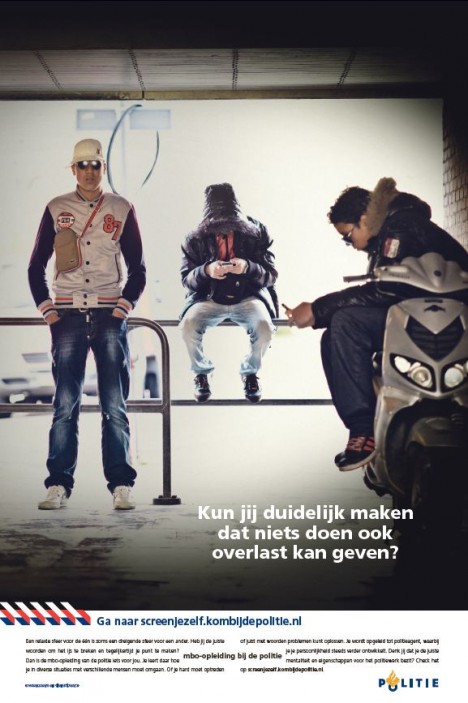
U ziet hier het bijbehorende filmpje:
De campagne maakt overigens gebruik van wel meerdere stereotyperingen:
Maar ik wil het even hebben over het deel met de hangjongeren. Zoals in het blog wordt opgemerkt gaat het niet zozeer om de diender op straat maar om de copywriter die de slogan ‘Kun jij duidelijk maken dat niets doen ook overlast kan geven?‘ heeft bedacht en de politieorganisatie die deze campagneposter en film goedkeuren. Wat hier gebeurt is te zien als onderdeel van de criminalisering van ‘hangjongeren’. Waar het eigenlijk door de geschiedenis heen zeer gebruikelijk is dat jongeren, in het bijzonder jongens, in de openbare ruimte bij elkaar komen, elkaars grenzen en die van anderen aftasten en nieuwe grenzen vastleggen als onderdeel van het proces van opgroeien, zien we eveneens dat dit altijd met argusogen gevolgd wordt door volwassenen. Het zijn immers deels de grenzen die volwassenen gesteld hebben die worden afgestast, uitgedaagd, overschreden en veranderd. De hangplekken krijgen voor jongeren een speciale betekenis tijdens en door het hangen als een plek waar men elkaar ontmoet en waar ze hun identiteit en het idee van zichzelf zijn vorm en inhoud krijgen. Uit allerlei onderzoeken blijkt dat mensen jaren later daar nog met enige nostalgie aan terug denken bijvoorbeeld als ze er langskomen. Het is één van de manieren waarop een verbondenheid met iemands lokale omgeving wordt geschapen. Het gaat ook om het claimen van een plek en ruimtelijke autonomie ten koste van andere hanggroepen en volwassenen bijvoorbeeld door het achterlaten van graffiti of ‘rommel’ (meer dan eens afval van de Mac waar men net vandaan komt).
‘Overlast’ is het kernwoord waarmee volwassenen (buurtbewoners, politie, beleidsmakers) proberen de zeggenschap over de openbare ruimte terug te krijgen. In het geval van Marokkaans-Nederlandse hangjongeren (en in het filmpje en op de poster wordt waarschijnlijk niet voor niets een stereotype Marokkaans-Nederlandse hangjongere getoond) komt daar nog eens bij dat het gaat om een groep die gezien wordt als buitenstaander van de maatschappij. Hun claim op de openbare ruimte wordt door henzelf en de omgeving dan al snel geduid in termen van etniciteit of religie. De media spelen een grote rol in de criminalisering van hangjongeren. Verhalen in de media over hangplekken waar jongeren samenkomen zijn vrijwel altijd gekoppeld aan overlast en vertellen vrijwel altijd de boosheid van ouderen over het gebrek aan optreden door de politie. Erin Martineau heeft daar een mooi proefschrift “Too much tolerance”: Hang-around youth, public space, and the problem of freedom in the Netherlands” over geschreven, dat HIER in zijn geheel te downloaden is.
Martineau heeft onderzoek gedaan onder hangjongeren in Amsterdam en laat zien dat de zorgen omtrent hangjongeren samenhangen met andere zorgen van mensen over etnische diversiteit, gezag, sociale cohesie, opvoeding en veiligheid. Martineau laat zien dat het rondhangen van jongeren een eeuwenoude praktijk is, maar dat de term hangjongeren van meer recente datum is. De term maakt van een zeer diverse groep jongeren met uiteenlopende gedragingen een schijnbaar objectieve sociale categorie waar vervolgens beleid over gemaakt kan worden en waar de media haar reportages mee kan maken (het beestje moet immers een naam hebben toch?). Beleidsmakers, politici, media en politie maken zich druk over deze jongeren en in de debatten hierover en door de beleidsmaatregelen raakt de kwestie van hangjongeren vermengd met criminaliteit, integratie en gedragsregels die het publieke gedrag van deze jongeren moeten reguleren (denk aan de Gouden Stadsregels van Gouda).
Martineau stelt dat er niet zozeer sprake is van een morele paniek over de aanwezigheid en het gedrag van deze jongeren, maar dat er juist zeer gemengde boodschappen worden afgegeven. In het publieke vertoog worden hangjongeren vaak gezien als uitwas van de te grote tolerantie en vrijheden die de Nederlandse samenleving zouden kenmerken, en in het bijzonder in het geval van Marokkaans-Nederlandse hangjongeren als gevolg van het multiculturalisme. De grote, en soms theatrale ophef (‘straatterrorsten’) zouden dan een tegenreactie zijn op die tolerantie, vrijheden en het multiculturalisme. Volgens Martineau echter is dat onjuist. Terecht al is het maar omdat die vermeende vrijheden, tolerantie en het multiculturalisme mythes (maar wel belangrijke) zijn. Martineau maakt een ander punt overigens. De ophef over en criminalisering van rondhangende jongeren komt heeft te maken met drie ontwikkelingen sinds de jaren ’60:
- Een sterk geïndividualiseerde notie van persoonlijke vrijheid
- Het idee dat de overheid cq verzorgingsstaat alle sociale problemen moet oplossen
- De opkomst en verspreiding van een stedelijk schoonheidsideaal over hoe de openbare ruimte eruit moet zien: ordentelijk, rustig en schoon.
Daarmee is de commotie over rondhangende jongeren niet zozeer een tegenreactie op een teveel aan tolerantie, maar een product van de veranderingen van de jaren zestig. Veel mensen, zo laat Martineau zien, hechten sterk aan hun eigen individuele vrijheid, maar zijn wel verontrust over overlast van het gedrag van anderen. Individualisering betekent in Nederland dat men zich ontdaan heeft van sociale banden die als knellend worden ervaren en waarbij zelfontplooiing voorop staat. De overheid dient garant te staan voor ieders persoonlijke vrijheid, maar men vraagt tevens de overheid om de vrijheid van anderen aan banden te leggen als men er last van heeft. Dat heeft ook betrekking op de sociale ruimte. Martineau laat zien dat mensen vinden recht te hebben op een vreedzame, schone, ordentelijke omgeving; een vinex-wijk in optima forma. De term ‘overlast’ geeft in de discussies heeft dan ook vooral betrekking op het afzien en de machteloosheid van volwassenen aan en de wens dat de overheid dit oplost. De overheid op haar beurt reageert met een beroep op de ouders die hun verantwoordelijkheid moeten nemen, maar neemt tegelijkertijd maatregelen die diep ingrijpen in de persoonlijke levenssfeer van jongeren gericht op preventie van overlast en het veilig maken van de publieke ruimte. Ook de commercie speelt daar handig op in: hangjongerenweg.nl. In het geval van Marokkaans-Nederlandse jongeren staat een en ander dan ook nog eens in het teken van integratie, de islam-discussie en in enkele gevallen zelfs in het teken van anti-radicalisering.
Enerzijds wil de overheid de sociale wereld reguleren en willen veel burgers een geordende wereld. Anderzijds echter vinden de meeste burgers dat zij het recht hebben hun leven naar eigen goeddunken te leiden en dat niemand zich daarmee zou moeten bemoeien en dat zij het recht op een schone, harmonieuze leefomgeving. In deze context worden jongeren in het algemeen, en allochtone Nederlandse jongeren in het bijzonder, gezien als onaangepast. Overheidsingrijpen zou dan ook noodzakelijk zijn om deze jongeren te leren wat gepast gedrag is in het openbaar. De commotie over rondhangende jongeren gaat dan ook niet zozeer over daadwerkelijke overlast van jongeren zelf, maar over onmacht, woede en angst bij volwassenen die wordt veroorzaakt doordat de problemen die zij ervaren niet weggaan. En die problemen gaan niet weg, want nietsdoen is immers niet verboden en je kunt ook niet dag en nacht jongerenwerkers bij de jongeren neerzetten. En die hangjongeren doen niet meer dan wat van hen verwacht wordt: vasthouden aan de notie van persoonlijke vrijheid die niet aangetast mag worden door gezagsstructuren en eisen van anderen. Wanneer ze dan toch worden aangesproken als vervelende jongeren die iets verkeerds doen, moeten we niet vreemd opkijken als ze op een agressieve wijze reageren: criminalisering van groepen produceert criminelen.
Joumana Haddad – Realities of Arab Women and Inventing the Arab Woman
Posted on January 31st, 2012 by martijn.
Categories: Activism, Gender, Kinship & Marriage Issues, Multiculti Issues, Public Islam, Religion Other, Society & Politics in the Middle East.
Joumana Haddad is a Lebanese writer and poet. In 2010 she published I Killed Scheherazade: Confessions of An Angry Arab Woman. In this book she challenges prejudice, hypocrisy and religious bigotry; an effort (as she explains it) of self-criticism by taking on the dilemma’s and challenges of women in the Arab world and the Western stereotypes they are confronted with such as the suffering, oppressed woman. In doing so she asks tough questions but unfortunately also reinforces particular stereotypes with phrases such as ‘the Arab mind’ and constructing a dichtotomy between being religious on the one side and being liberated and emancipated on the other side. At the same time she tries to show the existence of multiple realities, the liberated Arab women exist as well as the oppressed (in her view similar as veiled) Arab women. This dual reality becomes her call to the West to stop generalizing and to Arab women to stand up and fight.
Last Sunday she was on Dutch TV. You can see the video below. The introduction is in Dutch, but the interview in English starts after 30 seconds.
Notwithstanding the critique that is certainly valid I liked her book. And although she is not the first and probably not the last Arab woman writing about controversial issues around sex, religion and oppression and challenging patriarchal norms and expectations in the Middle east, it is interesting how and why she became a sort of darling of the Western media likening to for example Carrie Bradshaw of Sex and the City and with profiles consisting of much attention to how she looks (unveiled, self-confident sexy). Ow did I mention she looks pretty?
Gezichtssluiers in Debat
Posted on January 28th, 2012 by martijn.
Categories: Gender, Kinship & Marriage Issues, Multiculti Issues, Notes from the Field, Public Islam.
Update: 6-2-2012 de stukken voor de 2e kamer zijn toegevoegd, zie onderaan
De volgende stappen in de richting van een verbod op de gezichtssluiers zijn inmiddels genomen. De Raad van State heeft een zeer kritisch advies over de kabinetsplannen afgegeven. De RvS heeft enkele jaren geleden ook al negatief geoordeeld over een voorstel van de PVV dat discriminerend zou zijn en in strijd zou zijn met de godsdienstvrijheid. Het huidige kabinetsplan is deels een reactie daarop (en voor het andere deel een tegemoetkoming aan de PVV voor de gedoogsteun). Helaas heb ik het advies niet online kunnen vinden, maar volgens de NOS site zou opnieuw het aspect van discriminatie en godsdienstvrijheid van belang zijn en de RvS vraagt zich af of een verbod niet een te zwaar middel is.
Het kabinet zet de plannen desondanks door:
Kabinet akkoord met verbod gelaatsbedekkende kleding | Persbericht | Rijksoverheid.nl
Met het wetsvoorstel geeft het kabinet uitvoering aan het voornemen zoals in het regeerakkoord staat.
Het verbod op het dragen van gelaatsbedekkende kleding is van belang voor een samenleving waarin iedereen volwaardig meedoet aan het maatschappelijk verkeer. Het verplicht dragen van een boerka of niqab voor het gezicht in het openbaar is in strijd met de gelijkwaardigheid van mannen en vrouwen. Met het wetsvoorstel neemt het kabinet voor deze vrouwen een belemmering voor deelname aan het maatschappelijk verkeer weg.Het legitieme doel om het dragen van gelaatsbedekkende kleding te beperken, is het beschermen van het maatschappelijk verkeer én de openbare orde in onze samenleving.
Voor de PVV speelt daarbij ook nog mee dat een gezichtssluier ingaat tegen de ‘westerse kernwaarden’. Minister Verhagen legt het als volgt uit:
Er zijn dus tal van uitzonderingen en volgens minister Verhagen ‘hoeft u zich dus geen zorgen te maken’. De vraag is dan wel wie hij met ‘u’ bedoelt. Naast gemengde reacties onder politici en moslims zijn er, neem ik aan, vrouwen met een gezichtssluier zich wel zorgen maken en er zijn ook vrouwen zonder gezichtssluier en mannen die dat doen. Een ander argument is dat mensen mee moeten doen met de samenleving en dat dat niet kan met een gezichtssluier. De vraag is dan wat precies die samenleving is? En waarom zouden mensen eigenlijk mee moeten doen? En waarom zouden mensen mee moeten doen met een samenleving met een regering die een anti-moslim houding heeft of die een anti-moslim houding op z’n minst overkomelijk vindt? (Zie ook de discussie over boerka en burgerschap).
Het volgende filmpje is van de recente demonstratie tegen het mogelijke verbod en laat een vrouw met niqaab aan het woord:
Op Republiek Allochtonië zijn alle voor- en tegenargumenten nog eens keurig op een rijtje gezet. Ook de uitzending van Nieuwsuur met onder meer mijn collega Annelies Moors geeft een goed overzicht:
Annelies Moors doet haar uitspraken op basis van haar onderzoek ‘Gezichtssluiers. Draagsters en Debatten‘. Zij laat zien dat vrouwen, onder wie veel autochtone vrouwen, kiezen voor een type gezichtssluier vaak na een jarenlange religieuze zoektocht en dat zij dit soms doen tegen de weerstand van de eigen familie en de verbale agressie van buitenstaanders in. De weerstand wordt gezien als de prijs die men moet betalen en vergroot ook in sommige gevallen het belang van de gezichtssluier omdat men het ziet als een religieuze beproeving die men moet doorstaan zo blijkt ook mijn eigen gesprekken met enkele dames.
De aspecten van zoektocht en religieuze beproeving zijn belangrijk. In tegenstelling tot wat men vaak denkt is het dragen van een bepaald type sluier geen teken van een afgeronde en zekere (morele) radicale identiteit of een eindstadium in een persoonlijke ontwikkeling. Dat is het echter niet. Ten eerste dragen veel vrouwen een gezichtssluier slechts ‘part time’; afhankelijk van de tijd en plaats waar men is. Ten tweede gaan sommige vrouwen na verloop van tijd over op een andere vorm van sluiering.
Het is lastig om iets zinnigs te zeggen over de gevolgen van een dergelijk verbod. Zoals we bij Nieuwsuur konden zien heeft de handhaving bij de politie geen hoge prioriteit, wat nog wel de nodige reuring zal opleveren en minister Opstelten is het er dan ook niet mee eens. De Engelse krant The Guardian ging eens kijken in Frankrijk. Ook daar lijken de vrouwen niet veel last te hebben van de politie, maar wel van verbale agressie of zelfs aanrandingen. Of dit nu komt door het verbod is onduidelijk aangezien althans in Nederland de vrouwen aangeven last te hebben van verbale en soms zelfs fysieke agressie. Het openbare orde argument en het argument van vrouwenonderdrukking lijken daarmee aardig ontkracht.
Het zijn niet de vrouwen die de openbare orde bedreigen, de vrouwen worden in de openbare ruimte bedreigd. Natuurlijk is er sprake van vrouwen die gedwongen worden om een type sluier te dragen, maar de voorbeelden die worden aangedragen hebben meestal betrekking op landen als Afghanistan, Pakistan en Saoedi-Arabië; sowieso niet de landen die bekend staan om staten die veel vrijheden geven aan burgers, laat staan aan vrouwelijke burgers. Gezichtssluiers en andere kleding in relatie tot recht op zelfbeschikking en zeggenschap over hun eigen lichaam dienen wel in hun context bekeken te worden; het dragen van een sluier is een andere realiteit en praktijk in Afghanistan dan in Nederland. Wel kan in sommige moslimkringen, ook in Nederland, sociale druk een meespelen als factor in de beslissing om een sluier te dragen (of niet te dragen, er zijn ook vrouwen die geen (gezichts-)sluier dragen uit vrees voor afwijzing bij een baan of agressie op straat). Niettemin zou de overheid er beter aan doen de gezichtssluier niet te verbieden, maar maatregelen te treffen om vrouwen die een gezichtssluier dragen beter te beschermen.
Intussen heb ik ook enkele mails ontvangen van dames die een gezichtssluier dragen en mij vragen of dat verbod al ingegaan is. Nee dus, als het verbod ingaat is dat op 1 januari 2013. En de discussie is natuurlijk nog niet gedaan. Het wetsvoorstel moet nog door de 1e en 2e Kamer. Eventueel zou men ook nog kunnen overwegen om naar het Europese Hof van Justitie te gaan en misschien betaalt die zakenman ook nog wel de boetes van de dames hier. Dit jaar kunt u wettelijk gezien dus nog vrolijk en gerust met een gezichtssluier lopen als u dat wil en, als u van buiten komt, Nederland met gezichtssluier bezoeken.
Zie ook een eerder stuk: Minister Donner as Mufti: New Developments in the Dutch ‘Burqa’ Debates door Annelies Moors.

Tot slot een rondje langs de virtuele velden:
Het niqaabverbod, een zorgwekkende ontwikkeling | Wijblijvenhier.nl
In het geval van de ‘boerka’ is er zonder grote politieke en maatschappelijke weerstand ingestemd met het verbod. De associaties met dit kledingstuk zijn namelijk ingeburgerd en vastgenageld; vastgeroest door herhalingen en bevestigingen. Dé boerka en alles wat daarbij hoort, is, als we Sarkozy, Wilders en vele anderen mogen geloven, de ultieme vijand van onze ‘superieure’ beschaving.
Twee duidelijke meningen over de nikaab/boerka « CarelBrendel.nl
De boerka, dat is een gevangenis, een dwangbuis. […]
Je kunt alleen maar bestaan als er ook iemand is om dat waar te nemen. En dat is zo onmogelijk, behalve voor de eigenaar. Het is de ultieme vernedering.
Eindelijk! Het Boerkaverbod is er door! « Wim de Bie
Na het voorstel tot een verbod op boerka’s voor scholen en voor ambtenaren laat de regering het verbieden van gezichtsbedekkende kleding in het openbaar vervoer dus over aan de vervoersbedrijven. Jammer! Hoe kunnen de conducteurs die bedrijfsregels handhaven, nu de boerka zo massaal wordt gedragen?
Nederland legt dwingende kledingvoorschriften op « De Zesde Clan
Minister Liesbeth Spies legt in Trouw uit dat Nederland een open samenleving is waar mensen elkaar ook open tegemoet moeten treden. Iedereen moet kunnen participeren. Klinkt mooi, maar de regering wil dit afdwingen met strafbepalingen. De regering negeert met deze vrijheidsbeperking allerlei argumenten tegen zo’n drastische ingreep in het persoonlijke leven van mensen.
Ten eerste ziet zo’n verknipt tafellaken om je bakkes er gewoon niet uit en ten tweede wil je als westerse man zo’n moslima gewoon in haar facial kijken om te checken of je haar zou doen achter het fietsenhok. Zo zijn wij. En eindelijk snapt de Nederlandse politiek dat ook eens. Dus deze zomer zijn er allemaal lekkere hete moslim chickies te bewonderen op het strand en in het park. Het is alsof Nederland een update heeft gehad en er weer een fout uit het systeem verwijderd is. Lang leve het Boerkaverbod!
Artikelen Vriend Klei: Fundamenteel debat over boerkaverbod nodig
Het debat moet allereerst gaan over de vraag, of vrouwen zelf kiezen een boerka te dragen, of dat de gemeenschap hun dwingt om dat te doen. Daarnaast moeten we de vraag stellen, of een verbod de al dan niet onderdrukte vrouwen wel verder helpt. Worden vrouwen die vrijwillig voor een boerka kiezen niet in hun godsdienstvrijheid en zelfexpressie aangetast? En worden vrouwen die nu een boerka mogen dragen straks niet thuis opgesloten, als er boerkaverbod komt? En als een boerkaverbod verkeerd zou zijn, waarmee zijn de vrouwen die gedwongen worden een boerka te dragen dan wel bij gebaat? Het zijn lastige fundamentele vragen, waarop ik zelf zo een-twee-drie nog geen antwoord heb.
De boerka vs de bikini | VerkenIslam
De rol van de vrouw ligt aan het hart van ieder cultuur. Afgezien van het stelen van de Arabische olie, gaat de ophanden zijnde oorlog in het Midden-Oosten over het ontdoen van de Arabieren van hun religie en cultuur, om de inwisseling van de boerka voor de bikini.
Ik ben geen expert betreffende de staat van de moslimvrouwen en ik houd ook te veel van vrouwelijke schoonheid om hier voor de boerka te pleiten. Maar ik verdedig wel wat van de waarden die de boerka voor mij vertegenwoordigt.
Voor mij vertegenwoordigt de boerka de toewijding van de vrouw aan haar man en haar familie.
Boerka ja? Boerka nee! « Ineke Evink
Aantasting van de vrijheid van godsdienst, een breuk met het tolerante Nederlandse verleden, symboolpolitiek om de PVV te pleasen, xenofobie, islam-bashing, alle beschuldigingen zijn de revue inmiddels gepasseerd. Ook het geringe aantal vrouwen die ze dragen werd als argument aangevoerd ze niet te verbieden. Maar hoe steekhoudend zijn die bezwaren eigenlijk?
Liegen zonder je gezicht te bedekken « Leibele,s kijk
De overheersing die zij misschien of niet over haar heen moest laten komen van haar islamitische mannen is nu dezelfde overheersing die zij over haar heen moet laten komen van een groot deel van de Nederlandse mannen. De achterlijke kant van de Islam ( volgens Blonde Geert ) is dezelfde kant als het liberalisme van Mark, dezelfde Christelijke als die van Maxime en van nog meerdere politieke kopstukken. Alleen groen links en de Christenunie distanciëerden zich daarvan.
Gunt de boerkadraagster mij wel mijn vrijheid? – Religie – TROUW
Ik ben best bereid om de boerkadraagster haar vrijheid te gunnen om haar godsdienst op haar manier te beleven. Waar ik echter huiverig voor ben, is de gedachte dat dat niet wederzijds is. Als er meer boerkadragers komen, is het niet ondenkbaar dat het mijn ontwikkeling zou kunnen tegengaan. Vooral liberale moslims kunnen hiervan de dupe worden. Door de boerka wordt namelijk de boodschap verspreid: hoe bedekter, hoe dichter bij Allah. Ik draag geen boerka, geen nikaab, ook geen hoofddoek maar ben wel moslim.
Desondanks ben ik soms niet zo blij met het boerkaverbod. Een verbod dat de vrijheid van een individu beperkt, is niet wezenlijk anders dan de praktijk in totalitaire ideologieën.
Boerkaverbod zet de deur open naar vervolging minderheden – Mumtaaz
Maar al een paar jaar is de politiek hard op weg vele rechten van de burger af te nemen. Niet alleen moslims hebben hier last van, ook anderen mogen opeens zomaar afgeluisterd of staande gehouden worden. Dat schijnt hip te zijn op het Binnenhof. Verbieden is zeg maar de Ugg van politiek Den-haag, maar dan bestemd voor beide geslachten (hoewel, op het centraal station heb ik reeds vele ‘mannen’ gespot met dit eskimoschoeisel). Elke partij loopt te koop met “vrijheid,” maar sinds vandaag kunnen we rustig stellen dat vrijheid hun minder waard is dan een Zimbabwaanse dollar.
Kamerstukken:
Wetsvoorstel algemeen verbod op gelaatsbedekkende kleding | Kamerstuk | Rijksoverheid.nl
Voorstel van wet tot instelling van een algemeen verbod op het dragen van gelaatsbedekkende kleding.
PDF document | 1 pagina | 28 KB
Kamerstuk: Voorstel van wet | 06-02-2012 | BZK
Bijlagen
Advies van de Raad van State bij het wetsvoorstel tot instelling van een algemeen verbod op het dragen van gelaatsbedekkende kleding
Kamerstuk | 28-11-2011 | BZKNader rapport wetsvoorstel algemeen verbod op gelaatsbedekkende kleding
Kamerstuk | 27-01-2012 | BZKMemorie van toelichting bij het wetsvoorstel tot instelling van een algemeen verbod op gelaatsbedekkende kleding.
Kamerstuk | 06-02-2012 | BZK