Religious and Political Radicalization
You are looking at posts in the category Religious and Political Radicalization.
| M | T | W | T | F | S | S |
|---|---|---|---|---|---|---|
| « Sep | ||||||
| 1 | 2 | 3 | 4 | |||
| 5 | 6 | 7 | 8 | 9 | 10 | 11 |
| 12 | 13 | 14 | 15 | 16 | 17 | 18 |
| 19 | 20 | 21 | 22 | 23 | 24 | 25 |
| 26 | 27 | 28 | 29 | 30 | 31 | |
Pages
- About
- C L O S E R moves to….C L O S E R
- Contact Me
- Interventions – Forces that Bind or Divide
- ISIM Review via Closer
- Publications
- Research
Categories
- (Upcoming) Events (33)
- [Online] Publications (26)
- Activism (117)
- anthropology (113)
- Method (13)
- Arts & culture (88)
- Asides (2)
- Blind Horses (33)
- Blogosphere (192)
- Burgerschapserie 2010 (50)
- Citizenship Carnival (5)
- Dudok (1)
- Featured (5)
- Gender, Kinship & Marriage Issues (265)
- Gouda Issues (91)
- Guest authors (58)
- Headline (76)
- Important Publications (159)
- Internal Debates (275)
- International Terrorism (437)
- ISIM Leiden (5)
- ISIM Research II (4)
- ISIM/RU Research (171)
- Islam in European History (2)
- Islam in the Netherlands (219)
- Islamnews (56)
- islamophobia (59)
- Joy Category (56)
- Marriage (1)
- Misc. News (891)
- Morocco (70)
- Multiculti Issues (749)
- Murder on theo Van Gogh and related issues (326)
- My Research (118)
- Notes from the Field (82)
- Panoptic Surveillance (4)
- Public Islam (244)
- Religion Other (109)
- Religious and Political Radicalization (635)
- Religious Movements (54)
- Research International (55)
- Research Tools (3)
- Ritual and Religious Experience (58)
- Society & Politics in the Middle East (159)
- Some personal considerations (146)
- Deep in the woods… (18)
- Stadsdebat Rotterdam (3)
- State of Science (5)
- Twitwa (5)
- Uncategorized (74)
- Young Muslims (459)
- Youth culture (as a practice) (157)
General
- ‘In the name of Allah, Most Gracious, Most Merciful’
- – Lotfi Haddi –
- …Kelaat Mgouna…….Ait Ouarchdik…
- ::–}{Nour Al-Islam}{–::
- Al-islam.nl De ware godsdienst voor Allah is de Islam
- Allah Is In The House
- Almaas
- amanullah.org
- Amr Khaled Official Website
- An Islam start page and Islamic search engine – Musalman.com
- arabesque.web-log.nl
- As-Siraat.net
- assadaaka.tk
- Assembley for the Protection of Hijab
- Authentieke Kennis
- Azaytouna – Meknes Azaytouna
- berichten over allochtonen in nederland – web-log.nl
- Bladi.net : Le Portail de la diaspora marocaine
- Bnai Avraham
- BrechtjesBlogje
- Classical Values
- De islam
- DimaDima.nl / De ware godsdienst? bij allah is de islam
- emel – the muslim lifestyle magazine
- Ethnically Incorrect
- fernaci
- Free Muslim Coalition Against Terrorism
- Frontaal Naakt. Ongesluierde opinies, interviews & achtergronden
- Hedendaagse wetenswaardigheden…
- History News Network
- Homepage Al Nisa
- hoofddoek.tk – Een hoofddoek, je goed recht?
- IMRA: International Muslima Rights Association
- Informed Comment
- Insight to Religions
- Instapundit.com
- Interesting Times
- Intro van Abdullah Biesheuvel
- islaam
- Islam Ijtihad World Politics Religion Liberal Islam Muslim Quran Islam in America
- Islam Ijtihad World Politics Religion Liberal Islam Muslim Quran Islam in America
- Islam Website: Islam, Islamic Studies, Arabic, Religion
- Islamforum
- Islamic Philosophy Online
- Islamica Magazine
- islamicate
- Islamophobia Watch
- Islamsevrouw.web-log.nl
- Islamwereld-alles wat je over de Islam wil weten…
- Jihad: War, Terrorism, and Peace in Islam
- JPilot Chat Room
- Madrid11.net
- Marocstart.nl – De marokkaanse startpagina!
- Maryams.Net – Muslim Women and their Islam
- Michel
- Modern Muslima.com
- Moslimjongeren Amsterdam
- Moslimjongeren.nl
- Muslim Peace Fellowship
- Muslim WakeUp! Sex & The Umma
- Muslimah Connection
- Muslims Against Terrorism (MAT)
- Mutma’inaa
- namira
- Otowi!
- Ramadan.NL
- Religion, World Religions, Comparative Religion – Just the facts on the world\’s religions.
- Ryan
- Sahabah
- Salafi Start Siden – The Salafi Start Page
- seifoullah.tk
- Sheikh Abd al Qadir Jilani Home Page
- Sidi Ahmed Ibn Mustafa Al Alawi Radhiya Allahu T’aala ‘Anhu (Islam, tasawuf – Sufism – Soufisme)
- Stichting Vangnet
- Storiesofmalika.web-log.nl
- Support Sanity – Israel / Palestine
- Tekenen van Allah\’s Bestaan op en in ons Lichaam
- Terrorism Unveiled
- The Coffee House | TPMCafe
- The Inter Faith Network for the UK
- The Ni’ma Foundation
- The Traveller’s Souk
- The \’Hofstad\’ terrorism trial – developments
- Thoughts & Readings
- Uitgeverij Momtazah | Helmond
- Un-veiled.net || Un-veiled Reflections
- Watan.nl
- Welkom bij Islamic webservices
- Welkom bij vangnet. De site voor islamitische jongeren!
- welkom moslim en niet moslims
- Yabiladi Maroc – Portail des Marocains dans le Monde
Dutch [Muslims] Blogs
- Hedendaagse wetenswaardigheden…
- Abdelhakim.nl
- Abdellah.nl
- Abdulwadud.web-log.nl
- Abou Jabir – web-log.nl
- Abu Bakker
- Abu Marwan Media Publikaties
- Acta Academica Tijdschrift voor Islam en Dialoog
- Ahamdoellilah – web-log.nl
- Ahlu Soennah – Abou Yunus
- Ahlul Hadeeth
- Ahlul Hadeeth
- Al Moudjahideen
- Al-Adzaan
- Al-Islaam: Bismilaahi Rahmaani Rahiem
- Alesha
- Alfeth.com
- Anoniempje.web-log.nl
- Ansaar at-Tawheed
- At-Tibyan Nederland
- beni-said.tk
- Blog van moemina3 – Skyrock.com
- bouchra
- CyberDjihad
- DE SCHRIJVENDE MOSLIMS
- DE VROLIJKE MOSLIM ;)
- Dewereldwachtopmij.web-log.nl
- Dien~oel~Islaam
- Eali.web-log.nl
- Een genade voor de werelden
- Enige wapen tegen de Waarheid is de leugen…
- ErTaN
- ewa
- Ezel & Os v2
- Gizoh.tk [.::De Site Voor Jou::.]
- Grappige, wijze verhalen van Nasreddin Hodja. Turkse humor.
- Hanifa Lillah
- hayya~ala~assalaah!
- Het laatste nieuws lees je als eerst op Maroc-Media
- Homow Universalizzz
- Ibn al-Qayyim
- IslaamLive Mail
- IslaamLive Mail
- Islam Blog – Juli 2007
- Islam in het Nieuws – web-log.nl
- Islam, een religie
- Islam, een religie
- Islamic Sisters – web-log.nl
- Islamiway’s Weblog
- Islamtawheed’s Blog
- Jihaad
- Jihad
- Journalista
- La Hawla Wa La Quwatta Illa Billah
- M O S L I M J O N G E R E N
- M.J.Ede – Moslimjongeren Ede
- Mahdi\’s Weblog | Vrijheid en het vrije woord | punt.nl: Je eigen gratis weblog, gratis fotoalbum, webmail, startpagina enz
- Maktab.nl (Zawaj – islamitische trouwsite)
- Marocdream.nl – Home
- Marokkaanse.web-log.nl
- Marokkanen Weblog
- Master Soul
- Miboon
- Miesjelle.web-log.nl
- Mijn Schatjes
- Moaz
- moeminway – web-log.nl
- Moslima_Y – web-log.nl
- mosta3inabilaah – web-log.nl
- Muhaajir in islamitisch Zuid-Oost Azië
- Mumin al-Bayda (English)
- Mustafa786.web-log.nl
- Oprecht – Poort tot de kennis
- Said.nl
- saifullah.nl – Jihad al-Haq begint hier!
- Salaam Aleikum
- Sayfoudien – web-log.nl
- soebhanAllah
- Soerah19.web-log.nl – web-log.nl
- Steun Palestina
- Stichting Moslimanetwerk
- Stories of Malika
- supermaroc
- Ummah Nieuws – web-log.nl
- Volkskrant Weblog — Alib Bondon
- Volkskrant Weblog — Moslima Journalista
- Vraag en antwoord…
- wat is Islam
- Wat is islam?
- Weblog – a la Maroc style
- website van Jamal
- Wij Blijven Hier
- Wij Blijven Hier
- www.BenAyad.be – Islam en Actua
- www.moslima.web-log.nl
- Yakini Time
- Youth Of Islam
- Youth Of Islam
- [fikra]
Non-Dutch Muslims Blogs
- Lanallah __Islamic BlogZine__
- This journey ends but only with The Beginning
- ‘the middle place’
- …Never Judge a Person By His or Her Blog…
- …under the tree…
- A Comment on PMUNA
- A Dervish’s Du`a’
- A Family in Baghdad
- A Garden of Children
- A Muslim Mother’s Thoughts / Islamic Parenting
- A Struggle in Uncertainty, Such is Life
- About Afghanistan
- adnan.org: good design, bad idea
- Afiyah
- Ahmeds World of Islam
- Al Musawwir
- Al-Musharaka
- Almiraya tBLOG – O, happy the soul that saw its own faults
- Almusawwir
- an open window
- Anak Alam
- aNaRcHo AkBaR
- Anthology
- AnthroGal’s World
- Arabian Passion
- ArRihla
- Articles Blog
- Asylum Seeker
- avari-nameh
- Baghdad Burning
- Being Noor Javed
- Bismillah
- bloggin’ muslimz.. Linking Muslim bloggers around the globe
- Blogging Islamic Perspective
- Chapati Mystery
- City of Brass – Principled pragmatism at the maghrib of one age, the fajr of another
- COUNTERCOLUMN: All Your Bias Are Belong to Us
- d i z z y l i m i t s . c o m >> muslim sisters united w e b r i n g
- Dar-al-Masnavi
- Day in the life of an American Muslim Woman
- Don’t Shoot!…
- eat-halal guy
- Eye on Gay Muslims
- Eye on Gay Muslims
- Figuring it all out for nearly one quarter of a century
- Free Alaa!
- Friends, Romans, Countrymen…. lend me 5 bux!
- From Peer to Peer ~ A Weblog about P2P File & Idea Sharing and More…
- Ghost of a flea
- Ginny’s Thoughts and Things
- God, Faith, and a Pen: The Official Blog of Dr. Hesham A. Hassaballa
- Golublog
- Green Data
- gulfreporter
- Hadeeth Blog
- Hadouta
- Hello from the land of the Pharaoh
- Hello From the land of the Pharaohs Egypt
- Hijabi Madness
- Hijabified
- HijabMan’s Blog
- Ihsan-net
- Inactivity
- Indigo Jo Blogs
- Iraq Blog Count
- Islam 4 Real
- Islamiblog
- Islamicly Locked
- Izzy Mo’s Blog
- Izzy Mo’s Blog
- Jaded Soul…….Unplugged…..
- Jeneva un-Kay-jed- My Bad Behavior Sanctuary
- K-A-L-E-I-D-O-S-C-O-P-E
- Lawrence of Cyberia
- Letter From Bahrain
- Life of an American Muslim SAHM whose dh is working in Iraq
- Manal and Alaa\’s bit bucket | free speech from the bletches
- Me Vs. MysElF
- Mental Mayhem
- Mere Islam
- Mind, Body, Soul : Blog
- Mohammad Ali Abtahi Webnevesht
- MoorishGirl
- Muslim Apple
- muslim blogs
- Muslims Under Progress…
- My heart speaks
- My Little Bubble
- My Thoughts
- Myself | Hossein Derakhshan’s weblog (English)
- neurotic Iraqi wife
- NINHAJABA
- Niqaabi Forever, Insha-Allah Blog with Islamic nasheeds and lectures from traditional Islamic scholars
- Niqabified: Irrelevant
- O Muhammad!
- Otowi!
- Pak Positive – Pakistani News for the Rest of Us
- Periphery
- Pictures in Baghdad
- PM’s World
- Positive Muslim News
- Procrastination
- Prophet Muhammad
- Queer Jihad
- Radical Muslim
- Raed in the Middle
- RAMBLING MONOLOGUES
- Rendering Islam
- Renegade Masjid
- Rooznegar, Sina Motallebi’s WebGard
- Sabbah’s Blog
- Salam Pax – The Baghdad Blog
- Saracen.nu
- Scarlet Thisbe
- Searching for Truth in a World of Mirrors
- Seeing the Dawn
- Seeker’s Digest
- Seekersdigest.org
- shut up you fat whiner!
- Simply Islam
- Sister Scorpion
- Sister Soljah
- Sister Surviving
- Slow Motion in Style
- Sunni Sister: Blahg Blahg Blahg
- Suzzy’s id is breaking loose…
- tell me a secret
- The Arab Street Files
- The Beirut Spring
- The Islamic Feminista
- The Land of Sad Oranges
- The Muslim Contrarian
- The Muslim Postcolonial
- The Progressive Muslims Union North America Debate
- The Rosetta Stone
- The Traceless Warrior
- The Wayfarer
- TheDesertTimes
- think halal: the muslim group weblog
- Thoughts & Readings
- Through Muslim Eyes
- Turkish Torque
- Uncertainty:Iman and Farid’s Iranian weblog
- UNMEDIA: principled pragmatism
- UNN – Usayd Network News
- Uzer.Aurjee?
- Various blogs by Muslims in the West. – Google Co-op
- washed away memories…
- Welcome to MythandCulture.com and to daily Arrows – Mythologist, Maggie Macary’s blog
- word gets around
- Writeous Sister
- Writersblot Home Page
- www.BenAyad.be – Islam en Actua
- www.Mas’ud’s blog
- \’Aqoul
- ~*choco-bean*~
General Islam Sites
- :: Islam Channel :: – Welcome to IslamChannel Official Website
- Ad3iyah(smeekbeden)
- Al-maktoum Islamic Centre Rotterdam
- Assalamoe Aleikoem Warhmatoe Allahi Wa Barakatuhoe.
- BouG.tk
- Dades Islam en Youngsterdam
- Haq Islam – One stop portal for Islam on the web!
- Hight School Teacher Muhammad al-Harbi\’s Case
- Ibn Taymiyah Pages
- Iskandri
- Islam
- Islam Always Tomorrow Yesterday Today
- Islam denounces terrorism.com
- Islam Home
- islam-internet.nl
- Islamic Artists Society
- Leicester~Muslims
- Mere Islam
- MuslimSpace.com | MuslimSpace.com, The Premiere Muslim Portal
- Safra Project
- Saleel.com
- Sparkly Water
- Statements Against Terror
- Understand Islam
- Welcome to Imaan UK website
Islamic Scholars
Social Sciences Scholars
- ‘ilm al-insaan: Talking About the Talk
- :: .. :: zerzaust :: .. ::
- After Sept. 11: Perspectives from the Social Sciences
- Andrea Ben Lassoued
- Anth 310 – Islam in the Modern World (Spring 2002)
- anthro:politico
- AnthroBase – Social and Cultural Anthropology – A searchable database of anthropological texts
- AnthroBlogs
- AnthroBoundaries
- Anthropologist Community
- anthropology blogs
- antropologi.info – Social and Cultural Anthropology in the News
- Arabist Jansen
- Between Secularization and Religionization Vrije Universiteit Amsterdam
- Bin Gregory Productions
- Blog van het Blaise Pascal Instituut
- Boas Blog
- Causes of Conflict – Thoughts on Religion, Identity and the Middle East (David Hume)
- Cicilie among the Parisians
- Cognitive Anthropology
- Comunidade Imaginada
- Cosmic Variance
- Critical Muslims
- danah boyd
- Deep Thought
- Dienekes’ Anthropology Blog
- Digital Islam
- Erkan\’s field diary
- Ethno::log
- Evamaria\’s ramblings –
- Evan F. Kohlmann – International Terrorism Consultant
- Experimental Philosophy
- For the record
- Forum Fridinum [Religionresearch.org]
- Fragments weblog
- From an Anthropological Perspective
- Gregory Bateson
- Islam & Muslims in Europe *)
- Islam, Islamic Studies, Arabic, Religion
- Islam, Muslims, and an Anthropologist
- Jeremy’s Weblog
- JourneyWoman
- Juan Cole – ‘Documents on Terrorist Abu Musab al-Zarqawi’
- Keywords
- Kijken naar de pers
- languagehat.com
- Left2Right
- Leiter Reports
- Levinas and multicultural society
- Links on Islam and Muslims
- log.squig.org
- Making Anthropology Public
- Martijn de Koning Research Pages / Onderzoekspaginas
- Material World
- MensenStreken
- Modern Mass Media, Religion and the Imagination of Communities
- Moroccan Politics and Perspectives
- Multicultural Netherlands
- My blog’s in Cambridge, but my heart is in Accra
- National Study of Youth and Religion
- Natures/Cultures
- Nomadic Thoughts
- On the Human
- Philip Greenspun’s Weblog:
- Photoethnography.com home page – a resource for photoethnographers
- Qahwa Sada
- RACIAL REALITY BLOG
- Religion Gateway – Academic Info
- Religion News Blog
- Religion Newswriters Association
- Religion Research
- rikcoolsaet.be – Rik Coolsaet – Homepage
- Rites [Religionresearch.org]
- Savage Minds: Notes and Queries in Anthropology – A Group Blog
- Somatosphere
- Space and Culture
- Strange Doctrines
- TayoBlog
- Teaching Anthropology
- The Angry Anthropologist
- The Gadflyer
- The Immanent Frame | Secularism, religion and the public sphere
- The Onion
- The Panda\’s Thumb
- TheAnthroGeek
- This Blog Sits at the
- This Blog Sits at the intersection of Anthropology & Economics
- verbal privilege
- Virtually Islamic: Research and News about Islam in the Digital Age
- Wanna be an Anthropologist
- Welcome to Framing Muslims – International Research Network
- Yahya Birt
Women's Blogs / Sites
- * DURRA * Danielle Durst Britt
- -Fear Allah as He should be Feared-
- a literary silhouette
- a literary silhouette
- A Thought in the Kingdom of Lunacy
- AlMaas – Diamant
- altmuslimah.com – exploring both sides of the gender divide
- Assalaam oe allaikoum Nour al Islam
- Atralnada (Morning Dew)
- ayla\’s perspective shifts
- Beautiful Amygdala
- bouchra
- Boulevard of Broken Dreams
- Chadia17
- Claiming Equal Citizenship
- Dervish
- Fantasy web-log – web-log.nl
- Farah\’s Sowaleef
- Green Tea
- hayya~ala~assalaah!
- Hilsen Fra …
- Islamucation
- kaleidomuslima: fragments of my life
- Laila Lalami
- Marhaban.web-log.nl – web-log.nl
- Moslima_Y – web-log.nl
- Muslim-Refusenik The official website of Irshad Manji
- Myrtus
- Noor al-Islaam – web-log.nl
- Oh You Who Believe…
- Raising Yousuf: a diary of a mother under occupation
- SAFspace
- Salika Sufisticate
- Saloua.nl
- Saudi Eve
- SOUL, HEART, MIND, AND BODY…
- Spirit21 – Shelina Zahra Janmohamed
- Sweep the Sunshine | the mundane is the edge of glory
- Taslima Nasrin
- The Color of Rain
- The Muslimah
- Thoughts Of A Traveller
- Volkskrant Weblog — Islam, een goed geloof
- Weblog Raja Felgata | Koffie Verkeerd – The Battle | punt.nl: Je eigen gratis weblog, gratis fotoalbum, webmail, startpagina enz
- Weblog Raja Felgata | WRF
- Writing is Busy Idleness
- www.moslima.web-log.nl
- Zeitgeistgirl
- Zusters in Islam
- ~:: MARYAM ::~ Tasawwuf Blog
Ritueel en religieuze beleving Nederland
- – Alfeth.com – NL
- :: Al Basair ::
- Abu Marwan Media Publikaties
- Ahlalbait Jongeren
- Ahlul Hadeeth
- Ahlul Hadeeth
- Al-Amien… De Betrouwbare – Home
- Al-Ummah
- Al-Ummah
- Al-Ummah
- Al-Wasatiyyah.com – Home
- Anwaar al-Islaam
- anwaaralislaam.tk
- Aqiedah’s Weblog
- Arabische Lessen – Home
- Arabische Lessen – Home
- Arrayaan.net
- At-taqwa.nl
- Begrijp Islam
- Bismillaah – deboodschap.com
- Citaten van de Salaf
- Dar al-Tarjama WebSite
- Dawah-online.com
- de koraan
- de koraan
- De Koran . net – Het Islaamitische Fundament op het Net – Home
- De Leidraad, een leidraad voor je leven
- Dien~oel~Islaam
- Dien~oel~Islaam
- Faadi Community
- Ghimaar
- hayya~ala~assalaah!
- hayya~ala~assalaah!
- Ibn al-Qayyim
- IMAM-MALIK-Alles over Islam
- IQRA ROOM – Koran studie groep
- Islaam voor iedereen
- Islaam voor iedereen
- Islaam: Terugkeer naar het Boek (Qor-aan) en de Soennah volgens het begrip van de Vrome Voorgangers… – Home
- Islaam: Terugkeer naar het Boek (Qor-aan) en de Soennah volgens het begrip van de Vrome Voorgangers… – Home
- IslaamLive Mail
- IslaamLive Mail
- IslaamLive Mail
- islam :: messageboard
- Islam City NL, Islam en meer
- Islam, een religie
- Islamia.nl – Islamic Shop – Islamitische Winkel
- Islamitische kleding
- Islamitische kleding
- Islamitische smeekbedes
- islamtoday
- islamvoorjou – Informatie over Islam, Koran en Soenah
- kebdani.tk
- KoranOnline.NL
- Lees de Koran – Een Openbaring voor de Mensheid
- Lifemakers NL
- Marocstart.nl | Islam & Koran Startpagina
- Miesbahoel Islam Zwolle
- Mocrodream Forums
- Moslims in Almere
- Moslims online jong en vernieuwend
- Nihedmoslima
- Oprecht – Poort tot de kennis
- Quraan.nl :: quran koran kuran koeran quran-voice alquran :: Luister online naar de Quraan
- Quraan.nl online quraan recitaties :: Koran quran islam allah mohammed god al-islam moslim
- Selefie Nederland
- Stichting Al Hoeda Wa Noer
- Stichting Al Islah
- StION Stichting Islamitische Organisatie Nederland – Ahlus Sunnat Wal Djama\’ah
- Sunni Publicaties
- Sunni.nl – Home
- Teksten van Aboe Ismaiel
- Terug Naar De Dien – Home
- Terug Naar De Dien – Home
- Terug Naar De Dien – Home
- Uw Keuze
- www.ahloelhadieth.com
- www.ahloelhadieth.com
- www.al-thabaat.com
- www.hijaab.com
- www.uwkeuze.net
- Youth Of Islam
- Zegswijzen van de Wijzen
- \’\’ Leid ons op het rechte pad het pad degenen aan wie Gij gunsten hebt geschonken\’\’
Muslim News
Moslims & Maatschappij
Arts & Culture
- : : SamiYusuf.com : : Copyright Awakening 2006 : :
- amir normandi, photographer – bio
- Ani – SINGING FOR THE SOUL OF ISLAM – HOME
- ARTEEAST.ORG
- AZIZ
- Enter into The Home Website Of Mecca2Medina
- Kalima Translation – Reviving Translation in the Arab world
- lemonaa.tk
- MWNF – Museum With No Frontiers – Discover Islamic Art
- Nader Sadek
Misc.
'Fundamentalism'
Islam & commerce
2
Morocco
[Online] Publications
- ACVZ :: | Preliminary Studies | About marriage: choosing a spouse and the issue of forced marriages among Maroccans, Turks and Hindostani in the Netherlands
- ACVZ :: | Voorstudies | Over het huwelijk gesproken: partnerkeuze en gedwongen huwelijken onder Marokkaanse, Turkse en Hindostaanse Nederlanders
- Kennislink – ‘Dit is geen poep wat ik praat’
- Kennislink – Nederlandse moslims
Religious Movements
- :: Al Basair ::
- :: al Haqq :: de waarheid van de Islam ::
- ::Kalamullah.Com::
- Ahloelhadieth.com
- Ahlul Hadeeth
- al-Madinah (Medina) The City of Prophecy ; Islamic University of Madinah (Medina), Life in Madinah (Medina), Saudi Arabia
- American Students in Madinah
- Aqiedah’s Weblog
- Dar al-Tarjama WebSite
- Faith Over Fear – Feiz Muhammad
- Instituut voor Opvoeding & Educatie
- IslaamLive Mail
- IslaamLive Mail
- islamtoday
- Moderate Muslims Refuted
- Rise And Fall Of Salafi Movement in the US by Umar Lee
- Selefie Dawah Nederland
- Selefie Nederland
- Selefienederland
- Stichting Al Hoeda Wa Noer
- Teksten van Aboe Ismaiel
- www.ahloelhadieth.com
- www.BenAyad.be – Islam en Actua
- Youth Of Islam

Eigenheid of Eigenzinnigheid in Ede
Posted on September 9th, 2009 by martijn.
Categories: Religion Other, Religious and Political Radicalization, Young Muslims.
Eigenheid of eigenzinnigheid. Analyse van cultuur- en geloofsgerelateerde denkbeelden en gedragsuitingen in de gemeente Ede.
Door: mr. drs. Lenke Balogh, dr. mr. Mirjam Siesling, dr. Menno Jacobs, drs. Hans Moors
1 september 2009, 171 pagina’s, isbn-nummer: 978-90-78886-36-5
Ede wil dialoog met islam- en plattelandsgemeenschap intensiveren
Cultuur- en geloofsgerelateerde denkbeelden en gedragsuitingen vormen geen grote maatschappelijke risico’s in de gemeente Ede. Dat blijkt uit een vandaag gepresenteerd onderzoek. Het gaat om het rapport ‘Eigenheid of eigenzinnigheid. Analyse van cultuur- en geloofsgerelateerde denkbeelden en gedragsuitingen in de gemeente Ede’.Het rapport beantwoordt de vraag in welke mate radicalisering in Ede een maatschappelijk risico vormt. Het onderzoek bestond uit twee delen, namelijk (1) radicalisering onder Marokkaanse jongeren, bezoekers van de moskee en jongeren met extremistische opvattingen en (2) welke opvattingen, attituden, en mechanismen kenmerken gesloten gemeenschappen en waarom en op welke wijze zetten groepen mensen zich tegen elkaar af. Het rapport geeft aanbevelingen om verdere afzijdigheid van de samenleving van de gemeenschappen te voorkomen dan wel deze meer aan de (Edese) samenleving te binden.
In algemene zin brengt het onderzoek in uiteenlopende contexten verschillende vormen van wij/zij denken voor het voetlicht. De onderzoekers denken dat dit niet makkelijk te bestrijden is. Het besef van vrijheid van meningsuiting, maar ook dat van vrijheid van godsdienst, telt zwaar. Daarom vindt het college het van belang dit te accepteren en de verdeeldheid te erkennen. Het hoort thuis in de arena van de democratie, waar die een plek biedt voor meningsuitwisseling, debat, belangenafweging en besluitvorming.
Graag onderschrijft het college de mening van de onderzoekers dat eventuele spanningen tussen bevolkingsgroepen niet te maken hebben met religie of cultuur als zodanig.
Dialoog bevorderen
Op basis van de onderzoeksresultaten heeft het Edese college van burgemeester en wethouders wel zorgen over onvoldoende geïntegreerde bevolkingsgroepen. Doordat gemeenschappen langs elkaar heen leven leidt dit niet tot problemen. Het college wil daarom wel de dialoog met vooral de islamgemeenschap en de plattelandsgemeenschap intensiveren.
De huidige activiteiten voor integratie en participatie worden langs de meetlat gelegd. Maatregelen of activiteiten zullen gericht zijn op opleiding, scholing, werkgelegenheid, tegengaan van discriminatie, opvoedingsondersteuning en openbreken van isolement bij gezinnen. Dat gebeurt omdat de onderzoekers aanbevelen de problemen te benaderen vanuit sociaaleconomisch en sociaal-cultureel perspectief.
Als het gaat om de Marokkaans-Nederlandse jeugd in de wijk Veldhuizen en evenementen in de buitendorpen wil het college van B en W bestaand beleid handhaven. Het Ministerie van Binnenlandse Zaken is bezig beleid te ontwikkelen rond ‘de kernwaarden van de democratische rechtsstaat’. De gemeente Ede wordt betrokken bij deze beleidsontwikkelingen en zal de vruchten hiervan zonodig gaan invoeren.
Goede communicatie
Daarnaast is er nu regelmatig overleg tussen college en vertegenwoordigers van de buitendorpen en Veldhuizen. Binnen de gemeentelijke organisatie zijn er vaste aanspreekpunten, zoals wijkbeheerder en de milieu- en bouwinspecteurs. Ook is er regelmatig overleg tussen de betreffende portefeuillehouders en sleutelfiguren binnen de verschillende gemeenschappen. Dit beleid blijft gehandhaafd.
Het college vindt dat in de communicatie, tussen gemeente en burgers, over beleid duidelijkheid voorop moet staan, zodat elke inwoner en gemeenschap zich gehoord en gezien voelt. Concreet betekent dit dat over en weer duidelijk dient te zijn wat is afgesproken, hoe de gemeente vorm geeft aan beleid en op welke wijze projecten worden afgerond. In het eerste kwartaal van 2010 zal B en W hierover voorstellen doen.
Enkele conclusies
- Binnen de moslims van Marokkaanse afkomst zijn er gradaties van liberaal tot orthodox. Een kleine groep jongeren is te betitelen als salafistisch. De onderzoekers concluderen dat factoren als geen erkenning, stigmatisering en relatieve (kans) armoede, het risico op maatschappelijke afzijdigheid versterkt en een voedingsbodem legt voor polarisering en voedingsbodem legt voor gevoeligheid voor radicalisering.
- De problemen in de wijk Veldhuizen A zijn dieper geworteld dan vormen van vandalisme en criminaliteit. Hoewel verdergaand onderzoek nodig is om dit goed in beeld te krijgen, concluderen de onderzoekers dat er geen verband is tussen vandalisme/criminaliteit en religieuze radicalisering.
- Kenmerkend voor het buitengebied is dat veel mensen de stad Ede als ver weg ervaren. Analytisch is het moeilijk te duiden of de geslotenheid in het buitengebied voortvloeit uit een plattelands- of uit een structurerende kerkelijke cultuur. Daarbij komt dat er ook in het buitengebied verschillen zijn: niet alle inwoners zijn kerkelijk en er is een verschil tussen de bewoners van dorpskernen en bewoners van het buitengebied. De zorg van de gemeente voor het ontstaan van een machtsvacuüm lijkt niet ongegrond, blijkens bijvoorbeeld de vasthoudendheid om drankketen in stand te houden
- Als het gaat om de identificatie met het geloof en ‘leven in eigen kring,’ zijn er mechanismen aan te wijzen binnen de reformatorische gezindte en de Marokkaanse moslimcultuur, die overeenkomen. Het gaat dan om een gelijksoortige manier van denken en van leven naar je geloof. Het geloof en/of de cultuur geven houvast en leveren enerzijds een systeem van sociale controle en anderzijds (angst voor) sociale uitsluiting.
- In het onderzoek blijkt uit de gesprekken met jongeren dat de omvang en aard van interetnische of interculturele confrontaties beperkt blijft tot een negatieve spanning tussen Lonsdalers en Marokkaanse jongeren als ze elkaar treffen op school, na schooltijd en op het Museumplein. Een verscherping van de polarisatie tussen beide groepen is lopende het onderzoek niet vastgesteld.
- Hoewel Ede markant is als het gaat om de culturele en religieuze bindingen, de stedelijke kern met een groot buitengebied en de stedelijke problematiek, is Ede zeker niet uniek. In andere gemeenten met vergelijkbare verstedelijking en plattelandsgebieden doen zich vergelijkbare spanningen voor tussen en binnen de bevolkingsgroepen.
IVA Beleidsonderzoek
‘IVA Beleidsonderzoek en Advies’ in Tilburg heeft het onderzoek uitgevoerd. De onderzoekers werden bijgestaan door een begeleidingscommissie, bestaande uit vertegenwoordigers van onder meer gemeente, politie, ministerie van Binnenlandse Zaken en Koninkrijksrelaties en werd voorgezeten door een onafhankelijke wetenschapper. Een klankbordgroep, die onder anderen bestond uit vertegenwoordigers van de Marokkaanse gemeenschap en de buitendorpen, was ook betrokken bij het onderzoek. Het onderzoek is mede tot stand gekomen door een financiële bijdrage van de Nationaal Coördinator Terrorismebestrijding en van het ministerie van Binnenlandse Zaken en Koninkrijksrelaties.
Het rapport is HIER te downloaden.
Radicalization Series Part II – What is it? A plea for critical radicalization studies
Posted on August 25th, 2009 by martijn.
Categories: Headline, ISIM/RU Research, Religious and Political Radicalization.
Introduction
This is part two of the radicalization series. In the first I gave a brief overview of different practices regarding counterradicalization, triggering (I think) the main question for part two: what the hell is radicalization.
Please consider the following statements:
- The authority of the goverment is not based upon the people. This would amount to sovereignty of the people but Muslims only recognize the absolute sovereignty of Allah, while the people’s sovereignty only recognizes that state and the will of the people as her God.
- If we will ever rule, we abolish democracy. There is not god but Allah and Allah is one. There is no room for other religions.
- The only distinction that really matters, is one between belief and unbelief, between the party upholding Allah’s rule and accepting his word, and the party rejecting it.
- If we ever rule, unbelieving journalists are the first who can enjoy their pension.
Would you consider the above statements as radical statements or perhaps even part of a radical ideology and/or movement?
What is it?
What is radical / radicalism / radicalization? There is a long standing tradition of evaluation and analysis of radicalization. The meaning of the term (political) radical usually pertains to a political orientation and/or means (sometimes including violence) that favor or promote revolutionary, fundamental changes in society. One of the first groups ever labelled (by themselves and others) as radical were the Radical Whigs whose writings played a major role in the American revolution with their ideas about democratic representation and taxes. Although nowadays radicalism is often linked to intolerance, anti-democratic views and means, the ideas of the Whigs their ideas will probably not considered as very radical in these days but rather as fair, Western and modern.
This example also shows that groups can call themselves radical. Another example is the Political Party of Radicals in the Netherlands in the past, which has merged with the Communist Party, Evangelical People’s Party and the Pacifist Socialist Party into the GreenLeft Party. Another term of used as a synonym to radical is extreme or extremism; but this is never (as far as I know) used by the groups themselves. Other similar terms are fundamentalist (in case of religion), subversive, fanaticism and far left or far right. Extremism or radicalism is not a prerogative from the fringes of society but can also occur in more mainstream parts of society.
Radicalism in Context: Bringing Cognitive Anthropology to Political Psychology
Political psychology research has recently converged on the realisation that any evaluation of ‘political radicalism’ cannot be undertaken in isolation, but must be done so with reference to specific social and cultural contexts (e.g. Haste, 2004; Marugesan, 2007). Meanwhile, developments in the field of cognitive anthropology offer a theoretical framework for capturing the interaction between universal cognitive modules and specific cultural contexts, the latter loaded with sets of ideological beliefs that can be taken on to differing degrees (Sperber, 1996). This paper presents the results of an attempt to utilise the lens of one such anthropological theory of belief maintenance, to analyse the arguments of those adhering to contextually radical beliefs: members of the UK Socialist Party. A combined qualitative and quantitative analysis of results reveals the negotiation of differing implicit and explicit beliefs, in a manner which sheds light on previous debates in cognitive functioning and socio-political ideology (e.g. Tetlock, 1984; Sidanius, 1985). It is concluded that useful theoretical insights can be garnered from the linking of political psychology and cognitive anthropology, while contemporary understandings of ‘radicalism’ will be enlightened by a sensitivity to differing socio-cultural contexts.
As one of the greatest and most level-headed masters of twentieth-century political sociology, Seymour Martin Lipset, has noted, fascism is the extremism of the center.Fascism had very little to do with passéiste feudal, aristocratic, monarchist ideas, was on the whole anti-clerical, opposed communism and socialist revolution, and–like the liberals whose electorate it had inherited–hated big business, trade unions, and the social welfare state. Lipset had classically shown that extremisms of the left and right were by no means exclusive: some petty bourgeois attitudes suspecting big business and big government could be, and were, prolonged into an extremism that proved lethal. Right-wing and center extremisms were combined in Hungarian, Austrian, Croatian, Slovak para-fascism (I have borrowed this term from Roger Griffin) of a pseudo-Christian, clericalist, royalist coloring, but extremism of the center does and did exist, proved by Lipset also through continuities in electoral geography.
Today there is nothing of any importance on the political horizon but the bourgeois center, therefore its extremism is the most likely to reappear. (Jörg Haider and his Freedom Party are the best example of this. Parts of his discourse are libertarian/neoliberal, his ideal is the propertied little man, he strongly favors a shareholding and home-owning petty bourgeois “democracy,” and he is quite free of romantic-reactionary nationalism as distinct from parochial selfishness and racism.) What is now considered “right-wing” in the United States would have been considered insurrectionary and suppressed by armed force in any traditional regime of the right as individualistic, decentralizing, and opposed to the monopoly of coercive power by the government, the foundation of each and every conservative creed. Conservatives are le parti de l’ordre,and loathe militias and plebian cults.
Now lets turn to the Dutch situation and have a look at a publication by the Algemene Inlichtingen- en Veiligheidsdienst (General Intelligence and Security Service – AIVD) I have blogged about earlier. The AIVD makes a useful distinction between terrorism and radicalism; both are obviously not the same but can occur together and being a terrorist would probably also mean being radical (but not the other way around I would add). One of the most striking findings is this one:
C L O S E R » Blog Archive » Terrorism and radicalization according to the AIVD
# A Moroccan national has been identified as a threat to national security because of his sympathy for the international violent jihad, has contacts with like-minded people abroad and support those people. He has been declared ‘persona non grata’ and will be deported to Morocco. In another report the AIVD concluded that an another man from the same family rejects the democratic order. This may prevent him to obtain Dutch nationality.
# The AIVD released a report about a Turkish man who travelled, via Turkey, to the Pakistani-Afghani border region to participate in the international violent Jihad. In the report the AIVD stated that he is a threat to national security and he also has been declared ‘persona non grata’.
It seems that ‘rejecting democracy’ is sufficient to label someone radical and declare him persona non grata. Also having plans to engage in global jihad (outside the Netherlands) is enough to be deemed a radical. Also the AIVD sees shared grievances as a main cause for (radical) activism but given the fact that the AIVD sees democracy and shared Dutch values as a yardstick for integration and radicalism, the danger exists that anyone Muslim who criticizes Dutch values or Dutch democracy is considered a radical.
For now the important thing is that radicalism is seen as a particular idea or act that goes against (a particular idea of) shared values and the existing (in this case democratic status quo) and that what is to be considered radical varies over time and across cultures. In an upcoming chapter in a volume on Politicization and Radicalization Roel Meijer and I have based ourselves upon a definition by Beach that captures the abovementioned aspects. He defines radicalization of social movements as
a change in one or more of the components of a social movement’s ideology and/or a change in the strategies and tactics employed or advocated by the movement such that the total of the change or changes brings the movement into a condition of lesser congruence with the values and means which are presented as legitimate by the dominant sector of the society in which the movement is acting.
Beach 1977, Social Movement Radicalization: the Case of the People’s Democracy in Northern Ireland. The Sociological Quarterly 19, pp. 305-318
This is a very useful definition, because it does not only focus on intra-movement developments but also on opinions and interests of other parties in society. Unfortunately in his worthwhile elaboration on this definition Beach (1977) conceptualizes the societally approved values as (‘initially’) static. Given the development of the Dutch Islam debate and the rise and toning down of the Salafi movement in the Netherlands it is however clear that what is approved in society can change rather rapidly in particular in the aftermath of shocking incidents such as 9/11. (See for example Van Bruinessen) In fact, what Meijer and myself are arguing that such a change was instrumental to the process of radicalization among young Muslims. We propose therefore a slightly changed and more precise definition of radicalization as
a change in one or more of the components of a group’s identity and/or ideology and/or a change in the strategies and tactics employed or advocated by the group such that the total of the change or changes brings the group into a condition of lesser congruence with the prevailing social arrangements, values and means which are presented as legitimate by the institutions and elites concerned with maintaining these social arrangements and values.De Koning & Meijer, forthcoming.
Instead of recognizing wider society and its institutions, radicalization involves a turn away from wider society into an exclusive in-group membership of a group with an anti-systemic ideology and/or tactics (see also Beach 1977: 313). This also means however that we should not only take into account the intra-movement developments but also wider society and ask ourselves why do particular institutions and elites consider and label particular individuals, social categories or social movements as ‘radical’, how does the process of labelling occur and what are the consequences? Neglecting the latter will, I think, inevitably mean that counter-radicalization policies, or even radicalization research, is state-centric and problem-oriented (with its focus on short-term imminent threats that take the state’s framing as self-evident – not very remarkable for policies of course) and moreover reducing issues of poverty, islamophobia, religionization and religion-based activism, lack of political influence into a matter of (the threat of) violence and/or a dangerous lack of cultural integration and social cohesion (or short; deviance). The fact that global inequalities and ucertainties, imperialism and (Western) interventionism in for example Iraq and Afghanistan (or the lack thereof in for example Chechnya) also play a role and provide fertile ground for militant oppositional ideologies and politics, is obscured in this way. In that sense labelling an individual, social category or movement as ‘radical’ is a political strategy that serves to protect particular interests.
Towards critical radicalization studies
What I mean by this perhaps becomes clearer when we have another look at the statements mentioned above. There is a major chance such public statements by Muslims would have been subjected to the label radical given the apparent concern of the Dutch government and institutions such as AIVD with seeing radicalism as something that is going against and/or threatening democracy. Those statements however, although made in public, were never considered as such. Maybe (I know I know, it is a trick and perhaps a little too obvious and simplistic) because they were not made by Muslims:
- The authority of the goverment is not based upon the people. This would amount to sovereignty of the people. The SGP (orthodox Christian party) only recognizes the absolute sovereignty of God, while the people’s sovereignty only recognizes that state and the will of the people as her God. SGP Program of Principles
- If the SGP will ever rule, we abolish democracy. There is only one God, there is no other way to receive salvation. The Lord Jezus says: I am the way, and the truth, and the life. There is no room for other religions.Ton Crijnen in daily newspaper Trouw.
- The only distinction that really matters, is one between belief and unbelief, between the party accepting God’s rule and his word, and the party rejecting it. Asking for Evangelist worshippers, then and now by G.J. Schutte, 2003, former leader of an orthodox Christian party, now part of the Christian Union with six seats in parliament and part of the government
- If we ever rule, Clairy Polak (Dutch journalist, accused of being a Leftie) is the first who can enjoy her pension. PVV Leader Wilders in magazine HP/De Tijd
Original Dutch versions:
- De overheid ontleent haar gezag niet aan het volk. Deze opvatting staat in verband met de volkssoevereiniteit. De SGP daarentegen erkent de absolute soevereiniteit van God, terwijl de volkssoevereiniteit slechts de staat en de algemene volkswil als haar god erkent. Beginselprogram SGP
- “Mocht de SGP ooit regeren, dan schaffen we de democratie af”, Er is maar één God. Op een andere wijze kun je niet zalig worden. De Here Jezus zegt: “Ik ben de Weg, de Waarheid en het Leven”. Er is dus geen ruimte voor andere godsdiensten Ton Crijnen. In: Trouw, 5.1.2002.
- het enige onderscheid dat echt ter zake doet, is dat tussen geloof en ongeloof, tussen de partij die het gezag van God en zijn woord aanvaardt en de partij die dit gezag verwerpt – Evangeliebelijders gevraagd, toen en nu”, G.J. Schutte, 2003.
- ’Als wij het voor zeggen krijgen, is Clairy Polak de eerste die van haar wachtgeld mag gaan genieten.’ Wilders in HP/De Tijd
Radicalization is not a stable and objective phenomenon out there to be studied in a self-evident and uncritical way. Radicalization research therefore not only needs to take into account the developments among radicalizing Muslims or radicalizing right wing youth (or left or center) but also needs take critically examine broader processes in society and the ideas and practices of elites and state-institutions involved in counter-radicalization policies. Both form different parts of the same medal and both (may) produce and reproduce each other.
Radicalization research also needs to consider the motivation of those apparently radicalizing individuals, groups or movement more seriously. The focus on deviance, lack of integration or even downright evil (as in the case of terrorists) lead to a situation in which the motivations and actions are only taken into account very superficially and/or one-sided. In the case of Muslim radicalization we now are faced with a situation in which the apparent radicalization of Muslim youth is unprecendented, more threatening than ever before and exceptional although the terrorism throughout the 1970s has been more serious in the Netherlands in terms of the people targeted and killed. Although the current motivations for radicalization differ from those in the past and the transnational connections also make Muslim radicalization much more complicated and unpredictable, an important difference is also that the motivations of for example the Moluccan radicals in the 1970s received recognition and understanding (although the means were disapproved of), but for radical Muslim youth there seems to be less understanding let alone sympathy. (See HERE for Fighting terrorism in the Netherlands; a historical perspective). The state’s policies, the politics of labelling and the ‘extremism of the center’ should therefore be as much part of radicalization research. Lacking in much of the analyses is a critical reflection on the role of the state and its institutions. Why do states and their institutions label particular individuals, groups and movements as radical and what are the consequences in terms of rights, policies and the position and daily lives of the targeted groups?
Researchers of radicalization can benefit from the critical terrorism studies as proposed by Gunning, Jackson and Breen Smyth. Consider for example the next statement by Jackson
e-IR » Why We Need Critical Terrorism Studies
an acute sensitivity to the politics of labelling and the acceptance of the fundamental ontological insecurity of the ‘terrorism’ label and thus extreme care in its use during research; a commitment to inter-disciplinarity and a willingness to engage with research from disciplines outside of international relations (there is some excellent terrorism research from anthropology, for example); a commitment to transparency regarding the values and political standpoints of researchers, particularly as they relate to the geo-political interests and values of the states they work in; a willingness by researchers to expand the focus of their research to include topics such as the use of terrorism by states, gender dimensions of terrorism, ethical-normative analysis of counter-terrorism, and the discursive foundations which make ‘terrorism studies’ possible in the first place; adherence to a set of responsible research ethics which take account of the various users of terrorism research, including the ‘suspect communities’ from which terrorists often emerge and the populations who bear the brunt of counter-terrorism policies; a commitment to taking the subjectivity of both the researcher and the researched seriously, particularly in terms of being willing to ‘talk to terrorists’; and a commitment to normative values and a broadly defined notion of emancipation. These commitments go beyond simply the call to engage in more rigorous and self-reflective research. In their normative dimensions in particular, these kinds of commitments amount to an orientation that shares many of the same attitudes and approaches as the Frankfurt School of Critical Theory and the Welsh School of Critical Security Studies.
The call for the establishment of a new, more reflexive ‘critical’ terrorism studies (CTS) is a self-conscious and deliberate attempt to try and overcome some of the problems that have been noted about the broader field of terrorism studies, and to attract scholars who study terrorism but are uncomfortable associating with a field that has historically been closely aligned with the state. The initial aim of CTS advocates has been to map out a new ‘critical’ set of approaches to the study of political terrorism, and to generate a new, broader research agenda.
Also work from social movement theory has, already, been very useful in treating different forms of radicalization as (for example) islamic activism. In particular an anthropological social movement approach can among others things take into account the differences in trajectories of radicalization and differences in commitment, levels of participation and motivations of radical actors and can offer a critique of state policies and actions (as does CTS). This should lead us to open up novel areas of investigation and interrogate wider processes, discourses, practices and experiences that produce, nurture and reproduce reframings of politics that appear to become anti-systemic and oppositional.
This was the second blog entry. In two months part three will be published here, which will focus more on my own research. After that part four will be published, focusing on the Dutch state institutions. If you want to stay updated, please register HERE.
C L O S E R » Blog Archive » Radicalization Series – Part I: The slippery slope of ethnic profiling
Nederlandse jongeren in Kenia
Posted on July 29th, 2009 by martijn.
Categories: ISIM/RU Research, Multiculti Issues, Religious and Political Radicalization, Young Muslims.
UPDATES ONDERAAN
Verschillende media weten vandaag te melden dat er in Kenia vier Nederlanders zijn ge-arresteerd op verdenking van het helpen van een moslimrebellenbeweging in Somalië.
Nederlanders gearresteerd in Kenia – Binnenland – Telegraaf.nl [24 uur actueel, ook mobiel] [binnenland]
Vier Nederlanders gearresteerd in Kenia
NAIROBI – De Keniaanse politie heeft vier mannen met een Nederlands paspoort gearresteerd bij de grens met Somalië. De Nederlanders worden ervan verdacht de islamitische opstandelingenbeweging al-Shabaab in Somalië te helpen, aldus een lokale functionaris woensdag.Drie van de vier 21-jarigen zijn in Marokko geboren, de vierde in Somalië. Ze zijn maandag aangehouden, toen ze in een gehuurde truck onderweg waren naar de Noord-Keniase plaats Kiunga. De verdachten zeggen toeristen te zijn, maar volgens de functionaris zijn er in het gebied geen toeristische attracties.
Het viertal wordt voor het einde van week naar de Keniaanse hoofdstad Nairobi overgebracht.
Een woordvoerder van het ministerie van Buitenlandse Zaken kon woensdag bevestigen dat op 24 juli drie Nederlanders en een Marokkaan met een Nederlandse verblijfstitel zijn opgepakt in Kenia bij de grens met Somalië. Volgens de woordvoerder heeft de Nederlandse ambassade in Kenia contact met de vier personen en zitten zij vast voor nader verhoor. Buitenlandse Zaken kon geen uitspraken doen over de reden waarom de vier zijn opgepakt en wacht het onderzoek af.
Nou lijkt mij de kans groot dat de Keniaanse autoriteiten ook afgaan op informatie van Nederlandse autoriteiten (AIVD?), maar voorlopig is het dus nog afwachten.
Wat is Al Shabaab eigenlijk? Al-Shabaab oftewel ‘de jongeren’ is een moslimrebellenbeweging in Somalië die ook wel bekend onder de naam Ash Shabaab, Hizbul Shabaab (partij van de jongeren) en Volksverzetsbeweging in het land van de twee migraties (PRM) ontstaan uit de ondergang van de islamitische raden in Somalië in 2006 als gevolg van het optreden van het Somalische leger (of wat daarvoor doorgaat) en het Ethiopische leger. De hardline jongerenbeweging binnen die islamitische raden gingen ondergronds en vormden de Al-Shabaab. Zij presenteren hun strijd vooral als een strijd voor rechtvaardigheid en orde in een land waar wetteloosheid en chaos de boventoon voeren. Zij willen de rechtvaardigheid en orde, naar eigen zeggen, terugbrengen door de sharia in te voeren. Vorig jaar kondigde de shabaab beweging aan in de regio van Lower Shabelle het islamitische provincie van Shabelle gevestigd te hebben, nadat men al eerder de Islamitische Provincie van Juba gevestigd zou hebben. Eén van de ideeen daarbij lijkt te zijn dat men erop gokt dat de bevolking zo blij is met de terugkeer van gezag en orde, en het verwijderen van de criminelen, dat ze de heerschappij van de shabaab beweging zullen accepteren. Dit zou best eens zo kunnen werken. Voor veel mensen in Somalië is de Al Shabaab een legitieme bevrijdingsbeweging tegen buitenlandse (Ethiopische) bezetting en geen terreurgroep. De shabaab beweging staat er inmiddels om bekend mensen van buiten Somalië te rekruteren voor hun strijd. Dit lijkt echter erg recent te zijn, vanaf 2006, en het lijkt vooral te gaan om Somalische jongeren buiten Somalië en veel minder om een mondiale jihad. De redenen voor jongeren om zich bij deze beweging aan te sluiten zijn onder meer zoeken naar een hoger doel in het leven en identiteit, drang naar avontuur en romantiek en een mengeling van jihadisme en Somalisch nationalisme.
Hieronder zie je een nasheed Ya Shabaab (Oh jongeren) met daarin beelden van de Shabaab beweging (met Nederlandse ondertiteling).
Dat mensen naar andere landen trekken om daar te vechten voor rechtvaardigheid en bevrijding (in hun ogen althans) is niets bijzonders. Dat gebeurde al tijdens de Spaanse burgeroorlog en we zien het klaarblijkelijk ook bij joodse jongeren uit Nederland. Verder hebben we natuurlijk ook onder moslimjongeren in Nederland diverse zaken gehad en de belangstelling voor Somalië is in bepaalde kringen zeker aanwezig en zeer levend(ig). Nou ja eigenlijk is het wel bijzonder want het gaat altijd om relatief kleine groepen; de overgrote meerderheid, als ze zich er al mee identificeert, blijft lekker in het land waar ze wonen en zelfs van degenen die erover praten (vaak in erg romantische termen) probeert maar een enkeling te gaan. Van diegenen die gaan, faalt ook nog eens gedeelte omdat het allemaal toch wat lastiger is dan in eerste lijkt.
Voor de goede orde of dit ook in dit geval zo is (dat er sprake is van jongeren die deelnemen aan de jihad aldaar) weten we niet. Wellicht waren ze inderdaad toeristen op weg naar Kiunga aan de Keniaans/Somalishe grens en bijvoorbeeld potentiele bezoekers van het Kiunga Maritiem Reservaat met mangroves, schildpadden en vogels. Rest nog de vraag hoe problematisch dit allemaal is en voor wie?
UPDATES
The Standard | Online Edition :: Dutchmen grilled over Al-Shabaab
Anti-terrorist police officers arrested four Dutch nationals on suspicion they were crossing to southern Somalia to join the Al-Shabaab militia group.
The Dutchmen, who were arrested at night in Kiwayu, Lamu District over the weekend, were taken to Mombasa and later flown to Nairobi for further interrogation.
[…]
“The four foreigners claimed they were tourists in Kiwayu but we doubted the authenticity of their documents so we took them to Nairobi for further interrogation,” Limo said.
He said the investigations would establish whether the four were tourists or were in the country on a different mission.
According to a police source, police had been looking for the foreigners for the last one week. The source said they had information the four had been recruited as Al-Shabaab members through the Internet.
Terreurverdachten Kenia aangehouden in Brussel – Trouw
Terreurverdachten Kenia aangehouden in Brussel
De vier mannen die in Kenia werden opgepakt op verdenking van terrorisme zijn donderdagochtend op het vliegveld van Brussel aangehouden.
RTL Nieuws.nl – Uitgezette mannen opgepakt in Brussel
Uitgezette mannen opgepakt in Brussel
Op verzoek van het Landelijk Parket in Nederland zijn vanmorgen op de luchthaven van Brussel de vier mannen aangehouden, die door de autoriteiten in Kenia gisteravond het land zijn uitgezet.
Openbaar Ministerie – Uitgezette mannen aangehouden wegens terrorisme
Uitgezette mannen aangehouden wegens terrorisme
30 juli 2009 – Landelijk Parket
Op verzoek van het Landelijk Parket zijn vanmorgen op de luchthaven van Brussel de vier mannen aangehouden, die door de autoriteiten in Kenia gisteravond het land zijn uitgezet. Ze zouden op weg zijn geweest naar een jihadistisch trainingskamp in Somalië.
Het viertal wordt verdacht van deelneming aan een terroristische organisatie. Door de Nationale Recherche zijn vanmorgen in Den Haag twee woonadressen van de mannen doorzocht. Daarbij is beslag gelegd op een grote hoeveelheid documenten.
De vier 21-jarige mannen zijn drie Nederlanders en een Marokkaan met een Nederlandse verblijfsvergunning. Zij zijn in België in verzekerde bewaring gesteld. De Belgische autoriteiten zullen later beslissen over de verzochte uitlevering.
Een van de mannen is in november 2005 aangehouden in Azerbeidzjan, omdat hij met twee anderen zou hebben willen deelnemen aan de jihad. Hij is destijds uitgezet naar Nederland.
Meer info over het eerdere Azebeidjan avontuur: (deels afschermd, behalve voor abonnees) De zonen zullen nu wel in Irak zitten, AD-Jihad? Nee, ‘t was vakantie, NRC – Ramazan Keskin ging ‘winkelen in Baku’, Ramazan, Said en Driss, Ibrahim ontkent ronselen voor jihad.
NOSJOURNAAL – Nederlandse moslimjongeren aangehouden
Huiszoekingen en arrestatie
In het onderzoek naar de jongemannen heeft de Nationale Recherche vanochtend in Den Haag twee huizen doorzocht. Er is een grote hoeveelheid documenten in beslag genomen.Eén van de vier mannen werd in 2005 in Azerbeidjan opgepakt, omdat hij met twee anderen onderweg was om deel te nemen aan de jihad. Hij is toen uitgezet naar Nederland.
Geweigerd door moskee
Het viertal behoort tot een groepje jonge moslims die vorig jaar door de As-Soennahmoskee in Den Haag de deur zijn gewezen. Dat bevestigen bronnen aan de NOS.Het moskeebestuur weigerde vorig jaar een groep jongeren de toegang om dat ze er te radicale denkbeelden op na zouden houden. Het zou gaan een groepje van 15 tot 20 jongeren, gedeeltelijk vaste bezoekers van de As-Soenahmoskee en gedeeltelijk afkomstig van elders. De groep verzorgde lezingen in verschillende moskeeen.
Gewaarschuwd
Het bestuur van de moskee waarschuwde de gemeente Den Haag voor de groep radicaliserende jongeren. De inlichtingendienst AIVD houdt de leden van de groep al geruime tijd in de gaten.De As-Soenahmoskee in Den Haag kwam in het verleden regelmatig negatief in het nieuws. Volgens de AIVD is de moskee een bolwerk van het Salafisme, een fundamentalistische stroming in de islam.
Bij nader inzien betwijfel ik overigens of dit groepje inderdaad deel uitmaakte van de groep jongeren die problemen had met de As Soennah moskee of men überhaupt deze moskee (nog) wel bezocht.
UPDATE VRIJDAG 31 JULI 2009
nrc.nl – Binnenland – In de Schilderswijk kennen ze Driss wel
In de Schilderswijk kennen ze Driss wel
Gepubliceerd: 31 juli 2009 13:01 | Gewijzigd: 31 juli 2009 13:16
Door Brian van der Bol en Merel Thie
Driss D. uit Den Haag werd deze week opgepakt in Kenia. Was hij een moslimterrorist? Volgens zijn broer ging hij weer met meisjes om.Den Haag, 31 juli. In de fundamentalistische As Soennah moskee in Den Haag kwam de 21-jarige Driss D. al tijden niet meer. Dat zegt bestuurslid Hamid Taheri van die moskee en dat zegt ook de broer van Driss, de 23-jarige Mimoen. Maar het betekent niet dat Driss D. niet meer met het geloof bezig was, juist niet.
In Kenia opgepakte man al eerder ‘op jihad’ – Binnenland – de Volkskrant
In Kenia opgepakte man al eerder ‘op jihad’
ANP
Gepubliceerd op 30 juli 2009 12:00, bijgewerkt op 30 juli 2009 12:59ROTTERDAM –
Een van de mannen die door Kenia is uitgezet wegens mogelijke betrokkenheid bij terrorisme, is een oude bekende van justitie: in 2005 werd hij aangehouden in Azerbeidzjan, nadat hij met twee andere geronseld was voor de jihad. Het vermoeden bestond dat ze onderweg waren naar Irak om daar te vechten voor hun geloof.
Niemand had nog vat op ‘jihadisten’ – Binnenland – de Volkskrant
Niemand had nog vat op ‘jihadisten’
ACHTERGROND, Van onze verslaggeefsters Janny Groen, Annieke Kranenberg
Gepubliceerd op 30 juli 2009 23:49, bijgewerkt op 31 juli 2009 08:59AMSTERDAM –
De vier door Kenia uitgewezen ‘jihadgangers’ raakten van hun familie en hun geloofsgenoten vervreemd. Zelfs hun radicale imam verstootte hen.
De Stichting As Soennah in Den Haag (Guus Dubbelman/ de Volkskrant)Al bijna een jaar maakt de gemeente Den Haag zich zorgen over een groep geradicaliseerde jongeren waarvan de vier veronderstelde ‘jihadgangers’ die in Kenia zijn opgepakt, deel uitmaakten. Zo’n twintig jongeren trokken van wijk naar wijk, en van moskee naar moskee om daar een voet tussen de deur te krijgen. Niemand, ouders noch instanties, had vat op hen. Wel zagen ze hen ‘doorradicaliseren’ en naar het bos gaan om – zo was de vrees – in conditie te raken voor de jihad.
UPDATE 3 – 08 – 2009
Vier terreurverdachten komen naar Nederland
De vier terreurverdachten die vorige week uit Kenia zijn gezet en sinds donderdag in België vastzitten, worden woensdag overgedragen aan de nationale recherche in Nederland. Dat heeft het landelijk parket van het Openbaar Ministerie maandag bekendgemaakt.
Deze entry zal de komende dagen voortdurend bijgewerkt worden. Op de hoogte blijven kan door je te abonneren: HIER.
Besmet. Levenslopen en motieven van extreem-rechtse activisten in Nederland
Posted on June 15th, 2009 by martijn.
Categories: (Upcoming) Events, Multiculti Issues, Religious and Political Radicalization.
Annette Linden interviewde 36 rechts georiënteerde activisten langdurig en meerdere malen om te achterhalen wat mensen beweegt om actief te worden en te blijven bij een extreem-rechtse beweging. Voor de analyse ontwikkelde zij een methode die het mogelijk maakt om de motieven, ideeën en doelen van deze personen te duiden. De analysemethode heeft drie pijlers:
- typologie van vier soorten activisten;
- drie hoofdmotieven om deel te nemen (instrumenteel, identiteit of ideologisch);
- fases van deelname (tot en met eventuele uittreding).
Het onderzoek leverde een rijk en gedifferentieerd beeld op. Wat van buitenaf beschouwd wordt als een coherent geheel, blijkt van binnenuit bezien een bonte verzameling van groeperingen en individuen met uiteenlopende beweegredenen om zich met extreem-rechts in te laten. De onderzoekster concludeert ook dat extreem-rechts continu van binnen uit fragmenteert door factoren als gebrek aan leiderschap en het ontbreken van een gezamenlijk doel. De eenheid van extreem-rechts is niet werkelijk aanwezig, maar wordt hen slechts van buitenaf toegedicht.
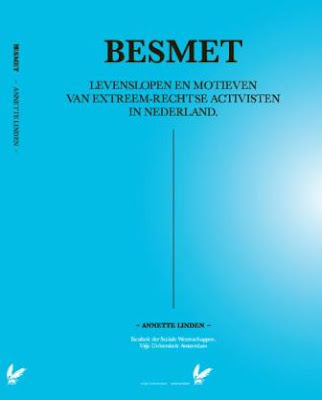
Book cover Besmet
Ook de actuele toepasbaarheid van de uitkomsten komt aan bod in de studie. De inzichten hebben volgens Linden waarde voor de huidige aanpak van activisme en radicalisering, niet alleen bij extreem-rechts. Door naast een groepering als geheel, ook de individuele motieven van activisten te bekijken en hierop in te spelen is het mogelijk radicalisering effectiever en in een vroeger stadium aan te pakken of zelfs te voorkomen.
Op vrijdag 26 juni 2009 om 13.45 uur verdedigt Annette Linden haar proefschrift ‘Besmet. Levenslopen en motieven van extreem-rechtse activisten in Nederland’. Zij is vandaag ook op de radio te beluisteren, om half elf bij het programma Dit is de Dag van de EO.
Radicalization Series – Part I: The slippery slope of ethnic profiling
Posted on June 5th, 2009 by martijn.
Categories: Headline, ISIM/RU Research, Religious and Political Radicalization.
The Open Society has published a report on ethnic profiling that I will discus here very briefly and give extensive quotes about the Dutch situation:
Ethnic Profiling in the European Union: Pervasive, Ineffective, and Discriminatory
Pervasive use of ethnic and religious stereotypes by law enforcement across Europe is harming efforts to combat crime and terrorism, according to this report released by the Open Society Justice Initiative.
Ethnic profiling occurs most often in police decisions about who to stop, question, search, and, at times, arrest. Yet there is no evidence that ethnic profiling actually prevents terrorism or lowers crime rates.
Throughout Europe, minorities and immigrant communities have reported discriminatory treatment by the police. From massive data mining operations to intimidating identity checks, ethnic profiling is often more of a public relations stunt than a real response to crime. The report, Ethnic Profiling in the European Union: Pervasive, Ineffective, and Discriminatory, details widespread profiling in France, Germany, Italy, The Netherlands, and other EU member states.
The report very clearly shows how and why ethnic profiling just doesn’t work and that conclusion has received much attention in the media. The report however also focuses on the way Franc, Germany, Italy and the Netherlands deal with the radicalization issue. Important in the policy theories of radicalization is the slippery slope paradigm:
Theories of Radicalization and the Slippery Slope into Extremist Violence (p. 93-94)
In practice, however, radicalization theories demonstrate a dangerous tendency to conflate an individual’s adoption of a conservative or “fundamentalist” practice of Islam with a willingness to resort to violence. Many radicalization theories rely on a “slippery slope” paradigm which posits a radicalization continuum along which individuals are believed to slide—gradually or rapidly—from increasing religious devotion, through conservative or “fundamentalist” streams of Islam, toward supporting terrorist activities and organizations until, in a limited number of cases, they end by directly participating in terrorist activities and organizations. The implication is that all conservative Muslims are potential terrorists; this constitutes a broad generalization that stigmatizes a group of persons on the basis of their religious beliefs. When such theories are the basis for police or other law enforcement operations without reliable supporting intelligence on terrorist threats, it is ethnic profiling. This “slippery slope” paradigm of radicalization is widespread in Europe and underpins counterterrorism practices of police and intelligence officials in many countries.[…]
The “ring model” of the Dutch General Intelligence and Security Services (AIVD) provides a similar illustration of this paradigm. The model consists of four rings, one inside the other, representing (from the core moving out): terrorists, supporters, sympathizers, society. An AIVD official described the model:The innermost ring [terrorists] represents persons who are able and willing to commit attacks. The active supporters of terrorists can be put in the second ring [supporters]. These persons can and want to support terrorists, so they are aware of the connection between their activities and terrorist attacks. The third ring [sympathizers] represents the people who feel some sympathy for the cause and who are susceptible to recruitment. In general, persons in this third ring reject the Western, Dutch society. The area outside the third ring [society] encompasses the entire Muslim society. The people in this area are in no way involved in Islamist extremism, but may fall victim to its actions. In this ring model our focus should not only be on the groups to be distinguished, but also on the interaction between the rings.
As, rightly so, argued the slippery slope paradigm by definition turns every Muslim into a potential radical, even though it is contested by many experts:
Centripetal movements can be designated as radicalization processes.
According to this approach, observant Muslims, particularly those practicing conservative forms of Islam, are potential terrorists. Behaviors that indicate that an individual is becoming increasingly devout or adopting a more conservative form of Islam thereby become tell-tale “indicators” of radicalization. Individuals so identified may then become the focus of various antiterrorism measures.This slippery slope paradigm is contested by experts. A French counterterrorism official with over two decades of experience recognized the differences:
A Muslim who is not radical in his practice, but who incites to violence is dangerous, and therefore of interest to us. On the other hand, a Muslim who is radical in his faith, but who is above all very pious, is not of interest for us. …[A]s far as Salafists, there are deeply pious Salafists who are radical but non-violent. You can compare them to Cistercian or Benedictine monks who are very pious, but not violent.
Saimir Amghar, a French researcher investigating radicalization processes among Muslim youth notes that the term “radicalization” covers several different phenomena, and argues that there are really three types of radicalization:
(1) nonreligious political radicalization;
(2) religious radicalization involving orthodox practice of Islam but rejecting violence;
and (3) political radicalization drawing from religious doctrine that manifests primarily through violent jihadism.
While similar factors may drive individuals toward each form of radicalization, they are distinct responses. Amghar argues that the second and third forms do not represent steps on a continuum but are in fact oppositional tendencies that are highly critical of one another. Under this view, the nonviolent forms of conservative Islam are in fact a bulwark against terrorism rather than a path toward violent jihad.
The Dutch agencies have been very active in operationalize slippery slope paradigm by using an approach that uses indicators to identify persons who could radicalize:
The Netherlands: Operationalizing the Theory of Radicalization (p.94-96)
The objective is to enable these actors to identify persons or organizations of potential interest to the police and intelligence services. In 2006, an official from the office of the National Coordinator on Counterterrorism, the institution responsible for developing policy and coordinating anti-terrorism measures in the Netherlands, explained their approach to profiling:We are also working on some initiatives in Amsterdam and Rotterdam to develop indicators—some kind of criteria of what to look for—that can also be used by people that are not specialists in using profiles in a critical way so that they can understand what kind of behavior should or would be potentially of our interest…We are refining them and refining them—trying to put in an administrative system.
The city of Rotterdam took the lead with a program called “Join in or get left behind,” initiated in February 2005. According to this program, indicators of radicalization include particular behavior patterns, such as frequent travel or hosting gatherings at one’s home, and changes in behavior, such as a man of Arabic origin who suddenly acquires more traditionally religious Muslim approaches to hair style, dress, mosque attendance, or physical contact with women in public. Dutch officials have taken pains to avoid the inclusion of ethnicity or nationality as suspicious criteria, but the indicators developed nonetheless draw attention to individuals who are becoming more orthodox in their practice of Islam. Essentially, a Muslim who shows outward signs of more conservative practice would become suspicious. Likewise a non-Muslim who outwardly shows signs of Muslim practice, indicating that he is a convert, would also become suspicious.
Those trained to watch for these indicators are reportedly told to watch not just for one change in behavior, but several. When they believe someone is radicalizing, they are asked to report the individual to the information “switch-point,” which verifies the situation and determines the most appropriate follow-up action. According to an evaluation report by the information switch-point, the Rotterdam program alerted police to 17 cases during 2005. Although the numbers to date appear relatively few and the consequences of identification benign, the indicators of radicalization clearly target Muslims and are likely to stigmatize a far larger number of Muslims than those actually identified as at risk of radicalization.
The indicators of radicalization used in the Netherlands continue to conflate orthodox religious practice with a tendency to use violence. A government guide for companies on detecting radicalization among their employees gives this advice: In determining whether there are radicalized personnel in your employment, a combination of factors must be taken into consideration. The following list provides a number of indicators which might signal the presence of radicalized personnel:
• Possession of extremist literature, pamphlets, or sound and data recording equipment,
or the perusal of extremist literature by means of the internet. This can be difficult for
companies to assess, as such activities are often carried out in another language, such as
Arabic.
• Seeming approval of terrorist attacks.
• Travel to regions or countries in which a terrorist conflict is taking place or in which there
are terrorist training camps, such as Chechnya, Kashmir, Iraq, and Pakistan.
• A sudden aversion to “Western customs” such as mixed activities (male/female), or drinking
alcohol, and requesting specific Islamic meals.
• Wearing specific clothing and symbols, or a sudden change of clothing style.
The Open Society report is a bit to fast sometimes with its assessment of the Dutch approach but fortunately they also acknowledge a gradual change in the counterradicalization practices:
On a more positive note, some Dutch authorities are also distinguishing between “extremism” involving support for violence and orthodox religious practice. The Amsterdam “switch-point on radicalization” has moved away from indicators focused on orthodox religious practice, and emphasizes the need to separate religious practice from political views—particularly whether an individual supports the use of violence.
Rotterdam is also moving away from the use of indicators of radicalization, although it remains in a process of flux. Across the Netherlands, there is a shift away from an approach that stigmatizes individuals and groups, and toward policies that address root causes of radicalization, such as discrimination, exclusion, and social polarization.
This move away from using stereotypical indicators is a good thing, and not only because the method itself is ineffective and reprehensible, but also, and perhaps most important, it creates an atmosphere of distrust that I have come across my fieldwork as well. This is something that the writers of the report also show very clearly:
Netherlands (p. 103-105)
According to some representatives of Dutch Muslims, Dutch intelligence services have used religion as a basis for monitoring, focusing their attention on Muslim organizations. Thus, it is alleged, monitoring has sometimes been conducted based on generalizations about the type of Islam that groups practice rather than specific information about activities in a particular mosque or organization. Such monitoring, some Muslims complain, has targeted even nonviolent streams of Islam, on the theory that they may be hotbeds of terrorist radicalization. Dutch authorities assert that surveillance has become narrowly targeted. There is wide gap between the perceptions of Dutch Muslims and Dutch law enforcement authorities of the scope and impact of surveillance practices.Dutch Muslim organizations believe that Dutch intelligence services monitor many of the country’s mosques. Dutch intelligence services have argued in public reports that Salafist and other extreme streams of Islam are very active and in some cases are trying to influence or even take over less extreme mosques in the Netherlands. A 2005 Dutch General Intelligence Service (AIVD) report on the links among Saudi Arabia, Salafism, radicalization processes, and terrorism in the Netherlands, was based on information gathered from monitoring mosques considered radical. In a 2007 interview, Dutch counterterrorism authorities stated that very few mosques are under surveillance as “hotbeds of radicalization.” One official explained it this way:
We are not condemning the general thinking of a group… [T]his concerns less than one percent of mosques. It is really a very small number. And all of the mosques surveilled have Hofstadt group connections [and] imams who use violent rhetoric…”
In a June 2007 presentation, Deputy National Coordinator for Counterterrorism Lidewijde Ongering testified before a U.S. Senate committee:
A small number of locations in the Netherlands, such as a few Salafist centers and mosques, have been identified as potential gateways to radical milieus.…Experience has shown that for some young people, non-violent Salafism is a first step towards further radicalization. The Dutch authorities keep a close watch on the imams and governing bodies of these institutions and remind them of their social responsibilities. Our message is clear: we will not allow them to cross the line and publicly preach intolerance. We also expect them to exclude jihadist recruiters and stop young people from opting for violence. If people in or around these centers prove to be promoting radicalization or spreading hatred, we do not hesitate to prosecute them or deport them as a threat to national security.
Surveillance is largely conducted through direct contact with mosque authorities and individuals who attend mosques, and through established informants. However, in an unknown number of cases, intelligence services also tape record sermons, especially Friday prayers. A Muslim community leader from Rotterdam, Brahim Bursic, called attention to the taping:
We know that all Friday prayers in mosques are taped. I told the imams not to be afraid; we are a democracy and they are not doing anything against the law. I also publicly suggested that if the intelligence officials are interested in what is being said in the mosques, the Friday prayers could be broadcast on TV.
A senior Dutch police officer said that such recording only occurs in “very limited, specific cases.” In addition to mosques, Dutch intelligence officials monitor Muslim organizations they believe to be spreading or supporting radical Islam. In a 2004 report, the AIVD defined “radical Islam” as “the politico-religious pursuit of establishing—if necessary by extreme means—a society which reflects the perceived values from the original sources of Islam as purely as possible.” The report commented on the different views within “radical Islam”:
Radical Islam consists of many movements and groups that, although related (in particular concerning faith and anti-Western sentiments), may harbor very different views on aims and means. This means that various kinds of threats can emanate from radical Islam, one of which is terrorism. In addition to radical Islamic organizations and networks which concentrate on the jihad (in the sense of armed combat) against the West, there are other groups, which principally focus on “Dawa” (the propagation of the radical-Islamic ideology), while some groups and networks combine both.
Both organizations classified as “jihad-focused” and those classified as “Dawafocused” fall within what Dutch intelligence sources described as the AIVD’s “professional interest,” and some are kept under surveillance. While the AIVD recognizes that only “jihad-focused” groups pose an immediate threat of violence, it believes that the “Dawa-focused” groups pose a longer-term threat by feeding processes of radicalization. The AIVD’s 2006 guide for local authorities explains the Dutch approach of targeting “hotbeds of radicalization”:
A hotbed of radicalism is an organization, group or place that serves as a breeding ground for activities and views that are instrumental in radicalizing individuals and can ultimately result in terrorist activities. … Hotbeds of radicalism can also serve as an ideological breeding ground for extremists. They can function as a first step on a path that may lead to violence. This danger exists in particular in the case of organizations that advocate extreme, intolerant isolationism or promote an intolerant “us vs. them” mentality. …
The aim of the approach is to make clear through joint, coordinated government action to those in charge of the hotbed of radicalism and to its visitors that activities of a radical nature will not be tolerated and that the authorities are monitoring activities closely. It is not clear how often monitoring by intelligence services is founded on intelligence-based evidence and how often generalizations about ethnicity or religion are the determining factor. Nor is it clear how often more intrusive monitoring techniques are utilized. Certain Muslim places of worship and organizations are clearly viewed as suspicious, even without specific evidence indicating involvement in any terrorist activities or incitement to violence. They are instead held to be potentially dangerous due to generalizations about the stream of Islam that they practice, albeit peacefully, and the theory that such practices represent a first step in the process of radicalization. In the absence of information about support for terrorism, covert surveillance is inappropriate and law enforcement efforts should instead focus on outreach to Muslim communities and voluntary information sharing. There is a wide gap between the way Dutch intelligence officials describe their monitoring and the way it is perceived by Muslim organizations and individuals. Dutch authorities claim their practices have become more narrowly targeted over time, but this cannot be independently verified. To this day, many Dutch Muslims believe that discriminatory and profiling-based surveillance is widespread and this perception, accurate or not, has negative consequences for policing in the Netherlands.
(p. 110-111)
When individuals are stopped on the street for identity checks, when police surround a mosque, when a business is raided or an individual arrested, the general public naturally assumes that law enforcement officials are acting because there is a reason to do so—that these persons present a real threat. The lack of any significant counterterrorism outcomes—such as detection, charges, or convictions—as a result of ethnic profiling does not serve to mitigate the damage done; the bare fact of being singled out in the context of counterterrorism measures is sufficient to create the stigma. A representative of the Dutch Association of Moroccans and Tunisians described the change in perception:Everyone thinks that when there is smoke, there is fire. Since 9/11 and the murder of Theo van Gogh, relations between Moroccans and the broader society have deteriorated. People look at each other with suspicion. When a Moroccan man walks in the street with a beard people look at him differently than before. When the police react in that way, it creates a bigger problem. It affects people’s perceptions. For instance, when a train was stopped recently and two men in Arabic dress were handcuffed and taken off the train by police, this image has a strong effect on those watching. And it makes big news in the media. Afterwards when it turns out that these men were not planning anything at all, they were just practicing Muslims, but it’s too late, the damage has been done.
The distrust among Muslims is very clear and many of them are very afraid of the negative consequences as was recently shown in the case of the ‘Ikea-threat‘ in Amsterdam which proved to be a false alarm. The information that lead to the arrests of the people was public information and could have been gathered by anyone. The fact that these seven people were Muslim, one of them being a relative of a person involved in the Madrid attacks was sufficient for the arrests. The hoax actually used ethnic profiling to make itself credible and probably the person making the fake call relied on his stereotype of the Dutch police using stereotypes. The Open Society institute refers to several reports that make clear that ethnic profiling doesn’t work because it is too static, too inclusive and too exclusive:
(P114-115)
[…]there is no single pathway to violent radicalization and the nature of Muslim practice is not a consistent or reliable factor in radicalization. These studies highlight a fundamental problem of using ethnic profiles: they are both overinclusive and underinclusive. They are overinclusive in that the vast majority of the people who fall into the category are entirely innocent; and they are underinclusive in that there are other terrorists and other criminals who do not fit the profile and who would escape attention if the profile were strictly applied. While overinclusion imposes
an unnecessary burden on “false positives” (persons who are innocent but match the profile), underinclusion may divert police attention from actual threats that lie beyond the prescribed profile. Thus, it was reported that, prior to the July 2005 attacks on the London public transport system, the leader of the bombers “had come to the attention of the intelligence services as an associate of other men who were suspected of involvement in a terrorist bomb plot. But he was not pursued because he did not tick enough of the boxes in the pre-July profile of the terror suspect.” The most authoritative report to date on the 7/7 London bombings concludes that “there is not a consistent profile to help identify who may be vulnerable to radicalization.” Another fundamental problem of profiling is its failure to account for the dynamism of its target: the subjects of profiling evolve in response to policing and law enforcement tactics. When a terrorist profile is known, terrorists can adapt to it through strategies of evasion and substitution. They may evade detection by recruiting individuals who do not fit the profile.
I think in general, besides being a little to black and white sometimes, the report is very good and gives a fair account of (at least) the Dutch situation. I do want to raise two issues: one about ethnic profiling and crime and the other one about radicalization.
First of all, although the report is not about crime, but the same questions can be asked. In the Netherlands professor Bovenkerk showed new statistics yesterday with an ‘alarming’ overrepresentation of ethnic groups.
Crime figures are normally compiled on a yearly basis. However, Professor Bovenkerk has looked at criminal behaviour spanning a number of years, between the ages of 18 and 24. His approach has resulted in an entirely different outcome. The professor linked information based on ethnicity to crime figures.
This is not permitted in the Netherlands, but the police department, youth care organisations and advisory groups in Rotterdam have been allowed to make the link, thanks to a special legal construction introduced in 2002.
Shock
Despite the multicultural projects, and the efforts of community leaders and youth services to promote integration, 55 percent of Moroccan youth between the ages of 18 and 24 are picked up by police as crime suspects.The same goes for 40 percent of Antillean and Surinamese youth and 36 percent of Turkish youth. These statistics are based on the city of Rotterdam, but Professor Bovenkerk does not see any reason why the statistics would be differ for any other major Dutch city.
After being very reluctant to calculate the ‘ethnic dimension’ of crime in the 1980s and the beginning of the 1990s, since then it has become some sort of Dutch hobby to present new statistics every now and then which are in all instances very alarming. So we have the ‘fact’ here that we have an overrepresentation of migrant youth in crime statistics, in particular Moroccan-Dutch youth and than still ethnic profiling would not be useful? Is research like this not a particular modality of ethnic profiling? It indeed is and as professor Henk Effers says it can be useful to know exactly ‘where it hurts’ and subsequently base our policies on these findings. But just as the slippery slope paradigm turns every Muslim into a potential radical, ethnic profiling with regard to crime does something similar. It assumes or produces the image that the problem is in fact ethnic or cultural. And that is highly questionable as Effers (and Bovenkerk for that matter) argues:
Fact or stigma? Police registration of ethnic backgrounds in Rotterdam is highly disputed | Radio Netherlands Worldwide
Above all, he thinks it important that Professor Bovenkerk clearly points out the ‘ethnic explanation’. Saying that they are criminal because they’ve been brought up that way doesn’t make sense:
“On the one hand, there is the socio-economic question. Many Moroccans, but also other ethnic groups, are deprived socio-economically speaking. On the other hand, the social control within these groups is much lower than within the broader Dutch population.”
These two things are not unrelated, Professor Effers explains. When children are sent outside to play because there is not enough room inside, there is little social control on the street. The professor also remarks that his colleague’s report has brought to light the fact that almost 20 percent of native Dutch youth have had a brush with the law.
Scoring
Professor Bovenkerk’s report touches on a delicate subject within political circles. Politicians like anti-immigration proponent Geert Wilders could use these figures to score political points. Mr Bovenkerk would be greatly disappointed if his report were indeed to be used in this way. He has clear ideas on what a good method of tackling the problem would be:“In any case, I think the job market plays an important role. There’s a lot possible but the youth need to be brought in. And then it’s really a question of stimulating more social control. Within the ethnic groups but also within the families.”
And I would like to add another thing to that. How long are we going to talk about the children of migrants as being ‘Moroccan’, ‘Turkish’ or in the case of people living in the kingdom of the Netherlands (but outside the Dutch state) as Antillians?
The second point I want to raise very briefly here is the issue of radicalization itself and the way it is treated in the report. The Open Society report takes radicalization among Muslims as a matter of fact. It does not really question the whole issue nor does it provide with a critical alternative for the radicalization theories prevalent in policy circles and counterterrorism agencies. It criticize the slippery slope paradigm but it does not ask the question what radicalization is according to them, what the actual developments are and how troublesome that may be (or not). Furthermore it only focuses on counterradicalization policies focused on Muslims. A different form of ethnic profiling however also occurs in the case of youth of the radical right, in particular in the past debates about ‘Lonsdale’ youth that designates white youth belonging to a particular youth culture as potential radicals. Furthermore by only focusing on Muslims it again appears that radicalization is only an issue when it comes to Muslims, thereby ignoring the violence and disturbance caused by radical left and radical right in the past 20 years.
I will come back on the issue of (defining) radicalization in a series of entries the coming weeks thereby (in the end) presenting my views and a possible working definition of radicalization. So, if you want to read that, stay updated and have not subscribed yet, you can do that HERE.
Criminalisering van islam?
Posted on May 20th, 2009 by martijn.
Categories: (Upcoming) Events, ISIM/RU Research, Religious and Political Radicalization.
Op de hoogte blijven? Abonneer je dan op Closer: HIER.
De Onderzoekschool Maatschappelijke Veiligheid van de Erasmus Universiteit Rotterdam organiseert op 18 juni het symposium:
Juridische ontwikkelingen sinds 9/11: Criminalisering van islam?
Erasmus Universiteit
Expo- en Congrescentrum
Forumzaal M3-15
Zou het in een democratische rechtsstaat mogelijk moeten zijn om aanslagen te verheerlijken? Hoe ver mag de Nederlandse overheid gaan in het opleggen van kledingvoorschriften ten aanzien van moslims? Zijn er gronden waarop men verbodsbepalingen ten aanzien van uitingsvormen van islam kan legitimeren? Dit zijn vragen die tijdens dit symposium aan de orde zullen komen.
De afgelopen jaren heeft islam in Nederland in de spotlights gestaan van media en politiek. De dominante toon in het debat over islam was er een van zorg over ‘radicale islam’ die een opstap zou zijn naar islamitisch terrorisme. Bij het dreigingsbeeld heeft de AIVD in oktober 2007 in het bijzonder haar pijlen op het ‘salafisme’ gericht dat als gevaarlijk wordt aangemerkt vanwege een anti-democratische houding die daarin verscholen zou liggen. Politici als Wilders en Verdonk hebben dit beeld in versterkte vorm overgenomen en het indammen van islamitische uitingsvormen als een speerpunt in hun programma verwerkt.
De angst voor radicale islam heeft echter ook weerslag gehad op wetgeving en rechtspraak. De processen tegen de Hofstadgroep hebben laten zien dat een radicale interpretatie van het geloof met de nieuwe wet terroristische misdrijven bewijs kan vormen voor het deelnemen aan een terroristische organisatie. Naast het strafbaar stellen van meer extreme denkbeelden staat een aantal islamitische uitingsvormen op de nominatie om verboden te worden. Zo is er een wetsvoorstel op komst om het dragen van een burqa in de publieke ruimte te verbieden en pleit Wilders’ PVV voor een hoofddoekenverbod in publieke functies en een verbod voor het bouwen van nieuwe moskeeën.
Deze recente ontwikkelingen roepen de vraag op of Nederland als democratische rechtsstaat – waarin godsdienstvrijheid een belangrijk grondrecht vormt – niet bepaalde grenzen (dreigt te) overschrijd(t)(en) en of er geen sprake is van een ongewenste vorm van problematisering en zelfs criminalisering van bepaalde religieuze denkbeelden. Het is op deze kwesties dat de sprekers tijdens dit symposium in zullen gaan. Daarmee zullen ze de volgende vragen beantwoorden:
- In hoeverre zijn de veronderstellingen die aan de verboden ten grondslag liggen juist? (dus: in hoeverre zijn deze problemen met islam er?)
- In hoeverre worden islamitische geloofsuitingen (legitiem of illegitiem) gecriminaliseerd?
Programma
14.00
Welkom en registratie
14.30
Opening door Mr. Fiore Geelhoed, promovenda aan de Erasmus Universiteit Rotterdam
14.35
Introductie door debatleider Prof. Maurits Berger, hoogleraar Islam in de hedendaagse Westerse wereld aan de Universiteit Leiden
14.50
Islam, radicalisation and radical Muslims
Prof. Tariq Ramadan, professor in islamstudies aan Oxford University en gasthoogleraar Identiteit en burgerschap aan de Erasmus Universiteit Rotterdam
15.10
Vanuit compassie de ander zien
Mevr. Maimunah van der Heide, columniste voor Islamwijzer.nl en oprichtster van Stichting Vangnet. Ze heeft als missie het bouwen van bruggen tussen praktiserende moslims en niet-moslims.
15.30
Piranha’s in de Hofstadvijver: De Nederlandse strafrechter en radicale moslims
Mr. Victor Koppe, strafrechtadvocaat te Amsterdam die onder meer Samir A. heeft verdedigd
15.50
Plenaire discussie met het publiek
16.50
Afsluiting en borrel
House of Glass – New publications by Al-Maqdisi
Posted on May 14th, 2009 by martijn.
Categories: ISIM/RU Research, Religious and Political Radicalization.
Al-Maqdisi Book Cover
Abu Muhammad al-Maqdisi was not only the mentor and teacher of Al-Zarqawi but his texts also played a major role in several Dutch jihadi circles, in particular that of the Hofstad network. The murderer of filmdirector and writer Theo van Gogh translated several texts of Al-Maqdisi such as Millat Ibrahim.
My colleague Joas Wagemakers at Radboud University referred me to a new book published by Al-Maqdisi: Man Kana Baytahu min Zujaj fa-la Yarmi ghayrahu bi-Hajar – Qira’a wa-Ta’ammul fi Asfar al-‘Ahd al-Qadim wa-Muqarana bayna Akhbariha wa-bayna l-Qisas al-Qur’an al-‘Azim (He whose house is made of glass should not throw stones at others – A reading and contemplation on the books of the Old Testament and a comparison between its message and the stories of the magnificent Qur’an), www.tawhed.ws, February 2008.
The book is dedicated to:
Dedication
- to the Pope of the Vatican Benedict XVI, who claims that our religion is spread solely by the sword.
- to Geert Wilders, the Dutch MP who criticizes Islam, demands a ban on the Koran and describes it as a fascist book.
- to Kurt Westergaard, the Danish cartoon illustrator whose pen only ridicules those who are different from the Westergaard family. In fact, all of Europe is a stone in his shoe.
- to Van Gogh, the Dutch director who connects rape with the laws of Islam.
- to Wafa’ Sultan, who speaks evil of Islam and the Koran but turns a blind eye to the extreme manifestations of insanity in the books of the Jews and the Christians!
- to all “ye who turn judgment to wormwood”
You are ignorant of your religion or you ignore it …
I will make you understand it through these contemplations..
I say to you and those like you:
He whose house is made of glass should not throw stones at others
Abu Muhammad
The last in the list, “Ye who turn judgment to wormwood” is an excerpt from the book Amos (5:7) from the Old Testament ( “Ye who turn judgment to wormwood, and leave off righteousness in the earth.”). The sentence pertains to justice which is the result of righteousness and seeking good. For more on this see HERE and HERE. This refers Al-Maqdisi’s critique on Wilders, Wafa Sultan and others that Islam is different from the Islam as they present it. With reference to the Old Testament, he points out that ‘Christians’ should not distort the ‘truth’. Al-Maqdisi states that he will give a thorough analysis of the most sacred book of the Christians (but in his account its only the Old Testament). By comparing the Bible texts with those of the Koran, Al-Maqdisi tries to show that in the Bible the original revelations of Moses and Jesus have been distorted.
Al-Maqdisi explains in the book how, according to his interpretation of Islam, people should reflect about God and how he is being described in the Old Testament. He suggests that God in the Bible God is described rather antropomorphic, as a God with human characteristics; something that is inconsistent with Salafi thought. The same, according to Al-Maqdisi, can be said about how angels and prophets in the Bible are represented. In his book Al-Maqdisi gives examples of angels and prophets who would do things such as wine drinking, which according to Islam are prohibited. Also in the Bible King David is presented as very human, while in the Quran he is an almost perfect man. The end of the book contains several issues ( “Several rarities”) that struck him during reading the Bible, he writes about biblical names and addresses the “Texts I do not understand.” Furthermore, he tries to show how texts in the Bible predict the prophet Muhammad.
According to Wagemaers Al-Maqdisi has written the book in prison following the remarks of the pope during his infamous speech in Germany. On Al-Maqdisi’s website the book is presented along with an essay in which he attacks the pope: To the slave of the Cross … The English translation can be found on Tibyan or on Jarret Brachman’s website.
I do not know whether this book will reach the same popularity in jihadi circles as other writings of Al-Maqdisi, but the sneer to Wilders, Van Gogh and his analysis of the ‘distortion’ of the original message of Jesus and Moses will (although not new) undoubtedly be praised. We will probably have to wait for the English translation since the English version of To the slave of the Cross has been widely disseminated already (also among Dutch circles).
I would like to thank my colleague Joas Wagemakers for giving me the information. The information about the book of Al-Maqdisi in this post is based upon his information but the content and the representation in this post is my responsibility.
Het glazen huis – Al Maqdisi Jihadi Controverse en nieuwe publicatie
Posted on May 8th, 2009 by martijn.
Categories: Headline, ISIM/RU Research, Religious and Political Radicalization.
Op de hoogte blijven? Abonneer je dan op Closer: HIER.
Abu Mohammed al-Maqdisi is een Jordaans-Palestijnse islam-geleerde. Hij is één van de meest invloedrijke ‘jihad-theoretici’ en ideologen van de mondiale jihad. In zijn werk gaat het om een oppositionele interpretatie van de islam waarbij de huidige regimes in het Midden-Oosten als afvallig gezien worden. Deze regimes kunnen daarom, indien mogelijk, bestreden worden met als doel een ‘ware’ islamitische staat te vestigen. Hij heeft bij het bredere publiek vooral bekend genoten als mentor en inspirator van Abu Musab Al-Zarqawi; één van de meest beruchte strijders in Irak onder de Amerikaanse bezetting.
Wat nu precies zijn invloed is, hoe hij anderen heeft beïnvloed en waarom is lastig vast te stellen. Onderzoek van mijn Nijmeegse collega Joas Wagemakers richt zich precies op die vragen in een fascinerend onderzoeksproject.
Wat in ieder geval wel duidelijk is, is dat op internet tal van (vertaalde) teksten van Al-Maqdisi, of fragmenten ervan, rondzwerven op fora, weblogs en andere sites. De website van Al-Maqdisi, Tawhed.ws, bevat een grote bibliotheek aan allerlei geschriften. Verschillende werken van Al-Maqdisi zijn vertaald in het Engels en Nederlands. Een voorbeeld van dit laatste is het geschrift Dit is onze aqiedah. Veel bekeken en beluisterd is een video van een huwelijksfeest waar Al Maqdisi aanwezig was.
[flashvideo filename=http://www.youtube.com/watch?v=AsTLk_m9B9k /]
Een andere zeer belangrijke tekst is Millat Ibrahim (godsdienst van Abraham), waarin Al-Maqdisi onder meer in gaat op het principe al-Walaa’ wal Baraa’ (loyaliteit/liefde en distantie/haat omwille van God). Deze tekst is onder meer door Mohammed Bouyeri vertaald en werd door enkelen binnen het Hofstad netwerk beschouwd als een kerntekst van de islam. En ook voor anderen is deze zeer belangrijk. Al-Maqdisi werd gearresteerd en veroordeeld op basis van beschuldigingen die betrekking hadden op terrorisme. Inmiddels is hij weer vrij.
Recent woedde er op diverse Arabischtalige sites nog een discussie over hem. Door een jongere generatie jihadisten, met name posters op het forum Midad al-Suyuf, werd Al-Maqdisi ervan beschuldigd ‘soft’ te zijn te geworden. (Een discussie die ik niet tegen ben gekomen in Nederland, maar dat zegt ook niet alles.) In zijn chatroom ging Al-Maqdisi in op de aantijgingen. Hij stelde onder meer dat hij verbaasd was over het lage denkniveau en dat anderen hem beter begrepen dan de jihad-jongeren die hem bekritiseerden. Opvallend daarbij was dat Al-Maqdisi daarbij verwees naar de oprichter van de website Jihadica, Will McCants, die zich bezighoudt met het gedachtegoed van jihadisten:
Maqdisi invokes McCants — jihadica
The al-Maqdisi controversy has taken a very interesting new turn. In a statement posted his website earlier this week, Abu Muhammad al-Maqdisi cited several Western scholars, including Dutch al-Maqdisi specialist Joas Wagemakers and Jihadica founder Will McCants, to make the point that his enemies understand him better than his detractors in the jihadi community do.
En inderdaad hij verwees daarbij ook naar mijn collega Joas Wagemakers; iets wat ook de New York Times is opgevallen in een recent artikel over de controverse. (Bij het artikel van de NYT vindt u in de linkerkolom ook een podcast, die de moeite waard is om te beluisteren. De auteur van dat stuk baseert zich in zijn podcast grotendeels op Joas Wagemakers.) Niet dat Joas Wagemakers (of McCants) het nou zo nodig moet opnemen voor Al-Maqdisi (dat kan Al-Maqdisi waarschijnlijk zeer goed zelf wel en het is ook niet de taak van onderzoekers), maar op basis van zijn eigen onderzoek wees Joas Wagemakers onder meer op de tegenstelling tussen jihad-denkers (zoals Al Maqdisi) en jihad-strijders (zoals Al Zarqawi). Dit kunnen we zien in het volgende commentaar dat Joas Wagemakers gaf op de website Jihadica:
More Fitna in Cyberspace: Mihdar vs al-Maqdisi — jihadica
I believe that this conflict between fighters and non-fighters goes back to the 1990s, when many of these people were in prison together. While they went to gaol sharing more or less the same beliefs, once they were in prison the differences started to surface. One of these differences was related to battlefield experience and the willingness to go to a foreign front and fight the far enemy. In prison, divisions started to rear their heads between those who’d been in Afghanistan to fight and those who hadn’t, with the former group increasing in stature in the eyes of many inmates. I believe that the current conflicts that you describe and that Jihadica has written about before are partly rooted in frustration over this issue that dates back to this period, when Al-Zarqawi, ‘Abd al-Hadi Daghlas and others risked life and limb by joining the fight in Afghanistan or Iraq while Al-Maqdisi and others preferred to stay in Jordan and, perhaps more importantly, to focus on da’wa. While these conflicts did not come to the fore until years later, I believe that the seeds of the fighters’ resentment towards Al-Maqdisi c.s. were sown in the 1990s. Knowing this, one can imagine that Al-Maqdisi’s criticism of Al-Zarqawi and others in 2004, 2005 and 2008 was interpreted by the fighters with this resentment still in mind. Several people saw his criticism as further proof that Al-Maqdisi is a hypocrite who talks the talk but when push comes to shove, he doesn’t have the guts to back up his words. I believe this accusation does not do justice to Al-Maqdisi’s views, which are more complex than this reasoning suggests, but it nevertheless was and still is a not uncommon view among certain Jordanian Jihadi-Salafis.
Op Jihadica kunnen we verder lezen dat niet alleen McCants en Wagemakers intussen worden aangehaald door jihadisten. Ook de uitstekende studie van Brynjar Lia Architect of Global Jihad: The Life of Al Qai’dah Strategist Abu Mus’ab al-Suri krijgt het zegel der goedkeuring onder meer op The Ignored Puzzle Pieces of Knowledge. De studies van Rand Corporation en de Militant Ideology Atlas en het FFI rapport van Hanna Rogan over Jihadism Online zijn vertaald naar het Arabisch terug te vinden op de site van Al-Maqdisi (de eerste twee alleen in samenvatting).
Al-Maqdisi book cover
Joas Wagemakers maakte mij erop attent dat Al-Maqdisi zeer recent een nieuw boek heeft gepubliceerd: Man Kana Baytahu min Zujaj fa-la Yarmi ghayrahu bi-Hajar – Qira’a wa-Ta’ammul fi Asfar al-‘Ahd al-Qadim wa-Muqarana bayna Akhbariha wa-bayna l-Qisas al-Qur’an al-‘Azim (Wie een huis van glas heeft moet een ander niet met stenen bekogelen – Een lezing en beschouwing over de boeken van het Oude Testament en een vergelijking tussen zijn boodschap en de verhalen van de geweldige koran), www.tawhed.ws, februari 2008. Al-Maqdisi heeft het boek in de gevangenis geschreven n.a.v. de opmerkingen van de paus tijdens zijn beruchte toespraak in Duitsland. Op Al-Maqdisi’s website wordt het boek gepresenteerd samen met een artikel To the slave of the Cross… dat in Engelse vertaling terug te vinden is op Tibyan, waarin specifiek de paus wordt aangevallen.
Mijn collega Joas Wagemakers heeft het bewuste boek en het mag opvallend genoemd worden. (De volgende informatie is van hem afkomstig, evenals de vertalingen). Op pagina 2, staat een opvallende boodschap/opdracht:
Opdracht
- aan de paus van het Vaticaan Benedictus XVI, die beweerde dat onze godsdienst alleen door het zwaard is verspreid.
- aan Geert Wilders, het Nederlandse parlementslid, die de islam bekritiseert, een verbod op de koran eist en het als een fascistisch boek heeft omschreven.
- aan Kurt Westergaard, de Deense cartoontekenaar, wiens pen alleen degenen belachelijk maakt die anders zijn dan de familie Westergaard. Heel Europa is zelfs een steen in zijn schoen.
- aan Van Gogh, de Nederlandse regisseur, die verkrachting verbindt met de wetten van de islam.
- aan Wafa’ Sultan, die kwaad spreekt van de islam en de koran maar haar ogen sluit voor de extreme uitingen van waanzin die in de boeken van de joden en de christenen staan!
- aan al “degenen die het recht in alsem verkeren”
Jullie weten niets over jullie godsdienst of jullie negeren hem…
Ik laat jullie er kennis mee maken door deze beschouwingen..
Ik zeg tot jullie en degenen die net zo zijn als jullie:
Wie een huis van glas heeft moet een ander niet met stenen bekogelen.
Abu Muhammad
Het laatste in de opsomming, “die het recht in alsem verkeren” is een fragment uit het boek Amos (5:7) uit het Oude Testament (“Die het recht in alsem verkeren, en de gerechtigheid ter aarde doen liggen”). Deze uitdrukking heeft betrekking op het verwijt van Al-Maqdisi aan Wilders, Wafa Sultan e.a. dat ze de islam anders afschilderen dan die is volgens Al-Maqdisi. Met de verwijzing naar het Oude Testament wijst hij erop dat ‘christenen’ de ‘waarheid’ niet moeten verdraaien. Al-Maqdisi kaatst de bal terug door te stellen dat hij een grondige analyse zal geven van het meest heilige boek van de christenen (maar heeft het daarbij alleen over het Oude Testament). Door de Bijbel teksten te vergelijken met die van de Koran wil hij laten zien dat in de Bijbel de oorspronkelijke openbaringen van Mozes en Jezus zouden zijn verdraaid.
Al-Maqdisi legt in het boek uit hoe er volgens de islam gedacht zou moeten worden over God en hoe er in het Oude Testament over wordt geschreven. Hij stelt dan dat God in de bijbel nogal antropomorfisch behandeld wordt waarmee wordt bedoeld dat God van menselijke gedaante zou zijn iets wat niet strookt met het salafistische gedachtegoed. Deze lijn trekt hij door in zijn behandeling over hoe engelen en profeten in de Bijbel worden gerepresenteerd. Al-Maqdisi geeft in zijn boek voorbeelden van engelen en profeten die dingen zouden doen die volgens de islam verboden zijn, zoals wijn drinken. Zo zou koning David in de Bijbel heel menselijk voorgesteld worden, terwijl hij in de Koran een nagenoeg perfecte man zou zijn. Het einde van het boek bevat diverse zaken (“Verscheidene rariteiten”) die hem zijn op gevallen tijdens het lezen van de Bijbel, gaat hij in op bijbelse namen en behandelt hij “Teksten die ik niet begrepen heb”. Verder stelt hij (uiteraard) ook nog dat de bijbel teksten bevat die al vooruitwijzen naar Mohammed.
Ik weet niet of dit boek eenzelfde populariteit zal bereiken onder jihadi-kringen als andere geschriften van Al-Maqdisi, maar de sneer naar Wilders, Van Gogh en zijn analyse van de verdraaiing van de oorspronkelijke boodschap van Jezus en Mozes zal (hoewel niet nieuw) ongetwijfeld in goede aarde vallen. Wellicht dat ik later deze week nog een link naar het boek zal geven.
Op de hoogte blijven? Abonneer je dan op Closer: HIER.
Terrorism and radicalization according to the AIVD
Posted on April 21st, 2009 by martijn.
Categories: International Terrorism, ISIM/RU Research, Religious and Political Radicalization.
The Dutch Algemene Inlichtingen en Veiligheidsdienst (AIVD – General Intelligence and Security Agency) has released its annual report 2008. According to the AIVD the following developments with regard to ‘jihadi terrorism’ have occurred:
Terrorism
- The threat for a terrorist attack in the Netherlands remains substantial. The Islamdebate in the Netherlands contributes to this profile as does Wilders’ film Fitna although it did not evoke strong reactions after its release.
- According to the AIVD there has occurred a strategic reorientation among jihadi’s from targets in Islamic countries to Western targets that would cause less Muslim victims.
- One of the threats for the Netherlands is coming from the Pakistani-Afghani border region. One of the arguments to substantiate this threat is the increase in numbers of Europeans who join a military training in that region. When they return to Europe they do not only have the ability to carry out attacks but they can also support and lead others. No participation of Dutch people has been identified however.
- The terrorist threat in the Netherlands pertains more and more to transnational networks instead of local, home-grown networks. The local networks are very divided and lack leadership. There have been no terrorist incidents that can be traced back to local networks. One person in The Hague has been arrested because he seemed to have radicalized in a short period of time and was in the possession of fire arms. No terrorist link could be established however and the person was convicted for possession of illegal fire arms.
- An Algerian member of a network of twelve persons involved in recruiting people for the violent Jihad was arrested and deported out of the country. This network was arrested for the first time in 2002 but released. Since then several members have been deported and others arrested several times. The network more or less ceased to exist.
- A Moroccan national has been identified as a threat to national security because of his sympathy for the international violent jihad, has contacts with like-minded people abroad and support those people. He has been declared ‘persona non grata’ and will be deported to Morocco. In another report the AIVD concluded that an another man from the same family rejects the democratic order. This may prevent him to obtain Dutch nationality.
- The AIVD released a report about a Turkish man who travelled, via Turkey, to the Pakistani-Afghani border region to participate in the international violent Jihad. In the report the AIVD stated that he is a threat to national security and he also has been declared ‘persona non grata’.
- In May 2008 the National Police arrested a Turkish-Dutch man on behalf of the French authorities. According to the AIVD the person was the centre of a international facilitating network affiliated with the Islamic Movement of Uzbekistan (IMU).
- In August 2008 a Pakistani student, Aqeel A., has been arrested on behalf of the Spanish authorities who consider him a fullmember of a Jihadi cell in Barcelona that was to a large extent (fourteen people) arrested on 18 and 19 January 2008. Aqeel was supposed to commit a (suicide) attack in Germany. He was arrested already in March 2008 in Breda and suspected of participating in an international Jihadi network that prepares for attacks in Europe. He had to be released then due to a lack of evidence but was declared ‘persona non grata’ later.
Radicalization
- Salafi centres are more moderate in public than in their own circles. Well-known salafi centres have moderated themselves in public because of media-attention, political pressures and critical reactions for the Moroccan-Dutch community. One tries to create the impression that they support integration of Muslims in the Netherlands but at the same time in closed circles polarizing statements are made that can have negative effects on society in the long term. The centres want to develop Salafism into an authoritative and influential movement.
- The ability for self-cleansing seems to be stronger; extremists are kept out. The As Soennah mosque has refused a group of extremist youth access to the mosque and reported them to the police.
- The ability to resist radical factions has increased. More and more Muslims publicly denounce the message of Salafi centres. Within the Turkish-Dutch community the resistance against radical Islamic ideologies remains high. Moderate groups such as the Diyanet and the moderate-islamist Milli Gorus play an important role. A few individuals however have turned away, partly influenced by radical islam websites. The Moroccan-Dutch community is still fertile recruiting ground for the radical movements. The Moroccan-Dutch who lack recognition and acceptance by society find eachother in shared grievances about their position. They meet on the internet and at lectures of youth preachers. The radical Islamic youth culture brings about a shared identity in Dutc society, recognition and positive self-esteem. These Moroccan-Dutch youth continue to radicalize but only in very low now numbers. More and more Muslims express their grievances in a democratic and non-radical activism such as demonstrations, petitions, fund raising, letters to the editors and call for boycots.
- The number of extremists statements by radical islamists on the Internet has not increased. A significant number of Dutch language Islamic sites carries a Salafi message. The number of extremist expressions and threats has slightly decreased, partly because of a strict policy on several large webfora and a decreasing interest among youth for radical expressions on the Internet. The existing (less than 10) Jihadi websites are already several years old and hardly updated if at all. Most of the material to be found on these sites originates from a small number of Arabic Jihadi sites. The technical problems of those sites in the last year did not affect the Dutch sites.
A few comments by me:
- With regard to terrorism, it is striking how shaky sometimes the allegations against people are. Is rejecting democracy really enough to be declared ‘persona non grata’?
- In my opinion the distinction between transnational networks and local, home-grown, networks is too strong. There have been and still are connections to several local and transnational networks.
- If we are talking about transnational links, where is the analysis of the relationship between the UK-Belgium-The Netherlands-Germany? One of the cases mentioned above has a clear relation with a recent arrest in the UK (to be clear I’m talking about suspects here, not convicted people).
- With regard to radicalization, the janus face of Salafism is a hot topic that has led to a brochure on the ‘facade politiek’ (political facade) of the Salafi movement that stimulates the municipalities to look beyond their first impressions of the Salafi movement. It more or less institutionalizes the official distrust towards Salafi networks. I have said it already after the latest report of the AIVD; the way things are now as a Salafi mosque you can never do well; you either isolate or infiltrate. I think labelling the Salafi movement is a dangerous and very ineffective way for dealing with all kinds of problems.
- The AIVD still sees shared grievances as a main cause for (radical) activism. This does play a role but is not enough. One of the things is that you don’t have to be radical Muslim to criticize Dutch society or the policies of the Dutch government.
- The AIVD sees the lack of reaction on the movie Fitna as a sign of stronger resillience. I still doubt that. I think the lack of reaction is the result of apathy which is a result of the enormous amount of attention for Islam, the double bind against Muslim groups (see 4) and the earlier insults against them and the backlash after the murder of Van Gogh; subordination by humiliation.
Studying Jihadism – The Jihad Recollections I
Posted on April 14th, 2009 by martijn.
Categories: ISIM/RU Research, Religious and Political Radicalization.
How to study Jihad? One of my regular readers who is always a little critical on what he sees as my apologetic viewpoints referred me to an article on Frontpage Magazine in which writer David Solway states the following: FrontPage Magazine
There are no low-hanging fruit in the Islamic orchard, no easy solutions or merely discursive reconciliations. The attempt to “understand” jihad will often culminate, intentionally or not, in humanizing it and therefore, through a subtle process of “reasonable” argumentation, in providing it with an intellectual alibi. Such efforts at exempting terror from condemnation through grasping empathetically its supposed roots have become a prospering industry in today’s ideological world.
His criticism is in particular direct against Thomas Hegghammer who writes for the Jihadica blog and Hegghammer has the best response to such an ignorant remark:
Jihadica Shmoohadica — jihadica
it actively argues in favour of ignorance. For Solway, detailed knowledge about the jihadis, their backgrounds and their thinking seems irrelevant. Trying to understand the myriad of factors that influence militants’ readings of scripture and the different tactical conclusions they draw from those readings is humanizing the enemy, a moral transgression. Jihadists are religious fanatics and it is enough to know where they are so we can bomb them.
Of course there remains the question of how to study Jihad and jihadists. An important contribution by Hegghammer and others is focusing on the people themselves instead of just studying their ideologies and if focusing on their Jihad-ideology they point out their political content which, according to them, is much more important (and less irrational) than many people think. Such a view does not go uncontested of course and Raymond Ibrahim at Middle East Strategy at Harvard (MESH) is a good and well informed example. According to Ibrahim (and see also Hegghammers response in the comment section of that post)» Jihadi studies as trivia Middle East Strategy at Harvard
The problem with the territory theory is the fact that Arab Christians—whether in Palestine or Iraq—have yet to blow themselves up during a suicide attack against Israel or U.S. forces in Iraq. As for Hegghammer’s own notion that nationalism generates suicide terrorism, Arab Christians have traditionally been at the fore of the Arab nationalist movement. According to his theory, then, one would logically expect them at the van of martyrdom operations, which they are not. Indeed, Christian and Muslim Arabs are identical: they look the same, live in the same place, speak the same language, and consider themselves “Arabs.” The only thing that differentiates them is religion. So, if all things—minus religion—are equal, is it not only logical to conclude that it is religion, or “ideology,” that is responsible for the suicide-bomber, as that is the only variable that Christian and Muslim Arabs do not share?
I think however Ibrahim is missing the point here. In this case he uses religion/culture/ideology as a category that explains a particular phenomenon if all other explanations are insufficient. The problem with this is that we do not know if we did not miss another explanation. Moreover the important question is not if religion/culture/ideology plays a role; as an anthropologist I would state it always plays a role. We can see culture as a repertoire of beliefs, practices and experiences that enforce people to understand the world around them and navigate in it. Bin Laden’s and/or Zawahiri’s ideology therefore always plays a role, the question however is how?
A special issue on Meaning making in Social Movements of Anthropological Quarterly has some interesting articles in that issue, such as the one of Holland, Fox and Daro that explores the concepts of figured worlds and cultural artifacts “to show how collective identity develops dialogically in practice both within and outside movements”.
One such example of a cultural artifact that is interesting to study is the new English language Jihadmagazine Jihad Recollections. You can read it here and view the trailer:
[flashvideo filename=http://www.youtube.com/watch?v=q5oKbrt3rnY /]
Jihad Recollections is a production of Samir Khan who announced it at The Ignored Puzzle Pieces of Knowledge (now hosted at Thabaat.net, which has an interesting Dutch/Belgium connection but perhaps later more on that):The Ignored Puzzle Pieces of Knowledge » Al-Fursan Media:: First English Jihad Magazine – Jihad Recollections no. 1
This is the very first English Jihadi Magazine aimed at the laymen, students of knowledge, political activists, intellectuals and scholars of the Ummah. It will seek to educate the Ummah on a monthly basis as to the latest happenings in fields related to Politics, Society, Economy, Technology etc. as well as educate the Muslims on the worldview of the Jihadi current. This magazine will serve as a platform for the English speaking Muslim Community to discuss their ideas, differences and thoughts on various issues related to the Islamic world and the hot issues which many stay silent on.
As a disclaimer, this magazine only intends to educate Muslims on their creed, political opinions of individual thinkers and writers, current events in light of objective criticism, as well as provide them with a source of understanding the battles in the international arena.
This ‘American Jihadist’ magazine is an interesting magazine and begs for an analysis. Jarret Brachman has dedicated himself to such a task in a (planned) 71-part series (one post for every page). Read also the response there by one of the writers in the magazine Abu Abdullah as-Sayf who raises the interesting question:
JARRET BRACHMAN DOT NET
o who is he to come to a sufficient conclusion to whether or not the “Salafi Jihadi” opinion is correct and whether or not what he call the “Mainstream Salafi”(i.e. madkhali, talafis, etc..) opinion correct?
The interesting thing of course is also who is Abu Abdullah as-Sayf? An analysis of Jihad Recollections should not only entail an analysis of the texts itself (although relevant) but also of the persons who wrote it and, perhaps even more important, the people who read it? Who are (besides journalists, academics, and intelligence services) the people who read it, their age, gender, life histories, their daily lives) and how do they consume these magazines? What does it mean for them? Is it an alternative for mainstream media? Is it about the political or religious content of the magazines? If they want to understand what politics and religion are actually about why do they read this magazine? In trying to answer these questions we can combine the ‘people-focused’ approach of Hegghammer and others and the religion-focused approach of Ibrahim without taking one of the viewpoints for granted.
Tariq Ramadan controversy: Moulding Muslim leaders
Posted on April 7th, 2009 by martijn.
Categories: ISIM/RU Research, Public Islam, Religious and Political Radicalization, Young Muslims.
Never a dull moment when you have someone like Tariq Ramadan. Now the debate is about his du’a for Palestine:
[flashvideo filename=http://www.youtube.com/watch?v=onuEStqTk20&e /]
The translation (by weblog Islam in Europe) is as follows:
Islam in Europe: Rotterdam: VVD complains about Tariq Ramadan prayer
(0:00) God, we ask for your strength and support whenever we tell the world that you are the only true God. You God you are not born, you are not unborn. Allah, we ask for your approval and count on your paradise.
(0:21) God, let us be of the Mouwahidin. God, let us belong to the people of Tawhid, to the people who recognize that there is no other God except you and that there is no other power without you. God, accept our prayer, and deeds. God, accept our prayers and let us belong to the accepted people.
(1:09) to the people loved by you, to the patient ones, you God, you are the God of this world. You are the God of the weak. Accept therefore our deeds and prayers. Allah, forgive us and be merciful towards us, forgive us.
(1:40) God, you are the God of forgiveness. Will you therefore forgive us? God forgive us because are much disposed towards forgiveness.
(2.05) You are the God of this world. You are the only God. Accept therefore everything of us. God, be merciful towards our parents.
(2:21) Good, be merciful towards our parents and towards the parents of our parents. God, be merciful towards everybody who is guilty of anything in this world and in the last world. God, forgive all sins of the Islamic deceased who witnessed on earth that you are the only true God, and that your prophet is the only messenger.
(2:47) God, let your light and appearance descend on their grave. God, strengthen the belief of our brothers and sisters in Palestine
(3.13) God, Strengthen their belief, those who are in Palestine, and let them celebrate their victory over their enemy, your enemy, enemy of the faith
(3.26) Only with your victory and mercy, you generous God. Allah, strengthen their belief in Palestine, in Chechnya, in Afghanistan, and in Morocco, and in Algeria, and in Tunisia, and in Egypt, and in Sudan, and in Kashmir, and in the whole world and out of the way places, you merciful God.
(4.01) Accept everything of them, and let them stand with both feet on the ground, and give them a place in your paradise, with the chosen believers and with the martyrs.
(4:15) God, strengthen their belief, those who are in prison and who live under torture. They are innocent. God, our enemies, your enemies, and enemies of the faith, let us leave to you.[we leave them to you, MdK)
(4:38) Let the Islam and the Muslims triumph and let your word triumph everywhere.
(4:47) God, let us be stronger than ourselves. God, purify our hearts and strengthen our bones and accept us and let us belong to the patient ones. God, unite us and our hearts and let us be brothers and sisters of each other, for you.
(5:23) God, we ask for your love. God, we ask for your love. God, we ask for your love. God let us belong to the people for whom you have love. God, let us fear you as if we see you.
(6:05) God, purify our hearts. God, we welcome your prophet and messenger.
Last week we were witness of a debate about his, according to a gay magazine, homofobic and mygonist statements. This issue in this du’a is that according to Ramadan’s opponents Ramadan accepts everything that is done in the name of Allah in Palestine, Afghanistan, Algeria, Sudan, Chechnya and Kashir and that he hopes that God will let Islam, Muslims and the word of God triumph everywhere. “Everything” probably not referring (according to the opponents) to the works of the Red Crescent in those areas but to terrorism. The conservative liberals of the VVD (Bas van Tijn) in Rotterdam (where Ramadan is based at the Erasmus University and advisor for a dialogue-project) have asked questions in the meeting of the city council:
Investigation into islamosoph Ramadan
In the Netherlands we have a separation of church and state. Mr. Ramadan is free to make the statements heard on the video. Everyone will have his or her private opinion about the content.
However, Mr. Ramadan is hired by the municipality of Rotterdam as an advior for the ‘social dialogueproject’. A project that does not shy away from taboos. An advisor always takes with him a past and a context. On 23 January 2007, the city board has already clearly stated to know his past and context, but finds him utterly suited to play a prominent role in the debate about societal issues. It is important to have total clarity about the way past and context are related to the aforementioned advices and the role of the consultant.The VVD has, in the light of the aforementioned, the following questions for board:
- How does the Board view the contents of the speech in relation the mr. Ramadan being a consultant for the city of Rotterdam and his role in the streetdialogues?
- Is het possible for the Board to imagine that there is uncertainty about the exact intentions of Mr. Ramadan. Is he building bridges or someone who calls for ‘accepting everything’ in the interest of the triumphing of Islam?
It seems that the taboo breaking dialogue project is breaking a lot of taboos but confirms the taboo on particular statements by Muslims. If a Muslim states that Islam does not approve of homosexuality, and he does not consider homosexuality normal and natural, why force him to change opinion, as Valenta asked last Saturday in an op-ed in NRC Handelsblad? Furthermore, I would add, if he does not approve of homosexuality but at the same time pleads for respect and refraining from condemnation, why can’t he be part of the dialogue project. In fact I would say, he is the perfect guy for it:
The Islamic teaching as a whole, as do all the monotheistic religions, prohibits homosexuality and does not promote it. It is perceived as against the Divine project for human beings. Now it must be clear that Muslims cannot condemn the people with no understanding: It is important for Muslims to be able to say “I disagree with what you are doing and respect who you are.” This is the way towards mutual tolerance and this is the way Muslims should act in their daily life. To be a gay does not prevent someone from being a Muslim: I know Muslims who are gay. Some are deeply suffering, others are doubting themselves and others are claiming their right to be so. It is important, once again not to condemn the beings while we may disapprove the behaviour or the acts. This is the way to respect each other, to remain both open and faithful to one’s belief.
His du’a for Palestine is not very remarkable (I realize some may find that very scary); it is a regular du’a asking God for justice for oppressed people. Stating that he approves of violent and terrorist campaigns by Muslim extremists is stretching his message to the extreme because he also states
God, our enemies, your enemies, and enemies of the faith, let us leave to you [we leave them to you]
And again, even if he did approve, why wouldn’t he be just the right person for the dialogue? In fact it appears now that the frequent attacks on him are more dangerous for his position as a consultant than his statements. In particular because he is not only under attack from Dutch secularists and anti-islamists but also from radical groups who oppose his cooperation with Dutch authorities and his statements about homosexuality and his call for a moratorium on corporate punishment. According to these critics Ramadan sells himself to the Dutch authorities which inevitable means that he will have to adjust (in their view dilute) the Islamic message. Their interpretation seems to be correct due to this controversy.
As a more eloquent response (although not related to this case) I would like to direct your attention to two articles in The Guardian of last week:
Gary Younge on Muslims and Labour’s anti-terror strategy | Comment is free | The Guardian
Somewhere out there is the Muslim that the British government seeks. Like all religious people he (the government is more likely to talk about Muslim women than to them) supports gay rights, racial equality, women’s rights, tolerance and parliamentary democracy. He abhors the murder of innocent civilians without qualification – unless they are in Palestine, Afghanistan or Iraq. He wants to be treated as a regular British citizen – but not by the police, immigration or airport security. He wants the best for his children and if that means unemployment, racism and bad schools, then so be it.
He raises his daughters to be assertive: they can wear whatever they want so long as it’s not a headscarf. He believes in free speech and the right to cause offence but understands that he has neither the right to be offended nor to speak out. Whatever an extremist is, on any given day, he is not it.
He regards himself as British – first, foremost and for ever. But whenever a bomb goes off he will happily answer for Islam. Even as he defends Britain’s right to bomb and invade he will explain that Islam is a peaceful religion. Always prepared to condemn other Muslims and supportive of the government, he has credibility in his community not because he represents its interests to the government, but because he represents the government’s interests to Muslims. He uses that credibility to preach restraint and good behaviour. Whatever a moderate is, on any given day, he is it.
On his slender shoulders lies Britain’s domestic anti-terror campaign. And as soon as the government finds him things are going to start turning around. Until then we are resigned to the fact that we will be about as successful at fighting terrorism at home as we are abroad and for the same reason. Unburdened by any desire to forge consensus or engage in negotiation, the government seeks to craft new realities out of whole cloth and then wonders why no one wants to wear them. And so it is that the mythical Muslim will prove as elusive as weapons of mass destruction or the beacons of democracy that Iraq and Afghanistan were supposed to become.
Our interviews with British Islamists have demonstrated a sense of an Islamic imperative that is strikingly similar to Tony Benn’s interpretation of Jesus’ call to active citizenship on behalf of the politically oppressed. This interpretation isn’t necessarily universal or representative – both Islam and Christianity have powerful advocates who oppose this view and believe in religion without politics. It follows that mainstream British Islamist organisations, like the Muslim Council of Britain, the Muslim Association of Britain, the British Muslim Initiative, Islamic Forum Europe and many more, do not represent the entirety of British Muslim opinion, any more than Methodists represent all of Protestantism. More quietist strands of Muslim practice prefer to keep their religion in the private sphere, just like many British Christians.
[…]
Mainstream British Islamists are simultaneously under attack by extremist Muslim groups like Hizb ut-Tahrir and Islam For The UK, an off-shoot from al-Muhaijoun. These fringes claim that British Islamists have sold out by working within British democracy.
They also attack British Islamists for working harmoniously with a wide range of secular activists including gay people and feminists, most notably in campaigns such as the Stop The War coalition. Which is why it’s a gross misrepresentation to conflate mainstream British Islamists with Hizb ut-Tahrir, and entirely disingenuous to suggest they serve as a conveyor belt for terrorist movements like al-Qaida. On the contrary, some of the most effective voices against al-Qaida influence are British Islamists.
Now British Islamists find themselves under constant scrutiny in Britain: from Islamophobes who call for any form of Islamically-inspired political behaviour to be controlled and condemned, and from fringe groups who believe that Muslim democratic political engagement in Britain is inherently sinful. This all-encompassing scrutiny has recently played out in the allegations against the Muslim Council of Britain’s deputy secretary general, Daud Abdullah. On the one hand he is accused of being disloyal to Britain, on the other unIslamic for being politically engaged. It is reasonable that policy makers would want to investigate the first accusation. In so doing, however, they need to keep a strong sense of perspective.
In the months ahead, democratic and peaceful political Islamist activism in Britain will continue to focus on the injustices suffered by Palestinians at the hands of Israel, and call for Hamas to be treated on an equal footing to Israel. It urgently needs to be recognised that, in so doing, British Islamists demonstrate their appetite for British politics and their distance from the sectarian and alienating tendencies of Hizb ut-Tahrir, the violent and millenarian views of al-Qaida, and the exclusionary and reactionary views of the Quilliam Foundation.
No, British Islamists aren’t the only Muslim political voice in modern Britain, but they don’t deserve the attacks they are enduring, and by the rules of our political system they don’t deserve to be excluded. Let’s hope that the government stops listening to the fringes, and recognises the variety of mainstream Muslim political voices before it’s too late.
Religie en het publieke domein
Posted on April 3rd, 2009 by martijn.
Categories: ISIM/RU Research, Public Islam, Religion Other, Religious and Political Radicalization, Young Muslims.
Afgelopen week werd het rapport religie en het publieke domein gepresenteerd. Dit rapport, samengesteld door het Instituut voor Publiek en Politiek (IPP) en het Ministerie van Binnenlandse Zaken, heeft als doel de juridische grenzen van de scheiding kerk-staat weer te geven en roept in feite gemeenten op hier pragmatisch mee om te gaan:
Gemeenten en rijksoverheid hebben dagelijks te maken met religie. Via individuele burgers of viareligieuze organisaties, in het kader van subsidieaanvragen of maatregelen tegen radicalisering. Religie is een maatschappelijk feit waar de overheid niet omheen kan. Dat leidt soms tot complicaties.
Van overheden wordt aan de ene kant verwacht dat zij zich, vanwege de godsdienstvrijheid en het beginsel van de scheiding van kerk en staat, niet met de inhoud van religie inlaten. Aan de andere kant kunnen juist de mogelijkheid tot het belijden van godsdienst of belangen van participatie en integratie vragen om een nauwere samenwerking met religieuze organisaties. In de afgelopen jarenheeft de discussie over dit spanningsveld een nieuw hoogtepunt bereikt. In 2004 gaf de kabinetsnota ‘Grondrechten in een pluriforme samenleving’ al een uiteenzetting van de inhoud van het beginsel van de scheiding van kerk en staat en spanningen tussen grondrechten.[1] De WRR-studies ‘Dynamiek in islamitisch activisme’ en ‘Geloven in het publieke domein’ hebben beide betrekking op verschillende facetten van dit vraagstuk. Ook een veelvoud aan Kamervragen had in de afgelopen jaren betrekking op de grenzen van de scheiding van kerk en staat.
Er blijkt in de praktijk veel onzekerheid te zijn over de manier waarop relaties tussen lokale overheden en religie moeten worden vormgegeven. Gemeenten geven vaak aan te willen samenwerken met maatschappelijke en religieuze organisaties, maar zijn terughoudend vanwege een mogelijke inbreuk op de scheiding van kerk en staat. Andere gemeenten sluiten elk contact met religieuze organisaties met een beroep op dit beginsel uit.
Dat is reden voor de Vereniging van Nederlandse Gemeenten (VNG) en het Ministerie van Binnenlandse Zaken en Koninkrijksrelaties (BZK) om te komen tot de uitgave van dit “Tweeluik Religie en Publiek Domein: handvatten voor gemeenten”.[2] Hiermee wordt beoogd gemeenten in staat te stellen beter te kunnen beoordelen wanneer sprake is van een inbreuk op het beginsel van de scheiding van kerk en staat.
Dit eerste deel van het tweeluik beoogt de juridische grenzen – en daarmee ook de ruimte voor afweging – zo duidelijk mogelijk weer te geven. Voor veel concrete vragen zal geen pasklaar antwoord worden geboden: de meeste situaties waarbij godsdienstvrijheid in het geding is, vragen om een bijzondere en zorgvuldige weging van belangen. Daar past ook een pragmatische benadering bij. Het zou niet binnen de uitwerking van de scheiding van kerk en staat, alsmede de autonomie van gemeenten, passen, wanneer van rijkswege zou worden geprobeerd daarvoor één strikt format op te leggen. Dit tweeluik kan wél helpen om een duidelijk kader te stellen, waarbinnen een dergelijke afweging moet plaatsvinden.
Ik heb hier al eerder over islam en het publieke domein geschreven en ook in het tijdschrift Pedagogiek is een vergelijkbaar issue aan bod gekomen: de moskee als partner in het onderwijs met mijn Goudse onderzoek als uitgangspunt. Zowel in politiek als in kranten is het een hot item. Ik heb het stuk nog niet helemaal kunnen lezen, maar enkele dingen vallen op:
- De scheiding kerk-staat kan pragmatisch worden aangepast als middel om radicalisering te gaan:
In principe mag de overheid geen inhoudelijke informatie over welke religie dan ook verspreiden. Maar om een tegenwicht te bieden aan radicale internetbronnen en om een pluriform aanbod te garanderen kan een gemeente ervoor kiezen een dergelijk project toch te ondersteunen. Op dat moment geeft de overheid wel een platform aan een bepaalde geloofsrichting en dat kan geïnterpreteerd worden als het zich (positief) uitspreken over die geloofsrichting. Men kan deze beslissing evenwel ook zien als een vorm van “compenserende neutraliteit”, wat zou betekenen dat de gemeente een dergelijk project kan steunen op voorwaarde dat de besluitvorming volledig transparant verloopt en geen onderdeel is van het reguliere beleid. De gemeenteraad zal hier moeten beslissen.
Dat blijft toch een vreemde opvatting over radicale internetbronnen. Het is niet zo dat er op internet niks anders te vinden is dan radicaal spul, daar hoef je niet eens heel goed voor te zoeken. Met andere woorden, een pluriform religieus aanbod hoeft niet slecht te zijn maar maak je geen illusies als het gaat om het tegengaan van radicalisering. Daarbij kun je je dus ook afvragen of het hele pleidooi voor een pragmatische omgang met religie in het publieke domein, niet vooral is veroorzaakt door een enorme verlegenheid om om te gaan met radicalisering en radicale uitingen in het publieke domein.
- Bovenstaande fragment is de enige verwijzing in het gehele rapport naar internet. De terugkeer van religie echter, zoals vaak naar voren gebracht, lijkt mij echter helemaal niet zo’n grote terugkeer te zijn (als het al ooit weg is geweest), maar vooral een toenemend belang van gemedialiseerde religie: dus de representatie van religie via allerlei media. Internet is tegelijkertijd een semi-publiek/semi-privé domein en een dergelijke medialisering heeft gevolgen voor de scheiding tussen seculier en religie, religie en het publieke domein.
- Opmerkelijk bij het congres was verder de samenstelling van de sprekerslijst. Deze hadden vrijwel allemaal op de één of andere manier te maken met religie zoals ook opgemerkt door PvdA-ster Marry Dijkshoorn op haar blog. Dat mag vreemd genoemd worden, immers ook clubs als humanisten en zo zouden hier graag over mee praten. Daarbij komt nog dat de zichtbaarheid van religie in het publieke domein (zie ook bij Remmelt Meijer over ‘New Calvinism‘ volgens Time één van de ‘Ten ideas changing the world right now’ ook tegenreacties oproept van seculiere/atheïstische kant zoals de buscampagnes in Engeland hebben laten zien. Hoe bezien we dergelijke campagnes eigenlijk in het licht van de scheiding religie en staat?
- Veel aandacht is er voor handreikingen voor gemeenten, maar weinig voor religieuze organisaties zo lijkt het. Een samenwerking tussen een religieuze organisatie en de overheid is iets anders dan tussen een commerciële organisatie en de overheid of tussen een semi-publieke instelling en de overheid. Dit vergt aanpassingen vanuit de overheid (genoeg aandacht daarvoor dus), maar ook aanpassingen van de religieuze organisaties (geen aandacht daarvoor).
- Er lijkt een verschil van omgang te zijn vanuit de overheid met klassieke religieuze instituties zoals de protestantse en katholieke kerk of het Leger des Heils (zo goed als onomstreden) en nieuwe religieuze verbanden zoals Youth for Christ en de Salafi beweging. De eerste instituties hebben zich zo goed als ingepast in het seculiere kader dat de staat aangeeft, de tweede niet of veel minder of op een manier die nieuwe controverses oproept. Hier is nauwelijks aandacht voor. Dit is wel belangrijk, want een deel van die voorgestane pragmatische aanpak richt zich op activiteiten voor jongeren; nou net iets waar die tweede groep clubs veel beter in zijn.
Tot zover wat puntjes dus. De discussie zal nog wel voortduren, dus wordt vervolgd.
Herken de salafist?
Posted on March 25th, 2009 by martijn.
Categories: ISIM/RU Research, Religious and Political Radicalization.
Het ministerie van Binnenlandse Zaken heeft een nieuw wapen in de strijd tegen radicalisering, meer in het bijzonder tegen de Salafi beweging die het speerpunt vormt van het anti-radicaliseringsbeleid: een folder die gemeenten attent moet maken op salafisten en hun vermeende facadepolitiek. Met een dergelijke term wordt bedoeld dat salafistische organisaties naar buiten toe een ander gezicht zouden hebben dan naar binnen (dat laatste zou dan hun echte gezicht zijn – waar heb ik dit toch ook al meer opgeschreven de afgelopen dagen?). Ik zal er voorlopig nog even niet inhoudelijk reageren. Hieronder een fragment uit de folder die je in z’n geheel HIER kunt vinden (pdf).
Façadepolitiek door salafistische organisaties
In de media en op straat is vaak duidelijk zichtbaar dat men te maken heeft met salafisten. Maar salafistische organisaties beseffen ook dat zij niet altijd kunnen uitkomen voor hun daadwerkelijke ideeën. Naar buiten toe verkondigen zij daarom met enige regelmaat een gematigde en een op integratie gerichte boodschap die sterk afwijkt van de boodschap die achter gesloten deuren wordt verspreid. Hiermee proberen zij te zorgen voor positieve beeldvorming over het salafisme, maar ze vermijden hiermee vooral publieke en politieke opschudding. Deze organisaties kiezen er daarom soms bewust voor om hun boodschap naar buiten toe aan te passen en met het opwerpen van een dergelijke façade is het voor hen tevens mogelijk om aanspraak te maken op subsidies, samen te werken met maatschappelijke instanties en (lokale) overheden en in relatieve luwte hun radicale boodschap te verspreiden.Façadepolitiek en de samenwerking met lokale overheden en maatschappelijke instanties
In het verleden blijken sommige (lokale) overheden te hebben samengewerkt met salafistische organisaties, waarvan ze niet wisten dat deze organisaties een radicaal gedachtegoed hadden. Hoewel er redenen kunnen zijn om met salafistische organisaties in dialoog te blijven, bestaat het risico dat overheden zonder het te weten bijdragen aan de verspreiding van radicaal gedachtegoed. Soms zijn salafistische organisaties en hun dawa-activiteiten niet als zodanig herkenbaar doordat ze zich van façadepolitiek bedienen.
In deze brochure wordt aan de hand van een aantal op feiten gebaseerde praktijkcasussen ingegaan op (mogelijke) façades die kunnen worden opgeworpen vanuit salafistische organisaties. Er worden tips gegevens over hoe u met dit specifieke voorbeeld zou kunnen omgaan. Hoe kunt u deze façades herkennen? Wat kunt u als (lokale) overheid of maatschappelijke instantie hiertegen doen? Met welke repressieve en preventieve maatregelen kunt u aan de slag?Signalen van façadepolitiek
Voor salafisten en andere radicale moslims kan het op sommige momenten opportuun zijn om zich anders voor te doen, of een andere boodschap te verkondigen dan zij daadwerkelijk voorstaan. Zoals blijkt uit de voorbeelden in deze brochure, kent façadepolitiek een grote hoeveelheid aan mogelijke verschijningsvormen. Het is dan ook niet mogelijk om een checklist te maken waarmee kan worden vastgesteld of iemand zich bedient van façadepolitiek. Het risico bestaat immers dat enerzijds signalen worden gemist en, anderzijds, dat onrust ontstaat omdat ten onrechte tekenen van radicalisering worden vermoed. Om façadepolitiek door salafistische organisaties goed te kunnen onderkennen is het vooral van belang om informatie over een bepaalde organisatie te beoordelen op consistentie en op signalen die duiden op een salafistische achtergrond. Hierbij speelt vooral de verzameling van informatie over de betreffende organisatie een belangrijke rol. Door breed informatie en inzichten te verzamelen krijgt men een goed beeld van diegene met wie (mogelijk) zaken worden gedaan.Voorbeelden van signalen van façadepolitiek
- Een organisatie zegt open te zijn en niets te willen achterhouden: iedereen die de organisatie wil bezoeken wordt graag ontvangen. Men is echter alleen welkom op afspraak, en als medewerkers van de gemeente onverwacht op bezoek komen worden zij niet binnengelaten.
- Een organisatie zegt graag samen te werken met andere partijen in de lokale omgeving, maar van samenwerking blijkt geen sprake. De organisatie wil vooral macht en probeert andere partijen buitenspel te zetten.
- Een organisatie wil graag activiteiten ontplooien, maar wil hierbij niet samenwerken met andere islamitische organisaties.
- In interviews laat een organisatie regelmatig blijken dat zij de democratische waarden en normen accepteert. Op een internetforum laten vertegenwoordigers van de organisatie in een ‘vraag- en antwoordrubriek’ dit echter niet blijken.
- Een organisatie wil graag subsidie van de gemeente ontvangen, maar blijkt geen of slechts summier inzicht te willen geven in de financiële situatie van de organisatie. Ook wil of kan de organisatie geen verantwoording afleggen over de ondernomen activiteiten.
- Een organisatie ontplooit verschillende activiteiten, maar heeft eigenlijk geen oog voor de resultaten. Het blijkt vooral te gaan om positieve reacties in de media en in de lokale omgeving ter versterking van de eigen machtspositie.
Het bovenstaande overzicht is niet uitputtend. De casussen in deze brochure illustreren de verscheidenheid van signalen van façadepolitiek. Er is een grote hoeveelheid signalen denkbaar waar u alert op moet zijn. Het is hierbij vooral een kwestie van gezond verstand. Het gaat er vooral om dat u bij de samenwerking rekening houdt met de mogelijkheid van façadepolitiek.
Bron: Binnenlands Bestuur
Suspected Female Terrorist Malika El-Aroud Arrested With 13 Others
Posted on December 20th, 2008 by martijn.
Categories: Blogosphere, ISIM/RU Research, Murder on theo Van Gogh and related issues, Religious and Political Radicalization, Religious Movements.
Suspected Female Terrorist Malika El-Aroud Arrested With 13 Others | wowOwow
Suspected Female Terrorist Malika El-Aroud Arrested With 13 Others
By The Staff at wowOwow.comMalika El-Aroud
A suspected female terrorist known as the “Internet jihadist” was arrested last night on the eve of the European Union Summit in Brussels, a Belgian police source told CNN.
Malika El-Aroud — who once described the “love” she and her late terrorist husband felt for Osama bin Laden — was one of 14 suspected terrorists arrested for her alleged involvement in the plan to execute an attack during the EU summit. It’s been said that El-Aroud calls herself a female holy warrior for al-Qaeda and has become one of the most prominent “Internet jihadists” in Europe, spreading hate messages through chat rooms and discussion boards.
“It’s not my role to set off bombs — that’s ridiculous,” she said to The New York Times. “I have a weapon. It’s to write. It’s to speak out. That’s my jihad. You can do many things with words. Writing is also a bomb.”
Her late husband, Dahmane Abd al-Sattar, killed anti-Taliban resistance leader Ahmad Shah Massoud — two days before the September 11, 2001, attacks.
In a 2006 interview with CNN, El-Aroud proclaimed her “love” for deadly terrorist leader, Bin-Laden. “Most Muslims love Osama. It was he who helped the oppressed. It was he who stood up against the biggest enemy in the world, the United States. We love him for that.”
Police say that they had no time to waste. According to CNN’s source, the 14 detained had contacts at the “highest levels of al-Qaeda.”
Niets dan Allah
Posted on December 20th, 2008 by martijn.
Categories: Blind Horses, ISIM/RU Research, Multiculti Issues, Religious and Political Radicalization, Religious Movements.
Niets dan Allah en zijn profeet – België – nieuws – Knack.be
Niets dan Allah en zijn profeet
16/12/2008 14:58
De grootste bedreiging voor een harmonieuze samenleving in en om Antwerpen komt niet van potentiële moslimterroristen. Wel van een groep salafisten binnen de islamgemeenschap voor wie er slechts één rechte weg is: degene die Allah vijftien eeuwen geleden heeft opgedragen aan zijn profeet Mohammed.
Dat is nogal kort door de bocht. Er is niet veel voor nodig om mensen verdacht te maken zo lijkt het:
En hoewel volgens de officiële lijn van JVI geweld niet de goedkeuring wegdraagt van Allah, blijkt toch minstens één van de oprichters en huidige dragende krachten het niet zo nauw te nemen met die stelling.
Saïd El Kaouakibi wordt door zowel de federale politie als de Staatsveiligheid omschreven als ‘gevaarlijk’. De broer van de OCMW-voorzitter in Boom komt voor in de adressenbestanden van buitenlandse terreurverdachten en wordt door de Belgische Staatsveiligheid in de gaten gehouden.
Hij is een vaste bezoeker van moskee El Fath op het Kiel in Hoboken. De imam daar en drie andere moskeegangers werden indertijd opgepakt omdat ze een aanslag zouden gepland hebben in de HST-tunnel in Antwerpen. Later zouden ze buiten vervolging worden gesteld wegens een gebrek aan bewijzen.
Gebrek aan bewijs is voldoende voor Knack.be om mensen als gevaarlijk aan te merken? Geen wonder dat Jongeren voor Islam met een reactie komt:
Jongeren Voor Islam – Recht op antwoord van Jongeren voor Islam aan De Knack
Als organisatie vertrekken we vanuit de leefwereld van de jongeren waarin ze zijn opgegroeid en waar de Islam deel uitmaakt, dit heeft ons in de voorbije jaren bewezen dat dit heel effectief is. Deze methode verschilt duidelijk van de standaard Marokkaanse buurtvereniging, we organiseren namelijk geen couscous avonden of theekransjes, maar wilt dit zeggen dat we een gevaar vormen?
In het artikel wordt ons ook verweten dat we als organisatie niet gemakkelijk bereikbaar zijn: “Na lang zoeken naar een telefoonnummer krijgen we toch een e-mailadres waar we onze vragen kunnen stellen. ‘Praten aan de telefoon doen we niet. Dan verdraait u toch maar onze woorden. We willen alles zwart op wit’, laat Zahnoun via een tussenpersoon weten. Het antwoord op ons vragenlijstje komt er pas na enkele dagen en is zeer algemeen. “ dit zegt meer over zijn kunnen dan over de organisatie, de insinuatie dat we een dubieuze en duistere organisatie zijn die alleen via tussenpersonen werkt is compleet uit de lucht gegerepen, maar hij slaagde er wel in om ons te mailen op donderdagavond via de website, waarna hij dezelfde avond een antwoord terugkreeg met onze wens om het via email af te handelen. Ook werd ons verweten dat we te algemene informatie gaven. We weten niet wat Dhr Cattebeke verwachtte naast de simpele waarheid.
Dan gaat Dhr Cattebeke één van de bestuursleden beschuldigen, Dhr Cattebeke stelt in het artikel: “Hij behoort duidelijk tot de jihadistische strekking binnen het salafisme en wordt door zowel de federale politie als de Staatsveiligheid aangeduid als ‘gevaarlijk’. Tot voor kort een van de ‘hoofdtargets’ van de Belgische veiligheidsdiensten. Een van de redenen daarvoor was dat het GSM-nummer van de 29-jarige Antwerpenaar afkomstig uit Boom, werd aangetroffen in de adressenbestanden van buitenlandse terreurverdachten. Daardoor figureerde hij ook op de lijstjes van buitenlandse veiligheidsdiensten”
Ook hier blijkt dat de fantasie en de interpretatie van Dhr Cattebeke boven elke norm van fatsoen te gaan. Het lijkt dat we in Vlaanderen schuldig zijn tot we het tegendeel kunnen bewijzen.
Ayman al-Zawahiri and Sayyed Imam al-Sharif debate
Posted on December 19th, 2008 by martijn.
Categories: ISIM/RU Research, Religious and Political Radicalization, Religious Movements.
Ideological clash of two jihadi titans shakes Al Qaeda | csmonitor.com
RIYADH, SAUDI ARABIA – A bitter, year-long feud that has shaken Al Qaeda’s ideological pillars grew even sharper last month. A former associate of Ayman al-Zawahiri accused him of working for Sudanese intelligence, wearing “women’s garments” to flee Afghanistan, and spreading an incorrect Islamic theory of jihad.
Mr. Zawahiri “is only good at fleeing, inciting, collecting donations, and talking to the media,” wrote Sayyed Imam al-Sharif in his latest attack on Al Qaeda’s No. 2.
Sayyed Imam, serving a life sentence in Egypt, is an esteemed theoretician of jihad whose ideas helped shape Al Qaeda’s ideology. But now he’s decrying its stock in trade – mass murder – in a clash that is an example of how some once-fierce zealots of violent jihad are having second thoughts.
“It is really an argument about … what means are militarily effective and Islamically legitimate,” says William McCants, a Washington area-based analyst of militant Islamism. Imam, he adds, is saying that only “a guerrilla war conducted against enemy soldiers” is permitted.
Counterradicalization: Understandings of Jihad in Saudi Arabia
Posted on November 13th, 2008 by martijn.
Categories: ISIM/RU Research, Religious and Political Radicalization, Religious Movements.
Deprogramming Jihadists – NYTimes.com
Finally, someone answered: “We do jihad to fight our enemies.”
“To defeat God’s enemies?” another suggested.
“To help weak Muslims,” a third offered.
“Good, good,” Jilani said. “All good answers. Is there someone else? What about you, Ali?” Ali, in the second row, looked away, then faltered: “To . . . answer . . . calls for jihad?”
Jilani frowned slightly and wrote Ali’s answer up on the white board behind him. He read it out to the class before turning back to Ali. “All right, Ali,” the sheik said. “Why do we answer calls for jihad? Is it because all Muslim leaders want to make God’s word highest? Do we kill if these leaders tell us to kill?”
Ali looked confused, but whispered, “Yes.”
“No — wrong!” Jilani cried as Ali blushed. “Of course we want to make God’s word highest, but not every Muslim leader has this as his goal. There are right jihads and wrong jihads, and we must examine the situation for ourselves. For example, if a person wants to go to hajj now, is it right?”
The class chuckled obligingly at Jilani’s little joke. The month for performing hajj, the holy pilgrimage to Mecca that observant Muslims hope to complete at least once in their lives, had ended five weeks earlier, and the suggestion was as preposterous as throwing a Fourth of July barbecue in November.
“Well, just as there is a proper time for hajj, there is also a proper time for jihad,” Jilani explained.
[…]Though the exact nature of the role that religious belief plays in the recruitment of jihadists is the subject of much debate among scholars of terrorism, a growing number contend that ideology is far less important than family and group dynamics, psychological and emotional needs. “We’re finding that they don’t generally join for religious reasons,” John Horgan told me. A political psychologist who directs the International Center for the Study of Terrorism at Penn State, Horgan has interviewed dozens of former terrorists. “Terrorist movements seem to provide a sense of adventure, excitement, vision, purpose, camaraderie,” he went on, “and involvement with them has an allure that can be difficult to resist. But the ideology is usually something you acquire once you’re involved.”
Broers aangemerkt als ‘sympathisanten van de internationale gewelddadige jihad’
Posted on November 12th, 2008 by martijn.
Categories: International Terrorism, ISIM/RU Research, Murder on theo Van Gogh and related issues, Religious and Political Radicalization.
Wat betekent dat nu eigenlijk ‘sympathisanten van de internationale gewelddadige jihad’? Alleen willen meedoen en geld overmaken?
AIVD: broer opgepakte moslima is staatsgevaar – Binnenland – de Volkskrant
AIVD: broer opgepakte moslima is staatsgevaar
Van onze verslaggeefsters Janny Groen, Annieke Kranenberg
DEN HAAG – De AIVD heeft twee broers in het vizier van de Nederlandse moslima die half oktober in Engeland is opgepakt wegens mogelijke betrokkenheid bij terrorisme. Beiden zijn volgens de dienst ‘sympathisant van de internationale gewelddadige jihad’.
Otman C. (35) is volgens de dienst een ‘gevaar voor de nationale veiligheid’. Hij zou willen meedoen aan de jihad en daartoe contacten in Libanon financieel hebben ondersteund. Nederland wil hem uitzetten naar zijn geboorteland Marokko. Het naturalisatieverzoek van zijn 20-jarige broer is afgewezen. De broers ontkennen alle aantijgingen van de dienst.
Hoewel de AIVD niet rept van de arrestatie van zus Houria (40) in Engeland, vermoedt C. dat zijn dreigende uitzetting daar wel mee te maken heeft.
Broers aangemerkt als 'sympathisanten van de internationale gewelddadige jihad'
Posted on November 12th, 2008 by martijn.
Categories: International Terrorism, ISIM/RU Research, Murder on theo Van Gogh and related issues, Religious and Political Radicalization.
Wat betekent dat nu eigenlijk ‘sympathisanten van de internationale gewelddadige jihad’? Alleen willen meedoen en geld overmaken?
AIVD: broer opgepakte moslima is staatsgevaar – Binnenland – de Volkskrant
AIVD: broer opgepakte moslima is staatsgevaar
Van onze verslaggeefsters Janny Groen, Annieke Kranenberg
DEN HAAG – De AIVD heeft twee broers in het vizier van de Nederlandse moslima die half oktober in Engeland is opgepakt wegens mogelijke betrokkenheid bij terrorisme. Beiden zijn volgens de dienst ‘sympathisant van de internationale gewelddadige jihad’.
Otman C. (35) is volgens de dienst een ‘gevaar voor de nationale veiligheid’. Hij zou willen meedoen aan de jihad en daartoe contacten in Libanon financieel hebben ondersteund. Nederland wil hem uitzetten naar zijn geboorteland Marokko. Het naturalisatieverzoek van zijn 20-jarige broer is afgewezen. De broers ontkennen alle aantijgingen van de dienst.
Hoewel de AIVD niet rept van de arrestatie van zus Houria (40) in Engeland, vermoedt C. dat zijn dreigende uitzetting daar wel mee te maken heeft.
Muslim cleric Abu Qatada held over bail breach
Posted on November 11th, 2008 by martijn.
Categories: International Terrorism, ISIM/RU Research, Religious and Political Radicalization, Religious Movements.
ITN – Qatada held after ‘attempts to flee UK’
Qatada held after ‘attempts to flee UK’
Radical cleric Abu Qatada is being held by police after allegedly trying to flee the country. (more…)
Verklaring van Vereniging Imams Nederland betreffende ophef bezoek imams aan Marokko
Posted on November 9th, 2008 by martijn.
Categories: Islam in the Netherlands, Morocco, Multiculti Issues, Religious and Political Radicalization.
Vereniging Imams Nederland VIN, Imamonline.nl
Verklaring van Vereniging Imams Nederland betreffende ophef bezoek imams aan Marokko
Wij van de Vereniging Imams Nederland betreuren het ten zeerste dat er grote ophef is ontstaan naar aanleiding van het bezoek van imams naar Marokko. Wij willen graag de volgende punten aanhalen en toelichten.
Zo werd er gesproken over een aantal van 40 tot 50 imams die weg geweest zijn. Dit is echter niet het geval. Het exacte aantal imams dat heeft deelgenomen aan deze conferentie vanuit Nederland bedroeg 35 imams.
Ook is het onjuist dat er moskeeën leeg zijn achter gelaten. Dit onderwerp gaat naast de imams ook het moskeebestuur aan en onze imams kennen hun verantwoordelijkheden goed. Zij zullen dan ook nooit de moskeegangers in de steek laten. De imams die aan de conferentie hebben deelgenomen hebben tijdig gezorgd voor vervanging.Het bezoek aan Marokko vloeide voort uit een initiatief van verschillende Islamitische organisaties die zich bezig houden met religieuze zaken uit de volgende landen; België, Duitsland, de Scandinavische landen en Nederland. Deze organisaties hebben ervoor gekozen deze conferentie in Marokko te houden. Dit om ervaringen met elkaar uit te wisselen zonder enige dwang van buitenaf. Het ministerie van religieuze zaken in Marokko heeft zich niet gemengd in deze conferentie, zij hebben enkel bijgedragen aan het organiseren ervan.
Het ministerie van religieuze zaken in Marokko heeft altijd verklaard dat Marokkanen die buiten Marokko leven en wonen de vrijheid en eigenheid hebben om hun religieuze zaken zelf te regelen en te organiseren zonder enige bemoeienis van wie dan ook. Het ministerie biedt echter wel haar ervaring op het gebied van het structureren van religieuze zaken aan. Hierbij kun je denken aan hoe om te gaan met radicalisme. Het ministerie staat dan ook altijd klaar voor wie hier gebruik van wenst te maken.
Één van onze doelen als Vereniging Imams Nederland is de imams te motiveren hun rol naar behoren te vervullen en de imam te blijven steunen zodat hij naar behoren kan functioneren in zijn werk . Dit kan alleen gewaarborgd worden door ontmoetingen met anderen te organiseren, bezoeken te brengen aan allerlei verschillende organisaties in zowel het binnen- als het buitenland en conferenties bij te wonen waarin men dezelfde doelstellingen voor ogen heeft die wij als Vereniging Imams Nederland ook hebben.
Wij zijn ons zeker bewust van het feit dat wij ons dienen te houden aan de Nederlandse wetten en er is zeker geen sprake van overtreding van deze wetten. Wij hebben in Nederland herhaaldelijk conferenties en studiedagen georganiseerd waarbij ook publieke figuren aanwezig waren. Deze conferenties en studiedagen zijn gefinancierd door bekende Nederlandse organisaties en overheidsinstanties.Hoogachtend, het bestuur van de VIN
ISET Working Paper Series: Identity in transition. Connecting online and offline internet practices of Moroccan-Dutch Muslim youth
Posted on November 3rd, 2008 by martijn.
Categories: Blogosphere, ISIM/RU Research, Murder on theo Van Gogh and related issues, My Research, Religious and Political Radicalization, Some personal considerations, Young Muslims.
ISET aims to bring an interdisciplinary approach to research questions
arising from transformations taking place across Europe and in Europe’s
relations with the wider world. The ISET Working Paper Series presents works in progress, and key ideas and findings, relating to ISET’s main research interests in the transformations taking place across Europe and in Europe’s relations with the wider world.
My paper Identity in transition. Connecting online and offline internet practices of Moroccan-Dutch Muslim youth, has been published on their website:
In the last 5 years the Internet has become the principal platform for the dissemination and mediation of the ideology of Islamic movements, ranging from purist (non-violent) to politically engaged movements to Jihadi networks. Certainly in intelligence and security circles the Internet is considered the single most important venue for the radicalization of Muslim youth. On the other hand the Internet is seen as a means for people to transcend ethnic and religious divisions that are pervasive in other spheres of life.
In this paper I will argue that both premises seem to result from a lack of understanding of the relationship between online and offline realities and still more from the difficulty of ascertaining the extent to which websites influence wider audiences and users. In order to understand the reception of Internet messages the local context and the way global narratives are appropriated in the local context, should be taken into account.
My argument will be based on my empirical study of the practices of Muslim youth with regard to the Internet; I will explore how they act simultaneously as performers and observers in these virtual spaces.
ISIM Review available online
Posted on November 3rd, 2008 by martijn.
Categories: [Online] Publications, Arts & culture, ISIM/RU Research, Multiculti Issues, My Research, Religious and Political Radicalization, Religious Movements, Research International, Ritual and Religious Experience, Young Muslims, Youth culture (as a practice).
ISIM Review 22, Autumn 2008 is out and available online. As usual very interesting articles which are relevant for my research, to name but a few:
- Jews and Others in Iraq / Sami Zubaida
- The Sound of Islam: Southeast Asian Boy Bands / Bart Barendregt
- Good Girls and Rebels / Miriam Gazzah
- Universal Aspirations: The Muslim Brotherhood in Europe / Brigitte Marechal
- New Muslim Youth Associations in Spain / Virtudes Tellez Delgado
- Islamic Religious Practice in Outer Space / Nils Fischer
- Ambivalent Purity / Martijn de Koning
- Muslim Idenitities in the Banlieue / Melanie Adrian
- Imam Hussayn is Love: Individualization of Shia Practices in Britain / Dana Moss
- Engaging Europe’s Muslims / Maleiha Malik
- Migration Matters: The Longer View / David Waines
- Editors’ Picks
- Arts: Hasan and Husain Essop
And many more of course. You can read on ISIM website.
Hofstadgroep 2 ?
Posted on October 28th, 2008 by martijn.
Categories: ISIM/RU Research, Religious and Political Radicalization, Religious Movements.
‘Opvolgers Hofstadgroep komen eraan’ – Telegraaf.nl
door Joost de Haas en Jouke SchaafsmaAMSTERDAM – Onderzoekers van de Rijksuniversiteit Groningen zijn op een nieuwe groep radicale Marokkaanse moslims gestuit die mogelijk een gevaar vormt voor de staatsveiligheid. De groep wil in de voetsporen van de Hofstadgroep treden. Het gaat om zeker negen jongeren, van 15 tot 25 jaar, die afkomstig zijn uit verschillende Amsterdamse stadsdelen.
Ze werken volgens de onderzoekers aan de oprichting van een criminele organisatie en schuwen het geweld niet om hun gedachtegoed te verspreiden. De groep zou intern al gesprekken voeren over voorbereidingen voor extremistische daden. Volgens de universiteit lijken die plannen nog in een pril stadium te verkeren en wordt er vooral over gefilosofeerd. “Maar ze zien een duidelijke uitweg in geweld”, aldus onderzoeker R. Balgobind.
De sociologen ontdekten de terroristen in wording bij een studie naar het verschil tussen Turkse en Marokkaanse radicale moslims. De Groningse onderzoekers wisten tot de groep Marokkanen door te dringen en interviews te houden.
Tijdens gesprekken vertelden de moslimradicalen ook dat ze voor werving van nieuwe leden financieel gesteund worden door organisaties uit het buitenland. Over de ‘salafi-jihadi’, een benaming voor radicale moslims die een islamitische staat willen, zei een van de leden: “Ik wil wel net als zij vechten tegen vijanden van de islam, de islam zal er altijd zijn zolang wij haar beschermen.” De leiders van de groep zijn een à twee hoger opgeleide Marokkaans-Nederlandse jongvolwassenen die hun studie in het hoger onderwijs niet afmaakten. Ze worden gevolgd door een aantal schoolverlaters, die veelal gescheiden ouders hebben. De groepsleden blijken vaak een strafblad te hebben.
“Gezien onze ervaringen met deze jongeren en de wijze waarop we met ze in contact kwamen, denken we niet aan grootspraak”, aldus onderzoeker R. Balgobind, die de studie verrichtte in het kader van een master sociologie.
De gemeente Amsterdam neemt de bevindingen serieus, vooral vanwege sterke gelijkenissen met de Hofstadgroep rond Mohammed B., de moordenaar van Theo van Gogh. ,,We gaan binnenkort in gesprek met de onderzoekers om alle bevindingen door te spreken. Zoals ook bij eerdere onderzoeken moet echter de identiteit van de moslimjongeren anoniem blijven omdat ze anders niet meer meewerken aan dergelijke studies”, aldus een ambtenaar.
Uit het onderzoek, dat werd begeleid door universitair docent Hans Knol, blijkt ook dat Turken in tegenstelling tot Marokkaanse jongeren wel geloven in de kansen die de samenleving biedt.
Ehh, dat laatste doet wel mijn wenkbrauwen een beetje fronsen. Gaat het hier om studenten? Dus nog geen sociologen, maar sociologie-studenten? Met alle respect, maar dat heeft toch een beetje z’n beperkingen.
En wat rechtvaardigt de conclusie dat het gaat om een groep? En nog wel Hofstadgroep 2? En wat zijn precies extremistische acties?
Protected: Cool en radicaal
Posted on October 27th, 2008 by martijn.
Categories: ISIM/RU Research, Religious and Political Radicalization, Young Muslims.
Enter your password to view comments.