Multiculti Issues
You are looking at posts in the category Multiculti Issues.
| M | T | W | T | F | S | S |
|---|---|---|---|---|---|---|
| « Sep | ||||||
| 1 | 2 | 3 | 4 | |||
| 5 | 6 | 7 | 8 | 9 | 10 | 11 |
| 12 | 13 | 14 | 15 | 16 | 17 | 18 |
| 19 | 20 | 21 | 22 | 23 | 24 | 25 |
| 26 | 27 | 28 | 29 | 30 | 31 | |
Pages
- About
- C L O S E R moves to….C L O S E R
- Contact Me
- Interventions – Forces that Bind or Divide
- ISIM Review via Closer
- Publications
- Research
Categories
- (Upcoming) Events (33)
- [Online] Publications (26)
- Activism (117)
- anthropology (113)
- Method (13)
- Arts & culture (88)
- Asides (2)
- Blind Horses (33)
- Blogosphere (192)
- Burgerschapserie 2010 (50)
- Citizenship Carnival (5)
- Dudok (1)
- Featured (5)
- Gender, Kinship & Marriage Issues (265)
- Gouda Issues (91)
- Guest authors (58)
- Headline (76)
- Important Publications (159)
- Internal Debates (275)
- International Terrorism (437)
- ISIM Leiden (5)
- ISIM Research II (4)
- ISIM/RU Research (171)
- Islam in European History (2)
- Islam in the Netherlands (219)
- Islamnews (56)
- islamophobia (59)
- Joy Category (56)
- Marriage (1)
- Misc. News (891)
- Morocco (70)
- Multiculti Issues (749)
- Murder on theo Van Gogh and related issues (326)
- My Research (118)
- Notes from the Field (82)
- Panoptic Surveillance (4)
- Public Islam (244)
- Religion Other (109)
- Religious and Political Radicalization (635)
- Religious Movements (54)
- Research International (55)
- Research Tools (3)
- Ritual and Religious Experience (58)
- Society & Politics in the Middle East (159)
- Some personal considerations (146)
- Deep in the woods… (18)
- Stadsdebat Rotterdam (3)
- State of Science (5)
- Twitwa (5)
- Uncategorized (74)
- Young Muslims (459)
- Youth culture (as a practice) (157)
General
- ‘In the name of Allah, Most Gracious, Most Merciful’
- – Lotfi Haddi –
- …Kelaat Mgouna…….Ait Ouarchdik…
- ::–}{Nour Al-Islam}{–::
- Al-islam.nl De ware godsdienst voor Allah is de Islam
- Allah Is In The House
- Almaas
- amanullah.org
- Amr Khaled Official Website
- An Islam start page and Islamic search engine – Musalman.com
- arabesque.web-log.nl
- As-Siraat.net
- assadaaka.tk
- Assembley for the Protection of Hijab
- Authentieke Kennis
- Azaytouna – Meknes Azaytouna
- berichten over allochtonen in nederland – web-log.nl
- Bladi.net : Le Portail de la diaspora marocaine
- Bnai Avraham
- BrechtjesBlogje
- Classical Values
- De islam
- DimaDima.nl / De ware godsdienst? bij allah is de islam
- emel – the muslim lifestyle magazine
- Ethnically Incorrect
- fernaci
- Free Muslim Coalition Against Terrorism
- Frontaal Naakt. Ongesluierde opinies, interviews & achtergronden
- Hedendaagse wetenswaardigheden…
- History News Network
- Homepage Al Nisa
- hoofddoek.tk – Een hoofddoek, je goed recht?
- IMRA: International Muslima Rights Association
- Informed Comment
- Insight to Religions
- Instapundit.com
- Interesting Times
- Intro van Abdullah Biesheuvel
- islaam
- Islam Ijtihad World Politics Religion Liberal Islam Muslim Quran Islam in America
- Islam Ijtihad World Politics Religion Liberal Islam Muslim Quran Islam in America
- Islam Website: Islam, Islamic Studies, Arabic, Religion
- Islamforum
- Islamic Philosophy Online
- Islamica Magazine
- islamicate
- Islamophobia Watch
- Islamsevrouw.web-log.nl
- Islamwereld-alles wat je over de Islam wil weten…
- Jihad: War, Terrorism, and Peace in Islam
- JPilot Chat Room
- Madrid11.net
- Marocstart.nl – De marokkaanse startpagina!
- Maryams.Net – Muslim Women and their Islam
- Michel
- Modern Muslima.com
- Moslimjongeren Amsterdam
- Moslimjongeren.nl
- Muslim Peace Fellowship
- Muslim WakeUp! Sex & The Umma
- Muslimah Connection
- Muslims Against Terrorism (MAT)
- Mutma’inaa
- namira
- Otowi!
- Ramadan.NL
- Religion, World Religions, Comparative Religion – Just the facts on the world\’s religions.
- Ryan
- Sahabah
- Salafi Start Siden – The Salafi Start Page
- seifoullah.tk
- Sheikh Abd al Qadir Jilani Home Page
- Sidi Ahmed Ibn Mustafa Al Alawi Radhiya Allahu T’aala ‘Anhu (Islam, tasawuf – Sufism – Soufisme)
- Stichting Vangnet
- Storiesofmalika.web-log.nl
- Support Sanity – Israel / Palestine
- Tekenen van Allah\’s Bestaan op en in ons Lichaam
- Terrorism Unveiled
- The Coffee House | TPMCafe
- The Inter Faith Network for the UK
- The Ni’ma Foundation
- The Traveller’s Souk
- The \’Hofstad\’ terrorism trial – developments
- Thoughts & Readings
- Uitgeverij Momtazah | Helmond
- Un-veiled.net || Un-veiled Reflections
- Watan.nl
- Welkom bij Islamic webservices
- Welkom bij vangnet. De site voor islamitische jongeren!
- welkom moslim en niet moslims
- Yabiladi Maroc – Portail des Marocains dans le Monde
Dutch [Muslims] Blogs
- Hedendaagse wetenswaardigheden…
- Abdelhakim.nl
- Abdellah.nl
- Abdulwadud.web-log.nl
- Abou Jabir – web-log.nl
- Abu Bakker
- Abu Marwan Media Publikaties
- Acta Academica Tijdschrift voor Islam en Dialoog
- Ahamdoellilah – web-log.nl
- Ahlu Soennah – Abou Yunus
- Ahlul Hadeeth
- Ahlul Hadeeth
- Al Moudjahideen
- Al-Adzaan
- Al-Islaam: Bismilaahi Rahmaani Rahiem
- Alesha
- Alfeth.com
- Anoniempje.web-log.nl
- Ansaar at-Tawheed
- At-Tibyan Nederland
- beni-said.tk
- Blog van moemina3 – Skyrock.com
- bouchra
- CyberDjihad
- DE SCHRIJVENDE MOSLIMS
- DE VROLIJKE MOSLIM ;)
- Dewereldwachtopmij.web-log.nl
- Dien~oel~Islaam
- Eali.web-log.nl
- Een genade voor de werelden
- Enige wapen tegen de Waarheid is de leugen…
- ErTaN
- ewa
- Ezel & Os v2
- Gizoh.tk [.::De Site Voor Jou::.]
- Grappige, wijze verhalen van Nasreddin Hodja. Turkse humor.
- Hanifa Lillah
- hayya~ala~assalaah!
- Het laatste nieuws lees je als eerst op Maroc-Media
- Homow Universalizzz
- Ibn al-Qayyim
- IslaamLive Mail
- IslaamLive Mail
- Islam Blog – Juli 2007
- Islam in het Nieuws – web-log.nl
- Islam, een religie
- Islam, een religie
- Islamic Sisters – web-log.nl
- Islamiway’s Weblog
- Islamtawheed’s Blog
- Jihaad
- Jihad
- Journalista
- La Hawla Wa La Quwatta Illa Billah
- M O S L I M J O N G E R E N
- M.J.Ede – Moslimjongeren Ede
- Mahdi\’s Weblog | Vrijheid en het vrije woord | punt.nl: Je eigen gratis weblog, gratis fotoalbum, webmail, startpagina enz
- Maktab.nl (Zawaj – islamitische trouwsite)
- Marocdream.nl – Home
- Marokkaanse.web-log.nl
- Marokkanen Weblog
- Master Soul
- Miboon
- Miesjelle.web-log.nl
- Mijn Schatjes
- Moaz
- moeminway – web-log.nl
- Moslima_Y – web-log.nl
- mosta3inabilaah – web-log.nl
- Muhaajir in islamitisch Zuid-Oost Azië
- Mumin al-Bayda (English)
- Mustafa786.web-log.nl
- Oprecht – Poort tot de kennis
- Said.nl
- saifullah.nl – Jihad al-Haq begint hier!
- Salaam Aleikum
- Sayfoudien – web-log.nl
- soebhanAllah
- Soerah19.web-log.nl – web-log.nl
- Steun Palestina
- Stichting Moslimanetwerk
- Stories of Malika
- supermaroc
- Ummah Nieuws – web-log.nl
- Volkskrant Weblog — Alib Bondon
- Volkskrant Weblog — Moslima Journalista
- Vraag en antwoord…
- wat is Islam
- Wat is islam?
- Weblog – a la Maroc style
- website van Jamal
- Wij Blijven Hier
- Wij Blijven Hier
- www.BenAyad.be – Islam en Actua
- www.moslima.web-log.nl
- Yakini Time
- Youth Of Islam
- Youth Of Islam
- [fikra]
Non-Dutch Muslims Blogs
- Lanallah __Islamic BlogZine__
- This journey ends but only with The Beginning
- ‘the middle place’
- …Never Judge a Person By His or Her Blog…
- …under the tree…
- A Comment on PMUNA
- A Dervish’s Du`a’
- A Family in Baghdad
- A Garden of Children
- A Muslim Mother’s Thoughts / Islamic Parenting
- A Struggle in Uncertainty, Such is Life
- About Afghanistan
- adnan.org: good design, bad idea
- Afiyah
- Ahmeds World of Islam
- Al Musawwir
- Al-Musharaka
- Almiraya tBLOG – O, happy the soul that saw its own faults
- Almusawwir
- an open window
- Anak Alam
- aNaRcHo AkBaR
- Anthology
- AnthroGal’s World
- Arabian Passion
- ArRihla
- Articles Blog
- Asylum Seeker
- avari-nameh
- Baghdad Burning
- Being Noor Javed
- Bismillah
- bloggin’ muslimz.. Linking Muslim bloggers around the globe
- Blogging Islamic Perspective
- Chapati Mystery
- City of Brass – Principled pragmatism at the maghrib of one age, the fajr of another
- COUNTERCOLUMN: All Your Bias Are Belong to Us
- d i z z y l i m i t s . c o m >> muslim sisters united w e b r i n g
- Dar-al-Masnavi
- Day in the life of an American Muslim Woman
- Don’t Shoot!…
- eat-halal guy
- Eye on Gay Muslims
- Eye on Gay Muslims
- Figuring it all out for nearly one quarter of a century
- Free Alaa!
- Friends, Romans, Countrymen…. lend me 5 bux!
- From Peer to Peer ~ A Weblog about P2P File & Idea Sharing and More…
- Ghost of a flea
- Ginny’s Thoughts and Things
- God, Faith, and a Pen: The Official Blog of Dr. Hesham A. Hassaballa
- Golublog
- Green Data
- gulfreporter
- Hadeeth Blog
- Hadouta
- Hello from the land of the Pharaoh
- Hello From the land of the Pharaohs Egypt
- Hijabi Madness
- Hijabified
- HijabMan’s Blog
- Ihsan-net
- Inactivity
- Indigo Jo Blogs
- Iraq Blog Count
- Islam 4 Real
- Islamiblog
- Islamicly Locked
- Izzy Mo’s Blog
- Izzy Mo’s Blog
- Jaded Soul…….Unplugged…..
- Jeneva un-Kay-jed- My Bad Behavior Sanctuary
- K-A-L-E-I-D-O-S-C-O-P-E
- Lawrence of Cyberia
- Letter From Bahrain
- Life of an American Muslim SAHM whose dh is working in Iraq
- Manal and Alaa\’s bit bucket | free speech from the bletches
- Me Vs. MysElF
- Mental Mayhem
- Mere Islam
- Mind, Body, Soul : Blog
- Mohammad Ali Abtahi Webnevesht
- MoorishGirl
- Muslim Apple
- muslim blogs
- Muslims Under Progress…
- My heart speaks
- My Little Bubble
- My Thoughts
- Myself | Hossein Derakhshan’s weblog (English)
- neurotic Iraqi wife
- NINHAJABA
- Niqaabi Forever, Insha-Allah Blog with Islamic nasheeds and lectures from traditional Islamic scholars
- Niqabified: Irrelevant
- O Muhammad!
- Otowi!
- Pak Positive – Pakistani News for the Rest of Us
- Periphery
- Pictures in Baghdad
- PM’s World
- Positive Muslim News
- Procrastination
- Prophet Muhammad
- Queer Jihad
- Radical Muslim
- Raed in the Middle
- RAMBLING MONOLOGUES
- Rendering Islam
- Renegade Masjid
- Rooznegar, Sina Motallebi’s WebGard
- Sabbah’s Blog
- Salam Pax – The Baghdad Blog
- Saracen.nu
- Scarlet Thisbe
- Searching for Truth in a World of Mirrors
- Seeing the Dawn
- Seeker’s Digest
- Seekersdigest.org
- shut up you fat whiner!
- Simply Islam
- Sister Scorpion
- Sister Soljah
- Sister Surviving
- Slow Motion in Style
- Sunni Sister: Blahg Blahg Blahg
- Suzzy’s id is breaking loose…
- tell me a secret
- The Arab Street Files
- The Beirut Spring
- The Islamic Feminista
- The Land of Sad Oranges
- The Muslim Contrarian
- The Muslim Postcolonial
- The Progressive Muslims Union North America Debate
- The Rosetta Stone
- The Traceless Warrior
- The Wayfarer
- TheDesertTimes
- think halal: the muslim group weblog
- Thoughts & Readings
- Through Muslim Eyes
- Turkish Torque
- Uncertainty:Iman and Farid’s Iranian weblog
- UNMEDIA: principled pragmatism
- UNN – Usayd Network News
- Uzer.Aurjee?
- Various blogs by Muslims in the West. – Google Co-op
- washed away memories…
- Welcome to MythandCulture.com and to daily Arrows – Mythologist, Maggie Macary’s blog
- word gets around
- Writeous Sister
- Writersblot Home Page
- www.BenAyad.be – Islam en Actua
- www.Mas’ud’s blog
- \’Aqoul
- ~*choco-bean*~
General Islam Sites
- :: Islam Channel :: – Welcome to IslamChannel Official Website
- Ad3iyah(smeekbeden)
- Al-maktoum Islamic Centre Rotterdam
- Assalamoe Aleikoem Warhmatoe Allahi Wa Barakatuhoe.
- BouG.tk
- Dades Islam en Youngsterdam
- Haq Islam – One stop portal for Islam on the web!
- Hight School Teacher Muhammad al-Harbi\’s Case
- Ibn Taymiyah Pages
- Iskandri
- Islam
- Islam Always Tomorrow Yesterday Today
- Islam denounces terrorism.com
- Islam Home
- islam-internet.nl
- Islamic Artists Society
- Leicester~Muslims
- Mere Islam
- MuslimSpace.com | MuslimSpace.com, The Premiere Muslim Portal
- Safra Project
- Saleel.com
- Sparkly Water
- Statements Against Terror
- Understand Islam
- Welcome to Imaan UK website
Islamic Scholars
Social Sciences Scholars
- ‘ilm al-insaan: Talking About the Talk
- :: .. :: zerzaust :: .. ::
- After Sept. 11: Perspectives from the Social Sciences
- Andrea Ben Lassoued
- Anth 310 – Islam in the Modern World (Spring 2002)
- anthro:politico
- AnthroBase – Social and Cultural Anthropology – A searchable database of anthropological texts
- AnthroBlogs
- AnthroBoundaries
- Anthropologist Community
- anthropology blogs
- antropologi.info – Social and Cultural Anthropology in the News
- Arabist Jansen
- Between Secularization and Religionization Vrije Universiteit Amsterdam
- Bin Gregory Productions
- Blog van het Blaise Pascal Instituut
- Boas Blog
- Causes of Conflict – Thoughts on Religion, Identity and the Middle East (David Hume)
- Cicilie among the Parisians
- Cognitive Anthropology
- Comunidade Imaginada
- Cosmic Variance
- Critical Muslims
- danah boyd
- Deep Thought
- Dienekes’ Anthropology Blog
- Digital Islam
- Erkan\’s field diary
- Ethno::log
- Evamaria\’s ramblings –
- Evan F. Kohlmann – International Terrorism Consultant
- Experimental Philosophy
- For the record
- Forum Fridinum [Religionresearch.org]
- Fragments weblog
- From an Anthropological Perspective
- Gregory Bateson
- Islam & Muslims in Europe *)
- Islam, Islamic Studies, Arabic, Religion
- Islam, Muslims, and an Anthropologist
- Jeremy’s Weblog
- JourneyWoman
- Juan Cole – ‘Documents on Terrorist Abu Musab al-Zarqawi’
- Keywords
- Kijken naar de pers
- languagehat.com
- Left2Right
- Leiter Reports
- Levinas and multicultural society
- Links on Islam and Muslims
- log.squig.org
- Making Anthropology Public
- Martijn de Koning Research Pages / Onderzoekspaginas
- Material World
- MensenStreken
- Modern Mass Media, Religion and the Imagination of Communities
- Moroccan Politics and Perspectives
- Multicultural Netherlands
- My blog’s in Cambridge, but my heart is in Accra
- National Study of Youth and Religion
- Natures/Cultures
- Nomadic Thoughts
- On the Human
- Philip Greenspun’s Weblog:
- Photoethnography.com home page – a resource for photoethnographers
- Qahwa Sada
- RACIAL REALITY BLOG
- Religion Gateway – Academic Info
- Religion News Blog
- Religion Newswriters Association
- Religion Research
- rikcoolsaet.be – Rik Coolsaet – Homepage
- Rites [Religionresearch.org]
- Savage Minds: Notes and Queries in Anthropology – A Group Blog
- Somatosphere
- Space and Culture
- Strange Doctrines
- TayoBlog
- Teaching Anthropology
- The Angry Anthropologist
- The Gadflyer
- The Immanent Frame | Secularism, religion and the public sphere
- The Onion
- The Panda\’s Thumb
- TheAnthroGeek
- This Blog Sits at the
- This Blog Sits at the intersection of Anthropology & Economics
- verbal privilege
- Virtually Islamic: Research and News about Islam in the Digital Age
- Wanna be an Anthropologist
- Welcome to Framing Muslims – International Research Network
- Yahya Birt
Women's Blogs / Sites
- * DURRA * Danielle Durst Britt
- -Fear Allah as He should be Feared-
- a literary silhouette
- a literary silhouette
- A Thought in the Kingdom of Lunacy
- AlMaas – Diamant
- altmuslimah.com – exploring both sides of the gender divide
- Assalaam oe allaikoum Nour al Islam
- Atralnada (Morning Dew)
- ayla\’s perspective shifts
- Beautiful Amygdala
- bouchra
- Boulevard of Broken Dreams
- Chadia17
- Claiming Equal Citizenship
- Dervish
- Fantasy web-log – web-log.nl
- Farah\’s Sowaleef
- Green Tea
- hayya~ala~assalaah!
- Hilsen Fra …
- Islamucation
- kaleidomuslima: fragments of my life
- Laila Lalami
- Marhaban.web-log.nl – web-log.nl
- Moslima_Y – web-log.nl
- Muslim-Refusenik The official website of Irshad Manji
- Myrtus
- Noor al-Islaam – web-log.nl
- Oh You Who Believe…
- Raising Yousuf: a diary of a mother under occupation
- SAFspace
- Salika Sufisticate
- Saloua.nl
- Saudi Eve
- SOUL, HEART, MIND, AND BODY…
- Spirit21 – Shelina Zahra Janmohamed
- Sweep the Sunshine | the mundane is the edge of glory
- Taslima Nasrin
- The Color of Rain
- The Muslimah
- Thoughts Of A Traveller
- Volkskrant Weblog — Islam, een goed geloof
- Weblog Raja Felgata | Koffie Verkeerd – The Battle | punt.nl: Je eigen gratis weblog, gratis fotoalbum, webmail, startpagina enz
- Weblog Raja Felgata | WRF
- Writing is Busy Idleness
- www.moslima.web-log.nl
- Zeitgeistgirl
- Zusters in Islam
- ~:: MARYAM ::~ Tasawwuf Blog
Ritueel en religieuze beleving Nederland
- – Alfeth.com – NL
- :: Al Basair ::
- Abu Marwan Media Publikaties
- Ahlalbait Jongeren
- Ahlul Hadeeth
- Ahlul Hadeeth
- Al-Amien… De Betrouwbare – Home
- Al-Ummah
- Al-Ummah
- Al-Ummah
- Al-Wasatiyyah.com – Home
- Anwaar al-Islaam
- anwaaralislaam.tk
- Aqiedah’s Weblog
- Arabische Lessen – Home
- Arabische Lessen – Home
- Arrayaan.net
- At-taqwa.nl
- Begrijp Islam
- Bismillaah – deboodschap.com
- Citaten van de Salaf
- Dar al-Tarjama WebSite
- Dawah-online.com
- de koraan
- de koraan
- De Koran . net – Het Islaamitische Fundament op het Net – Home
- De Leidraad, een leidraad voor je leven
- Dien~oel~Islaam
- Dien~oel~Islaam
- Faadi Community
- Ghimaar
- hayya~ala~assalaah!
- hayya~ala~assalaah!
- Ibn al-Qayyim
- IMAM-MALIK-Alles over Islam
- IQRA ROOM – Koran studie groep
- Islaam voor iedereen
- Islaam voor iedereen
- Islaam: Terugkeer naar het Boek (Qor-aan) en de Soennah volgens het begrip van de Vrome Voorgangers… – Home
- Islaam: Terugkeer naar het Boek (Qor-aan) en de Soennah volgens het begrip van de Vrome Voorgangers… – Home
- IslaamLive Mail
- IslaamLive Mail
- IslaamLive Mail
- islam :: messageboard
- Islam City NL, Islam en meer
- Islam, een religie
- Islamia.nl – Islamic Shop – Islamitische Winkel
- Islamitische kleding
- Islamitische kleding
- Islamitische smeekbedes
- islamtoday
- islamvoorjou – Informatie over Islam, Koran en Soenah
- kebdani.tk
- KoranOnline.NL
- Lees de Koran – Een Openbaring voor de Mensheid
- Lifemakers NL
- Marocstart.nl | Islam & Koran Startpagina
- Miesbahoel Islam Zwolle
- Mocrodream Forums
- Moslims in Almere
- Moslims online jong en vernieuwend
- Nihedmoslima
- Oprecht – Poort tot de kennis
- Quraan.nl :: quran koran kuran koeran quran-voice alquran :: Luister online naar de Quraan
- Quraan.nl online quraan recitaties :: Koran quran islam allah mohammed god al-islam moslim
- Selefie Nederland
- Stichting Al Hoeda Wa Noer
- Stichting Al Islah
- StION Stichting Islamitische Organisatie Nederland – Ahlus Sunnat Wal Djama\’ah
- Sunni Publicaties
- Sunni.nl – Home
- Teksten van Aboe Ismaiel
- Terug Naar De Dien – Home
- Terug Naar De Dien – Home
- Terug Naar De Dien – Home
- Uw Keuze
- www.ahloelhadieth.com
- www.ahloelhadieth.com
- www.al-thabaat.com
- www.hijaab.com
- www.uwkeuze.net
- Youth Of Islam
- Zegswijzen van de Wijzen
- \’\’ Leid ons op het rechte pad het pad degenen aan wie Gij gunsten hebt geschonken\’\’
Muslim News
Moslims & Maatschappij
Arts & Culture
- : : SamiYusuf.com : : Copyright Awakening 2006 : :
- amir normandi, photographer – bio
- Ani – SINGING FOR THE SOUL OF ISLAM – HOME
- ARTEEAST.ORG
- AZIZ
- Enter into The Home Website Of Mecca2Medina
- Kalima Translation – Reviving Translation in the Arab world
- lemonaa.tk
- MWNF – Museum With No Frontiers – Discover Islamic Art
- Nader Sadek
Misc.
'Fundamentalism'
Islam & commerce
2
Morocco
[Online] Publications
- ACVZ :: | Preliminary Studies | About marriage: choosing a spouse and the issue of forced marriages among Maroccans, Turks and Hindostani in the Netherlands
- ACVZ :: | Voorstudies | Over het huwelijk gesproken: partnerkeuze en gedwongen huwelijken onder Marokkaanse, Turkse en Hindostaanse Nederlanders
- Kennislink – ‘Dit is geen poep wat ik praat’
- Kennislink – Nederlandse moslims
Religious Movements
- :: Al Basair ::
- :: al Haqq :: de waarheid van de Islam ::
- ::Kalamullah.Com::
- Ahloelhadieth.com
- Ahlul Hadeeth
- al-Madinah (Medina) The City of Prophecy ; Islamic University of Madinah (Medina), Life in Madinah (Medina), Saudi Arabia
- American Students in Madinah
- Aqiedah’s Weblog
- Dar al-Tarjama WebSite
- Faith Over Fear – Feiz Muhammad
- Instituut voor Opvoeding & Educatie
- IslaamLive Mail
- IslaamLive Mail
- islamtoday
- Moderate Muslims Refuted
- Rise And Fall Of Salafi Movement in the US by Umar Lee
- Selefie Dawah Nederland
- Selefie Nederland
- Selefienederland
- Stichting Al Hoeda Wa Noer
- Teksten van Aboe Ismaiel
- www.ahloelhadieth.com
- www.BenAyad.be – Islam en Actua
- Youth Of Islam

Open brief en factsheet 1 kritische islamwetenschappers – ‘Wilders manipuleert Koranteksten’
Posted on February 6th, 2010 by martijn.
Categories: Important Publications, Multiculti Issues.
Via het weblog van Marlies ter Borg
Persbericht
Wilders manipuleert KorantekstenSuggestief en misleidend.
Dat zeggen vijf experts op het gebied van Koran, Islam en recht over de poging van Wilders om het gewelddadige karakter van de Islam aan te tonen. De PVV voorman hakt Koran verzen in tweeën. Het vreedzame stukje verstopt hij; het bevel voor militairen op het slagveld koppelt hij aan beelden van burger slachtoffers in vredestijd.
Zij richten zich vandaag in een open brief aan de Rechtbank, het Openbaar Ministerie, benadeelde partijen en de advocaat van Wilders.
Wilders roept wel getuigen op; het Openbaar Ministerie niet.
De professoren Leemhuis, Otto, Wiegers en Peters willen met redacteur-filosofe dr. Marlies ter Borg het evenwicht herstellen. Tot aan de rechtszitting in Juli worden een aantal factsheets gepubliceerd, over zogenaamde ‘waarheden van Wilders, (WW) : uitspraken van Wilders opgenomen in de dagvaarding. Vandaag verschijnt het eerste sheet overWW no. 1 ‘Het zijn de feiten. De Islam is een gewelddadige religie.’
Met een logische analyse van volledige Koran citaten, en gegevens uit andere bronnen wordt aangetoond dat de uitspraak van Wilders over de inherente gewelddadigheid van de Islam indruist tegen in de wetenschap geldende feiten en methoden. Zowel Christenen als Moslims keren zich tegenwoordig af van het verbreiden van hun geloof met het zwaard. Moslims zijn in grote meerderheid tegen terreur, zelf zijn zij veel vaker slachtoffer daarvan dan Westerlingen.
Meer informatie: dr. Marlies ter Borg, auteur Koran en Bijbel in Verhalen
wildersenwetenschap@gmail.com
Open Brief verzonden op 4 Februari aan:
-Rechtbank Arondissementsparket Amsterdam, mr. J.W. Moors (voorzitter), mw. -mr. J.M.J. Lommen- van Alphen, mr. M.M. van der Nat
-Openbaar Ministerie, Mr Paul Velleman, Mr Birgit van Roessel
-E-mail: ap-adam@om.nl
-Nederland Bekent Kleur,René Danen, info@nederlandbekentkleur.nl
-Mr Bram Moszkowicz, moszkowicz.amsterdam@planet.nl
Van -Professor dr. mr. Jan Michiel Otto, Recht en bestuur ontwikkelingslanden , Sharia expert, Directeur van Vollenhove Instituut, Faculteit der Rechtsgeleerdheid, Universiteit Leiden
-Professor dr. Gerard Wiegers, hoogleraar Religiestudies aan de Faculteit der
Geesteswetenschappen van de Universiteit van Amsterdam (UvA)
-Professor dr. Fred Leemhuis, arabist, emeritus hoogleraar Universiteit Groningen,
vertaler De Koran, Unieboek 2007
-Professor dr. mr. Ruud Peters, Arabische Taal en Cultuur, Sharia expert, UVA
-Dr. Marlies ter Borg, auteur Koran en Bijbel in Verhalen, Unieboek 2007, redacteur
wildersenwetenschap@gmail.com
Waarheidsvinding t.a.v. Islam en Koran, ten behoeve van het proces tegen Wilders
Dames en Heren,
Geert Wilders is een voorstander ‘waarheidsvinding’. Daartoe zal hij een aantal getuigen oproepen, die hem bij de waarheidsvinding t.a.v. Islam en Koran kunnen assisteren. Het Openbaar Ministerie roept geen getuigen op.
Als deskundigen op het terrein van de Koran en de Islam zijn wij gaarne bereid de ‘waarheidsvinding’ in dezen te dienen, door voor de dagvaarding relevante punten naar voren te brengen, gebaseerd op ons wetenschappelijk onderzoek. Wij zullen daarom in de periode tot aan de volgende rechtszitting in Juli U een aantal factsheets sturen, ter toetsing van de belangrijkste uitspraken van Wilders.De eerste van deze factsheets gaat hierbij. Het behandelt de ‘Waarheid van Wilders’
no. 1 ‘Het zijn de feiten. De islam is een gewelddadige religie.’ dv4
(‘dv’ verwijs telkens naar de betreffende bladzijde van de dagvaarding )De heer Wilders verwijst, ter onderbouwing van zijn waarheden, nogal eens naar de Koran. Graag brengen wij onze professionele kennis van de Koran in, ter toetsing van zijn uitspraken en wijze van citeren. Wij baseren ons daarbij op de gezaghebbende weergave van Professor F. Leemhuis, (Unieboek 2007, www.bijbelenkoran.nl).
Met de meeste hoogachting, namens alle hooggeleerden hierboven vermeld,
Marlies ter BorgFACTSHEET no 1 ‘Waarheid van Wilders’
“Het zijn de feiten. De islam is een gewelddadige religie.” dv4
dv= Dagvaardingdit is onjuist! aldus de Koran en Islam kenners/ rechtskundigen F. Leemhuis,J.M.Otto, G.Wiegers, R. Peters en ter M.L.A. Borg
wildersenwetenschap@gmail.com
Wilders zegt: “Islam betekent onderwerping en bekering van niet-moslims.” “een religie die beoogt anderen te elimineren”. dv 14
Maar in de Koran staat: “In de godsdienst is geen dwang.” K. 2:256Wilders zegt: “En de Koran is de Mein Kampf van een religie die anderen beoogt te elimineren …” dv 1-2
Mein Kampf (mijn gevecht) roept zonder meer op tot oorlog.
In de Koran wordt in bepaalde gevallen opgeroepen tot geweld, in andere gevallen tot vrede en verzoening, bijvoorbeeld:“Jullie zult elkaars bloed niet vergieten.” K.2:84
“God roept op tot de woning van de vrede.” K.10:25
“Maakt God niet tot een beletsel… om… vrede te stichten tussen de mensen.” K.2:224
“Denkt aan Gods genade aan jullie toen jullie vijanden waren en Hij jullie harten tot elkaar bracht en jullie door Zijn genade broeders werden;” K.3:103
Fitna: deskundigen een doorn in het oog
In de film Fitna werden onderstaande citaten gepresenteerd , vergezeld van “beelden van de aanslagen op het World Trade Centre in New York (11/9/2001) , en van de aanslagen door moslimextremisten in Madrid en Londen, met daarbij beelden van slachtoffers.” dv7Wilders citeert een halve zin uit Soera 47 vers 4
“Wanneer gij een ontmoeting hebt met hen die ongelovig zijn houwt dan in op de nekken en wanneer gij onder hen een bloedbad hebt aangericht bindt hen dan in boeien.” (vertaling onbekend, Theo van Gogh in beeld) dv 8Wilders suggereert hiermee dat een moslim geroepen is om ook in vredestijd ‘ongelovigen’ te doden. Deze suggestie wordt versterkt door de beelden van aanslagen onder de burgerbevolking in vredestijd. Met het halve citaat komt hij in problemen: de vijand wordt kennelijk eerst gedood om vervolgens in boeien gebonden te worden. Waarom lijken in boeien geslagen moeten worden is niet duidelijk.
Hetzelfde vers, nu volledig luidt:
“En wanneer jullie hen die ongelovig zijn [in de strijd] ontmoeten, slaat hen dan dood, maar wanneer jullie dan de overhand over hen verkregen hebben boeit hen dan stevig vast,
hetzij om hen later als gunst vrij te laten hetzij om hen los te laten kopen, wanneer de lasten van de oorlog zijn afgelegd.” Soera 47 vers 4 Leemhuis:Uit het volledige citaat blijkt:
1e dat het hier om een oorlog gaat, om het doden van vijandelijke troepen op het slagveld, en niet om een aanslag onder burgers in vredestijd,
2e volgens het Koran citaat moet het doden ophouden zodra meer zodra men militair de overhand heeft .Er is geen sprake van eliminatie van de vijand.
3e de vijand moet vanaf dat moment gevangen genomen worden, om hem na de oorlog vrij te laten.
Dit is in overeenstemming met het moderne internationale oorlogsrecht over krijgsgevangenen.Soera 8 vers 60 Wilders: “Maak voorbereidingen tegen hen met wat gij kunt aan kracht en paardenvolk om daarmee te terroriseren, te terroriseren Allah’s vijand en Uw vijand.” dv7
Soera 8: 60-61 Leemhuis: “En maakt tegen hen zo goed als jullie kunnen de bewapening en de inzetbare paarden gereed om Gods vijand en jullie vijand daarmee vrees aan te jagen en afgezien van hen anderen die jullie niet kennen, maar die God kent. En wat jullie ook als bijdrage op Gods weg geven, het zal jullie worden vergoed en jullie zal geen onrecht worden aangedaan.
En als zij geneigd zijn tot vrede, wees daar dan ook toe geneigd en stel je vertrouwen op God;”In de zonder bronvermelding weergegeven vertaling van Wilders staat terroriseren dwz ‘het stelselmatig schrik inboezemen door gewelddaden; door schrikaanjaging en geweld beheersen’. Leemhuis vertaalt ‘vrees aan jagen’ Dat is vergelijkbaar met afschrikken: een beproefde militaire strategie om door middel van wapengekletter, -vertoon van wapens zonder deze daadwerkelijk te gebruiken,- de vijand ertoe te bewegen van geweld af te zien. In de afschrikkingsstrategie worden wapens getoond ter voorkóming van oorlog. Vergelijk de NAVO strategie tegen de Sovjetunie in de Koude Oorlog. De leus van de tot de tanden toe gewapende NAVO was toentertijd ‘Peace is our Profession’. Het heeft gewerkt.
De film Fitna toonde ook het onderstaande citaat:
“Vernietig de ongelovigen en polytheisten, uw (Allah’s) vijanden en de vijanden van de religie. Allah tel ze en dood ze tot aan de laatste toe. En laat er niet één over.” dv 7
Deze zin, zonder bronvermelding, is in strijd met de genoemde Koran citaten in hun volledigheid genomen, die eerder een beheerste dan een ‘totalen Krieg’ beogen; en in strijd met het genoemde Koran citaat “In de godsdienst is geen dwang. 2:256
De vergelijkingen tussen de teksten zoals gepresenteerd door de heer Wilders en de bestaande wetenschappelijke kennis van de inhoud van de Koran, concluderen wij ten eerste dat de conclusie van de heer Wilders niet berust op feiten, maar slechts op een geheel van door hem op onjuiste wijze geconstrueerde ‘feiten’.
In de tweede plaats, rijst een algemenere vraag over de uitspraak van de heer Wilders dat de Islam een gewelddadige religie is. Kan het überhaupt waar zijn dat een religie gewelddadig is?
Religie is een geheel van waarden, normen, en geschriften. Religie wordt gepredikt en aangehangen door mensen. Geweld is een activiteit gepleegd door mensen en groepen mensen, niet door een religie. Een religie als zodanig kan niet gewelddadig zijn, noch vredelievend.
Een religie gewelddadig noemen is een suggestieve manier om een groep mensen, bepaalde gelovigen, gewelddadig te noemen.
Wetenschappelijk onderzoek wijst uit dat men in de Koran, evenals in de Hebreeuwse Bijbel en de Christelijke Bijbel, zowel aansporingen tot geweld als tot vrede kan vinden. Dit kan door iedereen nagegaan worden .
De geschiedenis leert: Islam niet gewelddadiger dan Christendom.
Voor zover bekend zijn kerstening en islamisering wereldwijd deels vrijwillig en deels met geweld geschied; voor zover.., want de eerlijkheid gebiedt te zeggen dat veel over die geschiedenis helemaal niet bekend is.
Wel is bekend dat er veel meer slachtoffers vielen bij interne conflicten onder Christenen, dan bij de relatief zeldzame oorlogen tussen Christenen en Moslims. Conflicten zoals de Dertigjarige Oorlog cq de oorlog tussen Turkije en Perzië sleepten zich langer voort en kostten meer slachtoffers dan bv. de oorlog tegen de Turken die culmineerde in de slag om Wenen.
De tijd waarin algemeen aanvaard werd dat men het geloof met het zwaard moest verspreiden is voorbij. Dit geldt zowel voor de Islam als voor het Christendom. Extremisten vormen op de algemene consensus een uitzondering.Terroristen niet representatief voor de Islam
Radicale Islamisten plegen tegenwoordig regelmatig aanslagen en proberen de staatsmacht in Moslim- meerderheid landen te verwerven. Dat laatste lukt hun echter zeer zelden, wat hen rancuneus maakt, en leidt tot nieuwe aanslagen. Van de meeste terroristische aanslagen van Islamisten zijn de slachtoffers zelf Moslim. De overgrote meerderheid van Moslims keurt dit geweld dan ook af .
Er klinken ook vredelievende geluiden uit Islam kringen.
Elke Moslim weet dat het woord ‘islam’ komt van de zelfde stam als het woord ‘salaam’ ( Hebreeuws: ‘shalom’), dat in beide talen ‘vrede’ betekent. In deze geest hebben 138 ( uitgegroeid tot 307) gezaghebbende Moslims, politieke en geestelijke leiders en intellectuelen, in 2007 een open brief geschreven naar hun Christelijke counterparts .
“De toekomst van de wereld hangt af van vrede tussen Moslims en Christenen. De basis voor begrip en vrede bestaat al…de liefde voor God en voor de naaste die in beide religies wordt gepredikt en in zowel de Bijbel en de Koran gevonden kunnen worden.”
Zie ook de reacties her en der op internet:
Maghreb Magazine
Volkskrant
Hans Jansen op Hoeiboei
Contradicere
Hababam
Elsevier
WoT 3- Wilders' Bouyeri Defense
Posted on January 21st, 2010 by martijn.
Categories: Multiculti Issues.
Today was the first day of the trial against Wilders. It was a procedural hearing and it will be resumed on February 3 after the three judges having considered the opening arguments of both sides and decided upon when and which witnesses have to appear. The prosecution will only call Wilders to the stand. Moszkowicz, Wilders’ lawyer, wants to call 17 witnesses:
1) Professor Sackers, Radboud University
2) Professor Zwart, Utrecht University
3) Afshin Ellian, anti-islam columnist, Leiden University
4) Professor Theo de Roos,
5) Professor András Sajó, Judge of the EHMS
6) Professor Hans Jansen, anti-islam columnist
7) Simon Admiraal, Islamic studies
8) Wafaa Sultan
9) Professor Israeli
10)mr. Salomon
11)Andrew G. Bostom
12)Robert Spencer
13)Mohammed Bouyeri (murderer of Theo van Gogh 2004)
14)Mr. Jasdi (spiritual leader Iranian president)
15)Ahmad Jannati (chairman Council of
16)Imam Fawaz Jneid (imam of the Salafi mosque in The Hague)
17)Sheikh Al-Qardawi
Interesting names, in particular of Mohammed Bouyeri. This will most likely mean that Wilders we follow a line of defense we can call a Bouyeri defense. He takes up the position of the most notorious Dutch Muslim who killed film director Theo van Gogh and stated that this was what Islam expected from him. According to Wilders there is no such thing as a moderate Islam, there is only one Islam and that Islam is fundamentally at odds with the tenets of Dutch culture. Views of Islam different from those of Bouyeri are considered to be false, examples of whitewashing, lying or at least irrelevant and not to be taken seriously. Every other view of Islam is therefore false and, moreover, as such he (Wilders) must be telling the truth which in turn means that he cannot be convicted. The problem of course is that there is not single view of what Islam is and the fragmentization of Islamic authority renders such an image completely ridiculous. And Wilders is making up lies everywhere as I have shown in my analysis of Fitna and his speech in Denmark. Nevertheless, the image he wants to create is compelling for its simplicity and its capacity of making the world understandable for many people.

Source: Geenstijl.nl alternate text: 'Wildersfans'
Below you can read Wilders’ speech at the court but before that I want to share another observation of today. At the start of the trial today protesters were outside the courthouse. You can watch a film of that HERE. That of course is not very remarkable. Now for those who understand Dutch, it is very clear that the people in this film are not among the most eloquent part of the Dutch nation. This makes them of course very vulnerable for all kinds of mockery with names such as clowns, retards, fools, attention-gays, boldheads and so on. It seems that also for anti-Islam/pro-Wilders there are ethics of how to go public with your complaints, grievances and claims. If you do not comply you are rendered abnormal for example by a Dutch shocklog (of all sites). Of course there are ‘normal‘ people (read ‘people like us who are eloquent, civilized and look the same). I don’t know what is more troublesome, the constant lies by Wilders or the continuing denouncement of people who are in some way different in the way they go public. In all accounts, these people are not taken seriously; whether they are radical Muslims or Wilders’ supporters. It is therefore a particular modality of exclusion that, my impression, is becoming more and more dominant.
And now for Wilders’ speech:
Mister Speaker, judges of the court,
I would like to make use of my right to speak for a few minutes.
Freedom is the most precious of all our attainments and the most vulnerable. People have devoted their lives to it and given their lives for it. Our freedom in this country is the outcome of centuries. It is the consequence of a history that knows no equal and has brought us to where we are now.
I believe with all my heart and soul that the freedom in the Netherlands is threatened. That what our heritage is, what generations could only dream about, that this freedom is no longer a given, no longer self-evident.
I devote my life to the defence of our freedom. I know what the risks are and I pay a price for it every day. I do not complain about it; it is my own decision. I see that as my duty and it is why I am standing here.
I know that the words I use are sometimes harsh, but they are never rash. It is not my intention to spare the ideology of conquest and destruction, but I am not any more out to offend people. I have nothing against Muslims. I have a problem with Islam and the Islamization of our country because Islam is at odds with freedom.
Future generations will wonder to themselves how we in 2010, in this place, in this room, earned our most precious attainment. Whether there is freedom in this debate for both parties and thus also for the critics of Islam, or that only one side of the discussion may be heard in the Netherlands? Whether freedom of speech in the Netherlands applies to everyone or only to a few? The answer to this is at once the answer to the question whether freedom still has a home in this country.
Freedom was never the property of a small group, but was always the heritage of us all. We are all blessed by it.
Lady Justice wears a blindfold, but she has splendid hearing. I hope that she hears the following sentences, loud and clear:
It is not only a right, but also the duty of free people to speak against every ideology that threatens freedom. Thomas Jefferson, the third President of the United States was right: The price of freedom is eternal vigilance.
I hope that the freedom of speech shall triumph in this trial.
In conclusion, Mister Speaker, judges of the court.
This trial is obviously about the freedom of speech. But this trial is also about the process of establishing the truth. Are the statements that I have made and the comparisons that I have taken, as cited in the summons, true? If something is true then can it still be punishable? This is why I urge you to not only submit to my request to hear witnesses and experts on the subject of freedom of speech. But I ask you explicitly to honour my request to hear witnesses and experts on the subject of Islam. I refer not only to Mister Jansen and Mister Admiraal, but also to the witness/experts from Israel, the United States, and the United Kingdom. Without these witnesses, I cannot defend myself properly and, in my opinion, this would not be an fair trial.
- Part 0 – Outlining the case
- Part 1 – Update on the Wilders trial
- Stay updated by subscribing HERE and you can also follow on Twitter.
- Dutch anti-Islam lawmaker faces hate speech trial
- Dutch lawmaker faces hatred charges for Islam film
- Dutch lawmaker tries to avoid hate speech charges
- Geert Wilders in Dutch court over anti-Islam comments
- Far-right Dutch MP in the limelight
- Geert Wilders arrives in UK and explains his ‘problems with Islam’
- Dutch mark Theo van Gogh killing 5 years on
![Reblog this post [with Zemanta]](http://img.zemanta.com/reblog_e.png?x-id=bbbbc09a-95a6-4dd8-8a39-a60d9c73b5b8)
WoT 3- Wilders’ Bouyeri Defense
Posted on January 21st, 2010 by martijn.
Categories: Multiculti Issues.
Today was the first day of the trial against Wilders. It was a procedural hearing and it will be resumed on February 3 after the three judges having considered the opening arguments of both sides and decided upon when and which witnesses have to appear. The prosecution will only call Wilders to the stand. Moszkowicz, Wilders’ lawyer, wants to call 17 witnesses:
1) Professor Sackers, Radboud University
2) Professor Zwart, Utrecht University
3) Afshin Ellian, anti-islam columnist, Leiden University
4) Professor Theo de Roos,
5) Professor András Sajó, Judge of the EHMS
6) Professor Hans Jansen, anti-islam columnist
7) Simon Admiraal, Islamic studies
8) Wafaa Sultan
9) Professor Israeli
10)mr. Salomon
11)Andrew G. Bostom
12)Robert Spencer
13)Mohammed Bouyeri (murderer of Theo van Gogh 2004)
14)Mr. Jasdi (spiritual leader Iranian president)
15)Ahmad Jannati (chairman Council of
16)Imam Fawaz Jneid (imam of the Salafi mosque in The Hague)
17)Sheikh Al-Qardawi
Interesting names, in particular of Mohammed Bouyeri. This will most likely mean that Wilders we follow a line of defense we can call a Bouyeri defense. He takes up the position of the most notorious Dutch Muslim who killed film director Theo van Gogh and stated that this was what Islam expected from him. According to Wilders there is no such thing as a moderate Islam, there is only one Islam and that Islam is fundamentally at odds with the tenets of Dutch culture. Views of Islam different from those of Bouyeri are considered to be false, examples of whitewashing, lying or at least irrelevant and not to be taken seriously. Every other view of Islam is therefore false and, moreover, as such he (Wilders) must be telling the truth which in turn means that he cannot be convicted. The problem of course is that there is not single view of what Islam is and the fragmentization of Islamic authority renders such an image completely ridiculous. And Wilders is making up lies everywhere as I have shown in my analysis of Fitna and his speech in Denmark. Nevertheless, the image he wants to create is compelling for its simplicity and its capacity of making the world understandable for many people.
Source: Geenstijl.nl alternate text: 'Wildersfans'
Below you can read Wilders’ speech at the court but before that I want to share another observation of today. At the start of the trial today protesters were outside the courthouse. You can watch a film of that HERE. That of course is not very remarkable. Now for those who understand Dutch, it is very clear that the people in this film are not among the most eloquent part of the Dutch nation. This makes them of course very vulnerable for all kinds of mockery with names such as clowns, retards, fools, attention-gays, boldheads and so on. It seems that also for anti-Islam/pro-Wilders there are ethics of how to go public with your complaints, grievances and claims. If you do not comply you are rendered abnormal for example by a Dutch shocklog (of all sites). Of course there are ‘normal‘ people (read ‘people like us who are eloquent, civilized and look the same). I don’t know what is more troublesome, the constant lies by Wilders or the continuing denouncement of people who are in some way different in the way they go public. In all accounts, these people are not taken seriously; whether they are radical Muslims or Wilders’ supporters. It is therefore a particular modality of exclusion that, my impression, is becoming more and more dominant.
And now for Wilders’ speech:
Mister Speaker, judges of the court,
I would like to make use of my right to speak for a few minutes.
Freedom is the most precious of all our attainments and the most vulnerable. People have devoted their lives to it and given their lives for it. Our freedom in this country is the outcome of centuries. It is the consequence of a history that knows no equal and has brought us to where we are now.
I believe with all my heart and soul that the freedom in the Netherlands is threatened. That what our heritage is, what generations could only dream about, that this freedom is no longer a given, no longer self-evident.
I devote my life to the defence of our freedom. I know what the risks are and I pay a price for it every day. I do not complain about it; it is my own decision. I see that as my duty and it is why I am standing here.
I know that the words I use are sometimes harsh, but they are never rash. It is not my intention to spare the ideology of conquest and destruction, but I am not any more out to offend people. I have nothing against Muslims. I have a problem with Islam and the Islamization of our country because Islam is at odds with freedom.
Future generations will wonder to themselves how we in 2010, in this place, in this room, earned our most precious attainment. Whether there is freedom in this debate for both parties and thus also for the critics of Islam, or that only one side of the discussion may be heard in the Netherlands? Whether freedom of speech in the Netherlands applies to everyone or only to a few? The answer to this is at once the answer to the question whether freedom still has a home in this country.
Freedom was never the property of a small group, but was always the heritage of us all. We are all blessed by it.
Lady Justice wears a blindfold, but she has splendid hearing. I hope that she hears the following sentences, loud and clear:
It is not only a right, but also the duty of free people to speak against every ideology that threatens freedom. Thomas Jefferson, the third President of the United States was right: The price of freedom is eternal vigilance.
I hope that the freedom of speech shall triumph in this trial.
In conclusion, Mister Speaker, judges of the court.
This trial is obviously about the freedom of speech. But this trial is also about the process of establishing the truth. Are the statements that I have made and the comparisons that I have taken, as cited in the summons, true? If something is true then can it still be punishable? This is why I urge you to not only submit to my request to hear witnesses and experts on the subject of freedom of speech. But I ask you explicitly to honour my request to hear witnesses and experts on the subject of Islam. I refer not only to Mister Jansen and Mister Admiraal, but also to the witness/experts from Israel, the United States, and the United Kingdom. Without these witnesses, I cannot defend myself properly and, in my opinion, this would not be an fair trial.
- Part 0 – Outlining the case
- Part 1 – Update on the Wilders trial
- Stay updated by subscribing HERE and you can also follow on Twitter.
- Dutch anti-Islam lawmaker faces hate speech trial
- Dutch lawmaker faces hatred charges for Islam film
- Dutch lawmaker tries to avoid hate speech charges
- Geert Wilders in Dutch court over anti-Islam comments
- Far-right Dutch MP in the limelight
- Geert Wilders arrives in UK and explains his ‘problems with Islam’
- Dutch mark Theo van Gogh killing 5 years on
WoT – Update on the Wilders trial
Posted on January 20th, 2010 by martijn.
Categories: Multiculti Issues.
Earlier I posted an outline of the court case against Dutch radical politician Geert Wilders. Tomorrow the trial will begin. A few notes are in place to update you:
- The trial may go on for a long time. Last week Wilders’ lawyer Moszkowicz objected to his client being on trial and stated that the prosecution was false. The court has rejected this. Wednesday 20 january is the first day of the trial. At this day the content of the accusations is not at issue. This day is a day of procedures. The public prosecutor and Wilders can call for experts and witnesses. Then it will take several months for the trial to start. After that Wilders can still appeal if he is convicted and if he is convicted then again, he can go the the Supreme Court and if that does not work out he can go the European Court of Human Rights.
- The search for the ‘truth’ in these cases is not solely done by the public prosecutor, but is done during the court case. This means that it is not by definition so that the public prosecutor will declare a guilty verdict at the end of the case. Today the public prosecutors office stated that it may possible ask for acquittal in this case.
- The trial yields much debate on the internet. IFPS has an online symposium featuring for example Bat Ye’or. Global Voices looks at two Egyptian blogs (one of them Ramblings of a Fool for Life) and Daniel Pipes explains why he stands behind Geert Wilders. An earlier statement by The American Muslim features on a Facebook group Muslims response to Geert Wilders (The Dutch Parliament Member). Also several news sources provide some information: The Times, TAZ.de, Libération.fr, and Deutsche Welle. The Dutch NRC International has a brief but adequate overview of the case Has Wilders broken the law? and Radio Netherlands asks who is funding Wilders’ defence.
- On his Dutch Twitter channel Wilders has stated that he is ready and confident that the case can only lead to acquittal. Freedom of expression has to win, according to him. Also a Dutch language website What Wilders Wants has been setup left wing activists summarizing the case against Wilders as Wilders discriminates against Muslims and migrants, Wilders incites to hatred and fear, Wilders wants racism, insults groups, and refuses debates.
- Stay updated by subscribing HERE and you can also follow on Twitter.
Wilders Trial
Part Zero – Outlining the case
Related articles by Zemanta:
![Reblog this post [with Zemanta]](http://img.zemanta.com/reblog_e.png?x-id=11a6631a-868b-4411-b89a-09e25d97d242)
Wilders on Trial (WoT) – part zero: outlining the case
Posted on January 1st, 2010 by martijn.
Categories: Multiculti Issues.
On January 20 Dutch politician Wilders has to stand on trial. I will keep you updated by a series of reports.
If you want to stay updated and did not subscribe yet, you can do so HERE
Peering into RNW’s Crystal Ball | Radio Netherlands Worldwide
Fireworks for The Hague
[…]but our Dutch political editor John Tyler is predicting plenty in The Hague, kicking off in January with the trial of controversial anti-Islam MP Geert Wilders for inciting hatred. Even if he’s found guilty, he’s still on a winning streak in the court of public opinion. His Freedom Party just keeps doing better and better in the opinion polls – something not to be ignored with elections due in the spring of 2011. But his chance may come even sooner according to Tyler.“None of Prime Minister Jan Peter Balkenende’s three cabinets have made it the full four years. And just look at the coalition – it’s a marriage of convenience, a divorce for the sake of the kids is making more and more sense. And the fun has yet to begin. In 2010, the government’s going to propose ways to cut 20 percent from the national budget – one fifth of total spending gone in a flash. I don’t think the government’s going to make it to Christmas.”
So who knows, before the year is out John could be interviewing Prime Minister Geert Wilders – and he could be the first Dutch leader with a criminal record.
What are the charges?
SUMMONS OF THE ACCUSED – Hudson New York
he, on one or more dates in or about the period from 8 August 2007 up to and including 27 March 2008, in The Hague and/or Amsterdam and/or (elsewhere in) the Netherlands, on multiple occasions, at least once, (each time) in public, orally, in writing or through images, intentionally offended a group of people, i.e. Muslims, based on their religion, by (each time) intentionally in
* De Volkskrant and/or
* on the internet on the website www.liveleak.com (in the film Fitna)placing (having placed) and/or showing (having showed) and/or having heard one or more texts and/or images and/or footage and/or audio fragments with the following content:
(De Volkskrant of 8 August 2007, ‘Enough is enough: prohibit the Quran’)
‘A moderate Islam does not exist. It does not exist because there is no distinction between Good Islam and Bad Islam. There is Islam and that is it. And Islam means the Quran and nothing but the Quran. And the Quran is the Mein Kampf of a religion that intends to eliminate others and that refers to those others – non-Muslims – as unfaithful dogs, inferior beings. Read the Quran, this Mein Kampf, again. In whatever version, you will see that all the evil that the sons of Allah commit to us and themselves originates from this book (Oriana Fallaci, The Force of Reason, post-script, page 305, February 2006).’
and/or
‘The core of the problem is the fascist Islam, the sick ideology of Allah and Mohammed as laid down in the Islamic Mein Kampf: the Quran. The texts from the Quran leave little to imagination.’
and/or
‘Prohibit this miserable book the way Mein Kampf was also prohibited!’
and/or
‘I have enough of the Quran in the Netherlands: prohibit this fascist book.’
and/or
(The film Fitna, placed on www.liveleak.com on 27 March 2008)
‘Islam wants to control, subdue and is out for the destruction of our Western civilisation. In 1945 Nazism was beaten in Europe. In 1989 communism was beaten in Europe. Now the Islamic ideology must be beaten. Stop the Islamisation. Defend our freedom.’
(Article 137c of the Dutch Criminal Code)
2.
he, on one or more dates in or about the period from 7 October 2006 up to and including 27 March 2008, in The Hague and/or Amsterdam and/or (elsewhere in) the Netherlands, on multiple occasions, at least once, (each time) in public, orally, in writing or through images, incited to hatred of people, i.e. Muslims, based on their religion, by (each time) in
* De Volkskrant and/or
* De Pers and/or
* Dagblad De Limburger-Limburgs Dagblad and/or on the internet
* on the website www.geenstijl.nl and/or www.pvv.nl and/or
* on the website of Radio Nederland Wereldomroep and/or the Wereldomroep and/or
* on the website www.liveleak.com (in the film Fitna)placing (having placed) and/or showing (having showed) and/or having heard one or more texts and/or images and/or footage and/or audio fragments with the following content:
(De Volkskrant of 7 October 2006, ‘The Pope is completely right’)
‘The borders are closed to all non-Western immigrants the same day.’
and/or
‘The demographic composition of the population is the biggest problem of the Netherlands. I am talking about what comes to the Netherlands and what reproduces here. If you look at the figures and the development therein* Muslims will move from the big cities to the country. We must stop the tsunami of the Islamisation. This hits us in the heart, in our identity, in our culture. If we do not defend ourselves all other points from my programme will appear to be useless.’
and/or
‘Of course. 99 percent of the people who came to live there are of an Islamic origin.’
and/or
‘Absolutely. The figures show this. One out of five Moroccan youngsters is registered with the police as a suspect. Their behaviour derives from their religion and culture. You cannot consider these two facts separately. The other day the Pope was completely right: the Islam is a violent religion. Islam means submission and conversion of non-Muslims. This interpretation rules in the living rooms of these problematic youngsters, in the mosques. It has been embedded in this community itself.’
and/or
‘Everybody adapts to our dominant culture. Who does not do so will no longer be here in twenty years time. They will be deported.’
and/or
‘We have a gigantic problem with Muslims, in every respect it is going too far, and we present solutions that cannot even get a mouse to come out of its hole.’
and/or
‘Those Moroccan boys are really violent. They beat up people because of their sexual orientation. I have never used violence.’
and/or
‘Of this tsunami of a culture foreign to us that becomes ever more dominant here. This must be stopped.’
and/or
(Internet column ‘Mohammed (part II): the Islamic invasion’ of 6 February 2007, on the website of www.geenstijl.nl and/or the website www.pvv.nl)
‘In the Nederlands Dagblad of last Saturday Professor Ralphael Israeli is also quoted who predicts a “Third Islamic Invasion of Europe” by means of “penetration, propaganda, conversion and demographic changes”. In his eyes the Europeans are even committing “demographic suicide” with the advancing Islam. The first Islamic invasion was stopped at Poitiers in the year 732 after the conquest of Spain, Portugal and the south of France and the second invasion attempt by the Ottoman Turks as stopped before the gates of Vienna where they were, fortunately, beaten in 1683. According to Prof. Israeli the third invasion attempt that is now going on in Europe has a much bigger change of success.
The man is absolutely right. The Muslim population doubles with every generation – 25 years – and the number of Islamics in each and every European country is taking disturbing forms.’
and/or
‘The Netherlands as Islamic mission country. If a terrorist like Mohammed B. could yet not be stopped, the tactics of penetration, propaganda, conversion and demographic change will indeed prove to be successful if the cowardly political elite from VVD to PvdA and from SP to CDA and their European equivalents continue to remain silent about it and denounce and demonise those who are not. There is enough Islam in Europe and in the Netherlands. The PVV will oppose this third Islamic invasion attempt with man and might.’
and/or
(De Pers of 13 February 2007, ‘What is driving Geert Wilders?’)
‘We want enough. Close the borders, no more Islamics in the Netherlands, many Muslims deported from the Netherlands, denaturalisation of Islamic criminals.’
and/or
‘It is the facts. The Islam is a violent religion. If Mohammed would be alive here today the Lower House would immediately agree to hunt him out of the country.’
and/or
‘Former chief of the Mossad Efraim Halevy says that the Third World War has already started. I am not putting these words in my mouth, but it is correct though.’
and/or
‘I have good intentions. We let something happen as a result of which this becomes a totally different society. I am well aware that in a few decades there will not be an Islamic majority yet. But it is growing. With aggressive elements, imperialism. Just take a walk down the street and look what it is bringing us. You feel that you are no longer living in your own country. A fight is going on and we must defend ourselves. Soon there will be more mosques than churches!’
and/or
(De Volkskrant of 8 August 2007, ‘Wilders: prohibit the Quran, also in mosque’)
‘A prohibition is a prohibition. Hence not only the sale but also the use in mosques and possession at home must be punished. If this is not possible in the current legislation then a new prohibitory provision must be created.’
and/or
‘This book incites to hatred and murder, and does therefore not fit in our legal system. If Muslims want to participate they must renounce this Quran. I understand this is much to ask, but we must stop making concessions.’
and/or
(De Volkskrant of 8 August 2007, ‘Enough is enough: prohibit the Quran’)
‘A moderate Islam does not exist. It does not exist because there is no distinction between Good Islam and Bad Islam. There is Islam and that is it. And Islam means the Quran and nothing but the Quran. And the Quran is the Mein Kampf of a religion that intends to eliminate others and that refers to those others – non-Muslims – as unfaithful dogs, inferior beings. Read the Quran, this Mein Kampf, again. In whatever version, you will see that all the evil that the sons of Allah commit to us and themselves originates from this book (Oriana Fallaci, The Force of Reason, post-script, page 305, February 2006).’
and/or
‘The core of the problem is the fascist Islam, the sick ideology of Allah and Mohammed as laid down in the Islamic Mein Kampf: the Quran. The texts from the Quran leave little to imagination.’
and/or
‘Prohibit this miserable book the way Mein Kampf was also prohibited!’
and/or
‘I am so ashamed of all those in- and outside of the government and the Lower House who refuse to stop the Islamic invasion of the Netherlands. I am so ashamed of Dutch politics where the overrepresentation of members of ethnic minorities in crime and criminality is accepted day in day out without an answer to it.’
and/or
‘The Hague is filled with cowardly folks. Scared people who were born cowardly and will die cowardly. Who feel and stimulate that the Dutch culture is founded on a Jewish-Christian-Islamic tradition. Who issue a general pardon to liars and criminals.’
and/or
‘Who do not give a damn about the interests of the Dutch citizens and cooperate in the transformation of the Netherlands into Netherabia as a province of the Islamic super state Eurabia.’
and/or
‘I have had enough of the Islam in the Netherlands: no more Muslim immigrants. I have had enough of the adoration of Allah and Mohammed in the Netherlands: no more mosques. I have had enough of the Quran in the Netherlands: prohibit this fascist book.
Enough is enough.’
and/or
(‘Wilders wants a renewed mini Quran’ of 7 September 2007 on the website of Radio Nederland Wereldomroep and/or the Wereldomroep via the link: http://static.rnw.nl/migratie/www.wereldomroep.nl/actua/nl/nederlandsepolitiek/070909wildersintvw-redirected)
‘This kind of renewed version would be desirable, according to the PVV leader; a Quran deprived of all vindictive verses. “It should actually have the format of a Donald Duck”, according to Wilders.’
and/or
(De Limburger of 9 February 2008, ‘Islam is my Fitna’)
‘I point to the role which the horrible Quran plays in the Islamisation of our society.’
and/or
‘In the film I illustrate texts and verses from the Quran with documentary images that demonstrate that the Quran is not a dead letter but the face of the Islam: a huge threat.’
and/or
(De Volkskrant of 11 February 2008, ‘It no longer has any use, but The Film will be there’)
‘In the GPD interview he explains that he will illustrate texts and verses from the Quran with documentary images. He wants to, by way of example, demonstrate that the Quran is not “ a dead letter but the face of the Islam: a huge threat”.’
and/or
(The film Fitna, placed on www.liveleak.com on 27 March 2008)
The film starts with a black image with the text: “Warning: this film contains very shocking material”. Then the sound of a match being lighted can be heard and a book with oriental looking symbols is opened up that looks like the Quran. On the first page a cartoon can be seen of Mohammed with a bomb in his turban. The sound of a burning fuse can be heard. A clock appears that starts counting down from 15:00.
A page of the book is turned over. Two open pages can be seen. On the page on the right the following text appears: “Quran, Surah 8, verse 60”. Then on the page on the left appears: “Surah 8. Verse 60: Prepare for them whatever force and cavalry ye are able of gathering, to strike terror, to strike terror into the hearts of the enemies, of Allah and your enemies”. A voice can also be heard which (most likely) sings this text in the Arabic language. On the page on the right, next to the text, footage of the attacks on the World Trade Center in New York (09/11/2001) are shown as well as of the attacks by Muslim extremists in Madrid and London with footage of the victims. This footage is alternated with footage of apparent imams who say: “What makes Allah happy? Allah is happy if non-Muslims are being killed” and “Destroy the unbelievers and polytheists, your (Allah’s) enemies and the enemies of the religion. Allah, count them and kill them up to the very last of them. And do not spare a single one”.
The page is turned. Now the page on the right states: “Quran, Surah 4, verse 56” and on the page on the left: “Surah 4, verse 56: Those who reject our signs, we shall soon cast into the fire: as often as their skins are roasted through, we shall change them for fresh skins, that they may taste the penalty: for Allah is Exalted in Power, Wise”. Then footage follows of a man who yells: “If Allah permits us, oh nation of Mohammed, even the stone will say Oh Muslim. A Jew is hiding behind me, come and cut off his head. And we shall cut off his head! By Allah, we shall cut it off! Oh Jews! Allah Akbar! (Allah is Great!). Jihad for the sake of Allah! Jihad for the sake of Allah! Victory to Allah! Allah Akbar! (Allah is Great!)”.
Then footage is shown of a young girl wearing a headscarf who is asked by a person off-screen who the Jews are. The little girl answers: “They are apes and pigs”. The voice says: “Are they apes and pigs? Says who?” The little girl says: “Allah”. The voice asks: “Where did he say this?” The little girl answers: “In the Quran”. The following footage shows a mass of people who are dragging corpses behind them. The following footage again shows images of the attacks in London showing, among other things, an exploded red double-decker bus. Then footage follows of apparently an imam who calls outs: “The Jews are Jews. They are the ones who must be butchered and killed”. These stills are intertwined with stills of Muslims (as follows from the headscarves and facial covering worn by one of the female persons) who show texts on signs: “Be prepared for the real Holocaust” and “God bless Hitler”. Then footage of a group of people in uniform who are lined up follows, apparently fighters who are standing with extended right arm (apparently bringing the Hitler salute).
A page is turned. On the new page the following text appears: “Quran, Surah 47, verse 4” and then: “Surah 47, verse 4: Therefore, when ye meet the Unbelievers in fight, smite at their necks; At length, when ye have thoroughly subdued them, bind a bond firmly on them”. A voice can also be heard which (probably) presents this text in the Arabic language. Then a newspaper article is shown of the murder of Theo van Gogh. A fragment of an interview with Theo van Gogh can be heard where he says, among other things: “I do not think that bullet will come for me!”. A picture of a male person appears who looks like Mohammed B. who has been convicted of the murder of Theo van Gogh. On screen appears: Mohammed B. Immediately thereafter an audio fragment in which the voice of Mohammed B. can be heard who says: “If I had the opportunity, if I would be free, and I had the opportunity to do it again, what I did on 2 November, I would have done exactly the same”. Footage appears of people who yell: “Learn from Theo van Gogh. Learn from the examples you can see! Because you pay with your blood!” and also footage of people with bloody knives. A newspaper article is shown with the header: “Hirsi Ali and Wilders into hiding. Death list. Targets in letter of Mohammed B.”. A fragment can also be seen of, as can be seen on screen, a Saudi TV station, Iqra TV, where a person says: “Houses and young men must be sacrificed, throats must be cut and skulls must be crushed. This is the road to victory”. Stills are shown of people wearing balaclavas and holding firearms. In between them they hold a man who is apparently their prisoner. The person wearing a balaclava in the middle reads a statement out loud. Then the masked men move to cut off the head of the prisoner. The beheading itself can (barely) not be seen. Yet the audio of the fragment remains audible. Sounds can be heard that apparently point to the beheading. After a few seconds the footage returns and one of the masked men can be seen holding the cut-off head of the prisoner up.
A page is turned again. On the new page can be read: “Quran, Surah 4, verse 89” and then: “Surah 4, verse 89: They but wish that ye should reject faith, as they do, and thus be on the same footing as they, so take not friends from their ranks until they flee in the way of Allah. But if they turn renegades, seize them and kill them wherever ye find them, and take no friends or helpers from their ranks”. A voice can also be heard which (probably) presents the text in the Arabic language. The text is followed by footage of Arabic looking people who state the following: “The Islam is a sacred religion. The best religion there is. If somebody converts to Christianity he deserves the death penalty”. Another person says: “The Islam is superior compared to the Jews, the Christians, the Buddhists and the Hindus. The only law recognised by Allah is the Islam. And he who pursues anything other but the Islam shall never be accepted”. The following newspaper headlines appear on screen: “Former Muslim Jami molested”, “Islamic witch hunt again threatens”, “Death to Rushdie” and “Letter on body Theo van Gogh disclosed. Hirsi Ali also receiving death threats”.
The page is turned. It says: “Quran, Surah 8, verse 39” and then: “Surah 8, verse 39: Fight them until there is no dissension, and the religion is entirely Allah’s”. Moreover, a voice can be heard which (probably) presents this text in the Arabic language. An Ayatollah appears who says: “The Islam is a religion that wants to control the world. It did so before and shall eventually do so again”. Followed by President Ahmadinejad who says: “The message of the Revolution is global, and is not restricted to a specific place or time. Have no doubt… Allah willing, Islam will conquer what? It will conquer all the mountain tops of the world”.
Then a number of apparently Arabic men appears on screen that make the following statements:
“We have ruled the world before. And Allah willing the day shall come that we will again rule the whole world. The day shall come that we will rule over America! The day shall come that we will rule over Great Britain and the whole world!”.
“Allah ordered us to spread this religion all over the world”.
“Thou shall take over the United States! Thou shall take over the United Kingdom! Thou shall take over Europe! Thou shall conquer them all. Thou shall be victorious! Thou shall take over Egypt. We have faith in Allah!”.
Then apparently Arabic people with signs are shown. The following texts can be read: “Islam will dominate the world” and “Freedom go to hell”.
Then the following text appears: “The Netherlands is under the spell of the Islam”. Stills are shown of mosques that are most likely situated in the Netherlands. A voice can also be heard which says: “These mosques are all part of the Dutch government system”. Footage is shown of a woman dressed in a burka combined with the newspaper header “Government: no burka prohibition” as also with satellite dishes and apartment buildings. Graphs are shown of the increase of the number of Muslims in the Netherlands in the course of the years. In the graphs the years 1909, 1960, 1990 and 2004 are shown with, respectively, the following numbers: 54, 1399, 458,000 and 944,000. Next to these graphs the number of Muslims in Europe in 2007 appears. The graph increases up to 54,000,000 and continues beyond the top of the screen. In the background stills can be seen of women with headscarves, satellite dishes and Dutch police officers in uniform taking off their shoes when they apparently enter a mosque. An apparent Muslim says: “If my sister or my mother has sex with another person I will also kill them”. The interviewer asks: “Then you commit blood vengeance!” The man answers: “Absolutely”. Another apparent Muslim says: “For example, in the Netherlands you can be adulterous or gay. But I do not wish to be part of that because the Islam considers that to be a crime”. A still appears of a postcard with the text: “Greetings from the Netherlands” where you can only see mosques. Then a preach can be heard, on screen the following appears: “Said in Dutch mosques”: “They must renounce political parties and worldly bodies of thought like liberalism, democracy, socialism and everything that smells of it and originates from the human brain” and (according to the text on screen pronounced in the El Tawheed mosque): “If a married man, by the grace of Allah, commits adultery, or a married woman commits adultery, she will be stoned”.
On screen the following question is shown: “The Netherlands in the future!?”. Stills are shown of apparently homosexual men (on screen it reads: “Gays”) who are hanged, children smothered in blood (on screen it reads: “Children”), stills of a woman with a bloody knife in her hand with a child smothered in blood on her lap, a woman (on screen it reads: “Women”) with a naked lower torso tied down to a bed and then a lot of blood (she is apparently being circumcised), a chopped off head of apparently a Muslim woman (she wears a headscarf), a woman dressed in a burka at a noose and a veiled woman who is shot through her head. These scenes are concluded with a large number of newspaper headlines. An enumeration of the headlines is provided below:
Islamists seek control, politically driven Muslims gain influence in Europe
Spanish Court examines ties. Laakkwartier with Madrid in terror web
Sudanese demand execution of British ‘teddy bear lady’
Three people suspected of planning attack
Hell will break loose. “What you need is a heavy bomb attack”. “We do not agree with the freedom of speech, because we renounce democracy”, “Our alternative is the Islam”
Explosive increase blood vengeance in Amsterdam
School closes on Muslim holidays
AIVD investigation: Jihad lessons at primary school
Minister reports Rotterdam abuse cases. Free trip to Mecca via Islam school
Ankara wants Turkish in classroom here
Donner eases the rules. Foreign imams can enter country more quickly
Murderer Theo van Gogh predicts terrorist acts. Mohammed B.: “My followers are ready”
Van Gogh murdered after Fatwa announcement
Almost half of the young Moroccans anti-Western
Mosques under spell of radical Muslim group
Suicide commandos in the Netherlands
Hamas meets in Rotterdam
Alexander must swim for hours. Moroccans throw gay into the water
Imams do not like gays
‘Imam legitimises violence against gays’
‘Throw gays of high buildings’
Mosque: “Turn the Netherlands into a Muslim state”
Girls still being circumcised
‘Muslims prevent doctors from providing care to women’
Halal fund: sliced meat for Muslims. New on Amsterdam Stock Exchange
Al Qaeda issues death sentence. Jihad against Wilders
‘Quran game licence’ Arabic Specialist Hans Jansen: “You already offend the Islam by not becoming a Muslim”Then a hand can be seen that takes up a page of the Quran. The screen then turns black and the sound of paper being torn can be heard. On screen the text appears: “The sound you just heard was a page from the telephone directory. Because it is not up to me but up to the Muslims themselves to tear the vindictive verses from the Quran. Muslims want you to give room to the Islam, but the Islam does not offer room to you.
The government wants you to respect the Islam, yet the Islam has no respect at all for you. The Islam wants to control, subdue and is out for the destruction of our Western civilisation. In 1945 Nazism was beaten in Europe. In 1989 communism was beaten in Europe. Now the Islamic ideology must be beaten. Stop the Islamisation. Defend our freedom”.
The film again concludes with the image of the cartoon of Mohammed with the turban. It can be seen that the fuse in his turban is almost near the end. A ticking clock can be heard. The clock appears on screen and counts down from 00:03 to zero. A flash of lightning can be seen and a bolt of lightning can be heard. Then the Quran is closed, the word “Fitna” is shown which flows into the word “Fin” and then the credits of the film are shown.
(Article 137d of the Dutch Criminal Code)
3.
he, on one or more dates in or about the period from 7 October 2006 up to and including 27 March 2008, in The Hague and/or Amsterdam and/or (elsewhere in) the Netherlands, on multiple occasions, at least once, (each time) in public, orally, in writing or through images, incited to discrimination, within the meaning of article 90 quarter of the Dutch Criminal Code, against people, i.e. Muslims, based on their religion, by (each time) in
* De Volkskrant and/or
* De Pers and/or
* Dagblad De Limburger-Limburgs Dagblad and/or on the internet
* on the website www.geenstijl.nl and/or www.pvv.nl and/or
* on the website of Radio Nederland Wereldomroep and/or the Wereldomroep and/or
* on the website www.liveleak.com (in the film Fitna)placing (having placed) and/or showing (having showed) and/or having heard one or more texts and/or images and/or footage and/or audio fragments with the following content:
(De Volkskrant of 7 October 2006, ‘The Pope is completely right’)
‘The borders are closed to all non-Western immigrants the same day.’
and/or
‘The demographic composition of the population is the biggest problem of the Netherlands. I am talking about what comes to the Netherlands and what reproduces here. If you look at the figures and the development therein* Muslims will move from the big cities to the country. We must stop the tsunami of the Islamisation. This hits us in the heart, in our identity, in our culture. If we do not defend ourselves all other points from my programme will appear to be useless.’
and/or
‘Of course. 99 percent of the people who came to live there are of an Islamic origin.’
and/or
‘Absolutely. The figures show this. One out of five Moroccan youngsters is registered with the police as a suspect. Their behaviour derives from their religion and culture. You cannot consider these two facts separately. The other day the Pope was completely right: the Islam is a violent religion. Islam means submission and conversion of non-Muslims. This interpretation rules in the living rooms of these problematic youngsters, in the mosques. It has been embedded in this community itself.’
and/or
‘Everybody adapts to our dominant culture. Who does not do so will no longer be here in twenty years time. They will be deported.’
and/or
‘We have a gigantic problem with Muslims, in every respect it is going too far, and we present solutions that cannot even get a mouse to come out of its hole.’
and/or
‘Those Moroccan boys are really violent. They beat up people because of their sexual orientation. I have never used violence.’
and/or
‘Of this tsunami of a culture foreign to us that becomes ever more dominant here. This must be stopped.’
and/or
(Internet column ‘Mohammed (part II): the Islamic invasion’ of 6 February 2007, on the website of www.geenstijl.nl and/or the website www.pvv.nl)
‘In the Nederlands Dagblad of last Saturday Professor Ralphael Israeli is also quoted who predicts a “Third Islamic Invasion of Europe” by means of “penetration, propaganda, conversion and demographic changes”. In his eyes the Europeans are even committing “demographic suicide” with the advancing Islam. The first Islamic invasion was stopped at Poitiers in the year 732 after the conquest of Spain, Portugal and the south of France and the second invasion attempt by the Ottoman Turks as stopped before the gates of Vienna where they were, fortunately, beaten in 1683. According to Prof. Israeli the third invasion attempt that is now going on in Europe has a much bigger change of success.
The man is absolutely right. The Muslim population doubles with every generation – 25 years – and the number of Islamics in each and every European country is taking disturbing forms.’
and/or
‘The Netherlands as Islamic mission country. If a terrorist like Mohammed B. could yet not be stopped, the tactics of penetration, propaganda, conversion and demographic change will indeed prove to be successful if the cowardly political elite from VVD to PvdA and from SP to CDA and their European equivalents continue to remain silent about it and denounce and demonise those who are not. There is enough Islam in Europe and in the Netherlands. The PVV will oppose this third Islamic invasion attempt with man and might.’
and/or
(De Pers of 13 February 2007, ‘What is driving Geert Wilders?’)
‘We want enough. Close the borders, no more Islamics in the Netherlands, many Muslims deported from the Netherlands, denaturalisation of Islamic criminals.’
and/or
‘It is the facts. The Islam is a violent religion. If Mohammed would be alive here today the Lower House would immediately agree to hunt him out of the country.’
and/or
‘Former chief of the Mossad Efraim Halevy says that the Third World War has already started. I am not putting these words in my mouth, but it is correct though.’
and/or
‘I have good intentions. We let something happen as a result of which this becomes a totally different society. I am well aware that in a few decades there will not be an Islamic majority yet. But it is growing. With aggressive elements, imperialism. Just take a walk down the street and look what it is bringing us. You feel that you are no longer living in your own country. A fight is going on and we must defend ourselves. Soon there will be more mosques than churches!’
and/or
(De Volkskrant of 8 August 2007, ‘Wilders: prohibit the Quran, also in mosque’)
‘A prohibition is a prohibition. Hence not only the sale but also the use in mosques and possession at home must be punished. If this is not possible in the current legislation then a new prohibitory provision must be created.’
and/or
‘This book incites to hatred and murder, and does therefore not fit in our legal system. If Muslims want to participate they must renounce this Quran. I understand this is much to ask, but we must stop making concessions.’
and/or
(De Volkskrant of 8 August 2007, ‘Enough is enough: prohibit the Quran’)
‘A moderate Islam does not exist. It does not exist because there is no distinction between Good Islam and Bad Islam. There is Islam and that is it. And Islam means the Quran and nothing but the Quran. And the Quran is the Mein Kampf of a religion that intends to eliminate others and that refers to those others – non-Muslims – as unfaithful dogs, inferior beings. Read the Quran, this Mein Kampf, again. In whatever version, you will see that all the evil that the sons of Allah commit to us and themselves originates from this book (Oriana Fallaci, The Force of Reason, post-script, page 305, February 2006).’
and/or
‘The core of the problem is the fascist Islam, the sick ideology of Allah and Mohammed as laid down in the Islamic Mein Kampf: the Quran. The texts from the Quran leave little to imagination.’
and/or
‘Prohibit this miserable book the way Mein Kampf was also prohibited!’
and/or
‘I am so ashamed of all those in- and outside of the government and the Lower House who refuse to stop the Islamic invasion of the Netherlands. I am so ashamed of Dutch politics where the overrepresentation of members of ethnic minorities in crime and criminality is accepted day in day out without an answer to it.’
and/or
‘The Hague is filled with cowardly folks. Scared people who were born cowardly and will die cowardly. Who feel and stimulate that the Dutch culture is founded on a Jewish-Christian-Islamic tradition. Who issue a general pardon to liars and criminals.’
and/or
‘Who do not give a damn about the interests of the Dutch citizens and cooperate in the transformation of the Netherlands into Netherabia as a province of the Islamic super state Eurabia.’
and/or
‘I have had enough of the Islam in the Netherlands: no more Muslim immigrants. I have had enough of the adoration of Allah and Mohammed in the Netherlands: no more mosques. I have had enough of the Quran in the Netherlands: prohibit this fascist book.
Enough is enough.’
and/or
(‘Wilders wants a renewed mini Quran’ of 7 September 2007 on the website of Radio Nederland Wereldomroep and/or the Wereldomroep via the link: http://static.rnw.nl/migratie/www.wereldomroep.nl/actua/nl/nederlandsepolitiek/070909wildersintvw-redirected)
‘This kind of renewed version would be desirable, according to the PVV leader; a Quran deprived of all vindictive verses. “It should actually have the format of a Donald Duck”, according to Wilders.’
and/or
(De Limburger of 9 February 2008, ‘Islam is my Fitna’)
‘I point to the role which the horrible Quran plays in the Islamisation of our society.’
and/or
‘In the film I illustrate texts and verses from the Quran with documentary images that demonstrate that the Quran is not a dead letter but the face of the Islam: a huge threat.’
and/or
(De Volkskrant of 11 February 2008, ‘It no longer has any use, but The Film will be there’)
‘In the GPD interview he explains that he will illustrate texts and verses from the Quran with documentary images. He wants to, by way of example, demonstrate that the Quran is not “a dead letter but the face of the Islam: a huge threat”.’
and/or
(The film Fitna, placed on www.liveleak.com on 27 March 2008)
The film starts with a black image with the text: “Warning: this film contains very shocking material”. Then the sound of a match being lighted can be heard and a book with oriental looking symbols is opened up that looks like the Quran. On the first page a cartoon can be seen of Mohammed with a bomb in his turban. The sound of a burning fuse can be heard. A clock appears that starts counting down from 15:00.
A page of the book is turned over. Two open pages can be seen. On the page on the right the following text appears: “Quran, Surah 8, verse 60”. Then on the page on the left appears: “Surah 8. Verse 60: Prepare for them whatever force and cavalry ye are able of gathering, to strike terror, to strike terror into the hearts of the enemies, of Allah and your enemies”. A voice can also be heard which (most likely) sings this text in the Arabic language. On the page on the right, next to the text, footage of the attacks on the World Trade Center in New York (09/11/2001) are shown as well as of the attacks by Muslim extremists in Madrid and London with footage of the victims. This footage is alternated with footage of apparent imams who say: “What makes Allah happy? Allah is happy if non-Muslims are being killed” and “Destroy the unbelievers and polytheists, your (Allah’s) enemies and the enemies of the religion. Allah, count them and kill them up to the very last of them. And do not spare a single one”.
The page is turned. Now the page on the right states: “Quran, Surah 4, verse 56” and on the page on the left: “Surah 4, verse 56: Those who reject our signs, we shall soon cast into the fire: as often as their skins are roasted through, we shall change them for fresh skins, that they may taste the penalty: for Allah is Exalted in Power, Wise”. Then footage follows of a man who yells: “If Allah permits us, oh nation of Mohammed, even the stone will say Oh Muslim. A Jew is hiding behind me, come and cut off his head. And we shall cut off his head! By Allah, we shall cut it off! Oh Jews! Allah Akbar! (Allah is Great!). Jihad for the sake of Allah! Jihad for the sake of Allah! Victory to Allah! Allah Akbar! (Allah is Great!)”.
Then footage is shown of a young girl wearing a headscarf who is asked by a person off-screen who the Jews are. The little girl answers: “They are apes and pigs”. The voice says: “Are they apes and pigs? Says who?” The little girl says: “Allah”. The voice asks: “Where did he say this?” The little girl answers: “In the Quran”. The following footage shows a mass of people who are dragging corpses behind them. The following footage again shows images of the attacks in London showing, among other things, an exploded red double-decker bus. Then footage follows of apparently an imam who calls outs: “The Jews are Jews. They are the ones who must be butchered and killed”. These stills are intertwined with stills of Muslims (as follows from the headscarves and facial covering worn by one of the female persons) who show texts on signs: “Be prepared for the real Holocaust” and “God bless Hitler”. Then footage of a group of people in uniform who are lined up follows, apparently fighters who are standing with extended right arm (apparently bringing the Hitler salute).
A page is turned. On the new page the following text appears: “Quran, Surah 47, verse 4” and then: “Surah 47, verse 4: Therefore, when ye meet the Unbelievers in fight, smite at their necks; At length, when ye have thoroughly subdued them, bind a bond firmly on them”. A voice can also be heard which (probably) presents this text in the Arabic language. Then a newspaper article is shown of the murder of Theo van Gogh. A fragment of an interview with Theo van Gogh can be heard where he says, among other things: “I do not think that bullet will come for me!”. A picture of a male person appears who looks like Mohammed B. who has been convicted of the murder of Theo van Gogh. On screen appears: Mohammed B. Immediately thereafter an audio fragment in which the voice of Mohammed B. can be heard who says: “If I had the opportunity, if I would be free, and I had the opportunity to do it again, what I did on 2 November, I would have done exactly the same”. Footage appears of people who yell: “Learn from Theo van Gogh. Learn from the examples you can see! Because you pay with your blood!” and also footage of people with bloody knives. A newspaper article is shown with the header: “Hirsi Ali and Wilders into hiding. Death list. Targets in letter of Mohammed B.” A fragment can also be seen of, as can be seen on screen, a Saudi TV station, Iqra TV, where a person says: “Houses and young men must be sacrificed, throats must be cut and skulls must be crushed. This is the road to victory”. Stills are shown of people wearing balaclavas and holding firearms. In between them they hold a man who is apparently their prisoner. The person wearing a balaclava in the middle reads a statement out loud. Then the masked men move to cut off the head of the prisoner. The beheading itself can (barely) not be seen. Yet the audio of the fragment remains audible. Sounds can be heard that apparently point to the beheading. After a few seconds the footage returns and one of the masked men can be seen holding the cut-off head of the prisoner up.
A page is turned again. On the new page can be read: “Quran, Surah 4, verse 89” and then: “Surah 4, verse 89: They but wish that ye should reject faith, as they do, and thus be on the same footing as they, so take not friends from their ranks until they flee in the way of Allah. But if they turn renegades, seize them and kill them wherever ye find them, and take no friends or helpers from their ranks”. A voice can also be heard which (probably) presents the text in the Arabic language. The text is followed by footage of Arabic looking people who state the following: “The Islam is a sacred religion. The best religion there is. If somebody converts to Christianity he deserves the death penalty”. Another person says: “The Islam is superior compared to the Jews, the Christians, the Buddhists and the Hindus. The only law recognised by Allah is the Islam. And he who pursues anything other but the Islam shall never be accepted”. The following newspaper headlines appear on screen: “Former Muslim Jami molested”, “Islamic witch hunt again threatens”, “Death to Rushdie” and “Letter on body Theo van Gogh disclosed. Hirsi Ali also receiving death threats”.
The page is turned. It says: “Quran, Surah 8, verse 39” and then: “Surah 8, verse 39: Fight them until there is no dissension, and the religion is entirely Allah’s”. Moreover, a voice can be heard which (probably) presents this text in the Arabic language. An Ayatollah appears who says: “The Islam is a religion that wants to control the world. It did so before and shall eventually do so again”. Followed by President Ahmadinejad who says: “The message of the Revolution is global, and is not restricted to a specific place or time. Have no doubt… Allah willing, Islam will conquer what? It will conquer all the mountain tops of the world”.
Then a number of apparently Arabic men appears on screen that make the following statements:
“We have ruled the world before. And Allah willing the day shall come that we will again rule the whole world. The day shall come that we will rule over America! The day shall come that we will rule over Great Britain and the whole world!”.
“Allah ordered us to spread this religion all over the world”.
“Thou shall take over the United States! Thou shall take over the United Kingdom! Thou shall take over Europe! Thou shall conquer them all. Thou shall be victorious! Thou shall take over Egypt. We have faith in Allah!”.
Then apparently Arabic people with signs are shown. The following texts can be read: “Islam will dominate the world” and “Freedom go to hell”.
Then the following text appears: “The Netherlands is under the spell of the Islam”. Stills are shown of mosques that are most likely situated in the Netherlands. A voice can also be heard which says: “These mosques are all part of the Dutch government system”. Footage is shown of a woman dressed in a burka combined with the newspaper header “Government: no burka prohibition” as also with satellite dishes and apartment buildings. Graphs are shown of the increase of the number of Muslims in the Netherlands in the course of the years. In the graphs the years 1909, 1960, 1990 and 2004 are shown with, respectively, the following numbers: 54, 1399, 458,000 an 944,000. Next to these graphs the number of Muslims in Europe in 2007 appears. The graph increases up to 54,000,000 and continues beyond the top of the screen. In the background stills can be seen of women with headscarves, satellite dishes and Dutch police officers in uniform taking off their shoes when they apparently enter a mosque. An apparent Muslim says: “If my sister or my mother has sex with another person I will also kill them”. The interviewer asks: “Then you commit blood vengeance!” The man answers: “Absolutely”. Another apparent Muslim says: “For example, in the Netherlands you can be adulterous or gay. But I do not wish to be part of that because the Islam considers that to be a crime”. A still appears of a postcard with the text: “Greetings from the Netherlands” where you can only see mosques. Then a preach can be heard, on screen the following appears: “Said in Dutch mosques”: “They must renounce political parties and worldly bodies of thought like liberalism, democracy, socialism and everything that smells of it and originates from the human brain” and (according to the text on screen pronounced in the El Tawheed mosque): “If a married man, by the grace of Allah, commits adultery, or a married woman commits adultery, she will be stoned”.
On screen the following question is shown: “The Netherlands in the future!?”. Stills are shown of apparently homosexual men (on screen it reads: “Gays”) who are hanged, children smothered in blood (on screen it reads: “Children”), stills of a woman with a bloody knife in her hand with a child smothered in blood on her lap, a woman (on screen it reads: “Women”) with a naked lower torso tied down to a bed and then a lot of blood (she is apparently being circumcised), a chopped off head of apparently a Muslim woman (she wears a headscarf), a woman dressed in a burka at a noose and a veiled woman who is shot through her head. These scenes are concluded with a large number of newspaper headlines. An enumeration of the headlines is provided below:
Islamists seek control, politically driven Muslims gain influence in Europe
Spanish Court examines ties. Laakkwartier with Madrid in terror web
Sudanese demand execution of British ‘teddy bear lady’
Three people suspected of planning attack
Hell will break loose. “What you need is a heavy bomb attack”. “We do not agree with the freedom of speech, because we renounce democracy”, “Our alternative is the Islam”
Explosive increase blood vengeance in Amsterdam
School closes on Muslim holidays
AIVD investigation: Jihad lessons at primary school
Minister reports Rotterdam abuse cases. Free trip to Mecca via Islam school
Ankara wants Turkish in classroom here
Donner eases the rules. Foreign imams can enter country more quickly
Murderer Theo van Gogh predicts terrorist acts. Mohammed B.: “My followers are ready”
Van Gogh murdered after Fatwa announcement
Almost half of the young Moroccans anti-Western
Mosques under spell of radical Muslim group
Suicide commandos in the Netherlands
Hamas meets in Rotterdam
Alexander must swim for hours. Moroccans throw gay into the water
Imams do not like gays
‘Imam legitimises violence against gays’
‘Throw gays of high buildings’
Mosque: “Turn the Netherlands into a Muslim state”
Girls still being circumcised
‘Muslims prevent doctors from providing care to women’
Halal fund: sliced meat for Muslims. New on Amsterdam Stock Exchange
Al Qaeda issues death sentence. Jihad against Wilders
‘Quran game licence’ Arabic Specialist Hans Jansen: “You already offend the Islam by not becoming a Muslim”Then a hand can be seen that takes up a page of the Quran. The screen then turns black and the sound of paper being torn can be heard. On screen the text appears: “The sound you just heard was a page from the telephone directory. Because it is not up to me but up to the Muslims themselves to tear the vindictive verses from the Quran. Muslims want you to give room to the Islam, but the Islam does not offer room to you.
The government wants you to respect the Islam, yet the Islam has no respect at all for you. The Islam wants to control, subdue and is out for the destruction of our Western civilisation. In 1945 Nazism was beaten in Europe. In 1989 communism was beaten in Europe. Now the Islamic ideology must be beaten. Stop the Islamisation. Defend our freedom”.
The film again concludes with the image of the cartoon of Mohammed with the turban. It can be seen that the fuse in his turban is almost near the end. A ticking clock can be heard. The clock appears on screen and counts down from 00:03 to zero. A flash of lightning can be seen and a bolt of lightning can be heard. Then the Quran is closed, the word “Fitna” is shown which flows into the word “Fin” and then the credits of the film are shown.
(Article 137d of the Dutch Criminal Code)
4.
he, on one or more dates on or about 7 October 2006, in The Hague and/or Amsterdam and/or (elsewhere in) the Netherlands, on multiple occasions, at least once, (each time) in public, orally, in writing or through images, incited to hatred of people, i.e. non-Western immigrants and/or Moroccans, based on their race, by (each time) in De Volkskrant placing (having placed) one or more texts with the following content:
(De Volkskrant of 7 October 2006, ‘The Pope is completely right’)
‘The borders are closed to all non-Western immigrants the same day.’
and/or
‘Of course. 99 percent of the people who came to live there are of an Islamic origin.’
and/or
‘Absolutely. The figures show this. One out of five Moroccan youngsters is registered with the police as a suspect. Their behaviour derives from their religion and culture. You cannot consider these two facts separately. The other day the Pope was completely right: the Islam is a violent religion. Islam means submission and conversion of non-Muslims. This interpretation rules in the living rooms of these problematic youngsters, in the mosques. It has been embedded in this community itself.’
and/or
‘Those Moroccan boys are really violent. They beat up people because of their sexual orientation. I have never used violence.’
(Article 137d of the Dutch Criminal Code)
5.
he, on one or more dates on or about 7 October 2006, in The Hague and/or Amsterdam and/or (elsewhere in) the Netherlands, on multiple occasions, at least once, (each time) in public, orally, in writing or through images, incited to discrimination, within the meaning of article 90 quarter of the Dutch Criminal Code, against people, i.e. non-Western immigrants and/or Moroccans, based on their race, by (each time) in De Volkskrant placing (having placed) one or more texts with the following content:
What happened?
The charges pertain to incitement to hatred and discrimination. What has led to these charges. Of course the abovementioned statements, but there is a little more that is important. It al started with the announcement of the movie Fitna in November 2007. According to Wilders to movie intendend to show to violent nature of Islam and the Quran (a license to kill). The police and the public prosecutor made it relatively easy to file a complaint against the movie. Immediately after its release the first complaint was filed and the forms necessary were already there. In June 2008 the public prosecutor decided however not to proceed with the prosecution because there were no unlawful elements in the movie. A strange decision. First one stimulates (before seeing the movie) people filing complaints, and then refuse to go on with it. Strange on behalf of the public prosecutor and one might add not very good for keeping confidence in the judiciary system because it stirs up things and leads people into a dead end. In January 2009 the Amsterdam appeals court orderded prosecutors to put Wilders on trial since ‘in a democratic system, hate speech is considered so serious that it is in the general interest to draw a clear line’.
Framing the trial
How is the trial sold to the public? As said above, the authorities view the general in terms of ‘general interest to draw a clear line’. It appears to be self-evident that drawing a clear line is a good thing. One can wonder about that. The decision not to prosecute was made because of the context of the public debate in which the film was made which (needs to) leave room for people to make strong statements. In both cases we can see the reaction of the authorities as an attempt to de-politicize the whole issue by bringing it in and out and in again in the judicial system. This of course does not work. Wilders frames it different and contrary to the views of the authorities:
Wilders loses appeal, will go on trial | MediaWatchWatch
It is a political trial. I am being prosecuted for saying about Islam what millions of Dutch people think. Freedom of speech is in danger of being sacrificed on the altar of Islam.
Is it? When one views freedom of speech as an absolute inalienable right, yes that this is correct. Note however that there have been other people wanting to trial Wilders for his film as well. Kurt Westergaard, one of the cartoonists of the infamous Muhammad Cartoons, claimed that Wilders was wrong in using the cartoon of the prophet Muhammad with a bomb-turban and that this infringed Westergaard’s copyright. Dutch director Rob Muntz announced to do the same because Wilders used fragments of Muntz’s interview with the late Theo van Gogh without crediting him. Of course these are complaints based upon secular regulations and not on religious feelings and convictions. Freedom of speech therefore is never absolute but always regulated and one’s freedom of speech should not damage another person. The court’s decision to prosecute is also in line with a previous decision in which a particular statement was not seen as inciting on its own, but it did within the particular context it was made. Other groups (including the people who made the complaints, a wide range of actors ranging from lawyers to one of the Salafi mosques in the Netherlands) have tried to frame it as incitement to hatred, insulting a religious group AND blashpemy. The latter however was turned down. The law on blasphemy is very strict and it is not even clear if making insulting comments about the prophet Muhammad is liable. See for more juridical details the brief by my Radboud University colleague Ybo Buruma. Framing it as blasphemy can be seen as attempt by religious status quo the protect the existing status quo, while making a movie bound to be experienced as blasphemous can be seen as an attack on that status quo. The same line of reasoning can be made with regard to incitement to hatred and discrimination and insulting a religious group. In both cases people want to defend their group from attacks that might be disruptive and threatening to the integrity of the group.
Questions for analysis
One of the things that matter to me in my analysis is what this trial means for the religious-secular divide in this country. How are religious arguments viewed and how do religious group adjust to secular language in order to defend their claims. The other thing is how secularism plays a role here. The freedom of speech is a secular freedom, but how is it politically used by groups to mobilise people and legitimate their political actions. What does the politicization of the freedom of speech mean and what disciplining aspects play a role. And how does all of this more specific to (debates about) Islam in society? A next issue pertains to ‘group’. A group is not a thing in and of itself, groups are created for example by speaking about offending a ‘religious group’. The group is constructed on the basis of adherence to a religion, notwithstanding the fact that many people who filed complaints are not Muslim or religious at all. How does the notion of freedom of speech play a role in construction of a group as a coherent, cleary defined category of people. Another thing I have been asking myself is also whether or not it makes a difference in the court case that Wilders is lying and cheating about Islam and Muslims as I have shown in my analysis of Fitna? Another issue is, and I think this makes the case of the people who filed the complaints and the public prosecutor weaker, is that Wilders is often quoting and/or referring to statements made by others? Can you be convicted for that even if it leads to a chain of falseness and hatred? Probably only (and I think that is a general weak point in these cases) if you take a person’s intentions into the decision-making process. But a person’s intentions are always hidden, you can never know a person’s real intentions and even so, thoughts about wanting kill someone or hate someone are not illegal. Many more questions will come up of course and if you have additional questions let me know. I will try to cover the trial day by day and take these questions into account as well as accounts of experiences by those who support Wilders and those support the complaints against him and others.
If you want to stay updated and did not subscribe yet, you can do so HERE
Wantrouwen in de Telegraaf
Posted on December 23rd, 2009 by martijn.
Categories: ISIM/RU Research, Multiculti Issues, Public Islam, Religious and Political Radicalization.
Stem op het beste en slechtste!.
De Telegraaf komt met een bericht over de conferentie van de Al Fourqaan moskee.
Wantrouwen islamconferentie – Binnenland – Telegraaf.nl [24 uur actueel, ook mobiel] [binnenland]
Wantrouwen islamconferentie
door Bart Olmer
EINDHOVEN – Inlichtingendiensten uit binnen- én buitenland zijn in de hoogste staat van paraatheid vanwege een vijfdaagse internationale islamitische conferentie in Eindhoven, die vandaag start. Inlichtingendiensten vrezen dat congresgangers in het geheim fondsen werven voor de gewapende islamitische strijd. Ook wordt gevreesd dat sprekers op de conferentie de integratie van moslims in Nederland terugdraaien.
Volgens de Telegraaf is een van aanwezige sprekers vanwege zijn radicale opvattingen door Saudi Arabië op de zwarte lijst gezet en zou de verborgen agenda zijn het tegenhouden van de integratie van moslims in Nederland en het werven van geld voor islamitische strijd. Nederlandse imams die wél positief zouden staan tegenover integratie zouden fel tegen de conferentie zijn omdat zo’n spreker uit SA de Nederlandse samenleving niet kent en zijn antwoorden dus desintegrerend zouden kunnen werken en alle goede bedoelingen van Nederlandse imams zouden hiermee gefrustreerd worden. De AIVD zou verder vooral geinteresseerd zijn in geheime bijeenkomsten buiten het congres om.
Ik blijf me verbazen over het gebrek aan kritisch vermogen. Internet zou het de MSM moeilijk maken en deze onder een kritische loep leggen? Daar blijkt werkelijk niks van, men doet er vooral nog een onkritisch schepje bovenop. Maar er is toch echt het nodige af te dingen op dit bericht. De ‘Nederlandse imams die voor integratie zijn’, ja ze zijn er maar ze worden niet met name genoemd. Wie heeft de Telegraaf gesproken? De woordvoerder van de Al Fourqaan moskee geeft aan dat ze niets te verbergen hebben en geen deurbeleid hebben. Dat klopt ook, de moskee is makkelijk toegankelijk tijdens dagen als deze. Als de Telegraaf dan iets vermoed, waarom sturen ze niet gewoon een verslaggever? Daarbij blijkt het niet te gaan om de conferentie zelf, maar om ‘geheime bijeenkomsten’ buiten de conferentie om. Dus waarom dan een kop als ‘wantrouwen islamconferentie’? En waarom noemt men die islamitische prediker niet bij naam. Ik denk zelf dat ze verwijzen naar sheikh Saad Al-Shatry die uit de Raad van Islamitische geleerden is gezet of gestapt (is mij niet helemaal duidelijk) vanwege zijn afkeuring over de beslissing om gemengd onderwijs toe te staan. Er is ook onder de verschillende netwerken in Nederland de nodige discussie over hem. Hier zie je een kort filmpje met hem:
[flashvideo filename=http://www.youtube.com/watch?v=PN2yGMztaJY /]
Maar goed het kan evengoed iemand anders zijn en sinds wanneer nemen we hier de normen die de Saudische overheid stelt zomaar over? Iemand die in Saudi Arabië openlijk een democratie naar Nederlands model nastreeft, kan ook wel eens op die lijst van radicalen terechtkomen.
Uit artikelen van Omroep Brabant en het Eindhovens Dagblad blijkt dat de Fourqaan moskee van zich afbijt en dat men de Telegraaf wil aanklagen wegens smaad en lasterOmroep Brabant: Al Fourkaan: bericht Telegraaf onzin
De Al Fourkaan moskee in Eindhoven gaat De Telegraaf aanklagen voor smaad en laster. De krant meldt dat een Arabischtalige conferentie die woensdagavond in de moskee begint een dekmantel is voor een geheime werving van fondsen voor de gewapende islamitische strijd. Een woordvoerder van de moskee noemt dit onzin. Ook volgens de AIVD klopt er niets van het bericht.
De Al Fourkaan moskee roept juist op tot ‘participatie in de samenleving’, aldus de zegsman. Volgens hem zijn er geen geheimen en is iedereen welkom op de conferentie, die vijf dagen gaat duren.
In het ED:
Vijfdaags symposium in Al Fourqaan – Eindhoven Stad – Regio – ED
de aantijging is ongefundeerd, volgens de AIVD (Algemene Inlichtingen- en Veiligheidsdienst). “Wij herkennen ons echt niet in het verhaal dat in De Telegraaf staat”, aldus een AIVD-woordvoerder.
Het verhaal in de Telegraaf liegt er dus niet om, maar is dus zeer twijfelachtig. De reacties zijn niet minder mals echter en ook op Spitsnieuws Online lusten sommigen er wel pap van (hoewel er ook zijn die proberen er een normale discussie van te maken:
SpitsNieuws : Islamconferentie Eindhoven verdacht
Afslachten.
En-el Hak | 23-12-09 | 11:32
En hetzelfde kunnen we zien op Elsevier.nl.
Op ICCA Eindhoven vinden we een aankondiging van deze conferentie.
[flashvideo filename=http://www.youtube.com/watch?v=Jun61_bKeIM /]
Zou het niet kunnen dat het bericht in de Telegraaf een uitdrukking is van een ander bericht in de Telegraaf:
Integratie vaak mislukking – Binnenland – Telegraaf.nl [24 uur actueel, ook mobiel] [binnenland]
De kloof tussen autochtone en allochtone Nederlanders groeit, ook al is de positie van immigranten verbeterd op het gebied van onderwijs, de positie van vrouwen, werkgelegenheid, behuizing en taalvaardigheid.
Een groeiend aantal van oorsprong Nederlandse burgers vreest dat ze zich steeds meer aan de wensen van immigranten moeten aanpassen.
In 2000 was 28 procent het met die stelling eens, nu 39 procent. Ze zien immigratie dan ook vaker als een bedreiging van de Nederlandse cultuur, zo stemde in 2000 26 procent met dat standpunt in en nu 39 procent.
Met andere woorden op basis van objectieve factoren zoals onderwijs, positie van vrouwen, werkgelegenheid, behuizing en taalvaardigheid neemt de integratie toe, maar de subjectieve is erg groot; iets waar Entzinger en Dourleijn ook al op wezen. Het stuk is gebaseerd op de Jaarrapport Integratie van het CBS, dat ik nog moet lezen maar op het eerste gezicht lijkt het bericht me een adequate weergave. Er is dus onbegrip, wantrouwen en autochtone Nederlanders vrezen dat zij zich moeten aanpassen aan allochtone Nederlanders en, gezien alle praat over islamisering, vooral aan moslims schat ik zo. Het zijn, terecht of onterecht, vooral de salafistische centra die ‘verdacht’ zijn omdat zij religie niet tot het privé-domein zouden beperken, (in het verleden) betrokken zouden zijn geweest bij allerlei praktijken met betrekking tot de islamitische strijd en (naar mijn mening onjuist) omdat zij zouden streven naar een islamisering van de samenleving. Afgezien van het feit dat het de gebruikelijke, laten we zeggen slordige journalistiek is van de Telegraaf is het bericht ook uiting van het wantrouwen en onbegrip en zal het dat ook niet verminderen.
Stem op het beste en slechtste!.
Vermijden van kerstmis…
Posted on December 21st, 2009 by martijn.
Categories: Internal Debates, ISIM/RU Research, Multiculti Issues.
Stem op het beste en slechtste!.
..dat is nog niet zo’n slecht idee, maar goed dat zegt dan ook een kerstmishater zoals ik. Het altijd goed geïnformeerde Allochtonen Weblog (wanneer verandert die naam nou eens?) komt met het volgende bericht:
Allochtonenweblog: Orthodoxe groepen roepen moslims op zich verre te houden van christelijke feestdagen
er [zijn] orthodoxe groeperingen die zich verzetten tegen het vieren door moslims van christelijke feestdagen. Zo heb ik dit jaar van verschillende afzenders een mail ontvangen waarin moslims wordt opgeroepen zich verre te houden van christelijke feestdagen. De brief bevat de volgende passage:
Wat houdt het vermijden van niet-islamitische feesten in de praktijk in?
1. Wegblijven van hun vieringen, dus het vermijden van plaatsen waar ze hun feestelijkheden houden en het vermijden dat je in hun feestelijkheden terecht komt, zoals bijvoorbeeld kerstmis en nieuwjaarsborrels, verjaardagsfeesten, st. maarten, sinterklaas, 1 aprilgrappen, allerlei jubilea, etc.
2. Vermijden om zelf zaken te doen, die te maken hebben met deze vieringen van de niet-moslims, zoals het in huis halen van een kerstboom, je kinderen mee laten doen met st. maarten of sinterklaas, verjaardagen vieren in je familiekring, vuurwerk afsteken op nieuwjaarsdag etc.
3. Vermijden om de niet-moslims te feliciteren met hun vieringen. Hoe kunnen we ze feliciteren met het feit dat ze ongehoorzaam zijn aan Allaah (subhanahu wa ta’ala)? Uitingen zoals prettige verjaardag, gelukkige feestdagen, gelukkig nieuwjaar, zijn ongepast. Het enige geluk is immers te vinden in imaan, waar geloof! Een moslim mag dus iemand niet feliciteren met het begaan van zonden en ongehoorzaamheid aan Allaah (subhanahu wa ta’ala)!
4. We moeten ook niet van onze eigen feesten imitaties maken van de feesten van de niet-moslims, dus dezelfde dingen doen die zij doen met hun feesten. Sowieso zullen veel van deze zaken verboden zijn.
Om onze identiteit en waardigheid te bewaren en om Allaah´s liefde en acceptatie te verdienen (en dit betekent vrede en geluk in dit leven en het uiteindelijke slagen in het Hiernamaals), laten we ons houden aan wat Allaah (subhanahu wa ta’ala) genoegen doet. Hij heeft ons dit laten weten in Zijn Boek en middels Zijn Boodschapper. En bedenk dat feesten en vieringen hierop geen uitzondering vormen.
Het volledige stuk kan HIER gelezen worden. Daartegenover staat het bericht in Trouw (onder meer opgepikt door Nieuwwij):
Mohammed, Alia en Feruk vieren Kerst – Trouw
Islam en Kerst, gaat dat samen? Steeds meer mensen vinden van wel. Kerstmis is niet alleen een religieus feest, maar heeft ook aardse waarde, „vriendschap, liefde, warmte en gezelligheid. Daar kan een moslim niet tegen zijn”.
Dit is allemaal niet erg nieuw. Het stuk waar Allochtonen weblog naar verwijst circuleert (deels) al enkele jaren op internet, zie Marokko.nl en is inmiddels aangepast en gerecycled op Ansaar.nl en Afghan.nl Forum. Op Ansaar.nl staat te lezen dat het stuk afkomstig zou zijn van de projectgroep Islam en Dialoog; of dat ook klopt weet ik niet. Een en ander verwijst naar een breder debat onder moslims en een bredere vraag: hoe moslim te zijn in een niet-moslim samenleving én wie spreekt namens de islam? Het is dan ook geen debat dat alleen tot Nederland beperkt blijft zoals onder meer het volgende artikel uit de Britse Independent laat zien:
Can a Muslim say happy Christmas to his friends? – This Britain, UK – The Independent
As a 23-year-old professional who socialises widely, Mr Azam had never considered the possibility that someone in his community might frown upon him for going round to his neighbours at Christmas or partying during New Year. But his friend, who had become increasingly devout, was adamant that such behaviour was haram (forbidden).
“Personally I think he’s wrong,” explained Mr Azam. “But it’s difficult to argue against him because all the information he gets is taken from the internet and it makes him sound very knowledgeable.”
Such a debate between two young British Muslims would have been almost unthinkable two decades ago. But today it is frequently the internet that young Muslims turn to when looking for spiritual advice. And what they find in cyberspace is often shockingly intolerant. “Do not congratulate [the unbeliever] on their festivals in any way whatsoever,” warns one prominent site. “That implies approval of their festival and not denouncing them.”
The Independent verwijst ook naar die bredere debatten en haalt als casus daarvoor de strijd tussen Egyptische Al Azhar en Saudische geleerden aan:
Can a Muslim say happy Christmas to his friends? – This Britain, UK – The Independent
Armed with quotes from Saudi scholars living thousands of miles away, a small number of angry young British Muslims are forgoing the inclusive Islam their parents were once taught in favour of an interpretation that encourages them to cut themselves off from mainstream society and view all non-Muslims with contempt.
But now, as the Hajj gets under way in Mecca, one of the world’s oldest Islamic institutions has come to Britain to remind young Muslims who might be tempted by the Wahabi rhetoric that there is an alternative way to worship. Scholars from Al-Azhar in Cairo have been touring Britain’s mosques to launch a new online book of fatwas (Islamic judgements) which directly challenge the Saudi way of thinking.
Het stuk verwijst naar Al Azhar’s stuk The Response dat te vinden is op de website Fixyourdeen (repareer je religie):
Fix Your Deen
What can the present work add to the overcrowded and, it seems, increasingly stagnant debate on “how to live as a Muslim in the modern world”? This book’s importance lies in refocusing our attention on the flexibility and coherence of the works of Sunni Islam’s traditional legal authorities, a point that, while eloquently made in Professor Muhammad Ra’fat ‘Uthman’s introduction, informs the reasoning behind all the legal opinions (fatawa) contained here. Of course, the same kind of reasoning was exercised by the classical jurists, for whom “difference” (ikhtilaf) was perceived as a sign of God’s mercy (rahma). Sadly, the jurists’ initial courage – their respect for difference, even for ambiguity – is now often forgotten, as the search for a single, monolithic reading to solve all problems regularly results in discussions breaking down into mere polemic. In troubled times, the authors invite Muslims to exercise compassion and common sense in their dealings with each other. The advice given is not to judge harshly someone who fails to live up to your standards, or who prefers a different path, or who is ignorant of the law in a particular instance.
The Response is written primarily for Muslims who, in searching for guidance, have been given simplistic, problematic and often dangerous readings of the faith. Its hope – for Muslims to value patience, caution and mercy – should not be misread as a call for undue lenience. The lines separating Muslim behavior from that of non-Muslims are clearly delineated. One example will suffice: while certain commentators prohibit Muslims from congratulating non-Muslims on the latter’s festival days, The Response permits this (fatwa no. 15); yet, it also links this permission to the condition that Muslims do not, while interacting with non-Muslims, begin to emulate their thinking or behavior. Any act that endangers a Muslim’s commitment to his or her faith is strongly discouraged; what is most important in establishing ethical and legal culpability is the underlying intention (niyya). The classical jurists would have agreed.
Originally composed in Arabic, this work was translated into English with a sense of urgency: it needed to be done, and it needed to be done now. The Response joins a growing body of scholarship through which the early legal scholars of Islam are permitted once again to speak for themselves. In contrast to the idiosyncratic interpretations of certain contemporary Hanbali scholars, the books’ authors realize the need for some rulings to be adapted to modern settings; they strive to do so without sacrificing the fundamental principles upon which the original rulings were based (e.g. fatwa no. 75). Needless to say, not all the opinions recommended here will convince all readers. But, these authors would contend, that is not the main issue at stake. For, as they repeatedly emphasize throughout their work, so long as an issue produces ikhtilaf among the scholars of Islam, it may not be legally prohibited by Muslims (e.g. fatwa 48). Ultimately, then, the authors’ response to extremism is to leave Muslims, as intelligent readers, to make their own choices, and to live with the consequences of these.
Het gehele boek kan HIER gedownload worden.

Cover 'The Response'
Ik heb het zelf nog niet gelezen en kan er dus weinig over zeggen behalve dan dat het duidelijk geschreven is met Saudische geleerden in het achterhoofd aangezien ze na iedere vraag een Saudische fatwa citeren en dan hun eigen (naar eigen zeggen centristische) alternatief geven. Bijvoorbeeld met betrekking tot het feliciteren van niet-moslims met hun religieuze festivals:
Question: A question was asked about whether or not Muslims should congratulate non- Muslims during the latter’s festivals (a‘ayad).
Fatwa in Brief: It is illegal to congratulate non-Muslims during their religious festivals. In so doing one shares in sin, and [their] corruption.
The Permanent Committee, 313/3
See Shaykh Sa‘id ‘Abd al-‘Azim, www.alsalafway.comResponse:
There is no harm in congratulating non-Muslims with whom you have a family relationship, or that are neighbours of yours. Regarding their festivals, however, do not participate in the rituals (tuqus) of Christians, or those in a similar religious category [i.e. non-Muslims].
Commentary:
In two verses from the Holy Qur’an the nature of relationships between Muslims and others are laid down (Q. 60:8-9). These verses apply directly to the polytheists and idol-worshippers (mushrikin wa’l-wathaniyyin)
“Allah forbids you not, with regard to those who fight you not for (your) Faith nor drive you out of your homes, from dealing kindly and justly with them: for Allah loveth those who are just”.“Allah only forbids you with regard to those who fight you for (your) Faith, and drive you out of your homes, and support (others) in driving you out, from turning to them (for friendship and protection). It is such as turn to them (in these circumstances), that do wrong”.
These two verses distinguish between, on the one hand, the peaceful (musalamin) and, on the other hand, the warriors (muharibin). Regarding the peaceful [non-Muslims], the law recommends behaving justly with them, this, in turn leads to charitable and kind dealings. On the other hand, the second verse forbids loyalty to the warriors. This is because they have taken Muslims as enemies, have fought with them and have driven them out of their homes.
The two Shaykhs [i.e. Bukhari and Muslim] report a hadith in which Asma’ (r.a.) the daughter of Abu Bakr, came to the Prophet (upon him be peace) and said: “O Messenger of God, my mother has come to me, and she is a polytheist (mushrika), and she wants to remain in contact with me, should I stay in touch with her?” The Prophet (upon him be peace) replied, yes, stay in touch with your mother. This hadith is agreed upon.
[We note that] This is the Prophet’s attitude towards a polytheist (mushrika); however, Islam’s approach to the People of the Book [i.e. to Jews and Christians] is known to be more lenient. Indeed, the Qur’an permits Muslims to be the dinner companions of Jews and Christians, and [even] to marry them. Obviously, in the latter case, an affectionate relationship is required. Further [as mentioned already], motherhood privileges a woman in her role over her children. The children [of a non-Muslim mother] will congratulate her on her festival days, and behave well towards her. The generous Prophet (upon him be peace) advises us “to treat people kindly” [lit: “with strong ethics”). He said “treat people”, and not just Muslims with kindness.21
Hence, if someone congratulates a Muslim during one of their feast, we are to respond to his greeting with a better, or at least an equal greeting. For God Almighty says:
“When ye are greeted with a greeting, [you should] return [this] with a better, or at least an equal greeting”. (Q. 4:86.)
Another motive to respond to the non-Muslim’s greeting is that, if Muslims want to call them [the non-Muslims] to Islam – which is an obligation upon all Muslims – one’s relationship with them should obviously be cordial. While in Mecca, the Prophet (upon him be peace) was well-mannered, and polite to the polytheists of the Quraysh. He behaved like this despite the fact that they wished to hurt him, and were plotting against him and his Companions. Indeed, he was so polite and decent with them that they trusted him with their valuables (wada‘i’). So, there should be nothing to prevent a Muslim from congratulating them verbally, or through letters that do not involve religious words or symbols. [This should not be difficult as] The greetings used to congratulate on such occasions do not normally pertain to religion; instead, they involve well-known complimentary messages. Likewise, there is also nothing to prevent a Muslim from accepting a present from non-Muslims, and [even] rewarding them for it. The Prophet (upon him be peace) accepted presents from non-Muslims. Hence, he accepted a gift from (among others) al-Muqawqas, the greatest of the Copts in Egypt. Likewise, we may accept presents on the condition that they are not forbidden by God, such as alcohol and pork.22 Regarding days set aside for national and social festivals, such as Independence Day, Children’s Day, Mother’s Day, and so on, a Muslim is free to congratulate non-Muslims at these times. If he is a citizen in this country, he is even free to participate in them, as long as he avoids the illegal acts that may occur during these occasions.
Dr. Yassir ‘Abd al-‘Azim
The response, p. 52-54, zie ook de uitspraken onder supervisie van Qaradawi
The Response is te zien als een poging van Al Azhar om hun positie als leidend islamitisch instituut te herstellen, zo stelt Gauvain in The Independent en de nuance en ambiguïteit terug te brengen in de islam die al zo lang het kenmerk zijn van de islamitische tradities. De vraag is echter of dit wel zal aanslaan. Al Azhar heeft veel van haar positie verloren en voor velen is het juist de nuance en ambiguïteit in de islamitische tradities die een probleem zijn omdat het daardoor zou lijken alsof de islamitische boodschap is aangepast en dus verwaterd. De Al Azhar sheikhs worden ook wel gezien als ‘paleisgeleerden’ of ‘paleissheikhs’ omdat ze aan de leiband zouden lopen van de Egyptische overheid (en bezwaar dat sommigen overigens ook tegen enkele Saoedische sheikhs inbrengen). Het gebrek aan controle en reikwijdte van Azhar, maar tegelijkertijd ook de grote invloed die men niettemin toch heeft, was goed te zien bij de recente case over Sheikh Tantawi van de Al Azhar die de niqab verbood op scholen. Er zijn vrouwen (met en zonder niqab) die Tantawi’s actie afkeuren en die vast blijven houden aan wat zij zien als het voorbeeld van de vrouwen van de profeet. In het Midden-Oosten gaat het daarbij ook om een strijd tussen de seculiere elite en de conservatieve en progressieve massa die voor spiritualiteit maar ook voor een politiek alternatief het antwoord in de islam vinden. Een soortgelijke strijd is ook in Europa te vinden waar de laatste jaren in toenemende mate de Europese overheden ook menen iets te moeten vinden over de islam en de geloofsbeleving van mensen, in naam van integratie en radicalisering (daar ga ik binnenkort nog op in) en in beide gevallen ook de controle over het lichaam van de vrouw willen hebben.
Het aanhalen van teksten zoals die gepubliceerd is op allochtonen-weblog bemoeilijkt zowel de pogingen van de Europese overheden als die van in het Midden-Oosten en van Al Azhar om greep te krijgen op jongeren. Internet maakt het mogelijk voor deze jongeren om zich op eigen houtje in een alternatieve islamitische traditie te voegen, juist buiten de controle van allerlei (seculiere en religieuze) gezaghebbende instanties om.
Stem op het beste en slechtste!.
Contested ‘Dutch’ Space – Place, space and field
Posted on December 18th, 2009 by martijn.
Categories: anthropology, Multiculti Issues, Some personal considerations.
Much of the debate about the establishment of mosques, women with niqab, processes of alienation among native Dutch in migrant areas, christmas decoration and so on, pertain to the issue of ‘place’ as in physical areas that are related to humans and their practices in particular ways. Henri Lefebvre in his The Production of Space, calles for bringing together physical space, mental space and social space. Instead of artificially separating these spaces we should acknowledge that there cannot be a way to talk about and experience of space without a process meaning-making and, therefore, there can never be just a psysical (neutral) place. Social relations and mental space are reflected in the materiality of space by ways of communicating and other practices. These forms of communicating in/over physical space and forms of practices within these space influence in turn the social relations and mental space. The mosque, or the street where it is built, the HHS school, the streets are the outcome of negotation processes involving distinct meanings, places, experiences and practices. A particular place can become imbued with a variety of local and global meanings reflected in physical, social and psychological ways that effect the every day practices, relationships, self-identifications and categorizations within and outside these places. Sometimes conflicts and inconsistencies can turn particular places into sites for an exchange of new ideas, alternatives that may be subversive (although not necessarily) and new spaces can come about or they, as Lefebvre states, they can be re-appropriated for new uses.
Let’s take street Y in city X as an example. This street and the houses were constructed in the 19th century when a lot migrants from Flanders came to city to work in one of its industries. The streetnames and nicknames for this area still reflect this ‘Flemish experience’. Nowadays however the canals in this area have been closed in the name of progress (making them into parking spaces) and the Flemish migrants are replaced by the gues workers of the 1960s and beyond and their families and descendants. Garages have been turned into a mosque and local shops of native citizens have been turned in to ‘Moroccan grocery shops’ ‘Moroccan butchers’ (later on ‘halal butchers’). Many of these shops disappear after a while, the most succesful ones attract not only Moroccan-Dutch customers but also native Dutch customers and have toned down their ‘Moroccan’ outlook (flags, products from Morocco, Moroccan/Turkish bread) and in particular on Friday afternoons one can witness a flow of ‘Moroccan men’ in djellabaa’s and women with headscarves going to the mosque. In order to go from one part of this area to another one has to cross a bridge, the most important bridge being in the street that connects this part of the city with the city’s centre. This bridge is often ‘occupied’ by Moroccan-Dutch youth who ‘just hang about’ as they say. Other people however seem to experience it as real occupation by strange, threatening forces. Moroccan-Dutch people sometimes refer to this area as ‘little Rabat’ or ‘little Morocco’ a term also used by native Dutch people but then in a derogatory manner. Another way of referring to this area, prevalent among native Dutch but also middle class Moroccan-Dutch, is saying it is a bad area. This usually refers to bad housing conditions (this area may well be the most densily populated area in the Netherlands without any large appartment buildings) and the many Moroccan-Dutch who live their. But also other moral evaluations are made: it is a dirty, messy place with rubbish (and dog poop!) everywhere, noisy young people (‘Morroccan scum’, ‘streetterrorists’) with abusive language who leave their mess everywhere, dangerous, ugly houses, men with long beards (‘hatebeards’) and robes, oppressed women with headscarves, lack of safety and what have you more. As such this area is an important part of moral geographies of people: it is out of place, out of the moral order and an area that is in need of being transformed from ‘bad’ to ‘good’.
A few years ago there was a rumour a new mosque would be built in this area. This rumour proved to be false but generated much debate. One of the participants told me that he thought building mosques, threatens his culture and identity. According to him ‘we live in the Netherlands, we are Dutch and now a strange element from outside comes in and I have to make room for that’. It is easy to criticize such an essentialist notion of culture as a homogeneous bloc (and one should) but it is important to take into account because it shows something of the process of meaning making among native Dutch citizens. And changes therein because in the 1990s a newly built mosque was often seen as a sign of integration, a willingness among Muslims to participate in this society and an expression of the change Dutch society has experienced from a relatively homogeneous society to a pluralist society (I know this is easily to criticize too). When the building of a new mosque would be done now, it would probably be seen as a sign of Islamization of society. The various meanings of any given place change over time and are influenced by global and local discourses but also by changes in the physical places that again reflect changes in wider society or even on a global scale. This may lead to conflicts, newly drawn boundaries and new fault lines of meaning and politics. But they may also lead to new initiatives in this local area. For example mosques often work on a small local scale; they are involved not so much in city activities (let alone national activities) but more often in neighbourhood activities. Other institutions in these neighbourhoods may try to accommodate to the changes in population and phsyical places by setting up dialogue activities and trying to involve newcoomers in their activities.
All these histories, practices, meanings and experiences turn this area into much more than just an area. It is an imaginary landscape imbued with all kinds of meanings and contestations of those meanings changing over time. The dynamics of space and place constitute an important research field for anthropologists as they try go grasp the significance of the connections between people’s everyday lives, materiality and place in particular contexts.
Contested 'Dutch' Space – Place, space and field
Posted on December 18th, 2009 by martijn.
Categories: anthropology, Multiculti Issues, Some personal considerations.
Much of the debate about the establishment of mosques, women with niqab, processes of alienation among native Dutch in migrant areas, christmas decoration and so on, pertain to the issue of ‘place’ as in physical areas that are related to humans and their practices in particular ways. Henri Lefebvre in his The Production of Space, calles for bringing together physical space, mental space and social space. Instead of artificially separating these spaces we should acknowledge that there cannot be a way to talk about and experience of space without a process meaning-making and, therefore, there can never be just a psysical (neutral) place. Social relations and mental space are reflected in the materiality of space by ways of communicating and other practices. These forms of communicating in/over physical space and forms of practices within these space influence in turn the social relations and mental space. The mosque, or the street where it is built, the HHS school, the streets are the outcome of negotation processes involving distinct meanings, places, experiences and practices. A particular place can become imbued with a variety of local and global meanings reflected in physical, social and psychological ways that effect the every day practices, relationships, self-identifications and categorizations within and outside these places. Sometimes conflicts and inconsistencies can turn particular places into sites for an exchange of new ideas, alternatives that may be subversive (although not necessarily) and new spaces can come about or they, as Lefebvre states, they can be re-appropriated for new uses.
Let’s take street Y in city X as an example. This street and the houses were constructed in the 19th century when a lot migrants from Flanders came to city to work in one of its industries. The streetnames and nicknames for this area still reflect this ‘Flemish experience’. Nowadays however the canals in this area have been closed in the name of progress (making them into parking spaces) and the Flemish migrants are replaced by the gues workers of the 1960s and beyond and their families and descendants. Garages have been turned into a mosque and local shops of native citizens have been turned in to ‘Moroccan grocery shops’ ‘Moroccan butchers’ (later on ‘halal butchers’). Many of these shops disappear after a while, the most succesful ones attract not only Moroccan-Dutch customers but also native Dutch customers and have toned down their ‘Moroccan’ outlook (flags, products from Morocco, Moroccan/Turkish bread) and in particular on Friday afternoons one can witness a flow of ‘Moroccan men’ in djellabaa’s and women with headscarves going to the mosque. In order to go from one part of this area to another one has to cross a bridge, the most important bridge being in the street that connects this part of the city with the city’s centre. This bridge is often ‘occupied’ by Moroccan-Dutch youth who ‘just hang about’ as they say. Other people however seem to experience it as real occupation by strange, threatening forces. Moroccan-Dutch people sometimes refer to this area as ‘little Rabat’ or ‘little Morocco’ a term also used by native Dutch people but then in a derogatory manner. Another way of referring to this area, prevalent among native Dutch but also middle class Moroccan-Dutch, is saying it is a bad area. This usually refers to bad housing conditions (this area may well be the most densily populated area in the Netherlands without any large appartment buildings) and the many Moroccan-Dutch who live their. But also other moral evaluations are made: it is a dirty, messy place with rubbish (and dog poop!) everywhere, noisy young people (‘Morroccan scum’, ‘streetterrorists’) with abusive language who leave their mess everywhere, dangerous, ugly houses, men with long beards (‘hatebeards’) and robes, oppressed women with headscarves, lack of safety and what have you more. As such this area is an important part of moral geographies of people: it is out of place, out of the moral order and an area that is in need of being transformed from ‘bad’ to ‘good’.
A few years ago there was a rumour a new mosque would be built in this area. This rumour proved to be false but generated much debate. One of the participants told me that he thought building mosques, threatens his culture and identity. According to him ‘we live in the Netherlands, we are Dutch and now a strange element from outside comes in and I have to make room for that’. It is easy to criticize such an essentialist notion of culture as a homogeneous bloc (and one should) but it is important to take into account because it shows something of the process of meaning making among native Dutch citizens. And changes therein because in the 1990s a newly built mosque was often seen as a sign of integration, a willingness among Muslims to participate in this society and an expression of the change Dutch society has experienced from a relatively homogeneous society to a pluralist society (I know this is easily to criticize too). When the building of a new mosque would be done now, it would probably be seen as a sign of Islamization of society. The various meanings of any given place change over time and are influenced by global and local discourses but also by changes in the physical places that again reflect changes in wider society or even on a global scale. This may lead to conflicts, newly drawn boundaries and new fault lines of meaning and politics. But they may also lead to new initiatives in this local area. For example mosques often work on a small local scale; they are involved not so much in city activities (let alone national activities) but more often in neighbourhood activities. Other institutions in these neighbourhoods may try to accommodate to the changes in population and phsyical places by setting up dialogue activities and trying to involve newcoomers in their activities.
All these histories, practices, meanings and experiences turn this area into much more than just an area. It is an imaginary landscape imbued with all kinds of meanings and contestations of those meanings changing over time. The dynamics of space and place constitute an important research field for anthropologists as they try go grasp the significance of the connections between people’s everyday lives, materiality and place in particular contexts.
Over de complexiteit van kerstbomen
Posted on December 13th, 2009 by martijn.
Categories: Multiculti Issues, Some personal considerations.
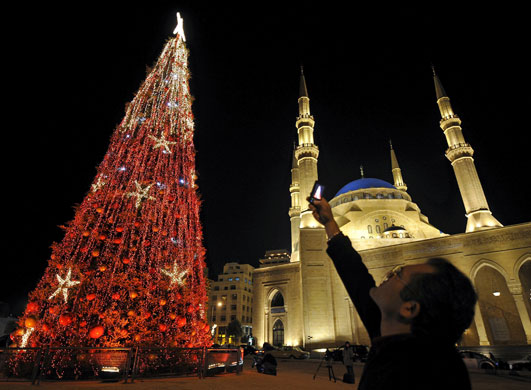
Christmas tree in front the Mohammed al-Amin Mosque in downtown Beirut, Lebanon Photograph: Wael Hamzeh/EPA
Antropologen mogen de dingen graag wat complexer maken. Nodeloos complex volgens sommigen misschien, maar de ratio is erachter is simpel en helder: de sociale werkelijkheid is complex. Dat blijkt maar weer eens uit de discussies over de kerstboom op de Haagse Hogeschool en het verbieden van het dragen van een kruisje bij de Amsterdamse GVB. Even kort waar beide zaken over gaan
Afschaffen kerstboom Haagse Hogeschool « DenHaag.Org
De Haagse Hogeschool heeft zich de woede van CDA lijsttrekker Karsten Klein op de hals gehaald. De school zou ‘te divers’ zijn voor de traditionele kerstboom in de hal van de school en de boom zou te veel verbinding hebben met het christelijke feest. Karsten Klein, lijsttrekker CDA Den Haag: “Dit is toch volkomen absurd? De kerstboom hoort in de Nederlandse traditie. Een onbegrijpelijke beslissing van de Haagse Hogeschool”.
De directie van de Haagse Hogeschool zegt dit jaar het internationale karakter in de school meer te willen benadrukken.
GVB verbiedt dragen kruisje – Binnenland – Telegraaf.nl [24 uur actueel, ook mobiel] [binnenland]
Ik word gediscrimineerd.
Het GVB staat vrouwelijke medewerkers wel toe een hoofddoekje te dragen als symbool van hun geloof. Bovendien wordt mij pas sinds begin dit jaar verboden het kruis opzichtig te dragen, terwijl ik dat sinds 1998 al doe tijdens mijn werk. Ik voel me prettig als ik het kruis draag. Het is het symbool van de liefde van Jezus Christus en dat wil ik laten zien. Ik leef in Nederland, een democratisch land waar je het recht hebt je geloof te uiten”, stelt Aziz.
“Amsterdam is een multiculti stad. Daarin is het niet passend dat moslima’s wel hun geloof mogen en kunnen uitdragen door middel van de hoofddoek, maar deze tramconducteur niet zichtbaar mag getuigen van zijn christelijk geloof “, stelt zijn advocate Jacqueline Koops. GVB-woordvoerder Petra Faber: “Het GVB heeft sinds een jaar nieuwe bedrijfskleding. Om de professionele uitstraling te bewaken, mogen sieraden niet zichtbaar over de bedrijfskleding worden gedragen. Uiteraard mag een ketting wel ónder de kleding worden gedragen. Dit geldt voor alle kettingen, ongeacht hoe ze eruitzien, of welke symboliek of religie ze vertegenwoordigen.”
Wat de HHS en GVB doen is niet meer of minder dan het verwijderen van religieuze symbolen uit het publieke domein. Daar zijn de nodige vraagtekens bij te zetten. Allereerst heeft de HHS NIET alle kerstbomen verbannen maar alleen in de centrale hal. GVB verwijdert niet alle religieuze symbolen uit haar domein; de hoofddoek is wel toegestaan. De HHS wil een meer internationale uitstraling (alsof kerst geen internationale uitstraling heeft) en rekening houden met de diversiteit (bedoeld wordt de allochtone student die bij mijn weten nergens om gevraagd heeft). De GVB doet iets wat nog interessanter is. Een kruis is daar geen religieus symbool, maar een sieraad en sieraden mogen niet zichtbaar zijn want dat zou niet professioneel zijn. Betekent dit dat ook oorbellen en armbanden verboden zijn? Dan moet de GVB echt haar personeel beter controleren want ik zie voortdurend conductrices met sieraden. Of is het bedoeld om het ‘Johnny en Anita’ goud en de blingbling bij blanke en zwarte mannen terug te dringen? Een kruis is daarbij toch echt voor veel mensen wel degelijk een religieus symbool en niet (alleen) een sieraad. Een hoofddoek is ook vaak aangepast aan de laatste mode dus is dat dan niet ook een sieraad?
Vervolgens breekt er over beide zaken natuurlijk heisa uit. Er wordt geprobeerd de christelijke betekenis van de kerstboom te ontkennen, terecht maar dat doet er niets aan af dat de kerstboom voor velen bij het christelijke kerstfeest hoort ook al is dat voor veel anderen weer niet. Het geeft vooral aan dat de kerstboom niet een symbool is dat voor één iets anders staat, maar dat het een symbool is dat velen kunnen delen terwijl ze er tegelijkertijd verschillende betekenissen aan geven. De PVV maak de zaak nog wat complexer door het niet te karakteriseren als secularisatie of de-christianisering van de openbare ruimte, maar als islamisering van de samenleving (ook al is er in de verste geen moslim te bekennen). Tegelijkertijd ziet men de kerstboom of het kruisje niet zozeer als religieuze symbolen, maar als Nederlandse traditionele waarden, normen en symbolen. Met andere woorden men verdedigd de christelijke traditie door deze te seculariseren (als cultuur-christelijk) en vervolgens het verwijderen van deze tradities te zien als een voorbeeld van voortschrijdende religionisering (islamisering) van de samenleving. Hypocriet misschien, maar het werkt wel lekker. En in alle gevallen betekent dit dat men om welke religieuze symbolen dan ook te kunnen weren, men zich moet gaan afvragen of een bepaalde praktijk nu wel of niet religieus is, of het nu wel of niet een verplichting is of het nu wel of niet een symbool is. Met andere woorden uit secularistische overwegingen dient men zich te gedragen als een theoloog. Hoe complex wil je het nog meer hebben?
Persoonlijk heb ik overigens een hekel aan die boom met z’n ballen en lichtjes. Ik vind het vooral een symbool van oppervlakkig consumentisme en het opdringen van een verstikkende nep-gezelligheid. Waar sommige mensen een winterdepressie krijgen door gebrek aan zonlicht, krijg ik een winterdepressie door een teveel aan kerstboomkunstlicht. Met een partner die dol is op kerstbomen en vrienden die mij zo aardig vinden dat ze voor geleverde diensten een ‘schattig’ kerstboompje kado doen en huisdieren die de boom aanvallen waardoor ik genoodzaakt ben de boom te verdedigen, begrijpt u dat niet alleen het professionele leven van een antropoloog complex is, maar ook het privé en sociale leven.
Christmas tree hugging at the HHS
Posted on December 8th, 2009 by martijn.
Categories: Multiculti Issues.

Greek police defending the christmas tree during the riots last year
The Dutch higher vocational school ‘Haagse Hogeschool (HHS)‘ (calling itself The Hague University – but don’t be fooled, it’s not a university), has banned the christmas tree from its school. Well, contrary to many reports, not every where, but in in the main entrance hall. According to HHS they wanted a more international approach for the coming holidays so they choose ‘light’ as a broad and positive theme expressed in light curtains, new years card and a charity action that fits more with the diverse character of its population. In other parts of its building there are christmas trees.
The main problem however seems to be the absence of a christmas tree in the main hall. The issue has been picked up by the Christian Democrats in The Hague claiming that the christmas tree belongs to Dutch tradition that is framed as a judeo-christian tradition. According to the reports in newspaper AD students protest against the school’s action by for example stating that because a number of religious fanatics are offended by a tree with balls and lights, the rest of the school has to suffer (note to my knowledge their are no complaints from religious groups and/or individuals) or stating that foreign students come to the Netherlands to get to know Dutch culture; with decisions such as these they better stay home. A Facebook group called We want a christmas tree in the HHS has been opened. According to orthodox christian newspaper the HHS considers a christmas tree ‘too much christianity‘ while rightwing opinion magazine Elsever has the headline that HHS thinks a christmas tree is ‘not multicultural enough‘ (in a derogatory sense); both showing their pre-occupations in this case. An atheist weblog God voor Dommen applauds the action of HHS because of its removal of religious symbols from public space (an argument made by several Muslims in personal conversations with me as well by the way) although they also criticize that the basis assumption for this action has to be (according to the blog) preventing complaints about religious insult (and if it does done for that reason we could also say it is patronizing). To add to this an interesting observation can be made. In order to maintain and defend the existence of Christian symbols in public space they are re-casted as cultural-christian or pre-christian (and therefore not religious). Is this secularism as a defense for christian-secular hegemony? What could be seen as a secularization of the public space by HHS, then becomes an attack on the christian-secular hegemony or (see below) an example of (self-)islamization (even though Muslims did not complain about the tree or the christian outlook of public space).
Outside the Netherlands there were already several debates about similar issues. In particular in the US where in some cases public schools are forced to make sure that no particular religion is endorsed or favored resulting in allowing the christmas tree (since it has become such a ‘secular’ symbol of the winter holiday) but banning a christmas creche. In another case where there has been complaints however the christmas tree has been banned.
The notions of culture, religion and identity are interesting in these cases. It seems that both the HHS and some of its opponents in this case view culture as a static, monolithic bloc whereby making room for others (non religious or other religious) involves taking something away from one’s own culture. A syncretic approach seems to be no option to consider albeit that some argue the christmas is itself a perfect symbol for multiculturalism (not by definition mistaken). Note that christmas itself is a syncretic tradition merging several pre-christian traditions with christians teachings and various symbolic features. The essentialist idea that christmas is an essential part of ‘our culture’ is not that strange however. Christmas organizes social relationships, part of the calendar and the consumerism that is part of the whole ritual is vital for the economy. It is the self-evident, taken-for-granted hegemonic status of christmas in which many Dutch people are brought up in from early years on, that creates the idea of christmas and the christmas tree with its lights and presents are also vital for us. Publicly rejecting or changing this tradition is labeled as wrong or giving in to the Other; it’s a win or loose mentality that has become stronger due the politicization of culture and religion since 9/11. This is even more so when it is suspected that Islam plays a role such as is clearly the assumption among opponents of the HHS). Christmas and its symbols have become the norm, anything else is at least remarkable or a(worse) as conservative weblog De Standaard states an example of ‘Self-Islamization‘ or according to other weblogs bowing for intolerance, (again, no complaint has been filed against the tree by any religious group). Now I could be mistaken, but most subordinate groups in the Netherlands (whatever religion, worldview or ethnicity) do not claim anything special and do not contest the religious outlook of christmas and its celebration. Most groups respond to such hegemony by adjusting particular rituals into a celebration that follows some of the logic of christmas. Hanukkah is often cited as an example but we can find such an appropriation also among Muslims who have transformed the iftar (closing the day of fasting during Ramadan) into public events much alike the christmas and new years events in the Netherlands (as Sunier has explained) but also by using a typically Dutch (?) feature of Christmas and Sinterklaas during the celebration of Eid. Usually for Sinterklaas but also for christmas people in a circle of family or friends draw names and buy and/or create a gift disguised in a creative way (suprise) accompanied by a humorous poem. The same ritual of drawing names (I’m not sure about the disguising of gifts) is done among some Muslims for Eid as well. As the Wayward Anthropologist has pointed out hanukkah but also Eid in such a case remain rituals marking membership of particular group but also connecting to and inserting oneself in the larger national ritual of consumerism.
Whether it is gift-giving, rituals of light and dark, the tree, they are all meaningful practices that are syncretic but experienced in an essentialist way. They become the subject of tensions and conflicts as a result of consumerism and the transformation from a pre-dominantly christian society to a pluralistic one (including those defending a particular secular outlook of society). Doing away with the christmas tree by HHS (note again, not completely!) maybe an attempt to avoid conflicts and to create a more international outlook as they say. It however neglects the meaningfulness of a tree for many people: it is not ‘just a tree’. Furthermore replacing the tree with the idea of light is interesting. Almost all cultures and religions have something with light and darkness and light is therefore a very strong symbol from which people are able to generate a variety of meanings. I do wonder however, since a symbol also has to have the ability to be signify difference (instead of similarity alone) if it is a viable idea. A symbol the whole world can adhere too does that mean anything or do people also need symbols to distinghuish themselves from those perceived as Others?
Swiss Minaret Ban or How Democracy, Secularism and Islamophobia threaten Democracy, Secularism and Religious Freedom
Posted on November 30th, 2009 by martijn.
Categories: ISIM/RU Research, Multiculti Issues, Public Islam.
 It is widely believed that secular democracy is the best way of managing diversity in a country; it guarantees freedom, peaceful relations and conflicts managed in a political arena. So we like to believe. In Switzerland the Swiss People’s Party (SVP) organized a referendum wanting to ban the construction of minarets because they symbolise a ‘political-religious claim to power‘ having no ‘religious significance‘. A clear secularist statement not completely at odds with European secularism that does not ban all religious symbols from public life but only ostentatious claims that apparently do not fit the existing status quo. The SVP’s proposal was accepted by a majority of the voters except in four cantons (Swiss is a confederation). A clearly not so secularist statement because other religious groups have no such restrictions, which makes it double strange because in this way the Swiss have given Islam officially an exceptional status which is quite remarkable since no European country has done that (in the case of Islam).
The minaret ban may be considered as something extreme that does not obey an enlightenment logic, we can see the same considerations in the case of (proposed) bans on the burqa/niqab that are discussed in several European countries. First of all, it concerns non-Islamic politicians discussing what particular ‘Islamic’ features actually are. For some women for example a burqa/niqab is not a symbol but a command or recommendation from God. It does not signify ones belief, it is part of practicing that belief. Also a political party discussing a minaret having no religious significance but a symbol of a political-religious claim means defining a particular feature. Second, although the rise of a secularist voice in Europe does effect Christian groups as well, the burden is on Islam and not on other groups. Thirdly, following from the previous one, secularism seems to have become a defining feature of European nationalism wherein political islamic symbols are to be rejected from the public domain in order to safeguard a particular culture. Fourth, at the same time protests of Muslims (and other religious groups) against for example Fitna and the Muhammad Cartoons or the posters of the referendum are labelled as an attack on the freedom of expression, seen as a typical difference between Muslims and Europeans. This produces a remarkable paradox. In order to uphold the secularized European society as a freedom loving tolerant society and a homogenous cultural other is created and dismissed as a violent, intrusive outsider. The minaret ban, for the proponents anyway, is an expression of the paradox but also produces the same paradox and as such sustains it. The credo of being intolerant against the intolerant is the logical explanation for that paradox that in the Netherlands is also used by Wilders’ PVV who also pleas for such a referendum in the Netherlands as does the Danish People’s Party leader Kia Kjaersgaard. In order to sustain the images of the irrational, angry Muslim particular key symbols of Islam are frequently targeted as signifiers of intolerance, any negative reaction from the side of Muslims ‘prove’ their standpoint (just watch how people will respond to the negative reactions from Muslim communities the coming days).
Therefore yes, the Swiss minaret ban is extreme for Europe but it is only an extreme outcome of a logic that has been apparent in Europe for several years now and that certainly not limited to Switzerland or extreme right parties. On the other hand we should lose sight of major opposition among non-Muslim Europeans as well who, no matter what their stance is towards Islam, are very negative about this development and who fear that democracy and secularism will eat itself when it becomes mixed with an explosive combination of nationalism and islamophobia.
UPDATE
Orthodox Christian party SGP submitted a motion, following the Swiss ban on minarets, urging restraint in building minarets in the Netherlands. According to the SGP building of minarets and mosques increases polarisation in Dutch society and, contrary to church towers, minarets to not fit the ‘cultural landscape’ of the Netherlands, produce ‘alienation’ and negatively affect Dutch identity. SGP also opposes ostentatious satellite dishes, building large mosques and publicly sending the call for prayer and asks for restraint in those cases as well. The motion was supported by Wilders’ Party for Freedom and Verdonk’s Proud of the Netherlands; conservative liberal VVD withdrew their support at the last moment because, according to them, this is a matter for local councils. The rest of parliament (a majority) opposed and the motion was rejected.
As such an interesting coalition between an orthodox Christian party (the other two Christian parties are in the government and opposed), a conservative liberal party VVD (secular), a populist-nationalist party (Verdonk) (secular) and an extremist party PVV (Wilders) also secular. To be clear, three secular parties but with different opinions and definitions on what secularism is or should be.
UPDATE:
Note that the SGP already filed the motion before the Swiss referendum (thanks to A el M to point that out to me)
![Reblog this post [with Zemanta]](http://img.zemanta.com/reblog_e.png?x-id=2226de52-da93-4a84-9051-2d1bb304bc2b)
Integratie is kiezen voor Nederland en Nederland kiest voor integratie?
Posted on November 18th, 2009 by martijn.
Categories: Multiculti Issues.
VROM – Kabinet: ‘Integratie is kiezen voor Nederland en Nederland kiest voor integratie’
Kabinet: ‘Integratie is kiezen voor Nederland en Nederland kiest voor integratie’
17-11-2009Een samenleving waarin iedereen meedoet en meetelt, wat hun afkomst, traditie of religie ook is. Dat is de samenleving waar het kabinet naar streeft, zo staat in de Integratiebrief. De ministerraad heeft op voorstel van minister Van der Laan voor Wonen, Wijken en Integratie afgelopen vrijdag ingestemd met toezending van de Integratiebrief aan de Tweede Kamer. In de brief schetst het kabinet het kader waarbinnen inmiddels maatregelen zijn genomen en dat sturend is voor nieuw beleid in de nabije toekomst.
Om de huidige problemen op te lossen is het volgende nodig:
- Integratie vraagt om een keuze voor Nederland.
- Remigratiewet wordt beperkt.
- Van nieuwkomers mag een extra inspanning worden verwacht om zich een plek te verwerven in de Nederlandse samenleving.
- Het kabinet houdt rekening met de spankracht van de samenleving.
- Goede integratie vraagt een selectief migratiebeleid.
- Parallelle gemeenschappen staan ontmoeting in de weg en zijn ongewenst.
- De rechtsstaat is de basis voor samenleven.
Integratie vraagt volgens het kabinet om een keuze voor Nederland. Dat betekent beginnen met inburgering, meedoen, kansen pakken die er liggen en liefst ook zelf kansen creëren. Vanwege de verkeerde signaalwerking wordt de Remigratiewet beperkt.
Alle burgers zijn gelijkwaardig, maar van migranten mag een extra inspanning worden gevraagd om een plek te verwerven in de Nederlandse samenleving. Om hen te helpen geeft de Nederlandse samenleving ze de mogelijkheid in te burgeren, een plek te verwerven en kansen om zich te ontplooien. Veel mensen pakken die kans, met hen gaat het goed.
Spankracht samenlevingHet kabinet houdt rekening met de spankracht van de samenleving bij het opvangen van migranten die onvoldoende zijn toegerust voor een succesvolle toekomst in Nederland. De leefbaarheid in buurten en wijken is onder druk komen te staan, net als de spankracht van leraren, huisartsen, hulpverleners en politiemensen. Taal- en opvoedingsproblemen moeten worden opgelost, overlast en criminaliteit stevig en snel aangepakt.
Herhaling van achterstand moet worden voorkomen en een selectief migratiebeleid is nodig voor succesvolle integratie. Daarom heeft het kabinet grenzen gesteld aan de komst van migranten die onvoldoende zijn toegerust voor een succesvolle toekomst in Nederland. Er is extra aandacht voor de arbeidsmigratie uit de Midden- en Oost-Europese lidstaten van de Europese Unie, maar ook voor de komst van (asiel)migranten uit andere herkomstgebieden zoals Somalië, Irak en Afghanistan.
Jaarrapport IntegratieUit het Jaarrapport Integratie 2009, dat tegelijkertijd naar de Tweede Kamer wordt gestuurd, blijkt dat de integratie van nieuwe Nederlanders langzaam maar zeker vooruit gaat. In het hoger onderwijs hebben studenten met een niet-westerse achtergrond een aanzienlijke inhaalslag gemaakt. Ook de arbeidsdeelname van nieuwe Nederlanders is in tien jaar met 10 procent gestegen en het aantal ondernemers nam met ruim 40.000 toe. Het jaarrapport laat echter tegelijkertijd zien dat de arbeidsmarktpositie van jongeren van niet-westerse herkomst verslechtert en dat woon- en schoolsegregatie eerder toe- dan afneemt.
Ontmoeting is van groot belang. Waar mensen samen werken aan oplossingen, krijgen zij iets gemeenschappelijks, en mede daardoor ontstaat ook ruimte voor verschillen. Parallelle gemeenschappen zijn ongewenst.
De rechtsstaat vormt bij dat alles het fundament van de samenleving. Hij is de basis voor het samen leven en biedt een ieder bescherming. Alle burgers hebben gelijke rechten en plichten. Alle burgers zijn gelijkwaardig; mannen en vrouwen, homo’s en hetero’s, gelovigen en ongelovigen, oude en nieuwe Nederlanders. Er is aanleiding voor de overheid in te grijpen als er haat wordt gezaaid of andersdenkenden worden gediscrimineerd.
RechtsstaatHet staat burgers vrij hun leven in te richten naar eigen religieuze en culturele inzichten, zolang dat binnen de grenzen van de rechtsstaat is en zij hun plichten als burger nakomen. Die kernwaarde vereist echter ook respect voor andere religies en andere gelovigen, maar ook voor hen die niet geloven of degene die afstand neemt van zijn/haar geloof. Plaats voor andere rechtssystemen is er niet. De democratische rechtsstaat is het enige uitgangspunt voor het Nederlandse recht.
De wereld is in beweging en Nederland verandert mee. De samenstelling van de bevolking is veranderd. Het kabinet vindt het belangrijk dat burgers onderlinge problemen en dilemma’s van die veranderende samenleving noemen en bespreken. Dat debat mag confronterend worden gevoerd zolang er wordt gestreefd naar het oplossen van de onenigheid en niet naar het op de spits drijven van tegenstellingen en het uitsluiten van groepen.
Beleidslijnen en maatregelen
- Wegwerken van achterstanden bij de inburgering. Inzet op toename van de aantallen inburgeraars, weg van de vrijblijvendheid. Maar ook verbetering van de kwaliteit van de inburgering en inzet op inburgering op de werkvloer.
- Aanpak probleemjongeren waaronder die van Marokkaanse en Antilliaanse afkomst: ze geven problemen en hebben problemen. Crimineel gedrag stevig aanpakken door repressief beleid en perspectief bieden om volwaardig mee te doen.
- Maatregelen huwelijks- en gezinsmigratie. Bevorderen dat mensen toegerust naar Nederland komen en bestrijden van huwelijksdwang.
- Bevorderen van gemengd wonen en weloverwogen woonruimteverdeling.
- Tegengaan segregatie in het onderwijs via pilots met aanmeldprocedures, dubbele wachtlijsten en voorlichting over schoolkeuze.
- Aanpak discriminatie en vergroten weerbaarheid van slachtoffers.
- Extra aandacht voor jeugdwerkloosheid onder migrantenjongeren.
- Integratie arbeidsmigranten uit Midden- en Oost-Europese lidstaten van de Europese Unie, onder meer door taalcursussen via werkgevers. Start van onderzoek naar mogelijkheid verplichte inburgering binnen de Europese Unie
Mijn antwoord? Ik ga het nog maar eens herhalen: Weg met de integratie.
Hongerige wolven – Wilders, PVV en extreem-rechts
Posted on October 31st, 2009 by martijn.
Categories: Multiculti Issues, Religious and Political Radicalization.
Zomaar even een klein overzichtje:
Carel Brendel – Onderzoekers
Drie door de minister van Binnenlandse Zaken aangestelde wetenschappers noemen de PVV een gevaar voor de staatsveiligheid. Legitiem en democratisch verzet tegen de overheid wordt als staatsgevaarlijk bestempeld. Het zijn de methodes waarmee in landen als Wit-Rusland de oppositie monddood wordt gemaakt. Hopelijk beseft minister Guusje ter Horst dat ze zich met dit onderzoek op zeer glad ijs begeeft.
Pseudo-wetenschapper Jaap van Donselaar: “Oppositie ondermijnt democratie” « seven
Blijkt dat ook nu bij het onderzoek van deze week de Volkskrant zelf weer die draai eraan heeft gegeven, en de feiten heeft aangedikt. Want dat blijkt toch een PvdA dependance via de PvdA stichting democratie en media te zijn. Dus na enige speurwerk blijken ze het nieuws alweer net iets anders opgeschreven te hebben dan het in het onderzoek zelf staat
Monddood maken « [ MARGINAAL weblog IN DE MARGE ]
Het meest verontrustend is de formulering van de onderzoekers. Ze bombarderen een democratische oppositiepartij tot een gevaar voor de staatsveiligheid. Ze doen dit op verzoek van het ministerie van Binnenlandse Zaken. Dit zijn de methoden waarmee autoritaire regimes de oppositie monddood maken.Legitiem verzet tegen overheidsbeleid wordt vertaald in systeemhaat tegen de overheid. Wie zich verzet tegen de regering, ondermijnt de democratie. Of verstoort de sociale cohesie, die overigens aljaren grondig is verstoord door het multiculturalisme. [bron]
Carel Brendel
Werkelijk briljant artikel van Carel Brendel. Iedere zin is raak. Ik wou dat ik het had geschreven.
VANGELLEKOM.NL » D66 wil blijkbaar geen zetels meer.
Overigens is het ook nog eens om kotsmisselijk van te worden dat dit rapport en daarbij meteen maar de de uitspraken van Pechthold, Halsema en knuffelminister van der laan( ja die moet ook zo nodig) gedaan worden op de dag dat we het treurige feit herdenken dat vijf jaar geleden Theo van Gogh werd afgeslacht door een moordenaar die zijn daad legitimeert zag door het politiek correcte toontje van de Nederlandse vooral linkse politiek de afgelopen 30 jaar.
Lucaswashier » Blog Archive » Pechtold loopt tien jaar achter
Ik ga er voor de zoveelste keer maar weer eens om vragen. Kom met argumenten. Argumenten die de PVV-stemmer rechtstreeks aanspreken, geen academische verhandelingen (PDF) over de precieze politieke kleur van Wilders die geheel over de hoofden van het kiezerspubliek heen worden uitgesproken. Met kreten als ‘Dit is niet gewoon rechts; dit is extréémrechts’ haal je slechts oude wonden open. Je overtuigt er niemand mee, behalve diegenen die tóch al overtuigd waren.
Discussie » Is Geert Wilders een gevaar voor de staatsveiligheid?
Wat vindt u? Bent u het eens met de conclusie. Zo ja, hoe zou de minister daar dan op moeten reageren?
Pechtold: Wilders is extreem-rechts – Binnenland – de Volkskrant
Fractievoorzitter Alexander Pechtold (D66) roept het naar eigen zeggen al drie jaar: ‘Geert Wilders is een racist en extreem-rechts. Maar nu eindelijk is er een wetenschappelijke onderbouwing.’
hoeiboei: Vraag en Antwoord (14)
Bonter dan de drie hoogleraren die wetenschappelijk bewezen hebben dat Wilders niet deugt, en dat zijn kiezers extremisten zijn, dat is tot op heden toch nog maar zelden vertoond. Twintig procent van de Nederlandse kiezers is extremist! Volgens een beroemde vriend van de islam, de Amerikaanse egghead John Esposito, ligt zelfs binnen de islam het percentage lager. Kun je bij zo’n hoog percentage nog wel van extremisme spreken? Is extremisme niet per definitie iets extreems?
Of deze conclusie logisch volgt uit het onderzoek, dat weten we niet omdat het rapport nog niet openbaar is. Ik denk niet dat het handig is om Wilders ‘extreem-rechts’ te noemen. Misschien dat een flink deel van zijn programma en intenties overeenkomen met eerdere extreem-rechtse partijen, maar je schiet er weinig mee op. Verder kan ik de conclusie van de onderzoekers wel delen.
Daar twitterde ik gisterochtend over: “of Wilders rechts of links is, daar gaat het niet om. Hij is extreem en radicaal. En door zijn succes gevaarlijk.”
Geert Wilders: islamofobie, systeemhaat en genocide | HetZuur.nl
De wetenschappers – radicaliseringsonderzoeker Hans Moors, hoogleraar (contra-)terrorisme Bob de Graaff en extreemrechtsdeskundige Jaap van Donselaar) komen in opdracht van het ministerie van binnelandse zaken tot de conclusie dat de PVV van Geert Wilders is een extreem-rechtse partij die islamofobie en systeemhaat tegen de overheid mobiliseert. Daarmee ondermijnt zij de sociale cohesie en de democratie in het land. Het staat op Volkskrant.nl. Ook pleegt Geert Wilders terrorisme, oorlogsmisdaden, massamoord, hoogverraad en genocide.
Hoe maken wij Geert Wilders af ? | Geen Nieuws
Bij deze een foto van het geheime Haagse wapen, dat er voor moet zorgen dat Geert Wilders en de PVV monddood gemaakt moeten worden. Na maanden van overleg hoe de groei van de PVV een halt kan worden toegeroepen, kwam Guus Slok-Op met een geweldig idee. Doodschieten zoals dat met Pim gebeurde kunnen wij niet nog een keer herhalen, dus wij doen het nu op een veel subtielere wijze : EEN RAPPORT.
Rapport PVV/Wilders niet volledig | Krapuul.nl
Wilders staat er gekleurd op bij het onderzoek naar radicalisering en polarisatie dat onlangs in opdracht van het ministerie van Binnenlandse Zaken is uitgevoerd. De PVV is een extreem-rechtse partij die islamofobie en systeemhaat tegen de overheid mobiliseert en daarmee de sociale cohesie en democratie ondermijnt. En zo is het, ik had het niet beter kunnen formuleren. Daarnaast kunnen we ook wel vaststellen dat Wilders een f**king waste of time is. Daar zal echt nooit iets constructiefs uit komen waar dit land 1 stuiver mee opschiet. Zijn partij stelt kamervragen over palmbomen op de Noordpool en smurfen. Dit aspect van Wilders/PVV mis ik in het rapport.
Geert Wilders is woedend op drie wetenschappers die zijn PVV zouden typeren als een extreem-rechtse partij die de democratie ondermijnt. „Ik ben echt ziedend. Ze zijn knettergek geworden. Wat een idiotie. Wij zijn democraten in hart en nieren”, stelde hij zaterdag.
Stan de Jong » De dodendans om Wilders
De linkse democratiebestrijders hebben een moordend plan bedacht om rechts van de VVD gereed te maken voor een afrekening à la Weimar-republiek. Nee, zelf houden ze schone handen. Het wachten is alleen nog maar op een verweesde GroenLinker die de handschoen opneemt. Als je leest dat een tribunaal bestaande uit de radicaliseringsonderzoeker(?) Hans Moors, hoogleraar (contra-) terrorisme Bob de Graaff en extreemrechtsdeskundige Jaap van Donselaar stellen: De PVV van Geert Wilders is een extreem-rechtse partij die islamfobie en systeemhaat tegen de overheid mobiliseert. Daarmee ondermijnt de partij de sociale cohesie en de democratie in het land, snap je natuurlijk dat de mobilisatietijd aangebroken is, en in rode en islamitische kringen de zucht om het beestje te slachten nieuw leven ingeblazen wordt. Hoewel niemand Geert Wilders ooit op het Haagse Malieveld een massa demagogisch heeft zien toeschreeuwen zoals de vertegenwoordigers van vakbonden, linkse partijen en NGO’s al sedert Troelstra’s revolutiepoging deden, en Wilders nog nooit te kennen gegeven heeft afscheid te willen nemen van de parlementaire democratie, zou hij de democratie van het land ondermijnen. Welnu, wie dagen Wilders voor de Rechter? Wie bedreigen de veiligheid van Wilders? Wie demoniseren Wilders?
[…]
De drie wijze mannen hadden vanwege hun linkse geaardheid al een afkeer voor Wilders, dus als ornithologen die per se het zeldzame bladkoninkje wilden zien modelleerden ze dat vogeltje uit een doodgewone fitis.
Ja, die lui heb je in het veld, beste lezers. Je beredeneert gewoon richting je wetenschappelijke conclusie. Maar het blijft gewoon een aanname waarvoor geen wetenschappelijk bewijs te leveren is.
Ondermijning democratie door Wilders « Quallekop’s Blog
Het is dan nu eindelijk eens wetenschappelijk onderzocht en vastgesteld, namelijk dat Geert Wilders, volgens de onderzoekers, de democratie ondermijnt. Juist de Partij voor de Vrijheid schijnt een bedreiging te zijn voor diezelfde vrijheid. Een opmerkelijk paradox die niet vaak genoeg verteld kan worden ter waarschuwing van het Volk dat straks mag stemmen.
Wie een beetje politiek bewust is en weet wat democratie inhoudt kan weten wat voor een partij de PVV is en waar Geert Wilders op uit is. De man kan nu nog van alles zeggen dat het niet waar is dat hij moslims het land uitzet en dat hij er alleen voor de echte Nederlander is maar de geschiedenis leert dat zulke despoten erop uit zijn de macht in handen te krijgen en zodra dát een feit is de oppositie uit te schakelen.
The Ministry of Interior (or Ministry of Home Affairs) in The Netherlands had three scientists look at the PVV, the party of Geert Wilders (Fitna etc).
The conclusions of the report were leaked, because the ministry was politically unhappy about the outcome of the report and apparently wanted it ‘softened’, something the researchers obviously didn’t want to consider, they have their reputations to guard.
» Blog Archive » WILDERS WOEDEND OP WETENSCHAPPERS
Dat Wilders woedend is, zegt niet zoveel, want Wilders kan over de meest onbenullige dingen ziedend worden. Maar hier heeft hij toch wel weer een punt. Wetenschappers horen geen politieke uitlatingen te doen, daar hebben we politici voor. Niet voor niets moet wetenschap waardevrij zijn. Als wetenschap niet waardevrij is, trekt je de conclusies van wetenschappers al bij voorbaar in twijfel.
Denkwel.nl » Geert Wilders Extreem gevaarlijk voor Nederland ?
Geert Wilders Extreem gevaarlijk voor Nederland?
Dus iemand uitmaken voor Extreem Rechts is democratisch ?.
Ik heb niet gestemd hoor !!! iemand anders wel ?
Ik weet wat echt Extreem is, het zijn juist die gene die zelf geen oplossing hebben en dan maar de gene die wat anders als hun denkt deruit te pikken,
Hij is DemoCratisch gekozen, als je hem afstoot dan hopelijk ziet nederland dan eindelijk in dat er geen democratie bestaat.
En trouwens !!! ons leger zit in Afganistan is dat democratisch ?.
Hoeveel onnodige doden zijn daar al gevallen,
dat noemen jullie zeker mild ?
SJAAK VAN BUREN: WILDERS GAAT ER AAN!!!
De minister van Binnenlandse Zaken (ene Guus) wil ten koste van alles een democratisch gekozen partij (de Partij voor de Vrijheid) verhinderen succesvol te blijven opereren. Dit karwei moet het masterpiece worden van een duistere samenzwering tussen PERS en regering. Guus liet drie lieden een rapport samenstellen waaruit zou moeten blijken dat de PVV een extreem rechtse partij is waar men bezig is de democratie te ondermijnen.
Zodat nu het opperhoofd van de Nederlandse politie gemachtigd is op grond van dit rapport de PVV te verbieden wegens staatsgevaarlijke activiteiten! Kan dat zo maar in dit land?
Uitspraken als ‘de keizer heeft geen kleren aan’ zijn staatsgevaarlijk
Sinds wanneer is intolerantie onmiddellijk staatsgevaarlijk, voor het laatst acteerdegebr_de_witt3 het gepeupel op die wijze toen in de zeventiende eeuw de gebroeders De Witt werden vermoord onder het goedkeurend oog van Prins Willem III, maar dat is toch nu niet aan de orde? De moord op Fortuyn door een gek kun je daar toch niet mee vergelijken?
Die wetenschappers zouden een cursus ‘ Ik en de ander’ moeten gaan volgen, waarbij zij eens op eigen kosten in de spiegel kijken en zich met externe hulp proberen in te leven in de maatschappij waarin zij verkeren, in plaats van ons met een duur door de balastingbetaler gefinancierd onderzoek tbv stervende partijen als de PvdA op te zadelen. .
Onderzoek: Wilders gevaar voor democratie en staatsveiligheid « Nieuws
Dat stellen drie (extreem)linkse pseudo-wetenschappers die in opdracht van Binnenlandse Zaken een ‘onderzoek’ zouden doen naar ‘radicalisering’ in brede zin, maar vanzelfsprekend doen alsof er geen moslim- of linksextremisme bestaat, bleven hangen bij ‘de blonde satan’.
Onderzoek bewijst: de PVV is gewoon extreemrechts! | De Dagelijkse Standaard
Het rapport is binnen, het bewijs is geleverd: de PVV is dus toch gewoon een ordinaire extreemrechtse partij. Aldus het vernietigende oordeel van drie hooggeleerde heren. Oorspronkelijk zouden ze een rapportje schrijven over het onderwerp ‘extremisme’, maar dat was natuurlijk veel te saai. Iedereen weet bovendien dat moslimextremisme in ons land niet bestaat, behalve dan in de hoofden van rechtse pers en kiezers. Dus hebben de onderzoekers hun pijlen uiteindelijk maar op het enige reeel existerende extremisme in ons land gericht, namelijk de PVV. Logisch, om met Johan Cruyff te spreken.
En dat allemaal naar aanleiding van dit bericht in de Volkskrant
‘Geert Wilders ondermijnt democratie’ – Binnenland – de Volkskrant
Een woordvoerder van Binnenlandse Zaken zegt dat ‘discussies over het rapport nog lopen’, maar dat er ‘pertinent geen sprake is van onenigheid’. Onderzoeker Moors wil weinig kwijt, maar beaamt wel dat onderdelen, zoals de kwalificatie extreem-rechts, ‘gevoelig liggen’. ‘De minister moet haar standpunt bepalen op grond van ons stuk. Zij kan zeggen: die Van Donselaar, De Graaff en Moors zijn zo gek als een deur. Maar ze mag niet aan ons onderzoek komen.’
Met andere woorden het rapport is nog niet klaar. We weten niet welke definitie de drie onderzoekers hanteren, hoe zij tot hun conclusies komen en hoe hun bevindingen met betrekking tot de PVV zich verhouden tot bevindingen met betrekking tot andere groepen zoals dierenrechtenactivisten, links-radicalen, rechts-radicalen, enzovoorts. Met andere woorden een hoop geblaat om niks.
Dat Wilders boos is, is ook niet zo vreemd. Dat is prettig want ‘woede’ doet het altijd goed in de media en niemand wil nu eenmaal graag extreem-rechts genoemd worden; zelfs niet degenen die het wel zijn. De drie wetenschappers hebben overigens wel gelijk dat ze voet bij stuk houden. Dat hun bevindingen het gevolg zouden zijn van hun ideologische achtergrond en zelfs tot demonisering zouden kunnen leiden, zijn niet ter zake doende argumenten. Of het nu gaat om politici die bepaalde onderwerpen op de onderzoeksagenda willen of zoals nu, om politici die bepaalde onderzoeksresultaten onwelgevallig vinden, daar moeten onderzoekers zich niet door laten leiden. Zij dienen zich daar niets van aan te trekken zelfs niet in het geval van opdrachtonderzoek. Waar de discussie over moet gaan (en daar kunnen politici zich natuurlijk best over uit laten) is over de inhoud en kwaliteit van het onderzoek. Dat kan nu niet want dan zullen we het toch echt eerst moeten lezen. En dat kan niet, want het rapport is er nog niet.
Wat wel van belang is om te weten dat de vraag of de PVV nu extreem-rechts is of niet ook onder wetenschappers een twistpunt is. Sommigen zien hem inderdaad als extreem-rechts hoewel de definitie die gehanteerd wordt niet altijd even duidelijk is. Anderen zien hem eerder als neo-conservatief, nationalistisch enzovoorts. Zelf gebruik ik voor de PVV liever de term ‘extremism of the center’ vanuit de gedachte (naar voren gebracht jaren geleden door Seymour Martin Lipset) dat er behalve extremisme van links of rechts ook nog zoiets bestaat als extremisme van het politieke midden (wat volgens Seymour Martin Lipset destijds de basis vormde voor het fascisme). De ideologie van de PVV gaat voorbij de scheiding rechts-links en probeert een oplossing te vinden voor reele economische, politieke en sociale problemen door een radicale verandering van de samenleving na te streven, het nationale belang boven alles te stellen en te hameren op krachtdadigheid, strijd en het zuiver houden van de nationale cultuur met daarbij de islam als ultieme ander, de vijand en het sluipende gif van de cohesie van de samenleving. De ideologie is te zien als een synthese van conservatief-rechtse ideeen, populisme, nationalisme (maar lang in zo’n romantische zin als sommige extreem-rechtse bewegingen), cultureel racisme, afkeer van de elite en (progressieve) intellectuelen, een sterke nadruk op het belang van de ‘gewone man’ en met een groot geloof in de maakbaarheid van de samenleving. De intolerantie, angst voor het vreemde, frustratie over problemen met en onder migranten en een kleinburgerlijke houding die we terug vinden in brede lagen van de bevolking zijn gekanaliseerd in de PVV-ideologie. Waar anti-democratisch extreem-rechts zich juist vaak keert tegen het geweldsmonopolie van de staat, doet de PVV dat niet; men ijvert eerder voor een versterking daarvan en lijkt het anarchisme van sommige extreem-rechtse en extreem-linkse clubs juist te vrezen. Daar zitten dus rechtse elementen in en ook linkse, maar het geheel van deze soep stijgt uit boven die tegenstelling en is tegelijkertijd meer geworteld in het politieke midden, maar dan in extreme vorm doorgetrokken.
Dit alles om de zaak nog even wat gecompliceerder te maken. Wat het ook moge zijn, de de term waarmee een groep gekwalificeerd wordt, is dus zelf onderwerp van maatschappelijke en wetenschappelijke discussie. Het gevolg is wel dat wetenschappers die zich hiermee bezighouden per definitie werken in een gepolitiseerd veld. Dat maakt het lastig en maakt hen kwetsbaar voor persoonlijke aanvallen of juist het tegendeel dat mensen met hun onderzoek aan de haal gaan om hun afkeer of juist bewondering voor een bepaald fenomeen of persoon te uiten; zonder dat men het onderzoek kent. Des te meer reden voor onderzoekers om hun poot stijf te houden zou ik zeggen en voor allerlei commentatoren reden genoeg om netjes te wachten tot het rapport uitkomt in plaats van zich als hongerige wolven te storten op uit de context gehaalde beweringen en voorlopige conclusies. Oftewel, zoals één van de onderzoekers laat weten:
Wilders ziedend door etiket ’extreem-rechts’ – Trouw
Onderzoeker Moors was zaterdag onaangenaam getroffen door het nieuws over het rapport. Volgens hem is de conceptversie nog niet besproken met het ministerie en kan er daardoor ook geen onenigheid zijn over de conclusies. Verder liggen de zaken veel genuanceerder dan ze nu in het nieuws komen, aldus de wetenschapper. Zo wordt Wilders’ PVV geen extreem rechtse partij genoemd. Wel wordt wordt gesteld dat Wilders door zijn islam-standpunt steeds verder „in de richting van de extreem rechtse familie” kan worden ingedeeld.
Lara, Ushi, Dushi en Piet: de versterking van racistische stereotypes
Posted on October 26th, 2009 by martijn.
Categories: Multiculti Issues.
Een tijdje terug was er een hoop commotie over het boek van Robert Vuijse Alleen maar nette mensen. Antropologe Irma Accord noemde het racistisch boek. En ook nog seksistisch trouwens, maar dat haalde minder de aandacht (ook veelzeggend?). Vuijsje vond natuurlijk van niet en vond de hele discussie onprettig. Dat is begrijpelijk…de meeste mensen willen niet racist genoemd worden; zelfs racisten niet.
Natuurlijk is Vuijsje’s boek fictie, maar dat wil niet zeggen dat het geen gebruik maakt van racistische stereotyperingen. Zoals Lenie Brouwer stelt op Standplaats Wereld:
Robert lacht in zijn vuistje « Standplaats Wereld
Een van de eerste lessen antropologie is distantie, wees je bewust van de verschillende betekenissen die mensen aan begrippen hechten. Probeer daarom zo neutraal mogelijke taal te gebruiken. Maar dat is antropologie. Moeten we literaire schrijvers ook verbieden dit soort terminologie te hanteren? Nee, want dat is censuur. Maar antropologen hebben wel de plicht die term te bekritiseren, en op het racistische discours te wijzen dat zo naadloos aansluit op de negatieve beeldvorming in de samenleving.
Een schrijver hoeft geen racistische intentie te hebben, hoeft ook helemaal geen racist te zijn en kan zelfs anti-racisme activist zijn, zijn taalgebruik en beeldgebruik is altijd ingebed in een bepaalde historische en culturele context. Een context die altijd gebruik maakt van stereotyperingen waarmee één persoon of groep een andere persoon of groep schetst. Deze stereotyperingen kunnen onbewust plaatsvinden en hebben vaak een lange geschiedenis (bijvoorbeeld via kolonialisme) zoals in Nederland ook te zien is met de traditie van zwarte piet. We kunnen wel oprecht vinden dat we met de traditie van zwarte piet geen racistische bedoelingen hebben, de geschiedenis ervan laat zien dat racistische stereotyperingen wel degelijk een rol spelen in het ontstaan, ontwikkeling en verspreiding van deze traditie. De culturele context verklaart mede waarom bepaalde racistische stereotyperingen in het ene land (de VS) zoveel controverse kunnen veroorzaken en in het andere land (Nederland) nauwelijks. Racistische stereotyperingen van zwarten in de VS zijn qua gevoeligheid vergelijkbaar met anti-semitische verbeeldingen van Joden in Nederland. Daarbij horen ook machtsverhoudingen. De zwarte gemeenschappen in de VS hebben na eeuwenlange slavernij en racistische onderdrukking zich behoorlijk weten te emanciperen en er is een sterke zwarte middenklasse en elite ontstaan die, gecombineerd met een toegenomen gevoeligheid onder witte Amerikanen, succesvol weet te ageren tegen stereotyperingen. In Nederland lijkt (zeg ik met enige voorzichtigheid en terughoudendheid) de groep zwarte Nederlanders(Surinaamse en Antilliaanse Nederlanders) zodanig geintegreerd (lees gepacificeerd), maar tegelijkertijd zo marginaal dat men nauwelijks een vuist kan maken.
Om van Japanners nog maar te zwijgen, want wie maakt zich daar nu druk om? Dat lijkt van de hak op de tak. Wat hebben Japanners en zwarte Nederlanders nu gemeen als het gaat om racistische stereotypes? Heel simpel: Wendy van Dijk

En eerlijk is eerlijk, ik had ook de sterreporter van Curacao nodig voordat ik dit ging schrijven. Best leuk hoor lachen om een dikke Antilliaanse dame met Surinaams accent. Net zoals ook het lachen was om een Japanse verslaggeefster die in niets verhullende taal vooral over sex vraagt. Zoals Beerenkamp in de NRC stelt hebben we hier te maken met een vorm van blackface. Hiermee wordt een theatrale verpersoonlijking van zwarten bedoeld waarmee bepaalde archetypische verbeeldingen uit het Amerikaanse racisme tentoon worden gespreid. Het ging daarbij meestal om blanke acteurs die hun gezichten zwart maakten, met priemende ogen en dikke rode lippen. Het zijn precies die stereotypen die de vandaag de dag nog bestaan (denk aan zwarte piet) en onderwerp zijn van de nodige controverses, met name in de VS. Yellowface is een vergelijkbaar fenomeen, maar dan gericht op het veranderen van blanke acteurs in karakters die Aziatisch or orientalistisch lijken. Let wel, dit kan bijna alleen met stereotyperingen want de karakters moeten voor een groot publiek herkenbaar zijn en dus gaat men vaak op de grootste gemene deler af qua herkenbaarheid en dat zijn wijdverbreide en oude stereotyperingen. En dus is Lucretia zwart, kleurrijk, vrolijk en zorgeloos maar ook enigszins lui en bevat het karakter nogal wat verwijzingen naar de black mammy. En heeft Ushi zwart haar, spleetogen, druk en onderdanig en spreekt beroert Engels. Er zijn meer opvallende creaties te vinden in de hedendaagse film. Zo speelde Rob Schneider in 2007 een Aziatische dominee en fotograaf in I Now Pronounce You Chuck and Larry met vergaande cosmetische aanpassingen, terwijl hij notabene deels Filipijns (en dus Aziatisch) van afkomst is.
Een ander recent voorbeeld is het Oktober nummer van de Franse Vogue dat gewijd is aan supermodellen over de hele wereld. Nu zijn er behoorlijk wat zwarte supermodellen, maar de redactie heeft ervoor gekozen om de witte Nederlandse Lara Stone op de cover te zetten:
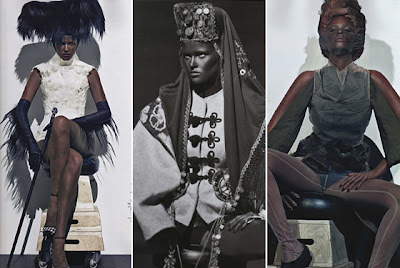
Zij heeft daarbij een zwart gezicht gekregen en ook nog eens kledij en juwelen die verwijzen naar een Afrikaans erfgoed om op die manier het beeld van een zwarte en/of exotische vrouw te scheppen. Het verwijt dat Nana A Tamakloe, oprichter van Confidence Model Management, maakt in een artikel van The Guardian is het volgende:
Why blacking up is the worst kind of fashion crime | World news | The Guardian
The image says we’d rather turn a European model white than hire a black model.
Voor Ushi en Dushi geldt eigenlijk hetzelfde. Hadden SBS (voorheen) en RTL (nu) geen zwarte en Japanse interviewster kunnen vinden die door zichzelf voor gek te zetten haar ‘tegenspeler’ voor gek zet? Het mag allemaal net wat moderner zijn dan de aloude blackface die vaak geschapen werd met houtskool (tegenwoordig supermoderne grime van het type In de ban van de ring), maar het blijft gaan om volksvermaak op basis van stereotypen die groepen mensen reduceert tot bepaalde uiterlijke kenmerken, soms zelfs zodanig dat het freaks worden. Dat Lara, Ushi en Dushi op zich helemaal niet zo negatief verbeeld worden en het zelfs op durven nemen tegen grote namen en die voor gek te zetten doet weinig af aan het racistische erfgoed waarin dit soort praktijken uit voorkomen. Pickering laat in zijn studie naar de Black Minstrels bijvoorbeeld zien hoe deze niet alleen gebaseerd zijn op de overbekende stereotyperingen, maar ook dat ze iets carnavalesk hebben met een omkering van waarden en het tarten van gezaghebbende figuren. Dat doet Ushi en Dushi ook, maar dan in het geval van beroemde presentators, filmsterren enz.
Daar hebben we altijd graag naar gekeken en graag om gelachen, maar het kan geen kwaad om de racistische ondertoon ervan te herkennen en iets meer begrip te hebben voor mensen die hier aanstoot aan nemen; we leven immers niet in een cultureel en historisch vacuüm. Eén van de dingen die je je kunt afvragen is in hoeverre dergelijke stereotype verbeeldingen ertoe bijdragen dat bepaalde groepen in een marginale positie in de samenleving komen of blijven.
Weg met de integratie
Posted on October 5th, 2009 by martijn.
Categories: Headline, Multiculti Issues, Public Islam, Religious and Political Radicalization, Some personal considerations.
Inleiding
Als er iets vanzelfsprekend lijkt in alle discussies over moslims dan is het wel dat zij moeten integreren. In talloze opiniebijdragen wordt dat niet ter discussie gesteld; er is alleen discussie over de vraag hoe. Ook op internet wordt op diverse blogs geschreven over integratie, om een paar voorbeelden te geven zie Joost Niemöller, Sargasso, Met Pels en Luis, Arne Mosselman, Erdebe, Blog of Reason, Stan de Jong, Lucaswashier.nl, Geencommentaar.nl en ga zo maar door. Maar waarom zou men willen integreren? En waarin eigenlijk? In deze bijdrage wil ik daar dieper op ingaan op basis van enkele recente indrukken die ik her en der tijdens debatten heb opgedaan.
Ik zal allereerst bekijken waar het bij integratie nu eigenlijk om draait, vervolgens wat de kenmerken zijn van het paradigma en wat de consequenties hiervan zijn. Vervolgens koppel ik in dit terug naar de indrukken die ik heb opgedaan, mede ook op basis van recente literatuur.
Integratie in de verbeelde natie
Ik sluit hierbij aan bij Schinkel die stelt:
Allochtonenweblog: Schaf het integratiebeleid af (Willem Schinkel)
Het hedendaagse denken over integratie heeft alle kenmerken van een sociaal-hypochondrische gedachtewisseling. Het bestendigt een scheiding tussen ‘de samenleving’ en mensen die ‘buiten de samenleving staan’, zij zijn een bedreiging voor de hygiëne van het sociaal lichaam. Iedere migrant is per definitie lichaamsvreemd aan het bestaande sociaal lichaam. Daarom spreken we in termen van ‘afstand tot de samenleving’.
Dat miskent echter het feit dat de samenleving niet zo hard is als een fysiek lichaam en dat het ‘binnen’ en het ‘buiten’ van de samenleving uitkomsten zijn van een discursief proces, van een sociale constructie. Wat ‘buiten’ of ‘binnen’ de samenleving is, is immers een discutabel onderscheid. Uiteraard zijn de te ‘integreren’ burgers wel degelijk onderdeel van de samenleving, maar zijn ze simpelweg een deel dat die samenleving minder waardeert. Ze staan niet alleen ‘buiten de samenleving’, maar bevinden zich ook aan de ‘onderkant van de samenleving’, en dus daarbinnen. Er is dus sprake van een paradox.
Bij binnen gaat het om binnen de natie-staat Nederland. De natie-staat komt ons als ‘natuurlijk’ voor, terwijl zij in feite een sociale constructie is waarmee wij ons leren identificeren. De natie is een product van collectieve verbeelding en praktijken; ze is een ‘imagined community’ (Anderson 1995) die grondgebied, volk en cultuur verenigt. Deze drie-eenheid constitueert het ‘land’. Gedurende de afgelopen twee eeuwen hebben nieuw ontstane naties via nationalistische programma’s gepoogd hun totale grondgebied cultureel en taalkundig maar ook economisch, sociaal en juridisch te homogeniseren. Deze nationalistische programma’s komen tot ons via onderwijs (denk aan de geschiedeniscanon waarin wordt bepaald wat de belangrijkste momenten van ‘onze’ geschiedenis zijn, maar denk ook aan de rol die onderwijs moet spelen bij integratie en denk aan de inburgeringscursussen), media (taal, beeld) en nationale symbolen (oranje, de koningin, de Nederlandse’ vlag). Migranten verstoren het heilige drie-eenheid waarbij idealiter volk, souvereiniteit en burgerschap als vanzelfsprekend bij elkaar horen om verschillende redenen. Zij verstoren al helemaal de relatie tussen natie en volk waarin in eerder stadium andere groepen (zoals katholieken en Friezen) als zijn ‘ingepast’ door integratiebeleid of door gedwongen assimilatie of zelfs met geweld. Een andere reden heeft te maken met de verzorgingsstaat die gebaseerd is op solidariteit onder het volk. Toen de verzorgingsstaat werd opgebouwd ging het voornamelijk om autochtone inwoners en solidariteit met migranten kwam niet in de gedachten op, maar zij kunnen er ook niet zomaar van worden buitengesloten. Nog een reden is dat migranten zich (per definitie) niets aantrekken van landsgrenzen. We kunnen al niet accepteren dat mensen binnen de landsgrenzen rondtrekken (zigeuners, woonwagenbewoners), maar wellicht nog minder wanneer dat van buitenaf komt. Deze punten hebben niet alleen gevolgen voor hoe we over migratie en integratie denken, maar zelfs voor onderzoek naar migratie zoals Wimmer en Schiller hebben laten zien.
Integratie als mengvorm van nationalisme en racisme
Het integratie- en immigratiebeleid zijn daarmee bij uitstek nationalistisch van aard. Alles wat van buiten de grenzen van Nederland komt, is een probleem voor de homogeniteit van de samenleving en dient gepacificeerd te worden. Dit gebeurt op verschillende manieren zoals Schinkel laat zien:Allochtonenweblog: Schaf het integratiebeleid af (Willem Schinkel)
1 De genealogisering van integratie, dat wil zeggen: de overdracht van het integratieprobleem op volgende generaties ‘migranten’. Het spreken over ‘tweede en derde generatie migranten’ is natuurlijk onzinnig, omdat het in het geheel geen migranten betreft. Maar er spreekt wel het idee uit dat wie zoon of dochter van een migrant is, nog altijd geen onderdeel is van de samenleving en een afstand te overbruggen heeft. Dat levert de verzekering op dat het sociaal lichaam ook in de toekomst onderscheid kan maken tussen ‘de samenleving’ en een omgeving van ‘niet geïntegreerden’ daarbuiten.
2 De dispensatie van etniciteit en integratie: autochtone Nederlanders worden voorgesteld als een etnisch neutrale categorie, en dat is de norm. Zij hebben ‘dispensatie van integratie’ ontvangen. Integratie speelt slechts bij personen die buiten de samenleving staan. Autochtonen zijn dat slechts wanneer ze zich aan de onderkant van de samenleving bevinden: als ze (ex-)gedetineerd, werkloos of gek zijn. Wie géén dispensatie van integratie ten deel valt, blijft altijd een zekere afstand tot de samenleving behouden. Ook wie ‘geïntegreerd’ is, blijft een ander die potentieel kan terugvallen in wezensvreemde culturele uitingen.
3 Het culturisme, ofwel een culturele vorm van racisme, dat uitgaat van het inherente conflict tussen culturen. In het culturisme bestaat een rangorde van culturen waarbij de ‘dominante cultuur’, ofwel de ‘cultuur’ van de samenleving, bovenaan staat. In het culturisme wordt de verklaring voor sociaaleconomische achterstanden en voor criminaliteit gevonden in de culturele achtergrond van een burger. De verantwoordelijkheid daarvoor ligt in geen geval bij de samenleving. Deze nadruk op cultuur heeft een uitsluitend effect en is sociologisch uiterst problematisch. De ‘cultuur’ van ‘Marokkanen’ kan bijvoorbeeld niet verklaren waarom er zo’n verschil is tussen generaties Marokkaanse Nederlanders. Sterker nog: dat verschil maakt duidelijk dat het in het geheel niet de ‘cultuur’, maar de positie van mensen in een omgeving is die hun handelen bepaalt. Mensen handelen in reactie op en met voortdurende creatieve aanpassing aan omstandigheden. ‘Cultuur’ is een schijnverklaring, van het soort: ‘Waarom doet Mohammed dit? Omdat relatief veel Mohammeds dit doen.’ Wie uitgaat van een dergelijke culturele bepaaldheid, kan bovendien niet verklaren waarom die cultuur in het ene geval wel, en in het andere geval niet tot problemen leidt. De hedendaagse criminalisering van de ‘cultuur van moslims’ is een vorm van culturisme die een sociaal-hypochondrische samenleving in staat stelt zichzelf te zuiveren van en te wapenen tegen gezondheidsproblemen van buitenaf.
4 De retoriek van het multiculturealisme: hier gaat het om het forceren van een breuk met het verleden door culturistisch te spreken over integratie. Het idee is hier dat Nederland jarenlang een multicultureel beleid heeft gevoerd dat de eigen cultuur van migranten heeft gestimuleerd en zo uiteindelijk tot polarisatie heeft geleid. Tegenover dat ‘oude’ of ‘verouderde denken’ staat het wereldwijs geworden realisme dat eenzijdige assimilatie de beste weg naar integratie is. Maar het ‘oude denken’ heerst, zo luidt de retoriek, nog altijd in beleid en politiek. De ‘linkse kerk’ is alomtegenwoordig, zo wil het complot. De realiteit is natuurlijk dat culturistisch denken – denken in termen van culturele problemen en van de noodzaak tot eenzijdige aanpassing – inmiddels dominant is geworden, en die dominantie juist behoudt door haar te verhullen.
Punt 3 en 4 zijn hier speciaal van belang. Na de Molukse acties van eind jaren zeventig en de realisatie dat de gastarbeiders niet zomaar weer weg zouden gaan, is men in de jaren ’80 begonnen met het Minderhedenbeleid (veelzeggend op zich omdat na die acties te doen). Dat richtte zich vooral op sociaal-economische achterstanden, maar eind jaren ’80 en de eerste helft van de jaren ’90 ontstond over een breed politiek spectrum het idee dat etnische diversiteit de sociale cohesie in het gedrang kon brengen. Cultuur komt daarmee om de hoek kijken gedefinieerd op een culturistische of essentialistische wijze waarbij er sprake is van homogene duidelijk herkenbare culturele groepen die gedefinieerd worden door hun nationale of etnische cultuur. Multiculturalisme was wellicht een oplossing hoewel er grote vraagtekens te zetten zijn bij de opvatting dat Nederland een multiculturele samenleving was en dat de overheid er een multicultureel beleid op na hield. Daarnaast werd één van de belangrijkste onderscheiden gemaakt die alle vier de punten van Schinkel in zich draagt: autochtoon – allochtoon. En als allochtoon is het lastig om het goed te doen. Met allochtonen worden in principe mensen van ‘buiten’ bedoeld met hun kinderen, maar in de praktijk gaat het om de groep Turkse, Marokkaanse, Surinaamse en Antilliaanse Nederlanders. Daar moet beleid voor worden gemaakt want daar zitten de problemen. Vervolgens gaan alle discussies over die allochtonen bijna als een etnische categorie op zich vergetende dat we ze juist als zodanig gecategoriseerd hebben omdat ze problemen zouden hebben en veroorzaken. Het onderscheid wordt vervolgens geinstitutionaleerd via beleid maar bijvoorbeeld ook via de inschrijving in het bevolkingsregister waarbij mensen moeten aangeven of zij (of hun kinderen) allochtoon zijn. Op deze manier en ook door de punten die Schinkel aanstipt, is het integratiebeleid eigenlijk niet meer dan een masker voor institutioneel racisme waarbij mensen op basis van hun afkomst (en waarbij cultuur een grote rol speelt) apart worden gezet. Kinderen van Marokkaanse Nederlanders worden automatisch als Marokkaans geregistreerd, ook kinderen van gemengde ouders. Een Nederlandse moeder kan wel een Marokkaans kind hebben, maar een Marokkaanse moeder geen Nederland kind. Iets wat ik eerder vergeleken met met de racistische one-drop rule. Aan de ene kant is er dus de veronderstelling dat de allochtoon iets moet doen bij integratie en moet veranderen: zijn identiteit en cultuur moeten veranderen. Aan de andere kant is er door de essentialistische en culturistische opvatting die in het paradigma zit en het van geboorte af categoriseren van mensen onmogelijk om te veranderen (of voor de meerderheid om de verandering op te merken). Alsof je een persoon een gek pak aantrekt zodat je hem er makkelijker uit kunt pikken, de persoon vervolgens bekritiseert om dat gekke pak en van hem verlangt dat hij dat pak weer uittrekt maar ook al doet hij dat je blijft hem zien als de persoon met dat gekke pak al is het maar omdat zijn kinderen het inmiddels ook dragen. Weliswaar wordt in de notitie over integratiebeleid “Zorg dat je erbij hoort” ook gesproken over de rol van autochtone Nederlanders, maar kijken we in die nota naar de uitwerking ervan dan zien we dat dit bijna in z’n geheel gericht is op allochtonen. “Zorg dat je erbij hoort” komt dan geheel voor rekening van de allochtoon terwijl de vraag hoe we autochtonen bij de pluriforme samenleving laten horen niet beantwoord wordt.
Totalitaire integratie
Het gaat echter niet alleen om erbij horen. De nota “Zorg dat je erbij hoort” maakt ook duidelijk dat allochtonen de kernwaarden van deze samenleving niet alleen moeten kennen en respecteren, maar ook moeten accepteren (p.10). De discussie over integratie is door de nadruk op cultuur eigenlijk een discussie over assimilatie geworden. Allochtonen moeten assimileren maar kunnen dat nooit vanwege dat geinstitutionaliseerde racisme. Maar de discussie gaat nog een stap verder. Er wordt door sommigen niet alleen om assimilatie, maar ook om loyaliteit gevraagd zoals in de discusie over dubbele nationaliteiten en het werk voor buitenlandse commissies door Marokkaanse Nederlanders. En het lijkt erop dat ook dat nog niet genoeg is zoals voortreffelijk weergegeven bij Geenstijl.nl. GeenStijl : Allochtoon niet gek op autochtoon. Ofzo
Allochtonen die gestudeerd hebben haten autochtonen. Of nou ja haten, ze zijn niet ‘per se dol’ op Nederlanders. Nu horen wij u denken: hoe zit dat dan bij de lager opgeleide allochtonen, zijn die wel per se dol op Nederlanders? Nee, die zijn dat ook niet. Maar dat is niet zo gek, want laagopgeleide Nederlanders zijn ook niet per se dol op allochtonen. Autochtonen Nederlanders trouwens, want een autochtoon is natuurlijk ook een Nederlander. Goed, waar waren we? Oh ja. Laagopgeleide Nederlanders zijn dus niet per se dol op allochtonen, maar hoogopgeleide Nederlanders zijn dat wèl. Verstand komt met de jaren zou je als allochtonen-liefhebber (of iemand die per se dol is op allochtonen) dus kunnen zeggen, ware het niet dat dit bij de allochtonen (of de allochtoonse Nederlanders voor wie die term prefereert) dus niet zo werkt. Schijten de hoogopgeleide Turken en Marokkanen dan op Nederlanders? Neeee zegt Jochem, ze ‘voelen zich wel loyaal’ aan Nederland. Maar meer ook niet. Komt omdat hoogopgeleide allochtonen wel eens tv kijken en daardoor krijgen ze begrip voor Nederland. Of loyaliteit beter gezegd, want per se dol op Nederlanders zijn ze nadrukkelijk niet. En dat komt weer omdat in die media allochtonen vaak negatief naar voren komen. En dan zegt de hoogopgeleide allochtoon dus: ‘Ho! Hier ben ik niet per se dol op.’ Duidelijk? Jochem Tolsma, nogmaals merci dat jij er bent.
Nu staat de redactie van Geenstijl.nl (althans bij mij) niet bekend om haar bovenmatige intelligentie en begrip, maar deze is toch wel aardig omdat het goed aangeeft hoe eendimensionaal integratie is geworden:
- Allochtonen moeten het sociaal-economisch beter doen
- Allochtonen moeten zich aanpassen aan onze cultuur
- Allochtonen moeten loyaal zijn aan Nederland
- Allochtonen moeten ‘ons’ aardig vinden.
Onderzoek als dat van Tolsma levert op z’n minst verwarring en irritatie op vanwege de niet eenduidige conclusies.
Nogmaals terwijl we net een categorie mensen als allochtoon benoemd hebben omdat ze niet voldoen aan die vier punten en dat ook nog eens zodanig hebben ingebed in beleid en discussies dat ze er ook niet aan kunnen voldoen. Door de nadruk ook nog eens te leggen op identificatie en gevoelens wordt het integratie beleid zo goed als totalitair; het gaat bij integratie om de volledige controle op het leven van migranten: politiek, cultureel, filosofisch, religieus, sociaal, economisch en ook nog eens emotioneel. Het integratieparadigma is verworden tot een dwangbuis waarin migranten gedwongen moeten worden om het heersende idee van Nederland als natie-staat te volgen omdat het goed voor ‘hen’ en voor ‘ons’ is.
Het meest vergaande is het anti-radicaliseringsbeleid. Waar na de Molukse acties van de jaren ’70 nog werd ingezet op een Minderhedenbeleid om meer werk te maken van de integratie van allochtonen als manier om hen te pacificeren, na 9/11 en de moord op Van Gogh is dat te soft en wordt er ingezet op harder beleid. Radicalisering wordt per definitie gezien als iets dat bestreden moet worden (even vergetend dat de eerste en tweede golf feministen ook als radicaal golden en dat we in het verleden zelfs zoiets hadden als een Politieke Partij Radicalen). Opnieuw wordt daarbij vooral gericht op allochtonen (moslims) en wordt het begrip polarisatie gereserveerd voor spanningen tussen moslims en niet-moslims en de opkomst(?) van radicaal-rechts. Dat er ook zoiets als een ‘radicalisering van het midden’ heeft plaatsgevonden waardoor iedere (ongewenste) publieke uiting van islam nogal snel als radicaal (en dus ongewenst) wordt aangemerkt, wordt ook vergeten. We zijn gelukkig net aan een apologieverbod ontsnapt (wat helemaal zou neerkomen tot een verbod op nadenken), maar het repressiebeleid zorgt er wel voor dat een strafrechtelijke aanklacht tegen moslims niet eens noodzakelijk is om hen te vervolgen wegens ‘terrorimse gerelateerde’ activiteiten. Met name salafistische groepen (de groepen die als radicaal worden aangemerkt vanwege onder meer het feit dat zij de islam wel een publiekelijke rol willen laten spelen en vanwege hun al dan niet vermeende banden met terrorisme) worden per definitie gewantrouwd. Maar ook in het geval van minder radicale moslimvoorlieden zoals Ramadan is een onwelgevallige mening genoeg om druk uit te oefenen om de man te verwijderen. Degene die bruggen moet bouwen van de dominante meerderheid naar de minderheid moet dezelfde mening erop na houden als die van de politieke elite uit die dominante meerderheid. De speelruimte voor vrij handelen en vrij denken wordt zo wel heel erg ingeperkt.
Tot slot: waarom integreren?
En wat doet die allochtoon dan? Ondanks de problemen die er zijn is het integratieproces op sociaal-economisch en cultureel gebied de laatste jaren gewoon doorgegaan. Tegelijkertijd is in de beleving van autochtonen, zo blijkt uit onderzoek van Entzinger en Dourleijn, de culturele afstand juist gegroeid. Waar Turkse en Marokkaanse Nederlanders steeds meer op autochtone Nederlanders zijn gaan lijken op het gebied van waardenoriëntaties, is de inschatting hiervan door autochtonen steeds negatiever. In feite kan men stellen dat de integratie voortgaat, maar dat er steeds nieuwe criteria voor integratie bijkomen. Dit zorgt nogal voor pijnlijke situaties, maar (nog erger) ook berusting. Zo stelden Marokkaans-Nederlandse jongeren ten tijde van de discussie over de dubbele nationaliteit van Aboutaleb en Albayrak:
Zie je wel! Je kunt in dit land alles worden. Je hebt als migrant alle kansen en je kunt zelfs minister worden. Maar hoe goed je het ook doet, denk vooral niet dat je er ooit bij zult horen.
In een recent boek van Marjo Buitelaar zien we ook iets dergelijks terug. Buitelaar laat helder zien met mooie en indringende citaten uit de levensverhalen hoezeer de vrouwen in zichzelf, hun eigen familie en de samenleving hebben geïnvesteerd. Ze hebben een sterk gevoel van verplichting: om hun ouders niet teleur te stellen maar ook om het negatieve imago van Marokkaanse Nederlanders en moslims te verbeteren. Daarbij waren en zijn zij als bijvoorbeeld Marokkaans-Nederlandse politica of onderzoekster een van de eersten. Dus bevinden ze zich op nieuw terrein en is hun aanwezigheid daar nieuw voor de gevestigde groepen. De enorme inspanning die het de vrouwen heeft gekost om te bereiken waar ze gekomen zijn verklaart waarschijnlijk ook de zucht naar waardering en erkenning die uit de verhalen spreekt. Deze wordt alleen maar versterkt door de negatieve beelden van Marokkaanse Nederlanders en moslims en leidt tot frustratie omdat men meent die erkenning en waardering toch niet te krijgen. Dit komt vooral tot uiting in de kritiek van de vrouwen op de wijze waarop met politica Ayaan Hirsi Ali is omgesprongen. Hoewel kritisch over haar uitlatingen en optreden vindt een van de vrouwen het schandalig dat toenmalig minister Verdonk haar het Nederlandse paspoort wilde ontnemen en dat Hirsi Ali als Nederlands staatsburger geen bescherming krijgt in de VS (p. 112). Als iemand die zo succesvol is en wellicht zelfs als voorbeeld van geslaagde integratie gezien kan worden, al zo makkelijk haar Nederlandse identiteit kan verliezen, wat betekent dat dan voor migranten die minder succesvol zijn en minder in de media komen? Kunnen ook zij op een dag tot ongewenst verklaard worden?
Een vraag die wijst op de indruk dat de Nederlandse samenleving wel loyaliteit vraagt aan haar migranten, maar niet teruggeeft. Een indruk die versterkt wordt doordat er nogal wat moslims zijn die ervaren dat zij in de politiek geen enkele stem hebben. De uitlatingen van Halsema zeer recent over de hoofddoek kwamen in sommige kringen vooral hard aan omdat zij gezien werd als iemand die wel voor de rechten van moslims zou opkomen. Let wel zij heeft niet gezegd dat zij zou tornen aan die rechten, maar die nuance lijkt (zoals ook in bovenstaande cases) volledig verloren te zijn gegaan. Recent zei een D66 politicus tegen mij hierover, ‘maar waarom klagen ze hier dan over, waarom doen er ze er niks aan?’ De interpretatie van sommige moslims van dergelijke uitspraken kan inderdaad als een uiting van ‘slachtoffergedrag’ gezien worden, maar ik denk dat de meesten van hen al een stap verder zijn: berusting.
Buitelaar stelt dat wanneer een groep of individu niet voldoende erkenning krijgt voor de eigen levensstijl dit kan leiden tot een identiteitscrisis of vervreemding. Het boek geeft daar voorbeelden van, niet alleen naar aanleiding van de discussie over Hirsi Ali, maar ook in het levensverhaal van de politica Tahara die aangeeft het niet meer op te kunnen brengen om de negatieve beeldvorming over moslims recht te zetten. Ik denk echter dat Buitelaar niet ver genoeg gaat in haar analyse van deze aspecten. De vrouwen oefenen niet alleen kritiek uit op politici in het integratiedebat, maar op het gehele integratieparadigma. Dit paradigma is niet alleen een beschrijving van de geleidelijke invoeging van migranten in de samenleving (p.158-159), maar ook een model dat aan migranten wordt opgelegd bijvoorbeeld door taaleisen, inburgeringscursussen en de norm dat migranten er geen dubbele loyaliteiten op zouden moeten nahouden. Op basis van de kritiek van de vrouwen kunnen we de discussie over de loyaliteit van Marokkaanse Nederlanders aan de Nederlandse samenleving, ook omdraaien: hoe loyaal is Nederland ten opzichte van de migranten en hun nakomelingen? Integratie wordt over het algemeen gezien als iets dat goed is, maar moeten we ons niet afvragen of het wel verstandig is van Marokkaanse Nederlanders om zich te integreren in een samenleving als die samenleving (of toch in ieder geval de heersende elite) geen enkele loyaliteit betoont aan migranten, zelfs als die zeer succesvol geïntegreerd zijn zoals Ayaan Hirsi Ali? Wetenschappers staan vaak vooraan om de overheid van advies te dienen over het integratiebeleid waarmee we eigenlijk kritiekloos het hele integratieparadigma reproduceren én legitimeren. Misschien is het tijd om dat niet meer te doen? Misschien is het tijd om allochtonen te adviseren vooral niet teveel in dit land te integreren?
Op de hoogte blijven van Closer? Schrijf je HIER in.
Riotous Rotterdam – Ethnography in the Netherlands
Posted on September 21st, 2009 by martijn.
Categories: anthropology, Blogosphere, Multiculti Issues.
I don’t think there that many people from abroad who are doing ethnographic research in the Netherlands. Which is a pity. The country is small, travelling is easy and Dutch may seem a difficult language but many people also speak (some kind of) English. In particular with regard to integration, islam, radicalization, migrants, multiculturalism and so on, a lot is happening here and many of the transnational debates about these issues have a particular local flavor.
One of the exceptions doing research here is Ms. Long from Canada. Her Ph.D project on constructing national identity through space in the Netherlands aims at understanding the relationship between Dutch Muslims and Dutch natives by looking at how people interpret their belonging (and not belong) in relation to specific places and how this is influenced by national and Islamophobic sentiments.
Besides this very interesting topic she also holds a weblog: Riotous Rotterdam where she blogs about her experiences as a researcher, PhD student, migrant and so on. The next entry is exemplary in the sense that it not only combines all those aspects and also makes clear what good ethnographic research is about:
Riotous Rotterdam: Lost in Transit
I followed all the steps to buy a ticket at the machine (the station is under construction so there is no ticketbooth with an actual person) yet when I went to pay, none of my cards would work! Debit yes, but only for a Dutch bank, Chipcard yes (of which I own one) but it didn’t have the 24 Euros on it that I needed to get to Amsterdam Centraal. After fidgeting and becoming exasperated I noticed that a line had accumulated behind me and I tried to cancel out of my purchase so others could go ahead of me. Just when I thought all is lost, the man behind me asked if he could help. He ended up purchasing my ticket on his card to which I gave him money – Thank goodness. As it turns out this man was an audio technician who has travelled all over the world creating speaking podiums, concert halls, and the like. He had spent much time in Iran and had an opinion on the state of affairs in Rotterdam with regard to how Muslims living here choose their identity. He believed that religious identity had become a cultural identity for some, and that the distinction between these identities was lost to both those adopting the label ‘Muslim’ and those native Dutch who conflated the religious and cultural identities of individuals. Heavy talk for 10 in the morning but it works for me!
This man also informed me that my ticket to Amsterdam Centraal would not take me to the station that I was trying to go to, Amsterdam-Sloterdijk. The conductor on the train also surmised that I would have to get out and buy the extra ticket at the Central train station that would take me the one train stop further or I could take my chances with the next conductor who would switch over at the Centraal station. ‘It’s okay’, he said, ‘you have 5 minutes between when we arrive and when we leave again, so you can run to get your ticket’. Great.
So our train arrives and I’m waiting by the doors. I run downstairs to the ticket machines and search on the screen for Sloterdijk…Sloterdijk…Sloterdijk…but it’s nowhere. Arg! So I queue up with other passengers to ask at the information desk. The line-up took a while and when I finally told her my issue, she gave me a mothering look, “well that’s because you’re looking for Amsterdam-Sloterdijk, darling” Ah, yes, I should have known. So back to the machine, I go through all the steps (which station, first or second class, single or return, full price or discount) when I realise…this machine ALSO doesn’t take any of my cards and while it was only 2,20 Euros to the next stop…I was 30 cents short! So I walked into the nearest shop to purchase a small drink to get change meanwhile giving up on the idea that I would make the same train but that I would catch the next one. Wait in line, purchase a water, walk back to the ticket machine, purchase the ticket, walk slowly to the train listing on the wall when I realise…I still had one minute to make the train! So I’m running back through the station up platform 8a run up the flight of stairs just in time…to see the doors close and the train pull away.
I should also add that throughout the rest of the day I proceeded to lock myself out of my mobile (the mobile I have here has a pin code that I must be entered when it’s turned back on which I forgot in the safety of my room in Rotterdam), mix-up where I was suppose to check out of the metro thus docking my Chipcard to the point where I couldn’t afford another route (so I got off and tried to walk, got lost and fed up, got back on the tram and paid for another ticket) and then had to pay for both internet time and a pay phone card in order to meet with my colleague who is doing research in Amsterdam. Phew. If it feels like a wild ride just reading the blog I was very very very tired yesterday when I finally stepped back into the flat. Although I was lost in/through/around transit at points during my day, I did make some wonderful contacts and learn quite a lot. I look forward to the next time I visit Amsterdam…but maybe next time I’ll take a smoother ride.
Ok, forget what I wrote about ‘easy travelling’ but it is exactly these kind of experiences that makes ethnography difficult, exhausting and so rewarding.
Ms. Long also has a colleague who does ethnographic research in Poland and yes she is also blogging about it.
Notorious Nowa Huta
Using Nowa Huta as a case study, my research looks at the changes that have taken place in Poland over the past twenty years, the ways in which people of different generations remember the socialist past, and what their memories can tell us about people’s lives in contemporary Poland.
Both researches and blogs are very interesting to monitor which I certainly will do for the time to come. And if there are other researchers from abroad working in the Netherlands I would love to hear it!
New Muslim Cool
Posted on September 15th, 2009 by martijn.
Categories: Arts & culture, Multiculti Issues, Youth culture (as a practice).
A documentary about Jason Perez, an American man who’s a rapper, educator, father, Muslim, husband and idealist who is trying to get away from his old life with gangs and drugs. The documentary is not a typical feel good film but also moves beyond the usual stereotypes showing the reproduction and transformation of cultural repertoires. Great film and probably useful for teaching purposes as well.
You can watch the trailer here:
[flashvideo filename=http://www.youtube.com/watch?v=Ne-dhZckbIk /]
The website New Muslim Cool has the DVD along with an educational toolkit (incl. lessons plans).
The case of Tariq Ramadan…again
Posted on September 1st, 2009 by martijn.
Categories: Multiculti Issues, Public Islam.
Yes, I thought about writing a piece, again, about Tariq Ramadan and his dismissal from Erasmus University of Rotterdam. But I’m not going to do it. I had to read the reports about the case after my holidays and I finally finished reading most articles and several blogitems. Most of it makes me too tired to write anything sensible about the topic so I will be silent.
If you want to read more about the case I refer you to the English pages of the Dutch newspaper NRC-Handelsblad:
Recent news
nrc.nl – International – Ramadan criticised over Iran connection
Ramadan criticised over Iran connection
Published: 13 August 2009 15:14 | Changed: 13 August 2009 16:47
By our news staff
Opposition members in the Rotterdam city council are once again calling for the resignation of integration consultant Tariq Ramadan, this time because he is hosting a talk show on an Iranian TV station.
nrc.nl – International – Rotterdam fires Tariq Ramadan over Iranian TV show
Rotterdam fires Tariq Ramadan over Iranian TV show
Published: 18 August 2009 14:19 | Changed: 19 August 2009 15:28
By Mark Hoogstad
The Rotterdam city government wants to break ties with the Muslim philosopher Tariq Ramadan, sources at city hall say.
nrc.nl – International – Ramadan: A bridge too far?
Ramadan: A bridge too far?
Published: 19 August 2009 14:49 | Changed: 20 August 2009 17:21
It is easy to see Tariq Ramadan’s connection to an Iranian TV station as a convenient excuse for his dismissal, but there has always been doubt about Ramadan’s suitability as a “builder of bridges”.
Opinion and rejoinder
nrc.nl – International – Don’t I get a chance to defend myself, Ramadan asks
Don’t I get a chance to defend myself, Ramadan asks
Published: 19 August 2009 14:44 | Changed: 20 August 2009 15:11
Tariq Ramadan, the Swiss philosopher and theologists, plans to fight his dismissal as an adviser and a professor in court. In an interview with NRC Handelsblad, he talks about his anger and his involvement with a government-funded Iranian TV channel that was the cause for the latest controversy in Rotterdam.
nrc.nl – International – Opinion – Rotterdam should get rid of this Islamist
Rotterdam should get rid of this Islamist
Published: 17 August 2009 10:45 | Changed: 18 August 2009 16:45
Anyone who, like Tariq Ramadan, works voluntarily for an immoral and extremely violent regime like that in Iran cannot be a ‘builder of bridges’ in the Netherlands.
nrc.nl – International – Opinion – Tariq Ramadan answers his Dutch detractors
Tariq Ramadan answers his Dutch detractors
Published: 18 August 2009 12:25 | Changed: 26 August 2009 10:56
Tariq Ramadan has once again come under fire in Rotterdam, where he is an adviser on integration. Ramadan says he is not surprised that it is only in the Netherlands that his collaboration with Iranian state TV has been criticised. “The controversy says far more about the alarming state of politics than about my person.”
nrc.nl – International – Ramadan wants to take Rotterdam to court
Ramadan wants to take Rotterdam to court
Published: 19 August 2009 11:47 | Changed: 19 August 2009 17:27
By Mark Hoogstad
Tariq Ramadan is furious about the way he has been cast aside by the Rotterdam city government. The Islamic scholar was fired from his job as integration adviser on Tuesday because of a talk show he hosts on Iranian state TV.
Older news
nrc.nl – International – Features – Controversy follows Tariq Ramadan to Rotterdam
Controversy follows Tariq Ramadan to Rotterdam
Published: 8 April 2009 17:09 | Changed: 18 August 2009 13:50
Controversy seems to follow Tariq Ramadan wherever he goes. In Rotterdam, where the Swiss philosopher and theologist has been asked to contribute to the multicultural dialogue, the gay community is up in arms over Ramadan’s statements about homosexuality and the role of women in society.
Closer
C L O S E R » Blog Archive » Tariq Ramadan controversy: Moulding Muslim leaders
In fact it appears now that the frequent attacks on him are more dangerous for his position as a consultant than his statements. In particular because he is not only under attack from Dutch secularists and anti-islamists but also from radical groups who oppose his cooperation with Dutch authorities and his statements about homosexuality and his call for a moratorium on corporate punishment. According to these critics Ramadan sells himself to the Dutch authorities which inevitable means that he will have to adjust (in their view dilute) the Islamic message. Their interpretation seems to be correct due to this controversy.
Worthwile reading is an older entry on The Immanent Frame about the reversal of a lower court ruling allowing the US government from entering the country.
The Immanent Frame » Reversal in the case of Tariq Ramadan
In light of the new developments in the case, we asked: what are the potential implications of the Ramadan case for both academic freedom and public discussions of Islam in the United States?
Our panelists:
Abdullahi Ahmed An-Na’im, Professor of Law, Emory University School of Law
Mohammed Bamyeh, Professor of Sociology, University of Pittsburgh
Richard W. Bulliet, Professor of History, Columbia University
Craig Calhoun, President of the Social Science Research Council, University Professor of the Social Sciences at New York University and Director of its Institute for Public Knowledge
John L. Esposito, University Professor of Religion and International Affairs, Professor of Islamic Studies and Founding Director of the Prince Alwaleed bin Talal Center for Muslim-Christian Understanding at the Walsh School of Foreign Service, Georgetown University
Mark Juergensmeyer, Director of the Orfalea Center for Global and International Studies at University of California, Santa Barbara, and President of the American Academy of Religion
Arvind Rajagopal, Associate Professor of Culture and Communication, New York University
Migrantenstudies – Identificatie van migrantenjongeren
Posted on August 28th, 2009 by martijn.
Categories: [Online] Publications, ISIM/RU Research, Multiculti Issues, My Research, Young Muslims, Youth culture (as a practice).
Migrantenstudies is het enige Nederlandstalige wetenschappelijke tijdschrift voor onderzoek naar migratie, etnische minderheden en de Nederlandse samenleving. Tal van onderwerpen komen aan bod zoals huisvesting, gezondheidszorg, onderwijs, arbeidsmarkt, politieke participatie, discriminatie en identiteit. Het eerste nummer van dit jaar (dat sinds kort online staat) is een thema-nummer over identificatie van migrantenjongeren.
Jongeren nemen een belangrijke plaats in het identiteitsdebat in, omdat juist van hen verwacht wordt dat zij zich met Nederland identificeren; het is het land waar ze zijn opgegroeid en vaak ook zijn geboren. Dit themanummer brengt een aantal recente studies samen over identificatie van in het bijzonder Marokkaanse en Turkse migrantenjongeren. Deze studies besteden in het bijzonder aandacht aan de wijze waarop de migrantenjongeren in de context van de huidige Nederlandse samenleving hun identiteit construeren en welke factoren daarop van invloed zijn.
Ersanili & Scholten, p. 3
In dit nummer vindt u artikelen van Han Entzinger, Inge van der Welle en Virginie Mamadouh, Evelyn Ersanili, Susan Ketner, Simone Boogaarts en ondergetekende:
- Inleiding, Evelyn Ersanilli & Peter Scholten (red), pag. 2-8
- Integratie, maar uit de gratie. Multi-etnisch samenleven onder Rotterdamse jongeren, Han Entzinger, pag. 8-23
- Territoriale identiteiten en de identificatiestrategieën van Amsterdamse jongvolwassenen van buitenlandse afkomst. Over evenwichtskunstenaars en kleurbekenners, Inge van der Welle en Virginie Mamadouh, pag. 24-41
- Identificatie van Turkse migrantenjongeren in Nederland, Frankrijk en Duitsland, Evelyn Ersanilli, pag. 42-58
- Islam is islam. Punt uit? Marokkaans-Nederlandse moslimjongeren in Gouda en de culturele constructie van een ‘zuivere’ islam, Martijn de Koning, pag. 59-72
- “Ik denk niet in culturen… ik denk eigenlijk meer in mijn geloof’. Waarom jongeren van Marokkaanse afkomst in Nederland de moslimidentiteit zo sterk benadrukken, Susan Ketner, pag. 73-87
- Gedwongen of Vrije keuze? In- en uitsluitingsmechanisme in de etno-party scene, Simone Boogaarts, pag. 87-104
U kunt het hele nummer gratis downloaden: Themanummer ‘Identificatie van Migrantenjongeren’
Nederlandse jongeren in Kenia
Posted on July 29th, 2009 by martijn.
Categories: ISIM/RU Research, Multiculti Issues, Religious and Political Radicalization, Young Muslims.
UPDATES ONDERAAN
Verschillende media weten vandaag te melden dat er in Kenia vier Nederlanders zijn ge-arresteerd op verdenking van het helpen van een moslimrebellenbeweging in Somalië.
Nederlanders gearresteerd in Kenia – Binnenland – Telegraaf.nl [24 uur actueel, ook mobiel] [binnenland]
Vier Nederlanders gearresteerd in Kenia
NAIROBI – De Keniaanse politie heeft vier mannen met een Nederlands paspoort gearresteerd bij de grens met Somalië. De Nederlanders worden ervan verdacht de islamitische opstandelingenbeweging al-Shabaab in Somalië te helpen, aldus een lokale functionaris woensdag.Drie van de vier 21-jarigen zijn in Marokko geboren, de vierde in Somalië. Ze zijn maandag aangehouden, toen ze in een gehuurde truck onderweg waren naar de Noord-Keniase plaats Kiunga. De verdachten zeggen toeristen te zijn, maar volgens de functionaris zijn er in het gebied geen toeristische attracties.
Het viertal wordt voor het einde van week naar de Keniaanse hoofdstad Nairobi overgebracht.
Een woordvoerder van het ministerie van Buitenlandse Zaken kon woensdag bevestigen dat op 24 juli drie Nederlanders en een Marokkaan met een Nederlandse verblijfstitel zijn opgepakt in Kenia bij de grens met Somalië. Volgens de woordvoerder heeft de Nederlandse ambassade in Kenia contact met de vier personen en zitten zij vast voor nader verhoor. Buitenlandse Zaken kon geen uitspraken doen over de reden waarom de vier zijn opgepakt en wacht het onderzoek af.
Nou lijkt mij de kans groot dat de Keniaanse autoriteiten ook afgaan op informatie van Nederlandse autoriteiten (AIVD?), maar voorlopig is het dus nog afwachten.
Wat is Al Shabaab eigenlijk? Al-Shabaab oftewel ‘de jongeren’ is een moslimrebellenbeweging in Somalië die ook wel bekend onder de naam Ash Shabaab, Hizbul Shabaab (partij van de jongeren) en Volksverzetsbeweging in het land van de twee migraties (PRM) ontstaan uit de ondergang van de islamitische raden in Somalië in 2006 als gevolg van het optreden van het Somalische leger (of wat daarvoor doorgaat) en het Ethiopische leger. De hardline jongerenbeweging binnen die islamitische raden gingen ondergronds en vormden de Al-Shabaab. Zij presenteren hun strijd vooral als een strijd voor rechtvaardigheid en orde in een land waar wetteloosheid en chaos de boventoon voeren. Zij willen de rechtvaardigheid en orde, naar eigen zeggen, terugbrengen door de sharia in te voeren. Vorig jaar kondigde de shabaab beweging aan in de regio van Lower Shabelle het islamitische provincie van Shabelle gevestigd te hebben, nadat men al eerder de Islamitische Provincie van Juba gevestigd zou hebben. Eén van de ideeen daarbij lijkt te zijn dat men erop gokt dat de bevolking zo blij is met de terugkeer van gezag en orde, en het verwijderen van de criminelen, dat ze de heerschappij van de shabaab beweging zullen accepteren. Dit zou best eens zo kunnen werken. Voor veel mensen in Somalië is de Al Shabaab een legitieme bevrijdingsbeweging tegen buitenlandse (Ethiopische) bezetting en geen terreurgroep. De shabaab beweging staat er inmiddels om bekend mensen van buiten Somalië te rekruteren voor hun strijd. Dit lijkt echter erg recent te zijn, vanaf 2006, en het lijkt vooral te gaan om Somalische jongeren buiten Somalië en veel minder om een mondiale jihad. De redenen voor jongeren om zich bij deze beweging aan te sluiten zijn onder meer zoeken naar een hoger doel in het leven en identiteit, drang naar avontuur en romantiek en een mengeling van jihadisme en Somalisch nationalisme.
Hieronder zie je een nasheed Ya Shabaab (Oh jongeren) met daarin beelden van de Shabaab beweging (met Nederlandse ondertiteling).
Dat mensen naar andere landen trekken om daar te vechten voor rechtvaardigheid en bevrijding (in hun ogen althans) is niets bijzonders. Dat gebeurde al tijdens de Spaanse burgeroorlog en we zien het klaarblijkelijk ook bij joodse jongeren uit Nederland. Verder hebben we natuurlijk ook onder moslimjongeren in Nederland diverse zaken gehad en de belangstelling voor Somalië is in bepaalde kringen zeker aanwezig en zeer levend(ig). Nou ja eigenlijk is het wel bijzonder want het gaat altijd om relatief kleine groepen; de overgrote meerderheid, als ze zich er al mee identificeert, blijft lekker in het land waar ze wonen en zelfs van degenen die erover praten (vaak in erg romantische termen) probeert maar een enkeling te gaan. Van diegenen die gaan, faalt ook nog eens gedeelte omdat het allemaal toch wat lastiger is dan in eerste lijkt.
Voor de goede orde of dit ook in dit geval zo is (dat er sprake is van jongeren die deelnemen aan de jihad aldaar) weten we niet. Wellicht waren ze inderdaad toeristen op weg naar Kiunga aan de Keniaans/Somalishe grens en bijvoorbeeld potentiele bezoekers van het Kiunga Maritiem Reservaat met mangroves, schildpadden en vogels. Rest nog de vraag hoe problematisch dit allemaal is en voor wie?
UPDATES
The Standard | Online Edition :: Dutchmen grilled over Al-Shabaab
Anti-terrorist police officers arrested four Dutch nationals on suspicion they were crossing to southern Somalia to join the Al-Shabaab militia group.
The Dutchmen, who were arrested at night in Kiwayu, Lamu District over the weekend, were taken to Mombasa and later flown to Nairobi for further interrogation.
[…]
“The four foreigners claimed they were tourists in Kiwayu but we doubted the authenticity of their documents so we took them to Nairobi for further interrogation,” Limo said.
He said the investigations would establish whether the four were tourists or were in the country on a different mission.
According to a police source, police had been looking for the foreigners for the last one week. The source said they had information the four had been recruited as Al-Shabaab members through the Internet.
Terreurverdachten Kenia aangehouden in Brussel – Trouw
Terreurverdachten Kenia aangehouden in Brussel
De vier mannen die in Kenia werden opgepakt op verdenking van terrorisme zijn donderdagochtend op het vliegveld van Brussel aangehouden.
RTL Nieuws.nl – Uitgezette mannen opgepakt in Brussel
Uitgezette mannen opgepakt in Brussel
Op verzoek van het Landelijk Parket in Nederland zijn vanmorgen op de luchthaven van Brussel de vier mannen aangehouden, die door de autoriteiten in Kenia gisteravond het land zijn uitgezet.
Openbaar Ministerie – Uitgezette mannen aangehouden wegens terrorisme
Uitgezette mannen aangehouden wegens terrorisme
30 juli 2009 – Landelijk Parket
Op verzoek van het Landelijk Parket zijn vanmorgen op de luchthaven van Brussel de vier mannen aangehouden, die door de autoriteiten in Kenia gisteravond het land zijn uitgezet. Ze zouden op weg zijn geweest naar een jihadistisch trainingskamp in Somalië.
Het viertal wordt verdacht van deelneming aan een terroristische organisatie. Door de Nationale Recherche zijn vanmorgen in Den Haag twee woonadressen van de mannen doorzocht. Daarbij is beslag gelegd op een grote hoeveelheid documenten.
De vier 21-jarige mannen zijn drie Nederlanders en een Marokkaan met een Nederlandse verblijfsvergunning. Zij zijn in België in verzekerde bewaring gesteld. De Belgische autoriteiten zullen later beslissen over de verzochte uitlevering.
Een van de mannen is in november 2005 aangehouden in Azerbeidzjan, omdat hij met twee anderen zou hebben willen deelnemen aan de jihad. Hij is destijds uitgezet naar Nederland.
Meer info over het eerdere Azebeidjan avontuur: (deels afschermd, behalve voor abonnees) De zonen zullen nu wel in Irak zitten, AD-Jihad? Nee, ‘t was vakantie, NRC – Ramazan Keskin ging ‘winkelen in Baku’, Ramazan, Said en Driss, Ibrahim ontkent ronselen voor jihad.
NOSJOURNAAL – Nederlandse moslimjongeren aangehouden
Huiszoekingen en arrestatie
In het onderzoek naar de jongemannen heeft de Nationale Recherche vanochtend in Den Haag twee huizen doorzocht. Er is een grote hoeveelheid documenten in beslag genomen.Eén van de vier mannen werd in 2005 in Azerbeidjan opgepakt, omdat hij met twee anderen onderweg was om deel te nemen aan de jihad. Hij is toen uitgezet naar Nederland.
Geweigerd door moskee
Het viertal behoort tot een groepje jonge moslims die vorig jaar door de As-Soennahmoskee in Den Haag de deur zijn gewezen. Dat bevestigen bronnen aan de NOS.Het moskeebestuur weigerde vorig jaar een groep jongeren de toegang om dat ze er te radicale denkbeelden op na zouden houden. Het zou gaan een groepje van 15 tot 20 jongeren, gedeeltelijk vaste bezoekers van de As-Soenahmoskee en gedeeltelijk afkomstig van elders. De groep verzorgde lezingen in verschillende moskeeen.
Gewaarschuwd
Het bestuur van de moskee waarschuwde de gemeente Den Haag voor de groep radicaliserende jongeren. De inlichtingendienst AIVD houdt de leden van de groep al geruime tijd in de gaten.De As-Soenahmoskee in Den Haag kwam in het verleden regelmatig negatief in het nieuws. Volgens de AIVD is de moskee een bolwerk van het Salafisme, een fundamentalistische stroming in de islam.
Bij nader inzien betwijfel ik overigens of dit groepje inderdaad deel uitmaakte van de groep jongeren die problemen had met de As Soennah moskee of men überhaupt deze moskee (nog) wel bezocht.
UPDATE VRIJDAG 31 JULI 2009
nrc.nl – Binnenland – In de Schilderswijk kennen ze Driss wel
In de Schilderswijk kennen ze Driss wel
Gepubliceerd: 31 juli 2009 13:01 | Gewijzigd: 31 juli 2009 13:16
Door Brian van der Bol en Merel Thie
Driss D. uit Den Haag werd deze week opgepakt in Kenia. Was hij een moslimterrorist? Volgens zijn broer ging hij weer met meisjes om.Den Haag, 31 juli. In de fundamentalistische As Soennah moskee in Den Haag kwam de 21-jarige Driss D. al tijden niet meer. Dat zegt bestuurslid Hamid Taheri van die moskee en dat zegt ook de broer van Driss, de 23-jarige Mimoen. Maar het betekent niet dat Driss D. niet meer met het geloof bezig was, juist niet.
In Kenia opgepakte man al eerder ‘op jihad’ – Binnenland – de Volkskrant
In Kenia opgepakte man al eerder ‘op jihad’
ANP
Gepubliceerd op 30 juli 2009 12:00, bijgewerkt op 30 juli 2009 12:59ROTTERDAM –
Een van de mannen die door Kenia is uitgezet wegens mogelijke betrokkenheid bij terrorisme, is een oude bekende van justitie: in 2005 werd hij aangehouden in Azerbeidzjan, nadat hij met twee andere geronseld was voor de jihad. Het vermoeden bestond dat ze onderweg waren naar Irak om daar te vechten voor hun geloof.
Niemand had nog vat op ‘jihadisten’ – Binnenland – de Volkskrant
Niemand had nog vat op ‘jihadisten’
ACHTERGROND, Van onze verslaggeefsters Janny Groen, Annieke Kranenberg
Gepubliceerd op 30 juli 2009 23:49, bijgewerkt op 31 juli 2009 08:59AMSTERDAM –
De vier door Kenia uitgewezen ‘jihadgangers’ raakten van hun familie en hun geloofsgenoten vervreemd. Zelfs hun radicale imam verstootte hen.
De Stichting As Soennah in Den Haag (Guus Dubbelman/ de Volkskrant)Al bijna een jaar maakt de gemeente Den Haag zich zorgen over een groep geradicaliseerde jongeren waarvan de vier veronderstelde ‘jihadgangers’ die in Kenia zijn opgepakt, deel uitmaakten. Zo’n twintig jongeren trokken van wijk naar wijk, en van moskee naar moskee om daar een voet tussen de deur te krijgen. Niemand, ouders noch instanties, had vat op hen. Wel zagen ze hen ‘doorradicaliseren’ en naar het bos gaan om – zo was de vrees – in conditie te raken voor de jihad.
UPDATE 3 – 08 – 2009
Vier terreurverdachten komen naar Nederland
De vier terreurverdachten die vorige week uit Kenia zijn gezet en sinds donderdag in België vastzitten, worden woensdag overgedragen aan de nationale recherche in Nederland. Dat heeft het landelijk parket van het Openbaar Ministerie maandag bekendgemaakt.
Deze entry zal de komende dagen voortdurend bijgewerkt worden. Op de hoogte blijven kan door je te abonneren: HIER.
Antropologie, financiële crisis en islamitisch bankieren
Posted on July 28th, 2009 by martijn.
Categories: anthropology, Multiculti Issues.
In Time Magazine een interessant interview met Karen Ho, een antropologe die gewerkt heeft bij een firma op Wall Street en recent gepromoveerd is op een onderzoek naar de cultuur van Wall Street, gepubliceerd als Liquidated: An Ethnograpy of Wall Street.
What’s Wrong with the Culture of Wall Street? – TIME
[She] was fascinated by how even in the midst of an economic boom, corporate downsizings were rampant — and how each time a company announced a major layoff, its stock rallied. What she found from her perch at Bankers Trust — and later in interviews with people at firms such as Morgan Stanley, Merrill Lynch, Lehman Brothers, Goldman Sachs, JPMorgan, Salomon Brothers, Kidder Peabody and Lazard — was that it wasn’t just an ideological commitment to boosting shareholder value that drove decisions to merge, break up and restructure companies, but also the work culture of Wall Street itself.
Belangrijk in haar verhaal en in de cultuur van Wall Street is dat alle zekerheden en stabiliteit weg lijkt te zijn.
What’s Wrong with the Culture of Wall Street? – TIME
What I found in my research was that in many ways investment bankers and how they approach work became a model for how work should be conducted. Wall Street shapes not just the stock market but also the very nature of employment and what kinds of workers are valued. These firms sit at the nexus — they are the financial advisers and sources of expertise to major U.S. corporations and institutional investors — and from this highly empowered middle-man role, what they say has a lot of influence. The model that came to be dominant in the 1980s was one of constant change. The idea is that there’s a lot of dead wood out there and people should be constantly moving, in lockstep with the market. If a company isn’t constantly restructuring and changing, then it’s stagnant and inefficient, a big lumbering brick.
[…]
Wall Street bankers understand that they are liquid people. It’s part of their culture. I had bankers telling me, “I might not be at my job next year so I’m going to make sure to get the biggest bonus possible.” I had bankers who advised the AOL–Time Warner merger saying, “Oh, gosh, this might not work out, but I probably won’t be here when it doesn’t work out.” I looked at them like, “What?” Their temporality is truncated.
Zij pleit dan ook veranderingen aangezien de recente crisis volgens haar nauwelijks heeft geleid tot veranderingen in de cultuur.
What’s Wrong with the Culture of Wall Street? – TIME
I would hope that folks in the Obama Administration would somehow link bonuses to long-term corporate productivity or long-term shareholder value — long-term meaning four to five years instead of five months or a year — and reinstate the Glass-Steagall Act [that separated investment and commercial banking]. These are big reforms, but they’d give you a more stable landscape to make even more changes. Part of what I learned is that the very kinds of daily practices that created the boom in the first place — wanting to book as many deals as possible for short-term bonuses, a workplace structured so that they’re knowingly not there for very long — paved the way for the bust. I talked to bankers who said, “When we do deals like this, we’re probably at the top of the market.” They knew. It’s not simply that busts always follow booms.
Opvallend is dat zij in het interview (ik ken het boek niet) vooral lijkt te pleiten voor een structuur verandering bij het bankieren. Dat is iets waar het bij ook om lijkt te draaien. Mede door de financiële crisis lijkt het alsof islamitisch bankieren met een opmars bezig is of dat mogelijk zou kunnen doen.
islamitisch bankierenIslamic Banking: Steady in Shaky Times – washingtonpost.com
The theological underpinning of Islamic banking is scripture that declares that collection of interest is a form of usury, which is banned in Islam. In the modern world, that translates into an attitude toward money that is different from that found in the West: Money cannot just sit and generate more money. To grow, it must be invested in productive enterprises.
“In Islamic finance you cannot make money out of thin air,” said Amr al-Faisal, a board member of Dar al-Mal al-Islami, a holding company that owns several Islamic banks and financial institutions. “Our dealings have to be tied to actual economic activity, like an asset or a service. You cannot make money off of money. You have to have a building that was actually purchased, a service actually rendered, or a good that was actually sold.”
In the Western world, bankers designing investment instruments have to satisfy government regulators. In Islamic banking, there is another group to please — religious regulators called a sharia board. Finance lawyers work closely with Islamic finance scholars, who study and review a product before issuing a fatwa, or ruling, on its compliance with sharia law.
Nadat de crisis in volle omvang bekend werd, kreeg ik vanuit diverse (salafi en non-salafi) hoeken diverse stukken toegestuurd waarin de zegeningen van het islamitisch bankieren (boven dat van het ‘westerse’) werden beschreven.
Can Islam Save The Economy? | Economy | ReligionDispatches
In the midst of a global financial crisis one sector has yet to suffer the fate of the rest. Islamic finance, or Sharia-compliant banking, offers strict moral guidelines for dealing with money. Trading debt and risky speculation are off-limits, as is investment in immoral enterprises like gambling, prostitution, and war profiteering. It might be time to get the muftis on the phone.
Gezien de sterke groei die er al was, lijkt er misschien inderdaad een kans te liggen.
IslamiCity.com – Can Islam Save The Economy?
Islam, the theorists believe, offers a distinct alternative to the other big-picture political economic options, capitalism and communism. By incorporating both markets and redistribution, they see it as the best of both worlds. After the two mega-ideologies spent the Cold War fighting over the allegiances of Muslim countries, the Soviet Union collapsed and now global capitalism is grinding to a halt as well. Islamists suspect that the reason Muslim countries remain impoverished is a fundamental incompatibility between these Western economics systems and the values that Muslim cultures hold dear. Now, perhaps, is the time for a third option to have its chance.
At the very least, suggests Boston University anthropologist Robert Hefner in a recent essay, these theories “provide a fascinating point of entry into the thoughts of Muslim leaders on global capitalism.”
We moeten het specifieke van deze banken echter ook niet overdrijven, hetgeen wellicht wel gebeurt wanneer we puur naar de theoretische en theologische grondslagen kijken. IslamiCity.com – Can Islam Save The Economy?
In the process of becoming competitive, though, Islamic banks may have lost some of the values they claim to be founded on. The theorists’ original hopes for fostering more ethical consumer preferences hasn’t taken hold in the banking culture. Bill Maurer, who has studied Islamic banks in South Asia and the United States, says these institutions aren’t much different from other banks, despite some conspicuous signs of piety like prayer rooms and conservative clothing. Working at one doesn’t mean joining a monastery. “A lot of the time,” adds Maurer, “it’s the same kind of drudgery and tedium that any old bank employee is dealing with.”
Among those in the West who have been following the progress of Islamic finance, Turkish-born Timur Kuran is the most skeptical. “Endeavoring to implement Islamic economics,” he writes in his book Islam and Mammon, both bankers and governments inevitably “recognize its unrealism.” While the earliest experiments depended on genuine partnerships and risk-sharing, the bulk of today’s Islamic transactions use instruments that differ only in name from what a conventional bank offers. In one of the most popular and long-practiced of these, murabaha, the bank buys an item for the client, who then in turn buys it from the bank, along with a premium that cleaves suspiciously close to the conventional interest rate. Religious scholars agree that the transaction is acceptable, even if the bank owns the item for just a millisecond. Pure in God’s eyes, perhaps, but there is nearly no difference in economic terms. Kuran and others have also pointed out that during the medieval period, when the Sharia guidelines for commerce were developed, nothing resembling a modern bank existed. There was no legal provision for such an institution to outlive individual owners, as nowadays a bank of any scale must.
Islamitisch bankieren is, zoals de al eerder genoemde Hefner in zijn essay al laat zien, vooral een modern antwoord op het (westerse) kapitalisme en niet zozeer een complete verwerping ervan. De ogenschijnlijk toenemende belangstelling voor islamitisch bankieren heeft denk ik echter niet alleen betrekking op een gevoelde noodzaak voor structuurverandering in de bankiersector, maar ook op een hernieuwd etnisch appèl voor de sector. Karen Ho’s onderzoek, zo valt toch wel te lezen tussen de regels in Time Magazine door, is eigenlijk deels ook een pleidooi voor een ethische reflectie op eigen belang, voortdurende verandering en onzekerheid en de dreiging van ontslag, temeer omdat deze niet alleen betrekking heeft op de banksector, maar ook is doorgesijpeld naar andere sectoren in de VS omdat de Wallstreet-cultuur (ook al is wat essentialistisch benaderd) niet alleen de aandelensector vormt, maar ook van invloed is op ideeen over wat voor type arbeiders ‘we’ willen hebben. (Iets dat ook anderen al hebben laten zien.) Of dit nu daadwerkelijk betekent dat islamitisch bankieren een grote vlucht zal nemen is nog maar de vraag overigens. Ook andere alternatieve bankiers die claimen een groter ethisch besef te hebben, doen het redelijk goed, maar dat wil nog niet zeggen dat het systeem daadwerkelijk gaat veranderen.
De kost gaat voor de baat uit
Posted on July 23rd, 2009 by martijn.
Categories: Multiculti Issues.
Er is een potentie goed nieuws vanuit het PVV-front voor allochtonen. De PVV (gesteund door de VVD) wil namelijk exact weten hoeveel geld allochtonen de staat kosten en hoeveel ze opleveren. Dit betekent dus dat als deze kosten-baten analyse voor het verleden en de toekomst positief uitvalt, de PVV een groot deel van haar bezwaren tegen migratie en allochtonen laat vallen.
Het idee is bepaald niet nieuw. Jaren geleden deed Pieter Lakeman al zo’n soortgelijke analyse in een zeldzaam vertoont stukje pseudo-wetenschappelijke goochelarij. Volgens Lakeman koste migratie ‘ons’ zo’n 70 miljard gulden; zo’n 32 miljard euro. Lees zijn boek Binnen zonder kloppen vooral en let op de onderbouwing van zijn cijfers. Het is niet duidelijk waarom hij bepaalde posten wel meeneemt en anderen weer niet en of de kosten van migratie als gevolg van dekolonisatie ook meetellen is eveneens onduidelijk. Het is onduidelijk waarom hij bij de economische bijdrage van migranten alleen het inkomen laat tellen dus ook de baten blijven vaag.
In het buitenland bestaat inmiddels bijna een traditie aan (wel) wetenschappelijke onderzoeken naar de fiscal impact van migratie. In Nederland heeft het CPB hier eerder onderzoek naar gedaan en gepresenteerd in de studie Immigration and the Dutch Economy. Al eerder publiceerde het CPB Hoe meer zielen, hoe minder vreugd. Wilders’ eerdere claim dat het 100 miljard kost (als je dat al meent te weten, waarom dan nog een onderzoek eigenlijk?) komt ook niet uit de lucht vallen zoals ik al eerder liet zien naar aanleiding van zijn bizarre speech in Denemarken (en willen journalisten die dit punt gebruiken, voortaan gewoon aan bronvermelding doen!?):
C L O S E R » Blog Archive » Geert wilders in Denmark
1. The 100 billion euro costs of migration is based upon a report that can be read HERE. The report estimates the costs of migration (among things) based upon constructed profiles in which the profiles of future migrants is based upon the age profiles of native citizens and socio-economic characteristics of current migrants p. 68-72):
Figure 4.4 also provides the opportunity to assess the effects of the immigration of families. A few examples are worked out here. The first is a family with a husband and wife aged 25 and the characteristics of the non-Western immigrants. The family has two children, aged 0 and 5, whose characteristics correspond to the average of those the Dutch and non-Western residents. It can be calculated from the data in figure 4.4 that the family carries a negative net contribution of 230,000 Euros (minus 43,ooo Euros for each of both parents and minus 68,000 Euros for the 0 year old child and minus 76,000 Euros for the 5 year old child) and thus forms a substantial burden to public finances. Even if the parents have the average of the non-Western and Dutch characteristics, and the children have the ‘Dutch’ characteristics the total lifetime contribution is negative (minus 48,000 Euros). A positive contribution requires that the social and economic characteristics of the family of immigrants almost fully equal those of the average Dutch residents. If all members of the family have the Dutch characteristics the total lifetime contribution amounts to 76,000 Euros, and if the parents are ‘highly performing’, the contribution rises to 226,000 Euros.
This means that in the most negative scenario the future costs of migration will be 230,000 euro for every non-western household. It does not say it pertains to current migrants and if we can come with that conclusion. Even if that would be the case, which it isn’t, Wilders takes the most negative contribution (minus 230,000) euros and extrapolates that to existing non-western households in the Netherlands. But also here he is sloppy: there are 224,500 of these households. Let’s include the households with one non-Western partner (85,000) that the total number becomes 309,000. 230,000 * 309,000 = 71,070,000,000. This is still considerably less than 100 billion. And I probably don’t even have to mention that not all of these people in the non-western category are Muslims.
Meten is weten lijkt het adagium te zijn, maar schijn bedriegt natuurlijk. Want wat ga je precies meten? De kosten van de opleiding van migranten? Inburgeringscursussen? Inkomsten aan belasting en accijnzen? En (hoe) houd je rekening met verschillen in leeftijdsopbouw van verschillende groepen? Allochtonen zijn gemiddeld wat jonger dan autochtonen en dat kan wel eens een verschil in kosten opleveren, maar ook een verschil in potentiële baten. Houd je rekening met feit dat veel eerste generatie migranten hier weliswaar jaren gewerkt hebben, maar geen volledige pensioenrechten hebben opgebouwd en dan dus relatief goedkoper zijn geweest? Hoe verwerk je het gegeven dat migranten die hier binnenkomen soms gelijk aan het werk kunnen; wel arbeidskrachten zonder dat je hebt te hoeven investeren in hun opleiding? Houd je rekening met de kosten wanneer zij er niet meer zouden zijn? En als er een bepaald positief of negatief saldo uitkomt, wat zegt dat dan? Dan moet je eerst bepalen wat de vergelijkingsgroep is. Meten is weten is dus nog helemaal niet zo evident, maar het venijn zit ‘m nog ergens anders dan in bovenstaande punten die anderen ook al aangehaald hebben. Het venijn zit ‘m in de term allochtoon en de geschiedenis ervan. Met de term allochtoon worden over het algemeen niet-westerse migranten en hun nakomelingen bedoeld, meer in het bijzonder Marokkaanse, Turkse, Surinaamse, Antilliaanse, Afrikaanse en Aziatische Nederlanders. Zeg maar iedereen die niet blank is.Allochtoon (persoon) – Wikipedia
Het begrip werd in 1971 geïntroduceerd door de sociologe Hilda Verwey-Jonker in een rapport voor het Nederlandse ministerie van Cultuur, Recreatie en Maatschappelijk Werk (CRM), ter vervanging van het tot dan toe gangbare woord immigrant. Feitelijk was het bedoeld als eufemisme. De termen ‘allochtoon’ en ‘autochtoon’ bestaan overigens al veel langer in het Nederlands, voor 1954 werden ze gespeld als ‘allochthoon’ en ‘autochthoon’. Ook in de biologie en geologie worden ze gebruikt om in- of uitheemse planten, dieren of verschijnselen mee te duiden. Nog in de jaren zeventig kon bijvoorbeeld een persoon uit Den Bosch die enkele kilometers verderop naar Sint-Michielsgestel verhuisde daar als allochtoon gezien worden.
Inmiddels heeft het woord ‘allochtoon’ ook een pejoratieve lading. In 2006 werd er zelfs een voorstel werd gedaan door de fractie van de PvdA in de Amsterdamse gemeenteraad, om het gebruik van de term ‘allochtoon’ in officiële stukken te verbieden. Bij gebrek aan een alternatief bleek dit niet haalbaar. Dit woord is dus een voorbeeld van een eufemismetredmolen. In februari 2008 suggereerde minister van justitie Ernst Hirsch Ballin ook maar weer eens dat de term allochtoon afgeschaft moest worden, maar kreeg direct veel kritiek over zich heen, vanwege het immers reeds lang bekende tredmoleneffect.
Kijken we naar het beleid dan is de term allochtoon gereserveerd voor die groepen die als problematisch worden beschouwd in culturele of sociaal-economische termen. Die problematiek was aanleiding om er beleid voor te bedenken; aanvankelijk etnische minderhedenbeleid en later allochtonenbeleid. Hiermee schept de staat dus een aparte categorie en een apart label voor migranten die als problematisch worden aangemerkt. Men is geen allochtoon van geboorte, maar omdat men zo aangemerkt wordt en men wordt zo aangemerkt omdat men (of de ouders) buiten Nederland afkomstig zijn en als probleem gezien wordt. En dan gaat men nu proberen vast te stellen hoeveel deze categorie ‘ons’ kost? Maar het hele punt was toch al dat deze categorie een probleem was/is? Anders was dat hele beleid niet nodig en ook die hele term niet. Een cirkelredenering in progress zou je kunnen zeggen. Tsja…zo lust ik er nog wel een paar.
The Politics of Dutch Tolerance
Posted on July 14th, 2009 by martijn.
Categories: Headline, Multiculti Issues.
Once, Amsterdam was the embodiment of the tolerance of the Netherlands: the proud capital of a country that saw itself as a symbol of openness. Until recently Amsterdam was seen as the favourable exception: here it was still different from the rest of the country, here the distrusting mass did not call for a revolt. And now there is a body with a butcher’s knife under a white sheet on the streets and everybody knows that we have been fooling ourselves.
Paul Scheffer (2004)
On 2 November 2004 Dutch film director and columnist Theo van Gogh is killed by Mohammed Bouyeri. This, according to some opinion leaders and newspapers, was the end of Dutch tolerance. Van Gogh well known in the Netherlands for some very good films and his vile columns on Islam and Muslims in which he frequently tried to insult Muslims by calling them goatfuckers (most of the time aimed at so-called radical Muslims but he remained vague about that) but at the same time seeing himself as someone standing up to defend the typically Dutch tolerance. It was said the attack was possible because we were too tolerant for people who want to destroy our democracy. Some said the aftermath of the murder when several Islamic schools, mosques and churches were set on fire, was the end of Dutch tolerance. Again, one could say. This was the second murder in a short period of time that shook the whole country. The first one was on 6 May 2002 when Dutch right wing populist Pim Fortuyn was murdered by a native Dutch environmental activist. That murder however did not raise serious questions about Dutch tolerance (although this was a very important issue in Fortuyn’s program and the election campaign): a Moroccan Muslim born in the Netherlands was needed for that. In foreign newspapers although the murder on Fortuyn has raised questions about Dutch tolerance, such as in an article in The Guardian about the confusion after the murder (Death of the Dutch Dream). In this article however tolerance is not related to the murder but the issues Fortuyn referred to in his campaign:
Dutch society, similarly, has become simply too complex to fit comfortably into the myth of liberal tolerance it had cast for itself.
The reactions on the murder of Van Gogh and before that the election campaign with Fortuyn, make clear that tolerance is an important issue for the Dutch. Tolerance is often seen as something good, neutral and beneficial. But that is highly questionable as PhD researcher on citizenship, subjectivity, and aesthetics in local communities Mepschen points out in an article on Monthly Review
The Slovenian philosopher and sociologist Slavoj Zizek argues that tolerance constitutes a mystifying discourse veiling what is really at the heart of political and social struggle. There is good reason, Zizek argues, that someone like Martin Luther King didn’t make use of the concept. The struggle against racism is not a struggle for tolerance, but for social, economic, political, and cultural rights, and for changing unjust and undemocratic power relations. Zizek makes a parallel with feminism, asking if feminists struggle to be ‘tolerated’ by men. Of course not — from this perspective the concept of tolerance even becomes rather ridiculous.
Tolerance, in other words, does not work as an imperative for political struggle.
Mepschen explain his point by referring to the debates about Islam and homophobia (seen as related) and Dutch identity and integration (in which gays have become ‘normal’). Notwithstanding the discursive construction (rather than daily practice) the tolerance towards gays does not remove structural aspects of Dutch society that are detrimental to gays:
[…]
What causes the disgust mentioned above is heteronormativity, which is still a structural, essential aspect of Dutch society and moral order. In other words, heterosexuality remains the self-evident norm, a normativity which is reproduced through the family, in the educational system, popular culture, and media. The tolerated homosexual fits this heteronormativity very well: in almost every way he behaves according to heteronormative norms. As Steven Seidman says, the emphasis on tolerance has normalized homosexuality. The modern homosexual changed from a deviant, excluded other into the mirror-image of the ideal heterosexual. In a 2001 article on normalization, Seidman argues: “Normalization is made possible because it simultaneously reproduces a dominant order of gender, intimate, economic, and national practices”. He warns: “[L]egitimation through normalization leaves in place the polluted status of there marginal sexualities and all the norms that regulate our sexual intimate conduct apart from the norm of heterosexuality”. He also points out: “Ultimately, normalization [renders] sexual difference a minor, superficial aspect of a self who in every other way reproduces an ideal of a national citizen”.
As argued, many people in the Netherlands still look the other way, disgusted, shamed, when confronted with homosexuality in public. In such a heteronormative culture it needs not surprise that many homosexual men and women are depressed; that suicide rates among young gays and lesbians remain high; that transgenderism and other forms of gender nonconformity are ridiculed and transgenders are excluded; that violence keeps threatening the lgbt-community. The solution for such problems is not a politics based on tolerance, but on the struggle against heteronormativity.
[…] I do not argue for intolerance, but for re-imagining political struggles in such a way that the structural causes of exclusion, discrimination, and violence assume center-stage again, for a queer movement that takes up the struggle against heterosexual normativity. Tolerance is ideology. We do not fight to become tolerated but to change the world. Tolerance is an ideological construct that disarms the lgbt-movement and positions us against as opposed to alongside ‘other’ oppressed minorities.
Tolerance is perhaps one of the main mythical characteristics of Dutch society. Mythical in the sense that it is a sacred narrative concerning how the Netherlands and the Dutch people came to have their present form. It can be traced back to the Dutch golden era, the 17th century and is still an important issue in debates and the relationship between different people.
Tolerance in Dutch society is mainly used with regard to different religions. Especially Amsterdam from the 17th century onwards is famous for its ability to attract people with a wide variety of religious and ethnic backgrounds who came for economical reasons or fled for religious reasons (Lucassen en Penninx 1997). In the 20th century religious tolerance is very much connected with the system of pillarization. In this system society was deeply divided into distinct and mutually antagonistic religious and ideological groups. Because of overarching cooperation at the elite level and by allowing each group as much autonomy as possible, a stable democracy was made possible (Lijphart 1968). The 1960s were a turning point in history in Europe and the U.S. In the Netherlands this turning point involved a major shift in the position of religion. A popular narrative is that during the 1960s the Dutch liberated themselves from the burden of religion. Free speech rights were loosened in the 1960s and already after WWII new mass political parties such as the PvdA (Labor Party) and the VVD (secular-right-liberal) emerged as powerful forces (Kennedy 1995: 356). By the end of the 1960s daily newspapers had lost their religious affiliations and the mass media become more adversarial with loosening of ties to religious denominations (Kennedy 1995: 285). After that the debate about tolerance seems to have shifted towards the question of how to deal with (Christian) groups that do not acknowledge and accept the fundamental freedoms of a secular Dutch society. In this sense secularism is not only a description of the decline of religion in society but also a norm in society. This question was raised when several Christian groups refused to vaccinate their children against polio or in case of the SGP (a right wing orthodox Christian political party) who refuses women to become active members of the party. The way these questions were resolved did not question the tolerance of society. On the contrary it was seen as an affirmation of Dutch tolerance. More serious questions were raised during the 1990s when the issue of tolerance was linked to immigration and Muslims. This shows that tolerance is more just a virtue alone. It is an important aspect of identity politics on both sides of ‘us’ and ‘them’. Identity politics, in my view, should be taken to mean the negotiations about the definition and interpretation of ideas, practices and experiences that constitute a certain identity (Eickelman en Piscatori 1996, Eriksen 1993). In this case it involves negotiations about the definition and interpretation of ideas, practices and experiences related to tolerance. One only has to have look at the headlines of Dutch and foreign newspapers after the murder of Van Gogh, or look at touristic brochures and flyers to realize that tolerance is considered to be an in important part of Dutch identity. Or read for example the next statement from a website about studying in the Netherlands. It clearly shows how the history of tolerance, tolerance as a virtue and tolerance as a part of Dutch identity are interwoven:
The Netherlands is extremely tolerant
A recent poll about the Dutch identity has revealed that tolerance is a typical Dutch property. The forefathers of Dutch tolerance descend from far back in history. These were Desiderius Erasmus (1469-1563), Hugo de Groot (1583-1645) and Baruch de Spinoza (1632-1677). These men influenced the Dutch tolerance, and with this prepared and defended in word and writing such as in the jurisprudence. democracy and equality are typical values that emanated from the tolerance philosophy. This also has its effect on aspects such as: the gay marriage, the Dutch drug policy and the recognition of prostitution as entrepreneurship. Recently it’s said that the Dutch tolerance is coming to an end. The murder of the well known politician Pim Fortuin and filmmaker Theo van Gogh has shaken Holland’s foundations.
Mepschen is right in taking the El Moumni affair as an important example in his essay. In the televisionprogram NOVA about the attitude of Moroccan boys towards homosexuality, young people were showing their contempt for gays. According to imam El Moumni in that program, homosexuality was a dangerous disease. This unleashed a fierce debate about the position of Islam in the Netherlands that clearly showed the transformation of tolerance that was already set in motion in the 1990s. Gaymagazine Gaykrant opened a website, as Mepschen also explained, with a poll with the thesis: ‘New Dutchmen must accept our tolerance, otherwise they don’t belong here’. An overwhelming majority of 91% agreed (Prins 2002, Trouw 2001). Also historian Kennedy points to the changing ideas about tolerance in an interview with Dutch daily Trouw (Top 2005). Freedom and tolerance become the dominant concepts and ‘narrow-mindedness’ and ‘intolerance’ are attacked. Tolerance becomes a militant term and something that other people should learn, a benchmark of integration and therefore part of identity politics.
Tolerance remains important for Dutch identity but is, in particularly by the ‘islamcritics’, transformed, from something that a dominant group is able to give to a minority group, to something the dominant group demands from the minority group. This is based on a very strong emphasis on personal autonomy and the conviction that the Other does not value personal autonomy and wants to restrict the personal autonomy of Dutch people.
- This entry is partly based upon a paper Dreaming in Dutch that was part of the Ethnobarometerproject in which native Dutch participans frequently discussed issues pertaining to Islam and Moroccan-Dutch people in terms of tolerance.
- Mepschen’s article was first published at International Viewpoint and you can also read it in Dutch (H/T Standplaats Wereld) Tegen tolerantie: Homoseksualiteit, islam en Nederlandse identiteit.
References
Anderson, B. 1983. Imagined Communities, 2nd edition 1991 edition. New York: Verso Press.
Cliteur, P. 2002. Moderne Papoea’s, Dilemma’s van een multiculturele samenleving. Amsterdam/Antwerpen: De Arbeiderspers.
Eickelman, D. en J. Piscatori. 1996. Muslim Politics. Princeton: Princeton University Press.
Kennedy, J. C. 1995. Building New Babylon: Cultural Change in the Netherlands during the 1960s. Ann Arbor: UMI Dissertation Services.
Lijphart, A. 1968. The politics of accommodation: pluralism and democracy in The Netherlands. Berkeley: University of California Press.
Lucassen, J. en R. Penninx. 1997. Newcomers, immigrants and their descendants in the Netherlands 1550-1995. Amsterdam: Het Spinhuis.
Prins, B. 2000. Voorbij de onschuld. Het debat over de multiculturele samenleving. Amsterdam: Van Gennep.
—. 2002. Het lef om taboes te doorbreken. Nieuw realisme in het Nederlandse discours over multiculturalisme. Migrantenstudies 18:241-254.
Scheffer, P. 2000. “Het multiculturele drama,” in NRC Handelsblad.
—. 2004. “Tolerance kan alleen overleven binnen grenzen: de kans voor een nieuwe ‘wij’,” in NRC Handelsblad, pp. 15.
Slijper, B. 1999. Twee concepties van liberale tolerantie in een multiculturele samenleving. Themanummer over ‘Multicultureel Burgerschap’ geredigeerd door Baukje Prins en Sawitri Saharso. Migrantenstudies 15:83-95.
Top, B. 2005. “Tolerantie is niet meer neutraal,” in Trouw.
Trouw. 2001a. “Boze moslims verzamlen 10.000 handtekeningen.”
—. 2001b. “Onderzoek uitspraken imam.”
Van Gogh, T. 2001. “Niemand vindt het meer de moeite waard om de typisch Nederlandse tolerantie te verdedigen.,” in NRC Handelsblad.
Restoring Dutch identity – Anti discrimination ads
Posted on July 9th, 2009 by martijn.
Categories: Multiculti Issues.
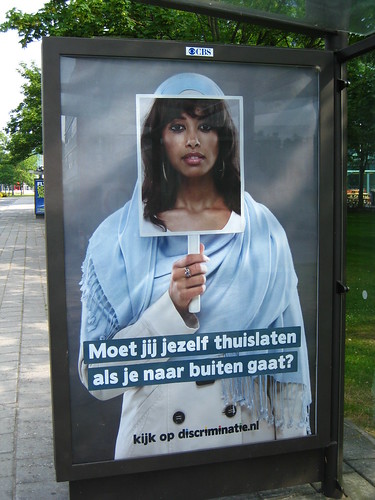
Dutch campaign against discrimination - Uploaded by Niriel on Flickr
Muslimah Media Watch (note to my regular readers: if you still have not checked that site, it is about time you did!) noticed the poster displayed above on Flickr.
Hide No More: Dutch Ad Campaign Targets Discrimination Against Hijabis « Muslimah Media Watch
The poster appears at bus stops, and says “Do you have to let yourself at home when going out?” At first, I was confused by what the poster meant. Was it saying that Muslim women who cover were hiding themselves or that Dutch society was making hijabis leave a part of their selves at home by pressuring them not to cover?
After clicking on the link in the Flickr page where I saw the image of the poster, I concluded it was the latter.[…]Seeing an anti-discrimination ad campaign in the Netherlands featuring a Muslim woman is heartening to say the least, because it shows an attempt to truly embrace the diversity that exists in the Netherlands.
[…]
The second reason why I love this image is because it completely reverses the looker’s expectation of hijab. Instead of the hijab hiding some aspect of the woman, it is society’s pressure for conformity that is making the woman hide an aspect of herself.
According to the website, discriminatie.nl (discrimination) that features the campaign
The Netherlands is a country where no one has to hide their own self. It is a place where no judgement is given about people’s skincolour, handicap, age or sexual preference. Everyone should be able to him/herself and to feel at home. In order to protect that, there are rules we have to abide by. Namely, that everyone in the Netherlands should be treated equally. That discrimination based upon religion, worldview, political conviction, race, gender or on whatever ground, is not allowed. Because in the Netherlands everyone is allowed to show his or hers own self everywhere.
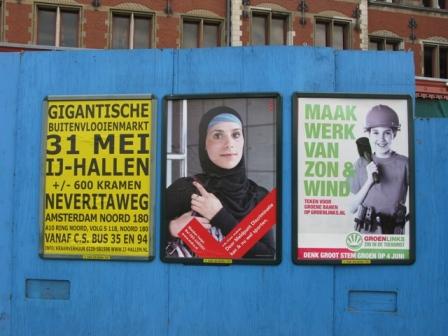
Photo taken by S.
Discriminatie.nl a non-governemental webportal set up by several anti-discrimination offices and funded by the Dutch state. There are more of such campaigns in the Netherlands such as the one as former Canadian blogger S. mentioned to me in an email she send me:
The poster in the middle is from the Discrimination Complaints Office for the Amsterdam Region (Meldpunt Discriminatie Regio Amsterdam -MDRA). The text on left side:
Melden helpt! = Reporting (filing a complaint) helps!
then the phone number and the website
The text on the right side is from 23 year old student Leila:
Door Meldpunt Discriminatie kan ik nu wel sporten – Because of the Discrimination Complaints Office I can play sports now
It refers to incident in Rotterdam (and several other cities) were girls/women were banned from a gym (called Fit for free) because they wanted to wear the headscarf at the gym (which does not mean the girl on the poster was involved although she is not a model dressing up as a Muslim woman – something they do sometimes in commercial ads – but indeed a student from, I think, the Free University Amsterdam). You can read about the issue here. Besides the complaint, this particular incident by the way also resulted in the establishment of a pressure group called Ontsluiert (Unveiled/unveiling also (fig.): reveals) that called for a boycott against the all the local gyms of Fit for free.
Discriminatie.nl is a similar (but national) complaints office. The campaign text of Discriminatie.nl can be seen not only as an attempt to establish or restore the image of a society in which in toleration is part of the national identity, but also as a call to act upon it and resist intolerant actions of people. In that sense the comment at MMW is almost the opposite of the comment at the flickr site where we can find the picture (and to which MMW refers to):
Dutch campaign against discrimination on Flickr – Photo Sharing!
I understood it completely wrong when I saw it first. I thought it meant that you shouldn’t hide yourself under a tent in the middle of summer just because the men of your family have made you believe since before you could read that that was the right thing to do if you happened to be a woman.
Therefore seeing this ad campaign surprised me because I knew that the current Dutch government was a big fan of the “cultural relativism” which leads to accepting the discrimination of women in the muslim culture because not accepting it would be make many muslims very angry. Insulting Islam is now a criminal offense here and we must let it insult us. So I thought, cool, the guys up there are changing their mind !
How naive I was. I went on their website ( discriminatie.nl/ ) and what I read there was in the continuity of this politically correct speech. They’re overdoing it since Geert Wilders’ result at the European elections I guess… (and no, I don’t vote for wilders).
I need to show that to Pat Condell. Here are two pretty good videos he made:
Shame on The Netherlands
[flashvideo filename=http://www.youtube.com/watch?v=EJKRF2uB8xU /]
Ban the Burka
[flashvideo filename=http://www.youtube.com/watch?v=TlkxlzTZc48 /]Now, don’t take me wrong. I don’t care if you’re gay, I don’t care if you’re black, ugly, poor, HIV positive or what have you. But I do care if your beliefs (in things that are proven wrong by the way) lead you to negate my freedom or speech, to indoctrinate children, oppress women and whatnot.
(videos added by me)
It is not the first time such a campaign evokes that type of negative comments. It also happened in a similar campaign in which the Dutch province Overijssel has a picture of a girl (actually living in that province) with a headscarf saying ‘See, the landscape (referring to the ‘typical’ Overijssel landscape) is in you’. Also in commercial campaigns pictures of woman with headscarves sometimes appear. The last one of course an attempt to reach out to a ‘Muslim market’ but as such also an attempt to normalize Muslims and include them in the community of consumers, or in the case of Overijssel include them in the moral community of the people of Overijssel (contrary to treating them as outsiders). Previously I have blogged about those campaigns and the (negative) reactions:
C L O S E R » Blog Archive » The power of images – Muslima ads
In both cases this might lead to a normalization of Muslims in the public landscape and I think a lot of the complaints against the campaigns are complaints against the normalization of Muslims in the public landscape. Some people don’t want Muslims or Islam to be part of the Dutch culture. Muslims do feature in public campaigns for a long time now but usually related to some exotic (halal) product or to some campaign related to integration of migrants or campaigns designed to promote social cohesion and public safety. The fact that they now appear in other type of (commercial) ads might indeed lead to further normalization.
Although these campaigns are not all of the same they do share some of the ambiguity MMW also refers to:
Hide No More: Dutch Ad Campaign Targets Discrimination Against Hijabis « Muslimah Media Watch
The one critique I do have with the ad is that it can be ambiguous, as described in the introductory paragraph of the Flickr post. The ambiguity that can occur looking at the ad for the first time could lead some people to come away with the wrong message such as the idea that hijab is preventing the woman from being herself. This would obviously negate the actual intent of the ad. Still, it is a great ad and positive image of hijabis that is very welcomed.
And both the reaction of MMW and on the Flickr site actually prove that ambiguity and it can also be found on some of the Islam sites in the Netherlands (see Ontdekislam – Dutch). I think it is very difficult to avoid such ambiguity unless you want to be very moralistic which would, I’m afraid, have a very negative effect and provoke even more negative remarks about this multiculti campaign. The ambiguity of course leads to people having different ideas about the interpretation of the campaign, but may also lead to debates as to how interpret it. That could be worth much more than a simple morally clear to do and to don’t list.
Moreover both the campaign text celebrating and stimulating the self image of the Dutch as tolerant and the critique on the campaign by ‘islam-rejectionists’ (for lack of a better word) belong together since they make clear that the Netherlands is in fact not as tolerant as some of wish but that it is also not a place solely occupied by ‘islam-rejectionists’. In a recent PhD study Jacomijn Hofstra (Groningen University) focuses on the perspective of Dutch majority members on immigrants’ acculturation. More precisely, their attitude towards acculturation strategies (integration, assimilation, separation and marginalization) of immigrants is studied. Additionally, the influence of attachment styles on majority members’ attitudes towards these acculturation strategies is examined.
Attaching cultures. The role of attachment styles in explaining majority members’ acculturation attitudes < Home RUG < Rijksuniversiteit Groningen
The data showed that, irrespective of the method of measurement, the phase of life of the respondent, or the cultural background of the immigrant, Dutch majority members prefer immigrants who use the integration strategy (characterized by cultural maintenance and positive relations with the host society), followed by the assimilation, separation and marginalization strategy. Furthermore, people scoring high on secure attachment (characterized by a constructive attitude towards the self and towards others) are more positive about the integrating immigrant. In contrast, the insecure styles (fearful, dismissing, and preoccupied) were either negatively or not related to the attitude towards integration. These styles correlated more strongly with the three other -less beneficial- acculturation strategies.
So, improving people’s level of secure attachment, might lead to a ‘truly’ culturally diverse society which guarantees a safe environment at schools, at work and in neighbourhoods for people with different cultural backgrounds.
At the same time the high scores of ‘islam-rejectionist’ Wilders shows that the ‘islamic issue’ is deeply dividing Dutch society and in a response to that tries to re-invent Dutch identity and with that the notion of tolerance.
The commercial campaigns and the campaign of Overijssel try, as said above, to re-establish the notion of tolerance and to include Muslims in the moral community. This however should not blind us to the fact that tolerance towards Muslims (or others) does not erase oppressive structures in society, the widespread idea that Muslims are still strangers in our midst (after 40 years), or that Muslims are discriminated against or that a secular (or at most a Christian) way of life is the normal way of life and everything else religious is irrational or even dangerous, that our Islam debate is sometimes so vile that some Muslims truly are afraid they will be forced to leave the country sooner or later (sometimes referring to Hirsi Ali as someone who embodied the Dutch ideal of integration, was succesful in her own way but nevertheless stripped of her Dutch identity). In that way the campaign of Discriminatie.nl that is also a complaints office is a step in the right direction. The problem however with these offices is that they do not really seem to work very well. The Amsterdam complaints office for example hears a lot of Moroccan-Dutch youth complaining about discrimination by secondary vocational school (saying that are raising barriers against Moroccan-Dutch youth) but there are no offical complaints (Source Dutch). One of the reasons probably is that these offices are very bureaucratic.
To end this blog, I would like to note (as MMW also makes clear) the campaign is not only about Muslim women who may be discriminated but the whole campaign is aimed against discrimination of gays, women, the handicapped and blacks (migrants). Look at the video belonging to the campaign:
[flashvideo filename=http://www.youtube.com/watch?v=PJ3A7DyPYnE /]